Pacific
Islands
Monthly
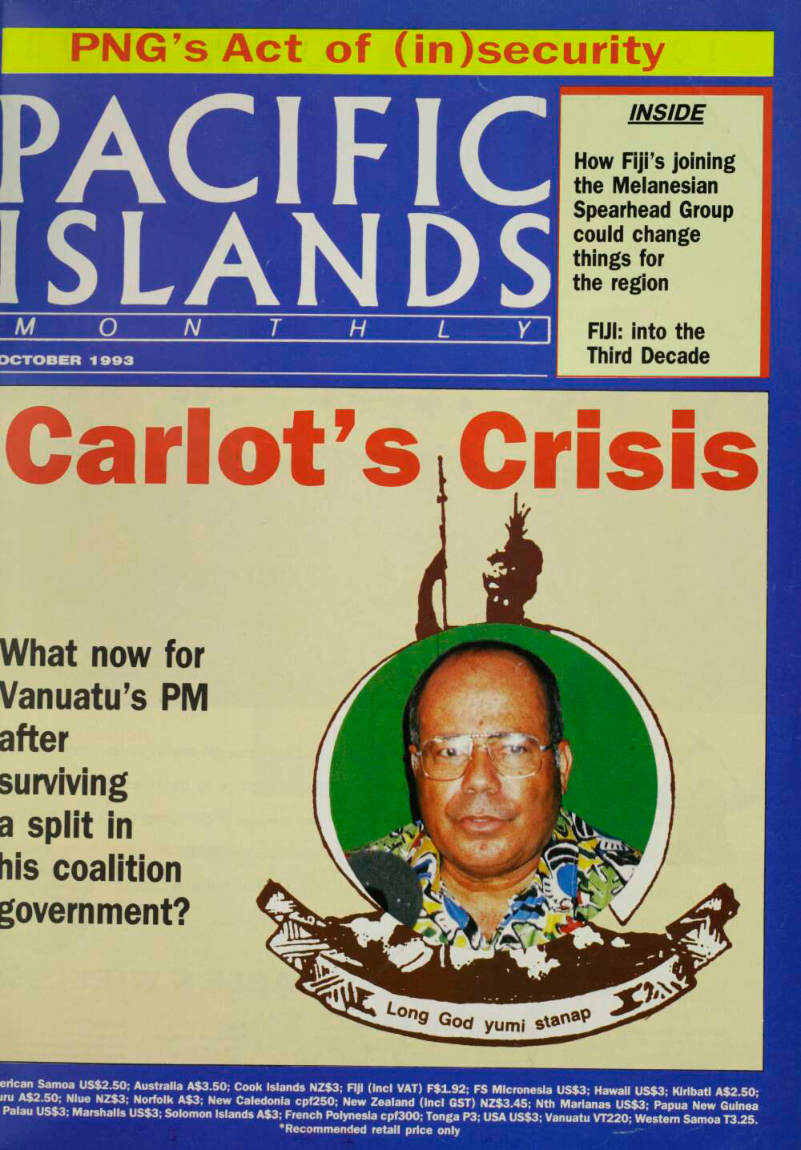
PNG’s Act of (insecurity
Inside
How Fiji’s joining the Melanesian Spearhead Group could change things for the region FIJI: into the Third Decade
October 1993
Carlot’sCrisis
What now for Vanuatu’s PM after surviving a split in his coalition government?
eriean Samoa us s2.so ; Australia A 53.50; Cook Islands NZ$3; FIJI (incl VAT) F 51.92; FS Micronesia US$3; Hawaii US$3; Kiribati A 52.50; *** NeW Caledonla *** New island (Incl GST) NZ53.45; Nth Marianas US$3; Papua New Guinea Palau US$3; Marshalls US$3; Solomon Islands As 3; French Polynesia cpf3oo; Tonga P 3; USA US$3; Vanuatu VT22O; Western Samoa T 3.25. ’Recommended retail price only
Advertisements & other items, p. 2 (1 item)
Cable & Wireless
• Cable and Wireless began keep-
ing people in touch around the
world more than a century ago. Today,
while the technology has changed,
the tradition of service to our customers in the
South Pacific is just the same.
We work in partnership with Governments,
dedicated to meeting the need of communities and businesses to stay in touch. From one island to the next or to the other side of the world, the message is the same: Cable and Wireless is
your South Pacific
connection bringing the
islands together.
CABLE & WIRELESS
Asia Pacific Head Office Cable and Wireless pic Cable and Wireless (Pacific) Limited 22nd Floor Office Tower Convention Plaza 1 Harbour Road Hong Kong Tfel: (852) 848 8620 Facsimile. (852) 868 5195 Fiji In association with the Government of Fiji Fiji International Telecommunications Ltd.
PO. Box 59 Mercury House 158 Victoria Parade Suva Fiji Tel: (679) 312933 Solomon Islands In association with the Government of the Solomon Islands Solomon Telekom Company Limited P.O. Box 148 Honiara Solomon Islands Tel: (677) 21576 Tbnga Cable and Wireless pic Private Mail Bag 4 General Post Office Nuku Alofa Tonga South Pacific Tfel: (676) 23499 Vanuatu In association with the Government of Vanuatu and France Cdbies el Radio Telecom Vanuatu Limited P.O. Box 146 Port Vila Vanuatu Tel: (678) 22185
Pacific
Islands
Monthly
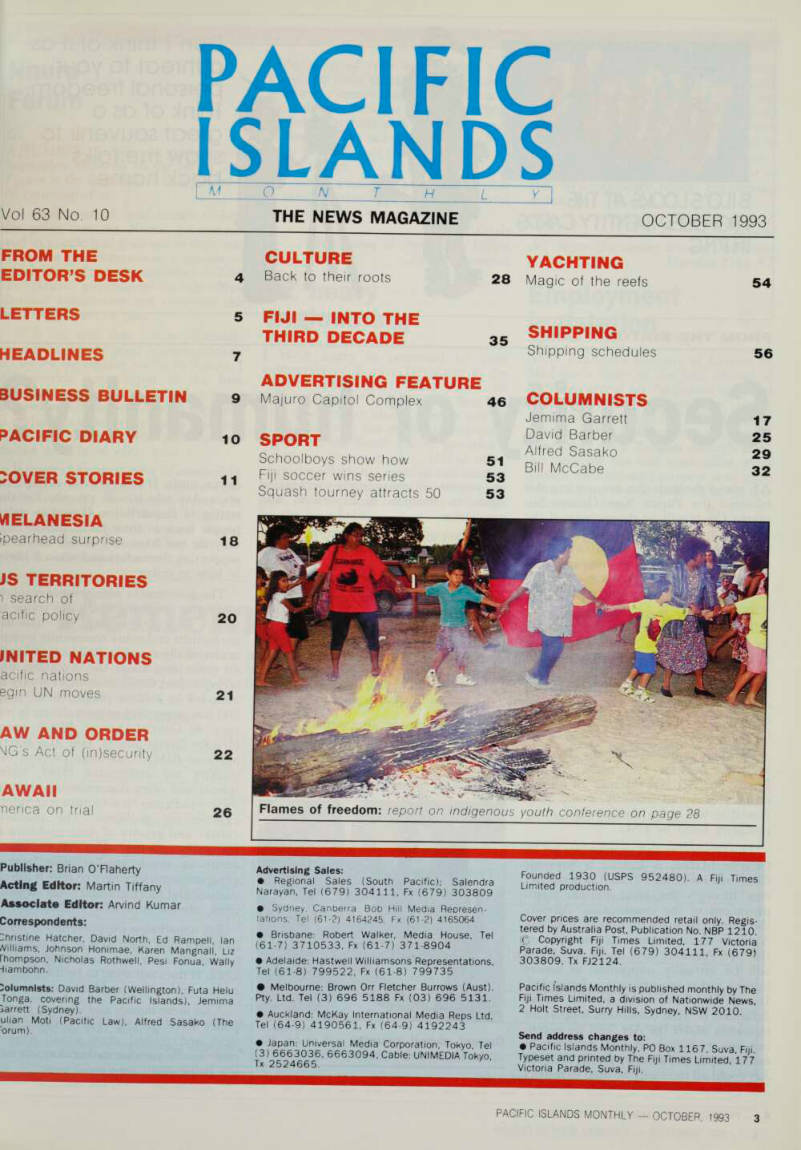
Vol 63 No. 10
The News Magazine
October 1993
From The
Editor’S Desk 4
Letters 5
Headlines 7
Business Bulletin 9
Pacific Diary 10
:Over Stories 11
Melanesia
ipearhead surprise 18
Is Territories
i search of acific policy 20
Inited Nations
acific nations egin UN moves 21
Aw And Order
Act of (in)security 22
Awaii
nerica on trial 26
Culture
Back to their roots 28
Fiji Into The
Third Decade 35
Advertising Feature
Majuro Capitol Complex 46
Sport
Schoolboys show how 51 Fiji soccer wins series 53 Squash tourney attracts 50 53
Yachting
Magic of the reefs 54
Shipping
Shipping schedules 56
Columnists
Jemima Garrett 17 David Barber 25 Alfred Sasako 29 Bill McCabe 32
Publisher: Brian O’Flaherty
Acting Editor: Martin Tiffany
Associate Editor: Arvind Kumar Correspondents: Christine Hatcher, David North, Ed Rampell, lan /Villiams, Johnson Honimae, Karen Mangnall. Liz Fhompson, Nicholas Rothwell, Pesi Fonua, Wally tiambohn.
Columnists: David Barber (Wellington), Futa Helu Tonga, covering the Pacific Islands), Jemima Barrett (Sydney). ulian Moti (Pacific Law), Alfred Sasako (The : orum).
Advertising Sales: • Regional Sales (South Pacific); Salendra Narayan, Tel (679) 304111, Fx (679) 303809 • Sydney. Canberra Bob Hill Media Represen tations. Tel (61-2) 4164245, Fx (61-2) 4165064 • Brisbane: Robert Walker, Media House, Tel (61-7) 3710533, Fx (61-7) 371-8904 • Adelaide: Hastwell Williamsons Representations, Tel (61-8) 799522, Fx (61-8) 799735 • Melbourne; Brown Orr Fletcher Burrows (Aust).
Pty. Ltd. Tel (3) 696 5188 Fx (03) 696 5131. • Auckland: McKay International Media Reps Ltd Tel (64-9) 4190561, Fx (64-9) 4192243 • Japan: Universal Media Corporation, Tokyo, Tel (3) 6663036, 6663094. Cable; UNIMEDIA Tokyo Tx 2524665.
Founded 1930 (USPS 952480). A Fiji Times Limited production.
Cover prices are recommended retail only. Regis tered by Australia Post, Publication No. NBP 1210.
C Copyright Fiji Times Limited, 177 Victoria Parade, Suva. Fiji. Tel (679) 304111, Fx (679)
303809. Tx Fj2124.
Pacific Islands Monthly is published monthly by The Fiji Times Limited, a division of Nationwide News, 2 Holt Street. Surry Hills. Sydney, NSW 2010.
Send address changes to: • Pacific Islands Monthly. PO Box 1167. Suva, Fiji.
Typeset and printed by The Fiji Times Limited, 177 Victoria Parade. Suva, Fiji.
Flames of freedom: report on indigenous youth conference on page 28
Security or humanity?
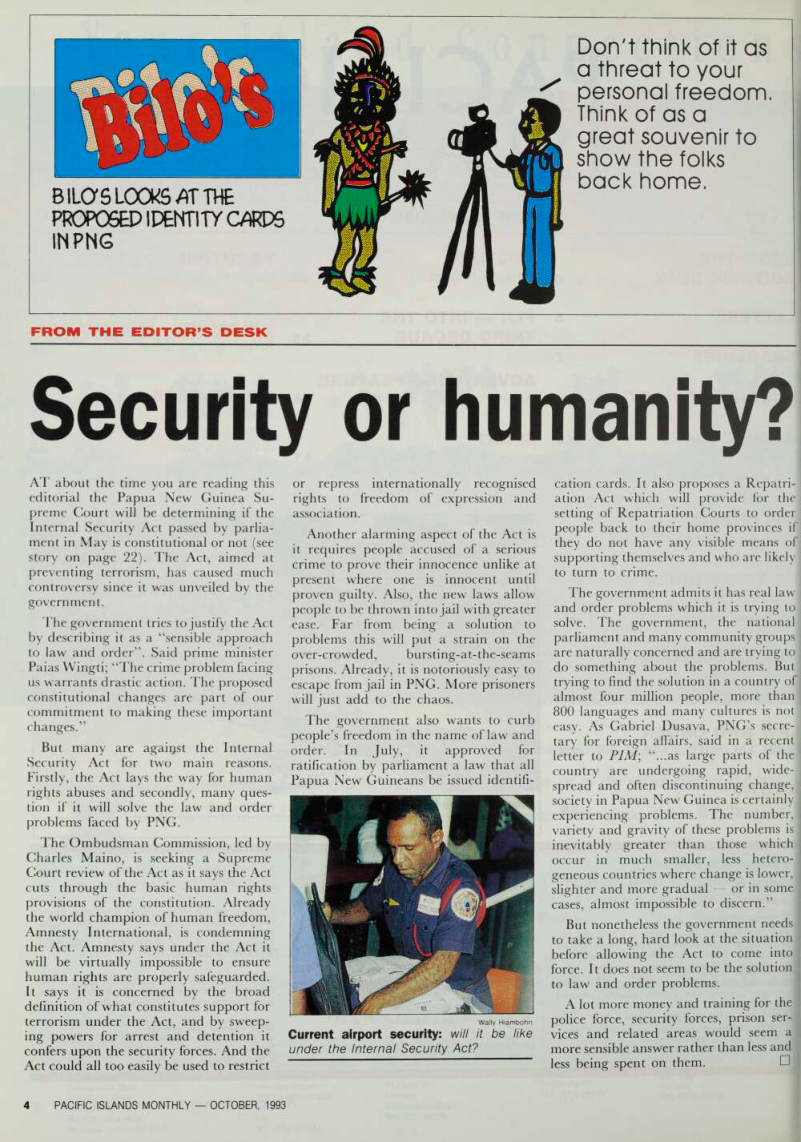
From The Editor’S Desk
AT about the time you are reading this editorial the Papua New Guinea Su preme Court will be determining if the
Internal Security Act passed by parlia
ment in May is constitutional or not (see story on page 22). The Act, aimed at preventing terrorism, has caused much controversy since it was unveiled by the government.
The government tries to justify the Act by describing it as a “sensible approach to law and order”. Said prime minister Paias Wingti; “The crime problem facing us warrants drastic action. The proposed constitutional changes are part of our commitment to making these important changes.”
But many are agairjst the Internal Security Act for two main reasons.
Firstly, the Act lays the way for human rights abuses and secondly, many ques tion if it will solve the law and order problems faced by PNG.
The Ombudsman Commission, led by Charles Maino, is seeking a Supreme Court review of the Act as it says the Act cuts through the basic human rights provisions of the constitution. Already the world champion of human freedom, Amnesty International, is condemning the Act. Amnesty says under the Act it will be virtually impossible to ensure human rights are properly safeguarded.
It says it is concerned by the broad definition of what constitutes support for terrorism under the Act, and by sweep ing powers for arrest and detention it confers upon the security forces. And the Act could all too easily be used to restrict
or repress internationally recognised rights to freedom of expression and association.
Another alarming aspect of the Act is it requires people accused of a serious crime to prove their innocence unlike at present where one is innocent until proven guilty. Also, the new laws allow people to be thrown into jail with greater ease. Far from being a solution to problems this will put a strain on the
over-crowded, bursting-at-the-seams
prisons. Already, it is notoriously easy to escape from jail in PNG. More prisoners will just add to the chaos.
The government also wants to curb people’s freedom in the name of law and order. In July, it approved for ratification by parliament a law that all Papua New Guineans be issued identifi-
cation cards. It also proposes a Repatri ation Act which will provide for the setting of Repatriation Courts to order j people back to their home provinces if they do not have any visible means of supporting themselves and who are likely to turn to crime.
The government admits it has real law and order problems which it is trying to solve. The government, the national parliament and many community groups are naturally concerned and are trying to I do something about the problems. But trying to find the solution in a country of almost four million people, more than 800 languages and many cultures is not I easy. As Gabriel Dusava, PNG’s secre-i tary for foreign affairs, said in a recent letter to PIM; “...as large parts of the country are undergoing rapid, wide- i spread and often discontinuing change, J society in Papua New Guinea is certainly! experiencing problems. The number, I variety and gravity of these problems is inevitably greater than those which occur in much smaller, less hetero-1 geneous countries where change is lower, slighter and more gradual or in some cases, almost impossible to discern.”
But nonetheless the government needs to take a long, hard look at the situation before allowing the Act to come into I force. It does not seem to be the solution ; to law and order problems.
A lot more money and training for the police force, security forces, prison ser- I vices and related areas would seem a more sensible answer rather than less and less being spent on them.
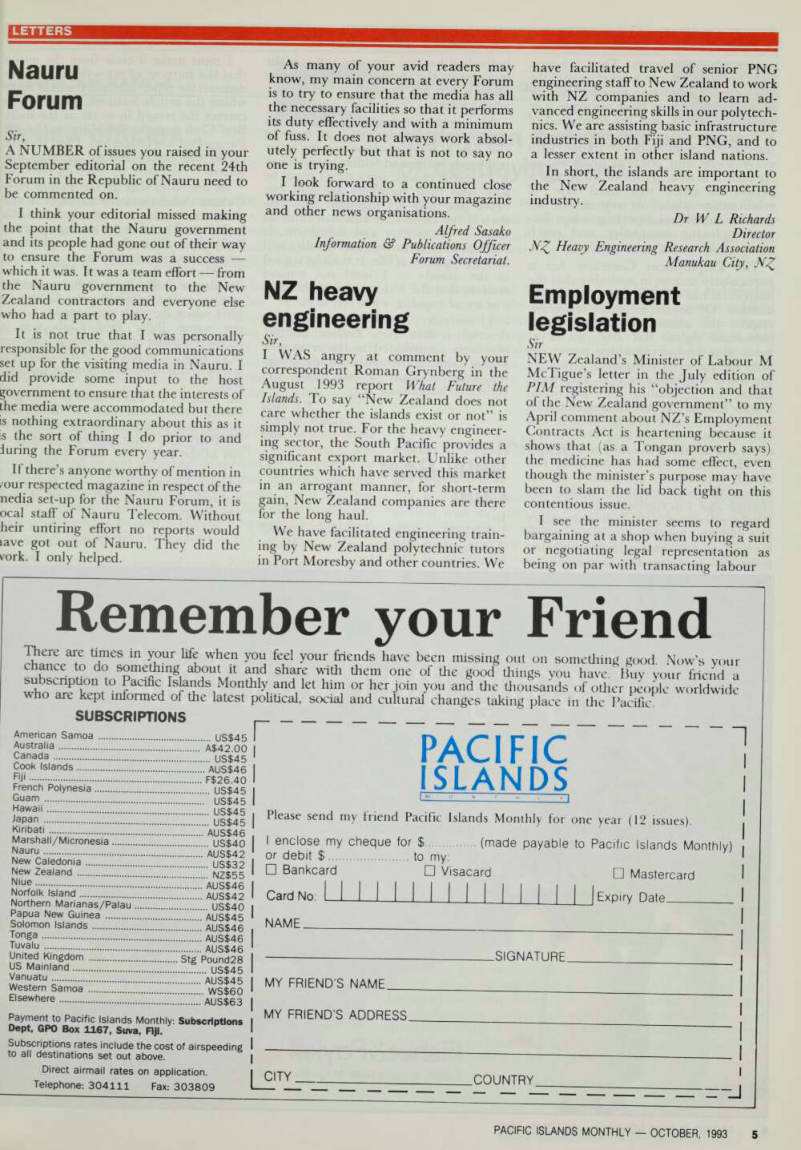
Wally Hiambohn Current airport security: will it be like under the Internal Security Act?
Advertisements & other items, p. 4 (1 item)
B 110’S Looks At The
PROPOSED IDENTITY CARPS
INPNG
Don't think of it as a threat to your personal freedom.
Think of as a great souvenir to show the folks back home.
NZ heavy
Letters
Nauru
Forum
Sir, A NUMBER of issues you raised in your September editorial on the recent 24th Forum in the Republic of Nauru need to be commented on.
I think your editorial missed making the point that the Nauru government and its people had gone out of their way to ensure the Forum was a success which it was. It was a team effort from the Nauru government to the New Zealand contractors and everyone else who had a part to play.
It is not true that I was personally responsible for the good communications set up for the visiting media in Nauru. I did provide some input to the host government to ensure that the interests of the media were accommodated but there is nothing extraordinary about this as it s the sort of thing I do prior to and during the Forum every year.
If there’s anyone worthy of mention in respected magazine in respect of the nedia set-up for the Nauru Forum, it is ocal staff of Nauru Telecom. Without heir untiring effort no reports would lave got out of Nauru. They did the
vork. I only helped.
As many of your avid readers may know, my main concern at every Forum is to try to ensure that the media has all the necessary facilities so that it performs its duty effectively and with a minimum of fuss. It does not always work absol utely perfectly but that is not to say no one is trying.
I look forward to a continued close working relationship with your magazine and other news organisations.
Alfred Sasako
Information & Publications Officer Forum Secretariat.
NZ heavy
engineering
Sir, I WAS angry at comment by your correspondent Roman Grynberg in the August 1993 report What Future the Islands. To say “New Zealand does not care whether the islands exist or not” is simply not true. For the heavy engineer ing sector, the South Pacific provides a significant export market. Unlike other countries which have served this market in an arrogant manner, for short-term gain, New Zealand companies are there for the long haul.
We have facilitated engineering train ing by New Zealand polytechnic tutors in Port Moresby and other countries. We
have facilitated travel of senior PNG engineering staff to New Zealand to work with NZ companies and to learn ad vanced engineering skills in our polytech nics. We are assisting basic infrastructure industries in both Fiji and PNG, and to a lesser extent in other island nations.
In short, the islands are important to the New Zealand heavy engineering
industry.
Dr W L Richards
Director NZ Heavy Engineering Research Association Manukau City, NZ
Employment
legislation
Sir NEW Zealand’s Minister of Labour M McTigue’s letter in the July edition of PIM registering his “objection and that of the New Zealand government” to my April comment about NZ’s Employment Contracts Act is heartening because it shows that (as a Tongan proverb says) the medicine has had some effect, even though the minister’s purpose may have been to slam the lid back tight on this contentious issue.
I see the minister seems to regard bargaining at a shop when buying a suit or negotiating legal representation as being on par with transacting labour
power with employers. They are not.
The first is a simple market event; the second is for a function presided over by an institution whose basic principle is or should be justice. But the third kind of arrangement is apart from the self interest and profit motive fraught with grave social and political implications.
As such it is treacherous to encourage a person to enter this third type of relationship ‘alone’ or represented by another individual especially when fac ing employing companies, and much worse if they are trasnationals.
The Employment Contracts Act is particularly vicious in assuming that the individual has effect in the sociopolitical domain. Of course we must recognise, respect and above all, always protect individual rights. But this can never mean that the individual has power vis a-vis the powerful companies which are the usual employers in NZ. This legis lation, in persuading the individual worker that he has effect and opening the way for him to be just by himself, can only destroy and working class move ment and anything liberal that goes with it. The studies the minister cites, I’m afraid, are lost on me since I do not believe the basic nature of society can change and I accordingly foretell their imminent refutation. It is an elementary fact that any lawyer or politician worth his salt should never forget viz that politically speaking the individual qua
individual has not capacity and it is the movement, the institution, the organis ation which are the real actors in any actual society.
Moreover, when the individual is encouraged at his peril to move in and out, as it were, of unions, the latter will surely suffer and wither away. They will become chaotic since they cannot be sure who their members are and can never put their act together. This law then is the stone that kills two birds at once the worker and the union. It shall stand as a symbol or illiberality and infect all spheres of life. It shall be copied in the islands I need not remind readers that the history of the islands is a story of copying what NZ does.
I, therefore, stand by my original description that “New Zealand in 1991 massively contributed to the erosion of liberal values ... demolished trade union ism and the right of association and collective bargaining”.
I F Helu
Atenisi Institute Tonga
Bully Beef
Club
Sir, I WRITE in respect of a report entitled A Chapter Ends for Pangu written by Wally Hiambohn in PIM May.
I must make it clear from the outset that the purpose of my writing is not to demean the report and the status of those whom the article featured, but rather to correct the record in so far as the Bully Beef Club and the establishment of the Pangu Pati are concerned. I feel obliged to do this before history becomes dis torted.
As one who was at the Papua New Guinea Administrative College at the time, and more importantly, one who had a small hand in the setting up of the Bully Beef Club, I want to place on record the following facts: Sir Michael Somare was NOT a co founder of Bully Beef Club because he was not at the Administrative College in 1964 when the club was started; the name Bully Beef Club was a registered name of the students’ canteen or tuckshop and not a political club as it is now being bandied around by journal ists; the Pangu Pati was created in 1965 as a consequence of the political discussions which often took place on the premises of the Bully Beef Club canteen rather than out of the Bully Beef Club itself.
I would like to urge the writers of contemporary history in the Pacific to research their facts well before putting pen to appear.
W Noel Levi (Cbe)
PNG High Commission London
Advertisements & other items, pp. 5-6 (1 item)
Remember your Friend
t j. mes in >','; >ur ** when y°u fe , el your friends have been missing out on something good. Now’s your chance to do something about it and share with them one of the good things you have. Buy your friend a Pacific Islands andlet him or her join you and the thousands of other people worldwide who are kept informed of the latest political, social and cultural changes taking place in the Pacific.
SUBSCRIPTIONS
American Samoa US$45
Australia “"a542.00
Canada US$45 Cook Islands AUSS46 I F526.40 I French Polynesia US$45 I
S uam . - US$45 I
” awan US$45 ,
£?P an ■ US$45
Kiribati AUSS46 Marshall/Micronesia US$4O I
Nauru . "Z.'"auss42 1
New Caledonia US$32 I New Zealand NZ$55 ' m iu ® ... AUSS46 I Norfolk Island AUSS42 I Northern Marianas/Palau US$4O i Papua New Guinea AUSS4S ' Solomon Islands AUSS46 , J on g a Tuvalu Umted Kingdom Stg Pound2B I US Mainland US$45 I r
PACIFIC
ISLANDS
1 Please send my friend Pacific Islands Monthly for one year (12 issues).
I enclose my cheque for $ (made payable to Pacific Islands Monthly) or debit $ to my: D Bankcard CD Visacard Q Mastercard Card No: Expiry Date.
NAME.
.SIGNATURE.
Vanuatu Western Samoa WS$6O wtlfio I MY FRIEND 'S name.
Elsewhere
AUSS63
Payment to Pacific Islands Monthly: Subscriptions Dept, GPO Box 1167, Suva, FIJI.
MY FRIEND'S ADDRESS.
Subscriptions rates include the cost of airspeeding to all destinations set out above.
Direct airmail rates on application.
Telephone: 304111 Fax: 303809
CITY
COUNTRY
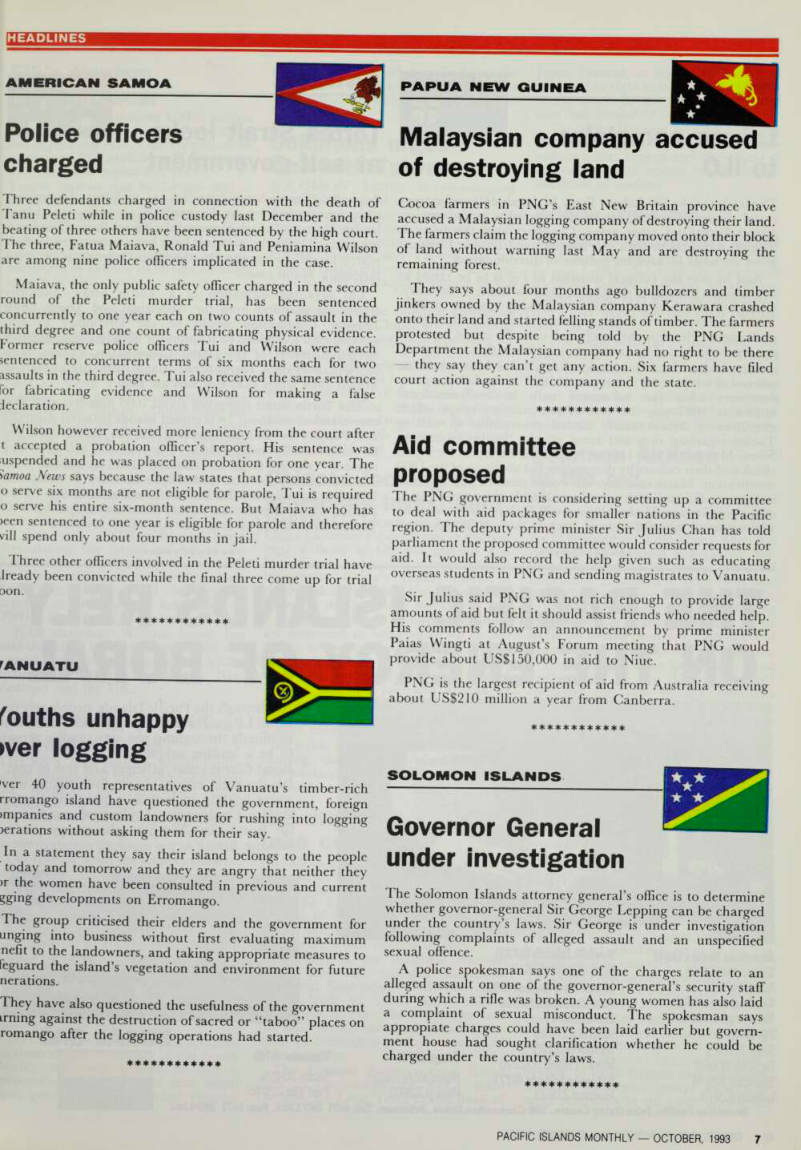
Keeping the Pacific Cool
k * ■ -■ T
charged
Headlines
American Samoa
Police officers charged
Three defendants charged in connection with the death of Tanu Peleti while in police custody last December and the beating of three others have been sentenced by the high court.
The three, Fatua Maiava, Ronald Tui and Peniamina Wilson are among nine police officers implicated in the case.
Maiava, the only public safety officer charged in the second round of the Peleti murder trial, has been sentenced concurrently to one year each on two counts of assault in the third degree and one count of fabricating physical evidence.
Former reserve police officers Tui and Wilson were each sentenced to concurrent terms of six months each for two assaults in the third degree. Tui also received the same sentence for fabricating evidence and Wilson for making a false declaration.
Wilson however received more leniency from the court after t accepted a probation officer’s report. His sentence was uspended and he was placed on probation for one year. The lamoa News says because the law states that persons convicted o serve six months are not eligible for parole, Tui is required o serve his entire six-month sentence. But Maiava who has >een sentenced to one year is eligible for parole and therefore vill spend only about four months in jail.
Three other officers involved in the Peleti murder trial have Iready been convicted while the final three come up for trial oon.
>ver logging
Anuatu
Souths unhappy >ver logging
'ver 40 youth representatives of Vanuatu’s timber-rich rromango island have questioned the government, foreign unpanies and custom landowners for rushing into logging )erations without asking them for their say.
In a statement they say their island belongs to the people today and tomorrow and they are angry that neither they >r the women have been consulted in previous and current
?ging developments on Erromango.
The group criticised their elders and the government for unging into business without first evaluating maximum nefit to the landowners, and taking appropriate measures to reguard the island’s vegetation and environment for future nerations.
They have also questioned the usefulness of the government irning against the destruction of sacred or “taboo” places on romango after the logging operations had started.
proposed
Papua New Guinea
Malaysian company accused
of destroying land
Cocoa farmers in PNG’s East New Britain province have accused a Malaysian logging company of destroying their land.
The farmers claim the logging company moved onto their block of land without warning last May and are destroying the
remaining forest.
They says about four months ago bulldozers and timber jinkers owned by the Malaysian company Kerawara crashed onto their land and started felling stands of timber. The farmers protested but despite being told by the PNG Lands Department the Malaysian company had no right to be there they say they can’t get any action. Six farmers have filed court action against the company and the state. ***
Aid committee
proposed
The PNG government is considering setting up a committee to deal with aid packages for smaller nations in the Pacific region. The deputy prime minister Sir Julius Chan has told parliament the proposed committee would consider requests for aid. It would also record the help given such as educating overseas students in PNG and sending magistrates to Vanuatu.
Sir Julius said PNG was not rich enough to provide large amounts of aid but felt it should assist friends who needed help.
His comments follow an announcement by prime minister Paias Wingti at August’s Forum meeting that PNG would provide about US$ 150,000 in aid to Niue.
PNG is the largest recipient of aid from Australia receiving about US$2lO million a year from Canberra.
under investigation
Solomon Islands
Governor General under investigation
The Solomon Islands attorney general’s office is to determine whether governor-general Sir George Lepping can be charged under the country’s laws. Sir George is under investigation following complaints of alleged assault and an unspecified sexual offence.
A police spokesman says one of the charges relate to an alleged assault on one of the governor-general’s security staff during which a rifle was broken. A young women has also laid a complaint of sexual misconduct. The spokesman says appropiate charges could have been laid earlier but govern ment house had sought clarification whether he could be charged under the country’s laws.
Labour complains
Fiji
Labour complains to ILO
The leader of the Fiji Labour Party Mahendra Chaudhry says racial discrimination is rife in the country’s public service, armed forces and other areas. Chaudhry says the party is lodging a complaint with the International Labour Organis ation on what he says are policies of discrimination.
And he says the political situation in Fiji is to be raised at September’s meeting of the United Nations General Assembly.
Chaudhry also says a resolution expressing concern at Fiji’s 1990 constitution is being sponsored in the European parliament. He says the resolution calls for trade and aid concesions to be tied to a satisfactory review of the constitution.
Meanwhile, the Fijian nationalist Taukei Movement has warned of a repeat of “the events of 1987” if the Labour party continues what the movement calls its confrontational approach. 1987 was the year of two military coups which overthrew a democratically elected government as well as Taukei-organised riots and arson attacks. Taukei spokesman Sikovi Matenaniu says Labour has shown disrespect for Fijian chiefs and their culture by demanding the abolition of the 1990 constitution. Matenaniu says the coups restored the rights of indigenous Fijians which were formalised in the promulgation of the constitution. He says Fijians will declare war on anyone who wants to take the country back to the way things were.
at self-government
Australia
Torres Strait looks at self-government
Australia’s Torres Strait Islanders are confident of forming a self-governing territory by the year 2001, according to an island leader. Gaetano Lui, chairman of the Torres Strait Coordinat ing Council, says the islanders have been encouraged in their search for self-government by the High Court decision in the landmaik Mabo case.
Lui says the formation of a Torres Strait Authority separating islanders from the Aboriginal and Torres Strait Islander Commission would be the forerunner to self government. Lui added he is optimistic islanders would replace elected members of the Island Coordinating Council with reprsentatives on a Torres Strait Island Authority as early as March 1994 when ICC elections are due.
The Torres Strait comprises about 7000 islanders and 2000 non-islanders on about 14 occupied islands between Australia and Papua New Guinea. Agreeing that the islands could not be economically independent, Lui says the self-governing territory would forge a bilateral aid agreement with Australia,similar to that with PNG. He says Torres Strait Islanders have looked for models of self-government in the Pacific, where lifestyle and culture are more compatible with Torres Strait islanders than was Australian society.
Advertisements & other items, p. 8 (1 item)
The Pacific Islands Rely
ON THE ENERGY OF BORAL
U" % & American Samoa (684) Tafuna 699 2948 Aua 6442170 Cook islands (682) Rarotonga 24460 Ffti (679) Suva 315522 Lautoka 60088 Sigatoka 50578 Labasa 82973 Norfolk Islands (6723) Norfolk Island 2419 Papua New Guinea (675) Port Moresby 214248 Lae 422574 Rabaul 921225 Wewak 862125 Mount Hagen 551216 Solomon Islands (677) Honiara 21833 All through the Pacific Islands, people rely on Boral LP gas for their energy needs. Boral has terminals throughout the area, and is proud to be a leading supplier.
Boral Gas is clean, efficient and low in cost.
It’s the ideal energy source for cooking and water heating in homes, motels and hotels, and for a wide range of industrial uses. So call for Boral Gas. We have the energy you’re
looking for.
Tonga (676) Nukualofa 24035 Vava’u 22903 Vanoata (678) Santo 36455 Port Vila 22046
BORAL GAS
Boral Gas Pacific, John Oxley Centre, 339 Coronation Drive, Brisbane. Tel: (07) 3671365. Fax: (07) 3694347
lending services
Business Bulletin
Fiji’s tourism
earnings soar
FIJI earned an estimated US$52 million from tourism in the three months to the end of June this year. This represented an increase of $5.3 million or 11.3 per cent over the same period last year.
Tourist arrivals rose by 7.4 per cent to 66,358 during the quarter compared with last year which was 62,263, Tourism has continued to be Fiji’s major foreign exchange earner since 1989. However, long dominant sugar exports are still important as more of its foreign earnings remain in Fiji.
Church buys
bank shares
THE sale of National Australia Bank’s 87 Eer cent stake in Papua New Guinea’s ank of South Pacific Ltd to a local Catholic Church-led consortium was finalised late August. Announcing the completion of the $11.3 million acqui sition by National Investment Holdings Ltd (NIH), chairman Alfred Daniel said the transition would be smooth with no disruption to the bank’s operations.
He said National Australia Bank’s (NAB) Noel Smith would remain man aging director of the bank until the end of next year. “NIH will now begin formulating the future policies of the bank with emphasis on how the nation’s
first nationally-owned private sector
bank can improve and broaden its services to business and individuals in PNG,” Daniel said in a statement.
NAB chairman William Irvine has said the sale of Bank of South Pacific was agreed as it was peripheral to NAB’s mainstream activities in Australia, New Zealand and the UK.
Continental pullout
to help islands?
FHERE’S hope among South Pacific sland nations that they will benefit from Be decision by American airline Clontinetal to cancel all services to Australia and New Zealand. Continental s also terminating all airfare and iccommodation packages out of Austra ia to Hawaii when the services cease on October 30.
Marketing director of the Fiji Visitors Jureau Bill Whiting said Fiji would lefinitely benefit from the end of the Continental services. He said cheap >ackage tours to Hawaii from Australia lad presented a tough challenge to ourist destinations in the South Pacific.
Vhiting said other airlines could move ito the Australia/Hawaii market but did ot believe they would copy the loss laking fares of recent times.
He said Fiji, with 50 per cent of tourist ccommodation available in the South ’acific, was well placed to win a foportion of the business that might ave gone to Hawaii. Other regional
nations which could benefit from the Continental move include Vanuatu, the Cook Islands, French Polynesia and New Caledonia.
Solomons urges
ties with Taiwan
SOLOMON Islands is encouraging other Pacific island countries to look to Taiwan for economic assistance and trade. Solomon Islands deputy prime minister and foreign affairs minister Francis Saemala says Taiwan has be come a major economic power and has a lot to offer developing nations in the region.
Saemala says the political differences between the two Chinas are an internal matter for them and there’s no need for Pacific countries to get involved.
Saemala said Taiwan had expressed willingness to assist in the establishment of the University of the South Pacific’s School of Marine Study in Solomon Islands. Solomon Islands has full diplo matic relations with Taiwan along with Nauru, Tonga and Tuvalu.
Chinese looking at
Marshalls investment
MARSHALL Islands ambassador to China Laurence Edwards said in the past year a flood of Chinese officials and businessmen had looked at investment in his country. China’s primary interest in the Marshall Islands is the free access it enjoys to the American market.
Edwards says two groups from China are interested in bringing in up to 100 fishing boats. And he says a group from Hainan has plans to establish an indus trial park with factories for canned coconut, pandanus juice and fish meal as well as business, recreation and other facilities. Another group wants to set up a joint venture brewery.
Edwards says once these are up and running, the Marshall Islands will be able to stand on its own feet with a non artificial economy.
EIE creditors
take control
CREDITORS of the Japanese company EIE International Corporation have taken control of the company’s assets in Fiji. The EIE properties include The
Regent of Fiji Resort, Sheraton Fiji
Resort and the adjoining championship golf course which opened in June.
A report in the Australian Financial Review said the troubled Electronic Industrial Enterprises (EIE) had com mitted itself to about $2OO million investment in Fiji. The newspaper said the bulk of this sum had already been spent in developing a major resort and
hotel complex.
The Financial Review quoted Keigo Fujii, a spokesman for ElE’s main creditor, the Long Term Credit Bank of
Japan Limited, as saying the bank had exercised its right to take up voting rights in the shares in the Fiji company and now had control of the project.
The move, however, will not have any immediate effect on work on the multi million dollar project and operations of the two popular resorts which employ hundreds of workers.
Winds, rain hit
Tonga’s pumpkin crop
IN Tonga, strong winds and heavy rain in mid-August damaged the kingdom’s
lucrative squash pumpkin plantations.
Radio Tonga said medium-sized plants five to six weeks old had been particu larly badly hit.
The radio said the current crop had also been hit by a fungus which attacks squash plants. It says revenue from squash exports is likely to be down this year. Tonga has rapidly built a squash pumpkin market in Japan and now earns millions of dollars a year from exports.
Solomon Airlines
in the red
AN exchange of words between the Solomon Islands minister of finance Andrew Nori and former finance minis ter Christopher Columbus Abe has revealed the national flag carrier Sol omon Airlines is in senous financial difficulties. A statement from Nori said the airline was more than three months in arrears on lease payments of its Boeing 737-400 and is facing repossesion of the jet by the leasing company, International Lease Finance Corporation of California.
His statement came in response to an earlier claim by Abe that cabinet had endorsed the new finance minister’s intention to borrow US$l.3 million to help the airline out of its troubles. But the present minister has rejected the possi bility of looking for domestic loan financing saying loans should be nego tiated by the airlines legal owner, Investment Corporation of Solomon Islands or the airline itself.
Nori said the last government made a serious mistake when it decided to lease overseas jets.
Bank to upgrade
lending services
THE Tonga Development Bank has launched a major project to upgrade lending and banking services to the people of the kingdom’s outer islands.
The project will be implemented over the next five years at a total cost of US$6.6 million. It is being funded jointly by the development bank and the International Fund for Agricultural Development. The major part of the project is a credit line of U 54.4 million to finance the bank’s lending to small farmers and fishermen, women’s and other groups as well as small businesses in the outer islands. □
Advertisements & other items, p. 10 (1 item)
Ela Motors
I Ci»«
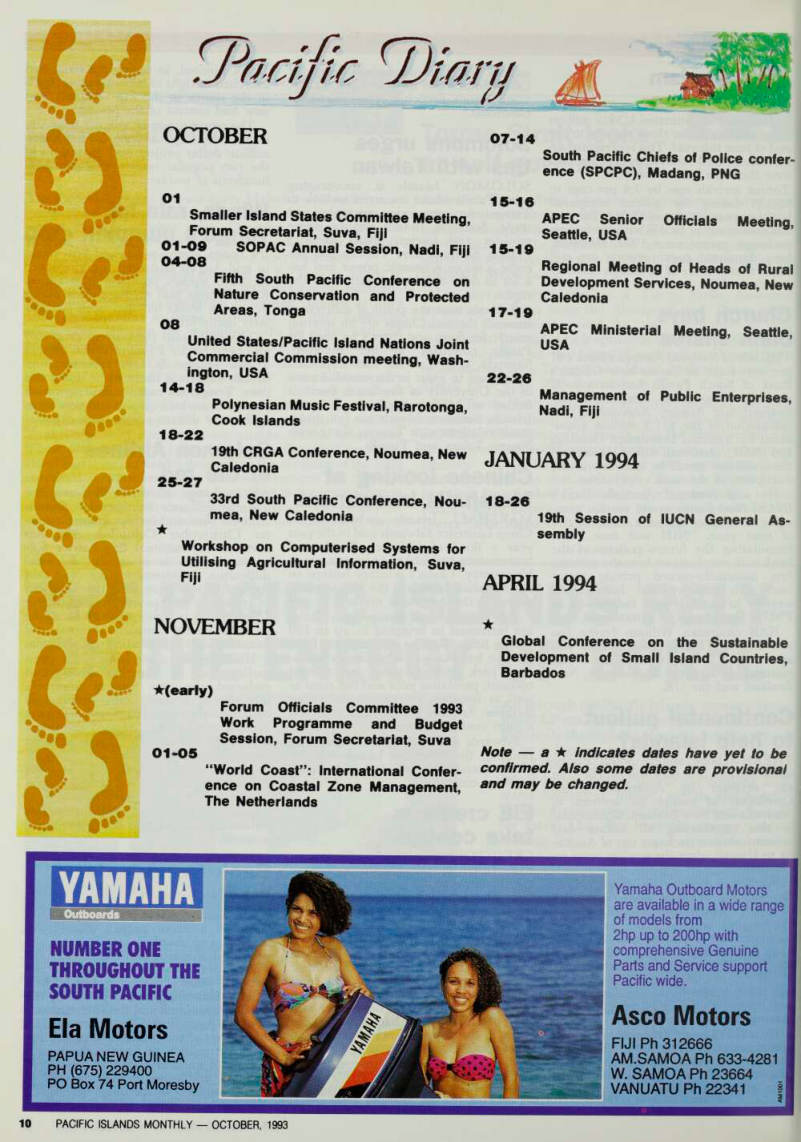
OCTOBER
01 Smaller Island States Committee Meeting, Forum Secretariat, Suva, Fiji 01-09 SOPAC Annual Session, Nadi, Fiji 04-08 Fifth South Pacific Conference on Nature Conservation and Protected Areas, Tonga 08 07-14 15-16 15-19 17-19 n United States/Pacific Island Nations Joint Commercial Commission meeting, Washington, USA 14-18 Polynesian Music Festival, Rarotonga, Cook Islands 18-22 >- South Pacific Chiefs of Police conference (SPCPC), Madang, PNG APEC Senior Officials Meeting, Seattle, USA Regional Meeting of Heads of Rural Development Services, Noumea, New Caledonia APEC Ministerial Meeting, Seattle,
USA
Management of Public Enterprises, Nadi, Fiji I* £ 0 h* n %. & 19th CRGA Conference, Noumea, New Caledonia 25-27 33rd South Pacific Conference, Noumea, New Caledonia ★ Workshop on Computerised Systems for Utilising Agricultural Information, Suva, Fiji
NOVEMBER
*(early) Forum Officials Committee 1993 Work Programme and Budget Session, Forum Secretariat, Suva 01-05 “World Coast”: International Conference on Coastal Zone Management, The Netherlands
JANUARY 1994
18-26 19th Session of lUCN General Assembly
APRIL 1994
Global Conference on the Sustainable Development of Small Island Countries, Barbados Note a ★ indicates dates have yet to be confirmed. Also some dates are provisional and may be changed.
Outboards
NUMBER ONI
THROUGHOUT THE
SOUTH PACIFIC
Ela Motors
PAPUA NEW GUINEA
PH (675) 229400 PO Box 74 Port Moresby - ' : Yamaha Outboard Motors are available in a wide range of models from 2hp up to 200 hp with comprehensive Genuine Parts and Service support Pacific wide.
Asco Motors
FIJI Ph 312666
AM.SAMOA Ph 633-4281
W. SAMOA Ph 23664
VANUATU Ph 22341
By Craig Skehan
Cover Stories
A LOOMING stalemate over the ap pointment in Vanuatu of a new head of state could be used to force early national elections, according to legal advice provided to opposition political parties.
And in any event, relative stability since 1991 elections has been eroded by recent defections from Prime Minister Carlot Korman’s ruling coalition.
The next poll is not due until late 1995.
However, opposition Vanua’aku Pati secretary general Sela Molisa says that in the interests of “stability”, the country can’t afford to wait that long. “We have a crisis coming up,” he said. Vanuatu’s politics were spotlighted in late August through premature reports that Maxime Carlot Korman’s ruling coalition had collapsed. In fact, Carlot Korman sur vived a spilt in his junior coaltion partner, former prime minister Walter Lini’s National United Party (NUP) retaining 24 seats in Vanuatu’s 46-seat parliament.
But the prime minister went from a position of seeming strength to one of inherent weakness. In early August, Lini demanded that Carlot Korman remove four NUP ministers who had become increasingly estranged from their own party. However, Korman only sacked one of them. Lini’s sister, Hilda (who was playing a negotiating role on behalf of her brother), and appointed NUP back bencher Robert Karie as agriculture minister.
Lini reportedly wanted to be deputy 3rime minister and minister for justice in i new line-up. When parliament esumed on August 23, Lini moved off he government bences with five NUP mlleagues, including Hilda and Karie. harlot Korman responded to a claim by -ini that he had been “provocative” •ver the reshuffle issue by stating that the >ulk of the provocation had come from he Lini camp.
With Lini’s group claiming a “centrist’ ole the official opposition is comprised of /IPs from the Vanuaku Pati, the
Melanesian Progressive Party (MPP),
Jagriamel and Tan Union. On Septem ber 12, it became public that Carlot korman had lured opposition Vanua’ku ati MP Thomas Faratia to the govern icnt side. Opposition officials said that aratia went temporarily into hiding ecause angry Vanua’ku Pati supporters ere out looking for him. The defection nproved Carlot Korman’s parliamen ts position for the tiime being at least.
But the need to replace the country’s sad of state, President Frederick imakata, has thrown a wildcard into anuatu politics. The four-year presi sntial term of Timakata, who has been eated for a serious illness reported to be ukemia, expires in February next year.
looms?
Fresh poll looms?
The need to replace President Tima kata has thrown a wildcard into Vanuatu politics
To elect a new presi dent requires a two thirds majority vote of an electoral colleague comprised of all Mem bers of Parliament and representatives of local government councils.
Carlot Korman has said that, on the basis of an earlier agree ment, he stood ready to nominate Lini as president. However, such a proposition is like a red rag to a bull as far Lini’s former colleagues-turned-foes in the Vanua’ku Pati are concerned. “He is
not acceptable,”
Melisa said. “Even be fore NUP was split it was short of the two thirds majority in the electoral college which
is required. “Our legal
advice is that if a new head of state cannot be
elected, parliament
has to be dissolved and new elections held.”
The Vanua’ku Pati has said it was willing to consider joining the UMP to form a new government without
either of the NUP factions. But Melisa said such a coalition would only be acceptable if it was for the purpose of preparing for early national elections.
Melisa said even if the government
reduced the number of local councils in order to gerrymander the electoral college, it was still unlikely to se cure the majority mar gin it needed to choose a new president.
He maintained that, however the goal was achieved, new elections would be “stabilising” for Vanuatu because there was currently a deep-seated paralysis in government decision making. To understand the current situation, it is necessary to look back at series of schisms which have dominated Vanu atu’s politics since the days of joint British/ French condominium colonial rule. At inde pendence in 1980, Lini moved further away from his past as an Anglican minister to preside over a long period of dominance by the Anglophone Vanua’aku Pati.
Lini ushered in a new brand of nationalistic “Melanesian socialism,
supporting liberation
struggles in various parts of the world and attack ing remaining pockets of French colonialism in the Pacific. The
Francophone UMP,
which accused the gov ernment of being too leftish, languished in the political cold. By 1988, tensions had built-up within the Vanua’ku Pati, partly over the
question of succession to Lini. Firebrand politician Barak Sope split with Lini to form the MPP in the wake of bitter in fighting linked to disputes over tra ditional claims to urban land.
Rival: Lini
President: Timakata
PM: Carlot Korman
In 1991, there was a second split, as detractors of Lini led by past party stalwarts Donald Kalpokas and Melisa won a legal battle for control of the Vanua’ku Pad. Lini, despite health problems and alienation from many former political comrades, stormed off to form NUP. It was this bitter in-fighting which helped Carlot Korman’s UMP
secure an election victory in December of that year. Machiavellian manoeuvring led to the formation of the post-election coalition between NUP and UMP but Lini himself took a back-seat role outside the ministry. Things went fairly smoothly for a while, then problems started. Carlot Korman has had difficulties with internal aspirants for his job, including ministers
Willie Jimmy and Serge Vohor.
And frictions developed between Lini and several of the NUP ministers over various government decisions, some of them said to have adversely affected various business interests. The ramifi cations of the latest political twist include the possibility of a court battle for control of NUP, mirroring what happened two years ago with the Vanua’ku Pad. Firm predictions are hard to make about Vanua’ku politics because there are so many variable, including double-crosses and pay-backs. But the bottom line is that pre-occupation with politicking tends to divert much needed attention from important social and development issues facing the country.
Political uncertainty also makes it harder for honest decision makers to bring into line, or sack, politicians and officials who might wish to corruptly pursue their own financial rather than national interest. • Attempts over five days to get comment from the Vanuatu government on the political situiation were unsuc~ cessful. Senior officials in the prime minister’s office did not return calls, □
Parliament: in session in 1991 when Lni was PM
Deals under scrutiny
By Craig Skehan
IN the rural areas of Vanuatu’s 80-odd scattered islands, there is not a lot money floating around but in the picturesque capital of Port Vila it is quite a different matter. While a handful of locals are regulars at the casino of the Radisson Royal Palms Resort, others prefer to stick to business wheeling and dealing.
But some of the deals, made in the shadows and allegedly overlapping with the interests of people in positions of public trust, are coming under scrutiny.
In February this year, a commission of inquiry was given terms of reference covering matters ranging from the prices paid by government bodies for various buildings to the sale of government equipment and the awarding of tenders.
The head of the inquiry is Clarence Marae. He is a law graduate from the University of Papua New Guinea, but not admitted to the Vanuatu Bar. Marae had his own problems back in 1989 when he was convicted of accepting a bribe from an Asian logging company and fined. He says he accepted a loan from the company involved and that this was found to be a technical breach of the law.
“That was in the past but I don’t have anything to hide. In my view I didn’t do anything wrong,” he told PIM.
In any event, Marae says he is now
enthusiastic about tackling corruption
and irregularities in official decision making. Marae has so far handed to deputy prime minister and Minister for Justice Sethy Regenvanu an interim report and two final reports. They are expected to be tabled in parliament in November or December. The reports cover purchase by the Vanuatu National
Provident Fund of Moore Stephens’
House in Port Vila and allegations that politicians in the pre-1991 government of Walter Lini got personal loans from the Asian Development Bank (ADB). It is understood that Marae had recom mended prosecutions One term of reference on land sales involves former minister Barak Sope
Port Vila: one of the upper class residential areas in the capital
who is now an opposition MP. Others relate to government purchases of stevedoring equipment from local Dinh Van Than business family interests, 1978 government losses in relation to a Hong Kong company’s involvement with Air Vanuatu, alleged irregularities involving European Community agricultural subsidies, shipping deals, and land pur chases by the Vanuatu Development Bank. Marae says that prime minister Carlot Korman recently gave him some additional terms of reference involving other transactions and he now expects his inquiry to run until at least September of next year.
The big question is whether wrong doers will be charged, allowing the courts to fulfil their function of protecting the public by dispensing justice. If both sides throw mud then agree to a trade-off whitewash, not much will have been achieved. Marae says he can only recommend that charges be laid, as the office of public prosecutions has the final say. He believes that it’s time to make use of an existing unexercised provision of Vanuatu’s constitution allowing for the appointment of an ombudsman. “My view is that some of these types of cases could, and should, be handled by an ombudsman,” he said.
On another front, there is the perplex ing story of plans by Vanuatu treasurer Willie Jimmy to raise US$2OOO million (two billion) foreign loan. Vanuatu’s annual government budget is about US$5O million.
The Australian Waratah Group has dready been paid U 5575,000 by the
Vanuatu finance ministry as a brokerage
In Vanuatu, a corruption commission of inquiry has presented finalised reports on 2 specific terms of reference, recommending prosecution in one of the cases
fee for the claimed loan. According to correspondence already exchanged, the huge sum would be delivered by a firm called Hannes Lenz Gesmbh and Co, which is based in the Philippines capital, Manila. A letter signed by Jimmy nominates three Vanuatu Government officials Harry Collins, Wreath Buie and Edward Bani as being authorised to carry out loan raising negotiations.
All three men have been seen in Suva, Fiji, where they have apparently held meetings with representatives of the Waratah Group. Another letter from the finance minister dated June 1, 1993 and addressed to Peter Johnston and Allan Bristow of the Waratah Group states; “Please accept this letter of appointment as your legal mandate to represent the Ministry of Finance, government of Vanuatu, in the effort to syndicate US$2 billion to facilitate a loan for the development of projects in our country”.
The letter stated the money would be used for housing, power generation, oil refineries, telecommunications, agricul tural projects and health programs.
According to Helen Fraser’s Canberra-based Pacific Report newsletter, Peter Johnston on behalf of Waratah said Vanuatu would not be obliged to take up the whole loan and that a reinvestment package would be pro posed. Fraser said Vanuatu had been told it would be paying a variable interest rate of around four to six per cent on the borrowed money but would receive 15 per cent on reinvested funds.
Waratah maintains that the money available for lending consists of “good clean funds which have been cleared via world banking sources” and that Citißank is part of the transaction chain.
According to other documents, the alleged Philippines lender linked success ful conclusion of the loan to being given first right of refusal on oil and mineral exjploration as well as fishing, timber and infrastructure projects. Sceptics wonder whether large scale loan funds will come through at all. They note that if negotiations break down, the U 5575,000 brokerage fee already paid will be lost. In other parts of the Pacific in recent years, there nave been a number of cases of big foreign loans being offered to govern ments. But in many instances, the deals looked like a ploy by scheme operators to get up-front money then disappear.
Many people in the Vanuatu finance ministry have heard local stories about huge transfers of funds. After all, Vanu atu is a long-established tax haven and financial centre used by international money men. Maybe this has helped to foster a new political cargo cult which believes wealth can wash up on your shores if you have the right connections. □
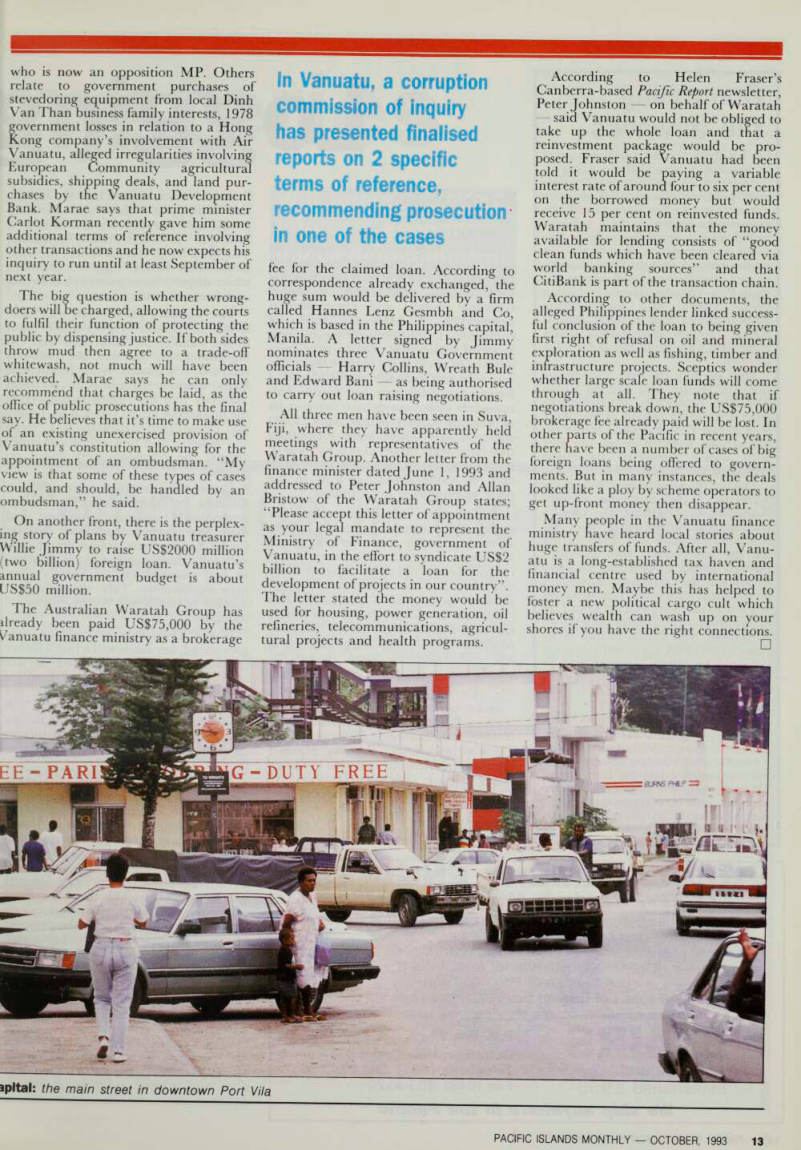
apital: the main street in downtown Port Vila
Controlling
the airwaves
OVER the years, there has been a sort of censorship musical chairs going on in relation to government controls over political reporting of sensitive subjects by Radio Vanuatu. While government-owned, the national broadcaster is supposed to have edi torial endependence. But as the old saying goes, truth is the first causualty of war. So when political battles hot up in Port Vila, directives start hitting the desks of long-suffering amdinistrators and editorial staff at Radio Vanuatu headquarters, which is perched on a small hill at the edge of town.
Back on July 10, 1991, then prime minister Walter Lini banned Radio Vanuatu broadcasts of statements from a dissident faction of his ruling Vanua’aku Pati. Regional media or ganisations weighed-in on the row with widely circulated statements criticising the action.
During the latest power struggle in Vanuatu, in which prime minister Korman was battling to keep a parliamentary majority, the boot was firmly on the other foot. Lini, having left the government with five sup porters, found himself cut off from access to the airwaves. Korman’s government instructed Radio Vanu atu not to carry statements from Lini or his group or to conduct interviews with them. The Pacific Islands News Association (PINA) reacted by saying it would be sad if Vanuatu had to revert to post media freedom restric tions which had tarnished the country’s reputation.
The leader of Vanuatu’s opposition
Vanua’aku Party, Donald Kalpokas,
told PIM that restrictions on Radio
Vanuatu were aflecting'all opposition
parties, and not just the Lini group. *‘When we issue a statement, we are lucky if a little bit of it gets on the air,”
Kalpokas said. “Anything which is sensitive seems to be cut.” □
Logging/steries
By Craig Skehan
A GOOD deal of mystery surrounds plans for a huge increase in logging on some of Vanuatu’s remote islands. And this comes at a time of increased regional focus on an urgent need to avoid economic pitfalls and environmental degradation. A Malaysian group of companies, Delta/Premier/Parklane, was reported earlier this year to have been authorised to cut more than 70,000 cubic metres of logs annually on the islands of Erromango, Malekyla and Santo. This compares with a current cut per year by all existing loggers of less than 25,000 cubic metres. There were suggestions that large-scale export of raw logs was to be allowed, overturning previous insist ence on value-adding, at least to the point of producing sawn timber.
While the Delta/Premier/Parklane group had reputedly signed logging agreements with anumber of island landowner representatives, others claim
ing traditional land rights objected. They
said they had been left out of nego tiations. In August, a quarantine row erupted over the arrival of two barges carrying hundreds of tonnes of heavy
equipment for logging. Large amounts of
soil, and vegetation were aboard the vessels and, after much fuss, the barges were ordered to leave the country.
In September, three government min isters - Finance Minister Willie Jimmy, Natural Resources Minister Paul Telukluk and former Forestry Minister Onneyn Tahi went to Malaysia to discuss future logging operations in Vanuatu.
Their trip was at the invitation, and apparently at the expense, of Delta/ Premier/Parklane. The ni-Vanuatu Ministers visited the Malaysian state of
Sarawak, where clashes between loggers and indigenous Penan and Berawan people have attracted world attention. A principal of Delta/Premier/Deltalane,
Ting Jack Sang, was previously involved
in Solomon Islands logging operations where disputes arose over environmental and financial issues.
The Vanuatu government was plan ning to re-examine Ting’s Vanuatu plans in the wake of the Malaysian trip. On September 13, the day the ministers returned to Vanuatu, Willie Jimmy told Radio Vanuatu that company officials in Malaysia had been open in answering the ministerial group’s questions. Jimmy said Delta/Premier/Parklane was “clean and honest” and that allegations made against the company were based on
jealousy.
Earlier this year, there were reports of divisions in cabinet over how Ting’s group should be allowed to proceed. And there was evidence that prime minister Carlot Korman was not entirely happy with some decisions made by Tahi when he had responsibility for forestry. Per haps significantly, Tahi was moved to another portfolio in a recent ministerial reshuffle.
If the Delta/Premier/Parklane deal goes ahead, key issues will icluse whether raw log exports will be allowed, the size of the total cut and the level of environmental safeguards. Another hot issue is whether the government will scrap reported agreement by the former forestry minister to allow a big reduction in company payments to a reforesation fund.
Other companies from Malaysia, Singapore and the People’s Republic of China have expressed an interest in beginning logging operations in Vanu atu. And there have been reports that a number of Asian companies have been looking at buying-out the owners off already-established Pacific Veneers which has a sawmill on the main island of Efate and logging operations on Erromango. This opens up the prospect of one of the new companies being able to make use of already negotiated logging agreements and export licenses.
The latest issue of the Port Vila based, environmentally oriented Logging News
points to regional examples of disputes
arising from logging companies giving gifts to selected traditional landowners and it notes, for example, there had already been logging related clan ten sions and alleged attempts at intimi dation.
Logging Mews criticised the practice of allowing logging company employees to keep record of the species of trees cut and log measurements. For example, Kauri logs had been recorded as the less valuable species, Melektri. “The com pany hides these logs at the bottom of the log heap to make it hard for people to check,” the newsletter said. Another practice cited was that of transfer pricing to maximise profits with a parent company and then claiming that the subsidiary had lost money and could not meet infrastructure development and
other obligations.
For the past five years the Vanuatu Department of Forestry, with Australian
Will foreign logging interests keep in check degradation of the environment?
aid assistance, has been compiling a national forest inventory. Recently a report of a study group found that a “national allowable cut of around 25,000 cubic metres should be considered”.
And a meeting of the South Pacific
Regional Environment Program
(SPREP) recommended that all member countries, including Vanuatu, review
sustainability of forestry practices to protect the viability of remaining forests and linked agricultural systems. Vanu atu’s own National Conservation Strat egy notes that even current logging operations are not being conducted on a sustainable basis.
In neighbouring Papua New Guinea and the Solomon Islands, problems in
the logging industry, including many
involving Malaysian firms, have ranged from alleged kick-backs to politicians to serious soil erosion in water catchments and damage to marine ecosystems. Many Asian countries have moved to restrict exports of raw logs because of increasing environmental costs. Companies are travelling further afield to look for new native forest areas. As forest resources at home shrink and tropical timber prices rise, even relatively small island countries such as Vanuatu start to look inviting.
The challenge for leaders in Vanuatu is to make sure that regional mistakes of the past are not repeated on their home turf. □
Advertisements & other items, p. 14 (1 item)
Blairs
REPLACEMENT ENGINES
Largest Range in the South Pacific
Over 800 engines available: Diesel-Gasoline lOhp to 400 hp Transmission to match if required Japanese English European Models Engine Overhaul Kits for most models Huge Range of Parts on hand GOOD supply of Bedford Detroit Gardner Leylands Mercedes Perkins Scania engines
BLAIRS
New Zealand Established 1956 P.O. Box 14 Geraldine, New Zealand Telephone (643) 693-8122 Fax (643) 693-8120 We ship anywhere In the Pacific
Computing in the Pacific
By Michael Le Grand
PACIFIC Islands Monthly has decided to take the brave step of commissioning a new feature column Computing in the Pacific (CIP).
CIP will aim to be interesting, topical and useful and will offer PIM readers insights into computers and computing technology. We will cover what’s hap pening in the information technology world, and more particularly what’s happening in computing in the Pacific islands.
Make no mistake about it, information technology (IT) is increasingly penetrat ing every nation in the Pacific. While formerly the domain of the larger govern ment agencies and departments or the banks and other large corporate and private sector interests, today, and more so in the future, the profile of the IT user is changing.
The change in IT user profile is being driven by many factors. Firstly, develop ments in the microcomputer area where what are termed ‘PCs’ are due to technological developments becoming increasingly powerful and faster with greater amount of storage. Secondly, developments in networking, communi cations and client server technology that effectively means relatively easy linking of machines, groups of machines or even groups of groups of machines. Often these networks can include local or remote mid range or mainframe compu
ters, all in what can be in real-time (as in a voice teleconference session with people) link up.
The next major change factor stems from developments in the software used to develop applications. Once main frame and mid-range systems needed large teams of dedicated professional programmers, microcomputers were re garded as toys. Languages used to develop large system applications were either very specialised (Algol, ADA, PPG or PLI) or semi generic (Cobol, Basic, Fortran). Today with languages such as C and in the development of 4GLs or pure database environments such as Xbase (Fox, Clipper, RBase, DBase 111/IV) application developers can concentrate less on the “how" purely technical programming aspects and more on the “what” or functional productivity of programs. These two positions are for most IT users light years apart and the importance of this development should not be underrated.
Another important evolutionary change is economic. A fact of life in high tech multi-national manufacturing with a focus on volume production in countries with low labour costs and high commonality of products in intense competition. Hardware is decreasing in price, in real dollar terms at around 15 per cent per annum. If you find this hard to believe, check the price you paid 10 to 12 months ago for your last PC printer or plotter. Check your cost today for the same model and be prepared (after
accounting for inflation and currency fluctuations, increases in freight or duty) to be surprised.
Mind you, this effect when ac companied by the effect the pace of technological development has on the market value of used equipment is a very compelling argument to support the universal adoption by governments of accelerated depreciation being allowed on computer equipment.
Prices in the Pacific nations are often very high. While justifiable in some cases, it is unfortunately often because of lack of competition between suppliers or because of a market monopoly with the user bearing the cost.
This is even a sounder reason why initially buyers should shop around suppliers for the best price. Even more so today as manufacturers are compelled to move away from proprietary systems through either the need to offer semi generic system software which allows their machines to talk to other manufac turers (open systems) or to employ products that are or seen to be industry standards (MS DOS, Unix, Windows etc).
Next issue we will look at how these factors have affected one of the Pacific I region’s most successful users of com- I puters, the Forum Fisheries Agency, I Forum Fisheries has successfully im- I plemented a phased approach to I standardising compensation in every I one of the 18 agency national offices. □ I
Advertisements & other items, p. 16 (1 item)
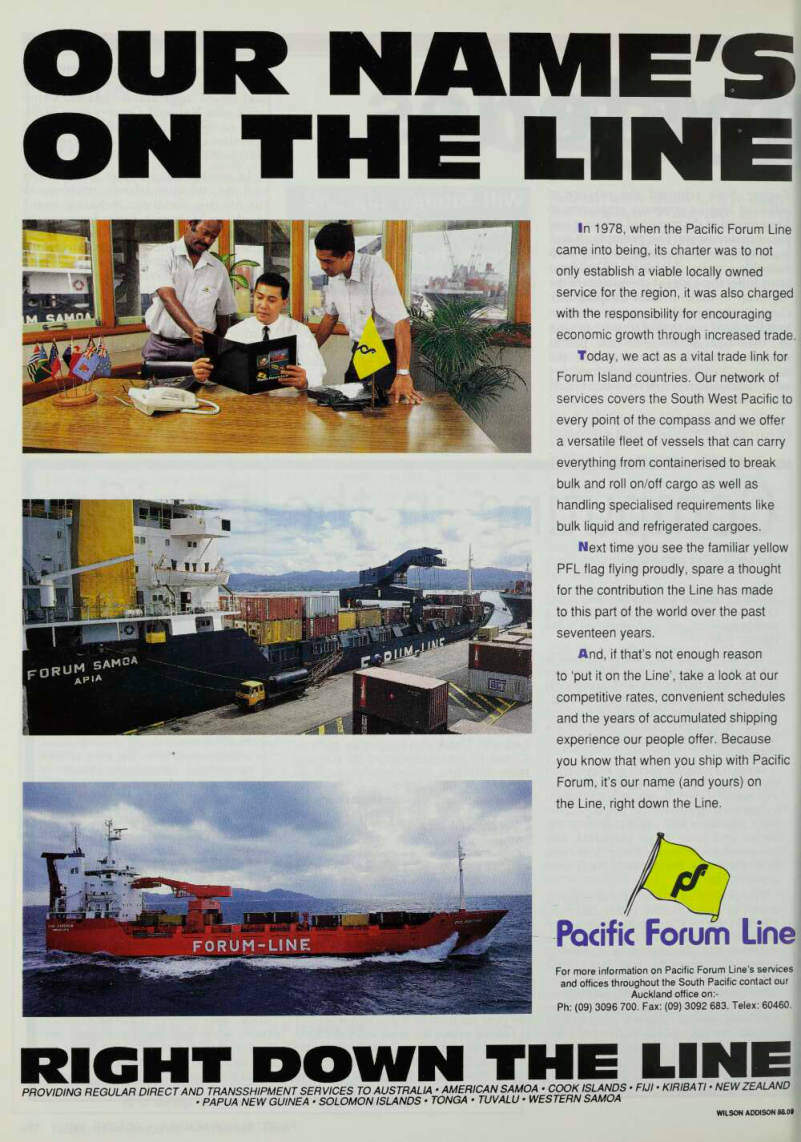
Right Down The Line
, J 1m c Ha l B » I.
II i - In 1978, when the Pacific Forum Line came into being, its charter was to not only establish a viable locally owned service for the region, it was also charged with the responsibility for encouraging economic growth through increased trade Today, we act as a vital trade link for Forum Island countries. Our network of services covers the South West Pacific to every point of the compass and we offer a versatile fleet of vessels that can carry everything from containerised to break bulk and roll on/off cargo as well as handling specialised requirements like bulk liquid and refrigerated cargoes.
Next time you see the familiar yellow PFL flag flying proudly, spare a thought for the contribution the Line has made to this part of the world over the past seventeen years.
And, if that’s not enough reason to ‘put it on the Line’, take a look at our competitive rates, convenient schedules and the years of accumulated shipping experience our people offer. Because you know that when you ship with Pacific Forum, it’s our name (and yours) on the Line, right down the Line. ff
Pacific Forum Line
For more information on Pacific Forum Line's services and offices throughout the South Pacific contact our Auckland office on:- Ph: (09) 3096 700. Fax: (09) 3092 683. Telex: 60460.
RIGHT DOWN THE LINE
PROVIDING REGULAR DIRECT AND TRANSSHIPMENT SERVICES TO AUSTRALIA • AMERICAN SAMOA I • COOKISLANDS • FIJI • KIRIBATI • NEW ZEALAND • PAPUA NEW GUINEA • SOLOMON ISLANDS • TONGA • TUVALU • WESTERN SAMOA
WILSON ADDISON 88.09
Grassroots solutions
IN Gumi village in the Morobe High lands in Papua New Guinea villagers are seriously considering an end to logging.
Not because of destruction of their forests but because they are making more from butterfly ranching - an industry which depends on the forest for its existence and which, if the forests are preserved, will continue to make money long after the area is logged out.
Butterflies and insects, destined for collectors and zoos around the world, are now worth around $A750,000 in export income to PNG each year.
They join a host of other non-timber forest products which hold enormous potential to stop forest destruction by replacing logging with grassroots indus tries which provide an income to cash
hungry villagers.
Other non-timber forest products which are already, or could be, har vested directly from the forest include rattan, betel nut, gums and resins,
massoy bark, edible nuts, plants with pharmaceutical applications and plants such as orchids which are suitable for potting.
As well, additional income can be made from handicrafts, nature tourism and small-scale logging with portable sawmills which allow single trees to be taken in a way which does not jeopardise the future of the forest.
None of these alternatives are a passport to instant riches but they can provide a good income and one which will act as an incentive for people to stay in their villages instead of joining those clamouring for government services and job opportunities in the cities.
In PNG butterfly farming, which has a well established and efficient marketing structure, is probably one of the easiest industries to join.
According to Peter Clarke, manager of the Morobe based
Trading Agency (IFTA), which oversees
all rJNG s insect exports, anything which ‘is big, beautiful or ugly is saleable’.
By far the most common insects ranched in PNG are the huge birdwing butterflies, one species of which ranks as the world s biggest.
Birdwings feed on aristolochia - a common vine which is easy to grow and thrives in secondary growth areas as well as its usual habitat deep in the forest.
SA3O 40* k utter % ranching a villager needs only The IFTA or other environmental organisations such as the Wau Ecology Institute will send out a handbook. Then it is plants 3 mattCr ° f P lantin S out some of the butterfly’s food Once the caterpillars have turned into pupae the villager olaces them inside a small cage where they can hatch away rom wind and predators which might damage their valuable vmgs.
The specimens are then sent to IFTA, which sells them to iverseas dealers or frames them for sale in PNG or abroad.
A new and lucrative market is developing for live specimens or T butterfly houses at zoos around the globe. xn an industry in which prices are easily damaged by wersupply this development, which requires the dispatch of resh pupae stocks every month, is a boon.
Butterflies are ranched in 14 or 15 of PNG’s 19 provinces
with around 800 villagers making between $lOO and $10,500 a year.
Rattan also has great potential. In Indonesia rattan exports have been worth as much as $BO million a year and total non-timber forest product exports, $154 million.
Although no official figures are available m PNG leading non-timber forest product specialist, UPNG’s Dr Simon Saulei, estimates there may be as many 50 PNG companies export
ing rattan.
Betel nut from the forest is also sold widely for local use.
Portable sawmills are used in PNG, Solomon Islands, Vanuatu, Fiji and elsewhere.
So far they have proved their value in contributing to villagers’ decisions not to allow large scale forest destruc tion by big logging companies and in providing timber for local communi ties.
As a source of sawn timber for a wider market or for export they have fallen short of expectations. This has been for a number of reasons all of which may be solvable. In particular there have been problems with milling not reaching the consistency or quality required for overseas market.
While there is undoubtedly a market for ‘ecologically sustainably produced rainforest timber’, for which the environmentally aware in western countries will pay a premium, getting into that market still presents problems. So does proving one’s timber has not damaged the forests, particularly m the face of growing evidence that badly used portable sawmills are doing just that.
Both Papua New Guinea and Solomon Islands are attempting to deal with these problems.
PNG is supporting a major survey of its estimated 700 portable sawmill owners. It aims to establish just how the mills are being used and what can be done to ensure they are
both profitable and environmentally friendly.
Solomon Islands is basing part of its strategy to curb the excesses of foreign logging companies around promoting small mills and has introduced new timber milling guidelines which ensure consistency in milling standard for export.
Right across the Pacific rainforests are being felled by big logging companies before scientists have had a chance to catalogue the resources they hold and before national government’s have had a chance to consider whether, in the fong run, more might be made from them through alternative uses.
The same traditional economic models which have failed to take account of the value of the forests in food, sustenance and shelter to the hundreds of thousands of people who still live a mainly subsistence lifestyle have also failed to measure the potential of resources being lost forever as the forests
disappear.
A project being funded by Australia’s overseas aid agency, AIDAB, is attempting redress that. It plans to catalogue all the resources with economic potential available in PNG’s forests and to establish marketing plans for the most
promising.
While the forest’s economic value is only a small fraction of its total worth, for those who live and work there, and to humankind which depends on its existence to limit global warning, it is the factor which is most likely to preserve it for future generations. n
Australia
Jemima
Garrett
Spearhead surprise
FOR years Fiji has had a standing invitation to join the Melanesian Spearhead Group (MSG) and for years the invitation was met with gracious silence from the Department of Foreign Affairs in Suva. For this reason the announcement by the Fiji prime minister, Sitiveni Rabuka that Fiji are likely to accept the invitation was surprising to most commentators. The reason why Fiji has in the past been so reluctant to join the MSG has been because the country is so clearly both Melanesian and Polynesian.
While anthropologists often dispute the existence of a clear difference be tween Melanesians and Polynesians none who have sat drinking with Polynesian officials after a regional conference would ever doubt its existence. There exists a great divide between Polynesia and Melanesia and it runs right through the Pacific and right through Fiji. The divide in Fiji is more than just geographical it is more than just Rotuma and the Lau group of islands. It is also very political
with the Lau group of islands to this day the traditional power centre in Fiji.
Throughout much of the pre-colonial era the Lau group of islands, located half way between Tonga and Fiji, were enormously influential in determining the direction which Fiji took through their contact and close relationship with the powerful, well armed and well organised Kingdom of Tonga. Many of the traditional chiefs of Fiji trace their lineage and connection to Lau and further to Tonga where the ties between the King of Tonga and Fiji’s chiefs remain very strong even today. Perhaps more importantly the way power is wielded by the chiefs within traditional
Fijian society is distinctly Polynesian
rather than the looser ‘big man’ system that exists in Melanesia. So while most Fijians may appear very much like Melanesians, especially to outsiders, the society’s structure and much of the culture remain distinctly Polynesian.
Forum meetings are, for many Pacific island leaders, a difficult and perplexing
event because they are under the eye of the media and there is an enormous amount of pressure to actually do something. For a rare moment the region’s media is focused upon the leaders and they are desperately looking for news and for some sort of evidence of a regional initiative that might make it possible to justify to their editors the cost of such a long journey. Increasingly the news worthiness of the Forum is making editors think more than twice about sending their staff. However, Sitiveni Rabuka announcement at the Nauru Forum of the inevitability of Fiji seeking membership in the Melanesian Spear head Group could result in the most profound political and economic realign ment of the South Pacific since the creation of the Forum over 20 years ago.
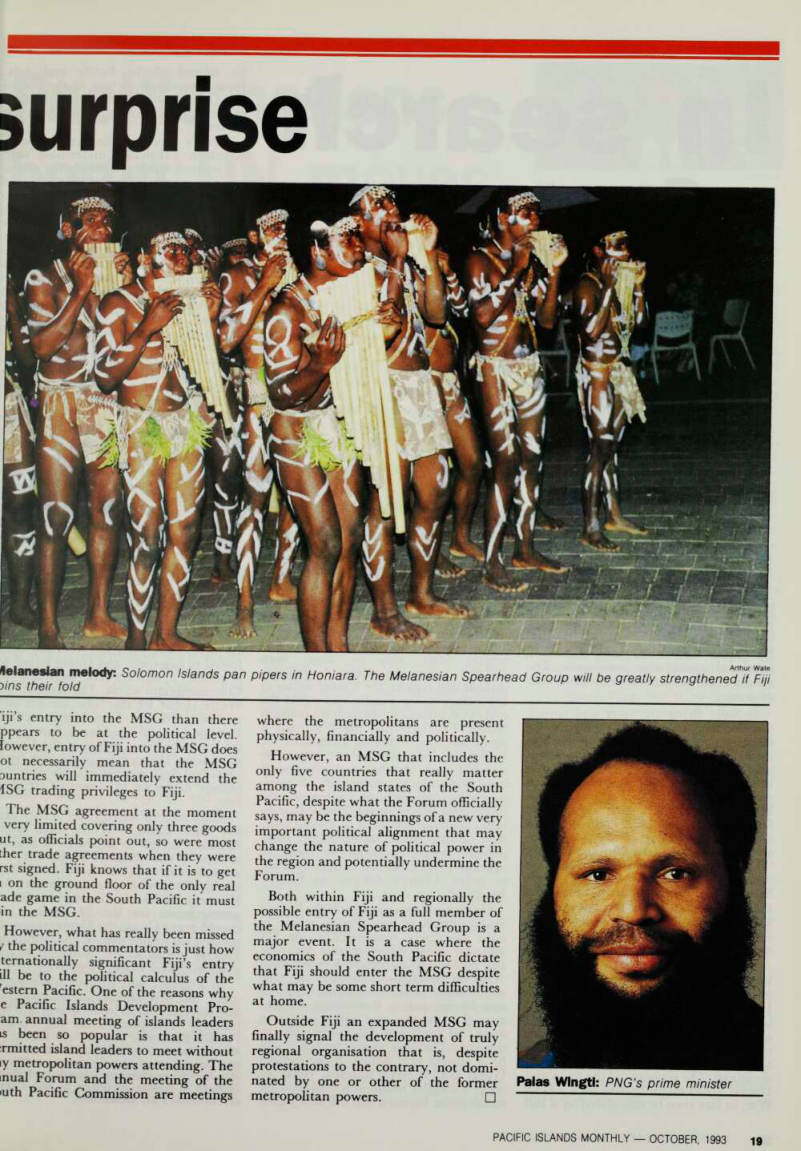
The fact is obvious that economically the future of the South Pacifc lies very much in Melanesia. PNG with its enormous resource wealth, Fiji with its industrial sector and New Caledonia with its apparently limitless access to the French treasury make for an impressive political constellation. Add to this Vanu atu with its tourism potential and Solomon Islands with its low labour cost there can be little doubt that if there is any economic potential in the South Pacific it lies in Melanesia.
Almost immediately following prime minister Rabuka’s announcement at the Forum the sounds of flip-flop and back track could be heard in the corridors of power in Suva with senior government officials talking of the undesirability of the proposal. Even Rabuka was quoted as saying within two days of the announcement that this would not mean a down-grading of the links with Poly nesia. The problem for the Fiji prime minister is that having now made the announcement at the Forum if he backtracks under pressure from the traditional elite he faces the possibility of irreparably damaging diplomatic and trade relations with Melanesia.
Just one year ago the MSG appeared to be almost defunct with the heads of government unable to even to decide to meet and while officials were still discuss ing a trade treaty the only trade that appeared to be of any significance was the trade in lead between the PNG Defence force and the Solomon Islands.
However, with the full of Solomon Islands Prime Minister Solomon Mamaloni and the rise to power of Francis Billy Hilly a new era in relations
Fiji ’s interest in joining the MSG has
surprised many
between PNG and the Solomons appears to have begun. This was signalled at the recent MSG summit held in June in Rabaul where the heads of government signed the much awaited MSG trade agreement. The trade agreement be tween the three countries eliminates the import duties on three commodities - beef from Vanuatu, canned fish from Sol omon Islands and tea from PNG. It is the duty free entry of the latter into the Solomon Islands that has already created difficulties on the Fiji side where tea exporter Hari Punja is facing increased competition from PNG tea in the Solomon Islands market as a direct result of the preferential access under the trade agreement.
The MSG trade agreement is a development that Fiji officials have eyed with both some trepidation as well as increasing interest. Fiji exporters and re exporters have carved out small but important export markets in many of the small South Pacific island states. These markets are important to Fiji well beyond their market value because they
permit Fiji to purchase in larger
quantities than is otherwise the case and as a result this lowers the cost of imports to both Fiji and the island states. The preferential access arrangement that is evolving between PNG and Solomon Islands and Vanuatu threatens to under mine the Fiji trade advantage in the Solomon Islands and Vanuatu. Fiji traders have never been able to establish a serious foothold in the huge PNG market. This trade advantage is crucial to Fiji and its economy and it is for this reason that Prime Minister Rabuka may be willing to take the flack he will get from Fiji’s Polynesian elite.
While the politicians of the MSG may be officially and publicly applauding Fiji’s entry into the MSG, their trade officials are a good deal less predisposed to the idea. There is a long standing and well justified fear that the advanced Fiji manufacturing sector, would, in the absence of tariffs, wipe out the fledgling manufacturing sectors in the other MSG counties. As a result, there is a great deal less enthusiasm at the official level for
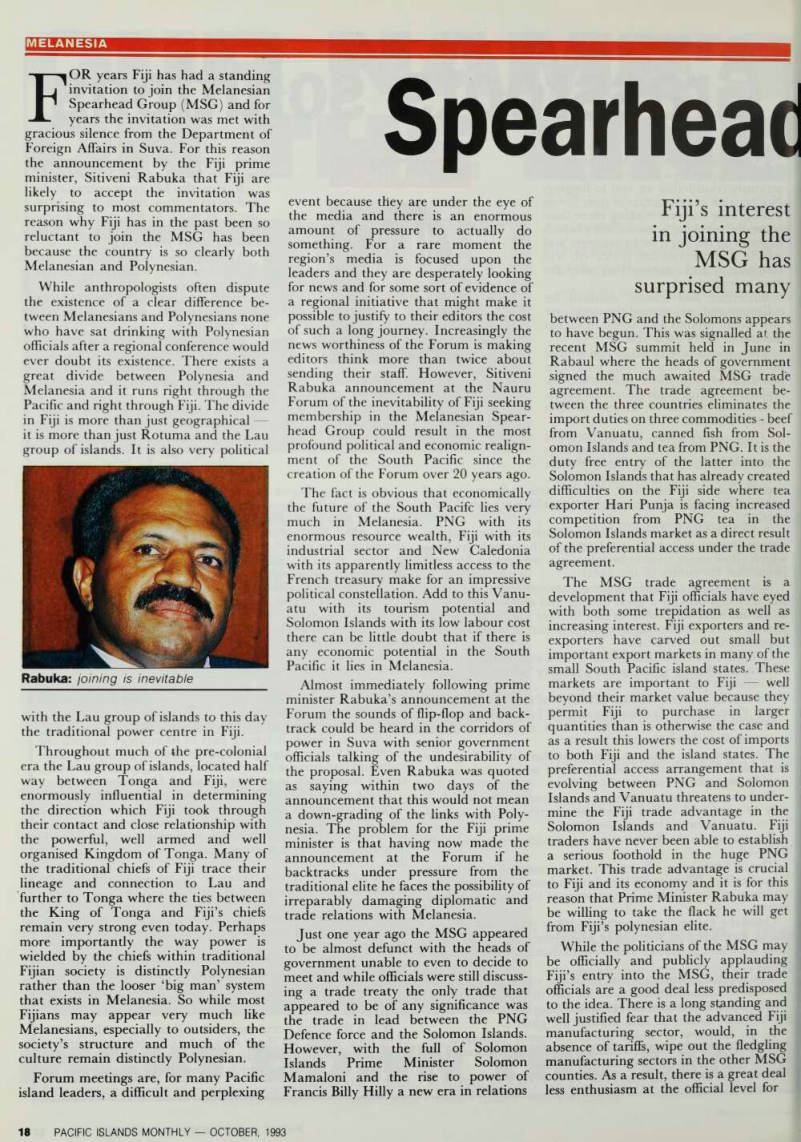
Rabuka: joining is inevitable
iji’s entry into the MSG than there ppears to be at the political level, lowever, entry of Fiji into the MSG does ot necessarily mean that the MSG Duntries will immediately extend the
ISG trading privileges to Fiji.
The MSG agreement at the moment very limited covering only three goods ut, as officials point out, so were most ther trade agreements when they were rst signed. Fiji knows that if it is to get i on the ground floor of the only real ade game in the South Pacific it must in the MSG.
However, what has really been missed f the political commentators is just how
ternationally significant Fiji’s entry
ill be to the political calculus of the estem Pacific. One of the reasons why e Pacific Islands Development Pro am annual meeting of islands leaders is been so popular is that it has rmitted island leaders to meet without iy metropolitan powers attending. The mual Forum and the meeting of the •uth Pacific Commission are meetings
where the metropolitans are present
physically, financially and politically.
However, an MSG that includes the only five countries that really matter among the island states of the South Pacific, despite what the Forum officially says, may be the beginnings of a new very important political alignment that may change the nature of political power in the region and potentially undermine the Forum.
Both within Fiji and regionally the possible entry of Fiji as a full member of the Melanesian Spearhead Group is a major event. It is a case where the economics of the South Pacific dictate that Fiji should enter the MSG despite what may be some short term difficulties at home.
Outside Fiji an expanded MSG may
finally signal the development of truly
regional organisation that is, despite protestations to the contrary, not domi nated by one or other of the former metropolitan powers, □
lelanesian melody: Solomon Islands pan pipers in Honiara. The Melanesian Spearhead Group will be greatly strengthened if Fill oins their fold
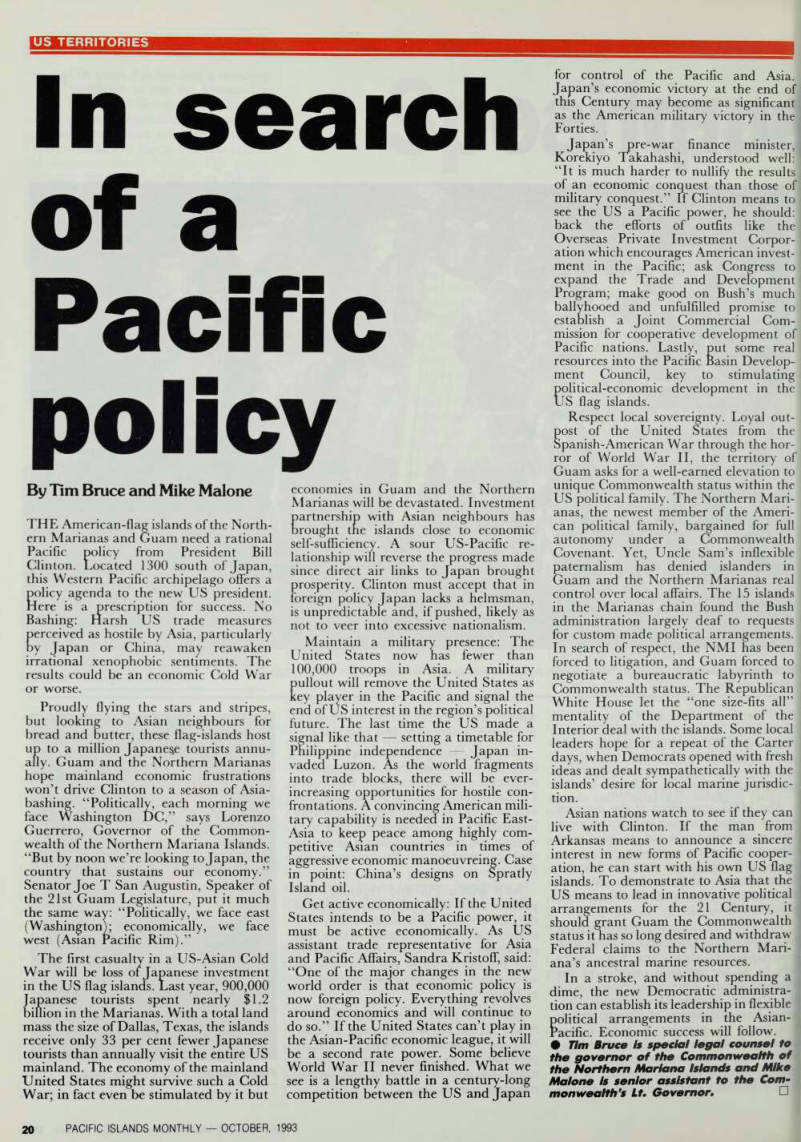
Palas Wlngtl: PNG's prime minister
policy
Us Territories
In search of a Pacific policy
By Tim Bruce and Mike Malone
THE American-flag islands of the North ern Marianas and Guam need a rational Pacific policy from President Bill Clinton. Located 1300 south of Japan, this Western Pacific archipelago offers a policy agenda to the new US president.
Here is a prescription for success. No Bashing: Harsh US trade measures Cerceived as hostile by Asia, particularly y Japan or China, may reawaken irrational xenophobic sentiments. The results could be an economic Cold War or worse.
Proudly flying the stars and stripes, but looking to Asian neighbours for bread and butter, these flag-islands host up to a million Japanese tourists annu ally. Guam and the Northern Marianas hope mainland economic frustrations won’t drive Clinton to a season of Asia bashing. “Politically, each morning we face Washington DC,” says Lorenzo Guerrero, Governor of the Common wealth of the Northern Mariana Islands.
“But by noon we’re looking to Japan, the country that sustains our economy.”
Senator Joe T San Augustin, Speaker of the 21st Guam Legislature, put it much the same way: “Politically, we face east (Washington); economically, we face west (Asian Pacific Rim).”
The first casualty in a US-Asian Cold War will be loss of Japanese investment in the US flag islands. Last year, 900,000 Japanese tourists spent nearly 51.2 billion in the Marianas. With a total land mass the size of Dallas, Texas, the islands receive only 33 per cent fewer Japanese tourists than annually visit the entire US mainland. The economy of the mainland United States might survive such a Cold War; in fact even be stimulated by it but
economies in Guam and the Northern Marianas will be devastated. Investment Cartnership with Asian neighbours has rought the islands close to economic self-sufficiency. A sour US-Pacific re lationship will reverse the progress made since direct air links to Japan brought prosperity. Clinton must accept that in foreign policy Japan lacks a helmsman, is unpredictable and, if pushed, likely as not to veer into excessive nationalism.
Maintain a military presence: The United States now has fewer than 100,000 troops in Asia. A military pullout will remove the United States as key player in the Pacific and signal the end of US interest in the region’s political future. The last time the US made a signal like that setting a timetable for Philippine independence Japan in vaded Luzon. As the world fragments into trade blocks, there will be ever increasing opportunities for hostile con frontations. A convincing American mili tary capability is needed in Pacific East- Asia to keep peace among highly com petitive Asian countries in times of aggressive economic manoeuvreing. Case in point: China’s designs on Spratly Island oil.
Get active economically: If the United States intends to be a Pacific power, it must be active economically. As US assistant trade representative for Asia and Pacific Affairs, Sandra Kristoff, said: “One of the major changes in the new world order is that economic policy is now foreign policy. Everything revolves around economics and will continue to do so.” If the United States can’t play in the Asian-Pacific economic league, it will be a second rate power. Some believe World War II never finished. What we see is a lengthy battle in a century-long competition between the US and Japan
for control of the Pacific and Asia.
Japan’s economic victory at the end of this Century may become as significant as the American military victory in the Forties.
Japan’s pre-war finance minister, Korekiyo Takahashi, understood well: “It is much harder to nullify the results of an economic conquest than those of military conquest.” If Clinton means to see the US a Pacific power, he should; back the efforts of outfits like the Overseas Private Investment Corpor ation which encourages American invest ment in the Pacific; ask Congress to expand the Trade and Development Program; make good on Bush’s much ballyhooed and unfulfilled promise to establish a Joint Commercial Com mission for cooperative development of Pacific nations. Lastly, put some real resources into the Pacific Basin Develop ment Council, key to stimulating
political-economic development in the
US flag islands.
Respect local sovereignty. Loyal out post of the United States from the Spanish-American War through the hor ror of World War 11, the territory of Guam asks for a well-earned elevation to unique Commonwealth status within the US political family. The Northern Mari anas, the newest member of the Ameri can political family, bargained for full autonomy under a Commonwealth Covenant. Yet, Uncle Sam’s inflexible paternalism has denied islanders in Guam and the Northern Marianas real control over local affairs. The 15 islands in the Marianas chain found the Bush administration largely deaf to requests for custom made political arrangements.
In search of respect, the NMI has been forced to litigation, and Guam forced to negotiate a bureaucratic labyrinth to Commonwealth status. The Republican White House let the “one size-fits all” mentality of the Department of the Interior deal with the islands. Some local leaders hope for a repeat of the Carter days, when Democrats opened with fresh ideas and dealt sympathetically with the islands’ desire for local marine jurisdic tion.
Asian nations watch to see if they can live with Clinton. If the man from Arkansas means to announce a sincere interest in new forms of Pacific cooper ation, he can start with his own US flag islands. To demonstrate to Asia that the US means to lead in innovative political arrangements for the 21 Century, it should grant Guam the Commonwealth status it has so long desired and withdraw Federal claims to the Northern Mari ana’s ancestral marine resources.
In a stroke, and without spending a dime, the new Democratic administra tion can establish its leadership in flexible political arrangements in the Asian- Pacific. Economic success will follow. • Tim Brute Is special legal counsel to the governor of the Commonwealth of the Northern Mariana Islands and Mike Malone Is senior assistant to the Com monwealth’s Lt, Governor,
Pacific nations
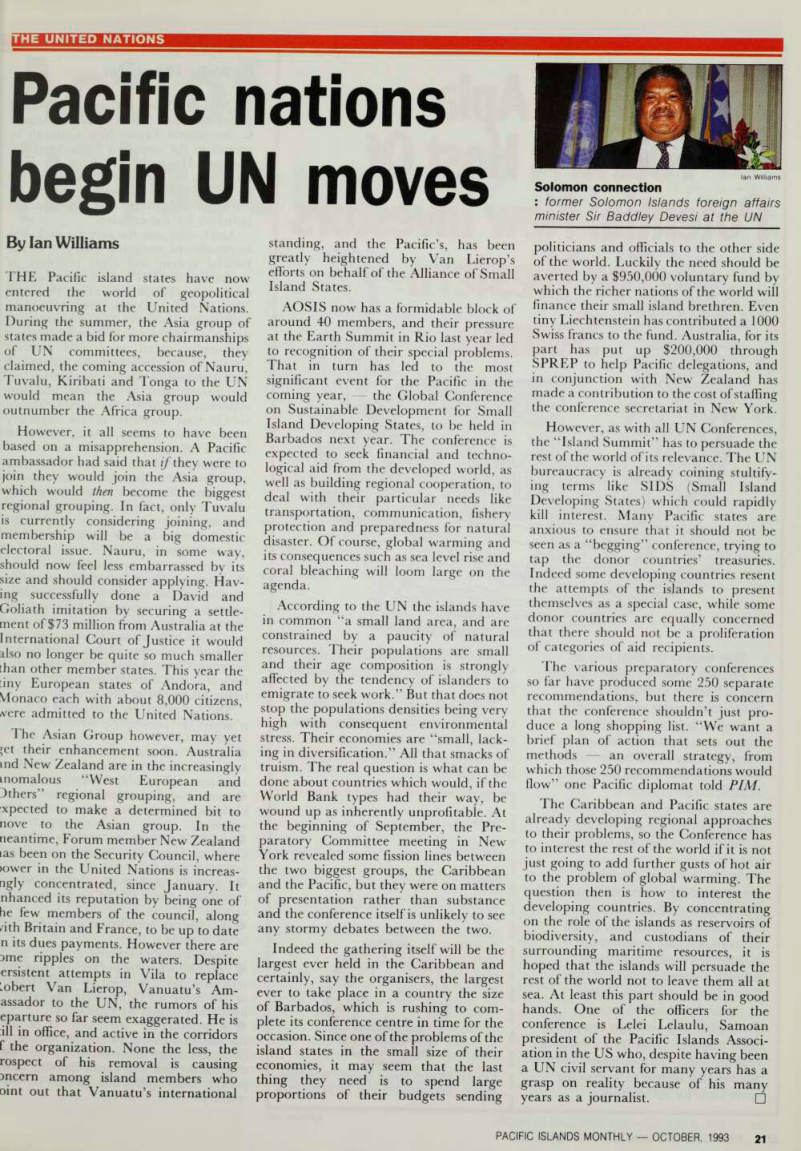
The United Nations
Pacific nations begin UN moves
By Ian Williams
THE Pacific island states have now entered the world of geopolitical manoeuvring at the United Nations.
During the summer, the Asia group of states made a bid for more chairmanships of UN committees, because, they claimed, the coming accession of Nauru, Tuvalu, Kiribati and Tonga to the UN would mean the Asia group would outnumber the Africa group.
However, it all seems to have been based on a misapprehension. A Pacific ambassador had said that if they were to join they would join the Asia group, which would then become the biggest regional grouping. In fact, only Tuvalu is currently considering joining, and membership will be a big domestic electoral issue. Nauru, in some way, should now feel less embarrassed by its size and should consider applying. Hav ing successfully done a David and Goliath imitation by securing a settle ment of $73 million from Australia at the International Court of Justice it would also no longer be quite so much smaller than other member states. This year the tiny European states of Andora, and Monaco each with about 8,000 citizens, *ere admitted to the United Nations.
The Asian Group however, may yet jet their enhancement soon. Australia md New Zealand are in the increasingly
momalous “West European and
Others” regional grouping, and are xpected to make a determined bit to nove to the Asian group. In the neantime, Forum member New Zealand las been on the Security Council, where >ower in the United Nations is increas ingly concentrated, since January. It nhanced its reputation by being one of he few members of the council, along dth Britain and France, to be up to date n its dues payments. However there are
3me ripples on the waters. Despite
ersistent attempts in Vila to replace Robert Van Lierop, Vanuatu’s Am assador to the UN, the rumors of his eparture so far seem exaggerated. He is ill in office, and active in the corridors f the organization. None the less, the rospect of his removal is causing Dncern among island members who oint out that Vanuatu’s international
standing, and the Pacific’s, has been greatly heightened by Van Lierop’s efforts on behalf of the Alliance of Small Island States.
AOSIS now has a formidable block of around 40 members, and their pressure at the Earth Summit in Rio last year led to recognition of their special problems.
That in turn has led to the most significant event for the Pacific in the coming year, the Global Conference on Sustainable Development for Small Island Developing States, to be held in Barbados next year. The conference is expected to seek financial and techno logical aid from the developed world, as well as building regional cooperation, to deal with their particular needs like transportation, communication, fishery protection and preparedness for natural disaster. Of course, global warming and its consequences such as sea level rise and coral bleaching will loom large on the agenda.
According to the UN the islands have in common “a small land area, and are constrained by a paucity of natural resources. Their populations are small and their age composition is strongly affected by the tendency of islanders to emigrate to seek work.” But that does not stop the populations densities being very high with consequent environmental stress. Their economies are “small, lack ing in diversification.” All that smacks of truism. The real question is what can be done about countries which would, if the World Bank types had their way, be wound up as inherently unprofitable. At the beginning of September, the Pre paratory Committee meeting in New York revealed some fission lines between the two biggest groups, the Caribbean and the Pacific, but they were on matters of presentation rather than substance and the conference itself is unlikely to see any stormy debates between the two.
Indeed the gathering itself will be the largest ever held in the Caribbean and certainly, say the organisers, the largest ever to take place in a country the size of Barbados, which is rushing to com plete its conference centre in time for the occasion. Since one of the problems of the island states in the small size of their economies, it may seem that the last thing they need is to spend large proportions of their budgets sending
politicians and officials to the other side of the world. Luckily the need should be averted by a $950,000 voluntary fund by which the richer nations of the world will finance their small island brethren. Even tiny Liechtenstein has contributed a 1000 Swiss francs to the fund. Australia, for its part has put up $200,000 through SPREP to help Pacific delegations, and in conjunction with New Zealand has made a contribution to the cost of staffing the conference secretariat in New York.
However, as with all UN Conferences, the “Island Summit” has to persuade the rest of the world of its relevance. The UN bureaucracy is already coining stultify ing terms like SIDS (Small Island Developing States) which could rapidly kill interest. Many Pacific states are anxious to ensure that it should not be seen as a “begging” conference, trying to tap the donor countries’ treasuries.
Indeed some developing countries resent the attempts of the islands to present themselves as a special case, while some donor countries are equally concerned that there should not be a proliferation of categories of aid recipients.
The various preparatory conferences so far have produced some 250 separate recommendations, but there is concern that the conference shouldn’t just pro duce a long shopping list. “We want a brief plan of action that sets out the methods an overall strategy, from which those 250 recommendations would flow” one Pacific diplomat told PIM.
The Caribbean and Pacific states are already developing regional approaches to their problems, so the Conference has to interest the rest of the world if it is not just going to add further gusts of hot air to the problem of global warming. The question then is how to interest the
developing countries. By concentrating
on the role of the islands as reservoirs of biodiversity, and custodians of their surrounding maritime resources, it is hoped that the islands will persuade the rest of the world not to leave them all at sea. At least this part should be in good hands. One of the officers for the conference is Lelei Lelaulu, Samoan president of the Pacific Islands Associ ation in the US who, despite having been a UN civil servant for many years has a grasp on reality because of his many years as a journalist. □
lan Williams Solomon connection former Solomon Islands foreign affairs minister Sir Baddley Devesi at the UN
By Wally Hiambohn
Law And Order
ARNOLD Amet, 40, became chief justice of Papua New Guinea on August 6, the second Papua New Guinean to ascend to the country’s highest judicial position. He took over from Sir Buri Kidu who has served with distinction for the past 13 years and established an internationally reputable independent judiciary for the country.
Amet, who was the surprise pick, has foreshadowed sweeping changes to the judicial system and legal practices to conform with PNG’s social, political and economic organisation rather than the “too formal, complex, expensive and inaccessible” system adopted at indepen dence 17 years ago. “Essentially, my philosophy about legal and judicial service to the people of this country is that it should be simple, less formal and less complicated as possible and less expensive so that it is far more accessible to the vast majority of the ordinary people of this country,” Amet said when he took office.
Simple and less complicated he may want laws to be but Amet has come in at a time when laws with far-reaching effects have been enacted in parliament and are being proposed by the Wingti government to address the country’s law and order problems.
By the time you are reading this story, the Supreme Court, of which Amet is a member of the bench, will be deciding whether the government’s controversial Internal Security Act is constitutional or not. The Ombudsman Commission, led by its chief Charles Maino, is seeking a Supreme Court review of the Act which, they say, cuts through the basic human rights provisions of the constitution.
The Act passed by parliament in May is aimed at preventing terrorism. It is intended to specify offences related to terrorism and the encouragement of terrorist activities and provide heavy penalties; outlaw organisations engaged in or likely to engage in or promote terrorist activities; provide powers to exclude persons likely to engage in terrorist activities from the country; provide powers to declare areas prohibited and exclude entry to such areas; provide powers of arrest and detention in such areas.
Finer details of interest are that people who encourage or support terrorism could be fined up to K 100,000 or jailed for up to 14 years under new
legislation passed by parliament;
it provides for “exclusion” of people the national executive council considers likely to engage in terrorism. In the case of citizens, this can mean barring that person form particular parts of the country.
Advertisements & other items, p. 22 (1 item)
How Apia
Found A Host Of
Potential New Investors
r Wester
Samoa
They went to the right people.
Finance Minister Tuilaepa Sailele told us Western Samoa was keen to encourage new investment.
Besides helping Pacific Forum business people start or expand their companies, the South Pacific Trade Commission also assists the islands’ 15 different governments.
In this instance, we arranged seminars in both Sydney and Melbourne, attracting more than 130 potential investors.
In addition to the Minister, speakers included Western Samoa High Commissioner, His Excellency Mr Feesago S Pepulea’i, Mr Falani Chan Tung, Trade Commerce & Industry Secretary. And Papalii Scanlan, General Manager of the Central Bank of Western Samoa.
So far, Apia has had serious discussions with six major companies.
Their proposals range from producing long-life milk to furniture manufacture and canning seafood to assembling spare parts for automobiles.
Our charge for organising all this?
Nothing. All our services are absolutely free.
To find out more about what we could do for you, your company or your government, just post or fax us the coupon below. If you’re in a hurry, feel free to phone.
Name Company Address P4C am* Lv. o z & Level 6, 50 Park Street, Sydney NSW 2000.
Phone: (612) 283 5933, Fax: (612) 283 5948 Adventors 12H2
(in)security?
Act of (in)security?
In the case of non-citizens, it can mean deportation and a bar on re-entry; • the law is meant to prevent acts of terrorism against the state and to safe guard against the setting up of illegal groups such as the Bougainville Revol utionary Army; • the law provides for fines of up to K 10,000 and/or jail terms of up to seven years for members of the organisation the NEC considers to be terrorist groups and for people who provide any kind of aid to such groups. • Anyone displaying support for the activities of such groups by wearing any item of dress or carrying articles of such kind as to arouse “resonable apprehen sion” that he is a member of an Drganisation involved in terrorist activi :ies, is also guilty of an offence and can 3e fined up to K 10,000 or jailed for up :o three years.
Other supplementary laws proposed include amendments to the Bail Act,
Criminal Code Act, Dangerous Drugs
Firearms Act, Police Act and iummary Offences Act. The Repatri ition Act will provide for the setting up if Repatriation Courts to order people lack to their home provinces if they do ot have any visible means of support nd who are likely to turn to crime, will order people to stay in the illages for a specified period. The Bail ict provides for only the national court grant bail, not the lower courts.
The Criminal Code is to be amended ) that police will not need warrants to lake arrests for prescribed offences, [eavier penalties for drug use and □ssessing and use of firearms will be
aposed under the Dangerous Drugs and
irearms Act. In July, the government so approved for ratification by parlia ent two new proposed laws that all apua New Guineans be issued identifi ition cards and that onus of proof be versed so that people charged for fences as serious as rape, murder or med robbery are automatically guilty id have to prove their innocence unlike >w where one is innocent until proven yond resonable doubt that they are lilty.
Said police minister Avusi Tanao icn he introduced these measures; hjs government is talking about a isible approach to law and order.”
Prime minister Wingti said of his govern ment’s total law and order package that it was a comprehensive approach to the problem which was making all sectors of the society “sick to death”. Said Wingti - “The crime problem facing us war rants drastic action. The proposed con stitutional changes are part of our commitment to making these important changes. We will not stop here. Our directions are quite clear to our law enforcement agencies to implement all the laws we have changed, and all the laws that we will change in the future.”
Amet’s predecessor Sir Buri Kidu, after keeping silent, spoke out against the Internal Security Act and related bills the moment he was replaced. He said the Act would cause chaos in the commun ity, the judiciary and the country as a whole. There would be human rights abuses, innocent people would be jailed and people’s movements would be re stricted, he summed. “This is a very dangerous trend and would work against the people,” he said.
Chief ombudsman Charles Maino sounded the biggest warning when he said it would create civil unrest when people’s lives are being frustrated. He described the laws as being “stupid” and “unconstitutional”. Maino instructed his lawyers to challenge the Internal Secur ity Act during the Supreme Court’s October hearing. “In my view the Act is unconstitutional; it is stupid to say the least,” he said. “If our leaders abuse their powers then the people may be frustrated and go up in arms to protect themselves.
Civil unrest will then become our daily event because people will be fighting for
their rights.”
Opposition to the laws came from all sectors of the community, and from Amnesty International and Australian , Belgium and Canadian lawyers and even a judge of the PNG national court. On the shifting of onus of proof, Judge Brown said in a letter to the Post-Courier newspaper; “I write to sound a warning to the executive arm of government now apparently considering the proposal, by academic advisers, to change the consti tution by doing away with the presump tion of innocence in serious criminal cases. An American, Thomas Jefferson said that all men are created equal but we know that not to be the case. Some
people have more opportunities than others, some are smarter and some accumulate riches more easily than others. The constitutional imperative to treat all men as equal is acted upon by all our courts (while recognising this reality), by applying this presumption of innocence. But this proposal may work to the contrary if the change is carried by parliament. A class of people will be created who will not have the protection the present constitution affords them.
The under-class, I venture to say, will not be the rich and famous but ordinary Papua New Guineans who may not be as smart as some. The change will condone an injustice. It reflects an impatience and arrogance in the proposals to seek efficiency in the pursuit of order to the detriment of justice for all. This wish of the academic ignores to my mind, the morality of its methods for by undermin ing the precept, that “all men are equal before the law” the conscience of all Papua New Guineans must be unsettled.
I ask the executive and all parliamen tarians to look to their conscience in this matter, for the proposal is fraught with risk.”
Philip George Scales, an Adelaide lawyer in a letter to Chief Justice Amet said there was considerable concern that the provisions of the Act were likely to lead to human rights violations occur ing.” He quoted Amnesty International as saying “The Act will be virtually impossible to ensure that human rights are properly safeguarded. He said Am nesty was concerned by the broad definition of what constitutes support for terrorism under the Act and by sweeping powers for arrest and detention it confers upon the security forces. It said it believed the Act could all too easily be applied to restrict or repress inter nationally recognised rights to freedom of expression and association.
“The new legislation grants the head of state power to ban organisations which are, in his opinion, ‘prompting or encouraging, o£ (are) likely to or about to promote or encourage terrorism’, Scales said.
“Likewise, individuals alleged by the government to support banned organis ations or who display support in a public place may be subjected to terms of three to seven years imprisonment. Appeals against the banning of an organisation can only be addressed to the head of state and national executive council the bodies which issued the decrees and not to an independent judicial authority.
Most worrying, a document signed by the police commissioner certifying that an individual is a member of a prescribed organisation constitutes prima facie evi dence of membership of the organisation.
“The government has said that the Act is necessary to combat law and order Droblems. But the Act specifically defines terrorism’ as including the use of violence for political ends. Amnesty
International is concerned that the vague language used to describe support for or encouragement of “terrorism” may perrange ° nnterpretation the “When vague terms such as these are employed, the risk of the law being invoked to suppress non-violent political dissent is greaty increased,” said the organisation. It added that “in any case, problems of criminality can never justify the application of laws which may lead to human rights violations.
“The act also gives the police powers to arrest without warrant and detain suspects without charge for a period oflO days, renewable for a further 10 days.
Amnesty said that the long experience of security legislation in countries such as South Africa, Malaysia and Northern Ireland had shown that when the security forces had power to detain tXdonr thOU s\rh ar f e 7 r 1 ’ fUrth |T rr l uch as tortu T, or |U treatment - frequently occur.
The Act was rushed through parliamem in May. However, since some provisions of the Act restrict consti-
tutional rights, a parliamentary majority
agreeing each provision is required
before the proposed legislation becomes law. Amnesty International is urging the government to reassess as a matter of priority the terms and provisions of the Act and to ensure that any national security legislation refers only to
recognisably criminal offences and does not violate the rights to freedom of opinion, belief, expression or association.
Amnesty said: “It is alarming that as the world gathers in Vienna to discuss
increasing safeguards for human rights
the PNG authorities are planning to remove existing safeguards, thereby po tentially undermining the rights of their citizens. Many of those gathered at Vienna are themselves survivors of hu man rights violations; some were victims of internal security legislation in other countries and could provide eloquent testimony of the ways in which such legislation has been used to suppress basic freedoms; and of how it has resulted in torture and ill-treatment.”
Opposition leader Jack Genia, who died recently, described it as an ill conceived Act thrown together in haste.
“The Act is a confusing bundle of ad hoc knee-jerk reaction to a major national problem. The ISA is suppressive, repress ive and inhuman and its constitutional validity is open to question. It is already receiving widespread criticism,” he said.
Opposition frontbencher John Momis said it was “draconian” and a move towards dictatorial rule and could be used against political opponents. Momis’ fellow Melanesia Alliance politician Bernard Narakobi said it restricted freedom of movement guaranteed under the constitution. The PNG Trade Union Congress, the umbrella body of all
workers unions in PNG, said it was a “cut-throat” Act designed to cut off
democracy and deprive the people of
PNG their rights to freedom.
Of ID cards, general secretary John Paska said it would be a costly and impractical exercise which would im prison Papua New Guineans in their own country. “It reduces Papua New Guin ean status to that of dogs who have to go around with tags on,” he said The Catholic Commission for Justice and Peace said that the proposal to shift the burden of proof from the prosecution to the defendant and the question of ID cards went against the fundamental rights of the citizens. Perhaps a better approach to the issue of law and order is one former prime minister Rabbie Namaliu called for in a recent address to a technical school in Port Moresby. He spoke of instilling personal discipline to children so that they learn to grow up with respect for themselves, others and their country. “I believe the lack of personal discipline is a major problem in this nation today,” he told students.
“Too many people think that freedom means doing exactly what you want, without thinking what it might do to others. Stop and think. If you agree that everyone should be free, then what about about the people who suffer because you are not self-disciplined.” “You cannot allow your freedom to take away some body else’s freedom. So personal respon sibility calls for personal discipline. □
Advertisements & other items, p. 24 (2 items)
Law And Order
Train at Home for the Career you want
ICS offers over 50 ways to improve your life Now you can gain an Australian qualification by training at home for the career you want.
No previous experience needed.. .study at home in your own time at your own pace...
All training materials provided. You can start an ICS course from just $59.00 Australian!
Choose one course that interests you most. ICS will send you obligation FREE information about the course you have chosen from the list below or your area of interest.
Fill in the coupon and send TODAY! International Correspondence Schools
PO BOX 900
ARTARMON NSW 2064 AUSTRALIA
FREE INFORMATION
Mail coupon or fax for details Fax; 61 2 906 2290 YES! I want without cost or obligation, free facts on how
PISA 3
I can study at home for the course I have chosen Course; Mr/Mrs/Miss: Address; Country: Age: Courses not generally suitable if age under 15.
Pacific Paradox
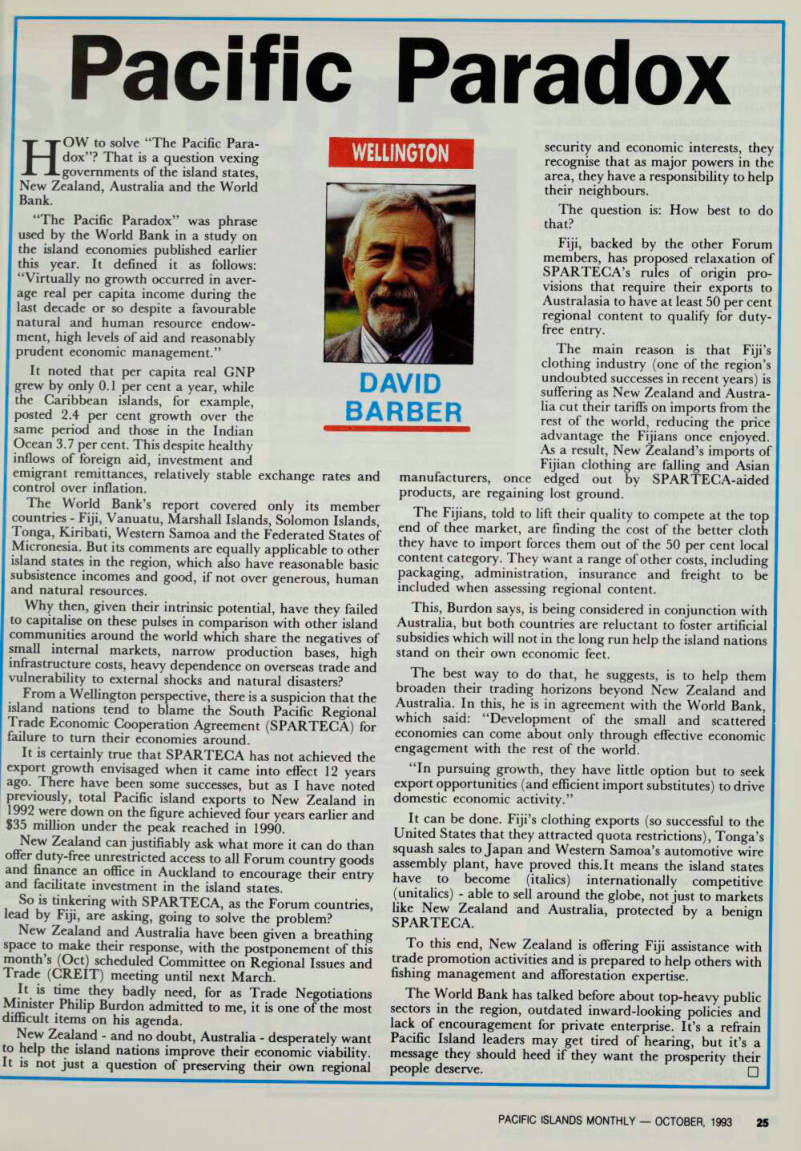
HOW to solve “The Pacific Para dox”? That is a question vexing governments of the island states, New Zealand, Australia and the World Bank.
“The Pacific Paradox” was phrase used by the World Bank in a study on the island economies published earlier this year. It defined it as follows: “Virtually no growth occurred in aver age real per capita income during the last decade or so despite a favourable natural and human resource endow ment, high levels of aid and reasonably prudent economic management.”
It noted that per capita real GNP grew by only 0.1 per cent a year, while the Caribbean islands, for example, posted 2.4 per cent growth over the same period and those in the Indian Ocean 3.7 per cent. This despite healthy inflows of foreign aid, investment and
emigrant remittances, relatively stable exchange rates and control over inflation.
The World Bank’s report covered only its member countries - Fiji, Vanuatu, Marshall Islands, Solomon Islands, Tonga, Kiribati, Western Samoa and the Federated States of Micronesia. But its comments are equally applicable to other island states in the region, which also have reasonable basic subsistence incomes and good, if not over generous, human j and natural resources.
Why then, given their intrinsic potential, have they failed to capitalise on these pulses in comparison with other island communities around the world which share the negatives of small internal markets, narrow production bases, high j infrastructure costs, heavy dependence on overseas trade and I vulnerability to external shocks and natural disasters?
From a Wellington perspective, there is a suspicion that the j island nations tend to blame the South Pacific Regional
Trade Economic Cooperation Agreement (SPARTECA) for
failure to turn their economies around.
It is certainly true that SPARTECA has not achieved the export growth envisaged when it came into effect 12 years ago. There have been some successes, but as I have noted previously, total Pacific island exports to New Zealand in 1992 were down on the figure achieved four years earlier and $35 million under the peak reached in 1990.
New Zealand can justifiably ask what more it can do than offer duty-free unrestricted access to all Forum country goods and finance an office in Auckland to encourage their entry and facilitate investment in the island states.
So is tinkering with SPARTECA, as the Forum countries, lead by Fiji, are asking, going to solve the problem?
New Zealand and Australia have been given a breathing space to make their response, with the postponement of this month s (Oct) scheduled Committee on Regional Issues and Trade (CREIT) meeting until next March.
J*. i 8 time they badly need, for as Trade Negotiations Minister Philip Burdon admitted to me, it is one of the most difficult items on his agenda.
New Zealand - and no doubt, Australia - desperately want to help the island nations improve their economic viability.
It is not just a question of preserving their own regional
security and economic interests, they recognise that as major powers in the area, they have a responsibility to help their neighbours.
The question is; How best to do that?
Fiji, backed by the other Forum members, has proposed relaxation of SPARTECA’s rules of origin pro visions that require their exports to Australasia to have at least 50 per cent
regional content to qualify for duty
free entry.
The main reason is that Fiji’s clothing industry (one of the region’s undoubted successes in recent years) is suffering as New Zealand and Austra lia cut their tariffs on imports from the rest of the world, reducing the price advantage the Fijians once enjoyed.
As a result, New Zealand’s imports of Fijian clothing are falling and Asian
manufacturers, once edged out by SPARTECA-aided products, are regaining lost ground.
The Fijians, told to lift their quality to compete at the top end of thee market, are finding the cost of the better cloth they have to import forces them out of the 50 per cent local content category. They want a range of other costs, including packaging, administration, insurance and freight to be included when assessing regional content.
This, Burdon says, is being considered in conjunction with Australia, but both countries are reluctant to foster artificial subsidies which will not in the long run help the island nations stand on their own economic feet.
The best way to do that, he suggests, is to help them broaden their trading horizons beyond New Zealand and Australia. In this, he is in agreement with the World Bank, which said: “Development of the small and scattered economies can come about only through effective economic engagement with the rest of the world.
“In pursuing growth, they have little option but to seek export opportunities (and efficient import substitutes) to drive domestic economic activity.”
It can be done. Fiji’s clothing exports (so successful to the United States that they attracted quota restrictions), Tonga’s squash sales to Japan and Western Samoa’s automotive wire assembly plant, have proved this.lt means the island states have to become (italics) internationally competitive (unitalics) - able to sell around the globe, not just to markets j like New Zealand and Australia, protected by a benien
Sparteca. J
To this end, New Zealand is offering Fiji assistance with trade promotion activities and is prepared to help others with j fishing management and afforestation expertise.
The World Bank has talked before about top-heavy public \ sectors in the region, outdated inward-looking policies and lack of encouragement for private enterprise. It’s a refrain i Pacific Island leaders may get tired of hearing, but it’s a j message they should heed if they want the prosperity their ! people deserve. n I
Wellington
David
Barber
America on trial
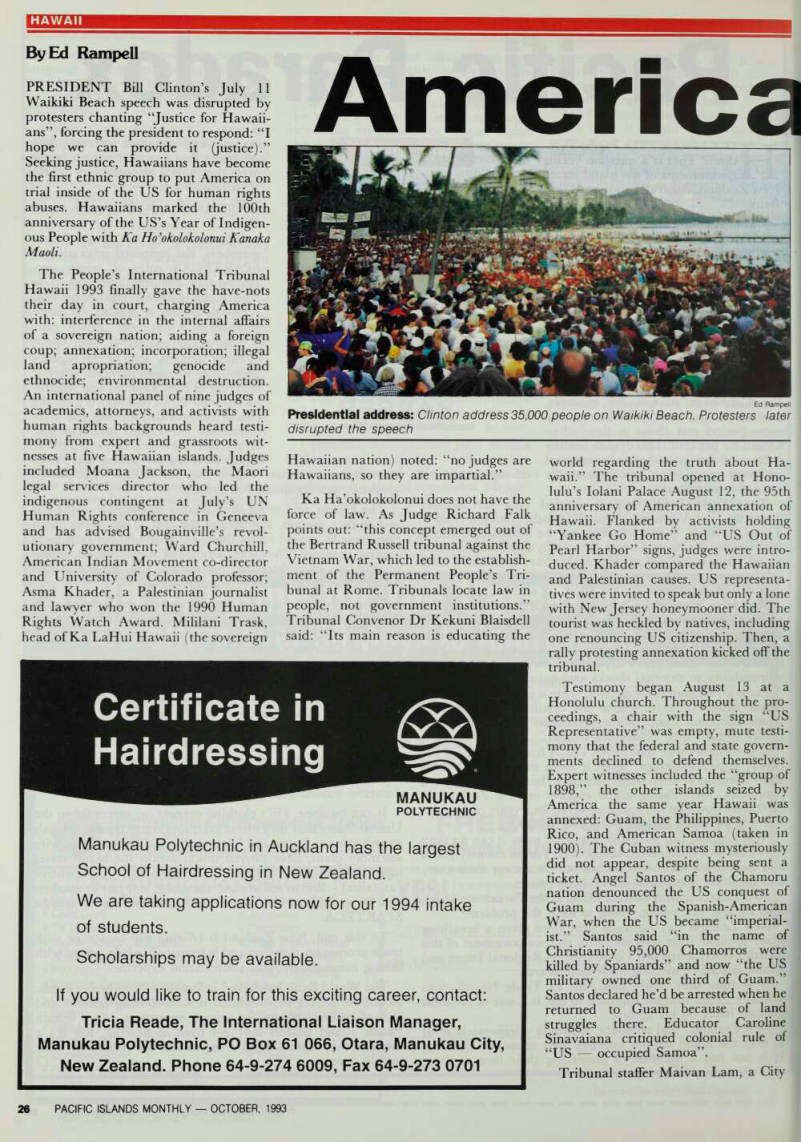
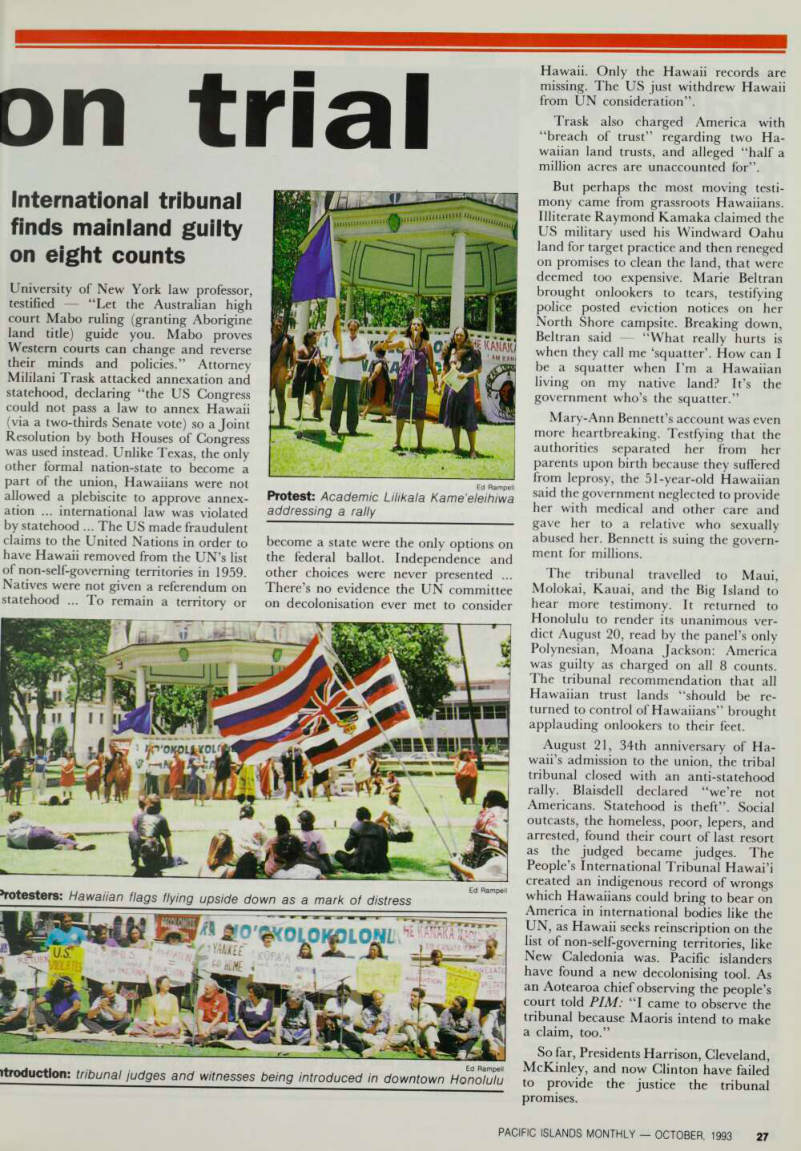
Hawaii
By Ed Rampell
PRESIDENT Bill Clinton’s July 11 Waikiki Beach speech was disrupted by protesters chanting “Justice for Hawaii ans”, forcing the president to respond: “I hope we can provide it (justice).”
Seeking justice, Hawaiians have become the first ethnic group to put America on trial inside of the US for human rights abuses. Hawaiians marked the 100th anniversary of the US’s Year of Indigen ous People with Ka Ho’okolokolonui Kanaka Maoli.
The People’s International Tribunal Hawaii 1993 finally gave the have-nots their day in court, charging America with: interference in the internal affairs of a sovereign nation; aiding a foreign coup; annexation; incorporation; illegal land apropriation; genocide and ethnocide; environmental destruction.
An international panel of nine judges of academics, attorneys, and activists with human rights backgrounds heard testi mony from expert and grassroots wit nesses at five Hawaiian islands. Judges included Moana Jackson, the Maori legal services director who led the indigenous contingent at July’s UN Human Rights conference in Geneeva and has advised Bougainville’s revol utionary government; Ward Churchill, American Indian Movement co-director and University of Colorado professor; Asma Khader, a Palestinian journalist and lawyer who won the 1990 Human Rights Watch Award. Mililani Trask, head of Ka LaHui Hawaii (the sovereign
Hawaiian nation) noted: “no judges are Hawaiians, so they are impartial.”
Ka Ha’okolokolonui does not have the force of law. As Judge Richard Falk points out: “this concept emerged out of the Bertrand Russell tribunal against the Vietnam War, which led to the establish ment of the Permanent People’s Tri bunal at Rome. Tribunals locate law in people, not government institutions.”
Tribunal Convenor Dr Kekuni Blaisdell said; “Its main reason is educating the
world regarding the truth about Ha waii.” The tribunal opened at Hono lulu’s lolani Palace August 12, the 95th anniversary of American annexation of Hawaii. Flanked by activists holding “Yankee Go Home” and “US Out of Pearl Harbor” signs, judges were intro duced. Khader compared the Hawaiian and Palestinian causes. US representa tives were invited to speak but only a lone with New Jersey honeymooner did. The tourist was heckled by natives, including one renouncing US citizenship. Then, a rally protesting annexation kicked off the tribunal.
Testimony began August 13 at a Honolulu church. Throughout the pro ceedings, a chair with the sign “US Representative” was empty, mute testi mony that the federal and state govern ments declined to defend themselves.
Expert witnesses included the “group of 1898,” the other islands seized by America the same year Hawaii was annexed: Guam, the Philippines, Puerto Rico, and American Samoa (taken in 1900). The Cuban witness mysteriously did not appear, despite being sent a ticket. Angel Santos of the Chamoru nation denounced the US conquest of Guam during the Spanish-American War, when the US became “imperial ist.” Santos said “in the name of Christianity 95,000 Chamorros were killed by Spaniards” and now “the US military owned one third of Guam.”
Santos declared he’d be arrested when he returned to Guam because of land struggles there. Educator Caroline Sinavaiana critiqued colonial rule of “US occupied Samoa”.
Tribunal staffer Maivan Lam, a City
Ed Rampell Presidential address: Clinton address 35,000 people on Waikiki Beach. Protesters later disrupted the speech
International tribunal
finds mainland guilty
on eight counts
University of New York law professor, testified “Let the Australian high
court Mabo ruling (granting Aborigine
land title) guide you. Mabo proves Western courts can change and reverse their minds and policies.” Attorney Mililani Trask attacked annexation and statehood, declaring “the US Congress could not pass a law to annex Hawaii (via a two-thirds Senate vote) so a Joint Resolution by both Houses of Congress was used instead. Unlike Texas, the only other formal nation-state to become a part of the union, Hawaiians were not allowed a plebiscite to approve annex ation ... international law was violated by statehood ... The US made fraudulent claims to the United Nations in order to have Hawaii removed from the UN’s list of non-self-goveming territories in 1959.
Natives were not given a referendum on statehood ... To remain a territory or
become a state were the only options on the federal ballot. Independence and other choices were never presented ...
There’s no evidence the UN committee on decolonisation ever met to consider
Hawaii. Only the Hawaii records are missing. The US just withdrew Hawaii from UN consideration”.
Trask also charged America with “breach of trust” regarding two Ha waiian land trusts, and alleged “half a million acres are unaccounted for”.
But perhaps the most moving testi mony came from grassroots Hawaiians.
Illiterate Raymond Kamaka claimed the US military used his Windward Oahu land for target practice and then reneged on promises to clean the land, that were deemed too expensive. Marie Beltran brought onlookers to tears, testifying police posted eviction notices on her North Shore campsite. Breaking down, Beltran said “What really hurts is when they call me ‘squatter’. How can I be a squatter when I’m a Hawaiian living on my native land? It’s the government who’s the squatter.”
Mary-Ann Bennett’s account was even more heartbreaking. Testfying that the authorities separated her from her parents upon birth because they suffered from leprosy, the 51-year-old Hawaiian said the government neglected to provide her with medical and other care and gave her to a relative who sexually abused her. Bennett is suing the govern ment for millions.
The tribunal travelled to Maui, Molokai, Kauai, and the Big Island to hear more testimony. It returned to Honolulu to render its unanimous ver dict August 20, read by the panel’s only Polynesian, Moana Jackson: America was guilty as charged on all 8 counts.
The tribunal recommendation that all Hawaiian trust lands “should be re turned to control of Hawaiians” brought applauding onlookers to their feet.
August 21, 34th anniversary of Ha waii’s admission to the union, the tribal tribunal closed with an anti-statehood rally. Blaisdell declared “we’re not Americans. Statehood is theft”. Social outcasts, the homeless, poor, lepers, and arrested, found their court of last resort as the judged became judges. The People’s International Tribunal Hawai’i created an indigenous record of wrongs which Hawaiians could bring to bear on America in international bodies like the UN, as Hawaii seeks reinscription on the list of non-self-governing territories, like New Caledonia was. Pacific islanders have found a new decolonising tool. As an Aotearoa chief observing the people’s court told PIM: “I came to observe the tribunal because Maoris intend to make a claim, too.”
So far, Presidents Harrison, Cleveland, McKinley, and now Clinton have failed to provide the justice the tribunal Dromises.
rotesters: Hawaiian flags flying upside down as a mark of distress
Production: tribunal judges and witnesses being introduced in downtown Honolulu
Ed Rampell Protest: Academic Lilikala Kame'eleihiwa addressing a rally
Ed Rampell
Advertisements & other items, p. 26 (1 item)
Hairdressing
Certificate in
MANUKAU
POLYTECHNIC
Manukau Polytechnic in Auckland has the largest School of Hairdressing in New Zealand.
We are taking applications now for our 1994 intake of students.
Scholarships may be available.
If you would like to train for this exciting career, contact: Tricia Reade, The International Liaison Manager, Manukau Polytechnic, PO Box 61 066, Otara, Manukau City, New Zealand. Phone 64-9-274 6009, Fax 64-9-273 0701
Back to
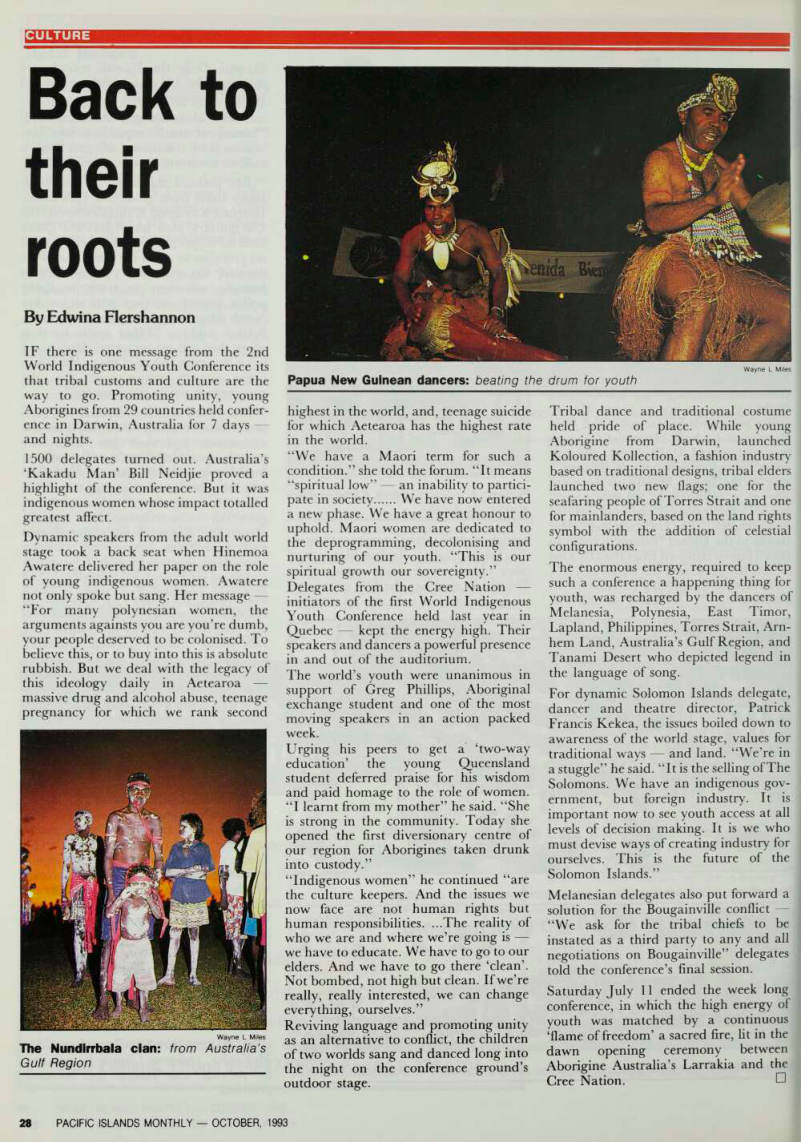
Culture
Back to their roots
By Edwina Flershannon
IF there is one message from the 2nd World Indigenous Youth Conference its that tribal customs and culture are the way to go. Promoting unity, young Aborigines from 29 countries held confer ence in Darwin, Australia for 7 days and nights. 1500 delegates turned out. Australia’s ‘Kakadu Man’ Bill Neidjie proved a highlight of the conference. But it was indigenous women whose impact totalled greatest affect.
Dynamic speakers from the adult world stage took a back seat when Hinemoa Awatere delivered her paper on the role of young indigenous women. Awatere not only spoke but sang. Her message “For many Polynesian women, the arguments againsts you are you’re dumb, your people deserved to be colonised. To believe this, or to buy into this is absolute rubbish. But we deal with the legacy of this ideology daily in Aetearoa massive drug and alcohol abuse, teenage pregnancy for which we rank second
highest in the world, and, teenage suicide for which Aetearoa has the highest rate in the world.
“We have a Maori term for such a condition.” she told the forum. “It means “spiritual low” an inability to partici pate in society We have now entered a new phase. We have a great honour to uphold. Maori women are dedicated to the deprogramming, decolonising and nurturing of our youth. “This is our spiritual growth our sovereignty.”
Delegates from the Cree Nation initiators of the first World Indigenous Youth Conference held last year in Quebec kept the energy high. Their speakers and dancers a powerful presence in and out of the auditorium.
The world’s youth were unanimous in
support of Greg Phillips, Aboriginal
exchange student and one of the most moving speakers in an action packed week.
Urging his peers to get a ‘two-way education’ the young Queensland student deferred praise for his wisdom and paid homage to the role of women.
“I learnt from my mother” he said. “She is strong in the community. Today she opened the first diversionary centre of our region for Aborigines taken drunk
into custody.”
“Indigenous women” he continued “are the culture keepers. And the issues we now face are not human rights but human responsibilities. ...The reality of who we are and where we’re going is we have to educate. We have to go to our elders. And we have to go there ‘clean’.
Not bombed, not high but clean. If we’re really, really interested, we can change
everything, ourselves.”
Reviving language and promoting unity as an alternative to conflict, the children of two worlds sang and danced long into the night on the conference ground’s outdoor stage.
Tribal dance and traditional costume held pride of place. While young Aborigine from Darwin, launched Koloured Kollection, a fashion industry based on traditional designs, tribal elders launched two new flags; one for the seafaring people of Torres Strait and one for mainlanders, based on the land rights symbol with the addition of celestial
configurations.
The enormous energy, required to keep such a conference a happening thing for youth, was recharged by the dancers of Melanesia, Polynesia, East Timor, Lapland, Philippines, Torres Strait, Arn hem Land, Australia’s Gulf Region, and Tanami Desert who depicted legend in the language of song.
For dynamic Solomon Islands delegate, dancer and theatre director, Patrick Francis Kekea, the issues boiled down to awareness of the world stage, values for traditional ways and land. “We’re in a stuggle” he said. “It is the selling of The Solomons. We have an indigenous gov ernment, but foreign industry. It is important now to see youth access at all levels of decision making. It is we who must devise ways of creating industry for ourselves. This is the future of the Solomon Islands.”
Melanesian delegates also put forward a solution for the Bougainville conflict “We ask for the tribal chiefs to be instated as a third party to any and all
negotiations on Bougainville” delegates
told the conference’s final session.
Saturday July 11 ended the week long conference, in which the high energy of youth was matched by a continuous ‘flame of freedom’ a sacred fire, lit in the dawn opening ceremony between Aborigine Australia’s Larrakia and the Cree Nation.
Wayne L Miles The Nundirrbala clan: from Australia’s Gulf Region
Wayne L Miles
Papua New Guinean dancers: beating the drum for youth
Nauru’s Forum
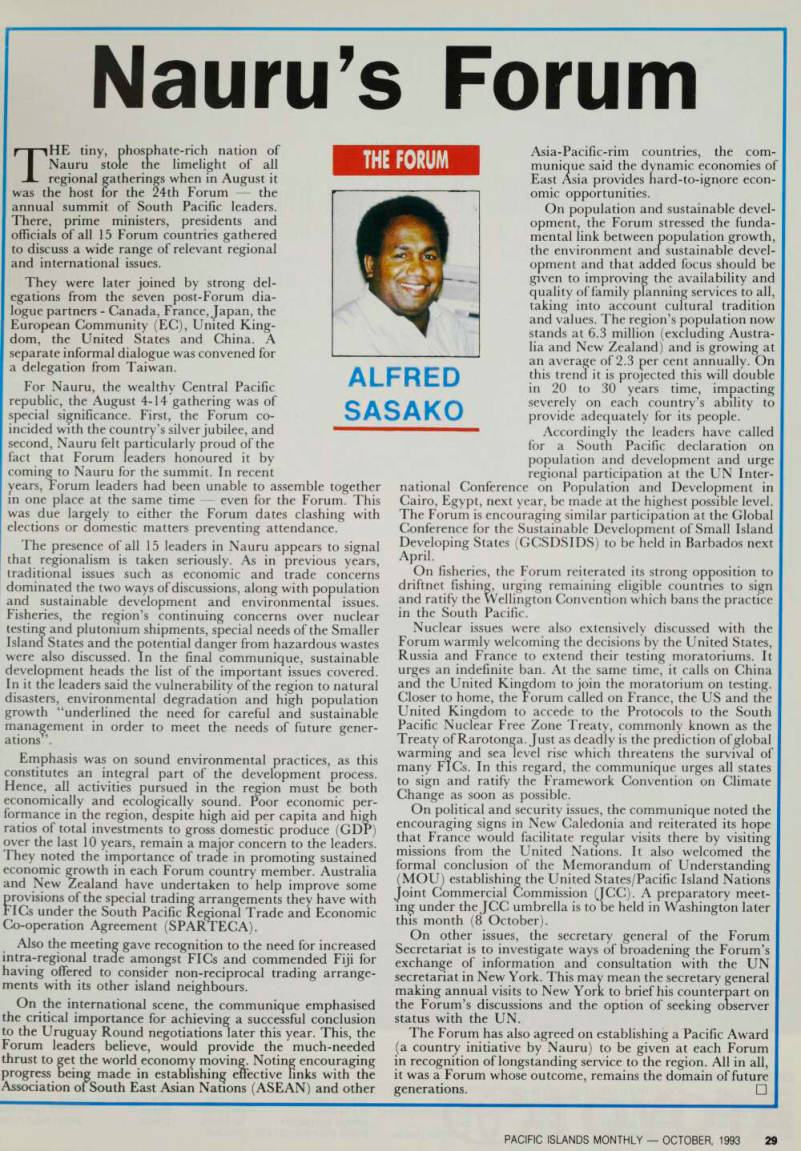
THE tiny, phosphate-rich nation of Nauru stole the limelight of all regional gatherings when in August it was the host for the 24th Forum the annual summit of South Pacific leaders.
There, prime ministers, presidents and officials of all 15 Forum countries gathered to discuss a wide range of relevant regional and international issues.
They were later joined by strong del egations from the seven post-Forum dia logue partners - Canada, France, Japan, the European Community (EC), United King dom, the United States and China. A separate informal dialogue was convened for a delegation from Taiwan.
For Nauru, the wealthy Central Pacific republic, the August 4-14 gathering was of special significance. First, the Forum co incided with the country’s silver jubilee, and second, Nauru felt particularly proud of the fact that Forum leaders honoured it by coming to Nauru for the summit. In recent
years, Forum leaders had been unable to assemble together in one place at the same time even for the Forum. This was due largely to either the Forum dates clashing with elections or domestic matters preventing attendance.
The presence of all 15 leaders in Nauru appears to signal that regionalism is taken seriously. As in previous years, traditional issues such as economic and trade concerns dominated the two ways of discussions, along with population and sustainable development and environmental issues.
Fisheries, the region’s continuing concerns over nuclear testing and plutonium shipments, special needs of the Smaller Island States and the potential danger from hazardous wastes were also discussed. In the final communique, sustainable development heads the list of the important issues covered.
In it the leaders said the vulnerability of the region to natural
disasters, environmental degradation and high population
growth “underlined the need for careful and sustainable management in order to meet the needs of future gener ations’’.
Emphasis was on sound environmental practices, as this constitutes an integral part of the development process.
Hence, all activities pursued in the region must be both economically and ecologically sound. Poor economic per formance in the region, despite high aid per capita and high ratios of total investments to gross domestic produce (GDP) over the last 10 years, remain a major concern to the leaders.
They noted the importance of trade in promoting sustained economic growth in each Forum country member. Australia and New Zealand have undertaken to help improve some provisions of the special trading arrangements they have with FICs under the South Pacific Regional Trade and Economic
Co-operation Agreement (SPARTECA).
Also the meeting gave recognition to the need for increased intra-regional trade amongst FICs and commended Fiji for having offered to consider non-reciprocal trading arrange ments with its other island neighbours.
On the international scene, the communique emphasised the critical importance for achieving a successful conclusion to the Uruguay Round negotiations later this year. This, the Forum leaders believe, would provide the much-needed thrust to get the world economy moving. Noting encouraging progress being made in establishing effective finks with the Association of South East Asian Nations (ASEAN) and other
Asia-Pacific-rim countries, the com munique said the dynamic economies of East Asia provides nard-to-ignore econ omic opportunities.
On population and sustainable devel opment, the Forum stressed the funda mental link between population growth, the environment and sustainable devel opment and that added focus should be given to improving the availability and quality of family planning services to all, taking into account cultural tradition and values. The region’s population now stands at 6.3 million (excluding Austra lia and New Zealand) and is growing at an average of 2.3 per cent annually. On this trend it is projected this will double in 20 to 30 years time, impacting severely on each country’s ability to provide adequately for its people.
Accordingly the leaders have called for a South Pacific declaration on population and development and urge regional participation at the UN Inter
national Conference on Population and Development in Cairo, Egypt, next year, be made at the highest possible level.
The Forum is encouraging similar participation at the Global Conference for the Sustainable Development of Small Island Developing States (GCSDSIDS) to be held in Barbados next April.
On fisheries, the Forum reiterated its strong opposition to driftnet fishing, urging remaining eligible countries to sign and ratify the Wellington Convention which bans the practice in the South Pacific.
Nuclear issues were also extensively discussed with the Forum warmly welcoming the decisions by the United States, Russia and France to extend their testing moratoriums. It urges an indefinite ban. At the same time, it calls on China and the United Kingdom to join the moratorium on testing.
Closer to home, the Forum called on France, the US and the United Kingdom to accede to the Protocols to the South Pacific Nuclear Free Zone Treaty, commonly known as the Treaty of Rarotonga. Just as deadly is the prediction of global warming and sea level rise which threatens the survival of many FICs. In this regard, the communique urges all states to sign and ratify the Framework Convention on Climate Change as soon as possible.
On political and security issues, the communique noted the encouraging signs in New Caledonia and reiterated its hope that France would facilitate regular visits there by visiting missions from the United Nations. It also welcomed the formal conclusion of the Memorandum of Understanding (MOU) establishing the United States/Pacific Island Nations Joint Commercial Commission (JCC). A preparatory meet ing under the JCC umbrella is to be held in Washington later this month (8 October).
On other issues, the secretary general of the Forum Secretariat is to investigate ways of broadening the Forum’s exchange of information and consultation with the UN secretariat in New York. This may mean the secretary general making annual visits to New York to brief his counterpart on the Forum’s discussions and the option of seeking observer status with the UN.
The Forum has also agreed on establishing a Pacific Award (a country initiative by Nauru) to be given at each Forum in recognition of longstanding service to the region. All in all, it was a Forum whose outcome, remains the domain of future generations. □
The Forum
Alfred
Sasako
Advertisements & other items, pp. 30-31 (1 item)
Is It Possible To Miefe A Hi Level Of Aerodynamk
WITH A ROOMY Creatin § a highly efficient, dynamic-looking car woe m 1111 XI IIUUIU 1 (jEUflil . be simple if it weren’t for one complicating detail; t passengers that must ride in it. Accommodating people comfortably in a pleasant, roor interior usually means a certain amount of aerodynamic potential has to be sacrifice 10 % m * Exact features and specifications may vary depending on country of purchase. Please check with your nearest TOYOTA distributor/dealer for details.
DISTRIBUTORS/DEALEkS
AMERICAN SAMOA BURNS PHILP (S.S.) CO. LTD.
GUAM & MICRONESIA... .ATKINS KROLL INC.
NORFOLK ISLANDS BORRY’S PTY LTD.
SOLOMON ISLANDS MENDANA MOTORS
VANUATU VANUATU MOTORS
PH 633-4281 PH 646-1876/9 PH 2114 PH 30314 PH 22341
E V IT RMITIMIY Until now. Using a con lO II DMUIIfULLI. cept called total airflow lagement, Toyota engineers were able to realize an efficient, wedge-shaped design le at the same time perfecting the alignment between body panels and components. :ourse our own innovative style of civilized neering makes sure that none of this comes he expense of the luxurious, leg-stretching interior. Because we realize that even a 0.33 is useless if no one wants to drive the car.
®TOYOTA
sound climate
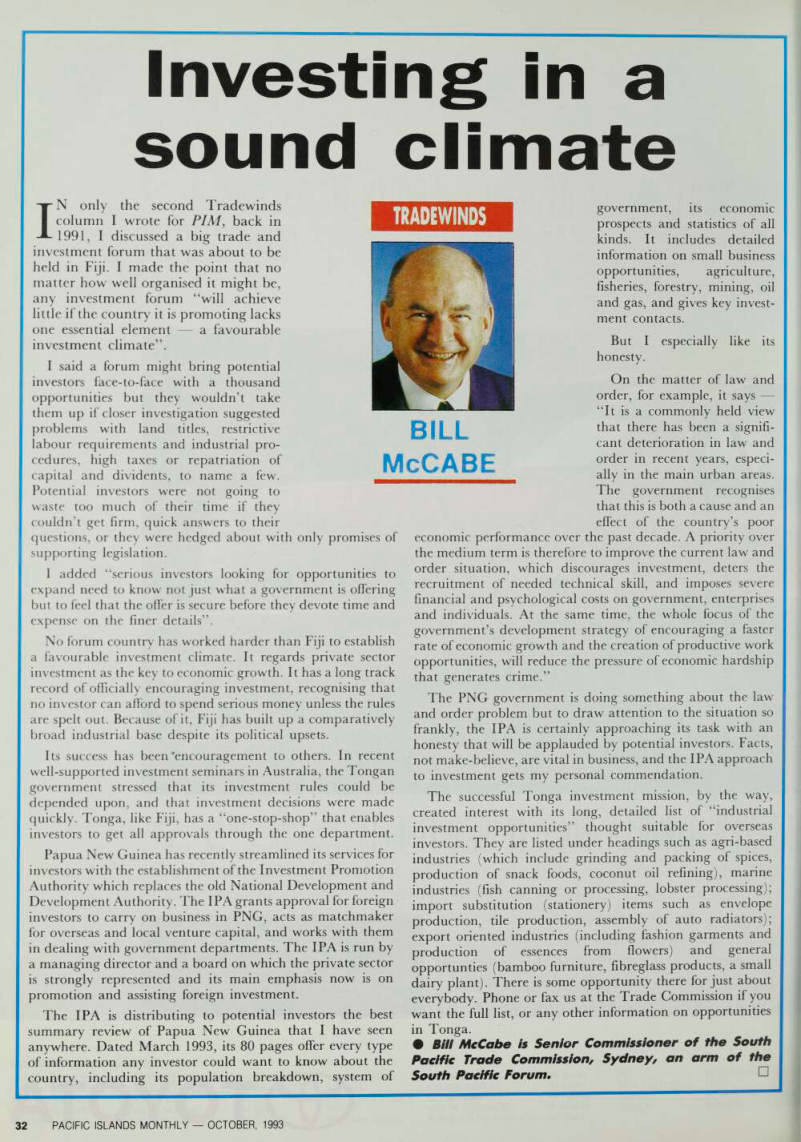
Investing in a sound climate
IN only the second Tradewinds column I wrote for PIM, back in 1991, I discussed a big trade and investment forum that was about to be held in Fiji. I made the point that no matter how well organised it might be, any investment forum “will achieve little if the country it is promoting lacks one essential element a favourable investment climate”.
I said a forum might bring potential investors face-to-face with a thousand opportunities but they wouldn’t take them up if closer investigation suggested problems with land titles, restrictive labour requirements and industrial pro cedures, high taxes or repatriation of capital and dividents, to name a few.
Potential investors were not going to waste too much of their time if they couldn’t get firm, quick answers to their
questions, or they were hedged about with only promises of supporting legislation.
I added “serious investors looking for opportunities to expand need to know not just what a government is offering but to feel that the offer is secure before they devote time and expense on the finer details”.
No forum country has worked harder than Fiji to establish a favourable investment climate. It regards private sector investment as the key to economic growth. It has a long track record of officially encouraging investment, recognising that no investor can afford to spend serious money unless the rules are spelt out. Because of it, Fiji has built up a comparatively broad industrial base despite its political upsets.
Its success has been'encouragement to others. In recent well-supported investment seminars in Australia, the Tongan government stressed that its investment rules could be depended upon, and that investment decisions were made quickly. Tonga, like Fiji, has a “one-stop-shop” that enables investors to get all approvals through the one department.
Papua New Guinea has recently streamlined its services for investors with the establishment of the Investment Promotion Authority which replaces the old National Development and Development Authority. The IPA grants approval for foreign investors to carry on business in PNG, acts as matchmaker for overseas and local venture capital, and works with them in dealing with government departments. The IPA is run by a managing director and a board on which the private sector is strongly represented and its main emphasis now is on promotion and assisting foreign investment.
The IPA is distributing to potential investors the best summary review of Papua New Guinea that I have seen anywhere. Dated March 1993, its 80 pages offer every type of information any investor could want to know about the country, including its population breakdown, system of
government, its economic prospects and statistics of all kinds. It includes detailed information on small business opportunities, agriculture, fisheries, forestry, mining, oil and gas, and gives key invest ment contacts.
But I especially like its honesty.
On the matter of law and order, for example, it says “It is a commonly held view that there has been a signifi cant deterioration in law and order in recent years, especi ally in the main urban areas.
The government recognises that this is both a cause and an effect of the country’s poor
economic performance over the past decade. A priority over the medium term is therefore to improve the current law and order situation, which discourages investment, deters the recruitment of needed technical skill, and imposes severe financial and psychological costs on government, enterprises and individuals. At the same time, the whole focus of the government’s development strategy of encouraging a faster rate of economic growth and the creation of productive work opportunities, will reduce the pressure of economic hardship that generates crime.”
The PNG government is doing something about the law and order problem but to draw attention to the situation so frankly, the IPA is certainly approaching its task with an honesty that will be applauded by potential investors. Facts, not make-believe, are vital in business, and the IPA approach to investment gets my personal commendation.
The successful Tonga investment mission, by the way, created interest with its long, detailed list of “industrial investment opportunities” thought suitable for overseas investors. They are listed under headings such as agri-based industries (which include grinding and packing of spices, production of snack foods, coconut oil refining), marine industries (fish canning or processing, lobster processing); import substitution (stationery) items such as envelope production, tile production, assembly of auto radiators); export oriented industries (including fashion garments and production of essences from flowers) and general opportunties (bamboo furniture, fibreglass products, a small dairy plant). There is some opportunity there for just about everybody. Phone or fax us at the Trade Commission if you want the full list, or any other information on opportunities in Tonga. • Bill McCabe is Senior Commissioner of the South Pacific Trade Commission , Sydney, an arm of the South Pacific Forum.
Tradewinds
Bill
Mccabe
Advertisements & other items, pp. 33-34 (1 item)
3tda MaihatAj
i ■'
AVIS
Z vt (kmnjt cuaikXt ) jo /ft i/H tea* a & ikmcA
UcCctiMc c&vuAu.
[fiioks cpu. ksut!
. MAThtAAJ .
Wx;
r ROM THE "VVE TRV
AVIS
OFFICES THROUGH
We try harder, head office : phone (6 JSTRALIA WIDE (008) 22 55 33 TOLL FREE / NEW ZEALAND WIDE (0800) 65 55 ///
heal'
& M * - 42
sißeej
'fLCt UT 7 233 9) 722 (679)
111 TOLL
FR
USA 800 - 331-2112 TOLL FREE
WILSON- ADD) SOI
The true colours of the Pacific
AIR
PACIFIC
FIJI'S INTERNATIONAL AIRLINE
*- Apia • Auckland • Brisbane • Christchurch • Honiara • Melbourne • Nadi • Port Vila • Suva • Sydney • Tokyo • Tonga
WILSON ADDISON 07.577
the move
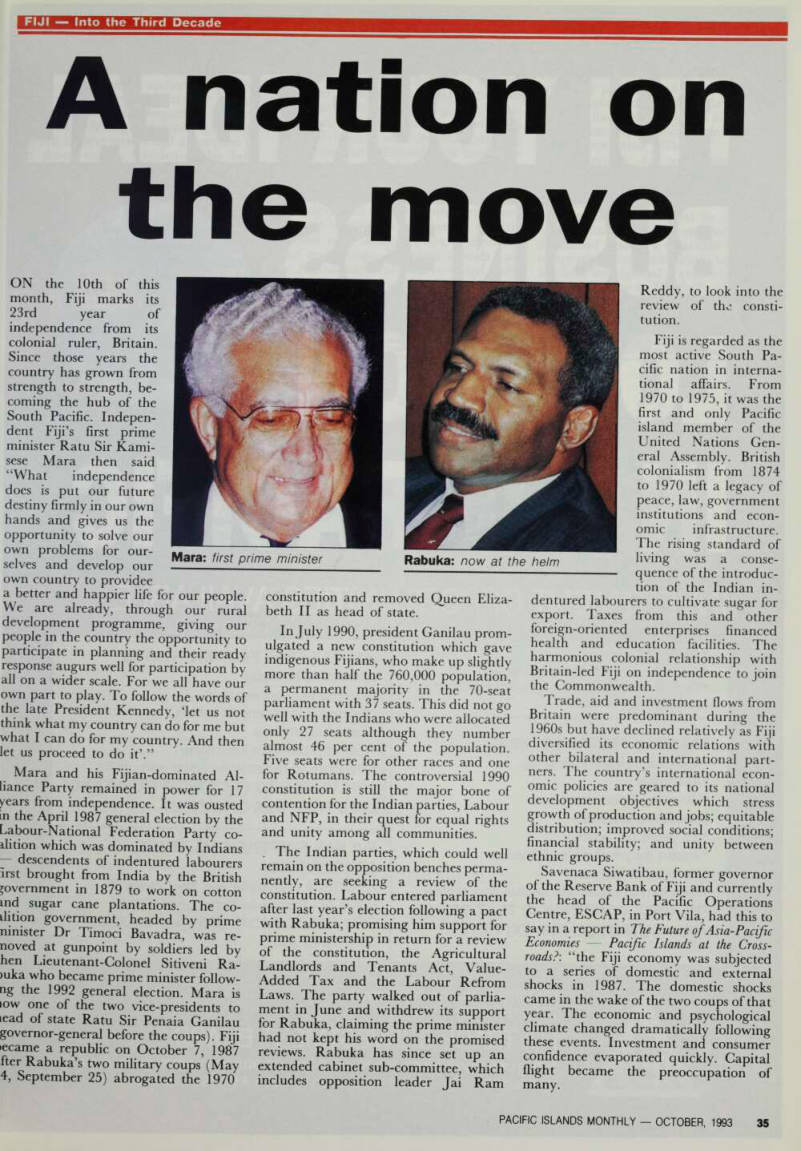
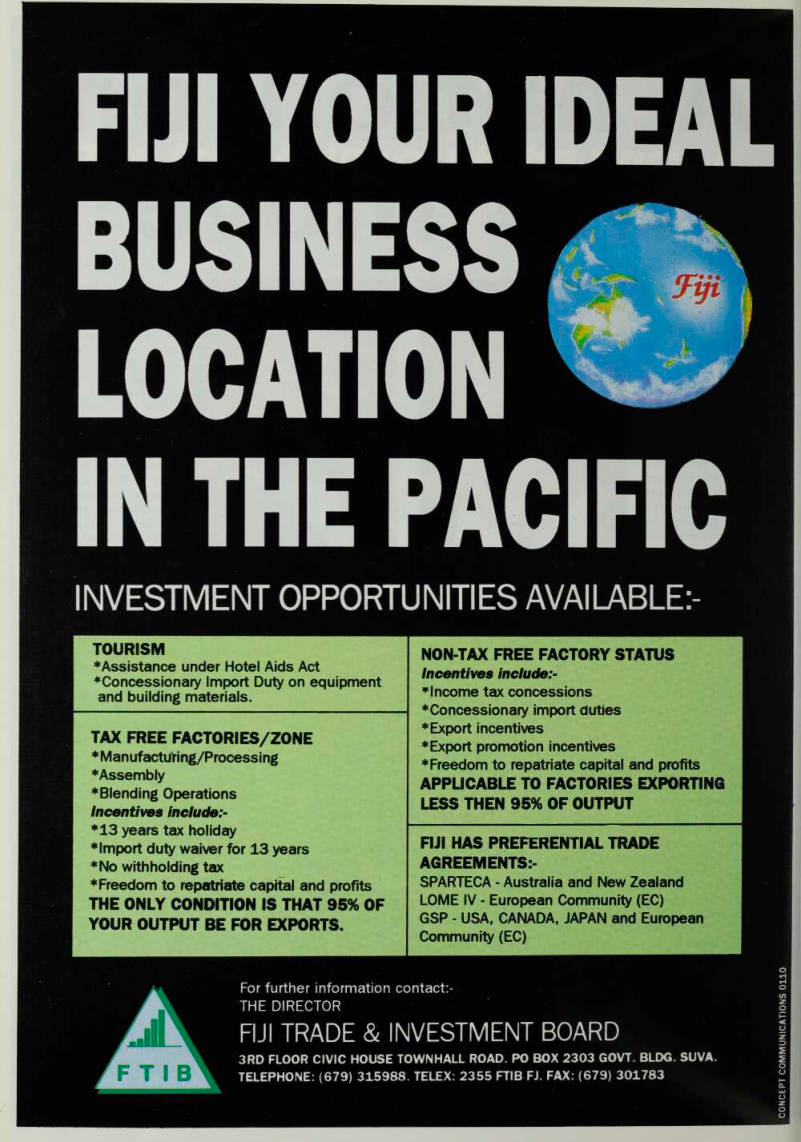
FIJI - Into the Third Decade
A nation on the move
ON the 10th of this month, Fiji marks its 23rd year of independence from its colonial ruler, Britain.
Since those years the country has grown from strength to strength, be coming the hub of the South Pacific. Indepen dent Fiji’s first prime minister Ratu Sir Kami sese Mara then said
“What independence
does is put our future destiny firmly in our own hands and gives us the opportunity to solve our own problems for our selves and develop our own country to providee
a better and happier life for our people.
We are already, through our rural development programme, giving our people in the country the opportunity to participate in planning and their ready response augurs well for participation by all on a wider scale. For we all have our own part to play. To follow the words of the late President Kennedy, ‘let us not think what my country can do for me but what I can do for my country. And then let us proceed to do it’.”
Mara and his Fijian-dominated Al liance Party remained in power for 17 y'ears from independence. It was ousted in the April 1987 general election by the Labour-National Federation Party co ition which was dominated by Indians descendents of indentured labourers Irst brought from India by the British government in 1879 to work on cotton ind sugar cane plantations. The co dition government, headed by prime ninister Dr Timoci Bavadra, was re noved at gunpoint by soldiers led by hen Lieutenant-Colonel Sitiveni Ra )uka who became prime minister follow ng the 1992 general election. Mara is iow one of the two vice-presidents to lead of state Ratu Sir Penaia Ganilau governor-general before the coups). Fiji •ecame a republic on October 7, 1987 fter Rabuka’s two military coups (May 4, September 25) abrogated the 1970
constitution and removed Queen Eliza beth II as head of state.
In July 1990, president Ganilau prom ulgated a new constitution which gave
indigenous Fijians, who make up slightly
more than half the 760,000 population, a permanent majority in the 70-seat parliament with 37 seats. This did not go well with the Indians who were allocated only 27 seats although they number almost 46 per cent of the population.
Five seats were for other races and one for Rotumans. The controversial 1990 constitution is still the major bone of contention for the Indian parties, Labour and NFP, in their quest for equal rights and unity among all communities. . The Indian parties, which could well remain on the opposition benches perma nently, are seeking a review of the constitution. Labour entered parliament after last year’s election following a pact with Rabuka; promising him support for prime ministership in return for a review of the constitution, the Agricultural Landlords and Tenants Act, Value- Added Tax and the Labour Refrom Laws. The party walked out of parlia ment in June and withdrew its support for Rabuka, claiming the prime minister had not kept his word on the promised reviews. Rabuka has since set up an extended cabinet sub-committee, which includes opposition leader Jai Ram
Reddy, to look into the review of the consti tution.
Fiji is regarded as the most active South Pa cific nation in interna tional affairs. From 1970 to 1975, it was the first and only Pacific island member of the United Nations Gen eral Assembly. British colonialism from 1874 to 1970 left a legacy of peace, law, government institutions and econ omic infrastructure.
The rising standard of living was a conse quence of the introduc tion of the Indian in
dentured labourers to cultivate sugar for export. Taxes from this and other
foreign-oriented enterprises financed
health and education facilities. The harmonious colonial relationship with
Britain-led Fiji on independence to join
the Commonwealth.
Trade, aid and investment flows from Britain were predominant during the 1960 s but have declined relatively as Fiji diversified its economic relations with other bilateral and international part ners. The country’s international econ omic policies are geared to its national
development objectives which stress
growth of production and jobs; equitable distribution; improved social conditions; financial stability; and unity between ethnic groups.
Savenaca Siwatibau, former governor of the Reserve Bank of Fiji and currently the head of the Pacific Operations Centre, ESCAP, in Port Vila, had this to say in a report in The Future of Asia-Pacific Economies Pacific Islands at the Cross roads?: “the Fiji economy was subjected to a series of domestic and external shocks in 1987. The domestic shocks came in the wake of the two coups of that year. The economic and psychological
climate changed dramatically following
these events. Investment and consumer
confidence evaporated quickly. Capital
flight became the preoccupation of many.
Mara: first prime minister
Rabuka: now at the helm
Most attempted capital flight through the banks but others sought avenues outside the banking system. Exporters deferred the repatriation of foreign exchange receipts but importers, because of expected falling consumer spending, delayed import orders and attempted to run down stocks. Residents who held short-term external debts sought accom modation from their banks to settle them early.
“The number of tourists declined sharply as their home governments advised them to avoid visiting Fiji until further notice. Sugar harvests were delayed through a strike and export products were black-banned in a number of economies of destination. Foreign exchange receipts fell dramatically ac companied by falling imports. The import substituting businesses soon re alised it would be difficult to survive within a contracting market and that long-term survival required a change in attitude and reorientation towards ex porting. Many business firms were forced to lay off workers and/or reduce salaries and wages.
“The overall deficit in the balance of payments widened sharply. External financing sources were effectively closed.
The government, which used to have long queues of international bankers wishing to lend to it, found its overtures for external accommodation politely ignored. Only two banks, both with branches in Fiji, responded positively and concluded stand-by arrangements, each for Aslo million, with the Reserve Bank of Fiji.
“The government and public sector enterprises whose financial positions had deteriorated rapidly sought accommo dation from the Reserve Bank. The bank’s claims from the public sector increased from zero in April to over $5O million in October 1987. That trend needed to be reversed quickly through drastic expenditure policies. The govern ment announced a 15 per cent reduction in public service salanes and the public sector enterprises had their budgetary allocations cut by 50 per cent. They were required to reduce operating expendi tures, including salaries, and were in formed that further requests for govern ment assistance would not be accommo dated.”
Traditionally, Fiji’s most valuable "esource has been sugar, generating up to :hree-fourths of export earnings, followed 3y coconut products and gold, generat ng up to half the remainder (Fiji government 1985, appendix D). The government’s policies of diversification md industrialisation have modified the >attem by raising fish products from zero n 1970 to six per cent in 1990, and imber products from less than one per ent to five per cent, and by exporting lew manufactured goods such as cement. iaint and boats. Garment exports
doubled and redoubled in the 1980 s.
The success of Fiji’s post-coup policies has been mixed. No state broke off diplomatic relations with Fiji save India, whose mission in Suva was expelled in 1990. Relations with international or ganisations not affiliated with the Com monwealth continued uninterrupted.
The island state leaders of the South Pacific Forum were disinclined to put Fiji’s deviation from constitutional gov ernment on the Forum agenda, regard ing this as a domestic, not a regional, issue and Tonga, Marshall Islands and the Melanesian states early stated their intention to work with the new govern ment in spite of Australia and New
Zealand’s disapproval. South-east and East Asian governments likewise dealt with Fiji pragmatically. By the end of 1987, Indonesian and Malaysian del egations had visited Fiji and entered into negotiations to enhance trade and econ omic cooperation with Fiji.
The return to constitutional and elected government last year has sal vaged Fiji’s standing in the eyes of democratic partners, and raised its chances of reinstatement in the Com monwealth. Fiji will continue to be a significant trader, a desirable venue for
international organisations, an import
ant hub for regional transportation and a strong player in South Pacific foreign affairs. □
Advertisements & other items, pp. 36-37 (2 items)
Business
mi YOUR IDEAL
LOCATION
IN THE PACIFIC
INVESTMENT OPPORTUNITIES AVAILABLE:-
TOURISM
♦Assistance under Hotel Aids Act ♦Concessionary Import Duty on equipment and building materials.
TAX FREE FACTORIES/ZONE
♦Manufactuhng/Processing ♦Assembly ♦Blending Operations Incentives include ♦l3 years tax holiday ♦lmport duty waiver for 13 years ♦No withholding tax ♦Freedom to repatriate capital and profits THE ONLY CONDITION IS THAT 95% OF
YOUR OUTPUT BE FOR EXPORTS.
NON TAX FREE FACTORY STATUS
Incentives include:- ♦lncome tax concessions ♦Concessionary import duties ♦Export incentives ♦Export promotion incentives ♦Freedom to repatriate capital and profits
APPUCABLE TO FACTORIES EXPORTING
LESS THEN 95% OF OUTPUT
FIJI HAS PREFERENTIAL TRADE
AGREEMENTS:-
SPARTECA - Australia and New Zealand LOME IV - European Community (EC) GSP - USA, CANADA, JAPAN and European Community (EC) For further information contact:-
THE DIRECTOR
FIJI TRADE & INVESTMENT BOARD
3RD FLOOR CIVIC HOUSE TOWNHALL ROAD. PO BOX 2303 GOVT. BLDG. SUVA.
TELEPHONE: (679) 315988. TELEX: 2355 FTIB FJ. FAX: (679) 301783
Fiji ever Fiji ...
fe- ■ -i^sa ■ n % »%, ;:m- -■ - I I
We congratulate
our great nation on the celebration of
Fiji Day
99 HI 111
fin
VISITORS
BUREAU
GEORGE (?ÜBINE 05.40
37
FIJI Into the Third Decade
PACIFIC ISLANDS MONTHLY OCTOBER, 1993
Political

evolution
12908 C Carbon-dated Lapita pottery pro vides evidence of complex civilisation evolving from a confluence of Melanesian and Poly nesian migrations. Regional and tribal wars were endemic. 1643 Dutch explorer Abel Tasman was the first European to see Fiji. 1700 s English explorers James Cook, William Bligh and Wilson sighted various Fiji islands. 1800-14 The chiefs of Bau assisted European traders’ exploitation of sandalwood and hosted the first European settlement. 1820-40 Russian explorer von Bellinghausen French explorer d’Urville, and American explorer Wilkes examined various islands; the latter making the first reliable charts. 1822 US ships began calling to buy beche de-mer (sea slug) for the China market. 1830-35 Wesleyan evangelists established churches and schools, bringing Christianity and English and an alphabet to the Fijian language. 1840 The United States appointed a vice consul in Levuka. 1844 Marist missionaries commenced evangelising, raising the possibility of French penetration 1854 Seru Cakobau, chief of Bau, converted to Christianity and appealed to Britain for assistance in his wars with rivals, including a Tongan chief. 1858 Britain appointed a consul who assisted Cakobau to fend off Tongan, French and US intervention. 1871 Cakobau established a natioinal a national monarchy. Blackbirding, alienation of land and commercial swindling by Europeans led him and the paramount chiefs to seek British protection.
1874 Cakobau and 11 paramount chiefs signed a deed of cession to Britain in return for pledge of protection of Fijian rights, privileges and welfare. Tribal wars and land alienation were halted and British law was established. 1879-1920 The Australian Colonial Sugar Refining Company imported about 60,000 indentured labourers from India to build the sugar industry. Their descendents remained to become tenant farmers, petty businessmen and numerically the largest ethnic group. 1929 The first Indians were elected to the colonial Legislative Council. 1937 The revised Legislative Council as signed equal numbers of seats to Europeans, Fijians and Indians. 1960 The National Federation Party, rep resenting Indian voters, was established 1964 Universal adult suffrage, on the basis of racially separate rolls, began. 1966 The Alliance, representing mainly Fijians, was established. Its leader, Ratu Sir Kamisese Mara, became the first chief minister under the self-government constitution of 1966. 1970 A new constitution was adopted and Fiji attained independence on October 10 96 years years after cession. Fiji joinedd the Commonwealth and the United Nations Gen eral Assembly. Mara led the Alliance to victory in the election of 1972, 1977 and 1982 and
served as prime minister and foreign minister for 17 years. 1971 Fiji joined the South Pacific Com mission the third Pacific island nation to do so. 1972 Fiji led the movement to establish the South Pacific Forum as an independent politi cal counterpart to the South Pacific Com mission. Capital Suva became the venue for the Forum Secretariat, the University of the South Pacific and other regional and international organisations. 1978 Fiji contributed troops to the United Nations Interim Force in Lebanon (UNIFIL). 1980 Fiji joined the South Pacific Regional Trade and Economic Cooperation Agreement
(Sparteca).
1987 The Federation-Labour coalition won the general election and its Fijian leader Dr Timoci Bavadra became prime minister. Colonel Sitiveni Rabuka led two army coups and declared Fiji a republic. 1988 Fiji turned to France, China, Taiwan and Malaysia for new military and economic aid and markets. Australia restored ministerial level contact. 1990 The government closed the Indian Embassy in Suva in retaliation for India’s lobbying against readmission of Fiji into the Commonwealth. A new constitution, biased in favour of indigenous Fijians, was adopted and the general election was scheduled for 1992. 1991 New Zealand and the United States restored ministerial level contact and some aspects of defence cooperation. 1992 General election was held in May. Coup leader Rabuka became prime minister following backing of Labour Party.
Source: The South Pacific Foreign Affairs Handbook. n
Advertisements & other items, p. 38 (2 items)
38
FIJI Into the Third Decade
PACIFIC ISLANDS MONTHLY OCTOBER, 1993
Second Hand Containers
WHERE AND WHEN YOU WANT THEM IN THE PACIFIC If you need a flexible and safe storage space we have the ideal solution for you. Our second hr ' provide instant secure storage. Guai to be wind and waterproof these cor are ideal for both temporary and lon term storage in Pacific conditions. the Pacific within a month and our rates have got to be the lowest you will find. All you need to do is tell us how many you want.
CONTACT:
PASCALE MARCONNET, BP 4757 NOUMEA, NEW CALEDONIA. TEL (687) 28 7450. FAX: (687) 26 3248 We can deliver to any island in
Sweet success
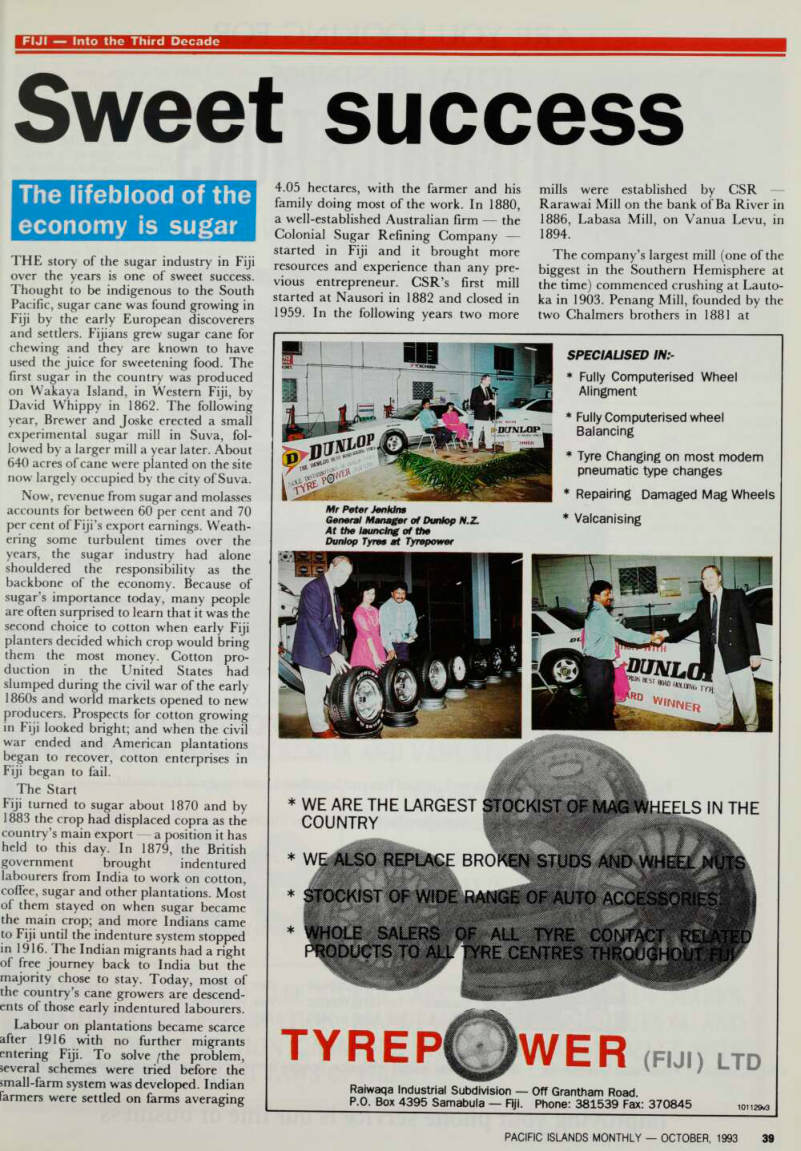

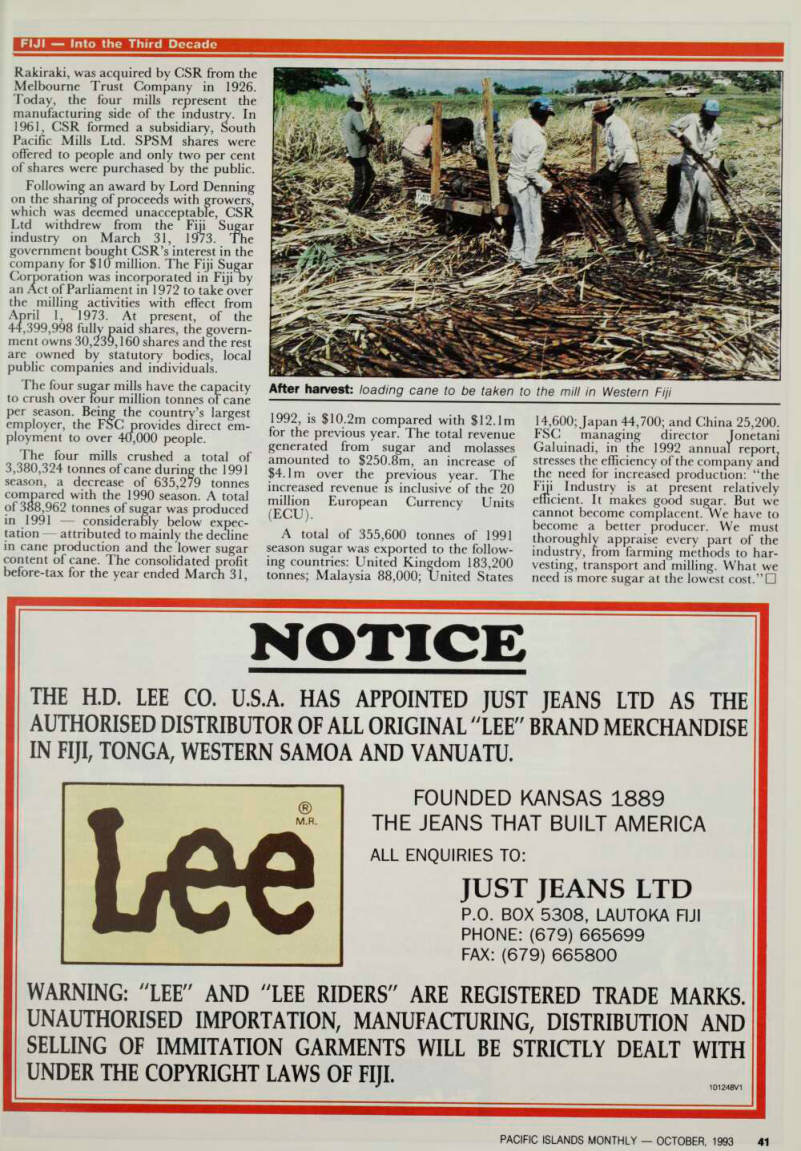
The lifeblood of the economy is sugar
THE story of the sugar industry in Fiji over the years is one of sweet success.
Thought to be indigenous to the South Pacific, sugar cane was found growing in Fiji by the early European discoverers and settlers. Fijians grew sugar cane for chewing and they are known to have used the juice for sweetening food. The first sugar in the country was produced on Wakaya Island, in Western Fiji, by David Whippy in 1862. The following year, Brewer and Joske erected a small experimental sugar mill in Suva, fol lowed by a larger mill a year later. About 640 acres of cane were planted on the site now largely occupied by the city of Suva.
Now, revenue from sugar and molasses accounts for between 60 per cent and 70 per cent of Fiji’s export earnings. Weath ering some turbulent times over the years, the sugar industry had alone shouldered the responsibility as the backbone of the economy. Because of sugar’s importance today, many people are often surprised to learn that it was the second choice to cotton when early Fiji planters decided which crop would bring them the most money. Cotton pro duction in the United States had slumped during the civil war of the early 1860 s and world markets opened to new producers. Prospects for cotton growing in Fiji looked bright; and when the civil war ended and American plantations began to recover, cotton enterprises in Fiji began to fail.
The Start Fiji turned to sugar about 1870 and by 1883 the crop had displaced copra as the country’s main export a position it has held to this day. In 1879, the British government brought indentured labourers from India to work on cotton, coffee, sugar and other plantations. Most of them stayed on when sugar became the main crop; and more Indians came to Fiji until the indenture system stopped in 1916. The Indian migrants had a right of free journey back to India but the majority chose to stay. Today, most of the country’s cane growers are descend ents of those early indentured labourers.
Labour on plantations became scarce after 1916 with no further migrants
entering Fiji. To solve /the problem,
several schemes were tried before the small-farm system was developed. Indian farmers were settled on farms averaging
4.05 hectares, with the farmer and his family doing most of the work. In 1880, a well-established Australian firm the
Colonial Sugar Refining Company
started in Fiji and it brought more resources and experience than any previous entrepreneur, CSR’s first mill started at Nausori in 1882 and closed in 1959. In the following years two more
mills were established by CSR Rarawai Mill on the bank ofßa River in 1886, Labasa Mill, on Vanua Levu, in 1894.
The company’s largest mill (one of the biggest in the Southern Hemisphere at the time) commenced crushing at Lauto ka in 1903. Penang Mill, founded by the two Chalmers brothers in 1881 at
Rakiraki, was acquired by CSR from the Melbourne Trust Company in 1926.
Today, the four mills represent the manufacturing side of the industry. In 1961, CSR formed a subsidiary, South Pacific Mills Ltd. SPSM shares were offered to people and only two per cent of shares were purchased by the public.
Following an award by Lord Denning on the sharing of proceeds with growers, which was deemed unacceptable, CSR Ltd withdrew from the Fiji Sugar industry on March 31, 19/3. The government bought CSR’s interest in the company for $lO million. The Fiji Sugar Corporation was incorporated in Fiji by an Act of Parliament in 1972 to take over the milling activities with effect from April 1, 1973. At present, of the 44,399,998 fully paid shares, the govern ment owns 30,239,160 shares and the rest are owned by statutory bodies, local public companies and individuals.
The four sugar mills have the capacity to crush over four million tonnes of cane per season. Being the country’s largest employer, the FSC provides direct em ployment to over 40,000 people.
The four mills crushed a total of 3,380,324 tonnes of cane during the 1991 season, a decrease of 635,2/9 tonnes compared with the 1990 season. A total of 3«8,962 tonnes of sugar was produced in 1991 considerably below expec tation attributed to mainly the decline in cane production and the lower sugar content of cane. The consolidated profit before-tax for the year ended March 31,
1992, is 510.2 m compared with 512.1 m for the previous year. The total revenue generated from sugar and molasses amounted to 5250.8 m, an increase of S4.lm over the previous year. The increased revenue is inclusive of the 20 million European Currency Units
(Ecu).
A total of 355,600 tonnes of 1991 season sugar was exported to the follow ing countries; United Kingdom 183,200 tonnes; Malaysia 88,000; United States
14,600; Japan 44,700; and China 25,200.
FSC managing director Jonetani Galuinadi, in the 1992 annual report, stresses the efficiency of the company and the need for increased production: “the Fiji Industry is at present relatively efficient. It makes good sugar. But we cannot become complacent. vVe have to become a better producer. We must thoroughly appraise every part of the industry, from farming methods to har vesting, transport and milling. What we need is more sugar at the lowest cost.”[H
After harvest: loading cane to be taken to the mill in Western Fiji
Advertisements & other items, pp. 39-42 (3 items)
39
FIJI Into the Third Decade
PACIFIC ISLANDS MONTHLY OCTOBER, 1993
Tyrepiiiwer
w m Mr Peter Jenkins General Manager of Dunlop N.Z.
At the launclng of the Dunlop Tyres at Tyre power
SPECIAUSED IN:-
* Fully Computerised Wheel Alingment * Fully Computerised wheel dunlop Balancing * Tyre Changing on most modem pneumatic type changes * Repairing Damaged Mag Wheels * Valcanising It
OUML
nu nm
* WE ARE THE LARGEST
COUNTRY
LS IN THE
W
BRO
TYREPiiiWER
(FIJI) LTD
Raiwaqa Industrial Subdivision Off Grantham Road P.O. Box 4395 Samabula Fiji. Phone: 381539 Fax: 370845
ARE YOU LOOKING FOR
TOTAL BUSINESS
COMMUNICATIONS
SOLUTIONS?
J \ 0£ *o* s a a i-f ***s iEi see »«» .4% i * • «e Kt ■ltiW
SEC
Fiji Posts & Telecommunications Limited has put together a vast range of the world's leading brands of business systems products to suit your business needs. From small businesses to large organisations. With NEC, Commander, Smarttalk and Exicom and the expertise of Fiji Posts & Telecommunications Limited you now have an unbeatable combination. So if you want to improve the efficiency of your business call: Suva: Lautoka: Labasa: Tel: (679)210545 Tel: (679) 660022 Tel: (679) 811800 Fax: (679)210527 Fax: (679) 666600 Fax: (679)812766 • Free Consultancy • Customised Configuration • Operator training provided • Technical Services Support • Flexible Purchase Options • Wide Selection Improving your phone service is our line of business
NOTICE
THE H.D. LEE CO. U.S.A. HAS APPOINTED JUST JEANS LTD AS THE AUTHORISED DISTRIBUTOR OF ALL ORIGINAL "LEE" BRAND MERCHANDISE IN FIJI, TONGA, WESTERN SAMOA AND VANUATU.
FOUNDED KANSAS 1889
THE JEANS THAT BUILT AMERICA
ALL ENQUIRIES TO:
JUST JEANS LTD
P.O. BOX 5308, LAUTOKA FIJI
PHONE: (679) 665699
FAX: (679) 665800
WARNING: "LEE" AND "LEE RIDERS" ARE REGISTERED TRADE MARKS.
UNAUTHORISED IMPORTATION, MANUFACTURING, DISTRIBUTION AND
SELLING OF IMMITATION GARMENTS WILL BE STRICTLY DEALT WITH
UNDER THE COPYRIGHT LAWS OF FIJI.
J 101248V1
(A co# <s' m Q r i; I ft Lj *
sale
E DUCATION
Learn more about Fiji - collect Fiji
stamps. Fiji's unique features have
been artistically recaptured on
stamps, It is anyone's delight and
a collector's must.
FIJI
FIJI k/ n; u!JskANt H~ tUi i' ; i -' k ' - ■ .'MM:
HOSG KONG RUGBY SEVENS
V*-
fIJJ Tit
K®6 KOS6 RUGBY SEVENS
IJJJIHU
pi JI NUDIBH A SCHS
86c lui , jffipsati-
-4k ft.
f. tm is* •xv
C I I T NUDIBSANi Hs-
Fiji . (SEA SLL'JS)
tobronthvt sS#S We offer you the best of our Fiji
stamps. For more information
write to: Postmaster, Philatelic
Bureau, P 0 Box 100, Suva, Fiji.
FWI
42c
41
FIJI Into the Third Decade
PACIFIC ISLANDS MONTHLY OCTOBER, 1993
opportunities
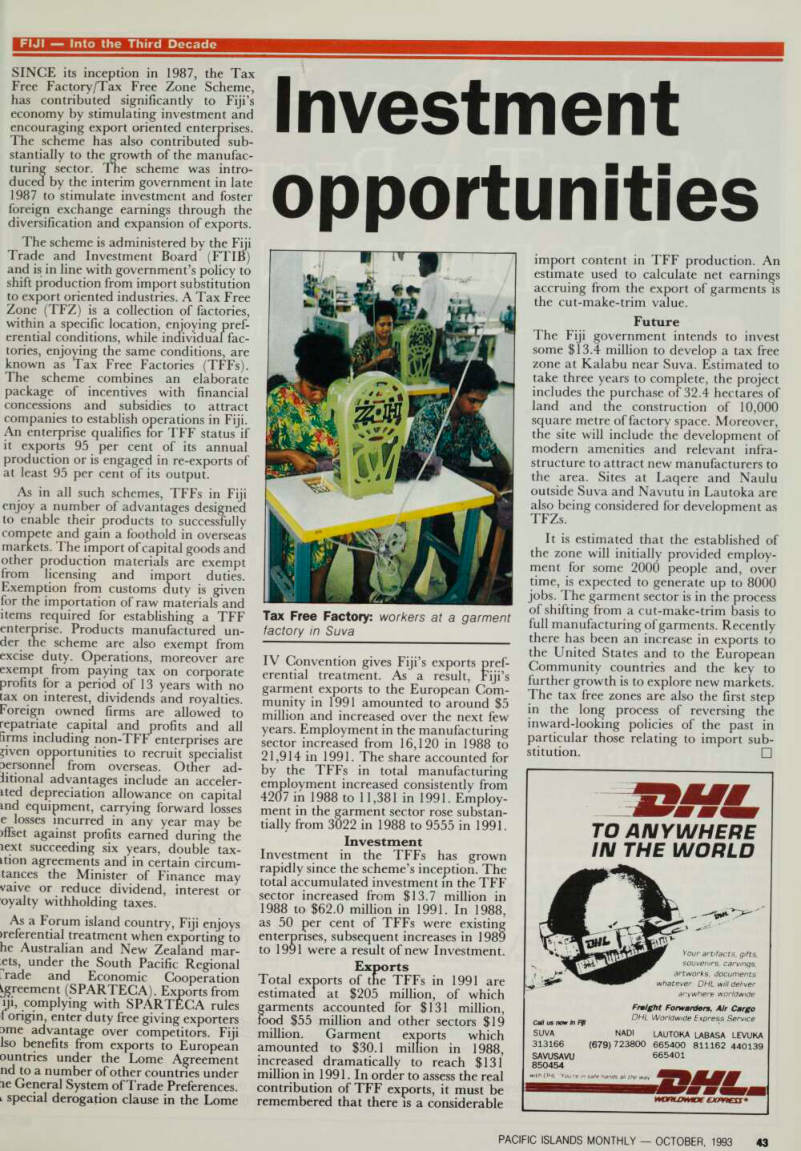
Investment opportunities
SINCE its inception in 1987, the Tax Free Factory/Tax Free Zone Scheme, has contributed significantly to Fiji’s economy by stimulating investment and encouraging export oriented enterprises.
The scheme has also contributed sub stantially to the growth of the manufac turing sector. Tiie scheme was intro duced by the interim government in late 1987 to stimulate investment and foster foreign exchange earnings through the diversification and expansion of exports.
The scheme is administered by the Fiji Trade and Investment Board (FTIB) and is in line with government’s policy to shift production from import substitution to export oriented industries. A Tax Free Zone (TFZ) is a collection of factories, within a specific location, enjoying pref erential conditions, while individual fac tories, enjoying the same conditions, are known as Tax Free Factories (TFFs).
The scheme combines an elaborate package of incentives with financial concessions and subsidies to attract companies to establish operations in Fiji, An enterprise qualifies for TFF status if it exports 95 per cent of its annual production or is engaged in re-exports of at least 95 per cent of its output.
As in all such schemes, TFFs in Fiji enjoy a number of advantages designed to enable their products to successfully compete and gain a foothold in overseas markets. The import of capital goods and other production materials are exempt from licensing and import duties.
Exemption from customs duty is given for the importation of raw materials and items required for establishing a TFF enterprise. Products manufactured un der tne scheme are also exempt from
excise duty. Operations, moreover are
exempt from paying tax on corporate profits for a period of 13 years with no tax on interest, dividends and royalties.
Foreign owned firms are allowed to repatriate capital and profits and all firms including non-TFF enterprises are opportunities to recruit specialist Dersonnei from overseas. Other ad ditional advantages include an acceler
ited depreciation allowance on capital
md equipment, carrying forward losses
e losses incurred in any year may be iffset against profits earned during the icxt succeeding six years, double tax ition agreements and in certain circum tances the Minister of Finance may vaive or reduce dividend, interest or
oyalty withholding taxes.
As a Forum island country, Fiji enjoys inferential treatment when exporting to he Australian and New Zealand mar kets, under the South Pacific Regional rade and Economic Cooperation
Agreement (SPARTECA). Exports from
yi, complying with SPARTECA rules f origin, enter duty free giving exporters Dme advantage over competitors. Fiji Iso benefits from exports to European ountries under the Lome Agreement nd to a number of other countries under le General System of Trade Preferences. l special derogation clause in the Lome
IV Convention gives Fiji’s exports pref erential treatment. As a result, Fiji’s garment exports to the European Com munity in 1991 amounted to around $5 million and increased over the next few years. Employment in the manufacturing sector increased from 16,120 in 1988 to 21,914 in 1991. The share accounted for by the TFFs in total manufacturing employment increased consistently from 4207 in 1988 to 11,381 in 1991. Employ ment in the garment sector rose substan tially from 3022 in 1988 to 9555 in 1991.
Investment Investment in the TFFs has grown rapidly since the scheme’s inception. The total accumulated investment m the TFF sector increased from 513.7 million in 1988 to 562.0 million in 1991. In 1988, as 50 per cent of TFFs were existing enterprises, subsequent increases in 1989 to 1991 were a result of new Investment.
Exports Total exports of the TFFs in 1991 are estimated at 5205 million, of which garments accounted for Sl3l million, food 555 million and other sectors Sl9 million. Garment exports which amounted to 530.1 million in 1988, increased dramatically to reach $l3l million in 1991. In order to assess the real contribution of TFF exports, it must be remembered that there is a considerable
import content in TFF production. An estimate used to calculate net earnings accruing from the export of garments is the cut-make-trim value.
Future The Fiji government intends to invest some $13.4 million to develop a tax free zone at Kalabu near Suva. Estimated to take three years to complete, the project includes the purchase of 32.4 hectares of land and the construction of 10,000 square metre of factory space. Moreover, the site will include the development of modern amenities and relevant infra structure to attract new manufacturers to the area. Sites at Laqere and Naulu outside Suva and Navutu in Lautoka are also being considered for development as
Tfzs.
It is estimated that the established of the zone will initially provided employ ment for some 2000 people and, over time, is expected to generate up to 8000 jobs. The garment sector is in the process of shifting from a cut-make-trim basis to full manufacturing of garments. Recently there has been an increase in exports to the United States and to the European Community countries and the key to further growth is to explore new markets.
The tax free zones are also the first step in the long process of reversing the inward-looking policies of the past in particular those relating to import sub stitution. □
Tax Free Factory: workers at a garment factory in Suva
Advertisements & other items, pp. 43-44 (2 items)
43
FIJI Into the Third Decade
PACIFIC ISLANDS MONTHLY OCTOBER, 1993
To Anywhere
IN THE WORLD
ft
OUL
H Your artifacts, gifts, souvenirs, carvings, artworks, documents whatever DHL will deliver anywhere worldwide Call us now In Pft Freight Forwarders, Air Cargo DHL Worldwide Express Service
SUVA NADI LAUTOKA LABASA LEVUKA
313166 (679)723800 665400 811162 440139
SAVUSAVU 665401
850454
im i r A ft r £ A
SiFEi
ruNriAV*UR «EE23 ft (ft. ft Hi ftlft il liras how do •It MOdbCKt *<L
put real fruit
into yoghurt?
iMtrairaii
We Pour Technology
Into EverythingWe Make
FWTTTTTTm
If you need more information on Rewa Dairy's range of natural dairy products or Tetrapak packaging capabilities contact: Rewa Co-operative Dairy Company Ltd, PO Box 3678, Samabula, Suva, Fiji. Telephone: 381288. Fax: 370190.
Tourism thrust
By Stan Ritova
THE Fiji Visitors Bureau has come a long way from its beginning as a committee in Suva in 1924 with a budget of about Fs2ooo to $4.5 million in 1992, and is now by far the main foreign exchange earner surpassing sugar. All of the $4.5m is provided by the government as a grant and of this s2m goes towards operating costs and $2.5m for marketing
including promotion and advertising.
Members of the industry itself contrib uted $2.5m for marketing, promotion
and advertising.
But the budget is inadequate in comparison to what the FVB is achieving in the way of visitor arrivals. Already tourism has taken over from sugar as the main foreign exchange earner and it will continue to grow if the climate is right.
In 1992 tourism earned $328.5m com pared with $ 138.3 m 10 years ago whicle sugar brought in $221.3m. “This is a commendable achievement on our part especially when we have to operate on a limited budget compared to what 3ther countries like Australia and New Zealand contribute to their tourist indus tries,” the bureau’s chief executive, [simeli Bainimara, said.
“Tourism, as figures show, will continue o grow because we have a beautifuul :ountry to show off and share with r isitors,” he said. “What we need most is nore government and industry financial upport to be able to step up our marketing ►rogram overseas,” Bainimara said.
Toursim earnings from visitor arrivals ave increased markedly over the years. In 980 there were 140,000 visitors who spent 109.5 m. This figure increased to about 48,000 in 1981 and they spent $ 122 m. The isitor arrival figure rose to 195,400 in 1986 nd they spent $ 185.4 m but the figure ropped to about 149,000 in 1987. Visitors lat year spent only $ 145.7 m, $39.7m less lan they did the previous year.
However, it picked up again in 1988 hen 208,000 tourists came our way aving behind slBlm. There was a markable jump to 250,656 visitors who >ent s2Bom in 1989 and 278,996 in 1990 ho spent an estimated $335m. The visitor •rivals figure dropped a bit in 1991 to >9,350 who spent $329m and increased amatically to 278,534 in 1992 when they •ent $328.5m. But 1993 looks like a omising year. Visitor arrivals for January June were 127,027, the highest for the :riod in the past four years, and could be lot more for the current six months.
Australia remains the main source of ji’s tourist arrivals rising from about ,000 in 1989 to about 105,000 in 1990 mg down to about 82,000 in 1991. irope, including Britain, was second
followed by the United States a close third.
According to a paper prepared by senior tourism officer (research), Samisoni Sawailau, of the Ministry of Tourism, the industry did not develop from tourist demand within the economy nor simply from demand citizens to visit Fiji. In fact tourism originated from the trans-Pacific shipping trade in the early 20th Century.
Australia and United States shipping lines used Fiji as a principal transhipment port.
Passengers on the ships disembarked in Suva for the north or south bound section of their voyage either to North America or Australia. Ships were rarely ever able to keep to their advertised time table, hotel board housing other services were estab lished.
In line with this drive for tourists, government abolished passports for ships’ passengers. The country’s fledgling tourist industry started to flourish in leaps and bounds with the support of government and finally in 1952 the name of Fiji Publicity Board was changed to the Fiji Visitors Bureau and this into effect on January 1, 1953. The number of visitors continued to rise from the bureau’s early beginnings and began to shape the destiny of the industry. Tiie Fiji Publicity Board was demanding for improvements to Nadi Airport from 1946 to 1961. The board’s demands paid off and in 1946 the first commercial flight into Nadi Airport in the way of a Pan American Airways airliner touched down a day after the Second World War spread to the Pacific. There were no passenger facilities of any signifi cance at Nadi Airport. But just across the road from the first terminal building located near where Sunflower Airlines have their offices and hanger at Nadi, was the Fiji Mocambo Hotel run by the late Barry Philp, a colourful figure and one of the fioneers of the building of tourist hotels in 7 iji and who later built the present Fiji Mocambo overlooking the airport. The Mocambo quickly acquired a reputation for friendliness and discomfort at times in about equal measure. As part of the development of the industry in Fiji and as an added incentive for people to come to Fiji, the government introduced duty-free shopping in 1962. Encouraged by what duty-free shopping had done to the tourism
industry almost overnight, government
passed a Hotels Aid Ordinance in 1964 to encourage investors to construct new ho tels. And this it did and the end result was that a number of hotels came up on what is now popularly known as the Coral Coast of Viti Levu. To mention a few, the Fijian, Naviti Resort, Paradise Point (now de funct) right next door to the “old lady of them all, the Korolevu Beach Hotel which unfortunately, is also defunct, and the Reef in Korotogo. Later ones were The Warwick of Fiji, the Regent and the Sheraton and other smaller places.
Tourism accounts for 22 per cent of Fiji’s gross foreign exchange earnings according to the 1990 figures and will no doubt have
risen to a much highter level.
According to Sawailau’s paper, tourism is estimated to provide employment di rectly and indirectly for 28,000 people which is about 22 per cent of total paid employment in hotels, or 90 per cent full time, as at September 1991. The sector is now the major source of paid employment in the country. The establishment of the major international chain hotels in Fiji has given local entrepreneurs the opportunity to initiate small road tours in association with accommodation businesses. Tourism annual earnings in foreign exchange com pared with sugar are as follows: 1989, sugar earned $212 million, tourism s2Bom; 1990, sugar earned $223m, tourism 5335; 1991, sugar earned s22om, tourism $329m. According to the tourism ministry, using a more simple term to weigh the significance of the tourism industry, if the average Australian visitor normally speends 10 days in Fiji with an average daily expenditure of $146 a day in 1990, by the time he goes back home, his holiday package would have cost him $1460.
Social Aspect According to the Ministry of Tourism paper there are obvious social costs to the country in relation to tourism develop ment. Social interaction between tourists and the local people would, over time, led to behavioural changes. “However, it is argued that not all social changes can be directed at tourism when one seriously considers the impact of the media, video/ television, education and the development process itself,” according to the paper. The FVB, like government feels that there should be “controlled tourism” because it would “enhance and definitely preserve and enrich authentic culture and tra dition.”
“Although a lot of pessimistic perception of tourism emnates from ignorance and misconception, a cautious approach to tourism would definitely advocate the preservation and enrichment of authentic culture and tradition.”
Future of the Industry For the future of the tourism industry there is a need for an additional 1500 hotel rooms by 1996. This is to add to the 4000 rooms that exist. The additional rooms are to include: 1000 premium resort rooms; 200 premium city hotel rooms; 200 mid-scale resort rooms;and 100 rooms related to special interests such as diving and track ing.
According to Sawailau’s paper, in terms of visitor arrivals, a target for the next five years was set with an average growth rate of 8 per cent a year. The 1989 and 1990 actual arrivals figure was short of the rorecast figure of 266,000. The need to encourage the landowners and locals to actively participate in small tourism busi ness is strongly emphasised, according to Sawailau’s paper.
In this regard, a new strategy in Secondary Tourism Activities (STA) has been vigorously pursued to widen and diversify ght local tourism activities base.
STA is all for tourist activities that are conducted outside of the main hotel perimeters. The major constraint lies in capital financing and technical advise.
There are currently three pilot projects on the ground initiated by Fijian landowners with no financial assistance from the government. □
Advertisements & other items, p. 45 (1 item)
45
FIJI Into the Third Decade
PACIFIC ISLANDS MONTHLY OCTOBER, 1993
Celebration Time
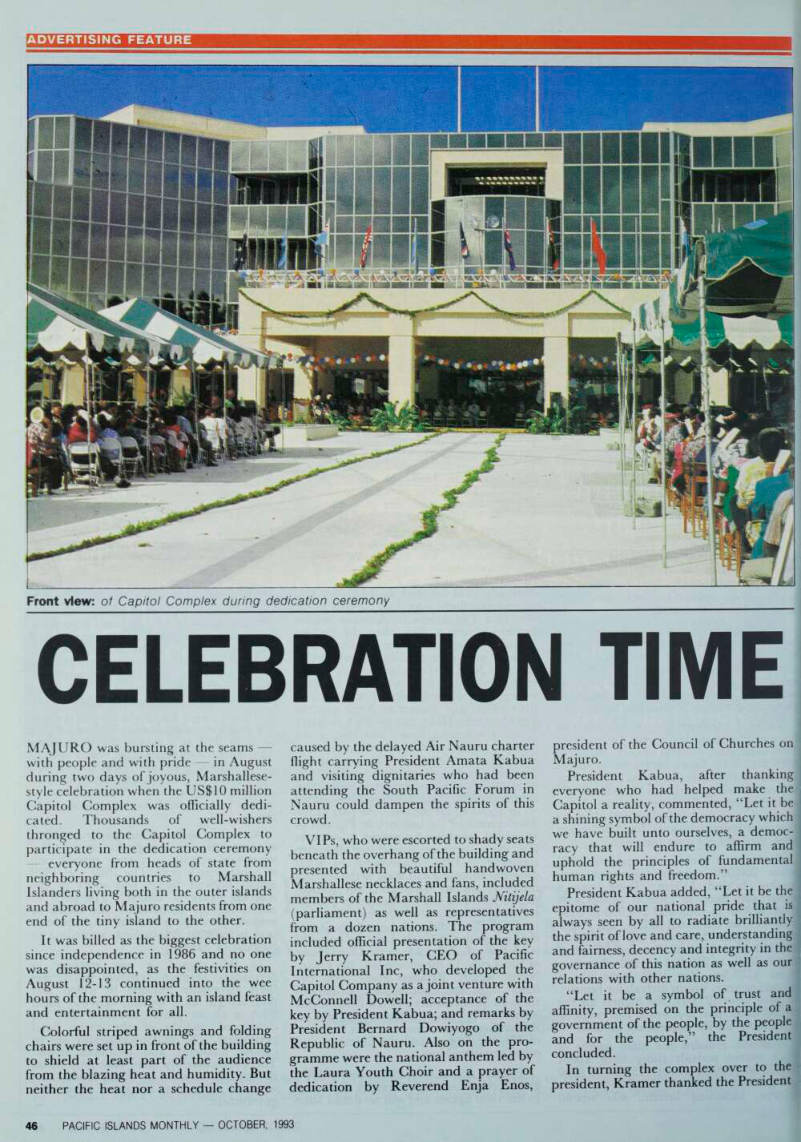

Advertising Feature
MAJURO was bursting at the seams with people and with pride in August during two days of joyous, Marshallesestyle celebration when the US$lO million Capitol Complex was officially dedicated. Thousands of well-wishers thronged to the Capitol Complex to parttctpate in the dedication ceremony everyone from heads of state from neighboring countries to Marshall Islanders living both in the outer islands and abroad to Majuro residents from one end of the tiny island to the other.
It was billed as the biggest celebration since independence in 1986 and no one was disappointed, as the festivities on August 12-13 continued into the wee hours of the morning with an island feast and entertainment for all.
Colorful striped awnings and folding chairs were set up in front of the building to shield at least part of the audience from the blazing heat and humidity. But neither the heat nor a schedule change
caused by the delayed Air Nauru charter flight carrying President Amata Kabua and visiting dignitaries who had been attending the South Pacific Forum in Nauru could dampen the spirits of this crowd.
VIPs, who were escorted to shady seats , . over h a ne of the building and med with be lutiful handwoven £f arshallese necklaces and fans, included members of the Marsha n Islands Nitijek , iament) as weU as representatives £, m a doMn nations . The program included official presentation of the key by Terry Kramer, CEO of Pacific International Inc, who developed the Capitol Company as a joint venture with McConnell Dowell; acceptance of the key by President Kabua; and remarks by President Bernard Dowiyogo of the Republic of Nauru. Also on the pro gramme were the national anthem led by the Laura Youth Choir and a prayer of dedication by Reverend Enja Enos,
president of the Council of Churches on Majuro.
President Kabua, after thanking everyone who had helped make the Capitol a reality, commented, “Let it be a shining symbol of the democracy which we have bui!t unto ourselves a democ rac V that wlll e ™ ure toalhrm and uphold the prmctples of fundamental human rights and freedom President Kabua added, Let it be the epitome of our national pride that is always seen by all to radiate brilliantly the spirit of love and care, un man mg and fairness, decency and mtegn y in governance of this nation as we as our relations with other nations “Let it be a symbol ot trust and affinity, premised on the principle ol a governmcntof the peop e > Y 1 an or p p ,
concluded. ,
In turning the complex over to the president, Kramer thanked the Presiden
Front view: of Capitol Complex during dedication ceremony
md his cabinet for their faith and trust n PII and McConnell Dowell, thanked he many subcontractors who worked on he project and also extended his ap ireciation to “the over 200 Marshallese raftsmen and workers who comprised >ver 70 percent of our work force.”
First Lady Emlain Kabua was at the Drefront of the ribbon cutting, with ssistance from the leiroj (queens), from he various atolls in the Marshalls. With he speeches spoken and the ribbon cut, was time to tour the building to view he modem space for the Nitijela and ovemment officials and to enjoy a ;w minutes of cool air conditioning!
Foreign dignitaries participating in ic celebration included FSM president ailey Olter; Nauru president Bernard |owiyogo, Kiribati president Teatao eaunaki; Tuvalu prime minister ikenibeu Paeniu; Maori queen Te rikinu Dame Te Arirangikaahu; Ratu u‘uakitau Cokanauto, president of the iji Senate; Dr. Andrew Theophanous, mister for health, Australia; Jim erard, deputy speaker of New Zealand ouse of Representatives; John Kaputin MG minister of foreign affairs; Zhou nming, Chinese ambassador; Masao M ede, Belau minister of health, and avid Fields, US ambassador.
The visiting dignitaries, together with e Marshallese senators and other local IPs, enjoyed a buffet dinner inside the w building, with food dishes provided local restaurants. They dined on licacies such as roast pork, lobster, ib, sashimi and breadfruit. Outside, e festivities continued with island-style xl plates filled to the brim for all who shed to participate. And as dusk settled
er the new Capitol Complex, the
thusiastic audience settled in for an “ning of performances that dazzled the “ and soothed the ear. Clearly, the jgest crowd-pleaser was the Jobwa , netimes referred to as “the war dance”
or “the stick dance,” performed by a large group from Ujae Atoll. With sticks thrust together in an eloborate chor eography and grass skirts flying as the dancing became more frenzied, the boys and young men impressed all. The Jobwa is a very special dance in Marshallese custom that can be performed only with permission from the high chief, in this case President Amata Kabua, who is also the high chief of the Ralik Chain.
President Kabua enjoyed the perform ance from his front row seat in the audience.
Entertainers journeyed to Majuro
from as far north as the Marshallese community living in California to as far
South as Fiji. Many of the outer atolls in the Marshalls sent performing groups; others had representatives perform from among those currently living in the capital Majuro. Altogether, more than 30 groups performed.
And whether you were physically at the Capitol Complex to witness the performances or were at home anywhere in Majuro, you were bound to hear the melodies as the local radio stations broadcast the performances lives.
Whether the visitors to Majuro were VIPs or “just plain folk” the consensus seemed to be that the Marshallese “throw quite a party!” □
Dance: part of the performing group from Southern California entertaining at the opening
Advertisements & other items, p. 47 (1 item)
KONE Elevators
1
lit
PROUD PROVIDERS OF
TWO PASSENGER ELEVATORS
for the Pacific International, Inc. & McConnell Dowell JV on the
CAPITOL COMPLEX
MAJURO
Contact KONE Elevators, AUCKLAND on; Ph. (09) 303 2040 Fax. (09) 309 3882
‘Taking you beyond 2000’
101455v2
Blending technology
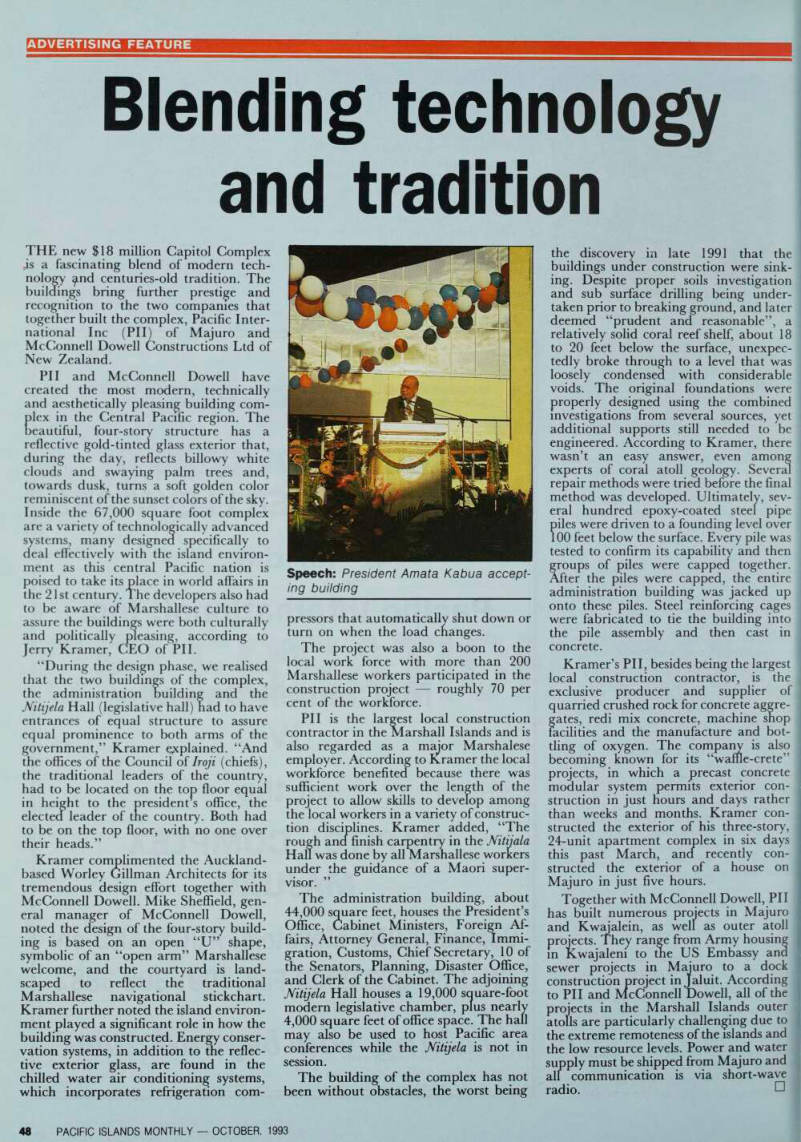
and tradition
THE new $lB million Capitol Complex is a fascinating blend of modern tech nology centuries-old tradition. The
buildings bring further prestige and
recognition to the two companies that together built the complex, Pacific Inter national Inc (PH) of Majuro and McConnell Dowell Constructions Ltd of New Zealand.
PH and McConnell Dowell have created the most modern, technically
and aesthetically pleasing building com-
Elex in the Central Pacific region. The eautiful, four-story structure has a reflective gold-tinted glass exterior that, during the day, reflects billowy white clouds and swaying palm trees and, towards dusk, turns a soft golden color reminiscent of the sunset colors of the sky.
Inside the 67,000 square foot complex are a variety of technologically advanced systems, many designed specifically to deal effectively with the island environ ment as this central Pacific nation is poised to take its place in world affairs in the 21st century. The developers also had to be aware of Marshallese culture to assure the buildings were both culturally and politically pleasing, according to Jerry Kramer, CEO of PH.
“During the design phase, we realised that the two buildings of the complex, the administration building and the Nitijela Hall (legislative hall) had to have entrances of equal structure to assure equal prominence to both arms of the government,” Kramer explained. “And the offices of the Council of Iroji (chiefs), the traditional leaders of the country, had to be located on the top floor equal in height to the presidents office, the elected leader of tne country. Both had to be on the top floor, with no one over their heads.”
Kramer complimented the Auckland based Worley Gillman Architects for its tremendous design effort together with McConnell Dowell. Mike Sheffield, gen eral manager of McConnell Dowell, noted the design of the four-story build ing is based on an open “U” shape, symbolic of an “open arm” Marshallese welcome, and the courtyard is land scaped to reflect the traditional Marshallese navigational stickchart.
Kramer further noted the island environ ment played a significant role in how the building was constructed. Energy conser vation systems, in addition to the reflec tive exterior glass, are found in the chilled water air conditioning systems, which incorporates refrigeration com-
pressors that automatically shut down or turn on when the load cnanges.
The project was also a boon to the local work force with more than 200 Marshallese workers participated in the construction project roughly 70 per cent of the workforce.
PII is the largest local construction contractor in the Marshall Islands and is also regarded as a major Marshalese employer. According to Kramer the local workforce benefited because there was sufficient work over the length of the project to allow skills to develop among the local workers in a variety of construc tion disciplines. Kramer added, “The rough and finish carpentry in the Nitiiala Hall was done by allMarshallese workers under the guidance of a Maori super visor. ”
The administration building, about 44.000 square feet, houses the President’s Office, Cabinet Ministers, Foreign Af fairs, Attorney General, Finance, Immi gration, Customs, Chief Secretary, 10 of the Senators, Planning, Disaster Office, and Clerk of the Cabinet. The adjoining Nitijela Hall houses a 19,000 square-foot modern legislative chamber, plus nearly 4.000 square feet of office space. The hall may also be used to host Pacific area conferences while the Nitijela is not in session.
The building of the complex has not been without obstacles, the worst being
the discovery in late 1991 that the buildings under construction were sink ing. Despite proper soils investigation and sub surface drilling being under taken prior to breaking ground, and later deemed “prudent and reasonable”, a relatively solid coral reef shelf, about 18 to 20 feet below the surface, unexpec tedly broke through to a level that was loosely condensed with considerable voids. The original foundations were
properly designed using the combined
investigations from several sources, yet additional supports still needed to be engineered. According to Kramer, there wasn’t an easy answer, even among experts of coral atoll geology. Several repair methods were tried before the final method was developed. Ultimately, sev eral hundred epoxy-coated steel pipe piles were driven to a founding level over 100 feet below the surface. Every pile was tested to confirm its capability and then groups of piles were capped together.
After the piles were capped, the entire administration building was jacked up onto these piles. Steel reinforcing cages were fabricated to tie the building into the pile assembly and then cast in concrete.
Kramer’s PI I, besides being the largest local construction contractor, is the exclusive producer and supplier of quarried crushed rock for concrete aggre gates, redi mix concrete, machine shop facilities and the manufacture and bot tling of oxygen. The company is also becoming known for its “waffle-crete” projects, in which a precast concrete modular system permits exterior con struction in just hours and days rather than weeks and months. Kramer con structed the exterior of his three-story, 24-unit apartment complex in six days this past March, and recently con structed the exterior of a house on Majuro in just five hours.
Together with McConnell Dowell, PI I has built numerous projects in Majuro and Kwaialein, as well as outer atoll projects. They range from Army housing m Kwajaleni to tne US Embassy and sewer projects in Majuro to a dock construction project in Jaluit. According to PI I and McConnell Dowell, all of the projects in the Marshall Islands outer atolls are particularly challenging due to the extreme remoteness of the islands and the low resource levels. Power and water supply must be shipped from Majuro and all communication is via short-wave radio.
Speech: President Amata Kabua accept ing building
Advertisements & other items, pp. 49-50 (1 item)
The "can do"
constructors
11l ■f,
Uli WiSA
11,
Partners in progress
throughout the Pacific
saying "can do"
to your construction needs
SSS&
& fU
HTCOWSELL
DOWELL
• Building • Civil • Electrical • Mechanical • Pipelining • Engineering • Construction • Management Head Office: New Zealand and Pacific Island Division McConnell Dowell House, 45 O’Rorke Rd, Penrose, Auckland, New Zealand. P.O. Box 2758 Auckland. Phone; (649) 579 5844 Fax: (649) 525 2090 Fijt - McConnell Dowell (Fiji) Ltd, Wilada Estate, Lami, Suva, Fiji Islands. P.O. Box 889, Suva, Fiji. Phone: (679) 362 666 Fax: (679) 361 172 American Samoa - McConnell Dowell Constructors Ltd, P.O. Box 4664, Pago Pago, American Samoa. Phone: (684) 699 2239 Fax: (684) 699 2552 Marshall Islands - PII/McConnell Dowell G-V.), P.O. Box 239, Majuro, Marshall Islands, 96960. Phone: (692625) 3430 Fax: (692625) 3166 Western Samoa - OTT/McConnell Dowell J.V., P.O. Box 3442, Apia, Western Samoa. Phone: (685) 21608 Fax: (685) 21746 Papua New Guinea - McConnell Dowell Constructors (PNG) Pty Ltd, P.O. Box 507, Port Moresby, P.N.G. Phone: (675) 212 022 Fax- (675) 212 780 All enquiries contact Mike Sheffield - Phone: (649) 579 5844 Fax: (649) 525 2090
MAJURO CAPTAIL COMPLEX
MAJURO CAPTAIL COMPLEX
Pacific
International , Inc
M° CONNELL
DOWELL
JOINT VENTURE
PHONE: 011-692-625-3122/3560
FAX: 692-625-3348
P.O. BOX 6
MAJURO, MARSHALL ISLANDS, 96960
PHONE: 011-692-625-3430
FAX: 692-625-3166
P.O. BOX 238
MAJURO
MARSHALL ISLANDS, 96960
"WAFFLE CRETE" structural precast
CONCRETE BUILDING SYSTEM
BUILD BETTER,BUILD FASTER, BUILD FOR LESS
jM
MAJURO CAPTAIL COMPLEX
CORPORATE OFFICE
P.O. BOX 1008
HAYS KANSAS, 67601 U.S.A
PHONE: (913) 625-3486
FAX: (913) 625-8542
116943V2
NOBODY DOES IT BETTER!
WHETHER IT'S BUILDING, CIVIL
CONSTRUCTION WORK OR
MECHANICAL AND ELECTRICAL
INSTALLATION, YOU'LL FIND US A
HARD TEAM TO BEAT
■* r MAJURO CAPTAIL COMPLEX (PHOTO BY CHRIS BING)
Schoolboys show
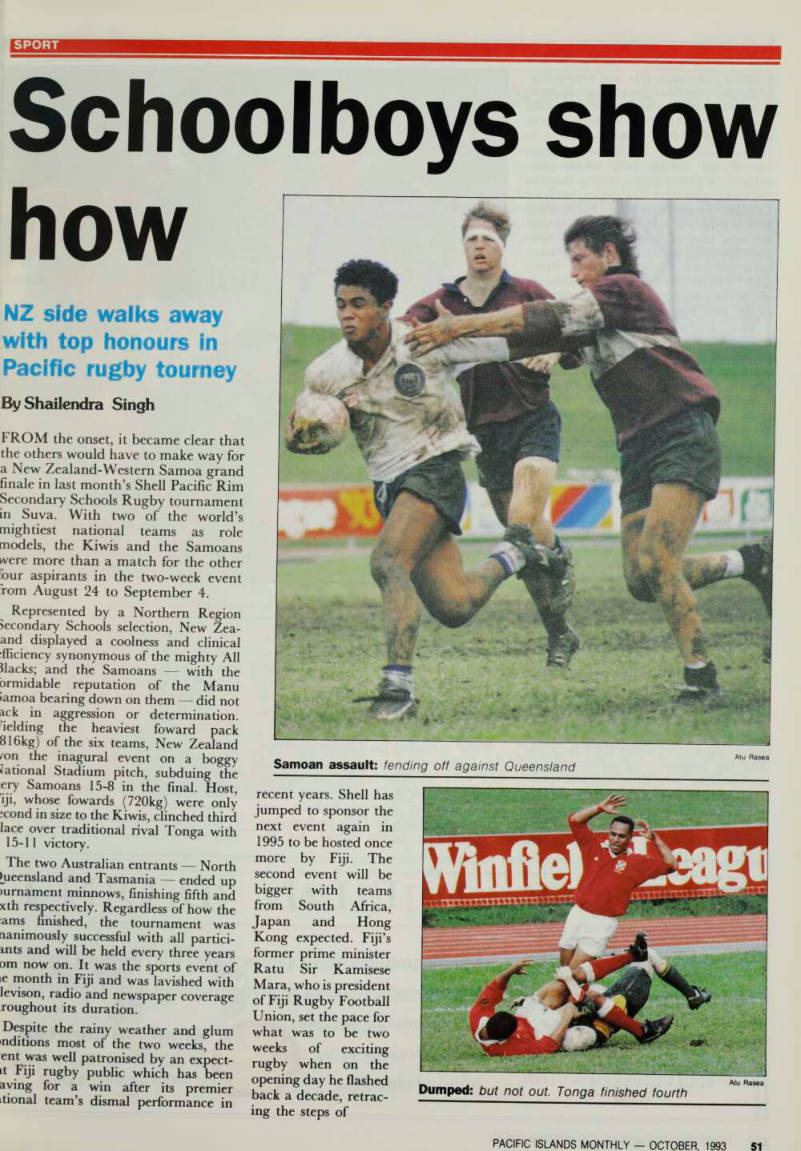
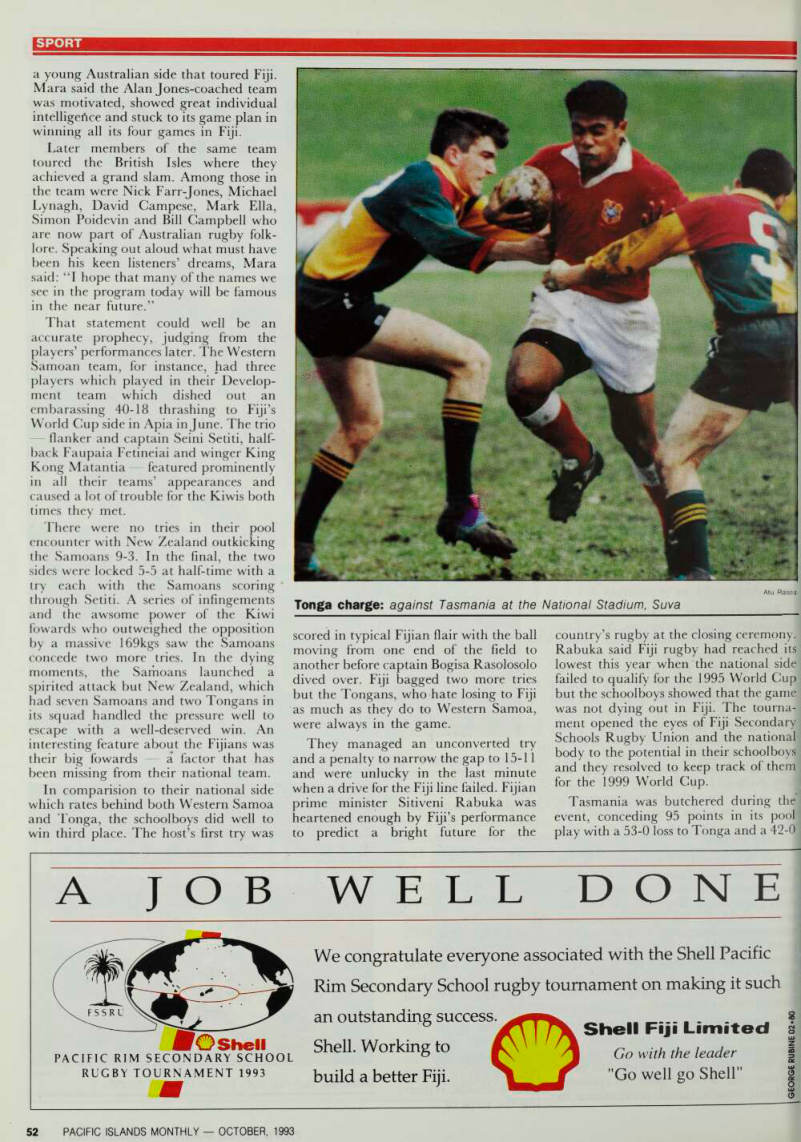
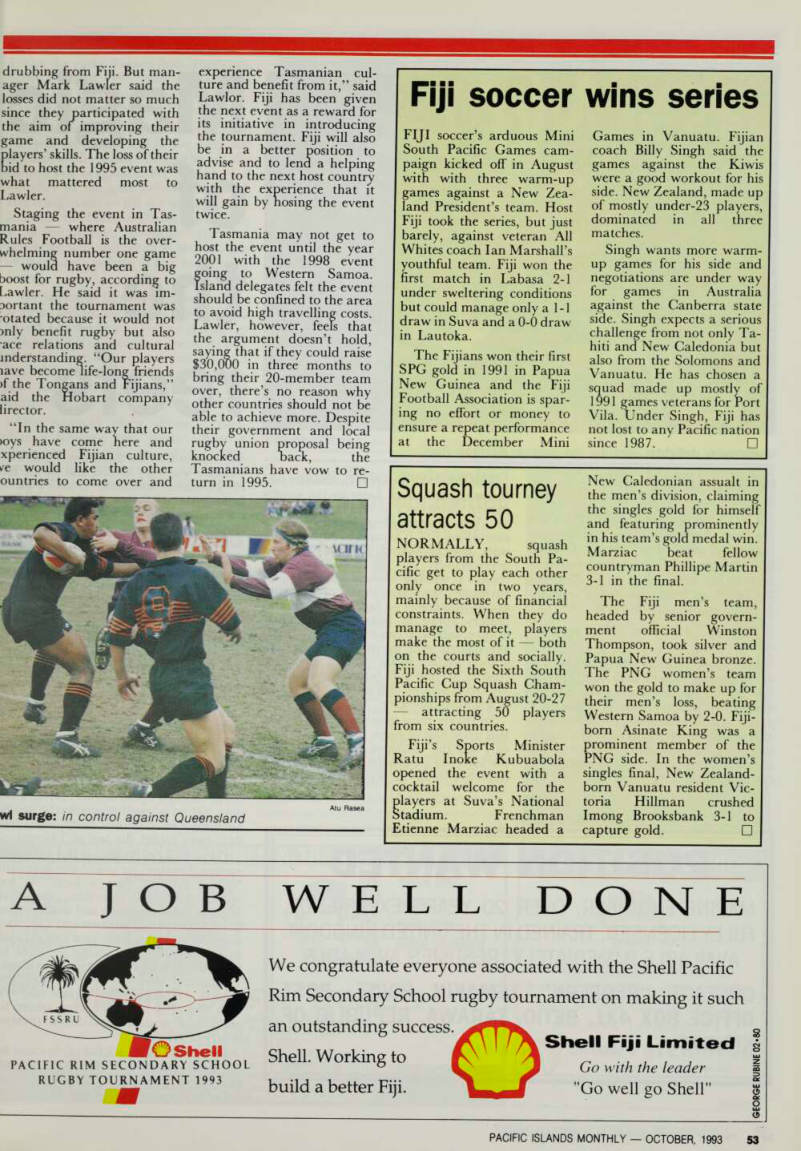
Sport
how
NZ side walks away with top honours in Pacific rugby tourney
By Shailendra Singh
FROM the onset, it became clear that the others would have to make way for a New Zealand-Western Samoa grand finale in last month’s Shell Pacific Rim
Secondary Schools Rugby tournament
in Suva. With two of the world’s mightiest national teams as role models, the Kiwis and the Samoans were more than a match for the other our aspirants in the two-week event
rom August 24 to September 4.
Represented by a Northern Region Secondary Schools selection, New Zea and displayed a coolness and clinical ‘fficiency synonymous of the mighty All Slacks; and the Samoans with the ormidable reputation of the Manu >amoa bearing down on them did not ack in aggression or determination.
Welding the heaviest foward pack 816 kg) of the six teams, New Zealand the inagural event on a boggy Jational Stadium pitch, subduing the ery Samoans 15-8 in the final. Host, iji, whose fowards (720 kg) were only xond in size to the Kiwis, clinched third lace over traditional rival Tonga with
15-11 victory.
The two Australian entrants North Queensland and Tasmania ended up mmament minnows, finishing fifth and xth respectively. Regardless of how the ams finished, the tournament was nanimously successful with all partici mts and will be held every three years □m now on. It was the sports event of ie month in Fiji and was lavished with levison, radio and newspaper coverage roughout its duration.
Despite the rainy weather and glum nditions most of the two weeks, the ent was well patronised by an expect it Fiji rugby public which has been aying for a win after its premier itional team’s dismal performance in
recent years. Shell has jumped to sponsor the next event again in 1995 to be hosted once
more by Fiji. The
second event will be bigger with teams from South Africa,
Japan and Hong
Kong expected. Fiji’s former prime minister Ratu Sir Kamisese Mara, who is president of Fiji Rugby Football Union, set the pace for what was to be two weeks of exciting rugby when on the
opening day he flashed
back a decade, retrac ing the steps of
Alu Rasea
Alu Rasea
Dumped: but not out. Tonga finished fourth
Samoan assault: fending off against Queensland
a young Australian side that toured Fiji.
Mara said the Alan Jones-coached team was motivated, showed great individual intelligence and stuck to its game plan in winning all its four games in Fiji.
Later members of the same team toured the British Isles where they achieved a grand slam. Among those in the team were Nick Farr-Jones, Michael Lynagh, David Campese, Mark Ella, Simon Poidevin and Bill Campbell who are now part of Australian rugby folk lore. Speaking out aloud what must have been his keen listeners’ dreams, Mara said: “I hope that many of the names we see in the program today will be famous in the near future.”
That statement could well be an accurate prophecy, judging from the players’ performances later. The Western Samoan team, for instance, had three players which played in their Develop ment team which dished out an embarassing 40-18 thrashing to Fiji’s World Cup side in Apia in June. The trio flanker and captain Seini Setiti, half back Faupaia Fetineiai and winger King Kong Matantia featured prominently in all their teams’ appearances and caused a lot of trouble for the Kiwis both times they met.
There were no tries in their pool encounter with New Zealand outkicking the Samoans 9-3. In the final, the two sides were locked 5-5 at half-time with a try each with the Samoans scoring through Setiti. A series of infmgements and the awsome power of the Kiwi fowards who outweighed the opposition by a massive 169kgs saw the Samoans concede two more tries. In the dying moments, the Samoans launched a spirited attack but New Zealand, which had seven Samoans and two Tongans in its squad handled the pressure well to escape with a well-deserved win. An interesting feature about the Fijians was their big fowards a factor that has been missing from their national team.
In comparision to their national side which rates behind both Western Samoa and Tonga, the schoolboys did well to win third place. The host’s first try was
scored in typical Fijian flair with the ball moving from one end of the field to another before captain Bogisa Rasolosolo dived over. Fiji bagged two more tries but the Tongans, who hate losing to Fiji as much as they do to Western Samoa, were always in the game.
They managed an unconverted try and a penalty to narrow the gap to 15-11 and were unlucky in the last minute when a drive for the Fiji line failed. Fijian prime minister Sitiveni Rabuka was
heartened enough by Fiji’s performance
to predict a bright future for the
country’s rugby at the closing ceremony, Rabuka said Fiji rugby had reached its lowest this year when the national side failed to qualify for the 1995 World Cup but the schoolboys showed that the game was not dying out in Fiji. The tourna ment opened the eyes of Fiji Secondary Schools Rugby Union and the national bo< L «° the potential m their schoolboys and they reso ved to keep track of them for the 1999 World Cu P Tasmania was butchered during the event, conceding 95 points in its pool play with a 53-0 loss to Tonga and a 42-0
Atu Rasea
Tonga charge: against Tasmania at the National Stadium, Suva
drubbing from Fiji. But man ager Mark Lawler said the losses did not matter so much since they participated with the aim of improving their game and developing the players’ skills. The loss of their bid to host the 1995 event was what mattered most to Lawler.
Staging the event in Tas mania where Australian Rules Football is the over whelming number one game - would have been a big boost for rugby, according to Lawler. He said it was im portant the tournament was 'otated because it would not pnly benefit rugby but also ace relations and cultural
mderstanding. “Our players
lave become life-long friends )f the Tongans and Fijians,” aid the Hobart company lirector.
“In the same way that our >oys have come here and xperienced Fijian culture, ve would like the other ountries to come over and
experience Tasmanian cul ture and benefit from it,” said Lawlor. Fiji has been given the next event as a reward for its initiative in introducing the tournament. Fiji will also be in a better position to advise and to lend a helping hand to the next host country with the experience that it will gain by nosing the event twice.
Tasmania may not get to host the event until the year 2001 with the 1998 event going to Western Samoa.
Island delegates felt the event should be confined to the area to avoid high travelling costs.
Lawler, however, feels that the argument doesn’t hold, saying that if they could raise $30,000 in three months to bring their 20-member team over, there’s no reason why other countries should not be able to achieve more. Despite their government and local
rugby union proposal being
knocked back, the Tasmanians have vow to re turn in 1995. □
wl surge: in control against Queensland
Alu Rasea
Advertisements & other items, pp. 52-53 (1 item)
A Job Well Done
' *s
WO Shell
PACIFIC RIM SECONDARY SCHOOL
RUGBY TOURNAMENT 1993
We congratulate everyone associated with the Shell Pacific Rim Secondary School rugby tournament on making it such an outstanding p|jj Limited Shell. Working to Go with the leader build a better Fiji. we^
GEORGE RUBINE 02*80
A JOB WELL DONE
s ' s
FSS R L
MO Shell
PACIFIC RIM SECONDARY SCHOOL
RUGBY TOURNAMENT 1993
We congratulate everyone associated with the Shell Pacific Rim Secondary School rugby tournament on making it such an outstanding success Shell. Working to build a better Fiji. o Shell Fiji Limited Go with the leader M Go well go Shell”
GEORGE RUBINE 02*80
Fiji soccer wins series
FIJI soccer’s arduous Mini South Pacific Games cam paign kicked off in August with with three warm-up games against a New Zea land President’s team. Host Fiji took the series, but just barely, against veteran All Whites coach lan Marshall’s youthful team. Fiji won the first match in Labasa 2-1 under sweltering conditions but could manage only a 1-1 draw in Suva and a 0-0 draw in Lautoka.
The Fijians won their first SPG gold in 1991 in Papua New Guinea and the Fiji Football Association is spar ing no effort or money to ensure a repeat performance at the December Mini
Games in Vanuatu. Fijian coach Billy Singh said the games against the Kiwis were a good workout for his side. New Zealand, made up of mostly under-23 players, dominated in all three matches.
Singh wants more warm up games for his side and negotiations are under way for games in Australia against the Canberra state side. Singh expects a serious challenge from not only Ta hiti and New Caledonia but also from the Solomons and Vanuatu. He has chosen a squad made up mostly of 1991 games veterans for Port Vila. Under Singh, Fiji has not lost to any Pacific nation since 1987. □
Squash tourney
attracts 50
NORMALLY, squash players from the South Pa cific get to play each other only once in two years, mainly because of financial constraints. When they do manage to meet, players make the most of it both on the courts and socially.
Fiji hosted the Sixth South
Pacific Cup Squash Cham
pionships from August 20-27
attracting 50 players from six countries.
Fiji’s Sports Minister Ratu Inoke Kubuabola opened the event with a cocktail welcome for the players at Suva’s National Stadium. Frenchman Etienne Marziac headed a
New Caledonian assualt in the men’s division, claiming the singles gold for himself and featuring prominently in his team’s gold medal win.
Marziac beat fellow countryman Phillipe Martin 3-1 in the final.
The Fiji men’s team, headed by senior govern ment official Winston Thompson, took silver and Papua New Guinea bronze.
The PNG women’s team won the gold to make up for their men’s loss, beating Western Samoa by 2-0. Fiji born Asinate King was a prominent member of the PNG side. In the women’s singles final, New Zealand born Vanuatu resident Vic toria Hillman crushed Imong Brooksbank 3-1 to capture gold. □
Magic
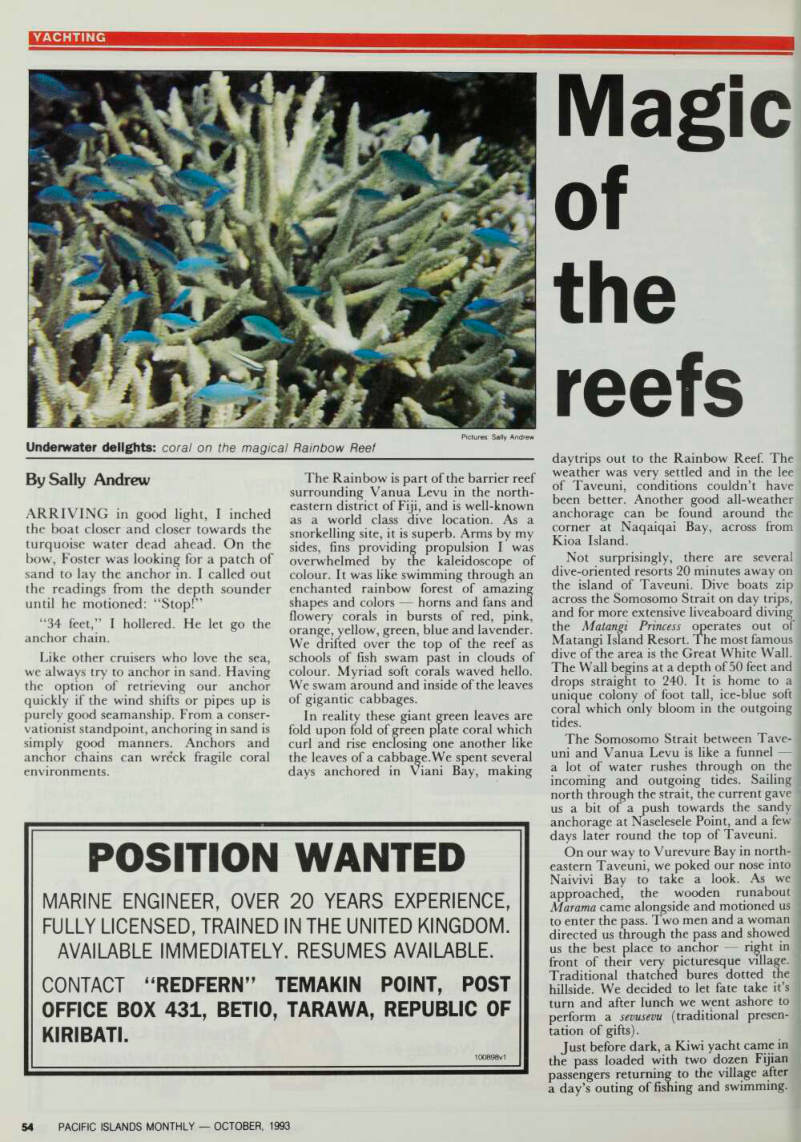
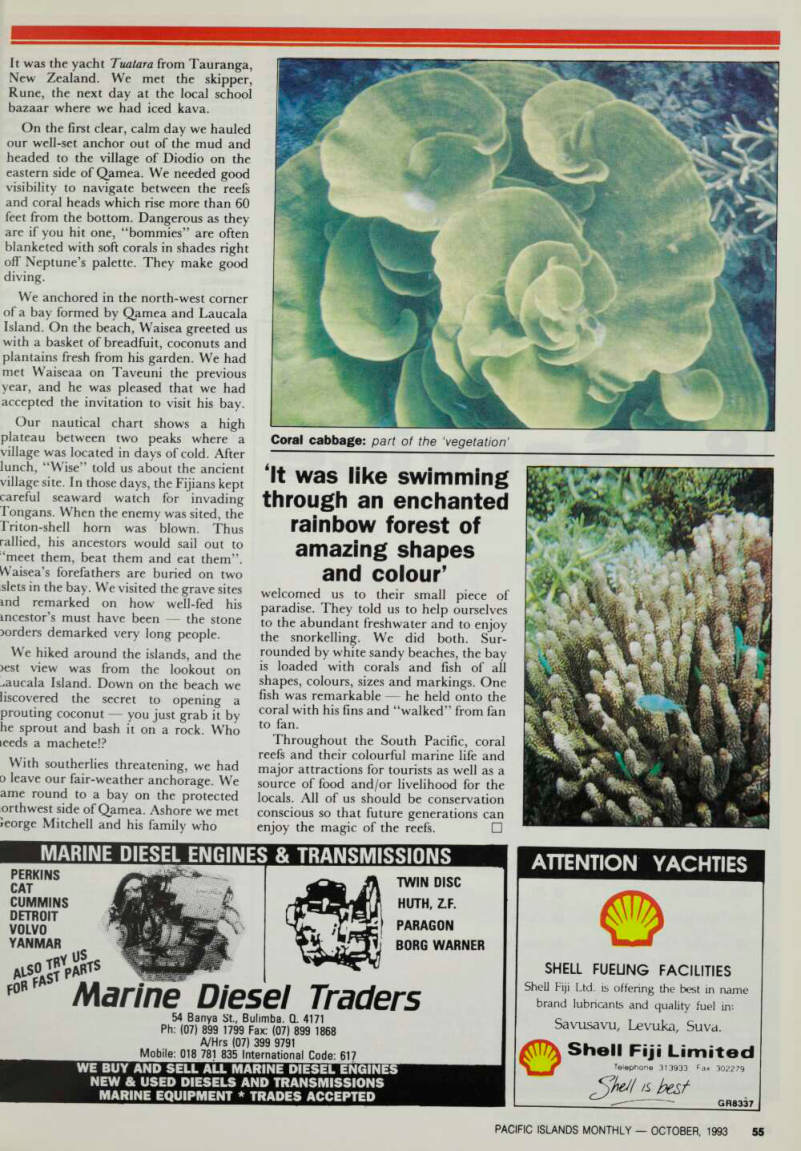
Yachting
Magic of the reefs
By Sally Andrew
The Rainbow is part of the barrier reef surrounding Vanua Levu in the north eastern district of Fiji, and is well-known as a world class ive i ocation . A s a snorkelling site, it is superb. Arms by my sides, fins providing propulsion I was overwhelmed by the kaleidoscope of colour. It was like swimming through an enchanted rainbow forest of amazing shapes and colors horns and fans and flowery corals in bursts of red, pink, orang e, yellow, green, blue and lavender We § nf [ ed ove “ the top Q f the reef as schools of fish swam past in clouds of colour. Myriad soft corals waved hello, We swam around and inside of the leaves of gigantic cabbages, In reality these giant green leaves are fold upon fold of green plate coral which curl and rise enclosing one another like the leaves of a cabbage. We spent several days anchored in Viani Bay, making
a r> r» • .1-1 Tii ARRIVING in good light, I inched the boat closer and closer towards the turquoise water dead ahead. On the bow, Foster was looking for a patch of sand to lay the anchor in. I called out the readings from the depth sounder until he motioned: “Stop!” uoA r „ T > n . tt , , 34 feet, I hollered. He let go the anchor chain.
Like other cruisers who love the sea, we always try to anchor in sand. Having the option of retrieving our anchor quickly if the wind shifts or pipes up is
purely good seamanship. From a conser
vationist standpoint, anchoring in sand is simply good manners. Anchors and anchor chains can wreck fragile coral environments.
daytrips out to the Rainbow Reef. The weather was very settled and in the lee of Taveuni, conditions couldn’t have been better. Another good all-weather anchorage can be found around the corner at Naqaiqai Bay, across from Kioa Island.
Not surprisingly, there are several dive-oriented resorts 20 minutes away on the island of Taveuni. Dive boats zip across the Somosomo Strait on day trips, and for more extensive liveaboard diving the Matangi Princess operates out of Matangi Island Resort. The most famous dive of the area is the Great White Wall.
The Wall begins at a depth of 50 feet and drops straight to 240. It is home to a unique colony of foot tall, ice-blue soft coral which only bloom in the outgoing tides.
The Somosomo Strait between Tave uni and Vanua Levu is like a funnel — a lot of water rushes through on the incoming and outgoing tides. Sailing north through the strait, the current gave us a bit of a push towards the sandy anchorage at Naselesele Point, and a few days later round the top of Taveuni.
On our way to Vurevure Bay in north eastern Taveuni, we poked our nose into Naivivi Bay to take a look. As we approached, the wooden runabout Marama came alongside and motioned us to enter the pass. Two men and a woman directed us through the pass and showed us the best place to anchor — right in front of their very picturesque village.
Traditional thatched bures dotted the hillside. We decided to let fate take it’s turn and after lunch we went ashore to perform a sevusevu (traditional presen tation of gifts).
Just before dark, a Kiwi yacht came in the pass loaded with two dozen Fijian passengers returning to the village after a day’s outing of fishing and swimming.
Underwater delights: coral on the magical Rainbow Reef
Pictures: Sally Andrew
It was the yacht Tuatara from Tauranga, New Zealand. We met the skipper, Rune, the next day at the local school bazaar where we had iced kava.
On the first clear, calm day we hauled our well-set anchor out of the mud and headed to the village of Diodio on the eastern side of Qamea. We needed good visibility to navigate between the reefs and coral heads which rise more than 60 feet from the bottom. Dangerous as they are if you hit one, “bommies” are often blanketed with soft corals in shades right off Neptune’s palette. They make good diving.
We anchored in the north-west corner of a bay formed by Qamea and Laucala Island. On the beach, Waisea greeted us with a basket of breadfuit, coconuts and plantains fresh from his garden. We had met Waiseaa on Taveuni the previous year, and he was pleased that we had accepted the invitation to visit his bay.
Our nautical chart shows a high plateau between two peaks where a village was located in days of cold. After lunch, “Wise” told us about the ancient village site. In those days, the Fijians kept careful seaward watch for invading Tongans. When the enemy was sited, the Triton-shell horn was blown. Thus rallied, his ancestors would sail out to ‘meet them, beat them and eat them”.
Waisea’s forefathers are buried on two slets in the bay. We visited the grave sites md remarked on how well-fed his mcestor’s must have been the stone demarked very long people.
We hiked around the islands, and the >est view was from the lookout on lsland. Down on the beach we liscovered the secret to opening a prouting coconut you just grab it by he sprout and bash it on a rock. Who iceds a machete!?
With southerlies threatening, we had d leave our fair-weather anchorage. We ame round to a bay on the protected orthwest side of Qamea. Ashore we met Jeorge Mitchell and his family who
‘lt was like swimming through an enchanted rainbow forest of amazing shapes and colour’
welcomed us to their small piece of paradise. They told us to help ourselves to the abundant freshwater and to enjoy the snorkelling. We did both. Sur rounded by white sandy beaches, the bay is loaded with corals and fish of all shapes, colours, sizes and markings. One fish was remarkable he held onto the coral with his fins and “walked” from fan to fan.
Throughout the South Pacific, coral reefs and their colourful marine life and major attractions for tourists as well as a source of food and/or livelihood for the locals. All of us should be conservation conscious so that future generations can enjoy the magic of the reefs. □
Coral cabbage: part of the ‘vegetation’
Advertisements & other items, pp. 54-55 (1 item)
Position Wanted
MARINE ENGINEER, OVER 20 YEARS EXPERIENCE,
FULLY LICENSED, TRAINED IN THE UNITED KINGDOM.
AVAILABLE IMMEDIATELY. RESUMES AVAILABLE.
CONTACT “REDFERN” TEMAKIN POINT, POST
OFFICE BOX 431, BETIO, TARAWA, REPUBLIC OF
KIRIBATI.
MARINE DIESEL ENGINES & TRANSMISSIONS
PERKINS
CAT
CUMMINS
DETROIT
VOLVO
YANMAR
Marine Diesel Traders
FOB
TWIN DISC
HUTH, Z.F.
PARAGON
BORG WARNER
54 Banya St, Bulimba. Q. 4171 Ph; (07) 899 1799 Fax: (07) 899 1868 A/Hrs (07) 399 9791 Mobile: 018 781 835 International Code: 617 WE BUY AND SELL ALL MARINE DIESEL ENGINE:
NEW & USED DIESELS AND TRANSMISSIONS
MARINE EQUIPMENT * TRADES ACCEPTED
ATTENTION YACHTIES
SHELL FUEUNG FACILITIES
Shell Fiji Ltd. is offering the best in name brand lubricants and quality fuel in; Savusavu, Levuka, Suva.
Shell Fiji Limited Telephone 313933 Fa* 302279 & best
Shipping
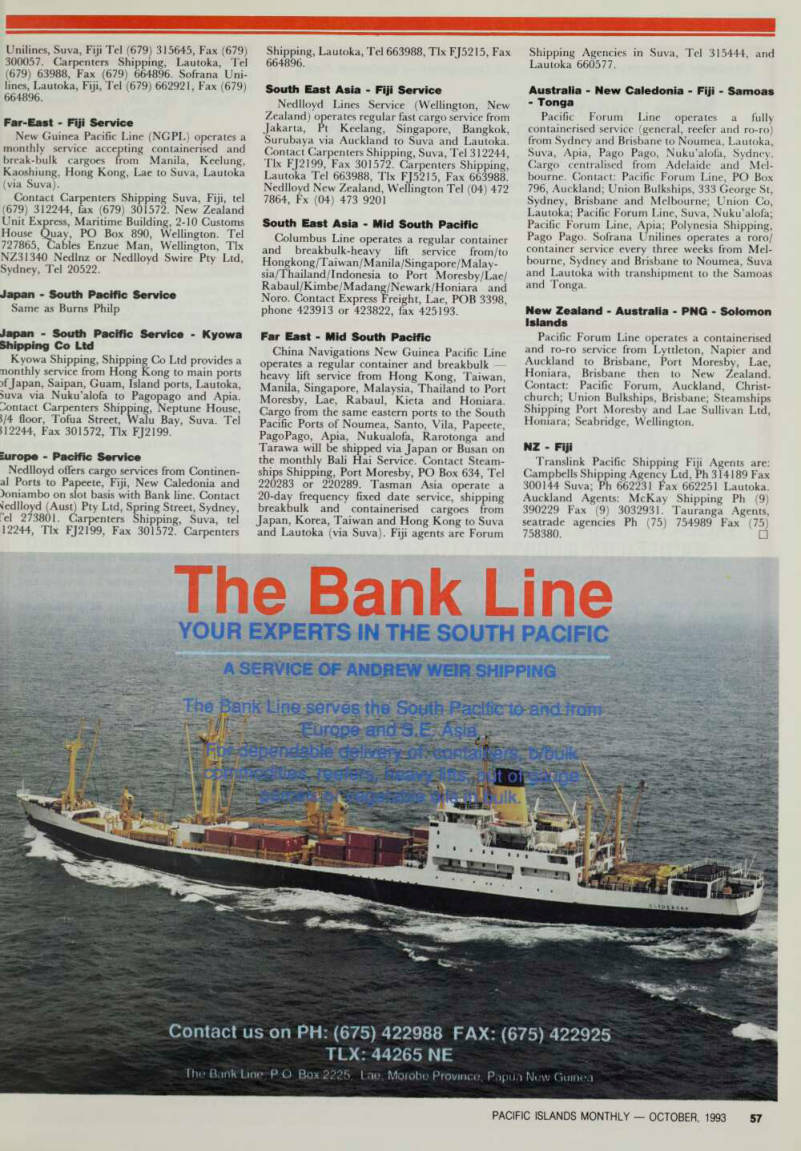
Schedules
West Coast North America Tahiti Pagopago Nuku’alofa Suva BLUE STAR LINE (BSL) operates a fully containerised/breakbulk service every 30 days from the West Coast North American ports of Seatle, Vancouver, Coos Bay, San Francisco and Los Angeles then on to Papeete, Pago Pago, Nuku’alofa and Suva. The vessels then continue on, back to the West Coast of North American ports via the New Zealand ports of Auckland and Napier. Ships are Washington Star and Napier Star. Contacts: BSL Seattle Ph 6825197, Fx 2339048, Tx 67327722. BSL Vancouver Ph 6819204, Fx 6811698, Tx 6732751. BSL San Franciso Ph 9282026, Fx 2475310, Tx 6732747.
BSI Los Angeles Ph 4325151, Fx 4357780, Tlx
6732746. Papeete Seairland Transports (PST)
Tahiti Ph 428307, Fx 430711, Tx 258 FP. Samoa Pacific Shipping Inc. PagoPago, Ph 6334665, Fx 6334667. Dateline Shipping & Travel Agencies, Nuku’alofa Ph 24500, Fx 23993, Tx 7566220.
BSL Auckland, Ph 3090965, Fx 3032039, Tlx 2556. BSL Napier, Ph 8353343, Fx 8351533, Tlx 30079. Shipping Services (Fiji) Ltd, Suva, Ph 305577, Fx 301615, Tx 2349. Shipping Services (Fiji) Ltd, Lautoka Ph 667677, Fax 667813.
FIJI NZ Tahiti West Coast North America BLUE STAR LINE (BSL) operates a fully containerised/breakbulk service every 21-25 days from Suva to Aucklannd and Napier then on to Papeete and the West Coast North American ports of Los Angeles, Vancouver, Seattle, Cocos Bay, San Francisco and Los Angeles with a transit time of approximately 25 days. The vessels then continue back to Fiji via Papeete,
Pago Pago and Nuku’alofa. Ships are Washing ton Star and Napier Star. Contacts: BSL Seade Ph 6825197, Fx 2339048, Tx 6732772. BSL Vancouver Ph 6819204, Fx 6811698, Tx 6732751. BSL San Francisco Ph 9282026, Fx 2475310, Tx 6732747. BSL Los Angeles Ph 4325151, Fx 4357780, Tlx 6732746. Agence Maritime Internationale De Tahiti Ph 428972, Fx 432184, Tx 227 FP. Samoa Pacific Shipping Inc. PagoPago, Ph 6334665, Fx 6334667.
Dateline Shipping & Travel Agencies, Nuku’alofa Ph 24500, Fx 23993, Tx 7566220.
BSL Auckland Ph 3090965, Fx 3032029, Tx 2556. BSL Napier Ph 835343, Fx 8351533, Tx 30079. Shippng Services (Fiji) Ltd, Suva, Ph 305577, Fx 301615, Tx 2349. Shipping Services (Fiji) Ltd, Lautoka Ph 667677, Fax 667813.
Australia FIJI West Coast North America BLUE STAR LINE (BSL) operates a fully containerised/breakbulk fortnightly service from Sydney to Melbourne, Brisbane (via Sydney), Wellington, Auckland, Suva, Seatle, Vancouver, (via Seatde), San Francisco and then to Los Angeles with a transit time of approximately 32 days. The vessels then continue back to the Australian ports. Ships are Columbia Star, Brisbane Star, and California Star. Contcts: BSL Sydney Ph 8449555, Fx 8449533, Tlx 20649/121484. BSL Melbourne Ph 2541660, Fax 6861009, Tx 31449. BSL Seattle Ph 6825197, Fx 2339048, Tx 6732772. BSL Vancouver Ph 6819204, Fx 6811698, Tx 6732751. BSL San Francisco Ph 9282026, Fx 2475310, Tx 673247.
BSL Los Angeles Ph 4325151, Fx 4357780, Tlx 6732746. Shipping Services (Fiji) Ltd, Suva, Ph 305577, Fx 301615, Tx 2349. Shipping Services (Fiji) Ltd, Lautoka Ph 667677, Fax 667813.
New Zealand - Fiji direct Sofrana Unilines operates a fully containerised/breakbulk service every 21 days from Auckland, Tauranga, Lyttleton to Suva and Lautoka. Loading every 21 days, ro/ro service, containers - reefer. Contact Sofrana Unilines, Sofrana House, 101 Customs Street, Auckland, PO Box 3614, Fax (09) 393874, Ph (09) 773279, Tlx NZ 2313. Direct toll free line 0800 659-922, Contact Alan Foote. Compass Shipping Agencies, PO Box 921 Wellington, Tel (04) 382 8206, Fax (04) 3828239, Tlx NZ 4769 Contact Steve Brannigan. Sofrana Unilines Agencies, PO Box 22046 Christchurch, Tel (03) 366 7180, Fax (03) 366 8868, TLX NZ4769, Contact Tony Newell. Carpenters Shipping, Private Mail Bag, Suva, Fiji, Tel (679) 312244, Fax (679) 301572, Tlx FJ 2199. Sofrana Unilines, Suva, Fiji, Tel (679) 315645, Fax (679) 300057.
Australia - Fiji direct Sofrana Unilines operates a container breakbulk service every three weeks from Melbourne, and Sydney to Lautoka and Suva.
Contact Sofrana Unilines (Aust) Pty Ltd, PO Box Q 136, Queen Victoria Building, Sydney, NSW 2000, Australia. Tel (02) 2648944, Fax (02) 2676547, Tlx (71) A 170090, Contact Sam Attaway/ George Lopez.
Delams Australia Pty Ltd. 474 Flinders Street, Melbourne. Tel (03) 614 1344, Fax (03) 629 4957.
Carpenters Shipping, Suva, Tel (679) 312244, Fax (679) 301572. Sofrana Unilines Suva, Tel (679) 315 645, Fax (679) 300057. Carpenters Shipping, Lautoka, Tel (679) 663988, Fax (679) 664896. Sofrana Unilines, Lautoka Tel (679) 662921, Fax (679) 664896.
Australia - Fiji monthly service Sofrana Unilines (Australia) Pty Ltd operates a regular monthly service with MV Capitaine Wallis. Contact Sofrana Unilines, Sydney, Tel (02) 2648944, Tlx AA170090, Fax (02) 267-6547. Carpenters Shipping, Suva, Fiji, Tel (679) 312244, Fax (679) 301572, Sofrana
Unilines, Suva, Fiji Tel (679) 315645, Fax (679) 300057. Carpenters Shipping, Lautoka, Tel (679) 63988, Fax (679) 664896. Sofrana Uni lines, Lautoka, Fiji, Tel (679) 662921, Fax (679) 664896.
Far-East - Fiji Service New Guinea Pacific Line (NGPL) operates a monthly service accepting containerised and break-bulk cargoes from Manila, Keelung, Kaoshiung, Hong Kong, Lae to Suva, Lautoka
(via Suva).
Contact Carpenters Shipping Suva, Fiji, tel (679) 312244, fax (679) 301572. New Zealand Unit Express, Maritime Building, 2-10 Customs House Quay, PO Box 890, Wellington. Tel 727865, Cables Enzue Man, Wellington, Tlx NZ31340 Nedlnz or Nedlloyd Swire Pty Ltd, Sydney, Tel 20522.
Japan - South Pacific Service Same as Burns Philp Japan - South Pacific Service - Kyowa Shipping Co Ltd Kyowa Shipping, Shipping Co Ltd provides a monthly service from Hong Kong to main ports sfjapan, Saipan, Guam, Island ports, Lautoka, suva via Nuku’alofa to Pagopago and Apia.
Contact Carpenters Shipping, Neptune House,
5/4 floor, Tofua Street, Walu Bay, Suva. Tel 512244, Fax 301572, Tlx FJ2199.
Europe - Pacific Service Nedlloyd offers cargo services from Continen al Ports to Papeete, Fiji, New Caledonia and )oniambo on slot basis with Bank line. Contact Nedlloyd (Aust) Pty Ltd, Spring Street, Sydney, el 273801. Carpenters Shipping, Suva, tel 12244, Tlx FJ2199, Fax 301572. Carpenters
Shipping, Lautoka, Tel 663988, Tlx FJ5215, Fax 664896.
South East Asia - Fiji Service Nedlloyd Lines Service (Wellington, New Zealand) operates regular fast cargo service from
Jakarta, Pt Keelang, Singapore, Bangkok,
Surubaya via Auckland to Suva and Lautoka.
Contact Carpenters Shipping, Suva, Tel 312244, Tlx FJ2199, Fax 301572. Carpenters Shipping, Lautoka Tel 663988, Tlx FJ5215, Fax 663988.
Nedlloyd New Zealand, Wellington Tel (04) 472 7864, Fx (04) 473 9201 South East Asia - Mid South Pacific Columbus Line operates a regular container and breakbulk-heavy lift service from/to
Hongkong/Taiwan/Manila/Singapore/Malay
sia/Thailand/Indonesia to Port Moresby/Lae/
Rabaul/Kimbe/Madang/Newark/Honiara and
Noro. Contact Express Freight, Lae, POB 3398, phone 423913 or 423822, fax 425193.
Far East - Mid South Pacific China Navigations New Guinea Pacific Line operates a regular container and breakbulk heavy lift service from Hong Kong, Taiwan, Manila, Singapore, Malaysia, Thailand to Port Moresby, Lae, Rabaul, Kieta and Honiara.
Cargo from the same eastern ports to the South Pacific Ports of Noumea, Santo, Vila, Papeete,
PagoPago, Apia, Nukualofa, Rarotonga and
Tarawa will be shipped via Japan or Busan on the monthly Bali Hai Service. Contact Steam ships Shipping, Port Moresby, PO Box 634, Tel 220283 or 220289. Tasman Asia operate a 20-day frequency fixed date service, shipping breakbulk and containerised cargoes from Japan, Korea, Taiwan and Hong Kong to Suva and Lautoka (via Suva). Fiji agents are Forum
Shipping Agencies in Suva, Tel 315444, and Lautoka 660577.
Australia - New Caledonia - Fiji - Samoas - Tonga Pacific Forum Line operates a fully containerised service (general, reefer and ro-ro) from Sydney and Brisbane to Noumea, Lautoka, Suva, Apia, Pago Pago, Nuku’alofa, Sydney.
Cargo centralised from Adelaide and Mel bourne. Contact: Pacific Forum Line, PO Box 796, Auckland; Union Bulkships, 333 George St, Sydney, Brisbane and Melbourne; Union Co, Lautoka; Pacific Forum Line, Suva, Nuku’alofa; Pacific Forum Line, Apia; Polynesia Shipping, Pago Pago. Sofrana Unilines operates a roro/ container service every three weeks from Mel bourne, Sydney and Brisbane to Noumea, Suva and Lautoka with transhipment to the Samoas
and Tonga.
New Zealand - Australia - PNG - Solomon Islands Pacific Forum Line operates a containerised and ro-ro service from Lyttleton, Napier and Auckland to Brisbane, Port Moresby, Lae, Honiara, Brisbane then to New Zealand.
Contact: Pacific Forum, Auckland, Christ church; Union Bulkships, Brisbane; Steamships Shipping Port Moresby and Lae Sullivan Ltd,
Honiara; Seabridge, Wellington.
NZ - Fiji Translink Pacific Shipping Fiji Agents are: Campbells Shipping Agency Ltd, Ph 314189 Fax 300144 Suva; Ph 662231 Fax 662251 Lautoka.
Auckland Agents: McKay Shipping Ph (9)
390229 Fax (9) 3032931. Tauranga Agents,
seatrade agencies Ph (75) 754989 Fax (75) 758380. □
Advertisements & other items, pp. 56-60 (1 item)
Reliability
& Service
SOFRANA has alvyays had the good sense to adapt to suit the needs of its customers. In the majority of countries that we serve, we have established a network of agency offices that allow us to deal directly with you, giving us the ability to deliver a better, more personalised service to suit your needs. In years gone by it has served us well, and will continue to follow this policy in the future.
Principal countries
• Australia • New Zealand • Papua New Guinea served In the South Pacific • Fiji • Norfolk Islands • Vanuatu e New Caledonia • Solomon Islands sth floor,Neptune House,Tofua Street, Walu Bay,Suva,Fiji.
Te1:315645,304528.
Fax:3oo 951, 300 057.
Postal Address:C/-Carpenters Shipping.
Private Mail Bag, Suva.
The Bank Line
YOUR EXPERTS IN THE SOUTH PACIFIC
BOOKS
INTERESTED IN HARD TO FIND BOOKS ON THE ISLANDS OF THE PACIFIC? Write the Book Bin Pacifica, 160 NW, Third, Corvallis, or
97330, U.S.A
SCRAP METAL
Tall ingots operate from Brisbane, Australia and make frequent visits to the Pacific Islands which they have done for twenty-five years. We are buyers of Copper, Brass, Aluminium, Lead, Cable etc. Inspection no problems. Telephone 61 7 8922033. Fax 61 78922077
AGENTS REQUIRED
Fiji s largest wholesaler of Car Accessories, Car Care Products, Woodworking Machinery requires agents in all South Pacific Countries Contact Autobarn PO Box 468 Suva, Fiji Islands. Telephone (679) 311151.
Fax (679) 305072
YACHT FOR SALE
42 Foot Classic English built ocean going cruising yacht, Very full inventory, Fiji customs duty paid For further information PHONE: (679) 361883 OR FAX (679) 361599. BOX 3205, LAMI, FIJI.
Educational Promotional Corporate TV Commercials Conference Riming • Events.
Tradewind Communications Ltd
TV BROADCAST & VIDEO PRODUCTION
Based in Auckland, New Zealand. The best production facilities in the South Pacific available with the most competitive rates. We can tailor a production to your budget and requirements. Location experience throughout the Pacific.
Call us now with your basic Idea and we will transform It Into a powerful message P.O. Box 5761 Ph (64) 9 520 4014 Wellesley St Auckland Fax (64) 9 522 2295 New Zealand Mobile (61) 25 986 507 Documentaries Tourist video Underwater Riming Any language i o iBsBv2
1 9 OCT TO
A/
SOUTH PACIFIC REGIONAL
ENVIRONMENT PROGRAMME
(SPREP)
VACANCY - PROJECT OFFICER (SPECIES PROTECTION):
SOUTH PACIFIC BIODIVERSITY CONSERVATION
PROGRAMME (SPBCP)
The South Pacific Regional Environment Programme (SPREP) seeks applicants for the position of Project Officer (Species Protection) for the South Pacific Biodiversity Conservation Programme (SPBCP).
The SPBCP helps participating countries establish and initially manage a series of diverse conservation areas (terrestrial, marine and combined) to enable the sustainable use of those areas' natural resources. Subsidiary activities support project objectives through provision of information, species protection and action-oriented policy studies. Tne SPBCP is executed by SPREP on behalf of the Global Environment Facility and its partners namely, the World Bank and the United Nations Development
Programme.
The Project Officer, manages the regional species conservation programmes for turtles, marine mammals and birds. In addition, this officer is responsible for facilitating the implementation of regional and global biodiversity conventions in SPREP member countries and initiating regional policy studies and activities related to biodiversity conservation such as biotechnology, biodiversity property rights, training, education, research and institutional development.
The appointment will be at Project Officer level and will be for two years in the first instance renewable by mutual agreement for a further one year. An attractive remuneration at this level and other employment benefits will be offered with the actual starting salary dependent on qualifications and experience. For non-Westem Samoan citizens, salary and allowances will be tax-free in Western Samoa.
Applicants must possess a University degree in a relevant field, preferably at post graduate level. Extensive (at least five years) experience working on environmental conservation, resource management, land use management or related fields in or on behalf of developing countries, preferably within the Pacific Islands, will be important.
Proven skills and experience in deeding with complex land tenure systems are desirable. Applicants must be nationals of a SPREP or United Nations member country and must be fluent in spoken and written English. Knowledge of a Pacific Island language and of French would be advantageous.
Applications must be accompanied by detailed curricula vitae containing full information on qualifications and experience relevant for the position as well as names, address, telephone and fax numbers of three persons associated with the applicant professionally and who would be prepared to provide testimonials when required.
Applications should be addressed to: The Director South Pacific Regional Environment Programme PO Box 240
APIA
Western Samoa Telephone: (685) 21 929 Fax: (685) 20 231 Further information, including full duty statement and conditions of appointment can be obtained from SPREP's Senior Administrative Officer, Mr Ueligitone Sasagi, at these numbers.
Closing date for all applications will be 31st October 1993. 104878v2
HEALTH PROGRAM
OPPORTUNITY IN KIRIBATI
The Foundation for the Peoples of the South Pacific in Kiribati seeks a Health Program Coordinator to develop and manage health programs (family planning CDD, nutrition, EPI). Minimum requirements: Masters in Public Health, computer literacy, and 2-3 years experience managing community health programs. Experience desired in; health information systems, program planning training and nealth education materials. Position requires frequent travel to outer islands. Direct inquiries and applications (CV, names & addresses of 3 professional references, date of availability, and salary requirements) to FSP Counby Representative at PO Box 43, Bairiki, Tarawa, Kiribati. Phone: 686-28101. Fax: 686-28082. i24448v2
BAGOT
BELLFOUNDRIES
Supplying tuned bronze bells in Australia and Pacific Islands since 1977 Postal Address: Box 421, North Adelaide, SA 5006, Australia Telephone: (08) 267 1306 Office: 147 Ward St, North Adelaide, SA Workshop: 346 Carrington St, Adelaide, SA
w/t
AMlOffoirLl
H « I A Mm s ■sL € • e’re different at Grand Pacific Life Insurance.
More like a family.
You feel it in the way we talk to you.
And you feel it in the way you can talk to us.
Because only one life insurance company in the Pacific is an island company... owned and operated by island people who understand the needs and lives of island people.
Grand
Pacific
LIFE
INSURANCE
COMPANY
Today, Grand Pacific Life Insurance offers a full range of life insurance and annuity plans as well as financial planning. Our total life insurance in force exceeds $3 billion with assets in excess of $l4B million. Grand Pacific Life Insurance.. .The island insurance company so different from the rest,
it’s like comparing apples
and oranges.
FEDERATED STATES
OF MICRONESIA
ACTOUKA EXECUTIVE
INSURANCE UNDERWRITERS
P.O. Box 55, Kolonia, Pohnpei, Federated States of Micronesia 96941
PACIFIC BASIN INSURANCE &
GENERAL SERVICES, INC.
P. 0. Box 494, Chuuk State, Federated States of Micronesia' 96942
TONGA
PESETIMAAFU INS. & FINANCE, LTD.
Private Bag 2, Taumoepeau Bldg.
Nukualofa, Tonga
GUAM.
GREAT NATIONAL INSURANCE
UNDERWRITERS, INC.
P.O. Box GA, Agana, Guam 96910
PACIFIC FINANCIAL
CORPORATION
P.O. Box AT, Agana, Guam 96910
TAKAGI & ASSOCIATES, INC.
414 W. Soledad Ave.
Agana, Guam 96910
MARSHALL ISLANDS
MARSHALLS INSURANCE
AGENCY
P.O. Box 113, Majuro, Marshall Islands 96960
AMERICAN SAMOA
MARK SOLOFA
PACIFIC INSURANCE
& FINANCE, INC.
P.O. Box 3149, Pago Pago, American Samoa 96799 1164 Bishop St., slh Fir., Honolulu, HI 96813 • Phone: (808) 548-3363 • FAX: (808) 548-5122 A member of the Finance Factors Family of Companies.
WESTERN SAMOA
MARK SOLOFA
PACIFIC INSURANCE
& FINANCE, INC.
P.O. Box 3149, Pago Pago, American Samoa 96799
NORTHERN
MARIANAS BELAU
PACIFIC BASIN INSURANCE
UNDERWRITERS, INC.
P.O. Box 710, Saipan, Marianas Islands 96950
PACIFICA INSURANCE
UNDERWRITERS, INC.
P.O. Box 168, Saipan, Marianas Islands 96950
HMRI
MITSUBISHI
Introducing the All New Mitsubishi Galant — Beautifully Engineered for the Way You Drive Although the new Galant is probably the most handsome new car on the road, its true beauty lies in its sheer driveability. It’s probably the first car ever that gives you the freedom to drive exactly how you choose. With a sporty, dynamic personality, it has the energy to set your adrenaline flowing when you want to drive for fun. Yet for an effortless drive home at the end of a long day, it has the smoothness and comfort you’d expect in a quality saloon. Quite how you drive the new Galant is entirely up to you.
The key to the new Galant’s versatile performance is All Wheel Control, a unique approach to car design total control with quicker, safer and more responsive performance than ever before imaginable.
The All Wheel Control vision is brought to reality in the new Galant by some of the most advanced automotive technology ever developed. From the first ever four wheel multi-link suspension system on a front engine, front wheel drive car to some of the world’s most intelligent computer control systems, the Galant boasts breakthroughs that ensure a smooth, responsive drive in any conditions. And with a range of newly developed 1.8-litre SOHC to 2.0-litre V 6 DOHC multi-valve engines, you can that puts your needs first. It works on the principle that every move a car makes, from accelerating to cornering, depends on how well your aims get passed to the road —and that hinges on all four wheels working as effectively as they can, to direct, manipulate and control. With true communication count on the power for the freedom to drive as you choose.
Discover the meaning of driving freedom with the new Mitsubishi Galant —and feel how All Wheel Control sets you apart from the crowd.
Mitsubishi Motors and drivers who care —creating between you and the road, the new Galant guarantees together.
The All New
MITSUBISHI GRLRNT
AMERICAN SAMOA
FUI: NIVIS MOTOR &
PACIFIC MARKETING INC. PO. Box 698, Pago Pago, Tel 699 9140 / AUSTRALIA: MITSUBISHI MOTORS AUSTRALIA LTD. 1284 South Road, Ctowllytok. South Aus&aha, Te 2757297 / , MACHINERY CO. LTD. G.PO. Box 158 Suva, Tel. 383411 / GUAM: TRIPPLE J ENTERPRISES INC. RO. Box 6068 Tamunmg, Tel, 6469126 1 N EW MLEDONUL , SOCIETE 0I IMPORTATION D'AUTO DU PACIFIQUE SUD S.A. PO. Box 2548 Noumea, Tel 274144 /NEW ZEALAND: MITSUBISHI MOTORS NEW ZEALAND LTD. Private Bag. Ponrua, TelJ37-0109,' NORFOLK ISLAND: BORRY S FTY LTD. PO. Box 169, Tel. 2114 /PAPUA NEW GUINEA; TOBA PTY LTD. PO. Box 503, Port Moresby, Tel. 217874/ SAIPAN: AUTO MOTION INC. RQ Box 569SKV Dist. * I. Tel 234 3332 /SOUJMON ISLANDS: HARVEST PACIFIC LTD. G.PO. Box 823, Honiara, tel 30407 /TAHITI (FRENCH POLYNESIA): SOPAOEP S.A. PO. Box el 427393 1/ TONGA: SFTANI MAPI CO LTD. RQ Box 88 Nukualofa Tel 24044 /VANUATU: SOCOMETRA VANUATU LTD. B.R 06 Route de Lagon, Port-Vila, Tel. 2314 /WESTERN SAMOA: MOTOR DISTRIBUTORS (SAMOA) LTD. PO. Box 576 Apia. Tel. 20957 A
MITSUBISHI
MOTORS
CREATING TOGETH