Pacific
Islands
Monthly
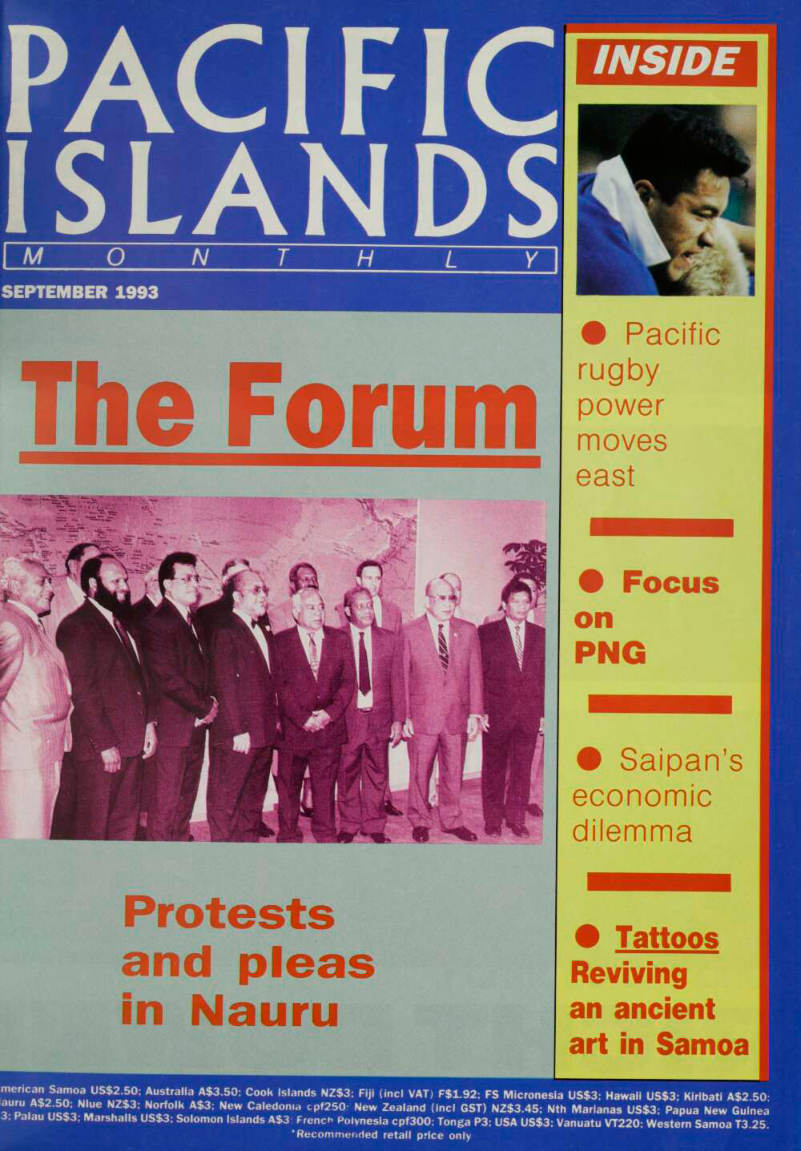
September 1993
The Forum
Protests and pleas in Nauru
Inside
• Pacific rugby power moves east Focus on
Png
• Saipan’s economic dilemma Tattoos Reviving an ancient art in Samoa
mer, canS am ° a US$2.5O: Australia A 53.50: Cook Islands NZ$3: Fiji (incl VAT) F 51.92; FS Micronesia US$3: Hawaii US$3: Kiribati As 2 50 auru As 2 50; Niue NZ$3; Norfolk As 3: New Caledonia cpf2so New Zealand (incl GST) NZ53.45: Nth Marianas US$3: Papua New Guinea ’ Palau US$3: Marshalls US$3: Solomon Islands As 3 French Polynesia cpf3oo: Tonga P 3: USA US$3: Vanuatu VT22O; Western Samoa T 3.25. ’Recommended retail price only
Advertisements & other items, pp. 2-4 (1 item)
Name's
i *3 o f Til S * >■ m ■w
iSMS
*BIBS®k£SSS6
RIGHT DOWN 1
PROVIDING REGULAR DIRECT AND TRANSSHIPMENT SERVICES TO AUSTRALIA • AMERICAN SAMOA • COOK ISLAi
LIN
m:.
IE LINE
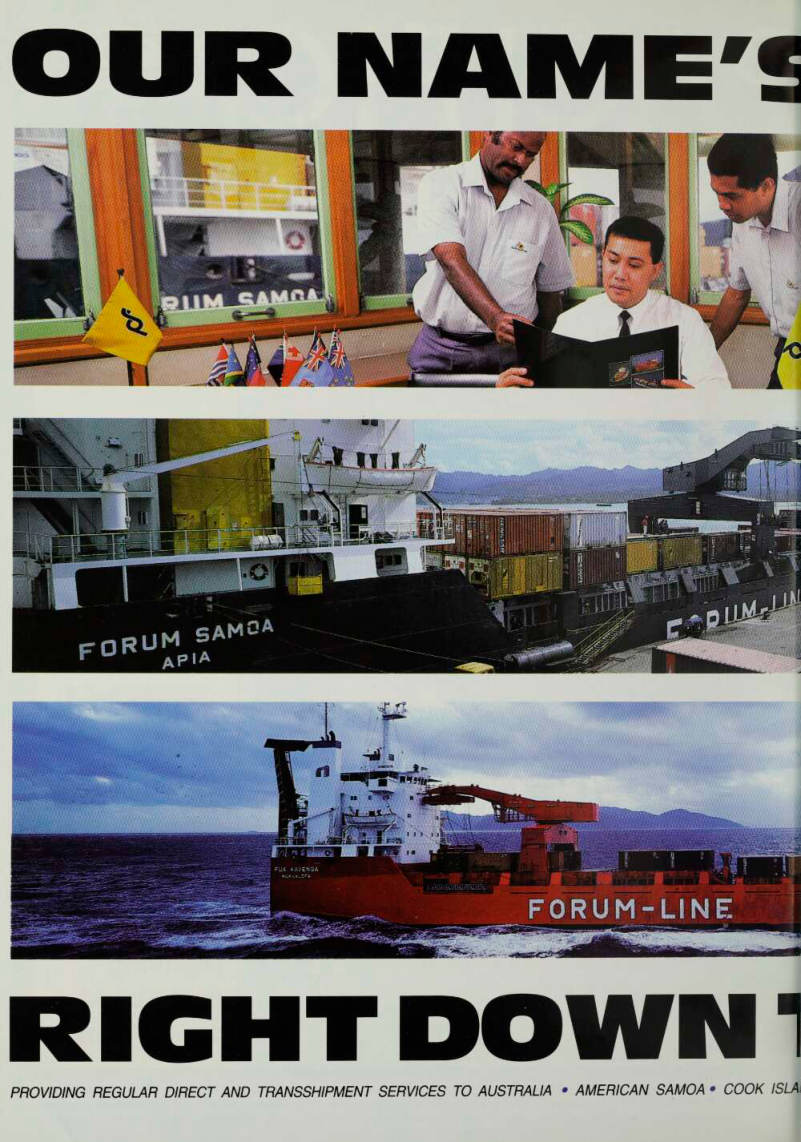
In 1978, when the Pacific Forum Line came into being, its charter was to not only establish a viable locally owned service for the region, it was also charged with the responsiblity for encouraging economic growth through increased trade.
Today, Pacific Forum Line is more than just a successful shipping line. It is a living example of regional co-operation at its best.
We act as a vital trade link for Forum Island countries.
Our network of services covers the South West Pacific to every point of the compass. From Lae to Lautoka, Melbourne to Tarawa and Apia to Auckland we offer a versatile fleet of vessels that can carry everything from containerised to break bulk and roll on/roll off cargo as well as handling specialised requirements like bulk liquid and refrigerated cargoes. Our aim is to ensure there is no cargo imported or exported in the South Pacific that we cannot handle.
Next time you see the familiar yellow PFL flag flying proudly, spare a thought for the contribution the Line has made to this part of the world over the past seventeen years.
And, if that’s not enough reason to ‘put it on the Line’, take a look at our competitive rates, convenient schedules and the years of accumulated shipping experience our people offer. Because you know that when you ship with Pacific Forum, it’s our name (and yours) on the Line, right down the Line. ff
Pacific Forum Line
For more information on Pacific Forum Line’s services and offices throughout the South Pacific contact our Auckland office on:- Ph: (09) 3096 700. Fax: (09) 3092 683. Telex: 60460.
PIBATI • NEW ZEALAND• PAPUA NEW GUINEA • SOLOMON ISLANDS • TONGA • TUVALU • WESTERN SAMOA
cA-AN Q c
n - '
Solßr
At last:
Solomon Islands
very own beer.
Taste the
differenc
Sol Brew Sol Brew
;/ /S 9M3MO\ BRIWIRIft ITD/HOM* W
W - SOI OMON ISLaMRS , • I ■Mm i Solomon Breweries Ltd., PO Box 848, Honiara, Solomon Islands Telephone: (677) 30 257. Telefax: (677) 30 852
Pacific
Islands
Monthly
Vol 63 No. 9
The News Magazine
September 1993
From The
Editor’S Desk 6
Letters 7
Pacific Diary 10
Headlines 11
Business Bulletin 13
Business
'rouble in Saipan 14 iconomic dilemma 16
Vanuatu
'usker finds its aste buds 23
Iarthquake
Suarn picks up the pieces 24
Aejon Expo ’93 27
He Forum 36
•Olitics
ettling in 39
Culture
eviving an ancient art 42
Focus On Png 47
Sport
Rugby power moves east 58 Spirited adolescent 60 Bodybuilding for ’95 Games 61
Yachting
Toothbrushes for paradise 62
Shipping
Shipping Schedule 65
Columnists
David Barber 9 Jemima Garrett 19 Bill McCabe 40 Futa Helu 41 Alfred Sasako 44
Oops ...
THE gremlins were at it again ... our report on New Caledonia’s squatter problem in PIM, July 1993, inadver tently referred to RPCR as pro independence RPCR headed by Jacques Lafleur. The sentence should have read, “A controversial agree ment endorsed in 1988 by the pro independence FLNKS, notably its assassinated leader Jean-Marie
Tjibaou, and the anti-independence
RPCR headed by Jacques Lafleur, the Accords have provided the blueprint for boosted economic development in the lead up to the scheduled refer endum on independence in 1988.” • In the August edition of PIM , a headline on an advertising feature on PNG’s Cellular Mobile Telephone service was wrongly attributed to Solomons Telecom exchange.
Any inconvenience caused by the errors is regretted. □
Publisher: Brian O’Flaherty Acting Editor Martin Tiffany Associate Editor: Arvind Kumar Correspondents: Christine Hatcher, David North, Ed Rampell. lan Williams, Johnson Honimae, Karen Mangnall, Liz Thompson, Nicholas Rothwell, Pesi Fonua, Wally Hiambohn.
Columnists: David Barber (Wellington), Futa Helu (Tonga, covering the Pacific Islands), Jemima Garrett (Sydney).
Julian Moti (Pacific Law), Alfred Sasako (The Forum).
Advertising Sales: • Regional Sales (South Pacific); Salendra Narayan. Tel (679) 304111, Fx (679) 303809 • Sydney, Canberra: Bob Hill Media Represen tations. Tel (61-2) 4164245, Fx (61-2) 4165064 • Brisbane: Robert Walker, Media House, Tel (61-7) 3710533, Fx (61-7) 371-8904 • Adelaide: Hastwell Williamsons Representations.
Tel (61-8) 799522, Fx (61-8) 799735 • Melbourne: Brown Orr Fletcher Burrows (Aust).
Pty. Ltd. Tel (3) 696 5188 Fx (03) 696 5131. • Auckland: McKay International Media Reps Ltd, Tel (64-9) 4190561. Fx (64-9) 4192243 • Japan: Universal Media Corporation, Tokyo, Tel (3) 6663036, 6663094, Cable: UNIMEDIA Tokyo.
Tx 2524665.
Founded 1930 (USPS 952480). A Fiji Times Limited production.
Cover prices are recommended retail only. Regis tered by Australia Post, Publication No. NBP 1210. © Copyright Fiji Times Limited, 177 Victoria Parade, Suva. Fiji. Tel (679) 304111, Fx (679)
303809, Tx Fj2124.
Pacific Islands Monthly is published monthly by The Fiji Times Limited, a division of Nationwide News, 2 Holt Street, Surry Hills. Sydney, NSW 2010.
Send address changes to: • Pacific Islands Monthly. PO Box 1167. Suva, Fiji.
Typeset and printed by The Fiji Times Limited, 177 Victoria Parade. Suva. Fiji.
Sepik carvings: a focus on PNG begins on page 47
A home for the Forum
From The Editor’S Desk
THE 24th South Pacific Forum meeting began and ended in Nauru last month.
How it went depends on who you talk to.
The regional leaders naturally praised
the outcome of the Forum meeting and of course the hosts. While the people who had their passports confiscated on arrival in Nauru were not too impressed. There were complaints of other shortcomings at the airport from bad organisation to
immigration officials being downright
rude. Some regional journalists were in Nauru three days before they were able to send copy home and communication generally was not terribly good. It was only a lot of hard work by Alfred Sasako of the Forum Secrtariat that got the communication facilities for journalists into some sort of order. Journalists who have returned from reporting the Forum say they were issued stiff warnings from government officials to stay away from controversy surrounding Nauru’s decreasing wealth. The journalists were told to report on the Forum alone or “get on the next flight home”. Nauru seemed paranoid about its dirty linen being aired in public especially during the Forum.
While they were happy to show the world the destruction caused to their island by phosphate mining they were touchy when the subject of missing investment funds was raised. During the Forum women and children took to the streets with banners and placards pro testing the mismanagement of their country’s phosphate wealth.
Last month’s PIM carried a cover report on the investments by the Nauru government and the problems with many of these investments. According to one of
the protest leaders, Ruby Dediya, the Nauru government confiscated the magazine before it was made available to the public. Government officials in Nauru would neither confirm nor deny the confiscation of the magazine saying they hadn’t seen a copy. What is certain is that there were no copies of the magazine available in bookshops during the Forum.
Meanwhile, in was not only journalists who had problems during the Forum.
Papua New Guinea officials had to run around to find a room for PNG prime
minister Paias Wingti before he arrived, There were reports of other accommo dation problems as well.
Not the kind of organisation you expect for such a high-powered regional meeting. Which again raises the question of whether the Forum meeting should have a permanent home. The present practice of island-hopping to a different regional capital each year for the meet ing is a costly affair. And it seems this is done more to keep each country happy than for the benefit of the organisation.
You then also run into problems ol countries like Nauru that are ill prepared and ill-equipped to play host to the regional meeting.
An editorial in The Fiji Times on August 5 called for the Forum meeting to make its home in Suva the home of the Forum Secretariat. Not a bad suggestion considering the facilities and infrastructure available and the fact that international organisations like the United Nations Development Pro gramme, the European Community and the United Nations International Chil dren’s Fund have their regional offices in Suva.
The Forum too has obviously been thinking along a similar vein. It has appointed a committee to review the Forum structure and there are sugges tions that regional leaders meet every second year while their foreign affairs ministers meet in the other years. A decision is expected at the Brisbane Forum next year.
The argument for a permanent home for the Forum is a sound one and should be given a lot of consideration. □(
Pacific Islands Monthly: banned in Nauru?
Advertisements & other items, p. 6 (1 item)
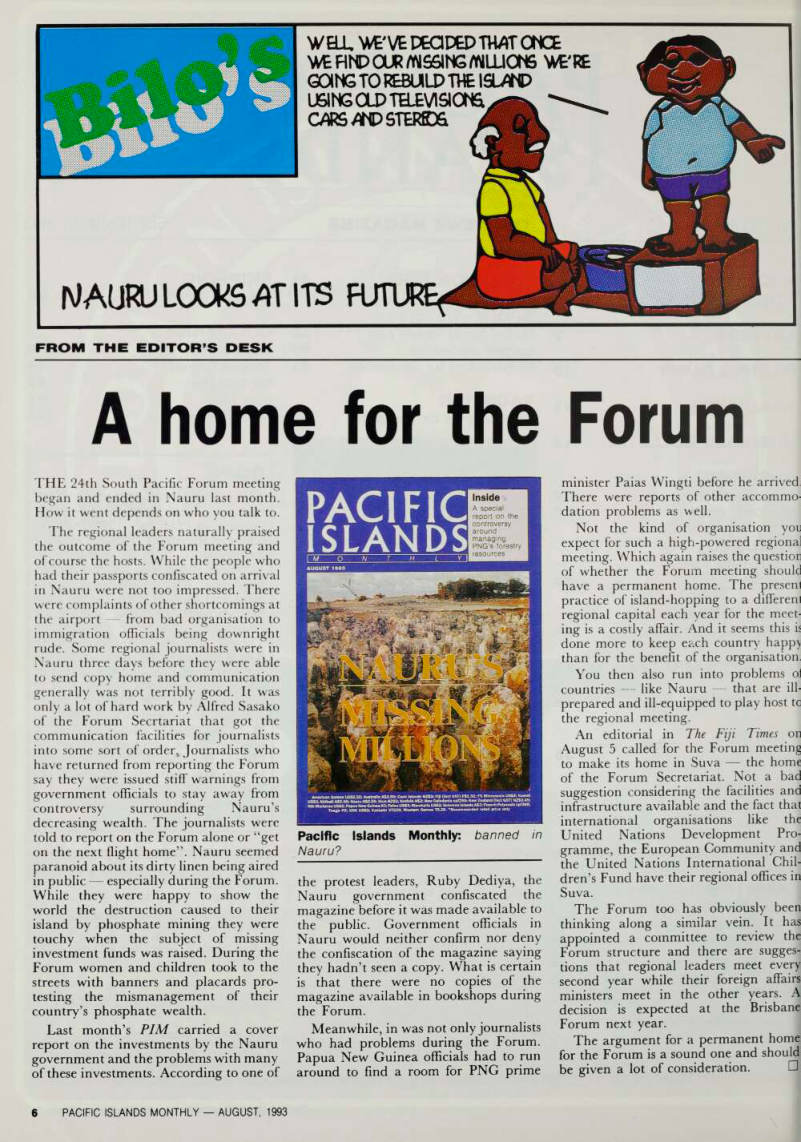
Mauru Looks At Its
WELL WE'VE DECIDED THAT ONCE
WE HMD OUR MSSING MILLIONS WE'RE
GOING TO REBUILD THE ISL/ND
USING OLD TELEVISIONS
CARS AW STEREOS
MAURU LOOKS AT ITS
Education
Letters
assistance
Sir, JEMIMA Garrett gave a very useful analysis of the issues donors face in providing educational assistance to the South Pacific in the June edition of Pacific Islands Monthly. In particular, her article provides a helpful snap-shot of the ‘in-Australia versus in-region’ education assistance dilemma. But that picture is dated, and fails to acknowledge the extent to which Australia’s said policies are now changing in response to the very issues Ms Garrett highlights.
Ms Garrett’s main point is that our education assistance emphasises in- Australia training for South Pacific islanders to the detriment of the Pacific island countries’ own education systems.
In fact, Australia in the process of moving the focus of that assistance from
in-Australia to in-region training. I
reconfirmed this in talks with the Vice- Chancellor of the University of the South Pacific, Esekia Solofa, during my recent yisit to Fiji.
The change in focus is already re lected in the declining number of Pacific slanders studying in Australia. One government-funded scheme is a particu ar case in point. Under what is now
called the John Crawford Scholarship Scheme (JCSS), 212 South Pacific island students were sponsored to study in Australia in 1991. Next year the JCSS will fund only 94 students less than half the number funded two years ago.
On the other side of the coin, there are now 100 students sponsored by the Australian government or by government-funded programs at the USP, 30 at the University of Papua New Guinea and about 100 students at other post-secondary institutions in the Pacific, mainly in Fiji and PNG.
Just as importantly, the Australian government recognises the need not only to increase the number of students at regional institutions, but to improve the quality of education those students receive.
A key priority is to address the high failure rate among Pacific island students both in Australia and in the region. We are looking at that right now and will continue to improve the selection of students and bridging programs offered.
But access to high quality primary and secondary education for South Pacific islanders is fundamental if students are to be able to take up opportunities offered for post-secondary study.
At the post-secondary level, we sup port training programs such as those provided at the Fiji School of Medicine, and are also developing in-region short
courses which are a cost-effective way to Erovide at least short-term solutions for ey skill shortages. In Fiji, in conjunction with local training institutions, we will run 15-20 short courses, costing about $400,000, for the public and private sector during 1993/94.
There is the additional problem of successful students wanting to live and work in Australia thereby leaving their home countries no better off. While
Australian development cooperation is
aimed at helping the economic and social development of Pacific island countries, it is a fact of life that qualified individuals from island countries do possess skills which may be in demand in New Zealand or Australia. I know Pacific island authorities are considering making it a condition of continued study that students return to work in their home country for an appropriate period once they have completed their awards.
The focus of Australia’s education assistance to island nations is now on local education development, and sub stantial resources are earmarked to promote in-region education and train ing. We hope that such assistance will further contribute to the sharing of knowledge as well as the development of material resources which is, after all, what aid and learning are all about.
Gordon Bilney
Minister for Pacific Island Affairs Australia.
Flosse
replies
Sir,
WOULD you please inform your readers by publishing in your next edition the corrections to the report titled French Polynesia. Going to polls in your May 1993 issue by Bengt Danielsson. As far as Danielsson’s latest incoherencies are con cerned, the entire article needs to be corrected.
The general election of March 1993 does not come at all under any colonial rule in French Polynesia and does not convey any disloyalty towards the island people.
On the contrary, French Polynesia is considered a collective whole equal to any
metropolitan counterpart within the
French republic. Therefore, like all French departments and territories, every five years, it is required to elect is members to the National Assembly (the First Parlia mentary Chamber of France), while every nine years locally elected officials appoint a representative to the Senate (the second chamber of the French parliament) This entire process is done exactly in accordance with the same ballot requirements and political choices as in rest of France. Two deputes from French Polynesia represent the 200,000 Polynesian French citizens
(one depute for every 100,000 inhabitants.)
These two elected officials have the same rights and duties as their 575 colleagues of the National Assembly who represent the other 60 million French citizens (one depute for every 105,000 inhabitants).
These two elected members are bound to the very democratic laws ruling the French nation, and it would be very biased to claim that they are, as Danielsson wrote, inevi tably “anti-colonialist and anti-nuclear”.
To consider that French Polynesia is a colony and to wish for a ban on nuclear tests are two political issues openly pro posed, among others, by the numerous candidates running at each election, and are for that matter, just as freely settled by the electors. It so happens that tne majority of them does not agree with such views.
Therefore, the two outgoing deputes, Leontieff and Vernaudon, were, as far as we know, neither in favour of independence nor opened to the resumption of the nuclear tests.
The representation of French Polynesia meets every requirement of proper pro portional representation found it an demo cratic parliamentary system, and does not hamper at all the action of our two deputes who labour in the interest of French Polynesians, much in the same was as their counterparts from Bordeaux or Auvergne.
The role of a national depute, from Polynesia or elsewhere, goes beyond the simple affairs of his constituency. He also has arbitrate the political life of the French nation, which is the first mission he is entrusted with as a Polynesian elected official. His duty is to legislate and to control the government of the Republic, just as deputes from the Paris region or from the coastal Alps would.
French Polynesia is a French overseas territory endowed with a deliberative assembly comprising 41 members, elected
by all the citizens of French Polynesia. The Territorial assembly and the Territorial government, responsible to the Assembly, are endowed with more powers than a state belonging to a federal country. For in stance, there is no other tax in French Polynesia than those which are decided upon by the Territorial assembly. The areas of competence still held by the French national government (mostly matters of national sovereignty such as immigration/ naturalisation, foreign affairs, national defence, justice ...) are exceptions, which are scrupulously described by the law.
Local political life is mainly run by the two
truly Polynesian authorities mentioned
above rather than by the two nationally elected officials, though, when necessary, the latter ones along with our senator can be used to make our voice heard at the national scale by both parliament and government.
To write that Gaston Flosse is “more French than Polynesian” is indeed even more ridiculous than it is defamatory. I was born in the most isolated archipelago of
French Polynesia, the gambier archipelago,
to a Polynesian mother and a French father. There is hardly anymore else other than Right Wing extremist theoreticians to claim the right to exclude a citizen from a given community, whether he be a Jew, a Roman, an immigrant’s child, or a Poly nesian half-breed, ... on the ground that half the cells running in his bloodstream are “foreign”. The French and Polynesian laws both ban such conduct.
My winning a majority of 50.13 per cent of the votes at the first round of a two round uninominal system on March 13, 1993, was not just a “narrow” achievement. It was
rather the outstanding victory' that only
knowledgeable people, acquainted with
electoral campaigning would know, and the kind that any candidate in any country, forced to go through a second round, would envy.
And as far as Danielsson’s statements, that I owe my majority to a “half’ of the electorate made up of expatriate metropolitants ... I can only say mat this shows how much more intellectual swindle can be surpassed by ridicule.
To this effect, I should remind you that out of 200,000 inhabitants currently living in French Polynesia, only 23,000 were born in a foreign 13 per cent of the total electorate. This is assuming that they systematically used the right of vote they’re entitled to and unite their ballot papers in a total devotion in my favour ... tne fact that the nuclear tests Commission Head quarters is located in the area I’m running in should in no way deceive you any more than it has Danielsson. The local polling station reports only 140 registered electors from the headquarters.
The so-called government privileges, meaning free boat and plane trips, through which Danielsson sees “the main reason” of
my success against the outgoing depute,
Vernaudon, give no credit at all to the
Polynesian voters.
To have stated, as Danielsson has, that “The five other candidates were against me, and had declared that they favored
independence and opposed the resumption
of the nuclear tests in Mururoa”, is false..
That was just true for two candidates, and Vernaudon was not one of them. They
respectively obtained 14.8 and 1.9 per cent of the votes.
The reports by Danielsson of the results obtained in the first round of the other constituency were also false.
Leontieff was not a Flosse emulator, a “satisfied of the colonial system”. On the contrary, he was a determined opponent and ran in that constituency as the alter ego of Vernaudon, his political ally, and an outgoing deputy like him. His getting only “a fifth of the votes” just meant that such was the extent of his personal audience. His rallying in the second round showed the consequences of his assessment.
Danielsson fails to say that the political ideals he attributes to Juventitn, that is: “a home rule government similar to the one found in the Cook Islands”, are actually the ones I thought of as a possibility for Polynesia, being only an evolution of our present constitution.
It is also false to state that, in this constituency as well as in the other one, “all other candidates had agendas that looked like Oscar Temaru’s. It is deceitful to all the votes they won to those obtained by the Mayor of Faaa.”
Only two candidates out of the eight, like Temaru clamored for independence. They respectively won 3.6 and 0.7 per cent of the votes. Therefore, the arithmetical errors of Danielsson, with the purpose of proving that Flosse is in the minority is indeed
laughable.
Any experienced political analyst could
explain to Danielsson. and any of your readers somewhat familiar with the two ballot systems would know, that selections are made during the first ballot, and that elimination is decided during the second bout.
The only results to be considered, for the circumstances, are the ones that have been drawn together after the first ballot of the March 1993 general election of French Polynesia. They have disclosed, to every one’s surprise, that 24 per cent of the electors nave chosen the independence agenda, that five of the 15 listed candidates in the two constituencies proposed such an agenda. These results, which have spurred many comments at that time, as Danielsson knows too well, are quite clear, and there is no need to tinker any longer with the calculator. A fourth of the electors rep resents a problem for the future and for the structuring of the society in French Poly nesia. The public debate has been newly reinforced by comparing the merits and advantages of the evolutive home rule linked to France and the total break off that would lead to independence, a state in which most island nations of the South Pacific region has had the greatest difficulty to achieve their social and economical aims.
The question has been asked to Poly nesians. It is quite unfortunate that Danielsson disguises the issue with false arguments. Does he not realise that the answer to this question could be different from the one, he nas chosen for himself, that is the independence most Polynesians will have to decide upon, for they are the only ones who will have to bear the conse quences of such an outcome.
Gaston Flosse
President French Polynesia
Advertisements & other items, p. 7 (1 item)
Remember your Friend
TJere are times in your life when you feel your friends have been missing out on something good. Now’s your chance to do something about it and share with them one of the good things you have. Buy your friend a subscription to Pacific Islands Monthly and let him or her join you and the thousands of other people worldwide who are kept informed of the latest political, social and cultural changes taking place in the Pacific. r
PACIFIC
ISLANDS
I enclose my cheque for $ (made payable to Pacific Islands Monthly) i or debit $ to my; □ Bankcard □ Visacard
SUBSCRIPTIONS
American Samoa US$45 Australia A 542.00 Canada US$45 Cook Islands AUSS46
RJ' F 526.40
French Polynesia US$45 Guam US$45 . ufs4s I please send my friend Pacific Islands Monthly for one year (12 issues)
Kiribati !!™~Z!~“’auSs46
Marshall/Micronesia US$4O Nauru AUSS42 New Caledonia US$32 New Zealand NZ$55 Niue AUSS46 Norfolk Island AUSS42 Northern Marianas/Palau US$4O Papua New Guinea AUSS4S Solomon Islands AUSS46 Tonga AUSS46 Tuvalu AUSS46 United Kingdom Stg Pound2B US Mainland US$45 Vanuatu AUSS4S Western Samoa WS$6O Elsewhere AUSS63 Payment to Pacific Islands Monthly: Subscriptions Dept, GPO Box 1167, Suva, FIJI.
Subscriptions rates include the cost of airspeeding to all destinations set out above.
Direct airmail rates on application.
Telephone: 304111 Fax: 303809 “I Card No; □ Mastercard Expiry Date
NAME
.SIGNATURE.
MY FRIEND’S NAME.
MY FRIEND’S ADDRESS.
CITY
COUNTRY
--j
... and equality for all
TEN years after the New Zealand government introduced an Equal Employment Opportunities policy designed to increase the participation of minorities in the public service, its success has been pretty limited.
The figures tell the story. While 4.6 per cent of New Zealanders aged 15-59 identify themselves as Pacific island people, for instance, they account for only 3.3 per cent of the country’s 36,100 public servants.
Nearly 10 per cent of the working population is Maori and a further 6.5 per cent identify as Maori and another ethnic group. But only 6.3 per cent of public servants are Maori with another 2.7 per cent part-Maori.
It is thus clear that the make-up of the public service does not reflect the New
Zealand population as a whole. More significantly, the majority of Maori and Pacific Island public servants work at the junior levels of the service few have risen to the middle or senior management ranks.
Whereas 20 per cent of all staff earn more than NZS4O,OOO a year, only six per cent of Pacific island men and two per cent of Pacific Island women are in this category. Maori men comprise only 12 per cent of this group and Maori women 4.5 per cent.
At the highest level, apart from the chief executive of the Ministry of Pacific Island Affairs, there are no Pacific island public servants earning more than 560,000. Only 0.7 per cent of Maori have made it to senior management positions.
A number of departments have been trying to increase minority participation for some years and have gone so far as to give priority to recruiting and developing Maori and Pacific island staff But this has clearly not worked in giving them adequate participation throughout all levels of the service.
Concerned about this, cabinet has directed chief executives of all government departments to implement strategies for increasing the numbers of Maori and Pacific island people at all levels.
The State Services Commission has been charged with promoting these strategies and to this end has produced two handbooks spelling out ways in which they may be
developed.
State Services Commissioner Don Hunn hopes this concerted effort will do for the minority races what the Equal Employment Opportunities policy has done for women, who now comprise 52 per cent of public servants. He acknowl edges they are still under-represented at the higher, better paid levels, holding only 18 per cent of senior management positions but points out that this is a big improvement on 1991 when they held only 10 per cent of the top jobs.
Hunn accepts that it will take some time to increase the numbers of Pacific island public servants to reflect their proportion of the population. As immigrants, they have simply not been here long enough to produce a generation
of university graduates with the qualifi cations an increasingly professional pub lic service requires, he says..
“The public service of the future will be highly qualified and skills of all kinds will be required if a newcomer is to make his or her way through the ranks.
Continuing education is the key and success will lie in Pacific island parents encouraging their young people to
become graduates.”
There is no proposal to use quota based affirmative action as the United States government did to boost the numbers of black Americans in the federal service hence no target numbers have been set.
The cabinet directive says govern ment departments should maintain the
principle of merit set out in the State Sector Act which requires all appointments to be made on the basis of the person “who is best suited” for the job.
“While we don’t have any targets, my personal hope is that within a decade we will have a public service that truly reflects the demography of the country,” Hunn says. “Only then will Pacific island people be satisfied that their concerns are truly understood.”
He acknowledges that it is no easy task. The total number of public servants has been halved in recent years. Hunn’s State Services Commission has cut its own staff from 750 to 130, severely restricting its ability to recruit.
In addition, high unemployment and hard times have meant people are hanging onto their jobs. There was a time when the turnover rate within the service was 10 per cent to 15 per cent it is now down to two per cent to three per cent, which makes it very difficult to get fundamental shifts in the personnel make-up of departments.
Hunn says the departments are now expected to go to considerably more effort than in the past to find suitable Maori and Pacific island candidates. If applicants for jobs are not suitable, at least they should be considered on a basis of their potential to become suitable, he says.
He rejects any suggestion that the departments are being encouraged to lower their standards. “It would be false liberalism if the effect of this was to dilute the ability of the public service to do its job. But we have to move to reflect the aspirations of the community. Otherwise we’ll get out of touch and then we wouldn’t be doing our job properly.”
The Careers Service, Quest Rapuara, is doing its bit to encourage more young Maori to get ahead, publishing a booklet about a group of Maori achievers in their 20s in all walks of life, designed to present them as role models for the
younger generations.
One, Charles Te Ahukaramu Royal, a 27-year-old writer, sums up their appeal to youngsters: “This is a new generation a new time for Maori to take control of their destiny as they go into the 21st Century, and be positive and creative about whatever they do.” □
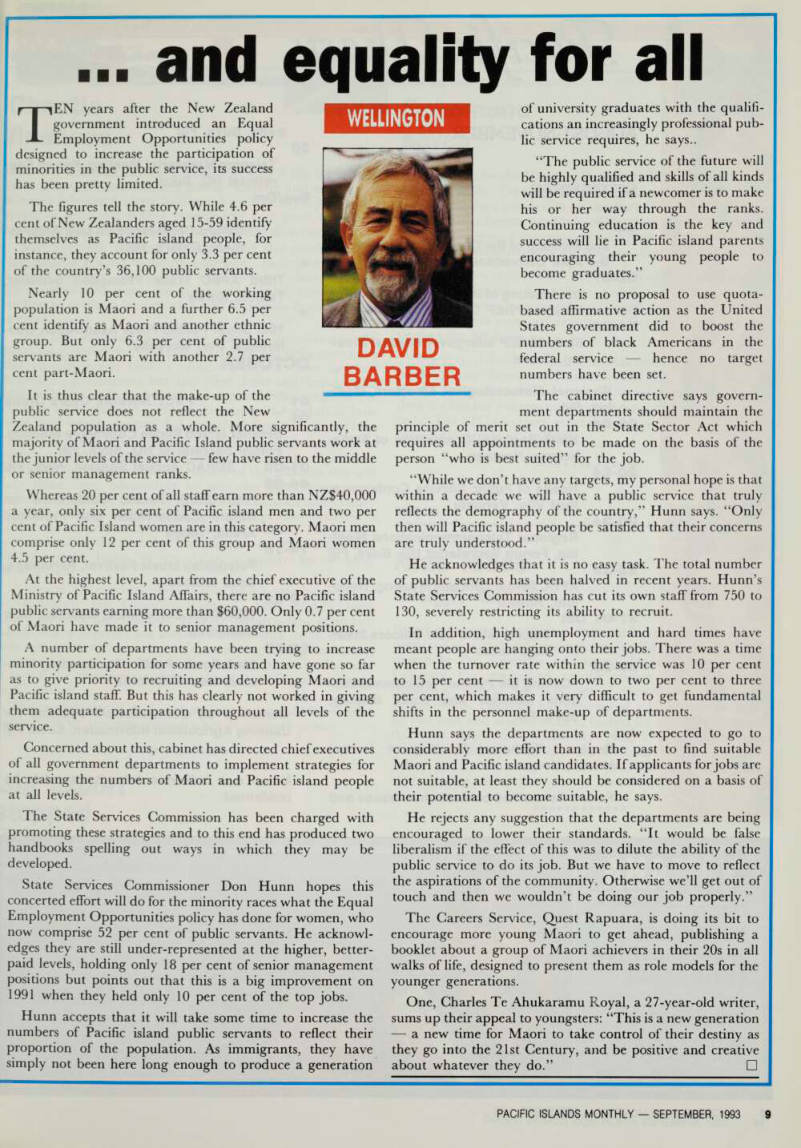
Wellington
David
Barber
Advertisements & other items, p. 10 (1 item)
U^ncifu
V 1 \ C? ••• % |/ n
y
IJiaru
AUGUST-NOVEMBER
SEPTEMBER
trade, Suva, Fiji 30 Telecom Ministerial Meeting, Forum Secretariat HQ, Suva Sep/Ocft 04 2nd Meeting of the Contracting Parties for the Apia Convention, Guam 06-07 2nd Meeting of the Contracting Parties for the SPREP Convention, Guam 08-10 Sixth SPREP Intergovernmental Meeting, Guam ★ Regional Meteorological Directors Meeting, Fiji 20-24 Ninth Regional Conference of Statisticians, Noumea 20-24 Heads of Public Service Conference, Port Vila, Vanuatu 20-24 Regional Telecommunications Meeting, Forum Secretariat HQ, Suva, Fiji 23-25 APEC Senior Officials Meeting, Honolulu, Hawaii 27- Oct Pacific Island Law Officers Meeting, Nauru 28- “Calling the Pacific” telecommunications seminar and trade display, Suva, Fiji ★ Regional Technical Meeting on Animal Health, Noumea ★ Forum Committee on Economic issues and Oxford Conference on Law Enforcement, Oxford, UK ★ Third APEC Trade Promotion Seminar, Taejon, Korea ★ 19th South Pacific Ports Association Conference, Port Moresby
OCTOBER
01 PACT Network Users Group 01 Smaller Island States Committee Meeting, Forum Secretariat HQ, Suva, Fiji 01-09 SOPAC Annual Session, Nadi, Fiji 04-08 Fifth South Pacific Conference on Nature Conservation and Protected Areas, Tonga 14-18 Polynesian Music Festival, Rarotonga, Cook Islands 18-22 19thCRGA Conference, Noumea, New Caledonia 25-27 33rd South Pacific Conference, Noumea, New Caledonia ★ Workshop on Computerised Systems for Utilising Agricultural Information, Suva, Fiji Note - a ★ indicates dates have yet to be confirmed.
Outboards
NUMBER ONE
THROUGHOUT THE
SOUTH PACIFIC
Ela Motors
PAPUA NEW GUINEA
PH (675) 229400 PO Box 74 Port Moresby x..
Yamaha Outboard Motors are available in a wide range of models from 2hp up to 200 hp with
comprehensive Genuine
Parts and Service support Pacific wide.
Asco Motors
FIJI Ph 312666
AM.SAMOA Ph 633-4281
W. SAMOA Ph 23664
VANUATU Ph 22341 I
stopped
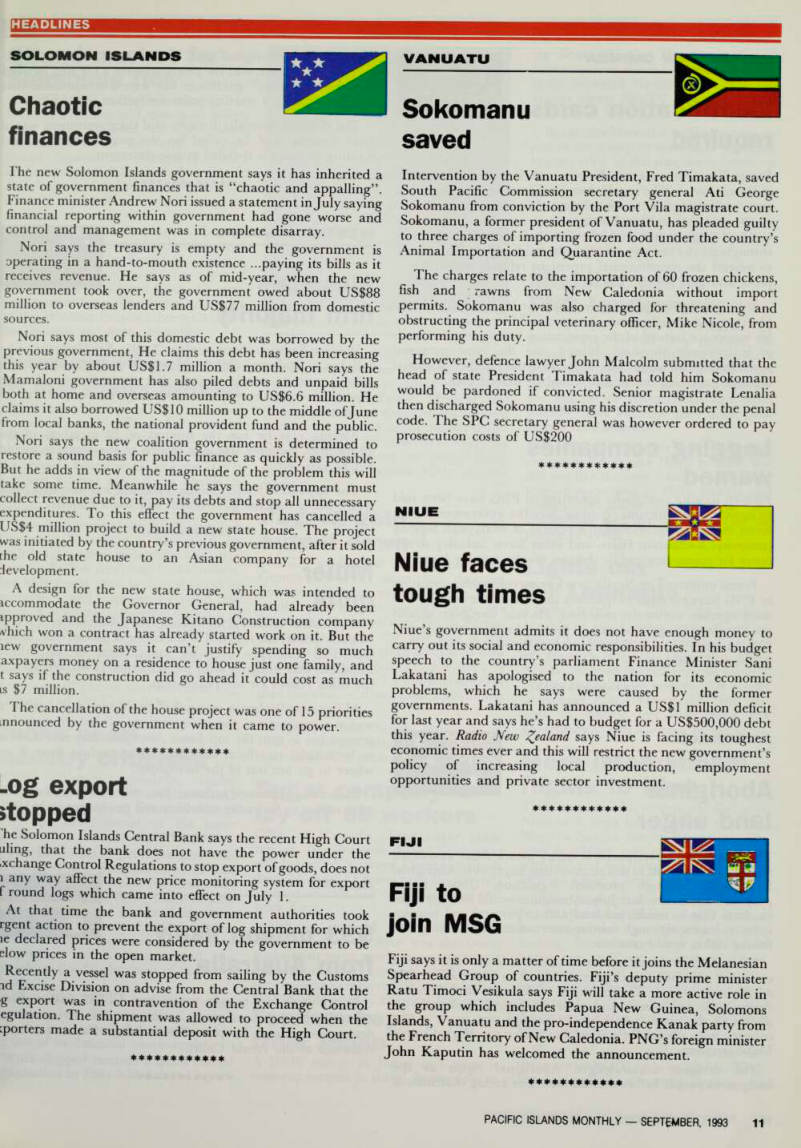
Headlines
Solomon Islands
Chaotic finances
The new Solomon Islands government says it has inherited a state of government finances that is “chaotic and appalling”.
Finance minister Andrew Non issued a statement in July saying financial reporting within government had gone worse and control and management was in complete disarray.
Nori says the treasury is empty and the government is operating in a hand-to-mouth existence ...paying its bills as it receives revenue. He says as of mid-year, when the new government took over, the government owed about US$BB million to overseas lenders and US$77 million from domestic sources.
Nori says most of this domestic debt was borrowed by the previous government, He claims this debt has been increasing this year by about US$l.7 million a month. Nori says the Mamaloni government has also piled debts and unpaid bills both at home and overseas amounting to US$6.6 million. He claims it also borrowed US$lO million up to the middle of June from local banks, the national provident fund and the public.
Nori says the new coalition government is determined to restore a sound basis for public finance as quickly as possible.
But he adds in view of the magnitude of the problem this will take some time. Meanwhile he says the government must collect revenue due to it, pay its debts and stop all unnecessary expenditures. To this effect the government has cancelled a US$4 million project to build a new state house. The project was initiated by the country’s previous government, after it sold [he old state house to an Asian company for a hotel
development.
A design for the new state house, which was intended to iccommodate the Governor General, had already been ipproved and the Japanese Kitano Construction company vhich won a contract has already started work on it. But the lew government says it can’t justify spending so much axpayers money on a residence to house just one family, and t says if the construction did go ahead it could cost as much is $7 million.
The cancellation of the house project was one of 15 priorities mnounced by the government when it came to power. ***
-og export
stopped
he Solomon Islands Central Bank says the recent High Court Liling, that the bank does not have the power under the xchange Control Regulations to stop export of goods, does not i any way affect the new price monitoring system for export f round logs which came into effect on July 1.
At that time the bank and government authorities took rgent action to prevent the export of log shipment for which le declared prices were considered by the government to be elow prices in the open market.
Recently a vessel was stopped from sailing by the Customs id Excise Division on advise from the Central Bank that the g export was in contravention of the Exchange Control egulation. The shipment was allowed to proceed when the [porters made a substantial deposit with the High Court.
Sokomanu
Vanuatu
Sokomanu saved
Intervention by the Vanuatu President, Fred Timakata, saved South Pacific Commission secretary general Ati George Sokomanu from conviction by the Port Vila magistrate court.
Sokomanu, a former president of Vanuatu, has pleaded guilty to three charges of importing frozen food under the country’s Animal Importation and Quarantine Act.
The charges relate to the importation of 60 frozen chickens, fish and rawns from New Caledonia without import permits. Sokomanu was also charged for threatening and obstructing the principal veterinary officer, Mike Nicole, from performing his duty.
However, defence lawyer John Malcolm submitted that the head of state President Timakata had told him Sokomanu would be pardoned if convicted. Senior magistrate Lenalia then discharged Sokomanu using his discretion under the penal code. The SPG secretary general was however ordered to pay prosecution costs of US$2OO
tough times
Niue
Niue faces tough times
Niue’s government admits it does not have enough money to carry out its social and economic responsibilities. In his budget speech to the country’s parliament Finance Minister Sani Lakatani has apologised to the nation for its economic problems, which he says were caused by the former governments. Lakatani has announced a US$l million deficit for last year and says he’s had to budget for a US$5OO,OOO debt this year. Radio New Z ea^ says Niue is facing its toughest economic times ever and this will restrict the new government’s policy of increasing local production, employment opportunities and private sector investment.
Fiji to
Fiji
Fiji to join MSG
Fiji says it is only a matter of time before it joins the Melanesian Spearhead Group of countries. Fiji’s deputy prime minister Ratu Timoci Vesikula says Fiji will take a more active role in the group which includes Papua New Guinea, Solomons Islands, Vanuatu and the pro-independence K.anak party from the French Territory of New Caledonia. PNG’s foreign minister John Kaputin has welcomed the announcement.
Logging companies
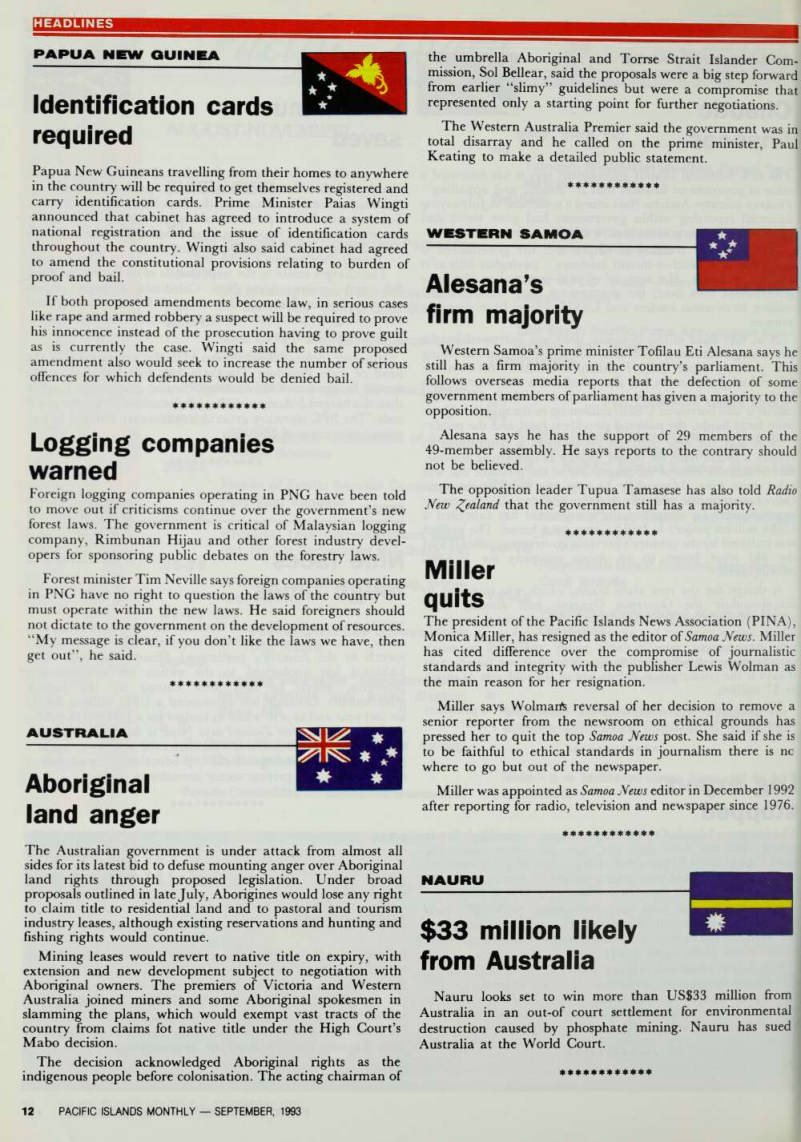
Papua New Guinea
Identification cards required
Papua New Guineans travelling from their homes to anywhere in the country will be required to get themselves registered and carry identification cards. Prime Minister Paias Wingti announced that cabinet has agreed to introduce a system of national registration and the issue of identification cards throughout the country. Wingti also said cabinet had agreed to amend the constitutional provisions relating to burden of proof and bail.
If both proposed amendments become law, in serious cases like rape and armed robbery a suspect will be required to prove his innocence instead of the prosecution having to prove guilt as is currently the case. Wingti said the same proposed amendment also would seek to increase the number of serious offences for which defendents would be denied bail. ***
Logging companies
warned
Foreign logging companies operating in PNG have been told to move out if criticisms continue over the government’s new forest laws. The government is critical of Malaysian logging company, Rimbunan Hijau and other forest industry devel opers for sponsoring public debates on the forestry laws.
Forest minister Tim Neville says foreign companies operating in PNG have no right to question the laws of the country but must operate within the new laws. He said foreigners should not dictate to the government on the development of resources.
“My message is clear, if you don’t like the laws we have, then get out”, he said.
Aboriginal
Australia
Aboriginal land anger
The Australian government is under attack from almost all sides for its latest bid to defuse mounting anger over Aboriginal land rights through proposed legislation. Under broad proposals outlined in late July, Aborigines would lose any right to claim title to residential land and to pastoral and tourism industry leases, although existing reservations and hunting and fishing rights would continue.
Mining leases would revert to native title on expiry, with extension and new development subject to negotiation with Aboriginal owners. The premiers of Victoria and Western Australia joined miners and some Aboriginal spokesmen in slamming the plans, which would exempt vast tracts of the country from claims fot native title under the High Court’s Mabo decision.
The decision acknowledged Aboriginal rights as the indigenous people before colonisation. The acting chairman of
the umbrella Aboriginal and Torrse Strait Islander Com mission, Sol Bellear, said the proposals were a big step forward from earlier “slimy” guidelines but were a compromise that represented only a starting point for further negotiations.
The Western Australia Premier said the government was in total disarray and he called on the prime minister, Paul Keating to make a detailed public statement.
firm majority
Western Samoa
Alesana’s firm majority
Western Samoa’s prime minister Tofilau Eti Alesana says he still has a firm majority in the country’s parliament. This follows overseas media reports that the defection of some government members of parliament has given a majority to the
opposition.
Alesana says he has the support of 29 members of the 49-member assembly. He says reports to the contrary should not be believed.
The opposition leader Tupua Tamasese has also told Radio New Zealand that the government still has a majority. ***
Miller
quits
The president of the Pacific Islands News Association (PINA), Monica Miller, has resigned as the editor of Samoa News. Miller has cited difference over the compromise of journalistic standards and integrity with the publisher Lewis Wolman as the main reason for her resignation.
Miller says Wolmarte reversal of her decision to remove a senior reporter from the newsroom on ethical grounds has pressed her to quit the top Samoa News post. She said if she is to be faithful to ethical standards in journalism there is nc where to go but out of the newspaper.
Miller was appointed as Samoa News editor in December 1992 after reporting for radio, television and newspaper since 1976.
$33 million likely
Nauru
$33 million likely from Australia
Nauru looks set to win more than US$33 million from Australia in an out-of court settlement for environmental destruction caused by phosphate mining. Nauru has sued Australia at the World Court.
ndustry criticised
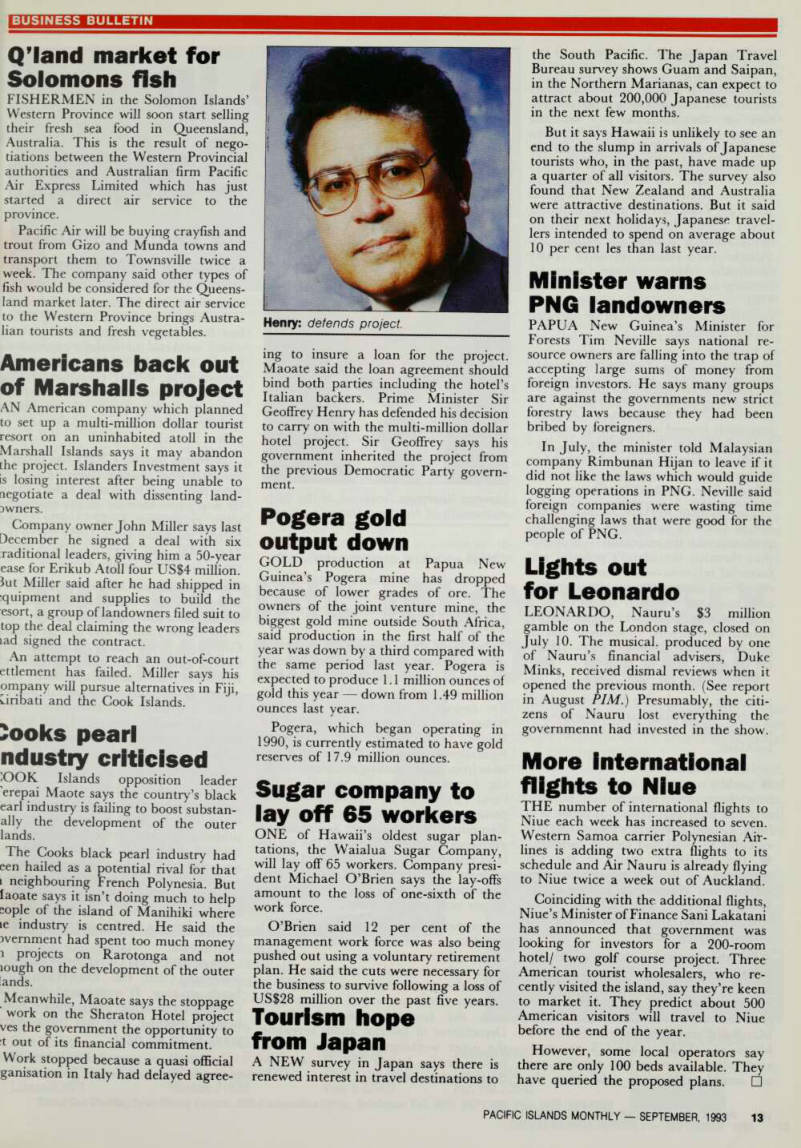
Business Bulletin
Q'land market for
Solomons fish
FISHERMEN in the Solomon Islands’
Western Province will soon start selling their fresh sea food in Queensland, Australia. This is the result of nego tiations between the Western Provincial authorities and Australian firm Pacific Air Express Limited which has just started a direct air service to the province.
Pacific Air will be buying crayfish and trout from Gizo and Munda towns and transport them to Townsville twice a week. The company said other types of fish would be considered for the Queens land market later. The direct air service to the Western Province brings Austra lian tourists and fresh vegetables.
Americans back out
of Marshalls project
AN American company which planned to set up a multi-million dollar tourist resort on an uninhabited atoll in the Marshall Islands says it may abandon the project. Islanders Investment says it is losing interest after being unable to negotiate a deal with dissenting land owners.
Company owner John Miller says last December he signed a deal with six raditional leaders, giving him a 50-year ease for Erikub Atoll four US$4 million. sut Miller said after he had shipped in :quipment and supplies to build the esort, a group of landowners filed suit to top the deal claiming the wrong leaders
lad signed the contract.
An attempt to reach an out-of-court ettlement has failed. Miller says his ompany will pursue alternatives in Fiji, Kiribati and the Cook Islands.
looks pearl
ndustry criticised
jOOK Islands opposition leader erepai Maote says the country’s black earl industry is failing to boost substan ally the development of the outer lands.
The Cooks black pearl industry had een hailed as a potential rival for that
i neighbouring French Polynesia. But
laoate says it isn’t doing much to help sople of the island of Manihiki where ic industry is centred. He said the )vemment had spent too much money i projects on Rarotonga and not lough on the development of the outer lands.
Meanwhile, Maoate says the stoppage work on the Sheraton Hotel project ves the government the opportunity to t out of its financial commitment.
Work stopped because a quasi official ganisation in Italy had delayed agree-
ing to insure a loan for the project.
Maoate said the loan agreement should bind both parties including the hotel’s Italian backers. Prime Minister Sir Geoffrey Henry has defended his decision to carry on with the multi-million dollar hotel project. Sir Geoffrey says his government inherited the project from the previous Democratic Party govern ment.
Pogera gold
output down
GOLD production at Papua New Guinea’s Pogera mine has dropped because of lower grades of ore. The owners of the joint venture mine, the biggest gold mine outside South Africa, said production in the first half of the year was down by a third compared with the same period last year. Pogera is expected to produce 1.1 million ounces of gold this year down from 1.49 million ounces last year.
Pogera, which began operating in 1990, is currently estimated to have gold reserves of 17.9 million ounces.
Sugar company to
lay off 65 workers
ONE of Hawaii’s oldest sugar plan tations, the Waialua Sugar Company, will lay off 65 workers. Company presi dent Michael O’Brien says the lay-offs amount to the loss of one-sixth of the work force.
O’Brien said 12 per cent of the management work force was also being
pushed out using a voluntary retirement
plan. He said the cuts were necessary for the business to survive following a loss of US$2B million over the past five years.
Tourism hope
from Japan
A NEW survey in Japan says there is renewed interest in travel destinations to
the South Pacific. The Japan Travel Bureau survey shows Guam and Saipan, in the Northern Marianas, can expect to attract about 200,000 Japanese tourists in the next few months.
But it says Hawaii is unlikely to see an end to the slump in arrivals of Japanese tourists who, in the past, have made up a quarter of all visitors. The survey also found that New Zealand and Australia were attractive destinations. But it said on their next holidays, Japanese travel lers intended to spend on average about 10 per cent les than last year.
Minister warns
PNG landowners
PAPUA New Guinea’s Minister for Forests Tim Neville says national re source owners are falling into the trap of accepting large sums of money from foreign investors. He says many groups are against the governments new strict forestry laws because they had been bribed by foreigners.
In July, the minister told Malaysian company Rimbunan Hijan to leave if it did not like the laws which would guide logging operations in PNG. Neville said foreign companies were wasting time challenging laws that were good for the people of PNG.
Lights out
for Leonardo
LEONARDO, Nauru’s $3 million gamble on the London stage, closed on July 10. The musical, produced by one of Nauru’s financial advisers, Duke Minks, received dismal reviews when it opened the previous month. (See report in August PIM.) Presumably, the citi zens of Nauru lost everything the governmennt had invested in the show.
More International
flights to Niue
THE number of international flights to Niue each week has increased to seven.
Western Samoa carrier Polynesian Air lines is adding two extra flights to its schedule and Air Nauru is already flying to Niue twice a week out of Auckland.
Coinciding with the additional flights, Niue’s Minister of Finance Sani Lakatani has announced that government was looking for investors for a 200-room
hotel/ two golf course project. Three
American tourist wholesalers, who re cently visited the island, say they’re keen to market it. They predict about 500 American visitors will travel to Niue before the end of the year.
However, some local operators say there are only 100 beds available. They have queried the proposed plans. □
Henry: defends project.
Saipan
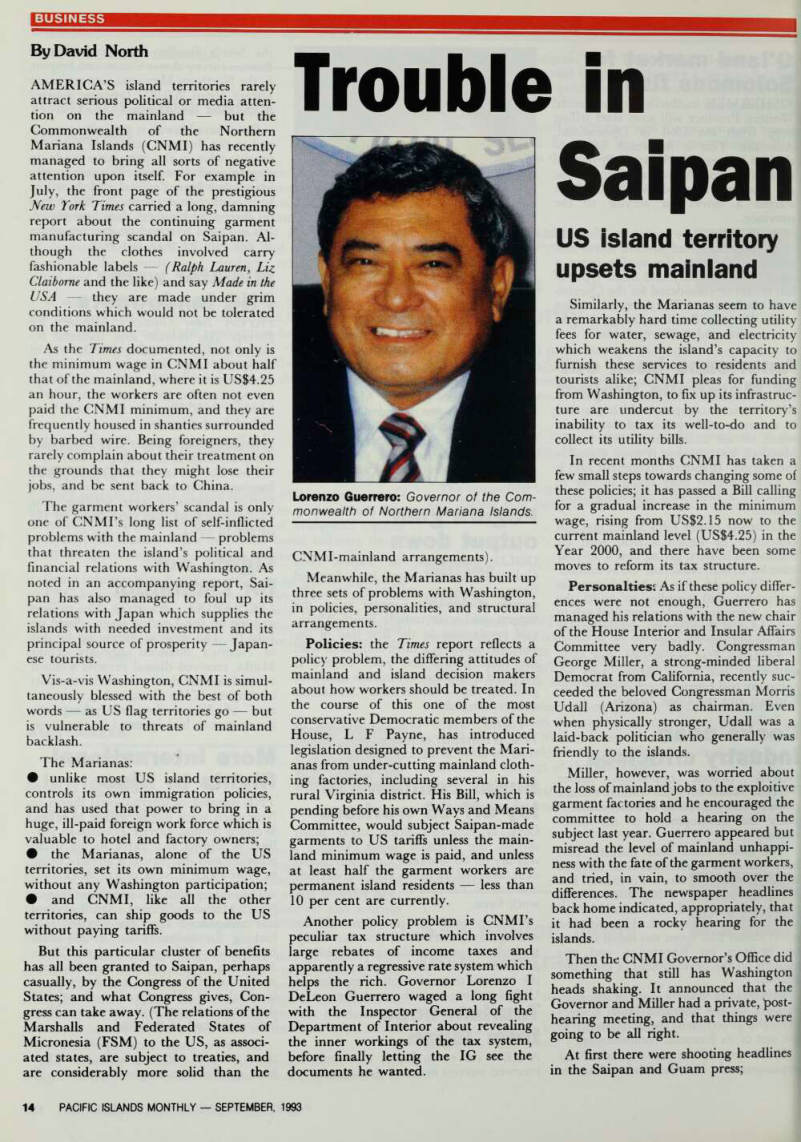
Trouble in
By David North
AMERICA’S island territories rarely attract serious political or media atten tion on the mainland but the Commonwealth of the Northern Mariana Islands (CNMI) has recently managed to bring all sorts of negative attention upon itself. For example in July, the front page of the prestigious New York Times carried a long, damning report about the continuing garment manufacturing scandal on Saipan. Al though the clothes involved carry fashionable labels (Ralph Lauren, Liz Claiborne and the like) and say Made in the USA they are made under grim conditions which would not be tolerated on the mainland.
As the Times documented, not only is the minimum wage in CNMI about half that of the mainland, where it is U 554.25 an hour, the workers are often not even paid the CNMI minimum, and they are frequently housed in shanties surrounded by barbed wire. Being foreigners, they rarely complain about their treatment on the grounds that they might lose their jobs, and be sent back to China.
The garment workers’ scandal is only one of CNMI’s long list of self-inflicted problems with the mainland problems that threaten the island’s political and financial relations with Washington. As noted in an accompanying report, Sai pan has also managed to foul up its relations with Japan which supplies the islands with needed investment and its
principal source of prosperity —Japan
ese tourists.
Vis-a-vis Washington, CNMI is simul taneously blessed with the best of both words as US flag territories go but is vulnerable to threats of mainland backlash.
The Marianas: • unlike most US island territories, controls its own immigration policies, and has used that power to bring in a huge, ill-paid foreign work force which is valuable to hotel and factory owners; • the Marianas, alone of the US territories, set its own minimum wage,
without any Washington participation;
• and CNMI, like all the other territories, can ship goods to the US without paying tariffs.
But this particular cluster of benefits has all been granted to Saipan, perhaps casually, by the Congress of the United States; and what Congress gives, Con gress can take away. (The relations of the Marshalls and Federated States of Micronesia (FSM) to the US, as associ ated states, are subject to treaties, and are considerably more solid than the
CNMI-mainland arrangements).
Meanwhile, the Marianas has built up three sets of problems with Washington, in policies, personalities, and structural arrangements.
Policies: the Times report reflects a policy problem, the differing attitudes of mainland and island decision makers about how workers should be treated. In the course of this one of the most conservative Democratic members of the House, L F Payne, has introduced legislation designed to prevent the Mari anas from under-cutting mainland cloth ing factories, including several in his rural Virginia district. His Bill, which is pending before his own Ways and Means
Committee, would subject Saipan-made
garments to US tariffs unless the main land minimum wage is paid, and unless at least half the garment workers are permanent island residents less than 10 per cent are currently.
Another policy problem is CNMI’s peculiar tax structure which involves large rebates of income taxes and apparently a regressive rate system which helps the rich. Governor Lorenzo I
DeLeon Guerrero waged a long fight
with the Inspector General of the Department of Interior about revealing the inner workings of the tax system, before finally letting the IG see the documents he wanted.
US island territory
upsets mainland
Similarly, the Marianas seem to have a remarkably hard time collecting utility fees for water, sewage, and electricity which weakens the island’s capacity to furnish these services to residents and tourists alike; CNMI pleas for funding from Washington, to fix up its infrastruc ture are undercut by the territory’s inability to tax its well-to-do and to collect its utility bills.
In recent months CNMI has taken a few small steps towards changing some of these policies; it has passed a Bill calling for a gradual increase in the minimum wage, rising from US$2.l5 now to the current mainland level (U 554.25) in the Year 2000, and there have been some moves to reform its tax structure.
As if these policy differ ences were not enough, Guerrero has managed his relations with the new chair of the House Interior and Insular Affairs Committee very badly. Congressman George Miller, a strong-minded liberal Democrat from California, recently suc ceeded the beloved Congressman Morris Udall (Arizona) as chairman. Even when physically stronger, Udall was a laid-back politician who generally was friendly to the islands.
Miller, however, was worried about the loss of mainland jobs to the exploitive garment factories and he encouraged the committee to hold a hearing on the subject last year. Guerrero appeared but misread the level of mainland unhappi ness with the fate of the garment workers, and tried, in vain, to smooth over the differences. The newspaper headlines back home indicated, appropriately, that it had been a rocky hearing for the islands.
Then the CNMI Governor’s Office did something that still has Washington heads shaking. It announced that the Governor and Miller had a private, 'post hearing meeting, and that things were going to be all right.
At first there were shoodng headlines in the Saipan and Guam press;
Lorenzo Guerrero: Governor of the Com monwealth of Northern Mariana Islands.
a couple of days later they came to the attention of Miller. He was furious.
There never had been a meeting. No-one in Washington can recall anyone, much less a governor (or his office) simply inventing a meeting with a committee chairman. Guerrero, said his press secre tary was confused.
Miller did not forget the incident. At the moment he is trying to push through the senate a Bill which he steered through the House which would take away millions of dollars of Compact Funds that CNMI had been expecting to flow out of Washington. Miller is also more than sympathetic to Payne’s bill but that will be handled by another House Commit
tee.
Meanwhile, the CNMI politician with the most credibility on tne mainland,
CNMI’s elected Washington Represen
tative, Juan Babauta, will be leaving town at the end of the year when his four year term expires. Instead of seeking to keep a safe seat, he contested with Guerrero for the Republican nomination for governor and lost by a handful of votes. Guerrero faces a November elec tion for another four-year term; his opponent, whom he beat once before, will be Democrat Froilan Tenorio, who
served as Washington Representative
until four years ago.
Structure. CNMI is currently the only US-flag territory without a member
of Congress. Nearby Guam, and distant American Samoa, and the two Carib bean territories (Puerto Rico and the US Virgin Islands) all have delegates in the House of Representatives. While they can not vote on some legislative matters on the Floor of the House, they can speak, and they do vote in the all important committees, and in the party caucus. All have proved useful to their islands.
Up until about a year ago CNMI could have had a similar seat in the House at mainland expense had they simply asked for it, but they did not do so. Now the Governor wants such a seat but given his troubles with Miller, and the garment scandal, and a broader battle about extending the delegates’ voting rights in January, there is no likelihood that what was once easily available will be obtainable in the near future. The Democratic leadership of the House, in January, sought to give the delegates from the islands, and from Washington DC, more voting power on the House Floor, and set off a terrible row with the Republicans.
One of the most remarkable elements of the Saipan story is the way it has broken up the previous islands solidarity in Washington; typically all the islands work togetner. But, as one representative of another territory said, “these guys are screwing things up for all the islands. We try hard to do tne right thing but the Saipan garment scandal makes it tough for all of us”. □
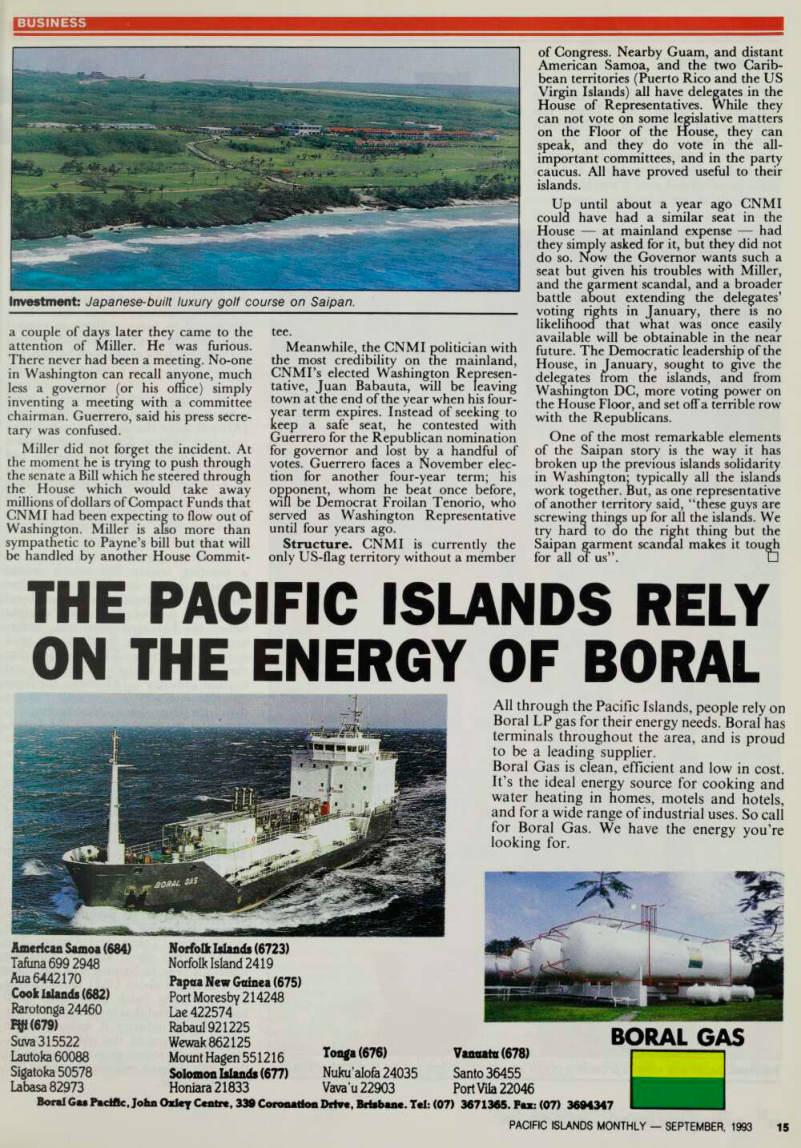
Investment: Japanese-built luxury golf course on Saipan.
Advertisements & other items, p. 15 (1 item)
The Pacific Islands Rely
ON THE ENERGY OF BORAL
4 m *-
BQPAi sAS
I American Samoa (684) Tafuna 699 2948 Ana 6442170 Cook Islands (682)
Rarotonga 24460
Ftfi(679) Suva 315522 Lautoka 60088 Sigatoka 50578 Labasa 82973 Norfolk Islands (6723) Norfolk Island 2419 Papua New Guinea (675) Port Moresby 214248 Lae 422574 Rabaul 921225 Wewak 862125 Mount Hagen 551216 Solomon Islands (677) Honiara 21833 All through the Pacific Islands, people rely on Boral LP gas for their energy needs. Boral has terminals throughout the area, and is proud to be a leading supplier.
Boral Gas is clean, efficient and low in cost.
It’s the ideal energy source for cooking and water heating in homes, motels and hotels, and for a wide range of industrial uses. So call for Boral Gas. We have the energy you’re
looking for.
Tonga (676) Nukualofa 24035 Vava’u 22903 Vanuatu (678) Santo 36455 Port Vila 22046
BORAL GAS
Bonl Gas Pacific, John Oxley Centre, 339 Coronation Drive. Brisbane. Tel: (07) 3671365. Fax: (07) 3694347
Economic
By David North
IN a move critic dubbed “economic Japan has the Mariana loses a challenging the lease on which the airline has built a $6O million hotel. If JAL’s threat carried out, it would cripple the islands’major industry tourism — which relies on Japan for 80 per cent of
its visitors. The public threat has already further clouded the Northern Mariana’s image in Japanese investment circles, which have grown cool to the islands
because of a series of land-alienation suits. The nearby island of Guam, which has three times the amount of Japanese tourism investment as Saipan and almost one million visitors annuallly, is feeling reverberations from JAL’s ultimatum since some Japanese investors find it difficult to distinguish among the islands.
The Japanese move comes on top of the Northern Marianas’ problems with US congressional leaders who have threatened to block millions in capital grants because of alien labour abuses and garment industry excesses on Saipan, the capital island. (See report on Pages 14, 15) .
“If we lose this lawsuit and the hotel is taken away from us, Hotel Nikko and JAL will leave the island,” wrote Nikko president Mitsuo Kitajima and Japan
Airline Development Company, Ltd
senior vice-president Tsunehisa Hayami in a letter to the Northern Marianas Senate. “And if this happens, every bank, developer and investor in Japan will know why,” the Japanese business men warned island leaders.
The letter was written as comment on a pending senate Bill which would compensate JAL and Nikko if they lost the suit and the hotel. Saying their hotel once was a symbol of the island’s bright future, the JAL spokesmen said “unfor tunately, today the hotel stands as a symbol of Article XII lawsuits that threaten the island’s economic and tourism industry”. JAL views the lease lawsuits as a way local people can get their property back after selling it, including the improvements like hotels, resorts, and shopping malls, without having to pay any restitution for the hotel or land, the letter said.
The 313-room Hotel Nikko was built in 1986 for US$6O million. The original owners of the land were paid U 55720,000 in 1983 for the 32,000 square metres on which the resort stands.
The La Fiesta San Roque shopping mall cost US$4O million to build aand has 60 retail units.
JAL, the major carrier of tourists to the islands, has 10 flights a week to
Saipan, including daily 747 Jumbo Jet
service from Tokyo and Osaka. The airline carries about 200,000 Japanese visitors a year to Saipan. The Japanese have invested about US$l billion in the Saipan resorts (with more than 1600 hotel rooms) and that investment and the construction industry it spawned have been key facors in the islands double digit private sector growth throughout the 1980 s. Saipan receives about 425,000 tourists a year.
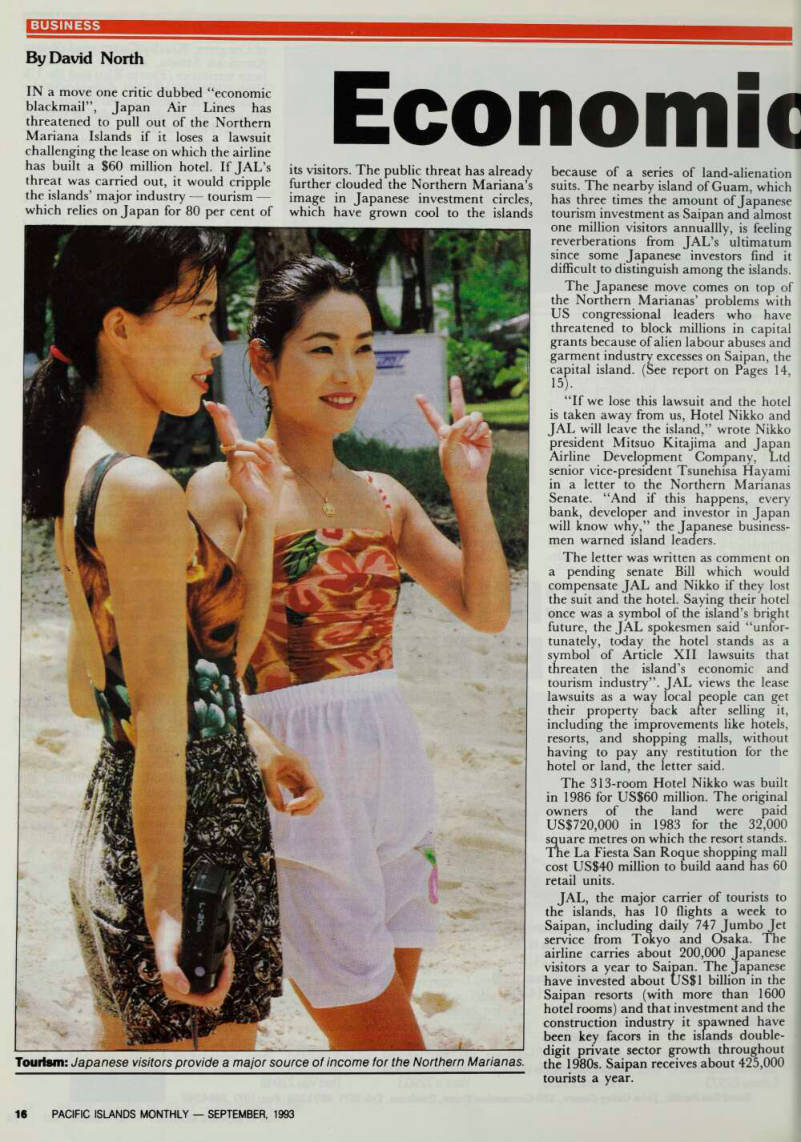
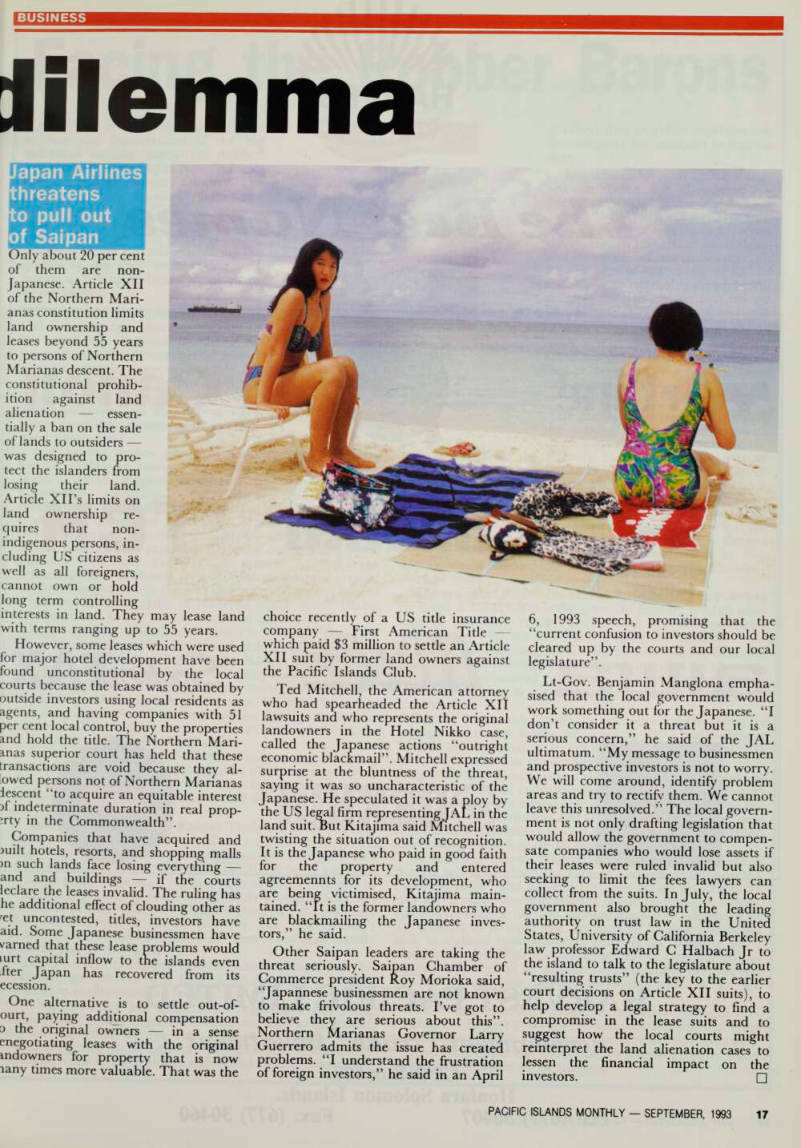
Tourism: Japanese visitors provide a major source of income for the Northern Marianas.
iM.ki.wjuima
jißiM
Only about 20 per cent of them are non- Japanese. Article XII of the Northern Mari anas constitution limits land ownership and leases beyond 55 years to persons of Northern Marianas descent. The constitutional prohib ition against land alienation essen tially a ban on the sale of lands to outsiders was designed to pro tect the islanders from losing their land.
Article Xll’s limits on land ownership re quires that non indigenous persons, in cluding US citizens as well as all foreigners, cannot own or hold
long term controlling
interests in land. They may lease land with terms ranging up to 55 years.
However, some leases which were used for major hotel development have been found unconstitutional by the local courts because the lease was obtained by outside investors using local residents as agents, and having companies with 51 per cent local control, buy the properties and hold the title. The Northern Mari anas superior court has held that these transactions are void because they al owed persons not of Northern Marianas descent “to acquire an equitable interest }f indeterminate duration in real prop erty in the Commonwealth”.
Companies that have acquired and auilt hotels, resorts, and shopping malls
m such lands face losing everything
and and buildings if the courts ledare the leases invalid. The ruling has he additional effect of clouding other as r et uncontested, titles, investors have aid. Some Japanese businessmen have earned that these lease problems would iurt capital inflow to tne islands even fter Japan has recovered from its ecession.
One alternative is to settle out-of ourt, paying additional compensation 3 the original owners in a sense enegotiating leases with the original mdowners for property that is now lany times more valuable. That was the
choice recently of a US title insurance company First American Title which paid S 3 million to settle an Article XII suit by former land owners against the Pacific Islands Club.
Ted Mitchell, the American attorney who had spearheaded the Article XII lawsuits and who represents the original landowners in the Hotel Nikko case, called the Japanese actions “outright economic blackmail”. Mitchell expressed surprise at the bluntness of the threat, saying it was so uncharacteristic of the Japanese. He speculated it was a ploy by the US legal firm representing JAL in the land suit. But Kitajima said Mitchell was twisting the situation out of recognition.
It is the Japanese who paid in good faith for the property and entered agreemennts for its development, who are being victimised, Kitajima main tained. “It is the former landowners who are blackmailing the Japanese inves tors,” he said.
Other Saipan leaders are taking the threat seriously, Saipan Chamber of Commerce president Koy Morioka said, “Japannese businessmen are not known to make frivolous threats. I’ve got to believe they are serious about this”.
Northern Marianas Governor Larry Guerrero admits the issue has created problems. “I understand the frustration of foreign investors,” he said in an April
6, 1993 speech, promising that the “current confusion to investors should be cleared up by the courts and our local
legislature”.
Lt-Gov. Benjamin Manglona empha
sised that the local government would work something out for the Japanese. “I don’t consider it a threat but it is a serious concern,” he said of the JAL ultimatum. “My message to businessmen and prospective investors is not to worry.
We will come around, identify problem areas and try to rectify them. We cannot leave this unresolved.” The local govern ment is not only drafting legislation that would allow the government to compen sate companies who would lose assets if their leases were ruled invalid but also seeking to limit the fees lawyers can collect from the suits. In July, the local government also brought the leading authority on trust law in the United States, University of California Berkeley law professor Edward C Halbach Jr to the island to talk to the legislature about “resulting trusts” (the key to the earlier court decisions on Article XII suits), to help develop a legal strategy to find a compromise in the lease suits and to su gg est how the local courts might reinterpret the land alienation cases to lessen the financial impact on the investors. □
Advertisements & other items, p. 18 (1 item)
Olivetti TC M
HARVEST
The Best Names
MArtline
A
MITSUBISHI
MOTORS
Tirfer Obeer
Canon
Olivetti TC M
n
Sufic iFAX
ODEXION
ftcmkjer
HARVEST PACIFIC LIMITED
development trade investment GPO Box 823 Honiara Solomon Islands.
Tel: (677) 30407 Fax: (677) 30460
Facing the Robber Barons
VANUATU is the next island nation set to face the depredations of the big industrial logging companies dubbed ‘robber barons’ by Papua New Guinea’s Barnett Timber Industry Enquiry. The Barnet Enquiry found logging com panies operating in PNG were respon sible for corrupting politicians and officials, circumventing PNG’s tax laws, under —valuing and mis—declaring the species of log they were taking and failing to live up to their commitments to landowners.
Not one of the companies investigated had a satisfactory record of sticking to the conditions imposed by the PNG government. The environmental record shows companies were responsible for
silting up streams, polluting village
water supplies, damaging reefs, and taking so many logs that forests were either completely destroyed or open to weed infestation.
In Vanuatu, a new group of timber companies, based around Malaysian entrepreneur Ting Jack Sang, is set to begin massive logging operations on the Islands of Erromango, Malekula and Santo. According to environmentalists, equipment shipped to Vila last month will enable the companies (Premier Corporation and Delta Development) to take between 100,000 and 150,000 cubic metres of timber a year. In 1991 the entire industry in Vanuatu took only 15,000 cubic metres. At that rate, Erromango and Malekula (one of Vanuatu’s larger islands) would be logged out in three to five years. More equipment is believed to be on order in Malaysia which would enable the companies to cut at a similar rate on Santo.
Before moving his focus of attention to Vanuatu Ting Jack Sang was responsible for the Earthmovers group of companies in Solomon Islands. At Kalena Bay on New Georgia Island the Earthmovers company Kalena Timber is said to have breached many of the environmental safeguards imposed by the Solomon’s government. Insensitive reading and logging too close to streams and on steep gradients has left local villages with a water supply so polluted they have to get their water from elsewhere.
Aerial photographs show the entire eastern end of the big Roviana Lagoon has been damaged by silt. Picturesque Viru Harbour, closest to one section of the logging, has been so badly damaged that its marine life and fisnmg grounds have been ruined.
Under Ting Jack Sang, Kalena Timber was also caught i-r u r 7^ Va^U^ shipments. Evidence presented to the High Court earlier this year suggested the company had undervalued one shipment worth 515950,000 by 50 per cent.
Short-term, large scale logging such as that envisaged in Vanuatu brings more problems. Already Premier/Delta has been able persuade Forestry Minister Onneyn Tahi to reduce i) con^r ih ut ion it must pay to the government’s Reafforestation fund from the 75 per cent of royalties usually paid to just 10 per cent.
If Delta/Premier exports 150,000 cubic metres a year the Vanuatu government will have foregone more than Asl million in reafforestation charges.
While Vanuatu has quite strict regulations governing the Forestry department could not hope to keep track on an operation of this size. It has just three timber monitoring officers. At best they would be able to make only monthly trips to Erromango and Malekula and when they
got there they would be dependent on the company for transport to logging sites.
The difficulties confronting Vanu atu are being felt elsewhere too.
Premier/Delta is just one of a number of huge Malaysian consortiums now taking control of logging right across the Pacific. In PNG Rimbunan Hijau and its associated companies controls 85 per cent of the industry. In the Solomons, an upcoming takeover will fiven Malaysian consortiums around 0 per cent of the industry.
With drastically reduced cuts in other tropical timber producing countries other island nations with timber resources, even small ones, can expect to face similar pressure over the next few years.
By far the most insidious problem the logging companies bring with them is corruption. Despite tne de
tails revealed by the Barnett Enquiry in PNG, corrupt practices by logging companies have continued unabated.
Papua New Guinea’s Forests Minister Tim Neville who is Cushing through tough new guidelines to control the ‘robber arons is reported to have turned down a $3 million bribe and faced death threats as a result of his reforms. He told the Rowan Callick from the Australian Financial Review newspaper “One of my brothers was confronted by four Malaysians in Lae and told to get me to back off, or his family were as good as dead”.
The respected Premier of Manus Province Steven Pokowin reported a U 5525,000 bribe given to him by a Malaysian l°gg in g company to the Police and the Ombudsman’s Commission who are now investigating the incident.
During campaigning for the May 26 election in Solomon Islands the opposition parties, now installed as the new government, identified corruption, particularly that associ ated with logging, as one of the most crucial issues facing the country.
Despite the formidable threats and inducements offered by logging companies forests ministers in PNG and Solomon Islands are determined to control the environmental and economic vandalism being visited on their nations.
In PNG Tim Neville wants to reduce log exports and has initiated a national audit to assess whether all timber should be processed before export. He also plans to change the tax regime so the government and landowners get better returns and introduce measures to stop one company or consortium controlling a lion’s share of logging leases.
In Solomon Islands Natural Resources Minister Ezekial Alebua wants to phase out logging and concentrate on the export of milled and finished products which provide more jobs and a bigger income. Alebua is also planning to tighten controls on logging licences, to strengthen the capacity of his department to monitor the activities of logging companies and to tighten environmental controls by insisting on a sustainable yield. For Alebua a big part or cleaning up the lo gßi n g.industry will be measures to help landowners harvest and mill their own timber, by-passing the big foreign
companies altogether.
In a context in which corruption comes hand in hand with logging the biggest problem the Solomon government faces is making sure none of its back benchers are enticed away.
When last tested the government’s fragile majority stood at just one member of parliament. □
Australia
Jemima
Garrett
Tourism and nature:
Environment
By Sean Weaver and Brian King
“TOURISM should be made to work around the environment without damag ing the natural beauty in any way”, said one tour operator. Another said “there needs to be more information on the environment to make people aware of what is happening. There needs to be more initiatives from government to enforce environment laws and to halt pollution and damage to the environ ment before it affects all of Fiji further”.
And the same one argues ... “we need more marine parks especially high quality ones like Taveuni’s Rainbow Reef’. It appears that many of Fiji’s tour operators make no bones about the need for more cooperation between groups involved in environmental protection and the tourism industry.
A survey of operators in the Fiji tourism industry was recently under taken by the National Environment Management Project in association with the Tourism Studies Section of the University of the South Pacific. The survey, entitled The Impact of the Environment on the Fiji Tourism Industry aimed at giving members of the industry an opportunity to have their say in the debate concerning the benefits (or other wise) of linking environmental planning with tourism.
Tourism is the single largest industry in Fiji but its success relies on the marketing of a clean, friendly, relaxing and exciting place to visit with a wealth of unspoiled natural attractions. There are substantial links between the state of Fiji’s natural environment and the on going success of this industry, although many are implicit. On the one hand conservationists have often asserted that tourism could be used to justify the protection of natural areas that would otherwise be used for extractive develop ment purposes such as the logging of a native forest. But on the other, little has been said by the tourism industry on the issue. This is unfortunate because the linking of environmental protection with tourism ventures would obviously re quire their involvement.
In order to ascertain the current state of tourism industry views in Fiji the authors mailed questionnaires to 87 operators and received 29 responses. The questionnaire consisted of eight sections which sought answers to the following issues: • the significance of the environment to the current business operations of the
respondent; • the current state of environmental protection in Fiji; • the potential for nature tourism in Fiji; • national parks and reserves; investment in nature tourism; • marketing and the environment; • the role of the respondents in the tourism industry as a whole; • additional comments.
Results In general, respondents acknowledged a significant relationship between the visi tor experience provided by their businesses and the quality of the natural environment in the immediate area. 55.2 per cent described the relationship as very strong, with a further 34.5 per cent selecting fairly strong, making a codec -
Tourism’s success relies on the marketing of a clean, friendly, relaxing and exciting place to visit
tive response of 89.7 per cent. When asked whether the same visitor experi ence was dependant on the quality and sound management of the natural en vironment in the relevant division of Fiji (ie. north, central, east or west) the feeling was still strong (62.1 per cent said very strong, 13.8 per cent strong) but 24 per cent answered neither weak nor strong, fairly weak or very weak.
Opinions diverge more when broader, regional environmental issues are ad dressed. Almost all respondents agreed that there was a critical importance of environmental quality in the immediate vicinity of their tourism operation. This tends to reinforce the notion of a direct relationship between the success of tour ism ventures and environmental man agement from the perspective of existing tourism operations.
The Current State of Environmental Protection in Fiji A total of 72.2 per cent described the current state of environmental protection in Fiji as “unsatisfactory” or “very unsatisfactory”. A much smaller 17.2 per cent responded with satisfactory (13.8 per cent) or very satisfactory (3.4 per cent).
When asked whether poor environ mental practice was causing problems for
their own business, slightly more (51.7 per cent) agreed than disagreed (44.8 per cent). A much larger group (69 per cent) suggested that poor environmental man agement was causing problems for the tourism industry in general. 24.1 per cent disagreed.
Perhaps not surprisingly, most respon dents think of environment in layman’s terms and not immediately as a scientific issue. When asked about deficiencies in environmental management, a surprisingly high number of respondents (48.3 per cent) identified a “lack of cleanliness” as being a significant prob lem. A smaller number identified land mismanagement (17.2 per cent), and smaller still, a lack of environmental awareness (6.9 per cent) as key problems, 82.8 per cent indicated that improve ments in environmental management would be of benefit to their business. 17.2 per cent did not.
The largest single improvement in environmental management sought by respondents was “clean up the foreshore” (34.5 per cent) suggesting that the consciousness about lack of cleanliness is focused on the coastline and is confined to visible forms of pollution. This is not surprising considering that the coastline is currently regarded as a major asset to the tourism industry. Should other natural areas become more important to tourism such as native forests, concern for the appearance and sound environ mental management of these areas is likely to grow as well. 17.2 per cent wanted more local involvement in environmental protection programs suggesting that part of the responsibility for a clean and healthy environment lay with the local people. 17.2 per cent supported the development of more environmental attractions.
The Potential of Nature Tourism in Fiji When asked about FijPs international competitiveness as a destination, 72.4 per cent described natural beauty as the country’s primary drawcard.
National Parks and Reserves Respondents were asked to name five parks or reserves in Fiji that they knew existed. Three were able to name five parks, eight named at least four, 15 named at least three, 16 named and two and 20 named at least one. Seven were unable or unwilling to name any parks or reserves. The parks and/or reserves most frequently mentioned included the Sigatoka Sand Dunes
National Park (which had nine men tions) and the Kula Bird Park (10 mentions). The Colo-i-Suva Forest Park gained eight mentions and the Bouma (Tavoro Falls) Forest Park got five mentions. 82.7 per cent of respondents agreed that the number of national parks and reserves in Fiji should be increased (58.6 per cent responding “strongly agree”). 6.9 per cent disagreed and 10.3 per cent neither agreed nor disagreed. This re sponse indicates a willingness of at least a segment of the tourism industry to support the establishment of an adequate national parks and reserves system in Fiji. When asked if an increase in the number of national parks and reserves would benefit their business operation, 72.4 per cent said it would. The main reason given was that such developments would enable the enhancement of visitor enjoyment (44.8 per cent) though a further 27.6 per cent suggested because it would help protect the environment.
The response of this sample of industry to the concept of “user pays” access to national parks and reserves was surprisingly favourable. 72.4 per cent favoured the user pays approach whilst 10.3 per cent opposed the idea.
Investment in Nature Tourism Respondents were divided as to their perceptions of the constraints to invest ment in nature tourism in Fiji. The only constraint which rated highly was “land owners”, with 44.8 per cent described it as a very great constraint. This may partly reflect a lack of understanding of landowners (their culture, social struc ture, needs and aspirations) by operators in the tourism industry. It indicates the iced for improved liaison and mediation ;>etween landowners and investors. Two )ther possible constraints to investment uggested by respondents were a lack of existing facilities and infrastructure.
Marketing and the Environment Operators were asked about the market ng of Fiji with particular reference to lature tourism. Respondents showed no l reat confidence in the quality of current aarketing activity. The largest single ategory (24.1 per cent) described pred ict quality as the major marketing
trength, with co-operative marketing
be only other significant category (20.7 er cent). Lack of cohesion in marketing fas seen by some (20.7 per cent) as the reatest marketing weakness. The lack of irect flights to Fiji by international irlines was indicated as a significant eakness by 17.2 per cent of respondents, t should be noted that the survey was
conducted before the launch of the “See The Fiji You Don’t Know” campaign.
Mutual Benefits The segment of the tourism industry surveyed showed considerable support for cooperation between the tourism sector and environmental management interests. In the eyes of many operators in the tourism industry a mutually beneficial relationship between environ mental management and the tourism sector is possible in Fiji. But how might
this happen?
There is growing agreement that Fiji’s tourism industry is currently in need of diversification. At the same time nature tourism (or ecotourism) is proving to be one of the major growth areas for tourism internationally. Fiji supports countless untapped nature tourism jewels which the tourism industry could exploit as part of a diversification manoeuvre. Fiji has the safest tropical rain forests on the planet. Imagine that as a marketing line it’s a winner. Without diversifying the attraction and marketing base, the building of more hotels, as is currently happening, is only going to increase the number of empty beds.
The economic advantages of linking environmental management to tourism exist at various levels. At the micro economic scale are the direct cash receipts from tourism in natural areas.
Environmental management also pro vides significant contributions that may not be measurable through micro economic analysis. Examples of such external benefits can be seen in many diverse locations around the world in cluding New Zealand, Queensland, Ne pal, Kenya, Costa Rica, British Col ombia, Colorado, Norway, and Brazil.
One of the principal reasons that tourists are likely to target these places as destinations is because they have, or are acclaimed to have, areas of substantial natural beauty. A large proportion of tourists arriving in New Zealand go there because of its international reputation as a clean, green landscape with world class national parks and wilderness areas.
Any economic analysis using available data that is based solely on receipts from operations within or near national parks, severely under-estimates the significance of national parks to tourism in those countries. This is because a significant proportion of receipts are collected at a great distances from the national parks.
Such receipts are often attributable to the international reputation that these destinations have in terms of their natural attractions.
If Fiji’s tourism sector were to utilise natural areas as part of its diversified attraction base and market them accord ingly, then a national parks and reserves system would provide both direct and indirect benefits to the industry. Once Fiji opens up to a segment of the tourism market that it is not catering for, more tourists are likely to target Fiji as a destination. In this way the establish ment of national parks and reserves could help to fill many empty hotel beds.
Tourism interest in natural ecosytems also helps to provide a commercial justification for the establishment of reserves in areas that would otherwise be damaged by some other form of develop ment. In terms of supply and demand, tourism and environmental management are complementary in creating a demand for each other’s services. The tourism sector may help bring about a commer cial demand for environmental manage ment services through the need for a clean backdrop for tourism activity and a diversified attraction base. The envir onmental management sector concurrently engenders government sup port for the establishment of protected areas and pollution control measures.
This situation of mutually beneficial demand and supply creates a planning environment where the independent interests of two seemingly unrelated sectors can be satisfied simultaneously by linking them together.
Opportunities Fiji government has an ideal opportunity to foster a mutually beneficial relation ship between tourism and environmental management. The responsibilities for achieving this lie both with the tourism and environmental management sectors.
Cooperation will require significant liaison and dialogue between the two.
The tourism sector will need to become more active in its support and promotion of environmental management in Fiji.
The environmental managers will need to accommodate appropriately planned and managed tourism activities in suit able reserve areas. Both parties will also need to demonstrate a commitment to serving the needs of landowners as part of any program of resource management involving the use of tribally owned resources.
The Fiji tourism industry has shown, in this survey, to be a significant advocate for conservation and an ally of environmental protection programmes.
The results of the NEMP/USP research project indicate that the Fiji government has an opportunity to build cross sectoral collaborations between tourism and en vironmental interests, and thereby move Fiji closer to the achievement of
ecologically sustainable development. □
Advertisements & other items, p. 22 (1 item)
Cable & Wireless
% * m
Cable and Wireless began keep-
ing people in touch around the
world more than a century ago. Today,
while the technology has changed,
the tradition of service to our customers in the
South Pacific is just the same.
We work in partnership with Governments,
dedicated to meeting the need of communities and businesses to stay in touch. From one island to the next or to the other side of the world, the message is the same: Cable and Wireless is
your South Pacific
connection bringing the
islands together.
CABLE & WIRELESS
Asia Pacific Head Office Cable and Wireless pic Cable and Wireless (Pacific) Limited 22nd Floor Office Tower Convention Plaza 1 Harbour Road Hong Kong * Tel: (852)848 8620 Facsimile: (852) 868 5195 Fiji In association with the Government of Fiji Fiji International Telecommunications Ltd.
P.O, Box 59 Mercury House 158 Victoria Parade Suva Fiji Tel: (679) 312933 Solomon Islands In association with the Government of the Solomon Islands Solomon Telekom Company Limited PO. Box 148 Honiara Solomon Islands Tel: (677) 21576 Tonga Cable and Wireless pic Private Mail Bag 4 General Post Office Nuku Alofa Tonga South Pacific Tel: (676) 23499 In association with the Government of Vanuatu and France Cdbies el Radio Telecom Vanuatu Limited P.O. Box 146 Port Vila Vanuatu Tel; (678) 22185
Tusker finds
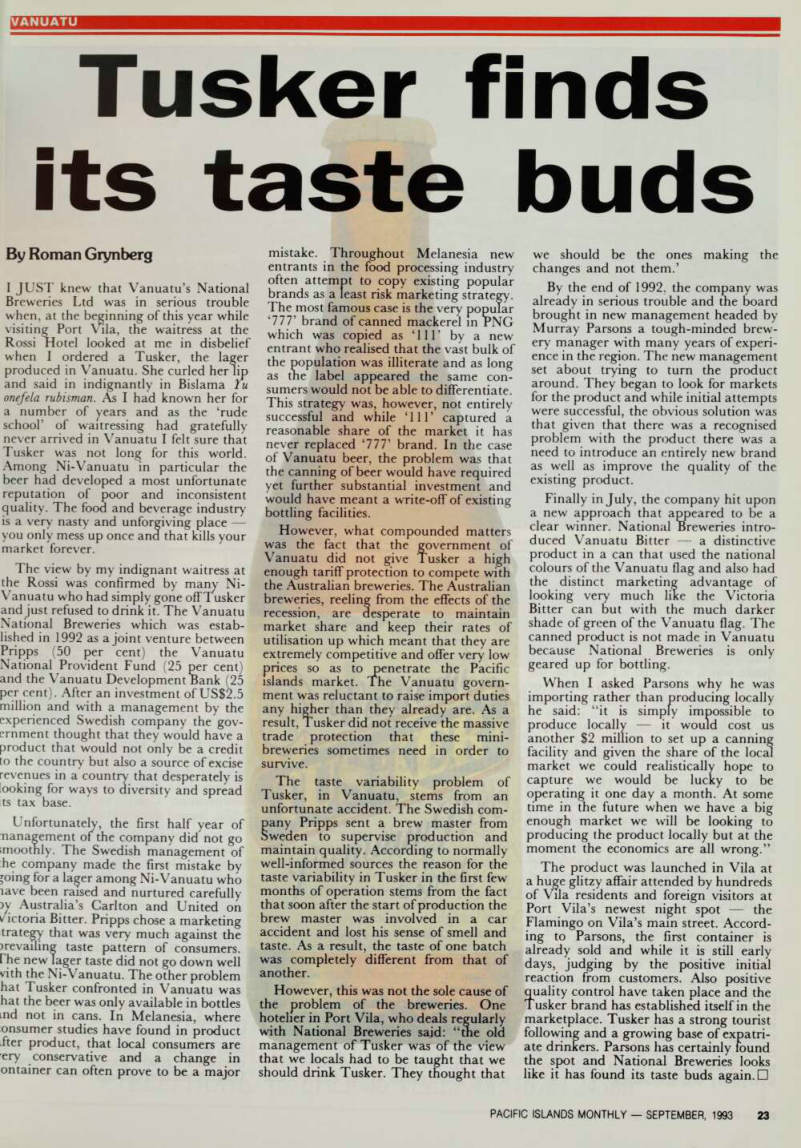
Vanuatu
Tusker finds its taste buds
By Roman Grynberg
I JUST knew that Vanuatu’s National Breweries Ltd was in serious trouble when, at the beginning of this year while visiting Port Vila, the waitress at the Rossi Hotel looked at me in disbelief when I ordered a Tusker, the lager produced in Vanuatu. She curled her lip and said in indignantly in Bislama Yu onefela rubisman. As I had known her for a number of years and as the ‘rude school’ of waitressing had gratefully never arrived in Vanuatu I felt sure that Tusker was not long for this world.
Among Ni-Vanuatu in particular the beer had developed a most unfortunate reputation of poor and inconsistent quality. The food and beverage industry is a very nasty and unforgiving place you only mess up once and that kills your market forever.
The view by my indignant waitress at the Rossi was confirmed by many Ni- Vanuatu who had simply gone off Tusker and just refused to drink it. The Vanuatu National Breweries which was estab lished in 1992 as a joint venture between Pripps (50 per cent) the Vanuatu National Provident Fund (25 per cent) and the Vanuatu Development Bank (25 per cent). After an investment of US$2.5 million and with a management by the experienced Swedish company the gov ernment thought that they would have a product that would not only be a credit to the country but also a source of excise revenues in a country that desperately is looking for ways to diversity and spread ts tax base.
Unfortunately, the first half year of nanagement of the company did not go imoothly. The Swedish management of he company made the first mistake by joing for a lager among Ni-Vanuatu who lave been raised and nurtured carefully iv Australia’s Carlton and United on
Victoria Bitter. Pripps chose a marketing
trategy that was very much against the irevailing taste pattern of consumers, fhe new lager taste did not go down well vith the Ni-Vanuatu. The other problem hat Tusker confronted in Vanuatu was hat the beer was only available in bottles md not in cans. In Melanesia, where onsumer studies have found in product iter product, that local consumers are ery conservative and a change in ontainer can often prove to be a major
mistake. Throughout Melanesia new entrants in the food processing industry often attempt to copy existing popular brands as a least risk marketing strategy.
The most famous case is the very popular ‘777’ brand of canned mackerel m PNG which was copied as TIT by a new entrant who realised that the vast bulk of the population was illiterate and as long as tne label appeared the same con sumers would not be able to differentiate.
This strategy was, however, not entirely successful and while TIT captured a reasonable share of the market it has never replaced ‘777’ brand. In the case of Vanuatu beer, the problem was that the canning of beer would have required yet further substantial investment and would have meant a write-off of existing bottling facilities.
However, what compounded matters was the fact that the government of Vanuatu did not give Tusker a high enough tariff protection to compete with the Australian breweries. The Australian breweries, reeling from the effects of the recession, are desperate to maintain market share and keep their rates of utilisation up which meant that they are extremely competitive and offer very low prices so as to penetrate the Pacific islands market. The Vanuatu govern ment was reluctant to raise import duties any higher than they already are. As a result, Tusker did not receive the massive trade protection that these mini breweries sometimes need in order to survive.
The taste variability problem of Tusker, in Vanuatu, stems from an unfortunate accident. The Swedish com pany Pripps sent a brew master from Sweden to supervise production and maintain quality. According to normally well-informed sources the reason for the taste variability in Tusker in the first few months of operation stems from the fact that soon after the start of production the brew master was involved in a car accident and lost his sense of smell and taste. As a result, the taste of one batch was completely different from that of another.
However, this was not the sole cause of the problem of the breweries. One hotelier in Port Vila, who deals regularly with National Breweries said: “tne old management of Tusker was of the view that we locals had to be taught that we should drink Tusker. They thought that
we should be the ones making the changes and not them.’
By the end of 1992. the company was already in serious trouble and the board brought in new management headed by Murray Parsons a tough-minded brew ery manager with many years of experi ence in the region. The new management set about trying to turn the product around. They began to look for markets for the product and while initial attempts were successful, the obvious solution was that given that there was a recognised problem with the product there was a need to introduce an entirely new brand as well as improve the quality of the existing product.
Finally in July, the company hit upon a new approach that appeared to be a clear winner. National Breweries intro duced Vanuatu Bitter a distinctive product in a can that used the national colours of the Vanuatu flag and also had the distinct marketing advantage of looking very much like the Victoria Bitter can but with the much darker shade of green of the Vanuatu flag. The canned product is not made in Vanuatu because National Breweries is only geared up for bottling.
When I asked Parsons why he was
importing rather than producing locally
he said: “it is simply impossible to produce locally it would cost us another $2 million to set up a canning facility and given the share of the local market we could realistically hope to capture we would be lucky to be operating it one day a month. At some time in the future when we have a big enough market we will be looking to producing the product locally but at the moment the economics are all wrong.”
The product was launched in Vila at a huge glitzy affair attended by hundreds of Vila residents and foreign visitors at Port Vila’s newest night spot the Flamingo on Vila’s main street. Accord ing to Parsons, the first container is already sold and while it is still early
days, judging by the positive initial
reaction from customers. Also positive quality control have taken place and the Tusker brand has established itself in the marketplace. Tusker has a strong tourist following and a growing base of expatri ate drinkers. Parsons has certainly found the spot and National Breweries looks like it has found its taste buds again. □
Advertisements & other items, p. 24 (1 item)
Earthquake
Agana: an overview of the capital. The quake epicentre was located west-southwest of Agana.
quake
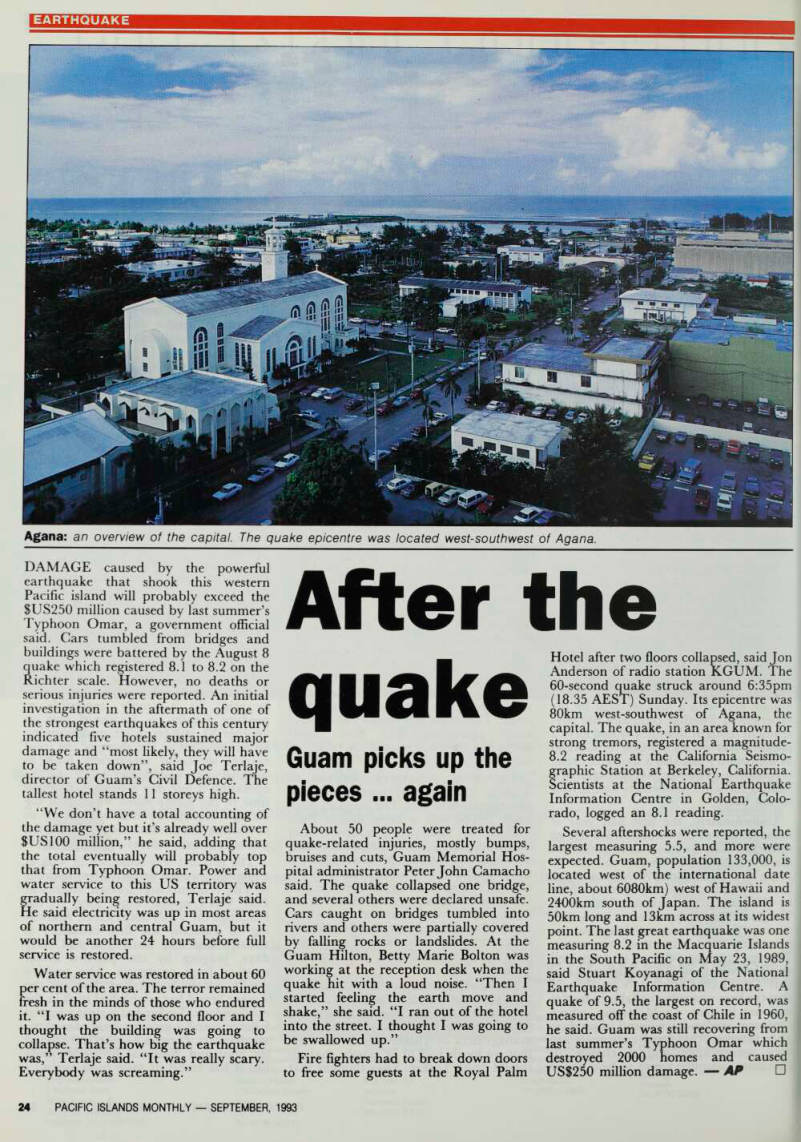
Afer the
Guam picks up the pieces ... again
DAMAGE caused by the powerful earthquake that shook this western Pacific island will probably exceed the SUS2SO million caused by last summer’s Typhoon Omar, a government official said. Cars tumbled from bridges and buildings were battered by the August 8 quake which registered 8.1 to 8 2 on the Richter scale. However, no deaths or serious injuries were reported. An initial investigation m the aftermath of one of the strongest earthquakes of this century indicated five hotels sustained major damage and most likely, they will have to be taken down said Joe Terlaje. director of Guam s Civil Defence. The tallest hotel stands 11 storeys high.
“We don’t have a total accounting of the damage yet but it s already well over SUSIOO million,” he said, adding that the total eventually will probably top that from Typhoon Omar. Power and water service to this US territory was gradually being restored, Terlaje said.
He said electricity was up in most areas of northern and central Guam, but it would be another 24 hours before full service is restored.
Water service was restored in about 60 per cent of the area. The terror remained fresh in the minds of those who endured it. “I was up on the second floor and I thought the building was going to
collapse. That’s how big the earthquake
was,” Terlaje said. “It was really scary.
Everybody was screaming.”
About 50 people were treated for
quake-related injuries, mostly bumps,
bruises and cuts, Guam Memorial Hos pital administrator Peter John Camacho said. The quake collapsed one bridge, and several others were declared unsafe.
Cars caught on bridges tumbled into rivers and others were partially covered by falling rocks or landslides. At the Guam Hilton, Betty Marie Bolton was working at the reception desk when the 9 ua k e hit with a loud noise. Then I e * in S eart h r P°^ e anc shake, she said. I ran out of the hotel P 1 * 0 * street. I thought I was going to swa “ owec l U P- Fire fighters had to break down doors to free some guests at the Royal Palm
Hotel after two floors collapsed, said Jon Anderson of radio station KGUM. The 60-second quake struck around 6:35pm (18.35 AEST) Sunday. Its epicentre was 80km west-southwest of Agana, the capital. The quake, in an area known for strong tremors, registered a magnitude -8.2 reading at the California Seismo graphic Station at Berkeley, California.
Scientists at the National Earthquake Information Centre in Golden, Colo rado, logged an 8.1 reading.
Several aftershocks were reported, the largest measuring 5.5, and more were expected. Guam, population 133,000, is located west of the international date line, about 6080 km) west of Hawaii and 2400 km south of Japan. The island is 50km long and 13km across at its widest point. The last great earthquake was one measuring 8.2 in the Macquarie Islands in the South Pacific on May 23, 1989, said Stuart Koyanagi of the National Earthquake Information Centre. A quake of 9.5, the largest on record, was measured off the coast of Chile in 1960, he said. Guam was still recovering from last summer’s Typhoon Omar which destroyed 2000 homes and caused
US$25O million damage.
AP
Advertisements & other items, pp. 25-27 (2 items)
The Kingdom of Tonga
-VAWAV-'
THE FRIENDLY ISLAND IN THE SOUTH PACIFIC
STAMPS OF THE ONLY EXISTING POLYNESIAN
KINGDOM IN THE WORLD,
THE HISTORY
OF TONGA IS UNIQUE SO ARE
ITS STAMPS. IF UNIQUE
QUALITY IS WHAT YOU
WANT CALL OR WRITE.
TONGA 80
Hirthdny »( HM Hipou tV :
NIUAFO’OU
miA E*>6w« r I*
KIHAOKAHA'U LELEI
AMGE FAKAKAUKMJ I
HOFAMLI
it \
TONGA 60
of kmga Mice Training Colley ft &Fitm ■v * Cl 0 45s \ 7* o»HMKw«
NIUAFOOU
AA.'jv, t^A/.'A-.vv-.w»VAViMAA
YOU CAN’T TELL THE
DIFFERENCE OF THE STAMPS
OF TONGA AND THAT OF
NIUAFO’OU BECAUSE THERE IS
NO DIFFERENCE IN THE
UNIQUENESS OF THE QUALITY.
YES, THERE ARE LOTS MORE
TO CHOOSE FROM.
ASK THE EXPERTS
TONGA PHILATELIC BUREAU, PO BOX 164,
NUKUALOFA, KINGDOM OF TONGA.
TELEPHONE: (676) 23066 TELEFAX: (676) 24366
IS
S\DH
little totfn V>
saM-O^
f \
CW ®t*MS«*
I w v.^ 1 merry fntic c 'tnc/i" 30.„ &
-SAVioa
& ■C^>s jßm.
Pteropus somoensis /fW*V ' 50s
SAMOA
WESTERN
SAMOA
IT'S REALLY QUITE AMAZING
JUST HOW MUCH YOU CAN
LEARN ABOUT OUR COUNTRY
THROUGH IT'S STAMPS.
OUR CULTURE AND
TRADITIONS; OUR WILDLIFE
BOTH ON LAND AND IN THE
SEA; OUR HISTORY AND
IMPORTANT EVENTS IN THE
PRESENT.
SO AFTER YOU'VE VISITED US,
CONTINUE YOUR DISCOVERY
OF WESTERN SAMOA FOR THE
REST OF YOUR LIFE-
COLLECT OUR STAMPS.
Please write to the: Western Samoa Philatelic Bureau Posts & Telecommunications Department Government of Western Samoa Apia, Western Samoa.
Fax 685 24000 Phone 685 20720 A
SAMOA
LONG
nosed empero* I V •• nth un a— a mr . £ M aaaaaaw—«
!PS£Ve “Z^
S,DE *U CB y
A fl 1 A ■
Taejon Expo 93, Korea
Airplane view: of the exposition site
Expo
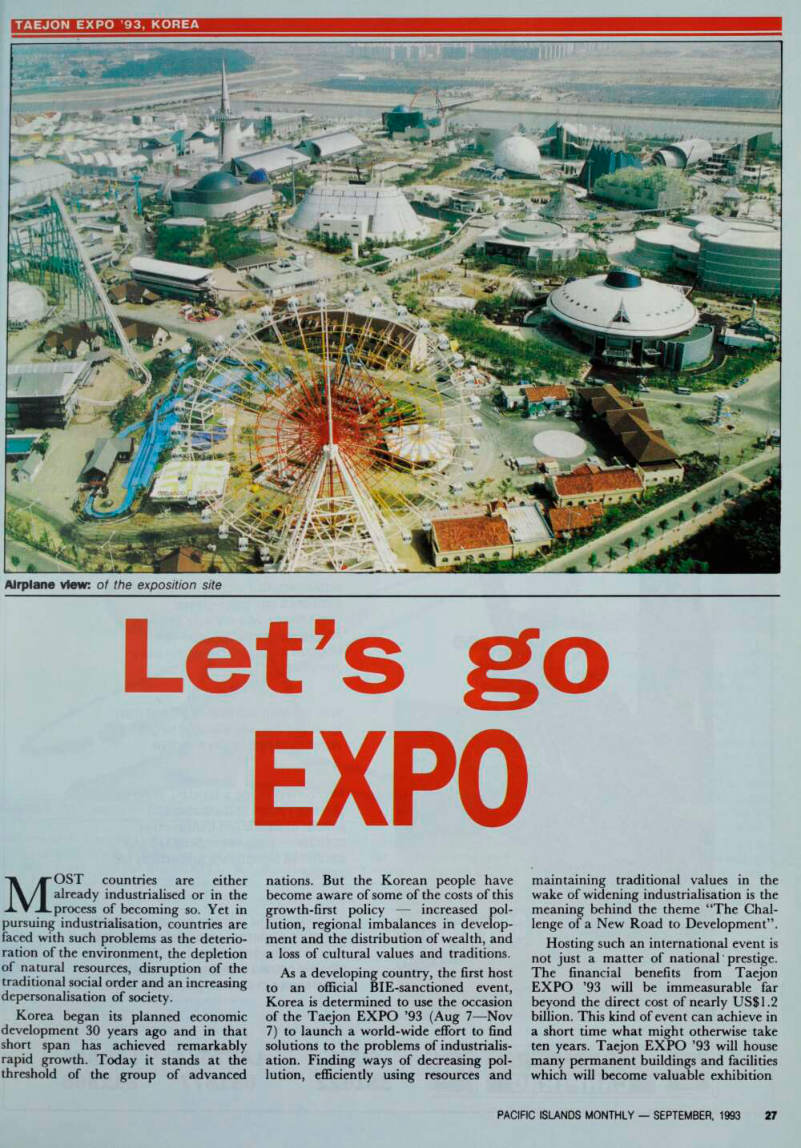

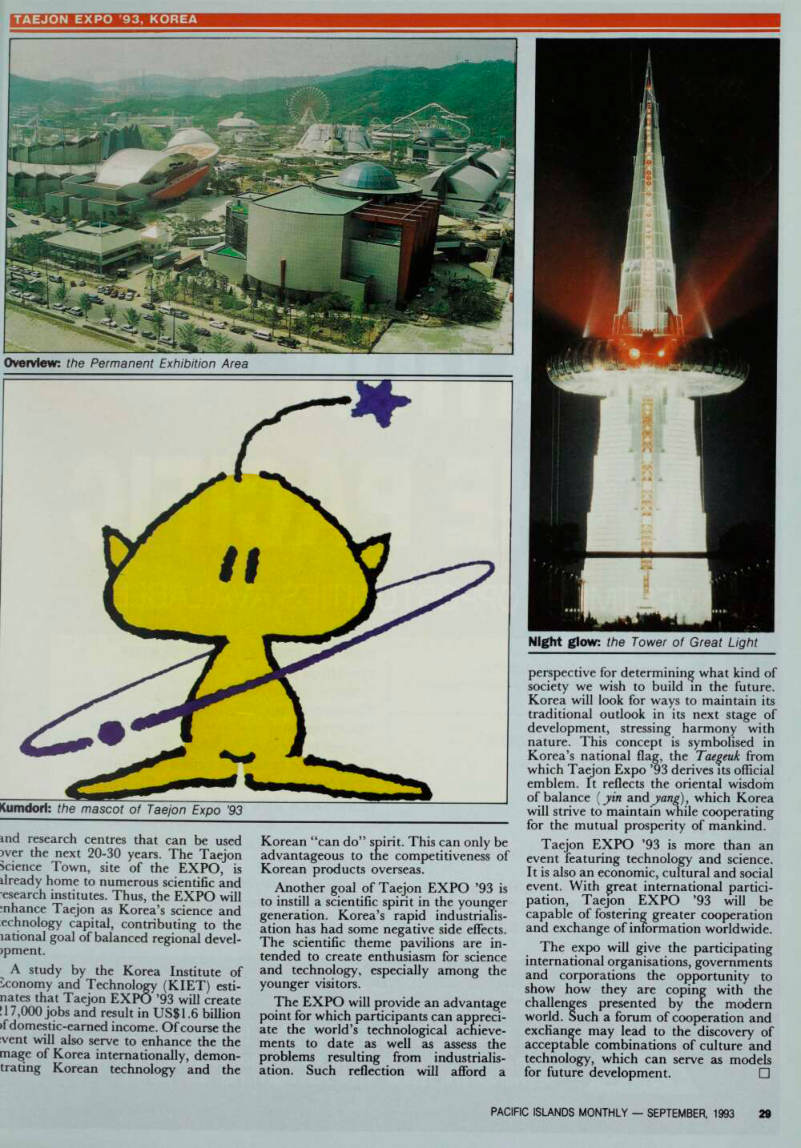

Let’s go
MOST countries are either already industrialised or in the process of becoming so. Yet in pursuing industrialisation, countries are faced with such problems as the deterioration of the environment, the depletion of natural resources, disruption of the traditional social order and an increasing depersonahsation of society.
Korea began its planned economic development 30 years ago and in that short span has achieved remarkably rapid growth. Today it stands at the threshold of the group of advanced
nations. But the Korean people have become aware of some of the costs of this
growth-first policy increased pol-
lution, regional imbalances in development and the distribution of wealth, and a loss of cultural values and traditions.
As a developing country, the first host t 0 an Q fg c i a i BIE-sanctioned event, Korea is determined to use the occasion of the Taejon EXPO ’93 (Aug 7—Nov 7) to launch a world-wide effort to find solutions to the problems of industrialisation. Finding ways of decreasing pollution, efficiently using resources and
maintaining traditional values in the wake of widening industrialisation is the meaning behind the theme “The Chal lenge of a New Road to Development”, Hosting such an international event is not j ust a mat ter of national prestige The financial benefits from Taejon EXPO ’93 will be immeasurable far beyond the direct cost of nearly US$l.2 billion. This kind of event can achieve in a short time what might otherwise take ten years. Taejon EXPO’93 will house many permanent buildings and facilities which will become valuable exhibition
md research centres that can be used wer the next 20-30 years. The Taejon Science Town, site of the EXPO, is dready home to numerous scientific and esearch institutes. Thus, the EXPO will mhance Taejon as Korea’s science and echnology capital, contributing to the lational goal of balanced regional devel >pment.
A study by the Korea Institute of Economy and Technology (KIET) esti nates that Taejon EXPO ’93 will create ■ 17,000 jobs and result in US$l.6 billion ff domestic-earned income. Of course the vent will also serve to enhance the the mage of Korea internationally, demon trating Korean technology and the
Korean “can do” spirit. This can only be advantageous to tne competitiveness of Korean products overseas.
Another goal of Taejon EXPO ’93 is to instill a scientific spirit in the younger generation. Korea’s rapid industrialis ation has had some negative side effects.
The scientific theme pavilions are in tended to create enthusiasm for science and technology, especially among the younger visitors.
The EXPO will provide an advantage point for which participants can appreci ate the world’s technological achieve ments to date as well as assess the
problems resulting from industrialis
ation. Such reflection will afford a
perspective for determining what kind of society we wish to build in the future.
Korea will look for ways to maintain its traditional outlook in its next stage of
development, stressing harmony with
nature. This concept is symbolised in Korea’s national flag, the Taegeuk from which Taejon Expo ’93 derives its official emblem. It reflects the oriental wisdom of balance ( yin and yang) , which Korea will strive to maintain while cooperating for the mutual prosperity of mankind.
Taejon EXPO ’93 is more than an event featuring technology and science.
It is also an economic, cultural and social event. With great international partici pation, Taejon EXPO ’93 will be capable of fostering greater cooperation and exchange of information worldwide.
The expo will give the participating international organisations, governments and corporations the opportunity to show how they are coping with the challenges presented by the modern world. Such a forum of cooperation and exchange may lead to the discovery of acceptable combinations of culture and technology, which can serve as models for future development. □
Overview: the Permanent Exhibition Area
Kumdorl: the mascot of Taejon Expo '93
Night glow: the Tower of Great Light
Expo site: the International Exhibition Area
Advertisements & other items, pp. 28-30 (1 item)
For Cost Effective Material Handling
A BLEND OF RELIABILITY AND PERFORMANCE
On-off access is easy, the seat comfortable. Engine vibrations have been isolated from the operator with a full-floating powertrain and noise levels are low.
Comfortable hydraulic controls are within easy reach.
A powershift transmission delivers smooth direction changes. A built-in inching valve allows inching creep at any speed Full capacity retention is maintained (with reduced back tilt) on simplex, duplex and triplex masts up to 4 meters high (except on the 1500 kg capacity trucks which retain full capacity up to 3.7 meters). All masts offer high-visibility.
Hook-type carriage features load and side thrust rollers Gear-type hydraulic pump provides Ease of maintenance has been priority flow to the steering control, designed-in - from the pop-up engim hood to the easy-to-clean air cleaner. 10 Instrumentation is complete and well positioned for “quick-glance” convenience. And available extended monitoring keeps the driver well informed about truck readiness and operations.
Well designed overhead guard and mast as well as low profile counterweight keep visibility superb in any direction Easy control is also a standard. From the steering system to the brakes and pedals, hydraulic and transmission controls every one is designed and positioned for optimum productivity and comfort.
All models come with low emission, smoothoperating engines powerful diesels which deliver full horsepower at just 2200 rpm, or efficient petrol/LP engines for reliable performance in a full range of applications.
FIJI YOUR IDEAL
BUSINESS
LOCATION
IN THE PACIFIC
INVESTMENT OPPORTUNITIES AVAILABLE:-
ilm For further information contact:-
THE DIRECTOR
FIJI TRADE & INVESTMENT BOARD
3RD FLOOR CIVIC HOUSE TOWNHALL ROAD. PO BOX 2303 GOVT. BLDG. SUVA.
TELEPHONE: (679) 315988. TELEX; 2355 FTIB FJ. FAX: (679) 301783
COMMUNICATIONS 0110
Taejon’s science town
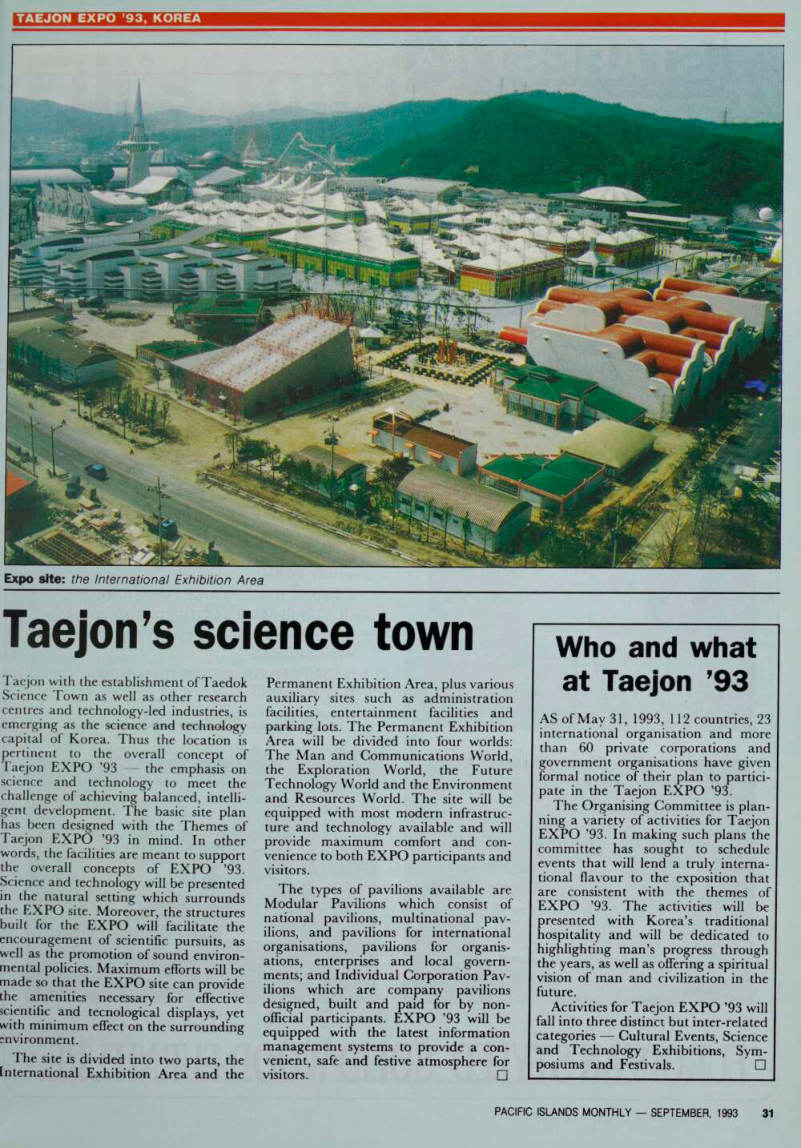
Taejon with the establishment of Taedok Science Town as well as other research centres and technology-led industries, is emerging as the science and technology capital of Korea. Thus the location is pertinent to the overall concept of Taejon EXPO ’93 the emphasis on science and technology to meet the challenge of achieving balanced, intelligent development. The basic site plan has been designed with the Themes of Taejon EXPO ’93 in mind. In other words, the facilities are meant to support the overall concepts of EXPO ’93. f n ci ™“ an t d techn o'°gy will be presented h, PYp‘ Ur Z S u surrounds mental policies. Maximum efforts will be tv . o K • win uc made so that the Exp ° sue can provide riemifi h*. nec^ ssar y J°. r Active .cientific and tecnological displays yet “n^ron'm™"" 1 effeCt ° n the SUrrOUndmg The site is divided into two parts, the International Exhibition Area and the
Permanent Exhibition Area, plus various auxiliary sites such as administration facilities, entertainment facilities and parking lots. The Permanent Exhibition Area will be divided into four worlds: The Man and Communications World, the Exploration World, the Future Technology World and the Environment and Resources World. The site will be equipped with most modern infrastruc ture and technology available and will provide maximum comfort and con venience to both EXPO participants and visitors. xhe , of pav ilions available are Modular Pavilions which consist of
jaftarts &
’ > T • . i p ments; and Individual Corporation Pav ilions which are pavilions designed, built and paid for by non official participants , EXPO ’93 will be e 9 ui PP ed with the latest information management systems to provide a con venient, safe and festive atmosphere for visitors. □
Who and what
at Taejon ’93
AS of May 31, 1993, 112 countries, 23 international organisation and more than 60 private corporations and government organisations have given formal notice of their plan to partici pate in the Taejon EXPO ’93.
The Organising Committee is plan ning a variety of activities for Taejon EXPO ’93. In making such plans the committee has sought to schedule events that will lend a truly interna tional flavour to the exposition that are consistent with the themes of EXPO ’93. The activities will be presented with Korea’s traditional hospitality and will be dedicated to highlighting man’s progress through the years, as well as offering a spiritual vision of man and civilization in the future.
Activities for Taejon EXPO ’93 will fall into three distinct but inter-related categories Cultural Events, Science and Technology Exhibitions, Sym posiums and Festivals. □
Advertisements & other items, p. 32 (1 item)
Furniture & Joinery Limited
LOT 24 BOILER CIRCLE KALABU P.O. BOX 6666 NASINU, FIJI.
MAKERS OF QUALITY FURNITURE
PHONE: 340078, 340203
FAX: 340167
I IE nK -yt ll 'arui IB •i
WE SPECIALIZE IN CUSTOM DESIGN
* DINING ROOM FURNITURE
* LOUNGE SUITE FULLY UPHOLSTERED AND
SHOW WOOD.
* CUSTOM BUILT HOUSE FURNITURE
* CUSTOMS MANUFACTURED FURNITURE
* EXPORTERS OF LOCAL TIMBER AND
ACCESSORIES
* SHOP FITTINGS, OFFICE FURNITURE
& PARTITIONS
* SPECIALIST TO BANKS AND OFFICES
Fiji’s tourism thrust
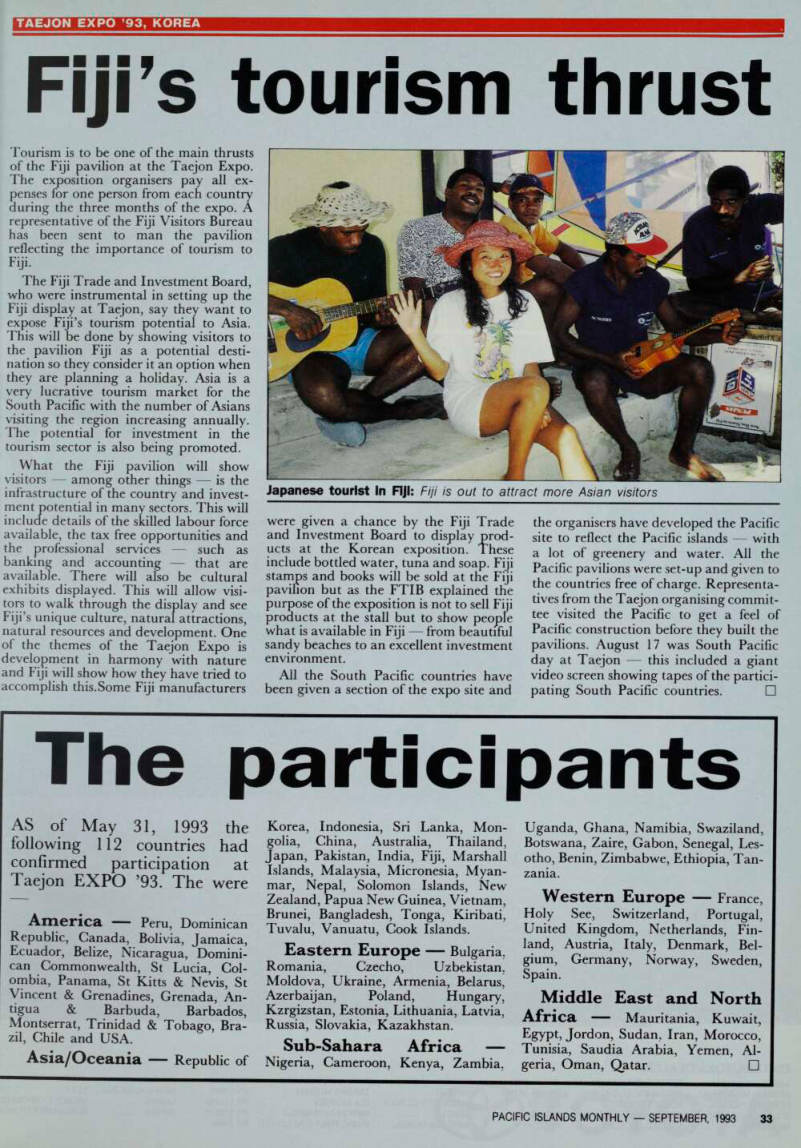
Tourism is to be one of the main thrusts of the Fiji pavilion at the Taejon Expo.
The exposition organisers pay all ex penses for one person from each country during the three months of the expo. A representative of the Fiji Visitors Bureau has been sent to man the pavilion reflecting the importance of tourism to Fiji.
The Fiji Trade and Investment Board, who were instrumental in setting up the Fiji display at Taejon, say they want to expose Fiji’s tourism potential to Asia.
This will be done by showing visitors to the pavilion Fiji as a potential desti nation so they consider it an option when they are planning a holiday. Asia is a very lucrative tourism market for the South Pacific with the number of Asians visiting the region increasing annually.
The potential for investment in the tourism sector is also being promoted.
What the Fiji pavilion will show visitors among other things is the infrastructure of the country and invest ment potential in many sectors. This will include details of the skilled labour force available, the tax free opportunities and the professional services such as banking and accounting that are available. There will also be cultural exhibits displayed. This will allow visi tors to walk through the display and see Fiji’s unique culture, natural attractions, natural resources and development. One of the themes of the Taejon Expo is development in harmony with nature and Fiji will show how they have tried to accomplish this. Some Fiji manufacturers
were given a chance by the Fiji Trade and Investment Board to display prod ucts at the Korean exposition. These include bottled water, tuna and soap. Fiji stamps and books will be sold at the Fiji pavilion but as the FTIB explained the purpose of the exposition is not to sell Fiji products at the stall but to show people what is available in Fiji from beautiful sandy beaches to an excellent investment environment.
All the South Pacific countries have been given a section of the expo site and
the organisers have developed the Pacific site to reflect the Pacific islands with a lot of greenery and water. All the Pacific pavilions were set-up and given to the countries free of charge. Representa tives from the Taejon organising commit tee visited the Pacific to get a feel of Pacific construction before they built the pavilions. August 17 was South Pacific day at Taejon this included a giant video screen showing tapes of the partici pating South Pacific countries. □
Japanese tourist in FIJI: Fiji is out to attract more Asian visitors
The participants
AS of May 31, 1993 the following 1 1 2 countries had c„ n fi par&ipadon „ 1 aejon bXrU 93. The were d . . d ur P , r» e , rU ’ mimcan Kepubhc, Canada, Bolivia, Jamaica, Ecuador, Belize, Nicaragua, Dominican Commonwealth, St Lucia, Colombia, Panama, St Kitts & Nevis, St Vincent & Grenadines, Grenada, Antigua & Barbuda, Barbados, Montserrat, Trinidad & Tobago, Brazil, Chile and USA A • Asia/Oceania Republic of
Korea, Indonesia, Sri Lanka, Mon- S olia > China, Australia, Thailand, mar, Nepal, Solomon Islands, New Zealand, Papua New Guinea, Vietnam, Brunei, Bangladesh, Tonga, Kiribati, Tuvalu, Vanuatu, Cook Islands. Eastern Europe Bulgaria, Romania, Czecho, Uzbekistan.
Moldova, Ukraine, Armenia, Belarus, Azerbaijan, Poland, Hungary, Kzrgizstan, Estonia, Lithuania, Latvia, Russia, Slovakia, Kazakhstan. c u o u A « . hub-Sahara Africa Nigeria, Cameroon, Kenya, Zambia,
Uganda, Ghana, Namibia, Swaziland, Botswana, Zaire, Gabon, Senegal, Les -5..*“' T ""
Western Europe France, Holy See, Switzerland, Portugal, United Kingdom, Netherlands, Fin iand Austria Ttalv TVnmarL M . ’ J? 1 ’ ltal >j Denmark, Bel- S 1111 ?’ erman y> orway, we en, P am - Middle East and North w v Atnca Mauritania, Kuwait, E gYPb Jordon, Sudan, Iran, Morocco, Tunisia, Saudia Arabia, Yemen, Al geria, Oman, Qatar. □
Advertisements & other items, pp. 34-35 (1 item)
With A Roomy Mai?
Creating a highly efficient, dynamic-looking car won be simple if it weren’t for one complicating detail; passengers that must ride in it. Accommodating people comfortably in a pleasant, roor interior usually means a certain amount of aerodynamic potential has to be sacrific i 4 4 % Q 9 * Exact features and specifications may vary depending on country of purchase. Please check with your nearest TOYOTA distributor/dealer for details.
DISTRffiUTORS/DEALERS
AMERICAN SAMOA BURNS PHILP (S.S.) CO. LTD. PH 633-4281 GUAM & MICRONESIA... ATKINS KROLL. INC. PH 646-1876/9 NORFOLK ISLANDS BORRY’S PTY LTD. PH 2114
SOLOMON ISLANDS MENDANA MOTORS PH 30314
VANUATU VANUATU MOTORS PH 22341
COOK ISLANDS PACIFIC MOTORS LTD. PH 20796
KIRIBATI TARAWA MOTORS PH 21090
PAPUA NEW GUINEA ... ELA MOTORS PH 217036
TAHITI NIPPON AUTOMOTO PH 429819
WESTERN SAMOA BURNS PHILP (S.S.) CO. LTD. PH 20800
FIJI ASCO MOTORS
NEW CALEDONIA .. S.I.A.P
SAIPAN MICROL CORPORATION
TONGA BURNS PHILP (TONGA) L
E MW COROLLA DOES IT BEAUTIFULLY,
lagement, Toyota engineers were able to realize an efficient, wedge-shaped design le at the same time perfecting the alignment between body panels and components, course our own innovative style of civilized neering makes sure that none of this comes ae expense of the luxurious, leg-stretching interior. Because we realize that even a 0.33 is useless if no one wants to drive the car.
®TOYOTA
garment proposal
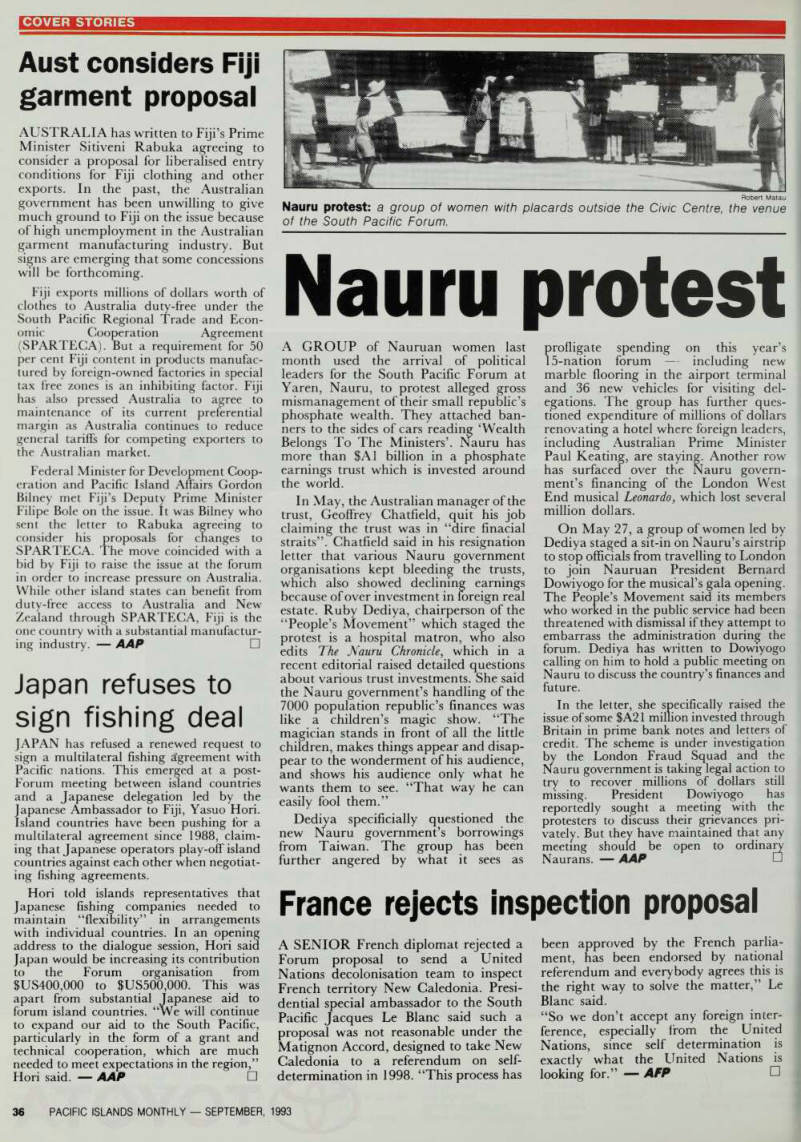
Cover Stories
Aust considers Fiji garment proposal
AUSTRALIA has written to Fiji’s Prime Minister Sitiveni Rabuka agreeing to consider a proposal for liberalised entry conditions for Fiji clothing and other exports. In the past, the Australian government has been unwilling to give much ground to Fiji on the issue because of high unemployment in the Australian
garment manufacturing industry. But
signs are emerging that some concessions will be forthcoming.
Fiji exports millions of dollars worth of clothes to Australia duty-free under the South Pacific Regional Trade and Econ omic Cooperation Agreement (SPARTECA). But a requirement for 50 per cent Fiji content in products manufac tured by foreign-owned factories in special tax free zones is an inhibiting factor. Fiji has also pressed Australia to agree to maintenance of its current preferential margin as Australia continues to reduce general tariffs for competing exporters to the Australian market.
Federal Minister for Development Coop eration and Pacific Island Affairs Gordon Bilney met Fiji’s Deputy Prime Minister Filipe Bole on the issue. It was Bilney who sent the letter to Rabuka agreeing to consider his proposals for changes to SPARTECA. The move coincided with a bid by Fiji to raise the issue at the forum in order to increase pressure on Australia.
While other island states can benefit from duty-free access to Australia and New Zealand through SPARTECA, Fiji is the one country with a substantial manufactur
ing industry.
Aap
sign fishing deal
Japan refuses to sign fishing deal
JAPAN has refused a renewed request to sign a multilateral fishing Agreement with Pacific nations. This emerged at a post- Forum meeting between island countries and a Japanese delegation led by the Japanese Ambassador to Fiji, Yasuo Hori.
Island countries have been pushing for a multilateral agreement since 1988, claim ing that Japanese operators play-off island countries against each other when negotiat ing fishing agreements.
Hori told islands representatives that Japanese fishing companies needed to maintain “flexibility” in arrangements with individual countries. In an opening address to the dialogue session, Hori said Japan would be increasing its contribution to the Forum organisation from SUS4OO,OOO to SUSSOO,OOO. This was apart from substantial Japanese aid to forum island countries. “We will continue to expand our aid to the South Pacific, particularly in the form of a grant and technical cooperation, which are much needed to meet expectations in the region,”
Hori said.
Aap
Nauru protest
A GROUP of Nauruan women last month used the arrival of political leaders for the South Pacific Forum at Yaren, Nauru, to protest alleged gross mismanagement of their small republic’s phosphate wealth. They attached banners to the sides of cars reading ‘Wealth Belongs To The Ministers’. Nauru has more than SAI billion in a phosphate earnings trust which is invested around the world.
In May, the Australian manager of the trust, Geoffrey Chatfield, quit his job claiming the trust was in “dire finacial straits”. Chatfield said in his resignation letter that various Nauru government organisations kept bleeding the trusts, which also showed declining earnings because of over investment in foreign real estate. Ruby Dediya, chairperson of the “People’s Movement” which staged the protest is a hospital matron, who also edits The Nauru Chronicle , which in a recent editorial raised detailed questions about various trust investments. She said the Nauru government’s handling of the 7000 population republic’s finances was like a children’s magic show. “The magician stands in front of all the little children, makes things appear and disappear to the wonderment of his audience, and shows his audience only what he wants them to see. “That way he can •i r i 55 easily fool them.
Dediya specificially questioned the
new Nauru government’s borrowings from Taiwan. The group has been further angered by what it sees as
profligate spending on this year’s 15-nation forum including new marble flooring in the airport terminal and 36 new vehicles for visiting del egations. The group has further ques tioned expenditure of millions of dollars renovating a hotel where foreign leaders, including Australian Prime Minister Paul Keating, are staying. Another row has surfaced over the Nauru govern ment’s financing of the London West End musical Leonardo, which lost several million dollars.
On May 27, a group of women led by Dediya staged a sit-in on Nauru’s airstrip to stop officials from travelling to London to join Nauruan President Bernard
Dowiyogo for the musical’s gala opening.
The People’s Movement said its members who worked in the public service had been threatened with dismissal if they attempt to embarrass the administration during the forum. Dediya has written to Dowiyogo calling on him to hold a public meeting on Nauru to discuss the country’s finances and future.
In the letter, she specifically raised the issue of some SA2I million invested through Britain in prime bank notes and letters of credit. The scheme is under investigation by the London Fraud Squad and the Nauru government is taking legal action to try to recover millions of dollars still missing. President Dowiyogo has reportedly sought a meeting with the protesters to discuss their grievances pri vately. But they have maintained that any meeting should be open to ordinary
Naurans.
Aap
Robert Matau Nauru protest: a group of women with placards outside the Civic Centre, the venue of the South Pacific Forum.
France rejects inspection proposal
A SENIOR French diplomat rejected a Forum proposal to send a United Nations decolonisation team to inspect French territory New Caledonia. Presi dential special ambassador to the South Pacific Jacques Le Blanc said such a proposal was not reasonable under the Matignon Accord, designed to take New Caledonia to a referendum on self determination in 1998. “This process has
been approved by the French parlia
ment, has been endorsed by national referendum and everybody agrees this is the right way to solve the matter,” Le Blanc said.
“So we don’t accept any foreign inter ference, especially from the United Nations, since self determination is exactly what the United Nations is
looking for.”
Afp
Islands’ plea
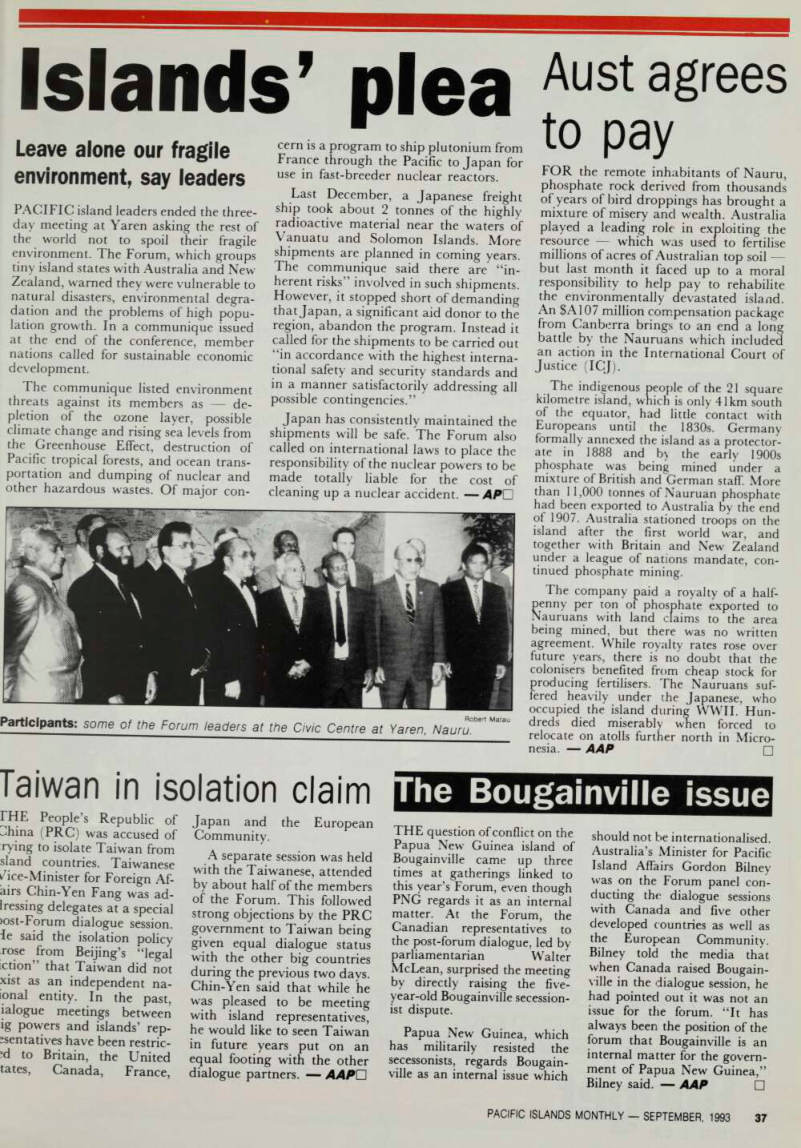
Leave alone our fragile environment, say leaders
PACIFIC island leaders ended the three day meeting at Yaren asking the rest of the world not to spoil their fragile environment. The Forum, which groups tiny island states with Australia and New Zealand, warned they were vulnerable to natural disasters, environmental degra dation and the problems of high popu lation growth. In a communique issued at the end of the conference, member nations called for sustainable economic development.
The communique listed environment threats against its members as de pletion of the ozone layer, possible climate change and rising sea levels from the Greenhouse Effect, destruction of Pacific tropical forests, and ocean trans portation and dumping of nuclear and other hazardous wastes. Of major con
cern is a program to ship plutonium from France through the Pacific to Japan for use in fast-breeder nuclear reactors.
Last December, a Japanese freight ship took about 2 tonnes of the highly radioactive material near the waters of Vanuatu and Solomon Islands. More shipments are planned in coming years.
The communique said there are “in herent risks” involved in such shipments.
However, it stopped short of demanding that Japan, a significant aid donor to the region, abandon the program. Instead it called for the shipments to be carried out in accordance with the highest interna tional safety and security standards and in a manner satisfactorily addressing all
possible contingencies.”
Japan has consistently maintained the shipments will be safe. The Forum also called on international laws to place the responsibility of the nuclear powers to be made totally liable for the cost of
cleaning up a nuclear accident.
AP
Participants: some of the Forum leaders at the Civic Centre at Yaren Nauru
Taiwan in isolation claim
Re P ublic of (PRC) was accused of rying to isolate Taiwan from sland countries. Taiwanese /ice-Minister for Foreign Afairc Phin v ° ,
"ressine f W “
• i . • , rose Lm IT " 0 " E* 6 ? ruL’ T. ® e V lng S “ le g al wion that Taiwan did not xist as an independent naional entity. In the past, lalogue meetings between !g powers and islands’ rep- -sentatives have been restric- *1 to Britain, the United tates, Canada, France,
Japan and the European
Community.
A separate session was held with the Taiwanese, attended by about half of the members of the Forum. This followed strong objections by the PRC government to Taiwan being given equal dialogue status with the other big countries during the previous two days.
Chin-Yen said that while he was pleased to be meeting with island representatives, he would like to seen Taiwan in future years put on an equal footing with the other
dialogue partners.
Aap
Aust agrees
to pay
FOR the remote inhabitants of Nauru, phosphate rock derived from thousands of years of bird droppings has brought a mixture of misery and wealth. Australia played a leading role in exploiting the resource which was used to fertilise millions of acres of Australian top soil but last month it faced up to a moral responsibility to help pay to rehabilite the environmentally devastated island.
An SAIO7 million compensation package from Canberra brings to an end a long battle by the Nauruans which included an action in the International Court of
Justice (ICJ).
The indigenous people of the 21 square kilometre island, which is only 41km south of the equator, had little contact with Europeans until the 1830 s. Germany formally annexed the island as a protector ate in 1888 and by the early 1900 s phosphate was being mined under a mixture of British and German staff. More than 11,000 tonnes of Nauruan phosphate had been exported to Australia by the end of 1907. Australia stationed troops on the island after the first world war, and together with Britain and New Zealand under a league of nations mandate, con
tinued phosphate mining.
The company paid a royalty of a half penny per ton of phosphate exported to Nauruans with land claims to the area being mined, but there was no written agreement. While royalty rates rose over future years, there is no doubt that the colonisers benefited from cheap stock for producing fertilisers. The Nauruans suf fered heavily under the Japanese, who occupied the island during WWII. Hun dreds died miserably when forced to relocate on atolls further north in Micro
nesia.
Aap
The Bougainville issue.
THE question of conflict on the Papua New Guinea island of Bougainville came up three times at gatherings linked to this year’s Forum, even though PNG regards it as an internal matter. At the Forum, the Canadian representatives to the post-forum dialogue, led by parliamentarian Walter McLean, surprised the meeting by directly raising the five year-old Bougainville secession ist dispute.
Papua New Guinea, which has militarily resisted the secessonists, regards Bougain ville as an internal issue which
should not be internationalised.
Australia’s Minister for Pacific Island Affairs Gordon Bilney was on the Forum panel con ducting the dialogue sessions with Canada and five other developed countries as well as the European Community.
Bilney told the media that when Canada raised Bougain ville in the dialogue session, he had pointed out it was not an issue for the forum. “It has always been the position of the forum that Bougainville is an internal matter for the govern ment of Papua New Guinea,”
Bilney said.
Aap
Advertisements & other items, p. 38 (1 item)
Budget
Coral
otet
■ ■ ? s 9 Port Moresby !i Mount Hagen v“
together with the
Premier Car Rental Company
Check into one of our superb Hotels in any of 7 unique locations throughout
Papua New Guinea and enjoy friendly
Melanesian Hospitality as well as
access to top quality Hire Cars.
i i V'.| Port Moresby Resort Madang
"wsn
Lae Popondetta mn $ * Lae -
Budget
rent-a-car ** : <«, ft »W V m * < * m m r ■ y m m. m m
VIS ADD/
PQ BOX 1215 BOROKO PAPUA NEW GUINEA
CENTRAL RESERVATIONS
PHONE:(67S) 25 2612, FAX 25 7853
Settling in
Politics
THE National Coalition Partnership (NCP) government in the Solomon Islands, which came into power on June 18, immediately settled into business wasting little time in rhetoric. Prime Minister Francis Billy Hilly, leader of the Independent Group in the coalition appointed his cabinet comprising of what could be considered the most abled politicians to head a government in the Solomon Islands 15 years of indepen dence.
Deputy Prime Minister and Foreign Affairs Ministers, Francis Saemala, is no stranger to foreign affairs being a former ambassador to the United Nations and the United States and High Com missioner to Canada. Experienced poli tician, former leader of opposition and lawyer, Andrew Nori is Finance Minister and former trade unionist, Joses Tuhanuku is responsible for Commerce, Employment and Trade. Educationists Dennis Lulei looks after education and lawyer Jackson Piasi takes charge of the newly created Ministry of Justice. For mer Prime Minister and strong supporter
of sustainable development Ezekiel
Alebua is Minister of Natural Resources and the list continues.
Even before, the NCP government released its statements of policy, it made decisions on issues which it had criticised the previous government of Solomon Mamaloni, The new government im mediately moved to resume dialogue -vith Papua New Guinea on the issue of he spill-over effects of the Bougainville xmflict. PNG’s Foreign Minister, John iCaputin made a visit to Honiara and icld talks with the new government.
Despite only being few weeks old, Prime Minister Hilly made his first trip overseas o the 7th summit of the Melanesian ipearhead Group in Rabaul, PNG.
Mamaloni boycotted the MSG last year >ecause of the trouble with PNG.
Hilly’s government has cancelled the even-month, 515200,000 contract of Australian lawyer, Julian Mod who was mployed by the previous government to dvise on privatisation and other econ mic ventures. Mod became involved in case involving the suspension of Central ank directors by the Minister of Fi ance and was later declared a pro fited immigrant for allegations of r orking outside his contract.
The Hilly government has also can died a SIS 12 million contract signed by ie old government with Japanese com-
Just a few weeks into their term and the new Solomon Islands government has already made some drastic decisions
pany, Kitano Construction for the build ing of a new state house in Honiara. The government explained it cannot justify such a huge amount of public money being spent on a house for one family.
The new state house, which was to have been the residence of the Solomon Islands’ Governor General had to be build after the old government sold the old state house to a Japanese company to build a hotel. After about two years the project has not started. The present government says the money received from the sale of the old state house has already been spent to purchase arms for the Police Field Force,
The Hilly government’s 35-page pol
icy statements set out a number of priorities which the government expects to achieve in its first 100 days in power.
Among these is the appointment of a Commission of Inquiry to investigate corruption, malpractices or abuses of power by the country’s leaders.
“Where there are public allegations
against leaders for corruption, malprac
tice or abuses of power, they must be fully investigated.” The government also wants to see a new planning strategy, effective control of the use of government assets and utilities, review the eight per cent goods tax and provincial establish ments. It pledged to review and reassess the country’s overseas diplomatic mis sions and formulate a new foreign
assistance policy.
A few weeks into power and the NCP govt has already terminated the contract of two senior diplomats appointed by the previous govenment. It has also tightened control on the use of govern ment vehicles. In the past the public had been very critical of government vehicle abuse. Now only constitutional post holders and cabinet ministers are entitled to keep government vehicles after hours.
Another action taken is the cancellation of the work permits of 25 foreigners involved in logging. Minister of Employ ment Tuhanuku said these work permits had been approved by former ministers
despite being rejected by the Com
missioner of Labour. Tuhanuku said his action was not being anti-foreign but
these foreigners mostly Asians have taken away jobs from Solomon Islanders.
The new government also accepted back national doctors who resigned from government service last year because of a dispute with the Mamaloni govern ment over working conditions. The contracts of permanent secretaries are now being reviewed. The new govern ment has the options of taking them back into the public service or making them political appointees.
The parliamentary opposition is yet to make any public criticism of the govern ment’s statement of policy despite dis
cussing it several times during meetings.
But public opinion is that the new government should be given the chance to deliver their pledges.
The only stumbling block is the election petitions filed against five min isters by candidates who lost in the May elections. The government must also work hard to increase its single majority in Parliament. But as Prime Minister Hilly commented at a recent press conference, he is comfortable as leader of a coalition government made up of seven political groups. □
Advertisements & other items, p. 39 (1 item)
To Anywhere
IN THE WORLD
■oau
Call us now
SUVA NADI
313166 723800 Your artifacts, gifts, souvenirs, carvings, artworks, documents whatever. DHL will deliver ( anywhere worldwide Freight Forwarder% Air Cargo DHL Worldwide Express Service
LAUTOKA
665400 665401
LABASA
811162
LEVUKA
440139 wonuJWKX exprtxx*
Never on a Monday
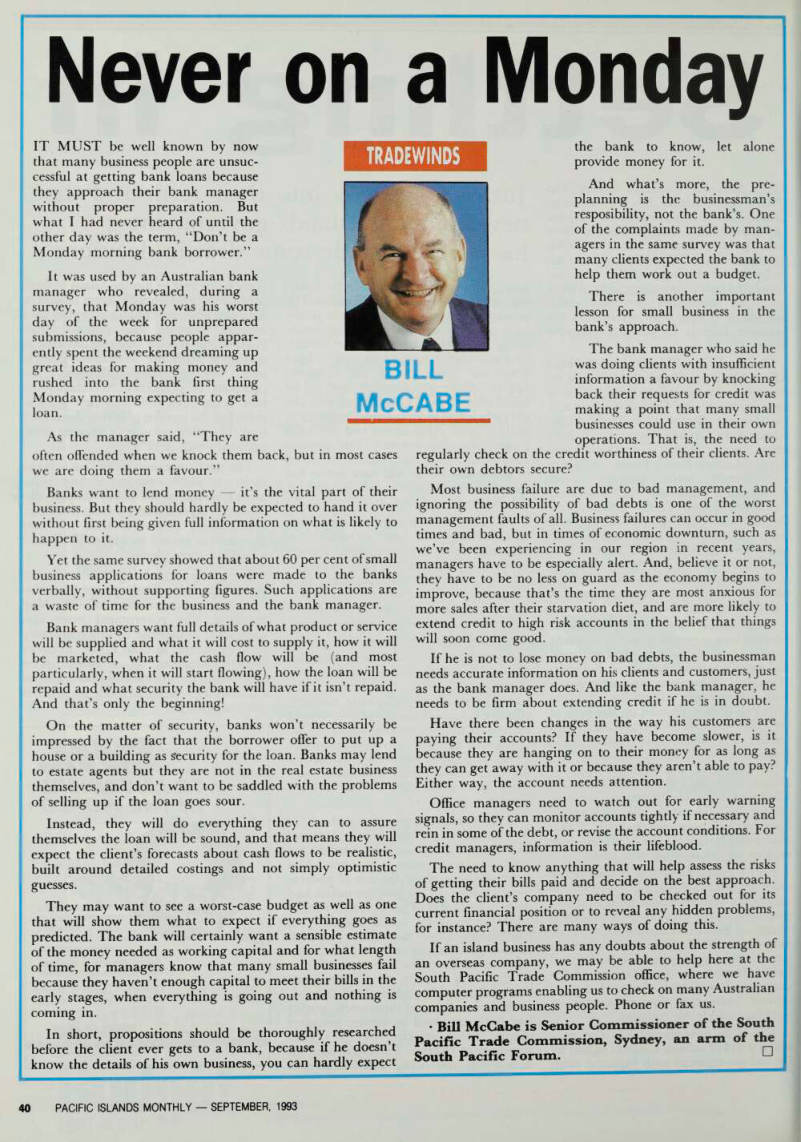
IT MUST be well known by now that many business people are unsuc cessful at getting bank loans because they approach their bank manager without proper preparation. But what I had never heard of until the other day was the term, “Don’t be a Monday morning bank borrower.”
It was used by an Australian bank manager who revealed, during a survey, that Monday was his worst day of the week for unprepared submissions, because people appar ently spent the weekend dreaming up great ideas for making money and rushed into the bank first thing Monday morning expecting to get a loan.
As the manager said, “They are
often offended when we knock them back, but in most cases we are doing them a favour.”
Banks want to lend money it’s the vital part of their business. But they should hardly be expected to hand it over without first being given full information on what is likely to happen to it.
Yet the same survey showed that about 60 per cent of small business applications for loans were made to the banks verbally, without supporting figures. Such applications are a waste of time for the business and the bank manager.
Bank managers want full details of what product or service will be supplied and what it will cost to supply it, how it will be marketed, what the cash flow will be (and most particularly, when it will start flowing), how the loan will be repaid and what security the bank will have if it isn’t repaid.
And that’s only the beginning!
On the matter of security, banks won’t necessarily be impressed by the fact that the borrower offer to put up a house or a building as Security for the loan. Banks may lend to estate agents but they are not in the real estate business themselves, and don’t want to be saddled with the problems of selling up if the loan goes sour.
Instead, they will do everything they can to assure themselves the loan will be sound, and that means they will expect the client’s forecasts about cash flows to be realistic, built around detailed costings and not simply optimistic guesses.
They may want to see a worst-case budget as well as one that will show them what to expect if everything goes as predicted. The bank will certainly want a sensible estimate of the money needed as working capital and for what length of time, for managers know that many small businesses fail because they haven’t enough capital to meet their bills in the early stages, when everything is going out and nothing is coming in.
In short, propositions should be thoroughly researched before the client ever gets to a bank, because if he doesn’t know the details of his own business, you can hardly expect
the bank to know, let alone provide money for it.
And what’s more, the pre planning is the businessman’s resposibility, not the bank’s. One of the complaints made by man agers in the same survey was that many clients expected the bank to help them work out a budget.
There is another important lesson for small business in the
bank’s approach.
The bank manager who said he was doing clients with insufficient information a favour by knocking back their requests for credit was making a point that many small businesses could use in their own operations. That is, the need to
regularly check on the credit worthiness of their clients. Are their own debtors secure?
Most business failure are due to bad management, and ignoring the possibility of bad debts is one of the worst management faults of all. Business failures can occur in good times and bad, but in times of economic downturn, such as we’ve been experiencing in our region in recent years, managers have to be especially alert. And, believe it or not, they have to be no less on guard as the economy begins to improve, because that’s the time they are most anxious for more sales after their starvation diet, and are more likely to extend credit to high risk accounts in the belief that things will soon come good.
If he is not to lose money on bad debts, the businessman needs accurate information on his clients and customers, just as the bank manager does. And like the bank manager, he needs to be firm about extending credit if he is in doubt.
Have there been changes in the way his customers are paying their accounts? If they have become slower, is it because they are hanging on to their money for as long as they can get away with it or because they aren’t able to pay?
Either way, the account needs attention.
Office managers need to watch out for early warning signals, so they can monitor accounts tightly if necessary and rein in some of the debt, or revise the account conditions. For credit managers, information is their lifeblood.
The need to know anything that will help assess the risks of getting their bills paid and decide on the best approach.
Does the client’s company need to be checked out for its current financial position or to reveal any hidden problems, for instance? There are many ways of doing this.
If an island business has any doubts about the strength of an overseas company, we may be able to help here at the South Pacific Trade Commission office, where we have computer programs enabling us to check on many Australian companies and business people. Phone or fax us. • Bill McCabe is Senior Commissioner of the South Pacific Trade Commission, Sydney, an arm of the South Pacific Forum.
Tradewinds
Bill
Mccabe
Political novelties
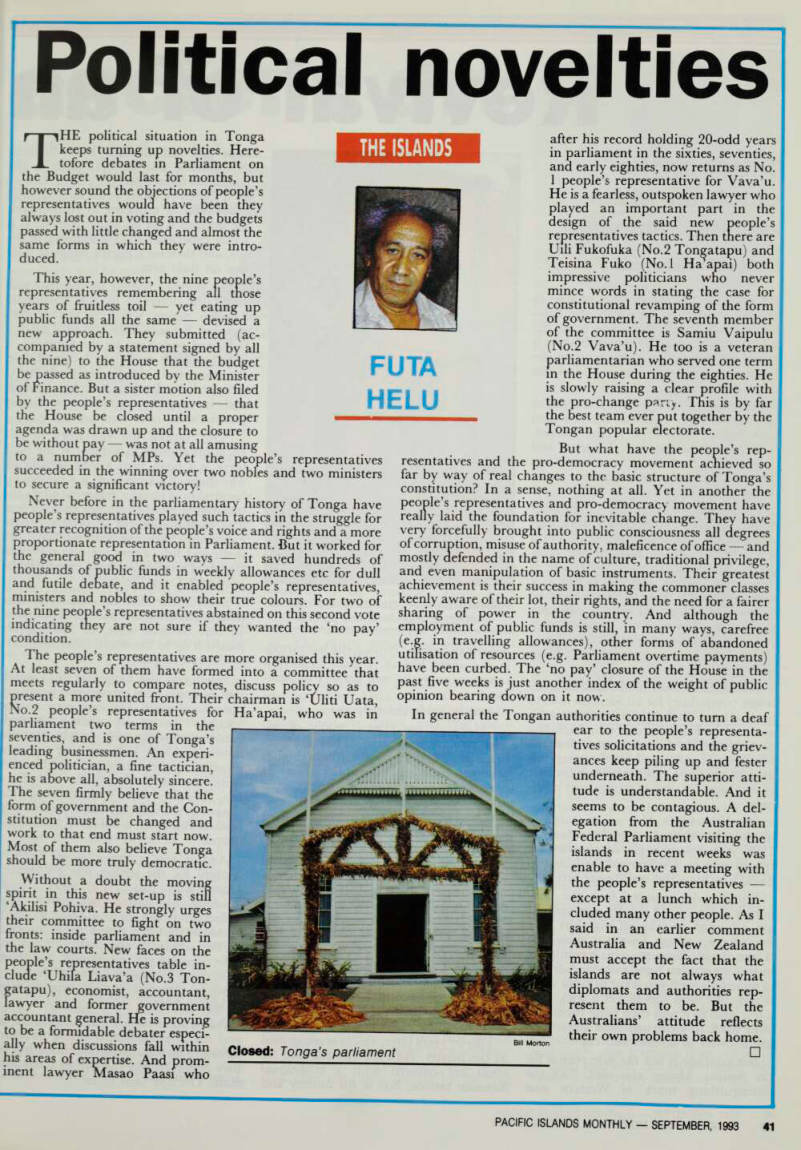
THE political situation in Tonga
keeps turning up novelties. Here tofore debates in Parliament on the Budget would last for months, but however sound the objections of people’s representatives would have been they always lost out in voting and the budgets passed with little changed and almost the same forms in which they were intro duced.
This year, however, the nine people’s representatives remembering all tnose years of fruitless toil yet eating up public funds all the same devised a new approach. They submitted (ac companied by a statement signed by all the nine) to the House that the budget be passed as introduced by the Minister of Finance. But a sister motion also filed by the people’s representatives that the House be closed until a proper agenda was drawn up and the closure to be without pay was not at all amusing
to a number of MPs. Yet the people’s representatives succeeded in the winning over two nobles and two ministers to secure a significant victory!
Never before in the parliamentary history of Tonga have people’s representatives played such tactics in the struggle for greater recognition of the people’s voice and rights and a more proportionate representation in Parliament. But it worked for the general good in two ways it saved hundreds of thousands of public funds in weekly allowances etc for dull and futile debate, and it enabled people’s representatives, ministers and nobles to show their true colours. For two of the nine people’s representatives abstained on this second vote indicating they are not sure if they wanted the ‘no pay’ condition.
The people’s representatives are more organised this year.
At least seven of them have formed into a committee that meets regularly to compare notes, discuss policy so as to present a more united front. Their chairman is ‘Uliti Uata, N 0.2 people’s representatives for Ha’apai, who was in
parliament two terms in the seventies, and is one of Tonga’s leading businessmen. An experi enced politician, a fine tactician, he is above all, absolutely sincere.
The seven firmly believe that the form of government and the Con stitution must be changed and work to that end must start now.
Most of them also believe Tonga should be more truly democratic.
Without a doubt the moving spirit in this new set-up is still ‘Akilisi Pohiva. He strongly urges their committee to fight on two fronts: inside parliament and in the law courts. New faces on the people’s representatives table in clude ‘Uhila Liava’a (N 0.3 Ton gatapu), economist, accountant, lawyer and former government accountant general. He is proving to be a formidable debater especi ally when discussions fall within his areas of expertise. And prom inent lawyer Masao Paasi who
after his record holding 20-odd years in parliament in the sixties, seventies, and early eighties, now returns as No. 1 people’s representative for Vava’u.
He is a fearless, outspoken lawyer who played an important part in the design of the said new people’s representatives tactics. Then mere are Uili Fukofuka (N 0.2 Tongatapu) and Teisina Fuko (No. 1 Ha\pai) both
impressive politicians who never
mince words in stating the case for constitutional revamping of the form of government. The seventh member of the committee is Samiu Vaipulu (N 0.2 Vava’u). He too is a veteran parliamentarian who served one term in the House during the eighties. He is slowly raising a clear profile with the pro-change party. This is by far the best team ever put together by the
Tongan popular electorate.
But what have the people’s rep
resentatives and the pro-democracy movement achieved so far by way of real changes to the basic structure of Tonga’s constitution? In a sense, nothing at all. Yet in another the people’s representatives and pro-democracy movement have really laid the foundation for inevitable change. They have very forcefully brought into public consciousness all degrees of corruption, misuse of authority, maleficence of office and mostly defended in the name of culture, traditional privilege, and even manipulation of basic instruments. Their greatest achievement is their success in making the commoner classes keenly aware of their lot, their rights, and the need for a fairer sharing of power in the country. And although the employment of public funds is still, in many ways, carefree (e.g. in travelling allowances), other forms of abandoned utilisation of resources (e.g. Parliament overtime payments) have been curbed. The ‘no pay’ closure of the House in the past five weeks is just another index of the weight of public opinion bearing down on it now.
In general the Tongan authorities continue to turn a deaf
ear to the people’s representa tives solicitations and the griev ances keep piling up and fester underneath. The superior atti tude is understandable. And it seems to be contagious. A del egation from the Australian Federal Parliament visiting the islands in recent weeks was enable to have a meeting with the people’s representatives except at a lunch which in cluded many other people. As I said in an earlier comment Australia and New Zealand must accept the fact that the islands are not always what diplomats and authorities rep resent them to be. But the Australians’ attitude reflects their own problems back home.
The Islands
Futa
Helu
Closed: Tonga’s parliament
Bill Morion
Revival of an

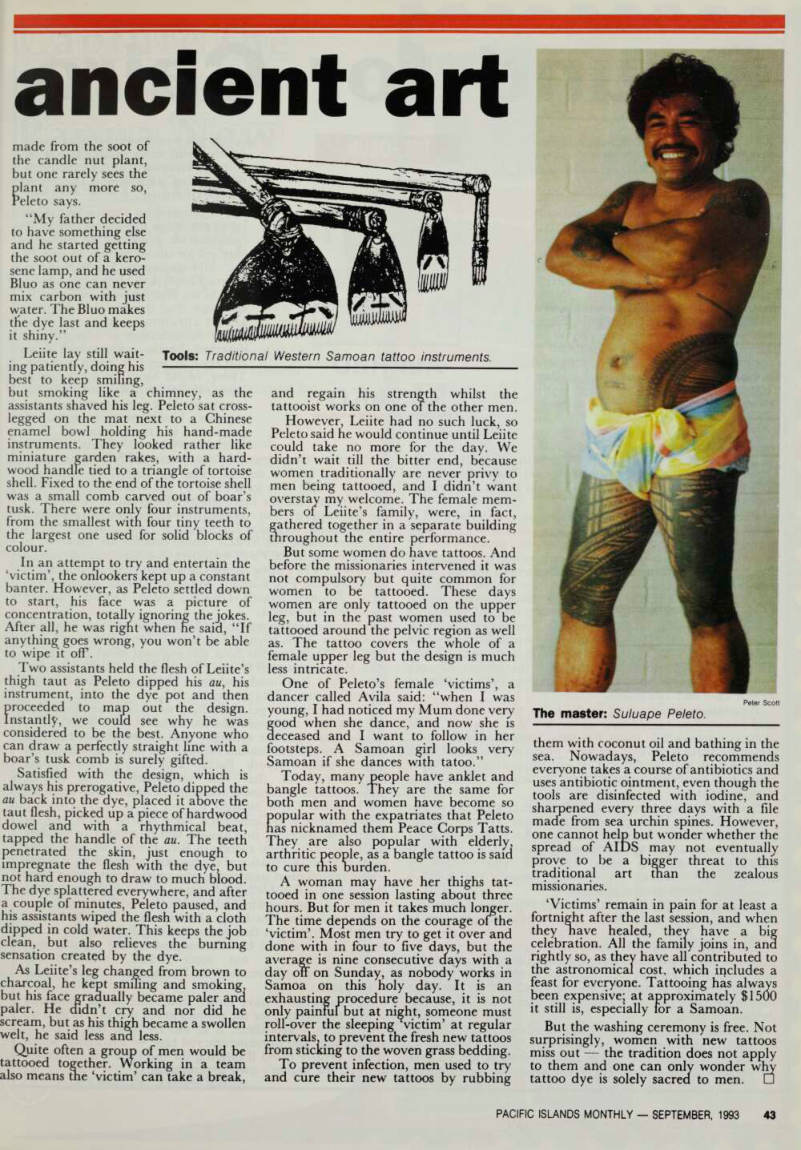
Culture
Tattoo tricks catch on again among Samoans
By Jennifer Grimwade
BY the time the missionaries arrived in Western Samoa in the 1830 s, the Poly nesians had already been practising the art of tattooing for 2000 years. No-one is exactly sure why but the missionaries immediately did their best to outlaw this ancient art.
Some people believe the missionaries tried to ban the tradition, because men with tattoos wandered around naked, showing off their tattoos. Intricate and geometrical, traditional Samoan tattoos decorate the male body from the waist down to the knee.
Fuimaono Tupua, chief of Samoan affairs, says the missionaries were out raged by the “washing ceremony” which is celebrated by all men at the com pletion of their tattoos. Tattoo dye is considered to be sacred, so once it impregnates the flesh, the body must be cleansed of this sacred spirit by sleeping with a new lover. Even married men participate in the washing ceremony and their wives are expected to turn a blind eye.
Before the arrival of the missionaries, it was compulsory for all Samoan men to have a tatau. In fact, the custom was so ancient, the English word ‘tatoo’ actually comes from the Samoan, tatau. But the missionaries succeeded in changing this ancient tradition, and tattooing became compulsory for sons of paramount chiefs only.
Since the 19505, this ancient art has become increasingly popular. And in 1990, it was once again compulsory for the all men in a village on the island of Savai’i to have the traditional tattoo.
Motsie, who returned from the Uni versity of Hawaii 18 months ago, said, “I am ashamed to take off my shirt as I don’t have a tattoo. I want to show that T can do it’. Guys say you haven’t got guts if you haven’t got tattoos. A friend of mine tells me if you want to know what it feels like, you should get a stick with a few nails in it and then bang them into your back. It’s the one time when men are allowed to scream and cry”.
But courage is not the sole reason for the revival. Motsie also said: “it’s the distinguishing mark of Western and
American Samoa. No one else has tattoos in the world like us. I want to have a tattoo so everyone will know I’m Sam oan.”
And he’s not the only one, “Many of my clients, many of my ‘victims’, are half-castes, They are par ticularly eager to have their bodies tattooed because it identifies them as Samoan,” says Suluape Peleto, the island’s most highly regarded tattooist.
Peleto is a full-time secondary scchool science teacher. When he finished his teacher training, he returned to the tiny
picturesque Lefaga Bay area to spend
some time with his family. His father, a well-known tattooist had already handed down his skills to three out of his six sons.
Peleto’s older brother practised his de signs on Peleto and before long, Peleto was assisting his brothers.
“Then I picked up the tool one day, and started practising on my leg. Of course I still have it! I wanted to learn how to hold the tool properly, and how hard to hit it,” says Peleto.
Fifteen years later, Peleto is recognised as the master. Half his legs and half his torso are covered with a traditional Samoan tattoos, bits of his tummy and
even his calf muscles have life-long experiments; but his real pride is the portrait of himself on his forearm. Drawn by a Dutch tattooist at an international convention of tattooists in Amsterdam, the portrait is an uncanny likeness. It is a rare experience to look someone in the eye, and then see a mirror image of their face on their arm.
The portrait is done by machine and is totally different to the traditional Samoan design which is always geo metrical. Because of the nature of the old fashioned tools used by the Samoans, it is not possible to create a curved line, therefore, their tattoos are made up of straight lines. Each pattern has a name, and it may be symbolic or simply
geometric.
“Our tattoos tell the story of our ancestors coming to Samoa; at the back there is a boat, then a long spearhead.
The shape of a kava bowl is a symbol for hospitality. The sides represent a fale, the traditional Samoan house. And the legs are combination of everyday items.
Especially from the sea, we have sea shells and fish. There are also represen tations of some of our fears, especially the centipede,” says Peleto.
Every year Peleto creates a new design. His latest is a pattern of dolphins.
In true Samoan style, he has happily passed it on to the dozen other members of the tattoo guild.
Peleto was also happy for us to watch him at work, even though spectators are not encouraged. On our way to the ‘victim’s’ house we walked through
gardens glowing with bright tropical
flowers and little kids sweeping the lawn dwarfed by their coconut frond brooms.
Before we had settled in the customary fale, Motsie, who had grabbed the chance to see what he was in for, bravely booked Peleto for a full-scale traditional tattoo.
And it was a brave move. Peleto’s ‘victim’ for the session was his cousin, Leiite who had “run away” from finishing his tattoo two years ago.
Defection is not only a blow to one’s manhood but it is also a great disgrace to the whole of the family. Even so, defections are not uncommon, and there were many jokes with Leiite before he lay down on the grass mat covering the floor of lava pebbles.
Adhering to the ancient custom, Peleto and his three assistants tied a Samoan sarong, a lavalava, over their jeans before they began to mix the dye in a coconut shell. The dye used to be
Peter Scott Painful art: the designs for women are less intricate, therefore less painful.
made from the soot of the candle nut plant, but one rarely sees the plant any more so, Peleto says.
“My father decided to have something else and he started getting the soot out of a kero sene lamp, and he used Bluo as one can never mix carbon with just water. The Bluo makes tfie dye last and keeps it shiny.”
Leiite lay still wait ing patiently, doing his best to keep smiling,
but smoking like a chimney, as the assistants shaved his leg. Peleto sat cross legged on the mat next to a Chinese enamel bowl holding his hand-made instruments. They looked rather like miniature garden rakes, with a hard wood handle tied to a triangle of tortoise shell. Fixed to the end of the tortoise shell was a small comb carved out of boar’s tusk. There were only four instruments, from the smallest witn four tiny teeth to the largest one used for solid blocks of colour.
In an attempt to try and entertain the ‘victim’, the onlookers kept up a constant banter. However, as Peleto settled down to start, his face was a picture of concentration, totally ignoring the jokes.
After all, he was rignt when he said, “If anything goes wrong, you won’t be able to wipe it off.
Two assistants held the flesh of Leiite’s thigh taut as Peleto dipped his au, his instrument, into the dye pot and then froceeded to map out the design, nstantly, we could see why he was considered to be the best. Anyone who can draw a perfectly straight line with a boar’s tusk comb is surely gifted.
Satisfied with the design, which is always his prerogative, Peleto dipped the au back into the dye, placed it above the taut flesh, picked up a piece of hardwood dowel and with a rhythmical beat, tapped the handle of the au. The teeth
penetrated the skin, just enough to
impregnate the flesh with the dye, but not hard enough to draw to much blood.
The dye splattered everywhere, and after a couple of minutes, Peleto paused, and his assistants wiped the flesh with a cloth dipped in cold water. This keeps the job clean, but also relieves the burning sensation created by the dye.
As Leiite’s leg changed from brown to charcoal, he kept smiling and smoking, but his face gradually became paler ana paler. He didn’t cry and nor did he scream, but as his thigh became a swollen welt, he said less and less.
Quite often a group of men would be tattooed together. Working in a team also means tne ‘victim’ can take a break,
and regain his strength whilst the tattooist works on one of the other men.
Howeyer, Leiite had no such luck, so Peleto said he would continue until Leiite could take no more for the day. We didn’t wait till the bitter end, because women traditionally are never privy to men being tattooea, and I didn’t want overstay my welcome. The female mem bers of Leiite’s family, were, in fact, gathered together in a separate building
throughout the entire performance.
But some women do have tattoos. And before the missionaries intervened it was not compulsory but quite common for women to be tattooed. These days women are only tattooed on the upper leg, but in the past women used to be tattooed around the pelvic region as well as. The tattoo covers the whole of a female upper leg but the design is much less intricate.
One of Peleto’s female ‘victims’, a dancer called Avila said: “when I was young, I had noticed my Mum done very good when she dance, and now she is deceased and I want to follow in her footsteps. A Samoan girl looks very Samoan if she dances with tatoo.”
Today, many people have anklet and bangle tattoos. They are the same for both men and women have become so popular with the expatriates that Peleto nas nicknamed them Peace Corps Tatts.
They are also popular with elderly, arthritic people, as a bangle tattoo is said to cure this Durden.
A woman may have her thighs tat tooed in one session lasting about three hours. But for men it takes much longer.
The time depends on the courage ofthe ‘victim’. Most men try to get it over and done with in four to five days, but the average is nine consecutive aays with a day on on Sunday, as nobody works in Samoa on this holy day. It is an exhausting procedure because, it is not only painful but at night, someone must roll-over the sleeping Victim’ at regular intervals, to prevent the fresh new tattoos from sticking to the woven grass bedding.
To prevent infection, men used to try and cure their new tattoos by rubbing
them with coconut oil and bathing in the sea. Nowadays, Peleto recommends everyone takes a course of antibiotics and uses antibiotic ointment, even though the tools are disinfected with iodine, and sharpened every three days with a file made from sea urchin spines. However, one cannot help but wonder whether the spread of AIDS may not eventually prove to be a bigger threat to this traditional art man the zealous missionaries. ‘Victims’ remain in pain for at least a fortnight after the last session, and when they nave healed, they have a big celebration. All the family joins in, and rightly so, as they have all contributed to the astronomical cost, which includes a feast for everyone. Tattooing has always been expensive; at approximately $l5OO it still is, especially for a Samoan.
But the washing ceremony is free. Not surprisingly, women with new tattoos miss out the tradition does not apply to them and one can only wonder why tattoo dye is solely sacrea to men. □
Peter Scott The master: Suluape Peleto.
Tools: Traditional Western Samoan tattoo instruments
Bound for Cairo
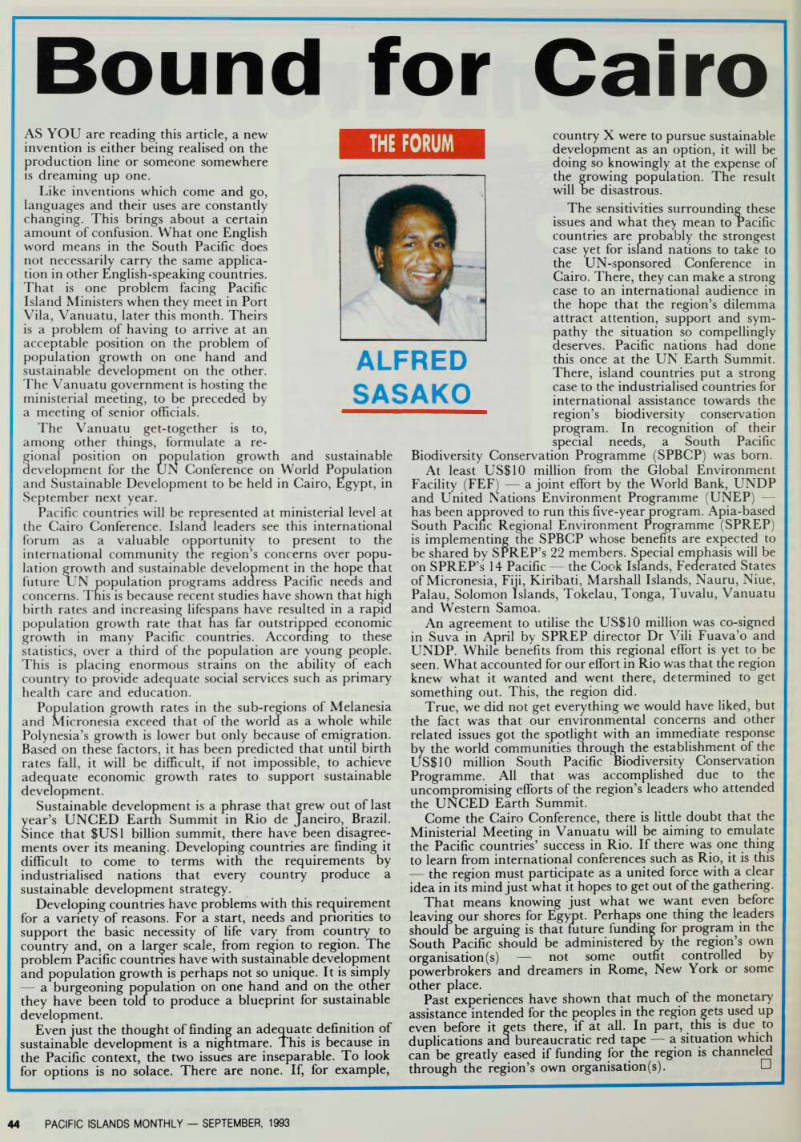
AS YOU are reading this article, a new invention is either being realised on the production line or someone somewhere is dreaming up one.
Like inventions which come and go, languages and their uses are constantly changing. This brings about a certain amount of confusion. What one English word means in the South Pacific does not necessarily carry the same applica tion in other English-speaking countries.
That is one problem facing Pacific Island Ministers when they meet in Port Vila, Vanuatu, later this month. Theirs is a problem of having to arrive at an acceptable position on the problem of population growth on one hand and sustainable development on the other.
The Vanuatu government is hosting the
ministerial meeting, to be preceded by
a meeting of senior officials.
The Vanuatu get-together is to, among other things, formulate a re
gional position on population growth and sustainable development for the UN Conference on World Population and Sustainable Development to be held in Cairo, Egypt, in September next year.
Pacific countries will be represented at ministerial level at the Cairo Conference. Island leaders see this international forum as a valuable opportunity to present to the international community the region’s concerns over popu lation growth and sustainable development in the hope mat future UN population programs adaress Pacific needs and concerns. Tnis is because recent studies have shown that high birth rates and increasing lifespans have resulted in a rapid population growth rate that has far outstripped economic growth in many Pacific countries. According to these statistics, over a third of the population are young people.
This is placing enormous strains on the ability of each country to provide adequate social services such as primary health care and education.
Population growth rates in the sub-regions of Melanesia and Micronesia exceed that of the world as a whole while Polynesia’s growth is lower but only because of emigration.
Based on these factors, it has been predicted that until birth rates fall, it will be difficult, if not impossible, to achieve adequate economic growth rates to support sustainable development.
Sustainable development is a phrase that grew out of last year’s UNCED Earth Summit in Rio de Janeiro, Brazil.
Since that SUSI billion summit, there have been disagree ments over its meaning. Developing countries are finding it difficult to come to terms with the requirements by industrialised nations that every country produce a sustainable development strategy.
Developing countries have problems with this requirement for a variety of reasons. For a start, needs and priorities to support the basic necessity of life vary from country to country and, on a larger scale, from region to region. The problem Pacific countnes have with sustainable development and population growth is perhaps not so unique. It is simply a burgeoning population on one hand and on the other they have been told to produce a blueprint for sustainable development.
Even just the thought of finding an adequate definition of sustainable development is a nightmare. This is because in the Pacific context, the two issues are inseparable. To look for options is no solace. There are none. If, for example,
country X were to pursue sustainable development as an option, it will be doing so knowingly at the expense of the growing population. The result will be disastrous.
The sensitivities surrounding these issues and what they mean to Pacific countries are probably the strongest case yet for island nations to take to the UN-sponsored Conference in Cairo. There, they can make a strong case to an international audience in the hope that the region’s dilemma attract attention, support and sym pathy the situation so compellingly deserves. Pacific nations had done this once at the UN Earth Summit.
There, island countries put a strong case to the industrialised countries for international assistance towards the region’s biodiversity conservation program. In recognition of their special needs, a South Pacific
Biodiversity Conservation Programme (SPBCP) was born.
At least USSIO million from the Global Environment Facility (FEE) a joint effort by the World Bank, UNDP and United Nations Environment Programme (UNEP) has been approved to run this five-year program. Apia-based South Pacific Regional Environment Programme (SPREP) is implementing the SPBCP whose benefits are expected to be shared by SPREP’s 22 members. Special emphasis will be on SPREP’s 14 Pacific the Cook Islands, Federated States of Micronesia, Fiji, Kiribati, Marshall Islands, Nauru, Niue, Palau, Solomon Islands, Tokelau, Tonga, Tuvalu, Vanuatu and Western Samoa.
An agreement to utilise the USSIO million was co-signed in Suva in April by SPREP director Dr Vili Fuava’o and UNDP. While benefits from this regional effort is vet to be seen. What accounted for our effort in Rio was that tne region knew what it wanted and went there, determined to get something out. This, the region did.
True, we did not get everything we would have liked, but the fact was that our environmental concerns and other related issues got the spotlight with an immediate response by the world communities through the establishment of the US$lO million South Pacific Biodiversity Conservation Programme. All that was accomplished due to the uncompromising efforts of the region’s leaders who attended the UNCED Earth Summit.
Come the Cairo Conference, there is little doubt that the Ministerial Meeting in Vanuatu will be aiming to emulate the Pacific countries’ success in Rio. If there was one thing to learn from international conferences such as Rio, it is this the region must participate as a united force with a clear idea in its mind just what it hopes to get out of the gathering.
That means knowing just what we want even before leaving our shores for Egypt. Perhaps one thing the leaders should be arguing is that future funding for programs the South Pacific should be administered by the region’s own organisation (s) not some outfit controlled by powerbrokers and dreamers in Rome, New York or some
other place.
Past experiences have shown that much of the monetary assistance intended for the peoples in the region gets used up even before it gets there, if at all. In part, this is due to duplications and bureaucratic red tape a situation which can be greatly eased if funding for tne region is channeled through the region’s own organisation(s). □
The Forum
Alfred
Sasako
Advertisements & other items, pp. 45-46 (1 item)
jpjapsai, liew
o»r M m ■
GUINEA
m 233E1 30t 17t It % m IS ,
PUflWWOltl
\ ifc~
wmvmmti
mieeooL^o^ !SSJfig»
'PUA NEW GUINEA
10 '/A
wmma
■Pmn mourn
atuatfi.
PAPUA NEW GUINEA
20t 90t IX / j* j
yitf
tn
papua new guinea
60t 90t !>• ' ’
UlN EA
new
A pUA
I9M
IBSK
®® ® $ Highly regarded and eagerly sought by collectors around the world, our world class stamps truly are model ambassadors. Whenever, our stamps travel there is great respect and admiration by those who meet them.
To overseas friends who know our land, they surely must bring back the scent of Frangipani, the call of the Bird of Paradise and the vivid memories of festivities where our rich traditional culture is exhibited. And for those too far away to visit our Land of the unexpectecd "You don't need to worry as the stamps you collect will tell it all".
Simply join our Standing Order Service.
INITIAL DEPOSIT OF: AUSS4O, NZ$5O
US$25, UK£l6. For credit Card Holders of American Express, Mastercard and Visa, just quote your card number and expiry date and we will forward your requirements without delay.
Or for general information on current and future stamp issues, write to us and ask for your name to be placed on the
mailing list.
Write to: Marketing Officer
PNG Philatelic Bureau (PIM)
PO Box 1, BOROKO NCD
Papua New Guinea Ph: (675) 274170/274282 Fax: (675) 252502
We will be happy to oblige.
Post & Telecom
■ « m j v: : s I ' : , fj
lm thousand destinations in one.
You could travel to every other place in the Pacific and still not encounter the incredible diversity that is Papua New Guinea. Explore mist^shrouded mountains lost in time. Dive in crystahclear waters teeming with marine life. Relax at a friendly resort nestled between palnvfringed m m i Beaches and a slumbering volcano. Navigate vast V * rivers snaking through virgin rainforest. Be welcomed by a myriad of unique and colourful peoples, each with their own distinct cultures and traditions.
Papua New Guinea. If you’re looking for your perfect destination in the Pacific, there’s really no reason to go anywhere else.
fife/
I For further information on PNG Holidays contact your Travel Agent or the Papua New Guinea Tourism Promotion Authority //■ n A IT //C C \ ”7
looks
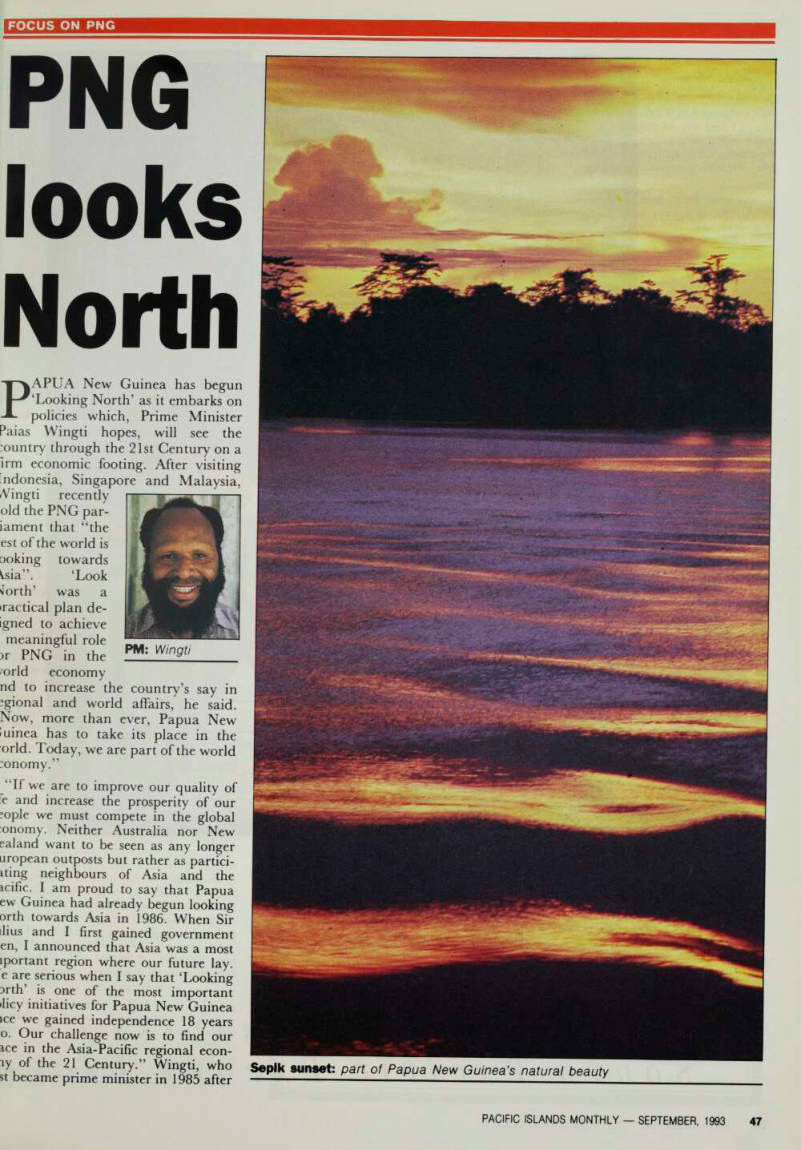

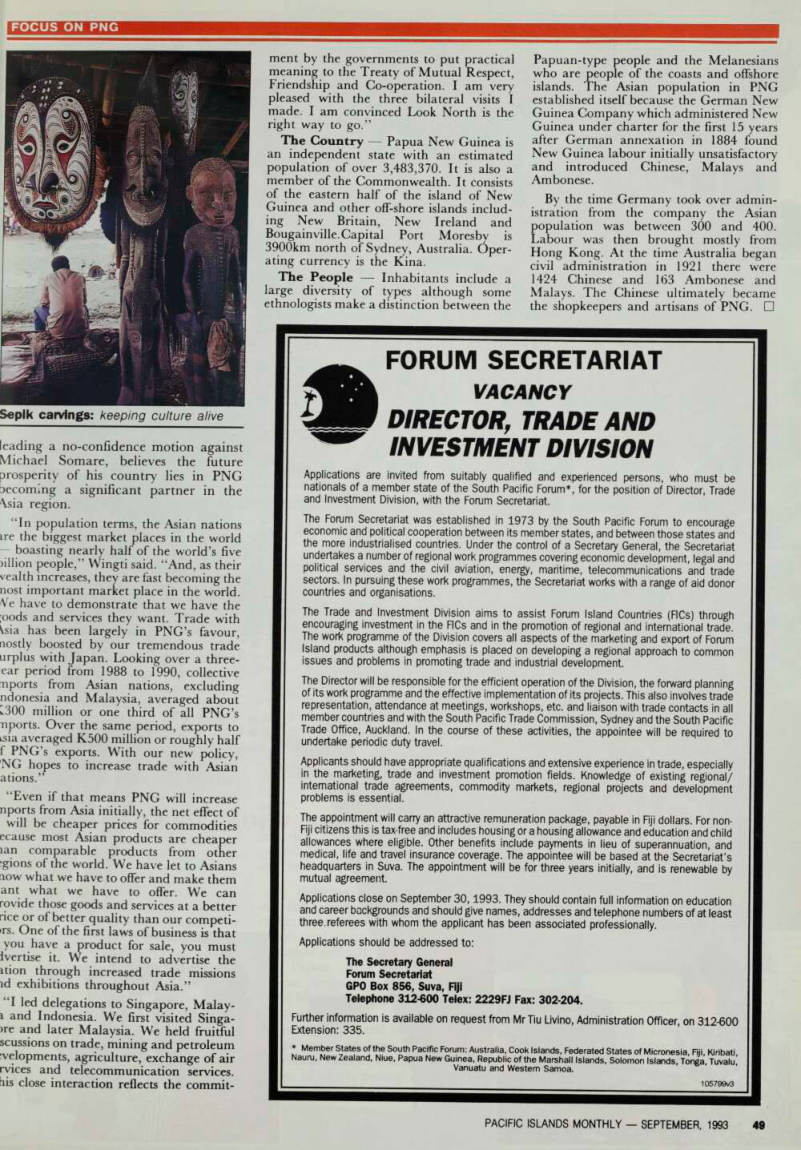
Focus On Png
Png
looks North
PAPUA New Guinea has begun ‘Looking North’ as it embarks on policies which, Prime Minister Paias Wingti hopes, will see the :ountry through the 21st Century on a irm economic footing. After visiting Indonesia, Singapore and Malaysia,
/Vingti recently
old the PNG par iament that “the est of the world is Doking towards ‘Look forth’ was a •ractical plan de igned to achieve
meaningful role
>r PNG in the
'odd economy
nd to increase the country’s say in and world affairs, he said.
Now, more than ever, Papua New Guinea has to take its place in the orld. Today, we are part of the world :onomy.”
“If we are to improve our quality of e and increase the prosperity of our -ople we must compete in the global onomy. Neither Australia nor New ealand want to be seen as any longer uropean outposts but rather as partici iting neighbours of Asia and the icific. I am proud to say that Papua ew Guinea had already begun looking orth towards Asia in 1986. When Sir ilius and I first gained government en, I announced that Asia was a most iportant region where our future lay. e are serious when I say that ‘Looking Drth’ is one of the most important >licy initiatives for Papua New Guinea ice we gained independence 18 years o. Our challenge now is to find our ice in the Asia-Pacific regional econ iy of the 21 Century.” Wingti, who st became prime minister in 1985 after
PM: Wingti
Seplk sunset: part of Papua New Guinea's natural beauty
leading a no-confidence motion against Michael Somare, believes the future prosperity of his country lies in PNG aecoming a significant partner in the
Asia region.
“In population terms, the Asian nations ire the biggest market places in the world boasting nearly half of the world’s five fillion people,” Wingti said. “And, as their vealth increases, they are fast becoming the nost important market place in the world.
Ye have to demonstrate that we have the pods and services they want. Trade with has been largely in PNG’s favour, nostly boosted by our tremendous trade urplus with Japan. Looking over a three ear period from 1988 to 1990, collective ti ports from Asian nations, excluding ndonesia and Malaysia, averaged about L3OO million or one third of all PNG’s nports. Over the same period, exports to isia averaged K5OO million or roughly half f PNG’s exports. With our new policy, NG hopes to increase trade with Asian ations.” ‘Even if that means PNG will increase nports from Asia initially, the net effect of will be cheaper prices for commodities ecause most Asian products are cheaper lan comparable products from other of the world. We have let to Asians now what we have to offer and make them ant what we have to offer. We can rovide those goods and services at a better rice or of better quality than our competi •rs. One of the first laws of business is that you have a product for sale, you must ivertise it. We intend to advertise the ition through increased trade missions
id exhibitions throughout Asia.”
“I led delegations to Singapore, Malay i and Indonesia. We first visited Singa )re and later Malaysia. We held fruitful scussions on trade, mining and petroleum :velopments, agriculture, exchange of air ryices and telecommunication services, bis close interaction reflects the commit
merit by the governments to put practical meaning to the Treaty of Mutual Respect, Friendship and Co-operation. I am very pleased with the three bilateral visits I made. I am convinced Look North is the right way to go.”
The Country Papua New Guinea is an independent state with an estimated population of over 3,483,370. It is also a member of the Commonwealth. It consists of the eastern half of the island of New • Um< vr anc * f off-shore islands includmg New Britain, New Ireland and Qonm amVi e^ a f Por I Moresby is 3900 km north of Sydney, Australia. Operatmg currency is the Kina.
The People Inhabitants include a large diversity of types although some ethnologists make a distinction between the
Papuan-type people and the Melanesians who are people of the coasts and offshore islands. The Asian population in PNG established itself because the German New Guinea Company which administered New Guinea under charter for the first 15 years a fter German annexation in 1884 found New Guinea labour initially unsatisfactory an d introduced Chinese, Malays and Ambonese.
By t g e time Germany took over admin istration from the company the Asian population was between 300 and 400.
Labour was then brought mostly from Hong Kong. At the time Australia began civil administration in 1921 there were 1424 Chinese and 1(53 Ambonese and Malays. The Chinese ultimately became the shopkeepers and artisans of PNG. □
Sepik carvings: keeping culture alive
Advertisements & other items, pp. 48-50 (1 item)
The Beer of Paradise...
pm sksu wmm t-mer Beer Csapes** The Beer of Paradise...
South Pacific Export Lager
I
FORUM SECRETARIAT
VACANCY
DIRECTOR, TRADE AND
INVESTMENT DIVISION
Applications are invited from suitably qualified and experienced persons, who must be nationals of a member state of the South Pacific Forum*, for the position of Director, Trade and Investment Division, with the Forum Secretariat.
The Forum Secretariat was established in 1973 by the South Pacific Forum to encourage economic and political cooperation between its member states, and between those states and the more industrialised countries. Under the control of a Secretary General, the Secretariat undertakes a number of regional work programmes covering economic development, legal and political services and the civil aviation, energy, maritime, telecommunications and trade sectors. In pursuing these work programmes, the Secretariat works with a range of aid donor countries and organisations.
The Trade and Investment Division aims to assist Forum Island Countries (FICs) through encouraging investment in the FICs and in the promotion of regional and international trade.
The work programme of the Division covers all aspects of the marketing and export of Forum Island products although emphasis is placed on developing a regional approach to common issues and problems in promoting trade and industrial development.
The Director will be responsible for the efficient operation of the Division, the forward planning of its work programme and the effective implementation of its projects. This also involves trade representation, attendance at meetings, workshops, etc. and liaison with trade contacts in all member countries and with the South Pacific Trade Commission, Sydney and the South Pacific Trade Office, Auckland. In the course of these activities, the appointee will be required to undertake periodic duty travel.
Applicants should have appropriate qualifications and extensive experience in trade, especially in the marketing, trade and investment promotion fields. Knowledge of existing regional/ international trade agreements, commodity markets, regional projects and development problems is essential.
The appointment will carry an attractive remuneration package, payable in Fiji dollars. For non- Fiji citizens this is tax-free and includes housing or a housing allowance and education and child allowances where eligible. Other benefits include payments in lieu of superannuation, and medical, life and travel insurance coverage. The appointee will be based at the Secretariat’s headquarters in Suva. The appointment will be for three years initially, and is renewable by mutual agreement.
Applications close on September 30,1993. They should contain full information on education and career backgrounds and should give names, addresses and telephone numbers of at least three, referees with whom the applicant has been associated professionally.
Applications should be addressed to: The Secretary General Forum Secretariat GPO Box 856, Suva, Fiji Telephone 312-600 Telex: 2229FJ Fax: 302-204.
Further information is available on request from Mr Tiu Livino, Administration Officer, on 312-600 Extension: 335. * Member States of the South Pacific Forum: Australia, Cook Islands. Federated States of Micronesia, Fiji, Kiribati Nauru, New Zealand, Niue, Papua New Guinea, Republic of the Marshall Islands, Solomon Islands, Tonga, Tuvalu’
Vanuatu and Western Samoa. 105799v3
11 ■ f; ►
pfm’wmr™
I jljTlflnUS DieiTfll Qpfnines k,i ' \ T . ■ : V - V f
Your communications
throughout Papua New?
and tire World
f ■ .M ■/*"*. ■ ; \V>. ■ m 7 A.., / i m • * t J > , - ’ #3* " - 5r "SS? ‘ ' ■ "Wil! ... i ■s* ■ > , -m ■ ■ ■ m mmPM i • v.^ ■ - ■ ■■ ■■ • - p 4 0A m *
MkL4 par*
ICATION CORPO
IQ, * is ■r*2J3
Health Hitches


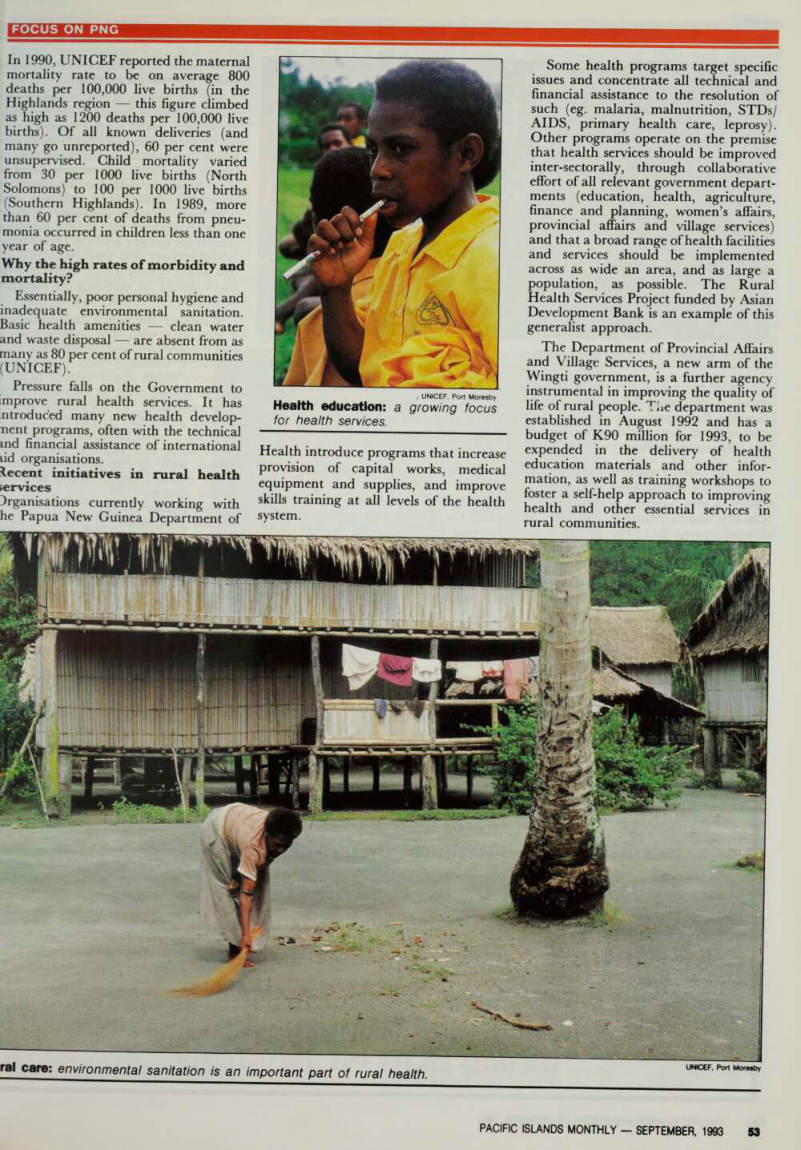
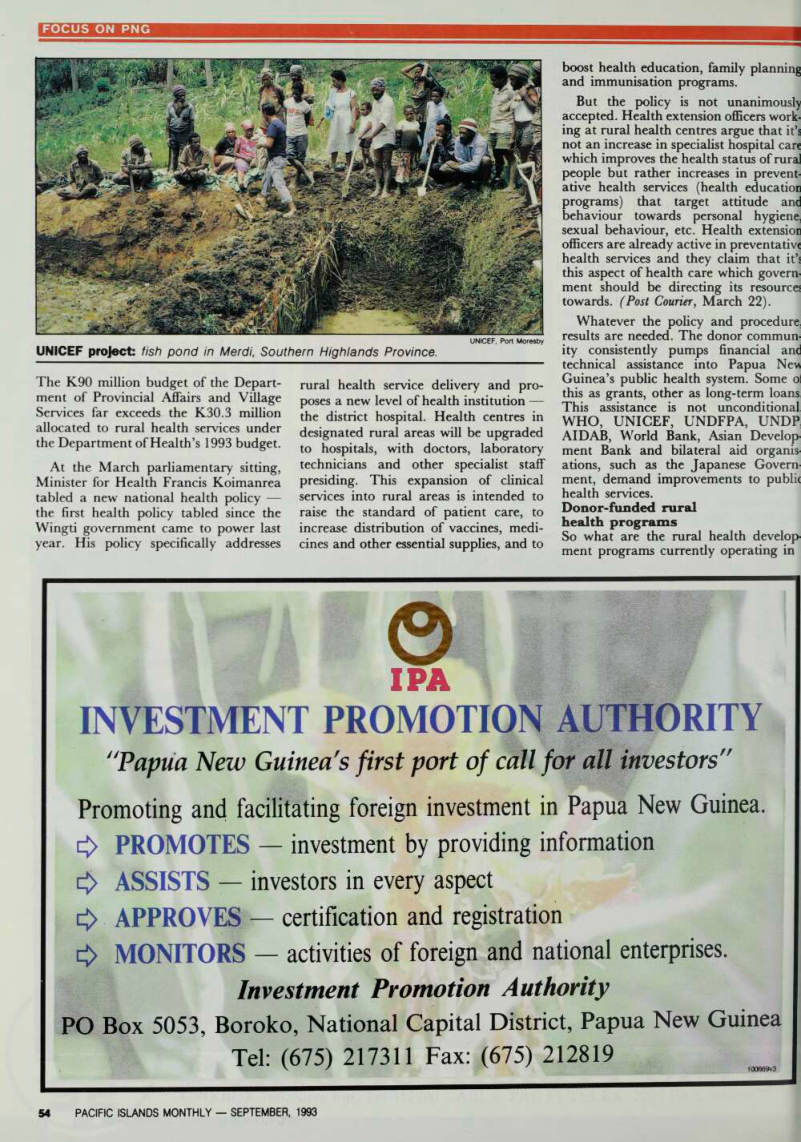
By Jann loms
PAPUA New Guinea’s decentralised public service has always given the lational Department of Health consider ible anguish when it comes to providing i uniform system of health care. Earnest efforts over many decades to provide icalth services to the nation’s 3.9 million >eople have frequently been thwarted by he lack of committed, co-ordinated ictivity at regional, provincial and listrict levels, and also by a perpetual carcity of government resources, leaving dequate and consistent standards of ommunity health care difficult to ch ain.
But bureaucratic difficulties and lack f public sector funding are not the only npediments to health care. Papua New luinea has one of the most rugged ;rrains in the world. Many communities re remote and inaccessible to providers f health services and medical supplies, n fact, 85 per cent of the total
opulation lives rurally. Transportation
lacking. Many people don’t have the leans to reach the nearest aid post or ealth centre (in some cases there isn’t /en a road). Likewise, movement out
from the provin cial health insti tutions and ad ministrations is in
adequate, result
ing in the irregular
provisioning of es sential drugs and supplies to rural clinics. Even if a sick person makes it to the aid post or health centre, there is no guaran tee that the re quired treatment will be available.
In consequence of the bureau cratic, communi cation and trans
portation difficult
ies, Papua New Guinea incurs one of the highest rates of communicable
disease and child and maternal mortality in the world. Malaria, pneumonia and diarrhoeal diseases are the three leading causes of death among children under
five years of age. Infectious diseases, malnutrition, and poor ante-natal and post-natal care are the major causes of death among women.
UNICEF, Pori Moresby
Teaching basics: Puppet shows are used to promote health in remote areas.
UNICEF, Pori Moresby Chlld: hoping for better care.
In 1990, UNICEF reported the maternal mortality rate to be on average 800 deaths per 100,000 live births (in the Highlands region this figure climbed as high as 1200 deaths per 100,000 live births). Of all known deliveries (and many go unreported), 60 per cent were unsupervised. Child mortality varied from 30 per 1000 live births (North Solomons) to 100 per 1000 live births (Southern Highlands). In 1989, more than 60 per cent of deaths from pneu monia occurred in children less than one year of age.
Why the high rates of morbidity and mortality?
Essentially, poor personal hygiene and inadequate environmental sanitation.
Basic health amenities clean water and waste disposal are absent from as many as 80 per cent of rural communities
(Unicef).
Pressure falls on the Government to improve rural health services. It has ntroduced many new health develop nent programs, often with the technical ind financial assistance of international
lid organisations.
decent initiatives in rural health services
Organisations currently working with
he Papua New Guinea Department of
Health introduce programs that increase provision of capital works, medical equipment and supplies, and improve skills training at all levels of the health system.
Some health programs target specific issues and concentrate all technical and financial assistance to the resolution of such (eg. malaria, malnutrition, STDs/ AIDS, primary health care, leprosy).
Other programs operate on the premise that health services should be improved
inter-sectorally, through collaborative
effort of all relevant government depart ments (education, health, agriculture, finance and planning, women’s affairs, provincial affairs and village services) and that a broad range of health facilities and services should be implemented across as wide an area, and as large a population, as possible. The Rural Health Services Project funded by Asian Development Bank is an example of this generalist approach.
The Department of Provincial Affairs and Village Services, a new arm of the Wingti government, is a further agency instrumental in improving the quality of life of rural people. The department was established in August 1992 and has a budget of K9O million for 1993, to be expended in the delivery of health education materials and other infor mation, as well as training workshops to foster a self-help approach to improving health and other essential services in rural communities.
UNICEF, Port Moresby Health education: a growing focus for health services.
[?]ral care: environmental sanitation is an important part of rural health.
UNICEF, Port Moresby
The K9O million budget of the Depart ment of Provincial Affairs and Village Services far exceeds the K 30.3 million allocated to rural health services under the Department of Health’s 1993 budget.
At the March parliamentary sitting, Minister for Health Francis Koimanrea tabled a new national health policy the first health policy tabled since the Wingti government came to power last year. His policy specifically addresses
rural health service delivery and pro poses a new level of health institution the district hospital. Health centres in designated rural areas will be upgraded to hospitals, with doctors, laboratory technicians and other specialist staff presiding. This expansion of clinical services into rural areas is intended to raise the standard of patient care, to increase distribution of vaccines, medi cines and other essential supplies, and to
boost health education, family planning and immunisation programs.
But the policy is not unanimously accepted. Health extension officers work ing at rural health centres argue that it’s not an increase in specialist hospital care which improves the health status of rural people but rather increases in prevent ative health services (health education programs) that target attitude and behaviour towards personal hygiene, sexual behaviour, etc. Health extension officers are already active in preventative health services and they claim that it’s this aspect of health care which govern ment should be directing its resources towards. (Post Courier , March 22).
Whatever the policy and procedure, results are needed. The donor commun ity consistently pumps financial and technical assistance into Papua New Guinea’s public health system. Some oi this as grants, other as long-term loans, This assistance is not unconditional,
Who, Unicef, Undfpa, Undp,
AIDAB, World Bank, Asian Develop ment Bank and bilateral aid organis ations, such as the Japanese Govern ment, demand improvements to public health services.
Donor-funded rural health programs So what are the rural health develop ment programs currently operating in
UNICEF project: fish pond in Merdi, Southern Highlands Province.
UNICEF, Port Moresby
Papua New Guinea? Let’s look at three principal endeavours the World Health Organisation’s Primary Health Care Development Program, Asian De velopment Bank’s Rural Health Services Project and UNICEF’s Co-operative Program for Maternal and Child Health.
WHO’s Primary Health Care
Development Program
Introduced in 1980, it encourages active participation of village people in rural health service delivery. Rural communi ties, so often remote and voiceless, experience considerable deprivation in standards of living and access to central government resources. Under this pro gram, each village undertakes its own money-making activities (cash crops, donations) and utilises its own labour (in a subsistence economy, a valuable re source waiting to be utilised) to establish
basic health services (housing, water tanks, toilets, gardens).
The end result is a self sufficient unit where village members take responsibility for their own basic health care instead of relying on scarce resources of government.
An important ideology of the program is to introduce a ‘bottom up” approach to health planning and manage ment, giving people at the village level responsibility for determining the services that are needed and how they should be implemented. The Village Development Commit tee typically comprises a dozen members, including a village magistrate/counsellor and >ther chosen, respected figures, [t plans and monitors com munity development activities, fhe committees are taught the nathematical principles of lata collection, data analysis
md basic accounting. They are also aught management and organisational kills so that they can develop project dans, project buagets and project moni oring systems. They learn how to indertake household surveys to deter line the priority needs of the members f their community. They brainstorm /ays of raising capital and the most ppropriate types of projects to im lement, given available community ADB’s Rural Health Services Proj- Development Bank is another gnificant player in the race to improve iral health services. Its financial input >r the past decade exceeds US§6O lillion. The Rural Health Services reject commenced in 1982 and dis ursed US$l2 million over six successive x years to upgrade rural health services i Central, Gulf, East Sepik, West Sepik, ladang, Western Highlands and Na
anal Capital District Provinces.
The first loan was succeeded by a cond, the ADB Rural Health Services
Project No 11, costing US$22.B million.
Between 1986 and 1991, the second rural health services project upgraded health facilities and services in tne 14 provinces excluded from development under ADB I. Physical infrastructure (civil works, medical equipment, transport, water supply, sanitation, radio communica tions equipment), health worker training (in-service training, health education training) and improvements to the planning and training sections of the National Department of Health were effected.
In 1992, a third ADB Rural Health Services Project was launched. It plans to spend U 5526.3 million expanding the physical infrastructure and institutional strengthening inputs made under ADB 11, with a major component of the project to be upgrading of rural health centres and staff houses in 13 provinces
(Central, Gulf, Western, East Sepik, New Ireland, Oro, Manus, Madang, Morobe, Western Highlands, Southern Highlands, Eastern Highlands and Enga). ADB 111 also aims to improve the national health information and health research systems and assist in reviewing a financial policy to derive more effective ways of recovering costs from the country’s four base and 19 other provin cial hospitals.
The capital and other inputs of the Rural Health Services Project are im pressive. However, once introduced, how will these improvements be maintained?
The whole process of rural health service delivery stands to become more effective if Village Development Committees are able to determine rural health priorities and steer the course for national and provincial policies on services, supplies, manpower and training.
UNICEF’s Co-operative Program
for Maternal ana Child Health UNICEF’s program operates in much the same way as WHO’s Primary Health Care Development Program, except with
an emphasis on child and maternal health. UNICEF works with people at the village level and is a leading agency in the training of volunteer village birth attendants. principal drive is to reduce child and maternal mortality, A U 552,693,000 four-year Co operative Program was negotiated with the Papua New Guinea Government in 1987 and ran from 1988 to 1992. More than 50 per cent of the program budget was spent on programs concerning im munisation, control of diarrhoea! dis eases and training of village birth attendants.
A second co-operative program has just been signed for U 5510,260,000 (Kl 3
million). The 1993-1997) program
furthers existing work in increasing child immunisation and reducing rates of diarrhoeal diseases, malaria and acute
respiratory infection
(pneumonia). The pro gram also furthers health education and family planning services, and standards of child and maternal nutrition. Most importantly, the pro gram aims to reduce maternal and child mor tality.
UNICEF has a Child Survival and Develop ment Program operating in one province, Southern Highlands.
The CSD program in tensifies immunisation and diarrhoeal disease control activities and also undertakes other health activities like the construction of venti lated smoke-free houses to promote reduction of respiratory infections ana the distribution of
permethrine-impregnated mosquito nets to control malaria.
Other donor initiatives A major Population and Family Plan ning Project is to be introduced this year, involving the Papua New Guinea Gov ernment and joint donors of the World Bank, Asian Development Bank and AIDAB. The US$53 million loan financed project will increase and up grade capital works, training, equip ment, contraceptive supplies, and other aspects of rural health service for the six years, 1993 to 1999. This will be one of the most important development projects for Papua New Guinea, for without rapid reduction of the high birth rate and formidable morbidity statistics, the country is drained of socio-economic benefits gained from mining, agriculture and other income-generating sectors.
The United Nations Family Planning Association (UNFPA) is to grant US$5.5 million this year for a nationwide
Population and Development Program
in support of the US$33 million project. □.
Children: their education is a priority.
UNICEF, Pori Moresby
Advertisements & other items, pp. 52-56 (2 items)
Our Move, Your Gain
-rv
Ports Authority of Fiji while streamlining its operations has simplified the shipping agents work, by arriving at a standard charge for handling cargo in its different modes* of operations; thus the loss acquired by hindrances of bad weather and inefficiencies in stevedoring have been addressed ...
Shipping agents are now protected by the PAF, which takes the sole responsibility of stevedoring by supplying appropriate equipments and a safe manning scale for higher efficiency and lower
stevedoring costs.
Contact Wharf Manager:
LASARUSA TUIMANU Ph 315399
ATAMA BECI Lautoka Ph 662944 D. KOYANASAU Levuka Ph 440189
PORTS AUTHORITY OF FIJI
GPO BOX 780, Suva Fiji, Tel 312700 CABLE: PAF FJ TELEX: 2203 FAX 300064**
0
IPA
INVESTMENT PROMOTION AUTHORITY
"Papua New Guinea's first port of call for all investors"
Promoting and facilitating foreign investment in Papua New Guinea. c> PROMOTES investment by providing information ASSISTS investors in every aspect c> APPROVES certification and registration c£> MONITORS activities of foreign and national enterprises.
Investment Promotion Authority PO Box 5053, Boroko, National Capital District, Papua New Guinea Tel: (675) 217311 Fax: (675) 212819
Gateway to the World
PNG Harbours Board
Wishes to congratulate the Government of Papua New Guinea on its “look North Policy” and acknowledges that we are on hand with 17 ports nationwide to swiftly and safely handle your cargo that the Policy will generate. i «L%r
PORTS
* Aitape * Buka * Kieta * Alotau * Davu * Kimbe * Bialla * Kavieng * Lae * Rabaul * Samarai * Vanimo * Lorengau * Oro Bay * Port Moresby * Wewak.
Head Office: PO Box 671, Ports Moresby Papua New Guinea Ph(675) 211400 Fax (675) 211546 212440
Focus On Png
Culture catches on
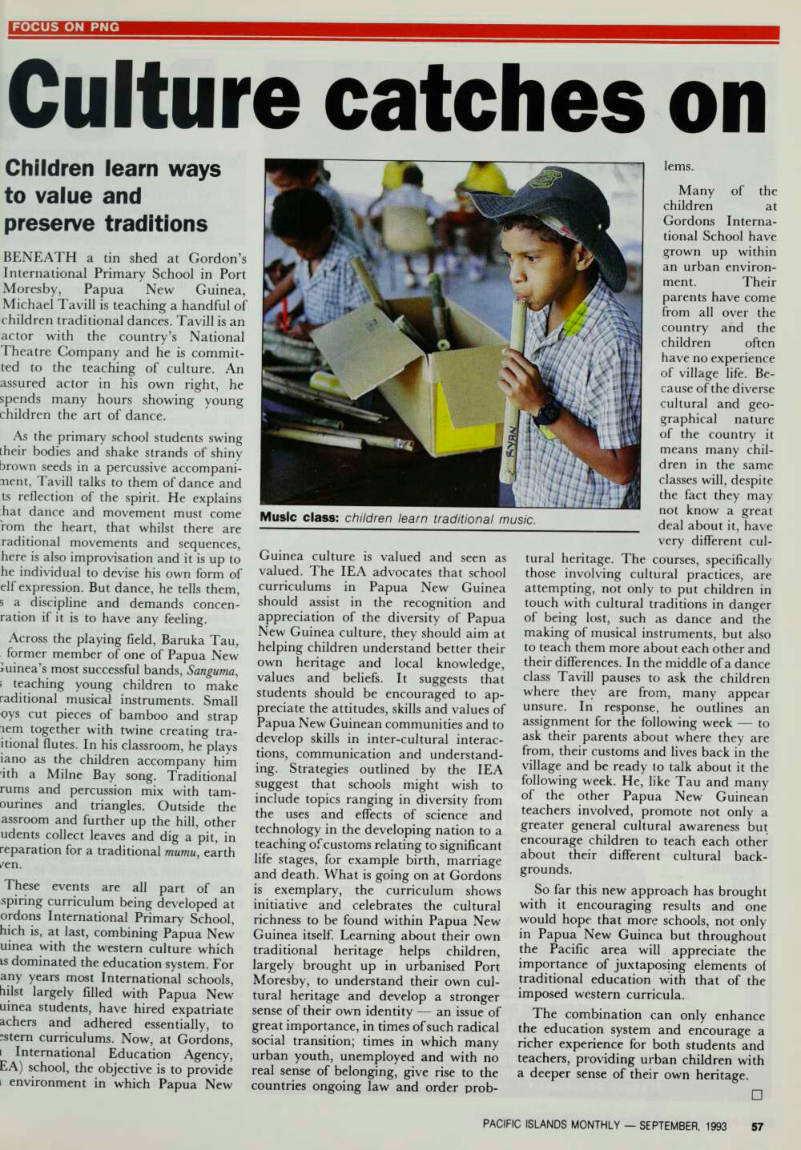
Children learn ways to value and preserve traditions
BENEATH a tin shed at Gordon’s International Primary School in Port
Moresby, Papua New Guinea,
Michael Tavill is teaching a handful of children traditional dances. Tavill is an actor with the country’s National Theatre Company and he is commit ted to the teaching of culture. An assured actor in his own right, he spends many hours showing young children the art of dance.
As the primary school students swing their bodies and shake strands of shiny brown seeds in a percussive accompani ment, Tavill talks to them of dance and ts reflection of the spirit. He explains hat dance and movement must come rom the heart, that whilst there are raditional movements and sequences, here is also improvisation and it is up to he individual to devise his own form of elf expression. But dance, he tells them, s a discipline and demands concern ration if it is to have any feeling.
Across the playing field, Baruka Tau, former member of one of Papua New Guinea’s most successful bands, Sanguma, i teaching young children to make raditional musical instruments. Small oys cut pieces of bamboo and strap lem together with twine creating tra itional flutes. In his classroom, he plays iano as the children accompany him ith a Milne Bay song. Traditional rums and percussion mix with tam ourines and triangles. Outside the assroom and further up the hill, other udents collect leaves and dig a pit, in reparation for a traditional mumu, earth /en.
These events are all part of an
spiring curriculum being developed at
ordons International Primary School, hich is, at last, combining Papua New uinea with the western culture which is dominated the education system. For any years most International schools,
bilst largely filled with Papua New
uinea students, have hired expatriate achers and adhered essentially, to astern curriculums. Now, at Gordons, 1 International Education Agency, EA) school, the objective is to provide i environment in which Papua New
Guinea culture is valued and seen as valued. The lEA advocates that school curriculums in Papua New Guinea should assist in the recognition and appreciation of the diversity of Papua New Guinea culture, they should aim at helping children understand better their own heritage and local knowledge, values and beliefs. It suggests that students should be encouraged to appredate the attitudes, skills and values of Papua New Guinean communities and to develop skills in inter-cultural interactions, communication and understand-
ing. Strategies outlined by the lEA
suggest that schools might wish to include topics ranging in diversity from the uses and effects of science and technology in the developing nation to a teaching of customs relating to significant life stages, for example birth, marriage and death. What is going on at Gordons is exemplary, the curriculum shows initiative and celebrates the cultural richness to be found within Papua New Guinea itself. Learning about their own
traditional heritage helps children,
largely brought up in urbanised Port Moresby, to understand their own cultural heritage and develop a stronger sense of their own identity an issue of great importance, in times of such radical social transition; times in which many urban youth, unemployed and with no real sense of belonging, give rise to the countries ongoing law and order prob
lems.
Many of the children at Gordons Interna tional School have grown up within an urban environ ment. Their parents have come from all over the country and the children often have no experience of village life. Be cause of the diverse cultural and geo graphical nature of the country it means many chil dren in the same classes will, despite the fact they may not know a great deal about it, have very different cul
tural heritage. The courses, specifically those involving cultural practices, are attempting, not only to put children in touch with cultural traditions in danger of being lost, such as dance and the making of musical instruments, but also to teach them more about each other and their differences. In the middle of a dance class Tavill pauses to ask the children where they are from, many appear unsure. In response, he outlines an assignment for the following week to ask their parents about where they are from, their customs and lives back in the village and be ready to talk about it the following week. He, like Tau and many of the other Papua New Guinean teachers involved, promote not only a greater general cultural awareness but encourage children to teach each other about their different cultural back grounds.
So far this new approach has brought with it encouraging results and one would hope that more schools, not only in Papua New Guinea but throughout the Pacific area will appreciate the importance of juxtaposing elements of traditional education with that of the imposed western curricula.
The combination can only enhance the education system and encourage a richer experience for both students and teachers, providing urban children with a deeper sense of their own heritage. n
Music class: children learn traditional music.
Rugby
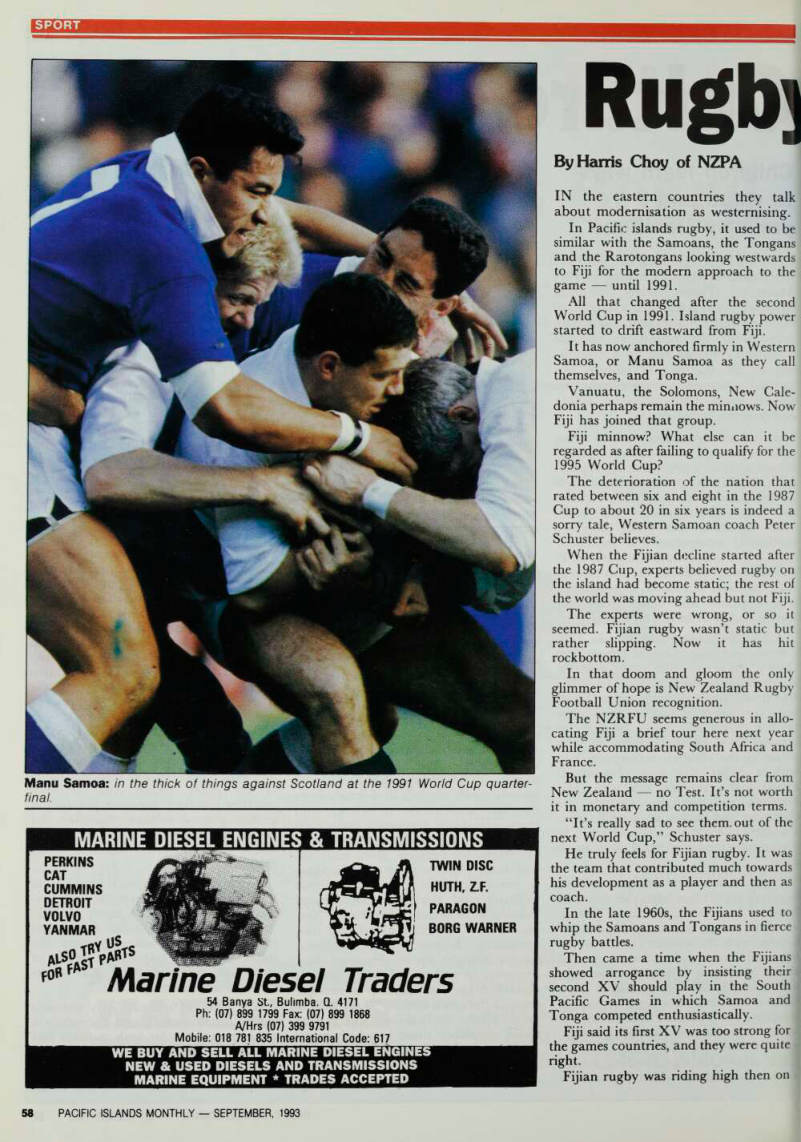
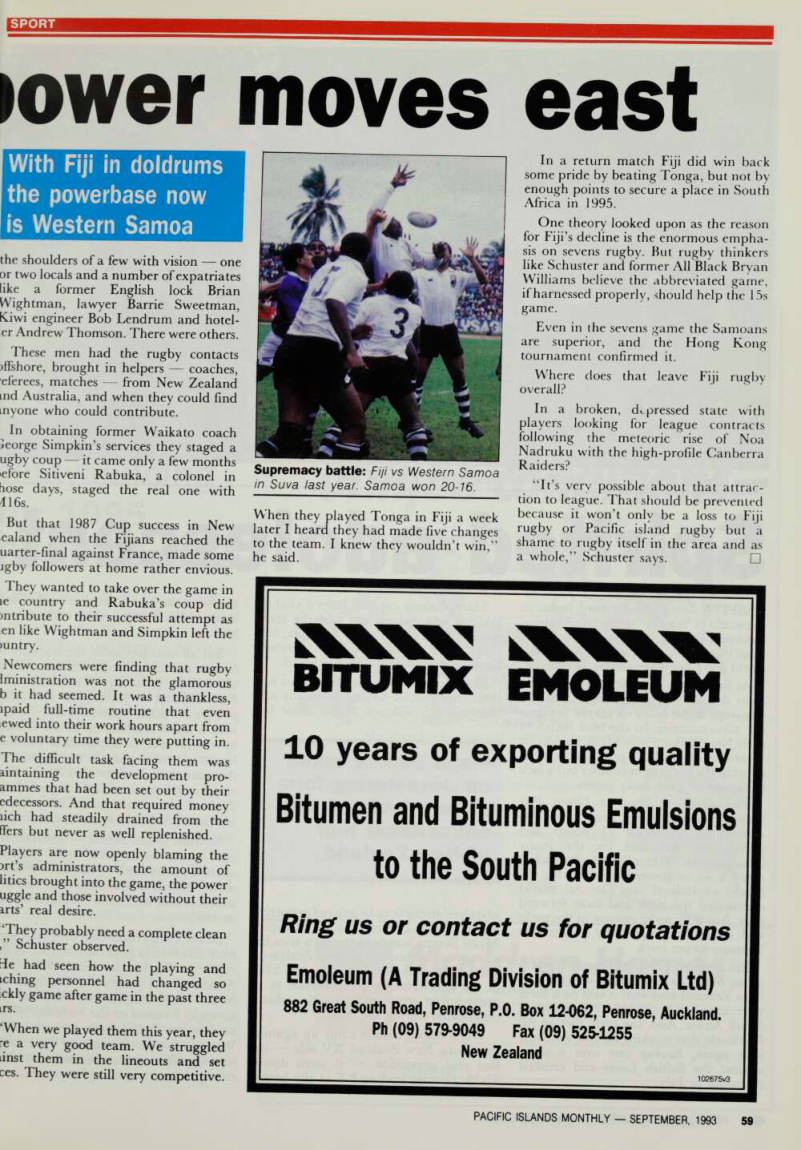
Sport
By Harris Choy of NZPA
IN the eastern countries they talk about modernisation as westernising.
In Pacific islands rugby, it used to be similar with the Samoans, the Tongans and the Rarotongans looking westwards to Fiji for the modern approach to the game until 1991.
All that changed after the second World Cup in 1991. Island rugby power started to drift eastward from Fiji.
It has now anchored firmly in Western Samoa, or Manu Samoa as they call themselves, and Tonga.
Vanuatu, the Solomons, New Cale donia perhaps remain the minnows. Now Fiji has joined that group.
Fiji minnow? What else can it be regarded as after failing to qualify for the 1995 World Cup?
The deterioration of the nation that rated between six and eight in the 1987 Cup to about 20 in six years is indeed a sorry tale, Western Samoan coach Peter Schuster believes.
When the Fijian decline started after the 1987 Cup, experts believed rugby on the island had become static; the rest of the world was moving ahead but not Fiji.
The experts were wrong, or so it seemed. Fijian rugby wasn’t static but rather slipping. Now it has hit rockbottom.
In that doom and gloom the only glimmer of hope is New Zealand Rugby Football Union recognition.
The NZRFU seems generous in allo cating Fiji a brief tour here next year while accommodating South Africa and France.
But the message remains clear from New Zealand no Test. It’s not worth it in monetary and competition terms.
“It’s really sad to see them, out of the next World Cup,” Schuster says.
He truly feels for Fijian rugby. It was the team that contributed much towards his development as a player and then as coach.
In the late 19605, the Fijians used to whip the Samoans and Tongans in fierce
rugby battles.
Then came a time when the Fijians showed arrogance by insisting their second XV should play in the South Pacific Games in which Samoa and Tonga competed enthusiastically.
Fiji said its first XV was too strong for the games countries, and they were quite right.
Fijian rugby was riding high then on
Manu Samoa: In the thick of things against Scotland at the 1991 World Cup quarter final.
With Fiji in doldrums the powerbase now is Western Samoa
the shoulders of a few with vision one or two locals and a number of expatriates like a former English lock Brian
Wightman, lawyer Barrie Sweetman,
Kiwi engineer Bob Lendrum and hotel er Andrew Thomson. There were others.
These men had the rugby contacts iffshore, brought in helpers coaches, eferees, matches from New Zealand ind Australia, and when they could find myone who could contribute.
In obtaining former Waikato coach George Simpkin’s services they staged a ugby coup it came only a few months efore Sitiveni Rabuka, a colonel in hose days, staged the real one with 116 s.
But that 1987 Cup success in New ealand when the Fijians reached the uarter-final against France, made some igby followers at home rather envious.
They wanted to take over the game in le country and Rabuka’s coup did mtribute to their successful attempt as en like Wightman and Simpkin left the >untry.
Newcomers were finding that rugby Iministration was not the glamorous b it had seemed. It was a thankless, ipaid full-time routine that even ewed into their work hours apart from e voluntary time they were putting in.
The difficult task facing them was
aintaining the development pro
ammes that had been set out by their edecessors. And that required money lich had steadily drained from the ffers but never as well replenished.
Players are now openly blaming the art’s administrators, the amount of litics brought into the game, the power uggle and those involved without their arts’ real desire.
They probably need a complete clean Schuster observed. rle had seen how the playing and idling personnel had changed so ckly game after game in the past three .rs.
When we played them this year, they ' e a very good team. We struggled inst them in the lineouts and set ces. They were still very competitive.
When they played Tonga in Fiji a week later I heard they had made five changes to the team. I knew they wouldn’t win,” he said.
In a return match Fiji did win back some pride by beating Tonga, but not by enough points to secure a place in South Africa in 1995.
One theory looked upon as the reason for Fiji’s decline is the enormous empha sis on sevens rugby. But rugby thinkers like Schuster and former All Black Bryan Williams believe the abbreviated game, if harnessed properly, should help the 15s game.
Even in the sevens game the Samoans are superior, and the Hong Kong tournament confirmed it.
Where does that leave Fiji rugby overall?
In a broken, depressed state with players looking for league contracts following the meteoric rise of Noa Nadruku with the high-profile Canberra Raiders?
“It’s very possible about that attrac tion to league. That should be prevented because it won’t only be a loss to Fiji rugby or Pacific island rugby but a shame to rugby itself in the area and as a whole,” Schuster says. □
Supremacy battle: Fiji vs Western Samoa in Suva last year. Samoa won 20-16.
Advertisements & other items, pp. 58-59 (3 items)
Marine Diesel Traders
MARINE DIESEL ENGINES & TRANSMISSIONS
PERKINS
CAT
CUMMINS
DETROIT
VOLVO
YANMAR
Marine Diesel Traders
TWIN DISC
HUTH, Z.F.
PARAGON
BORG WARNER
54 Banya St., Buhmba. Q. 4171 Ph: (07) 899 1799 Fax: (07) 899 1868 A/Hrs (07) 399 9791 Mobile: 018 781 835 International Code: 617 WE BUY AND SELL ALL MARINE DIESEL ENGINES
NEW & USED DIESELS AND TRANSMISSIONS
MARINE EQUIPMENT * TRADES ACCEPTED
tower moves east
59
SPORT
PACIFIC ISLANDS MONTHLY SEPTEMBER, 1993
tower moves east
Bitumix Emoleum
\v\v
10 years of exporting quality
Bitumen and Bituminous Emulsions
to the South Pacific
Ring us or contact us for quotations Emoleum (A Trading Division of Bitumix Ltd) 882 Great South Road, Penrose, P.O. Box 12-062, Penrose, Auckland.
Ph (09) 579-9049 Fax (09) 525-1255 New Zealand 102675v3
Spirited adolescent
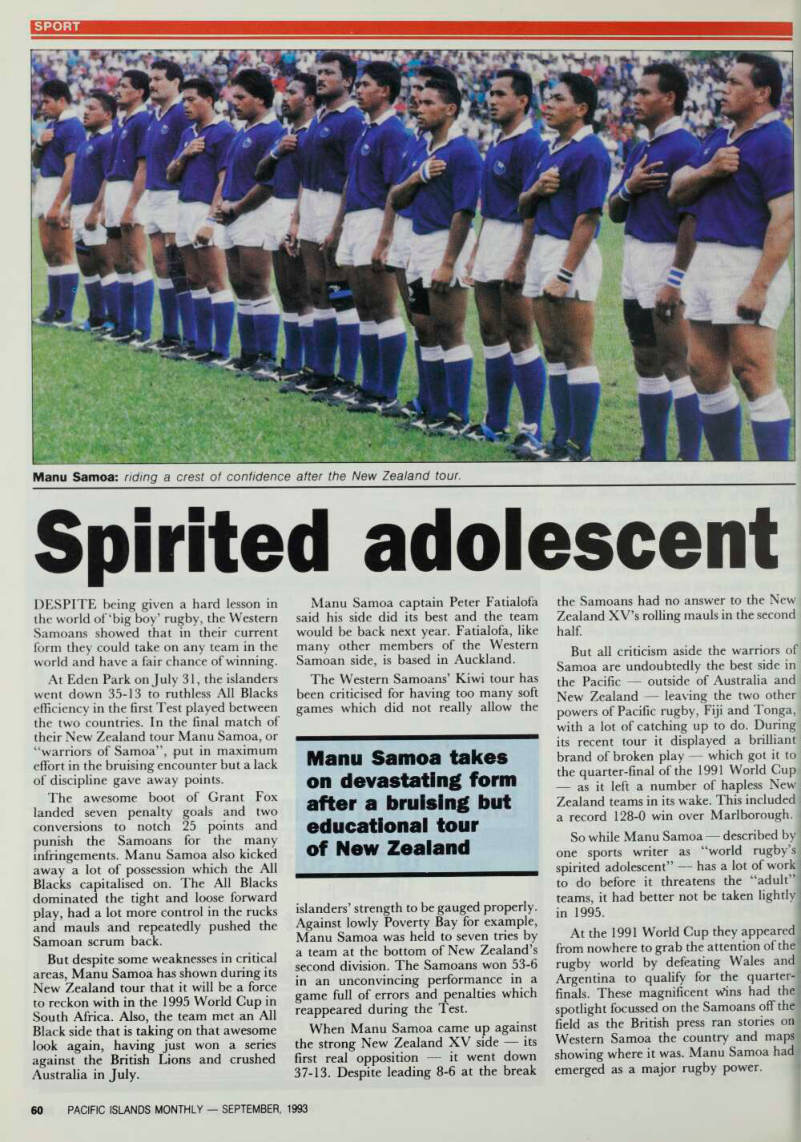
DESPITE being given a hard lesson in the world of‘big boy’ rugby, the Western Samoans showed that in their current form they could take on any team in the world and have a fair chance of winning.
At Eden Park on July 31, the islanders went down 35-13 to ruthless All Blacks efficiency in the first Test played between the two countries. In the final match of their New Zealand tour Manu Samoa, or “warriors of Samoa”, put in maximum effort in the bruising encounter but a lack of discipline gave away points.
The awesome boot of Grant Fox landed seven penalty goals and two conversions to notch 25 points and punish the Samoans for the many infringements. Manu Samoa also kicked away a lot of possession which the All Blacks capitalised on. The All Blacks dominated the tight and loose forward play, had a lot more control in the rucks and mauls and repeatedly pushed the Samoan scrum back.
But despite some weaknesses in critical areas, Manu Samoa has shown during its New Zealand tour that it will be a force to reckon with in the 1995 World Cup in South Africa. Also, the team met an All Black side that is taking on that awesome look again, having just won a series against the British Lions and crushed Australia in July.
Manu Samoa captain Peter Fatialofa said his side did its best and the team would be back next year. Fatialofa, like many other members of the Western Samoan side, is based in Auckland.
The Western Samoans’ Kiwi tour has been criticised for having too many soft games which did not really allow the
Manu Samoa takes on devastating form after a bruising but educational tour of New Zealand
islanders’ strength to be gauged properly.
Against lowly Poverty Bay for example, Manu Samoa was held to seven tries by a team at the bottom of New Zealand’s second division. The Samoans won 53-6 in an unconvincing performance in a game full of errors and penalties which reappeared during the Test.
When Manu Samoa came up against the strong New Zealand XV side its first real opposition it went down 37-13. Despite leading 8-6 at the break
the Samoans had no answer to the New Zealand XV’s rolling mauls in the second half.
But all criticism aside the warriors of Samoa are undoubtedly the best side in the Pacific outside of Australia and New Zealand leaving the two other powers of Pacific rugby, Fiji and Tonga, with a lot of catching up to do. During its recent tour it displayed a brilliant brand of broken play which got it to the quarter-final of the 1991 World Cup as it left a number of hapless New Zealand teams in its wake. This included a record 128-0 win over Marlborough.
So while Manu Samoa described by one sports writer as “world rugby’s spirited adolescent” has a lot of work to do before it threatens the “adult” teams, it had better not be taken lightly I in 1995.
At the 1991 World Cup they appeared from nowhere to grab the attention of the rugby world by defeating Wales and Argentina to qualify for the quarter finals. These magnificent wins had the spotlight focussed on the Samoans off the field as the British press ran stories on Western Samoa the country and maps showing where it was, Manu Samoa had
emerged as a major rugby power.
Manu Samoa: riding a crest of confidence after the New Zealand tour.
Bodybuilding

for 1995 Pacific Games
BODYBUILDING will be contested for he first time at the South Pacific Games n Tahiti in 1995. The sport was recently dopted within the charter of the Games ouncil. In another development, Inter ational Olympic president Juan An 3nio Samaranch has met International ederation of Bodybuilders president Dr en Weider.
Samaranch discussed with Dr Weider le strong possibility of Olympic recog ition for the sport in the near future, he first South Pacific bodybuilding intest will take place in Rarotonga, ook Islands, on September 24 at the ational auditorium. The patron for this 'em is the Ngereteina Puna, Cook lands Minister for Health and Educa an. South Pacific Games chairman apoleon Spitz and Games president *uli Paul Wallwork are both supportive the sport which is regarded as a ;althy pursuit for both young and old.
Meanwhile, the island nations are aring up for the Mini South Pacific mes which will be hosted by Vanuatu December, Participating countries are likely to id in their strongest contingents as part their buildup to the 1995 Tahiti imes.
Pan Pacific’s best: champion Steven Jones with South Pacific federation chief Warren Langman.
Top award: Samaranch (left) receives his award from Welder.
Advertisements & other items, p. 61 (1 item)
Designed for
the Padfic's
unique conditions.
;yv S Maddren have designed a range of homes, especially to suit Pacific conditions. Built in strength from additional ties and bracing, and a wide choice of designs that we are happy to modify to suit individual needs.
These homes may be purchased, kltset shell or complete with construction arranged as required.
Delivery is available throughout the Pacific.
Maddren Homes
P.O. Box 244, Kumeu, New Zealand. Ph (09) 412-9070.
Fax (09) 412-7251. Please mail me your free catalogue.
Name m M 7°*** Address
Toothbrushes
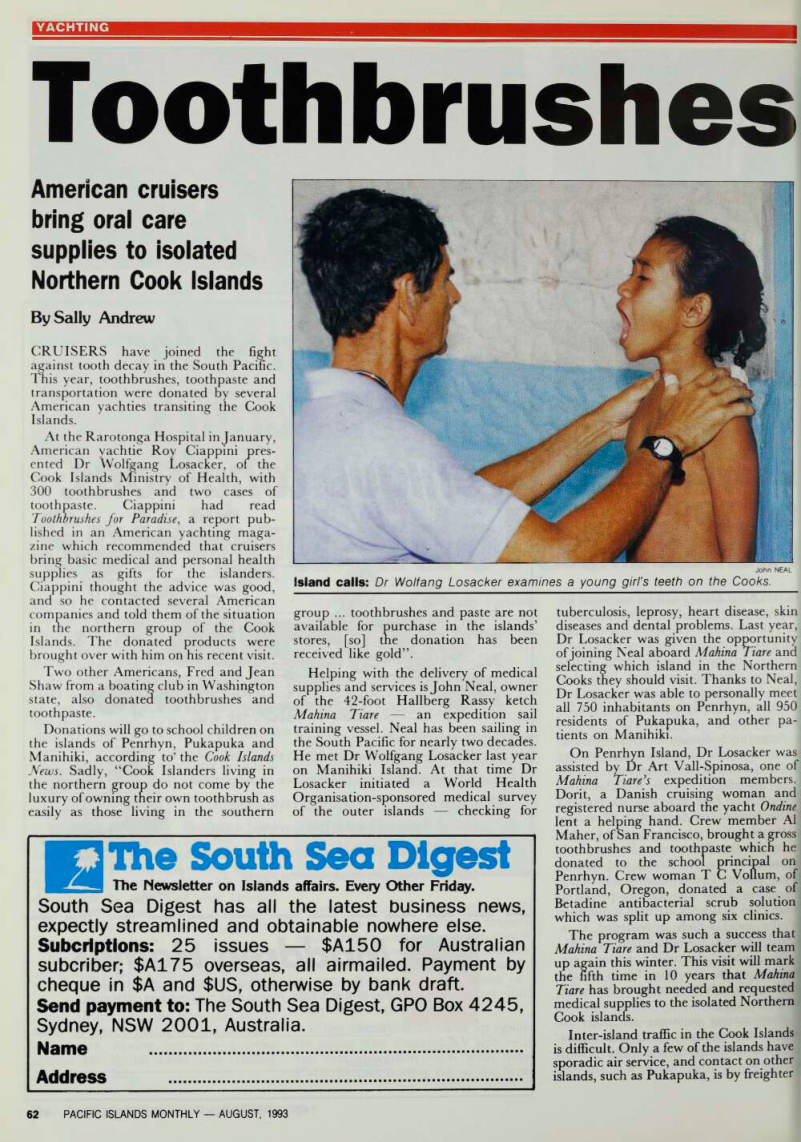
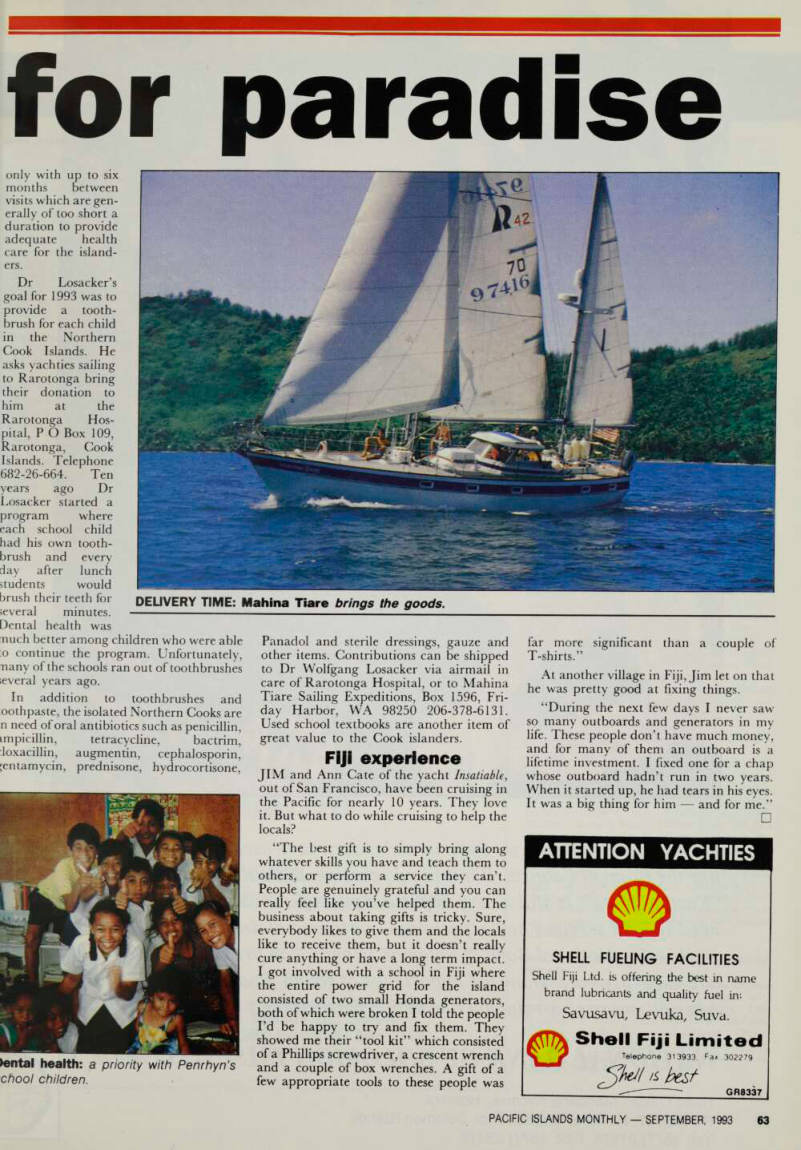
Yachting
American cruisers bring oral care supplies to isolated Northern Cook Islands
By Sally Andrew
CRUISERS have joined the fight against tooth decay in the South Pacific.
This year, toothbrushes, toothpaste and transportation were donated by several American yachties transiting the Cook Islands.
At the Rarotonga Hospital in January, American yachtie Roy Ciappmi pres ented Dr Wolfgang Losacker, of the Cook Islands Ministry of Health, with 300 toothbrushes and two cases of toothpaste. Ciappini had read Toothbrushes for Paradise, a report pub lished in an American yachting maga zine which recommended that cruisers bring basic medical and personal health supplies as gifts for the islanders.
Ciappini thought the advice was good, and so he contacted several American companies and told them of the situation in the northern group of the Cook Islands. The donated products were brought over with him on his recent visit.
Two other Americans, Fred and Jean Shaw from a boating club in Washington state, also donated toothbrushes and
toothpaste.
Donations will go to school children on the islands of Penrhyn, Pukapuka and Manihiki, according to' the Cook Islands News. Sadly, “Cook Islanders living in the northern group do not come by the luxury of owning their own toothbrush as easily as those living in the southern
group ... toothbrushes and paste are not available for purchase in the islands’ stores, [so] the donation has been received like gold”.
Helping with the delivery of medical supplies and services is John Neal, owner of the 42-foot Hallberg Rassy ketch Mahina Tiare an expedition sail training vessel. Neal has been sailing in the South Pacific for nearly two decades.
He met Dr Wolfgang Losacker last year on Manihiki Island. At that time Dr Losacker initiated a World Health Organisation-sponsored medical survey of the outer islands checking for
tuberculosis, leprosy, heart disease, skin diseases and dental problems. Last year, Dr Losacker was given the opportunity of joining Neal aboard Mahina Tiare and selecting which island in the Northern Cooks they should visit. Thanks to Neal, Dr Losacker was able to personally meet all 750 inhabitants on Penrhyn, all 950 residents of Pukapuka, and other pa tients on Manihiki.
On Penrhyn Island, Dr Losacker was assisted by Dr Art Vall-Spinosa, one of Mahina Tiare’s expedition members.
Dorit, a Danish cruising woman and registered nurse aboard the yacht Ondine lent a helping hand. Crew member A 1 Maher, of San Francisco, brought a gross toothbrushes and toothpaste which he donated to the school principal on Penrhyn. Crew woman T C Vollum, of Portland, Oregon, donated a case of Betadine antibacterial scrub solution which was split up among six clinics.
The program was such a success that Mahina Tiare and Dr Losacker will team up again this winter. This visit will mark the fifth time in 10 years that Mahina Tiare has brought needed and requested medical supplies to the isolated Northern Cook islands.
Inter-island traffic in the Cook Islands is difficult. Only a few of the islands have sporadic air service, and contact on other islands, such as Pukapuka, is by freighter
John NEAL
Island calls: Dr Wolfang Losacker examines a young girl’s teeth on the Cooks.
only with up to six months between visits which are gen erally of too short a duration to provide adequate health care for the island ers.
Dr Losacker’s goal for 1993 was to provide a tooth brush for each child in the Northern Cook Islands. He asks yachties sailing to Rarotonga bring their donation to him at the
Rarotonga Hos
pital, P O Box 109, Rarotonga, Cook Islands. Telephone 682-26-664. Ten years ago Dr Losacker started a program where each school child had his own tooth brush and every day after lunch students would brush their teeth for several minutes.
Dental health was
nuch better among children who were able ;o continue the program. Unfortunately, nany of the schools ran out of toothbrushes icveral years ago.
In addition to toothbrushes and oothpaste, the isolated Northern Cooks are n need of oral antibiotics such as penicillin, impicillin, tetracycline, bactrim, loxacillin, augmentin, cephalosporin, fentamycin, prednisone, hydrocortisone,
Panadol and sterile dressings, gauze and other items. Contributions can be shipped to Dr Wolfgang Losacker via airmail in care of Rarotonga Hospital, or to Mahina Tiare Sailing Expeditions, Box 1596, Fri day Harbor, WA 98250 206-378-6131.
Used school textbooks are another item of great value to the Cook islanders.
FIJI experience
JIM and Ann Cate of the yacht Insatiable, out of San Francisco, have been cruising in the Pacific for nearly 10 years. They love it. But what to do while cruising to help the locals?
“The best gift is to simply bring along whatever skills you have and teach them to others, or perform a service they can’t.
People are genuinely grateful and you can really feel like you’ve helped them. The business about taking gifts is tricky. Sure, everybody likes to give them and the locals like to receive them, but it doesn’t really cure anything or have a long term impact.
I got involved with a school in Fiji where the entire power grid for the island consisted of two small Honda generators, both of which were broken I told the people I’d be happy to try and fix them. They showed me their “tool kit” which consisted of a Phillips screwdriver, a crescent wrench and a couple of box wrenches. A gift of a few appropriate tools to these people was
far more significant than a couple of T-shirts.”
At another village in Fiji, Jim let on that he was pretty good at fixing things.
“During the next few days I never saw so many outboards and generators in my life. These people don’t have much money, and for many of them an outboard is a lifetime investment. I fixed one for a chap whose outboard hadn’t run in two years.
When it started up, he had tears in his eyes.
It was a big thing for him and for me.”
[?]Dental health: a priority with Penrhyn’s chool children.
DELIVERY TIME: Mahina Tiare brings the goods.
Advertisements & other items, pp. 62-64 (1 item)
The South Sea Digest
£
The Newsletter on Islands affairs. Eveiy Other Friday.
South Sea Digest has all the latest business news, expectly streamlined and obtainable nowhere else.
Subcriptions: 25 issues SAISO for Australian subcriber; SAI7S overseas, all airmailed. Payment by cheque in $A and SUS, otherwise by bank draft.
Send payment to: The South Sea Digest, GPO Box 4245, Sydney, NSW 2001, Australia.
Name Address
ATTENTION YACHTIES
SHELL FUEUNG FACILITIES
Shell Fiji Ltd. is offering the best in name brand lubricants and quality fuel in: Savusavu, Levuka, Suva. © Shell Fiji Limited Telephone 313933 Fa* 302279 /s best — • GR8337
ak 9 <■> * ' / V X ■f #■ 4 > : & t .: 9 rvx ", -• ■ * For hundreds of years we Solomon Islanders have used traditional money like the examples above. But times do change and although the use of "Kastom Mani" is still a very important part of our culture, at times we need special services and expertise in our financial dealings with a wider world. The National Bank of Solomon Islands can provide such services and expertise - we know the importance of sound financial management.
After all,we are carrying on a tradition centuries old.
NATIONAL BANK OF SOLOMON ISLANDS Limited
Head Office: Mendana Avenue, Honiara PO Box 37, Honiara, Guadalcanal, Solomon Islands Tel: (677)21874 Fax: (677)23478
Shipping
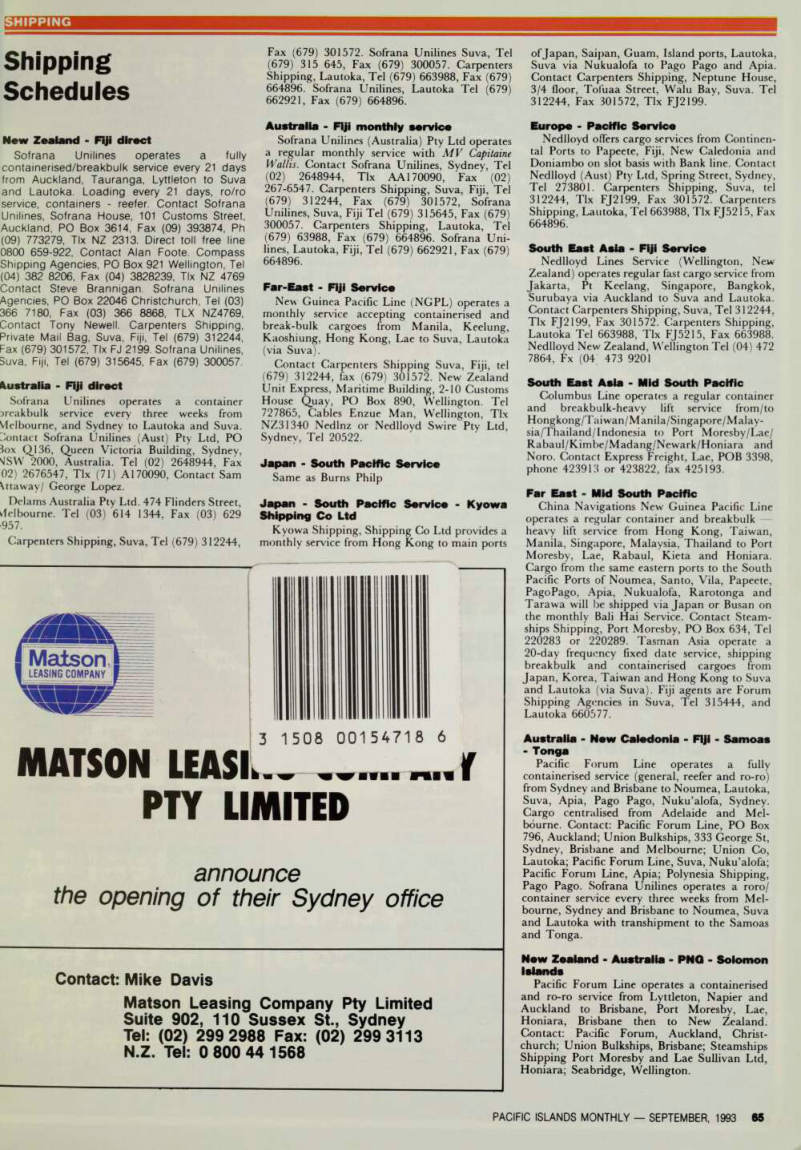
Schedules
New Zealand - Fiji direct Sofrana Unilines operates a fully containerised/breakbulk service every 21 days from Auckland, Tauranga, Lyttleton to Suva and Lautoka. Loading every 21 days, ro/ro service, containers - reefer. Contact Sofrana Unilines, Sofrana House, 101 Customs Street, Auckland, PO Box 3614, Fax (09) 393874, Ph (09) 773279, Tlx NZ 2313. Direct toll free line 0800 659-922, Contact Alan Foote. Compass Shipping Agencies, PO Box 921 Wellington, Tel (04) 382 8206, Fax (04) 3828239, Tlx NZ 4769 Contact Steve Brannigan. Sofrana Unilines Agencies, PO Box 22046 Christchurch, Tel (03) 366 7180, Fax (03) 366 8868, TLX NZ4769, Contact Tony Newell. Carpenters Shipping, Private Mail Bag, Suva, Fiji, Tel (679) 312244, Fax (679) 301572, Tlx FJ 2199. Sofrana Unilines, Suva, Fiji. Tel (679) 315645, Fax (679) 300057.
Australia - Fiji direct Sofrana Unilines operates a container Dreakbulk service every three weeks from Vlelbourne, and Sydney to Lautoka and Suva.
Contact Sofrana Unilines (Aust) Pty Ltd, PO Sox Q 136, Queen Victoria Building, Sydney, VSW 2000, Australia. Tel (02) 2648944, Fax 02) 2676547, Tlx (71) A 170090, Contact Sam Utaway/ George Lopez.
Delams Australia Pty Ltd. 474 Flinders Street, Melbourne. Tel (03) 614 1344, Fax (03) 629 957.
Carpenters Shipping, Suva, Tel (679) 312244,
Fax (679) 301572. Sofrana Unilines Suva, Tel (679) 315 645, Fax (679) 300057. Carpenters Shipping, Lautoka, Tel (679) 663988, Fax (679) 664896. Sofrana Unilines, Lautoka Tel (679) 662921, Fax (679) 664896.
Australia - Fiji monthly service Sofrana Unilines (Australia) Pty Ltd operates a regular monthly service with MV Capilaine Wallis. Contact Sofrana Unilines, Sydney, Tel (02) 2648944, Tlx AA170090, Fax (02)
267-6547. Carpenters Shipping, Suva, Fiji, Tel
(679) 312244, Fax (679) 301572, Sofrana Unilines, Suva, Fiji Tel (679) 315645, Fax (679) 300057. Carpenters Shipping, Lautoka, Tel (679) 63988, Fax (679) 664896. Sofrana Uni lines, Lautoka, Fiji, Tel (679) 662921, Fax (679) 664896.
Far-East - Fiji Service New Guinea Pacific Line (NGPL) operates a monthly service accepting containerised and break-bulk cargoes from Manila, Keelung, Kaoshiung, Hong Kong, Lae to Suva, Lautoka
(via Suva).
Contact Carpenters Shipping Suva, Fiji, tel (679) 312244, fax (679) 301572. New Zealand Unit Express, Maritime Building, 2-10 Customs House Quay, PO Box 890, Wellington. Tel 727865, Cables Enzue Man, Wellington, Tlx NZ31340 Nedlnz or Nedlloyd Swire Pty Ltd, Sydney, Tel 20522.
Japan - South Pacific Service Same as Burns Philp Japan - South Pacific Service - Kyowa Shipping Co Ltd Kyowa Shipping, Shipping Co Ltd provides a monthly service from Hong Kong to main ports
of Japan, Saipan, Guam, Island ports, Lautoka, Suva via Nukualofa to Pago Pago and Apia.
Contact Carpenters Shipping, Neptune House, 3/4 floor, Tofuaa Street, Walu Bay, Suva. Tel 312244, Fax 301572, Tlx FJ2199.
Europe - Pacific Service Nedlloyd offers cargo services from Continen tal Ports to Papeete, Fiji, New Caledonia and Doniambo on slot basis with Bank line. Contact Nedlloyd (Aust) Pty Ltd, Spring Street, Sydney, Tel 273801. Carpenters Shipping, Suva, tel 312244, Tlx FJ2199, Fax 301572. Carpenters Shipping, Lautoka, Tel 663988, Tlx FJ5215, Fax 664896.
South East Asia - Fiji Service Nedlloyd Lines Service (Wellington, New Zealand) operates regular fast cargo service from Jakarta, Pt Keelang, Singapore, Bangkok, Surubaya via Auckland to Suva and Lautoka.
Contact Carpenters Shipping, Suva, Tel 312244, Tlx FJ2199, Fax 301572. Carpenters Shipping, Lautoka Tel 663988, Tlx FJ5215, Fax 663988.
Nedlloyd New Zealand, Wellington Tel (04) 472 7864, Fx (04 473 9201 South East Asia - Mid South Pacific Columbus Line operates a regular container and breakbulk-heavy lift service from/to
Hongkong/Taiwan/Manila/Singapore/Malay
sia/Thailand/Indonesia to Port Moresby/Lae/
Rabaul/Kimbe/Madang/Newark/Honiara and
Noro. Contact Express Freight, Lae, POB 3398, phone 423913 or 423822, fax 425193.
Far East - Mid South Pacific China Navigations New Guinea Pacific Line operates a regular container and breakbulk heavy lift semce from Hong Kong, Taiwan, Manila, Singapore, Malaysia, Thailand to Port Moresby, Lae, Rabaul, Kieta and Honiara.
Cargo from the same eastern ports to the South Pacific Ports of Noumea, Santo, Vila, Papeete,
PagoPago, Apia, Nukualofa, Rarotonga and
Tarawa will be shipped via Japan or Busan on the monthly Bali Hai Service. Contact Steam ships Shipping, Port Moresby, PO Box 634, Tel 220283 or 220289. Tasman Asia operate a 20-day frequency fixed date service, shipping breakbulk and containerised cargoes from Japan, Korea, Taiwan and Hong Kong to Suva and Lautoka (via Suva). Fiji agents are Forum Shipping Agencies in Suva, Tel 315444, and Lautoka 660577.
Australia - New Caledonia - Fiji - Samoas - Tonga Pacific Forum Line operates a fully containerised service (general, reefer and ro-ro) from Sydney and Brisbane to Noumea, Lautoka,
Suva, Apia, Pago Pago, Nuku’alofa, Sydney.
Cargo centralised from Adelaide and Mel bourne. Contact: Pacific Forum Line, PO Box 796, Auckland; Union Bulkships, 333 George St, Sydney, Brisbane and Melbourne; Union Co, Lautoka; Pacific Forum Line, Suva, Nuku’alofa; Pacific Forum Line, Apia; Polynesia Shipping, Pago Pago. Sofrana Unilines operates a roro/ container service every three weeks from Mel bourne, Sydney and Brisbane to Noumea, Suva and Lautoka with transhipment to the Samoas
and Tonga.
New Zealand - Australia - PNQ - Solomon Islands Pacific Forum Line operates a containerised and ro-ro service from Lyttleton, Napier and Auckland to Brisbane, Port Moresby, Lae, Honiara, Brisbane then to New Zealand.
Contact: Pacific Forum, Auckland, Christ church; Union Bulkships, Brisbane; Steamships Shipping Port Moresby and Lae Sullivan Ltd,
Honiara; Seabridge, Wellington.
NZ - Fiji Translink Pacific Shipping Fiji Agents are: Campbells Shipping Agency Ltd, Ph 314189 Fax 300144 Suva; Ph 662231 Fax 662251 Lautoka. Auckland Agents: McKay Shipping Ph (9) 390229 Fax (9) 3032931. Tauranga Agents, seatrade agencies Ph (75) 754989 Fax (75) 758380.
NZ - Fiji - Pago - Apia - Nuk Translink Pacific Shipping operates a monthly sailing with Polynesian Link, which carries Dry Container, reefers and breakbulk cargoes. NZ Agents McKay Shipping Shipping AKLD Ph 390229, Fax 3032931. Fiji Agents Campbells Shipping Agency & ltd Ph 314189 Fax 300144 NZ - Noumea - Wallis - Futuna Translink Pacific Agency operate a container Breakbulk service once a month from NZ through Fiji and Noumea to Wallis & Futuna.
South East Asia - Fiji - Noumea - Papeete - Chile Service “Seaspac’* A joint Chilean CCNI/ CSAU Service offers a regular monthly sailing from Djakarta and Singapore to Noumea, Fiji, Papeete, and Chile. Cargo also federated to Singapore from Korea, Hong Kong, Taiwan, Malaysia, Bang
kok. Fiji Agents: Campbells Shipping Agency Ltd, ph. 314189, Fax 300144.
Australia - Fiji Service Barbican Line operate a monthly container service from Australia to Fiji.
Fiji Agents Campbells Shipping
Agency Ltd Ph 314189 Fax 300144.
Australia - Fiji - Noumea - Vila - Santa Marsmond Express Lines operate a breakbulk service from Goodwood Island Australia to Fiji, Noumea, Vila Santo and Honiara. Continuous receiv ing depots in Sydney and Brisbane enable this vessel to bring cargoes from these parts. Fiji Agents Campbells Shipping Agency Ltd, ph. 314189, Fax 300144. Brisbane Agents Shippings & Marketing Ph (7) 2628082. Sydney Agents Seabord Agencies (2) 3172325.
Australia - New Caledonia - Fiji - Hawaii - North America ACT Pace Pacific (ACTA Shipping) operates a fully containerised/break bulk service every 17-20 from Melbourne, Sydney, Brisbane to Noumea, Suva and Lautoka. The vessels continue on to the West Coast of North America calling Honolulu at frequent intervals. Ships are ACT and ACT 12. Contacts: ACTA Pty
Ltd, Sydney Ph 2869666, Tx 121369, Ex 2869610. ACTA Pty Ltd, Melbourne Ph
6112000, Tx 30949, Fx 6293055. Acta
Pty Ltd, Brisbane Ph 2213116 m Tx 40719, Fx 2298143. SATO, Noumea Ph 281122, Tx 3163, Fx 278532. Burns Philp Shipping, Suva Ph 311777, Tx 2168, Fx 301127; Burns Philp Shipping, Lautoka Ph 660777, Tx 5146, Fx 665850.
West Coast of North America - Fiji - New Zealand Blue Star Line Pacific Coast Service operates a fully containerised/break bulk service every 23 days from Vancouver, Seattle, San Francisco, Los Angeles to Pago Pago, Suva and New Zealand ports. The vessels continue to call Suva on the Northbound voyage from New Zealand every fortnight to pick up Fiji exports such as garments, fresh ginger, etc. for Hawaii and West Coast of North America ports. Blue Star Line also provides a through service to East Coast to North America. Ships are Wellington Star, Southland Star and California Star. South Pacific Inter Line operates a direct service between US/Canada, West Coast, Hawaii, South Pacific islands, Papua New Guinea and Queensland.
Container, refrigerator cargo, break bulk and heavy lift. Contacts: Carpenters Shipping, Suva, Tel (679) 302244, Fx (679) 301572. South Pacific Inter Line Ltd, World Trade Centre, Vancouver BC, Canada, Tel (604) 6411325, Fx (604) 6411395. Blue Star Line, San Francisco Ph 9282026, Tx 184925, Fx 6730355; Blue Star Line, Vancouver Ph 6817300, Tx 0451326, Fx 6835797; Interocean Steamship Corp, Seattle Ph 6829820, Tx 321101, Fx 3437421; Blue Star Line, Los Angeles Ph 5970454, Tx 408564, Fx 5978710. New Zealand Line, Wellington. Ph 739029, Tx 3583, Fx 4992468; New Zealand Line, Auckland Ph 390965, Tx 2556, Fx 3032039; Burns Philp Shipping, Suva Ph 311777, Tx 2168, Fx 301127; Burns Philp Shipping, Lautoka Ph 660777, Tx 5146, Fx 665850.
Japan - South Pacific Service Bali Hai Line a joint service of China Navigation. Mitsui OSK Line and NYK Line operates a fully containerised/break bulk service from Korea, Japan to South Pacific ports on a monthly basis serving ports of Pusan, Kobe, Nagoya, Yoko hama, Tarawa, Lautoka, Suva, Apia, Pago Pago. Papeete, Nuku’alofa, Nou mea, Vila, Santo. The ships are also fully specialised to carry vehicles on ro/ro basis. Ships are Coral Islander and Pacific Islander. Contacts: John Swire & Sons, Tokyo Ph 32309220, Tx 22248, Fx 3239288; Nippon Yusen Kaisha, Tokyo Ph 3284516, Tx 22236, Fx 32846332; Mtsul OSK Lines, Tokyo Ph 35877086, Tx 22266, Fx 35877732; Burns Philp Shipping, Suva (C/Islander) Ph 311777, Tx 2168, Fx 301127; Carpenters Ship ping, Suva (P/Islander) Ph 312244. □
Advertisements & other items, pp. 65-68 (2 items)
Matson Liasl F
Matson
LEASING COMPANY
3 1508 00154718 6
MATSON LIASL f
PTY LIMITED
announce the opening of their Sydney office Contact: Mike Davis Matson Leasing Company Pty Limited Suite 902, 110 Sussex St., Sydney Tel: (02) 299 2988 Fax: (02) 299 3113 N.Z. Tel: 0 800 44 1568
KYOWA
KYOWA
SHIPPING
CO., LTD.
Liner Service
FROM OJAPAN
OKOREA
OTAIWAN
O THAILAND
to Paciffic Islands
OHONG KONG
©SINGAPORE
©PHILIPPINES
©MALAYSIA
©INDONESIA
TO ©SAIPAN
©FEDERATED STATES
OF MICRONESIA
©MARSHAL ISLANDS
©AMERICAN SAMOA
©NEW CALEDONIA
©FIJI
©GUAM
©YAP
©PALAU
©WESTERN SAMOA
©SOLOMON ISLANDS
©VANUATU
©PAPUA NEW GUINEA
HEAD OFFICE
6th Floor Kikushima Bldg 2-3. Hamamalsucho 2-chome Mmalo-ku. Tokyo 105. Japan Phon*: 03(437)2885 (Rep ) Cables: MARIQUEEN Tokyo Tala«. 242-4651 Kyo*a J
OSAKA OFFICE
Dai San Fuji Bldg. 3-13 llachibon 1-chome, Osaka 550 Phona: 06(533)5821 (Rep ) Cable* MARIQUEEN Osaka Tala*: 525-6271 Ssiosa J
cA-AjN c
Solßr
At last: Solomon Islands very own beer.
Taste the difference Solomon Breweries Ltd., PO Box 848, Honiara, Solomon Islands Telephone: (677) 30 257. Telefax: (677) 30 852 Sol Brew KKlwmiU ITO/Hfl StHOMOfi wwte
ta*A*y
f O/
OCT m
MITSUBISHI
* Introducing the All New Mitsubishi Galant — Beautifully Engineered for the Way You Drive Although the new Galant is probably the most handsome new'car on the road, its true beauty lies in its sheer driveability. It’s probably the first car ever that gives you the freedom to drive exactly how you choose. With a sporty, dynamic personality, it has the energy to set your adrenaline flowing when you want to drive for fun. Yet for an effortless drive home at the end of a long day, it has the smoothness and comfort you’d expect in a quality saloon. Quite how you drive the new Galant is entirely up to you.
The key to the new Galant’s versatile performance is All Wheel Control, a unique approach to car design that puts your needs first. It works on the principle that every move a car makes, from accelerating to cornering, depends on how well your aims get passed to the road—and that hinges on all four wheels working as effectively as they can, to direct, manipulate and control. With true communication between you and the road, the new Galant guarantees total control with quicker, safer and more responsive performance than ever before imaginable.
The All Wheel Control vision is brought to reality in the new Galant by some of the most advanced automotive technology ever developed. From the first ever four wheel multi-link suspension system on a front engine, front wheel drive car to some of the world’s most intelligent computer control systems, the Galant boasts breakthroughs that ensure a smooth, responsive drive in any conditions. And with a range of newly developed 1.8-litre SOHC to 2.0-litre V 6 DOHC multi-valve engines, you can count on the power for the freedom to drive as you choose.
Discover the meaning of driving freedom with the new Mitsubishi Galant—and feel how All Wheel Control sets you apart from the crowd.
Mitsubishi Motors and drivers who care—creating
together.
The All New
MITSUBISHI J3HLHNT
A AMERICAN SAMOA; PACIFIC MARKETING INC. RO. Box 698, Pago Pago, Tel. 699-9140 1 AUSTRALIA: MITSUBISHI MOTORS AUSTRALIA LTD. 1284 Soulh Road, Clovelly Park, South Australia, Tel, (08) 2757297 FUI; NIVIS MOTOR & MACHINERY CO. LTD. G.RO. Box 150, Suva, Tel. 383411 / GUAM: TRIPPLE J ENTERPRISES INC. RO. Box 6066, lamuning, Tel. 6469126 1 HEW CALEDONIA; SOCIETE D’IMPORTATION D’AUTO DU PACIFIQUE SUD S.A. PO. Box 2548, Noumea, Tel. 274144 /NEW ZEALAND: MITSUBISHI MOTORS NEW ZEALAND LTD. Private Bag. Porirua, Tel. 237-0109/ NORFOLK ISLAND: BORRY S PTY LTD. RO. Box 169, Tel. 2114 /PAPUA NEW GUINEA: TOBA PTY LTD. PO. Box 503, Port Moresby, Tel. 217874 1 SAIPAN: AUTO MOTION INC. RO. Box 569, SKV Dist. 4, Tel 234 3332 / SOLOMON ISLANDS: HARVEST PACIFIC LTD. G.PO. Box 823, Honiara, fel 30407 /TAHITI (FRENCH POLYNESIA): SOPADEP S.A. RO. Box 1617, Papeete, Tel 427393/ TONGA: SITANI MAPI CO, LTD. RO. Box 83, Nuku'Alofa, Tel 24044 /VANUATU: SOCOMETRA VANUATU LTD. BP 06. Route de Lagon, Port Vila, Tel 2314 /WESTERN SAMOA: MOTOR DISTRIBUTORS (SAMOA) LTD. PO. Box 576, Apia, Tel. 20957
MITSUBISHI
MOTORS
CREATING TOGETH;