Saving the coral
p. 24 · Read in the full issue
Environment
SOUTH Pacific nations are trying to control the exploitation of coral which defends them from the harsh sea and provides atolls with their very foundations. But they are creating a diplomatic row with the Philippines, which is pressing for an international ban on coral Fa 1 he issue was highlighted last month in Tonga, where the Marine Resources Products and Export Company said it would export coral to the United States or medical transplants using certain types of coral to replace human bone.
Company director Siaosi Tuku’aho Kupu told the government’s Tonga Chronicle newspaper he was not concerned about possible environmental damage from harvesting coral, maintaining that very soon all sea creatures would be poisoned or killed by leaking radioactive contaminants from atomic tests. » k Meanwhile, 1 onga could earn money from a resource that may “turn out to be dead soon.” The kingdom’s Fisheries Department promptly banned the export of coral species used in medical transplants, but Kupu still has a licence from the Labour, Commerce and Industries Ministry to export. In Western Samoa, which in the last five years has seen two cyclones inflict dramatic damage to its
reefs, people are illegally taking newly
emerging coral to sell to the growing
world aquarium trade. Western Samoa hosts the South Pacific Regional Environmental Programme (SPREP) headquarters, which last year commissioned the creation of guidelines for coral exploitation. Although the 12-page document has been completed, SPREP W 1 not re^ease 11 i n i ts current form.
Informed sources say the draft document is creating difficulties for member countries, some of which want coral trade banned completely, and others, such as Fiji, who see money to be made in controlled exports. The sources say Manila, not a SPREP member, has been hostile to any attempt to control a trade they want banned outright. Coral reefs in Pof the Philippines have suffered serious local damage from coral harvest- As Manila s efforts to halt the trade have largely failed, Philippine officials now believe it will only stop if the sale of coral is banned internationally. 7 ° ne of the co-authors of the SPREP paper, conservationist Sue Wells, said by telephone from Oxford, England, that ornamental trade m coral for souvenirs was large while demand from medical companies was absolutely tiny”. She sa * d trying to come up with a regime for coral use was incredibly difficult.
“The problem is the scientific basis for stopping or regulating the coral trade is very p00r... Coral reefs are under very
serious threat all over the world at the moment, and the main problems are siltation from soil run-offs, overfishing and pollution. Actual removal is not so muc h of a problem except in the Maldives, where they actually mine the ree f s , removing great chunks of them.”
With a wide variety of buyers, South Pacific nations were worried about what could happen and wanted a strategy.
Pacific people, Wells said, appreciated how much more critical coral reefs were to their survival than other nations, ut settmg U P a complete ban on exporting was scientifically unjustified, especially as coral reefs were regularly destroyed by cyclones she said. The sensible thing would be to control and regulate the trade to allow small amounts t° he taken, Wells said. A lot of countries have simply banned the trade, and Wells said it was probably the easiest . . . lt f PP ° ach to tak J" As th^ re lsn 1 scl^ n " tific data to say how much can be taken / ouhave to gues *, at it and people don t llke domg that - She said one reason for not allowing unregulated exploitation of coral reefs is “that if people think you can go onto a reef and remove coral then they will get the feeling that there are no problems on reefs.” There are very real problems indeed, she said. □
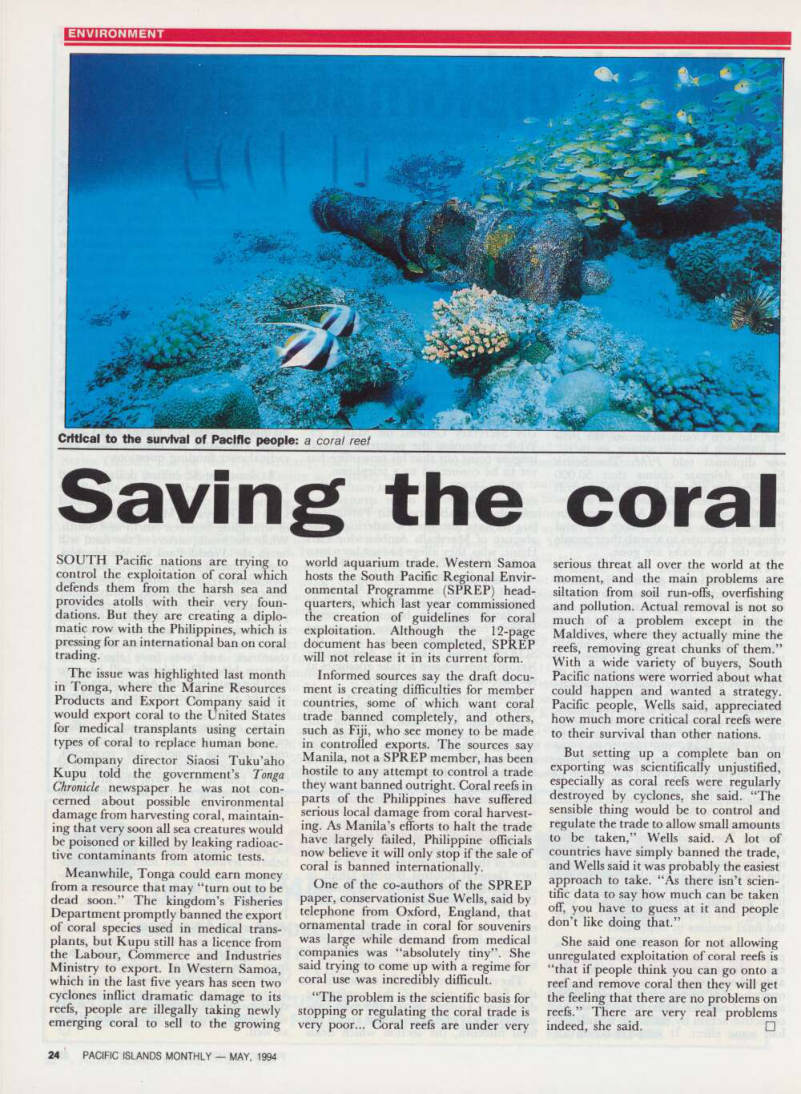
Critical to the survival of Pacific people: a coral reef