so successful
pp. 27-29 · Read in the full issue
Cover Story
Why Mauritius is so successful
By David North
AN ex-British colony, the island nation with its lovely beaches and its lush sugar cane lies 1500 miles south of the equator; the official language is English but many languages are spoken. There are no natural resources other than the soil. It sounds like the Pacific, until you read the economic news. The average per capita income for Mauritius was US$24lO a year in 1991 compared with Tonga’s US$l2BO that year, or PNG’s US$BOO.
Fiji was closer, at US$l93O.
Why is Mauritius so much more prosperous than so many of the roughly comparable island nations in the Pacific?
It is not because a metropolitan power is pumping subsidies into the economy, as France and the US do for their islands (and as Australia does in a more limited way for PNG); Mauritius was a British colony from 1815 to 1968 and has had little in the way of UK assistance since independence. Nor is Mauritius better placed geographically than the Pacific Islands. It is 500 miles or so due east of Madagascar in the middle of the Indian Ocean. It is so isolated that it rarely sees cruise ships, unless one (like the Queen Elizabeth 2) is on a round-the world voyage.
There is no gold or silver, coal or oil, or any other minerals yet the island’s finance minister relayed to PIM that his department was about to announce a 1993 per capita GNP of nearly $3OOO.
Further, if one looked at the island’s population mix, and the languages used, one might worry that so much diversity would be hard on the economy. The largest single group (about 52 per cent) of the population are Indian Hindus, then there are Indian Muslims (17 per cent), the Creoles who are of mixed European and African background (25 per cent), and the rest, mainly of French and Chinese descent. The language patterns relate more to history than to the current presence of a handful of Brits on the island. The British took the island from Napoleon in 1810 to protect its India merchantmen from his Mauritius based privateers. A little later, after the Congress of Vienna had awarded the island to the UK, it decided to introduce English as the official language of the government and the schools, but left fench in place as the dominant lan fuage of commerce, alongwith Creole, a rench-based pidgin. (To complicate
things, the name of the island is based on a Latin variation of the name of a long dead Dutchman, Prince Maurice of Orange; the Dutch held the island for a
while, too.)
Today, English remains the official language, but the newspapers and other media are largely in French, and nearly everyone speaks Creole as well as another language or two. Some of the Indians speak Hindi, the dominant language in the subcontinent, while more speak Bhojpuri, another tongue.
The Prime Minister, Sir Anerood Jugnauth, speaks all five, which is presumably useful at election time. Why is English the official language when there are only a handful of native speakers? “It is equally awkward to
everyone,” explained one Mauritian.
“No single group within the population has a linguuistic advantagge over any other group, so it works.” In the years right after World War II development
experts at the World Bank and elsewhere held Mauritius up as a typical Third World economic basket case. The island was in the middle of nowhere, incomes were low, the island had exactly one export (sugar) and the population was soaring, at three per cent every year.
While Mauritius remains in the middle of the Indian Ocean, everything else has changed. As a result of an intense education programme in the ’sos and ’6os, the rate of population increase has dropped to 0.8 per cent a year (which is just as well, as the population density is 587 per square kilometre, far greater than the highest density in the Pacific, Nauru’s 450 per square kilometre, or
Tonga’s 143, or Fiji’s relatively spacious
41 per square kilometre.) Similarly, for the first time, in 1993, the value added by manufacturing on the island some 5.5 billion rupees (the nation’s currency) Eassed the value of the sugar crop, 5.0 illion rupees. And, the per capita
income has kept climb ing.
What are the new sources of income? Why has the island’s econ omy worked so well?
The Mauritian Estab lishment decided, given its location and its lack of natural resources, that to prosper it had to create a line of products for export that would be valuable enough
(and light enough) to
ship reasonably
inexpensively and so it chose clothes and flowers.
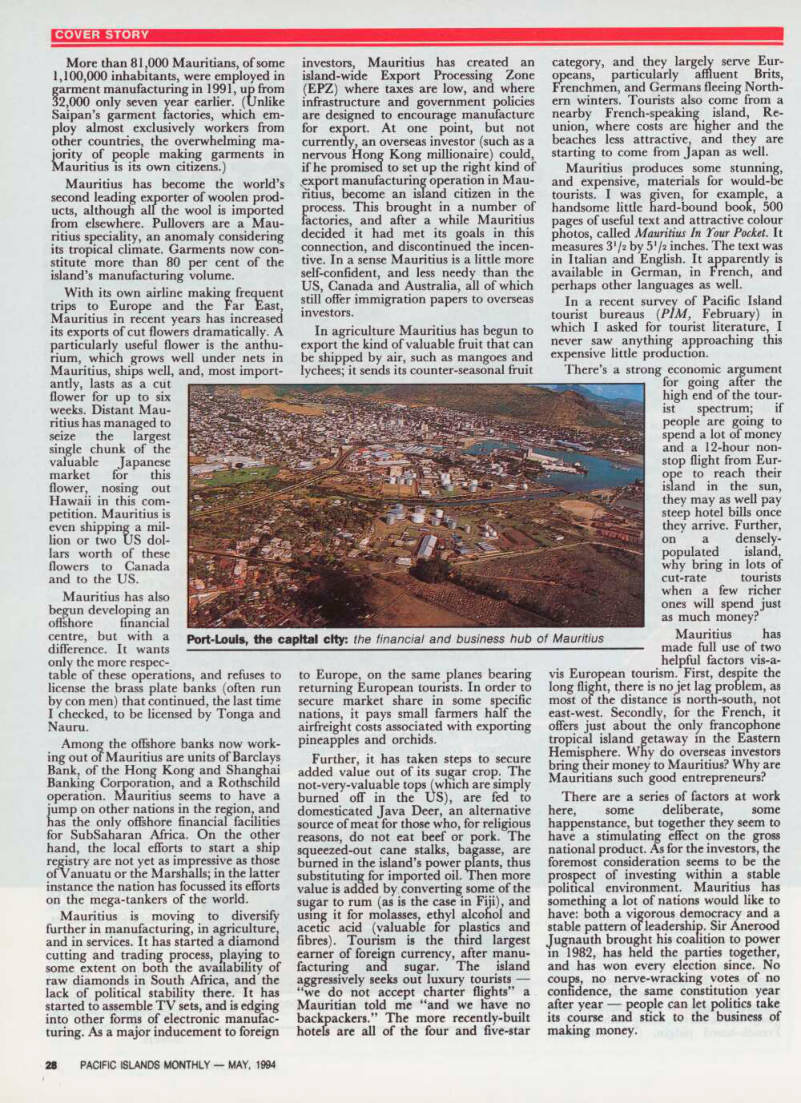
Excellent road network: an important aspect of communi cations
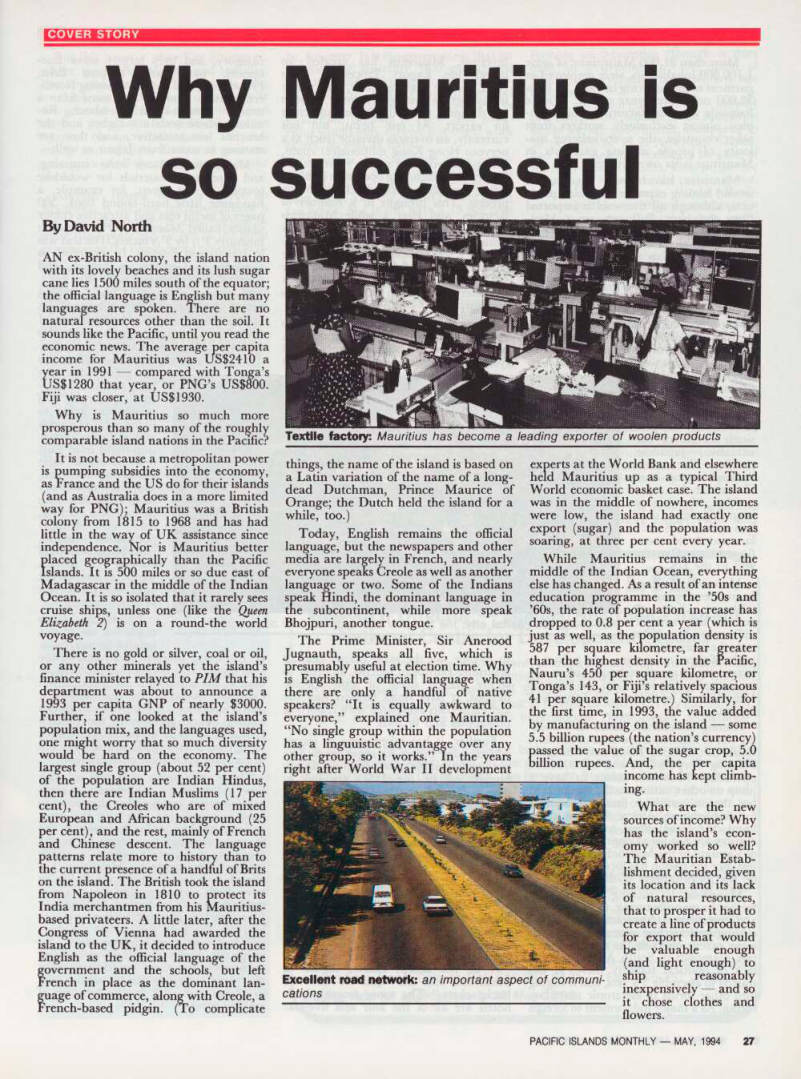
Textile factory: Mauritius has become a leading exporter of woolen products
More than 81,000 Mauritians, of some 1,100,000 inhabitants, were employed in farment manufacturing in 1991, up from 2,000 only seven year earlier. (Unlike Saipan’s garment factories, which em ploy almost exclusively workers from other countries, the overwhelming ma jority of people making garments in Mauritius is its own citizens.) Mauritius has become the world’s second leading exporter of woolen prod ucts, although all the wool is imported from elsewhere. Pullovers are a Mau ritius speciality, an anomaly considering its tropical climate. Garments now con stitute more than 80 per cent of the island’s manufacturing volume.
With its own airline making frequent trips to Europe and the Far East, Mauritius in recent years has increased its exports of cut flowers dramatically. A particularly useful flower is the anthu rium, which grows well under nets in Mauritius, ships well, and, most import
antly, lasts as a cut flower for up to six weeks. Distant Mau ritius has managed to seize the largest single chunk of the valuable Japanese market for this flower, nosing out Hawaii in this com petition. Mauritius is even shipping a mil lion or two US dol lars worth of these flowers to Canada and to the US.
Mauritius has also begun developing an offshore financial centre, but with a difference. It wants only the more respec
table of these operations, and refuses to license the brass plate banks (often run by con men) that continued, the last time I checked, to be licensed by Tonga and Nauru.
Among the offshore banks now work ing out of Mauritius are units of Barclays Bank, of the Hong Kong and Shanghai Banking Corporation, and a Rothschild operation. Mauritius seems to have a jump on other nations in the region, and has the only offshore financial facilities for Sub Saharan Africa. On the other hand, the local efforts to start a ship registry are not yet as impressive as those of Vanuatu or the Marshalls; in the latter instance the nation has focussed its efforts on the mega-tankers of the world.
Mauritius is moving to diversify further in manufacturing, in agriculture, and in services. It has started a diamond
cutting and trading process, playing to
some extent on both the availability of raw diamonds in South Africa, and the lack of political stability there. It has started to assemble TV sets, and is edging into other forms of electronic manufac turing. As a major inducement to foreign
investors, Mauritius has created an island-wide Export Processing Zone (EPZ) where taxes are low, and where infrastructure and government policies are designed to encourage manufacture for export. At one point, but not currently, an overseas investor (such as a nervous Hong Kong millionaire) could, if he promised to set up the right kind of export manufacturing operation in Mau ritius, become an island citizen in the Jirocess. This brought in a number of actories, and after a while Mauritius decided it had met its goals in this connection, and discontinued the incen tive. In a sense Mauritius is a little more self-confident, and less needy than the US, Canada and Australia, all of which still offer immigration papers to overseas investors.
In agriculture Mauritius has begun to export the kind of valuable fruit that can be shipped by air, such as mangoes and lychees; it sends its counter-seasonal fruit
to Europe, on the same planes bearing returning European tourists. In order to secure market share in some specific nations, it pays small farmers half the airfreight costs associated with exporting pineapples and orchids.
Further, it has taken steps to secure added value out of its sugar crop. The not-very-valuable tops (which are simply burned off in the US), are fed to domesticated Java Deer, an alternative source of meat for those who, for religious reasons, do not eat beef or pork. The squeezed-out cane stalks, bagasse, are burned in the island’s power plants, thus substituting for imported oil. Then more value is added by converting some of the sugar to rum (as is the case in Fiji), and using it for molasses, ethyl alcohol and acetic acid (valuable for plastics and fibres). Tourism is the third largest earner of foreign currency, after manu facturing and sugar. The island aggressively seeks out luxury tourists “we do not accept charter flights” a Mauritian told me “and we have no backpackers,” The more recently-built hotels are all of the four and five-star
category, and they largely serve Eur opeans, particularly affluent Brits, Frenchmen, and Germans fleeing North ern winters. Tourists also come from a nearby French-speaking island, Re union, where costs are higher and the beaches less attractive, and they are starting to come from Japan as well.
Mauritius produces some stunning, and expensive, materials for would-be tourists. I was given, for example, a handsome little hard-bound book, 500 pages of useful text and attractive colour photos, called Mauritius In Tour Pocket. It measures 3 1 / 2 by 5 1 / 2 inches. The text was in Italian and English. It apparently is available in German, in French, and perhaps other languages as well.
In a recent survey of Pacific Island tourist bureaus ( PIM, February) in which I asked for tourist literature, I never saw anything approaching this
expensive little production.
There’s a strong economic argument
for going after the high end of the tour ist spectrum; if people are going to spend a lot of money and a 12-hour non stop flight from Eur ope to reach their island in the sun, they may as well pay steep hotel bills once they arrive. Further, on a densely
populated island,
why bring in lots of cut-rate tourists when a few richer
ones will spend just
as much money?
Mauritius has made full use of two helpful factors vis-a
vis European tourism. First, despite the long flight, there is no jet lag problem, as most of the distance is north-south, not east-west. Secondly, for the French, it offers just about the only francophone tropical island getaway in the Eastern Hemisphere. Why do overseas investors bring their money to Mauritius? Why are Mauritians such good entrepreneurs?
There are a series of factors at work here, some deliberate, some happenstance, but together they seem to have a stimulating effect on the gross national product. As for the investors, the foremost consideration seems to be the prospect of investing within a stable political environment. Mauritius has something a lot of nations would like to have; both a vigorous democracy and a stable pattern of leadership. Sir Anerood Jugnauth brought his coalition to power in 1982, has held the parties together, and has won every election since. No coups, no nerve-wracking votes of no confidence, the same constitution year after year people can let politics take its course and stick to the business of
making money.
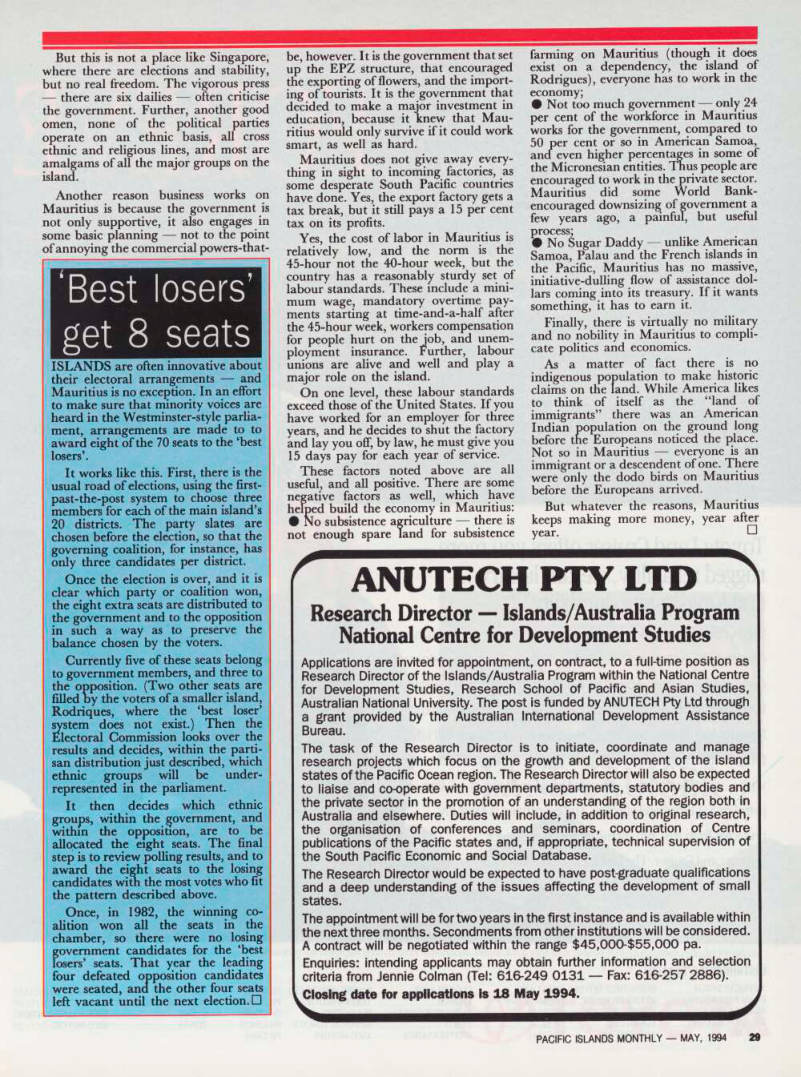
Port-Louls, the capital city: the financial and business hub of Mauritius
But this is not a place like Singapore, where there are elections and stability, but no real freedom. The vigorous press there are six dailies often criticise the government. Further, another good omen, none of the political parties operate on an ethnic basis, all cross ethnic and religious lines, and most are amalgams of all the major groups on the island.
Another reason business works on Mauritius is because the government is not only supportive, it also engages in some basic planning not to the point of annoying the commercial powers-that
be, however. It is the government that set up the EPZ structure, that encouraged the exporting of flowers, and the import ing of tourists. It is the government that decided to make a major investment in education, because it knew that Mau ritius would only survive if it could work smart, as well as hard.
Mauritius does not give away every thing in sight to incoming factories, as some desperate South Pacific countries have done. Yes, the export factory gets a tax break, but it still pays a 15 per cent tax on its profits.
Yes, the cost of labor in Mauritius is relatively low, and the norm is the 45-hour not the 40-hour week, but the country has a reasonably sturdy set of labour standards. These include a mini mum wage, mandatory overtime pay ments starting at time-and-a-half after the 45-hour week, workers compensation for people hurt on the Job, and unem ployment insurance. Further, labour unions are alive and well and play a major role on the island.
On one level, these labour standards exceed those of the United States. If you have worked for an employer for three years, and he decides to shut the factory and lay you off, by law, he must give you 15 days pay for each year of service.
These factors noted above are all useful, and all positive. There are some negative factors as well, which have helped build the economy in Mauritius: • No subsistence agriculture there is not enough spare land for subsistence
farming on Mauritius (though it does exist on a dependency, the island of Rodrigues), everyone has to work in the economy; Not too much government only 24 per cent of the workforce in Mauritius works for the government, compared to 50 per cent or so in American Samoa, and even higher percentages in some of the Micronesian entities. Thus people are encouraged to work in the private sector.
Mauritius did some World Bank encouraged downsizing of government a few years ago, a painful, but useful process; • No Sugar Daddy unlike American Samoa, Palau and the French islands in the Pacific, Mauritius has no massive, initiative-dulling flow of assistance dol lars coming into its treasury. If it wants something, it has to earn it.
Finally, there is virtually no military and no nobility in Mauritius to compli cate politics and economics.
As a matter of fact there is no indigenous population to make historic claims on the land. While America likes to think of itself as the “land of immigrants” there was an American Indian population on the ground long before the Europeans noticed the place.
Not so in Mauritius everyone is an immigrant or a descendent of one. There were only the dodo birds on Mauritius before the Europeans arrived.
But whatever the reasons, Mauritius keeps making more money, year after year. D