pharmaceutical intermediates
pp. 31-32 · Read in the full issue

innovative developments in pharmaceutical intermediates
THE problem of producing
increasingly complex,
biologically active mol ecules, according to a spokes man for Zeneca Fine Chemi
cals (1) (formerly ICI), has
created a market oppor tunity for fine chemical com panies with the right infra structure and expertise. As an alternative to in-house
development, a partnership
between a fine chemicals company and a pharmaceut ical firm can enable a joint approach to be taken to solving the problems of de
veloping and manufacturing
increasingly complex mol
ecules using faster develop
ment processes.
Chiral manufacturing is one of the fastest growing
fields of industrial chemistry. Pharma ceutical and agricultural companies are switching from traditional synthesis which gives 50-50 mixtures of mirror image molecules, and making instead the pure isomer that works best as a drug.
Almost all biological processes are chiral.
A living cell normally responds to only one isomer, just as a glove is designed to fit on either the right or left hand.
Critical Distinction Producers of flavours and fragrances have long known that the distinction between mirror images is critical, for example R-limonene smells of orange and its mirror image, S-limonene, smells of lemon. Yet most of today’s best-selling drugs are made and sold as a mixture of two isomers. Often one is active and the other is neutral.
Occasionally the unwanted isomer can cause harmful side effects. The most tragic effect was thalidomide one isomer was a tranquiliser and as scientists discovered too late the other produced birth defects. Chemists have distinguished between chiral isomers since the last century, but techniques are only now becoming available to apply the knowledge on a large scale and the
industry is being encouraged to develop
new drugs as single somers.
Some companies are preparing to relaunch established drugs as one isomer.
For instance, Boots of the UK is to make pure left-handed S-ibuprofen, the active form of the painkiller ibuprofen, which is now produced as a mixture with inactive
R-ibuprofen.
Potential Targets
Switching to a single isomer can rejuvenate the commercial life of an old drug, says Andy Richards, commercial director of Chiros Ltd, a Cambridge company specialising in chiral chemistry.
He estimates that 50 to 80 drugs now approaching the end of their patent protection are good potential targets for a switch. The cost of developing a single isomer from a mixture ranges from £l.4m to /(10m.
Chiros was established in January 1992 from the chiral division of Enzymatix Ltd in Cambridge.
Enzymatix had been operating its chiral division since 1988 and had built up a considerable technology base with over 20 patent applications covering a wide range of novel, chiral compounds.
The aim of Chiros is to focus on the discovery and development of complex chiral pharmaceuticals and to develop processes for manufacturer of new chiral
(optically pure) drugs. These new drugs
could arise from the development of new chemical entities (NCEs) or by the replacement of existing racemic (mixed isomer) drugs with single stereoisomers
(enant iomers) racemic switches.
Significant Lead
Chiros is gradually building up data to create two unique computerised data bases of separation techniques. One has details of the charac teristics of a substan tial number of bio catalysts, the other holds data on all chemical catalysts.
Together they give the company a sig nificant lead in
identifying manufac
turing routes in a short space of time.
A typical develop
ment time is three months to a year, but Chiros has been known to supply to one client, within just seven weeks of initial discussions, a 20kg sample of 99% enantiomeric excess using a new process.
The company also has several contracts for racemic switching; the homochiral version carries its own patents.
Chiros has facilities to carry out biotransformations on multi-kilogram and tonne scales. Complex procedures can be carried out under computer controls in sophisticated equipment.
More robust procedures are carried out in simple chemical reactors, easily scaled up.
Chiral Auxiliaries Oxford Asymmetry Ltd, a new com pany, focuses on chemical methods of chiral synthesis, rather than enzymatic or biological techniques. Research director Steve Davis, who also heads the univer sity research group that developed the technology, has developed an ingenious series of small molecules (which he calls chiral auxiliaries) for use in building up chiral compounds “like a piece of molecular scaffolding”. New chiral auxiliaries are reducing the cost of production of many homochiral com pounds, enhancing their viability as intermediates for pharmaceuticals and other products.
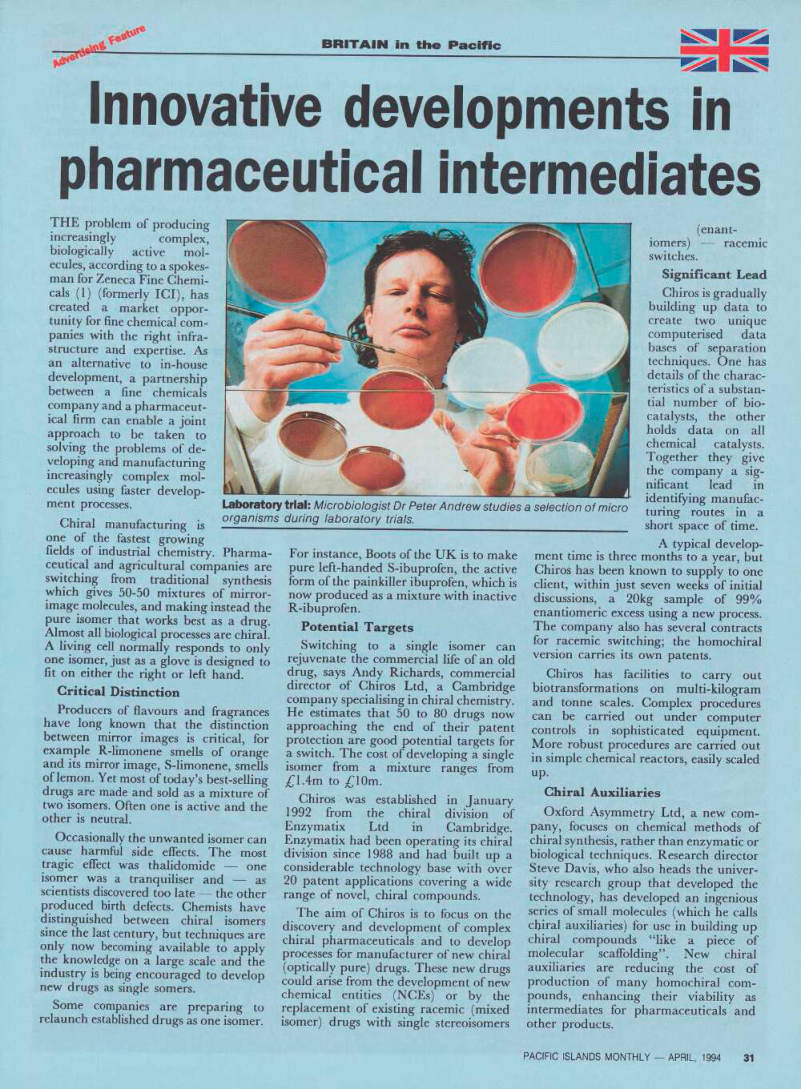
Laboratory trial: Microbiologist Dr Peter Andrew studies a selection of micro organisms during laboratory trials.
Chiral intermediates, auxiliaries (eg Evans Oxazoldinone and Oppolzer’s Sultans) and reagents (eg Davis Oxaziridines) are available in quantities from grammes to kilograms, often from stock. A catalogue detailing over 200 homochiral compounds is available. The company says that its unique combin ation of asymmetric synthesis expertise and continuing links with the leading academic and industrial research centres enables it to provide rapid development and enhancement of synthesis routes.
The Zeneca Fine Chemicals move into chiral intermediates is founded on the integration of its core business of fermentation technology and chemical synthesis. This provides the company with the capability to scale up a number of core processes such as stereo-selective dehalogenation, ketone reductions, bio expoxidations and ester resolutions to provide a wide range of chiral intermedi ates.
Development Pipeline Natural enzymes are a favourite tool of chiral synthesis because they distinguish between mirror images. For example, the company has identified 20 to 30 enzymes that could be used to reduce ketones to chiral alcohols an important step in pharmaceutical synthesis. The ability of fine chemical companies to operate at all levels, from laboratory to full-scale pro duction is essential for organisations operating at the high resource end of the
fine chemicals market and for the pharmaceutical industry searching for '‘fast track” products through the devel
opment pipeline.
Zeneca Fine Chemicals was formed to develop the chiral and fluoroaromatic sectors of Zeneca within a small respon sive organisation culture that has a big organisation resource pool with the essential ability to operate from labora tory through development to full scale operation. Its synthesis services were completed by the acquisition of Cam bridge Research Biochemicals in 1991, providing the ability to produce small scale radiolabelled chiral and fluoromatic compounds and bulk pep tides, all increasingly important chiral products for new life science products.
The addition of a world-scale plant at
Grangemouth, Scotland, producing
fluorobenzene and its derivatives by a process based on continuous HF diazotisation and the operation of KF exchange processes, enables Zeneca to produce a range of commercial fluoromatic products including fluorobenzene, 1,3-difluorobenzene, o and p-fluoroaniline, o- and
p-fluoropnenol, 3-chloro-4-fluoroaniline
and 2,4-difluoroaniline.
Raw Materials An outstanding example of innovation is the development by Allied Colloids Ltd of a Fine Chemicals Division from what was originally a business established in
1935 to service the local textile industry.
Now a business with a Fs63B million per year (£3oom) turnover and employing 2500 people worldwide, Allied Colloids has developed a range of pharmaceutical intermediates using expertise in Michael addition reactions and Hofmann degra dations, manufacturing the key raw materials, acrylamide and acrylic acid,
from acrylonitrile.
In 1992 Allied Colloids opened at Bradford, northern England, a £3. 5m fine-Chemicals facility, the first stage of a ESIO.6m (£sm) facility to be com pleted in April 1993, built to state-of-the art design incorporating Best Available
Technique (BATO.
Migraine Treatment
These are intermediates for the syn thesis of the antibiotics Cefbuperazone, Piperacillin; for the synthesis of Ambenonium chloride, Procainamide and Metocopramide, the last named product being widely used an an anti emetic and in the treatment of migraine; and in the synthesis of the psychotropic, antidepressant drug Minaprine.
The diversity of reactions reported for the substituted enthylene diamines indi cates the scope for using this family of products for the synthesis of novel compounds. In addition, the synthesis of
nitrogen-containing heterocycles from
the substituted ethylene diamines is widely reported in the literature and thus opens up many significant possibilities to develop the product range. □