The commercial arm
p. 33 · Read in the full issue
THE nations of the South Pacific rely largely on traditional agricultural indus try and overseas aid to survive and develop. But commodity prices have reached all-time lows, while aid budgets, official investment and trade support are all being cut in real terms, and flows of private capital and finance have become concentrated on major market areas.
Pacific governments have, therefore, had to turn to multilateral and bilateral finance institutions for investment sup port in their developing economies.
Commonwealth Development Corpor
ation (CDC), the United Kingdom’s overseas development finance institution, is one such organisation.
Charged with the task of assisting overseas countries in the development of their economies, CDC is the commercial arm of British aid. Its role in the economic development of the Pacific islands is particularly vital. Many foreign commercial banks are wary of lending in small-scale island projects, and insti tutional investors are not keen to enter new developing country markets; multi national companies suffer from cash shortage and local businesses are ham pered by weaknesses in domestic financial systems. The result is obvious:
potentially profitable and development
ally sound investments remain unrealised.
CDC works to remedy these short comings, together with local and foreign investors, multilateral development fi nance institutions, and other bilateral institutions. Many successful projects have been undertaken by CDC in the Pacific and its portfolio, standing at Fs27o million (£127 million) at the beginning of 1994, is growing.
CDC’s Pacific office is located in Papua New Guinea, and it is there that its most extensive contributions to devel opment of the region have been made. In a country where most international attention inevitably focuses on mining, petroleum and logging, CDC’s partici pation in the sustainable development of more traditionally based ventures has enabled PNG to secure several loans from other European development fi nance institutions.
CDC has a portfolio of nine major active projects m PNG representing a total investment of FslBs million (£B7 million), and others under investigation.
Private sector projects cover textiles, transport, agriculture, tourism, property and venture capital funds. A substantial amount is devoted to the agricultural sector, where low commodity prices cause trading losses and problems with loan repayments. However, projects with CDC investment, lending and corporate
management have survived 1993 where others face bankruptcy. Higaturu Oil Palms Pty Ltd, established on a 50/50 basis by CDC and the PNG government in 1976, is an operation of approximately 5500 hectares of estate oil palm, 6500 hectares of smallholder plantings, a 60 tonne per hour oil palm processing facility, and over 1000 hectares of cocoa.
Had the project failed, 2400 employees would have been laid off ana 1800 smallholders would have lost their liveli hood.
Similarly, Milne Bay Estates Pty Ltd was commissioned in 1985 to develop an initial 3700 hectares of oil palm (now 5400 hectares) and a 33 tonne per hour processing factory together with a 750 hectare cocoa estate and associated
fermentary. Shares are held by CDC (60 per cent) and the PNG government (40 per cent). CDC has also provided loan finance, has organised on-lending funds to be borrowed from the World Bank by the government, and has recently ar ranged price support finance.
PNG also boasts Ramu Sugar Hold ings Ltd managed by Booker Tate and partly financed by CDC. Originally designed to achieve PNG self-sufficiency in sugar, the company has achieved this goal while also extending its sales into the export market. CDC currently holds 26 per cent of the equity capital, and has provided debt facilities of F 511.7 million (£5.5 million) enabling the company to overcome problems caused by previously unidentified insects and drought. □
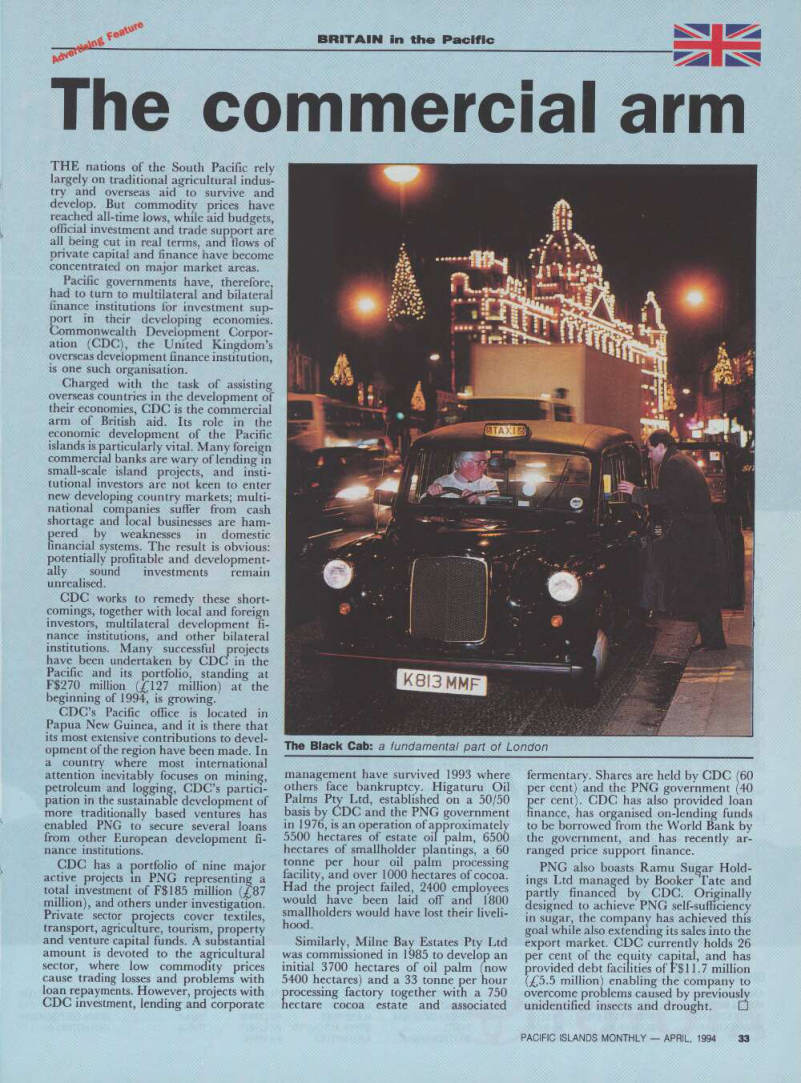
The Black Cab: a fundamental part of London