Growing
pp. 29-30 · Read in the full issue
importance of telecom sector
THE UK government’s laissez-faire in dustrial policy has had a profound effect of stimulating innovation. Telecom munications has benefited in particular, since the government replaced British Telecom’s monopoly with a duopoly as a result of Mercury Communications (now a wholly-owned subsidiary of Cable & Wireless) receiving a public telecommunications licence.
The market stimulation of competition between the two cellular telephone operators (Cellnst and Vodafone) re sulted in massive growth in this sector and also paved the way for developments in Telepoint and Personal Communica tions Networks (PCNs). The situation was further enhanced in 1991 with the publication of the Duopoly Review, bringing the prospect of much greater competition in the field of public network provision and operation. Without doubt, competition has been a major spur to companies to develop new, innovative products which will meet the new opportunities which arise within the UK and provide export potential.
Technological Developments
Such products are available either as components or as complete systems.
However, underlying technological de velopments often have more than a single area of application. For example, the pocket-sized CT-2 (cordless telephone, second generation) handsets can carry out many of the communications tasks.
The same handset can be used as a cordless phone within the home or as wire-less extensions to the PABX in the office (or even the home) in addition to being used for the public Telepoint service. The Telepoint service enables a subscriber to make telephone calls to anywhere in the world as long as the caller is within 100 to 200 m of a base station. In practice, the caller simply dials the required number, and the Telepoint pocket phone contracts the base station a transmitter unit which provides a connection with the telephone network. Once on the national network, the call can be connected to another telephone anywhere in the world just like any other call.
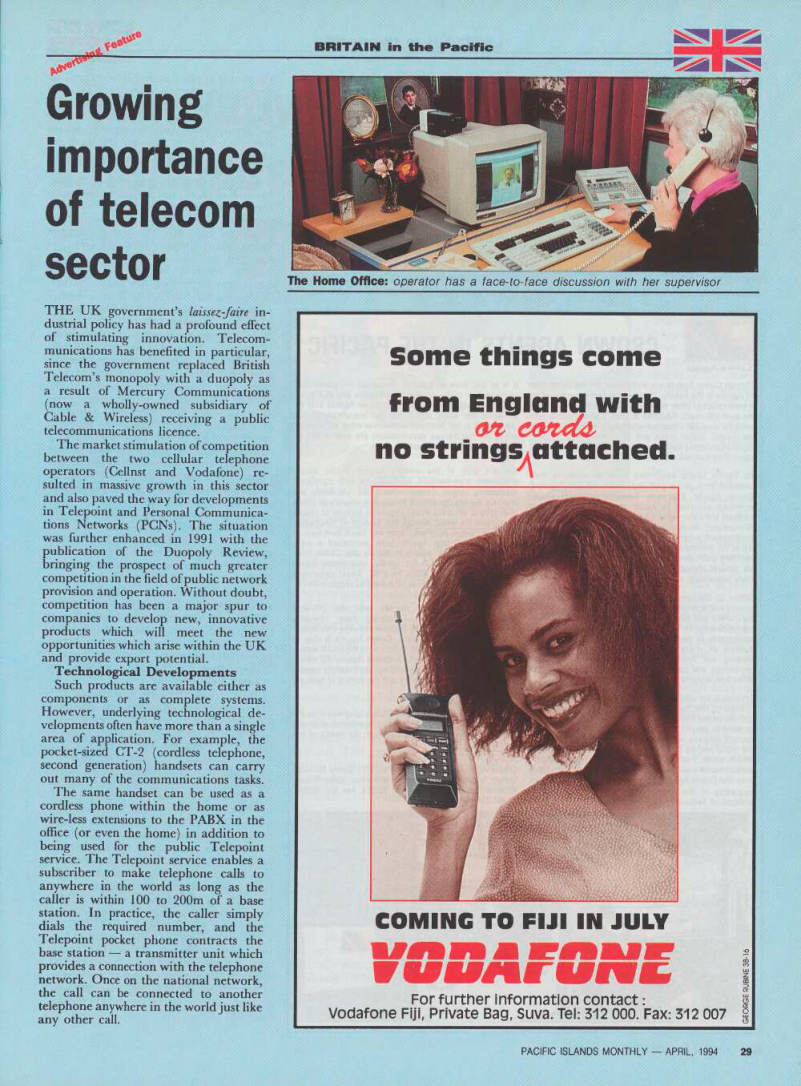
The Home Office: operator has a face-to-face discussion with her supervisor
A Telepoint handset can provide the user with the convenience of a pay phone in the pocket.
Large Networks GPT, the manufacturer of much of the CT-2 equipment, is also offering cordless PABX/key telephone system which will support up to 30 extensions. This is shortly to be followed by a system for 100 extensions, with larger systems to follow, which can be a mixture of wired and cordless and which are compatible with the company’s well established range of ISDX digital PABXs. The result will be that it will be possible to build large networks of PABXs spanning the country with wired or cordless handsets being
employed as circumstances dictate.
Orbi tel Mobile Communications Ltd is also heavily involved in providing CT -2 handsets and base stations. In addition, it is one of the leading designers in the world of telephones for the new pan- European digital cellular system, GSM.
This technology has been adopted countries in other parts of the world, and not just Europe. It will enable a British businessman, or his continental Eur opean counterpart, to travel anywhere in
the European Community and beyond
and still keep in touch.
However, Orbitel is also in the fore front of developing this technology for micro-cellular applications where one of
the major applications will be to provide wire-less telephone connections. This will provide a rapid and potentially low cost means of rolling out the telephone service in areas, previously unserved, where there is a large pent-up demand for
phones.
Pager Chips
Despite the advances (or maybe,
because of them) in telecommunications, the pager market around the world is
growing. GEC Plessey Semiconductors
(GPS) is currently the world’s largest
independent supplier of pager chips. It
has just announced details of a new paging receiver which will have a significant impact on the pager market.
Designated 5L6649-1, it is a higher performance version of the company’s 5L6639-1. Andrew Burt GPS’ world wide pager marketing manager ex plained “This has been specifically
engineered to meet the tough Japanese
standards. Most people in Tokyo carry a pager and consequently the airways are flooded with signals. The Japanese type approvals are therefore very stringent and require that the pager car function
correctly. Our design passed with flying
colours and is already being used by one major Japanese manufacturer for a new design of credit card pager that has just been launched and another supplier is working on a wristwatch pager.”
GPS is offering two versions one is a surface mount plastic device that
enables existing paging designs to be
upgraded to the new device and thus
provide immediate performance im
provements; and the second, a new
package design using a leadless chip
carrier less than 2mm high. This latter is targeted at the designers of small, eg. credit card, pagers. No doubt, in due course, these chips will also be employed in ordinary message pagers as well as the
higher-priced “premium” products.
Less Frustration With trunked radio systems, all the available radio channels are grouped together instead of each organisation having its own, often very limited, number of channels. The advantage here is that channels that would otherwise be unoccupied are available to all users instead of just sitting idle. This means that limited numbers of channels are used more effectively with the result that users suffer from less frustration at not being able to get through.
Heathrow Airport Ltd (HAL) has ordered what is believed to be the first implementation of a trunked mobile radio system for an international airport provider in the UK. Securicor PMR Systems has provided the new systems, worth over FSI.3 million (-£600,000). It will be used for handling communica tions between nearly 600 of HAL’s staff who are responsible for all operational duties at the airport including movement of aircraft on the ground, passenger and ground crew safety and emergency response. □