Trading in the islands
pp. 27-28 · Read in the full issue
THE inhabitants of the Pacific islands are renowned for their navigational skills and epic sea voyages. The British are famous for their entrepreneurship and trading heritage. Attributes such as these have led to the development of many close links and trade worth over F 5425 million (£2OO million) in 1993.
The Pacific Ocean is the greatest single
geographical entity on earth, extending
over nearly a third of the planet’s surface, or about half the area covered by water and '/ 5 more than all the land area put together. Small wonder that British exporters have not always found it the easiest market to service, despite their own undoubted itinerant skills. Never theless in 1993, British exporters man aged to sell over FS 119.2 million (£56 million) worth of goods and services to the Pacific islands. A similar amount may have also been shipped to these islands through Australia and New Zealand.
The largest single market for British companies in 1993 was Papua New Guinea, which took almost Fs23 million (£ll million) of goods, followed by Fiji, which was worth over FS 17 million (£8
million) for British firms, (this figure
excludes re-exports of Scotch whisky and steel from Australia and New Zealand).
Amongst the other islands, New Cale donia bought almost FS 17 million (£8 million) from British companies, and French Polynesia nearly FsB.s million (£4 million). Other islands that pur chased over Fs2.l million (£1 million) from Britain included the Marshall Islands, the Solomon Islands, Tonga and Western Samoa.
Trade the other way was much more substantial. Pacific island countries
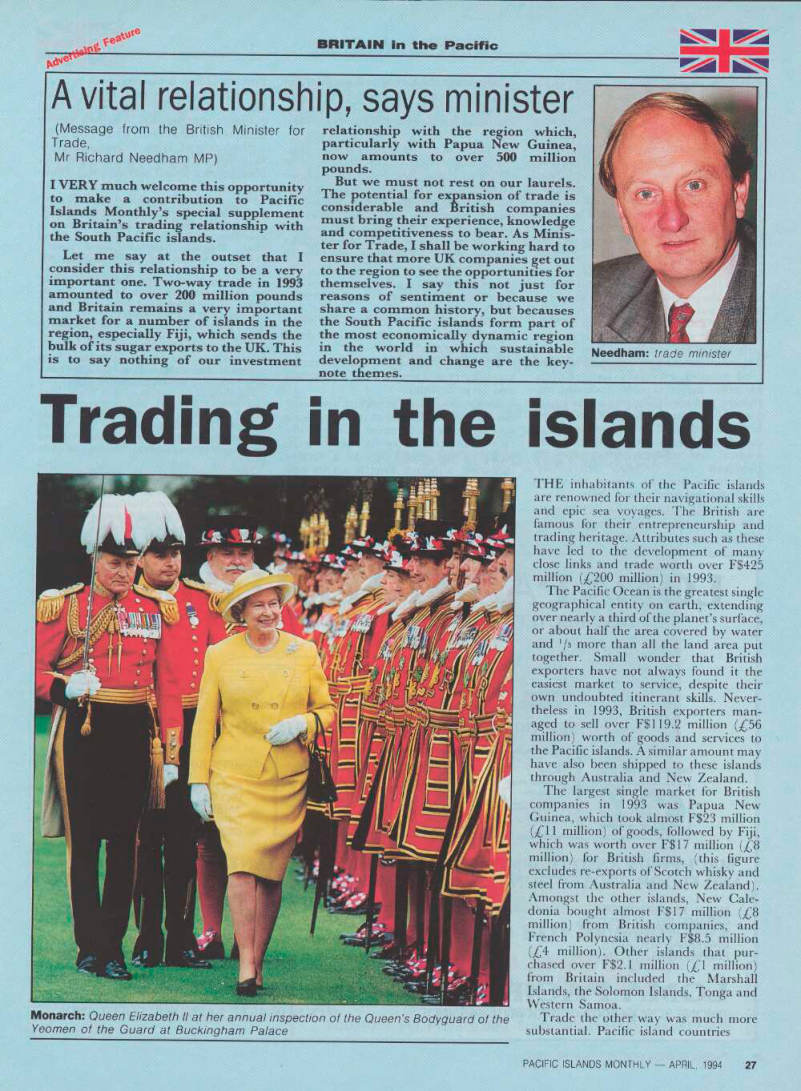
Monarch: Queen Elizabeth II at her annual inspection of the Queen's Bodyguard of the Yeomen of the Guard at Buckingham Palace
exported nearly Fs3l9 million (£l5O million) of goods to Britain in 1993. By far the largest exporter was Fiji, whose exports totalled almost FSIBS million (£B7 million), followed by Papua New Guinea which sold nearly FSIIS million (£54 million) worth of goods to Britain.
New Caledonia and the Solomon Islands registered exports in excess of F 54.2 million (£2 million) each, and Vanuatu F 53.2 million (£1.5 million). The figures suggest there is considerable scope for increasing the sales of British goods and services to the South Pacific.
Figures of course often only tell one side of the story. It is also worth looking at the kinds of products that are being bought and sold between Britain and the Pacific islands. British power generation equipment and machinery sells particu larly well in Fiji and Papua New Guinea.
Telecommunications equipment and road vehicles, especially Land Rovers, are other major exports. Specialist ma chinery and scientific and control equip ment also feature strongly. Other prod ucts that sell well are: beverages; high quality food stuffs and consumer goods; medical and pharmaceutical products; chemicals and electrical machinery.
Consultants are also active, providing much needed advice and skills.
The Pacific islands have traditionally sold commodities to Britain and this is still very much the case. Sugar and fish
products are the largest exports from Fiji and copra, palm oil and coffee/tea and cocoa is supplied from Papua New Guinea. New Caledonia exports iron and steel.
In view of the large distances between the Pacific Islands and Britain, it is difficult for most British companies to be physically represented in the market place, although there are firms with offices/representatives in Fiji, Papua New Guinea, French Polynesia and some of the other Islands. Most British firms trading with the Pacific Islands do so in one of four ways i. direct sale; ii sales through local agents/whole salers or distributors; iii invest in local companies either under their own names or under local company names; iv sales through manufacturing subsidiaries or agents based in Australia and New Zealand.
However, British exporters are being encouraged to visit the market to discuss new business and renew existing con tacts. Duty-free entry to French terri tories in the region act as a further incentive, although French agents rep resenting British companies might be better placed to take full advantage of these valuable access arrangements.
The British government, through the Department of Trade and Industry and
Foreign Office, is charged with promot
ing exports from Britain to the Pacific Islands. The DTI offers advice and
guidance to companies in Britain seeking
to export to the Islands, whilst staff in the Embassies and High Commission pro vide specific advice and support for British firms in the market place. They are also the first point of contact for companies wishing to find British com panies to trade or discuss projects with.
If you are based in Papua New Guinea, you should contact: British High Commission, Kiroki Street, Waigani, National Capital District, Papua New Guinea. Tel: 675 212 500. Fax: 675 253 547.
For those based in Fiji, Nauru and Tuvalu, you should contact: British Embassy, Victoria House, 47 Gladstone Road, Suva, Fiji. Tel: 679 311 033. Fax: 679 301 406.
In French Polynesia, the British Commercial representative is: Honorary British Consul, Papeete, BP 1064. Te1:689 428 457. Fax: 689 410 847. For Vanuatu and New Caledonia, your contact is: British High Commission, PO Box 567, Port Vila, Vanuatu, Tel: 678 3100.
For Kiribati you should contact: British High Comission, PO Box 61, Bairiki, Tarawa, Kiri bati. Tel: 686 21327. Fax: 686 21488. If you are based in the Solomon Islands, you should contact; British High Commission, Telekom House, Mendana House, Honiara, Solomon Islands.
The contact in Tonga is: British High Commission, PO Box 56, Nuku’alofa, Tonga.
Tel: 676 21 020/021. Fax; 676 24109. Western Samoa is covered from New Zealand and you should contact: British High Commission, 44 Hill Street, Wellington 1, New Zealand. Tel; 644 472 6049. Fax: 644 711 974. □