Tonga on the move
pp. 17-19 · Read in the full issue
Pacific Business
Island kingdom on the track to an economic boom
By Christine Hatcher
IN the Kingdom of Tonga, a banner called optimism is being carried into the new decade. “We’re sick, but not fatally sick,” says Kalafi Moala, editor of Taimi’o Tonga, Tonga’s weekly news paper. Inspired by what he saw as a growing need in the expanding business com munity “to inform Tongans about Tonga”, he began publishing Lali, a glossy magazine, in January.
“I believe business is more active and lively. For five years my stance has been negative and critical, especi ally of the passport exchange but it’s good for the exchange reserve, it’s our
second line of defence. We can go a whole
year spending, with nothing coming in,
and survive! We are a centre of force to be contend with nationally.”
Squash, the main export and niche market to Japan plays a large part in present confidence. A third successful season saw about $l7 million in revenue drop into the coffers this year. Since 1991, total cross-earnings, have come to $50.1 million. Due to a fall in imports and the agricultural export boost, trade , r ■ b ’ deficit narrowed by 42 per cent last October. „ T . . c A ~. , . , „ But, Lisiate A Akolo, president of the chamber of commerce and industry and chief executive of Tonga Investments Limited, says it’s difficult to pin down exactly whether the economy has progressed. He says there is a need for a stronger infrastructure and instead of
working against constraints, he would
like to see more government support for the private sector, more deregulation,
more industrial incentives, more creative inventiveness on overall review of policies and turning the mentality of the people around from just “making do”.
“We earned a lot of money from squash. Increased inflation created a bigger balance off trade deficit but 40 per cent of the proceeds from exports go back overseas in the form of pesticide, agricultural implements, seeds, petrol etc. The only things that is provided locally is labour.”
Although on the surface, there is a lot of tangible movement in the market , °, place, the money he says, does not necessarily stay m the country, No one has sat down to analyse what exactly has been gamed There is a need lor something to be activated all the time, not just seasonally from October to December. What is there apart from s( l uas • The answer, Moala says, is yam-beans a new, highly successful crop that has
been developed experimentally over the past year. If his predictions are right, and squash exports decline over the next five years, this crop, will earn more export dollars than squash evei has. Used as a , asc wltb raw hsh, there is a great demand foi this product m Japan All 1 at awaits 1S to secure a market. He is aBO settm S U P a h J g hl .V lucrative first f lass , P" ntl . n S P[ ess business to produce for tinned goods. Optimism lor a fl V ure 18 ™ hat . bieBe Respects provide, he says. 1 tried to look at it negatively but there are positive factors.” n ■ • r , , Positive factors also exist for the husband and wi f c team, Tricia and Bill Ho|den of Latini Fishcrics . Shc - s lhc busi „ he - s thc fisherman.
Going from a turllovcr ol 590 ,000 four s to a pred i ctcd 51.5 million this cxp J rt mail ,| to Hawaii, but also , Q Ncw K Zcaland Austra ia and Japan. They now own two 38ft commcr cial fishing vessels and have just opened their own processing
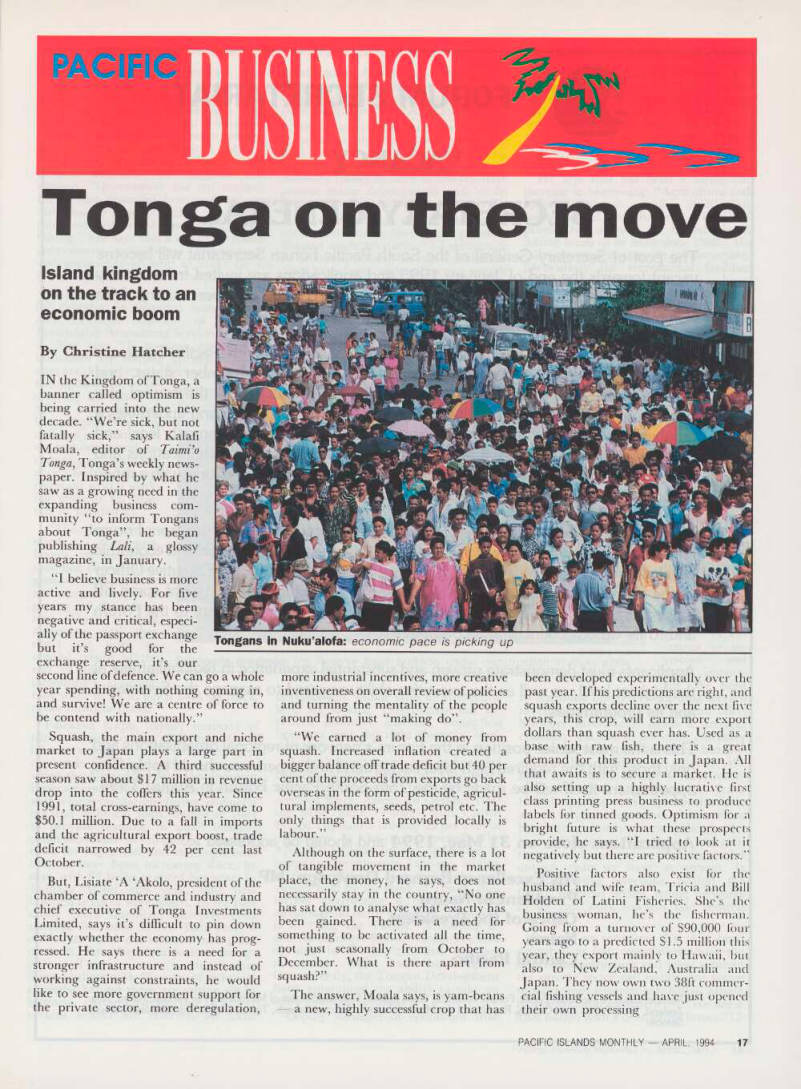
Tongans in Nuku’alofa: economic pace is picking up
factory. “We have a formula that works,” she says, “Hard work, hard work, hard work!” Putting in 14-hour days, self-reliance, profit sharing with good staff who choose their own crew, provide the incentive to meet targets, which Tricia says are limited only by flight schedules. As more destinations become available, the business will expand. “Government has not realised the fishing potential here and we are quite happy to leave it that way. They think only of squash and forget about fishing.” She says that a relatively stable government, non-existent bureaucracy and persistence all help to make for a lifestyle, impossible elsewhere.
Expansion equals an increasing need for expertise in financial management and Christine Uta’atu of Uta’atu Financial & Accounting Services provide it. She says “It is clear to us new businesses are starting up and existing ones are doing better. “To accommodate
the upturn she is in
creasing her space by
50 per cent, doubling her computer capacity
and has just employed
an economics and ac counting graduate and a certified public ac countant who is work ing towards his Mas ters in Economics.
“The lean is to wards economics.
People are no longer
shoe-box clients. Ton gans are realising more and more what is hap pening in their busi ness. There is more awareness and they don’t just want an annual return at the end of the year. If something’s wrong,
they want to fix it, get it back on track, make business plans.”
Falekava Kupu, deputy secretary of the industries division of the ministry of labour, commerce and industries, says the seeds for this thinking were sewn when the United Nations Development Program-approved five-year scheme, with a focus on manufacturing, engineer ing and technical skills, started in 1987 to provide training in small business promotion and development. Applica tions for expansion and developmental licences have been increasing since, he says, with 63 being granted last year. In January alone, this year, nine new business licences were issued. In the past seven years intensive entrepreneurial training has been active. Last year, a deliberate reach-out exercise took place overseas. Now there is a pattern emerg ing Tongans are returning home.
Some of them with 20 years of technical expertise behind them are setting up in business, encouraged by the fact that certain sectors are reserved for local
development. A technical learning insti tution is in the pipeline catering for school leavers interested in developing skills for use in the private sector.
An industrial trade and development
corporation plus an export processing
zone has been established. “The move from government,” he says “is to set up statutory bodies to more or less facilitate private sector development and to do away with government bureaucracy.”
The intention is to attract foreign investment into the country and promote Tongan made products. “To encourage an economic boom,” he says “deliberate
plans have been made subjecting squash
to a quota restriction to stabilise the market demand and ensure a consistent return. There is also a tendency to get into commercial marine activity, exports are escalating, infrastructure and air connections are improving. People’s atti tudes need to go along with the changes they need to be mentally clear about
development. Public skills at production level are lacking. Government has ap
f>roved incentive schemes, exemption
fom tax and the right financial insti tutions.”
Tonga’s commercial and competitive banking history began in April 1992 when the Financial Institutions Act received Royal Assent. In October 1993 the MBF Bank (Tonga) with Crown Prince Tupouto’a holding 25 per cent of the shares as chairman, opened. The ANZ Bank began limited operations in temporary premises in January, adding to the breakdown of a monopoly pre viously held by the Bank of Tonga, thus further sharpening a competitiveness advantageous to the customer. Their aim is to “ring the Pacific” according to general manager Bob De Courteney and opening in Tonga provided the last remaining link in the region.
Concurrently, the Tongan Development
Bank announced the ability to take on more commercial loans.
Deputy manager of operations with
TDB, Simione Sefanaia says “Tonga has had a late entry into the trade market.
There is still a lot of constraint in the manufacturing/export sector due to
many comparative disadvantages that
are hard for Tonga to penetrate. “Fiji is established for instance and freight costs
are high.”
He says that has been a significant increase in borrowing. “Agriculture and
industry borrow equally, 50/50, but
fishing is still low although a UNCDF project has allowed for 60 additional fishing boats to be built since 1988.” He talks of a need to upgrade infrastructure, particularly the recreational facilities that support the tourism sector. Even though tourism increased by 21 per cent last year, hotels still warrant upgrading and improvements is needed in the service industry, he admits.
Sefania sees growth potential in joint
ventures, with help from technical exper tise from overseas helping to establish
marketing links.
Lisiate ’A ’Akolo says the choices pro vided by the banks are already show ing psychologi cal benefits.
Although deep
down, there is not much dif ference be tween them, the options are there.
“More con fidence gives good expec tations to in vestors and
that’s import
ant. We need
to scrutinise ourselves regarding foreign investment, look at what we can offer.
Stronger investments equal a stronger economy. I’d like to see more efficiency in how we treat those investors. Bureau cratic delays need to be reduced. We have to be more serious says some thing and follow it up. Quite a few leave here disappointed. We are not the same as we advertise ourselves. We need a
bigger commitment, proper policy guide
lines. We need to followed up and gain their confidence and have a more solid outlook than we have at present. It entails getting everyone behind the banks, different bodies, strong networks so we can work towards one centred
objective.”
Despite an economy that has been described as flat; complaints about the lack of infrastructure and what some in the private sector call insufficient active support from government; Kalafi Moala makes the final judgment “We are a little nation with a prosperous future.”□
Christine Hatcher
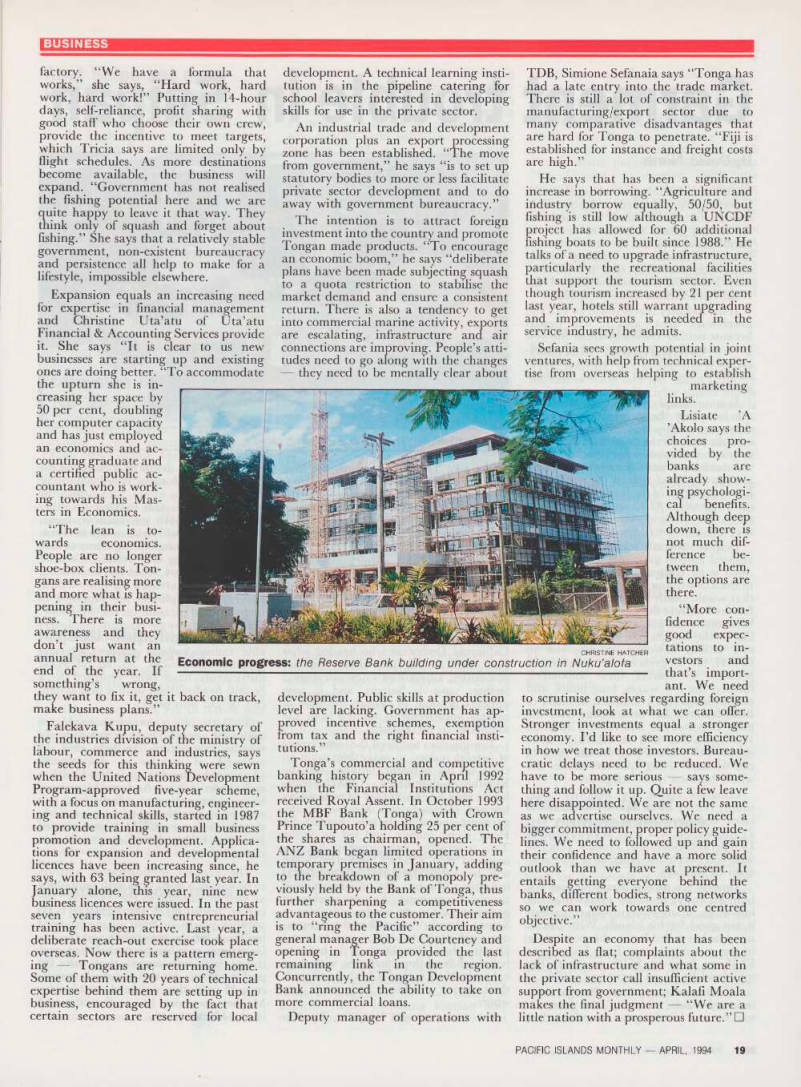
Economic progress: the Reserve Bank building under construction in Nuku'alofa