Diplomacy
p. 16 · Read in the full issue
The United Nations
Pacific style
By Ian Williams
DIPLOMACY has never been a strong card for the Pacific states. Understaffed, inexperienced, and at the whim of home governments which will often sacrifice international gains to score political points at home, even the best of Pacific envoys can have a hard time. That was
graphically demonstrated in February
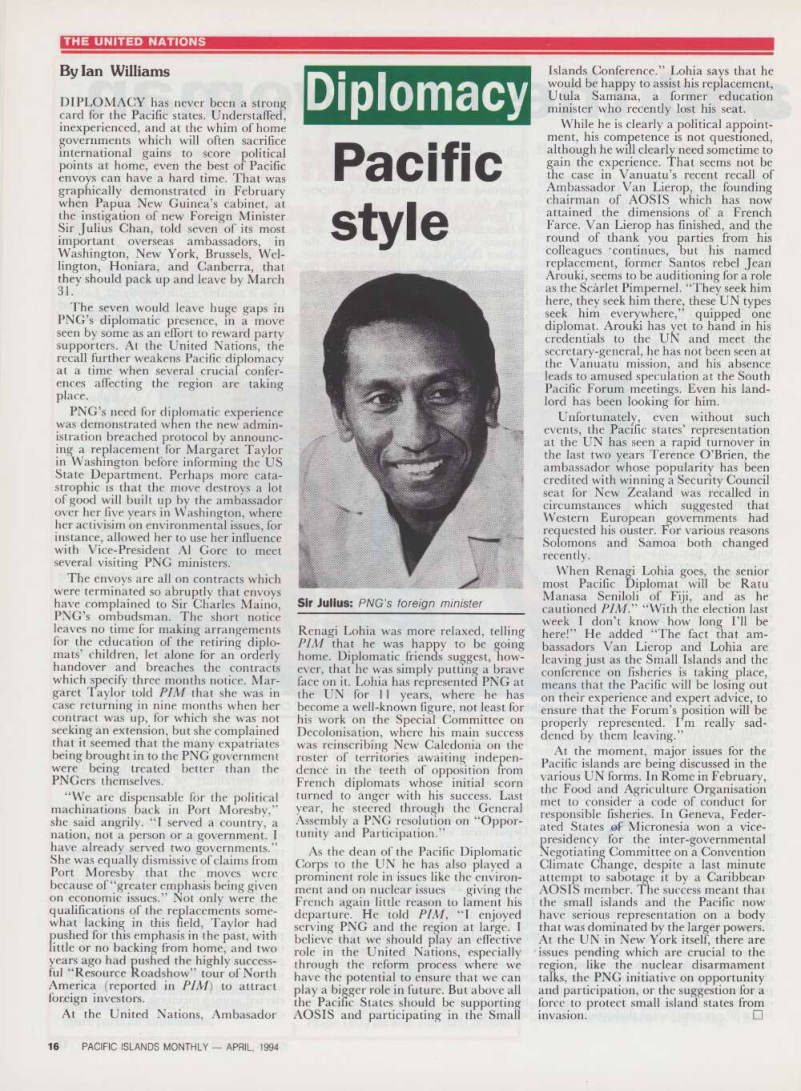
when Papua New Guinea’s cabinet, at the instigation of new Foreign Minister Sir Julius Chan, told seven of its most important overseas ambassadors, in Washington, New York, Brussels, Wel lington, Honiara, and Canberra, that they should pack up and leave by March 31.
The seven would leave huge gaps in PNG’s diplomatic presence, in a move seen by some as an effort to reward party supporters. At the United Nations, the recall further weakens Pacific diplomacy at a time when several crucial confer
ences affecting the region are taking
place.
PNG’s need for diplomatic experience was demonstrated when the new admin istration breached protocol by announc
ing a replacement for Margaret Taylor
in Washington before informing the US State Department. Perhaps more cata strophic is that the move destroys a lot of good will built up by the ambassador over her five years in Washington, where her activisim on environmental issues, for instance, allowed her to use her influence with Vice-President A 1 Gore to meet several visiting PNG ministers.
The envoys are all on contracts which were terminated so abruptly that envoys have complained to Sir Charles Maino, PNG’s ombudsman. The short notice leaves no time for making arrangements for the education of the retiring diplo mats’ children, let alone for an orderly handover and breaches the contracts which specify three months notice. Mar garet Taylor told PIM that she was in case returning in nine months when her contract was up, for which she was not seeking an extension, but she complained that it seemed that the many expatriates being brought in to the PNG government were being treated better than the PNGers themselves.
“We are dispensable for the political machinations back in Port Moresby,” she said angrily. “I served a country, a nation, not a person or a government. I have already served two governments.”
She was equally dismissive of claims from Port Moresby that the moves were
because of “greater emphasis being given
on economic issues.” Not only were the qualifications of the replacements some what lacking in this field, Taylor had pushed for this emphasis in the past, with little or no backing from home, and two years ago had pushed the highly success ful “Resource Roadshow” tour of North America (reported in PIM) to attract
foreign investors.
At the United Nations, Ambasador
Renagi Lohia was more relaxed, telling PIM that he was happy to be going home. Diplomatic friends suggest, how ever, that he was simply putting a brave face on it. Lohia has represented PNG at the UN for 11 years, where he has become a well-known figure, not least for his work on the Special Committee on Decolonisation, where his main success was reinscribing New Caledonia on the roster of territories awaiting indepen dence in the teeth of opposition from French diplomats whose initial scorn turned to anger with his success. Last year, he steered through the General Assembly a PNG resolution on “Oppor
tunity and Participation.”
As the dean of the Pacific Diplomatic Corps to the UN he has also played a prominent role in issues like the environ ment and on nuclear issues giving the French again little reason to lament his departure. He told PIM, “I enjoyed serving PNG and the region at large. I believe that we should play an effective role in the United Nations, especially through the reform process where we have the potential to ensure that we can play a bigger role in future. But above all the Pacific States should be supporting AOSIS and participating in the Small
Islands Conference.” Lohia says that he would be happy to assist his replacement, Utula Samana, a former education minister who recently lost his seat.
While he is clearly a political appoint ment, his competence is not questioned, although he will clearly need sometime to gain the experience. That seems not be the case in Vanuatu’s recent recall of Ambassador Van Lierop, the founding chairman of AOSIS which has now attained the dimensions of a French Farce. Van Lierop has finished, and the round of thank you parties from his colleagues continues, but his named replacement, former Santos rebel Jean Arouki, seems to be auditioning for a role as the Scarlet Pimpernel. “They seek him here, they seek him there, these UN types seek him everywhere,” quipped one diplomat. Arouki has yet to hand in his credentials to the UN and meet the secretary-general, he has not been seen at the Vanuatu mission, and his absence leads to amused speculation at the South Pacific Forum meetings. Even his land lord has been looking for him.
Unfortunately, even without such events, the Pacific states’ representation at the UN has seen a rapid turnover in the last two years Terence O’Brien, the ambassador whose popularity has been credited with winning a Security Council seat for New Zealand was recalled in circumstances which suggested that Western European governments had requested his ouster. For various reasons Solomons and Samoa both changed recently.
When Renagi Lohia goes, the senior most Pacific Diplomat will be Ratu Manasa Seniloli of Fiji, and as he cautioned PIMP “With the election last week I don’t know how long I’ll be here!” He added “The fact that am bassadors Van Lierop and Lohia are leaving just as the Small Islands and the conference on fisheries is taking place, means that the Pacific will be losing out on their experience and expert advice, to ensure that the Forum’s position will be
properly represented. I’m really sad
dened by them leaving.”
At the moment, major issues for the Pacific islands are being discussed in the various UN forms. In Rome in February, the Food and Agriculture Organisation met to consider a code of conduct for responsible fisheries. In Geneva, Feder ated States of Micronesia won a vice
presidency for the inter-governmental
Negotiating Committee on a Convention Climate Change, despite a last minute attempt to sabotage it by a Caribbean AOSIS member. The success meant that the small islands and the Pacific now have serious representation on a body that was dominated by the larger powers.
At the UN in New York itself, there are issues pending which are crucial to the region, like the nuclear disarmament talks, the PNG initiative on opportunity and participation, or the suggestion for a force to protect small island states from invasion. □
Sir Julius: PNG’s foreign minister