Law and the Fiji woman
pp. 14-15 · Read in the full issue
Women
By ’Atu Emberson-Bain
DURING the frenzy of a recent snap general election contested by an unpre cedented number of parties, the political barometer (as well as blood pressure levels) in Fiji probably rose like never before. But so far as time and political agendas permitted, voters were treated to manifestos that often sang very similar tunes. Apart from the preoccupation of the two main opposition parties with critical issues like the 1990 Constitution, highflying promises of social justice, poverty alleviation and multi-racialism were among the resounding catchcalls that bounced back and forth between sometimes unlikely contenders.
Even women and gender issues man aged to sneak their way into public debate and bring some nodding heads from unexpected quarters. While the main motor was to be found in the plucky spirit and strong women’s platforms of unsuccessful Labour Party candidate Peni Moore, some latterday pledges, notably a commitment to equal job opportunities for women, have surprisingly emerged from the ranks of the conservative General Voters Party which resumes its role as coalition partner of the ruling Fijian Soqosoqo ni Vakavulewa ni Taukei (SVT).
The election of three women to Fiji’s new parliament, albeit from the tra ditionalist SVT headed by former mili tary commander Sitiveni Rabuka, is a first in the country’s political history. So is the appointment of two women to a 12-member cabinet of an elected govern ment. It offers a fresh opportunity to the women’s movement to push a broad agenda for women.
One area which requires urgent atten tion is the plight faced by thousands of disadvantaged and vulnerable women workers. Fiji’s changing economic and political environment, particularly since the 1987 military coups, has had harsh consequences of women on wage employ ment, the rising level of female-headed households (both numerically and in respect of the proportion of destitute families), women’s higher unemploy ment levels and the erosion of living standards resulting from World Bank sponsored structural adjustment policies like Value-Added Tax (VAT) and labour market deregulation.
Reform of Fiji’s employment laws so as to promote greater gender equality would not solve all the problems faced by women workers but it would get rid of one nail from the proverbial coffin. It would be a constructive beginning. The
Employment Act is the most comprehen sive piece of legislation dealing with the rights of workers but it has numerous shortcomings for women. One of these is that there is no section that deals with sexual harassment of women in the workplace. While statistical data is not available to indicate the extent of the problem, it is known that women commonly encounter various forms of unsolicited, unwanted and offensive “ad vances” or related behaviour during the course of the working day, and that in many instances prospects for job security
and/or promotion are contingent upon
their tolerating such harassment from (male) employers or other men in
positions of authority.
The maternity pro visions of the Employ ment Act offer another telling example of the limitations implicit in Fiji employment legis lation. One of the most unregulated forms of employment in Fiji is domestic work, an area dominated by women. Paid public holidays, annual leave, sick pay, ma ternity leave, overtime and other basic con ditions of employment are rare privileges rather than legal entitlements. Poverty wages are übiquitous.
The Fiji National Provident Fund Act excludes domestics from superannuation, housing finance assist ance, and special death benefits, and
they have never been given the benefit of minimum wage protection.
Under the Employment Act, women domestic workers arc expressly denied the right to paid maternity leave or paid
statement (wage slip) spe ,lying parpen-
lars like wage rates, hours worked, J„ J .
. Iuc 10I1S ‘ .
domestic workers arc being left out in the cold, the prob cm does not lie only with the content ol the law. A significant impediment appears to be the failure on the part of the Labour Department to
enforce the positive legal provisions that
apply to these workers. Under the Employment Act, such provisions inelude the right to notice of dismissal or payment in lieu, the payment of wages on time, and protection from excessive (over 50 per cent) wage deductions. The
right to be compensated by an employer for a fatality, injury or illness arising out of, or in the course of, employment is enshrined in the Workman’s Compen sation Act.
There is little mystery about the lack of law enforcement in respect of women domestic workers. According to the Labour Department, these women have no legal standing at all under either the Employment Act or the Workman’s Compensation Act. In respect of the latter, the department is supported by a
legal interpretation given by the
solicitor-general’s office in 1992.
But both interpretations are conten tious and even within the Labour
Department itself there is a willingness to acknowledge that the law may have been
(inadvertently?) misinterpreted to the
disadvantage ol domestic workers. Unfortunately, until the official view is
Ml £3T,
Department wil, continue to be turned away. ... , a ma J Ol impediment to women s equality on the labour maiket, the problem ol law enforcement appears to result horn a number ol things. Ihe
practical problem of understaffing and
lack of resources like transport is high on the checklist. The total labour administration stall' totals just over 40 and includes only 21 Labour Inspectors. Not surprisingly, protection for workers in general, and women workers in particular, falls well short of a satisfactory standard.
For one thing, although workplace inspections are expected to take place annually, it is officially recognised that they “normally fall short of this target”.
Latest available data suggests that not more than 50 per cent of the total number of registered employers (employ ing some 77,000 workers) are being inspected.
The apparent reluctance to prosecute employers for offences against the labour laws is another disturbing trend. Labour officials give employers “a grace period of up to a month to rectify breaches of law”. Prosecution is a last resort, in itiated only “after attempts to secure voluntary compliance have proved unsuccessful”.
The poor conditions of
employment
facing the ma
jority of
women on the labour market, their common status as unor
ganised work
ers, and the
growing num
bers being ab sorbed into tax free garment factories whose owners have
persistently re
sisted wage
regulation, all
underscore the urgent need for more
stringently.
The charges
that have sur faced from time to time of
complicity between government labour
officers/inspectors and employers, especi
ally garment factory owners, also stress the desirability of tightening up the labour inspection process.
There are many areas where women on the labour market face special
disadvantages including outright dis
crimination. The law and the legal process can play a critical role as regulators of employment conditions and as guarantors of basic worker rights and
gender equity.
In a society such as Fiji where patriarchal values arc strong, they can together act as instruments of women’s protection and employment. It remains to be seen whether those elected to Fiji’s new parliament, including the three elected women members, will take up the
challenge.
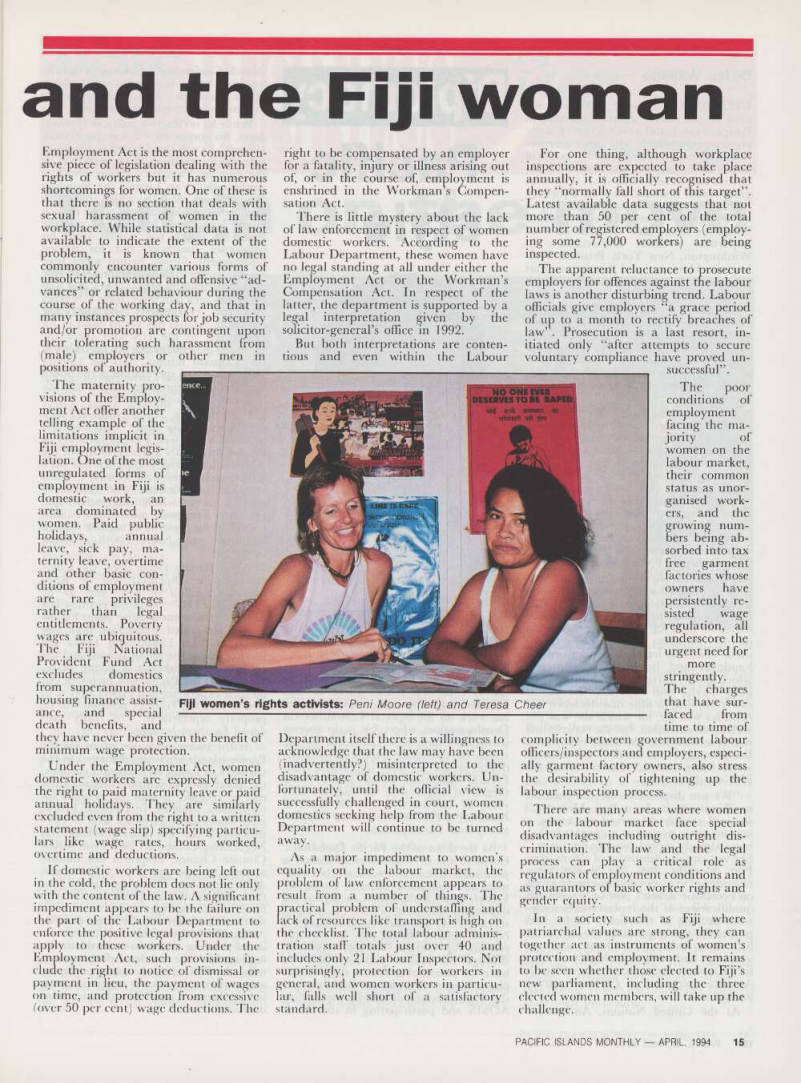
Fiji women’s rights activists: Peni Moore (left) and Teresa Cheer