America’s painful
pp. 11-13 · Read in the full issue
Cover Story
Atomic Secrets
By David North
THE United States is disclosing some of its own painful atomic secrets and this process may ultimately benefit the Marshall Islands.
Although the initial focus was not on the islands, the Clinton administration’s De partment of Energy has been revealing long-suppressed information on medical ex periments conducted more than 40 years ago. Prisoners and retarded men (on the mainland) were exposed to radiation, without their knowledge or consent, to see what would happen to them.
Little if anything was learned in the process.
It was in this tell-all set ting that the strong-minded chair of the House of Rep resentatives’ Natural Re sources Committee, George Miller (D Cal), called a hearing to learn more about what happened during the
atomic and nuclear bomb testing in the Marshalls. rp, . • i *i , , 1 he testimony was detailed and grim. t. t ' 4 , ttc l i It suggested that the US bomb testers . . . . * were, at the very least, insensitive about .i ■ . r C. ■ . ~, , „ the impact of radiation on the Marshall •iii i • • islanders and on their own servicemen. p , , ■ T A7 , ■ ven t e ultra-conservative Washington Times, always a staunch supporter of the Defense Establishment, was moved to write - Documents found m the archives of federal atomic agencies reveal a callous attitude hj US scunl,sis toward using Pacific islanders as test subjects after atomic blasts in Hu 19505.
Congressman Eni Faleomavaega (D
- Am. Samoa) was even more outraged - “Marshall Island leaders ... believe their people were used as guinea pigs ... for US radiation experiments. I share that belief. Miller s hearing was different from most such events. Usually a
ranking government spokesman and,
such as a cabinet member or Under Secretary, opens the meeting, testifying , rf l r =” 7 ° alone. 1 hen the interest groups and .•, N , experts appear m groups panels) later r . r / . ° r , ■ —often alter most ot the audience is gone >, , ■ • , r , ° to tdi tiiui* siOu oi leic story» 7 The first witness in Miller’s hearing, a pp ear ing all alone, was Jonathan M Weisgall; he has been the Washingtonbased , aw for the Bikinians since 1975.
He to|d how the us government in the 1940 s and 1950 s had botched safety precau ,i ons during the test explosions, and how had ke » man ofits d F ecisions .rj i i, • i secret for decades. It was only later in the
hearing that the Department of Energy
>™s given a chance to say its piece.
Weisgall’s detailed (and footnoted)
testimony set the tone for the day. Most G f the other witnesses, and the Committee members, seemed to agree that the
islanders and the on-duty US servicemen had suffered an historic injustice.
J . , ...
Ihe committee seemed willing to . , , , , ® consider what many resrard as the next ~7 r r step, the reopening of the Compact of t-i * • • « i t t t free Association between the United States and the Republic of the Marshall Islands, to consider the question of an additional flow of funds ( and perhaps medical services) to the islanders to try to compensate for past events. „ But ‘'e"' 11 n ,°‘ 'T’ eVen "“c 3 nCW sense of guilt on the part of some mainland leaders. Even though the c|inton administration may el an obMgation to prov i d e some additional assi “ ance , a nU mber of obstacles remain, First, as Weisgall pointed out from the witness table, many, many atomic testing documents remain classified. Second, reopening a Compact (or a Treaty) is
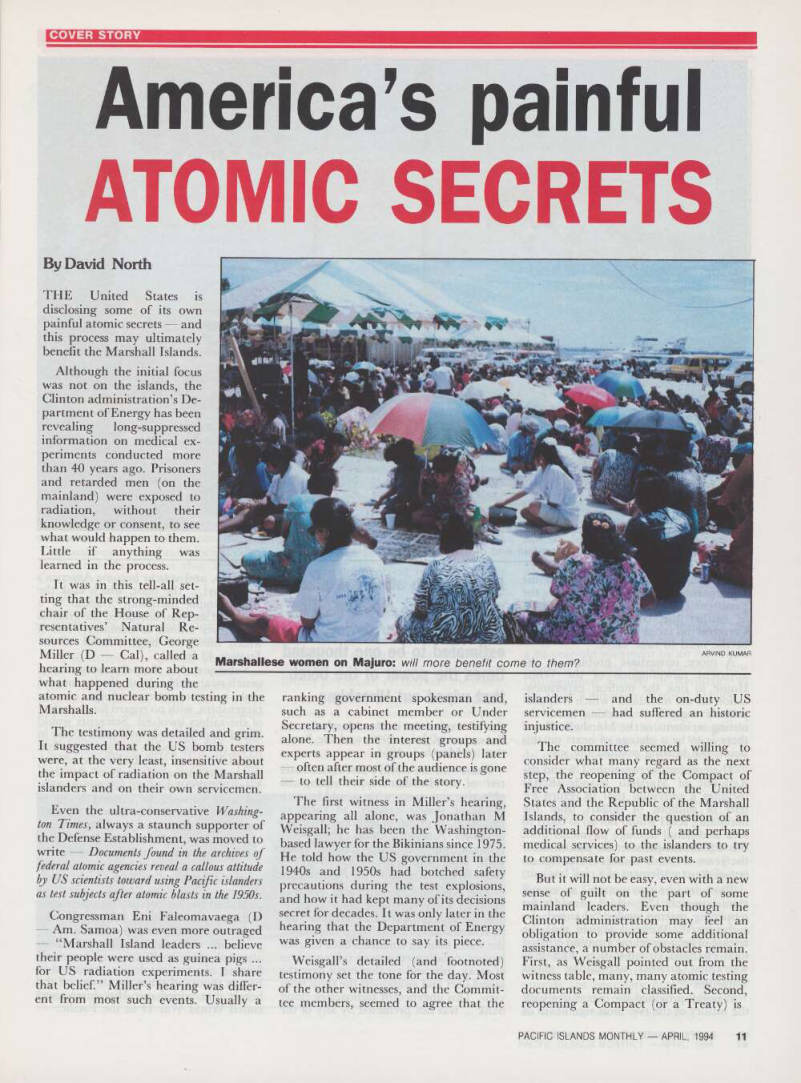
Arvind Kumar
Marshallese women on Majuro: will more benefit come to them?
Cover Story
always regarded as troublesome by the diplomats. And finally, there is the persistent cash shortage in Washington as neither the White House nor the Congress has faced what many believe to be the need to raise taxes.
A more immediate problem is the apparent unwillingness of the White House to link the medical experimentation on the mainland (which it appropriately regards as shocking) with the testing incidents in the Marshalls. But if there is to be a change of heart on this point, the hearing pointed the way. m , i r TP .I The compact between the US and the Republic of Marshall Islands (RMI) mcludes a provision that m return for tens of millions of dollars from the mainland, RMI would not go to court to seek addmona! damage payments from tile US to compensate the islanders for the years ofbombtestmg.lt was hke an out-of-court settlement of a civil law suit.
The compact also contains an escape clause, section 177, which provides for reopening matters under changed circumstances . Weisgall argued that the release of long-secret information created such changed circumstances, and thus warranted another negotiation about compensation.
Weisgall provided the committee with the history of the two most significant of
Drawn uihinh alcn tnnlr nlarn WlHvll dI9U IUUK piduc nn RjLjnj W3S AIHGNCd’S flfSt ’ , t6St Of 3 RUCIGdr dGVICG, .. . . . . .. estimated tO be 0116 thOUSaild tifTIGS tll6 DOWGf Of tll6 bODlb ... . . . ... .. 1031 Wiped OUt HirOStlimd
the 67 explosions in the Marshalls, the Baker test of July, 1946, and the Bravo shot of March 1, 1954. „ . . , „ „ , Baker was the world s first underwater test of a Hiroshima-type bomb; the objective was to see what would happen to naval vessels exposed to such an explosion. A group of still operative but outdated American Navy ships were
brought into the Bikini Lagoon along
with some raptured World War II German vessels, such as the Pnntz Eugen.
The explosion, according to Weisgall
“pushed a one-mile wide dome of water into tbe s ky j t looked like Niagara Falls i n reverse. Then a full 10 seconds later, the wa ter column collapsed back into the
lagoon, creating enormous rolling waves
G f S p ra y ) m i s t an d a j r that crept over the target fleet and swallowed the ships from view. This unexpected radioactive cloud bank ... was not predicted by any of the
scientists, and was to become America’s Chernobyl ... the blast, which sank the 26,000 tonne battleship Arkansas in a matter of seconds, unleashed the greatest waves ever known to humanity, one of which lifted the huge aircraft carrier Saratoga 43 feet.”
Subsequently, the observing naval vessels swarmed back into the lagoon and took geiger-counter readings on the target ships, with no regard for the safety °f sailors involved. Scientists would board ships covered from head to toe m safety clothing, goggle and gloves, to find sailors in shorts and T-shirts scrubbing the ra diation-soaked decks of the ship.
Some 200,000 American military person nel were exposed to varying levels of radiation at one time or another through the years of testing in the Marshalls, We i sg all obtained much of the infer maHon he used at the hearine in the course Q h f wri l g a book ab g out ,h e sub j ect Operation Crossroads the Atomic Tests at Bikini Atoll has just been published by the Naval Institute press, Eight years later, in 1954, when the Bravo test took place, the victims were primarily the islanders. Bravo, which also took place on Bikini, was America’s first test of a nuclear device, estimated to be one thousand times the power off the bomb that wiped out Hiroshima, and ended World War II in the Pacific.
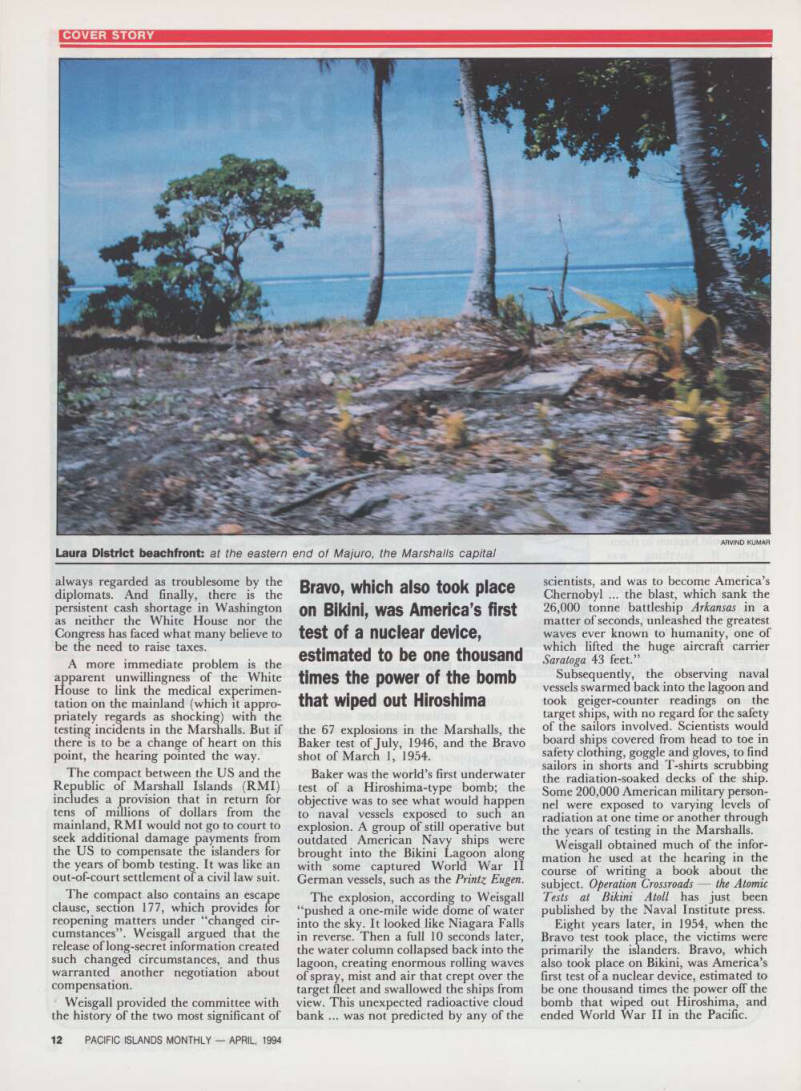
Arvind Kumar
Laura District beachfront: at the eastern end of Majuro, the Marshalls capital
This time the Navy was a little more careful about its people, and when it learned about what it reported as a change in the wind patterns just before Bravo, it ordered its ships to steam out of
danger, according to Weisgall. The
winds has been expected to blow north from the blast site, carrying the radiation away from the Navy vessels and the populated part of the Marshallese, tragic decision. Although it was clear that the radioactive fallout would hit many of the islands in the Marshalls, the blast went off as scheduled. Weisgall reported it this way “Ever since March 1, 1954, the US government has explained that there was an unexpected ‘shift of the winds occur ing after the detonation’ which carried the radioactive fallout from Bravo east ward over Bikini ... as well as Rogelap, Utrik and other atolls in the Marshall Islands.
“We now know that this is not true.
The shot was deliberately set off despite the fact that AEG (Atomic Energy
Commission) officials knew exactly
which way the winds were headed.
According to a now-declassified docu ment, the weather briefing at 7am the day before the shot predicted ‘no signifi cant fallout ... for populated Marshall Islands, but later in the day the trend was toward an unfavourable ... condition ...
The final weather and radiological safety check at 4.30 am shows that the AEG knew there was a problem.’
“Was the shot postponed? No. Were precautions taken for the Marshallese downwind? No. Were precautions taken for the US personnel downwind? Yes.
“This attitude getting the Ameri cans out of harm’s way but taking no action to protect the Marshallese is perfectly consistent with the attitude displayed in some of the radiation
experiments (on the Mainland) that
were conducted in the 1940 s and 19505.
These experiments weren’t conducted on Harvard Law School students. They were conducted on the handicapped, the
uninformed, people with no political
power.”
Weisgall did not present any evidence about harm done to the US servicemen exposed to the radiation but later in the hearing there was evidence about ad verse effects on the Marshallese, people who not only were in the area the time of the blasts, but who subsequently ate fruit, vegetables and fish grown in contaminated environments.
The committee was informed of the impact of automatic radiation on the people of Ebeye, an atoll at first thought outside the danger zone. The incidence of thyroid cancer, which is known to relate to radiation exposure, is 100 per cent higher among the islanders than it
is among people generally. Japanese and
British physicians carried out the study.
Peter Oliver, a senior RMI official, and one of the witnesses at the hearing, carried these results to chairmain Miller late last year. Other RMI witnesses included Ambassador Wilfried I Kendall; Johnsay Riklon, Senator from Rongelap; and five other island leaders
from Bikini, Utrik and Enewetak.
Senator Riklon said “The people of Rongelap were exposed to risks far greater, and we sustained injuries far more severe, than any other population except .. at Hiroshima and Nagasaki ... (we) fall into a small and highly unique class of Cold War casualties. We were not drawn into the arms race out of national ism, self-interest or for profit. We gained nothing and lost almost everything that gave our lives meaning. We had no legal
standing or political rights except those
granted unilaterally by the United
States.”
One of the verbal instances of callousness discussed at the hearing was a 40-year-old statement by an American scientist, Professor Merril Eisenbud, now Distinguished Scholar in Residence at the Duke University Medical School.
He was quoted as saying at the time “While it is true that these people do not live, I would say, the way Westerners do, civilised people, it is nevertheless true that these people are more like us than the mice.”
Eisenbud, a witness at the hearing, said that he had been quoted out of context.
Both Congressmen Faleomavaega and
Congressman Robert Underwood (D
Guam) are members of the Natural Resources Committee, and both partici pated in the hearing. Underwood later released a statement saying “Let’s open up the files, let’s find out what really happened, what went wrong, and let’s fulfill our moral responsibility to the people of the Marshall Islands, and provide the necessary health assistance for the radioactive rain that we showered on their islands 40 years ago.” □
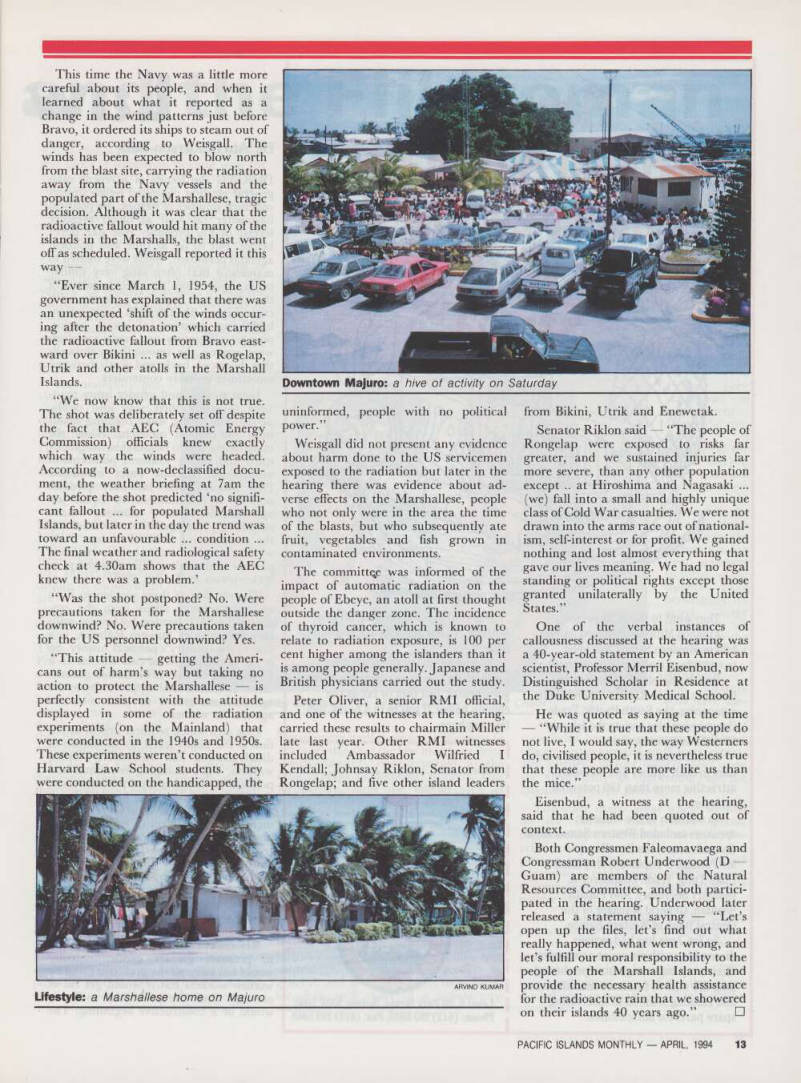
Lifestyle: a Marshallese home on Majuro
Arvind Kumar
Downtown Majuro: a hive of activity on Saturday