Protestors hit govt
Western Samoa
By Alan Ah Mu
A THREE-WEEK protest last month, aimed at removing the controversial Value-Added Goods and Services Tax (VAGST) and potentially, the govern ment, achieved neither, but the
protestors dispersed claiming that cuts to
import duty were the result of the their action.
But the government announced that the reduction or the complete removal of duty on 32 imports it regarded as “basic commodities” during the March 15 tabling of the 1993/94 second sup
plementary budget had been planned all
along. At the time, hundreds of protestors were into their third week camped in front of Prime Minister Tofilau Eti Alesana’s office under a
24-hour police guard.
The cuts were “relief measures” the government had always planned when the 10 per cent VAGST was first being considered, along with reductions to income tax that had already been
introduced, Finance Minister Tuilaepa
Malielegaoi said. Indeed the prime minister had reminded the country on government TV and radio in the first weekend of the protest, that cuts were due to be announced on March 15 as stated late last year when parliament last met.
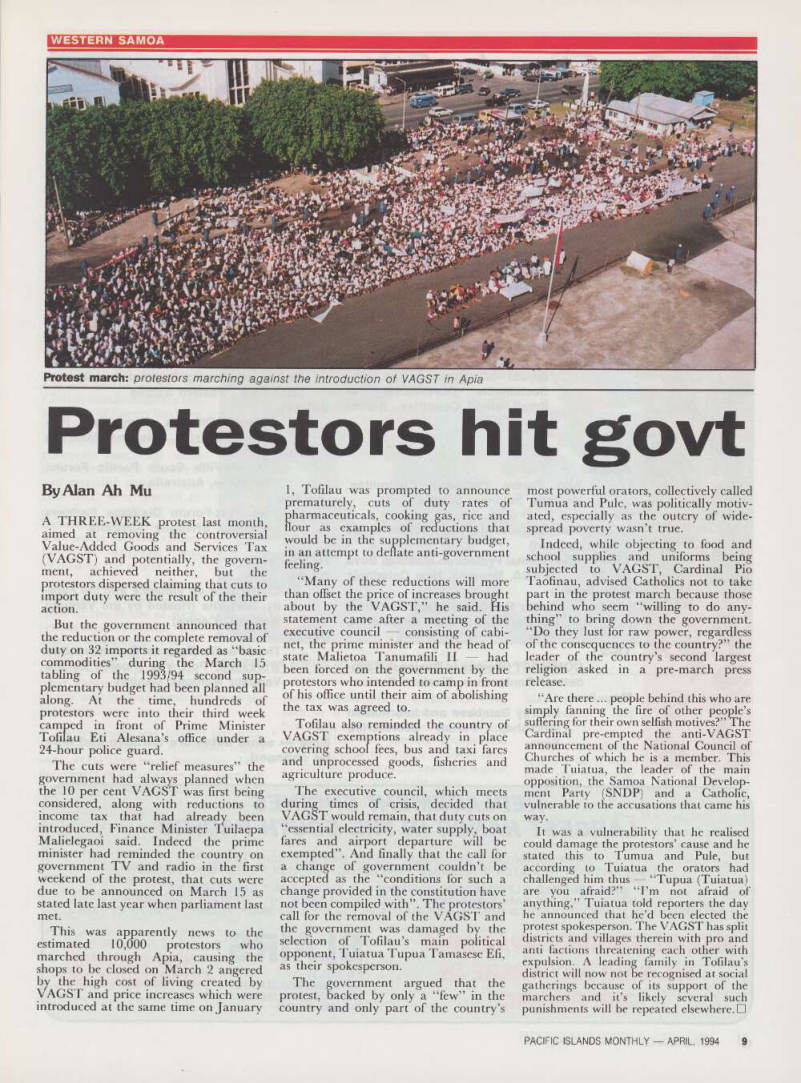
This was apparently news to the estimated 10,000 protestors who
marched through Apia, causing the
shops to be closed on March 2 angered by the high cost of living created by VAGST and price increases which were introduced at the same time on January
1, Tofilau was prompted to announce prematurely, cuts of duty rates of Sharmaceuticals, cooking gas, rice and our as examples of reductions that would be in the supplementary budget, in an attempt to deflate anti-government
feeling.
“Many of these reductions will more than offset the price of increases brought about by the VAGST,” he said. His statement came after a meeting of the executive council consisting of cabi net, the prime minister and the head of state Malietoa Tanumafili II had been forced on the government by the protestors who intended to camp in front of his office until their aim of abolishing the tax was agreed to.
Tofilau also reminded the country of
VAGST exemptions already in place
covering school fees, bus and taxi fares and unprocessed goods, fisheries and
agriculture produce.
The executive council, which meets during times of crisis, decided that VAGST would remain, that duty cuts on “essential electricity, water supply, boat fares and airport departure will be exempted”. And finally that the call for a change of government couldn’t be accepted as the “conditions for such a change provided in the constitution have not been compiled with”. The protestors’ caff for the removal of the VAGST and the government was damaged by the selection of Tofilau’s main political opponent, Tuiatua Tupua Tamasese Eli, as their spokesperson.
The government argued that the protest, backed by only a “few” in the country and only part of the country’s
most powerful orators, collectively called Tumua and Pule, was politically motiv ated, especially as the outcry of wide spread poverty wasn’t true.
Indeed, while objecting to food and school supplies and uniforms being subjected to VAGST, Cardinal Pio Taolinau, advised Catholics not to take Cart in the protest march because those ehind who seem “willing to do any thing” to bring down the government.
“Do they lust for raw power, regardless of the consequences to the country?” the leader of the country’s second largest religion asked in a pre-march press release.
“Are there ... people behind this who are simply fanning the fire of other people’s suffering for their own selfish motives?” The Cardinal pre-empted the anti-VAGST announcement of the National Council of Churches of which he is a member. This made Tuiatua, the leader of the main opposition, the Samoa National Develop ment Party (SNDP) and a Catholic, vulnerable to the accusations that came his way.
It was a vulnerability that he realised could damage theprotestors’ cause and he stated this to Tumua and Pule, but according to Tuiatua the orators had challenged him thus “Tupua (Tuiatua) are you afraid?” “I’m not afraid of anything,” Tuiatua told reporters the day he announced that he’d been elected the protest spokesperson. The VAGST has split districts and villages therein with pro and anti factions threatening each other with expulsion. A leading family in Tofilau’s district will now not be recognised at social gatherings because of its support of the marchers and it’s likely several such punishments will be repeated elsewhere. □
Protest march: protestors marching against the introduction of VAGST in Apia