Garment trouble in Saipan
p. 20 · Read in the full issue
Business
By David North
DOES your island want an experienced, if controversial garment industry? Sub stantial, but a little soiled? If it does, look no further than Saipan, as both the garment industry and the new Governor, Froilan Tenorio, are talking openly about the possibility that the industry may leave the Commonwealth of the Northern Mariana Islands (CNMI).
If the industry leaves it will go to a still lower-wage area, and it will depart because neither Washington nor the new governor will accept the level of exploi tation that much of the Saipan garment industry has thrust on its off-shore workers.
It is not simply that official Washing ton is telling the garment industry to shape up or ship out, it is rather more complicated. At the moment, Saipan sets its own minimum-wage levels, labour standards, and immigration rules. These are heavily tilted against the workers little regulation of the labour market and until recently a $2.15 an hour minimum wage. The guest workers cannot vote, so they are ripe for ill-treatment.
Despite this situation, congress has allowed Saipan garments to be labelled Made in the USA and they are admitted to the US without the payment of tariffs that would result had they been manu factured outside the US Customs system.
With mainland garment factories object ing to the low Saipan minimum wage, and unions objecting to jobs lost to CNMI, the congress has been under real pressure to correct these anomalies; further, the low wages, long hours, and prison camp type conditions in many of these factories has been spread over the front pages of the New York Times, the Washington Post and on television news shows. The barbed wire around some of the workers’ living quarters makes the
whole business quite telegenic.
Congress could, by majority vote,
simply restore its own power to make the labor and immigration conditions, and 2) the arrival of a new, reform-minded Democratic Governor, Froilan Tenorio, who was sworn into office for a four-year term in January.
Tenorio is a serious man who does not hide his convictions; he thinks that the
low-wage, many-foreign worker pattern
is not good for his islands. With this in mind he has called for an abrupt increase in the minimum wage from his current $2.45 an hour to $4.25 an hour (the mainland level) on January 1, 1995.
“If that means that the garment industry leaves, so be it,” the governor told me at a Washington reception a few
weeks ago. The old governor, the man Tenorio defeated, had tried to spin out an increase in the minimum wage to the mainland level until the next century.
Larry Guerrero had sought to calm critics of the garment industry with sweet talk, but few actions.
Tenorio’s call for a quick increase in the minimum wage was welcomed on Capitol Hill, and has broken the previous deadlock that existed between the chair man of the House of Representatives Natural Resources Committee, and the CNMI government. George Miller, the California Democrat who headed what had used to be the House interior committee, announced a new era of good feelings vis-a-vis Saipan, and it now appears possible to restore the flow of capital improvements money from the mainland to the islands.
Tenorio does not need the inducement of federal money to make him want to clean up the garment industry, but the
Republican-dominated CNMI legis
lature may be encouraged to raise wages because of this factor. Meanwhile, the
garment industry, largely funded by
Hong Kong money, and led by Willie Tan, a scratchy entrepreneur, has an nounced that a $4.25 minimum wage will be a “death knell” to the local
industry. Maybe. Or maybe it will
simply stop growing (the guest workers in garments and in the service industries in
Saipan already outnumber the indigen
ous work force by about two to one.) Despite their complaints it is hard to believe that all those factories, with their valuable Made in the USA label will pack their sewing machines and move else where.
But whatever else happens, Tenorio
has broken the mould and changed the dialogue; the workers will have to be paid better in the future. Meanwhile, the new governor is also shaking up other aspects of CNMI’s government, hand ling out decisions right and left. First, there is to be a tough hiring freeze to save money, no filling of government’s work day is 7.30 am to 4.30 pm and everyone is expected to be at work on time. Third, government employees are supposed to be polite and pleasant on the telephone.
Fourth, too many government employees had been using government-owned port able radios (cellular phones) as their personal possessions, so all of these instruments have been returned to a central headquarters until a new system can be put into place.
Similarly, all government employees
under the age of 25 have been told to get measles inoculations, to help slow an outbreak of measles in the islands. (Apparently the disease is less likely to strike older people.) And new plans have been set in motion to collect the 2 per cent fee on development more vigorously than in the past. (CNMI’s government has never had a reputation as a demon
tax collector).
The Tenorio administration appears to be having a good time with symbolism as well as substance. For example, the earlier tradition of setting aside VIP parking places in front of government buildings for the governor’s and the Lt- Governor’s cars has been abolished, and it has been announced that rules on
parking places for the physically handi
capped will be enforced vigorously.
Maybe a new day has, in fact, dawned in the Marianas. □
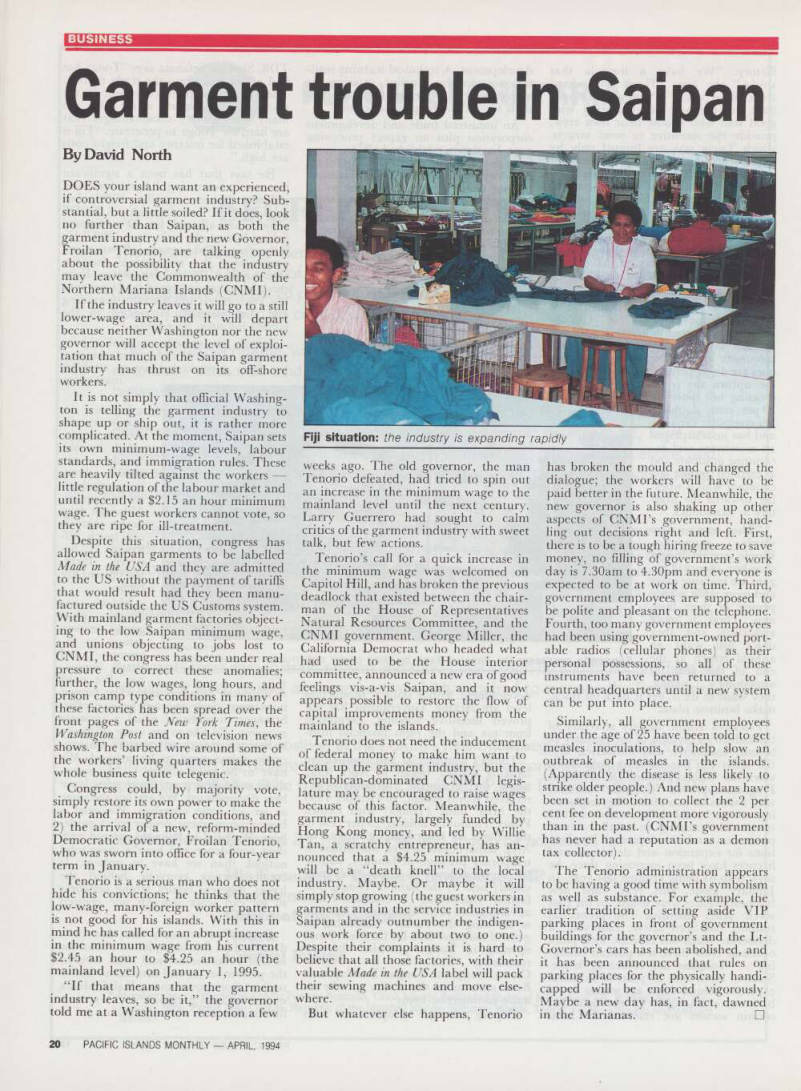
Fiji situation: the industry is expanding rapidly