Laggards respond
pp. 14-15 · Read in the full issue
Tourism
By David North
LAST month PIM reported on the variations in speed and accuracy with which island tourist bureaus responded to identical inquiries from a potential American tourist (me). We made a major mistake, however; we assumed that one could have an exchange of correspon dence with an island government agency in a matter of six weeks. Seven more responses ranging from considerate to
thoughtless came in
during the following
four weeks.
Earlier we reported that only 13 of the 27 tourist bureaus re
sponded during the six
weeks. Generally we found the smaller
islands responding
more quickly than the larger ones, and in two instances (CNMI and American Samoa) we were told by the tour ist bureaus that one drives on the left in those territories, which is not correct.
The bureaus res
ponding to our inquiry
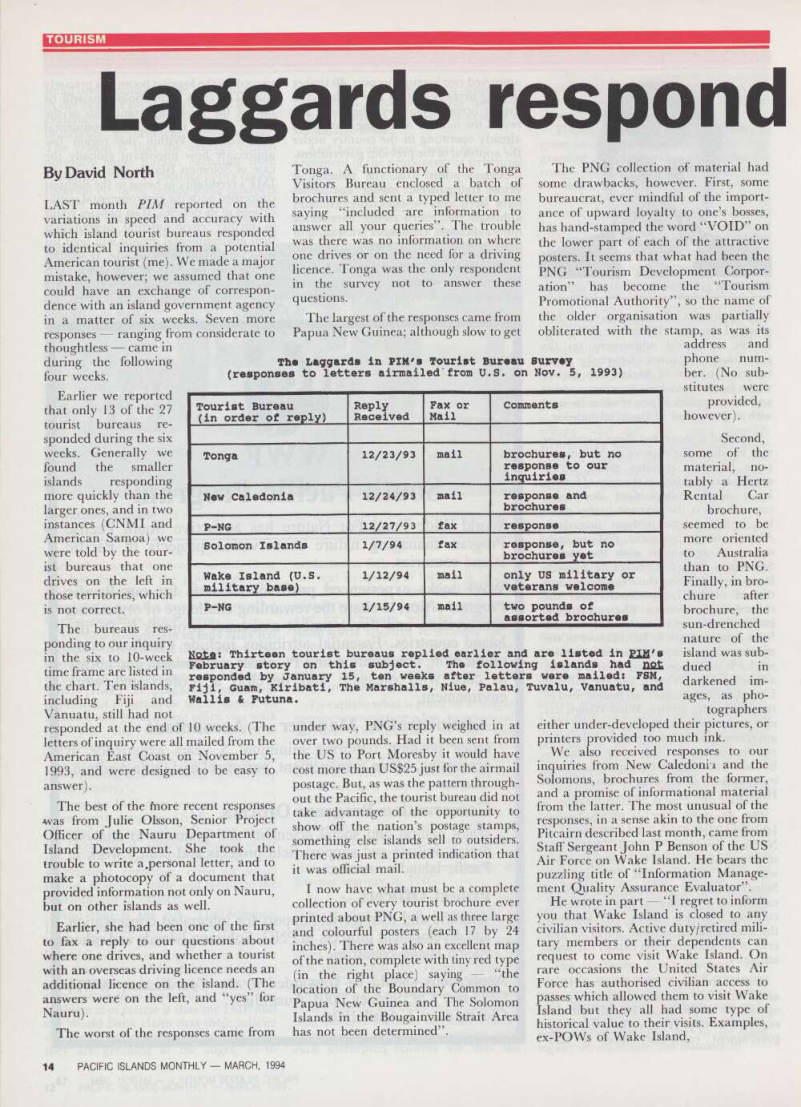
in the six to 10-week time frame are listed in the chart. Ten islands,
including Fiji and
Vanuatu, still had not
responded at the end of 10 weeks. (The letters of inquiry were all mailed from the American East Coast on November 5, 1993, and were designed to be easy to
answer).
The best of the more recent responses was from Julie Olsson, Senior Project Officer of the Nauru Department of Island Development. She took the trouble to write a.personal letter, and to make a photocopy of a document that provided information not only on Nauru, but on other islands as well.
Earlier, she had been one of the first to fax a reply to our questions about where one drives, and whether a tourist with an overseas driving licence needs an additional licence on the island. (The answers were on the left, and “yes” for
Nauru).
The worst of the responses came from
Tonga. A functionary of the Tonga
Visitors Bureau enclosed a batch of brochures and sent a typed letter to me saying “included are information to answer all your queries”. The trouble was there was no information on where one drives or on the need for a driving
licence. Tonga was the only respondent
in the survey not to answer these
questions.
The largest of the responses came from Papua New Guinea; although slow to get
The Laggards in PlM's Tourist Bureau survey (responses to letters airmailed from U.S. on Nov. 5, 1993)
Note; Thirteen tourist bureaus replied earlier and are listed in £lH's February story on this subject. The following islands had nat responded by January 15, ten weeks after letters were mailed: FSM, Fiji, Guam, Kiribati, The Marshalls, Niue, Palau, Tuvalu, Vanuatu, and Wallis & Futuna.
under way, PNG’s reply weighed in at over two pounds. Had it been sent from the US to Port Moresby it would have cost more than USS2S just for the airmail postage. But, as was the pattern through out the Pacific, the tourist bureau did not take advantage of the opportunity to show off the nation’s postage stamps, something else islands sell to outsiders.
There was just a printed indication that it was official mail.
I now have what must be a complete collection of every tourist brochure ever printed about PNG, a well as three large and colourful posters (each 17 by 24 inches). There was also an excellent map of the nation, complete with tiny red type
(in the right place) saying “the
location of the Boundary Common to Papua New Guinea and The Solomon Islands in the Bougainville Strait Area has not been determined”.
The PNG collection of material had some drawbacks, however. First, some bureaucrat, ever mindful of the import ance of upward loyalty to one’s bosses, has hand-stamped the word “VOID” on the lower part of each of the attractive posters. It seems that what had been the
PNG “Tourism Development Corpor
ation” has become the “Tourism Promotional Authority”, so the name of the older organisation was partially obliterated with the stamp, as was its
address and
phone num
ber. (No sub stitutes were
provided,
however).
Second, some of the material, no tably a Hertz Rental Car brochure, seemed to be more oriented to Australia than to PNG.
Finally, in bro chure after brochure, the sun-drenched nature of the island was sub dued in darkened im ages, as pho tographers
either under-developed their pictures, or printers provided too much ink.
We also received responses to our inquiries from New Caledonia and the Solomons, brochures from the former, and a promise of informational material from the latter. The most unusual of the responses, in a sense akin to the one from Pitcairn described last month, came from Staff Sergeant John P Benson of the US Air Force on Wake Island. He bears the puzzling title of “Information Manage ment Quality Assurance Evaluator”.
He wrote in part -“I regret to inform you that Wake Island is closed to any civilian visitors. Active duty/retired mili tary members or their dependents can request to come visit Wake Island. On rare occasions the United States Air Force has authorised civilian access to passes which allowed them to visit Wake Island but they all had some type of historical value to their visits. Examples, ex-POWs of Wake Island,
Tourist Bureau (in order of reply) Reply Received Fax or Mail Comments Tonga 12/23/93 mail brochures, but no response to our Inquiries New Caledonia 12/24/93 mall response and brochures
P-Ng
12/27/93 fax response Solomon Islands 1/7/94 fax response, but no brochures yet Wake Island (U.S. military base) 1/12/94 mail only US military or veterans welcome
P-Ng
1/15/94 mail two pounds of assorted brochures
family members of ex-POWs and a surveying crew to document the island.”
Wake, after a fierce battle early in World War 11, was stormed by the Japanese. As a matter of fact, the skimpy
tourist-type information provided by the
sergeant says “Live WW II ordinance is continually being found on Wake”.
Although a military facility, complete
with an airfield, bar, bowling alley, and a six-hole golf course, the island rules are more like those of a religious retreat “We do not allow weapons on the island.
This includes firearms, bows, switch blades and various martial arts devices.
Surrender weapons to the peace officer.
They will be returned to you upon departure ... violence will not be toler ated, and will result in incarceration, prosecution and removal from the island.”
Like Pitcairn, you must get high-level government permission to visit the island, and then you have to live up to the local rules many of which are safety oriented if you want to stay there. You cannot swim in the ocean, for
you must be with someone else. While sharks are rarely seen in the lagoon, large eels are common.
Wake is probably the only Pacific Island where the majority of the popu lation is Thai. The welcome to the island, in the little brochure, is Swasdee krub, a Thai phrase, in recognition of the fact that the seven US Air Force personnel and four US weathermen on the island are thoroughly outnumbered by the hundred or so Thai guest workers, who do the real work on the island.
Thinking of Sergeant Benson’s stilted response to my inquiry reminded me that I had received no replies, stilted or otherwise, from most of Micronesia.
There was the rapid (but inaccurate) reply from the Marianas, but working from tourist-dependent Guam, or tourist-hungry Palau, FSM, or the Mar shalls, or from Kiribati. Maybe people south of the equator are better letter writers.
Returning to our original inquiry, one
drives on the right on Wake and in New Caledonia, on the left in the Solomons, PNG, and Nauru, and probably on the left in Tonga as well. □
instance, but only in the lagoon where