logging dilemma
pp. 11-13 · Read in the full issue
Cover Story
The Solomon Islands logging dilemma
By Roman Grynberg
FOR three years now the Solomon
Islands foreign exchange reserves
have hovered between two weeks and 1.5 months import cover. The population has been increasing at a rate of 3.5 per cent per annum and successive governments have been spending and creating massive government deficits. In many ways the country looks like it is on the verge of bankruptcy.
However, if one looks at the 1992 growth figures then you would think that what we were looking is one of the newly emerging economic giants of Asia. In 1992 the growth rate of the Solomon Islands real GDP was an astounding 8.2 per cent. This is among the highest and most surprising rate of growth of any economy in the Pacific and only trailed the growth rate in Papua New Guinea which was booming from the massive increase in oil exports. However the growth figure is illusionary and is a perfect illustration of everything that is wrong with the way some economists use GDP as a measure of country’s wealth and national success. The principle reason the Solomon Islands was able to achieve so dramatic a rate of growth was because in that year it virtually doubled its log exports at the very time when the
log prices were going through the roof.
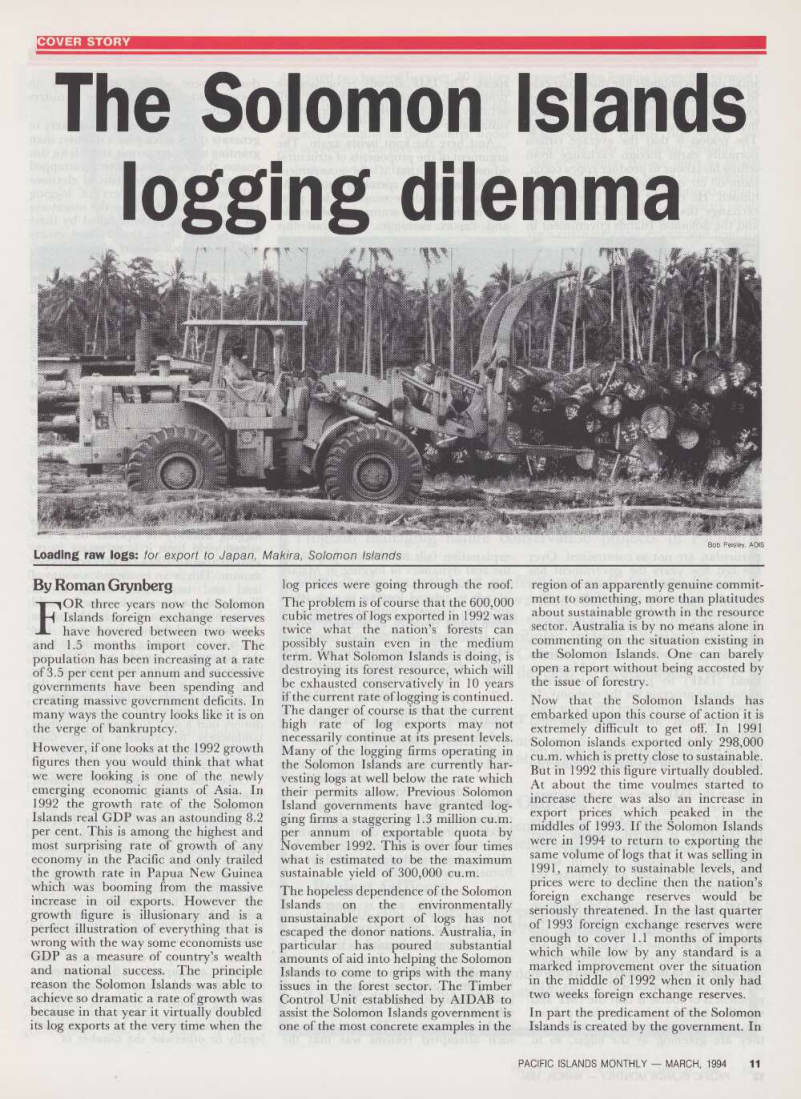
The problem is of course that the 600,000 cubic metres of logs exported in 1992 was twice what the nation’s forests can possibly sustain even in the medium term. What Solomon Islands is doing, is destroying its forest resource, which will be exhausted conservatively in 10 years if the current rate of logging is continued.
The danger of course is that the current high rate of log exports may not necessarily continue at its present levels.
Many of the logging firms operating in the Solomon Islands are currently har vesting logs at well below the rate which their permits allow. Previous Solomon Island governments have granted log ging firms a staggering 1.3 million cu.m, per annum of exportable quota by November 1992. This is over four times what is estimated to be the maximum sustainable yield of 300,000 cu.m.
The hopeless dependence of the Solomon Islands on the environmentally unsustainable export of logs has not escaped the donor nations. Australia, in
particular has poured substantial
amounts of aid into helping the Solomon Islands to come to grips with the many issues in the forest sector. The Timber Control Unit established by AIDAB to assist the Solomon Islands government is one of the most concrete examples in the
region of an apparently genuine commit
ment to something, more than platitudes about sustainable growth in the resource sector. Australia is by no means alone in commenting on the situation existing in the Solomon Islands. One can barely open a report without being accosted by the issue of forestry.
Now that the Solomon Islands has embarked upon this course of action it is extremely difficult to get off. In 1991 Solomon islands exported only 298,000 cu.m, which is pretty close to sustainable.
But in 1992 this figure virtually doubled.
At about the time voulmes started to increase there was also an increase in export prices which peaked in the middles of 1993. If the Solomon Islands were in 1994 to return to exporting the same volume of logs that it was selling in 1991, namely to sustainable levels, and prices were to decline then the nation’s foreign exchange reserves would be seriously threatened. In the last quarter of 1993 foreign exchange reserves were enough to cover 1.1 months of imports which while low by any standard is a marked improvement over the situation in the middle of 1992 when it only had two weeks foreign exchange reserves.
In part the predicament of the Solomon Islands is created by the government. In
Bob Peisley. AOIS
Loading raw logs: for export to Japan, Makira, Solomon Islands
small open economies like those that exist in the South Pacific the source of foreign exchange reserve depletion is almost invariably government over-spending.
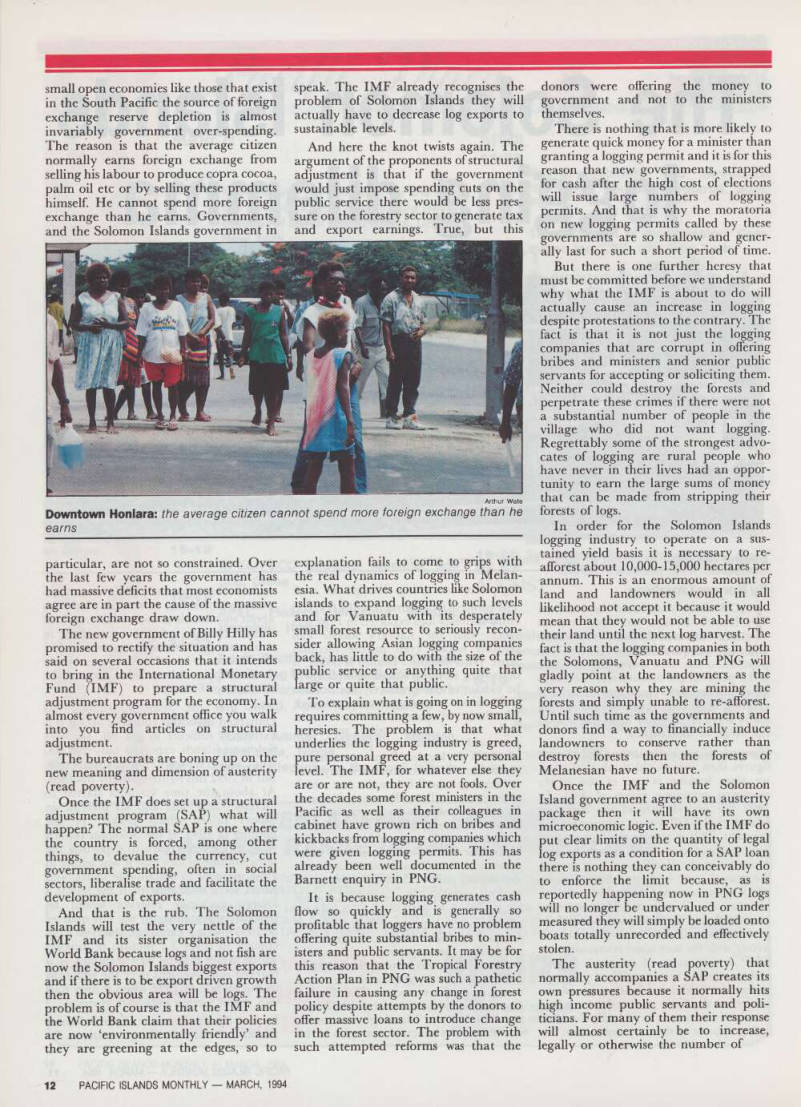
The reason is that the average citizen normally earns foreign exchange from selling his labour to produce copra cocoa, palm oil etc or by selling these products himself. He cannot spend more foreign exchange than he earns. Governments, and the Solomon Islands government in
speak. The IMF already recognises the problem of Solomon Islands they will actually have to decrease log exports to sustainable levels.
And here the knot twists again. The argument of the proponents of structural adjustment is that if the government would just impose spending cuts on the public service there would be less pres sure on the forestry sector to generate tax and export earnings. True, but this
particular, are not so constrained. Over the last few years the government has had massive deficits that most economists agree are in part the cause of the massive foreign exchange draw down.
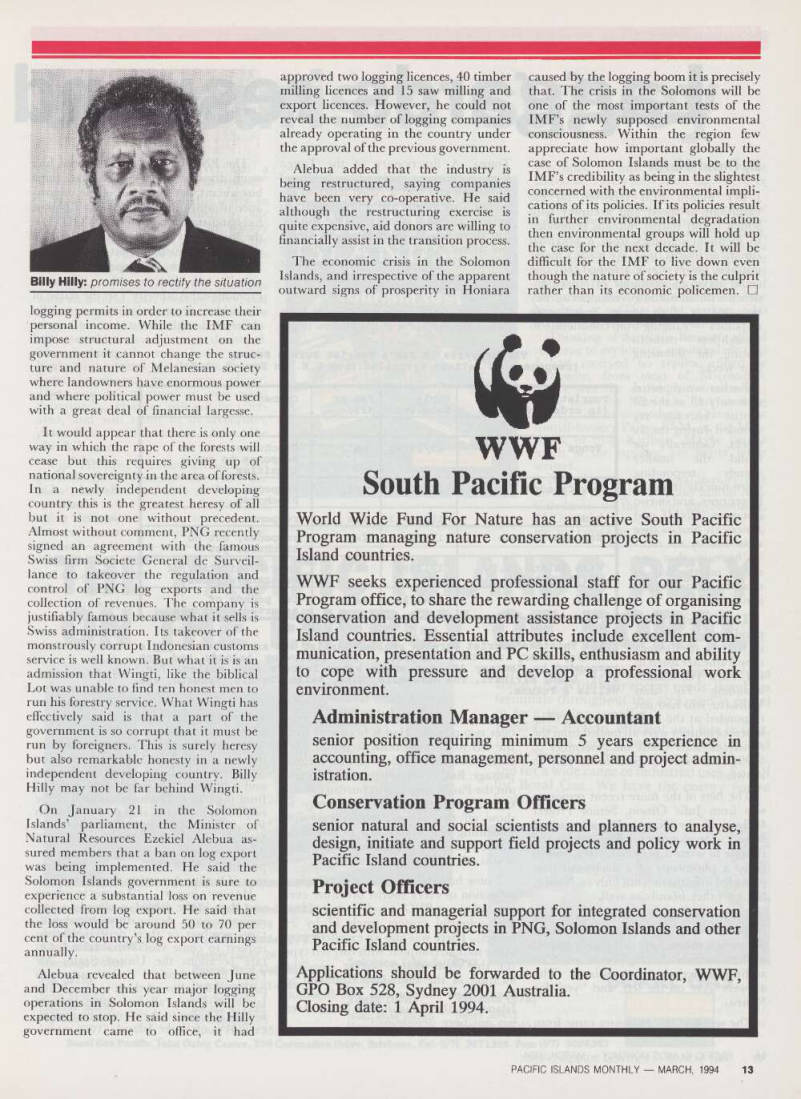
The new government of Billy Hilly has promised to rectify the situation and has said on several occasions that it intends to bring in the International Monetary Fund (IMF) to prepare a structural adjustment program for the economy. In almost every government office you walk into you find articles on structural adjustment.
The bureaucrats are boning up on the new meaning and dimension of austerity
(read poverty).
Once the IMF does set up a structural adjustment program (SAP) what will happen? The normal SAP is one where the country is forced, among other things, to devalue the currency, cut government spending, often in social sectors, liberalise trade and facilitate the development of exports.
And that is the rub. The Solomon Islands will test the very nettle of the IMF and its sister organisation the World Bank because logs and not fish are now the Solomon Islands biggest exports and if there is to be export driven growth then the obvious area will be logs. The problem is of course is that the IMF and the World Bank claim that their policies are now ‘environmentally friendly’ and they are greening at the edges, so to
explanation fails to come to grips with the real dynamics of logging in Melan esia. What drives countries like Solomon islands to expand logging to such levels and for Vanuatu with its desperately small forest resource to seriously recon sider allowing Asian logging companies back, has little to do with the size of the public service or anything quite that large or quite that public.
To explain what is going on in logging requires committing a few, by now small, heresies. The problem is that what underlies the logging industry is greed, pure personal greed at a very personal level. The IMF, for whatever else they are or are not, they are not fools. Over the decades some forest ministers in the Pacific as well as their colleagues in cabinet have grown rich on bribes and kickbacks from logging companies which were given logging permits. This has already been well documented in the Barnett enquiry in PNG.
It is because logging generates cash flow so quickly and is generally so profitable that loggers have no problem offering quite substantial bribes to min isters and public servants. It may be for this reason that the Tropical Forestry Action Plan in PNG was such a pathetic failure in causing any change in forest policy despite attempts by the donors to offer massive loans to introduce change in the forest sector. The problem with such attempted reforms was that the
donors were offering the money to government and not to the ministers themselves.
There is nothing that is more likely to generate quick money for a minister than granting a logging permit and it is for this reason that new governments, strapped for cash after the high cost of elections will issue large numbers of logging permits. And that is why the moratoria on new logging permits called by these governments are so shallow and gener ally last for such a short period of time.
But there is one further heresy that must be committed before we understand why what the IMF is about to do will actually cause an increase in logging despite protestations to the contrary. The fact is that it is not just the logging companies that are corrupt in offering bribes and ministers and senior public servants for accepting or soliciting them.
Neither could destroy the forests and perpetrate these crimes if there were not a substantial number of people in the village who did not want logging.
Regrettably some of the strongest advo cates of logging are rural people who have never in their lives had an oppor tunity to earn the large sums of money that can be made from stripping their forests of logs.
In order for the Solomon Islands logging industry to operate on a sus tained yield basis it is necessary to re afforest about 10,000-15,000 hectares per annum. This is an enormous amount of land and landowners would in all likelihood not accept it because it would mean that they would not be able to use their land until the next log harvest. The fact is that the logging companies in both the Solomons, Vanuatu and PNG will gladly point at the landowners as the very reason why they are mining the forests and simply unable to re-afforest.
Until such time as the governments and donors find a way to financially induce landowners to conserve rather than destroy forests then the forests of Melanesian have no future.
Once the IMF and the Solomon Island government agree to an austerity package then it will have its own microeconomic logic. Even if the IMF do put clear limits on the quantity of legal log exports as a condition for a SAP loan there is nothing they can conceivably do to enforce the limit because, as is
reportedly happening now in PNG logs
will no longer be undervalued or under measured they will simply be loaded onto boats totally unrecorded and effectively stolen.
The austerity (read poverty) that
normally accompanies a SAP creates its own pressures because it normally hits
high income public servants and poli
ticians. For many of them their response will almost certainly be to increase, legally or otherwise the number of
Downtown Honiara: the average citizen cannot spend more foreign exchange than he earns
logging permits in order to increase their personal income. While the IMF can impose structural adjustment on the government it cannot change the struc ture and nature of Melanesian society where landowners have enormous power and where political power must be used with a great deal of financial largesse.
It would appear that there is only one way in which the rape of the forests will cease but this requires giving up of national sovereignty in the area of forests.
In a newly independent developing
country this is the greatest heresy of all but it is not one without precedent.
Almost without comment, PNG recently signed an agreement with the famous Swiss firm Societe General de Surveil lance to takeover the regulation and control of PNG log exports and the collection of revenues. The company is justifiably famous because what it sells is Swiss administration. Its takeover of the monstrously corrupt Indonesian customs service is well known. But what it is is an admission that Wingti, like the biblical Lot was unable to find ten honest men to run his forestry service. What Wingti has effectively said is that a part of the government is so corrupt that it must be run by foreigners. This is surely heresy but also remarkable honesty in a newly
independent developing country. Billy
Hilly may not be far behind Wingti.
On January 21 in the Solomon Islands’ parliament, the Minister of Natural Resources Ezekiel Alebua as sured members that a ban on log export was being implemented. He said the Solomon Islands government is sure to experience a substantial loss on revenue collected from log export. He said that the loss would be around 50 to 70 per cent of the country’s log export earnings
annually.
Alebua revealed that between June and December this year major logging operations in Solomon Islands will be expected to stop. He said since the Hilly government came to office, it had
approved two logging licences, 40 timber milling licences and 15 saw milling and export licences. However, he could not reveal the number of logging companies already operating in the country under the approval of the previous government.
Alebua added that the industry is being restructured, saying companies have been very co-operative. He said although the restructuring exercise is quite expensive, aid donors are willing to financially assist in the transition process.
The economic crisis in the Solomon Islands, and irrespective of the apparent outward signs of prosperity in Honiara
caused by the logging boom it is precisely that. The crisis in the Solomons will be one of the most important tests of the
IMF’s newly supposed environmental
consciousness. Within the region few
appreciate how important globally the
case of Solomon Islands must be to the IMF’s credibility as being in the slightest concerned with the environmental impli cations of its policies. If its policies result in further environmental degradation then environmental groups will hold up the case for the next decade. It will be difficult for the IMF to live down even though the nature of society is the culprit rather than its economic policemen. □
Billy Hilly: promises to rectify the situation