Not Korman’s
p. 16 · Read in the full issue
Industrial Relations
year
1993 could really not be considered a good year for Vanuatu’s Prime Minister, Maxime Carlot Korman. In no area however has Carlot had more difficulties than in the area of industrial relations with his public servants who have twice confronted him this year.
Korman’s problems began in May
when some 700 members of the Vanuatu Teacher’s association walked off the jobs in pay dispute. The teachers were asking for a pay increase of 25 per cent. The teachers, who receive monthly salaries of 32,000 vatu (US$25O a month) for primary teachers and 50,000 vatu (US$4lO) claimed that they had not had a pay rise since 1987 were effectively routed in the 12-day strike. According to VTA President Oped Massing ‘All the teachers who went on strike were sus pended, even those who did not go on strike received suspension letters.’ At the end of strike the union was forced to settle for a reinstatement and a promised but indeterminate pay rise for its members in 1994.
What really created the problems for Carlot was not the strike but a phenom ena that has over the last decade pushed Papua New Guinea, Solomon Islands and now Vanuatu into substantial and what are quite destabilising conflicts. In the middle of the teachers strike in May the Vanuatu parliament decided to vote its 46 members a massive 40-70 per cent pay rise. The largest increases were for the ministers but increases were also given to the president. In Solomon Islands the government of Solomon Mamaloni had given massive salary increases to its top public servants thus precipitating a confrontation with its own public servants. The government of Rabbie Namaliu massively increased the salaries of MPs and statutory office bearers when it came to power in 1988.
The consequences were again predict able. There were a succession of strikes in the public and private sectors which eventually lead to a mutiny in the PNG defence forces when the army offered massive pay rises to the officers and virtually nothing to the enlisted men.
Carlot’s problems with industrial rela tions were compounded in June when he extended the politicisation of the public service to an entirely new level. Employ ing a practice begun by Walter Lini and continued by every Vanuatu prime minister since Carlot had six middle level public servants in the Department of
Finance dismissed for political reasons.
In a most extraordinary official letter dated 30th June 1993 from the Acting director of Finance, Terry Fisher wrote in a manner very reminiscent of the Stalinist era to one of the middle level officials in the Vanuatu paymaster’s office George Garae saying ‘lt is with the greatest of regret that I have to inform you that I am instructed by the Minister
(Willy Jimmy) to suspend you on
Political grounds, effective from 30th June 93’. The letter was signed by the acting director of finance.
Vanuatu is arguabbly the most deeply politicised country in the South Pacific.
It has been common practice for incom ing administrations to remove the min isterial first and second secretaries. These
were always political appointees but the
government of Carlot has moved to dismissing middle level public servants for political reasons. As a result of the politicisation of the Vanuatu public service some of the country’s best edu cated and most competent adminis trators are unemployed for no other reason than their political affiliation. The dismissal of the finance officials was
squashed by the public service com
mission in Vanuatu but the council of ministers (cabinet) upheld the decision and all have been sacked. Similar politically motivated sacking have been mooted for the health service as well as in the police.
While the situation was difficult in Vanuatu’s public service it was com pounded by a difficult strike in Novem ber and early December of the Vanuatu Public Service Association. The govern ment of Carlot declared the strike illegal and has threatened to dismiss all those involved. The government has also made clear its intention to dismiss some of the nation’s 5,500 public servants starting
this year with a reduction of 200. The public servants were asking for a 16 per cent wage increase which, together with the 4 per cent they received in 1992 would compensate them for what union leaders claimed was the effect of inflation since the time of the last public sector pay raise in 1990.
The strike which threatened to disrupt the South Pacific Mini-games when the union attempted to close the airport and threatened to cut off water to the capital Port Vila. The government stationed police outside the city’s water works during the strike. The government claimed in parliament that only 150 workers were off work and the union claimed 80 per cent. In the rigidly controlled media in Vanuatu Radio Vanuatu were forbidden to broadcast even service messages from the union.
There appears to have been wide spread support for the strike in Port Vila from all segments of the community.
Menawhile the public servants’ strike looked set to extend well into February (at the time of writing).
The Vanuatu government maintains that the strike is illegal and that public servants should return to work before their claims are looked into.
Public servants’ demands include a 16 per cent pay rise. The government has offered five per cent.
The Vanuatu government ordered strikers to return to work or face disciplinary action. A few obeyed, but the VPSA maintains that about 1,400 public servants, or nearly 70 per cent of its membership, remains on strike.
The VPSA is also demanding the revocation of suspension orders against 390 workers, the lifting of a ban on its use of the state-run media and the release of strikers’ salaries.
In a more recent development 34
private company employees who joined
the general strike called by the Vanuatu Council of trade unions in early Febru ary have lost their jobs. The general strike was in support of the civil servants.
Nineteen employees of Better Price, 12 from Au Bon Marche supermarkets and three from Thrifty Car rentals in Port Vila have all been sacked for joining the strike.
Meanwhile, most of the 116 members of the private sector unions who turned out to support the VCTU-called strike have returned to work following in creased threats of their sacking. Em ployees of domestic airlines Vanair in Santo all returned to work on February 14 after a warning by Vanair chairperson, Irene Bongnaim, that fail ure to return would result in their dismissal.
This report was compiled on February 16, no doubt events will have altered by the time you read this. □
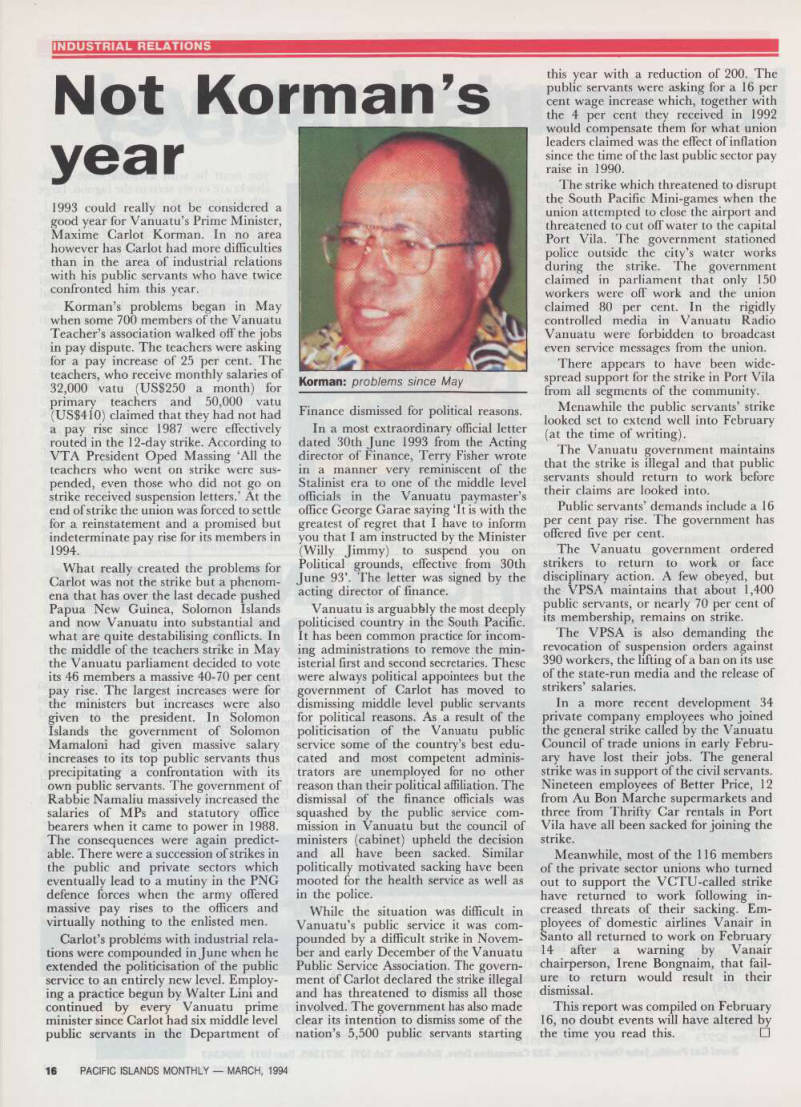
Korman: problems since May