Magnificent Malaysia
pp. 45-47 · Read in the full issue
Visit Malaysia Year ’94
THERE’S more to Malaysia than
swaying palm trees against a tropical
sunset and endless pristine beaches.
The country is an amalgamation of all the fascination and mystery of the East.
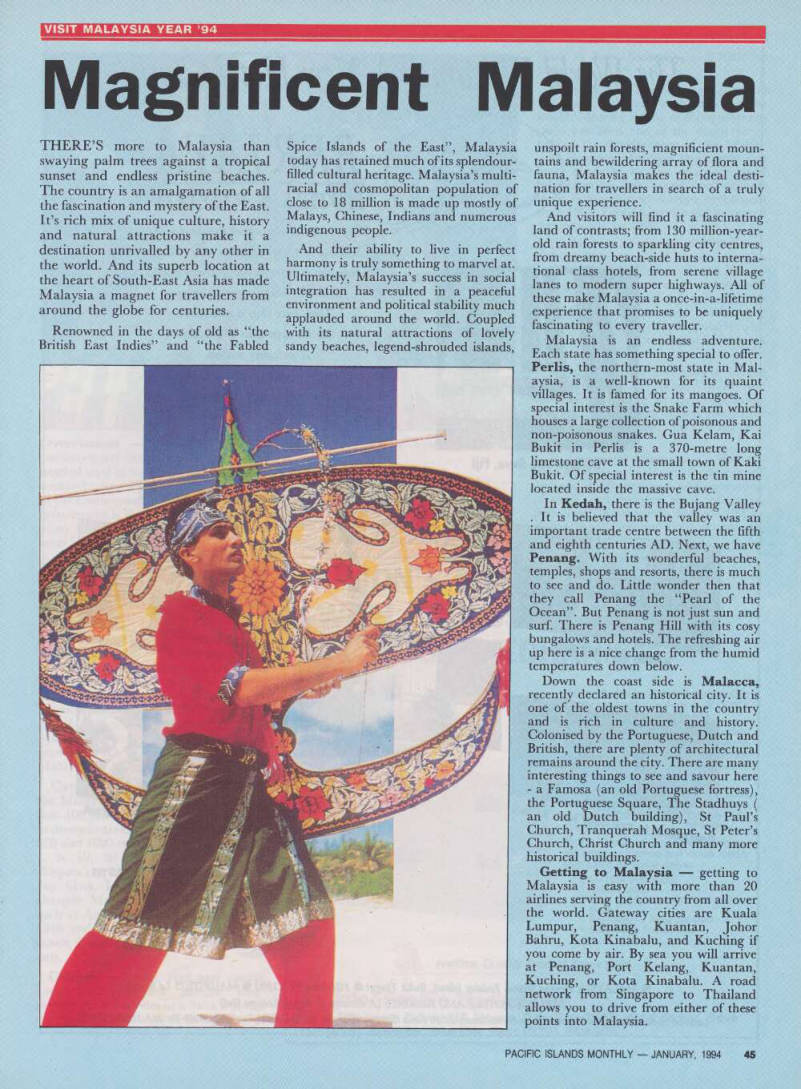
It’s rich mix of unique culture, history and natural attractions make it a destination unrivalled by any other in the world. And its superb location at the heart of South-East Asia has made Malaysia a magnet for travellers from around the globe for centuries.
Renowned in the days of old as “the British East Indies” and “the Fabled
Spice Islands of the East”, Malaysia today has retained much of its splendour filled cultural heritage. Malaysia’s multi racial and cosmopolitan population of close to 18 million is made up mostly of Malays, Chinese, Indians and numerous indigenous people.
And their ability to live in perfect harmony is truly something to marvel at.
Ultimately, Malaysia’s success in social integration has resulted in a peaceful environment and political stability much applauded around the world. Coupled with its natural attractions of lovely sandy beaches, legend-shrouded islands,
unspoilt rain forests, magnificient moun tains and bewildering array of flora and fauna, Malaysia makes the ideal desti nation for travellers in search of a truly unique experience.
And visitors will find it a fascinating land of contrasts; from 130 million-year old rain forests to sparkling city centres, from dreamy beach-side huts to interna tional class hotels, from serene village lanes to modern super highways. All of these make Malaysia a once-in-a-lifetime experience that promises to be uniquely fascinating to every traveller.
Malaysia is an endless adventure.
Each state has something special to offer.
Perils, the northern-most state in Mal aysia, is a well-known for its quaint villages. It is famed for its mangoes. Of special interest is the Snake Farm which houses a large collection of poisonous and non-poisonous snakes. Gua Kelam, Kai Bukit in Perlis is a 370-metre long limestone cave at the small town of Kaki Bukit. Of special interest is the tin mine located inside the massive cave.
In Kedah, there is the Bujang Valley . It is believed that the valley was an important trade centre between the fifth and eighth centuries AD. Next, we have Penang. With its wonderful beaches, temples, shops and resorts, there is much to see and do. Little wonder then that they call Penang the “Pearl of the Ocean”. But Penang is not just sun and surf. There is Penang Hill with its cosy bungalows and hotels. The refreshing air up here is a nice change from the humid temperatures down below.
Down the coast side is Malacca, recently declared an historical city. It is one of the oldest towns in the country and is rich in culture and history.
Colonised by the Portuguese, Dutch and British, there are plenty of architectural remains around the city. There are many interesting things to see and savour here - a Famosa (an old Portuguese fortress),
the Portuguese Square, The Stadhuys (
an old Dutch building), St Paul’s Church, Tranquerah Mosque, St Peter’s Church, Christ Church and many more
historical buildings.
Getting to Malaysia getting to Malaysia is easy with more than 20 airlines serving the country from all over the world. Gateway cities are Kuala
Lumpur, Penang, Kuantan, Johor
Bahru, Kota Kinabalu, and Kuching if you come by air. By sea you will arrive at Penang, Port Kelang, Kuantan, Kuching, or Kota Kinabalu. A road network from Singapore to Thailand allows you to drive from either of these points into Malaysia.
Government Malaysia enjoys a
parliamentary democracy. The supreme
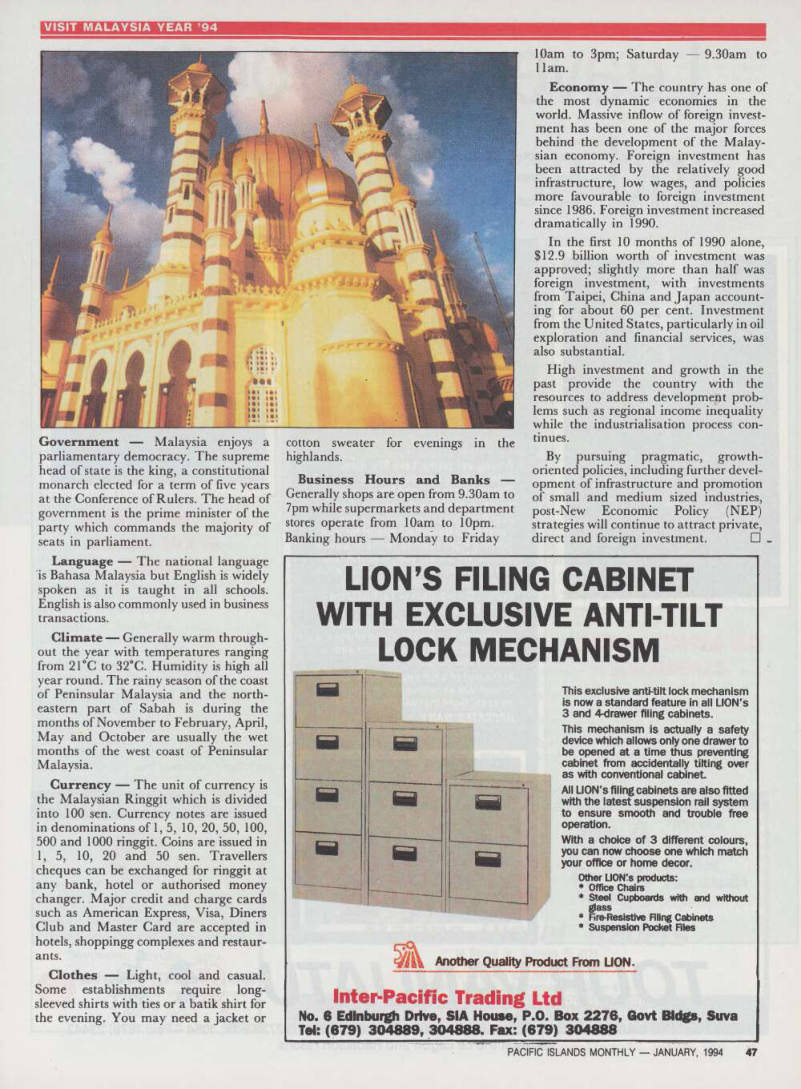
head of state is the king, a constitutional monarch elected for a term of five years at the Conference of Rulers. The head of government is the prime minister of the party which commands the majority of seats in parliament.
Language The national language is Bahasa Malaysia but English is widely spoken as it is taught in all schools.
English is also commonly used in business transactions.
Climate Generally warm through out the year with temperatures ranging from 21°C to 32°C. Humidity is high all year round. The rainy season of the coast of Peninsular Malaysia and the north eastern part of Sabah is during the months of November to February, April, May and October are usually the wet months of the west coast of Peninsular Malaysia.
Currency The unit of currency is the Malaysian Ringgit which is divided into 100 sen. Currency notes are issued in denominations of 1,5, 10, 20, 50, 100, 500 and 1000 ringgit. Coins are issued in 1,5, 10, 20 and 50 sen. Travellers cheques can be exchanged for ringgit at any bank, hotel or authorised money changer. Major credit and charge cards such as American Express, Visa, Diners Club and Master Card are accepted in hotels, shoppingg complexes and restaur ants.
Clothes Light, cool and casual.
Some establishments require long sleeved shirts with ties or a batik shirt for the evening. You may need a jacket or
cotton sweater for evenings in the
highlands.
Business Hours and Banks Generally shops are open from 9.30 am to 7pm while supermarkets and department stores operate from 10am to 10pm.
Banking hours Monday to Friday
ipam to 3pm; Saturday —9.30 am to 1 lam.
Economy The country has one of the most dynamic economies in the world. Massive inflow of foreign invest ment has been one of the major forces behind the development of the Malay sian economy. Foreign investment has been attracted by the relatively good infrastructure, low wages, and policies more favourable to foreign investment since 1986. Foreign investment increased dramatically in 1990.
In the first 10 months of 1990 alone, $12.9 billion worth of investment was approved; slightly more than half was foreign investment, with investments from Taipei, China and Japan account ing for about 60 per cent. Investment from the United States, particularly in oil exploration and financial services, was also substantial.
High investment and growth in the past provide the country with the resources to address development prob lems such as regional income inequality while the industrialisation process con tinues.
By pursuing pragmatic, growth
oriented policies, including further devel opment of infrastructure and promotion of small and medium sized industries,
post-New Economic Policy (NEP)
strategies will continue to attract private, direct and foreign investment. □ -