land
p. 44 · Read in the full issue
Farming
Back to the
By David and Ursula Chappell
ON July 21, a brief notice from the Frangi juice company in the classified ads of the Cook Islands News informed orange growers, “due to the closure of Kia Orana Foods Co., no fruit will be processed for concentrate this season. It was hoped we could get it together, but it proved beyond us.” Neil and Christine Willis, of Frangi, had tried for a month to get the juice-maker working at the now bankrupt KOFC but the machine needed so may new parts that they finally had to import frozen concentrate instead
of helping Cook Islands orange growers market a harvest worth an estimated
Nzs3O,Ooo.
That same day, panelists at the Avarua branch of the University of the South Pacific discussed the pros pects of the Cook Islands in the year 2000. National ad visory representa tive Kato Tama admitted that the government was
putting “all its eggs into one basket”, namely tourism. He recommended greater community participation in decision making because some projects have been focused too much on making money in the present and not enough on providing for future generations. “Development,” he said, “is how to better what we have today and that means making the best of what we have.” Another minister in the audience predicted that everyone might become millionaires someday when the technology was developed to mine undersea manganese nodules within the Cooks’ exclusive economic zone.
T oral Hpvplnnmpnt k nmhl.matir in Local development is problematic in the Cook Islands. Because it is freely associated with New Zealand, its people enjoy New Zealand citizenship, so about two-thirds of them now live outside the Cook Islands and half of those were born overseas. Nearby Niue, which is
also freely associated with New Zealand, is suffering an even greater population drain. More than 14,000 Niueans live in New Zealand, compared with 2000 at home. In July, Premier Frank Lui proposed what amounts to a kind of population swap offering 60-year leases to New Zealand pensioners who might want to retire in Niue. Both Niue and the Cooks reserve ownership of all land for the indigenous people (or their government) but despite the economic slowdown in New Zealand and the relegation of Pacific island migrants there to generally low-level jobs, most Cook Islanders and Niueans obviously prefer the “bright lights” to farming at home.
“Papa” Solomon o Solomon, of Aitu taki, a former official in the Cook Islands Ministry of Agriculture, remembers that things were different before self-
government in 1965. It was hard to find workers to employ in those days, he says, because so many already had jobs
producing, processing and shipping fruit.
He was sent to outer islands to start up growing projects. There was more reg ular shipping then, he recalls, which took oranges, bananas, copra, and pineapple to New Zealand. But since the 19705, exports have mostly declined. Now so many Cook Islanders go to New Zea land, and so many New Zealanders come to the Cooks, he says, that the population is becoming more and more mixed, and linked to tourism. In addition, foreign aid and remittances from relatives in New Zealand subsidise the Cook Islands economy.
There are exceptions to this picture, however. The many well-tended gardens on Rarotonga and outer islands show that Cook Islanders still know how to produce, and not only for subsistence. In
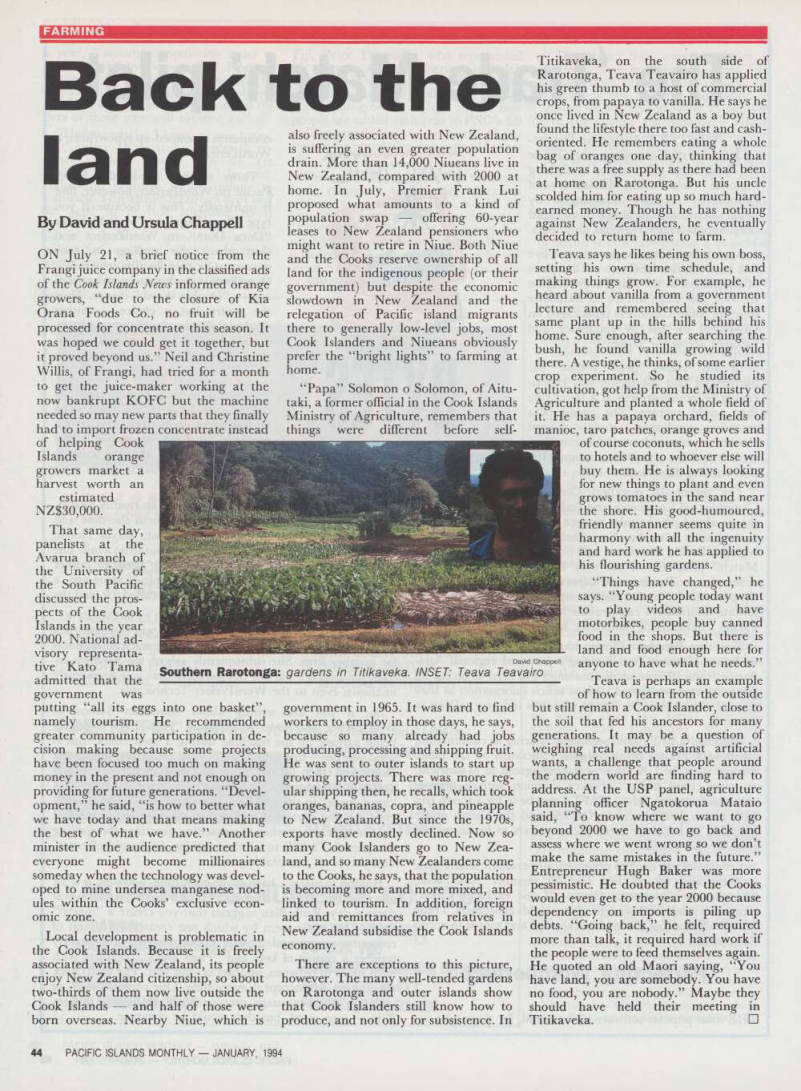
Titikaveka, on the south side of Rarotonga, Teava Teavairo has applied his green thumb to a host of commercial crops, from papaya to vanilla. He says he once lived in New Zealand as a boy but found the lifestyle there too fast and cash oriented. He remembers eating a whole bag of oranges one day, thinking that there was a free supply as there had been at home on Rarotonga. But his uncle scolded him for eating up so much hard earned money. Though he has nothing against New Zealanders, he eventually decided to return home to farm.
Teava says he likes being his own boss, setting his own time schedule, and
making things grow. For example, he
heard about vanilla from a government lecture and remembered seeing that same plant up in the hills behind his home. Sure enough, after searching the bush, he found vanilla growing wild there. A vestige, he thinks, of some earlier crop experiment. So he studied its cultivation, got help from the Ministry of Agriculture and planted a whole field of it. He has a papaya orchard, fields of manioc, taro patches, orange groves and
of course coconuts, which he sells to hotels and to whoever else will
buy them. He is always looking
for new things to plant and even grows tomatoes in the sand near the shore. His good-humoured, friendly manner seems quite in harmony with all the ingenuity and hard work he has applied to
his flourishing gardens.
“Things have changed,” he
says. “Young people today want
to play videos and have
motorbikes, people buy canned
food in the shops. But there is land and food enough here for anyone to have what he needs.”
Teava is perhaps an example of how to learn from the outside
but still remain a Cook Islander, close to the soil that fed his ancestors for many generations. It may be a question of weighing real needs against artificial wants, a challenge that people around the modern world are finding hard to address. At the USP panel, agriculture planning officer Ngatokorua Mataio said, “To know where we want to go beyond 2000 we have to go back and assess where we went wrong so we don’t make the same mistakes in the future.”
Entrepreneur Hugh Baker was more pessimistic. He doubted that the Cooks would even get to the year 2000 because dependency on imports is piling up debts. “Going back,” he felt, required more than talk, it required hard work if the people were to feed themselves again.
He quoted an old Maori saying, “You have land, you are somebody. You have no food, you are nobody.” Maybe they should have held their meeting in Titikaveka. □
David Chappell Southern Rarotonga: gardens in Titikaveka. INSET: Teava Teavairo