sightings
p. 49 · Read in the full issue
Yachting
Santo sightings
By Sally Andrew
LATE in the afternoon I searched the horizon, anxious to catch a glimpse of land before sunset. Fellowship was ap proaching Vanuatu after a seven-day passage from Tuvalu and the chart was not much better than the one Captain Cook made in 1774. With some relief, we sighted the northern tip of Maewo and confirmed that our course would miss the island.
In the moonlight we sailed across the inner sea towards Santo and at sunrise spotted the island of Ambae her silhouette looking every bit like a huge upturned canoe. Often shrouded in mist, the island appears and disappears like Michener’s Bali Hai. At midday we arrived at Luganville, our port of entry, and anchored off the old French school.
We were hungry, and had been told that the Natangora Cafe was the best place for an outstanding lunch and a good cup of coffee. So after clearing in with Customs and immigration, we headed straight for the Natangora. In the heart of the downtown Santo, this sidewalk cafe is a great place to sit and watch the world go by. We sipped our cappuccinos and laid back. It felt good to be in Vanuatu.
At times, Santo is a beehive of activity, like in 1942. During World War II US forces turned Santo into a huge camp for more than 100,000 servicemen. Five airfields, four hospitals, dozens of cin emas, and hundreds of kilometres of roads were built. Quonset huts were erected and used as offices, stores and workshops, and for accommodation. But the departure of the servicemen in 1945 left Santo a ghosttown.
Today, at lunchtime, Santo still re sembles a ghost town. But in the morning Santo comes alive. Women in their mother-hubbard dresses, streamers streaming and arms full of children, come to town to shop in Santo’s covered market. Everyone bustles in and out of the Chinese shops on main streed, looking for bargains and ingesting big, juicy mandarines from nearby Malo Island. Best buys include local produce and handicrafts, and specialty products
like Venui Vanilla and Valeteruru Cof fee.
There are two good anchorages close to town one in front of the old French school just west of the Sarakata River and another more protected spot at Palikulo Bay, a short taxi-ride distance away. Many boats stop at Santo to reprovision or renew visas, and this year we met the crews of Afrigan Queen (USA), Journeyman (USA),
Infinity (USA), Slow Lane (Canada),
Queneah Guen (Canada, Vagus (Australia), Windemere (New Zealand), Shantung (New Zealand) and Shalimar (Ireland).
In the bush 15 miles outside Luganville is the village of Vanafo where people wear little more than loin cloths and grass skirts.
Men and boys hunt pigs and birds with bows and arrows, and women cook food using stones heated by fires often made from rubbing two sticks together. Continu
ing to live a back-to-nature, commune-like existence is a conscious choice for these people whose huts, clothes and tools are fabricated from their natural environment.
Vanafo was a political hotspot in the 1970 s when Jimmy Stevens and his Nagriamel movement denounced the con dominium government and promoted a reactionary return to a kastom lifestyle. In 1980, Stevens led a mouse-that-roared type revolution and installed a shortlived pro visional government in Santo. Arrested and sentenced to jail for nearly 14 years, Stevens is now back at Vanafo. He enjoys visitors and loves to reminisce about the Americans coming to Santo in the ’4os.
Lots ofyachties visited Vanafro this year.
Adamite from New Zealand, Bumble Bee and
Ringoe from Germany, Babajaga from Switz
erland, Islandia from USA and Fellowship went with Martha from Gudfala Tours and received a warm welcome at the village.
Diving in Santo is great and one of the best and most accessible wreck dives in the world, the USS President Coolidge, lies close offshore in 20 to 80 metres of water.
A massive luxury liner turned troop carrier, the Coolidge sank in 1942 and still has old ammunition, guns and helmets strwen all over the decks. Bigger than the Fairstar, local divemaster Allen Power says that even after 25 years he hasn’t see it all. Helen and Colin Bell off the Australian yacht Truant did several dives on the Coolidge and in the coral garden at the top of the wreck where divers do their decompression, they met “Boris”.
Boris is a friendly fellow, about 7 feet long and 450 pounds, and has been hanging around the Coolidge for over 25 years. “There are lots of big fish tuna, barracuda, manta rays, and, like Boris, they all seem to be in proportion to the ship.” Thanks to the concerted efforts of Allen Power, all the artifacts, coral and fish in the area are protected as a marine park.
There’s good cruising all around Santo.
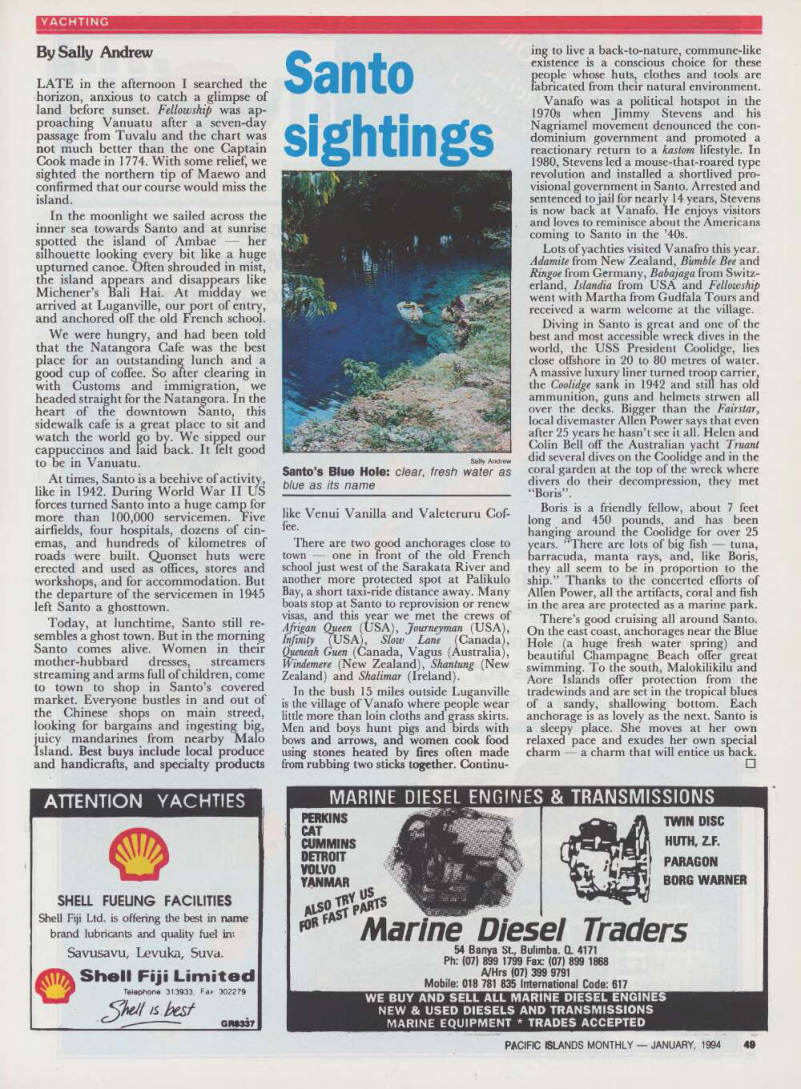
On the east coast, anchorages near the Blue Hole (a huge fresh water spring) and beautiful Champagne Beach offer great swimming. To tne south, Malokilikilu and Aore Islands offer protection from the tradewinds and are set in the tropical blues of a sandy, shallowing bottom. Each anchorage is as lovely as the next. Santo is a sleepy place. She moves at her own relaxed pace and exudes her own special charm a charm that will entice us back. □
Sally Andrew Santo’s Blue Hole: clear, fresh water as blue as its name