An empty seat in Paris
p. 40 · Read in the full issue
ON Jean-Marie Tjibaou’s request, the three partners who had just signed the Matignon Accords in Paris in June 1988 (which ended violence in New Caledonia and paved the way for a transitory 10-year period leading to a referendum on self-determination m 1998) agreed to meet every year in the French capital for a Comite de sum (monitoring committee) des accords.
The Kanak leader wanted to make sure that the implementation of the
rebalancing measures in favour of his
community, agreed on by the French
state, anti-independence RPCR and pro independence FLNKS, would really take
place as planned.
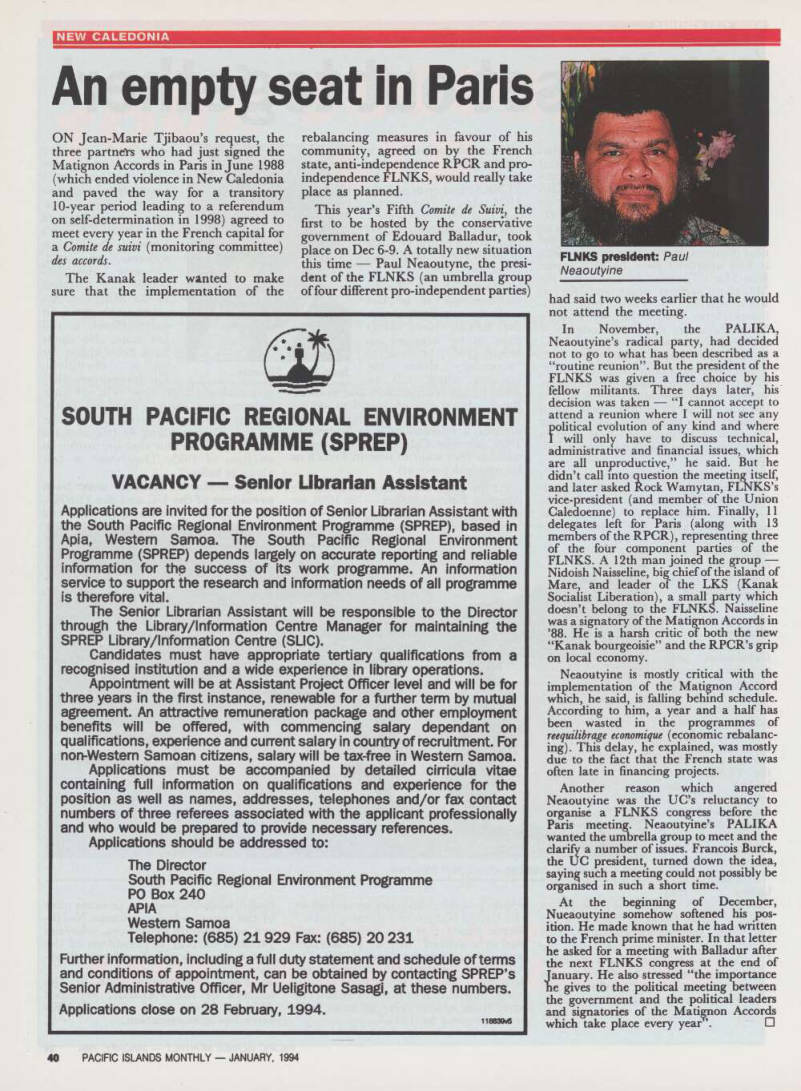
This year ’ s Fi f th Comite de Suivi, the first to be hosted by the conservative government of Edouard Bahadur, took p i ace on Dec 6-9. A totally new situation this time Paul Neaoutyne, the presi dent of the FLNKS (an umbrella group of four different pro-independent parties)
had said two weeks earlier that he would not attend the meeting.
In November, the PALIKA, Neaoutyine’s radical party, had decided not to go to what has been described as a “routine reunion”. But the president of the FLNKS was given a free choice by his fellow militants. Three days later, his decision was taken “I cannot accept to attend a reunion where I will not see any Folitical evolution of any kind and where will only have to discuss technical, administrative and financial issues, which are all unproductive,” he said. But he didn’t call into question the meeting itself, and later asked Rock Wamytan, FLNKS’s vice-president (and member of the Union
Caledoenne) to replace him. Finally, 11
delegates left for Paris (along with 13 members of the RPCR), representing three of the four component parties of the FLNKS. A 12th man joined the group Nidoish Naisseline, big chief of the island of Mare, and leader of the LKS (Kanak Socialist Liberation), a small party which doesn’t belong to tne FLNKS. Naisseline was a signatory of the Matignon Accords in ’BB. He is a harsh critic of both the new “Kanak bourgeoisie” and the RPCR’s grip on local economy.
Neaoutyine is mostly critical with the implementation of the Matignon Accord which, he said, is falling behind schedule.
According to him, a year and a half has been wasted in the programmes of
reequilibrage economique (economic rebalanc
ing). This delay, he explained, was mostly due to the fact that the French state was often late in financing projects.
Another reason which angered Neaoutyine was the UC’s reluctancy to organise a FLNKS congress before the
Paris meeting. Neaoutyine’s PALIKA
wanted the umbrella group to meet and the clarify a number of issues. Francois Burck, the UC president, turned down the idea, saying such a meeting could not possibly be organised in such a short time.
At the beginning of December, Nueaoutyine somehow softened his pos ition. He made known that he had written to the French prime minister. In that letter he asked for a meeting with Bahadur after the next FLNKS congress at the end of January. He also stressed “the importance he gives to the political meeting between the government and the political leaders and signatories of the Matignon Accords which take place every year”. □
FLNKS president: Paul Neaoutyine