Battle of the bedroom
pp. 41-42 · Read in the full issue

Population
By Alfred Sasako
JULIETTE’S second child was barely two when she fell pregnant again.
John, her husband of three years, just lost his job. In most Pacific countries, there are no unemployment benefits nor is there child endowment. The chances of finding another job are slim indeed.
Although the couple, now in their late
20s, has lived in the urban centre for many years, they have never been to a family planning clinic. Chances are that their third child is not too far behind unless they can be told of the import ance of making an informed choice about the number of children they want to have.
This anecdote epitomises the plight of young people in the region.
As politicians, social scien tists and representatives of
non-governmental organis
ations (NGOs) discovered during the Pacific island countries’ ministerial meet
ing on population and
sustainable development in Port Vila, Vanuatu, popu
lation throughout the Pacific is growing at an alarming rate rate that far outpaces economic growth in the past 10 years.
The two-day conference funded by the UNFPA, an UN agency responsible for family planning matters, was told that except for the tiny nation of Niue, island countries were experiencing a population boom, with some countries registering an annual increase of up to eight per cent in
rural-to-urban migration, exerting
further strain on already stretched gov ernment services.
The outlook for economic growth to cushion the effects of population growth on each country is not so promising. For instance, population growth rate in the region now averages 2.3 per cent per annum. The region’s population will double to 12.6 million in 20 to 30 years.
At this rate it means that about 72 babies are being born hourly throughout the Pacific. Financial implication to support this booming population is phenomenal.
This is more so when the performance
of the region’s economies was taken into account. According to World Bank studies of its Pacific member countries (PMCs), the island nations’ economies grew by a mere 0.2 per cent in the past 10 years hardly sufficient to support the extra mouths being born. These population statistic have to be put into perspectives as these vary from country to country. In the Marshall Islands, for instance, urban population is growing at 8.2 per cent annually, resulting in a -0.6
per cent decline in its rural population.
Similar trends have emerged in Vanu atu, Papua New Guinea and American Samoa where urban population in creased at a rate three times faster than that of their rural people, according to a paper given at the Port Vila Conference.
The paper titled, Population in the Pacific Situation and Outlook, was given by a demographer with the Noumea-based South Pacific Commission (SPC), Gerald Haberkorn, High fertility and improved infant mortality rates have added considerable costs to governments. “With less infants dying before their first birthday, these improvements are readily translated into higher life expectancies, with the highest level currently found in Polynesian countries,” Haberkorn said. Alarmed at this rather frightening trend, Pacific countries are taking up arms. By all accounts, governments of the region, backed by non-governmental organis ations, are on a war footing.
The common enemy - population
growth. The battleground - the bed room. As the world starts into the 21st century, for Pacific countries, the battle of the bedroom is only beginning.
But as the old saying goes, old habits die hard, so will be the road ahead.
Many islanders have a deep-seated belief that to have more children adds to a man’s macho status, hence a man’s place in both the family and society. They and some of their women folks will have to be convinced of the need for family plan
ning.
Critical to the success of this long unfought war is the need to motivate the region’s populace to get involved in specific pro grammes addressing the issue. As well, there is a need for a critical look at
family planning pro
grammes that have been in place for so many years without the expected re sult. For instance, why have these programmes failed to convince people of the need to plan their
family properly?
Was it because these
family planning pro
grammes were used as a pretext for “a nice holiday
in the sun” for those running them?
Whatever or whoever the culprit, time is running out for all the past rhetoric to continue. It is time to get right down to real business.
The batdelines for this war have been drawn. There is no doubt that it will be a protracted war. The ministerial meet ing in Vanuatu was in preparation for the International Conference on Popu lation and Development (ICPD) in Cairo, Egypt next year.
Staff of the New York-based ICPD Secretariat and the Suva-based South Pacific Forum Secretariat provided sup port to the Vanuatu Government in
hosting the meeting.
If statistics given at the Vanuatu conference on population and
sustainable development were anything
to go by, then the region faces a grim future, unless remedial actions are taken now. Vanuatu Prime Minister Maxime Carlot Korman left no doubt about the grim reality facing his country of 140,000 people when he officially opened the two day ministerial meeting. Growing at around two per cent
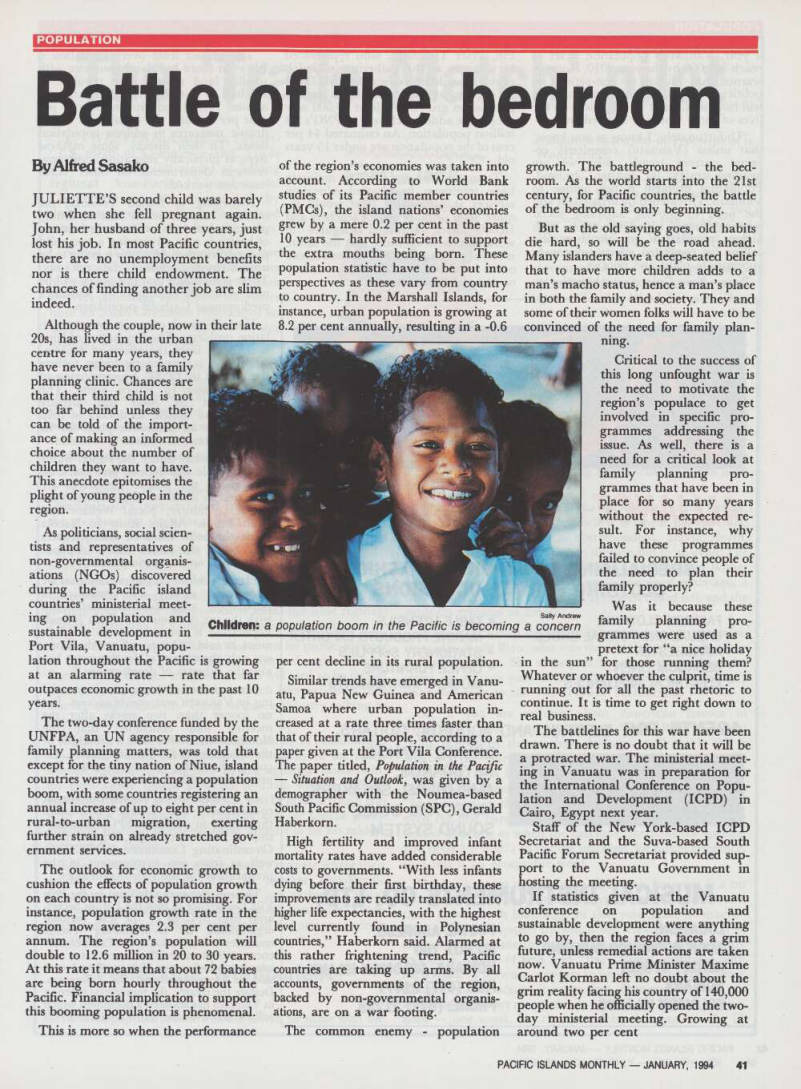
Sally Andrew Children: a population boom in the Pacific is becoming a concern
a year, Vanuatu’s population is set to reach 300,000 by the year 2010. Korman warned that “action or non-actions by politicians about population problems will have significant repercussions on the lives of those who will succeed us.”
“Unfortunately, I know as you know, that unless (Vanuatu) completely re verses current trends, then we are heading straight for disaster,” he said.
Population problem is not unique to Vanuatu. Threatened by urban drift and the need to provide adequate social services, many island countries with higher population growth rates are calling for concerted efforts to prepare appropriate plans and policies.
Papua New Guinea’s ambassador to
Fiji, Peter Tsiamalili, who represented his country at the gathering, told del egates it would be a mistake if PNG failed to implement bold policies to reduce population growth. At least 97,000 new people are added each year to PNG’s 3.9 million population. An estimated 44 per cent of the population are under 15 years old.
Tsiamalili said for PNG to maintain basic minimum health and education services at sustainable level would re quire 4000 primary school teachers and 18,000 nurses. He urged delegates “to work hard now to ensure that the future is one of our choosing and not one forced on us by circumstances we are too lazy or complacent to control.”
The impact from over population is felt even more by island countries with smaller land masses. The republic of Kiribati is one. With a population of around 70,000 and growing at two per cent per annum, the republic is taking drastic measures to address population issues. To their dismay, some of these steps as physically relocating some gov ernment departments on outer lands have not worked.
According to Inatoa Tebania, the minister responsible for health, family planning and social welfare, the ministry of health is now advocating a two-child per couple policy. How this is going to be implemented, Tebania did not say.
There is no doubt that this policy will be met with stiff oppositon by Kiribati’s predominant Catholic population.
Not all island countries have popu lation problems. The tiny nation of Niue is suffering from the effects of depopu lation and is desperately trying to lure the bulk of its 12,000 Niueans living in New Zealand to return home. The government in Alofi has already launched an appeal to donors to help make Niue an attractive place for its former citizens to return.
Exactly what future the region wants for its people will depend very much on how much the people themselves are prepared to shoulder. Fiji’s Minister for Women, Culture, Social Welfare and Multi-Ethnic Affairs Ratu Jo Nacola made the point when he told delegates that “what the future will be depends very much on our actions today”.
“It is therefore very important that we understand clearly the dynamics of population and its inter-relationship with the use of resources,” Ratu Jo said.
Population is central issue to develop ment, he said. “Our people are therefore, not only the objects of development, but also the subjects of development.”
The outcome of the preparatory meet ing in Vanuatu was one of success. But no sooner than two weeks after the meeting had concluded that the Noumea-based SPC fired a broadside at the Suva-based Forum Secretariat, ac cusing the latter of “dirty tactics and ungentleman-like behaviour.”
In a letter to his Forum Secretariat counterpart, Ati George Sokomanu threatened to withdraw SPC’s member ship of the South Pacific Organisations Co-ordinating Committee (SPOCC) as well as from any involvement in the preparation for the Cairo conference.
The row was over a decision by the Port Vila Conference to pick the Forum Secret ariat over SPC to be the lead regional organisation in co-ordinating Pacific countries’ participation at the Cairo confer ence in September. Both men later met over lunch m Suva on October 8 and were said to have ironed out the differences.
Despite the rivalry, the ministerial meeting in Vanuatu has adopted a document which will be taken to the Cairo conference. □