'We’ll set out together’
p. 39 · Read in the full issue
New Caledonia
THE Union Caledonienne, the oldest party in the' territory and the largest component party of the pro independence umbrellea group FLNKS (Kanak Socialist National Liberation Front) likes symbols. It, therefore, de cided to hold its 24th annual congress on November 12-13 in the tribe of N’de, near Noumea. It was there that, in 1988, it had approved then FLNKS leader Jean-Marie Tjibaou’s decision to sign the Matignon accords peace process two weeks earlier in Paris with anti independence leader Jacques Lafleur.
Name chosen for this year’s congress Ke Te Ve Taa (“we’ll set out together”) in the local vernacular language).
After two days of debates, the “UC”, as it is referred to, whose 220 delegates worked on six different political options for the territory’s future, spelt out a f platform for a negotiated independence or New Caledonia in 1998 and a timetable for the transfer of responsibil ities”.
The congress also repeated the UC’s definition of the Kanak people, accord ing to its draft constitution tabled at the United Nations in 1987 “a national
and multi-racial community, free, united and sover eign based on the solidarity of its dif ferent elements”.
This congress was seen by many observers as a turning point in Caledonian poli tics, since it clearly indicated precise choices for the fu ture, after a long period of internal problems and un certainties within the UC and within the FLNKS, fol
lowing the
“provincia lisation” of the ter ritory after the signing of the
Matignon Ac
cords.
It ended specu lations that
Lafleur’s 1991 call for a “consensus solution” to be found in order to avoid the 1998 “referendum guillotine” had found a very warm response within the UC, and was a clear answer to more radical members of the FLNKS who raised doubts about the fact that the UC was still pro-independence. Two weeks earlier for instance, the PALIKA
(Kanak Liberation Party, a smaller, more radical com ponent party of the FLNKS) had criticised the UC leaders “the consen sus that they advocate,” said its spokesman, “has more to do with a strategy of status quo which doesn’t bring any hope.”
The Union Caledonienne is in fact ready for negotiations with the RPCR, but “things have to be wrapped up before 1998”, in order to “accurately define the question which will be
asked for the referendum”, said Francois Burck, the re-elected president of the UC. (under the 1988 Matignon peace accords, a referendum is to be held in 1998, whereby Caledonians will decide whether they want to remain French or
become independent).
At the press conference following the congress, Burck declared “in 1998, we say ‘the country in sovereign’ which
Lafleur’s reaction was moderate the UC’s choice for a negotiated indepen dence “didn’t out rage” the founder of the RPCR. “It can’t possibly be taken seriously,” he said, “because (the UC people) are attached to the Matignon Ac cords ... this choice for independence is still not mine. No doors have been closed for further discussions.
On the contrary, they
give dialogue a priority.” For the anti independence leader, timetable is the biggest difference between him and the UC “I am willing to talk about a solution of consensus after the provincial elections of 1995. They want to talk about it before”. ■ Jean-Marie Tjibaou was both president of the UC and the FLNKS. ■ Leopold Joredie and Richard
means it is internationally recognised by the United Nations as a sovereign state.”
Burck added that this timetable “still had to be defined” with the French state and with anti-independence RPCR. The UC is now waiting forthe other partners to react — “we shall oblige them to bring their contribution so that discussions can start from now on. We all must have made progress by 1995.”
Kaloi, both UC leaders, preside over of the two pro-independence North ern and Islands Provinces, whereas Jacques Lafleur is president of the anti-independence Southern Prov ince. ■ Paul Neaoutyine, one bf the leaders of the PALIKA, replaced Tnbaou at the head of the A.NKS after his assassination. □
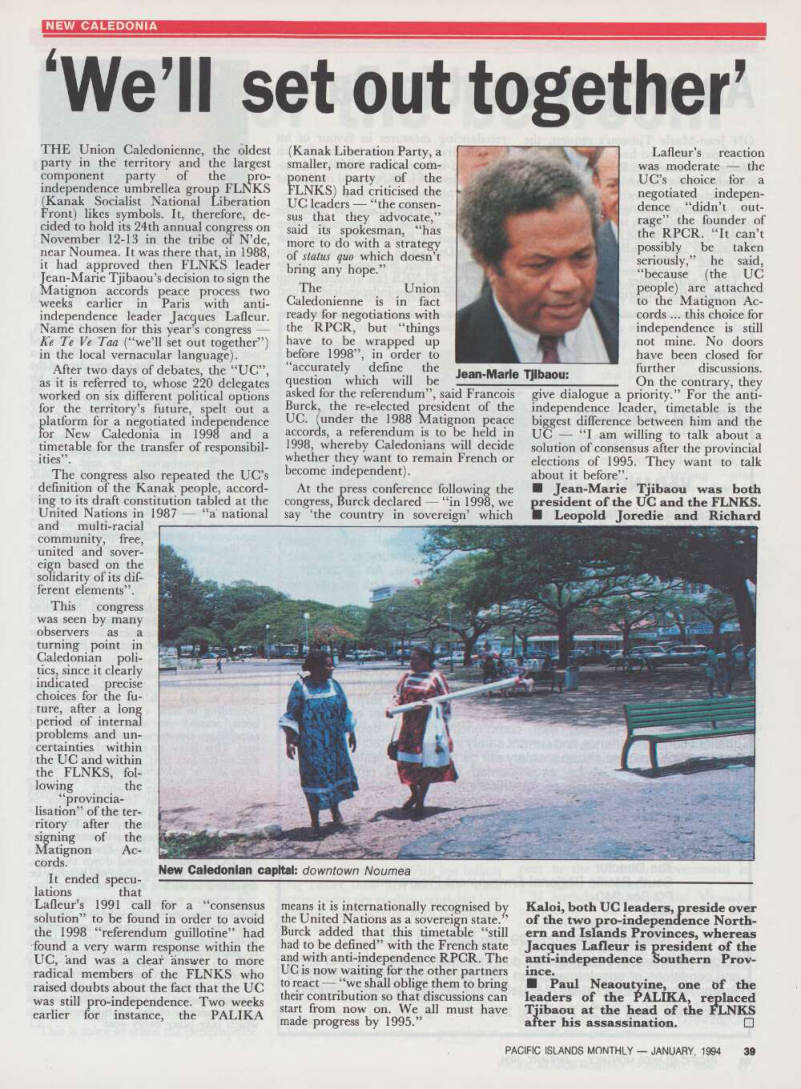
New Caledonian capital: downtown Noumea
Jean-Marie Tjibaou: