Coconut politics
p. 20 · Read in the full issue
COPRA prices have emerged in Vanu atu as an important element of the country’s political equation. Sensitivities partly arise from promises made by the ruling Union of Moderate Parties (UMP) during the country’s 1991 elec tion campaign. Prominent candidates pledged that copra prices would double under a UMP-led government. But in reality, the government has been strug
gling just to maintain the existing
guaranteed price of 25,000 vatu per tonne for hot-air-dried copra and 20,000 vatu per tonne for smoke-dried copra.
In the middle of October, the govern ment announced that it would give an additional 150 million vatu by the end of this year to the country’s Commodities Board to underwrite prices. This fol lowed demonstrations and anti government slogan painting on the northern island of Santo after some growers could not be paid because price support funds had run out. The govern ment is evidently hoping that the
European Community will step-up
commodity-price underwriting through
its Stabex scheme. An official review of the scheme in Vanuatu is scheduled to begin this month. There can be no certainty of additional funding. And regional planners know all too well that the wheels of European bureaucracy turn slowly. Significantly, the EC has moved generally to tighten control of the Stabex scheme m the Pacific region as well as in Africa and the Caribbean.
Much of the population in Vanuatu’s northern and central regions rely on cash from copra sales to supplement subsistence farming and fishing. So
pricing and marketing policies are politi
cally volatile. Sources m Port Vila said the government had banned Radio Vanu atu, the only national broadcaster, from running statements critical of its hand ling of copra price stabilisation. This year’s total production of copra is only expected to be between 25,000 and 30,000 tonnes. If production increases
substantially next year, and the EC does not come to the rescue, financial and political pressures arising from growing of the übiquitous coconut will intensify.
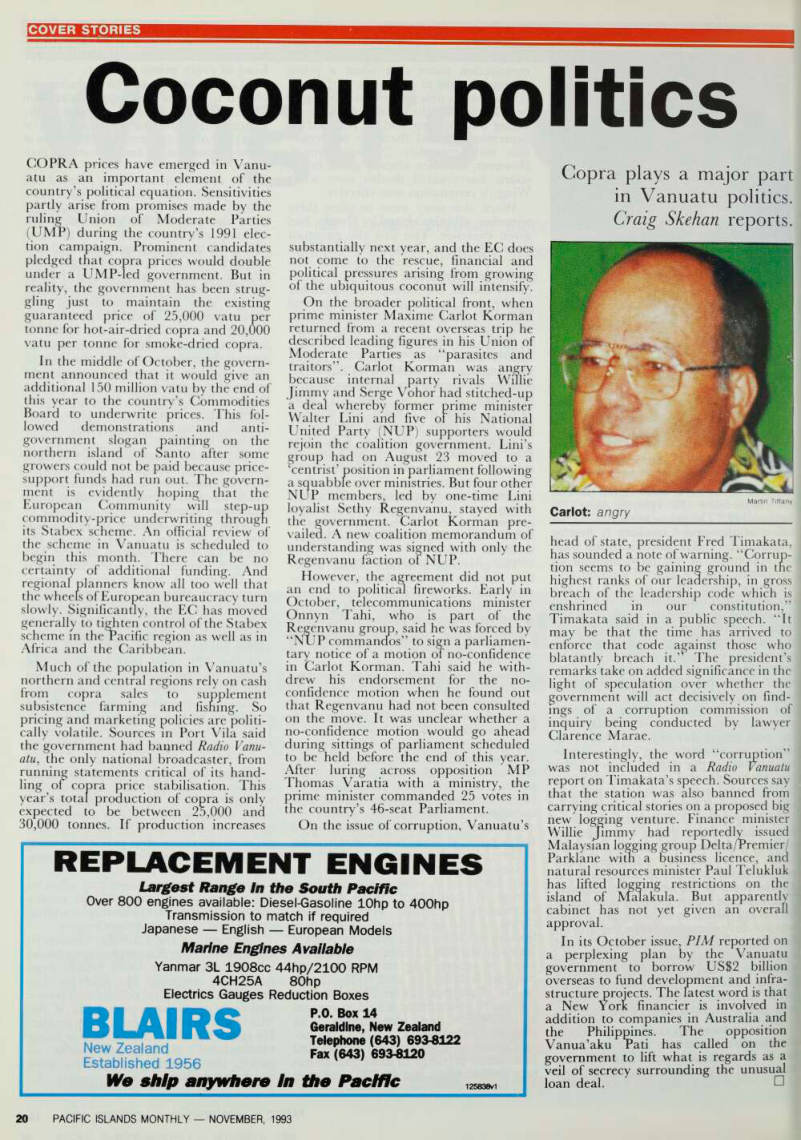
On the broader political front, when prime minister Maxime Carlot Korman returned from a recent overseas trip he described leading figures in his Union of Moderate Parties as “parasites and traitors”. Carlot Korman was angry because internal party rivals Willie Jimmy and Serge Vohor had stitched-up a deal whereby former prime minister Walter Lini and five of his National United Party (NUP) supporters would rejoin the coalition government. Lini’s had on August 23 moved to a
position in parliament following
a squabble over ministries. But four other NUP members, led by one-time Lini loyalist Sethy Regenvanu, stayed with the government. Carlot Korman pre vailed. A new coalition memorandum of understanding was signed with only the Regenvanu faction of NUP.
However, the agreement did not put an end to political fireworks. Early in October, telecommunications minister Onnyn Tahi, who is part of the Regenvanu group, said he was forced by “NUP commandos” to sign a parliamen tary notice of a motion of no-confidence in Carlot Korman. Tahi said he with drew his endorsement for the no confidence motion when he found out that Regenvanu had not been consulted on the move. It was unclear whether a no-confidence motion would go ahead during sittings of parliament scheduled to be held before the end of this year.
After luring across opposition MP Thomas Varatia with a ministry, the prime minister commanded 25 votes in the country’s 46-seat Parliament.
On the issue of corruption, Vanuatu’s
Copra plays a major part in Vanuatu politics.
Craig Skehan reports.
head of state, president Fred Timakata, has sounded a note of warning. “Corrup tion seems to be gaining ground in the highest ranks of our leadership, in gross breach of the leadership code which is enshrined in our constitution,”
Timakata said in a public speech. “It may be that the time has arrived to enforce that code against those who blatantly breach it.’ The president’s remarks take on added significance in the light of speculation over whether the government will act decisively on find ings of a corruption commission of inquiry being conducted by lawyer Clarence Marae.
Interestingly, the word “corruption” was not included in a Radio Vanuatu report on Timakata’s speech. Sources say that the station was also banned from carrying critical stories on a proposed big new logging venture. Finance minister Willie Jimmy had reportedly issued Malaysian logging group Delta/Premier/ Parklane with a business licence, and natural resources minister Paul Telukluk has lifted logging restrictions on the island of Afalakula. But apparently cabinet has not yet given an overall approval.
In its October issue, PIM reported on a perplexing plan by the Vanuatu government to borrow US$2 billion overseas to fund development and infra structure projects. The latest word is that a New York financier is involved in addition to companies in Australia and the Philippines. The opposition Vanua’aku rati has called on the government to lift what is regards as a veil of secrecy surrounding the unusual loan deal. D
Martin Tiffany Carlot: angry