Testing times
p. 21 · Read in the full issue
Will Fiji PM Rabuka survive a judicial inquiry into an out-of-court settlement?
By Craig Skehan
SHOULD Fiji’s Prime Minister Sitiveni Rabuka survive adverse findings against him by a corruption inquiry, he may have been taught a valuable lesson if you lay down with dogs, you get fleas.
But he is not out of trouble yet.
Before national elections in May last year, Rabuka confided to friends that he thought corruption in Fiji too often remained unexposed. So it was a surprise when the 1987 coup leader’s actions featured at a commission of inquiry into an abortive out-of-court compensation agreement.
A sensation was caused in Fiji’s national parliament when the report, compiled by retired judge Sir Ronald Kermode, was tabled on September 20.
Kermode found that Rabuka had acted improperly and prima facie illegally in relation to a damages claim by convicted fraud Tony Stephens for wrongful im prisonment on firearms charges. A deed of settlement signed late last year, which agreed to pay Stephens F 5980,000, was
later scrapped.
Stephens, as campaign manager of the hardline Fijian Nationalist United Front (FNUF), helped Rabuka achieve the parliamentary numbers to win the prime ninistership. After a furore erupted over he behind-the-scenes compensation
ieal, Stephens departed Suva for Lon
ion where he has been lying low. Before caving, Stephens was able to secure local cans of about SFI million, allegedly to lelp secure what Kermode described as i non-existent US$2OO million Middle i-ast loan. In Fiji, some businessmen personally guaranteed the local loan for Stephens or put up properties as security, fhe businessmen involved look anything >ut happy and relaxed these days.
In the wake of the adverse commission f inquiry, there has been a concerted
.amage control exercises. Attorney
xeneral Kemeledi Bulewa questioned he bona fides of Kermode’s report and Dught to undermine Kermode. And the rime minister announced his intention 3 seek a judicial review of the findings.
Labuka expressed confidence that his ame would be cleared. Further appeal
options mean the saga could drag-on for many months. Ra buka has said he
would only
stand aside from the
leadership if
criminal charges were laid against him.
Attempts
to P ut lid back on the political pot were not helped by notice being given to parliament of a no-confidence motion in Rabuka s leadership. In a classic irony, the noconfidence motion was moved by the government’s very own parliamentary j 3 ’ ' Under considerable pressure, including from some traditional Fijian chiefs, the motion was withdrawn. When PIM went to press, the whole issue was
simmering rather than boiling. Oppo-
sition Labour Party leader Mahendra Chaudhry said he would have supported the no-confidence motion. Chaudhry, after having supported Rabuka for the prime ministership last year despite being a victim of the 1987 military coups, has already split with the prime minister over constitutional and other issues.
However, opposition leader and lawyer Jai Ram Reddy, who like Chaudhry is a member of the country’s Fiji-Indian community, looked more likely to abstain on the no-confidence motion. Significantly, Reddy has been seeking political dialogue, notwithstanding the
Kermode trauma. This culminated in a speech by Reddy during ceremonies at Suva’s Albert Park on October 8 to mark the International Year of the World’s Indigenous People. “Today’s event is a spectacular and powerful celebration of things Fijian,” Reddy said. “It is there fore no small thing that the organisers of this grand event should see fit to invite the grandson of an Indian indentured labourer to be chief guest.” Reddy talked of a growing desire for national reconcili ation in Fiji.
Rabuka, too, was in a conciliatory mood when asked whether opposition criticisms of him over the Stephens episode would get in the way of moves to achieve greater unity. “Political parties will always have differences but we can put aside minor issues like this when there is a need to work together to find solutions to problems that are in the national interest to resolve,” Rabuka said.
The conciliation, which can be viewed as part of the process of trying to lower the political temperature in the country, extended to Rabuka adopting a forgiving attitude to rebel government MPs who supported Ilai Kuli’s no-confidence bid.
But there was no such largesse when just elected Suva Lord Mayor Joape Rokosoi was exposed during October for having attempted to link a campaign donation to his support for a proposed city plaza development. Rabuka quickly backed action to dismiss the wayward councillor.
There was no immediate option for a judicial review and, even though it was clear Rokosoi should go, an impression of double standards was left. Maybe the prime minister figured he had to demon strate he could still wield a firm hand on issues of alleged official misconduct, despite his own problems. □
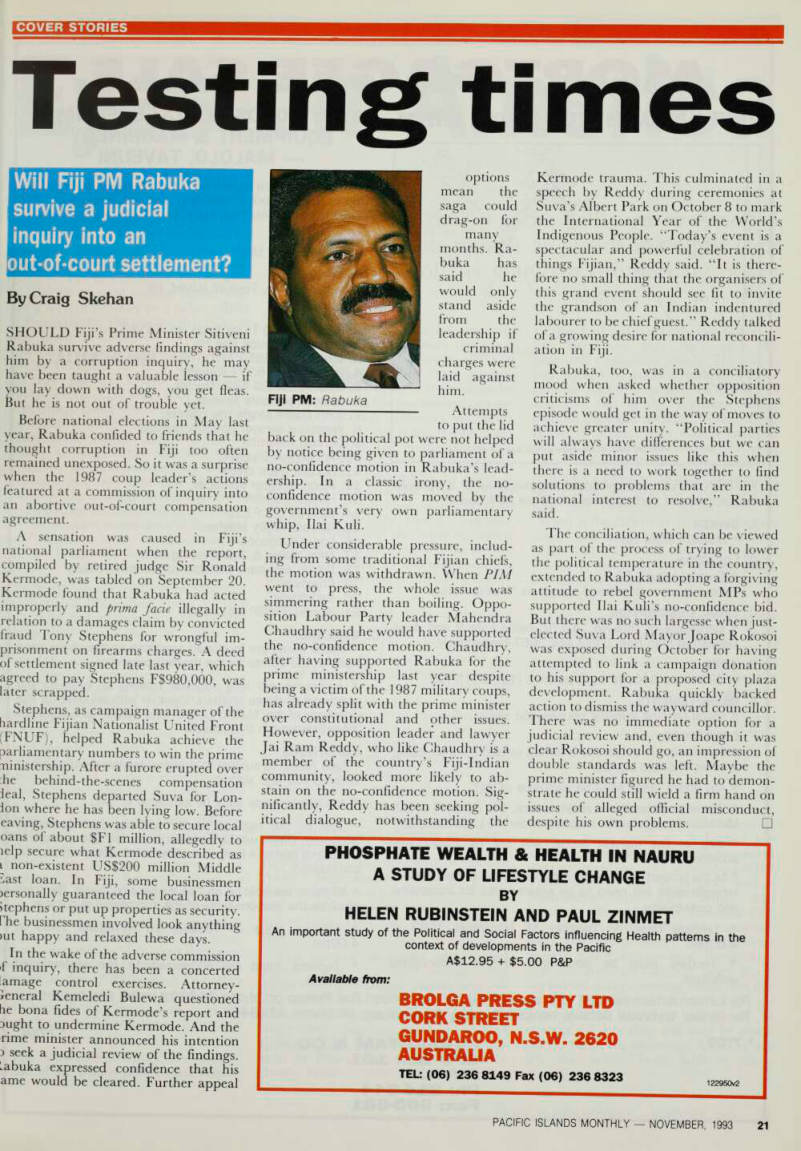
Fiji PM: Rabuka