Wingti’s coup
pp. 18-19 · Read in the full issue
Cover Stories
By Wally Hiambohn
In a shock political move that stunned the opposition PNG’s prime minister secures power for himself to the 1997 general election. But a court case continues.
ON the night of September 23, Papua New Guinea went to sleep not knowing their prime minister, Paias Wingti had resigned from office. He did so in a letter to the governor general Sir Wiwa Korowi.
The next day there was sheer shock and surprise all around when speaker Bill Skate announced the resignation on the floor of parliament. He then immediately called for fresh nominations for prime ministership and Wingti was renomi nated and reelected as a stunned and horrified opposition walked out in pro test.
Only three opposition members voted against Wingti as the government, many of whose members were also caught by surprise, reelected Wingti with 59 votes.
While the whole episode took exactly four minutes it will nonetheless, enter
history as being the swiftest and most cunning political coup in the country’s 18 years of independence. In doing so Wingti secured power for himself to the 1997 general election.
In a reaction to the episode about 4000 students and other protesters marched to parliament to present three petitions to Skate calling for his he resignation and for the resignation of Wingti and the
governor general.
Student leaders described the moved as the first political coup in the Pacific since the Fiji military coups in 1987.
Under the Constitution, a vote of no confidence cannot be moved in a prime minister or his government 18 months
after its election. This grace period expires in March next year.
What Wingti has done is get himself re-elected and extend that grace period for another 18 months to March, 1995.
The Constitution also states that there shall be no vote of no-confidence 12 months before the next general election, due in 1997.
This leaves about eight months during which the opposition can move a motion of no confidence however the govern ment has the prerogative not to call for a parliamentary sitting during that period. A motion of no-confidence can only be moved and voted on during a
parliament sitting.
Sections of the PNG constitution used in the September 24 episode state Section 142;“The prime minister - (1) An office of the prime minister is hereby established. (2) The prime minister shall be appointed at the first meeting of parliament after a general election and otherwise from time to time as the Dccasion for the appointment of a prime minister arises, by the head of state, icting in accordance with a decision of :he parliament. (3) if the parliament is in ;ession when a prime minister is to be ippointed, the question of the appoint nent shall be the first matter for consideration, after an formal business ind any nomination of a governor general or appointment of a speaker, on he next sitting day. Section 145; (4) A notion of no-confidence in the prime ninister or in the ministry may not be noved during the period of eighteen nonths commencing on the date of ppointment of prime minister. Section 46; Resignation (1) The prime minister lay resign from office by notice in writing to the head of state; Section 147; 2), ••• a Prime Minister who ssigns...shall continue in office until the ppointment of the next prime minister, he Supreme Court has now been asked y the opposition to declare that Wingti as not duly elected as prime minister on eptember 24, and that his election and ppointment as prime minister be de ared null and void. The opposition
irther seeks that Wingti’s resignation as
rime minister remains in force until a sw prime minister is duly elected.
Court proceedings on the opposition’s institutional reference began on Octo :r 8. Opposition counsel Loani Henao is callecf witnesses to establish when
Wingti tendered his resignation. The constitution states that when a prime minister resigns at a time the parliament is in session, a new prime minister should be elected at the next (parliament) sitting day. Wingti said he resigned on September 23 and therefore his reelec tion on September 24 was proper.
However, evidence already given in the courts has created doubts over when Wingti’s resignation was effective.
When this story went to press three witnesses, all subpoenaed by Henao, had given evidence. The first the governor general’s driver Patrick Seko testified that Wingti had meetings with the governor general and Skate on Septem ber 22 and 23. On the night of September 23 the three men and attorney general Philemon Embel and communications minister Martin Thompson had dinner at government house. Seko told the court that it wasn’t until 5.45 pm on Friday morning that he delivered to Sir Wiwa a large envelope containing four smaller envelopes which he collected from Wingti’s office at 2.56 am. He did not know what those envelopes contained.
Wingti’s private secretary Kila Oala said she was picked up at home at midnight on September 23 and typed three correspondence the governor general’s letter of acceptance of Wingti’s resignation, Embel’s instructions to the governor general of what procedures to follow and Wingti’s address to parlia ment on Friday.
The governor general’s official secre tary Stephen Igo told the court that he received from Sir Wiwa, Wingti’s resig nation letter at 9am on Friday. A copy of the letter tendered to the court was not stamped to indicate when it was formally received, something Igo said was an
“oversight”.
The government has hired three law firms at the state’s expense to defend its case while the opposition has received personal contributions of KlOOO from its members to pay for its lawyer.
In a lengthy explanation Wingti said he engineered his resignation and re election to avoid the “corruption” of the political number games. He said motions of no-confidence involved “greed and corruption”, “inducement offered to members of parliament”, “auctioning of men’s political souls” and “prostituting of the (political) system,”
Since independence in 1975 there have been just over 15 votes of no-confidence moved in parliament, three of them
successfully, including Wingti’s over
throw of the government of Michael Somare in 1985 and his defeat by Rabbie Namaliu in 1988. Explaining his political move to secure long term power and political stability he said; ‘The harsh reality of political life in PNG today is that every government is held at ransom by dissidents and opportunists. The freedom to move a motion of no confidence in a government is regarded as a sacred privilege in most parliamen tary democracies. But in PNG today it
has become a machine gun held at the head of every prime minister.
“Let us be frank; the inducements offered to members to support a motion of no-confidence have corrupted the ethics of the national parliament. Too many members are tempted with offers of money, patronage and powerful pos itions.”
The opposition has since pointed out in a public advertisment that while Wingti claimed he won the mandate from the people, the government co alition partners won only 28 of the total 109 seats, the opposition parties 42 and Independents 39. It said no single party won an outright majority, and the two sides had to win over the independents.
Wingti won prime ministership and
government with a 55-54 vote with the casting vote coming from the Speaker.
The opposition also pointed out that records snow that since 1985, the Wingti led team when in opposition moved eight votes of no-confidence, seven of them between 1989 and 1991 , compared to the current opposition’s one motion in which Rabbie Namaliu was elected prime minister in 1988.
“Eight votes of no-confidence in eight years from the Wingti-led Oppositions - Do you think he is sincere when he complains they are used too often”, the opposition asked.
Deputy prime minister Sir Juliu Chan who was overseas at the time of the resignation and re-election said he had not been consulted and upon his return on October 4 sought from Wingti reassurance that his and that of his
Peoples Progress Party’s status in govern
ment was intact. There was a lot of speculation that Wingti and other co alition partners had tried to isolate Chan and the PPP, and that leader of the League for the National Advancement John Nilkare had wanted to be deputy.
Having gotten this reassurance Chan agreed to be sworn again into his job.
Chan said under existing constitution Wingti had absolute power to do what ever he believed was necessary.
Countering criticism and allegations of conspiracy the governor general de scribed his role in the whole issue as that of a “constitutional rubber stamp with no executive powers. Korowi said he had no veto powers to stop politicians using constitutional provisions to maintaing grip onto political power.
Speaker Skate explained that what he did was in accordance with the consti tution and the parliamentary standing orders and the constitution.
The head of the Catholic Church in PNG Sir Peter Kurongku questioned whether the people would benefit from the whole exercise. He said he was greatly saddened that politics and power had once again been put ahead of the true welfare or the nation and the people.
He said while the constitution was being
manipulated to keep politicians in
power, the problems Facing PNG were not being addressed. □
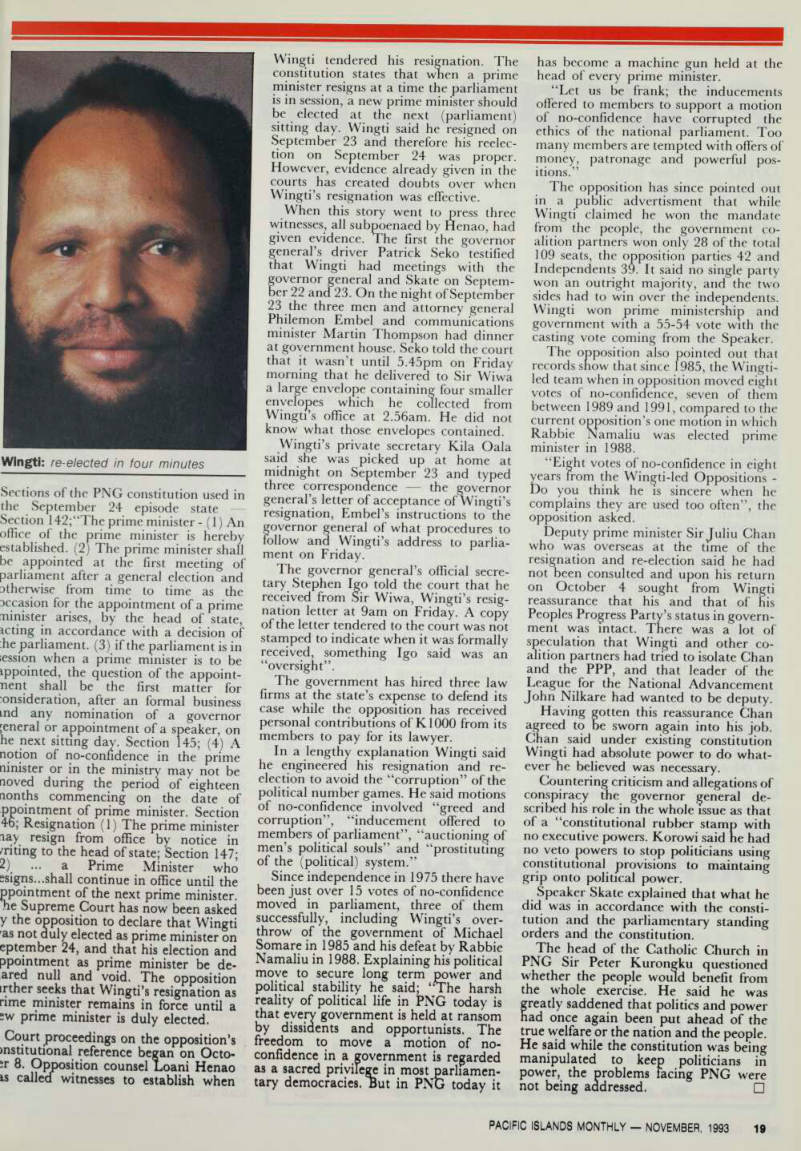
Wingti: re-elected in four minutes