Tradition Vs Law
p. 17 · Read in the full issue
Tradition
By Alan Ah Mu
LATE in September in scenic and isolated Lona village, Nuutai Mafulu, 40, to escape stones thrown by fellow villagers, ran towards his house a shotgun was fired at him. From inside his house, he cried out, “I want to live.”
“Come out,” replied his pursuers.
Nuutai did, and knelt in front of the village’s aumaga or untitled males, plead ing that he be taken away but for his wife and children to be spared. Soon after, he was fatally shot in the forehead with a .22 calibre gun and his body dumped near the house where the village council, made up of chiefs or matai, was meeting.
Nuutai’s wife, watched the gun being aimed at her husband and knew that their five children saw him being shot.
This much, the police have established, happened in Lona on Saturday, Septem ber 25. They’ve unraveled enough of what had happened for a murder charge to be pressed against Sesela Mateo Afoa, 31, in an investigation involving “the whole village,” the commissioner of police, Faluvao Tanielu said.
The murder was horrific enough to attract media attention from New Zea land. A TV crew turned up, something ordinarily occasioned by a Mam Samoa game or a cyclone, while the member of parliament of Lona, was tracked down in New Zealand, where he was for a funeral, and interviewed on TV.
For Samoans, fascination with details of the killing the actual event and other aspects like the fact that the defendant is a first cousin of the deceased - has been accompanied by sober discussions especi ally as Lena’s council was initially implicated. Statements given to police established that Nuutai had refused to contribute to village affairs, resisted council decisions, played cricket for another village where he had family and transported his team mates, while at the same time a family matai had been exiled by Lona.
Whatever the exact cause(s) of the villagers anger, they burned the de ceased’s shop, bus and Suzuki jeep on the orders of matai , though statements con flict of who ordered the shooting and why it’s occurred.
Sesela Afoa’s guilt or otherwise is ex pected to take months to be established.
But so far, 36 villagers have pleaded guilty to arson, wilful damage and throwing stones. Six other refute the :harges.
Fhe Samoa Times newspaper said “Such
barbaric and animalistic behaviour” is only seen in movies or “where the value of a human life is equal to a dog. “We ask the question, what it that prompts a civilised man or group of men to behave like a pack of dogs in ... mass hysteria?”
The head of the Catholic Church, Cardinal Pio Taofmuu released a state ment saying God alone has the “supreme authority over life. “Man has no author ity to take his own life or that of his fellowmen.” He asked if Samoa ever hears the cry of those “we kill”, the cry of “please let me live!” by innocent victims of abortion and “those who are gunned down like animals in the village malaes while their loved ones look on
helplessly.”
Reflections centre on the proud indepen dence declaration that Western Samoa is founded on God and the Samoan way or the faaSamoa, for the incident again raised the issue of individual rights versus traditional authority of matai on which so much of the faaSamoa is based.
“You and I know there’s a contradiction in authority,” Galuvao said to reporters.
“If you’re a Samoan you obey Samoa laws,” as laid down by matai, but these sometimes clash with post-independence, constitutional or “ palagi ’ (European) laws.
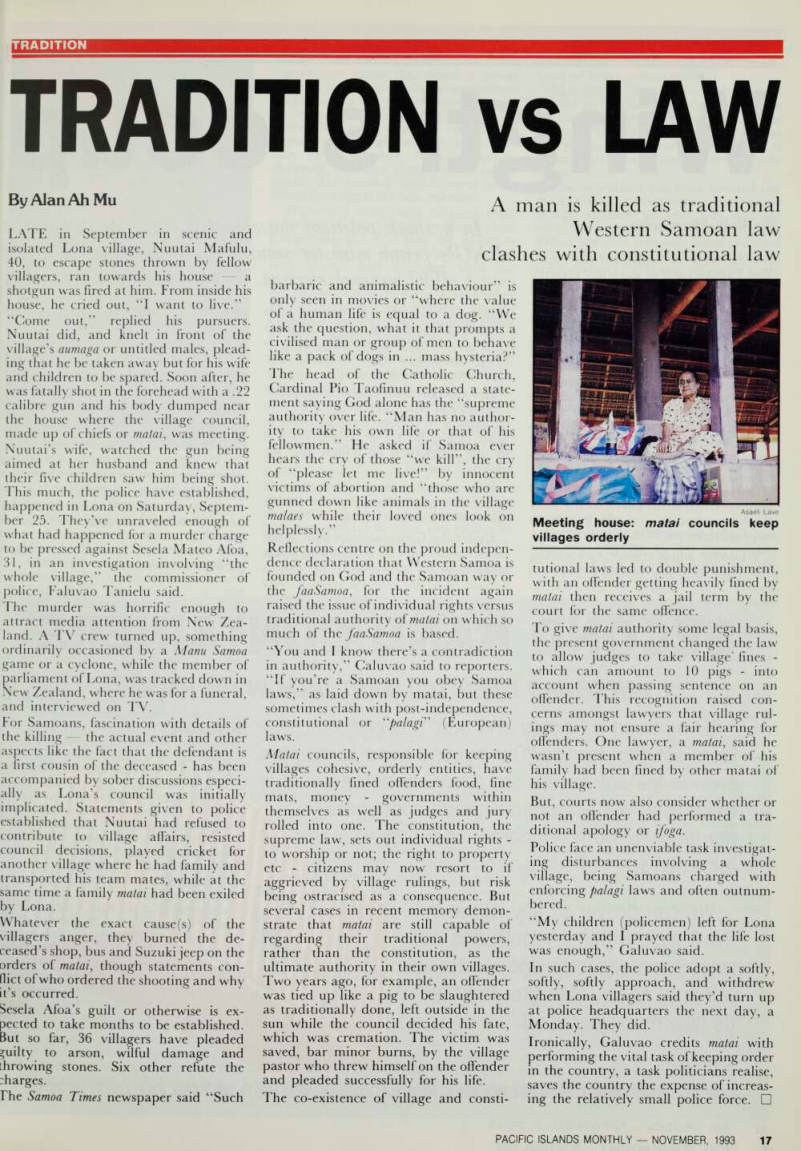
Matai councils, responsible for keeping villages cohesive, orderly entities, have traditionally fined offenders food, fine mats, money - governments within themselves as well as judges and jury rolled into one. The constitution, the supreme law, sets out individual rights to worship or not; the right to property etc - citizens may now resort to if
aggrieved by village rulings, but risk
being ostracised as a consequence. But several cases in recent memory demon strate that matai are still capable of regarding their traditional powers, rather than the constitution, as the ultimate authority in their own villages.
Two years ago, for example, an offender was tied up like a pig to be slaughtered as traditionally done, left outside in the sun while the council decided his fate, which was cremation. The victim was saved, bar minor burns, by the village pastor who threw himself on the offender and pleaded successfully for his life.
The co-existence of village and consti-
A man is killed as tradidonal Western Samoan law clashes with constitutional law
tutional laws led to double punishment, with an offender getting heavily fined by matai then receives a jail term by the court for the same offence.
To give matai authority some legal basis, the present government changed the law to allow judges to take village' fines which can amount to 10 pigs - into account when passing sentence on an offender. This recognition raised con cerns amongst lawyers that village rul ings may not ensure a fair hearing for offenders. One lawyer, a matai , said he wasn’t present when a member of his family had been fined by other matai of his village.
But, courts now also consider whether or not an offender had performed a tra ditional apology or ifoga.
Police face an unenviable task investigat ing disturbances involving a whole village, being Samoans charged with enforcing palagi laws and often outnum bered.
“My children (policemen) left for Lona yesterday and I prayed that the life lost was enough,” Galuvao said.
In such cases, the police adopt a softly, softly, softly approach, and withdrew when Lona villagers said they’d turn up at police headquarters the next day, a Monday. They did.
Ironically, Galuvao credits matai with performing the vital task of keeping order in the country, a task politicians realise, saves the country the expense of increas ing the relatively small police force. □
Asaeli Lave Meeting house: matai councils keep villages orderly