The Solomon saga
pp. 15-16 · Read in the full issue
Cover Story
By Martin Tiffany
like any good soap opera the political saga continues in the Sol omon Islands. Since coming into wer on June 18 the National Coalition Partnership government of prime minis ter Francis Billy Hilly has had little to relax and ease into its job.
Indeed, the little-known Hilly has not been given the chance to kick off his shoes and sit back securely in his prime minister’s chair. In addition to trying to keep the coalition afloat he is being kept on the edge of his seat by his predecessor, Solomon Mamaloni.
Within days of scraping home 24 votes to 23 in a secret ballot among the
47-newly elected parliamentarians, Hilly
was being given problems by the wily former prime minister. Mamaloni re fused to move out of the official prime minister’s residence after his defeat, forcing Hilly to stay at the Honiara Hotel. Eventually Mamaloni was per suaded to vacate the house although he had proved his point that he didn’t agree with the validity of the 24-23 result. Mamaloni queried the consti utional validity of the election in :ommunications with governor general
Mr George Lepping and formally sub
rutted the dispute for Sir George’s
ietermination on July 12 in accordance
vith the provisions of paragraph 10,
chedule 2 of the constitution.
In his letter to Sir George, Mamaloni intended that the election and sub equent appointment of Hilly as prime ninister was unconstitutional because he successful candidate had failed to ecure an “absolute majority of votes” as equired by the constitution.
Section 33 (1) of the constitution >rovides that; “There shall be a prime ninister who shall be elected as such by he members of parliament from amongst heir number in accordance with the ►revisions of schedule 2 to this consti ution.”
Paragraph 7 (1) of schedule 2 states; If any candidate should at any ballot eceive an absolute majority of votes he ball thereby be elected prime minister.”
The term “absolute majority” is de ned in section 144 (1) “absolute lajority” means at least one half of all le members plus one.
On the advice of his legal advisers, lamaloni contended that in conformity r ith the constitutional definition, “at :ast one half of all the members plus ne” meant that the requisite ‘absolute
majority’ was 25 and not 24. (Half of 47 is 23.5 plus one equals 24.5). Therefore, 25 was the nearest whole num ber capable of giving effect to and preserving the requirement of be ing “at least” 24.5 in a one man, one vote elec toral system.
At this time it was rumoured that former legal counsel to the Mamaloni government, Julian Moti, would be retained by Mamaloni to handle the case. Moti
had previously won a landmark case for the government when he appeared for finance minister Christopher Abe in proceedings involving the suspension of the directors of the Central Bank of Solomon Islands. On July 16, however, the Hilly government swiftly moved to close the door on any possible involve ment by Moti in the constitutional case by declaring Moti a persona non grata.
On August 5, the governor general wrote to Mamaloni informing him of the outcome of his determination of the dispute. Sir George’s letter said “I am now happy to inform you of my view on this matter based upon the following reasons; (1) I am convinced that the absolute majority in this case is 24 votes. One vote represents one member of parliament. In other words, one vote represents one person being a member of parliament.
The official result of the election of the prime minister on June 18, 1993 was Honourable Francis Billy Hilly 24 votes and yourself 23 votes. There were 47 members of parliament in person present and voting on that date. (2) If there was a dispute about the correct absolute majority, it should have been raised during that election or before June 18, 1993. Therefore, I find it rather difficult after 25 days to review my own determination when in the first place, I had already been convinced personally that the absolute majority was 24. In my view, paragraph 10 of schedule 2 is not an appeal provision. The whole intention of paragraph 10 is ensuring finality in the election of the prime minister. My determination on June 18, 1993 was to me therefore final on my part.
“I must say that for the above reasons I will not interfere with my own
determination made on June 18, 1993.
That is the absolute majority is 24 and not 25,” the governor general added.
Mamaloni’s law yer, Reginal Teutao, commenced pro ceedings for judicial review of Sir George’s determi nation in the High Court in early Aug ust.
The substance of Mamaloni’s applica
tion for judicial review was that the governor general had made various errors of law and therefore acted in excess of his jurisdictional powers.
September 23 was set by the High Court as the date for hearing Mamaloni’s application. However, on September 10, the governor general’s lawyer, Andrew Radclyffe (a British lawyer who formerly worked in the public solicitor’s office) filed an application to strike out the case from the High Court’s hearing list.
Radclyffe alleged that the High Court had no jurisdiction to deal with Mamaloni’s application. He also alleged that the governor general was immune from suit.
Justice Albert Parmer, a local judge, heard Radclyffe’s application and ruled against the objections. In a lengthy judgement Justice Palmer upheld the submissions made by Teutao that the High Court had jurisdiction to hear and determine Mamaloni’s case.
On September 24, the High Court sat all day to hear Mamaloni’s application.
Justice Palmer delivered his judgement on October 8.
In his judgement Justice Palmer said the governor general had not committed any error of law whatsoever, and was perfectly entitled to say as he did in his determination on August 6.
In his judgement Justice Palmer ad dressed the issue of the constitutional definition of what the absolute majority was as applied to this case.
He said: “Applying the formula there fore, at least one half of 47 members, is 24. There is no such person as a 23-an a-half person. However, that does not mean such a fraction should be ignored. 23.5 is the lowest minimum that one can
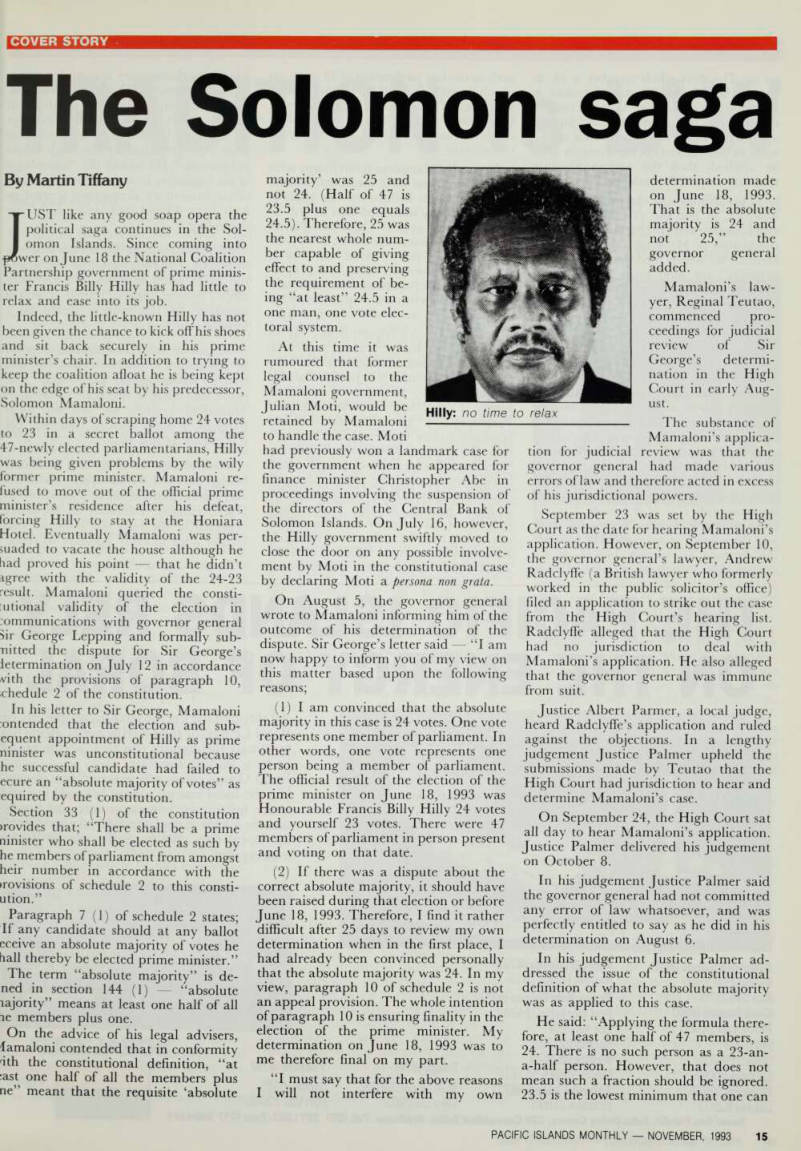
Hilly: no time to relax
go to. The next whole number is 24. It cannot be 23. Mr Teutao therefore is correct in his submission as to the correct definition of the words ‘at least’ and its application in the case where there are 47 seats in parliament. If the formula is to be applied, then the correct absolute majority required would be 25.
“The definition of the words ‘at least’ however, is not the crucial issue. The crucial issue, and this is contained in the submission of Mr Radclyffe, is that the context in which the words ‘absolute majority’ are used must first be con sidered, before coming to the conclusion that the definition in section 144(1) applies. The first part of the section 144(1) reads “In this constitution, unless the context otherwise re quires ”, Mr Radclyffe submits that in a 47 seat parliament, where the number is an odd number, an absolute majority can be obtained on a difference of one vote. This is what happened in this case. Honourable Francis Billy Hilly received 24 votes; one vote more than the total votes of his only rival, the applicant in this case. On that basis, the require ment of absolute majority as demanded in paragraph 7(1) of Schedule 2 to the constitution had been complied with, and therefore it is not necessary to apply the formula in section 144(1) of the constitution. In an even number of seats,
such as the last parliament of 38 seats, an absolute majority will be obtained on a difference of two votes. Since the increase was made to 47 seats, an absolute majority can be obtained on a difference of one vote.”
Naturally Mamaloni is not happy with the decision and feels the constitutional
definition is not being correctly applied.
He has already indicated that he will be
lodging an appeal against Justice
Palmer’s decision to the Court of Appeal.
When this story went to press Mamaloni’s lawyer, Teutao, was prepar ing the appeal papers and was unavail able for comment on the grounds of the
appeal.
Responding to a request from PIM for a response to Justice Palmer’s decision Mamaloni issued a statement. In it he said; "The grounds for Justice Palmer’ judgement may be assumed and it is highly likely that its effects to our Parliamentary system could be far reaching to say the least. Be that as it may the decision would also be seen as “clearing some elements of doubt” which have hovered over the prime minister’s election on June 18. It would seem that a good portion of the High Court judgement delved more into the politics of electing the PM rather than the likely adverse and practical effects which the 23/24 result could cause the Solomon
Islands parliamentary system, let alone, legislative process. The question of ‘ab solute majority’ within the contexts of parliamentary practice and procedures in Solomon Islands may seem to have
been over-simplified by the High Court
judgement.” He added the “sacredness of the legislative process... the foundation of parliamentary democracy seemed to
have been diluted fairly extensively” by
the ruling.
Mamaloni said no elected government in Solomon Islands would be safe under the 24/23 result in terms of a four-year office tenure, hence, much political instability in the country would be a
forgone conclusion.
On the invitation of PIM to respond to Mamaloni’s statement and the fact that he would appeal, Hilly said; “The court has made a decision, so be it. If Mamaloni appeals we will see what happens. I don’t wish to issue any big statements at this time.”
Meanwhile, over 10 election results are
being contested by unhappy candidates
and several petitions include ministers in Hilly’s cabinet. Decisions on these are expected in the next few months. This further adds to Hilly inability to relax.
So the saga continues. □