Culture catches on
p. 57 · Read in the full issue
Children learn ways to value and preserve traditions
BENEATH a tin shed at Gordon’s International Primary School in Port
Moresby, Papua New Guinea,
Michael Tavill is teaching a handful of children traditional dances. Tavill is an actor with the country’s National Theatre Company and he is commit ted to the teaching of culture. An assured actor in his own right, he spends many hours showing young children the art of dance.
As the primary school students swing their bodies and shake strands of shiny brown seeds in a percussive accompani ment, Tavill talks to them of dance and ts reflection of the spirit. He explains hat dance and movement must come rom the heart, that whilst there are raditional movements and sequences, here is also improvisation and it is up to he individual to devise his own form of elf expression. But dance, he tells them, s a discipline and demands concern ration if it is to have any feeling.
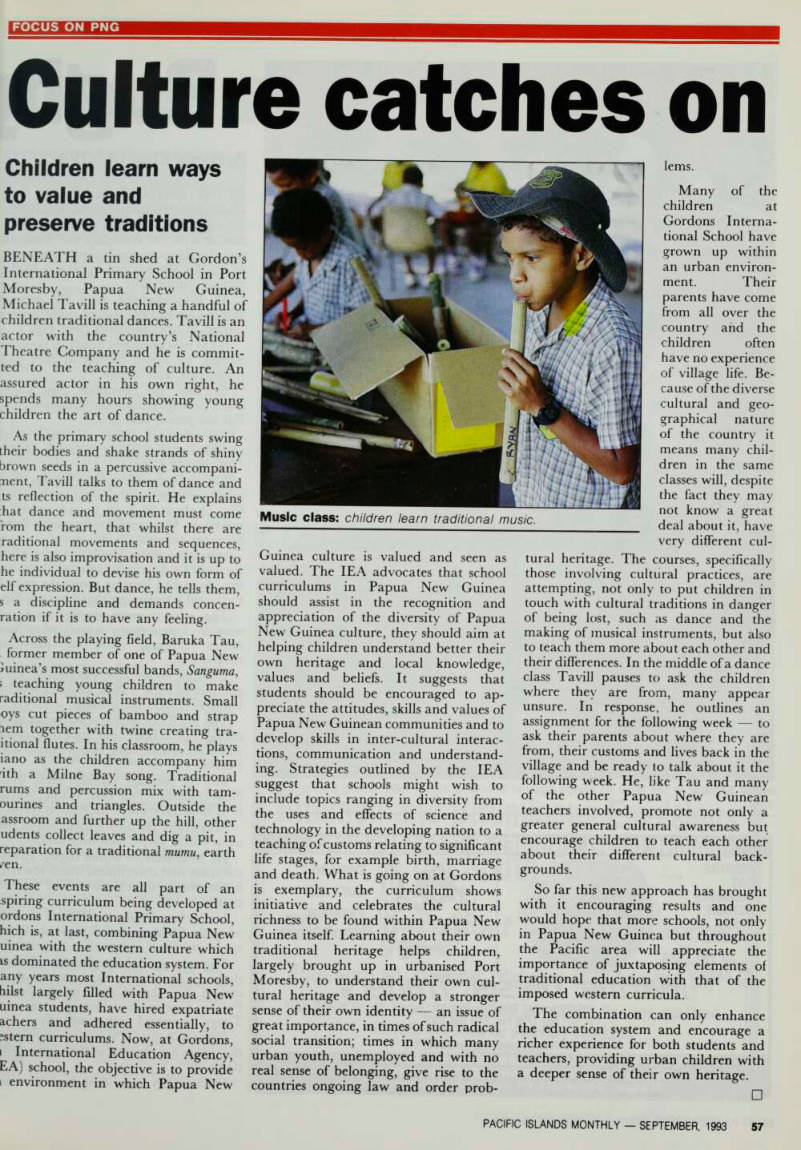
Across the playing field, Baruka Tau, former member of one of Papua New Guinea’s most successful bands, Sanguma, i teaching young children to make raditional musical instruments. Small oys cut pieces of bamboo and strap lem together with twine creating tra itional flutes. In his classroom, he plays iano as the children accompany him ith a Milne Bay song. Traditional rums and percussion mix with tam ourines and triangles. Outside the assroom and further up the hill, other udents collect leaves and dig a pit, in reparation for a traditional mumu, earth /en.
These events are all part of an
spiring curriculum being developed at
ordons International Primary School, hich is, at last, combining Papua New uinea with the western culture which is dominated the education system. For any years most International schools,
bilst largely filled with Papua New
uinea students, have hired expatriate achers and adhered essentially, to astern curriculums. Now, at Gordons, 1 International Education Agency, EA) school, the objective is to provide i environment in which Papua New
Guinea culture is valued and seen as valued. The lEA advocates that school curriculums in Papua New Guinea should assist in the recognition and appreciation of the diversity of Papua New Guinea culture, they should aim at helping children understand better their own heritage and local knowledge, values and beliefs. It suggests that students should be encouraged to appredate the attitudes, skills and values of Papua New Guinean communities and to develop skills in inter-cultural interactions, communication and understand-
ing. Strategies outlined by the lEA
suggest that schools might wish to include topics ranging in diversity from the uses and effects of science and technology in the developing nation to a teaching of customs relating to significant life stages, for example birth, marriage and death. What is going on at Gordons is exemplary, the curriculum shows initiative and celebrates the cultural richness to be found within Papua New Guinea itself. Learning about their own
traditional heritage helps children,
largely brought up in urbanised Port Moresby, to understand their own cultural heritage and develop a stronger sense of their own identity an issue of great importance, in times of such radical social transition; times in which many urban youth, unemployed and with no real sense of belonging, give rise to the countries ongoing law and order prob
lems.
Many of the children at Gordons Interna tional School have grown up within an urban environ ment. Their parents have come from all over the country and the children often have no experience of village life. Be cause of the diverse cultural and geo graphical nature of the country it means many chil dren in the same classes will, despite the fact they may not know a great deal about it, have very different cul
tural heritage. The courses, specifically those involving cultural practices, are attempting, not only to put children in touch with cultural traditions in danger of being lost, such as dance and the making of musical instruments, but also to teach them more about each other and their differences. In the middle of a dance class Tavill pauses to ask the children where they are from, many appear unsure. In response, he outlines an assignment for the following week to ask their parents about where they are from, their customs and lives back in the village and be ready to talk about it the following week. He, like Tau and many of the other Papua New Guinean teachers involved, promote not only a greater general cultural awareness but encourage children to teach each other about their different cultural back grounds.
So far this new approach has brought with it encouraging results and one would hope that more schools, not only in Papua New Guinea but throughout the Pacific area will appreciate the importance of juxtaposing elements of traditional education with that of the imposed western curricula.
The combination can only enhance the education system and encourage a richer experience for both students and teachers, providing urban children with a deeper sense of their own heritage. n
Music class: children learn traditional music.