Rugby
pp. 58-59 · Read in the full issue
Sport
By Harris Choy of NZPA
IN the eastern countries they talk about modernisation as westernising.
In Pacific islands rugby, it used to be similar with the Samoans, the Tongans and the Rarotongans looking westwards to Fiji for the modern approach to the game until 1991.
All that changed after the second World Cup in 1991. Island rugby power started to drift eastward from Fiji.
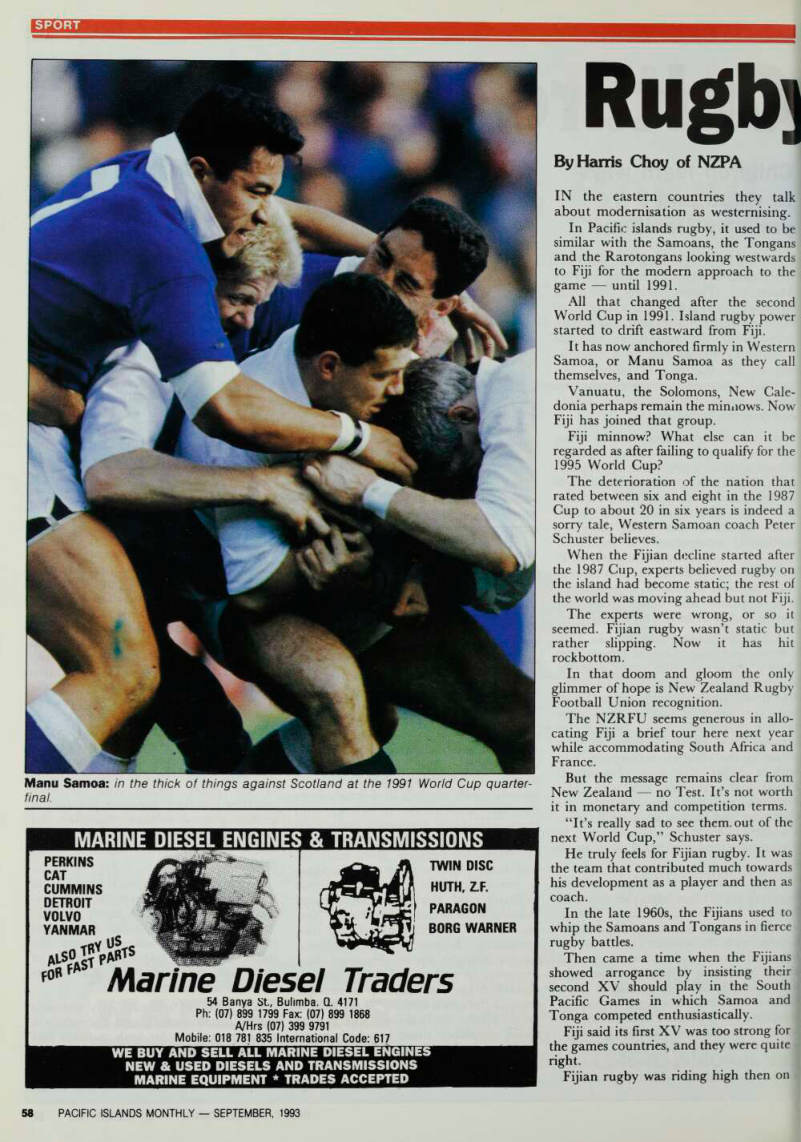
It has now anchored firmly in Western Samoa, or Manu Samoa as they call themselves, and Tonga.
Vanuatu, the Solomons, New Cale donia perhaps remain the minnows. Now Fiji has joined that group.
Fiji minnow? What else can it be regarded as after failing to qualify for the 1995 World Cup?
The deterioration of the nation that rated between six and eight in the 1987 Cup to about 20 in six years is indeed a sorry tale, Western Samoan coach Peter Schuster believes.
When the Fijian decline started after the 1987 Cup, experts believed rugby on the island had become static; the rest of the world was moving ahead but not Fiji.
The experts were wrong, or so it seemed. Fijian rugby wasn’t static but rather slipping. Now it has hit rockbottom.
In that doom and gloom the only glimmer of hope is New Zealand Rugby Football Union recognition.
The NZRFU seems generous in allo cating Fiji a brief tour here next year while accommodating South Africa and France.
But the message remains clear from New Zealand no Test. It’s not worth it in monetary and competition terms.
“It’s really sad to see them, out of the next World Cup,” Schuster says.
He truly feels for Fijian rugby. It was the team that contributed much towards his development as a player and then as coach.
In the late 19605, the Fijians used to whip the Samoans and Tongans in fierce
rugby battles.
Then came a time when the Fijians showed arrogance by insisting their second XV should play in the South Pacific Games in which Samoa and Tonga competed enthusiastically.
Fiji said its first XV was too strong for the games countries, and they were quite right.
Fijian rugby was riding high then on
Manu Samoa: In the thick of things against Scotland at the 1991 World Cup quarter final.
With Fiji in doldrums the powerbase now is Western Samoa
the shoulders of a few with vision one or two locals and a number of expatriates like a former English lock Brian
Wightman, lawyer Barrie Sweetman,
Kiwi engineer Bob Lendrum and hotel er Andrew Thomson. There were others.
These men had the rugby contacts iffshore, brought in helpers coaches, eferees, matches from New Zealand ind Australia, and when they could find myone who could contribute.
In obtaining former Waikato coach George Simpkin’s services they staged a ugby coup it came only a few months efore Sitiveni Rabuka, a colonel in hose days, staged the real one with 116 s.
But that 1987 Cup success in New ealand when the Fijians reached the uarter-final against France, made some igby followers at home rather envious.
They wanted to take over the game in le country and Rabuka’s coup did mtribute to their successful attempt as en like Wightman and Simpkin left the >untry.
Newcomers were finding that rugby Iministration was not the glamorous b it had seemed. It was a thankless, ipaid full-time routine that even ewed into their work hours apart from e voluntary time they were putting in.
The difficult task facing them was
aintaining the development pro
ammes that had been set out by their edecessors. And that required money lich had steadily drained from the ffers but never as well replenished.
Players are now openly blaming the art’s administrators, the amount of litics brought into the game, the power uggle and those involved without their arts’ real desire.
They probably need a complete clean Schuster observed. rle had seen how the playing and idling personnel had changed so ckly game after game in the past three .rs.
When we played them this year, they ' e a very good team. We struggled inst them in the lineouts and set ces. They were still very competitive.
When they played Tonga in Fiji a week later I heard they had made five changes to the team. I knew they wouldn’t win,” he said.
In a return match Fiji did win back some pride by beating Tonga, but not by enough points to secure a place in South Africa in 1995.
One theory looked upon as the reason for Fiji’s decline is the enormous empha sis on sevens rugby. But rugby thinkers like Schuster and former All Black Bryan Williams believe the abbreviated game, if harnessed properly, should help the 15s game.
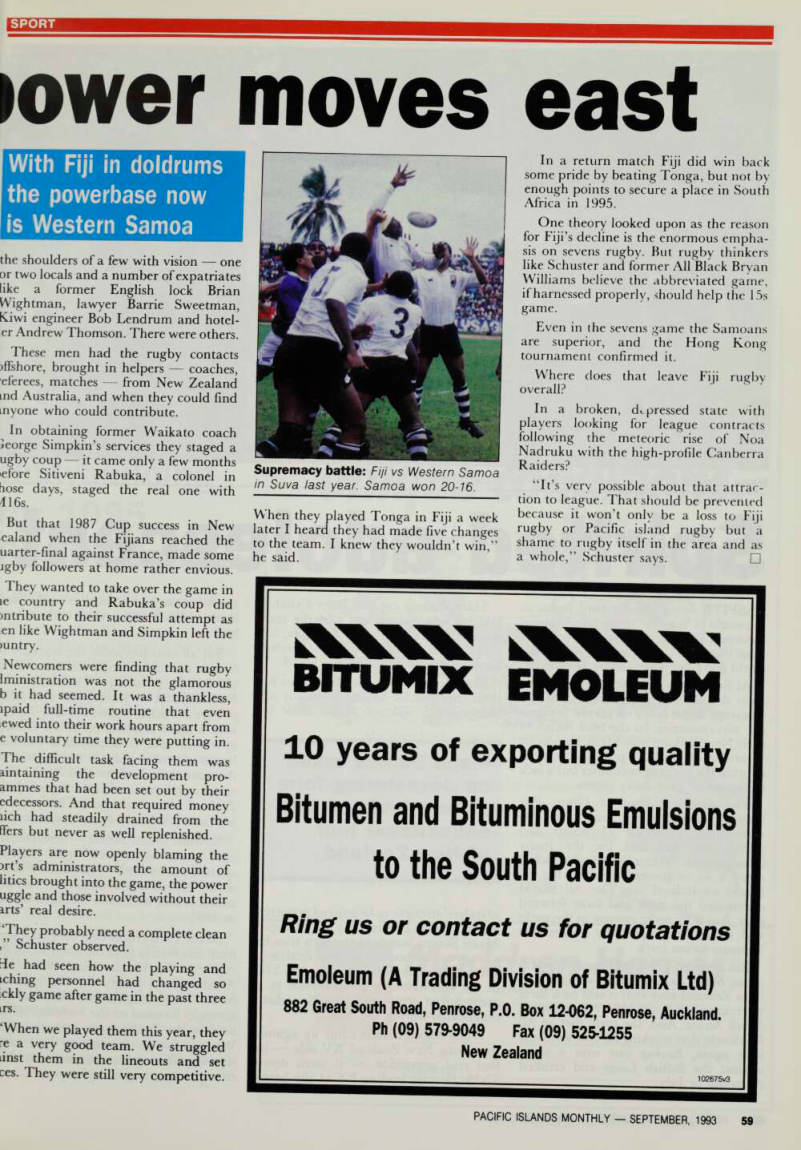
Even in the sevens game the Samoans are superior, and the Hong Kong tournament confirmed it.
Where does that leave Fiji rugby overall?
In a broken, depressed state with players looking for league contracts following the meteoric rise of Noa Nadruku with the high-profile Canberra Raiders?
“It’s very possible about that attrac tion to league. That should be prevented because it won’t only be a loss to Fiji rugby or Pacific island rugby but a shame to rugby itself in the area and as a whole,” Schuster says. □
Supremacy battle: Fiji vs Western Samoa in Suva last year. Samoa won 20-16.