Health Hitches
pp. 51-55 · Read in the full issue

By Jann loms
PAPUA New Guinea’s decentralised public service has always given the lational Department of Health consider ible anguish when it comes to providing i uniform system of health care. Earnest efforts over many decades to provide icalth services to the nation’s 3.9 million >eople have frequently been thwarted by he lack of committed, co-ordinated ictivity at regional, provincial and listrict levels, and also by a perpetual carcity of government resources, leaving dequate and consistent standards of ommunity health care difficult to ch ain.
But bureaucratic difficulties and lack f public sector funding are not the only npediments to health care. Papua New luinea has one of the most rugged ;rrains in the world. Many communities re remote and inaccessible to providers f health services and medical supplies, n fact, 85 per cent of the total
opulation lives rurally. Transportation
lacking. Many people don’t have the leans to reach the nearest aid post or ealth centre (in some cases there isn’t /en a road). Likewise, movement out
from the provin cial health insti tutions and ad ministrations is in
adequate, result
ing in the irregular
provisioning of es sential drugs and supplies to rural clinics. Even if a sick person makes it to the aid post or health centre, there is no guaran tee that the re quired treatment will be available.
In consequence of the bureau cratic, communi cation and trans
portation difficult
ies, Papua New Guinea incurs one of the highest rates of communicable
disease and child and maternal mortality in the world. Malaria, pneumonia and diarrhoeal diseases are the three leading causes of death among children under
five years of age. Infectious diseases, malnutrition, and poor ante-natal and post-natal care are the major causes of death among women.
UNICEF, Pori Moresby
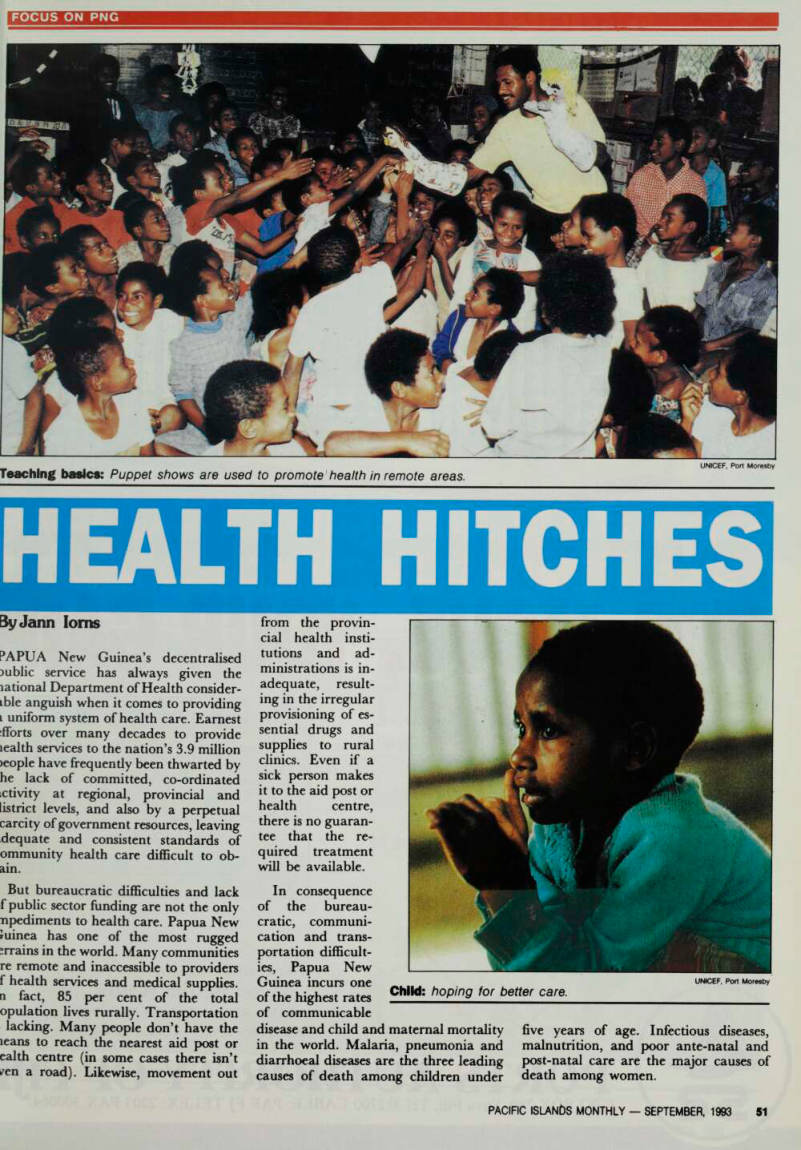
Teaching basics: Puppet shows are used to promote health in remote areas.
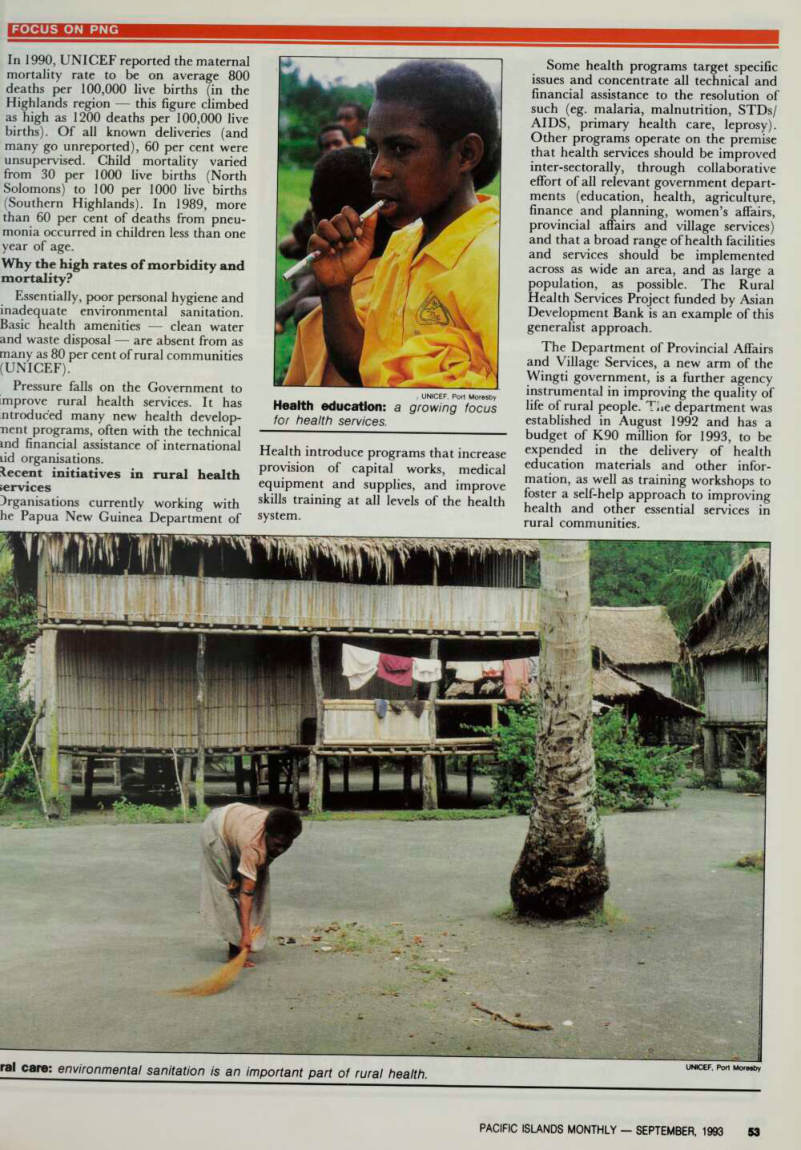
UNICEF, Pori Moresby Chlld: hoping for better care.
In 1990, UNICEF reported the maternal mortality rate to be on average 800 deaths per 100,000 live births (in the Highlands region this figure climbed as high as 1200 deaths per 100,000 live births). Of all known deliveries (and many go unreported), 60 per cent were unsupervised. Child mortality varied from 30 per 1000 live births (North Solomons) to 100 per 1000 live births (Southern Highlands). In 1989, more than 60 per cent of deaths from pneu monia occurred in children less than one year of age.
Why the high rates of morbidity and mortality?
Essentially, poor personal hygiene and inadequate environmental sanitation.
Basic health amenities clean water and waste disposal are absent from as many as 80 per cent of rural communities
(Unicef).
Pressure falls on the Government to improve rural health services. It has ntroduced many new health develop nent programs, often with the technical ind financial assistance of international
lid organisations.
decent initiatives in rural health services
Organisations currently working with
he Papua New Guinea Department of
Health introduce programs that increase provision of capital works, medical equipment and supplies, and improve skills training at all levels of the health system.
Some health programs target specific issues and concentrate all technical and financial assistance to the resolution of such (eg. malaria, malnutrition, STDs/ AIDS, primary health care, leprosy).
Other programs operate on the premise that health services should be improved
inter-sectorally, through collaborative
effort of all relevant government depart ments (education, health, agriculture, finance and planning, women’s affairs, provincial affairs and village services) and that a broad range of health facilities and services should be implemented across as wide an area, and as large a population, as possible. The Rural Health Services Project funded by Asian Development Bank is an example of this generalist approach.
The Department of Provincial Affairs and Village Services, a new arm of the Wingti government, is a further agency instrumental in improving the quality of life of rural people. The department was established in August 1992 and has a budget of K9O million for 1993, to be expended in the delivery of health education materials and other infor mation, as well as training workshops to foster a self-help approach to improving health and other essential services in rural communities.
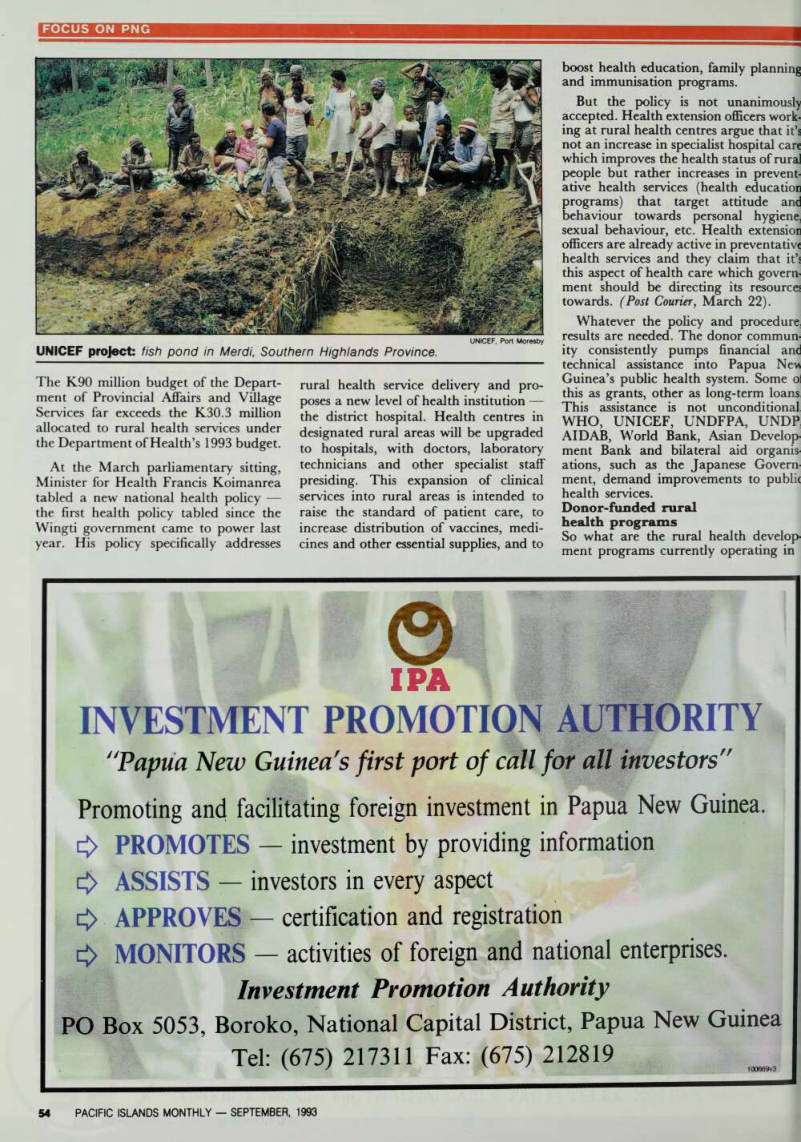
UNICEF, Port Moresby Health education: a growing focus for health services.
[?]ral care: environmental sanitation is an important part of rural health.
UNICEF, Port Moresby
The K9O million budget of the Depart ment of Provincial Affairs and Village Services far exceeds the K 30.3 million allocated to rural health services under the Department of Health’s 1993 budget.
At the March parliamentary sitting, Minister for Health Francis Koimanrea tabled a new national health policy the first health policy tabled since the Wingti government came to power last year. His policy specifically addresses
rural health service delivery and pro poses a new level of health institution the district hospital. Health centres in designated rural areas will be upgraded to hospitals, with doctors, laboratory technicians and other specialist staff presiding. This expansion of clinical services into rural areas is intended to raise the standard of patient care, to increase distribution of vaccines, medi cines and other essential supplies, and to
boost health education, family planning and immunisation programs.
But the policy is not unanimously accepted. Health extension officers work ing at rural health centres argue that it’s not an increase in specialist hospital care which improves the health status of rural people but rather increases in prevent ative health services (health education programs) that target attitude and behaviour towards personal hygiene, sexual behaviour, etc. Health extension officers are already active in preventative health services and they claim that it’s this aspect of health care which govern ment should be directing its resources towards. (Post Courier , March 22).
Whatever the policy and procedure, results are needed. The donor commun ity consistently pumps financial and technical assistance into Papua New Guinea’s public health system. Some oi this as grants, other as long-term loans, This assistance is not unconditional,
Who, Unicef, Undfpa, Undp,
AIDAB, World Bank, Asian Develop ment Bank and bilateral aid organis ations, such as the Japanese Govern ment, demand improvements to public health services.
Donor-funded rural health programs So what are the rural health develop ment programs currently operating in
UNICEF project: fish pond in Merdi, Southern Highlands Province.
UNICEF, Port Moresby
Papua New Guinea? Let’s look at three principal endeavours the World Health Organisation’s Primary Health Care Development Program, Asian De velopment Bank’s Rural Health Services Project and UNICEF’s Co-operative Program for Maternal and Child Health.
WHO’s Primary Health Care
Development Program
Introduced in 1980, it encourages active participation of village people in rural health service delivery. Rural communi ties, so often remote and voiceless, experience considerable deprivation in standards of living and access to central government resources. Under this pro gram, each village undertakes its own money-making activities (cash crops, donations) and utilises its own labour (in a subsistence economy, a valuable re source waiting to be utilised) to establish
basic health services (housing, water tanks, toilets, gardens).
The end result is a self sufficient unit where village members take responsibility for their own basic health care instead of relying on scarce resources of government.
An important ideology of the program is to introduce a ‘bottom up” approach to health planning and manage ment, giving people at the village level responsibility for determining the services that are needed and how they should be implemented. The Village Development Commit tee typically comprises a dozen members, including a village magistrate/counsellor and >ther chosen, respected figures, [t plans and monitors com munity development activities, fhe committees are taught the nathematical principles of lata collection, data analysis
md basic accounting. They are also aught management and organisational kills so that they can develop project dans, project buagets and project moni oring systems. They learn how to indertake household surveys to deter line the priority needs of the members f their community. They brainstorm /ays of raising capital and the most ppropriate types of projects to im lement, given available community ADB’s Rural Health Services Proj- Development Bank is another gnificant player in the race to improve iral health services. Its financial input >r the past decade exceeds US§6O lillion. The Rural Health Services reject commenced in 1982 and dis ursed US$l2 million over six successive x years to upgrade rural health services i Central, Gulf, East Sepik, West Sepik, ladang, Western Highlands and Na
anal Capital District Provinces.
The first loan was succeeded by a cond, the ADB Rural Health Services
Project No 11, costing US$22.B million.
Between 1986 and 1991, the second rural health services project upgraded health facilities and services in tne 14 provinces excluded from development under ADB I. Physical infrastructure (civil works, medical equipment, transport, water supply, sanitation, radio communica tions equipment), health worker training (in-service training, health education training) and improvements to the planning and training sections of the National Department of Health were effected.
In 1992, a third ADB Rural Health Services Project was launched. It plans to spend U 5526.3 million expanding the physical infrastructure and institutional strengthening inputs made under ADB 11, with a major component of the project to be upgrading of rural health centres and staff houses in 13 provinces
(Central, Gulf, Western, East Sepik, New Ireland, Oro, Manus, Madang, Morobe, Western Highlands, Southern Highlands, Eastern Highlands and Enga). ADB 111 also aims to improve the national health information and health research systems and assist in reviewing a financial policy to derive more effective ways of recovering costs from the country’s four base and 19 other provin cial hospitals.
The capital and other inputs of the Rural Health Services Project are im pressive. However, once introduced, how will these improvements be maintained?
The whole process of rural health service delivery stands to become more effective if Village Development Committees are able to determine rural health priorities and steer the course for national and provincial policies on services, supplies, manpower and training.
UNICEF’s Co-operative Program
for Maternal ana Child Health UNICEF’s program operates in much the same way as WHO’s Primary Health Care Development Program, except with
an emphasis on child and maternal health. UNICEF works with people at the village level and is a leading agency in the training of volunteer village birth attendants. principal drive is to reduce child and maternal mortality, A U 552,693,000 four-year Co operative Program was negotiated with the Papua New Guinea Government in 1987 and ran from 1988 to 1992. More than 50 per cent of the program budget was spent on programs concerning im munisation, control of diarrhoea! dis eases and training of village birth attendants.
A second co-operative program has just been signed for U 5510,260,000 (Kl 3
million). The 1993-1997) program
furthers existing work in increasing child immunisation and reducing rates of diarrhoeal diseases, malaria and acute
respiratory infection
(pneumonia). The pro gram also furthers health education and family planning services, and standards of child and maternal nutrition. Most importantly, the pro gram aims to reduce maternal and child mor tality.
UNICEF has a Child Survival and Develop ment Program operating in one province, Southern Highlands.
The CSD program in tensifies immunisation and diarrhoeal disease control activities and also undertakes other health activities like the construction of venti lated smoke-free houses to promote reduction of respiratory infections ana the distribution of
permethrine-impregnated mosquito nets to control malaria.
Other donor initiatives A major Population and Family Plan ning Project is to be introduced this year, involving the Papua New Guinea Gov ernment and joint donors of the World Bank, Asian Development Bank and AIDAB. The US$53 million loan financed project will increase and up grade capital works, training, equip ment, contraceptive supplies, and other aspects of rural health service for the six years, 1993 to 1999. This will be one of the most important development projects for Papua New Guinea, for without rapid reduction of the high birth rate and formidable morbidity statistics, the country is drained of socio-economic benefits gained from mining, agriculture and other income-generating sectors.
The United Nations Family Planning Association (UNFPA) is to grant US$5.5 million this year for a nationwide
Population and Development Program
in support of the US$33 million project. □.
Children: their education is a priority.
UNICEF, Pori Moresby