looks
pp. 47-49 · Read in the full issue
Focus On Png
Png
looks North
PAPUA New Guinea has begun ‘Looking North’ as it embarks on policies which, Prime Minister Paias Wingti hopes, will see the :ountry through the 21st Century on a irm economic footing. After visiting Indonesia, Singapore and Malaysia,
/Vingti recently
old the PNG par iament that “the est of the world is Doking towards ‘Look forth’ was a •ractical plan de igned to achieve
meaningful role
>r PNG in the
'odd economy
nd to increase the country’s say in and world affairs, he said.
Now, more than ever, Papua New Guinea has to take its place in the orld. Today, we are part of the world :onomy.”
“If we are to improve our quality of e and increase the prosperity of our -ople we must compete in the global onomy. Neither Australia nor New ealand want to be seen as any longer uropean outposts but rather as partici iting neighbours of Asia and the icific. I am proud to say that Papua ew Guinea had already begun looking orth towards Asia in 1986. When Sir ilius and I first gained government en, I announced that Asia was a most iportant region where our future lay. e are serious when I say that ‘Looking Drth’ is one of the most important >licy initiatives for Papua New Guinea ice we gained independence 18 years o. Our challenge now is to find our ice in the Asia-Pacific regional econ iy of the 21 Century.” Wingti, who st became prime minister in 1985 after
PM: Wingti
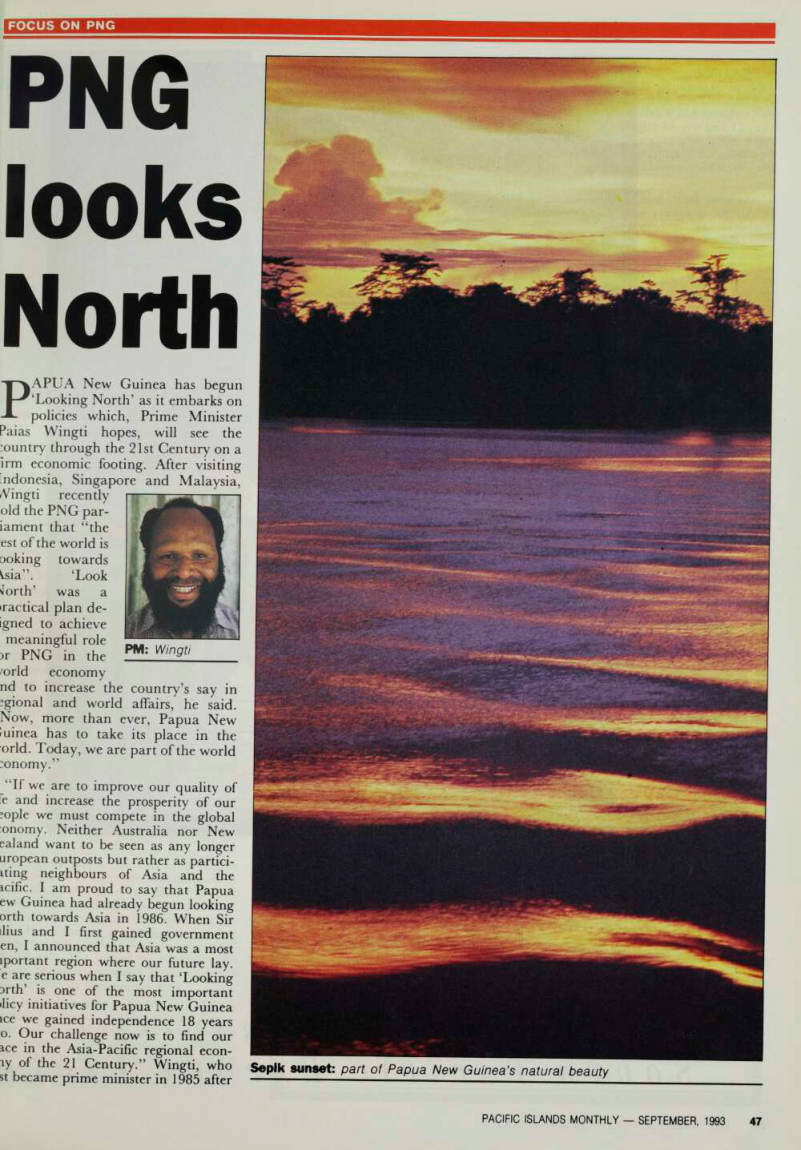
Seplk sunset: part of Papua New Guinea's natural beauty
leading a no-confidence motion against Michael Somare, believes the future prosperity of his country lies in PNG aecoming a significant partner in the
Asia region.
“In population terms, the Asian nations ire the biggest market places in the world boasting nearly half of the world’s five fillion people,” Wingti said. “And, as their vealth increases, they are fast becoming the nost important market place in the world.
Ye have to demonstrate that we have the pods and services they want. Trade with has been largely in PNG’s favour, nostly boosted by our tremendous trade urplus with Japan. Looking over a three ear period from 1988 to 1990, collective ti ports from Asian nations, excluding ndonesia and Malaysia, averaged about L3OO million or one third of all PNG’s nports. Over the same period, exports to isia averaged K5OO million or roughly half f PNG’s exports. With our new policy, NG hopes to increase trade with Asian ations.” ‘Even if that means PNG will increase nports from Asia initially, the net effect of will be cheaper prices for commodities ecause most Asian products are cheaper lan comparable products from other of the world. We have let to Asians now what we have to offer and make them ant what we have to offer. We can rovide those goods and services at a better rice or of better quality than our competi •rs. One of the first laws of business is that you have a product for sale, you must ivertise it. We intend to advertise the ition through increased trade missions
id exhibitions throughout Asia.”
“I led delegations to Singapore, Malay i and Indonesia. We first visited Singa )re and later Malaysia. We held fruitful scussions on trade, mining and petroleum :velopments, agriculture, exchange of air ryices and telecommunication services, bis close interaction reflects the commit
merit by the governments to put practical meaning to the Treaty of Mutual Respect, Friendship and Co-operation. I am very pleased with the three bilateral visits I made. I am convinced Look North is the right way to go.”
The Country Papua New Guinea is an independent state with an estimated population of over 3,483,370. It is also a member of the Commonwealth. It consists of the eastern half of the island of New • Um< vr anc * f off-shore islands includmg New Britain, New Ireland and Qonm amVi e^ a f Por I Moresby is 3900 km north of Sydney, Australia. Operatmg currency is the Kina.
The People Inhabitants include a large diversity of types although some ethnologists make a distinction between the
Papuan-type people and the Melanesians who are people of the coasts and offshore islands. The Asian population in PNG established itself because the German New Guinea Company which administered New Guinea under charter for the first 15 years a fter German annexation in 1884 found New Guinea labour initially unsatisfactory an d introduced Chinese, Malays and Ambonese.
By t g e time Germany took over admin istration from the company the Asian population was between 300 and 400.
Labour was then brought mostly from Hong Kong. At the time Australia began civil administration in 1921 there were 1424 Chinese and 1(53 Ambonese and Malays. The Chinese ultimately became the shopkeepers and artisans of PNG. □
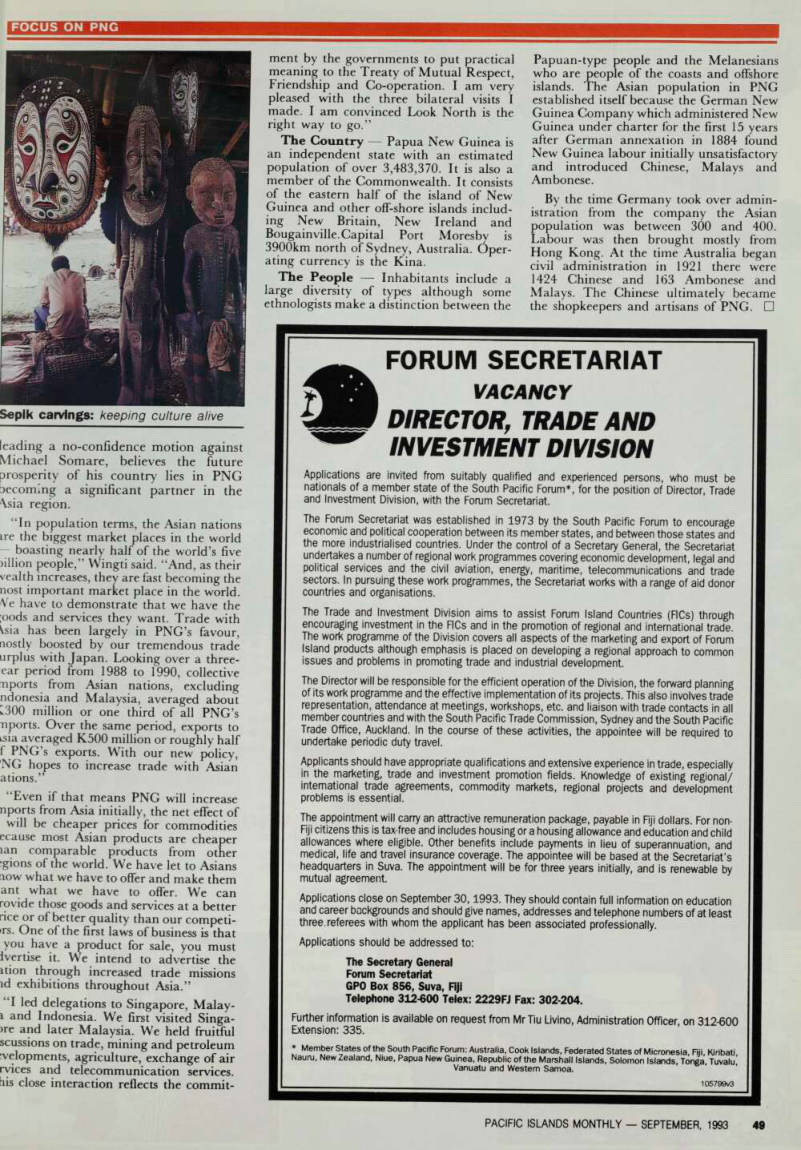
Sepik carvings: keeping culture alive