Political novelties
p. 41 · Read in the full issue
THE political situation in Tonga
keeps turning up novelties. Here tofore debates in Parliament on the Budget would last for months, but however sound the objections of people’s representatives would have been they always lost out in voting and the budgets passed with little changed and almost the same forms in which they were intro duced.
This year, however, the nine people’s representatives remembering all tnose years of fruitless toil yet eating up public funds all the same devised a new approach. They submitted (ac companied by a statement signed by all the nine) to the House that the budget be passed as introduced by the Minister of Finance. But a sister motion also filed by the people’s representatives that the House be closed until a proper agenda was drawn up and the closure to be without pay was not at all amusing
to a number of MPs. Yet the people’s representatives succeeded in the winning over two nobles and two ministers to secure a significant victory!
Never before in the parliamentary history of Tonga have people’s representatives played such tactics in the struggle for greater recognition of the people’s voice and rights and a more proportionate representation in Parliament. But it worked for the general good in two ways it saved hundreds of thousands of public funds in weekly allowances etc for dull and futile debate, and it enabled people’s representatives, ministers and nobles to show their true colours. For two of the nine people’s representatives abstained on this second vote indicating they are not sure if they wanted the ‘no pay’ condition.
The people’s representatives are more organised this year.
At least seven of them have formed into a committee that meets regularly to compare notes, discuss policy so as to present a more united front. Their chairman is ‘Uliti Uata, N 0.2 people’s representatives for Ha’apai, who was in
parliament two terms in the seventies, and is one of Tonga’s leading businessmen. An experi enced politician, a fine tactician, he is above all, absolutely sincere.
The seven firmly believe that the form of government and the Con stitution must be changed and work to that end must start now.
Most of them also believe Tonga should be more truly democratic.
Without a doubt the moving spirit in this new set-up is still ‘Akilisi Pohiva. He strongly urges their committee to fight on two fronts: inside parliament and in the law courts. New faces on the people’s representatives table in clude ‘Uhila Liava’a (N 0.3 Ton gatapu), economist, accountant, lawyer and former government accountant general. He is proving to be a formidable debater especi ally when discussions fall within his areas of expertise. And prom inent lawyer Masao Paasi who
after his record holding 20-odd years in parliament in the sixties, seventies, and early eighties, now returns as No. 1 people’s representative for Vava’u.
He is a fearless, outspoken lawyer who played an important part in the design of the said new people’s representatives tactics. Then mere are Uili Fukofuka (N 0.2 Tongatapu) and Teisina Fuko (No. 1 Ha\pai) both
impressive politicians who never
mince words in stating the case for constitutional revamping of the form of government. The seventh member of the committee is Samiu Vaipulu (N 0.2 Vava’u). He too is a veteran parliamentarian who served one term in the House during the eighties. He is slowly raising a clear profile with the pro-change party. This is by far the best team ever put together by the
Tongan popular electorate.
But what have the people’s rep
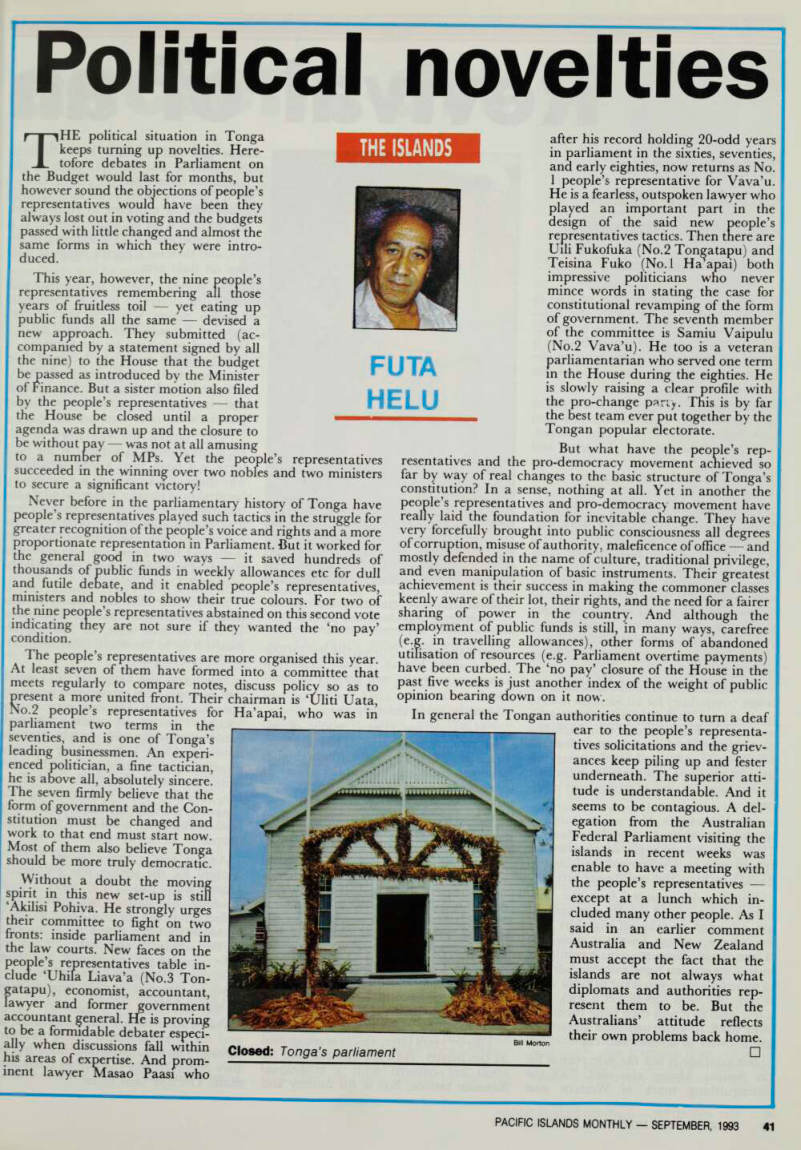
resentatives and the pro-democracy movement achieved so far by way of real changes to the basic structure of Tonga’s constitution? In a sense, nothing at all. Yet in another the people’s representatives and pro-democracy movement have really laid the foundation for inevitable change. They have very forcefully brought into public consciousness all degrees of corruption, misuse of authority, maleficence of office and mostly defended in the name of culture, traditional privilege, and even manipulation of basic instruments. Their greatest achievement is their success in making the commoner classes keenly aware of their lot, their rights, and the need for a fairer sharing of power in the country. And although the employment of public funds is still, in many ways, carefree (e.g. in travelling allowances), other forms of abandoned utilisation of resources (e.g. Parliament overtime payments) have been curbed. The ‘no pay’ closure of the House in the past five weeks is just another index of the weight of public opinion bearing down on it now.
In general the Tongan authorities continue to turn a deaf
ear to the people’s representa tives solicitations and the griev ances keep piling up and fester underneath. The superior atti tude is understandable. And it seems to be contagious. A del egation from the Australian Federal Parliament visiting the islands in recent weeks was enable to have a meeting with the people’s representatives except at a lunch which in cluded many other people. As I said in an earlier comment Australia and New Zealand must accept the fact that the islands are not always what diplomats and authorities rep resent them to be. But the Australians’ attitude reflects their own problems back home.
The Islands
Futa
Helu
Closed: Tonga’s parliament
Bill Morion