Revival of an
pp. 42-43 · Read in the full issue
Culture
Tattoo tricks catch on again among Samoans
By Jennifer Grimwade
BY the time the missionaries arrived in Western Samoa in the 1830 s, the Poly nesians had already been practising the art of tattooing for 2000 years. No-one is exactly sure why but the missionaries immediately did their best to outlaw this ancient art.
Some people believe the missionaries tried to ban the tradition, because men with tattoos wandered around naked, showing off their tattoos. Intricate and geometrical, traditional Samoan tattoos decorate the male body from the waist down to the knee.
Fuimaono Tupua, chief of Samoan affairs, says the missionaries were out raged by the “washing ceremony” which is celebrated by all men at the com pletion of their tattoos. Tattoo dye is considered to be sacred, so once it impregnates the flesh, the body must be cleansed of this sacred spirit by sleeping with a new lover. Even married men participate in the washing ceremony and their wives are expected to turn a blind eye.
Before the arrival of the missionaries, it was compulsory for all Samoan men to have a tatau. In fact, the custom was so ancient, the English word ‘tatoo’ actually comes from the Samoan, tatau. But the missionaries succeeded in changing this ancient tradition, and tattooing became compulsory for sons of paramount chiefs only.
Since the 19505, this ancient art has become increasingly popular. And in 1990, it was once again compulsory for the all men in a village on the island of Savai’i to have the traditional tattoo.
Motsie, who returned from the Uni versity of Hawaii 18 months ago, said, “I am ashamed to take off my shirt as I don’t have a tattoo. I want to show that T can do it’. Guys say you haven’t got guts if you haven’t got tattoos. A friend of mine tells me if you want to know what it feels like, you should get a stick with a few nails in it and then bang them into your back. It’s the one time when men are allowed to scream and cry”.
But courage is not the sole reason for the revival. Motsie also said: “it’s the distinguishing mark of Western and
American Samoa. No one else has tattoos in the world like us. I want to have a tattoo so everyone will know I’m Sam oan.”
And he’s not the only one, “Many of my clients, many of my ‘victims’, are half-castes, They are par ticularly eager to have their bodies tattooed because it identifies them as Samoan,” says Suluape Peleto, the island’s most highly regarded tattooist.
Peleto is a full-time secondary scchool science teacher. When he finished his teacher training, he returned to the tiny
picturesque Lefaga Bay area to spend
some time with his family. His father, a well-known tattooist had already handed down his skills to three out of his six sons.
Peleto’s older brother practised his de signs on Peleto and before long, Peleto was assisting his brothers.
“Then I picked up the tool one day, and started practising on my leg. Of course I still have it! I wanted to learn how to hold the tool properly, and how hard to hit it,” says Peleto.
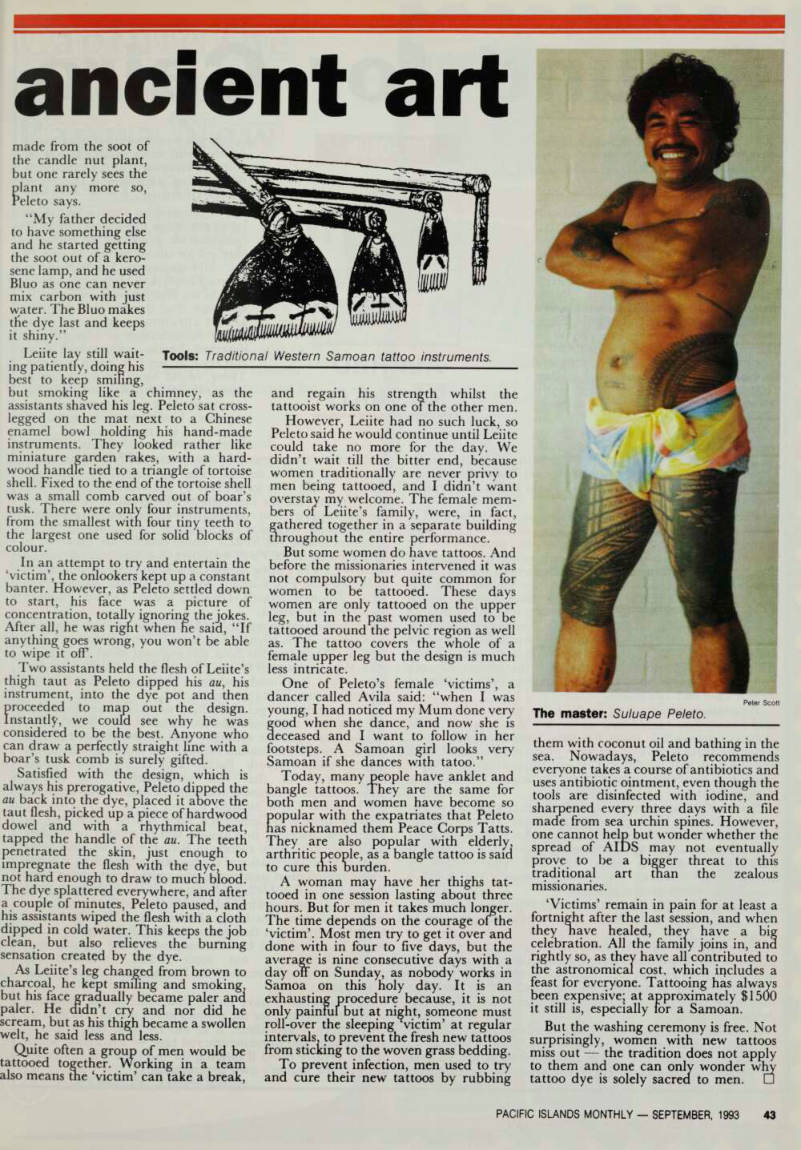
Fifteen years later, Peleto is recognised as the master. Half his legs and half his torso are covered with a traditional Samoan tattoos, bits of his tummy and
even his calf muscles have life-long experiments; but his real pride is the portrait of himself on his forearm. Drawn by a Dutch tattooist at an international convention of tattooists in Amsterdam, the portrait is an uncanny likeness. It is a rare experience to look someone in the eye, and then see a mirror image of their face on their arm.
The portrait is done by machine and is totally different to the traditional Samoan design which is always geo metrical. Because of the nature of the old fashioned tools used by the Samoans, it is not possible to create a curved line, therefore, their tattoos are made up of straight lines. Each pattern has a name, and it may be symbolic or simply
geometric.
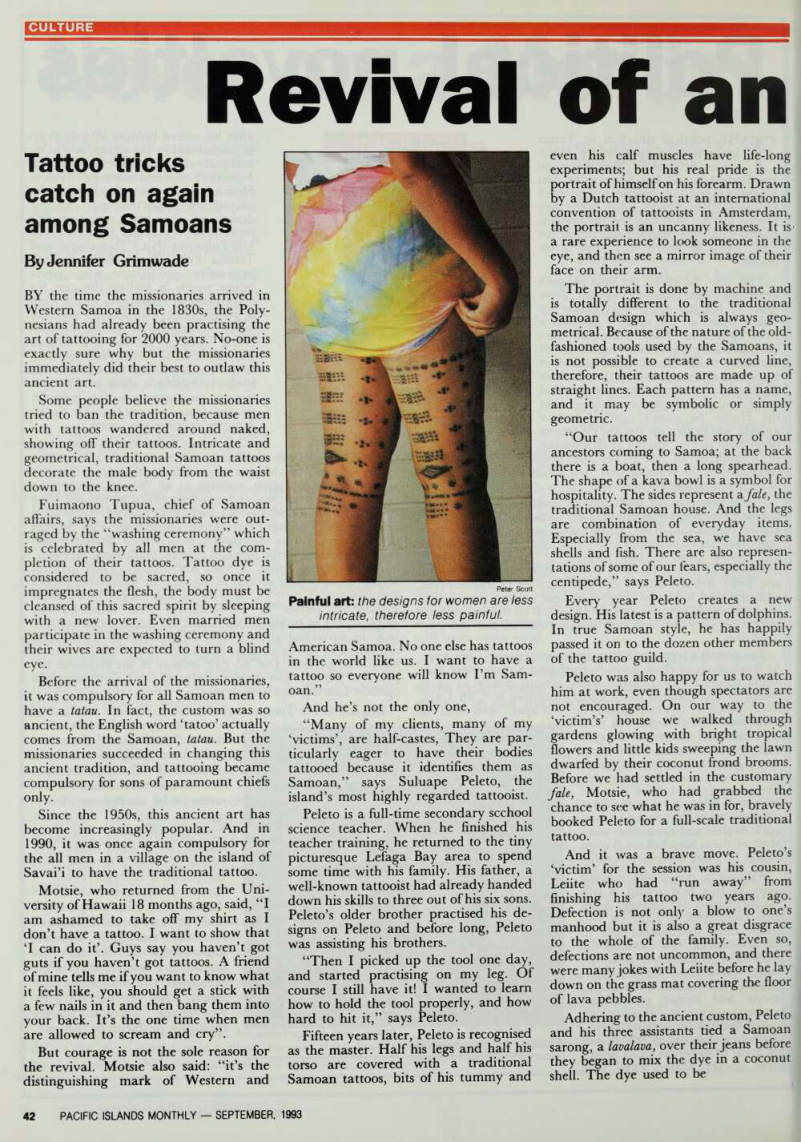
“Our tattoos tell the story of our ancestors coming to Samoa; at the back there is a boat, then a long spearhead.
The shape of a kava bowl is a symbol for hospitality. The sides represent a fale, the traditional Samoan house. And the legs are combination of everyday items.
Especially from the sea, we have sea shells and fish. There are also represen tations of some of our fears, especially the centipede,” says Peleto.
Every year Peleto creates a new design. His latest is a pattern of dolphins.
In true Samoan style, he has happily passed it on to the dozen other members of the tattoo guild.
Peleto was also happy for us to watch him at work, even though spectators are not encouraged. On our way to the ‘victim’s’ house we walked through
gardens glowing with bright tropical
flowers and little kids sweeping the lawn dwarfed by their coconut frond brooms.
Before we had settled in the customary fale, Motsie, who had grabbed the chance to see what he was in for, bravely booked Peleto for a full-scale traditional tattoo.
And it was a brave move. Peleto’s ‘victim’ for the session was his cousin, Leiite who had “run away” from finishing his tattoo two years ago.
Defection is not only a blow to one’s manhood but it is also a great disgrace to the whole of the family. Even so, defections are not uncommon, and there were many jokes with Leiite before he lay down on the grass mat covering the floor of lava pebbles.
Adhering to the ancient custom, Peleto and his three assistants tied a Samoan sarong, a lavalava, over their jeans before they began to mix the dye in a coconut shell. The dye used to be
Peter Scott Painful art: the designs for women are less intricate, therefore less painful.
made from the soot of the candle nut plant, but one rarely sees the plant any more so, Peleto says.
“My father decided to have something else and he started getting the soot out of a kero sene lamp, and he used Bluo as one can never mix carbon with just water. The Bluo makes tfie dye last and keeps it shiny.”
Leiite lay still wait ing patiently, doing his best to keep smiling,
but smoking like a chimney, as the assistants shaved his leg. Peleto sat cross legged on the mat next to a Chinese enamel bowl holding his hand-made instruments. They looked rather like miniature garden rakes, with a hard wood handle tied to a triangle of tortoise shell. Fixed to the end of the tortoise shell was a small comb carved out of boar’s tusk. There were only four instruments, from the smallest witn four tiny teeth to the largest one used for solid blocks of colour.
In an attempt to try and entertain the ‘victim’, the onlookers kept up a constant banter. However, as Peleto settled down to start, his face was a picture of concentration, totally ignoring the jokes.
After all, he was rignt when he said, “If anything goes wrong, you won’t be able to wipe it off.
Two assistants held the flesh of Leiite’s thigh taut as Peleto dipped his au, his instrument, into the dye pot and then froceeded to map out the design, nstantly, we could see why he was considered to be the best. Anyone who can draw a perfectly straight line with a boar’s tusk comb is surely gifted.
Satisfied with the design, which is always his prerogative, Peleto dipped the au back into the dye, placed it above the taut flesh, picked up a piece of hardwood dowel and with a rhythmical beat, tapped the handle of the au. The teeth
penetrated the skin, just enough to
impregnate the flesh with the dye, but not hard enough to draw to much blood.
The dye splattered everywhere, and after a couple of minutes, Peleto paused, and his assistants wiped the flesh with a cloth dipped in cold water. This keeps the job clean, but also relieves the burning sensation created by the dye.
As Leiite’s leg changed from brown to charcoal, he kept smiling and smoking, but his face gradually became paler ana paler. He didn’t cry and nor did he scream, but as his thigh became a swollen welt, he said less and less.
Quite often a group of men would be tattooed together. Working in a team also means tne ‘victim’ can take a break,
and regain his strength whilst the tattooist works on one of the other men.
Howeyer, Leiite had no such luck, so Peleto said he would continue until Leiite could take no more for the day. We didn’t wait till the bitter end, because women traditionally are never privy to men being tattooea, and I didn’t want overstay my welcome. The female mem bers of Leiite’s family, were, in fact, gathered together in a separate building
throughout the entire performance.
But some women do have tattoos. And before the missionaries intervened it was not compulsory but quite common for women to be tattooed. These days women are only tattooed on the upper leg, but in the past women used to be tattooed around the pelvic region as well as. The tattoo covers the whole of a female upper leg but the design is much less intricate.
One of Peleto’s female ‘victims’, a dancer called Avila said: “when I was young, I had noticed my Mum done very good when she dance, and now she is deceased and I want to follow in her footsteps. A Samoan girl looks very Samoan if she dances with tatoo.”
Today, many people have anklet and bangle tattoos. They are the same for both men and women have become so popular with the expatriates that Peleto nas nicknamed them Peace Corps Tatts.
They are also popular with elderly, arthritic people, as a bangle tattoo is said to cure this Durden.
A woman may have her thighs tat tooed in one session lasting about three hours. But for men it takes much longer.
The time depends on the courage ofthe ‘victim’. Most men try to get it over and done with in four to five days, but the average is nine consecutive aays with a day on on Sunday, as nobody works in Samoa on this holy day. It is an exhausting procedure because, it is not only painful but at night, someone must roll-over the sleeping Victim’ at regular intervals, to prevent the fresh new tattoos from sticking to the woven grass bedding.
To prevent infection, men used to try and cure their new tattoos by rubbing
them with coconut oil and bathing in the sea. Nowadays, Peleto recommends everyone takes a course of antibiotics and uses antibiotic ointment, even though the tools are disinfected with iodine, and sharpened every three days with a file made from sea urchin spines. However, one cannot help but wonder whether the spread of AIDS may not eventually prove to be a bigger threat to this traditional art man the zealous missionaries. ‘Victims’ remain in pain for at least a fortnight after the last session, and when they nave healed, they have a big celebration. All the family joins in, and rightly so, as they have all contributed to the astronomical cost, which includes a feast for everyone. Tattooing has always been expensive; at approximately $l5OO it still is, especially for a Samoan.
But the washing ceremony is free. Not surprisingly, women with new tattoos miss out the tradition does not apply to them and one can only wonder why tattoo dye is solely sacrea to men. □
Peter Scott The master: Suluape Peleto.
Tools: Traditional Western Samoan tattoo instruments