Never on a Monday
p. 40 · Read in the full issue
IT MUST be well known by now that many business people are unsuc cessful at getting bank loans because they approach their bank manager without proper preparation. But what I had never heard of until the other day was the term, “Don’t be a Monday morning bank borrower.”
It was used by an Australian bank manager who revealed, during a survey, that Monday was his worst day of the week for unprepared submissions, because people appar ently spent the weekend dreaming up great ideas for making money and rushed into the bank first thing Monday morning expecting to get a loan.
As the manager said, “They are
often offended when we knock them back, but in most cases we are doing them a favour.”
Banks want to lend money it’s the vital part of their business. But they should hardly be expected to hand it over without first being given full information on what is likely to happen to it.
Yet the same survey showed that about 60 per cent of small business applications for loans were made to the banks verbally, without supporting figures. Such applications are a waste of time for the business and the bank manager.
Bank managers want full details of what product or service will be supplied and what it will cost to supply it, how it will be marketed, what the cash flow will be (and most particularly, when it will start flowing), how the loan will be repaid and what security the bank will have if it isn’t repaid.
And that’s only the beginning!
On the matter of security, banks won’t necessarily be impressed by the fact that the borrower offer to put up a house or a building as Security for the loan. Banks may lend to estate agents but they are not in the real estate business themselves, and don’t want to be saddled with the problems of selling up if the loan goes sour.
Instead, they will do everything they can to assure themselves the loan will be sound, and that means they will expect the client’s forecasts about cash flows to be realistic, built around detailed costings and not simply optimistic guesses.
They may want to see a worst-case budget as well as one that will show them what to expect if everything goes as predicted. The bank will certainly want a sensible estimate of the money needed as working capital and for what length of time, for managers know that many small businesses fail because they haven’t enough capital to meet their bills in the early stages, when everything is going out and nothing is coming in.
In short, propositions should be thoroughly researched before the client ever gets to a bank, because if he doesn’t know the details of his own business, you can hardly expect
the bank to know, let alone provide money for it.
And what’s more, the pre planning is the businessman’s resposibility, not the bank’s. One of the complaints made by man agers in the same survey was that many clients expected the bank to help them work out a budget.
There is another important lesson for small business in the
bank’s approach.
The bank manager who said he was doing clients with insufficient information a favour by knocking back their requests for credit was making a point that many small businesses could use in their own operations. That is, the need to
regularly check on the credit worthiness of their clients. Are their own debtors secure?
Most business failure are due to bad management, and ignoring the possibility of bad debts is one of the worst management faults of all. Business failures can occur in good times and bad, but in times of economic downturn, such as we’ve been experiencing in our region in recent years, managers have to be especially alert. And, believe it or not, they have to be no less on guard as the economy begins to improve, because that’s the time they are most anxious for more sales after their starvation diet, and are more likely to extend credit to high risk accounts in the belief that things will soon come good.
If he is not to lose money on bad debts, the businessman needs accurate information on his clients and customers, just as the bank manager does. And like the bank manager, he needs to be firm about extending credit if he is in doubt.
Have there been changes in the way his customers are paying their accounts? If they have become slower, is it because they are hanging on to their money for as long as they can get away with it or because they aren’t able to pay?
Either way, the account needs attention.
Office managers need to watch out for early warning signals, so they can monitor accounts tightly if necessary and rein in some of the debt, or revise the account conditions. For credit managers, information is their lifeblood.
The need to know anything that will help assess the risks of getting their bills paid and decide on the best approach.
Does the client’s company need to be checked out for its current financial position or to reveal any hidden problems, for instance? There are many ways of doing this.
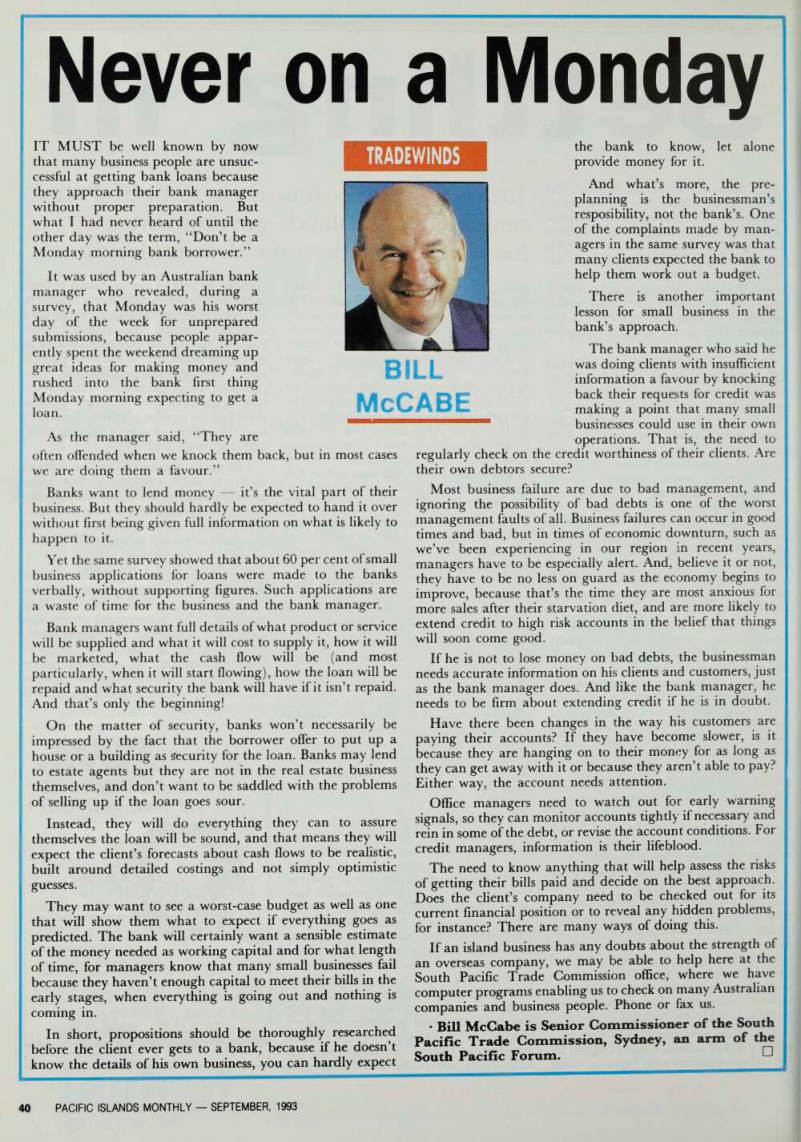
If an island business has any doubts about the strength of an overseas company, we may be able to help here at the South Pacific Trade Commission office, where we have computer programs enabling us to check on many Australian companies and business people. Phone or fax us. • Bill McCabe is Senior Commissioner of the South Pacific Trade Commission, Sydney, an arm of the South Pacific Forum.