Scientific Studies
pp. 49-51 · Read in the full issue
Special Report
THE specialities of oceanography, ge- °logy and geophysics form the backbone °f French scientific activities in New Caledonia.
ORSTOM, the French Institute of Scientific Research for Development through Co-operation, created its Oceanographic Department in Noumea more than 30 years ago. It now employs more than 50 people and manages its own fl ee t G f f our oceanographic vessels Q . .. / . ' Studies have supplied information on * e Physical and biological environment ° ■ NT ™ a " ne . regi °", p Pread p' r n ™/ P n. and p cn , ch I‘J • f , , kno * l( j d ge of this ecosystem has been applied, lor example, to tuna Fishing, and is more generally to lncrease Productivity of the
waters -
ORSTOM is also conducting an extensive study of thc New Caledonian lagoon, and is building a model of its functioning in order to develop an environment free of ciguatera poisoning resulting from human ingestion of flesh that contains ciguatoxin.
Other scientists are investigating the resources of the high seas, and work with meteorologists to understand the re lationship between ocean and climate, Thc first that the geologists and geophysists had was the mapping of the oc ean floor, using the bathymetric sys tem - They have now developed an extensive knowledge of the geological history of the South Pacific, and carry out cooperative research with scientists from Oceania, Australia, New Zealand anc t j ie United States, Another bodv IFREMFR (French Institute for Marine Research) has built and run a prawn farm, continuing the research and development done in its other laboratory at Tahiti, French Poly nesja New Caledonian land also offers a unique domain for research as well as considerable opportunities for cxploi tation.
Scientists of ORSTOM and CIRAD (agricultural studies) arc engaged in many projects, for example, pedologists
hydrologists, botanists, entomologists’
studying thc balance of nature so often
disturbed by human intervention, and work together in the development of
many agro-pastoral activities agricul
tural hydraulics, reafforestation, evol ution and soil fertility, chemical and biological control of pests, etc.
Their work is supported by an exten sive range of up-to-date equipment. A brand new SPOT remote sensing work station has been implemented, enabling them to further develop remote sensing studies.
Medical research is carried out by the Institut Pasteur de Noumea with a staff of 60. The main programs deal with
leprosis, entomology, virology and bac
teriology. The Noumea laboratory is part of the world-wide network of the Pasteur Instituts.
In New Caledonia the scientists study not only nature but also societies and
populations. For example, ORSTOM
has projects in the fields of human sciences interpretation of the environ ment by man, deciphering of the island’s past prior to written history, evolution and development of societies and of the
region.
All laboratories have already built a network of connections with their neigh bours of the Pacific islands, Australia and New Zealand. The opening of a section of the University of Pacific in Noumea in 1988 provides an opportunity for increas ing exchanges and co-operation.
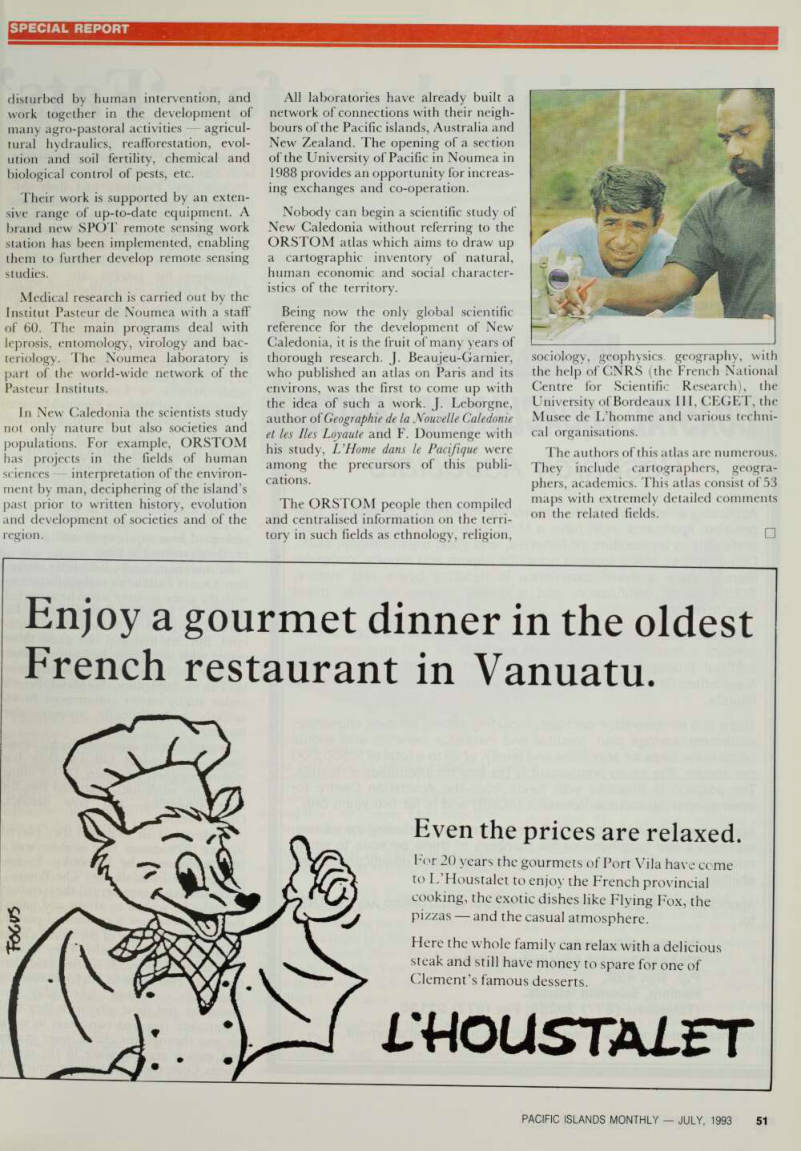
Nobody can begin a scientific study of New Caledonia without referring to the ORSTOM atlas which aims to draw up a cartographic inventory of natural, human economic and social character istics of the territory.
Being now the only global scientific reference for the development of New Caledonia, it is the fruit of many years of thorough research. J. Beaujeu-Garnier, who published an atlas on Paris and its environs, was the first to come up with the idea of such a work. J. Leborgne, author of Geographic de la Nouvelle Caledonie et les lies Loyaute and F. Doumenge with his study, L’Home dans le Pacifique were among the precursors of this publi cations.
The ORSTOM people then compiled and centralised information on the terri tory in such fields as ethnology, religion,
sociology, geophysics, geography, with the help of CNRS (the French National Centre for Scientific Research), the University ofßordeaux 111, CEGET, the Musee de L’homme and various techni cal organisations.
The authors of this atlas are numerous.
They include cartographers, geogra phers, academics. This atlas consist of 53 maps with extremely detailed comments on the related fields.