A special place for ‘Fats’
pp. 52-53 · Read in the full issue
Sports
By Atama Raganivatu
THE astonishing march of Western Samoan rugby reaches another milestone in July when the national team, Manu Samoa, embarks upon a nine-match tour of New Zealand. This culminates in a test match against the mighty All Blacks on
the month’s last day.
Barring a major mishap, the Western Samoans will be led on to Eden Park by a man who, in the eyes of millions throughout the world, has come to epitomise the spirit of his nation, Peter Fatialofa is recognised instantly in every country where rugby union is
played seriously. He is a revered figure in both Samoa and New Zealand.
Amazingly, Fatialofa had little en thusiasm for sports of any type during his schooldays and did not participate in organised rugby until age 20. This lack of interest is even more incredible when you consider his family background.
Amongst his cousins are a New Zealand “double international” (at net ball and softball) and a Junior All Black.
Three brothers have represented West ern Samoa at boxing (including Senio, a gold medallist at the 1973 South Pacific Games) and another made appearances for the Kiwi’s under-13 softball team. His father Momoe, a former Member of Parliament and Western Samoa Minister of Postal services, was also a boxing
champion.
And, boxing was Peter’s initial sport ing pursuit. He became good enough to win an important provincial champion ship when 16 but, shortly afterwards, suffered a painful defeat at the gloves of a much older opponent and this prompted him to abruptly and perma nently abandon the ring.
At this stage, rugby held little attrac tion. One of Fatialofa’s earliest flirtations with the game occured when he attended
Apia’s St. Joseph’s College, after his
parents returned to Samoa from Auck land. But, his first and last game there ended with him being laid unconscious.
Later, with the Fatialofa family now back in his birthplace, Auckland, Peter’s senior rugby career commenced in an
unlikely and distinctly unspectacular
manner.
Several friends, impressed by his broad frame (the six-foot tall Fatialofa has seldom weighed less than 18 1/2 stone during his adult life), recruited him for their struggling, and now defunct, Grafton team.
Grafton lost all 19 games they played in that 1979 season. One of these was a 56-0 hammering by Ponsonby. So im pressed was Fatialofa by “The Ponies”, he decided they represented the standard of rugby he wished to attain and joined them. He was now a committed player.
Ponsonby are now of the world’s most distinguished rugby clubs. They have a magnificent history. It is often said that there are two types of rugby players in Auckland those who play for Ponsonby and those who wish they did!
Fatialofa required two years to work his way through the club’s lower grades and gain a regular place in the senior fifteen. Once there, though, he cemented
his position. With the ever-reliable Sam oan as their prop, Ponsonby won six Auckland championships in 10 years.
His inevitable debut for the Auckland A side came in 1984. In the interim, “The Auks” have evolved into the most formidable combination ever seen in the game below international level. They have held the Ranfurly Shield, symbol of supremacy in New Zealand domestic rugby, since 1985.
Due to the incredible depth of talent Auckland can call upon, Fatialofa’s appearances for them have been spas modic. However, few would argue that he has long been among the best props in New Zealand and experts almost unanimously agree he is desperately unlucky not to have been called upon by its national team the world renowned All Blacks.
In 1986, he was selected for an All Blacks trial, gained a place in the North Island side for their then annual clash with the South Island and made appear ances for the New Zealand Emerging Players team.
An All Blacks cap appeared to be his for the taking, until a broken shoulder blade sidelined him for almost the entire
1987 campaign.
The failure of a fully-fit Fatialofa to .vin a berth in the 1989 New Zealand aarty for a tour of Australia shocked nany in rugby circles and made him aelieve his future lay not in the black of Vew Zealand, but the blue of Manu iamoa.
Fatialofa has always been proud of his
)ackground and, although living all but
i few months of his life in Auckland, he along with his 14 brothers and sisters vho are scattered right around the — refers to the village of .apasome (situated 30 kilometres from as his spiritual home.
Drafted into the squad that toured reland and Wales, he played in all 10 ;ames. By the end of the tour, Fatialofa fully devoted to the cause of Western iamoan rugby.
The Samoan’s emergence as a major •ower in international rugby has been ne of world sport’s more remarkable pisodes in recent years.
From minnows in the world arena, bey have risen to take a position mongst the elite. Victories over hosts Vales and Argentina at the 1991 World lup served notice that a new power had rrived on the scene and the comprehen-
s.ve defeats of Otago and Queensland during this year s Super Ten competition maintained the momentum.
Throughout it all, Fatialofa has played a classical role as inspirational captain. , , Since the World Cup adventure, he has been showered with accolades. Most noteworthy among them are featuring on Queen Elizabeth IPs New year’s honours list, being voted New Zealand Rugby Personality of the Year and gaining a place in the World XV that defeated the All Blacks last season.
There is considerable speculation over when “Fats”, as the solid Samoan is affectionately and widely nicknamed, will retire. After all, he is now 34!
g Fatia|ofa continues t 0 set one a| a( a time H e is certainly relishing the prospect of leading Manu Samoa against t^le Blacks. This, he concedes, is his greatest challenge to date.
Nor does he rule out the possibility of appearing in the 1995 World Cup.
Thanks in large degree to his job (he is a n owner-driver contracted to a firm specialising in the removal of pianos), Fatialofa remains exceptionally fit. So, W e may well see Western Samoa led by their amiable captain in South Africa.
What is certain is that whenever Peter Fatialofa does hang up his boots, he can be content that a very special place in the history of Western Saimoa sport will be reserved for him.
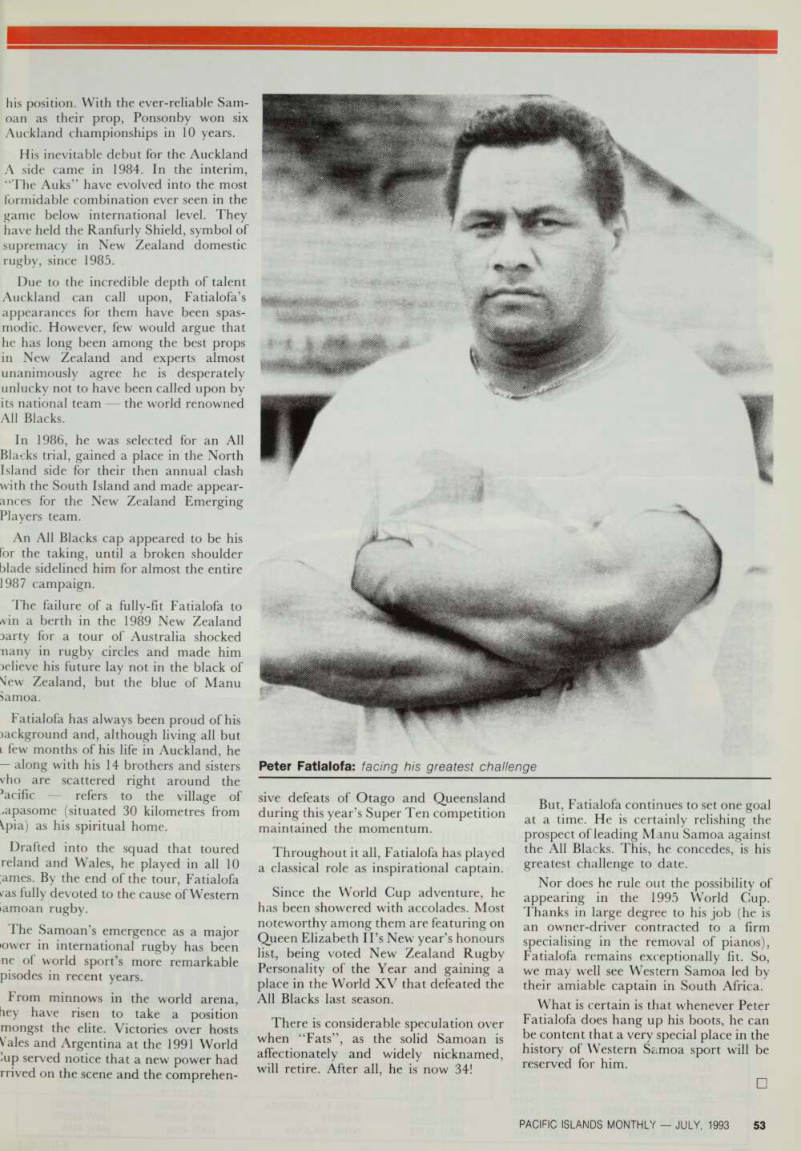
Peter Fatlalofa: facing his greatest challenge