Pacific


Islands
Monthly
July 1993
Police Brutality
Inside
Exclusive PNG’s Prime Minister Paias Wingti explains his govern ment decisions The plight of squatters in New Caledonia Fiji’s television soap opera Has Fiji’s Great Council of Chiefs become its House of Lords?
The far reaching impli cations of the Mabo ruling
merican Samoa US$2.5O; Australia A 53.50: Cook Islands NZ$3; FIJI (Incl VAT) F 51.92; FS Micronesia US$3; Hawaii US$3; Kiribati A 52.50o'^*3l* 31 N .T C H ale » d t, nl c CPf2 h s ° : N ® W Zea ' a " d <lnC ' GST) NZS34S; Nth Marianas *JSS3; Papua New Guinea 1 Pa,au USS3 ’ Marshalls US$3; Solomon Islands As 3; French Polynesia cpf3oo; Tonga P 3; USA US$3; Vanuatu VT22O; Western Samoa T 3.25. ‘Recommended retail price only
Cover illustration by Talat Mehmood
Advertisements & other items, p. 2 (1 item)
Your Island Connections
* m
Cable and Wireless began keep-
ing people in touch around the
world more than a century ago. Today,
while the technology has changed,
the tradition of service to our customers in the
South Pacific is just the same.
We work in partnership with Governments,
dedicated to meeting the need of communities and businesses to stay in touch. From one island to the next or to the other side of the world, the message is the same: Cable and Wireless is
your South Pacific
connection bringing the
islands together.
CABLE & WIRELESS
Asia Pacific Head Office Cable and Wireless pic Cable and Wireless (Pacific) Limited 22nd Floor Office Tower Convention Plaza 1 Harbour Road Hong Kong Tel: (852)848 8620 Facsimile: (852) 868 5195 Fiji In association with the Government of Fiji Fiji International Telecommunications Ltd.
PO Box 59 Mercury House 158 Victoria Parade Suva Fiji Tel: (679) 312933 Solomon Islands In association with the Government of the Solomon Islands Solomon Telekom Company Limited PO Box 148 Honiara Solomon islands Tel: (677) 21576 Tonga Cable and Wireless pic Private Mail Bag 4 General Post Office Nuku Alofa Tonga South Pacific Tel: (676) 23499 Vanuatu In association with the Government of Vanuatu and France Cdbles et Radio Vanuatu International Telecommunications Ltd.
PO. Box 164 Port Vila Vanuatu Tel: (678) 22185
Pacific
Islands
Monthly
Vo I 63 No. 7
The News Magazine
July 1993
From The
Editor’S Desk 4
Letters 5
Headlines 6
Pacific Diary
Law
i/Vhen trust funds go astray 11
Business Bulletin 12
Business
SPARTECA under fire 15 r TIB’s one-stop-shop 17
Dover Story
3 olice on trial 18
Profile
Vingti explains why 22
Solomon Islands
)eliberating on a prime minister 25 : ocus )ecent Housing ffor everyone 27
Felevision
he soap opera continues 35
Opinion
Great council or House of Lords 36
Advertising Feature
Books
Simply frightening stuff 47
French Territories 48
Sports
A special place for ‘Fats’ 52
Yachting
..and a littie help from friends 55
Shipping
Shipping schuldes 57
Columnists
David Barber 9 Alfred Sasako 33 Jemima Garrett 34 Bill McCabe 38
Publisher: Brian O’Flaherty Editor: Mala Jagmohan Senior Writer: Martin Tiffany Correspondents: Christine Hatcher, David North, Ed Rampell, lan Williams, Johnson Honimae, Karen Mangnall, Liz Thompson, Nicholas Rothwell, Pesi Fonua, Wally Hiambohn.
Columnists: David Barber (Wellington), Futa Helu (Tonga, covering the Pacific Islands), Jemima Garrett (Sydney).
Julian Moti (Pacific Law), Alfred Sasako (The Forum).
Advertising Sales: • Regional Sales (South Pacific); Salendra Narayan, Tel (679) 304111, Fx (679) 303809 • Sydney, Canberra: Bob Hill Media Represen tations, Tel (61-2) 4164245, Fx (61-2) 4165064 • Brisbane: Robert Walker, Media House, Tel (61-7) 3710533, Fx (61-7) 371-8904 • Adelaide: Hastwell Williamsons Representations, Tel (61-8) 799522, Fx (61-8) 799735 • Melbourne: Brown Orr Fletcher Burrows (Aust).
Pty. Ltd. Tel (3) 696 5188 Fx (03) 696 5131. • Auckland: McKay International Media Reps Ltd.
Tel (64-9) 4190561, Fx (64-9) 4192243 • Japan: Universal Media Corporation, Tokyo, Tel (3) 6663036, 6663094, Cable: UNIMEDIA Tokyo, Tx 2524665.
Founded 1930 (USPS 952480). A Fiji Times Limited production.
Cover prices are recommended retail only. Regis tered by Australia Post, Publication No. NBP 1210. © Copyright Fiji Times Limited, 177 Victoria Parade, Suva. Fiji. Tel (679) 304111, Fx (679)
303809. Tx Fj2124.
Pacific Islands Monthly is published monthly by The Fiji Times Limited, a division of Nationwide News, 2 Holt Street, Surry Hills. Sydney, NSW 2010.
Send address changes to; • Pacific Islands Monthly, PO Box 1167. Suva, Fiji.
Typeset and printed by The Fiji Times Limited, 177 Victoria Parade, Suva, Fiji.
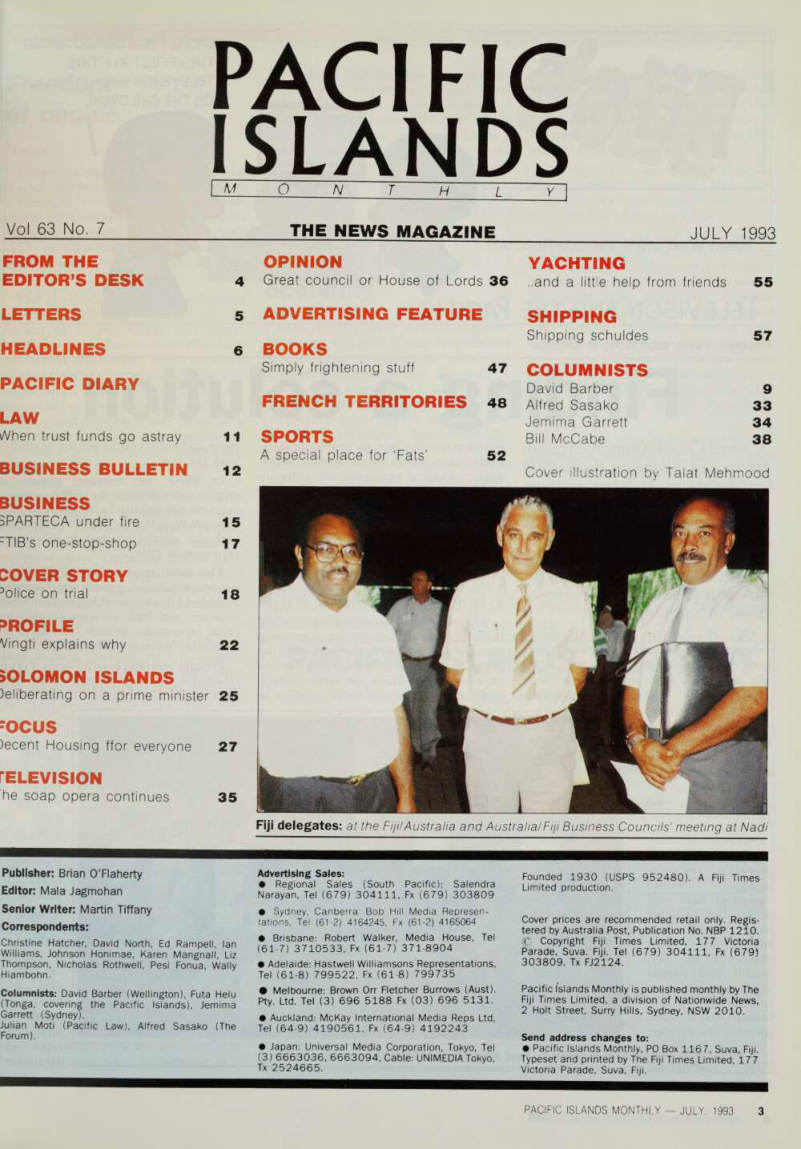
Fiji delegates: at the Fiji/Australia and Australia/Fiji Business Councils' meeting at Nadi
Finding a solution

From The Editor’S Desk
A recent book from Australian
National University, Pacific 2010
Challenging the Future , outlines some grim facts about the where we, as a region, are headed. The outlook is not bright, but at least we are being warned of the pitfalls that lie ahead and can take action now to avoid some of them in the future.
Of major concern to the region is its relatively high rate of population growth. Conservative projections to the year 2010 show, for example, that Papua New Guinea’s population
would be around 5.2 million. On the other hand, it could also be as high as 6.4 million. Other Melanesian countries are no better.
What is distress ing is that with the scarce resources most island countries have and with the trouble they currently face
maintaining basic
standards of, say, health and educa tion, any significant increase in popu lation would only increase the burden A few months ago PIM highlighted problems most
island countries face in providing basic health care. There appear chronic short ages of medical personnel and drugs to combat diseases and infections which could be quite easily avoided. Most countries face shortages of funds to improve medical facilities and buy new equipment.
Imagine the plight of these countries when their populations have increased by up to 40 per cent in less than 20 years.
The same can be said for providing basic education facilities for a growing number of youngsters. In addition, the larger numbers of school leavers have to have jobs to go. There just aren’t enough jobs for school leavers today, leading to
more and more youths getting in trouble with the law.
In PNG, for instance, growth in employment during the 1980 s was 0.5 per cent per annum or about 1000 jobs.
This left 35,000 school leavers every year with no alternative but a subsistence existence or crime.
The social implications of an unhar nessed population growth are worrying and island leaders need to get their heads together and look at ways of assuring rapid economic growth so that the doomsday scenario is avoided.
Perhaps the next South Pacific Forum scheduled for next month could be a starting point for discussions on how to
avert the crisis. All island leaders and other partners in
develop
ment are likely to be there and they could
begin the
process of
looking at
what the
region, as
a whole, can do to deal with what ap pears an almost cer tain pre dicament.
Unemployed In Port Morseby: the situation could worsen
Advertisements & other items, p. 4 (1 item)
Televison and the Pacific
Dear, I'm worried about
THE EFFECT ALL THIS
TELEVISION HAS
ON THE CHILDREN!
* I » Shhh! Wait until the co/merciai!
Televison and the Pacific
Freedom
Leters
Freedom of choice
Madam, I wish to register my objection and that of the New Zealand government to a comment about New Zealand’s Em ployment Contracts Act 1991 which appeared in your magazine in April 1993, in an article on the erosion of media freedom in the Pacific by Futa Helu.
The article stated that “New Zealand in 1991 contributed massively to the erosion of liberal values and media freedom by her Employment Contracts Act which demolished trade unionism and the right of association and collective bargaining”. Any reading of the Act shows this comment is simply wrong. The Employment Contracts Act specifically and clearly provides for freedom of association and collective bargaining.
Employees and employers have the right to choose whether they wish to be represented in negotiations by another person, group or organisation (which may be a union) and which person, group or organisation they wish to represent them. Once the parties have settled their representation, the Act also enables them to negotiate whether they will have collective or individual employ ment contracts.
Trade unionism has not been demol shed in New Zealand. As I have said, :rade unions are eligible along with other ndividuals and groups to act as represen atives for employees in negotiations and n other dealings with employers. A ;urvey conducted on behalf of the New Zealand Department of Labour by the deylen Research Centre and Teesdale Vleuli and Co in 1992 showed 57 percent )f employees involved in negotiations for ollective employment contracts were epresented by unions. Although some mions have lost members as a result of mployees’ ability to choose whether hey join or not, some commentators lave noted that a “new look, albeit mailer, union movement is appearing” is a result of rationalisation, amalga nation and the concentration of mem icrship (Harbridge and Hince, in Em iloyment Contracts: New' Zealand Ex >eriences, edited by Raymond
iarbridge).
In many ways the challenges faced by mions as a result of voluntary member hip have invigorated some unions and heses unions are more competitive as a esult.
Finally, I find the suggestion that the Employment Contracts Act has “con tributed massively to the erosion of liberal values and media freedom” quite ridiculous. Freedom of choice is surely a liberal value by any standards, and the Act has nothing whatever to do with media freedom or control.
Hon Maurice McTigue
Minister of Labour New Zealand
Vanuatu’s
economy
Madam, I have recently gone through the. very interesting ‘Focus on Vanuatu’ in the last issue of your magazine, to which the Statistics Office subscribes. However, I was greatly disappointed when I dis covered that most of the statistical information you report is neither accu rate nor up-to-date. Apparently the journalist did not bother to visit the Statistics Office while in Port Vila. Nor did he/she consult the statistical publi cation we are sending you regularly. You will find below some of the corrections to the mistakes I noticed and some remarks.
On overseas trade you published only the 1991 statistics whereas the 1992 figures have been available since early February 1993. The commentary that Vanuatu’s trade deficit “is not only chronic but widening” and the graph on
page 41 are wrong. Actually, the trade deficit of Vanuatu decreased over the last two years from 9009 million vatu in 1990 (celebrations of the 10th anniversary of independence) to 7181 million in 1991 and to 6593 million in 1992.
On tourism you don’t publish any figures about visitor arrivals. Once again, these statistics were released in February 1993 (42,673 visitors in 1992).
Your writer has said “the tourism sector has been in decline all over the world throughout the present recession, except in Vanuatu”. 1 think the journal ist should have mentioned that the tourist arrivals all over the Pacific region have strongly increased between 1991 and 1992 (by over six per cent according to Tourism Council of the South Pacific
figures). Also, government expenditures
constitute around 25 per cent of the GDP (1990 figures) and not 60 per cent as stated.
I hope my letter will prevent further mistakes in reporting the state of Vanu atu’s economy in your very valuable magazine, and that we will be consulted in future.
Jacob Isaiah,
Acting Principal Statistician, Vanuatu.
Editor’s note: The statistics used in the report were from the Australian National University data base and reports from the World Bank and Asian Development Bank.
Advertisements & other items, p. 5 (1 item)
Pacific Islands Monthly
SUBSCRIPTIONS
American Samoa US$45 Australia A 542.00 Canada US$45 Cook Islands AUSS46 Fiji F 526.40 French Polynesia US$45 Guam US$45 Hawaii US$45 Japan US$45 Kiribati AUSS46 Marshall/Micronesia US$4O Nauru AUSS42 New Caledonia US$32 Payment to Pacific Islands Monthly: New Zealand NZ$55 Niue AUSS46 Norfolk Island AUSS42 Northern Marianas/Palau US$4O Papua New Guinea AUSS4S Solomon Islands AUSS46 Tonga AUSS46 Tuvalu AUSS46 United Kingdom Stg Pound2B US Mainland US$45 Vanuatu AUSS4S Western Samoa WS$6O Elsewhere AUSS63 Subscriptions Dept GPO Box 1167, Suva, Fiji.
Subscriptions rates include the cost of airspeeding to all destinations set out above.
Direct airmail rates on application.
Telephone: 304111 Fax: 303809
dispute
Headlines
Papua New Guinea
Sir Serei dies
A former Papua New Guinea governor-general, Sir Serei Eri, died at his Hohola home in Port Moresby on May 25. Sir Serei began his career as a teacher, then came to be known as one of PNG’s best known writers and also served as a diplomat. He was also a founding member of the People’s Action Party which led to his rise in politics and saw him as the governor-general in 1990. He resigned from the post a year later amid controversy also involving party leader Ted Diro. ***
Legal service
dispute
Government legal services in Papua New Guinea came to a halt as lawyers from the attorney-general’s department continued their indefinite strike which started on June 7 over the alleged illegal appointment of justice secretary, Luke Lucas. State law yers say the appointment of Lucas was illegal in that it went against public service regulations on retirements and age limits. ***
Prisoners
escape
Thirty prisoners and nine remandees escaped from Keravat Jail in Papua New Guinea’s East New Britain province and police and a senior Correctional Service officers have blamed it on negilgence on the art of Correctional Institue Services men who were on duty at the time. Police reports indicate the 39 men escaped one by one beginning on Friday, June 11 through three sets of cut fences, but the CIS men did not know about it until 5.00 pm Monday, June 14. The 30 were serving time for offences including murder, armed robbery, and rape with violence.
The island’s
Pitcairn Islands
The island’s administration
By Mala Jagmohan
The Governor of Pitcairn says Britian would not shrug off its responsibility as colonial ruler because of costs involved in administering the island.
David Moss, who is Britain’s High Commissioner in new Zealand, said Britain made absolutely nothing from Pitcairn but it would never be independent and no other state was interested in taking over its administration.
Pitcairn’s 80 people are the descendants of nine mutineers, six Polynesian men and 12 Polynesian women who landed there in 1790 before burning their ship, Bounty. ***
pledge
Solomon Islands
Political pledge
The 25 newly elected Solomon Islands MPs have given a written pledge of support for a national coalition partnership to form the new government and said they would not be persuaded to leave the grouping. The group, comprising members from six political parties and independents, said it was determined to replace the government of national unity led by Prime Minister Solomon Mamaloni.
Spokesman for the coalition, Dennis Lulei, says they took the stand because of what they believed was a ploy by Mamaloni to entice its members to join him by announcing there would be three new ministerial posts if he formed the government.
Lulei said any increase to the current 15 ministries would require an amendment to the constitution with a two-third support in parliament. ***
‘Erratic’
pay awards
The Central Bank of Solomon Islands has blamed the government’s erratic pay awards as the main cause of its financial problems. Releaseing the bank’s 1992 annual report, Governor of the bank, Tony Hughes, said public servant wage increases of 15 to 64 per cent in January were a great handicap to efforts by the private sector and unions to establish a sound basis for wage adjustments. Hughes said the ability of the commercial sector to pay for work, skills and qualifications and still survive in a competitive world should be a yardstievk for determing both the private and the public sector wages.
Hughes also criticised the Solomon Islands government for its “very generous” tax concessions to foreign investors.
program
Marshall Islands
Starwars program
The United States has announced plans for a major expansion of its anti-missile testing program in the Pacific. The proposed centre of the US army’s Space and Strategic Defence Command is Kwajalein Atoll, which is already a major military base.
The US army says Kwajalein's uninhabited and remote location allows for a full range of tests on inter-continental and sea-launched ballistic missiles. It says anti-missile program aims to produce a shield to ward off nuclear attacks.
If the plan goes ahead, Kwajalein range will become home to nearly 1700 more US scientists and technicians. The base at Kwajalein currently injects more than US$25 million into the Marshall Islands' economy more than a third of the country’s annual budget.
Mystery
drug find
Two young Marshall Islands men have pleaded guilty to charges of using cocaine from a packet washed up on a beach at a remote atoll. Reports say their arrest was the largest development in a puzzling scries of discoveries of plastic wrapped packets of cocaine and heroin on some of Marshall Islands’ remotest atolls. The attorney-general’s office an nounced it would pay up to LSSSOO reward to anyone who
turns in illegal drugs.
French Polynesia
New tax
French Polynesian opposition parties and unions are meeting :o discuss the introduction of income tax. President Gaston Flosse’s government has brought in taxes of up to three per cent )n incomes over SIOOO. The new taxes, which also include taxes )n wine, petrol and unearned income, is expected to earn the government an extra USS3O million.
"ranee has told the territory it will fund a 10-year economic jackage in proportion to how much French Polynesia can put ip itself.
strike
Vanuatu
teachers strike
t three-week strike by teachers in Vanuatu ended on June 15.
Tie Vanuatu Teachers Union called off the strike after caching an agreement with the government on working onditions.
The breakthrough came just hours before the Vanuatu civil ?rvice threatened a national stopwork if the strike was not cttled. Both sides have formalised a deal on the teachers’ claim )r a 25-per-cent pay rise and a housing allowance.
But union leader Obed Masing said questions remained on ow much extra teachers w ould receive. If they were not happy ley would take further action.
Prime Minister Maxime Carlot Korman went on state radio ) appeal to public servants to abandon their plans for a ational strike. Earlier, Vanuatu’s President, Fred Timakata, ad urged Korman’s government to take immediate steps to the teachers strike.
The Vanuatu government had suspended more than 800 rimary school teachers after they went on strike on May 24. he government had rejected the demand for a pay increase, tying it was not budgeted for and not possible under the resent economic situation.
A cabinet statement had said the government would not derate what it termed teachers union’s disturbances in the iucation of the children. It claimed the strike was politically otivated and threatened disciplinary action if the teachers did 3t return to work.
Pioneering
Cook Islands
Pioneering woman
The grave of a New Zealand woman who killed herself 75 years ago after being condemned as “wicked” is to be restored in Rarotonga by a woman who now considers her a good role model. Etti Rout, who went to Europe during WWI, was notorious for handing out condoms to soldiers so they could have safe sex. Shunned by society after the war, she went to the Cook Islands and eventually committed suicide by taking
quinine.
Now New Zealander Jill Caughley has found the grave and wants to tidy it up and restore it. She believes it is a fitting project to honour the 100th anniversary of New Zealand women winning universal franchise.
Cabinet
Fiji
Cabinet reshuffle
Fiji’s Prime Minister, Sitiveni Rabuka, backed off from a much-publicised major Cabinet reshuffle in early June, announcing largely a reshuffling of portfolios only. The only casualties were former Minister for Information, Ilai Kuli, and Energy Minister Mesulame Naravva, who lost their Cabinet posts. Two other junior ministers, Etuate Tavai and Vincent Lobendahn, have also been dropped.
The information portfolio has been combined with labour and industrial relations under former primary' industries minister Koresi Matatolu. Former journalist Josefa Dimuri has been appointed minister of state for information The energy portfolio has been given to Ratu Ovini Bokini who retains his lands ministry as well. External trade has been merged with foreign affairs under deputy prime minister Filipe Bole.
Health minister Leo Smith has been moved to infrastructure and public works and his former position taken over by former minister of state Solomoni Naivalu.
Fijian affairs minister Ratu Timoci Vesikula, attorney general Kelemedi Bulewa, finance minister Paul Manueli, youth minister Ratu Inoke Kubuabola and education minister Taufa Vakatale have retained their portfolios.
The tourism ministry now comes under Harold Powell who retains his former portfolios of Trade and Commerce as well, while Ratu Viliame Dreunamisimisi, who had headed tourism has been given agriculture, fisheries and forests.
Former housing minister Lt Col Jonetani Kaukimoce has been given transport and civil aviation and veteran politician Ratu William Toganivalu was appointed minister in the Prime Minister’s office.
The reshuffle was an anti-climax after weeks of speculation on who would be dropped from the new Cabinet which had promised to be leaner and more efficient.
Advertisements & other items, p. 8 (1 item)
tium.
clanor
High-Tech High-Touch JfW I r f < Q X c
MAH
* Your car’s great, but what about your car audio system? You know what Clarion stands for: Hi-tech. User-friendly. Sound that gives you a blast from the past. Present and fulmH| Whether you want a standard car radio or a multi-component stereo * P^H system, Clarion’s the answer. Why settle for less than the best? ■v- j-| -- as y m. clarion Install a Clarion in your car and break through the sound barrier. CRX227AM/FM RADIO CASSETTE COMBINATION and CDC96OO CD CHANG FOR FURTHER INFORMATION Australia: Clarion Australia Pty. Ltd. Unit 17, 50 Keys Road Moorabbin, Vic 3189 / New Zealand: AWA New Zealand Limited, P.O, box 50-248, Porirua / Fiji Islands; Brijial & Co., Ltd., G.PO. Box 362, Suva / Tahiti: Comimpex S.A., BP 200, Papeete, Tahiti / New Caledonia; Caldis, B.PM 1, Noumea Cedex / Guam; Micropac Audio Inc., PO. Box 3478, Agana, Guam 96910, U.S.A. Tel: 472-8091, Cable Code: HIFI AUDIO AGANA
A world apart
TWO books published recently in New Zealand stunningly contrast life in our part of the world. One depicts the South Pacific as we like to think of it one of the last unspoiled areas on earth, populated by colourful, complex but mainly happy people. The other tells a story most of us would rather not hear - of a deprived and divided race,
increasingly struggling to cling to its
place in the Pacific sun.
Both are eminently readable and are worth considering together for the total picture they provide of life in the region.
One reminds us of what we have and why we should take pains to preserve it.
The other warns of what can happen to a proud people if they don’t strive to retain their heritage in the face of so called progress and don’t learn to adapt to the changing world.
Passages Journeys in Polynesia by
Auckland writer Graeme Lay is a delightful account of his travels throughout the region. It is undemanding and does not pretend to be either a guide book or a warts-and-all critique of what he calls “indisputably one of the most beautiful regions on earth” and “its melange of peoples”.
Maori The Crisis and the Challenge, by Alan Duff, is, on the other hand, very demanding and has already increased the author’s reputation acquired on the strength of his two previous books, both fictitious accounts of Maori life in Aotearoa as one of this country’s most controversial writers.
While Lay exudes charm and tolerance, Duff eschews both.
Lay can smile at the antics of even the grossiest palagi and papa’a visitors he comes across in his leisurely peregrinations.
Duff, who is a very angry man, can only rail at the state of what he describes as “the woe-begotten Maori nation”.
For Lay there is laughter, hospitality and an endless string of kindnesses he encounters on his travels through Tonga, Niue, the Cook Islands, Samoa, the Society Islands and the Tuamotus.
He paints a delicate, water-colour, picture of a region and its peoples winning the struggle to retain their identities, culture and vivacity in a rapidly changing world that is threatening to swamp a leisured lifestyle; a world of technological advances that is impatient to drag every society up (or down) to its level; a world that decrees undeveloped is synonymous with unhappy; where “progress” is deemed an essential ingredient of human life.
Lay reminds us that it is possible to feel “undeniably benevolent and reposeful” after attending a Sunday morning church service in the village of Avatele, Niue, where “people shuffle and scratch... a dog strolls in the pastor’s door and up the aisle without admonishment”.
He takes a party of 35 students from Auckland Girls’
Grammar School to the Cook Islands, where many of them find their roots. One 15-year-old finds two brothers she had not seen since she was tiny. A Samoan teenager, who confessed she never had any feeling for her Polynesian culture, finds the trip an “experience and an awakening”.
After visiting Aitutaki, a 17-year-old wrote, “There was pain
and sorrow on the last day, nobody wanted to leave, we were all so close to the island...”
Lay sees his own teenage sons, creatures of a modern society’s TV and video age, discover the delights of plunging into cool water down the sliding rocks near Apia as Samoans have done for about 3000 years.
For Duff, who is half Maori, there are no winners among his people.
He sees little laughter or kindness but plenty of racism, sexism and what he calls “the curse of welfarism” which he warns amounts to government “funding the ultimate destruction of a so
ciety”.
His is a book of rage and it has
predictably produced rage among
Maori leaders, who he singles out
for special attack as a cause of the problems of Maori, who he says bluntly are “losers”.
He dubs his elders “mediocrities... dogmatic... completely unread and therefore uninformed...smug...self-satisfied and more and more nowadays in a paid position”. He advocates little less than a revolution. “We desperately need positive, strong, educated, worldly, articulate leaders who’ll tell the present lose regime where to get off. We need leadership that tells Maoridom how to start becoming winners, instead of a thousand ‘reasons’ and excuses for why so many of us are losers.”
Duffs theme is that Maori must stop blaming the pakeha for all their ills and start improving themselves. He berates Maori for lacking the pakeha work ethic, for drinking and smoking too much, for refusing to budget and look after their health. He criticises parents for not making their children read books and do their homework, pointing out that they have the same opportunities as pakeha to become educated.
Maori, he says bluntly, prefers to whinge about pakeha injustices which he acknowledges rather than move to put its own house in order. He rejects criticism that he is “a brown-skinned pakeha and says, “They don’t want to hear what I’m saying.”
It is a book, one Maori critic wrote, that is “a loathsome tale of excruciating cruel insults and the defiling of Maori people in a way that no Maori media basher can ever possibly match”.
That sets the tone for a debate that, like it or not, Maoridom is going to have if it is to improve its lot.
It’s much more comfortable for us all to read Lay’s depiction of life in the South Pacific, but there are some realities we cannot ignore. Even if Duff s version is harsh and lacking in scholarship, it would be wrong to sweep the issues he raises under the carpet and pretend that all is sweetness and light in this part of the world. □ Passages Journeys in Polynesia by Graeme Lay.
Tandem Press. $NZ24.95.
Maori The Crisis and the Challenge by Alan Duff.
Harper Collins. SNZ 19.95.
Wellington
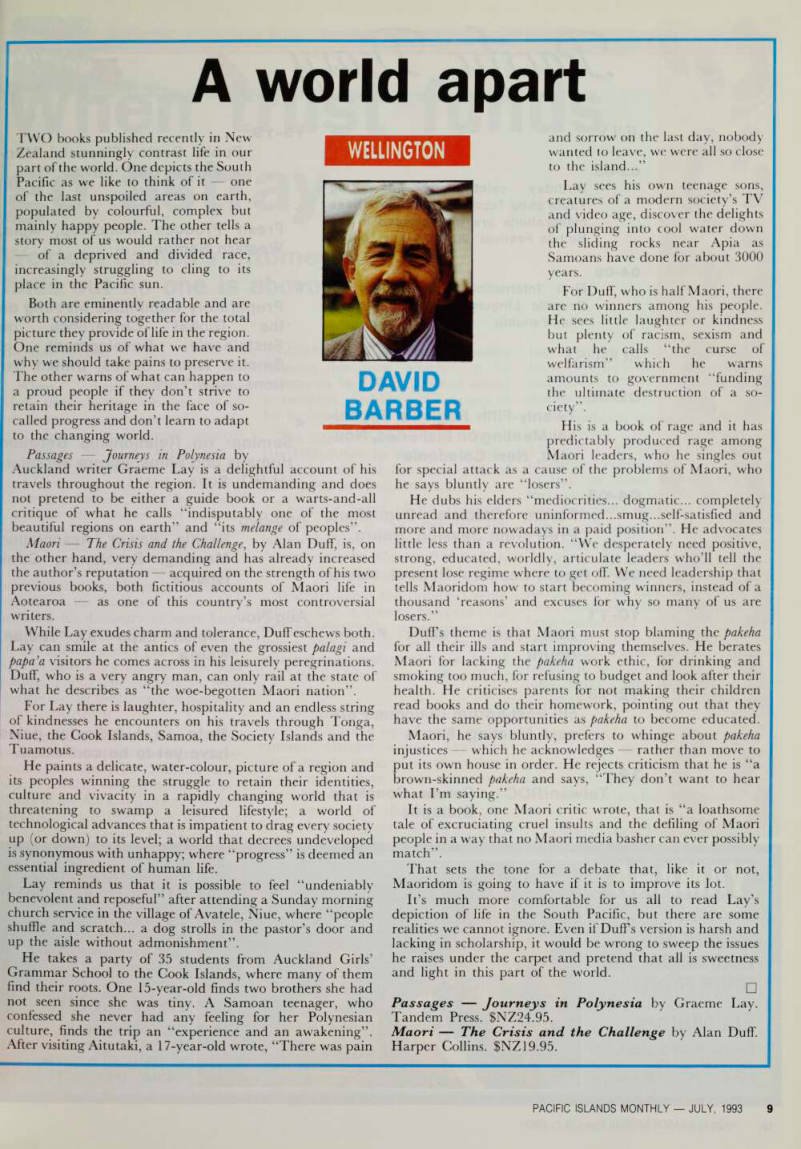
David
Barber
Advertisements & other items, p. 10 (1 item)
r Dwrij
c I
1 n t tf* y
JULY
03-08 04-09 Birthday celebrations for King Taufa’ahau Tupou IV of Tonga. These celebrations are incorporated in the Heilala Festival (June 26-July 10) First International Conference on Oceanic Linguistics, USP Complex, Vila, Vanuatu
AUGUST
02-06 04-05 ••• Twenty-Fifth Regional Technical Meeting on Fisheries, Noumea, New Caledonia Forum Officials Committee Pre-Forum Session, Nauru I U* Si 09 Forum Leaders’ Retreat, Nauru 10-11 24th South Pacific Forum, Nauru 12-13 sth Post-Forum Dialogue Partners Me eting, Nauru 14 Taiwan/ROC Forum Countries Dialogue 15-19 Public Sector Financial Man agement, USP, Suva Fresh Produce Workshop, Apia Western Samoa
Preparatory Committee Meeting on
the Global Conference on Sustainable Development of Smaller Island States, United Nations, New York Seminar on Relationship Between Humans and Ships, Forum Secretariat HQ, Suva
Aug-Sep
Aug-Nov
Pacific Power Association Meeting, Rarotonga, Cook Islands Taejon Expo ’93, Taejon, Korea Note - a ★ indicates dates have yet to be confirmed.
MHI
Outboards
NUMBER ONE
THROUGHOUT THE
SOUTH PACIFIC
Ela Motors
PAPUA NEW GUINEA
PH (675) 229400 PO Box 74 Port Moresby 3?
Yamaha Outboard Motors are available in a wide range of models from 2hp up to 200 hp with comprehensive Genuine Parts and Service support Pacific wide.
Asco Motors
FIJI Ph 312666
AM.SAMOA Ph 633-4281
W. SAMOA Ph 23664
VANUATU Ph 22341 I
go astray
Law
When trust funds go astray
Western Samoa’s attorney-general finds out no one is above the law
By Alan Ah Mu
When Leaupepe Sanerivi Muliaumasealii was appointed West ern Samoa’s attorney-general in early 1991, his academic record inspired confidence. An LLB (Hons) and a Masters of Jurisprudence from Auck land University, an LIM from McGill University, Canada, and a Bachelor of Civil Law from Oxford were impress ive achievements, especially as no Samoan holds the latter degree.
In a low key manner, Leaupepe
bolstered that confidence by building a
reputation for hard work shown, for nstance, his discovery of some long standing legal anomalies, the passing of in amendment giving prosecutors the 'ight of appeal for the first time and guiding Polynesian Airlines in legal natters during the transfer of manage nent from Ansett.
During that time, few in Samoa were
iware that Leaupepe was being inves
igated by the New Zealand Law society’s disciplinary tribunal for ac ivities in the Auckland practice he ran fom 1982 to late 1990. Thus, when the >3-year-old was found guilty on four Targes of professional misconduct and vas struck off the NZ law register in
■arly May, there was wide-felt surprise.
“It came as a shock,” said a former
Auckland employee of Leaupepe’s.
He always emphasised ethics.”
“Oh, I was surprised,” said one awyer. “He’s a quiet, hardworking ;uy” who was “well respected in NZ”.
In a letter faxed to the tribunal, the ttorney-general admitted making un uthorised payments of SNZ 113,630 r om 13 clients’ money, failing to ccount for the withdrawal of
SNZ23OO from a client’s account, allowing his trust account to be overdrawn by 5NZ25,000 and failing to complete monthly audit returns of his business.
The offences occured from 1988 to late 1990, when he ceased to practise in Auckland, and left a shortfall of 5NZ91,302 in clients’ money.
Leaupepe heard of the tribunal’s decision from a NZ reporter and informed Prime Minister Tofilau Eti Alesana and the Western Samoa Law
Society the next morning.
Worried about the country’s repu tation, the Cabinet accepted the Attorney-General’s resignation, the Prime Minister told reporters, and within days, a replacement was found in Tupai Se Apa, then president of the
law society.
The matter however, doesn’t end there. NZ’s fraud squad may yet lay
criminal charges against Leaupepe
who might be required to answer them in NZ since there is an extradition treaty between that country and West ern Samoa. (He didn’t attend the tribunal hearing, saying his medical condition after a heart attack in 1991
prevented it).
And there is a real possibility the Western Samoa Law Society will strike him off it’s law register also. The society is awaiting official copies of the charges and decision from the NZ Law Society before considering such an action, but there is a school of thought that not striking off Leaupepe will set a dangerous precedent for others disbarred elsewhere turning up to practise in Samoa.
In an interview with the Samoa Observer newspaper, Leaupepe blamed
himself for his demise and said he had been too busy with other matters and had failed to “tidy everything up” in Auckland before leaving.
Sympathisers say office and money management was not one of Leaupepe’s strengths; that he had probably carelessly used clients’ money to pay for other clients’ fees and through bad management, failed to complete audit returns.
But even then, the episode raises questions about the protection of clients. A total of 5NZ65,111 in claims by Leaupepe’s former clients have been met by the NZ Law Society’s fidelity fund, set up for those whose funds had been mishandled by lawyers. (In this case some clients did not apply for compensation from the fund). Samoan lawyers in Samoa do not have a fidelity fund. Several said this was an indi cation of the level of honesty amongst them.
Trust funds hold clients’ money handed over for such purposes as
deposits in land purchases or paying
for lawyers’ initial court appearances and the interviewing of witnesses in a case.
Lawyers may only withdraw money from trust accounts after a client has agreed to the fees listed in the bill of costs. Thus the “trust account can never be overdrawn by even one sene because it’s not your money,” one
lawyer explained.
“And you can’t use the trust account to pay for another client’s fee.”
“It’s a plus for us that to date no client has accused a lawyer of misuse of trust funds.”
The hope is that one well-qualified
lawyer’s lapses will help ensure that
this continues.
joint venture
Business Bulletin
Talair
grounded
PAPUA New Guinea’s biggest domestic airline, Talair, ceased operations at the end of May as a result of heavy losses incurred since December last year, re sulting in its fleet of 23 planes being grounded and 400 employees being laid off.
And PNG Prime Minister Paias Wingti has given an undertaking his government would consider buying out the airline. Following a meeting with three Eastern Highland leaders in late May Wingti undertook to speak to Transport Minister Roy Yaki on the buying out of Talair. And member of parliament for Garoka, Mathias Ijape, has said people in the Eatsern Highlands want the rural services to continue.
In announcing Talair’s closure, owner and managing director Sir Dennis Buchanan said the airline had been making losses of a million US dollars and could not afford to continue. Sir Dennis said the airline’s US$2 million in reserve would be used to immediately pay off all the staff. The airline would negotiate with creditors to wait for the sale of assets to before being paid off. Sir Dennis puts the value of Talair’s assets at S2O million.
Air Pac forecasts
increase in revenue
Fiji’s national airline, Air Pacific, has forecast it will be able to generate revenues of US$7OO million in the next four years. The airline’s finance director, Narendra Kumar, said the last time the revenues exceeded $7OO million was over an eight-year period. Air Pacific recently completed its most ambitious building project a US$l4 million hangar facility at Nadi International Airport.
NZ Telecom
profits fall
TELECOM New Zealand has reported a sharp drop in profit down to USSSB.S million for the year ended March 31. The drop was attributed to a major restructuring of the company. The profit fall down from U 55218.5 million in 1991-’92 was expected since Telecom announced plans to cut its staffing by 5000 and to streamline its organisation. Chairman Peter Chirtcliffe says the result is satisfactory in the context of a major restructuring.
PNG Agriculture
bank restructures
THE Agriculture Bank of Papua New Guinea is selling off its business subsidiaries to local interests. The bank's managing director, Shem Pake, says this is in line with the bank’s move to shift back to its core lending function. Pake said the bank had begun the long term process off selling off unsuccessful subsidi ary companies a move he believes is in the best interest of the bank.
Pake said because the bank was not an investment company, it could not suc cessfully run businesses.
Air New Zealand
wins award
AIR NEW ZEALAND has won a prestigious award for its Oceans Cam paign program featured on the airline’s international inflight entertaining pro gram Blue Pacific. The Oceans Campaign features received the Grand Environ ment Award at the 42nd Annual Pacific Asia Travel Association (PATA) confer ence in Hawaii.
An Air New Zealand statement said PATA and its member associations aim to promote tourism professionalism in the
Pacific-Asia region. Air New Zealand approached a California-based environ mental group, American Oceans Cam paign (AOC), with the idea of making feature films covering environmental and conservational issues to be screened on BLue Pacific.
A partnership, involving Air New Zealand, AOC and Television New Zealand, was formed to raise awareness of the South Pacific in terms of its appeal as both a travel destination and the environmental issues of concern.
The Oceans Campaign highlights issues such as coastal pollution and the exploitation of marine resources and the protection of the fragile natural re sources.
The Oceans Campaign has been featured on all Air New Zealand’s international flights since October 1992.
Aust dollar
at all-time low
THE Australian dollar dropped to an all-time low on the Reserve Bank’s trade weighted index, which measures the average value of the Australian dollar against the currencies of its major trading partners.
The Central Bank’s trade weighted index is currently measuring the dollar at a record low of 49.2 per cent. Currency dealers say investors are trying to sell of the dollar, prompting the Australian Reserve Bank to intervene.
The dollar sharply decreased in value against most major currencies since May 31 when Australia’s balance of payment figures were released. It was announced the country had a current account deficit of 51.7 billion.
On June 1 the Australian dollar was valued at US 67.6 cents, 72.4 Japanese Yen and NZSI.24. Twelve months ago it was valued at US 75.7 cents, 96.09 Yen and NZSE4I.
TAB in Fiji
joint venture
The people of Fiji’s Tailveu province have entered a joint venture with the New South Wales government to intro duce Totaliser Agency Board (TAB) betting outlets in Fiji this year. This follows cabinet approval of the setting up of a computerised betting system after considering a detailed plan developed by the NSW TAB.
NSW’s Minister of Sports, Recreation and Racing, Chris Downy, said the outlets hoped to get significant returns from the multi-million dollar markets of the Pacific region. The Fiji outlets would be connected to the NSW TAB head office in Sydney via satellite. □
Advertisements & other items, p. 12 (1 item)
Blairs
REPLACEMENT ENGINES
Largest Range in the South Pacific
Over 800 engines available: Diesel-Gasoline lOhp to 400 hp Transmission to match if required Japanese English European Models Engine Overhaul Kits for most models Huge Range of Parts on hand GOOD supply of Bedford Detroit Gardner Leylands Mercedes Perkins Scania engines
BLAIRS
New Zealand Established 1956 P.O. Box 14 Geraldine, New Zealand Telephone (643) 693-8122 Fax (643) 693-8120 We ship anywhere In the Pacific
Communist
turmoil affects business
By David North
FHE collapse of Communism continues :o cause tidal waves and ripples in South Pacific business circles, most recently hose in New Caledonia and Tonga. In Caledonia, Russia’s desperate need or hard currency has meant it is lumping its exports on world markets to aise needed cash and credits. While lussian exports of vodka, diamonds, and obalt have little impact on the islands, ts export of newly produced (and jrobably stockpiled) nickel has done errible things to New Caledonia’s nickel ndustry. fhe average price for a pound of nickel vas U 556.25 in 1988, when sold for cash >n the London Metal Exchange (LME).
Yhile the nickel price is volatile, the innual average LME price has been Iropping steadily in recent years, falling o 56.05 in 1989, and then in succeeding ears to 54.02, 53.70, 53.18 and to 52.51 n mid May of this year. This is a lecrease of close to 60 per cent, fhe sharpest drop came after the ttempted coup by Mikhail Gorbachev’s opponents in Moscow; once that failed, 11 restraint on the part of Russian •olicymakers vanished, and they flooded he world markets with nickel. The
;eneral world depression did not help
ommodity prices either.
Caledonia’s nickel producers, who hip various types of ore and concentrates o customers in Japan, Australia and the JS, sought to recover by producing more lickel. The annual production in the quivalent of pure nickel moved up from 0,527 metric tons in 1988 to 98,247 tons a 1990; it drifted down to 92,127 tons ast year. But an increase of production f3O per cent (between 1988 and 1992) annot compensate for a price drop of learly 60 per cent.
Vhile the distant Russian problems have •rought gloom to New Caledonia, the qually distant bloodshed in the former Jugoslavia’s Bosnia has been mildly iclpful to Tonga. As a result of sanctions n Serbia, Serbian businessmen and •oliticians find it easier to do deals on •assports of countries other than Yugo lavia and Serbia. America’s National ’ublic Radio has reported that there is booming market in Belgrade for other iations’ passports, with Tonga getting ome of the action. □
Development index
Fiji’s standing on the United Nation’s Human Development Index has moved up 10 notches in the last two years. In the same period Papua New Guinea has remained about stationary, while Vanuatu has advanced and Western Samoa and the Solomon Islands have retreated. These are the only island nations covered by the index which is published every two years.
The United Nations Development Program (UNPD) initiated the index a few years ago to supplement the more traditional economic indices, which show gross national product, the balance of trade, and the rise (and sometimes) the fall of debts.
The Human Development Index, instead, covers such variables as the average length of life, access to health care, level of literacy, and the treatment of women.
Simply reading the numbers released by UNPD this year gives a misleading view of the status of the Pacific islands; this is the case because the 1991 index covered 160 nations, and the 1993 index covers 173 countries. The additional nations, all coming from within what used to be the Soviet Union, rank in 1993 between 29th (Estonia, on the Baltic Sea) and 88th (Tajikistan in Central Asia.) The arrival of the new nations, most of which outranked Fiji in 1993, and all of which outranked the rest of the Pacific island states, have artificially depressed the island ratings as a result.
For example, Western Samoa was 81 in 1991 and seems to have fallen to 98 on the 1993 listing. If the 13 additional ex-Communist countries are removed from the equation, Western Samoa moved down from 81 to 85 on the corrected list.
While Fiji appears to have stayed at number 71 on the two lists, it in fact moved up to 61, when the new nations are eliminated. In other words, compared to the nations that were on both the 1991 and 1993 lists, Fiji moved up 10 full places.
In general terms, the Pacific island nations are in the middle of the spectrum on the Human Development Index. They are well below the industrial nations Japan leads the list every year), but all are above the poverty-stricken nations of Africa.
In addition to health data the new UNDP report also had some interesting things to say about the distribution of modern communications equipment in the households of the five Pacific island nations. One ol the most drastic variables shown in the report is the percentage of nations’ Gross National Products (GNP) accounted for by official development assistance. Here Western Samoa was not only the highest for the region, but third highest in the world with fully 52.0 per cent of its GNP, in 1991, coming from assistance from other nations and from international bodies. The others in the Pacific were Vanuatu with 24 per cent, the Solomons 20 per cent, PNG 11.2 per cent, and Fiji with the least, 3.5 per cent.
Advertisements & other items, pp. 13-14 (2 items)
Business
Study In Singapore
BE A GRADUATE BY OBTAINING
A PROFESSIONAL DIPLOMA/HIGHER DIPLOMA
IN COMPUTER STUDIES
FOR MORE INFORMATION PLEASE WRITE TO:
ADMISSION OFFICE
GENETIC COMPUTER SCHOOL
#O3-04, PARADIZ CENTRE
1 SELEGIE ROAD
SINGAPORE 0718
TEL: 65-3397588, FAX: 65-3381442
nil YOUR IDEAL
BUSINESS gj*
LOCATION
IN THE PACinC
INVESTMENT OPPORTUNITIES AVAILABLE:-
For further information contact:-
THE DIRECTOR
FIJI TRADE & INVESTMENT BOARD
3RD FLOOR CIVIC HOUSE TOWNHALL ROAD. PO BOX 2303 GOVT. BLDG. SUVA.
TELEPHONE: (679) 315988. TELEX: 2355 FTIB FJ. FAX: (679) 301783
COMMUNICATIONS 0110
SPARTECA under
fire
By Sudesh Kissun
AUSTRALIA and Fiji businessmen want the margin of preferential access allowed under South Pacific Regional Trade and Economic Co-operation Agreement (SPARTECA) to be pre served. They also want the operation of SPARTECA rules of origin to be re viewed and substantial changes made to criteria for eligibility. This was the message from the joint Fiji/Australia, Australia/Fiji Business Councils’ meeting that ended at the Regent of Fiji on June 12.
In a communique the councils noted the concerns with the operation of SPARTECA and urged all parties to work towards preserving the margin of preferential access as a matter of ur gency. “Such a change would have little impact on Australia and yet be a major boost to the Fijian manufacturing sec tor,” the communique read. Under SPARETCA’s rules of origin all exports should have 50 per cent local content to qualify.
Opening the meeting, Fiji’s Minister of Finance and Economic Planning, Paul Manueli, said Fiji’s exports had difficulty in qualifying under the local-content criteria of the rules of origin of
Sparteca.
“This is especially true for those exporters who have reduced their local
costs through efficiency, improvements
or for those aiming for the higher quality end of the market.” Manueli acknowl edged the Australian government’s re cent commitment to amend SPARTECA rules of origin to bring them in line with the revised Closer Economic Relations rules. These amendments will mean a number of additional costs will now be included as “local content”.
Manueli said the Fiji government felt that in order for SPARTECA to con tinue to assist Fiji’s exporters in making
the efficiency and quality improvements
necessary to be competitive on the world market, substantial transformations should be introduced as a test for access under SPARTECA.
“The introduction of substantial trans formation rules would allow labour productivity improvements in Fiji, with out jeopardising preferential access, en-
able manufacturers to move to the higher price range of the market; and encourage a wider range of exports from Fiji,” he said.
Visiting Australian Minister for Devel opment Co-operation and Pacific Island Affairs, Gordon Bilney, said his govern ment had recently “cleaned up” the definition of the rules of origin. Although the Australian government has not altered the basic criteria for determining rules of origin, Bilney thinks things should now be easier for Fiji exporters.
“We have clarified the detail and opened up the opportunities for honest businessmen while making it difficult for those who aren’t,”
For instance, factory and work costs will now include overheads in determin ing local content.
He urged Fiji businessmen to take advantage of the current concessions offered by SPARTECA for Fiji’s indus tries to become globally competitive.
Bilney also announced that his govern ment had recently adjusted its system of tariff preferences. Developing country preferences for textiles, clothing and footwear industries, chemicals, sugar, canned food, fruit juices and dried fruit will be phased out for all but the least developed countries and the South Pacific.
This means Fiji exporters will soon gain an extra five per cent point margin of preference into the Australian market over its competitors for these products.
The joint meeting also welcomed Fiji
government’s decision to transform Fiji
Trade and Investment Board into a one stop-shop and the proposed introduction of a single investment legislation to facilitate processing of investment ap
provals.
The meeting endorsed the need for an appraisal of the world of competitiveness of Fiji’s tourism industry to maintain and increase its market share in Australia.
It endorsed the industry proposal to boost spending in Australia commensur ate with the competitor’s promotional campaign and endorsed the concept that the government should contribute sub stantially to the campaign.
On Fijian participation in commerce, it was suggested that taxation benefits like Tax Free Factories and Tax Free Zones be extended to joint ventures with majority ethnic Fijian shareholders.
The meeting urged potential investors to seriously consider the benefits of meaningful and participative joint ven tures with indigenous Fijians.
As a practical demonstration of the council’s commitment to bringing ethnic Fijians into mainstream management, an annual scholarship program was also announced at the meeting. The first recipient is Fiji Development Bank’s Isoa Kaloumaira.
The meeting also urged government to facilitate the development of Namosi Copper Mine Project and expand the program at Emperor Gold Mining Com pany in Vatukoula. Delegates acknowl edged that the proposed expansion by Emperor and the Placer Namosi Project evaluation were significant indicators of the security Fiji offered investors. □
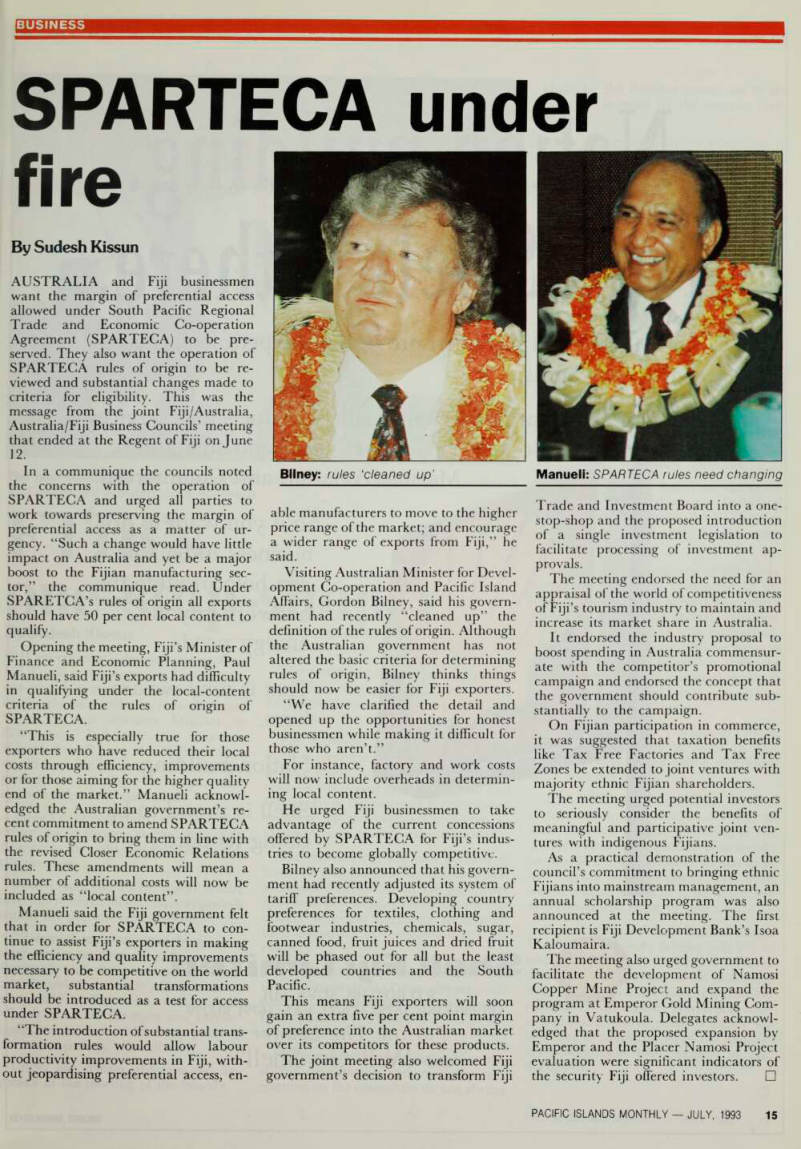
Bilney: rules ‘cleaned up'
Manueli: SPARTECA rules need changing
Advertisements & other items, p. 16 (1 item)
Nation building.
And Shell is there.
Since 1928, Shell has been providing the petroleum needs of the Fiji Islands.
Offering a full range of Shell quality products and services to your businesses, large and small. In Marine, Aviation and Commercial.
So if you want to do business in Fiji, we can help provide the answers to your energy needs.
That is why we are here.
Nation building.
Shell is proud to be doing its part.
Shell Fiji Limited
P O BOX 168, SUVA, FIJI,
TELEPHONE: (679) 313933, FAX: (679) 302279
Folloiv The Leader "Go Well Go Shell”
GEORGE RUBINE 02*32
one-stop-shop

Ftib’S
By Sudesh Kissun
FIJI government’s decision to transform Fiji Trade and Investment Board into a one-stop-shop means investors will now receive the final authority from the board to set up their ventures. Minister for Commerce, Industry and Tourism, Harold Powell said the FTIB reform would expedite the present practice and procedures relating to employment opportunities and investment.
Powell’s presentation was well re ceived by delegates at the joint Fiji/
Australia, Australia/Fiji Business Coun
cils meeting.
Powell said the FTIB would ensure investors received all necessary approvals within the shortest time possible.
Potential investors must be given a dear understanding of the necessary ipprovals and the terms of those ap provals and the relevant offices must be idequately staffed with well trained jfficials to create the right and encour impressions at the entry point of he one-stop-shop,” Powell said.
Under the reform program the fre [uency of the meeting of the board’s
project commPtee has been increased from every three weeks to two.
The committee is made up of represen tatives from ministries with responsibility for different issues arising from a project proposal.
For example, the Customs Depart ment is represented to offer advice on a project where a request for duty con cessions forms part of the proposal and
Immigration Department is represented
to advise on any proposal involving an
application to employ expatriate staff.
The government has also decided to have all government departments and ministries represented on the committee to include heads of departments or senior officers with the authority to commit their ministries to the committee’s de cision.
Powell said the present problem was that representatives of these departments were not always in positions to give the final approval to a decision made by the committee.
“This means that it is not uncommon to find departments and ministries rep resented on the committee do not always
abide by the decision passed on to the potential investor by the projects com mittee.”
All project applications submitted to FTIB will be accompanied by relevant application forms for work permits, exchange control approvals, duty con cessions requests, tax concession requests and registration forms. The FTIB will now obtain all approvals on behalf of the investor.
Approval by the immigration rep resentative in the project committee will be final, waiving the existing require ments for the immigration work permit committee to review such applications.
Powell said the prospective investor would receive a complete package from FTIB allowing him to operate his venture the next day after receiving approval. The targeted time frame for final and complete package of approvals to be passed to the investor is three weeks after project committee approval.
The reforms are based on the oper ations of the Malayasian Industrial Development Authority. An FTIB team visited Malaysia to study MI DA oper ations there.
Powell said Fiji was one of the many developing countries competing to at tract investment and needed more effec tive investment promotional activities.
“We have to be ready with suggestions, all the necessary details and we have to undertake rigorous follow up action to ensure we do not lose potential investors because after making initial contact, we failed to keep their interest.”
The minister said FTIB should keep in touch with investors to assist in any problems they faced while operating their ventures in Fiji.
The FTIB has established an im plementations and services division to assist investors already operating in the country. Powell said good sendees should be provided to the investors so that their investments were successful and word would spread that Fiji is an attractive and convenient place to invest in.
A team from the World Bank's Foreign Investment Advisory Service is in Fiji to assist FTIB implement the new reforms.
The team will also look at the possibility of establishing a single piece of legislation relating to investment. Powell said such a legislation would make it easier for investors to assimilate all of the regulat ory information they require in one document.
The men behind the idea: Minister Powell flanked by FTIB director Ratu Isoa Gavidi and permanent secretary Luke Rokovada
Police On Trial



Cover Story
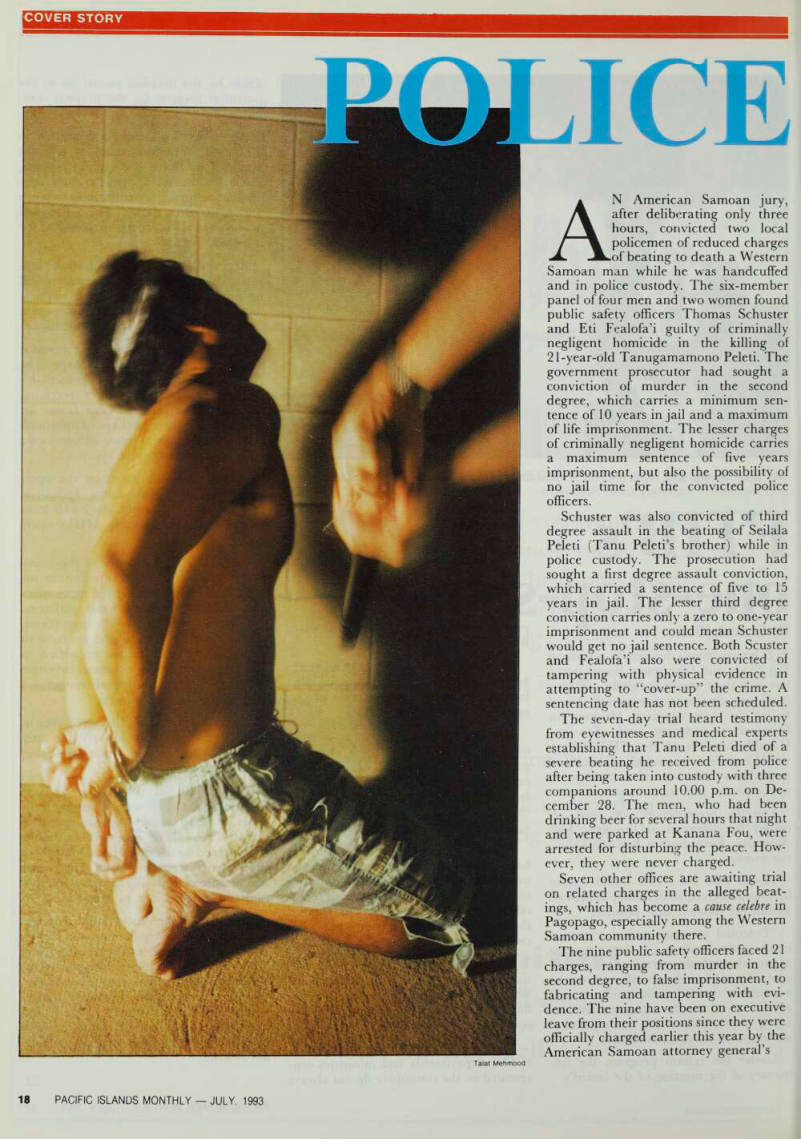
AN American Samoan jury, after deliberating only three hours, convicted two local policemen of reduced charges of beating to death a Western Samoan man while he was handcuffed and in police custody. The six-member panel of four men and two women found public safety officers Thomas Schuster and Eti Fealofa’i guilty of criminally negligent homicide in the killing of 21-year-old Tanugamamono Peleti. The government prosecutor had sought a conviction of murder in the second degree, which carries a minimum sen tence of 10 years in jail and a maximum of life imprisonment. The lesser charges of criminally negligent homicide carries a maximum sentence of five years imprisonment, but also the possibility of no jail time for the convicted police officers.
Schuster was also convicted of third degree assault in the beating of Seilala Peleti (Tanu Peleti’s brother) while in police custody. The prosecution had sought a first degree assault conviction, which carried a sentence of five to 15 years in jail. The lesser third degree conviction carries only a zero to one-year imprisonment and could mean Schuster would get no jail sentence. Both Scuster and Fealofa’i also were convicted of tampering with physical evidence in attempting to “cover-up” the crime. A sentencing date has not been scheduled.
The seven-day trial heard testimony from eyewitnesses and medical experts establishing that Tanu Peleti died of a severe beating he received from police after being taken into custody with three companions around 10.00 p.m. on De cember 28. The men, who had been drinking beer for several hours that night and were parked at Kanana Fou, were arrested for disturbing the peace. How ever, they were never charged.
Seven other offices are awaiting trial on related charges in the alleged beat ings, which has become a cause celebre in Pagopago, especially among the Western Samoan community there.
The nine public safety officers faced 21 charges, ranging from murder in the second degree, to false imprisonment, to fabricating and tampering with evi dence. The nine have been on executive leave from their positions since they were officially charged earlier this year by the American Samoan attorney general’s
Talat Mehmood
office. They have remained free after posting bail, which for those facing the most serious charges amounted to as much as SIOO,OOO.
The remaining seven officers will be prosecuted in two trials. The first trial of three of the seven is scheduled to begin in early July. The charges will be criminally negligent homicide, assault and fabricating evidence. The seven other police officers under indictment are Ronald Tui, Tamasamoa Taua’i and Fuatua Maiava, who will be tried in July, and Swain Meleisea, Tupulua Tagalao, Mascfua Suiaunoa, Peniamina Wilson, who will be tried last.
Key testimony in the Schuster- Fealoa'i trial included the testimony of Dr Mary Flynn, a licensed forensic pathologist and former Hawaii state medical examiner. Flynn, who per formed the autopsy on Tanu Peleti, testified his death was caused by a combination of blunt trauma injuries, positional restraint and asphyxia. The bruises, contusions and lacerations to his head, chest, sides, back, stomach, arms and legs were consistent with his having been kicked and choked while in a handcuffed and restrained position in police custody, Flynn testified on May 28. He had a fractured sternum, two broken ribs on his left side, several internal injuries and his lungs were full of blood, Flynn said. Police spokesmen had said Tanu Peleti received his head injuries when he fell during an escape attempt at Kanana Fou. Tanu Peleti was six foot two inches in height and weighed about 180 pounds.
The position restraint handcuffed and lying face down made it difficult for Tanu Peleti to breathe because his chest could not expand, Flynn said.
Later, when the victim was turned on his back and left in a slouched position, his neck was so bent that oxygen could not 50 to the rest of his body, Flynn testified.
The first three days of the trial heard ?ye-witness testimony from the three )ther men who were allegedly beaten
Uiga Uiga, Fa’alaga Milo, and Seilala
Peleti. Government prosecutor, assistant attorney-general Donald Sheehan, led he three in recounting their recollections afwhat happened the night of December 28 last year when they got together around 8.00 or 9.00 pm when they got ogether for some beer drinking. Later
they went out for a ride to Tafuna and continued drinking after they parked the car in an area known as Kanana Fou, not far from Petesa, where they lived. Late that night several police cars arrived at the scene, flashed lights into the men’s car, and ordered them out of the vehicle.
The men were immediately handcuffed and taken away in police vehicles. Tanu Peleti was taken in one vehicle while the three other men were taken in two other
police cars.
Uiga and Milo said they were not informed of why they were arrested, nor were they read their Miranda Rights. In US jurisdictions, police are required, under the Miranda Law, to advise those they arrest that they have a right to remain silent as well as a right to an attorney. Milo, Uiga and Seilala Peleti, still handcuffed, arrived at a police station in the Office of Motor Vehicles.
The beatings began as soon as they got there. Uiga said. “We were pushed to the ground and beaten. In an emotional testimony on the opening of the trial, Uiga said he cried out during the beatings “Please we’re not animals, we’re human beings.” He told the court, “Police shouldn't do this to us. I am an American Samoan. Police shouldn't do this to their own citizens.” Uiga said he was in great pain during the beating and was having great trouble breathing.
Uiga said as he continued to cry out, one police officer told him he talked too much
and “pushed a flashlight against my
jaw.” Uiga testified that at one point in the beatings he heard Eti Fealofa’i saying
“That’s enough”.
Fa’alaga Milo, another relative of Tanu Peleti, testified, “I was pushed to the floor and beaten.” He demonstrated for the court his position during the beatings by getting down on his knees, with his hands behind him as if cuffed, and with his face flat on the floor. He said during the beatings he continued to yell out, “Oh, I want to live, please.” Milo identified defendants Eti Fealofa’i as one of the officers present at the beatings and one who took part in beating him.
Seilala Peleti testified that when Tanu was brought into the police station that night, “ by two police officers (and) he looked tired, with blood coming from his nose. I then saw him being thrown on the other side of the room next to where Fa’alaga was.” Seilala said officer
Schuster was one of the two police men who brought Tanu into the station. “I saw Schuster stepping on my brother, using his legs to kick Tanu." Seilala also identified defendant Fealofa'i as one of the officers who was wielding a large
black object, possibly a flashlight.
Uiga testified he could see Tanu Peleti after the beat ings and l hat Tanu was in a slouched position with his head and shoulders against the wall. “Tanu was not moving. He looked different when he was brought in.
He did not look strong. He did not have the same strength he had coming into this world.”
Defence counsels Togiola Tulafono, representing Eti Fealofa’i and Steve Watson, representing Schuster, brought out that the men had been drinking quite a lot that night, more than a case of beer.
They also obtained the admission that Seilala Peleti had recently been con victed for driving with a suspended licence, was on a six-month probation at the time of his arrest, and prohibited from drinking alcoholic beverages or driving his car by the terms of that
probation. In subsequent testimony the
defence established that Seilala and one other man resisted arrest and attempted to flee. When officers tried to handcuff him at Kana Fou, Seilala said, “I pulled my hands because I did not know what was going on. The police officers never said why they locked our hands.” He also said the police were not aware of his probation when they arrested him.
A medical officer, emergency medical technician Punefu Tuaolo, testified on May 27 that when he arrived at the police station early December 29 to provide medical assistance, Tanu Peleti was lying motionless and appeared not to be breathing. He said he saw Schuster and another co-defendant Meleisea walking toward their vehicle. “Upon entering the building, I noticed a young man lying on the floor. I asked what happened twice, but no reply came from Fealofa’i who was in the room. Another young man who was sitting in a chair answered, “He is my brother and he was
beaten by the police.”
Dr Vaiula Tuato’o, the chief surgeon at the LBJ Medical Centre, testified on June 1 that the injuries to Seilala Peleti included abrasions on his face, chest, abdomen, hands and feet, with discolour
ation on the left side of the chest as well as swollen and discoloured wrists.
Tuato’o said Seilala complained of severe chest and stomach pain and was having great difficulty breathing. Seilala also had high level of the enzyme CPK, which is produced by damaged muscle. Seilala required hospitalisation for three days.
A former police reserve officer, Fa’asuamalie Fiame, testified on June 1 that while on duty after midnight on December 29 he saw two officers kicking and beating two of the four men who had earlier been brought to the station. He was told by the arresting officers that the men had been creating a public disturb ance, had been chased from one location where they were drinking in a parked car, and that the men had later been apprehended at a second location - Kanana Fou. He said public safety officer Fautua Maiavai was kicking Uiga on one side of the room while community service officer Ronald Tui was doing the same to Seilala on the other side of the room.
Fiame said he also observed one of the handcuffed men lying motionless on the floor and that the man looked very weak.
Mario Leflti, another emeregency medical technician from LBJ Medical Centre, also testified the same day that when he arrived at the police station (the Tafuna Substation West) a few hours after midnight, on December 29, “I saw bruises on Tanu’s (Peleti) chest, blood coming from his mouth, and he was not breathing”. The medics administered CPR and transported the men to the hospital in an ambulance. But Tanu never responded to the medical assist ance. He was pronounced dead at 2.40 am on December 29.
Sgt Terry Letuli, one of the first public safety officers assigned to investigate the death, testified that at the morgue he observed Tanu’s body had numerous contusions on the chest, abdomen, and on his sides. There were blood stains on Tanu’s face and the back of his head.
Foam was coming out of his right ear, and there was bruises on his mouth and ear, as well as contusions on his back and knees, as well as handcuff marks on his wrists.
As he investigation continues, Letuli said, he received written statements from some of the defendents. One statement by Eti Fealofa’i said one of the apprehen ded men had attempted to run away during the arrests at Kanana Fou and that another man, Tanu, while also trying to flee, had fallen and that Fealofa’i, who had been chasing the men, had fallen on top of him. Tanu was then handcuffed and placed in Schuster’s police vehicle.
‘We were pushed to the ground and beaten Please, we’re not animals, we’re human
beings ...
Police shouldn’t do this to their own citizens.’
In testimony on June 1 and 2, other police officers testified that some pages from the official police log book of the night of December 28 and 29 were missing. The missing pages would have contained the entries and comments of the arresting officers for the hours when Tanu Peleti and the three other men were arrested, interrogated and jailed.
Neither Schuster nor Fealofa’i took the witness stand but six other police officers were called by defence attorneys to testify about the stable emotional state of both officers and the attempts of some of those arrested to flee from the police on the night of December 28 at Kanana Fou.
Closing arguments were presented on the morning of June 4, beginning at 8.30 a.m. and lasted for five hours. The prosecution argued that the officers had acted recklessly and with extreme indif ference to human life, had caused Peleti’s death and then had lied to cover up their crime. Defence attorneys argued there was no clear and reliable evidence that proved that either Schuster or Fealofa’i took part in the beatings, and that while
a death had occurred, there were lesser charges the jury could consider, includ ing manslaughter and criminally negli gent homicide.
During and hour of instructions from Chief Justice Michael Kruse the jury was told the officers must be presumed innocent unless convincing evidence proving otherwise had been presented and that several lesser charges were available to them. Justice Kruse defined those charges and explained the sen tences they carried. The jury then began its deliberations and emerged with its verdict about 6.00 pm. □
Advertisements & other items, pp. 20-21 (1 item)
Professionals On The Field
NO MATTER WHERE YOU LOOK IN FIJI FOR AFTER SALES SUPPORT IN THE CONSTRUCTION ; THERE IS NONE LIKE CATERPILLAR AND THEIR DEALER TEAM
SUPPORT FROM CARPTRAC
CARPTRACS MODERN FACILITIES:
THE ONLY ONE OF ITS KIND IN FIJI
OFFERS A COMPLETE LIBRARY OF
TECHNICAL INFORMATION AND
TRAINING PROGRAMS TO ALL USERS OF
CATERPILLAR EQUIPMENT.
CARPTRA
U* HOME OF GENUINE
a CAT *
EM ’*"* tx
AFTER SALES SERVICE: FULLY
EQUIPPED WORKSHOP WITH A HEAVY
COMMITMENT IN SPECIALISED
EQUIPMENT AND HIGHLY QUALIFIED
SERVICE TECHNICIANS OFFERS THE
SUPPORT NO COMPETITOR IN FIJI CAN
OFFER.
® * w I • ' ;
PARTS SERVICE: OVER THE COUNTER
PARTS STOCK SYSTEM ENSURES NO LESS
THAN 85 PERCENT "OF THE SHELF"
PARTS AVAILABILITY. NON AVAILABLE
EMERGENCY DELIVERY BY AIRFREIGHT
WITHIN 48-60 HOURS AT NO
ADDITIONAL COST.
nil , KM mss c “ArEßpi LUfi r i •'a? * ' 4'^
SUPPORT THE WINNING TEAM
CATERPILLAR FOR INFRONT PERFORMANCE
CARPTRAC FOR BACK-UP SUPPORT
TO ANYWHERE
IN THE WORLD
Call us now
SUVA NADI
313166 723800 Your artifacts, gifts, souvenirs, carvings, artworks, documents whatever. DHL will deliven anywhere worldwide Freight Forwarders, Air Cargo DHL Worldwide Express Service
LAUTOKA
665400 665401
LABASA LEVUKA
811162 440139 with DHL "You're in safe hands all Che way''
WORLDWIDE EXPRESS*
Wingti explains

Profile
Wingti explains why
PNG prime minister speaks to Liz Thomspon on internal security, Porgera foreign investor confidence and his ‘push north’ policy
In the most recent session of parliament you passed an Internal Security Act. Can you tell me why you decided to introduce it? ell we must have peace and harmony amongst our people and the law and order problem in the country is one of the things which has created a negative image for Papua New Guinea. We decided there were various measures we could take one was to impose a state of emergency; the other one was a curfew in the area where the problem is - but we decided not to take either of those
options as they are short term, but to introduce a comprehensive package of measures to deal with the problem. >y, T , Q * • The Internal Security Act is part of that package and it allows the police force, say, in the instance of another Bougainville saga, to act ... it will empower the police. Where people have dangerous weapons and their behaviour goes against the interest of the state or of other people then we must have laws to deal with this kind of situation. We are also making amendments to the criminal code, amendments to the police force act
and looking at major changes to the constitution. We want to bring in ID cards in the country and we would like to change a section of the constitution so that it would allow for that to take place.
It will provide information on every citizen in the country and will help us to keep records of people who are, and those who are not, criminals, known criminals or people who have escaped out of jails, all this information would be on the ID card.
What do you consider the real threats in relation to the establish ment of this Internal Security Act?
We have very important resources in this country, very important to the nation and the Internal Security Act is designed to assist in the protection of those resources when people take the law into their own hands and engage in military type activities. When people attempt to close down a mine or cause damage to someone else’s property then we have to counteract that and in the past we didn’t have a legal way of handling that situation.
Now the government of the day, through the Internal Security Act, can declare that an area is covered by the act and we can have far more control over people’s movements within that area. We have to learn by our mistakes.
You’re making moves to bring more control back to the national government and limit the control of provincial governments. Why are you
taking this approach?
In this country we have close to four million people. There are 20 provincial governments and we have over 1000 politicians paid by the tax payers. When you compare this with a country like New Zealand which is the same in population and, I understand, they ‘ * . i , , 0/( ; r , , C ? r 1 I< ? ians a e e era level. They also have local government councils but I haven t coun e t em m our case and, if I did then we would have 5000 or 6000 po iticians in our country.
So, the cost factor is very important in this country, and in terms of whether people on the ground are getting the services they should from the provincial governments. In Papua New Guinea the delivery of services has somehow declined compared to the time of the colonial
administration and people can see that.
So we are trying to make the system of government more efficient and in the process looking at a major reform of the provincial government system.
We want to minimise the number of politicians, the number of elections.
Provincial elections cost two or three million kina each, when you multiply that by 20 you’re looking at a substantial amount of money being spent on elec tions.
We’re hoping to produce more inter action between the national and provin cial governments and the national mem bers of parliament do not feel they are involved in the running of the province.
We have a conflict between the national and provincial governments, so we want to see the provincial and national
members working more closely together,
we want less politicians, fewer elections.
The recommendation is that we have one general election. The elections for the whole country are held every five years
which would include national election as well as provincial elections.
So instead of spending over a 100 million Kina running elections we will spend maybe 20 or 30 million Kina running one national election which will cover both national and provincial elections.
The government recently requested more shares in the Porgera mine, given the findings were far above the estimates that were provided by the company at the time of securing the deal. Why did you initiate these demands and were you concerned that changes in a deal at this stage could jeopardise future investor confidence?
Well, I have always maintained that it is important for the investor and the landowners to feel very comfortable with each other. If the government feels that the income from the resource is being fairly distributed and it’s a good deal then there isn’t any problem.
In the case of Porgera, from the very
Liz Thomspn
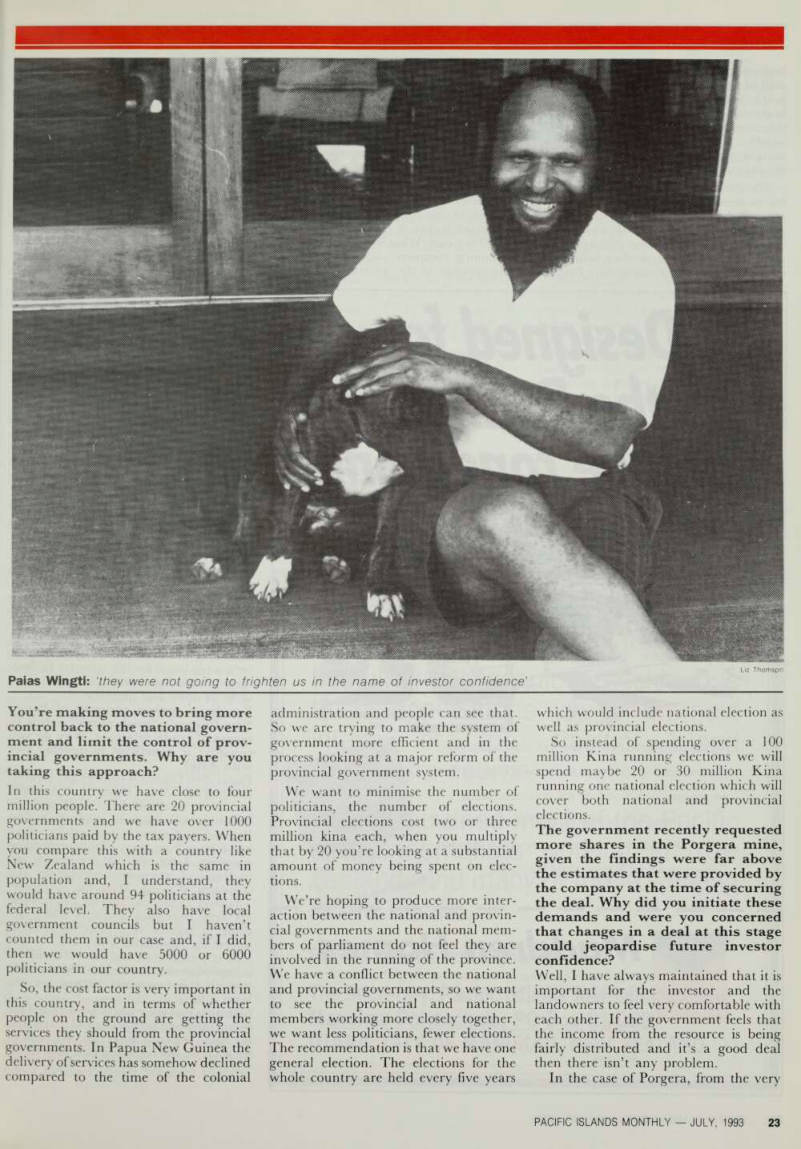
Paias Wingti: ‘they were not going to frighten us in the name of investor confidence'
beginning the profit was not fairly distrib uted in terms of share-holding and benefits to the country. We got a raw deal from the beginning. Some of the multinationals in the country have got a very good track record, but the thing is the mining companies are the ones with the capital and
the expertise.
The government hasn’t got that exper tise in terms of assessing the reserves. We rely on the information they provide us with, and I knew when I was in the opposition that the resource of Porgera was undervalued. I made it clear before the election that we would renegotiate Porgera
if we got into government. As soon as we got into power I called the chairman of the company, based in Canada, and asked him to come to Port Moresby for a one-to-one discussion. I made it clear to him that my government would not protect the mine unless I felt happy, and the government felt happy, that we were getting a fair share.
I informed the chairman that we wanted to increase our share-holding by another 20 per cent, to take it up to 30 per cent, and we wanted to pay a reasonable price for that 20 per cent. What happened was that the mining company underestimated the determination of the government, that I
meant business. So they went ahead, in a three-page statement released to the Syd ney stock exchange, arguing their case against the government publicly. As soon as they did that all the share prices came down and the mining industry was writing about how Papua New Guinea was trying to grab shares in Porgera without paying ... but I allowed them to do that because we were firm and they were not going to frighten us in the name of investor
confidence. They thought they would
create an anti-government feeling and the publicity would be so great that the government, because it was fearful of losing investor confidence would back down.
But I made it very clear that we were very determined, regardless of what the outside press seemed to think of Papua New Guinea. We were successful and now we are happy. But if they didn’t do it I was prepared to take other options and I had them already lined up. I would have introduced a law in parliament and taken over the company. But we are fair people and that was a last resort. I would have taken over Porgera. I was determined.
With the gold prices going up we have made a fortune for our country.
But how do you think it will effect foreign investor confidence?
Well, I think it’s important for investors to appreciate we have never taken any business over. Investors must not look at Chile, Africa, places where the government just took over and paid what they wanted to. We have never done this in our country.
There has always been discussion amongst shareholders.
That is something investors need to be aware of. We are reasonable people. Only when you take us for a ride and we have no other choice would we have to do something like that. The Porgera deal has been a big lesson for this country. In deals there must be some provision available for us to sit down and negotiate.
You have spoken recently of Papua
New Guinea’s “push north” policy in terms of trade relations. Why do you consider it beneficial to develop ties with Asia?
Papua New Guinea is strategically located, bridging the Asian region and Australia and New Zealand. Our traditional re lationship with Australia is important, but Papua New Guinea is in a position where it can learn from many of the surrounding countries. Asian countries are moving fast in terms of economic development and
standards of living. Malaysia, Singapore,
Thailand, Indonesia, Taiwan, China, these are very important countries which are going to become very powerful. That is something Australians can’t beat the level of productivity and the work ethic. It is important that Papua New Guinea looks towards these countries because we can learn a lot.
Countries that are going to be successful are competitive and productive and that is why the Asian region is important. We need to see what we can learn and gain from them.
Advertisements & other items, pp. 22-24 (1 item)
Study Ix Australia
VOCATIONAL, UNDERGRADUATE AND POSTGRADUATE COURSES
SPEC South Pacific Education College Represents the following Australian Tertiary Institutions in the Region; University of New South Wales University of Western Sydney University of Wollongong University of Central Queensland Insearch Institute of Commerce, Sydney New South Wales Tafe Canberra Institute of Technology Box Hill College of Tafe Melbourne SPEC also proud to represent the following business colleges: NSW Business College, Sydney Lorraine Martin Commercial College, Brisbane Holmes Commercial College, Melbourne.
STUDY FOR AN AUSTRALIAN COMPUTER QUALIFICATION IN SUVA, FIJI.
SPEC offers the Advanced Certificate in Information Technology from the Box Hill College of Technical and further Education in Melbourne Australia. Study 44 exciting computer modules in Fiji for a fraction of the cost of studying in Australia. Two intakes per year March and July.
Please note we do not award or provide scholarships.
For obligation free information on the above Australian Education Institutions contact:
S.P.E.C.
South Pacific Education College GPO Box 14671, Suva
STREET LEVEL, CREDIT CORP HOUSE,
4 GORDON STREET, SUVA. FIJI
TEL: (67) 305858
FAX: (679) 305866
dk
Designed for
the Padfic's
unique conditions.
; S L m I ~J( K K ' M jp ALBION T 37 • 1356 sq. ft.
Pacific conditions. Built in strength from additional ties and bracing, and a wide choice of designs that we are happy to modify to suit individual needs.
These homes may be purchased, kitset shell or complete with construction arranged as required.
Delivery is available throughout the Pacific.
Ho.
m *sf t
°nh
°C/fl
°m e s
Maddren Homes
P.O. Box 244, Kumeu, New Zealand. Ph (09) 412-9070.
Fax (09) 412-7251. Please mail me your free catalogue.
Name Address
prime minister
Solomon Islands
Deliberating on a prime minister
By Johnson Honimae
SOLOMON ISLANDS’ fourth national elections since independence in 1987, held on May 26, resulted in no absolute majority for any of the seven political groups or parties that put forward a total of 280 candidates to contest the 47 seats.
None of the political parties secured the 24 seats needed to secure a majority government.
This has led to a period of lobbying although not as intense as in neighbour ing Papua New Guinea where party members had to be virtually locked up to prevent other parties enticing them to cross the floor. All the same it was a tense period for the various political parties.
Prime Minister Mamaloni’s Group for National Unity and Reconciliation ended up with 21 seats, three short of a majority. Despite this there was con fusion over the numbers because some candidates entered the election with the names of two or three parties beside their election symbols. As the lobbying inten sified, the National Unity Group claimed it had 24 and went to the extent of laying out plans as if they had already formed the government. Mamaloni went ahead to announce that his group planned to increase the number of government ministries from the current 15 to 18. The reason for this increase was to match the increase in national parliament seats from 38 to 47. But the real reason must be that in order to keep the support of the numbers he needed for a majority, he would need to reward a few more MPs with ministerial portfolios.
Mamaloni also announced his govern ment, if returned, would increase the MPs Discretionary or Slush Fund which already stands at SIS 100,000 per MP per year, a total of 5400,000 to spend on any project in the constituency during the four-year-term. Political observers have put the 70 per cent return of the sitting MPs after the elections to the the
discretionary fund.
Only one Cabinet minister (Minister of Transport Ben Gale) and six MPs lost their seats. In previous elections it was common for up to 50 per cent of sitting MPs not to get re-elected. Opposition parties had varying degrees of success as results were announced. The new Na tional Action Party of Solomon Islands,
led by former Ambassador to the UN, Francis Saemala, secured four seats and the Labour Party increased its numbers from two to four.
The outcome was not as good for the
other Opposition parties including the
Peoples Alliance Party which only se cured seven seats from over the 30 candidates it had fielded during the election. The other main party, the United Party, only won two, the Na tionalist Front for Progress lost one and is only left with leader Andrew Nori. The informal grouping of the Christian Fel lowship Group got three and the rest went to independents.
The six Opposition parties and some independents had come together to form what they called the National Coalition Partners with the aim of topping Mamaloni’s attempt to from a govern ment. They claimed they had 28 seats
and were ready to form the new government. Possibile canidates for prime minister included member of the Alliance party, Dennis Lulei, who was a Foreign Minister several years ago, Leader of the Opposition, Joses Tuhanuku, Francis Saemala, leader of NAPSI or NFP leader, Andrew Nori.
Only Lulei revealed his willingness to be a candidate saying he had the experience and capability for the job. A former secondary school teacher. Lulei resigned as chairman of the Public Service Commission to contest the elections.
The National Coalition Partners claim they offer a better leadership and would restore confidence the country. But even before the issue could be resolved there was scepticism on how long such a coalition would last. Some, however, have pointed out that history tells us coalitions tend to stick together more than a majority government in this country. They say if' Mamaloni could hastily put together a coalition and make it last for the last three years, then the opposition parties who have been together for four years and know each other could have a better chance of survival. But the country’s people will have to wait until June 18 when the 47 MPs vote for a new Prime Minister. □
Advertisements & other items, pp. 25-26 (1 item)
Certificate In Journalism
Manukau Polytechnic in Auckland is taking applications now for the next intake of the Pacific Island Journalism course.
We have trained most of the Pacific Island journalists working in New Zealand, and many of those working in the Pacific.
For full details write now to: The Secretary, Pacific Islands Journalism Course, Manukau Polytechnic, PO Box 61066,
OTARA, CITY OF MANUKAU, NEW ZEALAND.
disCOVER
WESTERN
SAMOA
IT'S REALLY QUITE AMAZING
JUST HOW MUCH YOU CAN
LEARN ABOUT OUR COUNTRY
THROUGH IT'S STAMPS.
OUR CULTURE AND
TRADITIONS; OUR WILDLIFE
BOTH ON LAND AND IN THE
SEA; OUR HISTORY AND
IMPORTANT EVENTS IN THE
PRESENT.
SO AFTER YOU'VE VISITED US,
CONTINUE YOUR DISCOVERY
OF WESTERN SAMOA FOR THE
REST OF YOUR LIFE-
COLLECT OUR STAMPS.
Please write to the: Western Samoa Philatelic Bureau Posts & Telecommunications Department Government of Western Samoa Apia, Western Samoa.
Fax 685 24000 Phone 685 20720
housing
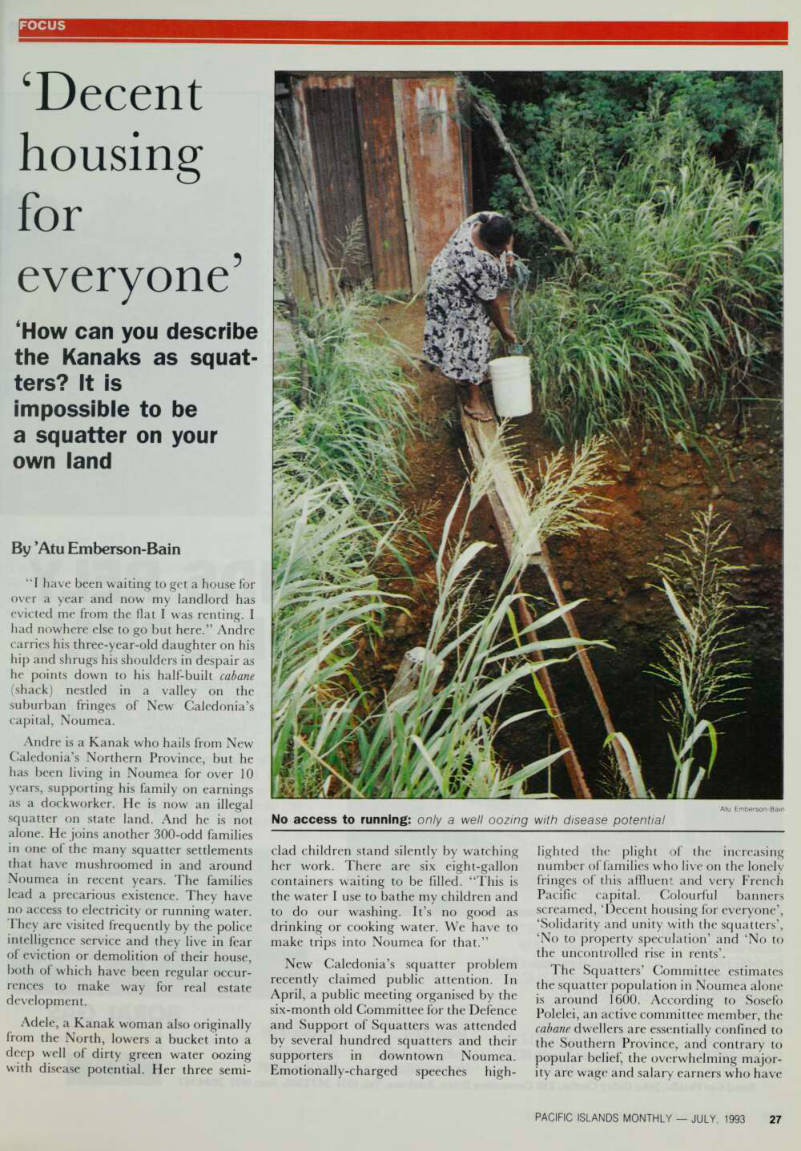
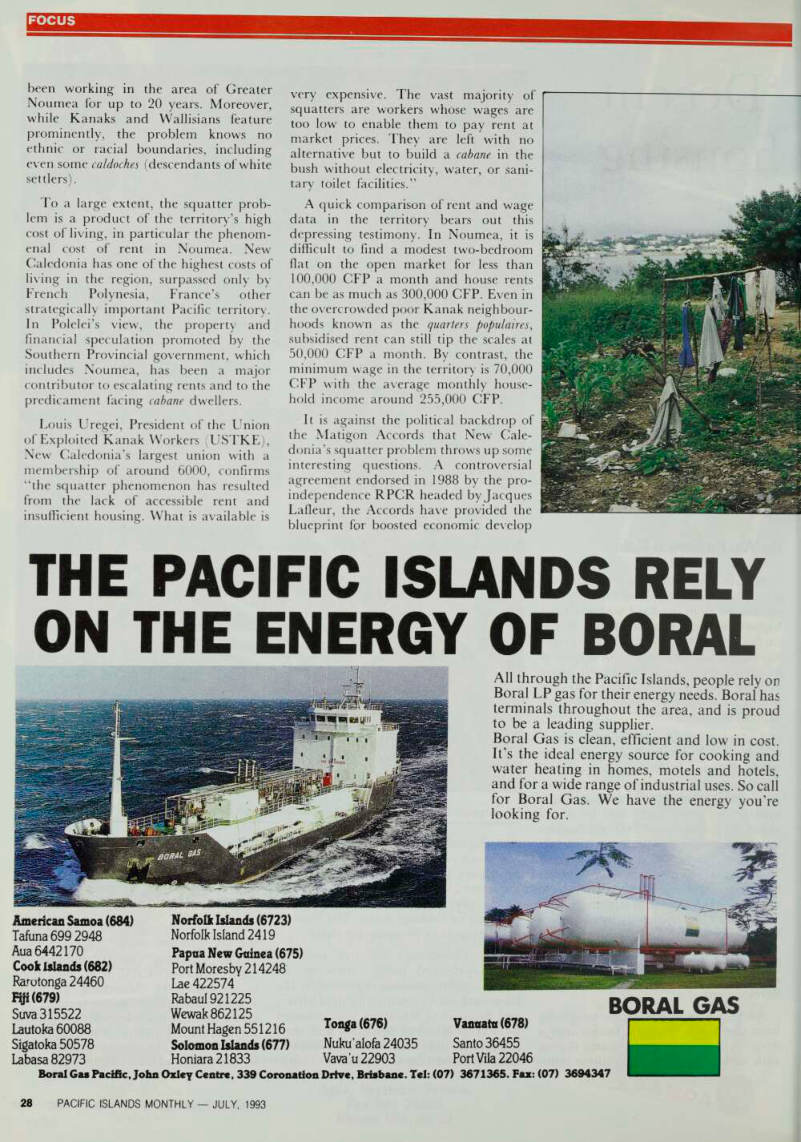
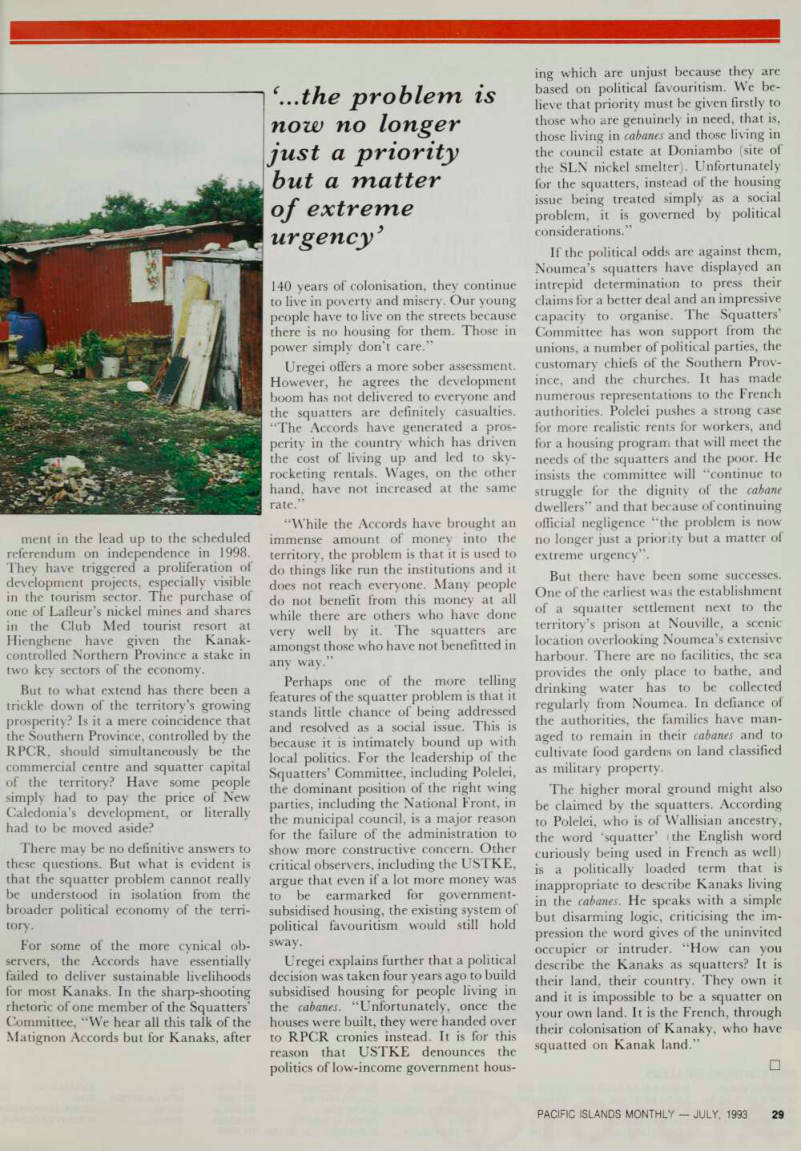
Focus
‘Decent housing for everyone’
‘How can you describe the Kanaks as squat ters? It is impossible to be a squatter on your own land
By ’Atu Emberson-Bain
“I have been waiting to get a house for over a year and now my landlord has evicted me from the flat I was renting. I had nowhere else to go but here.” Andre carries his three-year-old daughter on his hip and shrugs his shoulders in despair as he points down to his half-built cabane (shack) nestled in a valley on the suburban fringes of New Caledonia’s capital, Noumea.
Andre is a Kanak who hails from New Caledonia’s Northern Province, but he has been living in Noumea for over 10 years, supporting his family on earnings as a dockworker. He is now an illegal squatter on state land. And he is not alone. He joins another 300-odd families in one of the many squatter settlements that have mushroomed in and around Noumea in recent years. The families lead a precarious existence. They have no access to electricity or running water.
They are visited frequently by the police intelligence service and they live in fear of eviction or demolition of their house, both of which have been regular occur rences to make way for real estate
development.
Adele, a Kanak woman also originally from the North, lowers a bucket into a deep well of dirty green water oozing with disease potential. Her three semi-
clad children stand silently by watching her work. There are six eight-gallon containers waiting to be filled. “This is the water I use to bathe my children and to do our washing. It’s no good as drinking or cooking water. We have to make trips into Noumea for that.”
New Caledonia’s squatter problem recently claimed public attention. In April, a public meeting organised by the six-month old Committee for the Defence and Support of Squatters was attended by several hundred squatters and their supporters in downtown Noumea.
Emotionally-charged speeches high-
lighted the plight of the increasing number of families who live on the lonely fringes of this affluent and very French Pacific capital. Colourful banners screamed,‘Decent housing for everyone’, ‘Solidarity and unity with the squatters’, ‘ No to property speculation’ and ‘No to the uncontrolled rise in rents’.
Thc Squatters’ Committee estimates the squatter population in Noumea alone is around 1600 According to Sosefo Polelei, an active committee member, the cabane dwellers are essentially confined to the Southern Province, and contrary to popular belief, the overwhelming major ity are wage and salary earners who have
No access to running: only a well oozing with disease potential
Alu Emberson-Baln
been working in the area of Greater Noumea for up to 20 years. Moreover, while Kanaks and Wallisians feature prominently, the problem knows no ethnic or racial boundaries, including even some caldoches (descendants of white
settlers).
To a large extent, the squatter prob lem is a product of the territory’s high cost of living, in particular the phenom enal cost of rent in Noumea. New Caledonia has one of the highest costs of living in the region, surpassed only by French Polynesia, France’s other strategically important Pacific territory.
In Polelei’s view, the property and financial speculation promoted by the Southern Provincial government, which includes Noumea, has been a major contributor to escalating rents and to the predicament facing cabane dwellers.
Louis Uregei, President of the Union of Exploited Kanak Workers (USTKE), New Caledonia’s largest union with a membership of around 6000, confirms ”the squatter phenomenon has resulted from the lack of accessible rent and insufficient housing. What is available is
very expensive. The vast majority of squatters are workers whose wages are too low to enable them to pay rent at market prices. They are left with no alternative but to build a cabane in the bush without electricity, water, or sani tary toilet facilities.”
A quick comparison of rent and wage data in the territory bears out this depressing testimony. In Noumea, it is difficult to find a modest two-bedroom flat on the open market for less than 100.000 CFP a month and house rents can be as much as 300,000 CFP. Even in the overcrowded poor Kanak neighbour hoods known as the quarters populaires, subsidised rent can still tip the scales at 50.000 CFP a month. By contrast, the minimum wage in the territory is 70,000 CFP with the average monthly house hold income around 255,000 CFP.
It is against the political backdrop of the Matigon Accords that New Cale donia’s squatter problem throws up some interesting questions. A controversial agreement endorsed in 1988 by the pro independence RPCR headed by Jacques Lafleur, the Accords have provided the blueprint for boosted economic develop
ment in the lead up to the scheduled referendum on independence in 1998.
They have triggered a proliferation of
development projects, especially visible
in the tourism sector. The purchase of one of Lafleur’s nickel mines and shares in the Club Med tourist resort at Hienghene have given the Kanak controlled Northern Province a stake in two key sectors of the economy.
But to what extend has there been a trickle down of the territory’s growing prosperity? Is it a mere coincidence that the Southern Province, controlled by the RPCR, should simultaneously be the commercial centre and squatter capital of the territory? Have some people simply had to pay the price of New Caledonia’s development, or literally had to be moved aside?
There may be no definitive answers to these questions. But what is evident is that the squatter problem cannot really be understood in isolation from the broader political economy of the terri tory.
For some of the more cynical ob servers, the Accords have essentially failed to deliver sustainable livelihoods for most Kanaks. In the sharp-shooting rhetoric of one member of the Squatters’
Committee, “We hear all this talk of the Matignon Accords but for Kanaks, after
‘...the problem is now no longer
just a priority
but a matter
of extreme
urgency ’
140 years of colonisation, they continue to live in poverty and misery. Our young people have to live on the streets because there is no housing for them. Those in power simply don’t care.”
Uregei offers a more sober assessment.
However, he agrees the development boom has not delivered to everyone and the squatters are definitely casualties.
“The Accords have generated a pros perity in the country which has driven the cost of living up and led to sky rocketing rentals. Wages, on the other hand, have not increased at the same rate.”
“While the Accords have brought an immense amount of money into the territory, the problem is that it is used to do things like run the institutions and it does not reach everyone. Many people do not benefit from this money at all while there are others who have done very well by it. The squatters are amongst those who have not benefitted in
any way.”
Perhaps one of the more telling features of the squatter problem is that it stands little chance of being addressed and resolved as a social issue. This is because it is intimately bound up with local politics. For the leadership of the Squatters’ Committee, including Polelei, the dominant position of the right wing parties, including the National Front, in the municipal council, is a major reason for the failure of the administration to show more constructive concern. Other critical observers, including the USTKE, argue that even if a lot more money was to be earmarked for government subsidised housing, the existing system of political favouritism would still hold sway.
Uregei explains further that a political decision was taken four years ago to build subsidised housing for people living in the cabanes. “Unfortunately, once the houses were built, they were handed over to RPCR cronies instead. It is for this reason that USTKE denounces the politics of low-income government hous
ing which are unjust because they are based on political favouritism. We be lieve that priority must be given firstly to those who are genuinely in need, that is, those living in cabanes and those living in the council estate at Doniambo (site of the SLN nickel smelter). Unfortunately for the squatters, instead of the housing issue being treated simply as a social
problem, it is governed by political
considerations.”
If the political odds are against them, Noumea’s squatters have displayed an intrepid determination to press their claims for a better deal and an impressive
capacity to organise. The Squatters’
Committee has won support from the unions, a number of political parties, the customary chiefs of the Southern Prov ince, and the churches. It has made numerous representations to the French authorities. Polelei pushes a strong case for more realistic rents for workers, and for a housing program that will meet the needs of the squatters and the poor. He insists the committee will “continue to struggle for the dignity of the cabane dwellers” and that because of continuing official negligence “the problem is now no longer just a priority but a matter of
extreme urgency”.
But there have been some successes.
One of the earliest was the establishment of a squatter settlement next to the territory’s prison at Nouville, a scenic location overlooking Noumea’s extensive harbour. There are no facilities, the sea provides the only place to bathe, and drinking water has to be collected regularly from Noumea. In defiance of the authorities, the families have man aged to remain in their cabanes and to cultivate food gardens on land classified as military property.
The higher moral ground might also be claimed by the squatters. According to Polelei, who is of Wallisian ancestry, the word ‘squatter’ (the English word curiously being used in French as well) is a politically loaded term that is inappropriate to describe Kanaks living in the cabanes. He speaks with a simple but disarming logic, criticising the im pression the word gives of the uninvited occupier or intruder. “How can you describe the Kanaks as squatters? It is their land, their country. They own it and it is impossible to be a squatter on your own land. It is the French, through their colonisation of Kanaky, who have squatted on Kanak land.”
Advertisements & other items, pp. 28-32 (1 item)
The Pacific Islands Rely
ON THE ENERGY OF BORAL
t American Samoa (684) Tafuna 699 2948 Aua6442170 Cook Islands (682) Rarotonga 24460 Ffti (679) Suva 315522 Lautoka 60088 Sigatoka 50578 Labasa 82973 Norfolk Islands (6723) Norfolk Island 2419 Papna New Guinea (675) Port Moresby 214248 Lae 422574 Rabaul 921225 Wewak 862125 Mount Hagen 551216 Solomon Islands (677) Honiara 21833 All through the Pacific Islands, people rely on Boral LP gas for their energy needs. Boral has terminals throughout the area, and is proud to be a leading supplier.
Boral Gas is clean, efficient and low in cost.
If s the ideal energy source for cooking and water heating in homes, motels and hotels, and for a wide range of industrial uses. So call for Boral Gas. We have the energy you’re
looking for.
Tonga(676) Nukualofa 24035 Vava’u 22903 Vanuatu (678) Santo 36455 Port Vila 22046
BORAL GAS
Boral Gas Pacific, John Oxley Centre, 339 Coronation Drive, Brisbane. Tel: (07) 3671365. Fax: (07) 3694347
Creating a highly efficient, dynamic-looking car wou] be simple if it weren’t for one complicating detail; tf passengers that must ride in it. Accommodating people comfortably in a pleasant, roorr interior usually means a certain amount of aerodynamic potential has to be sacrifice // HI 4 * m Exact features and specifications may vary depending on country of purchase. Please check with your nearest TOYOTA distributor/dealer for details.
OISTRIBUTORS/DEALERS
AMERICAN SAMOA BURNS PH1LP (S.S.) CO. LTD. PH 633-4281 jUAM & MICRONESIA... ATKINS KROLL INC. PH 646-1876/9 slORFOLK ISLANDS BORRY’S PTY LTD. PH 2114
.OLOMON ISLANDS MENDANA MOTORS PH 30314
/ANUATU VANUATU MOTORS PH 22341
COOK ISLANDS PACIFIC MOTORS LTD.
KIRIBATI TARAWA MOTORS
PAPUA NEW GUINEA ... ELA MOTORS
TAHITI NIPPON AUTOMOTO
WESTERN SAMOA BURNS PHILP (S.S.) CO.
PH 20796 PH 21090 PH 217036 PH 429819
LTD. PH 20800
FIJI ASCO MOTORS
NEW CALEDONIA .. S.I.A.P.
SAIPAN MICROL CORPORATION 1
TONGA BURNS PHILP (TONGA) LTD
£ NEW COROLLA DOES II MTMLU.^X^Z;
lagement, Toyota engineers were able to realize an efficient, wedge-shaped design e at the same time perfecting the alignment between body panels and components, course our own innovative style of civilized neering makes sure that none of this comes ae expense of the luxurious, leg-stretching interior. Because we realize that even a 0.33 is useless if no one wants to drive the car.
<SK> TOYOTA
SOUTH PACIFIC REGIONAL
» ENVIRONMENT PROGRAMME
SPREP
MC4/VCK;
Programme Officer (Conservation Areas Biodiversity)
Programme Officer (Conservation Areas Socio-Economic)
The South Pacific Regional Environment Programme (SPREP) seeks applicants for the above positions with the South Pacific Biodiversity Conservation Programme (SPBCP).
The SPBCP is a five-year, US$lO million concerted effort to protect biological diversity while facilitating ecologically-sustainable development in fourteen countries of the South Pacific region. It is funded by the Global Environment Facility (GEF), a joint effort of the World Bank, the United Nations Development Programme (UNDP) and the United Nations Environment Programme (UNEP), and administered by SPREP.
The SPBCP will help participating countries establish and initially manage a series of diverse conservation areas (terrestrial, marine and combined) and enable the sustainable use of the area’s natural resources.
Subsidiary activities will support project objectives through provision of information, species protection and action-oriented policy studies.
These officers will be responsible for the implementation of all activities of the SPBCP under the supervision of the Project Manager. They will be based at the SPREP Headquarters in Apia, Western Samoa but will also travel widely throughout the region. They will cooperate closely with participating countries, local and international non-governmental organisations, local communities and other agencies concerned with the establishment of conservation areas and other operations of the SPBCP.
The appointments will be at Project Officer level and will be for two years in the first instance renewable by mutual agreement for a further term of two years. Attractive remunerations at this level and other employment benefits will be offered with the actual starting salary dependent on qualifications and experience. For non- Western Samoan citizens, salary and allowances will be tax-free in Western Samoa.
Applicants must possess a University degree in a relevant field, preferably at a post graduate level. Extensive (at least five years) experience working on environmental conservation, resource management, land use management or related fields in or on behalf of developing countries, preferably within the Pacific Islands will be important. Proven skills and experience in dealing with complex and land tenure systems are desirable.
Applicants must be nationals of a SPREP or United Nations member country and must be fluent in spoken and written English. Knowledge of Pacific Island languages would be advantageous.
Applications must be accompanied by detailed curricula vitae containing full information on qualifications and experience relevant for the position as well as names, addresses, telephone and fax numbers of three persons associated with the applicant professionally and who would be prepared to provide testimonials when required.
Applications should be addressed to: Further information, including full duty statement conditions of appointment can be obtained from SPREP’s Administrative Officer, Mr Ueligitone Sasagi, at these numbers.
Closing date for all applications will be July 30, 1993.
The Director South Pacific Regional Environment Programme P.O. Box 240
APIA
Western Samoa Telephone: (685) 21929 Fax: (685) 20 231
The way ahead
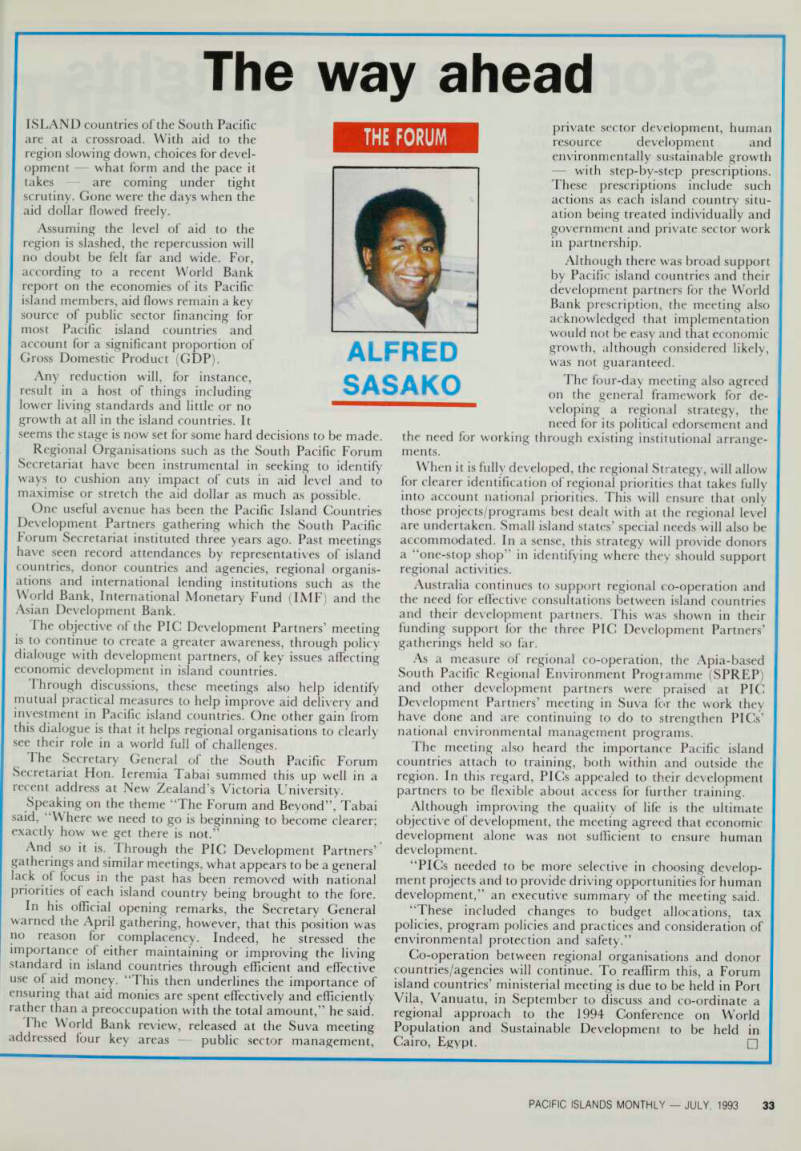
ISLAND countries of the South Pacific are at a crossroad. With aid to the region slowing down, choices for devel opment what form and the pace it takes are coming under tight scrutiny. Gone were the days when the aid dollar flowed freely.
Assuming the level of aid to the region is slashed, the repercussion will no doubt be felt far and wide. For, according to a recent World Bank report on the economies of its Pacific island members, aid flows remain a key source of public sector financing for most Pacific island countries and account for a significant proportion of Gross Domestic Product (GDP).
Any reduction will, for instance, result in a host of things including lower living standards and little or no growth at all in the island countries. It
seems the stage is now set for some hard decisions to be made.
Regional Organisations such as the South Pacific Forum Secretariat have been instrumental in seeking to identify ways to cushion any impact of cuts in aid level and to maximise or stretch the aid dollar as much as possible.
One useful avenue has been the Pacific Island Countries Development Partners gathering which the South Pacific Forum Secretariat instituted three years ago. Past meetings have seen record attendances by representatives of island countries, donor countries and agencies, regional organis ations and international lending institutions such as the World Bank, International Monetary Fund (IMF) and the Asian Development Bank.
The objective of the PIC Development Partners’ meeting is to continue to create a greater awareness, through policy dialouge with development partners, of key issues affecting economic development in island countries.
Through discussions, these meetings also help identify mutual practical measures to help improve aid delivery and investment in Pacific island countries. One other gain from this dialogue is that it helps regional organisations to clearly see their role in a world full of challenges.
The Secretary General of the South Pacific Forum Secretariat Hon. leremia Tabai summed this up well in a recent address at New Zealand’s Victoria University.
Speaking on the theme “The Forum and Beyond”, Tabai said, “Where we need to go is beginning to become clearer; exactly how we get there is not.”
And so it is. Through the PIC Development Partners’ gatherings and similar meetings, what appears to be a general lack of focus in the past has been removed with national priorities of each island country being brought to the fore.
In his official opening remarks, the Secretary General warned the April gathering, however, that this position was no reason for complacency. Indeed, he stressed the importance of either maintaining or improving the living standard in island countries through efficient and effective use of aid money. “This then underlines the importance of ensuring that aid monies are spent effectively and efficiently rather than a preoccupation with the total amount,” he said.
The World Bank review, released at the Suva meeting addressed four key areas public sector management,
private sector development, human resource development and environmentally sustainable growth - with step-by-step prescriptions.
These prescriptions include such actions as each island country situ ation being treated individually and government and private sector work in partnership.
Although there was broad support by Pacific island countries and their development partners for the World Bank prescription, the meeting also
acknowledged that implementation
would not be easy and that economic growth, although considered likely, was not guaranteed.
The four-day meeting also agreed
on the general framework for de veloping a regional strategy, the need for its political edorsement and
the need for working through existing institutional arrange ments.
When it is fully developed, the regional Strategy, will allow for clearer identification of regional priorities that takes fully into account national priorities. This will ensure that only those projects/programs best dealt with at the regional level are undertaken. Small island states’ special needs will also be accommodated. In a sense, this strategy will provide donors a “one-stop shop” in identifying where they should support
regional activities.
Australia continues to support regional co-operation and the need for effective consultations between island countries and their development partners. This was shown in their funding support for the three PIC Development Partners’ gatherings held so far.
As a measure of regional co-operation, the Apia-based South Pacific Regional Environment Programme (SPREP) and other development partners were praised at PIC Development Partners’ meeting in Suva for the work they have done and are continuing to do to strengthen PlCs’ national environmental management programs.
The meeting also heard the importance Pacific island countries attach to training, both within and outside the region. In this regard, PICs appealed to their development partners to be flexible about access for further training.
Although improving the quality of life is the ultimate objective of development, the meeting agreed that economic development alone was not sufficient to ensure human
development.
“PICs needed to be more selective in choosing develop ment projects and to provide driving opportunities for human development,” an executive summary of the meeting said.
“These included changes to budget allocations, tax policies, program policies and practices and consideration of environmental protection and safety.”
Co-operation between regional organisations and donor countries/agencies will continue. To reaffirm this, a Forum island countries’ ministerial meeting is due to be held in Port Vila, Vanuatu, in September to discuss and co-ordinate a regional approach to the 1994 Conference on World Population and Sustainable Development to be held in Cairo, Egypt. □
The Forum
Alfred
Sasako
Storm over land rights
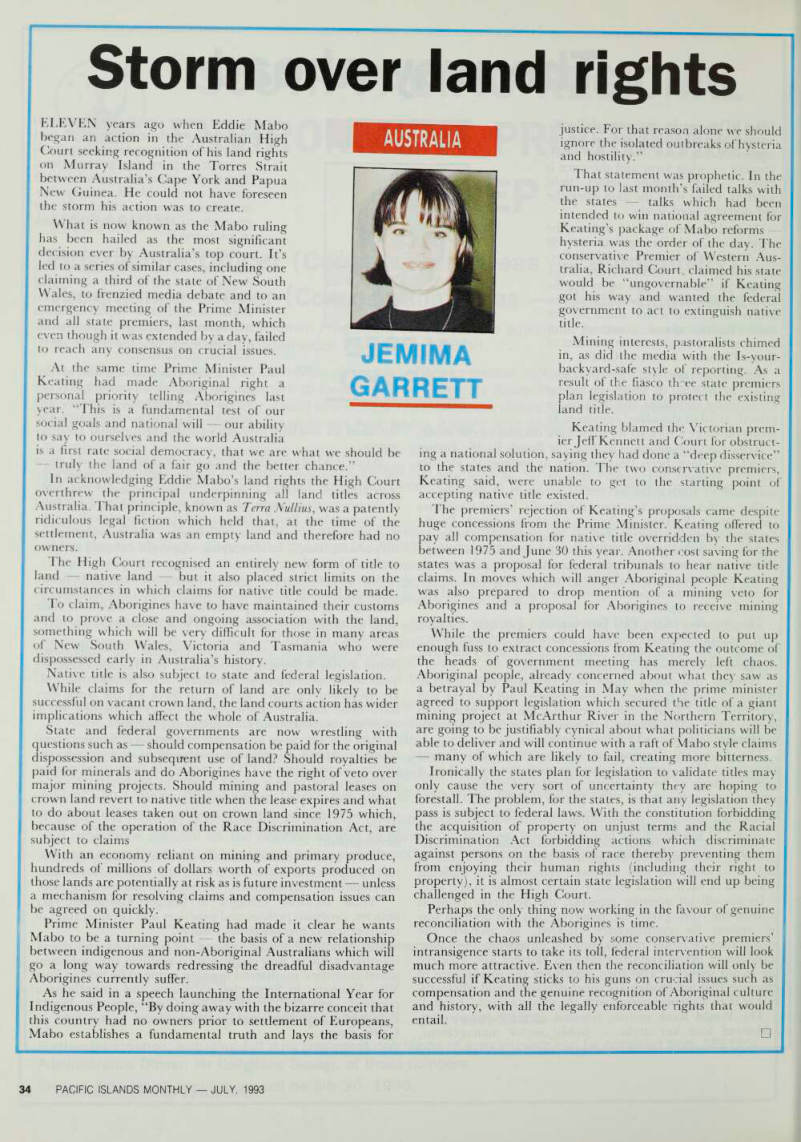
ELEVEN years ago when Eddie Mabo began an action in the Australian High Court seeking recognition of his land rights on Murray Island in the Torres Strait between Australia’s Cape York and Papua New Guinea. He could not have foreseen the storm his action was to create.
What is now known as the Mabo ruling has been hailed as the most significant decision ever by Australia’s top court. It’s led to a series of similar cases, including one claiming a third of the state of New South Wales, to frenzied media debate and to an emergency meeting of the Prime Minister and all state premiers, last month, which even though it was extended by a day, failed to reach any consensus on crucial issues.
At the same time Prime Minister Paul
Keating had made Aboriginal right a
personal priority telling Aborigines last
year. “This is a fundamental test of our social goals and national will our ability to say to ourselves and the world Australia
is a first rate social democracy, that we are what we should be truly the land of a fair go and the better chance.”
In acknowledging Eddie Mabo’s land rights the High Court overthrew the principal underpinning all land titles across Australia. 1 hat principle, known as Terra JVullius, was a patently ridiculous legal fiction which held that, at the time of the settlement, Australia was an empty land and therefore had no owners.
The High Court recognised an entirely new form of title to land native land but it also placed strict limits on the circumstances in which claims for native title could be made.
To claim, Aborigines have to have maintained their customs and to prove a close and ongoing association with the land, something which will be very difficult for those in many areas of New South Wales, Victoria and Tasmania who were
dispossessed early in Australia’s history.
Native title is also subject to state and federal legislation.
While claims for the return of land are only likely to be successful on vacant crown land, the land courts action has wider implications which affect the whole of Australia.
State and federal governments are now wrestling with questions such as should compensation be paid for the original dispossession and subsequent use of land? Should royalties be paid for minerals and do Aborigines have the right of veto over major mining projects. Should mining and pastoral leases on crown land revert to native title when the lease expires and what to do about leases taken out on crown land since 1975 which, because of the operation of the Race Discrimination Act, are subject to claims With an economy reliant on mining and primary produce, hundreds of millions of dollars worth of exports produced on those lands are potentially at risk as is future investment unless a mechanism for resolving claims and compensation issues can
be agreed on quickly.
Prime Minister Paul Keating had made it clear he wants Mabo to be a turning point the basis of a new relationship between indigenous and non-Aboriginal Australians which will go a long way towards redressing the dreadful disadvantage
Aborigines currently suffer.
As he said in a speech launching the International Year for Indigenous People, “By doing away with the bizarre conceit that this country had no owners prior to settlement of Europeans, Mabo establishes a fundamental truth and lays the basis for
justice. For that reason alone we should ignore the isolated outbreaks of hysteria and hostility.”
That statement was prophetic. In the run-up to last month’s failed talks with the states talks which had been intended to win national agreement for Keating’s package of Mabo reforms hysteria was the order of the day. The conservative Premier of Western Aus tralia, Richard Court, claimed his state would be “ungovernable” if Keating got his way and wanted the federal government to act to extinguish native title.
Mining interests, pastoralists chimed in, as did the media with the Is-your backyard-safe style of reporting. As a result of the fiasco th ~ee state premiers plan legislation to protect the existing land title.
Keating blamed the Victorian prem ier Jeff Kennett and Court for obstruct
ing a national solution, saying they had done a “deep disservice” to the states and the nation. The two conservative premiers, Keating said, were unable to get to the starting point of accepting native title existed.
The premiers’ rejection of Keating’s proposals came despite huge concessions from the Prime Minister. Keating offered to pay all compensation for native title overridden by the states between 1975 and June 30 this year. Another cost saving for the states was a proposal for federal tribunals to hear native title claims. In moves which will anger Aboriginal people Keating was also prepared to drop mention of a mining veto for Aborigines and a proposal for Aborigines to receive mining
royalties.
While the premiers could have been expected to put up enough fuss to extract concessions from Keating the outcome of the heads of government meeting has merely left chaos.
Aboriginal people, already concerned about what they saw as a betrayal by Paul Keating in May when the prime minister agreed to support legislation which secured the title of a giant mining project at McArthur River in the Northern Territory, are going to be justifiably cynical about what politicians will be able to deliver and will continue with a raft of Mabo style claims many of which are likely to fail, creating more bitterness.
Ironically the states plan for legislation to validate titles may only cause the very sort of uncertainty they are hoping to forestall. The problem, for the states, is that any legislation they pass is subject to federal laws. With the constitution forbidding the acquisition of property on unjust terms and the Racial Discrimination Act forbidding actions which discriminate against persons on the basis of race thereby preventing them from enjoying their human rights (including their right to property), it is almost certain state legislation will end up being challenged in the High Court.
Perhaps the only thing now working in the favour of genuine reconciliation with the Aborigines is time.
Once the chaos unleashed by some conservative premiers’ intransigence starts to take its toll, federal intervention will look much more attractive. Even then the reconciliation will only be successful if Keating sticks to his guns on crucial issues such as compensation and the genuine recognition of Aboriginal culture and history, with all the legally enforceable rights that would entail.
Australia
Jemima
Garrett
opera
Thlevision
The soap opera continues
Since the Fiji government first expressed an interest in setting up TV in the 1980 s, a firm decision has yet to be made on the issue
By Craig Skehan
The process of appointing a perma nent television services operator in Fiji is itself starting to resemble a TV 7 soap opera.
And the audience is asking : Where’s the money coming from? Why the cloak and dagger secrecy? And will there really
be majority foreign ownership?
Negotiations for television rights in Fiji go back to the mid-1980s when Austra lia’s Packer and Bond media groups wanted to set up TV in Fiji. But broadcasting did not start until 1991 when Television New Zealand (TVNZ) set up what was supposed to be a temporary service for just a few months.
Government policy shifts since then have ranged from intended majority govern ment ownership to no requirement whatsoever for government involvement.
Earlier this year, as bewildered entre preneurs tried to keep pace with policy fluctuations, a call for tenders raised hopes that a resolution was in sight. But the outcome of the tender process was a surprise and matters remain unsettleed.
Two foreign companies TVNZ and specially created Australian firm Pacific
Broadcasting Corporation Ltd (PBCL)
were authorised to form a joint venture with local private business inter ests. Government-owned Fiji Posts and Telecom Ltd (FPTL), which spent $90,000 on consultants to help compile their tender was left out in the cold.
Another government-owned tenderer, Fiji Development Bank, was also ruled out of contention. Media magnate
Rupert Murdoch’s News Corporation
was linked to the failed FPTL sub mission. So far it is not clear whether the
Murdoch group has lost interest or could still re-enter the scene as an investor through its existing local media holding, Fiji Times.
Locally born William Parkinson, who operates commercial radio stations in Fiji, stirred debate when he said Fiji interests should have majority control of the TV service. PBCL executive John Pollock responded testily that his com pany’s involvement had always been on the basis of a majority shareholding and management control. Pollock, whose family owns a number of Ford car dealerships in Australia, has been in and out of Fiji numerous times. There have been discussions on the possibility of a
three-way ownership split among
TVNZ, PBCL and potential local inves tors. It is unclear how such an arrange ment would work. If implemented, it would mean foreign ownership domi nance something most countries don’t tolerate when it comes to the influential television medium. There have already been tensions over what the relationship should be between TVNZ and PBCL, including in respect to management control.
Meanwhile, Parkinson has moved to stitch together a local investors’ group led by his company, Communications Fiji. Waiting in the wings with their cheque books are hotel chain owner and
opposition National Federation Party
stalwart Y.P. Reddy and businessman and government supporter Jim Ah Koy.
Both Ah Koy and Reddy have held talks with the Parkinson group.
Concerns about where plans for TV are headed intensified with public ques tioning about whether PBCL, and a finked Sydney company called Comsyst,
really had millions of dollars they had promised to invest in establishing both free-to-air and pay television channels in Fiji. The government, when annointing PBCL, said it was impressed by the promise of an initial Fs4-million invest ment, rising to more than FSII million.
The Fiji Times newspaper reported Pollock as denying information from Fiji government sources that his company was seeking to borrow funds within Fiji.
PBCL then wrote to a special cabinet television sub-committee, which would have to endorse any deal reached between the parties. The letter states that PBCL intended to fully fund the project from external sources. It is understood the company claims it cannot finalise its own financing plans in Australia
presumably through loan-raising until
a joint venture arrangement is con cluded.
Consultants have predicted the new broadcasting company would not make money for at least five or six years.
However, as with supplying equipment, money could be made more quickly through providing foreign television pro grams. TVNZ is looking to continue its current role as the major supplier of material which so far has ranged from overseas and sports and good quality programs to second rate drama series and situation comedies. Other groups want to get a bite at the programming cherry, so there could well be future criticism by would-be program suppliers about the “quality” of TV.
The cabinet sub-committee, which includes a senior representative from Prime Minister Sitiveni Rabuka’s office, has set a July 5 deadline for PBCL and TVNZ to reach a joint venture agree ment and include local investors. One complication is that the sub-committee has so far not given any clear direction on what would be the maximum allow able total foreign shareholding. And so far, virtually nothing lias been explained to the long-suffering public about how planned pay television would operate.
Some parties have questioned what they
see as a lack of direct television broad casting experience of the PBCL group, apart from the supply by Comsyst in Australia and elsewhere of equipment such as transmitters and microwave links. Comsyst is a small family company, but some decision makers in Fiji mis takenly formed the view that it was a
much larger corporation.
Ifa joint venture arrangement can’t be
finalised by July 5, Fiji’s so-called
existing temporary service might have to be temporary for a bit longer. The soap opera continues. □
Great Council
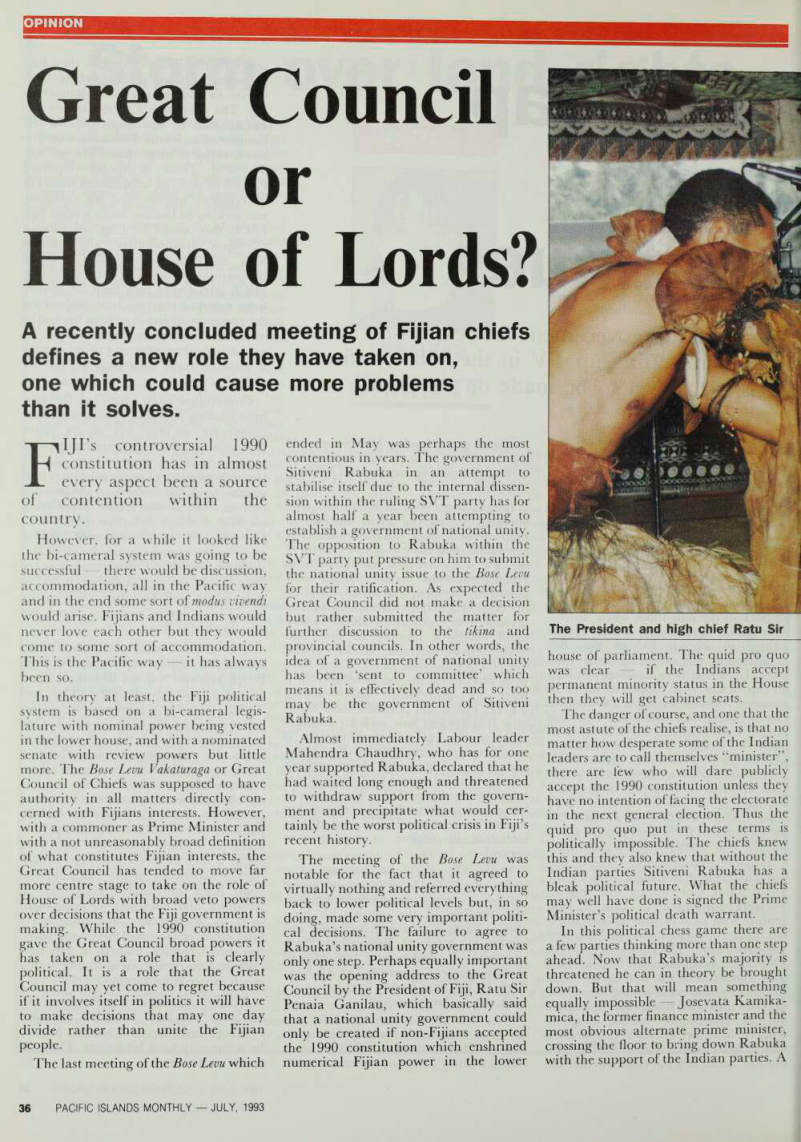
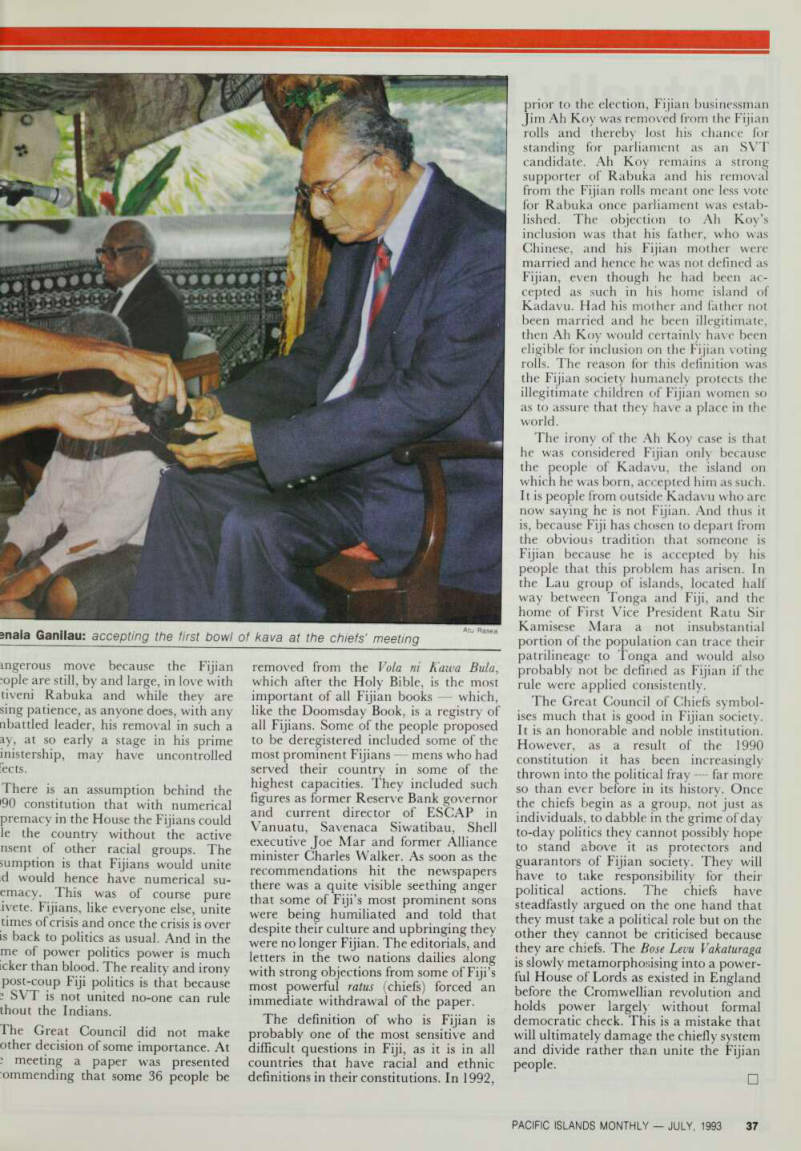
Opinion
Great Council or House of Lords?
A recently concluded meeting of Fijian chiefs defines a new role they have taken on, one which could cause more problems than it solves.
FIJI’S controversial 1990 constitution has in almost every aspect been a source of contention within the
country.
However, for a w hile it looked like the bi-cameral system was going to be successful there would be discussion, accommodation, all in the Pacific way and in the end some sort of modus vivendi would arise. Fijians and Indians would never love each other but they would come to some sort of accommodation.
This is the Pacific way it has always been so.
In theory at least, the Fiji political system is based on a bi-cameral legis lature with nominal power being vested in the lower house, and with a nominated senate with review powers but little more. The Bose Levu Vakaturaga or Great Council of Chiefs was supposed to have authority in all matters directly con cerned with Fijians interests. However, with a commoner as Prime Minister and with a not unreasonably broad definition of what constitutes Fijian interests, the Great Council has tended to move far more centre stage to take on the role of House of Lords with broad veto powers over decisions that the Fiji government is making. While the 1990 constitution gave the Great Council broad powers it has taken on a role that is clearly political. It is a role that the Great Council may yet come to regret because if it involves itself in politics it will have to make decisions that may one day divide rather than unite the Fijian people.
The last meeting of the Bose Levu which
ended in May was perhaps the most contentious in years. The government of Sitiveni Rabuka in an attempt to stabilise itself due to the internal dissen sion within the ruling SVT party has for almost half a year been attempting to establish a government of national unity.
The opposition to Rabuka within the SVT party put pressure on him to submit the national unity issue to the Bose Levu for their ratification. As expected the Great Council did not make a decision but rather submitted the matter for further discussion to the tikina and provincial councils. In other words, the idea of a government of national unity has been ‘sent to committee’ which means it is effectively dead and so too may be the government of Sitiveni Rabuka.
Almost immediately Labour leader Mahendra Chaudhry, who has for one year supported Rabuka, declared that he had waited long enough and threatened to withdraw support from the govern ment and precipitate what would cer tainly be the worst political crisis in Fiji’s recent history.
The meeting of the Bose Levu was notable for the fact that it agreed to virtually nothing and referred everything back to lower political levels but, in so doing, made some very important politi cal decisions. The failure to agree to Rabuka’s national unity government was only one step. Perhaps equally important was the opening address to the Great Council by the President of Fiji, Ratu Sir Penaia Ganilau, which basically said that a national unity government could only be created if non-Fijians accepted the 1990 constitution which enshrined numerical Fijian power in the lower
house of parliament. The quid pro quo was clear if the Indians accept permanent minority status in the House then they will get cabinet seats.
The danger of course, and one that the most astute of the chiefs realise, is that no matter how desperate some of the Indian leaders are to call themselves “minister”, there are few who will dare publicly accept the 1990 constitution unless they have no intention effacing the electorate in the next general election. Thus the quid pro quo put in these terms is politically impossible. The chiefs knew this and they also knew that without the Indian parties Sitiveni Rabuka has a bleak political future. What the chiefs may well have done is signed the Prime Minister’s political death warrant.
In this political chess game there are a few parties thinking more than one step ahead. Now that Rabuka’s majority is threatened he can in theory be brought down. But that will mean something
equally impossible —Josevata Kamika
mica, the former finance minister and the most obvious alternate prime minister, crossing the floor to bring down Rabuka with the support of the Indian parties. A
The President and high chief Ratu Sir
mgerous move because the Fijian >ople are still, by and large, in love with tiveni Rabuka and while they are sing patience, as anyone does, with any nbattled leader, his removal in such a ay, at so early a stage in his prime inistership, may have uncontrolled Eects.
There is an assumption behind the '9O constitution that with numerical premacy in the House the Fijians could le the country without the active nsent of other racial groups. The sumption is that Fijians would unite d would hence have numerical su emacy. This was of course pure ivete. Fijians, like everyone else, unite times of crisis and once the crisis is over is back to politics as usual. And in the me of power politics power is much icker than blood. The reality and irony post-coup Fiji politics is that because “ SVT is not united no-one can rule thout the Indians.
The Great Council did not make other decision of some importance. At ' meeting a paper was presented :ommending that some 36 people be
removed from the Void ni Kawa Bula, which after the Holy Bible, is the most important of all Fijian books which, like the Doomsday Book, is a registry of all Fijians. Some of the people proposed to be deregistered included some of the most prominent Fijians mens who had served their country in some of the
highest capacities. They included such
figures as former Reserve Bank governor and current director of ESCAP in Vanuatu, Savenaca Siwatibau, Shell executive Joe Mar and former Alliance minister Charles Walker. As soon as the recommendations hit the newspapers there was a quite visible seething anger that some of Fiji’s most prominent sons were being humiliated and told that
despite their culture and upbringing they
were no longer Fijian. The editorials, and letters in the two nations dailies along with strong objections from some of Fiji’s most powerful ratus (chiefs) forced an immediate withdrawal of the paper.
The definition of who is Fijian is probably one of the most sensitive and difficult questions in Fiji, as it is in all countries that have racial and ethnic definitions in their constitutions. In 1992,
prior to the election, Fijian businessman Jim Ah Koy was removed from the Fijian rolls and thereby lost his chance for standing for parliament as an SVT candidate. Ah Koy remains a strong supporter of Rabuka and his removal from the Fijian rolls meant one less vote for Rabuka once parliament was estab lished. The objection to Ah Koy’s inclusion was that his father, who was Chinese, and his Fijian mother were married and hence he was not defined as Fijian, even though he had been ac cepted as such in his home island of Kadavu. Had his mother and father not been married and he been illegitimate, then Ah Koy would certainly have been eligible for inclusion on the Fijian voting rolls. The reason for this definition was
the Fijian society humanely protects the
illegitimate children of Fijian women so as to assure that they have a place in the world.
The irony of the Ah Koy case is that he was considered Fijian only because the people of Kadavu, the island on which he was born, accepted him as such.
It is people from outside Kadavu who are now saying he is not Fijian. And thus it is, because Fiji has chosen to depart from the obvious tradition that someone is Fijian because he is accepted by his people that this problem has arisen. In the Lau group of islands, located half way between Tonga and Fiji, and the home of First Vice President Ratu Sir Kamisese Mara a not insubstantial portion of the population can trace their patrilineage to Tonga and would also probably not be defined as Fijian if the
rule were applied consistently.
The Great Council of Chiefs symbol ises much that is good in Fijian society.
It is an honorable and noble institution.
However, as a result of the 1990 constitution it has been increasingly thrown into the political fray far more so than ever before in its history. Once the chiefs begin as a group, not just as individuals, to dabble in the grime of day
to-day politics they cannot possibly hope
to stand above it as protectors and guarantors of Fijian society. They will have to take responsibility for their political actions. The chiefs have steadfastly argued on the one hand that they must take a political role but on the other they cannot be criticised because they are chiefs. The Bose Levu Vakaturaga is slowly metamorphosising into a power ful House of Lords as existed in England before the Cromwellian revolution and holds power largely without formal democratic check. This is a mistake that
will ultimately damage the chiefly system
and divide rather than unite the Fijian
people.
enaia Ganilau: accepting the first bowl of kava at the chiefs' meeting
Atu Rasea
Mutually beneficial councils
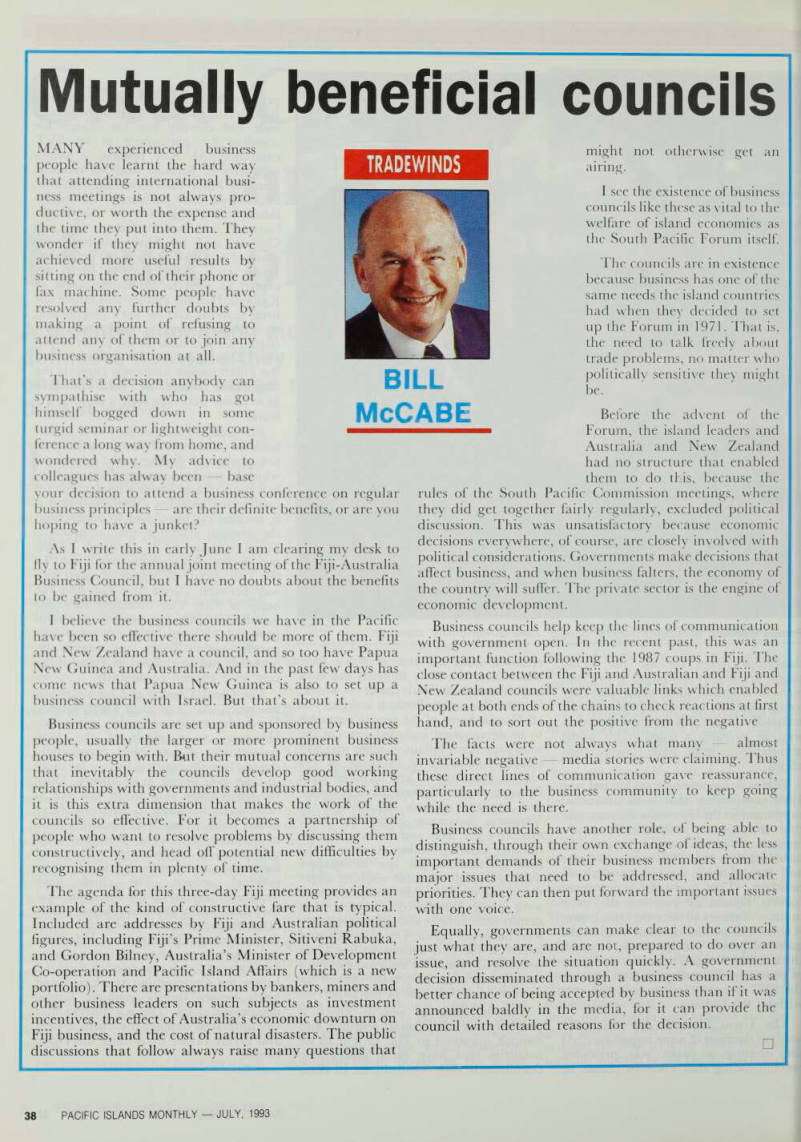
MANY experienced business people have learnt the hard way that attending international busi ness meetings is not always pro ductive, or worth the expense and the time they put into them. They wonder if they might not have achieved more useful results by sitting on the end of their phone or fax machine. Some people have resolved any further doubts by making a point of refusing to attend any of them or to join any business organisation at all.
That’s a decision anybody can sympathise with who has got himself bogged down in some turgid seminar or lightweight con ference a long way from home, and wondered why. My advice to colleagues has alway been base
your decision to attend a business conference on regular business principles are their definite benefits, or are you hoping to have a junket?
As I write this in early June I am clearing my desk to fly to Fiji for the annual joint meeting of the Fiji-Australia Business Council, but I have no doubts about the benefits to be gained from it. 1 believe the business councils we have in the Pacific have been so effective there should be more of them. Fiji and New Zealand have a council, and so too have Papua New Guinea and Australia. And in the past few days has come news that Papua New Guinea is also to set up a business council with Israel. But that’s about it.
Business councils are set up and sponsored by business people, usually the larger or more prominent business houses to begin with. But their mutual concerns are such that inevitably the councils develop good working relationships with governments and industrial bodies, and it is this extra dimension that makes the work of the councils so effective. For it becomes a partnership of people who want to resolve problems by discussing them constructively, and head off potential new difficulties by recognising them in plenty of time.
The agenda for this three-day Fiji meeting provides an example of the kind of constructive fare that is typical.
Included are addresses by Fiji and Australian political figures, including Fiji’s Prime Minister, Sitiveni Rabuka, and Gordon Bilney, Australia’s Minister of Development Co-operation and Pacific Island Affairs (which is a new portfolio). There are presentations by bankers, miners and other business leaders on such subjects as investment incentives, the effect of Australia’s economic downturn on Fiji business, and the cost of natural disasters. The public discussions that follow always raise many questions that
might not otherwise get an
airing.
I see the existence of business councils like these as vital to the welfare of island economies as the South Pacific Forum itself.
The councils are in existence because business has one of the same needs the island countries had when they decided to set up the Forum in 1971. That is, the need to talk freely about trade problems, no matter who
politically sensitive they might
be.
Before the advent of the Forum, the island leaders and Australia and New Zealand had no structure that enabled them to do this, because the
rules of the South Pacific Commission meetings, where they did get together fairly regularly, excluded political discussion. This was unsatisfactory because economic decisions everywhere, of course, are closely involved with political considerations. Governments make decisions that affect business, and when business falters, the economy of the country will suffer. The private sector is the engine of
economic development.
Business councils help keep the lines of communication with government open. In the recent past, this was an important function following the 1987 coups in Fiji. The close contact between the Fiji and Australian and Fiji and New Zealand councils were valuable links which enabled people at both ends of the chains to check reactions at first hand, and to sort out the positive from the negative The facts were not always what many almost invariable negative media stories were claiming. Thus these direct lines of communication gave reassurance, particularly to the business community to keep going while the need is there.
Business councils have another role, of being able to distinguish, through their own exchange of ideas, the less important demands of their business members from the major issues that need to be addressed, and allocate priorities. They can then put forward the important issues with one voice.
Equally, governments can make clear to the councils just what they are, and are not, prepared to do over an issue, and resolve the situation quickly. A government decision disseminated through a business council has a better chance of being accepted by business than if it was announced baldly in the media, for it can provide the council with detailed reasons for the decision.
Tradewinds
Bill
Mccabe
Advertisements & other items, pp. 39-40 (1 item)
(Programmes)
1
FORUM SECRETARIAT
VACANCY
DEPUTY SECRETARY GENERAL
(PROGRAMMES)
Applications are invited from suitably qualified and experienced persons, who must be nationals of a member state of the South Pacific Forum*, for the position of Deputy Secretary General (Programmes) with the Forum Secretariat.
The Forum Secretariat was established in 1973 by the South Pacific Forum to encourage economic and political cooperation between its member states, and between those states and the more industrialised countries. Under the control of a Secretary General, the Secretariat provides services to the Forum and undertakes activities in a number of areas; economic development, legal and political, civil aviation, energy, maritime telecommunications and trade. In pursuing these work programmes, the Secretariat works with a range of aid donor countries and organisations.
This executive position in the Forum Secretariat has substantial responsibilities for the provision of advice and guidance to multi-disciplinary staff on the analysis, implementation and evaluation of the Secretariat’s regional work programmes. The successful applicant, together with the Deputy Secretary General (Policy & Services), provides support to the Secretary General in his management of the Secretariat and in carrying out the mandates of the South Pacific Forum.
The Deputy Secretary General (Programmes) has specific oversight for staff involved in: regional trade and investment activities in particular in the areas of marketing, trade policy development and industry and investment; provision of technical assistance and advice to Forum Islands Countries on the development of their regional energy sectors; implementation of regional civil aviation and maritime development projects; assisting telecommunications development in FICs; and liaison with Forum member governments and with other governments and regional and international organisations.
The position requires leadership, managerial, advising, communication, representation and analytical skills and regional and international awareness. At least 10 years work experience covering all the above disciplines is required.
The appointment will carry an attractive remuneration package, payable in Fiji dollars. For non-Fiji citizens this is tax-free and includes housing and education and child allowances where eligible. Other benefits include payments in lieu of superannuation, and medical, life and travel insurance coverage. The appointee will be based at the Secretariat’s headquarters in Suva. The appointment will be for three years initially, and may be renewable for a further three year period.
Applications close on August 30, 1993. They should contain full information on education and career backgrounds and should give names, addresses and telephone numbers of at least three referees with whom the applicant has been associated professionally.
Applications should be addressed to: The Secretary General Forum Secretariat Box 856, Suva, Fiji Telephone 312-600 Telex: 2229 Fax: 302-204 Further information is available on request from Dr William Sutherland, Deputy Secretary General (Policy & Services) or Karen Sorby, Director, Administration Division. ♦Member states of the South Pacific Forum: Australia, Cook Islands, Federated States of Micronesia, Fiji, Kiribati, Nauru, New Zealam Niue, Papua New Guinea, Republic of the Marshall Islands, Solomon Islands, Tonga, Tuvalu, Vanuatu and Western Samoa.
We call it the
NEAX24OO SDS/SDS -VS
You'll call it your office miracle
NEC, the world leader in computers and communications.
Total Intergration It has now developed the new NEAX24OO SDS / SDS-VS that means total intergration of all your office automation equipment.
And that means higher productivity, cost savings, and better communications. pooling, expanded trunk and extension lines, interfacing, and many, many more applications that substantially increase your office possibilities
and efficiency.
Discover Discover the new NEAX24OO SDS / SDS - VS by contacting the Post & Telecom office nearest you.
Expandability Because it is modular it can be expanded as you grow and that means it can accommodate all your future office and communication needs Applications And that includes networking, modem The new NEAX24OO SDS. It does so much for you, we call it the office miracle.
FIJI POST AND
TELECOMMUNICATIONS
LIMITED
Providing answers that work for you Cmm i
Keeping the
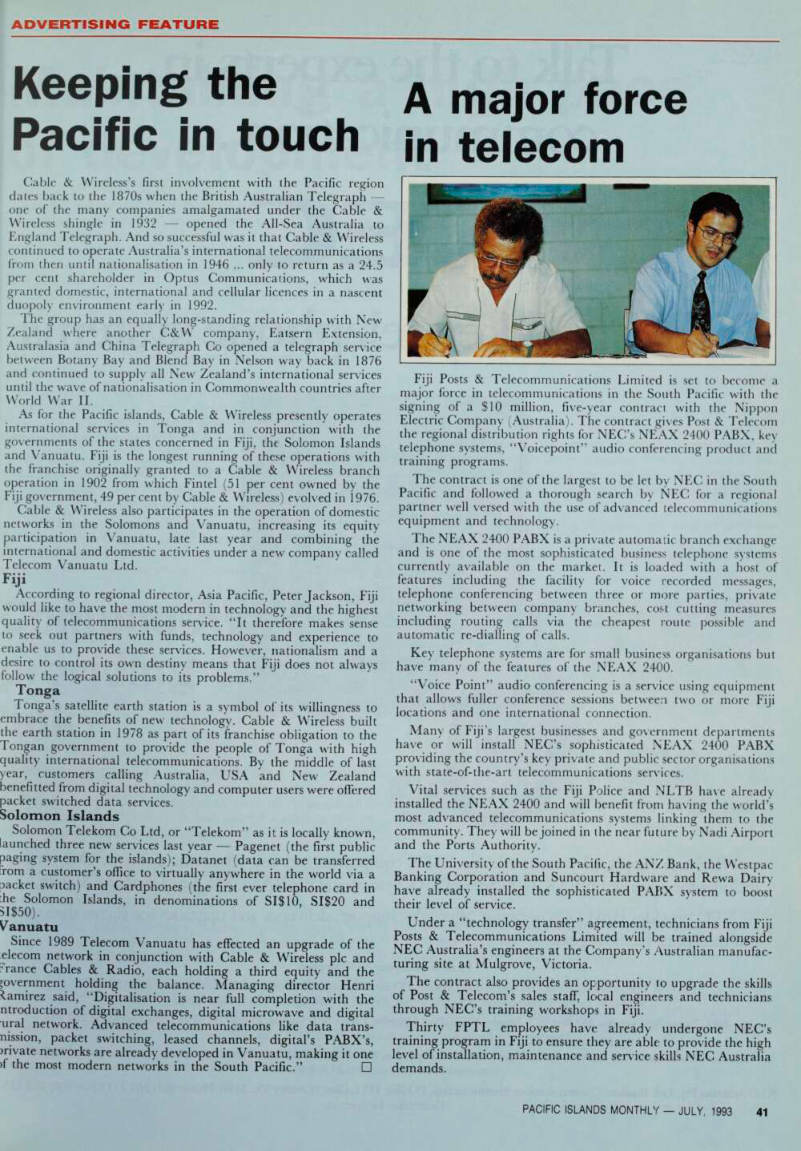
Advertising Feature
Keeping the Pacific in touch
Cable & Wireless’s first involvement with the Pacific region dates back to the 1870 s when the British Australian Telegraph one of the many companies amalgamated under the Cable & Wireless shingle in 1932 opened the All-Sea Australia to England Telegraph. And so successful was it that Cable & Wireless continued to operate Australia’s international telecommunications from then until nationalisation in 1946 ... only to return as a 24.5 per cent shareholder in Optus Communications, which was granted domestic, international and cellular licences in a nascent duopoly environment early in 1992.
The group has an equally long-standing relationship with New Zealand where another C&W company, Eatsern Extension, Australasia and China Telegraph Co opened a telegraph service between Botany Bay and Blend Bay in Nelson way back in 1876 and continued to supply all New Zealand’s international services until the wave of nationalisation in Commonwealth countries after World War 11.
As for the Pacific islands, Cable & Wireless presently operates international services in Tonga and in conjunction with the governments of the states concerned in Fiji, the Solomon Islands and Vanuatu. Fiji is the longest running of these operations with the franchise originally granted to a Cable & Wireless branch operation in 1902 from which Fintel (51 per cent owned by the Fiji government, 49 per cent by Cable & Wireless) evolved in 1976.
Cable & Wireless also participates in the operation of domestic networks in the Solomons and Vanuatu, increasing its equity participation in Vanuatu, late last year and combining the international and domestic activities under a new company called Telecom Vanuatu Ltd.
Fiji
According to regional director, Asia Pacific, Peter Jackson, Fiji would like to have the most modern in technology and the highest quality of telecommunications sendee. “It therefore makes sense to seek out partners with funds, technology and experience to enable us to provide these sendees. However, nationalism and a desire to control its own destiny means that Fiji does not always follow the logical solutions to its problems.”
Tonga
Tonga’s satellite earth station is a symbol of its willingness to embrace the benefits of new technology. Cable & Wireless built the earth station in 1978 as part of its franchise obligation to the Tongan government to provide the people of Tonga with high quality international telecommunications. By the middle of last year, customers calling Australia, USA and New Zealand benefitted from digital technology and computer users were offered packet switched data services.
Solomon Islands Solomon Telekom Co Ltd, or “Telekom” as it is locally known, launched three new services last year Pagenet (the first public paging system for the islands); Elatanet (data can be transferred rom a customer’s office to virtually anywhere in the world via a racket switch) and Cardphones (the first ever telephone card in :he Solomon Islands, in denominations of SIS 10, SIS2O and 51550).
Vanuatu Since 1989 Telecom Vanuatu has effected an upgrade of the Hecom network in conjunction with Cable & Wireless pic and "ranee Cables & Radio, each holding a third equity and the government holding the balance. Managing director Henri Ramirez said, “Digitalisation is near full completion with the ntroduction of digital exchanges, digital microwave and digital ural network. Advanced telecommunications like data trans nission, packet switching, leased channels, digital’s PABX’s, irivate networks are already developed in Vanuatu, making it one )f the most modern networks in the South Pacific.” □
A major force
in telecom
Fiji Posts & Telecommunications Limited is set to become a major force in telecommunications in the South Pacific with the signing of a $lO million, five-year contract with the Nippon Electric Company (Australia), The contract gives Post & Telecom the regional distribution rights for NEC’s NEAX 2400 PABX, key telephone systems, “Voicepoint” audio conferencing product and training programs.
The contract is one of the largest to be let by NEC in the South Pacific and followed a thorough search by NEC for a regional partner well versed with the use of advanced telecommunications equipment and technology.
The NEAX 2400 PABX is a private automatic branch exchange and is one of the most sophisticated business telephone systems currently available on the market. It is loaded with a host of features including the facility for voice recorded messages, telephone conferencing between three or more parties, private networking between company branches, cost cutting measures including routing calls via the cheapest route possible and automatic re-dialling of calls.
Key telephone systems are for small business organisations but have many of the features of the NEAX 2400.
“Voice Point” audio conferencing is a service using equipment that allows fuller conference sessions between two or more Fiji locations and one international connection.
Many of Fiji's largest businesses and government departments have or will install NEC’s sophisticated NEAX 2400 PABX providing the country’s key private and public sector organisations with state-of-the-art telecommunications services.
Vital services such as the Fiji Police and NLTB have already installed the NEAX 2400 and will benefit from having the world’s most advanced telecommunications systems linking them to the community. They will be joined in the near future by Nadi Airport and the Ports Authority.
The University of the South Pacific, the ANZ Bank, the Westpac Banking Corporation and Suncourt Hardware and Rewa Dairy have already installed the sophisticated PABX system to boost their level of service.
Under a “technology transfer” agreement, technicians from Fiji Posts & Telecommunications Limited will be trained alongside NEC Australia’s engineers at the Company's Australian manufac turing site at Mulgrove, Victoria.
The contract also provides an opportunity to upgrade the skills of Post & Telecom’s sales staff, local engineers and technicians
through NEC’s training workshops in Fiji.
Thirty FPTL employees have already undergone NEC’s training program in Fiji to ensure they are able to provide the high level of installation, maintenance and service skills NEC Australia demands.
Advertisements & other items, p. 42 (1 item)
PABX and key telephone systems
Talk to the experts in
communication...
'lyp
j
NEC]
NERX 24'00' .
IH-LiS* u i 205 i icm i msg ' □ d □ cm cm tm> LjKttUW*. m mm mm mm ma Ml 1 IL.CPU I B4R 1 LNR 1 CFALCPNiCPB [ACS VCL HbE3 cmim cm cm cm rm- Imi lm 3 \ a* i-i • i-' i • cn. cm* i * i • i i • cm* cm* cm>
WAYNE
•■cm* ■ rn •.CD •.cm
tHANK
BILL , ,
wa< •cm smew , vioa
PBTHt
SUB
•.cm rn
AO.TS ;•
AEHIN
SALE • f““)
wens j jsg«.*.cm % NEC can supply all your needs for PABX equipment and key telephone systems. Our range includes the advanced NEAX 2400 Series PABX System and the RANGER Key Telephone System.
NEC provides rapid sales response, after sales support, deliveries and upgrades for clients through-
out the South Pacific region.
Please contact your NEC supplier: Fiji Post Telecommunications Ltd. Marketing Division, PO Box 40, Suva Fiji. Phone: (679) 210 600 Fax: (679) 210 493.
Distributors for Fiji, Vanuatu, Western Samoa, Tonga, Kiribati, Tuvalu, Niue, Wallis & Futuna, New Caledonia.
NEC Papua New Guinea. PO Box 937, Boroko NCD, Port Moresby, Papau New Guinea. Phone: (675) 252 644 Fax: (675) 252 948.
Distributors for Papua New Guinea, Solomon Islands, Micronesia and Naum.
Telecom New Zealand Ltd. Business System Sales, 15 Lady Ruby Drive, East Tamaki, Auckland. Phone: (649) 274 3000 Fax: (649) 274 1999.
Distributors for New Zealand and Cook Islands.
NEC Australia Pty. Ltd. Business Communications Systems Group, PO Box 1111, Glen Waverley Vic, 3150. Phone: (03) 262 1111 Fax: (03) 262 1333.
Distributors for Australia.
of development

Maintaining a high pace of development
Vanitel was created in 1978 to take over all international telecommunications of Vanuatu. Since then this new joint venture has embarked in a completed renovation of the national network. In July 1990 a new digital telephone exchange was installed in Port Vila with a first capacity of4ooo lines extendable to 10,000. In May 1991 we commissioned the digital microwave (34 mbits) between Port Vila and Luganville linking, with the latest technology, the islands of Efate, Emae, Epi, Ambrym, Malekula and Santo. At the same time Luganville was equipped with its digital telephone exchange.
The line plants of Port Vila and Luganville have been upgraded and extended.
From there a digital rural network (TRT) was being implemented in South Santo, Central Malekula and South Efate. This was the first plan of development of the new joint venture and cost more than 1.2 billion vatu.
Also a new dish “Standard A” was installed and a new technology was introduced with the IDR carrier with Australia. This will increase the capacity of the earth station facilitating the growth in traffic.
In 1992 negotiations between the government of Vanuatu, Cable and Wireless Pic. and France Cables et Radio were successfully achieved with the merger on December 1, 1992 of the two previous companies, Vanitel Ltd and National
Telecommunications of Vanuatu Ltd. The new company now fully in charge of all telecommunications in Vanuatu is Telecom Vanuatu Limited.
Development plan N 0.2 has been launched with loan agreements between Caisse Francaise de Developpement, the government of Vanuatu and Telecom Vanuatu Limited. These loans for a total amount of 11 million FF are one part of a project for development for rural areas with the extension of the digital rural networks towards all islands for a three-year period and an investment program of 25 million FF. Connected to this digital rural network communities, Phonecards will be sold by local government councils, private shops or coasting vessels.
Since its inception in 1989 and with the help of the shareholders in Vanitel Ltd, Telecom Vanuatu Ltd has been able to bring modern telecommunications at a very high pace to give to the customers the best service. This success could not have been achieved without the good relations between the government of Vanuatu, Cable and Wireless Pic, and France Cables et Radio.
The government, by its decision to totally privatise telecommunications in Vanuatu, has shown the strong confidence it has in Cable and Wireless Pic. and France Cables et Radio.
Compac-AWA
providing the link
Communications Pacific Ltd, formerly AWA New Zealand continues to be intimately involved in telecommunication levelopments in Fiji. Previously, as part of Amalgamated /Vireless Australasia (AWA), it had played a leading role in he communications field helping to meet the needs of the
ociety.
Today Compac-AWA supplies, installs and provides techni al services to Communications Fiji Ltd (radio stations FM96
md Navtarang).
In aviation, fishing, forestry, marine, public works and ransport, tourism and the rural areas, Compac-AWA is ontributing daily to Fiji’s progress.
Over the last decade, Compac-AWA has expanded mobile adio coverage and services for commercial and rural users, •hortly the company is to embark on a major project of itroducing radio mobile-phone services to the cellular system.
According to Compac-AWA’s managing director, Harry
*owell, telecommunications today has ceased to be a luxury
and become a necessity for development. “As we approach the 21st century, telecommunication will play a vital role in bringing nations and people closer together, fostering better
relations, avoiding misunderstandings.
“Many lives throughout the world are saved daily through innovative emergency services via radio and satellite. The benefits of telecommunication in human development are numerous; therefore, to be a part of the industry, challenging as it may see, is very much a privilege.”
Advertisements & other items, p. 44 (1 item)
Dama
Switch on to DAM A-NET, the digital update of
the familiar PACT Network
DAMA-NET will improve regional telecommunications and business services b providing: - quiet and echo free digital connections - full speed fax transmission - high quality 14.4 KBits/second in-band data transfer.
DAMA-NET will be provided in the South Pacific in association with the followin administrations: Telstra Australia, Telecom Cook Islands, Fintel Fiji, TSKL Kiribati, Marshall Islands, Nauru Telecom, Telecom New Zealand International, Telecom Niue, PTC Papua New Guinea, Solomon Telekom and Telecom Tuvalu.
Australian enquiries can be directed to Graham Huddy, Business Manager DAMA Networks Telstra, Telephone +612 287 4320 or facsimile +612 287 5507.
OTC AUSTRALIA
digital
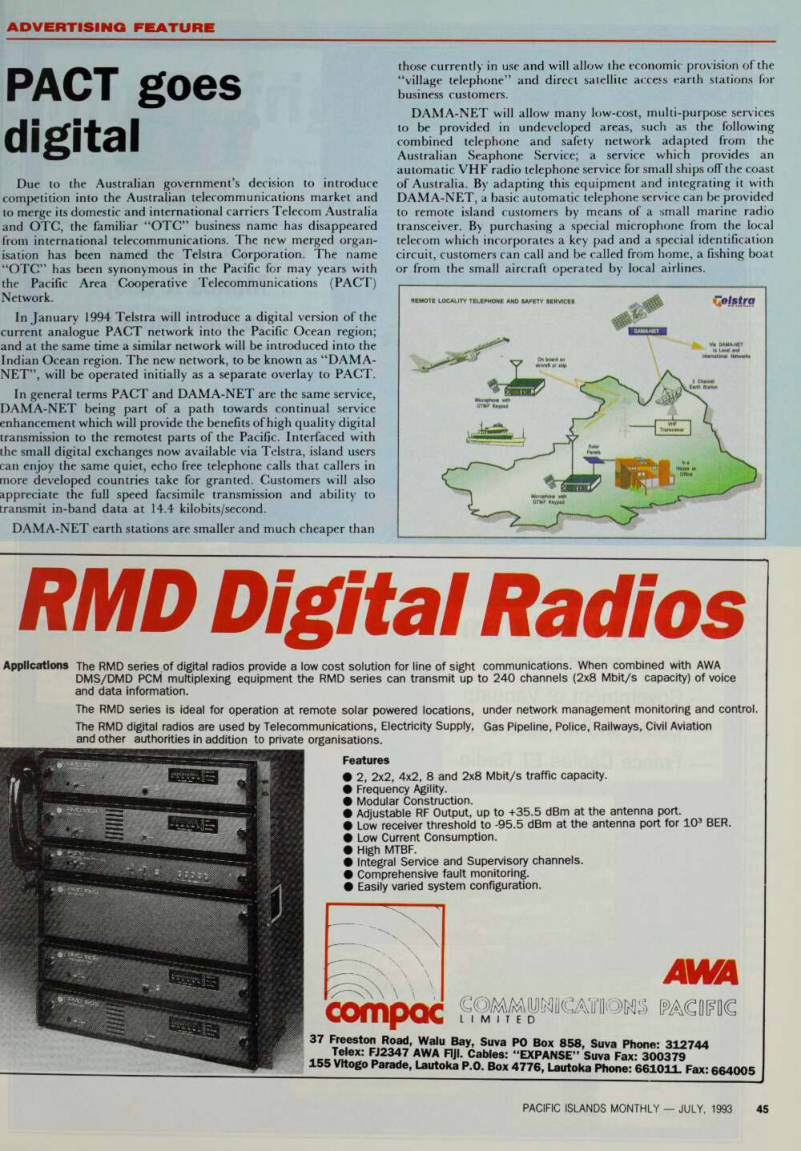
PACT goes digital
Due to the Australian government’s decision to introduce competition into the Australian telecommunications market and to merge its domestic and international carriers Telecom Australia and OTC, the familiar “OTC” business name has disappeared from international telecommunications. The new merged organ isation has been named the Telstra Corporation. The name “OTC” has been synonymous in the Pacific for may years with the Pacific Area Cooperative Telecommunications (PACT) Network.
In January 1994 Telstra will introduce a digital version of the current analogue PACT network into the Pacific Ocean region; and at the same time a similar network will be introduced into the Indian Ocean region. The new network, to be known as “DAMA NET”, will be operated initially as a separate overlay to PACT.
In general terms PACT and DAMA-NET are the same service, DAMA-NET being part of a path towards continual service enhancement which will provide the benefits of high quality digital transmission to the remotest parts of the Pacific. Interfaced with the small digital exchanges now available via Telstra, island users can enjoy the same quiet, echo free telephone calls that callers in more developed countries take for granted. Customers will also appreciate the full speed facsimile transmission and ability to transmit in-band data at 14.4 kilobits/second.
DAMA-NET earth stations are smaller and much cheaper than
those currently in use and will allow the economic provision of the “village telephone” and direct satellite access earth stations for business customers.
DAMA-NET will allow many low-cost, multi-purpose services to be provided in undeveloped areas, such as the following combined telephone and safety network adapted from the Australian Seaphone Service; a service which provides an automatic VHF radio telephone service for small ships off the coast of Australia. By adapting this equipment and integrating it with DAMA-NET, a basic automatic telephone sendee can be provided to remote island customers by means of a small marine radio transceiver. By purchasing a special microphone from the local telecom which incorporates a key pad and a special identification circuit, customers can call and be called from home, a fishing boat or from the small aircraft operated by local airlines.
Advertisements & other items, pp. 45-46 (1 item)
RMD Digital Radios
Applications The RMD series,of digital radios provide a low cost solution for line of sight communications. When combined with AWA DMS/DMD PCM multiplexing equipment the RMD series can transmit up to 240 channels (2xB Mbit/s capacity) of voice and data information.
The RMD series is ideal for operation at remote solar powered locations, under network management monitoring and control.
The RMD digital radios are used by Telecommunications, Electricity Supply, Gas Pipeline, Police, Railways, Civil Aviation and other authorities in addition to private organisations.
Features • 2, 2x2, 4x2, 8 and 2xB Mbit/s traffic capacity. • Frequency Agility. • Modular Construction. • Adjustable RF Output, up to +35.5 dßm at the antenna port. • Low receiver threshold to -95.5 dßm at the antenna port for 10 3 BER. • Low Current Consumption. • High MTBF. • Integral Service and Supervisory channels. • Comprehensive fault monitoring. • Easily varied system configuration.
AWA
compete
7Mi/M. limited’
IS ,D
37 Freeston Road, Walu Bay, Suva PO Box 858, Suva Phone: 312744 «cT/tl eX: 2347 AWA n J L Cables: “EXPANSE” Suva Fax: 300379 155 Vrtogo Parade, Lautoka P.O. Box 4776, Lautoka Phone: 661011. Fax: 664005
.juiui l
TELECOM VMUATC LTD
a joint venture between Government of Vanuatu Cable and wireless PLC France Cables ET Radio • e ■ I. ■ , mwm
Telecom Vanuatu Ltd
Makes it Easy
to Call Home!
> S> 3* 4
Simply frightening stuff
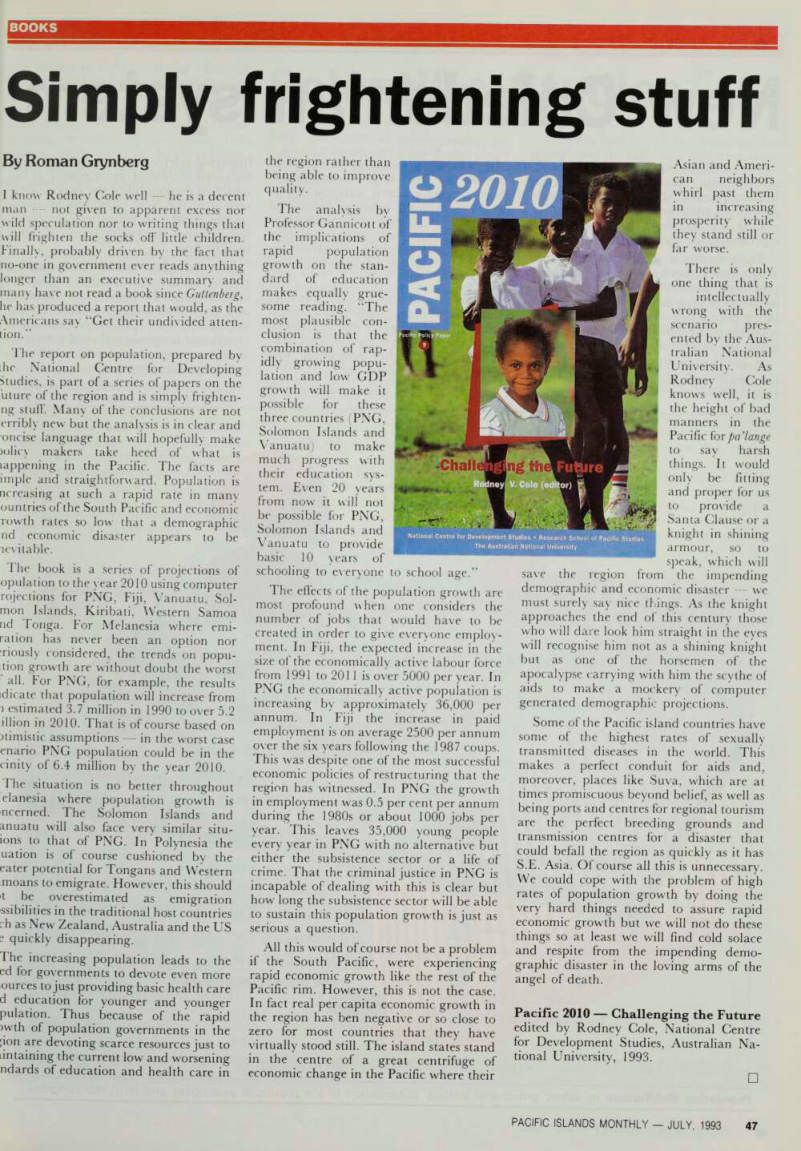
Ibooks
By Roman Grynberg
I know Rodney Cole well he is a decent man not given to apparent excess nor wild speculation nor to writing things that will frighten the socks off little children.
Finally, probably driven by the fact that no-one in government ever reads anything longer than an executive summary and many have not read a book since Gutlenberg, he has produced a report that would, as the Americans say “Get their undivided atten tion."
The report on population, prepared by he National Centre for Developing Studies, is part of a series of papers on the ulure of the region and is simply frighten ng stuff. Many of the conclusions are not erribly new but the analysis is in clear and oncise language that will hopefully make )olicy makers take heed of what is lappening in the Pacific. The facts arc implc and straightforward. Population is ncreasing at such a rapid rate in many ountrics of the South Pacific and economic rowth rates so low that a demographic nd economic disaster appears to be levilable.
The book is a series of projections of opulation to the year 2010 using computer rejections for PNG, Fiji, Vanuatu, Sol mon Islands, Kiribati, Western Samoa nd Tonga. For Melanesia where emi ration has never been an option nor riously considered, the trends on popu lion growth are without doubt the worst all. For PNG, for example, the results dicate that population will increase from i estimated 3.7 million in 1990 to over 5.2 illion in 2010. That is of course based on nimistic assumptions in the worst case enario PNG population could be in the cinity of 6.4 million by the year 2010.
The situation is no better throughout elanesia where population growth is ncerned. The Solomon Islands and anuatu will also face very similar situ ions to that of PNG. In Polynesia the uation is of course cushioned by the eater potential for Tongans and Western moans to emigrate. However, this should t be overestimated as emigration ssibilities in the traditional host countries :h as New Zealand, Australia and the US
quickly disappearing.
The increasing population leads to the ed for governments to devote even more ources to just providing basic health care d education for younger and younger pulation. Thus because of the rapid )wth of population governments in the are devoting scarce resources just to tintaining the current low and worsening ndards of education and health care in
the region rather than being able to improve quality.
The analysis by Professor Gannicott of the implications of rapid population growth on the stan dard of education makes equally grue some reading. “The most plausible con clusion is that the combination of rap idly growing popu lation and low GDP growth will make it possible for these three countries (PNG, Solomon Islands and Vanuatu) to make much progress with their education sys tem. Even 20 years from now it will not be possible for PNG, Solomon Islands and Vanuatu to provide basic 10 years of
schooling to everyone to school age.”
The effects of the population growth are most profound when one considers the number of jobs that would have to be created in order to give everyone employ ment. In Fiji, the expected increase in the size of the economically active labour force from 1991 to 2011 is over 5000 per year. In PNG the economically active population is increasing by approximately 36,000 per annum. In Fiji the increase in paid employment is on average 2500 per annum over the six years following the 1987 coups.
This was despite one of the most successful economic policies of restructuring that the region has witnessed. In PNG the growth in employment was 0.5 per cent per annum during the 1980 s or about 1000 jobs per year. This leaves 35,000 young people every year in PNG with no alternative but either the subsistence sector or a life of crime. That the criminal justice in PNG is incapable of dealing with this is clear but how long the subsistence sector will be able to sustain this population growth is just as serious a question.
All this would of course not be a problem if the South Pacific, were experiencing rapid economic growth like the rest of the Pacific rim. However, this is not the case.
In fact real per capita economic growth in the region has ben negative or so close to zero for most countries that they have virtually stood still. The island states stand in the centre of a great centrifuge of economic change in the Pacific where their
Asian and Ameri can neighbors whirl past them in increasing prosperity while they stand still or far worse.
There is only one thing that is
intellectually
wrong with the scenario pres ented by the Aus tralian National
University. As
Rodney Cole knows well, it is the height of bad manners in the Pacific for pa'lange to say harsh things. It would only be fitting and proper for us to provide a Santa Clause or a knight in shining armour, so to speak, which will
save the region from the impending demographic and economic disaster we must surely say nice things. As the knight approaches the end of this century those who will dare look him straight in the eyes will recognise him not as a shining knight but as one of the horsemen of the apocalypse carrying with him the scythe of aids to make a mockery of computer generated demographic projections.
Some of the Pacific island countries have some of the highest rates of sexually transmitted diseases in the world. This makes a perfect conduit for aids and, moreover, places like Suva, which are at times promiscuous beyond belief, as well as being ports and centres for regional tourism are the perfect breeding grounds and transmission centres for a disaster that could befall the region as quickly as it has S.E. Asia. Of course all this is unnecessary.
We could cope with the problem of high rates of population growth by doing the very hard things needed to assure rapid economic growth but we will not do these things so at least we will find cold solace and respite from the impending demo graphic disaster in the loving arms of the angel of death.
Pacific 2010 Challenging the Future edited by Rodney Cole, National Centre for Development Studies, Australian Na tional University, 1993.
New Caledonian system
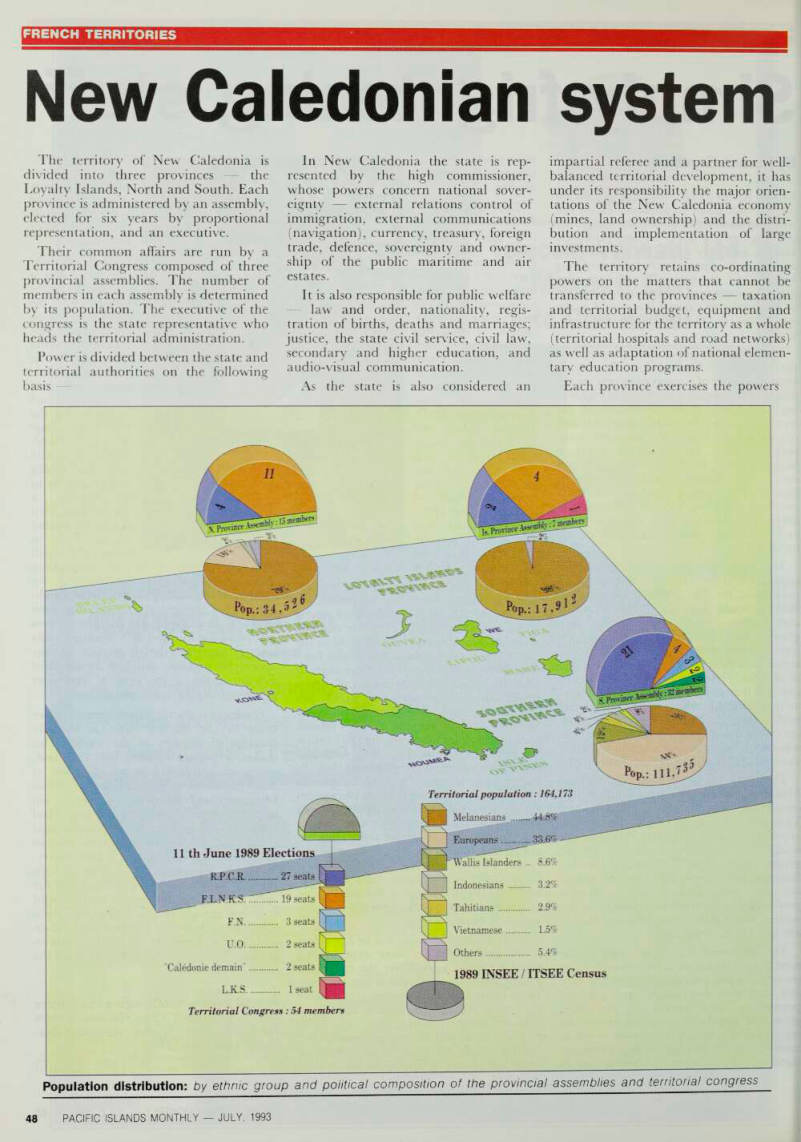

French Territories
The territory of New Caledonia is divided into three provinces the Loyalty Islands, North and South. Each province is administered by an assembly, elected for six years by proportional representation, and an executive.
Their common affairs are run by a Territorial Congress composed of three provincial assemblies. The number of members in each assembly is determined by its population. The executive of the congress is the state representative who heads the territorial administration.
Power is divided between the state and territorial authorities on the following basis
In New Caledonia the state is rep resented by the high commissioner, whose powers concern national sover eignty external relations control of immigration, external communications (navigation), currency, treasury, foreign trade, defence, sovereignty and owner ship of the public maritime and air estates.
It is also responsible for public welfare law and order, nationality, regis tration of births, deaths and marriages; justice, the state civil service, civil law, secondary and higher education, and audio-visual communication.
As the state is also considered an
impartial referee and a partner for well balanced territorial development, it has under its responsibility the major orien tations of the New Caledonia economy (mines, land ownership) and the distri bution and implementation of large investments.
The territory retains co-ordinating powers on the matters that cannot be transferred to the provinces taxation and territorial budget, equipment and infrastructure for the territory as a whole
(territorial hospitals and road networks)
as well as adaptation of national elemen tary education programs.
Each province exercises the powers
Population distribution: by ethnic group and political composition of the provincial assemblies and territorial congress
that do not lie either with the state, the territory or the “communes”, in particular provincial budget, provincial development blueprints and related in frastructure, economic development, training, teaching of vernacular languages, promotion of local cultures, health and social policy, support of the communes for elementary education, youth, sport and leisure, cultural activities, land reform and land planning.
Consultative organs the provincial customary consultative council is made up of the major chiefs of the province’s customary areas. It is consulted by the Provincial council on draft or proposed resolutions concerning special civil law and landownership issues. It may be consulted on any other matters on the initiative of the president of the province, vs ho, also on Ins own initiative, can refer any question or proposal concerning the special civil law statute or the Melanesian land reserve statute to the arovincu.l council.
The Economic and Social Committee *m bodies thc private sector (professional jroups, trade unions, womens’, youth md rural associations). It gives consultaive advice on the cultural, economic or ocial bills submitted by the congress, the irovmcial customary consultative counil and the high commissioner. □
Scientific Studies
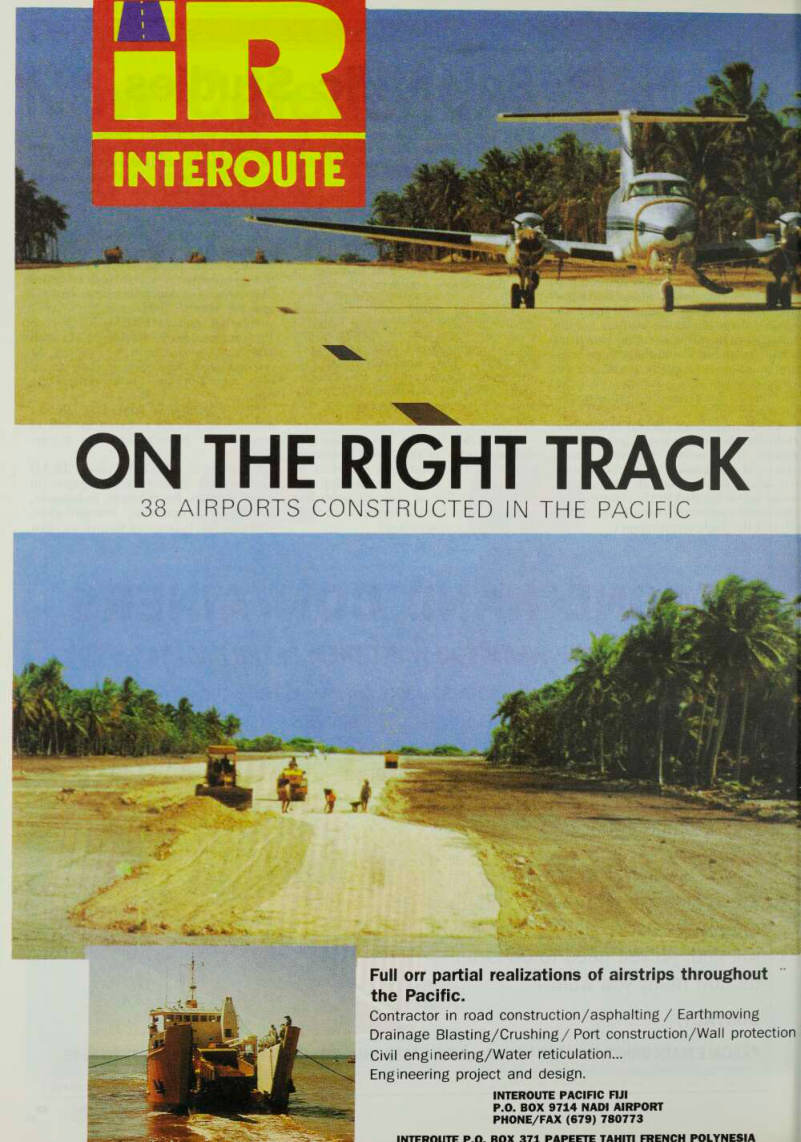
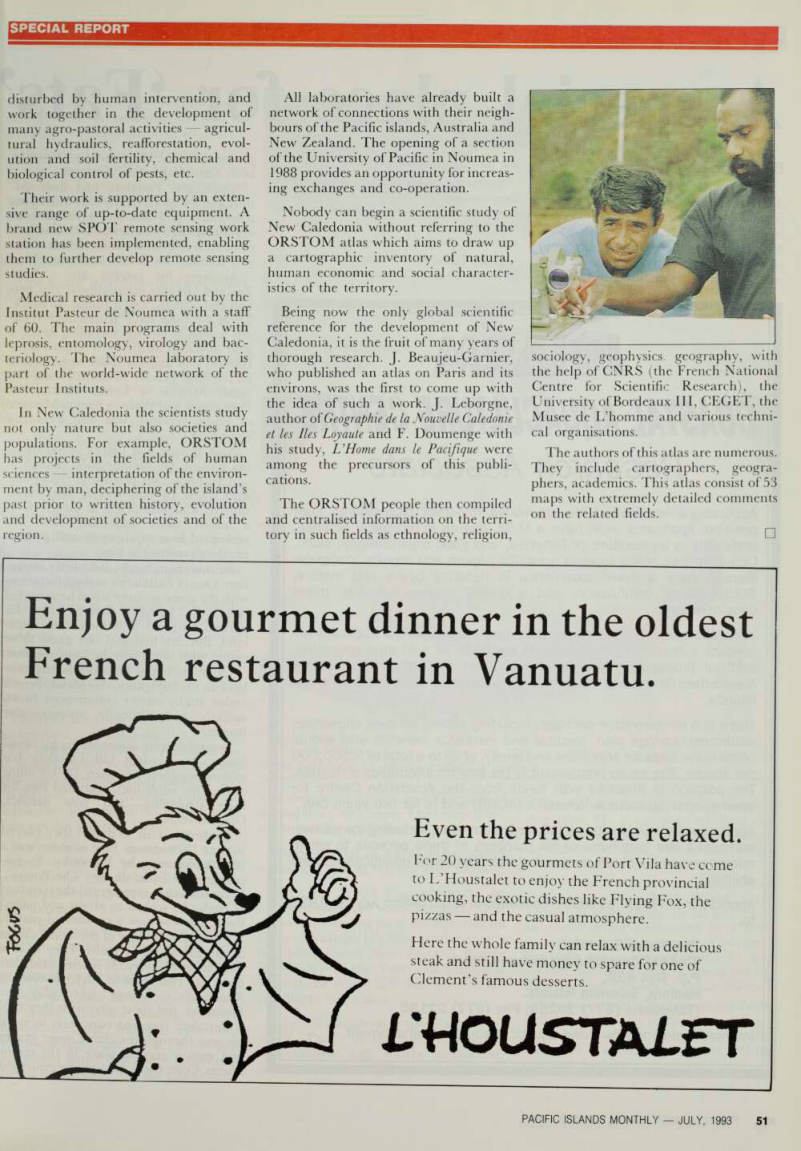
Special Report
THE specialities of oceanography, ge- °logy and geophysics form the backbone °f French scientific activities in New Caledonia.
ORSTOM, the French Institute of Scientific Research for Development through Co-operation, created its Oceanographic Department in Noumea more than 30 years ago. It now employs more than 50 people and manages its own fl ee t G f f our oceanographic vessels Q . .. / . ' Studies have supplied information on * e Physical and biological environment ° ■ NT ™ a " ne . regi °", p Pread p' r n ™/ P n. and p cn , ch I‘J • f , , kno * l( j d ge of this ecosystem has been applied, lor example, to tuna Fishing, and is more generally to lncrease Productivity of the
waters -
ORSTOM is also conducting an extensive study of thc New Caledonian lagoon, and is building a model of its functioning in order to develop an environment free of ciguatera poisoning resulting from human ingestion of flesh that contains ciguatoxin.
Other scientists are investigating the resources of the high seas, and work with meteorologists to understand the re lationship between ocean and climate, Thc first that the geologists and geophysists had was the mapping of the oc ean floor, using the bathymetric sys tem - They have now developed an extensive knowledge of the geological history of the South Pacific, and carry out cooperative research with scientists from Oceania, Australia, New Zealand anc t j ie United States, Another bodv IFREMFR (French Institute for Marine Research) has built and run a prawn farm, continuing the research and development done in its other laboratory at Tahiti, French Poly nesja New Caledonian land also offers a unique domain for research as well as considerable opportunities for cxploi tation.
Scientists of ORSTOM and CIRAD (agricultural studies) arc engaged in many projects, for example, pedologists
hydrologists, botanists, entomologists’
studying thc balance of nature so often
disturbed by human intervention, and work together in the development of
many agro-pastoral activities agricul
tural hydraulics, reafforestation, evol ution and soil fertility, chemical and biological control of pests, etc.
Their work is supported by an exten sive range of up-to-date equipment. A brand new SPOT remote sensing work station has been implemented, enabling them to further develop remote sensing studies.
Medical research is carried out by the Institut Pasteur de Noumea with a staff of 60. The main programs deal with
leprosis, entomology, virology and bac
teriology. The Noumea laboratory is part of the world-wide network of the Pasteur Instituts.
In New Caledonia the scientists study not only nature but also societies and
populations. For example, ORSTOM
has projects in the fields of human sciences interpretation of the environ ment by man, deciphering of the island’s past prior to written history, evolution and development of societies and of the
region.
All laboratories have already built a network of connections with their neigh bours of the Pacific islands, Australia and New Zealand. The opening of a section of the University of Pacific in Noumea in 1988 provides an opportunity for increas ing exchanges and co-operation.
Nobody can begin a scientific study of New Caledonia without referring to the ORSTOM atlas which aims to draw up a cartographic inventory of natural, human economic and social character istics of the territory.
Being now the only global scientific reference for the development of New Caledonia, it is the fruit of many years of thorough research. J. Beaujeu-Garnier, who published an atlas on Paris and its environs, was the first to come up with the idea of such a work. J. Leborgne, author of Geographic de la Nouvelle Caledonie et les lies Loyaute and F. Doumenge with his study, L’Home dans le Pacifique were among the precursors of this publi cations.
The ORSTOM people then compiled and centralised information on the terri tory in such fields as ethnology, religion,
sociology, geophysics, geography, with the help of CNRS (the French National Centre for Scientific Research), the University ofßordeaux 111, CEGET, the Musee de L’homme and various techni cal organisations.
The authors of this atlas are numerous.
They include cartographers, geogra phers, academics. This atlas consist of 53 maps with extremely detailed comments on the related fields.
Advertisements & other items, pp. 49-51 (1 item)
Second Hand Containers
WHERE AND WHEN YOU WANT THEM IN THE PACIFIC If you need a flexible and safe storage space we have the ideal solution for you. Our second h; provide instant secure storage. Guai to be wind and waterproof these cor are ideal for both temporary and lon term storage in Pacific conditions. rates have got to be the lowest you will find. All you need to do is tell us how many you want.
CONTACT:
PASCALE MARCONNET, BP 4767 NOUMEA, NEW CALEDONIA. TEL: (687) 28 7450. FAX: (687) 26 3248 We can deliver to any island in the Pacific within a month and our
ON THE RIGHT TRACK
38 AIRPORTS CONSTRUCTED IN THE PACIFIC
.I - •* ww 4.'
J.A . I
Full orr partial realizations of airstrips throughout the Pacific.
Contractor in road construction/asphalting / Earthmoving Drainage Blasting/Crushing/Port construction/Wall protection Civil engineering/Water reticulation...
Engineering project and design.
INTEROUTE PACIFIC FIJI
P.O. BOX 9714 NADI AIRPORT
PHONE/FAX (679) 780773
INTEROUTE P.O. BOX 371 PAPEETE TAHITI FRENCH POLYNESIA
Enjoy a gourmet dinner in the oldest
French restaurant in Vanuatu.
ft IS K V Even the prices are relaxed.
For 20 years the gourmets of Port Vila have come to L Houstalet to enjoy the French provincial cooking, the exotic dishes like Flying Fox, the pizzas and the casual atmosphere.
Here the whole family can relax with a delicious steak and still have money to spare for one of Clement’s famous desserts.
I'HousTAirr
A special place for ‘Fats’
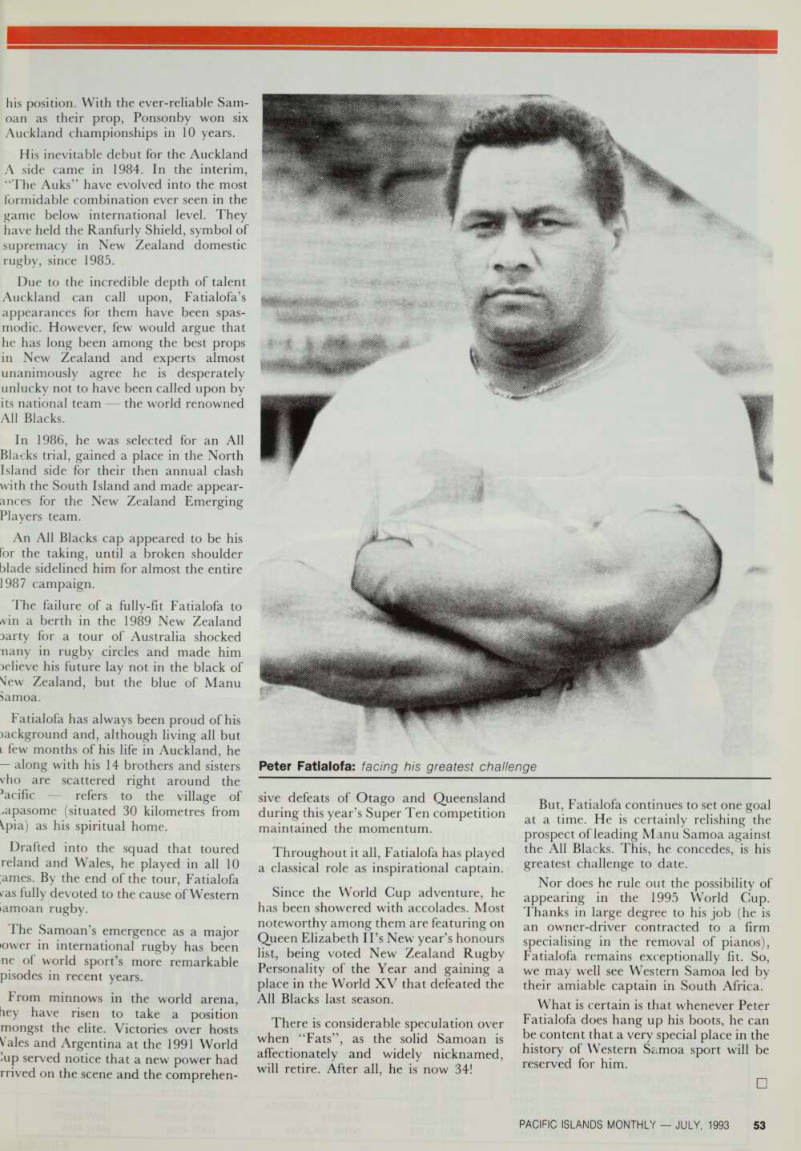
Sports
By Atama Raganivatu
THE astonishing march of Western Samoan rugby reaches another milestone in July when the national team, Manu Samoa, embarks upon a nine-match tour of New Zealand. This culminates in a test match against the mighty All Blacks on
the month’s last day.
Barring a major mishap, the Western Samoans will be led on to Eden Park by a man who, in the eyes of millions throughout the world, has come to epitomise the spirit of his nation, Peter Fatialofa is recognised instantly in every country where rugby union is
played seriously. He is a revered figure in both Samoa and New Zealand.
Amazingly, Fatialofa had little en thusiasm for sports of any type during his schooldays and did not participate in organised rugby until age 20. This lack of interest is even more incredible when you consider his family background.
Amongst his cousins are a New Zealand “double international” (at net ball and softball) and a Junior All Black.
Three brothers have represented West ern Samoa at boxing (including Senio, a gold medallist at the 1973 South Pacific Games) and another made appearances for the Kiwi’s under-13 softball team. His father Momoe, a former Member of Parliament and Western Samoa Minister of Postal services, was also a boxing
champion.
And, boxing was Peter’s initial sport ing pursuit. He became good enough to win an important provincial champion ship when 16 but, shortly afterwards, suffered a painful defeat at the gloves of a much older opponent and this prompted him to abruptly and perma nently abandon the ring.
At this stage, rugby held little attrac tion. One of Fatialofa’s earliest flirtations with the game occured when he attended
Apia’s St. Joseph’s College, after his
parents returned to Samoa from Auck land. But, his first and last game there ended with him being laid unconscious.
Later, with the Fatialofa family now back in his birthplace, Auckland, Peter’s senior rugby career commenced in an
unlikely and distinctly unspectacular
manner.
Several friends, impressed by his broad frame (the six-foot tall Fatialofa has seldom weighed less than 18 1/2 stone during his adult life), recruited him for their struggling, and now defunct, Grafton team.
Grafton lost all 19 games they played in that 1979 season. One of these was a 56-0 hammering by Ponsonby. So im pressed was Fatialofa by “The Ponies”, he decided they represented the standard of rugby he wished to attain and joined them. He was now a committed player.
Ponsonby are now of the world’s most distinguished rugby clubs. They have a magnificent history. It is often said that there are two types of rugby players in Auckland those who play for Ponsonby and those who wish they did!
Fatialofa required two years to work his way through the club’s lower grades and gain a regular place in the senior fifteen. Once there, though, he cemented
his position. With the ever-reliable Sam oan as their prop, Ponsonby won six Auckland championships in 10 years.
His inevitable debut for the Auckland A side came in 1984. In the interim, “The Auks” have evolved into the most formidable combination ever seen in the game below international level. They have held the Ranfurly Shield, symbol of supremacy in New Zealand domestic rugby, since 1985.
Due to the incredible depth of talent Auckland can call upon, Fatialofa’s appearances for them have been spas modic. However, few would argue that he has long been among the best props in New Zealand and experts almost unanimously agree he is desperately unlucky not to have been called upon by its national team the world renowned All Blacks.
In 1986, he was selected for an All Blacks trial, gained a place in the North Island side for their then annual clash with the South Island and made appear ances for the New Zealand Emerging Players team.
An All Blacks cap appeared to be his for the taking, until a broken shoulder blade sidelined him for almost the entire
1987 campaign.
The failure of a fully-fit Fatialofa to .vin a berth in the 1989 New Zealand aarty for a tour of Australia shocked nany in rugby circles and made him aelieve his future lay not in the black of Vew Zealand, but the blue of Manu iamoa.
Fatialofa has always been proud of his
)ackground and, although living all but
i few months of his life in Auckland, he along with his 14 brothers and sisters vho are scattered right around the — refers to the village of .apasome (situated 30 kilometres from as his spiritual home.
Drafted into the squad that toured reland and Wales, he played in all 10 ;ames. By the end of the tour, Fatialofa fully devoted to the cause of Western iamoan rugby.
The Samoan’s emergence as a major •ower in international rugby has been ne of world sport’s more remarkable pisodes in recent years.
From minnows in the world arena, bey have risen to take a position mongst the elite. Victories over hosts Vales and Argentina at the 1991 World lup served notice that a new power had rrived on the scene and the comprehen-
s.ve defeats of Otago and Queensland during this year s Super Ten competition maintained the momentum.
Throughout it all, Fatialofa has played a classical role as inspirational captain. , , Since the World Cup adventure, he has been showered with accolades. Most noteworthy among them are featuring on Queen Elizabeth IPs New year’s honours list, being voted New Zealand Rugby Personality of the Year and gaining a place in the World XV that defeated the All Blacks last season.
There is considerable speculation over when “Fats”, as the solid Samoan is affectionately and widely nicknamed, will retire. After all, he is now 34!
g Fatia|ofa continues t 0 set one a| a( a time H e is certainly relishing the prospect of leading Manu Samoa against t^le Blacks. This, he concedes, is his greatest challenge to date.
Nor does he rule out the possibility of appearing in the 1995 World Cup.
Thanks in large degree to his job (he is a n owner-driver contracted to a firm specialising in the removal of pianos), Fatialofa remains exceptionally fit. So, W e may well see Western Samoa led by their amiable captain in South Africa.
What is certain is that whenever Peter Fatialofa does hang up his boots, he can be content that a very special place in the history of Western Saimoa sport will be reserved for him.
Peter Fatlalofa: facing his greatest challenge
Advertisements & other items, pp. 52-54 (1 item)
lltllMM
COASTAL AQUACULTURE CENTRE
Research Associate
Applications are invited for the above mid-level professional staff position. Applicants must have a M.Sc. degree in Biological Science, preferably in aquaculture or fisheries, and good organizational skills.
Demonstrated ability to write scientific papers and reports, computer literacy, data analysis, experience in handling boats and motors, SCUBA diving certification, and a driving license are also major considerations.
In collaboration with the Senior Scientist, the successful applicant will conduct a research programme on methods for wild spat collection, artificial propagation and rearing of pearl oysters at the Coastal Aquaculture Centre and at other field experimental sites in the Solomon Islands.
There is a remuneration package, including salary, housing allowance, retirement/savings plan, medical and insurance benefits and annual home leave fares for appointee and family, of up to a total of 51560,000 per annum. The salary component is tax free for international recruits.
The position is financed with funds from the Australian Centre for International Agricultural Research (ACIAR) and is for two years only.
Applications should include a full curriculum vitae, including the names, addresses and telephone or fax numbers of three persons to whom reference can be made concerning the applicants qualifications and abilities.
Applications or inquiries should be mailed or faxed before July 26,1993 to: The Senior Scientist, ICLARM Coastal Aquaculture Centre, P.O. Box 438, Honiara, Solomon islands. (Telephone (677) 20255; Fax (677) 22130 international centre for living aquatic resources management.
BUDGET
S**; m mm B ‘■* »r B £* v- > GB **• i & Budget’s great value-for-money deals makes it possible for you to enjoy South Pacific with all the family. Ask about our Budget rates now.
Budget
THE SMART MONEY IS ON BUDGET
COUNTRIES
FIJI
NEW ZEALAND
AUSTRALIA
PNG
SOLOMON ISLANDS
WESTERN SAMOA
COOK ISLANDS
PHONE
(679) 315899 (649) 3096739 (613) 8668455 (675) 254111 (677) 23205 (685) 20561 (682) 20888
FAX
(679) 302450 (649) 3094180 (613) 8668134 (675) 257853 (677) 23593 (685) 22284 (682) 21275
COUNTRIES
GUAM
TONGA
VANUATU
NEW CALEDONIA
TAHITI
NIUE ISLAND:
PHONE
(671) 6465494 (676) 23510 (678) 23170 (687) 262009 (689) 438079 (683) 4504
FAX
(671) 6465493 (676) 24059 (678) 24693 (687) 261662 (689) 433926 (683) 4180
IHI
BUD ET 001-E
..and a little help from friends
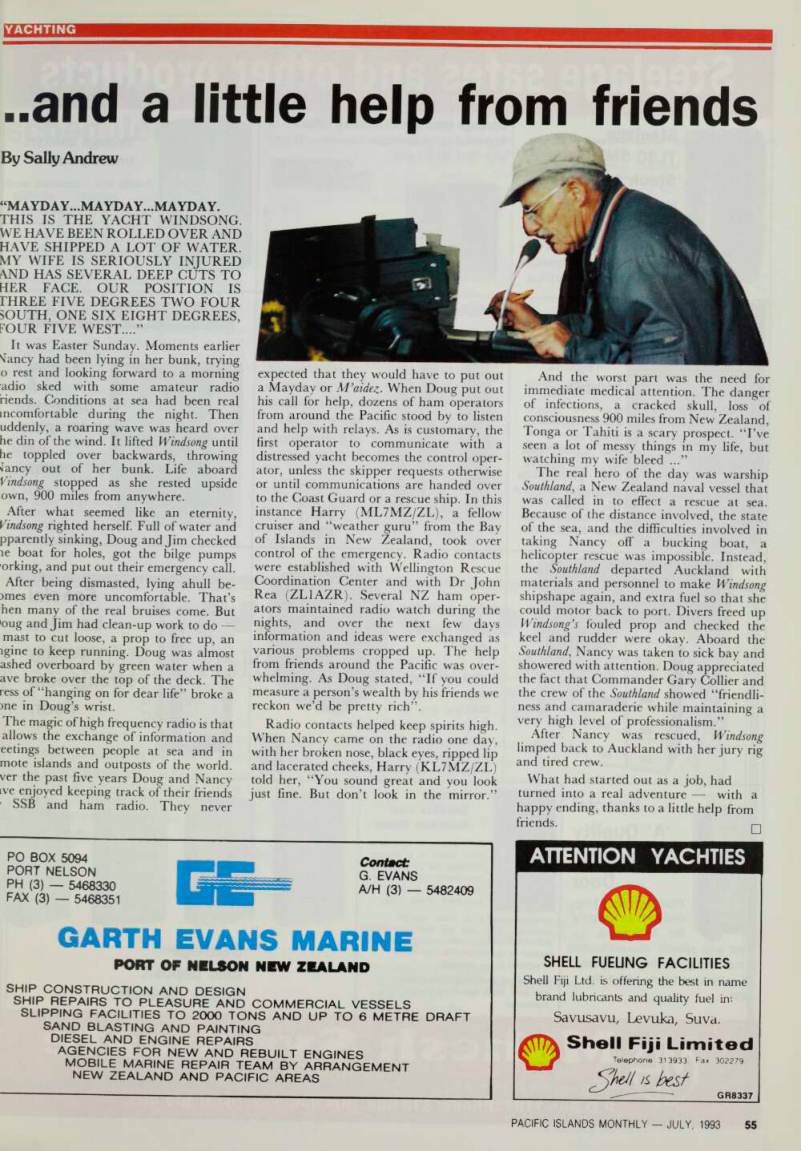
Yachting
By Sally Andrew
“Mayday...Mayday...Mayday.
This Is The Yacht Windsong.
We Have Been Rolled Over And
Have Shipped A Lot Of Water.
My Wife Is Seriously Injured
And Has Several Deep Cuts To
Her Face. Our Position Is
Fhree Five Degrees Two Four
South, One Six Eight Degrees,
Four Five West...”
It was Easter Sunday. Moments earlier 'fancy had been lying in her bunk, trying o rest and looking forward to a morning adio sked with some amateur radio riends. Conditions at sea had been real incomfortable during the night. Then uddenly, a roaring wave was heard over he din of the wind. It lifted Windsong until he toppled over backwards, throwing fancy out of her bunk. Life aboard Vindsong stopped as she rested upside own, 900 miles from anywhere.
After what seemed like an eternity, Vindsong righted herself. Full of water and pparently sinking, Doug and Jim checked ic boat for holes, got the bilge pumps orking, and put out their emergency call.
After being dismasted, lying ahull be )mes even more uncomfortable. That’s hen many of the real bruises come. But 'oug and Jim had clean-up work to do mast to cut loose, a prop to free up, an igine to keep running. Doug was almost ashed overboard by green water when a ave broke over the top of the deck. The ress of “hanging on for dear life” broke a
me in Doug’s wrist.
The magic of high frequency radio is that allows the exchange of information and eetings between people at sea and in mote islands and outposts of the world, ver the past five years Doug and Nancy ive enjoyed keeping track of their friends SSB and ham radio. They never
expected that they would have to put out a Mayday or M’aidez. When Doug put out his call for help, dozens of ham operators from around the Pacific stood by to listen and help with relays. As is customary, the first operator to communicate with a distressed yacht becomes the control oper ator, unless the skipper requests otherwise or until communications are handed over to the Coast Guard or a rescue ship. In this instance Harry (ML7MZ/ZL), a fellow cruiser and “weather guru” from the Bay of Islands in New Zealand, took over control of the emergency. Radio contacts were established with Wellington Rescue Coordination Center and with Dr John ea (ZLIAZR). Several NZ ham oper ators maintained radio watch during the nights, and over the next few days information and ideas were exchanged as various problems cropped up. The help from friends around the Pacific was over whelming. As Doug stated, “If you could measure a person’s wealth by his friends we reckon we’d be pretty rich”.
Radio contacts helped keep spirits high, When Nancy came on the radio one day, with her broken nose, black eyes, ripped lip and lacerated cheeks, Harry (KL7MZ/ZL) told her, “You sound great and you look just fine. But don’t look in the mirror.”
And the worst part was the need for immediate medical attention. The danger of infections, a cracked skull, loss of consciousness 900 miles from New Zealand, Tonga or Tahiti is a scary prospect. “I’ve seen a lot of messy things in my life, but watching my wife bleed ...”
The real hero of the day was warship Southland, a New Zealand naval vessel that was called in to effect a rescue at sea.
Because of the distance involved, the state of the sea, and the difficulties involved in taking Nancy off a bucking boat, a helicopter rescue was impossible. Instead, the Southland departed Auckland with materials and personnel to make Windsong shipshape again, and extra fuel so that she could motor back to port. Divers freed up Windsong’s fouled prop and checked the keel and rudder were okay. Aboard the Southland, Nancy was taken to sick bay and showered with attention. Doug appreciated the fact that Commander Gary Collier and the crew of the Southland showed “friendli ness and camaraderie while maintaining a very high level of professionalism.”
After Nancy was rescued, Windsong limped back to Auckland with her jury rig and tired crew.
What had started out as a job, had turned into a real adventure with a happy ending, thanks to a little help from friends. r-i
Advertisements & other items, pp. 55-56 (1 item)
Garth Evans Marine
ATTENTION YACHTIES
SHELL FUELING FACILITIES
Shell Fiji Ltd. is offering the best in name brand lubricants and quality fuel in; Savusavu, Levuka, Suva.
©Shell Fiji Limited
Telephone 313933 Pa* 302279
is hesf
GR8337
PO BOX 5094
PORT NELSON
PH (3) 5468330
FAX (3) 5468351
Contact
G. EVANS
A/H (3)
GARTH EVANS MARINE
PORT OF NELSON NEW ZEALAND
SHIP CONSTRUCTION AND DESIGN
SHIP REPAIRS TO PLEASURE AND COMMERCIAL VESSELS SLIPPING FACILITIES TO 2000 TONS AND UP TO 6 METRE
SAND BLASTING AND PAINTING
DIESEL AND ENGINE REPAIRS
AGENCIES FOR NEW AND REBUILT ENGINES
MOBILE MARINE REPAIR TEAM BY ARRANGEMENT
NEW ZEALAND AND PACIFIC AREAS
5482409
DRAFT
Steelage safes and other products
Steelage
TL3O Safes
Stock available
Model No.
TL30675
TL3OBOO
TL301050-S
TL301050-L
TL301225 s2Bso.oo+Vat s33so.oo+Vat s4oso.oo+Vat s4sso.oo+Vat ss6oo.oo+Vat Steelage torch & tool resisting safes Approved by Underwriters Laboraties U.S.A. with TRTL-30 6 Label Cj -j
TRTL
1215
TRTL
1380
TRTL TRTL
1660 1880
Seelage bankers
treasury safe Model Ret TDR/1050 TDR/1225 TDR/1525
Steelage
REGENT
An economic safe for domestic Retail and commercial use
Steelage
regent
safes Stock available Model No.
RS-0 slloo.oo+Vat RE-1 sl27s.oo+Vat RS-2 sl49s.oo+Vat RS-2D sl67s.oo+Vat RS-3 sl72s.oo+Vat RS-4 s2oso.oo+Vat RS-5 $2465.00+Vat Safe with safe deposit lockers Ideal for small branches of Banks as well as for Co-operatives where provision of a strongroom is uneconomical.
Steelage
fire
protection
computer
data
cabinet.
Fire Resisting FiWrg Cabinet mm m Fire resisting
book quality
door Fitted with strap hinge, designed for resisting fire & burglars, lined with special non- conducting & moisture generating high grade chemicals, complete with grille gate.
Special
bankers
quality
strongroom
door.
Special
‘A’ Quality
Strongroom
Door
Fitted with strap hinge, designed for resisting fire & burglars, lined with special non-conducting & moisture generating high grade chemicals, complete with grille gate.
Steelage Stainless steel Vault door 90mm The increase in attacks on Bank Vaults is a security challenge that Steelage has consistently met with some of the finest security equipment made today.
Intensive research in metal strength insulation, torch and drill resistant materials and various modes of safe breaking have enabled us to maintain this high degree of success in our campaign.
The door has been designed to protect your Bank Vault against the master cracksman.
Steelage
safe deposit
locker cabinets
Mahesh Syndicate
31 Raojibhai Patel Street, Suva.
P.0.80x 1187. Phone: 313 688, 304 446. Fax: (679) 302 485.
Shipping
schedules
New Zealand - Fiji direct Sofrana Unilines operates a fully containerised/breakbulk service every 21 days from Auckland, Tauranga, Lyttleton to Suva and Lautoka. Contact Auckland Sofrana Unilines, Sofrana House, 101 Customs Street, Auckland, PO Box 3614, Fax (09) 393874, Ph (09) 773279, Tlx NZ 2313. Direct toll free line 0800 659-922, Contact Alan Foote. Wellington Compass Shipping Agencies, PO Box 921 Wellington, Tel (04) 3828206, Fax (04) 3828239, Tlx NZ 4769 Contact Steve Brannican. Christ church Sofrana Unilines Agencies, PO Box 22046 Christchurch, Tel (03) 366 7180, Fax (03) 3668868, TLX NZ4769, Contact Tony Newell. Fiji Carpenters Shipping, Private Mail Bag, Suva, Fiji, Tel (679) 312244, Fax (679) 301572, Tlx FJ 2199. Sofrana Unilines, Suva, Fiji, Tel (679) 315645, Fax (679) 300057.
Australia - Fiji direct Sofrana Unilines operates a container/ breakbulk service every three weeks from Melbourne, and Sydney, to Lautoka and Suva.
Contact Sofrana Unilines (Aust) Pty Ltd, PO 3ox Q 136, Queen Victoria Building, Sydney, 2OOO, Australia. Tel (02) 2676547, Fax 02) 2648944, Tlx (71) A 170090, Contact Sam Mtaway/George Lopez.
Delmas Australia Pty Ltd 234 Sussex St,
Sydney NSW 2000, GPO Box 4181, Sydney. Tel (02) 2671234, Fax (02) 2611432. Contact Narii Salmon/Raymond Leong. Melbourne Dclmas Australia Pty Ltd 474 Flinders St, Melbourne. Fax (03) 6294957, Tel (03)
6141344. Fiji Carpenters Shipping, Suva Tel
(679) 312244, Fax (679) 301572. Sofrana Unilines Suva, Tel (679) 315 645, Fax (679) 300057. Carpenters Shipping, Lautoka, Tel (679) 663988, Fax (679) 664896. Sofrana Unilines, Lautoka Tel (679) 662921, Fax (679) 664896.
Australia - Fiji monthly service Sofrana Unilines (Australia) Pty Ltd operates a regular monthly service with MV Capitaine Wallis. Contact Sofrana Unilines, Sydney, Tel (02) 2648944, Tlx AA170090, Fax (02) 267-6547. Carpenters Shipping, Suva, Fiji, Tel (679) 312244, Fax (679) 301572, Sofrana Unilines, Suva, Fiji Tel (679) 315645, Fax (679) 300057. Carpenters Shipping, Lautoka. Tel (679) 63988, Fax (679) 664896. Sofrana Uni lines, Lautoka, Fiji, Tel (679) 662921, Fax (679) 664896.
Far-East - Fiji - New Zealand Service New Zealand Unit Express (NZUE) operates a monthly service accepting containerised and break-bulk cargoes from Manila, Keelung, Kaoshiung, Hong Kong, Lae to Suva, Lautoka (via Suva) and thence to New Zealand ports.
Contact Carpenters Shipping Suva, Fiji, tel (679) 312244, fax (679) 301572. New Zealand Unit Express, Maritime Building, 2-10 Customs House Quay, PO Box 890, Wellington. Tel 727865, Cables Enzue Man, Wellington, Tlx NZ31340 Nedlnz or Nedlloyd Swire Pty Ltd,
Sydney, Tel 20522.
Japan - South Pacific Service Same as Burns Philp Japan - South Pacific Service - Kyowa Shipping Co Ltd Kyowa Shipping, Shipping Co Ltd provides a monthly containerised service from Hong Kong to main ports of Japan, Saipan, Guam, Island ports, Lautoka, Suva via Nukualofa to Pago Pago and Apia. Contact Carpenters Shipping, Neptune House, 3/4 floor, Tofuaa Street, Walu Bay, Suva. Tel 312244, Fax 301572, Tlx FJ2199.
Europe - Pacific Service Nedlloyd offers cargo services from Continen tal Ports to Papeete, Fiji, New Caledonia and Doniambo on slot basis with Bank line. Contact Nedlloyd (Aust) Pty Ltd, Spring Street, Sydney, Tel 273801. Carpenters Shipping, Suva, tel 312244, Tlx FJ2199, Fax 301572. Carpenters Shipping, Lautoka, Tel 663988, Tlx FJ5215, Fax 664896.
South East Asia - Fiji Service Nedlloyd Lines (NZEAS) Service operates regular fast cargo service from Jakarta, Pt
Keelang, Singapore, Bangkok, Surubaya via
Auckland to Suva and Lautoka. Contact Carpenters Shipping, Suva, Tel 312244, Tlx FJ2199, Fax 301572. Carpenters Shipping, Lautoka Tel 663988, Tlx FJ5215, Fax 663988 South East Asia - Mid South pacific Columbus Line operates a regular container and breakbulk-heavy lift service from/to
Hongkong/Taiwan/Manila/Singapore/Malay
sia/Thailand/Indonesia to Port Moresby/Lae/
Rabaul/Kimbe/Madang/Newark/Honiara and Noro. Contact Express Freight, Lae, POB 3398, phone 423913 or 423822, fax 425193.
Far East - Mid South Pacific China Navigations New Guinea Pacific Line operates a regular container and breakbulk heavy lift service from Hong Kong, Taiwan, Manila, Singapore, Malaysia, Thailand to Port Moresby, Lae, Rabaul, Kieta and Honiara.
Cargo from the same eastern ports to the South Pacific Ports of Noumea, Santo, Vila, Papeete, PagoPago, Apia, Nukualofa, Rarotonga and Tarawa will be shipped via Japan or Busan on the monthly Bali Hai Service. Contact Steam ships Shipping, Port Moresby, PO Box 634, Tel 220283 or 220289. Tasman Asia operate a 20-day frequency fixed date service, shipping breakbulk and containerised cargoes from Japan, Korea, Taiwan and Hong Kong to Suva and Lautoka (via Suva). Fiji agents are Forum Shipping Agencies in Suva, Tel 315444, and Lautoka 660577.
Australia - New Caledonia - Fiji - Samoas - Tonga Pacific Forum Line operates a fully containerised service (general, reefer and ro-ro) from Sydney and Brisbane to Noumea, Lautoka, Suva, Apia, Pago Pago, Nuku’alofa, Sydney.
Cargo centralised from Adelaide and Mel bourne. Contact: Pacific Forum Line, PO Box 796, Auckland; Union Bulkships, 333 George St, Sydney, Brisbane and Melbourne; Union Co, Lautoka; Pacific Forum Line, Suva, Nuku’alofa; Pacific Forum Line, Apia; Polynesia Shipping, Pago Pago. Sofrana Unilines operates a roro/ container service every three weeks from Mel
bourne, Sydney and Brisbane to Noumea, Suva and Lautoka with transhipment to the Samoas and Tonga.
New Zealand - Australia - PNG - Solomon Islands Pacific Forum Line operates a containerised and ro-ro service from Lyttleton, Napier and Auckland to Brisbane, Port Moresby, Lae, Honiara, Brisbane then to New Zealand.
Contact: Pacific Forum, Auckland, Christ church; Union Bulkships, Brisbane; Steamships Shipping Port Moresby and Lae Sullivan Ltd,
Honiara; Seabridge, Wellington.
NZ - Fiji Translink Pacific Shipping Fiji Agents are; Campbells Shipping Agency Ltd, Ph 314189 Fax 300144 Suva; Ph 662231 Fax 662251 Lautoka.
Auckland Agents: McKay Shipping Ph (9) 390229 Fax (9) 3032931. Tauranga Agents, seatrade agencies Ph (75) 754989 Fax (75) 758380.
NZ - Fiji - Pago - Apia - Nuk Translink Pacific Shipping operates a monthly sailing with Polynesian Link, which carries Dry Container, reefers and breakbulk cargoes. NZ Agents McKay Shipping Shipping AKLD Ph 390229, Fax 3032931. Fiji Agents Campbells Shipping Agency & ltd Ph 314189 Fax 300144 NZ - Noumea - Wallis - Futuna Translink Pacific Agency operate a container Breakbulk service once a month from NZ through Fiji and Noumea to Wallis & Futuna.
South East Asia - Fiji - Noumea - Papeete
- Chile Service “Seaspac” A joint Chilean CCNI/CSAU Service offers a regular monthly sailing from Djakarta and Singapore to Noumea, Fiji, Papeete, and Chile. Cargo also federated to Singapore from Korea, Hong Kong, Taiwan,
Malaysia, Bangkok. Fiji Agents: Campbells
Shipping Agency Ltd, ph. 314189, Fax 300144.
Australia - Fiji Service Barbican Line operate a monthly container service from Australia to Fiji. Fiji Agents Campbells Shipping Agency Ltd Ph 314189 Fax 300144.
Australia - Fiji - Noumea - Vila - Santa Marsmond Express Lines operate a breakbulk service from Goodwood Island Australia to Fiji, Noumea, Vila Santo and Honiara. Continuous receiving depots in Sydney and Brisbane enable this vessel to bring cargoes from these parts. Fiji Agents Campbells Shipping Agency Ltd, ph. 314189, Fax 300144. Brisbane Agents Ship pings & Marketing Ph (7) 2628082. Sydney
Agents Seabord Agencies (2) 3172325.
Australia - New Caledonia - Fiji - Hawaii - North America ACT Pace Pacific (ACTA Shipping) operates a fully containerised/break bulk service every 17-20 from Melbourne, Sydney, Brisbane to Noumea, Suva and Lautoka. The vessels con tinue on to the West Coast of North America calling Honolulu at frequent intervals. Ships are ACT and ACT 12. Contacts: ACTA Pty Ltd, Sydney Ph 2869666, Tx 121369, Fx 2869610.
ACTA Pty Ltd, Melbourne Ph 6112000, Tx 30949, Fx 6293055. ACTA Pty Ltd, Brisbane Ph 2213116 m Tx 40719, Fx 2298143. SATO, Noumea Ph 281122, Tx 3163, Fx 278532. Burns Philp Shipping, Suva Ph 311777, Tx 2168, Fx 301127; Burns Philp Shipping, Lautoka Ph 660777, Tx 5146, Fx 665850.
West Coast of North America - Fiji • New Zealand Blue Star lane Pacific Coast Service operates a fully containerised/break bulk service every 23 days from Vancouver, Seattle, San Francisco, Los Angeles to Pago Pago, Suva and New Zealand ports. The vessels continue to call Suva on the Northbound voyage from New Zealand every fortnight to pick uo Fiji exports such as garments, fresh ginger, etc. for Hawaii and West Coast of North America ports. Blue Star Line also provides a through service to East Coast to North America. Ships are Wellington Star, Southland Star and California Star. Contacts: Blue Star Line, San Francisco Ph 9282026, Tx 184925, Fx 6730355; Blue Star Line, Vancouver Ph 6817300, Tx 0451326, Fx 6835797; Interocean Steamship Corp, Seattle Ph 6829820, Tx 321101, Fx 3437421; Blue Star Line, Los Angeles Ph 5970454, Tx 408564, Fx 5978710.
New Zealand Line, Wellington, Ph 739029, Tx 3583, Fx 4992468; New Zealand Line, Auckland Ph 390965, Tx 2556, Fx 3032039; Burns Philp Shipping, Suva Ph 311777, Tx 2168, Fx 301127; Burns Philp Shipping, Lautoka Ph 660777, Tx 5146, Fx 665850.
Japan - South Pacific Service Bali Hai Line a joint service of China Navigation, Mitsui OSK Line and NYK Line operates a fully containerised/break bulk service from Korea, Japan to South Pacific ports on a monthly basis serving ports of Pusan, Kobe, Nagoya, Yokohama, Tarawa, Lautoka, Suva,
Apia, Pago Pago, Papeete, Nukualofa, Noumea,
4%Santn. The ships are also fully specialised on ro/ro basis. Ships are Coral iSarraW ancfctfacific Islander.
Advertisements & other items, pp. 57-60 (1 item)
National Fishing
P.o. Box 93
FUNAFUTI
TUVALU
CORPORATION OF TUVALU
Tel: 688 724
FAX: 688 800
TLX: TUFISH TV 18106
SUBJECT: TENDER FOR THE SALE OF MFV “THE TAUTAI”
Tenders are invited for the Sale of a Fishing Vessel Tu Tautai on “as is where is” basis. operated by the' i" i apa " in 1932 / and is 39 - 20 metres in length O. A. It has been commercially Proiect conducted hv the Inr in For ! he 13031 three years ’ il was heavily engaged in the EEC Tuna Tagging oject, conducted by the SPC in the South Pacific Region. It is ideal for other type of fishing if converted, and is in good condition 8 The vessel can be inspected in Funafuti. The highest tender may not necessarily be accepted.
Other details are:- Breadth (max) Depth Nett Main Engine Interested parties should contact:- Closing date 30th July, 1993. 6.80 m 3.05 m 53.14 net tonnes Yanmar Diesel Type: T 260 ST 6 Cylinder Turbo charged, 1100 HP The General Manager Tuvalu National Fishing Corporation GPO Box 93 Funafuti, Tuvalu.
Phone (688) 724 Tlx (688) 18100 Fax (688) 800 118741v5
KYOWA
KYOWA
SHIPPING
CO., LTD.
Liner Service to Paciffic Islands
FROM OJAPAN
C KOREA
OTAIWAN
THAILAND
TO O SAIPAN
©FEDERATED STATES
OF MICRONESIA
OMARSHAL ISLANDS
©AMERICAN SAMOA
©NEW CALEDONIA
©FIJI
©HONG KONG
©SINGAPORE
©PHILIPPINES
©MALAYSIA
©INDONESIA
©GUAM
©YAP
©PALAU
©WESTERN SAMOA
©SOLOMON ISLANDS
©VANUATU
©PAPUA NEW GUINEA
HEAD OFFICE
6th Floor . Kikushima Bldg 2-3, Hamamatsucho 2-chome Mmato-ku, Tokyo 105, Japan Phone: 03(437)2885 (Rep ) Cable*: MARIQUEEN Tokyo Tele*: 242-4651 Kyowa J
OSAKA OFFICE
Dai San Fu|i Bldg, 3-13. Ilachibon 1-chome, Osaka 550 06(533)5821 (Rep ) Cable*: MARIQUEEN Osaka Tele*: 525-6271 Ssiosa J
/Pacific^
(( ISLANDS II
\\ fM Q N T H L Y I //
\(WRRK€T PLflCg/
For the benefit of our readers who would like to place a small classified advertisement in our magazine, Market Place will assist you in selling personal items, accommodation, real estate boating or a service ... in fact anything you would like to sell to our over 50,000 readers.
Market Place Advertising Rates are structured to allow you to place as many advertisements
as you wish, economically.
MARINE DIESEL ENGINES
& TRANSMISSIONS
TWIN DISC
HUTH, I.F.
PARAGON
BORG WARNER
PERKINS
CAT
CUMMINS
DETROIT
VOLVO
YANMAR
Marine Diesel Traders
54 Banya St, Bulimba. Q. 4171 Ph: (07) 899 1799 Fax: (07) 899 1868 A/Hrs (07) 399 9791 Mobile: 018 781835 International Code: 617 WE BUY AND SELL ALL MARINE DIESEL ENGINES
NEW & USED DIESELS AND TRANSMISSIONS
MARINE EQUIPMENT * TRADES ACCEPTED
GOLD BULLION I VACANCY
3UIRE GOLD BULLION FOR 17.5 c IN THE
LLAR (OR LESS).
i a NEW UNIQUE bullion coin marketing gram. rldwide application. Unlimited earnings po tial for motivated individuals. Contact PAC INVESTMENTS, P.O. Box 71, Espiritu no, Vanuatu. Fax: +678-36190.
SCRAP METAL
ingots operate from Brisbane, Australia I make frequent visits to the Pacific Islands ch they have done for twenty-five years. We buyers of Copper, Brass, Aluminium, Lead, )le etc. Inspection no problems. Telephone 7 8922033. Fax 61 78922077.
New Zealand licensed Hotel Manager (service orientated) seeks management position In resort/hotel South Pacific. Well experienced including Sheraton and Hilton. Please write Peter Williams P.O. Box 14517 Wellington N.Z. or Tel. 64-4-3862443.
COMMERCIAL PRINTING
Top quality four colour printing, brochures, posters, packaging, product labels, fabric labels, billboards, books, magazines, stickers, books. Export quail* ty. Contact Fiji’s most experienced Commercial Printers. FIJI TIMES COMMER- CIAL PRINTING. P.O. Box 1167. Suva. Fiji.
Phone: 304111 Fax. 301521.
COLLECTORS MODEL CARS
Dlecast model cars: CORGI, BRUMM, PROGETTO K, BEST, RAE and others. Please write or fax for lists:
MESSAGE MODELS,
P.O. Box 239,
NORTHBRIDGE, N.S.W., 2063,
AUSTRALIA.
Fax. +6l-2-967 2216 Telephone +6l-2-958 2315
SELF ADHESIVE LABELS
FORUM LABELS (FIJI) LTD
P.O. Box 1167, Suva,. Fiji. Phone:3o4lll We print self-adhesive labels in rolls, multi-coloured labels with hot foil, and die cut to shape, tickets and tags in rolls. We also supply labelling machines and fabric labels.
FOR SALE
M.V
NIVAGA
1
THE ABOVE VESSEL IS FOR SALE
G.R.T. 353 TONS
N.R.T 163 TONS
CARGO CAPACITY 250 TONS
LENGTH 41.48 METRES
PASSENGER RATING MAXIMUM 150
PERSONS. FULL SURVEY CERTIFICATE
VALID UNTIL FEBRUARY 1993
FITTED WITH TWIN SCREW GARDNER
ENGINES.
FOR FURTHER PARTICULARS AND
INSPECTION
PLEASE CONTACT;-
THE GENERAL MANAGER
INTER PORTS SHIPPING CORP LTD
PO BOX 152, SUVA
TELEPHONE: 313266
FAX NO: 303389
SERVING: SUVA SAVUSAVU LABASA
TAVEUNI ROTUMA
SHIPPING RECEIVING FORWARDING
CARTAGE INSURANCE
Introducing the All New Mitsubishi Galant — Beautifully Engineered for the Way You Drive Although the new Galant is probably the most handsome new car on the road, its true beauty lies in its sheer driveability. It’s probably the first car ever that gives you the freedom to drive exactly how you choose. With a sporty, dynamic personality, it has the energy to set your adrenaline flowing when you want to drive for fun. Yet for an effortless drive home at the end of a long day, it has the smoothness and comfort you’d expect in a quality saloon. Quite how you drive the new Galant is entirely up to you.
The key to the new Galant’s versatile performance is All Wheel Control, a unique approach to car design that puts your needs first. It works on the principle that every move a car makes, from accelerating to cornering, depends on how well your aims get passed to the road—and that hinges on all four wheels working as effectively as they can, to direct, manipulate and control. With true communication between you and the road, the new Galant guarantees total control with quicker, safer and more responsive performance than ever before imaginable.
The All Wheel Control vision is brought to reality in the new Galant by some of the most advanced automotive technology ever developed. From the first ever four wheel multi-link suspension system on a front engine, front wheel drive car to some of the world’s most intelligent computer control systems, the Galant boasts breakthroughs that ensure a smooth, responsive drive in any conditions. And with a range of newly developed 1.8-litre SOHC to 2.0-litre V 6 DOHC multi-valve engines, you can count on the power for the freedom to drive as you choose.
Discover the meaning of driving freedom with the new Mitsubishi Galant —and feel how All Wheel Control sets you apart from the crowd.
Mitsubishi Motors and drivers who care—creating
together.
The All New
MITSUBISHI QHLfINT
A AMERICAN SAMOA; PACIFIC MARKETING INC. RO. Box 698, Pago Pago, Tel. 699 9140 1 AUSTRALIA: MITSUBISHI MOTORS AUSTRALIA LTD. 1284 South Road, Clovelly Park, South Australia, Tel. (08) 2757297/ FIJI: NIVIS MOTOR & MACHINERY CO. LTD. G.RO Box 150, Suva, Tel 383411 1 GUAM: TRIPPLE J ENTERPRISES INC. RO, Box 6066, Tamuning, Tel. 6469126/ NEW CALEDONIA: SOCIETE DTMPORTATION D'AUTO DU PACIFIQUE SUD S.A. RO Box 2548, Noumea, Tel 274144 /NEW ZEALAND: MITSUBISHI MOTORS NEW ZEALAND LTD. Private Bag. Porirua, Tel 2370109 1 NORFOLK ISLAND: BORRY'S FTY LTD. RO. Box 169, Tel 2114 /PAPUA NEW GUINEA: TOBA PTY LTD. RO Box 503, Port Moresby, Tel. 217874 SAIPAN: AUTO MOTION INC. RO. Box 569, SKV Disl 4, Tel. 234 3332 /SOLOMON ISLANDS: HARVEST PACIFIC LTD. G.RO. Box 823, Honiara, Tel 30407 /TAHITI (FRENCH POLYNESIA): SOPADEP S.A. RO. Box 1617, Papeete, Tel. 427393 1 TONGA: SITANI MAPI CO., LTD. RO. Box 83, Nukualofa, Tel 24044/ VANUATU: SOCOMETRA VANUATU LTD. B.P 06, Route de Lagon, Port Vila, Tel. 2314/ WESTERN SAMOA: MOTOR DISTRIBUTORS (SAMOA) LTD. RO. Box 576, Apia, Tel. 20957
MITSUBISHI
MOTORS
CREATING TOGETHI