Anarchy

Pacific
Islands
Monthly
June 1993
Papuja 1 New Guinea thrown into chaos as a / crime wave sweeps through the country"
On the brink of
Anarchy
American Samoa US$2.5O; Australia A 53.50; Cook Islands NZ$3; FIJI (Incl VAT) F 51.92; FS Micronesia US$3; Hawaii US$3; Kiribati A 52.50; dauru A 52.50; Niue NZ$3; Norfolk As 3; New Caledonia cpf2so; New Zealand (incl GST) NZ53.45; Nth Marianas US$3; Papua New Guinea (3; Palau US$3; Marshalls US$3; Solomon Islands As 3; French Polynesia cpf3oo; Tonga P 3; USA US$3; Vanuatu VT22O; Western Samoa T 3.25. * Recommended retail price only
Advertisements & other items, p. 2 (1 item)
Cable & Wireless
Cable and Wireless began keep-
ing people in touch around the
world more than a century ago. Today,
while the technology has changed,
the tradition of service to our customers in the
South Pacific is just the same.
We work in partnership with Governments,
dedicated to meeting the need of communities and businesses to stay in touch. From one island to the next or to the other side of the world, the message is the same: Cable and Wireless is
your South Pacific
connection bringing the
islands together.
CABLE & WIRELESS
Asia Pacific Head Office Cable and Wireless pic Cable and Wireless (Pacific) Limited 22nd Floor Office Tower Convention Plaza 1 Harbour Road Hong Kong Tel; (852)848 8620 Facsimile (852)868 5195 Fiji In association with the Government of Fiji Fiji International Telecommunications Ltd PO Box 59 Mercury House 158 Victoria Parade Suva Fiji Tel: (679) 312933 Solomon Islands In association with the Government of the Solomon Islands Solomon Telekom Company Limited PO Box 148 Honiara Solomon Islands Tel: (677) 21576 Tonga Cable and Wireless pic Private Mail Bag 4 General Post Office Nuku Alofa Tonga South Pacific Tel: (676) 23499 Vanuatu In association with the Government of Vanuatu anck France Cables et Radio Vanuatu International Telecommunications Ltd.
PO Box 164 Port Vila Vanuatu Tel: (678) 22185
Pacific
Islands
Monthly
Vol 63 No. 6
The News Magazine
1993
From The
Editor’S Desk 4
Letters 5
Headlines 7
Pacific Diary 10
Opinion
What of Fiji’s future? 12
Cover Story
Crime wave 14
Elections
Mamaloni win on the cards 18
Conflict
Border patrol 20
Business
Pagan ash 23 Tax Havens in paradise 24 The good news and the bad 27 Trade overture 32
Japan Today
Japan of today 35 Simply elegant 36 A new social order 39 Building up human resources 41
Law
Test case for treaties 44
Religion
The case of the missing icon 46
Science
Lost fleet 48
Arts
Richly diverse 50
Profile
If I ruled the world 53
Yachting
Dancing the night away 54
Shipping
Shipping schedules 57
Columnists
Jemima Garrett 11 David Barber 18 Bill McCabe 33 Alfred Sasako 52
Publisher: Brian O’Flaherty Editor; Mala Jagmohan Senior Writer Martin Tiffany Correspondents: Christine Hatcher, David North, Ed Rampell, lan Williams, Johnson Honimae, Karen Mangnall, Liz Thompson, Nicholas Rothwell, Pesi Fonua, Wally Hiambohn.
Columnists: David Barber (Wellington), Futa Helu (Tonga, covering the Pacific Islands), Jemima Garrett (Sydney).
Julian Moti (Pacific Law), Alfred Sasako (The Forum).
Advertising Sales: • Regional Sales (South Pacific); Salendra Narayan, Tel (679) 304111, Fx (679) 303809 • Sydney, Canberra: Bob Hill Media Represen tations. Tel (61-2) 4164245, Fx (61-2) 4165064 • Brisbane: Robert Walker, Media House, Tel (61-7) 3710533, Fx (61-7) 371-8904 • Adelaide: Hastwell Williamsons Representations, Tel (61-8) 799522, Fx (61-8) 799735 • Melbourne: Brown Orr Fletcher Burrows (Aust).
Pty. Ltd. Tel (3) 696 5188 Fx (03) 696 5131. • Auckland: McKay International Media Reps Ltd, Tel (64-9) 4190561, Fx (64-9) 4192243 • Japan: Universal Media Corporation, Tokyo, Tel (3) 6663036, 6663094, Cable: UNIMEDIA Tokyo, Tx 2524665.
Founded 1930 (USPS 952480). A Fiji Times Limited production.
Cover prices are recommended retail only. Regis tered by Australia Post, Publication No. NBP 1210. © Copyright Fiji Times Limited, 177 Victoria Parade, Suva. Fiji. Tel (679) 304111, Fx (679)
303809. Tx Fj2124.
Pacific Islands Monthly is published monthly by The Fiji Times Limited, a division of Nationwide News, 2 Holt Street, Surry Hills, Sydney. NSW 2010.
Send address changes to: • Pacific Islands Monthly, PO Box 1167, Suva, Fiji.
Typeset and printed by The Fiji Times Limited, 177 Victoria Parade, Suva, Fiji.
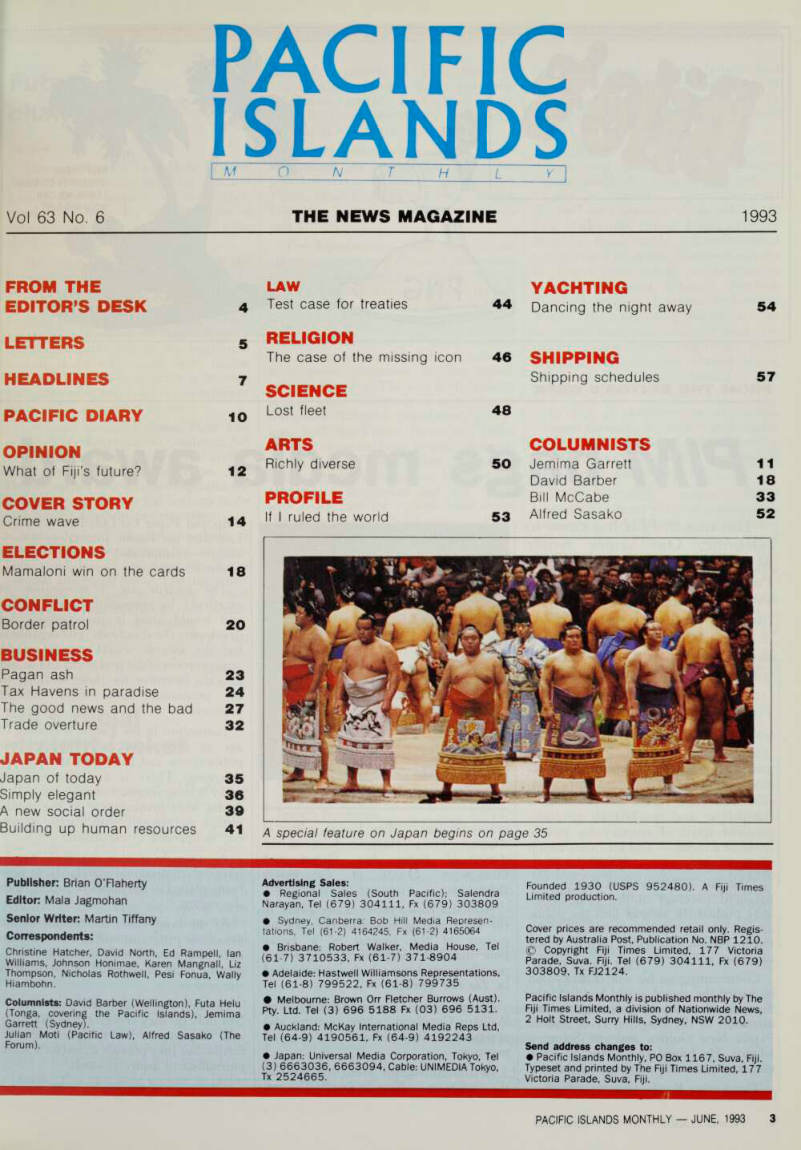
A special feature on Japan begins on page 35
PIM bags media award
From The Editor’S Desk
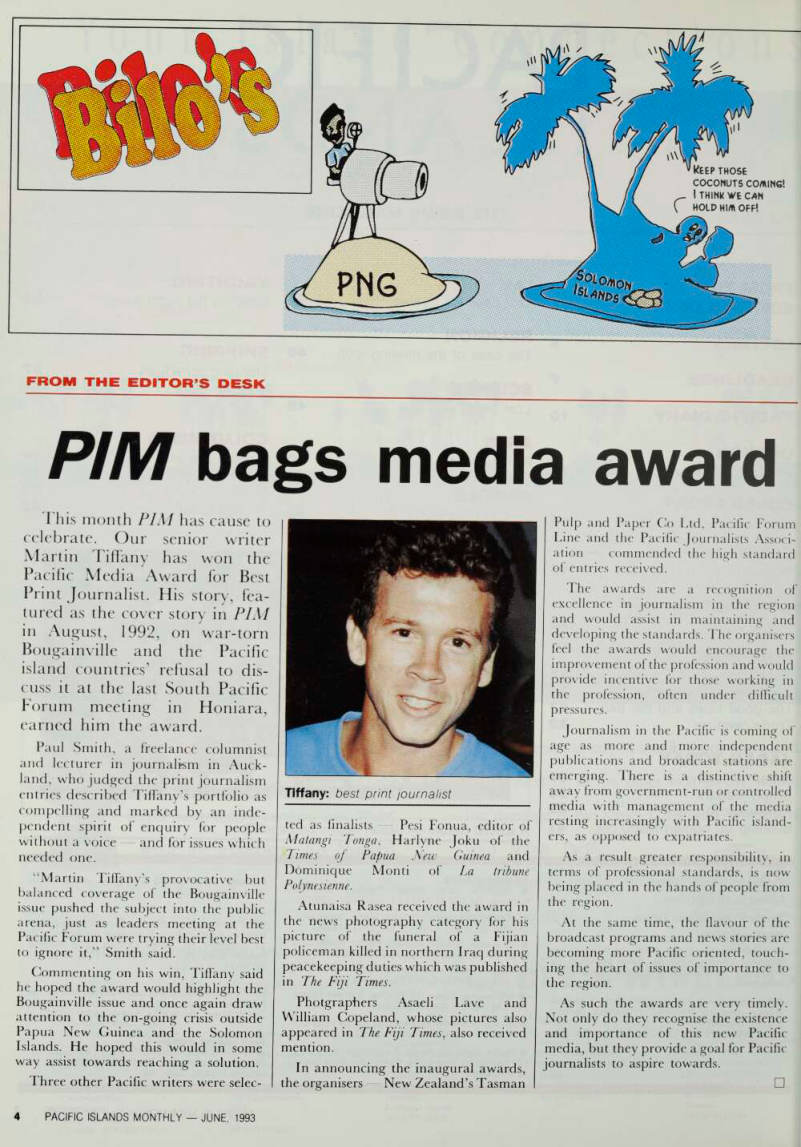
This month PIM has cause to celebrate. Our senior writer Martin Tiffany has won the Pacific Media Award for Best Print Journalist. His story, fea tured as the cover story in PIM in August, 1992, on war-torn Bougainville and the Pacific island countries’ refusal to dis cuss it at the last South Pacific
Forum meeting in Honiara,
earned him the award.
Paul Smith, a freelance columnist and lecturer in journalism in Auck land, who judged the print journalism entries described Tiffany’s portfolio as compelling and marked by an inde pendent spirit of enquiry for people without a voice and for issues which needed one.
“Martin Tiffany’s provocative but balanced coverage of the Bougainville issue pushed the subject into the public arena, just as leaders meeting at the Pacific Forum were trying their level best to ignore it,” Smith said.
Commenting on his win, Tiffany said he hoped the award would highlight the Bougainville issue and once again draw attention to the on-going crisis outside Papua New Guinea and the Solomon Islands. He hoped this would in some way assist towards reaching a solution.
Three other Pacific writers were selec-
ted as finalists Pesi Fonua, editor of Matangi Tonga , Harlyne Joku of the Times of Papua New Guinea and Dominique Monti of La tribune Polynesienne.
Atunaisa Rasea received the award in the news photography category for his picture of the funeral of a Fijian policeman killed in northern Iraq during peacekeeping duties which was published in The Fiji Times.
Photgraphers Asaeli Lave and William Copeland, whose pictures also appeared in The Fiji Times , also received mention.
In announcing the inaugural awards, the organisers New Zealand’s Tasman
Pulp and Paper Co Ltd, Pacific Forum Line and the Pacific Journalists Associ ation - commended the high standard of entries received.
The awards are a recognition of excellence in journalism in the region and would assist in maintaining and developing the standards. The organisers feel the awards would encourage the improvement of the profession and would provide incentive for those working in the profession, often under difficult pressures.
Journalism in the Pacific is coming of age as more and more independent publications and broadcast stations are emerging. There is a distinctive shift away from government-run or controlled media with management of the media resting increasingly with Pacific island ers, as opposed to expatriates.
As a result greater responsibility, in terms of professional standards, is now being placed in the hands of people from the region.
At the same time, the flavour of the broadcast programs and news stories are becoming more Pacific oriented, touch ing the heart of issues of importance to the region.
As such the awards are very timely.
Not only do they recognise the existence and importance of this new Pacific media, but they provide a goal for Pacific
journalists to aspire towards.
Tiffany: best print journalist
challenged
Letters
Futa challenged
Madam, The assertion by Futa Helu in your April 1993 issue that the New Zealand Employment Contracts Act has demol ished trade unionism and the right of association in collective bargaining can not go unchallenged.
The Act specifically gives workers the freedom to choose whether or not to belong to any employees organisation.
Membership of a trade union or any
employees organisation is now totally
voluntary. Freedom of association is
specifically protected by the legislation
and it is an offence to exert undue influence on employees either to become a member of an employee organisation or cease to be a member of one.
For some unstated reason Helu also considers the Employment Contracts Act erodes media freedom. I don’t under stand the basis for this assertion. The Employment Contracts Act regulates the law of employment. It has nothing to do with media freedom or censorship.
New Zealand cherish freedom of expression and the nation has an envi able legal history of freedom of ex
pression and equal rights. The suggestion
that New Zealand is setting a bad example for the Pacific Islands simply doesn’t accord with the reality.
P T Kiely
Solicitor Auckland
New Zealand
Fiji’s racial
straight-jacket
Madam In the April issue of PIM Martin Tiffany in his article “Greater Freedom” stated that Delaibatiki, Moala, Parkin son and Herman had maintained that in Fiji “culture” affected journalists’ story content. He then, quotes Moala of The Fiji Times saying; “Compared to other Pacific islands, Fiji is in a more difficult position as they have two major races (Fijians and Indians) and three major religions (Christianity, Hinduism, and Islam)... So you have to be sensitive to some issues.” These issues are not mentioned.
Tiffany apparently is very favourably disposed to the above expression of Jale Moala’s sentiments. Presumably Delaibatiki, Parkinson, and Herman also agree with this view of culture in Fiji.
Sadly, this notion of culture is rather
simplistic, superficial and, conflates “race” with “culture”. Sadly too, these journalists (actually media leaders) are also mouthing uncritically the racial straight jacket of the Fijian state.
The major ethnic categories or “races” as defined by the Fijian state for population census purposes are Chinese, Fijian, Part-European, Other Pacific Islanders, European, Indian, Rotuman and Others The Fijian-state’s politically defined ethnic categories for electoral politics are Fijians and Rotumans, General Voters Chinese/European/Part-European and all others (including Pacific Island ers) and Indians.
This classification of “races” in Fiji and their equation with different cultures is a gross distortion of the ethnic categories in Fiji. The fact of the matter is that when we speak of race, that is physically different population group ings, both the Ethnic Fijian and Indo- Fijian categories have considerable di versity within them. Thus there are Ethnic Fijians who appear Melanesian, others look Polynesian and still others who could pass for various admixtures (Part-European, Part-Chinese, Part- Rotuman, Part-Indian etc). The last category (mixed race persons) has pro vided one basis of the debate on what is a Fijian.
Likewise Indo-Fijians are physically diverse Punjabi, Sikhs, Pathans, light and dark-skinned Gujeratis, Nepalis
(akin to Gurkhas), North Indians and South Indians as well as people of mixed Indo-Fijian and Ethnic Fijian or another ethnic category ancestry whose fathers are Indo-Fijians.
Culturally, Fiji’s people are richly diverse and again the three major “races” politically defined by the state “Fijian”, “Indian” and “General Voters” are a travesty of the cultures of Fiji. Within the Ethnic Fijian category there is considerable linguistic/dialect and cultural diversity. The same applies to Indo-Fijians whose mother-tongue may be Fiji-Hindi, Gujerati, Punjabi, Tamil, Telegu, etc. Likewise the General Voters are an extremely diverse lot - the so called European category alone in cludes persons who originated from England, Germany, the United States, Malta, Greece, France, Australia, New Zealand, etc.
In Fiji as elsewhere in the world, cultural diversity is coupled with multi lingual and multi-cultural tendencies.
The latter can be fostered or undermined by the state and the media.
While journalists’ (especially media
leaders’) sensitivity to cultural diversity is admirable, they should not uncritically mouth the Fijian States’ racial categorisation because in doing so they become agents of the state in extending
its ethnic agenda.
Vijay Naidu
Suva Fiji
Advertisements & other items, pp. 5-6 (1 item)
Pacific Islands Monthly
Payment to Pacific Islands Monthly: Subscriptions Dept GPO Box 1167, Suva, Fiji.
Subscriptions rates include the cost of airspeeding to all destinations set out above.
Direct airmail rates on application.
Telephone: 304111 Fax: 303809
EVERYTHING YOU EVER WANTED
TO KNOW ABOUT F1J1...
... IN A COMPREHENSIVE COMPACT HANDBOOK
o fen § t
1 NEW
EDITION
OUT
, NOW ,
An ideal guide for the business person or travellers, at your fingertips
AVAILABLE AT LEADING NEWS AGENTS
BOOKSTORES AND FIJI TIMES OFFICES,
SUVA, NADI, LAUTOKA, LABASA
Boundary may
Headlines
Solomon Islands
Ministers reject 'hot pursuit’
An official agreement between the Solomon Islands and Papua New Guinea allowing PNG the right of “hot pursuit” across the Solomon border has been rejected by Solomon Islands ministers.
The Minister for Provincial Government, Alan Qurusu, says he will resign if the cabinet approves a recommendation that it will allow PNG troops based on Bougainville the right of “hot pursuit” 30 kilometres into Solomons’ territory. The right of “hot pursuit” was one of a number of recommendations endorsed by officials from Solomon Islands and PNG at a high level meeting in Honiara in late April.
Qurusu, who comes from Choiseul just near Solomons’ border with Bougainville, says the hot pursuit recommendation was dangerous as his constituents may get shot.
Solomons’ Police and Justice minister Albert Laore says PNG officials must be “out of their minds and out of their heads” if they think Solomon Islands would agree to this. Laore also disagreed with another of the Honiara agreements which said Bougainvilleans in the Solomon Islands would be repatriated. He said the Solomons could not repatriate Bougainvilleans knowing they would be harmed.
Boundary may
be redrawn
The international boundary between the Solomon Islands and Papua New Guinea may be redrawn. According to the Solomon Star newspaper this was suggested by PNG during a meeting between the two countries in late April.
The offer to redraw the boundary was made by PNG’s delegation leader foreign affairs secretary Gabriel Dusava. He said some long-standing disagreements stem from a common border drawn by the colonial masters who he said were totally ignorant about traditional Melanesian ties. He said because of this the PNG government was prepared to change the boundary. The Solomon Star report, however, did not elaborate on what boundary changes would be made
joins ADB
Tuvalu
Tuvalu joins ADB
I he Asian Development Bank has admitted Tuvalu as its 53rd member. Tuvalu with its population of 9000 has become a member after paying the first installment of its subscription to the bank’s capital stock. The bank has not said how much Fuvalu paid. The ADB, which provides loans for infrastructure ind economic restructuring to developing Asia-Pacific nations, s seeking to increase its capital to meet the growing financial iceds of its borrowing members.
found guilty
Western Samoa
Attorney general found guilty
Western Samoa’s attorney general has been struck off New Zealand’s law register. Senerivi Muli'aumaseali’i has been struck off for mishandling trust accounts at his Auckland practice, which he ran from 1982 to 1991.
He was found guilty on four charges of professional misconduct over trust accounts totalling more than US$6l,OOO.
After he left New Zealand for Western Samoa in 1991 to take over the post of attorney general, the Auckland District Law Society began investigating complaints about his handling of accounts.
The chairman of the tribunal, Lester Chisholm, delivering the ruling, said Muli’aumaseali’i was “not a fit and proper” person to practice law in New Zealand. He was fund guilty of making unauthorised payments totalling LISS6I,OOO from 13 clients’ money. Most of his clients were Western Samoan. He was also found guilty of allowing his trust account to be US$l4,OOO overdrawn and of failing to complete monthly audit returns of his business.
Muli’aumaseali’i has declined to say whether he intends resigning from his government-appointed post. He said his future was “completely within the government’s prerogative”.
Law Society counsel Stuart Ennor said the Western Samoa Law Society would be unable to charge Muli’amaseali'i over his Auckland activities which were outside its jurisdiction. But the striking off might allow the Samoan body to charge him with conduct unbecoming a legal practitioner. Ennor said if Muli’ aumaseali’i were struck the Western Samoa register, he could not hold the office of attorney-general.
In Wellington, the Western Samoa high commissioner said it was to prepare a report for its government.
'Come home’
Niue
'Come home’ offer to Niueans
The new leader ofNiue, Frank Lui, hopes to double the island’s population by offering “come home” incentives to Niueans living in New Zealand. Lui, who became premier in March, addressed meetings of Niueans in Auckland in early May to appeal to them to return to the isolated island. Niue has a population of 2000 but there are over 12,000 Niueans living in New Zealand.
The premier said Niue’s infrastructure could sustain a population of 5000 people with little change, but that was a 10-year target. He says he intends to increase the population by 500 in his three year term. Lui has aimed his plea to older Niueans living in New Zealand because he believes pending improvements in the superannuation payments they can receive on return to Niue will ease the transition.
Since 1974 Niue has been self-governing but in “free association” with New Zealand. New Zealand looks after security and foreign affairs.
Advertisements & other items, p. 8 (1 item)
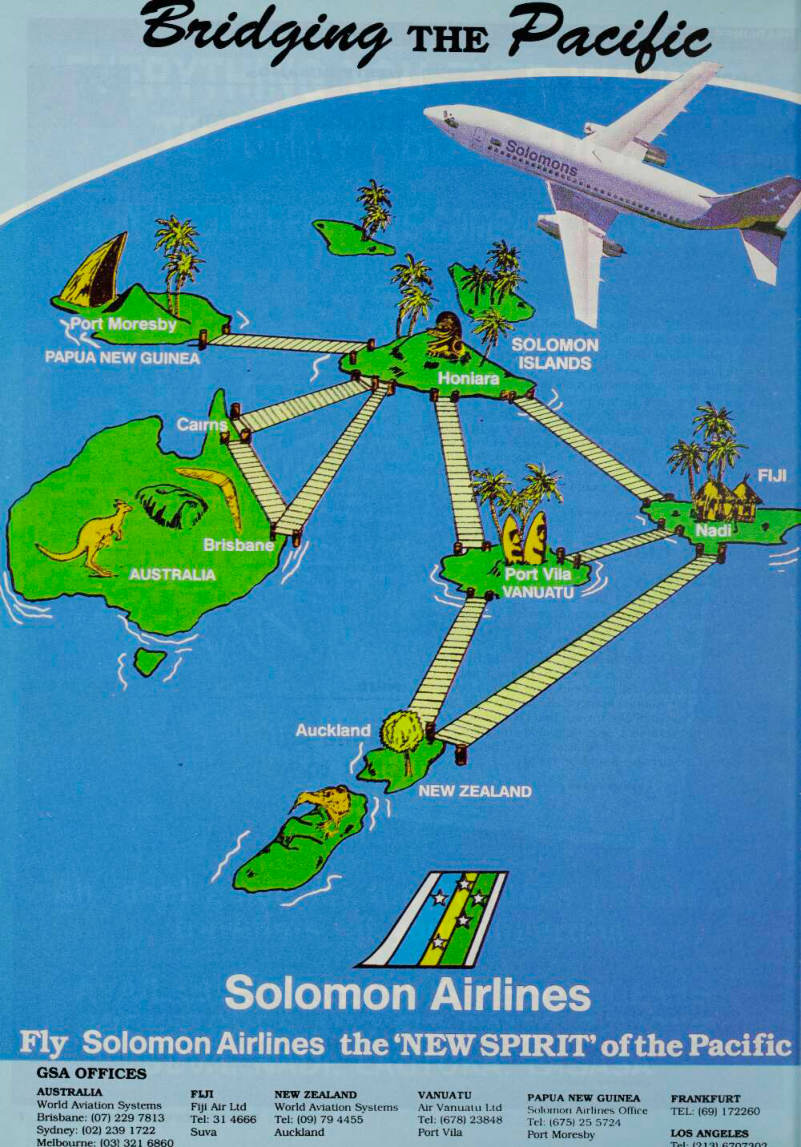
Cairns V
THE
9s '
PAPUA NEW GUI
Cairns V
*£l
mmm
r '■ » v i i
GSA OFFICES
AUSTRALIA
World Aviation Systems Brisbane: (07) 229 7813 Sydney: (02) 239 1722 Melbourne: (03) 321 6860
FIJI
Fiji Air Ltd Tel: 31 4666 Suva
NEW ZEALAND
World Aviation Systems Tel; (09) 79 4455 Auckland
VANUATU
.Mr Vanuatu Ltd Tel: (678) 23848 Port Vila
PAPUA NEW GUINEA
Solomon Airlines Office Tel: (675) 25 5724 Port Moresby
FRANKFURT
TEL: (69) 172260
LOS ANGELES
Tpl- roi-u «7A7QAO
Spaceport project
Papua New Guinea
Spaceport project a possibility
The Papua New Guinea cabinet has approved in principle the establishment of a commercial spaceport in the country. Space Transportation Systems Limited of Australia has been granted the right to conduct feasibility studies to determine a suitable site for the spaceport.
National radio NBC says a number of sites have been identified in northern PNG near the equator and STS will conduct feasibility studies to determine the right location consistent with scientific requirements. The study will also determine the impact on the local population, environmental considerations and socio-economic effects.
The project is estimated to cost about US$l billion and once established will be the first in the Asia-Pacific region. STS was involved in a similar venture in the Cape York Peninsula in Australia that has now been abandoned. If the PNG project goes ahead, it is likely to be in operation before the turn of the century.
PNG offers Fiji support
Papua New Guinea has offered to support Fiji’s re-entry into the Commonwealth. The offer was made by PNG Prime Minister Paias Wingti to Fiji’s deputy Prime Minister and Minister for Foreign Affairs, Filipe Bole, in talks in Port Moresby.
Both men discussed regional, bilateral and international issues. Earlier, PNG Foreign Affairs Minister, John Kaputin and Bole signed a technical cooperation agreement. This memorandum of understanding will form the basis for closer ties between the two Melanesian neighbours.
Bougainville minister reported dead
\ minister in the outlawed self-styled Bouganville government las died while in the custody of Papua New Guinea troops. \ccording to the Solomon Star newspaper a report by Radio Australia’s Sean Dorney says Ken Savia, the health minister in he Bougainville government, was arrested by PNG soldiers in
February,
Amnesty International has been pressing the PNG govern nent to clarify the fate of Ken Savia, saying it had received eports he had been tortured and killed while in detention. The 3 NG government admitted in February that Savia had been letained at the Arawa Hospital soon after its security forces mtered the provincial capital in central Bougainville.
While in Buka Island for a meeting of village chiefs and eaders from most parts of the province, Dorney said he was ible to confirm from eye-witnesses that Savia was separated fom the others detained at the hospital and his family has now earnt he was killed.
There’s still official silence from the PNG government on the natter.
Aging body
American Samoa
Aging body under investigation
The American Samoan government’s White Collar Crime Task Force has targeted the Territorial Administration on Aging (TAOA) for a criminal investigation.
Acting commissioner of public safety Mike Sala has confirmed the probe which was personally ordered by Governor A P Lutali. Sala says the probe relates to a “possible misappropriation of funds and criminal violations”.
The criminal probe was prompted as a result of discrepancies discovered by TAOA director Fuiavailili Mata’u Taele. Since January , TAOA has been preparing a total of 2,700 $25 food vouchers each month. But in two-week period, 485 vouchers had not been collected. Between September and December last year, TAOA was issuing more than 2700 food vouchers each month and all were picked up.
The TAOA director suspects the unclaimed vouchers are for “ghost recipients” or senior citizens who have passed away but were claimed by others.
Meanwhile US federal agencies have places TAOA under probation, a status which will be reviewed when the new fiscal year commences on October 1. In the last four years, TAOA has reportedly accumulated an overrun of close to US$2 million.
FINKS president
New Caledonia
FINKS president snubs Kerman
The president of New Caledonia’s pro-independence move ment FLNKS snubbed Vanuatu’s prime minister, Maxime Carlot Korman, during Korman’s week-long visit to the French territory. Korman told a news conference in Port Vila he regretted not being able to meet and talk with FLNKS president Paul Neaoutyne.
Korman said he was sorry if Neaoutyne thought his (Francophone) government was against the FLNKS struggle for New Caledonia’s independence. Vanuatu’s previous government of Father Walter Lini was the principal backer of New Caledonia’s independence and had close links with the
Flnks.
But Korman described the Lini government’s stand as “interference”. He said his government supports the Matignon Accords as the basis for peace, unity and development in New Caledonia. As well, the Accords provide time to prepare New Caledonia for independence when a referendum is held on the issue in 1998.
During his six-day visit to New Caledonia Korman failed to arrange a meeting with Neaoutyne and no reasons were given for the FLNKS president’s unavailability.
Pacific Diary
June
01-03 Fourth High Level Meeting of Govern ment Officials of South Pacific Countries on Cooperation in the Field of Intellectual Property, Forum Secret ariat, Suva, Fiji 07-10 Seminar on Promotion and Expansion of Small and Medium Enterprises, Shenzhen, Peoples Republic of China 07-10 APEC Energy Officials Meeting, Banf, Canada 07- Petroleum Product Pricing and Con tract Negotiation Workshop, University of the South Pacific, Suva, Fiji 08- Seminar on implementation of UN Declaration on the Granting of Inde pendence to Colonial Countries and Peoples, Port Moresby, Papua New Guinea 10-12 Australia/Fiji - Fiji Australia Business Councils’ joint meeting, Sheraton Fiji 12-18 International Conference of the Cul tural and Intellectual Property of Indi genous Peoples, Whakatane, New Zealand 14-16 Plenipotentiary Meeting (SPREP Treaty), Apia, Western Samoa 14-18 Fourteenth Regional Conference of Heads of Health Services, Vanuatu I
21- Sub-Regional Caucus for French Territories, Fiji 22- Commercialisation and the Public Service (venue to be determined) 24-26 Fourth Pacific Islands Conference of Leaders, Tahiti 26-July 10 Heilala Festival, Tonga 28-July 2 Environmental Impact Assess ment, Niue 30-July 2 APEC Senior Officials Meeting, Seattle, USA • South Pacific Sea Level and Climate Moni toring Project Training Workshop, Adelaide, Australia • Rural Agricultural Development Manage ment in the context of Biocontrol, Tonga • PECC Trade Policy Forum VII, Mexico • APEC Working Group on Trade Promotion Meeting, Vancouver, Canada
July
03-08 Birthday celebration for King Taufa’ahau Tupou IV of Tonga, Tonga.
These celebration are incorporated in the Heilala Festival Note - • indicates dates have yet to be confirmed.
Advertisements & other items, p. 10 (1 item)
Ela Motors
NUMBER ONE
THROUGHOUT THE
SOUTH PACIFIC
Ela Motors
PAPUA NEW GUINEA
PH (675) 229400 PO Box 74 Port Moresby * Yamaha Outboard Motors are available in a wide range of models from 2hp up to 200 hp with comprehensive Genuine Parts and Service support Pacific wide.
Asco Motors
FIJI Ph 312666
AM.SAMOA Ph 633-4281
W. SAMOA Ph 23664
VANUATU Ph 22341 I
Robbing the Pacific
IN LAST month’s PIM Martin Tiffany highlighted the fierce competition be tween Australian and New Zealand Universities to attract island students.
But there is an underside to this story which in decades to come could leave the islands robbed of their best talent and their already struggling academic institutions impoverished to an extent which will make them unable to cope with the huge numbers needing places.
The Education War is but a symptom of a system which sees most of Australia’s huge budget for development assistance in education spent in Australian places for island students many of whom could study in the Pacific for one quarter the cost.
When one looks at the number of Australian graduates who eventually become part of the brain drain migrat ing to other countries and the fact that
amongst other island students in Australia there is an alarming failure rate one must seriously question Australia’s motives in spending so much of its aid budget on these places.
And it is not just in the provision of universitv places w here big money is spent on Australian consultants or institutions when at least some of it might be more cost-effectively spent in the islands. On major aid projects the rules insisting on Australian content make it difficult for qualified islanders or island institutions to win high paying consultant positions or multi-million dollars tenders.
Cynical Australian academics, burnt by almost a decade of restructuring, will tell you the large number of in-Australia training places are simply a means of channeling income into Australia’s cash strapped educational institutions.
Looking at the statistics bears out that view.
In Australia the pain of government funding cut backs in education began in the mid-eighties with the Dawkins white paper on Education.
In 1989 Australia significantly boosted its numbers of in- Australia scholarships from the Pacific Islands.
Combined with the introduction of full fees for overseas students in 1990 that saw spending on Australia’s two main scholarship schemes (Sponsored Training Program and Equity and Merit Scholarship Scheme) jump from 55.3 million in the 1988 financial year to $27.8 million in 1992. \\ hile many places are taken by post-graduates or students studying technical subjects such as engineering which are not available at regional institutions many others go to students studying arts, science, accountancy or postgraduate courses which are.
Canberra has made some attempt to stop its in-Australia training places creaming of what should be the University of the South Pacific’s best students by imposing a rule that candidates will only be considered for in-Australia training if places are not available in the region. Unfortunately its a rule which, in practice, is frequently ignored.
Another big problem with in-Australia training is persistently high failure rates. Despite taking the best and brightest students a combination of factors from the students youth and placement at large alienating. Universities in big cities to inadequate preparatory programs have combined to produce failure rates of up to 50 per cent.
Attempts to bring this down by
placing students at regional universi ties, improving selection and bridging courses has not solved the problem.
On the other end of the scale amongst successful students serious difficulties persist with the “brain drain”. While initially almost all students return home follow-up studies show many do not stay. In Tonga for instance 40 per cent of students who had studied under the
Sponsored Training Program were
not in Tonga at the time of one study and another 39 per cent said they
were likely to migrate.
An internal AIDAB review of its education aid in the Pacific shows Canberra has acknowledged these problems and is beginning to
increasc-in-region training.
But on the small scale proposed it
is likely to have no more than a marginal impact.
II most of Australia's education aid dollars were put into the University of the South Pacific and associated institutions the region would be able to train thousands more graduates and. within a decade or so, olfer postgraduate and technical courses such as engineering currently unavailable.
The work being done at the University of Papua New Guinea to establish the Masters of Medicine course is proof this sort of transformation is possible. That c ourse, which got off the ground with an help from Australia, has not turned out nine Papua New Guinea specialist physicians, whose skills and qualifications are world class.
At the moment a mere 53.3 million dollars of Australia's education aid budget goes to the University of the South Pacific.
The need lor urgent attention to cost-effective (i.e. in region) and relevant education is all the more obvious when one looks at the huge numbers of young people due to come onto the job market over the next decade.
If they arc to find work and not get drawn into a cycle of poverty and violence, which has the potential to threaten the stability of island nations, they will need to have skills.
Education, from primary school level and adult literacy through to vocational and tertiary level will be crucial.
Again this is an issue Australia has started to recognise but without any particular vision.
Canberra’s recent decision to extend in-Australia training to Technical and Further Education Colleges and to vocational programs is only likely to add to complaints that the aid program is self-serving and to undercut a whole new layer of regional institutions. Institutions such as the Fiji Institute of Technology, Solomon Islands College of Higher Education and many others.
With countries like Solomon Islands and Vanuatu still unable offer primary education to large number of children it is at that level that the much needed revolution in education needs to start.
Unfortunately, aid donors prefer to put their dollars into higher education where they are likely to be able to influence the region’s future leaders. □
Australia
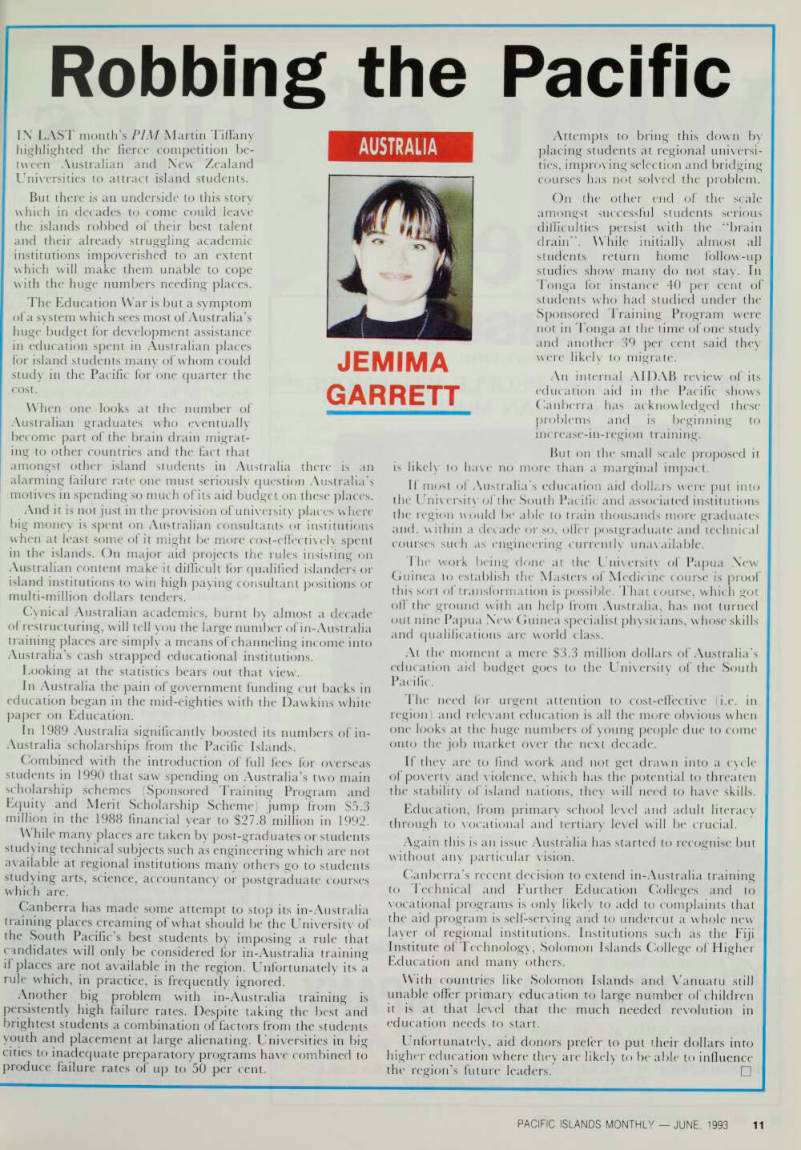
Jemima
Garrett
future?

Opinion
What of Fiji’s
By A Special Correspondent
In the last two months Sakeasi Buta droka, leader of the Fijian Nationalist Party, has appeared almost as often on the front page of Fiji’s daily newspapers as the nation’s Prime Minister, his performance in parliament and the debates he has sparked in the country have been one of the few pieces of political theatre the newspapers have found worthy of viewing. Over the period he has championed numerous controversial proposals over such issues as diverse as land tenure, an alternative Great Council of Chiefs and a Land Bank. The theme is, of course, vintage Butadroka an unbending support for what he sees as the rights of indigenous Fijians. For 20 years Buta has not been taken terribly seriously, yet suddenly, since Fiji’s return to democracy, his policies and voice ring out loud and clear from parliament. The most interesting questions is, why? How is a man like Buta able to so clearly capture the minds of the media and, to a painful degree, the views of an increasing number of Fijians? The reason for his success stems in large part from the fact that the government of Sitiveni Rabuka has for the past six months been utterly preoccupied with the formation of a government of na tional unity.
The reasons for Rabuka’s desire for a government of national unity are com plex. On the one level he appears to be operating out of a desire to come to terms with Fiji’s Indian minority and it is now statistically a minority. The second reason is somewhat more Machiavellian.
Waiting in the wings is Josevata Kami kamica, whom Prime Minister Rabuka has asked on more than one occasion to take over the Finance portfolio currently held by Rotuman Paul Manueli. The presence and power within cabinet of Rotumans and mixed race ministers of the General Voters Party have linked more than a few of Rabuka’s cabinet colleagues in the SVT, but more import antly is the fact that Kamikamica is waiting to replace not Manueli, but Rabuka himself.
Kamikamica to a large degree rep resents the power of and has the support of some of most powerful traditional chiefs within the Great Council of Chiefs and is clearly a long term (possibly even a short term) threat to Rabuka’s survival
a short term threat to Rabuka’s survival a threat that Rabuka would dearly like to neutralise or co-opt if necessary.
The internal dissension within his own SVT party has made it necessary for him to look to the Indian parties for support.
In so doing he has had at least verbally softened his position on Indian and minority rights in Fiji and appears to be willing to appease the Indian parties on a number of issues.
The appeasement thus far has been more apparent rather than real. There has been no revocation of the contro versial labour decrees, no substantive review of Value Added Tax and no full review of the constitution. Mahendra Chaudhry, leader of Fiji’s Indian dominated Labour Party has stood for election on a platform of not even sitting in parliament, and subsequently not only sat in parliament but supported Rabuka on a promise of electoral labour and tax reform, is now courting Rabuka to form a government of national unity and is beginning to look very much like Shakespeare’s proverbial ‘‘wench who doth protest too much”.
But what of Buta? It is precisely the apparent shift in policy to the political center by Rabuka in the last year that has given Buta his entree - an entree he had never had in 20 years of Fiji politics.
Rabuka is being out-flanked from his extreme right and as a good general he had better watch out before he loses the battle due to what mistakenly appears to be a minor tactical shift.
Is that all? Is it only the fact that Rabuka is making overtures to the Indians that accounts for Buta’s PR success in parliament. This is not just a game of appearances. The reality of the situation is that one year ago Rabuka was swept to power because he had the support of the vanua of the Fijian people.
He had their support'in part because of the coup, but also because he represented dare one say it a charismatic commoner and a departure from the old Lauan dominated elite. The chiefs were astute enough to know that they had better give the man his rope no matter how much they preferred Kamikamica who was and remains “their commoner”.
Rabuka will stay in power as long as he holds what the Chinese call “the man date from heaven” or the Fijian equivalent the vanua. But the chiefs and Kamikamica can read the vanua just as well as Rabuka.
Buta has succeeded in large measure because he has presented a clear and consistent policy to the vanua and this is getting back to village. The problem lies fairly and squarely with Rabuka and the SVT. Rather than out-flanking Buta, the
government of Rabuka has reacted to him. Cabinet has recently approved a S2-million loan scheme to fund the purchase of foreign owned land largely as a result of pressure from Buta.
Thus it appears that Buta is increasingly
being seen as setting Fiji’s political
agenda rather than the government.
Rather than presenting a coherent policy of Fijianistion that would sell to the vanua, Cabinet has simply reacted.
There is a real and substantive danger about what Buta is advocating especially in the area of returning land to Fijian owners. In 1997 the land leases under the Agricultural Landlord and Tenant Act come up for renewal. Buta wants this land returned to the Fijian land owners. It is not difficult to paint a quite realistic disaster scenario. In the year 2000 the Lome Convention which is the basis of Fiji’s sugar industry comes up for review and given that the EC now exports over 4 million tonnes of sugar and no longer needs sugar from Fiji, there is every likelihood that the conven tion will come to an end. (Contract sugar accounts for 40 per cent of Fiji’s available
land).
When the Convention was originally negotiated in 1974-5 the UK was still a major importer of sugar and AGP sugar was in demand. It is quite possible that under increasing pressure from Buta the Fiji government may attempt to develop a policy of returning land to its Fijian land owners just at the very time when that land will decrease in value. In order to do this the Fiji government would have to borrow massively in order to assist landowners to repay tenants for the value of the improvements. It may actually suit the interest of Indian landowners to have Fijians buy their land and pay for improvements just at the peak of its value. Thus the Fijian people may as a result of Buta’s pressure
be left with land that is of little commercial value but straddled with massive debts for the value of the
improvements.
Rabuka has made the cardinal mis take of politics. He has not presented his constituency with something concrete that makes him clearly different from his predecessors or his competitors. No matter how dangerous his ideas may be, that certainly cannot be said of Buta. His
policies are clear and quite unequivocal
and he is the only politician who knows he has nothing to gain from a govern ment of national unity.
The recent gagging of Buta over his attack of former Prime Minister and Vice-President Ratu Sir Kamisese Mara in parliament and his subsequent and
legally questionable ejection from the
house for almost three months has also struck a chord among many Fijians who, while deeply respecting Mara, at the same time pray the president Ratu Sir Penaia Ganilau will live to be a 120 years. Rabuka’s nightly prayers also go out for the continued good health of the
president. However gagging Buta by
ejectiing him from parliament only goes
to strengthen him.
In the final analysis Buta will not succeed even if the Prime Minister continues his current policy because what Buta says stands so fundamentally at odds with everything that is Christian and decent about Fiji. Buta has publicly said he wishes to ethnically cleanse Fiji Fiji only for the Fijians no Indians, no Europeans, no others. That is quite different from upholding the rights of the Fijian people. It is a simple message that rings of Bosnia and Croatia and while it might sell to some, to thinking Fijians who understand what sort of ugly society would need to be created to fulfil Buta’s nightmare this will almost certainly be
rejected. □
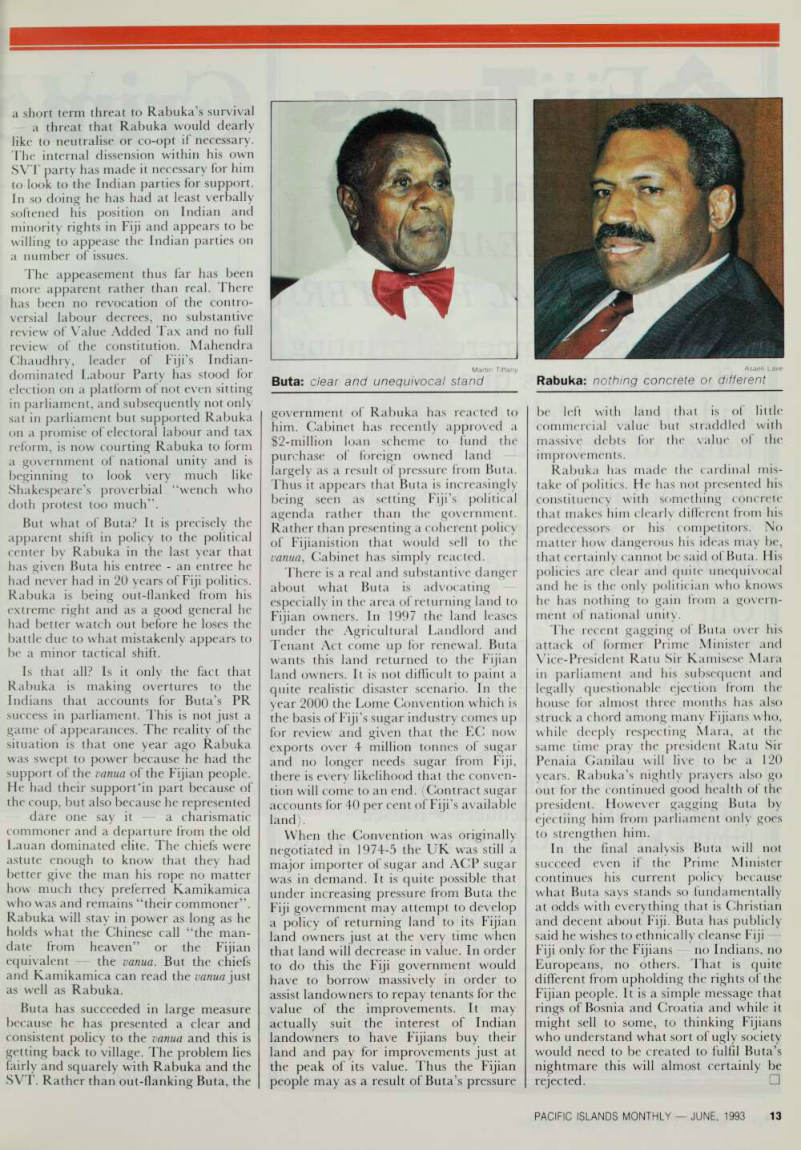
Martin Tiffany Buta: clear and unequivocal stand
Asaeli Lave Rabuka: nothing concrete or different
Advertisements & other items, pp. 12-14 (1 item)
Sg Samsung
The World’s Latest
PRODUCTS FOR PEOPLE WITH MORE
SENSE THAN MONEY
Available at Burns Philp Home Centres throughout Fiji and selected Duty Free Dealers.
SOLE DISTRIBUTORS:
To own a Samsung TV Screen, Samsung Video Deck and Samsung Remote Control Unit!
Thot’a Great!
That makes the Samsung Combination the most inexpensive of its kind.
Go for the best view.
Should be ideal for your home! <8
SAMSUNG
CORRIE & COMPANY
HEAD OFFICE G.P.O. BOX 45, SUVA TLX: FJ2166 CABLES: 'CORRICO’ SUVA.
TELEPHONE: 386777 BANKERS: WESTPAC, SUVA (FAX: (679) 370010 BRANCH OFFICE: 161 VITOGO PARADE P.O. BOX 83. LAUTOKA CABLES:
“CORRICO” LAUTOKA TELEPHONE: 60137
Fiji Times
Commercial Printing
FIJI'S LEADING
COMMERCIAL PRINTER!
Fiji Times Commercial printing
offers its clients quality, service
and timely delivery on a wide
range of printed products.
Technology, years of experience
and a professional approach
guarantee you the best service.
Our speciality is multi-colour
work. Our complete art and
design service allows us to offer
our clients a total package.
► Posters, Brochures ►Annual Reports
►Magazines ►All Office Stationery ►Labels
► Business Cards ►Calenders ►Raised
Printing ►Greeting Cards ►Packaging ►Books
Contact us for any of your printing needs.
SUVA ADDRESS: LAUTOKA ADDRESS: LABASA ADDRESS: NADI ADDRESS: Gordon Street Bila Street GPO Box 1167 PO Box 322
SUVA, Fiji LAUTOKA
PH: 304111 PH: 660422
FAX: 302011 Fax: 660352 302633 Jaduram Street
LABASA
PH: 811644
FAX; 812649
Main Street Nadi Town PO Box 1522
NADI
Shop 1 Kusum Centre PH: 780700,780702
FAX: 780705
Crime Wave

Cover Story
ON April 30, while Prime Minister Paias Wingti was outlining his government’s measures to fight crime, armed men robbed pay officers outside Morauta House in Port Moresby. Wingti’s office is on the top floor of the five-storey building and the money stolen
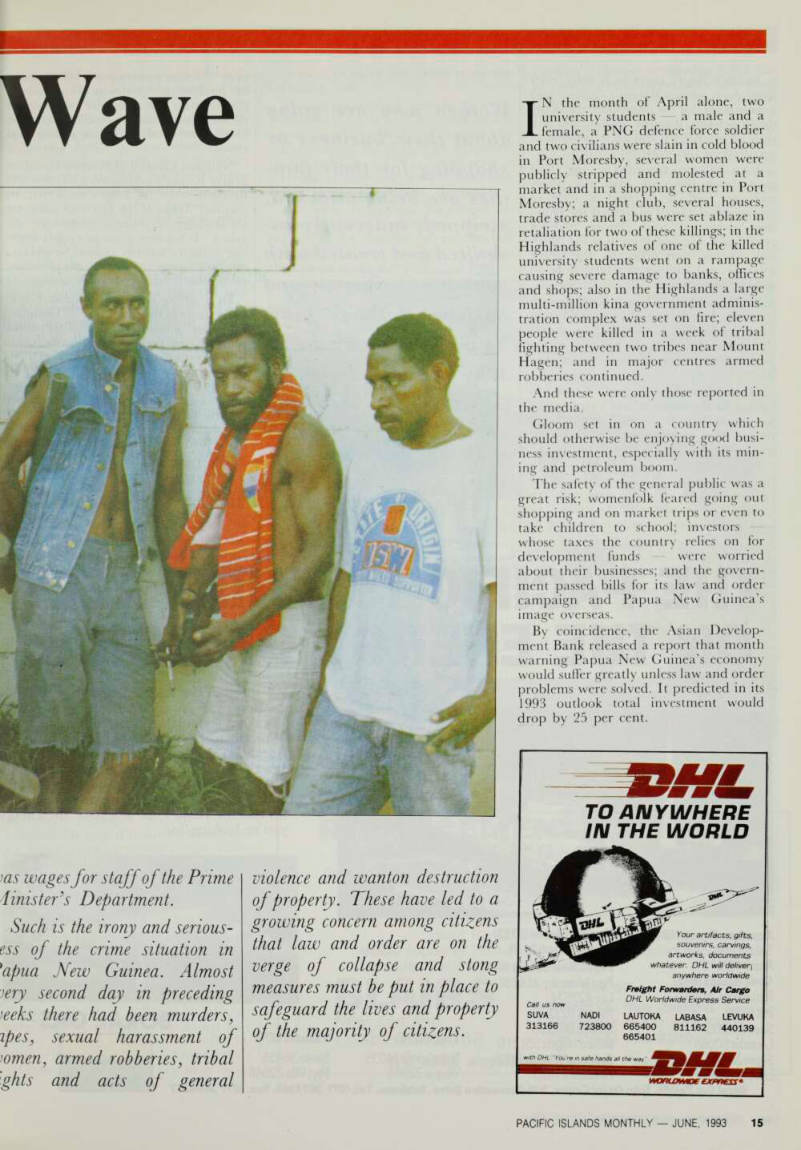
IN the month of April alone, two university students a male and a female, a PNG defence force soldier and two civilians were slain in cold blood in Port Moresby, several women were publicly stripped and molested at a market and in a shopping centre in Port Moresby; a night club, several houses, trade stores and a bus were set ablaze in retaliation for two of these killings; in the Highlands relatives of one of the killed university students went on a rampage causing severe damage to banks, offices and shops; also in the Highlands a large multi-million kina government adminis tration complex was set on fire; eleven people were killed in a week of tribal fighting between two tribes near Mount Hagen; and in major centres armed robberies continued.
And these were only those reported in the media, Gloom set in on a country which should otherwise be enjoying good busi ness investment, especially with its min
ing and petroleum boom.
The safety of the general public was a great risk; womenfolk feared going out shopping and on market trips or even to take children to school; investors whose taxes the country relies on for development funds were worried about their businesses; and the govern ment passed bills for its law and order campaign and Papua New Guinea’s
image overseas.
By coincidence, the Asian Develop ment Bank released a report that month warning Papua New Guinea’s economy would suffer greatly unless law and order problems were solved. It predicted in its 1993 outlook total investment would drop by 25 per cent.
[?]as wages for staff of the Prime Minister’s Department.
Such is the irony and serious ess of the crime situation in Papua New Guinea. Almost [?]ery second day in preceding weeks there had been murders, apes, sexual harassment of women, armed robberies, tribal [?]ghts and acts of general
violence and wanton destruction of property. These have led to a growing concern among citizens that law and order are on the verge of collapse and stong measures must be put in place to safeguard the lives and property of the majority of citizens.
Advertisements & other items, p. 15 (2 items)
Wave
To Anywhere
IN THE WORLD
Your artifacts, gifts, souvenirs, carvings, artworks, documents whatever. DHL will deliver! anywhere worldwide Call us now
SUVA
313166 Freight Forwarders, Air Cargo DHL Worldwide Express Service
NADI LAUTOKA LABASA LEVUKA
723800 665400 811162 440139 665401
stripped, indecently as
Cover Story
In the country there were calls, even from deep within Wingti’s cabinet and government, for the immediate use of the death penalty, flogging, declaration of a state of emergency and an imposition of a curfew in the worst-hit centres.
John Nilkare, regarded as the third man down the rank from the prime minister, said he wanted a state of emergency declared to combat the grow ing lawlessness and restore investor confidence. He said there was too much talk on law and order by the prime minister and cabinet but little done to enforce measures.
And he added, “There is just too much freedom. Freedom to do what? Certain freedoms have to be curtailed to protect the rights of at least 97 per cent of the population the peace-loving major
ity.”
Opposition leader Jack Genia in calling for the imposition of a curfew and for criminals to be publicly flogged said the reaction of police to crime was “far too little, far too late”.
“Women who are going about their business or shopping for their families are
being attacked, stripped, indecently as
saulted and treated with contempt,” he said. Later, as the situation worsened he
Women who are going about their business or shopping for their fam ilies are being attacked\ stripped, indecently as saulted and treated with contempt... Vicious and barbaric killings must be punishable by death.
Why should a people who take take the life of another person in such a manner be allowed to live?
said, “V icious and barbaric killings must be punishable by death. Why should people who take the life of another person in such manner be allowed to live.
Our system of administering justice must
change.”
National Council of Women President Maria Kopkop said women’s rights and freedom were no longer respected by youths. “What is the law and what are the law agencies doing to protect us,” she asked. “It has now come to a point where our women’s security cannot be guaran teed any longer by the very people whose profession it is to guarantee safety.”
In a strong editorial, the Post Courier daily wrote of the situation “Declining discipline within the ranks of the ‘disci plined forces’ coupled with the inereas in serious crime, are further signs of PNG moving towards a state of anarchy. No citizen today is free to move about because criminals appear to have gained control of this society, and their violent actions against citizens are not counter acted with equal force from the law.”
But Wingti did not believe the situ ation required any of the drastic measures suggested. Instead, he said what was required was a “well co ordinated attack on crime from all
angles”. In the first week of May when parliament was in its last week of the April-May session, the government pushed through several major legis lations seen as the main weapons for its long-term battle against crime. These were changes to the Summary Offences Act. the Bail Act, the Danger ous Drugs Act and the introduction and passage of two new laws known as the Internal Securities Act and the Repatri ation Act.
The effect of all these changes would enable authorities to refuse bail to people charged with committing serious crimes; enable quicker arrests of suspects; pro vide for stiller penalties for carrying and using firearms and dangerous drugs. And except for the' national court, local and district courts no longer have power to grant bail.
The State has also placed the' onus of proof on the accused so a person charged with an offence has to prove his or her innocence instead of the State, as at present. In other words when arrested and charged, a person is automatically guiltv until they prove their innocence, not innocent until proven guilty.
Wingti also promised to improve terms and conditions of serv ice of members of the polite force; boosted their LSS7I.B million budget this year by another USSIO million. In return he asked there be strict discipline in the force and there be positive results in clamping down on lawlessness. To ensure discipline is main tained the government passed another law disallowing any appeal, except through the national court, by police personnel convicted and either sus pended or dismissed by the force.
Wingti instructed four maximum se curity jails be constructed to ensure the hard-core criminals were kept in. A major problem in fighting crime has been the high number of escapes from jail of hard-core criminals, many of whom continue to be responsible for most of these serious crimes.
To assist the government, Port Moresby’s National Capital District Commission agreed to fund USSSOO,OOO for boom gates at the two main roads leading out of the city, and to be manned 24 hours by police to keep a tight check on everyone leaving or coming into the
city.
“We all want to see an end to rape, murder and robberies,” Wingti said when announcing his crime-fight strat- DW- He said he believed crime was on the rise in PNC because the people had an “ attitude problem”. “Papua New Guin eans must be willing to build, not tear down,” he told a meeting attended by women and church leaders. Our people's attitude must change. They must work
and learn to make wise use of resources, including time/' He said the spate oferimes in the weeks preceding were the sign of a “sick society whose members had no respect for society, whose members had no respect for the individual. It has lost its sense of direction of direction. People have ever begun to lose self-respect, he said But while supporting his earnest at tempts to quash lawlessness, those he invited to the meeting, threw the ball back into his court, calling on leaders themselves to set standards and lead bv
example. The prosecution of politicians involved in corruption and the moral conduct of some leaders were cases in point.
United church moderate Sioni Kami said leaders should examine themselves and clean their own backyard first before they expected the public to follow suit.
Both leaders and the public should ensure the continuing law and order problem in the country is seriously addressed.
Without this cooperation neither can be guaranteed a future.
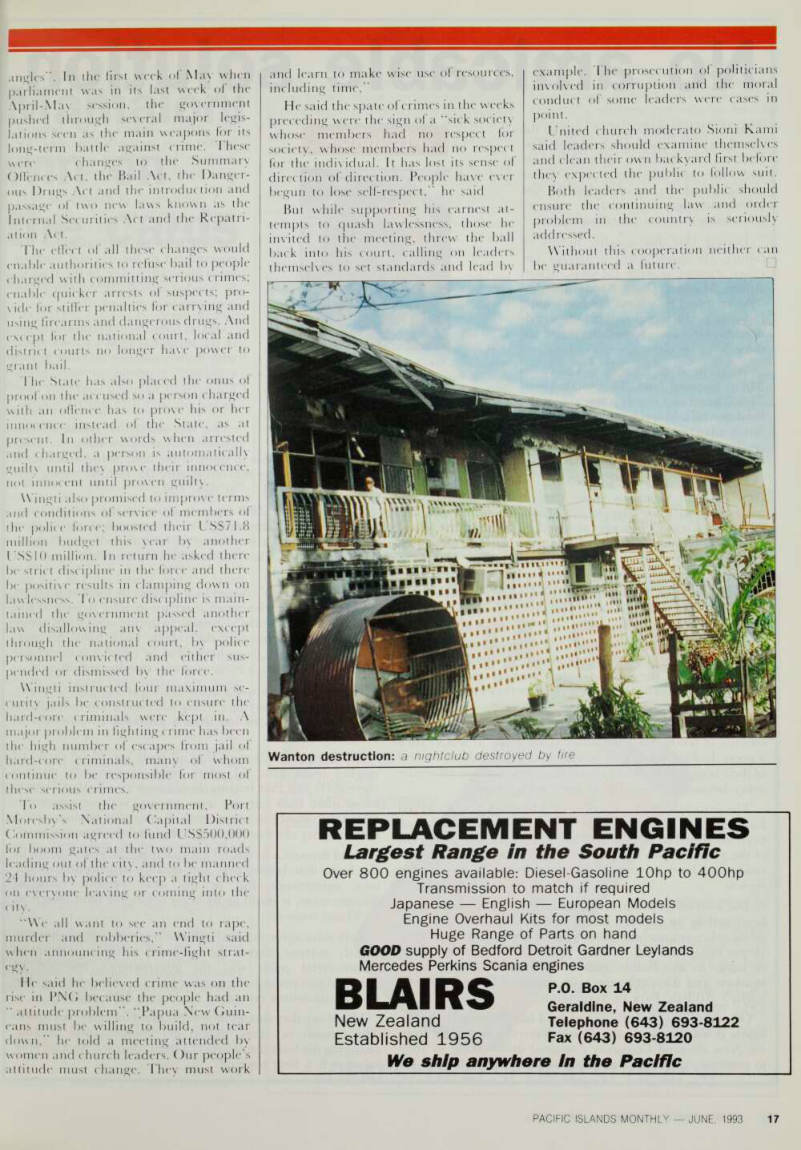
Wanton destruction: a nightclub destroyed by fire
Advertisements & other items, pp. 16-17 (1 item)
The Pacific Islands Rely
ON THE ENERGY OF BORAL
m n *»*i American Samoa (684) Tafuna 699 2948 Aua6442170 Cook Islands (682)
Rarotonga 24460
(679) Suva 315522 Lautoka 60088 Sigatoka 50578 Labasa 82973 Norfolk Islands (6723) Norfolk Island 2419 Papna New Guinea (675) Port Moresby 214248 Lae 422574 Rabaul 921225 Wewak 862125 Mount Hagen 551216 Solomon Islands (677) Honiara 21833 All through the Pacific Islands, people rely on Boral LP gas for their energy needs.
Boral has terminals throughout the area, and is proud to be a leading supplier.
Boral Gas is clean, efficient and low in cost.
It’s the ideal energy source for cooking and water beating in homes, motels and hotels, and for a wide range of industrial uses.
So call for Boral Gas. We have the energy you’re looking for.
Tonga(676) Nukualofa 24035 Vava’u 22903 Vannatn (678) Santo 36455 Port Vila 22046
BORAL GAS
Boral Gas Pacific, John Oxley Centre, 339 Coronation Drive, Brisbane. Tel: (07) 3671365. Fax: (07) 3694347
REPLACEMENT ENGINES
Largest Range in the South Pacific
Over 800 engines available: Diesel-Gasoline lOhp to 400 hp Transmission to match if required Japanese English European Models Engine Overhaul Kits for most models Huge Range of Parts on hand GOOD supply of Bedford Detroit Gardner Leylands Mercedes Perkins Scania engines
BLAIRS
New Zealand Established 1956 P.O. Box 14 Geraldine, New Zealand Telephone (643) 693-8122 Fax (643) 693-8120 We ship anywhere In the Pacific
No amicable solution
MAORI land grievances go back to the first days of European settlement in New Zealand. All attempts to resolve them over the last 150 years have failed dismally and the loss of land to the first white immigrants remains one of
Maoridom’s most outstanding injustices.
Despite this discouraging history of failure, the government is making an other attempt to settle the issue. Maori Affairs Minister Doug Kidd concedes: “We’re trying to achieve the impossible, but the problem cannot be left unad dressed for ever. Something must be done.”
What he is addressing is known as Maori reserved land. This totals about 74,600 acres and is only a fraction of the land to which Maori have lodged claims, but is a particularly difficult question to resolve because both Maori and pakeha
have equally legitimate interests to be taken into account.
In the early days of colonisation, the government and the New Zealand Company made deals under which certain pieces of land were reserved for Maori ownership and use.
The Crown was to look after the land on behalf of the Maori owners, and much of it was leased to new settlers for farming and housing.
In what would today be seen as a scandalous procedure, the leases were struck without agreement or even discussion with the Maori owners, who had no say in the administration of their land.
The settlers naturally w anted long term leases to justify the time and effort they had to donate to make the land productive and they also wanted renewal guarantees to ensure they would not be thrown off after they had developed it. Rents were reviewed only every 21 years.
It was a good deal for the settlers who effectively won security of tenure for generations at low rents. It wasn’t such a good deal for the Maori owners who never gained control of their land and saw the Value of their rental income dwindle away because of the 21-year fixed rent period.
The situation was legalised in 1955 by the Maori Reserved Land Act. It maintained the perpetual leases (which had been abolished in Britain in 1926) and set rents at 5 per cent of the government valuation for farmland and 4 per cent for residential land in townships, retaining the 21-yearly rent review.
The next effect was in recent years the Maori owners have been getting an average return of only about 1.6 per cent, while other commercial landowners were earing more than 10 per cent. And this on some prime land, including fertile orchards in the Nelson region, profitable dairy farms in Waikato and Taranaki, the town centre of Greymouth and rugby’s Athletic Park in Wellington.
On top of this, the amount of land has dwindled over the years. It was known as the Tenths Reserves, stemming from the New Zealand Company’s'original undertaking in 1839 to preserve one-tenth of all land ceded by Maori in trust for
the tribal owners. The original 20,000 acres in the Nelson area, for instance, had reduced to little more than 4000 acres by 1929.
A commission of inquiry in 1975 found, understandably, that the Maori landowners had been treated unfairly from the beginning, but the government of the day did nothing other than allow title to the land to be handed over to Maori trusts and incorporations to look after.
Maori resentment at the unfairness of the leases has built up since then, with leaders pointing out that Maori economic development was being hindered by having a land asset base locked up, and with miserly returns.
At the same tie, pakeha lessees, generations removed from the orig
inal ones, have, come to think of the land as theirs but have no security, fearing that eventually the historic wrong will have to be righted at their cost.
There are over 2300 separate leases on the affected land, which is spread throughout the country, but the biggest pockets are on the west coast of both islands, the Nelson- Motueka region, the Waikato, Wellington and Palmerston North.
The government’s dilemma is obvious by the fact it sat on the report of a review team it set up in 1991 to look at the question for 17 months unable to decide what to do about it. Kidd finally released the report, along with his own proposals, in April, launching what he called a consultation phase to try to get a consensus on resolving the issue.
He ruled out “a quick painful fix” as likely to do more harm than good, saying: “After 150 years, any attempt to solve this problem in less than a generation is doomed to failure.”
His key proposals were that all rents should be raised to market levels after 14 years (with seven-yearly reviews thereafter) and that tenants should have two further 21-year leases after their current term expires, with arrangements after that subject to negotiation. Residential tenants would have security of tenure as long as they and their spouses lived.
Kidd favours a hands-off approach by the government, in the hope that landowners and tenants will negotiate their own agreements. But in the most extreme cases of disagreement, it could be 84 years before the land reverts to its Maori owners.
Both sides agree the issue must be resolved, but neither was exactly ecstatic about the proposed solution. The most controversial point was the government’s rejection of financial compensation for either party compensation the review committee estimated could cost $3OO million.
Maori say they should be compensated for their past losses.
The tenants say they should get compensation because changing the lease terms breaks a legal contract. An amicable solution is a long time off. C
Wellington
David
Barber
Mamaloni

Elections
Mamaloni win on the cards
By Johnson Honimae
SOLOMON ISLANDS Prime Minister Solomon Mamalomi is back, at least in Parliament, for the next four years. His constituency of West Makira, in the eastern part of the country, has so much confidence in the man that Mamaloni stood unopposed when nominations for the May 25 national elections closed on April 28.
Another member of Mamaloni’s govern ment of national unity and Minister of Foreign Affairs and Trade Relations, Job Dudley Tausinga also stood unopposed in the North New Georgia seat in the Western Province. The Solomon Islands Group for National Unity and Reconciliation which Mamaloni is leading into the elections is made up of his 15 Cabinet members and six former government backbenchers. It will also include several new candidates. The group has lost the former MP for Small Malaita, Alex Bartlett, to the United Party but has gained a former deputy Prime Minister and a member of Mamaloni’s old
People’s Alliance Party, Danny Philip, who
is former MP for Rendova/Tetepari.
The May election is one which is being
contested by more professionals and quali
fied people than any other election since Solomons Islands gained independence in 1978. There are 33 public servants, includ ing their boss, the Chairman of the Public Service Commission, have left their secure jobs to enter politics. Included in this group are two permanent secretaries, Leonard Macnu’u, Health and Medical Services) who is contesting the West Honiara seat and Patteson Oti (Ministry of Provincial government), who is standing for the Femotu Nende seat, in the eastern part of die country. Two medical doctors and several academics are also going into the 'lections.
With already two in the bag, Prime
Minister Mamaloni’s National Unity
already has a head start on the seven )ther political parties that are putting orward candidates for the elections. Most )f Mamaloni’s former Cabinet ministers ihould not have any problems getting their ieats back except for two. One is the Minister of Transport, Works and Utilities, 3en Gale, MP for West Honiara, whose win s doubtful because the seat is being ontested by more educated and qualified 3eople for the first time. His opposing andidates include a former permanent
secretary, a prominent businessman and other former senior government officers.
Gale, a former taxi-driver who is hoping for his third term in Parliament, will have to work harder than he did in previous elections.
The other minister who will have to work hard is the Minister of Commerce and Primary Industries, Alfred Maetia, contest ing the Central Kvvara’s seat. The constitu ency’s area has been changed with nine new' constituencies added. Maetia will now have to cover some new villages. Maetia was also charged along with two Austra lians for attempting to smuggle parrots out of the country last year. Maetia was acquitted but his name has been scarred following the incident.
The other seats to watch out for are those contested by leaders of the other political parties. Former Prime Minister and leader of the United Party, Ezekiel Alebua is likely to retain his East Guadalcanal seat but his nearest riv al in the last election, Johnson Koli, is also standing. Leader of the National Party of Solomon Islands, NAPSI, Francis Saemala, thought he had it all tied up for the Aoke and Langa Langa seat on Malaita until a former Finance Minister and economist, Bartholomew Ulufa’alu, decided to contest the same seal.
Already there has been a lot of mud slinging between the two in their campaign.
Opposition Leader and Leader of the
Labour Parly, Joses Tuhanuku, must come back because he has been instrumental in creating a separate province for his two islands of Rennell and Bcllona and has been working hard onn getting relief supplies for his people in the wake of Cyclone Nina early this year.
Thee most hotly contested seat will have to be the West Are'Are seat contested by the Leader of the People s Alliance Part)’ and veteran politician, David Kausimae, and Leader of the Nationalist Front for Prog ress, Andrew Nori. The two candidates are also relatives and so family votes will be split and other votes will be split further by the three other candidates also running for the same seat.
With all the uncertainty, like most elections in Pacific island countries, Prime Minister Mamaloni’s group seems set to be a force to be reckoned with. Even if only 50 percent of his group’s candidates get elected, Mamaloni should be able to convince the independent candidates to
join him bv probably offering ministerial
positions in front of their eyes.
At least the National Unitv Group docs not have to worry about getting getting its leader into parliament which is a worry to the other parties. There is of course the final hurdle of choosing who should be a leader or prime minister if the other parlies decide to form a coalition government as a means getting rid of Mamaloni.
Advertisements & other items, p. 19 (1 item)
Shasta Soda
PROMOTION! PROMOTIONI PROMOTION!
Product; Soft Packing: 12 1 2,000 per 20ft Shipment: Next Price: U 554.49 FOB Seattle, W Term: 30 days Drinks 724 oz oz
FCL
sail Washington L/C placed Pacific Tonga Ph (676) Fax No 23 Willis Unga P.O orders must be at the South sales office in (676) 21-105 139. Contact Box 2481 alofa, Tonga
DEALS! DEALS! DEALS! DEALS!
Border patrol
Conflict
By Wally Hiambohn
ON the Royal Solomon Islands Patrol Vessel (RSIPV) Auki the 18-man crew are friendly, respectful and courteous.
Each night after dinner they sit around to watch video or tell jokfs, and one of the jokes I liked best is about a colleague on the Auki’s sister boat, Lata.
The story goes that after spending a stint at the border, Lata’s crew called in for a break in Honiara. On arrival this crewman was asked to pray to thank the Almighty for their safe-keeping and return home.
So the sailor bows his head and utters, “Big man, we thank you for bringing us safely home. You realise this is the first time we prayed to you in a long while because we know you are here in Honiara where your home is. We never pray at the border because you are never there.”
But as funny as it may seem the point is, with their experience at the border, members of the Solomon Islands surveil lance unit and the police field forces
(PFF) feel their God has forsaken them.
Th{ . Bougainville spill-over effect into thc Shortland Islands and the repeated jncursions b PNG securit forces into these islands is their first rea] experience r ... r , of military confirmation - and they are For the flrst tlme the y are out m the fleld for two weeks keeping guard and natrolinsr well into the nierht While r auuilll 6 wcu llllu lllc Himc man y are g ettin g used to the s,tuatlon and building up courage, most were, from the start, quite frightened of what their tour of duty would be.
Fighting a war with PNG soldiers was th e least of their considerations because they had heard enough tales of the war between PNG troops and Bougainville rebels.
During the machine-gun shoot-out I witnessed between PNG and Solomon Island forces at Tuluve on April 24, the police photographer kept insisting to his superior to stop the shooting because of
what the PNG Defence Force may do.
He told me, “This is it, I’m heading back home. I will become a missionary.”
Sure enough, two days later he was heading back to Honiara with my police escort (his superior) and me after convincing the boss that both his chil dren were down with malaria. He said he was planning to join a Christian fellow ship group travelling to Port Moresby to pray for the Bougainville crisis and its effect on the Solomons.
There are about 70 PFF and patrol boat crew based on the border. In all islands with human habitation there is PFF presence to provide security and comfort and to restore the confidence of
the people.
In Honiara the top echelon of the police force have anxious moments about what may happen on the border.
One senior office told me frankly they try their best to avoid any confrontation because it would have wide implications; the obvious injuries and loss of lives, further strains in relations between PNG
Wally Hiambohn
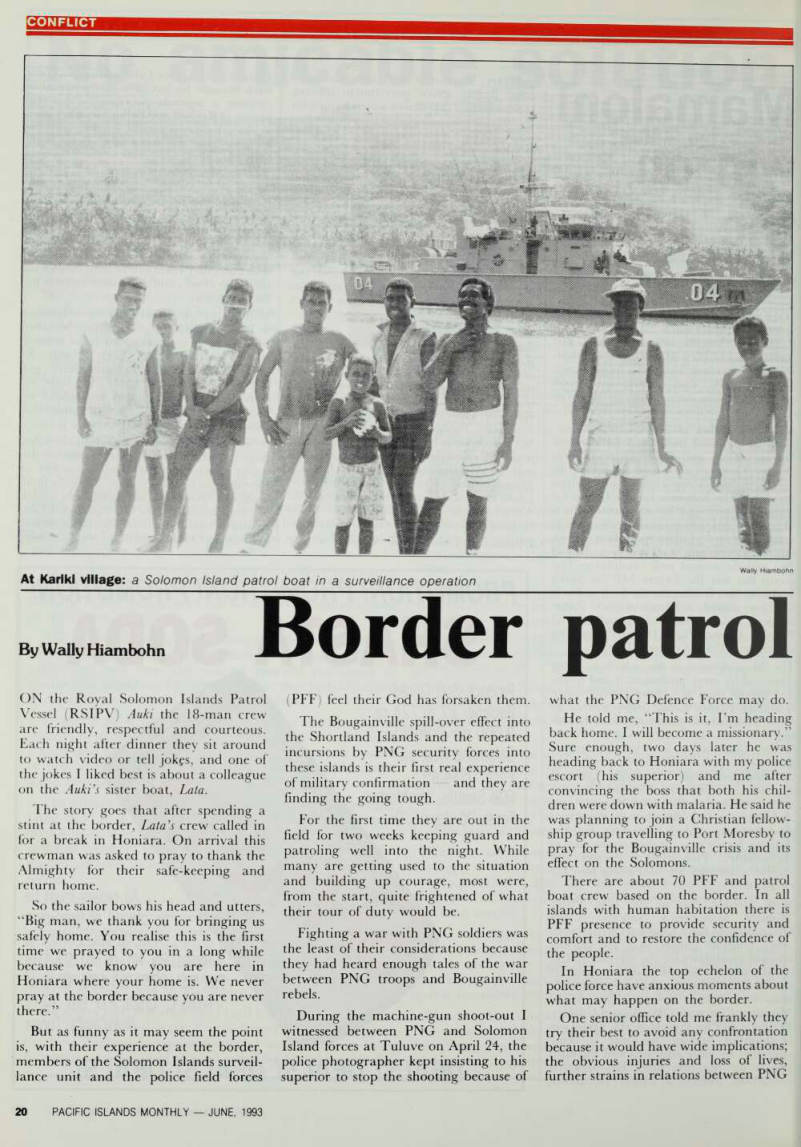
At Kariki village: a Solomon Island patrol boat in a surveillance operation
and the Solomons, and the financial costs of such a situation.
While there have been no casualties on either side, PNG’s repeated intrusions into the Shortland Islands have created tension in relations and cost the Solomon Islands police a great deal financially.
According to the officer some Sls4 million has been spent on its border surveillance operations a considerable amount in terms of the Solomon Islands
government’s public expenditure and
economy. Simply put, it is money the Solomon Islands cannot afford with the state its economy is in and the pressing need for improvements in vital areas such as health, education, roads and bridges.
There certainly is no need for “war” between Papua New Guinea and the Solomon Islands. Firstly, the two are the same people, Melanesian brothers and sisters, and neither can afford it in whatever shape or form it comes. The opposite would be ideal for them to work together for the two countries and
people.
What created this recent stand-off between the two sides is the Bougainville crisis and its “spill-over effects” into the Solomons. This is an issue which the two sides could easily to deal with. Both have have been dragging their feet over the issue.
With the imposition of a blockade around the island three years ago, Bougainvilleans, both civilians and el ements of the Bougainville Revolution ary Army, crossed over into the Shortlands and other parts of the West ern Province through the narrow span of water separating the two countries in search of “supplies”.
PNG security forces have crossed repeatedly into the Shortlands and there is sufficient evidence to prove this in pursuit of BRA elements who cross back and forth. Recent accusations, which have yet to be proven, about an arms traffic route from the Solomons into Boungainville and an arms build-up on the border is well known.
What has further miffed the PNG government is Solomon Islands facilitat ing operations and movement of BRA as well as pro-secessionist activists and sympathisers on its soil. Among them Martin Miriori, the Bougainville interim government representative in Honiara, and his propaganda activities, the likes of
BRA sympathiser Rosemarie Gillespie
and other foreign operatives in the Solomons and who go on to Bougainville to assist the BRA, and also the illegal
entry into Bougainville of foreign jour
nalists through the Solomon Islands.
The first major incident on the border was in early 1992 when PNG security forces raided Kairiki village in the Shortland Groups’ Fauro Island and
blew up a fuel depot they claimed was run for the rebels. While the government apologised over the “unauthorised” inci dent, it warned the Solomons to respect PNG’s sovereignty by not facilitating any activities against it. However, this did not seem to stop as suspected BRA elements and associates kept moving about at will between the two countries.
PNG security forces came up with another shock-horror when they raided Komaleai village, fired shots and killed two people.
People in the Shortlands told me on my recent tour of the islands they were living in constant fear of the security forces, and had restricted their move ments.
Unless Port Moresby or Honiara are in the Shortlands, neither would under stand and appreciate the difficulties these people are facing.
Four thousand human beings who through no fault of theirs are going through this “punishment”. They admit their origin and relationship to Bouganvilleans but say they had only tried to assist those in need of humani tarian aid. A well organised system for procurement of goods was in place where Bougainvilleans in need of food and fuel supplies had to get written approval from both the Bougainville Interim Govern ment and the Shortland Council of Chiefs before receiving these goods.
A black market operation at Komaleai village threw this organisation into chaos. Because Bougainvilleans were loaded with the precious Kina and desperate for supplies, the owners were ripping them off by charging goods in Solomon dollars but accepting payment in Kina.
For example, a store item that cost Sls3 would cost Bougainvilleans K 3, making an extra K 2 because the exchange rate for the two currencies is K 1 to SIS 3.
The operators of this outlet paid for it with the lives of two of their relatives when the PNG security forces stormed the village and pounded bullets into it.
Shortland chiefs who spoke to me expressed disappointment that this par ticular operation had jeopardised their arrangements. They said they weren’t surprised when the PNG security forces moved in and raided Komalaie village.
The attitude and possible involvement of certain Solomon Islands politicians was another area of concern to PNG.
There were claims that a few of these politicians were in contact with the BRA leadership and had on one occasion invited and entertained rebel military leader Sam Kauona.
PNG government officials also claim these politicians were present in Arawa in April 1990 when pro-secessionists
made the unilateral declaration of inde
pendence for Bougainville.
Prime Minister Solomon Mamaloni’s attitude has not helped the situation either. His letter, first to Manus Premier Stephen Pokawin discussing PNG’s internal issues, and later to deputy Prime Minister Sir Julius Chan about Bougain ville wasn’t received too well by Port
Moresby. Sir Julius’ terse reply made
quite obvious the manner in which the letter was received.
Mamaloni’s defence of Martin Miriori’s presence in Honiara contra dicted the undertaking he made to Prime Minister Paias Wingti to close Miriori’s office and remove him from the country.
Instead Honiara issued him two-year residential permit. Its treatment of Mike Foster and Rosemary Gillespie, con sidered foreign agents of the BRA, has
repeatedly angered Port Moresby. These
agents had passed through Honiara to get to Bougainville and vice versa and had for long irked the PNG government.
So it was not surprising when PNG made the claim in April that the Solomons government was assisting the BRA build-up allowing them to take delivery of arms.
For its part the Solomon Islands has accused the PNG government of failing to honour the understanding reached on border surveillance. Continuous in cursions by security forces at the border has angered the Solomon Islands. It is costing the Solomons huge sums of money to maintain police presence at the border. A senior policeman said they were being stretched to the limit.
The arrogant attitude of PNG military personnel at the border has aggravated the situation.
Solomon police personnel spoke fondly
of a certain Captain Philip who was in charge of the PNG base on Tuarato
Island. He helped in creating good
relationship between the two sides. This good relationship soured when he was replaced, they say.
Recent attempts at restoring PNG- Solomons relations is welcome. While bureaucrats have reached a deep and common understanding, it is to be hoped the politicians on both sides would take it further and sanction some of the issues agreed to. Otherwise it would have been a waste of time, going back to square one.
It is in the interest of both sides that there is a strong political will to solve the impasse in relations.
While both Mamaloni and Wingti have agreed on this new dialogue, they should take definite practical measures in addressing the issue.
Advertisements & other items, p. 22 (1 item)
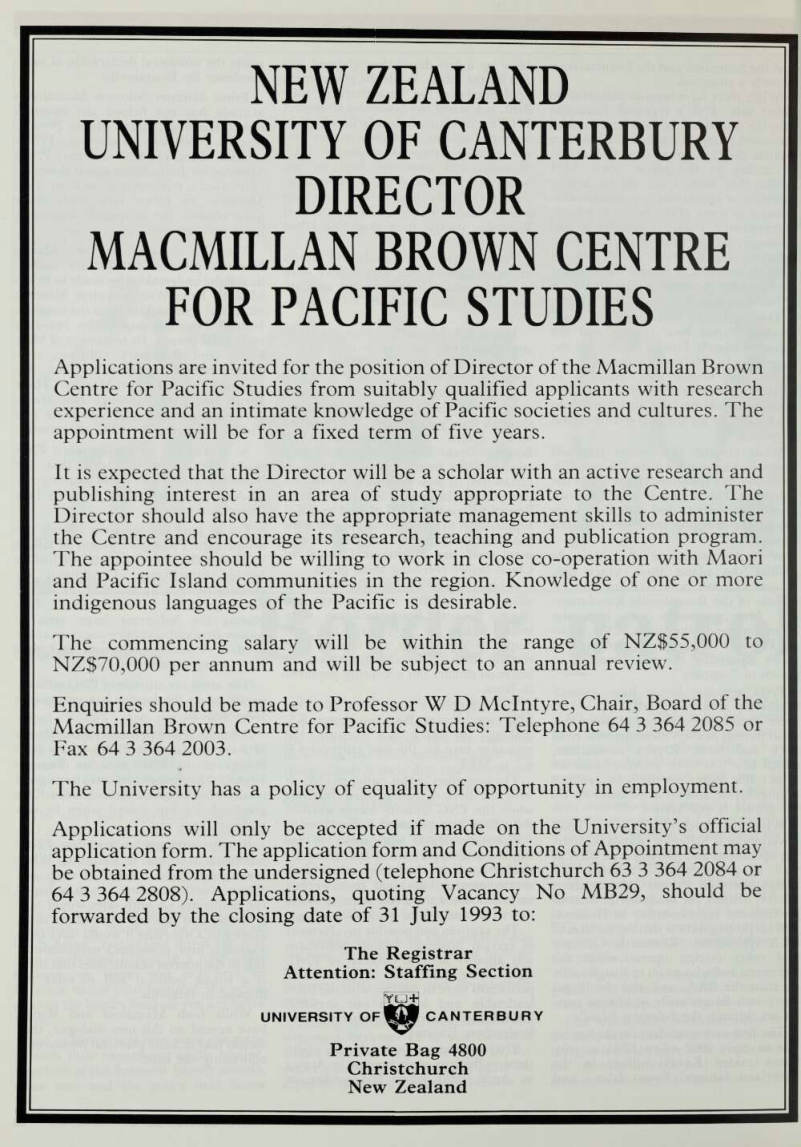
University Of Canterbury
NEW ZEALAND
DIRECTOR
MACMILLAN BROWN CENTRE
FOR PACIFIC STUDIES
Applications are invited for the position of Director of the Macmillan Brown Centre for Pacific Studies from suitably qualified applicants with research experience and an intimate knowledge of Pacific societies and cultures. The appointment will be for a fixed term of five years.
It is expected that the Director will be a scholar with an active research and publishing interest in an area of study appropriate to the Centre. The Director should also have the appropriate management skills to administer the Centre and encourage its research, teaching and publication program.
The appointee should be willing to work in close co-operation with Maori and Pacific Island communities in the region. Knowledge of one or more indigenous languages of the Pacific is desirable.
The commencing salary will be within the range of NZ555,000 to NZ$7O,OOO per annum and will be subject to an annual review.
Enquiries should be made to Professor W D Mclntyre, Chair, Board of the Macmillan Brown Centre for Pacific Studies: Telephone 64 3 364 2085 or Fax 64 3 364 2003.
The University has a policy of equality of opportunity in employment.
Applications will only be accepted if made on the University’s official application form. The application form and Conditions of Appointment may be obtained from the undersigned (telephone Christchurch 63 3 364 2084 or 64 3 364 2808). Applications, quoting Vacancy No M 829, should be forwarded by the closing date of 31 July 1993 to: The Registrar Attention: Staffing Section
UNIVERSITY OFM CANTERBURY
Private Bag 4800 Christchurch New Zealand
Paean Ash
Business
By David North
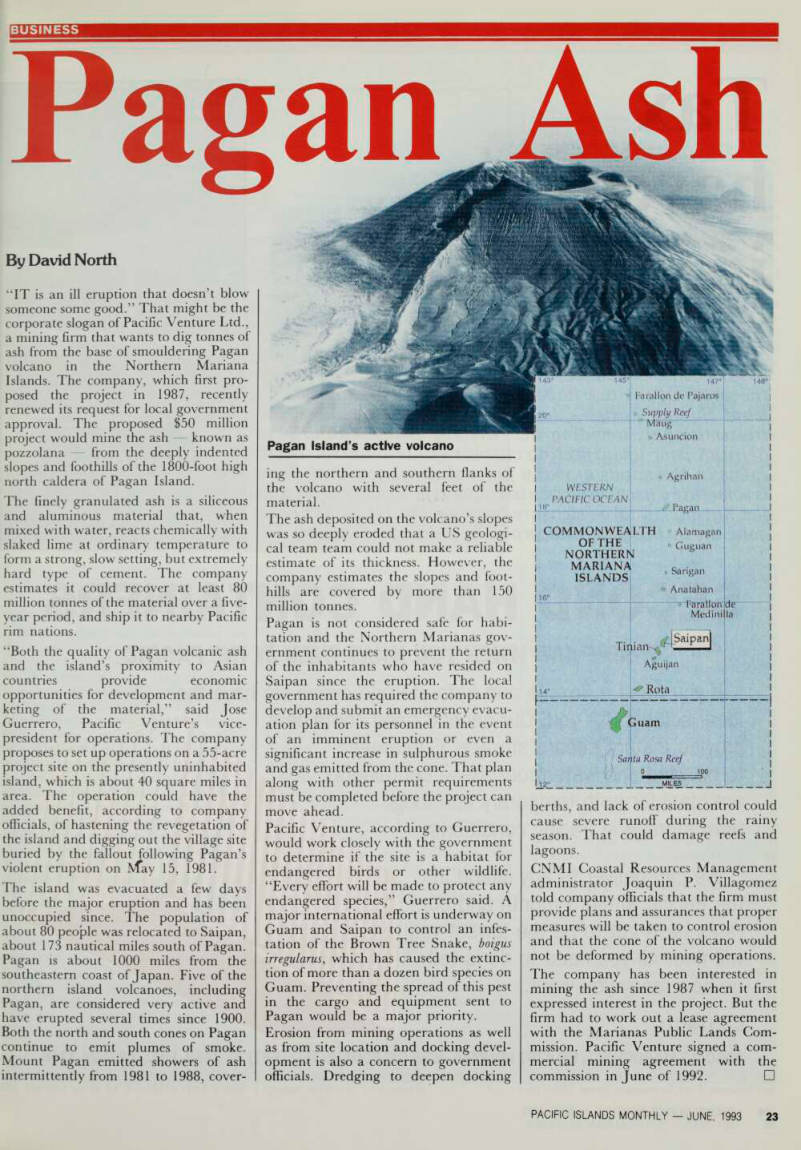
“IT is an ill eruption that doesn’t blow someone some good.” That might be the corporate slogan of Pacific Venture Ltd,, a mining firm that wants to dig tonnes of ash from the base of smouldering Pagan volcano in the Northern Mariana Islands. The company, which first pro posed the project in 1987, recently renewed its request for local government approval. The proposed $5O million project would mine the ash known as pozzolana from the deeply indented slopes and foothills of the 1800-foot high north caldera of Pagan Island.
The finely granulated ash is a siliceous and aluminous material that, when mixed with water, reacts chemically with slaked lime at ordinary temperature to form a strong, slow setting, but extremely hard type of cement. The company estimates it could recover at least 80 million tonnes of the material over a five year period, and ship it to nearby Pacific rim nations.
“Both the quality of Pagan volcanic ash and the island’s proximity to Asian countries provide economic opportunities for development and mar keting of the material,” said Jose Guerrero, Pacific Venture’s vice president for operations. The company proposes to set up operations on a 55-acre project site on the presently uninhabited island, which is about 40 square miles in area. The operation could have the added benefit, according to company officials, of hastening the revegetation of the island and digging out the village site buried by the fallout following Pagan’s violent eruption on \fay 15, 1981.
The island was evacuated a few days before the major eruption and has been unoccupied since. The population of about 80 people was relocated to Saipan, about 173 nautical miles south of Pagan.
Pagan is about 1000 miles from the southeastern coast of Japan. Five of the northern island volcanoes, including Pagan, are considered very active and have erupted several times since 1900.
Both the north and south cones on Pagan continue to emit plumes of smoke.
Mount Pagan emitted showers of ash intermittently from 1981 to 1988, cover-
ing the northern and southern flanks of the volcano with several feet of the material.
The ash deposited on the volcano’s slopes was so deeply eroded that a US geologi cal team team could not make a reliable estimate of its thickness. However, the company estimates the slopes and foot hills are covered by more than 150 million tonnes.
Pagan is not considered safe for habi tation and the Northern Marianas gov ernment continues to prevent the return of the inhabitants who have resided on Saipan since the eruption. The local government has required the company to develop and submit an emergency evacu ation plan for its personnel in the event of an imminent eruption or even a significant increase in sulphurous smoke and gas emitted from the cone. That plan along with other permit requirements must be completed before the project can move ahead.
Pacific Venture, according to Guerrero, would work closely with the government to determine if the site is a habitat for endangered birds or other wildlife.
“Every effort will be made to protect any endangered species,” Guerrero said. A major international effort is underway on Guam and Saipan to control an infes tation of the Brown Tree Snake, boigus irregularus , which has caused the extinc tion of more than a dozen bird species on Guam. Preventing the spread of this pest in the cargo and equipment sent to
Pagan would be a major priority.
Erosion from mining operations as well as from site location and docking devel opment is also a concern to government
officials. Dredging to deepen docking
berths, and lack of erosion control could cause severe runoff during the rainy season. That could damage reefs and lagoons.
CNMI Coastal Resources Management administrator Joaquin P. Villagomez told company officials that the firm must provide plans and assurances that proper measures will be taken to control erosion and that the cone of the volcano would not be deformed by mining operations.
The company has been interested in mining the ash since 1987 when it first expressed interest in the project. But the firm had to work out a lease agreement with the Marianas Public Lands Com mission. Pacific Venture signed a com mercial mining agreement with the commission in June of 1992. □
Pagan Island’s active volcano
in paradise

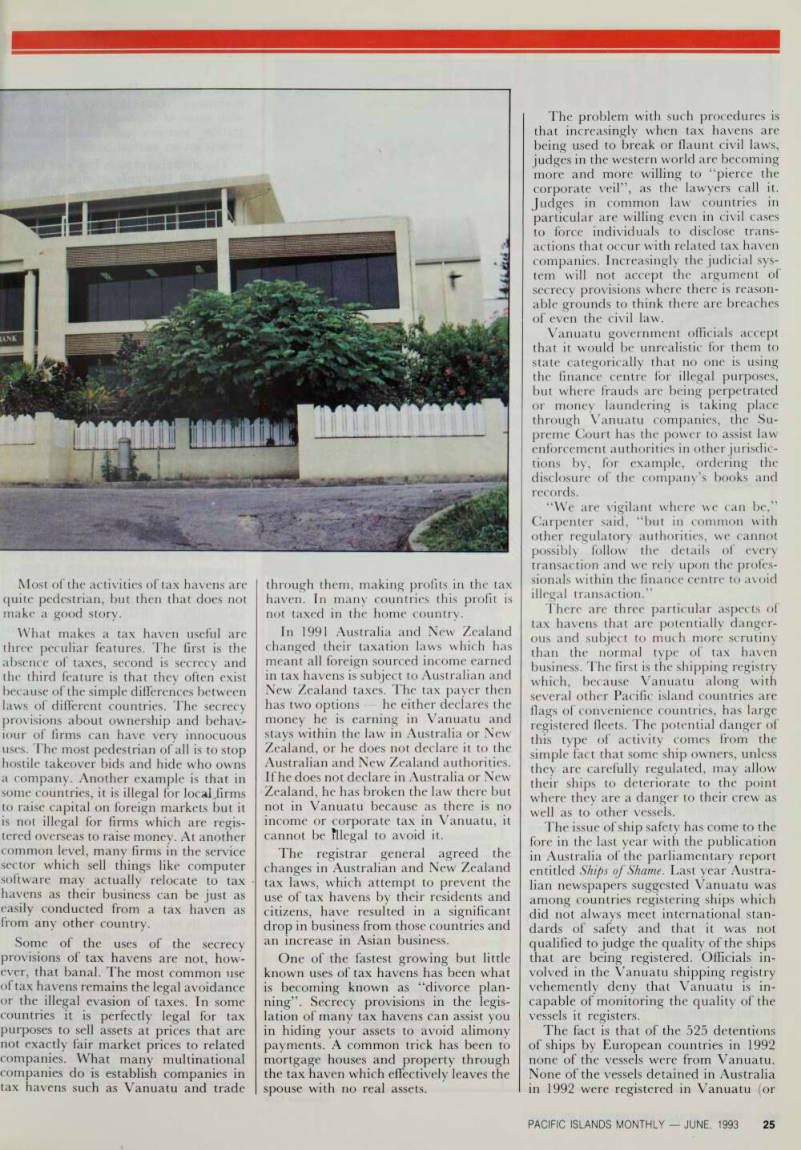
Tax havens in paradise
You can see in the eyes of Vanuatu's registrar of companies, Richard Carpenter, the fatigue that any man in his position must have trying to answer the question of the press about tax havens. He knows most journalists want the big story — the drug laundering business, the transnationals avoiding tax, the spy using Vanuatu to defraud poor unsuspecting citizens of his country. There exists in the minds of many journalists a view that there is something necessarily sinister about finance centres and tax havens, in large measure because sinister things have gone on in the past and probably continue to go on.
Most of the activities of tax havens are quite pedestrian, but then that does not make a good story.
What makes a tax haven useful are three peculiar features. The first is the absence of taxes, second is secrecy and the third feature is that they often exist because of the simple differences between laws of different countries. The secrecy provisions about ownership and behave iour of firms can have very innocuous uses. The most pedestrian of all is to stop hostile takeover bids and hide who owns a company. Another example is that in some countries, it is illegal for localjirms to raise capital on foreign markets but it is not illegal for firms which are regis tered overseas to raise money. At another common level, many firms in the service sector which sell things like computer software may actually relocate to tax havens as their business can be just as easily conducted from a tax haven as from any other country.
Some of the uses of the secrecy provisions of tax havens are not, how ever, that banal. The most common use of tax havens remains the legal avoidance or the illegal evasion of taxes. In some countries it is perfectly legal for tax purposes to sell assets at prices that are not exactly fair market prices to related companies. What many multinational companies do is establish companies in tax havens such as Vanuatu and trade
through them, making profits in the tax haven. In many countries this profit is not taxed in the home country.
In 1991 Australia and New Zealand changed their taxation laws which has meant all foreign sourced income earned in tax havens is subject to Australian and New Zealand taxes. The tax payer then has two options he either declares the money he is earning in Vanuatu and stays within the law in Australia or New Zealand, or he does not declare it to the Australian and New Zealand authorities.
If he does not declare in Australia or New Zealand, he has broken the law there but not in Vanuatu because as there is no income or corporate tax in Vanuatu, it cannot be rllegal to avoid it.
The registrar general agreed the
changes in Australian and New Zealand tax laws, which attempt to prevent the use of tax havens by their residents and citizens, have resulted in a significant drop in business from those countries and an increase in Asian business.
One of the fastest growing but little known uses of tax havens has been what is becoming known as “divorce plan
ning”. Secrecy provisions in the legis
lation of many tax havens can assist you in hiding your assets to avoid alimony payments. A common trick has been to mortgage houses and property through the tax haven which effectively leaves the spouse with no real assets.
The problem with such procedures is that increasingly when tax havens are being used to break or flaunt civil laws, judges in the western world are becoming more and more willing to “pierce the corporate veil”, as the lawyers call it.
Judges in common law countries in particular are willing even in civil cases to force individuals to disclose trans actions that occur with related tax haven
companies. Increasingly the judicial sys
tem will not accept the argument of secrecy provisions where there is reason able grounds to think there are breaches of even the civil law.
Vanuatu government officials accept that it would be unrealistic for them to state categorically that no one is using the finance centre for illegal purposes, but where frauds are being perpetrated or money laundering is taking place through Vanuatu companies, the Su preme Court has the power to assist law enforcement authorities in other jurisdic
tions by, for example, ordering the
disclosure of the company’s books and records.
“We are vigilant where we can be,”
Carpenter said, “but in common with other regulatory authorities, we cannot possibly fo!low r the details of every transaction and we rely upon the profes sionals within the finance centre to avoid
illegal transaction.”
There are three particular aspects of tax havens that are potentially danger ous and subject to much more scrutiny than the normal type of tax haven business. The first is the shipping registry which, because Vanuatu along with several other Pacific island countries are flags of convenience countries, has large registered fleets. The potential danger of this type of activity comes from the simple fact that some ship owners, unless they are carefully regulated, may allow their ships to deteriorate to the point where they are a danger to their crew as well as to other vessels.
The issue of ship safety has come to the fore in the last year with the publication in Australia of the parliamentary report entitled Ships of Shame. Last year Austra lian newspapers suggested Vanuatu was among countries registering ships which did not always meet international stan dards of safety and that it was not qualified to judge the quality of the ships that are being registered. Officials in volved in the Vanuatu shipping registry vehemently deny that Vanuatu is in capable of monitoring the quality of the vessels it registers.
The fact is that of the 525 detentions of ships by European countries in 1992 none of the vessels were from Vanuatu.
None of the vessels detained in Australia in 1992 were registered in Vanuatu (or
Cook Islands). The Vanuatu registry maintains comprehensive agreements with some of the world’s leading regis tration societies which inspect their vessels on an annual basis.
The global recession has also had an impact on insurance companies which are one ol the small but potentially controversial sectors of Vanuatu finance centre’s activities. Many companies es tablish off-shore insurance companies in finance centres so as to be able to take a percentage of any insurance premium as profit for the company itself. Most companies will reinsure their assets with a reputable international company but other less reputable companies under financial pressure will not reinsure and will accept risk associated with the insurance policy on their own captive company.
This is all fine until something happens. For example, an airline in another Pacific country decides to insure
its aeroplane through a captive company
in Vanuatu or a mining company decides to insure its tailing dam against bursting and then does not reinsure off-shore to cover the potential of catastrophic risk.
Asked to comment on this Carpenter said, “Although we do require infor mation on and place restrictions on the type and scope of business carried on by insurers licensed in Vanuatu, what you are suggesting could happen. I would expect the civil aviation and mining authorities in those countries who are responsible for controlling those indus tries to satisfy themselves that operators carry sufficient and adequate insurance cover.”
The third and possibly most difficult area of finance centre activities is that of international banking. Having your own bank has fantastic tax advantages in many countries by allowing investors to lend money to themselves. The regu lations for banks are fairly tough in Vanuatu you have to have an absolute minimum of US$l5O,OOO in paid up capital even if you are only trading “in-house”. You have to have experience in the business, references and a whole lot of other things you would never need in many other less responsible tax havens. The reason is that banks, while being able to do things such as lend money to you, are also able to launder drug money, defraud depositors, etc.
Vanuatu does regulate its tax haven activities and as a result the tax haven business has not been growing as rapidly as might have been the case had there been no regulation. The Vanuatu tax haven business is miniscule by interna tional standards with only about 2000 registered companies. But it constitutes approximately 12 to 15 per cent of the country’s GDP. □
Advertisements & other items, pp. 24-26 (1 item)
Second Hand Containers
WHERE AND WHEN YOU WANT THEM IN THE PACIFIC If you need a flexible and safe storage space we have the ideal solution for you. Our second hand containers provide instant secure storage. Guaranteed to be wind and waterproof these containers are ideal for both temporary and longterm storage in Pacific conditions. • t We can deliver to any island in the Pacific within a month and our rates have got to be the lowest you will find. All you need to do is tell us how many you want.
CONTACT:
PASCALE MARCONNET, BP 4767 NOUMEA, NEW CALEDONIA. TEL: (687) 28 7450. FAX: (687) 26 3248
How Honiara
Turbo-Charged
Their Motor Repair
Indusby
7 They were driven by change.
With more and more sophisticated vehicles being landed in the Solomon Islands, it had become obvious that the repairmen working on them needed advanced training.
The South Pacific Trade Commission organised intensive courses in Brisbane and Cairns that covered not only up-to-the-minute mechanical and electrical engineering, but also light engineering and fabrication along with inventory and retail procedures for spare parts.
Another to benefit recently from the Trade Commission’s efforts was the proprietor of a company supplying firefighting equipment at Honiara. We arranged training with the New South Wales Fire Brigade, which involved a full curriculum of modern firefighting techniques and equipment.
We also provided a two- week course for some other Solomon Islanders interested in the retail and commercial areas of the upholstery and furniture business.
And our charge for organising all this? Nothing. All our services are absolutely free.
If you are interested in our help, just post or fax us the coupon below. If you’re in a hurry, feel free to phone.
I Name Company Address p 4C m £ O I Level 6, 50 Park Street, Sydney NSW 2000.
Phone: (612)2835933, Fax: (612)2835948 Adventors 1249
good news

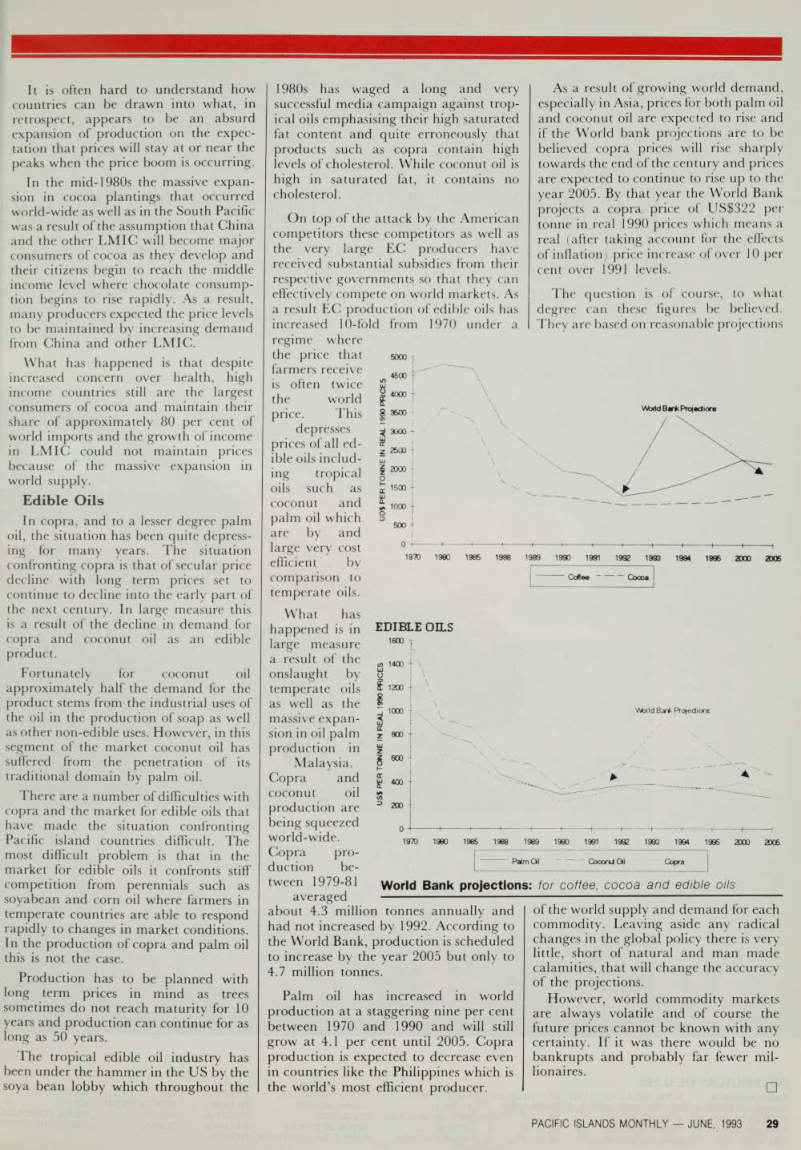
The
and the bad
A World Bank report forecasts commodity prices for the year 2000 and beyond
By Roman Grynberg
THE recently released World Bank report on the long-term outlook for major primary commodities in general makes depressing reading. However for the South Pacific, commodity prices for its main exports copra, coffee and cocoa are set to rise slightly in the longer term.
The growth however will be modest and it will be an increase from some of the lowest prices in the last 20 years. There
are no predictions of major growth and no real reason for optimism.
Coffee The World Bank’s report on projected coffee prices is like the good news-bad news joke. The good news is that coffee prices are going to recover from their 1991 levels, as they already have. The bad news is that the 1991 price is the lowest real price of coffee in recorded history and by the year 2005 will in real terms only be 40 per cent of the price
Tanna coffee: likely to suffer because of high labour costs
Phillipe Metois
received by producers in 1980. So while prices are on their way up, the World Bank projection indicates that they are unlikely to rise beyond USS2I6 by the year 2005.
Why? The supply-demand situation in coffee is not good. Demand growth is anaemic at approximately 1.5 per cent per annum and there has been the entry into the market of some very low cost producers such as Indonesia which has abundant land and low cost labour.
In large measure the collapse of coffee prices after 1989 has been a result of the suspension of export quota systems under the International Coffee Agreement. The resulting free-for-all with massive buffer stocks being dumped on world markets resulted in a drastic decline in com modity prices. At the end of 1988 there was an estimated stock of some 47 million bags of coffee in world stocks and by the beginning of 1992 this had decline to 36
million bags.
Like most of the region’s exports, coffee is a tree crop and that means that even with low commodity prices there is no decrease in the supply in the short run. As long as prices remain above harvesting costs, which are a relatively small proportion of total cost, supply will continue. The only substantial supply response occurs when there is a decision
over replanting.
The other reason why world supply response has been slow has been that governments of exporting countries have tended to suspend export taxes and devalue the currency so as to stabilise producer earnings. In the South Pacific the Papua New Guinea government has offered substantial subsidies to the indus try through stabilisation funds in order to ensure the viability of coffee and other tree crops throughout the present downturn. PNG, due to its substantial oil industry, is able to continue such a policy that would not be available to other island countries.
This attempt to stabilise commodity
prices through the elimination of export and other marketing costs by large exporting countries has had the effect of cushioning the blow in 1989. Brazil and Columbia have, in particular, been responsible for the fact that world coffee supply has been particularly slow to respond to the current downturn in prices because of their policies of at tempting to cushion their producers from the full effects of the world price decline.
The demand for coffee in the US, the world’s largest single buyer, is actually
expected to decline by approximately
0.2 per cent per annum up to the year 2005 as the population ages, health concerns increase and population grow th diminishes. In the EC the demand for coffee is expected to increase by 0.7 per cent per annum. The main growth of demand for coffee will be in low and medium income countries(LMlC) and as a result overall world demand is expected to increase at a rate of 1.3 per cent over the period. The situation in the former Soviet Union (FSU) is also murky. While the FSU only imported 2.7 million bags in 1989 this declined to only 1 million bags in 1991 as a result of its
continuing economic hardships caused
by the transition to a market economy.
This decline in demand will hit robust
producers as the FSU mainly imported
robusta coffee from Brazil, India and Vietnam. As a result robusta prices are expected to decline more substantially than arabica prices in the years to come.
In the region the problems of the PNG coffee industry will certainly be felt as the full effects of oil revenues flow' through to wage rates and raise the cost of harvest ing coffee in the Highlands. However, the government of Prime Minister Wingti remains committed to supporting the Highlands coffee industry and has in vested heavily in supporting the coffee stabilisation fund. Other smaller and experimental coffee projects such as those on Tanna in Vanuatu and Taveuni in Fiji are likely to suffer as result of the
relatively high labour costs. The World Bank’s recommendations to countries
producing coflee are producing
countries, especially those producing
robustas, should consider encouraging inefficient coffee farmers to diversify.
Such diversification is already underway in Brazil and Columbia.
Cocoa Just about everyone has sweet memor ies of the mid-1980’s when cocoa prices hit USS3OOO per tonne and everyone was going to become a millionaire from cocoa. Unfortunately everyone had the same idea. World cocoa production since the mid-1980s expanded by 1 million tonnes and consumption has only ex panded 600,000 tonnes. The simple arithmetic of supply and demand dic tates exactly what would happen to
prices.
There are number of good reasons why prices have not recovered quickly. The first reason has been the dramatic decline in the FSU consumption of chocolate which has decreased from over 245,000 tonnes to what was estimated to be 45,000 tonnes in 1992. The rapid growth of world plantings of the mid-1980s has more than compensated for the poor crop maintenance that has occurred as pro ducer prices fell below break-even.
The dramatic decline in cocoa prices since the mid-1980s has resulted in a fairly dramatic decline in not only plantings but also in the maintenance of cocoa plantations in many of the high cost countries. Most notably, Malaysia which was instrumental in clear felling its tropical rainforests in order to plant cocoa and palm oil has had enormous difficulties in surviving the current low commodity prices. With a break-even cost of USSISOO it is nevertheless ex pected that Malaysia will dramatically decrease its production of cocoa by the year 2000.
It is only in Indonesia where there is expected to be substantial expansion in the production of cocoa. Among small holders the cost of production in Indon esia is around USS3OO-500 per tonne, making it one of the world’s truly low cost producers. As a result Indonesia is set to capture a share of the world cocoa market. Cocoa prices will eventually recover as some of the countries that were involved in substantial planting pro grams withdraw.
In the region there has been a substantial expansion in cocoa pro duction in PNG, Solomon Islands and Vanuatu in much the same way as occurred in Asia. The production and export levels have expanded and while there have been major setbacks caused by the closure of major plantations on
Bougainville production has continued
though there are doubts that plantings will increase in light of the price forecasts.
It is often hard to understand how countries can be drawn into what, in retrospect, appears to be an absurd expansion of production on the expec tation that prices will stay at or near the peaks when the price boom is occurring.
In the mid-1980s the massive expan sion in cocoa plantings that occurred world-wide as well as in the South Pacific was a result of the assumption that China and the other LMIC will become major consumers of cocoa as they develop and their citizens begin to reach the middle income level where chocolate consump tion begins to rise rapidly. As a result,
many producers expected the price levels
to be maintained by increasing demand from China and other LMIC.
What has happened is that despite increased concern over health, high income countries still are the largest consumers of cocoa and maintain their share of approximately 80 per cent of world imports and the growth of income in LMIC could not maintain prices because of the massive expansion in
world supply.
Edible Oils In copra, and to a lesser degree palm oil, the situation has been quite depress ing for many years. The situation confronting copra is that of secular price decline with long term prices set to continue to decline into the early part of the next century. In large measure this is a result of the decline in demand for copra and coconut oil as an edible product.
Fortunately for coconut oil approximately half the demand for the product stems from the industrial uses of the oil in the production of soap as well as other non-edible uses. However, in this segment of the market coconut oil has suffered from the penetration of its traditional domain by palm oil.
There are a number of difficulties with copra and the market for edible oils that have made the situation confronting Pacific island countries difficult. The most difficult problem is that in the market for edible oils it confronts stiff competition from perennials such as soyabean and corn oil where farmers in temperate countries are able to respond rapidly to changes in market conditions.
In the production of copra and palm oil this is not the case.
Production has to be planned with long term prices in mind as trees sometimes do not reach maturity for 10 years and production can continue for as long as 50 years.
The tropical edible oil industry has been under the hammer in the US by the soya bean lobby which throughout the
1980 s has waged a long and very successful media campaign against trop ical oils emphasising their high saturated fat content and quite erroneously that products such as copra contain high levels of cholesterol. While coconut oil is high in saturated fat, it contains no cholesterol.
On top of the attack by the American competitors these competitors as well as the very large EC producers have received substantial subsidies from their respective governments so that they can effectively compete on world markets. As a result EC production of edible oils has increased 10-fold from 1970 under a regime where
the price that farmers receive is often twice the world price. This
depresses
prices of all ed ible oils includ ing tropical oils such as coconut and palm oil which are by and large very cost efficient by comparison to temperate oils.
What has happened is in large measure a result of the onslaught by temperate oils as well as the massive expan sion in oil palm production in Malaysia.
Copra and coconut oil production are being squeezed world-wide.
Copra pro
duction be tween 1979-81 averaged
about 4.3 million tonnes annually and had not increased by 1992. According to the World Bank, production is scheduled to increase by the year 2005 but only to 4.7 million tonnes.
Palm oil has increased in world production at a staggering nine per cent between 1970 and 1990 and will still grow at 4.1 per cent until 2005. Copra production is expected to decrease even in countries like the Philippines which is the world’s most efficient producer.
As a result of growing world demand, especially in Asia, prices for both palm oil and coconut oil are expected to rise and if the World bank projections are to be believed copra prices will rise sharply towards the end of the century and prices are expected to continue to rise up to the year 2005. By that year the World Bank projects a copra price of US$322 per tonne in real 1990 prices which means a real (after taking account for the effects of inflation) price increase of over 10 per cent over 1991 levels.
The question is of course, to what degree can these figures be believed.
They are based on reasonable projections
of the world supply and demand for each commodity. Leaving aside any radical changes in the global policy there is very little, short of natural and man made calamities, that will change the accuracy of the projections.
However, world commodity markets are always volatile and of course the future prices cannot be known with any certainty. If it was there would be no bankrupts and probably far fewer mil lionaires.
World Bank projections: for coffee, cocoa and edible oils
Advertisements & other items, pp. 27-31 (1 item)
Bellfounders (Aust)
Precision Bronze Bells Made in Australia * Decorative Church Bells * Carillons, Pearls, Chimes * Manual or Electrical Operation * Computer Controlled Systems * Ringing and Support Systems * Export and Installation 2/20 Clearvlew Place Brookvale NSW 2100 Australia Phone (02) 905 0051 Fax (02) 905 4220
was the cry of Nazi Germany “Exterminate the Jews!! ” 1 u Hitler killed 6 million of them I — J L men, women children.
Where is Hitler Now?
Where Is the Jew!
“Ve are my Witnesses” saith the Lord Isa 43:10 Though I make a full end of all Nations, wither I’ve scattered thee, yet will I not make a full end of thee; but I will correct thee in measure ’’
Jere 30:11 Read of God’s Prophecy being fulfilled in our times and the imminent return of Christ to make all things new.
Write for FREE booklet “ISRAEL’S REVIVAL”
SOUTH AUSTRALIA
The Chrlstadelphlans
GPO Box 881 Adelaide GPO Box 881
The Specialist Consultants
to the Textile, Clothing k footwear Industries Exporting, Sourcing, Manufacturing, Marketing, Business Planning, Human Resources, Feasibility Studies Suite 3, 8/138 Albert Street Brisbane 4000 Australia TPhone: 61 7 221 5988 Fax: 61 7 229 0055 Ft ersen associates
feVu
PTY
LTD
• CORPORATE MANAGEMENT CONSULTANTS •
Creating a highly efficient, dynamic-looking car woi be simple if it weren’t for one complicating detail; t passengers that must ride in it. Accommodating people comfortably in a pleasant, root interior usually means a certain amount of aerodynamic potential has to be sacrifice 4 fr * Exact features and specifications may vary depending on country of purchase. Please check with your nearest TOYOTA distributor/dealer for details.
DISTRIBUTORS/DEALERS
AMERICAN SAMOA BURNS PHILP (S.S.) CO. LTD. PH 633-4281 GUAM & MICRONESIA... ATKINS KROLL. INC. PH 646-1876/9 NORFOLK ISLANDS BORRY’S PTY LTD. PH 2114
SOLOMON ISLANDS MENDANA MOTORS PH 30314
VANUATU VANUATU MOTORS PH 22341
COOK ISLANDS PACIFIC MOTORS LTD. PH 20796
KIRIBATI TARAWA MOTORS PH 21090
PAPUA NEW GUINEA ... ELA MOTORS PH 217036
TAHITI NIPPON AUTOMOTO PH 429819
WESTERN SAMOA BURNS PHILP (S.S.) CO. LTD. PH 20800
FIJI ASCO MOTORS
NEW CALEDONIA .. .S.I.A.P.
SAIPAN MICROL CORPORATION
TONGA BURNS PHILP (TONGA) L
E NEW COROLLA DOES II BEAUTIFULLY.
Until now. Using a concept called total airflow lagement, Toyota engineers were able to realize an efficient, wedge-shaped design le at the same time perfecting the alignment between body panels and components. :ourse our own innovative style of civilized ineering makes sure that none of this comes he expense of the luxurious, leg-stretching interior. Because we realize that even a 0.33 is useless if no one wants to drive the car.
®TOYOTA
Trade
overture
By Martin Tiffany
NEW ZEALAND’S Minister for Trade
Negotiations, Philip Burdon, visited Papua
New Guinea and Fiji last month with the aim of improving trade relationships be tween his country and the two Pacific neighbours. His objective was to bring the New Zealand business sector closer to PNG
by showing New Zealand business people
the operating environment in that country.
This, he hoped, would give his country’s business sector a bit of push as new trade
was encouraged.
A report by the the trade delegation said while there were a number of trade policy concerns to work through, a few bilateral trade issues to straighten out and some market access concerns, they were pleased with the way discussions went. The report said New Zealand was seeking a more active involvement in PNG in a range of sectors and that New Zealand was now a
much more competitive source of goods and services. While there Burdon met with Prime Minister Paias Wingti and five of his cabinet colleagues, including David Mai, the Minister for Trade and Industry, the Mining and Petroleum Minister Masket langalio, Minister of Forests and Civil Aviation, Tim Neville and the Minister for Bougainville Affairs, Michael Ogio. The delegation also met businessmen and other senior government representatives.
On May 6 the New Zealand Delegation left PNG on a Royal New Zealand Air Force Hercules aircraft bound for Fiji for similar discussions. As expected there was talk on SPARTECA with Fiji’s Minister for Trade and Commerce, Harold Powell, saying he would like to change the 50 per cent local content provision of the agree ment describing it as a long time “sore” area for Fiji manufacturers. Burdon said his country would listen to any suggestions Fiji had to make on SPARTECA adding they would listen to any initiative to help trade
with Fiji.
Similarly to PNG, Burdon said he was in Fiji to review the whole trade relationship between his country and Fiji. He especially touched on Fiji’s garment and apparel export to New Zealand which had declined drastically. He said they would look at the reasons for the decline and try to “encour age more participation from Fiji in this sector”. Burdon said investors in New
Zealand were encouraged by the invest ment climate in Fiji. He said tourism infrastructure investment interested many New Zealand investors.
Opening a meeting of the Fiji-New Zealand Business Council, Burden echoed his PNG statement saying, “New Zealand had never been as competitive as it is now”.
He said the Pacific was important to New Zealand and Fiji was the most important South Pacific market. At present Fiji imports NZSI6S million worth of New Zealand food and manufactured products.
According to Burdon New Zealand manu facturers and food producers are after an open Fiji market. He said his government would welcome liberalisation of the dairy and apparel industries, hardboard and plywood imports, bakery and biscuit prod ucts, canned meats and beer. Burdon said they sought no special favour from Fiji “just a more open market where we can compete fairly with others”, adding he hoped Fiji would continue its deregulation policy.
While in Fiji Burdon presented a NZ5530,000 cheque to Minister of State for Forests, Ratu Serpepeli Naivalu. The money is New Zealand’s contribution to Fiji’s forestry sector development. New Zealand is also helping PNG develop its forestry sector. They have provided con sultants to PNG to help with a major World Bank project aimed at making major changes to the PNG forestry sector. □
Advertisements & other items, p. 32 (1 item)
Throughout The Pacific
AIR & SEA CONSOLIDATION SPECIALISTS
0
SUVA
Kwlcker International Freight Services Ltd PO Box 159 Suva Fiji Contact: Seth Maharaj Director
TEL: (679) 303 663
FAX:(679) 305 794
FIJI
LAUTOKA
Kwicker International Freight Services Ud PO Box 3433 Lautoka Fiji Islands Contact: Andres Feuereisen Western Manager
TEL: (679) 660 624
FAX; (679) 790 337 (Nadi Office)
NADI
Kwicker International Freight Services Ltd AFCAB Building Nadi Airport Contact: Andres Feuereisen Western Manager
TEL: (679) 790 635
FAX:(679) 790 337
PNG
Express Freight P 0 Box 137 Kabua Crescent Konedobu
PORT MORESBY
Contact Bob Howden Phone:! (675) 21 2185, 21 2350 Facsimile: (675) 21 2287 Telex: 22251 Express Freight PO Box 3398 Cnr Jossey and Mula Streets
LAE
Contact Paul Miller Phone: (675) 42 3913, 423822 Facsimile: i(675)'42 5193, 21 2287
WESTERN
SAMOA
Island Freight and Courier Company PO Box 498 Apia Western Samoa Contact Nancy MacDonald
TEL (685) 23 554
FAX (685) 20 912
BOS
FREIGHTWAYS INTERNATIONAL
TONGA
E M Jones & Co. Ltd Shipping Dept Contact: Tafaahau Road Des Carter PO Box 34 General Manager Nukualofa TEL: (676) 23 422 Tonga FAX; (676) 23 418
1 Freight Place, Mangere
P.O. Box 53 071
Auckland Airport
Telephone: 64-9-275 0750 Fax: 64-9-275 8236 or 275 3003 Telex: 2386
AUCKLAND PALMERSTON NTH
WELLINGTON NELSON
CHRISTCHURCH DUNEDIN
COOK
ISLANDS
Pacific Supplies Ltd PO Box 6 Rarotonga Cook Islands Contact: Brian Chrtty
TEL: (682) 27 770
FAX: (682) 24 555
Business and prosperity
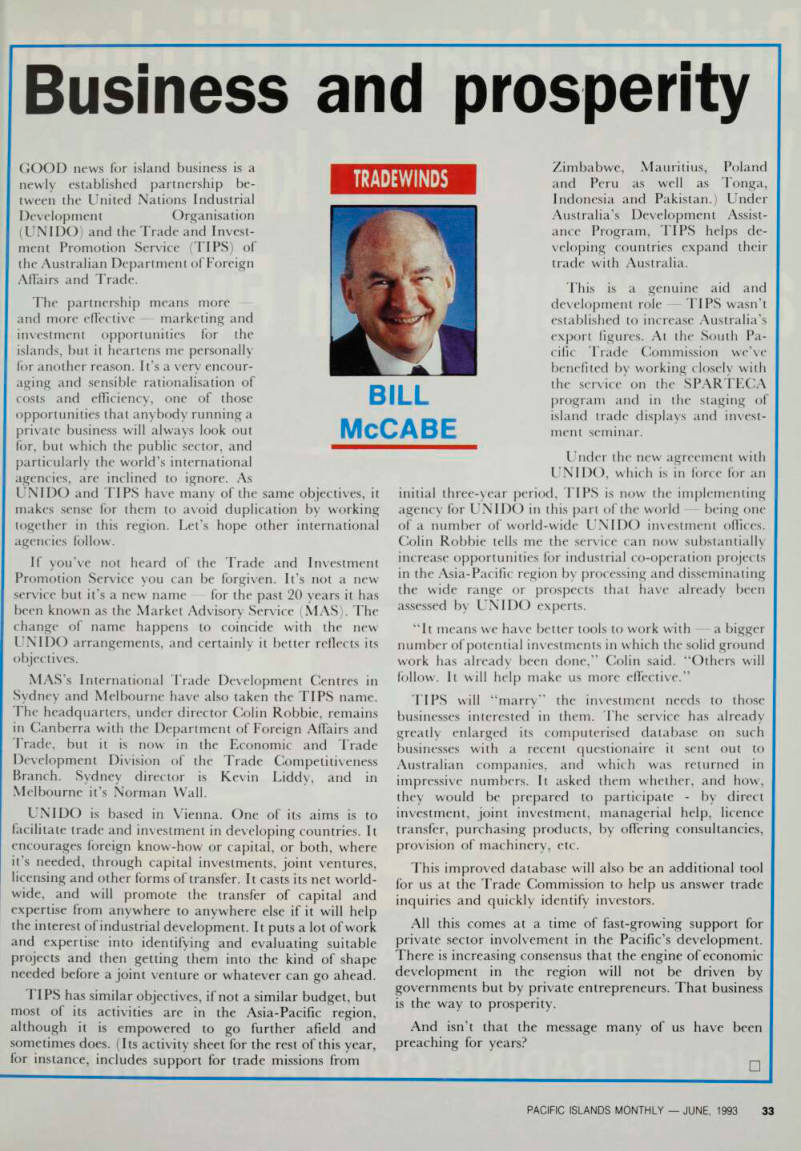
GOOD news for island business is a newly established partnership be tween the United Nations Industrial Development Organisation (UNIDO) and the Trade and Invest ment Promotion Service (TIPS) of the Australian Department of Foreign Affairs and Trade.
The partnership means more and more effective marketing and investment opportunities for the islands, but it heartens me personally for another reason. It s a very encour aging and sensible rationalisation of costs and efficiency, one of those opportunities that anybody running a private business will always look out for, but which the public sector, and particularly the world’s international agencies, are inclined to ignore. As
UNIDO and TIPS have many of the same objectives, it makes sense for them to avoid duplication by working together in this region. Let’s hope other international
agencies follow.
If you’ve not heard of the Trade and Investment Promotion Service you can be forgiven. It’s not a new service but it’s a new name for the past 20 years it has been known as the Market Advisory Service (MAS). The change of name happens to coincide with the new UNIDO arrangements, and certainly it better reflects its
objectives.
MAS’s International Trade Development Centres in Sydney and Melbourne have also taken the TIPS name.
The headquarters, under director Colin Robbie, remains in Canberra with the Department of Foreign Affairs and Trade, but it is now in the Economic and Trade Development Division of the Trade Competitiveness Branch. Sydney director is Kevin Liddy, and in Melbourne it’s Norman Wall.
UNIDO is based in Vienna. One of its aims is to facilitate trade and investment in developing countries. It encourages foreign know-how or capital, or both, where it’s needed, through capital investments, joint ventures, licensing and other forms of transfer. It casts its net world wide, and will promote the transfer of capital and expertise from anywhere to anywhere else if it will help the interest of industrial development. It puts a lot of work and expertise into identifying and evaluating suitable projects and then getting them into the kind of shape needed before a joint venture or whatever can go ahead.
TIPS has similar objectives, if not a similar budget, but most of its activities are in the Asia-Pacific region, although it is empowered to go further afield and sometimes does. (Its activity sheet for the rest of this year, for instance, includes support for trade missions from
Zimbabwe, Mauritius, Poland and Peru as well as Tonga, Indonesia and Pakistan.) Under Australia’s Development Assist ance Program, TIPS helps de
veloping countries expand their
trade with Australia.
This is a genuine aid and development role TIPS wasn’t established to increase Australia’s export figures. At the South Pa cific Trade Commission we’ve
benefited by working closely with
the service on the SPARTECA program and in the staging of island trade displays and invest ment seminar.
Under the new agreement with UNIDO, which is in force for an
initial three-year period, TIPS is now the implementing agency for UNIDO in this part of the world being one of a number of world-wide UNIDO investment offices.
Colin Robbie tells me the service can now substantially increase opportunities for industrial co-operation projects in the Asia-Pacific region by processing and disseminating the wide range or prospects that have already been assessed by UNIDO experts.
“It means we have better tools to work with - a bigger number of potential investments in which the solid ground work has already been done,” Colin said. “Others will follow. It will help make us more effective.”
TIPS will “marry” the investment needs to those businesses interested in them. The service has already greatly enlarged its computerised database on such businesses with a recent questionaire it sent out to Australian companies, and which was returned in impressive numbers. It asked them whether, and how, they would be prepared to participate - by direct investment, joint investment, managerial help, licence
transfer, purchasing products, by offering consultancies,
provision of machinery, etc.
This improved database will also be an additional tool for us at the Trade Commission to help us answer trade inquiries and quickly identify investors.
All this comes at a time of fast-growing support for private sector involvement in the Pacific’s development.
There is increasing consensus that the engine of economic development in the region will not be driven by governments but by private entrepreneurs. That business is the way to prosperity.
And isn’t that the message many of us have been preaching for years?
Tradewinds
Bill
Mccabe
Advertisements & other items, p. 34 (1 item)
Bridging Japan and Fiji closer
With S years of knowledge
and Experience in Fiji
I v »V vvv a £ ¥ *V * Importers’ * Exporters’ * Manufacturers’ * Agents * Business Adviser * Co-ordinator * Correspondent
JAPAN TRADE & TRAVEL (FIJI) LIMITED
AND
INDUE TRADING COMPANY LIMITED
2nd Floor Honson Bldg., Thompson St., P.O. Box 336, Suva, Fiji.
Tel: 679 300574, 300043 Fax 679 300680 Telex: FJ2221.
Japan of today
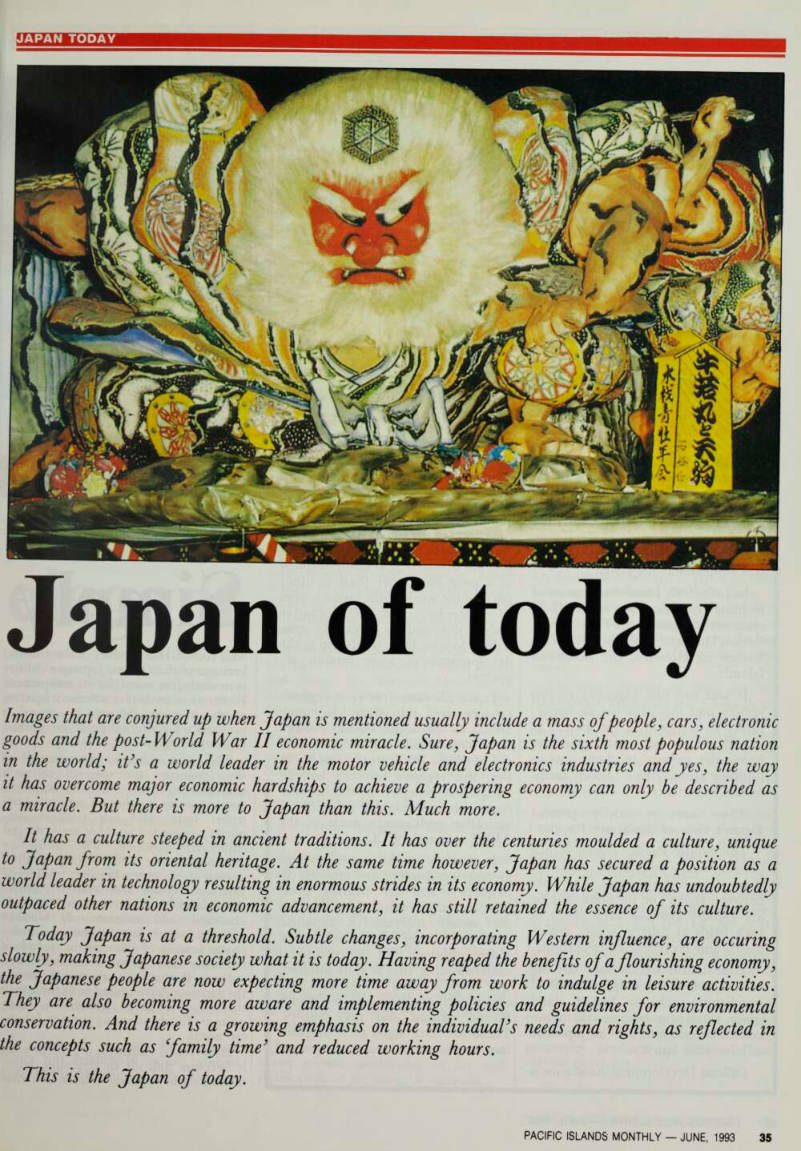
Japan Today
Images that are conjured up when Japan is mentioned usually include a mass of people, cars, electronic goods and the post-World War II economic miracle. Sure, Japan is the sixth most populous nation in the world; it's a world leader in the motor vehicle and electronics industries and yes, the way it has overcome major economic hardships to achieve a prospering economy can only be described as a miracle. But there is more to Japan than this. Much more.
It has a culture steeped in ancient traditions. It has over the centuries moulded a culture, unique to Japan from its oriental heritage. At the same time however, Japan has secured a position as a world leader in technology resulting in enormous strides in its economy. While Japan has undoubtedly outpaced other nations in economic advancement, it has still retained the essence of its culture.
Today Japan is at a threshold. Subtle changes, incorporating Western influence, are occuring slowly, making Japanese society what it is today. Having reaped the benefits of a flourishing economy, the Japanese people are now expecting more time away from work to indulge in leisure activities.
They are also becoming more aware and implementing policies and guidelines for environmental conservation. And there is a growing emphasis on the individual's needs and rights, as reflected in the concepts such as family time' and reduced working hours.
This is the Japan of today.
Simply
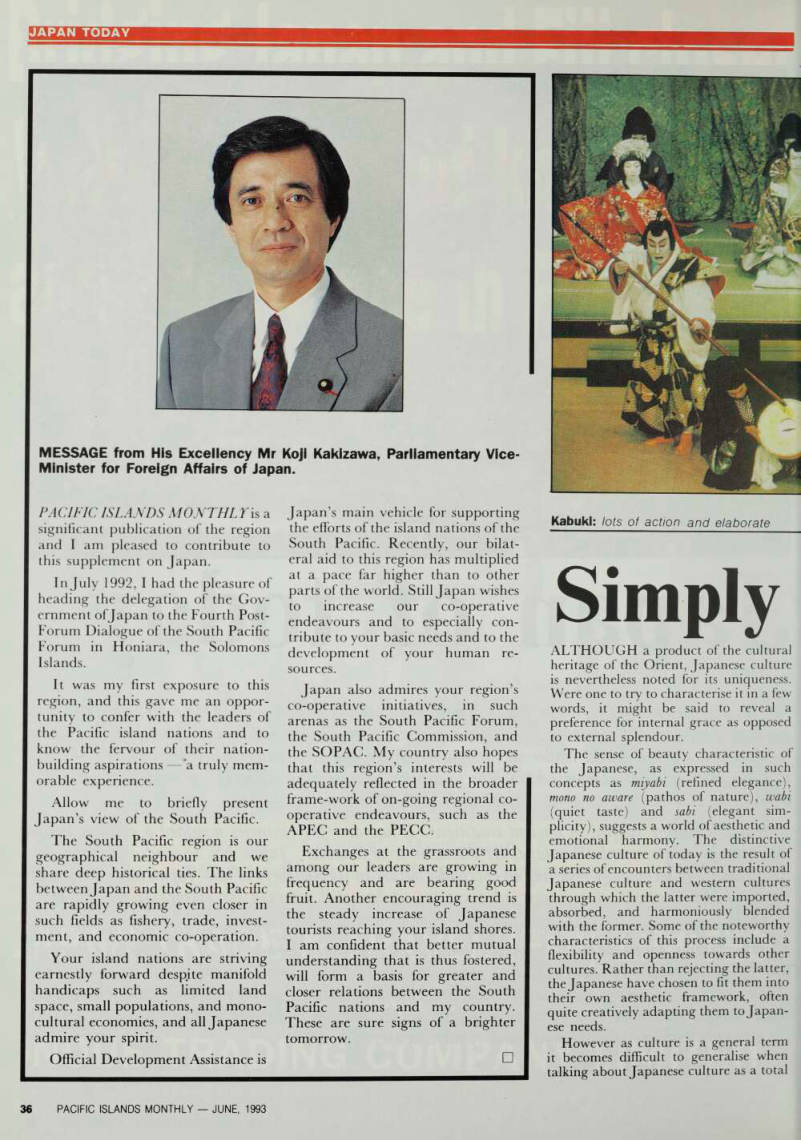
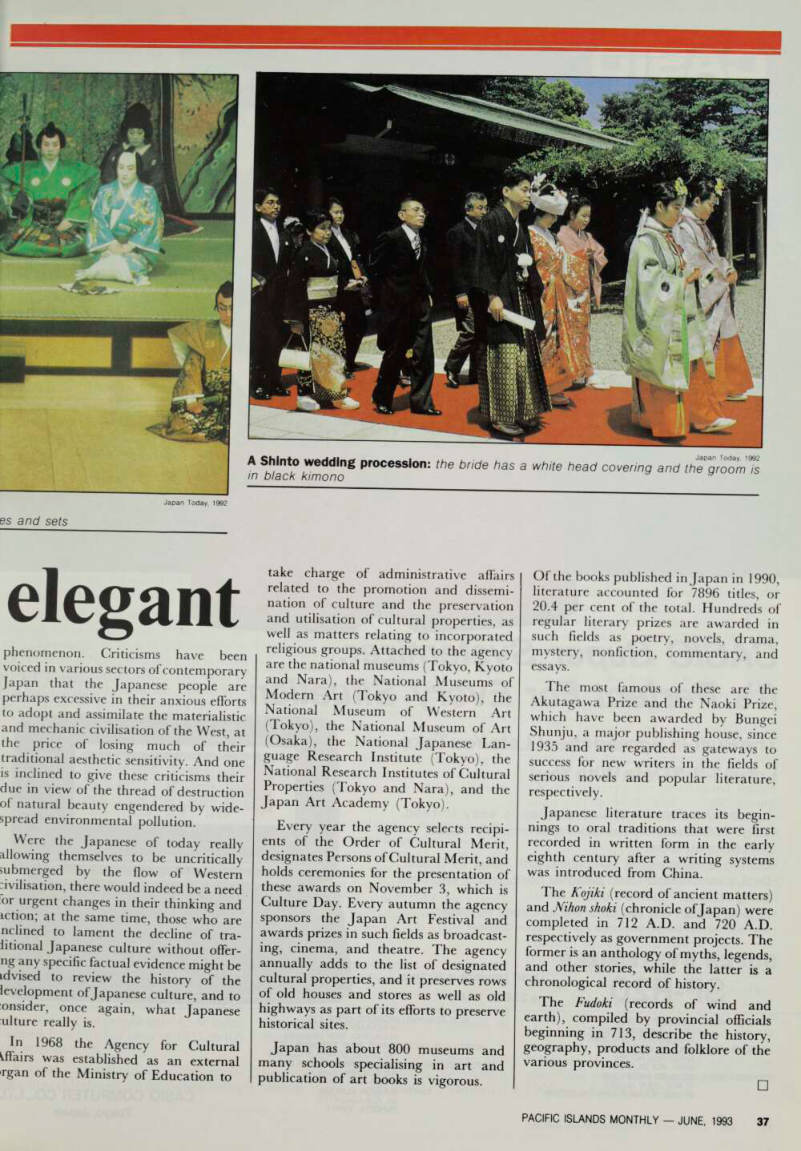
Pacific Islands Monthl T Is A
significant publication of the region and I am pleased to contribute to
this supplement on Japan.
In July 1992, I had the pleasure of heading the delegation of the Gov ernment ofjapan to the Fourth Post- Forum Dialogue of the South Pacific Forum in Honiara, the Solomons Islands.
It was my first exposure to this region, and this gave me an oppor tunity to confer with the leaders of the Pacific island nations and to know the fervour of their nation building aspirations —'a truly mem
orable experience.
Allow me to briefly present Japan’s view of the South Pacific.
The South Pacific region is our
geographical neighbour and we
share deep historical ties. The links between Japan and the South Pacific are rapidly growing even closer in such fields as fishery, trade, invest ment, and economic co-operation.
Your island nations are striving earnestly forward despjte manifold handicaps such as limited land space, small populations, and mono cultural economies, and all Japanese admire your spirit.
Official Development Assistance is
Japan’s main vehicle for supporting the efforts of the island nations of the South Pacific. Recently, our bilat eral aid to this region has multiplied at a pace far higher than to other parts of the world. Still Japan wishes to increase our co-operative endeavours and to especially con tribute to your basic needs and to the development of your human re sources.
Japan also admires your region’s co-operative initiatives, in such arenas as the South Pacific Forum, the South Pacific Commission, and the SOPAC. My country also hopes that this region’s interests will be adequately reflected in the broader frame-work of on-going regional co operative endeavours, such as the APEC and the PECC.
Exchanges at the grassroots and among our leaders are growing in frequency and are bearing good fruit. Another encouraging trend is the steady increase of Japanese tourists reaching your island shores.
I am confident that better mutual understanding that is thus fostered, will form a basis for greater and closer relations between the South Pacific nations and my country.
These are sure signs of a brighter tomorrow. □
ALTHOUGH a product of the cultural heritage of the Orient, Japanese culture is nevertheless noted for its uniqueness.
Were one to try to characterise it in a few words, it might be said to reveal a preference for internal grace as opposed to external splendour.
The sense of beauty characteristic of the Japanese, as expressed in such concepts as miyabi (refined elegance), mono no aware (pathos of nature), wabi (quiet taste) and sabi (elegant sim plicity), suggests a world of aesthetic and emotional harmony. The distinctive Japanese culture of today is the result of a series of encounters between traditional Japanese culture and western cultures through which the latter were imported, absorbed, and harmoniously blended with the former. Some of the noteworthy characteristics of this process include a flexibility and openness towards other cultures. Rather than rejecting the latter, the Japanese have chosen to fit them into their own aesthetic framework, often quite creatively adapting them to Japan ese needs.
However as culture is a general term it becomes difficult to generalise when talking about Japanese culture as a total
MESSAGE from His Excellency Mr Koji Kakizawa, Parliamentary Vice- Minister for Foreign Affairs of Japan.
Kabuki: lots of action and elaborate
phenomenon. Criticisms have been voiced in various sectors of contemporary Japan that the Japanese people are perhaps excessive in their anxious efforts to adopt and assimilate the materialistic and mechanic civilisation of the West, at the price of losing much of their traditional aesthetic sensitivity. And one is inclined to give these criticisms their due in view of the thread of destruction of natural beauty engendered by wide spread environmental pollution.
Were the Japanese of today really allowing themselves to be uncritically submerged by the flow of Western :ivilisation, there would indeed be a need or urgent changes in their thinking and iction; at the same time, those who are nclined to lament the decline of tra litional Japanese culture without offer ng any specific factual evidence might be idvised to review the history of the levelopment of Japanese culture, and to onsider, once again, what Japanese ulture really is.
In 1968 the Agency for Cultural dfairs was established as an external rgan of the Ministry of Education to
take charge of administrative affairs related to the promotion and dissemi nation of culture and the preservation and utilisation of cultural properties, as well as matters relating to incorporated religious groups. Attached to the agency are the national museums (Tokyo, Kyoto and Nara), the National Museums of Modern Art (Tokyo and Kyoto), the National Museum of Western Art (Tokyo), the National Museum of Art (Osaka), the National Japanese Lan guage Research Institute (Tokyo), the National Research Institutes of Cultural
Properties (Tokyo and Nara), and the
Japan Art Academy (Tokyo).
Every year the agency selects recipi ents of the Order of Cultural Merit, designates Persons of Cultural Merit, and holds ceremonies for the presentation of these awards on November 3, which is Culture Day. Every autumn the agency sponsors the Japan Art Festival and awards prizes in such fields as broadcast ing, cinema, and theatre. The agency annually adds to the list of designated cultural properties, and it preserves rows of old houses and stores as well as old highways as part of its efforts to preserve historical sites.
Japan has about 800 museums and many schools specialising in art and publication of art books is vigorous.
Of the books published in Japan in 1990, literature accounted for 7896 titles, or 20.4 per cent of the total. Hundreds of regular literary prizes are awarded in such fields as poetry, novels, drama, mystery, nonfiction, commentary, and essays.
The most famous of these are the Akutagawa Prize and the Naoki Prize, which have been awarded by Bungei Shunju, a major publishing house, since 1935 and are regarded as gateways to success for new writers in the fields of serious novels and popular literature, respectively.
Japanese literature traces its begin nings to oral traditions that were first recorded in written form in the early eighth century after a writing systems was introduced from China.
The Kojiki (record of ancient matters) and Nihon shoki (chronicle of Japan) were completed in 712 A.D. and 720 A.D. respectively as government projects. The former is an anthology of myths, legends, and other stories, while the latter is a chronological record of history.
The Fudoki (records of wind and earth), compiled by provincial officials beginning in 713, describe the history, geography, products and folklore of the various provinces.
Japan Today, 1992
[?]es and sets
A Shinto wedd ing procession: the bride has a white head covering and groom is in black kimono
Advertisements & other items, p. 38 (1 item)
CASIO Super Systemizer.
mmmmm So ' ■ ji|| >r -
It’s Perfect For Every Situation
The Built-In Spreadsheet Lets You Take
Lotus 1-2-3 Data With You!
Lotus 1-2-3
compatible
Large 40-column x 10-line display is easy to read.
Large 256K8 memory can store approximately 10,200
telephone numbers.
Built-in spreadsheet is compatible with Lotus 1-2-3*data.
Data communication with personal computers is effortless
using optional interface unit.
IC card system lets you tailor the functions you need.
Lotus and 1-2-3 are registered trademarks of Lotus Development Corporation.
SUPER SYSTEMJZER
SF-R2O
♦ 40 columns x 10 lines
♦ 256K8 RAM
data
AUSTRALIA MOBEX PTY. LTD.
UNIT 1, GIBBES STREET
CHATSWOOD N S W. 2067
FIJI ISLANDS: BRULAL & CO.,LTD.
G.PO. BOX N 0.362
SUVA, FIJI ISLANDS
NEW CALEDONIA MENARD PACIFIQUE
10 RUE JEAN JAURES
NOUMEA, NEW CALEDONIA
NEW ZEALAND MONACO CORP. LTD.
41 POLAND ROAD, GLENFIELD
AUCKLAND, NEW ZEALAND
NORFOLK ISLANDS BURNT PINE TRADERS LTD.
P0.80X21, NORFOLK ISLANDS
PAPUA NEW GUINEA SENGCO NIUGINI PTY. LTD.
P.0.80X 1886, BOROKU
PAPUA NEW GUINEA
TAHITI MAISON AUROSE
30, RUE COLLETTE
PAPEETE, TAHITI
CASIO COMPUTER CO., LTD.
Tokyo, Japan
A new social order
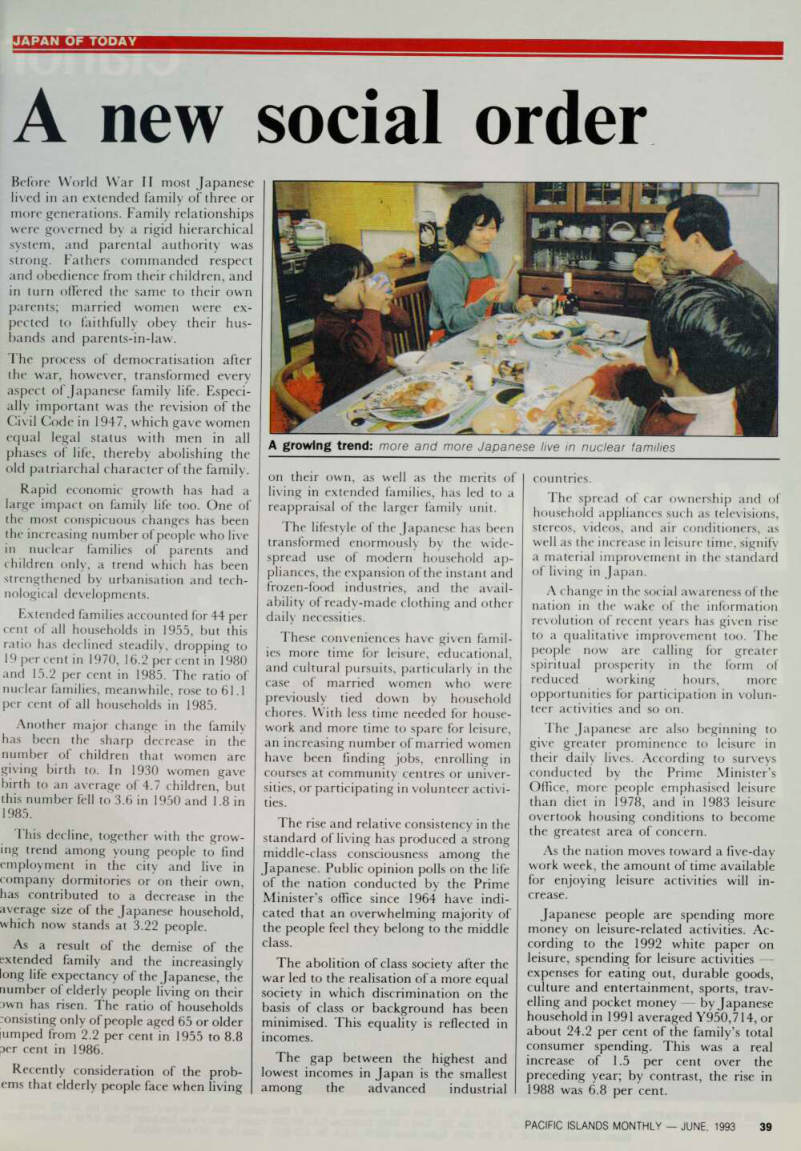
Before World War II most Japanese lived in an extended family of three or
more generations. Family relationships
were governed by a rigid hierarchical
system, and parental authority was strong. Fathers commanded respect and obedience from their children, and in turn offered the same to their own parents; married women were ex
pected to faithfully obey their hus
bands and parents-in-law.
The process of democratisation after the war, however, transformed every
aspect of Japanese family life. Especi
ally important was the revision of the Civil Code in 1947, which gave women equal legal status with men in all
phases of life, thereby abolishing the
old patriarchal character of the family.
Rapid economic growth has had a large impact on family life too. One of the most conspicuous changes has been the increasing number of people who live in nuclear families of parents and children only, a trend which has been strengthened by urbanisation and tech
nological developments.
Extended families accounted for 44 per cent of all households in 1955, but this ratio has declined steadily, dropping to 19 per cent in 1970, 16.2 per cent in 1980 and 15.2 per cent in 1985. The ratio of nuclear families, meanwhile, rose to 61.1 per cent of all households in 1985.
Another major change in the family has been the sharp decrease in the number of children that women are giving birth to. In 1930 women gave birth to an average of 4.7 children, but this number fell to 3.6 in 1950 and 1.8 in 1985.
This decline, together with the grow ing trend among young people to find employment in the city and live in company dormitories or on their own, has contributed to a decrease in the average size of the Japanese household, which now stands at 3.22 people.
As a result of the demise of the
extended family and the increasingly
long life expectancy of the Japanese, the number of elderly people living on their nwn has risen. The ratio of households :onsisting only of people aged 65 or older lumped from 2.2 per cent in 1955 to 8.8 ner cent in 1986.
Recently consideration of the prob ems that elderly people face when living
on their own, as well as the merits of living in extended families, has led to a reappraisal of the larger family unit.
The lifestyle of the Japanese has been transformed enormously by the wide spread use of modern household ap pliances, the expansion of the instant and frozen-food industries, and the avail ability of ready-made clothing and other daily necessities.
These conveniences have given famil ies more time for leisure, educational, and cultural pursuits, particularly in the case of married women who were previously tied down by household chores. With less time needed for house work and more time to spare for leisure, an increasing number of married women have been finding jobs, enrolling in courses at community centres or univer sities, or participating in volunteer activi ties.
The rise and relative consistency in the standard of living has produced a strong middle-class consciousness among the Japanese. Public opinion polls on the life of the nation conducted by the Prime Minister’s office since 1964 have indi cated that an overwhelming majority of the people feel they belong to the middle class.
The abolition of class society after the war led to the realisation of a more equal society in which discrimination on the basis of class or background has been minimised. This equality is reflected in incomes.
The gap between the highest and lowest incomes in Japan is the smallest among the advanced industrial
countries.
The spread of car ownership and of household appliances such as televisions, stereos, videos, and air conditioners, as well as the increase in leisure time, signify a material improvement in the standard of living in Japan.
A change in the social awareness of the nation in the wake of the information revolution of recent years has given rise to a qualitative improvement too. The people now are calling for greater spiritual prosperity in the form of reduced working hours, more opportunities for participation in volun teer activities and so on.
The Japanese are also beginning to give greater prominence to leisure in their daily lives. According to surveys conducted by the Prime Minister’s Office, more people emphasised leisure than diet in 1978, and in 1983 leisure overtook housing conditions to become the greatest area of concern.
As the nation moves toward a five-day work week, the amount of time available for enjoying leisure activities will in crease.
Japanese people are spending more money on leisure-related activities. Ac cording to the 1992 white paper on leisure, spending for leisure activities expenses for eating out, durable goods, culture and entertainment, sports, trav elling and pocket money by Japanese household in 1991 averaged Y 950,714, or about 24.2 per cent of the family’s total consumer spending. This was a real increase of 1.5 per cent over the preceding year; by contrast, the rise in 1988 was 6.8 per cent.
A growing trend: more and more Japanese live in nuclear families
Advertisements & other items, p. 40 (1 item)
IMff
$ € € ? £ $ a
umu
clarion
High-Tech High-Touch
IMff
v. j * sWi Lz^iDi a : w ® Your car’s great, but what about your car audio system? You know what Clarion stands for: i Hi-tech. User-friendly. Sound that gives you a blast from the past. Present and future. claf,on Whether you want a standard car radio or a multi-component stereo system, Clarion’s the answer. Why settle for less than the best?
Install a Clarion in your car and break through the sound barrier. CRX227AM/FM RADIO CASSETTE COMBINATION and CDC96OO CD CHANO FOR FURTHER INFORMATION Australia: Clarion Australia Pty. Ltd. Unit 17, 50 Keys Road Moorabbin, Vic 3189 / New Zealand: AWA New Zealand Limited P.O. box 1 50-248 Poriruai / Fiji Islands: Brijial & Co., Ltd., G.P.O. Box 362, Suva / Tahiti: Comimpex S.A., BP 200, Papeete, Tahiti / New Caledonia; Caldis, B.PM 1, Noumea Cedex / Guam: Micropac Audio Inc., P.O. Box 3478, Agana, Guam 96910, U.S.A. Tel: 472-8091, Cable Code; HIFI AUDIO AGANA
Building up human resources
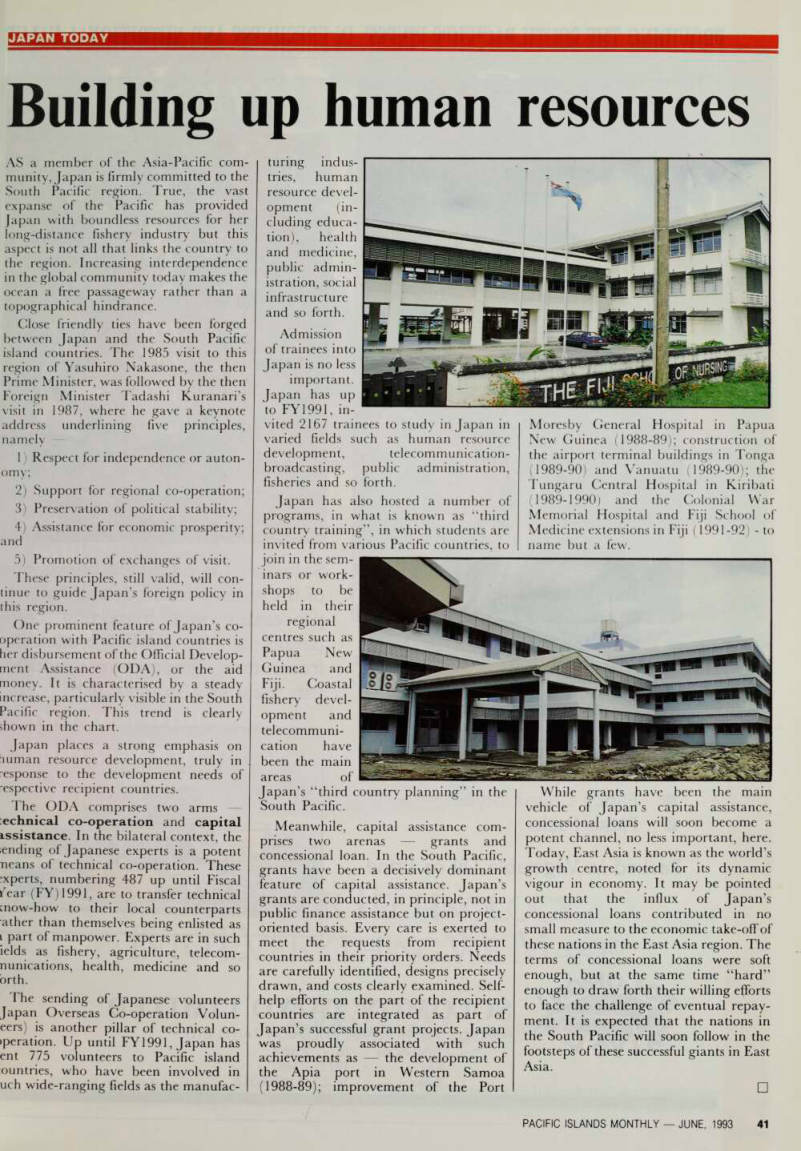
AS a member of the Asia-Pacific com munity, Japan is firmly committed to the South Pacific region. True, the vast expanse of the Pacific has provided Japan with boundless resources for her long-distance fishery industry but this aspect is not all that links the country to the region. Increasing interdependence in the global community today makes the ocean a free passageway rather than a topographical hindrance.
Close friendly ties have been forged between Japan and the South Pacific island countries. The 1985 visit to this region of Yasuhiro Nakasone, the then Prime Minister, was followed by the then Foreign Minister Tadashi Kuranari’s visit in 1987, where he gave a keynote address underlining five principles, namely 1) Respect for independence or auton omy; 2) Support for regional co-operation; 3) Preservation of political stability; 4) Assistance for economic prosperity; and 5) Promotion of exchanges of visit.
These principles, still valid, will con tinue to guide Japan’s foreign policy in
this region.
One prominent feature of Japan’s co operation with Pacific island countries is her disbursement of the Official Develop ment Assistance (ODA), or the aid money. It is characterised by a steady increase, particularly visible in the South Pacific region. This trend is clearly shown in the chart.
Japan places a strong emphasis on luman resource development, truly in "esponse to the development needs of espective recipient countries.
The ODA comprises two arms - :echnical co-operation and capital issistance. In the bilateral context, the sending of Japanese experts is a potent neans of technical co-operation. These experts, numbering 487 up until Fiscal fear (FY)1991, are to transfer technical mow-how to their local counterparts ather than themselves being enlisted as i part of manpower. Experts are in such ields as fishery, agriculture, telecom nunications, health, medicine and so brth.
The sending of Japanese volunteers
Japan Overseas Co-operation Volun
eers) is another pillar of technical co
►peration. Up until FY1991, Japan has
ent 775 volunteers to Pacific island ountries, who have been involved in uch wide-ranging fields as the manufac
turing indus tries, human resource devel opment (in cluding educa tion), health and medicine, public admin istration, social infrastructure and so forth.
Admission of trainees into Japan is no less important.
Japan has up to FY1991, in
vited 2167 trainees to study in Japan in varied fields such as human resource development, telecommunication
broadcasting, public administration,
fisheries and so forth.
Japan has also hosted a number of programs, in what is known as “third country training”, in which students are invited from various Pacific countries, to
join in the sem inars or work shops to be held in their regional centres such as Papua New Guinea and
Fiji. Coastal
fishery devel opment and telecommuni cation have been the main areas of
Japan’s “third country planning” in the South Pacific.
Meanwhile, capital assistance com prises two arenas grants and concessional loan. In the South Pacific, grants have been a decisively dominant feature of capital assistance. Japan’s grants are conducted, in principle, not in public finance assistance but on project oriented basis. Every care is exerted to meet the requests from recipient countries in their priority orders. Needs are carefully identified, designs precisely drawn, and costs clearly examined. Self help efforts on the part of the recipient countries are integrated as part of Japan’s successful grant projects. Japan was proudly associated with such achievements as the development of the Apia port in Western Samoa (1988-89); improvement of the Port
Moresby General Hospital in Papua New Guinea (1988-89); construction of the airport terminal buildings in Tonga (1989-90) and Vanuatu 1989-90); the Tungaru Central Hospital in Kiribati (1989-1990) and the Colonial War Memorial Hospital and Fiji School of Medicine extensions in Fiji (1991-92) - to name but a few.
While grants have been the main vehicle of Japan’s capital assistance, concessional loans will soon become a potent channel, no less important, here.
Today, East Asia is known as the world’s growth centre, noted for its dynamic vigour in economy. It may be pointed out that the influx of Japan’s concessional loans contributed in no small measure to the economic take-off of these nations in the East Asia region. The terms of concessional loans were soft enough, but at the same time “hard” enough to draw forth their willing efforts to face the challenge of eventual repay ment. It is expected that the nations in the South Pacific will soon follow in the footsteps of these successful giants in East Asia.
Advertisements & other items, pp. 42-43 (1 item)
Providing The South Pacific’S Finest, In Freshness And Nutritional Value
r ■ 1-3 P a M ■*r S"J * - -V-
IhUHHK
a a Today it proudly boasts as the producer of high, premium quality canned tuna products:- • Chilli Tuna • Fancy Solid Packs • Fancy Chunk Style • Flake Packs Packed in Vegetable Oil or Brine Solomon Taiyo Limited boasts one of the most advanced tuna fishing, processing and marketing companies in the world, processing frozen tuna, canned tuna products, fish meal and smoked fish.
'KimCKITVV
WmOiTUW
•'V J 9
TAI
n v\
SOLOMON TAIYO LIMITED
P.O. BOX 965, HONIARA, SOLOMON TAIYO LTD.
Telephone : (677) 21664 Fax : (677) 23462 Telex : SOLTAI HQ66317
im A vm A
aKKi
maxzvfiM
• WIS
TSTsl?m rutfuAv*uß •it
UTB£ I i I I I
how do
they make
tasty cheese
so deliciously
Tfomaat •it ■<v put real fruit
into yoghurt?
We FbURTECHNOLOGY
Into Everything We Make
fWTTTTI rm tLJ.
If you need more information on Rewa Dairy's range of natural dairy products or Tetrapak packaeine caoabilities contact: Rewa Co-operahve Dairy Company Ltd, PO Box 3678, SamS a P Suva, Fiji. Telephoned 381 288.FaxfsTDWO.
IH) Fl 037
treaties

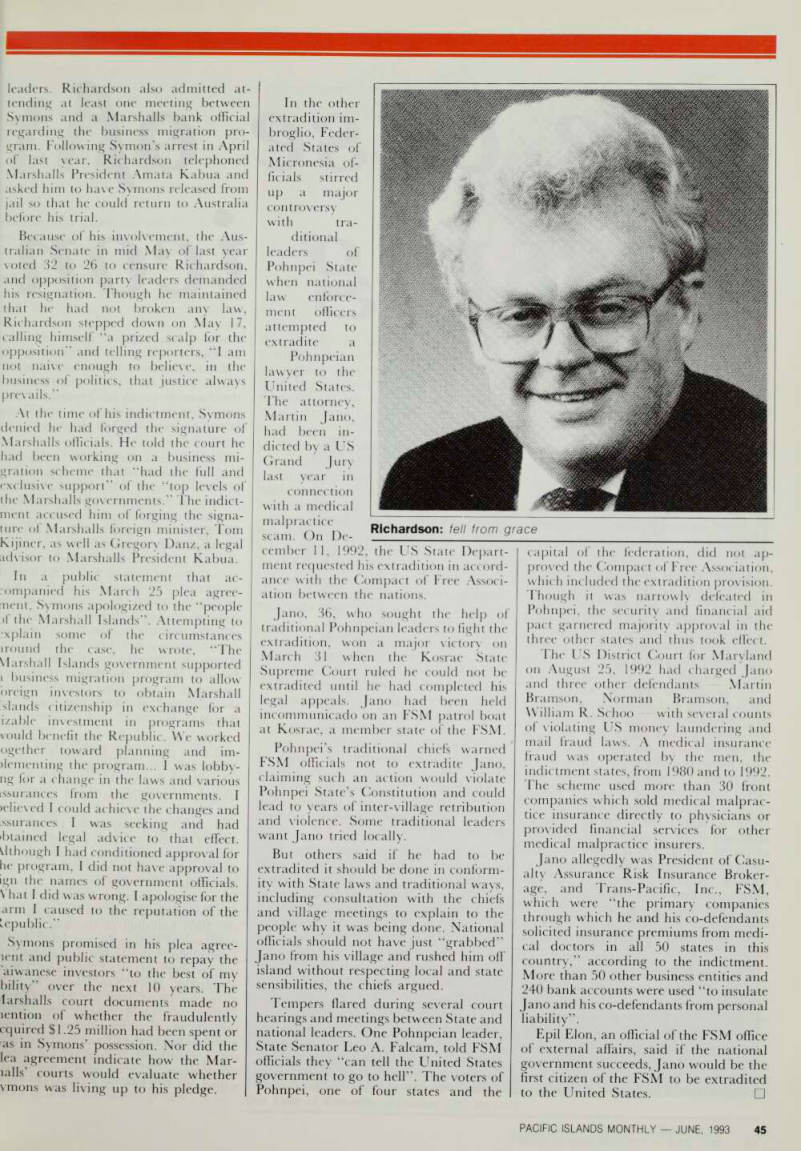
Law
Test
case for
treaties
How effective are the extradition commitments with metropolitan powers?
By David North
TWO criminal extradition agree ments are testing the strength of treaty commitments between major metropolitan Pacific powers and newly emerged Micronesian states. One case involves an Australian pledge to
extradite one of its “well-connected” citizens to the Republic of the Marshall Islands should the confessed forger fail to live up to the terms of his probation. The other controversy revolves around the Federated States of Micronesia’s power to extradite one of its citizens wanted in the United States for a multi-million dollar medical insurance fraud.
The Australian, Gregory B. Symons, whose investment migration scheme caused the temporary downfall last year of an influential member of Paul Keat ing’s Labour Party government, pleaded no contest on March 25 to 15 counts of forgery in the Marshalls. Symons admit ted he had illegally taken 51.25 million from Taiwanese investors as part of an
investment-for-Marshalls-passports
swap. Marshalls High Court Judge
Written Philippo accepted Symons plea
bargain, sentencing him to 90 days in Marshalls jail and 10 years probation.
As part of the deal, Symons has agreed to make every effort to repay the five Taiwanese, from whom he accepted 5250,000 each. Australia’s government,
under Keating’s leadership, has stipu
lated that it will extradite Symons back to Majuro, the islands capital, if he should fail to abide by his agreement. At the same time, Keating, whose Labour
Party won its fifth straight election in February, resurrected Senator Graham Richardson, who was implicated and politically hurt by the ‘‘Marshall Islands Affair”, returning him to his cabinet post as part of a reshuffled ministry.
Symons, 44, was in charge of a project that offered Marshalls citizenship to foreigners who made “sizeable invest ments” in the island nation. Symons told potential investors that a Marshalls passport could eventually provide them with free entry to the United States.
Under a treaty with the United States the Compact of Free Association Marshallese may enter United States territory as if they were US citizens.
However, US State Department officials have said that benefit would not apply to
non-Marshallese who gain citizenship
through programs like the one offered by
Symons.
Symons had won the confidence of Marshalls leaders in 1992 through Richardson, then Minister for Transpor tation and Communications. Symons is married to Richardson’s cousin and is an old friend of the cabinet minister.
Richardson, a well-known member of Keating’s Labour Party cabinet, had recommended Symons to the US am bassador in Australia and to Marshalls
leaders. Richardson also admitted at tending at least one meeting between Symons and a Marshalls bank official regarding the business migration pro gram. Following Symon’s arrest in April of last year, Richardson telephoned Marshalls President Amata Kabua and asked him to have Symons released from jail so that he could return to Australia before his trial.
Because of his involvement, the Aus tralian Senate in mid May of last year voted 32 to 26 to censure Richardson, and opposition party leaders demanded his resignation. Though he maintained that he had not broken any law, Richardson stepped down on May 17, calling himself “a prized scalp for the opposition” and telling reporters, “I am not naive enough to believe, in the business of politics, that justice always
prevails.”
At the time of his indictment, Symons denied he had forged the signature of Marshalls officials. He told the court he had been working on a business mi gration scheme that ' had the full and exclusive support” of the “top levels of the Marshalls governments.” The indict ment accused him of forging the signa ture of Marshalls foreign minister, Tom Kijiner, as well as Gregory Danz, a legal advisor to Marshalls President Kabua.
In a public statement that ac companied his March 25 plea agree
ment, Symons apologized to the “people
)f the Marshall Islands”. Attempting to explain some of the circumstances iround the case, he wrote, “The Marshall Islands government supported i business migration program to allow breign investors to obtain Marshall slands citizenship in exchange for a izable investment in programs that vould benefit the Republic. We worked ogether toward planning and im dementing the program... I was lobby ing for a change in the laws and various issu ranees from the governments. I >elieved I could achieve the changes and ssurances I was seeking and had obtained legal advice to that effect.
Uthough I had conditioned approval for he program. I did not have approval to ign the names of government officials. \ hat I did was wrong. I apologise for the arm I caused to the reputation of the Lcpublic.”
Symons promised in his plea agree ment and public statement to repay the aiwanese investors “to the best of my bility” over the next 10 years. The larshalls court documents made no lention of whether the fraudulently cquired 51.25 million had been spent or as in Symons’ possession. Nor did the lea agreement indicate how the Mar ais courts would evaluate whether vmons was living up to his pledge.
In the other extradition im broglio, Feder ated States of Micronesia of ficials stirred up a major controversy with tra ditional leaders of
Pohnpei State
when national law enforce ment officers attempted to extradite a
Pohnpeian
lawyer to the United States.
The attorney, Martin Jano, had been in dicted by a US
Grand Jury
last year in connection with a medical malpractice scam. On De
cember 11, 1992, the US State Depart ment requested his extradition in accord ance with the Compact of Free Associ ation between the nations.
Jano, 36, who sought the help of traditional Pohnpcian leaders to fight the extradition, won a major victory on March 31 when the Kosrae State Supreme Court ruled he could not be extradited until he had completed his
legal appeals. Jano had been held
incommunicado on an FSM patrol boat at Kosrae, a member state of the FSM.
Pohnpei’s traditional chiefs warned FSM officials not to extradite Jano, claiming such an action would violate Pohnpei State’s Constitution and could lead to years of inter-village retribution and violence. Some traditional leaders
want Jano tried locally.
But others said if he had to be extradited it should be done in conform ity with State laws and traditional ways, including consultation with the chiefs and village meetings to explain to the people why it was being done. National officials should not have just “grabbed”
Jano from his village and rushed him off island without respecting local and state sensibilities, the chiefs argued.
Tempers flared during several court hearings and meetings between State and national leaders. One Pohnpeian leader, State Senator Leo A. Falcam, told FSM officials they “can tell the United States government to go to hell”. The voters of Pohnpei, one of four states and the
capital of the federation, did not ap proved the Compact of Free Association, which included the extradition provision.
Though it was narrowly defeated in Pohnpci, the security and financial aid pact garnered majority approval in the three other states and thus took effect.
The US District Court for Maryland on August 25, 1992 had charged Jano and three other defendants Martin Bramson, Norman Bramson, and William R. Schoo with several counts of violating US money laundering and mail fraud laws. A medical insurance fraud was operated by the men, the indictment states, from 1980 and to 1992.
The scheme used more than 30 front companies which sold medical malprac tice insurance directly to physicians or provided financial services for other medical malpractice insurers.
Jano allegedly was President of Casu alty Assurance Risk Insurance Broker age, and Trans-Pacific, Inc., FSM, which were “the primary companies through which he and his co-defendants solicited insurance premiums from medi cal doctors in all 50 states in this country,” according to the indictment.
More than 50 other business entities and 240 bank accounts were used “to insulate Jano and his co-defendants from personal
liability”.
Epil Elon, an official of the FSM office of external affairs, said if the national government succeeds, Jano would be the first citizen of the FSM to be extradited to the United States. □
Richardson: fell from grace
Advertisements & other items, p. 44 (1 item)
tokcitoko
"Talk about value for money
And now a resort in Nadi that truly offers value for money. 70 units of comfort , each with television , air-conditioning , limited cooking facilities (suites , apartments , and 2 bedroom villas offer complete kitchens) and LS.D
telephones. Fiji's largest swimming pool
with giant waterslide • poolside quality restaurant and bar • supermarket • shops • convention facilities • beauty salon • massage clinic • sauna. (opposite Nadi International Airport) Telephone: 790222 Fax: 790400
tokcitoko
l re/ort hotel
m
missing icon
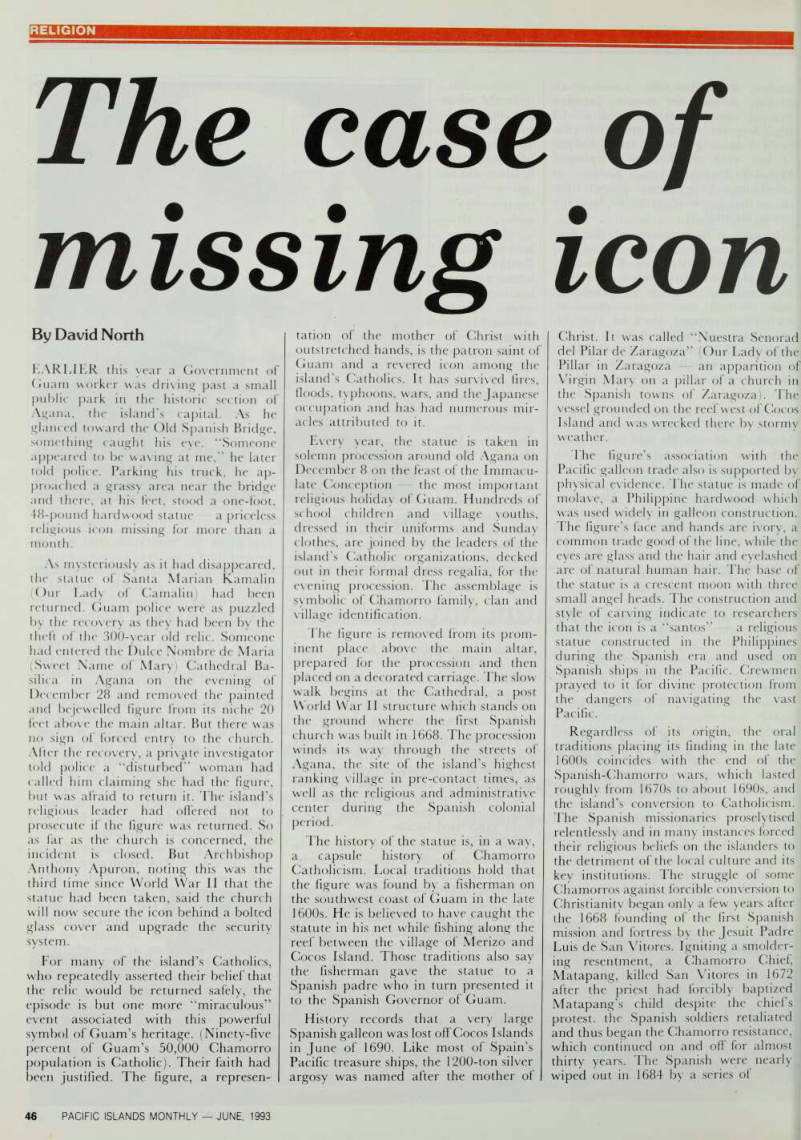
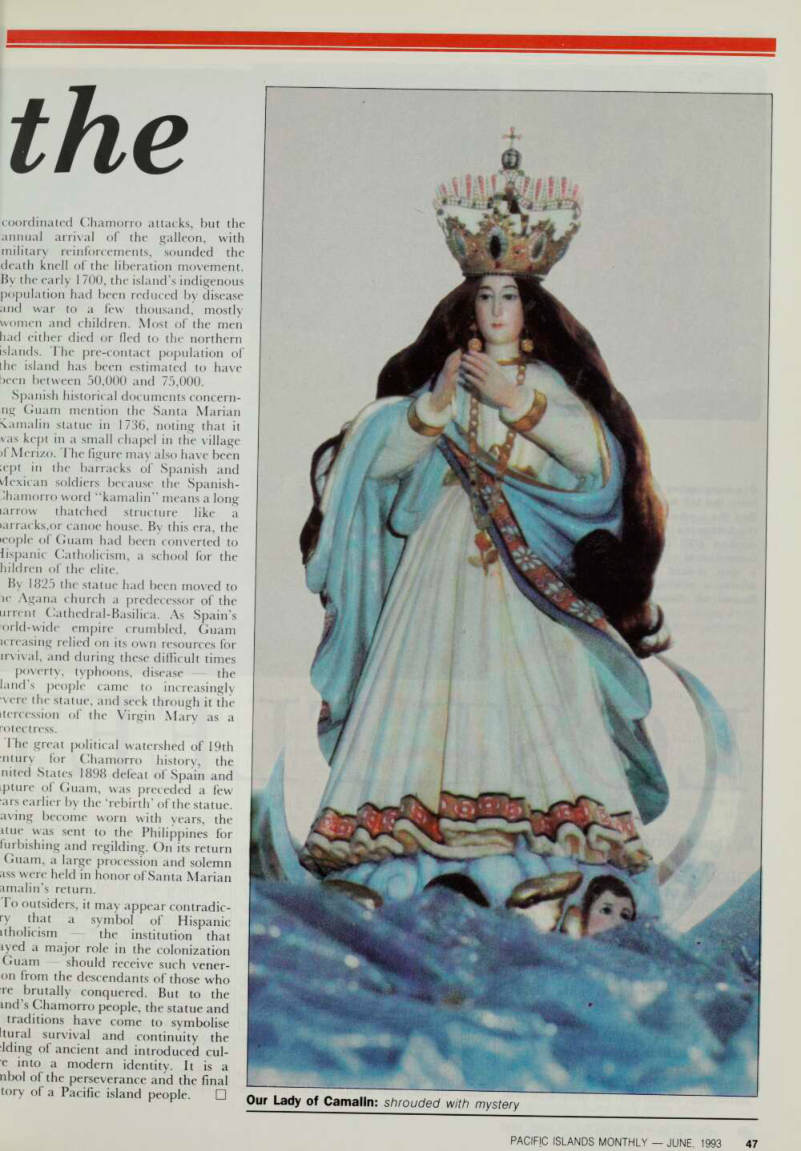
Religion
The case of the missing icon
By David North
EARLIER this year a Government of Guam worker was driving past a small public park in the historic section of Agana, the island’s capital. As he glanced toward the Old Spanish Bridge, something caught his eye. “Someone appeared to be waving at me,” he later told police. Parking his truck, he ap proached a grassy area near the bridge and there, at his feet, stood a one-foot, 48-pound hardwood statue a priceless religious icon missing for more than a month.
As mysteriously as it had disappeared, the statue of Santa Marian Kamalin Our Lady of Camalin) had been returned. Guam police were as puzzled by the recovery as they had been by the theft of the 300-year old relic. Someone had entered the Dulce Nombre de Maria (Sweet Name of Mary) Cathedral Ba silica in Agana on the evening of December 28 and removed the painted and bejewelled figure from its niche 20 feet above the main altar. But there was no sign of forced entry to the church.
After the recovery, a private investigator told police a “disturbed” woman had called him claiming she had the figure, but was afraid to return it. The island’s religious leader had offered not to prosecute if the figure was returned. So as far as the church is concerned, the incident is closed. But Archbishop Anthony Apuron, noting this was the third time since World War II that the statue had been taken, said the church will now secure the icon behind a bolted glass cover and upgrade the security system.
For many of the island’s Catholics, who repeatedly asserted their belief that the relic would be returned safely, the episode is but one more “miraculous” event associated with this powerful symbol of Guam’s heritage. (Ninety-five percent of Guam’s 50,000 Chamorro population is Catholic). Their faith had been justified. The figure, a represen
tation of the mother of Christ with outstretched hands, is the patron saint of Guam and a revered icon among the island’s Catholics. It has survived fires, floods, typhoons, wars, and the Japanese occupation and has had numerous mir acles attributed to it.
Every year, the statue is taken in solemn procession around old Agana on December 8 on the feast of the Immacu late Conception the most important religious holiday of Guam. Hundreds of school children and village youths, dressed in their uniforms and Sunday clothes, are joined by the leaders of the island’s Catholic organizations, decked out in their formal dress regalia, for the evening procession. The assemblage is symbolic of Chamorro family, clan and
village identification.
The figure is removed from its prom inent place above the main altar, prepared for the procession and then placed on a decorated carriage. The slow walk begins at the Cathedral, a post World War II structure which stands on the ground where the first Spanish church was built in 1668. The procession winds its way through the streets of Agana, the site of the island’s highest ranking village in pre-contact times, as well as the religious and administrative center during the Spanish colonial
period.
The history of the statue is, in a way, a capsule history of Chamorro Catholicism. Local traditions hold that the figure was found by a fisherman on the southwest coast of Guam in the late 1600 s. He is believed to have caught the statute in his net while fishing along the reef between the village of Merizo and Cocos Island. Those traditions also say the fisherman gave the statue to a Spanish padre who in turn presented it to the Spanish Governor of Guam.
History records that a very large Spanish galleon was lost off Cocos Islands in June of 1690. Like most of Spain’s Pacific treasure ships, the 1200-ton silver argosy was named after the mother of I
Christ. It was called “Nuestra Senorad del Pilar de Zaragoza” (Our Lady of the Pillar in Zaragoza an apparition of Virgin Mary on a pillar of a church in the Spanish towns of Zaragoza). The vessel grounded on the reef west of Cocos Island and was wrecked there by stormy weather.
The figure’s association with the Pacific galleon trade also is supported by physical evidence. The statue is made of molave, a Philippine hardwood which was used widely in galleon construction.
The figure’s face and hands are ivory, a common trade good of the line, while the eyes are glass and the hair and eyelashed are of natural human hair. The base of the statue is a crescent moon with three small angel heads. The construction and style of carving indicate to researchers that the icon is a “santos” a religious statue constructed in the Philippines during the Spanish era and used on Spanish ships in the Pacific. Crewmen prayed to it for divine protection from the dangers of navigating the vast Pacific.
Regardless of its origin, the oral traditions placing its finding in the late 1600 s coincides with the end of the Spanish-Chamorro wars, which lasted roughly from 1670 s to about 16905, and the island’s conversion to Catholicism.
The Spanish missionaries proselytised
relentlessly and in many instances forced their religious beliefs on the islanders to the detriment of the local culture and its key institutions. The struggle of some Chamorros against forcible conversion to Christianity began only a few years after the 1668 founding of the first Spanish mission and fortress by the Jesuit Padre Luis de San Vitores. Igniting a smolder ing resentment, a Chamorro Chief, Matapang, killed San Vitores in 1672 after the priest had forcibly baptized Matapang’s child despite the chiefs protest, the Spanish soldiers retaliated and thus began the Chamorro resistance, which continued on and off for almost thirty years. The Spanish were nearly wiped out in 1684 by a series of
coordinated Chamorro attacks, but the annual arrival of the galleon, with military reinforcements, sounded the death knell of the liberation movement.
By the early 1 700, the island's indigenous population had been reduced by disease and war to a few thousand, mostly women and children. Most of the men had cither died or fled to the northern islands. The pre-contact population of the island has been estimated to have been between 50,000 and 75,000.
Spanish historical documents concern ng Guam mention the Santa Marian \.amalin statue in 1736, noting that it vas kept in a small chapel in the village )f Mcrizo. The figure may also have been :cpt in the barracks of Spanish and Mexican soldiers because the Spanish fliamorro word “kamalin” means a long (arrow thatched structure like a ►arracks, or canoe house. By this era, the ►eople of Guam had been converted to lispanic Catholicism, a school for the hildren of the elite.
By 1825 the statue had been moved to ic Agana church a predecessor of the urrent Cathedral-Basilica. As Spain’s orld-wide empire crumbled, Guam icreasing relied on its own resources for irvival, and during these difficult times poverty, typhoons, disease the land s people came to increasingly vere the statue, and seek through it the itercession of the Virgin Mary as a rotectress.
The great political watershed of 19th ntury for Chamorro history, the nited States 1898 defeat of Spain and ipture of Guam, was preceded a few ars earlier by the ‘rebirth’ of the statue, aving become worn with years, the itue was sent to the Philippines for furbishing and regilding. On its return Guam, a large procession and solemn ass were held in honor of Santa Marian amalin’s return.
To outsiders, it may appear contradic ry that a symbol of Hispanic itholicism the institution that lyed a major role in the colonization Guam should receive such vener on from the descendants of those who re brutally conquered. But to the md s Chamorro people, the statue and traditions have come to symbolise itural survival and continuity the Iding of ancient and introduced cul c into a modern identity. It is a nbol of the perseverance and the final tory of a Pacific island people. □
Our Lady of Camalin: shrouded with mystery
Lost Fleet
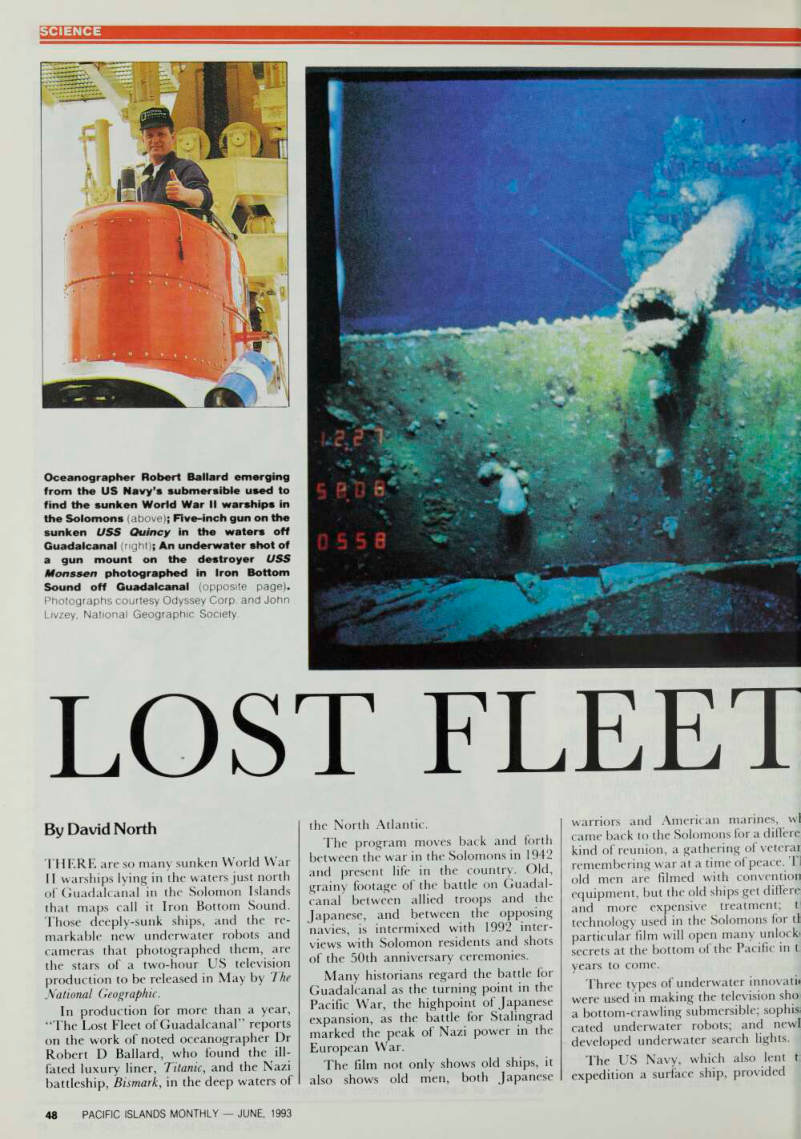
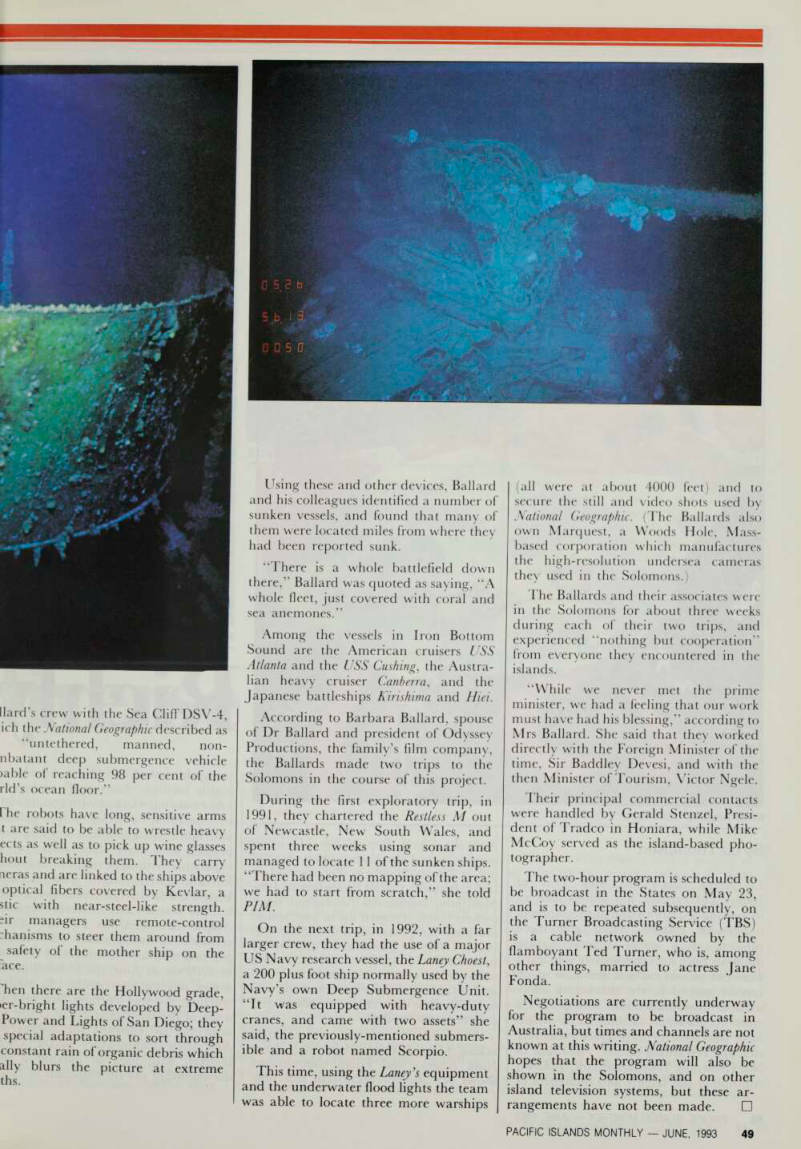
Science
By David North
THERE are so many sunken World War II warships lying in the waters just north of Guadalcanal in the Solomon Islands that maps call it Iron Bottom Sound.
Those deeply-sunk ships, and the re markable new underwater robots and cameras that photographed them, are the stars of a two-hour US television production to be released in May by The
National Geographic.
In production for more than a year, “The Lost Fleet of Guadalcanal” reports on the work of noted oceanographer Dr Robert D Ballard, who found the ill fated luxury liner, Titanic , and the Nazi battleship, Bismark, in the deep waters of
the North Atlantic.
The program moves back and forth between the war in the Solomons in 1942 and present life in the country. Old, grainy footage of the battle on Guadal canal between allied troops and the Japanese, and between the opposing navies, is intermixed with 1992 inter views with Solomon residents and shots of the 50th anniversary ceremonies.
Many historians regard the battle for Guadalcanal as the turning point in the Pacific War, the highpoint of Japanese expansion, as the battle for Stalingrad marked the peak of Nazi power in the European War.
The film not only shows old ships, it also shows old men, both Japanese
warriors and American marines, wl came back to the Solomons for a differe kind of reunion, a gathering of veterar: remembering war at a time of peace. TI old men are filmed with convention equipment, but the old ships get differe; and more expensive treatment; V. technology used in the Solomons for tf particular film will open many unlock* secrets at the bottom of the Pacific in t years to come.
Three types of underwater innovath were used in making the television sho* a bottom-crawling submersible; sophis; cated underwater robots; and newl developed underwater search lights.
The US Navy, which also lent t expedition a surface ship, provided
Oceanographer Robert Ballard emerging from the US Navy’s submersible used to find the sunken World War II warships in the Solomons (above); Five-inch gun on the sunken USS Quincy in the waters off Guadalcanal (right); An underwater shot of a gun mount on the destroyer USS Monssen photographed in Iron Bottom Sound off Guadalcanal (opposite page).
Photographs courtesy Odyssey Corp. and John Livzey, National Geographic Society.
Hard’s crew with the Sea Cliff DSV-4, ich the National Geographic described as “untethered, manned, non
nbatant deep submergence vehicle
>able of reaching 98 per cent of the rld’s ocean floor.” fhe robots have long, sensitive arms t are said to be able to wrestle heavy ects as well as to pick up wine glasses hout breaking them. They carry neras and are linked to the ships above optical fibers covered by Kevlar, a Stic with near-steel-like strength, -ir managers use remote-control zhanisms to steer them around from safety of the mother ship on the 'ace. hen there are the Hollywood grade,
•er-bright lights developed by Deep-
Power and Lights of San Diego; they special adaptations to sort through constant rain of organic debris which ally blurs the picture at extreme ths.
Using these and other devices, Ballard and his colleagues identified a number of sunken vessels, and found that many of them were located miles from where they had been reported sunk.
“There is a whole battlefield down there,” Ballard was quoted as saying, “A whole fleet, just covered with coral and sea anemones.”
Among the vessels in Iron Bottom Sound are the American cruisers USS Atlanta and the USS Cushing , the Austra lian heavy cruiser Canberra , and the Japanese battleships Kirishima and Hiei.
According to Barbara Ballard, spouse of Dr Ballard and president of Odyssey Productions, the family’s film company, the Ballards made two trips to the Solomons in the course of this project.
During the first exploratory trip, in
1991, they chartered the Restless M out of Newcastle, New South Wales, and spent three weeks using sonar and managed to locate 11 of the sunken ships.
“There had been no mapping of the area; we had to start from scratch,” she told
Rim.
On the next trip, in 1992, with a far larger crew, they had the use of a major US Navy research vessel, the Laney Choest, a 200 plus foot ship normally used by the Navy’s own Deep Submergence Unit.
“It was equipped with heavy-duty cranes, and came with two assets” she said, the previously-mentioned submers ible and a robot named Scorpio.
This time, using the Laney’s equipment and the underwater flood lights the team was able to locate three more warships
(all were at about 4000 feet) and to secure the still and video shots used by National Geographic. (The Ballards also own Marquest, a Woods Hole, Mass based corporation which manufactures the high-resolution undersea cameras they used in the Solomons.) The Ballards and their associates were in the Solomons for about three weeks during each of their two trips, and experienced “nothing but cooperation” from everyone they encountered in the islands.
“While we never met the prime minister, we had a feeling that our work must have had his blessing,” according to Mrs Ballard. She said that they worked directly with the Foreign Minister of the time, Sir Baddley Devesi, and with the then Minister of Tourism, Victor Ngele.
Their principal commercial contacts were handled by Gerald Stenzel, Presi dent of Tradco in Honiara, while Mike McCoy served as the island-based pho tographer.
The two-hour program is scheduled to be broadcast in the States on May 23, and is to be repeated subsequently, on the Turner Broadcasting Service (TBS) is a cable network owned by the flamboyant Ted Turner, who is, among other things, married to actress Jane Fonda.
Negotiations are currently underway
for the program to be broadcast in Australia, but times and channels are not known at this writing. National Geographic hopes that the program will also be shown in the Solomons, and on other island television systems, but these ar rangements have not been made. □
Richly diverse
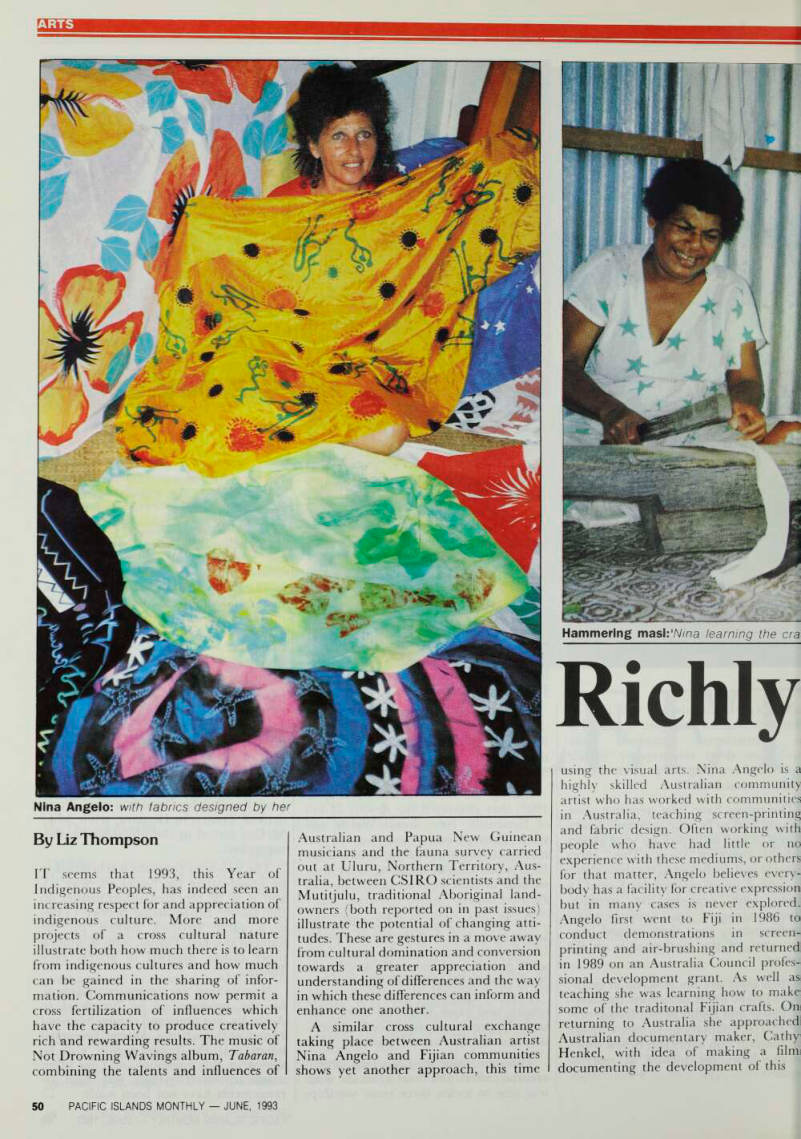
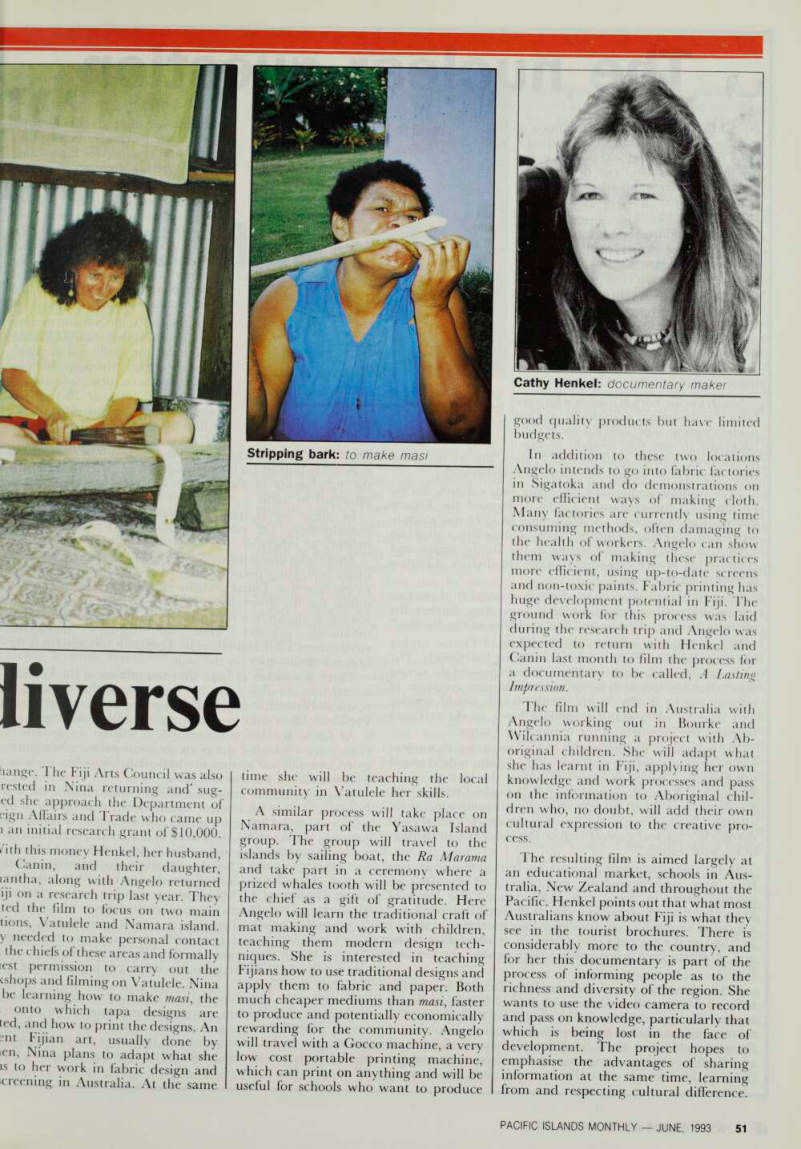
Arts
By Liz Thompson
IT seems that 1993, this Year of Indigenous Peoples, has indeed seen an increasing respect for and appreciation of indigenous culture. More and more projects of a cross cultural nature illustrate both how much there is to learn from indigenous cultures and how much can be gained in the sharing of infor mation. Communications now permit a cross fertilization of influences which
have the capacity to produce creatively
rich and rewarding results. The music of Not Drowning Wavings album, Tabaran, combining the talents and influences of
Australian and Papua New Guinean musicians and the fauna survey carried out at Uluru, Northern Territory, Aus tralia, between CSIRO scientists and the Mutitjulu, traditional Aboriginal land owners (both reported on in past issues) illustrate the potential of changing atti tudes. These are gestures in a move away from cultural domination and conversion towards a greater appreciation and understanding of differences and the way in which these differences can inform and enhance one another.
A similar cross cultural exchange taking place between Australian artist Nina Angelo and Fijian communities shows yet another approach, this time
using the visual arts. Nina Angelo is a highly skilled Australian community artist who has worked with communities in Australia, teaching screen-printing and fabric design. Often working with people who have had little or no: experience with these mediums, or others for that matter, Angelo believes every body has a facility for creative expression but in many cases is never explored., Angelo first went to Fiji in 1986 to conduct demonstrations in screen printing and air-brushing and returned! in 1989 on an Australia Council profes sional development grant. As well as; teaching she was learning how to make: some of the traditonal Fijian crafts. Oni returning to Australia she approached!
Australian documentary maker, Cathy' Henkel, with idea of making a filmi documenting the development of this
Nina Angelo: with fabrics designed by her
Hammering masi: 'Nina learning the cra
iiange. The Fiji Arts Council was also rested in Nina returning and' sug ed she approach the Department "of L'ign Affairs and Trade who came up i an initial research grant of SIO,OOO. nth this money Henkel, her husband, Canin, and their daughter, lantha, along with Angelo returned iji on a research trip last year. They ted the film to focus on two main tions, Vatulele and Namara island, y needed to make personal contact the chiefs of these areas and formally est permission to carry out the (shops and filming on Vatulele. Nina be learning how to make masi , the onto which tapa designs are ted, and how to print the designs. An ?nt Fijian art, usually done by en, Nina plans to adapt what she is to her work in fabric design and creening in Australia. At the same I
time she will be teaching the local community in Vatulele her skills.
A similar process will take place on Namara, part of the Yasawa Island group. The group will travel to the islands by sailing boat, the Ra Marama and take part in a ceremony where a prized whales tooth will be presented to the chief as a gift of gratitude. Here Angelo will learn the traditional craft of mat making and work with children, teaching them modern design tech niques. She is interested in teaching Fijians how to use traditional designs and apply them to fabric and paper. Both much cheaper mediums than masi, faster to produce and potentially economically rewarding for the community. Angelo will travel with a Gocco machine, a very low cost portable printing machine, which can print on anything and will be useful for schools who want to produce
good quality products but have limited budgets.
In addition to these two locations Angelo intends to go into fabric factories in Sigatoka and do demonstrations on more efficient ways of making cloth.
Many factories are currently using time consuming methods, often damaging to the health of workers. Angelo can show them ways of making these practices more efficient, using up-to-date screens and non-toxic paints. Fabric printing has huge development potential in Fiji. The ground work for this process was laid during the research trip and Angelo was expected to return with Henkel and Canin last month to film the process for a documentary to be called, A Lasting Impression.
The film will end in Australia with Angelo working out in Bourke and Wilcannia running a project with Ab original children. She will adapt what she has learnt in Fiji, applying her own knowledge and work processes and pass on the information to Aboriginal chil dren who, no doubt, will add their own cultural expression to the creative pro cess.
The resulting film is aimed largely at an educational market, schools in Aus tralia, New Zealand and throughout the Pacific. Henkel points out that what most Australians know about Fiji is what they see in the tourist brochures. There is considerably more to the country, and for her this documentary is part of the process of informing people as to the richness and diversity of the region. She wants to use the video camera to record and pass on knowledge, particularly that which is being lost in the face of development. The project hopes to emphasise the advantages of sharing information at the same time, learning from and respecting cultural difference.
Stripping bark: to make masi
Cathy Henkel: documentary maker
Advertisements & other items, p. 51 (1 item)
liverse
The nuclear question
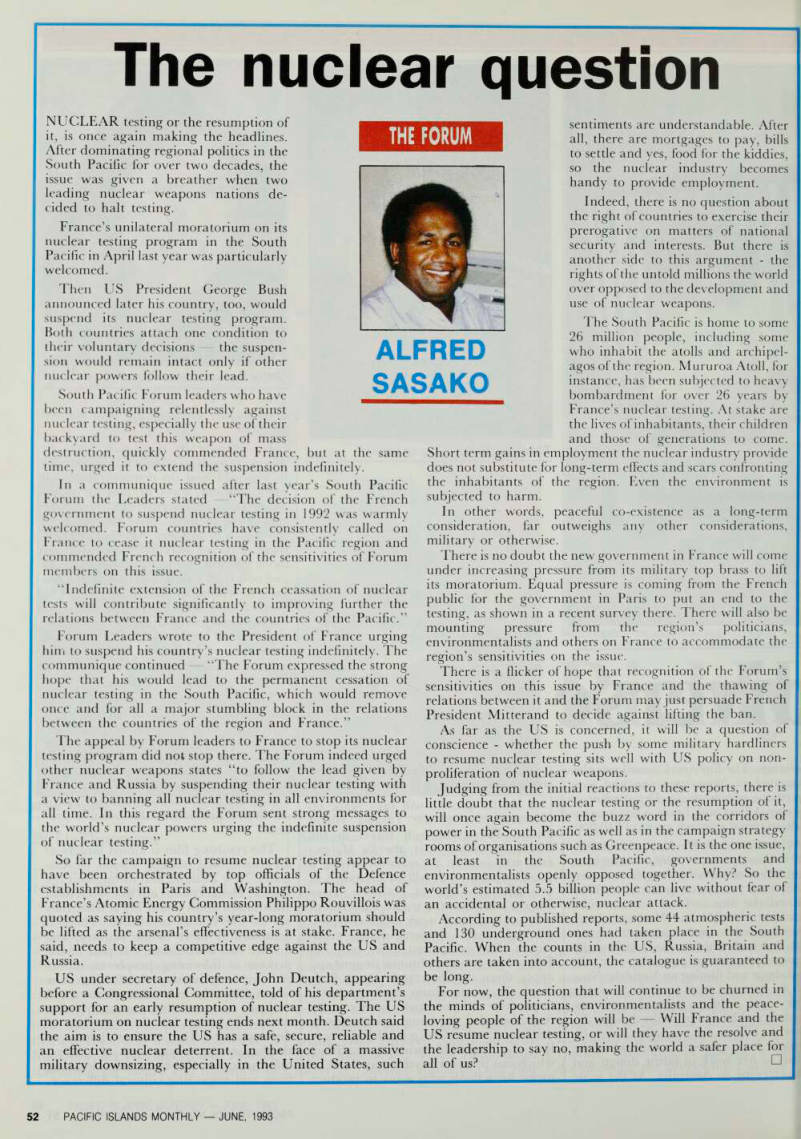
NUCLEAR testing or the resumption of it, is once again making the headlines.
After dominating regional politics in the South Pacific for over two decades, the issue was given a breather when two leading nuclear weapons nations de cided to halt testing.
France’s unilateral moratorium on its nuclear testing program in the South Pacific in April last year was particularly welcomed.
Then US President George Bush announced later his country, too, would suspend its nuclear testing program.
Both countries attach one condition to their voluntary decisions the suspen sion would remain intact only if other nuclear powers follow their lead.
South Pacific Forum leaders who have been campaigning relentlessly against nuclear testing, especially the use of their backyard to test this weapon of mass
destruction, quickly commended France, but at the same time, urged it to extend the suspension indefinitely.
In a communique issued after last year’s South Pacific Forum the Leaders stated “The decision of the French government to suspend nuclear testing in 1992 was warmly welcomed. Forum countries have consistently called on France to cease it nuclear testing in the Pacific region and commended French recognition of the sensitivities of Forum members on this issue.
“Indefinite extension of the French ceassation of nuclear tests will contribute significantly to improving further the relations between France and the countries of the Pacific.”
Forum Leaders wrote to the President of France urging him to suspend his country’s nuclear testing indefinitely. The communique continued “The Forum expressed the strong hope that his would lead to the permanent cessation of nuclear testing in the South Pacific, which would remove once and for all a major stumbling block in the relations between the countries of the region and France.”
The appeal by Forum leaders to France to stop its nuclear testing program did not stop there. The Forum indeed urged other nuclear weapons states “to follow the lead given by France and Russia by suspending their nuclear testing with a view to banning all nuclear testing in all environments for all time. In this regard the Forum sent strong messages to the world’s nuclear powers urging the indefinite suspension of nuclear testing.”
So far the campaign to resume nuclear testing appear to have been orchestrated by top officials of the Defence establishments in Paris and Washington. The head of France’s Atomic Energy Commission Philippo Rouvillois was quoted as saying his country’s year-long moratorium should be lifted as the arsenal’s effectiveness is at stake. France, he said, needs to keep a competitive edge against the US and Russia.
US under secretary of defence, John Deutch, appearing before a Congressional Committee, told of his department’s support for an early resumption of nuclear testing. The US moratorium on nuclear testing ends next month. Deutch said the aim is to ensure the US has a safe, secure, reliable and an effective nuclear deterrent. In the face of a massive military downsizing, especially in the United States, such
sentiments are understandable. After all, there are mortgages to pay, bills to settle and yes, food for the kiddies, so the nuclear industry becomes handy to provide employment.
Indeed, there is no question about the right of countries to exercise their prerogative on matters of national security and interests. But there is another side to this argument - the rights of the untold millions the world over opposed to the development and use of nuclear weapons.
The South Pacific is home to some 26 million people, including some who inhabit the atolls and archipel agos of the region. Mururoa Atoll, for instance, has been subjected to heavy bombardment for over 26 years by France’s nuclear testing. At stake are the lives of inhabitants, their children and those of generations to come.
Short term gains in employment the nuclear industry provide does not substitute for long-term effects and scars confronting the inhabitants of the region. Even the environment is subjected to harm.
In other words, peaceful co-existence as a long-term consideration, far outweighs any other considerations, military or otherwise.
There is no doubt the new government in France will come under increasing pressure from its military top brass to lift its moratorium. Equal pressure is coming from the French public for the government in Paris to put an end to the testing, as shown in a recent survey there. I'here will also be mounting pressure from the region’s politicians, environmentalists and others on France to accommodate the region’s sensitivities on the issue.
There is a flicker of hope that recognition of the Forum’s sensitivities on this issue by France and the thawing of relations between it and the Forum may just persuade French President Mitterand to decide against lifting the ban.
As far as the US is concerned, it will be a question of conscience - whether the push by some military hardliners to resume nuclear testing sits well with US policy on non proliferation of nuclear weapons.
Judging from the initial reactions to these reports, there is little doubt that the nuclear testing or the resumption of it, will once again become the buzz word in the corridors of power in the South Pacific as well as in the campaign strategy rooms of organisations such as Greenpeace. It is the one issue, at least in the South Pacific, governments and environmentalists openly opposed together. Why? So the world’s estimated 5.5 billion people can live without fear of an accidental or otherwise, nuclear attack.
According to published reports, some 44 atmospheric tests and 130 underground ones had taken place in the South Pacific. When the counts in the US, Russia, Britain and others are taken into account, the catalogue is guaranteed to
be long.
For now, the question that will continue to be churned in the minds of politicians, environmentalists and the peace loving people of the region will be Will France and the US resume nuclear testing, or will they have the resolve and the leadership to say no, making the world a safer place for all of us?
The Forum
Alfred
Sasako
ruled
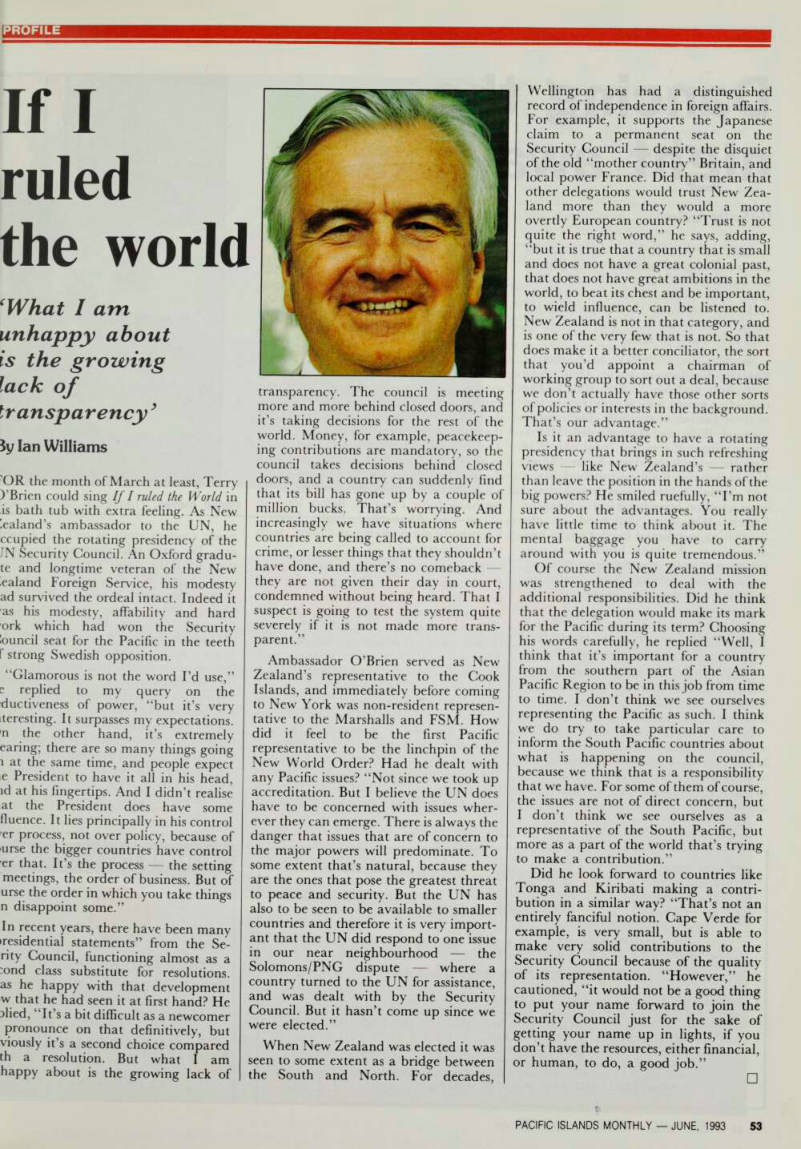
Profils
If I
the world
‘What I am unhappy about is the growing lack of transparency'
By Ian Williams
'OR the month of March at least, Terry )’Brien could sing If I ruled the World in is bath tub with extra feeling. As New Zealand’s ambassador to the UN, he ccupied the rotating presidency of the IN Security Council. An Oxford gradu te and longtime veteran of the New ealand Foreign Service, his modesty ad survived the ordeal intact. Indeed it as his modesty, affability and hard ork which had won the Security louncil seat for the Pacific in the teeth f strong Swedish opposition.
“Glamorous is not the word Td use,” s replied to my query on the ductiveness of power, “but it’s very teresting. It surpasses my expectations, n the other hand, it’s extremely earing; there are so many things going i at the same time, and people expect e President to have it all in his head, id at his fingertips. And I didn’t realise at the President does have some fluence. It lies principally in his control r er process, not over policy, because of urse the bigger countries have control er that. It’s the process the setting meetings, the order of business. But of urse the order in which you take things n disappoint some.”
In recent years, there have been many •residential statements” from the Se rity Council, functioning almost as a :ond class substitute for resolutions, as he happy with that development w . t^la ( t t had seen it at first hand? He alied, “It’s a bit difficult as a newcomer pronounce on that definitively, but viously it’s a second choice compared th a resolution. But what I am happy about is the growing lack of
transparency. The council is meeting more and more behind closed doors, and it’s taking decisions for the rest of the
world. Money, for example, peacekeep
ing contributions are mandatory, so the council takes decisions behind closed doors, and a country can suddenly find that its bill has gone up by a couple of million bucks. That’s worrying. And increasingly we have situations where countries are being called to account for crime, or lesser things that they shouldn’t have done, and there’s no comeback they are not given their day in court, condemned without being heard. That I suspect is going to test the system quite severely if it is not made more trans parent.”
Ambassador O’Brien served as New Zealand’s representative to the Cook Islands, and immediately before coming to New York was non-resident represen tative to the Marshalls and FSM. How did it feel to be the first Pacific representative to be the linchpin of the New World Order? Had he dealt with any Pacific issues? “Not since we took up accreditation. But I believe the UN does have to be concerned with issues wher ever they can emerge. There is always the danger that issues that are of concern to the major powers will predominate. To some extent that’s natural, because they are the ones that pose the greatest threat to peace and security. But the UN has also to be seen to be available to smaller countries and therefore it is very import ant that the UN did respond to one issue in our near neighbourhood — the Solomons/PNG dispute — where a country turned to the UN for assistance, and was dealt with by the Security Council. But it hasn’t come up since we were elected.”
When New Zealand was elected it was seen to some extent as a bridge between the South and North. For decades,
Wellington has had a distinguished record of independence in foreign affairs.
For example, it supports the Japanese claim to a permanent seat on the Security Council despite the disquiet of the old “mother country” Britain, and local power France. Did that mean that other delegations would trust New Zea land more than they would a more overtly European country? “Trust is not quite the right word,” he says, adding, “but it is true that a country that is small and does not have a great colonial past, that does not have great ambitions in the world, to beat its chest and be important, to wield influence, can be listened to.
New Zealand is not in that category, and is one of the very few that is not. So that does make it a better conciliator, the sort that you’d appoint a chairman of working group to sort out a deal, because we don’t actually have those other sorts of policies or interests in the background.
That’s our advantage.”
Is it an advantage to have a rotating presidency that brings in such refreshing views - like New Zealand’s rather than leave the position in the hands of the big powers? He smiled ruefully, “I’m not sure about the advantages. You really have little time to think about it. The mental baggage you have to carry around with you is quite tremendous.”
Of course the New Zealand mission was strengthened to deal with the additional responsibilities. Did he think that the delegation would make its mark for the Pacific during its term? Choosing his words carefully, he replied “Well, I think that it’s important for a country from the southern part of the Asian Pacific Region to be in this job from time to time. I don’t think we see ourselves representing the Pacific as such. I think we do try to take particular care to inform the South Pacific countries about what is happening on the council, because we think that is a responsibility that we have. For some of them of course, the issues are not of direct concern, but I don’t think we see ourselves as a representative of the South Pacific, but more as a part of the world that’s trying to make a contribution.”
Did he look forward to countries like Tonga and Kiribati making a contri bution in a similar way? “That’s not an entirely fanciful notion. Cape Verde for example, is very small, but is able to make very solid contributions to the Security Council because of the quality of its representation. “However,” he cautioned, “it would not be a good thing to put your name forward to join the Security Council just for the sake of getting your name up in lights, if you don’t have the resources, either financial, or human, to do, a good job.”
Dancing the
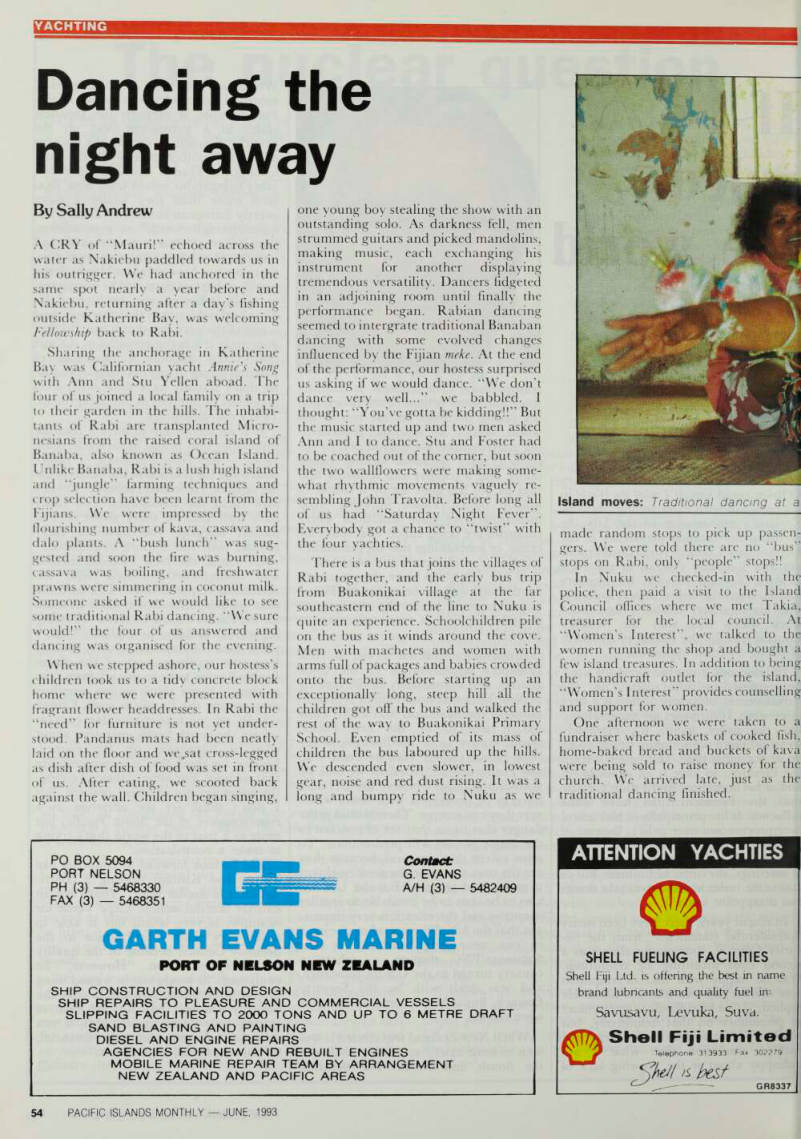
Yachting
Dancing the night away
By Sally Andrew
A CRY of “Mauri!” echoed across the water as Nakiebu paddled towards us in his outrigger. We had anchored in the same spot nearly a year before and
Nakiebu, returning after a day's fishing
outside Katherine Bay, was welcoming Fellowship back to Rabi.
Sharing the anchorage in Katherine Bay was Californian yacht Annie’s Song with Ann and Stu Yellen aboad. The four of us joined a local family on a trip to their garden in the hills. The inhabi tants of Rabi are transplanted Micro nesians from the raised coral island of Banaba, also known as Ocean Island.
Unlike Banaba, Rabi is a lush high island
and “jungle” farming techniques and
crop selection have been learnt from the Fijians. We were impressed by the flourishing number of kava, cassava and dalo plants. A “bush lunch” was sug gested and soon the fire was burning, cassava was boiling, and freshwater prawns were simmering in coconut milk.
Someone asked if we would like to see some traditional Rabi dancing. “We sure would!” the four of us answered and
dancing was oiganised for the evening.
When we stepped ashore, our hostess’s children took us to a tidy concrete block home where we were presented with fragrant flower headdresses. In Rabi the “need” for furniture is not yet under stood. Pandanus mats had been neatly laid on the floor and we„sat cross-legged as dish after dish of food was set in front of us. After eating, we scooted back against the wall. Children began singing,
one young boy stealing the show with an outstanding solo. As darkness fell, men strummed guitars and picked mandolins, making music, each exchanging his instrument for another displaying tremendous versatility. Dancers fidgeted in an adjoining room until finally the
performance began. Rabian dancing
seemed to intergrate traditional Banaban dancing with some evolved changes influenced by the Fijian meke. At the end of the performance, our hostess surprised us asking if we would dance. “We don’t dance very we 11...” we babbled. I thought; “You’ve gotta be kidding!!” But the music started up and two men asked Ann and I to dance. Stu and Foster had to be coached out of the corner, but soon the two wallflowers were making some what rhythmic movements vaguely re sembling John Travolta. Before long all of us had “Saturday Night Fever”.
Everybody got a chance to “twist” with the four yachties.
There is a bus that joins the villages of Rabi together, and the early bus trip from Buakonikai village at the far southeastern end of the line to Nuku is
quite an experience. Schoolchildren pile
on the bus as it winds around the cove.
Men with machetes and women with arms full of packages and babies crowded onto the bus. Before starting up an exceptionally loftg, steep hill all the children got off the bus and walked the rest of the way to Buakonikai Primary School. Even emptied of its mass of children the bus laboured up the hills.
We descended even slower, in lowest gear, noise and red dust rising. It was a long and bumpy ride to Nuku as we
made random stops to pick up passen gers. We were told there are no “bus” stops on Rabi, only ‘"people” stops!!
In Nuku we checked-in with the police, then paid a visit to the Island Council offices where we met Takia, treasurer lor the focal council. At “Women s Interest”, we talked to the women running the shop and bought a few island treasures. In addition to being the handicraft outlet for the island, “Women’s Interest” provides counselling and support for women.
One afternoon we were taken to a fundraiser where baskets of cooked fish, home-baked bread and buckets of kava were being sold to raise money for the church. We arrived late, just as the traditional dancing finished.
Island moves: Traditional dancing at a
Disappointed, our faces told all. After a few whisperings the dance was on again.
We enjoyed the “Dance of the Frigatebird” and were amazed to see a quick-knee’d Tahitian-style dance. Af terwards the group leader presented us with leis and asked if we would mind dancing! “Sure!” we said. Young and handsome Paul soon had me “twisting”, while the woman leader danced with Foster. When the dancing was over, we were honoured in the traditional Bana ban way with a squirt of cologne.
Our last evening at Buakonikai we were invited to a fourth dance perform ance. This time several elders attended and a veritable feast had been prepared.
The merrymaking continued until the wee morning hours. Everybody danced the night away while the rhythmic pounding of kava resounded through the darkness. About one o’clock, Ann made a speech of thanks for the food, dancing, hospitality and friendship. It had all been overwhelming. Speeches were exchanged between us and our hosts. When the words ran out, we made our way back to the boat exhausted but full of grog and good memories.
In Rabi, as in other remote and not so remote parts of Fiji, we had found a special place full of special people. □
[?]ndraiser
Advertisements & other items, pp. 54-56 (1 item)
Garth Evans Marine
ATTENTION YACHTIES
SHELL FUEUNG FACILITIES
Shell Fiji Ltd. is offering the best in name brand lubricants and quality fuel in; Savusavu, Levuka, Suva. © Shell Fiji Limited Telephone 313933 Fa* 302279
SSW/ is best
— GR8337
PO BOX 5094
PORT NELSON
PH (3) 5468330
FAX (3) 5468351
Contact
G. EVANS
A/H (3) 5482409
GARTH EVANS MARINE
PORT OF NELSON NEW ZEALAND
SHIP CONSTRUCTION AND DESIGN
SHIP REPAIRS TO PLEASURE AND COMMERCIAL VESSELS SLIPPING FACILITIES TO 2000 TONS AND UP TO 6 METRE DRAFT
SAND BLASTING AND PAINTING
DIESEL AND ENGINE REPAIRS
AGENCIES FOR NEW AND REBUILT ENGINES
MOBILE MARINE REPAIR TEAM BY ARRANGEMENT
NEW ZEALAND AND PACIFIC AREAS
The Bank Line
YOUR EXPERTS IN THE SOUTH PACIFIC
A SERVICE OF ANDREW WEIR SHIPPING
The Sank tH© ,r_ .r. *-* --r '■ SB -5; IP
A
A JOINT SERVICE OF
THE CHINA NAVIGATION CO. LTD.
(INC. IN U.K.)
Mitsui O.S.K. Lines Ltd.
(INC. IN JAPAN)
NIPPON YUSEN KAISHA
(INC. IN JAPAN)
SERVICE
TWO
OPERATING A MONTHLY SAILING FROM JAPAN
AND S.KOREA TO SOUTH PACIFIC PORTS
AS A MEMBER OF THE JAPAN SOUTH PACIFIC
FREIGHT CONFERENCE
CONTAINER / B/BULK
/RORO CAR CARRIER
ON SERVICE
Nagoya%
' % Busan I Yokohama
M.S. "PACIFIC ISLANDER”
(OPERATED By CNCO)
M.S. "CORAL ISLANDER”
(OPERATED By NYK/MOL)
Papua New Guinea
\ Tarawa
£0 to & C?' Honiara \ * Santo \ Vila \ O LautokaVT^--- * v / Suva i 3 Apia Pago * Pape< cr o Nukualofa Rarotonga For more information, please contact our AGENTS in SUVA, FIJI, or respective ports For "Pacific Islander", Carpenters Shipping Private Mail Bag
G.P.O.
Suva
CABLE: CARPSHIP
TLX; 2199 CARPSHIP FJ
TEL: 679-312244
FAX; 679-301572
And calling at: New Zealand For "Coral Islander": Burns Philp(SS)Co Ltd G.P.O. Box 355 Suva
CABLE: BURNSOUTH
TLX: 2168 BURNSHIP FJ
TEL: 679-311777
FAX; 679-301127
~doST r PAGO PAGO O^Days)
* HONIARA (39
RAROTONGA (Via APIA or PAGO PAGO)
SUVA (14 Day:
PAPEETE (23 D
VILA (35 Days: ( ) Average Transit Time From Yokohama * On Inducement Basis For Schedule Details See Your Local Press BALI HAI SERVICE ••• BALI HAI SERVICE ••• BALI HAI SERVICE ••• BALI HAI SERVICE •••
Shipping
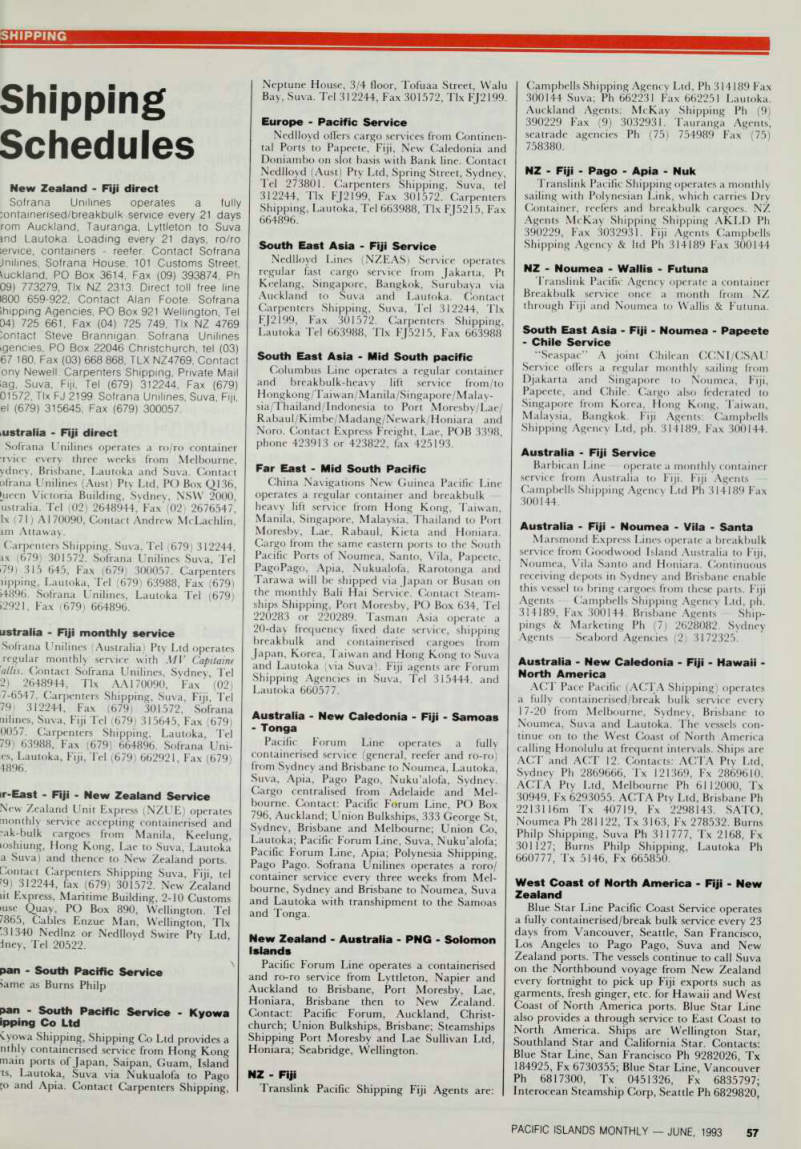
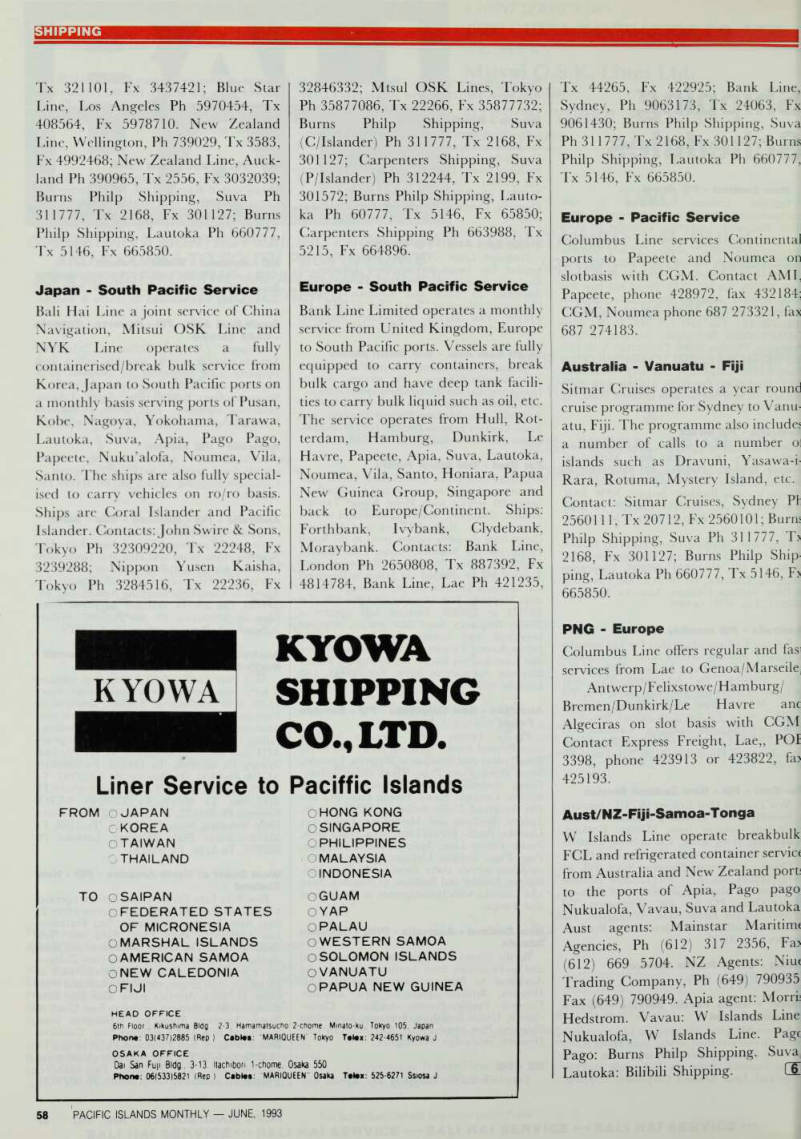
Schedules
New Zealand - Fiji direct Sofrana Unilines operates a fully xmtainerised/breakbulk service every 21 days rom Auckland, Tauranga, Lyttleton to Suva md Lautoka. Loading every 21 days, ro/ro lervice, containers - reefer. Contact Sofrana Jnilines, Sofrana House, 101 Customs Street, Auckland, PO Box 3614, Fax (09) 393874, Ph 09) 773279, Tlx NZ 2313. Direct toll free line >BOO 659-922, Contact Alan Foote. Sofrana Shipping Agencies, PO Box 921 Wellington, Tel 04) 725 661, Fax (04) 725 749, Tlx NZ 4769 Contact Steve Brannigan, Sofrana Unilines agencies, PO Box 22046 Christchurch, tel (03) 67 180, Fax (03) 668 868, TLX NZ4769, Contact ony Newell. Carpenters Shipping, Private Mail lag, Suva, Fiji. Tel (679) 312244, Fax (679) 01572, Tlx FJ 2199. Sofrana Unilines, Suva, Fiji, el (679) 315645, Fax (679) 300057.
Australia - Fiji direct Sofrana Unilines operates a ro/ro container ■rvicc every three weeks from Melbourne, ydney, Brisbane, Lautoka and Suva. Contact ofrana Unilines (Aust) Pty Ltd, PO Box Q 136, kieen Victoria Building, Sydney, NSW 2000, ustralia. Tel (02) 2648944,'Fax' (02) 2676547, lx (71) A 170090, Contact Andrew McLachlin, im Attaway.
Carpenters Shipping, Suva, Tel (679) 312244, ix (679) 301572. Sofrana Unilines Suva, Tel •79) 315 645, Fax (679) 300057. Carpenters lipping, Lautoka, Tel (679) 63988, Fax (679) >4896. Sofrana Unilines, Lautoka Tel (679) >292 1, Fax (679) 664896. ustralia - Fiji monthly service Sofrana Unilines (Australia) Pty Ltd operates regular monthly service with MV Capitame allis. Contact Sofrana Unilines, Sydney, Tel 2) 2648944, Tlx AA170090, Fax (02) 7-6547. Carpenters Shipping, Suva, Fiji, Tel 79) 312244, Fax (679) 301572, Sofrana nilines, Suva, Fiji Tel (679) 315645, Fax (679) 0057. Carpenters Shipping, Lautoka, Tel 79) 63988, Fax (679) 664896. Sofrana Uni ts, Lautoka, Fiji, Tel (679) 662921, Fax (679) 4896. ir-East - Fiji - New Zealand Service New Zealand Unit Express (NZUE) operates monthly service accepting containerised and ?ak-bulk cargoes from Manila, Keelung, toshiung, Hong Kong, Lae to Suva, Lautoka a Suva) and thence to New Zealand ports.
Contact Carpenters Shipping Suva, Fiji, tel '?) 312244, fax (679) 301572. New Zealand lit Express, Maritime Building, 2-10 Customs •use Quay, PO Box 890, Wellington. Tel 7865, Cables Enzue Man, Wellington, Tlx 131340 Nedlnz or Nedlloyd Swire Pty Ltd, dney, Tel 20522. pan - South Pacific Service Same as Burns Philp pan - South Pacific Service - Kyowa ipping Co Ltd Cyowa Shipping, Shipping Co Ltd provides a nthly containerised service from Hong Kong main ports of Japan, Saipan, Guam, Island ts, Lautoka, Suva via Nukualofa to Pago >° an( d Apia. Contact Carpenters Shipping,
Neptune House, 3/4 floor, Tofuaa Street, Walu Bay, Suva. Tel 312244, Fax 301572, Tlx FJ2199.
Europe - Pacific Service Nedlloyd offers cargo services from Continen tal Ports to Papeete, Fiji, New Caledonia and Doniambo on slot basis with Bank line. Contact Nedlloyd (Aust) Pty Ltd, Spring Street, Sydney, Tel 273801. Carpenters Shipping, Suva, tel 312244, Tlx FJ2199, Fax 301572. Carpenters Shipping, Lautoka, Tel 663988, Tlx FJ5215, Fax 664896.
South East Asia - Fiji Service Nedlloyd Lines (NZEAS) Service operates regular fast cargo service from Jakarta, Pt
Keelang, Singapore, Bangkok, Surubaya via
Auckland to Suva and Lautoka. Contact Carpenters Shipping, Suva, Tel 312244, Tlx FJ2199, Fax 301572. Carpenters Shipping, Lautoka Tel 663988, Tlx FJ5215, Fax 663988 South East Asia - Mid South pacific Columbus Line operates a regular container and breakbulk-heavy lift service from/to
Hongkong/Taiwan/Manila/Singapore/Malay
sia/Thailand/Indonesia to Port Moresby/Lae/
Rabaul/Kimbe/Madang/Newark/Honiara and
Noro. Contact Express Freight, Lae, POB 3398, phone 423913 or 423822, fax 425193.
Far East - Mid South Pacific China Navigations New Guinea Pacific Line operates a regular container and breakbulk heavy lift service from Hong Kong, Taiwan, Manila, Singapore, Malaysia, Thailand to Port Moresby, Lae, Rabaul, Kieta and Honiara.
Cargo from the same eastern ports to the South Pacific Ports of Noumea, Santo, Vila, Papeete, PagoPago, Apia, Nukualofa, Rarotonga and Tarawa will be shipped via Japan or Busan on the monthly Bali Hai Service. Contact Steam ships Shipping, Port Moresbv, PO Box 634, Tel 220283 or 220289. Tasman Asia operate a 20-day frequency fixed date service, shipping breakbulk and containerised cargoes from Japan, Korea, Taiwan and Hong Kong to Suva and Lautoka (via Suva). Fiji agents are Forum Shipping Agencies in Suva, Tel 315444. and Lautoka 660577.
Australia - New Caledonia - Fiji - Samoas - Tonga Pacific Forum Line operates a fully containerised service (general, reefer and ro-ro) from Sydney and Brisbane to Noumea, Lautoka, Suva, Apia, Pago Pago, Nuku’alofa, Sydney.
Cargo centralised from Adelaide and Mel bourne. Contact: Pacific Forum Line, PO Box 796, Auckland; Union Bulkships, 333 George St, Sydney, Brisbane and Melbourne; Union Co, Lautoka; Pacific Forum Line, Suva, Nuku’alofa; Pacific Forum Line, Apia; Polynesia Shipping, Pago Pago. Sofrana Unilines operates a roro/ container service every three weeks from Mel bourne, Sydney and Brisbane to Noumea, Suva and Lautoka with transhipment to the Samoas
and Tonga.
New Zealand - Australia - PNG - Solomon Islands Pacific Forum Line operates a containerised and ro-ro service from Lyttleton, Napier and Auckland to Brisbane, Port Moresby, Lae, Honiara, Brisbane then to New Zealand.
Contact: Pacific Forum, Auckland, Christ church; Union Bulkships, Brisbane; Steamships Shipping Port Moresby and Lae Sullivan Ltd,
Honiara; Seabridge, Wellington.
NZ - Fiji Translink Pacific Shipping Fiji Agents are:
Campbells Shipping Agency Ltd, Ph 314189 Fax 300144 Suva; Ph 662231 Fax 662251 Lautoka.
Auckland Agents: McKay Shipping Ph (9)
390229 Fax (9) 3032931. Tauranga Agents' seatrade agencies Ph (75) 754989 Fax (75) 758380.
NZ - Fiji - Pago - Apia - Nuk Translink Pacific Shipping operates a monthly sailing with Polynesian Link, which carries Dry Container, reefers and breakbulk cargoes. NZ
Agents McKay Shipping Shipping AKLD Ph
390229, Fax 3032931. Fiji Agents Campbells
Shipping Agency & ltd Ph 314189 Fax 300144 NZ - Noumea - Wallis - Futuna Translink Pacific Agency operate a container Breakbulk service once a month from NZ through Fiji and Noumea to Wallis & Futuna.
South East Asia - Fiji - Noumea - Papeete - Chile Service “Seaspac” A joint Chilean CCNI/CSAU Service offers a regular monthly sailing from Djakarta and Singapore to Noumea, Fiji, Papeete, and Chile. Cargo also federated to
Singapore from Korea, Hong Kong, Taiwan,
Malaysia, Bangkok. Fiji Agents; Campbells
Shipping Agency Ltd, ph. 314189, Fax 300144.
Australia - Fiji Service Barbican Line operate a monthly container service from Australia to Fiji. Fiji Agents Campbells Shipping Agency Ltd Ph 314189 Fax 300144.
Australia - Fiji - Noumea - Vila - Santa Marsmond Express Lines operate a breakbulk service from Goodwood Island Australia to Fiji, Noumea, Vila Santo and Honiara. Continuous receiving depots in Sydney and Brisbane enable this vessel to bring cargoes from these parts. Fiji
Agents Campbells Shipping Agency Ltd, ph.
314189, Fax 300144. Brisbane Agents Ship pings & Marketing Ph (7) 2628082. Sydney
Agents Seabord Agencies (2) 3172325.
Australia - New Caledonia - Fiji - Hawaii - North America ACT Pace Pacific (ACTA Shipping) operates a fully containerised/break bulk service every 17-20 from Melbourne, Sydney, Brisbane to Noumea, Suva and Lautoka. The vessels con tinue on to the West Coast of North America calling Honolulu at frequent intervals. Ships are ACT and ACT 12. Contacts; ACTA Pty Ltd, Sydney Ph 2869666, Tx 121369, Fx 2869610.
ACTA Pty Ltd, Melbourne Ph 6112000, Tx 30949, Fx 6293055. ACTA Pty Ltd, Brisbane Ph 2213116 m Tx 40719, Fx 2298143. SATO, Noumea Ph 281122, Tx 3163, Fx 278532. Burns Philp Shipping, Suva Ph 31 1777, Tx 2168, Fx 301127; Burns Philp Shipping, Lautoka Ph 660777, Tx 5146, Fx 665850.
West Coast of North America - Fiji - New Zealand Blue Star Line Pacific Coast Service operates a fully containerised/break bulk service every 23 days from Vancouver, Seattle, San Francisco, Los Angeles to Pago Pago, Suva and New Zealand ports. The vessels continue to call Suva on the Northbound voyage from New Zealand every fortnight to pick up Fiji exports such as garments, fresh ginger, etc. for Hawaii and West Coast of North America ports. Blue Star Line also provides a through service to East Coast to North America. Ships are Wellington Star, Southland Star and California Star. Contacts: Blue Star Line, San Francisco Ph 9282026, Tx 184925, Fx 6730355; Blue Star Line, Vancouver Ph 6817300, Tx 0451326, Fx 6835797; Interocean Steamship Corp, Seattle Ph 6829820,
Tx 321101, Fx 3437421; Blue Star Line, Los Angeles Ph 5970454, Tx 408564, Fx 5978710. New Zealand Line, Wellington, Ph 739029, Tx 3583, Fx 4992468; New Zealand Line, Auck land Ph 390965, Tx 2556, Fx 3032039; Burns Philp Shipping, Suva Ph 31 1777, Tx 2168, Fx 301127; Burns Philp Shipping, Lautoka Ph 660777, Tx 5146, Fx 665850.
Japan - South Pacific Service Bali Hai Line a joint service of China Navigation, Mitsui OSK Line and NYK Line operates a fully containerised/break bulk service from Korea, Japan to South Pacific ports on a monthly basis serving ports of Pusan, Kobe, Nagoya, Yokohama, Tarawa, Lautoka, Suva, Apia, Pago Pago, Papeete, Nuku’alofa, Noumea, Vila, Santo. The ships are also fully special ised to carry vehicles on ro/ro basis.
Ships are Coral Islander and Pacific Islander. Contacts: John Swire & Sons, Tokyo Ph 32309220, Tx 22248, Fx 3239288; Nippon Yusen Kaisha, Tokyo Ph 3284516, Tx 22236, Fx
32846332; Mtsul OSK Lines, Tokyo Ph 35877086, Tx 22266, Fx 35877732; Burns Philp Shipping, Suva (C/Islander) Ph 311777, Tx 2168, Fx 301127; Carpenters Shipping, Suva (P/Islander) Ph 312244, Tx 2199, Fx 301572; Burns Philp Shipping, Lauto ka Ph 60777, Tx 5146, Fx 65850; Carpenters Shipping Ph 663988, Tx 5215, Fx 664896.
Europe - South Pacific Service Bank Line Limited operates a monthly service from United Kingdom, Europe to South Pacific ports. Vessels are fully equipped to carry containers, break bulk cargo and have deep tank facili ties to carry bulk liquid such as oil, etc.
The service operates from Hull, Rot terdam, Hamburg, Dunkirk, Le Havre, Papeete, Apia, Suva, Lautoka, Noumea, Vila, Santo, Honiara, Papua New Guinea Group, Singapore and back to Europe/Continent. Ships: Forthbank, Ivybank, Clydebank, Moraybank. Contacts: Bank Line, London Ph 2650808, Tx 887392, Fx 4814784, Bank Line, Lae Ph 421235,
Tx 44265, Fx 422925; Bank Line, Sydney, Ph 9063173, Tx 24063, Fx 9061430; Burns Philp Shipping, Suva Ph 311777, Tx 2168, Fx 301127; Burns Philp Shipping, Lautoka Ph 660777, Tx 5146, Fx 665850.
Europe - Pacific Service Columbus Line services Continental ports to Papeete and Noumea on slotbasis with CGM. Contact AMI, Papeete, phone 428972, fax 432184; CGM, Noumea phone 687 273321, fax 687 274183.
Australia - Vanuatu - Fiji Sitmar Cruises operates a year round cruise programme for Sydney to Vanu atu, Fiji. The programme also includes a number of calls to a number ol islands such as Dravuni, Yasawa-i- Rara, Rotuma, Mystery Island, etc.
Contact: Sitmar Cruises, Sydney Ph 2560111, Tx 20712, Fx 2560101; Burns Philp Shipping, Suva Ph 31 1777, T> 2168, Fx 301 127; Burns Philp Ship ping, Lautoka Ph 660777, Tx 5146, F> 665850.
PNG - Europe Columbus Line offers regular and fasi services from Lae to Genoa/Marseilej
Antwerp/Felixstowe/Hamburg/
Bremen/Dunkirk/Le Havre anc Algeciras on slot basis with CGM Contact Express Freight, Lae,, POE 3398, phone 423913 or 423822, fa> 425193.
Aust/NZ-Fiji-Samoa-Tonga W Islands Line operate breakbulk FCL and refrigerated container service from Australia and New Zealand port: to the ports of Apia, Pago pago Nukualofa, Vavau, Suva and Lautoka Aust agents: Mainstar Maritime Agencies, Ph (612) 317 2356, Fa> (612) 669 5704. NZ Agents: Niue Trading Company, Ph (649) 790935 Fax (649) 790949. Apia agent: Morris Hedstrom. Vavau: W Islands Line Nukualofa, W Islands Line. Page Pago: Burns Philp Shipping. Suva Lautoka: Bilibili Shipping. CH
Advertisements & other items, pp. 58-60 (1 item)
Co., Ltd.
KYOWA
KYOWA
SHIPPING
CO., LTD.
Liner Service to Paciffic Islands
FROM ©JAPAN
OKOREA
OTAIWAN
I THAILAND
OHONG KONG
OSINGAPORE
OPHILIPPINES
O MALAYSIA
©INDONESIA
TO O SAIPAN
©FEDERATED STATES
OF MICRONESIA
©MARSHAL ISLANDS
©AMERICAN SAMOA
©NEW CALEDONIA
©FIJI
©GUAM
©YAP
©PALAU
©WESTERN SAMOA
©SOLOMON ISLANDS
©VANUATU
©PAPUA NEW GUINEA
HEAD OFFICE
6th Floor . Kikushima Bldg 2-3, Hamamatsucho 2-chome Mmato-ku, Tokyo 105, Japan Phone: 03(437)2885 (Rep ) Cable*: MARIQUEEN Tokyo Tel#*: 242-4651 Kyowa J
OSAKA OFFICE
Dai San Fuji Bldg, 3-13 itachibon 1-chome, Osaka 550 Phone: 06(533)5821 (Rep I Cables: MARIQUEEN Osaka Telei: 525-6271 Ssiosa J
/KCTTO\
(( ISLANDS ))
\ \ i M o N T H l y i //
_Mf>ftK€T PIfIC %JL
For the benefit of our readers who would like to place a small classified advertisement in our magazine, Market Place will assist you in selling personal items, accommodation, real estate, boating or a service ... in fact anything you would like to sell to our over 50,000 readers.
Market Place Advertising Rates are structured to allow you to place as many advertisements as you wish, economically.
CERTIFICATE IN JOURNALISM
Manukau Polytechnic in Auckland is taking applications now for the next intake of the Pacific Island Journalism course.
We have trained most of the Pacific Island journalists working in New Zealand, and many of those working in the Pacific.
For full details write now to: The Secretary, Pacific Islands Journalism Course, Manukau Polytechnic, PO Box 61066,
OTARA, CITY OF MANUKAU, NEW ZEALAND.
PACIFIC
SLANDS
fMONT H j V]
MRRK€T PLfiC€ CRN WORK
WOND€ftS FOR VOU ...
Promote your business, or service, sell your household
items, cars or heavy machinery
etc.
ONLY AUSSI PER WORD.
NO COMPANY LOGO. NO
DISPLAY. NO BOLD TYPE.
Just forward your Advertisement together with payment to: PACIFIC ISLANDS MONTHLY "Market Place", P.O. Box 1167, Suva, Fiji.
CONDITIONS:
1. All Advertisements are subject to acceptance and approval of publisher. 2. Advertisements are published as space permits: we cannot guarantee date of insertion. 3. All advertisements must be prepaid and should be typed or printed clearly. 4 Deadline for receipt of advertisements is the 10th of the month prior to issue.
5. PACIFIC ISLANDS MONTHLY
assumes no responsibility for any service other than publishing paid advertisements in this section.
du CAN earn $1 million p.a. MLM Ground oor Opportunity specialising In health and Jtrition products. In 16 countries and expandg rapidly. Top products and company support, end sase to AGM, 96 Sugarloaf Road, eilston Bay, Australia, 7016 or Fax 1 02 471026.
CONTEMPORARY ARTISTS
/isiting gallery curator wishes to meet artists and craftspeople working in Solomon Islands, Vanuatu, New Calelonia and Fiji. Will be visiting the region rom June 23 until July 20. Contact Ross >earle, PO Box 1268, Townsville, 4810, Australia, Phone 077 722560, Fax )77 723656.
COLLECTORS MODEL CARS
Diecast model cars: CORGI, BRUMM, PROGETTO K, BEST, RAE and others. Please write or fax for lists:
MESSAGE MODELS,
P.O. Box 239,
NORTHBRIDGE, N.S.W., 2063,
AUSTRALIA.
Fax. +6l-2-967 2216 Telephone +6l-2-958 2315
SCRAP METAL
Tall ingots operate from Brisbane, Australia and make frequent visits to the Pacific Islands which they have done for twenty-five years. We are buyers of Copper, Brass, Aluminium, Lead, Cable etc. Inspection no problems. Telephone 61 7 8922033. Fax 61 78922077.
REAL ESTATE
FIJI ISLANDS SAVUSAVU
Freehold Beachside 1 Acre properties 15 minutes from town. From F 520,000 Phone Elle Simpson 850 012 P.O. Box 206, Savu Savu.
MITSUBISHI
Introducing the All New Mitsubishi Galant — Beautifully Engineered for the Way You Drive Although the new Galant is probably the most handsome new car on the road, its true beauty lies in its sheer driveability. It’s probably the first car ever that gives you the freedom to drive exactly how you choose. With a sporty, dynamic personality, it has the energy to set your adrenaline flowing when you want to drive for fun. Yet for an effortless drive home at the end of a long day, it has the smoothness and comfort you’d expect in a quality saloon. Quite how you drive the new Galant is entirely up to you.
The key to the new Galant’s versatile performance is All Wheel Control, a unique approach to car design that puts your needs first. It works on the principle that every move a car makes, from accelerating to cornering, depends on how well your aims get passed to the road—and that hinges on all four wheels working as effectively as they can, to direct, manipulate and control. With true communication between you and the road, the new Galant guarantees total control with quicker, safer and more responsive performance than ever before imaginable.
The All Wheel Control vision is brought to reality in the new Galant by some of the most advanced automotive technology ever developed. From the first ever four wheel multi-link suspension system on a front engine, front wheel drive car to some of the world’s most intelligent computer control systems, the Galant boasts breakthroughs that ensure a smooth, responsive drive in any conditions. And with a range of newly developed 1,8-litre SOHC to 2.0-litre V 6 DOHC multi-valve engines, you can count on the power for the freedom to drive as you choose.
Discover the meaning of driving freedom with the new Mitsubishi Galant —and feel how All Wheel Control sets you apart from the crowd.
Mitsubishi Motors and drivers who care—creating
together.
The All New
MITSUBISHI GRLRNT
A AMERICAN SAMOA: PACIFIC MARKETING INC. P.O. Box 698, Pago Pago, Tel 699 9140 / AUSTRALIA; MITSUBISHI MOTORS AUSTRALIA LTD. 1284 South Road, Ctowllv South Australia, Tel / FIJI: NIVIS MOTOR & MACHINERY CO. LTD. G.PO. Box 150, Suva, Tel. 383411 / GUAM: TRIPPLE J ENTERPRISES INC. PO. Box 6066. Tamuning, Tel. 6469126 1 NEW CALEDONIA; SOCIETE D IMPORTATION 2314 /WESTERN SAMOA: MOTOR DISTRIBUTORS (SAMOA) LTD. PO. Box 576, Apia, Tel. 20957 SOCOMETRA VANUATU LTD. B.P. 06 Route de Lagon, Port Vila, Nuku'Alofa, Tel. 24044/
MITSUBISHI
* MOTORS
CREATING TOGETI