Pacific
Islands
Monthly
May 1993
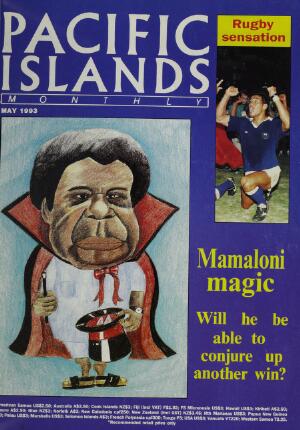
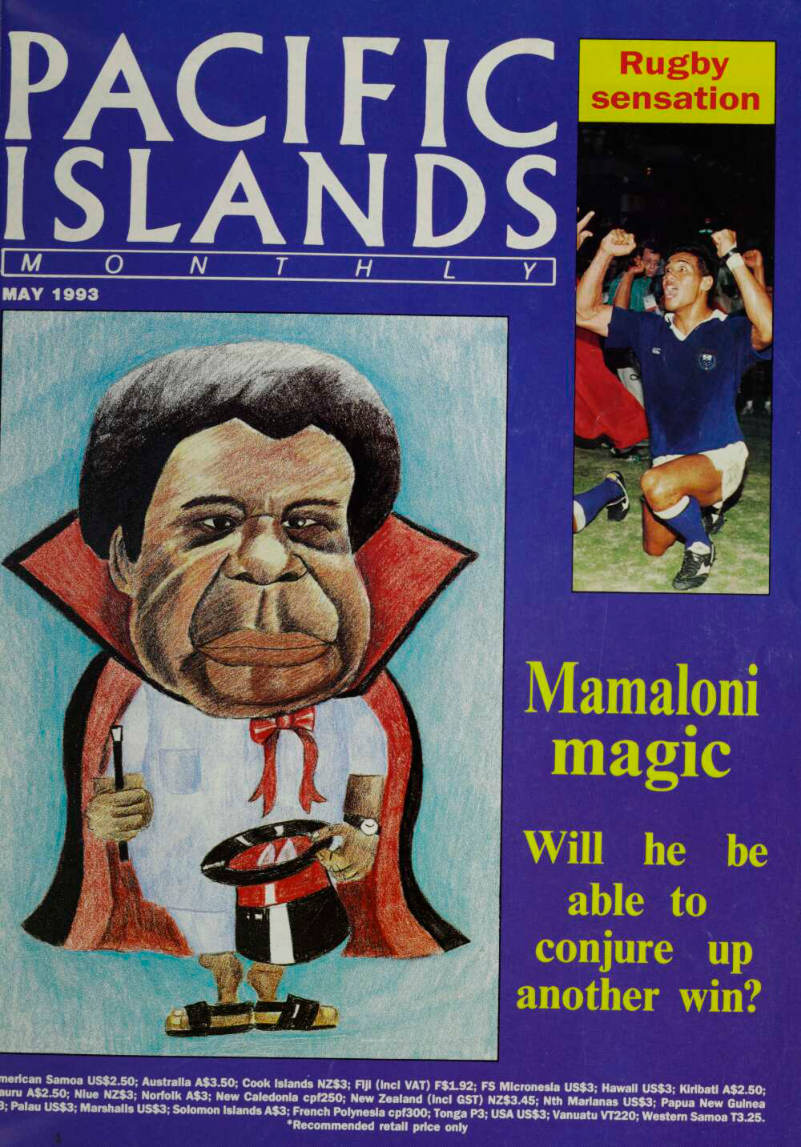
Rugby sensation
Mamaloni
magic
Will he be able to conjure up another win?
£S£ISS?2I r°?l' 8, f ndS S&f* ( i nCl VAT> , Fsl ’ 92i “Ss3; Hawaii US$3; Kiribati A 52.50; t* 3 . ? C f ,ed ® n,a cpf2so; New Zea,and One! GST) NZ53.45; Nth Marianas US$3; Papua New Guinea ’ USs3 ’ Marsha,ls US S 3; Solomon Islands As 3; French Polynesia cpf3oo; Tonga P 3; USA US$3; Vanuatu VT22O; Western Samoa T 3 25 ’"Recommended retail price only
Advertisements & other items, p. 2 (1 item)
Cable & Wireless
Cable and Wireless began keep-
ing people in touch around the
world more than a century ago. Today,
while the technology has changed,
the tradition of service to our customers in the
South Pacific is just the same.
We work in partnership with Governments,
dedicated to meeting the need of communities and businesses to stay in touch. From one island to the next or to the other side of the world, the message is the same: Cable and Wireless is
your South Pacific —u.
connection bringing the
islands together.
CABLE & WIRELESS
Asia Pacific Head Office Cable and Wireless pic Cable and Wireless (Pacific) Limited 22nd Floor Office Tower Convention Plaza 1 Harbour Road Hong Kong Tel: (852) 848 8620 Facsimile; (852) 868 5195 Fiji In association with the Government of Fiji Fiji International Telecommunications Ltd.
PO Box 59 Mercury House 158 Victoria Parade Suva Fiji Tel (679) 312933 Solomon Islands In association with the Government of the Solomon Islands Solomon Telekom Company Limited PO Box 148 Honiara Solomon Islands Tel: (677)21576 Tonga Cable and Wireless pic Private Mail Bag 4 General Post Office Nuku Alofa Tonga South Pacific Tel: (676) 23499 Vanuatu In association with the Government of Vanuatu and' France Cables et Radio Vanuatu International Telecommunications Ltd.
PO. Box 164 Port Vila Vanuatu Tel: (678) 22185
Pacific
Islands
Monthly
Vol 63 No. 5
The News Magazine
May 1993
From The
Editor’S Desk 4
Letters 5
Headlines 6
Fisheries
The tuna dilemma 9
Business
Musical investment by Nauru govern ment 14 Cannery closes 14 More trade expected 15
French Polynesia
Going to the polls 17
Elections
The Solomons call for change 18
Papua New Guinea
A chapter ends for Pangu 22
Religion
Church and politics 24
Federated States Of
Micronesia 26
Education
Fhe education war 33
Focus On Vanuatu
Sports
Sevens sensation
Yachting
Pacific gallivanter
39 Shipping
Shipping schedules 57
52 Columnists
Jemima Garrett 13 Bill McCabe 32 David Barber 35 Alfred Sasako 37
Publisher: Brian O’Flaherty Editor: Mala Jagmohan Senior Writer: Martin Tiffany Correspondents: Christine Hatcher, David North, Ed Rampell, lan Williams, Johnson Honimae, Karen Mangnall, Liz Thompson, Nicholas Rothwell, Pesi Fonua, Wally Hiambohn,Bill Morton.
Columnists: David Barber (Wellington), Futa Helu (Tonga, covering the Pacific Islands), Jemima Garrett (Sydney).
Julian Moti (Pacific Law), Alfred Sasako (The Forum).
Advertising Sales: • Regional Sales (South Pacific); Salendra Narayan, Tel (679) 304111, Fx (679) 303809 • Sydney, Canberra: Bob Hill Media Represen tations, Tel (61-2) 4164245, Fx (61-2) 4165064 • Brisbane: Robert Walker, Media House, Tel (61-7) 3710533, Fx (61-7) 371-8904 • Adelaide: Hastwell Williamsons Representations, Tel (61-8) 799522, Fx (61-8) 799735 • Melbourne: Brown Orr Fletcher Burrows (Aust).
Pty. Ltd. Tel (3) 696 5188 Fx (03) 696 5131. • Auckland: McKay International Media Reps Ltd, Tel (64-9) 4190561, Fx (64-9) 4192243 • Japan: Universal Media Corporation, Tokyo, Tel (3) 6663036, 6663094, Cable: UNIMEDIA Tokyo, Tx 2524665.
Founded 1930 (USPS 952480). A Fiji Times Limited production.
Cover prices are recommended retail only. Regis tered by Australia Post, Publication No. NBP 1210. © Copyright Fiji Times Limited, 177 Victoria Parade, Suva. Fiji. Tel (679) 304111, Fx (679)
303809, Tx Fj2124.
Pacific Islands Monthly is published monthly by The Fiji Times Limited, a division of Nationwide News, 2 Holt Street, Surry Hills, Sydney, NSW 2010.
Send address changes to: • Pacific Islands Monthly, PO Box 1167, Suva, Fiji.
Typeset and printed by The Fiji Times Limited, 177 Victoria Parade, Suva, Fiji.
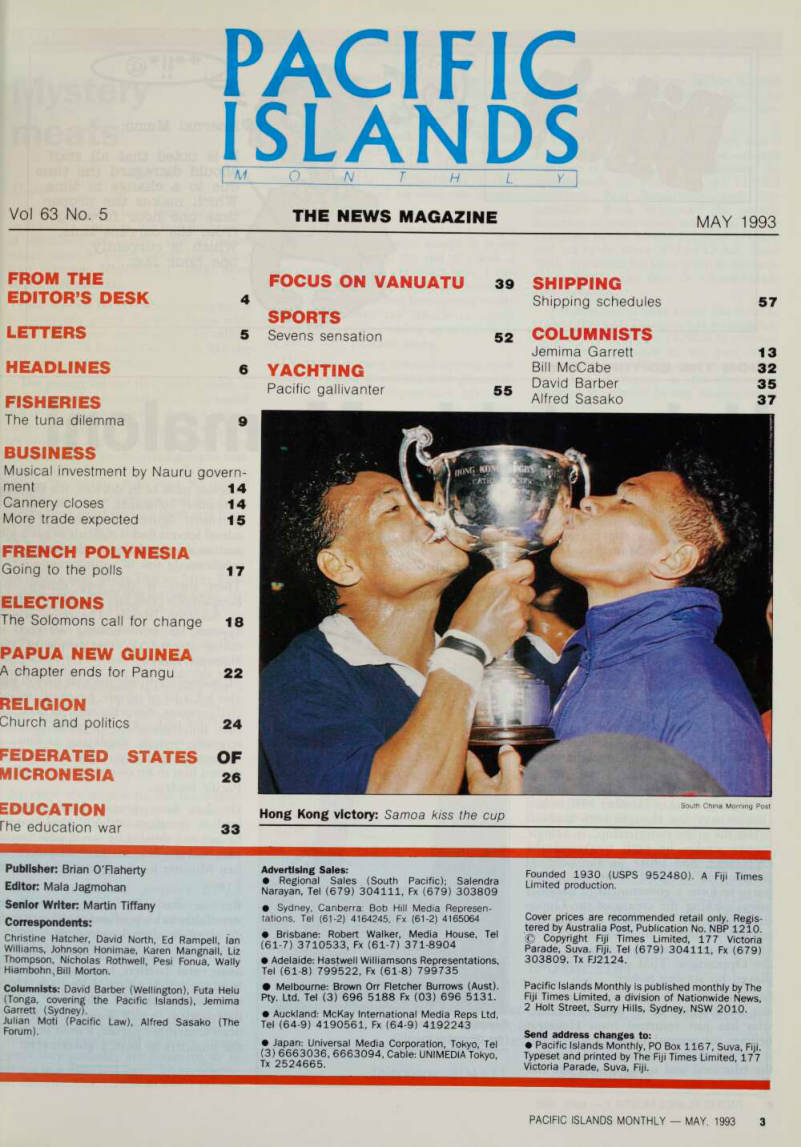
South China Morning Post
Hong Kong victory: Samoa kiss the cup
Unbeatable Mamaloni
From The Editor’S Desk
AS the Solomon Islands gears up for national elections later this month, there appears no strong enough candidate to wrestle the top job away from the incumbent, Solomon Mamaloni. Despite growing disillusionment with the Mamaloni leadership, the opposing forces have yet to put up someone bold enough and shrewd enough to outwit the wily prime minister.
While there are many who espouse the merits of a change in leadership and have the experience and capability, no one appears to have his act quite together to pose any serious threat to Mamaloni. So it appears that after the May 26 elections, Mamaloni could very well return as prime minister albeit with a new band of supporters in parliament.
But then changing his band of men is not something entirely new to him. Remem ber his coup d’etat in October 1990, when (just as everyone thought he was about to lose the prime ministership), in a single master stroke, he both weakened the Opposition and broke up the political parties. He resigned from the ruling party to form a government of national unity, picking the cream of the Oppo sition members which got him the necessary numbers to allow him to hold on to power and at the same time cripple the Opposition. That move amply dis played his staying power.
Now in 1993, he is again being put to the test. PIM senior writer Martin Tiffany, who has just returned from Honiara, believes the general feeling in the capital is one for change. His assessment is that the educated and urban people are not
willing to put up with another Mamaloni term.
Among the issues they cite which have been botched up by Mamaloni are the deteriorating state of the country’s econ omy, the appalling health sector which
has lost most of its doctors, the slipping education standards, the rising unem ployment figures, as more and more school leavers find it difficult to get a job and no attempt being made to work out solutions.
Then there is the long drawn out Bougainville crisis and its spill-over effect on Solomon Islands. The crisis, which appears far from nearing an end, is taking its toll on the people of the Solomon Islands.
Mamaloni’s attitude towards his job has also left a lot of people, especially senior civil servants, disenchanted. He does not take the high office of prime minister seriously enough, displaying at times a callousness which has not exactly en deared him to his own people or to other Pacific leaders.
He has been absent from regional leaders’ meetings without good reason, he has not showed up for appointments with foreign leaders, including Austra lian Minister for Foreign Affairs Gareth Evans.
But he has still managed to hold steadfastly to his post and could very well do so again after the elections.
He has just released a special fund to assist rural dwellers, bringing in support from those living outside Honiara. He is also contesting the elections as an independent which leaves him free to draw from other parties, if need be, to get the numbers to form a government.
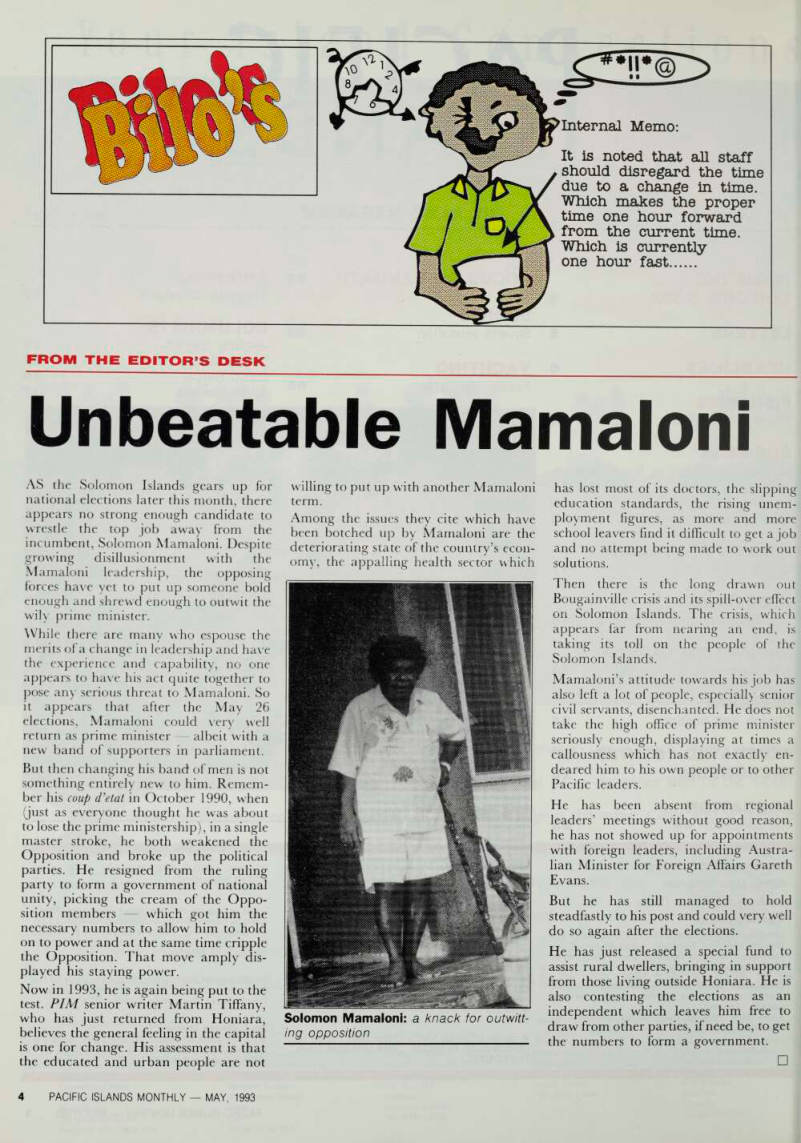
Solomon Mamaloni: a knack for outwitt ing opposition
Mystery
Letteers
meats
Madam, Pacific Islanders have been happy with fresh fish for centuries, but now the benefits of commerce are luring them to tinned meats, some of which would have made your average Neanderthal think twice about vegetarianism.
One familiar contribution to this process is charmingly called ‘Roasted Goose with Bone’. The bone seems to be the selling point here — a bonus of some sort, like the prize in a box of cereal.
The picture on the tin’s label (which is easily worth the thousand words you would find on an American label) shows a slab of rather red flesh. To the untrained eye, it is not obviously a goose, or at least not what I would imagine an uncooked goose to look like, though I have never actually seen one lying in the middle of the road. No sign of the bone in the picture; you will just have to take their word that it’s there and hope for the best.
But with the goose, at least you know what you’re getting at first glance. Some tins simply offer Meat This or Meat That — those blunt labels like corned meat. No genus mentioned, much less species.
If you don’t have your reading glasses for the fine print, you can check the quick clue: the picture of placid animals grazing in the green pastures on the label. In this case, you will see reassuring old friends like a sheep and a cow, (I say old friends, but sheep, especially, are a bit out of place in the tropical Pacific and will continue to be antil they swap some of that ridiculous vool for something lightweight and wrap iround.) So, from the picture on this meat label t seems pretty clear that, for example, here is no yak or rhino meat in the tin, hough who knows what lesser members of he animal kingdom are hiding behind that ow in the scene.
One of the British empire’s lasting ontributions to the Pacific shelves is sheep
ongues. Occasionally the manufacturer
ssures us the tongues have been “peeled”, Dr those of us who like our animals tortured rst.
Now, I am an American and we tend not 3 go for such things. We prefer having only ne tongue in our mouths at a time, and md to spew any loose ones. In America, imagine the cats usually get our tongues, lough they probably are presented to us umans in a disguised form. To accommo ate sensitive American stomachs, I believe
most US companies involved in this sordid meat business put leftover parts into a big bin destined for the Luncheon Meat Department. There the parts are turned into something flat, pink, vague looking and tasting something like a page ripped from a biology textbook. Occasionally there is a round bit disturbingly familiar in the middle of an otherwise anony mous slice.
Now, I have never actually seen a sheep’s tongue, I must confess except in in situ of course, and not at the end of a fork. I don’t really care for articulate food. I can only imagine opening the tin and finding a short stack of baaaa-ing instruments neatly packed. But then my conscience would dread the day of stumbling upon a hillside of mute New Zealand sheep.
Of course, gutting fish and ripping open a pig for a feast have their own pleasures.
But why import such leftovers?
Peter Morrison Tarawa
Republic of Kiribati
Flnks
mandate
Madam, The Bureau Politique of the FLNKS notes that recently a very unfortunate
argument has developed in the English language press in the South Pacific by independence activists living in New Zea land.
The Bureau Politique points out that it is under its authority that the external relations of the FLNKS are organised, the spokespeople for which are the FLNKS president, Paul Neaoutyine, and vice president, Rock Warnytan. In certain countries or conferences, other activists are delegated by the Bureau Politique to speak and act in the name of the FLNKS. Since 1985, this status has been given to Suzanne Ounei-Small who lives in Christchurch, New Zealand.
The Bureau Politique would like to make it clear that Luc Tutugoro has no mandate at all to represent the FLNKS in external affairs, even though in the past some internal responsibilities were entrusted to him. Luc Tutugoro is therefore only speaking for himself in any statements he may make.
Susi Newborn is also a participant in this debate. We scarcely know her and she is not a member of the FLNKS.
The Bureau Politique of the FLNKS therefore reminds its activitists living over seas of their obligation to exercise dis cretion. We would also like to take this opportunity to thank all the people or groups who, in close contact with Suzanne Ounei-Small, have since 1985 given precious moral and material support to the liberation struggle of the Kanak people.
Chanel Kapoen, Sylvain Pabouty, Norbert Caff a,
Victor Tutugoro,
Kanak Socialist National Liberation Front, New Caledonia
Advertisements & other items, p. 5 (1 item)
Pacific Islands Monthly
SUBSCRIPTIONS
American Samoa US$45 Australia A 542.00 Canada US$45 Cook Islands AUSS46 Fiji F 526.40 French Polynesia US$45 Guam US$45 Hawaii US$45 Japan US$45 Kiribati AUSS46 Marshall/Micronesia US$4O Nauru AUSS42 New Caledonia US$32 Payment to Pacific Islands Monthly: New Zealand NZ$55 Niue AUSS46 Norfolk Island AUSS42 Northern Marianas/Palau US$4O Papua New Guinea AUSS4S Solomon Islands AUSS46 Tonga AUSS46 Tuvalu AUSS46 United Kingdom Stg Pound2B US Mainland US$45 Vanuatu AUSS4S Western Samoa WS$6O Elsewhere AUSS63 Subscriptions Dept GPO Box 1167, Suva, Fiji.
Subscriptions rates include the cost of airspeeding to all destinations set out above.
Direct airmail rates on application.
Telephone: 304111 Fax: 303809
shortage
Headlines
Vanuatu
Operation Prema
Relief assistance has been arriving in Vanuatu for people in areas worst hit by Cyclone Prema in late March. The worst hit parts are North Efate and the Shepherds and Epi region in Central Vanuatu.
Australia has donated USS83,000 worth of disaster relief supplies while the British government gave USS40,000 to buy food. British high commisioner in Port Vila, Thomas Duggin has offered more help after details of the damage has been assessed by the Disaster Office.
The United Nations Development Relief Organisation and Disaster Humanitarian Assistance have pledged USS20,000 towards the relief operation code named ‘Operation Prema’.
The Chinese Red Cross Society, through the Chinese Embassy in Port Vila presented a cheque of USS10,000 to the Prime Minister’s office towards the operation.
The Japanese government are providing goods and services totalling USS 132,000. This includes water tanks, water containers, plastic sheets, tents, medical kits and the dispatch of a person to assess damage and assist with relief distribution.
The disaster relief supplies are being distributed to the affected areas by Vanuatu’s patrol boat, RVS Tukoro assisted by a New Zealand air force Andover aircraft.
Cook Islands
Japanese interested in minerals
The Japanese government has expressed interest in developing the deep sea mineral resources of the Cook Islands. The Japanese ambassador to New Zealand, Kateo Iguchi, said once the minerals were brought to the surface, the country could be one of the richest in the South Pacific.
Cook Islands Prime Minister Sir Geoffrey Henry sees the possibility of putting up a joint venture with the Japanese as highly likely. He said other countries had also expressed interest in developing deep sea resources. ***
Vaccine
shortage
A shortage of Hepatitis B vaccine is reported in the Cook Islands. Director of Public Health Roro Daniels says an expected shipment from the non-government New Zealand body, the Hepatitis Foundation, will only be sufficient for treating new-borns. Meanwhile, there are fears dengue fever may have hit Cook Islands again.
Australia
Pacific
minister
Australia has named Gordon Bilney as the Min ister for Pacific Islands Affairs. Bilney will also assume responsibility for
development assistance.
The ministry will be part of the Ministry of Foreign Affairs, headed by Senator Gareth Evans.
Bilney has previously
served as Minister for De fence Science and Person nel. An Australian govern
ment statement said the appointment reflected the importance Australia attached to its relationships with its Pacific island neighbours.
The Forum
Japan rejects Forum request
Japan has rejected a request from the 15-nation South Pacific Forum to fund a South Pacific trade office in Tokyo.
The secretary general of the South Pacific Forum Secretariat, Iremia Tabai, said he would continue to pursue the idea. Tabai said the Forum believed a trade office would increase the Pacific’s links with Japan and promote economic development in the island nations.
Japan is understood to have rejected the proposal on the grounds that it was too expensive.
American Samoa
Tax increase proposed
American Samoa’s governor AP Lutali wants the excise tax on all imports increased from three per cent to five per cent to raise revenue for a new hospital. Governor Lutali proposes that two per cent would go towards construction of a four-storey hospital, two per cent towards general operations and education, and one per cent is to be used to repay the US
Federal Emergency Management Agency.
Bilney: Minister for Pacific Island Affairs
Tonga
Kingdom in mourning
The Kingdom of Tonga was in mourning and there was sombre quietness in the capital Nuku’alofa as Tongans prepared for the burial of Princess Tupaimoheafo on March 19. The princess
died at Auck land Hospital on March 16 after after be ing treated for cancer for sev eral weeks.
Her hus band, Prince
Tui’pelehake,
is the brother
of King
Taufa’ahau Tupou IV, and was
Prime Minister of Tonga for 26 years before resigning because of ill health last year.
The government declared a 10-day mourning period following the burial of the princess. The declaration means no festivities in the kingdom no dances, socials, or sports, no music other than Christian tunes and no guitar playing during kava sessions.
This is the first death in the Tongan royal family since the death of the immensely popular Queen Salote in 1965 when a six-month period of mourning was observed.
Papua New Guinea
Blow to investor confidence
Resource analysts say investor confidence in Papua New Guinea has been dealt a blow by CRA’s withdrawl from the troubled Mount Kare. CRA said it had ended exploration of the hard rock gold deposit, amid problems with landowners and the government.
Stuart Shelley from Melbourne brokerage JB Were and Son >aid the investment community would not want to see too many riore things go wrong in PNG. Shelley warned that one more aegative would be pretty bad and would put people off PNG
lignificantly.
CRA’s departure follows the Porgera goldmine dispute, vhich sliced nearly US$l billion US dollars of PNG-related locks last year.
Rex Adams from Hambros Equities said “anyone who innounced they were putting money into exploration in PNG vould see their share prices drop like a stone”.
Solomon Islands
New goods tax
The Solomon Islands government’s new eight per cent Goods Sales Tax came into effect on April 1, after its implementation was postponed from March 1. The Ministry of Housing and Government Services has registered over 100 wholesalers and manufacturers who will collect the tax. And permanent secretary Mathias Pepena said the GST will be collected by the government from the wholesalers who are expected to pass it on to the retailers who in turn pass it on to the consumers.
The government said the idea behind the GST was to broaden the country’s tax base so that not only those engaged in formal employment carry the tax burden. In return the government has reduced personal income.
Marshall Islands
Symons jailed
Australian Gregory Symons has been sentenced to 90 days in jail in the Marshall Islands in connection with his scheme to sell Marshall Islands citizenship. He has also been ordered to pay back US$l.25 million to six Taiwanese who paid him in expectation of becoming citizens.
Symons pleaded “no contest” to 15 counts of forging official documents as part of an agreement with the Marshall Islands attorney general’s office. The agreement requires him to serve three months in jail and places him on probation for 10 years while he pays off his debts to the Taiwanese. It also involves the Australian government agreeing to give the Marshall Islands the right to extradite Symons if he does not comply with the terms of the agreement.
New Zealand
Abuse program
New Zealand’s social welfare minister Jenny Shipley has agreed to fund a pilot program to fight sexual and physical abuse in the Samoan community in that country.
Members of the community met Shipley at a workshop to discuss sources of funding to prevent abuse. Pacific island affairs minister Don McKinnon also attended. They wanted Shipley’s commitment to programs aimed at raising awareness, stopping violence and preventing child abuse.
Bill Morton Mourners: Women take food to the funeral
Advertisements & other items, p. 8 (1 item)
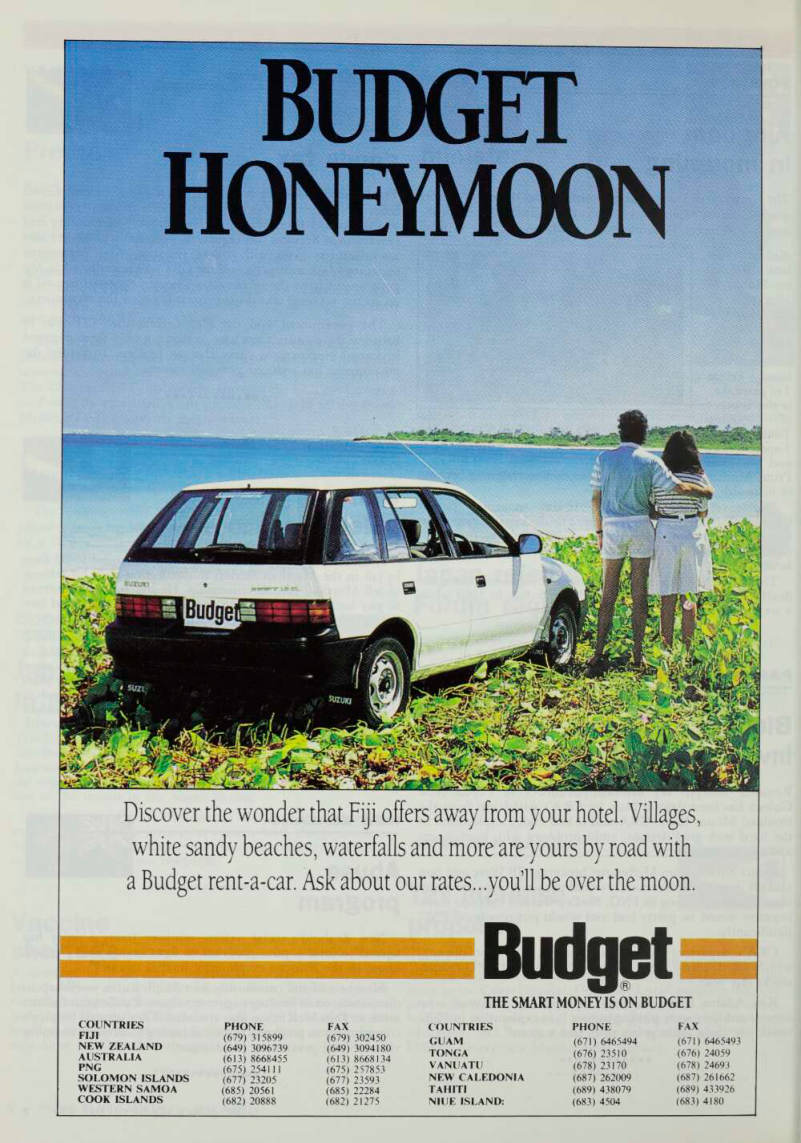
Honeymoon
m m m A B r*
Budge
$ vs« .S* m V> Sfw m fe K : £ 5^ •**
9RSS
- ... .^ m m 3
I9NB
a Discover the wonder that Fiji offers away from your hotel. Villages, white sandy beaches, waterfalls and more are yours by road with a Budget rent-a-car. Ask about our rates...you’ll be over the moon.
Budget
THE SMART MONEY IS ON BUDGET
■I
COUNTRIES
FIJI
NEW ZEALAND
AUSTRALIA
PNG
SOLOMON ISLANDS
WESTERN SAMOA
COOK ISLANDS
PHONE
(679) 315899 (649) 3096739 (613) 8668455 (675) 254111 (677) 23205 (685) 20561 (682) 20888
FAX
(679) 302450 (649) 3094180 (613) 8668134 (675) 257853 (677) 23593 (685) 22284 (682) 21275
COUNTRIES
GUAM
TONGA
VANUATU
NEW CALEDONIA
TAHITI
NIUE ISLAND:
PHONE
(671) 6465494 (676) 23510 (678) 23170 (687) 262009 (689) 438079 (683) 4504
FAX
(671) 6465493 (676) 24059 (678) 24693 (687) 261662 (689) 433926 (683) 4180
The tuna dilemma
Fisheries
The debate continues on what is a fair return from the islands’ only real resource its ocean. Economist Roman
Grynberg reports.
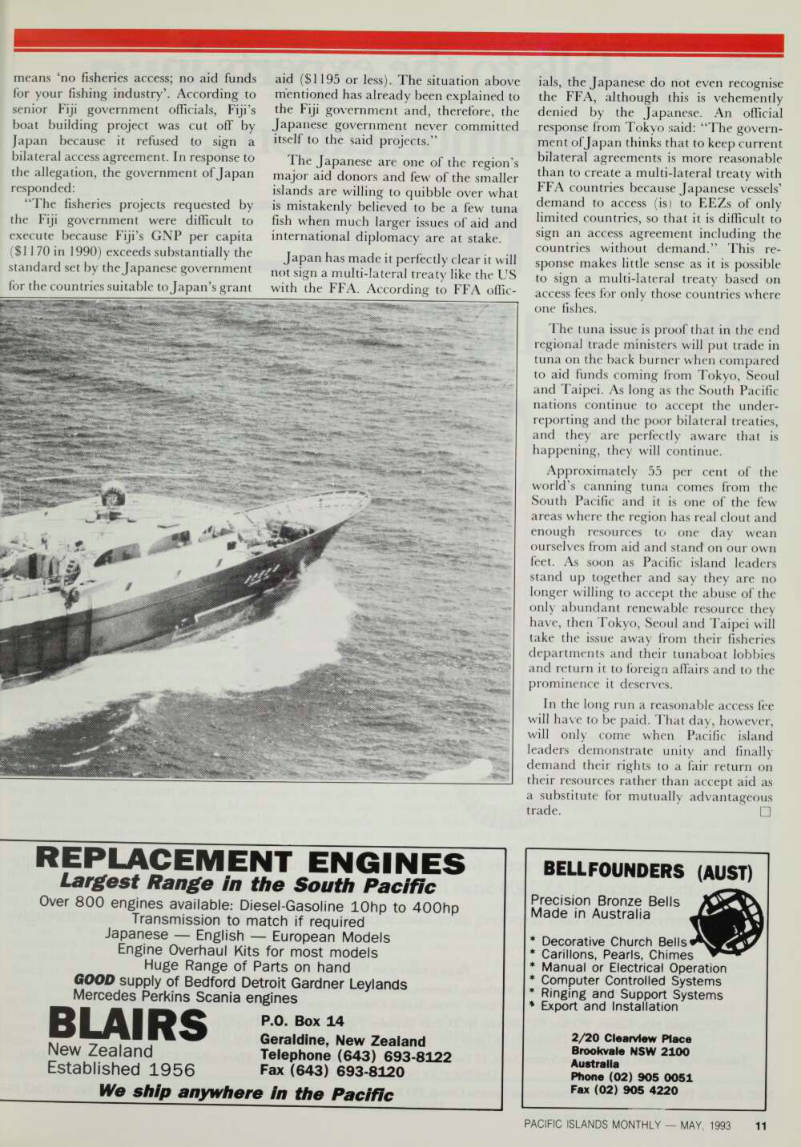
IT is only five years now since the nations of the Forum Fisheries Agency signed their first multi-lateral fisheries access agreement with the United States. That treaty was a land mark and brought to an end virtually a decade of acrimony, vitriol and open confrontation that many feared would push the island states of the South Pacific into what was then the Soviet camp. All this is history now but once again tuna fish diplomacy is ready to become an issue in the region’s affairs. As is fitting the 1990 s actors are different, the conflict is now with the Asian distant water fishing nations (DWFNs, pronounced Dwifins) and relations with the US are back on an even keel.
The new problem with tuna is much like the old one. The Pacific island nations (PIN) have since the United Nations Convention on the Law of the Sea had official international recognition of their 200-mile exclusive economic zone (FEZ). The problem was that the US, under pressure from its tuna boat lobby and Congress, never recognised the right
of nations over highly migratory species
affish in those EEZs. The argument went that because tuna migrates long dis ances, the Pacific island nations had no ■ights over fish that happened to be in heir FEZ.
For very obvious reasons, PIN did not juite see it that way, for while they did lot own the fish, they certainly had clear egal rights to sell rights to catch those ish while they were in their FEZ and ome PIN decided to use the powers they lad under the Law of the Sea Conven ion to seize US tuna vessels that were
[legally fishing. Papua New Guinea
eized the Damca in 1982 and under the nfamous Magnuson Act the US hreatened to impose mandatory sanc ions on PNG in retaliation. This was Dllowed by the Jeanette Diana episode /hen in June 1984 the Solomon Islands eized another US purse seiner fishing legally in its waters. What followed was rude lesson in tuna diplomacy for the ;land nations. Under pressure from the American Tuna Boat Association the US nposed an export embargo on Solomon slands fish products as well as other
etaliatory measures.
It was only when relations between NG and the US began to sour and resident leremia Tabai of Kiribati gned a fisheries access agreement with le Soviets that alarm bells started to )und in Washington. This was soon
followed by an agreement between Vanuatu and the USSR. It became clear in Washington that a change in policy was necessary and after several long years of negotiations the US signed a multi lateral treaty with the 16 members of the Forum Fisheries Agency. This treaty was certainly the Forum’s most successful effort at regional co-operation. The 1987 treaty gave the island nations an agree ment whereby the US paid
were paying PNG in their bilaterial negotiations. In large measure as a result of the USA-FFA treaty, negotiations between Japan and PNG collapsed in January 1987 and Japanese vessels have never returned to PNG waters to fish for tuna.
Following the treaty, relations with the US have improved dramatically. The Soviets left the Pacific soon after the initial agreements expired. Ironically, in
Estimated Catch by Purse Seiners in the South Pacific (metric tonnes, 1991)
Note: These are estimates of purse seiner fleets and do not include catches by Longline and pole and line fleets operating in the South Pacific.
Source: South Pacific Commission.
approximately nine per cent of the value of their catch as access fees to PIN.
Clearly, there was no way in which the American Tuna-Boat Association (ATA) was willing to pay nine per cent of the value of the catch, so in order to solve the problem, the US decided to pay almost 75 per cent from aid money. In effect, the ATA would only pay two per cent. The actual fees paid by the association amounted to US$4 million per annum in the revised 1991 treaty. This amounted to less than two per cent of the value of the catch. The rest, made up of $l4 million per annum, was in the form of grants from the US aid budget.
Under the current treaty arrangement US vessel owners pay only US$5O,OOO per vessel for the first 40 vessels and then after that US$6O,OOO per vessel up to a maximum of 40 vessels. The industry also pays $250,000 per annum into a techni cal assistance fund.
This nine per cent figure was unprece dented over twice what the Japanese
the last month Russian purse seiners have returned to the South Pacific. A Singa porean company has leased 10 Russian purse seiners which are in Honiara and will be fishing in Solomon waters.
Since 1987 PIN have seen the nine per-cent figure as a good but probably unachievable benchmark. With the ex ception of the US no one except Taiwan (which only four FFA members recog nise) has been willing to consider discuss ing a multi-lateral treaty. The reason is simple. For the DWFNs it is better to negotiate with one poor under-developed island country than with all 16 of them.
In 1991 the FFA estimated the DWFNs took over one million tonnes of tuna from the waters of its member states. Of this the US fleet took an estimated 205,000 tonnes and there is little doubt about the accuracy of this figure. The same cannot be said of Korea and Taiwan who massively under-report their catches.
Japan Korea Taiwan Log book entries 94,000 11,000 26,000 SRC estimates 170,000 242,000 176,000
The Japanese have tended to under report relatively little. The table presents what the three countries report on their log books and what the South Pacific Commission (SPC) that they are actually catching. Korea has been told that its purse seiners caught 11,000 tonnes of tuna in the South Pacific in 1991.
According to the Korean authorities concerned, there is no report on the alleged figures. And the figures of 242,000 tonnes is also a groundless
allegation.
“Whenever Korea catches the tuna, it pays proper access fees, so that there is no reason to report the false figures on the amount of fish they can catch.”
IT is noteworthy that while they deny the SPC estimates, they have pro vided no figures to PIM that they considered accurate.
How does SPC make these estimates?
The actual log books are given to the SPC/FFA member countries so they can determine what is declared. The esti mates of what is actually caught in the region comes from what is declared on shipping and transshipment documents in each of the importing countries. It must be added that the discrepancies between the log figures and the transshipment figures are not all fish caught and not paid for in the South Pacific. The fishing vessels do not have to report to the SPC fish caught in international waters or what is called near-international, waters although this situation is changing. Approximately 10 per cent to as much as 30 per cent of the figures above are legitimate under reporting, the rest of the difference is not.
It is felt by the SPC that Japanese records in the area are probably close to accurate as the differences between recorded amounts on log books and actual transshipment data can be ex
plained by their fishing in international
waters. The same cannot be said of the Koreans and the Taiwanese.
One reason why the Americans do not under-report is that their purse seiners are often accompanied by observers from Pacific island countries. These observers check that what is recorded in log books is accurate. The Asian vessels are no where near as well policed.
In order to improve the policing and in part to show just how serious the under-reporting is, the FFA has sought a new high-tech solution to the problem.
The FFA is currently seeking US$5 million funding under the Lome Conven tion for transponders which would beam the position of tuna fishing vessels back to Honiara via satellite.
All foreign vessels fishing in FFA waters would be required to carry transponders. The transponders would also allow the FFA to check log books of fishing vessels any time they like and thus
there would not be the delay in determin ing whether records are accurate. It now often takes up to nine month for FFA and SPC to receive log book records. How ever, high-tech policing will never be a substitute for good laws though there can be no doubt that it will certainly help.
All this does not explain why the Japanese have a relatively good record in terms of accurately reporting catch. In fact Japanese fishermen have a grater incentive to under-report their catch than the Koreans or Taiwanese because Japanese bilateral treaties base access
fees directly on catch while the Taiwan ese and Korean treaties are less directly linked to reported catch. Part of the explanation must surely lie in the fact that the Japanese government takes a much more active role in policing their own fleets than does either Korea or Taiwan which lake a far more relaxed
approach.
This leads to the next question if bilateral treaties are so bad, why are they not abandoned? If this abuse is as systematic as is widely believed then why aren’t the islands screaming to defend their interests? It is here that the world of tuna fishing joins the ugly world of diplomacy and aid. The simple fact is that for some of the smaller Forum countries such as Kiribati the access fee constitutes a large portion of total
government revenue. Moreover, some of the DWFNs have been more than willing to use their aid policy to assure their tuna vessels gain access to the FEZ of the island countries.
Japan, for example, has been very explicit in using its aid policy as a stick rather than as a carrot in the way the US has done. The government ofjapan in an official response to questions raised by PIM denied it linked aid to fisheries agreements, but clearly admitted the state of the country’s fisheries relation ship with Japan would influence the
priority of a project.
“In any region in the world, the government ofjapan has never linked its fisheries aid to the fishing access agree ment. Japan’s fisheries aid is demanded by many developing countries in the world which attach great importance to aquatic products as animal protein sources, and the aid is practised purely in order to contribute to the development of the country’s fishing industry.
“However, as budgetary limitation exists (and) while plenty requests are received, there is a possibility that, in order to decide acceptance or priority of each request, the situation of the fishing relationship between the country and Japan, as well as the feasibility and the effect of the requested project, might be considered.”
Stripped of the diplomatese, this
means ‘no fisheries access; no aid funds for your fishing industry’. According to senior Fiji government officials, Fiji’s boat building project was cut off by Japan because it refused to sign a bilateral access agreement. In response to the allegation, the government ofjapan responded: “The fisheries projects requested by the Fiji government were difficult to execute because Fiji’s GNP per capita ($ll7O in 1990) exceeds substantially the standard set by the Japanese government for the countries suitable to Japan’s grant
aid (SI 195 or less). The situation above mentioned has already been explained to the Fiji government and, therefore, the Japanese government never committed itself to the said projects.”
The Japanese are one of the region's major aid donors and few' of the smaller islands are willing to quibble over what is mistakenly believed to be a few tuna fish when much larger issues of aid and international diplomacy are at stake.
Japan has made it perfectly clear it will not sign a multi-lateral treaty like the US with the FFA. According to FFA offic
ials, the Japanese do not even recognise the FFA, although this is vehemently denied by the Japanese. An official response from Tokyo said: “The govern ment ofjapan thinks that to keep current bilateral agreements is more reasonable than to create a multi-lateral treaty with FFA countries because Japanese vessels’ demand to access (is) to EEZs of only limited countries, so that it is difficult to sign an access agreement including the countries without demand.” This re sponse makes little sense as it is possible to sign a multi-lateral treaty based on access fees for only those countries where one fishes.
The tuna issue is proof that in the end regional trade ministers will put trade in tuna on the back burner when compared to aid funds coming from Tokyo, Seoul and Taipei. As long as the South Pacific nations continue to accept the under reporting and the poor bilateral treaties, and they are perfectly aware that is happening, they will continue.
Approximately 55 per cent of the world’s canning tuna comes from the South Pacific and it is one of the few areas where the region has real clout and enough resources to one day wean ourselves from aid and stand on our own feet. As soon as Pacific island leaders stand up together and say they are no longer willing to accept the abuse of the only abundant renewable resource they have, then Tokyo, Seoul and Taipei will take the issue away from their fisheries departments and their tunaboat lobbies and return it to foreign affairs and to the prominence it deserves.
In the long run a reasonable access fee will have to be paid. That day, however, will only come when Pacific island leaders demonstrate unity and finally demand their rights to a fair return on their resources rather than accept aid as a substitute for mutually advantageous trade. □
Advertisements & other items, pp. 10-12 (2 items)
Fisheries
Blairs
REPLACEMENT engines
Largest Range in the South Pacific Over 800 engines available: Diesel-Gasoline lOhp to 400 hp Transmission to match if required Japanese English European Models Engine Overhaul Kits for most models Huge Range of Parts on hand GOOD supply of Bedford Detroit Gardner Leylands Mercedes Perkins Scania engines P.O. Box 14 Geraldine, New Zealand Telephone (643) 693-8122 Established 1956 Fax (643) 693-8120 We ship anywhere in the Pacific
New Zealand
BELLFOUNDERS (AUST)
Precision Bronze Bells Made in Australia * Decorative Church Bells * Carillons, Pearls, Chimes * Manual or Electrical Operation * Computer Controlled Systems * Ringing and Support Systems * Export and Installation 2/20 Clearvlew Place Brookvale NSW 2100 Australia Phone (02) 905 0051 Fax (02) 905 4220
Talk to the experts in
communication...
PABX and key telephone systems
NEC]
.I IE FIX 2400 j
3.lJlLmLiLaEi^
feUi. Lag.l'jit-'iM
I I I I I I I I* I 1 111 . m ma mm mm ■. ■).) ;W>-t B»R j LNR j CFA.L CFNjCFB [ ACB VCL ; □ □□ S f—i r—i La i i— i \ 4 rm :(~D %l\v NEC can supply all your needs for PABX equipment and key telephone systems. Our range includes the advanced NEAX 2400 Series PABX System and the RANGER Key Telephone System.
NEC provides rapid sales response, after sales support, deliveries and upgrades for clients through-
out the South Pacific region.
Please contact your NEC supplier: Fiji Post Telecommunications Ltd. Marketing Division, PO Box 40, Suva Fiji. Phone: (679) 210 600 Fax: (679) 210 493.
Distributors for Fiji, Vanuatu, Western Samoa, Tonga, Kiribati, Tuvalu, Niue, Wallis & Futuna, New Caledonia.
NEC Papua New Guinea. PO Box 937, Boroko NCD, Port Moresby, Papau New Guinea. Phone: (675) 252 644 Fax: (675) 252 948.
Distributors for Papua New Guinea, Solomon Islands, Micronesia and Nauru.
Telecom New Zealand Ltd Business System Sales, 15 Lady Ruby Drive, East Tamaki, Auckland Phone: (649) 274 3000 Fax: (649) 274 1999.
Distributors for New Zealand and Cook Islands.
NEC Australia Pty. Ltd Business Communications Systems Group, PO Box 1111, Glen Waverley Vic, 3150, Phone: (03) 262 1111 Fax: (03) 262 1333 Distributors for Australia.
Bilney’s point of view
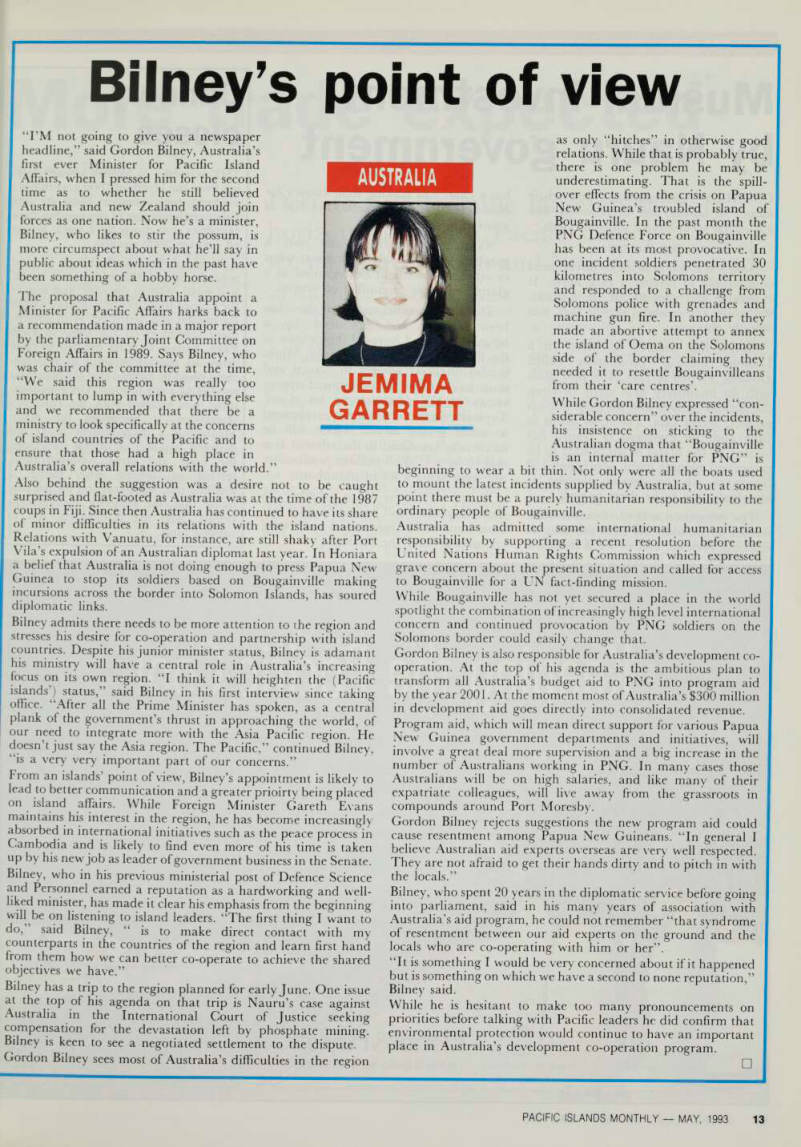
“I’M not going to give you a newspaper headline,” said Gordon Bilney, Australia’s first ever Minister for Pacific Island Affairs, when I pressed him for the second time as to whether he still believed Australia and new Zealand should join forces as one nation. Now he’s a minister, Bilney, who likes to stir the possum, is more circumspect about what he’ll say in public about ideas which in the past have been something of a hobby horse.
The proposal that Australia appoint a Minister for Pacific Affairs harks back to a recommendation made in a major report by the parliamentary Joint Committee on Foreign Affairs in 1989. Says Bilney, who was chair of the committee at the time, “We said this region was really too important to lump in with everything else and we recommended that there be a ministry to look specifically at the concerns of island countries of the Pacific and to ensure that those had a high place in Australia’s overall relations with the world.”
I Also behind the suggestion was a desire not to be caught surprised and flat-footed as Australia was at the time of the 1987 coups in Fiji. Since then Australia has continued to have its share of minor difficulties in its relations with the island nations.
Relations with Vanuatu, for instance, are still shaky after Port Vila’s expulsion of an Australian diplomat last year. In Honiara a belief that Australia is not doing enough to press Papua New Guinea to stop its soldiers based on Bougainville making incursions across the border into Solomon Islands, has soured diplomatic links.
Bilney admits there needs to be more attention to the region and stresses his desire for co-operation and partnership wdth island countries. Despite his junior minister status, Bilney is adamant his ministry will have a central role in Australia’s increasing focus on its own region. “I think it will heighten the (Pacific islands ) status,” said Bilney in his first interview since taking office. After all the Prime Minister has spoken, as a central plank of the government’s thrust in approaching the world, of our need to integrate more with the Asia Pacific region. He doesn t just say the Asia region. The Pacific,” continued Bilney, “is a very very important part of our concerns.”
From an islands’ point of view r , Bilney’s appointment is likely to lead to better communication and a greater prioirty being placed on island affairs. While Foreign Minister Gareth Evans maintains his interest in the region, he has become increasingly absorbed in international initiatives such as the peace process in Cambodia and is likely to find even more of his time is taken up by his new job as leader of government business in the Senate.
Bilney, who in his previous ministerial post of Defence Science and Personnel earned a reputation as a hardworking and well liked minister, has made it clear his emphasis from the beginning will, be on listening to island leaders. “The first thing I want to do, said Bilney, “ is to make direct contact with my counterparts in the countries of the region and learn first hand from them how we can better co-operate to achieve the shared objectives we have,”
Bilney has a trip to the region planned for early June. One issue at the top of his agenda on that trip is Nauru’s case against Australia in the International Court of Justice seeking compensation for the devastation left by phosphate mining.
Bilney is keen to see a negotiated settlement to the dispute.
Gordon Bilney sees most of Australia’s difficulties in the region
as only “hitches” in otherwise good relations. While that is probably true, there is one problem he may be underestimating. That is the spill over effects from the crisis on Papua New Guinea’s troubled island of Bougainville. In the past month the PNG Defence Force on Bougainville has been at its most provocative. In one incident soldiers penetrated 30 kilometres into Solomons territory and responded to a challenge from Solomons police with grenades and machine gun fire. In another they made an abortive attempt to annex the island of Oema on the Solomons side of the border claiming they needed it to resettle Bougainvilleans from their ‘care centres’.
While Gordon Bilney expressed “con siderable concern” over the incidents, his insistence on sticking to the
Australian dogma that “Bougainville
is an internal matter for PNG” is
beginning to wear a bit thin. Not only were all the boats used to mount the latest incidents supplied by Australia, but at some point there must be a purely humanitarian responsibility to the ordinary people of Bougainville.
Australia has admitted some international humanitarian responsibility by supporting a recent resolution before the United Nations Human Rights Commission which expressed grave concern about the present situation and called for access to Bougainville for a UN fact-finding mission.
While Bougainville has not yet secured a place in the world spotlight the combination of increasingly high level international concern and continued provocation by PNG soldiers on the Solomons border could easily change that.
Gordon Bilney is also responsible for Australia’s development co operation. At the top of his agenda is the ambitious plan to transform all Australia’s budget aid to PNG into program aid by the year 2001. At the moment most of Australia’s $3OO million in development aid goes directly into consolidated revenue.
Program aid, which will mean direct support for various Papua New Guinea government departments and initiatives, will involve a great deal more supervision and a big increase in the number of Australians working in PNG. In many cases those Australians will be on high salaries, and like many of their expatriate colleagues, will live away from the grassroots in compounds around Port Moresby.
Gordon Bilney rejects suggestions the new program aid could cause resentment among Papua New Guineans. “In general I believe Australian aid experts overseas are very well respected.
They are not afraid to get their hands dirty and to pitch in with the locals.”
Bilney, who spent 20 years in the diplomatic service before going into parliament, said in his many years of association with Australia’s aid program, he could not remember “that syndrome of resentment between our aid experts on the ground and the locals who are co-operating with him or her”.
“It is something I would be very concerned about if it happened but is something on which we have a second to none reputation,”
Bilney said.
While he is hesitant to make too many pronouncements on priorities before talking with Pacific leaders he did confirm that environmental protection would continue to have an important place in Australia’s development co-operation program.
Australia
Jemima
Garrett
by Nauru government
Business
Musical investment by Nauru government
USUALLY governments put their money in boring, safe investments, like gilt-edged securities or insured bonds.
Not Nauru, not this time.
Nauru has made a major investment comparable to buying a race horse. It expensive and very public. If it works, the world knows about it; if it fails, it is
equally obvious.
Nauru has decided to invest in a London musical production called Leonardo, Portrait of Love. The plot deals with an imaginary love affair between the famous painter and his most famous subject, Mona Lisa. The show opens in June and the President of Nauru has invited all the island heads of state to be present on opening night. More than 150 Nauruans, at considerable expense to somebody, are to be there as well.
The delegation and the heads of state will be in London the next morning to read the reviews, and to see if the show
has a chance of making some money for Nauru, or losing a bundle, the fate of many musicals.
Nauru’s investment is not only a gamble, it also apparently reflects what in other circles might be regarded as a glaring example of conflict of interest.
This is the case because their show has been written and produced by a songwriter from Liverpool (hometown to the Beatles) named Duke Minks. Minks is also financial adviser to Nauru and must have called the investment oppor tunity to the attention of his client.
Typically financial advisers are supposed to avoid giving advice which will be financially beneficial to the adviser. It is said to be a U 532.9 million production, that represents a lot of phosphate.
Nauru will soon learn whether its showbiz gamble will have a happier fate than some of its star-crossed real estate ventures around the Pacific. □
Cannery
closes
THE economy in Samoa, already reel ing from the layoffs of 1000 government workers, took another blow in late February when one of the two big tuna canneries shut down for a week, laying off another 2000 workers.
Some of Samoa Packing’s canned tuna, found in California grocery stores, had small holes in the cans, and tons of the canned product was withdrawn from the market and destroyed. With govern ment inspectors on the scene in Pago Pago, Samoa Packing decided to close down its operations until its manage ment could be assured that the plant was producing a safe product. Once manage ment was satisfied with the cannery’s
operations, it re-opened the plant.
Meanwhile a disagreement broke out between two sets of federal inspectors; the Food and Drug Administration, relying on, among other things, a smelling test, was harder on the packing house than the Fisheries Management people, who use a chemical test of canned tuna. □
Advertisements & other items, p. 14 (1 item)
Keeping the Pacific Cool
V r’’ ■ § f
VTA
f.
Uk \' * W^-4
More trade expected
By Martin Tiffany
Despite Asia looming large on the horizon the South Pacific should see more Australian and New Zealand trade.
SOUTH Pacific countries should experi ence an increase in trade with Austr alia and New Zealand.
Potential Australian exporters to the South Pacific are being encouraged by a recently launched export assistance package. The package ‘Export Start Up’ is the brainchild of Austrade (the Australian government’s Trade Com mission), According to Philip Sibree, Austrade’s Sydney-based executive general man ager Product Development and Market ing and the South Pacific, the scheme is aimed at new South Pacific exporters. He said interested exporters would be given training in Australia on various aspects of exporting from the basics to various peculiarities of Pacific destinations. This will include talks by exporters currently trading with the Pacific. There are also visits planned to Pacific countries. He said on a recent South Pacific marketing
tour 310 companies participated.
Australia’s Trade Commissioner in Fiji, Steve Ryan, returned from one of these South Pacific marketing tours in Australia in March. What they are targetting, he said, are small to medium sized Australian businesses with an annual turnover of less than Asls million under the Export Start Up scheme.
During the campaigning before the ecent Australian elections, the Coalition iccused Paul Keating’s Labour of not mcouraging Pacific trade. Indeed Keat ng has no history of links with the Pacific ind his sights seem firmly set on Asia, iome suggested this would lead to Australian companies missing out on ipportunities in the Pacific.
Sibree and Ryan disagree with this, iibree said while the government does irovide some sort of framework, business vill always make up its own mind where o go. And as Ryan points out the Pacific vill always be important as it gives new xporters the chance to get their feet wet •efore attempting the more difficult xport markets such as Asia and others urther afield.
At present the South Pacific accounts nr about seven per cent of Australia’s xports and there is good growth in *apua New Guinea and New Zealand nd growth overall for the other Pacific ilands. Sibree said the future looks “very □sy” with a number of opportunities resent. He said they were concentrating lot more on New Caledonia and singled
out that country, PNG, New Zealand and Fiji as countries where good opportunities exist.
The growinging importance of Asia for Australia cannot be denied. For example the Republic of Korea represented 0.2 per cent of Australia’s export market at a value of A 59.7 million in 1970-71. In 1990-91 the share was 6.2 per cent and the value A 53238.4 million. In comparison Fiji in 1970-71 had a share of 0.6 valued at A 524.7 million, the share fell to 0.4 per cent in 1990-91 although the value rose to A 5235.3. Similarly PNG's share fell from 3.7 per cent to 1.5 per cent although value rose from A 5163.4 million to A 5775.8 million.
Ty T .
New Zealand s Minister for Trade Negotiations, Philip Burdon, recently led a trade mission to PNG and Fiji to unashamedly promote New Zealand as a competitive supplier to the region .
New Zealand’s South Pacific markets were worth NZS63I million in the year to June 1992. In that year New Zealand exports to the region grew by 18 per cent,
a faster rate of increase than exports to the rest of the world. These exports accounted for 3.67 per cent of total ex P orts making the South Pacific a larger market for New Zealand than some much hl S her P roflle re g lons - The South Pacific is also emerging as a ma J or mark et for manufactured goods.
Thls 18 significant as three quarters of New Zealand’s export receipts (from S oods ) are stlll derived from primary
products.
Burdon wants to show New Zealand exporters the potential of the region is J ust starting to be tapped. He says the PNG economy has been enjoying growth rate s in excess of 10 per cent per annum and says if Australia can achieve exports to PNG in excess of ASI bi ||ion per annum Kiwi exporters should be ab[< T to better their existing 592 million.
Basically what Australia and New Zealand are saying is while Asia is looming larger and larger on the horizon the Pacific the South Pacific in particular will always be a major part of their trade and investment. □
Advertisements & other items, pp. 15-16 (1 item)
right now!
Training for a
career as a pilot?
Then read on,
right now!
A limited number of places are available on Flightline's professional pilot training courses - both aeroplane and helicopter - right now!
SO WHY WAIT?
Flightline is New Zealand's leading pilot training academy, with an enviable reputation for results and unequalled facilities 1 1 Local accommodation. • Comprehensive fixed wing and helicopter pilot training. • A large fleet of modern aircraft.. • Private, and Commercial Licences plus Instructor ratings. • Cost-effective, Multi-engine Instrument Rating using AST-300 simulator and Beechcraft twins. • Internationally recognised ICAO licences. • All ground theory subjects and specialist English language courses in-house. • Fully approved by NZ CAA and NZ Qualifications Authority.
To find out more, simply contact: Flightline Aeronautical College, Customer Services, PO Box 75, Papakura, Auckland, New Zealand Tel:+64-9-298 7142. Fax:+64-9-298 8597.
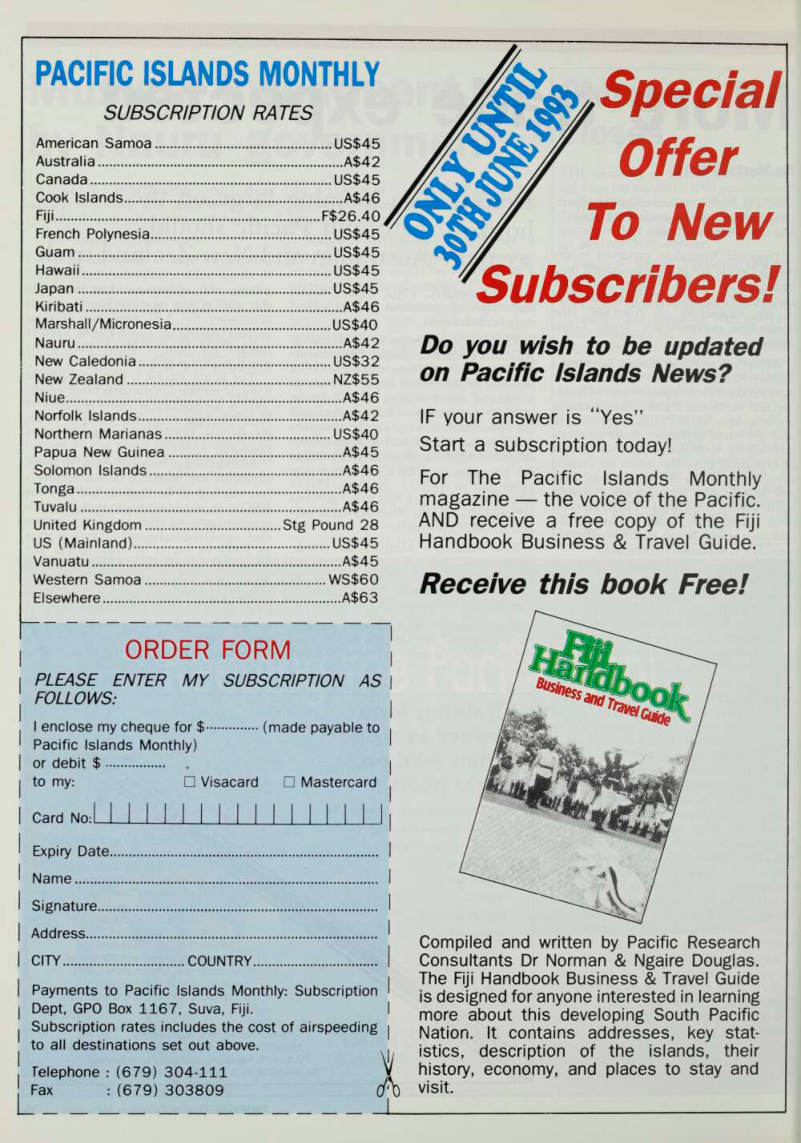
PACIFIC ISLANDS MONTHLY
SUBSCRIPTION RATES
American Samoa US$45 Australia As 42 Canada US$45 Cook Islands As 46 Fiji F 526.40 French Polynesia US$45 Guam US$45 Hawaii US$45 Japan US$45 Kiribati As 46 Marshall/Micronesia US$4O Nauru As 42 New Caledonia US$32 New Zealand NZ$55 Niue As 46 Norfolk Islands As 42 Northern Marianas US$4O Papua New Guinea As4s Solomon Islands As 46 Tonga As 46 Tuvalu As 46 United Kingdom Stg Pound 28 US (Mainland) US$45 Vanuatu As4s Western Samoa WS$6O Elsewhere As 63
ORDER FORM
PLEASE ENTER MY SUBSCRIPTION AS
FOLLOWS:
I enclose my cheque for $ (made payable to Pacific Islands Monthly) or debit $ to my: □ Visacard □ Mastercard & Card Noil I I Expiry Date Name Signature Address
CITY COUNTRY.
Payments to Pacific Islands Monthly: Subscription Dept, GPO Box 1167, Suva, Fiji.
Subscription rates includes the cost of airspeeding to all destinations set out above.
Telephone : (679) 304-111 Fax : (679) 303809
Special
Offer
To New
Subscribers!
Do you wish to be updated
on Pacific Islands News?
IF your answer is “Yes”
Start a subscription today!
For The Pacific Islands Monthly magazine the voice of the Pacific.
AND receive a free copy of the Fiji Handbook Business & Travel Guide.
Receive this book Free!
k S I Compiled and written by Pacific Research Consultants Dr Norman & Ngaire Douglas.
The Fiji Handbook Business & Travel Guide is designed for anyone interested in learning more about this developing South Pacific Nation. It contains addresses, key statistics, description of the islands, their history, economy, and places to stay and visit.
Going to the polls
French Polynesia
By Bengt Danielsson
The March election in French Polynesia proved once more how unfair the colonial rule is for the islanders. It was a sort of “national” election to renew the French parliament, taking place at five year intervals, during which only two of the 577 MPs can be elected by the islanders. Consequently, these two anti colonial and anti-nuclear representatives of the Polynesian people have been unable, during the parliamentary sessions, to enforce the adoption of their requests and to reject any decisions and laws they consider unfavourable.
The only small reform applied this time by the French government con cerned the date of the local election, which in the past always occurred after the elections had been held in France. As the first round of this new election took place on March 13 in French Polynesia, but one week later in France, the first MP elected was local candidate Gaston Flosse, who, is more metropolitan than Polynesian, as he is the son of a French businessman and for 20 years has been the leader of the local section of the French Gaulliste RPR party.
His party boss, Jacques Chirac, who has not accepted President Mitterand’s nuclear moratorium and disarmament program, therefore immediately made a public statement, claiming this election proved the majority of the Polynesians are now pro-French and pro-nuclear.
The truth, however, is that Gaston Flosse obtained only a slight majority of 50 13 per cent of the votes in the small
eastern constituency, comprising the
Marquesas and Tuamotu archipelagoes
and the eastern half of Tahiti, mainly because about half of the voters are expatriate French soldiers, sailors, nu clear technicians, government officials and businessmen.
But an unusually big number of Polynesians also voted for Flosse in the Marquesas and Tuamotu islands, be
cause since being appointed prime min
ister of the local government two years ago, he had often visited these remote islands on government vessels and airplanes and generously offered the nhabitants gifts and advantages. As the ncumbent MP, Emile Vernaudon, did aot have the means to begin his electoral :ampaign in this manner at such an early
date. This is undoubtedly the main reason why he lost his five-year seat in the French parliament.
The total number of votes that Flosse obtained in this constituency on March 13 was nevertheless not more than 15,776, and 15,692 Polynesians voted for the five other candidates, who were all in favour of independence and opposed to the resumption of nuclear testing at Moruroa.
What makes Chirac’s laudatory state ment that this new patriotic MP rep resents the majority of the Polynesian people even more untruthful is that in the other, larger constituency, comprising the western half of Tahiti and the Leeward and Austral islands, less than one fifth of the 41,369 votes were obtained on March 13 by the incumbent MP and former collaborator of Gaston Flosse, Alexandre Leontieff, who ac cepted the colonial system.
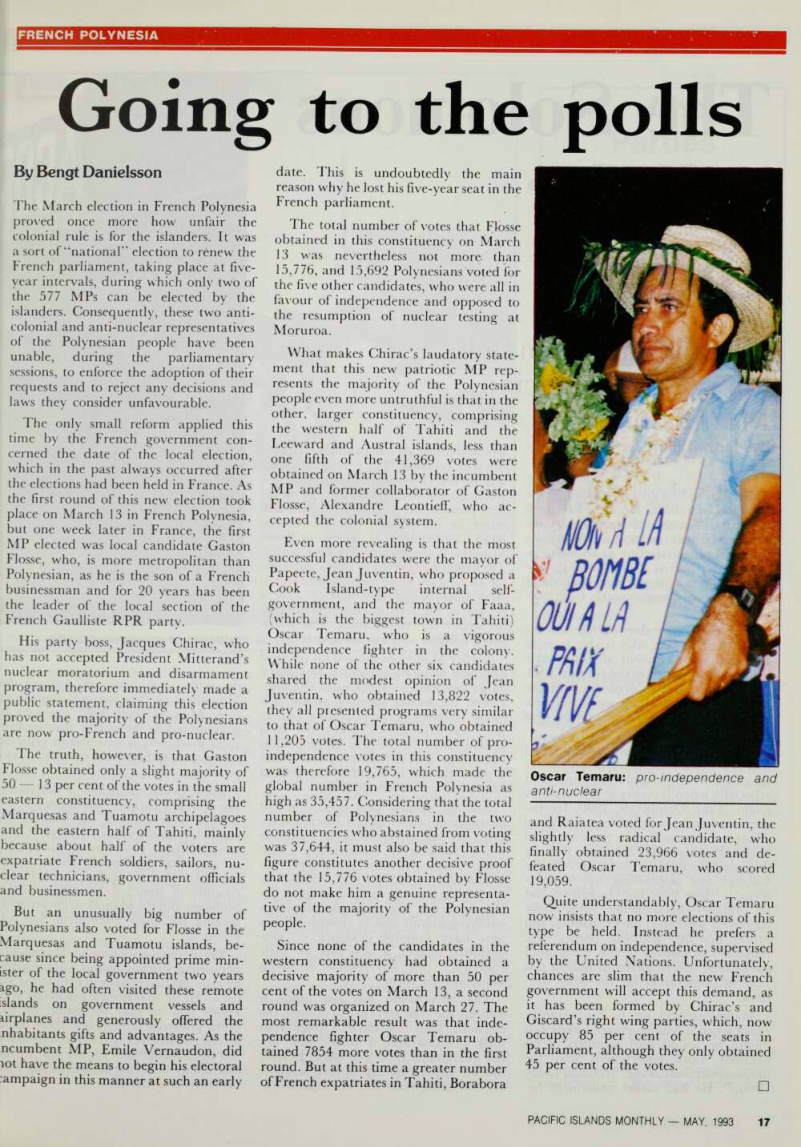
Even more revealing is that the most successful candidates were the mayor of Papeete, Jean Juventin, who proposed a Cook Island-type internal self government, and the mayor of Faaa, (which is the biggest town in Tahiti) Oscar Temaru, who is a vigorous independence fighter in the colony.
While none of the other six candidates hared the modest opinion of Jean Juventin, who obtained 13,822 votes, they all presented programs very similar to that of Oscar Temaru, who obtained 11,205 votes. The total number of pro independence votes in this constituency was therefore 19,765, which made the global number in French Polynesia as high as 35,457. Considering that the total number of Polynesians in the two constituencies who abstained from voting was 37,644, it must also be said that this figure constitutes another decisive proof that the 15,776 votes obtained by Flosse do not make him a genuine representa tive of the majority of the Polynesian
people.
Since none of the candidates in the western constituency had obtained a decisive majority of more than 50 per cent of the votes on March 13, a second round was organized on March 27. The most remarkable result was that inde pendence fighter Oscar Temaru ob tained 7854 more votes than in the first round. But at this time a greater number of French expatriates in Tahiti, Borabora
and Raiatea voted for Jean Juventin, the slightly less radical candidate, who finally obtained 23,966 votes and de feated Oscar Temaru, who scored 19,059.
Quite understandably, Oscar Temaru
now insists that no more elections of this type be held. Instead he prefers a referendum on independence, supervised by the United Nations. Unfortunately, chances are slim that the new French government will accept this demand, as it has been formed by Chirac’s and Giscard’s right wing parties, which, now occupy 85 per cent of the seats in Parliament, although they only obtained 45 per cent of the votes. □
Oscar Temaru: pro-independence and anti-nuclear
change
Elections
The Solomons call for change
But are they a match for master politician, Mamaloni?
By Martin Tiffany
THERE is to be a general election in the Solomon Islands this month. That much is clear. What the outcome is of these elections is not so evident. With the Prime Minister standing as an indepen dent, new parties being formed, the economy in trouble and a general call for
change, many question marks hang over
these islands.
May 26 is the day circled for the elections. The man who is able to form and lead a government after this date will need every trick in the political book to solicit the numbers needed to form the government. Indications are it will be a numbers game once the results are announced.
Prime Minister Solomon Mamaloni had proved time and again he is a master magician when it comes to politics and especially when it comes to the numbers game. Take October 9, 1990, for ex ample, when he resigned from his ruling Alliance Party to form a government of national unity. He achieved this by dropping five ministers in his all-Alliance Cabinet and appointing five replace ments four from the Opposition and an Alliance backbencher. This move effectively weakened the Opposition and broke up the political parties. He remained in control of this unity until parliament was dissolved in March this year in preparation for the May elec tions.
Mamaloni was up to his wizardry again when it was announced early last month he would lead members of his national unity government into the national elections as the “National Unity Group”. He had earlier announced he
would stand as an independent and have ties with no party. The core of his group will be his 15-member cabinet and the seven government backbenchers in the last parliament. Group members will stand as independent candidates but band together with Mamaloni as Prime M inistcr if the group gets into power.
The group is expected to field candidates for ah' 47 seats. (The number of seats has risen from 38 for this election after a review of the constituencies as allowed for under the constitution. The maxi mum number of seats allowed is 50.) Earlier Mamaloni showed his political craftiness when he appointed Rex Horoi as ambassador to the United Nations.
Horoi, the former director of the Sol omon Islands College of Higher Educa tion, was expected to contest the West Makira seat the seat Mamaloni is contesting. It was rumoured Horoi had a good chance of winning. At present Mamaloni stands unopposed.
Another political ploy was the recent distribution of the Special Discretionary Fund by the government to each na tional parliament constituency. This fund was recently increased to SIS 100,000 550,000 of which was released in time for people to enjoy the benefits before the elections. People on out-lying islands and in remote villages now have tangible evidence new outboard motors, a new roof for their church the government is doing something for them.
The government has also made it difficult for civil servants to contest the elections. They now have to resign from their jobs first and, if unsuccessful, are
not guaranteed their jobs back. Despite
this an unprecedented 36 civil servants are contesting seats and are expected to
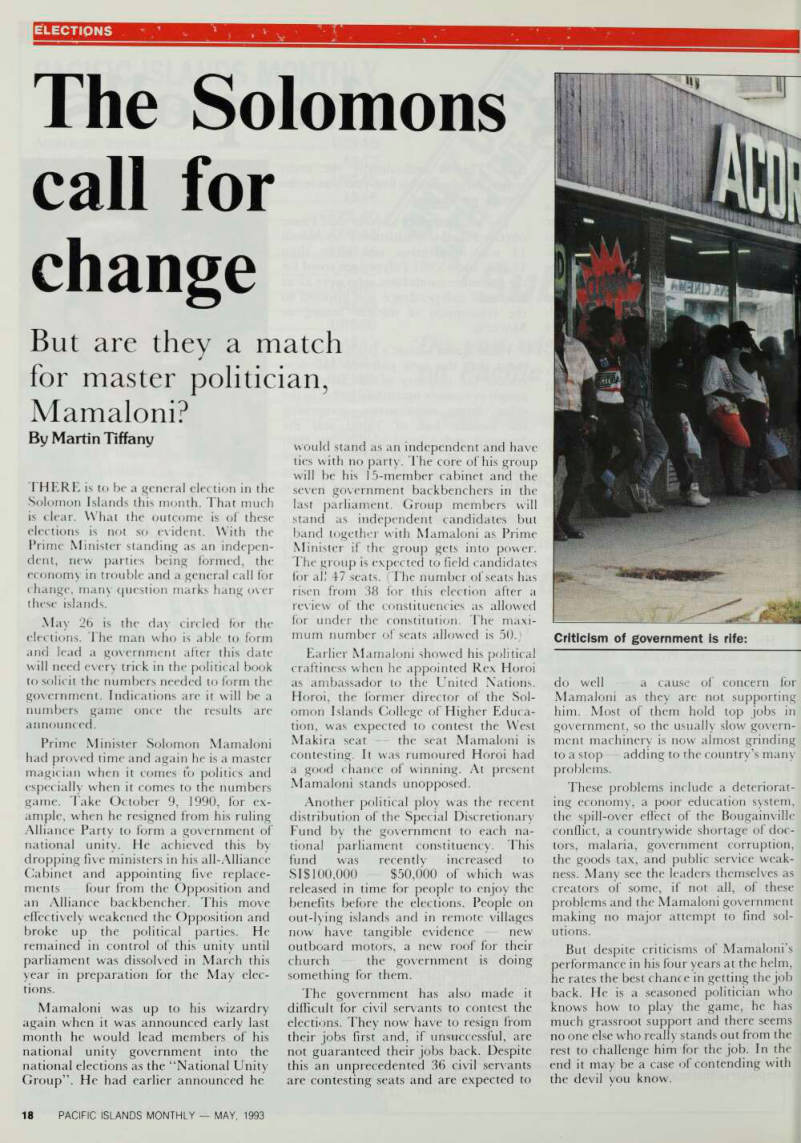
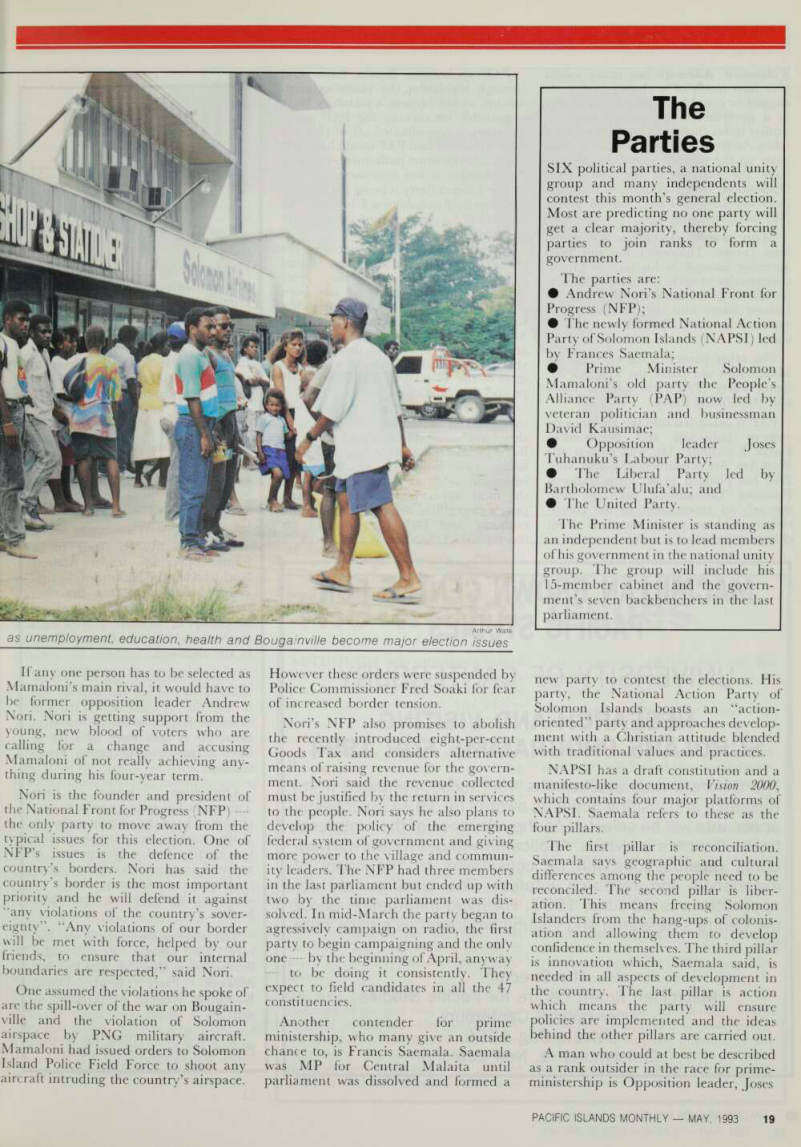
do well a cause of concern for Mamaloni as they are not supporting him. Most of them hold top jobs in government, so the usually slow govern ment machinery is now almost grinding to a stop adding to the country’s many
problems.
These problems include a deteriorat ing economy, a poor education system, the spill-over effect of the Bougainville conflict, a countrywide shortage of doc tors, malaria, government corruption, the goods tax, and public service weak ness. Many see the leaders themselves as creators of some, if not all, of these problems and the Mamaloni government making no major attempt to find sol utions.
But despite criticisms of Mamaloni’s performance in his four years at the helm, he rates the best chance in getting the job back. He is a seasoned politician who knows how to play the game, he has much grassroot support and there seems no one else who really stands out from the rest to challenge him for the job. In the end it may be a case of contending with the devil you know.
Criticism of government Is rife:
If any one person has to be selected as Mamaloni’s main rival, it would have to be former opposition leader Andrew Nori. Nori is getting support from the ,9 i 6 r i >oung, new oo o voters w o are amg or a c ange an accusing Mamalom ol not reallv achieving anyr s y thing during his lour-year term. & 7 Nori is the founder and president of the National Front for Progress (NFP) the only party to move away from the typical issues for this election. One of NFP’s issues is the defence of the country s borders. Nori has said the country s border is the most important priority and he will defend it against “any violations ol the country’s sovereignty’ . “Any violations of our border will be met with force, helped by our friends, to ensure that our internal boundaries are respected,” said Nori.
One assumed the violations he spoke of arc the spill-over of the war on Bougainville and the violation of Solomon airspace by PNG military aircraft.
Mamaloni had issued orders to Solomon Island Police Field Force to shoot any aircraft intruding the country’s airspace.
However these orders were suspended by Police Commissioner Fred Soaki for fear of increased border tension.
Nori’s NFP also promises to abolish
the recently introduced eight-per-cent
Goods Tax and considers alternative means of raising revenue for the govern ment. Nori said the revenue collected must be justified by the return in services to the people. Nori says he also plans to develop the policy of the emerging federal system of government and giving more power to the village and commun ity leaders. The NFP had three members in the last parliament but ended up with two by the time parliament was dis solved. In mid-March the party began to agressively campaign on radio, the first party to begin campaigning and the only one by the beginning of April, anyway to be doing it consistently. They expect to field candidates in all the 47 constituencies.
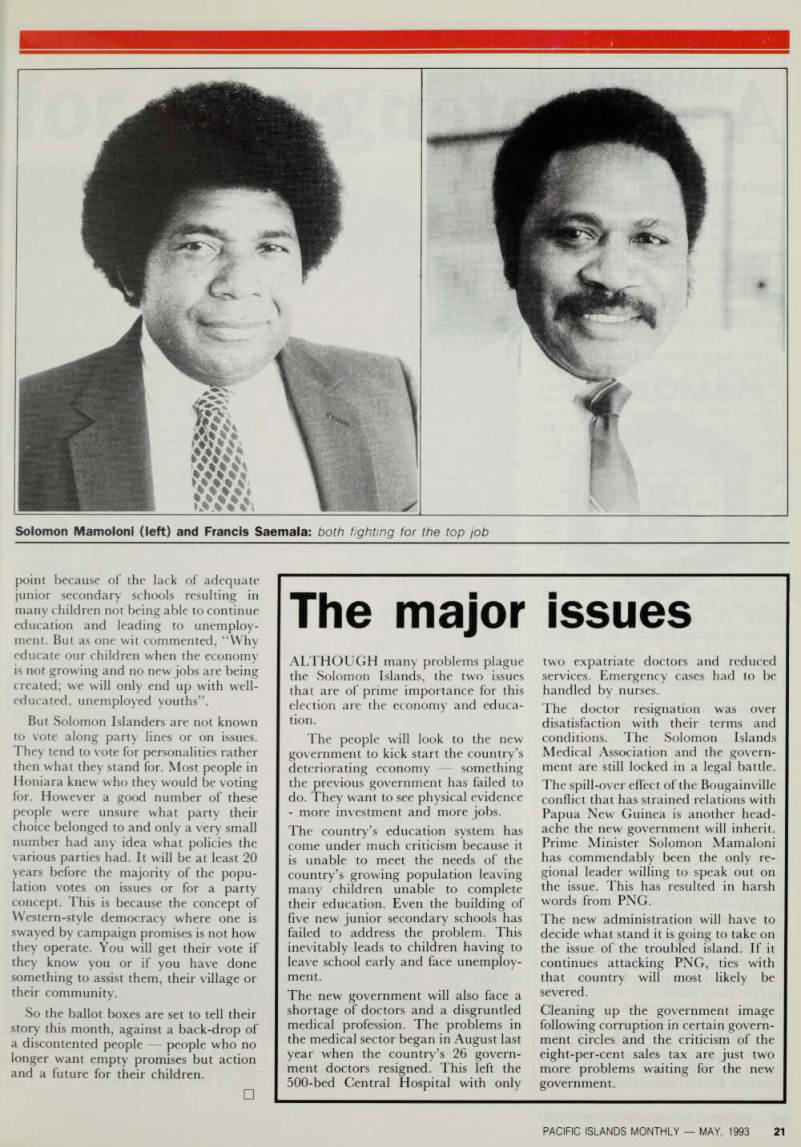
Another contender for prime ministership, who many give an outside chance to, is Francis Saemala. Saemala was MP for Central Malaita until parliament was dissolved and formed a
new party to contest the elections. His party, the National Action Party of Solomon Islands boasts an “action oriented” party and approaches develop ment with a Christian attitude blended with traditional values and practices.
NAPSI has a draft constitution and a manifesto-like document, Vision 2000 , which contains four major platforms of NAPSI. Saemala refers to these as the four pillars.
The first pillar is reconciliation.
Saemala says geographic and cultural differences among the people need to be reconciled. The second pillar is liber ation. This means freeing Solomon Islanders from the hang-ups of colonis ation and allowing them to develop confidence in themselves. The third pillar is innovation which, Saemala said, is needed in all aspects of development in the country. The last pillar is action which means the party will ensure policies are implemented and the ideas behind the other pillars are carried out.
A man who could at best be described as a rank outsider in the race for prime ministership is Opposition leader, Joses
Arthur Wate as unemployment, education, health and Bougamville become major election issues
Tuhanuku. Although not many would give him much of a chance, a few do suggest he could be a compromise choice in a government of national unity similar to his choice as Opposition leader when Andrew Nori stepped down. Nori gave up the position saying he did not have the support of the 16-member Opposition which comprises members from the Labour Party, United Party, NFP and independents.
Many saw his election as a compro mise choice. Tuhanuku has not been agressive enough in his role as Oppo sition leader to make his mark as a likely choice for prime minister. He leads the Labour Party into the election and is expected to win his Rennell and Bellona seat.
The other parties in the elections are Mamaloni’s old party the People’s Al liance Party (PAP), the Liberal Party and the United Party.
PAP is being led into the elections by veteran politician and businessman Davia Kausimae. He will contest the West Are ’Are constituency against Nori.
PAP has pledged to set up a National Planning Commission and to push through an amendment to the consti tution to ban party members from changing parties if it comes to power.
PAP spokesman Brown Sana said
through legislation the planning com
mission would become a statutory body responsible for turning the PAP mani festo into a co-ordinated set of planned activities. Saua said PAP would back two candidates for some parliamentary seat if they thought it was necessary.
The Liberal Party is being led into the elections by Bartholomew Ulufa’alu. His chances of becoming prime minister are
not high.
The sixth and last party contesting the elections is the United Party. Since former Prime Minister Sir Peter Kenilorea left the party it has been without a leader and has been somewhat
unfocused. Party spokesman Augustine
Manakako said his party had been keeping a low profile for the past four years. He said they planned to contest most of the 47 seats and had called for prospective candidates.
All the parties have given some indication of issues they will push for, they have made promises, and set goals.
But if the election is to be won or lost on issues, two issues economy and education stand out from the rest as the most important. There are many
people disgruntled with the deteriorating
economy and lack of plans for its redemption. Education is also a sore
point because of the lack of adequate junior secondary schools resulting in many children not being able to continue education and leading to unemploy ment. But as one wit commented, “Why educate our children when the economy is not growing and no new jobs are being created; we will only end up with well educated, unemployed youths”.
But Solomon Islanders are not known to vote along party lines or on issues.
They tend to vote for personalities rather then what they stand for. Most people in Honiara knew who they would be voting for. However a good number of these people were unsure what party their choice belonged to and only a very small number had any idea what policies the various parties had. It will be at least 20 years before the majority of the popu lation votes on issues or for a party concept. This is because the concept of Western-style democracy where one is swayed by campaign promises is not how they operate. You will get their vote if they know you or if you have done something to assist them, their village or
their community.
So the ballot boxes are set to tell their story this month, against a back-drop of a discontented people people who no longer want empty promises but action and a future for their children.
Solomon Mamoloni (left) and Francis Saemala: both fighting for the top job
Parties
The Parties
SIX political parties, a national unity group and many independents will contest this month’s general election.
Most are predicting no one party will get a clear majority, thereby forcing parties to join ranks to form a government.
The parties are: • Andrew Nori’s National Front for
Progress (NFP);
• The newly formed National Action Party of Solomon Islands (NAPSI) led by Frances Saemala; • Prime Minister Solomon Mamaloni’s old party the People’s Alliance Party (PAP) now led by veteran politician and businessman David Kausimac; • Opposition leader Joses Tuhanuku’s Labour Party; • The Liberal Party led by Bartholomew Ulufa’alu; and • The United Party.
The Prime Minister is standing as an independent but is to lead members of his government in the national unity group. The group will include his 15-member cabinet and the govern ment’s seven backbenchers in the last parliament.
players
The lead players
DESPITE the many problems the Solomon Islands faces and the gov ernment’s inability to solve them, Prime Minister Solomon Mamaloni must be tipped the strongest con tender for the country’s top job after the May 26 elections. He looks set to win his West Makira seat and with his political cunning has the ability to get the numbers to form a government.
He is standing as an independent but has the backing of the recently formed National Unity Group made up of his 15-member cabinet and the government’s seven backbenchers in the last parliament.
His main rival is likely to be former opposition leader Andrew Nori who has the backing of the new young bloods contesting the elec tions. He is being backed as the force for change in the country. Nori leads the National Front for Progress Party in the elections.
Frances Saemala, MP for Central Malaita in the last parliament, has formed the National Action Party of Solomon Islands to contest the elec tions. He is considered by some to have a chance of becoming Prime Minister.
Opposition leader Joses Tuhanuku has been given a remote chance to head the new government.
If the numbers game is played after the election and a government of national unity is formed, some say he could be a compromise choice similar to his choice as Opposition leader.
The other runners in the election race are Liberal Party leader Bartholomew Ulufa’alu and People’s Alliance Party head David Kausimae. Neither are favoured to win.
At the time of writing the United Party had yet to elect a leader.
Advertisements & other items, p. 20 (2 items)
[Elections
Macmillan Brown Centre For
PACIFIC STUDIES
UNIVERSITY OF CANTERBURY
RESEARCH AND VISITING
SCHOLARS PROGRAMME FOR 1994
The Centre invites applications from those interested in its Research and Visiting Scholars awards for 1994. Successful applicants will be selected on the relevance of their interests to the Centre’s activities. Applicants without formal conventional qualifications will be considered on the basis of experience and research interest. The closing date for applications is 30 June, 1993. For more information about the Centre’s Research and Visiting programmes please write to: The Director Macmillan Brown Centre for Pacific Studies University of Canterbury Private Bag 4800 Christchurch 1, New Zealand.
The major issues
ALTHOUGH many problems plague the Solomon Islands, the two issues that are of prime importance for this election are the economy and educa tion.
The people will look to the new government to kick start the country’s deteriorating economy something the previous government has failed to do. They want to see physical evidence - more investment and more jobs.
The country’s education system has come under much criticism because it is unable to meet the needs of the country’s growing population leaving many children unable to complete their education. Even the building of five new junior secondary schools has failed to address the problem. This inevitably leads to children having to leave school early and face unemploy ment.
The new government will also face a shortage of doctors and a disgruntled medical profession. The problems in the medical sector began in August last year when the country’s 26 govern ment doctors resigned. This left the 500-bed Central Hospital with only
two expatriate doctors and reduced services. Emergency cases had to be handled by nurses.
The doctor resignation was over disatisfaction with their terms and conditions. The Solomon Islands Medical Association and the govern ment are still locked in a legal battle.
The spill-over effect of the Bougainville conflict that has strained relations with Papua New Guinea is another head ache the new government will inherit.
Prime Minister Solomon Mamaloni has commendably been the only re gional leader willing to speak out on the issue. This has resulted in harsh words from PNG.
The new administration will have to decide what stand it is going to take on the issue of the troubled island. If it continues attacking PNG, ties with that country will most likely be severed.
Cleaning up the government image following corruption in certain govern ment circles and the criticism of the eight-per-cent sales tax are just two more problems waiting for the new government.
A chapter ends
papua new guinea
By Wally Hiambohn
THE two names sound alike Somare and Sir Maori. In 1975 one became the first prime minister and the other his deputy as they led Papua New' Guinea into independence on September 16.
Since then the names of Sir Michael Somare and Sir Albert Maori Kiki have remained synonymous with PNG poli tics.
They were both co-founders of the “Bully Beef Club” which was the begin ning of the now well established Pangu Pati the party which fought for and achieved PNG’s independence from Aus tralia and has continued to be a major force in the country’s politics for the last 17 years. (Pangu stands for Papua New
Guinea United.)
In March this year, quite by coinci dence, the two men Sir Michael and Sir Maori suddenly ended their long attachment with Pangu Pati. Sir Michael, 57, resigned from the party after 27 years of loyal service, and Sir Maori, 61, passed away at his Port Moresby home. The two incidents took place only days apart March 10 and March 13 respectively ending a chapter in Pangu Pati and PNG history.
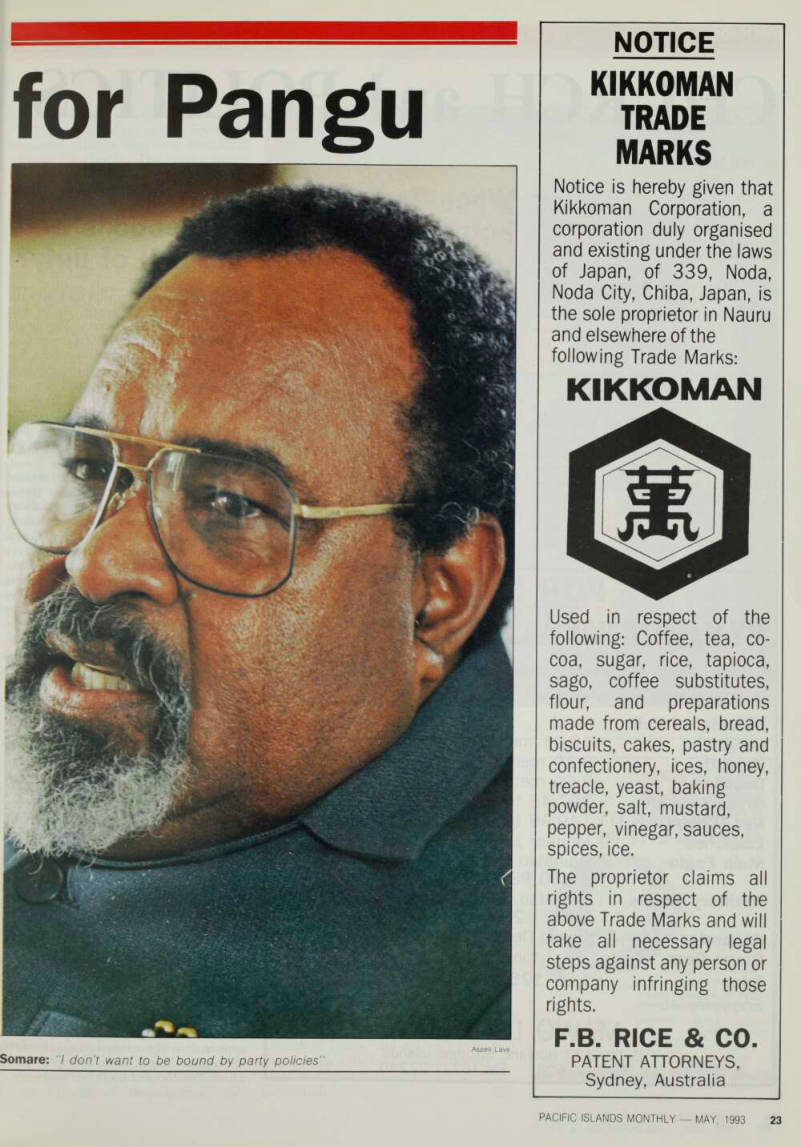
Somare resigned because of his backroom political squabbles which made him a “foreigner” in the party. His departure came as a surprise, or as party members put it, “a shock” to many. After handing over the Opposition and Pangu Pati leadership to Jack Genia as had been planned and agreed upon about eight months ago, he announced his resignation from the party.
The party caucus had never discussed, let alone agreed to Somare leaving the Pangu Pati; it had only agreed to the change in party leadership. Announcing his resignation, he discarded a prepared statement and came up with his own, Michael Thomas Somare, the Chief and Father of the Nation, as he is known, said: “I am leaving Pangu Pati with a heavy heart. Pangu Pati today is not the party that I have known for the last 26 years. Although I would like to remain as an ordinary member of Pangu, I feel that the party has become foreign to me, as illustrated by incidents which have occurred in the last few days. I therefore, with regret, leave the party.”
Jack Genia, then Somare’s successor of only a few hours, said, “We were all surprised by his announcement. Obvi
ously he has his reasons for doing what he did. No one can stand in his way. It was his decision and his alone. However, we in Pangu still consider him to be a part of the party. He w ill continue to be a guiding star to the party, Pangu is united. It is as strong as it ever was.”
Genia, while expressing hope that Somare would return, said there w r as no danger of an exodus from the party, adding he would work on consolidating
his leadership and maintaining Pangu’s
position.
Earlier in parliament Genia had said of Somare: “A great man, the first chief minister, later foundation prime minis ter, the Father of the Nation, regional member of East Sepik and the leader of the largest surviving political party”. He was an “inspiration to PNG politics”.
Government spokesman Roy Yaki said, “It takes a great man to relinquish power voluntarily and no doubt Sir Michael Somare fits into this category.”
The next day Somare’s party unani mously rejected his resignation, but he had already made up his mind. He told Post Courier editor Oseah Philemon he did not want to remain and be bound by party politics but to play a role that was above parochial politics.
“I want to be free so that I can talk to leaders of various parties and offer advice whenever I feel necessary. I don’t want to be bound by party policies on various issues.
“Some people in Pangu say my ideas are out of date and they want me out of the way. I get the feeling that young people don’t want me around, therefore I feel I should isolate myself completely from the party. I don’t want to be seen as overshadowering Jack Genia ... just because I am with Pangu, some people say I am the real power behind the party.
It happened when Rabbie Namaliu was prime minister. Some people said I was running the party and making govern ment decisions.”
He said he now wanted to be left alone to concentrate on looking after his family welfare and that of his electorate, and would retire from politics in 1997.
Whether he will actually retire seems doubtful. He had spoken about retiring before but still remained in politics.
Speculation already abounds that he may join the government ranks and one suggestion has been that he is being considered for the Foreign Affairs port folio. Whatever Somare’s next move, one thing seems quite certain he is no
longer a contender for the country’s top job. ... Sir Albert Maori Kiki close friends said died from a heart attack. He had previously suffered a stroke which had partially paralysed the left side of his body.
He had worked as a medical officer, laboratory technician, welfare officer and patrol officer before becoming involved in politics.
While furthering his education at the Administrative Staff College for a year in 1965, he, with Somare and Sir Joseph Nombri and other students studying political science, formed the Bully Beef Club. This was the group which became the seed bed where the ideas of home rule, self government and independence began to germinate and take root.
In 1967 Sir Maori Kiki together with Sir Joseph Nombri and Sir Cecil Abel drafted a submission calling for immedi ate home rule and presented it to the constitutional committee. In 1972 he was elected to parliament as a member of the third House of Assembly.
He was appointed Minister for Lands and Environment from 1972 to 1974 under self government when Somare was chief minister. He was later appointed Minister for Foreign Affairs and Trade and Defence and then deputy prime minister.
He was awarded the knighthood in 1977 in recognition of his service to politics and the community.
After his defeat in the 1977 elections he left politics and served in several private sector organisations, including Kwila Insurance and Credit Corporation (PNG) Ltd.
In his eulogy, Somare said, “He w'as seen by many Australians as a dangerous man, a disruption to the easy going pace of colonial life. To understand why he stirred so many, you have to understand the nature of those times.
“It is true that independence cost PNG no lives a fact both Papua New Guinea and Australia can be grateful to for it has smoothed our subsequent relations. But it is not true that indepen dence came without a struggle, without suspicion, without harsh words and without the total dedication of men like Sir Albert Maori Kiki.”
Somare recalled that in 1964 at a local officers’ salary tribunal he met this “vicious outspoken unionist”. They teamed up with several others to later put together their thoughts and form PNG’s first political party. □
Somare: “I don't want to be bound by party policies"
Asaeli Lave
Advertisements & other items, p. 23 (1 item)
Marks
NOTICE
KIKKOMAN
TRADE
MARKS
Notice is hereby given that Kikkoman Corporation, a corporation duly organised and existing under the laws of Japan, of 339, Noda, Noda City, Chiba, Japan, is the sole proprietor in Nauru and elsewhere of the following Trade Marks:
KIKKOMAN
Used in respect of the following: Coffee, tea, cocoa, sugar, rice, tapioca, sago, coffee substitutes, flour, and preparations made from cereals, bread, biscuits, cakes, pastry and confectionery, ices, honey, treacle, yeast, baking powder, salt, mustard, pepper, vinegar, sauces, spices, ice.
The proprietor claims all rights in respect of the above Trade Marks and will take all necessary legal steps against any person or company infringing those rights.
F.B. RICE & CO.
PATENT ATTORNEYS,
Sydney, Australia
Church And Politics
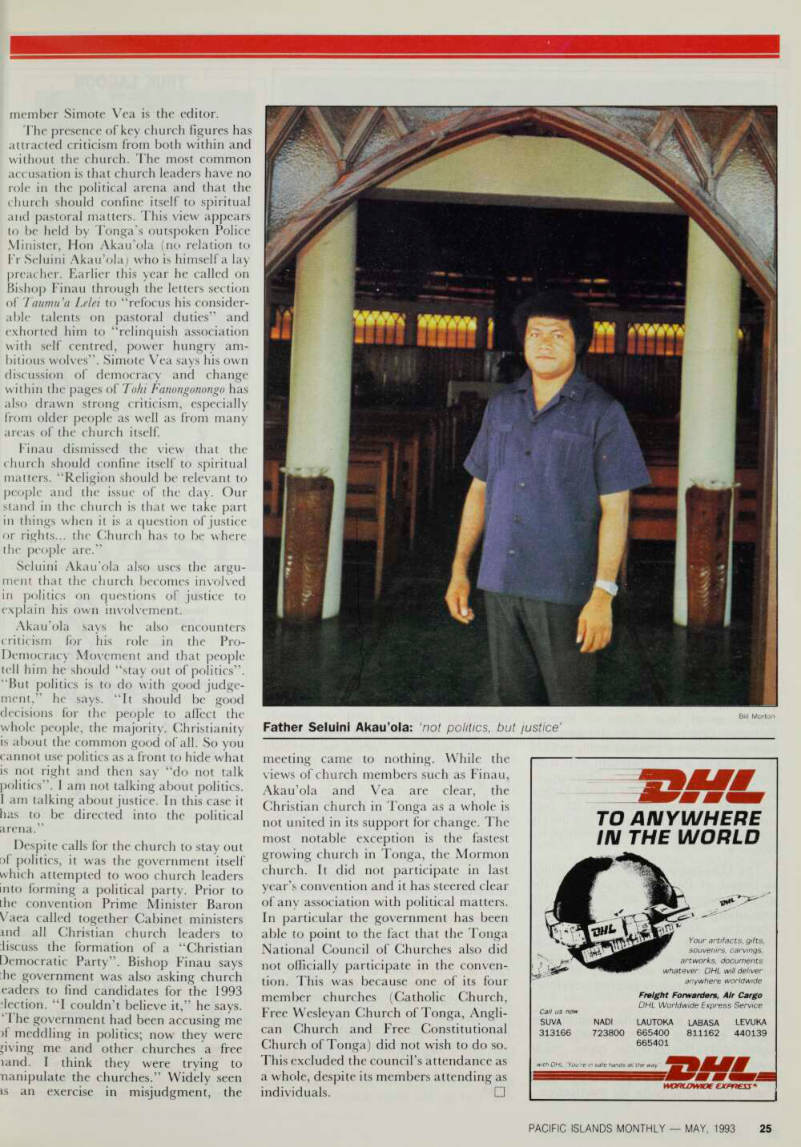
Religion
By Bill Morton
When Tonga’s churches took an active role in the last elections were they going beyond the call of duty?
OVER the last six months two events have occurred in Tonga that will be remembered as shaping its future. In November 1992 the newly-formed Pro- Democracy Movement held its “Conven tion on the Constitution and Democ racy”. The convention embraced the concept of democracy and called for changes to the constitution. In February this year elections were held for the nine
Peoples' Representatives to the
30-member Legislative Assembly. Elec tion results reflected the call for change when six pro-democracy candidates were elected.
Firmly at the front of this call is one of Tonga’s strongest social institutions the Church. Key members of the country’s two biggest churches, the Free Wesleyan Church of Tonga and the Catholic Church have put their voices behind those of the politicians, academics and the people. Their support has added legitimacy to the politicians’ cause and
given them an entry into the hearts and minds of the people. At the same time, it has attracted criticism and accusations that the church should stay out of
policitcs.
One of the clearest signals of the Church’s involvement in political devel opments came with the formation of the Pro-Democracy Movement in August, 1992. Church leaders were chosen for prime positions on its committee. Cath olic priest Father Seluini Akau’ola be came the movement’s chairman. Fr Akau’ola is parish priest of the important Nuku’alofa parish. When he was out of the country early this year it was a member of the Free Wesleyan Church,
Reverend Simote Vea who took over the reigns as acting chairman. As its first
project the Pro-Democracy Movement
staged its November 1992 Convention.
Past and present church members fea tured prominently amongst the speakers.
The convention was opened by the former president of the Free Wesleyan Church of Tonga Rev Amanaki Havea and closed by the head of the Catholic Church in Tonga, Bishop Patelesio Finau.
Bishop Finau says he became involved in the convention in order to let people know where he stands. “I believe the idea behind the convention was a just cause.
It was an effort to better the political structure in Tonga. It dealt with very deep justice issues including the consti
tution needing changes to give people
rights and dignity. I hope what I have done is a lesson to the people. When they see me there they realise ‘this is the church’ because I represent the church.”
Bishop Finau also played a role in the recent elections in his capacity as editor of the widely read Catholic newspaper Taum.ua Lelei. He used his editorial column to make both pre and post election comments. While unable to openly support particular candidates or political camps, his position was clear.
Prior to the election he pointed out that, “We, the people, only choose nine representatives out of 30 members for a certain type of parliament.” He went on to comment, “The majority who are politically powerless in Tonga . . . are asking for a greater participation in the political process in the hope to put an end to the injustices committed against their human dignity and against their com mon possession.” After the election he said, “The election gives a clear message from the majority of the people of Tonga to our King and government,” adding that the result for the main island of Tongatapu was “a resounding vote for
democracy and major changes”.
Discussion of political issues has also appeared in the newspaper of the Free Wesleyan Church Tohi Fanongonongo of which Pro-Democracy Movement
member Simote Vea is the editor.
The presence of key church figures has attracted criticism from both within and without the church. The most common accusation is that church leaders have no role in the political arena and that the church should confine itself to spiritual and pastoral matters. This view appears to be held by Tonga's outspoken Police Minister, Hon Akau’ola (no relation to Fr Seluini Akau’olaj who is himself a lay preacher. Earlier this year he called on Bishop Finau through the letters section of Taumu’a Lelei to “refocus his consider able talents on pastoral duties” and exhorted him to “relinquish association with self centred, power hungry am bitious wolves”. Simote Vea says his own discussion of democracy and change within the pages of Tohi Fanongonongo has also drawn strong criticism, especially from older people as well as from many areas of the church itself.
Finau dismissed the view that the church should confine itself to spiritual matters. “Religion should be relevant to people and the issue of the day. Our stand in the church is that we take part in things when it is a question of justice or rights... the Church has to be where the people arc.”
Seluini Akau’ola also uses the argu ment that the church becomes involved in politics on questions of justice to explain his own involvement.
Akau’ola says he also encounters criticism for his role in the Pro- Democracy Movement and that people tell him he should “stay out of politics”.
“But politics is to do with good judge ment,” he says. “It should be good decisions for the people to affect the whole people, the majority. Christianity is about the common good of all. So you cannot use politics as a front to hide what is not right and then say “do not talk politics”. I am not talking about politics.
I am talking about justice. In this case it has to be directed into the political arena.”
Despite calls for the church to stay out of politics, it was the government itself which attempted to woo church leaders into forming a political party. Prior to the convention Prime Minister Baron Vaea called together Cabinet ministers and all Christian church leaders to discuss the formation of a “Christian Democratic Party”. Bishop Finau says he government was also asking church eaders to find candidates for the 1993 election. “I couldn’t believe it,” he says. 1 The government had been accusing me }f meddling in politics; now they were giving me and other churches a free land. I think they were trying to nanipulate the churches.” Widely seen is an exercise in misjudgment, the
meeting came to nothing. While the views of church members such as Finau, Akau’ola and Vea are clear, the Christian church in Tonga as a whole is not united in its support for change. The most notable exception is the fastest growing church in Tonga, the Mormon church. It did not participate in last year’s convention and it has steered clear of any association with political matters.
In particular the government has been able to point to the fact that the Tonga National Council of Churches also did not officially participate in the conven tion. This was because one of its four member churches (Catholic Church, Free Wesleyan Church of Tonga, Angli can Church and Free Constitutional Church of Tonga) did not wish to do so.
This excluded the council’s attendance as a whole, despite its members attending as individuals. □
Father Seluini Akau’ola: 'not politics, but justice'
Bill Morton
Advertisements & other items, pp. 24-25 (1 item)
Mv Mawoii Honiara Solomon Islands
FOR SALE
Former Japanese fishing vessel now used as cargo ship.
Particulars of the vessel: — Material of Hull Length Breadth Depth Gross Tonnage
Net TONNAGE
Launched Main Engine Auxiliary Engine Generator Cargo Gear Price : Steel : 42.01 metres : 8.10 metres : 3.50 metres : 297.45 tons : 149.98 tons : January 1970 : Daihatsu Diesel KK, BPSHTCH 26DS 1,000 PS x 1 Set : Daihatsu, 6PSHT-18D (270 PS, 900 RPM) x 2 Sets : Sinkoo Denki 225 V x 220 KVA x 2 Set : 1 x 2 ton Derreck : $ US 125,000.00 Enquiries at: —
MAWO LIMITED
P.O. Box 177 Honiara, Solomon Islands Tel (677) 22604 Fax (677) 22240
Call us now
SUVA NADI
313166 723800
TO ANYWHERE
IN THE WORLD
Your artifacts, gifts, souvenirs, carvings, artworks, documents whatever. DHL will deliver anywhere worldwide Freight Forwarders, Air Cargo DHL Worldwide Express Service M ■&H-
LAUTOKA
665400 665401
LABASA LEVUKA
811162 440139 with DHL You're in safe hands all the t wontowxx express*
A new nation
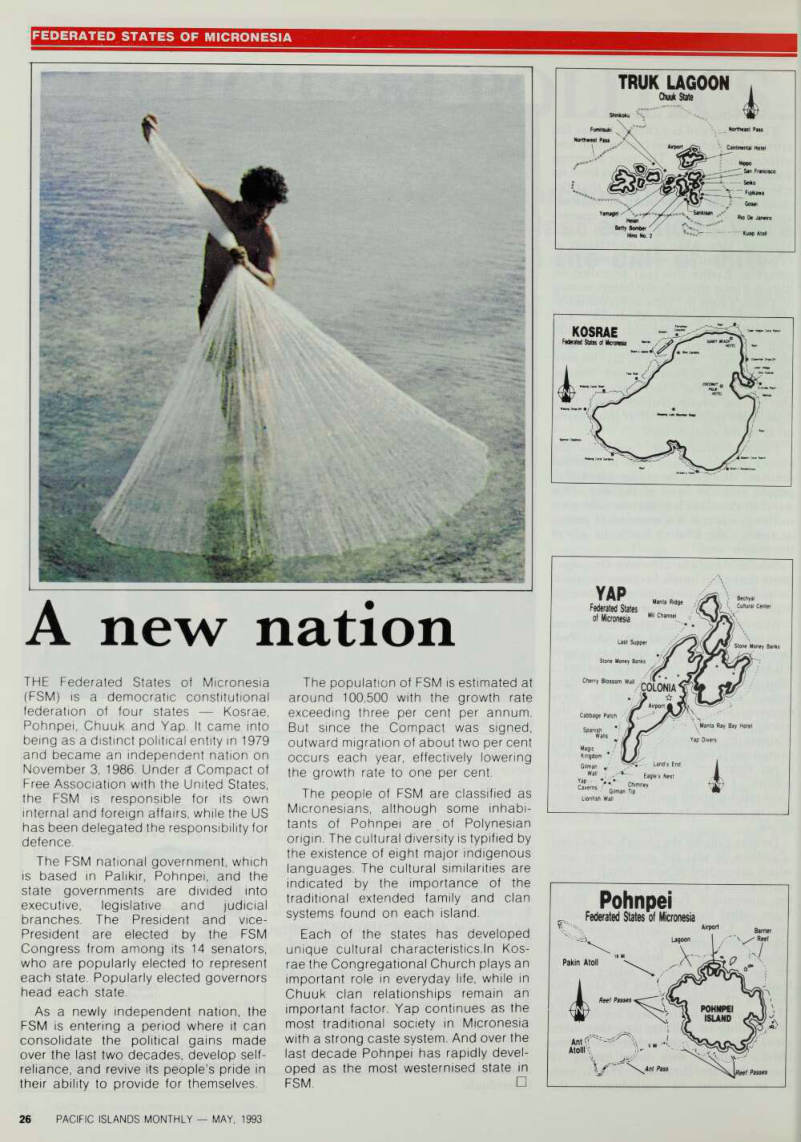
Federated States Of Micronesia
THE Federated States of Micronesia (FSM) is a democratic constitutional federation of four states Kosrae, Pohnpei, Chuuk and Yap. It came into being as a distinct political entity in 1979 and became an independent nation on November 3, 1986. Under a Compact of Free Association with the United States, the FSM is responsible for its own internal and foreign affairs, while the US has been delegated the responsibility for defence.
The FSM national government, which is based in Palikir, Pohnpei, and the state governments are divided into executive, legislative and judicial branches. The President and vice- President are elected by the FSM Congress from among its 14 senators, who are popularly elected to represent each state. Popularly elected governors head each state.
As a newly independent nation, the FSM is entering a period where it can consolidate the political gains made over the last two decades, develop self reliance, and revive its people’s pride in their ability to provide for themselves.
The population of FSM is estimated at around 100,500 with the growth rate exceeding three per cent per annum.
But since the Compact was signed, outward migration of about two per cent occurs each year, effectively lowering the growth rate to one per cent.
The people of FSM are classified as Micronesians, although some inhabi tants of Pohnpei are of Polynesian origin. The cultural diversity is typified by the existence of eight major indigenous languages. The cultural similarities are indicated by the importance of the traditional extended family and clan systems found on each island.
Each of the states has developed unique cultural characteristics.ln Kos rae the Congregational Church plays an important role in everyday life, while in Chuuk clan relationships remain an important factor. Yap continues as the most traditional society in Micronesia with a strong caste system. And over the last decade Pohnpei has rapidly devel oped as the most westernised state in
Fsm. □
Investing in the sea
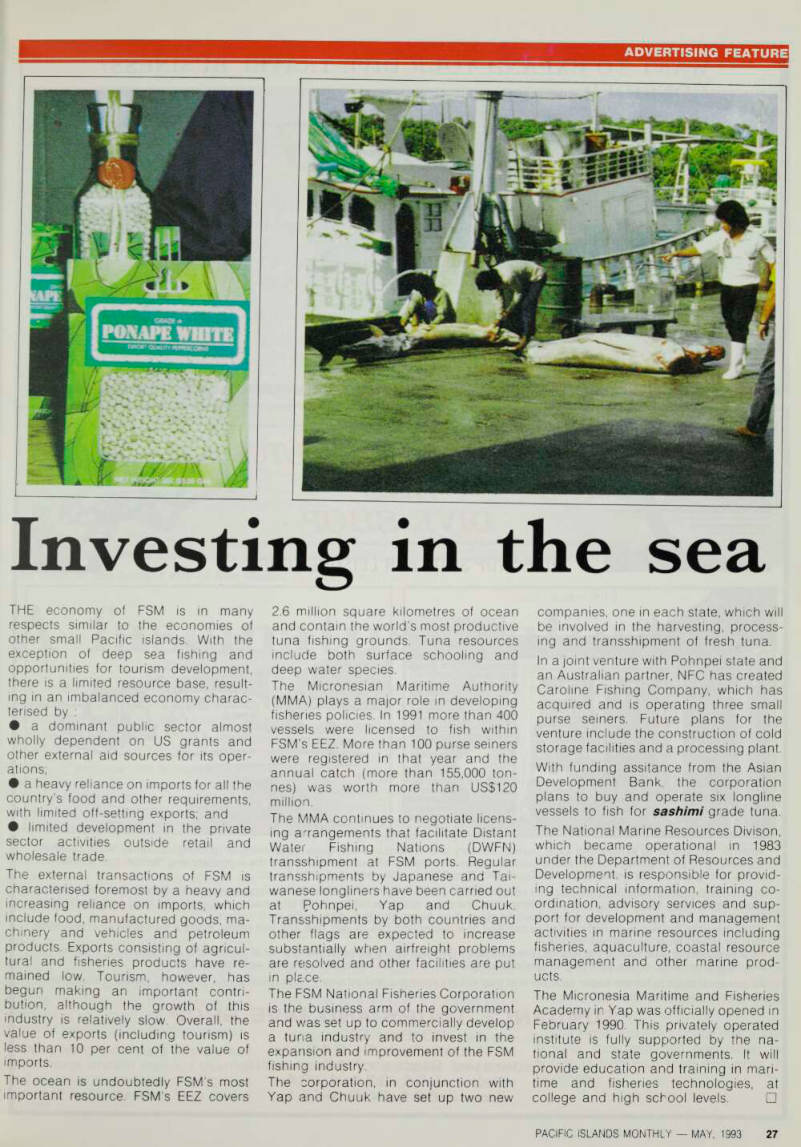
Advertising Feature
TFIE economy of FSM is in many respects similar to the economies of other small Pacific islands. With the exception of deep sea fishing and opportunities for tourism development, there is a limited resource base, result ing in an imbalanced economy charac terised by ; • a dominant public sector almost wholly dependent on US grants and other external aid sources for its oper ations; • a heavy reliance on imports for all the country’s food and other requirements, with limited off-setting exports; and • limited development in the private sector activities outside retail and wholesale trade.
The external transactions of FSM is characterised foremost by a heavy and increasing reliance on imports, which include food, manufactured goods, ma chinery and vehicles and petroleum products. Exports consisting of agricul tural and fisheries products have re mained low. Tourism, however, has begun making an important contri bution, although the growth of this industry is relatively slow. Overall, the value of exports (including tourism) is less than 10 per cent of the value of imports.
The ocean is undoubtedly FSM’s most important resource. FSM’s EEZ covers
2.6 million square kilometres of ocean and contain the world's most productive tuna fishing grounds. Tuna resources include both surface schooling and deep water species.
The Micronesian Maritime Authority (MMA) plays a major role in developing fisheries policies. In 1991 more than 400 vessels were licensed to fish within FSM's FEZ. More than 100 purse seiners were registered in that year and the annual catch (more than 155,000 ton nes) was worth more than US$l2O million.
The MMA continues to negotiate licens ing arrangements that facilitate Distant Water Fishing Nations (DWFN) transshipment at FSM ports. Regular transshipments by Japanese and Tai wanese longliners have been carried out at Pohnpei, Yap and Chuuk.
Transshipments by both countries and other flags are expected to increase substantially when airfreight problems are resolved and other facilities are put in place.
The FSM National Fisheries Corporation is the business arm of the government and was set up to commercially develop a tuna industry and to invest in the expansion and improvement of the FSM fishing industry.
The corporation, in conjunction with Yap and Chuuk have set up two new
companies, one in each state, which will be involved in the harvesting, process ing and transshipment of fresh tuna.
In a joint venture with Pohnpei state and an Australian partner, NFC has created Caroline Fishing Company, which has acquired and is operating three small purse seiners. Future plans for the venture include the construction of cold storage facilities and a processing plant.
With funding assitance from the Asian Development Bank, the corporation plans to buy and operate six longline vessels to fish for sashimi grade tuna.
The National Marine Resources Divison, which became operational in 1983 under the Department of Resources and Development, is responsible for provid ing technical information, training co ordination, advisory services and sup port for development and management activities in marine resources including fisheries, aquaculture, coastal resource management and other marine prod ucts.
The Micronesia Maritime and Fisheries Academy in Yap was officially opened in February 1990. This privately operated institute is fully supported by the na tional and state governments. It will provide education and training in mari time and fisheries technologies, at college and high school levels. □
Advertisements & other items, p. 28 (1 item)
Truk Lagoon
WANT TO EXPAND YOUR DIVE TRAVEL BUSINESS’
CONSIDER ...
THE ULTIMATE WRECK DIVING DESTINATION
Over 40 World War II Wrecks ... All inside a Lagoon We’re looking for a wholesaler or travel agent to represent us on the U.S. mainland. Contact us: Mark Mailo • Sundance Tours & Dive Shop PO Box 85 • Moen, Truk 96942 Ph. 011-(691)330-4234 • Fx. 011-(691)330-4451 10864 W 3
SUNDANCE TOURS
AND
DIVE SHOP
ONE STOP SHOP FOR LEISURE TOURS
SUNDANCE TOURS
s ■ -> m 4m Whether you prefer to explore the local tropical scenery and historical sites, enjoy sunbathing or strolling on sandy white beaches, snorkelling to get a glimpse of the exotic tropical underwater marine life, or better yet, dive the legendary and number one spectacular wreck diving site in the world, Sundance Tours and Dive Shop is your one stop shop for all.
Sundance Tours and Dive Shop (STDS) was established in 1990. It is the only complete tour operator in Truk offering island sightseeing tours, lagoon boat tours, diving and snorkelling tours and other leisure activities. STDS is owned and operated by local people who know their islands and environment and are proud to share their home and their knowledge with visitors.
STDS operates its own dive shop staffed by certified dive guides and has its own dive and tour boats. It has a 24-seater air-conditioned bus for island tours and airport shuttle.
As a memento of your visit to the islands, the Sundance Giftshop offers an assortment of local handicrafts and souvenirs. Whether you are on a short visit, or are planning to spend a longer time, STDS will make sure you are well looked after.
All you need to do is fax them your itinerary and they will organise the rest including hotel reservations, arranging ground transportation and the tours of your choosing.
SUNDANCE TOURS AND DIVE SHOP
PO Box 85 Moen Truk 96942 Federated States of Micronesia Tel: +691 330 4234 Fax: +691 330 4451 120803V1
A fascinating culture
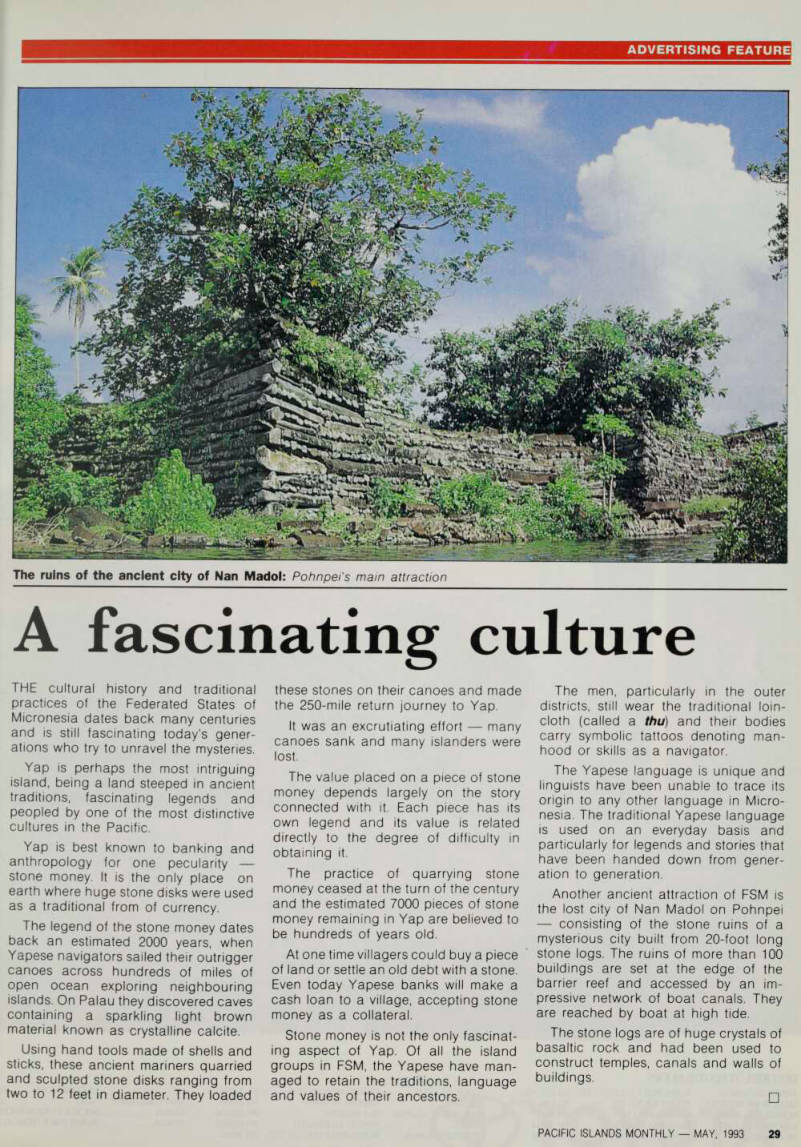
TFIE cultural history and traditional practices of the Federated States of Micronesia dates back many centuries and is still fascinating today’s gener ations who try to unravel the mysteries.
Yap is perhaps the most intriguing island, being a land steeped in ancient traditions, fascinating legends and peopled by one of the most distinctive cultures in the Pacific.
Yap is best known to banking and anthropology for one pecularity stone money. It is the only place on earth where huge stone disks were used as a traditional from of currency.
The legend of the stone money dates back an estimated 2000 years, when Yapese navigators sailed their outrigger canoes across hundreds of miles of open ocean exploring neighbouring islands. On Palau they discovered caves containing a sparkling light brown material known as crystalline calcite.
Using hand tools made of shells and sticks, these ancient mariners quarried and sculpted stone disks ranging from two to 12 feet in diameter. They loaded
these stones on their canoes and made the 250-mile return journey to Yap.
It was an excrutiating effort many canoes sank and many islanders were lost.
The value placed on a piece of stone money depends largely on the story connected with it. Each piece has its own legend and its value is related directly to the degree of difficulty in obtaining it.
The practice of quarrying stone money ceased at the turn of the century and the estimated 7000 pieces of stone money remaining in Yap are believed to be hundreds of years old.
At one time villagers could buy a piece of land or settle an old debt with a stone.
Even today Yapese banks will make a cash loan to a village, accepting stone money as a collateral.
Stone money is not the only fascinat ing aspect of Yap. Of all the island groups in FSM, the Yapese have man aged to retain the traditions, language and values of their ancestors.
The men, particularly in the outer districts, still wear the traditional loin cloth (called a thu) and their bodies carry symbolic tattoos denoting man hood or skills as a navigator.
The Yapese language is unique and linguists have been unable to trace its origin to any other language in Micro nesia. The traditional Yapese language is used on an everyday basis and particularly for legends and stories that have been handed down from gener ation to generation.
Another ancient attraction of FSM is the lost city of Nan Madol on Pohnpei consisting of the stone ruins of a mysterious city built from 20-foot long stone logs. The ruins of more than 100 buildings are set at the edge of the barrier reef and accessed by an im pressive network of boat canals. They are reached by boat at high tide.
The stone logs are of huge crystals of basaltic rock and had been used to construct temples, canals and walls of buildings. □
The ruins of the ancient city of Nan Madol: Pohnpei’s main attraction
Advertisements & other items, pp. 29-31 (2 items)
Advertising Feature
Creating a highly efficient, dynamic-looking car woul
be simple if it weren’t for one complicating detail; tb passengers that must ride in it. Accommodating people comfortably in a pleasant, room interior usually means a certain amount of aerodynamic potential has to be sacrificei
q q mk
Exact features and specifications may vary depending on country of purchase. Please check with your nearest TOYOTA distributor/dealer for details.
DISTRIBUTORS/DEALERS
AMERICAN SAMOA BURNS PHILP (S.S.) CO. LTD. PH 633-4281 jUAM & MICRONESIA... ATKINS KROLL. INC. PH 646-1876/9 NORFOLK ISLANDS BORRY’S PTY LTD. PH 2114
SOLOMON ISLANDS MENDANA MOTORS PH 30314
/ANUATU VANUATU MOTORS PH 22341
COOK ISLANDS PACIFIC MOTORS LTD. PH 20796
KIRIBATI TARAWA MOTORS PH 21090
PAPUA NEW GUINEA ... ELA MOTORS PH 217036
TAHITI NIPPON AUTOMOTO PH 429819
WESTERN SAMOA BURNS PHILP (S.S.) CO. LTD. PH 20800
FIJI ASCO MOTORS
NEW CALEDONIA .. .S.I.A.P.
SAIPAN MICROL CORPORATION
TONGA BURNS PHILP (TONGA) LTI
EIW COROLLA DOES IT
agement, Toyota engineers were able to realize an efficient, wedge-shaped design e at the same time perfecting the alignment between body panels and components, ourse our own innovative style of civilized neering makes sure that none of this comes le expense of the luxurious, leg-stretching interior. Because we realize that even a 0.33 s useless if no one wants to drive the car. >6 >2 911
TOYOTA
Widening our horizons
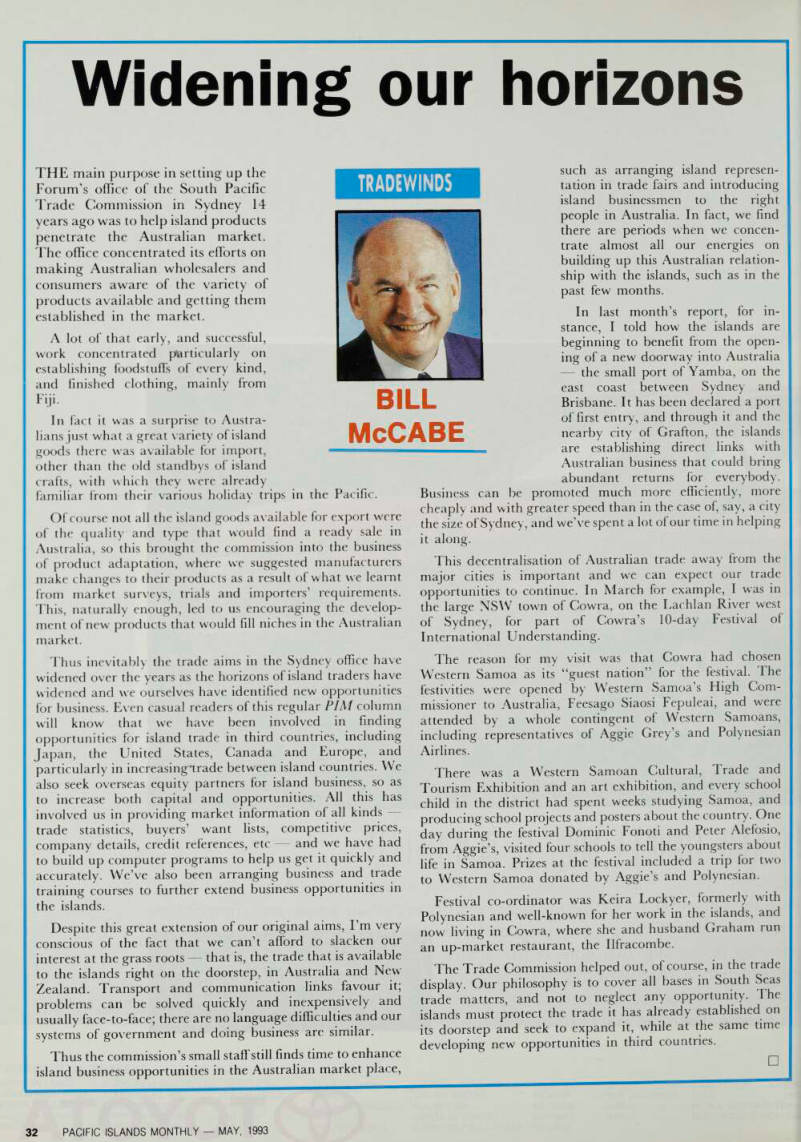
THE main purpose in setting up the Forum’s office of the South Pacific Trade Commission in Sydney 14 years ago was to help island products penetrate the Australian market.
The office concentrated its efforts on making Australian wholesalers and consumers aware of the variety of products available and getting them established in the market.
A lot of that early, and successful, work concentrated particularly on establishing foodstuffs of every kind, and finished clothing, mainly from Fiji.
In fact it was a surprise to Austra lians just what a great variety of island goods there was available for import, other than the old standbys of island crafts, with which they were already
familiar from their various holiday trips in the Pacific.
Of course not all the island goods available for export were of the quality and type that would find a ready sale in Australia, so this brought the commission into the business of product adaptation, where we suggested manufacturers make changes to their products as a result of what we learnt from market surveys, trials and importers’ requirements.
This, naturally enough, led to us encouraging the develop ment of new products that would fill niches in the Australian market.
Thus inevitably the trade aims in the Sydney office have widened over the years as the horizons of island traders have widened and we ourselves have identified new opportunities for business. Even casual readers of this regular PIAI column will know that we have been involved in finding opportunities for island trade in third countries, including Japan, the United States, Canada and Europe, and particularly in increasingnrade between island countries. We also seek overseas equity partners for island business, so as to increase both capital and opportunities. All this has involved us in providing market information of all kinds trade statistics, buyers’ want lists, competitive prices, company details, credit references, etc and we have had to build up computer programs to help us get it quickly and accurately. We’ve also been arranging business and trade training courses to further extend business opportunities in the islands.
Despite this great extension of our original aims, I’m very conscious of the fact that we can’t afford to slacken our interest at the grass roots that is, the trade that is available to the islands right on the doorstep, in Australia and New Zealand. Transport and communication links favour it; problems can be solved quickly and inexpensively and usually face-to-face; there are no language difficulties and our systems of government and doing business arc similar.
Thus the commission’s small staff still finds time to enhance island business opportunities in the Australian market place,
such as arranging island represen tation in trade fairs and introducing island businessmen to the right people in Australia. In fact, we find there are periods when we concen trate almost all our energies on building up this Australian relation ship with the islands, such as in the past few months.
In last month’s report, for in stance, I told how the islands are beginning to benefit from the open ing of a new doorway into Australia the small port of Yamba, on the east coast between Sydney and Brisbane. It has been declared a port of first entry', and through it and the nearby city of Grafton, the islands are establishing direct links with Australian business that could bring abundant returns for everybody.
Business can be promoted much more efficiently, more cheaply and with greater speed than in the case of, say, a city the size of Sydney, and we’ve spent a lot of our time in helping it along.
This decentralisation of Australian trade away from the major cities is important and we can expect our trade opportunities to continue. In March for example, I was in the large NSW town of Cowra, on the Lachlan River west of Sydney, for part of Cowra’s 10-day Festival of International Understanding.
The reason for my visit was that Cowra had chosen Western Samoa as its “guest nation” for the festival. The festivities were opened by Western Samoa’s High Com missioner to Australia, Feesago Siaosi Fepuleai, and were attended by a whole contingent of Western Samoans, including representatives of Aggie Grey’s and Polynesian Airlines.
There was a Western Samoan Cultural, Trade and Tourism Exhibition and an art exhibition, and every school child in the district had spent weeks studying Samoa, and producing school projects and posters about the country. One day during the festival Dominic Fonoti and Peter Alefosio, from Aggie’s, visited four schools to tell the youngsters about life in Samoa. Prizes at the festival included a trip for two to Western Samoa donated by Aggie’s and Polynesian.
Festival co-ordinator was Keira Lockyer, formerly with Polynesian and well-known for her work in the islands, and now living in Cowra, where she and husband Graham run an up-market restaurant, the Ilfracombe.
The Trade Commission helped out, of course, in the trade display. Our philosophy is to cover all bases in South Seas trade matters, and not to neglect any opportunity. The islands must protect the trade it has already established on its doorstep and seek to expand it, while at the same time developing new opportunities in third countries.
Tradewinds
Bill
Mccabe
The Education War
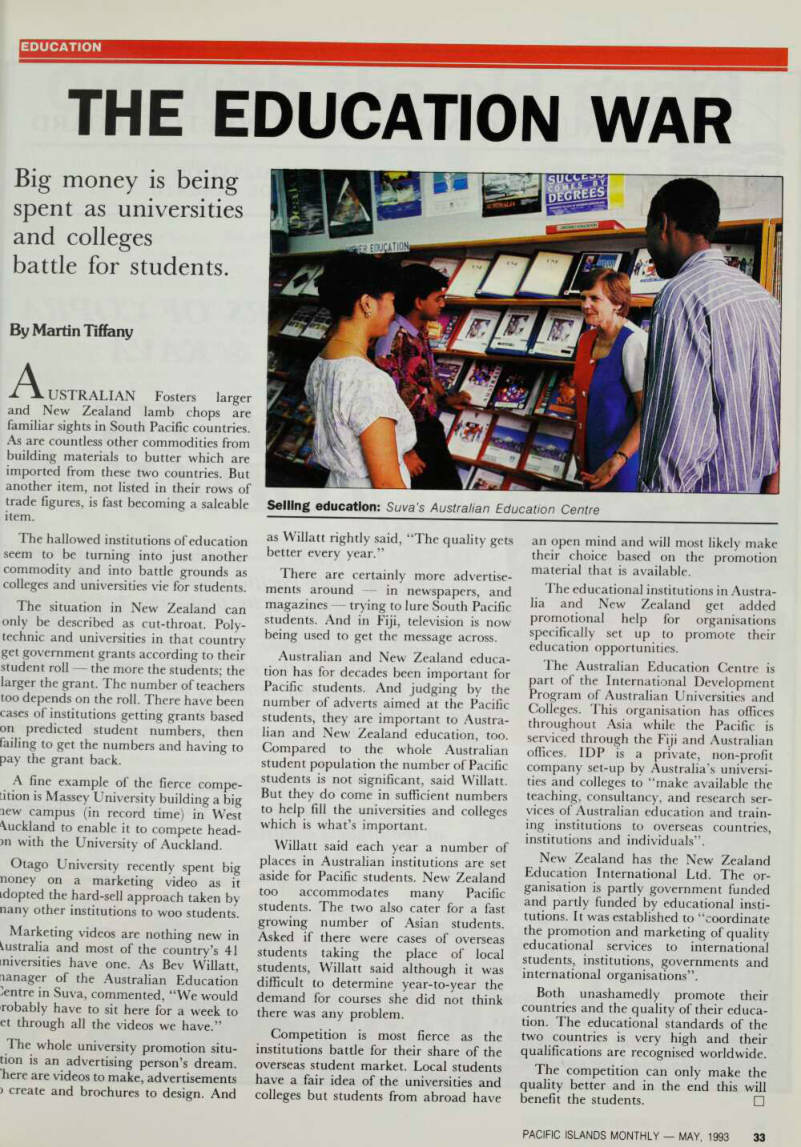
Education
Big money is being spent as universities and colleges battle for students.
By Martin Tiffany
A AUSTRALIAN Fosters larger and New Zealand lamb chops are familiar sights in South Pacific countries.
As are countless other commodities from building materials to butter which are imported from these two countries. But another item, not listed in their rows of trade figures, is fast becoming a saleable item.
The hallowed institutions of education seem to be turning into just another commodity and into battle grounds as colleges and universities vie for students.
The situation in New Zealand can only be described as cut-throat. Poly technic and universities in that country get government grants according to their student roll the more the students; the larger the grant. The number of teachers too depends on the roll. There have been cases of institutions getting grants based on predicted student numbers, then failing to get the numbers and having to pay the grant back.
A fine example of the fierce compe tition is Massey University building a big lew campus (in record time) in West ~nd to enable it to compete head )n with the University of Auckland.
Otago University recently spent big noney on a marketing video as it idopted the hard-sell approach taken by nany other institutions to woo students.
Marketing videos are nothing new in Australia and most of the country’s 41 iniversities have one. As Bev Willatt, lanager of the Australian Education Centre in Suva, commented, “We would robably have to sit here for a week to et through all the videos we have.”
The whole university promotion situ tion is an advertising person’s dream, here are videos to make, advertisements ) create and brochures to design. And
as Willatt rightly said, “The quality gets better every year.”
There are certainly more advertise ments around in newspapers, and magazines trying to lure South Pacific students. And in Fiji, television is now being used to get the message across.
Australian and New Zealand educa tion has for decades been important for Pacific students. And judging by the number of adverts aimed at the Pacific students, they are important to Austra lian and New Zealand education, too.
Compared to the whole Australian student population the number of Pacific students is not significant, said Willatt.
But they do come in sufficient numbers to help fill the universities and colleges which is what’s important.
Willatt said each year a number of places in Australian institutions are set aside for Pacific students. New Zealand too accommodates many Pacific students. The two also cater for a fast growing number of Asian students.
Asked if there were cases of overseas students taking the place of local students, Willatt said although it was difficult to determine year-to-year the demand for courses she did not think there was any problem.
Competition is most fierce as the institutions battle for their share of the overseas student market. Local students have a fair idea of the universities and colleges but students from abroad have
an open mind and will most likely make their choice based on the promotion material that is available.
The educational institutions in Austra lia and New Zealand get added promotional help for organisations specifically set up to promote their education opportunities.
The Australian Education Centre is part of the International Development Program of Australian Universities and Colleges. This organisation has offices throughout Asia while the Pacific is serviced through the Fiji and Australian offices. IDP is a private, non-profit company set-up by Australia’s universi ties and colleges to “make available the teaching, consultancy, and research ser vices of Australian education and train ing institutions to overseas countries, institutions and individuals”.
New Zealand has the New Zealand Education International Ltd. The or ganisation is partly government funded and partly funded by educational insti tutions. It was established to “coordinate the promotion and marketing of quality educational services to international students, institutions, governments and international organisations”.
Both unashamedly promote their countries and the quality of their educa tion. The educational standards of the two countries is very high and their qualifications are recognised worldwide.
The competition can only make the quality better and in the end this will benefit the students. □
Selling education: Suva's Australian Education Centre
Advertisements & other items, p. 34 (1 item)
Call Us
VANUATU COMMODITIES MARKETING BOARD
OFFICE DE COMMERCIALISATION
DES PRODUITS DE BASE DE VANUATU
Head Office: P.O Box 81 Port Vila Vanuatu Telex; 1036 COMBO NJH Phone (678) 23-123 Fax; (678) 23-993 Branch Office: P.O. Box 268 Luganville, Santo * V anuatu.
Phone: (678) 36-613 w pjtmi . vV'7^
LEADING EXPORTERS OF COPRA
COCOA BEANS & KAVA
CALL US
TODAY
Hl| VANUATU KA VA “The World s Best”
The beverage of the Pacific is increasing in popularity' as the good effect of its properties become more
appreciated.
Kara is high in fibre, low in calories; relaxes the body muscles and therefore eases tension; induces '\isound sleep without morning side-effects; has anti bacterial and anti fungal properties.
Availables in dried root or poivdered form
VANUATU COCOA BEANS
Organically cultivated to give a natural flavour
of the highest quality .
VANUATU COPRA
Processed from the world famous “Tree of Life” Exported in two grades:- premium - quality Hot-air /sundried or smoked.
Wk m w*.
Out with the old guard
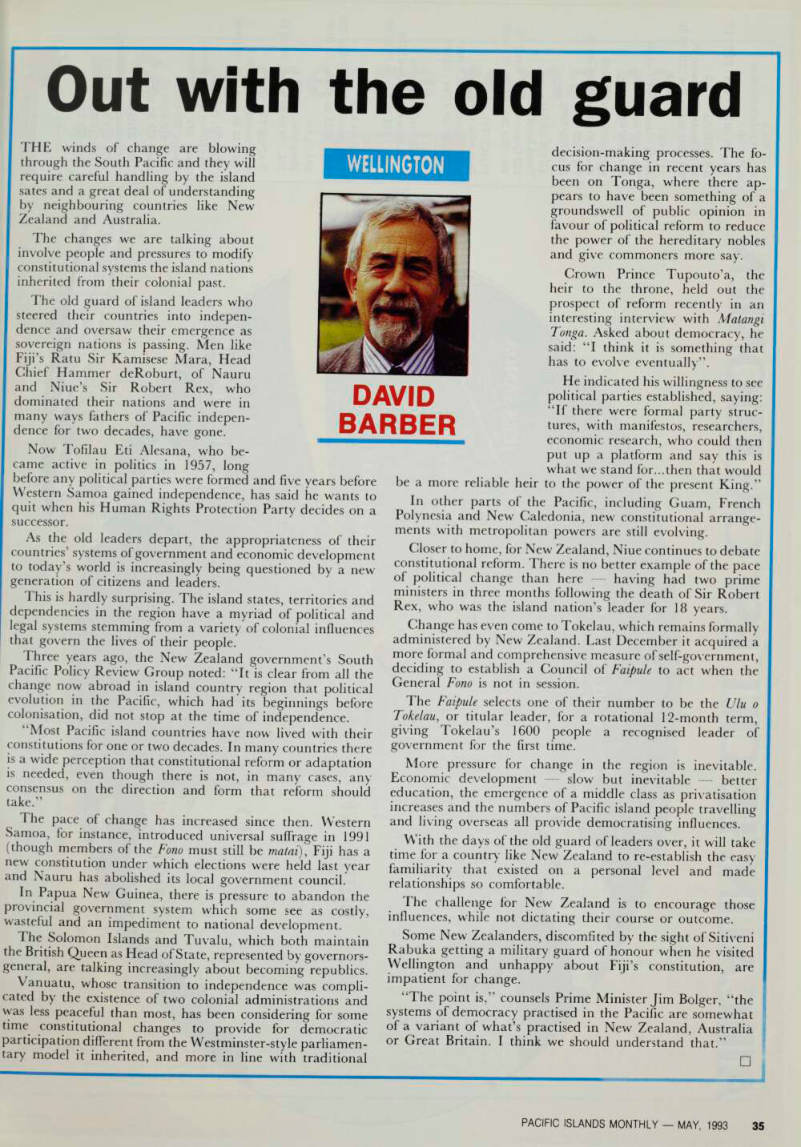
THE winds of change are blowing through the South Pacific and they will require careful handling by the island sates and a great deal of understanding by neighbouring countries like New Zealand and Australia.
The changes we are talking about involve people and pressures to modify constitutional systems the island nations inherited from their colonial past.
The old guard of island leaders who steered their countries into indepen dence and oversaw their emergence as sovereign nations is passing. Men like Fiji’s Ratu Sir Kamisese Mara, Head Chief Hammer deßoburt, of Nauru and Niue’s Sir Robert Rex, who dominated their nations and were in many ways fathers of Pacific indepen dence for two decades, have gone.
Now Tofilau Eti Alesana, who be came active in politics in 1957, long
before any political parties were formed and five years before Western Samoa gained independence, has said he wants to quit when his Human Rights Protection Party decides on a successor.
As the old leaders depart, the appropriateness of their countries’ systems of government and economic development to today’s world is increasingly being questioned by a new generation of citizens and leaders.
This is hardly surprising. The island states, territories and dependencies in the region have a myriad of political and legal systems stemming from a variety of colonial influences that govern the lives of their people.
Three years ago, the New Zealand government’s South Pacific Policy Review Group noted; “It is clear from all the change now abroad in island country region that political evolution in the Pacific, which had its beginnings before colonisation, did not stop at the time of independence.
Most Pacific island countries have now lived with their constitutions for one or two decades. In many countries there is a wide perception that constitutional reform or adaptation is needed, even though there is not, in many cases, any consensus on the direction and form that reform should take.”
The pace of change has increased since then. Western Samoa, for instance, introduced universal suffrage in 1991 (though members of the Fono must still be matai ), Fiji has a new constitution under which elections were held last year and Nauru has abolished its local government council.
In Papua New Guinea, there is pressure to abandon the provincial government system which some see as costly, wasteful and an impediment to national development.
The Solomon Islands and Tuvalu, which both maintain the British Queen as Head of State, represented by governors general, are talking increasingly about becoming republics.
Vanuatu, whose transition to independence was compli cated by the existence of two colonial administrations and was less peaceful than most, has been considering for some time constitutional changes to provide for democratic participation different from the Westminster-style parliamen tary model it inherited, and more in line with traditional
decision-making processes. The fo cus for change in recent years has been on Tonga, where there ap pears to have been something of a groundswell of public opinion in favour of political reform to reduce the power of the hereditary nobles and give commoners more say.
Crown Prince Tupouto’a, the heir to the throne, held out the prospect of reform recently in an interesting interview with Malangi Tonga. Asked about democracy, he said: “I think it is something that has to evolve eventually”.
He indicated his willingness to see political parties established, saying: “If there were formal party struc tures, with manifestos, researchers, economic research, who could then put up a platform and say this is what we stand for,..then that would
be a more reliable heir to the power of the present King.”
In other parts of the Pacific, including Guam, French Polynesia and New Caledonia, new constitutional arrange ments with metropolitan powers are still evolving.
Closer to home, for New Zealand, Niue continues to debate constitutional reform. There is no better example of the pace of political change than here having had two prime ministers in three months following the death of Sir Robert Rex, who was the island nation’s leader for 18 years.
Change has even come to Tokelau, which remains formally administered by New Zealand. Last December it acquired a more formal and comprehensive measure of self-government, deciding to establish a Council of Faipule to act when the General Fono is not in session.
The Faipule selects one of their number to be the Ulu o Tokelau , or titular leader, for a rotational 12-month term, giving Tokelau’s 1600 people a recognised leader of government for the first time.
More pressure for change in the region is inevitable.
Economic development slow but inevitable better education, the emergence of a middle class as privatisation increases and the numbers of Pacific island people travelling and living overseas all provide democratising influences.
With the days of the old guard of leaders over, it will take time for a country like New Zealand to re-establish the easy familiarity that existed on a personal level and made relationships so comfortable.
The challenge for New Zealand is to encourage those influences, while not dictating their course or outcome.
Some New Zealanders, discomfited by the sight of Sitiveni Rabuka getting a military guard of honour when he visited Wellington and unhappy about Fiji’s constitution, are impatient for change.
“The point is,” counsels Prime Minister Jim Bolger, “the systems of democracy practised in the Pacific are somewhat of a variant of what’s practised in New Zealand, Australia or Great Britain. I think we should understand that.”
Wellington
David
Barber
Advertisements & other items, p. 36 (1 item)
Aircalin, Le Ciel Esi Caledonien
ES SALOMON
& k \x
ES SAMOA
PORT-VILA
.ES FIDJI
ALEDONIE
BRISBANE
SYDNEY
ci i
ELBOURNE
NOUMEA
8, rue Frederic Surleau B.P. 3736 Tel. : 28 33 33 • Fax : 27 27 72
BRISBANE
ANZ Center, 324 Queen St.
Tel. ; 221 2433 • Fax . 221 43 31
SYDNEY
World Aviation, 64 York St.
Tel. : 267 8455 Fax : 262 6179
MELBOURNE
World Aviation, 543 King St.
Tel. : 321 6873 Fax : 329 0082
AUCKLAND
Trust Bank Building 229 Queen St., P.O. Box 2755 Tel. : 373 2605 • Fax : 377 5648
PORT-VILA
Immeuble Olympique rue Bougainville, B.P. 882 Tel. : 227 39 • Fax : 243 01
NADI
Commercial Concourse Nadi Airport. P.O. Box 9938 Tel. : 72 21 45 • Fax : 79 02 36
SUVA
64 Renwick rd Downtown Plaza. P.O. Box 159 Tel. : 30 21,33 • Fax : 30 19 28
WALLIS
Mata Utu, B.P. 49 T6l. ; 72 28 80 • Fax : 72 27 11
PAPEETE
Bid Pomare, B.P. 4585 Tel. : 45 09 04 • Fax : 45 09 05
TOKYO, ACI ltd
Bay Hilton International Room 395, 1-8 Maihama Uraysu Shi-Chiba Tdl. : 473 50 85 88 Fax : 473 50 85 86
LOS ANGELES
Air Promotion System Inc., 5777 W. Century Blvd, Tel. : 213 670 73 02 Fax : 213 338 07 08 m
US presence remains
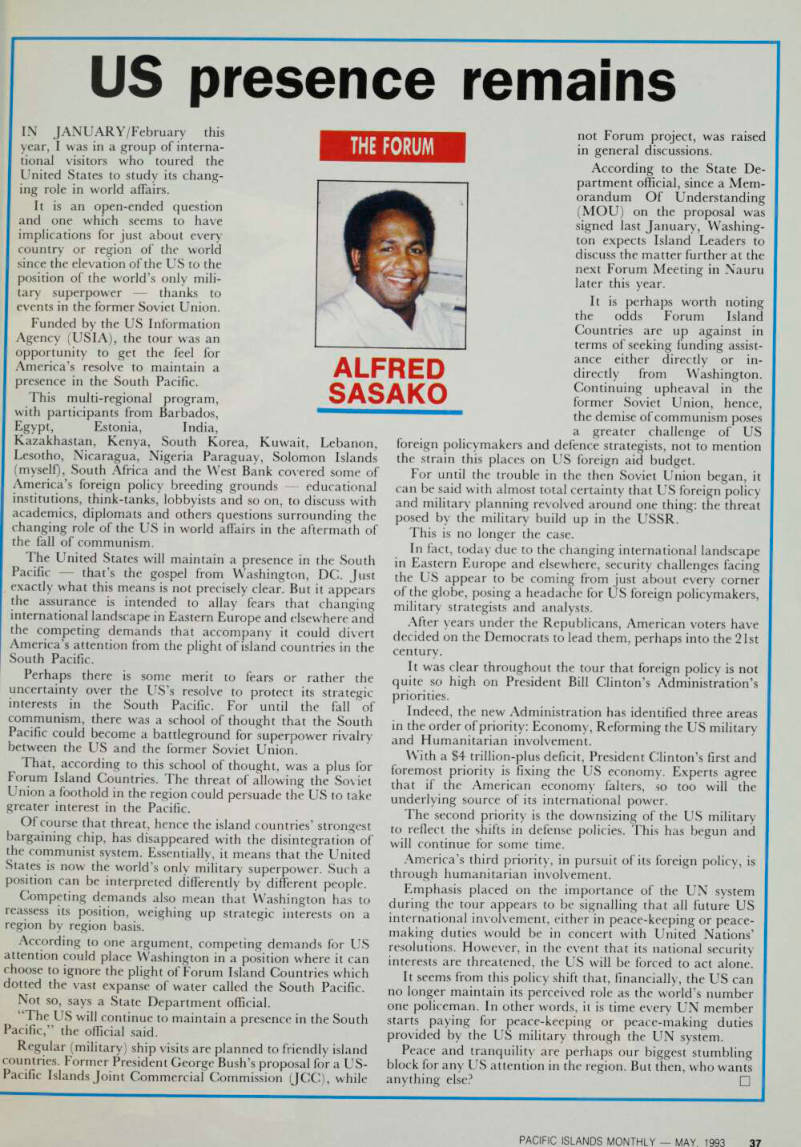
IN JANUARY/February this year, I was in a group of interna tional visitors who toured the United States to study its chang ing role in world affairs.
It is an open-ended question and one which seems to have implications for just about every country or region of the world since the elevation of the US to the position of the world’s only mili tary superpower thanks to events in the former Soviet Union.
Funded by the US Information Agency (USIA), the tour was an opportunity to get the feel for America’s resolve to maintain a presence in the South Pacific.
This multi-regional program, with participants from Barbados, Egypt, Estonia, India,
Kazakhastan, Kenya, South Korea, Kuwait, Lebanon,
Lesotho, Nicaragua, Nigeria Paraguay, Solomon Islands
(myself), South Africa and the West Bank covered some of America’s foreign policy breeding grounds educational institutions, think-tanks, lobbyists and so on, to discuss with academics, diplomats and others questions surrounding the changing role of the US in world affairs in the aftermath of the fall of communism.
The United States will maintain a presence in the South Pacific that’s the gospel from Washington, DC. Just exactly what this means is not precisely clear. But it appears the assurance is intended to allay fears that changing international landscape in Eastern Europe and elsewhere and the competing demands that accompany it could divert America’s attention from the plight of island countries in the South Pacific.
Perhaps there is some merit to fears or rather the uncertainty over the US’s resolve to protect its strategic interests in the South Pacific. For until the fall of communism, there was a school of thought that the South Pacific could become a battleground for superpower rivalry between the US and the former Soviet Union.
That, according to this school of thought, was a plus for Forum Island Countries. The threat of allowing the Soviet Union a foothold in the region could persuade the US to take greater interest in the Pacific.
Of course that threat, hence the island countries’ strongest bargaining chip, has disappeared with the disintegration of the communist system. Essentially, it means that the United States is now the world’s only military superpower. Such a position can be interpreted differently by different people.
Competing demands also mean that Washington has to reassess its position, weighing up strategic interests on a region by region basis.
According to one argument, competing demands for US attention could place Washington in a position where it can choose to ignore the plight ot Forum Island Countries which dotted the vast expanse of water called the South Pacific.
Not so, says a State Department official, ‘The US will continue to maintain a presence in the South Pacific,” the official said.
Regular (military) ship visits are planned to friendly island countries. Former President George Bush’s proposal for a US- Pacific Islands Joint Commercial Commission (JCC), while
not Forum project, was raised in general discussions.
According to the State De partment official, since a Mem orandum Of Understanding (MOU) on the proposal was
signed last January, Washing
ton expects Island Leaders to discuss the matter further at the next Forum Meeting in Nauru later this year.
It is perhaps worth noting the odds Forum Island Countries are up against in terms of seeking funding assist ance either directly or in directly from Washington.
Continuing upheaval in the former Soviet Union, hence, the demise of communism poses a greater challenge of US
foreign policymakers and defence strategists, not to mention the strain this places on US foreign aid budget.
For until the trouble in the then Soviet Union began, it can be said with almost total certainty that US foreign policy and military planning revolved around one thing: the threat posed by the military build up in the USSR.
This is no longer the case.
In fact, today due to the changing international landscape in Eastern Europe and elsewhere, security challenges facing the US appear to be coming from just about every corner of the globe, posing a headache for US foreign policymakers, military strategists and analysts.
After years under the Republicans, American voters have decided on the Democrats to lead them, perhaps into the 21st century.
It was clear throughout the tour that foreign policy is not quite so high on President Bill Clinton’s Administration’s priorities.
Indeed, the new Administration has identified three areas in the order of priority: Economy, Reforming the US military and Humanitarian involvement.
With a S 4 trillion-plus deficit, President Clinton’s first and foremost priority is fixing the US economy. Experts agree that if the American economy falters, so too will the underlying source of its international power.
The second priority is the downsizing of the US military to reflect the shifts in defense policies. This has begun and will continue for some time.
America’s third priority, in pursuit of its foreign policy, is through humanitarian involvement.
Emphasis placed on the importance of the UN system during the tour appears to be signalling that all future US international involvement, either in peace-keeping or peace making duties would be in concert with United Nations’ resolutions. However, in the event that its national security interests are threatened, the US will be forced to act alone.
It seems from this policy shift that, financially, the US can no longer maintain its perceived role as the world’s number one policeman. In other words, it is time every UN member starts paying for peace-keeping or peace-making duties provided by the US military through the UN system.
Peace and tranquility are perhaps our biggest stumbling block for any US attention in the region. But then, who wants anything else? □
The Forum
Alfred
Sasako
Advertisements & other items, p. 38 (1 item)
International
THE WINDSOR
The Windsor Hotel International relaxed atmosphere with a touch of the Mediterranean. On main road and only 5 minutes walk to town centre.
ACCOMMODATION
20 Studio units and 10 One bedroom Apartments fully self-contained, fan cooled, 53 new well appointed, airconditioned Suites to be completed September 1993.
LA BRASSERIE DO WINDSOR
Elegant yet casual dining in a friendly atmosphere, the Brasserie caters for all budgets. Open for breakfast, lunch and dinner. Our French and ni Vanuatu chefs will tantalize you with Provincial French Cuisine, Island delicacies, seafoods or appetizing light snacks and Pizzas.
THE WINDSOR SONSET BAR
Relax with Ice-cold drinks in spacious, air-conditioned comfort. Happy Hour from 6.00 pm when the sun begins to set.
DUKE OF WINDSOR “Ye Olde English Pub”
Traditional English Pub and Beer garden servicing icecold ales on tap and tasty snacks. Darts, disco, live entertainment. Open seven nights a week.
THE WINDSOR’S GAMING LOUNGE (CLUB 21)
Put yourself in the Winner’s Circle! Stylish new gaming room with generous Poker-machine jackpots and random bonus prizes. Join in the excitement and get the ‘Winning Edge’.
WINDSOR HOTEL INTERNATIONAL Ltd.
P O Box 810, Port Vila, Vanuatu.
Telephone: (678) 22150 Facsimile: (678) 22678
f v; N /> m u 9 - *
ssii
& m % out
Going Nowhere
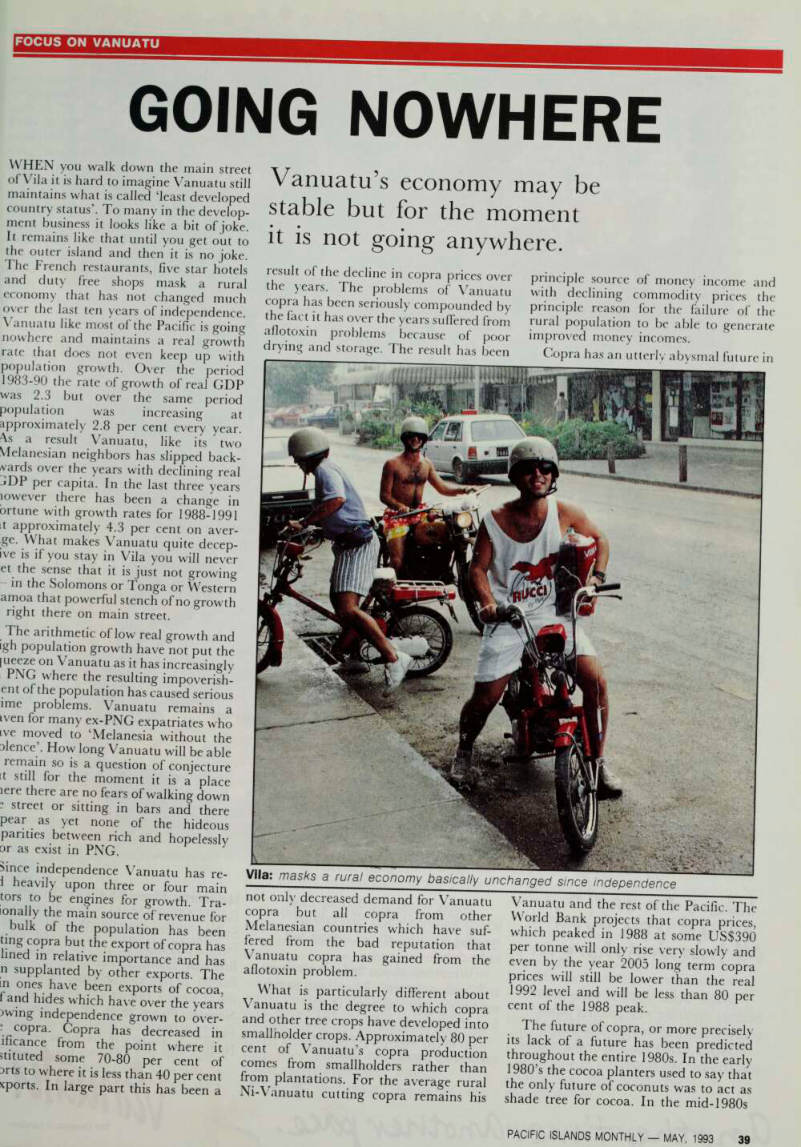

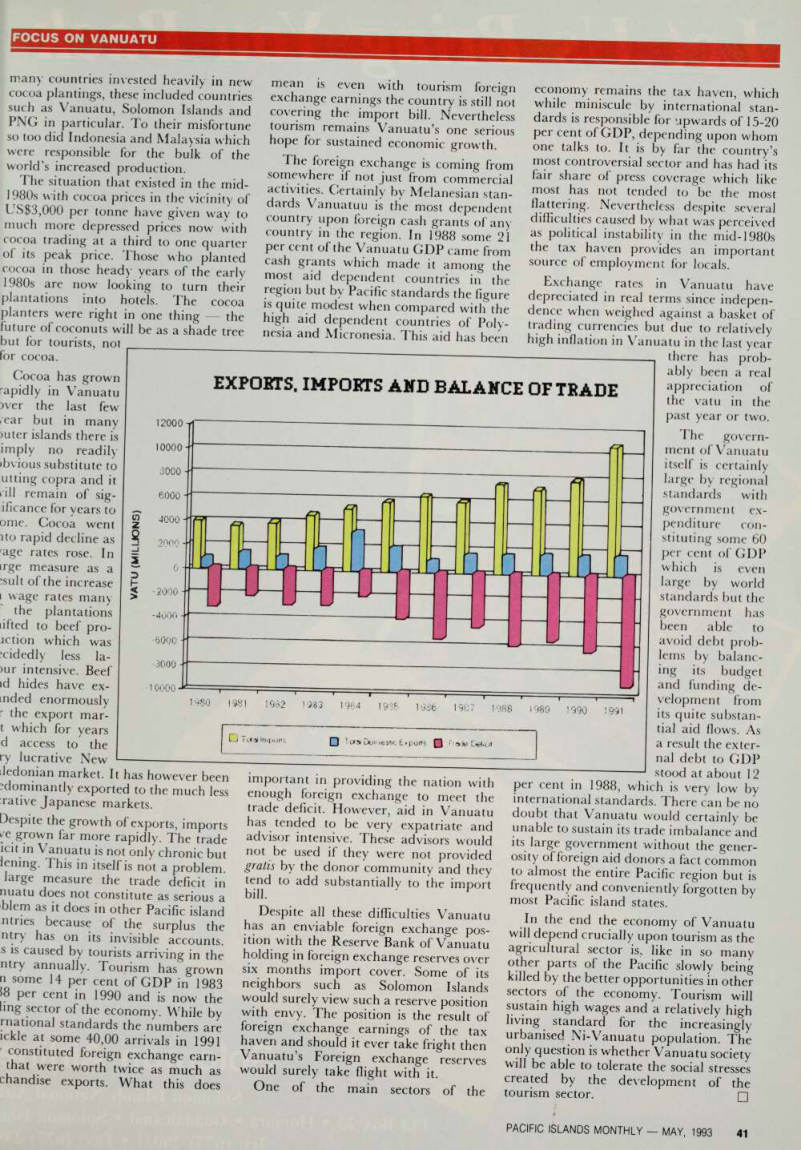
Focus On Vanuatu
Vanuatu’s economy may be stable but for the moment it is not going anywhere.
WHEN you walk down the main street of Vila it is hard to imagine Vanuatu still maintains what is called ‘least developed country status’. To many in the develop ment business it looks like a bit of joke.
It remains like that until you get out to the outer island and then it is no joke.
The French restaurants, five star hotels and duty free shops mask a rural economy that has not changed much over the last ten years of independence.
Vanuatu like most of the Pacific is going nowhere and maintains a real growth rate that does not even keep up with population growth. Over the period 1983-90 the rate of growth of real GDP was 2.3 but over the same period
population was increasing at
approximately 2.8 per cent every year. a result Vanuatu, like its two
Vlelanesian neighbors has slipped back
wards over the years with declining real jDP per capita. In the last three years lowever there has been a change in brtune with growth rates for 1988-1991 it approximately 4.3 per cent on aver se. What makes Vanuatu quite decep ive is if you stay in Vila you will never et the sense that it is just not growing in the Solomons or Tonga or Western amoa that powerful stench of no growth right there on main street.
The arithmetic of low real growth and igh population growth have not put the [ueeze on Vanuatu as it has increasingly PNG where the resulting impoverish ed of the population has caused serious ime problems. Vanuatu remains a iven for many ex-PNG expatriates who ive moved to ‘Melanesia without the Mence’. How long Vanuatu will be able remain so is a question of conjecture it still for the moment it is a place icre there are no fears of walking down “ street or sitting in bars and there pear as yet none of the hideous panties between rich and hopelessly or as exist in PNG. rince independence Vanuatu has re -1 heavily upon three or four main tors to be engines for growth. Tra lonally the main source of revenue for bulk of the population has been ting copra but the export of copra has lined m relative importance and has n supplanted by other exports. The in ones have been exports of cocoa, and hides which have over the years )wmg independence grown to over . copra. Copra has decreased in incance from the point where it mtuted some 70-80 per cent of 3rts to where it is less than 40 per cent sports. In large part this has been a
result of the decline in copra prices over the years. The problems of Vanuatu copra has been seriously compounded by the fact it has over the years suffered from aflotoxin problems because of poor drying and storage. The result has been
not only decreased demand for Vanuatu copra but all copra from other Melanesian countries which have suf fered from the bad reputation that Vanuatu copra has gained from the aflotoxin problem.
What is particularly different about Vanuatu is the degree to which copra and other tree crops have developed into smallholder crops. Approximately 80 per cent of Vanuatu’s copra production comes from smallholders rather than from plantations. For the average rural Ni-Vanuatu cutting copra remains his
principle source of money income and with declining commodity prices the principle reason for the failure of the rural population to be able to generate improved money incomes.
Copra has an utterly abysmal future in
Vanuatu and the rest of the Pacific. The World Bank projects that copra prices, which peaked in 1988 at some US$39O per tonne will only rise very slowly and even by the year 2005 long term copra prices will still be lower than the real 1992 level and will be less than 80 per cent of the 1988 peak.
The future of copra, or more precisely its lack of a future has been predicted throughout the entire 1980 s. In the early 1980’s the cocoa planters used to say that the only future of coconuts was to act as shade tree for cocoa. In the mid-1980s
Vila: masks a rural economy basically unchanged since independence
many countries invested heavily in new cocoa plantings, these included countries such as Vanuatu, Solomon Islands and PNG in particular. To their misfortune so too did Indonesia and Malaysia which were responsible for the bulk of the world’s increased production.
The situation that existed in the mid 1980s with cocoa prices in the vicinity of USS3,OOO per tonne have given way to much more depressed prices now with cocoa trading at a third to one quarter of its peak price. Those who planted cocoa in those heady years of the early 1980 s are now looking to turn their plantations into hotels. The cocoa planters were right in one thing the future of coconuts will be as a shade tree
but for tourists, not for cocoa.
Cocoa has grown rapidly in Vanuatu )ver the last few rear but in many )uter islands there is imply no readily •bvious substitute to utting copra and it fill remain of sig ificance for years to ome. Cocoa went ito rapid decline as age rates rose. In irge measure as a ‘suit of the increase i wage rates many the plantations lifted to beef pro- JCtion which was ‘cidedly less la )ur intensive. Beef id hides have ex
mded enormously
" the export mar t which for years d access to the ry lucrative New
Jedonian market. It has however been exported to the much less rative Japanese markets.
Despite the growth of exports, imports /e grown far more rapidly. The trade icit in Vanuatu is not only chronic but lenmg. This in itself is not a problem, large measure the trade deficit in nuatu does not constitute as serious a blem as it does in other Pacific island ntries because of the surplus the ntry has on its invisible accounts, s is caused by tourists arriving in the ntry annually. Tourism has grown n some 14 per cent of GDP in 1983 [? P er cen * in 1990 and is now the ling sector of the economy. While by rnational standards the numbers are ickle at some 40,00 arrivals in 1991
constituted foreign exchange earn
that were worth twice as much as chandise exports. What this does
mean is even with tourism foreign exchange earnings the country is still not covering the import bill. Nevertheless tourism remains Vanuatu’s one serious hope for sustained economic growth.
The foreign exchange is coming from
somewhere if not just from commercial activities. Certainly by Melanesian stan dards Vanuatuu is the most dependent country upon foreign cash grams of any country in the region. In 1988 some 21 per cent of the Vanuatu GDP came from cash grants which made it among the most aid dependent countries in the region but by Pacific standards the figure is quite modest when compared with the
high aid dependent countries of Poly
nesia and Micronesia. This aid has been
important in providing the nation with enough foreign exchange to meet the trade deficit. However, aid in Vanuatu has tended to be very expatriate and advisor intensive. These advisors would not be used if they were not provided gratis by the donor community and they tend to add substantially to the import bill.
Despite all these difficulties Vanuatu has an enviable foreign exchange pos ition with the Reserve Bank of Vanuatu
holding in foreign exchange reserves over
six months import cover. Some of its neighbors such as Solomon Islands would surely view such a reserve position with envy. The position is the result of
foreign exchange earnings of the tax
haven and should it ever take fright then
Vanuatu’s Foreign exchange reserves
would surely take flight with it.
One of the main sectors of the
economy remains the tax haven, which while miniscule by international stan dards is responsible for upwards of 15-20 per cent of GDP, depending upon whom one talks to. It is by far the country’s most controversial sector and has had its fair share of press coverage which like most has not tended to be the most
flattering. Nevertheless despite several
difficulties caused by what was perceived as political instability in the mid-1980s the tax haven provides an important source of employment for locals.
Exchange rates in Vanuatu have depreciated in real terms since indepen dence when weighed against a basket of trading currencies but due to relatively high inflation in Vanuatu in the last year
there has prob ably been a real appreciation of the vatu in the past year or two.
The govern ment of Vanuatu itself is certainly large by regional standards with government ex penditure con stituting some 60 per cent of GDP which is even
large by world
standards but the government has been able to avoid debt prob lems by balanc ing its budget and funding de
velopment from
its quite substan tial aid flows. As a result the exter nal debt to GDP stood at about 12
per cent in 1988, which is very low by international standards. There can be no doubt that Vanuatu would certainly be unable to sustain its trade imbalance and its large government without the gener osity of foreign aid donors a fact common to almost the entire Pacific region but is
frequently and conveniently forgotten by
most Pacific island states.
In the end the economy of Vanuatu will depend crucially upon tourism as the agricultural sector is, like in so many other parts of the Pacific slowly being killed by the better opportunities in other sectors of the economy. Tourism will sustain high wages and a relatively high living standard for the increasingly urbanised Ni-Vanuatu population. The only question is whether Vanuatu society will be able to tolerate the social stresses created by the development of the tourism sector. n
Advertisements & other items, pp. 40-42 (2 items)
’fvvvv£ > A/hcrtH^v*
V*- ' I > ' m % h / P W*** : i -
idMM. o~h
w)cvlo\ vi-o>A
ivu» fl/vurt kv\<?r£,.
Where would you find white powder beaches overhung with coconut palms, reaching down to tropical blue water?
Where would you find diving in coral seas so clear and warm?
Where would you find top class resorts featuring world class cuisine, sporting activities, shows, casino and
night clubs?
Where would you find a live volcano and ancient custom villages, fresh grown market produce and some of the friendliest people you’ll ever meet?
Where? Vanuatu, that’s where. An untouched paradise on earth.
Melbourne: Phone 03-417 3977, Fax 03-417 5977.
Sydney: Phone 02-223 8333, Fax 02-223 8781.
Brisbane: Phone 07-221 2366, Fax 07-233 2330. Auckland: Phone 09-373 3435, Fax 09-358 1413.
Noumea: Phone 28 66 77, Fax 27 40 50.
Nadi: Phone 733 521.
’fvvvv£ > A/hcrtH^v*
F The Untouched Paradise
Let Us Bring You Back
a* K / 'f - *1 9 £ s •Sr * ft * * V * r^k 4 K&a ¥ ¥ ¥
Solomon Airlines
Solomon Islands National Airlii PO Box 23 • Honiara • Guadalcanal • Solomon Islan rr.l. * tW.
[Focus On Vanuatu
Vanuatu’s Shining Star
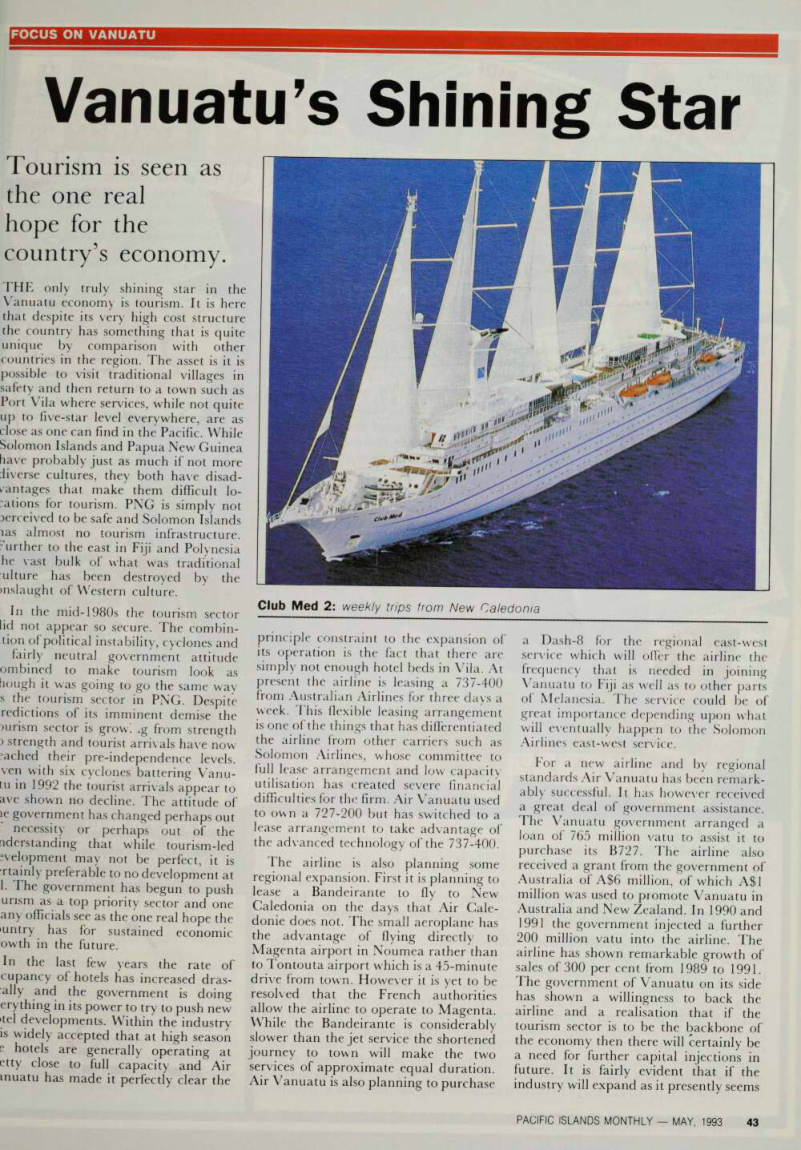
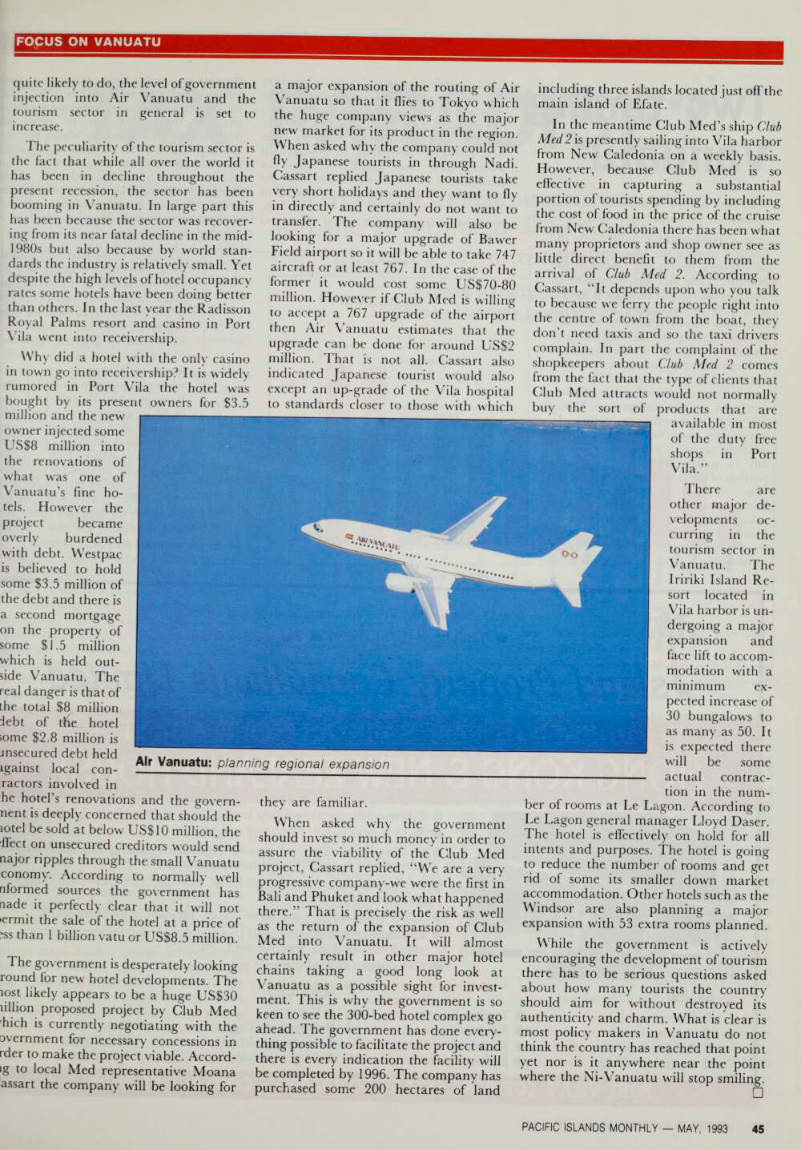
Tourism is seen as
the one real
hope for the
country’s economy.
THE only truly shining star in the Vanuatu economy is tourism. It is here that despite its very high cost structure the country has something that is quite unique by comparison with other countries in the region. The asset is it is possible to visit traditional villages in safety and then return to a town such as Port Vila where services, while not quite up to five-star level everywhere, are as close as one can find in the Pacific. While Solomon Islands and Papua New Guinea have probably just as much if not more diverse cultures, they both have disad vantages that make them difficult lo :ations for tourism. PNG is simply not perceived to be safe and Solomon Islands las almost no tourism infrastructure.
Airther to the east in Fiji and Polynesia he vast bulk of what was traditional ulture has been destroyed by the mslaught of Western culture.
In the mid-1980s the tourism sector lid not appear so secure. The combin tion of political instability, cyclones and fairly neutral government attitude ombined to make tourism look as hough it was going to go the same way s the tourism sector in PNG. Despite redictions of its imminent demise the )urism sector is grow. ,g from strength ) strength and tourist arrivals have now
cached their pre-independence levels,
ven with six cyclones battering Vanu tu in 1992 the tourist arrivals appear to ave shown no decline. The attitude of
le government has changed perhaps out
necessity or perhaps out of the riderstanding that while tourism-led may not be perfect, it is rtainly preferable to no development at 1. The government has begun to push unsm as a top priority sector and one any officials see as the one real hope the •untry has for sustained economic owth in the future.
In the last few years the rate of cupancy of hotels has increased dras ally and the government is doing erything in its power to try to push new
•tel developments. Within the industry
is widely accepted that at high season e hotels are generally operating at etty close to full capacity and Air muatu has made it perfectly clear the
principle constraint to the expansion of its operation is the fact that there are simply not enough hotel beds in Vila. At present the airline is leasing a 737-400 from Australian Airlines for three days a week. 1 his flexible leasing arrangement is one of the things that has differentiated the airline from other carriers such as Solomon Airlines, whose committee to full lease arrangement and low capacity utilisation has created severe financial difficulties for the firm. Air Vanuatu used to own a 727-200 but has switched to a lease arrangement to take advantage of the advanced technology of the 737-400.
The airline is also planning some regional expansion. First it is planning to lease a Bandeirante to fly to New Caledonia on the days that Air Cale donie does not. The small aeroplane has the advantage of flying directly to Magenta airport in Noumea rather than to Tontouta airport which is a 45-minute drive from town. However it is yet to be resolved that the French authorities allow the airline to operate to Magenta.
While the Bandeirante is considerably slower than the jet service the shortened journey to town will make the two services of approximate equal duration.
Air Vanuatu is also planning to purchase
a Dash-8 for the regional east-west service which will offer the airline the frequency that is needed in joining Vanuatu to Fiji as well as to other parts of Melanesia. The service could be of great importance depending upon what will eventually happen to the Solomon Airlines east-west service.
For a new airline and by regional standards Air Vanuatu has been remark ably successful. It has however received a great deal of government assistance.
The Vanuatu government arranged a loan of 765 million vatu to assist it to purchase its 8727. The airline also received a grant from the government of Australia of As 6 million, of which Asl million was used to promote Vanuatu in Australia and New Zealand. In 1990 and 1991 the government injected a further 200 million vatu into the airline. The airline has shown remarkable growth of sales of 300 per cent from 1989 to 1991.
The government of Vanuatu on its side has shown a willingness to back the airline and a realisation that if the tourism sector is to be the backbone of the economy then there will certainly be a need for further capital injections in future. It is fairly evident that if the industry will expand as it presently seems
Club Med 2: weekly trips from New Caledonia
quite likely to do, the level of government injection into Air Vanuatu and the tourism sector in general is set to increase.
The peculiarity of the tourism sector is the fact that while all over the world it has been in decline throughout the present recession, the sector has been booming in Vanuatu. In large part this has been because the sector was recover ing from its near fatal decline in the mid 1980s but also because by world stan dards the industry is relatively small. Yet despite the high levels of hotel occupancy rates some hotels have been doing better than others. In the last year the Radisson Royal Palms resort and casino in Port Vila went into receivership.
Why did a hotel with the only casino in town go into receivership? It is widely rumored in Port Vila the hotel was bought by its present owners for $3.5
million and the new owner injected some US$B million into the renovations of what was one of Vanuatu’s fine ho tels. However the project became overly burdened with debt. Westpac is believed to hold some $3.5 million of the debt and there is a second mortgage on the property of some $1.5 million which is held out side Vanuatu. The real danger is that of the total $8 million
debt of tile hotel
;ome $2.8 million is insecured debt held igainst local con ractors involved in
he hotel’s renovations and the govern nent is deeply concerned that should the iotel be sold at below US$lO million, the ffect on unsecured creditors would send
najor ripples through the small Vanuatu
conomy. According to normally well aformed sources the government has aade it perfectly clear that it will not •ermit the sale of the hotel at a price of jss than 1 billion vatu or US$B.5 million.
The government is desperately looking round for new hotel developments. The lost likely appears to be a huge US$3O lillion proposed project by Club Med hich is currently negotiating with the overnment for necessary concessions in rder to make the project viable. Accord ig to local Med representative Moana assart the company will be looking for
a major expansion of the routing of Air Vanuatu so that it flies to Tokyo which the huge company views as the major new market for its product in the region.
When asked why the company could not fly Japanese tourists in through Nadi.
Cassart replied Japanese tourists take very short holidays and they want to fly in directly and certainly do not want to transfer. The company will also be looking for a major upgrade of Bawer Field airport so it will be able to take 747 aircraft or at least 767. In the case of the former it would cost some US$7O-80 million. However if Club Med is willing to accept a 767 upgrade of the airport then Air Vanuatu estimates that the upgrade can be done for around US$2 million. I hat is not all. Cassart also indicated Japanese tourist would also except an up-grade of the Vila hospital to standards closer to those with whirh
they are familiar.
When asked why the government should invest so much money in order to assure the viability of the Club Med project, Cassart replied, “We are a very progressive company-we were the first in Bali and Phuket and look what happened there.” That is precisely the risk as well as the return of the expansion of Club Med into Vanuatu. It will almost certainly result in other major hotel chains taking a good long look at Vanuatu as a possible sight for invest ment. This is why the government is so keen to see the 300-bed hotel complex go ahead. The government has done every thing possible to facilitate the project and there is every indication the facility will be completed by 1996. The company has purchased some 200 hectares of land
including three islands located just off the main island of Efate.
In the meantime Club Med’s ship Club Med 2 is presently sailing into Vila harbor from New Caledonia on a weekly basis.
However, because Club Med is so effective in capturing a substantial portion of tourists spending by including the cost of food in the price of the cruise from New Caledonia there has been what many proprietors and shop owner see as little direct benefit to them from the arrival of Club Med 2. According to Cassart, “It depends upon who you talk to because we ferry the people right into the centre of town from the boat, they don’t need taxis and so the taxi drivers complain. In part the complaint of the shopkeepers about Club Med 2 comes from the fact that the type of clients that Club Med attracts would not normally buy the sort of products that are
available in most of the duty free shops in Port Vila.”
There are other major de velopments oc curring in the tourism sector in Vanuatu. The Iririki Island Re sort located in Vila harbor is un dergoing a major expansion and face lift to accom modation with a minimum ex pected increase of 30 bungalows to as many as 50. It is expected there will be some actual contrac tion in the num
ber of rooms at Le Lagon. According to Le Lagon general manager Lloyd Baser.
The hotel is effectively on hold for all intents and purposes. The hotel is going to reduce the number of rooms and get rid of some its smaller down market accommodation. Other hotels such as the Windsor are also planning a major expansion with 53 extra rooms planned.
While the government is actively encouraging the development of tourism there has to be serious questions asked about how many tourists the country should aim for without destroyed its authenticity and charm. What is clear is most policy makers in Vanuatu do not think the country has reached that point yet nor is it anywhere near the point where the Ni-Vanuatu will stop smiling. □
Air Vanuatu: planning regional expansion
Advertisements & other items, p. 44 (1 item)
y r \ V A' W |p
Vanuatu
55
VANUATU
* '*■ 11 - '-*• 20 V) - \ A S U ATJJ 0
STAMPS
OF
VANUATU
The beautiful and exotic country of Vanuatu has some of the most colourful and facinating stamps in the world.
They cover a broad spectrum of topics of interest to both new and established collectors. The stamps can be seen as windows to the nation of Vanuatu, revealing its customs and culture, fauna and flora, areas of development and the country’s participation in international issues.
The decision to collect the stamps of Vanuatu must be an easy one to make, with a unique past and the birth of a new nation in 1980.
The stamp are of the highest quality and individuality.
V A N
n y r \ V A' W |p r u A
nja!:
20
VANUAi
■ s A 0f Q -• To: The Manager, Vanuatu Philatelic Bureau, General Post Office, Port Vila, Vanuatu. 1 wish to purchase your new stamp issues.
Please send me full details of your next programme and your
STANDING ORDER SERVICE
Name; Address; Post Code;
INFORMATION AND ENQUIRIES
Telephone (678) 22000 or FAX (678) 23900 Port Vila. Vanuatu.
PHILATELIC BUREAU
OFFICIAL OPENING HOURS
MONDAY TO FRIDAY
7.30 to 11.30 and 13.15 to 16.30 /■
PORT VILA
POST OFFICE
BUREAU
A
kUATU ■|
Two timing

Vanuatu
Pacific time is notorious but it is consistent consistently late. Vanuatu
time is consistently confused. In the last few months the new government of Vanuatu has finally abolished the Summer Time Act which introduced daylight saving and brought to an end months of utter confusion in Port Vila.
Normally Vanuatu used to introduce
daylight saving at the beginning of
October and it would continue throughout the southern summer months. The government of Fiji is also considering the introduction of sum mer time and the lessons from Vanu atu may be worth considering. In developing countries the concept of
daylight saving is problematic especi
ally in urban areas where a large portion of the population living on the edge of town have no electricity.
Daylight saving meant man) workers who would have to be at work in Vanuatu at 7.30 am every day would have to wake up in the dark in order to be able to arrive to work on time.
In the tightly censored press in Vanuatu this was one of the few complaints that the government run newspapers were permit ted to print. As a result, the new govern ment decided to abolish the Summer Time Act. However, according to government sources there was insufficient time for parliament to pass legislation at the beginning of the summer time period in 1992. As a result the government an nounced its intention to repeal the act at
the earliest possible moment but neverthe less changed the clocks in late 1992. The trouble occurred when the government changed the clocks but in order tc demonstrate its seriousness about the re pealing the act it allowed the public servants to stay on the old time. The pandemonium that followed was some thing that brought back memories of the many similar absurdities of the colonial condominium when Vanuatu had twc colonial governments.
All hell broke loose in October 1992. Government began at 8.30 and continued to 12.30 for the lunch break. The private sector which moved on to summer time began at 7.30 and finished at 11.30. Memos flew left, right and centre trying to explain to con fused government employees what was going on and what time it really was. Parents with one child in government school and another in private school were late for work. At the docks at Port Vila you either had customs officers with no customs agents or vice versa. After three months ol chaos the government finally repealed the summer time Act and Vanuatu has now happily returned to Pacific Time. □
Advertisements & other items, p. 46 (1 item)
stand Property Consultants Limited
P.O. Box 2, Port Vila, Vanuatu, Main Street Offices, f • Telephone (678) 24630 • Fax (678) 24628
PRESENTS FOR SALE AS SOLE AGENT
HONG KONG & NEW ZEALAND HOUSE
Prime commercial building in the heart of Port Vila’s C.B.D.
Net rentable area-. 1,053 m 2 (11,334 ft) 3 storeys + 300 m 2 private basement parking (suitable for conversion to small shops or storage areas) Tenants include Commercial Bank, Govt Ministry Govt Dept, and Overseas Aid Agency. 100% occupancy. Long term leases, renewable on completion Extensively renovated in 1991 (new central air conditioning system, repainted, parking area repaved, etc.) Net return-. 10% of the sale price.
SALES: SERVICES:
• Flats • Tourism Projects • Valuations • Housing • Subdivisions • Property Management • Building Plots • Plantations • Investment Advice • Commercial Bldgs Businesses • Project Co-ordination • Lease Preparation • Negotiations With Custom Land Owners m % PORT VILA’S TOP REAL ESTATE COMPANY CONTACT US NOW!
Tax Paradise?
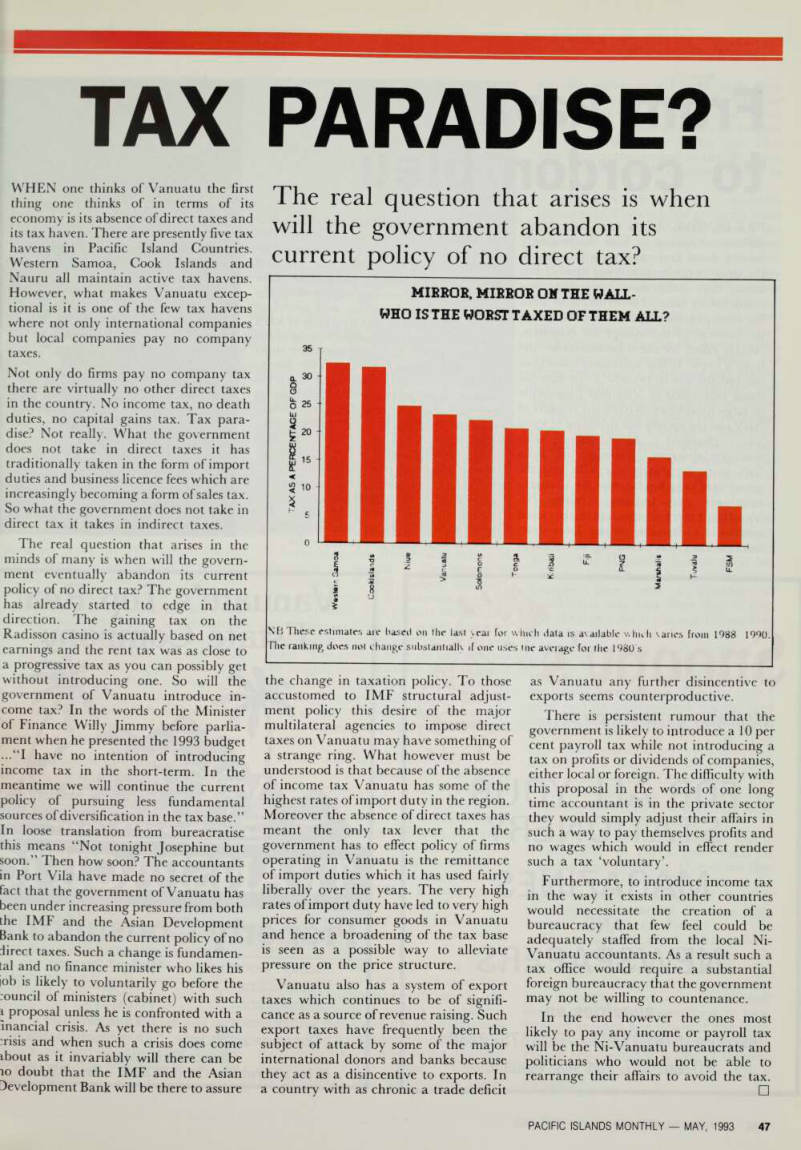
The real question that arises is when will the government abandon its current policy of no direct tax?
WHEN one thinks of Vanuatu the first thing one thinks of in terms of its economy is its absence of direct taxes and its tax haven. There are presently five tax havens in Pacific Island Countries.
Western Samoa, Cook Islands and Nauru all maintain active tax havens.
However, what makes Vanuatu excep tional is it is one of the few tax havens where not only international companies but local companies pay no company taxes.
Not only do firms pay no company tax there are virtually no other direct taxes in the country. No income tax, no death duties, no capital gains tax. Tax para dise? Not really. What the government does not take in direct taxes it has traditionally taken in the form of import duties and business licence fees which are increasingly becoming a form of sales tax.
So what the government does not take in direct tax it takes in indirect taxes.
The real question that arises in the minds of many is when will the govern ment eventually abandon its current policy of no direct tax? The government has already started to edge in that direction. The gaining tax on the Radisson casino is actually based on net earnings and the rent tax was as close to a progressive tax as you can possibly get without introducing one. So will the government of Vanuatu introduce in come tax? In the words of the Minister of Finance Willy Jimmy before parlia ment when he presented the 1993 budget ...“I have no intention of introducing income tax in the short-term. In the meantime we will continue the current policy of pursuing less fundamental sources of diversification in the tax base.”
In loose translation from bureacratise
this means “Not tonight Josephine but
soon.” Then how soon? The accountants in Port Vila have made no secret of the fact that the government of Vanuatu has been under increasing pressure from both the IMF and the Asian Development Bank to abandon the current policy of no direct taxes. Such a change is fundamen tal and no finance minister who likes his job is likely to voluntarily go before the :ouncil of ministers (cabinet) with such i proposal unless he is confronted with a mancial crisis. As yet there is no such :risis and when such a crisis does come ibout as it invariably will there can be 10 doubt that the IMF and the Asian Development Bank will be there to assure
the change in taxation policy. To those accustomed to IMF structural adjust ment policy this desire of the major multilateral agencies to impose direct taxes on Vanuatu may have something of a strange ring. What however must be understood is that because of the absence of income tax Vanuatu has some of the highest rates of import duty in the region.
Moreover the absence of direct taxes has meant the only tax lever that the government has to effect policy of firms operating in Vanuatu is the remittance of import duties which it has used fairly liberally over the years. The very high rates of import duty have led to very high prices for consumer goods in Vanuatu and hence a broadening of the tax base is seen as a possible way to alleviate pressure on the price structure.
Vanuatu also has a system of export taxes which continues to be of signifi cance as a source of revenue raising. Such export taxes have frequently been the subject of attack by some of the major international donors and banks because they act as a disincentive to exports. In a country with as chronic a trade deficit
as Vanuatu any further disincentive to exports seems counterproductive.
There is persistent rumour that the government is likely to introduce a 10 per cent payroll tax while not introducing a tax on profits or dividends of companies, either local or foreign. The difficulty with this proposal in the words of one long time accountant is in the private sector they would simply adjust their affairs in such a way to pay themselves profits and no wages which would in effect render such a tax ‘voluntary’.
Furthermore, to introduce income tax in the way it exists in other countries would necessitate the creation of a bureaucracy that few feel could be adequately staffed from the local Ni- Vanuatu accountants. As a result such a tax office would require a substantial foreign bureaucracy that the government may not be willing to countenance.
In the end however the ones most likely to pay any income or payroll tax will be the Ni-Vanuatu bureaucrats and politicians who would not be able to rearrange their affairs to avoid the tax. □
From kava
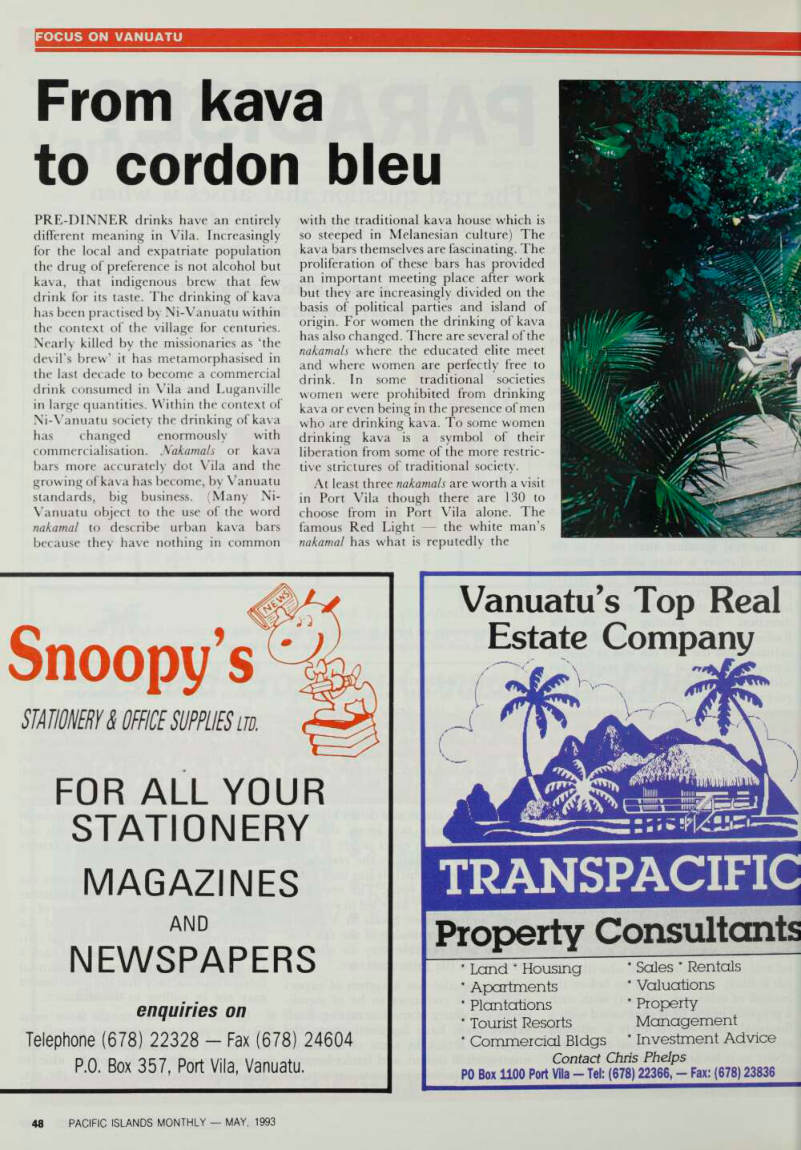
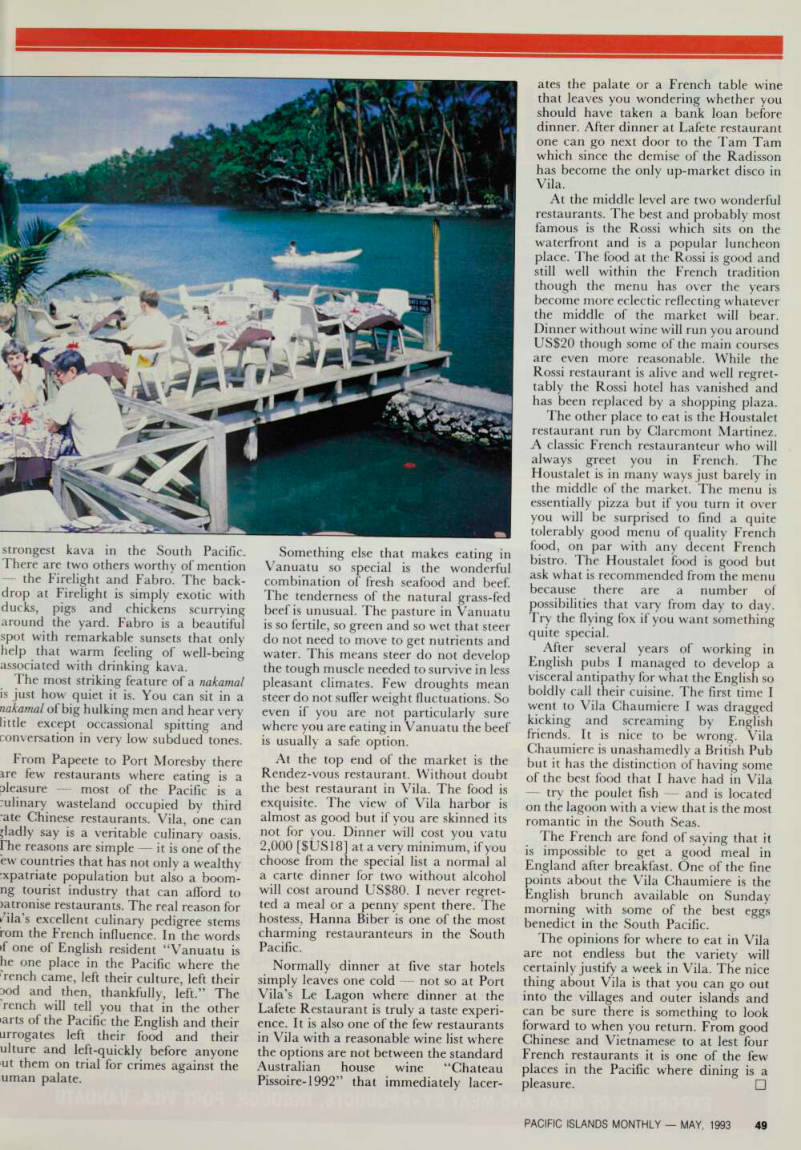
to cordon bleu
PRE-DINNER drinks have an entirely different meaning in Vila. Increasingly for the local and expatriate population the drug of preference is not alcohol but kava, that indigenous brew that few drink for its taste. The drinking of kava has been practised by Ni-Vanuatu within the context of the village for centuries.
Nearly killed by the missionaries as ‘the devil’s brew’ it has metamorphasised in the last decade to become a commercial drink consumed in Vila and Luganville in large quantities. Within the context of Ni-Vanuatu society the drinking of kava has changed enormously with commercialisation. Nakamals or kava bars more accurately dot Vila and the growing of kava has become, by Vanuatu standards, big business. (Many Ni- Vanuatu object to the use of the word nakamal to describe urban kava bars because they have nothing in common
with the traditional kava house which is so steeped in Melanesian culture) The kava bars themselves are fascinating. The proliferation of these bars has provided
an important meeting place after work
but they are increasingly divided on the basis of political parties and island of origin. For women the drinking of kava has also changed. There are several of the nakamals where the educated elite meet and where women are perfectly free to drink. In some traditional societies women were prohibited from drinking kava or even being in the presence of men who are drinking kava. To some women drinking kava is a symbol of their liberation from some of the more restric tive strictures of traditional society.
At least three nakamals are worth a visit in Port Vila though there are 130 to choose from in Port Vila alone. The famous Red Light the white man’s nakamal has what is reputedly the
strongest kava in the South Pacific.
There are two others worthy of mention - the Firelight and Fabro. The back drop at Firelight is simply exotic with ducks, pigs and chickens scurrying around the yard. Fabro is a beautiful spot with remarkable sunsets that only
help that warm feeling of well-being
associated with drinking kava.
The most striking feature of a nakamal is just how quiet it is. You can sit in a nakamal of big hulking men and hear very little except occassional spitting and conversation in very low subdued tones.
From Papeete to Port Moresby there are few restaurants where eating is a pleasure most of the Pacific is a :ulinary wasteland occupied by third ate Chinese restaurants. Vila, one can gladly say is a veritable culinary oasis.
Fhe reasons are simple it is one of the ew countries that has not only a wealthy ;xpatriate population but also a boom ng tourist industry that can afford to )atronise restaurants. The real reason for
/ila s excellent culinary pedigree stems
fom the French influence. In the words ►f one of English resident “Vanuatu is he one place in the Pacific where the rench came, left their culture, left their pod and then, thankfully, left.” The rench will tell you that in the other •arts of the Pacific the English and their urrogates left their food and their ulture and left-quickly before anyone ut them on trial for crimes against the
uman palate.
Something else that makes eating in Vanuatu so special is the wonderful combination of fresh seafood and beef.
The tenderness of the natural grass-fed beef is unusual. The pasture in Vanuatu is so fertile, so green and so wet that steer do not need to move to get nutrients and water. This means steer do not develop the tough muscle needed to survive in less pleasant climates. Few droughts mean steer do not suffer weight fluctuations. So even if you are not particularly sure where you are eating in Vanuatu the beef is usually a safe option.
At the top end of the market is the Rendez-vous restaurant. Without doubt the best restaurant in Vila. The food is exquisite. The view of Vila harbor is almost as good but if you are skinned its not for you. Dinner will cost you vatu 2,000 [SUSIB] at a very minimum, if you choose from the special list a normal al a carte dinner for two without alcohol will cost around US$BO. I never regret ted a meal or a penny spent there. The hostess, Hanna Biber is one of the most charming restauranteurs in the South Pacific.
Normally dinner at five star hotels simply leaves one cold not so at Port Vila’s Le Lagon where dinner at the Lafete Restaurant is truly a taste experi ence. It is also one of the few restaurants in Vila with a reasonable wine list where the options are not between the standard Australian house wine “Chateau Pissoire-1992” that immediately lacer
ates the palate or a French table wine that leaves you wondering whether you should have taken a bank loan before dinner. After dinner at Lafete restaurant one can go next door to the Tam Tam which since the demise of the Radisson has become the only up-market disco in Vila.
At the middle level are two wonderful restaurants. The best and probably most famous is the Rossi which sits on the waterfront and is a popular luncheon place. The food at the Rossi is good and still well within the French tradition though the menu has over the years become more eclectic reflecting whatever the middle of the market will bear.
Dinner without wine will run you around US$2O though some of the main courses are even more reasonable. While the Rossi restaurant is alive and well regret tably the Rossi hotel has vanished and has been replaced by a shopping plaza.
The other place to eat is the Houstalet restaurant run by Claremont Martinez.
A classic French restauranteur who will always greet you in French. The Houstalet is in many ways just barely in the middle of the market. The menu is essentially pizza but if you turn it over you will be surprised to find a quite tolerably good menu of quality French food, on par with any decent French bistro. The Houstalet food is good but ask what is recommended from the menu because there are a number of oossibilities that vary from day to day.
Try the flying fox if you want something quite special.
After several years of working in English pubs I managed to develop a visceral antipathy for what the English so boldly call their cuisine. The first time I went to Vila Chaumiere I was dragged
kicking and screaming by English
friends. It is nice to be wrong. Vila Chaumiere is unashamedly a British Pub but it has the distinction of having some of the best food that I have had in Vila - try the poulet fish and is located on the lagoon with a view that is the most romantic in the South Seas.
The French are fond of saying that it is impossible to get a good meal in England after breakfast. One of the fine points about the Vila Chaumiere is the English brunch available on Sunday morning with some of the best eggs benedict in the South Pacific.
The opinions for where to eat in Vila are not endless but the variety will certainly justify a week in Vila. The nice thing about Vila is that you can go out into the villages and outer islands and can be sure there is something to look forward to when you return. From good Chinese and Vietnamese to at lest four French restaurants it is one of the few places in the Pacific where dining is a
pleasure. □
Advertisements & other items, pp. 48-50 (1 item)
Snoopy’s
smmuomsmmrn
FOR ALL YOUR
STATIONERY
MAGAZINES
AND
NEWSPAPERS
enquiries on Telephone (678) 22328 - Fax (678) 24604 P.O. Box 357, Port Vila, Vanuatu.
Vanuatu’s Top Real
Estate Company
-4
TRANSPACIFIC
Property Consultants
* Land * Housing * Sales * Rentals * Apartments * Valuations * Plantations * Property * Tourist Resorts Management * Commercial Bldgs * Investment Advice Contact Chris Phelps PO Box HOO Port Vila - Tel: (678) 22366, - Fax: (678) 23836
J' VANUATU ABATTOIRS LIMITED
VAL-PACIFIC
r~r B -' Si<
SERVICE A
To supply local and overseas demand
PREPARED TO THE HIGHEST OF INTERNATIONAL
STANDARDS UNDER QUALIFIED GOVERNMENT SUPERVISION
full attention given to individual specifications (noted to produce the best meat in the Asia Pacific Region.)
ENQUIRE NOW FOR FUTURE DELIVERIES
Telephone (678) 22-961 Telefax (678) 23-255 P.O. Box 47 Telex (0771) 1016 Prem or NH PORT VILA. VANUATU EXPORTERS OF MEAT AND MEAT BY-PRODUCTS, THROUGH PORT VILA. VANUATU
Capital value on property
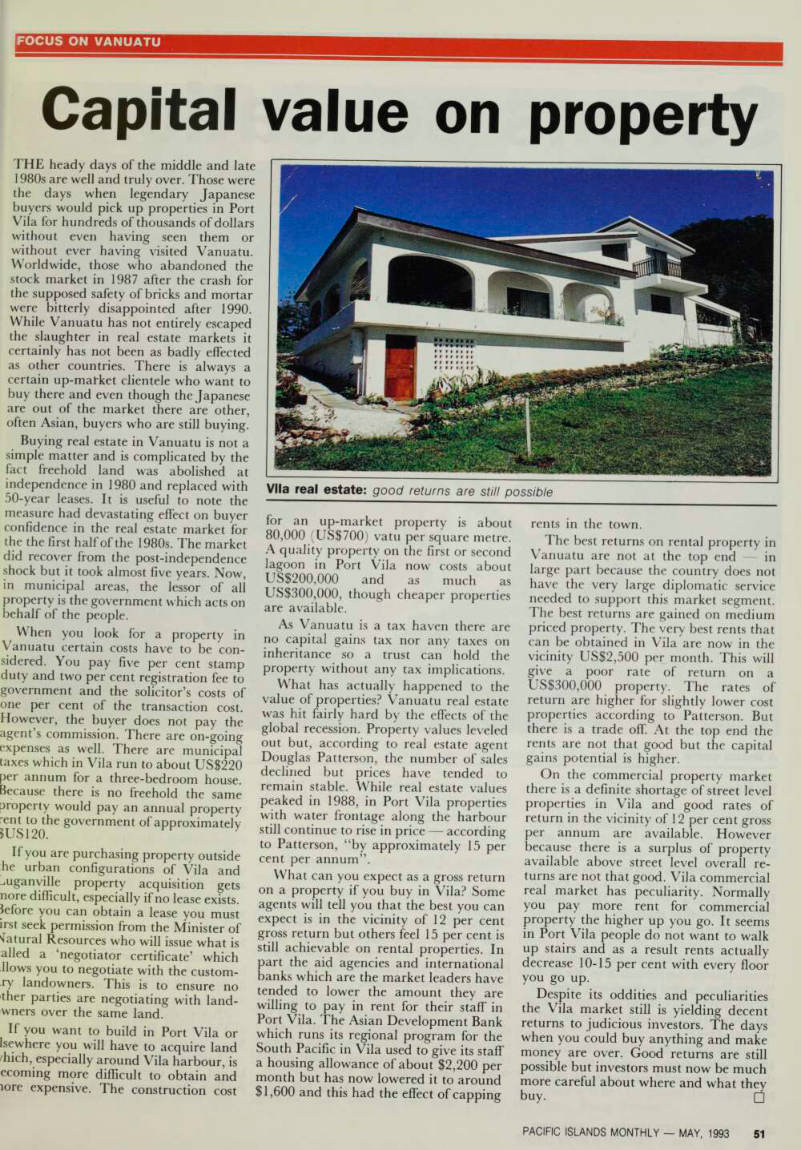
THE heady days of the middle and late 1980 s are well and truly over. Those were the days when legendary Japanese buyers would pick up properties in Port Vila for hundreds of thousands of dollars without even having seen them or without ever having visited Vanuatu.
Worldwide, those who abandoned the stock market in 1987 after the crash for the supposed safety of bricks and mortar were bitterly disappointed after 1990.
While Vanuatu has not entirely escaped the slaughter in real estate markets it certainly has not been as badly effected as other countries. There is always a certain up-matket clientele who want to buy there and even though the Japanese are out of the market there are other, often Asian, buyers who are still buying.
Buying real estate in Vanuatu is not a simple matter and is complicated by the fact freehold land was abolished at independence in 1980 and replaced with 50-year leases. It is useful to note the measure had devastating effect on buyer confidence in the real estate market for the the first half of the 1980 s. The market did recover from the post-independence shock but it took almost five years. Now, in municipal areas, the lessor of all property is the government which acts on behalf of the people.
When you look for a property in Vanuatu certain costs have to be con sidered. You pay five per cent stamp duty and two per cent registration fee to government and the solicitor’s costs of one per cent of the transaction cost.
However, the buyer does not pay the agent’s commission. There are on-going expenses as well. There are municipal taxes which in Vila run to about US$22O per annum for a three-bedroom house.
Because there is no freehold the same property would pay an annual property "ent to the government of approximated
&Usi2O. 7
If you are purchasing property outside he urban configurations of Vila and property acquisition gets nore difficult, especially if no lease exists, lefore you can obtain a lease you must irst seek permission from the Minister of Natural Resources who will issue what is ailed a ‘negotiator certificate’ which Hows you to negotiate with the custom er landowners. This is to ensure no ther parties are negotiating with land wners over the same land.
If you want to build in Port Vila or Isewhere you will have to acquire land ffiich, especially around Vila harbour, is ecoming more difficult to obtain and lore expensive. The construction cost
for an up-market property is about 80,000 (US$7OO) vatu per square metre.
A quality property on the first or second lagoon in Port Vila now costs about US$2OO,OOO and as much as
US$3OO,OOO, though cheaper properties
are available.
As Vanuatu is a tax haven there are no capital gains tax nor any taxes on inheritance so a trust can hold the property without any tax implications.
What has actually happened to the value of properties? Vanuatu real estate was hit fairly hard by the effects of the global recession. Property values leveled out but, according to real estate agent Douglas Patterson, the number of sales declined but prices have tended to remain stable. While real estate values peaked in 1988, in Port Vila properties with water frontage along the harbour still continue to rise in price according to Patterson, “by approximately 15 per cent per annum”.
What can you expect as a gross return on a property if you buy in Vila? Some agents will tell you that the best you can expect is in the vicinity of 12 per cent gross return but others feel 15 per cent is still achievable on rental properties. In part the aid agencies and international banks which are the market leaders have tended to lower the amount they are willing to pay in rent for their staff in Port Vila. The Asian Development Bank which runs its regional program for the South Pacific in Vila used to give its staff a housing allowance of about $2,200 per month but has now lowered it to around $1,600 and this had the effect of capping
rents in the town.
The best returns on rental property in Vanuatu are not at the top end in large part because the country does not have the very large diplomatic service needed to support this market segment.
The best returns are gained on medium priced property. The very best rents that can be obtained in Vila are now in the vicinity U 552,500 per month. This will give a poor rate of return on a US$3OO,OOO property. The rates of return are higher for slightly lower cost properties according to Patterson. But there is a trade off. At the top end the rents are not that good but the capital gains potential is higher.
On the commercial property market there is a definite shortage of street level properties in Vila and good rates of return in the vicinity of 12 per cent gross per annum are available. However because there is a surplus of property available above street level overall re turns are not that good. Vila commercial real market has peculiarity. Normally you pay more rent for commercial property the higher up you go. It seems in Port Vila people do not want to walk up stairs and as a result rents actually decrease 10-15 per cent with every floor you go up.
Despite its oddities and peculiarities the Vila market still is yielding decent returns to judicious investors. The days when you could buy anything and make money are over. Good returns are still possible but investors must now be much more careful about where and what they
buy. □
Vila real estate: good returns are still possible
Sevens sensation
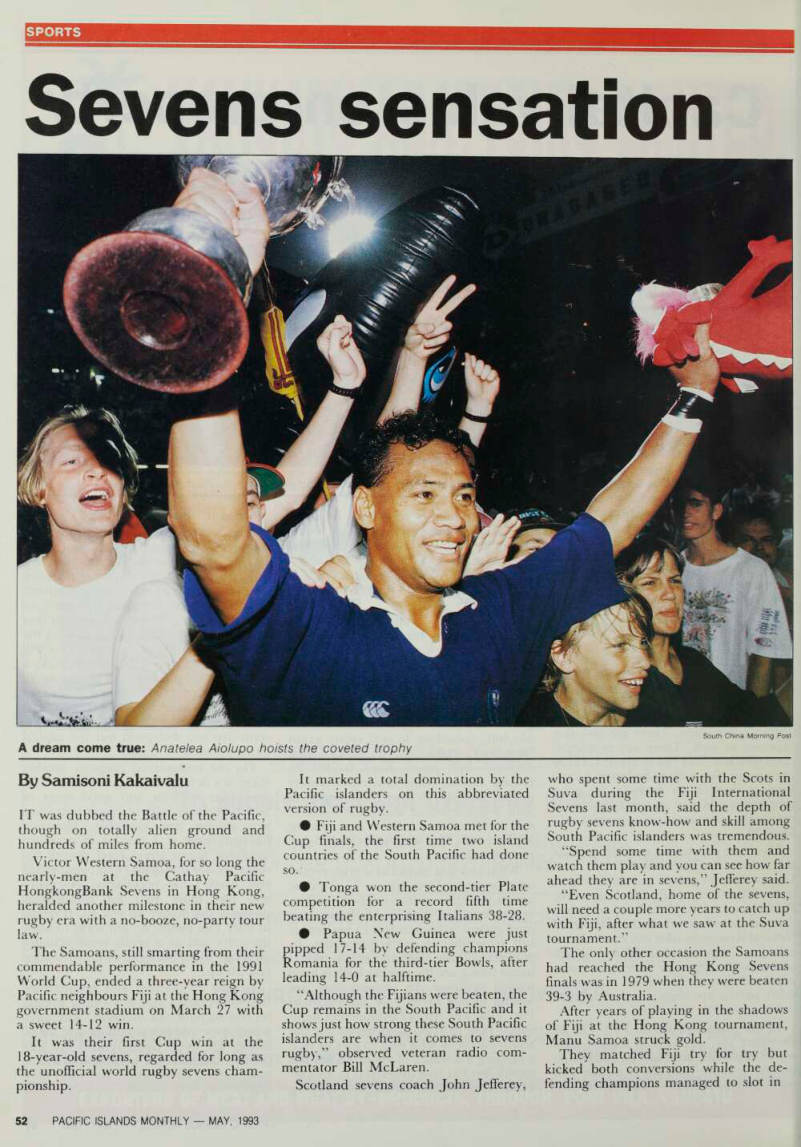
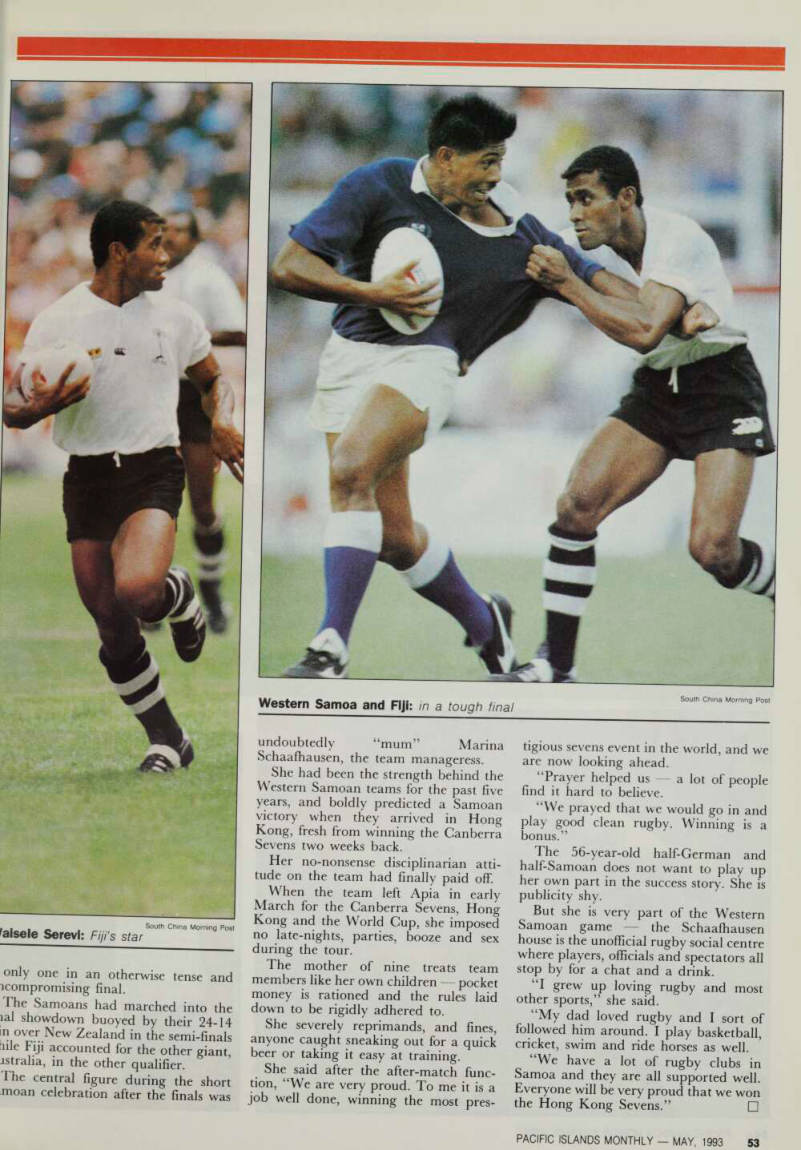
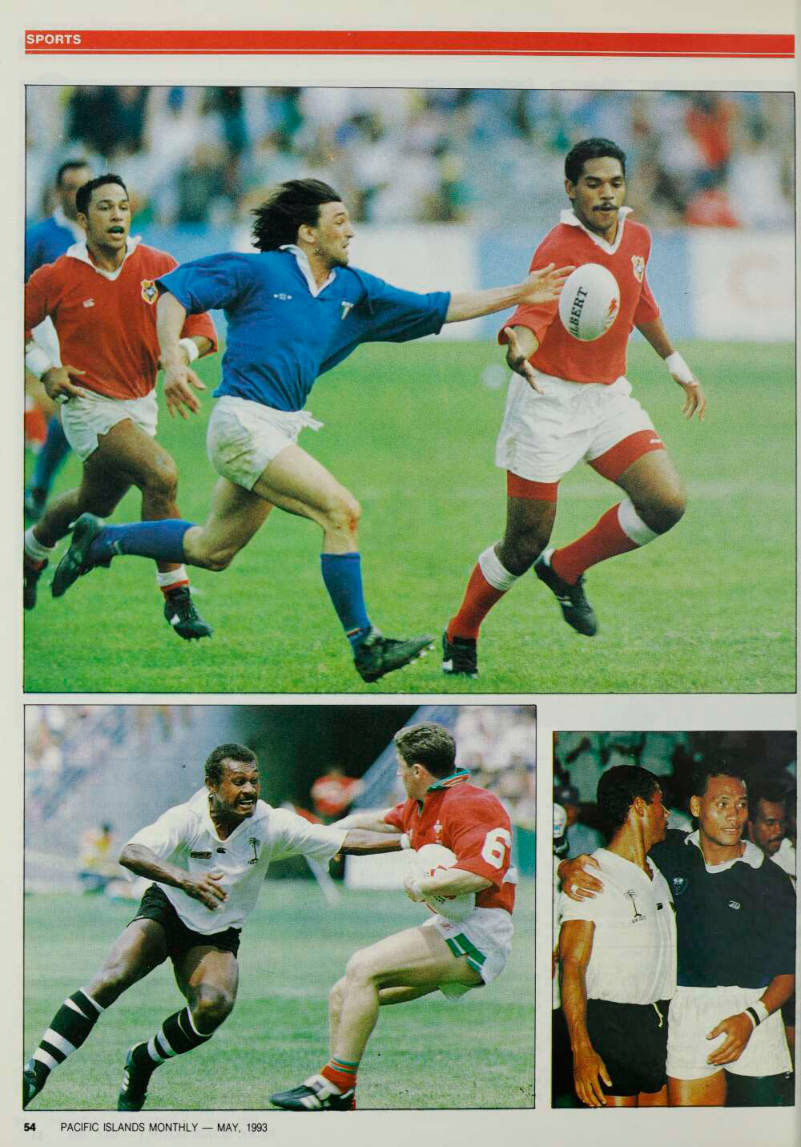
Sports
By Samisoni Kakaivalu
IT was dubbed the Battle of the Pacific, though on totally alien ground and hundreds of miles from home.
Victor Western Samoa, for so long the nearly-men at the Cathay Pacific Hongkongßank Sevens in Hong Kong, heralded another milestone in their new rugby era with a no-booze, no-party tour law.
The Samoans, still smarting from their commendable performance in the 1991 World Cup, ended a three-year reign by Pacific neighbours Fiji at the Hong Kong government stadium on March 27 with a sweet 14-12 win.
It was their first Cup win at the 18-year-old sevens, regarded for long as the unofficial world rugby sevens cham
pionship.
It marked a total domination by the Pacific islanders on this abbreviated version of rugby. • Fiji and Western Samoa met for the Cup finals, the first time two island countries of the South Pacific had done sq ‘ • Tonga, won the second-tier Plate competition for a record fifth time beating the enterprising Italians 38-28. • Papua New Guinea were just pipped 17-14 by defending champions Romania for the third-tier Bowls, after leading 14-0 at halftime.
“Although the Fijians were beaten, the Cup remains in the South Pacific and it shows just how strong these South Pacific islanders are when it comes to sevens ru gby, observed veteran radio commentator Bill McLaren.
Scotland sevens coach John Jefferey,
who spent some time with the Scots in Suva during the Fiji International Sevens last month, said the depth of rugby sevens know-how and skill among South Pacific ts.anders - tremendo^ Spend some time with them and watch them play and vou can see how far ahead they are in sevens,” Jefferey said. « Even Scotland? home of the seven s, need a couple more years to catc h U p wkh Fi - we saw at the Suva tournament.”
Xhe only other occasion the Samoans j^ ad reached the Hong Kong Sevens finals was in 1979 when they were beaten 39.3 by Australia.
After years of playing in the shadows of Fiji at the Hong Kong tournament, Mlanu Samoa struck gold.
They matched Fiji try for try but kicked both conversions while the de fending champions managed to slot in
South China Morning Post
A dream come true: Anatelea Aiolupo hoists the coveted trophy
only one in an otherwise tense and
icompromising final.
The Samoans had marched into the lal showdown buoyed by their 24-14 in over New Zealand in the semi-finals Fiji accounted for the other giant, jstralia, in the other qualifier.
The central figure during the short moan celebration after the finals was
undoubtedly “mum” Marina Schaafhausen, the team manageress.
She had been the strength behind the Western Samoan teams for the past five years, and boldly predicted a Samoan
victory when they arrived in Hong
Kong, fresh from winning the Canberra Sevens two weeks back.
Her no-nonsense disciplinarian atti tude on the team had finally paid off.
When the team left Apia in early March for the Canberra Sevens, Hong Kong and the World Cup, she imposed no late-nights, parties, booze and sex during the tour.
The mother of nine treats team members like her own children pocket money is rationed and the rules laid down to be rigidly adhered to.
She severely reprimands, and fines, anyone caught sneaking out for a quick beer or taking it easy at training.
She said after the after-match func tion, “We are very proud. To me it is a job well done, winning the most pres
tigious sevens event in the world, and we are now looking ahead.
“Prayer helped us a lot of people find it hard to believe.
“We prayed that we would go in and play good clean rugby. Winning is a bonus.”
The 56-year-old half-German and half-Samoan does not want to play up her own part in the success story. She is
publicity shy.
But she is very part of the Western Samoan game the Schaafhausen house is the unofficial rugby social centre where players, officials and spectators all stop by for a chat and a drink.
“I grew up loving rugby and most other sports,” she said.
“My dad loved rugby and I sort of followed him around. I play basketball, cricket, swim and ride horses as well.
“We have a lot of rugby clubs in Samoa and they are all supported well.
Everyone will be very proud that we won the Hong Kong Sevens.” □
South China Morning Post Salsele Serevi: Fiji’s star
Western Samoa and FIJI: in a tough final
South China Morning Post
Pacific gallivanter
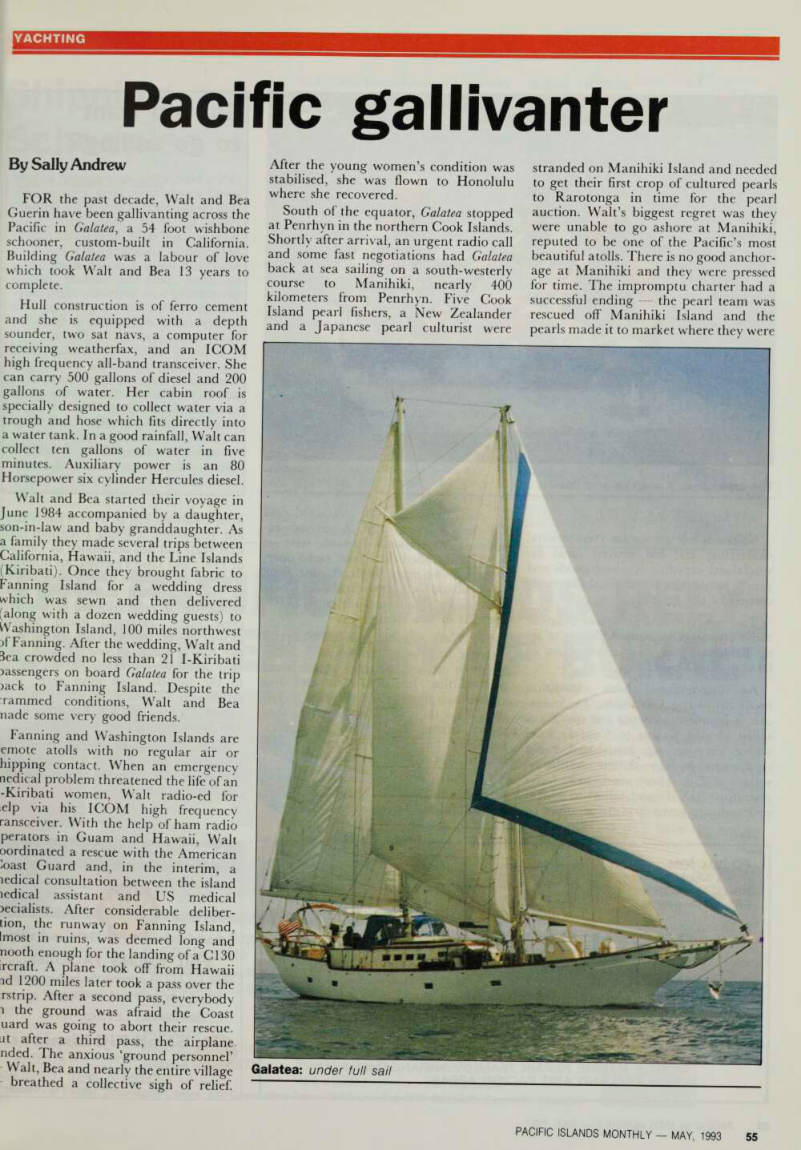
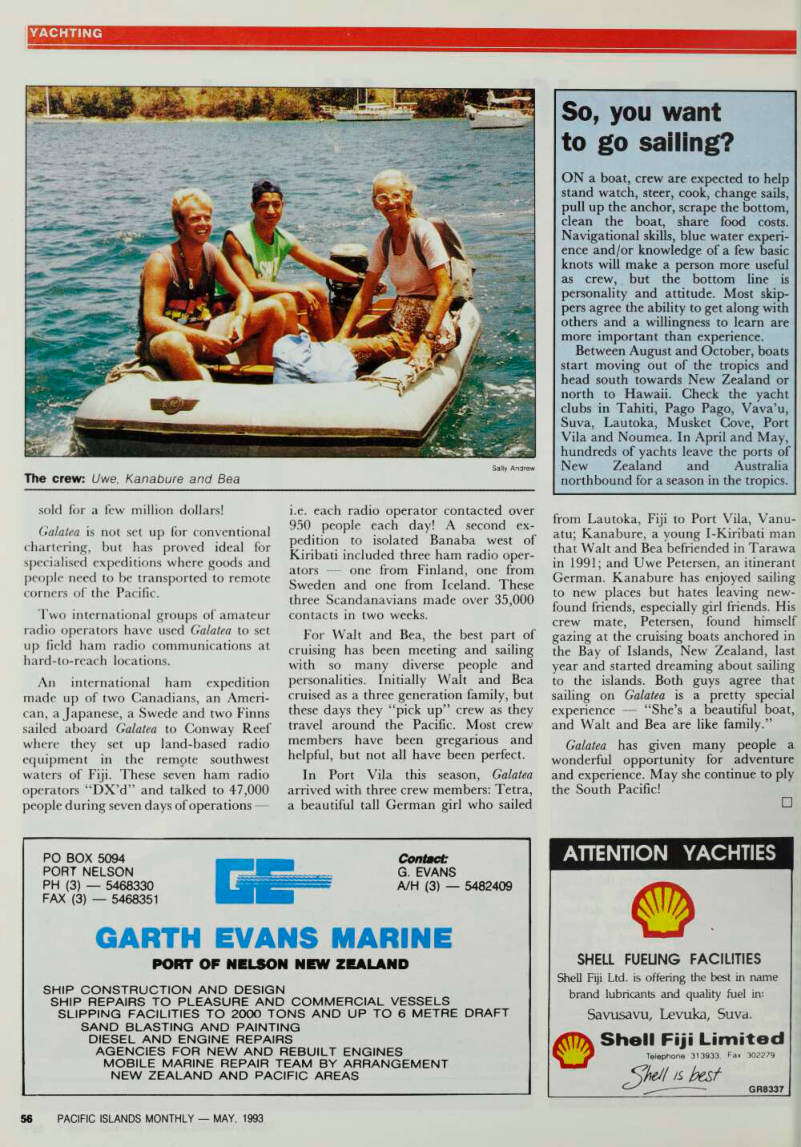
Yachting
By Sally Andrew
FOR the past decade, Walt and Bea Guerin have been gallivanting across the Pacific in Galatea , a 54 foot wishbone schooner, custom-built in California.
Building Galatea was a labour of love which took Walt and Bea 13 years to complete.
Hull construction is of ferro cement and she is equipped with a depth sounder, two sat navs, a computer for receiving weatherfax, and an ICOM high frequency all-band transceiver. She can carry 500 gallons of diesel and 200 gallons of water. Her cabin roof is specially designed to collect water via a trough and hose which fits directly into a water tank. In a good rainfall, Walt can collect ten gallons of water in five minutes. Auxiliary power is an 80 Horsepower six cylinder Hercules diesel.
Walt and Bea started their voyage in June 1984 accompanied by a daughter,
son-in-law and baby granddaughter. As
a family they made several trips between California, Hawaii, and the Line Islands
(Kiribati). Once they brought fabric to
Fanning Island for a wedding dress which was sewn and then delivered (along with a dozen wedding guests) to Washington Island, 100 miles northwest pf Fanning. After the wedding, Walt and Sea crowded no less than 21 I-Kiribati passengers on board Galatea for the trip
pack to Fanning Island. Despite the
:rammed conditions, Walt and Bea nade some very good friends.
Fanning and Washington Islands are emote atolls with no regular air or hipping contact. When an emergency nedical problem threatened the life of an -Kiribati women, Walt radio-ed for
elp via his ICOM high frequency
ransceiver. With the help of ham radio perators in Guam and Hawaii, Walt oordinated a rescue with the American Guard and, in the interim, a tedical consultation between the island icdical assistant and US medical pecialists. After considerable deliber tion, the runway on Fanning Island, Imost in ruins, was deemed long and nooth enough for the landing of a Cl 30 ircraft. A plane took off from Hawaii id 1200 miles later took a pass over the rstrip. After a second pass, everybody i the ground was afraid the Coast uard was going to abort their rescue, it after a third pass, the airplane nded. The anxious ‘ground personnel’
Walt, Bea and nearly the entire village breathed a collective sigh of relief.
After the young women’s condition was stabilised, she was flown to Honolulu where she recovered.
South of the equator, Galatea stopped at Penrhyn in the northern Cook Islands.
Shortly after arrival, an urgent radio call and some fast negotiations had Galatea back at sea sailing on a south-westerly course to Manihiki, nearly 400 kilometers from Penrhyn. Five Cook Island pearl fishers, a New Zealander and a Japanese pearl culturist were
stranded on Manihiki Island and needed to get their first crop of cultured pearls to Rarotonga in time for the pearl auction. Walt’s biggest regret was they were unable to go ashore at Manihiki, reputed to be one of the Pacific’s most beautiful atolls. There is no good anchor age at Manihiki and they were pressed for time. The impromptu charter had a successful ending the pearl team was rescued off Manihiki Island and the pearls made it to market where they were
Galatea: under full sail
sold for a few million dollars!
Galatea is not set up for conventional chartering, but has proved ideal for specialised expeditions where goods and people need to be transported to remote corners of the Pacific.
Two international groups of amateur radio operators have used Galatea to set up field ham radio communications at hard-to-reach locations.
An international ham expedition made up of two Canadians, an Ameri can, a Japanese, a Swede and two Finns sailed aboard Galatea to Conway Reef where they set up land-based radio equipment in the remote southwest waters of Fiji. These seven ham radio operators “DX’d” and talked to 47,000 people during seven days of operations
i.e. each radio operator contacted over 950 people each day! A second ex pedition to isolated Banaba west of Kiribati included three ham radio oper ators one from Finland, one from Sweden and one from Iceland. These three Scandanavians made over 35,000 contacts in two weeks.
For Walt and Bea, the best part of cruising has been meeting and sailing with so many diverse people and personalities. Initially Walt and Bea cruised as a three generation family, but these days they “pick up” crew as they travel around the Pacific. Most crew members have been gregarious and helpful, but not all have been perfect.
In Port Vila this season, Galatea arrived with three crew members: Tetra, a beautiful tall German girl who sailed
from Lautoka, Fiji to Port Vila, Vanu atu; Kanabure, a young I-Kiribati man that Walt and Bea befriended in Tarawa in 1991; and Uwe Petersen, an itinerant German. Kanabure has enjoyed sailing to new places but hates leaving new found friends, especially girl friends. His crew mate, Petersen, found himself gazing at the cruising boats anchored in the Bay of Islands, New Zealand, last year and started dreaming about sailing to the islands. Both guys agree that sailing on Galatea is a pretty special experience “She’s a beautiful boat, and Walt and Bea are like family.”
Galatea has given many people a wonderful opportunity for adventure and experience. May she continue to ply the South Pacific!
The crew: Uwe, Kanabure and Bea
Sally Andrew
to go sailing?
So, you want to go sailing?
ON a boat, crew are expected to help stand watch, steer, cook, change sails, pull up the anchor, scrape the bottom, clean the boat, share food costs.
Navigational skills, blue water experi ence and/or knowledge of a few basic knots will make a person more useful as crew, but the bottom line is personality and attitude. Most skip pers agree the ability to get along with others and a willingness to learn are more important than experience.
Between August and October, boats start moving out of the tropics and head south towards New Zealand or north to Hawaii. Check the yacht clubs in Tahiti, Pago Pago, Vava’u, Suva, Lautoka, Musket Cove, Port Vila and Noumea. In April and May, hundreds of yachts leave the ports of New Zealand and Australia northbound for a season in the tropics.
Advertisements & other items, p. 56 (2 items)
n best
ATTENTION YACHTIES
SHELL FUEUNG FACILITIES
Shell Fiji Ltd. is offering the best in name brand lubricants and quality fuel in: Savusavu, Levuka, Suva.
Shell Fiji Limited Telephone 313933. Fax 302279 0
n best
GR8337
Garth Evans Marine
PO BOX 5094 Contact
PORT NELSON G. EVANS
PH (3) 5468330 A/H (3) 5482409
FAX (3) 5468351
GARTH EVANS MARINE
PORT OP NELSON NEW ZEALAND
SHIP CONSTRUCTION AND DESIGN
SHIP REPAIRS TO PLEASURE AND COMMERCIAL VESSELS SLIPPING FACILITIES TO 2000 TONS AND UP TO 6 METRE DRAFT
SAND BLASTING AND PAINTING
DIESEL AND ENGINE REPAIRS
AGENCIES FOR NEW AND REBUILT ENGINES
MOBILE MARINE REPAIR TEAM BY ARRANGEMENT
NEW ZEALAND AND PACIFIC AREAS
Shipping
Schedules
New Zealand - Fiji direct Sofrana Unilines operates a fully containerised/breakbulk service every 21 days from Auckland, Tauranga, Lyttleton to Suva and Lautoka. Loading every 21 days, ro/ro service, containers - reefer. Contact Sofrana Unilines, Sofrana House. 101 Customs Street, Auckland, PO Box 3614, Fax (09) 393874, Ph (09) 773279, Tlx NZ 2313. Direct toll free line 0800 659-922, Contact Alan Foote. Sofrana Shipping Agencies, PO Box 921 Wellington, Tel (04) 725 661, Fax (04) 725 749, Tlx NZ 4769 Contact Steve Brannigan. Sofrana Unilines Agencies, PO Box 22046 Christchurch, tel (03) 567 180, Fax (03) 668 868, TLX NZ4769, Contact Cony Newell. Carpenters Shipping, Private Mail Bag. Suva, Fiji, Tel (679) 312244, Fax (679) 101572, Tlx FJ 2199. Sofrana Unilines, Suva, Fiji, fel (679) 315645, Fax (679) 300057.
Australia - Fiji direct Sofrana Unilines operates a ro/ro container ervice every three weeks from Melbourne, iydney, Brisbane, Lautoka and Suva. Contact ofrana Unilines (Aust) Pty Ltd, PO Box Q 136,
)uecn Victoria Building, Sydnev, NSW 2000,
lustralia. Tel (02) 2648944, Fax' (02) 2676547,
Fix (71) A 170090, Contact Andrew McLachlin, Sam Attaway.
Carpenters Shipping, Suva, Tel (679) 312244, Fax (679) 301572. Sofrana Unilines Suva, Tel (679) 315 645, Fax (679) 300057. Carpenters Shipping, Lautoka, Tel (679) 63988, Fax (679) 664896. Sofrana Unilines, Lautoka Tel 679 662921, Fax (679) 664896.
Australia - Fiji monthly service Sofrana Unilines (Australia) Pty Ltd operates a regular monthly service with MV Cafiilaine Wallis. Contact Sofrana Unilines, Sydney, Tel (02) 2648944, Tlx AA170090, Fax (02) 267-6547. Carpenters Shipping, Suva, Fiji, Tel (679) 312244, Fax *679; 301572, Sofrana Unilines, Suva, Fiji Tel (679) 315645, Fax (679) 300057. Carpenters Shipping, Lautoka. Tel (679) 63988, Fax (679) 664896. Sofrana Uni lines, Lautoka, Fiji, Tel (679) 662921, Fax (679) 664896.
Far-East - Fiji - New Zealand Service New Zealand Unit Express (NZUE) operates a monthly service accepting containerised and break-bulk cargoes from Manila, Keelung, Kaoshiung, Hong Kong, Lae to Suva, Lautoka (via Suva) and thence to New Zealand ports.
Contact Carpenters Shipping Suva, Fiji, tel
(679) 312244, fax (679) 301572. New Zealand Unit Express, Maritime Building, 2-10 Customs House Quay, PO Box 890, Wellington. Tel 727865, Cables Enzue Man, Wellington, Tlx NZ31340 Nedlnz or Nedlloyd Swire Pty Ltd,
Sydney, Tel 20522.
Japan - South Pacific Service Same as Burns Philp Japan - South Pacific Service - Kyowa Shipping Co Ltd Kyowa Shipping, Shipping Co Ltd provides a
monthly containerised service from Hong Kong
to main ports of Japan, Saipan, Guam, Island ports, Lautoka, Suva via Nukualofa to Pago
Pago and Apia. Contact Carpenters Shipping,
Neptune House, 3/4 floor, Tofuaa Street, Waiu Bay, Suva. Tel 312244, Fax 301572, Tlx FJ2199.
Europe - Pacific Service Nedlloyd offers cargo services from Continen tal Ports to Papeete, Fiji, New Caledonia and Doniambo on slot basis with Bank line. Contact Nedlloyd (Aust) Pty Ltd, Spring Street, Sydney, Tel 273801. Carpenters Shipping, Suva, tel 312244, Tlx FJ2199, Fax 301572. Carpenters Shipping, Lautoka, Tel 663988, Tlx FJ5215, Fax 664896.
South East Asia - Fiji Service Nedlloyd Lines (NZEAS) Service operates regular fast cargo service from Jakarta, Pt
Keelang, Singapore, Bangkok, Surubaya via
Auckland to Suva and Lautoka. Contact Carpenters Shipping, Suva, Tel 312244, Tlx
FJ2199, Fax 301572. Carpenters Shipping,
Lautoka Tel 663988, Tlx FJ5215, Fax 663988
South East Asia - Mid South Pacific Columbus Line operates a regular container and breakbulk-heavy lift ser vice from/to Hongkong/Taiwan/Manila/
Singapore/Malaysia/Thailand/Indon
esia to Port Moresby/Lae/Rabaul/ Kimbe/Madang/Newark/Honiara and Noro. Contact Express Freight, Lae, POB 3398, phone 423913 or 423822, fax 425193.
Far East - Mid South Pacific China Navigations New Guinea Pa cific Line operates a regular container and breakbulk heavy lift service from Hong Kong, Taiwan, Manila, Singa pore, Malaysia, Thailand to Port Moresby, Lae, Rabaul, Kieta and Honi ara. Cargo from the same eastern ports to the South Pacific Ports of Noumea, Santo, Vila, Papeete, PagoPago, Apia, Nukualofa, Rarotonga and Tarawa will be shipped via Japan or Busan on the monthly Bali Hai Service. Contact
Steamships Shipping, Port Moresby, PO
Box 634, Tel 220283 or 220289. Tasman Asia operate a 20-day frequency fixed date service, shipping breakbulk and containerised cargoes from Japan, Korea, Taiwan and Hong Kong to Suva and Lautoka (via Suva). Fiji agents are Forum Shipping Agencies in Suva, Tel
315444, and Lautoka 660577.
Australia - New Caledonia - Fiji - Samoas - Tonga Pacific Forum Line operates a fully containerised service (general, reefer and ro-ro) from Sydney and Brisbane to Noumea, Lautoka, Suva, Apia, Pago
Pago, Nuku’alofa, Sydney. Cargo cen
tralised from Adelaide and Melbourne.
Contact: Pacific Forum Line, PO Box 796, Auckland; Union Bulkships, 333 George St, Sydney, Brisbane and Mel bourne; Union Co, Lautoka; Pacific Forum Line, Suva, Nuku’alofa; Pacific Forum Line, Apia; Polynesia Shipping, Pago Pago. Sofrana Unilines operates a roro/container service every three weeks from Melbourne, Sydney and Brisbane to Noumea, Suva and Lautoka with transhipment to the Samoas and Tonga.
New Zealand - Australia - PNG - Solomon Islands Pacific Forum Line operates a containerised and ro-ro service from Lyttlcton, Napier and Auckland to Brisbane, Port Moresby, Lae, Honiara, Brisbane then to New Zealand. Contact: Pacific Forum, Auckland, Christchurch; Union Bulkships, Brisbane; Steamships Shipping Port Moresby and Lae Sullivan Ltd, Honiara; Seabridge, Wellington.
NZ - Fiji Translink Pacific Shipping Fiji Agents are; Campbells Shipping Agency Ltd, Ph 314189 Fax 300144 Suva; Ph 662231 Fax 662251 Lautoka. Auckland Agents: McKay Shipping Ph {9) 390229 Fax (9) 3032931. Tauranga Agents, seatrade agencies Ph (75) 754989 Fax (75) 758380.
NZ - Fiji - Pago - Apia - Nuk Translink Pacific Shipping operates a monthly sailing with Polynesian Link, which carries Dry Container, reefers and breakbulk cargoes. NZ Agents McKay Shipping Shipping AKLD Ph 390229, Fax 3032931. Fiji Agents Campbells Shipping Agency & ltd Ph 314189 Fax 300144 NZ - Noumea - Wallis - Futuna Translink Pacific Agency operate a container Breakbulk service once a month from NZ through Fiji and Noumea to Wallis & Futuna.
South East Asia - Fiji - Noumea - Papeete - Chile Service “Seaspac” A joint Chilean CCNI/ CSAU Service offers a regular monthly sailing from Djakarta and Singapore to Noumea, Fiji, Papeete, and Chile. Cargo also federated to Singapore from Korea,
Hong Kong, Taiwan, Malaysia, Bang
kok. Fiji Agents: Campbells Shipping Agency Ltd, ph. 314189, Fax 300144.
Australia - Fiji Service Barbican Line operate a monthly container service from Australia to Fiji.
Fiji Agents Campbells Shipping
Agency Ltd Ph 314189 Fax 300144.
Australia - Fiji - Noumea - Vila - Santa Marsmond Express Lines operate a breakbulk service from Goodwood Island Australia to Fiji, Noumea, Vila Santo and Honiara. Continuous receiv ing depots in Sydney and Brisbane enable this vessel to bring cargoes from these parts. Fiji Agents Campbells
Shipping Agency Ltd, ph. 314189, Fax
300144. Brisbane Agents Shippings & Marketing Ph (7) 2628082. Sydney Agents Seabord Agencies (2) 3172325.
Australia - New Caledonia - Fiji - Hawaii - North America ACT Pace Pacific (ACTA Shipping) operates a fully containerised/break bulk service every 17-20 from Melbourne, Sydney, Brisbane to Noumea, Suva and Lautoka. The vessels continue on to the West Coast of North America calling Honolulu at frequent intervals. ACTA Pty Ltd, Sydney Ph 2869666, Tx 121369, Fx 2869610. □
Advertisements & other items, pp. 57-60 (1 item)
The Pacific Islands Rely
ON THE ENERGY OF BORAL
m i fm lerican Samoa (684) ima 699 2948 16442170 ok Islands (682) otonga 24460 (679) ra315522 itoka 60088 atoka 50578 asa 82973 Norfolk Islands (6723) Norfolk Island 2419 Papua New Guinea (675) Port Moresby 214248 Lae 422574 Rabaul 921225 WewakB62l2s Mount Hagen 551216 Solomon Islands (677) Honiara 21833 All through the Pacific Islands, people rely on Boral LP gas for their energy needs Boral has terminals throughout the area, and is proud to be a leading supplier.
Boral Gas is clean, efficient and low in cost.
It’s the ideal energy source for cooking and water beating in homes, motels and hotels, and for a wide range of industrial uses.
So call for Boral Gas. We have the energy you’re looking for.
Tonga(676) Nukualofa 24035 Vava'u 22903 Vanuatu (678) Santo 36455 Port Vila 22046
BORAL GAS
r. *— w •uvauiwuj ron vna Bora] Gas Pacific .John Oxley Ce ntre, 339 Coronation Drive, Brisbane. Tel: (07) 3671365. Faa: (07) 3694347 I
KYOWA
KYOWA
SHIPPING
CO., LTD.
Liner Service to Paciffic Islands
FROM OJAPAN
OKOREA
OTAIWAN
O THAILAND
TO O SAIPAN
OFEDERATED STATES
OF MICRONESIA
OMARSHAL ISLANDS
O AMERICAN SAMOA
ONEW CALEDONIA
O FIJI
OHONG KONG
OSINGAPORE
OPHILIPPINES
O MALAYSIA
©INDONESIA
OGUAM
OYAP
OPALAU
OWESTERN SAMOA
OSOLOMON ISLANDS
OVANUATU
OPAPUA NEW GUINEA
HEAD OFFICE
6th Floor , Kikushima Bldg 2-3. Hamamatsucho 2-chome. Mmalo-ku, Tokyo 105, Japan Phone: 03(437)2885 (Rep ) Cable*; "MARIQUEEN Tokyo Tele*: 242-4651 Kyowa J
OSAKA OFFICE
Dai San Fuji Bldg , 3-13, Itachibon 1-chome, Osaka 550 Phone: 06(533)5821 (Rep ) Cables: MARIQUEEN" Osaka Telex: 525-6271 Ssiosa J.
Cm
ACIFI
ISLANDS
6AARK6T PLfIC
For the benefit of our readers who would like to place a small classified advertisement in our magazine, Market Place will assist you in selling personal items, accommodation, real estate boating or a service ... in fact anything you would like to sell to our over 50,000 readers Market Place Advertising Rates are structured to allow you to place as many advertisements as you wish, economically.
VACANCY
ENVIRONMENTAL
COORDINATOR
The Foundation for the Peoples of the South Pacific seeks an ENVIRONMENTAL COORDINATOR to conduct resource assessments, work with communities to develop and implement their own private-enterprise responses to environmental threats, and provide environmental education for rural communities.
Required qualifications: Master’s degree in resource management or environmental field plus 2 years experience (preferably in the South Pacific), or Bachelor’s and 5 years experience; knowledge of ecosystem science and resource management; fluency in written and spoken English; fluency in one or more Melanesian Pidgin languages; self-direction; and willingness to travel throughout the South Pacific. Experience with community-based resource management, conservation, or environmental education would be an advantage Contract will be 27 months, beginning June, 1993, based in Port Vila, Vanuatu. Respond with CV, names and phone numbers of three references before May 15 to: Dr. N. Devoe, P.O. Box 951, Port Vila, Vanuatu (FAX 678-24510, Phone 678-22915).
PACIFIC
ISLANDS
Iv*OA T H L Y
MfIRK€T PLflC€ CAN UJORK
UJOND6RS FOR VOU ...
Promote your business, or service, sell your household
items, cars or heavy machinery
etc.
ONLY AUSSI PER WORD.
NO COMPANY LOGO. NO
DISPLAY. NO BOLD TYPE.
Just forward your Advertisement together with payment to: PACIFIC ISLANDS MONTHLY “Market Place", P.O. Box 1167, Suva, Fiji.
CONDITIONS:
1. All Advertisements are subject to acceptance and approval of publisher. 2. Advertisements are published as space permits; we cannot guarantee date of insertion. 3. All advertisements must be prepaid and should be typed or printed clearly. 4. Deadline for receipt of advertisements is the 10th of the month prior to issue.
5. PACIFIC ISLANDS MONTHLY
assumes no responsibility for any service other than publishing paid advertisements in this section.
'ou CAN earn $1 million p.a. MLM Ground loor Opportunity specialising in health and lutrition products. In 16 countries and expandig rapidly. Top products and company support. >end sase to AGM, 96 Sugarloaf Road, Jeilston Bay, Australia, 7016 or Fax >lO2 471026.
WOMEN BE LIBERATED
)on’t carry water anymore
EVERYMANS TANK
1,600 litres of rainwater Easy to carry and install
GUTTER + TANK + PUMP
Complete package weighs 15 kgs )elivered by post VRITE Dr Hohl, 14 Surrey Court, Helensvale, Qld., 4210,
AUSTRALIA
ax No 61 75 731649
COLLECTORS MODEL CARS
Diecast model cars: CORGI, BRUMM, PROGETTO K, BEST, RAE and others. Please write or fax for lists:
MESSAGE MODELS,
P.O. Box 239,
NORTHBRIDGE, N.S.W., 2063,
AUSTRALIA.
Fax. +6l-2-967 2216 Telephone +6l-2-958 2315
SCRAP METAL
Tall ingots operate from Brisbane, Australia and make frequent visits to the Pacific Islands which they have done for twenty-five years. We are buyers of Copper, Brass, Aluminium, Lead, Cable etc. Inspection no problems. Telephone 61 7 8922033. Fax 61 78922077
BUSINESS
Manufacturing Engineer with management, commercial, trading, business development experience in Island Countries seeks employment in Asia Pacific Region. US & Aussie Citizen; Box 411, Glebe, Australia 2037, ANS
SERV +6l/2/552-0035.
V / C ’'9c_
WITH THE
CROWD?
s r-^
MITSUBISHI
Introducing the All New Mitsubishi Galant — Beautifully Engineered for the Way You Drive Although the new Galant is probably the most handsome new car on the road, its true beauty lies in its sheer driveability. It’s probably the first car ever that gives you the freedom to drive exactly how you choose. With a sporty, dynamic personality, it has the energy to set your adrenaline flowing when you want to drive for fun. Yet for an effortless drive home at the end of a long day, it has the smoothness and comfort you’d expect in a quality saloon. Quite how you drive the new Galant is entirely up to you.
The key to the new Galant’s versatile performance is All Wheel Control, a unique approach to car design that puts your needs first. It works on the principle that every move a car makes, from accelerating to cornering, depends on how well your aims get passed to the road—and that hinges on all four wheels working as effectively as they can, to direct, manipulate and control. With true communication between you and the road, the new Galant guarantees total control with quicker, safer and more responsive performance than ever before imaginable.
The All Wheel Control vision is brought to reality in the new Galant by some of the most advanced automotive technology ever developed. From the first ever four wheel multi-link suspension system on a front engine, front wheel drive car to some of the world’s most intelligent computer control systems, the Galant boasts breakthroughs that ensure a smooth, responsive drive in any conditions. And with a range of newly developed 1.8-litre SOHC to 2.0-litre V 6 DOHC you can count on the power for the to drive as you choose. /fx** ' Qc' Discover the of 4d wing freedom the new Mitsubishi GW&t — ill Wheel Control sets you apart frorq the crowd. ‘*93 —• Mitsubishi Motors and drivers who care —creating
together.
The All New
MITSUBISHI GRLRNT
A AMERICAN SAMOA: PACIFIC MARKETING INC. RO. Box 698, Pago Pago, Tel. 699 9140/ AUSTRALIA: MITSUBISHI MOTORS AUSTRALIA LTD. 1284 South Road, Clovelly Park, South Australia, Tel. (08) 2757297 / FUI; NIVIS MOTOR & MACHINERY CO. LTD. G.RO Box 150, Suva, Tel 383411 1 GUAM: TRIPPLE J ENTERPRISES INC. PO Box 6066, Tamuning, Tel 6469126 / NEW CALEDONIA: SOCIETE DTMPORTATION D'AUTD DU PACIFIQUE SUD S.A. PO. Box 2548, Noumea, Tel. 274144 / NEW ZEALAND: MITSUBISHI MOTORS NEW ZEALAND LTD. Private Bag. Porirua, Tel. 237-0109 / NORFOLK ISLAND: BORRY'S PTY LTD. PO. Box 169, Tel. 2114 /PAPUA NEW GUINEA: TO BA PTY LTD. RO. Box 503, Port Moresby, Tel. 217874 /SAIPAN: AUTO MOTION INC. RO. Box 569, SKV Dist. 4, Tel 234 3332 I SOLOMON ISLANDS: HARVEST PACIFIC LTD. G.RO. Box 823, Honiara, Tel 30407 /TAHITI (FRENCH POLYNESIA): SOPADEP S.A. RO. Box 1617 Papeete, Tel. 427393 1 TONGA: SITANI MAFI CO., LTD. RO. Box 83, Nuku'Alota, Tel 24044 /VANUATU: SOCOMETRA VANUATU LTD. B.R 06, Route de Lagon, Port Vila, Tel. 2314 /WESTERN SAMOA: MOTOR DISTRIBUTORS (SAMOA) LTD. RO. Box 576, Apia, Tel. 20957
MITSUBISHI
MOTORS
CREATING TOGETHI