Pacific
Islands
Monthly
Inside:
• Special report on Pacific media; • Papua New Guinea’s mining dilemma; • New Zealand a Pacific partner
April 1993
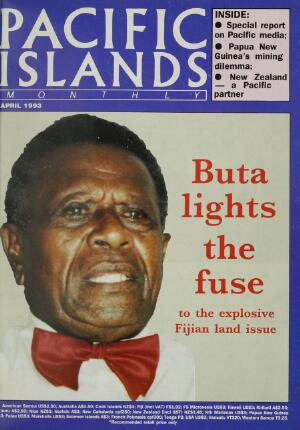
Buta
lights
the fuse to the explosive Fijian land issue
American Samoa US$2.5O; Australia A 53.50; Cook Islands NZ$3; FIJI (Incl VAT) F 51.92; FS Micronesia US$3; Hawaii US$3; Kiribati A 52.50; auru A 52.50; Niue NZ$3; Norfolk As 3; New Caledonia cpf2so; New Zealand (Incl GST) NZ53.45; Nth Marianas US$3; Papua New Guinea 3; Palau US$3; Marshalls US$3; Solomon islands As 3; French Polynesia cpf3oo; Tonga P 3; USA US$3; Vanuatu VT22O; Western Samoa T 3.25. * Recommended retail price only
Advertisements & other items, p. 2 (1 item)
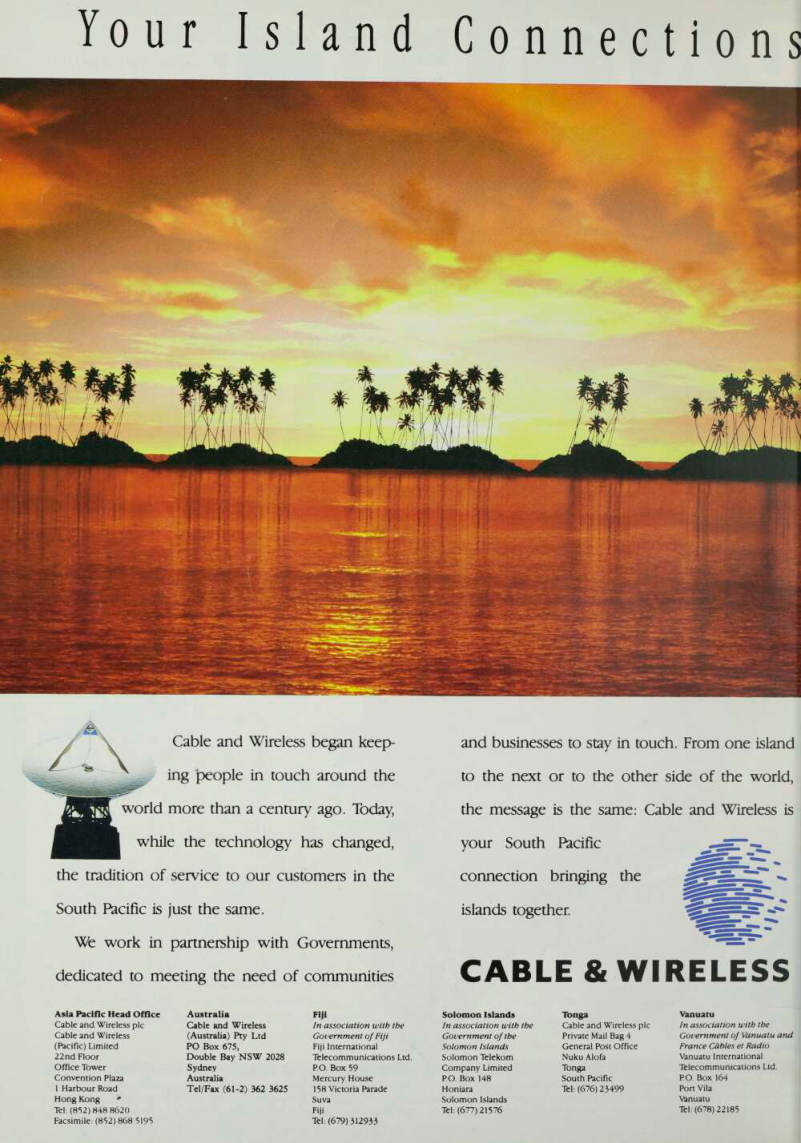
Cable & Wireless
Cable and Wireless began keep-
ing people in touch around the
world more than a century ago. Today,
while the technology has changed,
the tradition of service to our customers in the
South Pacific is just the same.
We work in partnership with Governments,
dedicated to meeting the need of communities and businesses to stay in touch. From one island to the next or to the other side of the world, the message is the same: Cable and Wireless is
your South Pacific
connection bringing the
islands together.
CABLE & WIRELESS
Asia Pacific Head Office Cable and Wireless pic Cable and Wireless (Pacific) Limited 22nd Floor Office Tower Convention Plaza 1 Harbour Road Hong Kong Tel: (852) 848 8620 Facsimile: (852) 868 5195 Australia Cable and Wireless (Australia) Pty Ltd PO Box 675, Double Bay NSW 2028 Sydney Australia Tel/Fax (61-2) 362 3625 Fiji In association with the Government of Fiji Fiji International Telecommunications Ltd.
PO Box 59 Mercury House 158 Victoria Parade Suva Fiji Tel: (679) 312933 Solomon Islands In association with the Government of the Solomon Islands Solomon Telekom Company Limited PO. Box 148 Honiara Solomon Islands Tel: (677) 21576 Tonga Cable and Wireless pic Private Mail Bag 4 General Post Office Nuku Alofa Tonga South Pacific Tel: (676) 23499 Vanuatu In association with the Government of Vanuatu and France Cdbles et Radio Vanuatu International Telecommunications Ltd.
P.O. Box 164 Port Vila Mmuatu Tel: (678) 22185
Pacific
Islands
Monthly
Vol 63 No. 4
The News Magazine
April 1993
From The
Editor’S Desk 4
Letters 5
Headlines 6
3Usiness
/leasuring up debts 11 Sputtering unions 12
le mines are rumbling 13 ourting the Asian tigers 15 iving landowners equity 17
Ougainville
window opened 19
Cover Story
psIOLand of discontent 20
Women
Cries from mothers of the land 24
Special Report
A blow to free press 26 Pohiva sued 29 Greater freedom 30 Ownership concerns 31
Science
Refugees on remote volcanoes 34
Profile
The Sunias’ rise from the ashes 36
Arts
An explosion of colour 40
New Zealand - A Pacific
Partner 42
Yachting
Ranthe Vua! 60
Shipping
Shipping schedules 61
Columnists
Bill McCabe 8 David Barber 9 Jemima Garrett 18 Alfred Sasako 39 Futa Helu 29
üblisher: Brian O’Flaherty ditor: Mala Jagmohan enior Writer: Martin Tiffany orrespondents: hristine Hatcher, David North, Ed Rampell, lan illiams, Johnson Honimae, Karen Mangnall, Liz lompson, Nicholas Rothwell, Pesi Fonua, Wally iambohn.
Dlumnists: David Barber (Wellington), Futa Helu onga, covering the Pacific Islands), Jemima arrett (Sydney), Margot O'Neill (Washington), lian Moti (Pacific Law), Alfred Sasako (The >rum). usiness and Advertising Manager, Charlotte lomas
Advertising Sales: • Regional Sales (South Pacific); Salendra Narayan, Tel (679) 304111, Fx (679) 303809 • Sydney, Canberra. Bob Hill Media Represen tations, Tel (61-2) 4164245, Fx (61-2) 4165064 • Brisbane: Robert Walker, Media House, Tel (61-7) 3710533, Fx (61-7) 371-8904 • Adelaide: Hastwell Williamsons Representations, Tel (61-8) 799522, Fx (61-8) 799735 • Melbourne: Brown Orr Fletcher Burrows (Aust).
Pty. Ltd. Tel (3) 696 5188 Fx (03) 696 5131. • Auckland: McKay International Media Reps Ltd, Tel (64-9) 4190561. Fx (64-9) 4192243 • Japan; Universal Media Corporation, Tokyo, Tel (3) 6663036, 6663094, Cable: UNIMEDIA Tokyo, Tx 2524665.
Founded 1930 (DSPS 952480). A Fiji Times Limited production.
Cover prices are recommended retail only. Regis tered by Australia Post, Publication No. NBP 1210. © Copyright Fiji Times Limited, 177 Victoria Parade, Suva. Fiji. Tel (679) 304111, Fx (679)
303809. Tx Fj2124.
Pacific Islands Monthly is published monthly by The Fiji Times Limited, a division of Nationwide News, 2 Holt Street, Surry Hills, Sydney, NSW 2010.
Send address changes to: • Pacific Islands Monthly, PO Box 1167, Suva, Fiji.
Typeset and printed by The Fiji Times Limited, 177 Victoria Parade, Suva, Fiji.
[?]others: the Bougainville story
Martin Tiffany Media: How free is the region?
New Zealand: Looking at the South Pacific
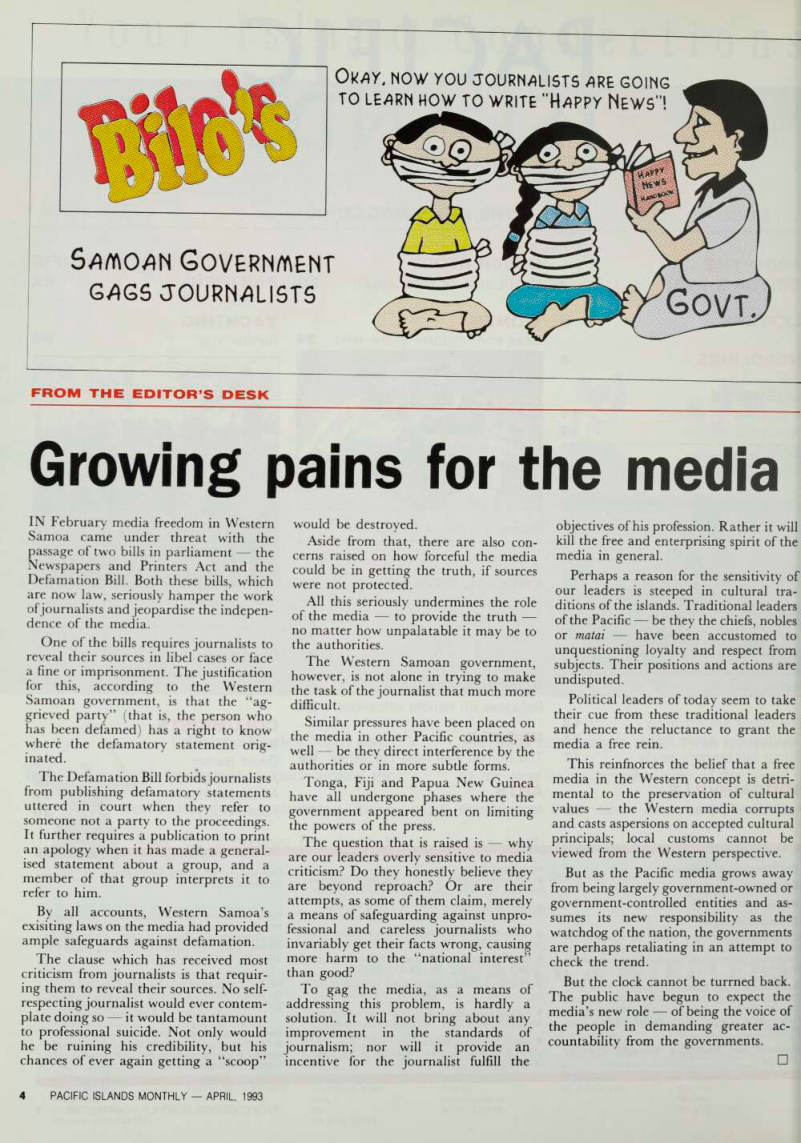
Growing pains for the media
From The Editor’S Desk
IN February media freedom in Western Samoa came under threat with the passage of two bills in parliament the Newspapers and Printers Act and the Defamation Bill. Both these bills, which are now law, seriously hamper the work
of journalists and jeopardise the indepen
dence of the media.
One of the bills requires journalists to reveal their sources in libel cases or face a fine or imprisonment. The justification for this, according to the Western Samoan government, is that the “ag grieved party” (that is, the person who has been defamed) has a right to know where the defamatory statement orig inated.
The Defamation Bill forbids journalists from publishing defamatory statements uttered in court when they refer to someone not a party to the proceedings.
It further requires a publication to print an apology when it has made a general ised statement about a group, and a member of that group interprets it to refer to him.
By all accounts, Western Samoa’s exisiting laws on the media had provided
ample safeguards against defamation.
The clause which has received most criticism from journalists is that requir ing them to reveal their sources. No self respecting journalist would ever contem plate doing so it would be tantamount to professional suicide. Not only would he be ruining his credibility, but his chances of ever again getting a “scoop”
would be destroyed.
Aside from that, there are also con cerns raised on how forceful the media could be in getting the truth, if sources were not protected.
All this seriously undermines the role of the media to provide the truth no matter how unpalatable it may be to the authorities.
The Western Samoan government, however, is not alone in trying to make the task of the journalist that much more difficult.
Similar pressures have been placed on the media in other Pacific countries, as well be they direct interference by the authorities or in more subtle forms.
Tonga, Fiji and Papua New Guinea
have all undergone phases where the government appeared bent on limiting the powers of the press.
The question that is raised is why are our leaders overly sensitive to media criticism? Do they honestly believe they are beyond reproach? Or are their attempts, as some of them claim, merely a means of safeguarding against unpro fessional and careless journalists who invariably get their facts wrong, causing more harm to the “national interest” than good?
To gag the media, as a means of addressing this problem, is hardly a solution. It will not bring about any improvement in the standards of journalism; nor will it provide an incentive for the journalist fulfill the
objectives of his profession. Rather it will kill the free and enterprising spirit of the media in general.
Perhaps a reason for the sensitivity of our leaders is steeped in cultural tra ditions of the islands. Traditional leaders of the Pacific be they the chiefs, nobles or matai have been accustomed to unquestioning loyalty and respect from subjects. Their positions and actions are
undisputed.
Political leaders of today seem to take their cue from these traditional leaders and hence the reluctance to grant the media a free rein.
This reinfnorces the belief that a free media in the Western concept is detri mental to the preservation of cultural values the Western media corrupts and casts aspersions on accepted cultural principals; local customs cannot be viewed from the Western perspective.
But as the Pacific media grows away from being largely government-owned or government-controlled entities and as sumes its new responsibility as the watchdog of the nation, the governments are perhaps retaliating in an attempt to check the trend.
But the clock cannot be turrned back.
The public have begun to expect the media’s new role of being the voice of the people in demanding greater ac countability from the governments.
change
Letters
Tides of
Madam, I have only been here a few weeks, barely enough time to unpack. But in this short time I have been a witness to events that have had a profound effect on me.
It is a daunting task to be the represen tative of our people here in Washington, and it is a task that evokes both great honor and frustration. I listened in frustration to the debates during my first week here on allowing the delegates to vote in the House Committee of the Whole, and I knew then that we have a long way to go in achieving our goals as
a people.
On the steps of the Capitol on January 20, I could see and feel in the 800,000 people gathered there a sense of hope and optimism that President Clinton’s inaug uration embodied.
A tide of change swept the nation in November, and a sea of people testified to the strength of the tide. For a long time \mericans waited, and, as the President >aid, “Our time has come, let us embrace t.” It is a change so deep and wide that t is called generational.
One person who longed for the Tange, and lived just long enough to see
t, was Supreme Court Justice Thurgood
Vlarshall. His life’s work was to effect Tange in the way Americans view ninorities and the less fortunate among is. His monumental arguments against acial segregation in schools and public nstitutions forever uplifted the lives of nillions.
His unwavering defence of civil rights md individual liberty was the corner tone of a new social fabric in America; i new relationship between the races and thnic groups that make up this great ountry.
The people of Guam are asking for no ess than a change of the same magni ude. We are asking to be viewed lifferently; in a new light; in ways that •reak the old stereotypes. We are asking ur a relationship with the federal ;overnment that uplifts us as a people nd empowers us with the dignity of self letermination.
Like Justice Marshall's work, the •regress may be slow, even at times mperceptible. The tide comes in slowly, »ut when it crests, the high tide is
overwhelming. We must not lose our commitment and we must not give up the fight for our dignity when difficulty arises. We must be the agent of change because, ultimately, our time will come too.
Robert A. Underwood,
Guam Delegate, United States Congress Washington, DC
Marshalls’
status
Madame, I enjoyed very much reading about “The fastest canoe in the South Pacific” in your December 1992 issue. We at the Institute have been following this project for some time and are delighted that it has not only succeeded but has received the recognition it deserves.
The publication of this article cer tainly voices your acknowledgment of the importance of maintaining island cul tural identities, an area which is among
our highest priorities.
We were distressed, however, in the
reference to the Marshalls as a “strategic trust of the United States”. Yes, from 1947 until October 1986 it was indeed a strategic trust territory of the United Nations administered by the United States. In 1986 the Compact of Free Association came into effect, recognising their international status in free associ ation with the United States. We were very pleased and we were there when the Republic of the Marshall Island became a member of the United Nations in the fall of 1991.
We very much appreciate PIM, and find it useful in keeping up with what’s happening in the Pacific.
Patricia Luce Chapman, Chair,
The Micronesia Institute, Washington DC, United States of America
Letters To The Editokmust
include writer’s full name, address and telephone number. All letters may be edited for purposes of clarity and space.
Letters should be addressed to: Pacific Islands Monthly, PO Box 1167, Suva,
Fiji
or faxed to: (679) 303809
Advertisements & other items, p. 5 (1 item)
Pacific Islands Monthly
Subscriptions rates include the cost of airspeeding to all destinations set out above.
Direct airmail rates on application.
Telephone: 304111 Fax: 303809
Vivian
Headlines
Niue
returned
The Premier of Niue, Young Vivian, has been returned to the Legislative Assembly in a general election.
Vivian and his chief opponent for the premiership, former Cabinet minister Frank Lui, both won their village constitu ency seats with comfortable majorities.
Reports from Niue say Vivian is tipped to continue as leader of the country.
In other results, Lady Patricia Rex, the wife of the late Premier. Sir Robert Rex, failed to win another term in office.
But Lady Rex’s son, Robert Rex junior, won a seat on the common roll.
The Niue constitution provides for an assembly consisting of 20 members 14 elected from village constituencies and six from a common roll.
An ex-public servant made redundant last year, Michael Jackson, topped the poll for the common roll with 543 votes.
A major loser was Terry Chapman, the secretary to the government since self-government in 1974 who resigned to contest the election. Chapman was ranked eighth out of the 24 candidates who were contesting the six common roll seats.
And, for the first time in Niue’s history, a palagi (European) was elected to the assembly. Terry Coe, former principal of the Niue High School, was ranked third in the common roll.
One village constituency remains undecided with the two highest scoring candidates polling an equal number of votes
for Namaliu
Papua New Guinea
June trial
The national court in Papua New Guinea has nominated the first two weeks of June for the trial of former Prime Minister Rabbie Namaliu and his finance minister Paul Pora. They face corruption charges relating to an inci dent in mid-1990 when they allegedly tried to buy the support of four government members of parliament.
The four had threatened to cross the floor in a vote of no confidence which would have brought down the government.
Namaliu, who lost power in last July’s national elections, faces 14 counts of misappropriation and misuse of public funds while Pora faces eight similar charges.
Namaliu: faces corruption charges
TVNZ buy
New Zealand
Dairy board wants
end to barter
New Zealand’s dairy board says it wants to end its long runnin! barter agreement to sell Russian Lada cars in payment for dair exports. Its subsidiary, Lada New Zealand, last year sold 371 vehicles taking it to 13th position on the country’s interna market. It also started exporting cars to other Pacific countries including New Caledonia, Vanuatu, Fiji, Western Samoa Solomon Islands and Papua New Guinea.
Dairy board spokesman Neville Martin says the board is alsc reviewing its involvement in Sovenz, its subsidiary set up tc trade with the former Soviet Union. Martin says Sovenz wa; established at a time when the Soviet Union, with its centrally planned economy and single-agency buying system, was th( world’s largest importer of butter. He says a very different marketing situation exists in the present Commonwealth o
Independent States.
The board is still owed more than US$lOO million on its lasi butter and milk powder deal with the Soviet Union’s central buying agency. ***
TVNZ buy
Asian shares
Television New Zealand has taken a 36 per cent stake in a Singapore-based company formed to launch Asia’s first business television news channel later this year. The other shareholders in the company are Singapore International Pty Ltd with 10 per cent, Business News Network of Hong Kong with 18, and Tele-Communications Inc of the United States with 36.
The company will broadcast a channel to be known as Asia Business News by satellite in English (and later in other languages) to Hong Kong, the Phillipines, Thailand, Taiwan and Indonesia. The channel will be based in Singapore and will be financed by advertising. It will operate 18 hours a day during the week and six hours on Saturday.
David Nicholson, a Television New Zealand representative said the company would send staff to establish the channel and then to train locals to operate it. ***
Kiwi success in
New Caledonia
New Caledonians are flocking to buy New Zealand boats and boating products, according to figures rev ealed by the Marine Export Group of New Zealand and TRADENZ. For the year to December 31, 1992, exports of boats and boating products totalled US$3.9 million, up from just over US$l million in 1991. Boating exports now account for 33 per cent of all New Zealand manufactured goods exported to New Caledonia and 13 per cent of all New Zealand’s exports there for the year.
Peter Rachtman, director of the Marine Export Group of New Zealand, said reasons for the success in New Caledonia included a favourable exchange rate, a reduction in import duties and the recognition of the quality of New Zealand boats.
operation slows
American Samoa
Cost cutting
The American Samoa Cabinet has failed to reach a decision on the next course of action to take to implement the second phase of Operations Reduction in Force (RIF). The operation is aimed at cutting costs to improve the government’s cash flow problems.
The Samoa News says it appears the Lutali administration is losing steam in its budget cutting initiative, a sharp contrast to the haste with which it implemented the first phase of the operation in January.
After the termination of 429 employees in the second week of January, the administration announced the second phase would follow shortly.
But a meeting on February 19 of Governor Lutali and •elected members of his Cabinet failed to come to a decision on the next step to take.
A shorter work week, rolling back salary increases given after :he 1989 freeze on hiring and pay rise, and the termination of ihort term contracts were the three alternatives under :onsideration.
However, the Governor’s chief of staff, Aleni Ripine, says Governor Lutali has given the cabinet members more time to •eview the three alternatives and to report back to the chief executive on February 25 with “solid figures” on how much he government stands to save and how many people will be i flee ted.
Meanwhile, the government is delaying issuing pay cheques o its employees under what has been described by acting freasurer Aitofele Sunia as a “very tight ” financial situation.
Sunia said the department was “scraping the bottom of the >arrel” to pay its employees’ fortnightly payroll bill.
He said the new administration’s collection of revenue owed o the government was very strong when it came in early last nonth, but it has now slowed down as the rest is not easy to ollect.
As the Governor and his cabinet study the next step to take n reducing government spending, the acting Treasurer is withholding the release of tax refund cheques.
Sunia said only under extra-ordinary circumstances, such as imerals, would tax refunds be disbursed, but added these would first have to be verified to make sure recipients were elling the truth.
tew flight
Chile
)lanned
’hilean airline Lan Chile plans to start a flight between South unerica and Australia with the Cook Islands along the way.
Larotonga would be one of the three stop-overs on the roposed four-stage 11,300 km trip.
The route would see a Lan Chile 767 leave Santiago stopping ff at Easter Island, Papeete and Rarotonga before landing in ydney.
Government
Fiji
sells shares
The Fiji government plans to sell off shares in companies it holds equity in or owns. The move is part of a plan for further reform of public enterprises to begin this year.
A statement from the Prime Minister’s office says the plan is based on an acceptance that public enterprises generally have performed poorly compared with their private counterparts.
The statement said the aim would be to prepare public sector
enterprises for privatisation.
Government presently owns or holds shares in 29 companies, enterprises or financial institutions.
Those most likely to be divested first are public shares in enterprises where government is a minority shareholder, such as Fiji Air and Home Finance Ltd.
The statement said the government was also seriously considering corporatising and then selling its shipyard and slipway in Suva.
But some public enterprises which enjoy dominant or market monopoly positions, such as Fiji Posts and Telecommunications Ltd, may not be privatised.
It says private enterprises not destined for privatisation will be required to run as commercial operations.
The government will also look at contracting out services.
This means government deparmtents may choose to buy services from outside if they are cheaper and more efficient those those provided by the government.
Airline managers
Solomons
face the chop
A number of senior managers of Solomon Islands’ national airline, Solomon Airlines, may lose their jobs under the current review of the airline. This was indicated by the airlines chairman, Reuben Natowan, in reference to media reports which singled out the air line's general manager, John Baura, as one of those to be axed.
Natowan said some of the senior managers may have to go, not because they hadn't been doing a
good job, but as a cost cutting measure. Natowan said it had been tough on the state-owned airline to meet managers’ various financial remunerations.
The airline has been seriously in debt since it started its international operations in 1990. In February the government owned airline put 70 per cent of its shares on offer. Hong Kong based company Golden Springs International was the only applicant for the shares.
Martin Tiffany Baura: to be axed?
Scope for the islands
NEW doors can open unexpectedly for those on the lookout for trading opportunities. Vanuatu and New Cale donia are benefitting from the opening of a new doorway into Australia at the small port of Yamba, on the east coast between Sydney and Brisbane.
Through it, the islands have established direct links with Australian business that could bring abundant returns for
everybody.
Yamba is a small resort town with a population of only a few thousand at the mouth of the Clarence River, northern NSW. But the surrounding Clarence Valley is a rich agricultural area, with growing industrial and business develop ment. Nearby is the small city of Grafton (pop. 1 7,000) spreading out on both sides
of the river, and Sydney, Newcastle and Brisbane are easily reached by road and rail. This part of NSW north coast is one of Australia’s fastest growing regions because of its equable climate and the increasing movement of people and business north, away from the crowded cities of Melbourne
and Sydney.
Yamba’s new' significance to the islands is that it has become a first port of entry, with shipping links to the Pacific.
The islands can thus tap into Australian markets without having to do business in the big cities with their crowded ports. The easier pace and atmosphere in Grafton, which is the business centre of activity in the Clarence Valley, is friendly “country style”, which is the style of the islands, and island visitors doing business there say they immediately feel at home. And business can be conducted much more efficiently, more cheaply and with greater speed than in the case of, say, a city the size of Sydney with its greater distances and transport problems.
As far as I know, this is the first time that a particular region has initiated direct and independent business links with the islands. Grafton "and Port Vila have established a sister city relationship.
Trade groups from New Caledonia, Western Samoa and Vanuatu have in recent months visited Grafton, and one of the latest visitors was the Premier of Niue, Young Vivian, who had preliminary talks on likely opportunities. Grafton business leaders arc planning their own familiarisation trip to Western Samoa soon, and may include Niue on the schedule following Vivian’s visit.
Vanuatu’s Finance Minister, Willie Jimmy, was in Grafton at the end of February leading an important government delegation from the republic, which included Father Gerard Leymang, first secretary, Prime Minister’s office; Nicholson Worek, second secretary, Ministry of Finance; John Simbolo, Director of Customs and Waimini Perei, recently appointed Director of Tourism for Vanuatu.
The Clarence region has been buying copra, timber and
beer from Vanuatu, and the region has shipped sugar (it’s a cane growing area), aluminium boats and fire trucks. The first experimental ship ment of Vanuatu’s Tusker beer was very well received in the Clarence and it is likely to be marketed in the area as a boutique beer. Timber sales include old and unproductive coconut palms, which will be turned into furniture in Australia. The palm timber is very hard, with a beautiful
grain, and requires special processing.
Pioneering work on this timber has been done by the Pacific Green Furniture Company, which has been making furniture from it in Sigatoka, Fiji, for the past two years and is also
using it as a lightweight building
material.
The Vanuatu delegation also dis cussed with the Grafton & District
Business Development Board Ltd the possibility of shipping copra in through Yamba. This is worth examining, but there may be greater opportunities for a joint venture between Australian and island businesses that would result in the copra being crushed on the spot in Vanuatu and only the oil exported. Crushing can be a fairly simple process that doesn’t require highly sophisticated or expensive machinery to extract most of the oil, and the residue could be marketed locally as stock feed.
Jimmy told a gathering at Grafton that both island and Australian governments could help the growing trade relationships with the area Australia by being more flexible on immigrations and quarantine laws.
Among the advantages for Australian entrepreneurs of another direct link with island groups such as Vanuatu and New Caledonia is the springboard into Europe through Lome and the Common Market. New Caledonia’s recent increased trade activity has followed the political conciliation that has come from the Matignon Accords. France sees the strength ening of New Caledonia’s economy through improved trade and investment as a vital way of ensuring that the territory will become more fully integrated into the region and its long term dependence on France reduced. I discussed this development in some detail in my report in P/A/last month.
As I said then, the New Caledonian government is serious about making it easier to do business there, and that means Australia’s ability to do business more easily with France and with the Common Market. The EC will recognise a product as coming from new Caledonia if it has between 20 and 60 per cent added value, depending on the product, put on it in New Caledonia.
The Vanuatu delegation also took the opportunity of looking at Australia’s racing and casino industries, although not in Grafton. They spoke to Victoria’s Totalizator Agency Board, which manages race betting, about the possibility of the TAB setting up operations in Vanuatu. The government, of course, would get its cut.
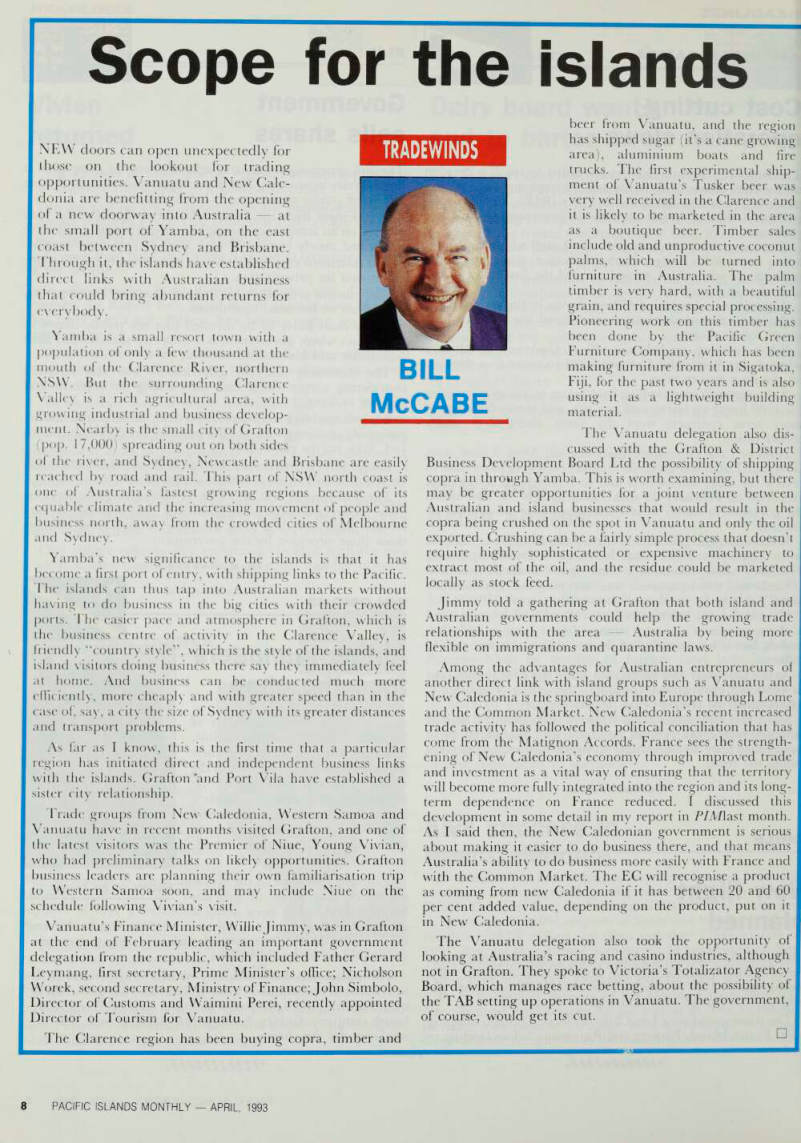
Tradewinds
Bill
Mccabe
Charting a growth pattern
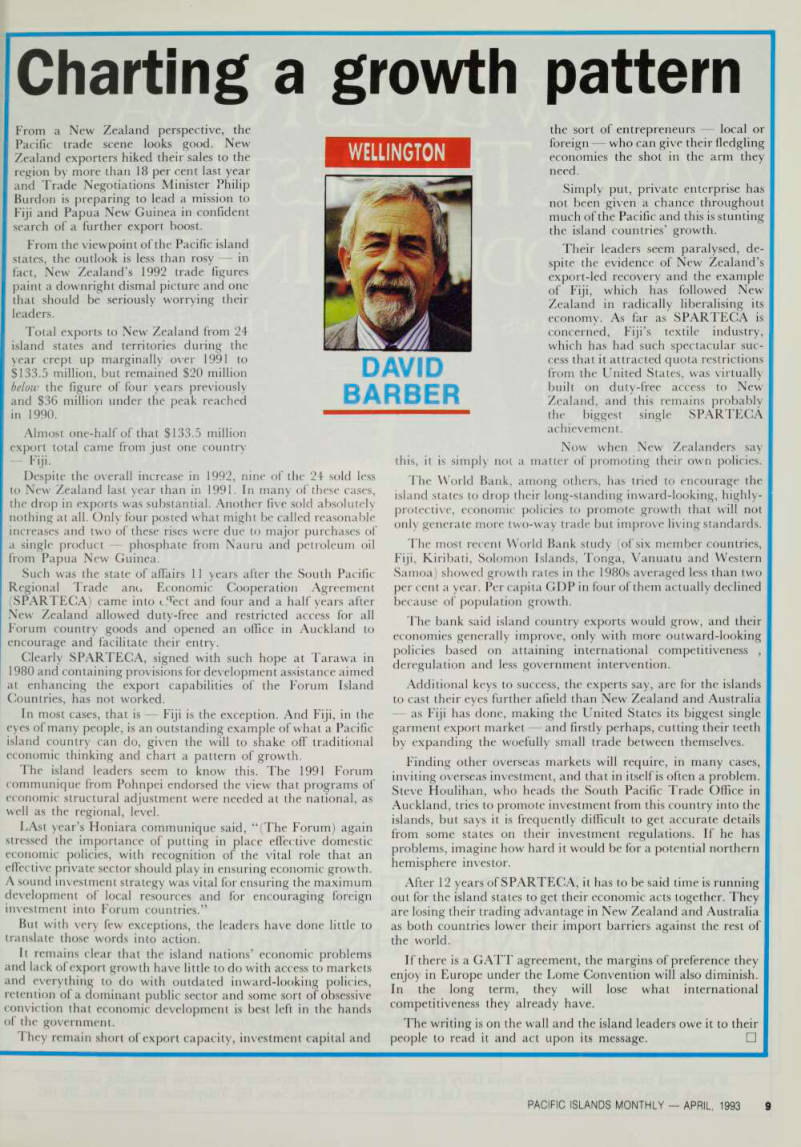
From a New Zealand perspective, the Pacific trade scene looks good. New Zealand exporters hiked their sales to the region by more than 18 per cent last year and Trade Negotiations Minister Philip Burdon is preparing to lead a mission to Fiji and Papua New Guinea in confident search of a further export boost.
From the viewpoint of the Pacific island states, the outlook is less than rosy in fact, New Zealand’s 1992 trade figures paint a downright dismal picture and one that should be seriously worrying their leaders.
Total exports to New Zealand from 24 island states and territories during the year crept up marginally over 1991 to 5133.5 million, but remained $2O million below the figure of four years previously and $36 million under the peak reached in 1990.
Almost one-half of that $133.5 million export total came from just one country
Fiji.
Despite the overall increase in 1992, nine of the 24 sold less to New Zealand last year than in 1991. In many of these cases, the drop in exports was substantial. Another five sold absolutely nothing at all. Only four posted what might be called reasonable increases and two of these rises were due to major purchases of a single product phosphate from Nauru and petroleum oil from Papua New Guinea.
Such was the state of affairs 11 years after the South Pacific Regional Trade anu Economic Cooperation Agreement (SPARTECA) came into effect and four and a half years after New Zealand allowed duty-free and restricted access for all Forum country goods and opened an office in Auckland to encourage and facilitate their entry.
Clearly SPARTECA, signed with such hope at Tarawa in 1980 and containing provisions for development assistance aimed at enhancing the export capabilities of the Forum Island Countries, has not worked.
In most cases, that is Fiji is the exception. And Fiji, in the eyes of many people, is an outstanding example of what a Pacific island country can do, given the will to shake off traditional economic thinking and chart a pattern of growth.
The island leaders seem to know this. The 1991 Forum communique from Pohnpei endorsed the view that programs of economic structural adjustment were needed at the national, as well as the regional, level.
LAst year’s Honiara communique said, “(The Forum) again stressed the importance of putting in place effective domestic economic policies, with recognition of the vital role that an effective private sector should play in ensuring economic growth.
A sound investment strategy was vital for ensuring the maximum development of local resources and for encouraging foreign investment into Forum countries.”
But with very few exceptions, the leaders have done little to translate those words into action.
It remains clear that the island nations’ economic problems and lack of export growth have little to do with access to markets and everything to do with outdated inward-looking policies, retention of a dominant public sector and some sort of obsessive conviction that economic development is best left in the hands of the government.
They remain short of export capacity, investment capital and
the sort of entrepreneurs local or
foreign who can give their fledgling
economies the shot in the arm they need.
Simply put, private enterprise has
not been given a chance throughout much of the Pacific and this is stunting the island countries’ growth.
Their leaders seem paralysed, de spite the evidence of New Zealand’s export-led recovery and the example of Fiji, which has followed New Zealand in radically liberalising its economy. As far as SPARTECA is
concerned, Fiji’s textile industry,
which has had such spectacular suc cess that it attracted quota restrictions from the United States, was virtually built on duty-free access to New Zealand, and this remains probably
the biggest single SPARTECA
achievement.
Now when New Zealanders say
this, it is simply not a matter of promoting their own policies.
The World Bank, among others, has tried to encourage the island states to drop their long-standing inward-looking, highly protective, economic policies to promote growth that will not only generate more two-way trade but improve living standards.
The most recent World Bank study (of six member countries, Fiji, Kiribati, Solomon Islands, Tonga, Vanuatu and Western Samoa) showed growth rates in the 1980 s averaged less than two per cent a year. Per capita GDP in four of them actually declined because of population growth.
The bank said island country exports would grow, and their economies generally improve, only with more outward-looking policies based on attaining international competitiveness , deregulation and less government intervention.
Additional keys to success, the experts say, are for the islands to cast their eyes further afield than New Zealand and Australia as Fiji has done, making the United States its biggest single garment export market and firstly perhaps, cutting their teeth by expanding the woefully small trade between themselves.
Finding other overseas markets will require, in many cases, inviting overseas investment, and that in itself is often a problem.
Steve Houlihan, who heads the South Pacific Trade Office in Auckland, tries to promote investment from this country into the islands, but says it is frequently difficult to get accurate details from some states on their investment regulations. If he has problems, imagine how hard it would be for a potential northern hemisphere investor.
After 12 years of SPARTECA, it has to be said time is running out for the island states to get their economic acts together. They are losing their trading advantage in New Zealand and Australia as both countries lower their import barriers against the rest of the world.
If there is a GATT agreement, the margins of preference they enjoy in Europe under the Lome Convention will also diminish.
In the long term, they will lose what international competitiveness they already have.
The writing is on the wall and the island leaders owe it to their people to read it and act upon its message. □
Wellington
David
Barber
Advertisements & other items, p. 10 (1 item)
Msss
im r A vm A
FVNFumm •ivMini: inis
COCKTAIL
ill •it
FLm/VVR
t UIR£ I . i 111
they make
tasty cheese
so deliciously
fit yngrjaac
put real fruit
into yoghurt?
We Pour Technology
Into Make
. m fLt y If you need more information on Rewa Dairy's range of natural dairy products or Tetrapak packaging capabilities contact: Rewa Co-operative Dairy Company Ltd, PO Box 3678, Samabula, Suva, Fiji. Telephone: 381288. Fax: 370190.
IH) FI 03A(
Measuring up debts
Business
By David North
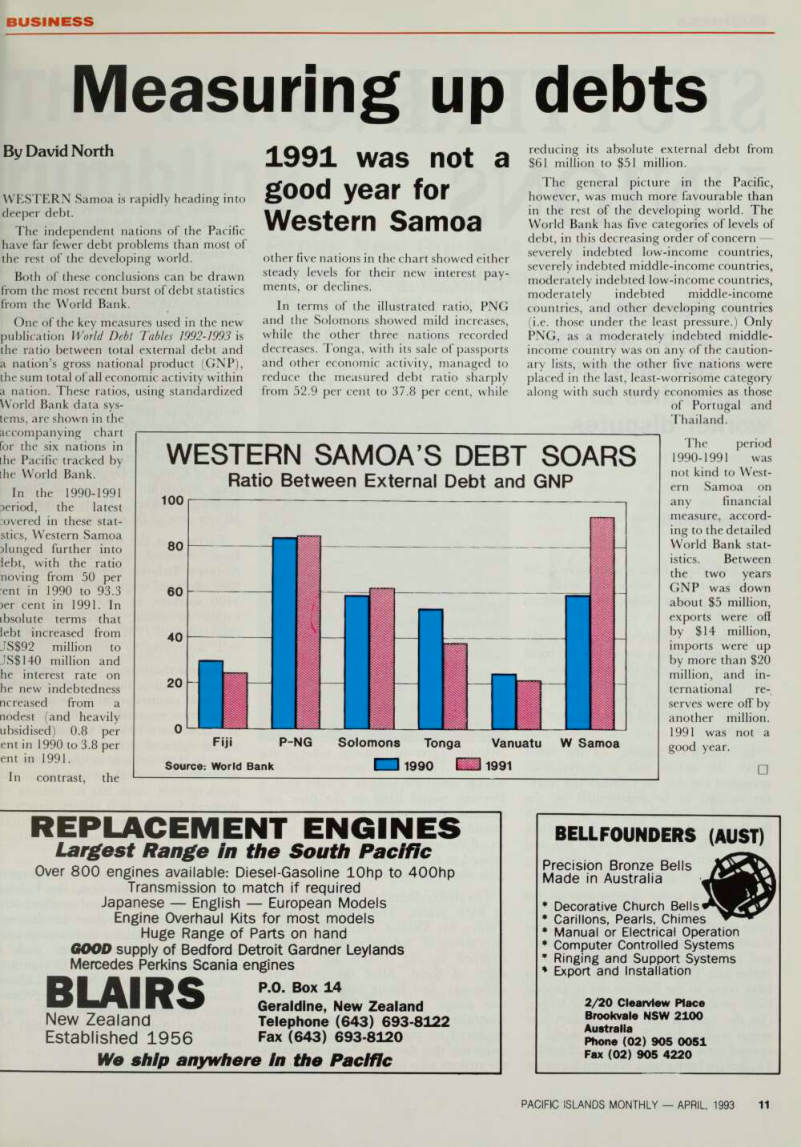
WESTERN Samoa is rapidly heading into
deeper debt.
The independent nations of the Pacific have far fewer debt problems than most of the rest of the developing world.
Both of these conclusions can be drawn from the most recent burst of debt statistics from the World Bank.
One of the key measures used in the new publication World Debt Tables 1992-1993 is the ratio between total external debt and
a nation’s gross national product (GNP),
the sum total of all economic activity within a nation. These ratios, using standardized
World Bank data sys tems, are shown in the
accompanying chart
for the six nations in
the Pacific tracked by
the World Bank.
In the 1990-1991 aeriod, the latest :overed in these stat stics, Western Samoa alunged further into lebt, with the ratio noving from 50 per ent in 1990 to 93.3 >er cent in 1991. In ibsolute terms that lebt increased from JS$92 million to JS$l4O million and he interest rate on he new indebtedness ncreased from a
nodest (and heavily
übsidised) 0.8 per ent in 1990 to 3.8 per ent in 1991.
In contrast, the
1991 was not a good year for Western Samoa
other five nations in the chart showed either steady levels for their new interest pay ments, or declines.
In terms of the illustrated ratio, PNG and the Solomons showed mild increases, while the other three nations recorded decreases. Tonga, with its sale of passports and other economic activity, managed to reduce the measured debt ratio sharply from 52.9 per cent to 37.8 per cent, while
reducing its absolute external debt from $61 million to $51 million.
The general picture in the Pacific, however, was much more favourable than in the rest of the developing world. The World Bank has five categories of levels of debt, in this decreasing order of concern — severely indebted low-income countries, severely indebted middle-income countries, moderately indebted low-income countries, moderately indebted middle-income countries, and other developing countries (i.e. those under the least pressure.) Only PNG, as a moderately indebted middle income country was on any of the caution ary lists, with the other five nations were placed in the last, least-worrisome category along with such sturdy economies as those
of Portugal and Thailand.
The period
1990-1991 was not kind to West ern Samoa on any financial measure, accord ing to the detailed World Bank stat istics. Between the two years GNP was down about $5 million, exports were off by sl4 million, imports were up by more than S2O million, and in ternational re-, serves were off by another million. 1991 was not a
good year.
Advertisements & other items, p. 11 (1 item)
Blairs
REPLACEMENT ENGINES
Largest Range in the South Pacific
Over 800 engines available: Diesel-Gasoline lOhp to 400 hp Transmission to match if required Japanese English European Models Engine Overhaul Kits for most models Huge Range of Parts on hand GOOD supply of Bedford Detroit Gardner Leylands Mercedes Perkins Scania engines
BLAIRS
New Zealand Established 1956 P.O. Box 14 Geraldine, New Zealand Telephone (643) 693-8122 Fax (643) 693-8120 We ship anywhere In the Pacific
BELLFOUNDERS (AUST)
Precision Bronze Bells Made in Australia Decorative Church Bells Carillons, Pearls, Chimes Manual or Electrical Operation Computer Controlled Systems Ringing and Support Systems Export and Installation 2/20 Clearvfew Place Brookvale NSW 2100 Australia Phone (02) 905 0051 Fax (02) 905 4220
Sputtering
Unions
Two Samoas, two union actions, but two different approaches to worker disputes
By David North
TWO efforts to form unions have failed in the Samoas, more drastically in Western Samoa than in American Samoa.
In Western Samoa the object was the Yazaki plant which assembles electrical harnesses for autos, the action was an attempted strike, and the persistent strikers have been fired; there was virtually no off-island resources used for the workers.
In American Samoa, on the other hand, the action was a managed election on whether the work ers wanted to be represented by the Mainland Teamsters union, which fought a hard, expensive and ultimately losing battle. But no one lost his job, and management’s margin of victory was tighter than in previous, similar battles.
There are some similarities in the situations, and some differences. All the firms involved are owned by off-island interests; Yazaki by Japanese investors, and the two tuna canneries by United States and Thai corporations. The firms have come to the Samoas not to process local products, but seeking low wages. (In the case of the tuna packers low wages within the US customs shield, as canned tuna is protected by a US tariff).
Further, in both places Western Samoans
do the work, and in both, the political establishment came down hard on the side of management.
The principal difference is the wages; Western Samoans working for Yazaki get about 62 US cents an hour (1.24 tala), while in American Samoa their countrymen earn close to US$3.OO an hour.
The Yazaki strike was not well planned, or perhaps not planned at all.
According to Patrick Fepulea’i, the attorney brought in by the strikers after some of the workers had been arrested, neither he nor the government saw the strike coming. It was voted upon, almost spontaneously, at a meeting of about half the 1400 or so member Yazaki work force. No professional union organisers (like the Teamsters) were on hand when the strike started, and unlike the US Mainland, there was no strike fund established to help workers through the economic pinch that accompanies all strikes.
There is virtually no tradition of factory work in Western Samoa (Yazaki is a relative newcomer to the island), and the specific duties required are said to be vigorous; further, the tough Japanese style-management irritated some of the workers. There were reports that if a worker spent too long in a toilet stall, a foreman would bang on the door and demand the worker get back to the assembly line. All this and the low wages set off the work stoppage. (Management refused to return PlM’s repeated phone calls about the strike.) The strikers found they had few friends in high places. The Prime Minister, Tofilau Eti Alesana, criticised the strike as evidence of “foreign ideas”; the police roughed up the strikers and arrested seven of them. After the strike was underway, and losing supporters daily, two palagi union officials, one from Australia and one from New Zealand, appeared on the scene, in an effort to minimise the damage. Soon thereafter the strikers who had not returned to the
assembly line were fired by the company.
In the course of the dispute much was made of the significance of Yazaki to the Western Samoan economy, claims which shrink upon careful examination. For example, the statement was made repeat edly, by Western Samoan government sources, that Yazaki accounted for “more than 80 per cent of the nation’s exports”.
According to the World Bank, West ern Samoa exports of goods and services were running at the USS 94 million level in 1990, before the arrival of Yazaki, dropping to $BO million the following year. We were told the auto parts made by the company were worth about $3O million by the Western Samoan Depart ment of Economic Development, while a press report put the figure at “tens of millions of dollars”. Thirty million is not 80 per cent of 80 million.
Further, at the wage of 62 cents an hour, reported to PIM by Western Samoa’s Labour Commissioner, Tate Simi, the total wage bill for the reported 1400 workers, at 2000 hours a year, comes to about US$2OOO,OOO. This calculation of PlM’s was “roughly cor rect” according to Simi.
If one is thinking in terms of economic value to a nation, the size of the wage bill is Yazaki’s contribution to the islands, as all the raw materials are imported, and as Yazaki has a 10-year tax holiday. The actual value of the electrical harnesses may be $3O million as they arrive in Australia, New Zealand and Japan, but much of that value has no bearing on Western Samoa, as it relates largely to raw materials imported into Western Samoa, and profits, if any, that remain in Japan.
Labour Commissioner Simi is prepar ing a report for his boss, the Labour Minister, on the strike and its aftermath.
While he would not share his findings with us, he did indicate there was no pre existing legal framework for such a dispute in Western Samoa. In contrast, in American Samoa the National Labour Relations Board managed a represen tation election for the workers, using precedents dating back more than 50 years.
rumbling

The mines are rumbling
By Wally Hiambohn
As cyclones were ripping through parts of the Pacific over Christmas and New Year, a storm of a different kind was brewing in the region’s west, threatening to cause irreparable damage. Fortu nately, it has lulled and is made to look more like a “storm in a teacup”.
This concerned resource development in Papua New Guinea the lucrative mining and petroleum projects which have boomed over the last four years.
Hopefully the calm remains, or the much prided “mountain of gold floating on a sea of oil" land might blow its top and boil over. The lull was mainly due to the main players in this resources controversy who raised the storm have now receded to boardrooms to fight it DUt.
A conference in Sydney mid-February discussed key issues which concern the government and industry and their relationship.
Top ranking government and industry officials talked on such issues as PNG government’s direction in equity partici
pation, key developments and impli
:ations of a proposed Gas Act; impli ations of PNG legislative changes on the mplementation of projects; resource axation in PNG; and understanding the ritical issues of the landowners.
Having learnt and recovered from the lightmare of losing revenue from the iougainville mine, the government and he resource sector had till then been leafing delicately and respectfully with ach other.
In every project from the billion-dollar old mine and Porgera and the Kutubu il to the humble Misima gold mine, isues of sensitivity were thrashed out in ill and involved every necessarry party from the prime minister and the chief ompany executives to the provincial overnments and landowners.
Apart from the controversies that arrounded the small but promising fount Kare alluvial gold mine (see 'parate story), all was rolling along well ntil the new government of Prime
linister Paias Wingti dropped a bomb
lell in December.
He wanted to review and increase state quity and local participation in resource
Papua New Guinea’s proposed changes to resource development threaten ‘the mountain of gold on a sea of oil’ to blow its top
projects so that Papua New Guineans were “owners of their resources” and playing a major role in their develop ment.
It is a long established government policy that it be granted an option of up to 30 per cent fully paid up equity in mining projects and 22.5 per cent carried equity in petroleum and gas projects.
The new move, which to some amounted to likely expropriation, shocked investors and tested their confi dence. VVingti also moved fast to attract and try and bring in investors from the fast-growing Asian region (see separate story).
Many existing investors until then had apart from the nagging law and order problems no reason to fear for their investment.
The government preceded its an nouncement with a serious allegation against developers of the giant Porgera gold mine.
Minerals and Energy Minister Masket langalio announced publicly that Placer Pacific, operators of the giant Porgera mine had misled the state into buying only 10 per cent equity instead of the full 30 per cent it was entitled to. He said the state was misled on the ore reserves at Porgera which only in November were revised and increased by 27 million ounces.
The other partners in the project Placer, Highlands Gold and Rennison Goldfields Consolidated each holds 30 per cent shares.
The claim, made following the an nouncement of the discovery of increased reserves at the mine, was denied by the other partners. Soon after, VVingti said in an Australian television interview that his government wanted to “break away” from a “club” of Australian investors and attract new resource from North Ame rica and Europe.
“This is Australia’s territory as far as they’re concerned. There is a club which wants to see PNG as a country that comes under the Australian mining influence ...” he told Channel Nine’s
Business Sunday.
langalio said in Australia the PNG government would review “some of the more questionable arrangements”.
In a more recent address Wingti told an oil and gas conference in Singapore in January there was still widespread dissat isfaction among landowners, although they received royalties, some compen sation and took part in spin-off benefits from resource projects.
“The state will endeavour to see that the people of Papua New Guinea gain maximum benefit from the development of its renewable resources. At the same
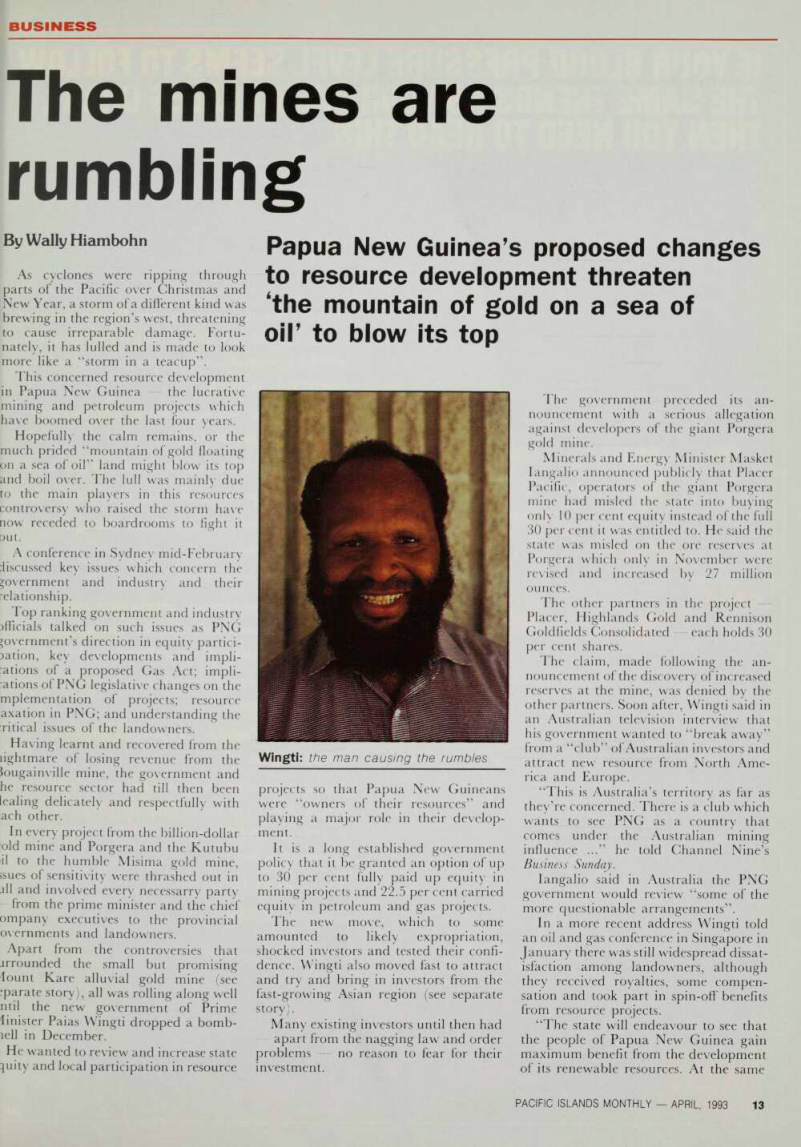
Wingti: the man causing the rumbles
time the state will ensure the investors enjoy a stable investment climate and get a reasonable return on investment. “I do not wish to see my beautiful country become another one of those countries that have lost out when their resources were exploited. I refuse to submit my country to be part of historical statistics.
The last thing I would want for my nation is to be left without a huge hole in the ground and a population spoilt by money after all the mineral and pet roleum has been drained from the land.
“Our landowners do receive royalties, some compensation and partake in certain spin-off business activities but still there is wide-spread landowner dissatis faction.” Wingti said his government was directing its energies towards other means and ways of ensuring the nation benefits from resource development other than taxation revenue. The government was now actively pursuing equity partici pation in major projects, either by the •state but preferably by individuals and
corporations owned by Papua New
Guineans.
He said the government was also looking very seriously at downstream processing of raw materials. “It is quite understandable that a consortium that has just completed a SI billion oil production facility will be somewhat uneasy about developing a further billion dollar refinery,” he said. “Still the state would like to invite and enter into partnerships with other firms which can build and operate a refinery profitably.
“The intrinsic benefits to the nation of such an arrangement are obvious jobs, more money retained on-shore and the development of our industrial base. At the end of the day it is not a question of whether we can squeeze 90 per cent tax out of a barrel of oil but what we do with
the money.”
At the conclusion of his Indonesia visit
in February Wingti foreshadowed major
rhanges to the petroleum equity share holding where the government currently is entitled to 22.5 per cent in any Detroleum project. He hinted the state nay increase its equity participation, ifter studying Indonesia’s highly success ul state-owned oil company, Pertamina.
Debate raged on the resource owner
;hip question.
“There is no doubt things are getting vorse,” a senior mining executive was quoted as saying at the time. “It is a good ;>lace to tread gently.” The executive lescribed Wingti as a “man in a hurry” vho would get into trouble sooner or ater.
In an analysis of the issue, director of he private sector funded Institute of National Affairs, John Millet summed, ’All of this matters not only because of he international principles of fair-play vhich are at stake but also because the
country’s future development depends crucially on what happens in the mining and petroleum sectors.”
He had earlier recommended the state sell rather than buy equity in resource projects. “All of this makes the sell option look increasingly attractive. The prime minister could proclaim victory for the broad national interest, for imaginative and pragmatic policy and for decisive leadership,” he wrote another time.
To Millet’s reference to “international fair-play ’ one Papuan New Guinean wrote describing it as “more fatuous nonsense”. The so-called Third World has been bled, suppressed and dictated to by the north for a very long time. If Papua New Guinea lied through its collective teeth for the next 200 years that wouldn’t balance past (and present) errors”.
To coincide with the controversy, Finance and Planning Minister Sir Julius Chan commissioned a review of the government’s equity and tax regime. The review, begun in January by the Inter national Monetary Fund and govern ment officials and expected to last several mmonths, was welcomed by mining companies. Sir Julius has said he does not expect to make any important new decisions on particular taxation or equity matters until the study is finished.
Industry sources say the review will clear the air, even though few concrete decisions are expected. But government officials say the review is designed primarily to provide an independent evaluation of the tax/equity regime covering the mining and oil sectors and to establish the basis for a separate policy for gas.
One industry official says the review should show the present regime compares well internationally, and will be especi ally valuable because it will be indepen dent. “It would be very beneficial to us because it would show from an indepen dent body that the state gets a fair share.
It does very well out of us,” he says.
As well as the equity issue, the petroleum sector is involved in an argument about the basis on which tax is calculated, and industry in general would like a more liberal regime for writing off exploration costs.
There are also indications the result of the survey may be to provide the basis for creating a gas equity and tax policy. At present gas comes under the country’s petroleum policy, which is entirely un suited to the long-term, multi-billion dollar investments required for pro duction that the country hopes to attract.
The Department of Minerals and Energy estimates the country has recoverable reserves of about 22 trillion cubic feet, almost all within a region stretching from the central Gulf of Papua New Guinea to the Highlands. □
Advertisements & other items, p. 14 (1 item)
The Same Trends As Your Credit Sales Chart,
IF YOUR BLOOD PRESSURE LEVEL SEEMS TO FOLLOW THE SAME TRENDS AS YOUR CREDIT SALES CHART,
THEN YOU NEED TO READ THIS.
5* O . w S’ 1991 With the introduction of our new Factoring service, we have practically eliminated the need for stress and high pressure over your company’s working capital requirements.
"Unbelievable!" you may exclaim, while making plans to change your GP.
If s no new wonder drug, in fact its not new at all.
Our solution to your problem is simplicity in itself We will give you the money that is tied up in unpaid invoices.
No collateral is necessary.
What this means for you, among other things, is greater freedom and flexibility to increase sales turnover and allow the acceptance of more orders.
In effect, this means growth for you, your business, and the economy.
There are no "catches." This whole service is based on trust.
If your interest has been aroused, please take the time to visit us at Burns Philp Building, Suva, at your nearest NBF Branch or call for more information on: Telephone 305113 or Facsimile 305097.
urn
Service you can grow on.
Courting the Asian tigers
IN early February Paias Wingti made his second visit to Indonesia since becoming prime minister in July, 1992. He had also visited Singapore and Malaysia in that period and wants to include several more Asian countries on his overseas itinerary this year.
It is part of his government’s new “Look North” policy, to attract investment and create new markets for exports. “In the coming months there will be an increased drive to get closer to our Asian neighbours,” Wingti said when visiting Indonesia. The new approach, taken right after a run-in with Australian mining companies, may have signalled that Wingti wanted a better deal, and believed the Asians would be the best.
He made this plain when he visited Singapore and Indonesia.
“The state will endeavour to see that the people of Papua New Guinea gain maximum benefit from the development of its non-renewable resources. At the same time the state will ensure investors enjoy a stable investment climate and get a reasonable return on investment.”
Wingti said it would be in the area of economics that PNG stood to reap the greatest benefits in increased relationship with Asia. “Each of the Asian tigers is increasing its industrial base. Not only can PNG learn from their experience, the same industries could be the destination for certain PNG raw materials which cannot be processed
locally.”
The Port Moresby-based Malaysian Business Council welcomed the Wingti government’s initiative. Council president Timothy Lim said, “An increased economic and trade alliance with nations in the Asia region is the right step in the interest of PNG whose economy is young and fast growing.” Lim said the Look North policy should not mean PNG should do away with its traditional and long lime trading, and business partners, it should look actively towards “large supermarket” of countries in Asia.”
At an oil and gas conference in Singapore in January, Wingti made his first attempt to sell PNG to Asian investors. He spoke of the great resource potentials and explained in detail his government’s policy on mining and the country’s lax regime.“We are seeking to create the circumstances which will provide long term stability for your investment in Papua New Guinea. In 1993 we will be looking at ways to create major incentives in oil and gas exploration and development.”
The following excerpts from a newspaper article by Australian Trevor Kennedy, a member of the PNG Holdings Corporation the gov ernment company charged with privatising publicly owned corporations very well summarises the implications of such a move to mining companies in PNG.
“It would be tragic if the current difficulties between some Australian resource companies and the government of Papua New Guinea escalated into the sort of dispute which permanently impaired our relationship with our closest regional partners - but it shows every sign of doing that. While re-orientation of our foreign policy priorities towards the “region” in preference to our traditional tics and markets in Europe is commendable there is a real need to ensure that our small Pacific neighbours are not forgotten in the rush to develop relationships with established and emerging Asian
Tigers.
“At the moment the Australian mining industry, or a section of it, has decided to take on the government of PNG with all the insensitivity and insouciance this sector has brought to the environmental issues and issues involving indigenous peoples worldwide over the decades. Clearly in the current dispute there are rights and wrongs on both sides. The issues are complex and emotionally charged as inevitably, so many issues involved with the land become to the extent to be left to the dispassionate judicial system to resolve.
“Currently the face of Australia is represented most forcefully by a group of major resource companies (which may have the balance of right on their side) of whom the overwhelming perception is of arrogance and greed (and there is at least some evidence that they have overplayed their hand). The danger is that Australians will be perceived to have changed from paternal to patronising, from helper to exploiter.
Already the recent dispute between CRA and Mount Kare landowners, which has dragged in the government and the Porgera partners has reached a crisis point it threatens to poison the relationship between Australian resources companies and the PNG government irreparably. Some leaders took the view that Australians had formed themselves into a tightly knit club, uninterested in the long term future of the country and its inhabitants just bent on exploitation.
“There is no doubt there are vast resource riches which still await exploitation in PNG and the Malaysians, the Japanese, the Koreans, the Taiwanese and the Chinese are aware of it. The preference of the powers in PNG at this stage is to stay with devil they know. It is obvious to them that a major shift in some investment will bring other problems that Australia and other Western investors do not burden them with. But it would be incorrect to continue believing that PNG’s foreign investment will founder if Australian investment dries up. □
Advertisements & other items, p. 16 (1 item)
Howßatham
Learned Hie Best Way
To Serve Pawpaw
To The Australian Market.
* They asked us.
Batham International of Fyi produces fruit and fruit juices. In particular, enough pawpaw to supply a major market like Australia. But they weren’t sure what form to ship it in. Who would be most interested. Or how to get it distributed. ' At the South Pacific Trade Commission we used our extensive resources to find out everything Batham needed to set up their rather fruitful new venture.
Just one of the many ways we are able to help businessmen from Pacific Forum countries.
If you’re starting up, improving or expanding a local business, we can help you too. Especially if you want to move into the export market.
And it’s all absolutely free.
To find out more, just post or fax us the coupon below. If you’re in a hurry, feel free to phone. r Name Company Address.
Sic & •o i Level 6, 50 Park Street, Sydney NSW 2000.
Phone: (612)2835933, Fax: (612)2835948 Advcntors 12til
Giving landowners equity
By Wally Hiambohn
CRA’s Mt Kare alluvial mining project, in which local landowners have 49 per cent equity, is unique in the history of PNG mining. It is the only mining project with such a high level of landowner participation. The following is a summary by CRA of issues surrounding this controversial mine.
THE small alluvial mine was born of unusual circumstances set up to re cover what remained after a gold rush in the late 1980 s. CRA exploration has held a prospecting authority over the area since 1985, and soon after the company discovered traces of alluvial gold in late 1987, the previously uninhabited Mt Kare area became the scene of a huge gold rush.
At its peak in mid-1988 there were 10,000 people panning for gold in the creek bed and surrounding areas, and law and order was a serious problem. It is estimated that up to Kl5O million worth of gold was taken off before the supply of easily won nuggets started to dwindle.
The gold rush on CRA’s prospecting
authority interrupted the company’s
exploration program, the main objective of which was to find a hard rock source of the alluvial gold. CRA negotiated with the leaders of 6000 local landowners (identified in a series of genealogical studies) in order to establish a project which would both satisfy the landowners’ interests and allow hard rock exploration to resume once the gold rush tapered off.
The result was a joint venture com pany to build and operate a small alluvial mine for the remaining alluvial gold. The company, Mt Kare Alluvial Mining (MKAM), is managed and 51-per-cent owned by CRA, in partner ship with the landowners’ umbrella
company, Kare-Puga Development Cor
poration (KDC), which owns 49 per cent.
CRA’s aim was to stabilise the area of
its prospecting authority and establish
goodwill with the landowners. From the outset, CRA indicated its intention to transfer its 51 per cent share of the mine equity to the landowners when they became able to financially support and manage the project.
The joint venture was granted a
CRA negotiated with the leaders of 6000 lo cal landowners in or der to establish a proj ect which would both satisfy the land owners’ interests and allow hard rock explo ration to resume once the gold rush tapered off.
special mining lease and began alluvial mining, recovering around 20,000 ounces of gold annually. And 80 per cent of the mine’s 120 employees were local landowners, who worked at the mine on a fly-in-fly-out basis.
Exploration work carried out on the alluvial deposits since the special mining lease was granted has shown that earlier estimates of the alluvial resources were too high. These earlier estimates were made during the gold rush when limited access made it impossible to conduct a thorough exploration program. Revised estimates suggest the volume and grade of the resource are at best only 10 to 15 per cent of the original estimates.
CRA Exploration’s hard rock explo ration program carried out in the adjacent prospecting authority has drilled 32 holes to date, but has also so far to indicate an economic resource.
CRA is committed to continuing hard rock exploration in the area and will seek to have its prospecting authority re newed in September 1993. To date the company has spent approximately K2l million on exploration and development at Mt Kare.
Since August 1992 the mine has been managed, through a management con tract, by a subsidiary of Placer Pacific (PNGj Pty Limited.
From its inception, the Mt Kare project has been dogged by controversy.
CRA’s mining and exploration leases and the partnership with the landowner company KDC have been persistently
challenged by a small group of locals.
This group, which has financial back ing from small Western Australian com panies, Ramsgate Resources and Menzies Gold, has waged a sustained campaign of litigation, political lobbying and public accusations against CRA.
The operations of the mine have also been disrupted by a scries of violent physical attacks. The third and most serious was an armed raid in January 1992 which cost the project K 3.5 million in damage and closure cost, and shut the mine for the first eight months of this year.
The litigation, which consists of four principle areas of dispute encompassing eight different cases, is being conducted on behalf of CRC’s and KDC’s op ponents by a Port Moresby legal firm, Warner Shand, run by expatriates.
CRA has defended the legal actions against it with some success and has in turn mounted a legal challenge to the involvement of Ramsgate and Menzies Gold in Mt Karc dispute by seeking to have the case against the special mining lease dismissed on the basis of champerty, which is the practice whereby outside parties in this case foreign mining companies) without a legal interest in the dispute, seek to fund a case on behalf of another, with the object of gaining an interest in the matter under dispute.
Since early 1992, two of the main litigants opposing the Mt Rare venture have claimed to be directors of KDC.
Proceedings in the National Court disputing these claims have been recently concluded in their favour. CRA said this decision may be appealed.
In October 1992 CRA offered to accelerate the transfer of its 51 per cent interest in the mine to the legitimate landowners, on condition that no outside interests were involved and that CRA’s tenure of prospecting authority in the area be secured. Despite assurances following negotiations with CRA, langalio, has made conflicting public statements on the Mt Kare issue, some of which have been in support of CRA’s opponents.
CRA’s efforts to expedite a resolution of the conflict are continuing.
Keating’s Miracle
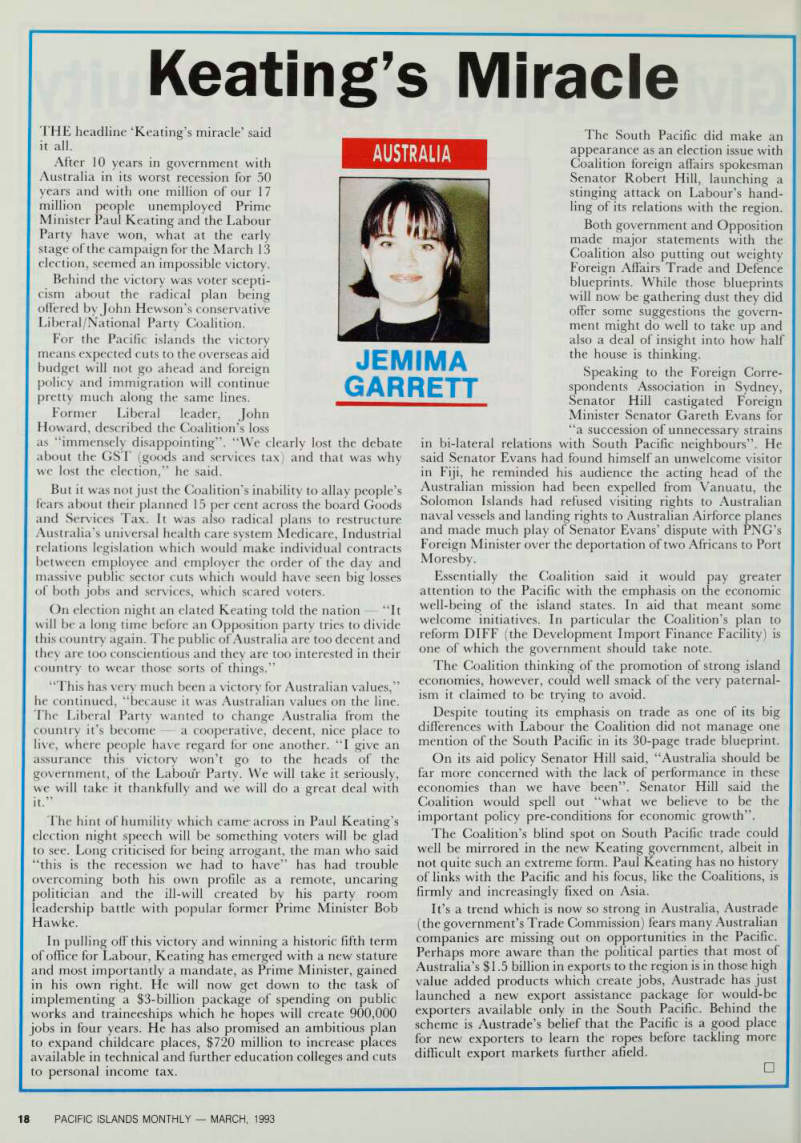
THE headline ‘Keating’s miracle’ said it all.
After 10 years in government with Australia in its worst recession for 50 years and with one million of our 17 million people unemployed Prime Minister Paul Keating and the Labour Party have won, what at the early stage of the campaign for the March 13 election, seemed an impossible victory.
Behind the victory was voter scepti cism about the radical plan being offered by John Hewson’s conservative Liberal/National Party Coalition.
For the Pacific islands the victory means expected cuts to the overseas aid budget will not go ahead and foreign policy and immigration will continue pretty much along the same lines.
Former Liberal leader, John Howard, described the Coalition’s loss
as “immensely disappointing”. “We clearly lost the debate about the GST (goods and services tax) and that was why we lost the election,” he said.
But it was not just the Coalition’s inability to allay people’s fears about their planned 15 per cent across the board Goods and Services Tax. It was also radical plans to restructure Australia’s universal health care system Medicare, Industrial relations legislation which would make individual contracts between employee and employer the order of the day and massive public sector cuts which would have seen big losses of both jobs and services, which scared voters.
On election night an elated Keating told the nation “It will be a long time before an Opposition party tries to divide this country again. The public of Australia are too decent and they are too conscientious and they are too interested in their country to wear those sorts of things.”
“This has very much been a victory for Australian values,” he continued, “because it was Australian values on the line.
The Liberal Party wanted to change Australia from the country it’s become a cooperative, decent, nice place to live, where people have regard for one another. “I give an assurance this victory won’t go to the heads of the government, of the Labour Party. We will take it seriously, we will take it thankfully and we will do a great deal with it.”
The hint of humility which came - across in Paul Keating’s election night speech will be something voters will be glad to see. Long criticised for being arrogant, the man who said “this is the recession we had to have” has had trouble overcoming both his own profile as a remote, uncaring politician and the ill-will created by his party room leadership battle with popular former Prime Minister Bob Hawke.
In pulling off this victory and winning a historic fifth term of office for Labour, Keating has emerged with a new stature and most importantly a mandate, as Prime Minister, gained in his own right. He will now get down to the task of implementing a $3-billion package of spending on public works and traineeships which he hopes will create 900,000 jobs in four years. He has also promised an ambitious plan to expand childcare places, $720 million to increase places available in technical and further education colleges and cuts to personal income tax.
The South Pacific did make an appearance as an election issue with Coalition foreign affairs spokesman Senator Robert Hill, launching a stinging attack on Labour’s hand ling of its relations with the region.
Both government and Opposition made major statements with the Coalition also putting out weighty Foreign Affairs Trade and Defence
blueprints. While those blueprints
will now be gathering dust they did offer some suggestions the govern ment might do well to take up and also a deal of insight into how half the house is thinking.
Speaking to the Foreign Corre
spondents Association in Sydney,
Senator Hill castigated Foreign Minister Senator Gareth Evans for “a succession of unnecessary strains
in bi-lateral relations with South Pacific neighbours”. He said Senator Evans had found himself an unwelcome visitor in Fiji, he reminded his audience the acting head of the Australian mission had been expelled from Vanuatu, the Solomon Islands had refused visiting rights to Australian naval vessels and landing rights to Australian Airforce planes and made much play of Senator Evans’ dispute with PNG’s Foreign Minister over the deportation of two Africans to Port Moresby.
Essentially the Coalition said it would pay greater attention to the Pacific with the emphasis on the economic well-being of the island states. In aid that meant some welcome initiatives. In particular the Coalition’s plan to reform DIFF (the Development Import Finance Facility) is one of which the government should take note.
The Coalition thinking of the promotion of strong island economies, however, could well smack of the very paternal ism it claimed to be trying to avoid.
Despite touting its emphasis on trade as one of its big differences with Labour the Coalition did not manage one mention of the South Pacific in its 30-page trade blueprint.
On its aid policy Senator Hill said, “Australia should be far more concerned with the lack of performance in these economies than we have been”. Senator Hill said the Coalition would spell out “what we believe to be the important policy pre-conditions for economic growth”.
The Coalition’s blind spot on South Pacific trade could well be mirrored in the new Keating government, albeit in not quite such an extreme form. Paul Keating has no history of links with the Pacific and his focus, like the Coalitions, is firmly and increasingly fixed on Asia.
It’s a trend which is now so strong in Australia, Austrade (the government’s Trade Commission) fears many Australian companies are missing out on opportunities in the Pacific.
Perhaps more aware than the political parties that most of Australia’s 51.5 billion in exports to the region is in those high value added products which create jobs, Austrade has just launched a new export assistance package for would-be exporters available only in the South Pacific. Behind the scheme is Austrade’s belief that the Pacific is a good place for new exporters to learn the ropes before tackling more difficult export markets further afield.
Australia
Jemima
Garrett
A Window Opened
Bougainville
By Johnson Honimae
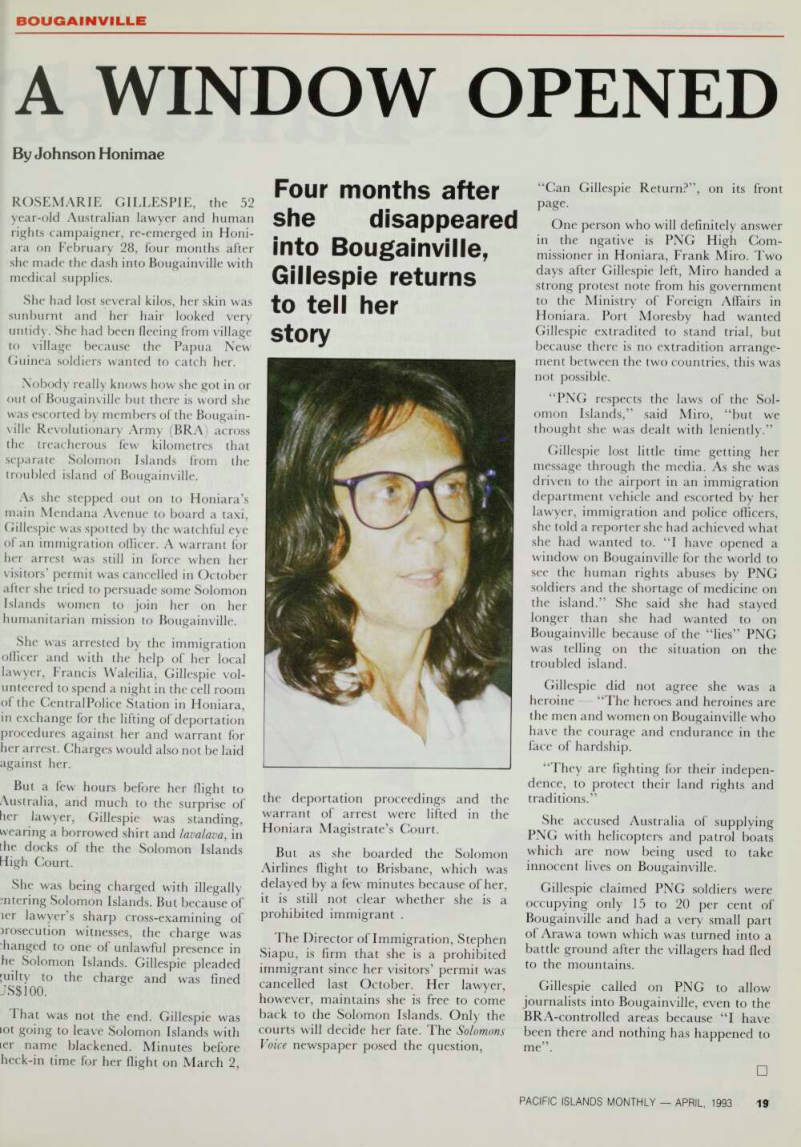
Rosemarie Gillespie, The 52
year-old Australian lawyer and human rights campaigner, re-emerged in Honi ara on February 28, four months after she made the dash into Bougainville with
medical supplies.
She had lost several kilos, her skin was sunburnt and her hair looked very untidy. She had been fleeing from village to village because the Papua New Guinea soldiers wanted to catch her.
Nobody really knows how she got in or out of Bougainville but there is word she was escorted by members of the Bougain ville Revolutionary Army (BRA) across the treacherous few kilometres that separate Solomon Islands from the troubled island of Bougainville.
As she stepped out on to Honiara’s main Mendana Avenue to board a taxi, Gillespie was spotted by the watchful eye of an immigration officer. A warrant for her arrest was still in force when her visitors’ permit was cancelled in October after she tried to persuade some Solomon Islands women to join her on her humanitarian mission to Bougainville.
She was arrested by the immigration officer and with the help of her local lawyer, Francis Waleilia, Gillespie vol unteered to spend a night in the cell room of the CentralPolice Station in Honiara, in exchange for the lifting of deportation procedures against her and warrant for her arrest. Charges would also not be laid against her.
But a few hours before her flight to Australia, and much to the surprise of
her lawyer, Gillespie was standing,
wearing a borrowed shirt and lavalava , in the docks of the the Solomon Islands
High Court.
She was being charged with illegally entering Solomon Islands. But because of ler lawyer’s sharp cross-examining of prosecution witnesses, the charge was thanged to one of unlawful presence in he Solomon Islands. Gillespie pleaded fuilty to the charge and was fined
Jss100.
That was not the end. Gillespie was lot going to leave Solomon Islands with icr name blackened. Minutes before heck-in time for her flight on March 2,
Four months after she disappeared into Bougainville, Gillespie returns to tell her story
the deportation proceedings and the warrant of arrest were lifted in the Honiara Magistrate’s Court.
But as she boarded the Solomon Airlines flight to Brisbane, which was delayed by a few minutes because of her, it is still not clear whether she is a
prohibited immigrant .
The Director of Immigration, Stephen Siapu, is firm that she is a prohibited immigrant since her visitors’ permit was cancelled last October. Her lawyer, however, maintains she is free to come back to the Solomon Islands. Only the courts will decide her fate. The Solomons Voice newspaper posed the question,
“Can Gillespie Return?”, on its front page.
One person who will definitely answer in the ngative is PNG High Com missioner in Honiara, Frank Miro. Two days after Gillespie left, Miro handed a strong protest note from his government to the Ministry of Foreign Affairs in Honiara. Port Moresby had wanted Gillespie extradited to stand trial, but because there is no extradition arrange ment between the two countries, this was not possible.
“PNG respects the laws of the Sol omon Islands,” said Miro, “but we thought she was dealt with leniently.”
Gillespie lost little time getting her message through the media. As she was driven to the airport in an immigration department vehicle and escorted by her
lawyer, immigration and police officers,
she told a reporter she had achieved what she had wanted to. “I have opened a window on Bougainville for the world to see the human rights abuses by PNG soldiers and the shortage of medicine on the island.” She said she had stayed longer than she had wanted to on Bougainville because of the “lies” PNG was telling on the situation on the troubled island.
Gillespie did not agree she was a heroine “The heroes and heroines are the men and women on Bougainville who have the courage and endurance in the face of hardship.
“They are fighting for their indepen dence, to protect their land rights and traditions.”
She accused Australia of supplying PNG with helicopters and patrol boats which are now being used to take innocent lives on Bougainville.
Gillespie claimed PNG soldiers were occupying only 15 to 20 per cent of Bougainville and had a very small part of Arawa town which was turned into a battle ground after the villagers had fled to the mountains.
Gillespie called on PNG to allow journalists into Bougainville, even to the BRA-controlled areas because “I have been there and nothing has happened to me”.
Land of discontent
Cover Story
WHILE some see Fijian nationalist Sakeasi Butadroka as a dangerous extremist, others regard him as a social pressure valve, allowing steam to be let off from time to time by bringing village-level Fijian concerns out into the open. In 1975, he provoked a bitter debate by moving in Parliament that all people of Indian origin in Fiji be deported to India at the expense of the former colonial ruler Britain. Then Prime Minister Ratu Sir Kamisese Mara accused Butadroka of peddling a “pernicious doctrine”. Now Butadroka, the man with the steely stare and trade mark bow-tie, is stirring the pot on the extremely sensitive issue of land ownership and control. And he is threatening to stage protests, using tactics such as what he calls “human roadblocks”. With the country facing a dilemma on the future treatment of indigenous land currently leased to Fiji Indian farmers, Suva based journalist Craig Skehan looks at central issues underlying the debate.ql
THE Fijian man with the steely stare and the trade-mark bow-tie, Sakeasi Iliesa Bakewa Butadroka, has stirred the political pot on the vexed issue of indigenous land ownership and control.
Some optimists believe there is still potential for a negotiated sharing of land which would form the basis for a wider political consensus in the still divided nation. But others see only a social time bomb ticking away and nobody deter mined and capable enough to defuse it.
Butadroka, in his 60s, sits in the
parliamentary Opposition with several
others, at times less hardline, Fijian nationalists. But he is surrounded by Fiji Indian MPs men who represent the community that Butadroka from time to time says should all be deported back to India. After elections held last May, Butadroka wanted to form a governing coalition with 1987 coup leader Sitiveni Rabuka’s Fijian Political Party (FPP), which embraces the country’s conserva tive Fijian chiefs. But this chiefly elite together with representatives of minorities such as Europeans, Chinese and people of mixed race would not tolerate an alliance with the nationalists.
Butadroka now tends to view Rabuka as a captive of the moderates.
Away from the limelight, brooding and fighting to maintain a popular power base, Butadroka attacks the ma jority indigenous government for not radically challenging the status quo. He sees that status quo as an historical legacy under which land acquired by European settlers last century is alienated from the original owners. And, even worse from his perspective, bureaucratic structures set up before 1970 independence from Britain continue to control other native lands in terms of leasing and develop ment decisions usurping involvement by ordinary native Fijians.
“It would be better if government had boiled a large pot of water and killed all the Fijians in it,” Butadroka says. He laments “ betrayal” by traditional chiefs of the past. “We have been looked down upon, here and throughout the world, because we are spoon fed, and waiting for things to be done for us in order to earn our living in the world,” he said recently.
Martin Tiffany Butadroka: the force behind the land debate
He unsuccessfully moved a motion in Parliament demanding that all issues related to control of natural resources be resolved before commencement of a review of the post-coup constitution
enshrining Fijian political dominance. As
well as extensive aquisition of alienated freehold land for traditional owners and payment of rents for Crown land, Butadroka’s nationalists want village proprietary rights on fishing grounds and royalties for mineral resources. Fellow nationalist Kolinio Qiqiawaqa says that if land and economic control issues were not resolved “we are on course for another explosion in the near future”.
In Fiji there are 1,822,921 hectares of land spread over several hundred islands in the Koro Sea. Some 1,519,956 hec tares is native land, of which 431,186 hectares is leased and 149,081 hectares is freehold. Bureaucratic red tape, and the fact that the government’s Native Lands Trust Board (NLTB) takes 25 per cent of lease payments to cover its own over heads, are specific sore points. Some people also question the fairness of
regional hereditary chiefs getting a large
slice of collected rents. But the really big underlying issue revolves around what will happen from 1996 onwards, as thousands of 30-year leases held by Indian farmers expire under the Agricul tural Landlords and Tenents Act
(ALTA). If indigenous Fijians resume
control of developed agricultural lands including sugar producing areas which
are Fiji’s biggest source of foreign
earnings - will productivity levels be maintained? There is past evidence that land returned to Fijian control has often been either less efficiently utilised or not used at all.
Freed from sugar plantation servitude by the 19205, Indian indentured labourers pressed for access to land. “I would say that the usage of land, not so much ownership in Fiji’s context, is in the blood of the Indians,” Opposition MP Ali Hussain says. “What use is it having a continent of land if you can’t utilise it in a productive manner?”
A former head of the NLTB and longtime internal government rival of Rabuka, Josevata Kamikamica, says the existing system had ensured greater stability in rural Fiji than many other developing countries. He points to the advantages of a system ensuring that
leasehold land was available for efficient farmers and public in frastructure. (Butadroka main tains that countries such as Papua New Guinea and Vanuatu are better off than Fiji because of greater grass roots con trol over land. But he generally ignores major associated problems, particularly protracted and at times violent compensation disputes over mines and other developments).
Deputy Prime
Minister Timoci Vesikula has warned that any viol ation of freehold prop erty rights would scare off foreign investors. He said since June 1992, about 36,000 hectares of Crown land had re verted to indigenous claimants, with plans for more transfers. In 1992, rents received by the NLTB, including royalties on forestry and gravel, totalled F 517.2 million compared to only about Fsl million 19 years ago. Vesikula says if it had not been for ALTA, Fiji would
not have prospered as it has. On a concilitary note, Vesikula said the government was exploring the possibility of providing for clans to actually own reefs and river beds. The problem here is that the extremely slow pace of conducting necessary surveys has potential to exacerbate frustrations. 0 , , . , , , , j Rabuka says that when he s asked about retracting freehold land rights of current non-Fijian owners, he replies, Would you like the government to come and take off your shirt and give it to the person next to you?”. He holds that the proverbial horse has bolted and the only option was to buy back freehold land.
Rabuka quotes from the Bible, “Whatever you do about the land, let oppression be not the motive.” But Ra-
buka, who at some future time might need the nationalists’ support, is careful to keep cordial relations with Butadroka.
The pro-indigenous Taukei Move ment, which was a major player in Rabuka’s 1987 coups deposing an Indian-majority coalition government, has called for an increase in land rents in line with a World Bank report suggesting that rent s are artificially low. This raises the whole tion J the long term viability of sugar f arming . With cane f arm s averaging a meagre four hectares, the i ncome in thousands of cases is only equivalent to U 552,500 a year or less, Even that remuneration is dependent on the fact that Europe pays substantially above world market price for Fiji sugar in an arrangement which constitutes a form of foreign aid. Some indigenous
Martin Tiffany Kamlkamica: existing system ensures stability
Fijians suggest that Indian sugar farmers don’t appreciate the extent of this assistance. Such artificial support, how ever, can’t last forever. If the sugar industry eventually collapses, economi
cally viable alternatives will need to be ur gently found. And it is difficult to predict at this stage just what the
implications
might be for
already strained
landlord/tenant
relationships.
On the wider political front, there have been hints that Rabuka and those close to him perceive po tential for the whole issue of land
to be used as a political tool. This implication is that if the Indian com munity learn to accept enshrined Fijian political dominance through the 1990 constitution, concessions could be forth coming on land security. This is what
might be labelled a carrot and stick approach; a reward for co-operation,
economic punishment for intransigence.
Butadroka, on the other hand, wants the future of land sorted out before consti-
tutional questions are even looked at.
The increasing stridency of Taukei Movement calls for return of land or hiking rents does not bode well for smooth resolution of communal differ ences.
On March 10, Fiji’s elderly President, Ratu Sir Penaia Ganilau, accused the Taukei Movement of sowing seeds of disunity. He defended the NLTB and urged a renewal of ALTA leases except
where indigenous Fijians had well thought out devel opment plans of their own. “We
must carefully
asses all issues re lating to land and decide wisely since land controls are the lifeline of our nation and our fu ture generations,” he said.
Meanwhile, Op
position Leader Jai Ram Reddy said he, along with the rest of the Fiji In dian community,
accept the principle of traditional Fijian land ownership. But he added dryly that other constitutional rights became a bit meaningless if at the end of the day Indians were left with no land to live on.
He also talked about the possibility of future national government subsidisation
NLTB office in Suva: administering native land
Martin Tiffany
of farm rents in order to protect the economy and individual families. Any tenant farmers forced to vacate their farms would need to be covered by some sort of resettlement program, he warned.
Governments of regional countries such as Australia and New Zealand follow the Fiji land debate closely. They under stand that if things fell apart here in terms of arrangements for land security, there could be a tide of would-be refugees to rival the estimated 30,000 Indians who left Fiji after the 1987 coups.
One of the factors that makes the current social, political and economic mix dangerous is that ethnic Fijian expectations were raised by Rabuka becoming Prime Minister. After all, he was the man who, with purported ‘divine’ inspiration, said he wanted to establish a new era of Fijians controlling their own destiny and resources. Buta droka suggests that if legitimate demands :an be met, a sort of utopia will prevail. ‘Once the Fijians are given rights over :heir resources, land and fishing grounds, hen we shall find a new Fiji,” he said.
Fhe non-Fijians will be more :omfortable and the Fijians will become lappier. Everyone will be thankful and 10 one will be sad.” However genuine dutadroka is in expressing such senti nents, the reality is that land is em broiled in the at times dirty business of lolitics. And even some people who illied themselves with Butadroka politi cly have been involved in controversies >ver alleged attempts to use influence to
gain control of land for personal advan tage. Ironies abound. For example part-
European businessman Tony Stephens,
who was Butadroka’s election campaign manager last year, caused a political furore over a behind-the-scenes nego tiated government compensation pay ment which if implemented would have seen him secure huge land estates. When it comes to land, there is no shortage of vested interests.
Looking for a brighter side to all this, there is a widespread acceptance that Fijians deserve every opportunity to develop skills necessary to expand their commercial use of land. This would arguably involve getting away from the partly inherited paternalism of the pres ent land administration system. Fijian statesman Ratu Sir Lala Sukuna once said, “At heart the Fijian may still be a subsistence agriculturalist, but with his head, often not so poor a head as some think, he see that he must be more.”
Land that forms islands its bound aries clearly defined by the sea - imbues a special psychological and emotional attachment. This emotional factor could complicate the search for solutions in Fiji if political and community leaders seek to exploit underlying sensitivities rather than sooth tensions. Fiji will pay a high price if efforts are not stepped up to find an equitable way of enhancing Fijian interests without unfairly disadvantaging hardworking Indian farmers.
ANY mention of roadblocks brings back memories of the 1987 military coups when Fijian nationalists led by the Taukei Movement used this form of protest to intimidate opponents. Last month, Sakeasi Butadroka said he might be forced to bring back the tactic to re inforce his calls for greater grassroots control of land, fishing grounds and mineral wealth.
What’s more, he said such action could be staged to co-incide with a scheduled May meeting of Fiji’s Great Council of Chiefs. His idea was that roads on the main island of Viti Levu could be cut by “human roadblocks” comprised of groups of people physically stopping the passage of vehicles.
Former deputy Prime Minister Josevata Kamikamica, speaking to PIM from the Australian National University in Can berra where he has been researching a paper dealing with regional land policy issues, expressed disappointment over the protest stand. “It is quite irrespon sible for Butadroka to make such a threat. It does not help the cause of the Fijians.” He said the Native Lands Trust Board (NLTB) was carrying out studies on how to deal with the expiry of land leases. Politicians should not try and “destabilise” this process for their own ends. “Land issues are always very sensitive and, if handled the wrong way, could lead to violence,” Kamikamica said.
A land dispute on Fiji’s Yanuca Island: triggered off roadblocks last year
Advertisements & other items, p. 22 (1 item)
Boat Builders
Slipways, boat repairs, maintenance and accessories.
t UNITED MARINE (S.P.) LIMITED
. 24 Tofua Street, Walu Bay, Suva.
P.O.Box 4076, Samabula, Suva, Fiji.
Telephone: (679) 311 452, 304 987. Fax: (679) 304 467. is] &
Cries from anothers of land
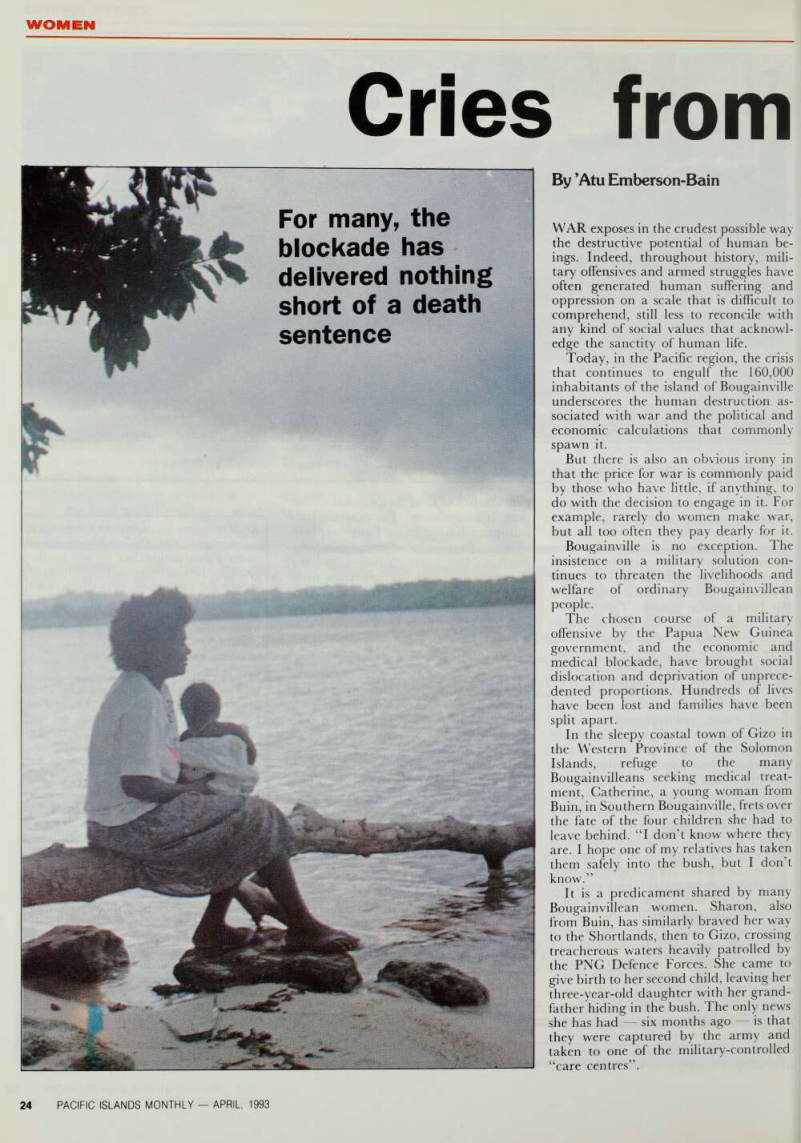
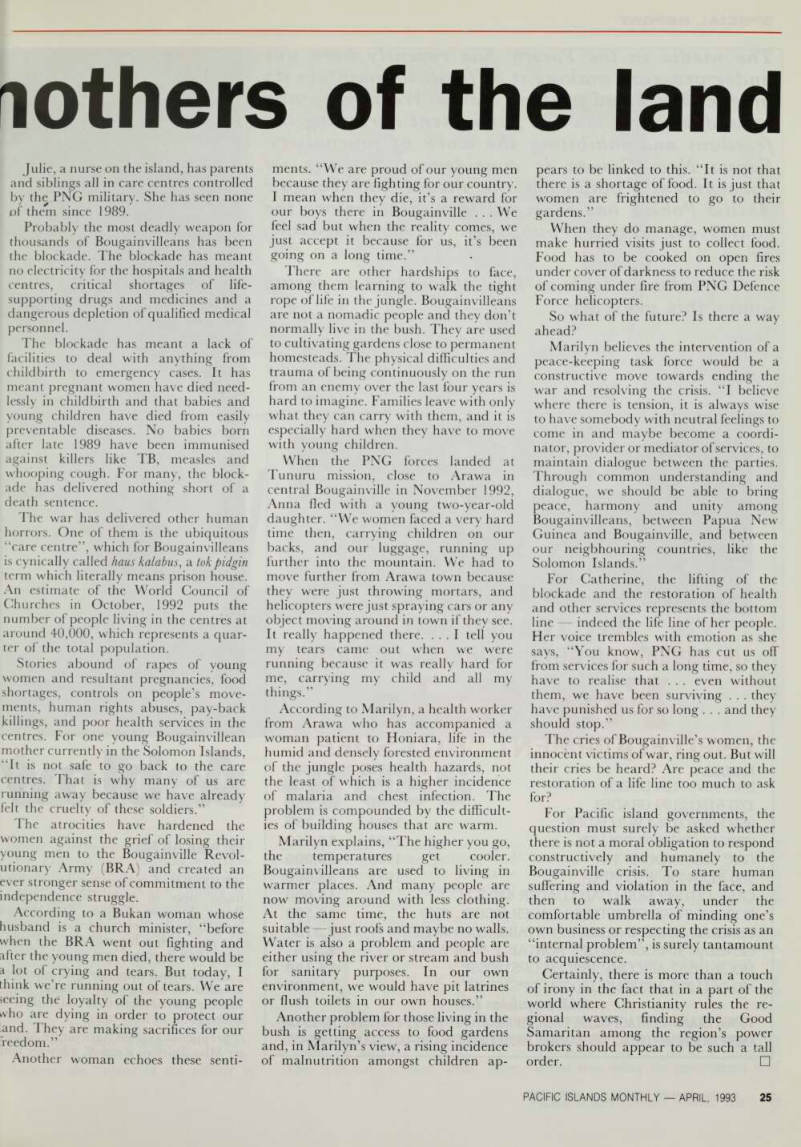
Women
By 'Atu Emberson-Bain
WAR exposes in the crudest possible way the destructive potential of human be ings. Indeed, throughout history, mili tary offensives and armed struggles have often generated human suffering and oppression on a scale that is difficult to comprehend, still less to reconcile with any kind of social values that acknowl edge the sanctity of human life.
Today, in the Pacific region, the crisis that continues to engulf the 160,000 inhabitants of the island of Bougainville underscores the human destruction as sociated with war and the political and economic calculations that commonly spawn it.
But there is also an obvious irony in that the price for war is commonly paid by those who have little, if anything, to do with the decision to engage in it. For example, rarely do women make war, but all too often they pay dearly for it.
Bougainville is no exception. The insistence on a military solution con tinues to threaten the livelihoods and welfare of ordinary Bougainvillean
people.
The chosen course of a military offensive by the Papua New Guinea government, and the economic and medical blockade, have brought social dislocation and deprivation of unprece dented proportions. Hundreds of lives have been lost and families have been split apart.
In the sleepy coastal town of Gizo in the Western Province of the Solomon Islands, refuge to the many Bougainvilleans seeking medical treat ment, Catherine, a young woman from Buin, in Southern Bougainville, frets over the fate of the four children she had to leave behind. “I don’t know where they are. I hope one of my relatives has taken them safely into the bush, but I don’t know.”
It is a predicament shared by many Bougainvillean women. Sharon, also from Buin, has similarly braved her way to the Shortlands, then to Gizo, crossing treacherous waters heavily patrolled by the PNG Defence Forces. She came to give birth to her second child, leaving her three-year-old daughter with her grand father hiding in the bush. The only news she has had — six months ago — is that they were captured by the army and taken to one of the military-controlled “care centres”.
For many, the blockade has delivered nothing short of a death sentence
Julie, a nurse on the island, has parents and siblings all in care centres controlled by the PNG military. She has seen none of them since 1989.
Probably the most deadly weapon for thousands of Bougainvilleans has been the blockade. The blockade has meant no electricity for the hospitals and health centres, critical shortages of life supporting drugs and medicines and a dangerous depletion of qualified medical personnel.
The blockade has meant a lack of facilities to deal with anything from childbirth to emergency cases. It has meant pregnant women have died need lessly in childbirth and that babies and young children have died from easily preventable diseases. No babies born after late 1989 have been immunised against killers like TB, measles and whooping cough. For many, the block ade has delivered nothing short of a death sentence.
The war has delivered other human horrors. One of them is the übiquitous “care centre”, which for Bougainvilleans is cynically called haus kalabus , a tok pidgin term which literally means prison house.
An estimate of the World Council of Churches in October, 1992 puts the number of people living in the centres at around 40,000, which represents a quar ter of the total population.
Stories abound of rapes of young women and resultant pregnancies, food shortages, controls on people’s move ments, human rights abuses, pay-back killings, and poor health services in the centres. For one young Bougainvillean mother currently in the Solomon Islands, “It is not safe to go back to the care centres. That is why many of us are running away because we have already felt the cruelty of these soldiers.”
The atrocities have hardened the women against the grief of losing their young men to the Bougainville Revol utionary Army (BRA) and created an ever stronger sense of commitment to the
independence struggle.
According to a Bukan woman whose husband is a church minister, “before when the BRA went out fighting and after the young men died, there would be a lot of crying and tears. But today, I think we’re running out of tears. We are seeing the loyalty of the young people who are dying in order to protect our and. They are making sacrifices for our reedom.”
Another woman echoes these send
ments. “We are proud of our young men because they are fighting for our country.
I mean when they die, it’s a reward for our boys there in Bougainville . . . We feel sad but when the reality comes, we just accept it because for us, it’s been going on a long time.”
There are other hardships to face, among them learning to walk the tight rope of life in the jungle. Bougainvilleans are not a nomadic people and they don’t normally live in the bush. They are used to cultivating gardens close to permanent homesteads. The physical difficulties and trauma of being continuously on the run from an enemy over the last four years is hard to imagine. Families leave with only what they can carry with them, and it is especially hard when they have to move with young children.
When the PNG forces landed at Tunuru mission, close to Arawa in central Bougainville in November 1992, Anna fled with a young two-year-old daughter. “We women faced a very hard time then, carrying children on our backs, and our luggage, running up further into the mountain. We had to move further from Arawa town because they were just throwing mortars, and helicopters were just spraying cars or any object moving around in town if they see.
It really happened there. ... I tell you my tears came out when we were running because it was really hard for me, carrying my child and all my things.”
According to Marilyn, a health worker from Arawa who has accompanied a woman patient to Honiara, life in the humid and densely forested environment of the jungle poses health hazards, not the least of which is a higher incidence of malaria and chest infection. The problem is compounded by the difficult ies of building houses that are warm.
Marilyn explains, “The higher you go, the temperatures get cooler.
Bougainvilleans are used to living in warmer places. And many people are now moving around with less clothing.
At the same time, the huts are not suitable —just roofs and maybe no walls.
Water is also a problem and people are either using the river or stream and bush for sanitary purposes. In our own environment, we would have pit latrines or flush toilets in our own houses.”
Another problem for those living in the bush is getting access to food gardens and, in Marilyn’s view, a rising incidence of malnutrition amongst children ap
pears to be linked to this. “It is not that there is a shortage of food. It is just that women are frightened to go to their gardens.”
When they do manage, women must make hurried visits just to collect food.
Food has to be cooked on open fires under cover of darkness to reduce the risk of coming under fire from PNG Defence
Force helicopters.
So what of the future? Is there a way ahead?
Marilyn believes the intervention of a peace-keeping task force would be a constructive move towards ending the war and resolving the crisis. “I believe where there is tension, it is always wise to have somebody with neutral feelings to come in and maybe become a coordi nator, provider or mediator of services, to maintain dialogue between the parties.
Through common understanding and
dialogue, we should be able to bring peace, harmony and unity among
Bougainvilleans, between Papua New
Guinea and Bougainville, and between our neighbouring countries, like the Solomon Islands.”
For Catherine, the lifting of the blockade and the restoration of health and other services represents the bottom line indeed the life line of her people.
Her voice trembles with emotion as she says, “You know, PNG has cut us off from services for such a long time, so they have to realise that . . , even without them, we have been surviving . . . they have punished us for so long . . . and they should stop.”
The cries of Bougainville’s women, the innocent victims of war, ring out. But will their cries be heard? Are peace and the restoration of a life line too much to ask for?
For Pacific island governments, the question must surely be asked whether there is not a moral obligation to respond constructively and humanely to the Bougainville crisis. To stare human suffering and violation in the face, and then to walk away, under the comfortable umbrella of minding one’s own business or respecting the crisis as an “internal problem”, is surely tantamount
to acquiescence.
Certainly, there is more than a touch of irony in the fact that in a part of the world where Christianity rules the re gional waves, finding the Good Samaritan among the region’s power brokers should appear to be such a tall order. □
A blow to free press

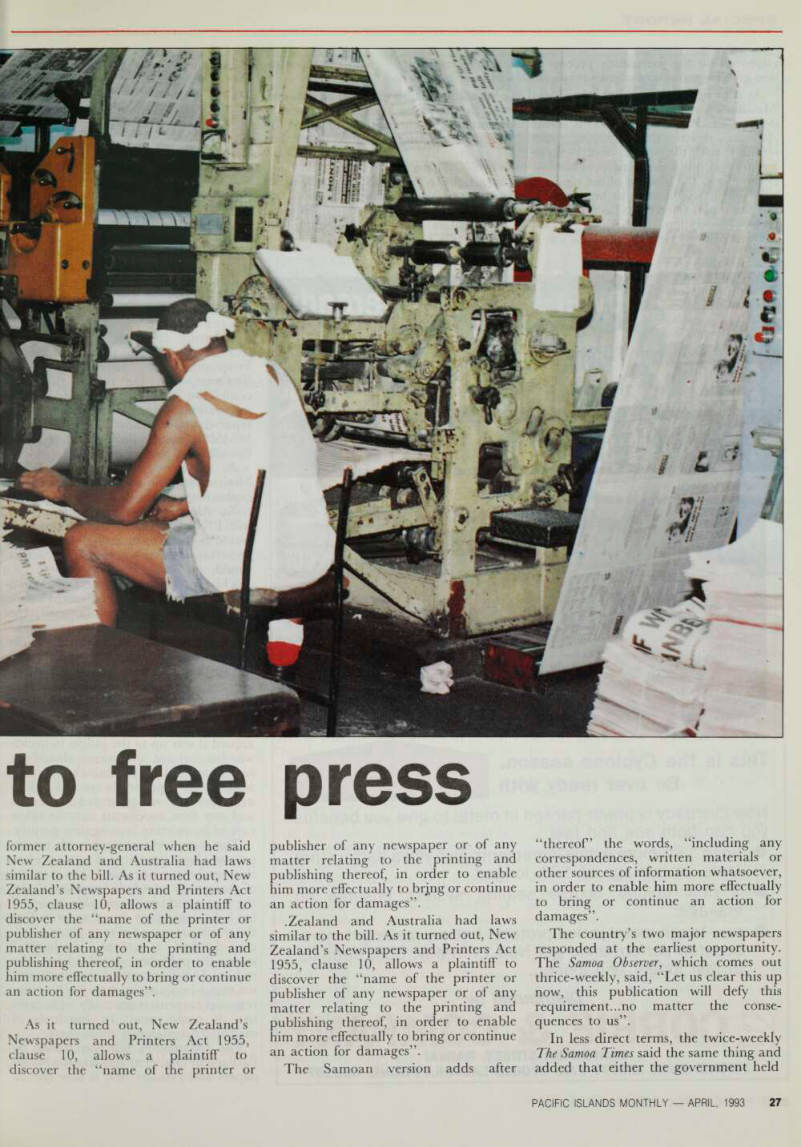

The media in the Pacific has recently been put under pressure making it difficult to maintain its independence and probing stance . Western Samoa passed two new laws in parliament curtailing the freedom and inhibiting the work of journalists .
Papua New Guinea is considering drawing up government’s policy on the media and Tonga’s Akilisi Pohiva has a record five cases before the courts for articles published in his magazine, Kele’a.
PIM takes a look at how the media is faring under this pressure .
By Alan Ah Mu
WESTERN Samoan reporters came under siege in early February when Prime Minister Tofilau Eti Alesana introduced the Newspapers and Printers Act and, with a big majority in Parlia ment, had it passed two days later.
Stunned and then outraged, reporters focussed on one clause clause 10 which required them to reveal sources of information in libel cases.
Scepticism greeted Agriculture Minis
ter Misa Telefoni Retzlaff, a lawyer and
former attorney-general when he said New Zealand and Australia had laws similar to the bill. As it turned out, New Zealand’s Newspapers and Printers Act 1955, clause 10, allows a plaintiff to discover the “name of the printer or publisher of any newspaper or of any matter relating to the printing and publishing thereof, in order to enable him more effectually to bring or continue an action for damages”.
As it turned out, New Zealand’s Newspapers and Printers Act 1955, clause 10, allows a plaintiff to discover the “name of the printer or
publisher of any newspaper or of any matter relating to the printing and publishing thereof, in order to enable him more effectually to or continue an action for damages”. .Zealand and Australia had laws similar to the bill. As it turned out, New Zealand’s Newspapers and Printers Act 1955, clause 10, allows a plaintiff to discover the “name of the printer or publisher of any newspaper or of any matter relating to the printing and publishing thereof, in order to enable him more effectually to bring or continue an action for damages”.
The Samoan version adds after
“thereof’ the words, “including any correspondences, written materials or other sources of information whatsoever, in order to enable him more effectually to bring or continue an action for
damages”.
The country’s two major newspapers responded at the earliest opportunity.
The Samoa Observer , which comes out thrice-weekly, said, “Let us clear this up now, this publication will defy this requirement...no matter the conse quences to us”.
In less direct terms, the twice-weekly The Samoa Times said the same thing and added that either the government held
contempt for the journalistic process or was grossly ignorant of what it involved.
As if to support the latter, the Prime Minister on the second day of the bill’s debate in Parliament, said a Radio Australia report that morning had wrongly told the world that Western Samoa was not a democracy. If the bill became law, the identity of the reporter who sent it would have to be revealed.
But the report referred to Pacific Islands News Association (PINA) president, Monica Miller’s view that the bill was a
form of censorship who the reporter was, was immaterial.
Regarding clause 10, the main cause of concern, the Prime Minister explained it protected the rights of those defamed by letters-to-the-editor published under nom de plumes (like “Trouble” or “Con cerned”). Those thus wronged, he said, had a right to know who had made the defamatory statements so they could be sued. The Samoa Observer contended such letter writers preferred anonymity for fear of “fear of reprisals”.
But an independent MP Le Tagaloa Pita, publisher of The South Sea Star , argued a newspaper had recently been fined WSS2O,OOO for defamation (a decision now being appealed) before the bill was passed, so the rights of those who felt wronged were already protected.
Opposition MPs accused the govern ment of intimidating the press, with former Cabinet minister Ulualofaiga Talamaivao Niko, urging fellow MPs not be afraid of criticism “we’re not angels”.
The bill was not referred to the bills committee to allow members of the public to express opinions on it and led to Samoa Observer publisher Fata Sano Malifa describing it as an “unpreceden ted swift passage”.
Referring to clause 10, the deputy secretary-general of the International Federation of Journalists, Neal Swancott, said the refusal to break confidence imposed by sources was an
international principle ofjournalism. Yet
reporters were now faced with a WSSSOOO fine or a three-month jail term for adhering to that principle. As criticism mounted, the Prime Minister felt the need to broadcast an explanation of the bill on government radio. Alesana also said after a meeting with PINA the “lines of communication” would be kept open and if the govern ment saw a need to change the act, it would.
This applied also to the Defamation Act which went before Parliament before the meeting. This time, however, the media was given the opportunity to make submissions on it. JAWS argued against two clauses, which were “original” and not in the NZ statute it was based on.
One of them made it an offence to publish defamatory statements made in court about someone who was not a party to the court proceedings. JAWS argued it was up to the judges to decide whether or not statements should be suppressed and the journalist’s job was to report what happened in court. Further more, evidence was presented under oath and any false statements may be taken care of by existing laws against perjury.
The second clause deals with matter printed about a member of a group when the member is unidentified. Any member of that group who feels “aggrieved”, by the report and has “reasonable grounds” for believing others “may suppose that the words are intended to apply to him”, can demand a written “disclaimer” saying the published words did not refer to him. JAWS submitted the clause was too vague because, for example, if a story reported carpenters generally were care less, it could result in hundreds of carpenters demanding disclaimers.
The Defamation Bill was passed by Parliament unaltered and, like the News papers and Printers Act, is now law. □
Advertisements & other items, pp. 26-28 (3 items)
Special Report
For Sale
4
CAT. LOADER 950
US $39,000.00 GOOD WORKING CONDITION
For Sale
All enquiries to: TONGA ISLAND:-CONTACT WILLIS TJNGA, PHONE (676) 21-105/21-190 FAX #(676) 23-139 AMERICAN SAMOA:- CONTACT KEN FLANDERS, PHONE (684) 6994304/4321, FAX (684) 699-4307
irfliTCfrn
N *}
r ,., CDAI I GENERAL
GENERAL Ip purpose
PURPOSE JL PURPOb
This is the Cyclone season.
Be ever ready with
irfliTCfrn
Now Eveready is power-packed in metal to give you benefits you can both see and feel. • up to 13% more active ingredients give you a battery that lasts an average of 13% longer! • a new unique double sealing system ensures no leakage. • new tough metal jacket protects battery making it moreboosted performance get New Eveready. Built stronger to last longer and longer...
Distributed by:
CORRIE & COMPANY
CARPENTER STREET, RAIWAI
PHONE: SUVA 386777 FAX: 370010 LAUTOKA PHONE: 660137
Pohiva
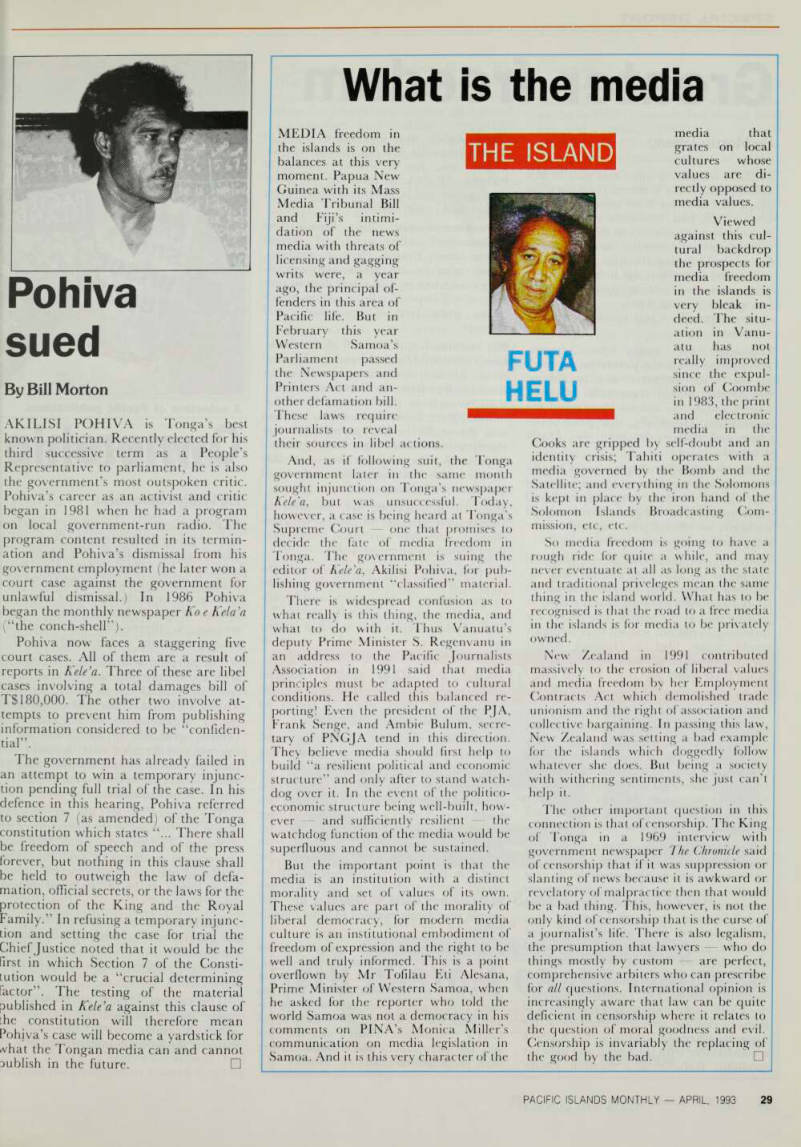
sued
By Bill Morton
AKILISI POHIVA is Tonga’s best known politician. Recently elected for his third successive term as a People’s Representative to parliament, he is also the government’s most outspoken critic.
Pohiva’s career as an activist and critic began in 1981 when he had a program on local government-run radio. The program content resulted in its termin ation and Pohiva’s dismissal from his government employment (he later won a court case against the government for unlawful dismissal.) In 1986 Pohiva began the monthly newspaper Ko e Kela'a (“the conch-shell”).
Pohiva now faces a staggering five court cases. All of them are a result of reports in Kele'a. Three of these are libel cases involving a total damages bill of T$ 180,000. The other two involve at tempts to prevent him from publishing information considered to be “confiden tial”.
The government has already failed in an attempt to win a temporary injunc tion pending full trial of the case. In his defence in this hearing, Pohiva referred to section 7 (as amended) of the Tonga constitution which states “... There shall be freedom of speech and of the press forever, but nothing in this clause shall be held to outweigh the law of defa mation, official secrets, or the laws for the protection of the King and the Royal Family.” In refusing a temporary injunc tion and setting the case for trial the Chief Justice noted that it would be the first in which Section 7 of the Consti tution would be a “crucial determining factor”. The testing of the material published in Kele'a against this clause of the constitution will therefore mean Pohiva’s case will become a yardstick for A'hat the Tongan media can and cannot Dublish in the future. □
What is the media
MEDIA freedom in the islands is on the balances at this very moment. Papua New Guinea with its Mass Media Tribunal Bill and Fiji’s intimi dation of the news media with threats of
licensing and gagging
writs were, a year ago, the principal of fenders in this area of Pacific life. But in February this year Western Samoa’s
Parliament passed
the Newspapers and Printers Act and an other defamation bill.
These laws require journalists to reveal
their sources in libel actions.
And, as if following suit, the Tonga government later in the same month
sought injunction on Tonga’s newspaper
Kele'a, but was unsuccessful. Today, however, a case is being heard at Tonga’s Supreme Court one that promises to decide the fate of media freedom in Tonga. The government is suing the editor of Kele'a , Akilisi Pohiva, for pub lishing government ‘“classified” material.
There is widespread confusion as to what really is this thing, the media, and what to do with it. Thus Vanuatu’s deputy Prime Minister S. Rcgenvanu in an address to the Pacific Journalists Association in 1991 said that media principles must be adapted to cultural conditions. He called this balanced re porting! Even the president of the PJA, Frank Senge, and Ambie Bulum, secre tary of PNGJA tend in this direction.
They believe media should first help to build “a resilient political and economic structure” and only after to stand watch dog over it. In the event of the politico economic structure being well-built, how ever and sufficiently resilient the watchdog function of the media would be superfluous and cannot be sustained.
But the important point is that the media is an institution with a distinct morality and set of values of its own.
These values are part of the morality of liberal democracy, for modern media culture is an institutional embodiment of freedom of expression and the right to be well and truly informed. This is a point overflown by Mr Tofilau Eti Alesana, Prime Minister of Western Samoa, when he asked for the reporter who told the world Samoa was not a democracy in his comments on PINA’s Monica Miller’s communication on media legislation in Samoa. And it is this very character of the
media that grates on local cultures whose values are di
rectly opposed to
media values.
Viewed against this cul
tural backdrop
the prospects for media freedom in the islands is very bleak in deed. The situ ation in Vanu atu has not
really improved
since the expul sion of Coombe in 1983, the print and electronic media in the
Cooks are gripped by self-doubt and an identity crisis; Tahiti operates with a media governed by the Bomb and the Satellite; and everything in the Solomons is kept in place by the iron hand of the Solomon Islands Broadcasting Com mission, etc, etc.
So media freedom is going to have a rough ride for quite a while, and may never eventuate at all as long as the state and traditional priveleges mean the same thing in the island world. What has to be recognised is that the road to a free media in the islands is for media to be privately owned.
New Zealand in 1991 contributed massively to the erosion of liberal values and media freedom by her Employment Contracts Act which demolished trade unionism and the right of association and collective bargaining. In passing this law, New Zealand was setting a bad example for the islands which doggedly follow whatever she docs. But being a society with withering sentiments, she just can’t
help it.
The other important question in this connection is that of censorship. The King of Tonga in a 1969 interview with government newspaper The Chronicle said of censorship that if it was suppression or slanting of news because it is awkward or revelatory of malpractice then that would be a bad thing. This, however, is not the only kind of censorship that is the curse of a journalist’s life. There is also legalism, the presumption that lawyers who do
things mostly by custom are perfect,
comprehensive arbiters who can prescribe for all questions. International opinion is increasingly aware that law can be quite deficient in censorship where it relates to the question of moral goodness and evil.
Censorship is invariably the replacing of
the good by the bad. □
The Island
Futa
Held
Greater freedom
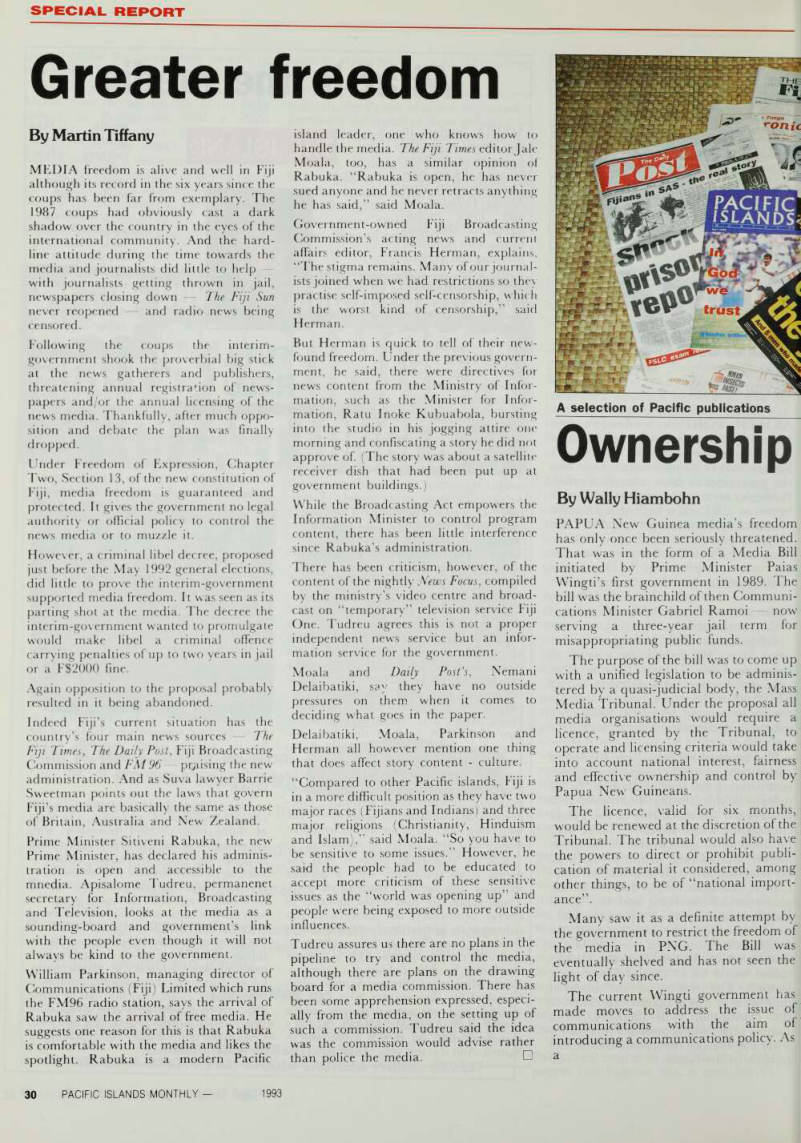
By Martin Tiffany
MEDIA freedom is alive and well in Fiji although its record in the six years since the coups has been far from exemplary. The 1987 coups had obviously cast a dark shadow over the country in the eyes of the international community. And the hard line attitude during the time towards the media and journalists did little to help
with journalists getting thrown in jail,
newspapers closing down The Fiji Sun never reopened and radio news being censored.
Following the coups the interim government shook the proverbial big stick at the news gatherers and publishers, threatening annual registration of news papers and/or the annual licensing of the news media. Thankfully, after much oppo sition and debate the plan was finally
dropped.
Under Freedom of Expression, Chapter Two, Section 13, of the new constitution of Fiji, media freedom is guaranteed and protected. It gives the government no legal authority or official policy to control the news media or to muzzle it.
However, a criminal libel decree, proposed just before the May 1992 general elections, did little to prove the interim-government supported media freedom. It was seen as its parting shot at the media. The decree the
interim-government wanted to promulgate
would make libel a criminal offence carrying penalties of up to two years in jail or a FS2OOO fine.
Again opposition to the proposal probably
resulted in it being abandoned.
Indeed Fiji’s current situation has the country’s four main news sources The Fiji Times, The Daily Post, Fiji Broadcasting Commission and FM 96 — praising the new administration. And as Suva lawyer Barrie Sweetman points out the laws that govern Fiji’s media are basically the same as those of Britain, Australia and New Zealand.
Prime Minister Sitiveni Rabuka, the new Prime Minister, has declared his adminis tration is open and accessible to the mnedia. Apisalome Tudreu, permanenet secretary for Information, Broadcasting and Television, looks at the media as a
sounding-board and government’s link
with the people even though it will not always be kind to the government.
William Parkinson, managing director of Communications (Fiji) Limited which runs the FM96 radio station, says the arrival of Rabuka saw the arrival of free media. He suggests one reason for this is that Rabuka is comfortable with the media and likes the spotlight. Rabuka is a modern Pacific
island leader, one who knows how to handle the media. The Fiji Times editor Jale Moala, too, has a similar opinion of Rabuka. “Rabuka is open, he has never sued anyone and he never retracts anything he has said,” said Moala.
Government-owned Fiji Broadcasting Commission’s acting news and current affairs editor, Francis Herman, explains, “The stigma remains. Many of our journal ists joined when we had restrictions so they
practise self-imposed self-censorship, which
is the worst kind of censorship,” said Herman.
But Herman is quick to tell of their new found freedom. Under the previous govern ment, he said, there were directives for news content from the Ministry of Infor mation, such as the Minister for Infor mation, Ratu Inoke Kubuabola, bursting into the studio in his jogging attire one morning and confiscating a story he did not approve of. (The story was about a satellite receiver dish that had been put up at
government buildings.)
While the Broadcasting Act empowers the Information Minister to control program content, there has been little interference since Rabuka’s administration.
There has been criticism, however, of the content of the nightly News Focus , compiled by the ministry’s video centre and broad cast on “temporary” television service Fiji One. Tudreu agrees this is not a proper independent news service but an infor mation service for the government.
Moala and Daily Post’s , Nemani Delaibatiki, say they have no outside pressures on them when it comes to deciding what goes in the paper.
Delaibatiki, Moala, Parkinson and Herman all however mention one thing that does affect story content - culture.
“Compared to other Pacific islands, Fiji is in a more difficult position as they have two major races (Fijians and Indians) and three
major religions (Christianity, Hinduism
and Islam),” said Moala. “So you have to be sensitive to some issues.” However, he said the people had to be educated to accept more criticism of these sensitive issues as the “world was opening up” and people were being exposed to more outside influences.
Tudreu assures us there are no plans in the pipeline to try and control the media, although there are plans on the drawing board for a media commission. There has
been some apprehension expressed, especi
ally from the media, on the setting up of such a commission. Tudreu said the idea was the commission would advise rather than police the media. □
Ownership
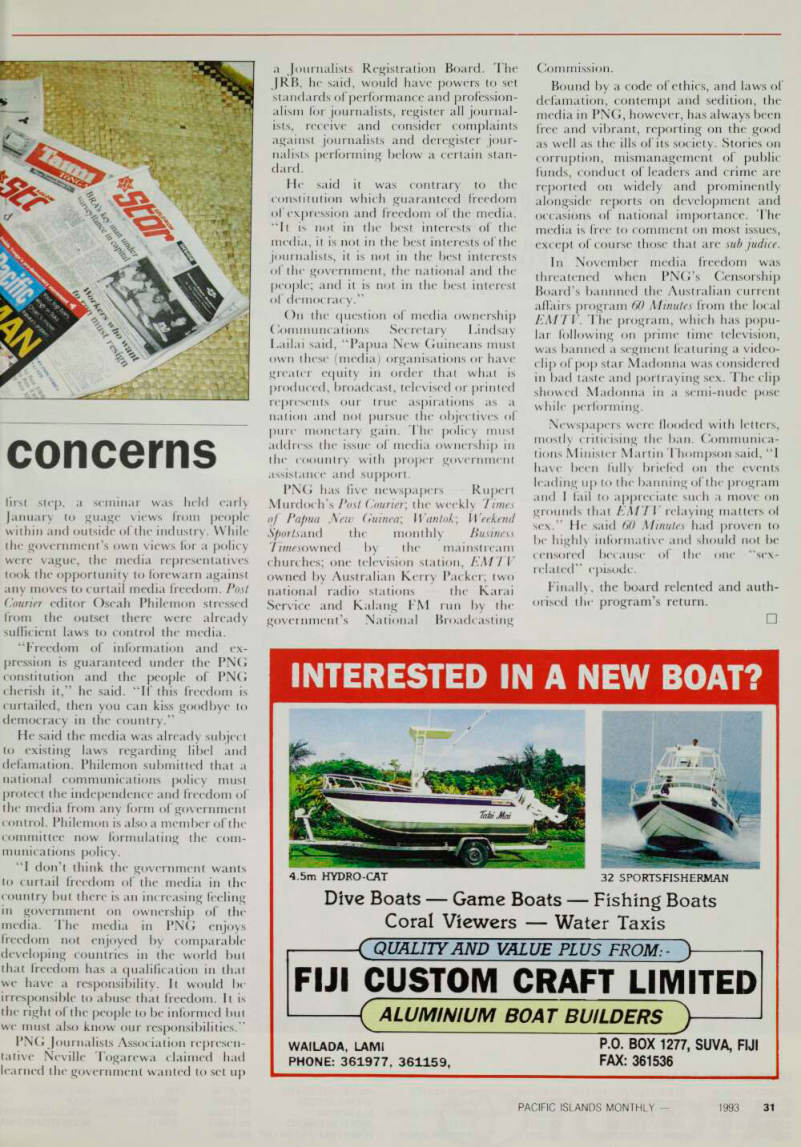
By Wally Hiambohn
PAPUA New Guinea media’s freedom has only once been seriously threatened.
That was in the form of a Media Bill initiated by Prime Minister Paias Wingti’s first government in 1989. The bill was the brainchild of then Communi cations Minister Gabriel Ramoi now serving a three-year jail term for misappropriating public funds.
The purpose of the bill was to come up with a unified legislation to be adminis tered by a quasi-judicial body, the Mass Media Tribunal. Under the proposal all media organisations would require a licence, granted by the Tribunal, to operate and licensing criteria would take into account national interest, fairness and effective ownership and control by Papua New Guineans.
The licence, valid for six months,would be renewed at the discretion of the Tribunal. The tribunal would also have the powers to direct or prohibit publi cation of material it considered, among other things, to be of “national import ance”.
Many saw it as a definite attempt by the government to restrict the freedom of the media in PNG. The Bill was eventually shelved and has not seen the light of day since.
The current VVingti government has made moves to address the issue oU communications with the aim of introducing a communications policy. As a
A selection of Pacific publications
first step, a seminar was held early January to guage views from people within and outside of the industry. While the government’s own views for a policy were vague, the media representatives took the opportunity to forewarn against any moves to curtail media freedom. Post Courier editor Oseah Philemon stressed from the outset there were already sufficient laws to control the media.
“Freedom of information and ex pression is guaranteed under the PNG constitution and the people of PNG cherish it,” he said. “If this freedom is curtailed, then you can kiss goodbye to democracy in the country.”
He said the media was already subject to existing laws regarding libel and defamation. Philemon submitted that a national communications policy must protect the independence and freedom of the media from any form of government control. Philemon is also a member of the committee now formulating the com
munications policy.
“I don’t think the government wants to curtail freedom of the media in the country but there is an increasing feeling in government on ownership of the media. The media in PNG enjoys
freedom not enjoyed by comparable
developing countries in the world but that freedom has a qualification in that we have a responsibility. It would be irresponsible to abuse that freedom. It is the right of the people to be informed but we must also know our responsibilities.”
PNG Journalists Association represen tative Neville Togarewa claimed had learned the government wanted to set up
a Journalists Registration Board. The JRB, he said, would have powers to set standards of performance and profession alism for journalists, register all journal ists, receive and consider complaints against journalists and deregister jour nalists performing below a certain stan dard.
He said it was contrary to the constitution which guaranteed freedom of expression and freedom of the media.
“It is not in the best interests of the media, it is not in the best interests of the journalists, it is not in the best interests of the government, the national and the people; and it is not in the best interest
of democracy.”
On the question of media ownership Communcations Secretary Lindsay Lailai said, “Papua New Guineans must own these (media) organisations or have greater equity in order that what is produced, broadcast, televised or printed represents our true aspirations as a nation and not pursue the objectives of pure monetary gain. The policy must address the issue of media ownership in the coountry with proper government assistance and support.
PNG has five newspapers Rupert Murdoch s Post Courier; the weekly Times of Papua New Guinea ; Wantok ; Weekend Sports&nd the monthly Business by the mainstream churches; one television station, EMTV owned by Australian Kerry Packer; two national radio stations the Karai Service and Kalang FM run by the government’s National Broadcasting
Commission.
Bound by a code of ethics, and laws of defamation, contempt and sedition, the media in PNG, however, has always been free and vibrant, reporting on the good as well as the ills of its society. Stories on corruption, mismanagement of public funds, conduct of leaders and crime are reported on widely and prominently alongside reports on development and occasions of national importance. The media is free to comment on most issues, except of course those that are sub judice.
In November media freedom was threatened when PNG’s Censorship Board’s bannned the Australian current affairs program 60 Minutes from the local EMTV. The program, which has popu lar following on prime time television, was banned a segment featuring a video clip of pop star Madonna was considered in bad taste and portraying sex. The clip showed Madonna in a semi-nude pose
while performing.
Newspapers were Hooded with letters, mostly criticising the ban. Communica tions Minister Martin Thompson said, “I have been fully briefed on the events leading up to the banning of the program and I fail to appreciate such a move on grounds that EM 7 V relaying matters of sex.” He said 60 Minutes had proven to be highly informative and should not be censored because of the one “sex
related” episode.
Finally, the board relented and auth orised the program’s return. □
Advertisements & other items, pp. 31-33 (1 item)
Fiji Custom Craft Limited
INTERESTED IN A NEW BOAT?
Taei r /
4.5 m HYDRO-CAT
32 SPORTSFISHERMAN
Dive Boats Game Boats Fishing Boats Coral Viewers Water Taxis -( QUALITY AND VALUE PLUS FROM:- >
FIJI CUSTOM CRAFT LIMITED
( aluminium boat builders
WAILADA. LAMI
PHONE; 361977, 361159,
P.O. BOX 1277, SUVA, FIJI
FAX: 361536
Creating a highly efficient, dynamic-looking car woe . be simple if it weren’t for one complicating detail; t passengers that must ride in it. Accommodating people comfortably in a pleasant, roor interior usually means a certain amount of aerodynamic potential has to be sacrifice 4 a. 4 £1 Exact features and specifications may vary depending on country of purchase. Please check with your nearest TOYOTA distributor/dealer for details.
DISTRIBUTORS/DEALERS
AMERICAN SAMOA BURNS PHILP (S.S.) CO. LTD.
GUAM & MICRONESIA... ATKINS KROLL. INC.
NORFOLK ISLANDS BORRY’S PTY LTD.
SOLOMON ISLANDS MENDANA MOTORS
VANUATU VANUATU MOTORS
PH 633-4281 PH 646-1876/9 PH 2114 PH 30314 PH 22341
COOK ISLANDS PACIFIC MOTORS LTD.
KIRIBATI TARAWA MOTORS
PAPUA NEW GUINEA .. .ELA MOTORS
TAHITI NIPPON AUTOMOTO
WESTERN SAMOA BURNS PHILP (S.S.) CO. LTD.
PH 20796 PH 21090 PH 217036 PH 429819 PH 20800
FIJI ASCO MOTORS
NEW CALEDONIA .. .S.I.A.P
SAIPAN MICROL CORPORATION 1
TONGA BURNS PHILP (TONGA) U
E S RMITIMTV Unti * now - Usin § a con ‘ DMlilirULLl. cept called total airflow lagement, Toyota engineers were able to realize an efficient, wedge-shaped design le at the same time perfecting the alignment between body panels and components, course our own innovative style of civilized ineering makes sure that none of this comes he expense of the luxurious, leg-stretching : interior. Because we realize that even a 0.33 is useless if no one wants to drive the car.
<SR)TOYOTA
Refugees
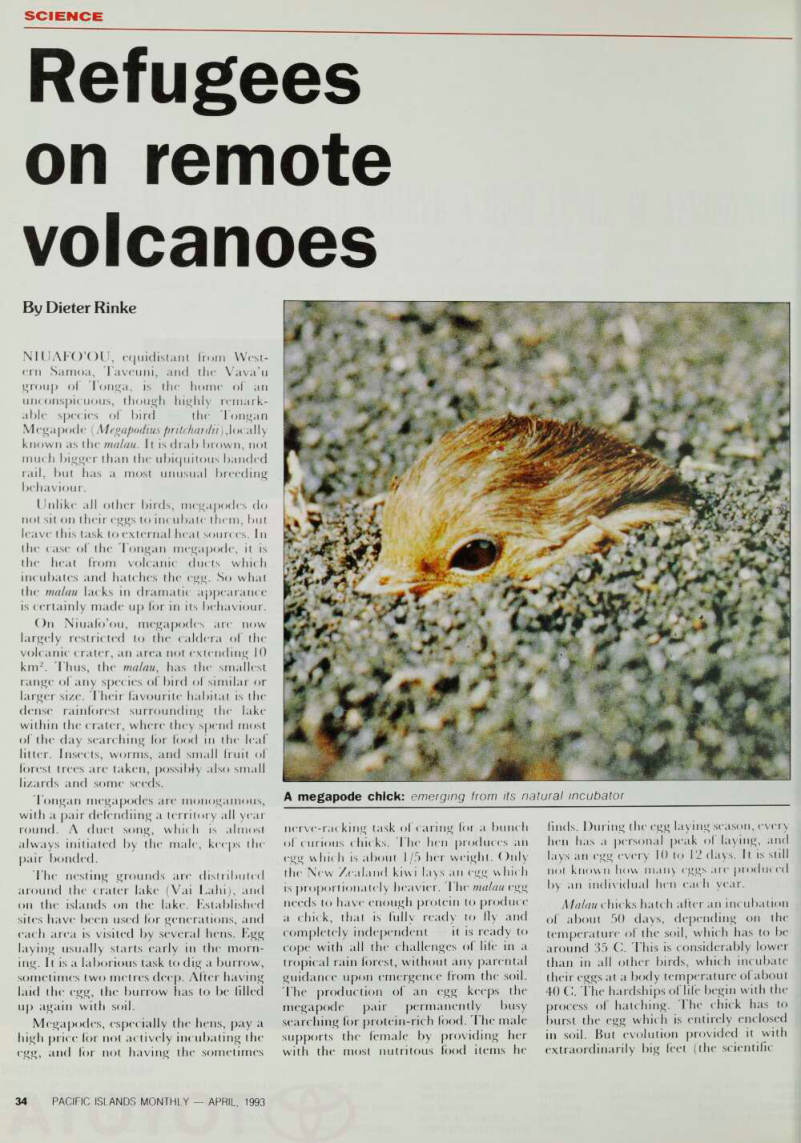
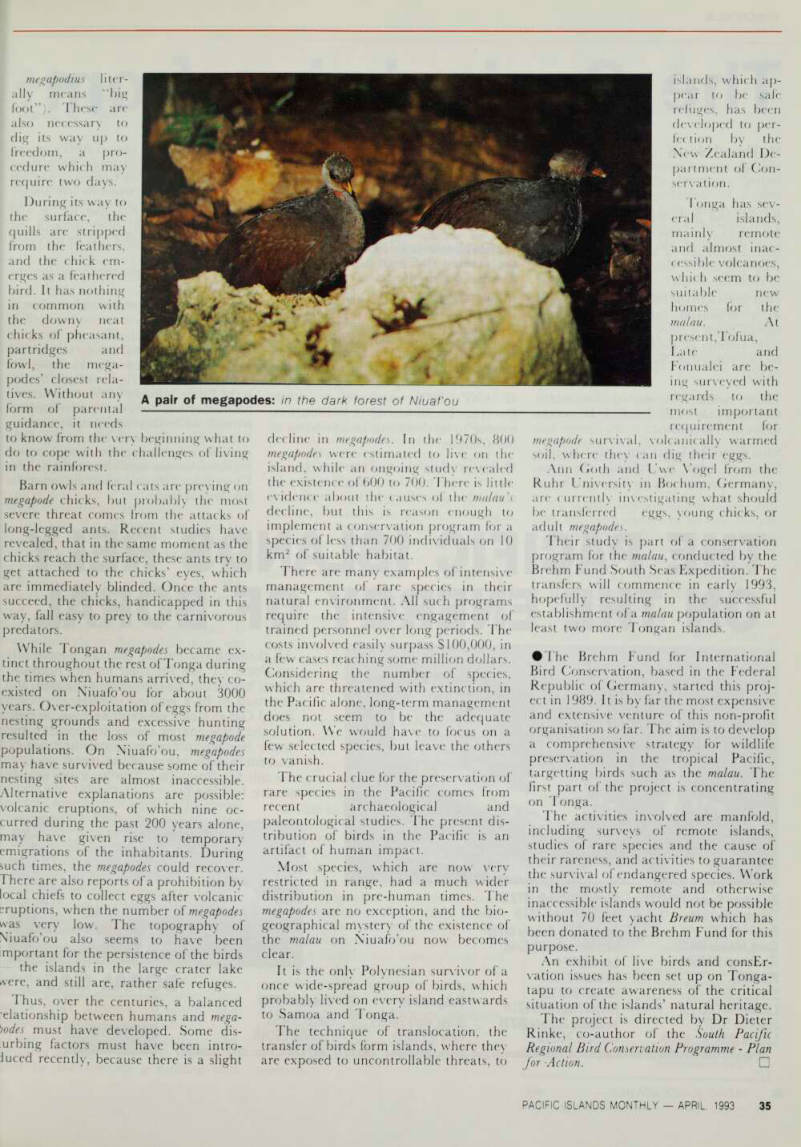
Science
Refugees on remote volcanoes
By Dieter Rinke
NIUAFO’OU, equidistant from West ern Samoa, Tavcuni, and the Vava’u group of Tonga, is the home of an
unconspicuous, though highly remark
able species of bird the Tongan
Megapode ( Megapodius prilchardii), locally
known as the malau. It is drab brown, not much bigger than the übiquitous banded rail, but has a most unusual breeding behaviour.
Unlike all other birds, mega pod es do not sit on their eggs to incubate them, but leave this task to external heal sources. In the case of the Tongan megapode, it is the heat from volcanic ducts which incubates and hatches the egg. So what the malau lacks in dramatic appearance is certainly made up for in its behaviour.
On Niuafo’ou, megapodes are now largely restricted to the caldera of the volcanic crater, an area not extending 10 km 2 . Thus, the malau , has the smallest range of any species of bird of similar or larger size. Their favourite habitat is the dense rainforest surrounding the lake within the crater, where they spend most of the day searching for food in the leaf litter. Insects, worms, and small fruit of forest trees are taken, possibly also small lizards and some seeds.
Tongan megapodes are monogamous, with a pair defendiing a territory all year round. A duet song, which is almost always initiated by the male, keeps the
pair bonded.
The nesting grounds are distributed around the crater lake (Vai Lain), and on the islands on the lake. Established sites have been used for generations, and each area is visited by several hens. Egg laying usually starts early in the morn ing. It is a laborious task to dig a burrow, sometimes two metres deep. After having laid the egg, the burrow has to be filled up again with soil.
Megapodes, especially the hens, pay a high price lor not actively incubating the egg, and for not having the sometimes
nerve-racking task of caring for a bunch of curious chicks. The hen produces an egg which is about 1/5 her weight. Only the'New Zealand kiw i lays an egg which is proportionately heavier. The malau egg needs to have enough protein to produce a chick, that is fully ready to fly and
completely independent it is ready to
cope with all the challenges of life in a tropical rain forest, without any parental guidance upon emergence from the soil.
The production of an egg keeps the
megapode pair permanently busy
searching for protein-rich food. I he male supports the female by providing her with the most nutritous food items he
finds. During the egg laying season, every lien has a personal peak of laying, and lays an egg every 10 to 12 days. It is still not known how many eggs are produced by an individual hen each year.
Malau chicks hatch after an incubation of about 50 days, depending on the temperature of the soil, which has to be around 35 C. This is considerably lower than in all other birds, which incubate their eggs at a body temperature of about 40 C. The hardships of life begin with the process of hatching. The chick has to burst the egg which is entirely enclosed in soil. But evolution provided it with extraordinarily big feet (the scientific
A megapode chick: emerging from its natural incubator
megapodius liter [ ally means “big foot”). These are also necessary to dig its way up to freedom, a pro cedure which may require two days.
During its way to the surface, the quills are stripped from the feathers, and the chick em erges as a feathered bird. It has nothing in common with the downy neat chicks of pheasant, partridges and fowl, the mega podes’ closest rela tives. Without any form of parental guidance, it needs
to know from the very beginning what to do to cope with the challenges of living in the rainforest.
Barn owls and feral cats are preying on megapode chicks, but probably the most severe threat comes from the attacks of long-legged ants. Recent studies have revealed, that in the same moment as the chicks reach the surface, these ants try to get attached to the chicks’ eyes, which are immediately blinded. Once the ants succeed, the chicks, handicapped in this way, fall easy to prey to the carnivorous predators.
While Tongan megapodes became cxtinct throughout the rest ofTonga during the times when humans arrived they COexisted on Niuafo’ou for about 3000 vears. Over-exploitation of eggs from the nesting grounds and excessWe hunting resulted in the loss of most populations. On .Niuafo’ou, may have survived because some of {heir nesting sites are almost inaccessible
Alternative explanations arc possible!
volcanic eruptions, of which nine occurred during the past 200 years alone may have given rise to temporary’emigrations of the inhabitants. During ~1 1pl . , , , suen times, the megapodes could recover. tu,,,. n i Pi- 1 here are also reports of a prohibition bv i,_„i i • r , 11 ‘ r . .local chiets to collect eggs alter volcanic r , , e ruptions, when the number of megapodes lA . ac i T i ? r c was very low. Ihe topography of , i v P p Niualo ou also seems to have been mportant for the persistence of the birds -ii • r .. , .ii * h and Urn hc J arge rate r r lake .vere, and still are, rather safe refuges.
I bus, over the centuries, 3. ba.la.nccd elationship between humans and mega- )odes must have developed. Some disurbing factors must have been introiuced recently, because there is a slight
decline in megapodes. In the 19705, 800 megapodes were estimated to live on the island, while an ongoing study revealed the existence of 600 to 700. There is little evidence about the causes of the malau s decline, but this is reason enough to implement a conservation program for a species of less than 700 individuals on 10 km 2 of suitable habitat.
There are many examples of intensive management of rare species in their natural environment. All such programs require the intensive engagement of
trained personnel over long periods. The
costs involved easily surpass 5100,000, in a few cases reaching some million dollars.
Considering the number of species, which arc threatened with extinction, in the Pacific alone, long-term management does not seem to be the adequate solution. We would have to focus on a few selected species, but leave the others to vanish.
The crucial clue for the preservation of rare species in the Pacific comes from recent archaeological and paleontological studies. The present dis tribution of birds in the Pacific is an artifact of human impact.
Most species, which arc now very restricted in range, had a much wider distribution in pre-human times. The megapodes are no exception, and the bio geographical mystery of the existence of the malau on Niuafo’ou now becomes clear.
It is the only Polynesian survivor of a once wide-spread group of birds, w hich probably lived on every island eastwards to Samoa and Tonga.
The technique of translocation, the transfer of birds form islands, w'hcrc they are exposed to uncontrollable threats, to
islands, which ap pear to be safe refuges, has been developed to per fection by the New /( aland De partment of Con servation.
Tonga has sev eral islands, mainly remote and almost inac cessible volcanoes, which seem to be suitable new homes for the malau. At presen t,Tofua, Late and Fonualei are be ing surveyed with regards to the
most important
requirement for
megapode survival, volcanically warmed soil, where they can dig their eggs.
Ann Goth and L'vve Vogel from the Ruhr University in Bochum, Germany, are currently investigating what should be transferred eggs, young chicks, or adult megapodes.
Their study is part of a conservation program for the malau , conducted by the Brehm Fund South Seas Expedition. The transfers will commence in early 1993, hopefully resulting in the successful establishment of a malau population on at least two more Tongan islands. • The Brehm Fund for International Bird Conservation, based in the Federal Republic of Germany, started this proj ect in 1989. It is by far the most expensive and extensive venture of this non-profit organisation so far. The aim is to develop a comprehensive strategy for wildlife preservation in the tropical Pacific, targetting birds such as the malau. The first part of the project is concentrating on Tonga.
The activities involved are manfold, including surveys of remote islands, studies of rare species and the cause of their rareness, and activities to guarantee the survival of endangered species. Work in the mostly remote and otherwise inaccessible islands would not be possible without 70 feet yacht Breum which has been donated to the Brehm Fund for this purpose.
An exhibit of live birds and consEr vation issues has been set up on Tonga tapu to create awareness of the critical situation of the islands’ natural heritage.
The project is directed by Dr Dieter Rinke, co-author of the South Pacific Regional Bird Conservation Programme - Plan for Action. □
A pair of megapodes: in the dark forest of Niuaf'ou
The Sunias’ rise from
Profile
By David North
FAMILIES play important roles in the politics of all islands, but the recent ups and downs of the Sunia family in American Samoa may be without precedent.
Four years ago the head of the family was in a Mainland prison for mis-using federal funds now Fofo Sunia and his three siblings all hold powerful positions in the American Samoan Government
(Asg).
Tause Sunia was elected Lieutenant Governor on A.P. Lutali’s Democrat ticket in November.
Soon thereafter Lutali appointed Aitofele Sunia to what is probably the most important position in his Cabinet, that of Treasurer.
And then their sister, Vaoita Savali, an experienced radio broadcaster, was named by Lutali to run the government owned television station, and, as such, serves as head of the of ASG Office of Information.
Meanwhile, their eldest brother, Fofo, is the ranking staff member of the Fono,
Samoa’a legislature.
Although the positions are important, the immediate tasks for the Sunias are not pleasant: • Tauese, as acting Governor, was given the job of running a major reduction in workforce wiping out the jobs of 1000 of ASG’s 5000 employees while Governor Lutali was off in Washington, helping to celebrate the inauguration of Bill Clinton. • Brother Aitofele, as Treasurer, had to try to scrape together enough money to meet the payroll; which consumes a
remarkable 84 per cent of ASG’s expen ditures. (The departing Republican Governor, Peter Tali Coleman, had left an empty treasury when he left office.) • And sister Vaoita had to try and explain all the bad news through the ASG information office and its television station.
All in all, a rough challenge for the family.
But the Sunias had seen tougher times in the past.
Fofo, the oldest brother, was born in 1937 into a powerful family which had roots in both Samoas. For example, his mother’s brother, Taofilau Eti Alesana, is the Prime Minister of Western Samoa; his mother was born to Western Samoan parents while they were missionaries in Papua New Guinea. The young Fofo studied at high schools in American and Western Samoa and then went to the University of Hawaii where he secured a BA in economics.
He became, fairly early in life, both a high chief and a talking chief (or orator) in Samoa’s matai system, and 10 years after leaving university he was chosen j (by the other matai in his village) for a seat in the territorial senate. He had both a modern education and the ancient titles, as well as the skills to move ahead in Samoan politics.
In 1980 he became the first delegate from Samoa to be seated in the US House of Representatives and was re-elected to that post in 1982, 1984 and 1986. He fared well in Congress, and by 1987 had become a chairman of a congressional sub-committee that dealt with non island affairs, the first island delegate in American history with that distinction.
Meanwhile, with a salary of close to SIOO,OOO a year, Fofo ran a nearly 51 million-a-year enterprise his office in the US House of Representatives. (The other members had similar salaries, of course, but each of them had 10 times as many constituents as Sunia.) Just why the delegate defrauded the taxpayers is not totally clear, but how' he did it, and how he got caught are matters of record.
Press speculation at the time (in 1988) was that Fofo felt a need to entertain and entertain lavishly the many Samoans who came to Washington. It was within the tradition, but there was no provision for it in the congressional
budget.
According to leaked reports from the prosecutors, what he and his then administrative assistant did was to add several residents of Samoa to the payroll and then cashed the paychecks. As these things go, it was neither a sophisticated
aor fool-proof scheme; although the
lames and salaries of the “ghost em iloyees” appeared in a public document which rarely finds its way to Pago s ago), there was no outcry.
But one of the “ghosts” later found hat the federal tax system planned to issess taxes on him for moneys he never eceived. He complained, and soon ederal investigators broke the case.
Fofo Sunia did not have the option of . trial in the friendly courts of the islands; ince the cheques were signed in Wash igton, he had a choice of pleading guilty r facing trial in the District of Colum ia. He pleaded guilty, was given a fine nd a short sentence in prison, and his seat in the House.
Days after finishing his sentence and "turning to Pago Pago Fofo Sunia was ired by the Fono as a ranking staff
member. Despite his problems with the law, no other Samoan (with the possible exception of the alternating governors, Coleman and Lutali) had his depth of experience with territorial and federal government, and so he was put to work by his former legislative colleagues. He has spent the recent years working quietly, largely out of the limelight.
But in 1992 the jSunia family surged forward.
First there was the selection of Tauese Sunia by A.P. Lutali as his running mate, for the office of Lt. Governor. (In Samoa, as in many Mainland states, the voters select among slates for these offices; if you wanted to vote for Sunia then you had to vote for Lutali, and vice versa.) Tauese had a very special, very Samoan occupation; he worked as a lay advocate (sort of a lawyer-substitute) handling matai claims before the High Court of American Samoa.
Lutali and Sunia defeated the Coleman-Toloa team by a wide margin in the November elections, and were sworn into office in early January.
On the last day of 1992 Lutali announced a number of Cabinet ap pointments including that of Aitofele Sunia as the new ASG Treasurer. The job is roughly comparable to that of the British Chancellor of the Exchequer or the Australian Treasurer; the incumbent supervises the development of budgets, the collection of taxes, and the payment of wages and other government bills.
There was some criticism of this Sunia appointment on the grounds that the new Treasurer was a lawyer, not a money man. Lutali’s spokesman replied the new governor wanted someone with a background in the law “to ensure that the law is followed at all times”.
Aitofele had previously served as Chief Legislative Counsel to the Fono , and, in more recent years had been in private practice with Ward and Associates.
Ironically, earlier in 1992 he had made headlines by successfully defending the former vice-speaker of the island House of Representatives on a fraud charge.
Moananu Va had been charged with taking government travel vouchers (for off-island travel), not using them, and converting them to cash. Aitofele had argued not that the act did not happen, but that no crime was involved because ASG did not give Moananu adequate opportunity to return the funds once he was caught. This presumably, is a line of reasoning Aitofele will not use in his new position.
The Sunias, of course, are not the only families involved in American Samoa politics. The appointments of former Governor Coleman’s son as his chief-of staff, and ofhis son-in-law as Washington representative had been highlighted in earlier issues of PIM as was the selection of Coleman’s daughter to the non-paid position of American Samoan member of the Republican National Committee.
And, more recently, it was learned that Governor Lutali’s daughter, Josephine, had been working for the ASG Treas urer’s office in an unannounced capacity, but apparently not that of deputy Treasurer.
Meanwhile, Savali Alesana Sunia, mother of the four office-holding Sunias and several other children, is in an odd situation. While she must pay taxes to Aitofele, and can watch Vaota’s tele vision, she has never been able to vote for either Fofo or Tauese.
No women and few men in Samoa can vote for representatives in the Samoa territorial senate where Fofo served for so long, as these selections are made by the malai. But male and female nationals can and do vote for both Lt. Governor and for the delegate to congress but Ms Sunia is not a national and never can be.
Although she has lived most of her life in American Samoa, and her children (born there) are national and prominent ones at that, there is no naturalisation process in American Samoa, so she will remain an alien in her children’s country for the rest of her life. □
Advertisements & other items, pp. 36-38 (1 item)
The Pacific Islands Rely
ON THE ENERGY OF BORAL
u* ' i* 3 3 ■■ -I r>- '.'J* ■ American Samoa (684) Tafuna 699 2948 Aua6442170 Cook Islands (682) Rarotonga 24460 Fyi (679) Suva 315522 Lautoka 60088 Sigatoka 50578 Labasa 82973 Norfolk Islands (6723) Norfolk Island 2419 Papaa New Guinea (675) Port Moresby 214248 Lae 422574 Rabaul 921225 Wewak 862125 Mount Hagen 551216 Solomon Islands (677) Honiara 21833 All through the Pacific Islands, people rely on Boral LP gas for their energy needs.
Boral has terminals throughout the area, and is proud to be a leading supplier.
Boral Gas is clean, efficient and low in cost It’s the ideal energy source for cooking and water beating in homes, motels and hotels, and for a wide range of industrial uses.
So call for Boral Gas. We have the energy you’re looking for.
Tonga(676) Nukualofa 24035 Vava’u 22903 Vanuatu (678) Santo 36455 Port Vila 22046
BORAL GAS
Boral Gas Pacific, John Oxley Centre, 339 Coronation Drive, Brisbane. Tel: (07) 3671365. Fax: (07) 3694347
TO ANYWHERE
IN THE WORLD
•gUU
Call us now
SUVA NADI
313166 723800 Your artifacts, gifts, souvenirs ,| carvings, artworks, documents whatever. DHL will de!iver\ \ anywhere worldwide Freight Forwarders, Air Cargo DHL Worldwide Express Service
LAUTOKA
665400 665401
LABASA
811162
LEVUKA
440139 with DHL "You're in safe hands all Che way" wontowKx ex/wess* ■ i
HONG KONG MAGIC
Hong Kong Rugby Sevens
Capture the action and thrill of the Hong Kong seven-a-side rugby tournament. These three stamps highlight the success Fiji has had in the Hong Kong tournament, winning it a record seven times.
For the sports fan and collector alike.
7S<?i of the Uloyal SAir ffforce
Celebrate the 75th anniversary of the Royal Air Force by collecting this set of commemorative stamps from Fiji.
With beautiful drawn aircraft from the Vickers Vildebeest to the British Aerospace Hawk it is a must for any collector.
HONGKONG
SEVENSR
n m % h
FIJI
“ --.---.vf "I
of the ROYAL AIR FORCE
1918-1993 59c
FIJI
m
75 th ANNIVERSARY
of the ROYAfAlft-FORCE Q „ 1918-1993 OjC
FIJI
77c I
7Sth ANNIVERSARY
ofcheROYAL AIRFORCE
1918-1993 $1
FIJI
FIJI
s $2
FIJI
75 ch ANNIVERSARY
of Che ROYAL AITFORCE
1918-1993
FIJI
V
?Sth ANNIVERSARY
of the ROYAL AIR FORCE
19181993 For more information write to: Postmaster Philatelic Bureau PO Box 100 Suva, Fiji.
Telecom
artworks
Going an extra mile
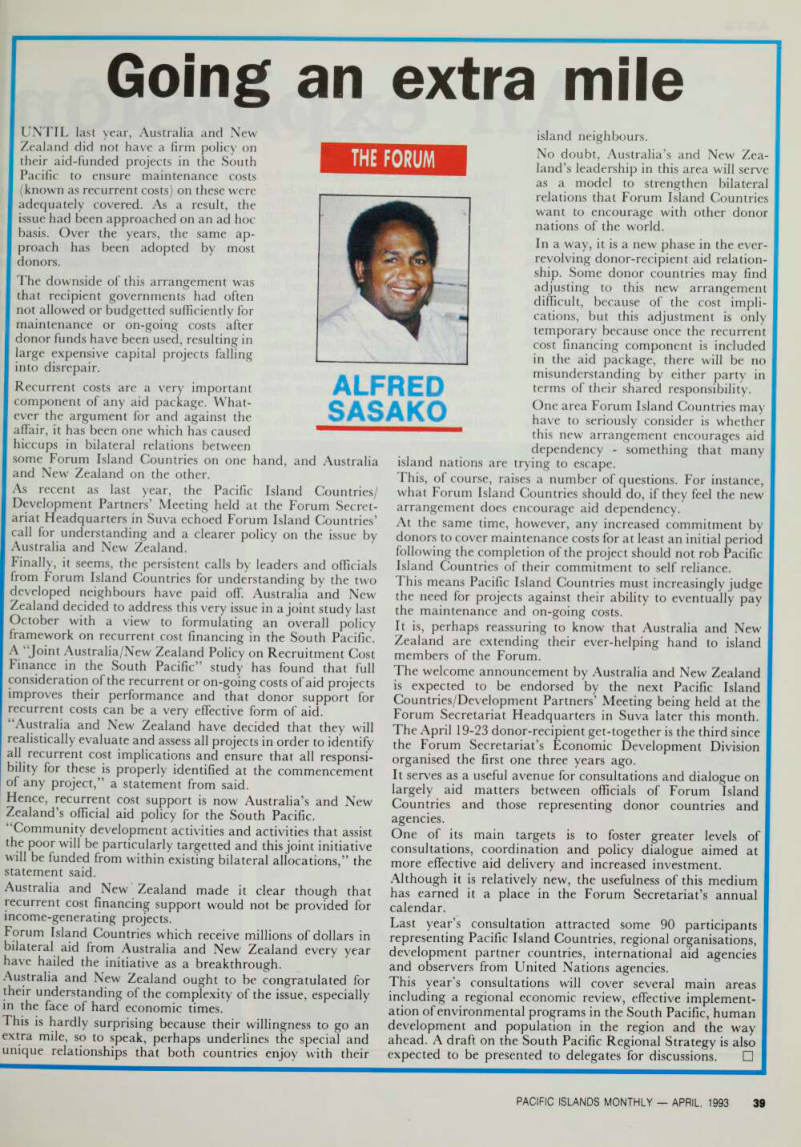
UNTIL last year, Australia and New Zealand did not have a firm policy on their aid-funded projects in the South Pacific to ensure maintenance costs (known as recurrent costs) on these were adequately covered. As a result, the issue had been approached on an ad hoc basis. Over the years, the same ap proach has been adopted by most donors.
The downside of this arrangement was that recipient governments had often not allowed or budgetted sufficiently for maintenance or on-going costs after donor funds have been used, resulting in large expensive capital projects falling
into disrepair.
Recurrent costs are a very important component of any aid package. What ever the argument for and against the affair, it has been one which has caused hiccups in bilateral relations between
some Forum Island Countries on one hand, and Australia and New Zealand on the other.
As recent as last year, the Pacific Island Countries/ Development Partners’ Meeting held at the Forum Secret ariat Headquarters in Suva echoed Forum Island Countries’ call for understanding and a clearer policy on the issue by Australia and New Zealand.
Finally, it seems, the persistent calls by leaders and officials from Forum Island Countries for understanding by the two developed neighbours have paid off. Australia and New Zealand decided to address this very issue in a joint study last October with a view to formulating an overall policy framework on recurrent,cost financing in the South Pacific.
A “Joint Australia/New Zealand Policy on Recruitment Cost Finance in the South Pacific” study has found that full consideration of the recurrent or on-going costs of aid projects improves their performance and that donor support for recurrent costs can be a very effective form of aid.
Australia and New Zealand have decided that they will realistically evaluate and assess all projects in order to identify all recurrent cost implications and ensure that all responsi bility for these is properly identified at the commencement of any project,” a statement from said.
Hence, recurrent cost support is now Australia’s and New Zealand’s official aid policy for the South Pacific.
Community development activities and activities that assist the poor will be particularly targetted and this joint initiative will be funded from within existing bilateral allocations,” the statement said.
Australia and New Zealand made it clear though that recurrent cost financing support would not be provided for
income-generating projects.
Forum Island Countries which receive millions of dollars in bilateral aid from Australia and New Zealand every year have hailed the initiative as a breakthrough.
Australia and New Zealand ought to be congratulated for their understanding of the complexity of the issue, especially in the face of hard economic times.
This is hardly surprising because their willingness to go an extra mile, so to speak, perhaps underlines the special and unique relationships that both countries enjoy with their
island neighbours.
No doubt, Australia’s and New Zea land’s leadership in this area will serve as a model to strengthen bilateral relations that Forum Island Countries want to encourage with other donor nations of the world.
In a way, it is a new phase in the ever revolving donor-recipient aid relation ship. Some donor countries may find adjusting to this new arrangement difficult, because of the cost impli cations, but this adjustment is only temporary because once the recurrent cost financing component is included in the aid package, there will be no misunderstanding by either party in terms of their shared responsibility.
One area Forum Island Countries may have to seriously consider is whether this new arrangement encourages aid dependency - something that many
island nations are trying to escape.
This, of course, raises a number of questions. For instance, what Forum Island Countries should do, if they feel the new arrangement does encourage aid dependency.
At the same time, however, any increased commitment by donors to cover maintenance costs for at least an initial period following the completion of the project should not rob Pacific Island Countries of their commitment to self reliance.
This means Pacific Island Countries must increasingly judge the need for projects against their ability to eventually pay the maintenance and on-going costs.
It is, perhaps reassuring to know that Australia and New Zealand are extending their ever-helping hand to island members of the Forum.
The welcome announcement by Australia and New Zealand is expected to be endorsed by the next Pacific Island Countries/Development Partners’ Meeting being held at the Forum Secretariat Headquarters in Suva later this month.
The April 19-23 donor-recipient get-together is the third since the Forum Secretariat’s Economic Development Division organised the first one three years ago.
It serves as a useful avenue for consultations and dialogue on largely aid matters between officials of Forum Island Countries and those representing donor countries and
agencies.
One of its main targets is to foster greater levels of consultations, coordination and policy dialogue aimed at more effective aid delivery and increased investment.
Although it is relatively new, the usefulness of this medium has earned it a place in the Forum Secretariat’s annual calendar.
Last year’s consultation attracted some 90 participants representing Pacific Island Countries, regional organisations, development partner countries, international aid agencies and observers from United Nations agencies.
This year’s consultations will cover several main areas including a regional economic review, effective implement ation of environmental programs in the South Pacific, human development and population in the region and the way ahead. A draft on the South Pacific Regional Strategy is also expected to be presented to delegates for discussions. □
The Forum
Alfred
Sasako
An explosion of colour
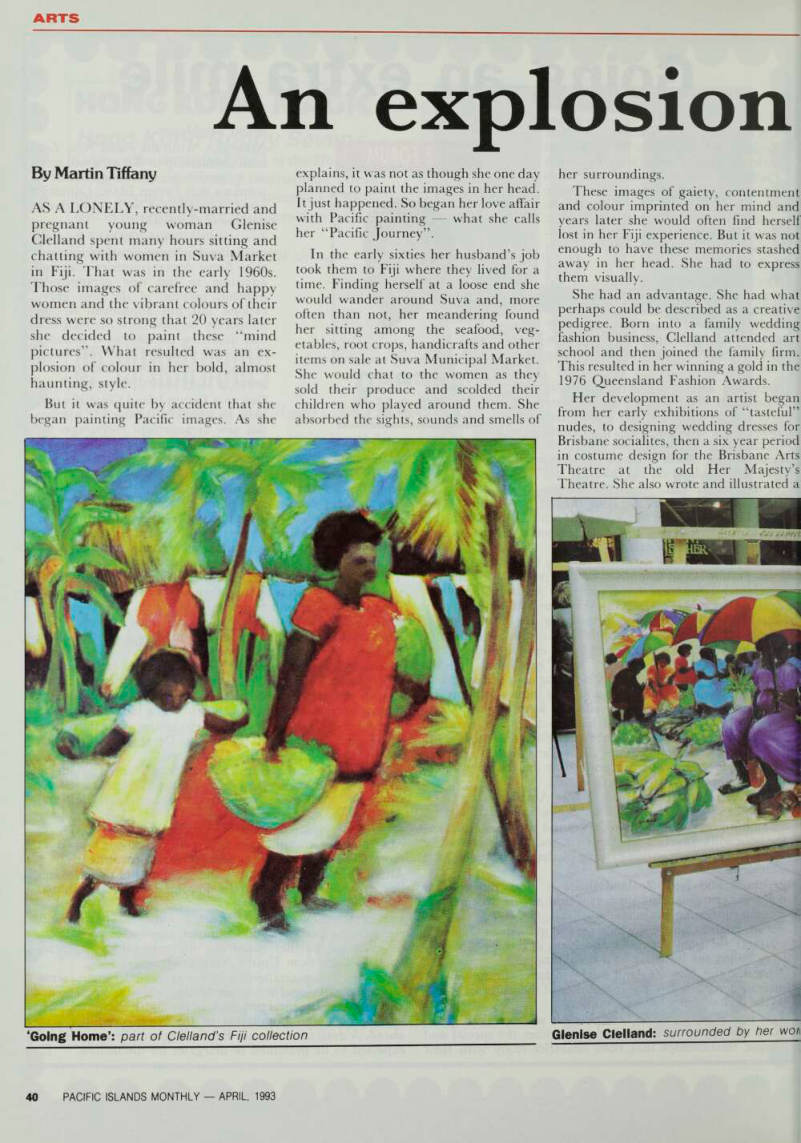
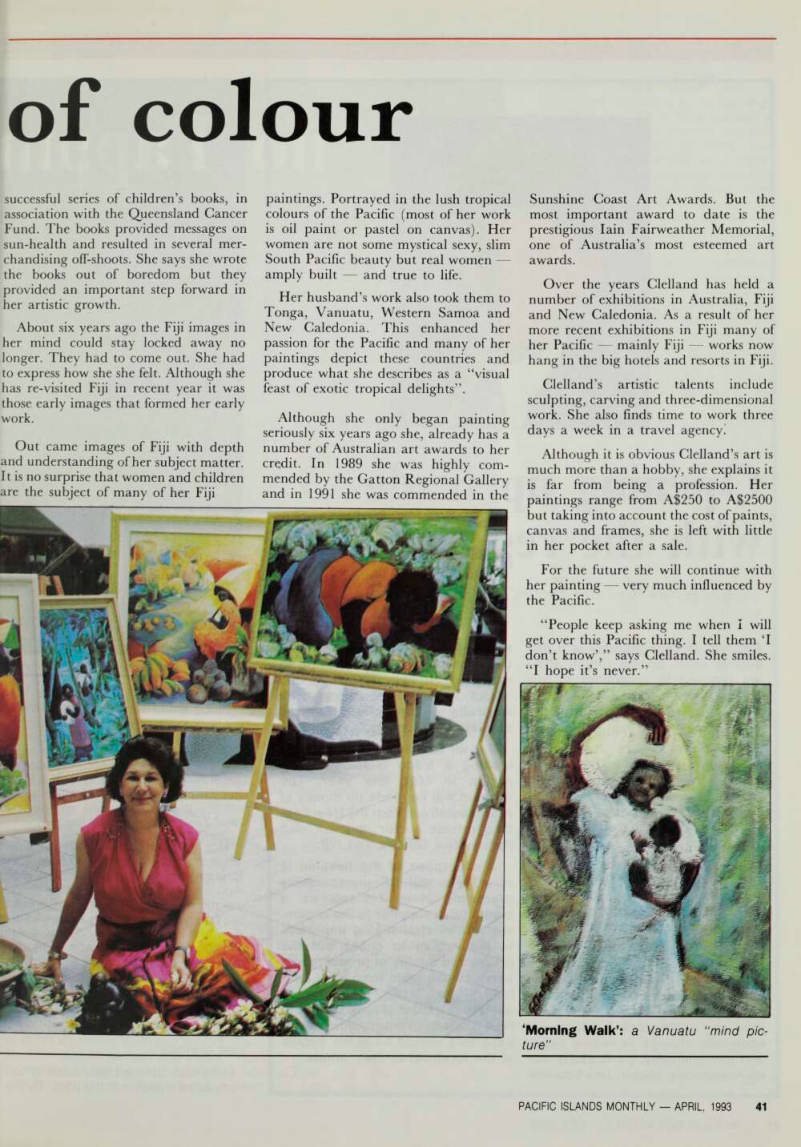
Arts
By Martin Tiffany
AS A LONELY, recently-married and pregnant young woman Glenise Clelland spent many hours sitting and chatting with women in Suva Market in Fiji. That was in the early 19605.
Those images of carefree and happy women and the vibrant colours of their dress were so strong that 20 years later she decided to paint these “mind pictures”. What resulted was an ex plosion of colour in her bold, almost haunting, style.
But it was quite by accident that she began painting Pacific images. As she
explains, it was not as though she one day planned to paint the images in her head.
I'.just happened. So began her love affair Pacific painting - what she calls cr acl 10 J In the early sixties her husband’s job took them to Fiji where they lived for a time - Finding herself at a loose end she would wander around Suva and, more ° ften ~han. ,han not ’ her meandering found her sitting among the seafood veg etables, root crops, handicrafts and other , items on sale at Suva Municipal Market, c , , , . . . r She would chat to the women as they so ld their produce and scolded their children who played around them. She absorbed the sights, sounds and smells of
her surroundings.
These images of gaiety, contentment and colour imprinted on her mind and years later she would often find herself lost in her Fiji experience. But it was not enough to have these memories stashed away in her head. She had to express them visually.
She had an advantage. She had what perhaps could be described as a creative pedigree. Born into a family wedding fashion business, Clelland attended art school and then joined the family firm.
This resulted in her winning a gold in the 1976 Queensland Fashion Awards.
Her development as an artist began from her early exhibitions of “tasteful” nudes, to designing wedding dresses for Brisbane socialites, then a six year period in costume design for the Brisbane Arts Theatre at the old Her Majesty’s Theatre. She also wrote and illustrated a
‘Going Home’: part of Clelland's Fiji collection
Glenise Clelland: surrounded by her wo [?]
successful series of children’s books, in association with the Queensland Cancer Fund. The books provided messages on sun-health and resulted in several merchandising off-shoots. She says she wrote the books out of boredom but they provided an important step forward in f .. .. r . u r her artistic growth.
About six years ago the Fiji images in her mind could stay locked away no longer. They had to come out. She had to express how she she felt. Although she has re-visited Fiji in recent year it was those early images that formed her early work.
Out came images of Fiji with depth and understanding of her subject matter.
It is no surprise that women and children are the subject of many of her Fiji
paintings. Portrayed in the lush tropical colours of the Pacific (most of her work is oil paint or pastel on canvas). Her women are not some mystical sexy, slim South Pacific beauty but real women amply built and true to life.
Her husband’s work also took them to Tonga, Vanuatu, Western Samoa and New Caledonia. This enhanced her passion for the Pacific and many of her paintings depict these countries and produce what she describes as a “visual feast of exotic tropical delights”.
Although she only began painting seriously six years ago she, already has a number of Australian art awards to her credit. In 1989 she was highly com
mended by the Gatton Regional Gallery
and in 1991 she was commended in the
Sunshine Coast Art Awards. But the most important award to date is the prestigious lain Fairweather Memorial, one of Australia’s most esteemed art awards.
Over the years Clelland has held a number of exhibitions in Australia, Fiji and New Caledonia. As a result of her more recent exhibitions in Fiji many of her Pacific mainly Fiji works now hang in the big hotels and resorts in Fiji.
Clelland’s artistic talents include
sculpting, carving and three-dimensional
work. She also finds time to work three days a week in a travel agency!
Although it is obvious Clelland’s art is much more than a hobby, she explains it is far from being a profession. Her paintings range from AS2SO to A 52500 but taking into account the cost of paints, canvas and frames, she is left with little in her pocket after a sale.
For the future she will continue with her painting very much influenced by the Pacific.
“People keep asking me when I will get over this Pacific thing. I tell them ‘I don’t know’,” says Clelland. She smiles.
“I hope it’s never.”
‘Morning Walk’: a Vanuatu “mind pic ture”
with the region
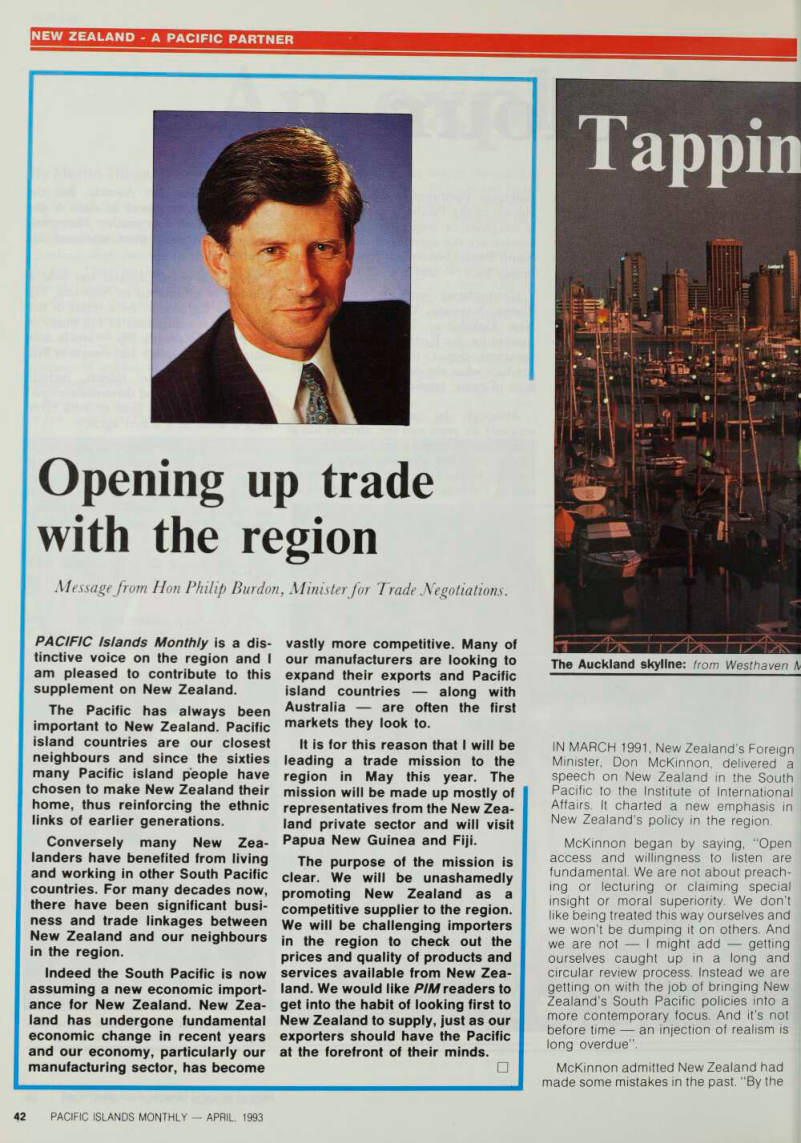
New Zealand - A Pacific Partner
Opening up trade with the region
Message from Hon Philip Burdon, Minister for Trade Negotiations.
PACIFIC Islands Monthly is a dis tinctive voice on the region and I am pleased to contribute to this supplement on New Zealand.
The Pacific has always been important to New Zealand. Pacific island countries are our closest neighbours and since the sixties many Pacific island people have chosen to make New Zealand their home, thus reinforcing the ethnic links of earlier generations.
Conversely many New Zea landers have benefited from living and working in other South Pacific countries. For many decades now, there have been significant busi ness and trade linkages between New Zealand and our neighbours in the region.
Indeed the South Pacific is now assuming a new economic import ance for New Zealand. New Zea land has undergone fundamental economic change in recent years and our economy, particularly our manufacturing sector, has become
vastly more competitive. Many of our manufacturers are looking to expand their exports and Pacific island countries along with Australia are often the first markets they look to.
It is for this reason that I will be leading a trade mission to the region in May this year. The mission will be made up mostly of representatives from the New Zea land private sector and will visit Papua New Guinea and Fiji.
The purpose of the mission is clear. We will be unashamedly promoting New Zealand as a competitive supplier to the region.
We will be challenging importers in the region to check out the prices and quality of products and services available from New Zea land. We would like PIM readers to get into the habit of looking first to New Zealand to supply, just as our exporters should have the Pacific at the forefront of their minds.
Tappin[?] the region
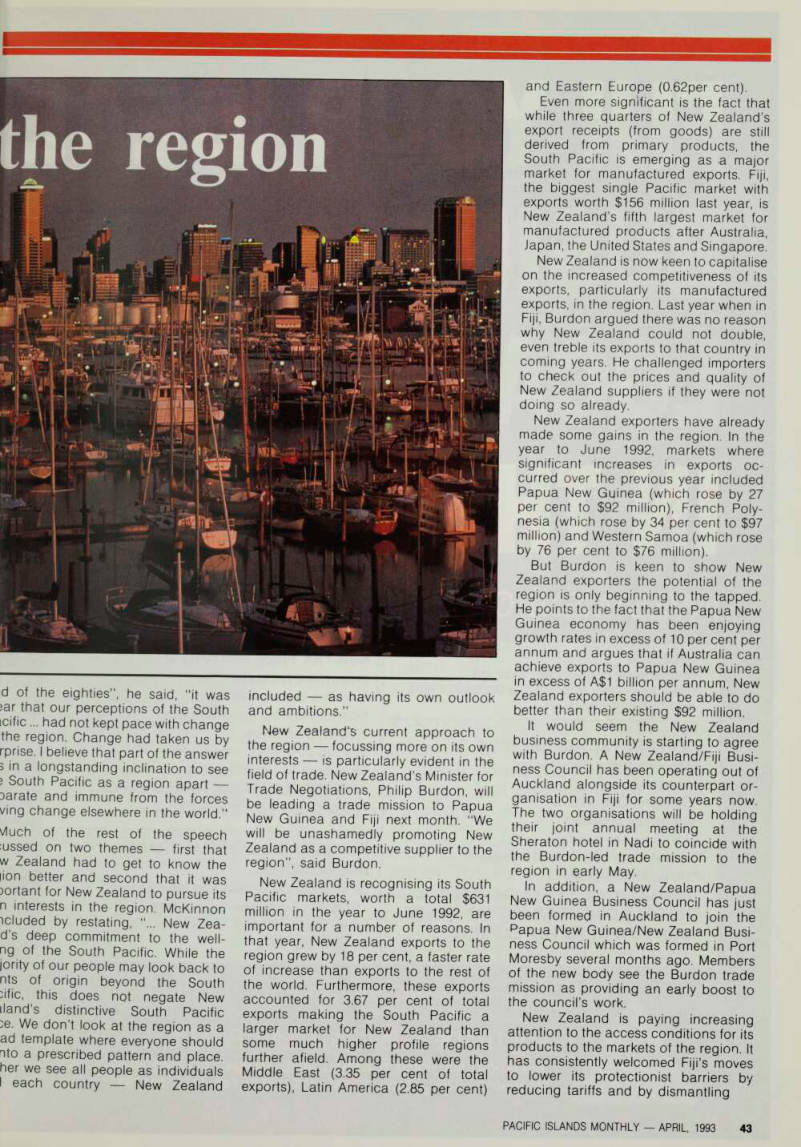

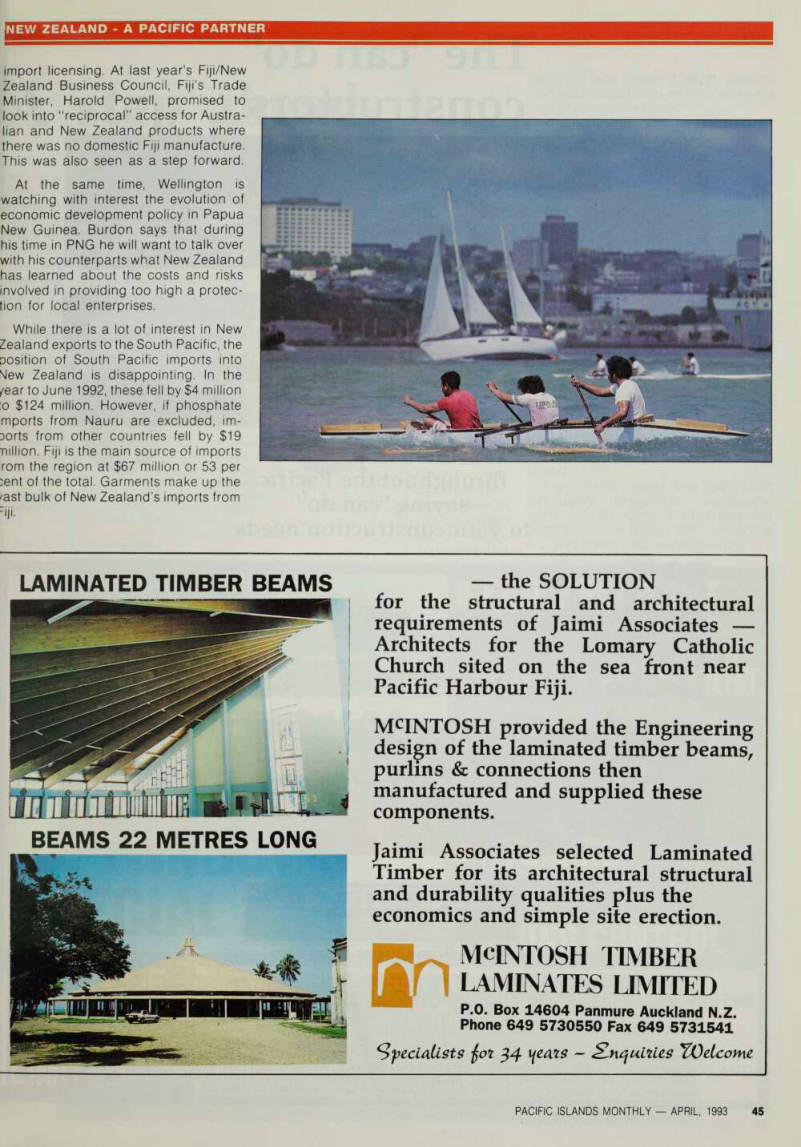
IN MARCH 1991, New Zealand’s Foreign Minister, Don McKinnon, delivered a speech on New Zealand in the South Pacific to the Institute of International Affairs. It charted a new emphasis in New Zealand’s policy in the region.
McKinnon began by saying, “Open access and willingness to listen are fundamental. We are not about preach ing or lecturing or claiming special insight or moral superiority. We don’t like being treated this way ourselves and we won’t be dumping it on others. And we are not I might add getting ourselves caught up in a long and circular review process. Instead we are getting on with the job of bringing New Zealand’s South Pacific policies into a more contemporary focus. And it’s not before time an injection of realism is long overdue”.
McKinnon admitted New Zealand had made some mistakes in the past. “By the
The Auckland skyline: from Westhaven [?]
d of the eighties”, he said, “it was ?ar that our perceptions of the South icific... had not kept pace with change the region. Change had taken us by rprise. I believe that part of the answer s in a longstanding inclination to see J South Pacific as a region apart Darate and immune from the forces ving change elsewhere in the world.” vluch of the rest of the speech :ussed on two themes first that w Zealand had to get to know the lion better and second that it was )ortant for New Zealand to pursue its n interests in the region. McKinnon icluded by restating, ”... New Zea d’s deep commitment to the well ng of the South Pacific. While the jority of our people may look back to nts of origin beyond the South 3ific, this does not negate New Hand's distinctive South Pacific :e. We don’t look at the region as a ad template where everyone should nto a prescribed pattern and place, her we see all people as individuals I each country New Zealand
included as having its own outlook and ambitions.”
New Zealand's current approach to the region focussing more on its own interests is particularly evident in the field of trade. New Zealand's Minister for Trade Negotiations, Philip Burden, will be leading a trade mission to Papua New Guinea and Fiji next month. "We will be unashamedly promoting New Zealand as a competitive supplier to the region”, said Burdon.
New Zealand is recognising its South Pacific markets, worth a total $631 million in the year to June 1992, are important for a number of reasons. In that year, New Zealand exports to the region grew by 18 per cent, a faster rate of increase than exports to the rest of the world. Furthermore, these exports accounted for 3.67 per cent of total exports making the South Pacific a larger market for New Zealand than some much higher profile regions further afield. Among these were the Middle East (3.35 per cent of total exports), Latin America (2.85 per cent)
and Eastern Europe (o.62per cent).
Even more significant is the fact that while three quarters of New Zealand’s export receipts (from goods) are still derived from primary products, the South Pacific is emerging as a major market for manufactured exports. Fiji, the biggest single Pacific market with exports worth $156 million last year, is New Zealand’s fifth largest market for manufactured products after Australia.
Japan, the United States and Singapore.
New Zealand is now keen to capitalise on the increased competitiveness of its exports, particularly its manufactured exports, in the region. Last year when in Fiji, Burdon argued there was no reason why New Zealand could not double, even treble its exports to that country in coming years. He challenged importers to check out the prices and quality of New Zealand suppliers if they were not doing so already.
New Zealand exporters have already made some gains in the region. In the year to June 1992, markets where significant increases in exports oc curred over the previous year included Papua New Guinea (which rose by 27 per cent to $92 million), French Poly nesia (which rose by 34 per cent to $97 million) and Western Samoa (which rose by 76 per cent to $76 million).
But Burdon is keen to show New Zealand exporters the potential of the region is only beginning to the tapped.
He points to the fact that the Papua New Guinea economy has been enjoying growth rates in excess of 10 per cent per annum and argues that if Australia can achieve exports to Papua New Guinea in excess of Asl billion per annum, New Zealand exporters should be able to do better than their existing $92 million.
It would seem the New Zealand business community is starting to agree with Burdon. A New Zealand/Fiji Busi ness Council has been operating out of Auckland alongside its counterpart or ganisation in Fiji for some years now.
The two organisations will be holding their joint annual meeting at the Sheraton hotel in Nadi to coincide with the Burdon-led trade mission to the region in early May.
In addition, a New Zealand/Papua New Guinea Business Council has just been formed in Auckland to join the p apua New Guinea/New Zealand Busi ness Council which was formed in Port Moresby several months ago. Members of the new body see the Burdon trade mission as providing an early boost to the council’s work.
New Zealand is paying increasing attention to the access conditions for its products to the markets of the region. It has consistently welcomed Fiji’s moves to lower its protectionist barriers by reducing tariffs and by dismantling
import licensing. At last year’s Fiji/New Zealand Business Council, Fiji’s Trade Minister, Harold Powell, promised to look into “reciprocal” access for Austra lian and New Zealand products where there was no domestic Fiji manufacture.
This was also seen as a step forward.
At the same time, Wellington is watching with interest the evolution of economic development policy in Papua New Guinea. Burdon says that during his time in PNG he will want to talk over with his counterparts what New Zealand has learned about the costs and risks involved in providing too high a protec tion for local enterprises.
While there is a lot of interest in New Zealand exports to the South Pacific, the position of South Pacific imports into Mew Zealand is disappointing. In the /ear to June 1992, these fell by $4 million :o $124 million. However, if phosphate mports from Nauru are excluded, im- Dorts from other countries fell by $l9 nillion. Fiji is the main source of imports rom the region at $67 million or 53 per 'ent of the total. Garments make up the 'ast bulk of New Zealand’s imports from : iji.
Advertisements & other items, pp. 44-46 (2 items)
Business
FIJI YOUR IDEAL
LOCATION
IN THE PACIFIC
INVESTMENT OPPORTUNITIES AVAILABLE:-
TOURISM
*Assistance under Hotel Aids Act ♦Concessionary Import Duty on equipment and building materials.
TAX FREE FACTORIES/ZONE
♦Manufacturing/Processing ♦Assembly ♦Blending Operations Incentives include:- ♦13 years tax holiday ♦Import duty waiver for 13 years ♦No withholding tax ♦Freedom to repatriate capital and profits THE ONLY CONDITION IS THAT 95% OF
YOUR OUTPUT BE FOR EXPORTS.
NON-TAX FREE FACTORY STATUS
Incentives include:- ♦ Income tax concessions ♦Concessionary import duties ♦Export incentives ♦Export promotion incentives ♦Freedom to repatriate capital and profits
APPLICABLE TO FACTORIES EXPORTING
LESS THEN 95% OF OUTPUT
FIJI HAS PREFERENTIAL TRADE
AGREEMENTS:-
SPARTECA - Australia and New Zealand LOME IV - European Community (EC) GSP - USA, CANADA, JAPAN and European Community (EC) For further information contact:-
THE DIRECTOR
FIJI TRADE & INVESTMENT BOARD
3RD FLOOR CIVIC HOUSE TOWNHALL ROAD. PO BOX 2303 GOVT. BLDG. SUVA.
TELEPHONE: (679) 315988. TELEX: 2355 FTIB FJ. FAX: (679) 301783
COMMUNICATIONS 0110
LAMINATED TIMBER BEAMS
m
BEAMS 22 METRES LONG
f A £ □H
the SOLUTION
for the structural and architectural requirements of Jaimi Associates Architects for the Lomary Catholic Church sited on the sea front near Pacific Harbour Fiji.
M c INTOSH provided the Engineering design of the laminated timber beams, purlins & connections then manufactured and supplied these components.
Jaimi Associates selected Laminated Timber for its architectural structural and durability qualities plus the economics and simple site erection.
Bn
McCWOSH TIMBER
LAMINATES LIMITED
P.O. Box 14604 Panmure Auckland N.Z.
Phone 649 5730550 Fax 649 5731541 Specialists jot 34 neats - YOelcome
The "can do"
constructors
* is UR s n ... w
Ifal
Partners in progress
throughout the Pacific
saying "can do"
to your construction needs
CM*> fu
M c CONNELL
DOWELL
CORPORATION LIMITED
• Building • Civil • Electrical • Mechanical • Pipelining • Engineering • Construction • Management Head Office: New Zealand and Pacific Island Division McConnell Dowell House, 45 O'Rorke Rd, Penrose, Auckland, New Zealand. P.O. Box 2497 Auckland. Phone: (649) 579 5460 Fax: (649) 579 5462 Fiji - McConnell Dowell (Fiji) Ltd, Wilada Estate, Lami, Suva, Fiji Islands. P.O. Box 889, Suva Fiji. Phone: (679) 362 666 Fax: (679) 351 065 American Samoa - McConnell Dowell Constructors Ltd, P.O. Box 4664, Pago Pago, American Samoa. Phone: (684) 699 2239 Fax: (684) 699 2552 Marshall Islands - PII/McConnell Dowell (J.V.), P.O. Box 239, Majuro, Marshall Islands, 96960. Phone: (692625) 3430 Fax: (692625) 3166 Western Samoa - OTT/McConnell Dowell J.V., P.O. Box 3442, Apia, Western Samoa. Phone: (685) 20123 Fax; (685) 21746 Papua New Guinea - McConnell Dowell Constructors (PNG) Pty Ltd, P.O. Box 507, Port Moresby. Phone: (675) 212 022 Fax: (675) 212 780 All enquiries contact Ron Wakeford - Phone; (649) 579 5460 Fax: (649) 579 1897
45
INEW ZEALAND - A PACIFIC PARTNER
PACIFIC ISLANDS MONTHLY APRIL, 1993
A step ahead

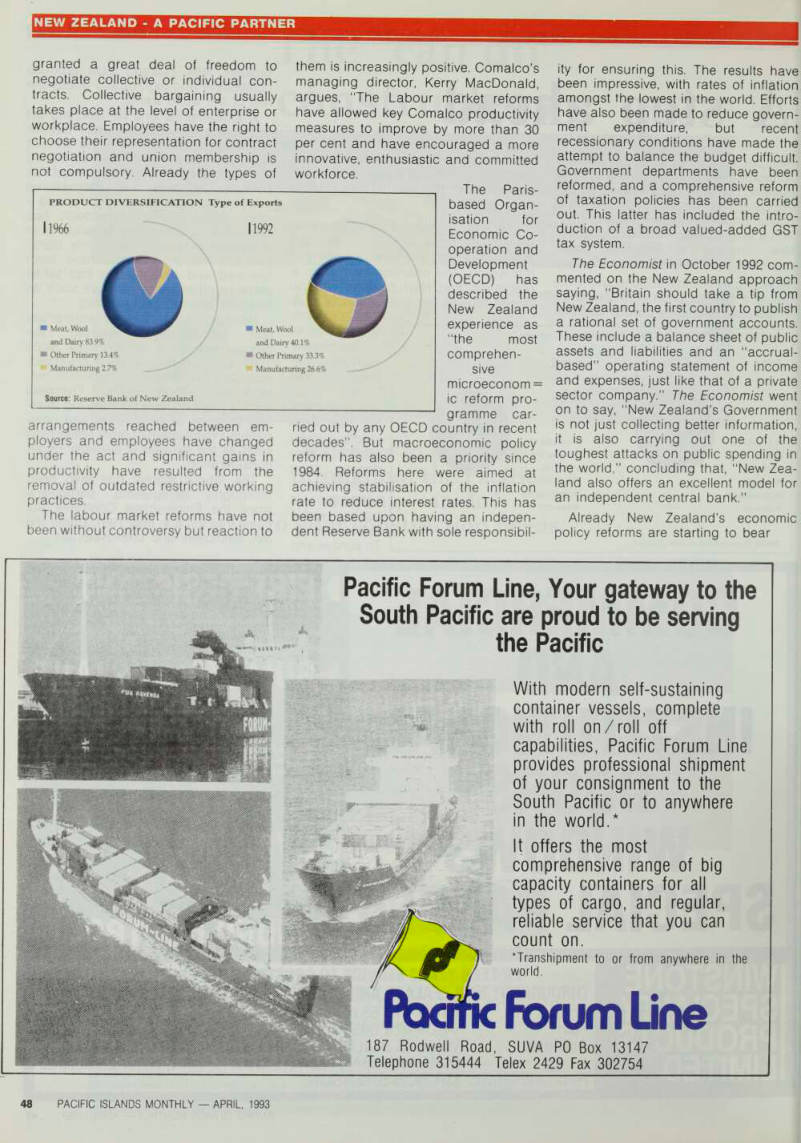
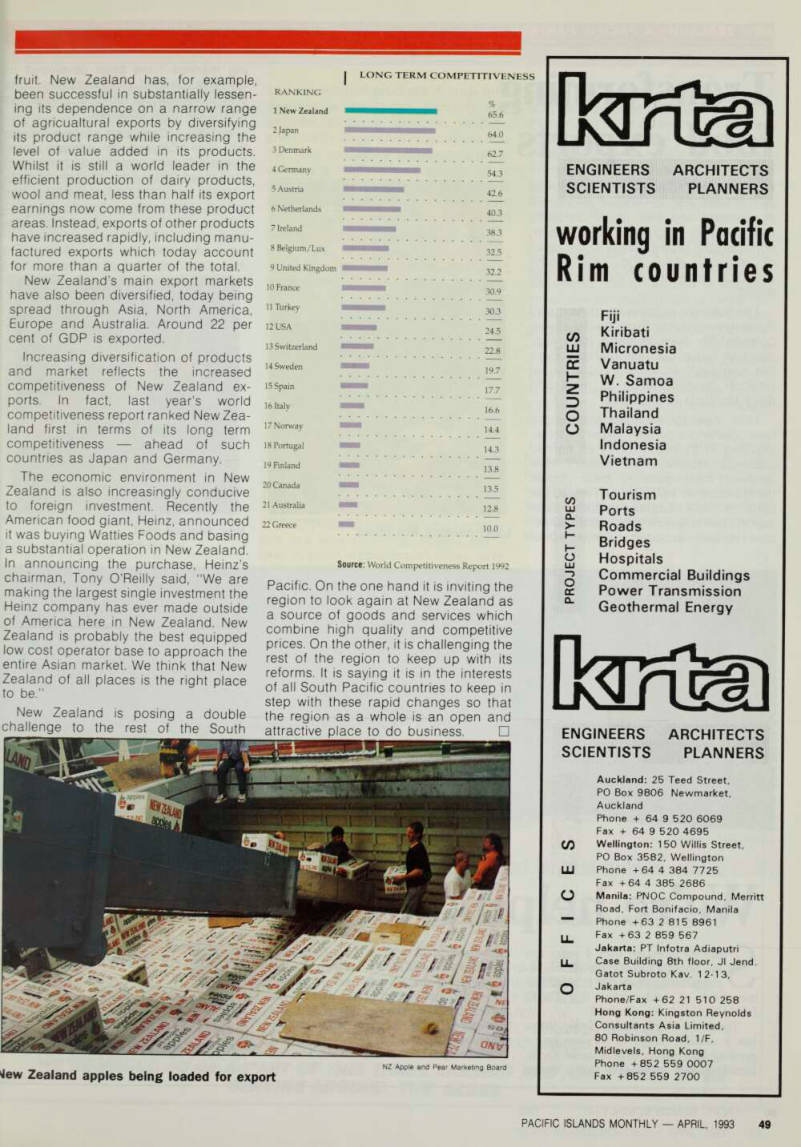
SIMILAR in size to Japan or Italy and somewhat smaller than PNG, New Zealand combines high mountains with extensive hill country and lowland plains. Snow fields, swift flowing rivers and a long coastline add to the variety.
New Zealand is renowned inter nationally for its landscape and beauty.
Reflecting its South Pacific location, the sea is a key factor in New Zealand’s temperate mid-latitude climate. Sun and
rain are plentiful and winters are not particularly cold. But in any one place at any one time, the weather can change quite quickly.
The New Zealand economy is also undergoing rapid change perhaps more rapid than any other economy in the region. The changes stem from a realisation that New Zealand can no longer rely on the production of bulk
farm products to send to its traditional markets in Europe and North Ame rica. Shelter ing New Zea land’s dom estic pro ducers from international competition is not a viable option either.
To survive and
prosper, New Zealand must produce competitive and high quality goods the rest of the world wants.
A fundamental and far-reaching set of reforms was initiated when Labour came to power in 1984. The current National Government has continued these reforms. The consistent thrust has been to enhance the international competitiveness of the economy, and a more market-oriented approach has been used to obtain this. Restrictions in a number of areas, particularly trans port and communications, have been removed and deregulation has taken place in other service sectors such as financial services and retailing.
Reform of state-owned enterprises has significantly increased the competitiveness of the economy. Since 1987, a number have been privatised, including the telecommunications net work and national airline. Overseas parties have acquired controlling inter ests in some of these privatised com panies. Privatisation of other enterprises such as the railways is currently under consideration.
The labour market has also been thoroughly deregulated, particularly since the Employment Contracts Act came into force in May 1991. Under the Act, employers and employees are
Source: Reserve Bank of New Zealand
granted a great deal of freedom to negotiate collective or individual con tracts. Collective bargaining usually takes place at the level of enterprise or workplace. Employees have the right to choose their representation for contract negotiation and union membership is not compulsory. Already the types of
arrangements reached between em ployers and employees have changed under the act and significant gains in productivity have resulted from the removal of outdated restrictive working practices.
The labour market reforms have not been without controversy but reaction to
them is increasingly positive. Comalco’s managing director, Kerry MacDonald, argues, “The Labour market reforms have allowed key Comalco productivity measures to improve by more than 30 per cent and have encouraged a more innovative, enthusiastic and committed workforce.
The Paris based Organ isation for Economic Co operation and Development (OECD) has described the New Zealand experience as “the most comprehen sive microeconom = ic reform pro gramme car
ried out by any OECD country in recent decades”. But macroeconomic policy reform has also been a priority since 1984, Reforms here were aimed at achieving stabilisation of the inflation rate to reduce interest rates. This has been based upon having an indepen dent Reserve Bank with sole responsible
ity for ensuring this. The results have been impressive, with rates of inflation amongst the lowest in the world. Efforts have also been made to reduce govern ment expenditure, but recent recessionary conditions have made the attempt to balance the budget difficult.
Government departments have been reformed, and a comprehensive reform of taxation policies has been carried out. This latter has included the intro duction of a broad valued-added GST tax system.
The Economist in October 1992 com mented on the New Zealand approach saying, “Britain should take a tip from New Zealand, the first country to publish a rational set of government accounts.
These include a balance sheet of public assets and liabilities and an “accrual based” operating statement of income and expenses, just like that of a private sector company.” The Economist went on to say, “New Zealand’s Government is not just collecting better information, it is also carrying out one of the toughest attacks on public spending in the world,” concluding that, “New Zea land also offers an excellent model for an independent central bank.”
Already New Zealand’s economic policy reforms are starting to bear
Source: Reserve Bank of New Zealand
fruit. New Zealand has, for example, been successful in substantially lessen ing its dependence on a narrow range of agricualtural exports by diversifying its product range while increasing the level of value added in its products.
Whilst it is still a world leader in the efficient production of dairy products, wool and meat, less than half its export earnings now come from these product areas. Instead, exports of other products have increased rapidly, including manu factured exports which today account for more than a quarter of the total.
New Zealand’s main export markets have also been diversified, today being spread through Asia, North America, Europe and Australia. Around 22 per cent of GDP is exported.
Increasing diversification of products and market reflects the increased competitiveness of New Zealand ex ports. In fact, last year’s world competitiveness report ranked New Zea land first in terms of its long term competitiveness ahead of such countries as Japan and Germany.
The economic environment in New Zealand is also increasingly conducive to foreign investment. Recently the American food giant, Heinz, announced it was buying Watties Foods and basing a substantial operation in New Zealand.
In announcing the purchase, Heinz’s chairman, Tony O’Reilly said, “We are making the largest single investment the Heinz company has ever made outside of America here in New Zealand. New Zealand is probably the best equipped low cost operator base to approach the entire Asian market. We think that New Zealand of all places is the right place to be.’’
New Zealand is posing a double challenge to the rest of the South
Pacific. On the one hand it is inviting the region to look again at New Zealand as a source of goods and services which combine high quality and competitive prices. On the other, it is challenging the rest of the region to keep up with its reforms. It is saying it is in the interests of all South Pacific countries to keep in step with these rapid changes so that the region as a whole is an open and attractive place to do business. □
New Zealand apples being loaded for export
Source: World Competitiveness Report 1992
NZ Apple and Pear Marketing Board
Advertisements & other items, pp. 47-49 (3 items)
47
[NEW ZEALAND - A PACIFIC PARTNER
PACIFIC ISLANDS MONTHLY APRIL, 1993
t
h
foe
■ Pacific Forum Line, Your gateway to the South Pacific are proud to be serving
the Pacific
With modern self-sustaining container vessels, complete with roll on /roll off capabilities, Pacific Forum Line provides professional shipment of your consignment to the South Pacific or to anywhere in the world.* It offers the most comprehensive range of big capacity containers for all types of cargo, and regular, reliable service that you can count on. ‘Transhipment to or from anywhere in the world.
Forum Line
187 Rodwell Road, SUVA PO Box 13147 Telephone 315444 Telex 2429 Fax 302754
DarSffl
ENGINEERS ARCHITECTS
SCIENTISTS PLANNERS
working in Pacific
Rim countries
Fiji Kiribati m Micronesia QC Vanuatu W. Samoa Philippines O Thailand O Malaysia Indonesia Vietnam Tourism
£ Ports
> Roads Bridges
y Hospitals
g Commercial Buildings cc Power Transmission Geothermal Energy
ENGINEERS ARCHITECTS
SCIENTISTS PLANNERS
Auckland: 25 Teed Street, PO Box 9806 Newmarket, Auckland Phone + 64 9 520 6069 Fax + 64 9 520 4695 C/3 Wellington: 150 Willis Street, PO Box 3582, Wellington LU Phone +64 4 384 7725 Fax +64 4 385 2686 o Manila: PNOC Compound, Merritt Road, Fort Bonifacio, Manila “ Phone +63 2 815 8961 Fax +63 2 859 567 Jakarta: PT Infotra Adiaputri LL Case Building Bth floor, Jl Jend.
Gatot Subroto Kav. 12-13, Q Jakarta Phone/Fax +62 21 510 258 Hong Kong: Kingston Reynolds Consultants Asia Limited, 80 Robinson Road, 1/F, Midlevels, Hong Kong Phone +852 559 0007 Fax +852 559 2700
48
NEW ZEALAND - A PACIFIC PARTNER
PACIFIC ISLANDS MONTHLY APRIL, 1993
Transforming
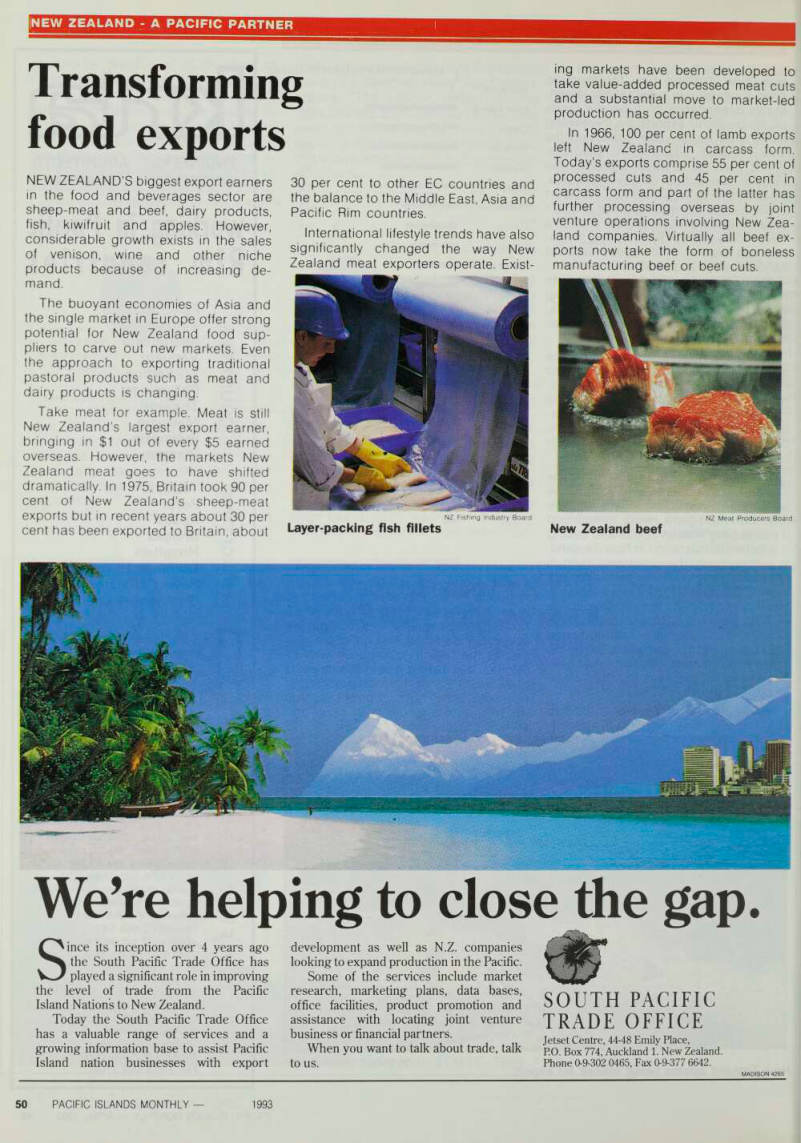

food exports
NEW ZEALAND’S biggest export earners in the food and beverages sector are sheep-meat and beef, dairy products, fish, kiwifruit and apples. However, considerable growth exists in the sales of venison, wine and other niche products because of increasing de mand.
The buoyant economies of Asia and the single market in Europe offer strong potential for New Zealand food sup pliers to carve out new markets. Even the approach to exporting traditional pastoral products such as meat and dairy products is changing.
Take meat for example. Meat is still New Zealand’s largest export earner, bringing in $1 out of every $5 earned overseas. However, the markets New Zealand meat goes to have shifted dramatically. In 1975, Britain took 90 per cent of New Zealand’s sheep-meat exports but in recent years about 30 per cent has been exported to Britain, about
30 per cent to other EC countries and the balance to the Middle East, Asia and Pacific Rim countries.
International lifestyle trends have also significantly changed the way New Zealand meat exporters operate. Exist-
ing markets have been developed to take value-added processed meat cuts and a substantial move to market-led production has occurred.
In 1966, 100 per cent of lamb exports left New Zealand in carcass form.
Today’s exports comprise 55 per cent of processed cuts and 45 per cent in carcass form and part of the latter has further processing overseas by joint venture operations involving New Zea land companies. Virtually all beef ex ports now take the form of boneless manufacturing beef or beef cuts.
NZ Fishing Industry Board Layer-packing fish fillets
NZ Meat Producers Board New Zealand beef
Aside from meat and dairy products, New Zealand is now developing a whole new range of food exports. Fish is a prime example. Seafood exports have grown over the space of 15 years to become the third largest component of New Zealand food exports. More than 200,000 tons are exported to over 40 countries with annual income exceeding NZ$l billion.
There has been rapid growth in value added exports of. both deep-sea fish
and aquaculture products. A large tuna resource is harvested annually and includes albacore, skipjack, yellowfin and bluefin. Greenshell mussels are now the most successful aquaculture prod uct and a major export earner. There
has been further success in exporting rock oysters. Salmon producers have developed overseas markets for export ing fresh, cold smoked and wood roasted salmon.
Many years of New Zealand horticul ture are also booming. Apples are a case in point. Apple export today have
grown to over $5OO million per annum with New Zealand leading the world in the development of new varieties such as braeburn and royal gala. Other new varieties currently under development are expected to increase growth in the future as New Zealand maintains its image as a premium supplier of top quality fruit.
Perhaps the most exciting fruit of all is not used for food but is made into wine. In recent years New Zealand has discovered that it has one of the best environments outside of France for production of premium cool climate grape varieties such as sauvignon blac, chardonnay and pinot noir. But there is a quantity problem with New Zealand wine there is not nearly enough of it to satisfy world demand. All this augurs well for the New Zealand wine industry to grow significantly in future.
Food is another area where life in New Zealand has changed significantly.
New Zealanders still enjoy the traditional roast of lamb with mint sauce. But they are just as likely today to sit down to a meal of fresh fish with a premium white varietal wine.
NZ Dairy Board High-tech dairy manufacturing
Royal gala premium variety
Advertisements & other items, pp. 50-51 (2 items)
50
NEW ZEALAND - A PACIFIC PARTNER
PACIFIC ISLANDS MONTHLY 1993
We’re helping to close the gap.
Since its inception over 4 years ago the South Pacific Trade Office has played a significant role in improving the level of trade from the Pacific Island Nations to New Zealand.
Today the South Pacific Trade Office has a valuable range of services and a growing information base to assist Pacific Island nation businesses with export development as well as N.Z. companies looking to expand production in the Pacific.
Some of the services include market research, marketing plans, data bases, office facilities, product promotion and assistance with locating joint venture business or financial partners.
When you want to talk about trade, talk to us.
SOUTH PACIFIC
TRADE OFFICE
Jetset Centre, 44-48 Emily Place, P.O. Box 774, Auckland 1. New Zealand.
Phone 0-9-302 0465, Fax 0-9-377 6642.
MADISON 4265
ran
L •if II <c CO Wi HI OL 4 y. ip.
V 9^ <9 & cT $5 ?$n
FOR
NEW ZEALAND
OHS ELEVATOR COMPANY is the world’s oldest and largest manufacturer of elevators and escalators.
OTIS is widely dispersed geographically and in excess of half a million OTIS products are in use on six continents.
HEAD OFFICE: 60 STANLEY ST.,
PARNELL / PO BOX 25
AKL
TEL: 3031877
FAX: 3779347
S/PACIFIC BRANCH 2nd FLR. NARSEVS BLDG
cnr. RENWICK RD & ELLERY ST
PO BOX 835
SUVA
TEL: 301-252 /301-562
FAX; 300-020
WE RE PROUD TO BE A PART OF THIS TRADE MISSION AND ARE PROUD TO BE
SERVING AROUND THE GLOBE
Manufactured exports - at the forefront
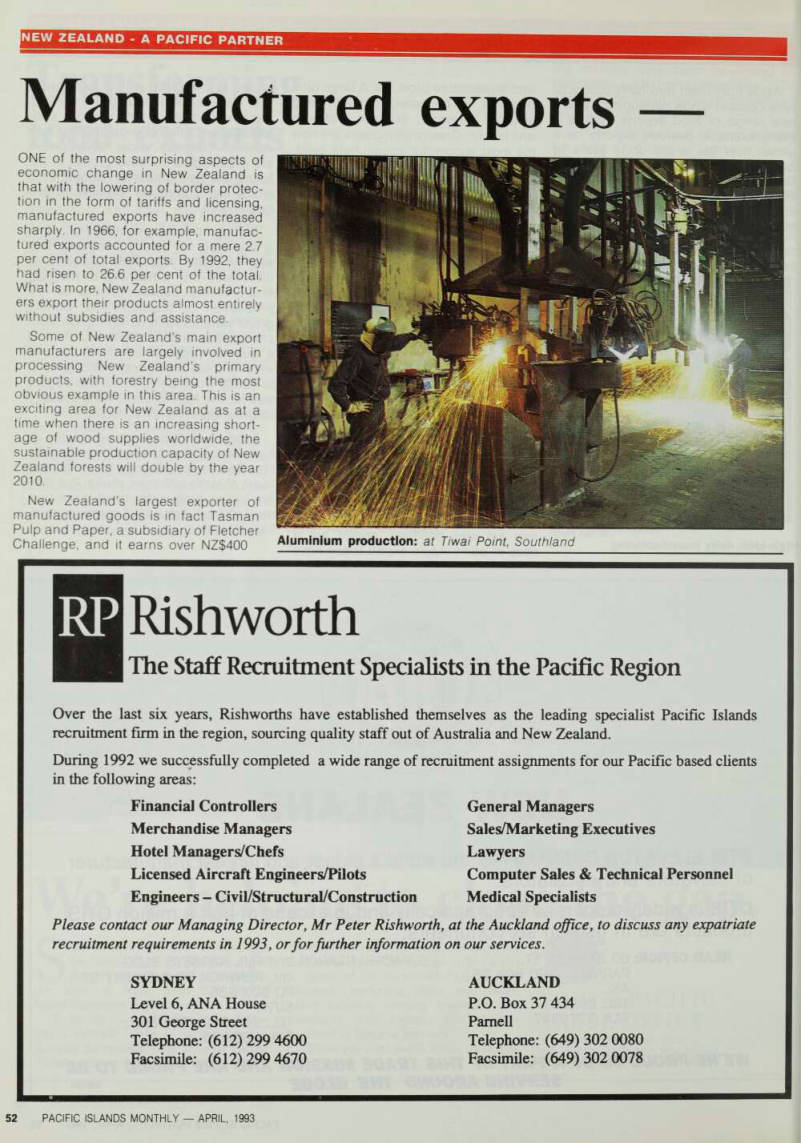
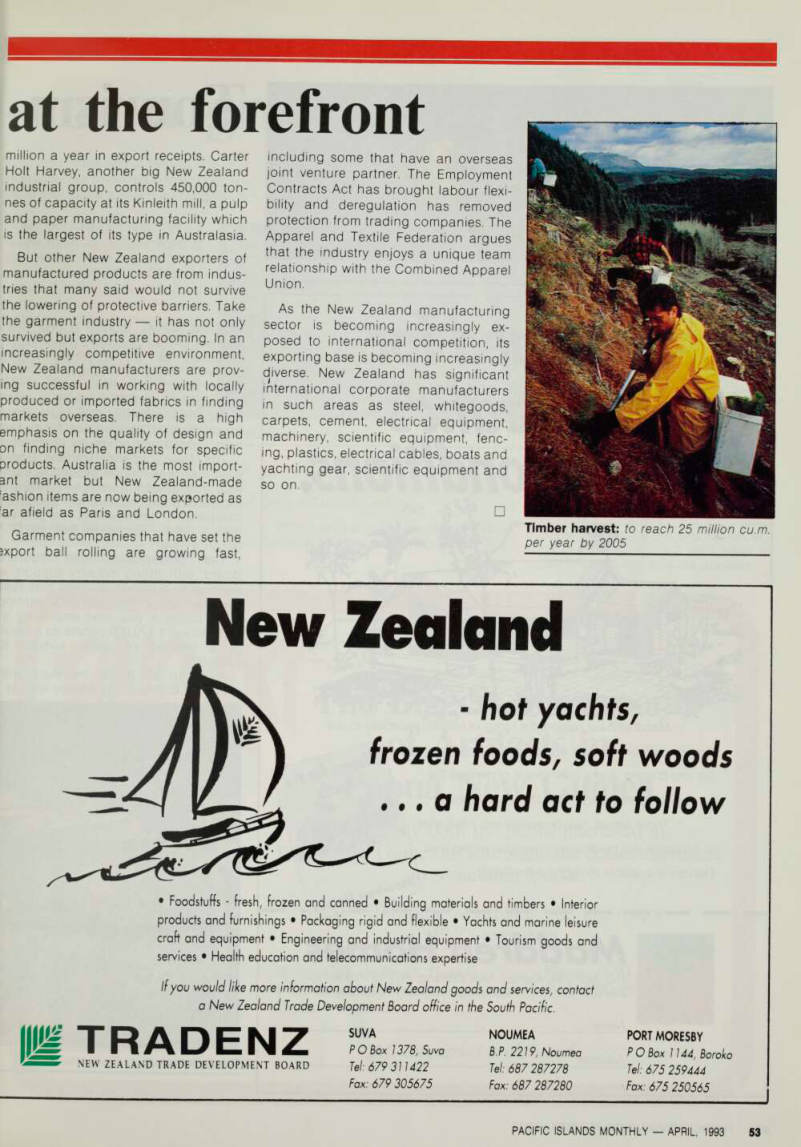
ONE of the most surprising aspects of economic change in New Zealand is that with the lowering of border protec tion in the form of tariffs and licensing, manufactured exports have increased sharply. In 1966, for example, manufac tured exports accounted for a mere 2.7 per cent of total exports. By 1992, they had risen to 26.6 per cent of the total.
What is more, New Zealand manufactur ers export their products almost entirely without subsidies and assistance.
Some of New Zealand’s main export manufacturers are largely involved in processing New Zealand’s primary products, with forestry being the most obvious example in this area. This is an exciting area for New Zealand as at a time when there is an increasing short age of wood supplies worldwide, the sustainable production capacity of New Zealand forests will double by the year 2010.
New Zealand’s largest exporter of manufactured goods is in fact Tasman Pulp and Paper, a subsidiary of Fletcher Challenge, and it earns over NZ$4OO
Aluminium production: at Tiwai Point, Southland
million a year in export receipts. Carter Holt Harvey, another big New Zealand industrial group, controls 450,000 ton nes of capacity at its Kinleith mill, a pulp and paper manufacturing facility which is the largest of its type in Australasia.
But other New Zealand exporters of manufactured products are from indus tries that many said would not survive the lowering of protective barriers. Take the garment industry it has not only survived but exports are booming. In an increasingly competitive environment, New Zealand manufacturers are prov ing successful in working with locally produced or imported fabrics in finding markets overseas. There is a high emphasis on the quality of design and on finding niche markets for specific products. Australia is the most import ant market but New Zealand-made 'ashion items are now being exported as : ar afield as Paris and London.
Garment companies that have set the export ball rolling are growing fast,
including some that have an overseas joint venture partner. The Employment Contracts Act has brought labour flexi bility and deregulation has removed protection from trading companies. The Apparel and Textile Federation argues that the industry enjoys a unique team relationship with the Combined Apparel Union.
As the New Zealand manufacturing sector is becoming increasingly ex posed to international competition, its exporting base is becoming increasingly diverse. New Zealand has significant international corporate manufacturers in such areas as steel, whitegoods, carpets, cement, electrical equipment, machinery, scientific equipment, fenc ing, plastics, electrical cables, boats and yachting gear, scientific equipment and so on.
Timber harvest: to reach 25 million cu.m. per year by 2005
Advertisements & other items, pp. 52-54 (2 items)
52
|NEW ZEALAND - A PACIFIC PARTNER
PACIFIC ISLANDS MONTHLY APRIL, 1993
Rishworth
RP
The Staff Recruitment Specialists in the Pacific
Region
Over the last six years, Rishworths have established themselves as the leading specialist Pacific Islands recruitment firm in the region, sourcing quality staff out of Australia and New Zealand.
During 1992 we successfully completed a wide range of recruitment assignments for our Pacific based clients in the following areas: Financial Controllers General Managers Merchandise Managers Sales/Marketing Executives Hotel Managers/Chefs Lawyers Licensed Aircraft Engineers/Pilots Computer Sales & Technical Personnel Engineers - Civil/Structural/Construction Medical Specialists Please contact our Managing Director, Mr Peter Rishworth, at the Auckland office, to discuss any expatriate recruitment requirements in 1993, or for further information on our services.
SYDNEY
Level 6, ANA House 301 George Street Telephone: (612) 299 4600 Facsimile: (612)299 4670
AUCKLAND
P.O. Box 37 434 Parnell Telephone: (649) 302 0080 Facsimile: (649) 302 0078
New Zealand
Me
■ ho yachts
frozen food , soft
... a hard act to
woods
follow
• Foodstuffs - fresh, frozen and canned • Building materials and timbers • Interior products and furnishings • Packaging rigid and flexible • Yachts and marine leisure craft and equipment • Engineering and industrial equipment • Tourism goods and services • Health education and telecommunications expertise If you would like more information about New Zealand goods and services, contact a New Zealand Trade Development Board office in the South Pacific.
IS
TRADENZ
NEW ZEALAND TRADE DEVELOPMENT BOARD
SUVA
P O Box 1378, Suva Tel: 679 311422 Fax: 679 305675
NOUMEA
B.P. 2219, Noumea Tel: 687 287278 Fax: 687 287280
PORT MORESBY
P 0 Box 1144, Boroko Tel: 675 259444 Fax: 675 250565
Designed for
the Poetic's
unique conditions.
;vv *Hr Maddren have designed a range of homes, especially to suit Pacific conditions. Built in strength from additional ties and bracing, and a wide choice of designs that we are happy to modify to suit individual needs.
These homes may be purchased, kitset shell or complete with construction arranged as required.
Delivery is available throughout the Pacific.
Maddren Homes
P.O. Box 244, Kumeu, New Zealand. Ph (09) 412-9070.
Fax (09) 412-7251. Please mail me your free catalogue.
Name rG n *<>», e s Address
Tourism path
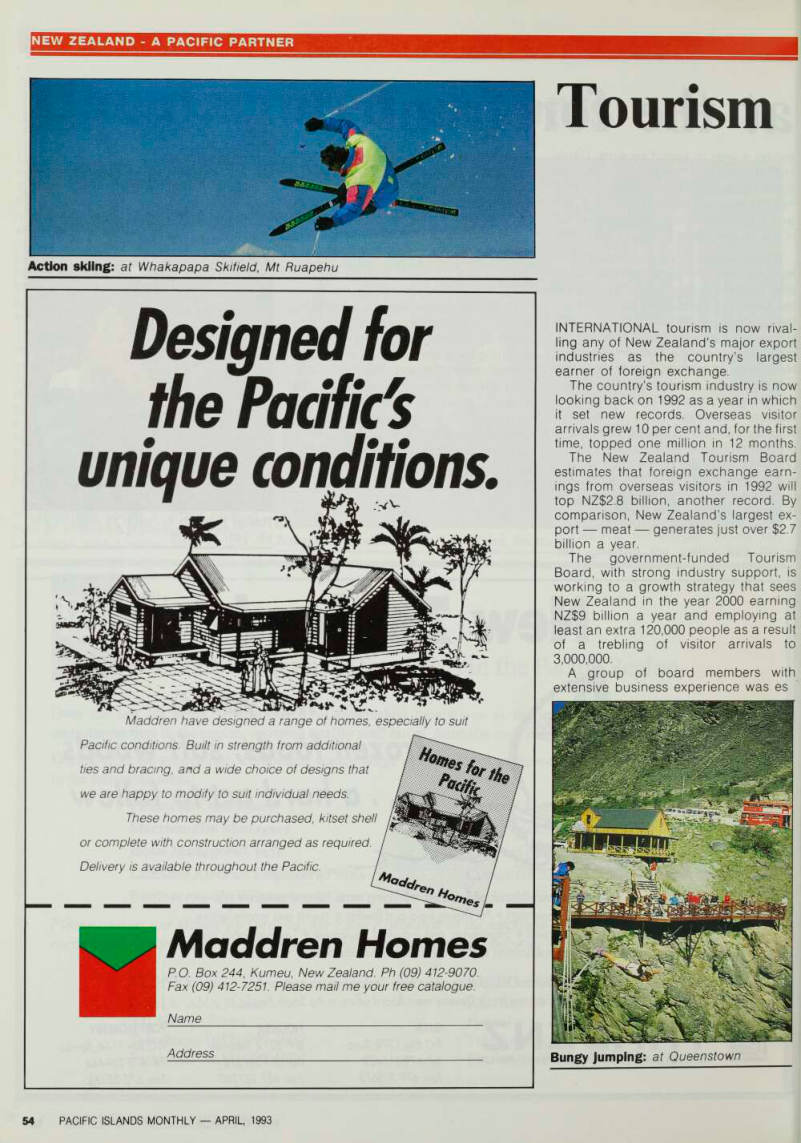
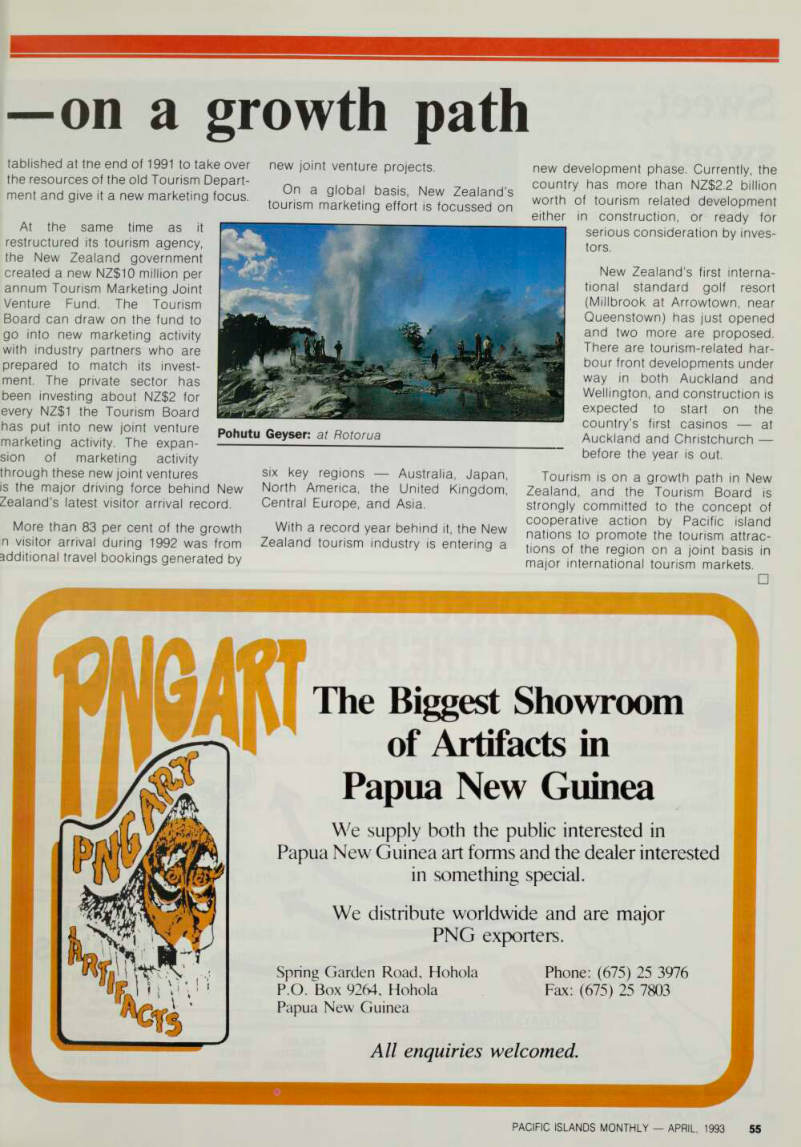
INTERNATIONAL tourism is now rival ling any of New Zealand’s major export industries as the country’s largest earner of foreign exchange.
The country’s tourism industry is now looking back on 1992 as a year in which it set new records. Overseas visitor arrivals grew 10 per cent and, for the first time, topped one million in 12 months.
The New Zealand Tourism Board estimates that foreign exchange earn ings from overseas visitors in 1992 will top NZ$2.B billion, another record. By comparison, New Zealand’s largest ex port meat generates just over $2.7 billion a year.
The government-funded Tourism Board, with strong industry support, is working to a growth strategy that sees New Zealand in the year 2000 earning NZ$9 billion a year and employing at least an extra 120,000 people as a result of a trebling of visitor arrivals to 3,000,000.
A group of board members with extensive business experience was es
Action skiing: at Whakapapa Skifield, Mt Ruapehu
Bungy Jumping: at Queenstown
tablished at tne end of 1991 to take over the resources of the old Tourism Depart ment and give it a new marketing focus.
At the same time as it restructured its tourism agency, the New Zealand government created a new NZ$lO million per annum Tourism Marketing Joint Venture Fund. The Tourism Board can draw on the fund to go into new marketing activity with industry partners who are prepared to match its invest ment. The private sector has been investing about NZ$2 for every NZ$l the Tourism Board has put into new joint venture marketing activity. The expan sion of marketing activity
through these new joint ventures is the major driving force behind New Zealand’s latest visitor arrival record.
More than 83 per cent of the growth n visitor arrival during 1992 was from additional travel bookings generated by
new joint venture projects.
On a global basis, New Zealand’s tourism marketing effort is focussed on
six key regions Australia, Japan, North America, the United Kingdom, Central Europe, and Asia.
With a record year behind it, the New Zealand tourism industry is entering a
new development phase. Currently, the country has more than NZ$2.2 billion worth of tourism related development either in construction, or ready for
serious consideration by inves tors.
New Zealand’s first interna tional standard golf resort (Millbrook at Arrowtown, near Queenstown) has just opened and two more are proposed.
There are tourism-related har bour front developments under way in both Auckland and Wellington, and construction is expected to start on the country’s first casinos at Auckland and Christchurch before the year is out.
Tourism is on a growth path in New Zealand, and the Tourism Board is strongly committed to the concept of cooperative action by Pacific island nations to promote the tourism attrac tions of the region on a joint basis in major international tourism markets.
Pohutu Geyser: at Rotorua
Advertisements & other items, pp. 54-55 (2 items)
54
NEW ZEALAND - A PACIFIC PARTNER
PACIFIC ISLANDS MONTHLY APRIL. 1993
The Biggest Showroom
tKJf ?» I *.
of Artifacts in
Papua New Guinea
We supply both the public interested in Papua New Guinea art forms and the dealer interested
in something special.
We distribute worldwide and are major PNG exporters.
Spring Garden Road, Hohola P.O. Box 9264, Hohola Papua New Guinea Phone: (675) 25 3976 Fax: (675) 25 7803 All enquiries welcomed.
Sweet,
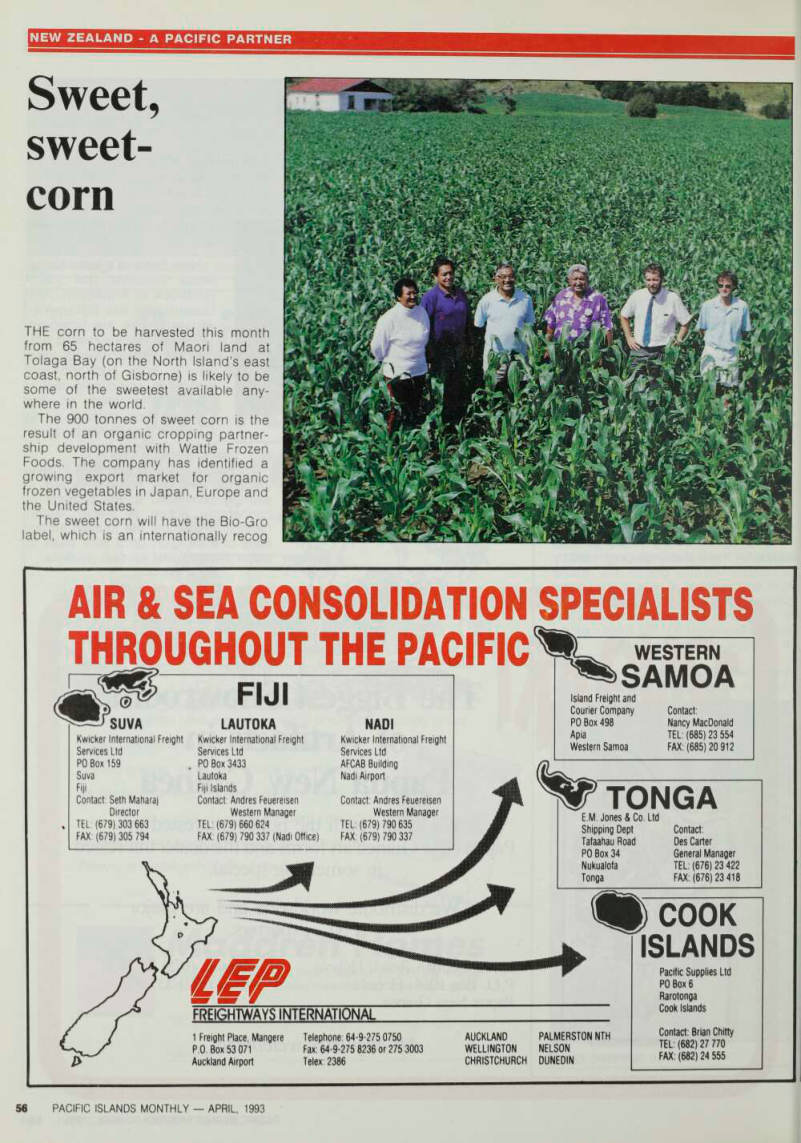

sweet corn
THE corn to be harvested this month from 65 hectares of Maori land at Tolaga Bay (on the North Island’s east coast, north of Gisborne) is likely to be some of the sweetest available any where in the world.
The 900 tonnes of sweet corn is the result of an organic cropping partner ship development with Wattie Frozen Foods. The company has identified a growing export market for organic frozen vegetables in Japan, Europe and the United States.
The sweet corn will have the Bio-Gro label, which is an internationally recog
nised organic standard with very strict rules about what is clean, green and organic.
There is a lot of land on the east coast which has had little or no chemicals applied to it, which means it has great potential for Bio-Gro production. The land that will yield the sweeter corn in Tolaga Bay is administered by the Paripoupou Trust on behalf of 1000 landowners. Bounded by steep native bush on one side and the Hikuwai River on the other, the two adjacent blocks had been leased for grazing for 50 years. The land was flood damaged in 1988 by Cyclone Bola. In 1992 the owners decided they would manage their own asset and farm the land themselves.
They were not alone, however, in seeing the potential for their land. 3 rivate contractors who had worked with Wattie Frozen Foods approached he Trust with a proposal for growing organic sweet corn. The partnership vith Wattie’s evolved when the company approached Te Puni Kokiri (New Zea and Ministry of Maori Development) vith a proposal to process and market he corn.
Rei Kohere. Te Rum Kokiri service broker in Gisborne, says from that
point the whole project became an important learning experience for every one involved. ‘The landowners were quite clear about the role they wanted to play in relation to their land, but knew they needed advice and resources to develop it and improve its productivity.”
The contractors had the knowledge and expertise in Bio-Gro and Te Puni Kokin’s MANA scheme provided estab lishment finance. The Trust could not use the land as security for a private sector loan because of the terms of the Trust Deed.
Te Puni Kokiri also helped with project development. ‘‘Our focus was always with the landowners,” says Rei Kohere. "We had to make sure the project met everyone’s requirements but the landowners’ position was, and still is, our priority. Our task was to make sure the owners had what they needed to make informed decisions and be there whenever it appeared that their position was being overlooked.”
Today the landowners’ position is one of strength. ‘‘We have a direct involvement in a well developed asset that promises to be both productive and profitable,” says Trust chairman Nolan Raihania. "We’re
looking forward to obtaining Bio-Gro status for ourselves. And we’re excited by what this means for the whole region.”
For Wattie’s, the project is also exciting. Wattie Frozen Foods agricul ture manager in Gisborne, Dr Stuart Davis, says that Wattie’s have made the Bio-Gro market a strategic priority in recent years. ‘‘Producing Bio-Gro vegetables is good for Wattie's, and good for New Zealand’s frozen vegetable market. Flere on the East Coast there’s great potential for New Zealand to trade on its clean green image.”
Overseas buyers are prepared to pay a premium for Bio-Gro vegetables, and because growers of organic vegetables run greater risk and incur added costs, they also get paid double the price they would receive for conventional veg etables.
For the landowners, Bio-Gro is also a label they’re very comfortable with. As Nolan Raihania points out, ‘‘From our perspective Bio-Gro is what traditional Maori cultivation techniques have al ways been about. What’s important now is to make organic farming profitable.” □ (Reproduced from the Te Puni Kokin Newsletter)
Advertisements & other items, pp. 56-58 (2 items)
56
NEW ZEALAND - A PACIFIC PARTNER
PACIFIC ISLANDS MONTHLY APRIL, 1993
•)Cook
AIR & SEA CONSOLIDATION SPECIALISTS
THROUGHOUT THE PACIFIC
FIJI I Island Freigh
WESTERN
SAMOA
SUVA
Kwicker International Freight Services Ltd PO Box 159 Suva Fiji Contact: Seth Mahara) Director
TEL (679) 303 663
FAX: (679) 305 794
LAUTOKA
Kwicker International Freight Services Ltd PO 00x3433 Lautoka Fiji Islands Contact: Andres Feuereisen Western Manager
TEL: (679) 660 624
FAX: (679) 790 337 (Nadi Office)
NADI
Kwicker International Freight Services Ltd AFCAB Building Nadi Airport Contact: Andres Feuereisen Western Manager
TEL: (679) 790 635
FAX: (679) 790 337
FREIGHTWAYS INTERNATIONAL
1 Freight Place, Mangere PO. Box 53071 Auckland Airport Telephone: 64-9-275 0750 Fax: 64-9-275 8236 or 275 3003 Telex: 2386 Island Freight and Courier Company PO Box 498 Apia Western Samoa Contact: Nancy MacDonald
TEL: (685) 23 554
FAX: (685) 20 912
EB
TONGA
E M. Jones & Co. Ltd Shipping Dept Tataahau Road PO Box 34 Nukualofa Tonga Contact: Des Carter General Manager
TEL: (676) 23422
FAX: (676) 23418
•)COOK
ISLANDS
AUCKLAND
WELLINGTON
CHRISTCHURCH
PALMERSTON NTH
NELSON
DUNEDIN
Pacific Supplies Ltd PO Box 6 Rarotonga Cook Islands Contact: Brian Chitty
TEL: (682) 27 770
FAX: (682) 24 555
Commercial Printing
FIJI’S LEADING COMMERCIAL PRINTER!
Fiji Times Commercial printing offers its clients quality, service and timely delivery on
a wide range of printed products.
Technology, years of experience and a professional approach guarantee you the best
service.
Our speciality is multi-colour work. Our complete art and design service allows us to offer
our clients a total package.
► Posters, Brochures ► Annual Reports ► Magazines ► AH Office Stationery ► Labels ► Business Cards ► Calendars ► Raised Printing ► Greeting Cards
► Packaging ► Books.
SUVA ADDRESS:
20 Gordon Street GPO Box 1167
SUVA, FIJI
PH: 304111
FAX: 302011
302633 Contact us for any of your printing needs.
LAUTOKA ADDRESS: LABASA ADDRESS;
Bila Street P 0 Box 322
LAUTOKA
PH: 660422 Fax: 660352 Jaduram Street
LABASA
PH: 811644
FAX: 812649
NADI ADDRESS:
Shop 1 Kusum Centre Main Street Nadi Town PO Box 1522
NADI
PH: 780700, 780702
FAX: 780705
ESSKIP
,^ e , ■
,»>v' **s£ v^'" l^'
®w opo 9 o Po 90
t**rkP^.o^
#S' V ' \ Bangkok • H °"9Kong • \ w Kuala Lumpur W3jF J«r 0 A n k \ I *
<^ a *«* *T- v
w sb* A Toronto % /&
Smgap \\
£ Denpasar / Bah % Papeete NN\\l I « A Brisbane 0 Sydney % \ / Christchurch w ::/t 4 n«*>°
* jsS*'
M *■ I <£* 6 <f 1* V *§3* 1 £ c \K* ( A--^*« ,0|
* s ‘ jjf*
fls *
% % C^9« V
'Ljftf £*s&o»*
L.&rf&'So*
No international airline serves the Pacific quite as well as Air New Zealand. We’re the only airline linking the Pacific Islands to New Zealand, North America, Asia, Europe and the United Kingdom, with a modern fleet of 767 and 747 wide-bodied jets. And now we offer direct flights between Tonga, Apia, Rarotonga and Honolulu.
With our new frequent flyer programme, every flight you make with us, whether it’s a short hop or a long jump, will earn you travel points towards upgrades, companion tickets and free trips. No wonder more people are flying the Pacific with Air New Zealand every day.
acijio
** ,*m* c
-rt&tsSsg
air newzEßLann
the pride of the pacific
a* B
Pride of the Pacific
In any contest for the most inspired strategic decision by a New Zealand company , development of the Coral Route would have to be a front runner
Conquering Isolation Neil Rennie
LINKING New Zealand with Fiji, Tonga, Samoa, the Cook Islands and the Society Islands, the Coral Route, as it has become affectionately known, was the backbone for securely establishing Air New Zealand’s international route expansion.
The “coral” route created a fund of goodwill among the peoples of the Pacific islands, providing regular com munication links and a unique tourist experience which no other carrier could emulate.
Today, Air New Zealand, building upon the strength and uniqueness of the South Pacific islands, operates six services beyond Fiji to North America (Honolulu, Los Angeles, Vancouver and Toronto), one service terminating in Nadi and one 8747 service beyond Nadi
to Narita, Tokyo a week.
The services through Fiji are indica tive of a strategy pursued to link all the islands of the Pacific served by the company with North America.
A once-weekly service operates be yond Tonga and Western Samoa and beyond Rarotonga to Honolulu and Los Angeles. Bi-weekly services are provided beyond Papeete to Los Angeles. The Coral Route links the destinations of Fiji, the Cook Islands and Tahiti together once a week.
Eventually, through the Air New Zea land network, all services operated to Los Angeles link with almost daily services to Europe (four times per week to London and twice weekly Frankfurt services).
Air New Zealand links coral atolls with other European destinations by taking advantage of strategic alliances estab lished with SAS and Swissair. Even though Air New Zealand may not fly to Zurich it is possible to link any desti nation on the Air New Zealand network with Swissair operations. (All services are operated by 8767 or 8747 aircraft.) This opens up enormous potential for the islands of the Pacific to penetrate all the major inbound markets of Europe and attract visitors to the South Pacific.
Neither should we overlook the poten tial to transport high value freight to these markets of North America and Europe.
Of Asia and Latin America the potential is enormous. It is a matter of the markets maturing and of creating destinational awareness of the unique ness and beauty of our part of the world.
Air New Zealand truly does unite with pride the destinations of the South Pacific.
Advertisements & other items, p. 59 (2 items)
59
[NEW ZEALAND - A PACIFIC PARTNER
PACIFIC ISLANDS MONTHLY APRIL, 1993
Investment Promotion Authority
o
IPA
... the first port of call for investors in Papua New Guinea ...
It is IPA's job ... • To provide information to investors in Papua New Guinea. • To help investors obtain relevant government approvals. • To act as a "match-maker" between citizen investors and appropriate foreign investors. • To keep a register of Foreign Investment Opportunity Notices. • To help citizens participate in National and Foreign Enterprises. • To grant certificates to Foreign Enterprises to carry on business in Papua New Guinea.
Further information, contact the Managing Director, Investment Promotion Authority, PO Box 5053, Boroko, NCD, Papua New Guinea. Telephone (675) 217311. Fax (675) 212819.
Ranthe Vua!
Yachting
OUR Vanuatu courtesy flag waved red, green, black and yellow from the starboard spreader as we flew along at five knots under jib alone. With flat seas and tradewind skies, we headed for Pentecost Island in the northern Vanuatu group.
Across the Selwyn Strait, we ghosted slowly along Pentecost’s western coast sailing past waterfalls, caves, cliffs and valleys. A tall dark island, Pentecost is long and narrow with a mountainous spine running up its centre. We followed the range markers into the anchorage at Loltong where several village children paddled out to greet us. On board one of the outriggers was Phillip, a ni-Vanuatu with two children. Phillip became our friend and guide.
Travellers encounter the challenge of language and communication in all the islands of the South Pacific but in Vanuatu the problem is different. Vanuatu has the most languages per capita of any country in the world and there are still more than 100 distinct traditional languages spoken in Vanuatu. The national language, Bislama, is an English-based pidgin which has evolved and is used throughout the archi pelago as the lingua franca. Until 1980, Vanuatu was jointly ruled by a “condo minium” government operated by Britain and France. Bislama allows those who have been educated in French language schools to communicate with those who have studied at English speaking institutions.
Most ni-Vanuatu are multi-lingual.
We carried our dinghy ashore and placed it in the shade of a nabanga, or banyon tree. Villagers came out of their homes and handshaking was non-stop as men, women and children welcomed us to northern Pentecost. “ Ranthe vua! ”
We went wokbaot our top priority when we are travelling. We took a long walk along a high ridge overlooking the bay for a spectacular view. 6ently tugging at her anchor rope, Fellowship was pro-
Sally Andrew continues her adventures in Vanuatu, ‘one of the most interesting places in the South Pacific, on board
tected on three sides by the light lumi nescent blues of coral reefs. To the west was a misty silhouette of the island of Ambae, and to the south were the well-kept grounds of the local Catholic mission and French
language school.
On Friday we ambled along the coastal path and visited two nearby villages. We walked along the shore, Phillip showed us inside the nakamals, pointing out the utensils used for making kava long wood, coconut shell cups and coral pestles used for crushing kava. We discovered that ni- Vanuatu often use the palm of their hand as the mortar.
In the evening, Phillip invited us to his home to drink kava or aelan bia. Kava roots were dug up, washed and peeled. We sat on a bench in a small two-room house and watched. Phillip sat on a mat on the coral floor surrounded by an assortment of kava
brewing paraphenalia. The scraped kava
roots were washed again, arranged in the palm of his left hand, then hand ground onto a wooden platter with a pestle made of shaped and fluted coral. The grated kava was kneaded with a little water, formed into a ball, wrapped in coconut gauze and squeezed first into two primary thick shelled bilo then melitta filtered into a thin drinking coconut shell cup. After a short blessing, the first cup was offered to us.
Bottoms up. I closed my eyes as the thick earthy drink went down. It tasted good. I passed the cup back to Phillip and thanked him. Later we learned to go to the door, yell Paaaaa , cough, spit, and shout an epithet to stop the rain. In between trips to the door, the conversation flowed quietly. It was nearly two o’clock in the morning when we got back aboard Fellowship
All too soon it was daybreak. In the village, a cock began crowing. The cry sounded more like Ranthe Vua (the indigen
ous “good morning”) than the five-syllable
“cock-a-doodle-doo” of my childhood. A barking dog joined in the serenade and the village began to stir. The sky slowly lightened, and the smoke of cooking fires rose in the bush, along the shore, in the
hills, along the ridge.
Saturday is sports day in the outer islands of Vanuatu and entire villages turn out to play or cheer-on the local athletes.
At Loltong, the soccer game was exception ally well-played, with a high level of enthusiasm and competitive spirit. On the edge of the playing field, women sold fried cakes (gateaux), drinking coconuts and Vanuatu’s national dish, laplap. Laplap are packages of grated manioc, taro roots or yams tightly wrapped in taro leaves, often seasoned with bits of meat or fish, and cooked in an underground oven. After the games we toured the local mission with
Father Jean.
In northern Pentecost we had been welcomed with open arms and leaving was sad. As a parting gift, Phillip and his family gave us a gift of fresh fruit and vegetables, and a hand-woven five-colour pandanus basket and traditional purple-dyed kastom dance mat.
Vanuatu is linguistically and culturally one of the most interesting places in the South Pacific. Traditions vary from island to island, and we found that Pentecost is still a very kastom oriented island. People believe in doing things the ni-Vanuatu way, and that made our visit to Pentecost
especially rewarding.
Advertisements & other items, p. 60 (1 item)
Garth Evans Marine
ATTENTION YACHTIES
SHELL FUELING FACILITIES
Shell Fiji Ltd. is offering the best in name brand lubricants and quality fuel in: Savusavu, Levuka, Suva.
Shell Fiji Limited Telephone 313933, Fax 302279 ©
/i best
GR8337
PO BOX 5094
PORT NELSON
PH (3) 5468330
FAX (3) 5468351
Contact:
G. EVANS
A/H (3)
GARTH EVANS MARINE
SHIP CONSTRUCTION AND DESIGN
SHIP REPAIRS TO PLEASURE AND COMMERCIAL VESSELS SLIPPING FACILITIES TO 2000 TONS AND UP TO 6 METRE
SAND BLASTING AND PAINTING
DIESEL AND ENGINE REPAIRS
AGENCIES FOR NEW AND REBUILT ENGINES
MOBILE MARINE REPAIR TEAM BY ARRANGEMENT
NEW ZEALAND AND PACIFIC AREAS
5482409
DRAFT
Shipping
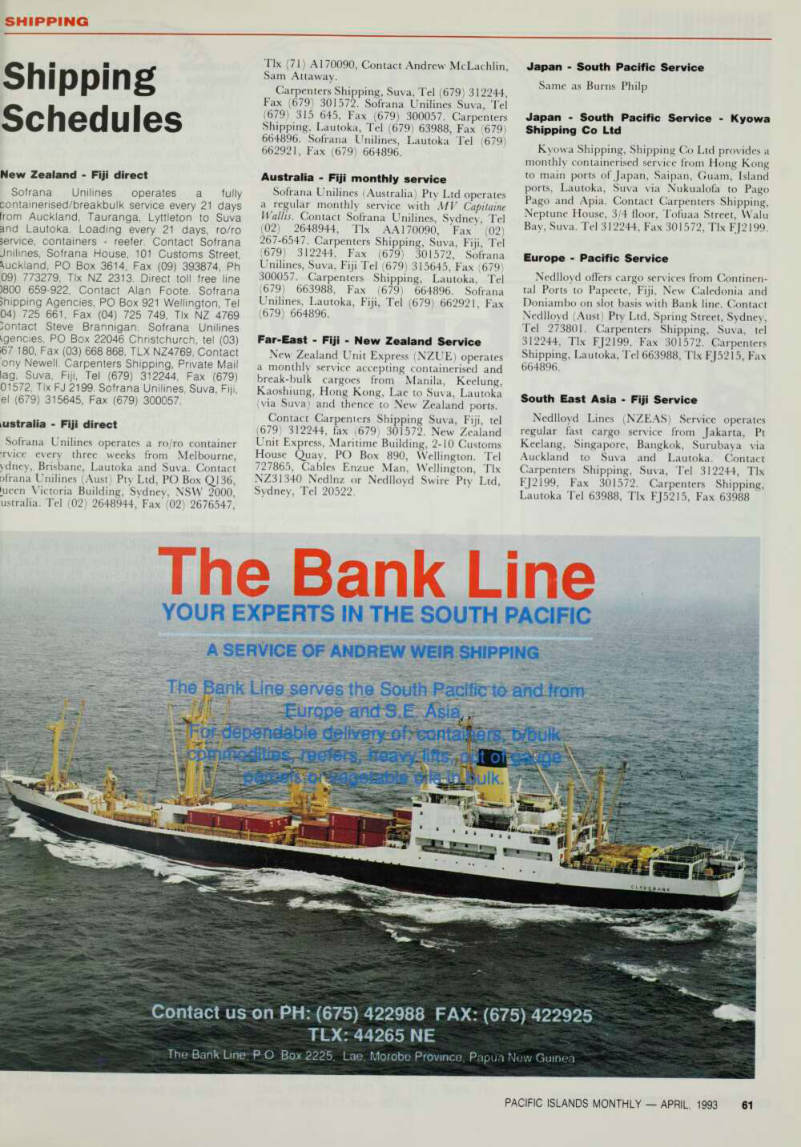
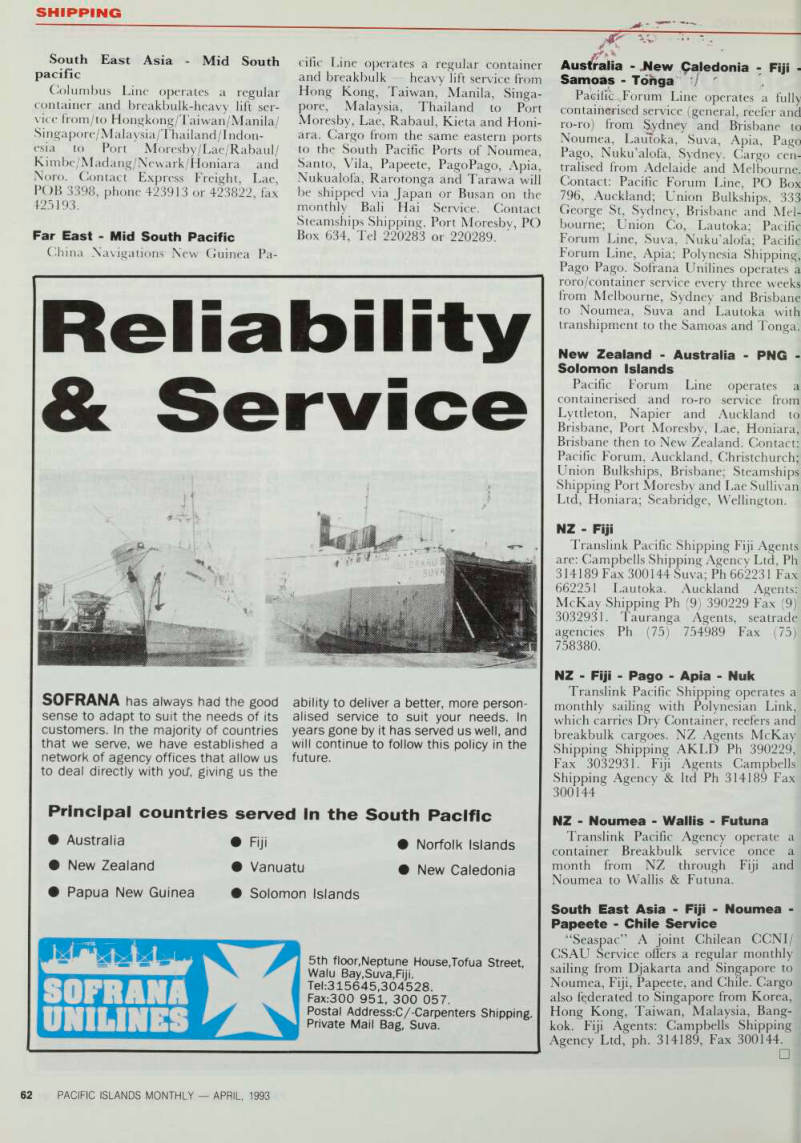
Schedules
New Zealand - Fiji direct Sofrana Unilines operates a fully containerised/breakbulk service every 21 days from Auckland, Tauranga, Lyttleton to Suva and Lautoka. Loading every 21 days, ro/ro service, containers - reefer. Contact Sofrana Jnilines, Sofrana House, 101 Customs Street, ~nd, PC Box 3614, Fax (09) 393874, Ph 09) 773279, Tlx NZ 2313. Direct toll free line )800 659-922, Contact Alan Foote. Sofrana shipping Agencies, PC Box 921 Wellington, Tel 04) 725 661, Fax (04) 725 749, Tlx NZ 4769 Contact Steve Brannigan. Sofrana Unilines agencies, PC Box 22046 Christchurch, tel (03) 167 180. Fax (03) 668 868, TLX NZ4769, Contact ony Newell. Carpenters Shipping, Private Mail lag, Suva, Fiji. Tel (679) 312244, Fax (679) 01572, Tlx FJ 2199. Sofrana Unilines, Suva, Fiji, el (679) 315645, Fax (679) 300057, Australia - Fiji direct Sofrana Unilines operates a ro/ro container •rvice every three weeks from Melbourne, ydney, Brisbane, Lautoka and Suva. Contact ofrana Unilines (Aust) Pty Ltd, PO Box QJ36,
•uecn Victoria Building, Sydney, NSW 2000,
ustralia. Tel (02) 2648944,'Fax (02) 2676547,
Tlx (71) A 170090, Contact Andrew McLachlin, Shipping, Suva, Tel (679) 312244, Fax (679) 301572. Sofrana Unilines Suva, Tel (679) 315 645, Fax (679) 300057. Carpenters Shipping, Lautoka, Tel (679) 63988, Fax (679) 664896. Sofrana Unilines, Lautoka Tel (679) 662921, Fax (679) 664896.
Australia - Fiji monthly service Sofrana Unilines (Australia) Pty Ltd operates a regular monthly service with MV Capitaine Wallis. Contact Sofrana Unilines, Sydney, Tel (02) 2648944, Tlx AA170090, Fax (02)
267-6547. Carpenters Shipping, Suva, Fiji, Tel
(679) 312244. Fax (679) 301572, Sofrana Unilines, Suva, Fiji Tel (679) 315645, Fax (679) 300057. Carpenters Shipping, Lautoka, Tel (679) 663988, Fax (679) 664896. Sofrana Unilines, Lautoka, Fiji, Tel (679) 662921, Fax (679) 664896.
Far-East - Fiji - New Zealand Service New Zealand Unit Express (NZUE) operates a monthly service accepting containerised and break-bulk cargoes from Manila, Keelung, Kaoshiuntr Hone Kone lae to Suva hntnh, (via Suva.’and thence to New Zealand ports.
Contact Carpenters Shipping Suva, Fiji, tel (679) 312244, fax (679) 301572. New Zealand Unit Express, Maritime Building, 2-10 Customs House Quay, PO Box 890, Wellington. Tel 727865, Cables Enzue Man, Wellington, Tlx NZ31340 Nedlnz or Nedlloyd Swire Pty Ltd,
Japan - South Pacific Service Same as Burns Philp Japan - South Pacific Service - Kyowa Shipping Co Ltd Kyowa Shipping, Shipping Co Ltd provides a monthly containerised service from Hong Kong to main ports of Japan, Saipan, Guam, Island ports, Lautoka, Suva via Nukualofa to Pago
Pago and Apia. Contact Carpenters Shipping,
Neptune House, 3/4 floor, Tofuaa Street, VValu Bay, Suva. Tel 312244, Fax 301572, Tlx FJ2199.
Europe - Pacific Service Nedlloyd offers cargo services from Continen tal Ports to Papeete, Fiji, New Caledonia and Doniambo on slot basis with Bank line. Contact Nedlloyd (Aust) Pty Ltd, Spring Street, Sydney, Tel 273801. Carpenters Shipping, Suva, tel 312244, Tlx FJ2199, Fax 301572. Carpenters Shipping, Lautoka, Tel 663988, Tlx FJ5215, Fax 664896.
South East Asia - Fiji Service Nedlloyd Lines (NZEAS) Service operates regular fast cargo service from Jakarta, Pt
Keelang, Singapore, Bangkok, Surubaya via
Auckland to Suva and Lautoka. Contact Carpenters Shipping, Suva, Tel 312244, Tlx
FJ2199, Fax 301572. Carpenters Shipping,
Lautoka Tel 63988, Tlx FJ5215, Fax 63988
South East Asia - Mid South pacific Columbus Line operates a regular container and breakbulk-heavy lift ser vice from/to Hongkong/Taiwan/Manila/
Singapore/Malaysia/Thailand/Indon
csia to Port Moresby/Lae/Rabaul/
Kimbe/Madang/Newark/Honiara and
Noro. Contact Express Freight, Lae, POB 3398, phone 423913 or 423822, fax 425193.
Far East - Mid South Pacific China Navigations New Guinea Pa
cific Line operates a regular container and breakbulk heavy lift service from Hong Kong, Taiwan, Manila, Singa pore, Malaysia, Thailand to Port Moresby, Lae, Rabaul, Kieta and Honi ara. Cargo from the same eastern ports to the South Pacific Ports of Noumea, Santo, Vila, Papeete, PagoPago, Apia, Nukualofa, Rarotonga and Tarawa will be shipped via Japan or Busan on the monthly Bali Hai Service. Contact Steamships Shipping, Port Moresbv, PO Box 634, Tel 220283 or 220289.
Australia - fie w Caledonia - Fiji Samoas - Tonga Pacific Forum Line operates a fully containerised service (general, reefer anc ro-ro) from Sydney and Brisbane to Noumea, Lautoka, Suva, Apia, Pago Pago, Nukualofa, Sydney. Cargo cen tralised from Adelaide and Melbourne Contact: Pacific Forum Line, PO Box 796, Auckland; Union Bulkships, 333 George St, Sydney, Brisbane and Mel bourne; Union Co, Lautoka; Pacific Forum Line, Suva, Nukualofa; Pacific Forum Line, Apia; Polynesia Shipping Pago Pago. Sofrana Unilines operates a roro/container service every three weeks from Melbourne, Sydney and Brisbane to Noumea, Suva and Lautoka with transhipment to the Samoas and Tonga New Zealand - Australia - PNG - Solomon Islands Pacific Forum Line operates containerised and ro-ro service from Lyttleton, Napier and Auckland to Brisbane, Port Moresby, Lae, Honiara, Brisbane then to New Zealand. Contact: Pacific Forum, Auckland, Christchurch;
Union Bulkships, Brisbane; Steamships
Shipping Port Moresby and Lae Sullivan
Ltd, Honiara; Seabridge, Wellington.
NZ - Fiji Translink Pacific Shipping Fiji Agents are: Campbells Shipping Agency Ltd, Ph 314189 Fax 300144 Suva; Ph 662231 Fax 662251 Lautoka. Auckland Agents: McKay Shipping Ph (9) 390229 Fax (9) 3032931. Tauranga Agents, seatrade agencies Ph (75) 754989 Fax (75) 758380.
NZ - Fiji - Pago - Apia - Nuk Translink Pacific Shipping operates a monthly sailing with Polynesian Link, which carries Dry Container, reefers and breakbulk cargoes. NZ Agents McKay Shipping Shipping AKLD Ph 390229, Fax 3032931. Fiji Agents Campbells Shipping Agency & ltd Ph 314189 Fax 300144 NZ - Noumea - Wallis - Futuna Translink Pacific Agency operate a container Breakbulk service once a month from NZ through Fiji and Noumea to Wallis & Futuna.
South East Asia - Fiji - Noumea - Papeete - Chile Service “Seaspac” A joint Chilean CCNI/ CSAU Service offers a regular monthly sailing from Djakarta and Singapore to Noumea, Fiji, Papeete, and Chile. Cargo also federated to Singapore from Korea, Hong Kong, Taiwan, Malaysia, Bang kok. Fiji Agents: Campbells Shipping Agency Ltd, ph. 314189, Fax 300144.
Advertisements & other items, pp. 61-64 (1 item)
The Bank Line
YOUR EXPERTS IN THE SOUTH PACIFIC
The Bank Line serves the South Pi
-- Europe Asia,
c^!tveryLof^nta?|?)iS;W6uik
t. i«w, i|i ■■■*» %• '-w jp n*
Reliability
& Service
SOFRANA has always had the good sense to adapt to suit the needs of its customers. In the majority of countries that we serve, we have established a network of agency offices that allow us to deal directly with you, giving us the ability to deliver a better, more personalised service to suit your needs. In years gone by it has served us well, and will continue to follow this policy in the future.
Principal countries served In the South Pacific • Australia • Fiji Norfolk Islands • New Zealand Vanuatu New Caledonia • Papua New Guinea • Solomon Islands Si b sth floor,Neptune House,Tofua Street, Walu Bay,Suva,Fiji.
Te1:315645,304528.
Fax:3oo 951, 300 057.
Postal Address:C/-Carpenters Shipping.
Private Mail Bag, Suva.
- Ai.r O/c m 1993 m a &
ACIFI
ISLANDS
O N T H L
fIRK€T PLRC
I 0 2604 03108347 For the benefit of our readers who would like to place a small classified advertisement in our magazine, Market Place will assist you in selling personal items, accommodation, real estate, boating or a service ... in fact anything you would like to sell to our over 50,000 readers.
Market Place Advertising Rates are structured to allow you to place as many advertisements as you wish, economically.
The University of New England, located in the city of Armidale in northern New South Wales welcomes overseas students. The University offers a unique experience in education, with the perfect blend of academic excellence and a relaxed, friendly environment. Bachelor, Masters and PhD degrees and Graduate Diplomas are available in: • Accounting and Financial Management • Agricultural Economics • Agricultural Science • Arts • Asian Studies • Communication Studies • Computing Science • Economics • Education/Education Administration • Engineering (Electronics/Communications) • Engineering (Resource) • Environmental Studies
• Geography
• Law • Master of Business Administration (MBA) • Music • Nursing/Health Administration • Science • Social Science • Urban and Regional Planning
• English Language Training
UNE
The University of
NEW ENGLAND
Armidale
AUSTRALIA
For applications and further information, con tact Australian Education Centre,Suite7A, Ist Floor, Queensland Insurance Centre, Victoria Parade, Suva OR The International Programs Office, The University of New England, Armidale, New South Wales, 2351. Australia, telephone 61 67733192, fax 61 67 71 1238.
PACIFIC
SLANDS
MRRK6T PLRCC CRN WORK
WOND6RS FOR VOU ...
Promote your business, or service, sell your household items, cars or heavy machinery etc.
ONLY AUSSI PER WORD.
NO COMPANY LOGO. NO
DISPLAY. NO BOLD TYPE.
Just forward your Advertisement together with payment to: PACIFIC ISLANDS MONTHLY "Market Place”, P.O. Box 1167, Suva, Fiji.
CONDITIONS:
1. All Advertisements are subject to acceptance and approval of publisher. 2. Advertisements are published as space permits; we cannot guarantee date of insertion. 3. All advertisements must be prepaid and should be typed or printed clearly. 4. Deadline for receipt of advertisements is the 10th of the month prior to issue,
5. PACIFIC ISLANDS MONTHLY
assumes no responsibility for any service other than publishing paid advertisements in this section.
)U CAN earn $1 million p.a. MLM Ground Dor Opportunity specialising in health and itrition products. In 16 countries and expander rapidly. Top products and company support. ;nd sase to AGM, 96 Sugarloaf Road, Alston Bay, Australia, 7016 or Fax L 02 471026.
ELF ADHESIVE LABELSI
)RUM LABELS (FIJI) LTD
0. Box 1167, Suva., Fiji. Phone: 304111 e print self-adhesive labels in rolls, mulcoloured labels with hot foil, and die cut shape, tickets and tags in rolls. We so supply labelling machines and fabric Dels.
REAL ESTATE
FIJI ISLANDS SAVUSAVU
Freehold Beachside 1 Acre properties 15 minutes from town. From F 520,000 Phone Elle Simpson 850 012 P.O. Box 206, Savu Savu.
COMMERCIAL PRINTING
Top quality four colour printing, brochures, posters, packaging, product labels, fabric labels, billboards, books, magazines, stickers, books. Export quality. Contact Fiji’s most experienced Commercial Printers. FIJI TIMES COMMER- CIAL PRINTING, P.O. Box 1167. Suva. Fiji.
Phone: 304111 Fax. 301521.
COLLECTORS MODEL CARS
Diecast model cars: CORGI, BRUMM, PROGETTO K, BEST, RAE and others. Please write or fax for lists:
MESSAGE MODELS,
P.O. Box 239,
NORTHBRIDGE, N.S.W., 2063,
AUSTRALIA.
Fax. +6l-2-967 2216 Telephone +6l-2-958 2315
p^e. ■ m m Wmß mamm mm ■ Mi ■ n m m me wmamsm - ■r iJJfL m n - .■ ■ n ■ t
First Again!
Pajero Finishes Ahead of the Crowd in Paris-Dakar
Following up last year’s
stunning 1-2-3 win in the Paris-Cape Town Cross
Country Rally, another
Mitsubishi Pajero has taken overall honors in this year’s rally, which finished in Dakar, Senegal.
Perhaps best known for outstanding endurance and performance on a diversity of surfaces, the Pajero excelled on this shorter, but more intense and difficult, course. In this 16 day rally in which only half the original starters finished, Pajero teams were three of the top five.
With this win, Mitsubishi Motors is excited about the prospect of another year of rally success. What we learn from rallying translates into better production vehicles. And lately this has paid off in very tangible ways for the Pajero: ’9l-’92 Japan Car of the Year Special Award, Britain’s Practical Caravan's top off-road 4x4 for 1992, Australia’s Bushdriver magazine’s ’9l 4WD Wagon of the Year, ’9l-’92 4x4 of the Year from France’s 4x4, and Germany’s 1992 Golden Steering Wheel Award for Special Class.
Although a pleasure, wins and awards are not ends in themselves. Regardless of whether 1993 provides so many accolades, Mitsubishi Motors is confident that dedication to motorsports is a means to our ultimate goal: creating the best performing, safest cars.
Moreover, as a way of combining technological development with pleasure for automotive enthusiasts and our customers, motorsports is integral to our philosophy of creating together. So awards and first place finishes aside, it’s a way we can all be winners.
A
MITSUBISHI
MITSUBISHI
MOTORS
In some markets the Mitsubishi Pajero is called Montero.
CREATING TOGETHER
AMERICAN SAMOA: PACIFIC MARKETING INC. PO. Box 698, Pago Pago, Tel. 699-9140 / AUSTRALIA: MITSUBISHI MOTORS AUSTRALIA LTD. 1284 South Road, Clovelly Park, South Australia, Tel. (08) 2757297 / FIJI: NIVIS MOTOR & MACHINERY CO. LTD. G.RO. Box 150, Suva. Tel 383411 / GUAM: TRIPPLE J ENTERPRISES INC. RO. Box 6066, Tamuning, Tel 6469126 / NEW CALEDONIA: SOCIETE D’IMPORTATION D'AUTO DU PACIFIQUE SUD S.A. PO Box 2548. Noumea, Tel. 274-144 / NEW ZEALAND: MITSUBISHI MOTORS NEW ZEALAND LTD. Private Bag Porirua, Tel. 237-0109 / NORFOLK ISLAND: BORRY’S PTY LTD. RO Box 169, Tel 2114 / PAPUA NEW GUINEA: TOBA PTY LTD. RO. Box 503, Port Moresby. Tel. 217-874 / SAIPAN: AUTO MOTION INC. PO Box 569, SKV Dist. 4, Tel 234-3332 / SOLOMON ISLANDS: HARVEST PACIFIC LTD.
G.RO. Box 823, Honiara. Tel 30407 / TAHITI (FRENCH POLYNESIA): SOPADEP S.A. PO. Box 1617, Papeete, Tel 427393 / TONGA: SITANI MAPI CO., LTD. RO Box 83, Nuku'Alofa, Tel 24044 / VANUATU: SOCOMETRA VANUATU LTD. B.R 06. Route de Lagon, Port-Vila, Tel. 2314 / WESTERN SAMOA: MOTOR DISTRIBUTORS (SAMOA) LTD. RO, Box 576, Apia. Tel. 20957