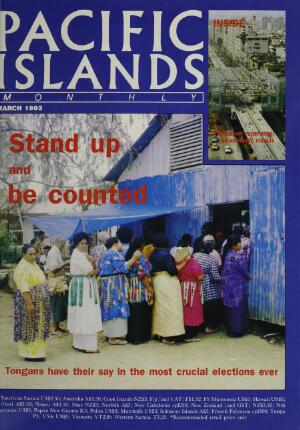
Pacific
Islands
Monthly
■Arch 1993
Stand up/
and be co until
Tongans have their say in the most crucial elections ever
American Samoa USS2.SO; Australia A 53.50; Cook Islands NZ$3; Fiji (incl VAT) F 51.92; FS Micronesia US$3; Hawaii US$3; ribati A 52.50; Nauru A 52.50; Niue NZ$3; Norfolk As 3; New Caledonia cpf2so; New Zealand (incl GST) NZ53.45; Nth irianas US$3; Papua New Guinea K 3; Palau US$3; Marshalls US$3; Solomon Islands As 3; French Polynesia cpf3oo; Tonga P 3; USA US$3; Vanuatu VT22O; Western Samoa T 3.25. *Recommended retail price only
Advertisements & other items, p. 2 (1 item)
Right
---itfi ■jar u 'r
THE
-r^r^
gUai^:
Figne^
Pacific
Islands
Monthly
Vol 63 No. 3
March 1993
The News Magazine
From The
Editor’S Desk 4
Letters 5
Headlines 6
Cover Stories
A question of time 11 Issues behind the elections 12
Financial Crisis
In the red 14 The bank account is empty 15
Politics
Bad boy George 17
Sovereignty
A question of when 20 Hawaiian renaissance 21
Origins
Sharing aboriginality 22
Economy
Resourceful initiative 24
Books
Che Pacific drug 26
Violence
Tackling perpetrators 29
Architecture
Realising the potential 32 Timber and thatch 34
Focus
Suva in a day 37
The Taiwan Experience
The Dragon’s Dream 40
Sports
Government funds dry up 51
Yachting
Land of contrast and adventure 54
Shipping
Shipping schedules 57
Columnists
Futa Helu 23 Bill McCabe 25 Jemima Garrett 28 David Barber 35
Publisher: Brian O’Flaherty Editor Mala Jagmohan Senior Writer Martin Tiffany Correspondents: Christine Hatcher, David North, Ed Rampell, lan Williams, Johnson Honimae, Karen Mangnall, Liz Thompson, Nicholas Rothwell, Pesi Fonua, Wally Hiambohn.
Columnists: David Barber (Wellington), Futa Helu (Tonga, covering the Pacific Islands), Jemima Garrett (Sydney), Margot O’Neill (Washington), Julian Moti (Pacific Law), Alfred Sasako (The Forum).
Business and Advertising Manager, Charlotte Thomas
Advertising Sales: • Regional Sales (South Pacific); Salendra Narayan, Tel (679) 304111, Fx (679) 303809 • Sydney, Canberra: Bob Hill Media Represen tations, Tel (61-2) 4164245, Fx (61-2) 4165064 • Brisbane: Robert Walker, Media House, Tel (61-7) 3710533, Fx (61-7) 371-8904 • Adelaide: Hastwell Williamsons Representations, Tel (61-8) 799522, Fx (61-8) 799735 • Melbourne: Brown Orr Fletcher Burrows (Aust).
Pty. Ltd. Tel (3) 696 5188 Fx (03) 696 5131. • Auckland: McKay International Media Reps Ltd, Tel (64-9) 4190561, Fx (64-9) 4192243 • Japan: Universal Media Corporation, Tokyo, Tel (3) 6663036, 6663094, Cable: UNIMEDIA Tokyo, Tx 2524665.
Founded 1930 (USPS 952480). A Fiji Times Limited production.
Cover prices are recommended retail only. Regis tered by Australia Post, Publication No. NBP 1210. © Copyright Fiji Times Limited, 177 Victoria Parade, Suva. Fiji. Tel (679) 304111, Fx (679)
303809, Tx Fj2124. <
Pacific Islands Monthly is published monthly by The Fiji Times Limited, a division of Nationwide News, 2 Holt Street, Surry Hills, Sydney, NSW 2010.
Send address changes to: • Pacific Islands Monthly, PO Box 1167, Suva, Fiji.
Typeset and printed by The Fiji Times Limited, 177 Victoria Parade, Suva, Fiji.
Taipei Stock Exchange: Financial speculation is on the rise in Taiwan
Snared in a vicious cycle
From The Editor’S Desk
ALARMING statistics from Rarotonga in the Cook Islands forces us this month to once again focus attention on a
heinous crime perpetrated against
women in Pacific socities. These crimes of violence are all the more in need of serious and prompt attention because the very nature of our societies makes it
virtually impossible
for the victims to break free from their miserable situations.
We are talking here about rape,
wife-bashing and
sexual abuse. We are also talking here about suffering viol ence at the hands of people women know and are in close con tact with.
Cases of rape are reported to the au thorities and action is usally taken, in that the case is heard be fore a court and the culprit sentenced.
But the attitude brought to bear upon such cases are ques tionable for in stance, the woman’s role in “encourag ing” the crime. Of course, the severity of the sentences have been questioned, es
pecially when they are compared to other violent crimes.
The case of the battered wife is perhaps even more pathetic because she is tragically bound in a vicious trap.
Because the women are often not financially independent they cannot leave. Because the societies in many cases
do not have centres such women can taken refuge in, they cannot leave. And because society generally views such violence as part of a woman’s lot, she is not likely to go against social pressures to escape.
She has little reason to resort to the law for protection. This has been known to
aggravate the situation es pecially if the crime is battery and she has no option but to continue to live with him. Be sides, most law enforcing au thorities in Pa cific countries do not consider wife-bashing a serious crime of violence rather a dom
estic problem
which will sort itself out.
Unfortu nately, unless we take stock of the situation now and come up with ways to remedy it, the injustices against women will continue. □
Advertisements & other items, p. 4 (1 item)
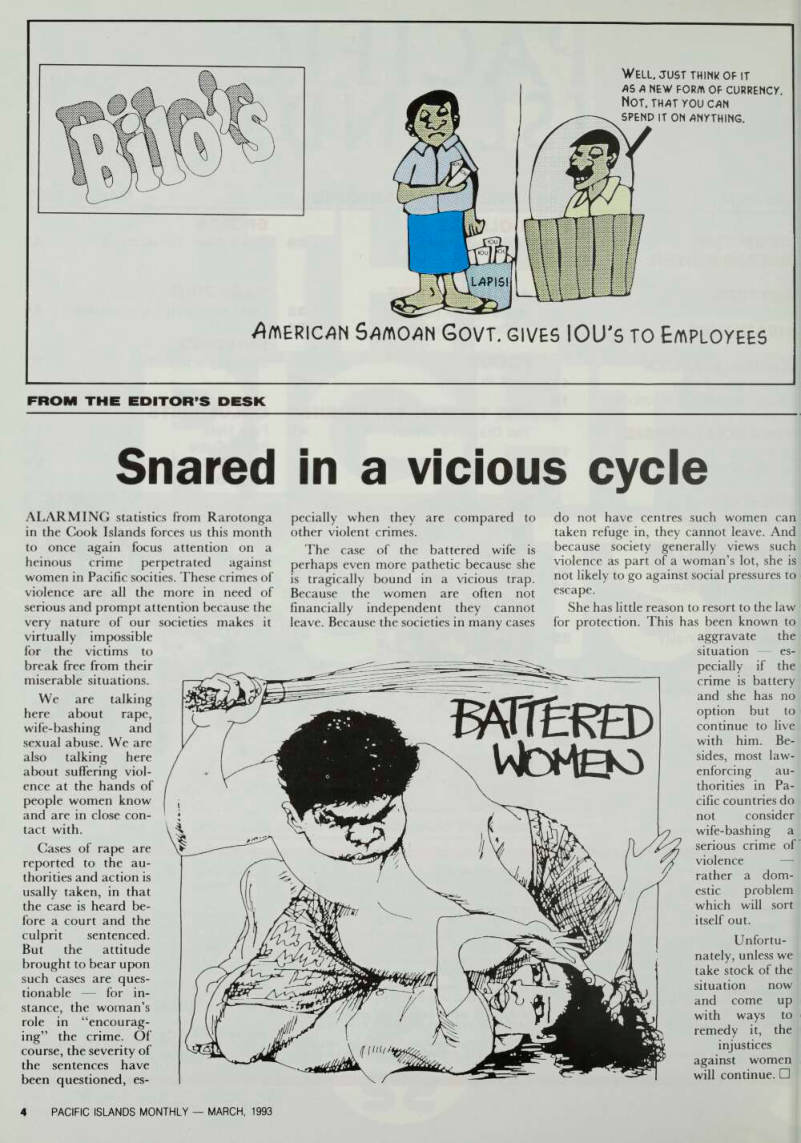
American Samoan Govt, gives lOU's to Employees
LAPISI
WELL, JUST THINK OF IT
AS A NEW FORM OF CURRENCY
Not. that you can
SPEND IT ON ANYTHING.
American Samoan Govt, gives lOU's to Employees
Thoughtful
Letters
remark
Madam, I want to reply to Aula Kobale’s letter [PIM, Jan. 1992). His letter cannot be left unanswered.
The comment that BRA (should be
“Bouganville Freedom Fighters” [BFF])
has not killed any Solomon Islanders was not only true but instructive. What the Honourable Prime Minister, Solomon Mamaloni, was alluding to was that “Brothers should not killed each other,” if the arguments of one nation and sovereignty are to hold water. This has not been the case with Papua New Guinea governments and the Papua New Guinea military which have been sup ported by Australian advice and re sources. The PNG military (with the support of Australia) had invaded Bouganville and the Solomon Islands and had killed people in these zones.
Clearly, Papua New Guinea and Austra lia had killed Bouganvilleans and Sol omon Islanders.
Certainly, this is not the case with BFF. However, the case of BFF, having not killed Solomon Islanders, would soon cease to be valid if Papua New Guinea military (with Australian military aid) continues to kill Bouganvilleans. Seen in this context, the Prime Minister’s remark was not unthoughtful but rather loaded with useful thoughts and cues. Only a decolonized mind which is able to decipher the difference between “ulti mate sovereignty” based on peoples’ lives and the respect for peoples’ person and property (in this case Bouganvilleans and Solomon Islanders), and “national sov ereignty,” founded on colonial demar cations, expatriate contrivances and con tinued neo-colonialism, can comprehend these dynamics.
The above aside, I would never condone killings by members of BFF. But Bouganville was invaded. And PNG government had yet to exhaust alterna tive means of resolving the conflict before the military resorted to invasion and
killing.
Any one who understands the “Melanesian mind,” would have realised that once a single life was lost, even the closing of Paguna mine would never compensate for such a loss. This is what Australian advisers (even some PNG leaders) have failed to realise or blatantly refused to acknowledge.
In some parts of the world where people are disposable and “Mr. Money” is glorified, this should have been the
case. Fortunately, some Bouganvilleans
have refused to put money in the place of their people in their land.
The above thus reflects the pressing need to resolve the conflict and, this time, PNG needs all Pacific island states to assist; most of all Solomon Islands. Any Prime Minister of the Solomon has a role to play in this endeavour with grace and
utmost integrity.
Benjamin Baeoro, Honolulu, Hawaii.
Tongan
time
Madam, I refer to your article “Royalty Under Threat” in the December issue of your magazine. Martin Tiffany raises the question of whether “the man (Akilsi Pohira) and his movement are a force ahead of their time”. I realise that Tonga straddles the line 180° east and west of Greenwich, that Tongans claim that “Tonga (is) where time begins”, but the philosopher Plato once said, “Time waits for no man”. Without going beyond the
realm of the mortals, by point is that time is running out. Whether it be the chiefs or the people living on the Tukutonga rubbish dump, the economy of the kingdom can no longer deliver the goods and services to satisfy the desires and human needs of the people. I mean deliver in terms of quantity, quality and in a manner acceptable to the people. If there is a sow with a litter and the sow has not enough food and only dirty water some piglets starve to death. If the sow has no milk all the piglets die. If the sow has no food and water the sow and the
piglets die.
Furthermore, if the pace of environ mental destruction continues the country won’t be able to deliver the most basic physical needs of humans food, clothing and shelter. It won’t eveb be a matter of sharing the cake or even stealing the cake, there just won’t be the capability to produce a cake.
It is not surprising that increasingly Tongans are seeing there is no future for their children in their homeland. It certainly looks like it is time for dialogue.
May be if there is another timely conference, for this time on the theme of “The Development of Tonga”, the Hon.
P.M. Vaea will attend and the other ministers will also make the time between their overseas travels.
Don Seiler Nuku'alofa Tonga
Advertisements & other items, p. 5 (1 item)
Pacific Islands Monthly
SUBSCRIPTIONS
American Samoa US$45 Australia A 542.00 Canada US$45 Cook Islands AUSS46 Fiji F 526.40 French Polynesia US$45 Guam US$45 Hawaii US$45 Japan US$45 Kiribati AUSS46 Marshall/Micronesia US$4O Nauru AUSS42 New Caledonia US$32 Payment to Pacific Islands Monthly: New Zealand NZ$55 Niue AUSS46 Norfolk Island AUSS42 Northern Marianas/Palau US$4O Papua New Guinea AUSS4S Solomon Islands AUSS46 Tonga AUSS46 Tuvalu AUSS46 United Kingdom Stg Pound2B US Mainland US$45 Vanuatu AUSS4S Western Samoa WS$6O Elsewhere AUSS63 Subscriptions Dept GPO Box 1167, Suva, Fiji.
Subscriptions rates include the cost of airspeeding to all destinations set out above.
Direct airmail rates on application.
Telephone: 304111 Fax: 303809
Landing rights
Headlines
Solomon Islands
Collaborators
arrested
Solomon Islands security personnel have arrested eight Solomon Islanders who have allegedly been collaborating with both the Papua New ’Guinea Defence Force and the Bougainville Revolutionary Army. A police spokesman said the men were from the Shortland Islands opposite Bougainville and were arrested on January 14 on a border island after returning from an illegal visit to Bougainville.
The spokesman said the men had now been brought to Honiara aboard the patrol boat Auki and would be charged under Solomon islands immigration laws. The eight men are all in their 20s and police believe they were dealing with both sides in the Bougainville conflict.
According to the police spokesman, the men had been selling Second World War ammunition to the BRA. It was also believed they had guided PNG soldiers in cross-border raids on Shortlands villages last year. The spokesman said both the PNG Defence Force and the BRA had raised complaints about being double-crossed in their dealings with the arrested men. ***
Landing rights
questioned
A Hong Kong-based company which has put in a bid to buy a major share in Solomon Airlines has questioned whether the airline’s landing rights in regional countries will be secure if the deal goes ahead. Golden Springs International, which has logging interests in Solomon Islands, was the only applicant for 70 per cent of the shares in the government-owned airline which were put on offer last month.
The manager of the Government’s Investment Corporation, Wilson Gina, says the question of landing rights was raised in initial negotiations with the company and further talks are expected. The Honiara newspaper Solomon Voice says it understands some regional countries have indicated their reluctance to grant Solomon Airlines landing rights if the Hong Kong company becomes a majority shareholder. ***
Airspace
violation
Solomon islands police have expressed surprise at the Papua New Guinea Defence Secretary, Peter Peipul’s denial of PNG Defence Force violations of Solomon Islands airspace. Assistant Commissioner of Police Operations, John Homelo, says the recent intrusions cannot be denied as they were witnessed by villagers, government officers and security personnel at the border area south of Bougainville.
Homelo says a light aircraft and a helicopter were seen crossing the border into Solomon Islands airspace more than once from Bougainville and returning the same way.
First Aids
Marshall Islands
victim
The Marshall Islands Health Minister Evelyn Kanou has announced the country’s first known victim of the virus that causes Aids. The 18-year-old man is now in Hawaii for treatment.
Kanou says in many countries around the world Aids has reached epidemic levels. She says the Marshall Islands still has the opportunity to limit the disease’s spread if everyone takes the necessary precautions. Marshall Islands health officials are worried sexually active teenagers and adults may be vulnerable to Aids.
The country was struck with a syphilis outbreak in 1991.
Cabinet ministers have met with health officials to plan ways to contain the spread of Aids.
New disclosure
Western Samoa
law for journalists
The Pacific Islands News Association, PINA, has written to the Western Samoan Prime Minister asking him to abolish a new source disclosure law.
The new laws will allow the courts to require journalists to reveal their sources of information. Under the recent Newspapers and Printers Act, journalists face jail term of three months and a fine up to $2OOO. The law requires newspaper publishers to reveal their sources in defamation cases.
PINA says the legislation passed without public consultation, is a severe setback for media freedom. PINA officials are seeking a meeting with the Western Samoan Prime Minister to discuss the issue. The Western Samoan government has made it clear that it was not happy over information and allegations contained in anonymous letters printed in the Letters to the Editor column.
split
Tonga
Media
There’s been a split in media organisations in Tonga with three of them coming together to form the Tonga Independent News Asociation (TINA), the second media body in Tonga.
Highlands
Papua New Guinea
Oil
call
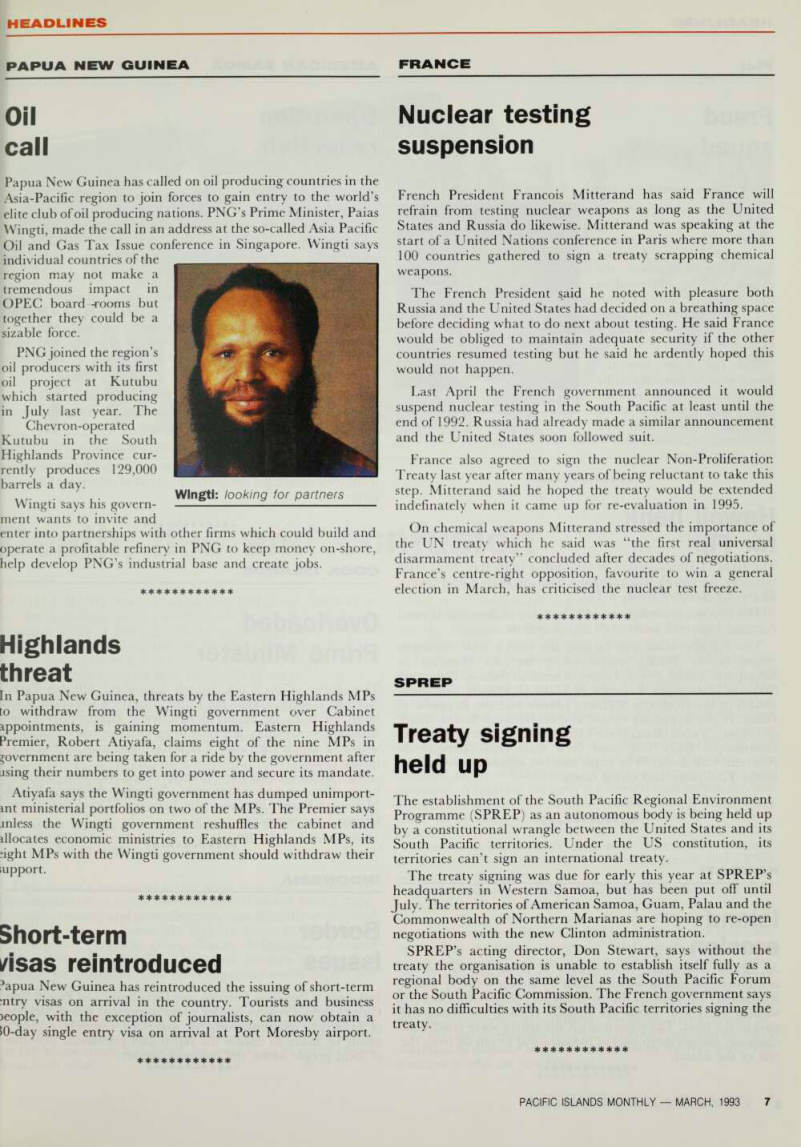
Papua New Guinea has called on oil producing countries in the Asia-Pacific region to join forces to gain entry to the world’s elite club of oil producing nations. PNG’s Prime Minister, Paias Wingti, made the call in an address at the so-called Asia Pacific Oil and Gas Tax Issue conference in Singapore. Wingti says
individual countries of the region may not make a tremendous impact in OPEC board -rooms but together they could be a sizable force.
PNG joined the region’s oil producers with its first oil project at Kutubu which started producing in July last year. The
Chevron-operated
Kutubu in the South Highlands Province cur rently produces 129,000 barrels a day.
Wingti says his govern ment wants to invite and
enter into partnerships with other firms which could build and operate a profitable refinery in PNG to keep money on-shore, help develop PNG’s industrial base and create jobs. ***
Highlands
threat
In Papua New Guinea, threats by the Eastern Highlands MPs to withdraw from the Wingti government over Cabinet
appointments, is gaining momentum. Eastern Highlands
Premier, Robert Atiyafa, claims eight of the nine MPs in government are being taken for a ride by the government after using their numbers to get into power and secure its mandate.
Atiyafa says the Wingti government has dumped unimport ant ministerial portfolios on two of the MPs. The Premier says anless the Wingti government reshuffles the cabinet and allocates economic ministries to Eastern Highlands MPs, its dght MPs with the Wingti government should withdraw their lupport. ♦*♦♦♦*♦♦*♦**
Short-term
/Isas reintroduced
3 apua New Guinea has reintroduced the issuing of short-term ;ntry visas on arrival in the country. Tourists and business aeople, with the exception of journalists, can now obtain a 10-day single entry visa on arrival at Port Moresby airport.
Wingti: looking for partners
suspension
France
Nuclear testing
French President Francois Mitterand has said France will refrain from testing nuclear weapons as long as the United States and Russia do likewise. Mitterand was speaking at the start of a United Nations conference in Paris where more than 100 countries gathered to sign a treaty scrapping chemical weapons.
The French President said he noted with pleasure both Russia and the United States had decided on a breathing space before deciding what to do next about testing. He said France would be obliged to maintain adequate security if the other countries resumed testing but he said he ardently hoped this would not happen.
Last April the French government announced it would suspend nuclear testing in the South Pacific at least until the end of 1992. Russia had already made a similar announcement and the United States soon followed suit.
France also agreed to sign the nuclear Non-Proliferation Treaty last year after many years of being reluctant to take this step. Mitterand said he hoped the treaty would be extended indefinately when it came up for re-evaluation in 1995.
On chemical weapons Mitterand stressed the importance of the UN treaty which he said was “the first real universal disarmament treaty” concluded after decades of negotiations.
France’s centre-right opposition, favourite to win a general election in March, has criticised the nuclear test freeze.
Treaty signing
Sprep
held up
The establishment of the South Pacific Regional Environment Programme (SPREP) as an autonomous body is being held up by a constitutional wrangle between the United States and its South Pacific territories. Under the US constitution, its territories can’t sign an international treaty.
The treaty signing was due for early this year at SPREP’s headquarters in Western Samoa, but has been put off until July. The territories of American Samoa, Guam, Palau and the Commonwealth of Northern Marianas are hoping to re-open negotiations with the new Clinton administration.
SPREP’s acting director, Don Stewart, says without the treaty the organisation is unable to establish itself fully as a regional body on the same level as the South Pacific Forum or the South Pacific Commission. The French government says it has no difficulties with its South Pacific territories signing the treaty.
for Fiji
Fiji
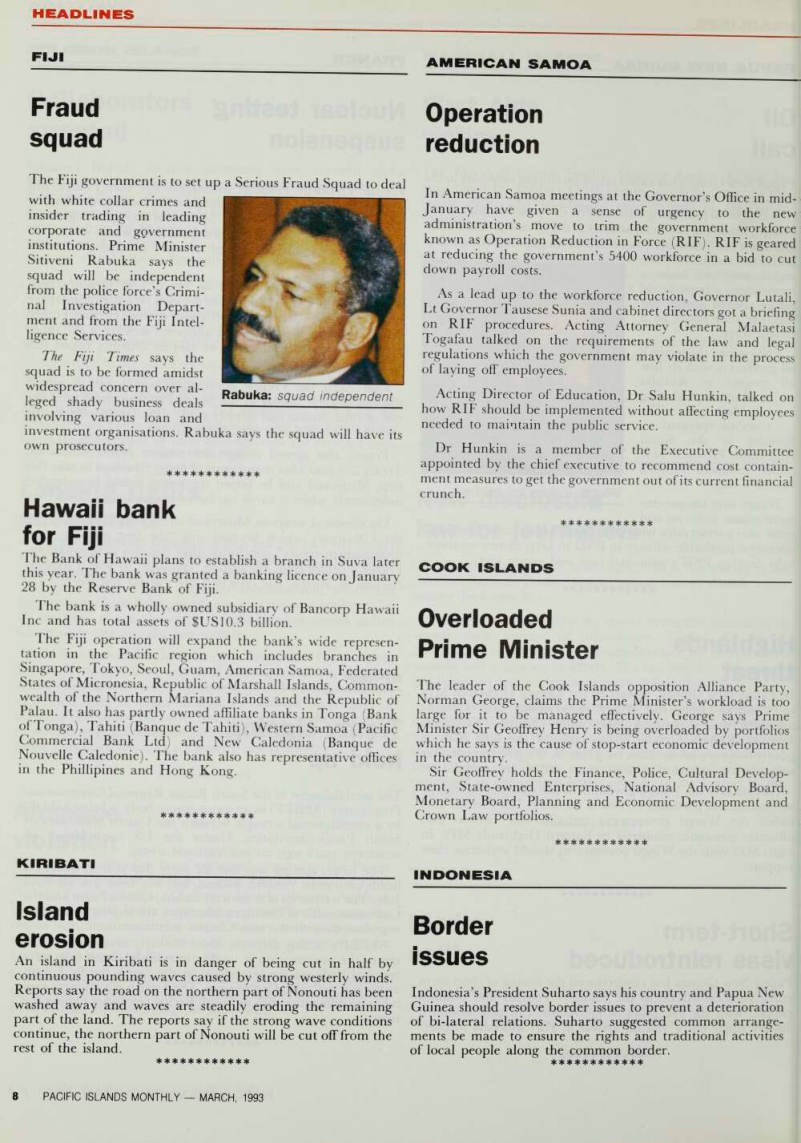
Fraud squad The Fiji government is to set up a Serious Fraud Squad to deal
with white collar crimes and
insider trading in leading
corporate and government institutions. Prime Minister Sitiveni Rabuka says the squad will be independent from the police force’s Crimi
nal Investigation Depart
ment and from the Fiji Intel ligence Services.
The Fiji Times says the squad is to be formed amidst widespread concern over al leged shady business deals involving various loan and
investment organisations. Rabuka says the squad will have its own prosecutors.
Hawaii bank
for Fiji
The Bank of Hawaii plans to establish a branch in Suva later this year. The bank was granted a banking licence on January 28 by the Reserve Bank of Fiji.
The bank is a wholly owned subsidiary of Bancorp Hawaii Inc and has total assets of SUSIO.3 billion.
The Fiji operation will expand the bank’s wide represen tation in the Pacific region which includes branches in Singapore, Tokyo, Seoul, Guam, American Samoa, Federated States of Micronesia, Republic of Marshall Islands, Common wealth of the Northern Mariana Islands and the Republic of Palau. It also has partly owned affiliate banks in Tonga (Bank ofTonga), Tahiti (Banque de Tahiti), Western Samoa (Pacific Commercial Bank Ltd) and New Caledonia (Banque de Nouvelle Caledonie). The bank also has representative offices
in the Phillipines and Hong Kong.
Rabuka: squad independent
erosion
Kiribati
Island
An island in Kiribati is in danger of being cut in half by continuous pounding waves caused by strong westerly winds.
Reports say the road on the northern part of Nonouti has been washed away and waves are steadily eroding the remaining part of the land. The reports say if the strong wave conditions continue, the northern part of Nonouti will be cut off from the rest of the island.
Operation
American Samoa
reduction
In American Samoa meetings at the Governor’s Office in mid- January have given a sense of urgency to the new administration’s move to trim the government workforce known as Operation Reduction in Force (RIF). RIF is geared at reducing the government’s 5400 workforce in a bid to cut down payroll costs.
As a lead up to the workforce reduction, Governor Lutali, Lt Governor Tausese Sunia and cabinet directors got a briefing on RIF procedures. Acting Attorney General Malaetasi Togafau talked on the requirements of the law and legal regulations which the government may violate in the process of laying off employees.
Acting Director of Education, Dr Salu Hunkin, talked on how RIF should be implemented without affecting employees needed to maintain the public service.
Dr Hunkin is a member of the Executive Committee appointed by the chief executive to recommend cost contain ment measures to get the government out ofits current financial crunch.
Overloaded
Cook Islands
Prime Minister
The leader of the Cook Islands opposition Alliance Party, Norman George, claims the Prime Minister’s workload is too large for it to be managed effectively. George says Prime Minister Sir Geoffrey Henry is being overloaded by portfolios which he says is the cause of stop-start economic development in the country.
Sir Geoffrey holds the Finance, Police, Cultural Develop ment, State-owned Enterprises, National Advisory Board, Monetary Board, Planning and Economic Development and Crown Law portfolios.
issues
Indonesia
Border
Indonesia’s President Suharto says his country and Papua New Guinea should resolve border issues to prevent a deterioration of bi-lateral relations. Suharto suggested common arrange ments be made to ensure the rights and traditional activities of local people along the common border.
Advertisements & other items, p. 9 (1 item)
Bougainville
Death: PNG soldiers with fallen comrade at Arawa on Bougainville
Death, lies and confusion
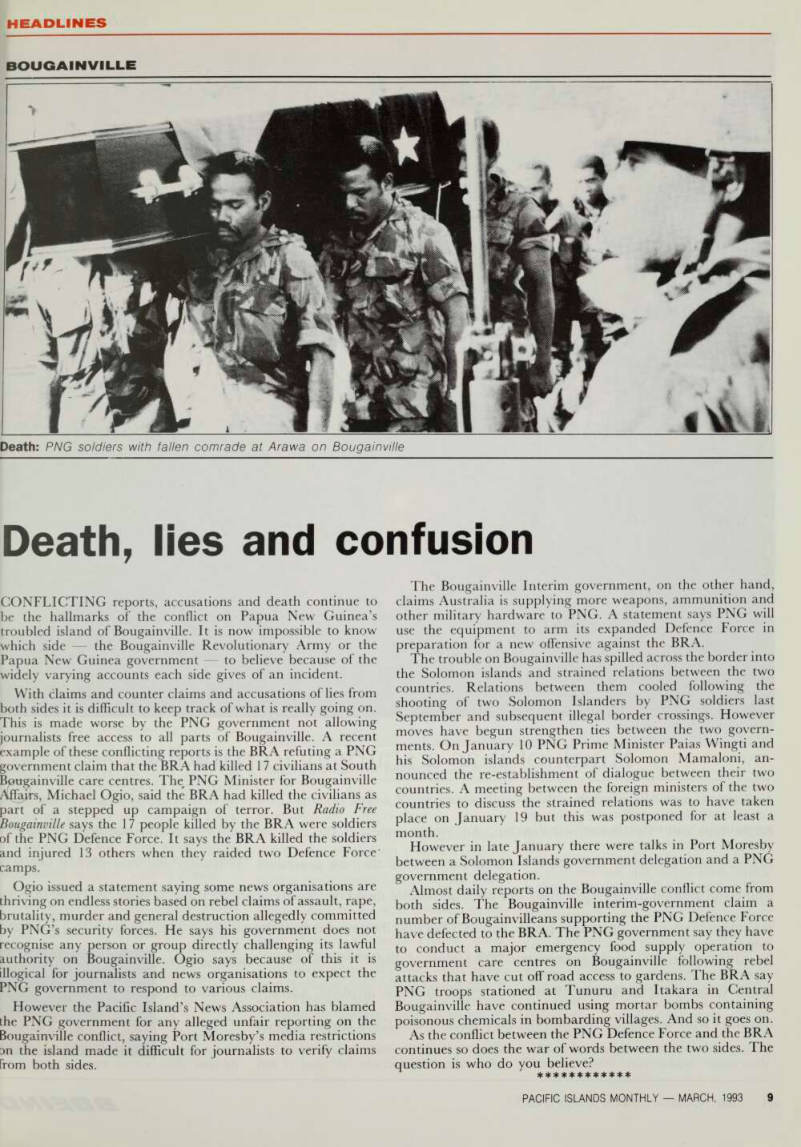
CONFLICTING reports, accusations and death continue to be the hallmarks of the conflict on Papua New Guinea’s troubled island of Bougainville. It is now impossible to know which side the Bougainville Revolutionary Army or the Papua New Guinea government to believe because of the widely varying accounts each side gives of an incident.
With claims and counter claims and accusations of lies from both sides it is difficult to keep track of what is really going on.
This is made worse by the PNG government not allowing journalists free access to all parts of Bougainville. A recent example of these conflicting reports is the BRA refuting a PNG government claim that the BRA had killed 17 civilians at South Bpugainville care centres. The PNG Minister for Bougainville A|lajrs, Michael Ogio, said the BRA had killed the civilians as part of a stepped up campaign of terror. But Radio Free Bougainville says the 17 people killed by the BRA were soldiers of the PNG Defence Force. It says the BRA killed the soldiers and injured 13 others when they raided two Defence Force' camps.
Ogio issued a statement saying some news organisations are thriving on endless stories based on rebel claims of assault, rape, brutality, murder and general destruction allegedly committed by PNG’s security forces. He says his government does not recognise any person or group directly challenging its lawful authority on Bougainville. Ogio says because of this it is illogical for journalists and news organisations to expect the PNG government to respond to various claims.
However the Pacific Island’s News Association has blamed the PNG government for any alleged unfair reporting on the Bougainville conflict, saying Port Moresby’s media restrictions an the island made it difficult for journalists to verify claims from both sides.
The Bougainville Interim government, on the other hand, claims Australia is supplying more weapons, ammunition and other military hardware to PNG. A statement says PNG will use the equipment to arm its expanded Defence Force in preparation for a new offensive against the BRA.
The trouble on Bougainville has spilled across the border into the Solomon islands and strained relations between the two countries. Relations between them cooled following the shooting of two Solomon Islanders by PNG soldiers last September and subsequent illegal border crossings. However moves have begun strengthen ties between the two govern ments. On January 10 PNG Prime Minister Paias Wingti and his Solomon islands counterpart Solomon Mamaloni, an nounced the re-establishment of dialogue between their two countries. A meeting between the foreign ministers of the two countries to discuss the strained relations was to have taken place on January 19 but this was postponed for at least a month.
However in late January there were talks in Port Moresby between a Solomon Islands government delegation and a PNG
government delegation.
Almost daily reports on the Bougainville conflict come from both sides. The Bougainville interim-government claim a number of Bougainvilleans supporting the PNG Defence Force have defected to the BRA. The PNG government say they have to conduct a major emergency food supply operation to government care centres on Bougainville following rebel attacks that have cut off road access to gardens. The BRA say PNG troops stationed at Tunuru and Itakara in Central Bougainville have continued using mortar bombs containing poisonous chemicals in bombarding villages. And so it goes on.
As the conflict between the PNG Defence Force and the BRA continues so does the war of words between the two sides. The question is who do you believe? ***
Advertisements & other items, p. 10 (1 item)
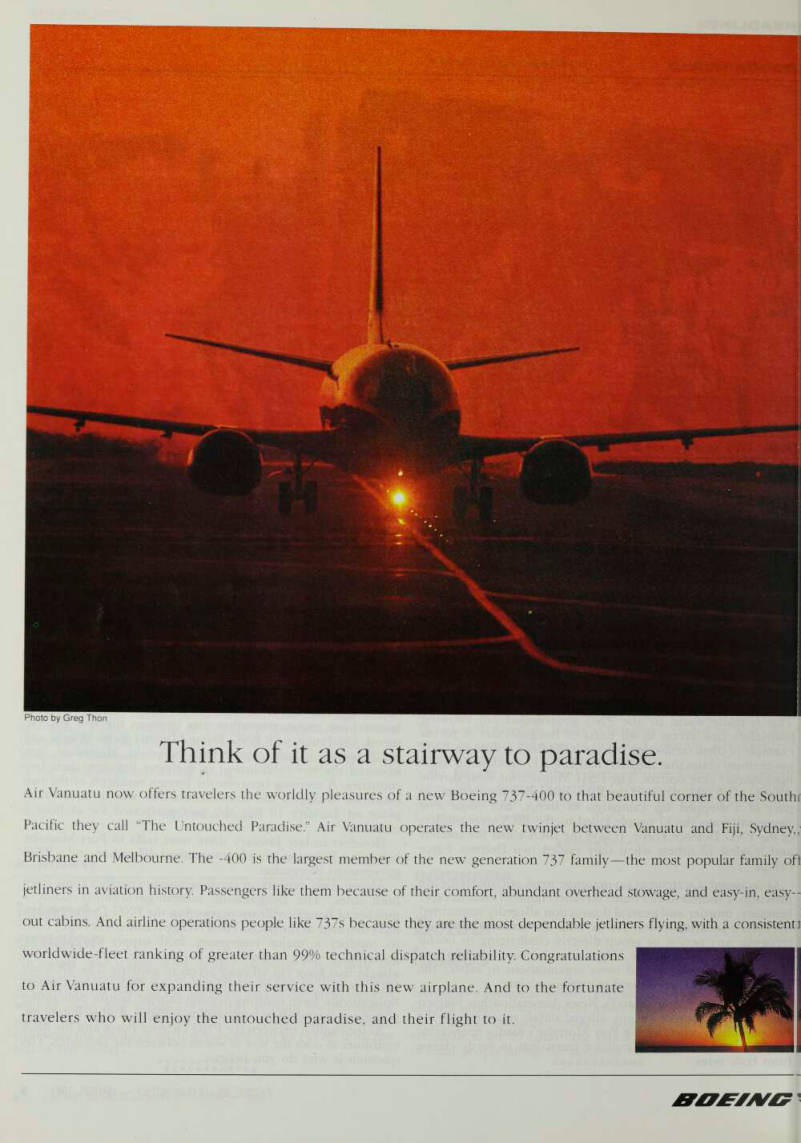
Think of it as a stairway to paradise.
: Photo by Greg Thon Think of it as a stairway to paradise.
Air Vanuatu now offers travelers the worldly pleasures of a new Boeing 737-400 to that beautiful corner of the South: Pacific they call “The Untouched Paradise.” Air Vanuatu operates the new twinjet between Vanuatu and Fiji, Sydney; Brisbane and Melbourne. The -400 is the largest member of the new generation 737 family—the most popular family oft jetliners in aviation history Passengers like them because of their comfort, abundant overhead stowage, and easy-in, easyout cabins. And airline operations people like 737 s because they are the most dependable jetliners flying, with a consistent! worldwide-fleet ranking of greater than 99% technical dispatch reliability. Congratulations to Air Vanuatu for expanding their service with this new airplane. And to the fortunate travelers who will enjoy the untouched paradise, and their flight to it.
A question of time
Cover Stories
By Bill Morton
The real message from the Tongan elections is that support for change is real. The government would like it to go away, but it is unlikely to do so.
TONGAN people went to the polls last month to vote for “Peoples’ Representa tives” to the country’s Legislative As sembly. The nine elected members will sit in parliament alongside 12 ministers handpicked by the King and nine “Nobles Representatives” chosen by 33 Noble families.
The 1993 election held special signifi cance. It was a test of countrywide support for the concepts of change and democracy.
Election results have caused the pro democracy camp to claim victory and the government to play-down this claim.
Six of the nine elected candidates are pro democracy; one is pro government and two have not yet revealed their al legiances.
Akilisi Pohiva, sitting representative for the main island of Tongatapu was re flected for his third successive parliamen tary term. He claims the election served as a referendum for people’s support for :hange. “We are very pleased with the "esult. It is a clear mandate for change md a clear message to the government.”
The results reveal regional differences n the country’s endorsement of democ •acy. Voters on Tongatapu elected :andidates to three seats. They gave iverwhelming support to Pohiva and wo fellow pro-democracy candidates /iliami Fukofuka and ’Uhila Liava’a. \mong them they captured 57 per cent )f the vote. The remaining vote was pread amongst another 12 candidates fom both the pro-democracy and pro government causes.
The outer island group of Ha’apai lected candidates for two seats. It howed it is following in the footsteps of
fongatabu by choosing pro-democracy
andidates Tesina Fuko and ’Uliti Uata. fhe unsuccessful third place-getter was
ilso pro-democracy. Most significantly,
la’apai rejected outspoken pro government member Viliami Afeaki.
Results from the other outer islands re not as clear-cut and suggest voters onsidered a range of issues in addition □ the question of democratic change, /ava’u (two seats) ousted both sitting nembers. It chose pro-democracy candi ate Masao Paasi for the first seat but
lected independent Samiu Vaipulu to
lie second, ’Eua (one seat) stayed onservative and re-elected its pro overnment member. The Niuas (one fat) booted out its conservative mem er, giving victory to the only woman
member in the House, ’Ofa Fusitu’a. Her intentions are not yet clear.
Compared to the 1990 election when pro-reform candidates won five out of nine seats, the 1993 election represents only a small improvement for the cause of change in Tonga. However, ’ Akilisi Pohiva says he expects pro-democracy numbers to increase through support from Samiu Vaipulu. Pohiva states Vaipulu joined him in a walk-out from parliament when they were both mem bers, between 1987-1990. Both Vaipulu and Fusitu’a will be under intense pressure to declare their positions in relation to democracy.
The crucial question which now stands out is how the election will affect the
process of change in Tonga. In previous elections pro-reform candidates cam paigned from a platform of cleaning up the act of government, citing corruption and misuse of funds at the highest levels.
In this election the stakes were much higher. As a result of the November 1992 “Convention on the Constitution and Democracy” the issue of “democracy” rocketted to the top of the political agenda. It was immediately in the election spotlight. The entire fabric of Tongan society was now under question, with pro-change candidates arguing for a reduction of the King’s powers and calling for a parliament with all 30 members elected by the people.
The election demonstrates that not all Tonga’s 95,000 “commoners” want such
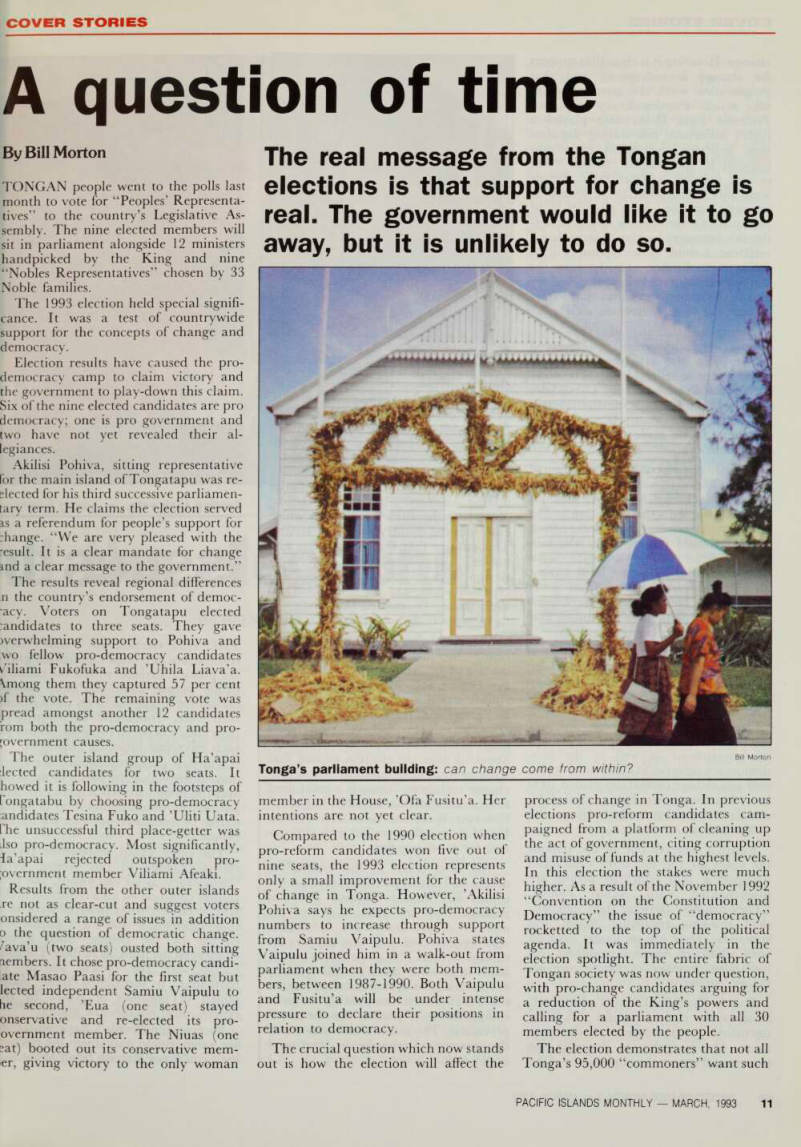
Tonga’s parliament building: can change come from within?
change. However it is clear that support for change is widespread and that people now want the government to take action. Pro-democracy supporter, Professor Futa Helu, who played a highly influential role during the elec tion, believes government must now respond to the peoples’ wishes. “The overall message is quite clear. People want our constitution to be looked at seriously and they want changes to be instituted. Government is now consider ing this message in order to formulate a response. I think their response will be different to former ones because the trend is very clear. I believe they will try and make some concessions that would at least erode their hold on society.”
Acting chairman of the Pro- Democracy Movement, Reverend Simote Vea also says the message to government is self-evident. “The clear
victory for Pro-Democracy Candidates
confirms that Tonga is moving towards
full democracy. Constitutional changes
will have to be made to make Tonga more democratic.”
Prior to the election the government made it clear it had no intention of considering change. Since the election it has re-aflirmed this position. The strongest statement has come from Prime Minister Baron Vaea, who said that Tongan people did not want democracy and that they liked having an elite leadership drawn from noble background. He added they were quite happy living with their traditions and accepted the role of the hierarchy.
The government view that change is unwarranted appears to be shared by deputy chief secretary and deputy secretary to Cabinet, Eseta Fusitu’a, who has previously also acted as a spokesperson for government. She said election data for Tongatapu suggest the pro-government as well as the pro democracy sides could claim victory. She said pro-change candidates gained 1000 votes less than when Pohiva, Fukofuka and former stablemate Laki Niu in the 1990 election.
Fusitu’a believes one of the reasons the votes for the top three candidates dropped is that educated people are disenchanted with Akilisi Pohiva.
“They are now showing their indepen dent thinking regarding Akilisi and company. They are no longer satisfied with whatever Akilisi is peddling. An increasing number of people are no longer buying it.”
Pohiva dismisses Fusitu’a’s interpret ation of the election results. “It is an unrealistic interpretation of the situ ation. She is trying to discredit our success and ignore the importance of the
election.” The pro-democracy candi dates’ claim of a mandate for change and the government’s restated position that it is not considering change indicate the battle lines between the two camps are now more sharply drawn than ever.
This polarity of standpoints represents a major obstacle to the process of change in the country. An equally telling obstacle is the 1875 constitution which enshrines the country’s political system.
This ensures that the 21 ministers and nobles’ representatives have a stranglehold on power. The people’s representatives can be out-voted on every issue, no matter how many of them support democracy.
The remaining avenue open to pro change members is to by-pass govern ment and go straight to the top. The Pro-Democracy Movement has pre viously stated it places its greatest hope for change with the King. Akilisi Pohiva appears to also believe monarchial intervention may be the key to change.
Speaking after the election he said that while he must first consult his fellow pro change members, “there is a great need to have an audience with His Majesty.”
However, it remains to be seen whether His Majesty will share Pohiva’s enthusi asm for a get-together.
The next scene in the enthralling drama of Tonga’s political development is therefore hard to predict. The real message from the election is not the number of pro-democracy candidates who were elected, it is that support for change is real. The government would like it to go away but it is unlikely to do so. It is now a question of continued stand-off between the opposing camps or compromise. At present the former is prevailing. The result of this may mean the process of change is long and
unpleasant. □
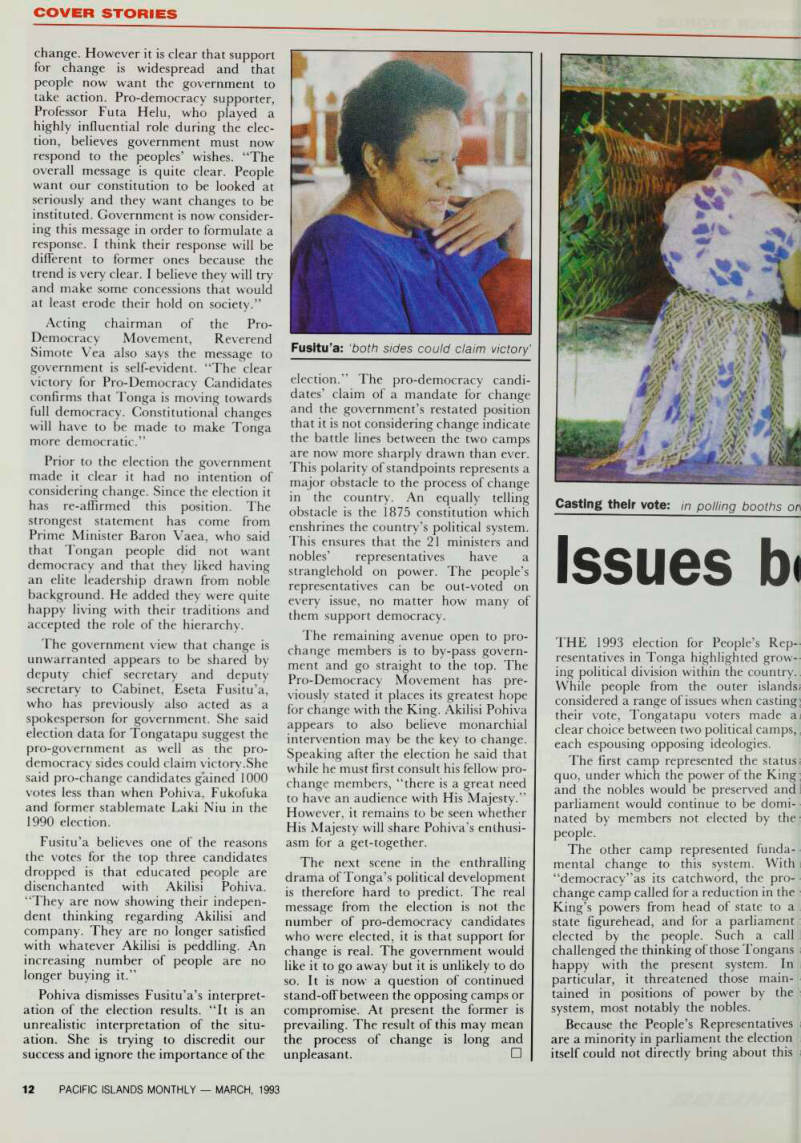
Fusitu’a: ‘both sides could claim victory’
Issues b[?]nd the elections
THE 1993 election for People’s Rep resentatives in Tonga highlighted grow ing political division within the country..
While people from the outer islands? considered a range of issues when casting} their vote, Tongatapu voters made aj clear choice between two political camps,,
each espousing opposing ideologies.
The first camp represented the status? quo, under which the power of the King} and the nobles would be preserved and J parliament would continue to be domi nated by members not elected by the;
people.
The other camp represented funda- • mental change to this system. With j “democracy”as its catchword, the pro- • change camp called for a reduction in the * King’s powers from head of state to a j state figurehead, and for a parliament elected by the people. Such a call J challenged the thinking of those Tongans ; happy with the present system. In j particular, it threatened those main tained in positions of power by the ; system, most notably the nobles.
Because the People’s Representatives ; are a minority in parliament the election itself could not directly bring about this
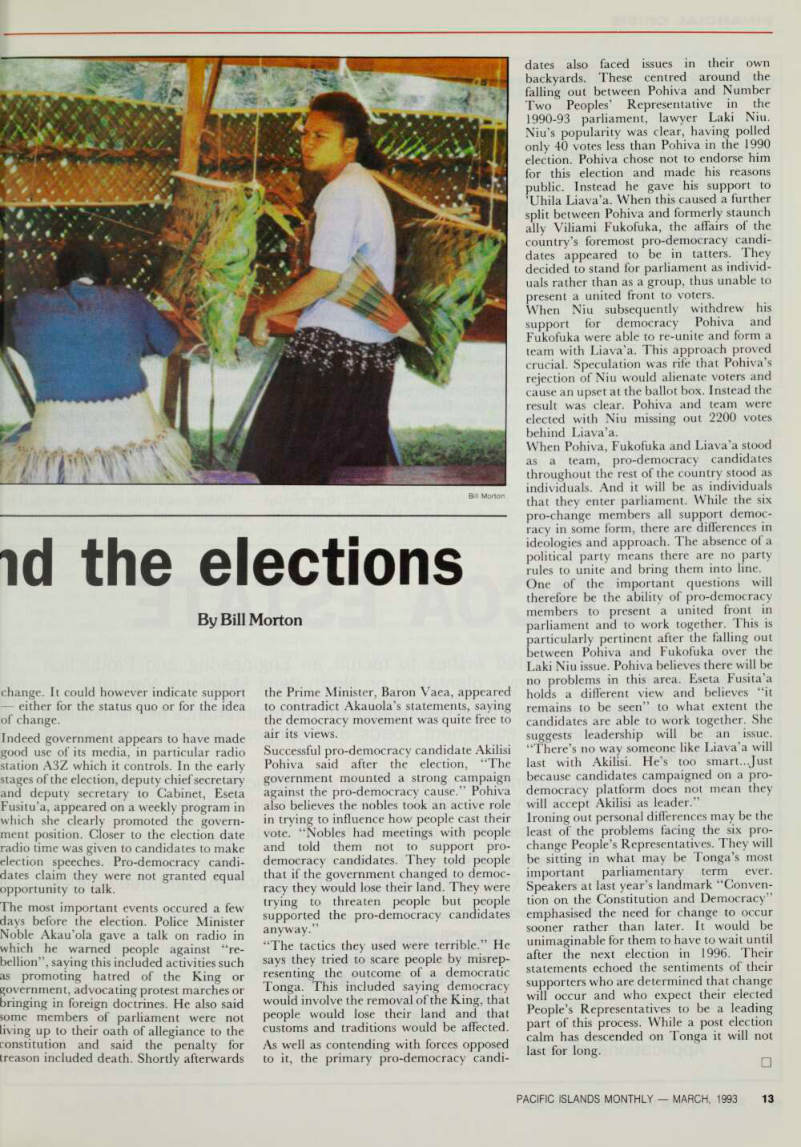
Casting their vote: in polling booths on[?]
By Bill Morton
change. It could however indicate support either for the status quo or for the idea of change.
Indeed government appears to have made good use of its media, in particular radio station A3Z which it controls. In the early stages of the election, deputy chief secretary and deputy secretary to Cabinet, Eseta Fusitu’a, appeared on a weekly program in which she clearly promoted the govern ment position. Closer to the election date radio time was given to candidates to make election speeches. Pro-democracy candi dates claim they were not granted equal opportunity to talk.
The most important events occured a few days before the election. Police Minister Noble Akau’ola gave a talk on radio in which he warned people against “re bellion”, saying this included activities such as promoting hatred of the King or government, advocating protest marches or bringing in foreign doctrines. He also said some members of parliament were not living up to their oath of allegiance to the constitution and said the penalty for treason included death. Shortly afterwards
the Prime Minister, Baron Vaea, appeared to contradict Akauola’s statements, saying the democracy movement was quite free to air its views.
Successful pro-democracy candidate Akilisi Pohiva said after the election, “The government mounted a strong campaign against the pro-democracy cause.” Pohiva also believes the nobles took an active role in trying to influence how people cast their vote. “Nobles had meetings with people and told them not to support pro democracy candidates. They told people that if the government changed to democ racy they would lose their land. They were trying to threaten people but people supported the pro-democracy candidates anyway.”
“The tactics they used were terrible.” He says they tried to scare people by misrep resenting the outcome of a democratic Tonga. This included saying democracy would involve the removal of the King, that people would lose their land and that customs and traditions would be affected.
As well as contending with forces opposed to it, the primary pro-democracy candi
dates also faced issues in their own backyards. These centred around the falling out between Pohiva and Number Two Peoples’ Representative in the 1990-93 parliament, lawyer Laki Niu.
Niu’s popularity was clear, having polled only 40 votes less than Pohiva in the 1990 election. Pohiva chose not to endorse him for this election and made his reasons public. Instead he gave his support to ’Uhila Liava’a. When this caused a further split between Pohiva and formerly staunch ally Viliami Fukofuka, the affairs of the country’s foremost pro-democracy candi dates appeared to be in tatters. They decided to stand for parliament as individ uals rather than as a group, thus unable to present a united front to voters.
When Niu subsequently withdrew his support for democracy Pohiva and Fukofuka were able to re-unite and form a team with Liava’a. This approach proved crucial. Speculation was rife that Pohiva’s rejection of Niu would alienate voters and cause an upset at the ballot box. Instead the result was clear. Pohiva and team were elected with Niu missing out 2200 votes behind Liava’a.
When Pohiva, Fukofuka and Liava’a stood as a team, pro-democracy candidates throughout the rest of the country stood as individuals. And it will be as individuals that they enter parliament. While the six pro-change members all support democ racy in some form, there are differences in ideologies and approach. The absence of a political party means there are no party rules to unite and bring them into line.
One of the important questions will therefore be the ability of pro-democracy members to present a united front in parliament and to work together. This is particularly pertinent after the falling out between Pohiva and Fukofuka over the Laki Niu issue. Pohiva believes there will be no problems in this area. Eseta Fusita’a holds a different view and believes “it remains to be seen” to what extent the candidates are able to work together. She suggests leadership will be an issue.
“There’s no way someone like Liava’a will last with Akilisi. He’s too smart.. Just because candidates campaigned on a pro democracy platform does not mean they will accept Akilisi as leader.”
Ironing out personal differences may be the least of the problems facing the six pro change People’s Representatives. They will be sitting in what may be Tonga’s most important parliamentary term ever.
Speakers at last year’s landmark “Conven tion on the Constitution and Democracy” emphasised the need for change to occur sooner rather than later. It would be unimaginable for them to have to wait until after the next election in 1996. Their statements echoed the sentiments of their supporters who are determined that change will occur and who expect their elected People’s Representatives to be a leading part of this process. While a post election calm has descended on Tonga it will not last for long. n
Bill Morton
Advertisements & other items, p. 12 (1 item)
Cover Stories
In The Red
Financial Crisis
What happens when a new administration takes office and is faced with an empty treasury?
By David North
THE FRAYED string finally broke, and 1000 employees of the American Samoan government (ASG) have lost their jobs.
The new Governor, AP Lutali, was faced with an empty treasury and a bloated payroll when he took office in January.
He immediately took drastic action to remedy the situation, and laid off 20 per cent of the ASG’s employees.
The protests were vociferous; the head of the territory’s Republican Party, Te’o Fuavai, organised a rally for the laid-off workers, and a law suit was filed against the (Democratic) Governor’s action in the High Court of American Samoa.
Many of the laid-off workers said it was an outrage, and that dismissals were not handled according to regulations;
other observers praised the Governor for his courage, and were relieved that something finally had been done to solve American Samoa’s long-simmering financial crisis.
American Samoa’s finances, never sturdy, have been going from bad to worse in recent years but the incumbent Governor, Peter Tali Coleman appar ently did not want to take dramatic remedial action until after the November election. He was seeking another four year term, and he was running against his life-long foe, former (and now) Governor Lutali.
So Coleman ran through just about every financial manoeuvre in the book to avoid taking the unpopular steps needed to solve the crisis. He did not want either a massive layoff or a cutback in the hours
of all workers (though he used tha technique briefly a year or so ago). Noi did he want to raise taxes enough to keep meeting the payroll.
As 1992 progressed it became eviden that Coleman could not run out th( string forever. Often there were headline; in the Samoa News saying this week th( banks were accepting ASG payrol checks, as they had not the week before or vice versa. (Sometimes one ban! accepted ASG checks and others die not). Suppliers and contractors were noi paid for months on end; sometime: shipments of medicine to the hospita were suspended as a result.
Moneys from specific federal grant: were shuffled into other funds to help meet the payroll and the Federa Highway Administration stopped repaii work on a major highway until the funding situation could be rectified.
Other techniques were also used. The pension (social security) taxes for the ASG workers were not paid by the
Coleman Administration, to keep the payroll checks flowing; in another case, a US Labor Department pot of money, designed to train the unemployed for a full year, was used up in the first three months of the current fiscal year (Octo ber 1 December 31), again to avoid layoffs. The Lutali Administration will see none of these Labor Department funds for nine months, unless Lutali can persuade the Clinton Administration to help him out.
Making things worse, the outgoing Coleman administration gave favoured employees post-election raises (which Lutali will have to cancel) and expedited salary, leave and expense account checks
for ranking political appointees.
Lutali had few options. Coleman had scrounged as much money as anyone could from various special funds, from the banks, and (in effect) from suppliers.
Lutali had promised to curb fraud and abuse, but that is a slow way to save money. Similarly, though probably needed in the long run, raising taxes takes time before money starts flowing into the treasury. Finally, Lutali did not know as much about the territory’s finances as he would have liked outgoing Treasurer Ace Tago, a Coleman ally, had refused to release the annual audits on ASG finances, and was off-island for much of the period between the election and the inauguration.
Given the situation, the only sure way to bring some financial balance was to lay off the workers. First it appeared that 429 would go, than the total moved up to 1000. Generally those laid off were either Coleman political appointees (who did not have civil service status) or the far more numerous temporary or con tract employees. In many of the latter cases, people were hired despite the fact there was no money in the budget for their salaries.
Most of the talk in Samoa has been about the hurt to the workers, not about the reduction in services; a smaller staff probably can get most of the job done.
But losing a government job in Samoa is a real blow to the individual. Samoa is a two-industry place with the exception of some retail and private sector services activity, involving perhaps 2000 workers everyone works for either the government or the tuna canneries. And since the better jobs are in government, these go exclusively to voters, while a majority of the 4700 people in the two canneries (where the work is considerably rougher) are from other islands, notably Western Samoa.
So if you lose your government job, there isn’t much else to do, unless you want to disembowel tuna all day.
The flip side of the situation was that none of the alien workers on the island were hurt by the layoffs given the situation everyone Lutali laid off was a voter, and politicians do not like to hurt voters.
One should hasten to add the Coleman’s apparent slowness to raise taxes or cut costs was not the only factor at work. As his supporters point out, when Coleman took over from Lutali four years ago the treasury was not overflowing. Further, the Fono (the territorial legislature) has not been very supportive of some of Coleman’s tax initiatives; also, Samoa never has had a tradition of frugal government. Finally, there are underlying structural factors that have quietly contributed to the current situation.
Many governments, from small island states to the mighty government in Washington, over-spend and under-tax as American Samoa has done for years but they seem to do so without the level of disorder and panic recently seen in Pago Pago. How do they manage? There are two reasons: the territorial govern ment plays a disproportionately large role in the economy, and has (compared to most other island governments) more limited powers.
Because of the territorial government’s larger role in the economy, when it screws up the consequences are much more significant than when Washington, for example, makes comparable errors, as it did in the savings and loan fiasco.
One set of numbers tells the story: on the Mainland 15 per cent of the work force is employed (either in military or civilian jobs) by federal, state or local governments In American Samoa fully 41 per cent are employed by the territorial government.
Not only has the ASG payroll been
padded with needless workers, but ASG also manages the telephone, power and water systems. Bloated governmental staffs are not unique to American Samoa; governments play major roles in the economies of all the island states. But here the second structural distinction comes into play ASG is a colonial government with severely limited fiscal powers. It simply does not have the room for manoeuvre of the independent gov ernments.
Traditionally independent nations spending more money than they raises in taxes can look for (at least temporary) relief from five sources: (1) private sector bank loans; (2) donor nations; (3) international agencies, like the World Bank; (4) the printing of additional currency, or (5) “creative” use of one’s sovereign powers, like Tonga’s sales of its passports. Since ASG is not a nation, it has no access to the last three sources, and only limited use of the first two.
As noted, the private banks treat ASG as a major, but not terribly reliable customer, and both local and federal law limit thd extent that banks can make loans to ASG. Further, the US is a jealous donor nation to its flag territories; it hands out limited subsidies and does not allow its islands (or other units of local government) to seek funds else where.
So once Coleman’s string of temporary fixes ran out, Lutali had few choices, and he took the drastic step of a large layoff.
He decided to inflict the inevitable pain early, and then later he would seek more money from the Mainland, try to get his books balanced, and hope to be in the position of re-hiring some people well before the election of 1996 rolls around.
It was a gutsy move, and maybe he can make it work. □
Advertisements & other items, p. 14 (1 item)
Cocoa Estate
Metenesel Estates Limited wishes to recruit an Engineering and Production Manager for the company’s plantation on North West Malekula, Vanuatu.
The successful candidate will be responsible for the maintenance of the estate's electrical & mechanical equipment, roads and bridges and the post harvest handling of cocoa. 1. He must have experience in vehicle and electrical plant maintenance.
Experience with heavy duty earth moving equipment will be an advantage. 2. He must be able to supervise cocoa factory operations.
Salary and Condition will be discussed at the interview and will be in the range of A 530,000 per annum (tax free) plus excellent free housing and free utilities.
Applications should be sent to:- The Chairman, Metenesel Estates Limited, c/- KPMG Peat Marwick, P.O. Box 212,
PORT VILA.
Applications close on 31st March, 1993.
The bank account is empty
The Lutali Transition Team’s reports on American Samoa’s finances do not speak in macro-economic terms about the gross national product, the govern ment’s overall debt level, or the balance of payments.
It talks about meeting the payroll.
The following are excepts from one such report as noted in the Samoa News: “The bank account is empty. All the cash is used as fast as it becomes available to meet current obligations.
“At the end of September ASG had a bank balance of— $7,152,724 (in the red.) This included checks that were
printed but either not released or not cashed of $8,395,600.
“ASG also reported investments of $5,933,546 ... if [they] were cashed in and all outstanding checks were re leased, ASG would still have a negative bank balance of about $1.2 million.
“ASG relies on the Department of Interior’s operating grant [of about $20,000,000 a year] to cover one payroll a month, then uses [tax and other grant] collections to cover the other
payroll ...”
Both Governors Coleman and Lutali have secured advances on Interior’s monthly grants to help meet the bi monthly payroll.
Advertisements & other items, p. 16 (1 item)
plus friendly service
r ; ,
CMT4200
42" multi-system super projection TV with S-video terminal, surround sound and 7-language teletext.
CXW300
Portable CD player/tuner/double cassette deck with high-speed dubbing and bass boost sound.
VTM838E
PAL VCR with NTSC playback compatibility and two-speed recording and playback (SP/LP). *
VM-E25E
“Twist & Shoot” 8mm movie camera with 16 x digital zoom.
All this
plus friendly service
at a Hitachi dealer near you.
Va m ff CV-4700 1000W 4.5-liter vacuum cleaner \ , with foot switch, tool storage space and top-mounted 360-degree rotating hose.
CX-W500
Portable CD player/ digital tuner/double cassette deck with “3D twin drive” system and remote control.
FX-9 Mini Hi-Fi system with super wide surround sound and one-touch CD-to-tape dubbing. m O 6 ® Q 'wmSk mm
PAF1260PX
Microprocessor controlled washing machine with forced drain pump, softener/bleach dispenser, and lint filter.
Our support network puts service within easy reach.
AUSTRALIA:
HITACHI SALES AUSTRALIA PTY LTD.
153 Keys Road Moorabbin, Victoria 3189 Tel: (03) 555-8722
Fiji: NEW ZEALAND:
BURNS PHILP (SOUTH SEA) ROBINSON INDUSTRIES LTD.
COMPANY LTD. 6 Zelanian Drive Box 355, G.P.O. East Tamaki Suva Auckland Tel; 9-311777 Tel: 9-2745615
COMMUNICATIONS PACIFIC LTD. (AWA)
37 Freeston Road (PO. Box 858) Walu Bay. Suva Tel; 9-312744 1993 Hitachi, Ltd.. Tokyo, Japan. All rights reserved.
NEW CALEDONIA:
CALDIS CALTEC
B.P Ml B.R 2540
Noumea Noumea Tel; 26.33.00 Tel: 28.39.54
PAPUA NEW GUINEA; TAHITI:
PACIFIC ELECTRONICS POSI-LECTRIC
PO. BOX2115 PO. BOX 144,
LAE PAPEETE,
Tel: 5-424467 Tel: 42.92.56.
HITACHI
Bad Boy George

Politics
Controversial Atiu MP Norman George has finally secured party leadership.
By Christine Hatcher
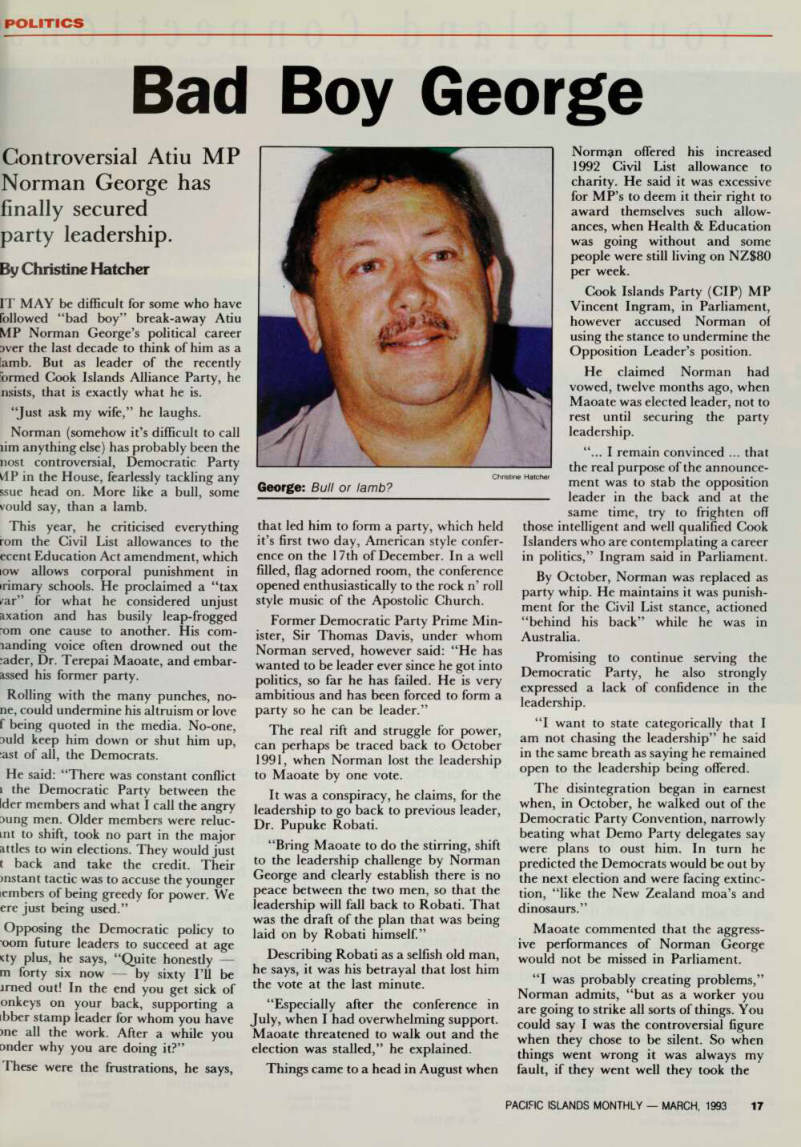
IT MAY be difficult for some who have followed “bad boy” break-away Atiu MP Norman George’s political career Dver the last decade to think of him as a lamb. But as leader of the recently brmed Cook Islands Alliance Party, he nsists, that is exactly what he is.
“Just ask my wife,” he laughs.
Norman (somehow it’s difficult to call lim anything else) has probably been the
nost controversial, Democratic Party
HP in the House, fearlessly tackling any ssue head on. More like a bull, some vould say, than a lamb.
This year, he criticised everything rom the Civil List allowances to the ecent Education Act amendment, which
iow allows corporal punishment in
irimary schools. He proclaimed a “tax far” for what he considered unjust axation and has busily leap-frogged "om one cause to another. His com landing voice often drowned out the :ader, Dr. Terepai Maoate, and embar assed his former party.
Rolling with the many punches, no ne, could undermine his altruism or love f being quoted in the media. No-one, Duld keep him down or shut him up, :ast of all, the Democrats.
He said: “There was constant conflict i the Democratic Party between the Ider members and what I call the angry Dung men. Older members were reluc mt to shift, took no part in the major attles to win elections. They would just t back and take the credit. Their mstant tactic was to accuse the younger icmbers of being greedy for power. We
ere just being used.”
Opposing the Democratic policy to oom future leaders to succeed at age
tty plus, he says, “Quite honestly
m forty six now by sixty I’ll be imed out! In the end you get sick of onkeys on your back, supporting a ibber stamp leader for whom you have me all the work. After a while you Dnder why you are doing it?”
These were the frustrations, he says,
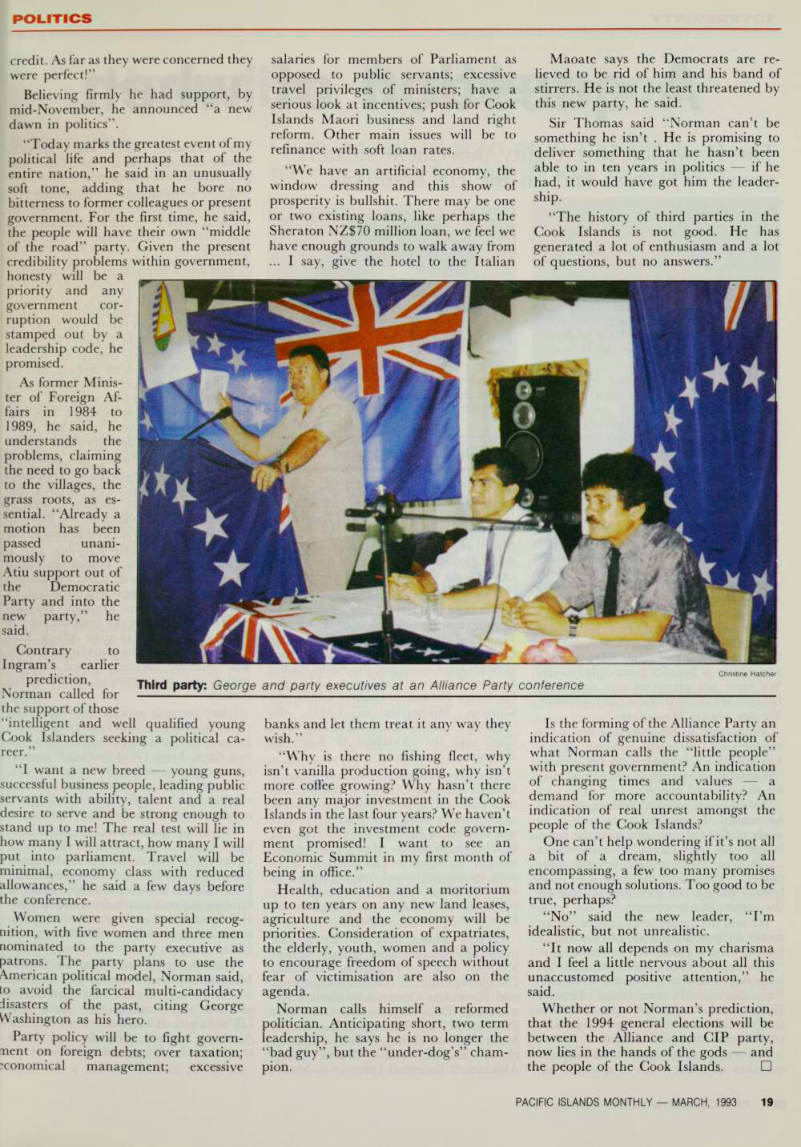
that led him to form a party, which held it’s first two day, American style confer ence on the 17th of December. In a well filled, flag adorned room, the conference opened enthusiastically to the rock n’ roll style music of the Apostolic Church.
Former Democratic Party Prime Min ister, Sir Thomas Davis, under whom Norman served, however said: “He has wanted to be leader ever since he got into politics, so far he has failed. He is very ambitious and has been forced to form a party so he can be leader.”
The real rift and struggle for power, can perhaps be traced back to October 1991, when Norman lost the leadership to Maoate by one vote.
It was a conspiracy, he claims, for the leadership to go back to previous leader, Dr. Pupuke Robati.
“Bring Maoate to do the stirring, shift to the leadership challenge by Norman George and clearly establish there is no peace between the two men, so that the leadership will fall back to Robati. That was the draft of the plan that was being laid on by Robati himself.”
Describing Robati as a selfish old man, he says, it was his betrayal that lost him the vote at the last minute.
“Especially after the conference in July, when I had overwhelming support.
Maoate threatened to walk out and the election was stalled,” he explained.
Things came to a head in August when
Norman offered his increased 1992 Civil List allowance to charity. He said it was excessive for MP’s to deem it their right to award themselves such allow ances, when Health & Education was going without and some people were still living on NZ$BO per week.
Cook Islands Party (CIP) MP Vincent Ingram, in Parliament, however accused Norman of using the stance to undermine the
Opposition Leader’s position.
He claimed Norman had vowed, twelve months ago, when Maoate was elected leader, not to rest until securing the party
leadership.
"... I remain convinced ... that the real purpose of the announce ment was to stab the opposition leader in the back and at the same time, try to frighten off
those intelligent and well qualified Cook Islanders who are contemplating a career in politics,” Ingram said in Parliament.
By October, Norman was replaced as party whip. He maintains it was punish ment for the Civil List stance, actioned “behind his back” while he was in Australia, Promising to continue serving the Democratic Party, he also strongly expressed a lack of confidence in the
leadership.
“I want to state categorically that I am not chasing the leadership” he said in the same breath as saying he remained open to the leadership being offered.
The disintegration began in earnest when, in October, he walked out of the Democratic Party Convention, narrowly beating what Demo Party delegates say were plans to oust him. In turn he predicted the Democrats would be out by the next election and were facing extinc tion, “like the New Zealand moa’s and dinosaurs.”
Maoate commented that the aggress ive performances of Norman George would not be missed in Parliament.
“I was probably creating problems,”
Norman admits, “but as a worker you are going to strike all sorts of things. You could say I was the controversial figure when they chose to be silent. So when things went wrong it was always my fault, if they went well they took the
George: Bull or lamb?
credit. As far as they were concerned they
were perfect!”
Believing firmly he had support, by mid-November, he announced “a new dawn in politics”.
“Today marks the greatest event of my political life and perhaps that of the entire nation,” he said in an unusually soft tone, adding that he bore no bitterness to former colleagues or present government. For the first time, he said, the people will have their own “middle of the road” party. Given the present credibility problems within government,
honesty will be a priority and any government cor ruption would be stamped out by a leadership code, he
promised.
As former Minis ter of Foreign Af fairs in 1984 to 1989, he said, he understands the problems, claiming the need to go back to the villages, the grass roots, as es sential. “Already a motion has been
passed unani
mously to move Atiu support out of the Democratic Party and into the new party,” he said.
Contrary to
Ingram’s earlier
prediction, Norman called for the support of those
“intelligent and well qualified young Cook Islanders seeking a political ca reer.”
“I want a new breed young guns,
successful business people, leading public
servants with ability, talent and a real desire to serve and be strong enough to stand up to me! The real test will lie in how many I will attract, how many I will put into parliament. Travel will be minimal, economy class with reduced allowances,” he said a few days before the conference.
Women were given special recog nition, with five women and three men nominated to the party executive as patrons. The party plans to use the American political model, Norman said, to avoid the farcical multi-candidacy disasters of the past, citing George Washington as his hero.
Party policy will be to fight govern ment on foreign debts; over taxation; economical management; excessive
salaries for members of Parliament as opposed to public servants; excessive travel Privileges of ministers; have a senous look at incentives; push for Cook Islands Maori business and land right re {? rm - ° ther main issues wiU be to reflnance wlth soft loan rates ' “We have an artificial economy, the window dressing and this show of prosperity is bullshit. There may be one or two existing loans, like perhaps the Sheraton NZS7O million loan, we feel we have enough grounds to walk away from ... I say, give the hotel to the Italian
banks and let them treat it any way they wish.”
“Why is there no fishing fleet, why isn’t vanilla production going, why isn’t more coffee growing? Why hasn’t there been any major investment in the Cook Islands in the last four years? We haven’t even got the investment code govern ment promised! I want to see an Economic Summit in my first month of being in office.”
Health, education and a moritorium up to ten years on any new land leases, agriculture and the economy will be priorities. Consideration of expatriates, the elderly, youth, women and a policy to encourage freedom of speech without fear of victimisation are also on the
agenda.
Norman calls himself a reformed politician. Anticipating short, two term leadership, he says he is no longer the “bad guy”, but the “under-dog’s” cham pion.
Maoate says the Democrats are re lieved to be rid of him and his band of stirrers. He is not the least threatened by this new party, he said, Sir Thomas said ‘ ‘Norman can’t be something he isn’t . He is promising to deliver something that he hasn’t been able *° in tf" Y ears m P olltlc ;> he bac b 11 would have got him the leader shi P “The history of third parties in the Cook Islands is not good. He has generated a lot of enthusiasm and a lot of questions, but no answers.”
Is the forming of the Alliance Party an indication of genuine dissatisfaction of what Norman calls the “little people” with present government? An indication of changing times and values a demand for more accountability? An indication of real unrest amongst the people of the Cook Islands?
One can’t help wondering if it’s not all a bit of a dream, slightly too all encompassing, a few too many promises and not enough solutions. Too good to be true, perhaps?
“No” said the new leader, “I’m idealistic, but not unrealistic.
“It now all depends on my charisma and I feel a little nervous about all this unaccustomed positive attention,” he said.
Whether or not Norman’s prediction, that the 1994 general elections will be between the Alliance and CIP party, now lies in the hands of the gods and the people of the Cook Islands. □
Christine Hatcher
Third party: George and party executives at an Alliance Party conference
Advertisements & other items, pp. 18-19 (2 items)
Your Island Connections
Cable and Wireless began keep-
ing people in touch around the
world more than a century ago. Today,
while the technology has changed,
the tradition of service to our customers in the
South Pacific is just the same.
We work in partnership with Governments,
dedicated to meeting the need of communities and businesses to stay in touch. From one island to the next or to the other side of the world, the message is the same: Cable and Wireless is
your South Pacific
connection bringing the
islands together.
CABLE & WIRELESS
Asia Pacific Head Office Cable and Wireless pic Cable and Wireless (Pacific) Limited 22nd Floor Office Tower Convention Plaza 1 Harbour Road Hong Kong Tel: (852)848 8620 Facsimile: (852) 868 5195 Australia Cable and Wireless (Australia) Pty Ltd PO Box 675, Double Bay NSW 2028 Sydney Australia Tel/Fax (61-2) 362 3625 Fiji In association with the Government of Fiji Fiji International Telecommunications Ltd.
PO. Box 59 Mercury House 158 Victoria Parade Suva Fiji Tel: (679) 312933 Solomon Islands In association with the Government of the Solomon Islands Solomon Telekom Company Limited PO. Box 148 Honiara Solomon Islands Tel: (677) 21576 Tonga Cable and Wireless pic Private Mail Bag 4 General Post Office Nuku Alofa Tonga South Pacific Tel: (676) 23499 Vanuatu In association with the Government of Vanuatu and France Cables et Radio Vanuatu International Telecommunications Ltd.
PO. Box 164 Port Vila Vanuatu Tel: (678) 22185
Politics
A question of when
Sovereignty
The Hawaiian sovereignty movement steadily grows in Hawaii and on the US mainland.
By Mel Kemahan
THE MOOD was solemn this Sunday (Jan 17, 1993) afternoon as over 150 Hawaiians and friends, many clad in black, braved flood conditions to gather
at Loyola Marymount University
(LMU) to commemorate the 100th anniversary of the overthrow of Queen Lili’uokalani and discuss the Hawaiian
Sovereignty Movement.
Community leaders and individuals came from as far as San Diego, 100 miles away despite a winter storm that pummelled Southern California and Baja with rain and small tornadoes,
leaving highways impassable with
mudslides and flooding in places.
According to the 1990 census, 35,000 Hawaiians live in California, about one sixth of the total Hawaiian population.
There are only about 216,000 Native Hawaiians left among Hawaii’s million residents. The increasing vigor of the Sovereignty Movement in the island state has raised questions and anxieties among Native Hawaiians living overseas.
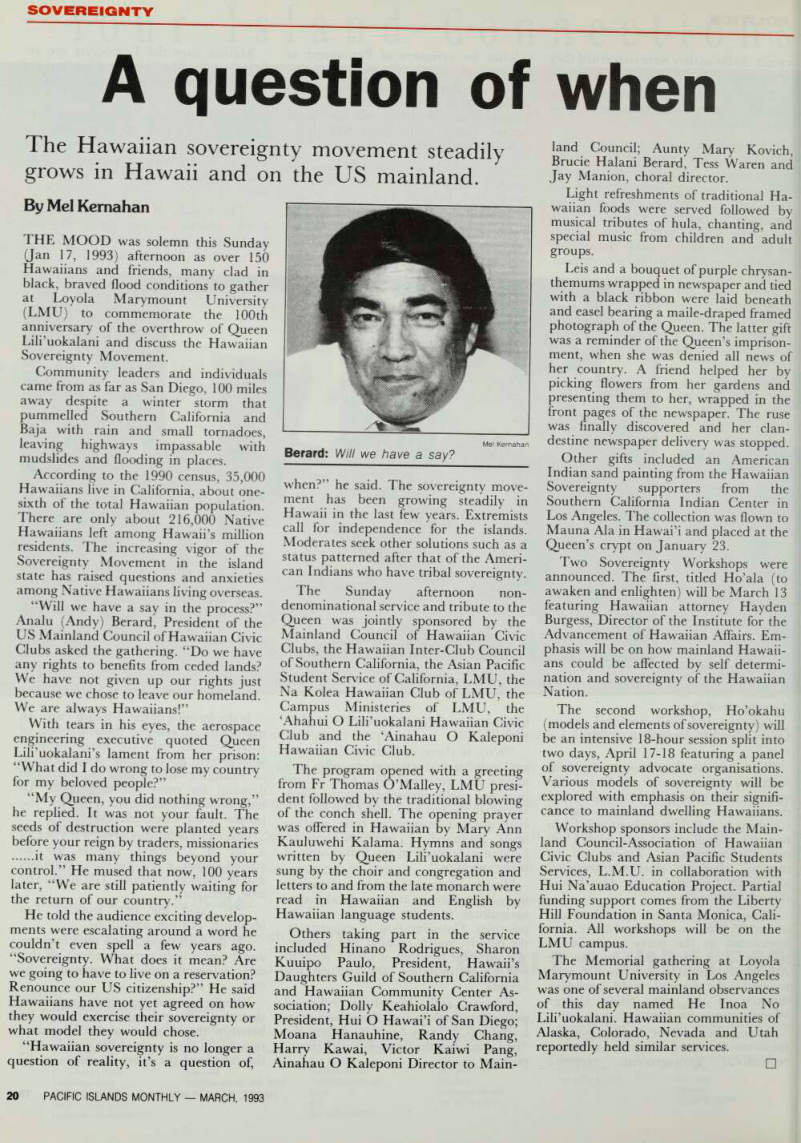
“Will we have a say in the process?”
Analu (Andy) Berard, President of the US Mainland Council of Hawaiian Civic Clubs asked the gathering. “Do we have any rights to benefits from ceded lands?
We have not given up our rights just because we chose to leave our homeland.
We are always Hawaiians!”
With tears in his eyes, the aerospace
engineering executive quoted Queen
Lili’uokalani’s lament from her prison: “What did I do wrong to lose my country for my beloved people?”
“My Queen, you did nothing wrong,” he replied. It was not your fault. The seeds of destruction were planted years before your reign by traders, missionaries it was many things beyond your control.” He mused that now, 100 years later, “We are still patiently waiting for the return of our country.”
He told the audience exciting develop ments were escalating around a word he couldn’t even spell a few years ago.
“Sovereignty. What does it mean? Are we going to have to live on a reservation?
Renounce our US citizenship?” He said Hawaiians have not yet agreed on how they would exercise their sovereignty or what model they would chose.
“Hawaiian sovereignty is no longer a question of reality, it’s a question of,
when?” he said. The sovereignty move ment has been growing steadily in Hawaii in the last few years. Extremists call for independence for the islands.
Moderates seek other solutions such as a status patterned after that of the Ameri can Indians who have tribal sovereignty.
The Sunday afternoon non denominational service and tribute to the Queen was jointly sponsored by the Mainland Council of Hawaiian Civic Clubs, the Hawaiian Inter-Club Council of Southern California, the Asian Pacific Student Service of California, LMU, the Na Kolea Hawaiian Club of LMU, the Campus Ministeries of LMU, the ‘Ahahui O Lili’uokalani Hawaiian Civic Club and the ‘Ainahau O Kaleponi Hawaiian Civic Club.
The program opened with a greeting from Fr Thomas O’Malley, LMU presi dent followed by the traditional blowing of the conch shell. The opening prayer was offered in Hawaiian by Mary Ann Kauluwehi Kalama. Hymns and songs written by Queen Lili’uokalani were sung by the choir and congregation and letters to and from the late monarch were read in Hawaiian and English by Hawaiian language students.
Others taking part in the service included Hinano Rodrigues, Sharon Kuuipo Paulo, President, Hawaii’s Daughters Guild of Southern California and Hawaiian Community Center As sociation; Dolly Keahiolalo Crawford, President, Hui O Hawai’i of San Diego; Moana Hanauhine, Randy Chang, Harry Kawai, Victor Kaiwi Pang, Ainahau O Kaleponi Director to Main
land Council; Aunty Mary Kovich, Brucie Halani Berard, Tess Waren and Jay Manion, choral director.
Light refreshments of traditional Ha waiian foods were served followed by musical tributes of hula, chanting, and special music from children and adult groups.
Leis and a bouquet of purple chrysan themums wrapped in newspaper and tied with a black ribbon were laid beneath and easel bearing a maile-draped framed photograph of the Queen. The latter gift was a reminder of the Queen’s imprison ment, when she was denied all news of her country. A friend helped her by picking flowers from her gardens and presenting them to her, wrapped in the front pages of the newspaper. The ruse was finally discovered and her clan destine newspaper delivery was stopped.
Other gifts included an American Indian sand painting from the Hawaiian Sovereignty supporters from the Southern California Indian Center in Los Angeles. The collection was flown to Mauna Ala in Hawai’i and placed at the Queen’s crypt on January 23.
Two Sovereignty Workshops were
announced. The first, titled Ho’ala (to awaken and enlighten) will be March 13
featuring Hawaiian attorney Hayden
Burgess, Director of the Institute for the Advancement of Hawaiian Affairs. Em phasis will be on how mainland Hawaii ans could be affected by self determi nation and sovereignty of the Hawaiian Nation.
The second workshop, Ho’okahu (models and elements of sovereignty) will be an intensive 18-hour session split into two days, April 17-18 featuring a panel of sovereignty advocate organisations.
Various models of sovereignty will be explored with emphasis on their signifi cance to mainland dwelling Hawaiians.
Workshop sponsors include the Main land Council-Association of Hawaiian Civic Clubs and Asian Pacific Students Services, L.M.U. in collaboration with Hui Na’auao Education Project. Partial funding support comes from the Liberty Hill Foundation in Santa Monica, Cali fornia. All workshops will be on the LMU campus.
The Memorial gathering at Loyola Marymount University in Los Angeles was one of several mainland observances of this day named He Inoa No Lili’uokalani. Hawaiian communities of Alaska, Colorado, Nevada and Utah reportedly held similar services. □
Berard: Will we have a say?
Hawaiian Renaissance
By Martin Tiffany
Over the last 10 years or so Hawaiians have begun to feel they belong to a nation.
OF ALL the people of the Pacific the Hawaiians are arguably the race who have been most completely dominated by a foreign power. Being part of the American super-nation, their individual identity as a Pacific country in its own right has all but disappeared. So much so, special programs have had to be set up to ensure native Hawaiians learn their language and culture.
However, in the last 10 years or so there has been something of a “Hawaiian Renaissance” as Hawaiians begin to get a sense of belonging to a nation. These nationalistic feelings were aided greatly by the setting up of the Office of Hawaiian Affairs (OHA)in 1981. Consti tuted in 1980 the OHA represents the native Hawaiians and the Hawaiian people. It is the only official represen tation they have.
With 64 staff throughout the eight major islands of Hawaii the OHA looks after land and revenue from it educa tion, housing, health and other import ant matters for the Hawaiians. The bulk of the 64 staff work in the capital Honolulu. Many are specialists dealing with specific areas such as land and natural resources and run their own research programs.
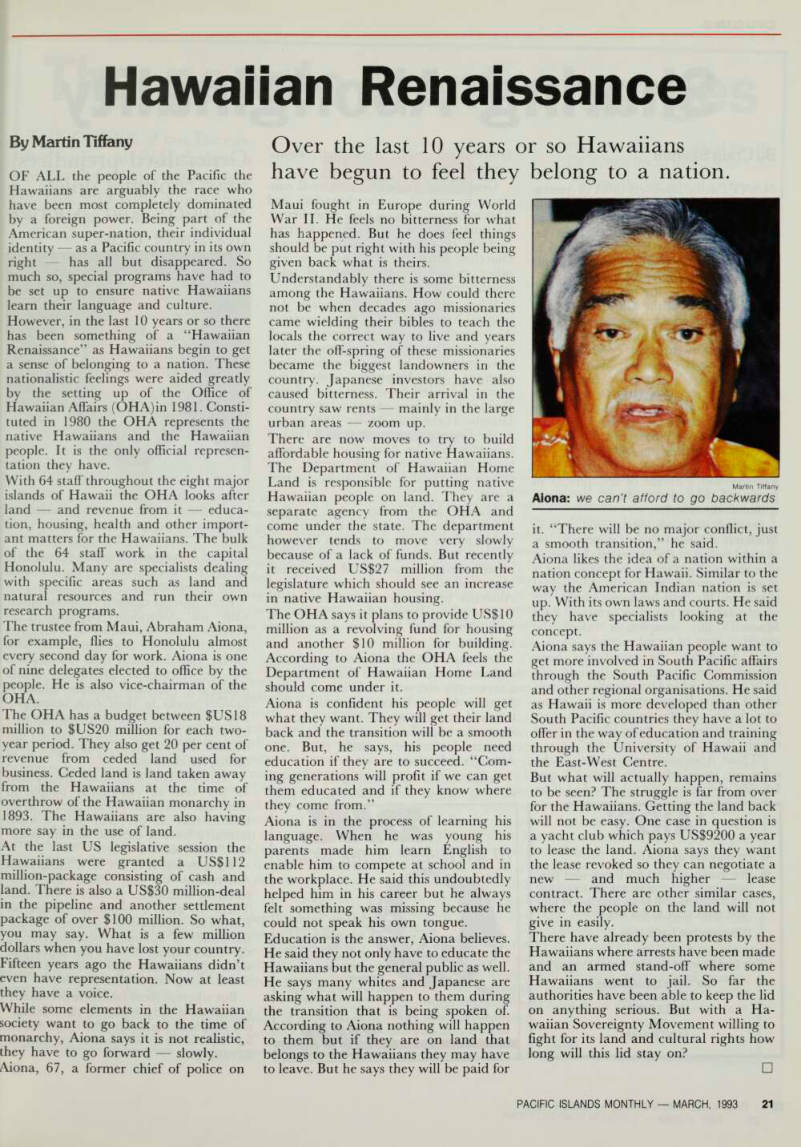
The trustee from Maui, Abraham Aiona, for example, flies to Honolulu almost every second day for work. Aiona is one of nine delegates elected to office by the people. He is also vice-chairman of the
Oha.
The OHA has a budget between SUSIB million to SUS2O million for each two year period. They also get 20 per cent of revenue from ceded land used for business. Ceded land is land taken away from the Hawaiians at the time of overthrow of the Hawaiian monarchy in 1893. The Hawaiians are also having more say in the use of land.
At the last US legislative session the Hawaiians were granted a US$ll2 million-package consisting of cash and land. There is also a US$3O million-deal in the pipeline and another settlement package of over $lOO million. So what, you may say. What is a few million dollars when you have lost your country.
Fifteen years ago the Hawaiians didn’t even have representation. Now at least they have a voice.
While some elements in the Hawaiian society want to go back to the time of monarchy, Aiona says it is not realistic, they have to go forward slowly.
Aiona, 67, a former chief of police on
Maui fought in Europe during World War 11. He feels no bitterness for what has happened. But he does feel things should be put right with his people being given back what is theirs.
Understandably there is some bitterness among the Hawaiians. How could there not be when decades ago missionaries came wielding their bibles to teach the locals the correct way to live and years later the off-spring of these missionaries became the biggest landowners in the country. Japanese investors have also caused bitterness. Their arrival in the country saw rents mainly in the large urban areas zoom up.
There are now moves to try to build affordable housing for native Hawaiians.
The Department of Hawaiian Home Land is responsible for putting native Hawaiian people on land. They are a separate agency from the OHA and come under the state. The department however tends to move very slowly because of a lack of funds. But recently it received US$27 million from the legislature which should see an increase in native Hawaiian housing.
The OHA says it plans to provide US$lO million as a revolving fund for housing and another $lO million for building.
According to Aiona the OHA feels the Department of Hawaiian Home Land should come under it.
Aiona is confident his people will get what they want. They will get their land back and the transition will be a smooth one. But, he says, his people need education if they are to succeed. “Com ing generations will profit if we can get them educated and if they know where they come from.”
Aiona is in the process of learning his language. When he was young his parents made him learn English to enable him to compete at school and in the workplace. He said this undoubtedly helped him in his career but he always felt something was missing because he could not speak his own tongue.
Education is the answer, Aiona believes.
He said they not only have to educate the Hawaiians but the general public as well.
He says many whites and Japanese are asking what will happen to them during the transition that is being spoken of.
According to Aiona nothing will happen
to them but if they are on land that belongs to the Hawaiians they may have to leave. But he says they will be paid for
it. “There will be no major conflict, just a smooth transition,” he said.
Aiona likes the idea of a nation within a nation concept for Hawaii. Similar to the way the American Indian nation is set up. With its own laws and courts. He said they have specialists looking at the concept.
Aiona says the Hawaiian people want to get more involved in South Pacific affairs through the South Pacific Commission and other regional organisations. He said as Hawaii is more developed than other South Pacific countries they have a lot to offer in the way of education and training through the University of Hawaii and the East-West Centre.
But what will actually happen, remains to be seen? The struggle is far from over for the Hawaiians. Getting the land back will not be easy. One case in question is a yacht club which pays US$92OO a year to lease the land. Aiona says they want the lease revoked so they can negotiate a new and much higher lease contract. There are other similar cases, where the people on the land will not give in easily.
There have already been protests by the Hawaiians where arrests have been made and an armed stand-off where some Hawaiians went to jail. So far the authorities have been able to keep the lid on anything serious. But with a Ha waiian Sovereignty Movement willing to fight for its land and cultural rights how long will this lid stay on? □
Martin Tiffany Aiona: we can’t afford to go backwards
Sharing Aboriginality
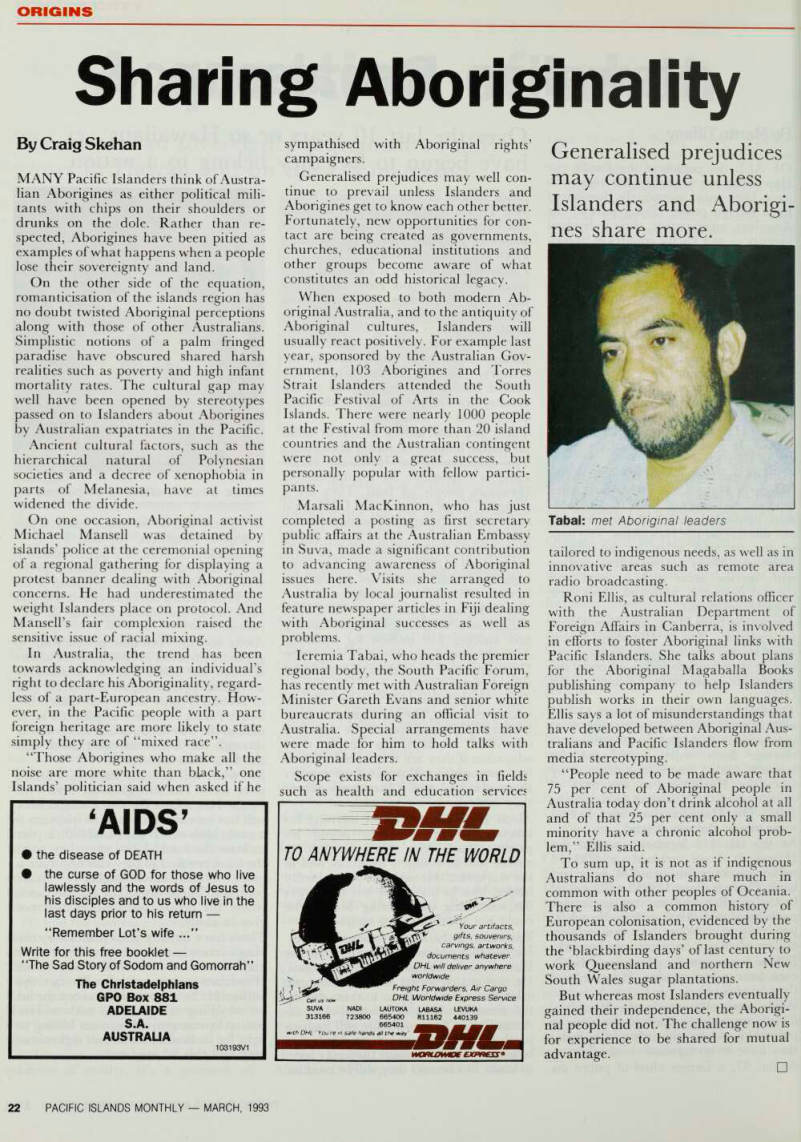
Origins
By Craig Skehan
Generalised prejudices may continue unless Islanders and Aborigi nes share more.
MANY Pacific Islanders think of Austra lian Aborigines as either political mili tants with chips on their shoulders or drunks on the dole. Rather than re spected, Aborigines have been pitied as examples of what happens when a people lose their sovereignty and land.
On the other side of the equation, romanticisation of the islands region has no doubt twisted Aboriginal perceptions along with those of other Australians.
Simplistic notions of a palm fringed paradise have obscured shared harsh realities such as poverty and high infant mortality rates. The cultural gap may well have been opened by stereotypes passed on to Islanders about Aborigines by Australian expatriates in the Pacific.
Ancient cultural factors, such as the hierarchical natural of Polynesian societies and a decree of xenophobia in parts of Melanesia, have at times widened the divide.
On one occasion, Aboriginal activist Michael Mansell was detained by islands’ police at the ceremonial opening of a regional gathering for displaying a protest banner dealing with Aboriginal concerns. He had underestimated the weight Islanders place on protocol. And Mansell’s fair complexion raised the sensitive issue of racial mixing.
In Australia, the trend has been towards acknowledging an individual’s right to declare his Aboriginality, regard less of a part-European ancestry. How ever, in the Pacific people with a part foreign heritage are more likely to state simply they are of “mixed race”, “Those Aborigines who make all the noise are more white than black,” one Islands’ politician said when asked if he
sympathised with Aboriginal rights’ campaigners.
Generalised prejudices may well con tinue to prevail unless Islanders and Aborigines get to know each other better.
Fortunately, new opportunities for con tact are being created as governments, churches, educational institutions and other groups become aware of what constitutes an odd historical legacy.
When exposed to both modern Ab original Australia, and to the antiquity of Aboriginal cultures, Islanders will usually react positively. For example last year, sponsored by the Australian Gov ernment, 103 Aborigines and Torres Strait Islanders attended the South Pacific Festival of Arts in the Cook Islands. There were nearly 1000 people at the Festival from more than 20 island countries and the Australian contingent were not only a great success, but personally popular with fellow partici pants.
Marsali MacKinnon, who has just completed a posting as first secretary public affairs at the Australian Embassy in Suva, made a significant contribution to advancing awareness of Aboriginal issues here. Visits she arranged to Australia by local journalist resulted in feature newspaper articles in Fiji dealing with Aboriginal successes as well as problems. leremia Tabai, who heads the premier regional body, the South Pacific Forum, has recently met with Australian Foreign Minister Gareth Evans and senior white bureaucrats during an official visit to Australia. Special arrangements have were made for him to hold talks with
Aboriginal leaders.
Scope exists for exchanges in fields such as health and education services
tailored to indigenous needs, as well as in innovative areas such as remote area radio broadcasting.
Roni Ellis, as cultural relations officer with the Australian Department of Foreign Affairs in Canberra, is involved in efforts to foster Aboriginal links with Pacific Islanders. She talks about plans for the Aboriginal Magaballa Books publishing company to help Islanders publish works in their own languages.
Ellis says a lot of misunderstandings that have developed between Aboriginal Aus tralians and Pacific Islanders flow from
media stereotyping.
“People need to be made aware that 75 per cent of Aboriginal people in Australia today don’t drink alcohol at all and of that 25 per cent only a small minority have a chronic alcohol prob lem,” Ellis said.
To sum up, it is not as if indigenous Australians do not share much in common with other peoples of Oceania, There is also a common history of European colonisation, evidenced by the thousands of Islanders brought during the ‘blackbirding days’ of last century to work Queensland and northern New South Wales sugar plantations.
But whereas most Islanders eventually gained their independence, the Aborigi nal people did not. The challenge now is for experience to be shared for mutual advantage.
Tabai: met Aboriginal leaders
Advertisements & other items, p. 22 (1 item)
Aids’
TO ANYWHERE IN THE WORLD
■pH** m Your artifacts, gifts, souvenirs, carvings, artworks, documents whatever DHL will deliver anywhere worldwide Freight Forwarders. Air Cargo DHL Worldwide Express Service
LAUTOKA LABASA LEVUKA
665400 811162 440139 665401 wth DHL "You're m sate hands all the way"
NADI
723800
AIDS’
• the disease of DEATH • the curse of GOD for those who live lawlessly and the words of Jesus to his disciples and to us who live in the last days prior to his return “Remember Lot’s wife ...”
Write for this free booklet “The Sad Story of Sodom and Gomorrah”
The Christadelphians GPO Box 881
ADELAIDE
S.A.
AUSTRALIA
103193V1
The people want changes
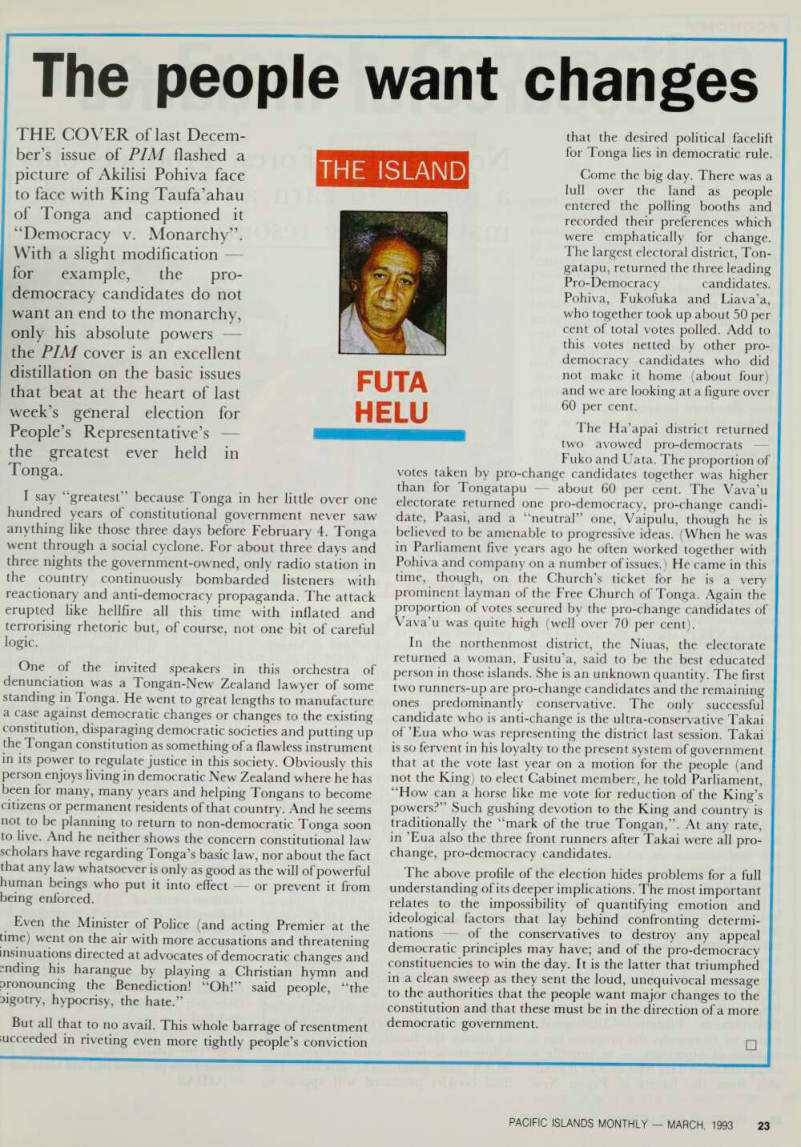
The Island
THE COVER of last Decem ber’s issue of PIM flashed a picture of Akilisi Pohiva face to face with King Taufa’ahau of Tonga and captioned it
“Democracy v. Monarchy”.
With a slight modification for example, the pro democracy candidates do not want an end to the monarchy, only his absolute powers the PIM cover is an excellent distillation on the basic issues that beat at the heart of last week’s general election for
People’s Representative’s
the greatest ever held in
Tonga.
I say “greatest” because Tonga in her little over one hundred years of constitutional government never saw anything like those three days before February 4. Tonga went through a social cyclone. For about three days and three nights the government-owned, only radio station in the country continuously bombarded listeners with
reactionary and anti-democracy propaganda. The attack
erupted like hellfire all this time with inflated and terrorising rhetoric but, of course, not one bit of careful
logic.
One of the invited speakers in this orchestra of denunciation was a Tongan-New Zealand lawyer of some standing in Tonga. He went to great lengths to manufacture a case against democratic changes or changes to the existing constitution, disparaging democratic societies and putting up the Tongan constitution as something of a flawless instrument in its power to regulate justice in this society. Obviously this person enjoys living in democratic New Zealand where he has been for many, many years and helping Tongans to become citizens or permanent residents of that country. And he seems not to be planning to return to non-democratic Tonga soon to live. And he neither shows the concern constitutional law scholars have regarding Tonga’s basic law, nor about the fact that any law whatsoever is only as good as the will of powerful human beings who put it into effect or prevent it from
being enforced.
Even the Minister of Police (and acting Premier at the time) went on the air with more accusations and threatening insinuations directed at advocates of democratic changes and mding his harangue by playing a Christian hymn and pronouncing the Benediction! “Oh!” said people, “the
Digotry, hypocrisy, the hate.”
But all that to no avail. This whole barrage of resentment lucceeded in riveting even more tightly people’s conviction
that the desired political facelift for Tonga lies in democratic rule.
Come the big day. There was a lull over the land as people entered the polling booths and recorded their preferences which were emphatically for change.
The largest electoral district, Ton gatapu, returned the three leading
Pro-Democracy candidates.
Pohiva, Fukofuka and Liava’a, who together took up about 50 per cent of total votes polled. Add to this votes netted by other pro democracy candidates who did not make it home (about four) and we are looking at a figure over 60 per cent.
The Ha’apai district returned two avowed pro-democrats - Fuko and Uata. The proportion of
votes taken by pro-change candidates together was higher than for Tongatapu about 60 per cent. The Vava’u electorate returned one pro-democracy, pro-change candi date, Paasi, and a “neutral” one, Vaipulu, though he is believed to be amenable to progressive ideas. (When he was in Parliament five years ago he often worked together with Pohiva and company on a number of issues.) He came in this time, though, on the Church’s ticket for he is a very prominent layman of the Free Church of Tonga. Again the proportion of votes secured by the pro-change candidates of Vava’u was quite high (well over 70 per cent).
In the northenmost district, the Niuas, the electorate returned a woman, Fusitu’a, said to be the best educated person in those islands. She is an unknown quantity. The first two runners-up are pro-change candidates and the remaining ones predominantly conservative. The only successful candidate who is anti-change is the ultra-conservative Takai of ’Eua who was representing the district last session. Takai is so fervent in his loyalty to the present system of government that at the vote last year on a motion for the people (and not the King) to elect Cabinet members, he told Parliament, “How can a horse like me vote for reduction of the King’s powers?” Such gushing devotion to the King and country is traditionally the “mark of the true Tongan,”. At any rate, in ’Eua also the three front runners after Takai were all pro
change, pro-democracy candidates.
The above profile of the election hides problems for a full understanding of its deeper implications. The most important relates to the impossibility of quantifying emotion and ideological factors that lay behind confronting determi nations of the conservatives to destroy any appeal democratic principles may have; and of the pro-democracy constituencies to win the day. It is the latter that triumphed in a clean sweep as they sent the loud, unequivocal message to the authorities that the people want major changes to the \ constitution and that these must be in the direction of a more democratic government.
Futa
Helu
Resourceful Initiative
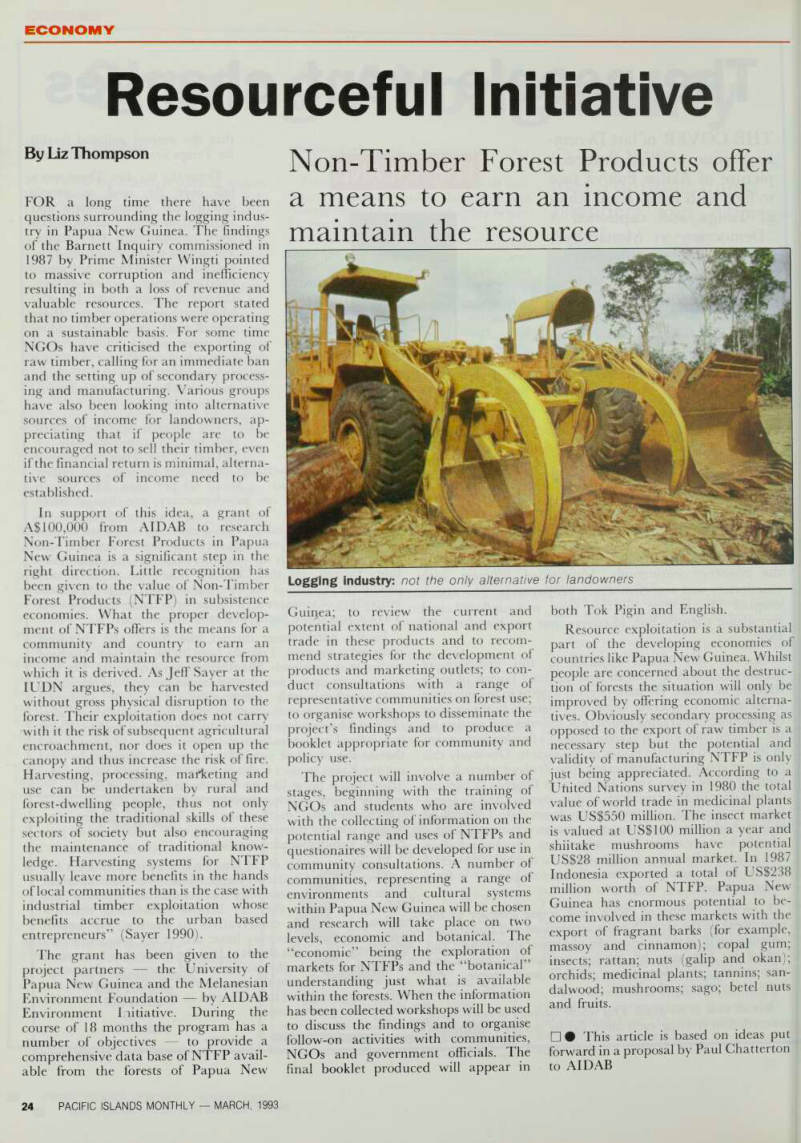
Economy
By Liz Thompson
Non-Timber Forest Products offer a means to earn an income and maintain the resource
FOR a long time there have been questions surrounding the logging indus try in Papua New Guinea. The findings of the Barnett Inquiry commissioned in 1987 by Prime Minister Wingti pointed to massive corruption and inefficiency resulting in both a loss of revenue and valuable resources. The report stated that no timber operations were operating on a sustainable basis. For some time NGOs have criticised the exporting of raw timber, calling for an immediate ban and the setting up of secondary process ing and manufacturing. Various groups have also been looking into alternative sources of income for landowners, ap preciating that if people are to be encouraged not to sell their timber, even if the financial return is minimal, alterna tive sources of income need to be established.
In support of this idea, a grant of A$ 100,000 from AIDAB to research Non-Timber Forest Products in Papua New Guinea is a significant step in the right direction. Little recognition has been given to the value of Non-Timber Forest Products (NTFP) in subsistence economies. What the proper develop ment of NTFPs offers is the means for a community and country to earn an income and maintain the resource from which it is derived. As Jeff Sayer at the lUDN argues, they can be harvested without gross physical disruption to the forest. Their exploitation does not carry with it the risk of subsequent agricultural encroachment, nor does it open up the canopy and thus increase the risk of fire.
Harvesting, processing, marketing and use can be undertaken by rural and forest-dwelling people, thus not only exploiting the traditional skills of these sectors of society but also encouraging the maintenance of traditional know ledge. Harvesting systems for NTFP usually leave more benefits in the hands of local communities than is the case with industrial timber exploitation whose benefits accrue to the urban based
entrepreneurs” (Sayer 1990).
The grant has been given to the project partners the University of Papua New Guinea and the Melanesian Environment Foundation by AIDAB Environment Initiative. During the course of 18 months the program has a number of objectives to provide a comprehensive data base of NTFP avail able from the forests of Papua New
Guinea; to review the current and potential extent of national and export trade in these products and to recommend strategies for the development of products and marketing outlets; to conduct consultations with a range of representative communities on forest use; te organise workshops to disseminate the project’s findings and to produce a booklet appropriate for community and policy use.
The project will involve a number of stages, beginning with the training of NGOs and students who are involved with the collecting of information on the potential range and uses of NTFPs and questionaires will be developed for use in community consultations. A number of communities, representing a range of environment; and cultural systems within Papua New Guinea will be chosen and research will take place on two levels, economic and botanical. The “economic” being the exploration of markets for NTFPs and the “botanical” understanding just what is available within the forests. When the information has been collected workshops will be used to discuss the findings and to organise follow-on activities with communities, NGOs and government officials. The final booklet produced will appear in
both Tok Pigin and English.
Resource exploitation is a substantial part of the developing economies of countries like Papua New Guinea. Whilst people are concerned about the destruc tion of forests the situation will only be improved by offering economic alterna tives. Obviously secondary processing as opposed to the export of raw timber is a necessary step but the potential and validity of manufacturing NTFP is only just being appreciated. According to a Utiited Nations survey in 1980 the total value of world trade in medicinal plants was US$55O million. The insect market is valued at US$lOO million a year and shiitake mushrooms have potential US$2B million annual market. In 1987 Indonesia exported a total of US$23B million worth of NTFP. Papua New Guinea has enormous potential to be come involved in these markets with the export of fragrant barks (for example, massoy and cinnamon); copal gum; insects; rattan; nuts (galip and okan); orchids; medicinal plants; tannins; san dalwood; mushrooms; sago; betel nuts and fruits. □ • This article is based on ideas put forward in a proposal by Paul Chatterton
To Aidab
Logging industry: not the only alternative for landowners
The French Connection
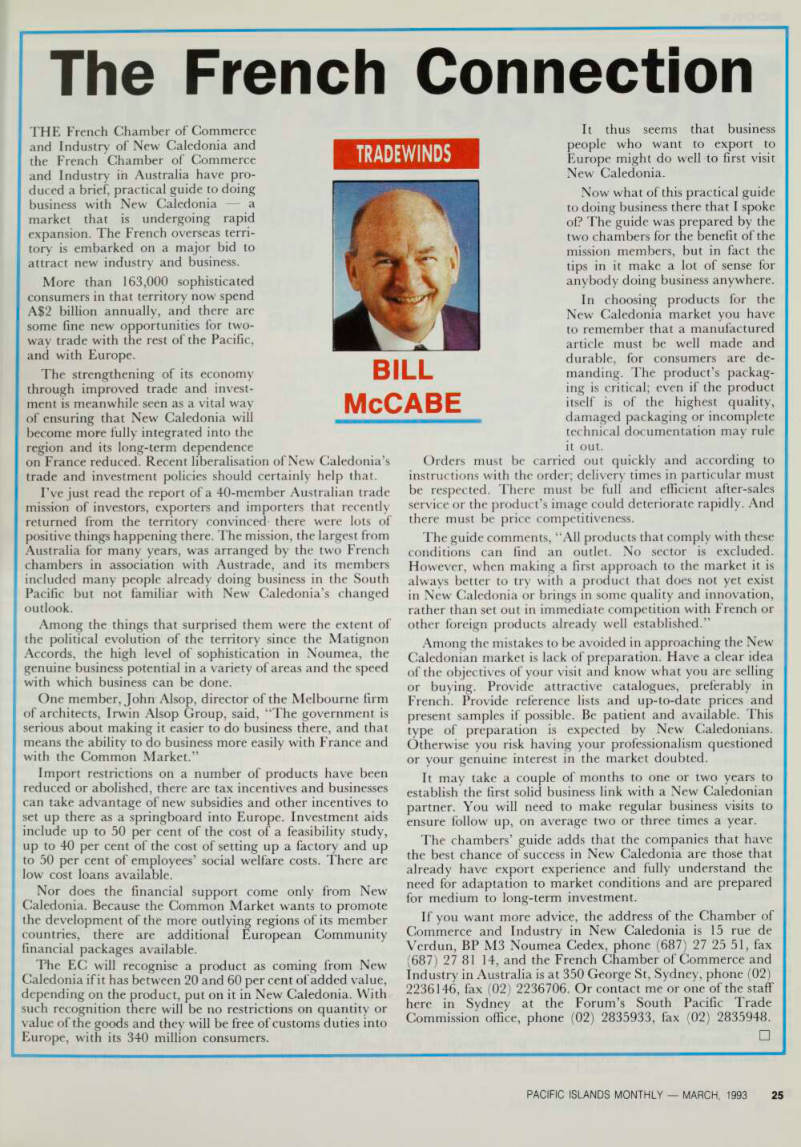
Tradewinds
THE French Chamber of Commerce and Industry of New Caledonia and the French Chamber of Commerce and Industry in Australia have pro duced a brief, practical guide to doing business with New Caledonia a market that is undergoing rapid expansion. The French overseas terri tory is embarked on a major bid to attract new industry and business.
More than 163,000 sophisticated consumers in that territory now spend As 2 billion annually, and there are some fine new opportunities for two way trade with the rest of the Pacific, and with Europe.
The strengthening of its economy through improved trade and invest ment is meanwhile seen as a vital way of ensuring that New Caledonia will become more fully integrated into the region and its long-term dependence
on France reduced. Recent liberalisation of New Caledonia’s trade and investment policies should certainly help that.
I’ve just read the report of a 40-member Australian trade mission of investors, exporters and importers that recently returned from the territory convinced there were lots of positive things happening there. The mission, the largest from Australia for many years, was arranged by the two French chambers in association with Austrade, and its members included many people already doing business in the South Pacific but not familiar with New Caledonia’s changed outlook.
Among the things that surprised them were the extent of the political evolution of the territory since the Matignon Accords, the high level of sophistication in Noumea, the genuine business potential in a variety of areas and the speed with which business can be done.
One member, John Alsop, director of the Melbourne firm of architects, Irwin Alsop Group, said, “The government is serious about making it easier to do business there, and that means the ability to do business more easily with France and with the Common Market.”
Import restrictions on a number of products have been reduced or abolished, there are tax incentives and businesses can take advantage of new subsidies and other incentives to set up there as a springboard into Europe. Investment aids include up to 50 per cent of the cost of a feasibility study, up to 40 per cent of the cost of setting up a factory and up to 50 per cent of employees’ social welfare costs. There are low cost loans available.
Nor does the financial support come only from New Caledonia. Because the Common Market wants to promote the development of the more outlying regions of its member countries, there are additional European Community financial packages available.
The EC will recognise a product as coming from New Caledonia if it has between 20 and 60 per cent of added value, depending on the product, put on it in New Caledonia. With such recognition there will be no restrictions on quantity or value of the goods and they will be free of customs duties into Europe, with its 340 million consumers.
It thus seems that business people who want to export to Europe might do well to first visit New Caledonia.
Now what of this practical guide to doing business there that I spoke of? The guide was prepared by the two chambers for the benefit of the mission members, but in fact the tips in it make a lot of sense for anybody doing business anywhere.
In choosing products for the New Caledonia market you have to remember that a manufactured article must be well made and durable, for consumers are de
manding. The product’s packag
ing is critical; even if the product itself is of the highest quality, damaged packaging or incomplete technical documentation may rule it out.
Orders must be carried out quickly and according to instructions with the order; delivery times in particular must be respected. There must be full and efficient after-sales service or the product’s image could deteriorate rapidly. And there must be price competitiveness.
The guide comments, “All products that comply with these conditions can find an outlet. No sector is excluded.
However, when making a first approach to the market it is always better to try with a product that does not yet exist in New Caledonia or brings in some quality and innovation, rather than set out in immediate competition with French or other foreign products already well established.”
Among the mistakes to be avoided in approaching the New Caledonian market is lack of preparation. Have a clear idea of the objectives of your visit and know what you are selling or buying. Provide attractive catalogues, preferably in French. Provide reference lists and up-to-date prices and present samples if possible. Be patient and available. This type of preparation is expected by New Caledonians.
Otherwise you risk having your professionalism questioned or your genuine interest in the market doubted.
It may take a couple of months to one or two years to establish the first solid business link with a New Caledonian partner. You will need to make regular business visits to ensure follow up, on average two or three times a year.
The chambers’ guide adds that the companies that have the best chance of success in New Caledonia are those that already have export experience and fully understand the need for adaptation to market conditions and are prepared for medium to long-term investment.
If you want more advice, the address of the Chamber of Commerce and Industry in New Caledonia is 15 rue de Verdun, BP M 3 Noumea Cedex, phone (687) 27 25 51, fax (687) 27 81 14, and the French Chamber of Commerce and Industry in Australia is at 350 George St, Sydney, phone (02) 2236146, fax (02) 2236706. Or contact me or one of the staff here in Sydney at the Forum’s South Pacific Trade Commission office, phone (02) 2835933, fax (02) 2835948.
Bill
Mccabe
The Pacific Drug
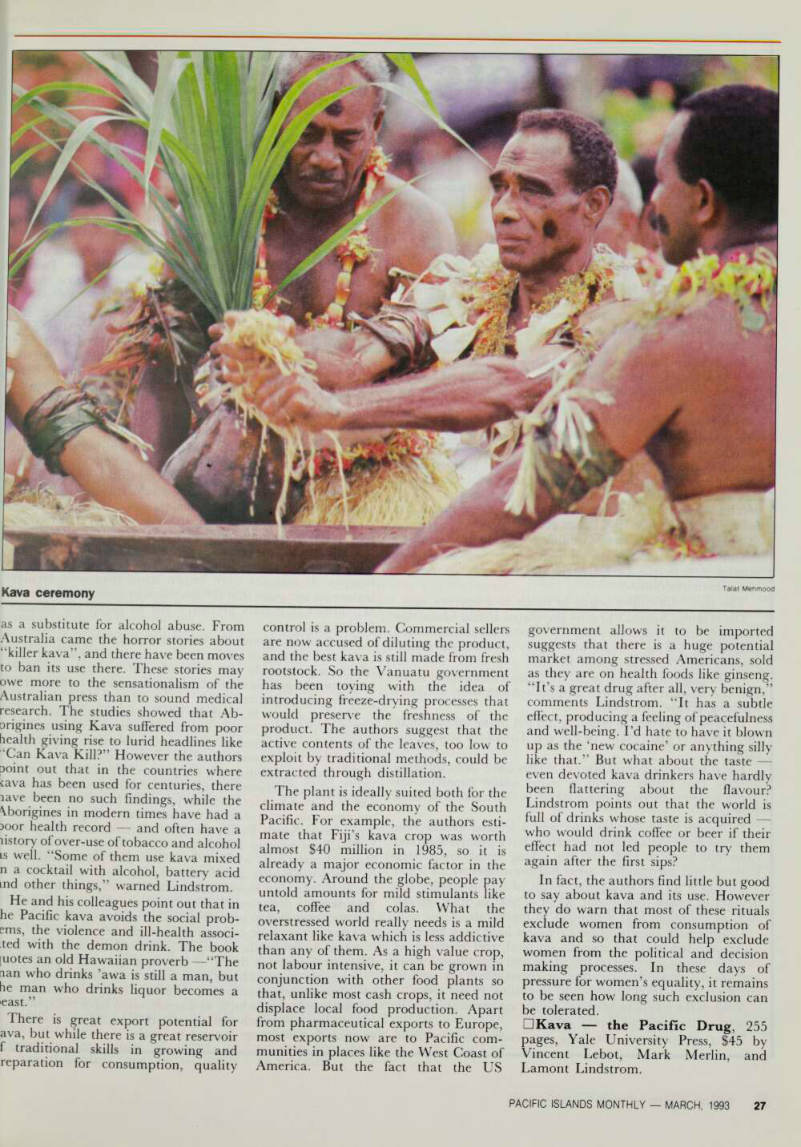
Books
By lan Williams
The islands’ national drink, kava, comes under scientific scrutiny and emerges as anything but the demon drink
KAVA does not kill, as some newspaper headlines have it. On the contrary it is a benign drug which is beneficial to society and the Pacific islands econ omy. These are the conclusions of Kava, the Pacific Drug, a book published this month by Yale University Press, writ ten by three researchers who have looked at the chemistry, botany and anthropology of the Pacific’s most distinctive product. Co-authors Vin cent Lebot and Mark Lament of the University of Hawai’i, and Lament Lindstrom of the University of Arizona are no ivory tower academics; they all admit they themselves also carried out extensive first-hand consumer research of kava.
Perhaps their most interesting con clusion is that the cultivated kava plant began as a cutting from the wild species in Vanuatu, some 2500 to 3000 years ago. In the past, botanists saw cultivated kava, or Piper Methysticum and the wild variety, Piper Wickmanii as two separate species, of the pepper family, but the authors claim kava began as a cutting from the wild plant, and a hundred generations of Pacific farmers have since been selecting cuttings that gave roots strong in the chemical cocktail that gives the drink its effect.
During their travels around the ocean, it seems Pacific islanders were careful to take their cuttings with them, growing them wherever they settled.
Studying the chemical composition of the different wild and cultivated plants, they came to the conclusion that Vanu atu has so many different varieties of kava plants, and so many clearly trace able similarities between the cultivated and wild varieties, that Kava is almost
certainly the Melanesian Republic’s
most distinctive contribution to the
Pacific Way.
That conclusion is, they say, reinforced by the evidence of the words used for Kava in various Pacific languages. Far from dying out, the tradition is growing.
In Vanuatu, alcohol sales are only 60 per cent of what they were at the time of independence as locals prefer kava to beer, wine and spirits. Vila now has many kava bars. “It’s a big improvement over the older alcoholic, social atmos phere,” Lament Lindstrom comments.
Lindstrom told PIM he suspected it
was the absence of major mammalian plant-eaters in the islands which led the kava plant to concentrate its active chemicals in the roots and stump, in order to protect against the fungi and microbes in the soil. These chemicals, the kavalactones do have an anti-fungal effect - in addition to making people
happy.
For the moment, kava is safe from artificial, synthesised competition. The drink seems to need all its six major chemical ingredients working together to have its effect on humans. The different varieties developed by growers mostly differ in the balance of substances, some of which hit the bloodstream very quickly, and others which, less soluble, take hours to cross the stomach wall.
Hence the notorious Vanuatu variety Tudei that keeps the drinker in the air for two days.
Most of the kavalactones do not dissolve well in water which is why the traditional method of chewing the root produces such good results. In Victorian days scientists theorised the saliva had a chemical effect, inducing fermentation in the kava bowl. However, “Saliva has no effect whatsoever on the active molecules in kava,” Lindstrom told PIM. It is the mechanical effect of chewing which is so effective.
The resinous substances have to be extracted from the plant and then dispersed into tiny droplets in the water to form an emulsion that will cross the stomach wall into the bloodstream. It is almost disappointing to record that they discovered no evidence that the chewing by virgins, as mandated in many islands, produces any better effect than more experienced chews. And many commer cial kava bars now use a meat-grinder which is not in the slightest bit romantic.
So what does kava do? According to the researchers it induces a form of narcosis, reduces pain, and acts as a local
anaesthetic; it relaxes the muscles and counters fungus growths. But drinkers use it despite the numbing effects on mouth and throat, aiming instead for what the book calls the “excellent pschopharmacological activity” of pro ducing “emotional and muscular relax ation, stabilisation of the feelings and stimulation of the ability to think and act.”
Researchers have suggested that, as well as its recreational use, it could have uses in countering schizophrenia, epi lepsy and as a muscle relaxant. In the past it has been used in treatments of gonorrhea, and other infective agents. It has been suggested that it may have a role as a food preservative because of its
anti-fungal effect.
In fact, it could even be an answer to overpopulation. Many islanders report that kava diminishes interest in sex.
Asked about this aspect, Lindstrom speculated to PIM that in many islands it may have helped maintain the tra dition of couples abstaining from sex until the child was weaned several years in most cases.
It is this mix of properties which has led to pharmaceutical companies in France and Germany being major pur chasers of kava from the region.
However, for anthropologists and soci ologists, perhaps the most significant aspects of kava drinking has been its role in maintaining social structures. In many island societies, hierarchy is emphasised by the order in which the kava is drunk, while the drink itself tends to make people less aggressive and more amen able to reasoned discussion.
It is those traditional ritual aspects with their pre-Christian overtones which made the missionaries oppose Kava use, but the wheel has now turned. In some areas, the Roman Catholics have incor porated kava into their rituals, while Fijian Methodist missionaries to Austra lian Aborigines have tried to promote it
as a substitute for alcohol abuse. From “?™ a ca , me the horror stories about killer kava , and there have been moves to ban its use there. These stories may owe more to the sensationalism of the Australian press than to sound medical research. 1 he studies showed that Ab- Drigmes using Kava suffered from poor tiealth gwrng nse to lund headlines like .an Kava Kill? However the authors point out that m the countries where
lave beenno Zh
\borimnes in gS ’h wl “if
>oor health re/ord™ “
• r record and often have a " well °-«S V o e m r ; U on " baCCO r d alCOh °J n a cocktail with md other things,” warned Lindstrom u. i u- ii , . he Padt kavi 3d eS ?r tOU V 'i" ems the vi T a :™ ld ; ■ }T ’“Tlf prob ‘ md whh hl r and all-health assoc-
uoterin o d I
T hC
be man who drinks r S * a man ’ but east » h d ks llc l uor becomes a ' there is great export potential for ava, but while there is a great reservoir t traditional skills m growing and reparation for consumption, quality
control is a problem. Commercial sellers are now accused of diluting the product, and the best kava is still made from fresh rootstock. So the Vanuatu government has been toying with the idea of
introducing freeze-drying processes that
would preserve the freshness of the product. The authors suggest that the active contents of the leaves, too low to exploit by traditional methods, could be extracted through distillation.
The plant is ideally suited both for the climate and the economy of the South Pacific - For sample, the authors estimate t h a t Fiji’s kava crop was worth 840 4tllion in 19 P 85 so U is alrCady a economic factor in the "T 7 ' Around 'he globe, people pay untold amounts for mild stimulants like tea ’ Coffee and colas ' What the overstressed world really needs is a mild re l a xant like kava which is less addictive than any ° f them ' As a hi S h value cro P’ not labour intensive, it can be grown in conjunction with other food plants so that, unlike most cash crops, it need not displace local food production. Apart from pharmaceutical exports to Europe, most exports now are to Pacific communities in places like the West Coast of America. But the fact that the US
government allows it to be imported suggests that there is a huge potential market among stressed Americans, sold as they are on health foods like ginseng “It’s a great drug after all, very benign/’ comments Lindstrom. “It has a subtle effect, producing a feeling of peacefulness and well-being. I’d hate to have it blown up as the ‘new cocaine’ or anything silly like that.” But what about the taste even devoted kava drinkers have hardly been flattering about the flavour?
Lindstrom points out that the world is ™ of drinks whose taste is acquired w b° would drink coffee or beer if their effect had not led people to try them again after the first sips?
In fact, the authors find little but good to say about kava and its use. However they do warn that most of these rituals exclude women from consumption of kava and so that could help exclude women from the Political an£ decision making processes In these days of pressure for women’s equality, it remains to be seen how long such exclusion can be tolerated, DKava the Pacific Drug 255 pages, Yale University Press, $45 by Vincent Lebot, Mark Merlin and Lamont Lindstrom.
Kava ceremony
Talal Mehmood
Reefs in crisis
Australia
IF YOU live in the Pacific islands chances are that you live near a coral reef in crisis.
Internationally recognised coral bi ologist, Dr John Veron, from the Australian Institute of Marine Science in Townsville estimates 70 per cent of the reefs in the Indian and Pacific Oceans have been degraded in some way.
Dr Leon Zann, a specialist in Pacific island reefs says, “We have seen the collapse of reef ecosystems near virtu ally all major urbanised areas” in the islands.
Reefs near Pacific island capitals such as Suva, Nuku’alofa, Apia, Tarawa, Port Vila and Pago Pago are, according to Dr Zann, suffering “grave ecological problems”.
That does not mean the Pacific islands do not have large areas of
beautiful and intact reef. They do around the myriad of islands away from the main centres. The problem is that damage near heavily populated areas is dramatic and in certain patches, as Dr Zann points out, so severe that it has led to the collapse of the entire ecosystem.
The problems are caused simply by too many people.
In Suva, for instance, in an area which used to support around 1000 people there are now 120,000 with the reef just two kilometres offshore.
The reefs’ difficulties began as much as a century ago.
On Western Samoa’s heavily populated Upolu Island, for instance, large scale clearing of coastal forest for copra plantations led to erosion and heavy siltation as topsoil clogged the reefs and coastal streams.
As the population grew so did the human and animal waste and the amount of nitrogen and phosphates from fertilisers leaching around the reefs.
In Western Samoa overfishing has led to the extinction of two species of giant clam. In Fiji and Tonga the story is the same.
Local breeding populations of turtles have been so badly affected that turtles caught in many island countries are migrants from breeding populations in Australia or French Polynesia.
In American Samoa industry and a leaking World War II wreck carrying a dangerous cargo, have pushed lead and cadmium levels so high that the taking of fish from Pago harbour and surrounding areas has been banned.
To top it all the damaging crown of thorns starfish has devastated many reefs which, when subject to other stresses such as pollution, find it difficult to regenerate.
Dealing with these problems requires long term solutions sewage treatment or disposal on land, the relocation of rubbish dumps, controls on industrial and agricultural waste and on silt producing clearing or construction, as well as curbs on population growth and migration to the cities.
None of the solutions are easy; if they are not prohibitively expensive they are politically difficult.
Many governments are only too aware their rubbish
dumps, created in mangrove swamps to keep them away from areas people use, are in a highly sensitive spot; one which is used as breeding ground for fish and other marine species and from which it is impossible to prevent leaching for toxins into the marine environment.
With land having so much cul tural importance in the Pacific, getting permission for new dump sites is not easy.
Human waste is perhaps the biggest problem of all. After nine years working in the Pacific, Dr Zann, now a senior scientist with the Great Barrier Reef Marine Park Authority, says his biggest environ mental fear is not for the reefs themselves but for the health of the humans living around them.
Recently, water borne human
waste has caused outbreaks of cholera and typhus in a number of island nations as well as spreading hepatitis. To treat the waste to a level which would kill disease causing agents is well beyond island budgets.
The Pacific islands are not the only ones to be wrestling with water pollution problems.
Until just a few years ago, in Sydney, the waste of one million used to pour out into the water near its famous city beaches. It was not until brown scum became a regular feature on our coast that the government spent the hundreds of millions of dollars necessary just to pump the effluent further out to sea.
Amid all the gloom there are some hopeful signs.
Australia has just embarked on an ambitious exercise which will provide an inventory of its entire marine environment and form the basis for a strategy to protect it into the next century.
The first step, a State of the Marine Environment report, will describe every marine environment in detail setting out each one’s environmental assets and problems as well as the sort of use people want to make of the area.
Dr Zann is co-ordinating the project. He says he hopes it will lead to a network of multi-use marine protected areas like the Great Barrier Reef Marine Park. In the islands, too, governments are aware of the problems facing reefs. The Apia-based South Pacific Regional Environment Program (SPREP) is putting a high priority on integrated Coastal Zone Management which tries to deal with the multiplicity of problems which are combining to stress urban reefs.
Essentially it aims to make sure planning decisions by every government department take account of environmental consequences and to provide the basic information necessary to know what those consequences might be.
At the South Pacific Commission the under-funded inshore fisheries program is doing its best to stop overfishing.
Probably the most hopeful sign is the increasing willingness of agencies and governments to involve local landowners in solutions; solutions which, as a result, often have the spin-off of creating jobs which can slow the drift to the cities as well as provide a welcome income to locals. □
Jemima
Garrett
Tackling perpetrators
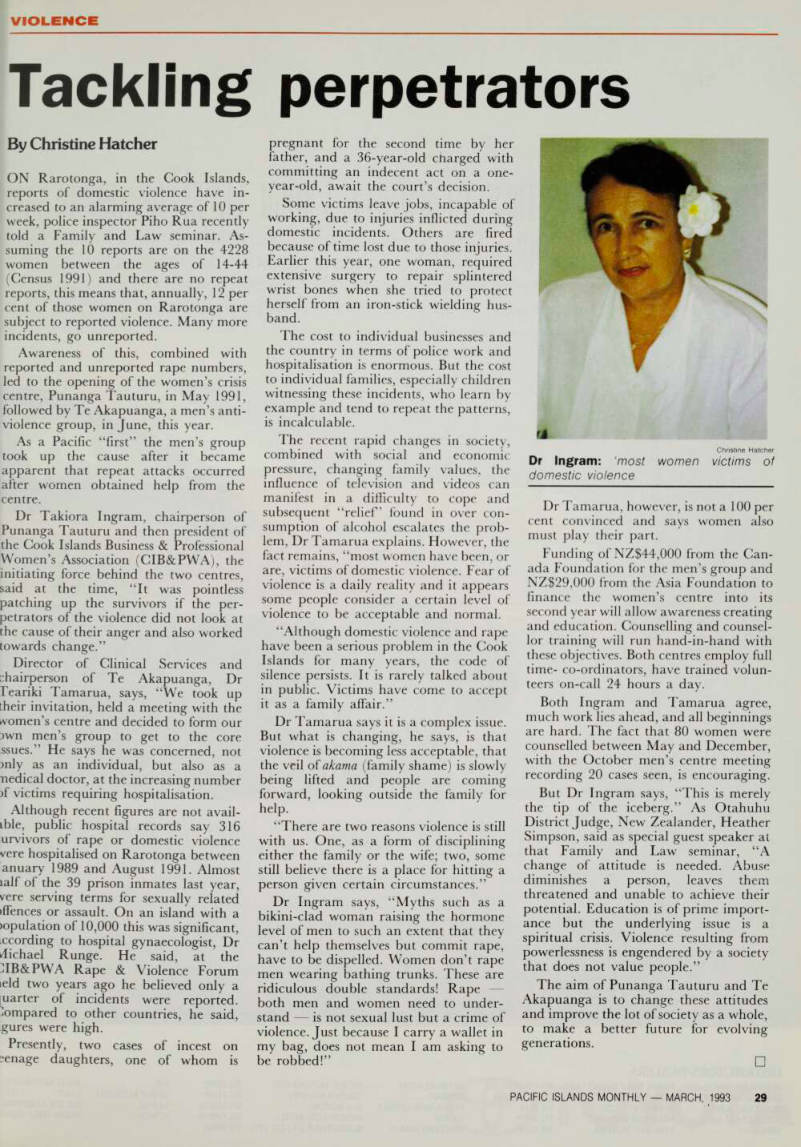
Violence
By Christine Hatcher
ON Rarotonga, in the Cook Islands, reports of domestic violence have in creased to an alarming average of 10 per week, police inspector Piho Rua recently told a Family and Law seminar. As suming the 10 reports are on the 4228 women between the ages of 14-44 (Census 1991) and there are no repeat reports, this means that, annually, 12 per cent of those women on Rarotonga are subject to reported violence. Many more incidents, go unreported.
Awareness of this, combined with reported and unreported rape numbers, led to the opening of the women’s crisis centre, Punanga Tauturu, in May 1991, followed by Te Akapuanga, a men’s anti violence group, in June, this year.
As a Pacific “first” the men’s group took up the cause after it became apparent that repeat attacks occurred after women obtained help from the centre.
Dr Takiora Ingram, chairperson of Punanga Tauturu and then president of the Cook Islands Business & Professional Women’s Association (CIB&PWA), the initiating force behind the two centres, said at the time, “It was pointless patching up the survivors if the per petrators of the violence did not look at the cause of their anger and also worked
towards change.”
Director of Clinical Services and :hairperson of Te Akapuanga, Dr Feariki Tamarua, says, “We took up their invitation, held a meeting with the women’s centre and decided to form our )wn men’s group to get to the core ssues.” He says he was concerned, not mly as an individual, but also as a nedical doctor, at the increasing number
)f victims requiring hospitalisation.
Although recent figures are not avail ible, public hospital records say 316 urvivors of rape or domestic violence
vere hospitalised on Rarotonga between
anuary 1989 and August 1991. Almost lalf of the 39 prison inmates last year, vere serving terms for sexually related ►ffences or assault. On an island with a >opulation of 10,000 this was significant,
ccording to hospital gynaecologist, Dr
dichael Runge. He said, at the CIB&PWA Rape & Violence Forum icld two years ago he believed only a [uarter of incidents were reported.
Compared to other countries, he said, gures were high.
Presently, two cases of incest on menage daughters, one of whom is
pregnant for the second time by her father, and a 36-year-old charged with committing an indecent act on a one year-old, await the court’s decision.
Some victims leave jobs, incapable of working, due to injuries inflicted during domestic incidents. Others are fired because of time lost due to those injuries.
Earlier this year, one woman, required extensive surgery to repair splintered wrist bones when she tried to protect herself from an iron-stick wielding hus band.
The cost to individual businesses and the country in terms of police work and hospitalisation is enormous. But the cost to individual families, especially children witnessing these incidents, who learn by example and tend to repeat the patterns, is incalculable.
The recent rapid changes in society, combined with social and economic pressure, changing family values, the influence of television and videos can manifest in a difficulty to cope and subsequent “relief’ found in over con sumption of alcohol escalates the prob lem, Dr Tamarua explains. However, the fact remains, “most women have been, or are, victims of domestic violence. Fear of violence is a daily reality and it appears some people consider a certain level of violence to be acceptable and normal.
“Although domestic violence and rape have been a serious problem in the Cook Islands for many years, the code of silence persists. It is rarely talked about in public. Victims have come to accept it as a family affair.”
Dr Tamarua says it is a complex issue.
But what is changing, he says, is that violence is becoming less acceptable, that the veil of akama (family shame) is slowly being lifted and people are coming forward, looking outside the family for
help.
“There are two reasons violence is still with us. One, as a form of disciplining either the family or the wife; two, some still believe there is a place for hitting a person given certain circumstances.”
Dr Ingram says, “Myths such as a bikini-clad woman raising the hormone level of men to such an extent that they can’t help themselves but commit rape, have to be dispelled. Women don’t rape men wearing bathing trunks. These are ridiculous double standards! Rape both men and women need to under stand is not sexual lust but a crime of violence. Just because I carry a wallet in my bag, does not mean I am asking to be robbed!”
Dr Tamarua, however, is not a 100 per cent convinced and says women also must play their part.
Funding of NZ544,000 from the Can ada Foundation for the men’s group and NZ529,000 from the Asia Foundation to finance the women’s centre into its second year will allow awareness creating and education. Counselling and counsel lor training will run hand-in-hand with these objectives. Both centres employ full time- co-ordinators, have trained volun teers on-call 24 hours a day.
Both Ingram and Tamarua agree, much work lies ahead, and all beginnings are hard. The fact that 80 women were counselled between May and December, with the October men’s centre meeting recording 20 cases seen, is encouraging.
But Dr Ingram says, “This is merely the tip of the iceberg.” As Otahuhu District Judge, New Zealander, Heather Simpson, said as special guest speaker at that Family and Law seminar, “A change of attitude is needed. Abuse diminishes a person, leaves them threatened and unable to achieve their potential. Education is of prime import ance but the underlying issue is a spiritual crisis. Violence resulting from powerlessness is engendered by a society that does not value people.”
The aim of Punanga Tauturu and Te Akapuanga is to change these attitudes and improve the lot of society as a whole, to make a better future for evolving generations.
Christine Hatcher Dr Ingram: ‘most women victims of domestic violence
Advertisements & other items, pp. 30-31 (1 item)
Creating a highly efficient, dynamic-looking car wo
be simple if it weren’t for one complicating detail; passengers that must ride in it. Accommodating people comfortably in a pleasant, roo interior usually means a certain amount of aerodynamic potential has to be sacrific i % 4 » Exact features and specifications may vary depending on country of purchase. Please check with your nearest TOYOTA distributor/dealer for details.
DISTRffiUTORS/DEALERS
AMERICAN SAMOA BURNS PHILP (S.S.) CO. LTD, PH 633-4281 GUAM & MICRONESIA. . ATKINS KROLL. INC. PH 646-1876/9 NORFOLK ISLANDS BORRY’S PTY LTD. PH 2114
SOLOMON ISLANDS MENDANA MOTORS PH 30314
VANUATU VANUATU MOTORS PH 22341
COOK ISLANDS PACIFIC MOTORS LTD.
KIRIBATI TARAWA MOTORS
PAPUA NEW GUINEA .. ELA MOTORS
TAHITI NIPPON AUTOMOTO
WESTERN SAMOA BURNS PHILP (S.S.) CO. LTD.
PH 20796 PH 21090 PH 217036 PH 429819 PH 20800
FIJI ASCO MOTORS
NEW CALEDONIA .. S.I.A.P
SAIPAN MICROL CORPORATIC
TONGA BURNS PHILP (TONGA*
Until now. Using a con- . cept called total airflow magement, Toyota engineers were able to realize an efficient, wedge-shaped design tile at the same time perfecting the alignment between body panels and components, course our own innovative style of civilized gineering makes sure that none of this comes the expense of the luxurious, leg-stretching ;e interior. Because we realize that even a 0.33 1 is useless if no one wants to drive the car.
® TOYOTA
Realising the potential
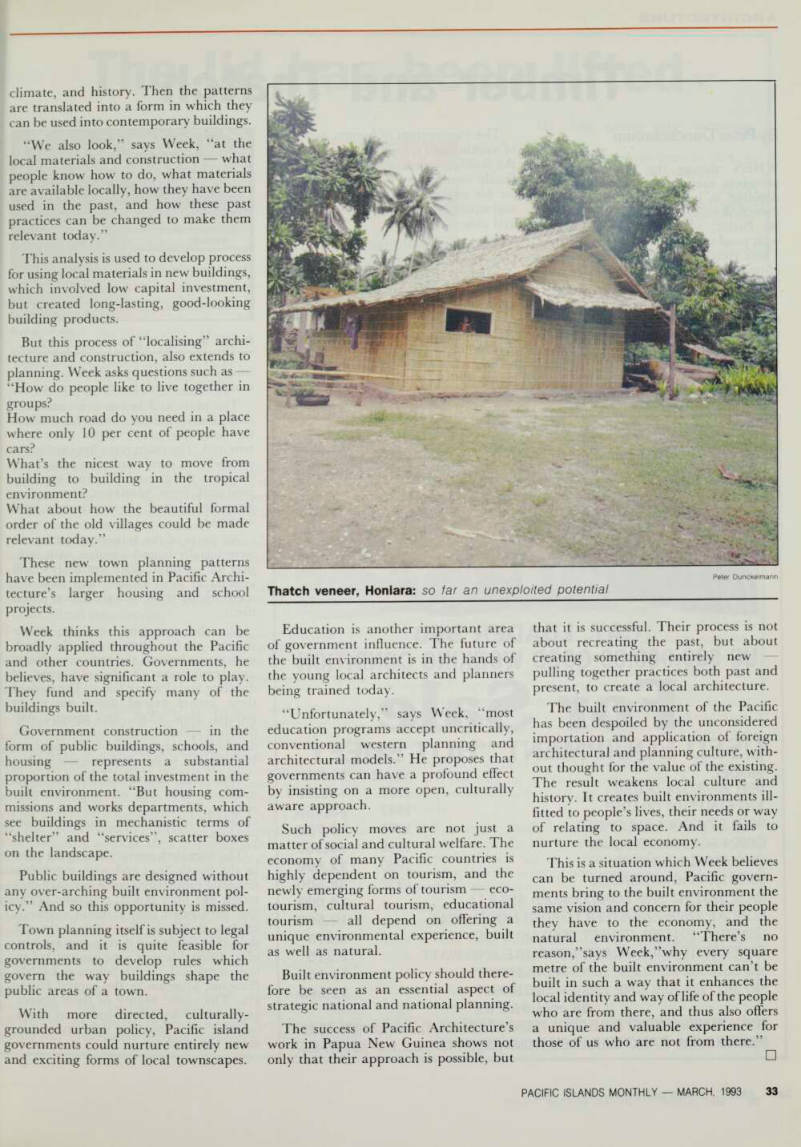
Architecture
By Liz Thompson
‘Buildings are the biggest, and in many ways, the most important artefacts a culture produces’
RAPID development in the Pacific Island nations has seen the old tra ditional environments of the indigenous people replaced, wholesale, by Western models of building and townscape. Al though most countries have policies to ensure the development of their natural environments is consonant with local cultural values, there have been no corresponding policies towards the built environment partly because of an absence of models for such development.
One firm is working towards the creation of such models.
David Week is director of Pacific Architecture, a firm based in Sydney but with projects in many parts of the Pacific.
“Buildings,” he says, “are the biggest, and in many ways the most important artefacts a culture produces. If you surround people 100 per cent with the artefacts of a foreign culture, within one generation they’ll lose their own. And, for Pacific countries, buildings are artefacts they can control. They’re never going to make their own cars, or stereo systems, or refrigerators. But they can produce their own buildings.”
Week has been working for 15 years on models of planning and architecture which fuse the best of local culture with modern management and technology.
This work is now bearing fruit. For the second time in three years, a project by Week’s firm has won the annual Papua New Guinea Institute of Architects/ James Hardie Housing Award. The first time was in 1990, for its Provincial Government Staff Housing Project on the island of Bougainville; then again in 1992 for a group of four government houses in Palmalmal, East Ne>v Britain.
1991 also saw an international jury select Pacific Architecture’s scheme for a Kanak cultural centre for a short-list of three, from an original 170 contenders.
And the company has now been invited to work farther afield, with a large-scale, low-cost housing project based on an analysis of South Indian culture now under construction in Vellore, near Madras.
These projects illustrate PA’s core philosophy to evolve and improve the local building culture, rather than re place it with some supposedly superior import. Russell Hall, the jury chairman on the 1990 award, stated the 18 houses built for the North Solomons Provincial government had “successfully achieved its stated aims in a technically competent and beautiful manner. It reflected the culture and climate in which it exists and because of this, its acceptance is assured.
Such an approach will produce a sympathetic and appropriate architec ture for Papua New Guinea.”
Week feels that while there are often laws encouraging local control of the business and land and an awareness of the importance of cultural traditions, this awareness is not carried through into
policies on housing and towns. He sees two reasons for this. The first is that the built environment is a normal part of day-to-day life, that the people are not conscious of it and its tremendous effect on them. The second is that, historically, people have only been presented with two, supposedly mutually exclusive op tions either the purely traditional architecture, or imported Western archi tecture.
Traditional buildings are not perma nent, they don’t have modern con veniences like electricity, water, or in door toilets, they’re not insect proof, banks won’t lend on them, and building regulations often prohibit. So they turn to “modern” buildings this often means hot, ugly, and expensive fibro boxes.
Week is working to define and estab lish a middle ground permanent buildings with modern comforts and amenities, but thoroughly grounded in the local culture, in their materials, workmanship, and design. The result is synthesis or as Week calls it, a “fusion” of the best of the traditional and the modern.
The detailed process of working out such a fusion has been developed primar ily through a long series of projects in Papua New Guinea. This process in volves looking both at traditional archi tecture and at what people are doing in new, non-traditional settlements re settlement schemes, villages, informal urban settlements where people are designing and building for themselves.
This sort of study reveals indigenous architectural and settlement patterns.
Some are traditional, some are new.
The process takes these patterns, and studies how they have evolved around the local economy, and way of life,
climate, and history. Then the patterns are translated into a form in which they can be used into contemporary buildings.
“We also look,” says Week, “at the local materials and construction what people know how to do, what materials are available locally, how they have been used in the past, and how these past practices can be changed to make them relevant today.”
This analysis is used to develop process for using local materials in new buildings, which involved low capital investment,
but created long-lasting, good-looking
building products.
But this process of “localising” archi tecture and construction, also extends to planning. Week asks questions such as “How do people like to live together in
groups?
How much road do you need in a place where only 10 per cent of people have cars?
What’s the nicest way to move from building to building in the tropical environment?
What about how the beautiful formal order of the old villages could be made relevant today.”
These new town planning patterns have been implemented in Pacific Archi tecture’s larger housing and school projects.
Week thinks this approach can be broadly applied throughout the Pacific and other countries. Governments, he believes, have significant a role to play.
They fund and specify many of the buildings built.
Government construction in the form of public buildings, schools, and housing represents a substantial proportion of the total investment in the built environment. “But housing com missions and works departments, which see buildings in mechanistic terms of “shelter” and “services”, scatter boxes on the landscape.
Public buildings are designed without any over-arching built environment pol icy.” And so this opportunity is missed.
Town planning itself is subject to legal controls, and it is quite feasible for governments to develop rules which govern the way buildings shape the public areas of a town.
With more directed, culturally grounded urban policy, Pacific island governments could nurture entirely new and exciting forms of local townscapes.
Education is another important area of government influence. The future of the built environment is in the hands of the young local architects and planners being trained today.
“Unfortunately,” says Week, “most education programs accept uncritically, conventional western planning and architectural models.” He proposes that i f A (T e governments can have a profound effect by insisting on a more open, culturally
aware approach.
Such policy moves are not just a matter of social and cultural welfare. The economy of many Pacific countries is highly dependent on tourism, and the newly emerging forms of tourism ecotourism, cultural tourism, educational tourism all depend on offering a unique environmental experience, built as well as natural. „ r i ii .i Built environment policy should therer , i fore be seen as an essential a pec of strategic national and national planning.
The success of Pacific Architecture’s work in Papua New Guinea shows not only that their approach is possible, but
that it is successful. Their process is not about recreating the past, but about creating something entirely new pulling together practices both past and present, to create a local architecture. , The bu ‘ l( environment of the Pacific has bee " despoiled by the unconsidered importation and application of foreign architectural and planning culture w«h out thought for the value ol the existing, « weakens local cukure and h crea(es built environmen ,s ill fitted to people’s lives, their needs or way of relating to space. And it fails to nurture the local economy, This is a situation which Week believes can turne d around, Pacific govern ments bring to the built environment the same vision and concern for their people they have to the economy, and the natural environment. “There’s no reason,’’says Week,’’why every square metre of the built environment can’t be t built in such a way that it enhances the > fufeofthe people there> and thus a]so offers a unique and valuable experience for those of us who are not from there.”
D
Peter Dunckelmann
Thatch veneer, Honiara: so far an unexploited potential
Advertisements & other items, p. 32 (1 item)
@rassHards Group
1 s- Vi 0 '\
PLUMBING FITTINGS OF TOMORROW
For quotes and information on the above & following contact: @rassHards Group BRASSHARDS MANUFACTURING PTY. LTD. BRASSHARDS HOLDINGS PTY.. LTD. 43 CARTER ROAD, BROOKVALE, N.S.W., 2000, AUSTRALIA • TEL 02 938-1122 FAX 02 9383974
Timber and Thatch

Architecture
By Peter Dunckelmann
WHEN visiting the South-Seas, one perceives similar impressions as those depicted in holiday catalogues sun drenched villages perched on the rim of the Pacific; white sand beaches fringed with pandanus trees and coconut palms.
These villages reveal inspiring examples of traditional skills and knowledge com bined with a sense of practical simplicity.
Materials, designs and implement
ations vary from bush, to highlands and to man-made islands in Malaita’s remote Lau Lagoon in the Solomon Islands, which have been constructed on sand bars or exposed stretches of reef with coral boulders taken from the reef.
The construction of homes, as well as of working and store huts, is a matter for ‘ he families concerned. The head of the Tamily would erect an additional house for hls adolescent, still unmarried sons and would be hel P ed m the task b Y them and c^ose relatives.
At first sight the dwelling and sleeping houses look flimsy; drafty huts rattled by t h e wind. Their ground surface is relatively small, measuring, for example, approximately smx7m or smaller. They consist of a roof, resting on four or six posts, and a suspended floor, about three to four metres above sea level. Some houses have walls made from timber planks. Others are fitted with mats made from the mid-ribs of coconut fronds, or
from pandanus leaves, which are woven into special pieces for this purpose.
The posts and beams are commonly made from pandanus trunks from which the cork-like outer layer has been removed. The main posts frequently rest on rocks or coral limestone which are buried in the ground. The roof thatch is produced from pandanus leaves, that gives the house a surprisingly cool ambiance.
All parts of the framework of houses were usually bound together with lash ings of coconut fibre cord. It’s still applied in most villages and nails are used only by those who are able to afford them.
On the mainland, on the larger islands, a few houses in the bush settlements beyond the ordinary villages are reminiscent of the old type of dwelling and sleeping house. The roofs of these houses extend down almost to ground level. Yet the present day dwelling and sleeping houses are a recent development and evocative of bungalows built by the more affluent households.
Since the beginning of European influence with the onset of the new religion, Christianity, traditional decor ations of houses have become almost obsolete.
The twentieth century is keeping pace in the South Seas and with increasing financial prosperity people embrace ma terials like fibre board, concrete, bricks and corrugated iron to build spacious, modern dwellings. To reinstate the old skills of building and decorating, samples of traditional houses were constructed in the compound of the Solomon Islands National Museum in the capital Honi ara. The rustic beauty of these timber and thatch houses co-exists in stark contrast to a modern age skyscraper across the road.
Rustic beauty: of timber and thatch
Advertisements & other items, p. 34 (1 item)
For Sale
4 *
CAT. LOADER 950
US $39,000.00 GOOD WORKING CONDITION
For Sale
AU enquiries to; TONGA ISLAND:-CONTACT WILLIS 'UNGA, PHONE (676) 21-105/21-190 FAX #(676) 23-139 AMERICAN SAMOA:- CONTACT KEN FLANDERS, PHONE (684) 699-4304/4321, FAX (684) 6994307
The lid has been lifted
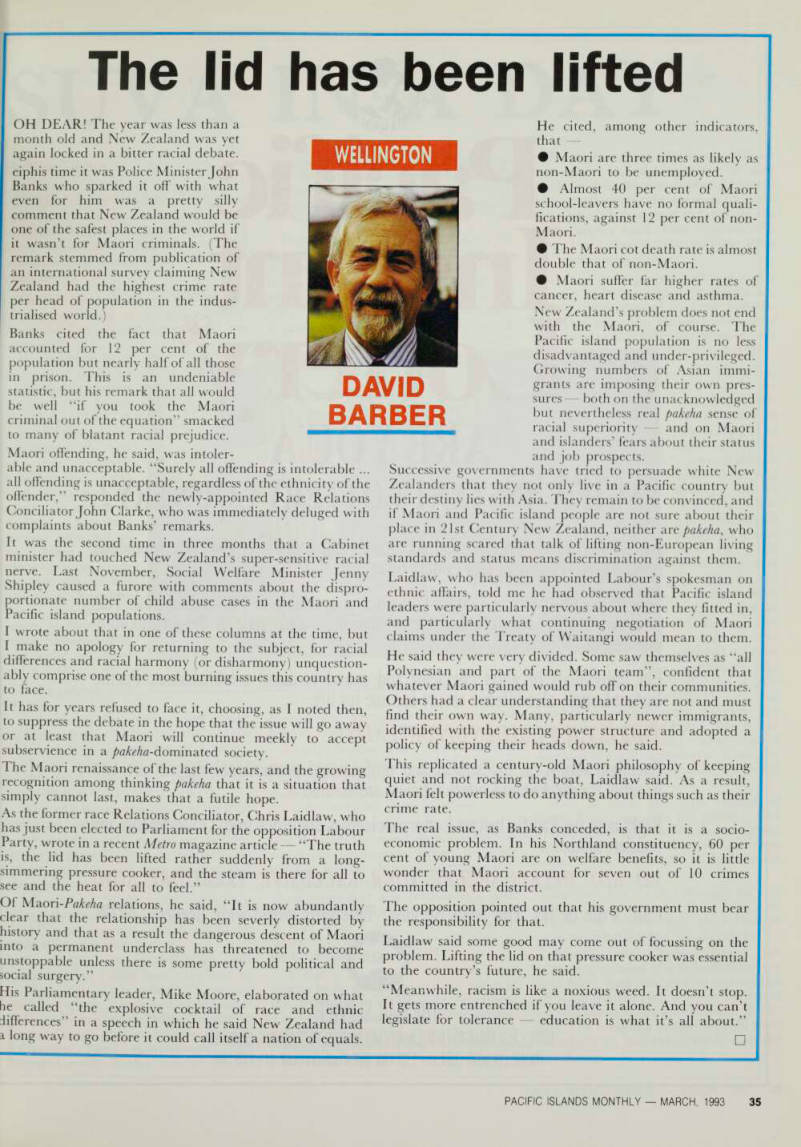
Wellington
OH DEAR! The year was less than a month old and New Zealand was yet again locked in a bitter racial debate. eiphis time it was Police Minister John Banks who sparked it off with what even for him was a pretty silly comment that New Zealand would be one of the safest places in the world if it wasn’t for Maori criminals. (The remark stemmed from publication of an international survey claiming New Zealand had the highest crime rate per head of population in the indus trialised world.) Banks cited the fact that Maori accounted for 12 per cent of the population but nearly half of all those in prison. This is an undeniable statistic, but his remark that all would be well “if you took the Maori criminal out of the equation” smacked to many of blatant racial prejudice.
Maori offending, he said, was intoler-
able and unacceptable. “Surely all offending is intolerable ... all offending is unacceptable, regardless of the ethnicity of the offender,” responded the newly-appointed Race Relations Conciliator John Clarke, who was immediately deluged with complaints about Banks’ remarks.
It was the second time in three months that a Cabinet minister had touched New Zealand’s super-sensitive racial nerve. Last November, Social Welfare Minister Jenny Shipley caused a furore with comments about the dispro portionate number of child abuse cases in the Maori and Pacific island populations.
I wrote about that in one of these columns at the time, but I make no apology for returning to the subject, for racial differences and racial harmony (or disharmony) unquestion ably comprise one of the most burning issues this country has to face.
It has for years refused to face it, choosing, as I noted then, to suppress the debate in the hope that the issue will go away or at least that Maori will continue meekly to accept subservience in a pakeha-dommaied society.
The Maori renaissance of the last few years, and the growing recognition among thinking pakeha that it is a situation that simply cannot last, makes that a futile hope.
As the former race Relations Conciliator, Chris Laidlaw, who has just been elected to Parliament for the opposition Labour Party, wrote in a recent Metro magazine article “The truth is, the lid has been lifted rather suddenly from a long simmering pressure cooker, and the steam is there for all to see and the heat for all to feel.”
Of Maori -Pakeha relations, he said, “It is now abundantly clear that the relationship has been severly distorted by history and that as a result the dangerous descent of Maori into a permanent underclass has threatened to become unstoppable unless there is some pretty bold political and
social surgery.”
His Parliamentary leader, Mike Moore, elaborated on what he called “the explosive cocktail of race and ethnic differences” in a speech in which he said New Zealand had a long way to go before it could call itself a nation of equals.
He cited, among other indicators, that • Maori are three times as likely as non-Maori to be unemployed. • Almost 40 per cent of Maori school-leavers have no formal quali fications, against 12 per cent of non- Maori. • The Maori cot death rate is almost double that of non-Maori. • Maori suffer far higher rates of cancer, heart disease and asthma.
New Zealand’s problem does not end with the Maori, of course. The Pacific island population is no less
disadvantaged and under-privileged.
Growing numbers of Asian immi grants are imposing their own pres sures both on the unacknowledged but nevertheless real pakeha sense of racial superiority and on Maori and islanders’ fears about their status and job prospects.
Successive governments have tried to persuade white New Zealanders that they not only live in a Pacific country but their destiny lies with Asia. They remain to be convinced, and if Maori and Pacific island people are not sure about their place in 21st Century New Zealand, neither are pakeha , who are running scared that talk of lifting non-European living standards and status means discrimination against them.
Laidlaw, who has been appointed Labour’s spokesman on ethnic affairs, told me he had observed that Pacific island leaders were particularly nervous about where they fitted in, and particularly what continuing negotiation of Maori claims under the Treaty of Waitangi would mean to them.
He said they were very divided. Some saw themselves as “all Polynesian and part of the Maori team”, confident that whatever Maori gained would rub off on their communities.
Others had a clear understanding that they are not and must find their own way. Many, particularly newer immigrants, identified with the existing power structure and adopted a policy of keeping their heads down, he said.
This replicated a century-old Maori philosophy of keeping quiet and not rocking the boat, Laidlaw said. As a result, Maori felt powerless to do anything about things such as their crime rate.
The real issue, as Banks conceded, is that it is a socio economic problem. In his Northland constituency, 60 per cent of young Maori are on welfare benefits, so it is little wonder that Maori account for seven out of 10 crimes committed in the district.
The opposition pointed out that his government must bear the responsibility for that.
Laidlaw said some good may come out of focussing on the problem. Lifting the lid on that pressure cooker was essential to the country’s future, he said.
“Meanwhile, racism is like a noxious weed. It doesn’t stop.
It gets more entrenched if you leave it alone. And you can’t legislate for tolerance education is what it’s all about.”
David
Barber
Advertisements & other items, p. 36 (1 item)
Lottery*
Pacific
Instant
ARE YOU A
PACIFIC INSTANT LOTTERY COUNTRY?
Already, several Pacific nations have responded to the developmental opportunities Pacific Instant Lottery offers.
Tattersalls’ 120 years of Lottery Guidance is available to your nation now. This includes totally controlled revenue earnings and state-of-the-art auditing procedures.
For individuals of good character and sound business establishment, Pacific Instant Lottery also offers a secure income for life.
THIS IS YOUR GOLDEN OPPORTUNITY!
Excellent return on investment and professional promotional support are two benefits Pacific Instant Lottery retailers are assured of.
Right now the Pacific Instant Lottery welcomes enquiries from Governments and retailers alike.
DO NOT DELAY! SECURE YOUR EXCLUSIVE TERRITORY NOW!
Call, write or fax The Mail Service, Tattersalls world-wide licencee, NOW.
THE MAIL SERVICE
sum 5,55 FLEiNGTON ROAD, NORTH MELBOURNE, VICTORIA 3051, AUSTRALIA.
PHONE: COUNTRY CODE 61+3 329 9388. FAX: COUNTRY CODE 61+33292166,
Suva In A Day
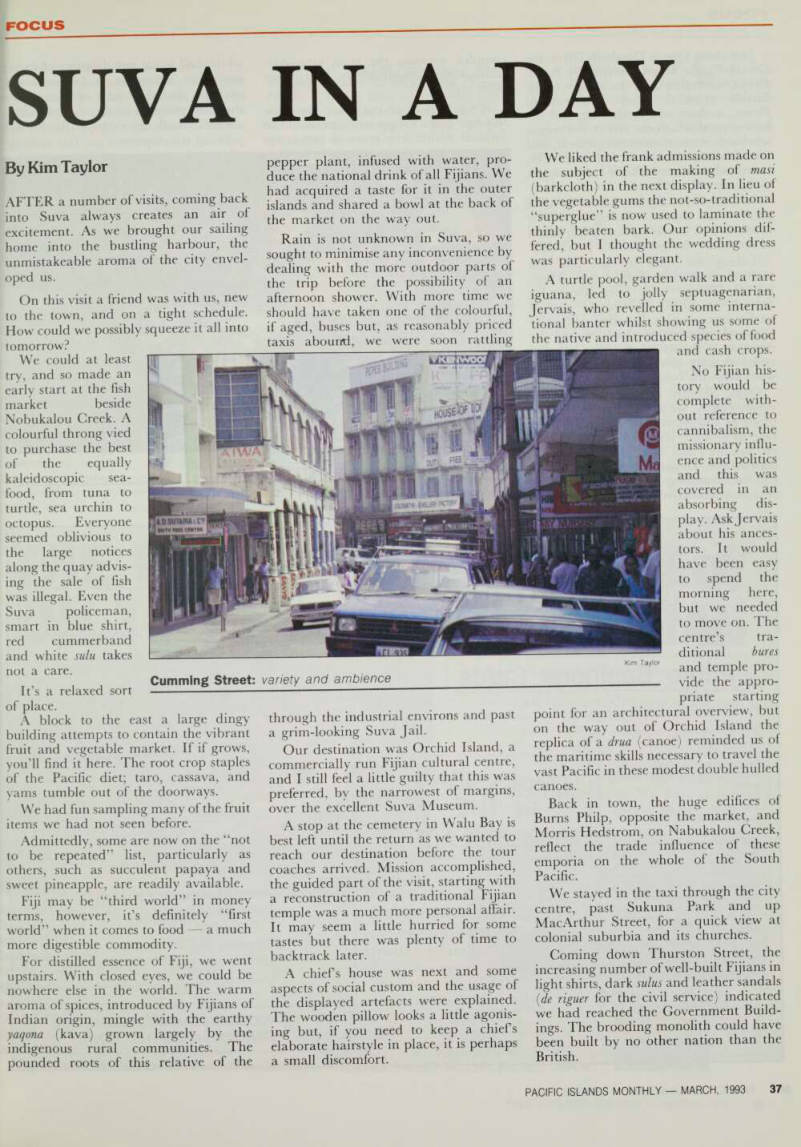
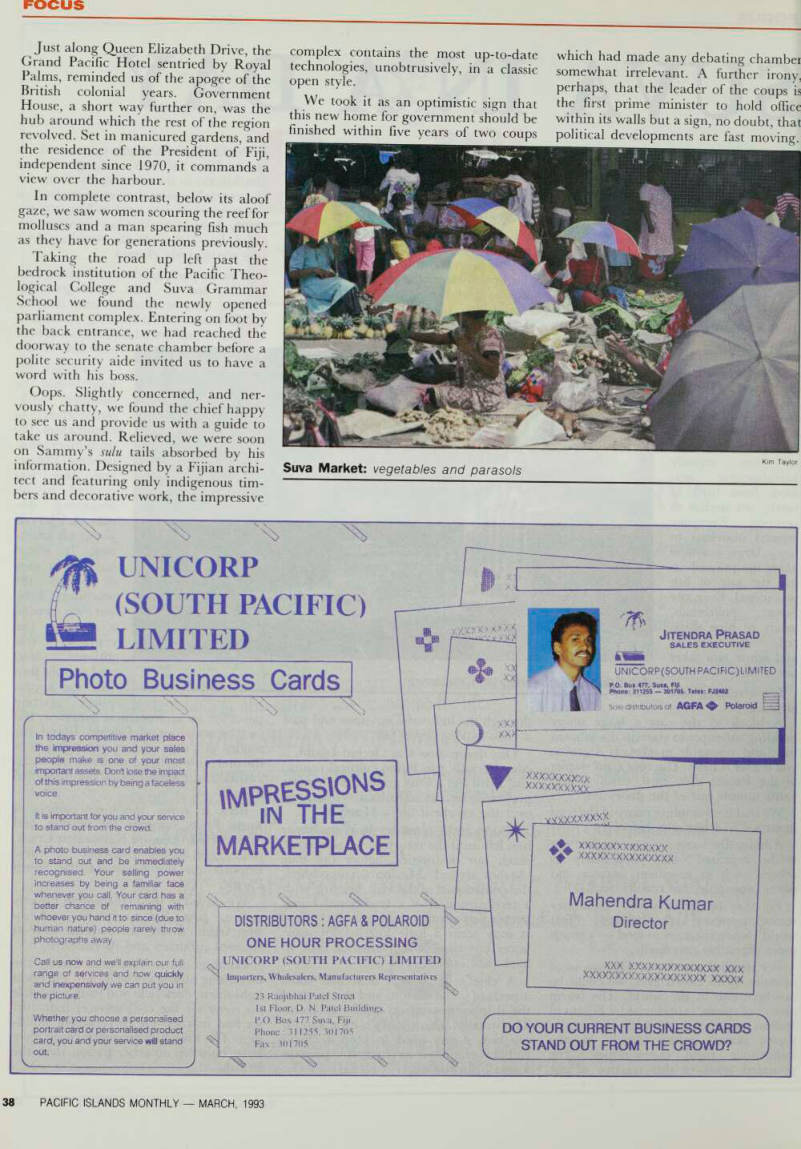
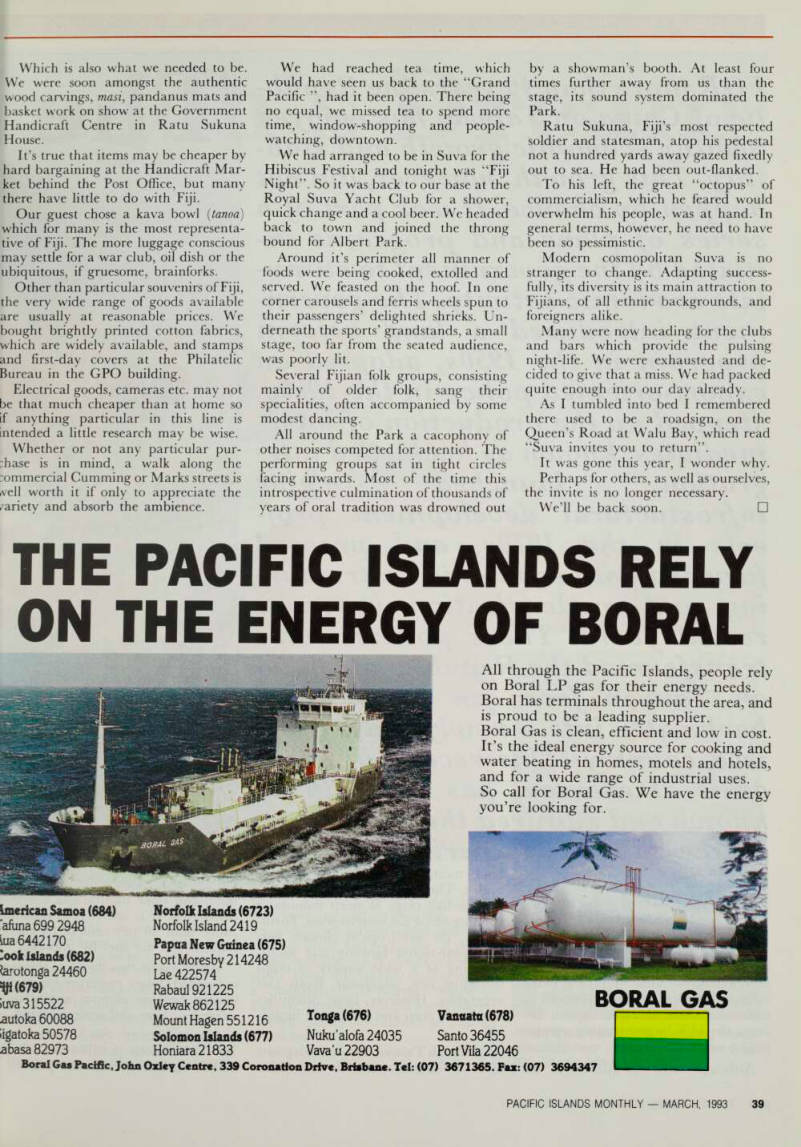
Focus
By Kim Taylor
AFTER a number of visits, coming back into Suva always creates an air of excitement. As we brought our sailing home into the bustling harbour, the unmistakeable aroma of the city envel
oped us.
On this visit a friend was with us, new to the town, and on a tight schedule.
How could we possibly squeeze it all into tomorrow?
We could at least try, and so made an early start at the fish market beside Nobukalou Creek. A colourful throng vied to purchase the best of the equally
kaleidoscopic sea
food, from tuna to turtle, sea urchin to octopus. Everyone seemed oblivious to the large notices along the quay advis ing the sale of fish was illegal. Even the
Suva policeman,
smart in blue shirt, red cummerband and white sulu takes not a care.
It’s a relaxed sort
of place.
A block to the east a large dingy building attempts to contain the vibrant fruit and vegetable market. If if grows, you’ll find it here. The root crop staples of the Pacific diet; taro, cassava, and yams tumble out of the doorways.
We had fun sampling many of the fruit items we had not seen before.
Admittedly, some are now on the “not to be repeated” list, particularly as others, such as succulent papaya and sweet pineapple, are readily available.
Fiji may be “third world” in money terms, however, it’s definitely “first world” when it comes to food a much more digestible commodity.
For distilled essence of Fiji, we went upstairs. With closed eyes, we could be nowhere else in the world. The warm aroma of spices, introduced by Fijians of Indian origin, mingle with the earthy yaqona (kava) grown largely by the indigenous rural communities. The pounded roots of this relative of the
pepper plant, infused with water, pro duce the national drink of all Fijians. We had acquired a taste for it in the outer islands and shared a bowl at the back of the market on the way out.
Rain is not unknown in Suva, so we sought to minimise any inconvenience by dealing with the more outdoor parts of the trip before the possibility of an afternoon shower. With more time we should have taken one of the colourful, if aged, buses but, as reasonably priced taxis abound, we were soon rattling
through the industrial environs and past
a grim-looking Suva Jail.
Our destination was Orchid Island, a commercially run Fijian cultural centre, an d \ still feel a little guilty that this was preferred, by the narrowest of margins, over the excellent Suva Museum.
A stop at the cemetery in Walu Bay is best left until the return as we wanted to reach our destination before the tour coaches arrived. Mission accomplished, the guided part of the visit, starting with a reconstruction of a traditional Fijian temple was a much more personal affair, It may seem a little hurried for some tastes but there was plenty of time to backtrack later.
A chiefs house was next and some aspects of social custom and the usage of the displayed artefacts were explained.
The wooden pillow looks a little agonis ing but, if you need to keep a chiefs elaborate hairstyle in place, it is perhaps a small discomfort.
We liked the frank admissions made on the subject of the making of masi (barkcloth) in the next display. In lieu of the vegetable gums the not-so-traditional “superglue” is now used to laminate the thinly beaten bark. Our opinions dif fered, but I thought the wedding dress was particularly elegant.
A turtle pool, garden walk and a rare
iguana, led to jolly septuagenarian,
Jervais, who revelled in some interna tional banter whilst showing us some of the native and introduced species of food
and cash crops.
No Fijian his tory would be complete with out reference to cannibalism, the missionary influ ence and politics and this was covered in an absorbing dis
play. Askjervais
about his ances tors. It would have been easy to spend the morning here, but we needed to move on. The centre’s tra ditional bures and temple pro vide the appro
priate starting
point for an architectural overview, but on the way out of Orchid Island the replica of a drua (canoe) reminded us of the maritime skills necessary to travel the vast Pacific in these modest double hulled canoes.
Back in town, the huge edifices of Burns Philp, opposite the market, and Morris Hedstrom, on Nabukalou Creek, reflect the trade influence of these emporia on the whole of the South Pacific.
We stayed in the taxi through the city centre, past Sukuna Park and up MacArthur Street, for a quick view at colonial suburbia and its churches.
Coming down Thurston Street, the increasing number of well-built Fijians in light shirts, dark sulus and leather sandals [de riguer for the civil service) indicated we had reached the Government Build ings. The brooding monolith could have been built by no other nation than the British.
Gumming Street: variety and ambience
Just along Queen Elizabeth Drive, the Grand Pacific Hotel sentried by Royal Palms, reminded us of the apogee of the British colonial years. Government House, a short way further on, was the hub around which the rest of the region revolved. Set in manicured gardens, and the residence of the President of Fiji, independent since 1970, it commands a view over the harbour.
In complete contrast, below its aloof gaze, we saw women scouring the reef for molluscs and a man spearing fish much as they have for generations previously.
Taking the road up left past the bedrock institution of the Pacific Theo logical College and Suva Grammar School we found the newly opened parliament complex. Entering on foot by the back entrance, we had reached the doorway to the senate chamber before a polite security aide invited us to have a word with his boss.
Oops. Slightly concerned, and ner vously chatty, we found the chief happy to see us and provide us with a guide to take us around. Relieved, we were soon on Sammy’s sulu tails absorbed by his information. Designed by a Fijian archi tect and featuring only indigenous tim bers and decorative work, the impressive
complex contains the most up-to-date technologies, unobtrusively, in a classic open style.
We took it as an optimistic sign that this new home for government should be finished within five years of two coups
which had made any debating chamber somewhat irrelevant. A further irony, perhaps, that the leader of the coups is the first prime minister to hold office within its walls but a sign, no doubt, that political developments are fast moving.
Kim Taylor
Suva Market: vegetables and parasols
Which is also what we needed to be.
We were soon amongst the authentic wood carvings, masi, pandanus mats and basket work on show at the Government Handicraft Centre in Ratu Sukuna House.
It’s true that items may be cheaper by hard bargaining at the Handicraft Mar ket behind the Post Office, but many there have little to do with Fiji.
Our guest chose a kava bowl ( tanoa ) which for many is the most representa tive of Fiji. The more luggage conscious may settle for a war club, oil dish or the übiquitous, if gruesome, brainforks.
Other than particular souvenirs of Fiji, the very wide range of goods available are usually at reasonable prices. We
bought brightly printed cotton fabrics,
which are widely available, and stamps and first-day covers at the Philatelic Bureau in the GPO building.
Electrical goods, cameras etc. may not be that much cheaper than at home so if anything particular in this line is intended a little research may be wise.
Whether or not any particular pur :hase is in mind, a walk along the :ommercial Gumming or Marks streets is veil worth it if only to appreciate the variety and absorb the ambience.
We had reached tea time, which would have seen us back to the “Grand Pacific ”, had it been open. There being no equal, we missed tea to spend more time, window-shopping and people watching, downtown.
We had arranged to be in Suva for the Hibiscus Festival and tonight was “Fiji Night”. So it was back to our base at the Royal Suva Yacht Club for a shower, quick change and a cool beer. We headed back to town and joined the throng bound for Albert Park.
Around it’s perimeter all manner of foods were being cooked, extolled and served. We feasted on the hoof. In one corner carousels and ferris wheels spun to their passengers’ delighted shrieks. Un derneath the sports’ grandstands, a small stage, too far from the seated audience, was poorly lit.
Several Fijian folk groups, consisting mainly of older folk, sang their specialities, often accompanied by some modest dancing.
All around the Park a cacophony of other noises competed for attention. The performing groups sat in tight circles facing inwards. Most of the time this introspective culmination of thousands of years of oral tradition was drowned out
by a showman’s booth. At least four times further away from us than the stage, its sound system dominated the Park.
Ratu Sukuna, Fiji’s most respected soldier and statesman, atop his pedestal not a hundred yards away gazed fixedly out to sea. He had been out-flanked, To his left, the great “octopus” of commercialism, which he feared would overwhelm his people, was at hand. In general terms, however, he need to have been so pessimistic, Modern cosmopolitan Suva is no stranger to change. Adapting success fully, its diversity is its main attraction to Fijians, of all ethnic backgrounds, and
foreigners alike.
Many were now heading for the clubs and bars which provide the pulsing night-life. We were exhausted and de cided to give that a miss. We had packed
quite enough into our day already,
As I tumbled into bed I remembered there used to be a roadsign, on the Queen’s Road at Walu Bay, which read “Suva invites you to return”.
It was gone this year, I wonder why.
Perhaps for others, as well as ourselves, the invite is no longer necessary, We’ll be back soon. □
Advertisements & other items, pp. 38-39 (2 items)
Focus
impressions
UNICORP
(SOUTH PACIFIC)
LIMITED
Photo Business Cards
x> In todays competitive market place the impression you and your sales people make is one of your most important assets. Don't lose the impact of this impression by being a faceless voice.
It is important for you and your service to stand out from the crowd.
A photo business card enables you to stand out and be immediately recognised. Your selling power increases by being a familiar face whenever you call. Your card has a better chance of remaining with whoever you hand it to since (due to human nature) people rarely throw photographs away.
Call us now and we'll explain our full range of services and how quickly and inexpensively we can put you in the picture.
Whether you choose a personalised portrait card or personalised product card, you and your service will stand out. x> NX
impressions
" in the
MARKETPLACE
DISTRIBUTORS: AGFA & POLAROID
ONE HOUR PROCESSING
UNICORP (SOUTH PACIFIC) LIMITED
Importers, Wholesalers, Manufacturers Representatives 23 Raojibhai Patel Street Ist Floor, D N. Patel Buildings.
P.O. Box 477 Suva, Fiji, Phone: 311255. 301705 Fax : 301705 m iL
JITENDRA PRASAD
SALES EXECUTIVE
P.O. Box *77. Sum, Rj) Phone: 311255 301705. Telex: F 32462 Sole distributors of AGFA <s> Polaroid ▼ * :
Mahendra Kumar
Director
XXX XXXXXXXXXXXXXX XXX
xxxxxxxxxxxxxxxxxxx xxxxx
DO YOUR CURRENT BUSINESS CARDS
STAND OUT FROM THE CROWD?
THE PACIFIC ISLANDS RELY
ON THE ENERGY OF BORAL
' - *• wm American Samoa (684) 'afuna 699 2948 6442170 look Islands (682)
Rarotonga 24460
W (679) >uva315522 .autoka 60088 iigatoka 50578 abasa 82973 Norfolk Islands (6723) Norfolk Island 2419 Papua New Guinea (675) Port Moresby 214248 Lae 422574 Rabaul 921225 WewakB62l2s Mount Hagen 551216 Solomon Islands (677) Honiara 21833 All through the Pacific Islands, people rely on Boral LP gas for their energy needs.
Boral has terminals throughout the area, and is proud to be a leading supplier.
Boral Gas is clean, efficient and low in cost.
It’s the ideal energy source for cooking and water beating in homes, motels and hotels, and for a wide range of industrial uses.
So call for Boral Gas. We have the energy you’re looking for.
Tonga (676) Nukualofa 24035 Vava’u 22903 Vanuatu (678) Santo 36455 Port Vila 22046
BORAL GAS
Boral Gas Pacific. John Oxley Centre, 339 Coronation Drive, Brisbane. Tel: (07) 3671365. Fax: (07) 3694347
The ragon's Dream
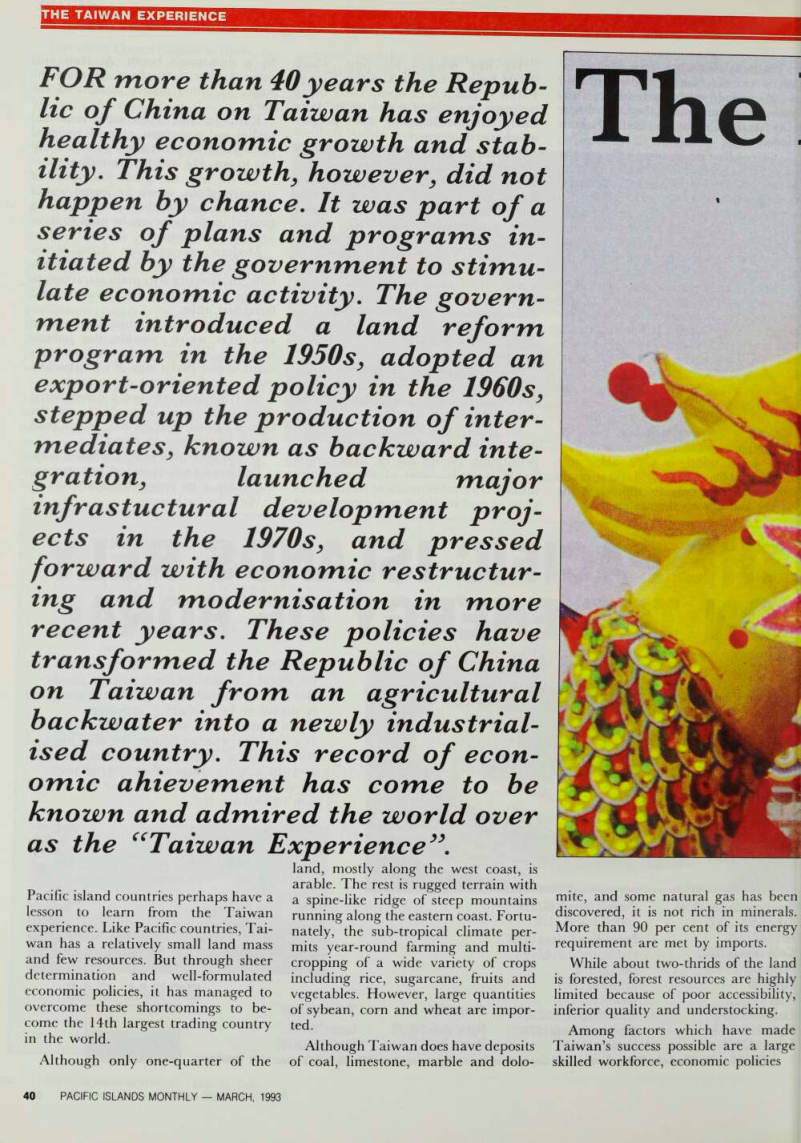
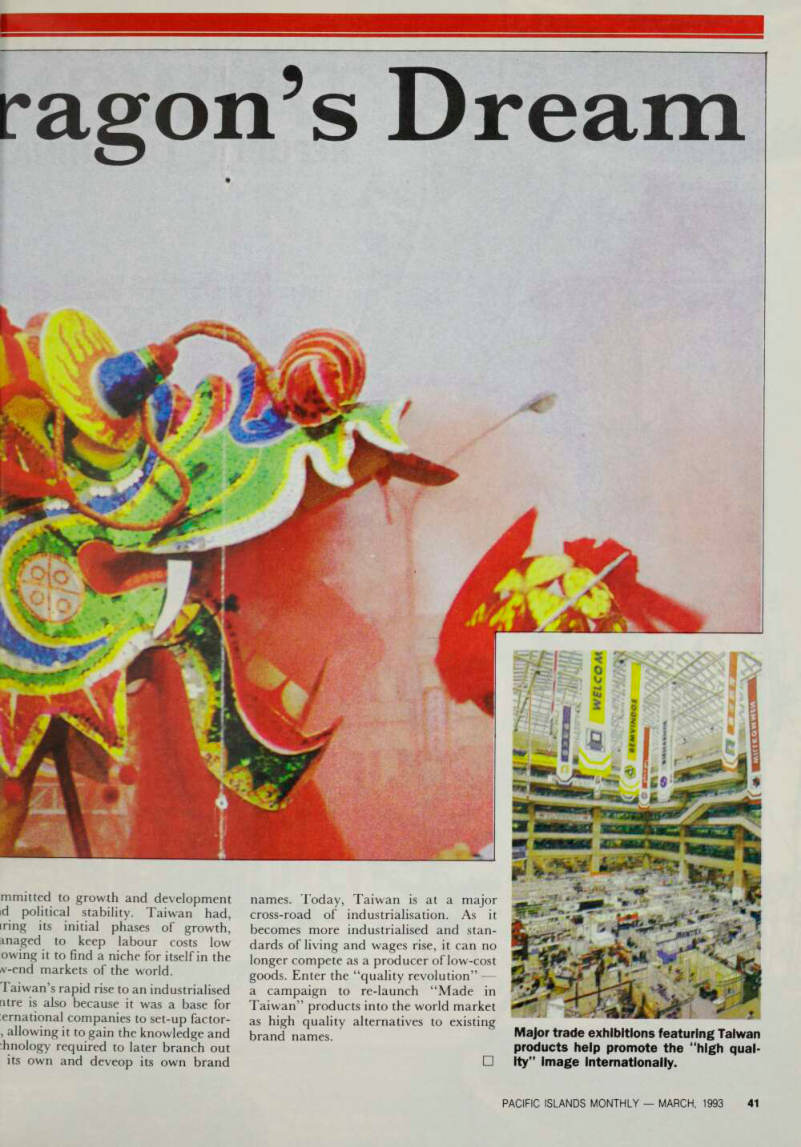
The Taiwan Experience
FOR more than 40years the lie of China on Taiwan has enjoyed healthy economic growth and stab ility. This growth, however, did not happen by chance. It was part of a series of plans and programs in itiated by the government to stimu late economic activity. The govern ment introduced a land reform program in the 19505, adopted an export-oriented policy in the 19605, stepped up the production of inter mediates, known as backward inte gration, launched major
infrastuctural development proj
ects in the 19705, and pressed forward with economic restructur ing and modernisation in more recent years. These policies have transformed the Republic of China on Taiwan from an agricultural backwater into a newly industrial ised country. This record of econ omic ahievement has come to be known and admired the world over as the “Taiwan Exp
Pacific island countries perhaps have a lesson to learn from the Taiwan experience. Like Pacific countries, Tai wan has a relatively small land mass and few resources. But through sheer determination and well-formulated economic policies, it has managed to overcome these shortcomings to be come the 14th largest trading country in the world.
Although only one-quarter of the
land, mostly along the west coast, is arable. The rest is rugged terrain with a spine-like ridge of steep mountains running along the eastern coast. Fortu nately, the sub-tropical climate per mits year-round farming and multi cropping of a wide variety of crops including rice, sugarcane, fruits and
vegetables. However, large quantities
of sybean, corn and wheat are impor ted.
Although Taiwan does have deposits of coal, limestone, marble and dolo
mite, and some natural gas has been discovered, it is not rich in minerals.
More than 90 per cent of its energy
requirement are met by imports.
While about two-thrids of the land is forested, forest resources are highly limited because of poor accessibility,
inferior quality and understocking.
Among factors which have made Taiwan’s success possible are a large skilled workforce, economic policies
mmitted to growth and development d political stability. Taiwan had, iring its initial phases of growth, anaged to keep labour costs low owing it to find a niche for itself in the v-en markets of the world.
Taiwan’s rapid rise to an industrialised ntre is also because it was a base for ernational companies to set-up factor- , allowing it to gain the knowledge and :hnology required to later branch out its own and deveop its own brand
names. Today, Taiwan is at a major cross-road of industrialisation. As it becomes more industrialised and stan dards of living and wages rise, it can no longer compete as a producer of low-cost goods. Enter the “quality revolution” a campaign to re-launch “Made in Taiwan” products into the world market
as high quality alternatives to existing
brand names.
Major trade exhibitions featuring Taiwan products help promote the “high qual ity” image internationally.
Advertisements & other items, p. 42 (1 item)
T/Hw/1N
DOING BUSINESS Will
REPUBLIC OF CHINA
FOR MORE DETAILS CONTACT
TRADE MISSION OF REPUBLIC OF CHINA
6th Floor Air Pacific House Suva, Fiji.
Telephone: (679) 315922. 315476 Fax: (679) 301890' * Mi rm m r* *** waa v * Jl .. . * *• * s‘* V \ Ir*^ i* * I 'I Mr N T ■> % M r v ii /
Employment



The Taiwan Experience
The economic
miracle
IN the four decades from 1952 onward, the economy grew at an average innual rate of 8.8 per cent. Less than US$lOO at the close of World War 11,
3er capita gross national product
'GNP) in Taiwan by 1992 had risen to
Employment
trends
UT the end of June 1992, employment ate in Taiwan was 98.45 per cent, down ►y 0.17 per cent from the 98.62 per cent f March 1992.
In recent years the government has stablished service centres all over Tai wan to adjust man-power supply and emand. According to their figures, pplicants totalled 30,429 and job penings numbered 119,394 in the
cond quarter of 1992. Demand for orkers was almost four times greater an job-seekers.
US$lO,OOO. The economic progress during this period has been nothing short of remarkable.
Taiwan has a land area of only 36,000 square kilometres. It has very r . i 1 lew natural resources.
The major resource that Taiwan does have is manpower. At the end of 1991, population stood at 20.6 million, a density of 571 people per square kilometre making Taiwan one of the
most densely populated areas in the world. To develop the potential of Taiwan’s human resources, the gov
ernment has given special emphasis to
education. Education for the first to the ninth is now universal, and educa . , , tional and training programs are aimed at meeting economic needs, The first four year plan in 1953 sparked the economic growth that Taiwan has sustained, Gross national product (GNP) in
real terms grew at an average annual rate of 8.2 per cent during the 19505, 9.1 per cent in the 60s, and 10.2 per cent in the 70s. Economic growth slowed at the start of the 80s, as the world experienced a recession. In the 80s, however, Taiwan’s economy ad vanced at an annual average rate 0f8.2 per cent. In 1991 GNP grew to reach US$lBO.3 billion.
Annual per capita GNP grew 4.7 per cent in the 50s, 6.2 per cent in the 60s, 8.1 per cent in the 70s and 6.6 per cent in the 80s. In 1991 it rose by 6.2 per cent and stood at US$BBl5. By the end of 1992 it had exceeded US$lO,OOO.
How was all this made possible?
A land reform program was intro duced in the early 1950 s to stimulate farm production and exports of agri cultural products. The land reform also promoted social justice and paved the way for industrialisation. In 1960, a Statute for the Encouragement of Investment was enacted to promote
saving, capital formation, industrial
development and export expansion. In 1966, Taiwan’s first export processing
zone, with the combined features of an industrial park and a free trade zone, was opened to introduce foreign direct investment, to promote exports and to create employment opportunities.
These measures helped Taiwan overcome its economic disadvantages.
They also provided a foundation for rapid and sustained economic growth.
The strategies adopted by the gov ernment to promote economic devel opment and stability were guided by
six key policies :
• Attaching equal emphasis to economic growth and economic stab ility; • Promoting the growth of agricul ture and industry;
• Developing light industry first
and then heavy industry; • Moving from import substitution to export expansion; • Expanding the infrastructure to meet development needs; • Narrowing the income gap be tween the affluent and less affluent.
These policies were implemented in four stages. The first stage, from around 1945 to 1952, saw economic
A high priority: high-tech industries and research and development initiatives
ehabilitation and stabilisation as najor concerns. Measures included a nonetary reform program and land eform.
During the second stage, from 1953
d 1960, an import-substitution policy
ras adopted to save foreign exchange
nd channel limited resources to areas f production with a proven domestic larket. The 1950 s also saw the itroduction of a series of four-year
conomic development plans and
>reign exchange, economic and fiscal Torms. The New Taiwanese dollar
as devalued against foreign
arrencies, and a unitary exchange
ite system was adopted.
In the third stage from 1961 to 1972, ic government shifted its emphasis to
i export-expansion policy. During
lis period real GNP grew 10.2 per ;nt a year, consumer prices rose only 3 per cent resulting in price
ability and rapid economic growth.
From 1973 onward, the economy ced two oil crises, high inflation, and rise in protectionism abroad. To stain economic growth the govern ent embarked upon a restructuring id modernisation of the economy, bis saw a growth in high-tech and
value-added industries as electrical and non-electrical machinery, electronics and information. In 1973 an Industrial Technology and Research Institute was set up, in 1980 the Science-based Industrial Park, a newly created mini-town, was opened to
attract investment in high-tech indus tries. In 1990 the Statute for Industrial Upgrading was enacted offering tax credits for research and development, automation, pollution control and other activities that promote produc tivity and restructuring.
Taiwan stock market
Advertisements & other items, pp. 43-45 (1 item)
Do your customers deserve the best?
TUN-
SAINSBURV
mCK
BM. SKiriMh
in hn
k* lO\
EJakecJ
Whih
% v s.
SKJFh
water No matter how you stack it, PAFCO canned tuna is the best you can buy Pacific Fishing Company Limited packs tuna for the highbst quality markets in the world. PAFCO tuna is recognised as the top quality product in those markets.
Solid chunk and flake tdna is packed in oil, broth, brine or water according to customer requirements.
Watch the leaders in the high value markets and ask the question Do your customers deserve the best?
Quality Tuna Products from FIJI
PACIFIC FISHING CO. LTD
MANUFACTURERS AND SUPPLIERS
SUVA Phone Suva P.O. Box 1371 313354 or 311852 Suva, Fiji TELEX FJ 2349
FAX SUVA 301904
OF CANNED TUNA AND FISH MEAL
LEVUKA Phone Levuka P.O. Box 41 440005 or 440055 Levuka. Fiji TELEX FJ 7252
FAX 440400 114856v2
UNIVERSAL MUFFLERS MFG. LTD.
'W'- I I S
Manufacturers, Importers, Exporters, Retailers & Fitters
for Mufflers, Exhaust Pipes, Flexible Pipes, Chrome piece, Gaskets, Clamps, 0-Rings & etc.
All inquiries are welcome.
G.P.O. Box 13937, Suva, Fiji. Lot 67. Nasinu Rd. Kalabu Sub-Industrial Area, Valelevu, Suva, Rep. of Fiji.
Ph. (679) 391550,(679) 381233 (A/H)
FORMOSA CHEMICAL INDUSTRIES (SR) LTD
P.0.80X 4045 LAUTOKA, FIJI. PHONE (679) 640445 FAX (679) 660445
Manufacturers of:- FRENCH FRAGRANCE PERFUMES
• ROOM/AIR/CAR FRESHNERS WITH REFILS • HAIR GELS • NAIL POLISHES
LIPSTICKS •SHAMPOOS/CONDITIONERS
B j * ■ AVAILABLE FROM PHARMACIES AND LEADING STORES THROUGHOUT FIJI.
We also manufacture
STARTOX INSECT KILLERS & DETERGENTS
BUY 1 BOTTLE STARTOX INSECT KILLER & RECEIVE
1 STARTOX SPRAY CAN FREE
0,
: EXPORT ENQUIRIES WELCOME
* DISTRIBUTORS REQUIRED FOR MORE DETAILS PLEASE PHONE (679) 660445 OR FAX (679) 660445 LAUTOKA, FIJI.
Foreign Trade
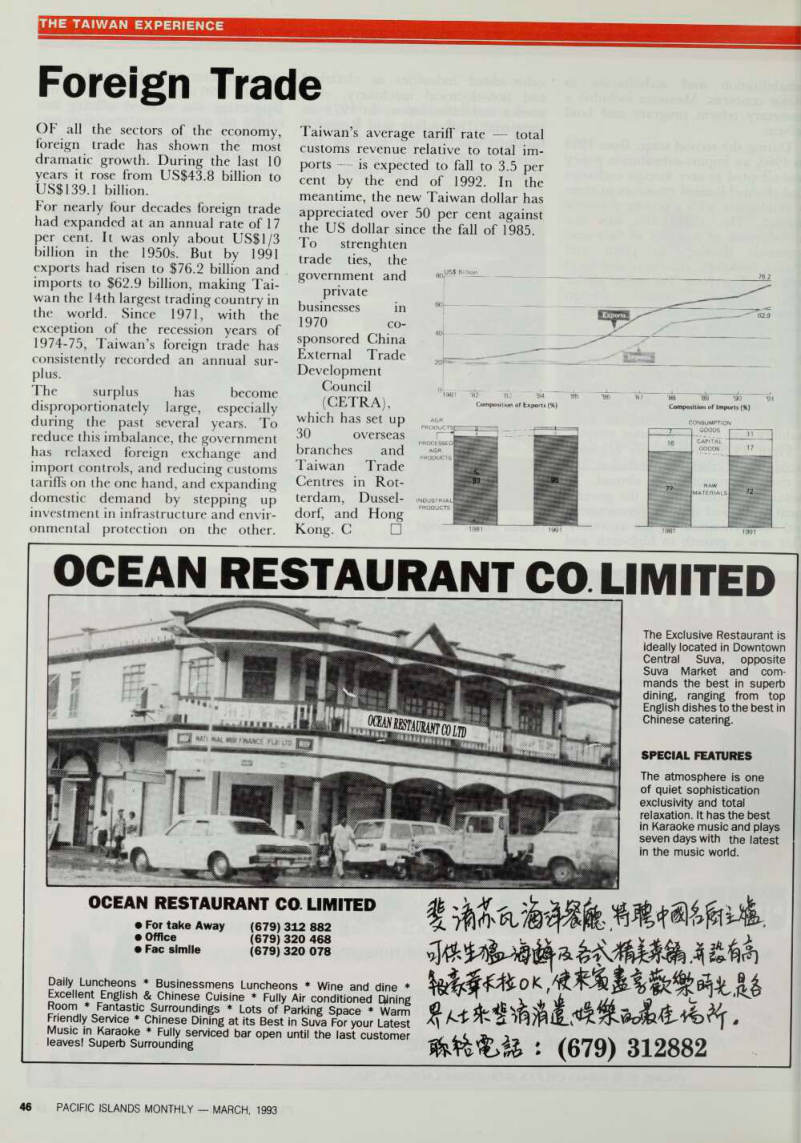
OF all the sectors of the economy, foreign trade has shown the most dramatic growth. During the last 10 years it rose from US$43.B billion to U 55139.1 billion.
For nearly four decades foreign trade had expanded at an annual rate of 17 per cent. It was only about USsl/3 billion in the 19505. But by 1991 exports had risen to $76.2 billion and imports to $62.9 billion, making Tai wan the 14th largest trading country in the world. Since 1971, with the exception of the recession years of 1974-75, Taiwan’s foreign trade has consistently recorded an annual sur
plus.
The surplus has become
disproportionately large, especially
during the past several years. To reduce this imbalance, the government has relaxed foreign exchange and import controls, and reducing customs tariffs on the one hand, and expanding domestic demand by stepping up investment in infrastructure and envir onmental protection on the other.
Taiwan’s average tariff rate total customs revenue relative to total im ports is expected to fall to 3.5 per cent by the end of 1992. In the meantime, the new Taiwan dollar has appreciated over 50 per cent against the US dollar since the fall of 1985.
To strenghten trade ties, the government and private businesses in 1970 co sponsored China External Trade
Development
Council
(Cetra),
which has set up 30 overseas branches and Taiwan Trade Centres in Rot terdam, Dussel dorf, and Hong Kong. C □
Advertisements & other items, p. 46 (1 item)
Ocean Restaurant Co Limited
LTD
r The Exclusive Restaurant is ideally located in Downtown Central Suva, opposite Suva Market and commands the best in superb dining, ranging from top English dishes to the best in Chinese catering.
SPECIAL FEATURES
The atmosphere is one of quiet sophistication exclusivity and total relaxation. It has the best in Karaoke music and plays seven days with the latest in the music world.
OCEAN RESTAURANT CO. LIMITED
• For take Away (679) 312 882 • Office (679) 320 468 • Fac simile (679) 320 078 Daily Luncheons * Businessmens Luncheons * Wine and dine * Excellent English & Chinese Cuisine * Fully Air conditioned Dining Room * Fantastic Surroundings * Lots of Parking Space ♦ Warm Friendly Service * Chinese Dining at its Best in Suva For your Latest Music in Karaoke * Fully serviced bar open until the last customer leaves! Superb Surrounding : (679) 312882
Moving into the future


TAIWAN’S emphasis on economic growth has also, however, meant attention has been diverted from some serious economic and social problems.
These include traffic congestion, envir onmental pollution, a rising crime rate, lack of cultural and recreational facili ties, and excessive preoccupation with financial speculation. In addition, a tightening supply of low-skilled labour and a declining work ethic are hamper
ing business activity and slowing econ
omic growth.
As a result, the six-year national development plan was formulated to iddress these problems. It covers the oeriod from 1991 to 1996.
Policy goals of the plan are
• To Raise the National Income
hrough continuous economic develop
nent and creation of job opportunities md to enter into the ranks of high ncome countries. The plan aims to >oost the nation’s per capita gross
lational product (GNP) to
JS$ 14,000.
Mass Rapid Transportation system In Taipei: under construction to ease the city’s traffic congestion
• To Strengthen Infrastructral Development This includes proper planning of manpower, energy, water, land and other resources essential to industrial development; augmenting transportation, shipping and telecom munications facilities; and building Taiwan into a financial centre, trans portation hub and technological stronghold for the western Pacific. • To Pursue Balanced Regional Development narrowing gaps in regional development to promote a regional balance; strengthening infrastructural, medical, cultural and educational facilities in isolated areas; building convenient transportation networks to shorten the distance be tween regions. • To Improve the Quality of Life involves planning the development of living perimeters, augmenting hous ing, cultural, educational, sports, medical, shopping and transportation facilities; strengthening social security and establishing social welfare; and, boosting Taiwan into the ranks of developed nations and creating a society of affluence and civility. □
Improving the quality of life: one of the goals of the national development plan
Advertisements & other items, pp. 47-50 (1 item)
Manufacturers Of Quality Plasticware
ALL ENQUIRIES TO:
PA BLO
* BLOW MOULDING
750 ML 2.2SLITRES,
4.SLITRES.
* PLANTER POTS
* MANUFACTURERS OF
KITCHENWARE
* CUSTOM-INJECTION
MOULDING UP
TO 38 OZS
MAKOI INDUSTRIAL
GPO BOX 12353 SUVA FIJI ISLANDS
TELEPHONE (679) 391750 FAX (679) 340188
138
MANUFACTURERS OF BAGS FOR SCHOOL,
SPORTS, TRAVEL QUALITY, WATERPROOF
BAGS AT REASONABLE PRICES,
LATEST FASHION!
137 201 51
FOR FURTHER ENQUIRIES CALL:
#136 E>
OUNCAN
DUNCAN INDUSTRIAL CO., CTD.
4. ACKLAND ST. VATUWAQA IND.
SUB-DIVISION
P. O BOX : 5083 RAIWAQA, FIJI.
PHONE : (679) 384608
FAX: (679) 387049
w ■ I hat's the first rule of business success ?
Knowing where to start. Fortunately, there's a place that will point you in the right direction, A place where you'll find trade information. business contacts, product displays and international trade shows. The Taipei World Trade Center. Because business isn't a game of chance, it's a game of strategy. See Us First.
MtPEI U/ORLD CMINM EXTERNAL TR4DE
CENTER Operated by DEmoFWENT council 5 HsinyiRd . Sec 5, Taipei, Taiwan. R.O.C. Tel: (886-2)725-1111 Fax. (886-2)725-1314
8P I .m '■m * t m ». •i •;
Budget
m i s® er> If you’re about to shift homes or offices then why not do it on a Budget.
We’ll offer a rate that will really move you. Phone for details. m
Budget
THE SMART MONEY IS ON BUDGET
COUNTRIES
FIJI
NEW ZEALAND
AUSTRALIA
PNG
SOLOMON ISLANDS
WESTERN SAMOA
COOK ISLANDS
PHONE
(679) 315899 (649) 3096739 (613) 8668455 (675) 254111 (677) 23205 (685) 20561 (682) 20888
FAX
(679) 302450 (649) 3094180 (613) 8668134 (675) 257853 (677) 23593 (685) 22284 (682) 21275
COUNTRIES
GUAM
TONGA
VANUATU
NEW CALEDONIA
TAHITI
NIUE ISLAND:
PHONE
(671) 6465494 (676) 23510 (678) 23170 (687) 262009 (689) 438079 (683) 4504
FAX
(671) 6465493 (676) 24059 (678) 24693 (687) 261662 (689) 433926 (683) 4180
Government funds dry up

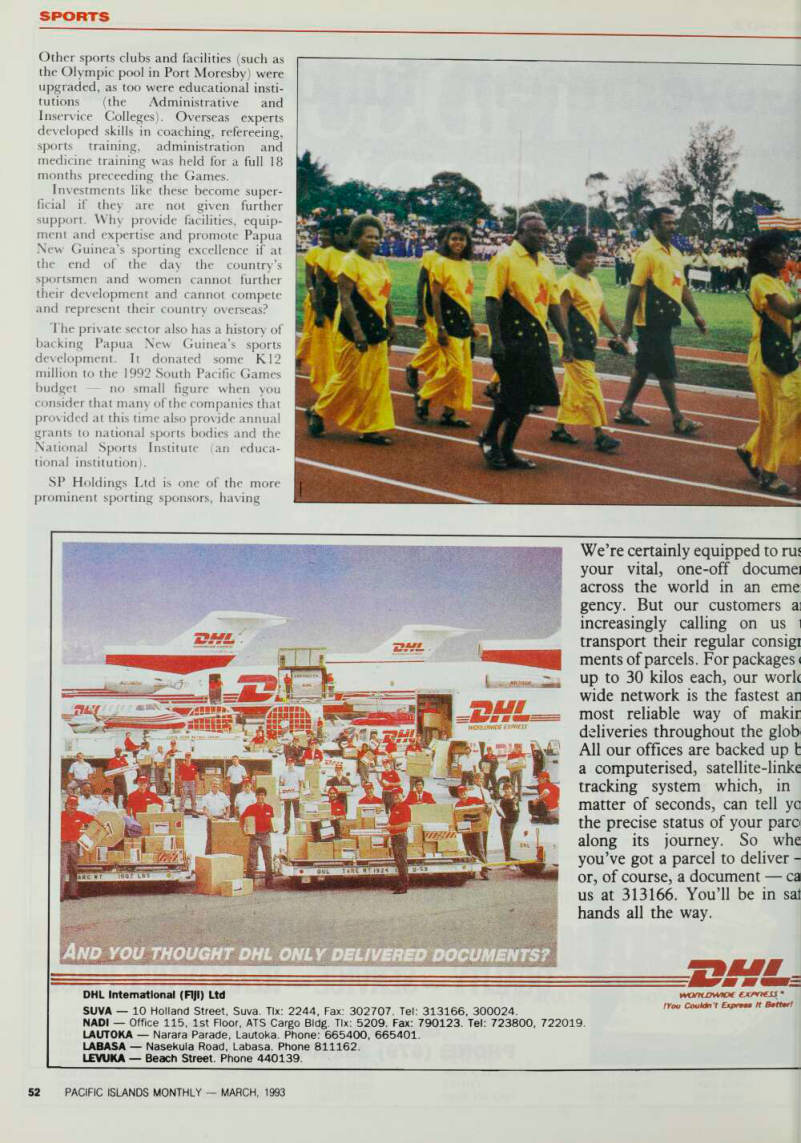
Sports
By Jann Iorns
Papua New Guinea’s future as a regional leader in sports is under jeopardy as the government excludes grants from its budget
PAPUA New Guinea’s sporting com munity is shell-shocked in the wake of the
Wingti government’s 1993 National
Budget and its preclusion of an annual allocation to the National Sports Pro gram. The PNG Sports Federation says it will no longer be able to send representatives to international compe titions or to maintain the existing level of
onshore competition.
Papua New Guinea is the South Pacific’s number one sporting nation. It won more medals than any other partici pating nation at the South Pacific Games n 1991 (44 golds, 28 silver and 27 bronze). The PNG Sports Federation 'ears the country will lose its supremacy.
Certainly, without representation at the Vlini South Pacific Games in Vanuatu ater this year, or the South Pacific james in Tahiti in 1995, rival nations of Vew Caledonia, Tahiti or Fiji stand to :laim Papua New Guinea’s stronghold.
The PNG Sports Federation says it ilso had plans to send a representative earn to the 1994 Commonwealth Games md the 1996 Olympic Games. But what )f these plans now?
John Dawanicura, head of the PNG >ports Federation, says, “It’s only the econd year of a four-year plan. If the government bows out now, we under nine all that we’ve done to promote ports people and to establish Papua New
Guinea as a country of sporting excel lence.”
“Giving our people overseas exposure is vital,” Dawanicura says. “We have to send our top sportsmen and women to international competitions, and that requires a lot of financial support. In the past, government has understood and helped to provide some of this support.”
Even if the Federation finds alterna tive support (say from the corporate sector) so that the country’s sport speople can, in 1993, compete overseas, there’s still the pressing issue of having to meet the Federation’s running costs and the expense involved in maintaining Papua New Guinea’s seat on the international sporting committees’ (the International Olympic Committee, the Common wealth Games Foundation and the South Pacific Games Council) expenses pre viously met by government.
“The Federation has always attended the annual general assemblies of the international committees,” Dawanicura says, “plus attended other meetings and seminars. We’ve always had a commit
ment to making sure our people get to the major international events. Now, with the absence of national government support, we’re not so sure we’ll be able to.”
From all accounts, the Wingti govern ment seems to have slipped the carpet out from under the Federation’s feet. The former Pangu government provided an annual budget of between K 50,000 to K 100,000 to the Federation (for running costs and for distribution as discretionary grants to individuals and clubs, and other special grants such as the K 100,000 grant to the national rugby league team for its 1992 South Pacific tour). The former government also pumped some K 34.4 million into the 1991 South Pacific Games.
The significance of this investment is simply that for the first time ever Papua New Guinea had world class sports facilities and equipment, and the advice and encouragement of overseas sporting
specialists.
Two major stadiums the Sir John Guise stadium in Port Moresby and the Sir Ignatius Kilage Stadium in Lae were built especially for the Games.
Other sports clubs and facilities (such as the Olympic pool in Port Moresby) were upgraded, as too were educational insti tutions (the Administrative and Inservice Colleges). Overseas experts developed skills in coaching, refereeing, sports training, administration and medicine training was held for a full 18 months preceeding the Games.
Investments like these become super ficial if they are not given further support. Why provide facilities, equip ment and expertise and promote Papua New Guinea’s sporting excellence if at the end of the day the country’s sportsmen and women cannot further their development and cannot compete and represent their country overseas?
The private sector also has a history of backing Papua New Guinea’s sports development. It donated some Kl 2 million to the 1992 South Pacific Games budget no small figure when you consider that many of the companies that provided at this time also provide annual grants to national sports bodies and the National Sports Institute (an educa tional institution).
SP Holdings Ltd is one of the more prominent sporting sponsors, having
>vided annual grants to sports associ 3ns for many years and a separate K 2 llion contribution to the 1991 South :ific Games. In 1993 it will also ugurate the sportsmen-of-the-year ard, costing K 50,000 annually. The GBC (Papua New Guinea Banking rporation) is another strong sup ter, donating at least K 35,000 each r to the National Sports Institute, fhe International Olympic Commit is another organisation demonstra y consistent support for sports devel nent in Papua New Guinea. It itributes between U 5545,000 to 1,000 annually, and has done so since 12 through the I.O.C’s Solidarity •gram. The Solidarity Program aims levelop competitors in Olympic sports
well as training specialists in related
fiplines of administration and medi s. In 1992, the program assisted the G Sports Federation with clinics in
letics, boxing, lawn tennis, shooting
I judo. athletics is likely to one of the hardest by the decision. Papua New Guinea excelled at competitive athletics, rung gold at the South Pacific Games 991, 1987, 1979, 1971 and 1969, the ii South Pacific Games in 1989 and 5, and the Oceania Athletics Cham nships in 1990. Sama Sasama, the :ional Coaching Director for Ath :s, reports on the likely future of letics.
Our athletes need overseas exposure. n that the Federation has no finance
to subsidise athletes’ attendance at inter national competitions, the PNG Athletics Union will have to rely solely on private sector and community sponsorship.”
“The Union is going to have to do a lot more fundraising and individuals will be more responsible for raising finance than they’ve ever needed to be before,”
Sasama says. “If they can’t find the money, they won’t go.”
Team sports like rugby league and basketball will also suffer from the absence of government support for the
National Sports Program. Thirty-five
different sporting bodies are affiliated to the Federation and they all require finance to hold inter-club and inter
provincial championships. Securing pri
vate sector support, as an alternative to the historic Federation grant, may prove difficult for some bodies, especially those not located in provinces with major industries.
Martin Adamson, President of the PNG Rugby League Association, pre dicts on the future of rugby league as a national sport. “We’ll be pushing to maintain the standard we’ve achieved.
This year, unlike last year, we won’t be able to send the national team (Kumuls) overseas. We also won’t be able to
develop the junior players because we
won’t have the finance for training clinics and junior league championships. Junior development is important,” Adamson says. “We have to promote new players up through the grades. We’re already noticing a lack of new talent. If we don’t watch out, rugby league will disappear.”
The PNG Sports Commission, another body responsible for sports development, is also short-changed by the Wingti government’s decision. The commission is a new statutory authority, established in February 1992, with the express responsibility of maintaining the two big stadiums in Port Moresby and Lae. It also has the role of developing sports at the community level, on a nationwide basis. A further task is to oversee the operation of the National Sports Insti tute where most of the training clinics, secondary school phys-ed teacher training and other educational programs take place.
For 1993, some money is allocated to the PNG Sports Commission K 900,000 for stadium maintenance, KBOO,OOO for the commission’s internal running costs and K 822,000 for con tinued operation of the National Sports Institute. But there’s no allocation for sports development; no way of ensuring that the sporting facilities and insti tutions as established don’t turn into
white elephants.
John Kambuou, the commission’s Executive Director, says there’s dire need to develop sports in the rural communi ties. Equipment and training are sorely
needed. Jan Waddy, the commission’s Director of Sports, exemplifies this - “Some schools have only one ball for say 30 or 40 students, and maybe a total of three or four balls in total. That’s it for their sports equipment.”
The tragedy is that sport and rec reation are pivotal to Papua New Guinea culture. For centuries rural villagers engaged in traditional ceremony and dance, as well as hunting, spear and dart throwing. Coastal communities were active in fishing and canoeing. Most of these activities continue today, in much the same form as they always have.
Combined with the traditional forms of recreation is the growing emergence of urban gymnasiums and clubs, offering a range of racquet, team and_water sports.
It is natural to expect the people of Papua New Guinea to want to partici pate in these new modern sports.
But the picture is bleak. Without adequate support there will be no sports clubs. The national identity may disap pear as a result. Sport is seen as an important mechanism in uniting Papua New Guinea’s 700 different cultural/ lingual groups. Seven thousand of the country’s 3.53 million people joined together for the 1991 South Pacific Games, people representing communities from all over the country. For the two weeks of competition, crime miraculously came to a standstill.
Kambuou and Dawanincura reiterate the role of sport in bringing people together, in instilling a sense of national pride and, to some extend, addressing the country’s law and order problem.
“Also, we have a lot of natural flair and talent in Papua New Guinea,”
Kambuou says. “A lot of that talent isn’t seen at national championships, where selection to international competitions takes place. Some of our most promising sportsmen and women aren’t getting beyond the district and provincial com petitions, either because their club can’t afford to affiliate with the national association or because the individuals themselves can’t afford to travel to participate in the selection trials.”
There are many areas that need financial support if Papua New Guinea’s sporting development is to continue.
Both the PNG Sports Commission and the PNG Sports Federation have their hearts set on an era of development. The Federation is likely to move into some hard and fast campaigning among the private sector (seeing as the international competitions are drawing close), and it will also likely lobby Cabinet. Let’s hope these efforts prove successful. There’s still time. The Wingti government may even retract its earlier decision and help to mount a first-class challenge to secure the country’s title as the number one sport ing nation in the South Pacific. □
Advertisements & other items, pp. 51-52 (1 item)
\ Kanvan Papers Limited
/MANUFACTURERS OF ENVELOPES/
FIJI’S FIRST - FIJI’S BEST
COMPUTER FORMS PRINTERS
QUALITY - SERVICE - REASONABLE PRICE
GPO BOX 1430, SUVA, FIJI
PHONE: (679) 381300 FAX: (679) 387383
mhbhhhhhhhhhhhhhhhhhhh -r
■BHL
I E_ nut mi =^w=== iff r//' ,1 m IdMkfi We’re certainly equipped to rus your vital, one-off documei across the world in an eme: gency. But our customers ai increasingly calling on us 1 transport their regular consigr ments of parcels. For packages \ up to 30 kilos each, our work wide network is the fastest ae most reliable way of makir deliveries throughout the glob- All our offices are backed up t a computerised, satellite-linke tracking system which, in matter of seconds, can tell yc the precise status of your pam along its journey. So whe you’ve got a parcel to deliver or, of course, a document ca us at 313166. You’ll be in sal hands all the way.
DHL International (FIJI) Ltd woncowtc* expness • SUVA —lO Holland Street, Suva. Tlx: 2244, Fax: 302707. Tel: 313166, 300024. rYou Cou,dn ' t Expn n *** NADI Office 115, Ist Floor. ATS Cargo Bldg. Tlx; 5209. Fax: 790123. Tel; 723800, 722019.
LAUTOKA Narara Parade, Lautoka. Phone: 665400, 665401.
LABASA Nasekula Road, Labasa. Phone 811162.
LEVUKA Beach Street. Phone 440139.
Land of Contrast and
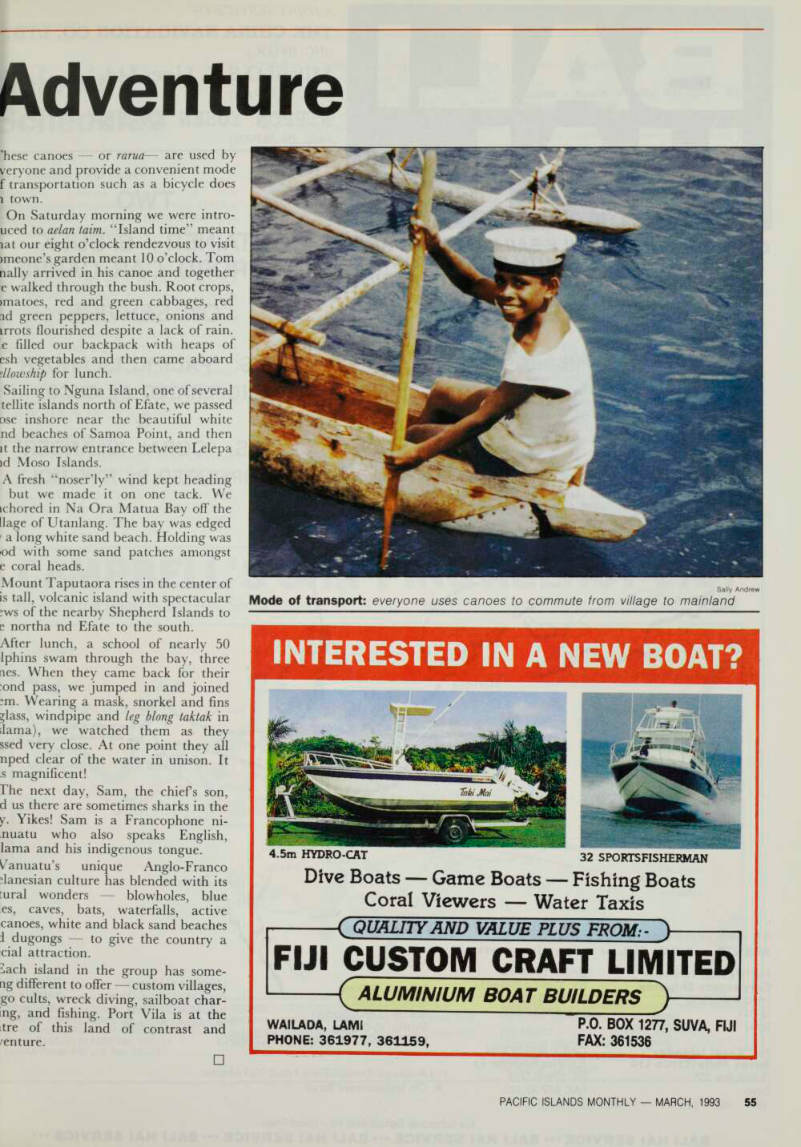
Yachting
By Sally Andrew
Vanuatu’s unique culture blends with its natural wonders to give a special attraction
LIGHT winds and flat seas had given us a smooth ride from Fiji 500 miles west to Vanuatu. By late afternoon on the fourth day out, a tell-tale smudge of gray appeared on the distant horizon. Twenty miles ahead lay Efate Island. Port Vila, Vanuatu’s southern port of entry and national capital, was still a good 40 miles away too far to make it into port before sundown so we reduced sail and planned for a dawn arrival.
The wind completely disappeared before sunrise, so we fired up the Yanmar diesel and motored past Pango Point. We anchored near the yellow quarantine buoy in Vila Bay. Within the hour, two gentlemen from customs and agriculture had arrived and cleared us. Welcome to Vanuatu!
Port Vila is one of the South Pacific’s most picturesque towns with many boars
moored Mediterranean-style along the
waterfront. The day had dawned warm and blue. The water inside the harbour was remarkably clear and was dotted with a few wind-surfers and para-sailors.
We motored past the Vanuatu Cruis ing Club and picked up a mooring off the beach at Iririki Island. Fellowship se cured, we rowed ashore to pick up mail and meet friends Erja and Glenn off US yacht Aku Ankka at the Waterfront Restaurant.
The afternoon was spent walking around Vila eating marvellous ice cream, buying cheap baguettes and beef, and poking around shops. The museum/ cultural center was filled with a wealth of artifacts and ethnological material.
North of town, just beyond the village of
Mele Maat, we followed a trail to a fantastic waterfall with freshwater pools and cascades in a jungle-like setting. It was heavenly.
Vila Harbour was packed with boats.
A French yacht Full was moored nearby.
We had met her single-handed skipper, Jean Baptiste, in Fiji’s Mamanuca group.
Limerick Lady, out of Australia was making her last stop before completing a seven-year and 60,000 mile circumnavi gation. On board were Lorenz, Janis, Yolly (age seven) and baby Fabienne, born in Suva the previous year.
Other sightings included Insatiable from California, Gwalarn from Alaska, Whimbrel from Colorado, Sulieka from England, Free Spirit from Canada, and more than 20 other yachts from around the world.
Market days in Port Vila are Wednes day, Friday and Saturday. Families and their produce arrive the night before and often you can make purchases as they set up their stalls. The following morning the market area comes alive with colour.
Fruits, vegetables, flowers, seashells, carvings, bracelets, baskets and t-shirts are sold by village women dressed in bright (and often huge) Mother Hubbard dresses.
We filled our bags with pumpkins, pomeloes, Chinese cabbage, green pep pers, tomatoes and coconuts. Provisioned with plenty of food, we left Port Vila.
Devil’s Point, 10 miles outside tin harbour, has a nasty reputation fo rough seas where wind and current clash We must have timed it right. Condition were benign and we anchored a Tukutuku. During the night the wind switched, and by early morning we wen “rock and rolling” at anchor as a larg< westerly swell rolled straight into th< bay. We weighed anchor at daybreak The sky was clear as we sailed past “Hat’ (Eretoka) Island and into Havannal Harbour via the Hilliard Channel.
With the winds behind us, we crossec tacks with a woman paddling fron Lelepa Island to the mainland. Having only seen men and boys aboard outrig gers in the past, I cheered her on with £ smile and a wave, which she returned Deep inside the harbour, we tucked intc a small bay on the south side of Most Island.
The next day we joined two othei hachts, Che’gar from New Zealand and Papa Kilo from Hull, Great Britain whc were anchored on the other side of the harbour. We had many visitors that afternoon as canoe after canoe stopped by to say hello. Men, women, children, even a dog who stretched across an outrigger thwart snoozing.
The villagers from Moso Island grow vegetables on the mainland and paddle back and forth cross the harbour every day commuting to and from their village.
"hese canoes —or rarua — are used by veryone and provide a convenient mode f transportation such as a bicycle does i town.
On Saturday morning we were intro uced to aelan taim. “Island time” meant lat our eight o’clock rendezvous to visit >meone’s garden meant 10 o’clock. Tom nally arrived in his canoe and together e walked through the bush. Root crops, unatoes, red and green cabbages, red id green peppers, lettuce, onions and irrots flourished despite a lack of rain, e filled our backpack with heaps of esh vegetables and then came aboard dlowship for lunch.
Sailing to Nguna Island, one of several tellite islands north of Efate, we passed dsc inshore near the beautiful white nd beaches of Samoa Point, and then it the narrow entrance between Lelepa id Moso Islands.
A fresh “noser’ly” wind kept heading but we made it on one tack. We ichored in Na Ora Matua Bay off the llage of Utanlang. The bay was edged r a long white sand beach. Holding was od with some sand patches amongst e coral heads.
Mount Taputaora rises in the center of is tall, volcanic island with spectacular of the nearby Shepherd Islands to e northa nd Efate to the south.
After lunch, a school of nearly 50 Iphins swam through the bay, three ics. When they came back for their :ond pass, we jumped in and joined mi. Wearing a mask, snorkel and fins ?lass, windpipe and leg blong taktak in llama), we watched them as they ssed very close. At one point they all nped clear of the water in unison. It
s magnificent!
Ehe next day, Sam, the chiefs son, d us there are sometimes sharks in the y. Yikes! Sam is a Francophone ni nuatu who also speaks English, lama and his indigenous tongue.
Vanuatu’s unique Anglo-Franco
danesian culture has blended with its tural wonders blowholes, blue es, caves, bats, waterfalls, active canoes, white and black sand beaches i dugongs to give the country a cial attraction. iach island in the group has some tig different to offer custom villages, go cults, wreck diving, sailboat char ing, and fishing. Port Vila is at the tre of this land of contrast and venture.
Sally Andrew Mode of transport: everyone uses canoes to commute from village to mainland
Advertisements & other items, pp. 54-56 (2 items)
Garth Evans Marine
ATTENTION YACHTIES
SHELL FUEUNG FACILITIES
Shell Fiji Ltd. is offering the best in name brand lubricants and quality fuel in: Savusavu, Levuka, Suva.
/m\ Shell Fiji Limited
3 Telephone 313933, Fax 302279
& hesf
GRB337
PO BOX 5094
PORT NELSON
PH (3) 5468330
FAX (3) 5468351
GARTH EVANS MARINE
PORT OF NELSON NEW ZEALAND
SHIP CONSTRUCTION AND DESIGN
SHIP REPAIRS TO PLEASURE AND COMMERCIAL VESSELS SLIPPING FACILITIES TO 2000 TONS AND UP TO 6 METRE DRAFT
SAND BLASTING AND PAINTING
DIESEL AND ENGINE REPAIRS
AGENCIES FOR NEW AND REBUILT ENGINES
MOBILE MARINE REPAIR TEAM BY ARRANGEMENT
NEW ZEALAND AND PACIFIC AREAS
Contact
G. EVANS
A/H (3) 5482409
INTERESTED IN A NEW BOAT?
Wr* fts /■ Tnki Mai '
4.5 m HYDRO-CAT
I
32 SPORTSFISHERMAN
Dive Boats Game Boats Fishing Boats Coral Viewers Water Taxis
( QUALITY AND VALUE PLUS PROMTS)
FIJI CUSTOM CRAFT LIMITED
( aluminium boat BUILDERS )
WAILADA, LAMI P.O. BOX 1277, SUVA, FIJI
PHONE: 361977, 361159, FAX: 361536
A JOINT SERVICE OF
THE CHINA NAVIGATION CO. LTD
(INC. IN U.K.)
Mitsui O.S.K. Lines Ltd.
(INC. IN JAPAN)
NIPPON YUSEN KAISHA
(INC. IN JAPAN)
SERVICE
TWO
OPERA TING A MONTHL Y SAILING FROM JAPAN
AND S.KOREA TO SOUTH PACIFIC PORTS
AS A MEMBER OF THE JAPAN SOUTH PACIFIC
FREIGHT CONFERENCE
CONTAINER / B/BULK
/RORO CAR CARRIER
ON SERVICE
Nagoya'
Busan \V / Kobe
M.S. "PACIFIC ISLANDER”
(OPERATED By CNCO)
M.S. "CORAL ISLANDER”
(OPERATED By NYK/MOL)
Papua New Guinea ' Tarawa £
Honiara \
\ Santo Vila % i Noumea v) LautokaVT*.
I c, Apia
Pago
v /Suva Pape! -"a Nukualofa Rarotonga For more information, please contact our AGENTS in SUVA, FIJI, or respective ports For "Pacific Islander"
Carpenters Shipping Private Mail Bag
G.P.O.
Suva
CABLE: CARPSHIP
TLX: 2199 CARPSHIP FJ
TEL; 679-312244
FAX: 679-301572
And calling at:
TARAWA (9 Days)
APIA (18 Days) NUKUA'LOFA (28days) SANTO (36 Days) New Zealand
LAUTOKA (13 Days)
PAGO PAGO (19 Days)
NOUMEA (31 Days)
* HONIARA (39 Days)
SUVA (14 Day*
PAPEETE (23 D
VILA (35 Days) For "Coral Islander": Burns Philp(SS)Co Ltd G.P.O. Box 355 Suva
CABLE: BURNSOUTH
TLX: 2168 BURNSHIP FJ
TEL: 679-311777
FAX; 679-301127
RAROTONGA (Via APIA or PAGO PAGO)
) Average Transit Time : On Inducement Basis From Yokohama For Schedule Details See Your Local Press BALI HAI SERVICE ••• BALI HAI SERVICE ••• BALI HAI SERVICE ••• BALI HAI SERVICE •••
Adventure
Shipping
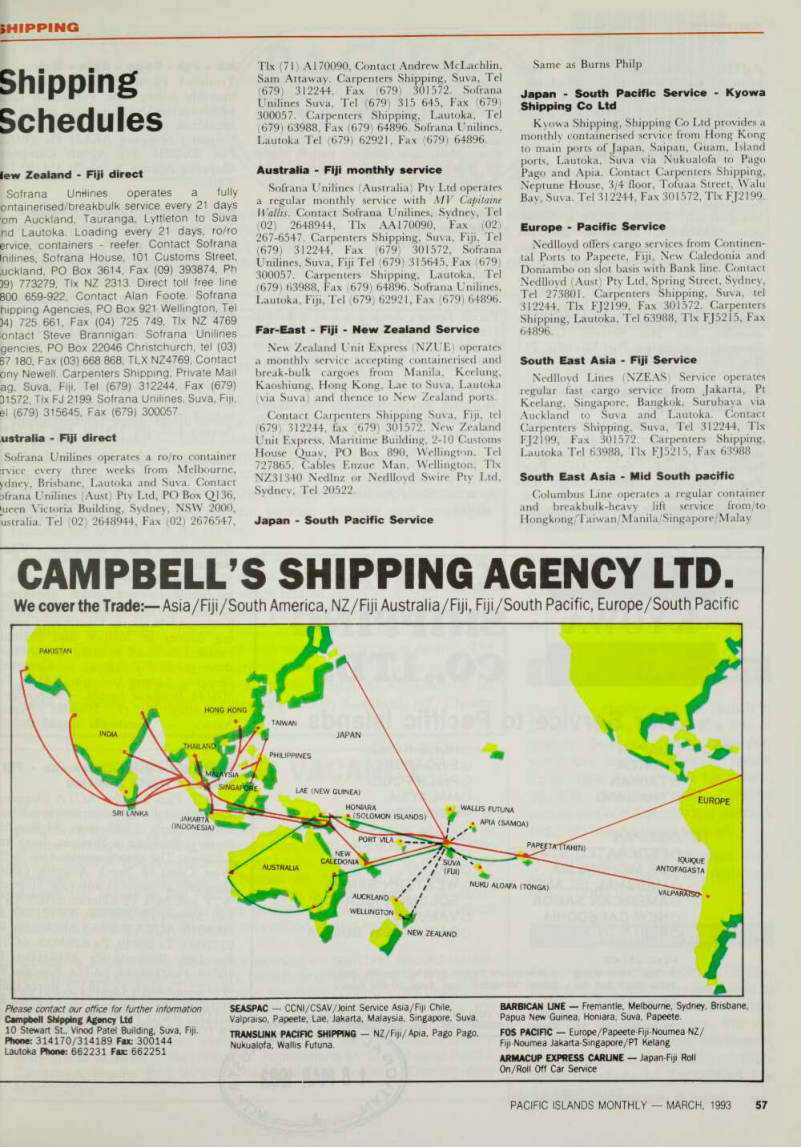
Schedules
lew Zealand - Fiji direct Sofrana Untlines operates a fully ontainerised/breakbulk service every 21 days om Auckland, Tauranga, Lyttleton to Suva nd Lautoka. Loading every 21 days, ro/ro ervice, containers - reefer. Contact Sofrana Inilines, Sofrana House, 101 Customs Street, ,uckland, PO Box 3614, Fax (09) 393874, Ph )9) 773279, Tlx NZ 2313. Direct toll free line 800 659-922, Contact Alan Foote. Sofrana hipping Agencies, PO Box 921 Wellington, Tel )4) 725 661, Fax (04) 725 749, Tlx NZ 4769 ;ontact Steve Brannigan. Sofrana Unilines gencies, PO Box 22046 Christchurch, tel (03) 57 180, Fax (03) 668 868, TLX NZ4769, Contact ony Newell. Carpenters Shipping, Private Mail ag. Suva, Fiji. Tel (679) 312244, Fax (679) D 1572, Tlx FJ 2199 Sofrana Unilines, Suva, Fiji, el (679) 315645, Fax (679) 300057. ustralia - Fiji direct Sofrana Unilines operates a ro/ro container :rvice every three weeks from Melbourne, ydney, Brisbane, Lautoka and Suva. Contact afrana Unilines (Aust) Pty Ltd, PO Box Q 136, •ueen Victoria Building, Sydney, NSW 2000, ustralia. Tel (02) 2648944, Fax (02) 2676547,
Tlx (71) A 170090, Contact Andrew McLachlin, Sam Attaway. Carpenters Shipping, Suva, Tel (679) 312244. Fax (679) 301572. Sofrana Unilines Suva, Tel (679) 315 645, Fax (679) 300057. Carpenters Shipping, Lautoka, Tel (679) 63988, Fax (679) 64896. Sofrana Unilines, Lautoka Tel (679) 62921, Fax (679) 64896.
Australia - Fiji monthly service Sofrana Unilines (Australia) Pty Ltd operates a regular monthly service with MV Capitaine Wallis. Contact Sofrana Unilines, Sydney, Tel (02) 2648944, Tlx AA170090, Fax (02) 267-6547. Carpenters Shipping, Suva, Fiji, Tel (679) 312244, Fax (679) 301572, Sofrana Unilines, Suva, Fiji Tel (679) 315645, Fax (679) 300057. Carpenters Shipping, Lautoka. Tel (679) 63988, Fax ( 679) 64896. Sofrana Unilines, Lautoka, Fiji, Tel (679) 62921, Fax (679) 64896.
Far-East - Fiji - New Zealand Service New Zealand L’nit Express (NZUE) operates a monthly service accepting containerised and break-bulk cargoes from Manila, Keelung, Kaoshiung, Hong Kong, Lae to Suva, Lautoka (via Suva) and thence to New Zealand ports.
Contact Carpenters Shipping Suva, Fiji, tel (679) 312244, fax (679) 301572. New Zealand Unit Express, Maritime Building, 2-10 Customs House Quay, PO Box 890, Wellington. Tel 727865. Cables Enzue Man. Wellington, Tlx NZ31340 Nedlnz or Nedlloyd Swire Pty Ltd, Sydney, Tel 20522.
Japan - South Pacific Service
Same as Burns Philp Japan - South Pacific Service - Kyowa Shipping Co Ltd Kyowa Shipping, Shipping Co Ltd provides a monthly containerised service from Hong Kong to main ports of Japan, Saipan, Guam, Island ports, Lautoka, Suva via Nukualofa to Pago Pago and Apia. Contact Carpenters Shipping, Neptune House, 3/4 floor, Tofuaa Street, Walu Bay, Suva. Tel 312244, Fax 301572, Tlx FJ2199.
Europe - Pacific Service Nedlloyd offers cargo services from Continen tal Ports to Papeete, Fiji, New Caledonia and Doniambo on slot basis with Bank line. Contact Nedlloyd (Aust) Pty Ltd, Spring Street, Sydney, Tel 273801. Carpenters Shipping, Suva, tel 312244, Tlx FJ2199, Fax 301572. Carpenters Shipping, Lautoka, Tel 63988, Tlx FJ5215, Fax 64896.
South East Asia - Fiji Service Nedlloyd Lines (NZEAS) Service operates regular fast cargo service from Jakarta, Pt Keelang, Singapore. Bangkok, Surubaya via Auckland to Suva and Lautoka. Contact Carpenters Shipping, Suva, Tel 312244, Tlx FJ2199, Fax 301572. Carpenters Shipping, Lautoka Tel 63988, Tlx FJ5215, Fax 63988 South East Asia - Mid South pacific Columbus Line operates a regular container and breakbulk-heavy lift service from/to
Hongkong/Taiwan/Manila/Singapore/Malay
sia/Thailand/Indonesia to Port
Moresby/Lae/Rabaul/Kimbe/Madang/
Newark/Honiara and Noro. Contact Express Freight, Lae, POB 3398, phone 423913 or 423822, fax 425193.
Far East - Mid South Pacific China Navigations New Guinea Pacific Line operates a regular container and breakbulk heavy lift service from Hong Kong, Taiwan, Manila, Singa pore, Malaysia, Thailand to Port Moresby, Lae, Rabaul, Kieta and Honi ara. Cargo from the same eastern ports to the South Pacific Ports of Noumea, Santo, Vila, Papeete, PagoPago, Apia, Nukualofa, Rarotonga and Tarawa will be shipped via Japan or Busan on the monthly Bali Hai Service. Contact Steamships Shipping, Port Moresby, PO Box 634, Tel 220283 or 220289.
Australia - New Caledonia - Fiji - Samoas - Tonga Pacific Forum Line operates a fully containerised service (general, reefer and ro-ro) from Sydney and Brisbane to Noumea, Lautoka, Suva, Apia, Pago
Pago, Nuku’alofa, Sydney. Cargo cen
tralised from Adelaide and Melbourne.
Contact: Pacific Forum Line, PO Box 796, Auckland; Union Bulkships, 333
George St, Sydney, Brisbane and Mel bourne; Union Co, Lautoka; Pacific Forum Line, Suva, Nukualofa; Pacific Forum Line, Apia; Polynesia Shipping, Pago Pago. Sofrana Unilines operates a roro/container service every three weeks from Melbourne, Sydney and Brisbane to Noumea, Suva and Lautoka with transhipment to the Samoas and Tonga.
New Zealand - Australia - PNG - Solomon Islands Pacific Forum Line operates a containerised and ro-ro service from Lyttleton, Napier and Auckland to Brisbane, Port Moresby, Lae, Honiara, Brisbane then to New Zealand. Contact: Pacific Forum, Auckland, Christchurch;
Union Bulkships, Brisbane; Steamships
Shipping Port Moresby and Lae Sullivan Ltd, Honiara; Seabridge, Wellington.
NZ - Fiji Translink Pacific Shipping Fiji Agents are: Campbells Shipping Agency Ltd, Ph 314189 Fax 300144 Suva; Ph 662231 Fax 662251 Lautoka. Auckland Agents: McKay Shipping Ph (9) 390229 Fax (9) 3032931. Tauranga Agents, seatrade agencies Ph (75) 754989 Fax (75) 758380.
NZ - Fiji - Pago - Apia - Nuk Translink Pacific Shipping operates monthly sailing with Polynesian Linl which carries Dry Container, reefers an breakbulk cargoes. NZ Agents McKa Shipping Shipping AKLD Ph 39022£ Fax 3032931. Fiji Agents Campbell Shipping Agency & ltd Ph 314189 Fa 300144 NZ - Noumea - Wallis - Futuna Translink Pacific Agency operate container Breakbulk service once month from NZ through Fiji an Noumea to Wallis & Futuna.
South East Asia - Fiji - Noumea Papeete - Chile Service “Seaspac” A joint Chilean CCNI/CSAI Service offers a regular monthly sailin from Djakarta and Singapore to Nou mea, Fiji, Papeete, and Chile. Cargo ab federated to Singapore from Korea Hong Kong, Taiwan, Malaysia, Bang kok. Fiji Agents: Campbells Shippini Agency Ltd, ph. 314189, Fax 300144.
Australia - Fiji Service Barbican Line operate a month!container service from Australia to Fiji
Fiji Agents Campbells Shippinj
Agency Ltd Ph 314189 Fax 300144.
Australia - Fiji - Noumea - Vila Santa Marsmond Express Lines operate ; breakbulk service from Goodwooc Island Australia to Fiji, Noumea, Vils Santo and Honiara. Continuous receiv ing depots in Sydney and Brisbam enable this vessel to bring cargoes fron these parts. Fiji Agents Campbell!
Shipping Agency Ltd, ph. 314189, Fa: 300144. Brisbane Agents Shippings & Marketing Ph (7) 2628082. Sydney Agents Seabord Agencies (2 3172325.
Australia - New Caledonia - Fiji Hawaii - North America ACT Pace Pacific (ACTA Shipping operates a fully containerised/break bulfi service every 17-20 from Melbourne; Sydney, Brisbane to Noumea, Suva anc Lautoka. The vessels continue on to the West Coast of North America calling Honolulu at frequent intervals. Ships are ACT and ACT 12. Contacts: ACTA Ptv Ltd, Sydney Ph 2869666, Tx 121369, Fx 2869610. ACTA Pty Ltd, Melbourne Ph
6112000, Tx 30949, Fx 6293055. Acta
Pty Ltd, Brisbane Ph 2213116 m Tx 40719, Fx 2298143. SATO, Noumea Ph 281122, Tx 3163, Fx 278532. Burns Philp Shipping, Suva Ph 311777, Tx 2168, Fx 301127; Burns Philp Shipping, Lautoka Ph 60777, Tx 5146, Fx 65850.
Advertisements & other items, pp. 57-60 (1 item)
Campbell’S Shipping Agency Ltd.
We cover the Trade: — Asia/Fiji/South America, NZ/Fiji Australia/Fiji, Fiji/South Pacific, Europe/South Pacific
TAIWAN
I
INDIA
JAPAN
I **
PHILIPPINES
I A
LAE (NEW GUINEA)
EUROPE
HONIARA
• (SOLOMON ISLANDS)
WALDS FUTUNA
SRI LANKA
r • APIA (SAMOA)
f /* \
PORT VILA .
papeet
TAHITI)
NEW >
CALEDONIA
•§ / / (nil)
/ ALOAFA (TONGA)
iqliique
ANTOFAGASTA
AUSTRALIA
VALPA
AUCKLAND /
WELLINGTON
NEW ZEALAND
Please contact our office for further information Campbell Shipping Agency Ltd 10 Stewart SL, Vinod Patel Building, Suva, Fiji.
Phone: 314170/314189 Fax: 300144 Lautoka Phone: 662231 Fax; 662251 SEASPAC CCNI/CSAV/Joint Service Asia/Fiji Chile, Valpraiso, Papeete, Lae, Jakarta, Malaysia, Singapore, Suva.
TRANSUNK PACIFIC SHIPPING - NZ/Fiji/Apia, Pago Pago, Nukualofa, Wallis Futuna.
BARBICAN LINE Fremantle, Melbourne, Sydney, Brisbane.
Papua New Guinea, Honiara, Suva, Papeete.
FOS PACIFIC Europe/Papeete-Fiji-Noumea NZ/ Fiji-Noumea Jakarta-Singapore/PT Kelang ARMACUP EXPRESS CARUNE Japan-Fiji Roll On/Roll Off Car Service
KYOWA
KYOWA
SHIPPING
CO., LTD.
Liner Service
FROM OJAPAN
OKOREA
©TAIWAN
O THAILAND
TO O SAIPAN
©FEDERATED STATES
OF MICRONESIA
©MARSHAL ISLANDS
©AMERICAN SAMOA
©NEW CALEDONIA
©FIJI
to Paciffic Islands
©HONG KONG
©SINGAPORE
©PHILIPPINES
©MALAYSIA
©INDONESIA
©GUAM
©YAP
©PALAU
©WESTERN SAMOA
©SOLOMON ISLANDS
©VANUATU
©PAPUA NEW GUINEA
HEAD OFFICE
6th Floor , Kikushima Bldg 2-3. Hamamalsucho 2-chome. Mmalo-ku. Tokyo 105. Japan Phone; 03(437)2885 (Rep ) Cables: MARIQUEEN Tokyo Telex; 242-4651 Kyowa J
OSAKA OFFICE
Dai San Fuji Bldg. 3-13, itachibon 1-chome, Osaka 550 06(533)5821 (Rep ) Cables; MARIQUEEN" Osaka Telex: 525-6 I
AC IFI
ISLANDS
O N T H L
fiRK€T PLRC
0 2604 03108347 5 For the benefit of our readers who would like to place a small classified advertisement in our magazine, Market Place will assist you in selling personal items, accommodation, real estate, boating or a service ... in fact anything you would like to sell to our over 50,000 readers.
Market Place Advertising Rates are structured to allow you to place as many advertisements as you wish, economically.
THE PACIFIC WAY
Michael Haas’ The Pacific Way, the most comprehensive sourcebook on South Pacific regional cooperation, is now available for US $43 plus postage from Greenwood Press, Box 5007, Westport, CT 06881, USA.
Use American Express, Mastercard/ Access, or Visa.
JOINT VENTURE
Joint business venture in Asia/Pacific wanted by two Aust. businesswomen.
Asso-70K equity plus management skills. fax: Simon-Barkley 613 592 9491
BUSINESS OPPORTUNITY
Invest in a charter yacht or launch in Tonga’s Vava’u, Fiji and NZ’s Bay uf Islands. Excellent income, free personal use and tax planning opportunity. New fleet of 42ft Launches, 36/40ft Beneteau and Catalina yachts and 40ft Catamarans wanted.
FREE 30 minute video tells all.
Write Rainbow Yacht Charters, P.O.
Box 8327 Symonds Street, Auckland or Fax 0064 9 378 0931.
SCRAP METAL
Tall ingots operate from Brisbane, Australia and make frequent visits to the Pacific Islands which they have done for twenty-five years. We are buyers of Copper, Brass, Aluminium, Lead, Cable etc. Inspection no problems. Telephone 61 7 8922033. Fax 61 78922077.
GREENPEACE VACANCY
The environmental organisation, Greenpeace is hiring for the position of Coral Reef/Fisheries Campaigner for the Pacific region. The position will be based in our regional office which may soon be relocated to Fiji. Specific responsibilities would be to: assist in the development and implementation of model community based management projects around the Pacific Islands; identify and promote sustainable alternatives to activities causing coral reef and coastal degradation/work with regional organisations and national governments to assist with the development and implementation of integrated coastal zone management policies; monitor and investigate fisheries aid and trade in the region.
Applicants should have experience working on coral reef/integrated coastal zone management/fisheries related issues. Technical background in marine biology, resource management or other related fields is helpful but not essential. Experience in education, public speaking or community organising is extremely useful. Good writing and computer skills are essential. Familiarity and experience with region conditions is desired. The successful candidate will be someone who can work in a team as well as independently. Willingness to travel is also required. Applications to: Greepeace Pacific Campaign, Private Bag 92507, Auckland, NZ. Closing date March 20. 121010*
GREENPEACE VACANCY
The environmental organisation, Greenpeace is hiring for the position of pollution prevention/toxic trade campaigner for the Pacific region. The position will be based in our regional office which may soon be relocated to Fiji. Specific responsibilities would be to: investigate, publicise and organise to prevent proposed schemes for disposing of wastes from outside the region in the Pacific; develop and implement pilot waste prevention programmes; and work to promote understanding of waste generation and opportunities for prevention in the region.
Applicants should have experience working on pollution related issues.
Technical background in chemistry, biology or other related field is helpful but not essential. Experience in public speaking or community organising is extremely useful. Good writing skills are important. Familiarity and experience with region’s conditions is desired. TheT successful candidate will be someone who can work in a team as well as independently.
Willingness to travel is also required. Applications to: Greenpeace Pacific Campaign, Private Bag 92507, Auckland New Zealand. Closing date March 20.
2^£.^e_V-o«--S.
i though we’re 75 years
sport still keeps us in shap
M
PAC
A 50 1962 Mitsubishi 500 First of its class in the Macao Grand Prix. Powered by an air-cooled two-cylinder engine generating 21 ps. y* 36 1964 Mitsubishi Colt 600 First of its class in the Malaysian Grand Prix.
X MU 1964 Mitsubishi Colt 1000 First in the Grand Prix of Japan. Its air-cooled engine with 51 ps gives it a top speed of 125 km/h. 1967 Mitsubishi Colt 1000 F First of its class in Australia’s 2nd Southern Cross Rally. The 3rd Rally one year later is won by its successor, the Mitsubishi Colt 1000 F Sports. mm ■Hi 1970 Mitsubishi Galant GTO First Galant to race in a rally, Australia’s sth Southern Cross Rally. Boosted by twin carbs, its 1.6 1972 Mitsubishi Galant 16 LGS First in the 7th Southern Cross Rally of Australia. 10 1988 Mitsubishi Galant Dynamic 4 First in the 9th Himalaya Rally. 1967 Mitsubishi Colt F 2-A First in the Grand Prix of Japan. Following in the tyremarks of its predecessor, the Colt F 3-A. It is powered by a 1.6 litre engine. 1970 Mitsubishi Colt F 2-D First of its class in the Grand Prix of Japan. 1973 Mitsubishi Lancer 1600 GSR First in the Bth Southern Cross Rally Follow-up victories in the 9th, 10th and 11th rallies. It also finished first in the 22nd ’(1974) and 24th (1976) East African Safari Rally. *♦< 1989 Mitsubishi Galant Dynamic 4 First in two WRC events, the 39th 1000 Lakes Rally in Finland and the 38th RAC Rally. 1969 Mitsubishi F 2-C First in the Grand Prix of Japan. Powered by a 1.6 litre fuel injection engine delivering 240 ps. 1971 Mitsubishi Colt F 2000 First in the Grand Prix of Japan. Its 2.0 litre enginedelivers 290 ps.
MITSUBISHI
1985 Mitsubishi Pajero/Montero First in the 7th Paris-Dakar Rally in unmodified 4WD production class. Fiist in Australia’s Ist Wynn’s Safari Rally. 211 m 1992 Mitsubishi Pajero/Montero First, second and third in the Ist Paris-Cape Town Rally, the successor to Paris-Dakar. 13,000 gruelling kilometres extending the full length of Africa.
To many people, motorsport is great entertainment.
Modem rallies and races require skill, hard work, and a great deal of technological expertise. The resulting competition can be both fascinating and exhilarating
for participants and spectators alike.
But for Mitsubishi Motors there’s an added dimension—it’s an essential part of our business. We view the world’s toughest raid and rally courses as among our
most important research and development facilities.
We thrive on finding the most extreme conditions for both vehicle and driver. And we love the challenge of proving that our technology is the world’s best. But most of all, motorsport is important for us because what we leam by racing through jungles and deserts ultimately translates into better performing road vehicles.
Mitsubishi Motors is one of the world’s oldest car manufacturers. And we’re certainly proud of that heritage. But we believe that our tradition is only important as long as
we remain innovative.
AMERICAN SAMOA: PACIFIC MARKETING INC. PO Box 698, Pago Pago. Tel 699-9140 1 AUSTRALIA: MITSUBISHI MOTORS AUSTRALIA LTD, 1284 South Road, Clovelly Park, South Australia. Tel (08) 2757297 / FIJI; NIVIS MOTOR 8 MACHINERY CO. LTD. G PO Box 150, Suva. Tel 383411 / GUAM: GUAM INTERNATIONAL MOTORS INC. PO Box 8638. Tamunlng Guam, Tel 6467622 / NEW CALEDONIA: SOCIETE DTMPORTATION D’AUTO DU PACIFIQUE SUD S.A. PO Box 2548, Noumea, Tel. 274-144 / NEW ZEALAND: MITSUBISHI MOTORS NEW ZEALAND LTD. Private Bag Porlrua. Tel 237 0109 / NORFOLK ISLAND; BORRY'S PTY LTD. PO Box 169, Tel. 2114 / PAPUA NEW GUINEA: TOBA PTY LTD. PO Box 503. Port Moresby.
Tel 217-874 / SAIPAN: E SAIPAN MOTORS INC. PO Box 569. Tel. 234-7343 / SOLOMON ISLANDS: HARVEST PACIFIC LTD. G PO Box 823, Honiara. Tel 30407 / TAHITI (FRENCH POLYNESIA): SOPADEP S.A. PO Box 1617, Papeete. Tel 427393 / TONGA; SITANI MAPI CO., LTD. PO. Box 83, Nuku'Alofa, Tel. 24044 / VANUATU; SOCOMETRA VANUATU LTD. B P 06, Route de Lagon, Port Vila, Tel 2314 / WESTERN SAMOA: MOTOR DISTRIBUTORS (SAMOA) LTD. PO. Box 576, Apia, Tel. 20957 A
MITSUBISHI
MOTORS