Pacific

Islands
M Onthly
Inside
The struggle of the indigenous people
Ebruary 1993
Cyclone
\ Tl • • •
iiji
s up
die^eces
American Samoa US$2.5O; Australia A 53.50; Cook Islands NZ$3: FIJI (tncl VAT) F 51.92: FS Micronesia US$3; Hawaii US$3: Kiribati A 52.50: Nauru A 52.50: Niue ■s3; Norfolk As 3; New Caledonia cpf2so; New Zealand (Incl GST) NZ53.45; Nth Marianas US$3; Papua New Guinea K 3: Palau US$3: Marshalls US$3: Solomon Islands As 3; French Polynesia cpf3oo: Tonga P 3; USA US$3; Vanuatu VT22O; Western Samoa T 3.25. retail nrice nnlv
COVER: The Sigatoka Bridge
across the Sigatoka River was de
stroyed by flood waters during Cyclone
Kina. It was a major link between the Western and Central Divisions on Fiji’s main island. Ferry services now trans port goods and people across the river.
The bridge was one of three major
bridges destroyed.
Advertisements & other items, p. 2 (1 item)
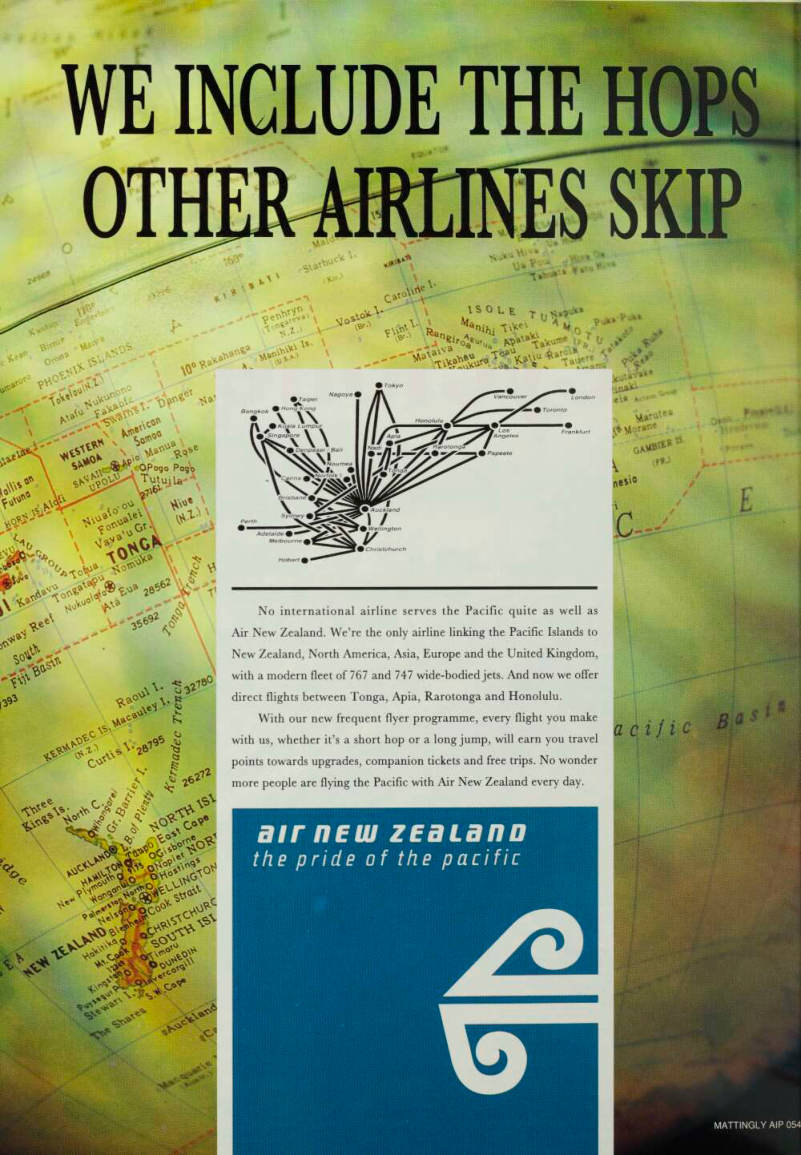
We Include The Hops
ES SKIP
\]o s
ISO t E Tu*.**
„ Ma -iih f r»v‘ *»• V OPogo Pogg Tutujla ,t v y-* S' * So- Nagoya^ w
f\ S K T
I 9 \V^ \\ % 7> NN\\l >Ca,rns #kXX# Si M \ : Sydney •] f# Wellington 0 Christchurch W**z * ev» ***
oii***
V nesio Adelaide Melbourne * M tl \
%ofe' ■
1^ 'ioN 18 ° v ei V S tS \K*° :r V & O^C^' £o*' eo^ QC *°' /o- No international airline serves the Pacific quite as well as Air New Zealand. We’re the only airline linking the Pacific Islands to New Zealand, North America, Asia, Europe and the United Kingdom, with a modern fleet of 767 and 747 wide-bodied jets. And now we offer direct flights between Tonga, Apia, Rarotonga and Honolulu.
With our new frequent flyer programme, every flight you make with us, whether it’s a short hop or a long jump, will earn you travel points towards upgrades, companion tickets and free trips. No wonder more people are flying the Pacific with Air New Zealand every day.
air new ZEBLano
the pride of the pacific
cijic
S^ V A\\
* V CP *
B$ st
J
Pacific
Islands
Monthly
Vol 63 No. 2
The News Magazine
February 1993
From The
Editor’S Desk 4
Letters 5
Headlines 7
Politics
test for change 11 Spreading the word 13 plan for unity 15
Business
Selling off the flag carrier 18
Relevision
Monopoly is out 21
Cover Stories
Disaster 22 Fiji radar fails 23
Special Report
Lament of the indigenous people 26 The New Zealand proof 29 Fighting back 32 Forging real solutions 35 Powerful Tabaran 37
Women
Juki’s creations 39
Health
Linguists battle aids 40
United States
New faces in Washington 46 Winter trial 47
Environment
Conserving forests 48
Sports
Sevens rugby kings to host interna tional tourney 51
Yachting
Shaking up Shakola 54
Shipping
Shipping schedules 56
Columnists
Jemima Garrett 38 Bill McCabe 42 Futa Helu 43 David Barber 45
Publisher: Brian O’Flaherty Editor: Mala Jagmohan Senior Writer: Martin Tiffany Correspondents: Christine Hatcher, David North, Ed Rampell, lan Williams, Johnson Honimae, Karen Mangnall, Liz Thompson, Nicholas Rothwell, Pesi Fonua, Wally Hiambohn.
Columnists: David Barber (Wellington), Futa Helu (Tonga, covering the Pacific Islands), Jemima Garrett (Sydney), Margot O’Neill (Washington), Julian Moti (Pacific Law), Alfred Sasako (The Forum).
Business and Advertising Manager, Charlotte Thomas
Advertising Sales: • Regional Sales (South Pacific); Salendra Narayan, Tel (679) 304111, Fx (679) 303809 • Sydney, Canberra: Bob Hill Media Represen tations, Tel (61-2) 4164245, Fx (61-2) 4165064 • Brisbane: Robert Walker, Media House, Tel (61-7) 3710533, Fx (61-7) 371-8904 • Adelaide; Hastwell Williamsons Representations, Tel (61-8) 799522, Fx (61-8) 799735 • Melbourne: Brown Orr Fletcher Burrows (Aust).
Pty. Ltd. Tel (3) 696 5188 Fx (03) 696 5131. • Auckland: McKay International Media Reps Ltd, Tel (64-9) 4190561, Fx (64-9) 4192243 • Japan: Universal Media Corporation, Tokyo, Tel (3) 6663036, 6663094, Cable: UNIMEDIA Tokyo, Tx 2524665.
Founded 1930 (USPS 952480). A Fiji Times Limited production.
Cover prices are recommended retail only. Regis tered by Australia Post, Publication No. NBP 1210. © Copyright Fiji Times Limited, 177 Victoria Parade, Suva. Fiji. Tel (679) 304111, Fx (679)
303809. Tx Fj2124.
Pacific Islands Monthly is published monthly by The Fiji Times Limited, a division of Nationwide News, 2 Holt Street, Surry Hills, Sydney, NSW 2010.
Send address changes to: • Pacific Islands Monthly, PO Box 1167, Suva, Fiji.
Typeset and printed by The Fiji Times Limited, 177 Victoria Parade, Suva, Fiji.
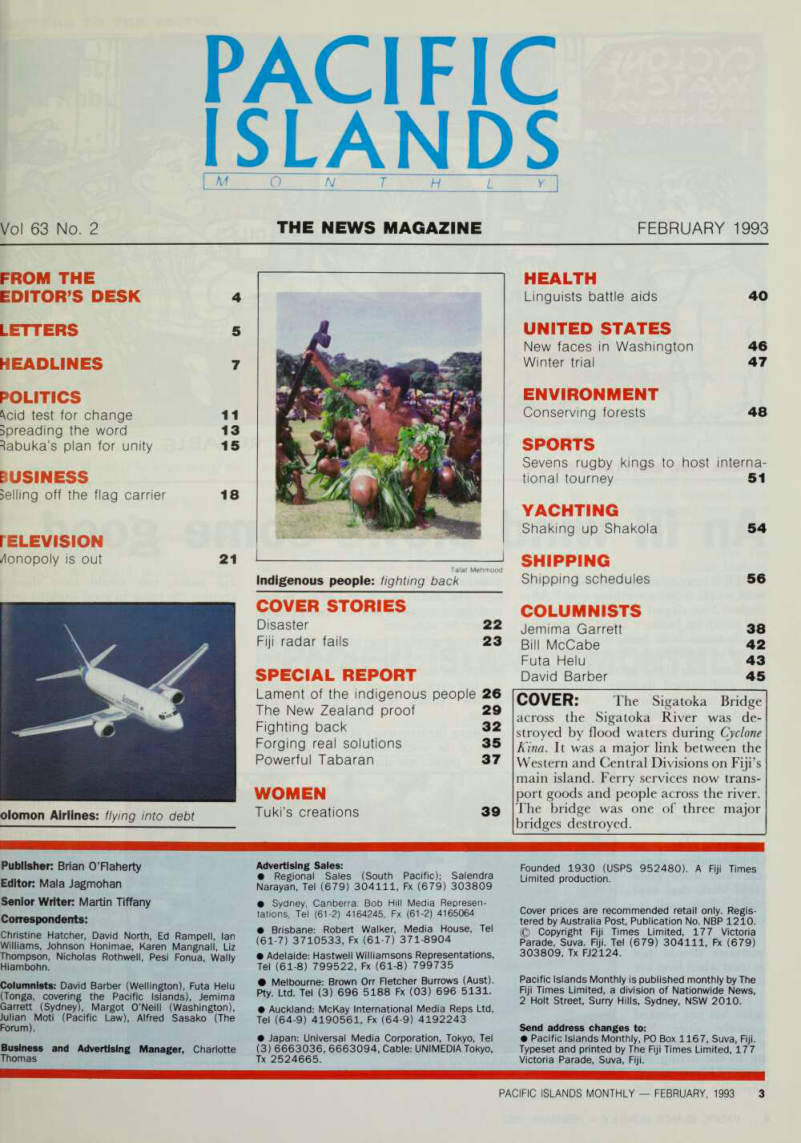
[?]olomon Airlines: flying into debt
Talat Mehmood Indigenous people: fighting back
An ill wind blows some good
From The Editor’S Desk
DOES it have to take a cyclone with 120 knot winds to get something done? After Cyclone Kina ripped its way through the Fiji group on January 2 and 3 something finally seems to be being done about the country’s decrepit weather radar.
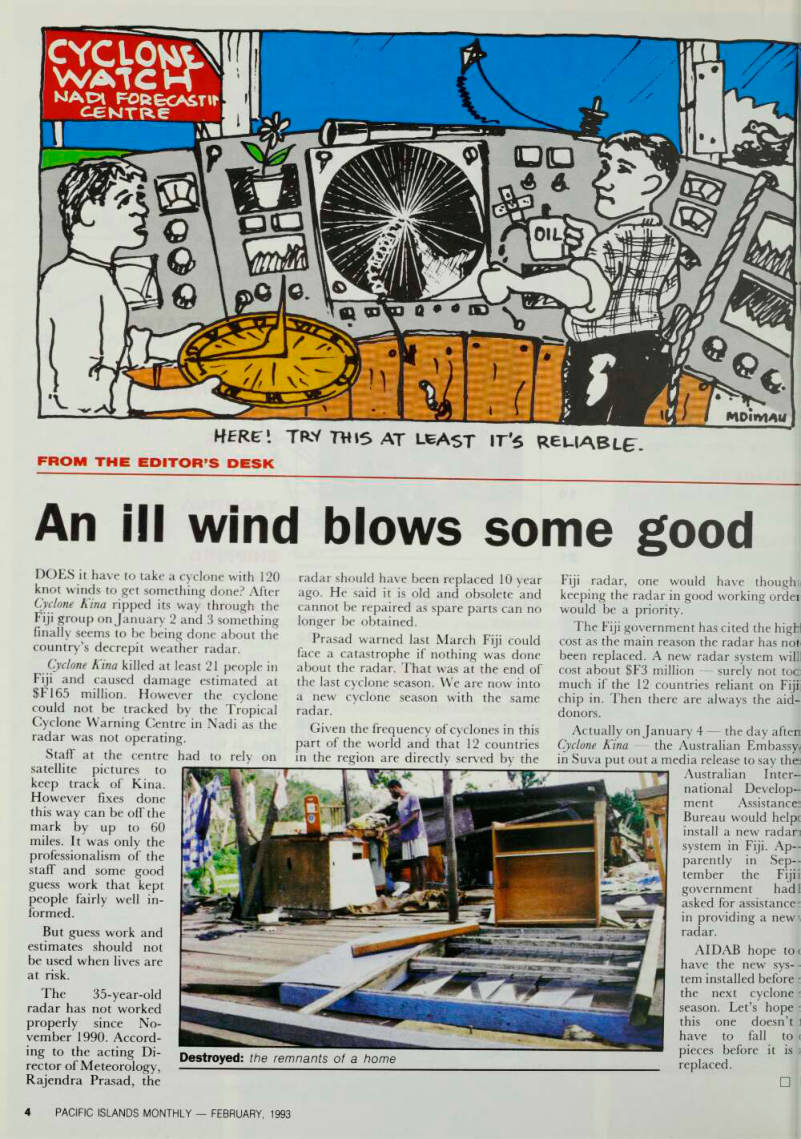
Cyclone Kina killed at least 21 people in Fiji and caused damage estimated at SKI 65 million. However the cyclone could not be tracked by the Tropical Cyclone Warning Centre in Nadi as the radar was not operating.
Staff at the centre had to rely on
satellite pictures to keep track of Kina.
However fixes done this way can be off the mark by up to 60 miles. It was only the professionalism of the staff and some good guess work that kept people fairly well in formed.
But guess work and estimates should not be used when lives are at risk.
The 35-year-old
radar has not worked properly since No vember 1990. Accord ing to the acting Di rector of Meteorology, Rajendra Prasad, the
radar should have been replaced 10 year ago. He said it is old and obsolete and cannot be repaired as spare parts can no longer be obtained.
Prasad warned last March Fiji could face a catastrophe if nothing was done about the radar. That was at the end of the last cyclone season. We are now into a new cyclone season with the same radar.
Given the frequency of cyclones in this part of the world and that 12 countries in the region are directly served by the
Fiji radar, one would have thoughu keeping the radar in good working order would be a priority.
The Fiji government has cited the higH cost as the main reason the radar has not' been replaced. A new radar system will] cost about SF3 million surely not toco much if the 12 countries reliant on Fijii chip in. Then there are always the aid donors.
Actually on January 4 the day aften Cyclone Kina the Australian in Suva put out a media release to say thea
Australian Inter
national Develop
ment Assistance 3 Bureau would helpc install a new radan system in Fiji. Ap
parently in Sep
tember the Fijii government had! asked for assistances in providing a new\ radar, AIDAB hope to t have the new sys- tern installed before ; the next cyclone; season. Let’s hope ; this one doesn’t 1 have to fall to ( pieces before it is f replaced.
Destroyed: the remnants of a home
Fiji’s
Letters To The Editor
Channel 10
and Rabuka
Madam, Jemima Garrett’s column [ PIM Decem ber 1992] about the Australian television Channel 10’s interview with Prime Minister Sitiveni Rabuka is commend able as independent, objective and fair comment. She has basically confirmed what I had said to the news media in Fiji about that interview. It was a dishonest and unprofessional piece of work. By
editing and splicing together comments
that had been provided off the record the reporter portrayed a false image of the Prime Minister as someone who was callous, uncharitable and in favour of repatriation of our Indo-Fijian citizens.
In her full quotation of the particular part of the interview that Channel 10 had distorted, Jemima Garrett could have made the point more strongly had >he included the continuation of that exchange: Journalist: Would it be better then if the Indians just went back to India.
Rabuka: Yes, but that is not what we’re iriving for.
Journalist: You did say that earlier though hat you wanted them all to go.
Rabuka: No I didn’t, that was somebody r Ise.
Journalist: Do you support that?
Rabuka: No.
It wasjacqueline Wilcox the journalist
vho persisted in suggesting throughout
he interview the idea of repatriation of [ndo-Fijians to India. The Prime Minis er was not impressed with Wilcox’s gnorant and arrogant manner because ater in the interview he said to her:- “I am surprised that your station has illowed you to come here not being fully mefed about the situation here in Fiji md try to ask some questions as if you mew what was going on here”.
The Prime Minister’s comments about joverty and the social welfare system are ilso distorted because they were directed it certain sections of the Australian tudience who are defenders of the nodern Welfare State. The Prime Min ster had said he was not in favour of an :laborate state-sponsored welfare system n Fiji because he believed our societal :thos of younger relatives caring for the Lged and the invalid is still strong and he lid not see why the state or profit making >rganisations in Fiji should take over this latural role of families.
Jacqueline Wilcox had promised to end me a copy of her television
programme and a copy of the full videotape of the interview. To date we have not received any of these. Nor have we received an apology from Channel 10.
Jone Dakuvula
Office of the Prime Minister
Fiji’s
guests
Madam, No-one likes to be misrepresented through devious editing and Jemima Garrett may certainly be quite correct to raise the question of ethics. This is the ostensible thrust of her column in December’s PIM entitled “Shame on you, Channel 10”.
However, the summary of the unedi ted material presented by Jemima does little to redeem Rabuka. No matter which way you re-present them, his comments about the poor being sinners and how he doesn’t believe in social security are anathema to most ordinary Australians. There is no escaping the irony in the fact that these comments were made as Rabuka himself had come to Australia a-begging alms for defence.
The reference to third, fourth, fifth and sixth generation Fijians of Indian descent as “guests” does not wash very well either. A guest/host comparison is only viable in Fiji because the so-called guests have not at any stage emasculated their
inhabitant hosts by dispossessing them of their land or their cultural or social identity. Thus we still have in Fiji indigenous people empowered enough in political and social identity and land ownership to be afforded the description of “host”. This, unlike the “guests” in Australia ( to continue this unfortunate and insulting metaphor) whose antecedents dispossessed the host inhabi tants of land and destroyed their cultural and social identity.
Initially after the coups some Austra lians, who were not fully informed about Fijian history, strove to assuage their guilt about mistreatment of the Kooris by projecting the Australian situation onto Fiji and treating Rabuka as a hero for indigenous struggles. Now many more Australians treat him as a subject of ridicule, scorn and comedy. So much for the high and positive profile pur ported to have been lately gained for Fiji by its Prime Minister.
As for the ethics around “off-the record” interviews being kept secret to support the “new openness”, let that be debated at a journalist’s luncheon. What we would like to see in PIM is presen tation and discussion of facts that the media has at hand, as opposed to a presentation and discussion about ethics that promote keeping certain facts un derhand.
Sosi Toa
Nawal Maharaj NSW Movement for Democracy in Fiji Inc
Nsw
Australia
Island games
Madam , I write in reply to Futa Helu’s (FH) foray into to the world of sports writing in your July 1992 edition. I agree with his praise of the rugby success of Samoa, Fiji and Tonga. This was especially illustrated by Samoa and Tonga’s recent wins against the NZ Maoris.
However FH tells us that rugby began as a means of keeping warm in the cold, fostering a public school mentality and sustaining imperial interests. While sport may contribute to a person’s develop ment and consequent contribution to a nation I am not sure William Webb Ellis had dreams of an expanded empire when, in 1823, “he first took the ball in his arms and ran with it”. Rather I think he had the more limited objective of scoring a goal (try).
It appears FH is repelled by New Zealand’s ‘Public School Mentality’. As a product of the New Zealand state education I was surprised to hear we had ‘public schools’. We certainly have private schools but to compare them with English public schools of the 19th century is to create a false impression in the eyes of those readers who have not been to New Zealand.
Rugby, FH, informs us is flawed for Pacific Islanders because it is a game of brute endurance and tenacity and lacks speed, sharpness of eye, accuracy, skill and finality. I am happy to see that Pacific Islanders have overcome these obvious drawbacks and are still fine exponents of the running, passing, kick
ing, jumping, catching, tackling game
enjoyed by rugby players and supporters everywhere. Indeed the International Rugby Board (IRB) object of the game
specifically mentions carrying, passing,
kicking and grounding the ball.
It is true that not all rugby involves running, passing and kicking. However those other facets of the game our learned sports writer finds so disagreeable, have evolved as part of the game and as such have their own skill and strength require ments. FH mentions the rougher aspects of the game. I do not condone foul play or violence but FH forgets that like boxing which he tells us is a traditional island sport, rugby is a contact sport between grown men, none of whom are forced to play.
FH ‘calls to reject New Zealand Philistinism (an inaccessibility to ideas
and ideals) as expressed by its rugby’. On July 4 1992 New Zealand adopted the revised IRB rules designed to make rugby an even more attractive game.
New Zealand played a major role in revising the rules. To accuse New Zealand of Philistinism and brand its supposedly dull rugby as a portrayal of the nation is narrow minded and petty.
FH tells us the 15-a-side code should be altered ‘to allow what is distinctive in the Pacific character to come through’.
He is being too harsh on many Pacific Island players. Is it not their flair, speed and style which have made players and teams from many Island nations so successful? There are also many Pacific Islanders apparently rising above the yoke of imperialism and playing with great sucess in the freezing climes of Australia and New Zealand.
FH’s depth of sport knowledge is further displayed (exposed?) with judge ments on the state of Australian Cricket.
A great way to fill the last paragraph but a Bilo’s cartoon would have used the space more efficiently.
Yes FH traditional island sports use skill, sharpness of the eye and agility and I hope they never die out. However to suggest introduced sports should be changed to suit specific abilities denies people the chance to broaden their sporting and cultural horizons. The people in the Pacific have the ability to do well at any sport.
Finally to brand a nation dull im perialist or philistine because of your view of one sport, reflects the view of one who has some or all of those qualities.
Wake up Futa Helu, you are missing a great game.
Paul Curry
Port Vila, Vanuatu
Spc
burden
Madam Your article “Clean Up This Mess” (December 1992) is a very sad story about one of the supposedly prime and prestigious regional institutions in the Pacific. Just as the SPC is beginning to rebuild it headquarters in Noumea, it is time for Pacific people to reflect on the purpose or mission of this financially burdened organisation.
Indeed one can question whether the region needs the Commission at all; especially when the Forum Secretariat is
moving more and more effectively intcc SPC ‘territory’. After nearly 50 years oi providing ‘technical advice and assist ance to the Pacific, it may be time for at re-think on the region’s priorities.’
Aid funds are no longer flowing freely, and it is only a matter of time (and it may, have already arrived) when donors willl begin to question their commitments toe this mis-managed organisation. In at world of economic recession it might be* prudent for Pacific people to quid backing a losing and broken-down horse. .
George Kingsleys
Christchurchi New /jealandS
Australia
a disappointment
Madam, Australia is becoming a disappointment with regards to the issue of East Timor.
While the plight of East Timor is recognised by the highest world body, the United Nations, Australia does not, by forging partnership with Indonesia to set up drill facilities in the Timor sea soon, according to the latest news. Then where has that much vocality on the massacre in Dili, November 1991, boiled down to? Or was it just a white-wash hypocrisy? Again where is that good sense that Australia had in sending a navy contingent to Iraq to help defence less Kuwait from the tyranny of Presi dent Saddam Hussein? Is East Timor’s plight not of the same vein?
Thank God for the recent far sightedness and co-operation of South Pacific Island nations that saw New Zealand through to become a permanent member of the United Nations Security Council. I remain optimistic that due to this milestone development, East Timor’s plight will once again be boosted.
Congratulations New Zealand, you de serve it for having been the bastion of freedom and the kingpin of a free world in the South Pacific.
As for Portugal, God bless you in your bid to restrain Australia and Indonesia through the International Courts of Justice against their barbaric intentions to acquire minerals and oil from the Timor Sea. It will be a glaring act tantamount to international crime if they proceed.
Graham Vulabete
University of the South Pacific Suva Fiji
Advertisements & other items, p. 5 (1 item)
Pacific Islands Monthly
SUBSCRIPTIONS
American Samoa US$45 Australia A 542.00 Canada US$45 Cook Islands AUSS46 Fiji F 526.40 French Polynesia US$45 Guam US$45 Hawaii US$45 Japan US$45 Kiribati AUSS46 Marshall/Micronesia US$4O Nauru AUSS42 New Caledonia US$32 Payment to Pacific Islands Monthly: New Zealand NZ$55 Niue AUSS46 Norfolk Island AUSS42 Northern Marianas/Palau US$4O Papua New Guinea AUSS4S Solomon Islands AUSS46 Tonga AUSS46 Tuvalu AUSS46 United Kingdom Stg Pound2B US Mainland US$45 Vanuatu AUSS4S Western Samoa WS$6O Elsewhere AUSS63 Subscriptions Dept GPO Box 1167, Suva, Fiji.
Subscriptions rates include the cost of airspeeding to all destinations set out above.
Direct airmail rates on application.
Telephone: 304111 Fax: 303809
Fishy
Headlines
Cyclone
Cyclones
hit region
While Fiji is continuing with its recovery after the onslaught of Cyclone Kina last month, other South Pacific countries are recovering as well. [ Cyclone Nina struck parts of northern Tonga and further south the main island of Tongatapu was hit by strong winds associated with Cyclone Kina. Three people were killed in Tonga and substantial damage was caused to Tongatapu’s eastern side and the capital Nuku’alofa lost power. A number of houses in the capital lost their roofs.
In Nuku’alofa harbour three boats two inter-island ferries and a fishing vessel were wrecked. Meanwhile in Niue Nina’s 50 knot winds damaged the main wharf. ’ In the Solomon Islands a number of disaster areas were declared after Cyclone Nina struck in early January. A National Disaster Council spokesman says as many as 4000 people are homeless on the islands of Rennel and Bellona where only two buildings are still standing. Consignments of relief supplies, mainly tarpaulins and clothing, have been airlifted to the affected areas. Vessels with fresh water and food supplies have also been sent out to the affected areas.
The Australian government has sent emergency supplies to the Solomon Islands. These include tarpaulins and water
ourification equipment.
Two young children and an elderly woman were killed when Vina hit Bellona late on New Year’s Day. Two other Solomon [slanders died when their canoe capsized in rough seas in the country’s Western Province. In the Solomon Islands as a whole ibout 10,000 people are now though to be homeless as a result )f the cyclone.
Kiribati
Fishy
money
fhe Kiribati authorities have accused some of the Korean ishing companies employing I-Kiribati fishermen of not omplying with their agreements signed with the Kiribati ;overnment.
Kiribati’s Minister for Commerce, Industry and Employment Kemuera Tateraka has told parliament some Korean fishing ompanies have not been sending the I-Kiribati fishermen’s alaries back home as agreed.
He says this has been causing hardships to the parents of the "amen concerned. The minister said some companies do send alaries back to Kiribati but not on time.
Tateraka says his ministry is lookinging into the matter.
Fiji
Taukei unhappy
with Rabuka
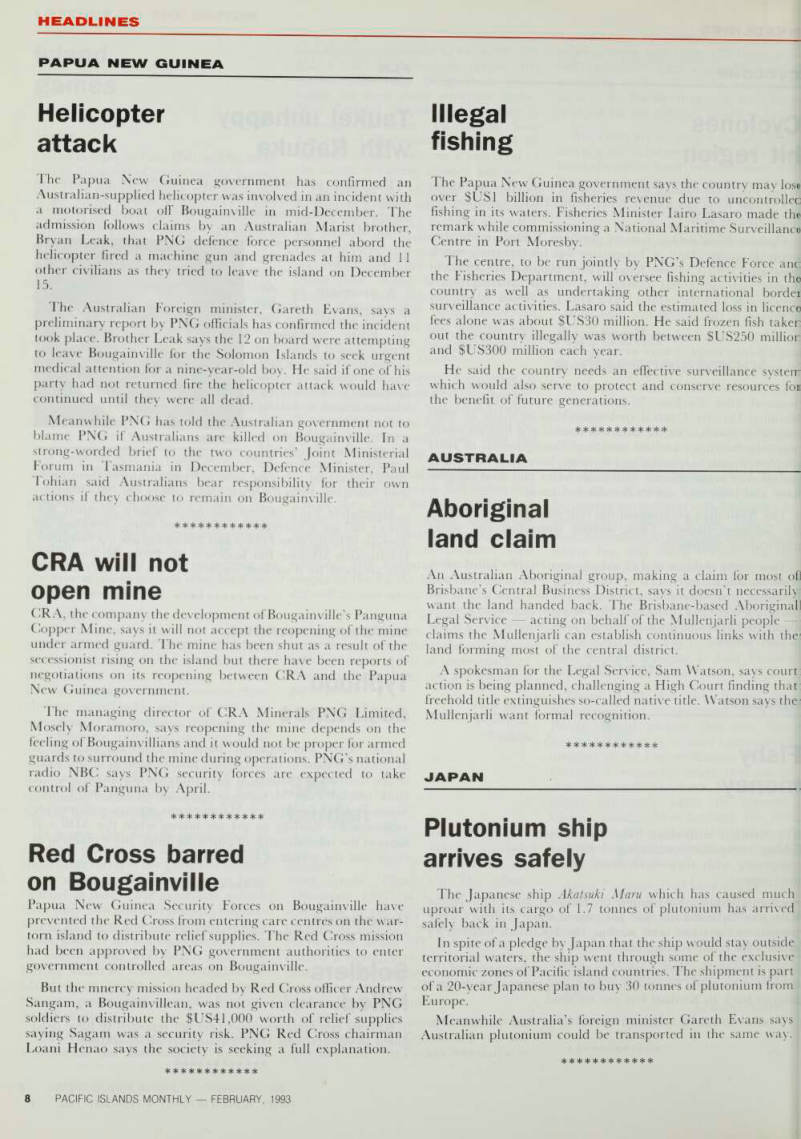
The Fijian nationalist Taukei movement has called on all indigenous Fijian members of parliament to completely reject moves towards the formation of a government of national unity.
Prime Minister Sitiveni Rabuka, who made the initial call for
the formation of a unity government, is a Taukei member.
A statement by the movement’s leader Taniela Veitata says the
37 Fijian parliamen
tarians should throw the proposal out without any qualms. Veitata says the
proposal is a cunning
scheme aimed at taking
away indigenous Fijian’s
control of the country.
He says Rabuka should
not allow himself to be manupulated by what he says are conspirators scheming to steer him away from the goals and ideals of the 1987 struggle.
Meanwhile Fiji’s cabinet has unanimously accepted Ra buka’s call for a government of national unity providing the interests of indigenous Fijians and Rotumans are not sacrificed.
Information Minister Ilai Kuli says the Prime Minister’s call was accepetd by a cabinet meeting with a few reservations.
Marshall Islands
Typhoon
assistance
The Asian Development Bank is expected to give a SUSSOO,OOO loan to the Marshall islands to help in the wake of the destruction caused in November by Typhoon Gay. A bank official Paul McCabe says he anticipates the United States Federal Emergency Management Agency will provide assistance for damage to private homes while the ADB will support the rehabilitation of public facilities, the replanting of crops and the repair of fishing boats.
Indonesia
Soldiers killed At least two Indonesian soldiers are reported to have been killed in clashes with West Papuan OPM separatists.
Rabuka: unity call
Papua New Guinea
Helicopter
attack
The Papua New Guinea government has confirmed an Australian-supplied helicopter was involved in an incident with a motorised boat of! Bougainville in mid-December. The admission follows claims by an Australian Marist brother, Bryan Leak, that PNG defence force personnel abord the helicopter fired a machine gun and grenades at him and 11 other civilians as they tried to leave the island on December 15.
The Australian Foreign minister, Gareth Evans, says a preliminary report by PNG officials has confirmed the incident took place. Brother Leak says the 12 on board were attempting to leave Bougainville for the Solomon Islands to seek urgent medical attention for a nine-year-old boy. He said if one of his party had not returned fire the helicopter attack would have continued until they were all dead.
Meanwhile PNG has told the Australian government not to blame PNG if Australians are killed on Bougainville. In a strong-worded brief to the two countries’ Joint Ministerial Forum in Tasmania in December, Defence Minister, Paul Tohian said Australians bear responsibility for their own actions if they choose to remain on Bougainville. ***
CRA will not
open mine
CRA, the company the development of Bougainville’s Panguna Copper Mine, says it will not accept the reopening of the mine under armed guard. The mine has been shut as a result of the secessionist rising on the island but there have been reports of negotiations on its reopening between CRA and the Papua New Guinea government.
The managing director of CRA Minerals PNG Limited, Mosely Moramoro, says reopening the mine depends on the feeling of Bougainvillians and it would not be proper for armed guards to surround the mine during operations. PNG's national radio NBC says PNG security forces are expected to take control of Panguna by April. ***
Red Cross barred
on Bougainville
Papua New Guinea Security Forces on Bougainville have prevented the Red Cross from entering care centres on the war torn island to distribute relief supplies. The Red Cross mission had been approved by PNG government authorities to enter government controlled areas on Bougainville.
But the mnercy mission headed by Red Cross officer Andrew Sangam, a Bougainvillean, was not given clearance by PNG soldiers to distribute the SUS4I,OOO worth of relief supplies saying Sagam was a security risk. PNG Red Cross chairman Loani Henao says the society is seeking a full explanation.
Illegal
fishing
The Papua New Guinea government says the country may lose over SUSI billion in fisheries revenue due to uncontrolled fishing in its waters. Fisheries Minister lairo Lasaro made the remark while commissioning a National Maritime Surveillance Centre in Port Moresby.
The centre, to be run jointly by PNG’s Defence Force anc the Fisheries Department, will oversee fishing activities in the country as well as undertaking other international bordei surveillance activities. Lasaro said the estimated loss in licence fees alone was about SUS3O million. He said frozen fish taken out the country illegally was worth between SUS2SO million and SUS3OO million each year.
He said the country needs an effective surveillance system which would also serve to protect and conserve resources fon the benefit of future generations.
Australia
Aboriginal
land claim
An Australian Aboriginal group, making a claim for most ofl Brisbane’s Central Business District, says it doesn’t necessarily want the land handed back. The Brisbane-based Aboriginal!
Legal Service acting on behalf of the Mullenjarli people claims the Mullenjarli can establish continuous links with the; land forming most of the central district.
A spokesman for the Legal Service, Sam Watson, says court; action is being planned, challenging a High Court finding that: freehold title extinguishes so-called native title. Watson says the; Mullenjarli want formal recognition.
Japan
Plutonium ship
arrives safely
The Japanese ship Akatsuki Maru which has caused much uproar with its cargo of 1.7 tonnes of plutonium has arrived safely back in Japan.
In spite of a pledge by Japan that the ship would stay outside territorial waters, the ship went through some of the exclusive ■ economic zones of Pacific island countries. The shipment is part of a 20-year Japanese plan to buy 30 tonnes of plutonium from Europe.
Meanwhile Australia’s foreign minister Gareth Evans says h Australian plutonium could be transported in the same way.
Solomon Islands
Government will
accept base
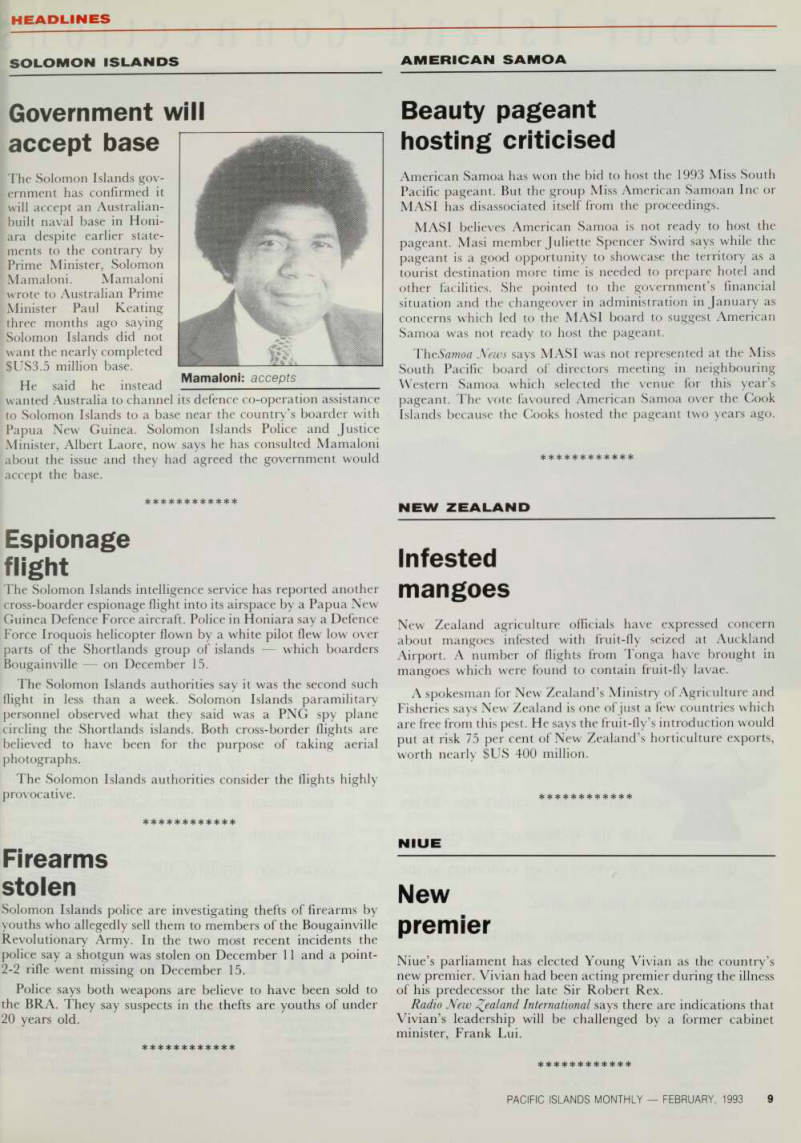
The Solomon Islands gov t ernment has confirmed it ; will accept an Australian built naval base in Honi [ ara despite earlier state ments to the contrary by Prime Minister, Solomon f Mamaloni. Mamaloni i wrote to Australian Prime Minister Paul Keating three months ago saying ! Solomon Islands did not
want the nearly completed
SUS3.S million base.
He said he instead
wanted Australia to channel its defence co-operation assistance to Solomon Islands to a base near the country’s boarder with Papua New Guinea. Solomon Islands Police and Justice Minister, Albert Laore, now says he has consulted Mamaloni about the issue and they had agreed the government would accept the base. ***
Espionage
flight
The Solomon Islands intelligence service has reported another cross-boarder espionage flight into its airspace by a Papua New Guinea Defence Force aircraft. Police in Honiara say a Defence Force Iroquois helicopter flown by a white pilot flew low over parts of the Shortlands group of islands which boarders Bougainville on December 15.
The Solomon Islands authorities say it was the second such flight in less than a week. Solomon Islands paramilitary personnel observed what they said was a PNG spy plane circling the Shortlands islands. Both cross-border flights are believed to have been for the purpose of taking aerial photographs.
The Solomon Islands authorities consider the flights highly provocative. ***
Firearms
stolen
Solomon Islands police are investigating thefts of firearms by youths who allegedly sell them to members of the Bougainville Revolutionary Army. In the two most recent incidents the police say a shotgun was stolen on December 11 and a point -2-2 rifle went missing on December 15.
Police says both weapons are believe to have been sold to the BRA. They say suspects in the thefts are youths of under 20 years old.
American Samoa
Beauty pageant
hosting criticised
American Samoa has won the bid to host the 1993 Miss South Pacific pageant. But the group Miss American Samoan Inc or MASI has disassociated itself from the proceedings.
MASI believes American Samoa is not ready to host the pageant. Masi member Juliette Spencer Swird says while the pageant is a good opportunity to showcase the territory as a tourist destination more time is needed to prepare hotel and other facilities. She pointed to the government’s financial situation and the changeover in administration in January as concerns which led to the MASI board to suggest American Samoa was not ready to host the pageant.
TheS'amofl News says MASI was not represented at the Miss South Pacific board of directors meeting in neighbouring Western Samoa which selected the venue for this year’s pageant. The vote favoured American Samoa over the Cook Islands because the Cooks hosted the pageant two years ago.
New Zealand
Infested
mangoes
New Zealand agriculture officials have expressed concern about mangoes infested with fruit-fly seized at Auckland Airport. A number of flights from Tonga have brought in mangoes which were found to contain fruit-fly lavae.
A spokesman for New Zealand’s Ministry of Agriculture and Fisheries says New Zealand is one of just a few countries which are free from this pest. He says the fruit-fly’s introduction would put at risk 75 per cent of New Zealand’s horticulture exports, worth nearly SUS 400 million.
Niue
New
premier
Niue’s parliament has elected Young Vivian as the country’s new premier. Vivian had been acting premier during the illness of his predecessor the late Sir Robert Rex.
Radio New Zealand International says there are indications that Vivian’s leadership will be challenged by a former cabinet minister, Frank Lui.
Mamaloni: accepts
Advertisements & other items, p. 10 (1 item)
Cable & Wireless
Cable and Wireless began keep-
ing people in touch around the
world more than a century ago. Today,
while the technology has changed,
the tradition of service to our customers in the
South Pacific is just the same.
We work in partnership with Governments,
dedicated to meeting the need of communities Asia Pacific Head Office Cable and Wireless pic Cable and Wireless (Pacific) Limited 22 nd Floor Office Tower Convention Plaza 1 Harbour Road Hong Kong Tel: (852)848 8620 Facsimile: (852) 868 5195 Australia Cable and Wireless (Australia) Pty Ltd PO Box 675, Double Bay NSW 2028 Sydney Australia Tel/Fax (61-2) 362 3625 Fiji In association with the Government of Fiji Fiji International Telecommunications Ltd.
PO Box 59 Mercury House 158 Victoria Parade Suva Fiji Tel: (679) 312933 and businesses to stay in touch. From one island to the next or to the other side of the world, the message is the same: Cable and Wireless is
your South Pacific = —•—
connection bringing the
islands together.
CABLE & WIRELESS
Solomon Islands In association with the Government of the Solomon Islands Solomon Telekom Company Limited PO. Box 148 Honiara Solomon Islands Tel: (677)21576 Tonga Cable and Wireless pic Private Mail Bag 4 General Post Office Nuku Alofa Tonga South Pacific Tel: (676) 23499 Vanuatu In association with the Government of Vanuatu and \ France Cables et Radio Vanuatu International Telecommunications Ltd.
PO, Box 164 Port Vila Vanuatu Tel: (678)22185
Acid test for change
Politics
By Bill Morton
As Tonga gears up for its elections, and as the call for change is put to the test, cracks are already appearing in the people’s unity
LATE November, 1992 saw one of the most important political events in Tonga’s political history. The Conven tion on the Constitution and Democracy, organised by the country’s Pro- Democracy Movement, was widely at tended and attracted attention regionally and internationally.
The four-day convention was a clear sign that the call for change is reverberat ing loudly and clearly around the Kingdom. Parliamentarians, church leaders and academics spoke of the need for a more democratic system, for reduced powers of the King and for constitutional amendment.
Two months later the impact of the convention is being overshadowed by the next one on the country’s political calendar. On February 4, elections will
be held for the Peoples’ Representatives
to the Legislative Assembly. Fifty-five candidates will contest the nine available seats. (The other 21 seats consist of nine representatives of the 33 noble families and 12 ministers appointed for life by the King. As a clear majority they ensure the Peoples Representatives can be outvoted on every issue.) Important questions which arose from the convention are now being put to the acid test by the pending elections. In a party-less system will the pro-democracy movement formalise itself into a political party? Will democracy and change be the most important election issues? At present five of the nine peoples’ represen tatives support change. Will this number be increased after the next election?
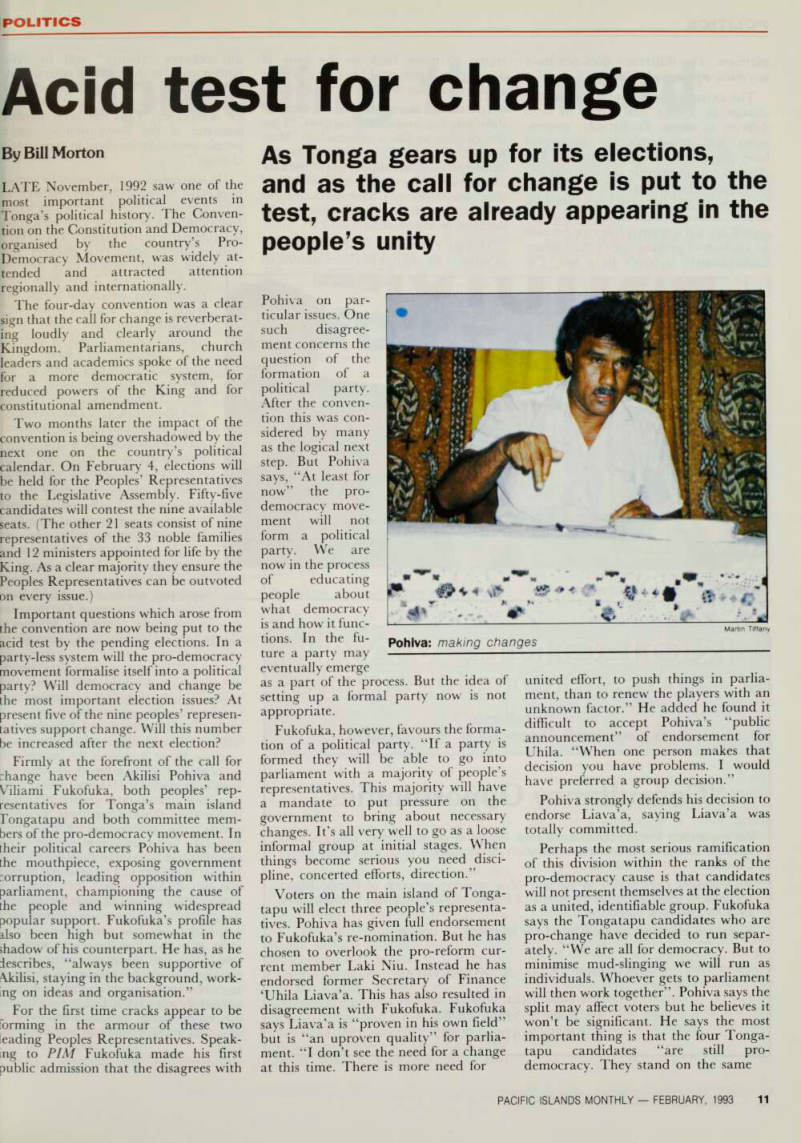
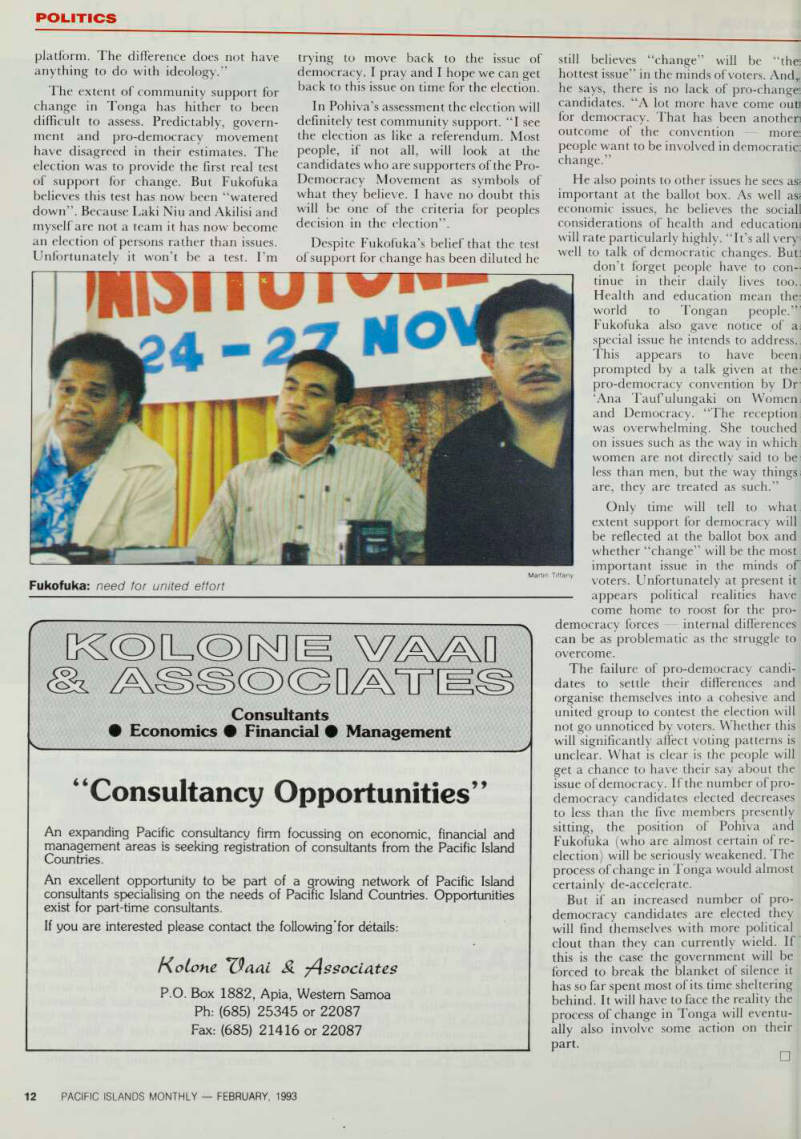
Firmly at the forefront of the call for :hange have been Akilisi Pohiva and Viliami Fukofuka, both peoples’ rep resentatives for Tonga’s main island Fongatapu and both committee mem bers of the pro-democracy movement. In their political careers Pohiva has been
the mouthpiece, exposing government
:orruption, leading opposition within
parliament, championing the cause of
the people and winning widespread
popular support. Fukofuka’s profile has also been high but somewhat in the shadow of his counterpart. He has, as he describes, “always been supportive of \kilisi, staying in the background, work ing on ideas and organisation.”
For the first time cracks appear to be ibrming in the armour of these two
leading Peoples Representatives. Speak
ing to PIM Fukofuka made his first public admission that the disagrees with
Pohiva on par ticular issues. One such disagree ment concerns the question of the formation of a
political party.
After the conven tion this was con sidered by many as the logical next step. But Pohiva says, “At least for now” the pro democracy move ment will not form a political party. We are now in the process of educating
people about
what democracy is and how it func tions. In the fu ture a party may eventually emerge
as a part of the process. But the idea of setting up a formal party now is not
appropriate.
Fukofuka, however, favours the forma tion of a political party. “If a party is formed they will be able to go into
parliament with a majority of people’s
representatives. This majority will have a mandate to put pressure on the government to bring about necessary changes. It's all very well to go as a loose informal group at initial stages. When things become serious you need disci pline, concerted efforts, direction.”
Voters on the main island of Tonga tapu will elect three people’s representa tives. Pohiva has given full endorsement to Fukofuka’s re-nomination. But he has chosen to overlook the pro-reform cur rent member Laki Niu. Instead he has endorsed former Secretary of Finance ‘Uhila Liava’a. This has also resulted in disagreement with Fukofuka. Fukofuka says Liava’a is “proven in his own field” but is “an uproven quality” for parlia ment. “I don’t see the need for a change at this time. There is more need for
united effort, to push things in parlia ment, than to renew the players with an unknown factor. He added he found it difficult to accept Pohiva’s “public announcement> . P f endor sement for makes have P oblems , wou|d a f dec ision.” 5 Pohiva strongly defends his decision to endorse Liava’a, saying Liava’a was totally committed.
Perhaps the most serious ramification Q f division within the ranks of the pro-democracy cause is that candidates will not present themselves at the election as a united, identifiable group. Fukofuka says the Tongatapu candidates who are pro-change have decided to run separ ately. “We are all for democracy. But to minimise mud-slinging we will run as individuals. Whoever gets to parliament will then work together”. Pohiva says the split may affect voters but he believes it won’t be significant. He says the most important thing is that the four Tonga tapu candidates “are still pro democracy. They stand on the same
Martin Tiffany
Pohiva: making changes
platform. The difference does not have anything to do with ideology.”
The extent of community support for change in Tonga has hither to been difficult to assess. Predictably, government and pro-democracy movement have disagreed in their estimates. The election was to provide the first real test of support for change. But Fukofuka believes this test has now been “watered down”. Because Laki Niu and Akilisi and mvself are not a team if has now hprnmp an election of persons rather than issues.
Unfortunately it won’t be a test. I’m
trying to move back to the issue of democracy. I pray and I hope we can get back to this issue on time for the election.
In Pohiva’s assessment the election will definitely test community support. “I see the election as like a referendum. Most people, if not all, will look at the candidates who are supporters of the Pro- Democracy Movement as symbols of what they believe. I have no doubt this be one of the criteria for peoples decision in the election”.
Despite Fukofuka’s belief that the test of support for change has been diluted he
still believes “change” will be “thea hottest issue” in the minds of voters. And, ( he says, there is no lack of pro-changea candidates. “A lot more have come outt for democracy. That has been anothen outcome of the convention morea people want to be involved in democratic:
change.”
He also points to other issues he sees ass important at the ballot box. As well asE economic issues, he believes the sociall considerations of health and education! will rate particularly highly. “It’s all well to talk of democratic changes. But]
don’t forget people have to con tinue in their daily lives too..
Health and education mean the;
world to Tongan people.”'
Fukofuka also gave notice of aj special issue he intends to address..
This appears to have beenj prompted by a talk given at the; pro-democracy convention by Dr* ‘Ana Taufulungaki on Women j and Democracy. “The reception j was overwhelming. She touched J on issues such as the way in which j women are not directly said to be; less than men, but the way things; are, they are treated as such.”
Only time will tell to what extent support for democracy will be reflected at the ballot box and whether “change” will be the most important issue in the minds oT voters. Unfortunately at present it appears political realities have come home to roost for the pro
democracy forces internal differences can be as problematic as the struggle to overcome.
The failure of pro-democracy candi dates to settle their differences and organise themselves into a cohesive and united group to contest the election will not go unnoticed by voters. Whether this will significantly affect voting patterns is unclear. What is clear is the people will get a chance to have their say about the issue of democracy. If the number of pro democracy candidates elected decreases to less than the five members presently sitting, the position of Pohiva and Fukofuka (who are almost certain of re election) will be seriously weakened. The process of change in Tonga would almost certainly de-accelerate.
But if an increased number of pro democracy candidates are elected they will find themselves with more political clout than they can currently wield. If this is the case the government will be forced to break the blanket of silence it has so far spent most of its time sheltering behind. It will have to face the reality the process of change in Tonga will eventu ally also involve some action on their part.
Fukofuka: need for united effort
Martin Tiffany
Advertisements & other items, p. 12 (1 item)
Consultancy Opportunities”
CCOtkOIMI
OOO^TTt
Consultants Economics • Financial Management 44
Consultancy Opportunities”
An expanding Pacific consultancy firm focussing on economic, financial and management areas is seeking registration of consultants from the Pacific Island Countries.
An excellent opportunity to be part of a growing network of Pacific Island consultants specialising on the needs of Pacific Island Countries. Opportunities exist for part-time consultants.
If you are interested please contact the following’for details:
Kclone X9aai &
P.O. Box 1882, Apia, Western Samoa Ph: (685) 25345 or 22087 Fax: (685) 21416 or 22087
Spreading the word
By Bill Morton
NOW that the Pro-Democracy Conven tion has been and gone its impact is being examined. Was it simply a talkathon with no productive follow-up? The Honourable Fusitu’a, Speaker of the Tongan parliament, had suggested many of the people who attended were just “academics enjoying a bit of a holiday” and the “ripple” would “quickly fade”.
But would the government itself provide a constructive response to the conven tion? And while it is clear the convention has sparked keen discussion around kava bowls on the main island of Tongatapu, what of the rest of Tonga? To what extent was the convention relevant to the other islands in the kingdom?
To date tangible outcomes of the convention have been hard to find. The convention did not pass resolutions and made no specific plans for future action.
There was some support for Sione Na’a Fiefia, Director of USP in Tonga, who called for a referendum to test commun ity support for change. This idea has not been pursued further.
However the absence of a definite next step appears to fit with Viliami Fukofuka’s view of the pro-democracy movement’s present role. He sees this as consisting of “public education”.
“People kept asking us during the convention “what’s next.” We deliberately said to people “We are not here to tell you. Our job is to help you understand what democracy is all about the implications, what kinds of changes may be necessary in terms of the constitution, the structure. It’s up to you to decide.”
Fukofuka believes at least 70 per cent of the electorate are “for change”. But he says this does not mean they are demanding specifically democratic changes. “They know there are problems with the present structure.” But they cannot decide how far to go with change.
“That is why it’s very important to continue with public education so that when more changes for democracy come, they really are democratic changes.”
Still remaining is the question of whether the influence of the Pro- Democracy Movement has been con fined to the main island of Tongatapu.
Tonga’s 170 islands are strewn over an ocean area of 363,000 square kilometres.
The furthest island group from the capital Nuku’alofa is the Niuas, lying 600 km to the north.
The reception the pro-democracy
movement will encounter in far-flung islands such as the Niuas is as yet untested. Siaki Kata is the Peoples’
Representative for the Niuas and does not support the Pro-Democracy Move ment. He believes the people of the Niuas are happy with the present political system. He also says they do not believe the constitution needs to be changed and they see no need for the king’s power to be curbed. “The people of the Niuas believe the King should have the power because he is a Christian and he knows what to do. In addition he was the first one to have the best education in Tonga.” Kata sees his own role in the
‘Our job is to help you understand what democracy is all about
the implications,
what kinds of changes may be necessary in terms of the consti tution, the structure.
It’s up to you to de cide.’
House is not to push for change but to argue for better schools, transport and industry for the people of the Niuas.
And while Kata sees no need for change, Fukofuka believes as a result of the activities of the Pro-Democracy Movement and the convention, change is inevitable. “It is not so much whether there will be change, but when. The mood is for change. I firmly believe it will come in the next three years.”
Interestingly Fukofuka thinks the im petus for change will come from the two people who have the firmest grip on Tonga’s destiny, the King and his son the Crown Prince. “That’s where our hope lies. The government is considering change. But the ministers won’t go very far. They have to protect their interests.
They have reputations to keep. The King and the Crown Prince have a much wider perspective of what’s needed in this country. They don’t need wealth and power and they don’t need their repu tation to be protected. They have these already. That’s why we hope that
through the normal constitutional chan nels change can be brought about.”
Meanwhile, the government continues its policy of remaining tight-lipped about the Pro-Democracy Movement and their call for change.
To date it has chosen not to provide an official response to the Convention.
Eseta Fusitu’a, deputy chief secretary and deputy secretary to Cabinet, who is also the wife of the Speaker, the Honourable Fusitu’a, said the govern ment considered it was “not fair or responsible to respond” until it had received a submission based on conven tion outcomes from the Pro-Democracy Movement.
She added that if the government does receive such a submission, it will be looked at “as coming from the 200-300 people who may have supported the submissions. The government, however, cannot exclude the rest of the population whose views are not included.”
In the absence of an official govern ment response Mrs Fusitu’a did offer several observations regarding the con vention. In particular she referred to the number of people who attended. She said the Pro-Democracy Movement had ac tively promoted the convention through out the nation and “had invited the whole country to attend. But of the 100,000 or so people invited, 500 at tended on the opening day. This dropped to 200-300 on the following days.” She also pointed out both the government and the Council of Churches had declined the invitation to attend the convention.
Mrs Fusitu’a also referred to the way organisers publicised daily proceedings of the convention and said reporting by the media “was not entirely accurate.” She said papers presented and discussions from the floor showed very clearly there was not a uniformity of views among convention speakers or the audience. But none of the media releases from the convention reflected this.
Viliami Fukofuka dismisses Mrs.
Fusitua’s comments. He believes there is a definite split within the government, reflected most strongly in the reversals it has made, such as changing its mind about whether to participate in the convention. He sees the government is now abdicating its responsibility to respond to the convention by relying for comment on Mrs. Fusitua who is a civil servant and not a member of govern ment.
Advertisements & other items, p. 14 (1 item)
Coopers
& Lybrand
accounts for more business
in the Solomon Islands
J Ear mi
IBJPr'
; V"
A jL f?
TIW
Leaders in
Accountancy
and
Business
Services
Coopers & Lybrand is the largest and most established accounting firm in the Solomon Islands. That’s why we account for more business.
Our broad range of services covers: ■ Audit ■ Taxaiion ■ Accounting ■ Finance ■ Insolvency
■ Computer Consulting ■ Data Processing.
Coopers & Lybrand is also conveniently located in the heart of Honiara.
For specialist business advice, call Coopers & Lybrand, the experts in the Solomon Islands.
Iron bottom Sound Mendana Hotel racra
NBSI
tavtoa Rove Panaiina Ranandi Airport City Centre Buildinp Central Bank westpac Coopers & Lybrand Ist Floor, City Centre Building Mendana Avenue, HONIARA Telephone: 21851 Facsimile: 23342
Coopers
& Lybrand
Solutions for Business A Member Firm of Coopers & Lybrand (International)
Rabuka’s plan for unity
By Mala Jagmohan
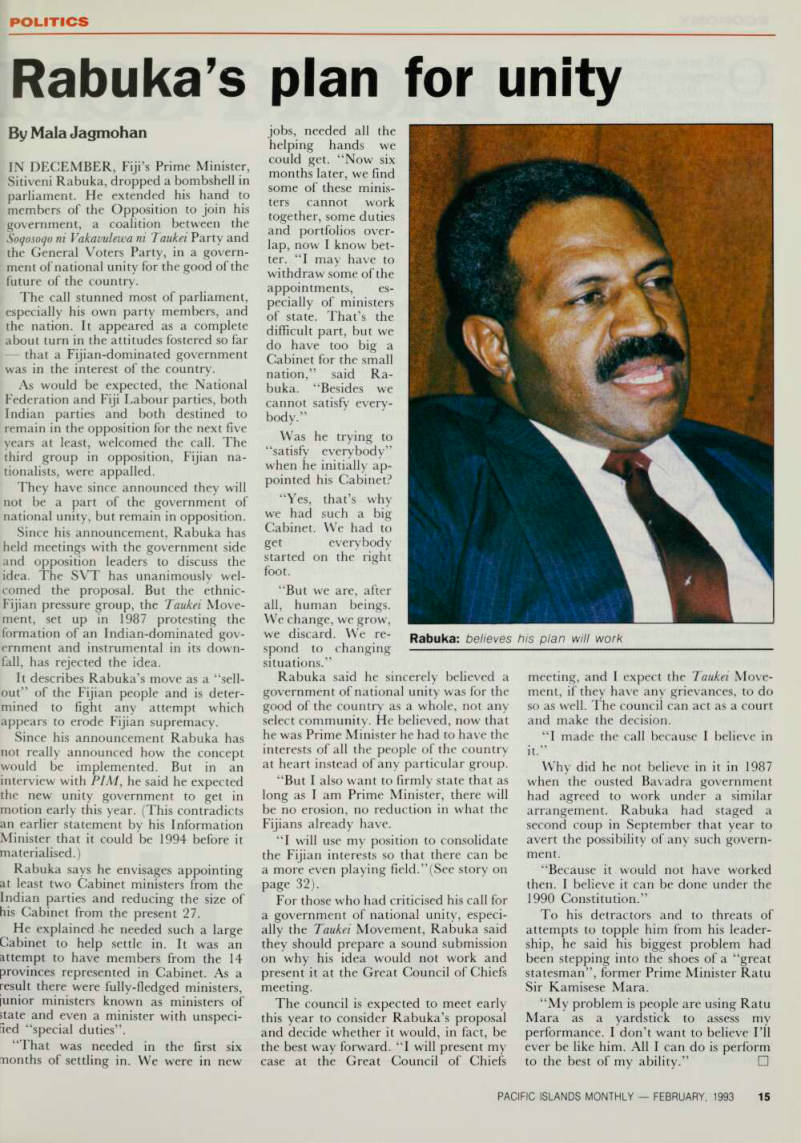
IN DECEMBER, Fiji’s Prime Minister, Sitiveni Rabuka, dropped a bombshell in parliament. He extended his hand to members of the Opposition to join his government, a coalition between the Soqosoqo ni Vakavulewa ni Taukei Party and the General Voters Party, in a govern ment of national unity for the good of the future of the country.
The call stunned most of parliament, especially his own party members, and the nation. It appeared as a complete about turn in the attitudes fostered so far that a Fijian-dominated government was in the interest of the country.
As would be expected, the National Federation and Fiji Labour parties, both Indian parties and both destined to remain in the opposition for the next five years at least, welcomed the call. The third group in opposition, Fijian na tionalists, were appalled.
They have since announced they will not be a part of the government of national unity, but remain in opposition.
Since his announcement, Rabuka has held meetings with the government side and opposition leaders to discuss the idea. The SVT has unanimously wel comed the proposal. But the ethnic- Fijian pressure group, the Taukei Move ment, set up in 1987 protesting the formation of an Indian-dominated gov ernment and instrumental in its down fall, has rejected the idea.
It describes Rabuka’s move as a “sell out” of the Fijian people and is deter mined to fight any attempt which appears to erode Fijian supremacy.
Since his announcement Rabuka has not really announced how the concept would be implemented. But in an interview with PIM, he said he expected the new unity government to get in motion early this year. (This contradicts an earlier statement by his Information Minister that it could be 1994 before it
materialised.)
Rabuka says he envisages appointing at least two Cabinet ministers from the Indian parties and reducing the size of his Cabinet from the present 27.
He explained he needed such a large Cabinet to help settle in. It was an attempt to have members from the 14 provinces represented in Cabinet. As a result there were fully-fledged ministers, junior ministers known as ministers of state and even a minister with unspeci fied “special duties”.
“That was needed in the first six months of settling in. We were in new
jobs, needed all the helping hands we could get. “Now six months later, we find some of these minis ters cannot work together, some duties and portfolios over lap, now I know bet ter. “I may have to withdraw some of the appointments, es pecially of ministers of state. That’s the difficult part, but we do have too big a Cabinet for the small nation,” said Ra buka. “Besides we cannot satisfy every body.”
Was he trying to
“satisfy everybody”
when he initially ap pointed his Cabinet?
“Yes, that’s why we had such a big Cabinet. We had to get everybody started on the right foot.
“But we are, after all, human beings.
We change, we grow, we discard. We re spond to changing situations.”
Rabuka said he sincerely believed a government of national unity was for the good of the country as a whole, not any select community. He believed, now that he was Prime Minister he had to have the interests of all the people of the country at heart instead of any particular group.
“But I also want to firmly state that as long as I am Prime Minister, there will be no erosion, no reduction in what the Fijians already have.
“I will use my position to consolidate the Fijian interests so that there can be a more even playing field.”( See story on page 32).
For those who had criticised his call for a government of national unity, especi ally the Taukei Movement, Rabuka said they should prepare a sound submission on why his idea would not work and present it at the Great Council of Chiefs meeting.
The council is expected to meet early this year to consider Rabuka’s proposal and decide whether it would, in fact, be the best way forward. “I will present my case at the Great Council of Chiefs
meeting, and I expect the Taukei Move ment, if they hav e any grievances, to do so as well. The council can act as a court and make the decision.
“I made the call because I believe in it.”
Why did he not believe in it in 1987 when the ousted Bavadra government had agreed to work under a similar arrangement. Rabuka had staged a second coup in September that year to avert the possibility of any such govern ment.
“Because it would not have worked then. I believe it can be done under the 1990 Constitution.”
To his detractors and to threats of attempts to topple him from his leader ship, he said his biggest problem had been stepping into the shoes of a “great statesman”, former Prime Minister Ratu Sir Kamisese Mara.
“My problem is people are using Ratu Mara as a yardstick to assess my performance. I don’t want to believe I’ll ever be like him. All I can do is perform to the best of my ability.” □
Rabuka: believes his plan will work
Back From
Economy
ONE year ago there was not a sober economic commentator who did not think the Solomon Islands would become one of the first of the island countries to fall into “the clutches of the International Monetary Fund (IMF)”. At the end of 1991 the economic situation was grave indeed. The foreign exchange reserves in December were at record lows representing a little over two weeks import cover. At its most recent peak in late 1986 by comparison, the country had nearly five months import cover a figure normally considered to be quite healthy by international stan dards.
By September of 1992 the Solomon Islands appears to have pulled back temporarily from the brink of economic disaster with external reserves recovering at the end of the third quarter of 1992 to over 51554.6 million, which was slightly over 1.5 months cover and there appear to be some initial signs that there may actually be a longer term real recovery in the economy.
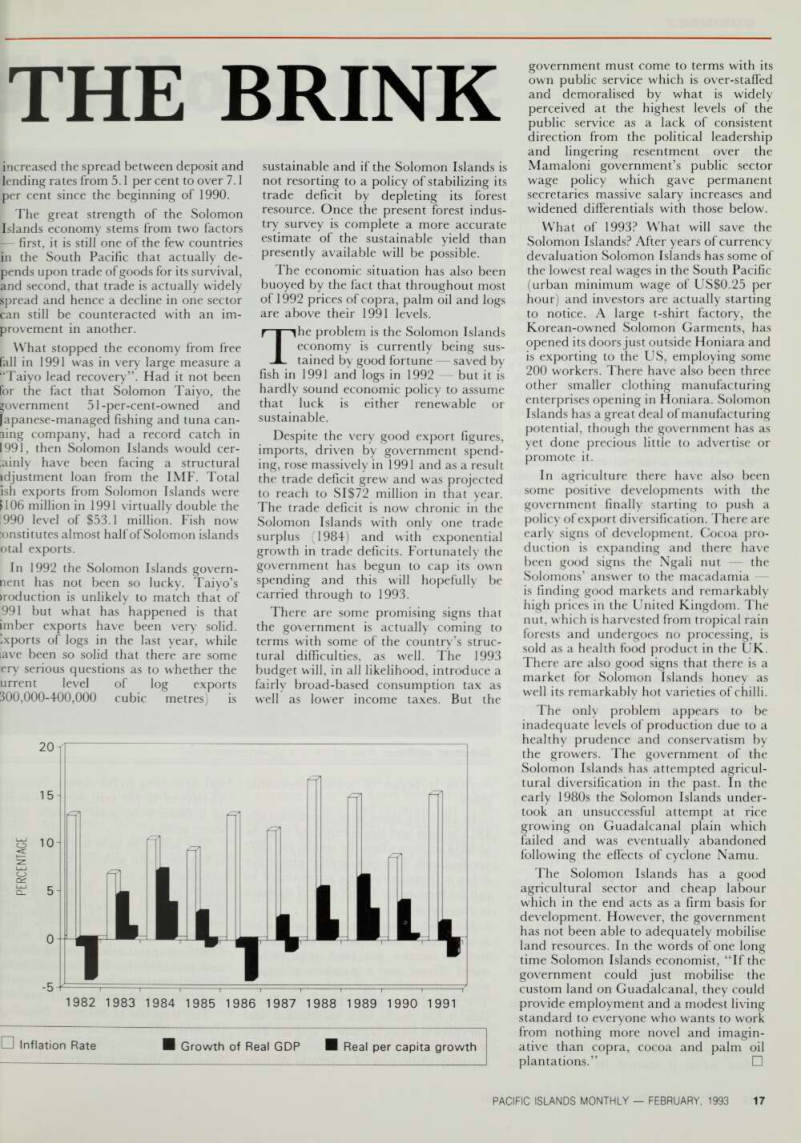
Economic growth in the Solomon Islands has been erratic in the past five years with real GDP growth varying from quite respectable levels of 6.5 per cent in 1989 to very low levels of 1.8 per cent in 1991. In terms of per capita GDP, the Solomon Islands, with a population growth of over 3.5 per cent has basically stood dead in the water with the standard of living neither rising nor
declining.
The reason for the apparent failure of the Solomon Islands economy to exhibit any real per capita growth over the last five years stems from two factors. The most important reason must be the very serious deterioration in the nation’s terms of trade (export price divided by import price). Using 1985 as a base year of 100 the terms of trade had deteriorated to 50 by 1991. In other words, the Solomon Islands had to export twice as much copra, fish and palm oil in 1991 as it did in 1985 just to buy the same quantity of
imports.
With the exception of 1987 the terms of trade of Solomon Islands have deterio rated every year since 1985. While government policy in the Solomon Islands cannot be blamed for the appar ent deterioration in the terms of trade, there can be no doubt the situation would have been better had the govern ment been able to further stimulate export volumes which showed a modest four per cent growth rate over the period.
For decades resource exporting countries in Africa and the South Pacific have used the deterioration in the terms of trade as a justification for their apparent policy paralysis. The argument goes that because import prices have risen more rapidly than export prices
there is nothing the government can do to maintain living standards. The retort that if the deterioration is structural or permanent governments should then find new export sectors is usually met by the stock reply that this is the job of the private sector. Of late this type of argument comes from even fairly developed resource exporting countries such as Australia, New Zealand and Canada when the government wishes to explain the apparent deterioration of living standards.
The second reason for the very difficult times the Solomon Islands has had must be laid squarely at the feet of the government. The deterioration in the balance of payments must also be ascribed to the massive growth in government deficit spending. The deficit spending in the Solomon Islands has, to an unusual degree, been financed by domestic rather than foreign borrowing.
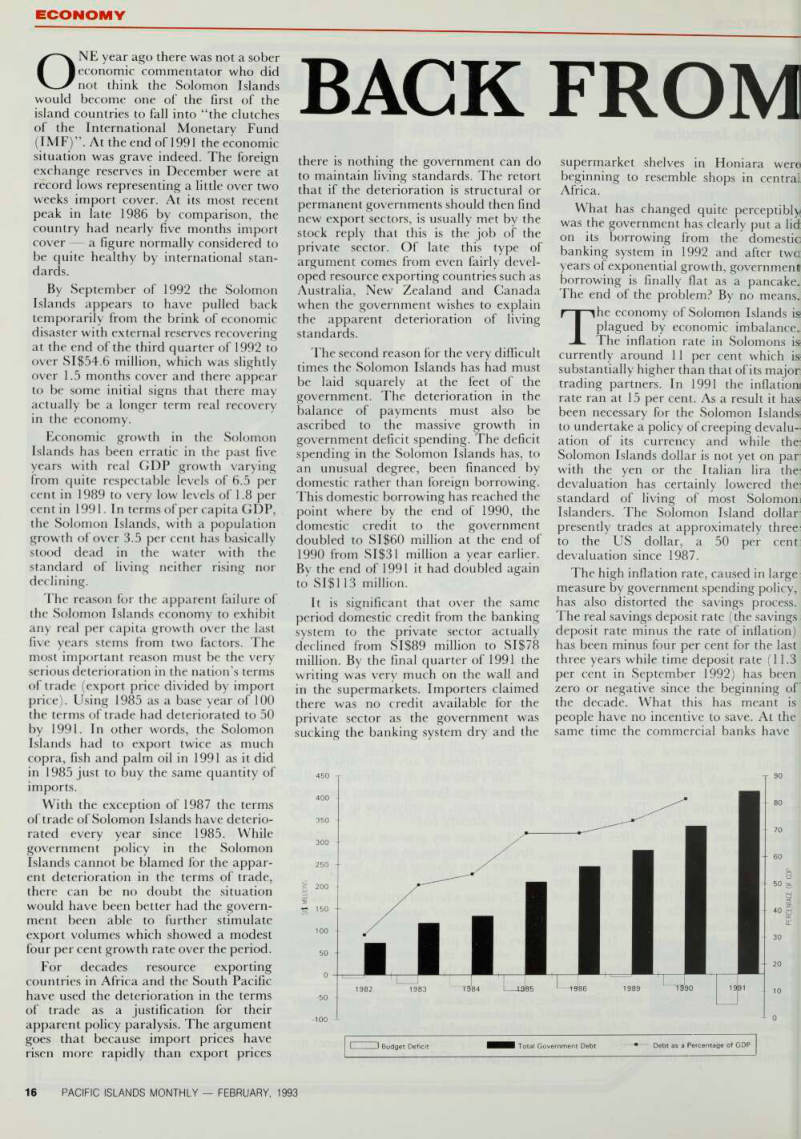
This domestic borrowing has reached the point where by the end of 1990, the domestic credit to the government doubled to Sls6o million at the end of 1990 from Sls3l million a year earlier, By the end of 1991 it had doubled again to SIS 113 million.
It is significant that over the same period domestic credit from the banking system to the private sector actually declined from SISB9 million to SIS7B million. By the final quarter of 1991 the writing was very much on the wall and in the supermarkets. Importers claimed there was no credit available for the private sector as the government was sucking the banking system dry and the
supermarket shelves in Honiara were beginning to resemble shops in central Africa.
What has changed quite perceptibly was the government has clearly put a lid on its borrowing from the domestic banking system in 1992 and after twee years of exponential growth, government! borrowing is finally flat as a pancake.
The end of the problem? By no means.
The economy of Solomon Islands is plagued by economic imbalance..
The inflation rate in Solomons is currently around 11 per cent which is substantially higher than that of its major trading partners. In 1991 the inflationi rate ran at 15 per cent. As a result it has* been necessary for the Solomon Islands* to undertake a policy of creeping devalu ation of its currency and while the!
Solomon Islands dollar is not yet on par with the yen or the Italian lira the; devaluation has certainly lowered the; standard of living of most Sblomom Islanders. The Solomon Island dollar presently trades at approximately three; to the US dollar, a 50 per cent: devaluation since 1987.
The high inflation rate, caused in large;
measure by government spending policy,
has also distorted the savings process.
The real savings deposit rate (the savings; deposit rate minus the rate of inflation) has been minus four per cent for the last three years while time deposit rate (11.3 per cent in September 1992) has been zero or negative since the beginning of the decade. What this has meant is people have no incentive to save. At the same time the commercial banks have
increased the spread between deposit and lending rates from 5.1 per cent to over 7.1 per cent since the beginning of 1990.
The great strength of the Solomon Islands economy stems from two factors first, it is still one of the few countries in the South Pacific that actually de pends upon trade of goods for its survival, and second, that trade is actually widely spread and hence a decline in one sector can still be counteracted with an im provement in another.
What stopped the economy from free fall in 1991 was in very large measure a “Taiyo lead recovery”. Had it not been for the fact that Solomon Taiyo, the government 51-per-cent-owned and fapanese-managed fishing and tuna can ning company, had a record catch in 1991, then Solomon Islands would cer :ainly have been facing a structural idjustment loan from the IMF. Total ish exports from Solomon Islands were MO6 million in 1991 virtually double the '990 level of $53.1 million. Fish now :onstitutes almost half of Solomon islands otal exports.
In 1992 the Solomon Islands govern nent has not been so lucky. Taiyo’s •reduction is unlikely to match that of 991 but what has happened is that imber exports have been very solid.
Exports of logs in the last year, while lave been so solid that there are some ery serious questions as to whether the urrent level of log exports 300,000-400,000 cubic metres) is
sustainable and if the Solomon Islands is not resorting to a policy of stabilizing its trade deficit by depleting its forest resource. Once the present forest indus try survey is complete a more accurate estimate of the sustainable yield than presently available will be possible.
The economic situation has also been buoyed by the fact that throughout most of 1992 prices of copra, palm oil and logs are above their 1991 levels.
The problem is the Solomon Islands economy is currently being sus tained by good fortune saved by fish in 1991 and logs in 1992 but it is hardly sound economic policy to assume that luck is either renewable or sustainable.
Despite the very good export figures, imports, driven by government spend ing, rose massively in 1991 and as a result the trade deficit grew and was projected to reach to Sls72 million in that year.
The trade deficit is now chronic in the Solomon Islands with only one trade surplus (1984) and with exponential growth in trade deficits. Fortunately the government has begun to cap its own spending and this will hopefully be carried through to 1993.
There are some promising signs that the government is actually coming to terms with some of the country’s struc tural difficulties, as well. The 1993 budget will, in all likelihood, introduce a fairly broad-based consumption tax as well as lower income taxes. But the
government must come to terms with its own public service which is over-staffed and demoralised by what is widely perceived at the highest levels of the public service as a lack of consistent direction from the political leadership and lingering resentment over the Mamaloni government’s public sector wage policy which gave permanent secretaries massive salary increases and widened differentials with those below.
What of 1993? What will save the Solomon Islands? After years of currency devaluation Solomon Islands has some of the lowest real wages in the South Pacific (urban minimum wage of US$O.25 per hour) and investors are actually starting to notice. A large t-shirt factory, the Korean-owned Solomon Garments, has opened its doors just outside Honiara and is exporting to the US, employing some 200 workers. There have also been three other smaller clothing manufacturing enterprises opening in Honiara. Solomon Islands has a great deal of manufacturing potential, though the government has as yet done precious little to advertise or promote it.
In agriculture there have also been some positive developments with the government finally starting to push a policy of export diversification. There are early signs of development. Cocoa pro duction is expanding and there have been good signs the Ngali nut the Solomons’ answer to the macadamia is finding good markets and remarkably high prices in the United Kingdom. The nut, which is harvested from tropical rain forests and undergoes no processing, is sold as a health food product in the UK.
There are also good signs that there is a market for Solomon Islands honey as well its remarkably hot varieties of chilli.
The only problem appears to be inadequate levels of production due to a healthy prudence and conservatism by the growers. The government of the Solomon Islands has attempted agricul tural diversification in the past. In the early 1980 s the Solomon Islands under took an unsuccessful attempt at rice growing on Guadalcanal plain which failed and was eventually abandoned following the effects of cyclone Namu.
The Solomon Islands has a good agricultural sector and cheap labour which in the end acts as a firm basis for development. However, the government has not been able to adequately mobilise land resources. In the words of one long time Solomon Islands economist, “If the government could just mobilise the custom land on Guadalcanal, they could provide employment and a modest living standard to everyone who wants to work from nothing more novel and imagin ative than copra, cocoa and palm oil plantations.” □
Selling off the
Business
By Roman Grynberg
WHEREAS you almost never get a yawn when the government tries to sell off the nation’s telephone service, you can visibly raise blood pressures when the government tries to sell off the nation’s airlines.
This national reflex to protect the flag has been clearly evident in Honi ara over the last few months where one of the hottest questions around town was who was going to buy the nation’s ailing flag carrier Solomon Airlines.
The second hottest question was just how much the government was going to lose on the deal.
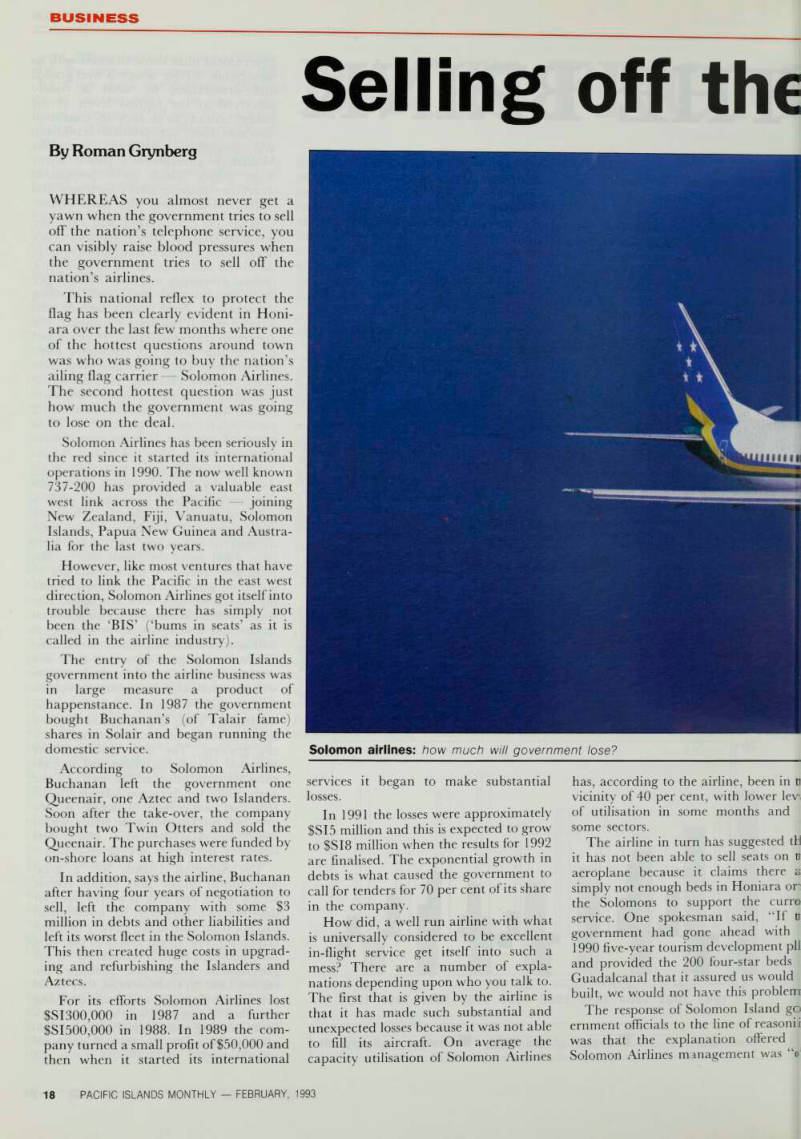
Solomon Airlines has been seriously in the red since it started its international operations in 1990. The now well known 737-200 has provided a valuable east west link across the Pacific joining New Zealand, Fiji, Vanuatu, Solomon Islands, Papua New Guinea and Austra lia for the last two years.
However, like most ventures that have tried to link the Pacific in the east west direction, Solomon Airlines got itself into trouble because there has simply not been the ‘BIS’ (‘bums in seats’ as it is called in the airline industry).
The entry of the Solomon Islands government into the airline business was in large measure a product of happenstance. In 1987 the government bought Buchanan’s (of Talair fame) shares in Solair and began running the domestic service.
According to Solomon Airlines, Buchanan left the government one Queenair, one Aztec and two Islanders.
Soon after the take-over, the company bought two Twin Otters and sold the Queenair. The purchases were funded by on-shore loans at high interest rates.
In addition, says the airline, Buchanan after having four years of negotiation to sell, left the company with some S 3 million in debts and other liabilities and left its worst fleet in the Solomon Islands.
This then created huge costs in upgrad ing and refurbishing the Islanders and Aztecs.
For its efforts Solomon Airlines lost $81300,000 in 1987 and a further $81500,000 in 1988. In 1989 the com pany turned a small profit of $50,000 and then when it started its international
services it began to make substantial losses.
In 1991 the losses were approximately SSIS million and this is expected to grow to SSIB million when the results for 1992 are finalised. The exponential growth in debts is what caused the government to call for tenders for 70 per cent of its share in the company.
How did, a well run airline with what is universally considered to be excellent in-ffight service get itself into such a mess? There are a number of expla nations depending upon who you talk to.
The first that is given by the airline is that it has made such substantial and unexpected losses because it was not able to fill its aircraft. On average the capacity utilisation of Solomon Airlines
has, according to the airline, been in tt vicinity of 40 per cent, with lower lev\ of utilisation in some months and some sectors.
The airline in turn has suggested tH it has not been able to sell seats on o aeroplane because it claims there s simply not enough beds in Honiara on the Solomons to support the curre service. One spokesman said, “If tt government had gone ahead with
1990 five-year tourism development pll
and provided the 200 four-star beds Guadalcanal that it assured us would built, we would not have this problem The response of Solomon Island go ernment officials to the line of reasonii was that the explanation offered Solomon Airlines management was “o
Solomon airlines: how much will government lose?
igenuous” and that it may well have (plained losses in 1990 and 1991. But aving seen clearly the government was nable to attract investment in the •urism industry, why did the airline go lead with leasing an even larger Boeing 17-400. The reply the airline gives is lat by the time it became apparent icre would be no hotels built the airline as committed to proceeding with the ase. here is still one more nagging question lat is frequently asked in Honiara about ie management of Solomon Airlines, ow could a management team with any :perience in the Pacific undertake ajor investments on the basis of prom ts in a government plan? It is argued at had common sense prevailed Sol
omon Airlines would have leased the airplane after the hotel beds were built and not before, and certainly not on the basis of a development plan. According to the airline, it only entered into the international airline service after Air Pacific sold its own 737-200 from the route. Low capacity utilisation has no doubt been one of the problems con fronted by the airline, but there have been others. One frequently cited prob lem is that the airline over extended itself by flying to Auckland, a sector on which utilisation rates are particularly low.
Even on its domestic routes there have been problems with the airline. Despite the massive devaluation of the Solomon Island dollar over the last three years, the company has only been allowed two
10-per-cent price rises in January and August 1991 for domestic service. So even on the domestic service, which is usually operating at high rates of utilis ation, there have been little or no profits.
In the final analysis the Solomon Islands government could no longer sustain the mounting debt and having invested over SSI2S million in the airline it began to see it as a bottomless pit into which it would be forced to pour money indefin itely. The government has only recently succeeded in reigning in its overall spending and hence the privatisation move was seen as part of a wider policy of trying to stabilise the economy.
When the company was recently put to tender there was only one bidder - Golden Spring which according to Wilson Gina, general manager of the government-owned Investment Corpor ation of Solomon Islands which owns Solomon Airlines, is “an Indonesian based and Hong Kong-registerd logging company”. Well informed sources indi cate that Golden Spring offered the government in the vicinity of SSI4 million for the government’s 70 per cent share of the company along with land access provisions as well as other unspeci fied guarantees.
If the government were to accept the offer it would mean it would have lost some SSI 15 million from its investment in the airline. It is widely felt among board members that selling off a debt-ridden airline during a global recession may be less than opportune.
A number of airlines have looked at the
possibility of acquiring the government’s
share. Early on in the picture Air Niugini took a brief look. Air Nauru has also expressed interest and expressed its displeasure that the tender period was insufficient for it to mount a bid. There have also been serious expressions of interest from even further afield. Royal Brunei Airlines also appears to have shown some interest, according to the airline, but has recently withdrawn.
Perhaps it is time to once again resurrect the idea of a regional carrier an ‘Air Melanesia’ combining the interna tional services of Air Vanuatu, Air Niugini and Solomon Airlines and thereby rationalising existing interna tional services. It might even prove a useful subject for discussion at the next
Melanesian Spearhead Group meeting
and would certainly be less contentious than discussing Bougainville.
Advertisements & other items, pp. 19-20 (2 items)
flag carrier
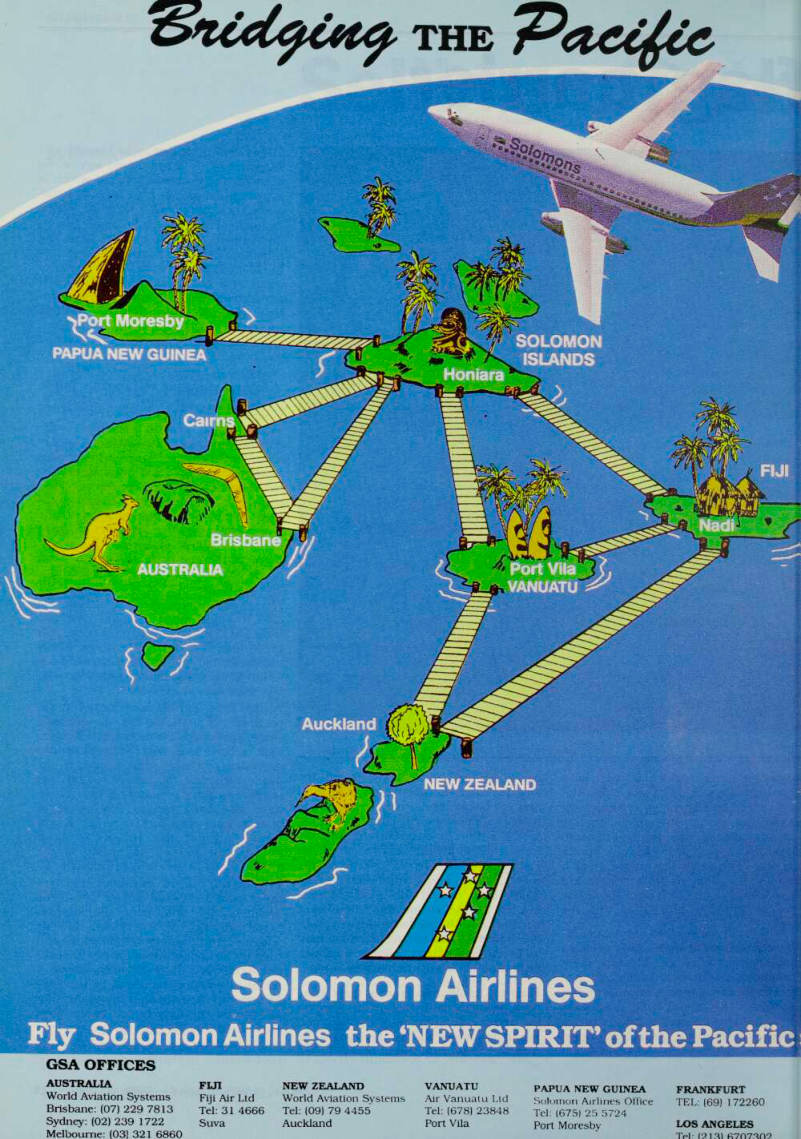
Pacific
THE
PAPUA NEW GUINEA
Cairns
'A
Auckland fl
m
NEW ZEALAND
s ?-• mm mm
Solomon Airlines
Solomon Airlines the ‘NEW SPIRIT’ of the Pacific
GSA OFFICES
AUSTRALIA
World Aviation Systems Brisbane: (07) 229 7813 Sydney: (02) 239 1722 Melbourne: (03) 321 6860
FIJI
Fiji Air Ltd Tel: 31 4666 Suva
NEW ZEALAND
World Aviation Systems Tel: (09) 79 4455 Auckland
VANUATU
Air Vanuatu Ltd Tel: (678) 23848 Port Vila
PAPUA NEW GUINEA
Solomon Airlines Office Tel: (675) 25 5724 Port Moresby
FRANKFURT
TEL; (69) 172260
LOS ANGELES
Tel: 12131 #*707309
Monopoly is out
Television
By Mala Jagmohan
After years of indecision and debate on the country’s television service the Fiji government has surprised many by offering licences to all interested.
AFTER years of debate, decision and its fair amount of controversy, the Fiji government appears finally on the way to making a decision on the future of the country’s television service. And the decision, likely to come as a surprise to many of those who had tendered for the rights to broadcast, is likely to be announced in the next month.
While for years the companies, which had tendered, had banked on operating as a monopoly, the new line of govern ment thought is likely to come as a jolt to a few of them.
PIM has managed to establish the new approach is to do away with the idea of granting any one company exclusive rights for a specified period of time, say 12 years, to control television services in
Fiji.
Instead, the government has now decided it would be wiser to grant licences to all companies which come forward with viable proposals and agree to operate under guidelines set down by the government.
“Open it up, that’s what we want to do,” said Fiji’s Prime Minister, Sitiveni
Rabuka. “There has been far too much lobbying by the various companies.”
The lobbying has made the govern ment aware of the virtues of many of them; that more than one was offering a good deal. So, rather than limit the choice to one, the government is willing to give them all a shot at it. In this way, the government feels, only those serious enough about setting up the service and with the resources to do so would come forward. It would rule out companies who were banking on surviving on the basis of the exclusive rights alone.
This will definitely be good news to the viewer not only will he have a choice in what he wants to watch, but the competition is likely to ensure better quality in programs.
“The best will survive. Who says the laws of the jungle cannot be applied here?” he says with a chuckle.
Government control is expected to be regulatory only again a departure from former government views that it should also have some shareholding in the new venture. After the financial mess the government-owned Fiji Broadcasting Commission built up over the years, it has become wary of any financial involvement in the deal.
But, the government has not veered from its initial stance that the company which granted the rights must look at providing services to as wide an audience as possible, to include programs which enhance local culture and tradition and to provide skills and expertise to local staff both technical and in producing programs.
In addition the government is looking at the venture as providing a social service to the people, a service which can be developed to meet the needs of the people. This will invariably mean the inclusion of educational programs reach ing as much of the rural population as
possible.
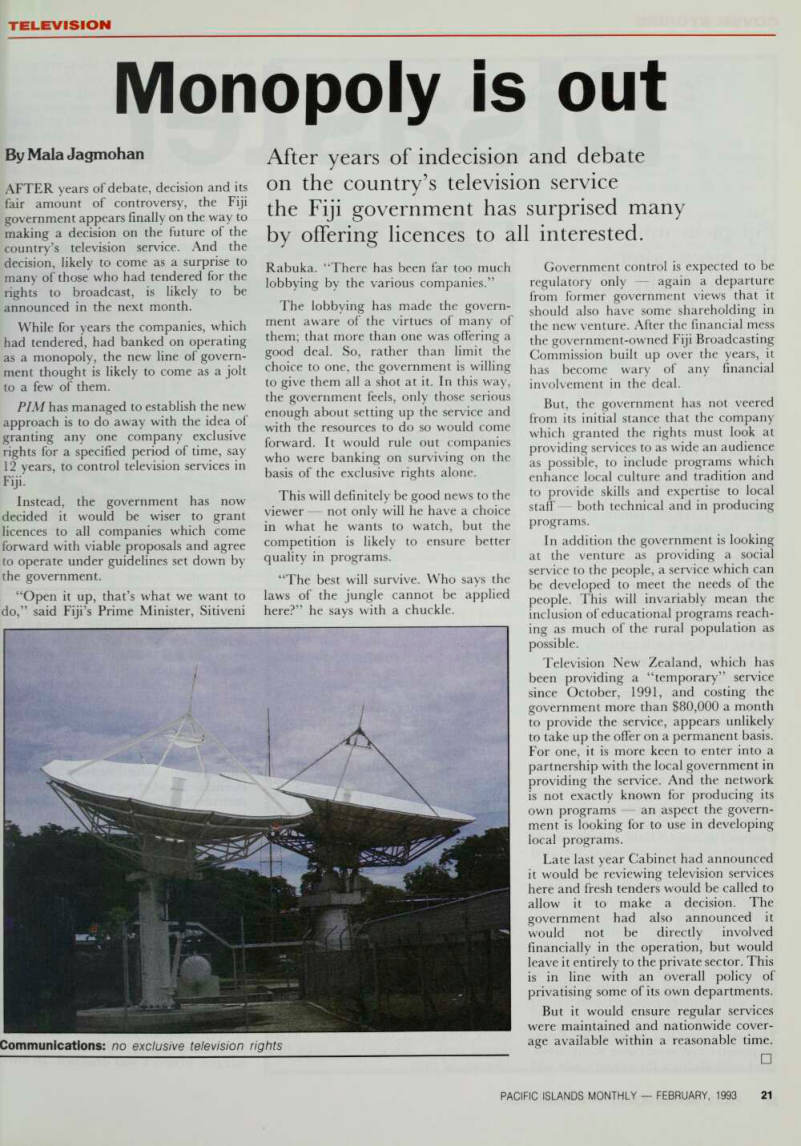
Television New Zealand, which has been providing a “temporary” service since October, 1991, and costing the government more than $BO,OOO a month to provide the service, appears unlikely to take up the offer on a permanent basis.
For one, it is more keen to enter into a partnership with the local government in providing the service. And the network is not exactly known for producing its own programs an aspect the govern ment is looking for to use in developing local programs.
Late last year Cabinet had announced it would be reviewing television services here and fresh tenders would be called to allow it to make a decision. The government had also announced it would not be directly involved financially in the operation, but would leave it entirely to the private sector. This is in line with an overall policy of privatising some of its own departments.
But it would ensure regular services were maintained and nationwide cover age available within a reasonable time.
Communications: no exclusive television rights
Disaster
Cover Stories
Fiji picks up the pieces after the onslaught of Cyclone Kina.
By Martin Tiffany
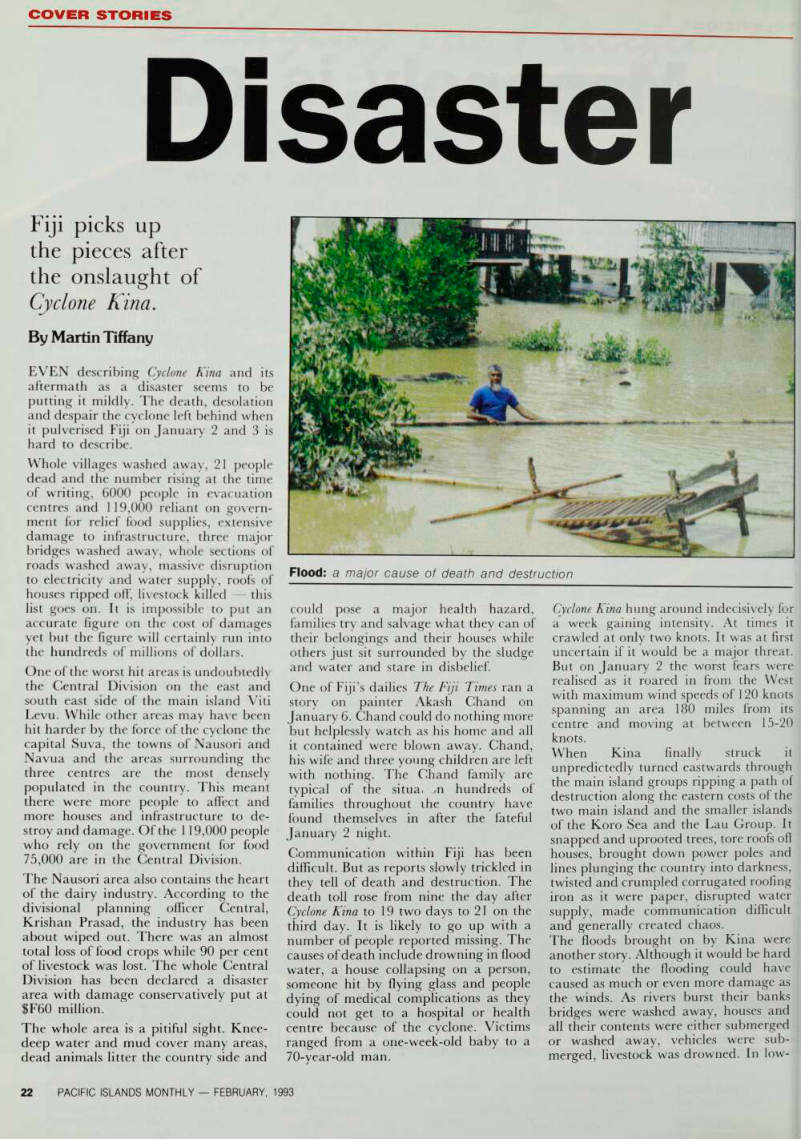
EVEN describing Cyclone Kina and its aftermath as a disaster seems to be putting it mildly. The death, desolation and despair the cyclone left behind when it pulverised Fiji on January 2 and 3 is hard to describe.
Whole villages washed away, 21 people dead and the number rising at the time of writing, 6000 people in evacuation centres and 119,000 reliant on govern ment for relief food supplies, extensive damage to infrastructure, three major bridges washed away, whole sections of roads washed away, massive disruption to electricity and water supply, roofs of houses ripped oflf, livestock killed this list goes on. It is impossible to put an accurate figure on the cost of damages yet but the figure will certainly run into the hundreds of millions of dollars.
One of the worst hit areas is undoubtedly the Central Division on the east and south east side of the main island Viti Levu. While other areas may have been hit harder by the force of the cyclone the capital Suva, the towns of Nausori and Navua and the areas surrounding the three centres are the most densely populated in the country. This meant there were more people to affect and more houses and infrastructure to de stroy and damage. Of the 119,000 people who rely on the government for food 75,000 are in the Central Division.
The Nausori area also contains the heart of the dairy industry. According to the divisional planning officer Central, Krishan Prasad, the industry has been about wiped out. There was an almost total loss of food crops while 90 per cent of livestock was lost. The whole Central Division has been declared a disaster area with damage conservatively put at SF6O million.
The whole area is a pitiful sight. Knee deep water and mud cover many areas, dead animals litter the country side and
could pose a major health hazard, families try and salvage what they can of their belongings and their houses while others just sit surrounded by the sludge and water and stare in disbelief. ni CT?- -, i t t'i, I? - "
One ot Fin s dailies Ihe bin 1 imes ran a . J • a i u nu a story on painter Akash Chand on r , j , • anuarv b. Chand could do nothing more u*u i i i . u u u & , n but helplessly watch as his home and all it contained were blown away. Chand, , • -r , uij i his wife and three young children are left • i • tV , r -1 with nothing. Ihe Chand family are „ • , rff i i j c typical of the s.tua, ,n hundreds of fam.hes throughout the country have found themselves m after the fateful January 2 night.
Communication within Fiji has been difficult. But as reports slowly trickled in they tell of death and destruction. The death toll rose from nine the day after Cyclone Kina to 19 two days to 21 on the third day. It is likely to go up with a
number of people reported missing. The
causes of death include drowning in flood water, a house collapsing on a person, someone hit by flying glass and people
dying of medical complications as they
could not get to a hospital or health centre because of the cyclone. Victims ranged from a one-week-old baby to a 70-year-old man.
Cyclone Kina hung around indecisively for a week gaining intensity. At times it crawled at only two knots. It was at first uncertain if it would be a major threat.
But on January 2 the worst fears were realised as it roared in from the West with maximum wind speeds of 120 knots spanning an area 180 miles from its centre and moving at between 15-20 knots.
When Kina finally struck it unpredictedly turned eastwards through the main island groups ripping a path of destruction along the eastern costs of the two main island and the smaller islands of the Koro Sea and the Lau Group. It snapped and uprooted trees, tore roofs ofi houses, brought down power poles and lines plunging the country into darkness, twisted and crumpled corrugated roofing iron as it were paper, disrupted water supply, made communication difficult and generally created chaos.
The floods brought on by Kina were another story. Although it would be hard to estimate the flooding could have caused as much or even more damage as the winds. As rivers burst their banks bridges were washed away, houses and all their contents were either submerged or washed away, vehicles were sub merged, livestock was drowned. In low
Flood: a major cause of death and destruction
lying areas like Navua, Nausori and the Sigatoka Valley mud clung to everything as waters subsided and covered root crops and vegetables destroying them. It was these flood waters that accounted for most deaths.
As the waters rose people were forced to climb onto the roofs of their houses and climb trees to escape the torrent. Some had to remain there for up to 16 hours.
As this report was being compiled four days after Kina the country was only just beginning to show some semblance of normality. Electricity and water were being restored, people were returning to work, ferry services were being run across rivers that had lost bridges, flights were operating and a general clean up was taking place.
The affect to the country’s economy has yet to be assessed but it is certain to be bad . The dairy industry has been very badly affected, cane crops have been damaged but how badly is not yet known, livestock and poultry have been killed by the thousand, the rice crop in the Central Division has been wiped out, the Sigatoka Valley, known as Fiji’s salad bowl, lost its vegetables and rootcrops and damage is expected to run into the hundreds of thousands of dollars. To make matters worse some farmers also lost farming equipment. Luckily tourism infrastructure was not badly affected.
On a brighter note a joint New Zealand, Australian and French relief effort has been launched to help Fiji. The three nations agreed last year they would work together to provide aid in such circumstances.
A Royal New Zealand Air Force Orion aircraft and a helicopter were sent to Fiji to assist in the relief effort. The Orion has been carrying out aerial survey of the damage while the helicop ter has been helping with relief supply distribution. The Australians sent a Hercules transport plane carrying a military helicopter and crew to assist in operation. Another Hercules was sent from Australia carrying supplies includ ing emergency rations, tarpaulins and water purification equipment. From Noumea the French sent a Transall aircraft carrying 1000 tarpaulins, 200 water tanks and 134,000 water purifying tablets.
Other countries including Japan, Brit ain and the United States have re sponded with relief assistance which has included cash and equipment.
The sun is now shining again in Fiji, the water is drying up and the rubbish is being cleared away. But for the people of Fiji the real task of rebuilding their lives has only just begun.
Fiji radar fails
By Martin Tiffany
IMAGINE a light tropical rain turning into a storm followed by gale-force winds and then you are hit by a killer cyclone. And you had no idea it was coming. Fiji and some of its regional neighbours could be faced with such a situation before this cyclone season is over. Basically because its cyclone monitoring equipment is out-dated and has a habit of breaking down.
The seriousness of these problems were rudely shown to Fiji when Cyclone Kina struck in early January. It was obvious to people listening to the weather updates on the radio some thing was amiss at the National Weather Forecasting Centre. When the capital Suva, and near-by towns Na vua and Nausori were being hit by the worst of Kina the radio reported the cyclone was close to the island of Gau 360 kilometres away.
At one point the national weather centre lost track of the cyclone alto gether when its radar broke down and it had to rely on New Zealand to track the cyclone. In fact Cyclone Kina could not be tracked at all using the radar even though the system came within 60 miles of the weather forecasting centre.
Suva and the eastern side of the main island Viti Levu got a nasty shock because of the radar failure when Kina took a southerly turn and hit harder than expected. In fact the people on the eastern coasts of Viti Levu, Vanua Levu (the second main island) and the islands in the Lau and Lomaiviti group got little warning at all.
At 7pm on Saturday January 2 the Nadi weather centre indicated the cyclone may veer their way instead of to the west. The confirmation that it would came at midnight when people could do little more than cower in their homes as the cyclone raged outside.
Three weeks earlier Cyclone Joni hit Fiji with 75 knot winds and gusts of up to 110 knots and the radar broke down.
The radar did not start working until Joni was 100 miles out of Nadi and then it only worked for about seven hours.
National weather centre staff had to rely on satellite images of the cyclone taken by a Japanese satellite 36,000 over Papua New Guinea to fix its location. Fixes done this way can be off the mark by as much as 60 miles. It was only some good guessing and the professionalism of the centre’s staff that
kept the public reasonably well in formed. Acting Director of Meteor ology Rajendra Prasad said he really did not rely on the radar at all, he used the satellite.
In March last year the 35-year-old radar system seized up and was unable to warn of Cyclone Fran. It was fortunate Fran was not strong and did not hit Fiji. But inaccuracies and out-of-date equipment should not come into play when cyclones with killer winds are hitting a country. People’s lives should not be at the mercy of good guess work.
Because of the radar problems the Fiji weather centre had to resort to over warning people.
Twelve countries are directly served by the Fiji weather centre. Given the frequency cyclones and hurricanes hit Fiji and its neighbours who rely on Fiji for information, it is incredible that keeping the cyclone monitoring equip ment in good order and up-to-date is not a priority for the Fiji government or for the other countries which rely on it. Last year 12 cyclones passed this way.
Prasad said the equipment they were using should have been replaced ten years ago adding that the last time the radar operated smoothly was in No vember 1990. The radar equipment is now so old it is impossible to get new parts for it.
New equipment will not be cheap with the cost of replacing the radar running into the SF3 million plus range. The Fiji government said the high cost is the reason they have not been able to replace the radar adding that they could not just install the
equipment overnight.
In September the Fiji government made a request to Australia to assist in providing a weather and wind-finding radar. In response an Australian specialist team from the International Development Assistance Bureau (AIDAJB) is expected in Fiji this month to work on developing the best radar.
This is the good news. The bad news is that while the AIDAB team hope to have the system installed before the next cyclone season it will not be in place before the end of this season.
Cyclone season in the Pacific is officially November to April. This means we are stuck with three more months of cyclone season, a 35-year-old radar with a habit of breaking down, some guess work and undoubtedly a lot of prayer.
Images of
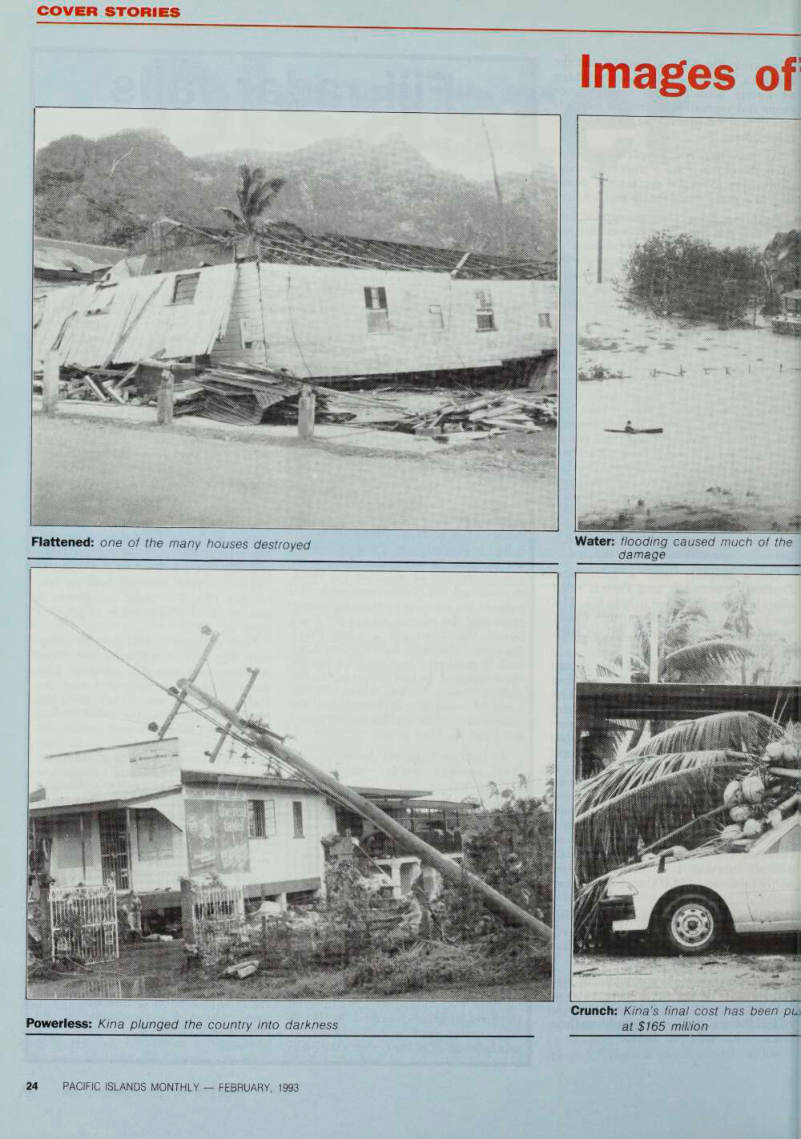
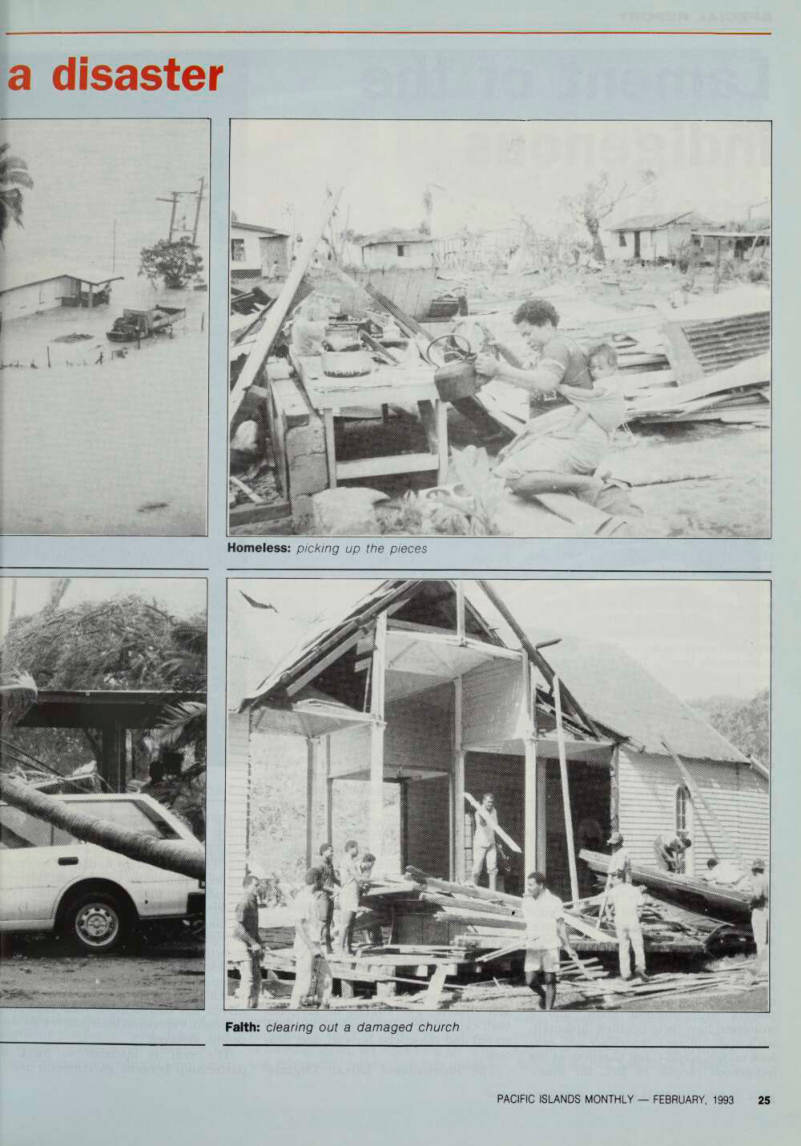
indigenous
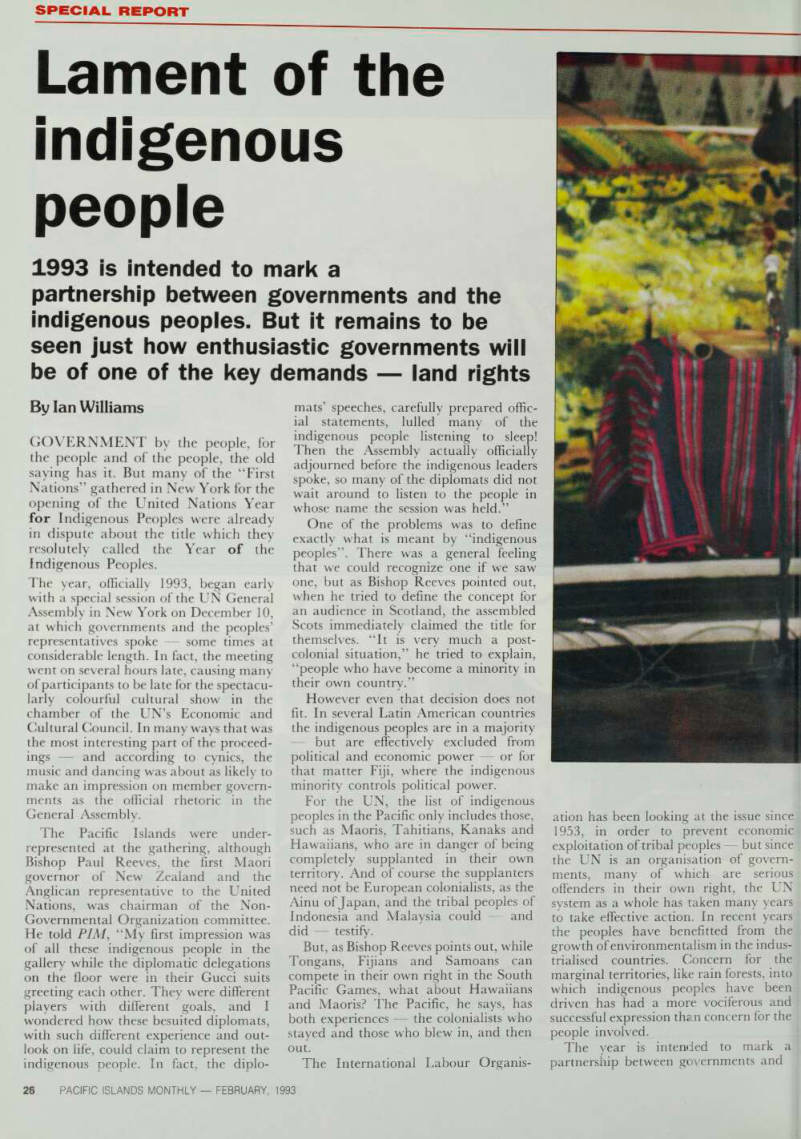
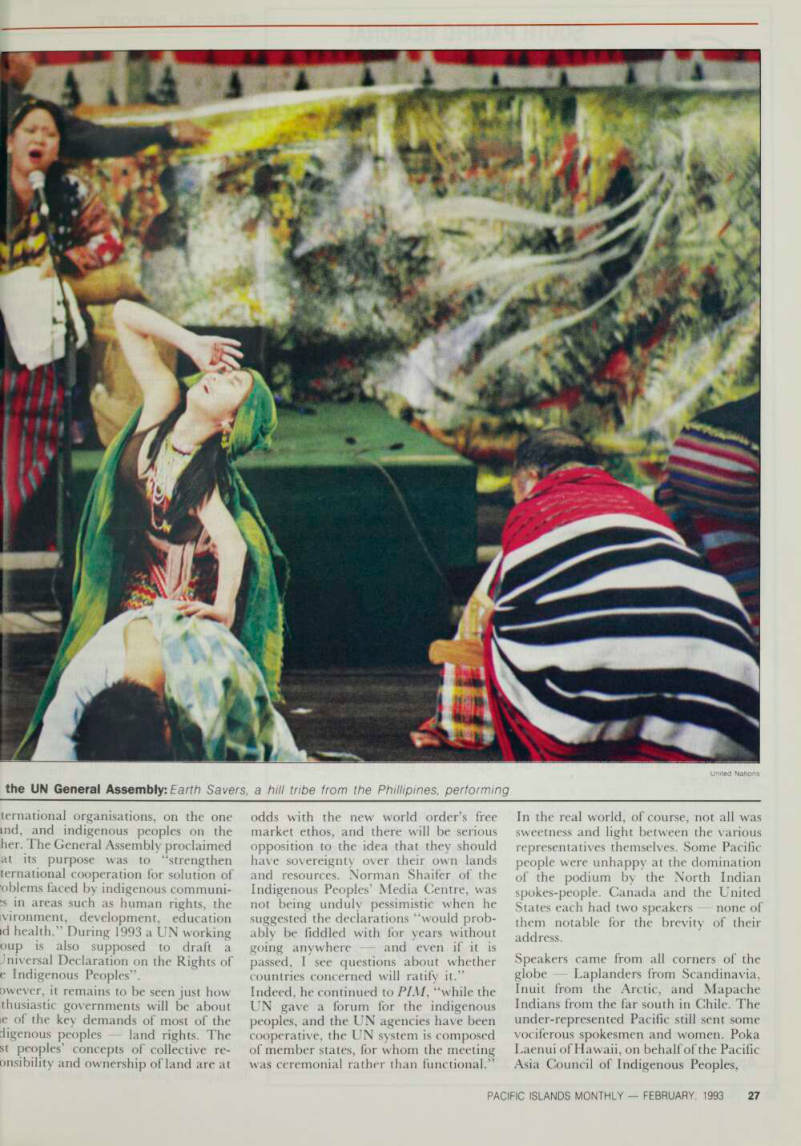

Special Report
Lament of the indigenous people
1993 is intended to mark a partnership between governments and the indigenous peoples. But it remains to be seen just how enthusiastic governments will be of one of the key demands land rights
By lan Williams
GOVERNMENT by the people, for the people and of the people, the old saying has it. But many of the “First Nations” gathered in New York for the opening of the United Nations Year
for Indigenous Peoples were already
in dispute about the title which they resolutely called the Year of the
Indigenous Peoples.
The year, officially 1993, began early with a special session of the UN General Assembly in New York on December 10, at which governments and the peoples’ representatives spoke some times at considerable length. In fact, the meeting went on several hours late, causing many of participants to be late for the spectacu larly colourful cultural show in the chamber of the UN’s Economic and Cultural Council. In many ways that was the most interesting part of the proceed ings and according to cynics, the music and dancing was about as likely to make an impression on member govern ments as the official rhetoric in the General Assembly.
The Pacific Islands were under represented at the gathering, although Bishop Paul Reeves, the first Maori governor of New Zealand and the Anglican representative to the United Nations, was chairman of the Non- Governmental Organization committee.
He told PIM , “My first impression was of all these indigenous people in the gallery while the diplomatic delegations on the floor were in their Gucci suits greeting each other. They were different players with different goals, and I wondered how these besuited diplomats, with such different experience and out look on life, could claim to represent the indigenous people. In fact, the diplo
mats’ speeches, carefully prepared offic ial statements, lulled many of the indigenous people listening to sleep!
Then the Assembly actually officially adjourned before the indigenous leaders spoke, so many of the diplomats did not wait around to listen to the people in whose name the session was held.”
One of the problems was to define exactly what is meant by “indigenous peoples”. There was a general feeling that we could recognize one if we saw one, but as Bishop Reeves pointed out, when he tried to define the concept for an audience in Scotland, the assembled Scots immediately claimed the title for themselves. “It is very much a post colonial situation,” he tried to explain, “people who have become a minority in their own country.”
However even that decision does not fit. In several Latin American countries the indigenous peoples are in a majority - but are effectively excluded from political and economic power or for that matter Fiji, where the indigenous minority controls political power.
For the UN, the list of indigenous peoples in the Pacific only includes those, such as Maoris, Tahitians, Kanaks and Hawaiians, who are in danger of being completely supplanted in their own territory. And of course the supplanters need not be European colonialists, as the Ainu of Japan, and the tribal peoples of Indonesia and Malaysia could and did testify.
But, as Bishop Reeves points out, while Tongans, Fijians and Samoans can compete in their own right in the South Pacific Games, what about Hawaiians and Maoris? The Pacific, he says, has both experiences the colonialists who stayed and those who blew in, and then out.
The International Labour Organis-
ation has been looking at the issue since 1953, in order to prevent economic exploitation of tribal peoples but since the UN is an organisation of govern ments, many of which are serious offenders in their own right, the UN system as a whole has taken many years to take effective action. In recent years the peoples have benefitted from the growth of environmentalism in the indus trialised countries. Concern for the marginal territories, like rain forests, into which indigenous peoples have been driven has had a more vociferous and successful expression than concern for the
people involved.
The year is intended to mark a partnership between governments and
ternational organisations, on the one md, and indigenous peoples on the her. The General Assembly proclaimed at its purpose was to “strengthen ternational cooperation for solution of oblems faced by indigenous communi -s in areas such as human rights, the vironment, development, education id health.” During 1993 a UN working oup is also supposed to draft a Jniversal Declaration on the Rights of
e Indigenous Peoples”,
owever, it remains to be seen just how thusiastic governments will be about ie of the key demands of most of the digenous peoples land rights. The st peoples’ concepts of collective re onsibility and ownership of land are at
odds with the new world order’s free market ethos, and there will be serious opposition to the idea that they should have sovereignty over their own lands and resources. Norman Shaifer of the Indigenous Peoples’ Media Centre, was not being unduly pessimistic when he suggested the declarations “would prob ably be fiddled with for years without going anywhere and even if it is passed, I see questions about whether countries concerned will ratify it.”
Indeed, he continued to PIM, “while the UN gave a forum for the indigenous peoples, and the UN agencies have been cooperative, the UN system is composed of member states, for whom the meeting was ceremonial rather than functional.”
In the real world, of course, not all was sweetness and light between the various representatives themselves. Some Pacific people were unhappy at the domination of the podium by the North Indian spokes-people. Canada and the United States each had two speakers none of them notable for the brevity of their address.
Speakers came from all corners of the globe Laplanders from Scandinavia, Inuit from the Arctic, and Mapache Indians from the far south in Chile. The under-represented Pacific still sent some vociferous spokesmen and women. Poka Laenui of Hawaii, on behalf of the Pacific Asia Council of Indigenous Peoples,
United Nations
the UN General Assembly: Earth Savers, a hill tribe from the Phillipines, performing
contrasted the UN’s high moral stand with the behaviour of member states, pointing out that there were atrocities against indigenous people in East Timor.
West Papua, and the Moluccas Island.
“There must be an end to such hypocrisy and firm action must be taken by the United Nations to end such atrocities,” he told the General Assembly.
A similar theme was taken up by William Means, President of the International Treaty Council, who addressed his comments on the treatment meted out to Native Americans. “We are the Palestin ians of the Western Hemisphere,” he said. Lois O’Donague of the Aboriginal and Torress Strait Islander Commission was able to record some success, that after 204 years the Australian courts had finally recognized her people did in fact own their own land when Captain Cook turned up on their shores. For the two centuries before, the law deemed the land belonged to no one.
On the other hand, Tamati Reedy of the National Maori Congress, complained the New Zealand government, despite just winning a seat on the Security Council had acted “in utter violation of the rights of its own minority indigenous group over the Maori fishing rights issue.
Anderson Muang Urud of the Kelabit people of Sarawak spoke despite warnings from people claiming to rep resent Malaysia that it would be bad for his future health to do so. He said the so called progress represented by logging meant “only starvation, dependence, helplessness, the destruction of our cul ture and the demoralization of our people.” In 10 years time, he prophesied, the jobs “created” by logging would be gone. “And the forest which had sus tained the people for thousands of years would be gone with them.”
Pacific diplomats also had their say.
Terry O’Brien, New Zealand Ambassa dor of the UN, differed from Reedy, saying the fishing rights agreement is seen “almost universally as being fair to all parties and the resolution of a long standing and contentious issue”. He finished by stressing that the relationship between member states and the indigen ous peoples must be “equitable and based on mutual respect and under standing”.
Vanuatu’s Report Van Lierop echoed some of the points made by the indigen ous peoples themselves and expressed support for the idea of a mechanism which would go beyond 1993, to give indigenous peoples a “a greater voice within the international community, and the means to help them set their own development priorities and address their
own needs.” Australian Senator Patricia Giles indulged in some uncommon self criticism by referring to the Royal Commission on the deaths of Aborigines in police custody which, she said, indicated the 99 people who died “were victims of entrenched and institutionalized racism and discrimi nation”.
The government, however, had ac cepted almost all the recommendations of the commission and was determined to stop such incidents in future.
Fiji’s Senator Adi Litia Cakobau, unsurprisingly, invoked the intentions of the year to bless the new constitution which, she said, was intended to “protect
and promote” the special “indigenous
position” of the indigenous Fijian people by giving them a majority of seats and by according recognition to the Great Council of Chiefs. This was, she claimed, in accordance with the “protective provisions in the constitutions of several other member countries of the UN”. It was an interesting analogy, which was not, however, pursued by anyone else.
By the end of the evening, the weary delegates found the cultural evening had started without them. Indeed one group of about 30 was prevented from entering the auditorium by the UN security guards. Despite their motley costumes, they did not have the right pass.
But there was one clear victory for the first peoples that day. The guard backed down when he saw the determination and anger of the crowd shouting that “it’s our evening”. It was a neat parable, of the fact that the peoples have to fight to gain control of their own year, let alone their own lands.
Van Lierop: going beyond 1993
Advertisements & other items, p. 28 (1 item)
South Pacific Regional
ENVIRONMENT PROGRAMME (SPREP)
VACANCY POPULATION
AND DEVELOPMENT OFFICER
Applications are invited for the position of Population and Development Officer with the South Pacific Regional Environment Programme (SPREP), in Apia, Western Samoa.
SPREP is a regional organisation established by 26 governments and administrations to assist Pacific Island countries and territories to protect and improve their shared environment and to manage their resources so as to enhance the quality of life for present and future generations. The need to integrate population and environment concerns is a priority for sustainable development in the Pacific and an integral part of SPREP’s Action Plan.
The Population and Development Officer will be responsible for the implementation and supervision of a UNFPA funded Population Integration Project that will focus on macro-level linkages between population characteristics, sustainable development and the environment which can be addressed through sectoral and national planning.
Candidates must have appropriate tertiary qualifications from a recognized institution and at least five years’ work experience in a field related to this position. Other essential requirements are the ability to work as part of a small inter-disciplinary team, to manage the work of consultants and to meet project deadlines.
Appointment will be at Project Officer level and will be for three years in the first instance, renewable for a further term by mutual agreement. An attractive remuneration package and other employment benefits will be offered, with commencing salary dependent on qualifications, experience and current salary in country of recruitment. For non-Western Samoan citizens, salary will be tax-free in Western Samoa.
Applications must be accompanied by detailed curricula vitae containing full information on qualifications and experience for the position as well as names, addresses, telephone and/or fax contact numbers of three referees associated with the applicant professionally and who would be prepared to provide necessary references.
Applications should be addressed to: The Director Further information, including a full duty statement and schedule of terms and conditions of appointment, can be obtained by contacting SPREP’s Senior Administrative Officer, Mr Ueligitone Sasagi, at these numbers.
Applications close on 15 March 1993.
South Pacific Regional Environment Programme PO Box 240
APIA
Western Samoa Telephone: (685) 21929 Fax: (685) 20 231
The New Zealand proof
NEW ZEALAND has continued to work towards addressing and trying to resolve claims of the Maori people since the Treaty of Waitangi Act, passed by parliament in 1975. In its reports to the United Nations working group, the New Zealand delegate has outlined the steps being taken in New Zealand.
New Zealand’s attempts to address Maori claims began in 1975 when parlia ment passed the Treaty of Waitangi Act, which in turn established the Waitangi Tribunal to investigate claims from 1975.
This was amended in 1985 to allow addressing claims dating back to the first signing of the treaty on February 6, 1840.
In his statement to the UN, the head of the New Zealand delegation outlined his country’s determination “to face up to matters which have gone wrong in the past, and to seek agreement to resolve them in a satisfactory way”. There has also been a quickening of the pace at which claims are to be resolved. “Our
approach to negotiations is far less adversarial than in the past”, says del egation head Roger Farrell.
Significant developments he outlined to the UN last year were a procedure by which surplus Crown land held by Railcorp would be disposed of allowing Maori interests to be protected; committment to rebuild Maori presence in the fishing industry; the Ka Awatea report relating to Maori health, educa tion, training and economic resource development; the setting up of the Ministry of Maori Development. The government is also determined disparities between Maori and other New Zea landers in education, training, health and resource development do not continue.
Above all, the government is commit ted to looking at the treaty “for guidance as we navigate this last decade of the 20th century”.
Advertisements & other items, pp. 30-31 (1 item)
Is It Possible 10Ihieve Allol Level Of Aerodynami
passengers that must ride
interior usually means a certain
Creating a highly efficient, dynamic-looking car wot be simple if it weren’t for one complicating detail; in it. Accommodating people comfortably in a pleasant, rooc :ertain amount of aerodynamic potential has to be sacrifio I*# » Exact features and specifications may vary depending on country of purchase. Please check with your nearest TOYOTA distributor/dealer for details.
DISTRIBUTORS/DEALERS
AMERICAN SAMOA BURNS PHILP (S.S.) CO. LTD. PH 633-4281 GUAM & MICRONESIA... ATKINS KROLL. INC. PH 646-1876/9 NORFOLK ISLANDS BORRY’S PTY LTD. PH 2114
SOLOMON ISLANDS MENDANA MOTORS PH 30314
VANUATU VANUATU MOTORS PH 22341
COOK ISLANDS PACIFIC MOTORS LTD.
KIRIBATI TARAWA MOTORS
PAPUA NEW GUINEA .. .ELA MOTORS
TAHITI NIPPON AUTOMOTO
WESTERN SAMOA BURNS PHILP (S.S.) CO.
PH 20796 PH 21090 PH 217036 PH 429819
LTD. PH 20800
FIJI ASCO MOTORS
NEW CALEDONIA ...S.I.A.P.
SAIPAN MICROL CORPORATIONS
TONGA BURNS PHILP (TONGA) II
e: Until now. Using a concept called total airflow lagement, Toyota engineers were able to realize an efficient, wedge-shaped design le at the same time perfecting the alignment between body panels and components. :ourse our own innovative style of civilized ineering makes sure that none of this comes he expense of the luxurious, leg-stretching interior. Because we realize that even a 0.33 is useless if no one wants to drive the car.
® TOYOTA
Fighting back

Two indigenous Fijians, both successful in their own rights, share vastly differing views on the plight of their people
By Mala Jagmohan
ON May 14, 1987, a military coup overthrew the ethnic Indian-dominated government of Fiji and abrogated the country’s constitution in the name of indigenous rights. The coup was to have been in response to a cry from the indigenous Fijians, comprising approximately half of the country’s population, for control of the govern ment and in answer to their aspirations.
It was to have prevented the Fijians from becoming disadvantaged powerless and landless in their own country.
Almost six years later, debate on the
plight of the indigenous Fijians continues
were they disadvantaged, what are
these aspirations and are they being met as a result of the coup and the subsequent pro-indigenous constitution?
Fiji’s coup leader, Major-General Siti veni Rabuka, now the democratically elected prime minister, believes so. While there is a lot still to be done for the
indigenous population, the “playing
field" is now more even,he says.
Part of the process of levelling the “playing field” included a new consti tution which enshrines indigenous su premacy in government in terms of numbers (the House of Representatives has 37 indigenous seats compared to 33 seats for all others), “positive discrimi nation" in legislation which ensures, for instance, that at least 50 per cent of civil service jobs and a greater allocation of
scholarships go to the Fijians, and economic policies aimed at improving the standard of living for the indigenous people have been introduced.
“Now we are at the levelling out process”, says Rabuka. He believes the
positive discriminatory policies were a
necessary part of the process and sees a day in the future where all the peoples of Fiji can exist on a more-or-less equal
footing.
The policies were necessary, he says, because the Fijians were definitely disad vantaged before 1987 under the previous constitution which tended to treat all races equally without addressing the special needs of the indigenous
population.
He further agrees that land rights and political leadership are two issues which Fijians hold dear, and a threat to either has potential to spark outrage.
“They were, however, not disadvan taged in ownership of their land.” (Eighty-three per cent of all land has
been classified native land and protective clauses in the 1970 constitution made it virtually impossible to change its status.
Native land has been administered by the Native Lands Trust Board, which acts as an inter-mediary between the native owner and the tenant.) “But the usage of the land and the acquisition of the means to turn it around to profitable productivity has been a problem,” says Rabuka. “If he wants to borrow, he needs to de-reserve it so that he can use the title to borrow against on a personal basis. Then he has to use the land productively so that he can repay the loan. If he does not, the bank takes over and an enterprising Indian takes on the lease.”
“But it must also be remembered the NLTB’s objective is to make land available for development it is there for the development of the nation, rather than the Fijian.”
Another area where Fijians have been disadvantaged is in education. Because most Fijians tend to live in rural areas, away from centres where governments have concentrated their funds for educa tion, the quality of education and educational resources available for Fijian children have been lacking.
Rabuka explains that because rural schools have fewer resources and facilities good teachers are reluctant to be posted to them. And as a result, these children are inextricably caught in the web.
There is no way, therefore, that they can compete on equal terms with other children for scholarships to tertiary institutions. Hence, the separate scholar ship criteria for Fijian students.
Rabuka’s government’s answer to this problem is also to improve facilities in rural schools “we say rural schools, as opposed to Fijian schools, knowing that 80 to 90 per cent of them are Fijian schools”.
But he believes without political lead ership none of these policies would have been possible. “With political leadership you can manoeuvre the other forces (including economic) to manipulate the changes in favour of the Fijian people.
“Fijians must have control if they are not to be annihilated. Economic power is important, but political power you can work with it.”
However, Rabuka is the first to admit changes in the economic well-being of the Fijians cannot be brought about over night. “It is a long-term project and the problem we are facing is that Fijians expect short-term results.”
He urged the Fijian people to exercise mental discipline as individuals in pursu ing economic advancement for them selves and their families. In particular, Rabuka referred to traditional obli gations requiring members of extended families and clans to contribute to major
Talat Mehmood
War dance: part of Fijian traditions still kept alive
occasions such as weddings, funerals.
These obligations are based on the premise that all members of a clan, for instance, are responsible for the welfare of others.
Because he is required to be continu ously responsible for the needs of his whole clan, a Fijian finds it extremely difficult to budget according to his resources. Social pressures are so great as to force an individual to forego the needs of his immediate family to look after his greater family. As a result the Fijian, especially the urban Fijian, found himself
mostly living beyond his means.
Rabuka’s view is that while there is a place for tradition, this must be weighed against the needs of his family first. The priority must be one’s immediate family, and the individual must learn to say “no”.
He said in the past, the extent of what one could contribute towards these traditional needs was based on the season’s crop. The head of the village would allocate how much would be set aside to meet these needs after providing for all within the village. This concept must be adapted to the family situation and Fijians must learn to live by it.
But, he said, as long as he was prime minister there would be no erosion of the
special advantages enjoyed by the Fijians
under the new constitution. The advan tages were meant to bring Fijians on the same level as the other races in their own land and once this was satisfactorily achieved, changes could be made for a more equitable system. □ Dr Tupeni Baba, an indigenous Fijian and an academic at the University of the South Pacific, was one of the ministers overthrown in the 1987 military coup. His percep
tion of indigenous rights and aspir
ations are quite different to that
adopted by the authorities.
“Let us look at the United Nations covenant on the indigenous peoples. This covenant is consistent with the UN Human Rights charter in that it recog nises indigenous rights within the context of human rights, but focuses on the rights of indigenous and tribal peoples of the land.
“The UN covenant does not say it should be done at the expense of other people. It does not say the indigenous people have more rights than others.
“What I fear is that people who do not understand this think it places indigen ous people in a pre-eminent or dominant position. A lot of people in Fiji are using
it to mean the indigenous should be given pre-eminence in Fiji in the consti tution and so on.”
He said the UN covenant must not be used as an excuse to deny the rights of other people or to maintain certain indigenous traditions which oppress or deny the rights of indigenous people, in
particular women.
What are Fijian aspirations?
"I’d say the basic aspirations of an ordinary Fijian are a good standard of living which includes for an urban Fijian employment and a reasonable wage, education, reasonable house, access to medical facilities and the freedom of
expression and religious worship.
“But then these are no different to the aspirations of an Indian or any other race
Fiji is a country where the indigenous people decided to take the initiative to take a stand and to fight for what they believed, whether rightly or wrongly, was their entitlement. But how does their interpret ation of indigenous rights compare with the United Nations charter.
in Fiji. These are the aspirations of the ordinary citizen of Fiji, regardless of his
ethnic background.”
In addition, he said, all races in Fiji also aspired to owning land, but where they differed was the in the concept of this ownership. The non-Fijian needed it for survival; for the Fijian it was much more than that “it is the whole cosmos”.
“Fijians are very sensitive about land.
He has a communal system, headed by chiefs, to which he is tied. Land is tied up with a Fijian’s whole identity.
“This is where he is different from other races he is sensitive about anything that appears to undermine it.
“And the coup-makers appealed to this sensitivity to arouse the strong sentiments expressed in 1987.”
Baba points out there was never an intention to take away the Fijian land.“ln any case, the protective clauses
of the 1970 constitution ensured there was no way anything could be changed on land rights without their consent.”
Looking back at the five-and-half years since the coup and at the policies of the pro-indigenous governments, Baba says the basic aspirations of the Fijians have not been satisfied.
“Their policies have, in effect, left the indigenous population worse off than they were before 1987. For example, the imposition of Value Added Tax; the continued high rents on housing estates; the deteriorating conditions in our hos pitals; and the method of distributing educational awards.
“Of the proportion of people living below the poverty line in Fiji now, Fijians account for about one-quarter. There is a higher level of poverty in Fijian villages today than in settlements occupied by other races.
"It is obviously clear, that those Fijians in positions of power are geting richer, have greater opportunities for wealth and business than the ordinary Fijian. As a result, they also have better access to medical facilities overseas, better standards of education for their children and so on.”
He cited the case of Fijian Holdings Ltd, a company established to advance the economic participation of Fijians in commerce and business, whose directors had become its major shareholders “while denying the ordinary Fijian people there was not even an attempt to advertise the sale of shares”.
“Is this indigenous rights? Are these the indigenous aspirations the coup was intended to promote?
“It is clear there is an increasing gap between the rich Fijian and the poor Fijian and this has been made possible by the “positive discrimination” policies of the governments.
Baba looks at the whole concept of indigenous rights in Fiji as a system which is pushing the Fijians backward.
"It is an attempt to cocoon the Fijian in a colonial system where they become unable to face the realities of modern life.”
He quoted the indigenous Fijian
anthroplogist, R.R. Nayacakalou, from
his book Leadership in Fiji “It seems to me that one of the greatest obstacles facing the Fijians today is the failure to recognize that there is a contradiction; they must now make the momentous choice between preserving and changing their ‘way of life’. The belief that they can do both simultaneously is a mon strous nonsense with which they have been straddled for so many years now that its eradication may be very difficult to achieve.”
Advertisements & other items, pp. 32-33 (1 item)
Consort Shipping Line Ltd.
Proudly linking the Islands of Fiji with the rest of the Pacific, supplying a service of quality, reliability and affordability.
K Whatever your requirements, be it ferry service, barge operations or conventional shipping, you can rely on us to be on hand to do it at very competitive freight rates and passenger fares!.
Consort Shipping Ro-Ro passenger and cargo ferry “SPIRIT OF FREE ENTERPRISE’ (SOFE) has the distinction of being the largest and fastest cargo vessel operating within Fiji waters, offering a service of international quality and reliability to the Northern Division twice a week. Linking Suva to Savusavu, Labasa, Taveuni, Koro and Levuka.
If a barge service is required, then Interport Shipping conjuction with CBM Shipping can offer the service of the Tugs; Tui Wailevu and Wakaya in combination with barges Tank 65 and house barge IPSCI.
And if it’s conventional Shipping there’s the 350 tonne cargo and passenger vessel Nivanga 1, available to go anywhere in Fiji and the Pacific.
CBM Shipping
Muaiwalu Complex, Rona Street, Walu Bay, Suva. Box 152, Suva. Fax: 303389. Telex: FJ2703. Tel: Suva: 313344, 313638, 313266. Cargo Receiving Depot 312022. Dominion House, Suva: 302877. Taveuni-lan Simpson: 880261. Koro Island J Takelo: 18 Labasa Consort Shipping: 811144, 812338. Savusavu: 850279.
NTER-PORTS SHIPPING CORPORATION
LTD
m
ABELS
VS*.
N ■ ■■c T,-‘.
New Zealand’s leading suppliers of: ♦ Catering <Sc Culinary Margarines ♦ Quality Deep Frying Shortenings ♦ Quality Blended Vegetable Oils ♦ Specialty Bakery Margarines (Sc Shortenings ♦ An extensive range of foodservice ingredients
Proud to be a part of
a special piece of New
Zealand history.
Serving Pacific Islands, Countries
and Territories with Pride.
Abels Ltd, 101 Carlton Gore Rd., Newmarket, Auckland. Ph 64'9-5241000. Fax 64-9-5241161
Forging real solutions
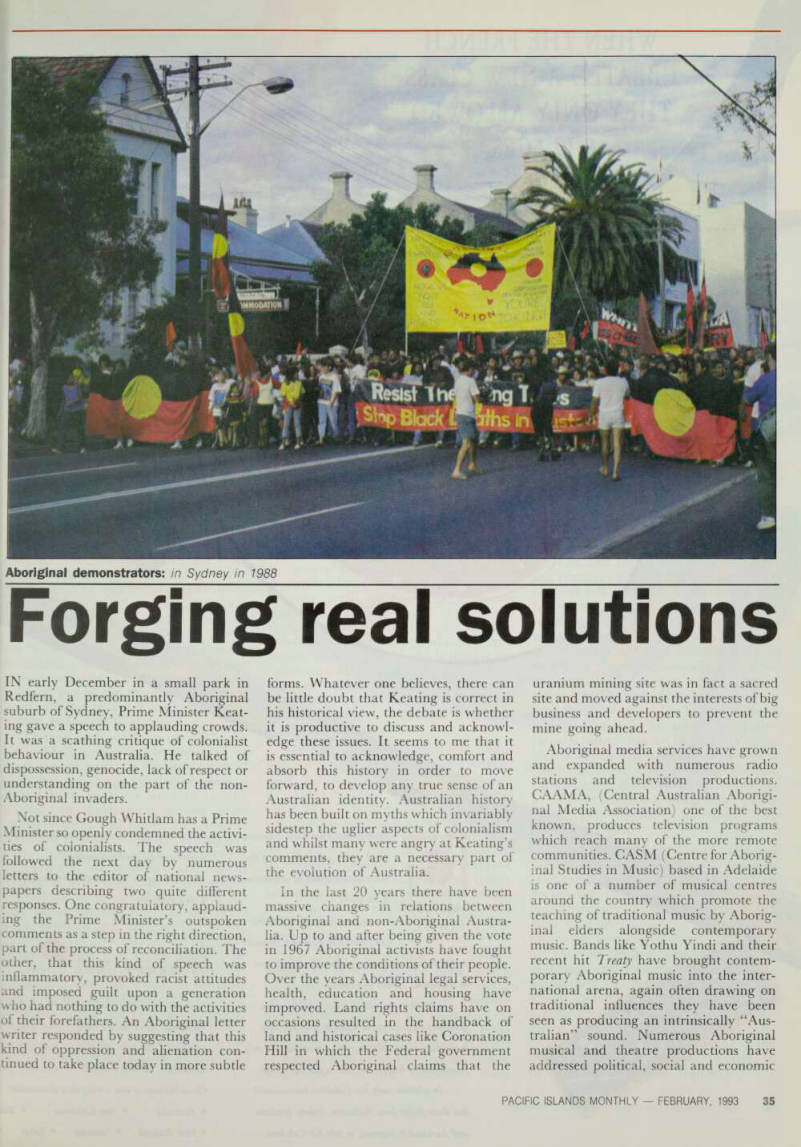

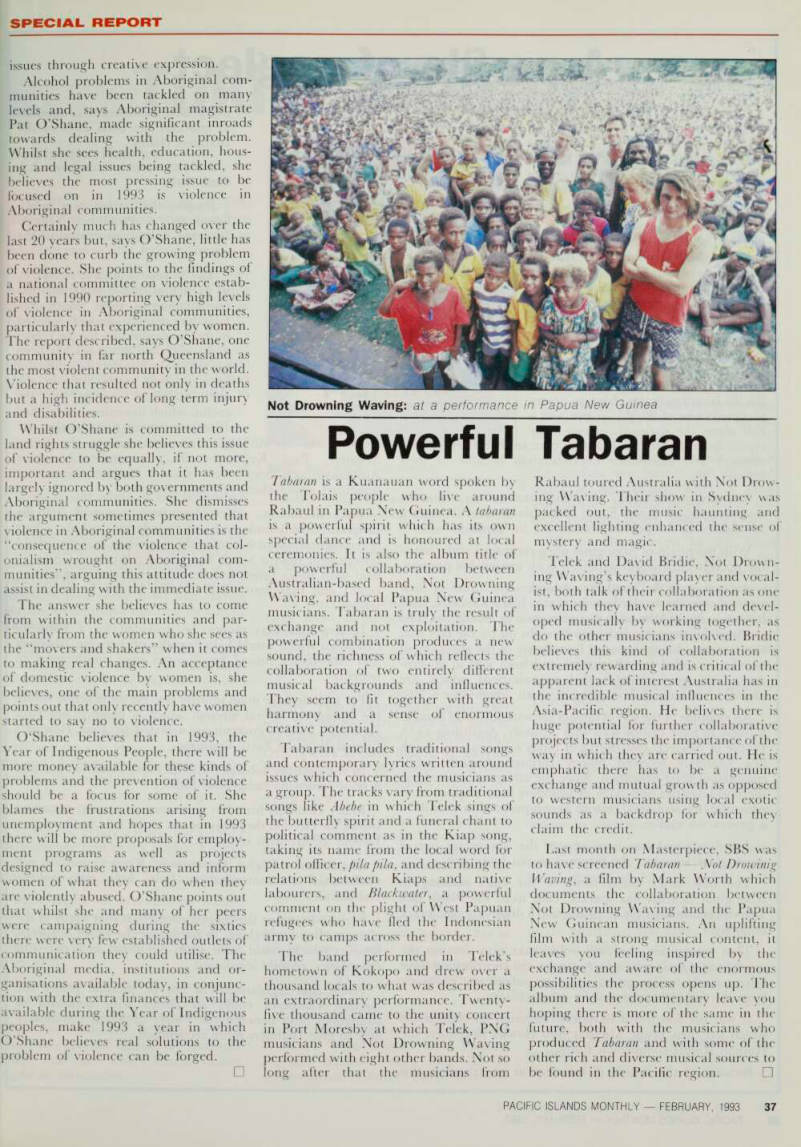
IN early December in a small park in Redfern, a predominantly Aboriginal suburb of Sydney, Prime Minister Keat ing gave a speech to applauding crowds.
It was a scathing critique of colonialist behaviour in Australia. He talked of dispossession, genocide, lack of respect or understanding on the part of the non-
Aboriginal invaders.
Not since Gough Whitlam has a Prime Minister so openly condemned the activi ties of colonialists. The speech was followed the next day by numerous letters to the editor of national news papers describing two quite different responses. One congratulatory, applaud ing the Prime Minister’s outspoken comments as a step in the right direction, part of the process of reconciliation. The other, that this kind of speech was inflammatory, provoked racist attitudes and imposed guilt upon a generation who had nothing to do with the activities of their forefathers. An Aboriginal letter writer responded by suggesting that this kind of oppression and alienation con tinued to take place today in more subtle
forms. Whatever one believes, there can be little doubt that Keating is correct in his historical view, the debate is whether it is productive to discuss and acknowl edge these issues. It seems to me that it is essential to acknowledge, comfort and absorb this history in order to move forward, to develop any true sense of an Australian identity. Australian history has been built on myths which invariably sidestep the uglier aspects of colonialism and whilst many were angry at Keating’s comments, they are a necessary part of the evolution of Australia.
In the last 20 years there have been massive changes in relations between Aboriginal and non-Aboriginal Austra lia. Up to and after being given the vote in 1967 Aboriginal activists have fought to improve the conditions of their people.
Over the years Aboriginal legal services, health, education and housing have improved. Land rights claims have on occasions resulted in the handback of land and historical cases like Coronation Hill in which the Federal government respected Aboriginal claims that the
uranium mining site was in fact a sacred site and moved against the interests of big business and developers to prevent the mine going ahead.
Aboriginal media services have grown and expanded with numerous radio stations and television productions.
CAAMA, (Central Australian Aborigi nal Media Association) one of the best known, produces television programs which reach many of the more remote communities. CASM (Centre for Aborig inal Studies in Music) based in Adelaide is one of a number of musical centres around the country which promote the teaching of traditional music by Aborig inal elders alongside contemporary music. Bands like Yothu Yindi and their recent hit Treaty have brought contem porary Aboriginal music into the inter national arena, again often drawing on traditional influences they have been seen as producing an intrinsically “Aus tralian” sound. Numerous Aboriginal musical and theatre productions have addressed political, social and economic
Aboriginal demonstrators: in Sydney in 1988
issues through creative expression.
Alcohol problems in Aboriginal com munities have been tackled on many levels and, says Aboriginal magistrate Pat O’Shane, made significant inroads towards dealing with the problem.
Whilst she sees health, education, hous ing and legal issues being tackled, she believes the most pressing issue to be focused on in 1993 is violence in
Aboriginal communities.
Certainly much has changed over the last 20 years but, says O’Shane, little has been done to curb the growing problem of violence. She points to the findings of a national committee on violence estab lished in 1990 reporting very high levels of violence in Aboriginal communities,
particularly that experienced by women.
The report described, says O’Shane, one community in far north Queensland as the most violent community in the world.
Violence that resulted not only in deaths but a high incidence of long term injury and disabilities.
Whilst O’Shane is committed to the land rights struggle she believes this issue of violence to be equally, if not more, important and argues that it has been largely ignored by both governments and Aboriginal communities. She dismisses the argument sometimes presented that violence in Aboriginal communities is the “consequence of the violence that col onialism wrought on Aboriginal com munities’*, arguing this attitude does not assist in dealing with the immediate issue.
The answer she believes has to come from within the communities and par ticularly from the women who she sees as the “movers and shakers” when it comes to making real changes. An acceptance of domestic violence by women is, she believes, one of the main problems and points out that only recently have women started to say no to violence. o‘Shane believes that in 1993, the Year of Indigenous People, there will be more money available for these kinds of problems and the prevention of violence should be a focus for some of it. She blames the frustrations arising from unemployment and hopes that in 1993 there will be more proposals for employ ment programs as well as projects designed to raise awareness and inform women of what they can do when they are violently abused. O’Shane points out that whilst she and many of her peers were campaigning during the sixties there were very few established outlets of communication they could utilise. The Aboriginal media, institutions and or
ganisations available today, in conjunc
tion with the extra finances that will be available during the Year of Indigenous peoples, make 1993 a year in which O’Shane believes real solutions to the problem of violence can be forged.
Advertisements & other items, p. 36 (1 item)
8 Places.
WHEN THE FRENCH
CREATED A NEW CLASS
THEY ONLY ALLOWED
8 PLACES.
V , ■Vh; *" : W
r Wf
i * - 'i ' 1 {!*? , -t i !
BSf 3^
Hw*co 5
CL/KSE
¥ m m > T&ere « c/<mj of business travel that is undeniably one of the most exclusive offered by any airline in the world.
Classe Hibiscus. Eight First Class seats that have been reserved for the business class traveller and offer the ultimate in convenience, comfort and service.
Luxurious first class seating, an exotic menu combining French tropical delicacies with the finest Australian accompaniments, and service that can only be achieved by limiting the class to just eight people.
In addition, only Air Caledonie International has direct flights from Melbourne, Sydney, Brisbane and Auckland to Noumea, so only Air Caledonie International offers the business traveller the class ths deserve and the speed they require.
Then again, Air Caledonie International is m a class of its own.
RNATIONAL
Brisbane Tel: (07) 832 3344 Fax: (07) 832 < 1 Melbourne Tel: (03) 321 6872 Fax: (03) 329 ■' Sydney Tel: (02) 239 1722 Fax: (02) 262 • 1 Auckland Tel: (09) 732 603 Fax: (09) 366 i Classe Hibiscus is now serving these destinations: • Australia • New Caledonia • Wallin • New Zealand • Vanuatu • Tahiti • •
Powerful Tabaran
Tabaran is a Kuanauan word spoken by the Tolais people who live around Rabaul in Papua New Guinea. A tabaran is a powerful spirit which has its own special dance and is honoured at local ceremonies. It is also the album title of a powerful collaboration between Australian-based band, Not Drowning Waving, and local Papua New Guinea musicians. Tabaran is truly the result of exchange and not exploitation. The powerful combination produces a new sound, the richness of which reflects the collaboration of two entirely different musical backgrounds and influences.
They seem to fit together with great harmony and a sense of enormous
creative potential.
Tabaran includes traditional songs and contemporary lyrics written around issues which concerned the musicians as a group. The tracks vary from traditional songs like Abebe in which Telek sings of the butterfly spirit and a funeral chant to political comment as in the Kiap song, taking its name from the local word for patrol officer,/^ pila , and describing the relations between Kiaps and native labourers, and Blackwater , a powerful comment on the plight of West Papuan refugees who have fled the Indonesian army to camps across the border.
The band performed in Telek’s hometown of Kokopo and drew over a thousand locals to what was described as
an extraordinary performance. Twenty
five thousand came to the unity concert in Port Moresby at which Telek, PNG musicians and Not Drowning Waving performed with eight other bands. Not so long after that the musicians from
Rabaul toured Australia with Not Throw ing Waving, Their show in Sydney was packed out, the music haunting and excellent lighting enhanced the sense of mystery and magic, Telek and David Bridie, Not Drown
ing Waving’s keyboard player and vocal
ist, both talk of their collaboration as one in which they have learned and devel
oped musically by working together, as
do the other musicians involved. Bridie believes this kind of collaboration is extremely rewarding and is critical of the apparent lack of interest Australia has in the incredible musical influences in the Asia-Pacific region. He belivcs there is huge potential for further collaborative projects but stresses the importance of the way in which they are carried out. He is emphatic there has to be a genuine exchange and mutual growth as opposed to western musicians using local exotic sounds as a backdrop for which they claim the credit.
Last month on Masterpiece, SBS was to have screened Tabaran Not Drowinig Waving , a film by Mark Worth which documents the collaboration between
Not Drowning Waving and the Papua
New Guinean musicians. An uplifting film with a strong musical content, it
leaves you feeling inspired by the
exchange and aware of the enormous possibilities the process opens up. The album and the documentary leave you hoping there is more of the same in the future, both with the musicians who produced Tabaran and with some of the other rich and diverse musical sources to be found in the Pacific region. □
Not Drowning Waving: at a performance in Papua New Guinea
A profile of neglect
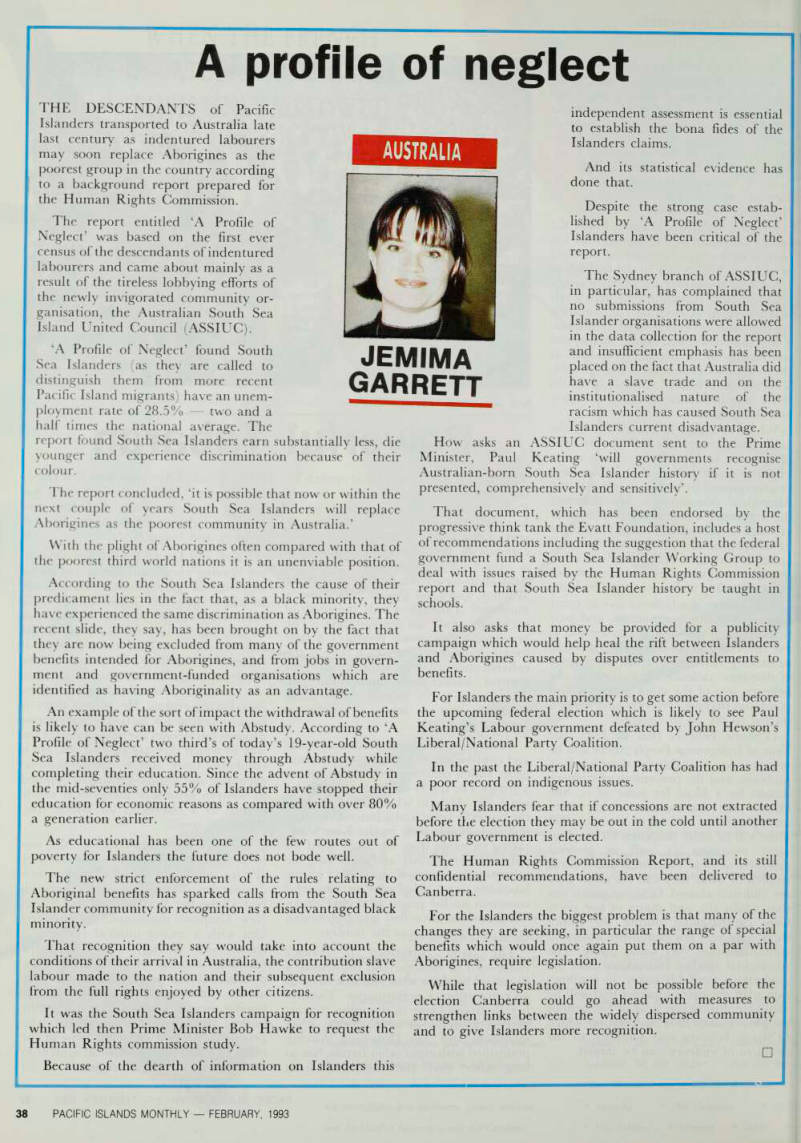
THE DESCENDANTS of Pacific Islanders transported to Australia late last century as indentured labourers may soon replace Aborigines as the poorest group in the country according to a background report prepared for the Human Rights Commission.
The report entitled ‘A Profile of Neglect’ was based on the first ever census of the descendants of indentured labourers and came about mainly as a result of the tireless lobbying efforts of the newly invigorated community or ganisation, the Australian South Sea Island United Council (ASSIUC). ‘A Profile of Neglect’ found South Sea Islanders (as they are called to distinguish them from more recent Pacific Island migrants) have an unem ployment rate of 28.5% two and a half times the national average. The
report found South Sea Islanders earn substantially less, die younger and experience discrimination because of their colour.
The report concluded, ‘it is possible that now or within the next couple of years South Sea Islanders will replace Aborigines as the poorest community in Australia.’
With the plight of Aborigines often compared with that of the poorest third world nations it is an unenviable position.
According to the South Sea Islanders the cause of their predicament lies in the fact that, as a black minority, they have experienced the same discrimination as Aborigines. The recent slide, they say, has been brought on by the fact that they are now being excluded from many of the government benefits intended for Aborigines, and from jobs in govern ment and government-funded organisations which are identified as having Aboriginality as an advantage.
An example of the sort of impact the withdrawal of benefits is likely to have can be seen with Abstudy. According to ‘A Profile of Neglect’ two third’s of today’s 19-year-old South Sea Islanders received money through Abstudy while completing their education. Since the advent of Abstudy in the mid-seventies only 55% of Islanders have stopped their education for economic reasons as compared with over 80% a generation earlier.
As educational has been one of the few routes out of poverty for Islanders the future does not bode well.
The new strict enforcement of the rules relating to Aboriginal benefits has sparked calls from the South Sea Islander community for recognition as a disadvantaged black minority.
That recognition they say would take into account the conditions of their arrival in Australia, the contribution slave labour made to the nation and their subsequent exclusion from the full rights enjoyed by other citizens.
It was the South Sea Islanders campaign for recognition which led then Prime Minister Bob Hawke to request the Human Rights commission study.
Because of the dearth of information on Islanders this
independent assessment is essential to establish the bona Tides of the Islanders claims.
And its statistical evidence has done that.
Despite the strong case estab lished by ‘A Profile of Neglect’
Islanders have been critical of the report.
The Sydney branch of ASSIUC, in particular, has complained that no submissions from South Sea Islander organisations were allowed in the data collection for the report and insufficient emphasis has been placed on the fact that Australia did have a slave trade and on the institutionalised nature of the racism which has caused South Sea Islanders current disadvantage.
How asks an ASSIUC document sent to the Prime Minister, Paul Keating ‘will governments recognise Australian-born South Sea Islander history if it is not presented, comprehensively and sensitively’.
That document, which has been endorsed by the progressive think tank the Evatt Foundation, includes a host of recommendations including the suggestion that the federal government fund a South Sea Islander Working Group to deal with issues raised by the Human Rights Commission report and that South Sea Islander history be taught in schools.
It also asks that money be provided for a publicity campaign which would help heal the rift between Islanders and Aborigines caused by disputes over entitlements to benefits.
For Islanders the main priority is to get some action before the upcoming federal election which is likely to see Paul Keating’s Labour government defeated by John Hewson’s Liberal/National Party Coalition.
In the past the Liberal/National Party Coalition has had a poor record on indigenous issues.
Many Islanders fear that if concessions are not extracted before the election they may be out in the cold until another Labour government is elected.
The Human Rights Commission Report, and its still confidential recommendations, have been delivered to Canberra.
For the Islanders the biggest problem is that many of the changes they are seeking, in particular the range of special benefits which would once again put them on a par with Aborigines, require legislation.
While that legislation will not be possible before the election Canberra could go ahead with measures to strengthen links between the widely dispersed community and to give Islanders more recognition.
Australia
Jemima
Garrett
Juki’s creations
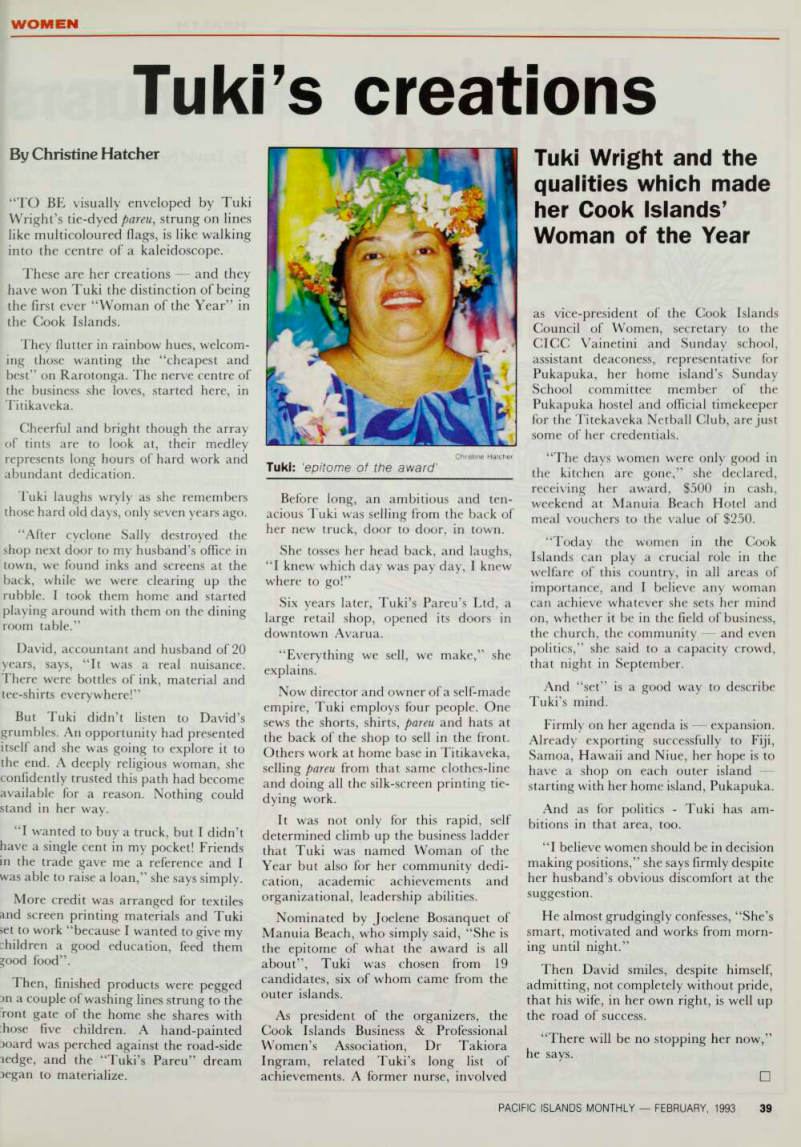
Women
By Christine Hatcher
“TO BE visually enveloped by Tuki
Wright’s tie-dyed pareu , strung on lines like multicoloured flags, is like walking into the centre of a kaleidoscope.
These are her creations and they have won Tuki the distinction of being the first ever “Woman of the Year” in the Cook Islands.
They flutter in rainbow hues, welcom ing those wanting the “cheapest and best” on Rarotonga. The nerve centre of the business she loves, started here, in Titikaveka.
Cheerful and bright though the array of tints are to look at, their medley represents long hours of hard work and abundant dedication.
Tuki laughs wryly as she remembers those hard old days, only seven years ago.
“After cyclone Sally destroyed the shop next door to my husband’s office in town, we found inks and screens at the back, while we were clearing up the rubble. I took them home and started playing around with them on the dining room table.”
David, accountant and husband of 20 years, says, “It was a real nuisance.
There were bottles of ink, material and tee-shirts everywhere!”
But Tuki didn’t listen to David’s grumbles. An opportunity had presented itself and she was going to explore it to the end. A deeply religious woman, she confidently trusted this path had become available for a reason. Nothing could stand in her way.
“I wanted to buy a truck, but I didn’t have a single cent in my pocket! Friends in the trade gave me a reference and I was able to raise a loan,” she says simply.
More credit was arranged for textiles and screen printing materials and Tuki »et to work “because I wanted to give my children a good education, feed them food”.
Then, finished products were pegged an a couple of washing lines strung to the ront gate of the home she shares with ihose five children. A hand-painted aoard was perched against the road-side aedge, and the “Tuki’s Pareu” dream aegan to materialize.
Before long, an ambitious and ten acious Tuki was selling from the back of her new truck, door to door, in town.
She tosses her head back, and laughs, “I knew which day was pay day, I knew where to go!”
Six years later, Tuki’s Pareu’s Ltd, a large retail shop, opened its doors in downtown Avarua.
“Everything we sell, we make,” she
explains.
Now director and owner of a self-made empire, Tuki employs four people. One sews the shorts, shirts, pareu and hats at the back of the shop to sell in the front.
Others work at home base in Titikaveka, selling pareu from that same clothes-line and doing all the silk-screen printing tie dying work.
It was not only for this rapid, self determined climb up the business ladder that Tuki was named Woman of the Year but also for her community dedi cation, academic achievements and organizational, leadership abilities.
Nominated by Joelene Bosanquet of Manuia Beach, who simply said, “She is the epitome of what the award is all about”, Tuki was chosen from 19 candidates, six of whom came from the outer islands.
As president of the organizers, the Cook Islands Business & Professional Women’s Association, Dr Takiora Ingram, related Tuki’s long list of achievements. A former nurse, involved
Juki Wright and the qualities which made her Cook Islands’
Woman of the Year
as vice-president of the Cook Islands Council of Women, secretary to the CICC Vainetini and Sunday school, assistant deaconess, representative for Pukapuka, her home island’s Sunday School committee member of the Pukapuka hostel and official timekeeper for the Titekaveka Netball Club, are just some of her credentials.
“The days women were only good in the kitchen are gone,” she declared, receiving her award, $5OO in cash, weekend at Manuia Beach Hotel and meal vouchers to the value of $250.
“Today the women in the Cook Islands can play a crucial role in the welfare of this country, in all areas of importance, and I believe any woman can achieve whatever she sets her mind on, whether it be in the field of business, the church, the community and even politics,” she said to a capacity crowd, that night in September.
And “set” is a good way to describe Tuki’s mind.
Firmly on her agenda is expansion.
Already exporting successfully to Fiji, Samoa, Hawaii and Niue, her hope is to have a shop on each outer island starting with her home island, Pukapuka.
And as for politics - Tuki has am bitions in that area, too.
“I believe women should be in decision making positions,” she says firmly despite her husband’s obvious discomfort at the suggestion.
He almost grudgingly confesses, “She’s smart, motivated and works from morn ing until night.”
Then David smiles, despite himself, admitting, not completely without pride, that his wife, in her own right, is well up the road of success.
“There will be no stopping her now,” he says.
Christine Hatcher
Juki: epitome of the award'
Linguists
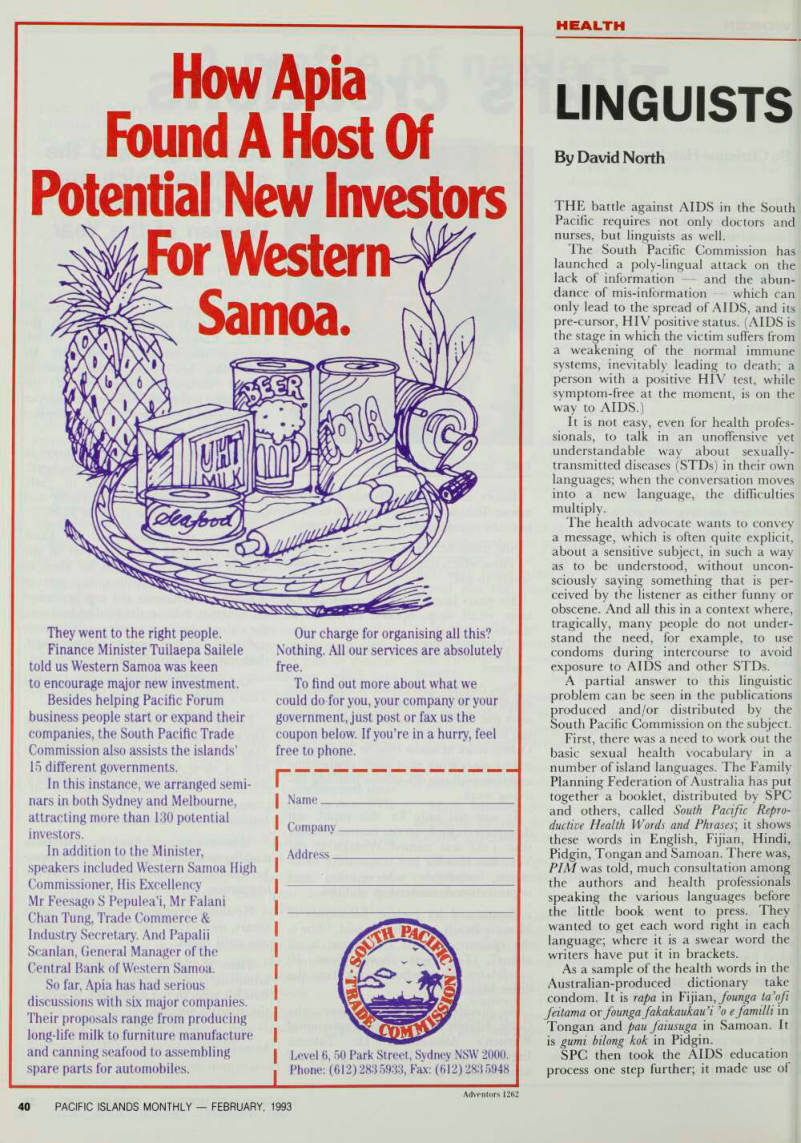

Health
By David North
THE battle against AIDS in the South Pacific requires not only doctors and nurses, but linguists as well.
The South Pacific Commission has launched a poly-lingual attack on the lack of information and the abun dance of mis-information which can only lead to the spread of AIDS, and its pre-cursor, HIV positive status. (AIDS is the stage in which the victim suffers from a weakening of the normal immune systems, inevitably leading to death; a person with a positive HIV test, while symptom-free at the moment, is on the way to AIDS.) It is not easy, even for health profes sionals, to talk in an unoffensive yet understandable way about sexually transmitted diseases (STDs) in their own languages; when the conversation moves into a new language, the difficulties multiply.
The health advocate wants to convey a message, which is often quite explicit, about a sensitive subject, in such a way as to be understood, without uncon sciously saying something that is per ceived by the listener as either funny or obscene. And all this in a context where, tragically, many people do not under stand the need, for example, to use condoms during intercourse to avoid exposure to AIDS and other STDs.
A partial answer to this linguistic problem can be seen in the publications produced and/or distributed by the South Pacific Commission on the subject.
First, there was a need to work out the basic sexual health vocabulary in a number of island languages. The Family Planning Federation of Australia has put together a booklet, distributed by SPC and others, called South Pacific Repro ductive Health Words and Phrases ; it shows these words in English, Fijian, Hindi, Pidgin, Tongan and Samoan. There was, PIM was told, much consultation among the authors and health professionals speaking the various languages before the little book went to press. They wanted to get each word right in each language; where it is a swear word the writers have put it in brackets.
As a sample of the health words in the Australian-produced dictionary take condom. It is rapa in Fijian, founga ta’ofi feitama or founga fakakaukau’i ’o e familli in Tongan and pau faiusuga in Samoan. It is gumi bilong kok in Pidgin.
SPC then took the AIDS education process one step further; it made use of
a 16-page pamphlet, full of drawings, with headings like “What Causes AIDS?”, “Why AIDS is so dangerous” and “How is HIV spread?”
The pamphlet had been written in English in Suva at a WHO/UNESCO workshop to meet the needs of the Pacific islands. SPC is now part-way through its translation and distribution process.
So far it has produced copies of the booklet in English and in 20 other South Pacific languages: Bislama (Vanuatu), Chuuk (FSM), Cook Island Maori, Fijian, French, Hindi, Kiribati, Kunie (New Caledonia), Motu (PNG), Niuean, Pidgin (PNG), Pijin (Solomon Islands), the Polynesian language of Uvea (New Caledonia), Samoan, Tahitian, Tokelau, Tongan, Tuvaluan, Wallisian, and Yap (FSM). (The languages are identified here as they were in a SPC memor andum.) Steven Vete, the SPC health infor
mation officer, is looking for volunteer translators who can render the basic pamphlet into other island languages not listed above. He can be reached at SPC, Noumea Cedex, New Caledonia, by mail, at (687) 26 20 00, by voice phone, or at (687) 26 38 18 by fax.
SPC has also launched a small grants program designed to help grass roots organizations, throughout the Pacific, to conduct local information programs to help combat AIDS.
These grants, none exceeding SUSSOOO, have been awarded (at this writing) to some 21 organizations in 12 Pacific jurisdictions Cook Islands, Fiji, French Polynesia, Guam, New Cale donia, Niue, the Northern Marianas, PNG, Tokelau, Tonga, Vanuatu and Western Samoa. No grants have yet been made to American Samoa, FSM, Kiri bati, the Marshalls, Nauru, Palau, the Solomons, or Tuvalu.
A number of different approaches to
AIDS education have been funded through these SPC grants. For example, in PNG the Eastern Highlands Provin cial Council of Women provided AIDS information at a five-day workshop for the women’s leaders in the province, while in Vanuatu the Wan Smolbag Theatre produced four theatrical shows for the community, and for the nation's health care workers.
Similarly, condoms were distributed in Guam, radio programs were produced in New Caledonia, and prison officials were trained in AIDS education in Fiji.
Churches > health departments, youth grou P s a " d the Red Cross were amon « tbe awardees ' Those wishing to apply for these grants should write to SPC’s Vete at the address shown above ’ Eli S ible organizations are governmental non-profit entities; each a PP bcant sb °nld describe itself, provide a SU T budget ’ and f. P T posed program m enough detail to be
Advertisements & other items, p. 40 (1 item)
How Apia
Found A Host Of
Potential New Investors
r Wester
Samoa
y £3 They went to the right people.
Finance Minister Tuilaepa Sailele told us Western Samoa was keen to encourage major new investment.
Besides helping Pacific Forum business people start or expand their companies, the South Pacific Trade Commission also assists the islands’ 15 different governments.
In this instance, we arranged seminars in both Sydney and Melbourne, attracting more than 130 potential investors.
In addition to the Minister, speakers included Western Samoa High Commissioner, His Excellency Mr Feesago S Pepulea’i, Mr Falani Chan Tung, Trade Commerce & Industry Secretary. And Papalii Scanlan, General Manager of the Central Bank of Western Samoa.
So far, Apia has had serious discussions with six major companies.
Their proposals range from producing long-life milk to furniture manufacture and canning seafood to assembling spare parts for automobiles.
Our charge for organising all this?
Nothing. All our services are absolutely free.
To find out more about what we could do for you, your company or your government, just post or fax us the coupon below. If you’re in a hurry, feel free to phone.
I Name Company Address & O Z i Level 6, 50 Park Street, Sydney NSW 2000.
Phone: (612) 2835933, Fax: (612) 2835948 Adventors 1262
Tourism and taste
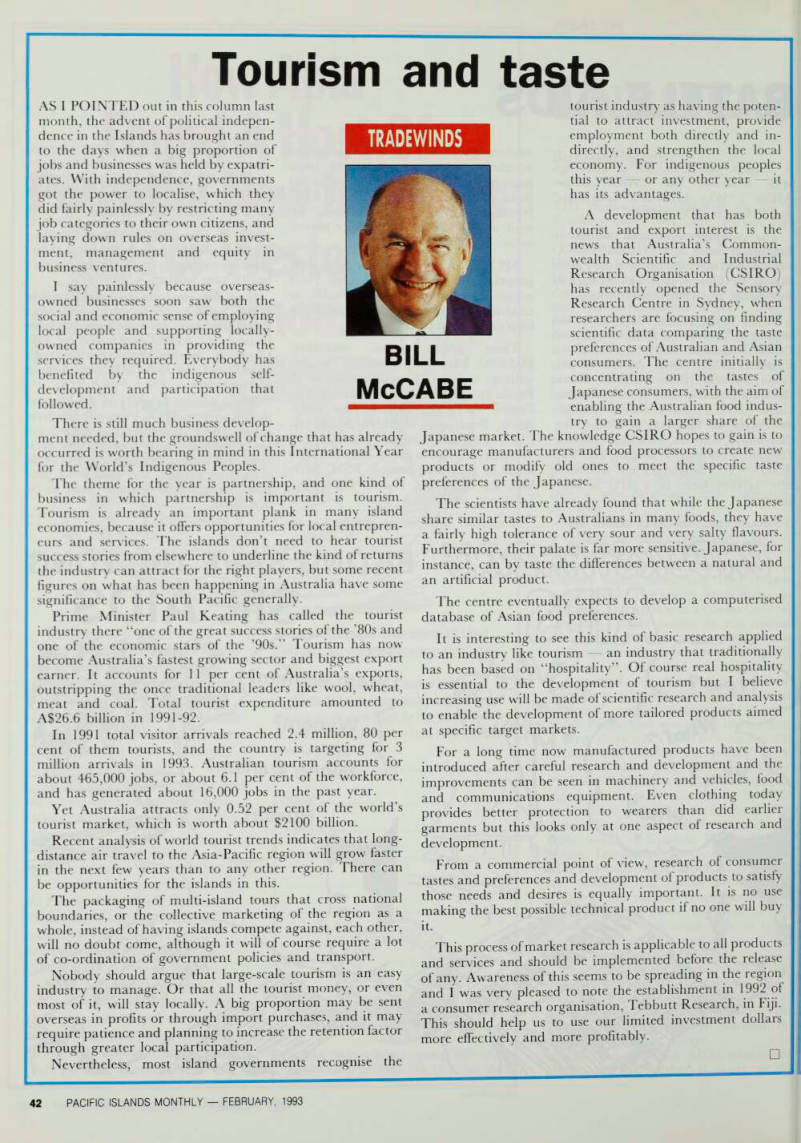
AS I POINTED out in this column last month, the advent of political indepen dence in the Islands has brought an end to the days when a big proportion of jobs and businesses was held by expatri ates. With independence, governments got the power to localise, which they did fairly painlessly by restricting many job categories to their own citizens, and laying down rules on overseas invest ment, management and equity in business ventures.
I say painlessly because overseas owned businesses soon saw both the social and economic sense of employing local people and supporting locally owned companies in providing the services they required. Everybody has benefited by the indigenous self development and participation that followed.
There is still much business develop ment needed, but the groundswell of change that has already occurred is worth bearing in mind in this International Year for the World’s Indigenous Peoples.
The theme for the year is partnership, and one kind of business in which partnership is important is tourism.
Tourism is already an important plank in many island economies, because it offers opportunities for local entrepren eurs and services. The islands don’t need to hear tourist success stories from elsewhere to underline the kind of returns the industry can attract for the right players, but some recent figures on what has been happening in Australia have some significance to the South Pacific generally.
Prime Minister Paul Keating has called the tourist industry there “one of the great success stories of the ’Bos and one of the economic stars of the ’9os.” Tourism has now become Australia’s fastest growing sector and biggest export earner. It accounts for 11 per cent of Australia’s exports, outstripping the once traditional leaders like wool, wheat, meat and coal. Total tourist expenditure amounted to A 526.6 billion in 1991-92.
In 1991 total visitor arrivals reached 2.4 million, 80 per cent of them tourists, and the country is targeting for 3 million arrivals in 1993. Australian tourism accounts for about 465,000 jobs, or about 6.1 per cent of the workforce, and has generated about 16,000 jobs in the past year.
Yet Australia attracts only 0.52 per cent of the world’s tourist market, which is worth about $2lOO billion.
Recent analysis of world tourist trends indicates that long distance air travel to the Asia-Pacific region will grow faster in the next few years than to any other region. There can be opportunities for the islands in this.
The packaging of multi-island tours that cross national boundaries, or the collective marketing of the region as a whole, instead of having islands compete against, each other, will no doubt come, although it will of course require a lot of co-ordination of government policies and transport.
Nobody should argue that large-scale tourism is an easy industry to manage. Or that all the tourist money, or even most of it, will stay locally. A big proportion may be sent overseas in profits or through import purchases, and it may require patience and planning to increase the retention factor through greater local participation.
Nevertheless, most island governments recognise the
tourist industry as having the poten tial to attract investment, provide employment both directly and in directly, and strengthen the local
economy. For indigenous peoples
this year or any other year it has its advantages.
A development that has both tourist and export interest is the news that Australia’s Common wealth Scientific and Industrial Research Organisation (CSIRO) has recently opened the Sensory Research Centre in Sydney, when researchers are focusing on finding scientific data comparing the taste preferences of Australian and Asian consumers. The centre initially is concentrating on the tastes of Japanese consumers, with the aim of enabling the Australian food indus try to gain a larger share of the
Japanese market. The knowledge CSIRO hopes to gain is to encourage manufacturers and food processors to create new products or modify old ones to meet the specific taste preferences of the Japanese.
The scientists have already found that while the Japanese share similar tastes to Australians in many foods, they have a fairly high tolerance of very sour and very salty flavours.
Furthermore, their palate is far more sensitive. Japanese, for instance, can by taste the differences between a natural and an artificial product.
The centre eventually expects to develop a computerised database of Asian food preferences.
It is interesting to see this kind of basic research applied to an industry like tourism an industry that traditionally has been based on “hospitality”. Of course real hospitality is essential to the development of tourism but I believe increasing use will be made of scientific research and analysis to enable the development of more tailored products aimed at specific target markets.
For a long time now manufactured products have been introduced after careful research and development and the improvements can be seen in machinery and vehicles, food and communications equipment. Even clothing today provides better protection to wearers than did earlier garments but this looks only at one aspect of research and development.
From a commercial point of view, research of consumer tastes and preferences and development of products to satisfy those needs and desires is equally important. It is no use making the best possible technical product if no one will buy it.
This process of market research is applicable to all products and services and should be implemented before the release of any. Awareness of this seems to be spreading in the region and I was very pleased to note the establishment in 1992 of a consumer research organisation, Tebbutt Research, in Fiji.
This should help us to use our limited investment dollars more effectively and more profitably.
Tradewinds
Bill
Mccabe
Those infernal constitutions
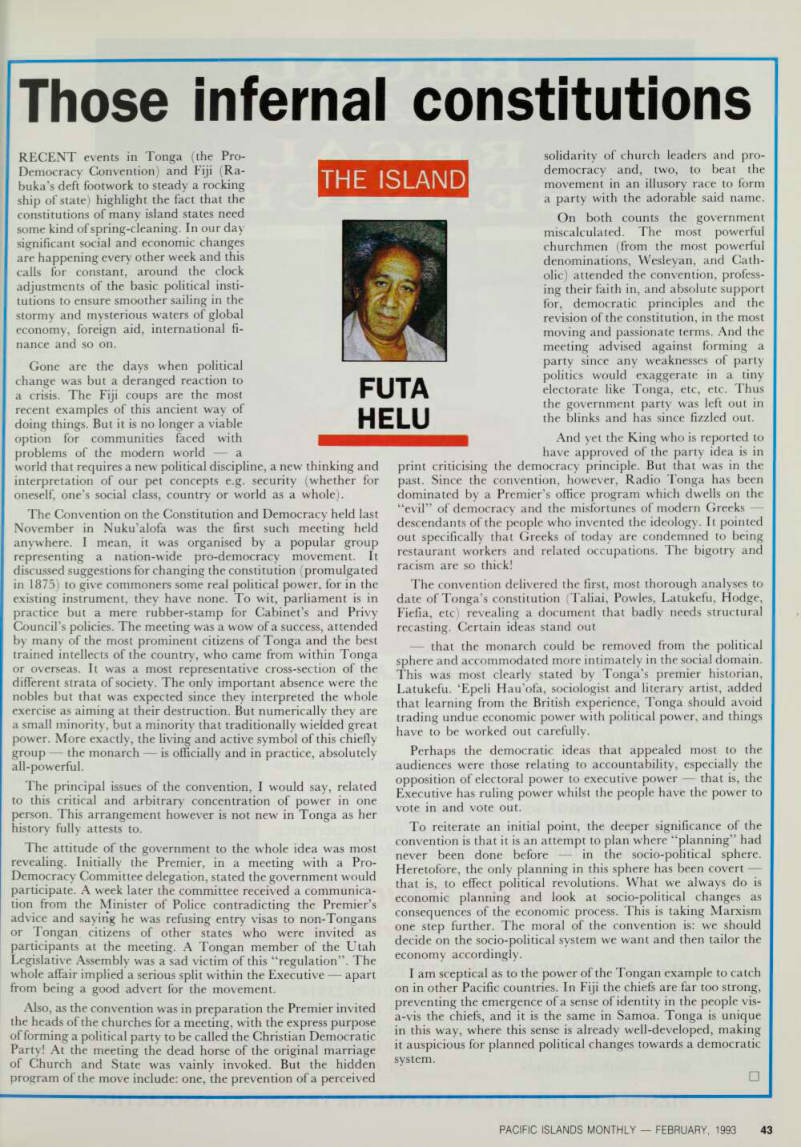
RECENT events in Tonga (the Pro- Democracy Convention) and Fiji (Ra buka’s deft footwork to steady a rocking ship of state) highlight the fact that the constitutions of many island states need some kind of spring-cleaning. In our day significant social and economic changes are happening every other week and this calls for constant, around the clock adjustments of the basic political insti tutions to ensure smoother sailing in the stormy and mysterious waters of global economy, foreign aid, international fi nance and so on.
Gone are the days when political change was but a deranged reaction to a crisis. The Fiji coups are the most recent examples of this ancient way of doing things. But it is no longer a viable option for communities faced with problems of the modern world a
world that requires a new political discipline, a new thinking and interpretation of our pet concepts e.g. security (whether for oneself, one’s social class, country or world as a whole).
The Convention on the Constitution and Democracy held last November in Nuku’alofa was the first such meeting held anywhere. I mean, it was organised by a popular group representing a nation-wide pro-democracy movement. It discussed suggestions for changing the constitution (promulgated in 1875) to give commoners some real political power, for in the existing instrument, they have none. To wit, parliament is in practice but a mere rubber-stamp for Cabinet’s and Privy Council’s policies. The meeting was a wow of a success, attended by many of the most prominent citizens of Tonga and the best trained intellects of the country, who came from within Tonga or overseas. It was a most representative cross-section of the different strata of society. The only important absence were the nobles but that was expected since they interpreted the whole exercise as aiming at their destruction. But numerically they are a small minority, but a minority that traditionally wielded great power. More exactly, the living and active symbol of this chiefly group the monarch is officially and in practice, absolutely all-powerful.
The principal issues of the convention, I would say, related to this critical and arbitrary concentration of power in one person. This arrangement however is not new in Tonga as her history fully attests to.
The attitude of the government to the whole idea was most revealing. Initially the Premier, in a meeting with a Pro- Democracy Committee delegation, stated the government would participate. A week later the committee received a communica tion from the Minister of Police contradicting the Premier’s advice and saying he was refusing entry visas to non-Tongans or Tongan citizens of other states who were invited as participants at the meeting. A Tongan member of the Utah Legislative Assembly was a sad victim of this “regulation”. The whole affair implied a serious split within the Executive apart from being a good advert for the movement.
Also, as the convention was in preparation the Premier invited the heads of the churches for a meeting, with the express purpose of forming a political party to be called the Christian Democratic Party! At the meeting the dead horse of the original marriage of Church and State was vainly invoked. But the hidden program of the move include: one, the prevention of a perceived
solidarity of church leaders and pro democracy and, two, to beat the movement in an illusory race to form a party with the adorable said name.
On both counts the government miscalculated. The most powerful churchmen (from the most powerful denominations, Wesleyan, and Cath olic) attended the convention, profess ing their faith in, and absolute support for, democratic principles and the revision of the constitution, in the most moving and passionate terms. And the meeting advised against forming a party since any weaknesses of party politics would exaggerate in a tiny electorate like Tonga, etc, etc. Thus the government party was left out in the blinks and has since fizzled out.
And yet the King who is reported to have approved of the party idea is in
print criticising the democracy principle. But that was in the past. Since the convention, however, Radio Tonga has been dominated by a Premier’s office program which dwells on the “evil” of democracy and the misfortunes of modern Greeks descendants of the people who invented the ideology. It pointed out specifically that Greeks of today are condemned to being restaurant workers and related occupations. The bigotry and racism are so thick!
The convention delivered the first, most thorough analyses to date of Tonga’s constitution (Taliai, Powles, Latukefu, Hodge, Fiefia, etc) revealing a document that badly needs structural recasting. Certain ideas stand out - that the monarch could be removed from the political sphere and accommodated more intimately in the social domain.
This was most clearly stated by Tonga’s premier historian, Latukefu. ‘Epeli Hau’ofa, sociologist and literary artist, added that learning from the British experience, Tonga should avoid trading undue economic power with political power, and things have to be worked out carefully.
Perhaps the democratic ideas that appealed most to the audiences were those relating to accountability, especially the opposition of electoral power to executive power that is, the Executive has ruling power whilst the people have the power to vote in and vote out.
To reiterate an initial point, the deeper significance of the convention is that it is an attempt to plan where “planning” had never been done before in the socio-political sphere.
Heretofore, the only planning in this sphere has been covert that is, to effect political revolutions. What we always do is economic planning and look at socio-political changes as consequences of the economic process. This is taking Marxism one step further. The moral of the convention is: we should decide on the socio-political system we want and then tailor the economy accordingly.
I am sceptical as to the power of the Tongan example to catch on in other Pacific countries. In Fiji the chiefs are far too strong, preventing the emergence of a sense of identity in the people vis a-vis the chiefs, and it is the same in Samoa. Tonga is unique in this way, where this sense is already well-developed, making it auspicious for planned political changes towards a democratic system.
The Island
Futa
Helu
Advertisements & other items, p. 44 (1 item)
far# of ih
.<**■ m M V*.:
ROYAL TONGAN REGAL CLASS
-Anew style and standard of business class from a country renowned for its friendliness and
hospitality.
Domestic services throughout the Kingdom of
Tonga.
International services linking Tonga with New Zealand and Fiji. Book with us and experience service that’s normally reserved for Royalty. >
ROYAL TONGAN AIRLINES
far# of ih
OFFICES AND REPRESENTATIVES;
Nukualofa Royal Tongan Airlines: Auckland World Aviation Systems: Sydney World Aviation Systems: Nadi Sunflower Airlines: Suva Sunflower Airlines: Tel: (676) 23 414 Tel: (09) 379 4454 Tel: (02) 239 1722 Tel: (679) 723 016, 723 408 Tel: (679) 315 755 Fax: (676) 24 056 Fax: (09) 377 5648 Fax: (02) 290 3641 MEMBER OF THE INTERNATIONAL AIR TRANSPORT ASSOCIATION
A major economic force
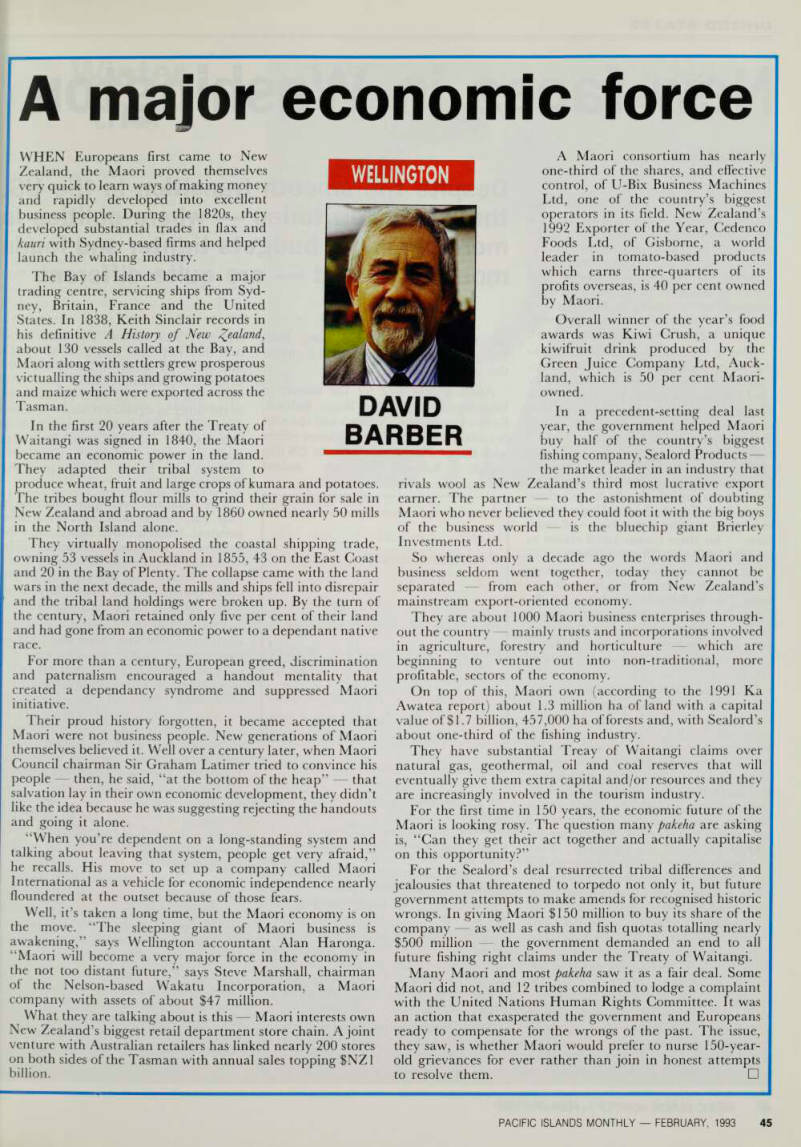
WHEN Europeans first came to New Zealand, the Maori proved themselves very quick to learn ways of making money and rapidly developed into excellent business people. During the 1820 s, they developed substantial trades in flax and kauri with Sydney-based firms and helped launch the whaling industry.
The Bay of Islands became a major trading centre, servicing ships from Syd ney, Britain, France and the United States. In 1838, Keith Sinclair records in his definitive A History of New Zjealmd, about 130 vessels called at the Bay, and Maori along with settlers grew prosperous victualling the ships and growing potatoes and maize which were exported across the Tasman.
In the first 20 years after the Treaty of Waitangi was signed in 1840, the Maori became an economic power in the land.
They adapted their tribal system to
produce wheat, fruit and large crops of kumara and potatoes.
The tribes bought flour mills to grind their grain for sale in New Zealand and abroad and by 1860 owned nearly 50 mills in the North Island alone.
They virtually monopolised the coastal shipping trade, owning 53 vessels in Auckland in 1855, 43 on the East Coast and 20 in the Bay of Plenty. The collapse came with the land wars in the next decade, the mills and ships fell into disrepair and the tribal land holdings were broken up. By the turn of the century, Maori retained only five per cent of their land and had gone from an economic power to a dependant native race.
For more than a century, European greed, discrimination and paternalism encouraged a handout mentality that created a dependancy syndrome and suppressed Maori initiative.
Their proud history forgotten, it became accepted that Maori were not business people. New generations of Maori themselves believed it. Well over a century later, when Maori Council chairman Sir Graham Latimer tried to convince his people then, he said, “at the bottom of the heap” that salvation lay in their own economic development, they didn’t like the idea because he was suggesting rejecting the handouts and going it alone.
“When you’re dependent on a long-standing system and talking about leaving that system, people get very afraid,” he recalls. His move to set up a company called Maori International as a vehicle for economic independence nearly floundered at the outset because of those fears.
Well, it’s taken a long time, but the Maori economy is on the move. “The sleeping giant of Maori business is awakening,” says Wellington accountant Alan Haronga.
“Maori will become a very major force in the economy in the not too distant future,” says Steve Marshall, chairman of the Nelson-based Wakatu Incorporation, a Maori company with assets of about $47 million.
What they are talking about is this Maori interests own New Zealand’s biggest retail department store chain. A joint venture with Australian retailers has linked nearly 200 stores on both sides of the Tasman with annual sales topping SNZI billion.
A Maori consortium has nearly one-third of the shares, and effective control, of U-Bix Business Machines Ltd, one of the country’s biggest operators in its field. New Zealand’s 1992 Exporter of the Year, Cedenco Foods Ltd, of Gisborne, a world leader in tomato-based products which earns three-quarters of its profits overseas, is 40 per cent owned by Maori.
Overall winner of the year’s food awards was Kiwi Crush, a unique kiwifruit drink produced by the Green Juice Company Ltd, Auck land, which is 50 per cent Maori owned.
In a precedent-setting deal last year, the government helped Maori buy half of the country’s biggest fishing company, Sealord Products the market leader in an industry that
rivals wool as New Zealand’s third most lucrative export earner. The partner to the astonishment of doubting Maori who never believed they could foot it with the big boys of the business world is the bluechip giant Brierley Investments Ltd.
So whereas only a decade ago the words Maori and business seldom went together, today they cannot be separated from each other, or from New Zealand’s mainstream export-oriented economy.
They are about 1000 Maori business enterprises through out the country mainly trusts and incorporations involved in agriculture, forestry and horticulture which are beginning to venture out into non-traditional, more profitable, sectors of the economy.
On top of this, Maori own (according to the 1991 Ka Awatea report) about 1.3 million ha of land with a capital value of $1.7 billion, 457,000 ha of forests and, with Sealord’s about one-third of the fishing industry.
They have substantial Treay of Waitangi claims over natural gas, geothermal, oil and coal reserves that will eventually give them extra capital and/or resources and they are increasingly involved in the tourism industry.
For the first time in 150 years, the economic future of the Maori is looking rosy. The question many pakeha are asking is, “Can they get their act together and actually capitalise on this opportunity?”
For the Sealord’s deal resurrected tribal differences and jealousies that threatened to torpedo not only it, but future government attempts to make amends for recognised historic wrongs. In giving Maori SISO million to buy its share of the company as well as cash and fish quotas totalling nearly S5OO million the government demanded an end to all future fishing right claims under the Treaty of Waitangi.
Many Maori and most pakeha saw it as a fair deal. Some Maori did not, and 12 tribes combined to lodge a complaint with the United Nations Human Rights Committee. It was an action that exasperated the government and Europeans ready to compensate for the wrongs of the past. The issue, they saw, is whether Maori would prefer to nurse 150-year old grievances for ever rather than join in honest attempts to resolve them. □
Wellington
David
Barber
New faces in Washington
United States
By David North
Despite the smooth transition in the US, the island territories where politics is more personal, budgets tighter and feuds moss-encrusted are quite different
NEW faces, new issues, and old feuds marked the start of the political year for the United States flag islands. One of the new faces in Washington is Bob Under wood, the newly-elected Democratic delegate from Guam. Soft spoken, and gentle in manner, he successfully cam paigned as a stronger supporter of Chamorro rights than his opponent, sitting delegate Ben Blaz (a Republican).
Among the issues Underwood plans to pursue in Washington are seeking adop tion of the Guam Commonwealth Bill by the Congress, the return of excess Defense Department lands to the Guam Govern ment, and the granting of World War II indemnities by the US government. A clause in the US-Japan Peace Treaty made it impossible for US citizens on Guam, unlike residents of other once- Japanese occupied islands, to seek these funds from Japan, hence Underwood’s interest in making it possible - 40 years later for these Guam-based claims to be filed with the US government.
As soon as Underwood arrived in Washington he and his new colleague from Puerto Rico button-holed all the other freshman Democrats in the House of Representatives lining up their sup port for giving the territorial delegates limited voting privileges on the floor of the House.
While the Democrat caucus quickly supported the extended voting privileges, that action set off a firestorm of contro versy, as the Republicans, a perpetual minority in the House, noticed that the five delegates getting the new powers were all Democrats. They complained that three of the five jurisdictions had, by Congressional standards, tiny popu lations (about 50,000 in American Samoa, for instance, vs. 590,000 for the typical Mainland Congressman.) They also noted that of the five delegates, only the one for the District of Columbia, spoke for voters who paid federal taxes.
The other four delegates represent Am erican Samoa, Guam, Puerto Rico and the US Virgin Islands.
Presumably the Republican oppo
sition would have been muted had Ben Blaz held his seat.
After a barrage of largely negative media attention, and after the House Democratic leadership had watered down the provision a bit, the House members voted, mostly along party lines, to give the delegates the right to vote in
the Committee of the Whole. Both Faleomavaega and Underwood joined in the televised debate.
Another new face for the islands in Washington is that of Bruce Babbitt, former Governor of Arizona and the next Secretary of Interior, the Cabinet officer with the greatest power over the US flag islands. Known as an ardent
In a tight financial situation where contractors for the Amercan Samoa government
are routinely not paid for
months at a time, and where the lack of funds sometimes delays the arrival of needed drugs, the departing governor saw to it that his son-in-law was paid for future work not yet performed.
environmentalist, a keen intellect and a lack-lustre public speaker, Babbitt failed to sway the Democrat Party when he sought the Presidential nomination four year ago, but he apparently impressed his fellow Governor, Bill Clinton. Re placing the laid-back Manuel Lujan, Babbitt’s views on island issues are not yet known.
A third new face has not appeared out of the mists of the transition process, that is, the new Assistant Secretary of Interior for Territorial and International Affairs, a post held during the Bush years by Stella Guerra.
While the transition process in Wash ington takes much longer than it does in most parliamentary democracies, it has been, in recent decades, a time of
relatively little friction. The losers know that they have lost, and generally leave the scene in good order. Bush and Clinton, for example, have been civil with each other, and each has deferred to the other in significant ways. (Clinton supported Bush’s decision to intervene in Somalia, for example, and Bush has made no major budgetary moves that will tie the hands of the incoming Democrats.) The scene has been quite different in Pago Pago, where politics are much more personal, budgets much tighter, and the feuds are more moss-encrusted. (The departing Republican Governor, Peter Tali Coleman, and the arriving Demo cratic Governor, A.P. Lutali, have been bitter political rivals since the 19705.) In a tight financial situation in which contractors for the American Samoa Government (ASG) are routinely not paid for months at a time, and where the lack of funds sometimes delays the arrival of needed drugs at the Territory’s hospital, the departing Governor saw to it that his son-in-law, ASG’s Washington Representative Fred Radewagen, was paid for future work not yet performed.
Similarly, Coleman renewed the contract of his son and chief-of-staff, Dyke Coleman, for two more years even though the incoming Lutali is highly likely to fire both of Coleman’s relatives, and will then have to scramble to find funds to pay their replacements.
In a comparable move, Coleman’s police chief gave post-election pay in creases to a number of favoured officers, said to be Coleman supporters, another personnel action which the incoming Governor may seek to unravel.
Coleman’s supporters said that Lutali’s final months as Governor four years earlier were also marked by sudden pay increases for favored staffers (but apparently no family members were involved.)
Winter
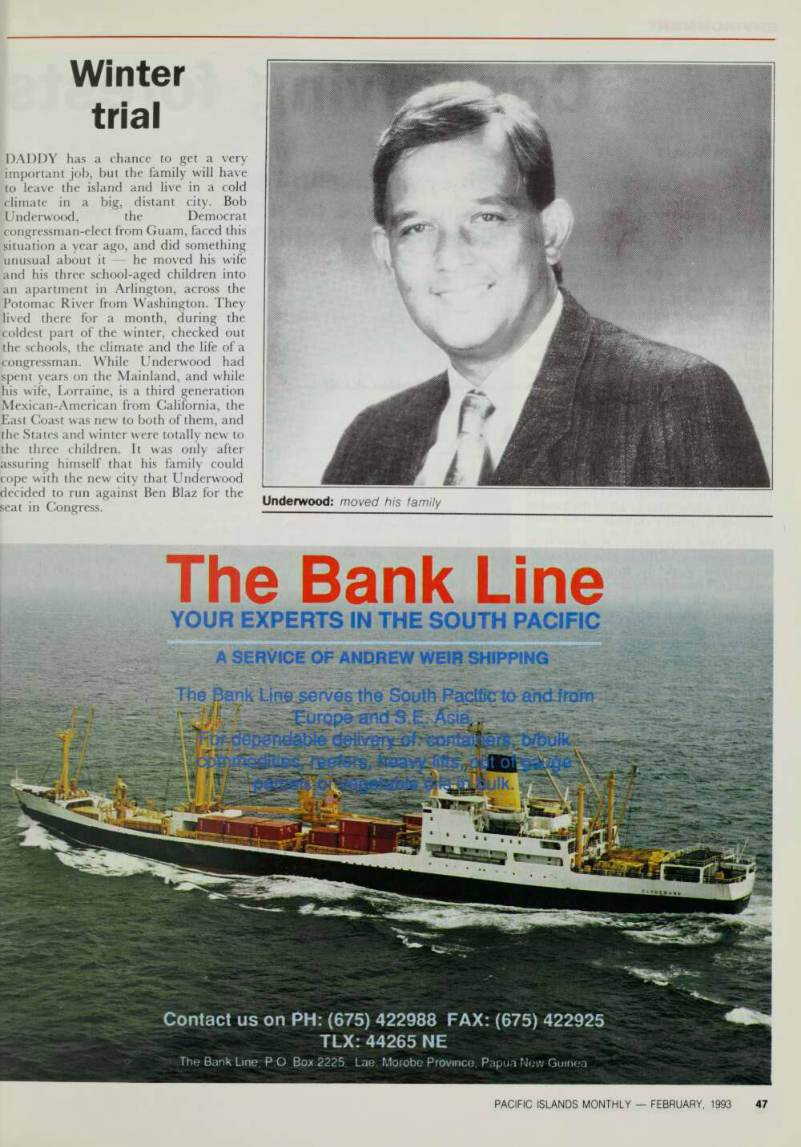
trial
DADDY has a chance to get a very important job, but the family will have to leave the island and live in a cold climate in a big, distant city. Bob Underwood, the Democrat congressman-elect from Guam, faced this situation a year ago, and did something unusual about it he moved his wife and his three school-aged children into an apartment in Arlington, across the Potomac River from Washington. They lived there for a month, during the coldest part of the winter, checked out the schools, the climate and the life of a congressman. While Underwood had spent years on the Mainland, and while his wife, Lorraine, is a third generation Mexican-American from California, the East Coast was new to both of them, and the States and winter were totally new to the three children. It was only after assuring himself that his family could cope with the new city that Underwood decided to run against Ben Blaz for the seat in Congress.
Underwood: moved his family
Advertisements & other items, p. 47 (1 item)
The Bank Line
YOUR EXPERTS IN THE SOUTH PACIFIC
A SERVICE OF ANDREW WEIR SHIPPING
The Bank Uf m -■ t *fei6uife - • : Contact us on PH: (675) 422988 FAX: (675) 422925
TLX; 44265 NE
The Bank Line P O Box 2225, Lae, Morobe Province, Papua New Guinea
Conserving forests
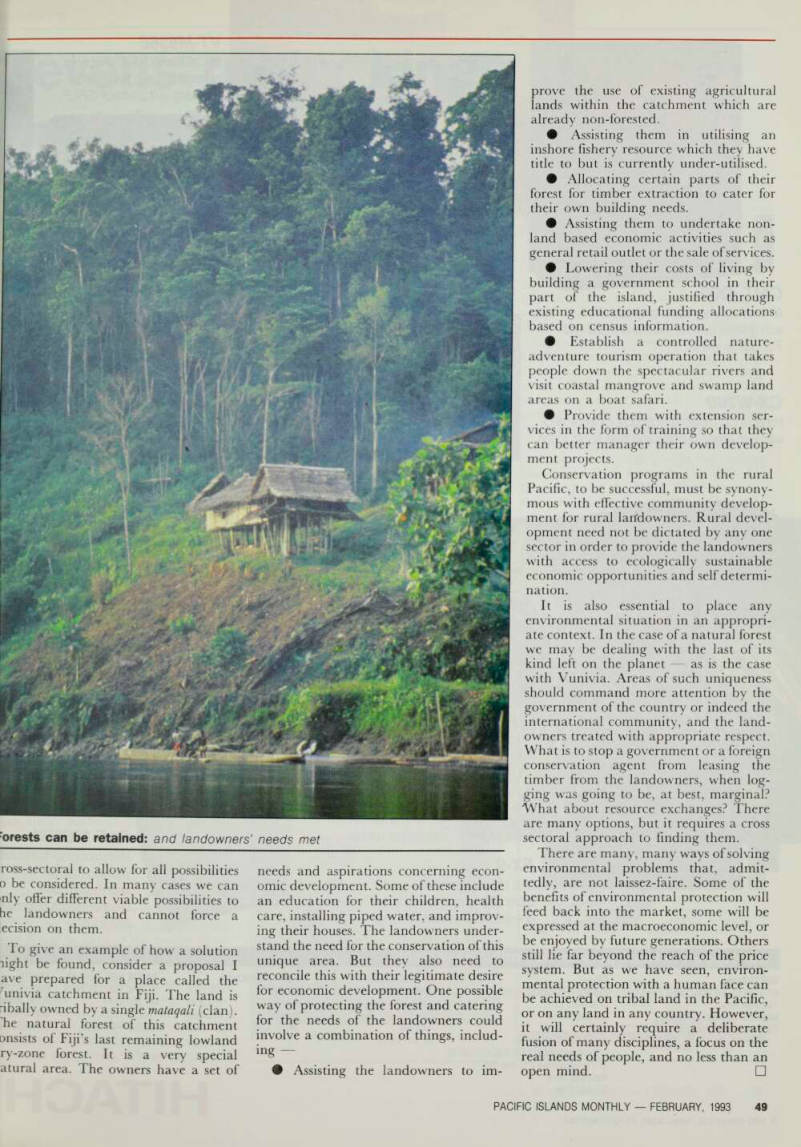
Environment
By Sean Weaver
Can environmental protection with a human face be achieved in tribal lands in the Pacific?
THE natural sciences such as ecology, geology or chemistry are useful in helping us understand, the physical and technical aspects of environmental degradation. But to understand the causes of human-induced environmental damage and to cure those ills environ mental managers must, of course, learn about people. This is because the causes, and necessary solutions, to environ mental problems are usually social and economic. Nowhere is this more obvious than in the case of indigenous forest depletion on tribal land in the rural Pacific.
A common scenario of this kind might be the loss of a rare type of indigenous forest due to logging activities carried out by the landowners or, on behalf of the owners, by a logging company. Most of my experience of this kind relates to environmental management programs in rural Fiji where almost all of the land in question is tribally owned.
Let’s take a look at the situation from the perspective of the landowners them selves and work up from there. The owners of areas of indigenous forest in Fiji will generally have a set of needs and aspirations which partly related to socio economic development. They own a resource a natural forest, which happens to be rather rare and of national or international significance in terms of bio-diversity. In the absence of outside assistance of some form, an obvious way to make an income from their private or tribal resource is to log the forest. No big deal, people have been logging forests for millennia.
The situation for the forest owner changes very rapidly when a team of environmental managers come to visit and inform the landowner the forest they are logging or planning to log is a special area and one that should be placed into a reserve.
To put it another way, imagine you are a city-dweller and you own a suburban property. Times are tough, you have lost your job and it appears you will have no choice but to dig up the lawn to plant vegetables as you can no longer afford the food bills. There is a pervasive short term need that can be satisfied using your own resources. You start to dig over the garden and some clean-cut brightly dressed ecologist comes to visit. They proceed to inform you that an extremely rare species of worm dwells beneath your lawn. It lives
in the roots of the grass and so will die if the lawn is removed and cannot be transferred to another locality as it is too sensitive. The situation is not unlike that experienced by a Fijian landowner.
“This is my back yard.” you say, and, “I do not have much money and need vegetables to stay healthy. If I grow them here I will not need to buy them and an immediate need will be satisfied.”
This is rather similar to Fiiian land owners who say, “This is our forest. We need cash to pay for our children’s school fees, to improve our houses, to pay for health care, and for our general daily needs.
“If we can’t cut this forest down our immediate needs will not be satisfied after all it is our resource. Unless you present us with an alternative means of gaining an equivalent income we will have to say no to forest conservation on this land.”
The ball is now in the court of the environmental managers who must find a socio-economic solution to what at first appeared to be an ecological problem. It is at this point that many natural scientists throw up their hands and say, “This is no longer any of my business.
Untangling socio-economic issues is out side my area of professional expertise.
Someone else must sort it out as it is not
my responsibility.”
This is where we depart from natural science and enter into the realm of disciplines such as social geography,
sociology, political science, anthro
pology, and economics. We are now talking about the valuation of natural areas, and finding socio-economic sol utions to socio-economic problems.
In an intact state a natural forest will undoubtedly provide benefits to the landowners and the wider community.
However, these benefits are often far less tangible than cash, or are lower down in the landowner’s list of priorities than other needs and wants. A standing native forest will not sprout dollar bills and pay for the children’s school fees. And until it does the landowners will use their resource in such a way that it satisfies their immediate needs and aspirations.
Dealing with issues relating to the
socio-economic well being of rural peoples begins to sound more like the kind ofl work carried out by development] agencies and not an environmental! protection organisation. Bio-diversity is? no longer the principal focus of our activities it is community develop ment. And this is where it begins to get] very interesting. Many, many people! from many different backgrounds are! involved in development issues of some! form. This ranges from the pleated-suit] brigade of the big business, the economic: policy analysts of the government] treasury, government development plan ners within different economic sectors,, various levels of the private sector, t development and environmental non
government groups, political parties,*
and, not to forget, the local people. Alll will have different things to say about the! best development recipe to use. They are! often in total contradiction to each othen and each speak a different dialect. Bud perhaps the most important experts? worth consulting, who are indeed the: original clients, are the landowners.
Negotiate with the landowners first) and build up from there. Go to the: people on the land, find out what theys really need and want, and find out their available resources may be able toe cater for those needs and wants. Remem ber logging may only appear to be the! single most viable option for at predominantly forested area. There ares likely to be many others. It is important) at this stage to see how the full spectrumr of development options might be able toe cater for the aspirations of the owners. It) would be a mistake to simply hand the! problem over to any one particular secton to solve.
If we are talking about a forest, fon example, many people will assume the! forest is the most appropriate groupc worth consulting. If this is done then the!) entire process of negotiations will be! dictated by the philosophies and the! language games of that discipline. The! best solution the forest sector can offeri may be greatly inferior to what is in fact) possible. We are dealing with a forest inn this example yes, but we are not)' necessarily talking about forestry. The! approach must be multidisciplinary andfc
ross-sectoral to allow for all possibilities o be considered. In many cases we can nly offer different viable possibilities to he landowners and cannot force a ecision on them.
To give an example of how a solution light be found, consider a proposal I ave prepared for a place called the hmivia catchment in Fiji. The land is dbally owned by a single mataqali (clan), he natural forest of this catchment
onsists of Fiji’s last remaining lowland
ry-zone forest. It is a very special atural area. The owners have a set of
needs and aspirations concerning econ omic development. Some of these include an education for their children, health care, installing piped water, and improv ing their houses. The landowners under stand the need for the conservation of this unique area. But they also need to reconcile this with their legitimate desire for economic development. One possible way of protecting the forest and catering for the needs of the landowners could involve a combination of things, includ
ing
• Assisting the landowners to im
prove the use of existing agricultural lands within the catchment which are already non-forested. • Assisting them in utilising an inshore fishery resource which they have title to but is currently under-utilised. • Allocating certain parts of their forest for timber extraction to cater for their own building needs. • Assisting them to undertake non land based economic activities such as general retail outlet or the sale of services. • Lowering their costs of living by building a government school in their part of the island, justified through existing educational funding allocations based on census information. • Establish a controlled nature adventure tourism operation that takes people down the spectacular rivers and visit coastal mangrove and swamp land areas on a boat safari, • Provide them with extension ser vices in the form of training so that they can better manager their own develop ment projects.
Conservation programs in the rural Pacific, to be successful, must be synony mous with effective community develop ment for rural landowners. Rural devel opment need not be dictated by any one sector in order to provide the landowners with access to ecologically sustainable economic opportunities and self determi nation.
It is also essential to place any environmental situation in an appropri ate context. In the case of a natural forest we may be dealing with the last of its kind left on the planet as is the case with Vunivia. Areas of such uniqueness should command more attention by the government of the country or indeed the international community, and the land owners treated with appropriate respect.
What is to stop a government or a foreign conservation agent from leasing the timber from the landowners, when log ging was going to be, at best, marginal?
What about resource exchanges? There are many options, but it requires a cross sectoral approach to finding them.
There are many, many ways of solving environmental problems that, admit tedly, are not laissez-faire. Some of the benefits of environmental protection will feed back into the market, some will be expressed at the macroeconomic level, or be enjoyed by future generations. Others still lie far beyond the reach of the price system. But as we have seen, environ mental protection with a human face can be achieved on tribal land in the Pacific, or on any land in any country. However, it will certainly require a deliberate fusion of many disciplines, a focus on the real needs of people, and no less than an open mind. □
Forests can be retained: and landowners’ needs met
Advertisements & other items, p. 50 (2 items)
50
1993 Hitachi, Ltd., Tokyo, Japan. All rights reserved
plus friendly service
VTMB3BE
PAL VCR with NTSC playback compatibility and two-speed recording and playback (SP/LP).
CMT-4200
42" multi-system super projection TV with S-video terminal, surround sound and 7-language teletext.
VME2SE
“Twist & Shoot” Bmm movie camera with 16 x digital zoom.
CX-W3OO
Portable CD player/tuner/double cassette deck with high-speed dubbing and bass boost sound.
All this
plus friendly service
at a Hitachi dealer near you.
i CX-W5OO
CV-4700 1000 W 4.5-liter vacuum cleaner with foot switch, tool storage space and top-mounted 360-degree rotating hose. mttk Portable P la V er/ Hj digital tuner/double IJI cassette deck with W "3D twin drive” system mi and remote control.
FX-9 Mini Hi-Fi system with super wide surround sound and one-touch CD-to-tape dubbing.
PAFI26OPX
Microprocessor controlled s - ■[ M I I washing machine with forced drain pump, softener/bleach dispenser, ; and lint filter.
Our support network puts service within easy reach.
AUSTRALIA:
HITACHI SALES AUSTRALIA PTY LTD.
153 Keys Road Moorabbin, Victoria 3189 Tel: (03) 555-8722 Fiji:
BURNS PHILP (SOUTH SEA)
COMPANY LTD.
Box 355, G.P.O.
Suva Tel: 9-311777
COMMUNICATIONS PACIFIC LTD. (AV/A)
37 Freeston Road (PO. Box 858) Walu Bay, Suva Tel: 9-312744
NEW ZEALAND:
ROBINSON INDUSTRIES LTD.
6 Zelanian Drive East Tamaki Auckland Tel: 9-2745615
NEW CALEDONIA: PAPUA NEW GUINEA: TAHITI:
CALDIS CALTEC PACIFIC ELECTRONICS POSI-LECTRIO
B.P Ml B.P 2540 PO. Box 2115 PO. BOX 144, , Noumea Noumea LAE PAPEETE, Tel: 26,33.00 Tel: 28.39.54 Tel: 5-424467 Tel; 42.92.56.
HITACHI
Sevens rugby kings to
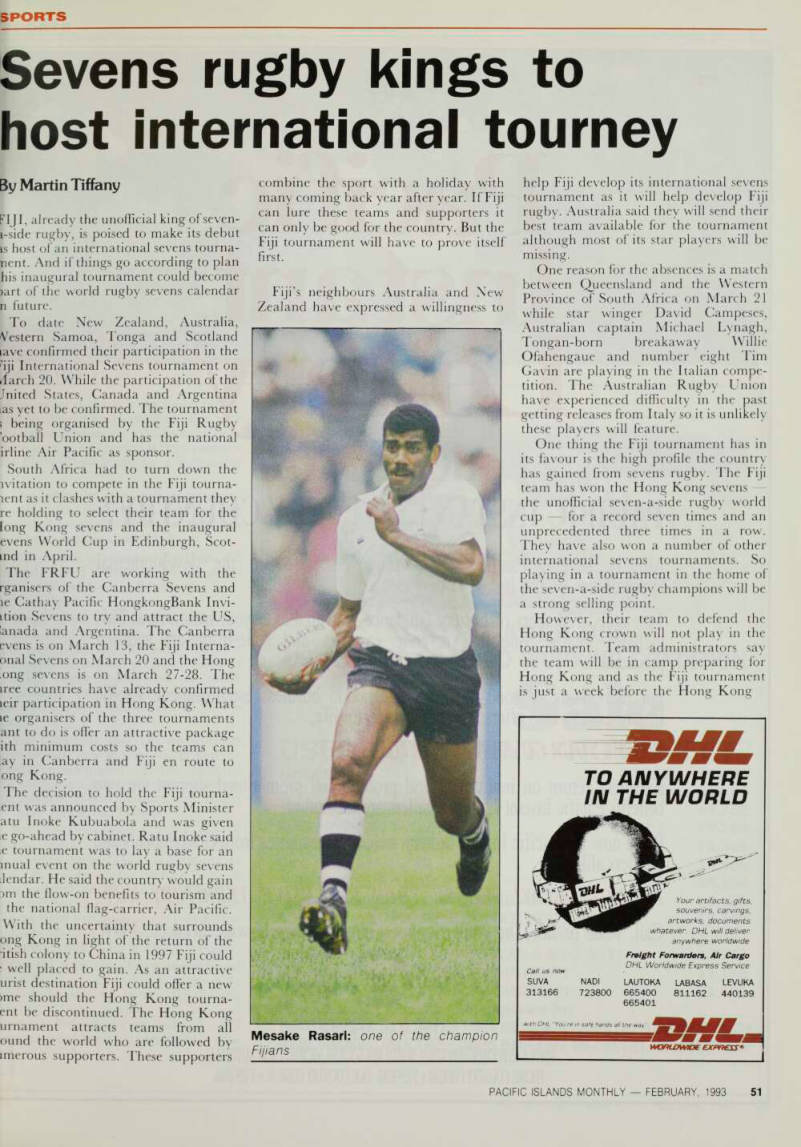

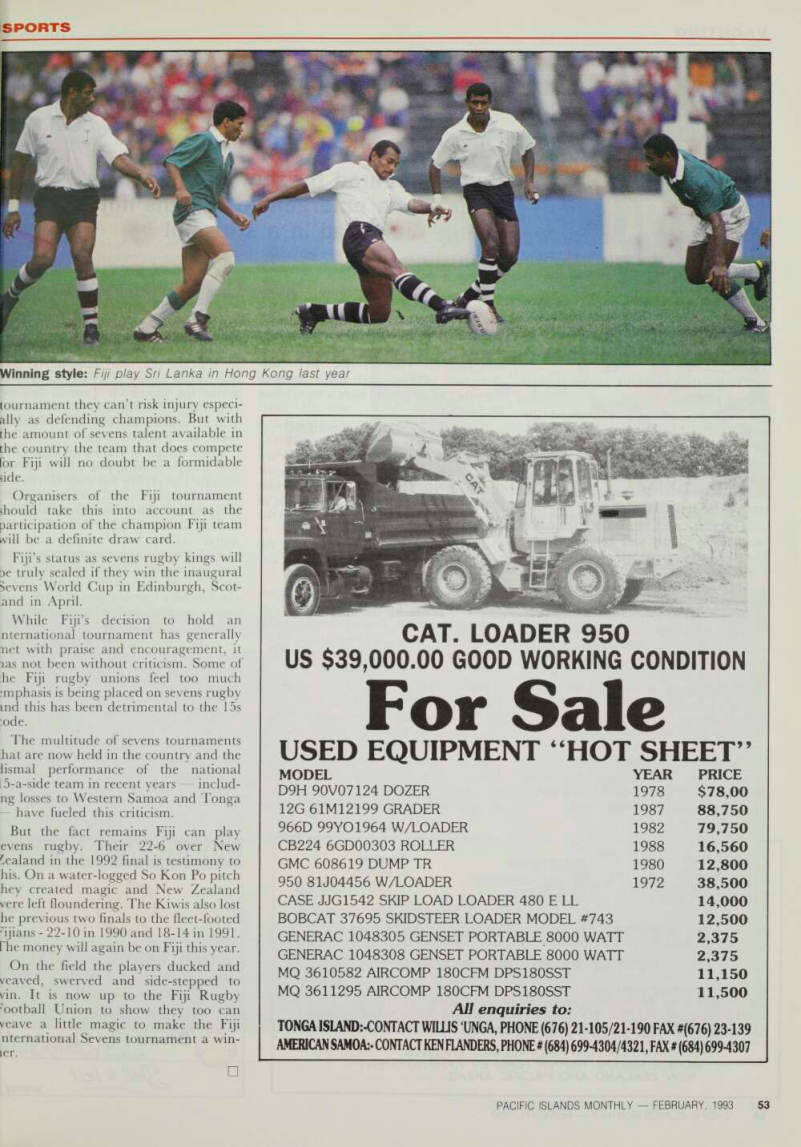
Sports
Sevens rugby kings to host international tourney
By Martin Tiffany
FIJI, already the unofficial king ofseven i-side rugby, is poised to make its debut is host of an international sevens tourna nent. And if things go according to plan his inaugural tournament could become >art of the world rugby sevens calendar n future.
To date New Zealand, Australia, Vestern Samoa, Tonga and Scotland lave confirmed their participation in the 'iji International Sevens tournament on darch 20. While the participation of the Jnited States, Canada and Argentina ias yet to be confirmed. The tournament > being organised by the Fiji Rugby 'ootball Union and has the national irline Air Pacific as sponsor.
South Africa had to turn down the ivitation to compete in the Fiji tourna lent as it clashes with a tournament they re holding to select their team for the long Kong sevens and the inaugural evens World Cup in Edinburgh, Scot ind in April.
The FRFU are working with the rganisers of the Canberra Sevens and le Cathay Pacific Hongkongßank Invi ition Sevens to try and attract the US, lanada and Argentina. The Canberra evens is on March 13, the Fiji Interna onal Sevens on March 20 and the Hong .ong sevens is on March 27-28. The tree countries have already confirmed
icir participation in Hong Kong. What
ic organisers of the three tournaments ant to do is offer an attractive package ith minimum costs so the teams can ay in Canberra and Fiji en route to ong Kong.
The decision to hold the Fiji tourna ent was announced by Sports Minister atu Inokc Kubuabola and was given ie go-ahead by cabinet. Ratu Inoke said e tournament was to lay a base for an mual event on the world rugby sevens Jendar. He said the country would gain Dm the flow-on benefits to tourism and the national flag-carrier, Air Pacific.
With the uncertainty that surrounds ong Kong in light of the return of the •itish colony to China in 1997 Fiji could - well placed to gain. As an attractive urist destination Fiji could offer a new >me should the Hong Kong tourna ent be discontinued. The Hong Kong urnament attracts teams from all ound the world who are followed by imerous supporters. These supporters
combine the sport with a holiday with many coming back year after year. If Fiji can lure these teams and supporters it can only be good for the country. But the Fiji tournament will have to prove itself first.
Fiji’s neighbours Australia and New Zealand have expressed a willingness to
help Fiji develop its international sevens tournament as it will help develop Fiji rugby. Australia said they will send their best team available for the tournament although most of its star players will be missing.
One reason for the absences is a match between Queensland and the Western Province of South Africa on March 21 while star winger David Campeses, Australian captain Michael Lynagh, Tongan-born breakaway Willie Ofahengaue and number eight Tim Gavin are playing in the Italian compe tition. The Australian Rugby Union have experienced difficulty in the past getting releases from Italy so it is unlikely these players will feature.
One thing the Fiji tournament has in its favour is the high profile the country has gained from sevens rugby. The Fiji team has won the Hong Kong sevens the unofficial seven-a-side rugby world cup for a record seven times and an unprecedented three times in a row.
They have also won a number of other international sevens tournaments. So playing in a tournament in the home of the seven-a-side rugby champions will be a strong selling point.
However, their team to defend the Hong Kong crown will not play in the tournament. Team administrators say the team will be in camp preparing for Hong Kong and as the Fiji tournament is just a week before the Hong Kong
Mesake Rasari: one of the champion Fijians
tournament they can’t risk injury especi ally as defending champions. But with the amount of sevens talent available in the country the team that does compete for Fiji will no doubt be a formidable iide.
Organisers of the Fiji tournament should take this into account as the participation of the champion Fiji team will be a definite draw card.
Fiji’s status as sevens rugby kings will t>e truly sealed if they win the inaugural Sevens World Cup in Edinburgh, Scot and in April.
While Fiji’s decision to hold an nternational tournament has generally net with praise and encouragement, it las not been without criticism. Some of he Fiji rugby unions feel too much emphasis is being placed on sevens rugby md this has been detrimental to the 15s :ode.
The multitude of sevens tournaments hat are now held in the country and the lismal performance of the national [5-a-side team in recent years includ ng losses to Western Samoa and Tonga have fueled this criticism.
But the fact remains Fiji can play evens rugby. Their 22-6 over New Zealand in the 1992 final is testimony to his. On a water-logged So Kon Po pitch hey created magic and New Zealand vere left floundering. The Kiwis also lost he previous two finals to the fleet-footed r ijians- 22-10 in 1990 and 18-14 in 1991. fhe money will again be on Fiji this year.
On the field the players ducked and veaved, swerved and side-stepped to vin. It is now up to the Fiji Rugby r ootball Union to show they too can veave a little magic to make the Fiji nternational Sevens tournament a win ter.
Winning style: Fiji play Sri Lanka in Hong Kong last year
Advertisements & other items, pp. 51-53 (2 items)
To Anywhere
IN THE WORLD
Your artifacts, gifts, souvenirs, carvings, artworks, documents whatever. DHL will deliver anywhere worldwide Call us now
SUVA NADI
313166 723800 Freight Forwarders, Air Cargo DHL Worldwide Express Service
LAUTOKA LABASA LEVUKA
665400 811162 440139 665401 with DHL "You're in safe hands all the way" woncowMX expness*
w
Pacific
Instant
Lottery*
ARE YOU A
PACIFIC INSTANT LOTTERY COUNTRY?
Already, several Pacific nations have responded to the developmental opportunities Pacific Instant Lottery offers.
Tattersalls’ 120 years of Lottery Guidance is available to your nation now. This includes totally controlled revenue earnings and state-of-the-art auditing procedures.
For individuals of good character and sound business establishment, Pacific Instant Lottery also offers a secure income for life.
THIS IS YOUR GOLDEN OPPORTUNITY!
Excellent return on investment and professional promotional support are two benefits Pacific Instant Lottery retailers are assured of.
Right now the Pacific Instant Lottery welcomes enquiries from Governments and retailers alike.
DO NOT DELAY! SECURE YOUR EXCLUSIVE TERRITORY NOW!
Call, write or fax The Mail Service, Tattersalls world-wide licencee, NOW.
THE MAIL SERVICE
SUITE 5,55 REMINGTON ROAD, NORTH MELBOURNE, VICTORIA 3051, AUSTRALIA.
PHONE; COUNTRY CODE 61+3 329 9388. FAX: COUNTRY CODE 61 +33292166. § (/) o < cc
CAT. LOADER 950
US $39,000.00 GOOD WORKING CONDITION
For Sale
USED EQUIPMENT “HOT SHEET’’
MODEL YEAR PRICE
D9H 90V07124 DOZER 1978 $78,00
12G 61M12199 GRADER 1987 88,750
966 D 99YG1964 W/LOADER 1982 79,750
C 8224 6GD00303 ROLLER 1988 16,560
GMC 608619 DUMP TR 1980 12,800
950 81J04456 W/LOADER 1972 38,500
CASE JJGIS42 SKIP LOAD LOADER 480 E LL 14,000 BOBCAT 37695 SKIDSTEER LOADER MODEL #743 12,500 GENERAC 1048305 GENSET PORTABLE 8000 WATT 2,375 GENERAC 1048308 GENSET PORTABLE 8000 WATT 2,375
MQ 3610582 AIRCOMP 180CFM DPSIBOSST 11,150
MQ 3611295 AIRCOMP 180CFM DPSIBOSST 11,500
All enquiries to: TONGA ISLAND:-CONTACT WILUS UN6A, PHONE (676) 21-105/21-190 FAX #(676) 23-139 AMERICAN SAMOA:- CONTACT KEN FLANDERS, PHONE (684) 6994304/4321, FAX (684) 6994307
Sports
Shaking up
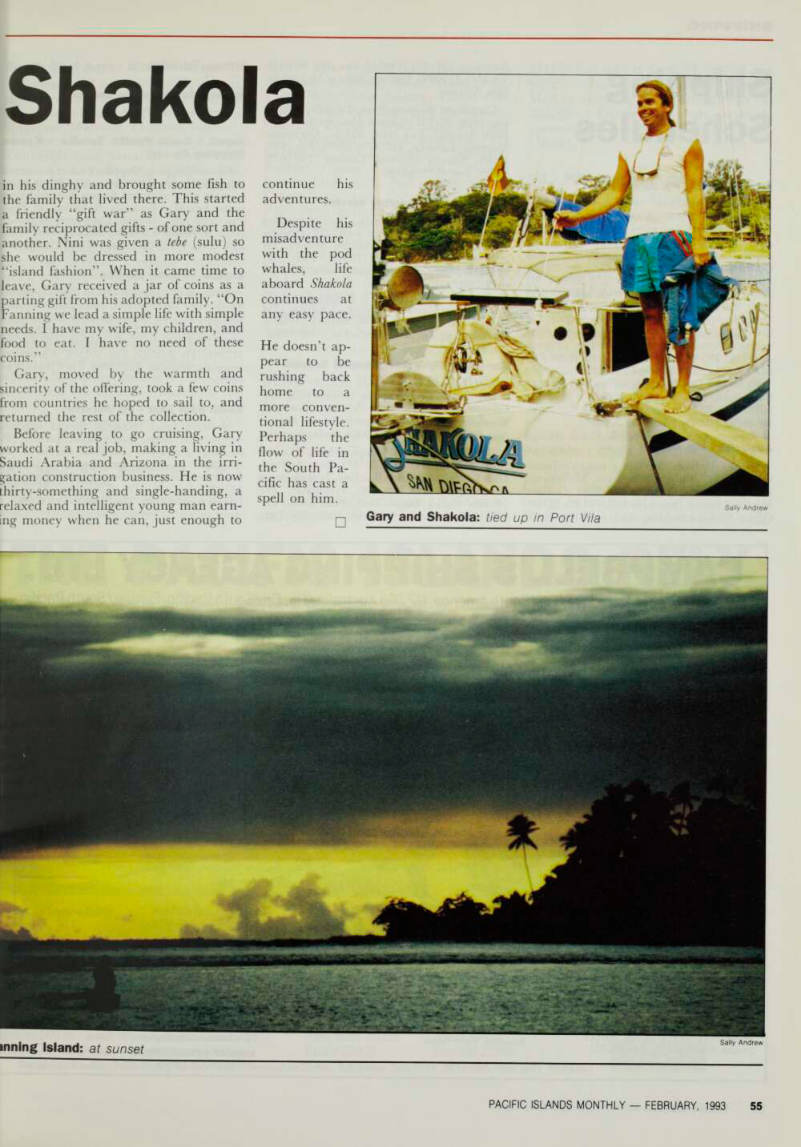
Yachting
By Sally Andrew
Being prepared for the contingencies of maritime emergencies means not losing your head in a stressful situation
A THOUSAND miles south of Ha waii, Gary and his girl-friend, Nini,
were sailing along, grooving to the
sound of Jeff Beck’s wild guitar play ing. Suddenly there was a strange creak-creeaak-creak noise in the back
ground.
“Gary, does the cd sound weird to 9 your “Yeah, do you think we’ve broken the cd player?”
Gary reached up and turned the music off. The squeaks continued.
Creak-creeaak-crreak, “Strange, it sounds like bulkheads
working.” Gary got up to investigate
and discovered the sound coming up out of the toilet bowl.
“Gary, it can’t be coming from the head. Why don’t you get some rest.
We’ll figure it out when we get to
Fanning.
So Gary tried to rest again, minus Jeff Beck. Seconds later, the reassuring sound of water passing along the hull stopped.
So did all forward motion. There was a sickening thud - as Nini describes it, the same kind of loud noise you’d expect to hear if you were in a car and had run smack into a tree. But Shakola was in the middle of the Pacific Ocean, hundreds of miles from any land. A sinking feeling of disbelief filled the air and both their hearts.
Gary leaped up and screamed. “We’ve hit something!”. In an instant he was on deck. Shakola was surrounded by a pod of whales with large square-shaped heads.
They were easy to identify - sperm whales. Nearly 15 of them, each twice the size of Shakola , took turns exhaling a putrid mix of saltwater and dead plank ton. The oblique trajectory of their blow was spot on. One by one they came alongside, exhaled, then made room so the other whales could have a try spitting on Shakola.
Being prepared for the contingencies of maritime emergencies means not losing your head in a stressful situation. When Nini moaned, “Why in the whole Pacific do they have to be here?”, Gary lifted his head out of the bilge and got straight to the point. “Get the canned goods and the emergency bag in case we have to abandon ship.” He finished checking the bilge to see if Shakola was taking on any water nothing, not a drop.
Gary and Nini stood on deck alter nately begging the whales to go away and cussing them. After 45 minutes that seemed like hours, the behemoths swam off to another corner of the Pacific. The whale-watching had ended.
Gary and Nini made landfall at Fanning Island the next day. Surveying the damage after the arrival, Gary discovered the bulkhead supporting the forward berth had been jarred loose, causing cosmetic rather than structural damage. Not so obvious, Shakola’s two part hull had sustained structural dam age where the bow had collided with the
giant whale. Repair work on the boau was finished in Australia.
What an inauspicious start to a four-' year voyage that has taken Gary Pione and his 30-foot Rawson-designed Shakolcs to Hawaii, the Line Islands, Western Samoa and Tonga. Gary has sailed twice across the boisterous Tasman Sea be-' tween New Zealand and Australia. This year he cruised through Nouvelle Cale donie and Vanuatu.
Music is one of Gary’s greatest loves.; and Shakola is equipped with a cd and cassette player. He has over 60 cds and nearly 80 cassettes and likes folk, country rock, rock just about everything. Orn a calm passage, Gary will take out as
guitar (either his electric guitar and
amplifier or his acoustic guitar) and workl out new music. “Going offshore is like going to school”. Before leaving, Gary sets himself a learning goal or project and passes the time by learning a new song.; reading a book, or studying a new way to work out navigational sights. Shakola has a satnav but Gary prefers keeping ini practice and using his sextant. “This trip] I want to master the ‘S tables’, a quick! and dirty way of computing celestial sights for navigation.”
Even after the many beautiful islands he has visited and the many people ho has met, the one place that stands out as extra-special is his first landfall south of Hawaii, Fanning Island. When he ar rived at English Harbour, he went ashoro
in his dinghy and brought some fish to the family that lived there. This started a friendly “gift war” as Gary and the family reciprocated gifts - of one sort and another. Nini was given a tebe (sulu) so she would be dressed in more modest “island fashion”. When it came time to leave, Gary received a jar of coins as a parting gift from his adopted family. “On Fanning we lead a simple life with simple needs. I have my wife, my children, and food to eat. I have no need of these coins.”
Gary, moved by the warmth and sincerity of the offering, took a few coins from countries he hoped to sail to, and returned the rest of the collection.
Before leaving to go cruising, Gary worked at a real job, making a living in Saudi Arabia and Arizona in the irri gation construction business. He is now thirty-something and single-handing, a relaxed and intelligent young man earn ing money when he can, just enough to
continue his adventures.
Despite his
misadventure with the pod whales, life aboard Shakola continues at any easy pace.
He doesn’t ap pear to be rushing back home to a more conven
tional lifestyle.
Perhaps the
flow of life in the South Pa cific has cast a spell on him. □
Sally Andrew
Gary and Shakola: tied up in Port Vila
Sally Andrew
[?]inning Island: at sunset
Advertisements & other items, pp. 54-55 (2 items)
Garth Evans Marine
ATTENTION YACHTIES
SHELL FUEUNG FACILITIES
Shell Fiji Ltd. is offering the best in name brand lubricants and quality fuel in: Savusavu, Levuka, Suva. © Shell Fiji Limited Telephone 313933. Fax 302279
<tkH & best
GRB337
PO BOX 5094
PORT NELSON
PH (3) 5468330
FAX (3) 5468351
Contact
G. EVANS
A/H (3) 5482409
GARTH EVANS MARINE
PORT OF NELSON NEW ZEALAND
SHIP CONSTRUCTION AND DESIGN
SHIP REPAIRS TO PLEASURE AND COMMERCIAL VESSELS SLIPPING FACILITIES TO 2000 TONS AND UP TO 6 METRE DRAFT
SAND BLASTING AND PAINTING
DIESEL AND ENGINE REPAIRS
AGENCIES FOR NEW AND REBUILT ENGINES
MOBILE MARINE REPAIR TEAM BY ARRANGEMENT
NEW ZEALAND AND PACIFIC AREAS
Shakola
Shipping
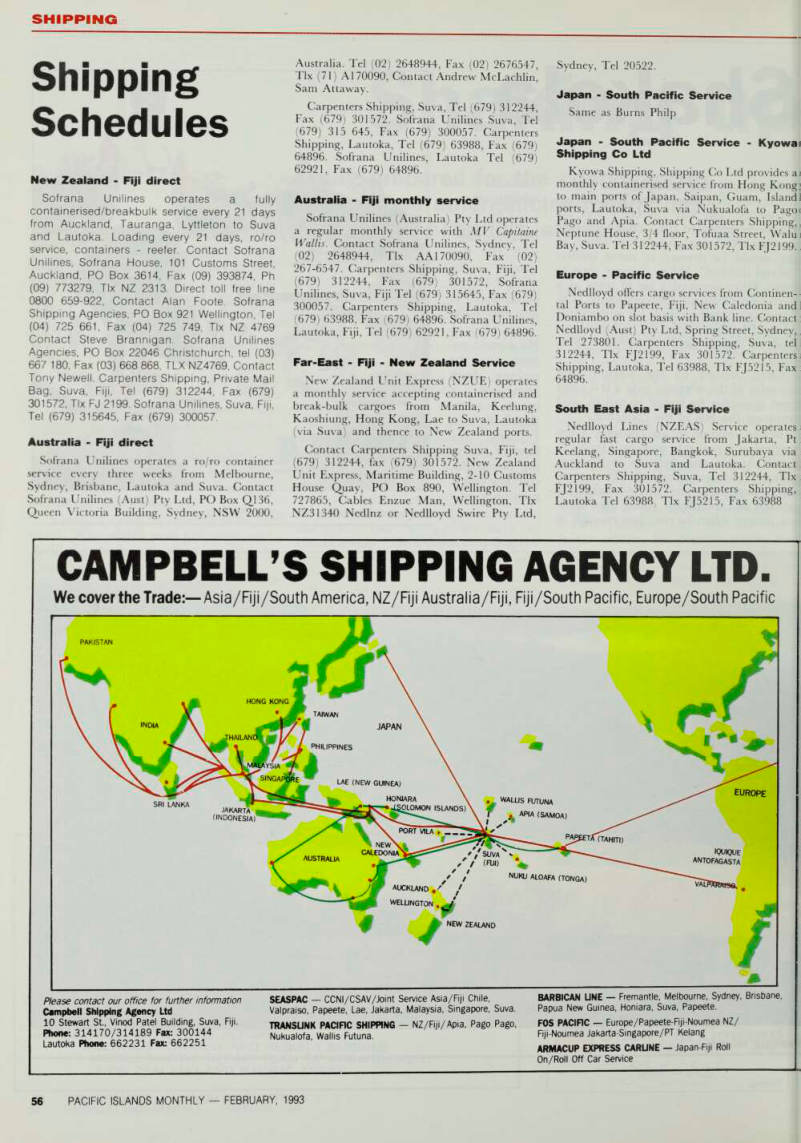
Schedules
New Zealand - Fiji direct Sofrana Unilines operates a fully containerised/breakbulk service every 21 days from Auckland, Tauranga, Lyttleton to Suva and Lautoka. Loading every 21 days, ro/ro service, containers - reefer. Contact Sofrana Unilines, Sofrana House, 101 Customs Street, Auckland, PO Box 3614, Fax (09) 393874, Ph (09) 773279, Tlx NZ 2313. Direct toll free line 0800 659-922, Contact Alan Foote. Sofrana Shipping Agencies, PO Box 921 Wellington, Tel (04) 725 661, Fax (04) 725 749, Tlx NZ 4769 Contact Steve Brannigan. Sofrana Unilines Agencies, PO Box 22046 Christchurch, tel (03) 667 180, Fax (03) 668 868, TLX NZ4769. Contact Tony Newell. Carpenters Shipping, Private Mail Bag, Suva, Fiji. Tel (679) 312244, Fax (679) 301572, Tlx FJ 2199. Sofrana Unilines, Suva, Fiji, Tel (679) 315645, Fax (679) 300057.
Australia - Fiji direct Sofrana Unilines operates a ro/ro container service every three weeks from Melbourne, Sydney, Brisbane, Lautoka and Suva. Contact Sofrana Unilines (Aust) Pty Ltd, PO Box Q 136,
Queen Victoria Building, Sydney, NSW 2000,
Australia. Tel (02) 2648944, Fax (02) 2676547, Tlx (71) A 170090, Contact Andrew McLachlin, Sam Attaway.
Carpenters Shipping, Suva, Tel (679) 312244, Fax (679) 301572. Sofrana Unilines Suva, Tel (679) 315 645, Fax (679) 300057. Carpenters Shipping, Lautoka, Tel (679) 63988, Fax (679) 64896. Sofrana Unilines, Lautoka Tel (679) 62921, Fax (679) 64896.
Australia - Fiji monthly service Sofrana Unilines (Australia) Pty Ltd operates a regular monthly service with MV Capitaine Wallis. Contact Sofrana Unilines, Sydney, Tel (02) 2648944, Tlx AA170090, Fax (02) 267-6547. Carpenters Shipping, Suva, Fiji, Tel (679) 312244. Fax (679) 301572, Sofrana Unilines, Suva, Fiji Tel (679) 315645, Fax (679) 300057. Carpenters Shipping, Lautoka, Tel (679) 63988, Fax (679) 64896. Sofrana Unilines, Lautoka, Fiji, Tel (679) 62921, Fax (679) 64896.
Far-East - Fiji - New Zealand Service New Zealand Unit Express (NZUE) operates a monthly service accepting containerised and break-bulk cargoes from Manila, Keelung, Kaoshiung, Hong Kong, Lae to Suva, Lautoka (via Suva) and thence to New Zealand ports.
Contact Carpenters Shipping Suva, Fiji, tel (679) 312244, fax (679) 301572. New Zealand Unit Express, Maritime Building, 2-10 Customs House Quay, PO Box 890, Wellington. Tel 727865, Cables Enzue Man, Wellington, Tlx NZ31340 Nedlnz or Nedlloyd Swire Pty Ltd,
Sydney, Tel 20522.
Japan - South Pacific Service Same as Burns Philp Japan - South Pacific Service - Kyowa Shipping Co Ltd Kyowa Shipping, Shipping Co Ltd provides ai monthly containerised service from Hong Kong’ to main ports of Japan, Saipan, Guam, Island! ports, Lautoka, Suva via Nukualofa to Pagot Pago and Apia. Contact Carpenters Shipping,, Neptune House, 3/4 floor, Tofuaa Street, Walui Bay, Suva. Tel 312244, Fax 301572, Tlx FJ2199..
Europe - Pacific Service Nedlloyd offers cargo services from Continen tal Ports to Papeete, Fiji, New Caledonia and 1 Doniambo on slot basis with Bank line. Contact ] Nedlloyd (Aust) Pty Ltd, Spring Street, Sydney,, Tel 273801. Carpenters Shipping, Suva, tel 1 312244, Tlx FJ2199, Fax 301572. Carpenters; Shipping, Lautoka, Tel 63988, Tlx FJ5215, Fax ; 64896.
South East Asia - Fiji Service Nedlloyd Lines (NZEAS) Service operates; regular fast cargo service from Jakarta, Pt Keelang, Singapore, Bangkok, Surubaya via.
Auckland to Suva and Lautoka. Contact Carpenters Shipping, Suva, Tel 312244, Tlx : FJ2199, Fax 301572. Carpenters Shipping, , Lautoka Tel 63988., Tlx FJ5215, Fax 63988
South East Asia - Mid South pacific Columbus Line operates a regular container and breakbulk-heavy lift ser vice from/to Hongkong/Taiwan/Manila/ Singapore/Malaysia/Thailand/Indon esia to Port Moresby/Lae/Rabaul/ Kimbe/Madang/Newark/Honiara and Noro. Contact Express Freight, Lae, POB 3398, phone 423913 or 423822, fax 425193.
Far East - Mid South Pacific China Navigations New Guinea Pa cific Line operates a regular container and breakbulk heavy lift service from Hong Kong, Taiwan, Manila, Singa pore, Malaysia, Thailand to Port Moresby, Lae, Rabaul, Kieta and Honi ara. Cargo from the same eastern ports to the South Pacific Ports of Noumea, Santo, Vila, Papeete, PagoPago, Apia, Mukualofa, Rarotonga and Tarawa will Se shipped via Japan or Busan on the nonthly Bali Hai Service. Contact Steamships Shipping, Port Moresby, PO Sox 634, Tel 220283 or 220289.
Australia - New Caledonia - Fiji iamoas - Tonga Pacific Forum Line operates a fully ontainerised service (general, reefer and
ro-ro) from Sydney and Brisbane to Noumea, Lautoka, Suva, Apia, Pago Pago, Nuku’alofa, Sydney. Cargo cen tralised from Adelaide and Melbourne.
Contact: Pacific Forum Line, PO Box 796, Auckland; Union Bulkships, 333 George St, Sydney, Brisbane and Mel bourne; Union Co, Lautoka; Pacific Forum Line, Suva, Nuku’alofa; Pacific Forum Line, Apia; Polynesia Shipping, Pago Pago. Sofrana Unilines operates a roro/container service every three weeks from Melbourne, Sydney and Brisbane to Noumea, Suva and Lautoka with transhipment to the Samoas and Tonga.
New Zealand - Australia - PNG - Solomon Islands Pacific Forum Line operates a containerised and ro-ro service from Lyttleton, Napier and Auckland to Brisbane, Port Moresby, Lae, Honiara, Brisbane then to New Zealand. Contact: Pacific Forum, Auckland, Christchurch; Union Bulkships, Brisbane; Steamships Shipping Port Moresby and Lae Sullivan Ltd, Honiara; Seabridge, Wellington.
NZ - Fiji Translink Pacific Shipping Fiji Agents are: Campbells Shipping Agency Ltd, Ph
314189 Fax 300144 Suva; Ph 662231 Fax 662251 Lautoka. Auckland Agents: McKay Shipping Ph (9) 390229 Fax (9) 3032931. Tauranga Agents, seatrade agencies Ph (75) 754989 Fax (75) 758380.
NZ - Fiji - Pago - Apia - Nuk Translink Pacific Shipping operates a monthly sailing with Polynesian Link, which carries Dry Container, reefers and breakbulk cargoes. NZ Agents McKay Shipping Shipping AKLD Ph 390229, Fax 3032931. Fiji Agents Campbells Shipping Agency & ltd Ph 314189 Fax 300144 NZ - Noumea - Wallis - Futuna Translink Pacific Agency operate a container Breakbulk service once a month from NZ through Fiji and Noumea to Wallis & Futuna.
South East Asia - Fiji - Noumea - Papeete - Chile Service “Seaspac” A joint Chilean CCNI/ CSAU Service offers a regular monthly sailing from Djakarta and Singapore to Noumea, Fiji, Papeete, and Chile. CB
Advertisements & other items, pp. 56-60 (2 items)
Campbell’S Shipping Agency Ltd.
We cover the Trade:— Asia/Fiji/South America, NZ/Fiji Australia/Fiji, Fiji/South Pacific, Europe/South Pacific
=AKIS T AN
HONG KONG
x r
TAIWAN
INDIA
JAPAN
HAILAN
PHILIPPINES
4 l
TSIA
LAE (NEW GUINEA)
EUROPE
HONIARA
WALLIS FUTUNA
jl APIA (SAMOA)
' A
SRI LANKA
OLOMON ISLANDS)
JAKARTA
(INDONESIA)
PORT VILA . TT
PAgfETA (TAHITI)
NEW
IQUIQUE
ANTOFAGASTA
CALEDONIA
* f SUVA *
St (w V
/ / NUK U ALOAFA (TONGA)
AUCKLAND / f
WELLINGTON - JL
|F
m NEW ZEALAND
AUSTRALIA
/ * / Please contact our office for further information Campbell Shipping Agency Ltd 10 Stewart St., Vinod Patel Building, Suva, Fiji.
Phone; 314170/314189 Fax; 300144 Lautoka Phone: 662231 Fax: 662251 SEASPAC CCNI/CSAV/Joint Service Asia/Fiji Chile, Valpraiso, Papeete, Lae, Jakarta, Malaysia, Singapore, Suva.
TRANSUNK PACIFIC SHIPPING NZ/Fiji/Apia, Pago Pago,
Nukualofa, Wallis Futuna.
BARBICAN UNE Fremantle, Melbourne, Sydney, Brisbane, Papua New Guinea, Honiara, Suva, Papeete.
FOS PACIFIC Europe/Papeete-Fiji-Noumea NZ/ Fiji-Noumea Jakarta-Singapore/PT Kelang ARMACUP EXPRESS CARUNE Japan-Fiji Roll On/Roll Off Car Service
THE PACIFIC ISLANDS RELY
ON THE ENERGY OF BORAL
mmm merican Samoa (684) afuna 699 2948 ua 6442170 ook Islands (682) arotonga 24460 Iff (679) uva 315522 autoka 60088 igatoka 50578 abasa 82973 Norfolk Islands (6723) Norfolk Island 2419 Papna New Gninea (675) Port Moresby 214248 Lae 422574 Rabaul 921225 WewakB62l2s Mount Hagen 551216 Solomon Islands (677) Honiara 21833 All through the Pacific Islands, people rely on Boral LP gas for their energy needs.
Boral has terminals throughout the area, and is proud to be a leading supplier.
Boral Gas is clean, efficient and low in cost.
It’s the ideal energy source for cooking and water beating in homes, motels and hotels, and for a wide range of industrial uses.
So call for Boral Gas. We have the energy you’re looking for.
Tonga(676) Nukualofa 24035 Vava’u 22903 Vanuatu (678) Santo 36455 Port Vila 22046
BORAL GAS
Boral Gas Pacific, John Oxley Centre. 339 Coronation Drive, Brisbane. Tel: (07) 3671365. Fax: (07) 3694347
PACIFIC ISLANDS MONTHLY
SUBSCRIPTION RATES
American Samoa US$45 Australia As 42 Canada US$45 Cook Islands As 46 Fiji F 526.40 French Polynesia US$45 Guam US$45 Hawaii US$45 Japan US$45 Kiribati As 46 Marshall/Micronesia US$4O Nauru As 42 New Caledonia US$32 New Zealand NZ$55 Niue As 46 Norfolk Islands As 42 Northern Marianas US$4O Papua New Guinea As4s Solomon Islands As 46 Tonga As 46 Tuvalu As 46 United Kingdom Stg Pound 28 US (Mainland) US$45 Vanuatu As4s Western Samoa WS$6O Elsewhere As 63
ORDER FORM
PLEASE ENTER MY SUBSCRIPTION /IS
FOLLOWS:
I enclose my cheque for $ (made payable to Pacific Islands Monthly) or debit $ to my: □ Visacard □ Mastercard Card No:l Expiry Date.
Name Signature Address
CITY COUNTRY.
Payments to Pacific Islands Monthly: Subscription Dept, GPO Box 1167, Suva, Fiji.
Subscription rates includes the cost of airspeeding to all destinations set out above.
Telephone : (679) 304-111 Fax : (679) 303809 C
Special
Offer
To New
Subscribers!
Do you wish to be updated
on Pacific Islands News?
IF your answer is “Yes”
Start a subscription today!
For The Pacific Islands Monthly magazine the voice of the Pacific.
AND receive a free copy of the Fiji Handbook Business & Travel Guide.
Receive this book Free!
, 2604 03108347 Compiled and written by Pacific Research Consultants Dr Norman & Ngaire Douglas.
The Fiji Handbook Business & Travel Guide is designed for anyone interested in learning more about this developing South Pacific Nation. It contains addresses, key statistics, description of the islands, their history, economy, and places to stay and visit.
AC IF1
ISLANDS
O N T H L
flRK€T PLRC
For the benefit of our readers who would like to place a small classified advertisement in our magazine, Market Place will assist you in selling personal items, accommodation, real estate, boating or a service ... in fact anything you would like to sell to our over 50,000 readers.
Market Place Advertising Rates are structured to allow you to place as many advertisements as you wish, economically.
FOR SALE
MOTOR TUG ‘WIRANA’
Built in Australia 1971 L.O.A. 32!83 M, Beam 8.94M, Grt 316.85, Propulsion English Electric Diesel, 12-Cylinder, 2640 BHP at 900 RPM, Free running speed about 14KN, Fuel capacity 170,000 litres, Single variable pitch propellor 26 ton bollard pull, fitted with towing winch, classed DNV1 A1 tug.
Vessel Inspectable Cairns, North Queensland.
Sellers seeking prompt sale ‘As is where is’.
BUSINESS OPPORTUNITY
Invest in a charter yacht or launch in Tonga’s Vava’u, Fiji and NZ’s Bay of Islands. Excellent income, free personal use and tax planning opportunity. New fleet of 42ft Launches, 36/40ft Beneteau and Catalina yachts and 40ft Catamarans wanted. FREE 30 minute video tells all.
Write Rainbow Yacht Charters, P.0. Box 8327 Symonds Street, Auckland or Fax 0064 9 378 0931.
WISH TO BUY
A/anted to buy: Sea Cucumber, Shark All Marine Products.
CONTACT: Beh Enterprises, PO Box 477, Eastwood, 2122, NSW, AUS-
TRALIA. FAX; 61.2.874 5380.
SCRAP METAL
all ingots operate from Brisbane, Australia md make frequent visits to the Pacific Islands vhich they have done for twenty-five years. We ire buyers of Copper, Brass, Aluminium, Lead, 'able etc. Inspection no problems. Telephone >1 7 8922033. Fax 61 78922077.
SCRAP METAL
Good prices paid for your clean scrap Aluminium, Brass, Copper, Lead etc. Contact Nonferral Pty Ltd. 23 Davis Road, Wetherill Park NSW 2164 Australia. FAX 61 2 604 1304 for prompt reply. Our Company is a long established smelter and a leading metals buyer from the Pacific Region. Telephone 61 2 604 8855.
WORKBOAT ‘WATERVIEW’
Built in Australia 1987 LOA 10.42M, Beam 4.64M, Grt 13, Propulsion 2 x Ford 2725 series 6-Cylinder Diesels, Speed about 10KN, Fuel capacity 1,500 litres. Welded Aluminium Construction, 21 passengers, 2 crew, toilet. Classed Maritime Services Board.
Vessel Inspectable Sydney Sellers seeking best offers ‘as is where is’.
For further information: Austral Chartering Pty Limited 9th Floor, 80 Mount Street, North Sydney, NSW, 2060.
Australia.
TLX: AA170384
Fax: +612 964 0202
TEL: +612 954 0200
Contact Mr Francis Keegan Managing Director
COMMERCIAL PRINTING
Top quality four colour printing, brochures, posters, packaging, product labels, fabric labels, billboards, books, magazines, stickers, books. Export quality. Contact Fiji’s most experienced Commercial Printers. FIJI TIMES
COMMERCIAL PRINTING, P.O. Box 1167, Suva.
Fiji. Phone: 304111 Fax: 301521.
PACIFIC
ISLANDS
I M Q M T .H L Y
THE NEWS MAGAZINE
MARKET PLACE CAN WORK
WONDERS FOR YOU ...
Promote your business, or service, sell your household items, cars or heavy machinery etc.
ONLY AUS$1 PER WORD.
NO COMPANY LOGO. NO
DISPLAY. NO BOLD TYPE.
Just forward your Advertisement together with payment of PACIFIC ISLANDS MONTHLY “Market Place”, P.O. Box 1167, Suva, Fiji.
CONDITIONS
1. All Advertisements are subject to acceptance and approval of publisher. 2. Advertisements are published as space permits: we cannot guarantee date of insertion. 3. All advertisements must be pre-paid and should be typed or printed clearly. 4. Deadline for receipt of advertisements is the 10th of the month prior to issue.
5. PACIFIC ISLANDS MONTHLY assumes
no responsibility for any service other than publishing paid advertisements in this section. 120875v2
1
The South Sea Digest
The Newsletter on Islands affairs. Every Other Friday.
South Sea Digest has all the latest business news, expectly streamlined and obtainable nowhere else.
Subscription: 25 issues — SA150 for Australian subscriber; $A175 overseas, all airmailed. Payment by cheque m A$ and US, otherwise by bank draft.
Send payment to: The South Sea Digest, GPO Box 4245, Sydney, NSW 2001. Australia.
Name Address 20790/3
sport still keeps us in shape.
n though we’re 75 years
Pac
50 1962 Mitsubishi 500 First of its class in the Macao Grand Prix. Powered by an air-cooled two-cylinder engine generating 21 ps. 1964 Mitsubishi Colt 600 First of its class in the Malaysian Grand Prix m 1964 Mitsubishi Colt 1000 First in the Grand Prix of Japan. Its air-cooled engine with 51 ps gives it a top speed of 125 km/h. 1967 Mitsubishi Colt 1000 F First of its class in Australia’s 2nd Southern Cross Rally. The 3rd Rally one year later is won by its successor, the Mitsubishi Colt 1000 F Sports. ■.■.l.' -in mi'' TRiaun— CffiJH2>GALANT CIBIE n > MM 1970 Mitsubishi Galant GTO First Galant to race in a rally, Australia's sth Southern Cross Rally Boosted by twin carbs, its 1.6 1967 Mitsubishi Colt F 2-A First in the Grand Prix of Japan. Following in the ty remarks of its predecessor, the Colt F 3-A. It is powered by a 1.6 litre engine. 1970 Mitsubishi Colt F 2-D First of its class in the Grand Prix of Japan. 1972 Mitsubishi Galant 16 LGS First in the 7th Southern Cross Rally of Australia. k\ 10 1988 Mitsubishi Galant Dynamic 4 First in the 9th Himalaya Rally 1973 Mitsubishi Lancer 1600 GSR First in the Bth Southern Cross Rally. Follow-up victories in the 9th, 10th and 11th rallies. It also finished first in the 22nd’(1974) and 24th (1976) East African Safari Rally. 1989 Mitsubishi Galant Dynamic 4 First in two WRC events, the 39th 1000 Lakes Rally in Finland and the 38th RAC Rally. 1969 Mitsubishi F 2-C First in the Grand Prix of Japan. Powered by a 1.6 litre fuel injection engine delivering 240 ps. 1971 Mitsubishi Colt F 2000 First in the Grand Prix of Japan. Its 2.0 litre engines delivers 290 ps. tl sonouto MITSUBISHI 1985 Mitsubishi Pajero/Montero First in the 7th Paris-Dakar Rally in unmodified 4WD production class. First in Australia’s Ist Wynn’s Safari Rally. 211 t—r 1992 Mitsubishi Pajero/Montero First, second and third in the Ist Paris-Cape Town i Rally, the successor to Paris-Dakar. 13,000 gruellingi kilometres extending the full length of Africa.
To many people, motorsport is great entertainment.
Modern rallies and races require skill, hard work, and a great deal of technological expertise. The resulting competition can be both fascinating and exhilarating
for participants and spectators alike.
But for Mitsubishi Motors there’s an added dimension it ’s an essential part of our business. We view the world’s toughest raid and rally courses as among our
most important research and development facilities.
We thrive on finding the most extreme conditions for both vehicle and driver. And we love the challenge of proving that our technology is the world’s best. But most of all, motorsport is important for us because what we learn by racing through jungles and deserts ultimately translates into better performing road vehicles.
Mitsubishi Motors is one of the world’s oldest car manufacturers. And we’re certainly proud of that heritage. But we believe that our tradition is only important as long as
we remain innovative. Anniversary
AMERICAN SAMOA; PACIFIC MARKETING INC. PO Box 698. Pago Pago, Tel 699 9140 / AUSTRALIA: MITSUBISHI MOTORS AUSTRALIA LTD 1284 South Road, Clovelly Park, South Australia. Tel (08) 2757297 / FIJI: NIVIS MOTOR & MACHINERY CO. LTD. G.RO Box 150, Suva. Tel 383411 / GUAM: GUAM INTERNATIONAL MOTORS INC. PO Box 8638, Tamunlng Guam, Tel 6467622 / NEW CALEDONIA; SOCIETE ©'IMPORTATION D AUTD DU PACIFIQUE SUD S.A. PO Box 2548, Noumea, Tel 274 144 / NEW ZEALAND: MITSUBISHI MOTORS NEW ZEALAND LTD. Private Bag Ponrua. Tel 237 0109 / NORFOLK ISLAND: BORRY S PTY LTD. PO Box 169, Tel 2114 / PAPUA NEW GUINEA: TOBA PTY LTD. PO Box 503, Port Moresby.
Tel 217 874 / SAIPAN: E'SAIPAN MOTORS INC PO Box 569, Tel 234 7343 1 SOLOMON ISLANDS; HARVEST PACIFIC LTD. G.PO Box 823, Honiara. Tel 30407 / TAHITI (FRENCH POLYNESIA): SOPADEP S.A. PO Box 1617, Papeete, Tel 427393 / TONGA: SITANI MAPI CO., LTD. PO Box 83. Nuku'Alola, Tel 24044 / VANUATU: SOCOMETRA VANUATU LTD. B P 06, Route de Lagon, Port Vila, Tel 2314 / WESTERN SAMOA: MOTOR DISTRIBUTORS (SAMOA) LTD. PO Box 576, Apia, Tel 20957 A
MITSUBISHI-
MOTORS