Pacific
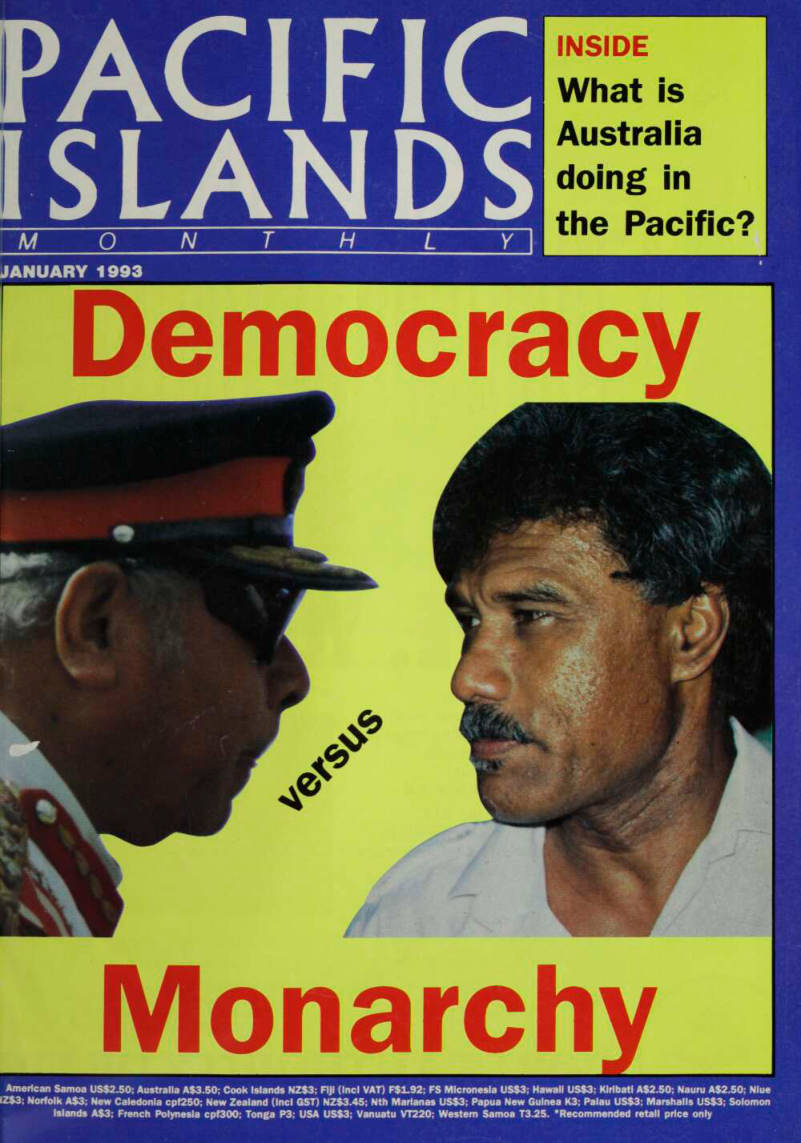
Islands
Monthly
Inside
What is Australia doing in the Pacific?
January 1993
Democracy
Monarchy
American Samoa US$2.5O; Australia A 53.50; Cook islands NZ$3; FIJI (Incl VAT) F 51.92; FS Micronesia US$3; Hawaii US$3; Kiribati A 52.50; Nauru A 52.50; Niue IZ$3; Norfolk As 3; New Caledonia cpf2so; New Zealand (Incl GST) NZ53.45; Nth Marianas US$3; Papua New Guinea K 3; Palau US$3; Marshalls US$3; Solomon Islands As 3; French Polynesia cpf3oo; Tonga P 3; USA US$3; Vanuatu VT22O; Western Samoa T 3.25. retail price only
Advertisements & other items, p. 2 (1 item)
Our Move, Your Gain
*T\ - I mm ■ U
Ports Authority of Fiji while streamlining its operations has simplified the shipping agents work, by arriving at a standard charge for handling cargo in its different modes of operations; thus the loss acquired by hindrances of bad weather and inefficiencies in stevedoring have been addressed ...
Shipping agents are now protected by the PAF, which takes the sole responsibility of stevedoring by supplying appropriate equipments and a safe • manning scale for higher efficiency and lower
stevedoring costs.
m Contact Wharf Manager
WAISEA TALIKEDE Suva Ph: 315399
ATAMA BECI Lautoka Ph: 662944 D. KOYANASAU Levuka Ph: 440189
PORTS AUTHORITY OF F]
GPO BOX 780, Suva Fiji, Tel 312700 CABLE. PAF FJ TELEX: 2203 FAX 300064
Pacific
Islands
Monthly
Vol 63 No. 1
The News Magazine
January 1993
From The
Editor’S Desk 4
Letters 5
Headlines 7
Papua New Guinea
Another crisis for Wingti 11
Cover Stories
Tonga’s call for democracy 16 How the government works 18 The King of Tonga 19 Election of representitives 19
Law
Guam abortion ban reversed 20
Special Report
Where are we headed? 24 Population figures 26 The people-our hope 27
Business
Capitalising on timber 29
International
Relations
Regional Superpower 35 Crack down on illegal fishing 38
Fundamental differences 42 The new decision-makers 44
Books
Reds under the reef 46
Lifestyle
Venturing into the past 48
Sports
Winning Streak 51 The star of the tournament 53
Yachting
Warmth of the people and beauty of the islands 54
Shipping
Shipping schedules 56
Columnists
David Barber 13 Jemima Garrett 15 Bill McCabe 33 Alfred Sasako 44
Publisher: Brian O’Raherty Editor: Mala Jagmohan Senior Writer: Martin Tiffany Correspondents: Christine Hatcher, David North, Ed Rampell, lan Williams, Johnson Honimae, Karen Mangnall, Liz Thompson, Nicholas Rothwell, Pesi Fonua, Wally Hiambohn.
Columnists: David Barber (Wellington), Futa Helu (Tonga, covering the Pacific Islands), Jemima Garrett (Sydney), Margot O’Neill (Washington), Julian Moti (Pacific Law), Alfred Sasako (The Forum).
Business and Advertising Manager, Charlotte Thomas
Advertising Sales: • Regional Sales (South Pacific); Salendra Narayan. Tel (679) 304111, Fx (679) 303809 • Sydney, Canberra: Bob Hilt Media Represen tations, Tel (61-2) 4164245, Fx (61-2) 4165064 • Brisbane: Robert Walker, Media House, Tel (61-7) 3710533, Fx (61-7) 371-8904 • Adelaide: Hastwell Williamsons Representations, Tel (61-8) 799522, Fx (61-8) 799735 • Melbourne: Brown Orr Fletcher Burrows (Aust).
Pty. Ltd. Tel (3) 696 5188 Fx (03) 696 5131. • Auckland: McKay International Media Reps Ltd, Tel (64-9) 4190561, Fx (64-9) 4192243 • Japan: Universal Media Corporation, Tokyo, Tel (3) 6663036, 6663094, Cable; UNIMEDIA Tokyo, Tx 2524665.
Founded 1930 (USPS 952480). A Fiji Times Limited production.
Cover prices are recommended retail only. Regis tered by Australia Post, Publication No. NBP 1210. © Copyright Fiji Times Limited, 177 Victoria Parade, Suva. Fiji. Tel (679) 304111, Fx (679)
303809. Tx Fj2124.
Pacific Islands Monthly is published monthly by The Fiji Times Limited, a division of Nationwide News, 2 Holt Street, Surry Hills, Sydney, NSW 2010.
Send address changes to: • Pacific Islands Monthly, PO Box 1167, Suva, Fiji.
Typeset and printed by The Fiji Times Limited, 177 Victoria Parade, Suva, Fiji.
Asaeli Lave Tomorrow’s generation: what's in store for them
Arin Chandra Teresa Tairi: a rising netball star
The winds of change
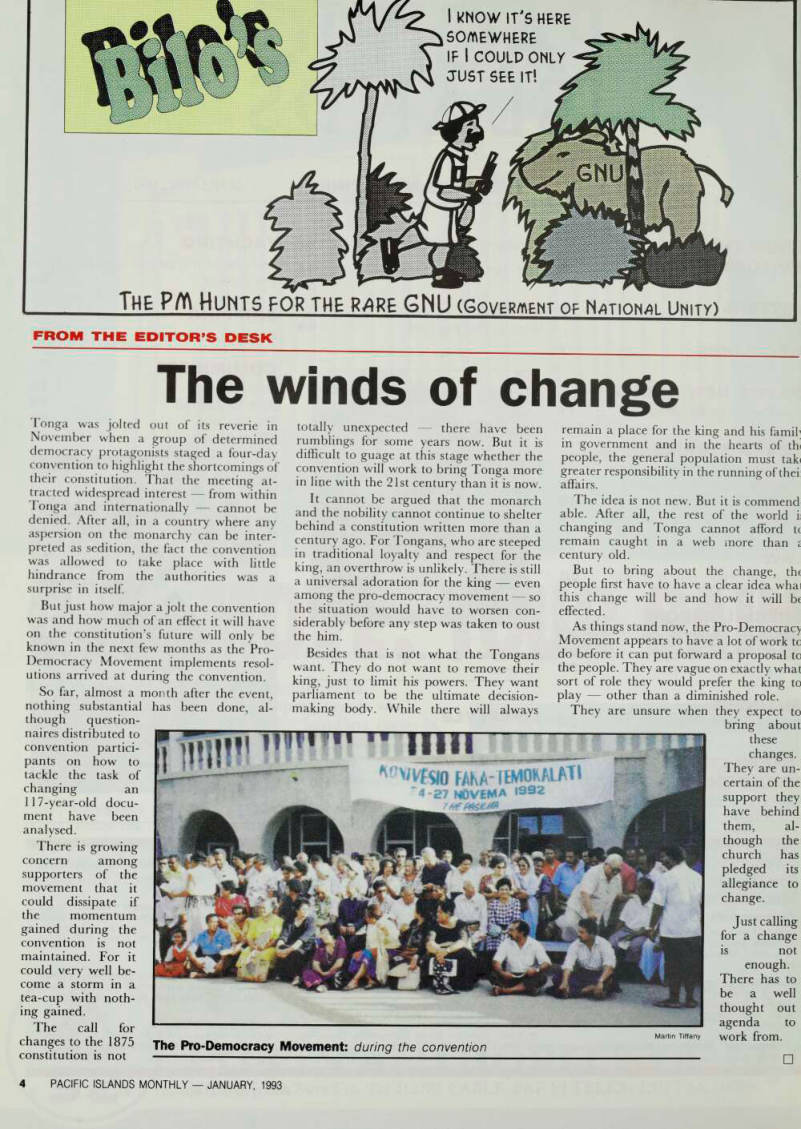
From The Editor’S Desk
Tonga was jolted out of its reverie in November when a group of determined democracy protagonists staged a four-day convention to highlight the shortcomings of their constitution. That the meeting at tracted widespread interest from within Tonga and internationally cannot be denied. After all, in a country where any aspersion on the monarchy can be inter preted as sedition, the fact the convention was allowed to take place with little hindrance from the authorities was a surprise in itself.
But just how major a jolt the convention was and how much of an effect it will have on the constitution’s future will only be known in the next few months as the Pro- Democracy Movement implements resol utions arrived at during the convention.
So far, almost a month after the event, nothing substantial has been done, al
though question naires distributed to convention partici pants on how to tackle the task of
changing an
117-year-old docu ment have been analysed.
There is growing concern among supporters of the movement that it could dissipate if the momentum gained during the convention is not maintained. For it could very well be come a storm in a tea-cup with noth ing gained.
The call for changes to the 1875 constitution is not
totally unexpected there have been rumblings for some years now. But it is difficult to guage at this stage whether the convention will work to bring Tonga more in line with the 21st century than it is now.
It cannot be argued that the monarch and the nobility cannot continue to shelter behind a constitution written more than a century ago. For Tongans, who are steeped in traditional loyalty and respect for the king, an overthrow is unlikely. There is still a universal adoration for the king even among the pro-democracy movement so the situation would have to worsen con siderably before any step was taken to oust the him.
Besides that is not what the Tongans want. They do not want to remove their king, just to limit his powers. They want parliament to be the ultimate decision making body. While there will always
remain a place for the king and his famib in government and in the hearts of thl people, the general population must tak< greater responsibility in the running of theii affairs.
The idea is not new. But it is commend able. After all, the rest of the world ii changing and Tonga cannot afford tc remain caught in a web more than 2 century old.
But to bring about the change, the people first have to have a clear idea whal this change will be and how it will be effected.
As things stand now, the Pro-Democracy Movement appears to have a lot of work to do before it can put forward a proposal to the people. They are vague on exactly what sort of role they would prefer the king to play other than a diminished role.
They are unsure when they expect to
bring about these changes.
They are un certain of the support they have behind them, al though the church has pledged its allegiance to change.
Just calling for a change is not enough.
There has to be a well thought out agenda to work from.
Martin Tiffany
The Pro-Democracy Movement: during the convention
Advertisements & other items, p. 4 (1 item)
1 Know It's Here
SOMEWHERE
IF I COULD ONLY
JUST SEE IT!
N m GNU (Govermeht of Nyition/il Unity)
Unthoughtful
letters to the editor
A warm
thank you
Madam, Our 1992 contribution drive was wonderful! It was indeed a rare opportunity for Florence R. Ratieta Memorial Foundation to honour two
very special people, Jacob Amos and
the Rev. Joseph Tetau, as tamara of the year. It was truly an evening oiyokwe ‘ as family and friends from all over the islands gathered together at the Ma
juro Community Center to recognize
these “Ambassadors of Love” for their outstanding contributions to the foun dation. Our deepest thanks to everyone who helped make this memorable
event possible.
We take this opportunity to thank a few of the people who generously con tributed their energy and time to the foundation. Members Lily Amos and Jane Betero both write the profiles on the foundation volunteers, which they have done for two years. To these people, we of Florence R. Ratieta Memorial Foun dation say komol tata for your commit ment and extraordinary skills.
Our membership continuous to grow and our services are reaching more people. It is only through your generous support and enthusiasm that Florence R.
Ratieta Memorial Foundation can ac complish its mission and you will see this done better and in more ways in the coming year.
Before I dose, the Board of Trustees of the Foundation wishes all of you, your family and friends, a wonderful Holiday- Season and a Happy New Year.
Again, a warm komol tata, yokvce and tiakabo.
Mary loane
Secretary for the Foundation Majuro
Unthoughtful
remark
Madam, I wish to comment on a statement made by the Honourable Prime Minister of the Solomon Islands ( PIM , October, 1992) “BRA (Bougainville Revolutionary
Army) has not yet killed any Solomon Islands citizens during this long protrac ted crisis. This is not the same case with Papua New Guinea and Australia.”
This is totally an unthoughtful remark.
How could one expect BRA to gun down a Solomon Islander?
The remark made to highlight BRA’s respect for Solomon Islands sovereignty in comparison to PNG sovereignty obvi ously falls short!
Aula Kobale
Queensland, Australia
Australian
parallel
Madam, The act of the Australian government in supplying the PNG government with IROQUIS helicopters ( PIM , November 1992) or indirectly participating in the killing of Bougainvilleans is apparently repeating Australia’s history of slaugh tering indigenous Pacific islanders.
The killing and plundering of native black Australians in the past by whites is parallel to what Australia is now doing in contributing to the killings on Bou gainville.
How does Australia value such types of
aid programs? How many more deaths of innocent Bougainvilleans will such aid cause? The purpose for which the heliopters were supplied should no longer be denied.
Spill-over effects into the Solomon Islands and the pragmatic response from other neighbouring countries were only two of the many examples of the extremely outrageous use of the helicop ters. It would be better if the aid program is diverted towards law and order probelms on PNG mainland which is an everyday night-mare for the citizens of PNG and foreign investors.
Another dimension of the issue is Australia’s position on human rights and decolonization both regionally and inter nationally. It doesn’t make sense to see Australia condemning Indonesia for the massacres in East Timor while support ing the killing on Bougainville.
Although most people appreciate Aus tralia’s aid programs in th& Pacific region, aid must be rational, instead of depriving segments of the society or advocating cabinet ministers/foreign in vestors interests in recipient countries.
The phenomenon of the helicopters is so out of hand that unless Australia takes a comprehensive look at the situation, the sun will never set on the Bougainville crisis.
Warry Lala
South Pentecost Vanuatu
Advertisements & other items, pp. 5-6 (1 item)
Pacific Islands Monthly
SUBSCRIPTIONS
American Samoa US$45 Australia A 542.00 Canada US$45 Cook Islands AUSS46 Fiji F 526.40 French Polynesia US$45 Guam US$45 Hawaii US$45 Japan US$45 Kiribati AUSS46 Marshall/Micronesia US$4O Nauru AUSS42 New Caledonia US$32 Payment to Pacific Islands Monthly: New Zealand NZ$55 Niue AUSS46 Norfolk Island AUSS42 Northern Marianas/Palau US$4O Papua New Guinea AUSS4S Solomon Islands AUSS46 Tonga AUSS46 Tuvalu AUSS46 United Kingdom Stg Pound2B US Mainland US$45 Vanuatu AUSS4S Western Samoa WS$6O Elsewhere AUSS63 Subscriptions Dept GPO Box 1167, Suva, Fiji.
Subscriptions rates include the cost of airspeeding to all destinations set out above.
Direct airmail rates on application.
Telephone: 304111 Fax: 303809
VTMB3BE
PAL VCR with NTSC playback compatibility and two-speed recording and playback (SP/LP).
CMT-4200
42" multi-system super projection TV with S-video terminal, surround sound and 7-language teletext.
VME2SE
“Twist & Shoot” Bmm movie camera with 16 x digital zoom.
CXW3OO
Portable CD player/tuner/double cassette deck with high-speed dubbing and bass boost sound.
All this
plus friendly service
at a Hitachi dealer near you,
Will
mm BS V\ HI
CX-W5OO
Portable CD player/ digital tuner/double cassette deck with “3D twin drive” system and remote control.
FX-9 Mini Hi-Fi system with super wide surround sound and one-touch CD-to-tape dubbing.
PAF-1260PX
Microprocessor controlled washing machine with forced drain pump, softener/bleach dispenser, and lint filter.
Our support network puts service within easy reach.
AUSTRALIA:
HITACHI SALES AUSTRALIA PTY LTD.
153 Keys Road Moorabbin, Victoria 3189 Tel; (03) 555-8722 Fiji:
BURNS PHILP (SOUTH SEA)
COMPANY LTD.
Box 355, G.P.O.
Suva Tel; 9-311777
COMMUNICATIONS PACIFIC LTD. (AWA)
37 Freeston Road (PO. Box 858) Walu Bay. Suva Tel; 9-312744
NEW ZEALAND:
ROBINSON INDUSTRIES LTD.
6 Zelanian Drive East Tamaki Auckland Tel: 9-2745615 © 1992 Hitachi, Ltd., Tokyo. Japan. All rights reserved.
NEW CALEDONIA: PAPUA NEW GUINEA: TAHITI:
CALDIS CALTEC PACIFIC ELECTRONICS POSI-LECTRIC
B.PMI 8.P2540 PO. Box 2115 PO. BOX 144, Noumea Noumea LAE PAPEETE, Tel: 26.33.00 Tel: 28.39.54 Tel: 5-424467 Tel: 42.92.56.
HITACHI
Placer Dome
Headlines
Papua New Guinea
will not sell
Placer Dome, the Canadian mother company of Placer PNG which runs the giant Pogera Gold Mine says it will not sell a further 20 per cent equity to the Papua New Guinea government. In a letter to the PNG government Placer’s chairman Fraser Fell said he had been misrepresented and equity was not for sale.
The letter sent to the Sydney Stock Exchange said his statement regarding equity was to cover the situation should the government proceed with unilateral action to compulsorily take an interest in the mine.
Earlier reports quoted Fell as saying Placer was willing to sell a further 20 per cent share of the current market value to the PNG government which would bring the government s equity to 30 per cent.
PNG’s Opposition has accused Wingti s senior mining advisor Bob Needham of being responsible for telling the government Pogera would be a marginal project with minimal returns.
Meanwhile companies with resource projects in PNG have suffered further losses on the Australian Stock Exchange over uncertainty over PNG government's policy towards major resource development. There have been fears the PNG government will not pay for the increase in its stake in Pogera although Finance Minister Sir Julius Chan has said it will pay.
Budget
Cook Islands
deficit
Fhe Cook Islands government revealed the biggest budget ieficit in 20 years when it tabled its budget for the year to July 1993 in Rarotonga on December 3. The deficit of $US3 million :omes mostly from the October Festival of Pacific Arts.
Prime Minister Sir Geoffrey Henry has told parliament extraordinary expenses were incurred by the festival, but he lays the cost has been well under the SUS2.3 million mark ivhich had been predicted for the event.
He promised the deficit will be wiped out by the time of the lext budget and replaced by a surplus. Sir Geoffrey says the 2ook Islands is likely to increase its revenues from tourism and ts gross domestic product should continue to rise by five per :ent a year despite worldwide recession.
The leader of the opposition Democratic Party, Terepai Vlaoate, has accused the government of creating an artificial iconomy. Maoate says the budget is what he calls a patch-up ob based 90 per cent on loans.
Costs for the arts festival included beautifying the entire sland with $500,000 worth of trees and plants and building a &NZ11.6 million cultural centre — the main venue for the estivities.
editor
Tonga
Ban on
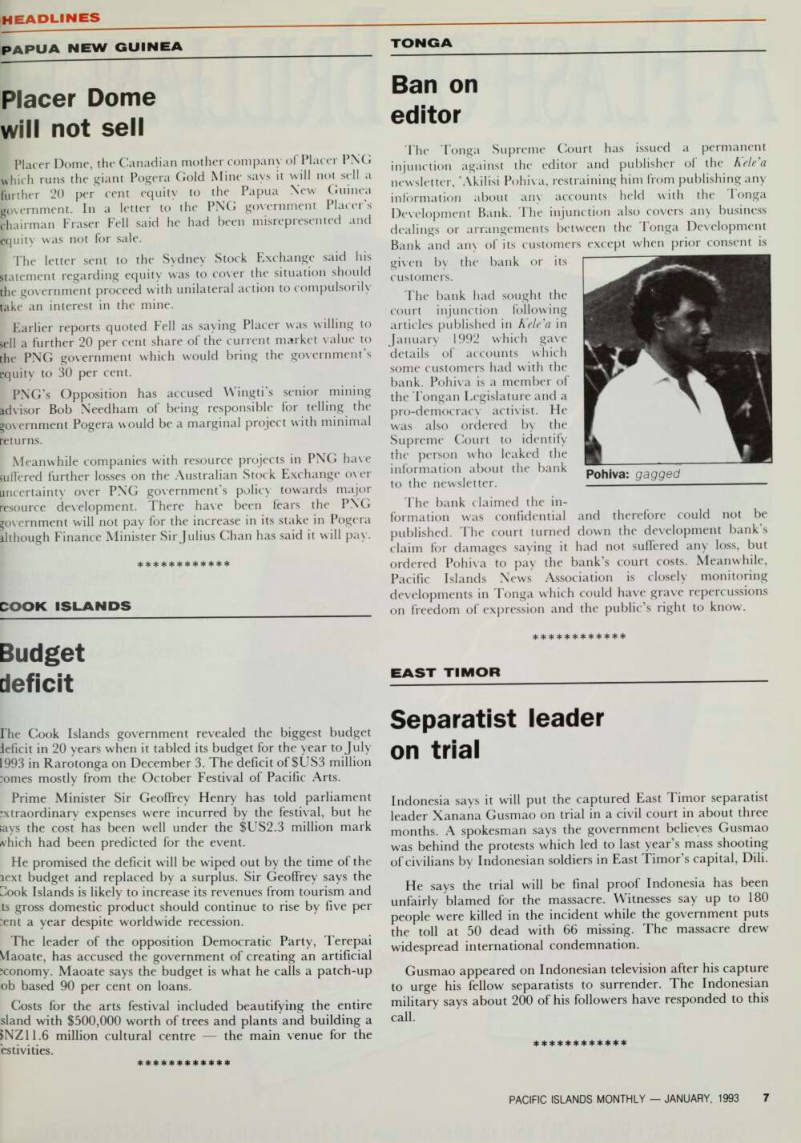
The Tonga Supreme Court has issued a permanent injunction against the editor and publisher of the Kele'a newsletter, 'Akilisi Pohiva, restraining him from publishing any information about any accounts held with the Tonga Development Bank. Fhe injunction also covers any business dealings or arrangements between the Tonga Development Bank and any of its customers except when prior consent is
given by the bank or its customers.
The bank had sought the court injunction following articles published in hele’a in January 1992 which gave details of accounts which some customers had with the bank. Pohiva is a member of the Tongan Legislature and a pro-democracy activist. He was also ordered by the Supreme Court to identify the person who leaked the information about the bank to the newsletter.
The bank claimed the in-
formation was confidential and therefore could not be published. The court turned down the development bank s claim for damages saying it had not suffered any loss, but ordered Pohiva to pay the bank’s court costs. Meanwhile, Pacific Islands News Association is closely monitoring developments in Tonga which could have grave repercussions on freedom of expression and the public’s right to know.
Pohiva: gagged
Separatist leader
East Timor
on trial
Indonesia says it will put the captured East Timor separatist leader Xanana Gusmao on trial in a civil court in about three months. A spokesman says the government believes Gusmao was behind the protests which led to last year’s mass shooting of civilians by Indonesian soldiers in East Timor’s capital, Dili.
He says the trial will be final proof Indonesia has been unfairly blamed for the massacre. Witnesses say up to 180 people were killed in the incident while the government puts the toll at 50 dead with 66 missing. The massacre drew widespread international condemnation.
Gusmao appeared on Indonesian television after his capture to urge his fellow separatists to surrender. The Indonesian military says about 200 of his followers have responded to this call.
Advertisements & other items, p. 8 (1 item)
♦
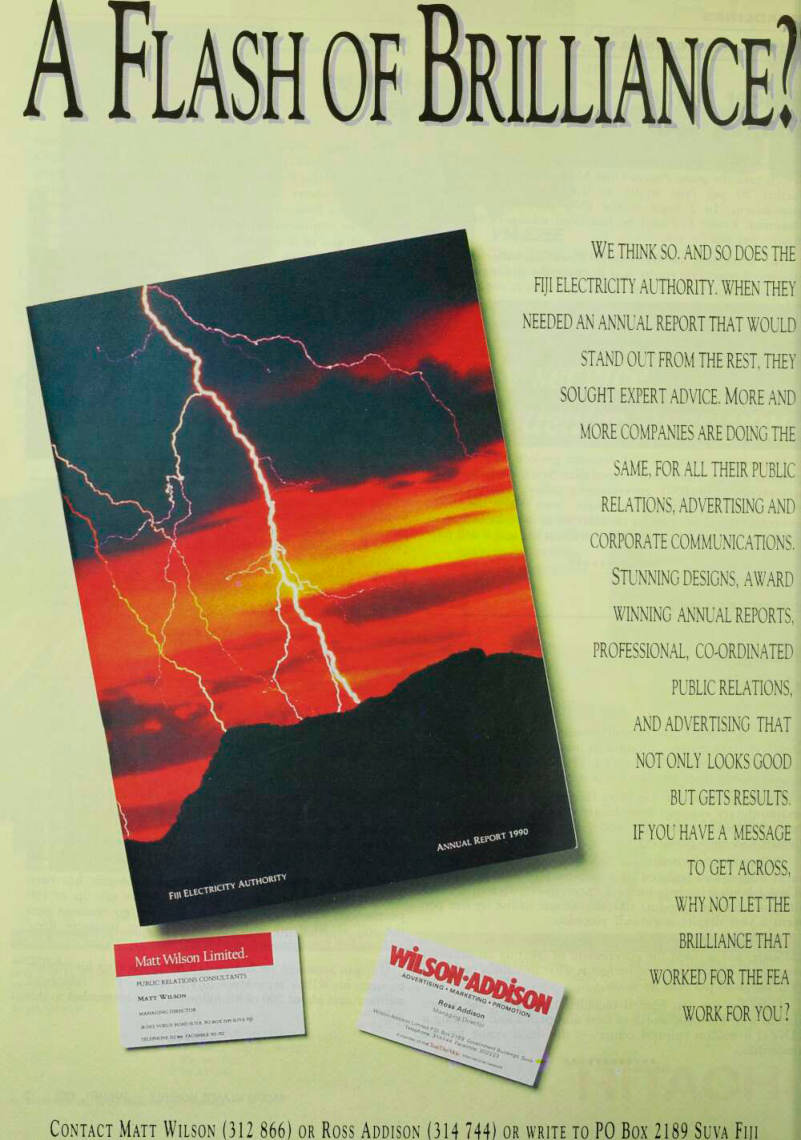
t V : "Aft Matt Wilson Limited public relations consultants
M ATT WILSON
MANACINCDIMCTO»
svotux»° AI>ttJVA to »ox SUVAI WE THINK SO. AND SO DOES THE
FIJI ELECTRICITY AUTHORITY. WHEN THEY
NEEDED AN ANNUAL REPORT THAT WOULD
STAND OUT FROM THE REST, THEY
SOUGHT EXPERT ADVICE. MORE AND
MORE COMPANIES ARE DOING THE
SAME, FOR ALL THEIR PUBLIC
RELATIONS, ADVERTISING AND
CORPORATE COMMUNICATIONS.
STUNNING DESIGNS, AWARD
WINNING ANNUAL REPORTS,
PROFESSIONAL, CO-ORDINATED
PUBLIC RELATIONS,
AND ADVERTISING THAT
NOT ONLY LOOKS GOOD
BUT GETS RESULTS.
IF YOU HAVE A MESSAGE
TO GET ACROSS,
WHY NOT LET THE
BRILLIANCE THAT
WORKED FOR THE FEA
WORK FOR YOU?
Contact Matt Wilson (312 866) or Ross Addison (314 744) or write to PO Box 2189 Suva Fiji
unity government
Fiji
Rabuka proposes
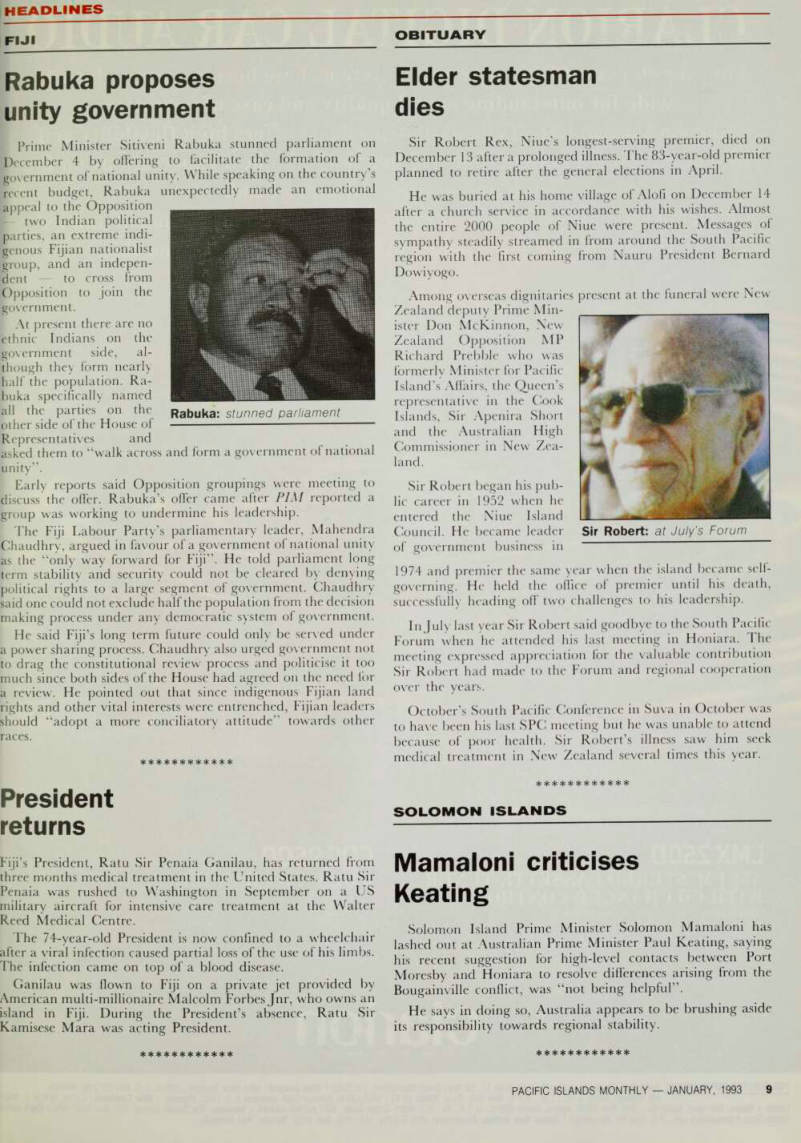
Prime Minister Sitiveni Rabuka stunned parliament on ‘December 4 by offering to facilitate the formation of a government of national unity. While speaking on the country’s recent budget, Rabuka unexpectedly made an emotional
appeal to the Opposition two Indian political parties, an extreme indi genous Fijian nationalist group, and an indepen dent to cross from Opposition to join the government. • At present there are no ethnic Indians on the government side, al though they form nearly half the population. Ra buka specifically named all the parties on the other side of the House of Representatives and
asked them to “walk across and form a government of national unity”. \ Early reports said Opposition groupings were meeting to discuss the offer. Rabuka’s offer came after PIM reported a group was working to undermine his leadership.
The Fiji Labour Party’s parliamentary leader, Mahendra Chaudhry, argued in favour of a government of national unity as the “only way forward for Fiji”. He told parliament long term stability and security could not be cleared by denying political rights to a large segment of government. Chaudhry said one could not exclude half the population from the decision making process under any democratic system of government.
He said Fiji’s long term future could only be served under a power sharing process. Chaudhry also urged government not to drag the constitutional review process and politicise it too much since both sides of the House had agreed on the need for a review. He pointed out that since indigenous Fijian land rights and other vital interests were entrenched, Fijian leaders should “adopt a more conciliatory attitude” towards other races. ***
President
returns
Fiji’s President, Ratu Sir Penaia Ganilau, has returned from three months medical treatment in the United States. Ratu Sir Penaia was rushed to Washington in September on a US military aircraft for intensive care treatment at the Walter Reed Medical Centre.
The 74-year-old President is now confined to a wheelchair after a viral infection caused partial loss of the use of his limbs.
The infection came on top of a blood disease.
Ganilau was flown to Fiji on a private jet provided by American multi-millionaire Malcolm Forbes Jnr, who owns an island in Fiji. During the President’s absence, Ratu Sir Kamisese Mara was acting President.
Rabuka: stunned parliament
dies
Obituary
Elder statesman
Sir Robert Rex, Niue’s longest-serving premier, died on December 13 after a prolonged illness. The 83-year-old premier planned to retire after the general elections in April.
He was buried at his home village of Alofi on December 14 after a church service in accordance with his wishes. Almost the entire 2000 people of Niue were present. Messages of sympathy steadily streamed in from around the South Pacific region with the first coming from Nauru President Bernard Dowiyogo.
Among overseas dignitaries present at the funeral were New
Zealand deputy Prime Min ister Don McKinnon, New Zealand Opposition MP Richard Prebble who was formerly Minister for Pacific Island’s Affairs, the Queen’s representative in the Cook Islands, Sir Apenira Short and the Australian High Commissioner in New Zea land.
Sir Robert began his pub lic career in 1952 when he entered the Niue Island Council. He became leader of government business in
1974 and premier the same year when the island became self governing. He held the office of premier until his death, successfully heading off two challenges to his leadership.
In July last year Sir Robert said goodbye to the South Pacific Forum when he attended his last meeting in Honiara. The meeting expressed appreciation for the valuable contribution Sir Robert had made to the Forum and regional cooperation over the years.
October’s South Pacific Conference in Suva in October was to have been his last SPC meeting but he was unable to attend because of poor health. Sir Robert’s illness saw him seek medical treatment in New Zealand several times this year.
Sir Robert: at July's Forum
Keating
Solomon Islands
Mamaloni criticises
Solomon Island Prime Minister Solomon Mamaloni has lashed out at Australian Prime Minister Paul Keating, saying his recent suggestion for high-level contacts between Port Moresby and Honiara to resolve differences arising from the Bougainville conflict, was “not being helpful”.
He says in doing so, Australia appears to be brushing aside its responsibility towards regional stability.
Advertisements & other items, p. 10 (1 item)
clarion
DIGITAL CAR AUDIO
For over 40 years Clarion car audio systems have been recognised worldwide for outstanding sound quality and ease of operation.
Clarion’s broad line of compatible products offers high flexibility and allows building a system that will match the highest expectations on the new and exciting Digital Sound.
Clarion strive to improve and perfect the driving environment and let the driver and passengers alike relax as much as possible. * i Clarion >5 clarion tM.
CMX250D
AM/FM/STEREO CASSETTE TUNER
WITH CD CHANGER CONTROL
nnioofYiyitem ‘Dolby and the Double-D symbol are trademarks of Dolby Laboratories Licensing Corporation
CDC9500
6 DISC CD CHANGER
» Specifications and design are subject to change without notice o
clarion
SS High-Tech High-Touch V3T
Another crisis for Wingti
Papua New Guinea
By Wally Hiambohn
IF Stephen Pokawin and 18 fellow provincial premiers had it their way Paias Wingti would not be prime minister of Papua New Guinea. Wingti touched a sensitive chord with Pokawin’s lot when he announced his intention to abolish the provincial government sys tem and to centralise most government and administrative functions.
The system, first introduced on Bou gainville in 1976 and later to all the other 18 provinces, was intended to bring government closer to the people. Most government functions, except for foreign affairs, police, defence and in a few selected cases, finance, where decentra lised giving provinces autonomy to make their own decisions on issues affecting
their respective provinces and people.
But after 16 years,* Wingti says, the system is “too costly” and achieving little of the objectives it was initially set up for.
The whole dream and purpose of provincial governments has gone wrong,” Wingti said on October 7, when announcing his government’s intention to do away with the system.
“They are becoming a power unto themselves to the point of downright disrespect and disobedience of national government directions,” he lamented.
Premiers in regional blocs shot back fast, telling Wingti he could not possibly remove their governments without ex pecting severe consequences. While they agreed there was a need for a review of the system, abolition, they said, was out of the question. They blamed the government for inadequate funding which had caused a disintegration of social and economic development in rural areas.
Pokawin, who once lectured in politi cal science at the University of PNG, and now premier of the northern-most tiny island province of Manus, led premiers of five of the island provinces, including representatives from Bougainville, for a crisis meeting in Rabaul. Their reaction to the whole issue was, as expected, most extreme.
They announced after the meeting that secession of the five provinces was now a possibility. “Independence is not out of reach,” they declared. “The option of a separate state of the combined provinces of the New Guinea island region remains on the agenda, and shall do so for as long as the prime minister, the deputy prime minister and their colleagues in the national government intend to gain exclusive control over all aspects of government administration throughout the country.”
“It is clear that the motive behind abolishing provincial governments is simply to place control over the exploi tation of our nation’s natural resources in the hands of a small number of national leaders in Waigani (national government headquarters in Port Moresby).
“Either Mr Wingti must go or the region must, and it is not of great concern to us which one it is.”
The islands’ leaders even resolved to draw up their own national anthem and flag and to remove those of PNG.
Furthermore, they wrote to Solomon Islands Prime Minister Solomon Mamaloni suggesting discussions in Honiara for future political association.
Mamaloni’s response to premier Pokawin and his invitation to premiers to travel to Honiara was received with total disbelief in PNG.
Mamaloni made known his strong
straight-forward views on provincial governments, and even Bougainville, in this response.
Prime Minister Wingti personally wrote back to complain Mamamaloni was meddling in PNG’s internal affairs.
On the other hand, Wingti took the islands premiers’ Stand calmly, saying it was to be expected. He said the vast
majority of people supported his move..
Only the premiers who had vested interests in seeing the continuation of provincial governments were opposed to it, Wingti said. Debate has since ensued on the issue.
One person opposed to the system wrote, “Papua New Guinea’s population of four million people is over-governed, and is a major drain on the nation’s purse. There seem to be 19 different prime ministers with 133 Cabinet minis ters throughout the 19 provinces, with a
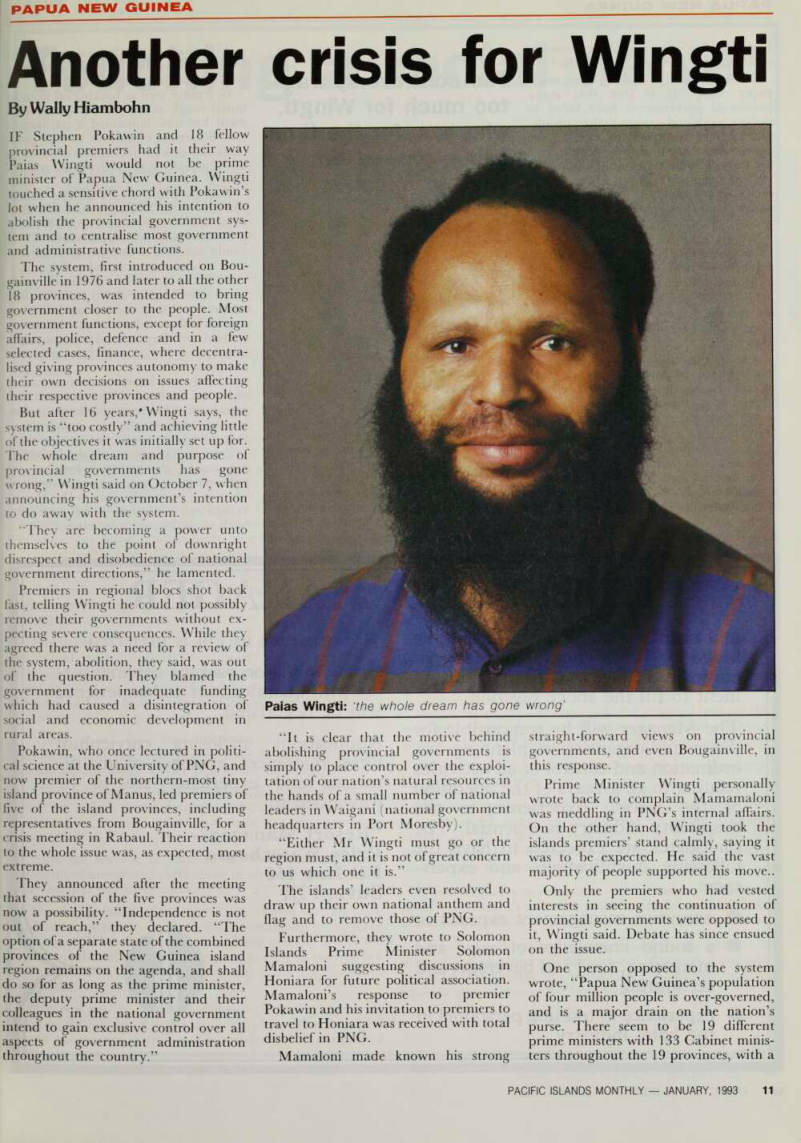
Paias Wingti: ‘the whole dream has gone wrong'
huge number of provincial government staff draining the provincial budget.”
In its editorial, The Post-Courier news paper said, “It is true that many provincial governments have failed to deliver goods and services to their people.
Others have succeeded in meeting the development needs of their people. It is not the system that is at fault, but leaders who were supposed to serve the needs of their people and in doing so have undermined the original objectives of the system.”
Wingti said in his October 7 an nouncement that K 329 million almost a quarter of the national budget went into provincial governments annually.
Up to 550 provincial politicians took up over KlO million in 1991 in wages alone. This excluded perks and privi leges.
Adding this number of politicians to the 109 national politicians gives a total of 659. Comparatively, New Zealand, which had a similar population but a far more advanced economy, had only 97 politicians.
This 97, Wingti said, cost the New Zealand tax-payer K 3.5 million a year to cover salaries and allowances. On this basis, he said, PNG's 109 politicians were
being under-utilised.
“By any test, provincial governments have failed to give people basic services,”
The controversy was too much for Wingti, who has, for the time being, passed the buck to Micah’s committee
he said. Provincial governments were established through the organic law on provincial governments. It was first introduced on Bougainville in 1976 when that part of the country first tried to secede in 1975. Ironically, when they are again trying to secede, and when the increased autonomy is among one of the options available to the government, it now wants to withdraw rather than give more powers.
Said Wingti, “Whether we like it or not this nation was forced to take on this costly second tier of government as a result of a blackmail from one provincial grouping. This blackmail was essentially give us provincial governments or Bougainville secedes. Once was enough.
We will not allow the same blackmail again.”
The government had planned to first
seek parliament’s approval in its last session in November, but the controversy was too much for it to do just yet.
In a move seen as backing off from its initial tough stand, the Wingti govern ment has now appointed a parliamen tary bipartisan committee to tour prov inces and seek a cross-section of views on an alternative to provincial govern ments.
One proposal, by Provincial Affairs Minister John Nilkare, is the establish ment of less costly and less cumbersome provincial and local authorities. These would basically comprise of reputable local leaders and national politicians.
With the bipartisan committee, prov incial governments would see it as their chance to lobby hard and build up enough influence for at least the system to stay on. They may agree to a major revamp of the system but not total abolition.
Already they have had an encouraging sign when the head of the committee, Ben Micah, a first term parliamentarian, announced soon after his appointment that the system would not be abolished.
Provincial premiers will also be lobby ing among the national members of parliament to vote against abolition when it is put to the vote in the House.
Wingti has, for the time being, passed the buck on to Micah's committee. □
Advertisements & other items, p. 12 (1 item)
Fiji Resort Manager
Our client is seeking the services of an individual or a couple fully experienced in all facets of resort management to fill the above position.
The Manager will be responsible for the overall organisation, planning, coordination and control of all activities relating to all aspects of the operation of the resort. Experience in the hospitality industry is essential. The candidates are expected to have the following qualifications and experience: • executive management experience • a sound knowledge of sales and marketing, food and beverage, and accounting • experience in training personnel in the hotel industry • experience in Fiji is preferred A remuneration package commensurate with qualifications and experience will be negotiated.
Applications enclosing curriculum vitae, references, evidence of qualifications and experience are to be forwarded to: “Resort Manager”
Price Waterhouse PO Box 156 Suva, FIJI
Touching a racial nerve
I’M NOt sure whether it’s because New Zealand is a multi-cultural society or in spite of the fact, but we do have a depressing ability in this country to stir up racial hornets’ nests with all too great a frequency.
The most casual comment on differences between the races can touch racial nerves and explode a barrage of recriminations which sel dom clear the air or clarify the issue but inevitably make the situation worse.
For this reason, racial questions which probably need to be discussed in any healthy society are often ignored, shoved to the back of the nation’s
consciousness or only lightly touched upon before being hurriedly dispatched to that Pandora’s box of subjects which are not polite to talk about.
Nobody likes to be tagged a racist or to be unpopular, and if there is anything else certain in this world other than death or taxes, it is that it’s impossible to raise a racial issue in New Zealand without being put into one of thos categories.
Social Welfare Minister Jenny Shipley found this out recently when she reported on the dramatic increase in child abuse and the disproportionate number of Maori and Pacific island cases.
She produced statistics showing that reported child abuse cases had jumped from 10,600 to nearly 25,000 in five years.
She said Pacific island people accounted for nearly eight per cent of the family group conferences called when a child was deemed to be in need of care and protection, although they were only 3.6 per cent of the population.
Maori (about 12 per cent of the population) figured in 42 per cent of the case conferences, while pakeha (79 per cent) accounted for about 47 per cent of the meetings.
“We know that culturally as the Pacific island population increases in New Zealand there may be a factor there... that is unspoken,” she said. “But it is an issue that must be spoken about in New Zealand society.”
Although she was at pains to say there were significant amounts of unreported child abuse in all three communities, the reaction was predictable.
She was accused of naked racism, vilified on talk-back radio and made subject of a volley of complaints to the Race Relations Office. Few critics echoed her concern about the rising number of child abuse cases; most centred only on her references to a possible link with the rising Pacific island
population.
The real issue that more and more New Zealanders are beating the hell out of their kids was obscured as the racial nerve was exposed. Sadly, as all too often happens, the subject
Wellington
was quickly dropped because of its racial sensitivities, and that means the country has again evaded a debate on a pressing social issue that it needs to have.
“If abuse of our children is to be dealt with, we cannot continue to gloss over, blame, justify or walk away from the hard facts,” Shipley said.
Pacific Island Affairs Minister Don McKinnon moved to calm the row, pointing out it was culturally inappropriate to use a pakeha defi nition of child abuse when studying Pacific island communities. The island peoples were traditionally strong disciplinarians, he said, with
a strong sense of family which was lacking in some pakeha communities.
“There are differences between what Pacific island communities and others might define as discipline or abuse.”
McKinnon said Pacific island people had different social values which should not be “shoe-horned into a pakeha set of values of what is right and what is wrong”.
But the fact that the Pacific island community was growing rapidly did mean the incidence of child abuse as defined in pakeha terms was increasing too.
Significantly, Shipley did win support from an Auckland based island social worker, Amalaini Ligalevu, who con gratulated her for raising an issue she said had been swept under the carpet for far too long.
She said a lot of child abuse was not reported because the women were too afraid and church ministers said reporting cases would reflect badly on the Pacific island community.
“Child abuse is child abuse and there is nothing cultural about it,” she said.
She was backed up by Maori author Alan Duff who accused school principals of covering up Maori parental neglect and abuse because they were afraid to speak out for fear of being labelled racist. He said they were better placed than anyone to know what was going on in families.
Where Shipley was vulnerable was in ignoring the impact of her government’s economic policies, which have hit Pacific island people harder than most, on the child abuse question.
Critics pointed out at least one in four Pacific islander is unemployed (againsst a national rate of 10 per cent) and said hardship and poverty put stresses on families that created tensions and increased the likelihood of abuse.
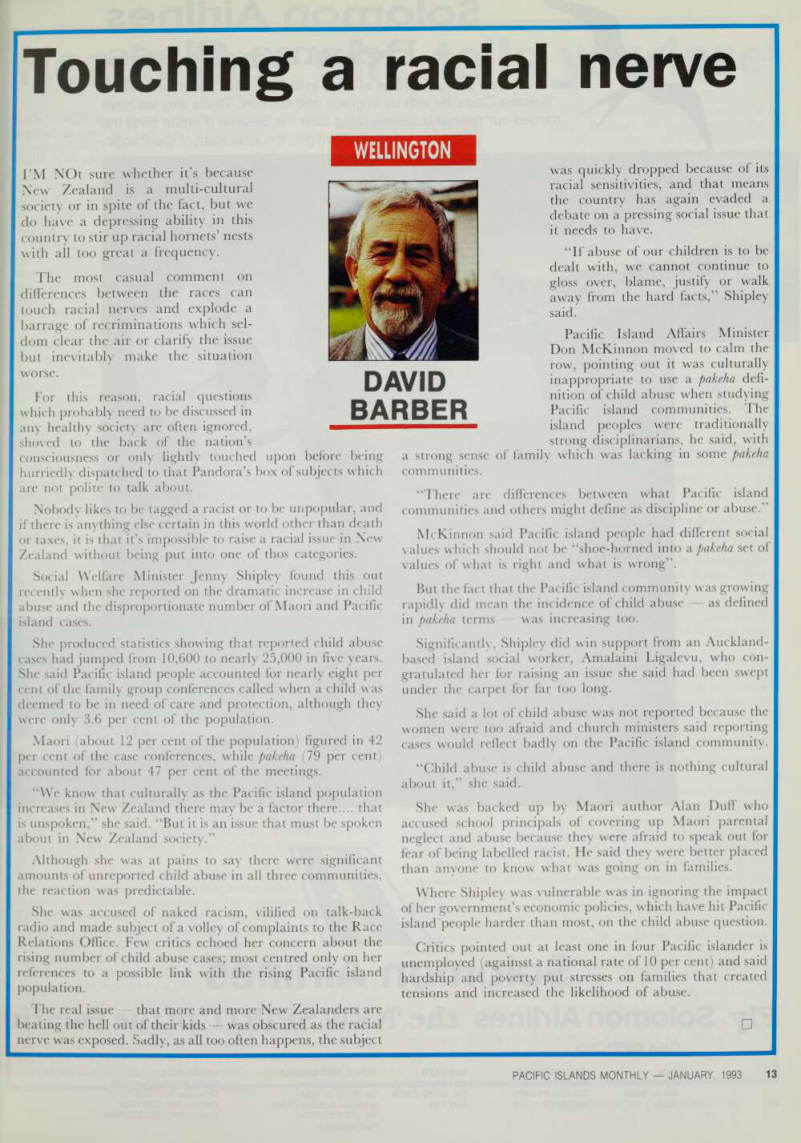
David
Barber
Advertisements & other items, p. 14 (1 item)
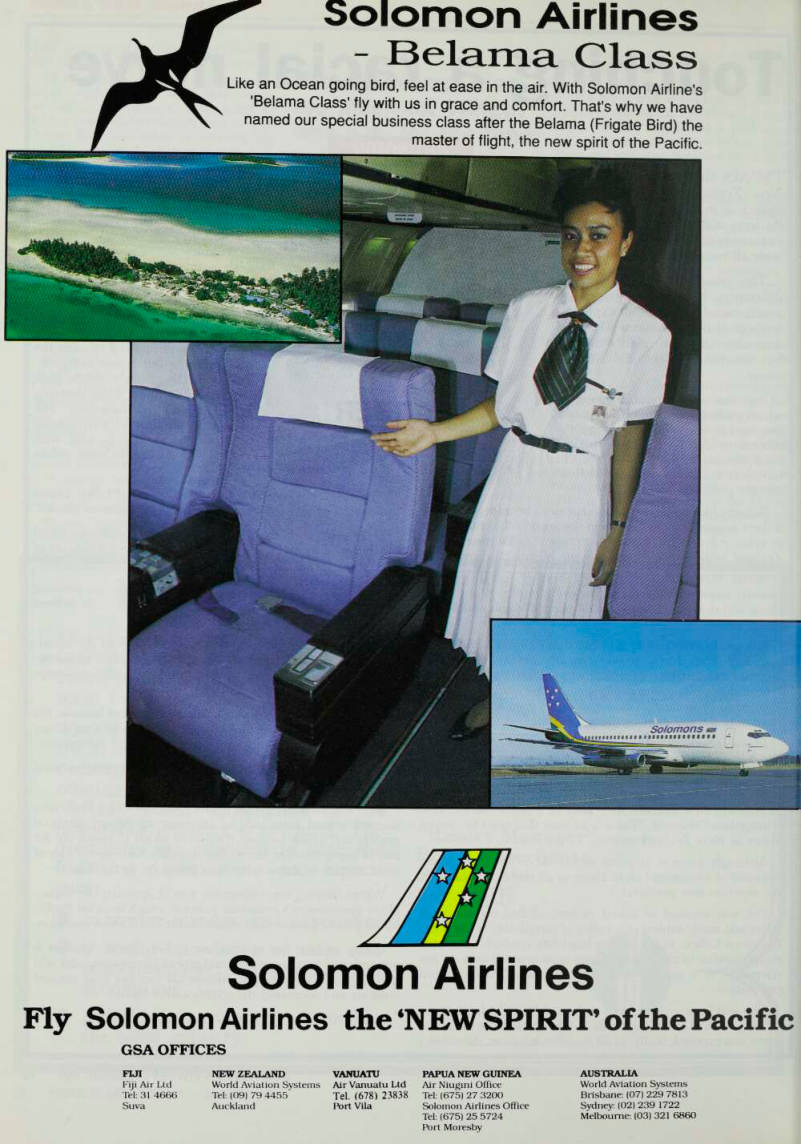
Solomon Airlines
- Belama Class
Like an Ocean going bird, feel at ease in the air. With Solomon Airline's 'Belama Class' fly with us in grace and comfort. That's why we have named our special business class after the Belama (Frigate Bird) the master of flight, the new spirit of the Pacific. ii Solomons M
Solomon Airlines
Fly Solomon Airlines the ‘NEW SPIRIT’ of the Pacific
GSA OFFICES
FIJI NEW ZEALAND VANUATU PAPUA NEW GUINEA Fiji Air Ltd World Aviation Systems Air Vanuatu Ltd Air Niugini Office Tel: 31 4666 Tel: (09) 79 4455' Tel. (678) 23838 Tel: (675) 27 3200 Suva Auckland Port Vila Solomon Airlines Office Tel: (675) 25 5724
AUSTRALIA
World Aviation Systems Brisbane; (07) 229 7813 Sydney: (02) 239 1722 Melbourne: (03) 321 6860
Heads they win, tails you lose
DO YOUR eyes glaze over as the latest hysterical news story on the impenetrably complex GATT negotiations comes over the radio. You are certainly not alone. I would guess there are probably only one or two per cent of people who actually understand the gobbledygook spoken in the name of GATT (the General Agreement on Tariffs and
Trade).
But if you are like me you may also have been wondering whether now is the time to start worrying about GATT. For the island nations the answer may be yes because, however the issue resolves itself, trading conditions for them are going to get tougher.
The hysteria over the French decision not to back the historic compromise reached between the United States and Europe in November on agricutural subsidies gives the impression we may be facing “the end of civilisation as we know it”. With the US decision to retaliate with punitive tariffs, the doomsday predictions of an escalating world
trade war which would plunge the globe into a massive
depression is looking more possible.
Originally GATT was intended as a means of getting international trade, the lifeblood of all 20th century economies, onto a fairer footing; to reduce tariff barriers which block entry to many goods particularly those made in the third world and to reduce government subsidies to industries which give inefficient producers an unfair advantage over their counterparts in non-subsidising countries.
If concluded successfully the latest round of negotiations, known as the Uruguay round would, roughly speaking, lead to a worldwide reduction of tariffs of one third a big achievement.
In all there have been 14 different sets of negotiations involved in the Uruguay round on everything from tropical products through to financial services and intellectual property. The sticking point has been the fact that for any of the new regimes to come into operation there must be international agreement on all 14 areas, all of which are highly technical. The French government, perhaps more than others, has found some measures extremely unpalatable to those of its constituents whose jobs depend on the tariffs under threat.
Now, six years into the Uruguay round, agriculture is the only sticking point. Until the November agreement between Europe and the United States the talks had looked so badly stalled that it was feared they may fail. France’s decision to hold out on the hard fought deal has been greeted with outrage.
So, was the United State’s retaliation the beginning of the trade war? The answer is probably no. Sure, France looks pretty dug-in but after the March general election a solution may be easier to find.
Economists estimate success with the GATT negotiations will lead to a $2OO-billion dollar increase in the value of world trade.
Despite its farmers’ opposition to the agricultural provisions France cannot afford to miss out on the benefits in other areas.
What is needed now is a face saving device. And that is just what is being prepared. Work on the main body of the GATT agreement is now under way again and it is hoped the focus on this and its benefits will give time for a compromise on agriculture to emerge in a less politically charged atmosphere.
It’s a way out that the embattled French government has not
rejected.
For the Pacific islands, either outcome from the GATT negotiations presents problems. While obviously an international trade war would be a disaster for the islands, the tariff reductions offered by a successful conclusion to the agreement are in fact
a disadvantage for island exporters.
Why? Because at the moment the island nations have very advantageous special agreements with all the big
markets (US and Europe for instance)
which give almost tariff-free access.
Therefore, any reduction in tariffs will
only help their competitors.
In textiles the situation is even worse. Much of the Malaysian invest ment in Fiji for instance is because Malaysia has filled its quota in some of the crucial western markets. Once those quotas meet their GATT induced end it is very likely cheaper costs at home will mean a flight of
capital.
The good news is that tariff and quota reductions will not take place overnight. If the problems with the GATT negotiations are solved the new agreement will come into effect on January 1, 1994, with tariff reductions
taking place in phases over a number of years.
In textiles the multi-fibre agreement gives a 10-year phase-in period. That gives the islands just one decade to become internationally competitive or find another business.
PEOPLE from Fiji and Tonga have topped the list of those deported from Australia for overstaying their visas. Ihe latest figures from the Immigration Department, which cover the financial year 1991-92, show that 10.8 per cent of all deportees came from Fiji and a further 9.9 per cent from Tonga. Only Britain rivalled those rates, with 10.7 per cent.
For island communities the immigration crackdown, which began two years ago, is having serious consequences particularly for children. Kids born to illegal immigrants after August 1986 are not eligible to attend school.
According to Tongan community worker Losenna Ma’ake, up to 50 or 60 per cent of the members of the Sydney Tongan community are illegal immigrants and significant numbers have children in the affected age group. V\ hile many kids are beating the system by enrolling in Catholic schools, Ma’ake says there are still quite a few children getting no education.
Community workers put islanders' high deportation rates down to a belief that deportation makes no difference to an individual s ability to return later to visit relatives.
Many people believe once someone has been marked as illegal he goes on a black-list of those not to be given visas again.
The rules say an illegal who goes home under his own steam is eligible to return immediately while a deportee is banned for five years. In practice it is likely to be hard for any individual with a record of illegality to obtain a visitors visa in the future.
A spokesman for the Immigration Department admits officials would be very vigorous in assessing applications, often looking for more than just a return ticket as proof that an applicant was not likely to overstay.
In some cases only a convincing job and close family to return to will be enough.
The crackdown has now reduced the number of Fijian and Tongan over-stayers by one third and is likely to continue.
Immigration officials say, if anything, the compliance effort is now stronger than when the crackdown began in 1990.
As a next step the government is considering introducing legislation which would require all employers to check job seekers’ immigration status before taking them on.
Australia
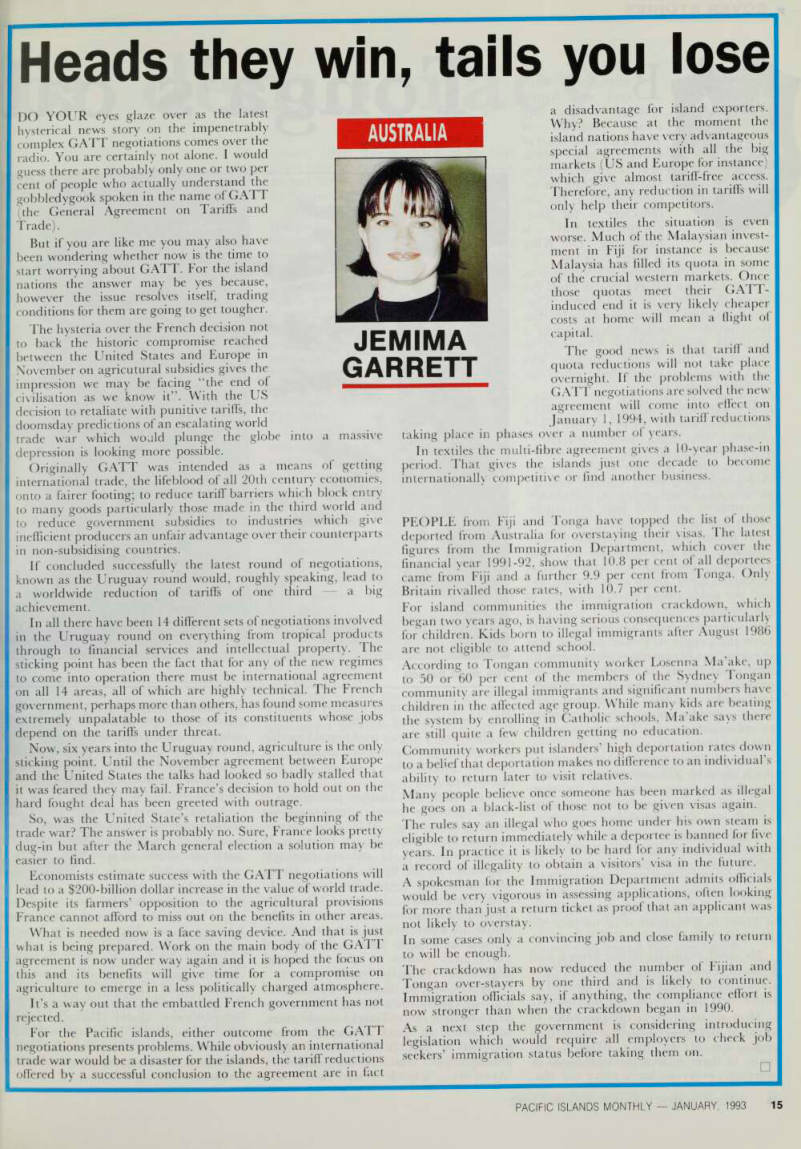
Jemima
Garrett
Beneath the
Cover Stories
seemingly tran quil and happy exterior of the tiny island kingdom of Tonga throbs a heart of unrest. A heart whose beat has gained rhythm and momentum in re cent months as the un thinkable for mod ern times anyway is happening. The King is being opposed.
In the 1770 s during his voyages to Tonga Captain James Cook dubbed the kingdom “The Friendly Islands”. Cer tainly modern Tonga seems to fit that description smiling people living a laid-back slow-paced life. However, in November this sleepy kingdom was shaken awake as people were jolted out of their routine life.
On November 24-27 the country’s pro-democracy movement formed in August this year held a public convention on democracy, the consti tution and political change in Xuku’alofa. It aimed to explain to the people of Tonga what a democratic government was and how the consti tution had to be amended to allow for a more democratic style of government basically, why power should be taken away from the country’s near-absolute monarch, King Taufa’ahau Tupou IV, and the noble ruling class, and given to
the people.
It will not be easy. Nowhere in history have the people in power handed over the reins just because they were asked to.
The royal family have held power for generations and this power was guaran teed under the 1875 constitution. The King and his nobles have no reason to relinquish power. They have every thing to lose.
The pro-democracy movement want the King to be a constitutional monarch.
He doesn’t seem interested in their suggestion even though they guarantee he will retain his privileges.
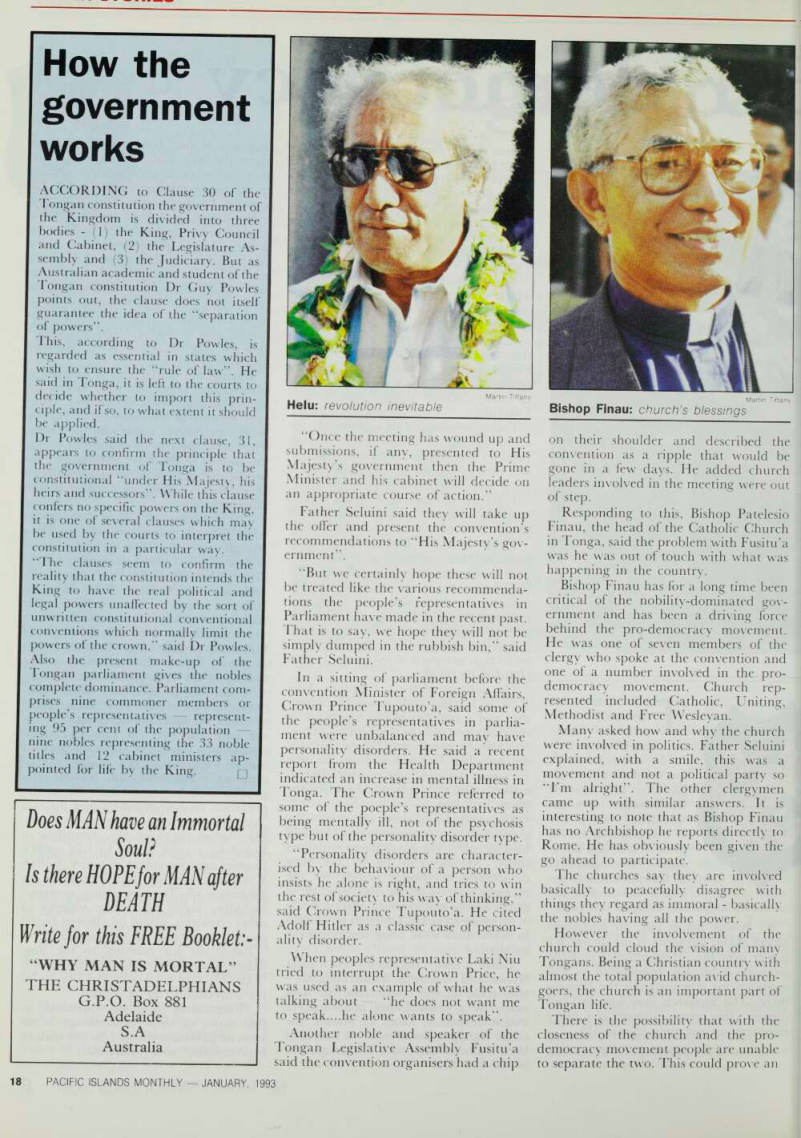
Some speakers at the convention suggested there could be trouble if the people did not get what they want in two or three years. Tongan academic Pro fessor Futa Hclu said political change could occur either through the shedding of blood in a revolution or by peaceful and legal democratic means.
He cited examples of the French and Russian revolutions saying in both cases the need for change had been ignored or suppressed until revolt was inevitable.
Most see as unlikely the possibility of violence and bloodshed because, with a population of less than 100,000, and many of them related through blood or marriage, everyone knew every one else.
As one speaker commented, it would be like brother killing brother.
However, Tonga’s traditional kingship has a history of murder and assassination and the country has a bloody civil war to its credit.
At present the Tongan parliament is made up of nine people’s representatives (representing the 94,000-plus population), nine nobles elected from the 33 noble titles and 12 cabinet ministers appointed for life by the King giving the nobles almost complete power.
As Australian academic Dr Guy Powles explains, one fundamental right found in most written constitutions is missing in Tonga. This is the right of every adult citizen to vote for elected
representatives in the legislature.
Dr Powles, an Associate Professor of Law at Melbourne’s Monash University and a student of the Tongan constitution, was invited to speak at the November convention. But in October Tonga’s Immigration and Police Minister ’Akau’ola a noble said visas would
be denied to foreigners trying to partici pate in the convention. Dr Powles and
other foreign participants mainly
international constitutional law experts from Australia and New Zealand were unable to attend but sent their papers to be read out at the meeting.
According to Dr Powles’ paper, the constitution discriminates against com moners, and nobles and commoners are not equal under all laws.
“The reality is that, while some laws; such as the criminal law treat all persons; the same, other laws relating to political! rights and land tenure make distinctions between classes. This means the Tongani constitution can and does, give greater weight or value to the vole of a noble; citizen than to the vote of a commoner citizen,” said Dr Powles. He said if] Tonga had been a former colony seeking} independence under United Nations; supervision, the UN would not have; permitted Tonga to become independent; without a more representative electoral! system for the legislature.
Tonga’s call for democracy
By Martin Tiffany
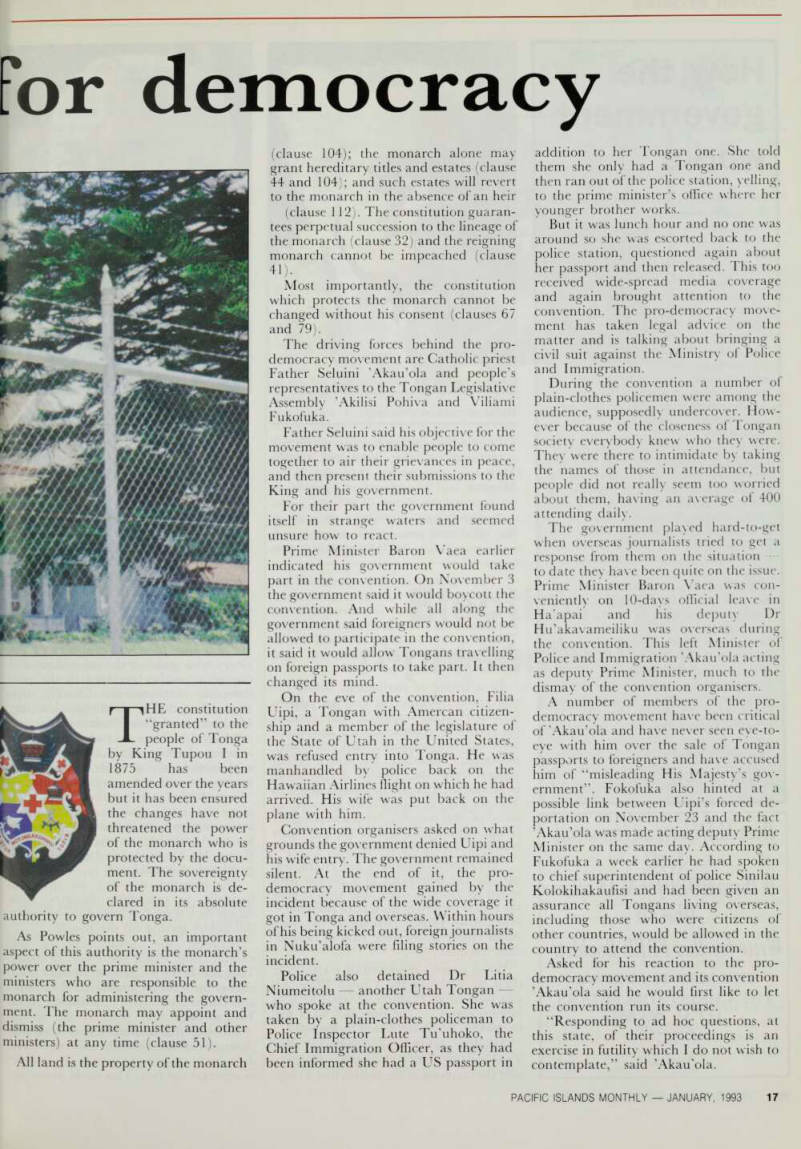
The royal palace
THE constitution
“granted” to the people of Tonga by King Tupou I in 1875 has been amended over the years but it has been ensured the changes have not threatened the power of the monarch who is protected by the docu ment. The sovereignty of the monarch is de clared in its absolute
authority to govern Tonga.
As Powles points out, an important aspect of this authority is the monarch’s power over the prime minister and the ministers who are responsible to the monarch for administering the govern ment. The monarch may appoint and dismiss (the prime minister and other ministers) at any time (clause 51).
All land is the property of the monarch
(clause 104); the monarch alone may grant hereditary titles and estates (clause 44 and 104); and such estates will revert to the monarch in the absence of an heir (clause 112). The constitution guaran tees perpetual succession to the lineage of the monarch (clause 32) and the reigning monarch cannot be impeached (clause 41).
Most importantly, the constitution which protects the monarch cannot be changed without his consent (clauses 67 and 79).
The driving forces behind the pro democracy movement are Catholic priest Father Seluini ’Akau’ola and people’s representatives to the Tongan Legislative Assembly ’Akilisi Pohiva and Viliami Fukofuka.
Father Seluini said his objective for the movement was to enable people to come together to air their grievances in peace, and then present their submissions to the King and his government.
For their part the government found itself in strange waters and seemed unsure how to react.
Prime Minister Baron Vaea earlier indicated his government would take part in the convention. On November 3 the government said it would boycott the convention. And while all along the government said foreigners would not be allowed to participate in the convention, it said it would allow Tongans travelling on foreign passports to take part. It then changed its mind.
On the eve of the convention, Filia Uipi, a Tongan with Amercan citizen ship and a member of the legislature of the State of Utah in the United States, was refused entry into Tonga. He was manhandled by police back on the Hawaiian Airlines flight on which he had arrived. His wife was put back on the plane with him.
Convention organisers asked on what grounds the government denied Uipi and his wife entry. The government remained silent. At the end of it, the pro democracy movement gained by the incident because of the wide coverage it got in Tonga and overseas. Within hours of his being kicked out, foreign journalists in Nuku’alofa were filing stories on the incident.
Police also detained Dr Litia Niumeitolu another Utah Tongan who spoke at the convention. She was
taken by a plain-clothes policeman to
Police Inspector Lute Tu’uhoko, the Chief Immigration Officer, as they had been informed she had a US passport in
addition to her Tongan one. She told them she only had a Tongan one and then ran out of the police station, yelling, to the prime minister’s office where her younger brother works.
But it was lunch hour and no one was around so she was escorted back to the police station, questioned again about her passport and then released. This too received wide-spread media coverage and again brought attention to the convention. The pro-democracy move ment has taken legal advice on the matter and is talking about bringing a civil suit against the Ministry of Police
and Immigration.
During the convention a number of plain-clothes policemen were among the audience, supposedly undercover. How ever because of the closeness of Tongan society everybody knew' who they were.
They were there to intimidate by taking the names of those in attendance, but people did not really seem too worried about them, having an average of 400 attending daily.
The government played hard-to-gct when overseas journalists tried to get a response from them on the situation to date they have been quite on the issue.
Prime Minister Baron Vaea was con veniently on 10-days official leave in Ha'apai and his deputy Dr Hu’akavameiliku was overseas during the convention. This left Minister of Police and Immigration ’Akau’ola acting as deputy Prime Minister, much to the dismay of the convention organisers.
A number of members of the pro democracy movement have been critical of ’Akau’ola and have never seen eye-to eye with him over the sale of Tongan passports to foreigners and have accused him of “misleading His Majesty’s gov ernment”. Fokofuka also hinted at a possible link between Uipi’s forced de portation on November 23 and the fact ’Akau’ola was made acting deputy Prime Minister on the same day. According to Fukofuka a week earlier he had spoken to chief superintendent of police Sinilau Kolokihakaufisi and had been given an assurance all Tongans living overseas, including those who were citizens of other countries, would be allowed in the country to attend the convention.
Asked for his reaction to the pro democracy movement and its convention ’Akau’ola said he would first like to let the convention run its course.
“Responding to ad hoc questions, at this state, of their proceedings is an exercise in futility which I do not wish to contemplate,” said ’Akau’ola.
“Once the meeting has wound up and submissions, if any, presented to His Majesty’s government then the Prime Minister and his cabinet will decide on an appropriate course of action.”
Father Seluini said they will take up the offer and present the convention's recommendations to “His Majesty’s gov ernment”.
"But we certainly hope these will not be treated like the various recommenda tions the people’s representatives in Parliament have made in the recent past.
That is to say, we hope they will not be simply dumped in the rubbish bin," said Father Seluini.
In a sitting of parliament before the convention Minister of Foreign Affairs, Crown Prince Tupouto’a, said some of the people’s representatives in parlia ment were unbalanced and may have personality disorders. He said a recent report from the Health Department indicated an increase in mental illness in Tonga. The Crown Prince referred to some of the pocple’s representatives as being mentally ill, not of the psychosis type but of the personality disorder type.
"Personality disorders are character ised by the behaviour of a person who insists he alone is right, and tries to win the rest of society to his way of thinking.” said Crown Prince Tupouto’a. He cited Adolf Hitler as a classic case of person ality disorder.
When peoples representative Laki Niu tried to interrupt the Crown Price, he was used as an example of what he was talking about “he does not want me to speak...he alone wants to speak”.
Another noble and speaker of the Tongan Legislative Assembly Fusitu’a said the convention organisers had a chip
on their shoulder and described the convention as a ripple that would be gone in a few days. He added church leaders involved in the meeting were out of step.
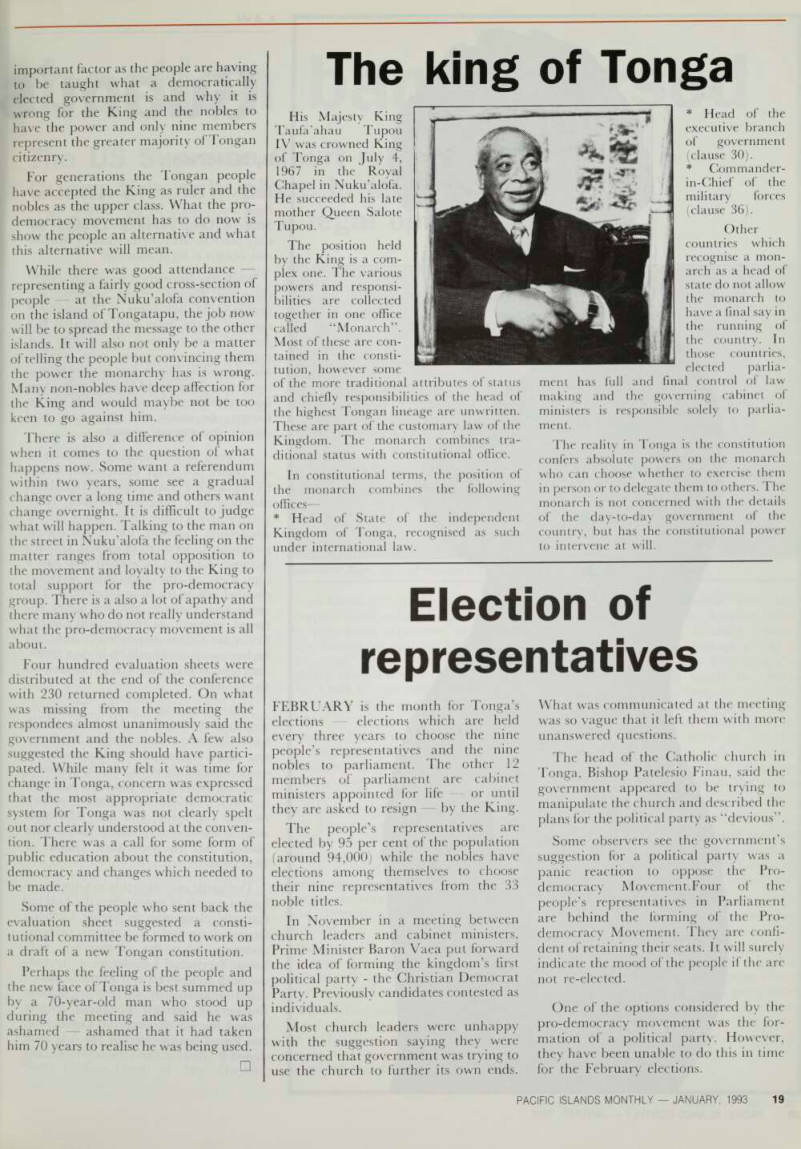
Responding to this, Bishop Patelesio Finau, the head of the Catholic Church in Tonga, said the problem with Fusitu’a was he was out of touch with what was happening in the country.
Bishop Finau has for a long time been critical of the nobility-dominated gov ernment and has been a driving force behind the pro-democracy movement.
He was one of seven members of the clergy who spoke at the convention and one of a number involved in the pro democracy movement. Church rep resented included Catholic, Uniting, Methodist and Free Wesleyan.
Many asked how and why the church were involved in politics. Father Seluini explained, with a smile, this was a movement and not a political party so “I’m alright". The other clergymen came up with similar answers. It is interesting to note that as Bishop Finau has no Archbishop he reports directly to Rome. He has obviously been given the go ahead to participate.
The churches say they are involved basically to peacefully disagree with things they regard as immoral - basically the nobles having all the power.
However the involvement of the church could cloud the vision of many Tongans. Being a Christian country with almost the total population avid church goers, the church is an important part of Tongan life.
There is the possibility that with the closeness of the church and the pro democracy movement people are unable to separate the two. This could prove an
Martin Tiffany Helu: revolution inevitable
Martin Tiffany Bishop Finau: church’s blessings
important factor as the people are having to be taught what a democratically elected government is and why it is wrong for the King and the nobles to have the power and only nine members represent the greater majority of Tongan citizenry.
For generations the Tongan people have accepted the King as ruler and the nobles as the upper class. What the pro democracy movement has to do now is show the people an alternative and what this alternative will mean.
While there was good attendance representing a fairly good cross-section of people at the Nuku’alofa convention on the island ofTongatapu, the job now will be to spread the message to the other islands. It will also not only be a matter of telling the people but convincing them the power the monarchy has is wrong.
Many non-nobles have deep affection for the King and would maybe not be too keen to go against him.
There is also a difference of opinion when it comes to the question of what happens now. Some want a referendum within two years, some see a gradual change over a long time and others want change overnight. It is difficult to judge what will happen. Talking to the man on the street in Nuku’alofa the feeling on the matter ranges from total opposition to the movement and loyalty to the King to total support for the pro-democracy group. There is a also a lot of apathy and there many who do not really understand what the pro-democracy movement is all about.
Four hundred evaluation sheets were distributed at the end of the conference with 230 returned completed. On what was missing from the meeting the respondees almost unanimously said the government and the nobles. A few also suggested the King should have partici pated. While many felt it was time for change in Tonga, concern was expressed that the most appropriate democratic system for Tonga was not clearly spelt out nor clearly understood at the conven tion. There was a call for some form of public education about the constitution, democracy and changes which needed to be made.
Some of the people who sent back the evaluation sheet suggested a consti tutional committee be formed to work on a draft of a new Tongan constitution.
Perhaps the feeling of the people and the new face of Tonga is best summed up by a 70-year-old man who stood up during the meeting and said he was ashamed ashamed that it had taken him 70 years to realise he was being used.
government
How the government works
ACCORDING to Clause 30 of the Tongan constitution the government of the Kingdom is divided into three bodies - (1) the King, Privy Council and Cabinet, (2) the Legislature As sembly and (3) the Judiciary. But as Australian academic and student of the Tongan constitution Dr Guy Powles points out, the clause does not itself guarantee the idea of the “separation of powers”.
This, according to Dr Powles, is regarded as essential in states which wish to ensure the “rule of law”. He said in Tonga, it is left to the courts to decide whether to import this prin ciple, and if so, to what extent it should be applied.
Dr Powles said the next clause, 31, appears to confirm the principle that the government of Tonga is to be constitutional “under His Majesty, his heirs and successors”. W hile this clause confers no specific powers on the King, it is one of several clauses which may be used by the courts to interpret the constitution in a particular way.
“1 he clauses seem to confirm the reality that the constitution intends the King to have the real political and legal powers unaffected by the sort of unwritten constitutional conventional conventions which normally limit the powers of the crown,” said Dr Powles.
Also the present make-up of the Tongan parliament gives the nobles complete dominance. Parliament com prises nine commoner members or people’s representatives represent ing 95 per cent of the population nine nobles representing the 33 noble titles and 12 cabinet ministers ap pointed for life by the King. □
Advertisements & other items, p. 18 (1 item)
Soul?
Does MAN have an Immortal
Is there HOPEfor MAN after
DEATH
Write for this FREE Booklet:-
“WHY MAN IS MORTAL”
THE CHRISTADELPHIANS
G.P.O. Box 881 Adelaide S.A Australia
The king of Tonga
His Majesty King
Taufa'ahau Tupou
IV was crowned King of Tonga on July 4, 1967 in the Royal Chapel in Nuku’alofa.
He succeeded his late mother Queen Salote
Tupou.
The position held by the King is a com plex one. The various powers and responsi bilities are collected together in one office called “Monarch”.
Most of these are con tained in the consti tution, however some
of the more traditional attributes of status and chiefly responsibilities of the head of the highest Tongan lineage are unwritten.
These are part of the customary law of the Kingdom. The monarch combines tra ditional status with constitutional office.
In constitutional terms, the position of the monarch combines the following offices — * Head of State of the independent Kingdom of Tonga, recognised as such under international law.
* Head of the executive branch of government
(clause 30).
* Commander in-Chief of the military forces
(clause 36).
Other countries which recognise a mon arch as a head of state do not allow the monarch to have a final say in the running of the country. In those countries,
elected parlia
ment has full and final control of law making and the governing cabinet of
ministers is responsible solely to parlia
ment.
The reality in Tonga is the constitution confers absolute powers on the monarch who can choose whether to exercise them in person or to delegate them to others. The monarch is not concerned with the details of the day-to-day government of the country, but has the constitutional power to intervene at will.
representatives
Election of representatives
FEBRUARY is the month for Tonga’s elections elections which are held every three years to choose the nine people’s representatives and the nine nobles to parliament. The other 12 members of parliament are cabinet ministers appointed for life or until they are asked to resign by the King.
The people’s representatives are
elected by 95 per cent of the population (around 94,000) while the nobles have elections among themselves to choose their nine representatives from the 33 noble titles.
In November in a meeting between church leaders and cabinet ministers, Prime Minister Baron Vaea put forward the idea of forming the kingdom’s first political party - the Christian Democrat Party. Previously candidates contested as individuals.
Most church leaders were unhappy with the suggestion saying they were concerned that government was trying to use the church to further its own ends.
What was communicated at the meeting was so vague that it left them with more
unanswered questions.
The head of the Catholic church in Tonga, Bishop Patelesio Finau, said the government appeared to be trying to manipulate the church and described the plans for the political party as “devious”.
Some observers see the government’s suggestion for a political party was a panic reaction to oppose the Pro democracy Movement. Four of the
people’s representatives in Parliament
are behind the forming of the Pro democracy Movement. They are confi dent of retaining their seats. It will surely indicate the mood of the people if the are not re-elected.
One of the options considered by the pro-democracy movement was the for mation of a political party. However, they have been unable to do this in time for the February elections.
Guam’s abortion ban reversed
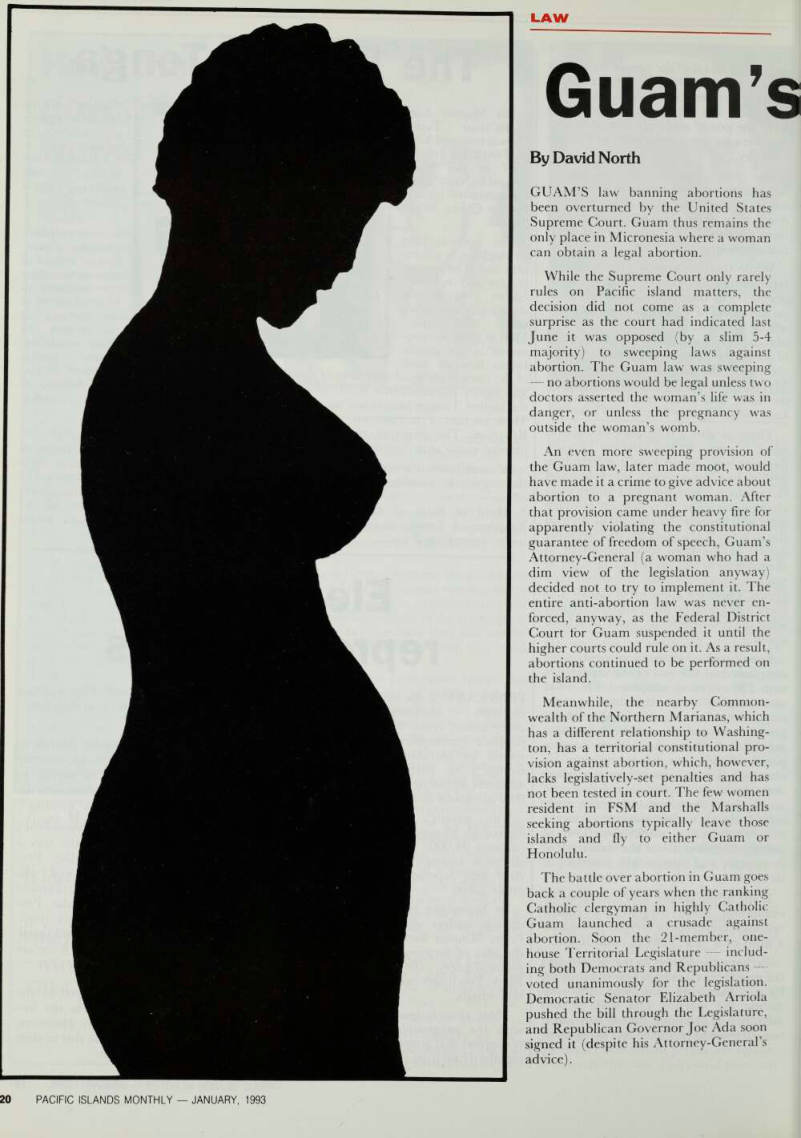
L Aw
By David North
GUAM’S law banning abortions has been overturned by the United States Supreme Court. Guam thus remains the only place in Micronesia where a woman can obtain a legal abortion.
While the Supreme Court only rarely rules on Pacific island matters, the decision did not come as a complete surprise as the court had indicated last June it was opposed (by a slim 5-4 majority) to sweeping laws against abortion. The Guam law was sweeping no abortions would be legal unless two doctors asserted the woman’s life was in danger, or unless the pregnancy was outside the woman’s womb.
An even more sweeping provision of the Guam law, later made moot, would have made it a crime to give advice about abortion to a pregnant woman. After that provision came under heavy fire for
apparently violating the constitutional
guarantee of freedom of speech, Guam’s Attorney-General (a woman who had a dim view of the legislation anyway) decided not to try to implement it. The entire anti-abortion law was never en forced, anyway, as the Federal District Court tor Guam suspended it until the higher courts could rule on it. As a result, abortions continued to be performed on the island.
Meanwhile, the nearby Common wealth of the Northern Marianas, which has a different relationship to Washing ton, has a territorial constitutional pro vision against abortion, which, however, lacks legislatively-set penalties and has not been tested in court. The few women resident in FSM and the Marshalls seeking abortions typically leave those islands and fly to cither Guam or Honolulu.
The battle over abortion in Guam goes back a couple of years when the ranking Catholic clergyman in highly Catholic Guam launched a crusade against abortion. Soon the 21-member, one house Territorial Legislature includ ing both Democrats and Republicans voted unanimously for the legislation.
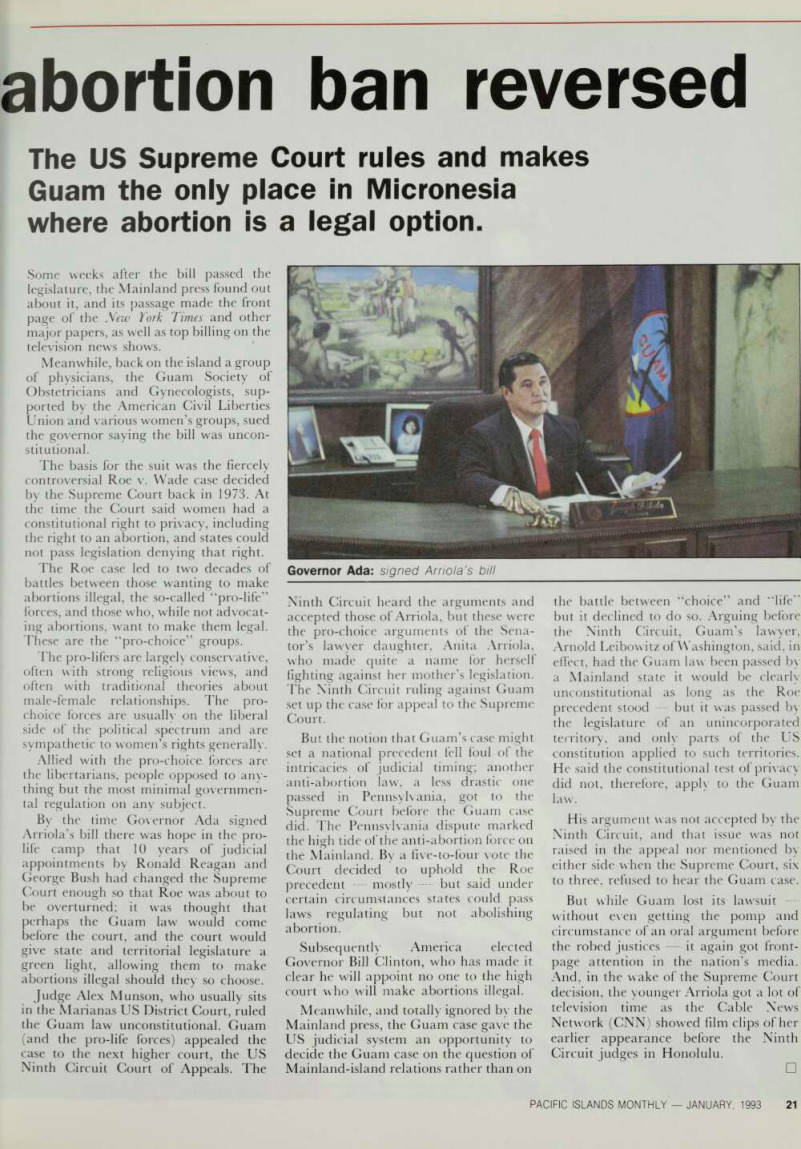
Democratic Senator Elizabeth Arriola pushed the bill through the Legislature, and Republican Governor Joe Ada soon signed it (despite his Attorney-General’s advice).
The US Supreme Court rules and makes Guam the only place in Micronesia where abortion is a legal option.
Some weeks after the bill passed the legislature, the Mainland press found out about it, and its passage made the front page of the New York Times and other major papers, as well as top billing on the television news shows.
Meanwhile, back on the island a group of physicians, the Guam Society of Obstetricians and Gynecologists, sup ported by the American Civil Liberties Union and various women’s groups, sued the governor saying the bill was uncon stitutional.
The basis for the suit was the fiercely controversial Roe v. Wade case decided by the Supreme Court back in 1973. At the time the Court said women had a constitutional right to privacy, including the right to an abortion, and states could not pass legislation denying that right.
The Roe case led to two decades of battles between those wanting to make abortions illegal, the so-called “pro-life” forces, and those who, while not advocat ing abortions, want to make them legal.
These are the “pro-choice” groups.
The pro-lifers are largely conservative, often with strong religious views, and often with traditional theories about male-female relationships. The pro choice forces are usually on the liberal side of the political spectrum and arc sympathetic to women’s rights generally.
Allied with the pro-choice forces are the libertarians, people opposed to any thing but the most minimal governmen tal regulation on any subject.
By the time Governor Ada signed Arriola’s bill there was hope in the pro life camp that 10 years of judicial appointments by Ronald Reagan and George Bush had changed the Supreme Court enough so that Roc was about to be overturned; it was thought that perhaps the Guam law would come before the court, and the court would give state and territorial legislature a green light, allowing them to make abortions illegal should they so choose.
Judge Alex Munson, who usually sits in the Marianas US District Court, ruled the Guam law unconstitutional. Guam (and the pro-life forces) appealed the case to the next higher court, the US Ninth Circuit Court of Appeals. The
Ninth Circuit heard the arguments and accepted those of Arriola, but these were the pro-choice arguments of the Sena tor’s lawyer daughter, Anita Arriola, who made quite a name for herself fighting against her mother’s legislation.
The Ninth Circuit ruling against Guam set up the case for appeal to the Supreme Court.
But the notion that Guam’s case might set a national precedent fell foul of the intricacies of judicial timing; another anti-abortion law, a less drastic one passed in Pennsylvania, got to the Supreme Court before the Guam case did. The Pennsylvania dispute marked the high tide of the anti-abortion force on the Mainland. By a five-to-four vote the Court decided to uphold the Roe precedent mostly but said under certain circumstances states could pass laws regulating but not abolishing abortion.
Subsequently America elected Governor Bill Clinton, who has made it clear he will appoint no one to the high court who will make abortions illegal.
Meanwhile, and totally ignored by the Mainland press, the Guam case gave the US judicial system an opportunity to decide the Guam case on the question of Mainland-island relations rather than on
the battle between “choice” and "life" but it declined to do so. Arguing before the Ninth Circuit, Guam’s lawyer, Arnold Leibowitz of Washington, said, in effect, had the Guam law been passed by a Mainland state it would be clearly unconstitutional as long as the Roe precedent stood but it was passed by the legislature of an unincorporated territory, and only parts of the US constitution applied to such territories.
He said the constitutional test of privacy did not, therefore, apply to the Guam law.
His argument was not accepted by the Ninth Circuit, and that issue was not raised in the appeal nor mentioned by either side when the Supreme Court, six to three, refused to hear the Guam case.
But while Guam lost its lawsuit without even getting the pomp and circumstance of an oral argument before the robed justices it again got front page attention in the nation’s media.
And, in the wake of the Supreme Court decision, the younger Arriola got a lot of television time as the Cable News Network (CNN) showed film clips of her earlier appearance before the Ninth Circuit judges in Honolulu.
Governor Ada: signed Arriola’s bill
Advertisements & other items, pp. 22-23 (1 item)
-
m 'f w.
V ■ n i W f f iftil " mm v ■ j / ..
With
National MBf Master Card
you’ve got
the whole world in
your hands.
Now, for the first time ever, ere’s a unique credit card specially
signed for today’s modern Fijian,
le National MBf Master Card is the
rst and Only Fiji Dollar Credit
ird accepted locally and at over 9 illion outlets worldwide. It gives u Revolving Credit, so you have e option of settling just 10% of the lount due each month which gives u the option of saving your finances
r other things.
And as a Cash Card, it obviously gets u cash at over 80,000 Master Card"
Ms worldwide. Plus Cash on Card all branches of National Bank of Fiji d at more than 100,000 Master Card
rations throughout the world.
If you hold the National MBf isterCard, we know how impressive your financial status is and so you
automatically enjoy preferential
treatment when you apply for a Current Account with The National Bank of Fiji. They will also give you
Refinancing Facilities.
When you travel, National MBf Master Card provides you with a high value Insurance Plan for Travel Accident and Travel Inconveniences.
National MBf Master Card also gives you Travel Assistance through Master Assist™ 24 hours a day, every day of the year.
The Master Assist™ programme will help you in many kinds of
emergencies: legal and medical
referrals, medical repatriation, emergency assistance, lost document, luggage retrieval assistance and emergency cash.
This is just a glimpse of the benefits from National MBf Master Card. There’s no reason now to feel second best.
Apply for The First Fiji Dollar Credit Card today, and you’ve got the whole world in your hands.
NATIONAL BANK OF FIJI
smm
VALID
3T a# I I'M
National
MBf Master Card.
cnza
National MBf Master Card is issued by National MBf Finance (Fiji) Ltd. in conjunction with National Bank of Fiji under the affiliate licence of MBf Card Services Sdn. Bhd. from Master Card International Inc. To apply call 302232 or pick-up an application form at any branch of National Bank of Fiji.
Where

Special Report
Where are we headed?
The Pacific region, with its unique circumstances, finds itself ill-prepared for the century ahead.
By Martin Tiffany
PELL away the glossy tourist-brochure image from the Pacific islands and you will find island economies in trouble.
With problems that arc unique to the region, all Pacific island nations are facing constraints to development of varying magnitudes.
On top of this there is the apparent volatility of Pacific island economies, made worse by the countries’ relatively small size where the results of almost every event, good or bad, are quickly transmitted throughout the entire na tion. This last observation is made by Rodney Cole from the Research School of Pacific Studies at the Australian National University in Canberra.
Cole, research director of the Islands/ Australia Program at the National Centre for Development Studies (NCOS), is part of an ambitious project looking at the future of the region and the difficulties that may emerge as a result of high lev els of population growth.
He said governments are so immersed in the problems that confront them day to-day that they have been unable to devote time to thinking ahead, seeking to establish plans and programs now which, while accommodating the problems of the present, would look at least easing difficulties which can expect to emerge in the future.
These difficulties involve a range of
issues, including relatively high popu
lation growth and a possibility that available resources from land and sea
will diminish over time. In order to highlight these problems the NCDS has initiated a program called Pacific 2010, based on demographic projections for the major island stales of the Pacific to about the year 2010, which seeks to identify problems likely to emerge as a direct result of population growth.
Projects under Pacific 2010 are not concerned with population control or family planning but with the economic implications of an expanding number of people, particularly young people, at a time when employment opportunities, if not decreasing arc at least not to be
expanding.
According to Cole, over the last decade, on average, the island econom ies, as measured by GNP, have failed to
perform satisfactorily, with some
countries in fact going backwards in terms of per capita income.
Failure to perform can be attributed to a wide range of factors, some of which can be controlled while others are beyond the influence of island govern ments.
Hurricanes, cyclones, drought, frost, and flood are features of some or all Pacific islands.
While the international community is generous in response to these disasters, support is usually of a humanitarian variety and has little long term effect on the national product.
Some countries have a restricted range of exports, usually the legacy of poverty in the country’s resource base. Most of the regional countries have small, frag mented domestic markets and are remote
from foreign markets, access to which is made more difficult by high transport costs.
Most island nations have high levels of population growth and problems with skills development. Young people move to the greener pastures of developed countries overseas. This influences the efforts of government to encourage foreign investment although remittances from Pacific islanders working abroad can play a major role in supporting the balance of payments of some countries.
Land tenure can sometimes prove a difficult issue in the negotiation of agreements affecting investment, par ticularly in the mining sector. Especially in countries where traditional bound aries have not been clearly defined. Law and order problems in some countries have serious implications for investment decisions.
Also as Cole points out, “being price takers for most of their domestic pro duction, particularly in the agricultural sector, the islands are inevitably subject to the vagaries of international market
and the often savage price shifts.”
Despite the relief offered by such devices as STABEX, some governments have been forced, for political and social reasons, to provide price support schemes involving resources which could under other circumstances be better used else where.
These are serious problems which need to be addressed to promote island development. But it is not all doom and gloom.
Since gaining independence the re gional governments have enjoyed the generosity of an increasing range of aid donors. Generous levels of aid have, however, often masked real structural problems and caused governments to defer or avoid decisions necessary to meet their shifting social and economic needs.
It has been argued that aid might give way to trade and become a more positive feature of donor/recipient relations. In creasingly the islands seek improved options for their activities and have argued that aid funds should be div erted to support trading operations.
Trade treaties like SPARTECA and PATCRA have been put in place by
Australia and New Zealand to foster Pacific trading ventures and help island entrepreneurs enter their markets. In addition, the Lome Convention of the European Community, the Market Ac
cess and Regional Competitiveness
Scheme of the USAID program and a number of other bi-lateral and multi lateral agreements exist to provide opportunities for the islands to develop trading links with the rest of the world.
But, with the possible exception of Fiji’s garment industry, there has been little to show for the opportunities available. The global nature of the world’s trading operations makes it imperative these small economies recog nise their limitations and advantages and act accordingly. Cole suggests they must seek to use the labour they possess, their often unique climatic and geographic locations, the treaties which provide special advantages and the natural attractions of their environment.
Some countries have made the break.
Fiji took advantage of the 1987 military coups to de-regulate labour practices, de value its currency and introduce incen tives for foreign investors. All positive
steps which have led to substantial growth in the manufacturing sector, particularly in the field of garments.
Tonga has identified a niche market in Japan for a particular variety of squash pumpkin and developed an important, short-season export industry. Western Samoa took advantage of cheap, skilled labour to have a Japanese firm begin manufacturing electrical harnesses for motor vehicles. One thousand jobs are expected to be created.
While island leaders seek to develop
policies which provide an improved way
of life for their people, the manner in which this might be achieved does not become any easier, despite increasing aid flows and improved trading opportunities. The accepted measure of growth, GNP per capita, continues either to fall or grow only slowly over time.
According to Cole the reason is clear.
Populations continue to grow despite efforts by some countries to support family planning in the interests of higher living standards. In some instances there is a “safety net” in the form of emigration and this is evident in the population growth rate figures for Tonga and Western Samoa. Other countries which do not have the same opportunities for emigration have had access to land which has helped absorb population
growth.
Cole says the question to be addressed is whether these options for absorbing population increases will always be open.
If the countries to which Polynesian emigrants have moved should become less accommodating, what will the results then be? In those countries where land has been the “safety net” can this
position continue?
Some suggest that in future the only option open to many Pacific islanders will be subsistence agriculture. But with much of the available arable land in most Pacific countries already being used, will this option be available in the future?
Traditional unprocessed commodity exports are the prime feature of most South Pacific economies copper and timber in PNG, phosphate in Nauru, copra in Kiribati, sugar in Fiji and coconut oil in Western Samoa presently share declining terms of trade.
These exports are extremely vulnerable to world market fluctuations.
Semi-subsistence agriculture and fisheries are the backbone of many Pacific economies. According to Suva based Forum Secretariat these have not sustained growth in the 1980 s basically because of the sharp decline in prices for traditional primary export commodities.
Pacific population: outpacing economic growth
As Cole sees it, the conclusion, “inevi table from the available evidence, is that, as of now, the islands of the Pacific Ocean arc coping with existing levels of popu lation, but only just. Standards of living, as measured by conventional methods are in gradual decline; pressures on land and thus the subsistence sector, are
increasing.”
There are opportunities for improv ing the contributions of the manufactur ing sector to the national economy. This however requires careful management to avoid entering into competition with
those countries better able to meet the demands of a fickle international market than small isolated states. Niche markets appear to offer prospects of success. This scenario calls for careful examination of policies towards the future.”
The National Centre for Development Studies through the program Pacific 2010 will seek to present to governments and those involved in resource manage ment. an indication of likely implications of population growth in various sectors of national economies. It will also seek to identify possible options which might be
considered, at least to minimize the effects of population growth. The first book from the program ‘Pacific 2010- Challenging the future?’ is due for publication soon. It should provide some sobering thoughts to governments and private sectors alike.
As Cole says, the leaders of today should take heed of the ‘dooms-day’ scenario the population projections of Pacific 2010 imply. After all, they are responsible for the consequences for the next generation. He is confident that national leadership and the international community want to face up to the question of tomorrow and steps can be taken to meet the challenge population growth implies. □
Population
Figures
THE TOTAL population of the 13 Forum Island Countries is about 5.3 million people. Seventy per cent live in Papua New Guinea. Fiji has the second biggest popu lation accounting for 13 per cent of the region’s total. In sharp contrast is Niue with less than 2500 people 0.04 per cent of the region’s population.
The 13 FICs are the Cook Islands, Federated States of Micronesia, Fiji, Kiri bati, Marshall Islands, Nauru, Niue, Pa pua New Guinea, Solomon Islands, Tonga, Tuvalu, Vanuatu and Western Samoa.
Their size, climate and make up vary widely. But there is one thing they do have in common a relatively high rate of population growth, averaging 2.2 per cent across the region.
The particularly high growth rates in Melanesian countries reflect declining mor tality and very high fertility rates. Accord ing to World Bank figures, between 1980 and 1988, the net population growth rate was 3.5 per cent in the Solomon Islands and 2.9 per cent in Vanuatu. In other countries fertility rates were lower.
Kiribati, Western Samoa and Tonga have relatively high natural growth rates of 2.3, 2.2 and 2.9 per cent respectively. Only high rates of emigration from the three countries mean the net population growth is low there. However, migration also results in the loss of skilled workers. The situation is the same in Niue, the Cook Islands and Fiji where migration reduces potential growth rates but results in skilled human resource depletion.
Because of the high population growth rates, children comprise a high proportion of the total population, producing rela tively high dependency ratios.
Advertisements & other items, p. 26 (1 item)
Rewa Rice Limited
69 KINGS ROAD NAUSORI CABLE: REWARICE FIJI
P.O. BOX 17 NAUSORI FIJI
TELEPHONE: 477855 NAUSORI FAX: (679) 400253
Why Buy Overseas Rice When
Your Own Fiji Grown Rice Is
More Nutritious
We at Rewa Rice Ltd Are Doing Our Utmost To Help Revitalize The Rice Industry In Fiji Our Efforts Include Providing Incentives And Subsidies Eor banners, Machinery And Equipment Pools For Farmers, And Fabrication Workshops For Tools Required In The Industry.
Rewa Rice Ltd Is Naturally Committed To Providing Nutritious Products For Our Valued Customers.
So Lets Combine Our Efforts in Producing More Rice And Becoming Self-Sufficient.
Support Local Rice And Join Everyone Nationwide In Life s New Way Of Living Make Sure To Buy Rewa Rice From Your Local Supermarket Rewa Rice Products For Better Life Through Better Nutrition.
The people - our hope
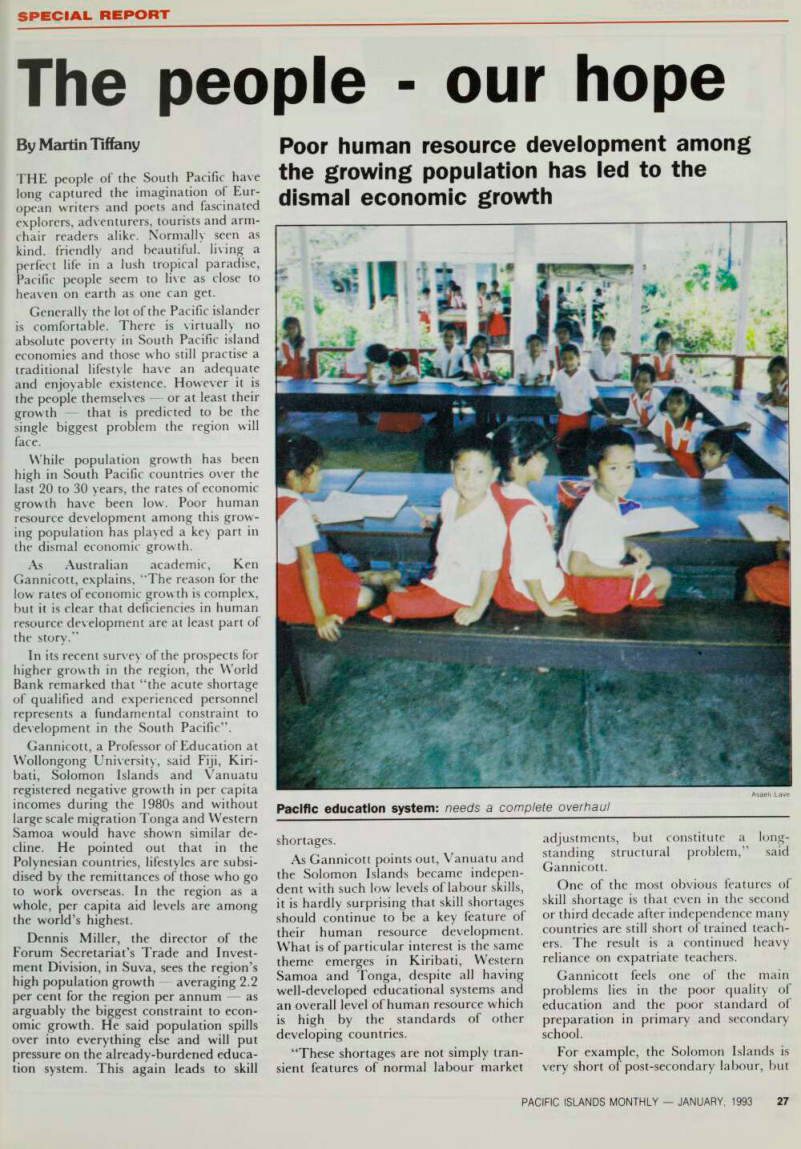
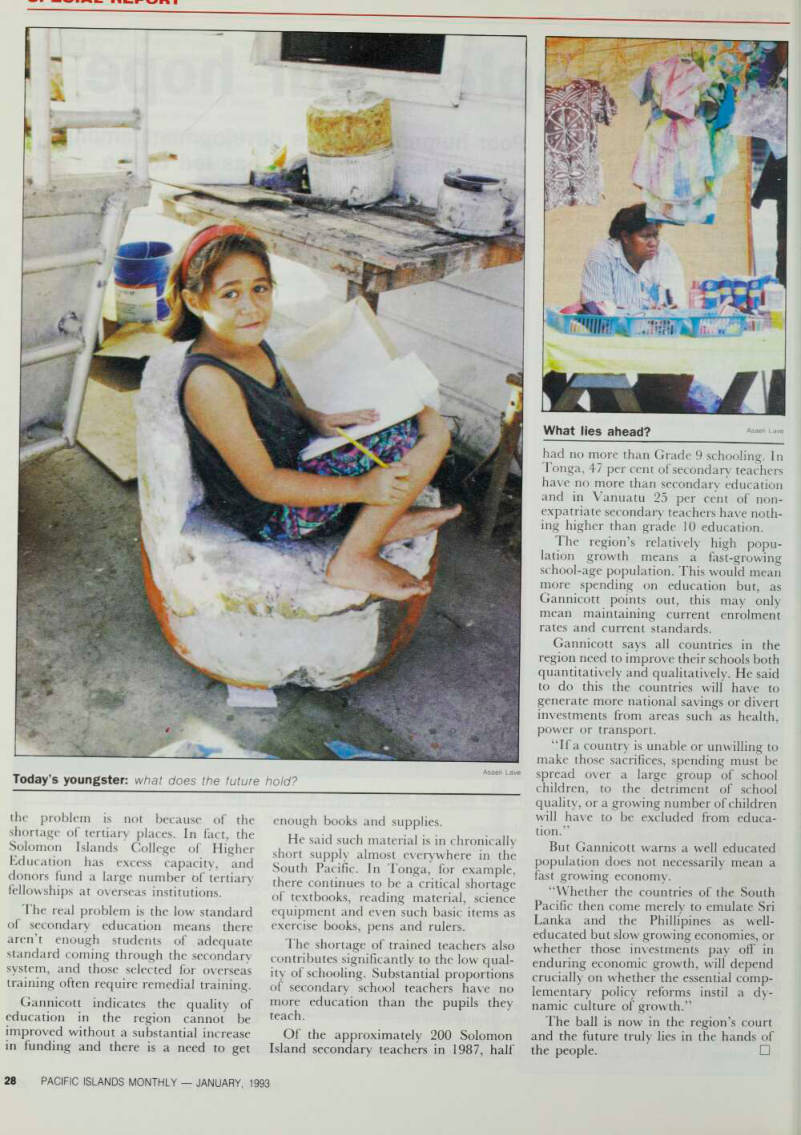
Special Report
By Martin Tiffany
Poor human resource development among the growing population has led to the dismal economic growth
THE people of the South Pacific have long captured the imagination of Eur opean writers and poets and fascinated explorers, adventurers, tourists and arm chair readers alike. Normally seen as kind, friendly and beautiful, living a perfect life in a lush tropical paradise, Pacific people seem to live as close to heaven on earth as one can get.
Generally the lot of the Pacific islander is comfortable. There is virtually no absolute poverty in South Pacific island economies and those who still practise a traditional lifestyle have an adequate and enjoyable existence. However it is the people themselves or at least their growth that is predicted to be the single biggest problem the region will face.
While population growth has been high in South Pacific countries over the last 20 to 30 years, the rates of economic growth have been low. Poor human resource development among this grow ing population has played a key part in the dismal economic growth.
As Australian academic, Ken Gannicott, explains, “The reason for the low rates of economic growth is complex, but it is clear that deficiencies in human resource development arc at least part of the story.”
In its recent survey of the prospects for higher growth in the region, the World Bank remarked that “the acute shortage of qualified and experienced personnel represents a fundamental constraint to development in the South Pacific”.
Gannicott, a Professor of Education at Wollongong University, said Fiji, Kiri bati, Solomon Islands and Vanuatu registered negative growth in per capita incomes during the 1980 s and without large scale migration Tonga and Western Samoa would have shown similar de cline. He pointed out that in the Polynesian countries, lifestyles are subsi dised by the remittances of those who go to work overseas. In the region as a whole, per capita aid levels are among the world’s highest.
Dennis Miller, the director of the Forum Secretariat’s Trade and Invest ment Division, in Suva, sees the region’s high population growth averaging 2.2 per cent for the region per annum as arguably the biggest constraint to econ omic growth. He said population spills over into everything else and will put pressure on the already-burdened educa tion system. This again leads to skill
shortages.
As Gannicott points out, Vanuatu and the Solomon Islands became indepen dent with such low levels of labour skills, it is hardly surprising that skill shortages should continue to be a key feature of their human resource development.
What is of particular interest is the same theme emerges in Kiribati, Western Samoa and Tonga, despite all having well-developed educational systems and an overall level of human resource which is high by the standards of other
developing countries.
“These shortages are not simply tran sient features of normal labour market
adjustments, but constitute a long standing structural problem,” said Gannicott.
One of the most obvious features of skill shortage is that even in the second or third decade after independence many countries are still short of trained teach ers. The result is a continued heavy reliance on expatriate teachers.
Gannicott feels one of the main problems lies in the poor quality of education and the poor standard of preparation in primary and secondary school.
For example, the Solomon Islands is very short of post-secondary labour, but
Asaeli Lave
Pacific education system: needs a complete overhaul
the problem is not because of the shortage of tertiary places. In fact, the Solomon Islands College of Higher Education has excess capacity, and donors fund a large number of tertiary fellowships at overseas institutions.
The real problem is the low standard of secondary education means there aren’t enough students of adequate standard coming through the secondary system, and those selected for overseas training often require remedial training.
Gannicott indicates the quality of education in the region cannot be improved without a substantial increase in funding and there is a need to get
enough books and supplies. u ,• i u , •, • • , „ short the South Pacific. In Tonga, for example there continue s to be a critical shortage of tex tbooks, reading material, science equipment and even such basic items as exercise books, pens and rulers.
The shortaee of trained teachers also snorta g e oi trained teacners also F° nt^ butes s/gnificantly to the low qual ity of schooling. Substantial proportions of secondary school teachers have no more education than the pupils they teach.
Of the approximately 200 Solomon Island secondary teachers in 1987, half
had no more than Grade 9 schooling. In Tonga, 47 per cent of secondary teachers have no more than secondary education and in Vanuatu 25 per cent of non expatriate secondary' teachers have noth ing higher than grade 10 education.
The region’s relatively high popu lation growth means a fast-growing school-age population. This would mean more spending on education but, as Gannicott points out, this may only mean maintaining current enrolment rates and current standards.
Gannicott says all countries in the region need to improve their schools both quantitatively and qualitatively. He said to do this the countries will have to generate more national savings or divert investments from areas such as health, power or transport.
“If a country is unable or unwilling to make those sacrifices, spending must be spread over a large group of school children, to the detriment of school quality, or a growing number of children will have to be excluded from educa tion.”
But Gannicott warns a well educated population does not necessarily mean a fast growing economy.
“Whether the countries of the South Pacific then come merely to emulate Sri Lanka and the Phillipines as well educated but slow growing economies, or whether those investments pay off in enduring economic growth, will depend crucially on whether the essential comp lementary policy reforms instil a dy namic culture of growth.”
The ball is now in the region’s court and the future truly lies in the hands of the people. □
Today’s youngster: what does the future hold?
Asaeli Lave
What lies ahead?
Asaeli Lave
Capitalising on timber



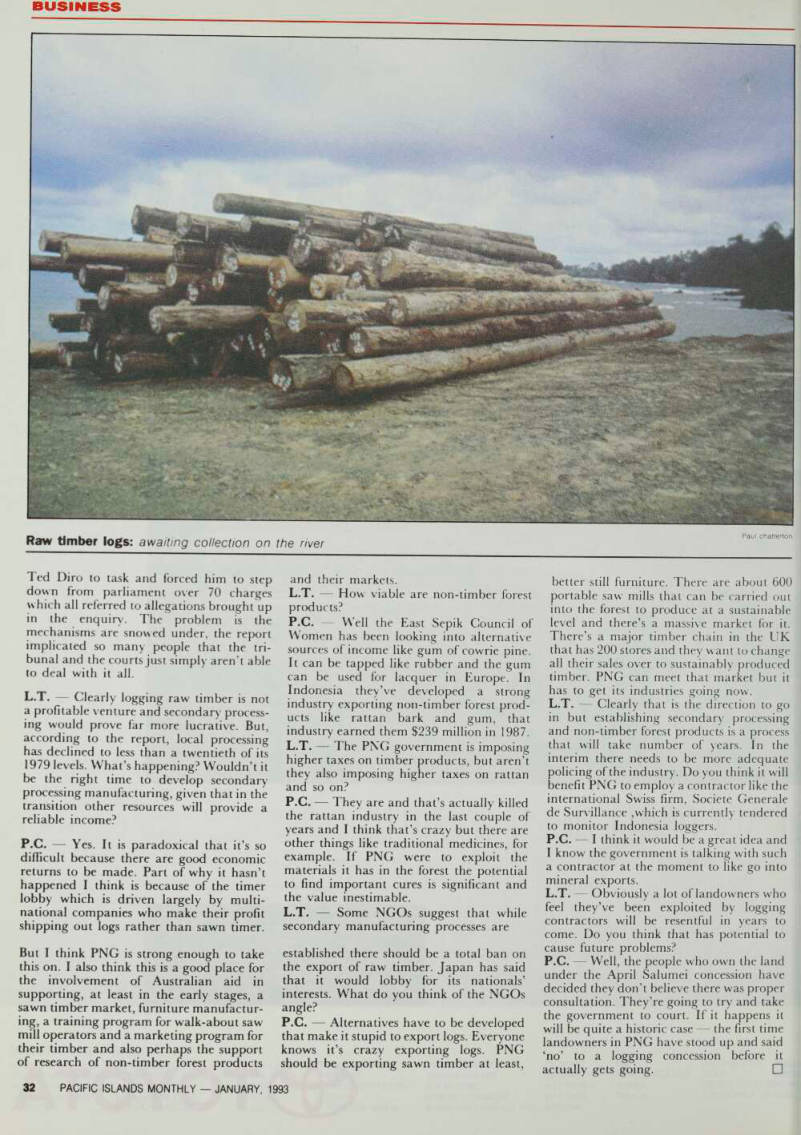
Business
By Liz Thompson
PAPUA New Guinea has approximately 33 million hectares of closed forests, about 15 million of which have forestry potential. To date it is estimated that apporximately 5 million have either been logged or are under logging permits. In 1987 the forest industries exported 1450 cubic metres of timber worth 103 million kina and in 1988 timber accounted for eight per cent of total exports. It is an industry which has the potential to provide great return and yet it has been beset by problems resulting in the squandering of a national resource for little return. In 1987 the Wingti government started a commission of inquiry into the operations of the timber industry in PNG under the chairing of Justice Thomas Barnett. The enquiry pointed to a number of the industry's main problems and its findings, along with those of the Tropical Forest Action Plan (TFAP) set up under the directions of the World Bank, resulted in the setting up of a moratorium on the granting of logging concessions.
Paul Chat ter ton is currently working for the World Wildlife Fund helping them organize their Conservation Programmes in PNG and was a founding member of the Asia Pacific Action Group which was responsible for publishing a condensed and extremely influential version of the 5500-page Barnett Report which was never made available to the public. He works with community groups in PNG and has long been concerned with the rapacious nature of the timber industry. Here he talks about some of the issues involved.
L.T. The Barnett Report slated that in 1987 the PNG government lost 527.500,000 in foreign currency earnings and around 54.270.000 on company profits through transfer pricing. Can you
explain what this is?
P.C. Well that happens when a company puts the name of a less valuable log on the log it is exporting, so that they don't have to pay royalties on the real
value and, in many instances, the logs arc declared by Japanese company officials.
They write in Japanese and the forestry officials can't understand and there aren't enough officials to check all the timber export operations.
L.T. The Barnett Report also pointed out that landowners receive inadequate returns for their timber and that often contractual obligations, such as the development of roads, schools and hospitals arc not fulfilled, why is this?
P.C. As Barnett said, almost every logging company in the last 10 years hasn't provided the benefits it promised.
In very few cases have they replanted and if they have it is seldom to the extent
required under contract. They're usually
fly-by-night, low capital operations that
go in to make a quick buck and get out before the people have to deal with the consequences.
L.T. The report also implicated many political figures in the corruption.
How effective is the leadership tribunal in enforcing control?
P.C. They are enforcing some control, it was the tribunal which took
Ted Diro to task and forced him to step down from parliament over 70 charges which all referred to allegations brought up in the enquiry. The problem is the mechanisms are snowed under, the report implicated so many people that the tribunal and the courts just simply aren t able to deal with it all. » >-p /-'ll I I ... ki Car \ raW |, irn k er 15 not ; P 01 V' en Ur r ean seco . n ar > process- ? U ? U ar more iterative. But,
has decliLd\olUXn’a“wen{ie°hTfTl
1979 levels What’s hannpnintr? WnnlHn’t if be the ri*ht time be the right time to .develop secondary processing manu actunng, given that in the transition other resources wil provide a reliable income? P P.C. Yes. It is paradoxical that it’s so difficult because there are good economic returns to be made. Part of why it hasn’t happened I think is because of the timer lobby which is driven largely by multinational companies who mike their profit shipping out logs rather than sawn timer. 00 But I think PNG is strong enough to lake this on. I also think this is a good place for the involvement of Australian aid in supporting, at least in the early stages, a sawn timber market, furniture manufacturing, a training program for walk-abou, saw mill operators and a marketing program for their timber and also perhaps the support 01 research or non-timber lorest products
and their markets.
L.T. -- How viable are non-timber forest products?
P.C. Well the East Sepik Council of Women has been looking into alternative sources of income like gum of cowrie pine.
It can be tapped like rubber and the gum can be used for lacquer in Europe. In Indonesia they’ve developed a strong: industry exporting non-timber forest products bk e ra ttan bark and gum, that industry earned them $239 million in 1987.
L-T The PNG government is imposing higher taxes on timber products, but aren’t they also imposing higher taxes on rattan an d so on? K p q Thev are and that’s actuallv killed 1 ney are ana mat s actually killed the ratlan industry in the last couple of years and I think that’s crazy but there are other things like traditional medicines, for example. If PNG were to exploit the materials it has in the forest the potential to find important cures is significant and 'he value inestimable.
L.T. - Some NGOs suggest that while secondary manufacturing processes are 0 r established there should be a total ban on the export of raw timber. Japan has said that it would lobby for its nationals’ interests. What do you think of the NGOs angle?
P.C. - Alternatives have ,0 be developed that make it stupid to export logs. Everyone knows it s crazy exporting logs. PNG should be exporting sawn timber at least,
better still furniture. There are about 600 portable saw mills that can be carried out into the forest to produce at a sustainable level and there’s a massive market for it.
There’s a major timber chain in the UK that has 200 stores and they want to change all their sales over to sustainably produced timber. PNG can meet that market but it has to get its industries going now.
L.T. Clearly that is the direction to go
in but establishing secondary processing
and non-timber forest products is a process that will take number of years In the interim there needs to be more adequate policing of the industry. Do you think it will benefit PNG to employ a contractor like the international Swiss firm, Societe Generale ~, . ’ . t , , de Sumllance ,which is currently tendered *° m onitor Indonesia loggers. * think it would be a great idea and 1 know the government is talking with such a contractor at the moment to like go into mineral exports L.T. - Obviously a lot of landowners who feel ,be >' ve b f" exploited by logging contractors will be resentful in years to come. Do you think that has potential to cause future problems.
PC ? , We l l ’ tbe P«°P le who own the land under the April Salumei concession have do " 1 , belleve ther< ; was P™P, er consultation. They re going to try and take % r a “hismric cale the lfrst fime ando J lers in PNG have stood up and said w to a , in concess ion before it
actually gets going □
Raw timber logs: awaiting collection on the river
Paul chalterton
Advertisements & other items, pp. 29-32 (2 items)
ilPilPi
MMM.
r m mm ■
TVMJTM
mrnrm mmm I intfiiirai! mm* nut iik u( £ isor I We’re certainly equipped to rush your vital, one-off document across the world in an emergency. But our customers are increasingly calling on us to transport their regular consignments of parcels. For packages of up to 30 kilos each, our worldwide network is the fastest and most reliable way of making deliveries throughout the globe.
All our offices are backed up by a computerised, satellite-linked tracking system which, in a matter of seconds, can tell you the precise status of your parcel along its journey. So when you’ve got a parcel to deliver or, of course, a document call us at 313166. You’ll be in safe hands all the way.
DHL International (FIJI) Ltd SUVA 10 Holland Street. Suva. Tlx: 2244, Fax: 302707. Tel: 313186, 300024.
NADI Office 115, Ist Floor, ATS Cargo Bldg. Tlx: 5209. Fax: 790123. Tel: 723800, 722019.
LAUTOKA Narara Parade, Lautoka. Phone: 665400, 665401.
LABASA Nasekula Road, Labasa. Phone 811162.
LEVUKA Beach Street. Phone 440139. woncowfoe express • I You Couldn’t Express It Bo tier!
Creating a highly efficient, dynamic-looking car wot be simple if it weren’t for one complicating detail; i passengers that must ride in it. Accommodating people comfortably in a pleasant, root interior usually means a certain amount of aerodynamic potential has to be sacrific
Itl
4 * * Exact features and specifications may. vary depending on country of purchase. Please check with your nearest TOYOTA distributor/dealer for details.
DISTRIBUTORS/DEALERS
AMERICAN SAMOA BURNS PHILP (S.S.) CO. LTD. PH 633-4281 GUAM & MICRONESIA... ATKINS KROLL. INC. PH 646-1876/9
NORFOLR'ISLANDS BORRY’S PTY LTD. PH 2114
SOLOMON ISLANDS MENDANA MOTORS PH 30314
VANUATU VANUATU MOTORS PH 22341
COOK ISLANDS PACIFIC MOTORS LTD. PH 20796
KIRIBATI TARAWA MOTORS PH 21090
PAPUA NEW GUINEA ... ELA MOTORS PH 217036
TAHITI NIPPON AUTOMOTO PH 429819
WESTERN SAMOA BURNS PHILP (S.S.) CO. LTD. PH 20800
FIJI ASCO MOTORS
NEW CALEDONIA .. .S.I.A.P.
SAIPAN MICROL CORPORATION
TONGA BURNS PHILP (TONGAXi
IT BEAUTI
Until now. Using a con- . cept called total airflow nagement, Toyota engineers were able to realize an efficient, wedge-shaped design die at the same time perfecting the alignment between body panels and components, course our own innovative style of civilized Sneering makes sure that none of this comes the expense of the luxurious, leg-stretching e interior. Because we realize that even a 0.33 is useless if no one wants to drive the car.
® TOYOTA
Business
An optimistic future
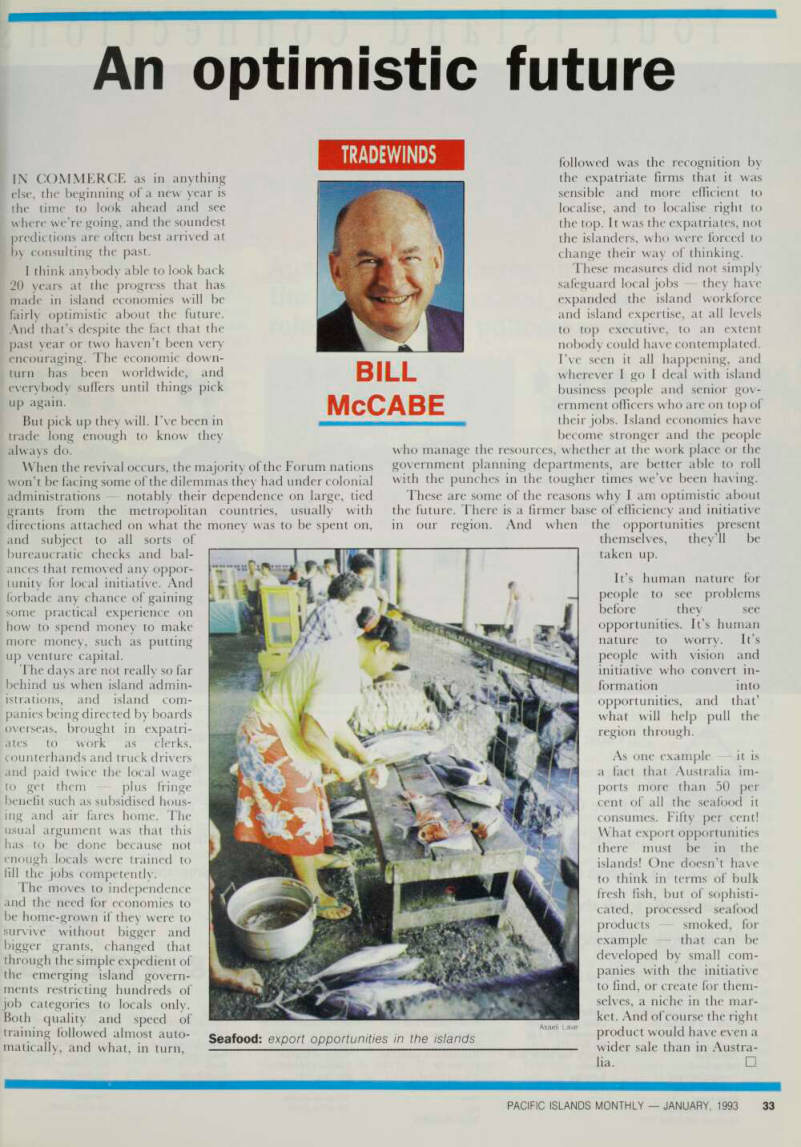
IN COMMERCE as in anything else, the beginning of a new year is the time to look ahead and see where we’re going, and the soundest predictions are often best arrived at by consulting the past.
I think anybody able to look back 20 years at the progress that has made in island economies will be fairly optimistic about the future.
And that’s despite the fact that the past year or two haven’t been very encouraging. The economic down turn has been worldwide, and everybody suffers until things pick
up again.
But pick up they will. I've been in
trade long enough to know they
always do.
When the revival occurs, the majority of the Forum nations won’t be facing some of the dilemmas they had under colonial administrations notably their dependence on large, tied grants from the metropolitan countries, usually with directions attached on what the money was to be spent on,
and subject to all sorts of bureaucratic checks and bal ances that removed any oppor tunity for local initiative. And forbade any chance of gaining : some practical experience on how to spend money to make more money, such as putting up venture capital.
The days are not really so far behind us when island admin istrations, and island com panies being directed by boards overseas, brought in expatri ates to work as clerks, counterhands and truck drivers and paid twice the local wage to get them plus fringe benefit such as subsidised hous ing and air fares home. The usual argument was that this has to be done because not enough locals were trained to till the jobs competently.
The moves to independence and the need for economies to be home-grown if they were to survive without bigger and bigger grants, changed that through the simple expedient of the emerging island govern ments restricting hundreds of job categories to locals only.
Both quality and speed of training followed almost auto matically, and what, in turn,
followed was the recognition by the expatriate firms that it was sensible and more efficient to localise, and to localise right to the top. It was the expatriates, not the islanders, who were forced to change their way of thinking.
These measures did not simply
safeguard local jobs they have
expanded the island workforce and island expertise, at all levels to top executive, to an extent
nobody could have contemplated.
I’ve seen it all happening, and wherever I go I deal with island business people and senior gov ernment officers who are on top of their jobs. Island economies have become stronger and the people
who manage the resources, whether at the work place or the government planning departments, are better able to roll with the punches in the tougher times we’ve been having.
These are some of the reasons why I am optimistic about the future. There is a firmer base of efficiency and initiative in our region. And when the opportunities present
themselves, they’ll be taken up.
It’s human nature for people to see problems before they see opportunities. It’s human nature to worry. It’s people with vision and initiative who convert in formation into opportunities, and that’ what will help pull the
region through.
As one example it is a fact that Australia im ports more than 50 per cent of all the seafood it consumes. Fifty per cent!
What export opportunities there must be in the islands! One doesn’t have to think in terms of bulk fresh fish, but of sophisti cated, processed seafood products smoked, for example that can be developed by small com panies with the initiative to find, or create for them selves, a niche in the mar ket. And of course the right product would have even a wider sale than in Austra lia. □
Tradewinds
Bill
Mccabe
Seafood: export opportunities in the islands
Asaeli Lave
Advertisements & other items, p. 34 (1 item)
Cable & Wireless
■ - * m m * m
Cable and Wireless began keep-
'S ing people in touch around the world more than a century ago. Today,
while the technology has changed,
the tradition of service to our customers in the
South Pacific is just the same.
We work in partnership with Governments,
dedicated to meeting the need of communities and businesses to stay in touch. From one island to the next or to the other side of the world, the message is the same: Cable and Wireless is
your South Pacific
connection bringing the
islands together.
CABLE & WIRELESS
Asia Pacific Head Office Cable and Wireless pic Cable and Wireless (Pacific) Limited 22 nd Floor Office Tower Convention Plaza 1 Harbour Road Hong Kong Tel: (852)848 8620 Facsimile: (852) 868 5195 Australia Cable and Wireless (Australia) Pty Ltd PO Box 675, Double Bay NSW 2028 Sydney Australia Tel/Fax (61-2) 362 3625 Fiji In association with the Government of Fiji Fiji International Telecommunications Ltd.
P.O. Box 59 Mercury House 158 Victoria Parade Suva Fiji Tel: (679) 312933 Solomon Islands In association with the Government of the Solomon Islands Solomon Telekom Company Limited P.O. Box 148 Honiara Solomon Islands Tel: (677) 21576 Tonga Cable and Wireless pic Private Mail Bag 4 General Post Office Nuku Alofa Tonga South Pacific Tel: (676) 23499 Vanuatu In association with the Government of Vanuatu and France Cables et Radio Vanuatu International Telecommunications Ltd.
P.O. Box 164 Port Vila Vanuatu Tel: (678) 22185
Regional
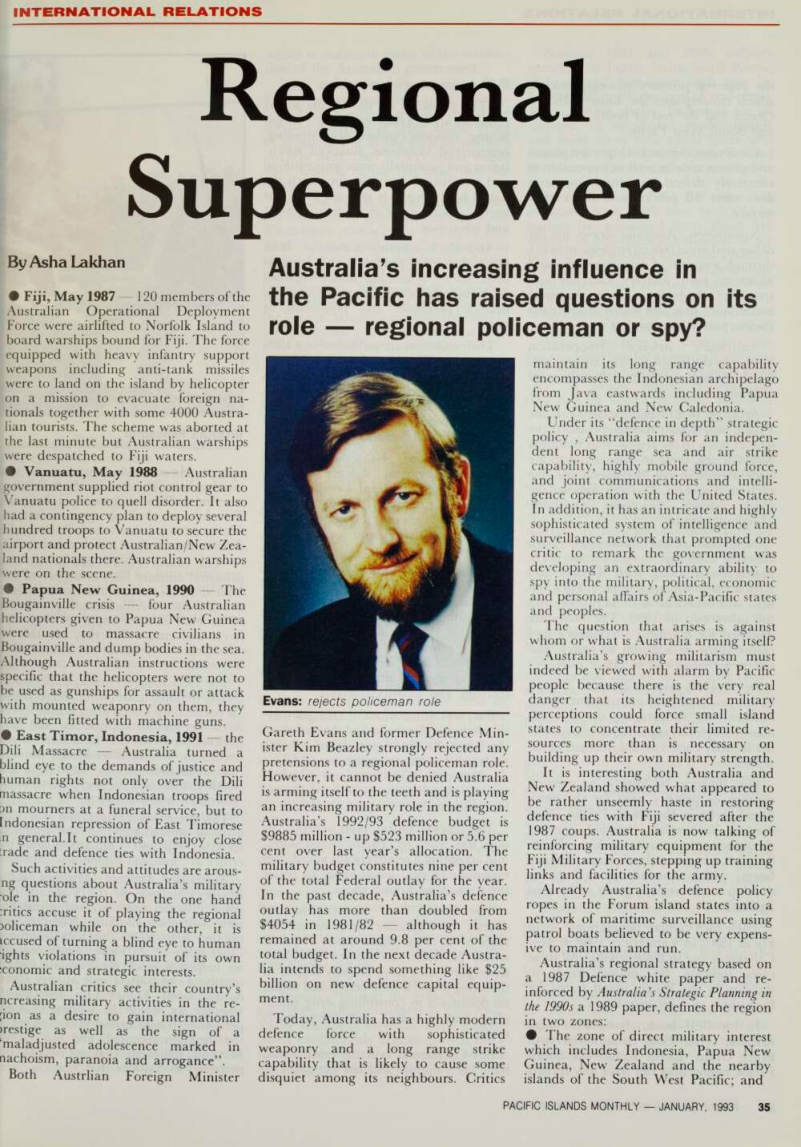
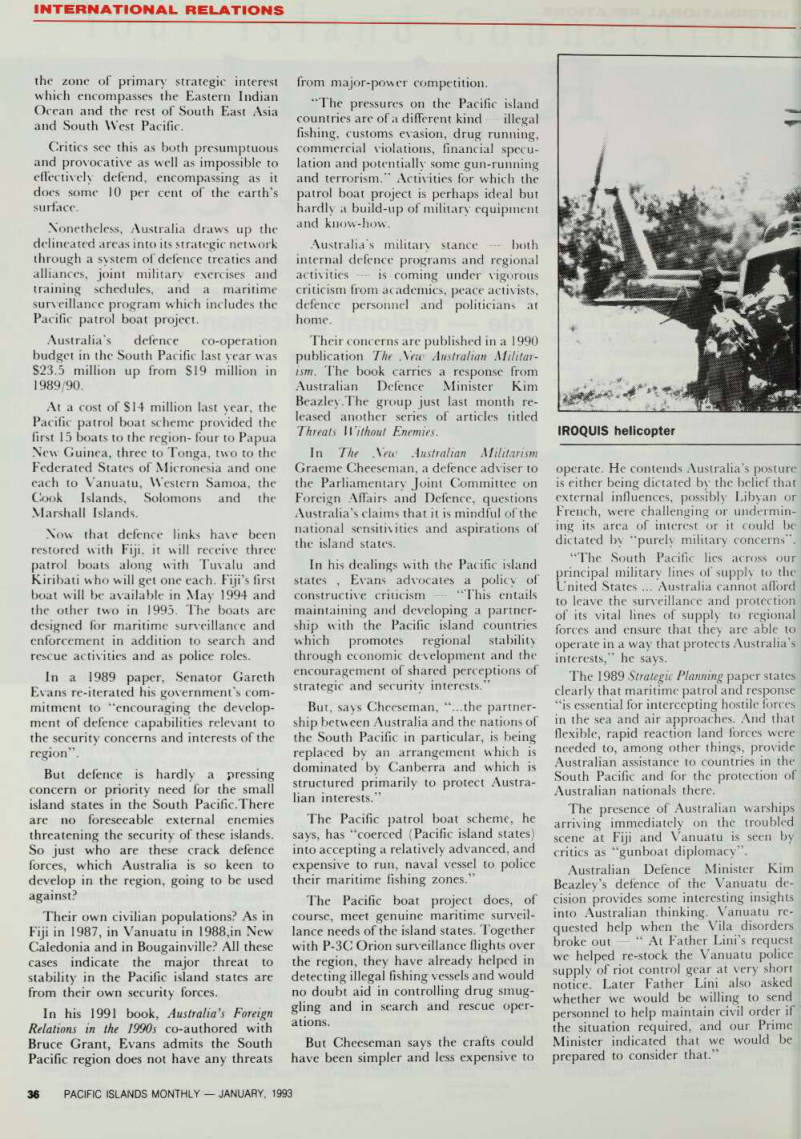
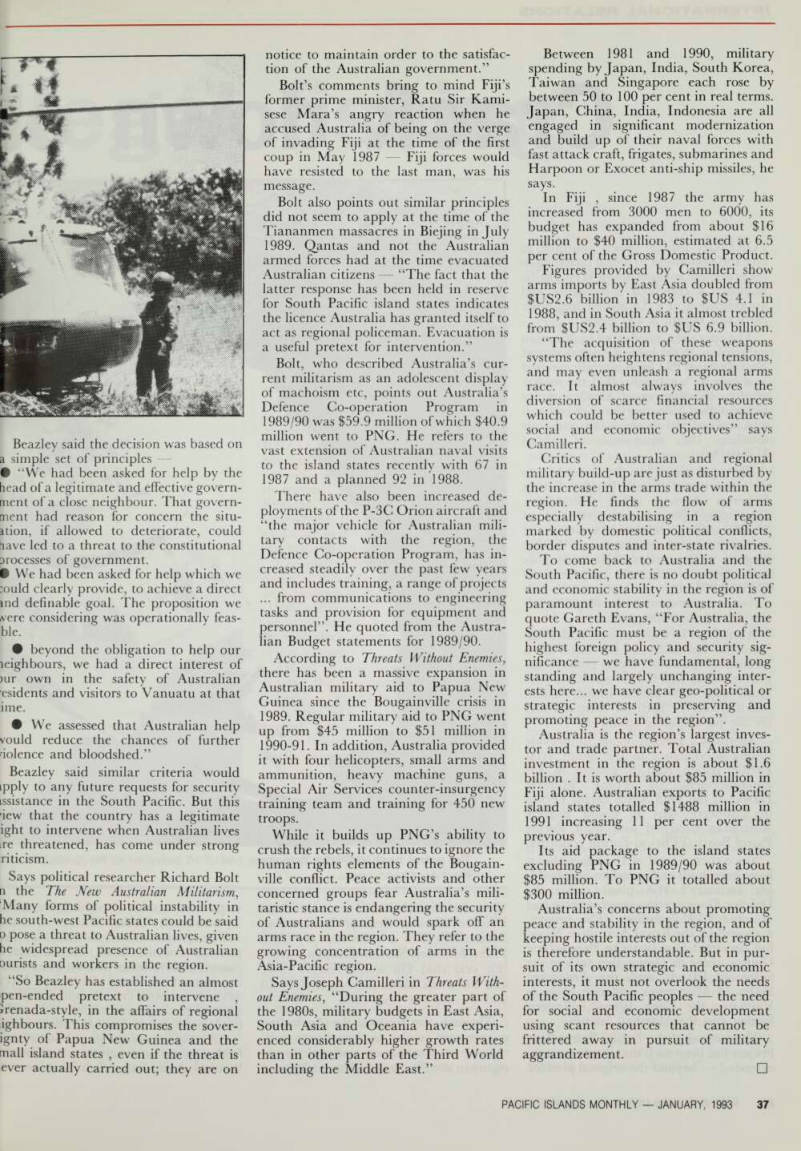
International Relations
Regional Superpower
By Asha Lakhan
Australia’s increasing influence in the Pacific has raised questions on its role regional policeman or spy?
• Fiji, May 1987 - 120 members of the Australian Operational Deployment Force were airlifted to Norfolk Island to board warships bound for Fiji. The force equipped with heavy infantry support weapons including anti-tank missiles were to land on the island by helicopter on a mission to evacuate foreign na tionals together with some 4000 Austra lian tourists. The scheme was aborted at the last minute but Australian warships were despatched to Fiji waters. • Vanuatu, May 1988 - Australian government supplied riot control gear to Vanuatu police to quell disorder. It also had a contingency plan to deploy several hundred troops to Vanuatu to secure the airport and protect Australian/New Zea land nationals there. Australian warships were on the scene. • Papua New Guinea, 1990 The Bougainville crisis four Australian helicopters given to Papua New Guinea were used to massacre civilians in Bougainville and dump bodies in the sea.
Although Australian instructions were specific that the helicopters were not to be used as gunships for assault or attack with mounted weaponry on them, they have been fitted with machine guns. • East Timor, Indonesia, 1991 - the Dili Massacre Australia turned a blind eye to the demands of justice and human rights not only over the Dili massacre when Indonesian troops fired 3n mourners at a funeral service, but to Indonesian repression of East Timorese n general.lt continues to enjoy close ;rade and defence ties with Indonesia.
Such activities and attitudes are arous ng questions about Australia’s military ole in the region. On the one hand :ritics accuse it of playing the regional policeman while on the other, it is iccused of turning a blind eye to human ights violations in pursuit of its own ;conomic and strategic interests.
Australian critics see their country’s ncreasing military activities in the re gion as a desire to gain international )restige as well as the sign of a ‘maladjusted adolescence marked in nachoism, paranoia and arrogance”.
Both Austrlian Foreign Minister
Gareth Evans and former Defence Min ister Kim Beazley strongly rejected any pretensions to a regional policeman role.
However, it cannot be denied Australia is arming itself to the teeth and is playing an increasing military role in the region.
Australia’s 1992/93 defence budget is $9885 million - up $523 million or 5.6 per cent over last year’s allocation. The military budget constitutes nine per cent of the total Federal outlay for the year.
In the past decade, Australia’s defence outlay has more than doubled from $4054 in 1981/82 although it has remained at around 9.8 per cent of the total budget. In the next decade Austra lia intends to spend something like $25 billion on new defence capital equip ment.
Today, Australia has a highly modern defence force with sophisticated weaponry and a long range strike capability that is likely to cause some disquiet among its neighbours. Critics
maintain its long range capability encompasses the Indonesian archipelago from Java eastwards including Papua New Guinea and New Caledonia.
Under its “defence in depth” strategic policy , Australia aims for an indepen dent long range sea and air strike capability, highly mobile ground force, and joint communications and intelli gence operation with the United States.
In addition, it has an intricate and highly sophisticated system of intelligence and surveillance network that prompted one critic to remark the government was developing an extraordinary ability to spy into the military, political, economic and personal affairs of Asia-Pacific states and peoples.
The question that arises is against whom or what is Australia arming itself?
Australia’s growing militarism must indeed be viewed with alarm by Pacific people because there is the very real danger that its heightened military perceptions could force small island states to concentrate their limited re sources more than is necessary on building up their own military strength.
It is interesting both Australia and New Zealand showed what appeared to be rather unseemly haste in restoring defence ties with Fiji severed after the 1987 coups. Australia is now talking of reinforcing military equipment for the
Fiji Military Forces, stepping up training
links and facilities for the army.
Already Australia’s defence policy ropes in the Forum island states into a network of maritime surveillance using patrol boats believed to be very expens ive to maintain and run.
Australia’s regional strategy based on a 1987 Defence white paper and re inforced by Australia's Strategic Planning in the 1990 s a 1989 paper, defines the region in two zones: • The zone of direct military interest which includes Indonesia, Papua New Guinea, New Zealand and the nearby islands of the South West Pacific; and
Evans: rejects policeman role
the zone of primary strategic interest which encompasses the Eastern Indian Ocean and the rest of South East Asia and South West Pacific.
Critics see this as both presumptuous and provocative as well as impossible to effectively defend, encompassing as it docs some 10 per cent of the earth’s surface.
Nonetheless, Australia draws up the delineated areas into its strategic network through a system of defence treaties and alliances, joint military exercises and training schedules, and a maritime surveillance program which includes the Pacific patrol boat project.
Australia's defence co-operation budget in the South Pacific last year was 523.5 million up from Sl9 million in 1989/90.
At a cost of Sl4 million last year, the Pacific patrol boat scheme provided the first 15 boats to the region- four to Papua New Guinea, three to Tonga, two to the Federated States of Micronesia and one each to Vanuatu, Western Samoa, the Cook Islands, Solomons and the Marshall Islands.
Now that defence links have been restored with Fiji, it will receive three patrol boats along with Tuvalu and Kiribati who will get one each. Fiji’s first boat will be available in May 1994 and the other two in 1995. The boats are designed for maritime surveillance and enforcement in addition to search and rescue activities and as police roles.
In a 1989 paper, Senator Gareth Evans re-iterated his government’s com mitment to “encouraging the develop ment of defence capabilities relevant to the security concerns and interests of the region”.
But defence is hardly a pressing concern or priority need for the small island states in the South Pacific. There are no foreseeable external enemies threatening the security of these islands.
So just who are these crack defence forces, which Australia is so keen to develop in the region, going to be used against?
Their own civilian populations? As in Fiji in 1987, in Vanuatu in 1988,in New Caledonia and in Bougainville? All these cases indicate the major threat to stability in the Pacific island states are from their own security forces.
In his 1991 book, Australia’s Foreign Relations in the 1990 s co-authored with Bruce Grant, Evans admits the South Pacific region does not have any threats
from major-power competition.
“The pressures on the Pacific island countries are of a different kind illegal fishing, customs evasion, drug running, commercial violations, financial specu lation and potentially some gun-running and terrorism." Activities for which the patrol boat project is perhaps ideal but hardly a build-up of military equipment and know-how.
Australia's military stance both internal defence programs and regional activities is coming under vigorous criticism from academics, peace activists, defence personnel and politicians at home.
Their concerns are published in a 1990 publication The Mew Australian Militar ism. The book carries a response from Australian Defence Minister Kim Beazley.The group just last month re leased another series of articles titled Threats W ithout Enemies.
In The A 'ew Australian Militarism Graeme Cheeseman, a defence adviser to the Parliamentary Joint Committee on Foreign Affairs and Defence, questions Australia’s claims that it is mindful of the national sensitivities and aspirations of the island states.
In his dealings with the Pacific island states , Evans advocates a policy of constructive criticism “This entails maintaining and developing a partner ship with the Pacific island countries which promotes regional stability through economic development and the encouragement of shared perceptions of strategic and security interests.”
But, says Cheeseman, “...the partner ship between Australia and the nations of the South Pacific in particular, is being replaced by an arrangement which is dominated by Canberra and which is structured primarily to protect Austra lian interests.”
The Pacific patrol boat scheme, he says, has “coerced (Pacific island states) into accepting a relatively advanced, and expensive to run, naval vessel to police their maritime fishing zones.”
The Pacific boat project does, of course, meet genuine maritime surveil lance needs of the island states. Together with P-3C Orion surveillance flights over the region, they have already helped in detecting illegal fishing vessels and would no doubt aid in controlling drug smug gling and in search and rescue oper ations.
But Cheeseman says the crafts could have been simpler and less expensive to
operate. He contends Australia’s posture is either being dictated by the belief that external influences, possibly Libyan or French, were challenging or undermin ing its area of interest or it could be dictated by “purely military concerns".
“The South Pacific lies across our principal military lines of supply to the United States ... Australia cannot afford to leave the surveillance and protection of its vital lines of supply to regional forces and ensure that they are able to operate in a way that protects Australia’s interests," he says.
The 1989 Strategic Planning paper states clearly that maritime patrol and response “is essential for intercepting hostile forces in the sea and air approaches. And that flexible, rapid reaction land forces were needed to, among other things, provide Australian assistance to countries in the South Pacific and for the protection of Australian nationals there.
The presence of Australian warships arriving immediately on the troubled scene at Fiji and Vanuatu is seen by
critics as “gunboat diplomacy”.
Australian Defence Minister Kim Beazley’s defence of the Vanuatu de cision provides some interesting insights into Australian thinking. Vanuatu re quested help when the Vila disorders broke out “ At Father Lini’s request we helped re-stock the Vanuatu police supply of riot control gear at very short notice. Later Father Lini also asked whether we would be willing to send personnel to help maintain civil order if the situation required, and our Prime Minister indicated that we would be prepared to consider that.”
IROQUIS helicopter
Beazley said the decision was based on a simple set of principles “We had been asked for help by the head of a legitimate and effective govern ment of a close neighbour. That govern ment had reason for concern the situ ation, if allowed to deteriorate, could have led to a threat to the constitutional processes of government. • We had been asked for help which we :ould clearly provide, to achieve a direct and definable goal. The proposition we vere considering was operationally feas ble. • beyond the obligation to help our aeighbours, we had a direct interest of >ur own in the safety of Australian esidents and visitors to Vanuatu at that ime. • We assessed that Australian help vould reduce the chances of further holence and bloodshed.”
Beazley said similar criteria would ipply to any future requests for security issistance in the South Pacific. But this hew that the country has a legitimate ight to intervene when Australian lives ire threatened, has come under strong riticism.
Says political researcher Richard Bolt n the The JVew Australian Militarism , Many forms of political instability in he south-west Pacific states could be said o pose a threat to Australian lives, given he widespread presence of Australian ourists and workers in the region.
“So Beazley has established an almost pen-ended pretext to intervene , Irenada-style, in the affairs of regional ighbours. This compromises the sover ignty of Papua New Guinea and the mall island states , even if the threat is ever actually carried out; they are on
notice to maintain order to the satisfac tion of the Australian government.”
Bolt’s comments bring to mind Fiji’s former prime minister, Ratu Sir Kami sese Mara’s angry reaction when he accused Australia of being on the verge of invading Fiji at the time of the first coup in May 1987 Fiji forces would have resisted to the last man, was his message.
Bolt also points out similar principles did not seem to apply at the time of the Tiananmen massacres in Biejing in July 1989. Qantas and not the Australian armed forces had at the time evacuated Australian citizens “The fact that the latter response has been held in reserve for South Pacific island states indicates the licence Australia has granted itself to act as regional policeman. Evacuation is a useful pretext for intervention.”
Bolt, who described Australia’s cur rent militarism as an adolescent display of machoism etc, points out Australia’s Defence Co-operation Program in 1989/90 was $59.9 million of which $40.9 million went to PNG. He refers to the vast extension of Australian naval visits to the island states recently with 67 in 1987 and a planned 92 in 1988.
There have also been increased de ployments of the P-3C Orion aircraft and “the major vehicle for Australian mili tary contacts with the region, the Defence Co-operation Program, has in creased steadily over the past few years and includes training, a range of projects ... from communications to engineering tasks and provision for equipment and personnel”. He quoted from the Austra lian Budget statements for 1989/90.
According to Threats Without Enemies , there has been a massive expansion in Australian military aid to Papua New Guinea since the Bougainville crisis in 1989. Regular military aid to PNG went up from $45 million to $5l million in 1990-91. In addition, Australia provided it with four helicopters, small arms and ammunition, heavy machine guns, a
Special Air Services counter-insurgency
training team and training for 450 new troops.
While it builds up PNG’s ability to crush the rebels, it continues to ignore the human rights elements of the Bougain ville conflict. Peace activists and other concerned groups fear Australia’s mili taristic stance is endangering the security of Australians and would spark off an arms race in the region. They refer to the growing concentration of arms in the Asia-Pacific region.
Says Joseph Camilleri in Threats With out Enemies , “During the greater part of the 1980 s, military budgets in East Asia, South Asia and Oceania have experi enced considerably higher growth rates than in other parts of the Third World including the Middle East.”
Between 1981 and 1990, military spending by Japan, India, South Korea, Taiwan and Singapore each rose by between 50 to 100 per cent in real terms.
Japan, China, India, Indonesia are all engaged in significant modernization and build up of their naval forces with fast attack craft, frigates, submarines and Harpoon or Exocet anti-ship missiles, he says.
In Fiji , since 1987 the army has increased from 3000 men to 6000, its budget has expanded from about $l6 million to $4O million, estimated at 6.5 per cent of the Gross Domestic Product.
Figures provided by Camilleri show arms imports by East Asia doubled from SUS 2.6 billion in 1983 to SUS 4.1 in 1988, and in South Asia it almost trebled from SUS 2.4 billion to SUS 6.9 billion.
“The acquisition of these weapons systems often heightens regional tensions, and may even unleash a regional arms race. It almost always involves the diversion of scarce financial resources which could be better used to achieve social and economic objectives” says Camilleri.
Critics of Australian and regional military build-up are just as disturbed by the increase in the arms trade within the region. He finds the flow of arms especially destabilising in a region marked by domestic political conflicts, border disputes and inter-state rivalries.
To come back to Australia and the South Pacific, there is no doubt political and economic stability in the region is of paramount interest to Australia. To quote Gareth Evans, “For Australia, the South Pacific must be a region of the highest foreign policy and security sig nificance we have fundamental, long standing and largely unchanging inter ests here... we have clear geo-political or strategic interests in preserving and promoting peace in the region”.
Australia is the region’s largest inves tor and trade partner. Total Australian investment in the region is about $1.6 billion . It is worth about $B5 million in Fiji alone. Australian exports to Pacific island states totalled $l4BB million in 1991 increasing 11 per cent over the
previous year.
Its aid package to the island states excluding PNG in 1989/90 was about $B5 million. To PNG it totalled about $3OO million.
Australia’s concerns about promoting peace and stability in the region, and of keeping hostile interests out of the region is therefore understandable. But in pur suit of its own strategic and economic interests, it must not overlook the needs of the South Pacific peoples the need for social and economic development using scant resources that cannot be frittered away in pursuit of military
aggrandizement.
Crack down or [?]llegal fishing
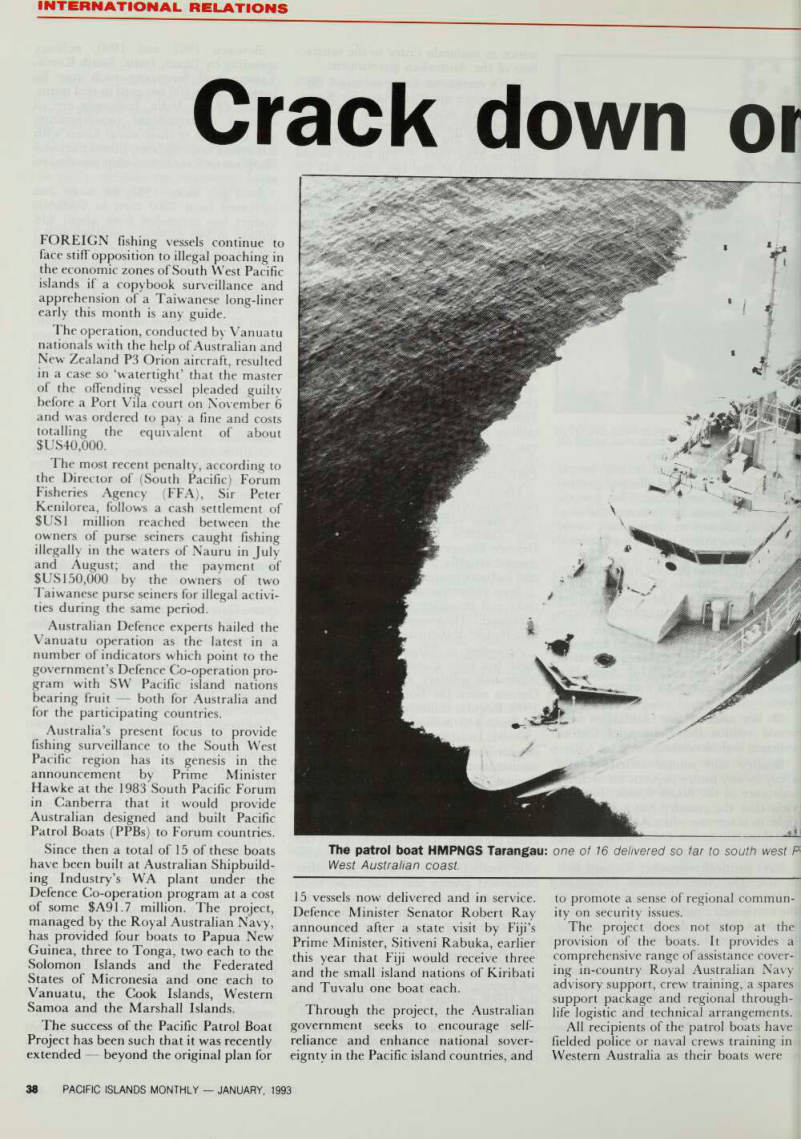
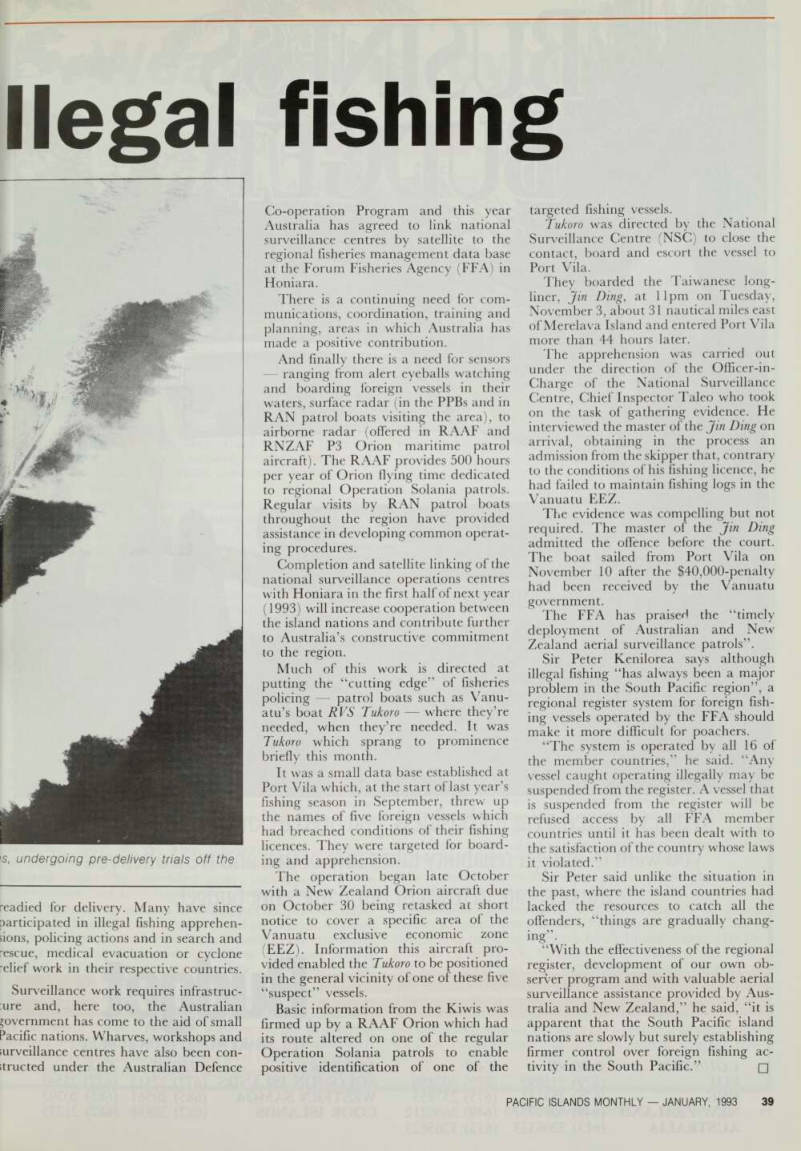
FOREIGN fishing vessels continue to face stiff opposition to illegal poaching in the economic zones of South West Pacific islands if a copybook surveillance and apprehension of a Taiwanese long-liner early this month is any guide.
The operation, conducted by Vanuatu nationals with the help of Australian and New Zealand P 3 Orion aircraft, resulted in a case so ‘watertight’ that the master of the offending vessel pleaded guilty before a Port Vila court on November 6 and was ordered to pay a fine and costs totalling the equivalent of about
Sus4O,Ooo.
The most recent penalty, according to the Director of (South Pacific) Forum Fisheries Agency (FFA), Sir Peter Kenilorea, follows a cash settlement of SUSI million reached between the owners of purse seiners caught fishing illegally in the waters of Nauru in July and August; and the payment of SUS 150,000 by the owners of two Taiwanese purse seiners for illegal activi ties during the same period.
Australian Defence experts hailed the Vanuatu operation as the latest in a number of indicators which point to the government’s Defence Co-operation pro gram with SW Pacific island nations bearing fruit both for Australia and for the participating countries.
Australia’s present focus to provide fishing surveillance to the South West Pacific region has its genesis in the announcement by Prime Minister Hawke at the 1983 South Pacific Forum in Canberra that it would provide Australian designed and built Pacific Patrol Boats (PPBs) to Forum countries.
Since then a total of 15 of these boats have been built at Australian Shipbuild ing Industry’s WA plant under the Defence Co-operation program at a cost of some 5A91.7 million. The project, managed by the Royal Australian Navy, has provided four boats to Papua New Guinea, three to Tonga, two each to the Solomon Islands and the Federated States of Micronesia and one each to Vanuatu, the Cook Islands, Western Samoa and the Marshall Islands.
The success of the Pacific Patrol Boat Project has been such that it was recently extended beyond the original plan for
15 vessels now delivered and in service.
Defence Minister Senator Robert Ray announced after a state visit by Fiji’s Prime Minister, Sitiveni Rabuka, earlier this year that Fiji would receive three and the small island nations of Kiribati and Tuvalu one boat each.
Through the project, the Australian government seeks to encourage self reliance and enhance national sover eignty in the Pacific island countries, and
to promote a sense of regional commun ity on security issues.
The project does not stop at the provision of the boats. It provides a comprehensive range of assistance cover ing in-country Royal Australian Navy advisory support, crew training, a spares support package and regional through life logistic and technical arrangements.
All recipients of the patrol boats have fielded police or naval crews training in Western Australia as their boats were
The patrol boat HMPNGS Tarangau: one of 16 delivered so far to south west P[?] West Australian coast.
readied for delivery. Many have since participated in illegal fishing apprehen sions, policing actions and in search and rescue, medical evacuation or cyclone "elief work in their respective countries.
Surveillance work requires infrastruc ture and, here too, the Australian government has come to the aid of small Pacific nations. Wharves, workshops and surveillance centres have also been con structed under the Australian Defence
Co-operation Program and this year Australia has agreed to link national surveillance centres by satellite to the regional fisheries management data base at the Forum Fisheries Agency (FFA) in Honiara.
There is a continuing need for com munications, coordination, training and planning, areas in which Australia has made a positive contribution.
And finally there is a need for sensors ranging from alert eyeballs watching and boarding foreign vessels in their waters, surface radar (in the PPBs and in RAN patrol boats visiting the area), to airborne radar (offered in RAAF and
RNZAF P 3 Orion maritime patrol
aircraft). The RAAF provides 500 hours per year of Orion flying time dedicated
to regional Operation Solania patrols.
Regular visits by RAN patrol boats throughout the region have provided assistance in developing common operat
ing procedures.
Completion and satellite linking of the national surveillance operations centres with Honiara in the first half of next year (1993) will increase cooperation between the island nations and contribute further to Australia’s constructive commitment to the region.
Much of this work is directed at putting the “cutting edge” of fisheries policing patrol boats such as Vanu atu’s boat RVS Tukoro where they’re needed, when they’re needed. It was Tukoro which sprang to prominence briefly this month.
It was a small data base established at Port Vila which, at the start of last year’s fishing season in September, threw up the names of five foreign vessels which had breached conditions of their fishing licences. They were targeted for board
ing and apprehension.
The operation began late October with a New Zealand Orion aircraft due on October 30 being retasked at short notice to cover a specific area of the Vanuatu exclusive economic zone (EEZ). Information this aircraft pro vided enabled the Tukoro to be positioned in the general vicinity of one of these five
“suspect” vessels.
Basic information from the Kiwis was firmed up by a RAAF Orion which had its route altered on one of the regular Operation Solania patrols to enable positive identification of one of the
targeted fishing vessels.
Tukoro was directed by the National Surveillance Centre (NSC) to close the contact, board and escort the vessel to Port Vila.
They boarded the Taiwanese long liner, Jin Ding , at 11pm on Tuesday, November 3, about 31 nautical miles east of Merelava Island and entered Port Vila more than 44 hours later.
The apprehension was carried out under the direction of the Oflicer-in- Charge of the National Surveillance Centre, Chief Inspector Taleo who took on the task of gathering evidence. He interviewed the master of the Jin Ding on arrival, obtaining in the process an admission from the skipper that, contrary to the conditions of his fishing licence, he had failed to maintain fishing logs in the Vanuatu EEZ.
The evidence was compelling but not required. The master of the Jin Ding admitted the offence before the court.
The boat sailed from Port Vila on November 10 after the $40,000-penalty had been received by the Vanuatu government.
The FFA has praised the “timely deployment of Australian and New Zealand aerial surveillance patrols”.
Sir Peter Kenilorea says although illegal fishing “has always been a major problem in the South Pacific region”, a regional register system for foreign fish ing vessels operated by the FFA should make it more difficult for poachers.
“The system is operated by all 16 of the member countries,” he said. “Any vessel caught operating illegally may be suspended from the register. A vessel that is suspended from the register will be refused access by all FFA member countries until it has been dealt with to the satisfaction of the country whose laws it violated.”
Sir Peter said unlike the situation in the past, where the island countries had lacked the resources to catch all the offenders, “things are gradually chang ing”.
“With the effectiveness of the regional register, development of our own ob server program and with valuable aerial surveillance assistance provided by Aus tralia and New Zealand,” he said, “it is apparent that the South Pacific island nations are slowly but surely establishing firmer control over foreign fishing ac tivity in the South Pacific.” □
is, undergoing pre- delivery trials off the
Advertisements & other items, p. 40 (1 item)
Budget
When you need a car for business, you need to know it’s there when you want it. Budget reliability takes care of that and well offer you the best rate in town or our names not budget.
COUNTRY
FIJI
PNG
NEW ZEALAND
AUSTRALIA
Budget
THE SMART MONEY IS ON BUDGET
PHONE FAX
(679) 315899 (679) 302450 (675) 254111 (675) 257853 (649) 3096737 (649) 3660212 (613) 3206333 (613) 3265623
COUNTRY PHONE FAX
SOLOMON ISLANDS (677) 22313 (677) 23593
WESTERN SAMOA (685) 20561 (685) 20393
COOK ISLANDS (682) 20888 (682) 21275
Weathering cyclones
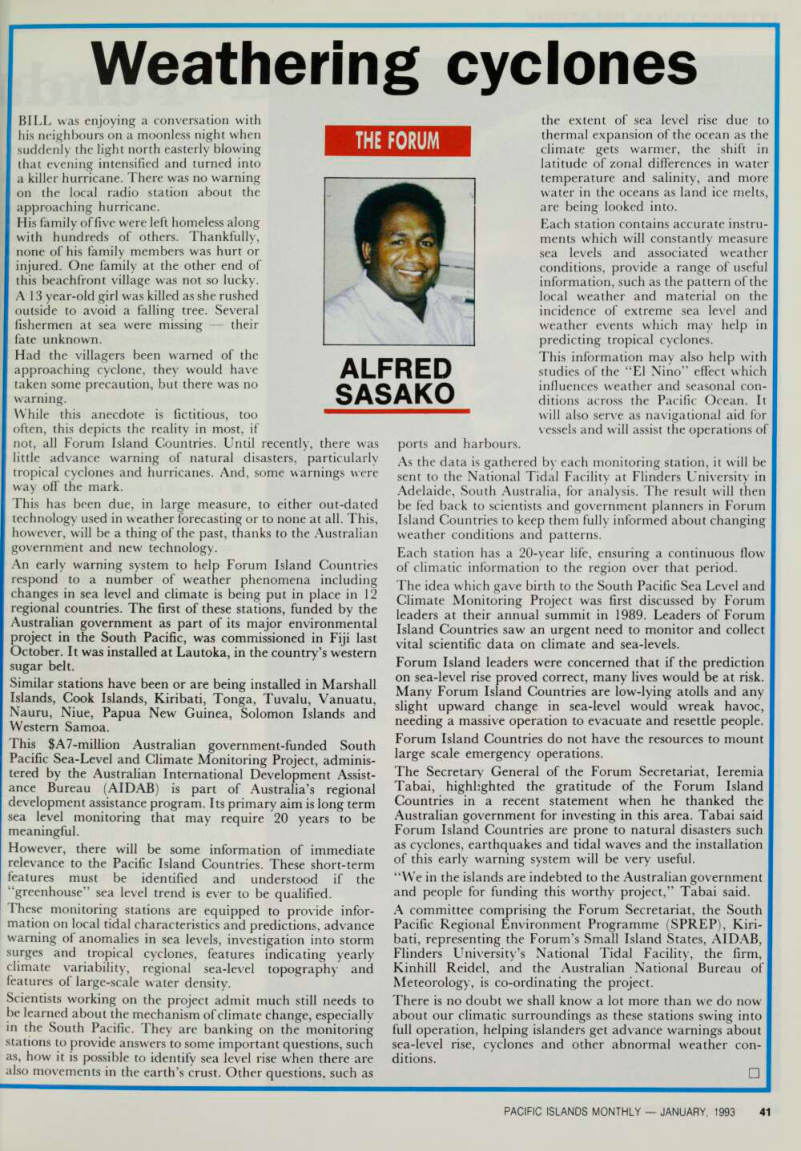
BILL was enjoying a conversation with his neighbours on a moonless night when suddenly the light north easterly blowing that evening intensified and turned into a killer hurricane. There was no warning on the local radio station about the
approaching hurricane.
His family of five were left homeless along with hundreds of others. Thankfully, none of his family members was hurt or injured. One family at the other end of this beachfront village was not so lucky.
Al 3 year-old girl was killed as she rushed outside to avoid a falling tree. Several fishermen at sea were missing their fate unknown.
Had the villagers been warned of the approaching cyclone, they would have taken some precaution, but there was no warning.
While this anecdote is fictitious, too often, this depicts the reality in most, if
not, all Forum Island Countries. Until recently, there was little advance warning of natural disasters, particularly tropical cyclones and hurricanes. And, some warnings were way off the mark.
This has been due, in large measure, to either out-dated technology used in weather forecasting or to none at all. This, however, will be a thing of the past, thanks to the Australian government and new technology.
An early warning system to help Forum Island Countries respond to a number of weather phenomena including changes in sea level and climate is being put in place in 12 regional countries. The first of these stations, funded by the Australian government as part of its major environmental project in the South Pacific, was commissioned in Fiji last October. It was installed at Lautoka, in the country’s western sugar belt.
Similar stations have been or are being installed in Marshall Islands, Cook Islands, Kiribati, Tonga, Tuvalu, Vanuatu, Nauru, Niue, Papua New Guinea, Solomon Islands and Western Samoa.
This SA7-million Australian government-funded South Pacific Sea-Level and Climate Monitoring Project, adminis tered by the Australian International Development Assist ance Bureau (AIDAB) is part of Australia’s regional development assistance program. Its primary aim is long term sea level monitoring that may require 20 years to be meaningful.
However, there will be some information of immediate relevance to the Pacific Island Countries. These short-term features must be identified and understood if the “greenhouse” sea level trend is ever to be qualified.
These monitoring stations are equipped to provide infor mation on local tidal characteristics and predictions, advance warning of anomalies in sea levels, investigation into storm surges and tropical cyclones, features indicating yearly climate variability, regional sea-level topography and features of large-scale water density.
Scientists working on the project admit much still needs to be learned about the mechanism of climate change, especially in the South Pacific. They are banking on the monitoring stations to provide answers to some important questions, such as, how it is possible to identify sea level rise when there are also movements in the earth’s crust. Other questions, such as
the extent of sea level rise due to thermal expansion of the ocean as the climate gets warmer, the shift in latitude of zonal differences in water temperature and salinity, and more water in the oceans as land ice melts, are being looked into.
Each station contains accurate instru ments which will constantly measure sea levels and associated weather conditions, provide a range of useful information, such as the pattern of the local weather and material on the incidence of extreme sea level and weather events which may help in
predicting tropical cyclones.
This information may also help with studies of the “El Nino” effect which influences weather and seasonal con ditions across the Pacific Ocean. It will also serve as navigational aid for vessels and will assist the operations of
ports and harbours.
As the data is gathered by each monitoring station, it will be sent to the National Tidal Facility at Flinders University in Adelaide, South Australia, for analysis. The result will then be fed back to scientists and government planners in Forum Island Countries to keep them fully informed about changing weather conditions and patterns.
Each station has a 20-year life, ensuring a continuous flow of climatic information to the region over that period.
The idea which gave birth to the South Pacific Sea Level and Climate Monitoring Project was first discussed by Forum leaders at their annual summit in 1989. Leaders of Forum Island Countries saw an urgent need to monitor and collect vital scientific data on climate and sea-levels.
Forum Island leaders were concerned that if the prediction on sea-level rise proved correct, many lives would be at risk.
Many Forum Island Countries are low-lying atolls and any slight upward change in sea-level would wreak havoc, needing a massive operation to evacuate and resettle people.
Forum Island Countries do not have the resources to mount
large scale emergency operations.
The Secretary General of the Forum Secretariat, leremia Tabai, highlighted the gratitude of the Forum Island Countries in a recent statement when he thanked the Australian government for investing in this area. Tabai said Forum Island Countries are prone to natural disasters such as cyclones, earthquakes and tidal waves and the installation of this early warning system will be very useful.
“We in the islands are indebted to the Australian government and people for funding this worthy project,” Tabai said.
A committee comprising the Forum Secretariat, the South
Pacific Regional Environment Programme (SPREP), Kiri
bati, representing the Forum’s Small Island States, AIDAB, Flinders University’s National Tidal Facility, the firm, Kinhill Reidel, and the Australian National Bureau of Meteorology, is co-ordinating the project.
There is no doubt we shall know a lot more than we do now about our climatic surroundings as these stations swing into full operation, helping islanders get advance warnings about sea-level rise, cyclones and other abnormal weather con ditions.
The Forum
Alfred
Sasako
Fundamental Differences
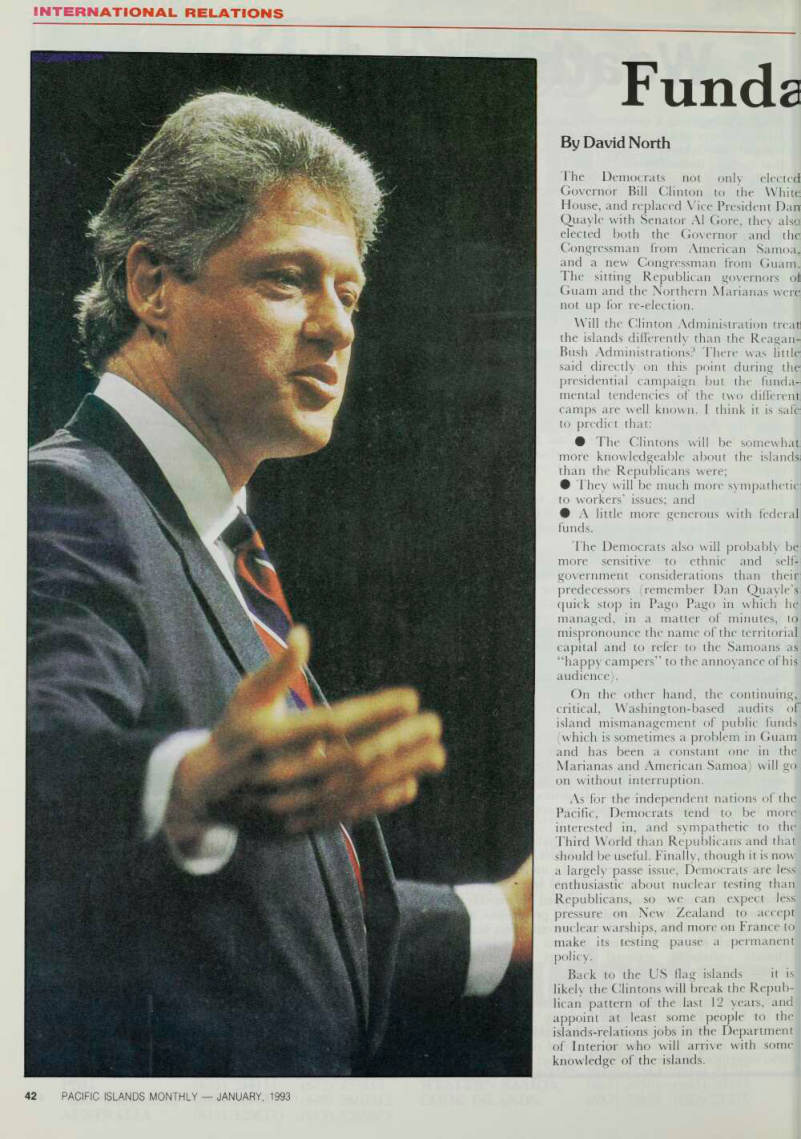
By David North
The Democrats not only elected Governor Bill Clinton to the White House, and replaced Vice President Dan Quayle with Senator A 1 Gore, they also elected both the Governor and the Congressman from American Samoa, and a new Congressman from Guam.
The sitting Republican governors oft Guam and the Northern Marianas were not up for re-election.
Will the Clinton Administration treat! the islands differently than the Reagan- Bush Administrations? There was little said directly on this point during the presidential campaign but the funda mental tendencies of the two different] camps are well known. I think it is safe: to predict that: • The Clintons will be somewhat; more knowledgeable about the islands! than the Republicans were; • They will be much more sympathetic: to workers’ issues; and • A little more generous with federal, funds.
The Democrats also will probably be; more sensitive to ethnic and self government considerations than their
predecessors (remember Dan Quayle’s;
quick stop in Pago Pago in which he; managed, in a matter of minutes, to mispronounce the name of the territorial capital and to refer to the Samoans as “happy campers” to the annoyance of his; audience).
On the other hand, the continuing, critical, Washington-based audits of island mismanagement of public funds (which is sometimes a problem in Guam and has been a constant one in the Marianas and American Samoa) will go on without interruption.
As for the independent nations of the Pacific, Democrats tend to be more interested in, and sympathetic to the- Third World than Republicans and that should be useful. Finally, though it is now a largely passe issue, Democrats are less I; enthusiastic about nuclear testing than Republicans, so we can expect less pressure on New Zealand to accept nuclear warships, and more on France to make its testing pause a permanent
policy.
Back to the US flag islands it is likely the Clintons will break the Repub lican pattern of the last 12 years, and appoint at least some people to the ■' islands-relations jobs in the Department of Interior who will arrive with some knowledge of the islands.
Further, a Democratic Congress and a Democratic Labor Department will insist I on higher wages for the garment workers [ on Saipan if the "Made in L T SA” label Icontinues to be attached to the clothing [ made there. Stateside unions will see to 1 that. Further, the two Congressmen most interested in this issue, Lewis Payne (D Virginia) and George Miller (D ICalifornia), chair of the Interior and [ Insular Affairs Committee were re- I elected in the recent election, while the I House member most likely to speak up for CNMFs establishment, Robert Lagomarsino (R California) was [defeated by a Republican who spent money like water in the primary.
Similarly, the Clintons will approach social issues with more sympathy. It will be easier to introduce food stamps, and maybe there will be a totally different stance no appointments will be made of any judges or lawyers who would agree with the tough anti-abortion position taken by Guam.
How will the new Democratic ap pointee handle the continuing desire of the Marianas for more freedom, and of Guam for Commonwealth status? That is hard to say; it depends on who is appointed to what position. While Main land Democrats routinely have a range of predictable views on the status of women and of ethnic minorities, on workers’ rights, and on the need to be supportive of the poor, they do not come with a predictable view about self government-short-of-statehood within the US system.
One thing is sure, however securing statehood for the heavily Democratic (and Black) District of Columbia, and for the Hispanic island of Puerto Rico, will be much more pressing issues to the Clinton White House than concerns regarding levels of self-government in any of the Pacific territories.
Here are some specifics about the US-
Elag islands:
American Samoa With the Presi dent (Clinton) and the new Governor [A. P. Lutali) and the Congressman (Eni F. H. Faleomavaega) all allied to one mother, there should be relatively imooth sailing in Mainland-Amcrican Samoa relations. Samoa (unlike Guam md CNMI) is not seeking to change its )asic relations with Washington, so those horny problems arc avoided.
While in the past there had been a cries of battles between Faleomavaega md former Governor Peter Tali Dolcman, often over who was to get redit for certain federal-island pro
grams, these differences presumably will disappear. The Congressman, the Governor and the Clintons can now move ahead together on such bread-and butter issues as getting food stamps a specialized welfare program) for older and disabled Samoans; similarly there will be no barriers to the introduction of a Mainland-subsidised housing program for military veterans. (Many Samoans enlist in the US armed services, retire after 20 years while still relatively young, and then return to the islands with nice
How will the Demo cratic victories affect relations between Washington and the Pacific Islands?
pensions.) Guam Things will be a little more complicated in the Guam-Mainland scene, as there is a Republican Governor, Joe Ada, along with the newly-elected Democratic Congressman, Robert Un derwood. They probably will wrestle with each other. It is expected Under wood will be far more vigorous in his pursuit of Chamorro rights than his predecessor, Ben Blaz.
But, in contrast to American Samoa, Guam is largely self-sufficient financially (thanks to all those Japanese tourists) and no Mainland interests arc trying to attack a major Guam industry, as is the case with the Marianas. So relations between the island and the Mainland should rock along easily, except for the persisting dispute about Commonwealth status.
The Marianas The outcome of the 1992 elections left the political leadership of the Commonwealth of the Northern Marianas in even worse shape than before.
While both American Samoa and Guam have delegates to the House of Representatives, with large federally funded staffs busily promoting the inter ests of their islands (though no vote on
the floor of the House; CWII’s able envoy to W ashington, Juan N. Babauta, is little more than an elected lobbyist. A Republican, Babauta has one more year to serve of his four-year term as CNMI’s
Washington Representative.
CNMI, for reasons that arc hard to understand, has not opted for the seat in the House of Representatives that it could have for the asking. The scat would give CNMI a place at the table where decisions are made, but apparently the
Republican leadership views asking for a
seat in the House as committing itself too closely to Washington, Meanwhile, in addition to this struc tural problem, the CNMI Governor, Larry Guerrero, has little credibility in Washington. First there was his listless performance last summer at a rare House Committee hearing devoted to his islands, and to the scandalous wages paid to the foreign workers brought into Saipan's garment factories. The Governor show ed no signs of appreciat ing the extent to which his territory was in serious trouble with the Congress over this issue. The clothes, with "Made in USA” labels are brought to the Main land, while the jobs in question have moved from the Mainland to the islands, irking many Stateside Congressmen who formerly had the jobs in their districts
PIM July, 1992 .
Then, in a manoeuver that left Washington heads shaking in disbelief, his press office said Governor Guerrero had held a very fruitful, one-on-one meeting, after the hearing, with the Committee chair. Congressman Miller.
But the meeting never happened.
Apparently believing that things said
to the media in the islands would never get back to Washington, the Governor's office basked in favourable local press for a couple of days. Then all hell broke loose when the strong-minded Chairman found out about the story; his office issued a furious press release and lie immediately sent a team of investigators to find out what was happening on the islands, in the garment factories, and in the barbed-wire enclosed camps where many of the workers live.
So the next time the Marianas w ant to make their case to the Congress thev will not have a Congressman to help them as Samoa and Guam do), will have a Governor whose word means little to the chairman of the all-powerful House Interior and Insular Affairs Committee, and will find the White House is no longer in the hands of their political party.
Advertisements & other items, p. 42 (1 item)
International Relations
The new decision-makers
By David North
THERE w ill be a number of new island focussed decision-makers as a result of Bill Clinton’s election as President of the US Ol particular interest to the US flag islands and Palau, and to some extent FSM and the Marshalls, will be the Assistant Secretary of Interior for Terri torial and International Affairs. This is a presidential appointment, and is cur rently held by Stella Guerra.
Washington speculation is that it is highly unlikely that the Clintons will do what the Republicans have done for over a decade give that job to a deserving Mainland Hispanic politician with no previous contact with the region.
Pedro San Juan (a one-time John Kennedy appointee who switched to Reagan), Rick Montoya, a New’ Mex ican, and Stella Guerra, a Texan, had some good Washington connections, all wanted to be an assistant secretary of something, and none knew much about the Pacific when they were appointed. (There is some speculation the personnel people at the Republican White House thought the job dealt with Puerto Rico, and its Hispanic residents; it does not, but that did not prevent successive appointments of the Hispanics. It was also regarded as a position in which little harm could be done.) In contrast, the Clintons might very well appoint someone who actually know's the territory. The principal name discussed currently in Washington, for the Assistant Secretaryship, is that of Muliufi (Mufi) Hanneman. Of Samoan descent, he holds a degree from Harvard, won a prestigious White House Fellow ship (there are about a dozen a year), and twice sought the Democratic nomi nation for Congress from Hawaii. Cur rently he holds a Cabinet post in the administration of a Clinton ally, Governor John D. Waihee 111 of Hawaii, w'ho is a native Hawaiian and and has himself been mentioned for Secretary of Interior.
Another name heard is that of Jeff Farrow, once the Chairman of the Democratic Party in the US Virgin Islands (in the Caribbean), a one-time staffer to the late, legendary Congress man Phil Burton (D - California and currently staff director of the House Sub committee on Insular Affairs. Farrow managed, among other things, the recent hearings in which the Marianas w r ere politely dragged over the coals for the treatment of alien garment workers.
As the Clinton administration prepares to settle in, speculation is rife on who will succeed Stella Guerra.
Hanneman, however, is said to prefer a comparable job in the Department of Commerce, because of his background in business, and Farrow has irked some people in Washington, so the race is still open. It is highly unlikely to be settled until the new' Secretary of Interior makes his or her recommendation, and no one has been named to that spot at this writing.
It has been a lonely four years for Guerra. Although she had enough politi cal connections to secure the appoint ment 'being both a woman and a Hispanic helped she did not have enough allies elsewhere in town (on Capitol Hill, at the White House, and in the other departments) to help her win the inevitable battles. Further, the pos ition of the Bush Administration, or at least that of its budget people, was often at odds with the interests of the islands, so she had scratchy work to do while on business in the Pacific. Back at the department she had a laid-back and not terribly-supportivc boss, Secretary Manuel Lujan, and she had a reputation of giving her subordinates little freedom of operation.
The Interior jobs are worth struggling for. The assistant secretaryship pays SI 12,000 a year, while the pay of the politically-appointed deputies varies; Houston was paid 568,000 and the other deputy 598,000. And one is obligated, of course, to travel to the islands from time to time, a pleasant duty during Washing ton’s long, cold, and wet winter.
Washington-based salaries are much higher than those in the islands; the Governor of Guam is paid 575,000 a year, and in American Samoa the governor's salary is 550,000 a year. Both
also occupy territorially-provided guber
natorial mansions.
There will be other personnel shifts as by-products of the November elections.
There is some possibility that the del egate from American Samoa, Eni F. H.
Faleomavaega, although he has only two terms under his belt, may, just may have enough seniority and luck to move into a sub-committee chairmanship on the House Foreign Affairs Committee, if
several of the longer-termed Democratic members of the Committee choose to accept other sub-committee chairs in other committees. (In the House one cannot hold more than one sub committee chair.) Falemovaega had been deputy sub committee chair to Congressman Stephen Solarz (D - New York who was essentially redistricted out of a chance to return to the House. Solarz, who knows a lot about the South Pacific, and who is regarded as very competent, may get a major position in the State Depart ment.
The elections will, indirectly and ultimately, probably remove from the government several old Pacific hands now working at the Overseas Private Investment Corporation (OPIC). The agency provides insurance to US com panies investing in what they regard as risky foreign environments. While OPIC, per se, has only a minor role to play in the Pacific, its President, Fred Zeder, had been the Reagan Administration’s am bassador in charge of working out the Associated States’ relationships with FSM and the Marshalls.
Working with Zeder on the Micro nesian arrangements were Jim Berg and Howard Hills, both now ranking officers of OPIC.
Unaffected by the election, at least directly, is Zeder’s son, Fred Jr., who runs the Marshall’s successful effort to license giant tankers. Both the Marshalls and Vanuatu have entered the ship licensing business, once the specialty of Panama and Liberia (both recently racked with revolutions and invasions.' Another Republican about to lose his government job is Grover J. Rees 111. currently general counsel to the US Immigration and Naturalisation Service, in the Justice Department. Young, brilliant and very conservative, his first job in the Pacific was as Chief Justice of the High Court of American Samoa, to which he was appointed by Interior Secretary Lujan. (A lawyer, Rees’ pre vious job for Ronald Reagan’s Justice Department had been finding staunch conservatives to serve as federal judges.) j
Advertisements & other items, p. 45 (1 item)
To be financed by the European Community, European
FORUM SECRETARIAT
TENDER NO: 3598
PACIFIC REGIONAL ENERGY PROGRAMME
To be financed by the European Community, European
Development Fund
Photovoltaics Follow-up Project Project No: 5100.16.94.175 Supply of Equipment
1. PARTICIPATION
Participation is open on equal terms to natural and legal persons governed by public or private law, save for those which are non profit-making, of the EC and/or the ACP States.
2. SUBJECT
The Invitation to Tender invites offers for the supply, in 12(twelve) Lots, of photovoltaic equipment for electrification projects in Fiji, Kiribati, Papua New Guinea, Tonga and Tuvalu, including: photovoltaic modules, mounting racks, controllers, fluorescent lights, night lights, switches, wire, batteries refrigerators, portable tools, test equipment and solarimeters. The quantities and specifications for each item are provided in detail in the Tender Dossier.
3. TENDER DOSSIER
The tender dossier (available in English only) can be obtained free of charge from: (i) Director, Energy Division Forum Secretariat Ratu Sukuna Road GPO Box 856 Suva, FIJI (ii) The Commission of the European Communities Directorate General for Development/Services (DG VII/E/3) 200 Rue de la Ro B-1049 Brussels, BELGIUM
4. SUBMISSIONS
Two sets of submissions should arrive at respectively: South Pacific Institute for Renewable Energies CEA Compound BP U 530, Mahina Tahiti, French Polynesia attn. Mr H.A. Wade, Senior Engineer Forum Secretariat Ratu Sukuna Road GPO Box 856 Suva, FIJI attn. Director, Energy Division at the latest on 10 March 1993 Tahiti time.
Tenders will be opened in public on 10 March at 11.00 hours Tahiti time.
Reds Under
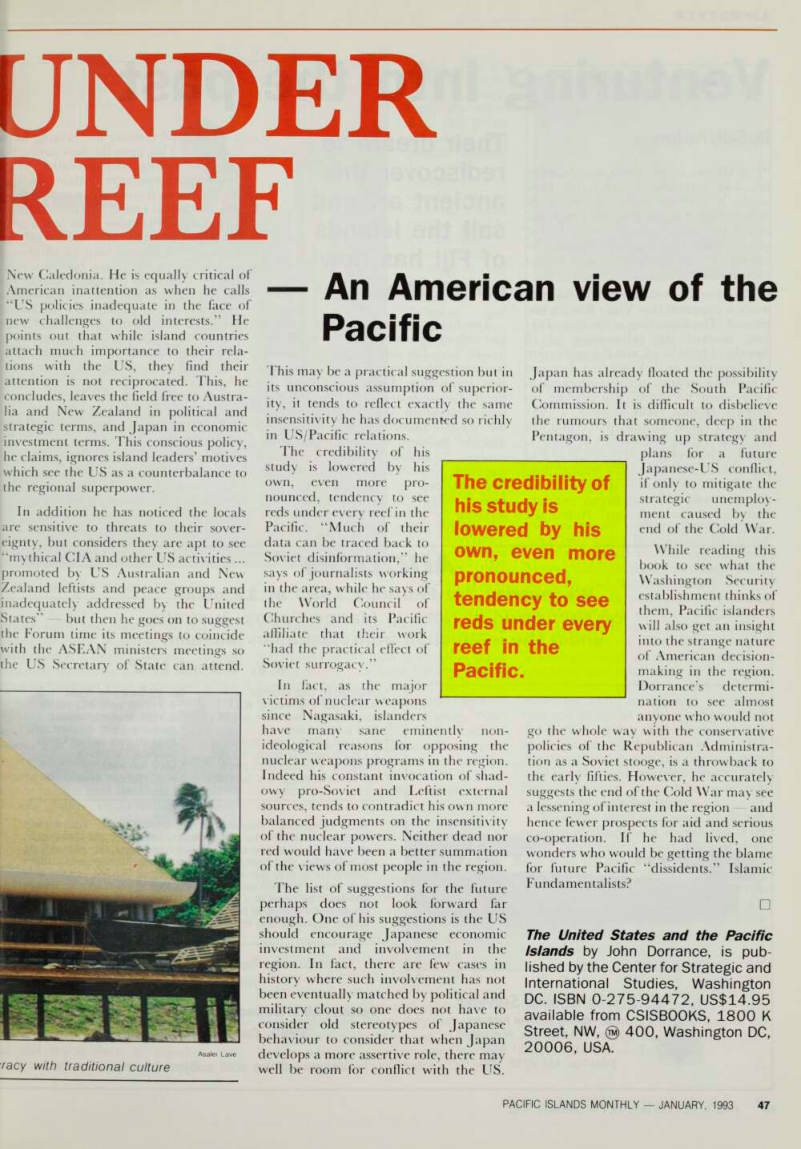
The Reef
By lan Williams
Robert Burns, the Scots poet,
prayed, “Oh, would some
Power the giftie gi’ us, to see ourselves as others see us”.
Pacific people have an oppor tunity to see themselves as the American foreign affairs estab lishment see them in John C.
Dorrance’s book, The United States and the Pacific Islands.
While the State Department often has a body of expertise on international relations, its policies can be and often are derailed by vociferous domestic lobbies, whether commercial, military or political. Such influences thrive in the absence of public interest in the region in question, and ordinary Am ericans are notoriously uncaring indeed ignorant about the rest of the world. Even more than in other parts of the globe, this is true of the Pacific where, paradoxically, the US probably has more power than anywhere else.
During World War 11, the islands were newspaper head
lines as Allied troops leap-frogged their way towards Japan. Out of the headlines, they dropped out of public awareness except when they were illumi nated by the glare of nuclear test programs in the fifties. “There are only 90,000 people out there. Who gives a damn!” Dorrance quotes Henry Kissinger saying of the Micronesian trust territories when he was National Security Ad viser. Up to 1990, only
three Pacific specialists had been trained in the State Department and none of them was being used.
However, John Dorrance was one of the few specialists on the region before he died in early 1991. As such, he fought against what he termed the US’s “benign neglect” of the Pacific islands. He died before this study was completed, and so the text was adjusted by someone else who left anomalies like a discussion of the possibility of UN membership for the Marshalls and FSM, 15 months after they had successfully obtained such membership.
Dorrance’s point of view is strangely flawed. He sees facts clearly, but his analysis bears little relation to them. In his analysis of the motives of island leaders he is quick to see “Soviet inspried,” “leftist” or “pacifist” outside inlfuences at work when there is disagree
‘Most island states have little or no potential for economic development that promises future self sufficiency; they are probably permanently depen dent on aid.’
ment with Washington’s whims. Such paranoia sits strangely in a book which chronicles the US’s sins of omission and commission quite diligently, and thus gives quite rational, and local reasons for Pacific islanders not to confuse Uncle Sam with Father Christmas. For ex ample, Dorrance points out the US’s refusal for years to agree to a fishing agreement; the refusal to sign the Treaty of Rarotonga, the tacit approval of French nuclear
testing, the huge arrears to SOPAC and so on.
He makes it plain the American interest, intermit tent though it is, has never been that altruistic. From a
strategic point of
view the islands, as in the War, straddle the Pacific basin, which is now an economic
powerhouse rival
ling the old trade routes of the Atlan
tic. The air and sea routes which pass the islands now account for half of American foreign trade. However, he tends to see things as he would like, rather than as they were. His vision of the US role does not, for example, mention the overthrow of independent Hawaii by US marines.
In more contemporary times, he men tions the Indonesian threat to Australia and Papua New Guinea, without even a passing reference to East Timor, and the US role there. In discussing Palau, he skips the sordid tale of IPSECO and the power station which has saddled the Palauans with a massive foreign debt and in which several friends of the White House were closely implicated.
However, he accurately lists the prob lems of the region “Most island states have little or no potential for economic development that promises future self sufficiency; they are probably perma
nently dependent on aid.” All arr exceptionally vulnerable to world prices for energy and food and they have sorm of the world’s highest youth suicide rates high rates of alcoholism, as well a j internal problems of ethnicity, ano economics and, of course, he adds “vulnerability to external mischie makers.”
Despite references to problems witH conservative nobles in Tonga, and untii recently Western Samoa, not to mention the traditionalists in Fiji, he consider that ,“A major success...has been th« blending of Western democratic parliaj mentary institutions and values witH those of traditional cultures into goverm mental institutions that ensure, witH some exceptions, a level of democracy and human rights unmatched elsewhere in the Third World.”
He identifies what locals call “the Pacific Way” without ever using the term himself the need to win a consensus before a vote. But other traits can causo problems like the unique attachment to and trusteeship for the land that fuel:J conflict in Bougaineville, Palau, Fiji anc
Fiji’s parliament building: blending wes[?]
An American view of the Pacific
New Caledonia. He is equally critical of . American inattention as when he calls I “US policies inadequate in the face of i new challenges to old interests.” He points out that while island countries attach much importance to their rela ; tions with the US, they find their attention is not reciprocated. This, he concludes, leaves the field free to Austra lia and New Zealand in political and strategic terms, and Japan in economic investment terms. This conscious policy, he claims, ignores island leaders’ motives which see the US as a counterbalance to the regional superpower.
In addition he has noticed the locals are sensitive to threats to their sover eignty, but considers they are apt to see “mythical CIA and other activities ... promoted by US Australian and New Zealand leftists and peace groups and inadequately addressed by the Lhiited States” but then he goes on to suggest the Forum time its meetings to coincide with the ASEAN ministers meetings so the US Secretary of State can attend.
This may be a practical suggestion but in its unconscious assumption of superior ity, it tends to reflect exactly the same insensitivity he has documented so richly
in US/Pacific relations.
The credibility of his study is lowered by his own, even more pro nounced, tendency to see reds under every reef in the Pacific. “Much of their data can be traced back to Soviet disinformation,” he says of journalists working in the area, while he says of the World Council of Churches and its Pacific affiliate that their work "had the practical effect of Soviet surrogacy.”
In fact, as the major victims of nuclear w eapons since Nagasaki, islanders
have many sane eminently non ideological reasons for opposing the nuclear weapons programs in the region.
Indeed his constant invocation of shad owy pro-Soviet and Leftist external sources, tends to contradict his own more balanced judgments on the insensitivity of the nuclear powers. Neither dead nor red would have been a better summation of the views of most people in the region.
The list of suggestions for the future perhaps does not look forward far enough. One of his suggestions is the US should encourage Japanese economic investment and involvement in the region. In fact, there are few cases in history where such involvement has not been eventually matched by political and military clout so one does not have to consider old stereotypes of Japanese behaviour to consider that when Japan develops a more assertive role, there may well be room for conflict with the US.
The credibility of his study is lowered by his own, even more pronounced, tendency to see reds under every reef in the Pacific.
Japan has already floated the possibility
of membership of the South Pacific Commission. It is difficult to disbelieve the rumours that someone, deep in the Pentagon, is drawing up strategy and
plans for a future Japanese-US conflict, if only to mitigate the strategic unemploy ment caused by the end of the Cold War.
While reading this book to see what the Washington Security establishment thinks of them, Pacific islanders will also get an insight into the strange nature of American decision making in the region.
Dorrance's determi nation to see almost anyone who would not
go the whole way with the conservative policies of the Republican Administra tion as a Soviet stooge, is a throwback to the early fifties. However, he accurately suggests the end of the Cold War may see a lessening of interest in the region and hence fewer prospects for aid and serious co-operation. If he had lived, one wonders who would be getting the blame for future Pacific “dissidents.” Islamic Fundamentalists? □ The United States and the Pacific Islands by John Dorrance, is pub lished by the Center for Strategic and International Studies, Washington
Dc. Isbn 0-275-94472, U 5514.95
available from CSISBOOKS, 1800 K Street, NW, @) 400, Washington DC,
20006, Usa.
Asalei Lave racy with traditional culture
Advertisements & other items, p. 46 (1 item)
Books
Venturing into the past
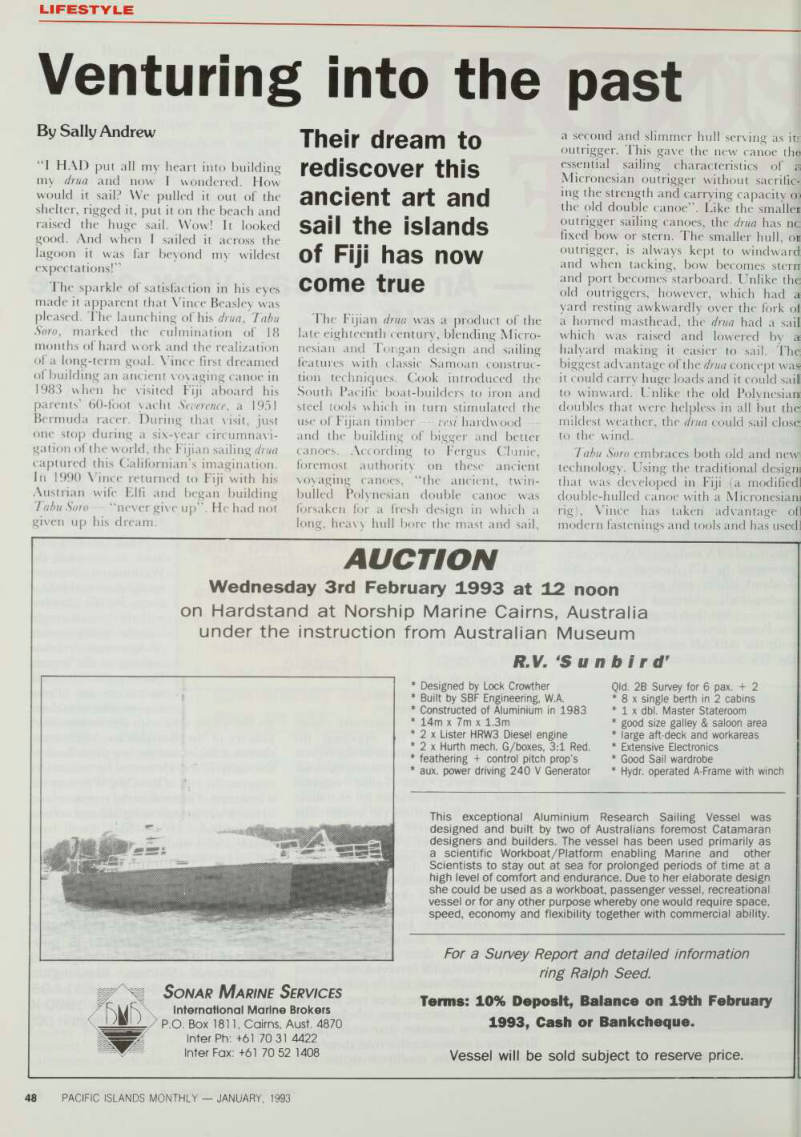
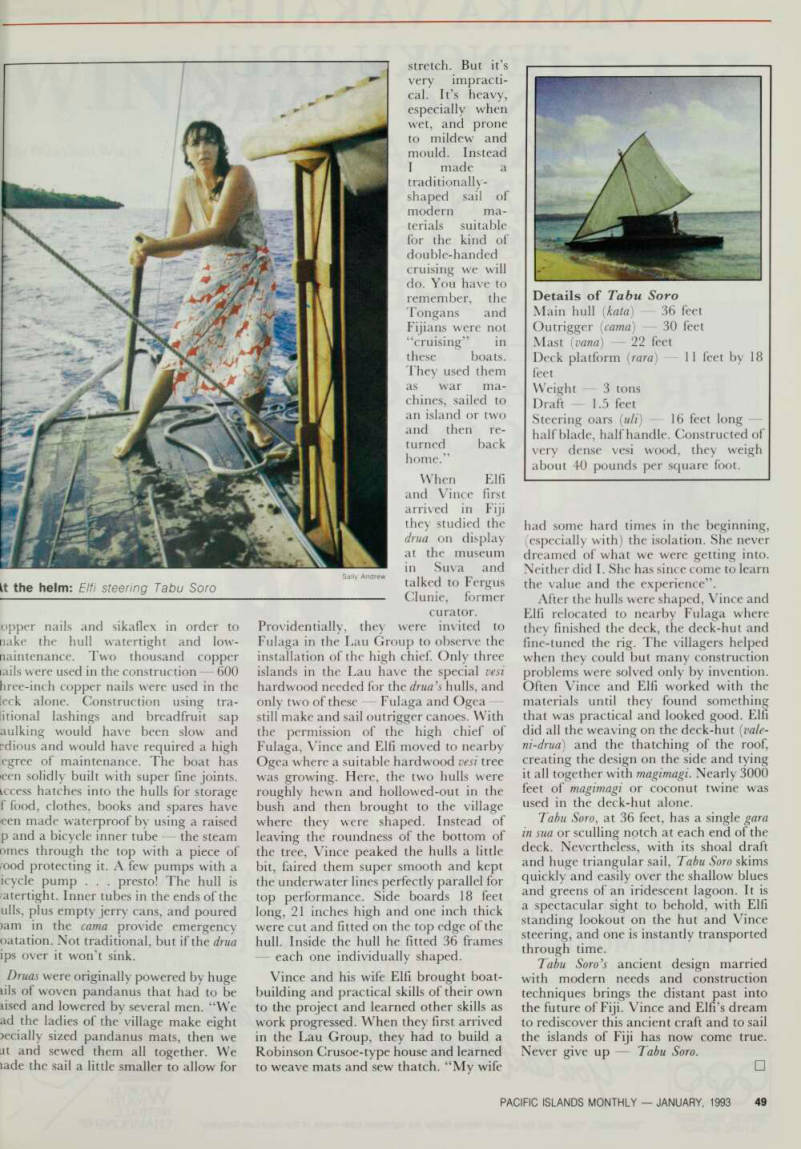
By Sally Andrew
Their dream to rediscover this ancient art and sail the islands of Fiji has now come true
“I HAD put all my heart into building my drua and now I wondered. How would it sail? We pulled it out of the shelter, rigged it, put it on the beach and raised the huge sail. Wow! It looked good. And when I sailed it across the lagoon it was far beyond my wildest expectations!”
The sparkle of satisfaction in his eyes made it apparent that Vince Beasley was pleased. The launching of his drua, Tabu Soro, marked the culmination of 18 months of hard work and the realization of a long-term goal. Vince first dreamed of building an ancient voyaging canoe in 1983 when he visited Fiji aboard his parents’ 60-foot yacht Severe nee, a 1951 Bermuda racer. During that visit, just one stop during a six-year circumnavi gation ol the world, the Fijian sailing drua captured this Californian’s imagination.
In 1990 Vince returned to Fiji with his Austrian wife Elfi and began building Tabu Soro “never give up”. He had not given up his dream.
The Fijian drua was a product of the late eighteenth century, blending Micro nesian and Tongan design and sailing features with classic Samoan construc tion techniques. Cook introduced the South Pacific boat-builders to iron and steel tools which in turn stimulated the use of Fijian timber vesi hardwood and the building of bigger and better canoes. According to Fergus Clunie, foremost authority on these ancient voyaging canoes, “the ancient, twin bulled Polynesian double canoe was forsaken for a fresh design in which a long, heavy hull bore the mast and sail,
a second and slimmer hull serving as its: outrigger. This gave the new canoe the essential sailing characteristics of a Micronesian outrigger without sacrific ing the strength and carrying capacity oil the old double canoe”. Like the smaller outrigger sailing canoes, the drua has nc fixed bow or stern. The smaller hull, on outrigger, is always kept to windward and when tacking, bow becomes stern and port becomes starboard. Unlike the old outriggers, however, which had a yard resting awkwardly over the fork ot a horned masthead, the drua had a sail which was raised and lowered by a halyard making it easier to sail. The biggest advantage of the drua concept was it could carry huge loads and it could saiD to winward. Unlike the old Polynesian! doubles that were helpless in all but the mildest weather, the drua could sail close to the wind.
Tabu Sara embraces both old and newj technology. Using the traditional desigm that was developed in Fiji (a modified! double-hulled canoe with a Micronesiani rig), Vince has taken advantage of modern fastenings and tools and has used!
opper nails and sikaflex in order to nake the hull watertight and low naintenance. Two thousand copper lails were used in the construction 600 hree-inch copper nails were used in the leek alone. Construction using tra litional lashings and breadfruit sap aulking would have been slow and edious and would have required a high egree of maintenance. The boat has •een solidly built with super fine joints.
Lccess hatches into the hulls for storage f food, clothes, books and spares have een made waterproof by using a raised p and a bicycle inner tube the steam omes through the top with a piece of rood protecting it. A few pumps with a icycle pump . . . presto! The hull is watertight. Inner tubes in the ends of the ulls, plus empty jerry cans, and poured )am in the cama provide emergency oatation. Not traditional, but if the drua ips over it won’t sink.
Druas were originally powered by huge lils of woven pandanus that had to be used and lowered by several men. “We ad the ladies of the village make eight jecially sized pandanus mats, then we nt and sewed them all together. We lade the sail a little smaller to allow for
stretch. But it’s
very impracti
cal. It’s heavy,
especially when
wet, and prone to mildew and mould. Instead I made a traditionally shaped sail of modern ma terials suitable for the kind of double-handed cruising we will do. You have to remember, the Tongans and Fijians were not “cruising” in these boats.
They used them as war ma chines, sailed to an island or two and then re turned back home.”
When Elfi and Vince first arrived in Fiji they studied the drua on display at the museum in Suva and talked to Fergus Clunie, former
curator.
Providentially, they were invited to Fulaga in the Lau Group to observe the installation of the high chief. Only three islands in the Lau have the special vesi hardwood needed for the drua’s hulls, and only two of these Fulaga and Ogea still make and sail outrigger canoes. With the permission of the high chief of Fulaga, Vince and Elfi moved to nearby Ogea where a suitable hardwood vesi tree was growing. Here, the two hulls were roughly hewn and hollowed-out in the bush and then brought to the village where they were shaped. Instead of leaving the roundness of the bottom of the tree, Vince peaked the hulls a little bit, faired them super smooth and kept the underwater lines perfectly parallel for top performance. Side boards 18 feet long, 21 inches high and one inch thick were cut and fitted on the top edge of the hull. Inside the hull he fitted 36 frames each one individually shaped.
Vince and his wife Elfi brought boat building and practical skills of their own to the project and learned other skills as work progressed. When they first arrived in the Lau Group, they had to build a Robinson Crusoe-type house and learned to weave mats and sew thatch. “My wife
had some hard times in the beginning, (especially with) the isolation. She never dreamed of what we were getting into.
Neither did I. She has since come to learn the value and the experience”.
After the hulls were shaped, Vince and Elfi relocated to nearby Fulaga where they finished the deck, the deck-hut and fine-tuned the rig. The villagers helped when they could but many construction
problems were solved only by invention.
Often Vince and Elfi worked with the materials until they found something that was practical and looked good. Elfi did all the weaving on the deck-hut (vale ni-drua) and the thatching of the roof, creating the design on the side and tying it all together with magimagi. Nearly 3000 feet of magimagi or coconut twine was used in the deck-hut alone.
Tabu Soro, at 36 feet, has a single gara in sua or sculling notch at each end of the deck. Nevertheless, with its shoal draft and huge triangular sail, Tabu Soro skims quickly and easily over the shallow blues and greens of an iridescent lagoon. It is a spectacular sight to behold, with Elfi standing lookout on the hut and Vince steering, and one is instantly transported through time.
Tabu Sow’s ancient design married with modern needs and construction techniques brings the distant past into the future of Fiji. Vince and Elfi’s dream to rediscover this ancient craft and to sail the islands of Fiji has now come true.
Never give up
Tabu Soro.
At the helm: Elfi steering Tabu Soro
Sally Andrew
Details of Tabu Soro Main hull (kata)-36 feet Outrigger ( cama )-30 feet Mast ( vana )-22 feet Deck platform ( rara) -11 feet by 18 feet Weight-3 tons Draft-1.5 feet Steering oars (uli) - 16 feet long half blade, half handle. Constructed of very dense vesi wood, they weigh about 40 pounds per square foot.
Advertisements & other items, pp. 48-50 (1 item)
Auction
Wednesday 3rd February 1993 at 12 noon on Hardstand at Norship Marine Cairns, Australia
under the instruction from Australian Museum
Sonar Marine Services
International Marine Brokers P.O. Box 1811, Cairns, Aust. 4870 Inter Ph: +6l 70 31 4422 Inter Fax: +6l 70 52 1408
R.V. ‘Sunbird'
* Designed by Lock Crowther * Built by SBF Engineering, W.A. * Constructed of Aluminium in 1983 * 14m x 7m x 1.3 m * 2 x Lister HRW3 Diesel engine * 2 x Hurth mech. G/boxes, 3:1 Red. * feathering + control pitch prop’s * aux. power driving 240 V Generator Qld. 2B Survey for 6 pax. + 2 * 8 x single berth in 2 cabins * 1 x dbl. Master Stateroom * good size galley & saloon area * large aft-deck and workareas * Extensive Electronics * Good Sail wardrobe * Hydr. operated A-Frame with winch This exceptional Aluminium Research Sailing Vessel was designed and built by two of Australians foremost Catamaran designers and builders. The vessel has been used primarily as a scientific Workboat/Platform enabling Marine and other Scientists to stay out at sea for prolonged periods of time at a high level of comfort and endurance. Due to her elaborate design she could be used as a workboat, passenger vessel, recreational vessel or for any other purpose whereby one would require space, speed, economy and flexibility together with commercial ability.
For a Survey Report and detailed information
ring Ralph Seed.
Terms: 10% Deposit, Balance on 19th February
1993, Cash or Bankcheque.
Vessel will be sold subject to reserve price.
VIINAKA VAKALtVU!
TENGKU TRU!
TANGIO TUMAS!
MALO ‘AUPITO!
THANKS MATE!
SAASETAI!
...IN OTHER WORDS
THANK YOU!
FROM ALL OF US HERE
AT COCA-COLA!
% / / t / U
CbK€
TO ALL THE GIRLS WHO PARTICIPATED IN THE
COCA-COLA WORLD YOUTH NETBALL CHAMPIONSHIPS
AT THE MULTI PURPOSE COURTS SUVA, FIJI NOV 28TH TO
DEC STH 1992
QOp
OFFICIAL WORLDWIDE
OLYMPIC SPONSOR
ijou.
‘Coca-Cola”, "Coke” and the Dynamic Ribbon Device are registered trade marks of The Coca-Cola Company” * \
W ORLD
WVOUTH
NETBALL
CHAMPIONSHIP
Winning Streak
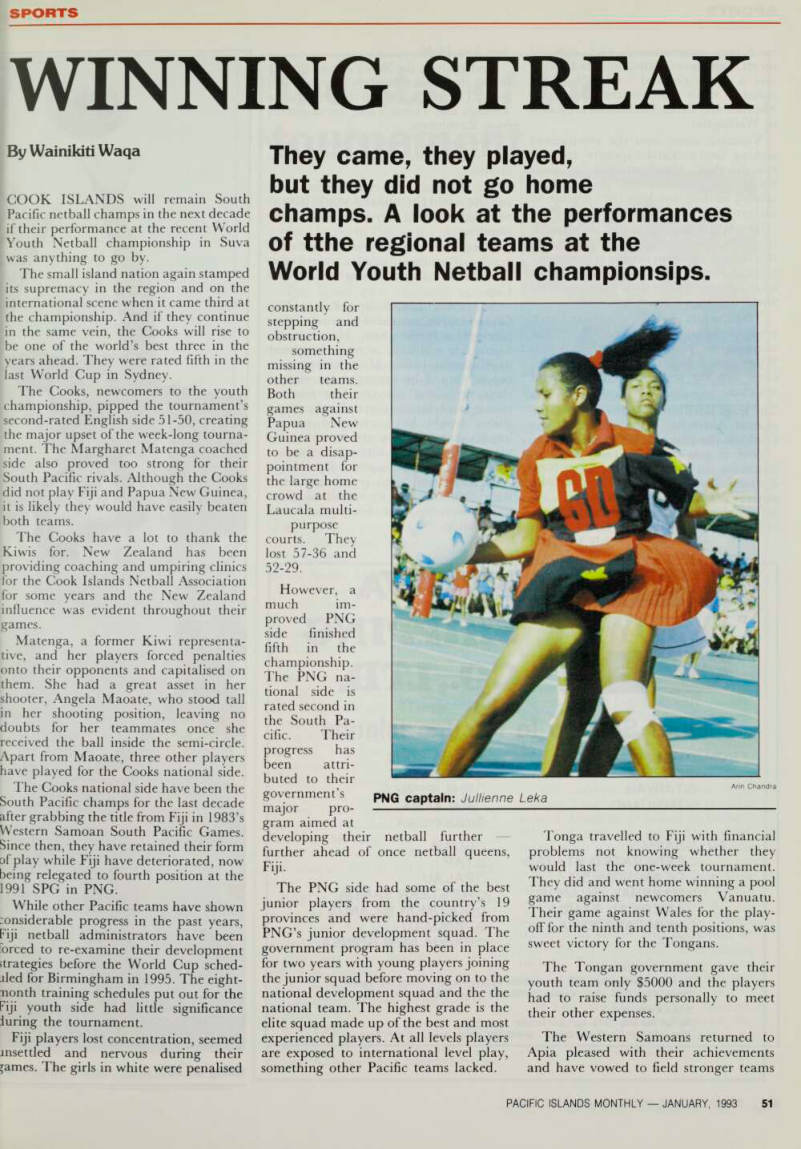
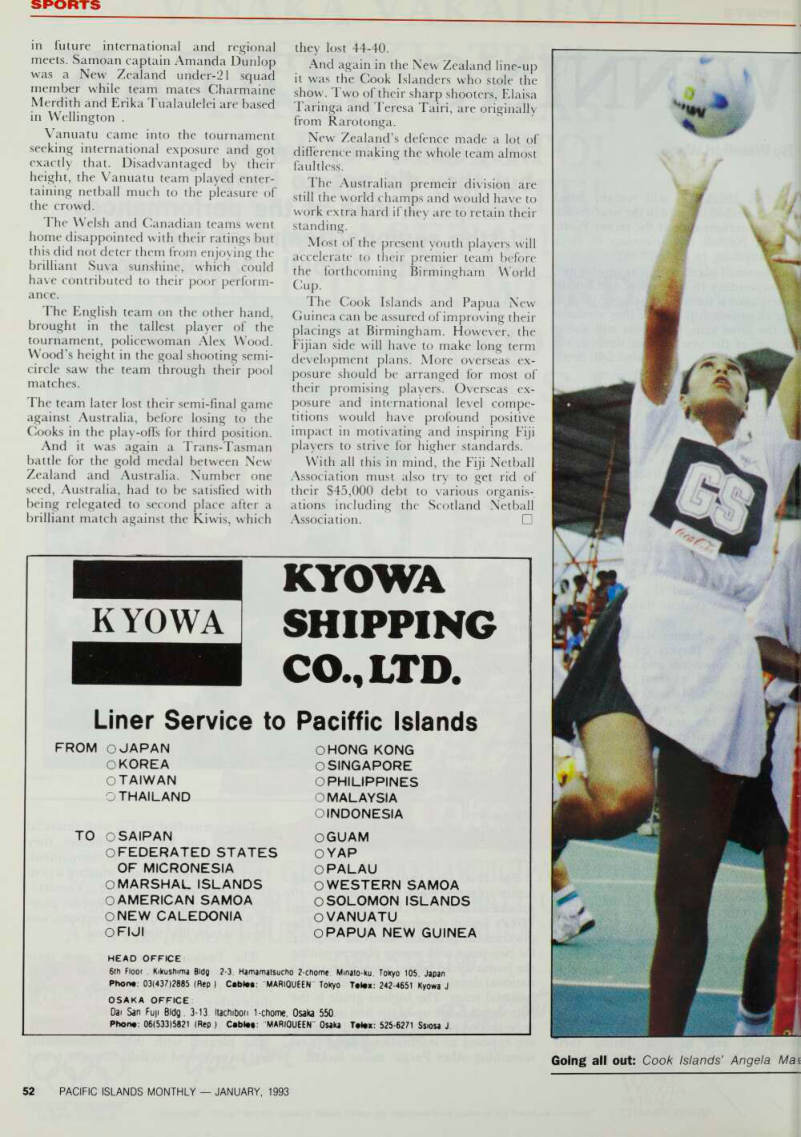
By Wainikiti Waqa
They came, they played, but they did not go home champs. A look at the performances of tthe regional teams at the World Youth Netball championsips.
COOK ISLANDS will remain South Pacific netball champs in the next decade if their performance at the recent World Youth Netball championship in Suva ( was anything to go by.
The small island nation again stamped its supremacy in the region and on the international scene when it came third at the championship. And if they continue in the same vein, the Cooks will rise to be one of the world’s best three in the years ahead. They were rated fifth in the last World Cup in Sydney.
The Cooks, newcomers to the youth championship, pipped the tournament’s second-rated English side 51-50, creating the major upset of the week-long tourna ment. The Margharet Matenga coached side also proved too strong for their South Pacific rivals. Although the Cooks did not play Fiji and Papua New Guinea, it is likely they would have easily beaten both teams.
The Cooks have a lot to thank the Kiwis for. New Zealand has been providing coaching and umpiring clinics for the Cook Islands Netball Association for some years and the New Zealand influence was evident throughout their games.
Matenga, a former Kiwi representa tive, and her players forced penalties onto their opponents and capitalised on them. She had a great asset in her shooter, Angela Maoate, who stood tall in her shooting position, leaving no doubts for her teammates once she received the ball inside the semi-circle.
Apart from Maoate, three other players have played for the Cooks national side.
The Cooks national side have been the South Pacific champs for the last decade after grabbing the title from Fiji in 1983’s Western Samoan South Pacific Games.
Since then, they have retained their form of play while Fiji have deteriorated, now being relegated to fourth position at the
1991 Spg In Png.
While other Pacific teams have shown :onsiderable progress in the past years, Fiji netball administrators have been breed to re-examine their development itrategies before the World Cup sched iled for Birmingham in 1995. The eight nonth training schedules put out for the Fiji youth side had little significance luring the tournament.
Fiji players lost concentration, seemed msettled and nervous during their James. The girls in white were penalised
constantly for stepping and obstruction, something missing in the other teams.
Both their games against Papua New Guinea proved to be a disap pointment for the large home crowd at the Laucala multi purpose courts. They lost 57-36 and 52-29.
However, a much im proved PNG side finished fifth in the
championship.
The PNG na tional side is rated second in the South Pa cific. Their progress has been attri buted to their government’s
major pro
gram aimed at
developing their netball further further ahead of once netball queens, Fiji.
The PNG side had some of the best junior players from the country’s 19 provinces and were hand-picked from PNG’s junior development squad. The government program has been in place for two years with young players joining the junior squad before moving on to the national development squad and the the national team. The highest grade is the elite squad made up of the best and most
experienced players. At all levels players
are exposed to international level play, something other Pacific teams lacked.
Tonga travelled to Fiji with financial problems not knowing whether they would last the one-week tournament.
They did and went home winning a pool game against newcomers Vanuatu.
Their game against Wales for the play off for the ninth and tenth positions, was sweet victory for the Tongans.
The Tongan government gave their youth team only SSOOO and the players had to raise funds personally to meet their other expenses.
The Western Samoans returned to Apia pleased with their achievements and have vowed to field stronger teams
PNG captain: Jullienne Leka
Arin Chandra
in future international and regional meets. Samoan captain Amanda Dunlop was a New Zealand under-21 squad member while team mates Charmaine Merdith and Erika Tualaulelei are based in Wellington .
Vanuatu came into the tournament seeking international exposure and got exactly that. Disadvantaged by their height, the Vanuatu team played enter taining netball much to the pleasure of the crowd.
The Welsh and Canadian teams went home disappointed with their ratings but this did not deter them from enjoying the brilliant Suva sunshine, which could have contributed to their poor perform ance.
The English team on the other hand, brought in the tallest player of the tournament, policewoman Alex Wood.
Wood’s height in the goal shooting semi circle saw the team through their pool matches.
The team later lost their semi-final game against Australia, before losing to the Cooks in the play-offs for third position.
And it was again a Trans-Tasman battle for the gold medal between New Zealand and Australia. Number one seed, Australia, had to be satisfied with being relegated to second place after a brilliant match against the Kiwis, which
they lost 44-40.
And again in the New Zealand line-up it was the Cook Islanders who stole the show. Two of their sharp shooters, Elaisa Taringa and Teresa Tairi, are originally
from Rarotonga.
New Zealand’s defence made a lot of difference making the whole team almost faultless.
The Australian premeir division are still the world champs and would have to work extra hard if they are to retain their standing.
Most of the present youth players will accelerate to their premier team before the forthcoming Birmingham World
Cup.
The Cook Islands and Papua New Guinea can be assured of improving their placings at Birmingham. However, the Fijian side will have to make long term development plans. More overseas ex posure should be arranged for most of their promising players. Overseas ex posure and international level compe titions would have profound positive impact in motivating and inspiring Fiji players to strive for higher standards.
With all this in mind, the Fiji Netball Association must also try to get rid of their $45,000 debt to various organis ations including the Scotland Netball Association. □
Going all out: Cook Islands’ Angela Ma
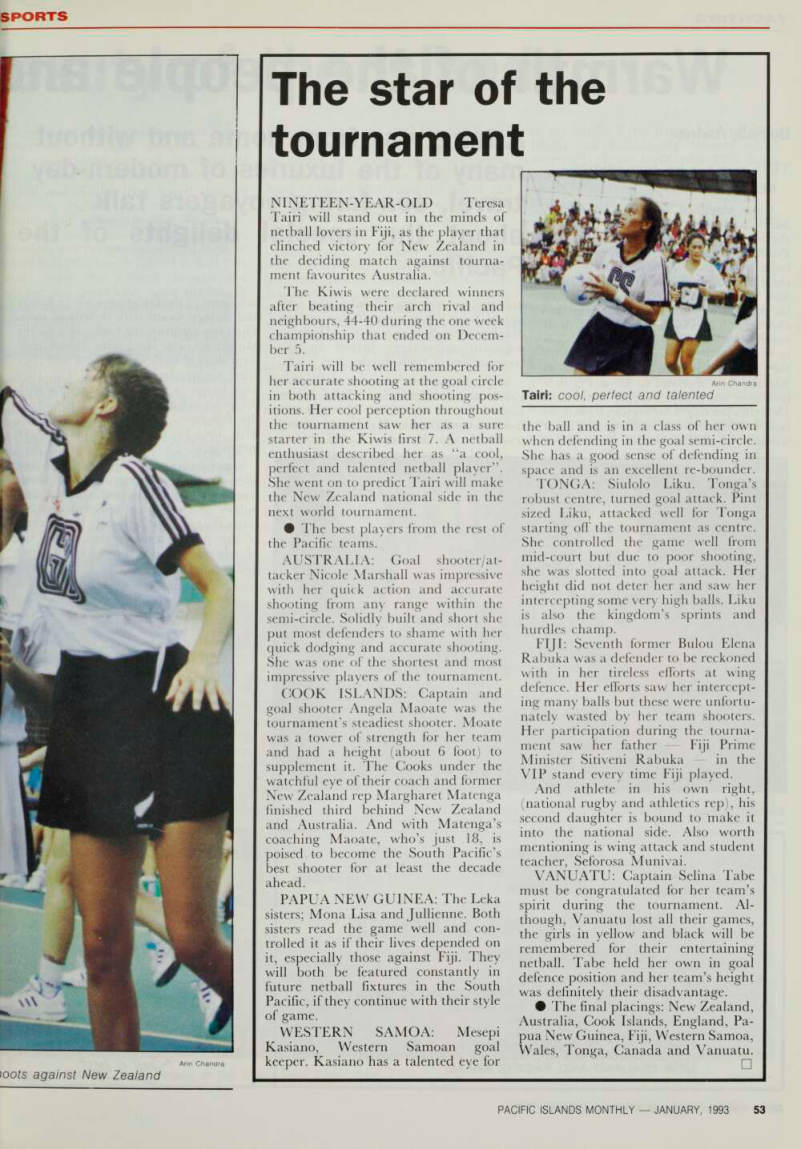
The star of the tournament
Nineteen-Year-Old Teresa
Tairi will stand out in the minds of netball lovers in Fiji, as the player that clinched victory for New Zealand in the deciding match against tourna ment favourites Australia.
The Kiwis were declared winners after beating their arch rival and neighbours, 44-40 during the one week championship that ended on Decem ber 5.
Tairi will be well remembered for her accurate shooting at the goal circle in both attacking and shooting pos itions. Her cool perception throughout the tournament saw her as a sure starter in the Kiwis first 7. A netball enthusiast described her as “a cool, perfect and talented netball player”.
She went on to predict Tairi will make the New Zealand national side in the next world tournament. The best players from the rest of the Pacific teams.
AUSTRALIA: Goal shooter/at tacker Nicole Marshall was impressive with her quick action and accurate shooting from any range within the semi-circle. Solidly built and short she put most defenders to shame with her quick dodging and accurate shooting.
She was one of the shortest and most impressive players of the tournament.
COOK ISLANDS: Captain and goal shooter Angela Maoate was the tournament’s steadiest shooter. Moate was a tower of strength for her team and had a height (about 6 foot) to supplement it. The Cooks under the watchful eye of their coach and former New Zealand rep Margharet Matenga finished third behind New Zealand and Australia. And with Matenga’s coaching Maoate, who’s just 18, is poised to become the South Pacific’s best shooter for at least the decade ahead.
Papua New Guinea: The Leka
sisters; Mona Lisa and Jullienne. Both sisters read the game well and con trolled it as if their lives depended on it, especially those against Fiji. They will both be featured constantly in future netball fixtures in the South Pacific, if they continue with their style of game.
Western Samoa: Mesepi
Kasiano, Western Samoan goal keeper. Kasiano has a talented eye for
the ball and is in a class of her own when defending in the goal semi-circle.
She has a good sense of defending in space and is an excellent re-bounder.
TONGA: Siulolo Liku. Tonga’s robust centre, turned goal attack. Pint sized Liku, attacked well for Tonga starting off the tournament as centre.
She controlled the game well from mid-court but due to poor shooting, she was slotted into goal attack. Her height did not deter her and saw her intercepting some very high balls. Liku is also the kingdom’s sprints and hurdles champ.
FIJI: Seventh former Bulou Elena Rabuka was a defender to be reckoned with in her tireless efforts at wing defence. Her efforts saw her intercept ing many balls but these were unfortu nately wasted by her team shooters.
Her participation during the tourna ment saw her father Fiji Prime Minister Sitiveni Rabuka in the VIP stand every time Fiji played.
And athlete in his own right, (national rugby and athletics rep), his second daughter is bound to make it into the national side. Also worth mentioning is wing attack and student teacher, Seforosa Munivai.
VANUATU; Captain Selina Tabe must be congratulated for her team’s spirit during the tournament. Al though, Vanuatu lost all their games, the girls in yellow and black will be remembered for their entertaining netball. Tabe held her own in goal defence position and her team’s height was definitely their disadvantage. • The final placings: New Zealand, Australia, Cook Islands, England, Pa pua New Guinea, Fiji, Western Samoa, Wales, Tonga, Canada and Vanuatu. □
Arin Chandra foots against New Zealand
Arin Chandra Tairi: cool, perfect and talented
Advertisements & other items, pp. 52-53 (3 items)
Sports
Co., Ltd.
KYOWA
KYOWA
SHIPPING
CO., LTD.
Liner Service to Paciffic Islands
FROM OJAPAN
OKOREA
©TAIWAN
©THAILAND
TO ©SAIPAN
©FEDERATED STATES
OF MICRONESIA
©MARSHAL ISLANDS
©AMERICAN SAMOA
©NEW CALEDONIA
©FIJI
©HONG KONG
©SINGAPORE
©PHILIPPINES
©MALAYSIA
©INDONESIA
©GUAM
©YAP
©PALAU
©WESTERN SAMOA
©SOLOMON ISLANDS
©VANUATU
©PAPUA NEW GUINEA
HEAD OFFICE
6th Floor Kikushtma Bldg 2-3. Hamamatsucho 2-chome Mmato-ku. Tokyo 105. Japan Phon#: 03(437)2885 (Rep ) Cabtot; MARIQUEEN Tokyo Talax; 242-4651 Kyowa J
OSAKA OFFICE
Dai San Fuji Bldg 3-13 llachibon 1-chome, Osaka 550 Phona: 06(533)5821 (Rep ) Cablaa: MARIQUEEN Osaka Tala*: 525-6271 Ssiosa J
Sports
Warmth of the people and beauty of the islands
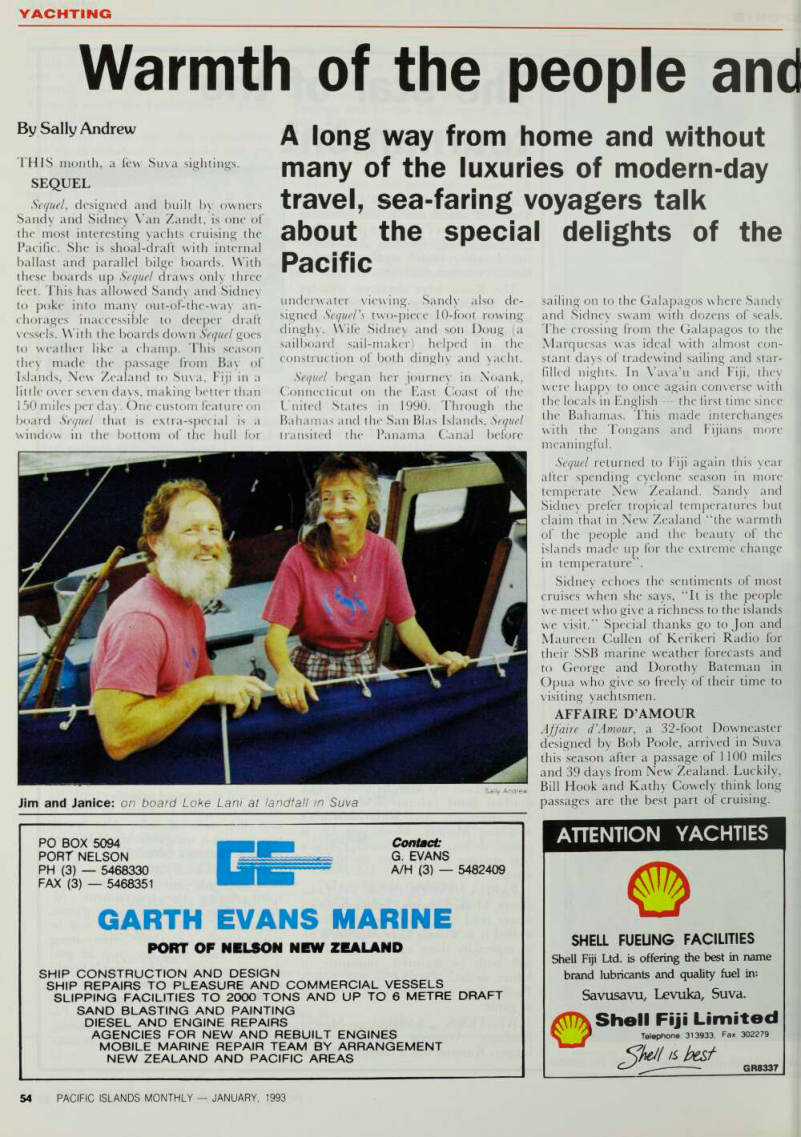
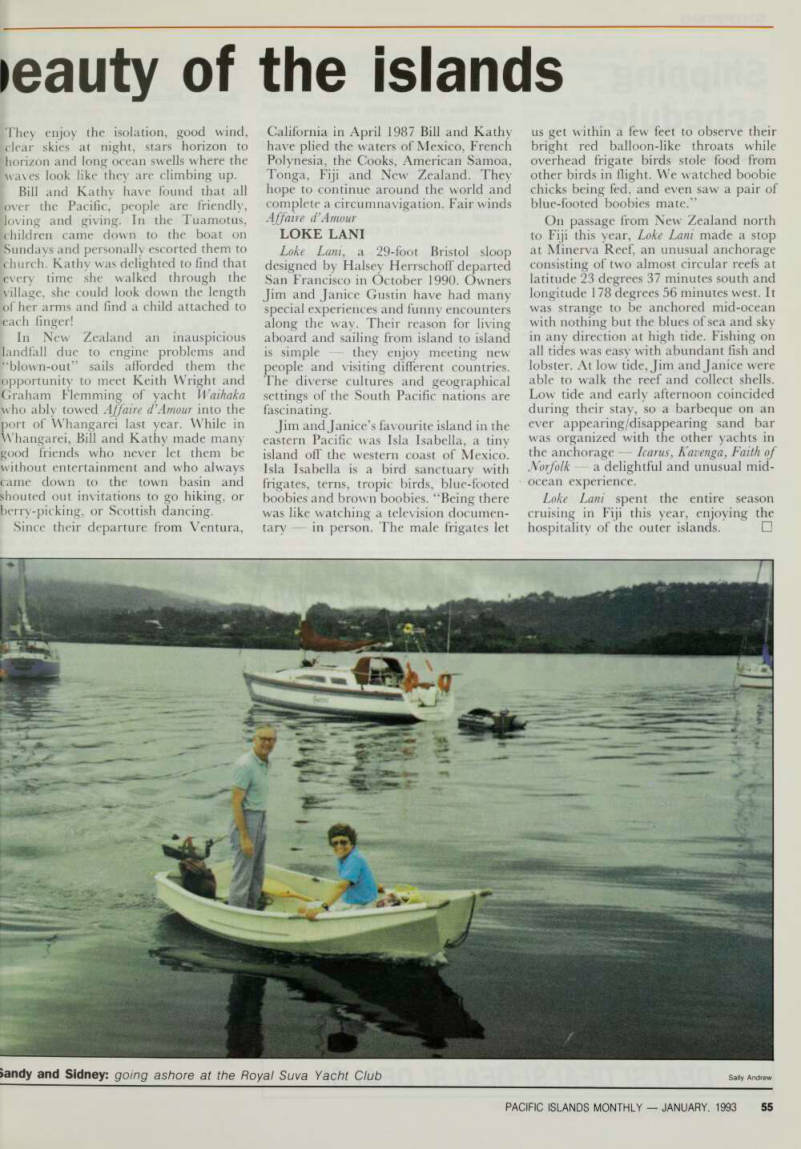
Yachting
By Sally Andrew
A long way from home and without many of the luxuries of modern-day travel, sea-faring voyagers talk about the special delights of the Pacific
THIS month, a few Suva sightings.
Sequel
Sequel , designed and built by owners Sandy and Sidney Van Zandt, is one of the most interesting yachts cruising the Pacific. She is shoal-draft with internal ballast and parallel bilge boards. With these boards up Sequel draws only three feet. This has allowed Sandy and Sidney to poke into man)’ out-of-the-way an chorages inaccessible to deeper draft vessels. With the boards down Sequel goes to weather like a champ. This season they made the passage from Bay of Islands, New Zealand to Suva, Fiji in a little over seven days, making better than 150 miles per day. One custom feature on board Sequel that is extra-special is a window in the bottom of the hull for
underwater viewing. Sandy also de signed Sequel’s two-piece 10-foot rowing dinghy. Wife Sidney and son Doug (a sailboard sail-maker) helped in the construction of both dinghy and yacht.
Sequel began her journey in Noank, Connecticut on the East Coast of the United States in 1990. Through the Bahamas and the San Bias Islands. Sequel transited the Panama Canal before
sailing on to the Galapagos where Sand)' and Sidney swam with dozens of seals.
The crossing from the Galapagos to the Marquesas was ideal with almost con stant days of tradewind sailing and star filled nights. In Vava’u and Fiji, they were happy to once again converse with the locals in English - the first time since the Bahamas. This made interchanges with the Tongans and Fijians more
meaningful.
Sequel returned to Fiji again this year after spending cyclone season in more temperate New Zealand. Sandy and
Sidney prefer tropical temperatures but
claim that in New Zealand “the warmth of the people and the beauty of the islands made up for the extreme change
in temperature”.
Sidney echoes the sentiments of most cruises when she says, “It is the people we meet who give a richness to the islands we visit.” Special thanks go to Jon and Maureen Cullen of Kerikeri Radio for their SSB marine weather forecasts and to George and Dorothy Bateman in Opua who give so freely of their time to
visiting yachtsmen.
Affaire D’Amour
Affaire d’Amour, a 32-foot Downeaster designed by Bob Poole, arrived in Suva this season after a passage of 1100 miles and 39 days from New Zealand. Luckily, Bill Hook and Kathy Cowely think long passages are the best part of cruising.
Sally Andrew Jim and Janice: on board Loke Lani at landfall in Suva
They enjoy the isolation, good wind, s clear skies at night, stars horizon to »horizon and long ocean swells where the waves look like they are climbing up.
Bill and Kathy have found that all over the Pacific, people are friendly, loving and giving. In the Tuamotus, [children came down to the boat on Sundays and personally escorted them to church. Kathy was delighted to find that every time she walked through the I village, she could look down the length [of her arms and find a child attached to
teach finger!
In New Zealand an inauspicious
’landfall due to engine problems and
!“blown-out” sails afforded them the opportunity to meet Keith Wright and Graham Flemming of yacht Waihaka who ably towed Affaire d’Amour into the port of Whangarei last year. While in VVhangarei, Bill and Kathy made many good friends who never let them be without entertainment and who always came down to the town basin and shouted out invitations to go hiking, or
berry-picking, or Scottish dancing.
Since their departure from Ventura,
California in April 1987 Bill and Kathy have plied the waters of Mexico, French Polynesia, the Cooks, American Samoa, Tonga, Fiji and New Zealand. They hope to continue around the world and complete a circumnavigation. Fair winds Affaire d’Amour
Loke Lani
Lani, a 29-foot Bristol sloop designed by Halsey Herrschoff departed San Francisco in October 1990. Owners ji m and Janice Gustin have had many special experiences and funny encounters along the way. Their reason for living aboard and sailing from island to island is simple they enjoy meeting new people and visiting different countries.
The diverse cultures and geographical settings of the South Pacific nations are
fascinating.
Jim and Janice’s favourite island in the eastern Pacific was Isla Isabella, a tiny island off the western coast of Mexico.
Isla Isabella is a bird sanctuary with frigates, terns, tropic birds, blue-footed boobies and brown boobies. “Being there was like watching a television documentary in person. The male frigates let
us get within a few feet to observe their bright red balloon-like throats while overhead frigate birds stole food from other birds in flight. We watched boobie chicks being fed, and even saw a pair of blue-footed boobies mate.”
On passage from New Zealand north to Fiji this year, Loke Lani made a stop at Minerva Reef, an unusual anchorage consisting of two almost circular reefs at latitude 23 degrees 37 minutes south and longitude 178 degrees 56 minutes west. It was strange to be anchored mid-ocean with nothing but the blues of sea and sky in any direction at high tide. Fishing on all tides was easy with abundant fish and lobster. At low tide, Jim and Janice were able to walk the reef and collect shells.
Low tide and early afternoon coincided during their stay, so a barbeque on an ever appearing/disappearing sand bar was organized with the other yachts in the anchorage Icarus, Kavenga, Faith of Norfolk a delightful and unusual mid
ocean experience.
Loke Lani spent the entire season cruising in Fiji this year, enjoying the hospitality of the outer islands. □
Sandy and Sidney: going ashore at the Royal Suva Yacht Club
Sally Andrew
Advertisements & other items, p. 54 (1 item)
Garth Evans Marine
ATTENTION YACHTIES
SHELL FUEUNG FACILITIES
Shell Fiji Ltd. is offering the best in name brand lubricants and quality fuel in; Savusavu, Levuka, Suva.
Shell Fiji Limited Telephone 313933. Fax 302279 ©
a best
GR8337
PO BOX 5094
PORT NELSON
PH (3) 5468330
FAX (3) 5468351
Contact
G. EVANS
A/H (3) 5482409
GARTH EVANS MARINE
PORT OF NELSON NEW ZEALAND
SHIP CONSTRUCTION AND DESIGN
SHIP REPAIRS TO PLEASURE AND COMMERCIAL VESSELS SLIPPING FACILITIES TO 2000 TONS AND UP TO 6 METRE DRAFT
SAND BLASTING AND PAINTING
DIESEL AND ENGINE REPAIRS
AGENCIES FOR NEW AND REBUILT ENGINES
MOBILE MARINE REPAIR TEAM BY ARRANGEMENT
NEW ZEALAND AND PACIFIC AREAS
Shipping

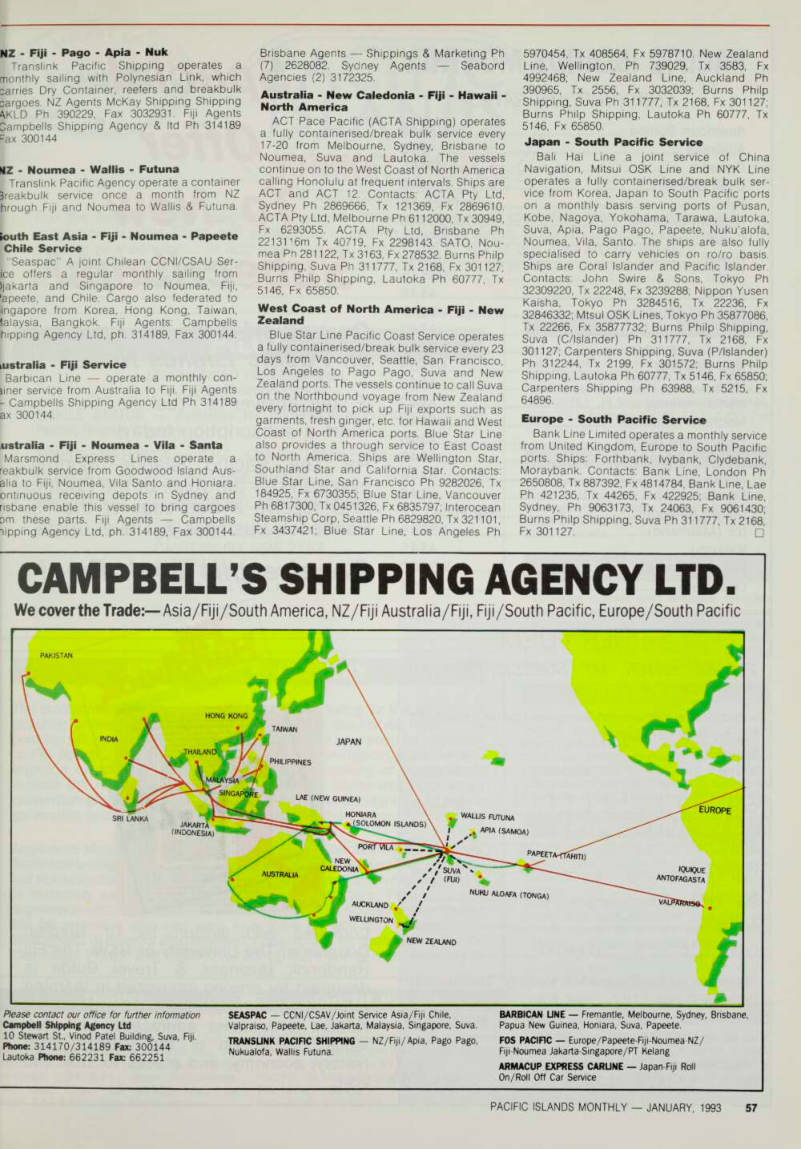
schedules
New Zealand - Fiji direct Sofrana Unilines operates a fully containerised/breakbulk service every 21 days from Auckland, Tauranga, Lyttleton to Suva and Lautoka. Loading every 21 days, ro/ro service, containers - reefer. Contact Sofrana Unilines, Sofrana House, 101 Customs Street, Auckland, PO Box 3614, Fax (09) 393874 Ph (09) 773279. Tlx NZ 2313. Direct toll free line 0800 659-922, Contact Alan Foote. Sofrana Shipping Agencies, PO Box 921 Wellington, Tel (04) 725 661, Fax (04) 725 749, Tlx NZ 4769 Contact Steve Brannigan Sofrana Unilines Agencies, PO Box 22046 Christchurch, tel (03) 667 180, Fax (03) 668 868, TLX NZ4769, Contact Tony Newell. Carpenters Shipping, Private Mail Bag, Suva, Fiji, Tel (679) 312244, Fax (679) 301572, Tlx FJ 2199. Sofrana Unilines. Suva, Fiji, Tel (679) 315645, Fax (679) 300057 Australia - Fiji direct Sofrana Unilines operates a ro/ro container service every three weeks from Melbourne, Sydney, Brisbane, Lautoka and Suva. Contact Sofrana Unilines (Aust) Pty Ltd, PO Box Q 136, Queen Victoria Building, Sydney, NSW 2000, Australia. Tel (02) 2648944, Fax (02) 2676547, Tlx (71) A 170090, Contact Andrew McLachlin, Sam Attaway.
Carpenters Shipping, Suva, Tel (679) 312244, Fax (679) 301572. Sofrana Unilines Suva, Tel (679) 315 645, Fax (679) 300057, Carpenters
Shipping, Lautoka, Tel (679) 63988, Fax (679) 64896. Sofrana Unilines, Lautoka Tel (679) 62921, Fax (679) 64896.
Australia - Fiji monthly service Sofrana Unilines (Australia) Pty Ltd operates a regular monthly service with MV Capitaine Wallis. Contact Sofrana Unilines, Sydney, Tel (02) 2648944, Tlx AA170090, Fax (02) 267-6547.
Carpenters Shipping, Suva, Fiji, Tel (679) 312244, Fax (679) 301572, Sofrana Unilines, Suva, Fiji Tel (679) 315645, Fax (679) 300057.
Carpenters Shipping, Lautoka, Tel (679) 63988, Fax (679) 64896. Sofrana Unilines, Lautoka, Fiji, Tel (679) 62921, Fax (679) 64896.
Far-East - Fiji - New Zealand Service New Zealand Unit Express (NZUE) operates a monthly service accepting containerised and break-bulk cargoes from Manila, Keelung, Kaoshiung, Hong Kong, Lae to Suva, Lautoka (via Suva) and thence to New Zealand ports.
Contact Carpenters Shipping Suva, Fiji, tel (679) 312244, fax (679) 301572, New Zealand Unit Express, Maritime Building, 2-10 Customs House Quay, PO Box 890, Wellington. Tel 727865, Cables Enzue Man, Wellington, Tlx NZ31340 Nedtnz or Nedlloyd Swire Pty Ltd, Sydney, Tel 20522.
Japan - South Pacific Service Same as Burns Philp Japan - South Pacific Service - Kyowa Shipping Co Ltd fKyowa Shipping, Shipping Co Ltd provides a monthly containerised service from Hong Kong to main ports of Japan, Saipan, Guam, Island ports, Lautoka, Suva via Nukualofa to Pago Pago and Apia. Contact Carpenters Shipping, Neptune House, 3/4 floor, Tofuaa
Street, Walu Bay, Suva. Tel 312244, Fax 301572 Tlx FJ2199.
Europe - Pacific Service Nedlloyd offers cargo services from ContiJ nental Ports to Papeete, Fiji, New Caledonui and Doniambo on slot basis with Bank line Contact Nedlloyd (Aust) Pty Ltd, Spring Street; Sydney Tel 273801. Carpenters Shipping, Suvs tel 312244, Tlx FJ2199, Fax 301572. Carpenter!
Shipping, Lautoka, Tel 63988, Tlx FJ5215, Fa:i 64896.
South East Asia - Fiji Service Nedlloyd Lines (NZEAS) Service operate:; regular fast cargo service from Jakarta, F Keelang, Singapore, Bangkok, Surubaya vis Auckland to Suva and Lautoka. Contacr Carpenters Shipping, Suva, Tel 312244, Tljl FJ2199, Fax 301572. Carpenters Shipping Lautoka Tel 63988, Tlx FJ5215, Fax 63988 South East Asia - Mid South pacific Columbus Line operates a regular containe; and breakbulk-heavy lift service from/to
Hongkong/Taiwan/Manila/Singapore/Malay
sia/Thailand/Indonesia to Port Moresby/Lae,; Rabaul/Kimbe/Madang/Newark/Honiara ano Noro. Contact Express Freight, Lae, POB 3398? phone 423913 or 423822, fax 425193.
Far East - Mid South Pacific China Navigations New Guinea Pacific Line operates a regular container and breakbulk heavy lift service from Hong Kong, Taiwanr Manila, Singapore, Malaysia, Thailand to Port Moresby, Lae, Rabaul, Kieta and Honiara!
Cargo from the same eastern ports to the South Pacific Ports of Noumea, Santo, Vila, Papeete; PagoPago, Apia, Nukualofa, Rarotonga anct Tarawa will be shipped via Japan or Busan om the monthly Bali Hai Service. Contact Steam ships Shipping, Port Moresby, PC Box 634, Te; 220283 or 220289.
Australia - New Caledonia - Fiji - Samoas - Tonga Pacific Forum Line operates a fully* containerised service (general, reefer and ro-ro); from Sydney and Brisbane to Noumea, Lautoka,j Suva, Apia, Pago Pago, Nukualofa, Sydney.' Cargo centralised from Adelaide and Mel bourne. Contact: Pacific Forum Line, PO Box* 796, Auckland; Union Bulkships, 333 George StJ Sydney, Brisbane and Melbourne; Union Co,,* Lautoka; Pacific Forum Line, Suva, Nuku’alofa;;; Pacific Forum Line, Apia; Polynesia Shipping,,!
Pago Pago. Sofrana Unilines operates a roroA container service every three weeks fromr Melbourne, Sydney and Brisbane to Noumea,,; Suva and Lautoka with transhipment to the?
Samoas and Tonga.
New Zealand - Australia - PNG - Solomon* Islands Pacific Forum Line operates a containerised!: and ro-ro service from Lyttleton, Napier andt Auckland to Brisbane, Port Moresby, Lae,, Honiara, Brisbane then to New Zealand..
Contact: Pacific Forum, Auckland, Christ-church; Union Bulkships, Brisbane; Steamships?
Shipping Port Moresby and Lae Sullivan Ltd,, Honiara; Seabridge, Wellington.
NZ - Fiji Translink Pacific Shipping Fiji Agents are:; Campbells Shipping Agency Ltd, Ph 314189 Fax > 300144 Suva; Ph 662231 Fax 662251 Lautoka..
Auckland Agents: McKay Shipping Ph (9) 390229 Fax (9) 3032931. Tauranga Agents,, seatrade agencies Ph (75) 754989 Fax (75) ( 758380,
NZ - Fiji - Pago - Apia - Nuk Translink Pacific Shipping operates a monthly sailing with Polynesian Link, which carries Dry Container, reefers and breakbulk cargoes. NZ Agents McKay Shipping Shipping <\KLD Ph 390229, Fax 3032931. Fiji Agents Campbells Shipping Agency & ltd Ph 314189 Fax 300144 NZ - Noumea - Wallis - Futuna I Translink Pacific Agency operate a container Breakbulk service once a month from NZ hrough Fiji and Noumea to Wallis & Futuna. k>uth East Asia - Fiji - Noumea - Papeete Chile Service I “Seaspac" A joint Chilean CCNI/CSAU Ser ice offers a regular monthly sailing from Jakarta and Singapore to Noumea, Fiji, •apeete, and Chile. Cargo also federated to lingapore from Korea, Hong Kong, Taiwan, lalaysia, Bangkok. Fiji Agents: Campbells hipping Agency Ltd, ph. 314189, Fax 300144.
Australia - Fiji Service Barbican Line operate a monthly con liner service from Australia to Fiji. Fiji Agents F Campbells Shipping Agency Ltd Ph 314189 ax 300144, ustralia - Fiji - Noumea - Vila - Santa Marsmond Express Lines operate a reakbulk service from Goodwood Island Aus alia to Fiji, Noumea, Vila Santo and Honiara, ontinuous receiving depots in Sydney and risbane enable this vessel to bring cargoes cm these parts. Fiji Agents Campbells lipping Agency Ltd, ph. 314189, Fax 300144.
Brisbane Agents Shippings & Marketing Ph (7) 2628082. Sydney Agents Seabord Agencies (2) 3172325.
Australia - New Caledonia - Fiji - Hawaii - North America ACT Pace Pacific (ACTA Shipping) operates a fully containerised/break bulk service every 17-20 from Melbourne, Sydney, Brisbane to Noumea, Suva and Lautoka. The vessels continue on to the West Coast of North America calling Honolulu at frequent intervals. Ships are ACT and ACT 12. Contacts: ACTA Pty Ltd, Sydney Ph 2869666, Tx 121369, Fx 2869610.
ACTA Pty Ltd, Melbourne Ph 6112000, Tx 30949, Fx 6293055. ACTA Pty Ltd, Brisbane Ph 22131 i 6m Tx 40719, Fx 2298143. SATO, Nou mea Ph 281122, Tx 3163, Fx 278532. Burns Philp Shipping, Suva Ph 311777, Tx 2168, Fx 301127; Burns Philp Shipping, Lautoka Ph 60777, Tx 5146, Fx 65850.
West Coast of North America - Fiji - New Zealand Blue Star Line Pacific Coast Service operates a fully containerised/break bulk service every 23 days from Vancouver, Seattle, San Francisco, Los Angeles to Pago Pago, Suva and New Zealand ports. The vessels continue to call Suva on the Northbound voyage from New Zealand every fortnight to pick up Fiji exports such as garments, fresh ginger, etc. for Hawaii and West Coast of North America ports. Blue Star Line also provides a through service to East Coast to North America. Ships are Wellington Star, Southland Star and California Star. Contacts: Blue Star Line, San Francisco Ph 9282026, Tx 184925, Fx 6730355; Blue Star Line, Vancouver Ph 6817300, Tx 0451326, Fx 6835797; Interocean Steamship Corp, Seattle Ph 6829820, Tx 321101, Fx 3437421; Blue Star Line, Los Angeles Ph
5970454, Tx 408564, Fx 5978710. New Zealand Line, Wellington, Ph 739029, Tx 3583, Fx 4992468; New Zealand Line, Auckland Ph 390965, Tx 2556, Fx 3032039; Burns Philp Shipping, Suva Ph 311777, Tx 2168, Fx 301127; Burns Philp Shipping, Lautoka Ph 60777, Tx 5146, Fx 65850.
Japan - South Pacific Service Bali Hai Line a joint service of China Navigation, Mitsui OSK Line and NYK Line operates a fully containerised/break bulk ser vice from Korea, Japan to South Pacific ports on a monthly basis serving ports of Pusan, Kobe, Nagoya, Yokohama, Tarawa, Lautoka, Suva, Apia, Pago Pago, Papeete, Nuku’alofa.
Noumea, Vila, Santo. The ships are also fully specialised to carry vehicles on ro/ro basis.
Ships are Coral Islander and Pacific Islander, Contacts: John Swire & Sons, Tokyo Ph 32309220, Tx 22248, Fx 3239288; Nippon Yusen Kaisha, Tokyo Ph 3284516, Tx 22236, Fx 32846332; Mtsul OSK Lines. Tokyo Ph 35877086, Tx 22266, Fx 35877732; Burns Philp Shipping, Suva (C/lslander) Ph 311777, Tx 2168, Fx 301127; Carpenters Shipping, Suva (P/lslander) Ph 312244, Tx 2199, Fx 301572; Burns Philp Shipping, Lautoka Ph 60777, Tx 5146, Fx 65850; Carpenters Shipping Ph 63988, Tx 5215, Fx 64896.
Europe - South Pacific Service Bank Line Limited operates a monthly service from United Kingdom, Europe to South Pacific ports. Ships: Forthbank, Ivybank, Clydebank, Moraybank. Contacts: Bank Line, London Ph 2650808, Tx 887392, Fx 4814784, Bank Line, Lae Ph 421235, Tx 44265, Fx 422925; Bank Line, Sydney, Ph 9063173, Tx 24063, Fx 9061430; Burns Philp Shipping, Suva Ph 311777, Tx 2168 Fx 301127. □
Advertisements & other items, pp. 56-60 (1 item)
Shasta Soda
PROMOTION! PROMOTIONI PROMOTION!
Product: Soft Drinks Packing: 12 oz,/24 oz. 2,000 per 20ft FCL Shipment: Next sail Price: U 554.49 FOB Seattle, Washington Term: 30 days L/C ♦ All orders must be placed at the South Pacific sales office in Tonga. Ph. No. (676) 21-105 Fax No. (676) 23-139, Contact Willis L. ’Unga. P.O. Box 2481 Nukualofa, Tonga
DEALS! DEALS! DEALS! DEALS!
CAMPBELL’S SHIPPING AGENCY LTD.
We cover the Trade:—Asia/Fiji/South America, NZ/Fiji Australia/Fiji, Fiji/South Pacific, Europe/South Pacific *
PAKISTAN
HONG KONG
TAIWAN
INDIA
JAPAN
I
HA) LAN
PHILIPPINES
I I
LAE (NEW GUINEA)
EUROPE
HONIARA
WALLIS FUTUNA
SRI LANKA
SOLOMON (SUNOS)
JAKARTA
(INDONESIA)
I , APIA (SAMOA)
PORI Vlu
PAPEETA-fTAHITI)
NEW N
CALEDONIA
IQUKJUE
ANTOFAGASTA
'“A /, SUVA '
/ t <FW V
/ / NUWJ ALOAFA (TONGA)
AUCKLAND / /
WELLINGTON
AUSTRALIA
NEW ZEALAND
/ Please contact our office for further information Campbell Shipping Agency Ltd 10 Stewart St., Vinod Patel Building, Suva, Fiji.
Phone: 314170/314189 Fax: 300144 Lautoka Phone: 662231 Fax; 662251 SEASPAC CCNI/CSAV/Joint Service Asia/Fiji Chile, Valpraiso, Papeete, Lae, Jakarta, Malaysia, Singapore, Suva.
TRANSUNK PACIFIC SHIPPING - NZ/Fiji/Apia, Pago Pago.
Nukualofa, Wallis Futuna.
BARBICAN LINE Fremantle, Melbourne, Sydney, Brisbane, Papua New Guinea, Honiara, Suva, Papeete.
FOS PACIFIC Europe/Papeete-Fiji-Noumea NZ/ Fiji-Noumea Jakarta-Singapore/PT Kelang ARMACUP EXPRESS CARUNE Japan Fiji Roll On/Roll Off Car Service
PACIFIC ISLANDS MONTHLY
SUBSCRIPTION RATES
American Samoa US$45 Australia As 42 Canada US$45 Cook Islands As 46 Fiji F 526.40 French Polynesia US$45 Guam US$45 Hawaii US$45 Japan US$45 Kiribati As 46 Marshall/Micronesia US$4O Nauru As 42 New Caledonia US$32 New Zealand NZ$55 Niue As 46 Norfolk Islands As 42 Northern Marianas US$4O Papua New Guinea As4s Solomon Islands As 46 Tonga As 46 Tuvalu As 46 United Kingdom Stg Pound 28 US (Mainland) US$45 Vanuatu As4s Western Samoa WS$6O Elsewhere As 63
ORDER FORM
PLEASE ENTER MY SUBSCRIPTION AS
FOLLOWS:
I enclose my cheque for $ (made payable to Pacific Islands Monthly) or debit $ to my: □ Visacard □ Mastercard Card No:l I I I I I I I I Expiry Date Name Signature Address
CITY COUNTRY.
Payments to Pacific Islands Monthly: Subscription Dept, GPO Box 1167, Suva, Fiji.
Subscription rates includes the cost of airspeeding to all destinations set out above.
Telephone : (679) 304-111 Fax : (679) 303809 C
Special
Offer
To New
Subscribers!
Do you wish to be updated
on Pacific Islands News?
IF your answer is “Yes”
Start a subscription today!
For The Pacific Islands Monthly magazine the voice of the Pacific.
AND receive a free copy of the Fiji Handbook Business & Travel Guide.
Receive this book Free!
BUirU 2604 03108347 Compiled and written by Dr Norman Douglas of The University of NSW. The Fiji Handbook Business & Travel Guide is designed for anyone interested in learning more about this developing South Pacific Nation. It contains addresses, key statistics, description of the islands, their history, economy, and places to stay and visit.
XfcfcAHr OyC -A 1393
MAR
-A A A/
ACIFI
ISLANDS
r~M~
fifiKCT Pine
For the benefit of our readers who would like to place a small classified advertisement in our magazine, Market Place will assist you in selling personal items, accommodation, real estate, boating or a service ... in fact anything you would like to sell to our over 50,000 readers.
Market Place Advertising Rates are structured to allow you to place as many advertisements as you wish, economically.
BOOKS
Sydney secondhand bookshop wants to buy quality books on the Pacific and Southeast Asia. Also now available current catalogue “Pacific and Southeast Asia” free on request.
BIBLIOPHILE, 24 Glenmore Road, Paddington, NSW 2021, Australia. Tel. 61.2.331.1411. Fax 61.2.361.3371.
PURCHASE
I am interested in buying a working dive or charter boat business in South Pacific Region.
Working partnership okay. Please write to Craig Purdon, 76 Wollybutt Road, Engadine, NSW, 2233. Australia.
SCRAP METAL
Tall ingots operate from Brisbane, Australia and make frequent visits to the Pacific Islands which they have done for twenty-five years. We are buyers of Copper, Brass, Aluminium, Lead, Cable etc. Inspection no problems. Telephone 61 7 8922033. Fax 61 78922077.
SCRAP METAL
Good prices paid for your clean scrap Aluminium, Brass, Copper, Lead etc. Contact Nonferral Pty Ltd. 23 Davis Road, Wetherill Park NSW 2164 Australia. FAX 61 2 604 1304 for prompt reply. Our Company is a long established smelter and a leading metals buyer from the Pacific Region. Telephone 61 2 604 8855.
DRYDOCK FOR SALE
Floating Dry Dock capable of slipping vessels of up to 30 metres loa. 350 tonnes displacement. 9 metre beam and 3.75 metres draught.
Dock is in excellent condition and in current Queensland department of harbours and marine survey. It is fully self contained.
Including 150 kva generating plant.
For further information contact Rosshaven Marine Pty. Ltd.
Phone 077 726392 or Fax 077 714337
TRAWLER/FISHING VESSEL
(Ref No 474) 45’ Steel. 6V71 GM main.
Yanmar aux. Clean well built vessel in good condition. Price AUD 139,000. CHARTER CRAFT MARINE, BC/15 Tedder Av Main Beach, Q 4217, Aust. Ph 61-75-916334 Fax 61-75-329788
PILOT
EXPERIENCED PROFESSIONAL
A.T.P.L. (Second Class) * SINGLE STATUS Available for immediate appointment in any Pacific Region Country * SOUND EXPERIENCE R.P.T., Charter, Island Flying
* RATINGS —PA3I 350, 858, BN2
* HOURS T.T. 900, MULTI 350, MULTI I.F.R. 230 WRITE 200 Holden Street
TEL
FAX
CANTERBURY NSW 2193
AUSTRALIA
612 797 6433 (A.H.) 612 791 0806
GREENPEACE VACANCY .
The environmental organisation, Greenpeace is hiring for the position of pollution prevention/toxic trade campaigner for the Pacific region. The position will be based in our regional office which may soon be relocated to Fiji. Specific responsibilities would be to: investigate, publicise and organise to prevent proposed schemes for disposing of wastes from outside the region in the Pacific; develop and implement pilot waste prevention programmes; and work to promote understanding of waste generation and opportunities for prevention in the region.
Applicants should have experience working on pollution related issues.
Technical background in chemistry, biology or other related field is helpful but not essential. Experience in public speaking or community organising is extremely useful. Good writing skills are important. Familiarity and experience with region’s conditions is desired. The successful candidate will be someone who can work in a team as well as independently.
Willingness to travel is also required. Applications to: Greenpeace Pacific Campaign, Private Bag 92507, Auckland, NZ. Closing date: February 8.
TRAVEL
loneysaving tips in travel guides by David tanley: Micronesia Handbook (U 5515.45), ahiti-Polynesia Handbook (U 5515.45), Fiji •lands Handbook (U 5512.45), South Pacific andbook (U 5519.45). Moon Publications, 22 Wall, Chico, CA 95928 USA, fax 316) 345-6751. Visa. Mastercard.
SOUTH PACIFIC
A SOUTH PACIFIC INVENTORY OF OVER $3OO MILLION: estates, resorts, hotel chains, private islands, hideaways, tax havens and yachting heavens, $50,000 to $5O million.
PACIFIC ISLAND INVESTMENTS (USA)
Tel: (808) 883-8000 Fax: (808) 883-8838
;n though we’re 75 years
sport still keeps us in shape.
5D A 1962 Mitsubishi 500 First of its class in the Macao Grand Prix. Powered by an air-cooled two-cylinder engine generating 21 ps. /-
übJ
1964 Mitsubishi Colt 600 First of its class in the Malaysian Grand Prix. m mm 1964 Mitsubishi Colt 1000 First in the Grand Prix of Japan. Its air-cooled engine with 51 ps gives it a top speed of 125 km/h. 7L_ 1967 Mitsubishi Colt IOOOF First of its class in Australia's 2nd Southern Cross Rally. The 3rd Rally one year later is won by its successor, the Mitsubishi Colt 1000 F Sports. oiSJUJ* GAL AM T tint 1970 Mitsubishi Galant GTO First Galant to race in a rally, Australia’s sth Southern Cross Rally, Boosted by twin carbs, its 1.6 1967 Mitsubishi Colt F 2-A First in the Grand Prix of Japan. Following in the tyremarks of its predecessor, the Colt F 3-A. It is powered by a 1.6 litre engine. 1970 Mitsubishi Colt F 2-D First of its class in the Grand Prix of Japan.
IhM
1972 Mitsubishi Galant 16 LGS First in the 7th Southern Cross Rally of Australia. /.EH 10 1988 Mitsubishi Galant Dynamic 4 First in the 9th Himalaya Rally. 1973 Mitsubishi Lancer 1600 GSR First in the Bth Southern Cross Rally. Follow-up victories in the 9th, 10th and 11th rallies. It also finished first in the 22nd'(1974) and 24th (1976) East African Safari Rally. 1989 Mitsubishi Galant Dynamic 4 First in two WRC events, the 39th 1000 Lakes Rally in Finland and the 38th RAC Rally. 1969 Mitsubishi F 2-C First in the Grand Prix of Japan. Powered by a 1.6 litre fuel injection engine delivering 240 ps. 1971 Mitsubishi Colt F 2000 First in the Grand Prix of Japan. Its 2.0 litre engines delivers 290 ps. 18a 1985 Mitsubishi Pajero/Montero First in the 7th Paris-Dakar Rally in unmodified 4WD production class. First in Australia’s Ist Wynn’s Safari Rally. * 211 1992 Mitsubishi Pajero/Montero First, second and third in the Ist Paris-Cape Town i Rally, the successor to Paris Dakar. 13,000 gruelling kilometres extending the full length of Africa.
To many people, motorsport is great entertainment.
Modem rallies and races require skill, hard work, and a great deal of technological expertise. The resulting competition can be both fascinating and exhilarating
for participants and spectators alike.
But for Mitsubishi Motors there’s an added dimension it ’s an essential part of our business. We view the world’s toughest raid and rally courses as among our
most important research and development facilities.
We thrive on finding the most extreme conditions for both vehicle and driver. And we love the challenge of proving that our technology is the world’s best. But most of all, motorsport is important for us because what we learn by racing through jungles and deserts ultimately translates into better performing road vehicles.
Mitsubishi Motors is one of the world’s oldest car manufacturers. And we re certainly proud of that heritage. But we believe that our tradition is only important as long as [fa we remain innovative.
AMERICAN SAMOA: PACIFIC MARKETING INC. PO Box 696 Pago Pago, Tel 699 9140 / AUSTRALIA; MITSUBISHI MOTORS AUSTRALIA LTD 1284 South Road. Clovelly Park, South Australia. Tel (08) 2757297 / FUI: NIVIS MOTOR 8 MACHINERY CO LTD G PO Box 150. Suva. Tel 383411 I GUAM; GUAM INTERNATIONAL MOTORS INC PO Box 863 a Tamuning Guam. Tel 6467622 / NEW CALEDONIA; SOCIETE DTMPORTATION D'AUTD DU PACIFIOUE SUD S.A PO Box 254 a Noumea.
Tel 274 144 / NEW ZEALAND: MITSUBISHI MOTORS NEW ZEALAND LTD Private Bag Pdnrua, Tel 2370109 I NORFOLK ISLAND; BORRY'S PTY LTD PO Box 169. Tel 2114 / PAPUA NEW GUINEA; TOBA PTY LTD PO Box 503 Port Moresby, Tel 217074 / SAIPAN; E'SAIRAN MOTORS INC PO Box 569, Tel 234 7343 / SOLOMON ISLANDS; HARVEST PACIFIC LTD GPO Box 823 Honiara, Tel 30407 / TAHITI (FRENCH POLYNESIA): SOPADEP SA. PO Box 161 7 Papeete. Tel 427393 / TONGA; SITANI MAFI CO. LTD. PO Box 83, Nuku Alola. Tel 24044 / VANUATU: SOCOMETRA VANUATU LTD BP 06 Route de Lagon, Peal Vila, Tel 2314 I WESTERN SAMOA: MOTOR DISTRIBUTORS (SAMOA) LTD PO Box 576 Apia, Tel 20957 A
MITSUBISHI
MOTORS