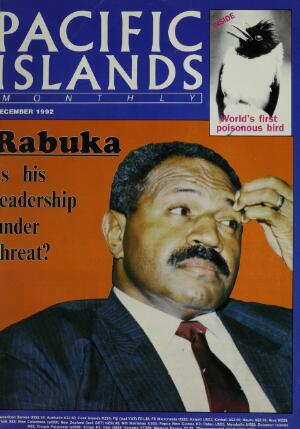
Pacific
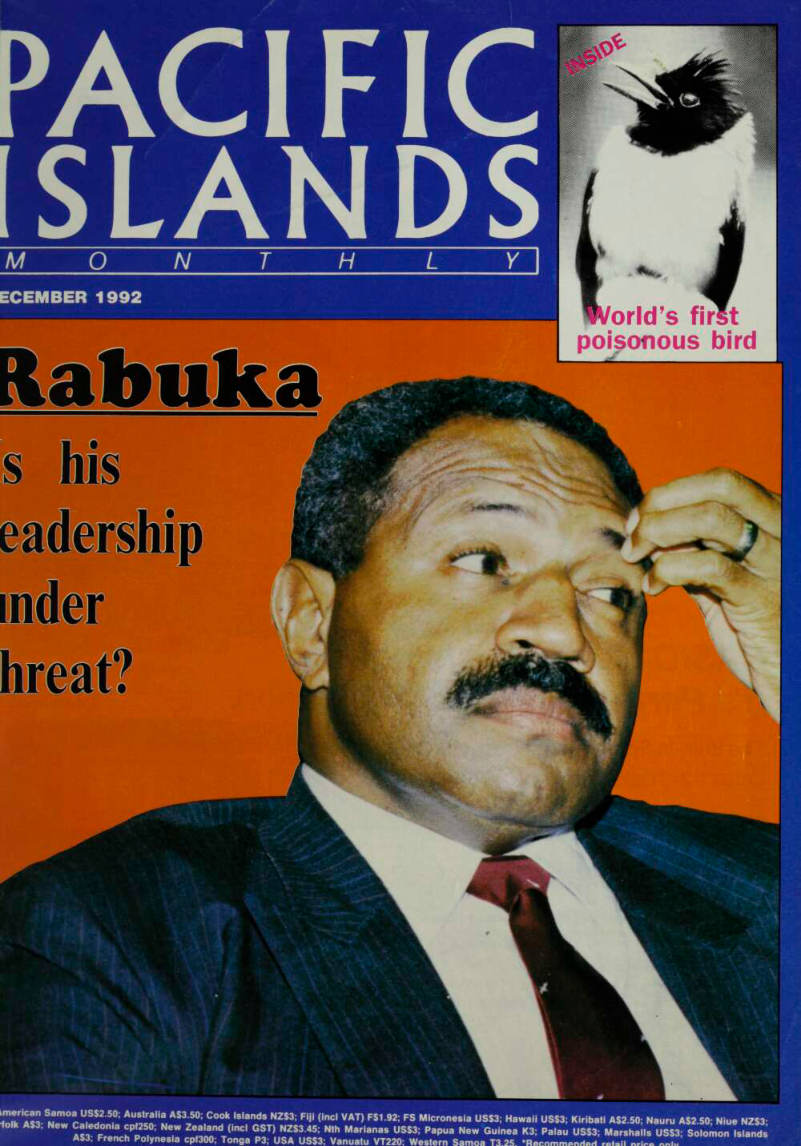
Islands
Monthly
Ecember 1992
IVorld’s first poisonous bird
OllK.fl
s his mder hreat?
tok«3-N a ew°^l!sL s |°. ; AS V O: , C ° Ok , ' s 'f"A S T > Z “; Fii ' (inC ' VAT) FSI 92: FS Micronesia Hawaii USS 3; Kiribati AS2SO; Nauru A 52.50; Niue NZS3; * ’ NeW T ( of .c. s ?.er ; , N .' h Maria " as US$3: Papua New Guinea K 3; Palau USJ3; USS3; Solomon Islands ynesia cpf3oo, Tonga P 3, USA US$3, Vanuatu VT22O; Western Samoa T 3.25. rotail nriro nnlu
Advertisements & other items, p. 2 (1 item)
CASIO Super Systemizer.
It’s Perfect For Every Situation.
The Built-In Spreadsheet Lets You Take
/ Lotus 1-2-3 j
\ data compatible 1
Lotus 1-2-3 Data With You!
•Large 40-column x 10-line display is easy to read. • Large 256K8 memory can store approximately 10,200
telephone numbers.
•Built-in spreadsheet is compatible with Lotus 1-2-3*data. • Data communication with personal computers is effortless
using optional interface unit.
• IC card system lets you tailor the functions you need. • Lotus and 1-2-3 are registered trademarks of Lotus Development Corporation.
SUPER SYSTEMIZER
SF-R2O
♦ 40 columns x 10 lines
♦ 256K8 RAM
hB-4«2 51.95 msSSSS i t Rang* So to
AUSTRALIA MOBEX PTY. LTD.
UNIT 1, GIBBES STREET
CHATSWOOD N S W. 2067
FIJI ISLANDS BRULAL & CO., LTD.
G.PO. BOX N 0.362
SUVA, FIJI ISLANDS
NEW CALEDONIA MENARD PACIFIQUE
10 RUE JEAN JAURES
8P3899 NOUMEA, NEW CALEDONIA
NEW ZEALAND MONACO CORP. LTD.
41 POLAND ROAD, GLENFIELD
AUCKLAND, NEW ZEALAND
NORFOLK ISLANDS BURNT PINE TRADERS LTD.
P.0.80X21, NORFOLK ISLANDS
PAPUA NEW GUINEA SENGCO NIUGINI PTY. LTD.
P.0.80X 1886, BOROKU
PAPUA NEW GUINEA
TAHITI MAISON AUROSE
30. RUE COLLETTE
PAPEETE, TAHITI
CASIO COMPUTER CO., LTD
Tokyo, Japan
Pacific
Islands
Monthly
Vol 62 No. 12
The News Magazine
December 1992
Letters 5
Headlines 6
South Pacific
Commission
up this mess 9 Starting off with a bang 10 Removing barriers 11
20Ver Story
tebuka walking a tight-rope 14
.And Rights
.and disputes in Polynesia 16 -rench no inside. Stay outside’ 19
Politics
)emocrats make clean sweep in US territorial elections 20 loyalty under threat 23
The Region
War on drug trafficking 24
Profile
No difference between Anglophone and Francophone 32
Advertising Feature
PAFCO and its origin 35 Over 100 separate checks and tests 37
Environment
Tourism’s balancing act 38
Migration
Control migrants or promote tourism 41 Three visa policies 41
Western Samoa
Cultural centre controversy erupts 42
Science
World's first poisonous bird 44
Arts
This is the Yarnangu 48
Festival
The fastest canoe in the South Pacific 50
Sports
See ya around, champ 52
Yachting
Stepping off the treadmill 54
Shipping
Shipping schedules 56
Columnists
Jemima Garrett 13 Margot O’Neill 27 Alfred Sasako 29 Julian Moti 39 Bill McCabe 42 David Barber 47
Publisher: Brian O’Flaherty Editor: Mala Jagmohan Senior Writer: Martin Tiffany Correspondents: Christine Hatcher, David North, Ed Rampell, lan Williams, Johnson Honimae, Karen Mangnall, Liz Thompson, Nicholas Rothwell, Pesi Fonua, Wally Hiambohn.
Columnists: David Barber (Wellington), Futa Heiu (Tonga, covering the Pacific Islands), Jemima Garrett (Sydney), Margot O’Neill (Washington), Julian Moti (Pacific Law), Alfred Sasako (The Forum).
Business and Advertising Manager, Charlotte Thomas
Advertising Sales: • Regional Sales (South Pacific); Salendra Narayan, Tel (679) 304111, Fx (679) 303809 • Sydney, Canberra: Bob Hill Media Represen tations, Tel (61-2) 4164245, Fx (61-2) 4165064 • Brisbane: Robert Walker, Media House, Tel (61-7) 3710533, Fx (61-7) 371-8904 • Adelaide: Hastwell Williamsons Representations, Tel (61-8) 799522, Fx (61-8) 799735 • Melbourne: Brown Orr Fletcher Burrows (Aust).
Pty. Ltd. Tel (3) 696 5188 Fx (03) 696 5131. • Auckland: McKay International Media Reps Ltd, Tel (64-9) 4190561, Fx (64-9) 4192243 • Japan: Universal Media Corporation, Tokyo, Tel (3) 6663036, 6663094, Cable: UNIMEDIA Tokyo, Tx 2524665.
Founded 1930 (USPS 952480). A Fiji Times Limited production.
Cover prices are recommended retail only. Regis tered by Australia Post, Publication No. NBP 1210. © Copyright Fiji Times Limited, 177 Victoria Parade, Suva. Fiji. Tel (679) 304111, Fx (679)
303809, Tx Fj2124.
Pacific Islands Monthly is published monthly by The Fiji Times Limited, a division of Nationwide News, 2 Holt Street, Surry Hills, Sydney, NSW 2010.
Send address changes to: • Pacific Islands Monthly, PO Box 1167, Suva, Fiji.
Typeset and printed by The Fiji Times Limited, 177 Victoria Parade, Suva, Fiji.
The South Pacific Commission in session
Aboriginal artists at work
The fastest canoe in the Pacific
Advertisements & other items, p. 4 (1 item)
frnapwoua 1393
m A n m ■T
S IP
C r M iL^f4
Merry Ch
Mappy Mo Mays
from tBiCo
S&E3
iHi'rrg (Cliriatmaa anh a
frnapwoua 1393
3Frnm tlyr Pariftr Jalan&a UnntljUj tram
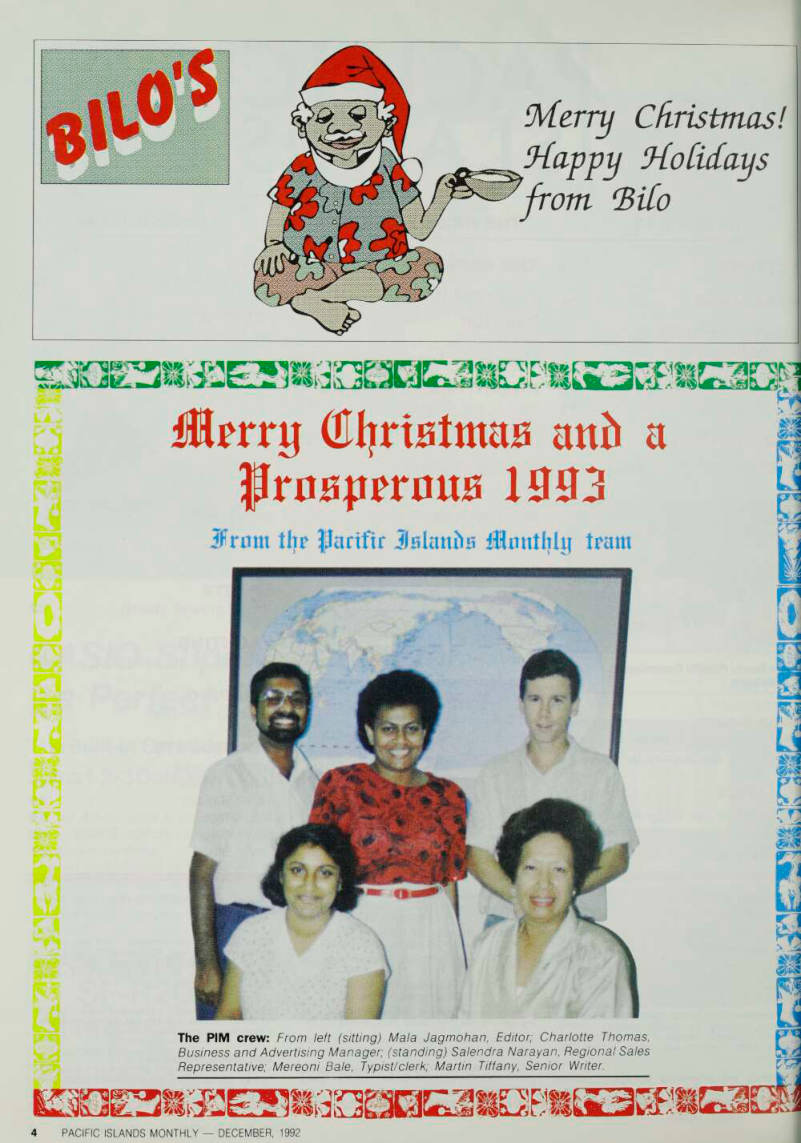
4 «» The PIM crew: From left (sitting) Mala Jagmohan, Editor; Charlotte Thomas, Business and Advertising Manager; (standing) Salendra Narayan, Regional Sales Representative; Mereoni Bale, Typist/clerk; Martin Tiffany, Senior Writer.
sovereignty
Letters
Hawaiian
Madam , I read your November 1992 cover stories “Hawaii’s Quest for Sovereignty” with interest and humility.
The scheming on that fatal 17th day of January that signalled the downfall of the Hawaiian monarchy and the demise of the Hawaiians as a people is mind boggling.
Commendations are due to the organ isers of the Hawaiian Sovereignty Move ment.
Those of us, fellow Pacific islanders who take our own sovereignty for granted, must not only lend them our sympathetic ears but also extend the movement our support.
During the “1989 Conference on US Pacific Insular Areas” held in Honolulu, [ was humbled by the attention US federal agencies paid the small island states of Palau, Federated States of Micronesia, the Marshall Islands; and :he US territories of American Samoa, Commonwealth of the Northern Mariana Islands , and Guam.
By contrast, spokesperson for native Eskimos and indigenous Hawaiians were lot provided seats and had to remain itanding while giving their 10-minute
iresentation as “petitioners”.
My advice to the Palau delegation to mdorse the Eskimo and Hawaiian state nents went unheeded.
My heart goes out to you all: Dennis ‘Bumpy” Kanahele, Mililani Trask, Dr Cekuni Blaisdell, Hayden Burgess, and mur other fellow activists.
Please send us your campaign ma erials so that we too can take up the :ause of your inalienable sovereignty icld for the time being in abeyance.
Vic Uherbelau Director, Foreign Affairs
Png
lolitics
l Aadam, I refer to the article “Resource devel •pment the dividing line in PNG >olitics” by Frank Kolma, in PIM July, 992.
With the exceptions of the bits on the lumber of parties and on the secret >allot, when I read the article, it almost eemed like reading about politics in the JSA (or many other countries).
Robert Silberstorf Antioquia Colombia
n H women dim
violence
, , , Madam We appreciate the coverage you gave to the first Pacific Regional Workshop on Violence Against Women, recently coordinated by us in Fiji. However, it is important to put the event into its development context and to clarify the detail of some of the issues discussed.
The workshop was an integral part of what is a major four-year development project which strengthens and utilises the services of the Fiji Women’s Crisis Centre to train women from the Pacific in crisis counselling and the establishment and management of services for women victims.
Pacific women plan to integrate these services m many of their ongoing development programmes. Community education on violence against women will begin with events during the forthcoming International 16 days of Activism, culminating on Human Rights Day, December 10.
This AIDAB funded programme is enabling women to develop a broader understanding of the complex issue of violence, plus a framework of strategies, and sources of financial, moral and political support to do ameliorative and preventive work.
The issues highlighted in your October PIM formed part of background discussions. Participants examined the social economic and political aspects of gender violence and the role of the state, the judiciary, military and police.
The vulnerability of women in conflict zones and states of emergencies were discussed. But we would like to clarify that references to Bougainville was bal anced and impartial. Ms. Cox has in fact been seriously misquoted.
Our position and concerns are well reflected in our 26 resolutions and will be apparent in the publication of hand books, co-ordination of community edu cation, and establishment of crisis ser vices throughout the Pacific over the next few years.
Shamima AH Fiji Women’s Crisis Centre
Home
finance
Madam, I refer to the comment in your article entitled “The Political Connection” in the September issue of PIM.
For the record I would be grateful if you would publish that the PNG Home Finance Co Ltd, a company which, as you correctly state, was set up to give low and middle income level earners easier access to housing finance was in fact established by the Commomwealth De velopment Corporation of the UK. It is however licensed by the Government of
Png.
Its success, which you believe will not be evident for another few years, is in fact already being seen by a number of home ownership schemes which are being established by private companies and government departments to take advan tage of this initiative.
Brian Glassock Commonwealth Development Corporation
Advertisements & other items, p. 5 (1 item)
Pacific Islands Monthly
Payment to Pacific Islands Monthly: Subscriptions Dept GPO Box 1167, Suva, Fiji.
Subscriptions rates include the cost of airspeeding to all destinations set out above.
Direct airmail rates on application.
Telephone: 304111 Fax; 303809
boycott
Headlines
Vanuatu
Parliament
boycott
All 16 members of Vanu atu’s Opposition boycotted the beginning of the second ordinary session of the House on November 9 forcing it to adjourn because of a lack of quorum.
Only 30 of the 46 members of parliament turned up at the chambers when, accord ing to the Standing Orders, at least two thirds or 31 mem bers should bee present for the sitting to go ahead.
Speaker Alfred Maseng post
poned the meeting until No vember 12.
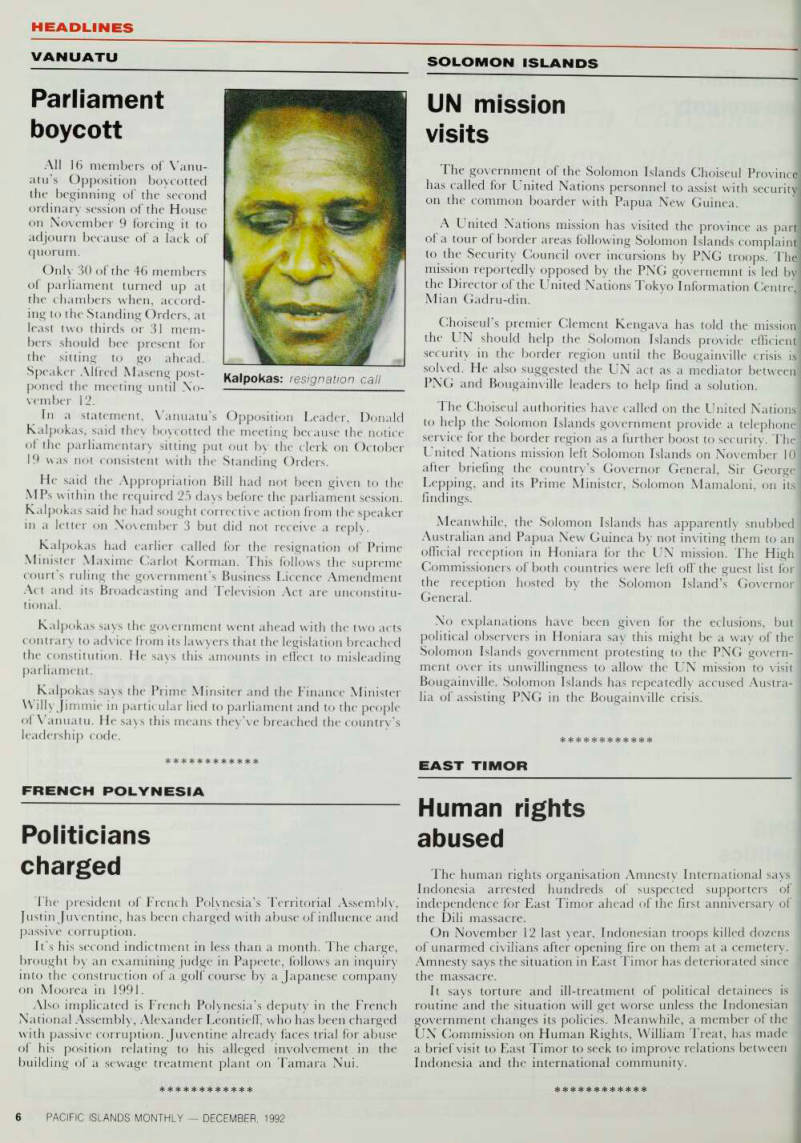
In a statement, Vanuatu’s Opposition Leader, Donald Kalpokas, said they boycotted the meeting because the notice of the parliamentary sitting put out by the clerk on October 19 was not consistent with the Standing Orders.
He said the Appropriation Bill had not been given to the MPs within the required 25 days before the parliament session.
Kalpokas said he had sought corrective action from the speaker in a letter on November 3 but did not receive a reply.
Kalpokas had earlier called for the resignation of Prime Minister Maxime Carlot Korman. This follows the supreme court’s ruling the government’s Business Licence Amendment Act and its Broadcasting and Television Act are unconstitu tional.
Kalpokas says the government went ahead with the two acts contrary to advice from its lawyers that the legislation breached the constitution. He says this amounts in effect to misleading parliament.
Kalpokas says the Prime Minsiter and the Finance Minister Willy Jimmie in particular lied to parliament and to the people of Vanuatu. He says this means they’ve breached the country’s
leadership code.
Kalpokas: resignation call
charged
French Polynesia
Politicians
The president of French Polynesia’s Territorial Assembly, Justin Juventine, has been charged with abuse of influence and passive corruption.
It s his second indictment in less than a month. The charge, brought by an examining judge in Papeete, follows an inquiry into the construction of a golf course by a Japanese company on Moorea in 1991.
Also implicated is French Polynesia’s deputy in the French National Assembly, Alexander Leontieff, who has been charged with passive corruption. Juventine already faces trial for abuse of his position relating to his alleged involvement in the building of a sewage treatment plant on Tamara Nui.
UN mission
Solomon Islands
visits
The government of the Solomon Islands Choiseul Province has called for United Nations personnel to assist with security on the common boarder with Papua New Guinea.
A United Nations mission has visited the province as part of a tour of border areas following Solomon Islands complaint to the Security Council over incursions by PNG troops. The mission reportedly opposed by the PNG governemnt is led by the Director of the United Nations Tokyo Information Centre, Mian Gadru-din.
Choiseul’s premier Clement Kengava has told the mission the UN should help the Solomon Islands provide efficient security in the border region until the Bougainville crisis is solved. He also suggested the UN act as a mediator betweeJ PNG and Bougainville leaders to help find a solution.
The Choiseul authorities have called on the United Nations! to help the Solomon Islands government provide a telephone service for the border region as a further boost to security. The United Nations mission left Solomon Islands on November 10 after briefing the country’s Governor General, Sir George Lepping, and its Prime Minister, Solomon Mamaloni, on its 1 findings.
Meanwhile, the Solomon Islands has apparently snubbed Australian and Papua New Guinea by not inviting them to an official reception in Honiara for the UN mission. The High Commissioners of both countries were left off the guest list for the reception hosted by the Solomon Island’s Governor General.
No explanations have been given for the eclusions, but political observers in Honiara say this might be a way of the Solomon Islands government protesting to the PNG govern ment over its unwillingness to allow the UN mission to visit Bougainville. Solomon Islands has repeatedly accused Austra- ■ lia of assisting PNG in the Bougainville crisis.
Human rights
East Timor
abused
The human rights organisation Amnesty International says Indonesia arrested hundreds of suspected supporters of independence for East Timor ahead of the first anniversary of the Dili massacre.
On November 12 last year, Indonesian troops killed dozens of unarmed civilians after opening fire on them at a cemetery.
Amnesty says the situation in East Timor has deteriorated since the massacre.
It says torture and ill-treatment of political detainees is routine and the situation will get worse unless the Indonesian government changes its policies. Meanwhile, a member of the UN Commission on Human Rights, William Treat, has made a brief visit to East Timor to seek to improve relations between i Indonesia and the international community.
Foreign exchange
Fiji
Fire-starters
arrested
In Fiji, 22 men have appeared in court charged with unlawful assembly and obstruction in connection with fires they lit to block access to one of the country’s top resorts. Their arrest on November 10 restored access to Shangri La’s Fijian Resort which has been deserted by tourists since the fires were lit a week ago.
The 22 men have been released on SUS 130 bail each with one of the conditions being they must not be seen within one kilometre of the resort causeway for any reason. Police are looking for 10 other men in connection with the case. The protestors have been demanding the removal of Adi Lady Lala Mara, wife of acting president Ratu Sir Kamisese Mara, as sole trustee of a fund into which lease money for the hotels is paid.
Resort general manager Radike Qereqeretabua says he and his staff will travel widely in order to attract visitors back to the hotel. But he doesn’t expect business to be normal until January. ***
Rabuka's
budget
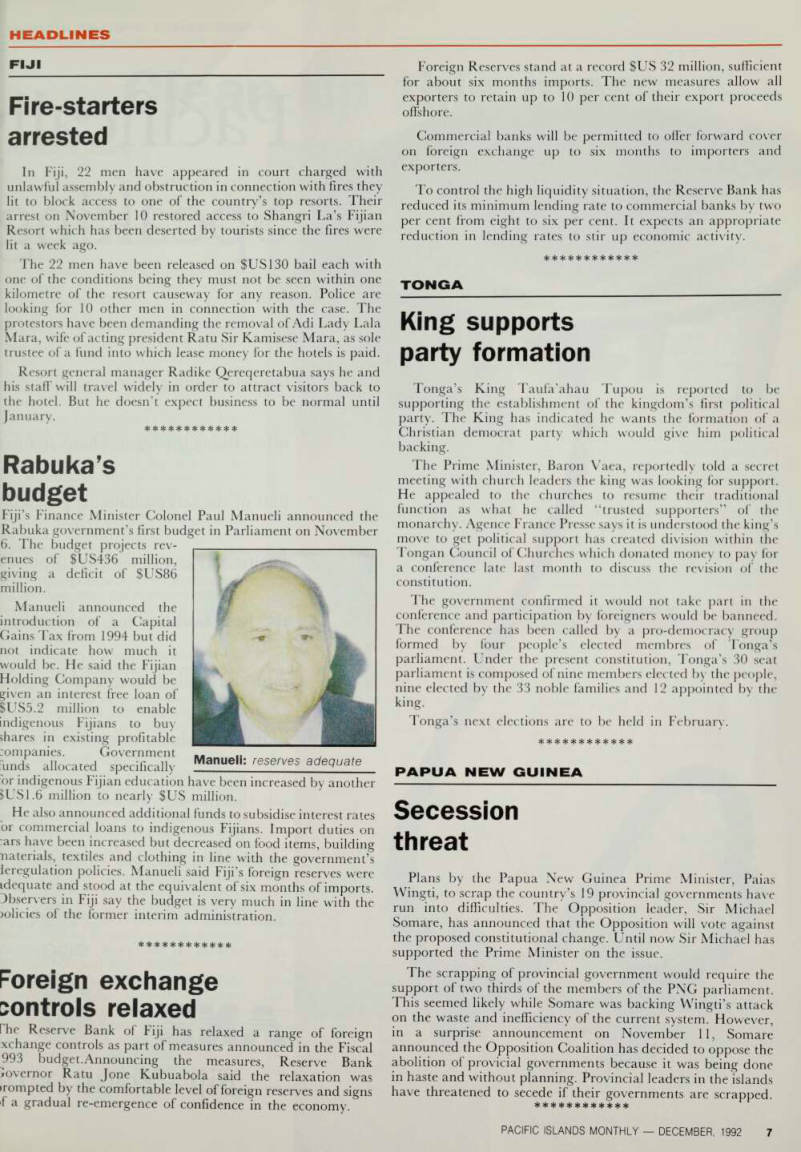
Fiji’s Finance Minister Colonel Paul Manueli announced the Rabuka government’s first budget in Parliament on November
6. The budget projects rev enues of SUS 436 million, giving a deficit of SUSB6 million.
Manueli announced the
introduction of a Capital
Gains Tax from 1994 but did not indicate how much it would be. He said the Fijian
Holding Company would be
given an interest free loan of SUSS.2 million to enable indigenous Fijians to buy
>hares in existing profitable
:ompanies. Government iunds allocated specifically
br indigenous Fijian education have been increased by another &USI.6 million to nearly SUS million.
He also announced additional funds to subsidise interest rates or commercial loans to indigenous Fijians. Import duties on :ars have been increased but decreased on food items, building naterials, textiles and clothing in line with the government’s ieregulation policies. Manueli said Fiji’s foreign reserves were idequate and stood at the equivalent of six months of imports.
Observers in Fiji say the budget is very much in line with the )olicies of the former interim administration. ***
Foreign exchange
controls relaxed
fhe Reserve Bank of Fiji has relaxed a range of foreign xchange controls as part of measures announced in the Fiscal 993 budget. Announcing the measures, Reserve Bank governor Ratu Jone Kubuabola said the relaxation was •rompted by the comfortable level of foreign reserves and signs f a gradual re-emergence of confidence in the economy.
Foreign Reserves stand at a record SUS 32 million, sufficient for about six months imports. The new measures allow all exporters to retain up to 10 per cent of their export proceeds offshore.
Commercial banks will be permitted to offer forward cover on foreign exchange up to six months to importers and exporters.
To control the high liquidity situation, the Reserve Bank has reduced its minimum lending rate to commercial banks by two per cent from eight to six per cent. It expects an appropriate reduction in lending rates to stir up economic activity.
Manueli: reserves adequate
King supports
Tonga
party formation
Tonga’s King Taufa’ahau Tupou is reported to be supporting the establishment of the kingdom’s first political party. The King has indicated he wants the formation of a Christian democrat party which would give him political backing.
The Prime Minister, Baron Vaea, reportedly told a secret meeting with church leaders the king was looking for support.
He appealed to the churches to resume their traditional function as what he called “trusted supporters” of the monarchy. Agence France Presse says it is understood the king’s move to get political support has created division within the Tongan Council of Churches which donated money to pay for a conference late last month to discuss the revision of the constitution.
The government confirmed it would not take part in the conference and participation by foreigners would be banneed.
The conference has been called by a pro-democracy group formed by four people’s elected membres of Tonga’s parliament. Under the present constitution, Tonga’s 30 seat parliament is composed of nine members elected by the people, nine elected by the 33 noble families and 12 appointed by the king.
Tonga’s next elections are to be held in February.
Secession
Papua New Guinea
threat
Plans by the Papua New Guinea Prime Minister, Paias Wingti, to scrap the country’s 19 provincial governments have run into difficulties. The Opposition leader, Sir Michael Somare, has announced that the Opposition will vote against the proposed constitutional change. Until now Sir Michael has supported the Prime Minister on the issue.
The scrapping of provincial government would require the support of two thirds of the members of the PNG parliament.
This seemed likely while Somare was backing Wingti’s attack on the waste and inefficiency of the current system. However, in a surprise announcement on November 11, Somare announced the Opposition Coalition has decided to oppose the abolition of provicial governments because it was being done in haste and without planning. Provincial leaders in the islands have threatened to secede if their governments are scrapped. ***
Advertisements & other items, p. 8 (1 item)
Pacificall
an • - ■
I A warm welcome is probably the m |l| important thing that any bank has offer. Being the biggest bank in Fiji a part of the largest banking group in l Pacific may give us the edge in provid the best facilities for you locally a |M internationally, but never at the expei a of our individual personal service. A 1 all, that is why we are where we < I today. Here for you, ANZ Bank F Your bank.
Official Sponsor 1992 Olympic Team
O Qp
ANZ
Fiji - Your bant
Clean up this mess
South Pacific Commission
By Martin Tiffany
THE big boys at the 32nd South Pacific Conference in Suva were not happy. And they warned the South Pacific Com mission to clean up its financial mess or they would reconsider their financial contributions.
Despite assurances at the October meet ing from the commissions outgoing secretary-general, Atanraoi Baiteke, that the deficit problem was under control, Australia, France, the United Kingdom and New Zealand expressed concern.
Australia is the biggest donor, contribu ting almost SUS 2 million of the S 6 million received in assessed contri butions.
Australian representative Stephen Mar
tin said his delegation could not accept Baiteke’s statement the budget deficit was under control. If the current situ ation persisted, Australia would have to review and consider scaling down the level of its extra-budgetary assistance and use some of its funds to improve the financial management of the com mission.
France said if reforms proposed by the SPG Management Systems Review Sub- Committee were not implemented, they would have to reconsider the payment date and the amount of its contributions to the SPG.
The United Kingdom representative said in 1993 they would continue their extra budgetary assistance to the projects they now supported. However, the amount of this assistance in 1994 would depend on the steps taken in 1993 to improve financial management and control.
New Zealand said it was concerned because last year’s conference had di rected the secretariat to take appropriate remedial action following consideration of last year’s audit report, but the current audit report had covered much the same
ground.
The problem the commission has been faced with over the past couple of years is financial mismanagement and a grow ing budget deficit. The 1991 deficit was first believed to be around SUSI million but according to conference spokesman, Nauru’s Leo Keke, it is between
Sussoo,Ooo And $U5750,000.
The commission’s budget consists of the core budget and an extra-budgetary fund. Seventy per cent of the core budget covers administrative costs and 30 per cent finances the work program. The extra-budgetary fund makes up the shortfall in the work program.
The 1991 auditor’s report showed a
negative balance in the core budget of SUS 2.4 million.
What the donor countries Australia, France, the United States, Britain and New Zealand want is the com mission’s financial situation monitored closely before they give any further payments.
The 17th meeting of the Committee of Representatives of Governments and Administrations (CRGA), held in Suva immediately before the conference, agreed to accept the recommendations (with two exceptions) made by the auditors for immediate implementations.
The CRGA meeting also requested the auditors to closely monitor the financial situation and the implementation of these recommendations.
The report by auditors Coopers and Lybrand for 1991 said some accounting principles applied in previous years did not conform with generally accepted accounting principles. And recommen dations made in previous audit reports had not been implemented.
The budget for 1993 of SUS 22 million was approved on the condition the new management implement recommended
changes to the commission’s financial systems and management practices.
These changes are to ensure a stricter control on expenditure, improve internal auditing and ensure the financial situ ation is closely monitored.
What was interesting was there was no attempt made to apologise or make excuses for the financial mismanage ment. It was accepted there was a problem and a solution had to be found.
What perhaps irritated some countries, the donors in particular, was that after the financial problems were brought to light at the 1991 conference they ex pected something to have been done about them. Especially after four CRGA meetings two last year and two this year. The CRGA acts as a board of management for the SPG and it was expected they would sort out the prob lem. Many countries were genuinely surprised nothing had been done.
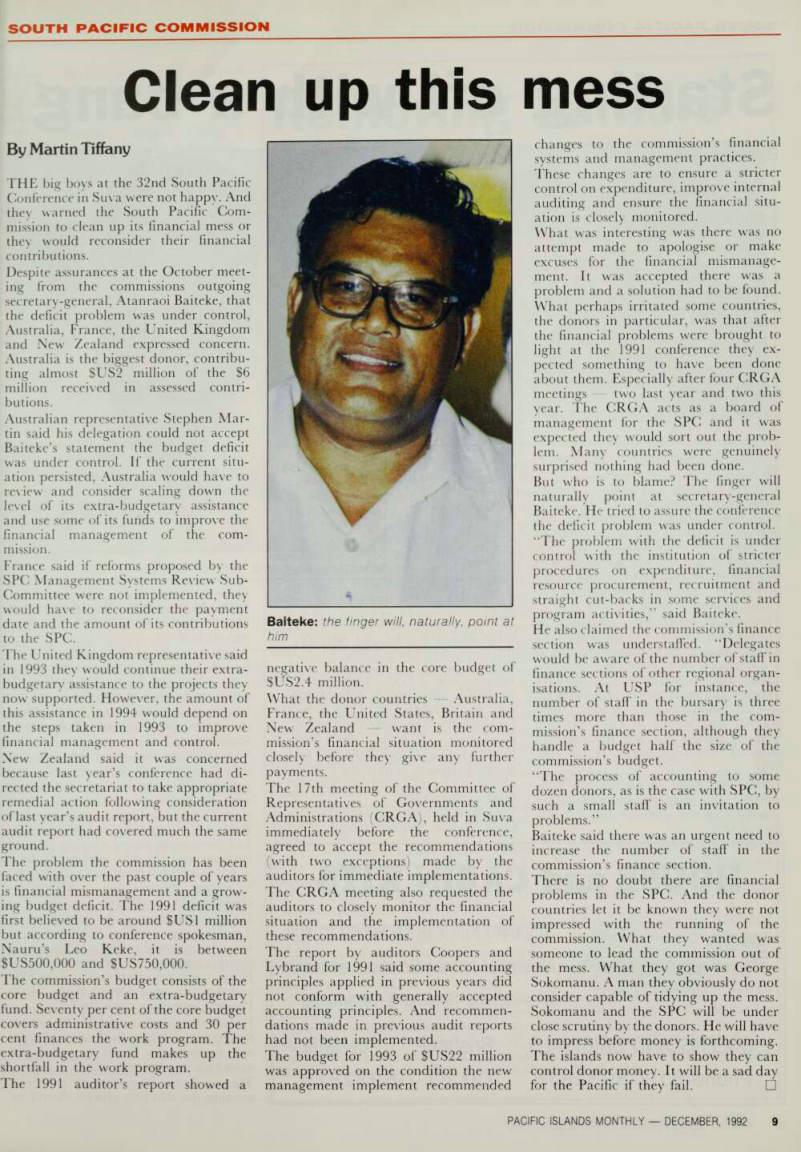
But who is to blame? The finger will naturally point at secretary-general Baiteke. He tried to assure the conference the deficit problem was under control.
“The problem with the deficit is under control with the institution of stricter
procedures on expenditure, financial
resource procurement, recruitment and straight cut-backs in some services and program activities,’’ said Baiteke.
He also claimed the commission’s finance section was understaffed. “Delegates would be aware of the number of staff in finance sections of other regional organ isations. At USP for instance, the number of staff in the bursary is three times more than those in the com mission’s finance section, although they handle a budget half the size of the commission’s budget.
“The process of accounting to some dozen donors, as is the case with SPG, by such a small staff is an invitation to
problems.”
Baiteke said there was an urgent need to increase the number of staff in the commission’s finance section.
There is no doubt there are financial problems in the SPG. And the donor countries let it be known they were not impressed with the running of the commission. What they wanted was someone to lead the commission out of the mess. What they got was George Sokomanu. A man they obviously do not consider capable of tidying up the mess.
Sokomanu and the SPG will be under close scrutiny by the donors. He will have to impress before money is forthcoming.
The islands now have to show they can control donor money. It will be a sad day for the Pacific if they fail. □
Baiteke: the finger will, naturally, point at him
Starting off with a bang
By Martin Tiffany
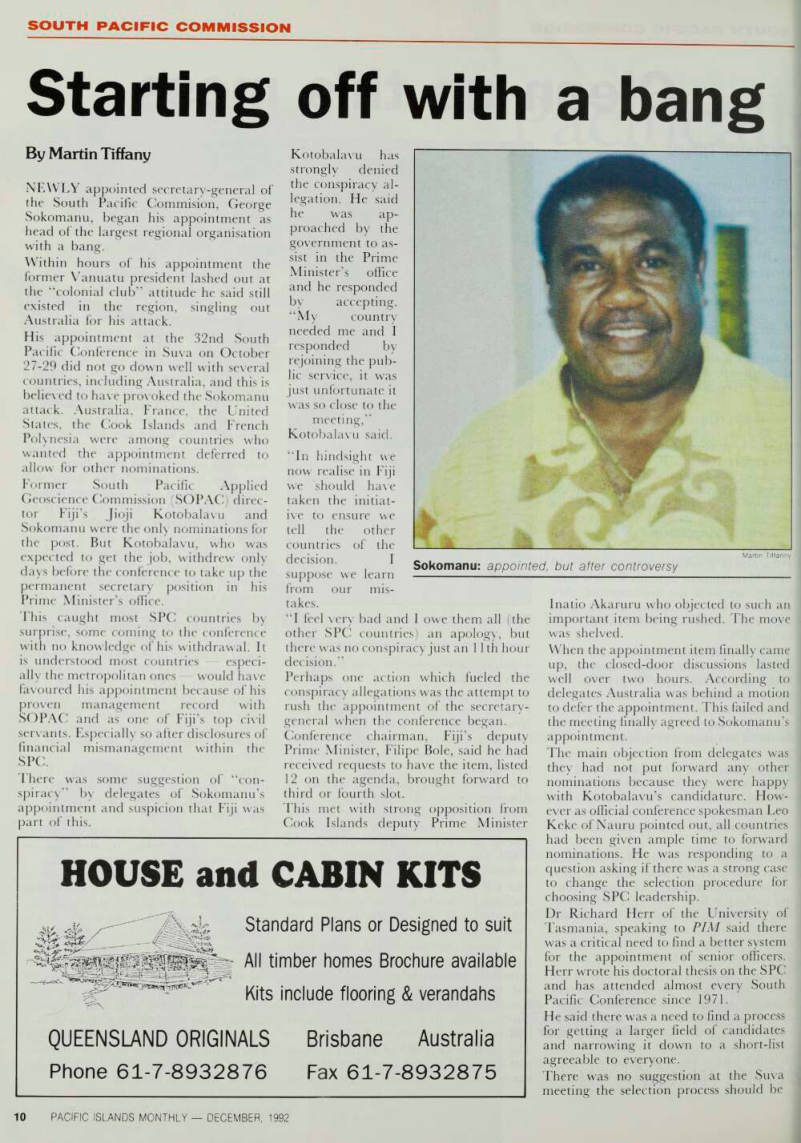
NEWLY appointed secretary-general of the South Pacific Commision, George Sokomanu, began his appointment as head of the largest regional organisation with a bang.
Within hours of his appointment the former Vanuatu president lashed out at the “colonial club” attitude he said still existed in the region, singling out Australia for his attack.
His appointment at the 32nd South Pacific Conference in Suva on October 27-29 did not go down well with several countries, including Australia, and this is believed to have provoked the Sokomanu attack. Australia. France, the United States, the Cook Islands and French Polynesia were among countries who wanted the appointment deferred to allow for other nominations.
Former South Pacific Applied Geoscience Commission (SOPAC) direc tor Fiji’s Jioji Kotobalavu and Sokomanu were the only nominations for the post. But Kotobalavu, who was expected to get the job, withdrew only days before the conference to take up the permanent secretary position in his Prime Minister’s office.
This caught most SPC countries by surprise, some coming to the conference with no knowledge of his withdrawal. It is understood most countries especi ally the metropolitan ones would have favoured his appointment because of his proven management record with SOPAC and as one of Fiji’s top civil servants. Especially so after disclosures of financial mismanagement within the
Spc.
There was some suggestion of “con spiracy” by delegates of Sokomanu’s appointment and suspicion that Fiji was part of this.
Kotobalavu has
strongly denied
. tbe cons P|F ac y a legation. He said he was ap- Poached by the government to as -5*5! ! n tbe >r^ Tie I ! ll^ ter s °^ IC( r be res P onc led accepting. country nee{^ anc ! * re^P on e V re l oinm .g the P ub ’ .* C servace ’ n was -l ust it was so close to the meeting, kotobalavu said, “In hindsight we now realise in Fiji we should have taken the initiat ive to ensure we tell the other countries of the decision. I suppose we learn from our mis takes.
“I feel very bad and I owe them all (the other SPC countries) an apology, but there was no conspiracy just an 11th hour decision.”
Perhaps one action which fueled the conspiracy allegations was the attempt to rush the appointment of the secretary general when the conference began.
Conference chairman, Fiji’s deputy Prime Minister, Filipe Bole, said he had received requests to have the item, listed 12 on the agenda, brought forward to third or fourth slot.
This met with strong opposition from Cook Islands deputy Prime Minister
Inatio Akaruru who objected to such an important item being rushed. The move was shelved.
When the appointment item finally came up, the closed-door discussions lasted well over two hours. According to delegates Australia was behind a motion to defer the appointment. This failed and
the meeting finally agreed to Sokomanu’s
appointment.
The main objection from delegates was they had not put forward any other nominations because they were happy with Kotobalavu’s candidature. How ever as official conference spokesman Leo Keke of Nauru pointed out, all countries had been given ample time to forward nominations. He was responding to a question asking if there was a strong case to change the selection procedure for
choosing SPC leadership.
Dr Richard Herr of the University of Tasmania, speaking to PIM said there was a critical need to find a better system for the appointment of senior officers.
Herr wrote his doctoral thesis on the SPC and has attended almost every South Pacific Conference since 1971.
He said there was a need to find a process for getting a larger field of candidates and narrowing it down to a short-list agreeable to everyone.
There was no suggestion at the Suva meeting the selection process should be
Sokomanu: appointed, but after controversy
altered the feeling being the countries knew the post was up for nominations and only Fiji and Vanuatu had put forward names.
The Sokomanu outburst, saying a colonial club did exist within the SPC, came at a press conference on the
afternoon of his appointment.
“The way the Australian government is carrying on, we’re back at the stage we should be out of,” said Sokomanu.
“Do we still need people to bulldoze us around here or let Pacific islanders do their own thing and show places like Australia and others that they can do the job as well as others?”
Australian Parliamentary Secretary to the Minister of Foreign Affairs, Stephen Martin, was not impressed with the criticism. Martin, the head of the Australian delegation to the SPC, said
Sokomanu was respected in the region
but said deferring the appointment would have possibly allowed other can didates to be nominated who possesed the “required financial and management skill” to tackle SPC’s current problems.
Martin said after this sort of outburst Australia one of the SPC’S major financial supporters didn’t feel very welcome.
He also dismissed as “absolute non.sense” suggestions that frosty relations between Port Vila and Canberra came into over the leadership issue.Sokomanu’s attack on Australia did not go down well with other meeting delegates.
In its final report the conference rapped Sokomanu’s knuckles by endors ing comments by the representatives of French Polynesia, the Cook Islands, France and Tokelau condemning an interview the secretary-general elect gave to the press. The conference noted Sokomanu had referred to in-camera discussions on the appointment of prin cipal officers and he had criticised the positions of certain member countries on this item.
Sokomanu was requested by the con ference to help maintain a spirit of regional unity and refrain from “com menting publicly on the positions of individual members”.
Meanwhile, Sokomanu said he be lieved he had the experience for the SPC saying, “what is a degree when experi ence is there for a job”. Certainly one thing Sokomanu has in his favour is as a former Vanuatu president he knows the regional heads and they view him on an equal standing. To further help his regional dealings he speaks fluent Eng lish, French, Fijian and pidgin.
Despite the differences over his ap pointment none of the countries felt this would strain their dealings with the SPC.
Advertisements & other items, p. 10 (1 item)
House And Cabin Kits
Standard Plans or Designed to suit All timber homes Brochure available Kits include flooring & verandahs QUEENSLAND ORIGINALS Brisbane Australia Phone 61-7-8932876 Fax 61-7-8932875
Removing barriers
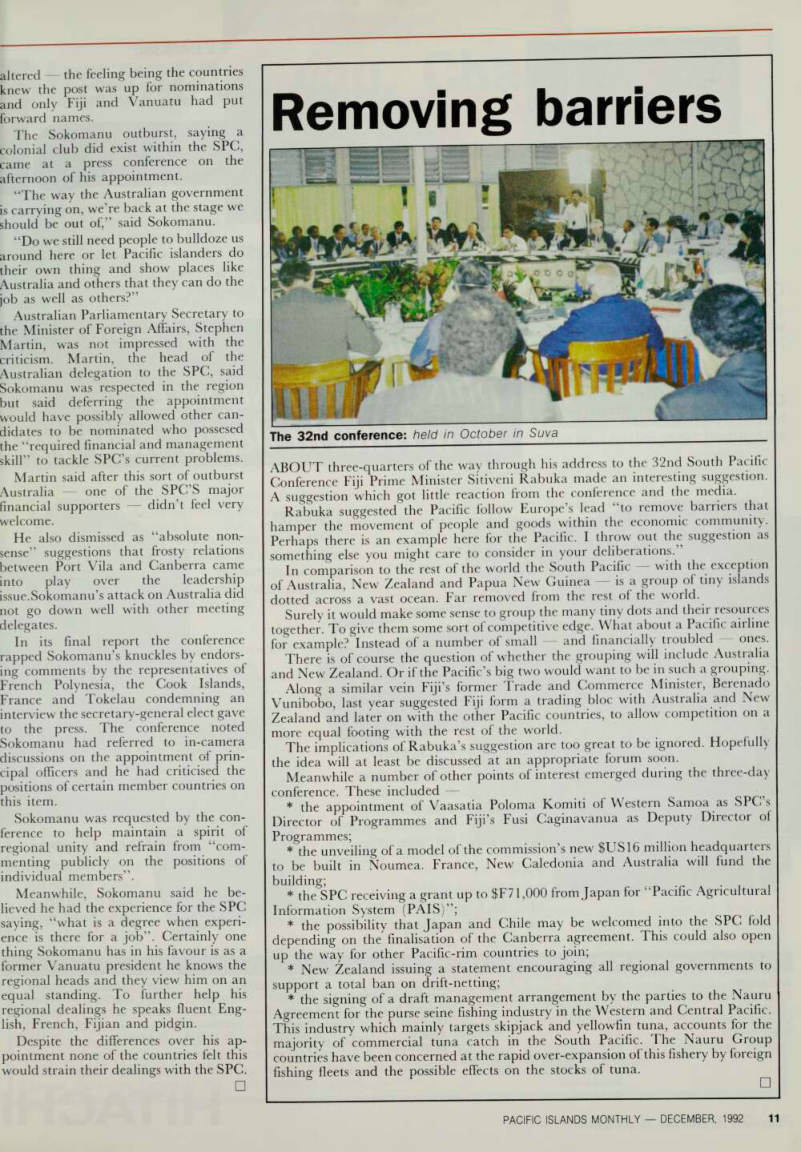
ABOUT three-quarters of the way through his address to the 32nd South Pacific Conference Fiji Prime Minister Sitiveni Rabuka made an interesting suggestion.
A suggestion which got little reaction from the conference and the media.
Rabuka suggested the Pacific follow Europe’s lead “to remove barriers that hamper the movement of people and goods within the economic community.
Perhaps there is an example here for the Pacific. I throw out the suggestion as something else you might care to consider in your deliberations.
In comparison to the rest of the world the South Pacific with the exception of Australia, New Zealand and Papua New Guinea is a group of tiny islands dotted across a vast ocean. Far removed from the rest of the world.
Surely it would make some sense to group the many tiny dots and their resources together. To give them some sort of competitive edge. What about a Pacific airline for example? Instead of a number of small and financially troubled ones.
There is of course the question of whether the grouping will include Australia and New Zealand. Or if the Pacific’s big two would want to be in such a grouping.
Along a similar vein Fiji’s former Trade and Commerce Minister, Berenado Vunibobo, last year suggested Fiji form a trading bloc with Australia and New Zealand and later on with the other Pacific countries, to allow competition on a more equal footing with the rest of the world.
The implications of Rabuka’s suggestion are too great to be ignored. Hopefully the idea will at least be discussed at an appropriate forum soon.
Meanwhile a number of other points of interest emerged during the three-day conference. These included * the appointment of Vaasatia Poloma Komiti of Western Samoa as SPG s Director of Programmes and Fiji’s Fusi Caginavanua as Deputy Director of Programmes; * the unveiling of a model of the commission’s new SUSI 6 million headquarters to be built in Noumea. France, New Caledonia and Australia will fund the building; * the SPC receiving a grant up to $F71,000 from Japan for “Pacific Agricultural Information System (PAIS)”; * the possibility that Japan and Chile may be welcomed into the SPC fold depending on the finalisation of the Canberra agreement. This could also open up the way for other Pacific-rim countries to join; * New Zealand issuing a statement encouraging all regional governments to support a total ban on drift-netting; * the signing of a draft management arrangement by the parties to the Nauru Agreement for the purse seine fishing industry in the Western and Central Pacific.
This industry which mainly targets skipjack and yellowfin tuna, accounts for the majority of commercial tuna catch in the South Pacific. The Nauru Group countries have been concerned at the rapid over-expansion of this fishery by foreign fishing fleets and the possible effects on the stocks of tuna.
The 32nd conference: held in October in Suva
Advertisements & other items, p. 12 (1 item)
plus friendly service
VTMB3BE
PAL VCR with NTSC playback
compatibility and two-speed
recording and playback (SP/LP)
-a*
CMT42OO
42" multi-system super projection TV with S-video terminal, surround sound and
7-language teletext.
CX-W3OO
Portable CD player/tuner/double cassette deck with high-speed dubbing and bass boost sound.
VME2SE
“Twist & Shoot” Bmm movie camera with 16 x digital zoom.
All this
plus friendly service
at a Hitachi dealer near you.
y CX
W5OO
CV-4700 1000 W 4.5-liter vacuum cleaner with foot switch, tool storage space and top-mounted
360-degree rotating hose.
Portable CD player/
digital tuner/double
cassette deck with “3D twin drive” system and remote control.
FX9 Mini Hi-Fi system with super wide surround sound and
one-touch CD-to-tape dubbing.
Our support network puts service within easy reach.
PAFI26OPX
Microprocessor controlled
washing machine with forced drain pump,
softener/bleach dispenser,
and lint filter.
AUSTRALIA:
HITACHI SALES AUSTRALIA PTY LTD.
153 Keys Road Moorabbin, Victoria 3189 Tel: (03) 555-8722 Fiji;
BURNS PHILP (SOUTH SEA)
COMPANY LTD
Box 355, G.P.O.
Suva Tel: 9-311777
COMMUNICATIONS PACIFIC LTD. (AWA)
37 Freeston Road (PO. Box 858) Walu Bay. Suva Tel: 9-312744
NEW ZEALAND:
ROBINSON INDUSTRIES LTD
6 Zelanian Drive East Tamaki Auckland Tel: 9-2745615
NEW CALEDONIA:
CALDIS
B.P Ml
Noumea Tel: 26.33.00
CALTEC
B.P 2540 Noumea Tel: 28.39.54
PAPUA NEW GUINEA:
PACIFIC ELECTRONICS
PO. Box 2115
LAE
Tel: 5-424467
TAHITI:
POSI-LECTRIC
PO. BOX 144,
PAPEETE,
Tel: 42.92.56. © 1992 Hitachi, Ltd., Tokyo, Japan. All rights reserved.
HITACHI
Shame on you, Channel 10
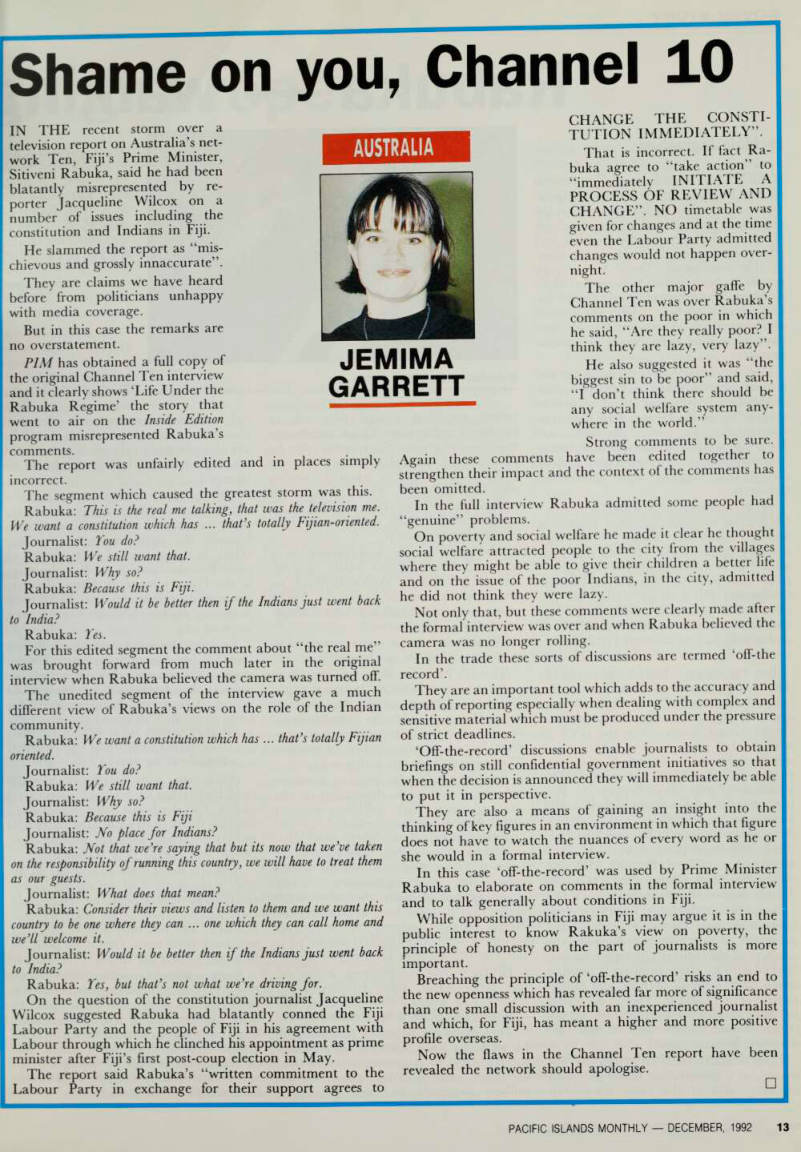
IN THE recent storm over a television report on Australia s net work Ten, Fiji’s Prime Minister, Sitiveni Rabuka, said he had been blatantly misrepresented by re porter Jacqueline Wilcox on a number of issues including the constitution and Indians in Fiji.
He slammed the report as “mis chievous and grossly innaccurate”.
They are claims we have heard before from politicians unhappy with media coverage.
But in this case the remarks are no overstatement.
PIM has obtained a full copy of the original Channel Ten interview and it clearly shows ‘Life Under the Rabuka Regime’ the story that went to air on the Inside Edition program misrepresented Rabuka’s comments.
The report was unfairly edited and in places simply incorrect.
The segment which caused the greatest storm was this.
Rabuka: This is the real me talking, that was the television me.
We want a constitution which has ... that’s totally Fijian-oriented.
Journalist: You do?
Rabuka: We still want that.
Journalist: Why so?
Rabuka: Because this is Fiji.
Journalist: Would it be better then if the Indians just went back to India?
Rabuka: Yes.
For this edited segment the comment about “the real me” was brought forward from much later in the original interview when Rabuka believed the camera was turned off.
The unedited segment of the interview gave a much different view of Rabuka’s views on the role of the Indian community.
Rabuka: We want a constitution which has ... that’s totally Fijian oriented.
Journalist: You do?
Rabuka: We still want that.
Journalist: Why so?
Rabuka: Because this is Fiji Journalist: No place for Indians?
Rabuka: Not that we’re saying that but its now that we’ve taken on the responsibility of running this country, we will have to treat them as our guests.
Journalist: What does that mean?
Rabuka: Consider their views and listen to them and we want this country to be one where they can ... one which they can call home and we’ll welcome it.
Journalist: Would it be better then if the Indians just went back to India?
Rabuka: Yes, but that’s not what we’re driving for.
On the question of the constitution journalist Jacqueline Wilcox suggested Rabuka had blatantly conned the Fiji Labour Party and the people of Fiji in his agreement with Labour through which he clinched his appointment as prime minister after Fiji’s first post-coup election in May.
The report said Rabuka’s “written commitment to the Labour Party in exchange for their support agrees to
Change The Consti
Tution Immediately”.
That is incorrect. If fact Ra buka agree to “take action” to “immediately INITIATE A
Process Of Review And
CHANGE”. NO timetable was given for changes and at the time even the Labour Party admitted changes would not happen over
night.
The other major gaffe by Channel Ten was over Rabuka’s comments on the poor in which he said, “Are they really poor? I think they are lazy, very lazy”.
He also suggested it was “the biggest sin to be poor” and said, “I don’t think there should be any social welfare system any where in the world.”
Strong comments to be sure.
Again these comments have been edited together to strengthen their impact and the context of the comments has been omitted.
In the full interview Rabuka admitted some people had
“genuine” problems.
On poverty and social welfare he made it clear he thought social welfare attracted people to the city from the villages where they might be able to give their children a better life and on the issue of the poor Indians, in the city, admitted he did not think they were lazy.
Not only that, but these comments were clearly made after the formal interview was over and when Rabuka believed the camera was no longer rolling.
In the trade these sorts of discussions are termed ‘off-the record’.
They are an important tool which adds to the accuracy and depth of reporting especially when dealing with complex and sensitive material which must be produced under the pressure of strict deadlines. ‘Off-the-record’ discussions enable journalists to obtain briefings on still confidential government initiatives so that when the decision is announced they will immediately be able to put it in perspective.
They are also a means of gaining an insight into the thinking of key figures in an environment in which that figure does not have to watch the nuances of every word as he or she would in a formal interview.
In this case ‘off-the-record’ was used by Prime Minister Rabuka to elaborate on comments in the formal interview and to talk generally about conditions in Fiji.
While opposition politicians in Fiji may argue it is in the public interest to know Rakuka’s view on poverty, the principle of honesty on the part of journalists is more important.
Breaching the principle of‘off-the-record’ risks an end to the new openness which has revealed far more of significance than one small discussion with an inexperienced journalist and which, for Fiji, has meant a higher and more positive
profile overseas.
Now the flaws in the Channel Ten report have been revealed the network should apologise. □
Australia
Jemima
Garrett
Rabuka - walking[?] tight-rope
Cover Story
By Mala Jagmohan
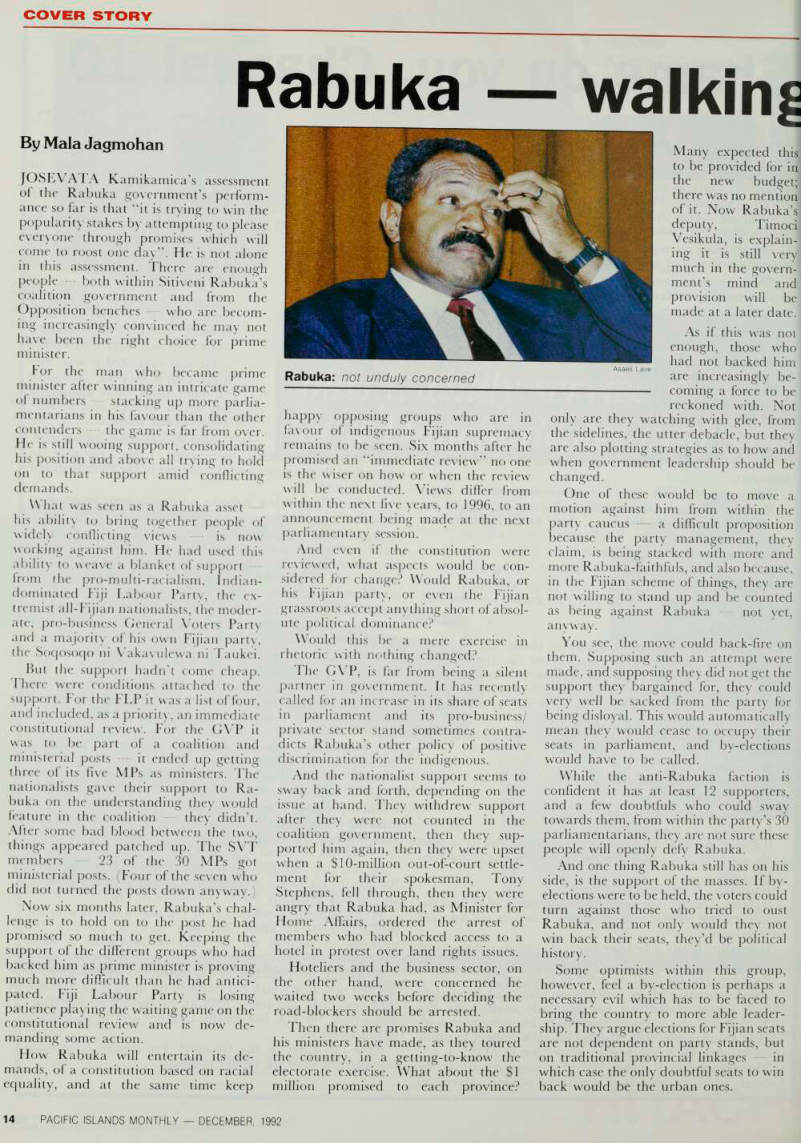
JOSEVATA Kamikamica’s assessment of the Rabuka government’s perform ance so far is that “it is trying to win the popularity stakes by attempting to please everyone through promises which will come to roost one day”. He is not alone in this assessment. There are enough people both within Sitivcni Rabuka’s coalition government and from the Opposition benches who are becom ing increasingly convinced he may not have been the right choice for prime minister.
For the man who became prime minister after winning an intricate game of numbers stacking up more parlia mentarians in his favour than the other contenders the game is far from ov er.
He is still wooing support, consolidating his position and above all trying to hold on to that support amid conflicting demands.
W hat was seen as a Rabuka asset his ability to bring together people of widely conflicting views is now working against him. He had used this ability to weave a blanket of support from the pro-multi-racialism. Indian dominated Fiji Labour Party, the ex tremist all-Fijian nationalists, the moder ate, pro-business General Voters Party and a majority of his own Fijian partv, the Soqosoqo ni Vakavulewa ni Taukei.
But the support hadn't come cheap.
There were conditions attached to the support. For the FLP it was a list of four, and included, as a priority, an immediate constitutional review. For the GVP it was to be part of a coalition and ministerial posts it ended up getting three of its five MPs as ministers. The nationalists gave their support to Ra buka on the understanding they would feature in the coalition they didn’t.
After some bad blood between the two, things appeared patched up. The SVT members 23 of the 30 MPs got ministerial posts. (Four of the seven who did not turned the posts down anyway.) Now six months later, Rabuka’s chal lenge is to hold on to the post he had promised so much to get. Keeping the support of the different groups who had backed him as prime minister is proving much more difficult than he had antici pated. Fiji Labour Party is losing patience playing the waiting game on the constitutional review and is now de manding some action.
How Rabuka will entertain its de mands, of a constitution based on racial equality, and at the same time keep
happy opposing groups who are in favour of indigenous Fijian supremacy remains to be seen. Six months after he promised an “immediate review” no one is the wiser on how or when the review will be conducted. Views differ from within the next five years, to 1996, to an announcement being made at the next
parliamentary session.
And even if the constitution were reviewed, what aspects would be con sidered for change? Would Rabuka, or his Fijian party, or even the Fijian grassroots accept anything short of absol ute political dominance?
Would this be a mere exercise in rhetoric with nothing changed?
The GVP, is far from being a silent partner in government. It has recently called for an increase in its share of seats in parliament and its pro-business/ private sector stand sometimes contra dicts Rabuka’s other policy of positive discrimination for the indigenous.
And the nationalist support seems to sway back and forth, depending on the issue at hand. They withdrew support after they were not counted in the coalition government, then they sup ported him again, then they were upset when a $lO-million out-of-court settle ment for their spokesman, Tony Stephens, fell through, then they were angry that Rabuka had, as Minister for Home Affairs, ordered the arrest of members who had blocked access to a hotel in protest over land rights issues.
Hoteliers and the business sector, on the other hand, were concerned he waited two weeks before deciding the road-blockers should be arrested.
Then there are promises Rabuka and his ministers have made, as they toured the country, in a getting-to-know the electorate exercise. What about the SI million promised to each province?
Many expected this to be provided for in the new budget;j there was no mention of it. Now Rabuka’s
deputy, Timoci!
Vesikula, is explain ing it is still very much in the govern ment’s mind and provision will be made at a later date.
As if this was not enough, those who had not backed him are increasingly be coming a force to be reckoned with. Not
only are they watching with glee, from the sidelines, the utter debacle, but they are also plotting strategies as to how and when government leadership should be
changed.
One of these would be to move a motion against him from within the party caucus a difficult proposition because the party management, they claim, is being stacked with more and more Rabuka-faithfuls, and also because, in the Fijian scheme of things, they are not willing to stand up and be counted as being against Rabuka - - not yet, anyway.
You see, the move could back-fire on them. Supposing such an attempt were made, and supposing they did not get the support they bargained for, they could very well be sacked from the party for being disloyal. This would automatically mean they would cease to occupy their seats in parliament, and by-elections would have to be called.
While the anti-Rabuka faction is confident it has at least 12 supporters, and a few doubtfuls who could sway towards them, from within the party’s 30 parliamentarians, they are not sure these people will openly defy Rabuka.
And one thing Rabuka still has on his side, is the support of the masses. If by elections were to be held, the voters could turn against those who tried to oust Rabuka, and not only would they not win back their seats, they’d be political history.
Some optimists within this group, however, feel a by-election is perhaps a necessary evil which has to be faced to bring the country to more able leader ship. They argue elections for Fijian seats are not dependent on party stands, but on traditional provincial linkages in which case the only doubtful seats to win back would be the urban ones.
Rabuka: not unduly concerned
Asaeli Lave
Rabuka became Fiji’s prime minister after a numbers game which saw him gain majority support.
Six months later, the game is far from over.
Another strategy is to use parliament as a forum to topple leadership. While it is argued parliament does not have the right to change the prime minister since it did not appoint him in the first place (the President of the country appoints the prime minister based on who in his deliberate judgement commands the majority support of the House), a defeated government motion or an Opposition motion which gets carried can technically be seen as a vote of no confidence.
Whether this vote is against the entire government or the leader of the govern ment side is a question which the president might have to step in to resolve.
He could dissolve parliament and call for fresh elections, or he could decide the government might function better under
a new prime minister.
Another option is for members of the house to send a petition to the president, indicating a lack of support for Rabuka.
The role the Opposition parties will play in such a move is obvious. The 14 National Federation Party MPs have never been Rabuka supporters. They had backed Kamikamica, finance minis ter in the interim government before the elections, as prime minister and they
have not been inspired by Rabuka’s
leadership since to change. The FLP, on the other hand, have never been keen on Kamikamica.
So while NFP might feel Kamikamica is the most able person for the job, it might be expedient to look for an alternative, such as Ratu William Toganivalu, who got FLP’s 13 votes.
Toganivalu, a veteran politician, has through the years advocated multi racialism with a view to improving the indigenous’ lot. In fact, as far back as
1963, he had highlighted the dangers of apportioning blame on any one com munity for the lack of advancement of another. Yet he had also pointed out the dangers of economic inequality. He talked about “competing with them (Indians) cleanly and with all our might and with all our strength in our endeavour not to be their masters but to be their economic equals” a sentiment which would sit very well with the Indian Opposition. He has recently also been on record saying the constitution can be changed for the better.
But Kamikamica, himself, is not out of
the running for prime-ministership
should a crisis arise. A cooler and calmer head than Toganivalu, it is unlikely he would like to rush into a situation without having first worked out exactly which way the masses would swing. He is more likely to take the cautious wait and-see line and maybe let the people see the shortfalls of Rabuka first. But it was exactly this caution and lack of aggress ive lobbying which had cost him the prime-ministership in June.
What is the driving force behind the anti-Rabuka group? Is it through pure envy they missed out on the prime ministership? Is it a case of sour grapes?
Or do they genuinely feel they can do a better job and Rabuka is sending the country to ruin?
“He does not know what he’s doing,” said one. “There are no policies the government has on anything. In fact, their whole policy seems to be to hold on to power at any cost.”
“The promises which are being made to the people promises which reek of a popularity contest. Promises, which he will have to honour sooner or later. My concern is that when that time comes, when people realise these are nothing but
hollow words it might be too late. The country would have gone too far down the drain.”
He points out investment is at a low.
There is no growth in the private sector.
There is no attempt to boost investor confidence or to get the economy going.
“They do not know what they are
doing.”
Part of this disillusionment stems from the way the Rabuka-governmcnt handled some of the crises. In its early days it had to contend with the Fiji Post and Telecommunications saga, a prob lem inherited from the interim govern ment. After much controversy, including having the portfolio removed from Min ister Ilai Kuli, an illegal strike which Kuli appeared to be sympathetic to wards, the resignation of the board and profound apologies to the board from government, the matter was finally settled.
But the scandal which really rocked the government and forced the resig nation of attorney-general Apaitia Seru, was the Tony Stephens settled. Stephens, who had sued the government for unlawful detention during the days of the Internal Security Decree, was given a settlement by Seru amounting to some SlO million a staggeringly high figure which stunned the nation.
The payment was deferred, with parliament calling for a commission of inquiry into the whole settlement. Now the government has announced it will seek to annul the settlement in parlia ment.
This could be the motion which will be a test for the Rabuka goovernment.
While the NFP and FLP are not in favour of the payout, they do not see why they should bail the government out of a mess of its own making. While the nationalists generally agree with the payout, they are not likely to vote in favour of annulling it. And there are
enough government members outraged
by the settlement to either vote against it or abstain from voting.
Whether they will decide to make this the issue to change leadership will be known in the next few weeks.
If not, Rabuka will continue, well aware of the moves behind the scenes, of plans to oust him. He is reportedly not too concerned and feels can hold his way through a crisis.
Land disputes
Land Rights
Land disputes in Polynesia
Pomare Party versus the Territory
By Karin von Strokirch
FHE EXPULSION of the Pomare Party from the island of Mopelia, and their subsequent hunger strike in protest, highlighted the endemic problem of indigenous land rights in French Poly nesia. These dramatic events in Septem ber, resulting from a dispute between the territorial government and the Pomare Party, were but a culmination of long standing hostilities and protracted legal battles. That the government is con stantly at loggerheads with the Pomare Party is perhaps not surprising given the latter’s militant approach to land reform and their political agenda for indepen dence and an end to nuclear testing.
The Pomare Party began to file claims to the island of Mopelia in the Leeward Islands in 1983 and has been occupying the land, first intermittently, and then permanently, ever since. Their removal became more pressing as in 1991 the territory granted land and maritime concessions on Mopelia to inhabitants of the neighbouring island of Maupiti who were keen to exploit these concessions.
The Pomare Party’s occupation of Mopelia was judged illegal by the local Appeals Court in July 1991, however, no action was taken until September this year. Due to a series of conflicts between the Pomare Party and the mayor and inhabitants of Maupiti, including violent exchange in December last year, a compromise seemed unlikely as neither side was prepared to tolerate cohabi tation with the other on Mopelia.
The dawn raid on September 5 by the fast frigate PrairiaU with 40 gendarmes , eight military men and a helicopter seemed a little out of proportion to the task of expelling eight squatters from Mopelia. Questioned on the size of the operation, the French High Commission said, to their knowledge there were up to SO'members of the Pomare Party on the island, while there was also the danger of reinforcements being sent from Tahiti to assist them, and therefore the forces employed were not considered to be
excessive. In fact, Joinville Pomare had intended to join the beleagured activists at Mopelia but was delayed by the police in Papeete and eventually turned back when he realised he was too late to prevent the expulsion.
The High Commissioner, Michel Jau, justified the eviction of the Pomare Party on the basis their occupation was “with out legal authorisation" but the timing of the “intervention by the forces of order had the ecjual objective of avoiding all risk of a grave confrontation and to protect the different Polynesian com munities who were opposed in this affair." The fear of a violent confron tation was not without basis as the imminent arrival of 100 people from the neighboring island of Maupiti was al most bound to result in conflict.
It would seem this was one dispute which the high commission would rather not have become involved in. Indigenous land rights disputes are a messy business which France would prefer to leave to the locals. The assistant to the high com missioner, Lionel Rimoux, said the mission to Mopelia was a success from a technical point of view but had to be seen as a failure given that force should only be used as a last resort. A statement from Michel Jau, added “this intervention should not be taken to be a substitute for the search for a durable solution by negotiation, dialogue and mutual com prehension." This could be seen as an indirect criticism of the territorial gov ernment for not having done enough to resolve the dispute by peaceful nego tiations and was interpreted as such by the Minister of the Sea responsible for this affair, Edouard Fritch.
Fritch argues in the government’s defence that they had done all in their power to reach a mutually agreeable solution with the Pomare Party but these efforts, including last minute attempts at conciliation, had been consistently ig nored or rejected by their leader, Joinville Pomare. The government, said Fritch, had been willing to grant con-
cessions to the Pomare Party if they! lodged a formal application to the mayor of Maupiti and ceased obstructing the
Maupiti people’s settlement of Mopelia.
Furthermore, the Pomare Party had prevented the free circulation of mari time traffic by blocking the pass which
provided the only entry to Mopelia
lagoon. Finally, much was made of the fact the Pomare Party members were cultivating marijuana on the island.
Joinville Pomare was opposed to the
settlement of Maupiti people on Mopelia
for several reasons. Firstly, because the Pomare family claimed to have ancestral rights to the land which the Maupiti people did not. Secondly, the Maupiti
people had polluted their lagoon through
water melon cultivation and associated pesticides and fertilizers, to such an extent their lagoon was unfit for pearl farming, which they now wanted to undertake at Mopelia. Pomare argued Mopelia’s lagoon would soon end up in the same state as that of Maupiti.
Finally, the Mopelia atoll is only 300 hectares and its sensitive environment would not support the presence of 100 or more new settlers from Maupiti.
The Pomare Party was cultivating pearls in the Mopelia lagoon. It was due to their success with this enterprise that the Maupiti people decided to start a pearl farm at Mopelia as well. Pomare is asking the territory pay damages of 50
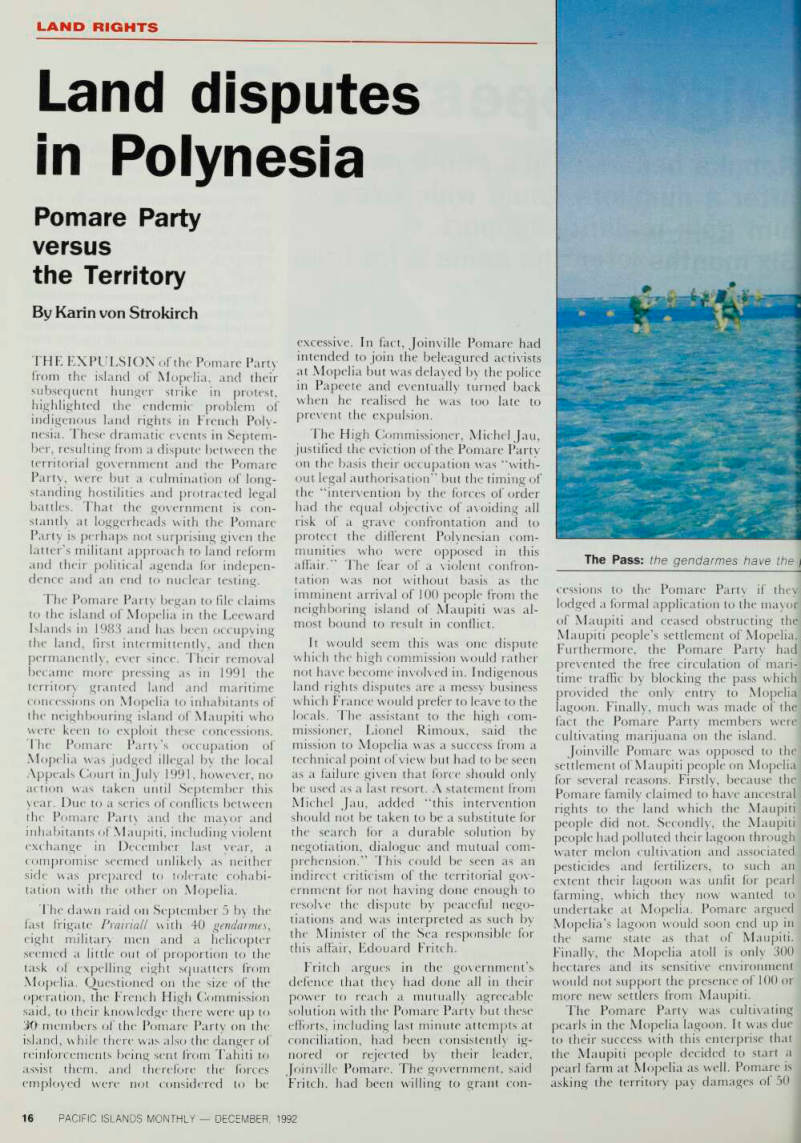
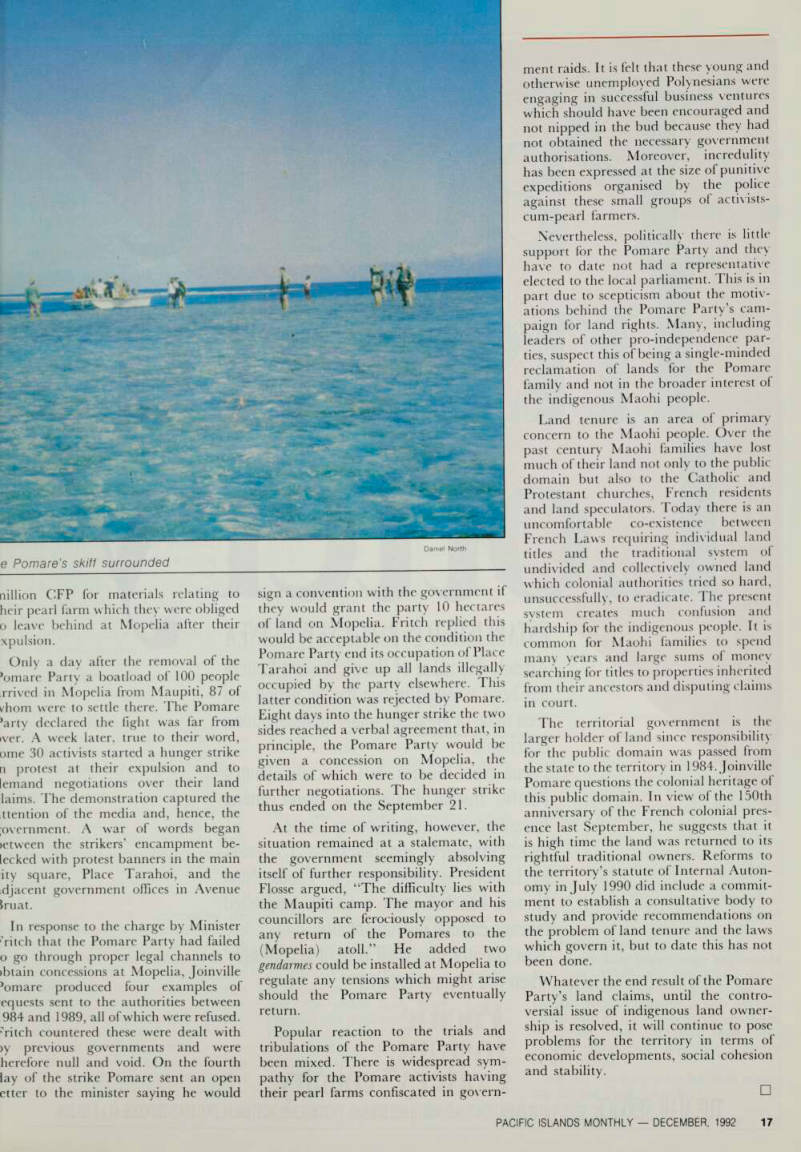
The Pass: the gendarmes have the
nillion CFP for materials relating to heir pearl farm which they were obliged o leave behind at Mopelia after their
xpulsion.
Only a day after the removal of the ‘omare Party a boatload of 100 people rrived in Mopelia from Maupiti, 87 of vhom were to settle there. The Pomare *arty declared the fight was far from iver. A week later, true to their word, ome 30 activists started a hunger strike a protest at their expulsion and to lemand negotiations over their land laims. The demonstration captured the ttention of the media and, hence, the government. A war of words began >etween the strikers’ encampment be lecked with protest banners in the main ity square, Place Tarahoi, and the idjacent government offices in Avenue Iruat.
In response to the charge by Minister Titch that the Pomare Party had failed o go through proper legal channels to »btain concessions at Mopelia, Joinville Annare produced four examples of equests sent to the authorities between 984 and 1989, all of which were refused.
Titch countered these were dealt with >y previous governments and were herefore null and void. On the fourth lay of the strike Pomare sent an open etter to the minister saying he would
sign a convention with the government if they would grant the party 10 hectares of land on Mopelia. Fritch replied this would be acceptable on the condition the Pomare Party end its occupation of Place Tarahoi and give up all lands illegally occupied by the party elsewhere. This latter condition was rejected by Pomare.
Eight days into the hunger strike the two sides reached a verbal agreement that, in principle, the Pomare Party would be given a concession on Mopelia, the details of which were to be decided in further negotiations. The hunger strike thus ended on the September 21.
At the time of writing, however, the situation remained at a stalemate, with the government seemingly absolving itself of further responsibility. President Flosse argued, “The difficulty lies with the Maupiti camp. The mayor and his councillors are ferociously opposed to any return of the Pomares to the (Mopelia) atoll.” He added two gendarmes could be installed at Mopelia to regulate any tensions which might arise should the Pomare Party eventually return.
Popular reaction to the trials and tribulations of the Pomare Party have been mixed. There is widespread sym pathy for the Pomare activists having their pearl farms confiscated in govern
ment raids. It is felt that these young and otherwise unemployed Polynesians were engaging in successful business ventures which should have been encouraged and not nipped in the bud because they had not obtained the necessary government authorisations. Moreover, incredulity has been expressed at the size of punitive
expeditions organised by the police
against these small groups of activists
cum-pearl farmers.
Nevertheless, politically there is little support for the Pomare Party and they have to date not had a representative elected to the local parliament. This is in part due to scepticism about the motiv ations behind the Pomare Party’s cam paign for land rights. Many, including leaders of other pro-independence par ties, suspect this of being a single-minded reclamation of lands for the Pomare family and not in the broader interest of the indigenous Maohi people.
Land tenure is an area of primary concern to the Maohi people. Over the past century Maohi families have lost much of their land not only to the public domain but also to the Catholic and Protestant churches, French residents and land speculators. Today there is an uncomfortable co-existence between French Laws requiring individual land titles and the traditional system of undivided and collectively owned land which colonial authorities tried so hard, unsuccessfully, to eradicate. The present svstem creates much confusion and hardship for the indigenous people. It is common for Maohi families to spend many years and large sums of money searching for titles to properties inherited from their ancestors and disputing claims in court.
The territorial government is the larger holder of land since responsibility for the public domain was passed from the state to the territory in 1984. Joinvillc Pomare questions the colonial heritage of this public domain. In view of the 150th anniversary of the French colonial pres ence last September, he suggests that it is high time the land was returned to its rightful traditional owners. Reforms to the territory’s statute of Internal Auton omy in July 1990 did include a commit ment to establish a consultative body to study and provide recommendations on the problem of land tenure and the laws which govern it, but to date this has not been done.
Whatever the end result of the Pomare Party’s land claims, until the contro versial issue of indigenous land owner ship is resolved, it will continue to pose problems for the territory in terms of economic developments, social cohesion and stability.
Daniel North
[?]e Pomare's skiff surrounded
Advertisements & other items, p. 18 (1 item)
Lottery country.
mmm*
r i s w r
ESTABLISHED IN PAPUA NEW GUINEA
Already the value of Pacific Instant Lottery has been assessed in one Pacific nation and seen to be of great advantage to that nation's development.
Papua New Guinea will officially launch Pacific Instant Lottery as their generic Instant Scratch Ticket Lottery Game.
Prize Guarantees and Tattersalls' 120 years of Lottery guidance means Papua New Guinea benefits from a totally controlled revenue earning instrumentality.
Your country may well benefit accordingly when you become another
Pacific
Instant
Lottery country.
THE MAIL SERVICE: suite 5,55 flemington road, north Melbourne, victoria tom, Australia, fax: country code 61+33292166.
‘French no inside. Stay outside’
Land Rights
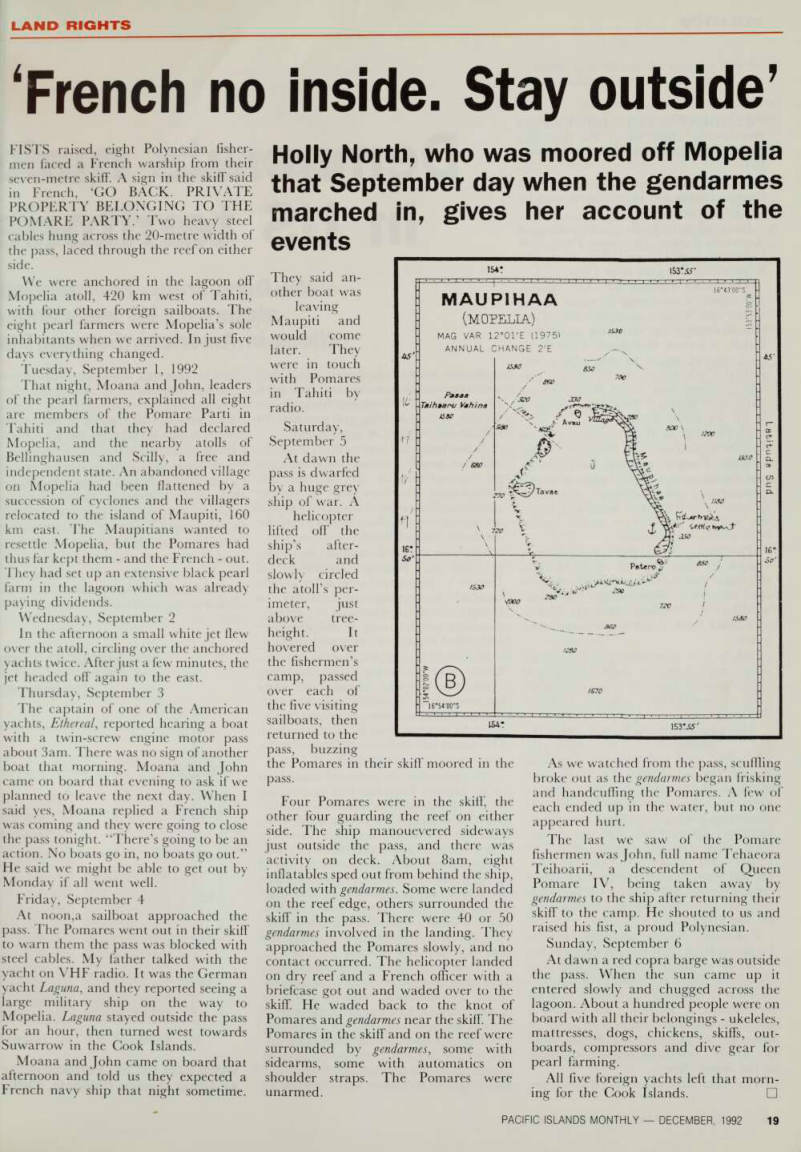
FISTS raised, eight Polynesian fisher men faced a French warship from their seven-metre skiff. A sign in the skiff said in French, ‘GO BACK. PRIVATE
Property Belonging To The
POMARE PARTY.’ Two heavy steel cables hung across the 20-metre width of the pass, laced through the reef on either side.
We were anchored in the lagoon off Mopelia atoll, 420 km west of Tahiti, with four other foreign sailboats. The eight pearl farmers were Mopelia’s sole inhabitants when we arrived. In just five days everything changed.
Tuesday, September 1, 1992 That night, Moana and John, leaders of the pearl farmers, explained all eight are members of the Pomare Parti in Tahiti and that they had declared Mopelia, and the nearby atolls of Bellinghausen and Scilly, a free and independent state. An abandoned village on Mopelia had been flattened by a succession of cyclones and the villagers relocated to the island of Maupiti, 160 km east. The Maupitians wanted to resettle Mopelia, but the Pomares had thus far kept them - and the French - out.
They had set up an extensive black pearl farm in the lagoon which was already paying dividends.
Wednesday, September 2 In the afternoon a small white jet flew over the atoll, circling over the anchored yachts twice. After just a few minutes, the jet headed off again to the east.
Thursday, September 3 The captain of one of the American yachts, Ethereal , reported hearing a boat with a twin-screw engine motor pass about Sam. There was no sign of another boat that morning. Moana and John came on board that evening to ask if we planned to leave the next day. When I said yes, Moana replied a French ship was coming and they were going to close the pass tonight. “There’s going to be an action. No boats go in, no boats go out.”
He said we might be able to get out by Monday if all went well.
Friday, September 4
At noon,a sailboat approached the pass. The Pomares went out in their skiff to warn them the pass was blocked with steel cables. My father talked with the yacht on VHF radio. It was the German yacht Laguna , and they reported seeing a large military ship on the way to Mopelia. Laguna stayed outside the pass for an hour, then turned west towards Suwarrow in the Cook Islands.
Moana and John came on board that afternoon and told us they expected a French navy ship that night sometime.
Holly North, who was moored off Mopelia that September day when the gendarmes marched in, gives her account of the events
They said an other boat was leaving Maupiti and would come later. They were in touch with Pomares in Tahiti by radio.
Saturday,
September 5
At dawn the pass is dwarfed by a huge grey ship of war. A
helicopter
lifted off the
ship’s after
deck and slowly circled the atoll’s per
imeter, just
above tree height. It hovered over the fishermen’s
camp, passed
over each of the five visiting sailboats, then returned to the pass, buzzing
the Pomares in their skiff moored in the pass. .
Four Pomares were in the skill, the other four guarding the reef on either side. Ihe ship manouevered sideways just outside the pass, and there was activity on deck. About Sam, eight inflatables sped out from behind the ship, loaded with gendarmes. Some were landed on the reef edge, others surrounded the skiff in the pass. There were 40 or 50 gendarmes involved in the landing. They approached the Pomares slowly, and no contact occurred. The helicopter landed on dry reef and a French officer with a briefcase got out and waded over to the skiff. He waded back to the knot of Pomares and gendarmes near the skiff. The Pomares in the skiff and on the reef were surrounded by gendarmes , some with sidearms, some with automatics on shoulder straps. The Pomares were unarmed.
As we watched from the pass, scuffling broke out as the gendarmes began frisking and handcuffing the Pomares. A few of each ended up in the water, but no one appeared hurt.
The last we saw of the Pomare fishermen was John, full name Tehaeora Teihoarii, a descendent of Queen Pomare IV, being taken away by gendarmes to the ship after returning their skiff to the camp, ffe shouted to us and raised his fist, a proud Polynesian.
Sunday, September 6 At dawn a red copra barge was outside the pass. When the sun came up it entered slowly and chugged across the lagoon. About a hundred people were on board with all their belongings - ukeleles, mattresses, dogs, chickens, skiffs, out boards, compressors and dive gear for pearl farming.
All five foreign yachts left that morn ing for the Cook Islands. □
Democrats mak[?]lean sweep
Politics
Democrats mak[?]lean sweep in US territoria[?]lections
PRESIDENT-ELECT Bill Clinton’s Democratic allies swept the US flag elections in the Pacific in early Novem ber.
All the major offices in American Samoa, Guam and Hawaii were won by the Democrats.
Bounced out of office were long-time American Samoa Governor Peter Tali Coleman and General Ben Blaz, the
Republican delegate from Guam.
The island winners included: Ameri can Samoa’s re-elected delegate to the House of Representatives, Eni F.H.
Faleomavaega; Eni’s running mate, A.P.
Lutali, a former Governor of the terri tory, elected again to that office, and Robert L T nderwood, the Chamorro col lege professor who upset Blaz. Guam’s Democrats fattened their usual majority in the territorial legislature.
Meanwhile, in Hawaii, there was no serious opposition for Senator Daniel
Inouye, Congresswoman Patsy Mink
and Congressman Neil Abercrombie, all Democrats, all winners. Governor Clinton carried the state handily, it being the only US jurisdiction in the Pacific with a vote for president.
The sitting Republican Governor of Guam, Joe Ada, was not up for election this year, and there were no elections in the staunchly Republican Common wealth of the Northern Mariana Islands CNMI holds theirs in odd-numbered years.
While it is true that the Democrats swept everything in sight, the island elections were separate from each other and, to some extent, reflected different dynamics.
American Samoa. Furthest from the US Mainland, geographically, culturally, and politically is American Samoa, the only US territory below the Equator. Here party labels are relatively new, but the animosities among the players go back a long time. Lutali and Coleman, for example, had run against each other repeatedly in the past with Lutali’s first victory over Coleman com ing this year. Faleomavaega, now with a large political following of his own, has been Lutali’s ally (and once served as his
Lt. Governor).
Coleman, despite his close ties to President Bush, had been in political hot water for a long time. Often absent from the island, either attending to Governor’s business in Washington, dealing with his own health, or attending the numerous gatherings of island leaders that are so attractive to politicians, Coleman faced the steady (and often detailed) criticism of the Samoa News.
The News often complained about the
As Democratic President-eU victory on US mainland, I offices in American Samoa, Gui
territory’s constant financial crisis. While the mainland government can, and does, run up colossal deficits, its checks do not bounce, it pays its bills, and provides the day-to-day services of government.
It has been different in Pago Pago. In order to avoid reducing the number of government workers, the Coleman Ad ministration has been slow to pay its suppliers. Asa result drugs at the hospital are sometimes in short supply, and the roads do not get fixed.
Coleman’s administration, according to both the Federal Department of Interior’s Inspector-General, and the General Accounting Office GAO), a Congressional watchdog agency, routinely spent money it did not have and failed to collect taxes with vigor.
It all lead to a 6554 to 4462 victory for Lutali over Coleman, with two other candidates drawing about 1500 votes between them. Lutali’s running-mate, and Lt. Governor-elect, is Tauese Sunia, younger brother to former Congressman Fofo Sunia who was forced from office by a financial scandal in 1988.
As compared to political leaders in other islands, Coleman had two strong structural advantages, and two substan tial disadvantages; he held a fixed, four year term, and did not have to worry about maintaining a parliamentary ma jority; further, he had near total control of the government’s finances, contracting authority and personnel. On the other hand, he, unlike many Pacific leaders, faced a fiercely critical daily newspaper, and overseas auditors and investigators that he could not control.
Coleman’s defeat will cause the depar ture of two of his relatives from govern ment employment; his son, Dyke Coleman, who had served as his chief of staff in recent years, and his son-in-law, Fred Radewagen, whose handsome sal ary as the territory’s representative in Washington was criticized during the campaign. Radewagen will continue to
edit his sprightly newsletter. Washingtor Pacific Report, and his wife (anc Coleman’s daughter) Amati Radewagen, will remain in her unpaic position as a member of the Republicar National Committee.
It will be interesting to see how Lutal: deals with the financial mess that he ha: inherited, one that Coleman claims stemmed, at least in part, from Lutali’s earlier administration (1985-1989). Will Lutali reduce the bloated payroll? Raisd taxes? Those are the difficult questions. A less difficult one: will he close the territory’s Washington office, as he did before, thus ousting Radewagen? Prob ably.
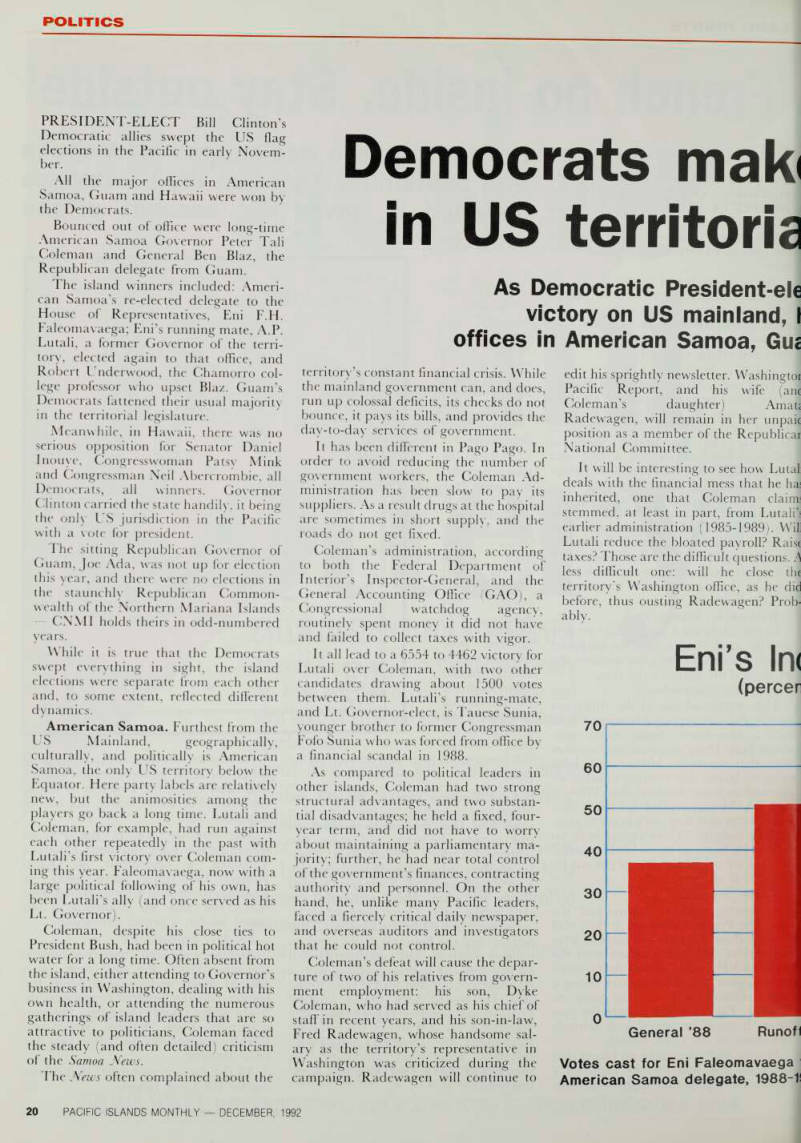
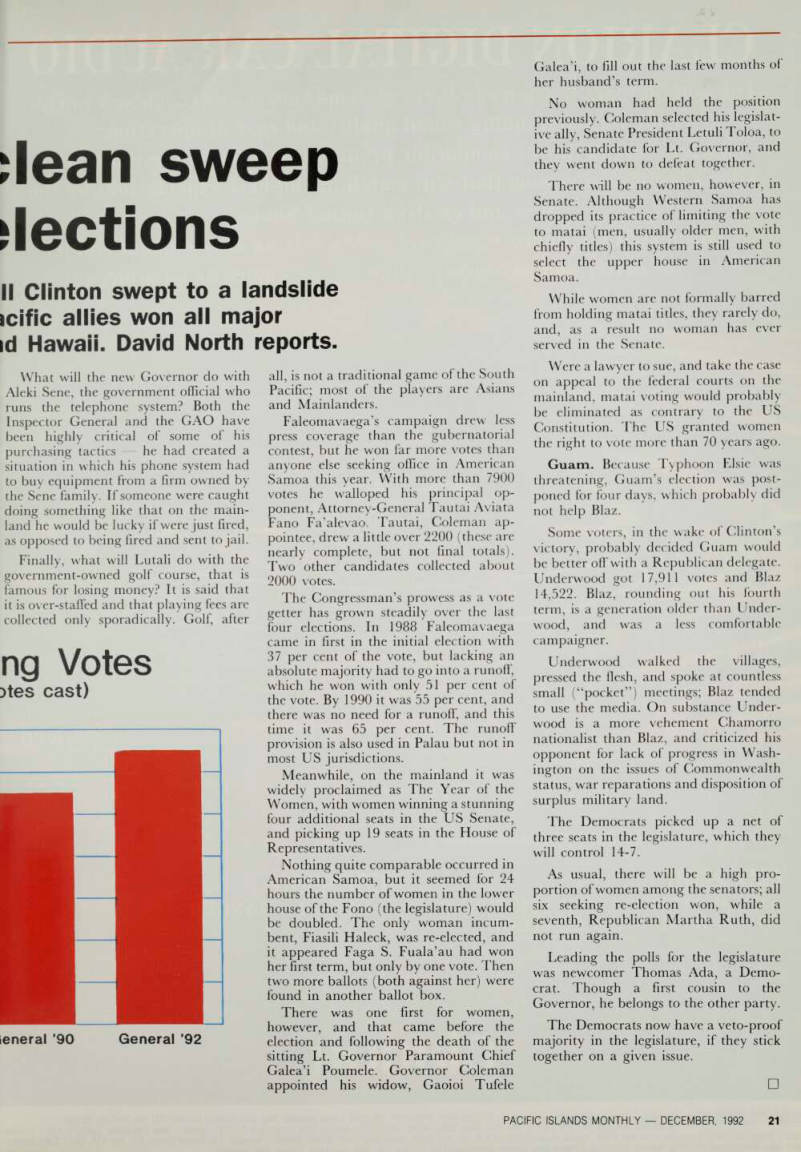
Eni’s ln< (percen
Votes cast for Eni Faleomavaega American Samoa delegate, 1988-1[?]
II Clinton swept to a landslide icific allies won all major id Hawaii. David North reports.
What will the new Governor do with Aleki Sene, the government official who runs the telephone system? Both the Inspector General and the GAO have been highly critical of some of his purchasing tactics he had created a situation in which his phone system had to buy equipment from a firm owned by the Sene family. If someone were caught doing something like that on the main land he would be lucky if were just fired, as opposed to being fired and sent to jail.
Finally, what will Lutali do with the government-owned golf course, that is famous for losing money? It is said that it is over-staffed and that playing fees are collected only sporadically. Golf, after
ng Votes >tes cast)
all, is not a traditional game of the South Pacific; most of the players are Asians and Mainlanders.
Faleomavaega’s campaign drew less press coverage than the gubernatorial contest, but he won far more votes than anyone else seeking office in American Samoa this year. With more than 7900 votes he walloped his principal op ponent, Attorney-General Tautai Aviata Fano Fa’alevao. Tautai, Coleman ap pointee, drew a little over 2200 (these arc nearly complete, but not final totals).
Two other candidates collected about 2000 votes.
The Congressman’s prowess as a vote getter has grown steadily over the last four elections. In 1988 Faleomavaega came in first in the initial election with 37 per cent of the vote, but lacking an absolute majority had to go into a runoff, which he won with only 51 per cent of the vote. By 1990 it was 55 per cent, and there was no need for a runoff, and this time it was 65 per cent. The runoff provision is also used in Palau but not in most US jurisdictions.
Meanwhile, on the mainland it was widely proclaimed as The Year of the Women, with women winning a stunning four additional seats in the US Senate, and picking up 19 seats in the House of Representatives.
Nothing quite comparable occurred in American Samoa, but it seemed for 24 hours the number of women in the lower house of the Fono (the legislature) would be doubled. The only woman incum bent, Fiasili Haleck, was re-elected, and it appeared Faga S. Fuala’au had won her first term, but only by one vote. Then two more ballots (both against her) were found in another ballot box.
There was one first for women, however, and that came before the election and following the death of the sitting Lt. Governor Paramount Chief Galea’i Poumele. Governor Coleman appointed his widow, Gaoioi Tufele
Galea’i, to fill out the last few months of her husband’s term.
No woman had held the position previously. Coleman selected his legislat ive ally, Senate President Letuli Toloa, to be his candidate for Lt. Governor, and they went down to defeat together.
There will be no women, however, in Senate. Although Western Samoa has dropped its practice of limiting the vote to matai (men, usually older men, with chiefly titles) this system is still used to select the upper house in American Samoa.
While women are not formally barred from holding matai titles, they rarely do, and, as a result no woman has ever served in the Senate.
Were a lawyer to sue, and take the case on appeal to the federal courts on the mainland, matai voting would probably be eliminated as contrary to the US Constitution. The US granted women the right to vote more than 70 years ago.
Guam. Because Typhoon Elsie was threatening, Guam’s election was post poned for four days, which probably did not help Blaz.
Some voters, in the wake of Clinton’s victory, probably decided Guam would be better off with a Republican delegate.
Underwood got 17,911 votes and Blaz 14,522. Blaz, rounding out his fourth term, is a generation older than Under wood, and was a less comfortable
campaigner.
Underwood walked the villages, pressed the flesh, and spoke at countless small (“pocket”) meetings; Blaz tended to use the media. On substance Under wood is a more vehement Chamorro nationalist than Blaz, and criticized his opponent for lack of progress in Wash ington on the issues of Commonwealth status, war reparations and disposition of surplus military land.
The Democrats picked up a net of three seats in the legislature, which they will control 14-7.
As usual, there will be a high pro portion of women among the senators; all six seeking re-election won, while a seventh, Republican Martha Ruth, did not run again.
Leading the polls for the legislature was newcomer Thomas Ada, a Demo crat. Though a first cousin to the Governor, he belongs to the other party.
The Democrats now have a veto-proof majority in the legislature, if they stick together on a given issue.
Advertisements & other items, p. 22 (1 item)
clarion
DIGITAL CAR AUDIO
For o\er 40 years Clarion car audio systems have been recognised worldwide for outstanding sound quality and ease of operation.
Clarion’s broad line of compatible products offers high flexibility and allows building a system that will match the highest expectations on the
new and exciting Digital Sound.
Clarion strive to improve and perfect the driving environment and let the driver and passengers alike relax as much as possible.
Ik % ' ' *
mm 6-c
DIGITAL AUDIO
clarion
' TOC? <
Clarion SsSßKfifio a mi
CMX 250 D
AM/FM/STEREO CASSETTE TUNER
WITH CD CHANGER CONTROL
□□.OOL«T»Yi7?MI *ooiby anc the Double-0 symbol are trademarks o' Dolby Laboratories Licensing Corporation
CDC9SOO
6 DISC CD CHANGER
1 Specifications and design are subject to change without notice
clarion
v High-Tech High-Touch . r JT OR FURTHER INFORMATION Australia. Clarion Australia Ply. Ltd. Unit 17, 50 Keys Road Moorabbin, Vic 3189 / New Zealand; AWA New Zealand Limited P 0 Box 50-248 Porirua prtpy / Pnom- MiDmn* a h , IJI S nn^ ' Ltd u GPO Box 362 - Suva Tahiti: Hl Fl - VAIRAATOA Avenue Chef Vairaatoa B.P 1128, Papeete / New Caledonia; Caldis, B.P.M 1. Noumea nnth i R 5 0 B ?i X 3 ? 78 ' A ? a " a ' Guam 96910 ' USA Tel: 472 - 8091 - Cable Code ; HIFI AUDIO AGANA / Venuatu: The Sound Centre, PO. Box 434, Vila / Cook Islands; QUID beas International Ltd . RO Rnx 4Q Ramtnnna / Panna Mpui HninDQ Nanomouar /DM n \ D+w i on rw+ KA U..
Royalty under threat
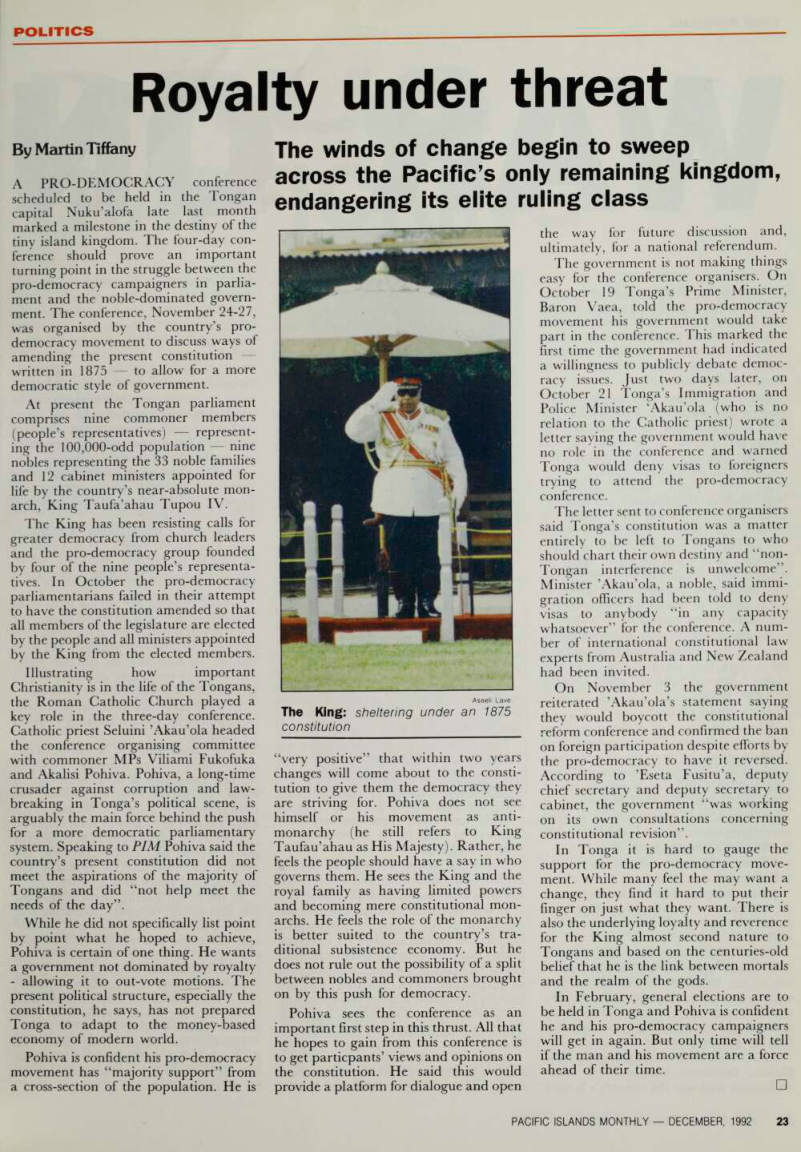
Politics
By Martin Tiffany
A PRO-DEMOCRACY conference scheduled to be held in the Tongan capital Nuku’alofa late last month marked a milestone in the destiny of the tiny island kingdom. The four-day con ference should prove an important turning point in the struggle between the
pro-democracy campaigners in parlia
ment and the noble-dominated govern ment. The conference, November 24-27, was organised by the country’s pro democracy movement to discuss ways of amending the present constitution written in 1875 to allow for a more democratic style of government.
At present the Tongan parliament comprises nine commoner members
(people’s representatives) represent
ing the 100,000-odd population nine nobles representing the 33 noble families and 12 cabinet ministers appointed for life by the country’s near-absolute mon arch, King Taufa’ahau Tupou IV.
The King has been resisting calls for greater democracy from church leaders and the pro-democracy group founded by four of the nine people’s representa tives. In October the pro-democracy parliamentarians failed in their attempt to have the constitution amended so that all members of the legislature are elected by the people and all ministers appointed by the King from the elected members.
Illustrating how important Christianity is in the life of the Tongans, the Roman Catholic Church played a key role in the three-day conference.
Catholic priest Seluini ’Akau’ola headed the conference organising committee with commoner MPs Viliami Fukofuka and Akalisi Pohiva. Pohiva, a long-time crusader against corruption and law breaking in Tonga’s political scene, is arguably the main force behind the push for a more democratic parliamentary system. Speaking to PIM Pohiva said the country’s present constitution did not meet the aspirations of the majority of Tongans and did “not help meet the needs of the day”.
While he did not specifically list point by point what he hoped to achieve, Pohiva is certain of one thing. He wants a government not dominated by royalty - allowing it to out-vote motions. The present political structure, especially the constitution, he says, has not prepared Tonga to adapt to the money-based economy of modern world.
Pohiva is confident his pro-democracy movement has “majority support” from a cross-section of the population. He is
The winds of change begin to sweep across the Pacific’s only remaining kingdom, endangering its elite ruling class
“very positive” that within two years changes will come about to the consti tution to give them the democracy are striving for, Pohiva does not see himself or his movement as anti monarchy (he still refers to King Taufau’ahau as His Majesty). Rather, he feels the people should have a say in who governs them. He sees the King and the royal family as having limited powers and becoming mere constitutional mon archs. He feels the role of the monarchy is better suited to the country’s tra ditional subsistence economy. But he does not rule out the possibility of a split between nobles and commoners brought on by this push for democracy.
Pohiva sees the conference as an important first step in this thrust. All that he hopes to gain from this conference is to get particpants’ views and opinions on the constitution. He said this would provide a platform for dialogue and open
the way for future discussion and, ultimately, for a national referendum.
The government is not making things easy for the conference organisers. On October 19 Tonga’s Prime Minister, Baron Vaea, told the pro-democracy movement his government would take part in the conference. This marked the first time the government had indicated a willingness to publicly debate democ racy issues. Just two days later, on October 21 Tonga’s Immigration and Police Minister ‘Akau’ola (who is no relation to the Catholic priest) wrote a letter saying the government would have no role in the conference and warned Tonga would deny visas to foreigners trying to attend the pro-democracy conference.
The letter sent to conference organisers said Tonga’s constitution was a matter entirely to be left to Tongans to who should chart their own destiny and “non- Tongan interference is unwelcome”.
Minister ’Akau’ola, a noble, said immi gration officers had been told to deny visas to anybody “in any capacity whatsoever” for the conference. A num ber of international constitutional law experts from Australia and New Zealand had been invited.
On November 3 the government reiterated ’Akau’ola’s statement saying they would boycott the constitutional reform conference and confirmed the ban on foreign participation despite efforts by the pro-democracy to have it reversed.
According to ’Eseta Fusitu’a, deputy chief secretary and deputy secretary to cabinet, the government “was working on its own consultations concerning constitutional revision”.
In Tonga it is hard to gauge the support for the pro-democracy move ment. While many feel the may want a change, they find it hard to put their finger on just what they want. There is also the underlying loyalty and reverence for the King almost second nature to Tongans and based on the centuries-old belief that he is the link between mortals and the realm of the gods.
In February, general elections are to be held in Tonga and Pohiva is confident he and his pro-democracy campaigners will get in again. But only time will tell if the man and his movement are a force ahead of their time.
Asaeli Lave The King: sheltering under an 1875 constitution
War On
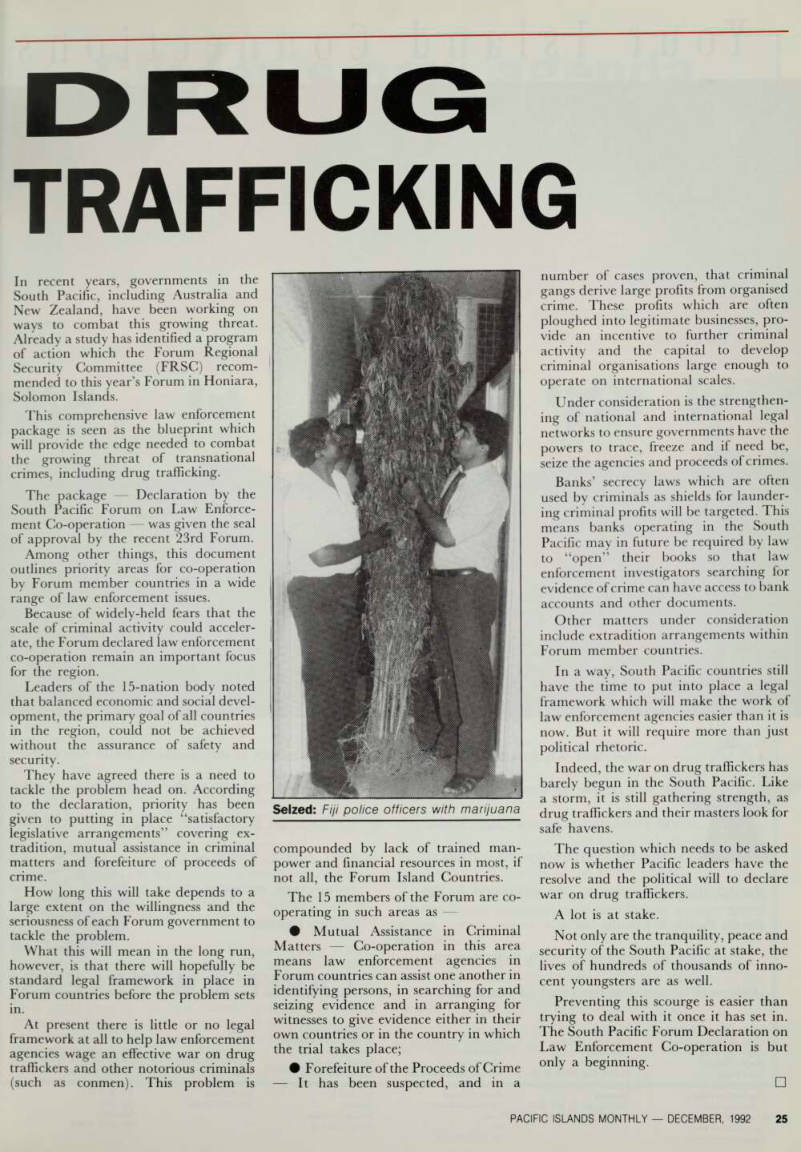
The Region
IT WAS in the wee hours of one morning in 1990 when a combined special Austra lian Federal Police (AFP) and Australian Customs Service taskforce swooped on an unsuspecting yacht moored in the calm waters of Whitsunday Passage in far northern Queensland.
On board were five people - three women and two men. Unknown to the crew the yacht had been under surveil lance for months as it made its way through South East Asia, Papua New Guinea and then to Australia.
As the yacht sailed into the Whitsundays, the taskforce put together in Townsville, swung into action. A 24-hour surveillance was put into force.
Taskforce members - all in plain clothes - took turns at night, using an array of sophisticated equipment, includ ing binoculars equiped with infra-red night vision, to watch the movement of the yacht’s crew members.
As dawn was breaking, the taskforce struck. Using a high-speed boat and one other craft, they stormed the yacht and ordered its crew to lie low while a search was conducted.
They found nothing.
The yacht even had a clearance from Papua New Guinea Customs when it had berthed at the northern town of Madang a month or so earlier. (A Supreme Court jury in Brisbane later heard the yacht also visited Lae and Port Moresby).
As the search continued, it seemed everything was in order. Until they came to the yacht’s water tank, that is.
“Come and have a look,’’one officer yelled out.
At the bottom of the tank were tonnes of compressed powdered cocaine in sealed plastic bags. Street value SAIO million.
These details were later related to a trial which lasted several months, start ing in the Brisbane District Court and ending before a Supreme Court jury which found the two men (of German extraction) guilty. They are serving lengthy jail sentences in Brisbane.
In November last year Papua New Guinea fishermen stumbled on what authorities said was the country’s largest
drug haul while digging for turtle eggs on a remote atoll off PNG’s New Ireland Province.
The 1.5 tonnes of hashish resin were found buried in the sand. Wrapped in sealed plastic bags, the number 777 embossed in gold seals was clearly stamped at the top of each carton.
Each of the 66 cartons also bore the letters RR at the bottom. Authorities estimate the street value of this 1.5-tonne consignment at between 5F31.4 million and 5F78.5 million.
Although no one was arrested, police and other government officials believed the huge consignment was brought into PNG from Asia by foreign vessels.
As the couriers failed to make con nections quickly, they decided to bury the “cargo” on Hawaii Island in the Nuguria group of islands, about 190 km north-east of Rabaul.
A week before, an unidentified yacht was reportedly seen leaving Hawaii atoll by people from nearby islands. Hawaii atoll is a popular fishing and turtle
hunting ground.
Former PNG Prime Minister Rabbie Namaliu later told Parliament foreign vessels had been entering PNG waters and ports illegally with guns and drugs.
It was difficult, he said, to monitor the movements of these yachts and ships because the monitoring system lacked the financial and manpower resources to carry out the task effectively.
PNG has asked Australia and New Zealand to help in its surveillance on
drug smuggling.
The story of the PNG drug haul is similar to another drug find in Solomon Islands (further east of PNG), in 1990.
It was reported a yacht had left the consignment on a sandy, uninhabited island to be picked up later by a foreign fishing boat. Among the stories circulat ing in Honiara at the time was one that an expatriate pilot working for the country’s national airline, Solomon Air lines, would give the fishing boat the direction to the island to make the pick up.
Instead, stranded fishermen found the drug, believed to be hashish resin, buried in the sand in large containers. It was
said to have been destined for Australia.
Again, there were no arrests.
In Fiji earlier this year, authorities seized 12 gas cylinders buried in the sand on an uninhabited island in the Southern
Lau Group.
Inside was hashish resin in paste form.
Its street value SF3O million. Hashish resin is a tar-like substance which can be smoked or mixed with drinks and taken orally. It is a concentrated form of processed marijuana and is said to be 12 per cent more potent.
Experts say drug trafficking is a megabuck industry whose operation is growing in sophistication and approach almost everyday.
The South Pacific is being increasingly used as a transit point. “It is a menace of global proportion and one which requires a global response,” one expert says.
School children are among those most vulnerable. A broad program to educate them about the dangers of the illegal use of drugs and its severe penalty is urgently needed. In Australia, for instance, pen alty for drug trafficking can land you in jail for life, a $A50,000 fine or both.
In some countries in South East Asia,
punishment for drug trafficking is death
by hanging.
Drug trafficking is a world-wide, multi-billion dollar industry, although no one can place a firm figure on its value. Its perpetrators are among the most powerful in the world because of the huge amount of money at their disposal.
In extreme circumstances as evident in recent events in Central America, the drug trade can directly threaten the international peace and security.
In the South Pacific, there is growing fear that with governments declaring war on drug barons in countries such as Italy and Colombia, the region could become easy prey for drug smugglers using legitimate business as covers.
Ease of travel and modern sophisti cated telecommunications facilities add to the fear the South Pacific may soon lose its paradise label.
Indeed, the recent drug hauls in Australia, Fiji, PNG and Solomon Islands brought home this stark reality.
So what now?.
In recent years, governments in the South Pacific, including Australia and New Zealand, have been working on ways to combat this growing threat.
Already a study has identified a program of action which the Forum Regional Security Committee (FRSC) recom mended to this year’s Forum in Honiara, Solomon Islands.
This comprehensive law enforcement package is seen as the blueprint which will provide the edge needed to combat the growing threat of transnational crimes, including drug trafficking.
The package Declaration by the South Pacific Forum on Law Enforce ment Co-operation was given the seal of approval by the recent 23rd Forum.
Among other things, this document outlines priority areas for co-operation by Forum member countries in a wide range of law enforcement issues.
Because of widely-held fears that the scale of criminal activity could acceler ate, the Forum declared law enforcement co-operation remain an important focus for the region.
Leaders of the 15-nation body noted that balanced economic and social devel opment, the primary goal of all countries in the region, could not be achieved without the assurance of safety and security.
They have agreed there is a need to tackle the problem head on. According to the declaration, priority has been given to putting in place “satisfactory legislative arrangements” covering ex tradition, mutual assistance in criminal matters and forefeiture of proceeds of crime.
How long this will take depends to a large extent on the willingness and the seriousness of each Forum government to tackle the problem.
What this will mean in the long run, however, is that there will hopefully be standard legal framework in place in Forum countries before the problem sets in.
At present there is little or no legal framework at all to help law enforcement agencies wage an effective war on drug traffickers and other notorious criminals (such as conmen). This problem is
compounded by lack of trained man power and financial resources in most, if not all, the Forum Island Countries.
The 15 members of the Forum are co operating in such areas as • Mutual Assistance in Criminal Matters Co-operation in this area means law enforcement agencies in Forum countries can assist one another in identifying persons, in searching for and seizing evidence and in arranging for witnesses to give evidence either in their own countries or in the country in which the trial takes place; • Forefeiture of the Proceeds of Crime - It has been suspected, and in a
number of cases proven, that criminal gangs derive large profits from organised crime. These profits which are often ploughed into legitimate businesses, pro vide an incentive to further criminal activity and the capital to develop criminal organisations large enough to operate on international scales.
Under consideration is the strengthen ing of national and international legal networks to ensure governments have the powers to trace, freeze and if need be, seize the agencies and proceeds of crimes.
Banks’ secrecy laws which are often used by criminals as shields for launder ing criminal profits will be targeted. This means banks operating in the South Pacific may in future be required by law to “open” their books so that law enforcement investigators searching for evidence of crime can have access to bank accounts and other documents.
Other matters under consideration include extradition arrangements within Forum member countries.
In a way, South Pacific countries still have the time to put into place a legal framework which will make the work of law enforcement agencies easier than it is now. But it will require more than just
political rhetoric.
Indeed, the war on drug traffickers has barely begun in the South Pacific. Like a storm, it is still gathering strength, as drug traffickers and their masters look for safe havens.
The question which needs to be asked now is whether Pacific leaders have the resolve and the political will to declare war on drug traffickers.
A lot is at stake.
Not only are the tranquility, peace and security of the South Pacific at stake, the lives of hundreds of thousands of inno cent youngsters are as well.
Preventing this scourge is easier than trying to deal with it once it has set in.
The South Pacific Forum Declaration on Law Enforcement Co-operation is but only a beginning.
Seized: Fiji police officers with marijuana
Advertisements & other items, p. 26 (1 item)
Cable & Wireless
Cable and Wireless began keep-
ing people in touch around the
world more than a century ago. Today,
while the technology has changed,
the tradition of service to our customers in the
South Pacific is just the same.
We work in partnership with Governments,
dedicated to meeting the need of communities and businesses to stay in touch. From one island to the next or to the other side of the world, the message is the same: Cable and Wireless is
your South Pacific
connection bringing the
islands together.
CABLE & WIRELESS
Asia Pacific Head Office Cable and Wireless pic Cable and Wireless (Pacific) Limited 22 nd Floor Office Tower Convention Plaza 1 Harbour Road Hong Kong Tel: (852) 848 8620 Facsimile: (852) 868 5195 Australia Cable and Wireless (Australia) Pty Ltd PO Box 675, Double Bay NSW 2028 Sydney Australia Tel/Fax (61-2) 362 3625 Fiji In association with the Government of Fiji Fiji International Telecommunications Ltd.
PO. Box 59 Mercury House 158 Victoria Parade Suva Fiji Tel: (679) 312933 Solomon Islands In association with the Government of the Solomon Islands Solomon Telekom Company Limited PO, Box 148 Honiara Solomon Islands Tel: (677) 21576 Tonga Cable and Wireless pic Private Mail Bag 4 General Post Office Nuku Alofa Tonga South Pacific Tel: (676) 23499 Vanuatu In association with the Government of Vanuatu and France Cables et Radio Vanuatu International Telecommunications Ltd.
PO. Box 164 Port Vila Vanuatu Tel: (678) 22185
Clinton’s new agenda
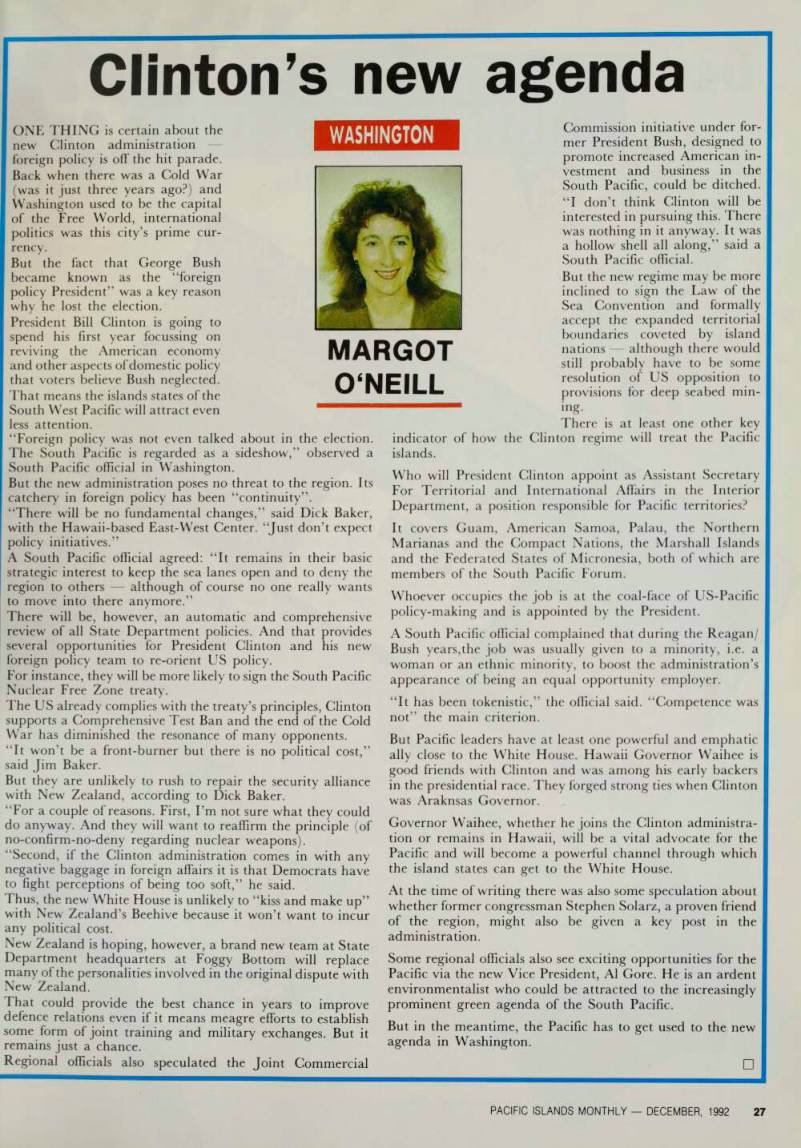
ONE THING is certain about the new Clinton administration foreign policy is off the hit parade.
Back when there was a Cold War (was it just three years ago?) and Washington used to be the capital of the Free World, international
politics was this city’s prime cur
rency.
But the fact that George Bush became known as the “foreign policy President” was a key reason why he lost the election.
President Bill Clinton is going to spend his first year focussing on reviving the American economy and other aspects of domestic policy that voters believe Bush neglected.
That means the islands states of the South West Pacific will attract even less attention.
“Foreign policy was not even talked about in the election.
The South Pacific is regarded as a sideshow,” observed a South Pacific official in Washington.
But the new administration poses no threat to the region. Its catchery in foreign policy has been “continuity”.
“There will be no fundamental changes,” said Dick Baker, with the Hawaii-based East-West Center. “Just don’t expect
policy initiatives.”
A South Pacific official agreed: “It remains in their basic strategic interest to keep the sea lanes open and to deny the region to others although of course no one really wants to move into there anymore.”
There will be, however, an automatic and comprehensive review of all State Department policies. And that provides several opportunities for President Clinton and his new foreign policy team to re-orient US policy.
For instance, they will be more likely to sign the South Pacific Nuclear Free Zone treaty.
The US already complies with the treaty’s principles, Clinton supports a Comprehensive Test Ban and the end of the Cold War has diminished the resonance of many opponents.
“It won’t be a front-burner but there is no political cost,” said Jim Baker.
But they are unlikely to rush to repair the security alliance with New Zealand, according to Dick Baker.
“For a couple of reasons. First, I’m not sure what they could do anyway. And they will want to reaffirm the principle (of no-confirm-no-deny regarding nuclear weapons).
“Second, if the Clinton administration comes in with any negative baggage in foreign affairs it is that Democrats have to fight perceptions of being too soft,” he said.
Thus, the new White House is unlikely to “kiss and make up” with New Zealand’s Beehive because it won’t want to incur any political cost.
New Zealand is hoping, however, a brand new team at State Department headquarters at Foggy Bottom will replace many of the personalities involved in the original dispute with New Zealand.
That could provide the best chance in years to improve defence relations even if it means meagre efforts to establish some form of joint training and military exchanges. But it remains just a chance.
Regional officials also speculated the Joint Commercial
Commission initiative under for mer President Bush, designed to promote increased American in vestment and business in the South Pacific, could be ditched.
“I don’t think Clinton will be interested in pursuing this. There was nothing in it anyway. It was a hollow shell all along,” said a South Pacific official.
But the new regime may be more inclined to sign the Law of the Sea Convention and formally accept the expanded territorial boundaries coveted by island nations although there would still probably have to be some resolution of US opposition to provisions for deep seabed min
ing.
There is at least one other key
indicator of how the Clinton regime will treat the Pacific islands.
Who will President Clinton appoint as Assistant Secretary For Territorial and International Affairs in the Interior Department, a position responsible for Pacific territories?
It covers Guam, American Samoa, Palau, the Northern Marianas and the Compact Nations, the Marshall Islands and the Federated States of Micronesia, both of which are members of the South Pacific Forum.
Whoever occupies the job is at the coal-face of US-Pacific policy-making and is appointed by the President.
A South Pacific official complained that during the Reagan/ Bush years,the job was usually given to a minority, i.e. a woman or an ethnic minority, to boost the administration’s appearance of being an equal opportunity employer, “It has been tokenistic,” the official said. “Competence was not” the main criterion.
But Pacific leaders have at least one powerful and emphatic ally close to the White House. Hawaii Governor Waihee is good friends with Clinton and was among his early backers in the presidential race. They forged strong ties when Clinton was Araknsas Governor, Governor Waihee, whether he joins the Clinton administra tion or remains in Hawaii, will be a vital advocate for the Pacific and will become a powerful channel through which the island states can get to the White House.
At the time of writing there was also some speculation about whether former congressman Stephen Solarz, a proven friend of the region, might also be given a key post in the administration.
Some regional officials also see exciting opportunities for the Pacific via the new Vice President, A 1 Gore. He is an ardent environmentalist who could be attracted to the increasingly prominent green agenda of the South Pacific.
But in the meantime, the Pacific has to get used to the new agenda in Washington.
Washington
Margot
O‘Neill
Advertisements & other items, p. 28 (1 item)
Collectors Packs
PHONECARD
'■t .«• fcV m iC^ s. . * % m - A -• § &{ V I -V * » t *> v ;1* 4 T *./► y W* a*-
Focusing on the year ahead
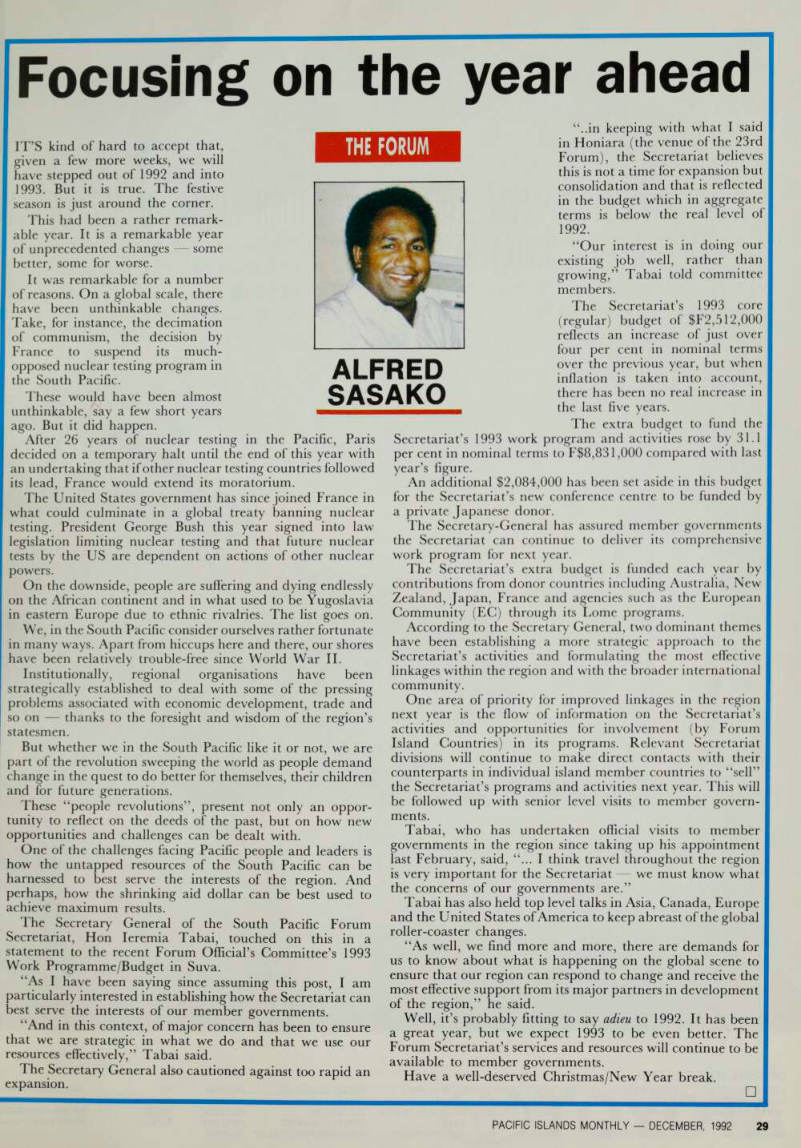
IT’S kind of hard to accept that, given a few more weeks, we will have stepped out of 1992 and into 1993. But it is true. The festive season is just around the corner.
This had been a rather remark able year. It is a remarkable year
of unprecedented changes some
better, some for worse.
It was remarkable for a number of reasons. On a global scale, there have been unthinkable changes.
Take, for instance, the decimation of communism, the decision by France to suspend its much opposed nuclear testing program in the South Pacific.
These would have been almost unthinkable, say a few short years ago. But it did happen.
After 26 years of nuclear testing in the Pacific, Paris decided on a temporary halt until the end of this year with an undertaking that if other nuclear testing countries followed its lead, France would extend its moratorium.
The United States government has since joined France in what could culminate in a global treaty banning nuclear testing. President George Bush this year signed into law legislation limiting nuclear testing and that future nuclear tests by the US are dependent on actions of other nuclear powers.
On the downside, people are suffering and dying endlessly on the African continent and in what used to be Yugoslavia in eastern Europe due to ethnic rivalries. The list goes on.
We, in the South Pacific consider ourselves rather fortunate in many ways. Apart from hiccups here and there, our shores have been relatively trouble-free since World War 11.
Institutionally, regional organisations have been strategically established to deal with some of the pressing problems associated with economic development, trade and so on thanks to the foresight and wisdom of the region’s statesmen.
But whether we in the South Pacific like it or not, we are part of the revolution sweeping the world as people demand change in the quest to do better for themselves, their children and for future generations.
These “people revolutions”, present not only an oppor tunity to reflect on the deeds of the past, but on how new opportunities and challenges can be dealt with.
One of the challenges facing Pacific people and leaders is how the untapped resources of the South Pacific can be harnessed to best serve the interests of the region. And perhaps, how the shrinking aid dollar can be best used to achieve maximum results.
The Secretary General of the South Pacific Forum Secretariat, Hon leremia Tabai, touched on this in a statement to the recent Forum Official’s Committee’s 1993 Work Programme/Budget in Suva.
“As I have been saying since assuming this post, I am particularly interested in establishing how the Secretariat can best serve the interests of our member governments.
“And in this context, of major concern has been to ensure that we are strategic in what we do and that we use our resources effectively,” Tabai said.
The Secretary General also cautioned against too rapid an expansion.
“..in keeping with what I said in Honiara (the venue of the 23rd Forum), the Secretariat believes this is not a time for expansion but consolidation and that is reflected in the budget which in aggregate terms is below the real level of 1992.
“Our interest is in doing our existing job well, rather than growing,” Tabai told committee members.
The Secretariat’s 1993 core (regular) budget of $F2,512,000 reflects an increase of just over four per cent in nominal terms over the previous year, but when inflation is taken into account, there has been no real increase in the last five years.
The extra budget to fund the
Secretariat’s 1993 work program and activities rose by 31.1 per cent in nominal terms to F 58,831,000 compared with last
year’s figure.
An additional $2,084,000 has been set aside in this budget for the Secretariat’s new conference centre to be funded by a private Japanese donor.
The Secretary-General has assured member governments the Secretariat can continue to deliver its comprehensive work program for next year.
The Secretariat’s extra budget is funded each year by contributions from donor countries including Australia, New Zealand, Japan, France and agencies such as the European
Community (EC) through its Lome programs.
According to the Secretary General, two dominant themes have been establishing a more strategic approach to the Secretariat’s activities and formulating the most effective linkages within the region and with the broader international community.
One area of priority for improved linkages in the region next year is the flow of information on the Secretariat’s activities and opportunities for involvement (by Forum Island Countries) in its programs. Relevant Secretariat divisions will continue to make direct contacts with their counterparts in individual island member countries to “sell” the Secretariat’s programs and activities next year. This will be followed up with senior level visits to member govern ments.
Tabai, who has undertaken official visits to member governments in the region since taking up his appointment last February, said, “... I think travel throughout the region is very important for the Secretariat we must know what the concerns of our governments are.”
Tabai has also held top level talks in Asia, Canada, Europe and the United States of America to keep abreast of the global roller-coaster changes.
“As well, we find more and more, there are demands for us to know about what is happening on the global scene to ensure that our region can respond to change and receive the most effective support from its major partners in development of the region,” he said.
Well, it’s probably fitting to say adieu to 1992. It has been a great year, but we expect 1993 to be even better. The Forum Secretariat’s services and resources will continue to be available to member governments.
Have a well-deserved Christmas/New Year break.
The Forum
Alfred
Sasako
Advertisements & other items, pp. 30-31 (1 item)
Creating a highly efficient, dynamic-looking car woi
• be simple if it weren’t for one complicating detail; i passengers that must ride in it. Accommodating people comfortably in a pleasant, rooi interior usually means a certain amount of aerodynamic potential has to be sacrific : 4 % Exact features and specifications may vary depending on country of purchase. Please check with your nearest TOYOTA distributor/dealer for details.
DISTRIBUTORS/DEALERS
AMERICAN SAMOA BURNS PHILP (S.S.) CO. LTD. PH 633-4281 GUAM & MICRONESIA... ATKINS KROLL. INC. PH 646-1876/9 NORFOLK ISLANDS BORRY’S PTY LTD. PH 2114
SOLOMON ISLANDS MENDANA MOTORS PH 30314
VANUATU VANUATU MOTORS PH 22341
COOK ISLANDS PACIFIC MOTORS LTD. PH 20796
KIRIBATI TARAWA MOTORS PH 21090
PAPUA NEW GUINEA ... ELA MOTORS PH 217036
TAHITI NIPPON AUTOMOTO PH 429819
WESTERN SAMOA BURNS PHILP (S.S.) CO. LTD. PH 20800
FIJI ASCO MOTORS
NEW CALEDONIA .. .S.I.A.P.
SAIPAN MICROL CORPORATION
TONGA BURNS PHILP (TONGA*
Until now. Using a concept called total airflow nagement, Toyota engineers were able to realize an efficient, wedge-shaped design ile at the same time perfecting the alignment between body panels and components, course our own innovative style of civilized ;ineering makes sure that none of this comes the expense of the luxurious, leg-stretching > interior. Because we realize that even a 0.33 is useless if no one wants to drive the car.
® TOYOTA
Anglophone and Francophone’
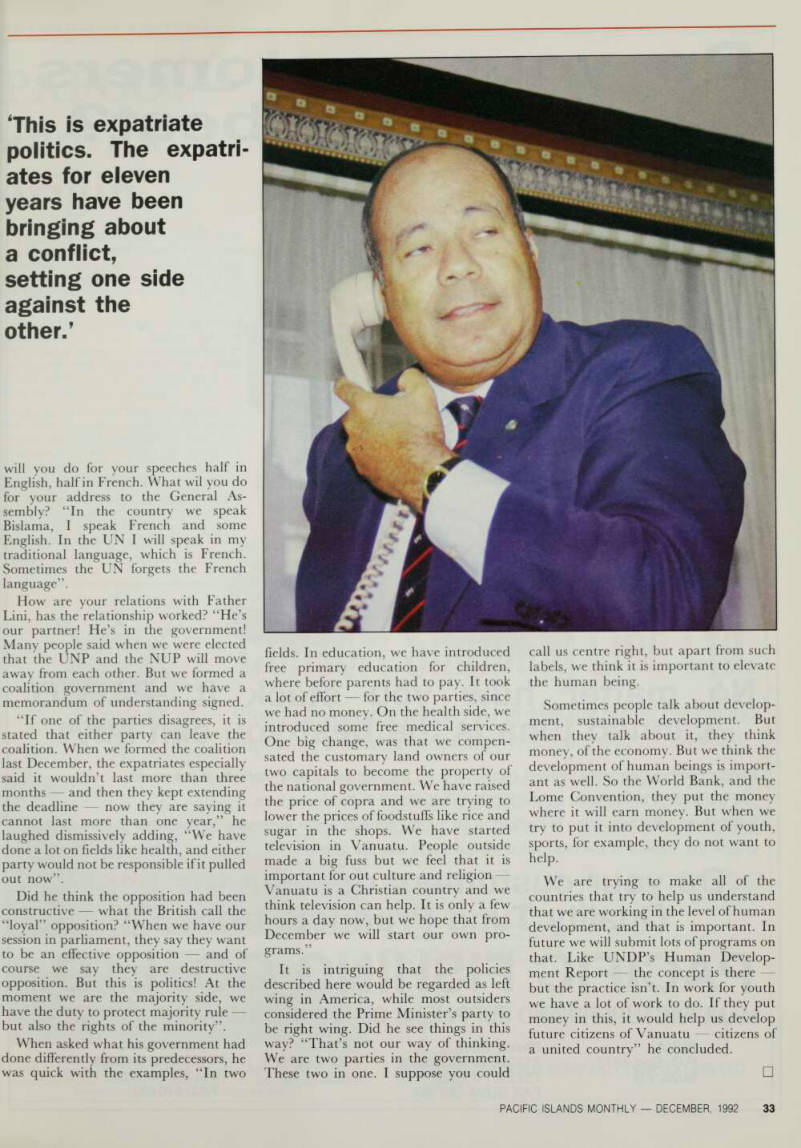
Profile
‘No difference between Anglophone and Francophone’
By lan Williams
AS PIM interviewed the Prime Minister in his New York Hotel room, in English, he alternated between French and Bislama in talking to his colleagues. When asked if the
change of government implied a change
of Foreign Policy from its independent
and non-aligned position, he emphasised continuity. “At the moment, we are not changing everything but there has been a change of government, so of course, there will be some changes of
policy.
“For example, we will give priority in our foreign affairs to external trade. In the past we have done lots on the political and human rights level and we will continue to do so, but we will add to that a concern for internal and external trade.
We have established relationships with some countries and we will maintain them, but others we will build strong commercial relations with”.
When asked if he was referring to Taiwan, he replied, “Well not only that we first moved to Grafton in Austra lia. We have relationships with business people, and we are trying to build commercial relations between Australia and Vanuatu. It is not easy but at the moment we are trying to negotiate for direct shipping. And we have started talks with the New Caledonia provinces and New Zealand.”
But does having trade relations with Taiwan imply diplomatic relations? “No, we already have relations with the mainland of China, and we will continue those. They give a lot of help to Vanuatu and they are very important in our grouping in, for example, the United Nations. Our ties with Taiwan are only at the commercial level.”
Vanuatu is the only Forum country which joined the Non-Aligned Move ment but you were not represented in Djakarta at the recent NAM summit why? “It is simply that we were a new government, just come in, and we faced many decisions, we had a lot to do in internal affairs. It was too early for us, so we decided not to go this time.”
New Zealand had apparently hoped Vanuatu would be canvassing on its behalf for the Security Council seat among the non-aligned, but Carlot says,
VANUATU S new Prime Minister, Maxime Carlot, is sending mixed signals to the world. He attended a World Anti-Communist League meeting in Hungary but denied rumours he would antagonize China by recognising Taiwan. He siganlled clearly Vanuatu’s foreign policy would follow the bottom hne more than any political line in future. He also told PIM the Francophone/ Anglophone divide was an artificial creation of expatriates but insisted his first speech to the United Nations General Assembly should be in French
“We have not been informed about that.
But we will take it as trade we will trade with them for votes. If they support us, we will support them. We have candidates in our regional organizations - and we will look for New Zealand support.”
And why did he go to the World Anti- Communist League conference? “When we were in opposition, our party, and myself, were members of this body, so I was invited to go, and I took the chance to visit Hungary to see what it was like following the collapse of communism there”.
Will there be any change in the attitude of Vanuatu to the Kanaks in New Caledonia. “It depends on what you are talking about. Our links with the New Caledonia people are stronger than ever. Our Foreign Minister works closely with the French government and of course also closely with the two prov inces.
“We have strong ties now, and the provinces are ready to make investments in agriculture in Vanuatu. This is our priority, and we are not interested in talk, about more Kanak, more Melanesian, and so on. That’s not our priority. And I think we are gaining the support of island leaders, because they can see how important it is to build up our economies which are worsening throughout the Pacific islands.
“If I can make a comparison, the previous government was doing well in production in Vanuatu, but less so in selling our products. That is why we are giving priority to looking for partners.
For example, we have near 100 per cent imports form Australia, but now we are sitting down and talking and there are Australian businessmen interested in buying products from us. There are problems about customs and so on, but we hope to resolve them.”
Has the new government changed its attitude to French nuclear testing if they were to resume? “We signed the letter at
the Forum, not just about the testing but about nuclear fuel shipments and war material. Automatically, the people in Vanuatu do not want these things. We sent that message not just to France, but Japan, Britain, China and Russia”.
On the environmental field, Vanuatu has achieved a high standing inter nationally, particularly because of the role played by Robert Van Lierop, your UN ambassador as chairman of the body. Are you going to maintain the same stand? “Well we support the environment we are for development without spoiling the environment. We will continue to support it and we will do more in that field. Vanuatu wants the UN to be serious and quick about setting up the commission on sustainable devel opment. We think the UN has been a little bit slow in this sphere”.
On domestic policies, you have mem bers of both Anglophone and Francophone parties in your govern ment. Do you think you will be able to take politics in Vanuatu away from the
linguistic divide?
“Yes, this is expatriate politics in Vanuatu. There is no problem between Anglophone and Francophone. The ex patriates for 11 years have been bringing about a conflict, setting one side against the other. When we came into power, both communities took their place in the government. Before, the Anglophones would not promote Francophones in the government.
“When we came to power the expatri ates, from Australia, France and else where, said it was impossible to do what we did. But it is normal in Vanuatu. Even in the former government the Minister of Health for example was a Francophone, but they never mentioned it”.
So what compromise did you reach about languages? “There is no compro mise necessary. The languages are our Droperty, they are put in our consti ution. The expatriates never got that.
There is no difference between francophones and Anglophones for local
people.”
Boutros Boutros Ghali gives his
‘This is expatriate politics. The expatri ates for eleven years have been bringing about a conflict, setting one side against the other.’
will you do for your speeches half in English, half in French. What wil you do for your address to the General As sembly? “In the country we speak Bislama, I speak French and some English. In the UN I will speak in my traditional language, which is French.
Sometimes the UN forgets the French
language”.
How are your relations with Father Lini, has the relationship worked? “He’s our partner! He’s in the government!
Many people said when we were elected that the UNP and the NUP will move away from each other. But we formed a coalition government and we have a memorandum of understanding signed.
“If one of the parties disagrees, it is stated that either party can leave the coalition. When we formed the coalition last December, the expatriates especially said it wouldn’t last more than three months and then they kept extending the deadline now they are saying it cannot last more than one year,” he laughed dismissively adding, “We have done a lot on fields like health, and either party would not be responsible if it pulled out now”.
Did he think the opposition had been constructive what the British call the “loyal” opposition? “When we have our session in parliament, they say they want to be an effective opposition and of course we say they are destructive opposition. But this is politics! At the moment we are the majority side, we have the duty to protect majority rule but also the rights of the minority”.
When asked what his government had done differently from its predecessors, he was quick with the examples, “In two
fields. In education, we have introduced free primary education for children, where before parents had to pay. It took a lot of effort for the two parties, since we had no money. On the health side, we introduced some free medical sendees.
One big change, was that we compensated the customary land owners of our two capitals to become the property of the national government. We have raised the price of copra and we are trying to lower the prices of foodstuffs like rice and sugar in the shops. We have started television in Vanuatu. People outside made a big fuss but we feel that it is important for out culture and religion- Vanuatu is a Christian country and we think television can help. It is only a few hours a day now, but we hope that from I-. , 7 r December we will start our own pro- r
gram S... . .
11 is intriguing that the policies described here would be regarded as left wing in America, while most outsiders considered the Prime Minister s party to be right wing. Did he see things m this way? That s not our way of thinking.
We are two parties m the government.
These two in one. I suppose you could
call us centre right, but apart from such labels, we think it is important to elevate the human being, e , , Somet.mes people talk about develop ™nt - sustainable development. But whe " ,h O' talk about it, they hmk money, of the economy. But we think the development of human beings is import ant as S° the World Bank, and the Lome Convention, they put the money where it will earn money. But when we tr Y t° put it into development of youth, sports, for example, they do not want to help.
We are • tQ make all of the countries that t to he i p us understand we are WQrki in the level of human , , . ,• . . T development, and that is important. In r r ,• , . r future we will submit lots of programs on that. Like UNDP’s Human Develop ment Report the concept is there b u t p rac tice isn’t. In work for youth we kave a i Q t of work to do. If they put mo ney in this, it would help us develop f u t ure citizens of Vanuatu citizens of a united country » he concluded.
Advertisements & other items, p. 34 (1 item)
deserve the
Do your customers
MSBURvS
A( K I
noil
imMi
cio^r ii ffwSSJS * W /// \ -
SKIPIACK
KCTV- ’
£m*FSZ
No matter how you stack it, PAFCO canned tuna is the best you can buy Pacific Fishing Company Limited packs tuna for the highest quality markets in the world.
PAFCO tuna is recognised as the top quality product in those markets.
Solid chunk and flake tuna is packed in oil, broth, brine or water according to customer requirements.
Watch the leaders in the high value markets and ask the question
Do your customers deserve the best?
Quality Tuna Products from Fiji
PACIFIC FISHING CO. LTD.
MANUFACTURERS AND SUPPLIERS OF CANNED TUNA AND FISH MEAL SUVA Phone Suva LEVUKA Phone Levuka P.O. Box 1371 313354 or 311852 P.O. Box 41 440005 or 440055 Suva, Fiji TELEX FJ 2349 Levuka, Fiji TELEX FJ 7252 n«i<«
FAX SUVA 301904 FAX 440400
origin
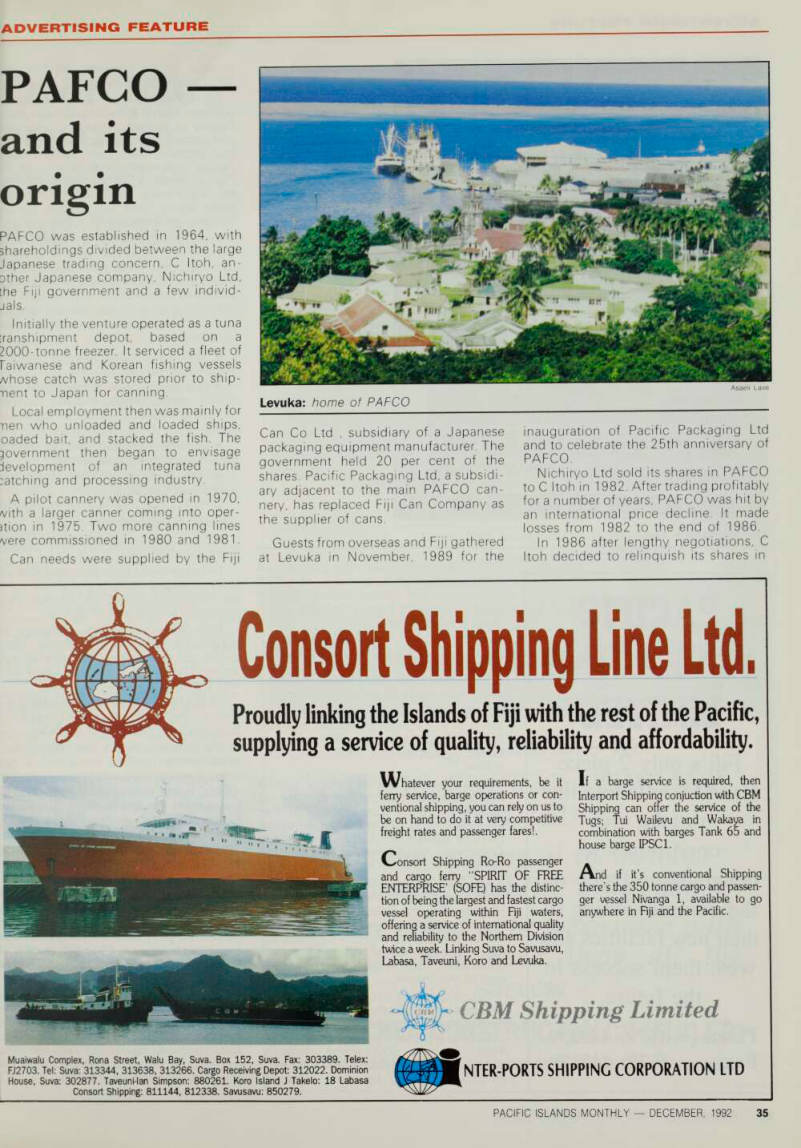

Advertising Feature
Pafco-
and its origin
PAFCO was established in 1964, with shareholdings divided between the large Japanese trading concern. C Itoh. an ather Japanese company. Nichiryo Ltd, the Fiji government and a few individ jals.
Initially the venture operated as a tuna transhipment depot, based on a 2000-tonne freezer. It serviced a fleet of Faiwanese and Korean fishing vessels /vhose catch was stored prior to ship nent to Japan for canning.
Local employment then was mainly for nen who unloaded and loaded ships, oaded bait, and stacked the fish. The government then began to envisage development of an integrated tuna :atching and processing industry.
A pilot cannery was opened in 1970, with a larger canner coming into oper ation in 1975. Two more canning lines were commissioned in 1980 and 1981.
Can needs were supplied by the Fiji
Can Co Ltd , subsidiary of a Japanese packaging equipment manufacturer. The government held 20 per cent of the shares. Pacific Packaging Ltd, a subsidi ary adjacent to the main PAFCO can nery, has replaced Fiji Can Company as the supplier of cans.
Guests from overseas and Fiji gathered at Levuka in November, 1989 for the
inauguration of Pacific Packaging Ltd and to celebrate the 25th anniversary of
Pafco.
Nichiryo Ltd sold its shares in PAFCO to C Itoh in 1982. After trading profitably for a number of years, PAFCO was hit by an international price decline. It made losses from 1982 to the end of 1986.
In 1986 after lengthy negotiations, C Itoh decided to relinquish its shares in
Levuka: home of PAFCO
PAFCO to government. The government became the majority owner about 98 per cent and a financial restructuring created a sound base to continue and expand operations.
In the 1990 and 1991 annual reports, the directors reported a total turnover in excess of $5O million, four per cent higher than 1989. Sales for the last five years totalled $230 million.
The company today has shareholders' funds of $l2 million compared to about $500,000 in January, 1987. Current assets exceed current liabilities by $5.7 million.
The company initiated major capital improvements, particularly in canning equipment, to enhance profitability. Pa cific Packaging Limited, a subsidiary of PAFCO opened in 1989, has created additional reductions in production costs.
The PAFCO extension commissioned on September 26 this year by Prime Minister Sitiveni Rabuka, is funded by the Australian government. The $l7 million package has special significance as the largest single aid project ever undertaken by that government in this part of the Pacific.
The expansion, funded under the auspices of the Australian International Development Assistance Bureau (AIDAB), includes major wharf develop ment, a new 3000-tonne capacity freezer, batch processing facilities, roll on-roll-off loading facilities, container
storage, office complex, forklifts andl 3000 special aluminium fish bins.
AIDAB appointed a joint venture: between Riedel & Byrne and Irwin Alsop Pacific as project managers, engineers! and architects, after an exhaustive selec-1 tion process. Both joint venture comJ panies have extensive experience in the Pacific. Riedel & Byrne were responsible for the marine engineering activities.l Irwin Alsop were responsible for the! building and associated works.
Head contractor for the land recla mation and wharves was McConnell Dowell (Fiji). Head contractor for the] building and paving work was Fletcher) Construction Co (Fiji) Ltd.
The implementation of the project] involved a number of separate contracts! including ★ The land reclamation and wharves] and roll-on-roll-off facility. ★ The construction of three very large] freezer rooms, offices and site services] including hydraulic works to collect all] waste. ★ The fish unloading, loading, sorting,] binning and weighing system. ★ The supply of 3000 one-tonne] aluminium fish bins. ★ The supply of special forklifts tol operate in the freezer rooms. ★ The provision of navigation equip-] ment for shipping.
The extensions have provided PAFCO] with increased capacity and efficiency in] all aspects of unloading, storage, pro-1 cessing, canning and shipping.
They also allow the company to] supply its markets consistently year-] round, provide better stock control and reduced handling costs, and lower port] and berthing charges.
PAFCO tuna is regarded as among the] best in the world. It is sold mainly to| customers in Britain and Canada.
The company has a "no nets", "dol-l phin friendly" policy.
The cannery annually processes about] 15,000 metric tonnes of tuna supplied by boats from the government-owned Ika Corporation, and vessels fishing in Kiri- bati and Solomon Islands waters.
A fleet of 16 vessels chartered to ] PAFCO from F.C.F. Fishery Co. Ltd of] Taiwan also supplies the cannery.
The cannery provides direct employ ment for up to 1000 people, with another 150 to 200 employed indirectly on Ovalau. At peak production, the number employed represents 50 to 60 per cent of 1 the total working population of Ovalau ( and Moturiki.
The company has its own internal training scheme, which provides online training of production employees in food i handling, training of local technicians I and machine operators, management I training, in house-specialised courses I and customer-service training.
Salendra Narayan The production line: PAFCO employs about 1000 people
Advertisements & other items, pp. 35-36 (1 item)
Consort Shipping Line Ltd.
Proudly linking the Islands of Fiji with the rest of the Pacific, supplying a service of quality, reliability and affordability. *1 ' i' Whatever your requirements, be it ferry service, barge operations or conventional shipping, you can rely on us to be on hand to do it at very competitive freight rates and passenger fares!.
Consort Shipping Ro-Ro passenger and cargo ferry “SPIRIT OF FREE ENTERPRISE’ (SOFE) has the distinction of being the largest and fastest cargo vessel operating within Fiji waters, offering a service of international quality and reliability to the Northern Division twice a week. Linking Suva to Savusavu, Labasa, Taveuni, Koro and Levuka.
If a barge service is required, then Interport Shipping conjuction with CBM Shipping can offer the service of the Tugs; Tui Wailevu and Wakaya in combination with barges Tank 65 and house barge IPSCI.
And if it’s conventional Shipping there’s the 350 tonne cargo and passenger vessel Nivanga 1, available to go anywhere in Fiji and the Pacific.
Muaiwalu Complex, Rona Street, Walu Bay, Suva. Box 152, Suva. Fax: 303389. Telex: FJ2703. Tel: Suva; 313344, 313638, 313266. Cargo Receiving Depot: 312022. Dominion House, Suva; 302877. Taveuni-lan Simpson: 880261. Koro Island J Takelo; 18 Labasa Consort Shipping: 811144, 812338. Savusavu: 850279.
CBM Shipping Limited
NTER-PORTS SHIPPING CORPORATION LTD
PACIFIC
PACKAGING
LIMITED
Fiji’s only 2 piece Can Maker would like to take this opportunity to congratulate Pafco on the commissioning of their new facilities and wish them success in the future.
Phone (679) 440239 Fax (679) 440370
separate
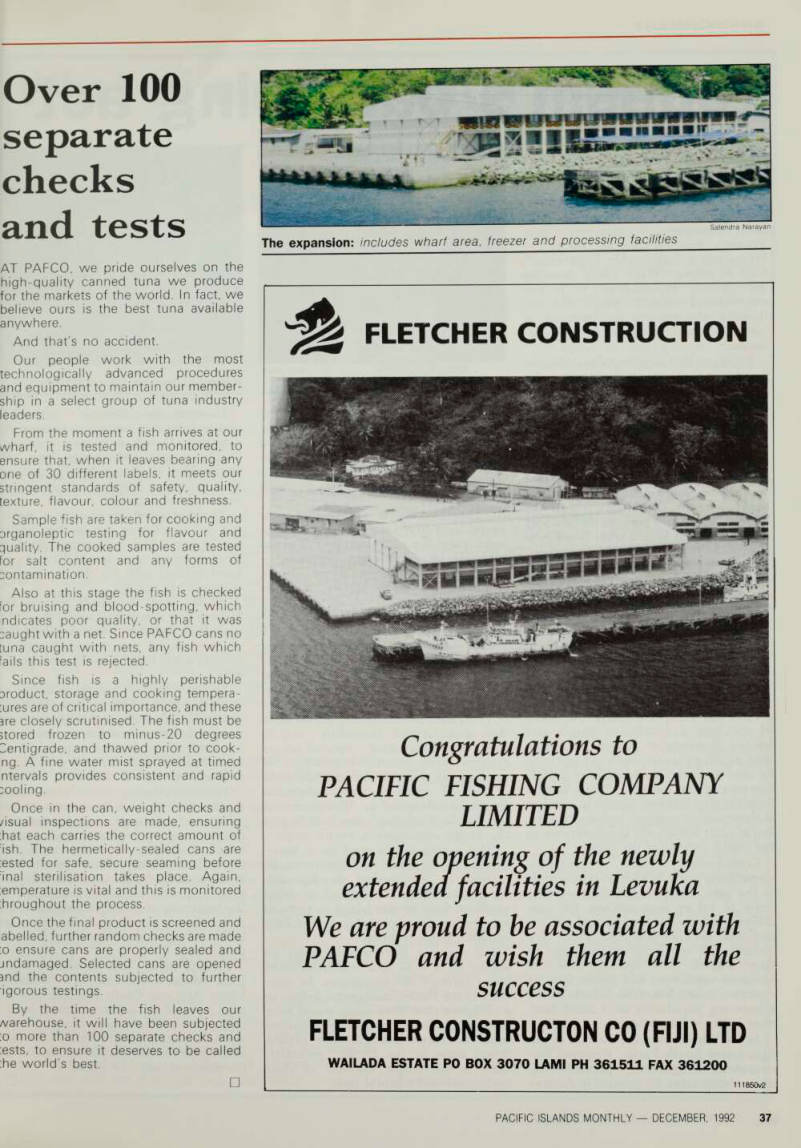
Over 100 separate checks and tests
AT PAFCO, we pride ourselves on the high-quality canned tuna we produce for the markets of the world. In fact, we believe ours is the best tuna available anywhere.
And that's no accident.
Our people work with the most technologically advanced procedures and equipment to maintain our member ship in a select group of tuna industry leaders.
From the moment a fish arrives at our wharf, it is tested and monitored, to ensure that, when it leaves bearing any one of 30 different labels, it meets our stringent standards of safety, quality, texture, flavour, colour and freshness.
Sample fish are taken for cooking and organoleptic testing for flavour and quality. The cooked samples are tested for salt content and any forms of oontamination.
Also at this stage the fish is checked for bruising and blood-spotting, which ndicates poor quality, or that it was saught with a net. Since PAFCO cans no tuna caught with nets, any fish which fails this test is rejected.
Since fish is a highly perishable oroduct, storage and cooking tempera tures are of critical importance, and these are closely scrutinised. The fish must be stored frozen to minus-20 degrees Centigrade, and thawed prior to cook ng. A fine water mist sprayed at timed ntervals provides consistent and rapid pooling.
Once in the can, weight checks and /isual inspections are made, ensuring that each carries the correct amount of ish. The hermetically-sealed cans are tested for safe, secure seaming before inal sterilisation takes place. Again, temperature is vital and this is monitored throughout the process.
Once the final product is screened and abelled, further random checks are made to ensure cans are properly sealed and jndamaged. Selected cans are opened and the contents subjected to further igorous testings.
By the time the fish leaves our warehouse, it will have been subjected to more than 100 separate checks and tests, to ensure it deserves to be called the world's best.
Salendra The expansion: includes wharf area, freezer and processing facilities
Advertisements & other items, p. 37 (1 item)
Fletcher Construction
S&V*
Congratulations to
PACIFIC FISHING COMPANY
LIMITED
on the opening of the newly
extended facilities in Levuka We are proud to be associated with PAFCO and wish them all the success
FLETCHER CONSTRUCTON CO (FIJI) LTD
WAILADA ESTATE PO BOX 3070 LAMI PH 361511 FAX 361200
Tourism’s balancing act
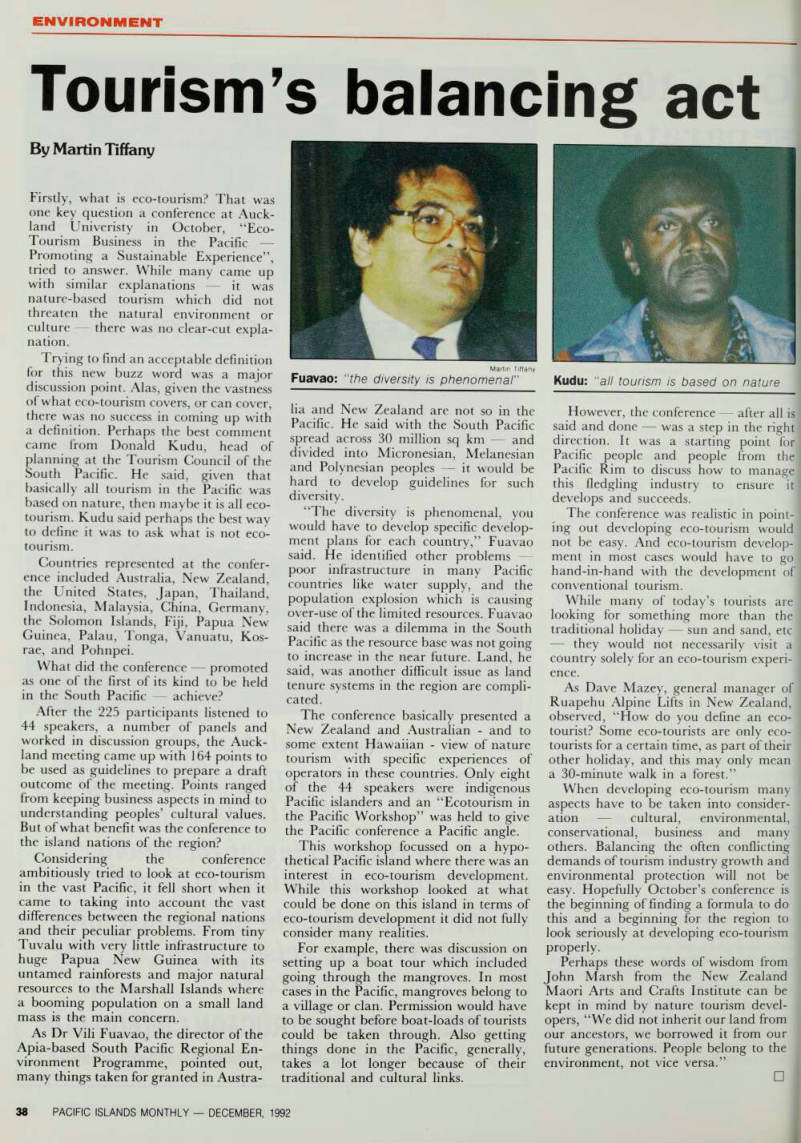
Environment
By Martin Tiffany
Firstly, what is eco-tourism? That was one key question a conference at Auck land Univeristy in October, “Eco- Tourism Business in the Pacific Promoting a Sustainable Experience”, tried to answer. While many came up with similar explanations it was nature-based tourism which did not threaten the natural environment or culture there was no clear-cut expla nation.
Trying to find an acceptable definition for this new buzz word was a major discussion point. Alas, given the vastness of what eco-tourism covers, or can cover, there was no success in coming up with a definition. Perhaps the best comment came from Donald Kudu, head of planning at the Tourism Council of the South Pacific. He said, given that basically all tourism in the Pacific was based on nature, then maybe it is all eco tourism. Kudu said perhaps the best way to define it was to ask what is not eco tourism.
Countries represented at the confer ence included Australia, New Zealand, the United States, Japan, Thailand,
Indonesia, Malaysia, China, Germany,
the Solomon Islands, Fiji, Papua New Guinea, Palau, Tonga, Vanuatu, Kos rae, and Pohnpei.
What did the conference promoted as one of the first of its kind to be held in the South Pacific achieve?
After the 225 participants listened to 44 speakers, a number of panels and worked in discussion groups, the Auck land meeting came up with 164 points to be used as guidelines to prepare a draft outcome of the meeting. Points ranged from keeping business aspects in mind to
understanding peoples’ cultural values.
But of what benefit was the conference to the island nations of the region?
Considering the conference ambitiously tried to look at eco-tourism in the vast Pacific, it fell short when it came to taking into account the vast differences between the regional nations and their peculiar problems. From tiny Tuvalu with very little infrastructure to huge Papua New Guinea with its untamed rainforests and major natural resources to the Marshall Islands where a booming population on a small land mass is the main concern.
As Dr Vili Fuavao, the director of the Apia-based South Pacific Regional En
vironment Programme, pointed out,
many things taken for granted in Austra-
lia and New Zealand are not so in the Pacific. He said with the South Pacific spread across 30 million sq km and divided into Micronesian, Melanesian and Polynesian peoples it would be hard to develop guidelines for such
diversity.
“The diversity is phenomenal, you would have to develop specific develop ment plans for each country,” Fuavao said. He identified other problems poor infrastructure in many Pacific countries like water supply, and the population explosion which is causing over-use of the limited resources. Fuavao said there was a dilemma in the South Pacific as the resource base was not going to increase in the near future. Land, he said, was another difficult issue as land tenure systems in the region are compli cated.
The conference basically presented a New Zealand and Australian - and to some extent Hawaiian - view of nature tourism with specific experiences of operators in these countries. Only eight of the 44 speakers were indigenous Pacific islanders and an “Ecotourism in the Pacific Workshop” was held to give the Pacific conference a Pacific angle.
This workshop focussed on a hypo thetical Pacific island where there was an interest in eco-tourism development.
While this workshop looked at what could be done on this island in terms of eco-tourism development it did not fully consider many realities.
For example, there was discussion on setting up a boat tour which included going through the mangroves. In most cases in the Pacific, mangroves belong to a village or clan. Permission would have to be sought before boat-loads of tourists could be taken through. Also getting things done in the Pacific, generally, takes a lot longer because of their traditional and cultural links.
However, the conference after all is said and done was a step in the right direction. It was a starting point for Pacific people and people from the Pacific Rim to discuss how to manage this fledgling industry to ensure it develops and succeeds.
The conference was realistic in point ing out developing eco-tourism would not be easy. And eco-tourism develop ment in most cases would have to go hand-in-hand with the development of conventional tourism.
While many of today’s tourists are looking for something more than the traditional holiday sun and sand, etc they would not necessarily visit a country solely for an eco-tourism experi ence.
As Dave Mazey, general manager of Ruapehu Alpine Lifts in New Zealand, observed, “How do you define an eco tourist? Some eco-tourists are only eco tourists for a certain time, as part of their other holiday, and this may only mean a 30-minute walk in a forest.”
When developing eco-tourism many aspects have to be taken into consider ation cultural, environmental, conservational, business and many others. Balancing the often conflicting demands of tourism industry growth and environmental protection will not be easy. Hopefully October’s conference is the beginning of finding a formula to do this and a beginning for the region to look seriously at developing eco-tourism properly.
Perhaps these words of wisdom from John Marsh from the New Zealand Maori Arts and Crafts Institute can be kept in mind by nature tourism devel opers, “We did not inherit our land from our ancestors, we borrowed it from our future generations. People belong to the environment, not vice versa,”
Martin Tiffany Fuavao: “the diversity is phenomenal"
Kudu: “all tourism is based on nature
What of environmental refugees?
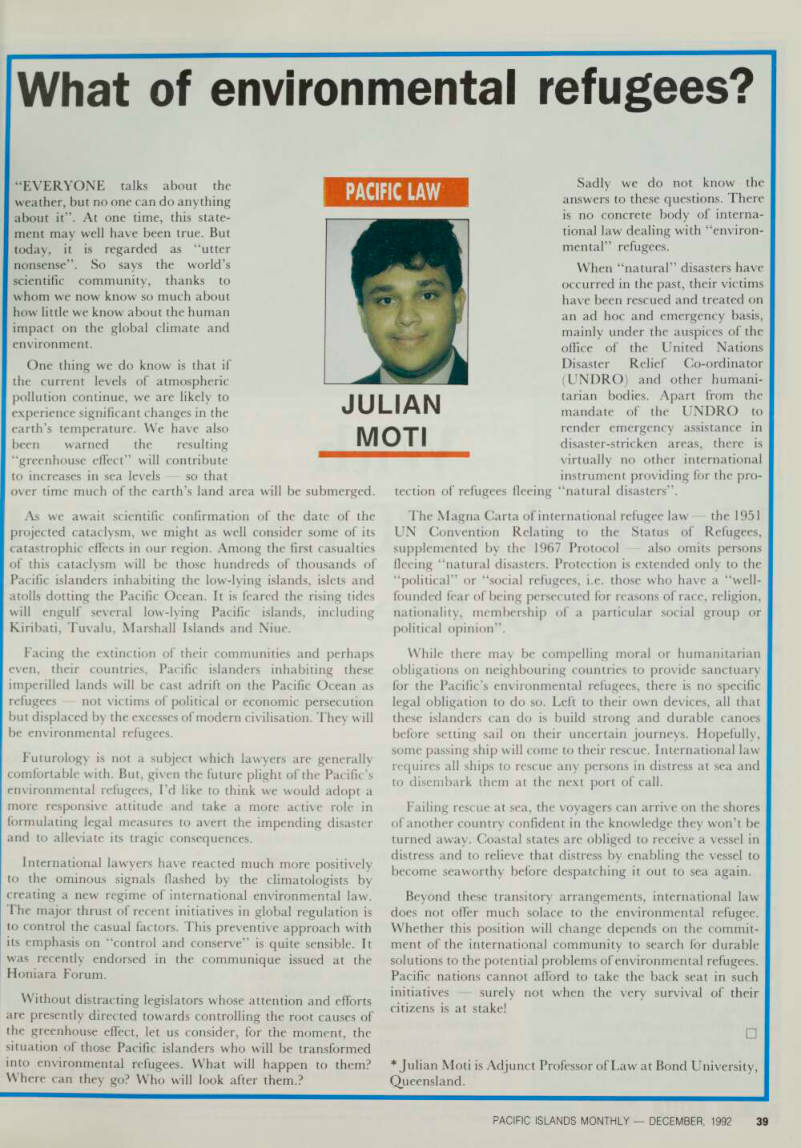
“EVERYONE talks about the weather, but no one can do anything about it”. At one time, this state ment may well have been true. But today, it is regarded as “utter nonsense”. So says the world’s scientific community, thanks to whom we now know so much about how little we know about the human impact on the global climate and environment.
One thing we do know is that if the current levels of atmospheric pollution continue, we are likely to
experience significant changes in the
earth’s temperature. We have also been warned the resulting “greenhouse effect” will contribute to increases in sea levels so that
over time much of the earth’s land area will be submerged.
As we await scientific confirmation of the date of the projected cataclysm, we might as well consider some of its catastrophic effects in our region. Among the first casualties of this cataclysm will be those hundreds of thousands of Pacific islanders inhabiting the low-lying islands, islets and atolls dotting the Pacific Ocean. It is feared the rising tides will engulf several low-lying Pacific islands, including Kiribati, Tuvalu, Marshall Islands and Niue.
Facing the extinction of their communities and perhaps even, their countries, Pacific islanders inhabiting these imperilled lands will be cast adrift on the Pacific Ocean as refugees not victims of political or economic persecution but displaced by the excesses of modern civilisation. They will be environmental refugees.
Futurology is not a subject which lawyers are generally comfortable with. But, given the future plight of the Pacific’s environmental refugees, I’d like to think we would adopt a more responsive attitude and take a more active role in formulating legal measures to avert the impending disaster and to alleviate its tragic consequences.
International lawyers have reacted much more positively to the ominous signals flashed by the climatologists by creating a new regime of international environmental law.
The major thrust of recent initiatives in global regulation is to control the casual factors. This preventive approach with its emphasis on “control and conserve” is quite sensible. It was recently endorsed in the communique issued at the Honiara Forum.
Without distracting legislators whose attention and efforts are presently directed towards controlling the root causes of the greenhouse effect, let us consider, for the moment, the situation of those Pacific islanders who will be transformed into environmental refugees. What will happen to them?
Where can they go? Who will look after them.?
Sadly we do not know the answers to these questions. There is no concrete body of interna tional law dealing with “environ mental” refugees.
When “natural” disasters have occurred in the past, their victims have been rescued and treated on an ad hoc and emergency basis, mainly under the auspices of the office of the United Nations Disaster Relief Co-ordinator (UNDRO) and other humani tarian bodies. Apart from the mandate of the UNDRO to render emergency assistance in disaster-stricken areas, there is virtually no other international instrument providing for the pro
tection of refugees fleeing “natural disasters”.
The Magna Carta of international refugee law the 1951 UN Convention Relating to the Status of Refugees, supplemented by the 1967 Protocol - also omits persons fleeing “natural disasters. Protection is extended only to the “political” or “social refugees, i.e. those who have a “well founded fear of being persecuted for reasons of race, religion, nationality, membership of a particular social group or political opinion”.
While there may be compelling moral or humanitarian obligations on neighbouring countries to provide sanctuary for the Pacific’s environmental refugees, there is no specific legal obligation to do so. Left to their own devices, all that these islanders can do is build strong and durable canoes before setting sail on their uncertain journeys. Hopefully, some passing ship will come to their rescue. International law requires all ships to rescue any persons in distress at sea and to disembark them at the next port of call.
Failing rescue at sea, the voyagers can arrive on the shores of another country confident in the knowledge they won’t be turned away. Coastal states are obliged to receive a vessel in distress and to relieve that distress by enabling the vessel to become seaworthy before despatching it out to sea again.
Beyond these transitory arrangements, international law does not offer much solace to the environmental refugee.
Whether this position will change depends on the commit ment of the international community to search for durable solutions to the potential problems of environmental refugees.
Pacific nations cannot afford to take the back seat in such initiatives surely not when the very survival of their citizens is at stake!
* Julian Moti is Adjunct Professor of Law at Bond University, Queensland.
Pacific Law
Julian
Moti
Advertisements & other items, p. 40 (1 item)
in your hands.
r ■ - m m - J ■ 8K ■.
PP m ¥ f ■
With
National MBf Master Card
you’ve got the whole world
in your hands.
Now, for the first time ever, there’s
a unique credit card specially designed
for today’s modern Fijian. The National MBf Master Card is the First and Only
Fiji Dollar Credit Card accepted locally
and at over 9 million outlets worldwide.
It gives you Revolving Credit, so you have the option of settling just 10% of the amount due each month which gives you the option of saving your finances for other things.
And as a Cash Card, it obviously gets you cash at over 80,000 MasterCard* ATMS worldwide. Plus Cash on Card at all branches of National Bank of Fiji and at more than 100,000 Master Card locations throughout the world.
If you hold the National MBf Master Card, we know how impressive your financial status is and so
you automatically enjoy preferential
treatment when you apply for a Current Account with The National Bank of Fiji.
They will also give you Refinancing
Facilities.
When you travel, National MBf Master Card provides you with a high value Insurance Plan for Travel Accident and Travel Inconveniences.
National MBf Master Card also gives you Travel Assistance through Master Assist™ 24 hours a day, every day of the year.
The Master Assist™ programme will help you in many kinds of
emergencies: legal and medical
referrals, medical repatriation, emergency assistance, lost document, luggage retrieval assistance and emergency cash.
This is just a glimpse of the benefits from National MBf Master Card. There’s no reason now to feel second best.
Apply for The First Fiji Dollar Credit Card today, and you’ve got the whole world in your hands.
NATIONAL BANK OF FIJI
S3HI® IT^TsTI
V&m r c ‘ ; Wy
National
MBf Master Card.
ME IfM!
National MBf Master Card is issued by National MBf Finance (Fiji) Ltd. in conjunction with National Bank of Fiji under the affiliate licence of MBf Card Services Sdn. Bhd. from Master Card International Inc. To apply call 302232 or pick-up an application form at any branch of National Bank of Fiji.
promote tourism?
Migration
Control migrants or promote tourism?
By David North
SEVERAL Pacific island governments are struggling with the question shall we insist visitors have visas issued in advance (to better control migration) or shall we waive such requirements (to encourage tourism)?
Papua-New Guinea has opted for tighter controls, Guam for easier ones, while New Zealand and American Samoa squabble over who’s eligible for easy passage through
international airports.
PNG’s Foreign Affairs Department has ruled all aliens, including tourists, have to secure a visa before they arrive in the nation. (Visas used to be routinely available at air and seaports.) Further, if a tourist in PNG gets a job offer, he will have to leave the country to apply for an employment visa there will be no more of the adjustment of status (to the work visa) as there was in the past.
Guam has a different set of priorities. Its principal economic activity is tourism, and its principal customers come from the newly prosperous nations of East Asia, all of whom used to have to go to a US consulate to get a visa. And the US does not issue visas casually.
With some prodding from Congressman Ben Blaz (R. Guam) the US Immigration Service has begun to let people from certain nations come to Guam as short-term tourists without visas; in a highly statistical manner, the Immigration Service has calculated which nations had the history of the least abuse of tourist visas, and started letting residents of those nations come to Guam (and elsewhere in the States) without visas.
People from Japan were the first to be allowed to arrive in Guam without visas, then Koreans, and most recently Blaz announced residents of Taiwan were about to obtain the same deal. The announcement came as particularly good news to struggling Continental-Air Micronesia, the only airline with direct service between Taiwan and Guam.
Meanwhile a controversy, or maybe just some confusion, has broken out over tourist visas between the Congressman from American Samoa, Eni F.H.
Faleomavaega (D), and the government of New Zealand, New Zealand, like Japan and Great Britain, has a good record for not abusing US tourist visas, i.e. its people are unlikely to stay illegally after being admitted as tourists. So they can come to the US without a need for a visa. Part of the deal is that Americans wanting to go to New Zealand are treated the same way and there’s the rub.
New Zealand has long figured it had an immigration-control problem, and people from its former mandate, Western Samoa, were at the head of the list of those who settled permanently in New Zealand without getting permission from the local authorities.
The New Zealand government evidently decided residents of American Samoa were more like Western Samoans than they were like other people travelling on US passports, and it decided to make a distinction based on a little-known element in US nationality law Wellington decided no visas were needed by US citizens but they would be needed by US nationals.
It so happens the only US nationals are people from American Samoa a historical accident. Everywhere else under the US flag the native-born and the naturalised are citizens.
The Congressman, in late September, protested the situation to Acting US Secretary of State Lawrence Eagleburger and to the New Zealand government.
What the Congressman did not point out is that American Samoa has its own very tight immigration laws; and while it is easy enough for a foreigner to get a tourist visa, it is extremely difficult for the same alien to get permission to settle in American Samoa permanently. And, unlike PNG, there is no provision in the law for that foreigner (unless off Samoan extraction) to convert his or her status to that of a US national.
The government of American Samoa handles its own immigration policy, and it is a tough one. Guam would like to have these powers, but Congress has not agreed.
policies
Three visa policies
By David North
ISLAND nations have three poten tial visa policies no visas re quired, visas issued at the ports-of entry, or visas issued overseas.
Often two or more friendly nations, with similar levels of prosperity, will agree to waive visas for each other’s citizens, on the grounds the migration poses little risk to the nations involved.
Canada and the US, and the nations of Western Europe operate this way; the US and poverty stricken Mexico do not.
Issuing the visa at the port of entry is usually a formality, and the result is about the same as the no visa policy very, very few people are denied entry as a result.
If there is one plane a week arriving from a given direction, what does the immigration inspector do with the suspect visitor from that
plane, particularly if the plane has
already departed?
In extremely serious cases, jail is the only answer.
Small island nations, such as Tuvalu and Kiribati, lacking a network of visa-issuing consulates and embassies, usually have no choice but to issue visas at the air and sea ports of entry.
Demanding that a visa be issued outside the nation before entry is the only way a nation can begin to exert control of aliens wishing entry. The nation has the choice of issuing visas freely, or being careful in their issuance.
Papua-New Guinea (see article)
has decided it is important to make visa decisions overseas.
controversy erupts
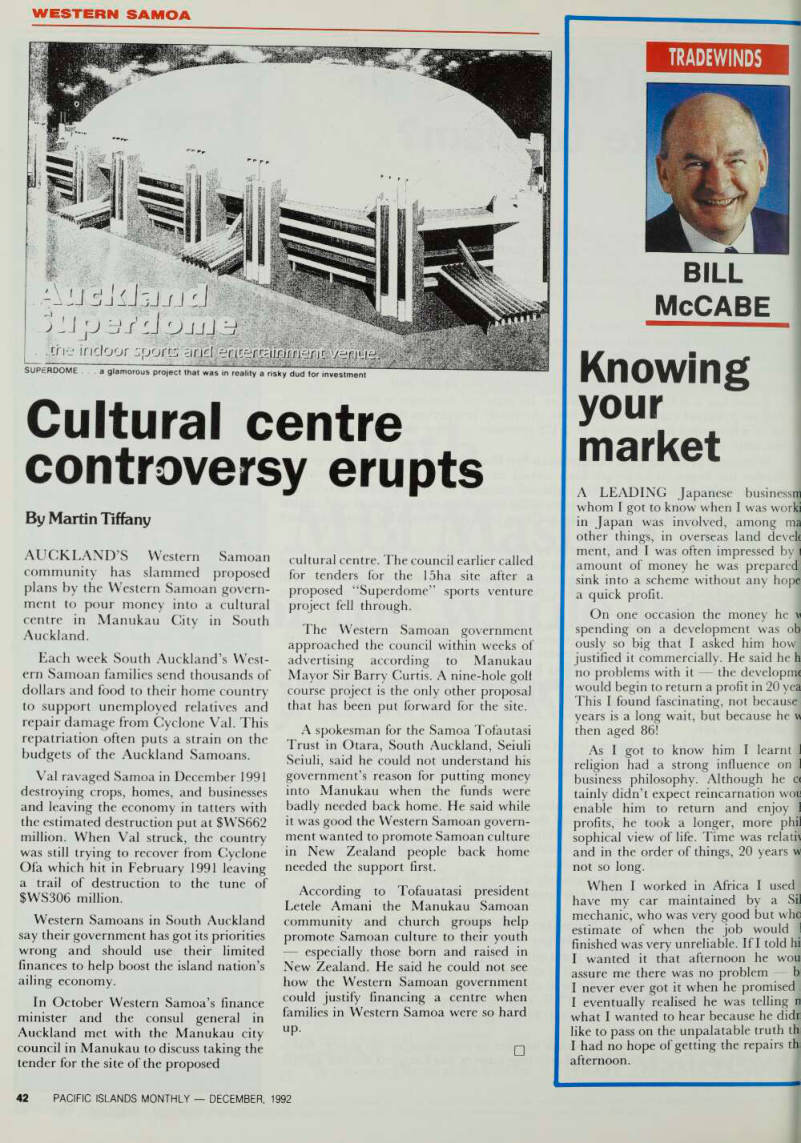
Western Samoa
Cultural centre controversy erupts
By Martin Tiffany
AUCKLAND’S Western Samoan
community has slammed proposed
plans by the Western Samoan govern ment to pour money into a cultural centre in Manukau City in South Auckland.
Each week South Auckland’s West ern Samoan families send thousands of dollars and food to their home country to support unemployed relatives and
repair damage from Cyclone Val. This
repatriation often puts a strain on the budgets of the Auckland Samoans.
Val ravaged Samoa in December 1991 destroying crops, homes, and businesses and leaving the economy in tatters with the estimated destruction put at SWS662 million. When Val struck, the country was still trying to recover from Cyclone Ofa which hit in February 1991 leaving a trail of destruction to the tune of SWS3O6 million.
Western Samoans in South Auckland say their government has got its priorities wrong and should use their limited finances to help boost the island nation’s
ailing economy.
In October Western Samoa’s finance minister and the consul general in Auckland met with the Manukau city council in Manukau to discuss taking the tender for the site of the proposed
cultural centre. The council earlier called for tenders for the 15ha site after a proposed “Superdome” sports venture project fell through.
The Western Samoan government approached the council within weeks of advertising according to Manukau Mayor Sir Barry Curtis. A nine-hole goll course project is the only other proposal that has been put forward for the site.
A spokesman for the Samoa Tofautasi Trust in Otara, South Auckland, Seiuli Seiuli, said he could not understand his government’s reason for putting money into Manukau when the funds were badly needed back home. He said while it was good the Western Samoan govern ment wanted to promote Samoan culture in New Zealand people back home needed the support first.
According to Tofauatasi president Letele Amani the Manukau Samoan community and church groups help promote Samoan culture to their youth especially those born and raised in New Zealand. He said he could not see how the Western Samoan government could justify financing a centre when families in Western Samoa were so hard up.
SUPERDOME a glamorous project that was in reality a risky dud for investment
Knowing
Tradewinds
Knowing your market
A LEADING Japanese whom I got to know when I was worki in Japan was involved, among ma other things, in overseas land develfl ment, and I was often impressed by t amount of money he was prepared] sink into a scheme without any hope
a quick profit.
On one occasion the money he v\ spending on a development was ob ously so big that I asked him how justified it commercially. He said he h no problems with it the developme would begin to return a profit in 20 yea This I found fascinating, not because years is a long wait, but because he w then aged 86!
As I got to know him I learnt 1 religion had a strong influence on 1 business philosophy. Although he c( tainly didn’t expect reincarnation won enable him to return and enjoy 1 profits, he took a longer, more phil sophical view of life. Time was relativ and in the order of things, 20 years w not so long.
When I worked in Africa I used have my car maintained by a Sil mechanic, who was very good but who estimate of when the job would ! finished was very unreliable. If I told hi I wanted it that afternoon he woui assure me there was no problem b I never ever got it when he promised I eventually realised he was telling n what I wanted to hear because he didr like to pass on the unpalatable truth thi I had no hope of getting the repairs th; afternoon.
Bill
Mccabe
[t was rather an unfortunate way of ming a service business, but I knew i well enough to learn he was merely ctising, in his own way, a strong gious philosophy he had of being isiderate to others. It was part of him. ivery religion includes a personal code ethics, or philosophy, about how icrents should live their daily lives, I my experience is that we are not ays aware of how many people really live and work by that code in their iness dealings as well as in everything Vhile experience of different religions [ cultures is usually something people e to acquire for themselves, in some igs we can benefit from good specialist ice without having to learn the hard For instance, I frequently stress in >e columns the South Pacific Trade nmission can make specialist advice ilable to island business people to 3 them resolve just about any prob , but export marketing, which in /es being conscious of different re ms and cultures, responds to help
n specialists particularly.
lompetent designers of marketing erials, such as packaging, will, for mple, advise on the significance of mrs in religious symbolism. This can e an important influence on sales in e areas. That black signifies death in it religions and white is the symbol of t, purity and joy, is well known; but, ourse, white signifies charity; green, symbol of nature, will represent the e of eternal life, and blue, the symbol heaven, will signify truth. Among cultures and religions this can
significant.
he rule is that nothing should be keted in a culture which an exporter
anfamiliar with without planning
ice, for there are many hidden traps. r as once involved with Eta brand ducts, which we planned to introduce he Japanese market and did. But r weren’t sold under that name, ause research showed us in Japan it connotations of class that would ic it unsuitable. ometimes any importer with strong ;s in the country will be able to tell straight away whether your product kely to be unacceptable in the local ket. Often, though, products may d deeper research and perhaps some marketing. f you are in doubt or need advice, tact us.
Advertisements & other items, p. 43 (1 item)
In One Night.
How Tahiti
Sold $2 Million
Worth Of Products
In One Night.
O-O. -^sfC^s^ vl 0^ > <O-5* 1 The Tahiti Exportation Board wanted to promote French Polynesian products in Sydney.
Everything from chocolates to beer to black pearls.
The Board enlisted participants, arranged shipment of their products and funded the displays.
The Trade Commission, in turn, put together a mailing list of people likely to be interested and sent out invitations to a gala evening in the ballroom of the Regent.
We had displays built. Generated press coverage. And we hired three lovely ladies to move among the guests wearing some of those black pearls. (The most expensive jewels were in a case under armed guard.) When the evening was over, products totalling more than $2 million had been sold.
Needless to say, the Tahiti Exportation Board was quite pleased with the way everything went.
If you’d like to feel the same sort of pleasure, just post or fax us the coupon below. If you’re in a hurry, feel free to phone. i I Name I Company ! Address £ r o z I c £ £ Level 6,50 Park Street, Sydney NSW 2000.
Phone: (612) 2835933, Fax: (612) 2835948
World’s [?]irst poisonous bird
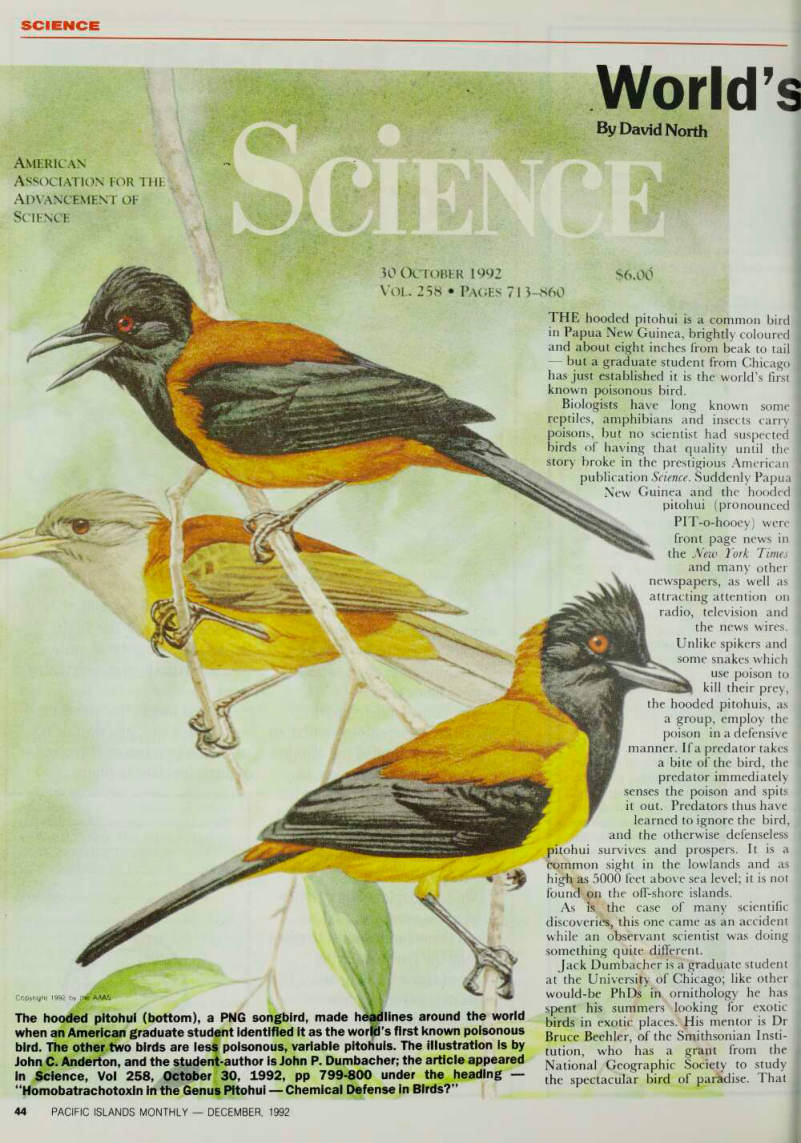
Science
By David North
American Association for the Adv ancement of Science
rtj
30 October 1992 $6.00 VOL. 258 • Pages 713-860
THE hooded pitohui is a common bird in Papua New Guinea, brightly coloured and about eight inches from beak to tail but a graduate student from Chicago has just established it is the world’s first known poisonous bird.
Biologists have long known some reptiles, amphibians and insects carry poisons, but no scientist had suspected birds of having that quality until the story broke in the prestigious American
publication Science. Suddenly Papua
New Guinea and the hooded pitohui (pronounced
PIT-o-hooey) were
front page news in the New York Times and many other v newspapers, as well as attracting attention on radio, television and the news wires.
Unlike spikcrs and some snakes which use poison to kill their prey, the hooded pitohuis, as a group, employ the poison in a defensive WB manner -l^ a predator takes a bite of the bird, the predator immediately f BF senses the poison and spits W it out. Predators thus have learned to ignore the bird, and the otherwise defenseless pitohui survives and prospers. It is a Cqmmon sight in the lowlands and as high as 5000 feet above sea level; it is not found on the off-shore islands.
As is the case of many scientific discoveries, this one came as an accident while an observant scientist was doing something quite different.
Jack Dumbacher is a graduate student at the University of Chicago; like other would-be PhDs in ornithology he has spent his summers looking for exotic birds in exotic places. His mentor is Dr Bruce Beehler, of the Smithsonian Insti tution, who has a grant from the National Geographic Society to study the spectacular bird of paradise. That
Copynght 1992 by the AAAS The hooded pitohui (bottom), a PNG songbird, made headlines around the world when an American graduate student identified It as the world’s first known poisonous bird. The other two birds are less poisonous, variable pitohuis. The illustration is by John C. Anderton, and the student-author is John P. Dumbacher; the article appeared in Science, Vol 258, October 30, 1992, pp 799-800 under the heading “Homobatrachotoxin in the Genus Pitohui Chemical Defense in Birds?”
study and others have taken Dr Beehler to Papua-New Guinea 14 times in recent years.
Working in PNG’s first national park, Varirata National Park, a 45-minute drive from downtown Port Moresby, Durnbaeher was busy trapping the bird of paradise. From time to time the nets caught hooded pitohui as well. Some times Dumbacher’s hands were scratched during these experiences, and he licked the blood from the cuts, finding, to his surprise, his mouth felt numb. At first he and his colleagues figured he had encountered a poisonous plant (and not being botanists had not pursued the matter.) Eventually, Durnbaeher sus pected the experience might have related to the pitohui, so he brought back to the US some feathers, skins, bones, muscle and internal organs of the little birds, all prepared as laboratory specimens.
All these items turned out to have poison in them, a neurotoxin which produces paralysed muscles, and if enough is injected in a mouse, quick death. The outer parts of the pitohui, however, the skins and particularly the feathers, were much more toxic than the inner parts of the bird as if the birds were sending out warning signals to would-be predators.
“How did this system work to protect the hooded pitohui?” Dr Beehler was asked. “Well, like so much in nature, it’s a messy system. Some pitohui die before predators know what they are doing, but usually the snakes and the raptors (birds of prey, like hawks) learn to leave the birds alone,” he replied.
He went on to say he thought, though he has never seen it in the wild, snakes lick what they eat before they kill it, and a snake licking a pitohui would get a taste of the poison and would slither off for other prey.
Further, and this may be one of the major secondary findings of this dis covery, it may well be the pitohui’s colourful plumage, with much strongly contrasting black and brick-orange, is not just designed to attract birds of the other sex, the traditional interpretation of bright colors in birds.
Maybe the reason for the colours is to let predators know here is a nasty mouthful so go bite something else! (All of this having been worked out over the aeons through a specialised form of evolution and of the survival of the fittest, or, in this case, the survival of the most
obviously poisonous.) Elsewhere in the animal kingdom there are brightly colored beasts laden with poison; there is the beautiful but toxic monarch butter fly, the coral snake, and in the jungles of South America, the brightly coloured poison-dart frog, so named because the indigenous population has long used a poison from the frog on the tips of the darts they shoot from their blow guns. (No one has yet reported a similar use, by the people of PNG, of the pitohui poison, but it is a large country and a question no one has researched.) The South American frog has some thing else in common with the hooded pitohui each carries the same poison which goes by the name of homobatrachotoxin; it appears no where else in the world. Scientists speculate the two creatures, so distant from each other both geographically and in the evol utionary scheme of things, must have independently arrived at the utility of the
poison.
As a matter of fact, the poison in the frog is much more concentrated than it is in the bird. There is a phenomenon in nature called “visual mimicry”. For example, there is the viceroy butterfly which looks very much like the monarch, while it is not poisonous to eat, predators do not know that, and the viceroy profits.
Something similar to that has occurred among the pitohui in PNG, according to Dumbach.
There are also the variable pitohui and the rusty pitohui, close cousins of the hooded pitohui, but with only a fraction of the latter’s poison. Many variable pitohui look very much like the hooded variety, and presumably are avoided by snakes and hawks as well.
Dumbach and Beehler are enthusiastic about the level of co-operation they have secured for their work in PNG. Both the government and the University of Papua New Guinea must endorse scientific expeditions, or they do not occur.
According to Beehler both lamo Ila, the ranking civil servant and secretary of the PNG Department of Environment and Conservation, and Dr lan Burrows, chair of the University’s Department of Bi ology, have been quite supportive of the bird of paradise and hooded pitohui studies.
Similarly, Durnbaeher spoke of the detailed assistance the ornithologists re ceived from two residents of the Kokoda region, Rodney Gaga and Michael
Lucas. Both gave the visitors detailed information on birds and plants, and were the first to identify the hooded pitohuis as “rubbish birds," i.e. those which should not be eaten.
Durnbaeher has also worked with residents of the East Sepik Province who had established, on traditionally-owned lands, their own nature preserve, the Mojirau Wild Life Arrea.
When an Asian-owned logging com pany started cutting down trees in the Wild Life Area, and the residents’ efforts to secure assistance from the PNG government came to naught, they en listed Dumbacher's help. He got some journalists in Port Moresby interested in the case, they poked around, and soon the illicit logging ended. Durnbaeher regarded his involvement in the matter as just a part of his relations with (he property owners.
On a different note the American
ornithologists, when asked, reported
their own brushes with crime in the bush.
A group of them were spending the night in Varirata Park; each was in his or her own tent, sound asleep. Ihe tents of two of the women were invaded by burglars; one of the women slept through it, and found later her camera and other valuables had been stolen. The other woke to find a strange man in her tent, screamed, and he ran away. Neither woman was touched by the burglars.
The research on the pitohui is far from complete, and much of it is now in the hands of scientists working in or near the field of medicine. They are curious about how the hooded pitohui (and the poison dart frog) manage to acquire the toxin do they generate it internally, or do they, through some chemical process, harvest it from their surroundings and then concentrate it in their bodies?
More importantly, how do they keep the poison from killing themselves?
Were scientists to know the answer to the last question, they probably could use the information to help treat arrhythmias (irregular heartbeats) in humans, and/or to develop reversible anesthetics, i.e. so that doctors could use drugs to move people both into and out of conscious ness.
And all because an American graduate student, with a habit of licking cuts on his hands in the PNG bush, stumbled on a scientific discovery. □
Advertisements & other items, p. 46 (1 item)
We Pour Technology
in f £ vm r £
FVNFUmVR
COCKTAIL
•it
lISHI
FLAVOUR
linn HI
LITRE
they make
tasty cheese
yogbciKT m
We Pour Technology
Into EverythingWe Make
fWTrm rm OQ9 If you need more information on Rewa Dairy's range of natural dairy products or Tetrapak packaging capabilities contact: Rewa Co-operative Dairy Company Ltd, PO Box 3678, Samabula, Suva, Fiji. Telephone: 381 288. Fax: 370 190.
IH) FI 037
Across the cultural divide
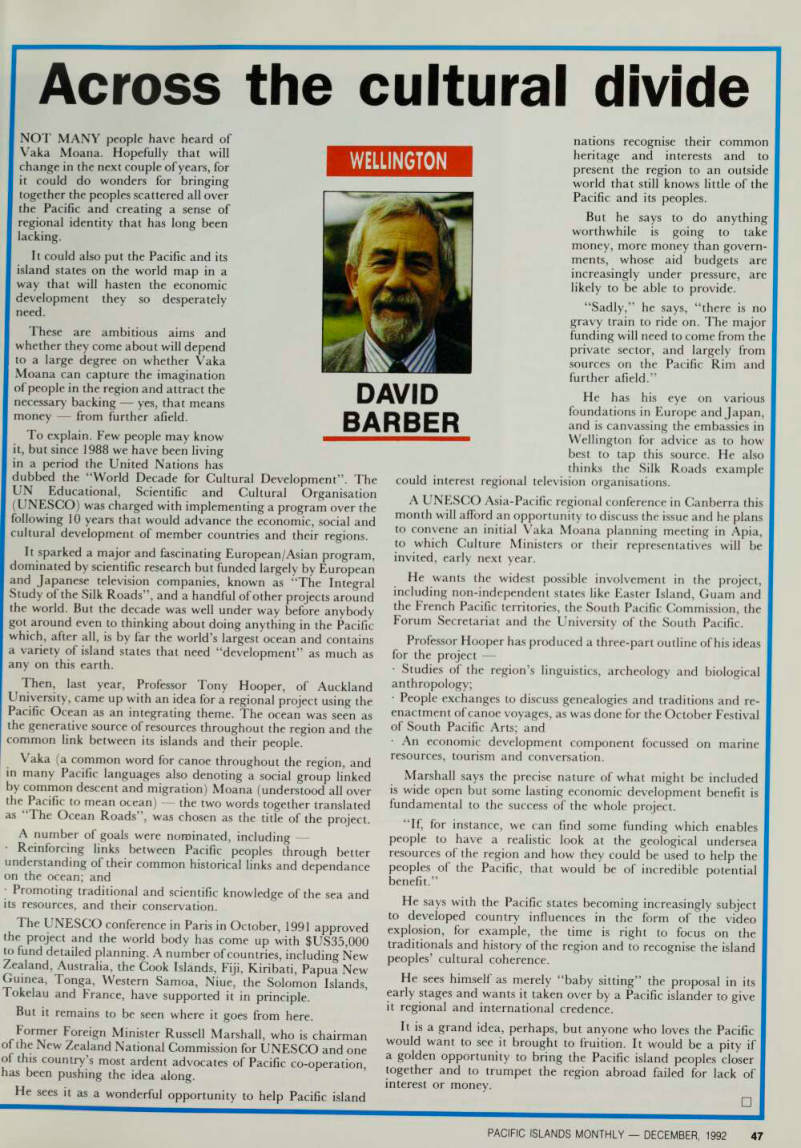
I NOT MANY people have heard of I Vaka Moana. Hopefully that will change in the next couple of years, for it could do wonders for bringing together the peoples scattered all over the Pacific and creating a sense of regional identity that has long been lacking.
It could also put the Pacific and its island states on the world map in a way that will hasten the economic development they so desperately need.
These are ambitious aims and whether they come about will depend to a large degree on whether Vaka Moana can capture the imagination of people in the region and attract the necessary backing yes, that means money from further afield.
To explain. Few people may know it, but since 1988 we have been living in a period the United Nations has
I dubbed the “World Decade for Cultural Development”. The lUN Educational, Scientific and Cultural Organisation I (UNESCO) was charged with implementing a program over the I following 10 years that would advance the economic, social and I cultural development of member countries and their regions.
It sparked a major and fascinating European/Asian program, I dominated by scientific research but funded largely by European I and Japanese television companies, known as “The Integral I Study of the Silk Roads”, and a handful of other projects around I the world. But the decade was well under way before anybody I got around even to thinking about doing anything in the Pacific I which, after all, is by far the world’s largest ocean and contains a variety of island states that need “development” as much as any on this earth.
Then, last year, Professor Tony Hooper, of Auckland University, came up with an idea for a regional project using the Pacific Ocean as an integrating theme. The ocean was seen as the generative source of resources throughout the region and the common link between its islands and their people.
Vaka (a common word for canoe throughout the region, and in many Pacific languages also denoting a social group linked by common descent and migration) Moana (understood all over the Pacific to mean ocean) the two words together translated as “The Ocean Roads”, was chosen as the title of the project.
A number of goals were nominated, including • Reinforcing links between Pacific peoples through better understanding of their common historical links and dependance on the ocean; and Promoting traditional and scientific knowledge of the sea and its resources, and their conservation.
The UNESCO conference in Paris in October, 1991 approved the project and the world body has come up with 5U535,000 to fund detailed planning. A number of countries, including New Zealand, Australia, the Cook Islands, Fiji, Kiribati, Papua New Guinea, Tonga, Western Samoa, Niue, the Solomon Islands, Tokelau and France, have supported it in principle.
But it remains to be seen where it goes from here.
Former Foreign Minister Russell Marshall, who is chairman of the New Zealand National Commission for UNESCO and one of this country s most ardent advocates of Pacific co-operation, has been pushing the idea along.
He sees it as a wonderful opportunity to help Pacific island
nations recognise their common heritage and interests and to present the region to an outside world that still knows little of the Pacific and its peoples.
But he says to do anything worthwhile is going to take money, more money than govern ments, whose aid budgets are increasingly under pressure, are likely to be able to provide.
“Sadly,” he says, “there is no gravy train to ride on. The major funding will need to come from the private sector, and largely from sources on the Pacific Rim and further afield.”
He has his eye on various foundations in Europe and Japan, and is canvassing the embassies in Wellington for advice as to how best to tap this source. He also thinks the Silk Roads example
could interest regional television organisations.
A UNESCO Asia-Pacific regional conference in Canberra this month will afford an opportunity to discuss the issue and he plans to convene an initial Vaka Moana planning meeting in Apia, to which Culture Ministers or their representatives will be invited, early next year.
He wants the widest possible involvement in the project, including non-independent states like Easter Island, Guam and the French Pacific territories, the South Pacific Commission, the Forum Secretariat and the University of the South Pacific.
Professor Hooper has produced a three-part outline of his ideas for the project • Studies of the region’s linguistics, archeology and biological
anthropology;
• People exchanges to discuss genealogies and traditions and re enactment of canoe voyages, as was done for the October Festival of South Pacific Arts; and • An economic development component focussed on marine resources, tourism and conversation.
Marshall says the precise nature of what might be included is wide open but some lasting economic development benefit is fundamental to the success of the whole project.
“If, for instance, we can find some funding which enables people to have a realistic look at the geological undersea I resources of the region and how they could be used to help the peoples of the Pacific, that would be of incredible potential benefit.”
He says with the Pacific states becoming increasingly subject to developed country influences in the form of the video explosion, for example, the time is right to focus on the traditional and history of the region and to recognise the island peoples’ cultural coherence.
He sees himself as merely “baby sitting” the proposal in its early stages and wants it taken over by a Pacific islander to give it regional and international credence.
It is a grand idea, perhaps, but anyone who loves the Pacific would want to see it brought to fruition. It would be a pity if a golden opportunity to bring the Pacific island peoples closer together and to trumpet the region abroad failed for lack of interest or money.
Wellington
David
Barber
This is the [?]arnangu
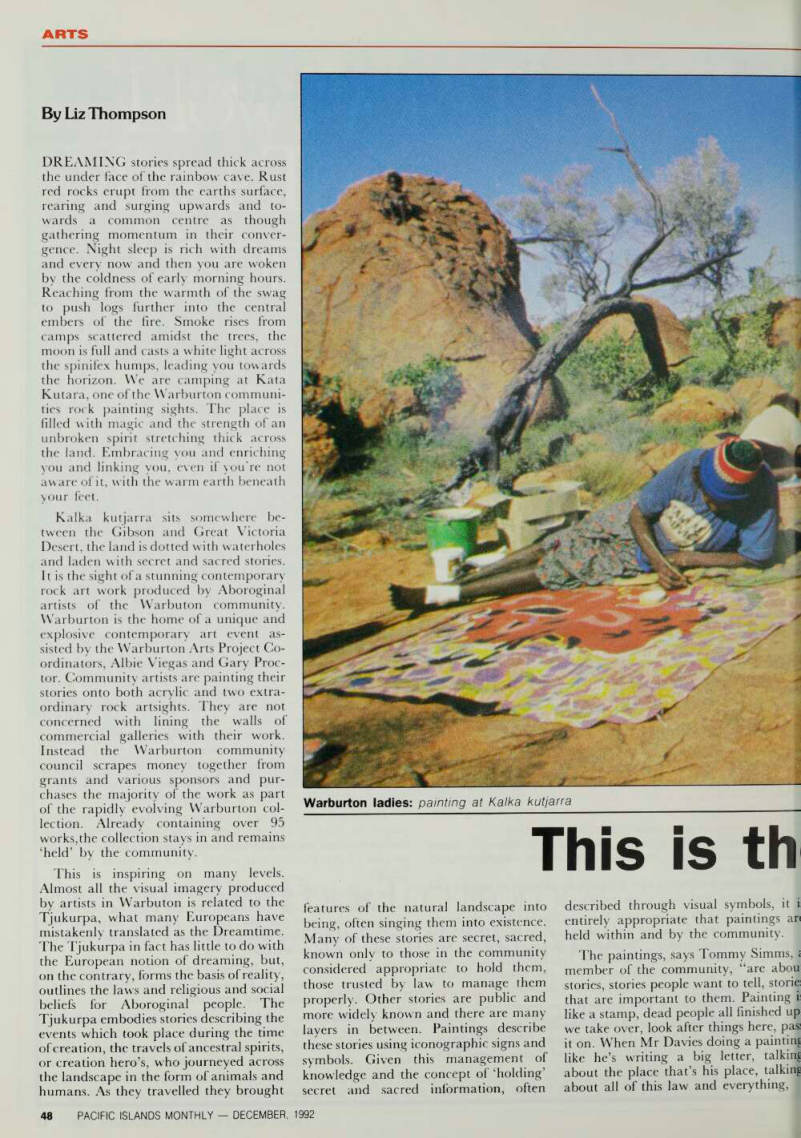
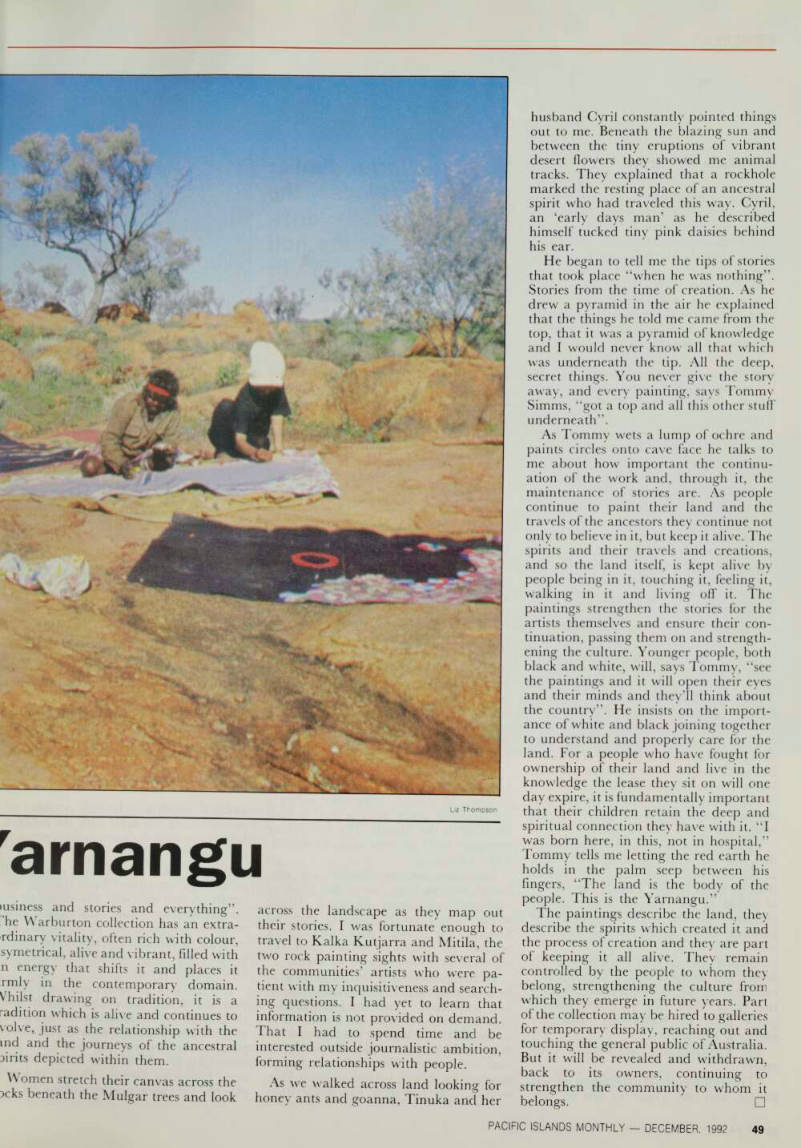
Arts
By Liz Thompson
DREAMING stories spread thick across the under face of the rainbow cave. Rust red rocks erupt from the earths surface,
rearing and surging upwards and to
wards a common centre as though gathering momentum in their conver gence. Night sleep is rich with dreams and every now and then you are woken by the coldness of early morning hours.
Reaching from the warmth of the swag to push logs further into the central embers of the fire. Smoke rises from camps scattered amidst the trees, the moon is full and casts a white light across the spinifex humps, leading you towards the horizon. We are camping at Kata Kutara, one of the Warburton communi ties rock painting sights. The place is filled with magic and the strength of an unbroken spirit stretching thick across the land. Embracing you and enriching you and linking you, even if you're not aware of it, with the warm earth beneath your feet.
Kalka kutjarra sits somewhere be tween the Gibson and Great Victoria Desert, the land is dotted with waterholes and laden with secret and sacred stories. 11 is the sight of a stunning contemporary rock art work produced by Aboroginal artists of the Warbuton community.
Warburton is the home of a unique and explosive contemporary art event as sisted by the Warburton Arts Project Co ordinators, Albie Viegas and Gary Proc tor. Community artists are painting their stories onto both acrylic and two extra ordinary rock artsights. They are not concerned with lining the walls of commercial galleries with their work.
Instead the Warburton community council scrapes money together from grants and various sponsors and pur chases the majority of the work as part of the rapidly evolving Warburton col lection. Already containing over 95 works,the collection stays in and remains ‘held’ by the community.
This is inspiring on many levels.
Almost all the visual imagery produced by artists in Warbuton is related to the Tjukurpa, what many Europeans have mistakenly translated as the Dreamtime.
The Tjukurpa in fact has little to do with the European notion of dreaming, but, on the contrary, forms the basis of reality, outlines the laws and religious and social beliefs for Aboroginal people. The Tjukurpa embodies stories describing the events which took place during the time of creation, the travels of ancestral spirits, or creation hero’s, who journeyed across the landscape in the form of animals and humans. As they travelled they brought
features of the natural landscape into being, often singing them into existence.
Many of these stories are secret, sacred, known only to those in the community considered appropriate to hold them, those trusted by law to manage them properly. Other stories are public and more widely known and there are many layers in between. Paintings describe these stories using iconographic signs and symbols. Given this management of knowledge and the concept of ‘holding’ secret and sacred information, often
described through visual symbols, it i: entirely appropriate that paintings an held within and by the community.
The paintings, says Tommy Simms, * member of the community, “are abou stories, stories people want to tell, storie: that are important to them. Painting i; like a stamp, dead people all finished up we take over, look after things here, pas; it on. When Mr Davies doing a painting like he’s writing a big letter, talking about the place "that’s his place, talking about all of this law and everything, I
Warburton ladies: painting at Kaika kutjarra
•usiness and stories and everything”. he V\ arburton collection has an extrardinary vitality, often rich with colour, symetrical, alive and vibrant, filled with n energy that shifts it and places it rmly in the contemporary domain. vhilst drawing on tradition, it is a radition which is alive and continues to volve, just as the relationship with the md and the journeys of the ancestral Dints depicted within them.
Women stretch their canvas across the Dcks beneath the Mulgar trees and look
across the landscape as they map out their stories. I was fortunate enough to travel to Kalka Kutjarra and Mitila, the two rock painting sights with several of the communities’ artists who were pa tient with my inquisitiveness and search ing questions. I had yet to learn that information is not provided on demand, That I had to spend time and be interested outside journalistic ambition,
forming relationships with people.
As we walked across land looking for honey ants and goanna, Tinuka and her
husband Cyril constantly pointed things out to me. Beneath the blazing sun and between the tiny eruptions of vibrant desert flowers they showed me animal tracks. They explained that a rockhole marked the resting place of an ancestral spirit who had traveled this way. Cyril, an ‘early days man’ as he described himself tucked tiny pink daisies behind his ear.
He began to tell me the tips of stories that took place “when he was nothing”.
Stories from the time of creation. As he drew a pyramid in the air he explained that the things he told me came from the top, that it was a pyramid of knowledge and I would never know all that which was underneath the tip. All the deep, secret things. You never give the story away, and every’ painting, says Tommy Simms, “got a top and all this other stuff underneath”.
As Tommy wets a lump of ochre and paints circles onto cave face he talks to me about how important the continu ation of the work and, through it, the maintenance of stories are. As people continue to paint their land and the travels of the ancestors they continue not only to believe in it, but keep it alive. The spirits and their travels and creations, and so the land itself, is kept alive by people being in it, touching it, feeling it, walking in it and living off it. The paintings strengthen the stories for the artists themselves and ensure their con tinuation, passing them on and strength ening the culture. Younger people, both black and white, will, says Tommy, “see the paintings and it will open their eyes and their minds and they’ll think about the country”. He insists on the import ance of white and black joining together to understand and properly care for the land. For a people who have fought for ownership of their land and live in the knowledge the lease they sit on will one day expire, it is fundamentally important that their children retain the deep and spiritual connection they have with it. “I was born here, in this, not in hospital,”
Tommy tells me letting the red earth he holds in the palm seep between his fingers, “The land is the body of the people. This is the Yarnangu.”
The paintings describe the land, they describe the spirits which created it and the process of creation and they are part of keeping it all alive. They remain controlled by the people to whom they belong, strengthening the culture from which they emerge in future years. Part of the collection may be hired to galleries for temporary display, reaching out and touching the general public of Australia.
But it will be revealed and withdrawn, back to its owners, continuing to strengthen the community to whom it
belongs. □
Liz Thompson
The fastest canoe the south Pacific
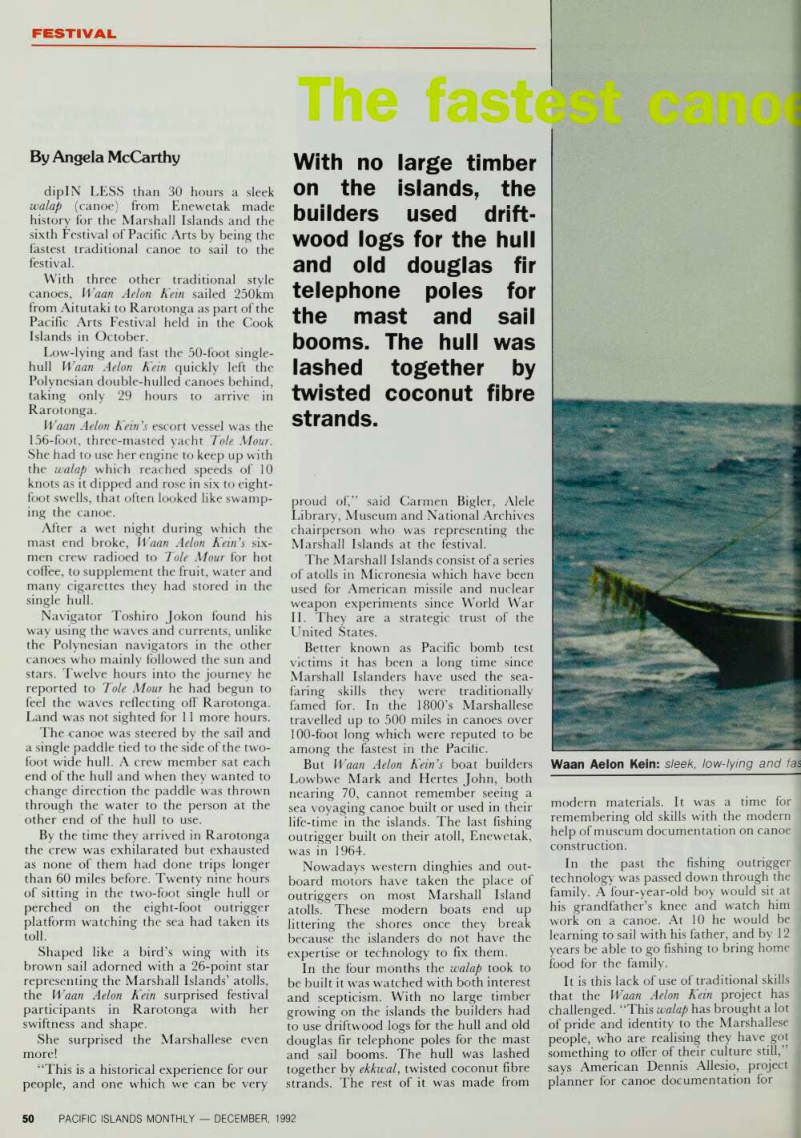
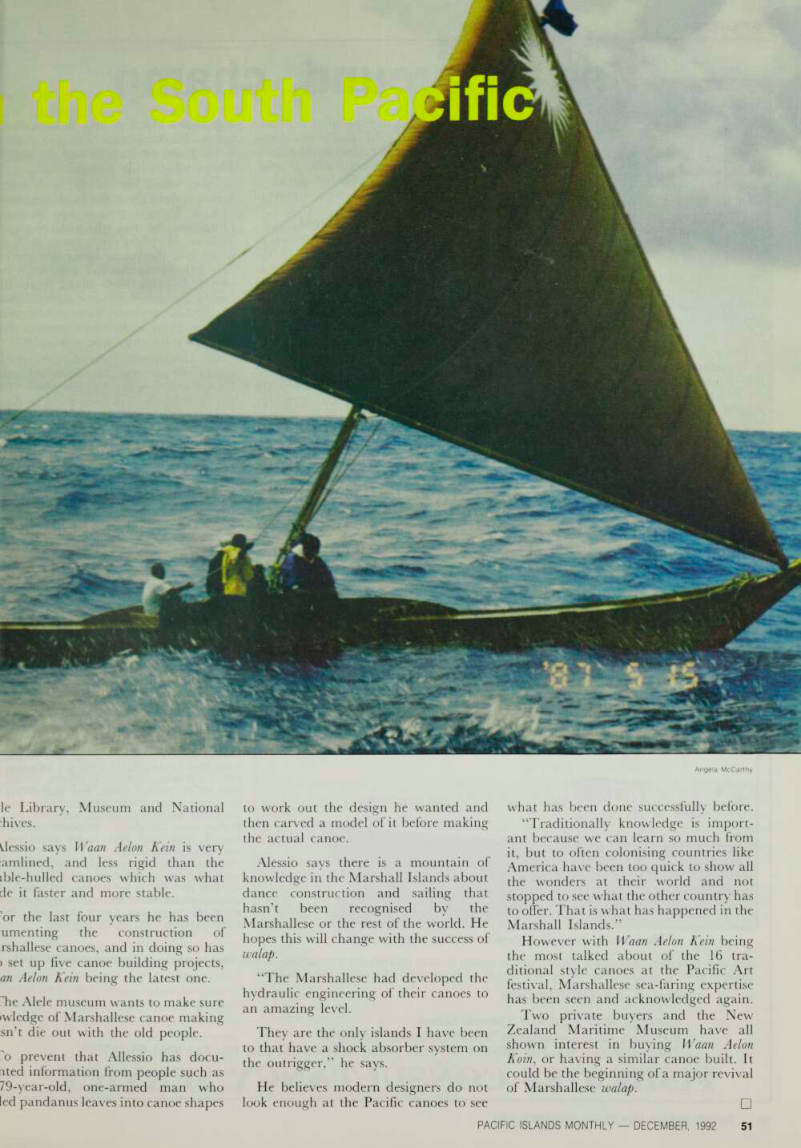
Festival
By Angela McCarthy
With no large timber on the islands, the builders used drift wood logs for the hull and old douglas fir telephone poles for the mast and sail booms. The hull was lashed together by twisted coconut fibre strands.
diplN LESS than 30 hours a sleek walap (canoe) from Enewetak made history for the Marshall Islands and the sixth Festival of Pacific Arts by being the fastest traditional canoe to sail to the festival.
With three other traditional style canoes, Waan Aelon Kein sailed 250 km from Aitutaki to Rarotonga as part of the Pacific Arts Festival held in the Cook Islands in October.
Low-lying and fast the 50-foot single hull Waan Aelon Kein quickly left the Polynesian double-hulled canoes behind, taking only 29 hours to arrive in Rarotonga.
Waan Aelon Kein’s escort vessel was the 156-foot, three-masted yacht Tole Mour.
She had to use her engine to keep up with the walap which reached speeds of 10 knots as it dipped and rose in six to eight foot swells, that often looked like swamp ing the canoe.
After a wet night during which the mast end broke, Waan Aelon Kein’s six men crew radioed to Tole Mour for hot coffee, to supplement the fruit, water and many cigarettes they had stored in the single hull.
Navigator Toshiro Jokon found his way using the waves and currents, unlike the Polynesian navigators in the other canoes who mainly followed the sun and stars. Twelve hours into the journey he reported to Tole Mour he had begun to feel the waves reflecting off Rarotonga.
Land was not sighted for 11 more hours.
The canoe was steered by the sail and a single paddle tied to the side of the two foot wide hull. A crew member sat each end of the hull and when they wanted to change direction the paddle was thrown through the water to the person at the other end of the hull to use.
By the time they arrived in Rarotonga the crew was exhilarated but exhausted as none of them had done trips longer than 60 miles before. Twenty nine hours of sitting in the two-foot single hull or perched on the eight-foot outrigger platform watching the sea had taken its toll.
Shaped like a bird’s wing with its brown sail adorned with a 26-point star representing the Marshall Islands’ atolls, the Waan Aelon Kein surprised festival participants in Rarotonga with her swiftness and shape.
She surprised the Marshallese even more!
“This is a historical experience for our people, and one which we can be very
proud of,” said Carmen Bigler, Alele Library, Museum and National Archives chairperson who was representing the Marshall Islands at the festival.
The Marshall Islands consist of a series of atolls in Micronesia which have been used for American missile and nuclear weapon experiments since World War 11. They are a strategic trust of the United States.
Better known as Pacific bomb test victims it has been a long time since Marshall Islanders have used the sea faring skills they were traditionally famed for. In the 1800’s Marshallese travelled up to 500 miles in canoes over 100-foot long which were reputed to be among the fastest in the Paciiic.
But Waan Aelon Kein’s boat builders Lowbwe Mark and Hertes John, both nearing 70, cannot remember seeing a sea voyaging canoe built or used in their life-time in the islands. The last fishing outrigger built on their atoll, Enewetak, was in 1964.
Nowadays western dinghies and out board motors have taken the place of outriggers on most Marshall Island atolls. These modern boats end up littering the shores once they break because the islanders do not have the expertise or technology to fix them.
In the four months the walap took to be built it was watched with both interest and scepticism. With no large timber growing on the islands the builders had to use driftwood logs for the hull and old douglas fir telephone poles for the mast and sail booms. The hull was lashed together by ekkwal, twisted coconut fibre strands. The rest of it was made from
modern materials. It was a time for remembering old skills with the modern help of museum documentation on canoe construction.
In the past the fishing outrigger technology was passed down through the family. A four-year-old boy would sit at his grandfather’s knee and watch him work on a canoe. At 10 he would be learning to sail with his father, and by 12 years be able to go fishing to bring home food for the family.
It is this lack of use of traditional skills that the Waan Aelon Kein project has challenged. “This walap has brought a lot of pride and identity to the Marshallese ; people, who are realising they have got something to offer of their culture still,” says American Dennis Allesio, project planner for canoe documentation for
Waan Aelon Kein: sleek, low-lying and fas[?]
le Library, Museum and National Lives. dessio says Waan Aelon Kein is very amlined, and less rigid than the ible-hulled canoes which was what de it faster and more stable. or the last four years he has been umenting the construction of rshallese canoes, and in doing so has > set up five canoe building projects, an Aelon Kein being the latest one.
Le Aide museum wants to make sure •wledge of Marshallese canoe making sn’t die out with the old people. :o prevent that Allessio has docu ited information from people such as 79-year-old, one-armed man who led pandanus leaves into canoe shapes
to work out the design he wanted and then carved a model of it before making the actual canoe.
Alessio says there is a mountain of knowledge in the Marshall Islands about dance construction and sailing that hasn’t been recognised by the Marshallese or the rest of the world. He hopes this will change with the success of walap.
“The Marshallese had developed the hydraulic engineering of their canoes to an amazing level.
They are the only islands I have been to that have a shock absorber system on the outrigger,” he says.
He believes modern designers do not look enough at the Pacific canoes to see
what has been done successfully before.
“Traditionally knowledge is import ant because we can learn so much from it, but to often colonising countries like America have been too quick to show all the wonders at their world and not stopped to see what the other country has to offer. That is what has happened in the Marshall Islands.”
However with Waan Aelon Kein being the most talked about of the 16 tra ditional style canoes at the Pacific Art festival, Marshallese sea-faring expertise has been seen and acknowledged again.
Two private buyers and the New Zealand Maritime Museum have all shown interest in buying Waan Aelon Koin , or having a similar canoe built. It could be the beginning of a major revival of Marshallese walap. □
Angela McCarthy
See ya around, champ
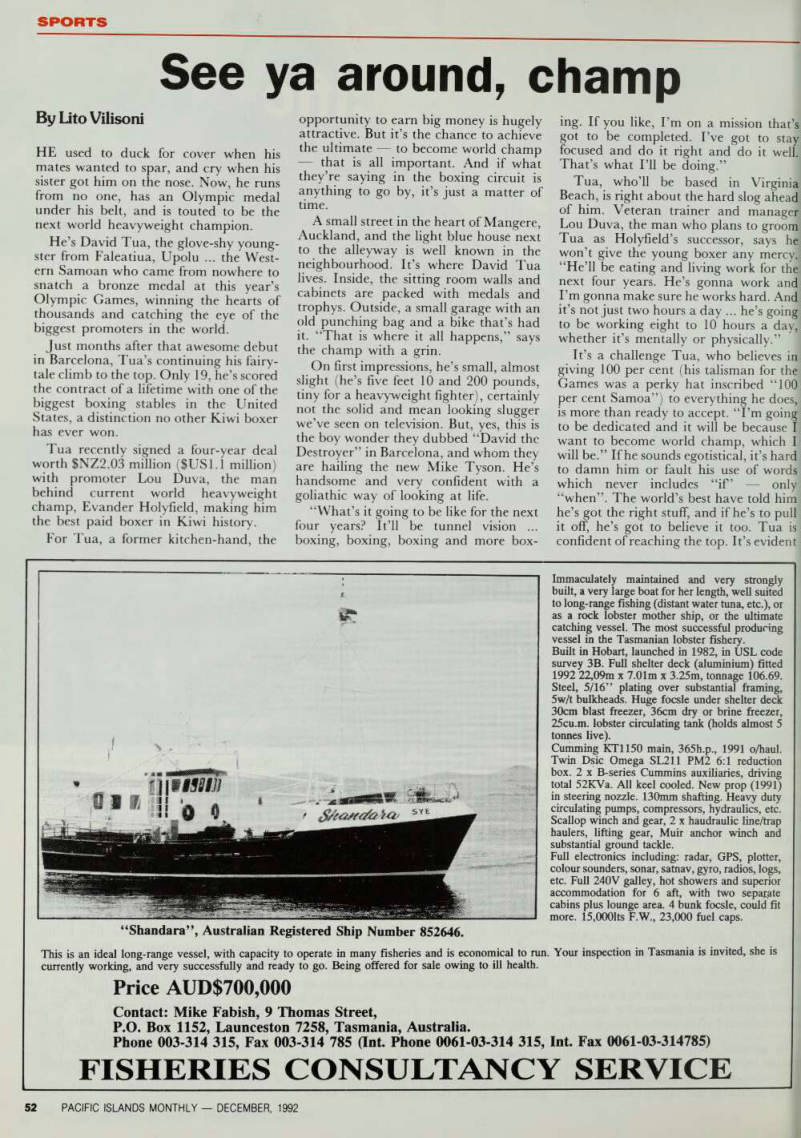
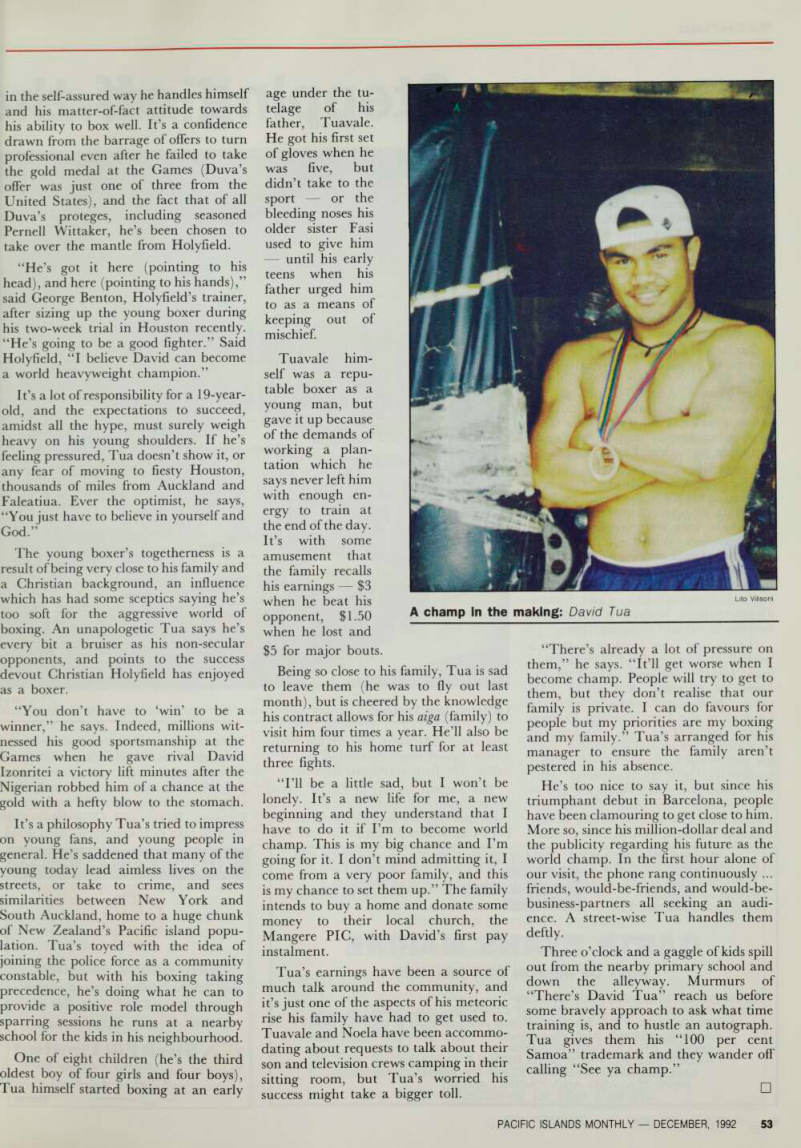
Sports
By Lito Vilisoni
HE used to duck for cover when his mates wanted to spar, and cry when his sister got him on the nose. Now, he runs from no one, has an Olympic medal under his belt, and is touted to be the
next world heavyweight champion.
He’s David Tua, the glove-shy young ster from Faleatiua, Upolu ... the West ern Samoan who came from nowhere to snatch a bronze medal at this year’s Olympic Games, winning the hearts of thousands and catching the eye of the biggest promoters in the world.
Just months after that awesome debut in Barcelona, Tua’s continuing his fairy tale climb to the top. Only 19, he’s scored the contract of a lifetime with one of the biggest boxing stables in the United States, a distinction no other Kiwi boxer has ever won.
Tua recently signed a four-year deal
worth SNZ2.O3 million (SUSI.I million) with promoter Lou Duva, the man behind current world heavyweight champ, Evander Holyfield, making him the best paid boxer in Kiwi history.
For Tua, a former kitchen-hand, the
opportunity to earn big money is hugely attractive. But it’s the chance to achieve the ultimate to become world champ that is all important. And if what they’re saying in the boxing circuit is anything to go by, it’s just a matter of time.
A small street in the heart of Mangere, Auckland, and the light blue house next to the alleyway is well known in the neighbourhood. It’s where David Tua lives. Inside, the sitting room walls and cabinets are packed with medals and trophys. Outside, a small garage with an old punching bag and a bike that’s had it. “That is where it all happens,” says the champ with a grin.
On first impressions, he’s small, almost slight (he’s five feet 10 and 200 pounds,
tiny for a heavyweight fighter), certainly
not the solid and mean looking slugger we’ve seen on television. But, yes, this is the boy wonder they dubbed “David the Destroyer” in Barcelona, and whom they are hailing the new Mike Tyson. He’s handsome and very confident with a goliathic way of looking at life.
“What’s it going to be like for the next four years? It’ll be tunnel vision ... boxing, boxing, boxing and more box
ing. If you like, I’m on a mission that’s got to be completed. I’ve got to stay focused and do it right and do it well.
That’s what I’ll be doing.”
Tua, who’ll be based in Virginia Beach, is right about the hard slog ahead of him. Veteran trainer and manager Lou Duva, the man who plans to groom Tua as Holyfield’s successor, says he won’t give the young boxer any mercyj “He’ll be eating and living work for the next four years. He’s gonna work and I’m gonna make sure he works hard. And it’s not just two hours a day ... he’s going to be working eight to 10 hours a day, whether it’s mentally or physically.”
It’s a challenge Tua, who believes in giving 100 per cent (his talisman for the Games was a perky hat inscribed “100 per cent Samoa”) to everything he does, is more than ready to accept. “I’m going to be dedicated and it will be because I want to become world champ, which I will be.” If he sounds egotistical, it’s hard to damn him or fault his use of words which never includes “if’ only “when”. The world’s best have told him he’s got the right stuff, and if he’s to pull it off, he’s got to believe it too. Tua is confident of reaching the top. It’s evident
in the self-assured way he handles himself and his matter-of-fact attitude towards his ability to box well. It’s a confidence drawn from the barrage of offers to turn professional even after he failed to take the gold medal at the Games (Duva’s offer was just one of three from the United States), and the fact that of all Duva’s proteges, including seasoned Pernell Wittaker, he’s been chosen to take over the mantle from Holyfield.
“He’s got it here (pointing to his head), and here (pointing to his hands),” said George Benton, Holyfield’s trainer, after sizing up the young boxer during his two-week trial in Houston recently.
“He’s going to be a good fighter.” Said Holyfield, “I believe David can become a world heavyweight champion.”
It’s a lot of responsibility for a 19-year old, and the expectations to succeed, amidst all the hype, must surely weigh heavy on his young shoulders. If he’s feeling pressured, Tua doesn’t show it, or any fear of moving to fiesty Houston, thousands of miles from Auckland and Faleatiua. Ever the optimist, he says, “You just have to believe in yourself and God.”
The young boxer’s togetherness is a result of being very close to his family and a Christian background, an influence which has had some sceptics saying he’s too soft for the aggressive world of boxing. An unapologetic Tua says he’s every bit a bruiser as his non-secular opponents, and points to the success devout Christian Holyfield has enjoyed as a boxer.
“You don’t have to ‘win’ to be a winner,” he says. Indeed, millions wit
nessed his good sportsmanship at the
Games when he gave rival David Izonritei a victory lift minutes after the Nigerian robbed him of a chance at the gold with a hefty blow to the stomach.
It’s a philosophy Tua’s tried to impress on young fans, and young people in general. He’s saddened that many of the young today lead aimless lives on the streets, or take to crime, and sees similarities between New York and South Auckland, home to a huge chunk of New Zealand’s Pacific island popu lation. Tua’s toyed with the idea of joining the police force as a community constable, but with his boxing taking precedence, he’s doing what he can to provide a positive role model through sparring sessions he runs at a nearby school for the kids in his neighbourhood.
One of eight children (he’s the third oldest boy of four girls and four boys), Tua himself started boxing at an early
age under the tu telage of his father, Tuavale.
He got his first set of gloves when he was five, but didn’t take to the sport or the bleeding noses his older sister Fasi used to give him until his early teens when his father urged him to as a means of keeping out of mischief.
Tuavale him self was a repu table boxer as a young man, but gave it up because of the demands of working a plan tation which he says never left him with enough en ergy to train at the end of the day.
It’s with some amusement that the family recalls his earnings S 3 when he beat his opponent, $1.50 when he lost and $5 for major bouts,
Being so close to his family, Tua is sad to leave them (he was to fly out last month), but is cheered by the knowledge his contract allows for his aiga (family) to visit him four times a year. He’ll also be returning to his home turf for at least three fights.
“I’ll be a little sad, but I won’t be lonely. It’s a new life for me, a new beginning and they understand that I have to do it if I’m to become world champ. This is my big chance and I’m going for it. I don’t mind admitting it, I come from a very poor family, and this is my chance to set them up.” The family intends to buy a home and donate some money to their local church, the Mangere PIC, with David’s first pay instalment.
Tua’s earnings have been a source of much talk around the community, and it’s just one of the aspects of his meteoric rise his family have had to get used to.
Tuavale and Noela have been accommo dating about requests to talk about their son and television crews camping in their sitting room, but Tua’s worried his success might take a bigger toll.
“There’s already a lot of pressure on them,” he says. “It’ll get worse when I become champ. People will try to get to them, but they don’t realise that our family is private. I can do favours for people but my priorities are my boxing and my family.” Tua’s arranged for his manager to ensure the family aren’t pestered in his absence.
He’s too nice to say it, but since his triumphant debut in Barcelona, people have been clamouring to get close to him.
More so, since his million-dollar deal and the publicity regarding his future as the world champ. In the first hour alone of our visit, the phone rang continuously ... friends, would-be-friends, and would-be business-partners all seeking an audi ence. A street-wise Tua handles them deftly.
Three o’clock and a gaggle of kids spill out from the nearby primary school and down the alleyway. Murmurs of “There’s David Tua” reach us before some bravely approach to ask what time training is, and to hustle an autograph.
Tua gives them his “100 per cent Samoa” trademark and they wander off calling “See ya champ.”
Lilo Vilisoni
A champ in the making: David Tua
Advertisements & other items, p. 52 (1 item)
Fisheries Consultancy Service
Immaculately maintained and very strongly built, a very large boat for her length, well suited to long-range fishing (distant water tuna, etc.), or as a rock lobster mother ship, or the ultimate catching vessel. The most successful producing vessel in the Tasmanian lobster fishery.
Built in Hobart, launched in 1982, in USL code survey 38. Full shelter deck (aluminium) fitted 1992 22,09 m x 7.01 m x 3.25 m, tonnage 106.69.
Steel, 5/16” plating over substantial framing, sw/t bulkheads. Huge focsle under shelter deck 30cm blast freezer, 36cm dry or brine freezer, 25cu.m. lobster circulating tank (holds almost 5
tonnes live).
Gumming KTIISO main, 365h.p., 1991 o/haul.
Twin Dsic Omega SL2II PM2 6:1 reduction box. 2 x B-series Cummins auxiliaries, driving total 52KVa. All keel cooled. New prop (1991) in steering nozzle. 130 mm shafting. Heavy duty circulating pumps, compressors, hydraulics, etc.
Scallop winch and gear, 2 x haudraulic line/trap haulers, lifting gear, Muir anchor winch and substantial ground tackle.
Full electronics including: radar, GPS, plotter, colour sounders, sonar, satnav, gyro, radios, logs, etc. Full 240 V galley, hot showers and superior accommodation for 6 aft, with two separate cabins plus lounge area. 4 bunk focsle, could fit more. 15,0001 ts F.W., 23,000 fuel caps.
This is an ideal long-range vessel, with capacity to operate in many fisheries and is economical to run. Your inspection in Tasmania is invited, she is currently working, and very successfully and ready to go. Being offered for sale owing to ill health.
Price AUDS7OO,OOO
Contact: Mike Fabish, 9 Thomas Street, P.O. Box 1152, Launceston 7258, Tasmania, Australia.
Phone 003-314 315, Fax 003-314 785 ant Phone 0061-03-314 315, Int. Fax 0061-03-314785)
FISHERIES CONSULTANCY SERVICE
oi mm
1 i !i 0 o i l
“Shandara”, Australian Registered Ship Number 852646.
Stepping off the[?]readmill
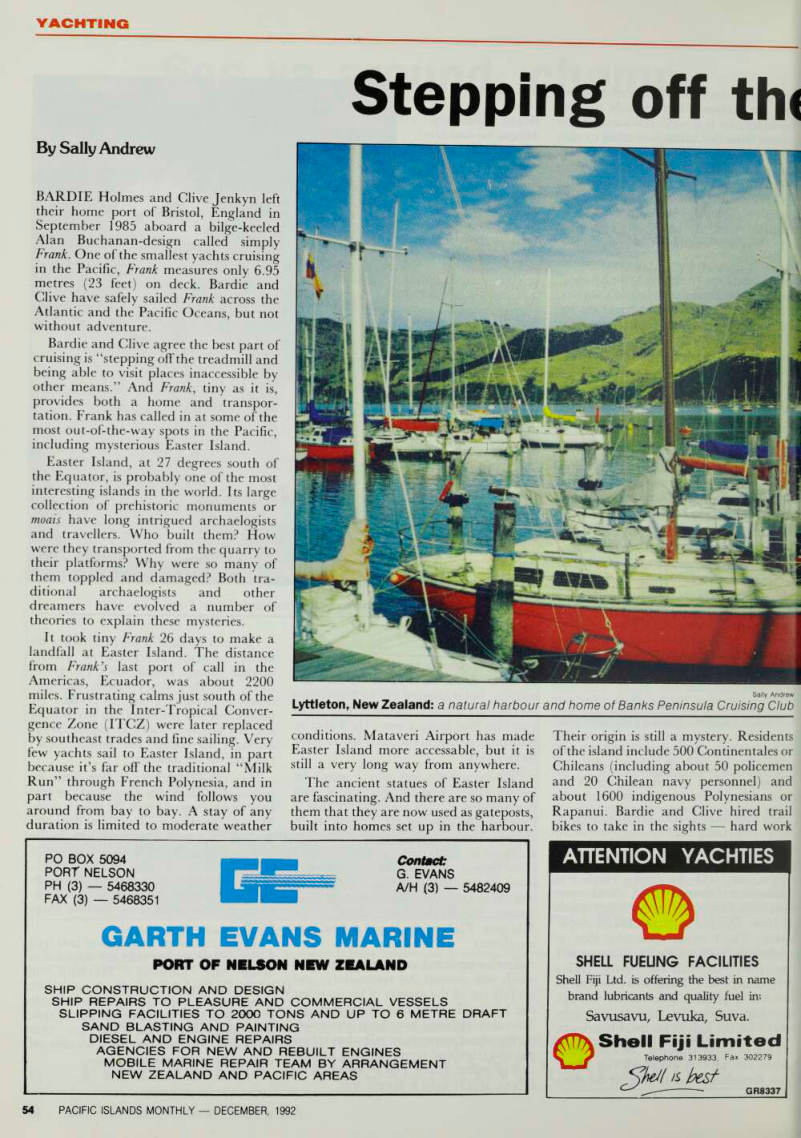
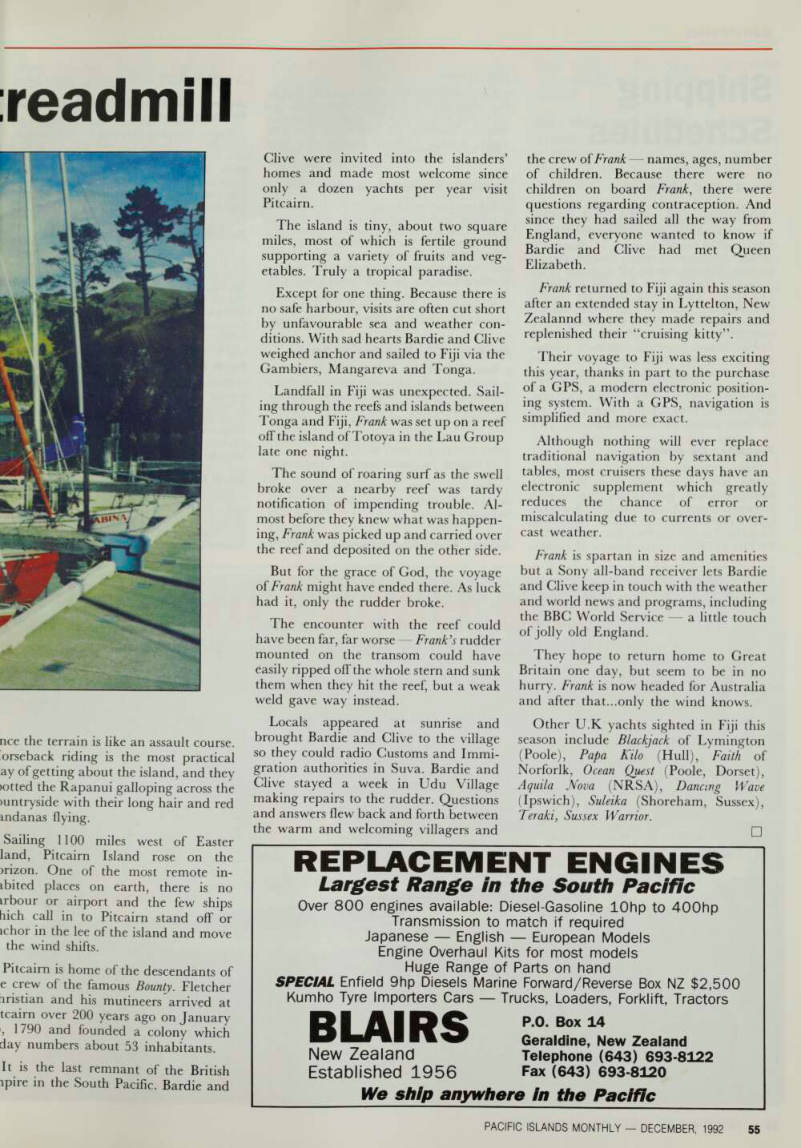
Yachting
By Sally Andrew
BARDIE Holmes and Clive Jenkyn left their home port of Bristol, England in September 1985 aboard a bilge-keeled Alan Buchanan-design called simply Frank. One of the smallest yachts cruising in the Pacific, Frank measures only 6.95 metres (23 feet) on deck. Bardie and Clive have safely sailed Frank across the Atlantic and the Pacific Oceans, but not without adventure.
Bardie and Clive agree the best part of cruising is “stepping off the treadmill and being able to visit places inaccessible by other means.” And Frank , tiny as it is, provides both a home and transpor tation. Frank has called in at some of the most out-of-the-way spots in the Pacific, including mysterious Easter Island.
Easter Island, at 27 degrees south of the Equator, is probably one of the most interesting islands in the world. Its large collection of prehistoric monuments or moais have long intrigued archaelogists and travellers. Who built them? How were they transported from the quarry to their platforms? Why were so many of them toppled and damaged? Both tra ditional archaelogists and other dreamers have evolved a number of theories to explain these mysteries.
It took tiny Frank 26 days to make a landfall at Easter Island. The distance from Frank’s last port of call in the Americas, Ecuador, was about 2200 miles. Frustrating calms just south of the Equator in the Inter-Tropical Conver gence Zone (ITCZ) were later replaced by southeast trades and fine sailing. Very few yachts sail to Easter Island, in part because it’s far off the traditional “Milk Run” through French Polynesia, and in part because the wind follows you around from bay to bay. A stay of any duration is limited to moderate weather
conditions. Mataveri Airport has made Easter Island more accessable, but it is still a very long way from anywhere.
The ancient statues of Easter Island are fascinating. And there are so many of them that they are now used as gateposts, built into homes set up in the harbour.
Their origin is still a mystery. Residents of the island include 500 Continentales or Chileans (including about 50 policemen and 20 Chilean navy personnel) and about 1600 indigenous Polynesians or Rapanui. Bardie and Clive hired trail bikes to take in the sights hard work
Sally Andrew Lyttleton, New Zealand: a natural harbour and home of Banks Peninsula Cruising Club
nee the terrain is like an assault course, horseback riding is the most practical ay of getting about the island, and they
>otted the Rapanui galloping across the
mntryside with their long hair and red
mdanas flying.
Sailing 1100 miles west of Easter land, Pitcairn Island rose on the >rizon. One of the most remote in ibited places on earth, there is no irbour or airport and the few ships hich call in to Pitcairn stand off or ichor in the lee of the island and move the wind shifts.
Pitcairn is home of the descendants of e crew of the famous Bounty. Fletcher iristian and his mutineers arrived at tcairn over 200 years ago on January , 1790 and founded a colony which day numbers about 53 inhabitants.
It is the last remnant of the British ipire in the South Pacific. Bardie and
Clive were invited into the islanders’ homes and made most welcome since only a dozen yachts per year visit Pitcairn.
The island is tiny, about two square miles, most of which is fertile ground supporting a variety of fruits and veg etables. Truly a tropical paradise.
Except for one thing. Because there is no safe harbour, visits are often cut short by unfavourable sea and weather con ditions. With sad hearts Bardie and Clive weighed anchor and sailed to Fiji via the Gambiers, Mangareva and Tonga.
Landfall in Fiji was unexpected. Sail ing through the reefs and islands between Tonga and Fiji, Frank was set up on a reef off the island of Totoya in the Lau Group late one night.
The sound of roaring surf as the swell broke over a nearby reef was tardy notification of impending trouble. Al most before they knew what was happen ing, Frank was picked up and carried over the reef and deposited on the other side.
But for the grace of God, the voyage of Frank might have ended there. As luck had it, only the rudder broke.
The encounter with the reef could have been far, far worse Frank’s rudder mounted on the transom could have easily ripped off the whole stern and sunk them when they hit the reef, but a weak weld gave way instead.
Locals appeared at sunrise and brought Bardie and Clive to the village so they could radio Customs and Immi gration authorities in Suva. Bardie and Clive stayed a week in Udu Village
making repairs to the rudder. Questions
and answers flew back and forth between the warm and welcoming villagers and
the crew of Frank names, ages, number of children. Because there were no children on board Frank , there were questions regarding contraception. And since they had sailed all the way from England, everyone wanted to know if Bardie and Clive had met Queen Elizabeth.
Frank returned to Fiji again this season after an extended stay in Lyttelton, New Zealannd where they made repairs and
replenished their “cruising kitty”.
Their voyage to Fiji was less exciting this year, thanks in part to the purchase of a GPS, a modern electronic position ing system. With a GPS, navigation is simplified and more exact.
Although nothing will ever replace traditional navigation by sextant and tables, most cruisers these days have an electronic supplement which greatly reduces the chance of error or miscalculating due to currents or over cast weather.
Frank is spartan in size and amenities but a Sony all-band receiver lets Bardie and Clive keep in touch with the weather and world news and programs, including the BBC World Service a little touch of jolly old England.
They hope to return home to Great Britain one day, but seem to be in no hurry. Frank is now headed for Australia and after that...only the wind knows.
Other U.K yachts sighted in Fiji this season include Blackjack of Lymington (Poole), Papa Kilo (Hull), Faith of Norforlk, Ocean Quest (Poole, Dorset), Aquila Nova (NRSA), Dancing Wave
(Ipswich), Suleika (Shoreham, Sussex),
Teraki, Sussex Warrior.
Advertisements & other items, pp. 54-55 (1 item)
Garth Evans Marine
ATTENTION YACHTIES
SHELL FUEUNG FACILITIES
Shell Fiji Ltd. is offering the best in name brand lubricants and quality fuel in; Savusavu, Levuka, Suva.
Shell Fiji Limited Telephone 313933, Fax 302279 ©
'fyldl A hesf
GR8337
PO BOX 5094
PORT NELSON
PH (3) 5468330
FAX (3) 5468351
m Contact
G. EVANS
A/H (3) 5482409
GARTH EVANS MARINE
PORT OF NELSON NEW ZEALAND
SHIP CONSTRUCTION AND DESIGN
SHIP REPAIRS TO PLEASURE AND COMMERCIAL VESSELS SLIPPING FACILITIES TO 2000 TONS AND UP TO 6 METRE DRAFT
SAND BLASTING AND PAINTING
DIESEL AND ENGINE REPAIRS
AGENCIES FOR NEW AND REBUILT ENGINES
MOBILE MARINE REPAIR TEAM BY ARRANGEMENT
NEW ZEALAND AND PACIFIC AREAS
REPLACEMENT ENGINES
Largest Range In the South Pacific Over 800 engines available: Diesel-Gasoline lOhp to 400 hp Transmission to match if required Japanese English European Models Engine Overhaul Kits for most models Huge Range of Parts on hand SPECIAL Enfield 9hp Diesels Marine Forward/Reverse Box NZ $2,500 Kumho Tyre Importers Cars Trucks, Loaders, Forklift, Tractors
BLAIRS
New Zealand Established 1956 P.O. Box 14 Geraldine, New Zealand Telephone (643) 693-8122 Fax (643) 693-8120 We ship anywhere in the Pacific
Shipping
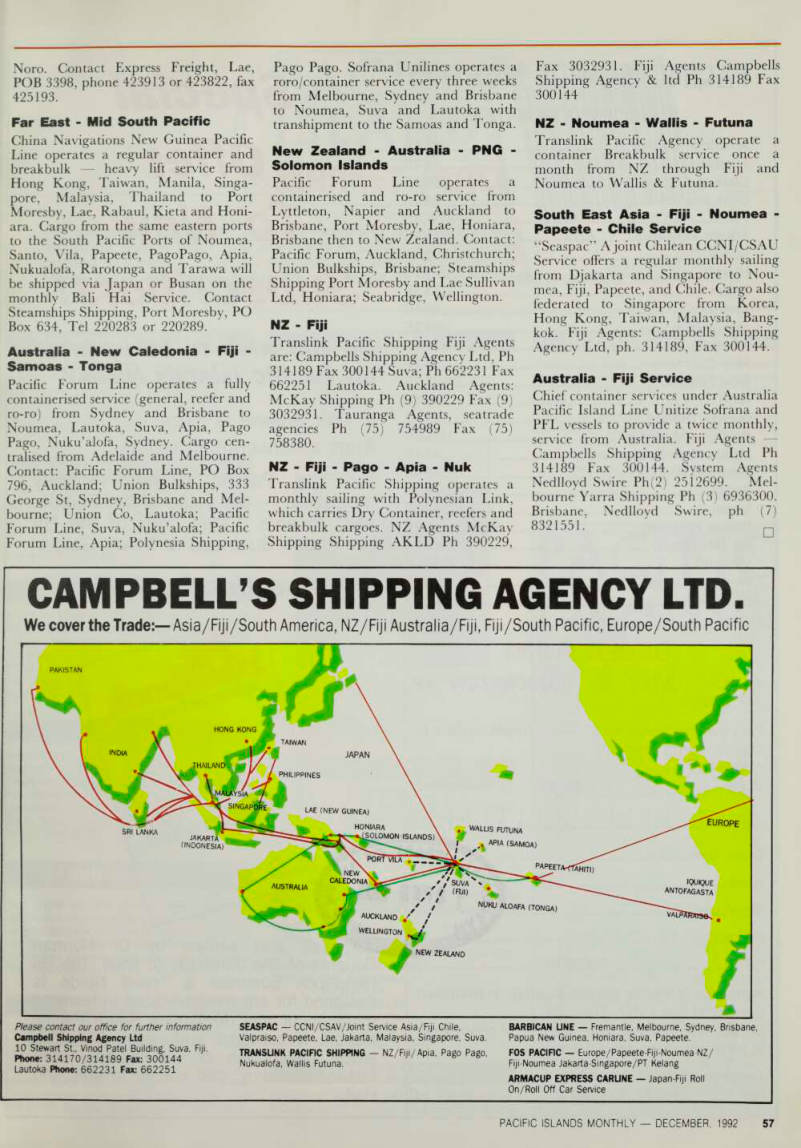
Schedules
New Zealand - Fiji direct Sofrana Unilines operates a fully containerised/breakbulk service every 21 days from Auckland, Tauranga, Lyttleton to Suva and Lautoka. Loading every 21 days, ro/ro service, containers - reefer. Contact Sofrana Unilines, Sofrana House, 101 Customs Street, Auckland, PO Box 3614, Fax (09) 393874, Ph (09) 773279, Tlx NZ 2313. Direct toll free line 0800 659-922, Contact Alan Foote. Sofrana Shipping Agencies, PO Box 921 Wellington, Tel (04) 725 661, Fax (04) 725 749, Tlx NZ 4769 Contact Steve Brannigan. Sofrana Unilines Agencies, PO Box 22046 Christchurch, tel (03) 667 180, Fax (03) 668 868, TLX NZ4769, Contact Tony Newell. Carpenters Shipping, Private Mail Bag, Suva, Fiji, Tel (679) 312244, Fax (679) 301572, Tlx FJ 2199. Sofrana Unilines, Suva, Fiji, Tel (679) 315645, Fax (679) 300057, Australia - Fiji direct Sofrana Unilines operates a ro/ro container service every three weeks from Melbourne, Sydney, Brisbane, Lautoka and Suva. Contact Sofrana Unilines (Aust) Pty Ltd, PO Box Q 136,
Queen Victoria Building, Sydney, NSW 2000,
Australia. Tel (02) 2648944, Fax (02) 2676547, Tlx (71) A 170090, Contact Andrew McLachlin,
Sam Attaway.
Carpenters Shipping, Suva, Tel (679) 312244, Fax (679) 301572. Sofrana Unilines Suva, Tel (679) 315 645, Fax (679) 300057. Carpenters Shipping, Lautoka, Tel (679) 63988, Fax (679) 64896. Sofrana Unilines, Lautoka Tel (679) 62921, Fax (679) 64896.
Australia - Fiji monthly service Sofrana Unilines (Australia) Pty Ltd operates a regular monthly service with MV Capitaine Wallis. Contact Sofrana Unilines, Sydney, Tel (02) 2648944, Tlx AA170090, Fax' (02) 267-6547. Carpenters Shipping, Suva, Fiji, Tel (679) 312244, Fax (679) 301572, Sofrana Unilines, Suva, Fiji Tel (679) 315645, Fax (679) 300057. Carpenters Shipping, Lautoka, Tel (679) 63988, Fax (679) 64896. Sofrana Unilines, Lautoka, Fiji, Tel (679) 62921, Fax (679) 64896.
Far-East - Fiji - New Zealand Service New Zealand Unit Express (NZUE) operates a monthly service accepting containerised and break-bulk cargoes from Manila, Keelung, Kaoshiung, Hong Kong, Lae to Suva, Lautoka (via Suva) and thence to New Zealand ports.
Contact Carpenters Shipping Suva, Fiji, tel (679) 312244, fax (679) 301572. New Zealand Unit Express, Maritime Building, 2-10 Customs House Quay, PO Box 890, Wellington. Tel 727865, Cables Enzue Man, Wellington, Tlx NZ31340 Nedlnz or Nedlloyd Swire Pty Ltd, Sydney, Tel 20522.
Japan - South Pacific Service
Same as Burns Philp Japan - South Pacific Service - Kyowa Shipping Co Ltd Kyowa Shipping, Shipping Co Ltd provides a monthly containerised service from Hong Kong to main ports of Japan, Saipan, Guam, Island ports, Lautoka, Suva via Nukualofa to Pago Pago and Apia. Contact Carpenters Shipping, Neptune House, 3/4 floor, Tofuaa Street, Walu Bay, Suva. Tel 312244, Fax 301572, Tlx FJ2199.
Europe - Pacific Service Nedlloyd offers cargo services from Continent tal Ports to Papeete, Fiji, New Caledonia and Doniambo on slot basis with Bank line. Contact Nedlloyd (Aust) Pty Ltd, Spring Street, Sydney, Tel 273801. Carpenters Shipping, Suva, tel 312244, Tlx FJ2199, Fax 301572. Carpenters Shipping, Lautoka, Tel 63988, Tlx FJ5215, Fax 64896.
South East Asia - Fiji Service Nedlloyd Lines (NZEAS) Service operates regular fast cargo service from Jakarta, Pt Keelang, Singapore, Bangkok, Surubaya via Auckland to Suva and Lautoka. Contact Carpenters Shipping, Suva, Tel 312244, Tlx FJ2199, Fax 301572. Carpenters Shipping, Lautoka Tel 63988, Tlx FJ5215, Fax 63988 South East Asia - Mid South pacific Columbus Line operates a regular container j and breakbulk-heavy lift service from/to
Hongkong/Taiwan/Manila/Singapore/Malay
sia/Thailand/Indonesia to Port Moresby/Lae/ Rabaul/Kimbe/Madang/Newark/Honiara and
Noro. Contact Express Freight, Lae, POB 3398, phone 423913 or 423822, fax 425193.
Far East - Mid South Pacific China Navigations New Guinea Pacific Line operates a regular container and breakbulk heavy lift service from Hong Kong, Taiwan, Manila, Singa pore, Malaysia, Thailand to Port Moresby, Lae, Rabaul, Kieta and Honi ara. Cargo from the same eastern ports to the South Pacific Ports of Noumea, Santo, Vila, Papeete, PagoPago, Apia, Nukualofa, Rarotonga and Tarawa will be shipped via Japan or Busan on the monthly Bali Hai Service. Contact Steamships Shipping, Port Moresby, PO Box 634, Tel 220283 or 220289.
Australia - New Caledonia - Fiji - Samoas - Tonga Pacific Forum Line operates a fully containerised service (general, reefer and ro-ro) from Sydney and Brisbane to Noumea, Lautoka, Suva, Apia, Pago Pago, Nuku’alofa, Sydney. Cargo cen tralised from Adelaide and Melbourne.
Contact: Pacific Forum Line, PO Box 796, Auckland; Union Bulkships, 333 George St, Sydney, Brisbane and Mel bourne; Union Co, Lautoka; Pacific Forum Line, Suva, Nuku’alofa; Pacific Forum Line, Apia; Polynesia Shipping,
Pago Pago. Sofrana Unilines operates a roro/container service every three weeks from Melbourne, Sydney and Brisbane to Noumea, Suva and Lautoka with transhipment to the Samoas and Tonga.
New Zealand - Australia - PNG - Solomon Islands Pacific Forum Line operates a containerised and ro-ro service from Lyttleton, Napier and Auckland to Brisbane, Port Moresby, Lae, Honiara, Brisbane then to New Zealand. Contact: Pacific Forum, Auckland, Christchurch; Union Bulkships, Brisbane; Steamships Shipping Port Moresby and Lae Sullivan Ltd, Honiara; Seabridge, Wellington.
NZ - Fiji Translink Pacific Shipping Fiji Agents are: Campbells Shipping Agency Ltd, Ph 314189 Fax 300144 Suva; Ph 662231 Fax 662251 Lautoka. Auckland Agents: McKay Shipping Ph (9) 390229 Fax (9) 3032931. Tauranga Agents, seatrade agencies Ph (75) 754989 Fax (75) 758380.
NZ - Fiji - Pago - Apia - Nuk Translink Pacific Shipping operates a monthly sailing with Polynesian Link, which carries Dry Container, reefers and breakbulk cargoes. NZ Agents McKay Shipping Shipping AKLD Ph 390229,
Fax 3032931. Fiji Agents Campbells Shipping Agency & ltd Ph 314189 Fax 300144 NZ - Noumea - Wallis - Futuna Translink Pacific Agency operate a container Breakbulk service once a month from NZ through Fiji and Noumea to Wallis & Futuna.
South East Asia - Fiji - Noumea - Papeete - Chile Service “Seaspac” A joint Chilean CCNI/CSAU Service offers a regular monthly sailing from Djakarta and Singapore to Nou mea, Fiji, Papeete, and Chile. Cargo also federated to Singapore from Korea, Hong Kong, Taiwan, Malaysia, Bang
kok. Fiji Agents: Campbells Shipping
Agency Ltd, ph. 314189, Fax 300144.
Australia - Fiji Service Chief container services under Australia Pacific Island Line Unitize Sofrana and PFL vessels to provide a twice monthly, service from Australia. Fiji Agents - Campbells Shipping Agency Ltd Ph 314189 Fax 300144. System Agents Ncdlloyd Swire Ph(2) 2512699. Mel bourne Yarra Shipping Ph (3) 6936300.
Brisbane, Nedlloyd Swire, ph (7) 8321551. n
Advertisements & other items, pp. 56-60 (1 item)
The Bank Line
YOUR EXPERTS IN THE SOUTH PACIFIC
A SERVICE OF ANDREW WEIRSHIPPING
Tlie Bank Line .serves the South PadScrto anjifmm
-lEurope ancfSE^s
it- 'f 11 - A .
CAMPBELL’S SHIPPING AGENCY LTD.
We cover the Trade:—Asia/Fiji/South America, NZ/Fiji Australia/Fiji, Fiji/South Pacific, Europe/South Pacific
HONG KONG
TAIWAN
INDIA
JAPAN
I
HAILAN
PHILIPPINES
i 1
SINGA
LAE (NEW GUINEA)
EUROPE
HONJARA rulUN *
/-*"K -<SOLOMON ISLANDS)\ 4
\ 1 .% APIA (SAMOA)
\ PORT VILA
\ I
NEW \
WALLIS FUTUNA
SRI LANKA
papeet
AHITI)
NEW >
CALEDONIA
IQUIQUE
ANTOFAGASTA
*A ' i SUVA '
/ t (OJI) \
/ / NUWJ ALOAFA (TONGA)
AUCKLAND / f
AUSTRALIA
|P WELLINGTON
‘ NEW ZEALAND
/ Please contact our office for further information Campbell Shipping Agency Ltd 10 Stewart St., Vinod Patel Building, Suva, Fiji.
Phone: 314170/314189 Fax: 300144 Lautoka Phone: 662231 Fax; 662251 SEASPAC CCNI/CSAV/Joint Service Asia/Fiji Chile, Valpraiso, Papeete, Lae, Jakarta, Malaysia, Singapore, Suva.
TRANSUNK PACIFIC SHIPPING - NZ/Fiji/Apia, Pago Pago, Nukualofa, Wallis Futuna.
BARBICAN LINE Fremantle, Melbourne, Sydney, Brisbane, Papua New Guinea, Honiara, Suva, Papeete.
FOS PACIFIC Europe/Papeete-Fiji-Noumea NZ/ Fiji-Noumea Jakarta-Singapore/PT Kelang ARMACUP EXPRESS CARUNE Japan-Fiji Roll On/Roll Off Car Service
PACIFIC ISLANDS MONTHLY
SUBSCRIPTION RATES
American Samoa US$45 Australia As 42 Canada US$45 Cook Islands As 46 Fiji F 526.40 French Polynesia US$45 Guam US$45 Hawaii US$45 Japan US$3B Kiribati As 46 Micronesia US$35 Nauru As 42 New Caledonia US$32 New Zealand NZ$55 Niue As 46 Norfolk Islands As 42 Northern Marianas US$35 Papua New Guinea As4s Solomon Islands As 46 Tonga As 46 Tuvalu As 46 United Kingdom Stg Pound 28 US (Mainland) US$45 Vanuatu As4s Western Samoa WS$6O Elsewhere As 63
Special
Offer
To New
Subscribers!
Do you wish to be updated
on Pacific Islands News?
IF your answer is “Yes”
Start a subscription today!
For The Pacific Islands Monthly magazine the voice of the Pacific.
AND receive a free copy of the Fiji Handbook Business & Travel Guide.
Receive this book Free!
•rman Douglas of The University of NSW. The Fiji Handbook Business & Travel Guide is designed for anyone interested in learning more about this developing South Pacific Nation. It contains addresses, key statistics, description of the islands, their history, economy, and places to stay and visit.
ORDER FORM
PLEASE ENTER MY SUBSCRIPTION
FOLLOWS:
I enclose my cheque for $ (made payable to Pacific Islands Monthly) or debit $ to my: □ Visacard n Mastercard
Card No:l
Expiry Date Name Signature...
Address
CITY COUNTRY,
Payments to Pacific Islands Monthly: Subscription I Dept, GPO Box 1167, Suva, Fiji. I Subscription rates includes the cost of airspeeding to all destinations set out above. I Telephone : (679) 304-111 \ Fax : (679) 303809 (j* ♦ 0
Gaslit
For the benefit of our readers who would like to place a small t 1 Jr magazine, Market Place will assist you in selling personal items, 3 ~*\d re, boating or a service ... in fact anything you would like to sell to 1 -w readers.
Market Place Advertising Rates are structured to allow you to advertisements as you wish, economically.
FLYBRIDGE CRUISER
(Ref No 284) 46’ GRP, Twin 3208 NA Cat diesels, 12.5KVA Onan. Well equipped comfortable cruiser, just completed full refit.
Price AUD 235,000. CHARTER CRAFT MARINE,
BC/15 Tedder, Av, Main Beach, Q 4217, Aust.
Ph 61-75-916334 Fax 61-75-329788
TRAWLER/FISHING VESSEL
(Ref No 474) 45’ Steel. 6V71 GM main.
Vanmar aux. Clean well built vessel in good condition. Price AUD 139,000. CHARTER CRAFT MARINE, BC/15 Tedder Av Main Beach, Q 4217, Aust. Ph 61-75-916334 Fax 61-75-329788
SOUTH PACIFIC
A SOUTH PACIFIC INVENTORY OF OVER $3OO MILLION: estates, resorts, hotel chains, private islands, hideaways, tax havens and yachting heavens, $50,000 to $5O million.
PACIFIC ISLAND INVESTMENTS (USA)
Tel: (808) 883-8000 Fax: (808) 883-8838
TRAVEL
Moneysaving tips in travel guides by David Stanley: Micronesia Handbook (U 5515.45), Tahiti-Polynesia Handbook (U 5515.45), Fiji Islands Handbook (U 5512.45), South Pacific Handbook (U 5519.45). Moon Publications, 722 Wall, Chico, CA 95928 USA, fax (916) 345-6751. Visa. Mastercard.
SCRAP METAL
Tall ingots operate from Brisbane, Australia and make frequent visits to the Pacific Islands which they have done for twenty-five years. We are buyers of Copper, Brass, Aluminium, Lead, Cable etc. Inspection no problems. Telephone 61 7 8922033. Fax 61 78922077.
SCRAP METAL
Good prices paid for your clean scrap Aluminium, Brass, Copper, Lead etc. Contact Nonferral Pty Ltd. 23 Davis Road, Wetherill Park NSW 2164 Australia. FAX 61 2 604 1304 for prompt reply. Our Company is a long established smelter and a leading metals buyer from the Pacific Region. Telephone 61 2 604 8855.
FOR SALE
“QUINQUEREME’
42 Foot classic English built ocean going cruising yacht. Very full inventory. Fiji customs duty paid.
For further information phone (679) 361883 or Fax (679) 361599
SHEETROCK CONTRACTOR
(808) 883-8215 Specializing in all phases of plasterboard construction. Will travel to jobsite!'' Waikoloa Drywall 383165 Waikoloa, 96738-3
IMPORT - EXPORT OPPORTUNITIES
& P ■% f Urgently requi& listing of all yourfproducts.
Markets realty, available on most goods.
Special interests' items: Ambergris, Sea Horse Etc. Sandalwood.
Contact; Beh Enterprises.
PO Box 477 Eastwood 2122 NSW. Australia.
Pho 61.2.874 6111 Fax. 61.2.874 5380
TATTOO SUPPLY
Everything. Write for price list. Tattoo Supply, P.O. Box 3068 Clontarf, Australia. Qld. 4019.
DRYDOCK FOR SALE
Floating Dry Dock capable of slipping vessels of up to 30 metres loa. 350 tonnes displacement. 9 metre beam and 3.75 metres draught.
Dock is in excellent condition and in current Queensland department of harbours and marine survey. It is fully self contained.
Including 150 kva generating plant.
For further information contact Rosshaven Marine Pty. Ltd.
Phone 077 726392 or Fax 077 714337
PACIFIC
ISLANDS
IMONT H L Y
MRRKCT PLRC6 CRN WORK
WOND6RS FOR VOU ...
Promote your business, or service, sell your household
items, cars or heavy machinery
etc.
ONLY AUSSI PER WORD.
NO COMPANY LOGO. NO
DISPLAY. NO BOLD TYPE.
Just forward your Advertisement together with payment to: PACIFIC ISLANDS MONTHLY "Market Place”, P.O. Box 1167, Suva, Fiji.
CONDITIONS:
1. All Advertisements are subject to acceptance and approval of publisher. 2. Advertisements are published as space permits: we cannot guarantee date of insertion. 3. All advertisements must be prepaid and should be typed or printed clearly. 4. Deadline for receipt of advertisements is the 10th of the month prior to issue.
5. PACIFIC ISLANDS MONTHLY
assumes no responsibility for any service other than publishing paid advertisements in this section.
Even though we’re 75 years < sport still keeps us in shape.
A 50 1962 Mitsubishi 500 First of its class in the Macao Grand Prix. Powered by an air-cooled two-cylinder engine generating 21 ps. 1967 Mitsubishi Colt 1000 F First of its class in Australia’s 2nd Southern Cross Rally The 3rd Rally one year later is won by its successor, the Mitsubishi Colt 1000 F Sports 1970 Mitsubishi Galant GTO First Galant to race in a rally, Australia’s sth Southern Cross Rally. Boosted by twin carbs, its 1.6 sasasas- -1972 Mitsubishi Galant 16 LGS First in the 7th Southern Cross Rally of Australia. 10 1988 Mitsubishi Galant Dynamic 4 First in the 9th Himalaya Rally.
1964 Mitsubishi Colt 600 First of its class in the Malaysian (.rand Frix. 1967 Mitsubishi Colt F 2-A First in the Grand Prix of Japan. Following in the tyremarks of its predecessor, the Colt F 3-A. It is powered by a 1.6 litre engine * 1970 Mitsubishi Colt F 2D First of its class in the Grand Prix of Japan. 1973 Mitsubishi Lancer 1600 GSR First in the Bth Southern Cross Rally. Follow-up victories in the 9th, 10th and 11th rallies. It also finished first in the 22nd (1974) and 24th (1976) East African Safari Rally. 1989 Mitsubishi Galant Dynamic 4 First in two WRC events, the 39th 1000 Lakes Rally in Finland and the 38th RAC Rally.
m* 15 * 1964 Mitsubishi Colt 1000 First in the Grand Prix of Japan Its air-cooled engine with 51 ps gives it a top speed of 125 km/h. e - 1969 Mitsubishi F 2-C First in the Grand Prix of Japan. Powered by a 1.6 litre fuel injection engine delivering 240 ps. 1971 Mitsubishi Colt F 2000 First in the Grand Prix of Japan. Its 2.0 litre engine delivers 290 ps.
IB9^ sonojto MITSUBISHI 1985 Mitsubishi Pajero/Montero First in the 7th Paris-Dakar Rally in unmodified 4WD production class. First in Australia’s Ist Wynn’s Safari Rally. w 211 1992 Mitsubishi Pajero/Montero First, second and third in the Ist Paris-Cape Town Rally, the successor to Paris-Dakar. 13,000 gruelling kilometres extending the full length of Africa.
To many people, motorsport is great entertainment.
Modem rallies and races require skill, hard work, and a great deal of technological expertise. The resulting competition can be both fascinating and exhilarating for participants and spectators alike.
But for Mitsubishi Motors there’s an added dimension —it ’s an essential part of our business. We view the world’s toughest raid and rally courses as among our most important research and development facilities.
We thrive on finding the most extreme conditions for
both vehicle and driver. And we love the challenge of proving that our technology is the world’s best. But most of all, motorsport is important for us because what we learn by racing through jungles and deserts ultimately translates into better performing road vehicles.
Mitsubishi Motors is one of the world’s oldest car manufacturers. And we’re certainly proud of that heritage. But we believe that our tradition is only important as long as we remain innovative.
A
MITSUBISHI
MOTORS
AMERICAN SAMOA; PACIFIC MARKETING INC. PO Box 698, Pago Pago, Tel 699 9140 / AUSTRALIA; MITSUBISHI MOTORS AUSTRALIA LTD. 1284 Soulh Road, Clovelly Park, South Auslralia, Tel (08) 2757297 / FUI: NIVIS MOTOR & MACHINERY CO. LTD. G PO Box 150. Suva, Tel 383411 / GUAM: GUAM INTERNATIONAL MOTORS INC. PO Box 8638, Tamumng Guam, Tel 6467622 / NEW CALEDONIA: SOCIETE D’IMPORTATION DAUTO DU PACIFIQUE SUD S.A. PO Box 2548, Noumea.
Tel 274 144 NEW ZEALAND: MITSUBISHI MOTORS NEW ZEALAND LTD. Private Bag Ponrua. Tel. 237-0109 / NORFOLK ISLAND; BORRY'S PTY LTD. PO Box 169, Tel 2114 / PAPUA NEW GUINEA: TOBA PTY LTD. PO Box 503, Pori Moresby.
Tel 217 874 / SAIPAN: E SAIPAN MOTORS INC. PO Box 569, Tel 234 7343 / SOLOMON ISLANDS: HARVEST PACIFIC LTD. G.PO Box 823, Honiara. Tel 30407 / TAHITI (FRENCH POLYNESIA); SOPADEP SA. PO Box 1617. Papeete, Tel 427393 / TONGA: SITANI MAFI CO.. LTD. PO Box 83. Nuku Alola. Tel 24044 / VANUATU: SOCOMETRA VANUATU LTD. B P 06. Route de Lagon, Port Vila, Tel 2314 / WESTERN SAMOA: MOTOR DISTRIBUTORS (SAMOA) LTD. PO Box 576, Apia, Tel 20957