Pacific
Islands
Monthly
Dvember 1992
Inside;
• Update on PNG-Solomon Islands relatiions § Fiji’s struggle to bridge its economic gap f Casinos the need for regulation • French Polynesia’s De velopment Charter and its implications
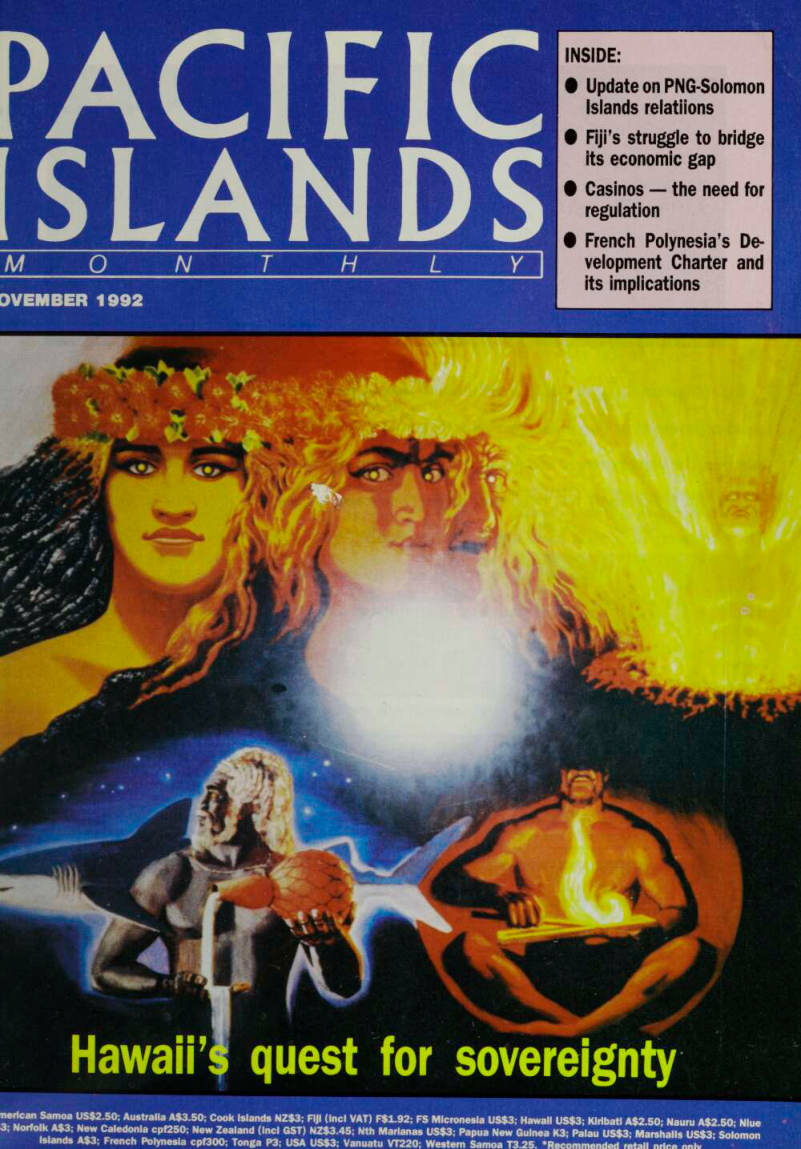
Hawaii’s quest for sovereignty
il Ss2 - s®; 5 ® ; Austra,la Cook Islands NZ$3; FIJI (Incl VAT) F 51.92; FS Micronesia US$3; Hawaii US$3; Kiribati A 52.50; Nauru A 52.50; Niue 3, Norfolk As 3; New Caledonia cpf2so; New Zealand (Incl GST) NZ53.45; Nth Marianas US$3; Papua New Guinea K 3; Palau US$3; Marshalls US$3- Solomon Islands As 3; French Polynesia cpf3oo; Tonga P 3; USA US$3; Vanuatu VT22O; Western Samoa T 3.25. ‘Recommended retail nrlce onlv
Advertisements & other items, p. 2 (1 item)
mazoa
Nature’s spectacle offers such a richness of colour and texture, that man has always dreamt of stealing some of its magic. To recreate the smooth perfection of a pearl, the brilliance of a bird’s leather, the velvet texture of a petal, the depth of hue of tropical fish. There are endless examples of the mysteries man has tried conquering, at every stage of civilization. In their own field, the engineers at Mazda have come close to realising their own dream. They have developed “High-Reflectivity Coating”, a new painting process that sheathes cars in colours that are incredibly deep, intense, brilliant and as smooth as a mirror a reflection of a new perfection in the world of the automobile.
On the road to civilization.
Pacific
Islands
Monthly
Vol 62 No. 11
The News Magazine
November 1992
-Rom The
Editor’S Desk 4
.Etters 5
Bougainville
lo end to PNG-Solomon order problems 6
A sequence of events 16 awards resolution 17
Olitics
le charter that spells sillusionment 12
Over Stories
awaiian nationalism e wild card 18 le coup agaiinst sovereignty 22
Lisin Ess
igulating casinos a ivernment challenge 24
Sugar’s not-so-sweet deal 27 Fiji’s struggle to bridge the economic gap 28
Disaster
Huricane Iniki Hawaii’s major calamity 32
Advertising Feature
Malaysia-Fiji trade links sealed 34 Banking on the future 35 Courtesy is paying off 38
Education
The power of knowledge 40 Adding the local flavour 43 Discriminating evidence 44
Fashion
Lasting impressions 47
Cuisine
The melting pot of culinary delight 48
Profile
Taking them under her wing 50
Yachting
All in the family 54
Shipping
Shipping schedules 57
Columnists
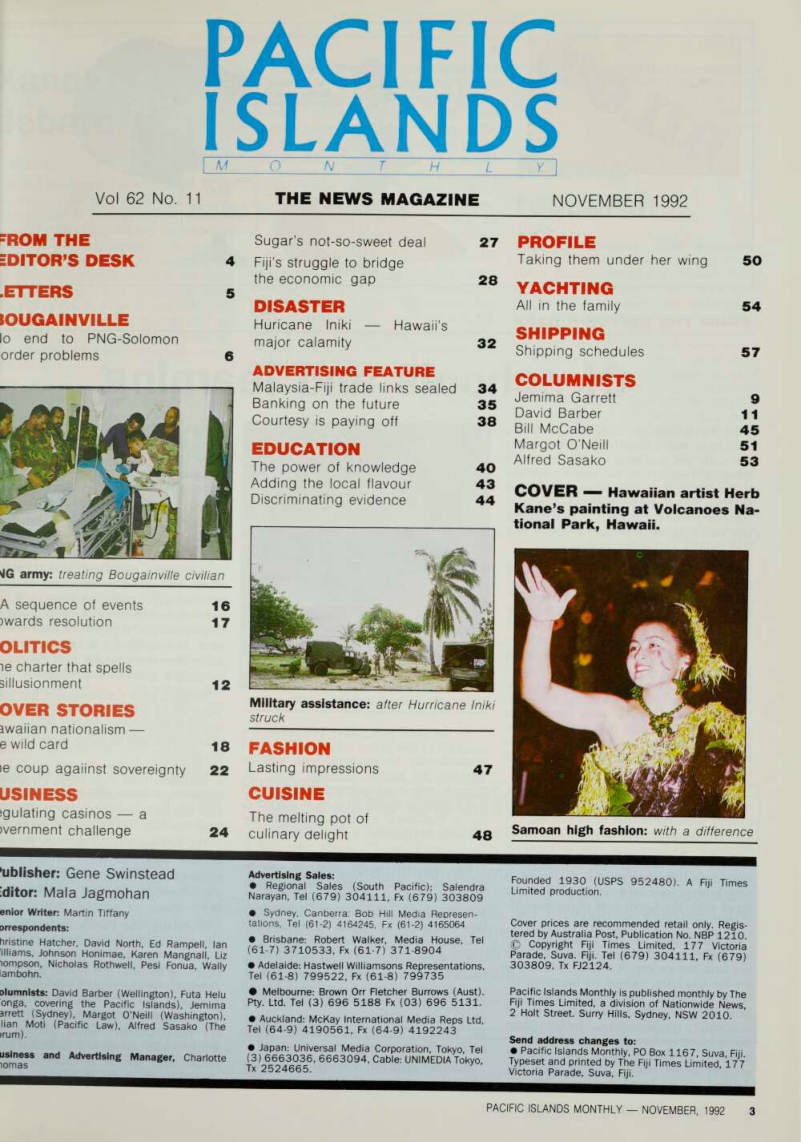
Jemima Garrett 9 David Barber 11 Bill McCabe 45 Margot O’Neill 51 Alfred Sasako 53 COVER Hawaiian artist Herb Kane’s painting at Volcanoes Na tional Park, Hawaii.
Publisher: Gene Swinstead
Editor: Mala Jagmohan
enior Writer: Martin Tiffany respondents: hristine Hatcher, David North, Ed Rampell, lan illiams, Johnson Honimae, Karen Mangnall, Liz lompson, Nicholas Rothwell, Pesi Fonua, Wally iambohn. olumnists: David Barber (Wellington), Futa Helu onga, covering the Pacific Islands), Jemima arrett (Sydney), Margot O'Neill (Washington), lian Moti (Pacific Law), Alfred Sasako (The i rum). uslness and Advertising Manager, Charlotte lomas
Advertising Sales: • Regional Sales (South Pacific); Salendra Narayan, Tel (679) 304111, Fx (679) 303809 • Sydney, Canberra: Bob Hill Media Represen tations, Tel (61-2) 4164245, Fx (61-2) 4165064 • Brisbane: Robert Walker, Media House, Tel (61-7) 3710533, Fx (61-7) 371-8904 • Adelaide: Hastwell Williamsons Representations, Tel (61-8) 799522, Fx (61-8) 799735 • Melbourne: Brown Orr Fletcher Burrows (Aust).
Pty. Ltd. Tel (3) 696 5188 Fx (03) 696 5131. • Auckland: McKay International Media Reps Ltd, Tel (64-9) 4190561, Fx (64-9) 4192243 • Japan: Universal Media Corporation, Tokyo, Tel (3) 6663036, 6663094, Cable: UNIMEDIA Tokyo Tx 2524665.
Founded 1930 (USPS 952480). A Fiji Times Limited production.
Cover prices are recommended retail only. Regis tered by Australia Post, Publication No. NBP 1210. © Copyright Fiji Times Limited, 177 Victoria Parade, Suva. Fiji. Tel (679) 304111, Fx (679)
303809, Tx Fj2124.
Pacific Islands Monthly is published monthly by The Fiji Times Limited, a division of Nationwide News, 2 Holt Street. Surry Hills, Sydney, NSW 2010.
Send address changes to: • Pacific Islands Monthly, PO Box 1167, Suva, Fiji Typeset and printed by The Fiji Times Limited, 177 Victoria Parade, Suva, Fiji.
[/]G army: treating Bougainville civilian
Military assistance: after Hurricane Iniki struck
Samoan high fashion: with a difference
Of schools and learning
From The Editor’S Desk
FIJI’S Education Minister, Taufa Vakatale, has spoken out against, what she calls the weakness of her country’s education system too much emphasis on exams, and as a result, exam-oriented subjects. She decries the situation in most schools where the priority is to complete the year’s syllabus so that students can successfully sit for the exams.
With such an emphasis on passing exams, students are becoming more and more programmed into cramming texts, learning the facts rote fashion, with little regard to whether they have developed fully as young adults.
The situation Vakatale criticises is not prevalent in Fiji alone. Far too many schools, in far too many countries in the region, seem to be measuring students’ success according to their success in examinations. While it is agreed exams form an important part of a child’s education, they are not the be all and end all of a child’s learning experience.
How many instances have we come across where a child’s self-worth has been cruelly dashed because he or she did not excel in the academic subjects at school?
Similarly, we have also come across cases of children having an exaggerated opinion of themselves an opinion which does not always endure when faced with the harsh tests of the real-life world.
A large part of the blame for this warped system of valuing people’s worth lies with the society. A society, which has for far too long, valued its members by their academic brilliance. And this brilliance is usually measured in terms of academic qualifications, rather than being based on how the qualifications are applied. It only takes a quick glance around us to realise success need not depend on academic excellence alone.
At the same time, there still remains a need for exams in our schools. There will undoubtedly be students who will be aspiring for higher learning. And, al though, this number is small, they need to be catered to. There will still need to be a yardstick to measure who are capable to continue with further educa tion.
But the criteria for selection can be modified, from the present system of how much a student has learnt, to maybe, how much he is capable of learning, or how capable he is at grasping and understanding ideas and theories.
But for the changes to take place there needs to be commitment from the policy makers and initiative from those who will be implementing the policies to bring about an education system that is, above all, working towards nurturing better citizens for their respective countries.
Another criticism Vakatale has of the education system is the teachers’ inabil
ity, or reluctance, to take advantage i the opportunities offered within tl school curriculum to digress into areas i discussion which are not specific to tl exams. Why must they stop where tl syllabus does? What about encouragir the children’s natural thirst for knov ledge and exploring related areas i interest?
A common complaint is that teache have lost their dedication and ai increasingly looking at their jobs as mere eight-to-four job. Commitment an dedication to the profession have becorr rare. Few value the enermous respons bility they have, along with parents, i shaping a generation of citizens.
Perhaps poor remuneration has somi thing to do with the lukewarm attituc teachers bring to their jobs. Perhaps lac of resources and facilities frustrate gem ine desires.
Perhaps there is a need for goverr ments to re-assess the role of educatio and teachers in their plans — especial! as they draw up budgetary allocation!
We can only hope as more countrk become aware of the shortfalls of th system they will bring in changes so th? schools truly become institutions ( learning.
Normally, the Pacific region tends t rely on methods tried and tested in th developed regions of the world befor adapting them to our needs. Maybe, fo a change, we can initiate our own syster in education a system which does nc ignore the role of tradition and culture ii our development, which merges aca
demic qualifications with practical appli
cation and which is tailored to th unique needs of the Pacific.
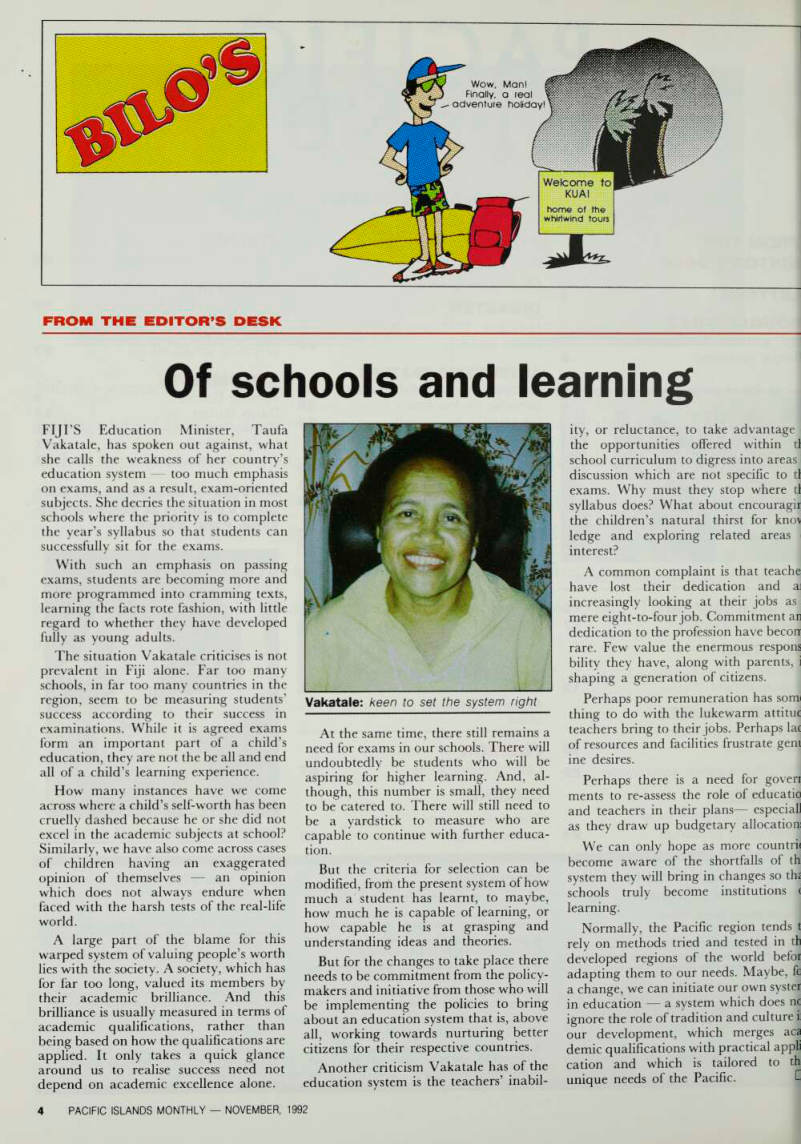
Vakatale: Keen to set the system right
Advertisements & other items, p. 4 (1 item)
a
Wow, Man!
Finally, a real adventure holiday! im. welcome
KUAI
home of the whirlwind tours
Right to
Letters
Kanak
debate
Madam, In her most recent proclamation as the louthpiece for us, the Kanak people, )unei-Small is perhaps trying to make p for the fact that she was no where to e seen in Kanaky during les evenements of le 1980 s. By purposefully misinterpret ig Newborn’s letter to suit her own ersonal agenda, and maligning those ho risk much to help us and others in ic Pacific, she is playing directly into the mds of the mining and nuclear indus ies; hardly the tactics of a street-wise :tivist.
The Kanak people are not, and never ive been, “acutely aware” of the ivironmental and health problems as ciated with the mining industry in our untry, neither have we made it a ocus” of our struggle “for decades”, as unei-Small states. Perhaps she needs minding that the reason my comrade, oi Machoro, blocked the Thio mine for ree months in 1984 was to paralyse the ritory’s economy, not to demonstrate out pollution. However, Julian K and itonin C, with whom I was impos ed, blocked the mine of N’Goye in 79 because of pollution. This, and the }test in 1983 by the brave families of
»inde Ouipont against the logging of
;ir forest and the pollution of their sam, are the only two occasions when naks have scratched the surface of dronmental issues. I helped organise protest of May 1985, (not 1986), the f a young Kanak was killed by fascist nch settlers (not by the army) in the ranee to one of our ghettos in umea, a protest which focussed on ideal themes but also included a louncement of French nuclear testing. nei-Small should check her facts with se of us who were there at the time Dre attempting to write our history for 4uch can be done to try and solve se problems raised in Newborn’s “r, without having to wait as nei-Small would have us for that when France will relinquish all lomic and political powers. Kanak vists, young and old, have come ;ther to form our first environmental sure group and we have recently i collecting samples of nickel pol
)n for independent analysis outside
laky. And this year, for the first time
its history, the FLNKS Cong ress
ed a resolution on the environment.
Perhaps the years living outside the struggle, and the privilege of a foreign education, have contributed to Ounei- Small’s short-sightedness and self aggrandizing perspective which stifles the slightest possibility of an authentic Kanak debate. Those of us who stayed behind to fight, however, are more humble about the role we played in the continuing struggle for Kanak indepen dence and the suffering we have all endured, Kanak and non-Kanak alike.
On what grounds does Ounei-Small give herself the right to prevent others from giving us necessary information with which to further our cause? She offers no pragmatic solutions to a struggle from which she has long been absent.
Neither is she, nor has she ever been, the spokesperson for my people.
Luc Tutuporo
Minister for Economic Development Gouvernement de Kanaky
Right to
criticise
Madam, Susanna Small’s recent letter ( PIM , September, 1992) raises an interesting point: who are, and who are not, permitted to criticise so-called “indigen ous peoples”, what they do, say or write?
By her own criteria, Susanna Small could silence all non-indigenous reports for the people of Bougainville or East Timor, or any discussion on the Fiji Constitution or the destruction of tribal homelands in Malaysia.
Has she not realised that neo-colonialism in the Pacific is not race or colour specific?
Anaru Dyer
Auckland, New Zealand
Pacific
research
Madam, Stuart Schwartzstein, ( PIM , September, 1992) has some unflattering things to say about Pacific anthropology against which he suffers a “visceral reaction”. Now while no one could nor would want to defend all past anthropological research, cultural awareness will be vitally important for the success of any future research efforts and it is anthropologists both metropolitan and island based who have provided much of this cross-cultural understanding.
If National Science Foundation supports new Pacific research let us hope they invite the collaboration of local, island anthropol ogists who understand Pacific cultures.
They, unlike some well-paid non anthropological sorts, typically spend longer than “one day or [even] five in a place.” Dr Schwartzstein cites “the old joke about the typical Pacific family, a mother, father, two kids and the live-in anthropologist.” Equally well-known now adays are expensive research and develop mental projects that have been both pernicious and disastrous because of a lack of local cultural awareness and these are not jokes. An anthropologist might begin by explaining to Dr Schwartzstein that “a mother, father and two kids” in no way is “the typical Pacific family!”
Lamont Lindstrom
Oklahoma,
Usa.
Advertisements & other items, p. 5 (1 item)
The South Sea Digest
The Newsletter on Islands affairs. Every Other Friday.
South Sea Digest has all the latest business news, expectly streamlined and obtainable nowhere else.
Subcriptions: 25 issues SAISO for Australian subcriber; SAI7S overseas, all airmailed. Payment by cheque in $A and SUS, otherwise by bank draft.
Send payment to: The South Sea Digest, GPO Box 4245, Sydney, NSW 2001, Australia.
Name Address
No end to PNG-Solomo slands border problems
Bougainville
By Wally Hiambohn
PAPUA NEW GUINEA’S deputy Prime Minister Sir Julius Chan while attending a meeting of World Bank and Interna tional Monetary Fund governors in New York in late September decided he should also drop in for a “chat” with the United Nations Security Council Presi dent Dr Jose Ayala Lasso and its members.
Sir Julius took the opportunity to brief Lasso on the Bougainville situation, including the recent incident in which PNG troops crossed over into neighbour ing Solomon Islands and allegedly killed two people, shot an child and abducted a man.
A Soloman Islands delegation had also been present in New York to take the issue to the Security Council, and to seek a UN intervention in addressing the Bougainville crisis and its spill-over effects into their country.
After consulting both sides Lasso announced the Security Council had decided the two countries should resolve the matter between themselves and that there was no need for UN intervention.
Sir Julius happily reported back that he was successful in persuading Lasso’s council that PNG had taken swift action to resolve the dispute.
“I told them (members of the council) that the incident happened; that we were very quick to reconcile all the issues raised by the Solomons government and I didn’t see any need for the Solomons to prematurely ask for UN intervention at this time,” Sir Julius told reporters when he returned to PNG on October 3.
He said he told the council the PNG
government intended to put those mem bers of the security force involved through the legal process and that PNG was prepared to pay compensation for damages done.
“I'm so happy the UN has responded favourably to our presentaton and I think that is all we can do at this point,” he said.
While the two sides ponder one bitterly and the other with regret over the incident and seek dialogue, one
pertinent question remains.
Could this incident and many others over the past four years been avoided or minimised?
Since 1989, officials of both sides have had numerous discussions on how to deal with the spill over effects. A key consideration was for a boarder surveil lance leading to a Memorandum of Understanding being signed in 1990 for this surveillance.
Under this MOU Solomon Islands was responsible for the provision of one patrol boat; the cost and manning of all necessary logistical and administrative support to the program from the Sol omon Islands side; the establishment of a surveillance centre and staff; and the provision of backup liaison between the two surveillance centres of both countries.
The government of PNG on the other hand was to be responsible for the provision of boats and crew for surveil lance purposes as agreed, within an
agreed area of operation; the provision
and manning of surveillance centre to be located in an appropriate location; the cost of administering the program for the PNG side; and taking necessary actions
on any other issues related to the program from time to time.
Although the idea of a joint operation has not been fully supported by thej Solomon Islands on legal grounds, it claims its has, since the MOU, markedly; improved its presence along the border, both in terms of the personnel and the
regularity of the patrols.
It says that while it had been willing] to co-operate, its major constraints have been its inability to sustain the cost or operation indefinitely and its inability to
effectively police the extensive boundary.]
It further claims that it had observed PNG had also not fulfilled its obligations under the MOU.
“It has never been able to command a presence on the border. This failure has! led to the situation on the border to deteriorate and to cause the BRA
(Bougainville Revolutionary Army) el-j
ements and others to move freely into!
Solomon Islands territory,” the governs ment claimed in a recent document.
“In our view these violations havej
been completely ignored by the Namaliuj
government,” it said. “It protested to|
Solomon Islands government against matters such as the illegal BRA office in Honiara and the presence of Miriori in the Solomon Islands but sees little or nol sensitivity in these violations.
The report concluded, “The effects of Bougainville have already been ad-1 versely felt in the Solomon Islands. It is in the interest of the Solomon Islands to co-operate with and be helpful to PNG] in finding a lasting peaceful solution' . I PNG however, secs things differently.
It says it has kept its part of the bargain and maintained regular naval patrols using its part of the bargain.
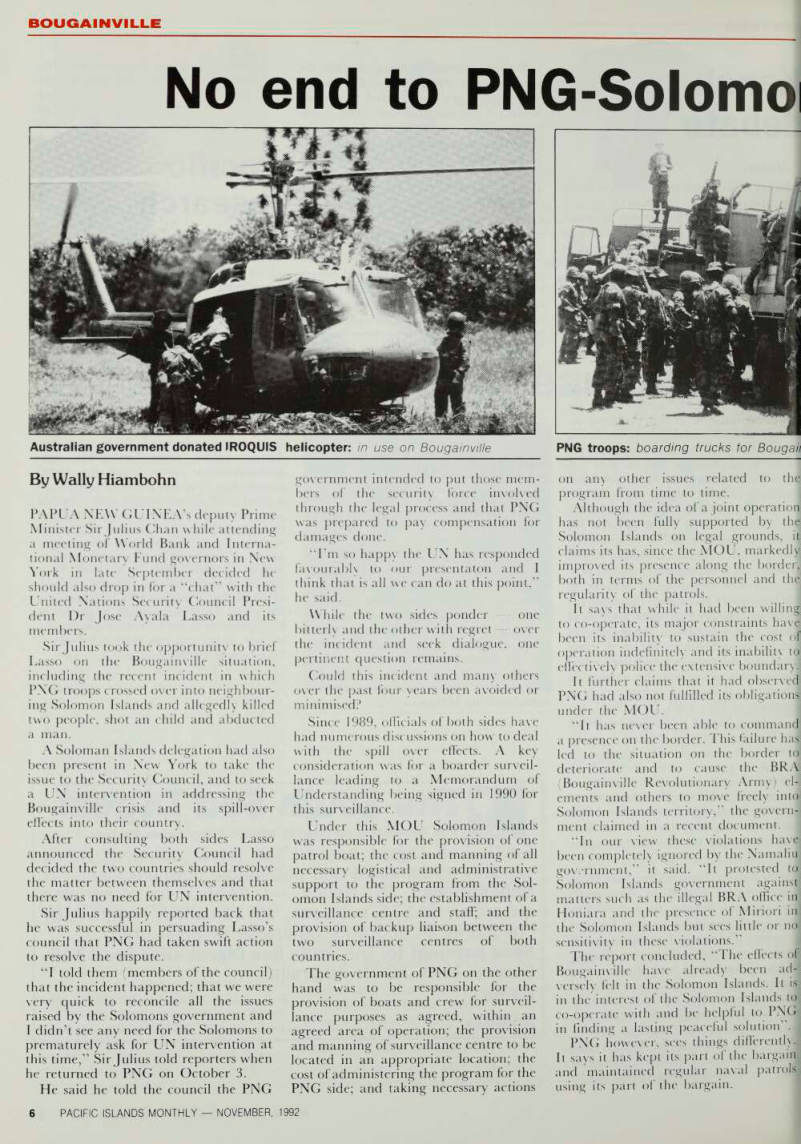
Australian government donated IROQUIS helicopter: in use on Bougainville
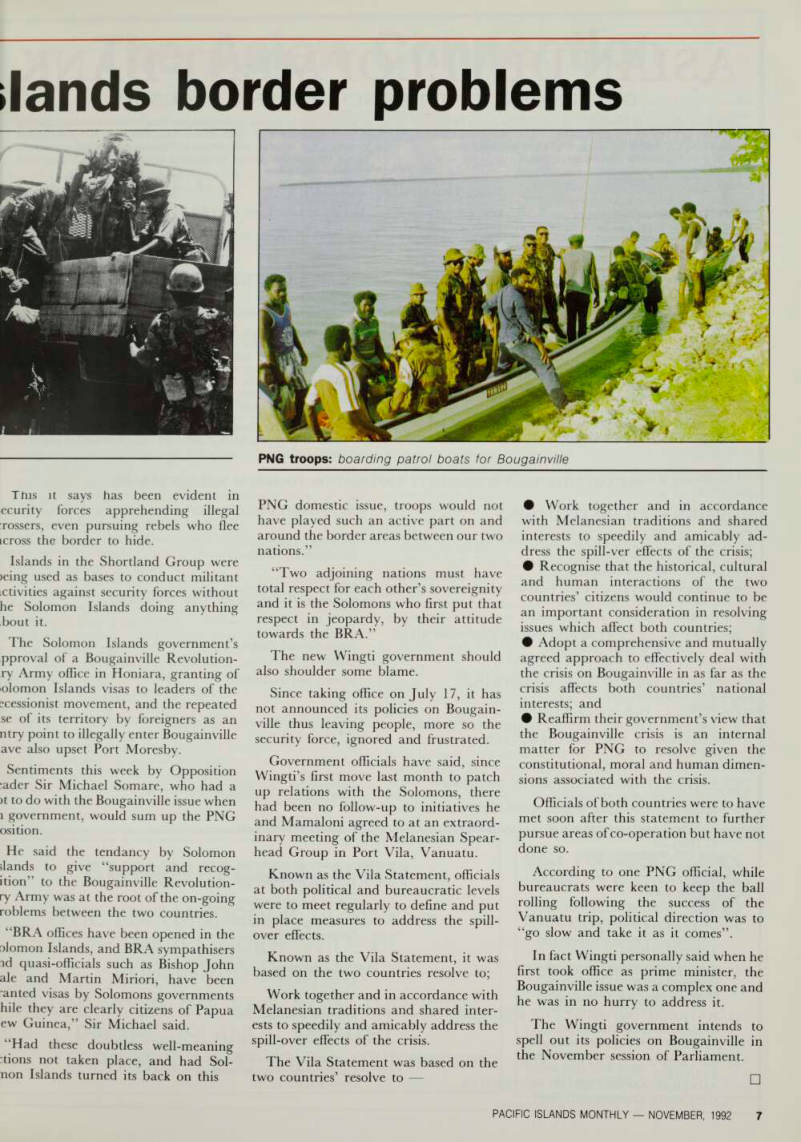
PNG troops: boarding trucks for Bougaii
This it says has been evident in ecurity forces apprehending illegal :rossers, even pursuing rebels who flee icross the border to hide.
Islands in the Shortland Group were >eing used as bases to conduct militant ictivities against security forces without
he Solomon Islands doing anything
bout it.
The Solomon Islands government’s pproval of a Bougainville Revolution ry Army office in Honiara, granting of olomon Islands visas to leaders of the “cessionist movement, and the repeated se of its territory by foreigners as an
ntry point to illegally enter Bougainville
ave also upset Port Moresby.
Sentiments this week by Opposition ;ader Sir Michael Somare, who had a )t to do with the Bougainville issue when i government, would sum up the PNG osition.
He said the tendancy by Solomon >lands to give “support and recog ition” to the Bougainville Revolution ry Army was at the root of the on-going roblems between the two countries.
“BRA offices have been opened in the ilomon Islands, and BRA sympathisers id quasi-officials such as Bishop John ale and Martin Miriori, have been anted visas by Solomons governments hile they are clearly citizens of Papua ew Guinea,” Sir Michael said.
“Had these doubtless well-meaning 'tions not taken place, and had Sol non Islands turned its back on this
PNG domestic issue, troops would not have played such an active part on and around the border areas between our two nations.”
“Two adjoining nations must have total respect for each other’s sovereignity and it is the Solomons who first put that respect in jeopardy, by their attitude towards the BRA.”
The new Wingti government should also shoulder some blame.
Since taking office on July 17, it has not announced its policies on Bougain ville thus leaving people, more so the security force, ignored and frustrated.
Government officials have said, since Wingti’s first move last month to patch up relations with the Solomons, there had been no follow-up to initiatives he and Mamaloni agreed to at an extraord inary meeting of the Melanesian Spear head Group in Port Vila, Vanuatu.
Known as the Vila Statement, officials at both political and bureaucratic levels were to meet regularly to define and put in place measures to address the spill over effects.
Known as the Vila Statement, it was based on the two countries resolve to; Work together and in accordance with Melanesian traditions and shared inter ests to speedily and amicably address the spill-over effects of the crisis.
The Vila Statement was based on the two countries’ resolve to —
• Work together and in accordance with Melanesian traditions and shared interests to speedily and amicably ad dress the spill-ver effects of the crisis; • Recognise that the historical, cultural and human interactions of the two countries’ citizens would continue to be an important consideration in resolving issues which affect both countries; • Adopt a comprehensive and mutually agreed approach to effectively deal with the crisis on Bougainville in as far as the crisis affects both countries’ national interests; and • Reaffirm their government’s view that the Bougainville crisis is an internal matter for PNG to resolve given the constitutional, moral and human dimen sions associated with the crisis.
Officials of both countries were to have met soon after this statement to further pursue areas of co-operation but have not done so.
According to one PNG official, while bureaucrats were keen to keep the ball rolling following the success of the Vanuatu trip, political direction was to “go slow and take it as it comes”.
In fact Wingti personally said when he first took office as prime minister, the Bougainville issue was a complex one and he was in no hurry to address it.
The Wingti government intends to spell out its policies on Bougainville in the November session of Parliament.
PNG troops: boarding patrol boats for Bougainville
Advertisements & other items, p. 8 (1 item)
sdfh
The Asian Connection
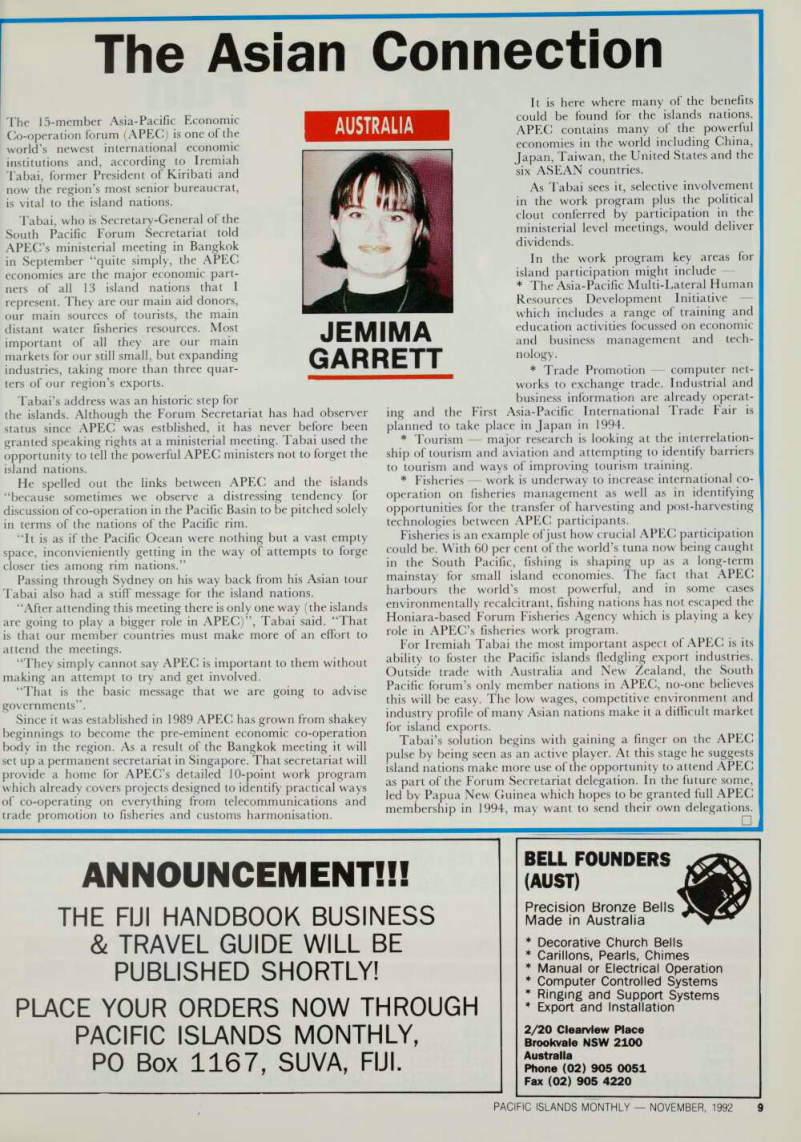
The 15-member Asia-Pacific Economic Co-operation forum (APEC) is one of the world’s newest international economic institutions and, according to Iremiah Tabai, former President of Kiribati and now the region’s most senior bureaucrat, is vital to the island nations.
Tabai, who is Secretary-General of the South Pacific Forum Secretariat told APEC’s ministerial meeting in Bangkok
in September “quite simply, the APEC
economies are the major economic part ners of all 13 island nations that I represent. They are our main aid donors, our main sources of tourists, the main distant water fisheries resources. Most important of all they are our main markets for our still small, but expanding industries, taking more than three quar ters of our region’s exports.
Tabai’s address was an historic step for
the islands. Although the Forum Secretariat has had observer status since APEC was estblished, it has never before been granted speaking rights at a ministerial meeting. Tabai used the opportunity to tell the powerful APEC ministers not to forget the island nations.
He spelled out the links between APEC and the islands “because sometimes we observe a distressing tendency for discussion of co-operation in the Pacific Basin to be pitched solely in terms of the nations of the Pacific rim.
“It is as if the Pacific Ocean were nothing but a vast empty space, inconvieniently getting in the way of attempts to forge closer ties among rim nations.”
Passing through Sydney on his way back from his Asian tour Tabai also had a stiff message for the island nations.
“After attending this meeting there is only one way (the islands are going to play a bigger role in APEC)”, Tabai said. “That is that our member countries must make more of an effort to attend the meetings.
“They simply cannot say APEC is important to them without making an attempt to try and get involved.
“That is the basic message that we are going to advise
governments”.
Since it was established in 1989 APEC has grown from shakey beginnings to become the pre-eminent economic co-operation body in the region. As a result of the Bangkok meeting it will set up a permanent secretariat in Singapore. That secretariat will provide a home for APEC’s detailed 10-point work program which already covers projects designed to identify practical ways of co-operating on everything from telecommunications and trade promotion to fisheries and customs harmonisation.
It is here where many of the benefits could be found for the islands nations.
APEC contains many of the powerful economies in the world including China, Japan, Taiwan, the United States and the six ASEAN countries.
As Tabai sees it, selective involvement in the work program plus the political clout conferred by participation in the ministerial level meetings, would deliver dividends.
In the work program key areas for
island participation might include
* The Asia-Pacific Multi-Lateral Human Resources Development Initiative which includes a range of training and education activities focussed on economic and business management and tech
nology.
* Trade Promotion computer net works to exchange trade. Industrial and business information are already operat
ing and the First Asia-Pacific International Trade Fair is planned to take place in Japan in 1994. * Tourism major research is looking at the interrelation ship of tourism and aviation and attempting to identify barriers to tourism and ways of improving tourism training. * Fisheries work is underway to increase international co operation on fisheries management as well as in identifying opportunities for the transfer of harvesting and post-harvesting technologies between APEC participants.
Fisheries is an example of just how crucial APEC participation could be. With 60 per cent of the world’s tuna now being caught in the South Pacific, fishing is shaping up as a long-term mainstay for small island economies. The fact that APEC harbours the world’s most powerful, and in some cases environmentally recalcitrant, fishing nations has not escaped the Honiara-based Forum Fisheries Agency which is playing a key role in APEC’s fisheries work program.
For Iremiah Tabai the most important aspect of APEC is its ability to foster the Pacific islands fledgling export industries.
Outside trade with Australia and New Zealand, the South Pacific forum’s only member nations in APEC, no-one believes this will be easy. The low wages, competitive environment and industry profile of many Asian nations make it a difficult market for island exports.
Tabai’s solution begins with gaining a finger on the APEC pulse by being seen as an active player. At this stage he suggests island nations make more use of the opportunity to attend APEC as part of the Forum Secretariat delegation. In the future some, led by Papua New Guinea which hopes to be granted full APEC membership in 1994, may want to send their own delegations.
Australia
Jemima
Garrett
Advertisements & other items, pp. 9-10 (1 item)
Announcement!!!
BELL FOUNDERS
(AUST)
Precision Bronze Bells Made in Australia * Decorative Church Bells * Carillons, Pearls, Chimes * Manual or Electrical Operation * Computer Controlled Systems * Ringing and Support Systems * Export and Installation 2/20 Clearvlew Place Brookvale NSW 2100 Australia Phone (02) 905 0051 Fax (02) 905 4220
ANNOUNCEMENT!!!
THE FIJI HANDBOOK BUSINESS
& TRAVEL GUIDE WILL BE
PUBLISHED SHORTLY!
PLACE YOUR ORDERS NOW THROUGH
PACIFIC ISLANDS MONTHLY,
PO Box 1167, SUVA, FIJI.
Fun
and
reedom
M m > 4WD!
mfim
mm
**?XPS£
m s ■
Budget
sv ?r. .* > >■ A, t;:_ --^ tt* v -' 4fel|S v-v .■:■■■• "- -V/- . - ■■■*; f-wy *“’ Vf«r ■ * ■ >4*** “■ * At- V --r'r:- -v . ■ . —■" C' v ’
Hit the Beaches in a Budget FoUrwheel Drive. With the right vehicle to take you freely back to nature and with the right amount of Sunshine, there 9 s nothing better
than a weekend with Budget.
COUNTRY PHONE EAX
FIJI (679) 315899 (679) 302450
PNG (675) 254111 (675) 257853
NEW ZEALAND (649) 3096737 (649) 3660212
AUSTRALIA (613) 3206333 (613) 3265623
Budget
THE SMART MONEY IS ON BUDGET
COUNTRY PHONE FAX
SOLOMON ISLANDS (677) 22313 (677) 23593
WESTERN SAMOA (685) 20561 (685) 20393
COOK ISLANDS (682) 20888 (682) 21275
Scaling new heights
DIPLOMATIC appointments
are not always hugely signifi
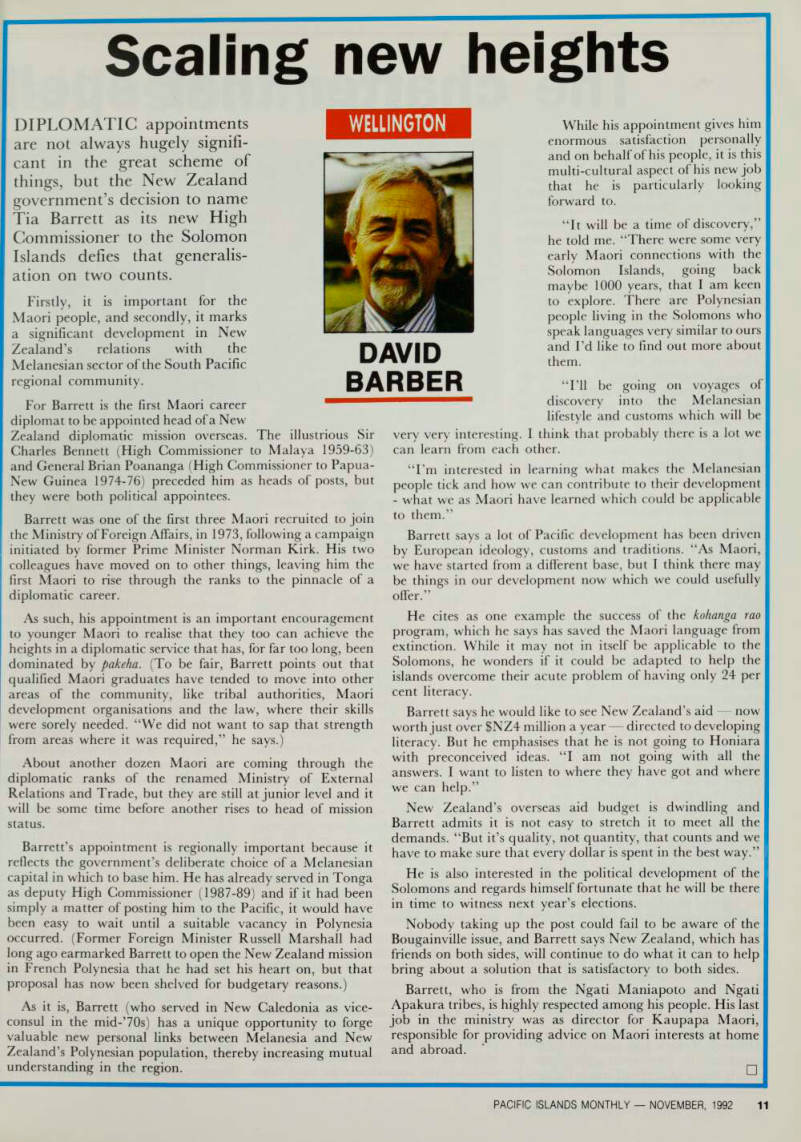
cant in the great scheme of things, but the New Zealand government’s decision to name Tia Barrett as its new High Commissioner to the Solomon Islands defies that generalis ation on two counts.
Firstly, it is important for the Maori people, and secondly, it marks a significant development in New Zealand’s relations with the Melanesian sector of the South Pacific regional community.
For Barrett is the first Maori career diplomat to be appointed head of a New
Zealand diplomatic mission overseas. The illustrious Sir Charles Bennett (High Commissioner to Malaya 1959-63) and General Brian Poananga (High Commissioner to Papua- New Guinea 1974-76) preceded him as heads of posts, but they were both political appointees.
Barrett was one of the first three Maori recruited to join the Ministry of Foreign Affairs, in 1973, following a campaign initiated by former Prime Minister Norman Kirk. His two colleagues have moved on to other things, leaving him the first Maori to rise through the ranks to the pinnacle of a diplomatic career.
As such, his appointment is an important encouragement to younger Maori to realise that they too can achieve the heights in a diplomatic service that has, for far too long, been dominated by pakeha. (To be fair, Barrett points out that qualified Maori graduates have tended to move into other areas of the community, like tribal authorities, Maori development organisations and the law, where their skills were sorely needed. “We did not want to sap that strength from areas where it was required,” he says.) About another dozen Maori are coming through the diplomatic ranks of the renamed Ministry of External Relations and Trade, but they are still at junior level and it will be some time before another rises to head of mission status.
Barrett’s appointment is regionally important because it reflects the government’s deliberate choice of a Melanesian capital in which to base him. He has already served in Tonga as deputy High Commissioner (1987-89) and if it had been simply a matter of posting him to the Pacific, it would have been easy to wait until a suitable vacancy in Polynesia occurred. (Former Foreign Minister Russell Marshall had long ago earmarked Barrett to open the New Zealand mission in French Polynesia that he had set his heart on, but that proposal has now been shelved for budgetary reasons.) As it is, Barrett (who served in New Caledonia as vice consul in the mid-’7os) has a unique opportunity to forge valuable new personal links between Melanesia and New Zealand’s Polynesian population, thereby increasing mutual understanding in the region.
While his appointment gives him enormous satisfaction personally and on behalf of his people, it is this multi-cultural aspect of his new job that he is particularly looking forward to.
“It will be a time of discovery,” he told me. “There were some very early Maori connections with the Solomon Islands, going back maybe 1000 years, that I am keen to explore. There are Polynesian people living in the Solomons who speak languages very similar to ours and I’d like to find out more about them.
“I’ll be going on voyages of discovery into the Melanesian lifestyle and customs which will be
very very interesting. I think that probably there is a lot we can learn from each other.
“I’m interested in learning what makes the Melanesian people tick and how we can contribute to their development - what we as Maori have learned which could be applicable to them.”
Barrett says a lot of Pacific development has been driven by European ideology, customs and traditions. “As Maori, we have started from a different base, but I think there may be things in our development now which we could usefully offer.”
He cites as one example the success of the kohanga rao program, which he says has saved the Maori language from extinction. While it may not in itself be applicable to the Solomons, he wonders if it could be adapted to help the islands overcome their acute problem of having only 24 per cent literacy.
Barrett says he would like to see New Zealand’s aid now worth just over SNZ4 million a year directed to developing literacy. But he emphasises that he is not going to Honiara with preconceived ideas. “I am not going with all the answers. I want to listen to where they have got and where we can help.”
New Zealand’s overseas aid budget is dwindling and Barrett admits it is not easy to stretch it to meet all the demands. “But it’s quality, not quantity, that counts and we have to make sure that every dollar is spent in the best way.”
He is also interested in the political development of the Solomons and regards himself fortunate that he will be there in time to witness next year’s elections.
Nobody taking up the post could fail to be aware of the Bougainville issue, and Barrett says New Zealand, which has friends on both sides, will continue to do what it can to help bring about a solution that is satisfactory to both sides.
Barrett, who is from the Ngati Maniapoto and Ngati Apakura tribes, is highly respected among his people. His last job in the ministry was as director for Kaupapa Maori, responsible for providing advice on Maori interests at home and abroad.
Wellington
David
Barber
The charter that spell disillusionment

Politics
By Karin von Strokirch
THE conclusions presented at the end of July by the Development Charter in Tahiti were indicative of the profound social and economic malaise pervading the territory. The reports were the result of a week-long conference by over 30 groups comprising 350 leading members of the community. The participants came from diverse professional back grounds ranging from public servants and businessmen to religious leaders.
Their task was to identify the 10 main obstacles to development in the territory and to propose 10 priority areas for reform. The groups, independently of each other, produced a damning indict ment of politicians as a group, regardless of party affiliation. But other sectors, such as the public service, trade unions and churches were also subject to heavy criticism for their part in putting the brakes on development.
It is no coincidence that this comprehen sive reflection on the territory’s present and future directions came only three months after the announcement of the nuclear test moratorium. The decision sent shock waves through the territory.
The temporary, and what must eventu ally be a permanent, suspension of the tests, has driven home the need for an urgent examination of ways in which the Pacific Test Centre’s (CEP) dominant role in the economy for the last 30 years can be replaced.
The concept of a Development Charter was initiated by President Gaston Flosse and agreed to in Paris under a protocol signed by the state and the territory on May 14, 1992. This meeting was to a large extent designed to reassure the territory France would not simply desert it in the wake of the CEP. The first phase of the charter was based in Papeete. Now the charter co-ordinators are consulting with rural districts and outer islands. On the basis of the charter’s conclusions and proposals the territorial government will attempt to produce a long term develop ment strategy. The French state, in turn, is committed to assist in the implement ation of the new development strategy, entitled Pact for Progress, the terms of which will be negotiated by January 1993.
Although France has signalled its pre paredness to participate, the onus is clearly being placed on French Polynesia
to take responsibility for its future. The reports of the Development Charter in late July expressed the utter disillusion ment of the population with their political leaders. To quote but one such view: “There can be no real reforms with a political class composed, by a large majority, of incompetent and immature men driven by personal, pecuniary, electoralist and nepotistic motivations.”
The attack on politicians did not end there, they were also accused of wasting public funds, promoting a climate of instability as a result of their continual factionalism, and failing to provide a long-term vision for development of the territory. After hearing two days of reports in this vein, President Flosse remarked, with a begrudging sense of humour, that in their critique of the territory’s leaders the charter groups must have drawn on every abusive word in the French dictionary! On a more serious note, he added, that if they were right there was little hope for the future.
The high degree of disenchantment with local politicians is not surprising given the political mayhem witnessed over the past year. Last September the fragile governing coalition between Flosse’s Tahoeraa party and Emile Vernaudon’s Ai’a Api collapsed only five months after the elections which brought them to power. The new coalition government of Tahoeraa and Jean Juventin’s Here Ai’a was then virtually paralysed until April this year due to a lock-out at the Territorial Assembly, organised by the indignant outgoing assembly president, Vernaudon. The comedy assumed tragic proportions when, as a result of the lock out, the assembly was unable to vote on funds for the victims of Cyclone Wasa, which had hit several outer islands at Christmas. This complete dysfunction of the territory’s highest democratic insti tution was severely criticized by the charter. Industrial disputes, featuring prolonged strikes and blockades, in July 1991 and the beginning of 1992, have also contributed to perceptions of a government losing control.
The image of President Flosse personally was tarnished by the decision of a Paris court on April 1 to convict him of abuse of office, for which he received a fine and a six-month suspended sentence. The conviction led to calls for his resignation and for new elections by the opposition parties. The President did not have to resign as he has appealed the court’s decision; the appeal was to have been
heard on October 23. The final straw foi the government came even as the chartei groups were reaching their conclusions, when the French High Commissioner seized control of the territorial budget.j France also came under fire for being “lax” in not having fulfilled its responsi bilities in the territory, in terms ol promoting economic development and ensuring the legal and democratic func tioning of the territory’s institutions. The statute of autonomy was regarded by many charter groups as being a failure, due to the poor performance of both state and territorial authorities.
The second major area to come under the Development Charter’s scrutiny was the economy. It noted that, “The Polynesian economy, based as it has been on atomic rent since 1963, is artificially sustained by external transfers and now exhibits several principal forms of unbal anced and negative development; includ ing high prices, an excessive trade deficit and dependence on imported foods.”
Another serious constraint on develop ment is the “hypertrophy and low productivity” of the public service, as well as the high salaries and fringe benefits enjoyed by public servants and
politicians alike.
Further, it was felt that the territory’s j
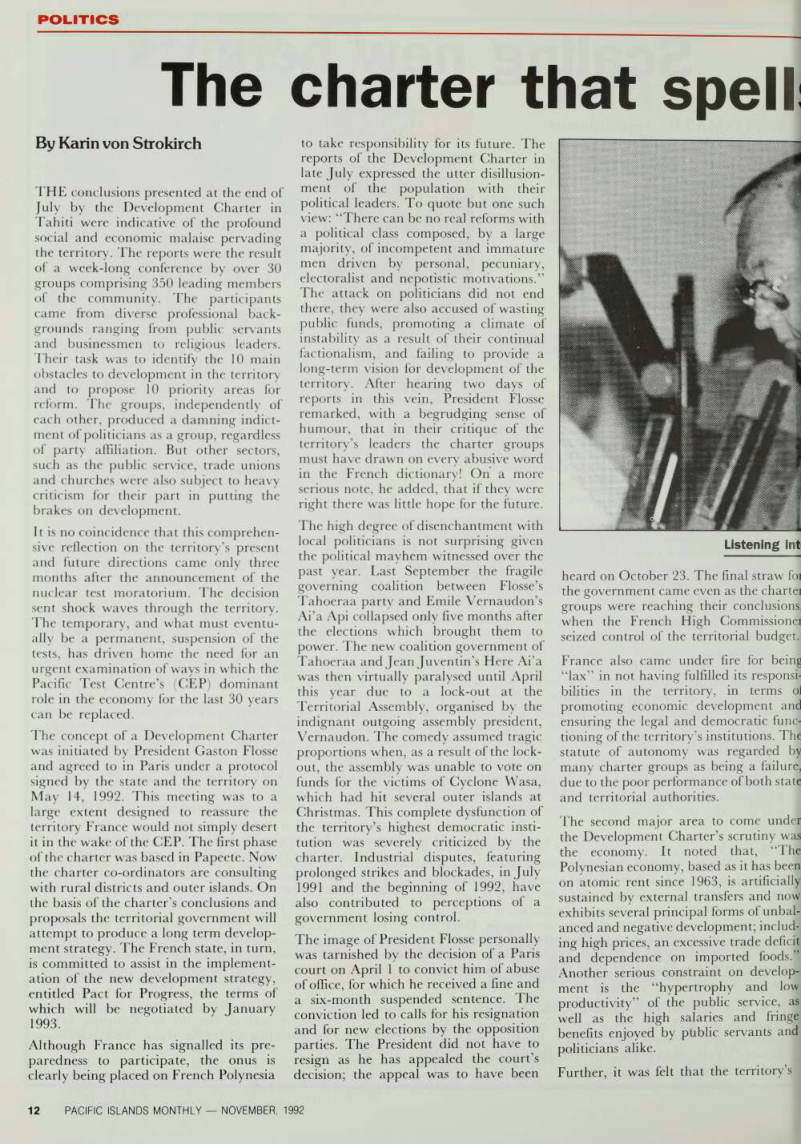
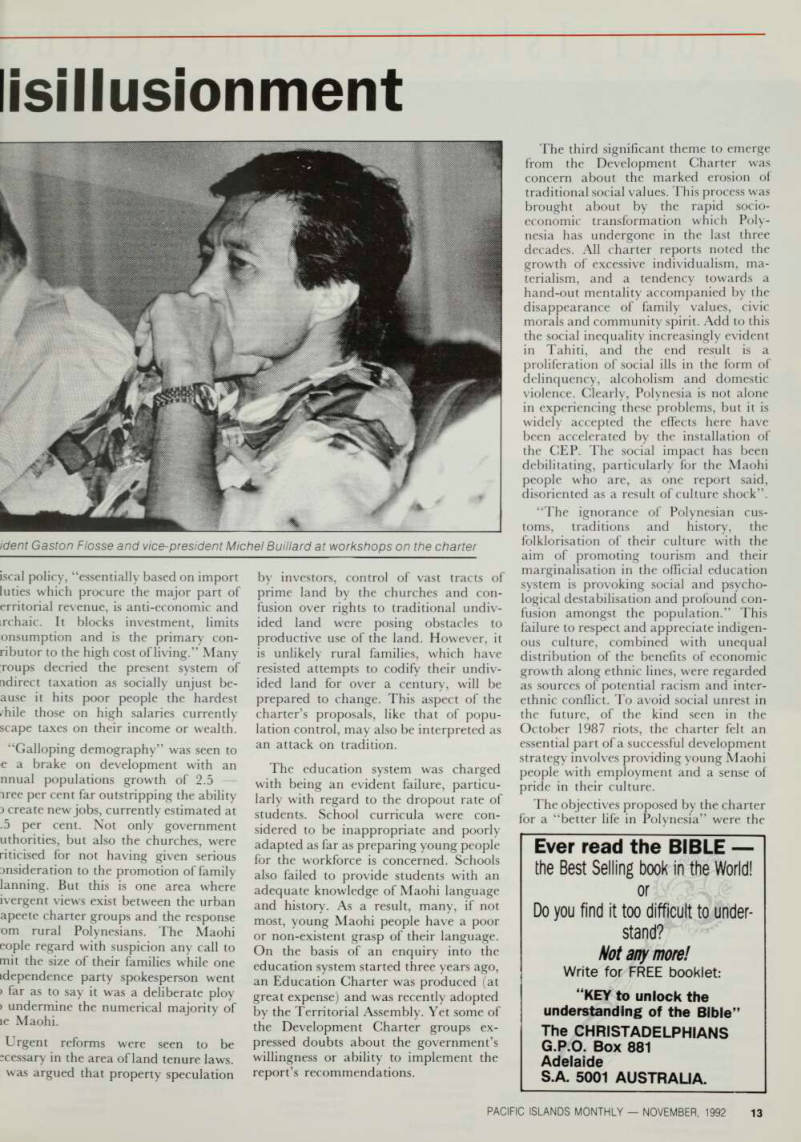
Listening in[?]
iscal policy, “essentially based on import luties which procure the major part of erritorial revenue, is anti-economic and trchaic. It blocks investment, limits onsumption and is the primary con ributor to the high cost of living.” Many roups decried the present system of ndirect taxation as socially unjust be ause it hits poor people the hardest /hile those on high salaries currently scape taxes on their income or wealth.
“Galloping demography” was seen to e a brake on development with an nnual populations growth of 2.5 iree per cent far outstripping the ability create new jobs, currently estimated at .5 per cent. Not only government uthorities, but also the churches, were riticised for not having given serious Dnsideration to the promotion of family lanning. But this is one area where ivergent views exist between the urban apeete charter groups and the response om rural Polynesians. The Maohi eople regard with suspicion any call to mit the size of their families while one
(dependence party spokesperson went
> far as to say it was a deliberate ploy > undermine the numerical majority of le Maohi.
Urgent reforms were seen to be in the area of land tenure laws. was argued that property speculation
by investors, control of vast tracts of prime land by the churches and con fusion over rights to traditional undiv ided land were posing obstacles to productive use of the land. However, it is unlikely rural families, which have resisted attempts to codify their undiv ided land for over a century, will be prepared to change. This aspect of the charter’s proposals, like that of popu lation control, may also be interpreted as an attack on tradition.
The education system was charged with being an evident failure, particu larly with regard to the dropout rate of students. School curricula were con sidered to be inappropriate and poorly adapted as far as preparing young people for the workforce is concerned. Schools also failed to provide students with an adequate knowledge of Maohi language and history. As a result, many, if not most, young Maohi people have a poor or non-existent grasp of their language.
On the basis of an enquiry into the education system started three years ago, an Education Charter was produced (at great expense) and was recently adopted by the Territorial Assembly. Yet some of the Development Charter groups ex pressed doubts about the government’s willingness or ability to implement the report’s recommendations.
The third significant theme to emerge from the Development Charter was concern about the marked erosion of traditional social values. This process was brought about by the rapid socio economic transformation which Poly nesia has undergone in the last three decades. All charter reports noted the growth of excessive individualism, ma terialism, and a tendency towards a hand-out mentality accompanied by the disappearance of family values, civic morals and community spirit. Add to this the social inequality increasingly evident in Tahiti, and the end result is a proliferation of social ills in the form of delinquency, alcoholism and domestic violence. Clearly, Polynesia is not alone in experiencing these problems, but it is widely accepted the effects here have been accelerated by the installation of the CEP. The social impact has been debilitating, particularly for the Maohi people who are, as one report said, disoriented as a result of culture shock”.
“The ignorance of Polynesian cus toms, traditions and history, the folklorisation of their culture with the aim of promoting tourism and their marginalisation in the official education system is provoking social and psycho logical destabilisation and profound con fusion amongst the population.” This failure to respect and appreciate indigen ous culture, combined with unequal distribution of the benefits of economic growth along ethnic lines, were regarded as sources of potential racism and inter ethnic conflict. To avoid social unrest in the future, of the kind seen in the October 1987 riots, the charter felt an essential part of a successful development strategy involves providing young Maohi people with employment and a sense of pride in their culture.
The objectives proposed by the charter for a “better life in Polynesia” were the
[?]dent Gaston Flosse and vice-president Michel Buillard at workshops on the charter
inverse of the problems they identified.
They emphasized the compelling need to reduce economic dependence on France and particularly the nuclear test pro gram.
The Development Charter has been rigorous in diagnosing French Poly nesia’s ills and has provided vision for the future. Yet, as President Flosse pointed out, it is one thing to make criticisms and recommendations and another to realise them.
Intransigence on the part of politicians and public servants, based on a desire to protect their existing privileges, poses a major obstacle to numerous recommen
dations. For example, it will be an up-hill battle to reduce the size and cost of the territorial bureaucracy, as this sector has a lot of political clout, and a strong trade union. The govern ment tried to begin this process in August by freez ing the salaries of the public service but the re sponse has been one of outrage and outright re fusal by the public service trade union, which has moreover attacked the charter as being a “mas querade”. Similarly, there would be resistance to the idea mooted by the charter of prohibiting accumu lation of political offices.
The extent to which offices can be accumulated was illustrated last year whereby Emile Vernaudon simultaneously acted as
municipal mayor, deputy to the French National Assembly and President of the Territorial Assembly.
A dilemma, which the Development Charter has far from resolved, is determining what kind of development and for whom. A prominent example of differing perceptions is in tourism. The government, private sector and foreign investors are keen to promote large hotel projects with a view to injecting much needed capital and providing employ ment.
Many Polynesians are not convinced of the employment benefits of such projects, arguing that the majority of jobs for them will be in the form of cleaners and gardeners. One result of this conflict ing perception of development is that several major hotel projects have had to be abandoned in recent years in the face of popular opposition. The most notable cases being the construction of a 2000-room hotel on the island of Tupai in the Australs which was opposed by traditional landowners, and the pro
posed golf-course-hotel condominium at
Opunohu on Moorea, which was de feated in a local referendum last year.
Now a new controversy has emerged over the Meridien Hotel project in Punaauia, Tahiti. For nearly two months local residents have been camped at the hotel site, preventing construction, in defiance of heavy fines and a court order for them to move. Their position is that there have been irregularities in the granting of construction permits and a failure to consult with the population or to under take an environmental impact study.
Yet, fundamentally, the protestors would be opposed to the project regardless of
the processes which led to it because the hotel is to be built on a public park and access to the beach which they want to maintain. The logic of building new hotels has also been questioned given the present inability to fill existing ones in Tahiti, and the number of hotels which have recently been shut down as a result.
A similar deadlock exists over the phosphate mine planned for the island of Mataiva. Locals are all too aware of the environmental damage caused by a previous phosphate mine on the island of Makatea, not to mention the experience of Nauru. It is partly due to the failure of the above projects to proceed, that President Flosse saw the need for a comprehensive debate to determine what people actually want and how their aspirations can be realised.
The wildcard factor in French Poly nesia’s development is the role to be played by France. On the one hand the nuclear tests have constituted an import ant form of revenue for the territory, on the other, they are widely recognised as
blocking incentives for productive econ omic activity. In order to make realistic plans for the future, territorial authorities need to know whether the test mora torium will continue. Moreover, French Polynesia has no guarantees as to whether the present high level of civil aid from France will be maintained if the CEP shuts down.
The French Socialist government has indicated its commitment to the Devel opment Charter in the form of its contribution to this plan, but the size and quality of its contribution to this plan, which would be crucial to its success, is as yet unknown. The plan has been
linked to the Matignon Ac cords in New Caledonia, with a major difference be ing that, at this stage, no referendum on indepen dence is envisaged at the end of it. Finally, all the agree ments with Paris, including the Pact which will be signed in January 1993, may be renegotiated from scratch if Jacques Chirac’s RPR wins the national legislative elec tions in March 1993.
Local reactions to the De velopment Charter have been mixed. Cynics argue that the charter is just one in a parade of public debates, conferences and round tables on development in recent years, all of which were soon forgotten. This reference to past forums is inaccurate but optimistic observers believe the charter has presented
possibly the most systematic
and honest assessment of the territory’s political and socio-economic life seen to date. The importance placed on the charter was evident in the fact that no high-ranking members of government attended the recent regional meeting in Noumea for French diplomats and terri torial heads of government; they chose to stay in Tahiti and hear the conclusions of the charter.
One commentator said President Flosse had exhibited a poor sense of timing in holding the debate now as opposed to just after the elections last year when he could have laid the blame for the charter’s bleak prognosis on the outgoing government. Instead, the pres ent leadership should be commended for having the courage to initiate such a reflection, at its own peril in political terms, in order to define a sound strategy for Polynesia’s future. Now the question remains, does the political will exist, in both Paris and Papeete, to implement the charter’s recommendations?
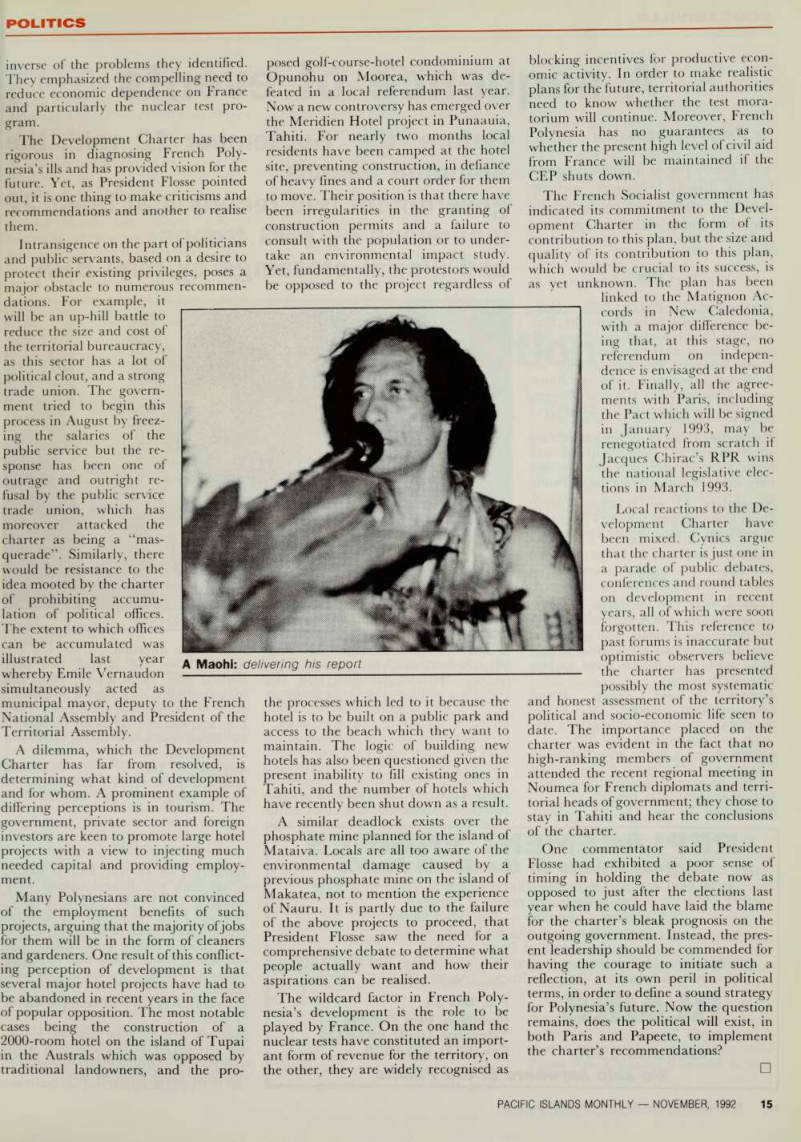
A Maohi: delivering his report
Advertisements & other items, pp. 13-15 (2 items)
Ever read the BIBLE
the Best Selling book in the World! or Do you find it too difficult to under-
stand?
Not any more!
Write for FREE booklet: “KEY to unlock the understanding of the Bible”
The CHRISTAOELPHIANS
G.P.O. Box 881 Adelaide
S.A. 5001 AUSTRALIA.
Your Island Connections
m
Cable and Wireless began keep-
ing people in touch around the
world more than a century ago. Today,
while the technology has changed,
the tradition of service to our customers in the
South Pacific is just the same.
We work in partnership with Governments,
dedicated to meeting the need of communities and businesses to stay in touch. From one island to the next or to the other side of the world, the message is the same: Cable and Wireless is
your South Pacific
connection bringing the
islands together.
CABLE & WIRELESS
Asia Pacific Head Office Cable and Wireless pic Cable and Wireless (Pacific) Limited 22nd Floor Office Tower Convention Plaza 1 Harbour Road Hong Kong Tel: (852) 848 8620 Facsimile: (852) 868 5195 Australia Cable and Wireless (Australia) Pty Ltd PO Box 675, Double Bay NSW 2028 Sydney Australia Tel/Fax (61-2) 362 3625 Fiji In association with the Government of Fiji Fiji International Telecommunications Ltd.
PO. Box 59 Mercury House 158 Victoria Parade Suva Fiji Tel: (679) 312933 Solomon Islands In association with the Government of the Solomon Islands Solomon Telekom Company Limited PO. Box 148 Honiara Solomon Islands Tel: (677) 21576 Tonga Cable and Wireless pic Private Mail Bag 4 General Post Office Nuku Alofa Tonga South Pacific Tel: (676) 23499 Vanuatu In association with the Government of Vanuatu < France Cables et Radio Vanuatu International Telecommunications Ltd.
PO, Box 164 Port Vila Vanuatu Tel: 1678) 22185
Politics
A sequence of events
Bougainville
By Wally Hiambohn
Before the September 12 raid, the Solomon Islands government had recorded at least 22 incursions by PNG troops and illegal crossings by thhe BRA
The following is a chronological list of illegal crossings and re lated incidences as recorded by the Solomon Islands govern ment. 1989 November 1- PNG’s Police Com missioner, Paul Tohian (Controller, Bou gainville Crisis) warned that “any Sol omon Islands citizens who cross into North Solomons Province of PNG are liable for prosecution under the Emer gency (Bougainville) (General Powers) Act 1989 for breach of the Emergency Order”.
November 11 Three Bougainvilleans all of Orava Golo, Manasah and Kanaka violated the border ban and were seen at a Samanago Village, Fauro.
November 17 Solomon Islands Police Commissioner informs PNG police of violation of their border cross ban 1990 June On two occasions Solomon Islands security forces encountered five and three speed boats with dozens of armed BRA rascals a few miles from a PNG patrol boat which failed to give chase in its waters.
August 5 Seven armed Bougainvilleans landed at, Baola, Shortlands at 3.00 am threatening vil lagers and forcefully bought fuel.
August 6 A canoe with Shortland villagers was approached in the sea and robbed by several gunmen. Sea shells and other items were stolen.
November 23 Thomas Kanave,
Leveuas Magasu Mangu, Joe Prel,
Timothy Ama were charged with illegal
crossing. They were discharged but bound not to commit any further offence within three months. 1991 April 11 PNGDF Nomad aircraft flew over Balalae and later took off in
Bougainville direction.
April 13 The aircraft flew over medical ship Tulagi several times and frightened crew then landed at Balalae.
July Bougainvilleans named Glen John and Simon Tourika are questioned for illegal possession of .22 rifle and ammunitions.
August 1-6 Wounded Bougainvilleans arrived and treated at Central Hospital for gun wounds. 1992 January 1 Modesto Buin of Koliae village with two Bougainvilleans were captured. His 15 HP Yamaha Engine, tank and tools, one paddle and 20 litres of petrol were seized by PNG patrol boat 03 at Maohu Island. Buin escaped and was now at home. Patrol boat remained within SI territory (Tuluve Island) until January 4.
January 13-14 patrol boat still within SI waters.
January 2 Solomon Islander, Uaba, was arrested by PNG patrol boat while transporting 49 drums of fuel to Bougain ville after being hired by two
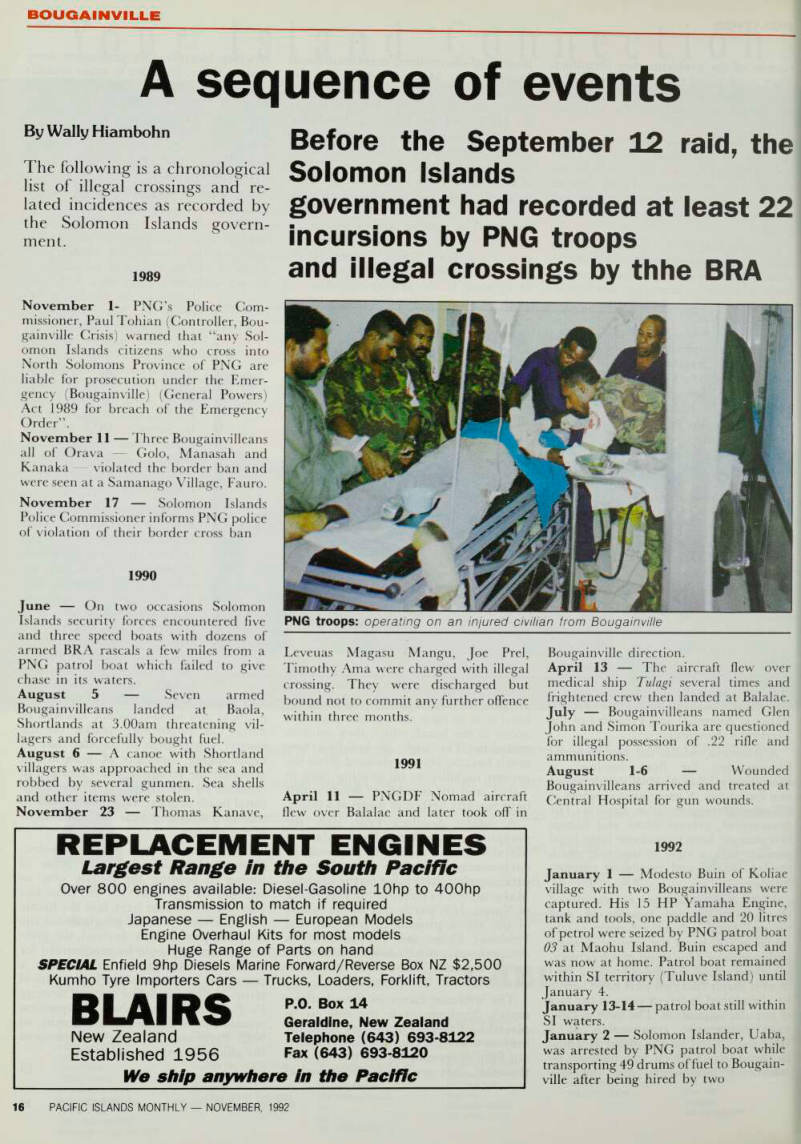
PNG troops: operating on an injured civilian from Bougainville
Bougainvillean businessmen. He was punched in the face four times and beaten twice with rifle butt.
January 16 PNG patrol boat 02 seen off Komailae.
February 2 PNG patrol boat called at Komalie village to enable Uaba to say goodbye to his family before being taken for trial in Rabaul.
March 12 At B.oopm outboard engines sounds were heard. 9.00 pm engine sounds stopped. Moments later a flare was fired over Bomana petrol depot.
Shots were then fired towards the petrol depot. After that one dingy and two ray boats with nine persons on board were
seen leaving. Investigation revealed 1200-litre drum of petrol (full) and one empty container were damaged. Bullet shots found on a coconut trunk suggested an M-16 rifle was used.
March 18 Eight men from Gaomae arrested by PNG Defence and taken to Tuaroto camp for questioning. Defence personnel pointed guns at them during questioning. The men were fishing on Tuluve Island on SI side.
Nfarch 21 While Lata was at Kariki with DCP Sireheti on board, PNG Defence chased three canoes from Bou gainville who escaped to Kariki. PNG speed crafts turned back when they
spotted the presence of Lata.
Bougainvilleans were handed over to Police Korovou.
April 2 PNG Defence entered Solomon Islands by motorised boat and landed at Kava Kava Bay, south west of Fauro and travelled on foot to Kariki village. They claimed they were search ing for BRA crossers. All were heavily armed and threatened villagers. After they failed to find any BRA members they travelled to Samanago village still on Fauro, again terrorising villagers.
April 8 Police Korovou confirmed PNG Defence ray boat called at Samanago village on April 4.
Advertisements & other items, p. 16 (1 item)
Blairs
REPLACEMENT ENGINES
Largest Range in the South Pacific
Over 800 engines available: Diesel-Gasoline lOhp to 400 hp Transmission to match if required Japanese English European Models Engine Overhaul Kits for most models Huge Range of Parts on hand SPECIAL Enfield 9hp Diesels Marine Forward/Reverse Box NZ $2,500 Kumho Tyre Importers Cars Trucks, Loaders, Forklift, Tractors
BLAIRS
New Zealand Established 1956 P.O. Box 14 Geraldine, New Zealand Telephone (643) 693-8122 Fax (643) 693-8120 We ship anywhere In the Pacific
Towards resolution
By Evelyn Hogan
The “Bougainville Crisis Towards Resolution” conference in Canberra on September 29 brought together Bougainvilleans both pro- and anti secessionist who shared an intense experience of suffering.
Joseph Egilio, member of parliament for Central Bougainville, said the saddest thing about the conflict was the disunity among the people. He said, “First we were against the company, then the PNG government, then we were at each other’s throats: clan against clan, families against families, brothers against brothers”.
It was the third Bougainville confer ence organised by the Department of Political and Social Change in the Research School of Pacific Studies of the Australian National University.
UPNG’s Professor of Political Studies, Yaw Saffu, started with an academic analysis of events. Egilio read a statement by Minister for State for Matters Relat ing to Bougainville, Michael Ogio, which set out the objectives of the Wingti government. These are to restore law and order, legal authority and rehabilitate the young people; accelerate delivery of goods and services through the interim authorities; revive the functioning of the churches, NGOs and youth organis ations; and create incentives to resurrect commercial life and infrastructure.
When this in place they would begin negotiations for a lasting political sol ution.
Moses Havini and Mike Forster rep resented the secessionists, and Egilio, Nic Peniai and Leo Hannett those who now wish to remain within Papua New Guinea. Ruth Saovana-Springs gave an insight in the role of chiefs, the particular burdens imposed on women and vividly
described the psychological impact of the
conflict on children.
Macquarie University expert in Con flict Resolution, Dr Greg Tillett, sug gested several possible courses of action.
In response to the PNG government’s request to Solomon Islands to remove the Bougainville Revolutionary Army office in Honiara, Mike Forster asked, if the humanitarian office was a negative thing? It is through Martin Miriori in Honiara that negotiations have already taken place, he said.
There was a lack of participation by
non-Bougainvillean Papua New Guin
eans. Foreign Minister, John Kaputin, who is very understanding of the complexities of the situation, had been invited but was unable to attend. Several PNG students and Canberra-based Pa pua New Guineans attended, but no non-Bougainvilleans and few academics asked questions from the floor.
Egilio, who had previously been with the secessionist interim government in Arawa, said they had found the BRA unco-operative. He withdrew and con centrated on working with the Wakunai council of chiefs. He complained the Kietas denied the Wakunai people the right to export cocoa through their port.
So he went to Buka and asked for ships to be brought to Numa Numa. His conversion came when the PNG govern ment showed its sincerity in lifting the blockade and greater organising capacity by sending a ship three days later.
Leo Hannett, former Premier of North Solomons Province, lamented that more than 40 well-educated Bougainvilleans had been killed during the crisis leaving few new leaders to take initiat ives. But there is a new generation of leaders arising throughout Papua New Guinea. They are closer to their tra ditional elders and more practically oriented, with a broader range of professional and technical training, than the first generation of university gradu
ates.
Nic Peniai, engineering graduate and Chairman of the South Boungainville Interim Authority, is one such man. He reported that when Minister Ogio visited the South Bougainville area in late September he could not believe how much had been achieved by the Interim Authority in just two months, and not only in the revival of health services and schools. There had also been a political reconciliation process involving the chiefs, the former BRA (who are now resistance workers), the PNG Defence Force and the Interim Authority.
Peneeiai is a complex man of gentle toughness. With fingertips callused play ing guitar, the grinding of back teeth belies an underlying tension. Trim and healthy after four years of blockade imposed subsistence, he is lucky to be alive. In March he was one of seven taken prisoner with Anthony Anugu, former MP for South Bougainville, to the BRA camp at Panguna. After Anugu and two others were tortured and killed, Peniai cheated death and escaped with the other four captives.
He returned to South Bougainville to help lay the foundation for reconciliation and restoration. Because of BRA attacks on their leaders, Buin and Siwai chiefs had already invited the PNG Defence Force in to secure the area.
Peniai said, “I have lost two brothers and a mother through the activities of the BRA. Any more delay will be another death.”
All participants expressed the need for peace and continuing dialogue among all parties to the dispute. Over time, a process of reconciliation including other Papua New Guineans is needed as well.
Advertisements & other items, p. 18 (1 item)
Cover Stories
Ed Rampell
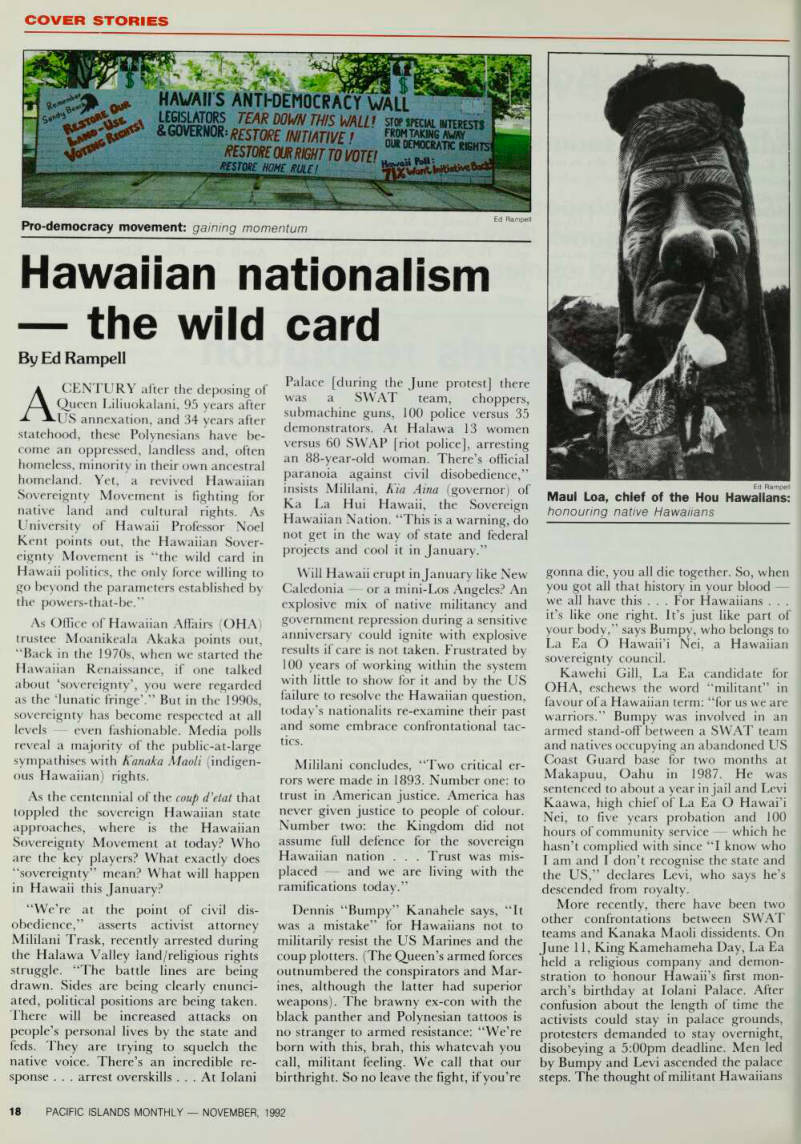
Pro-democracy movement: gaining momentum
Hawaiian nationalism
the wild card
By Ed Rampell
A CENTURY after the deposing of Queen Liliuokalani, 95 years after US annexation, and 34 years after statehood, these Polynesians have be come an oppressed, landless and, often homeless, minority in their own ancestral homeland. Yet, a revived Hawaiian Sovereignty Movement is fighting for native land and cultural rights. As University of Hawaii Professor Noel Kent points out, the Hawaiian Sover eignty Movement is “the wild card in Hawaii politics, the only force willing to go beyond the parameters established by the powers-that-be.”
As Office of Hawaiian Affairs (OHA) trustee Moanikeala Akaka points out, “Back in the 19705, when we started the Hawaiian Renaissance, if one talked about ‘sovereignty’, you were regarded as the ‘lunatic fringe’.” But in the 19905, sovereignty has become respected at all levels even fashionable. Media polls reveal a majority of the public-at-large sympathises with Kanaka Maoli (indigen ous Hawaiian) rights.
As the centennial of the coup d’etat that toppled the sovereign Hawaiian state approaches, where is the Hawaiian Sovereignty Movement at today? Who are the key players? What exactly does “sovereignty” mean? What will happen in Hawaii this January?
“We’re at the point of civil dis obedience,” asserts activist attorney Mililani Trask, recently arrested during the Halawa Valley land/religious rights struggle. “The battle lines are being drawn. Sides are being clearly enunci ated, political positions are being taken.
There will be increased attacks on people’s personal lives by the state and feds. They are trying to squelch the native voice. There’s an incredible re sponse . . . arrest overskills ... At lolani
Palace [during the June protest] there was a SWAT team, choppers, submachine guns, 100 police versus 35 demonstrators. At Halawa 13 women versus 60 SWAP [riot police], arresting an 88-year-old woman. There’s official paranoia against civil disobedience,” insists Mililani, Kia Aina (governor) of Ka La Hui Hawaii, the Sovereign Hawaiian Nation. “This is a warning, do not get in the way of state and federal projects and cool it in January.”
Will Hawaii erupt in January like New Caledonia or a mini-Los Angeles? An explosive mix of native militancy and government repression during a sensitive anniversary could ignite with explosive results if care is not taken. Frustrated by 100 years of working within the system with little to show for it and by the US failure to resolve the Hawaiian question, today’s nationalits re-examine their past and some embrace confrontational tac tics.
Mililani concludes, “Two critical er rors were made in 1893. Number one: to trust in American justice. America has never given justice to people of colour.
Number two: the Kingdom did not assume full defence for the sovereign Hawaiian nation . . . Trust was mis placed and we are living with the ramifications today.”
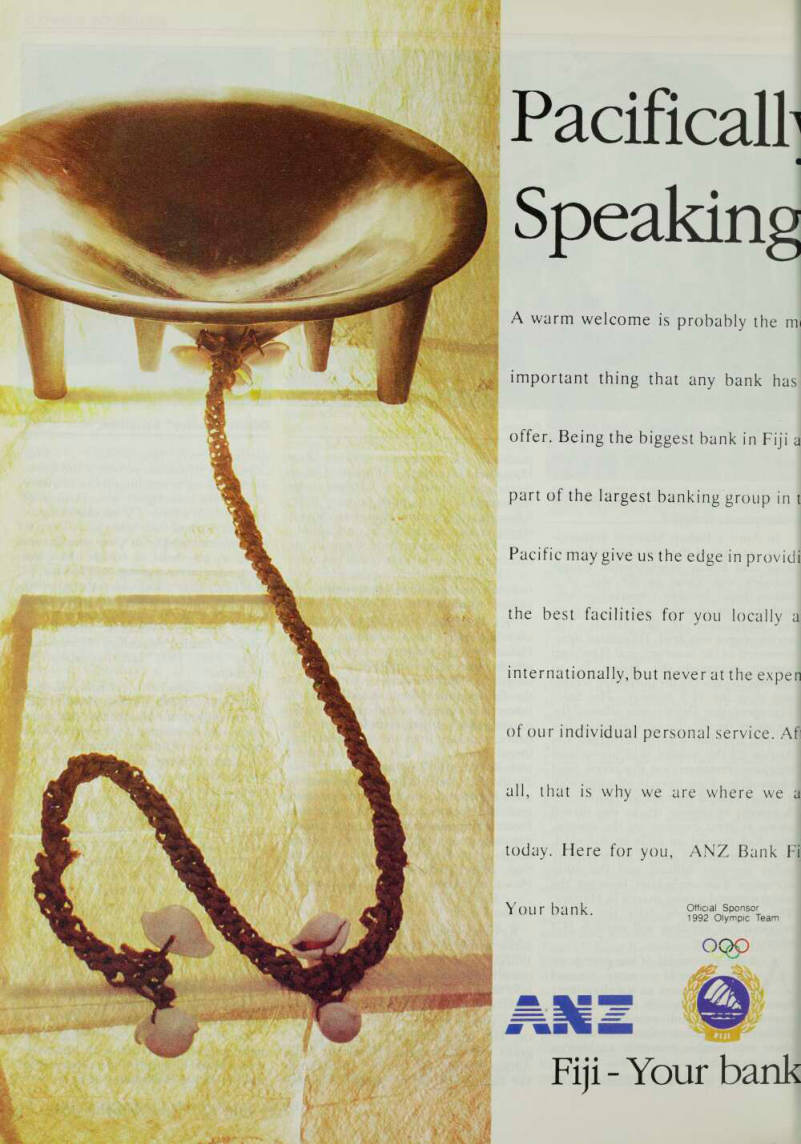
Dennis “Bumpy” Kanahele says, “It was a mistake” for Hawaiians not to militarily resist the US Marines and the coup plotters. (The Queen’s armed forces outnumbered the conspirators and Mar ines, although the latter had superior weapons). The brawny ex-con with the black panther and Polynesian tattoos is no stranger to armed resistance: “We’re born with this, brah, this whatevah you call, militant feeling. We call that our birthright. So no leave the fight, if you’re
gonna die, you all die together. So, when you got all that history in your blood we all have this ... For Hawaiians . . . it’s like one right. It’s just like part of your body,” says Bumpy, who belongs to La Ea O Hawaii’! Nei, a Hawaiian
sovereignty council.
Kawehi Gill, La Ea candidate for OHA, eschews the word “militant” in favour of a Hawaiian term: “for us we are warriors.” Bumpy was involved in an armed stand-off between a SWAT team and natives occupying an abandoned US Coast Guard base for two months at Makapuu, Oahu in 1987. He was sentenced to about a year in jail and Levi Kaawa, high chief of La Ea O Hawai’i Nei, to five years probation and 100 hours of community service which he hasn’t complied with since “I know who I am and I don’t recognise the state and the US,” declares Levi, who says he’s descended from royalty.
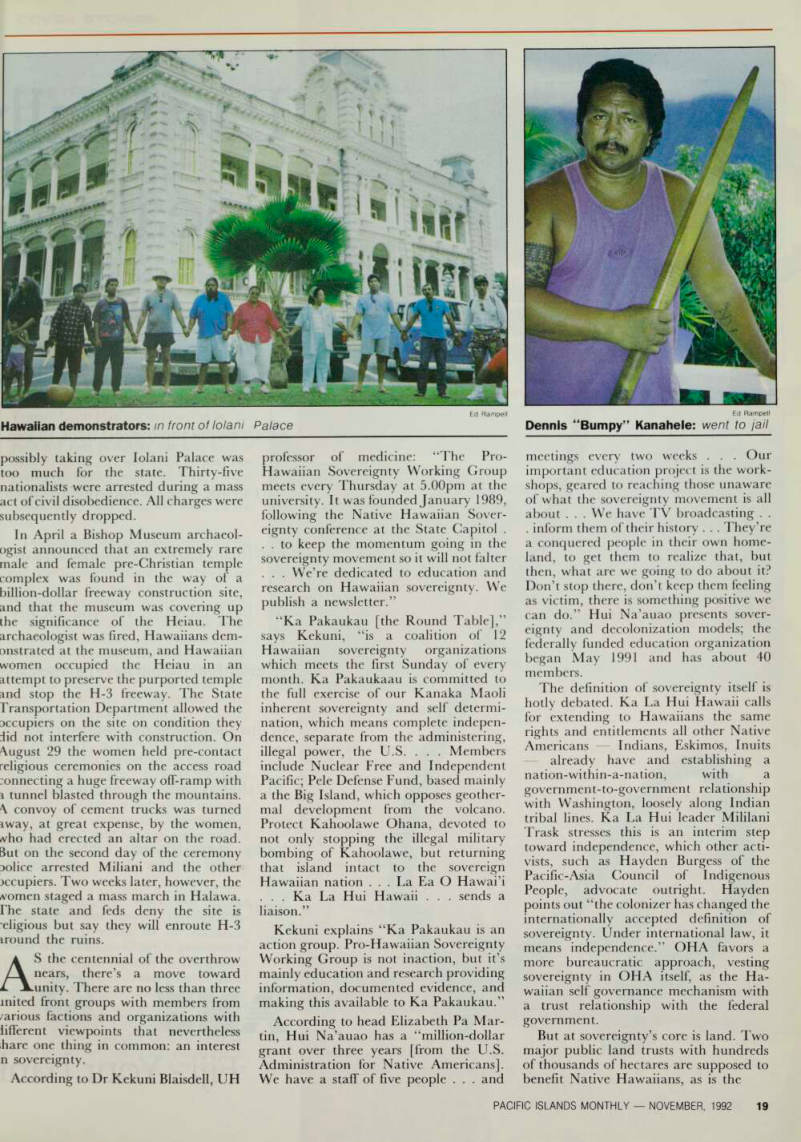
More recently, there have been two other confrontations between SWAT teams and Kanaka Maoli dissidents. On June 11, King Kamehameha Day, La Ea held a religious company and demon stration to honour Hawaii’s first mon arch’s birthday at lolani Palace. After confusion about the length of time the activists could stay in palace grounds, protesters demanded to stay overnight, disobeying a s:oopm deadline. Men led by Bumpy and Levi ascended the palace steps. The thought of militant Hawaiians
Ed Rampell Maui Loa, chief of the Hou Hawaiians: honouring native Hawaiians
possibly taking over lolani Palace was too much for the state. Thirty-five nationalists were arrested during a mass act of civil disobedience. All charges were
subsequently dropped.
In April a Bishop Museum archaeologist announced that an extremely rare male and female pre-Christian temple complex was found in the way of a billion-dollar freeway construction site, and that the museum was covering up the significance of the Heiau. The archaeologist was fired, Hawaiians demonstrated at the museum, and Hawaiian women occupied the Heiau in an attempt to preserve the purported temple and stop the H-3 freeway. The State Transportation Department allowed the accupiers on the site on condition they did not interfere with construction. On August 29 the women held pre-contact religious ceremonies on the access road :onnecting a huge freeway off-ramp with i tunnel blasted through the mountains. \ convoy of cement trucks was turned iway, at great expense, by the women, .vho had erected an altar on the road.
But on the second day of the ceremony Dolice arrested Miliani and the other occupiers. Two weeks later, however, the ,vomen staged a mass march in Halawa.
The state and feds deny the site is eligious but say they will enroute H-3 iround the rums.
AS the centennial of the overthrow nears, there’s a move toward unity. There are no less than three mited front groups with members from various factions and organizations with iifferent viewpoints that nevertheless hare one thing m common: an interest n sovereignty.
According to Dr Kekuni Blaisdell, UH
professor of medicine; “The Pro- Hawaiian Sovereignty Working Group meets every Thursday at 5.00 pm at the university. It was founded January 1989, following the Native Hawaiian Sover eignt y, conference at the State Capitol • to kee P the momentum going in the sovereignty movement so it will not falter • • • W , e re dedicated to education and research on Hawaiian sovereignty. We publish a newsletter, “Ka Pakaukau [the Round Table],” says Kekuni, “is a coalition of 12 Hawaiian sovereignty organizations which meets the first Sunday of every month. Ka Pakaukaau is committed to the full exercise of our Kanaka Maoli inherent sovereignty and self determi nation, which means complete indepen dence, separate from the administering, illegal power, the U.S. . . . Members include Nuclear Free and Independent Pacific; Pele Defense Fund, based mainly a the Big Island, which opposes geother mal development from the volcano, Protect Kahoolawe Ghana, devoted to not only stopping the illegal military bombing of Kahoolawe, but returning that island intact to the sovereign Hawaiian nation ... La Fa O Hawai’i . . . Ka La Hui Hawaii . . . sends a liaison.”
Kekuni explains “Ka Pakaukau is an action group. Pro-Hawaiian Sovereignty Working Group is not inaction, but it’s mainly education and research providing information, documented evidence, and making this available to Ka Pakaukau.”
According to head Elizabeth Pa Mar pn> j [ u j Na’auao has a “million-dollar grant over three years [from the U.S.
Administration for Native Americans].
We have a staff of five people . . . and
meetings every two weeks . . . Our important education project is the work shops, geared to reaching those unaware of what the sovereignty movement is all about . . . We have TV broadcasting . . . inform them of their history . . . They’re a conquered people in their own home land, to get them to realize that, but then, what are we going to do about it?
Don’t stop there, don’t keep them feeling as victim, there is something positive we can do.” Hui Na’auao presents sover eignty and decolonization models; the federally funded education organization began May 1991 and has about 40 members.
The definition of sovereignty itself is hotly debated. Ka La Hui Hawaii calls for extending to Hawaiians the same rights and entitlements all other Native Americans Indians, Eskimos, Inuits already have and establishing a nation-within-a-nation, with a government-to-government relationship with Washington, loosely along Indian tribal lines. Ka La Hui leader Mililani Trask stresses this is an interim step toward independence, which other acti vists, such as Hayden Burgess of the Pacific-Asia Council of Indigenous People, advocate outright. Hayden points out “the colonizer has changed the internationally accepted definition of sovereignty. Under international law, it means independence.” OHA favors a more bureaucratic approach, vesting sovereignty in OHA itself, as the Ha waiian self governance mechanism with a trust relationship with the federal government.
But at sovereignty’s core is land. Two major public land trusts with hundreds of thousands of hectares are supposed to benefit Native Hawaiians, as is the
Hawaiian demonstrators: in front of lolani Palace
Ed Rampell
Ed Rampell Dennis “Bumpy” Kanahele: went to jail
Bishop estate, Hawaii’s largest private landowner (8 per cent of land). All sovereignty models seek, in varying degrees, control of ceded and homeland lands and revenues derived from them.
More radical nationalists seek the entire chain (from Midway to Johnston Atoll) breaking up the land monopoly of private estates, closing large military bases like Pearl Harbor, and redistribut ing the land to Hawaiians.
Despite greater unification, there’s still a split in the sovereignty movement between grass roots natives and official Hawaiians. Generally, the chasm is between autonomous groups, such as Ka La Hui and La Ea, who are to the left of US and state government funded and affiliated entities, such as OHA and Governor John Waihee.
OHA is seriously factionalized.
Trustee Louis Hao publicly writes of “the turmoil of poor trustee relationships, bad publicity and probably the low level of trust in OHA . . . history. The past two years presented dismal situations . . . this cycle of self destruction.” OHA Trustee Akaka says, “OHA is too close to the state.”
Divisiveness is also exacerbated by the blood quantum dispute, with two differ ent legal classifications for Hawaiians with more or less than 50 per cent Hawaiian ancestry.
Activists seek to bring their case to the international arena. Dr Blaisdell pro claims Pro-Hawaiian Sovereignty Work ing Group’s tribunal will “kick off October 23-25, 1992, we draft and publicly announce the indictment of the US for its crimes against the Kanaka Maoli nation, this will serve notice on the US which will be invited to defend itself at the tribunal proper to be conducted August 12-21, 1993.” Kekuni interfaces with the International Indian Treaty Council (Indians are indicting Columbus for genocide during the quicentennial this October) and seeking distinguished leaders from the Pacific to participate as judges (Cuba may be asked to partici pate).
Nationalists also reach out to the United Nations. Lawyer Hayden Bur gess, of the Instittute for the Advance ment of Hawaiian Affairs is president of the Paciflc-Asia Council of Indigenous People, a non-governmental organization (NGO) affiliated with the World Council of Indigenous People and linked to the UN. Like La Ea, Burgess who presents Hawaii’s case at interna tional bodies in Geneva and elsewhere asserts Article 73 of the UN Charter
guarantees Hawaiians self determi nation. The lawyer insists Hawaii’s 1959 “plebiscite” was not a legitimate act of self determination because the vote gave Hawaiians a choice between statehood or remaining a territory, but not for independence.
Mililani and Laa Ea want Hawaii reinscribed on the UN Decolonization Committee’s list of non-self governing territories, like New Caledonia was.
They hope Pacific members of the UN will assist them in their self determination drive in the international arena, as they did the Kanaks.
What will happen in January during the observance of the centennial of the overthrow is anybody’s guess. Will na tionalists try taking over lolani Palace
and reinstating themselves on the throne?
Will the state and feds try co-opting the movement in order to prevent violence?
Will Washington announce a perma nent end to the bombing of Kahoolawe and even return it to the Hawaiians? Will the SI 12 million-plus so-called “historic ceded lands settlement” money, the state, OHA, and Governor agreed to, finally be disbursed? Will the US Con gress ratify Senator Dan Akaka’s resol ution that America apologize for the invasion? Will there be reparations?
There will be official observances.
Activist marches, demonstrations, and vigils will take place. Nationalists Haunani-Kay Trask and Puhipau are making a documentary Act of War.
Singer Marlene Sai stars as Liliuokalani in the docu-drama Betrayal. The play Liliuokalani has been staged. Mass spec
tacles recreating the 1893 coup are supposed to take place at the palace and environs.
It will be a hot time in the old town.
It remains to be seen if, when the next confrontation takes place, Governor Waihee, a Hawaiian, will heed the call of demonstrators to come and talk?
Buzz Agard of the Council of Ha waiian Organizations says in January, the Hawaiian nation should pick up where the Queen left off. “She prorogued the legislature now, 100 years later, it’s time to call it back into session.”
But what is really on everybody’s minds, especially those Hawaiians camp ing on the beaches, getting evicted, arrested, abused, ill, landless, unem ployed will there be the “enlightened justice” President Cleveland spoke of 100 long years ago?
Land rights demonstration: using ancient religion
Ed Rampell
Ed Rampell
Activist attorney: Mililani Trask
Advertisements & other items, p. 20 (1 item)
Pacificall
A warm welcome is probably the m important thing that any bank has offer. Being the biggest bank in Fiji a part of the largest banking group in t Pacific may give us the edge in providi the best facilities for you locally a internationally, but never at the expen of our individual personal service. Af all, that is why we are where we a today. Here for you, ANZ Bank F Your bank.
Official Sponsor 1992 Olympic Team
OQp
Fiji - Your bank
The coup against sovereignty
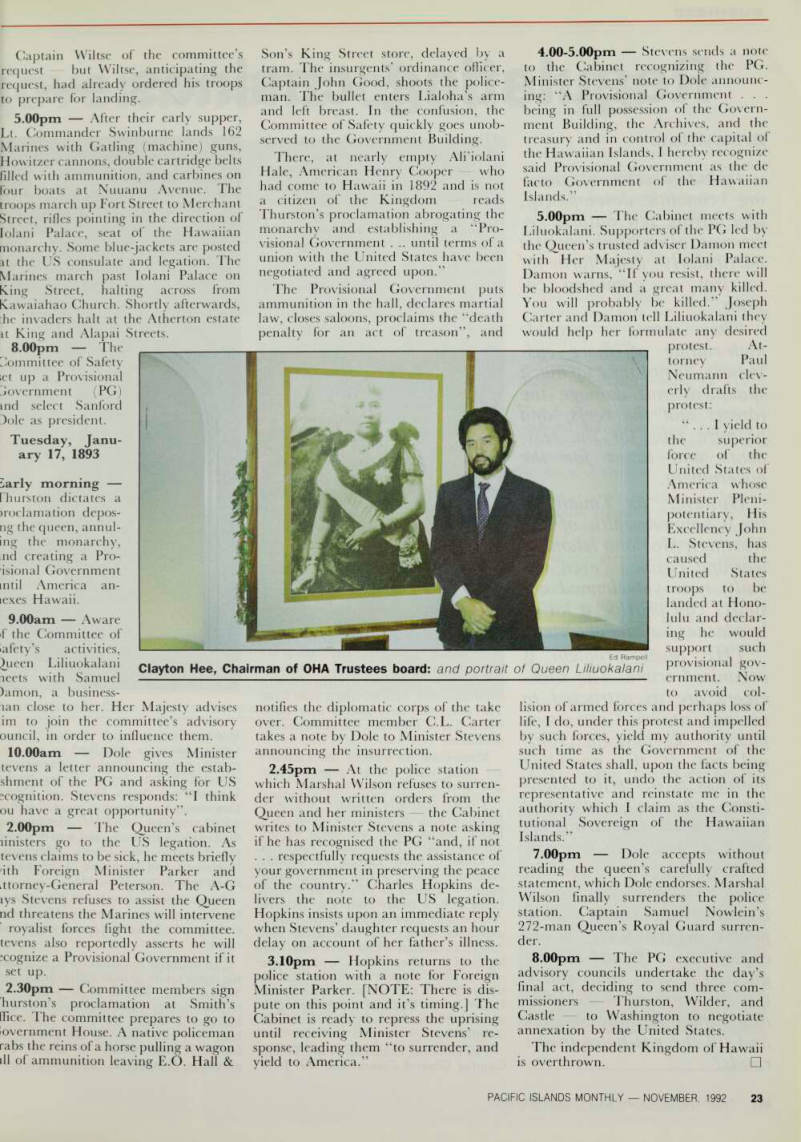
a historical perspective
By Ed Rampell
THE history of the Hawaian holocaust begins in 1778 with Cook’s voyages, his death at Kealakekua Bay, and the British reprisal. Protestant missionaries from New England arrived in 1820, filling a cultural vacuum created by the breaking of the precontact religion’s Kapu system in 1819. The missionries ended up as a merhant and landowning class.
By the 1880 s, the conflict between the ascendancy of the oligarchy of largely American missionary-descended mer chants and planters and native aspir ations - exacerbated by US economic and military interests erupts into violence. King Kalakaua tries unifying Polynesia into a confederacy of isles and further angers the Caucasian oligarchy with his nativstic revival of traditional culture, such as hula, and a “Merry Monarch” life style the puritans per ceived as debauched and profligate.
The US military demands exclusive rights in 1886 to Pearl Harbor as a condition for renewing the Reciprocity Treaty,which gave Hawaii planters
tariff-free access to US markets; the King and grass roots Hawaiians strongly oppose territorial cession. In January 1887, Lorrin Thurston, Sanford Dole and other oligarchs form a pro annexationist secret society, the Ha waiian League.
Triggered by a May 1887 opium scandal, the Hawaiian League and the para-military, all-Haole Honolulu Rifles confront King Kalakaua and impose the “Bayonet Constitution” allowing Kalakaua to reign but not rule. A new Cabinet is formed with Thurston as Interior Minister, Pearl Harbour is ceded to Washington, and the Reci procity Treaty is renewed.
But the sovereignty struggle continues.
Kalakaua insists on using his last political prerogative veto power. On July 30, 1889 Hawaiian nationalist Robert Wilcox and his “Redshirts” stage an armed revolt against the Bayonet Consti tution, which is put down; troops from the USS Adams patrol Honolulu. The following year Wilcox turns to the
electoral process his Hawaiian Politi cal Association joins forces with working class whites in the Mechanics’ and Workingmen’s Political Protective As sociation. Their National Reform Party wins half of the legislature’s seats, weakening the Bayonet Constitution’s cabinet, amidst talk of a constitutional convention. Suffering from ill health, King Kalakaua dies on January 20, 1891 at San Francisco.
His younger sister Liliuokalani accedes to the throne determined to revive royal power. The McKinley act removes the tariff on raw sugar entering America and gives a two-cent per pound bounty for domestic sugar, undermining the Reci procity Treaty, threatening to destroy Hawaii’s planter-ocracy. Thurston forms another cabal the Annexation Club.
In January 1893, the missionary descendants oppose opium and lottery bills as sugar’s depression deepens. On January 14 Queen Liliuokalani pro rogues the legislature and prepares for an incendiary act.
Her Majesty attempts promulgating a new constitution which two-thirds of the Hawaiians petitioned for that would reverse the Bayonet Constitution and reinvest political power in the monarchy and native electorate. Deeming her plan to be “revolutionary”, Thurston forms the Committee of Safety 12 of its original 13 members are Annexation Club members. The pro-annexationist, anti-indigenous tone of US President Harrison and Minister Stevens stimu lated the high treason.
How did the coup d’etat and American take-over of the of Hawaii happen?
Monday, January 16, 1893 9.00am-12.00pm: The Committee of Public Safety, mainly of businessmen with American backgrounds, meet at the Honolulu law office of Lorrin Thurston.
The co-conspirators arrange a mass meeting and sign a letter to US Minister John Stevens: . . the public safety is menaced and lives and property are in peril, and we appeal to you and the United States forces at your command for assistance . . . we pray for the protection of the United States forces” upon “a further request received from the committee.” 11.00 am: American attorney and committee member Henry Cooper goes to Honolulu Harbour to notify USS Boston
Captain Wiltse of the committee’s request but Wiltse, anticipating the request, had already ordered his troops to prepare for landing. 5.00 pm After their early supper, Lt. Commander Swinburne lands 162 Marines with Gatling (machine) guns, How itzer cannons, double cartridge belts filled with ammunition, and carbines on four boats at Nuuanu Avenue. The troops march up Fort Street to Merchant Street, rifles pointing in the direction of lolani Palace, seat of the Hawaiian monarchy. Some blue-jackets are posted at the US consulate and legation. The Marines march past lolani Palace on Kang Street, halting across from Kawaiahao Church. Shortly afterwards, :he invaders halt at the Atherton estate at King and Alapai Streets.
B.oopm The Committee of Safety ;et up a Provisional jovernment (PG) ind select Sanford 3ole as president.
Tuesday, Janu ary 17, 1893 iarly morning fhurston dictates a )roclamation depos ng the queen, annul ing the monarchy, ,nd creating a Pro isional Government intil America an icxes Hawaii. 9.00 am Aware f the Committee of •afety’s activities, )ueen Liliuokalani icets with Samuel )amon, a business
lan close to her. Her Majesty advises im to join the committee’s advisory ouncil, in order to influence them. 10.00 am Dole gives Minister tevens a letter announcing the estab shment of the PG and asking for US “cognition. Stevens responds: “I think ou have a great opportunity”. 2.00 pm The Queen’s cabinet linisters go to the US legation. As tevens claims to be sick, he meets briefly ath Foreign Minister Parker and atorney-General Peterson. The A-G lys Stevens refuses to assist the Queen nd threatens the Marines will intervene royalist forces fight the committee, tevens also reportedly asserts he will a Provisional Government if it set up. 2.30 pm Committee members sign hurston’s proclamation at Smith’s [lice. The committee prepares to go to Government House. A native policeman rabs the reins of a horse pulling a wagon ill of ammunition leaving E.O. Hall &
Son’s King Street store, delayed by a tram. The insurgents’ ordinance officer,
Captain John Good, shoots the police
man. The bullet enters Lialoha’s arm and left breast. In the confusion, the Committee of Safety quickly goes unob served to the Government Building.
There, at nearly empty Ali’iolani Hale, American Henry Cooper who had come to Hawaii in 1892 and is not a citizen of the Kingdom reads
Thurston’s proclamation abrogating the
monarchy and establishing a "Pro visional Government . .. until terms of a union wdth the United States have been
negotiated and agreed upon.”
The Provisional Government puts ammunition in the hall, declares martial law, closes saloons, proclaims the “death penalty for an act of treason”, and
notifies the diplomatic corps of the take over. Committee member C.L. Carter takes a note by Dole to Minister Stevens announcing the insurrection.
2.45 pm At the police station
which Marshal Wilson refuses to surrender without written orders from the Queen and her ministers the Cabinet writes to Minister Stevens a note asking if he has recognised the PG “and, if not • • . respectfully requests the assistance of your government in preserving the peace of the country.” Charles Hopkins delivers the note to the US legation.
Hopkins insists upon an immediate reply when Stevens’ daughter requests an hour delay on account of her father’s illness.
3.10 pm Hopkins returns to the
police station with a note for Foreign Minister Parker. [NOTE: There is dispute on this point and it’s timing.] The Cabinet is ready to repress the uprising until receiving Minister Stevens’ response, leading them “to surrender, and yield to America.”
4.00-5.00 pm Stevens sends a note to the Cabinet recognizing the PG.
Minister Stevens’ note to Dole announc ing: “A Provisional Government . . . being in full possession of the Govern ment Building, the Archives, and the treasury and in control of the capital of the Hawaiian Islands, I hereby recognize said Provisional Government as the de facto Government of the Hawaiian Islands.” 5.00 pm The Cabinet meets with Liluokalani. Supporters of the PG led by the Queen’s trusted adviser Damon meet with Her Majesty at lolani Palace.
Damon warns, “If you resist, there will be bloodshed and a great many killed.
You will probably be killed.” Joseph Carter and Damon tell Liliuokalani they would help her formulate any desired
protest. At torney Paul Neumann clev erly drafts the protest: “ . . . I yield to
the superior
force of the United States of America whose Minister Pleni
potentiary, His
Excellency John L. Stevens, has caused the United States troops to be landed at Hono lulu and declar ing he would support such
provisional gov
ernment. Now to avoid col
lision of armed forces and perhaps loss of life, I do, under this protest and impelled by such forces, yield my authority until such time as the Government of the United States shall, upon the facts being presented to it, undo the action of its representative and reinstate me in the authority which I claim as the Consti tuti°nal,. Sovereign of the Hawaiian Islands. 7.00 pm Dole accepts without reading the queen’s carefully crafted statement, which Dole endorses. Marshal Wilson finally surrenders the police station. Captain Samuel Nowlein’s 272-man Queen’s Royal Guard surren der.
B.oopm The PG executive and advisory councils undertake the day’s act ’ deciding to send three com missioners Thurston, Wilder, and Castle - to Washington to negotiate annexation by the United States, The independent Kingdom of Hawaii is overthrown. □
Ed Rampell Clayton Hee, Chairman of OHA Trustees board: and portrait of Queen Liliuokalani
Advertisements & other items, p. 22 (1 item)
Shasta Soda
PROMOTION! PROMOTIONI PROMOTION!
Product: Soft Drinks Packing: 12 oz./24 oz. 2,000 per 20ft FCL Shipment: Next sail Price: U 554.49 FOB Seattle, Washington Term: 30 days L/C *»• All orders must be placed at the South Pacific sales office in Tonga. Ph. No. (676) 21-105 Fax No. (676) 23-139. Contact Willis L. 'Unga. P.O. Box 2481 Nukualofa, Tonga
DEALS! DEALS! DEALS! DEALS!
Regulating casinos- a goverment challenge
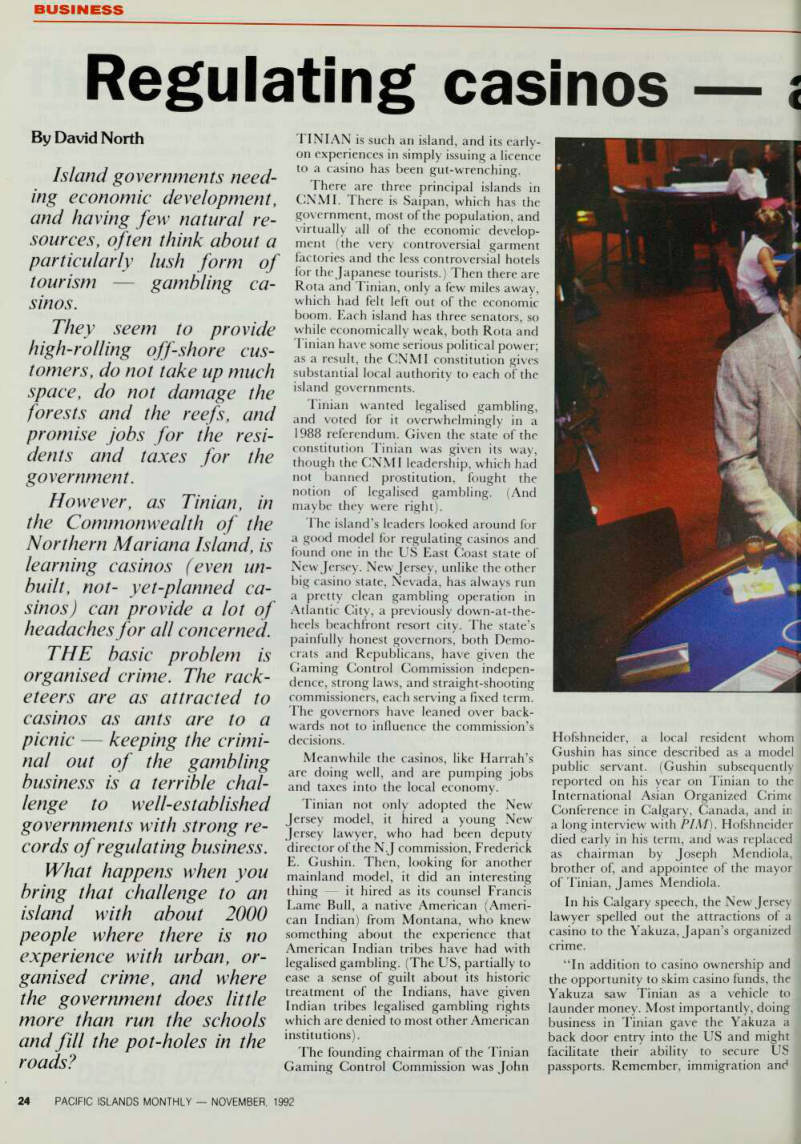
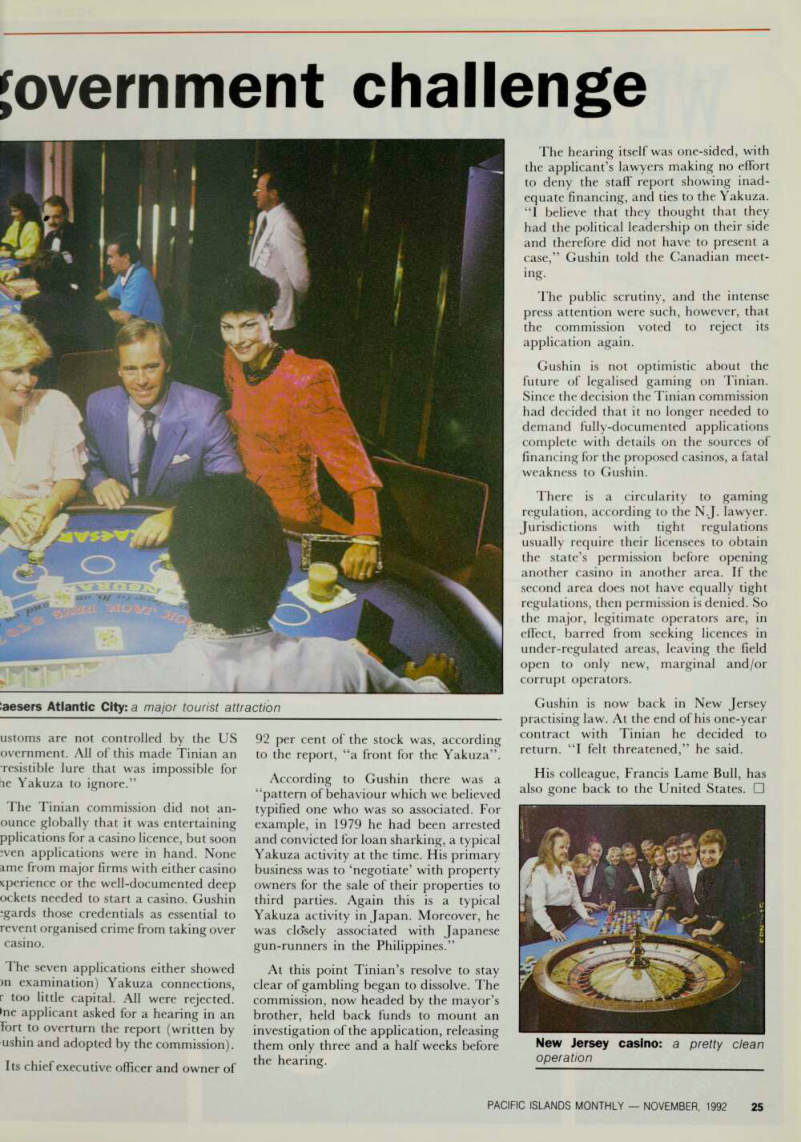
Business
By David North
Island governments need ing economic and having few natural re sources, often think about a particularly lush form of tourism gambling ca sinos.
They seem to provide high-rolling off-shore cus tomers, do not take up much space, do not damage the forests and the reefs, and promise jobs for the resi dents and taxes for the government.
However, as Tinian, in the Commonwealth of the Northern Mariana Island, is learning casinos (even un built, not- yet-planned ca sinos) can provide a lot of headaches for all concerned.
THE basic problem is organised crime. The rack eteers are as attracted to casinos as ants are to a picnic keeping the crimi nal out of the gambling business is a terrible chal lenge to well-established governments with strong re cords of regulating business.
What happens when you bring that challenge to an island with about 2000 people where there is no experience with urban, or ganised crime, and where the government does little more than run the schools and fill the pot-holes in the roads?
TINIAN is such an island, and its early on experiences in simply issuing a licence to a casino has been gut-wrenching.
There are three principal islands in CNMI. There is Saipan, which has the government, most of the population, and virtually all of the economic develop ment (the very controversial garment factories and the less controversial hotels for the Japanese tourists.) Then there are Rota and Tinian, only a few miles away, which had felt left out of the economic boom. Each island has three senators, so while economically weak, both Rota and Tinian have some serious political power; as a result, the CNMI constitution gives substantial local authority to each of the island governments.
Tinian wanted legalised gambling, and voted for it overwhelmingly in a 1988 referendum. Given the state of the constitution Tinian was given its way, though the CNMI leadership, which had not banned prostitution, fought the notion of legalised gambling. (And maybe they were right).
The island’s leaders looked around for a good model for regulating casinos and found one in the US East Coast state of New Jersey. New Jersey, unlike the other big casino state, Nevada, has always run a pretty clean gambling operation in Atlantic City, a previously down-at-the heels beachfront resort city. The state’s painfully honest governors, both Demo crats and Republicans, have given the Gaming Control Commission indepen dence, strong laws, and straight-shooting commissioners, each serving a fixed term.
The governors have leaned over back wards not to influence the commission’s decisions.
Meanwhile the casinos, like Harrah’s are doing well, and are pumping jobs and taxes into the local economy.
Tinian not only adopted the New Jersey model, it hired a young New Jersey lawyer, who had been deputy director of the NJ commission, Frederick E. Gushin. Then, looking for another mainland model, it did an interesting thing it hired as its counsel Francis Lame Bull, a native American (Ameri can Indian) from Montana, who knew something about the experience that American Indian tribes have had with legalised gambling. (The US, partially to ease a sense of guilt about its historic treatment of the Indians, have given Indian tribes legalised gambling rights which are denied to most other American institutions).
The founding chairman of the Tinian Gaming Control Commission was John
Hofshneider, a local resident whom Gushin has since described as a model public servant. (Gushin subsequently reported on his year on Tinian to the International Asian Organized Crime Conference in Calgary, Canada, and in a long interview with PIM ). Hofshneider died early in his term, and was replaced as chairman by Joseph Mendiola, j brother of, and appointee of the mayor of Tinian, James Mendiola.
In his Calgary speech, the New Jersey lawyer spelled out the attractions of a casino to the Yakuza, Japan’s organized crime.
“In addition to casino ownership and the opportunity to skim casino funds, the Yakuza saw Tinian as a vehicle to launder money. Most importantly, doing business in Tinian gave the Yakuza a back door entry into the US and might facilitate their ability to secure US i passports. Remember, immigration and
ustoms are not controlled by the US overnment. All of this made Tinian an resistible lure that was impossible for lie Yakuza to ignore.”
The Tinian commission did not an ounce globally that it was entertaining pplications for a casino licence, but soon ’ven applications were in hand. None ame from major firms with either casino xperience or the well-documented deep ockets needed to start a casino. Gushin igards those credentials as essential to revent organised crime from taking over casino.
The seven applications either showed
>n examination) Yakuza connections,
r too little capital. All were rejected, ►ne applicant asked for a hearing in an fort to overturn the report (written by ushin and adopted by the commission).
Its chief executive officer and owner of
92 per cent of the stock was, according to the report, “a front for the Yakuza”.
According to Gushin there was a “pattern of behaviour which we believed typified one who was so associated. For example, in 1979 he had been arrested and convicted for loan sharking, a typical Yakuza activity at the time. His primary business was to ‘negotiate’ with property owners for the sale of their properties to third parties. Again this is a typical Yakuza activity in Japan. Moreover, he was closely associated with Japanese gun-runners in the Philippines.”
At this point Tinian’s resolve to stay clear of gambling began to dissolve. The commission, now headed by the mayor’s brother, held back funds to mount an investigation of the application, releasing them only three and a half weeks before the hearing.
The hearing itself was one-sided, with the applicant’s lawyers making no effort to deny the staff report showing inad equate financing, and ties to the Yakuza.
“I believe that they thought that they had the political leadership on their side and therefore did not have to present a case,” Gushin told the Canadian meet ing.
The public scrutiny, and the intense press attention were such, however, that the commission voted to reject its application again.
Gushin is not optimistic about the future of legalised gaming on Tinian, Since the decision the Tinian commission had decided that it no longer needed to demand fully-documented applications complete with details on the sources of financing for the proposed casinos, a fatal weakness to Gushin.
There is a circularity to gaming regulation, according to the NJ. lawyer.
Jurisdictions with tight regulations usually require their licensees to obtain the state’s permission before opening another casino in another area. If the second area does not have equally tight regulations, then permission is denied. So the major, legitimate operators are, in effect, barred from seeking licences in under-regulated areas, leaving the field open to only new, marginal and/or corrupt operators.
Gushin is now back in New Jersey practising law. At the end of his one-year contract with Tinian he decided to return. “I felt threatened,” he said.
His colleague, Francis Lame Bull, has also gone back to the United States. □
laesers Atlantic City: a major tourist attraction
New Jersey casino: a pretty clean operation
Advertisements & other items, p. 26 (1 item)
We Include The Hops 1
OTHE
\B° L E Tl „„
\U 0 „e' * o^° R £ t & S , ,r ' _* s * Q* O k ’<«4' _>S> t-''i fo v -'„v / V~ 'T VO. q .SK e% of* o< o\ vA * 'o \ 'o
ni^o>w7sl^w
Uj, taV^ ?v .;„ i6at< \ ■ \ . :.® . OPogo Pogo
,j< V b s^A>>-
V**'«V _#' ' '
*J*?fc o \ ‘,
tC\. \ £ V e . w'**V r *&r & %j #*o
<^lfessr
4$ \\ \\ ft Papeete /. •A Frankfurt s\ g** b S\Q , J' I Christchurch No international airline serves the Pacific quite as well as Air New Zealand. We’re the only airline linking the Pacific Islands to New Zealand, North America, Asia, Europe and the United Kingdom, with a modern fleet of 767 and 747 wide-bodied jets. And now we offer direct flights between Tonga, Apia, Rarotonga and Honolulu.
With our new frequent flyer programme, every flight you make with us, whether it’s a short hop or a long jump, will earn you travel points towards upgrades, companion tickets and free trips. No wonder more people are flying the Pacific with Air New Zealand every day. cij i c
air hew ZEBLann
the pride of the pacific
mmmmm ■■■
Sugar’s not-so-sweet deal
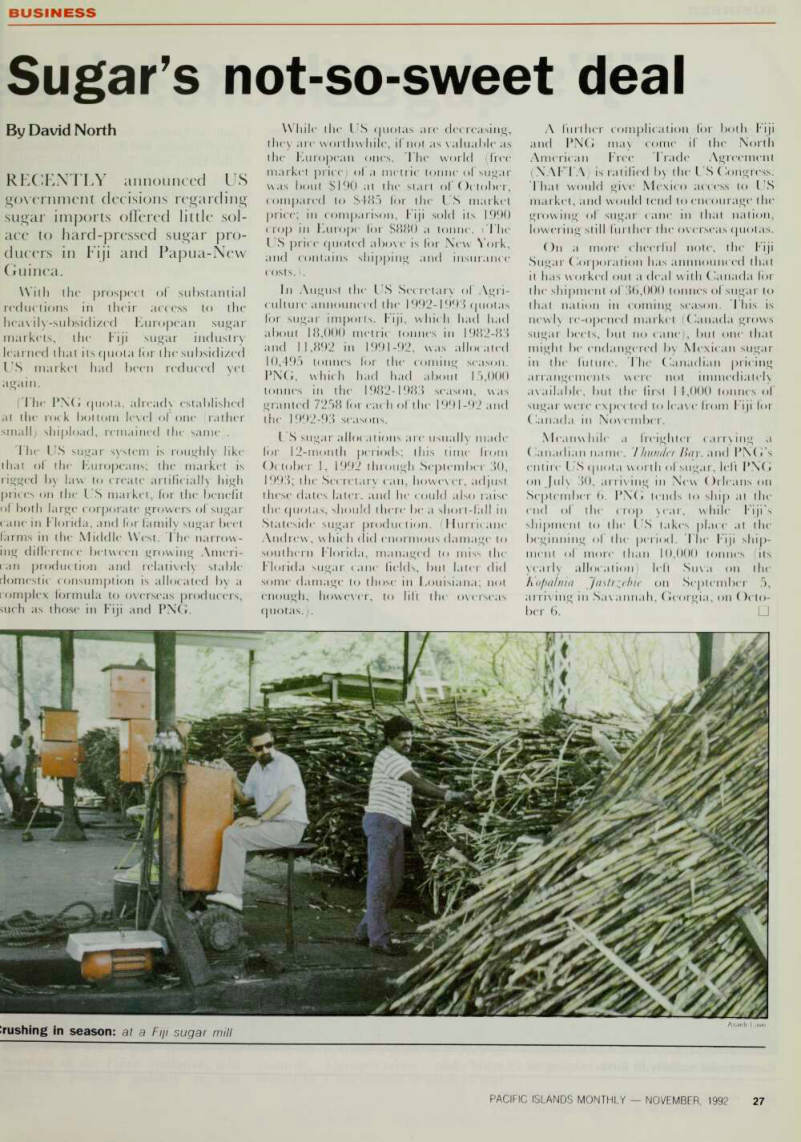
By David North
RECENTLY announced US government decisions regarding sugar imports offered little sol ace to hard-pressed sugar pro ducers in Fiji and Papua-New Guinea.
With the prospect of substantial reductions in their access to the heavily-subsidized European sugar markets, the Fiji sugar industry learned that its quota for the subsidized US market had been reduced yet again. (The PNG quota, already established at the roc k bottom level of one (rather small) shipload, remained the same .
The US sugar system is roughly like that of the Europeans; the market is rigged by law to create artificially high price's on the US market, for the benefit of both large corporate growers of sugar cane in Florida, and for family sugar beet farms in the Middle West. The narrow ing difference between growing Ameri can production and relatively stable domestic consumption is allocated by a complex formula to overseas producers, cuch as those in Fiji and PNG.
While the US quotas are decreasing, they are worthwhile, if not as valuable as the European ones. The world (free market price] of a metric tonne of sugar was bout SI9O at the start of October, compared to 5485 for the US market price; in comparison, Fiji sold its 1990 crop in Europe for SBBO a tonne. The US price quoted above is for New York, and contains shipping and insurance costs.).
In August the US Secretary of Agri culture announced the 1992-1993 quotas for sugar imports. Fiji, which had had about 18,000 metric tonnes in 1982-83 and 11,892 in 1991-92, was allocated 10,495 tonnes lor the coming season.
PNG, which had had about 15,000 tonnes in the 1982-1983 season, was granted 7258 for eac h of the 1991-92 and the 1992-93 seasons.
L S sugar allocations are usually made for 12-month periods; this time from October 1, 1992 through September 30, 1993; the Secretary can, however, adjust these dates later, and he could also raise the quotas, should there be- a short-fall in Stateside' sugar production. (Hurricane Andrew, which did enormous damage' to southern Florida, managed to miss the Florida sugar cane fields, but later did some damage to those in Louisiana; not enough, however, to lift the overseas quotas.).
A further complication for both Fiji and PNCi may come if the North American Free Trade Agreement (NAFTA; is ratified by the I S Congress.
That would give Mexico access to US market, and would tend to encourage the growing of sugar cane in that nation, lowering still further the overseas quotas.
On a more cheerful note, the Fiji Sugar Corporation has annnounced that it has worked out a deal with Canada for the shipment of 36,000 tonnes of sugar to that nation in coming season. This is newly re-opened market (Canada grows sugar beets, but no cane), but one that might be endangered by Mexican sugar in the future. The Canadian pricing arrangements were not immediately available, but the first 1 4,000 tonnes of sugar were expected to leave from Fiji for Canada in November.
Meanwhile a freighter carrying a Canadian name. Thunder lia]\ and PNG’s entire US quota worth of sugar, left PNC on July 30, arriving in New Orleans on September 6. PNG lends to ship at (he end of (he crop year, while Fiji’s shipment to the US takes place at the beginning of the period. The Fiji ship ment of more than 10,000 tonnes (its yearly allocation) left Suva on the A opalnm Jastrzehie on September .3, arriving in Savannah, Georgia, on Octo ber 6. □
Asaeh lave
[?]ushing in season: at a Fiji sugar mill
Advertisements & other items, p. 27 (1 item)
Business
Fiji’s struggle to bridge the economic gap
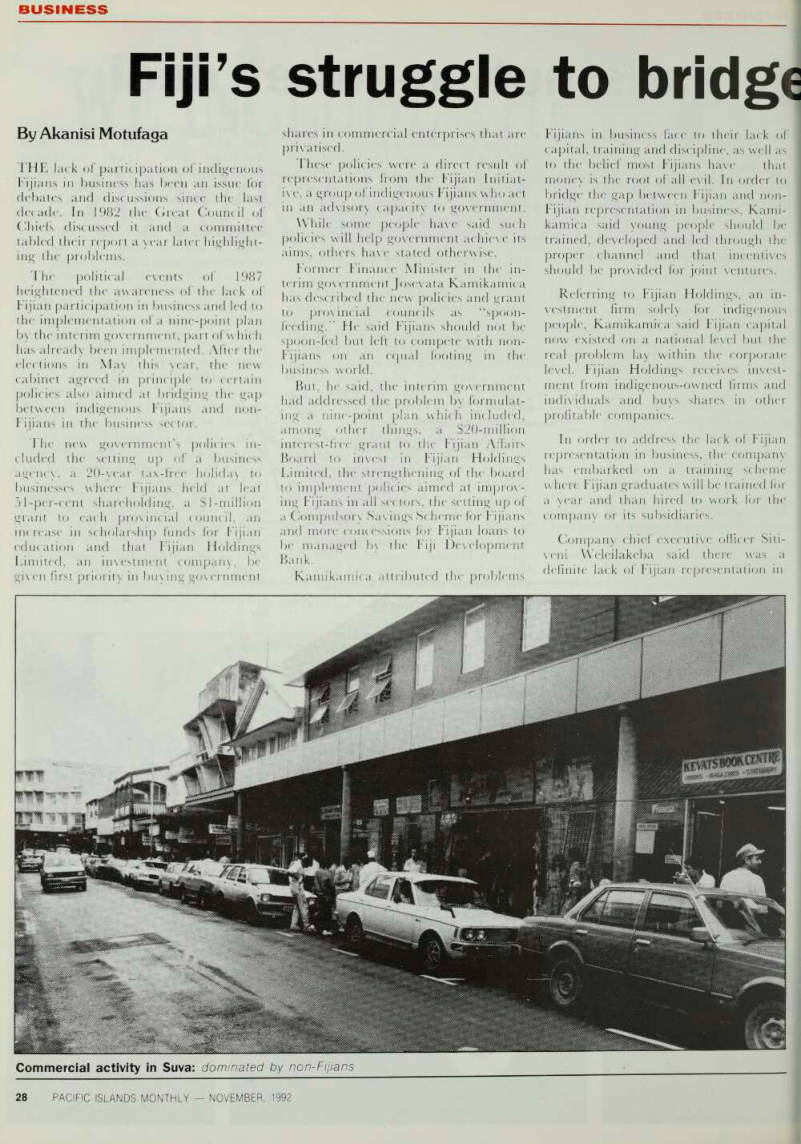
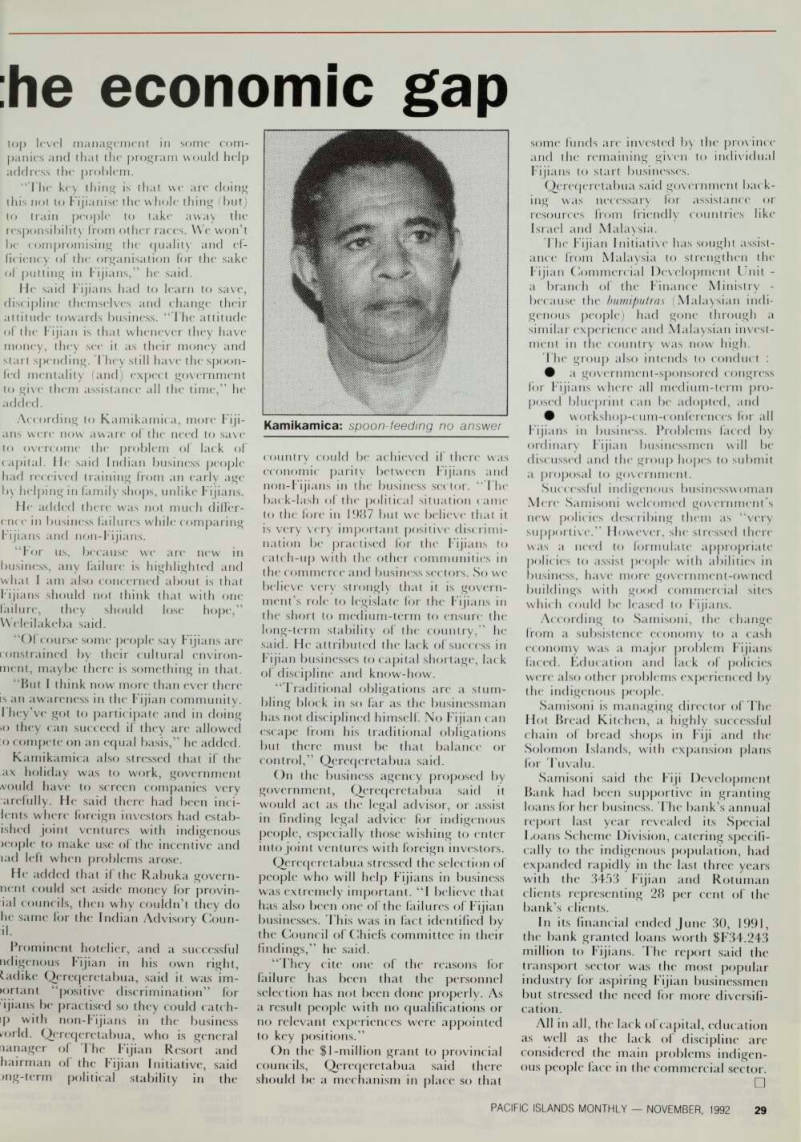
By Akanisi Motufaga
THE 1 ack of participation of indigenous Fijians in business has been an issue for debates and discussions since the last decade. In 1982 the Great Council of Chiefs discussed it and a committee tabled their report a year later highlight ing the problems.
The political events of 1987 heightened the awareness of the lack of Fijian participation in business and led to
the implementation of a nine-point plan
by the interim government, part of which has already been implemented. After the elections in May this year, the new cabinet agreed in principle to certain policies also aimed at bridging the gap between indigenous Fijians and non- Fijians in the business sector.
The new government’s policies in cluded the setting up of a business agency, a 20-year tax-free holiday to businesses where Fijians held at leat
51-per-cent shareholding, a SI-million
grant to each provincial council, an increase in scholarship funds for Pijian education and that Fijian Holdings Limited, an investment company, be
given first priority in buying government
shares in commercial enterprises that are privatised.
These policies were a direct result of representations from the Fijian Initiat ive, a group of indigenous Fijians who act in an advisory capacity to government.
While some people have said such policies will help government achieve its aims, others have stated otherwise.
Former Finance Minister in the in terim government Josevata Kamikamica has described the new policies and grant to provincial councils as “spoon feeding." He said Fijians should not be spoon-fed but left to compete with non- Fijians on an equal footing in the business world.
But, he said, the interim government had addressed the problem by formulat
ing a nine-point plan which included,
among other things, a S2O-million interest-free grant to the Fijian Affairs Board to invest in Fijian Holdings Limited, the strengthening of the board
to implement policies aimed at improv
ing Fijians in all sectors, the setting up of a Compulsory Savings Scheme for Fijians and more concessions for Fijian loans to
be managed bv the Fiji Development
Bank.
Kamikamica attributed the problems
Fijians in business face to their lack of capital, training and discipline, as well as to the belief most Fijians have that money is the root of all evil. In order to bridge the gap between Fijian and non- Fijian representation in business. Kami kamica said young people should be trained, developed and led through the proper channel and that incentives should be provided for joint ventures.
Referring to Fijian Holdings, an in vestment firm solely for indigenous
people, Kamikamica said Fijian capital
now existed on a national level but the real problem lay within the corporate level. Fijian Holdings receives invest ment from indigenous-owned firms and individuals and buys shares in other
profitable companies.
In order to address the lack of Fijian representation in business, the company has embarked on a training scheme where Fijian graduates will be trained for a year and than hired to work for the company or its subsidiaries.
Company chief executive officer Siti veni Weleilakcba said there was a definite lack of Fijian representation in
Commercial activity in Suva: dominated by non-Fijians
top level management in some com panies and that the program would help address the problem.
“The key thing is that we are doing this not to Fijianise the whole thing (but) to train people to take away the responsibility from other races. We won’t be compromising the quality and ef ficiency of the organisation for the sake of putting in Fijians,” he said.
He said Fijians had to learn to save, discipline themselves and change their attitude towards business. “The attitude of the Fijian is that whenever they have money, they see it as their money and start spending. They still have the spoon fed mentality (and) expect government to give them assistance all the time,” he added.
According to Kamikamica, more Fiji ans were now aware of the need to save to overcome the problem of lack of capital. He said Indian business people had received training from an early age by helping in family shops, unlike Fijians.
He added there was not much differ ence in business failures while comparing Fijians and non-Fijians.
“For us, because we are new in business, any failure is highlighted and what I am also concerned about is that Fijians should not think that with one failure, they should lose hope,”
Weleilakeba said.
“Of course some people say Fijians are constrained by their cultural environ ment, maybe there is something in that.
“But I think now more than ever there is an awareness in the Fijian community.
Fhey’vc got to participate and in doing >o they can succeed if they arc allowed o compete on an equal basis,” he added.
Kamikamica also stressed that if the ax holiday was to work, government vould have to screen companies very arcfully. He said there had been inei lents where foreign investors had cstab ished joint ventures with indigenous Jcople to make use of the incentive and lad left when problems arose.
He added that if the Rabuka govern nent could set aside money for provin ial councils, then why couldn’t they do he same for the Indian Advisory Coun il.
Prominent hotelier, and a successful ndigenous Fijian in his own right, ladike Qereqeretabua, said it was im portant “positive discrimination” for ijians be practised so they could catch ip with non-Fijians in the business i/orld. Qereqeretabua, who is general nanager of The Fijian Resort and hairman of the Fijian Initiative, said >ng-term political stability in the
country could be achieved if there was economic parity between Fijians and non-Fijians in the business sector. k ‘The back-lash of the political situation came to the fore in 1987 but we believe that it is very very important positive discrimi nation be practised for the Fijians to catch-up with the other communities in the commerce and business sectors. So we believe very strongly that it is govern ment’s role to legislate for the Fijians in the short to medium-term to ensure the
long-term stability of the country,” he
said. He attributed the lack of success in Fijian businesses to capital shortage, lack of discipline and know-how.
“Traditional obligations arc a stum bling block in so far as the businessman has not disciplined himself. No Fijian can escape from his traditional obligations but there must be that balance or control,” Qereqeretabua said.
On the business agency proposed by government, Qereqeretabua said it would act as the legal advisor, or assist in finding legal advice for indigenous people, especially those wishing to enter into joint ventures with foreign investors.
Qereqeretabua stressed the selection of people who will help Fijians in business was extremely important. “I believe that has also been one of the failures of Fijian businesses. This was in fact identified by the Council of Chiefs committee in their findings,” he said.
“They cite one of the reasons for failure has been that the personnel selection has not been done properly. As a result people with no qualifications or no relevant experiences were appointed to key positions,”
On the SI-million grant to provincial councils, Qereqeretabua said there should be a mechanism in place so that
some funds are invested by the province and the remaining given to individual Fijians to start businesses.
Qereqeretabua said government back ing was necessary for assistance or resources from friendly countries like Israel and Malaysia.
The Fijian Initiative has sought assist ance from Malaysia to strengthen the Fijian Commercial Development Unit a branch of the Finance Ministry because the bumiputras (Malaysian indi genous people) had gone through a similar experience and Malaysian invest ment in the country was now high.
The group also intends to conduct : • a government-sponsored congress for Fijians where all medium-term pro
posed blueprint can be adopted, and
• workshop-cum-conferences for all Fijians in business. Problems faced by ordinary Fijian businessmen will be discussed and the group hopes to submit a proposal to government.
Successful indigenous businesswoman Mere Samisoni welcomed government's new policies describing them as “very supportive.” However, she stressed there was a need to formulate appropriate policies to assist people with abilities in business, have more government-owned buildings with good commercial sites which could be leased to Fijians.
According to Samisoni, the change from a subsistence economy to a cash
economy was a major problem Fijians
faced. Education and lack of policies
were also other problems experienced by
the indigenous people.
Samisoni is managing director of The Hot Bread Kitchen, a highly successful chain of bread shops in Fiji and the Solomon Islands, with expansion plans for Tuvalu.
Samisoni said the Fiji Development Bank had been supportive in granting loans for her business. The bank’s annual report last year revealed its Special Loans Scheme Division, catering specifi cally to the indigenous population, had expanded rapidly in the last three years with the 3453 Fijian and Rotuman clients representing 28 per cent of the bank’s clients.
In its financial ended June 30, 1991, the bank granted loans worth 5F34.243 million to Fijians. The report said the transport sector was the most popular
industry for aspiring Fijian businessmen
but stressed the need for more diversifi cation.
All in all, the lack of capital, education as well as the lack of discipline are considered the main problems indigen ous people face in the commercial sector.
Kamikamica: spoon-feeding no answer
Advertisements & other items, pp. 30-31 (1 item)
Is It Possible To Achieve A High Level Of Aerodynami
Creating a highly efficient, dynamic-looking car wot be simple if it weren’t for one complicating detail; passengers that must ride in it. Accommodating people comfortably in a pleasant, rooi interior usually means a certain amount of aerodynamic potential has to be sacrific fl % % » * mm Exact features and specifications may vary depending on country of purchase. Please check with your nearest TOYOTA distributor/dealer for details.
DISTRIBUTORS/DEALERS
AMERICAN SAMOA BURNS PH1LP (S.S.) CO. LTD.
GUAM & MICRONESIA... ATKINS KROLL. INC.
NORFOLK ISLANDS BORRY’S PTY LTD.
SOLOMON ISLANDS MENDANA MOTORS
VANUATU VANUATU MOTORS
PH 633-4281 PH 646-1876/9 PH 2114 PH 30314 PH 22341
E IT Until now. Using a concept called total airflow lagement, Toyota engineers were able to realize an efficient, wedge-shaped design le at the same time perfecting the alignment between body panels and components, course our own innovative style of civilized ineering makes sure that none of this comes he expense of the luxurious, leg-stretching : interior. Because we realize that even a 0.33 is useless if no one wants to drive the car.
<® TOYOTA
Hurricane Iniki: Hawaii’s major calamity
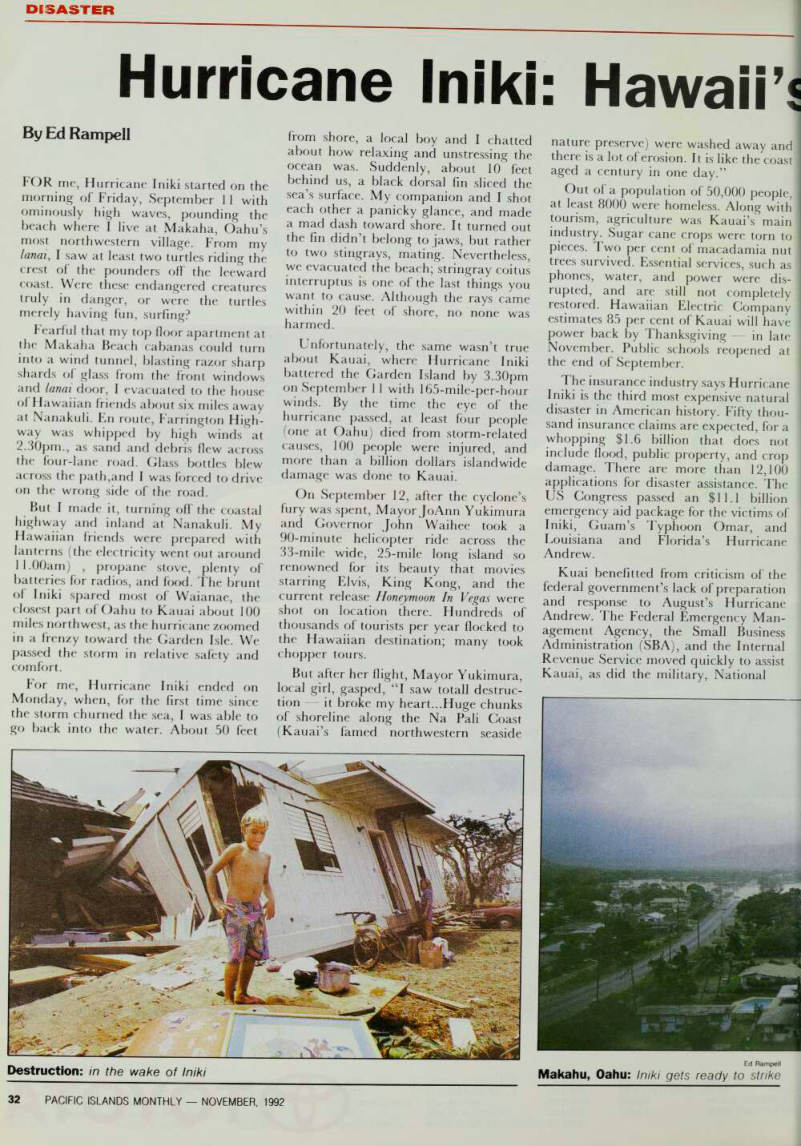
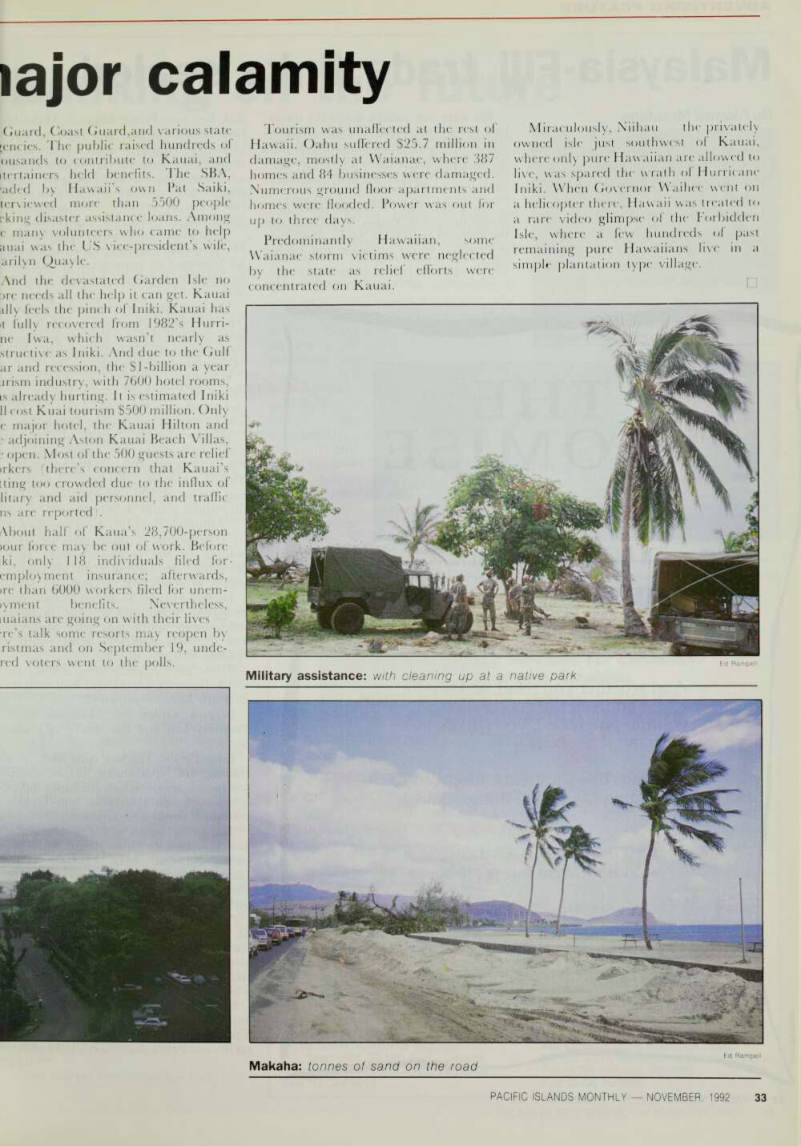
Disaster
By Ed Rampell
FOR me, Hurricane Iniki started on the morning of Friday, September 11 with ominously high waves, pounding the beach where I live at Makaha, Oahu’s most northwestern village. From my lanai , I saw at least two turtles riding the crest of the pounders off the leeward coast. Were these endangered creatures truly in danger, or were the turtles
merely having fun, surfing?
Fearful that my top floor apartment at the Makaha Beach cabanas could turn into a wind tunnel, blasting razor sharp shards of glass from the front windows and lanai door, I evacuated to the house of Hawaiian friends about six miles away at Nanakuli. En route, Farrington High way was whipped by high winds at 2.30 pm., as sand and debris flew across the four-lane road. Glass bottles blew across the path,and I was forced to drive on the wrong side of the road.
But I made it, turning off the coastal highway and inland at Nanakuli. My Hawaiian friends were prepared with lanterns (the electricity went out around 11.00 am) , propane stove, plenty of batteries for radios, and food. The brunt of Iniki spared most of Waianae, the closest part of Oahu to Kauai about 100 miles northwest, as the hurricane zoomed in a frenzy toward the Garden Isle. We passed the storm in relative safety and comfort.
For me, Hurricane Iniki ended on Monday, when, for the first time since the storm churned the sea, I was able to go back into the water. About 50 feet
from shore, a local boy and I chatted about how relaxing and unstressing the ocean was. Suddenly, about 10 feet behind us, a black dorsal fin sliced the sea’s surface. My companion and I shot each other a panicky glance, and made a mad dash toward shore. It turned out the fin didn’t belong to jaws, but rather
to two stingrays, mating. Nevertheless,
we evacuated the beach; stringray coitus interruptus is one of the last things you want to cause. Although the rays came within 20 feet of shore, no none was harmed.
Unfortunately, the same wasn’t true about Kauai, where Hurricane Iniki battered the Garden Island by 3.30 pm on September 11 with 165-mile-per-hour winds. By the time the eye of the hurricane passed, at least four people (one at Oahu) died from storm-related causes, 100 people were injured, and more than a billion dollars islandwide damage was done to Kauai.
On September 12, after the cyclone’s fury was spent, Mayor JoAnn Yukimura and Governor John Waihee took a 90-minute helicopter ride across the 33-mile wide, 25-mile long island so renowned for its beauty that movies starring Elvis, King Kong, and the current release Honeymoon In Vegas were shot on location there. Hundreds of thousands of tourists per year flocked to the Hawaiian destination; many took
chopper tours.
But after her flight, Mayor Yukimura, local girl, gasped, ‘T saw totall destruc tion it broke my heart... Huge chunks of shoreline along the Na Pali Coast (Kauai’s famed northwestern seaside
nature preserve) were washed away and there is a lot of erosion. It is like the coast aged a century in one day.”
Out of a population of 50,000 people, at least 8000 were homeless. Along with tourism, agriculture was Kauai’s main industry. Sugar cane crops were torn to pieces. Two per cent of macadamia nut trees survived. Essential services, such as phones, water, and power were dis rupted, and are still not completely restored. Hawaiian Electric Company estimates 85 per cent of Kauai will have power back by Thanksgiving in late November. Public schools reopened at the end of September.
The insurance industry says Hurricane Iniki is the third most expensive natural disaster in American history. Fifty thou sand insurance claims are expected, for a whopping $1.6 billion that does not include flood, public property, and crop damage. There are more than 12,100 applications for disaster assistance. The US Congress passed an $ll.l billion emergency aid package for the victims of Iniki, Guam’s Typhoon Omar, and Louisiana and Florida’s Hurricane Andrew.
Kuai benefitted from criticism of the federal government’s lack of preparation and response to August’s Hurricane Andrew. The Federal Emergency Man agement Agency, the Small Business Administration (SBA), and the Internal Revenue Service moved quickly to assist Kauai, as did the military, National
Destruction: in the wake of Iniki
Ed Rampell Makahu, Oahu: Iniki gets ready to strike
Guard, Coast Guard,and various state rencies. The public raised hundreds ol ousands to contribute to Kauai, and itertainers held benefits. The SBA, •aded by Hawaii’s own Pat Saiki, terviewed more than 5500 people ['king disaster assistance loans. Among e many volunteers who came to help auai was the US vice-president’s wife, arilyn Quayle.
And the devastated Garden Isle no Dre needs all the help it can get. Kauai ally feels the pinch of Iniki. Kauai has it fully recovered from 1982’s Hurri ne Iwa, which wasn’t nearly as structive as Iniki. And due to the Gulf ar and recession, the SI-billion a year jrism industry, with 7600 hotel rooms, is already hurting. It is estimated Iniki 11 cost Kuai tourism S5OO million. Only e major hotel, the Kauai Hilton and ; adjoining Aston Kauai Beach Villas, ' open. Most of the 500 guests are relief irkers (there’s concern that Kauai’s Lting too crowded due to the influx of litary and aid personnel, and traffic ns are reported '.
About hall' of Kaua’s 28,700-person >our force may be out of work. Before ki, only 118 individuals filed for employment insurance; afterwards, ire than 6000 workers filed for unem lyment benefits. Nevertheless, luaians are going on with their lives re ’s talk some resorts may reopen by ristmas and on September 19, unde red voters went to the polls.
Tourism was unaffected at the rest of Hawaii. Oahu suffered 525.7 million in damage, mostly at Waianae, where 387 homes and 84 businesses were damaged.
Numerous ground floor apartments and homes were flooded. Power was out for up to three days. . , u Predominantly Hawaiian, some Waianae storm victims were neglected by the state as relief efforts were concentrated on Kauai.
Miraculously, Niihau the privately owned isle just southwest ol Kauai, where only pure Hawaiian are allowed to live, was spared the wrath of Hurricane Iniki. When Governor Waihee went on a helicopter there, Hawaii was treated to a rare video glimpse of the Forbidden Isle, where a few hundreds of past remaining pure Hawaiians live in a simple plantation type village.
Ed Rampell
Makaha: tonnes of sand on the road
Military assistance: with cleaning up at a native park
Malaysia-Fiji trade links sealed
Advertising Feature
By Akanisi Motufaga
MALAYSIA’S investment presence in Hji goes back 20 years with the sale of Fiji Resorts Limited to the Kuok Group.
The local hotel company owned Fiji Mocambo Hotel and The Fijian.
Over the years the investment has grown with the establishment of textile factories, hotels, trading firms and the introduction of Malaysian-made cars.
For some companies, it was the quota free access into other overseas markets which attracted them to invest in Fiji, while for others it was the encourage ment by Malaysian Prime Minister Mohammed Mahathir.
Apart from Fiji, Malaysian investment is also present in Papua New Guinea in the form of merchant banks, insurance companies, travel agencies and timber yards.
Malaysia’s ambassador to Fiji, Ffai
Bak Ng, said Prime Minister Mahathir had always stressed the need to have closer trade links which was one of the reasons for setting up an embassy in Fiji.
Ambassador Ng said Malaysian com panies were looking at investment in other Pacific countries but wanted to learn first from the Fiji experience.
“It is like a chicken and egg situation.
Do we go there and hope for the sea and air transport to improve or do we wait for them to improve and then go?,” he said.
On investment potential, Ambassador Ng said there was trust by Malaysian investors and this was evident in expan sion plans currently being carried out by Malaysian-owned hotels. for instance, The Fijian, which is now called Shangri-La’s Fijian Resort, has embarked on a SIO-million facelift. This will be completed in next December.
In the last five years, the parent company has spent 515.5 million on The Fijian and 52.5 million on Fiji Mocambo.
This involves the upgrading of facilities and extensions. “Even with Courtesy Inn the)’ spent a sum in investment.
“Although the Malaysian presence is, by comparison, a small presence, it is helping in the economic sense. It is providing the* customer an alternative supply of goods and services,” he said.
He said Fiji and Malaysia had a strong friendship bond and a close bilateral relationship which was why Malaysia was the only ASEAN country with a resident embassy in Fiji.
There are currently three hotels, two textile factories, a bank and trading store that are Malaysian-owned.
Berjaya Group of Malaysia owns Courtesy Inn and has shares in textile factories.
Inter-Pacific Trading Sdn Bhd., is a trading firm specialising in the distri bution of goods which includes office equipment, durable and non-durable consumer goods and furniture.
The cither hotels are Fiji Mocambo and Shangri-La’s Fijian Resort while the bank, National MBI Finance (Fiji) Limited, is a joint venture between MBf finance Berhad and Fiji-government owned National Bank of Fiji.
A former Malaysian-owned company, SI A International (Fiji) Limited, re cently changed hands while a Fijian owned company, Nakiti Holdings, has embarked on a supplier arrangement with a Malaysian firm.
Recently, five Proton Saga cars were imported from Perusahaan Otomobil Nasional Berhad in Malaysia. The local agents are Pala’s Auto Services Limited.
Advertisements & other items, p. 34 (1 item)
Promise
THE
" Take a burden off
our shoulders and make
a buck. A BIG buck.
Not a burden, really.
Just the need to off-load some of our profits by selling Fiji-wide and to the other South Pacific Islands.
And whether you retail, or keep for yourself the goods you volume-purchased, you still make a buck.
On things like Garments. Electronics.
Building Material. Fittings. And
more.
Call us. Write Us. Or fax us.
And hold us to our promise.
INTERNATIONAL (FIJI) LTD.
SIA HOUSE 6 EDINBURGH DRIVE SUVA
TELEPHONE 303173 303213 FAX 303321
Banking on the future

FIRST it was leasing and hire purchasing then factoring and later Mastercard. Now National MBf Finance Fiji) Limited plans to introduce another type of credit card - a Travel Mastercard.
The credit card will be separate from its standard and gold cards and is expected to be available next year.
These plans are just part of what the finance company intends to introduce over the next few years.
National MBf, a joint venture between government-owned National Bank of Fiji and MBf Finance Berhad of Malaysia, has an operating capital of SFI million with a 5F500,000 investment in compu ter software and hardware for Mastercard alone.
The parent company, which is present in Fiji and Papua New Guinea, is looking at investing in Tonga. It has a diversified business interest which includes in surance firms, supermarkets, manufac turing, banking and so on.
In Fiji, National MBf has established a credit card branch in the western division and is installing Mastercard terminals at all NBF branches.
The finance company is also finalising details on the factoring service which will be available soon.
The service will be open to businesses which perform well financially, have potential, and are good debtors. For example, businesses which export goods are expected to make payments includ ing duty on the items. The receiver of the goods will usually ask for 60 days or more before paying for the items.
When this happens, most businesses face cash flow problems until the pay ment is made. In order to avoid such problems, National MBf enters the scene with a factoring service.
The finance company will be able to pay as much as 80 per cent of the value of the items within 24 to 48 hours without asking for collaterals. It also up-lifts the invoice for the items from the business.
Companies will have to pay a factoring fee of one to three percent, depending on the value of the invoice and an interest rate calculated according to the number of withdrawals.
Leasing and hire-purchasing are also important services available at National MBf. Leasing involves the renting of
equipment like heavy machinery, medi
cal and dental equipment and compu ters. The equipment, which is bought by the finance company, can either be sold to the users or substituted for a new machine.
“The market here is not too bad. It is
quite attractive even though it is small.
Our commitment here is quite substan tial,” said National MBfs assistant vice
president. Sinclair Wong.
Despite National \lBfs range of ser vices and future plans in Fiji, the company has expressed concern at the absence of an overall association aimed
at protecting foreign investors. “The only
concern vve have is that we have to safe guard the industry as a whole. If somebody does something wrong, the government passes an act and everybody suffers,” Wong said. “In financial lines, we are a bit
concerned be cause if financial com panies come in and act
irresponsibly,
there is no cen
tral organis
ation which can look after
these things.
Our invest ment here is long-term.’ □
National MBf’s Sinclair Wong
The Mastercard: a National MBf service
Advertisements & other items, pp. 35-37 (1 item)
Dealership Opportunities
FOR THE SOUTH PACIFIC
Buying and
du
HOTEL Pi
AS WELL
services for consumer d non durables -
TS, OFFICE SUPPLIES ,
USEHOLD PRODUCTS
★ OFFICE FURNITURE chairs, fi fili s, cupboards, fire proof tables. ing cabinets. ★ HOTEL SUPPLIES banquet chairs, ★ OFFICE STATIONERIES Specialist In paJsr products fax rolls, telex rolls, paper rolls for cash registers, calculators etc, single or double ply (OTC or NCR), carbon papers, stencil papers ★ HOUSEHOLD PRODUCTS metal & wooden furniture, bk ★ WRITING INSTRUMENTS ball pens, pencils, mar pencils, etc.
Only genuine dealers need write in with details of company fc| or contact our office. trouno
SDN.
ADI N G
B H HEAD OFFICE: Suite 15A, 15th Floor, Office Tower, Kompleks Nagaria, 12. Jalan IMBI, 55100 Kuala Lumpur, Malaysia. Tel; 03-2444507, 2449948 Fax: 03-2449855 FIJI OFFICE: No. 6 Edinburgh Drive, P 0 Box 2276 Government Buildings, Suva Tel: (679) 304888, 304889 Fax: (679) 304888
With
National MBf Master Card
you’ve got
the whole world in
your hands.
Now, for the first time ever, e’s a unique credit card specially
gned for today’s modern Fijian.
National MBf Master Card is the t and Only Fiji Dollar Credit 1 accepted locally and at over 9 ion outlets worldwide. It gives Revolving Credit, so you have option of settling just 10% of the unt due each month which gives
the option of saving your finances
other things.
And as a Cash Card, it obviously gets cash at over 80,000 MasterCard* Ls worldwide. Plus Cash on Card I branches of National Bank of Fiji at more than 100,000 Master Card
tions throughout the world.
If you hold the National MBf terCard, we know how impressive your financial status is and so you
automatically enjoy preferential
treatment when you apply for a Current Account with The National Bank of Fiji. They will also give you
Refinancing Facilities.
When you travel, National MBf Master Card provides you with a high value Insurance Plan for Travel Accident and Travel Inconveniences.
National MBf Master Card also gives you Travel Assistance through Master Assist™ 24 hours a day, every day of the year.
The Master Assist™ programme will help you in many kinds of
emergencies: legal and medical
referrals, medical repatriation, emergency assistance, lost document, luggage retrieval assistance and emergency cash.
This is just a glimpse of the benefits from National MBf Master Card. There’s no reason now to feel second best.
Apply for The First Fiji Dollar Credit Card today, and you’ve got the whole world in your hands.
NATIONAL BANK OF FIJI
National
MBf Master Card.
ens
National MBf Master Card is issued by National MBf Finance (Fiji) Ltd. in conjunction with National Bank of Fiji under the affiliate licence of MBf Card Services Sdn. Bhd. from Master Card International Inc. To apply call 302232 or pick-up an application form at any branch of National Bank of Fiji.
Courtesy is paying off
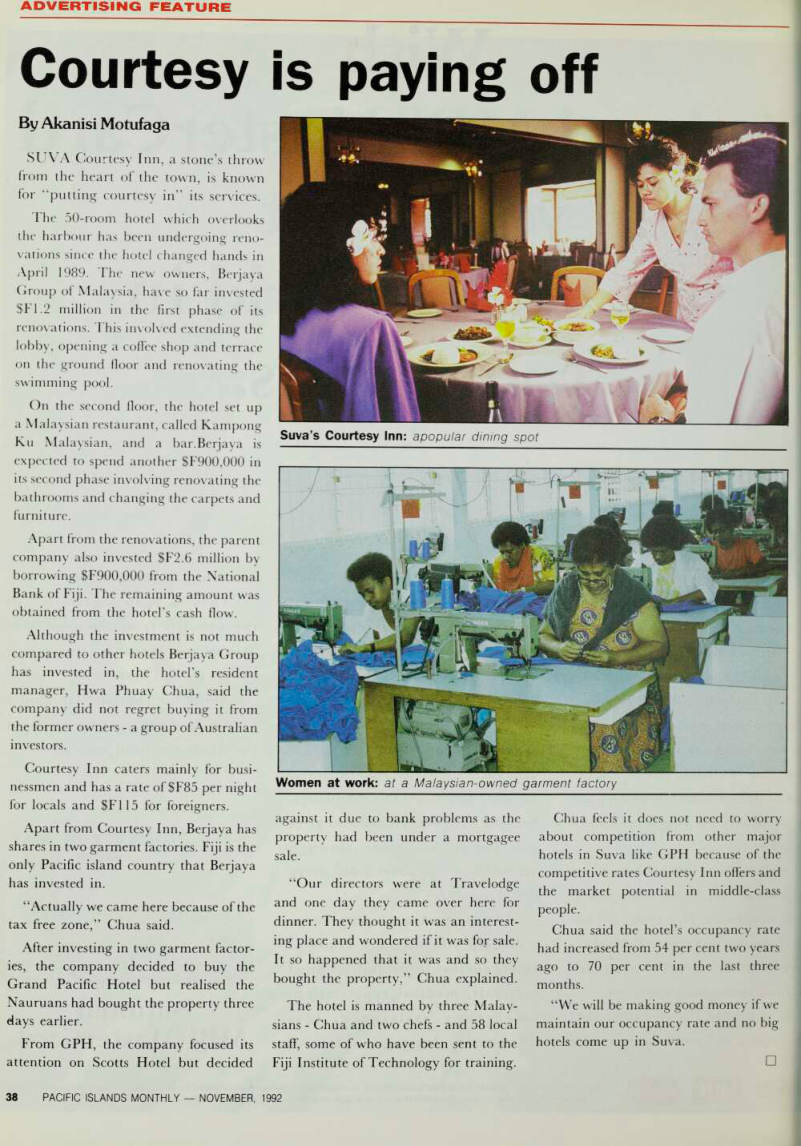
By Akanisi Motufaga
SUVA Courtesy Inn, a stone’s throw from the heart of the town, is known for “putting courtesy in” its services.
The 50-room hotel which overlooks the harbour has been undergoing reno vations since the hotel changed hands in April 1989. The new owners, Berjaya Group of Malaysia, have so far invested SFI.2 million in the first phase of its renovations. This involved extending the lobby, opening a coffee shop and terrace on the ground floor and renovating the
swimming pool.
On the second floor, the hotel set up a Malaysian restaurant, called Kampong Ku Mai aysian, and a bar.Berjaya is expected to spend another 5F900,000 in its second phase involving renovating the bathrooms and changing the carpets and furniture.
Apart from the renovations, the parent company also invested 5F2.6 million by borrowing 5F900,000 from the National Bank of Fiji. The remaining amount was obtained from the hotel’s cash flow.
Although the investment is not much compared to other hotels Berjaya Group has invested in, the hotel’s resident manager, Hwa Phuay Chua, said the company did not regret buying it from the former owners - a group of Australian investors.
Courtesy Inn caters mainly for busi nessmen and has a rate of SFBS per night for locals and SFIIS for foreigners.
Apart from Courtesy Inn, Berjaya has shares in two garment factories. Fiji is the only Pacific island country that Berjaya has invested in.
“Actually we came here because of the tax free zone,” Chua said.
After investing in two garment factor ies, the company decided to buy the Grand Pacific Hotel but realised the Nauruans had bought the property three days earlier.
From GPH, the company focused its attention on Scotts Hotel but decided
against it due to bank problems as the property had been under a mortgagee sale.
“Our directors were at Travelodge and one day they came over here for dinner. They thought it was an interest ing place and wondered if it was for sale.
It so happened that it was and so they
bought the property,” Chua explained.
The hotel is manned by three Malay sians - Chua and two chefs - and 58 local staff, some of who have been sent to the Fiji Institute of Technology for training.
Chua feels it does not need to worry about competition from other major hotels in Suva like GPH because of the competitive rates Courtesy Inn offers and the market potential in middle-class
people.
Chua said the hotel’s occupancy rate had increased from 54 per cent two years ago to 70 per cent in the last three months.
“We will be making good money if we maintain our occupancy rate and no big hotels come up in Suva.
Suva’s Courtesy Inn: apopular dining spot
Women at work: at a Malaysian-owned garment factory
Advertisements & other items, p. 39 (1 item)
Suva GourtessT
*• •sar*
No other hotel in Suva trtflke you feel right at ho ! mm 55 other hotel is like the Because 1 °*** hi. nor too small- Jus. <* /-' re " ri,h£r on perfect size to g.« V"- P “ £lC 7lle rooms. nn.,ne With fifty coml „,(/« shop wlth Molavsinn restmnon , lwt and mom/ terrace, sunmmmg V fte , special other commences to P« V Courtesy In« / ed "f {>xU
c#<»-n y N. si
Suva GourtessT
:"r,r
GEORGE RUBINE 9061
The power of knowledge

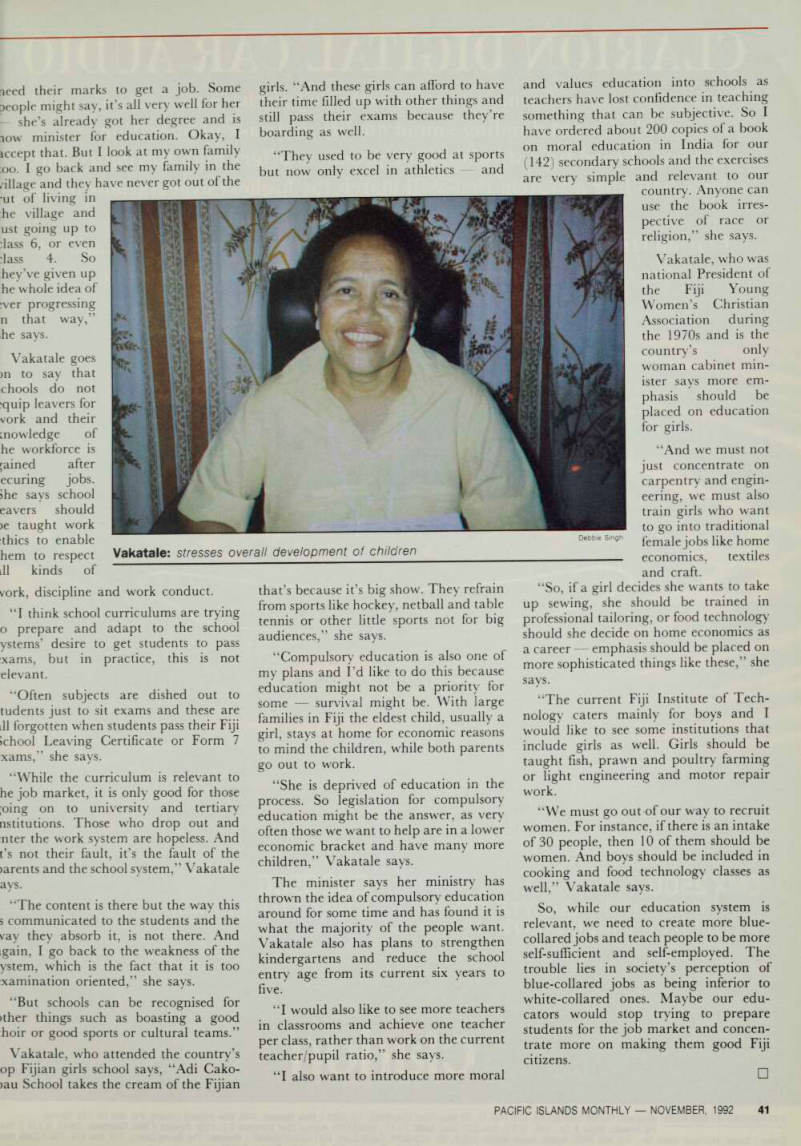
Education
By Debbie Singh
Fiji’s Education Minister, Tania Vakatale, speaks on the shortcomings of the system
Fiji’s education system is too academic and examination oriented, with teachers constantly under pressure to complete syllabuses and students being denied personally enriching subjects in the process, says the Fiji’s education minis ter, Taufa Vakatale.
“Non examinable subjects like re ligious teaching, literature, drama, cul
ture and physical education are swapped in favour of physics, chemistry and biology, and teachers don’t digress when teaching these,” she says.
“So when an opportunity crops up and we need to stress values we don’t. For instance, teachers could spend a period
on male-female stereotyping in or social science classes, but they don’t pick up opportunities to digress.
“I find it very disturbing that if secondary school students miss a math-] ematics or physics class, they use a physical education class to make up for it. They shouldn’t be doing this but if stems from the fact that we have become very examination conscious and as a result, very narrow-minded”, Vakatale says.
“So our children have become com petitive in a very negative way and schools are competing with other schools for 100 per cent pass rates (in exams),” she says.
“But I don’t see education as a means of getting jobs I see it as a means of preparing a child to cope with life and, perhaps this is a rather radical thing for| one to be thinking of, especially as minister for education. But I’m not too| worried if we teach subjects in schools! that are irrelevant to the employment market”.
“Teachers are not worried about the full development of the child or whether 1 they have been enriched by other things.
“For instance, most Fiji schools gear students toward scoring high marks in subjects such as economics, accounting, mathematics and english, thus narrow ing them into taking the barest minimum subjects,” Vakatale says.
“We need to have more core require ments like arts students taking science subjects and vice-versa”.
Vakatale says the only way the system can be improved is by cutting the link between employment and what is ■ achieved via a certificate in schools. She recommends employers put prospective applicants through aptitude tests before interviewing them and then look at their examination results. “For instance, why should a care-taker need to have a pass I in english in the Fiji School Leaving Certificate examination? I think all he needs is to be vigilant, have a strong body, be awake at night and in good health. Why should a pass in english be a qualifying thing?” Vakatale asks.
She says only when this link is cut, can schools relax and treat an examination pass as just a pass and not judge it on the merit of its grades.
“Why should we look at marks? They j have their certificate and that’s it”, she j says.
“They’ll need their marks if they decide to go to university but they don’t
need their marks to get a job. Some leople might say, it’s all very well for her she’s already got her degree and is low minister for education. Okay, I iccept that. But I look at my own family :00. I go back and see my family in the dllage and they have never got out of the
ut of living in he village and ust going up to :lass 6, or even :lass 4. So hey’ve given up he whole idea of
;ver progressing
n that way,” he says.
Vakatale goes m to say that chools do not ;quip leavers for vork and their
knowledge of
he workforce is
gained after
ecuring jobs. >he says school eavers should
>e taught work
thics to enable hem to respect ill kinds of
vork, discipline and work conduct.
“I think school curriculums are trying o prepare and adapt to the school ystems’ desire to get students to pass xams, but in practice, this is not elevant.
“Often subjects are dished out to tudents just to sit exams and these are ill forgotten when students pass their Fiji ichool Leaving Certificate or Form 7 xams,” she says.
“While the curriculum is relevant to he job market, it is only good for those ;oing on to university and tertiary nstitutions. Those who drop out and nter the work system are hopeless. And t’s not their fault, it’s the fault of the >arents and the school system,” Vakatale ays.
“The content is there but the way this s communicated to the students and the vay they absorb it, is not there. And igain, I go back to the weakness of the ystem, which is the fact that it is too xamination oriented,” she says.
“But schools can be recognised for »ther things such as boasting a good hoir or good sports or cultural teams.”
Vakatale, who attended the country’s op Fijian girls school says, “Adi Cako >au School takes the cream of the Fijian
girls. “And these girls can afford to have their time filled up with other things and still pass their exams because they’re boarding as well.
“They used to be very good at sports but now only excel in athletics and
that’s because it’s big show. They refrain from sports like hockey, netball and table tennis or other little sports not for big audiences,” she says.
“Compulsory education is also one of my plans and I’d like to do this because education might not be a priority for some survival might be. With large families in Fiji the eldest child, usually a girl, stays at home for economic reasons to mind the children, while both parents go out to work.
“She is deprived of education in the process. So legislation for compulsory education might be the answer, as very often those we want to help are in a lower economic bracket and have many more children,” Vakatale says.
The minister says her ministry has thrown the idea of compulsory education around for some time and has found it is what the majority of the people want.
Vakatale also has plans to strengthen kindergartens and reduce the school entry age from its current six years to five.
“I would also like to see more teachers in classrooms and achieve one teacher per class, rather than work on the current teacher/pupil ratio,” she says.
“I also want to introduce more moral
and values education into schools as teachers have lost confidence in teaching something that can be subjective. So I have ordered about 200 copies of a book on moral education in India for our (142) secondary schools and the exercises are very simple and relevant to our
country. Anyone can use the book irres pective of race or religion,” she says.
Vakatale, who was national President of the Fiji Young Women’s Christian Association during the 1970 s and is the
country’s only
woman cabinet min ister says more em phasis should be placed on education
for girls.
“And we must not just concentrate on carpentry and engin eering, we must also train girls who want to go into traditional female jobs like home economics, textiles and craft.
“So, if a girl decides she wants to take up sewing, she should be trained in professional tailoring, or food technology should she decide on home economics as a career emphasis should be placed on more sophisticated things like these,” she says.
“The current Fiji Institute of Tech nology caters mainly for boys and I would like to see some institutions that include girls as well. Girls should be taught fish, prawn and poultry farming or light engineering and motor repair work.
“We must go out of our way to recruit women. For instance, if there is an intake of 30 people, then 10 of them should be women. And boys should be included in cooking and food technology classes as well,” Vakatale says.
So, while our education system is relevant, we need to create more blue collared jobs and teach people to be more self-sufficient and self-employed. The trouble lies in society’s perception of blue-collared jobs as being inferior to white-collared ones. Maybe our edu cators would stop trying to prepare students for the job market and concen trate more on making them good Fiji citizens.
Vakatale: stresses overall development of children
Advertisements & other items, pp. 40-42 (2 items)
40
PACIFIC ISLANDS MDNTHI Y NDVFMRFR IQQP
Corrie & Company
V
GENERAL
PURPOSE
GENERAL
PURPOSE
11 This is the Cyclone season.
Be ever ready with Now Eveready is power-packed in metal to give you benefits you can both see and feel. • up to 13% more active ingredients give you a battery that lasts an average of 13% longer! • a new unique double sealing system ensures no leakage. • new tough metal jacket protects battery making it moreboosted performance get New Eveready. Built stronger to last longer and longer...
Distributed by:
CORRIE & COMPANY
CARPENTER STREET, RAIWAI
PHONE: SUVA 386777 FAX: 370010 LAUTOKA PHONE: 660137
CLARION DIGITAL CAR AUDIO
For over 40 years Clarion car audio systems have been recognised worldwide for outstanding sound quality and ease of operation.
Clarion’s broad line of compatible products offers high flexibility and allows building a system that will match the highest expectations on the new and exciting Digital Sound.
Clarion strive to improve and perfect the driving environment and let the driver and passengers alike relax as much as possible. m m 6-c Clarion Li 1:3.0 111 E A-M
REAR «’
rnmmmmm clarion
CMX2SOD
AM/FM/STEREO CASSETTE TUNER
WITH CD CHANGER CONTROL
nm DOLBY system i * Dolby and the Double-D symbol are trademarks of Dolby Laboratories Licensing Corporation
CDC 9500
6 DISC CD CHANGER
i Specifications and design are subject to change without nonce
clarion
ST High-Tech High-Touch XX
Adding the local flavour
Education
By Christine Hatcher
IT’S B.ooam. The bells clang, urging “get in line” commands on eight primary and three secondary schools. Another day buzzes into action in the Cook Islands Free Educational system.
Ngereteina Puna, Minister of Educa tion says, “We have come a long way since the Polynesia Way was introduced n late 1989.”
He says, “We have an education system that holds on to the arm of New Zealand, rather than being on the back Tit.”
A recent review of this report, the Education & Training Sector Study ETSS) in April 1992, has highlighted a leed to get in touch with an even more ‘local flavour” educationally. It encour iges community involvement, an in :rease in textbook availability and has ecommended decentralization of de dsion making.
Chairman of the Polynesia Way Com nittee, Toua Matamaki, says, “This will ake up to five years to realize, due to mdgetary constraints.” The minister ees education as an economical invest nent in the future, on a shoe-string >udget.
Public perception of the quality of ducation reported in Polynesia Way is lot encouraging. “Low, sometimes rock ►ottom standards... very poor teaching...ramshackle wildings...outmoded curriculum...poor »rofessional satisfaction... massive ..aimless youth...deteriorat
ng values.”
The UNDP Human Development Report 991 says the Cook Island would need to icrease educational expenditure five per ent to reach an average for developing ountries. The present budget, the irgest allocation at NZ$7.B million 1991-1992) expends 85 per cent on alaries leaving 15 per cent.
Only half a million dollars remain to un schools on 13 islands. One-teacher Tools exist on Palmerston and Nassau nd composite classes on other outer ilands are not uncommon. Sometimes, nough money for books and essentials, i absent.
Minister Puna says, “This is not a on government, they are trying a do their best.
While the importance of the “first ears” is recognised, this is not reflected i teachers’ salaries. However, tertiary ualified teachers and principals in the rimary field do exist.
But, says Puna, “I’ve never known a
rich teacher.” He says while better pay might attract good staff, it may attract them for the wrong reasons.
While waiting to see qualified, dedi cated staff, he says, “Some of the best teachers I know have no qualifications.”
Only six per cent (1991) of Cook Island trained teachers have university degrees, according to the ETSS.
And, dedication may be hard to buy at a starting salary of NZ$5OOO to NZ$6OOO per annum. The highest achievable wage being NZ519,500.
Says Puna, “Several teachers are still on NZ$BOOO we have to do something about that.”
‘We have come a long way ... we have an education sys tem that holds on to the arm of New Zealand, rather than being on the back of it.’
The ETSS cites a need to increase teacher morale.
Despite this, it seems, most children work hard, fare well. But, within any school system, those who cannot “fit in”, exist. For those, special dispensation must be granted by the Secretary of Education.
Thee Secretary, Lionel Browne, says, “There are a few. Granted mainly because of pregnancy and to those who find school torture, have a high absenteesim rate. But “drop outs” are virtually unknown. Education is compul sory until the age of 15 and may be raised to 16. But, everyone leaves school able to read.”
For those who do not fall by the wayside, a scheme, in operation since the 70s provides basis skills to the large percentage who leave school and become
“self-employed”.
The basic skills apprenticeship scheme, bridging from school to work-force in hospitality, mechanics, carpentry, bloc; • laying, nursing and the police force, ' v < s introduced in the 70s, he explains.
For those who gained an ‘A’ bursary plus last year, 13 scholarships Were
granted by Australia, New Zealand and the States.
For those who miss out, “in-house” training in their fields of choice is encouraged together with correspon dence study.
While curriculum says scholarships are awarded on a non-sexist basis, the statistics are confidential. Public opinion however indicates more men than women obtain those scholarships. This is despite a higher percentage (22.2 per cent) (statistics: ETSS).
In a bi-lingual society, gaining em ployment unless proficient in both Maori and English, is become increasingly difficult.
Ngatokorua says, while universal sub jects, such as English, Mathematics and Science are taught to New Zealand School Certificate level, Maori Language and Culture is compulsory to Cook Islands School Certificate level, the
minimum qualification.
Ngeretcina Puna remembers when speaking Maori during school, was
punished.
He says, “I try to see the rationale, but it was a stupid rule. I’m glad those days are over now. Somehow, the attitude changed, we became contemptible to wards our own language, our Maori
ways of doing things.”
Now, the use of local medicine is being
practised in primary schools.
“I envisaged schools with herb gardens for school lunches or nutritional drinks,” the minister says, looking forward to the day he can outlaw “junk food”.
Other pending changes include the controversial amendment to the current education act allowing capital punish ment in primary schools, a recent hotly debated issue. The present act allows corporal punishment for male secondary school students.
While two schools, so far, have reacted strongly against the amendment, others have not replied to a letter seeking
opinions.
The minister said in August, “To me, disrespect of authority warrants some form of corporal punishment”.
He said his attention was drawn to teachers verbally abusing children and there was no place in the system for people like that. Some people had the wrong idea about corporal punishment, he said.
“...It’s not using a big stick, it’s a smack on the leg”
Corporal punishment, he said, would be clearly defined.
Discriminating evidence
By David North
FOR years Commonwealth of the Northern Marianas Islands has not been able to organise its higher education system (which produces some teachers) and its wage scales to get enough local residents to teach school. So it had to look elsewhere to hire teachers, and it turned to two quite different labour markets the mainland and the
Philippines. The attraction of the main land teachers was that they were avail able, spoke good English, and could help CNMI kids qualify for mainland col leges. The attraction of the Filipino teachers was that they were inexpensive, and they were particularly adept with Filipino students (though CNMTs immi gration policies are such that most of the temporary alien workers from the Philip pines are not allowed to bring along their children).
In this meeting CNMI, according to the US Justice Department, erected aj three-tier system for the teachers. In the top layer were the mainland teachersj whose transportation to the islands is paid by CNMI, and who are paid better and get better housing than the other teachers.
In the middle level are the indigenous Chamorro and Carolinian teachers. At] the bottom are the Filipinos, who are paid less than the Americans, who are housed less well than the mainlandersj and whose hours are longer and working: conditions are less favorable than either] the Americans or the indigenous teach-j ers. Filipinos, who also must fly to their! jobs, secured none of the transportation assistance offered to the mainlanders.
Further the Justice Department charged the Filipinos were not given the same promotional opportunities granted other teachers, and the educational system made no effort to punish students; who harassed their Filipino teachers on racial grounds.
Federal law, for many years, has prohibited mainland employers from asking potential employees anything about their family situation a boss cannot ask a job candidate if he or she l is married, much less if she is pregnant.
To do so is to suggest gender discrimi nation.
Juan L. Babauta, CNMI Board of Education Chairman, denied the charges generally, but offered no specifics in! rebuttal.
Although he did not say so, a close] reading of the Justice Department com plaint suggests that the Washington lawyers tossed every conceivable charge into the complaint. For example, the; Board of Education was accused of causing the Filipino teachers to leave the islands if they wanted to change em ployers. This is not a Board of Education decision, it relates to the way CNMI treats all alien workers. CNMI was also accused of insisting that Filipino teachers take an English language test, but it does not make similar requirements of indi genous and mainland teachers. The
CNMI requirement is comparable to i
that made by every American university contemplating an application filed by a ] student from a nation other than an ] English-speaking one; those from English-speaking countries do not take a ! language test. Since English is the 1 language of instruction in CNMI, know- 1 ing English would seem to be a plausible condition for employment, as would j testing for it among job candidates from a non-English-speaking country.
Advertisements & other items, p. 44 (1 item)
Post Of Vice Chancellor
LE lUNIVESITE AOAO 0 SAMOA
Applications are invited for appointment as the Vice Chancellor of Le lunivesite Aoao o Samoa (Le 1.A.0.5.) The post of Vice Chancellor is that of the Academic and Administrative Head of the University as is required to focus the resources of the university, to fulfill the functions of the University as prescribed by legislation.
Le 1.A.0.5. established in 1984 will need further developments to service national needs as laid down in legislation and in accordance with policies laid down by the Council. The post of Vice Chancellor is to provide for leadership.
SALARY & TERMS OF SERVICE
Not less than WS $44,144 p.a. Grants are provided towards travel and removal.
Housing and transport will be provided. Eligible appointees will be requested to join the Superannuation Scheme for Le lunivesite Aoao o Samoa. The term of appointment is five (5) years with extensions/renewals as Council directs.
The University reserves the right not to make an appointment or to make an appointment by invitation at any time.
As provided for in the legislation copies for which may be obtained from le lAOS.
QUALIFICATIONS
A post-graduate qualification with proven years of effective administrative and academic experience.
Prospective applicants should write to the Registrar and indicate three (3) names of referees and times of availability for appointment. Applications are to be lodged with the Registrar by Monday November 30, 1992.
DUTIES
ADDRESS: The Registrar, Le 1.A.0.5., P.O. Box 5768,
Apia, WESTERN SAMOA,
Fax No. (685) 20938 Telephone (685) 20072/20575
Specialised training
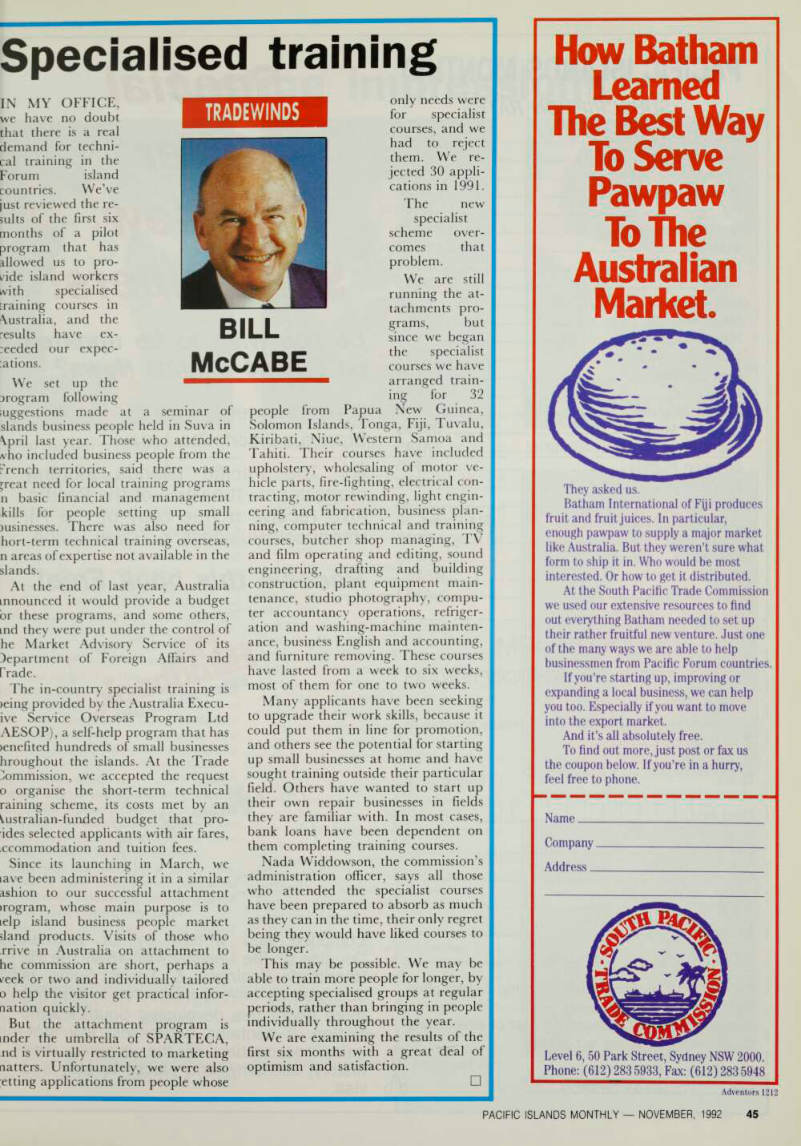
In My Office,
we have no doubt that there is a real demand for techni cal training in the Forum island countries. We’ve just reviewed the re sults of the first six months of a pilot program that has allowed us to pro vide island workers
with specialised
training courses in \ustralia, and the results have ex zeeded our expec tations.
We set up the
anagram following
;uggestions made at a seminar of slands business people held in Suva in \pril last year. Those who attended, who included business people from the French territories, said there was a rreat need for local training programs n basic financial and management kills for people setting up small msinesses. There was also need for hort-term technical training overseas, n areas of expertise not available in the slands.
At the end of last year, Australia mnounced it would provide a budget or these programs, and some others, md they were put under the control of he Market Advisory Service of its Department of Foreign Affairs and frade.
The in-country specialist training is >eing provided by the Australia Execu ive Service Overseas Program Ltd AESOP), a self-help program that has >enefited hundreds of small businesses hroughout the islands. At the Trade Commission, we accepted the request o organise the short-term technical raining scheme, its costs met by an Wstralian-funded budget that pro ides selected applicants with air fares, ccommodation and tuition fees.
Since its launching in March, we lave been administering it in a similar ashion to our successful attachment >rogram, whose main purpose is to iclp island business people market sland products. Visits of those who rrive in Australia on attachment to he commission are short, perhaps a /eek or two and individually tailored o help the visitor get practical infor
nation quickly.
But the attachment program is mder the umbrella of SPARTECA, nd is virtually restricted to marketing natters. Unfortunately, we were also etting applications from people whose
only needs were for specialist courses, and we had to reject them. We re jected 30 appli cations in 1991.
The new
specialist
scheme over comes that
problem.
We are still running the at tachments pro grams, but since we began the specialist courses we have arranged train ing for 32
people from Papua New Guinea, Solomon Islands, Tonga, Fiji, Tuvalu, Kiribati, Niue, Western Samoa and Tahiti. Their courses have included upholstery, wholesaling of motor ve hicle parts, fire-fighting, electrical con tracting, motor rewinding, light engin eering and fabrication, business plan ning, computer technical and training courses, butcher shop managing, TV and film operating and editing, sound engineering, drafting and building
construction, plant equipment main
tenance, studio photography, compu ter accountancy operations, refriger ation and washing-machine mainten ance, business English and accounting, and furniture removing. These courses have lasted from a week to six weeks, most of them for one to two weeks.
Many applicants have been seeking to upgrade their work skills, because it could put them in line for promotion, and others see the potential for starting up small businesses at home and have sought training outside their particular field. Others have wanted to start up their own repair businesses in fields they are familiar with. In most cases, bank loans have been dependent on them completing training courses.
Nada Widdowson, the commission’s administration officer, says all those who attended the specialist courses have been prepared to absorb as much as they can in the time, their only regret being they would have liked courses to be longer.
This may be possible. We may be able to train more people for longer, by accepting specialised groups at regular periods, rather than bringing in people individually throughout the year.
We are examining the results of the first six months with a great deal of optimism and satisfaction.
Tradewinds
Bill
Mccabe
Advertisements & other items, pp. 45-46 (1 item)
Pawpaw
How Batham
Learned
The Best Way
To Serve
Pawpaw
To The
Australian
Market.
J m They asked us.
Batham International of Fyi produces fruit and fruit juices. In particular, enough pawpaw to supply a nuyor market like Australia. But they weren’t sure what form to ship it in. Who would be most interested. Or how to get it distributed.
At the South Pacific Trade Commission we used our extensive resources to find out everything Batham needed to set up their rather fruitful new venture. Just one of the many ways we are able to help businessmen from Pacific Forum countries.
If you’re starting up, improving or expanding a local business, we can help you too. Especially if you want to move into the export market.
And it’s all absolutely free.
To find out more, just post or fax us the coupon below. If you’re in a hurry, feel free to phone.
Name Company Address i z
Oil*
Level 6, 50 Park Street, Sydney NSW 2000.
Phone: (612) 283 5933, Fax: (612) 283 5948 Adventors 1212
PACIFIC ISLANDS MONTHLY
SUBSCRIPTION RATES
Special
American Samoa...
Australia Canada Cook Islands Fiji French Polynesia...
Guam Hawaii Japan Kiribati Micronesia Nauru New Caledonia New Zealand Niue Norfolk Islands Northern Marianas, Papua New Guinea Solomon Islands Tonga Tuvalu United Kingdom US (Mainland) Vanuatu Western Samoa Elsewhere
USS4S
A$42
USS4S
A$46 F526.40
USS4S
USS4S
USS4S
USS3B
A$46
USS3S
A$42
USS32
NZSSS
A$46 A$42
USS3S
A$45 A$46 A$46 A$46 Stg Pound 28
USS4S
A$45
WSS6O
A$63
I ORDER FORM
PLEASE ENTER MY SUBSCRIPTION AS
FOLLOWS:
I enclose my cheque for $ (made payable to ' Pacific Islands Monthly) or debit $ |to my: □ Visacard □ Mastercard I Card No:LL. I I I I I I I I I I I I I I I I Expiry Date
I Name
I Signature
Address
I CITY COUNTRY
I Payments to Pacific Islands Monthly: Subscription Dept, GPO Box 1167, Suva, Fiji. ■ Subscription rates includes the cost of airspeeding J to all destinations set out above.
Telephone : (679) 304-111 \ Fax : (679) 303809 0*
Offer
To New
Subscribers!
Do you wish to be updated
on Pacific Islands News?
IF your answer is “Yes”
Start a subscription today!
For The Pacific Islands Monthly magazine the voice of the Pacific.
AND receive a free copy of the Fiji Handbook Business & Travel Guide.
Receive this book Free!
rm Compiled and written by Dr Norman Douglas of The University of NSW. The Fiji Handbook Business & Travel Guide is designed for anyone interested in learning more about this developing South Pacific Nation. It contains addresses, key statistics, description of the islands, their history, economy, and places to stay and visit.
Lasting impressions
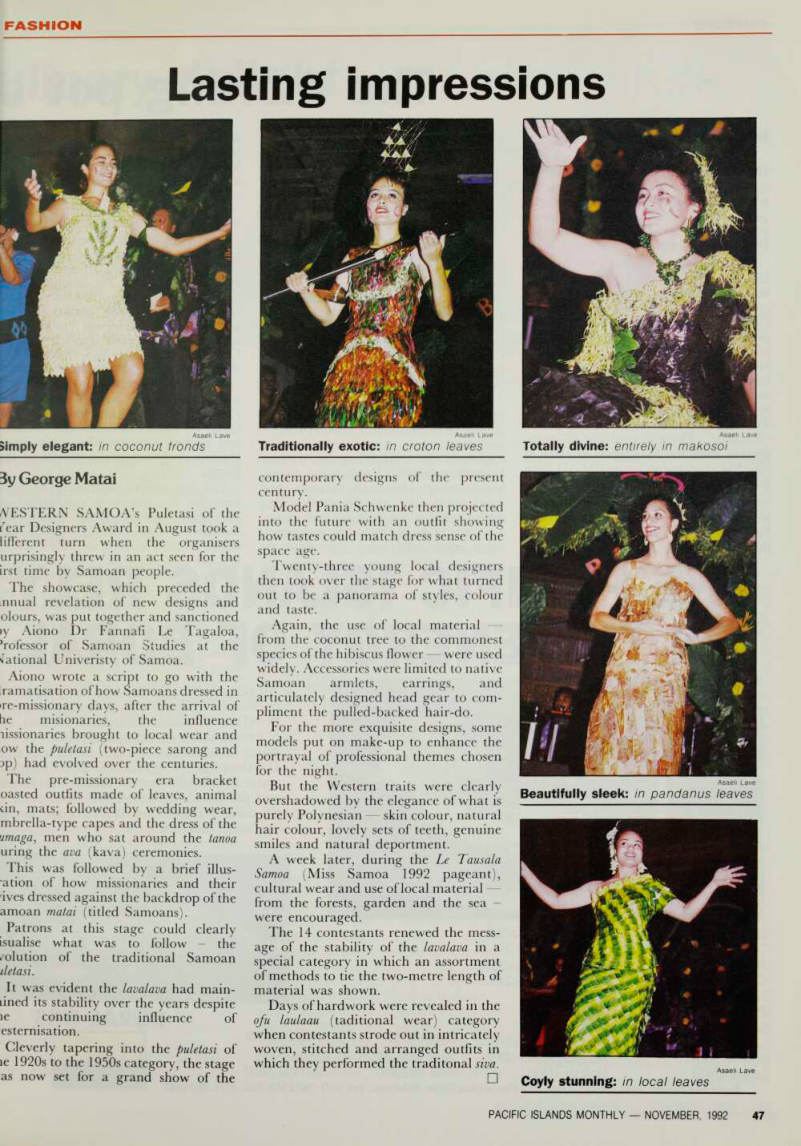
Fashion
By George Matai
WESTERN SAMOA’S Puletasi of the ear Designers Award in August took a lifferent turn when the organisers urprisingly threw in an act seen for the irst time by Samoan people.
The showcase, which preceded the nnual revelation of new designs and olours, was put together and sanctioned ►y Aiono Dr Fannafi Le Tagaloa, Tofessor of Samoan Studies at the National Univeristy of Samoa.
Aiono wrote a script to go with the ramatisation of how Samoans dressed in ire-missionary days, after the arrival of be misionaries, the influence lissionaries brought to local wear and ow the puletasi (two-piece sarong and Dp) had evolved over the centuries.
The pre-missionary era bracket oasted outfits made of leaves, animal cm, mats; followed by wedding wear, mbrella-type capes and the dress of the umaga, men who sat around the tanoa uring the ava (kava) ceremonies.
This was followed by a brief illus ation of how missionaries and their ives dressed against the backdrop of the
amoan matai (titled Samoans).
Patrons at this stage could clearly isualise what was to follow - the /olution of the traditional Samoan detasi.
It was evident the lavalava had main lined its stability over the years despite
le continuing influence of
esternisation.
Cleverly tapering into the puletasi of ic 1920 s to the 1950 s category, the stage as now set for a grand show of the
contemporary designs of the present century.
Model Pania Schwenke then projected into the future with an outfit showing how tastes could match dress sense of the space age.
Twenty-three young local designers then took over the stage for what turned out to be a panorama of styles, colour and taste.
Again, the use of local material from the coconut tree to the commonest species of the hibiscus flower were used widely. Accessories were limited to native Samoan armlets, earrings, and articulately designed head gear to com pliment the pulled-backed hair-do.
For the more exquisite designs, some models put on make-up to enhance the portrayal of professional themes chosen for the night.
But the Western traits were clearly overshadowed by the elegance of what is purely Polynesian skin colour, natural hair colour, lovely sets of teeth, genuine smiles and natural deportment.
A week later, during the Le Tausala Samoa (Miss Samoa 1992 pageant), cultural wear and use of local material from the forests, garden and the sea -
were encouraged.
The 14 contestants renewed the mess age of the stability of the lavalava in a special category in which an assortment of methods to tie the two-metre length of material was shown.
Days of hardwork were revealed in the ofu laulaau (taditional wear) category when contestants strode out in intricately woven, stitched and arranged outfits in which they performed the traditonal siva.
Asaeli Lave Simply elegant: in coconut fronds
Asaeli Lave Traditionally exotic: in croton leaves
Asaeli Lave Totally divine: entirely in makosoi
Asaeli Lave Beautifully sleek: in pandanus leaves
Asaell Lave Coyly stunning: in local leaves
The melting pot o[?]ulinary delight
Cuisine
By Dennis Richardson
HAWAII is without a doubt the ethnic melting pot of the Pacific islands where everyone belongs to a minority (and where, in the 1980 US Census Summary Tables, Hawaiians and other Polynesians do not even rate a mention!) . r , ... a popu ation o a most one mi ion, 26 per cent are haole (Caucasian me u mg ortugese), 24 per cent Japan ese, per cent rihpmo, five per cent mese, ess than one per cent (9000) P, ur f u awaiian t^e remainder div ided between the Korean, Vietnamese, i egro, Samoan, mixed race and miscel janeous . Moreover, the islands were originally settled by Polynesians from ™' P a ™ ° f , the Pac , lflc nommall y c a 1 V. 1 m . ora * ra ltlon means faraway . There is evidence of immi- Irvwr* r ° m . the . Mar quesas_as early as the UP t 0 At the time of James Cook’s discovery of Hawaii in 1778 and his death at Kealekekua Bay the following year there may have been some 300,000
people living in the island chain.
Within 100 years the number had been reduced (by disease and despair) to less than 60,000, and the frenetic recruitment of plantation labour launched the het erogeneous destiny of the 50th State of the Union.
It might be expected that so vari egated a settlement history would have given the Hawaiian Islands a diversity of food habits and cuisines. And indeed there is nowhere in the Pacific islands a greater diversity of eating houses than present-day Ohau. But this richness (and the economy) owe more to the $2-billion tourist industry and the $1 billion of federal inputs (largely military-related) than to Hawaii’s history of immigration.
In the early days, agriculture was relatively highly developed, and in cluded an ingenious irrigation system for the root staple, taro, which greatly impressed the English explorer George Vancouver in 1791, Yams, sugar, bread fruit, papaya, bananas, coconut, and other fruits (but not pineapple) were grown, while edible dogs and pigs and a variety of birds (including a domesti cated goose) and fish pre-date the
arrival of James Cook. Goats were introduced by Cook and sheep by Vancouver, but these were protein sources only for royalty. Commoners relied on the astonishing diversity of fish which many would argue is still the fmest feature of Hawaiian foods.
There are over 800 species of fish in Hawaiian waters, many of them edible, These include kihikihi (moorish Idols), (silver perch), Pacific Blue Marlin (which grows to over 1000 lbs), several other billfish, mahimahi (dorado or dol
phin), aku (skipjack), ahi (yellow fin),
and six other tuna species, sharks, limpets, oysters, crayfish, prawns and shrimps, squid and octopus, Despite the profusion of sea-fish there was also an ancient pond-fishing culture.
Fifteenth century fishponds can still be found on Ohau, Molokai and Kauai’i; and modern versions have since made Hawaii the pond-fishing capital of the Pacific.
The first western commercial contacts were by the notorious and rapacious European sandalwooders. When the sandalwood was exhausted, North Am erican whalers arrived to exploit the
acquired tastes of the chiefs for foreign goods. As many as 500 whaling ships a year have been reported as visit ing Honolulu and Lahaina one of which (in 1843)
carried a youthful Herman
Melville.
The development of in
dustrial petroleum in the
US spelled the end of whaling and widespread alienation and privatisation of land, re sulting from the Great Mahele in 1848, enabled
the development of plan
tation sugar and, later, pineapple. Then began the quest for cheap labour. It :ame from Kwangtung,
Mongolia, Korea, Japan, Puerto Rico, Madeira, the Azores, Portugal, Spain, [taly, Poland (Galicia), Australia, Ger nany, Norway, Russia, Siberia, Mocronesia, Polynesia, Melanesia and he Philippines.
Between 1852 and 1930, over 400,000 nen, women and children were trans ited to the plantations. Illiteracy was :onsidered an advantage (the labourers :ould not read their contracts and were :onsequently docile) as was a mixture of >rigins a company manager urged the Commission in 1895 (three years >efore annexation) to “keep a variety of abourers ... and thus prevent any :oncerted action in case of strikes ...”!
The history of Hawaii, thus, was not uch as to favour either the survival of the triginal Polynesian cuisine or the mportation of the more sophisticated omponents of others. There are, of ourse, some Polynesian foods poi pounded taro, nowadays blended, for aole visitors, with mashed banana), kalua >ig steamed in an umu or earth oven and 2 ulau (pork, beef, salt fish and taro leaves ►aked in ti or banana leaves). There are Iso distinctive Portugese contributions Pao doce, a light and sugared round loaf; lalasada, a kind of doughnut; spicy ausage, eaten with bean soup; and arious characteristic marinades). There re Filipino dishes like lechon kawali baked suckling pig); adobo (stew); pancit ijon (a mixture of shrimp, pork, veg tables and noodles) and the übiquitous "rmented fish paste, bagoong surprisingly, perhaps, the alleged stimu mt balut does not appear to have
reached the islands) there is the usual range of foodstuffs which follow Chinese settlement in any country (notably the Chinese introduced a variety of veg etables beans, snow peas, bamboo, lotus and various cabbages as well as a range of dim sum tid-bits which later became pupus or canapes). There are the hot Korean flavours of him chee (pickled vegetables, with garlic and chillies) and kun koki (meat marinated in soy, sugar and sesame, broiled and served very crisp), and most importantly, there is a rich Japanese legacy that is unique outside Japan. As with Chinese cuisine, many dishes lend themselves to the American habit of pupu tempura , meat and fish in shoyu, sashimi, daikon (white radish) with ginger, sushi, mochi and others as well as more formally structured combinations.
But to the visitor, the culinary interest of Hawaii lies in local adaptations of traditional imported recipes and the converse, imported recipes using local materials. They range from rumaki (chicken livers and water chestnuts which may be served with either Chinese mustard, Japanese Shoyu or chillies), manapua (a local version of filled Chinese dumplings), saimin (a noodle soup in vented by Hawaian Japanese), teriyaki beef, and Hawaian char siu (sweet roast pork with white wine) to the use of Macademia nuts in place of almonds, Mani manju sweet beans in a pastry and a huge variety of American derived desserts, based on tropical fruits ( banana, pineapple, poi and guava muf fins, papaya and coconut candies, mango
tapioca pudding, tropical fruit crepes
and waffles, passionfruit pie, and avo cado sherbert). There is even a Moroc can restaurant serving couscous with a local flavour, an Italian trattoria (one of several) offering prosciutto with papaya (instead of melon) and excellent Thai, Indonesian, Swiss, Greek, Portuguese, French and American eating places, , , r J The demands of tourism and defencce have also led to a prohferation of takeaways. Inevitably, McDonalds, Kentucky Fried Chicken, laco Bell, various Pizza and Pancake chains are there 5 more unusual are the very good ( and cheap) onental takeaways in eluding Japanese and Korean outlets, Fast food 18 appropriate to Hawaii. After 1™"
MoZ“
Montague,
Advertisements & other items, pp. 48-49 (1 item)
The Pacific Islands Rely
ON THE ENERGY OF BORAL
■ W^fcaUi l*si American Samoa (684) Tafuna 699 2948 Aua 6442170 Cook Islands (682; Rarotonga 24460 (679) Suva 315522 Lautoka 60088 Sigatoka 50578 Labasa 82973 Norfolk Islands (6723) Norfolk Island 2419 Papua New Guinea (675) Port Moresby 214248 Lae 422574 Rabaul 921225 Wewak 862125 Mount Hagen 551216 Solomon Islands (677) Honiara 21833 All through the Pacific Islands, people rely on Boral LP gas for their energy needs.
Boral has terminals throughout the area, and is proud to be a leading supplier.
Boral Gas is clean, efficient and low in cost.
It’s the ideal energy source for cooking and water beating in homes, motels and hotels, and for a wide range of industrial uses.
So call for Boral Gas. We have the energy you’re looking for.
Tonga(676) Nukualofa 24035 Vava’u 22903 Vanuatu (678) Santo 36455 Port Vila 22046
BORAL GAS
Boral Gas Pacific, John Oxley Centre, 339 Coronation Drive, Brisbane. Tel: (07) 3671365. Fax: (07) 3694347
BAGOT
BELLFOUNDRIES
Supplying tuned
bronze bells in Australia and Pacific Islands since 1977 imf Postal Address: Box 421, North Adelaide, SA 5006, Australia Telephone: (08) 267 1306 Office: 147 Ward St, North Adelaide, SA Workshop: 346 Carrington St, Adelaide, SA
Taking them under her wing
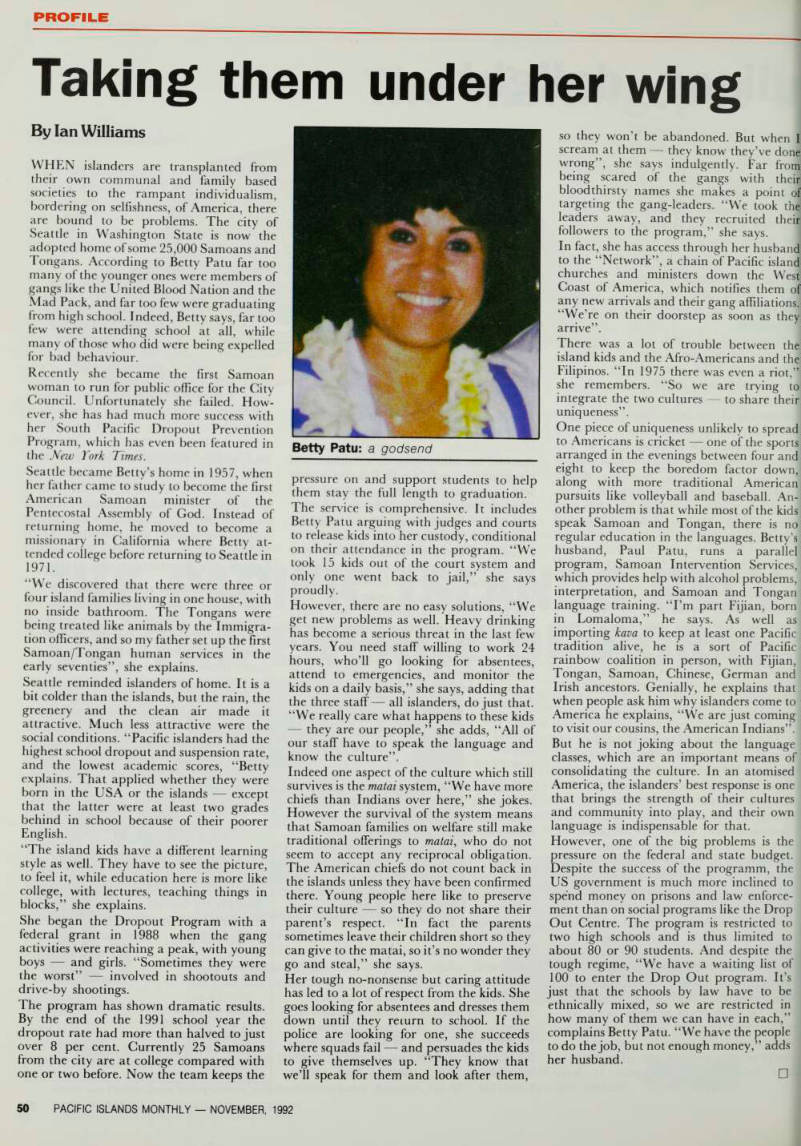
Profile
By lan Williams
WHEN islanders are transplanted from their own communal and family based societies to the rampant individualism, bordering on selfishness, of America, there are bound to be problems. The city of Seattle in Washington State is now the adopted home of some 25,000 Samoans and Tongans. According to Betty Patu far too many of the younger ones were members of gangs like the United Blood Nation and the Mad Pack, and far too few were graduating from high school. Indeed, Betty says, far too few were attending school at all, while many of those who did were being expelled for bad behaviour.
Recently she became the first Samoan woman to run for public office for the City Council. Unfortunately she failed. How ever, she has had much more success with her South Pacific Dropout Prevention Program, which has even been featured in the New York Times.
Seattle became Betty’s home in 1957, when her father came to study to become the first American Samoan minister of the Pentecostal Assembly of God. Instead of returning home, he moved to become a missionary in California where Betty at tended college before returning to Seattle in 1971.
“We discovered that there were three or four island families living in one house, with no inside bathroom. The Tongans were being treated like animals by the Immigra tion officers, and so my father set up the first Samoan/Tongan human services in the early seventies”, she explains.
Seattle reminded islanders of home. It is a bit colder than the islands, but the rain, the greenery and the clean air made it attractive. Much less attractive were the social conditions. “Pacific islanders had the highest school dropout and suspension rate, and the lowest academic scores, “Betty explains. That applied whether they were born in the USA or the islands except that the latter were at least two grades behind in school because of their poorer English.
“The island kids have a different learning style as well. They have to see the picture, to feel it, while education here is more like college, with lectures, teaching things in blocks,” she explains.
She began the Dropout Program with a federal grant in 1988 when the gang activities were reaching a peak, with young boys and girls. “Sometimes they were the worst” involved in shootouts and
drive-by shootings.
The program has shown dramatic results.
By the end of the 1991 school year the dropout rate had more than halved to just over 8 per cent. Currently 25 Samoans from the city are at college compared with one or two before. Now the team keeps the
pressure on and support students to help them stay the full length to graduation.
The service is comprehensive. It includes Betty Patu arguing with judges and courts to release kids into her custody, conditional on their attendance in the program. “We took 15 kids out of the court system and only one went back to jail,” she says proudly.
However, there are no easy solutions, “We get new problems as well. Heavy drinking has become a serious threat in the last few years. You need staff willing to work 24 hours, who’ll go looking for absentees, attend to emergencies, and monitor the kids on a daily basis,” she says, adding that the three staff — all islanders, do just that.
“We really care what happens to these kids they are our people,” she adds, “All of our staff have to speak the language and know the culture”.
Indeed one aspect of the culture which still survives is the matai system, “We have more chiefs than Indians over here,” she jokes.
However the survival of the system means that Samoan families on welfare still make traditional offerings to matai, who do not seem to accept any reciprocal obligation.
The American chiefs do not count back in the islands unless they have been confirmed there. Young people here like to preserve their culture so they do not share their parent’s respect. “In fact the parents sometimes leave their children short so they can give to the matai, so it’s no wonder they go and steal,” she says.
Her tough no-nonsense but caring attitude has led to a lot of respect from the kids. She goes looking for absentees and dresses them down until they return to school. If the police are looking for one, she succeeds where squads fail and persuades the kids to give themselves up. “They know that we’ll speak for them and look after them,
so they won’t be abandoned. But when I scream at them they know they’ve done wrong”, she says indulgently. Far from being scared of the gangs with their bloodthirsty names she makes a point of targeting the gang-leaders. “We took the leaders away, and they recruited theirj followers to the program,” she says.
In fact, she has access through her husband to the “Network”, a chain of Pacific island churches and ministers down the West Coast of America, which notifies them of any new arrivals and their gang affiliations.
“We’re on their doorstep as soon as they arrive”.
There was a lot of trouble between the island kids and the Afro-Americans and the Filipinos. “In 1975 there was even a riot,”! she remembers. “So we are trying to integrate the two cultures to share their uniqueness”.
One piece of uniqueness unlikely to spread to Americans is cricket one of the sports arranged in the evenings between four and eight to keep the boredom factor down, along with more traditional American pursuits like volleyball and baseball. An other problem is that while most of the kids speak Samoan and Tongan, there is no regular education in the languages. Betty’s husband, Paul Patu, runs a parallel program, Samoan Intervention Services, which provides help with alcohol problems, interpretation, and Samoan and Tongan language training. “I’m part Fijian, born in Lomaloma,” he says. As well as importing kava to keep at least one Pacific tradition alive, he is a sort of Pacific rainbow coalition in person, with Fijian, Tongan, Samoan, Chinese, German and Irish ancestors. Genially, he explains that when people ask him why islanders come to America he explains, “We are just coming to visit our cousins, the American Indians”.
But he is not joking about the language classes, which are an important means of consolidating the culture. In an atomised America, the islanders’ best response is one that brings the strength of their cultures and community into play, and their own language is indispensable for that.
However, one of the big problems is the pressure on the federal and state budget.
Despite the success of the programm, the US government is much more inclined to spend money on prisons and law enforce ment than on social programs like the Drop Out Centre. The program is restricted to two high schools and is thus limited to about 80 or 90 students. And despite the tough regime, “We have a waiting list of 100 to enter the Drop Out program. It’s just that the schools by law have to be ethnically mixed, so we are restricted in how many of them we can have in each,” complains Betty Patu. “We have the people to do the job, but not enough money,” adds her husband.
Betty Patu: a godsend
Finding the American connection
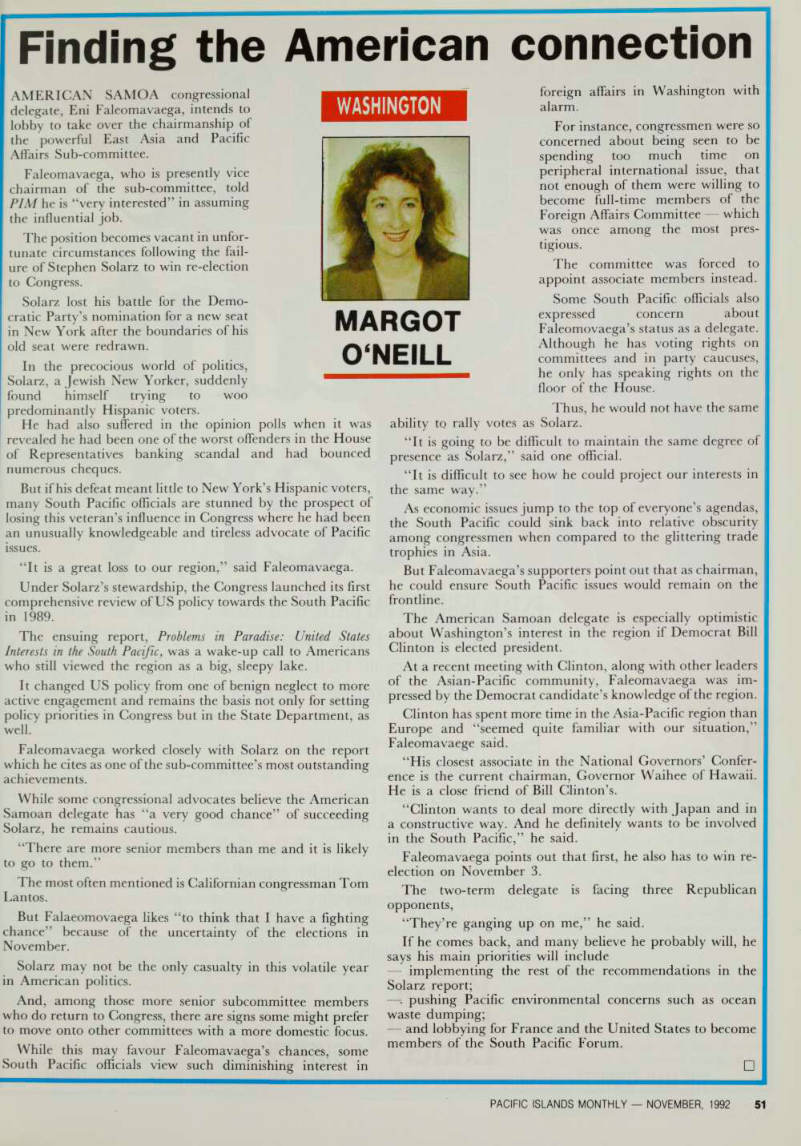
AMERICAN SAMOA congressional delegate, Eni Faleomavaega, intends to lobby to take over the chairmanship of the powerful East Asia and Pacific Affairs Sub-committee.
Faleomavaega, who is presently vice chairman of the sub-committee, told PIM he is “very interested” in assuming the influential job.
The position becomes vacant in unfor tunate circumstances following the fail ure of Stephen Solarz to win re-election to Congress.
Solarz lost his battle for the Demo cratic Party’s nomination for a new seat in New York after the boundaries of his old seat were redrawn.
In the precocious world of politics, Solarz, a Jewish New Yorker, suddenly found himself trying to woo predominantly Hispanic voters.
He had also suffered in the opinion polls when it was revealed he had been one of the worst offenders in the House of Representatives banking scandal and had bounced numerous cheques.
But ifhis defeat meant little to New York’s Hispanic voters, many South Pacific officials are stunned by the prospect of losing this veteran’s influence in Congress where he had been an unusually knowledgeable and tireless advocate of Pacific issues.
“It is a great loss to our region,” said Faleomavaega.
Under Solarz’s stewardship, the Congress launched its first comprehensive review of US policy towards the South Pacific in 1989.
The ensuing report, Problems in Paradise: United States Interests in the South Pacific, was a wake-up call to Americans who still viewed the region as a big, sleepy lake.
It changed US policy from one of benign neglect to more active engagement and remains the basis not only for setting policy priorities in Congress but in the State Department, as well.
Faleomavaega worked closely with Solarz on the report which he cites as one of the sub-committee’s most outstanding achievements.
While some congressional advocates believe the American Samoan delegate has “a very good chance” of succeeding Solarz, he remains cautious.
“There are more senior members than me and it is likely to go to them.”
The most often mentioned is Californian congressman Tom Lantos.
But Falaeomovaega likes “to think that I have a fighting chance” because of the uncertainty of the elections in November.
Solarz may not be the only casualty in this volatile year in American politics.
And, among those more senior subcommittee members who do return to Congress, there are signs some might prefer to move onto other committees with a more domestic focus.
While this may favour Faleomavaega’s chances, some South Pacific officials view such diminishing interest in
foreign affairs in Washington with alarm.
For instance, congressmen were so concerned about being seen to be spending too much time on peripheral international issue, that not enough of them were willing to become full-time members of the Foreign Affairs Committee which was once among the most pres tigious.
The committee was forced to appoint associate members instead.
Some South Pacific officials also expressed concern about Faleomovaega’s status as a delegate.
Although he has voting rights on committees and in party caucuses, he only has speaking rights on the floor of the House.
Thus, he would not have the same
ability to rally votes as Solarz.
“It is going to be difficult to maintain the same degree of presence as Solarz,” said one official.
“It is difficult to see how he could project our interests in the same way.”
As economic issues jump to the top of everyone’s agendas, the South Pacific could sink back into relative obscurity among congressmen when compared to the glittering trade trophies in Asia.
But Faleomavaega’s supporters point out that as chairman, he could ensure South Pacific issues would remain on the frontline.
The American Samoan delegate is especially optimistic about Washington’s interest in the region if Democrat Bill Clinton is elected president.
At a recent meeting with Clinton, along with other leaders of the Asian-Pacific community, Faleomavaega was im pressed by the Democrat candidate’s knowledge of the region.
Clinton has spent more time in the Asia-Pacific region than Europe and “seemed quite familiar with our situation,”
Faleomavaege said.
“His closest associate in the National Governors’ Confer ence is the current chairman, Governor Waihee of Hawaii.
He is a close friend of Bill Clinton’s.
“Clinton wants to deal more directly with Japan and in a constructive way. And he definitely wants to be involved in the South Pacific,” he said.
Faleomavaega points out that first, he also has to win re election on November 3.
The two-term delegate is facing three Republican opponents, “They’re ganging up on me,” he said.
If he comes back, and many believe he probably will, he says his main priorities will include implementing the rest of the recommendations in the Solarz report; —pushing Pacific environmental concerns such as ocean
waste dumping;
and lobbying for France and the United States to become members of the South Pacific Forum.
Washington
Margot
O'neill
Advertisements & other items, p. 52 (1 item)
■Rery
OVfDO
cmc
,IV,
■Rery
ESTABLISHED IN PAPUANEW GUINEA %J
Already the value of Pacific Instant Lottery has been assessed in one Pacific nation and seen to be of great advantage to that nation's development.
Papua New Guinea will officially launch Pacific Instant Lottery as their generic Instant Scratch Ticket Lottery Game.
Prize Guarantees and Tattersalls 1 120 years of Lottery guidance means Papua New Guinea benefits from a totally controlled revenue earning instrumentality.
Your country may well benefit accordingly when you become another
Pacific
Instant
Lottery country.
THEMAILSERVICE: SUITES,SS FLEWNGTON ROAD, NORTH MELBOURNE, VICTORIA 3051, AUSTRALIA. FAX: COUNTRY CODE 61 +3329 2166.
Where has the money gone?
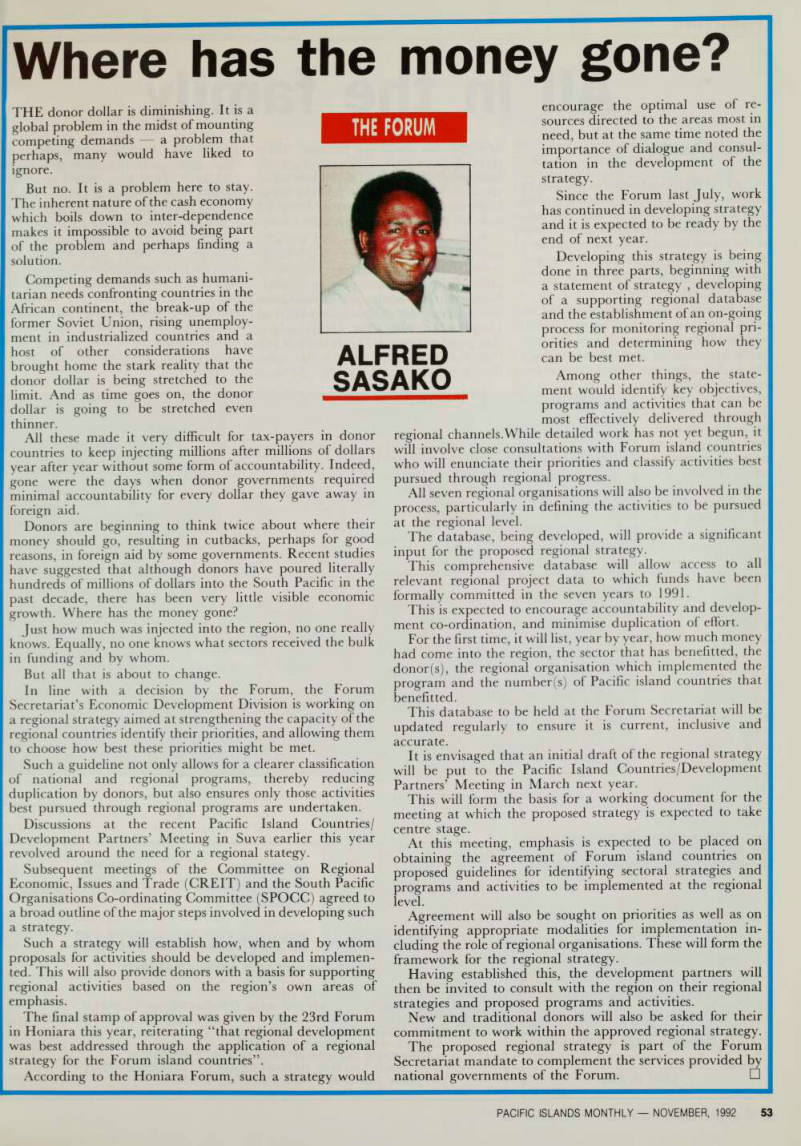
THE donor dollar is diminishing. It is a global problem in the midst of mounting competing demands a problem that perhaps, many would have liked to ignore.
But no. It is a problem here to stay.
The inherent nature of the cash economy which boils down to inter-dependence makes it impossible to avoid being part of the problem and perhaps finding a solution.
Competing demands such as humani tarian needs confronting countries in the African continent, the break-up of the former Soviet Union, rising unemploy ment in industrialized countries and a host of other considerations have brought home the stark reality that the donor dollar is being stretched to the limit. And as time goes on, the donor dollar is going to be stretched even thinner.
All these made it very difficult for tax-payers in donor countries to keep injecting millions after millions of dollars year after year without some form of accountability. Indeed, gone were the days when donor governments required minimal accountability for every dollar they gave away in foreign aid.
Donors are beginning to think twice about where their money should go, resulting in cutbacks, perhaps for good reasons, in foreign aid by some governments. Recent studies have suggested that although donors have poured literally hundreds of millions of dollars into the South Pacific in the past decade, there has been very little visible economic growth. Where has the money gone?
Just how much was injected into the region, no one really knows. Equally, no one knows what sectors received the bulk in funding and by whom.
But all that is about to change.
In line with a decision by the Forum, the Forum Secretariat’s Economic Development Division is working on a regional strategy aimed at strengthening the capacity of the regional countries identify their priorities, and allowing them to choose how best these priorities might be met.
Such a guideline not only allows for a clearer classification of national and regional programs, thereby reducing duplication by donors, but also ensures only those activities best pursued through regional programs are undertaken.
Discussions at the recent Pacific Island Countries/ Development Partners’ Meeting in Suva earlier this year revolved around the need for a regional stategy.
Subsequent meetings of the Committee on Regional Economic, Issues and Trade (CREIT) and the South Pacific Organisations Co-ordinating Committee (SPOCC) agreed to a broad outline of the major steps involved in developing such a strategy.
Such a strategy will establish how, when and by whom proposals for activities should be developed and implemen ted. This will also provide donors with a basis for supporting regional activities based on the region’s own areas of
emphasis.
The final stamp of approval was given by the 23rd Forum in Honiara this year, reiterating “that regional development was best addressed through the application of a regional strategy for the Forum island countries”.
According to the Honiara Forum, such a strategy would
encourage the optimal use of re sources directed to the areas most in need, but at the same time noted the importance of dialogue and consul tation in the development of the strategy.
Since the Forum last July, work has continued in developing strategy and it is expected to be ready by the end of next year.
Developing this strategy is being done in three parts, beginning with a statement of strategy , developing of a supporting regional database and the establishment of an on-going process for monitoring regional pri orities and determining how they can be best met.
Among other things, the state ment would identify key objectives, programs and activities that can be most effectively delivered through
regional channels. While detailed work has not yet begun, it will involve close consultations with Forum island countries who will enunciate their priorities and classify activities best pursued through regional progress.
All seven regional organisations will also be involved in the process, particularly in defining the activities to be pursued at the regional level.
The database, being developed, will provide a significant input for the proposed regional strategy.
This comprehensive database will allow access to all relevant regional project data to which funds have been formally committed in the seven years to 1991.
This is expected to encourage accountability and develop ment co-ordination, and minimise duplication of effort.
For the first time, it will list, year by year, how much money had come into the region, the sector that has benefitted, the donor(s), the regional organisation which implemented the program and the number(s) of Pacific island countries that benefitted.
This database to be held at the Forum Secretariat will be updated regularly to ensure it is current, inclusive and accurate.
It is envisaged that an initial draft of the regional strategy will be put to the Pacific Island Countries/Development Partners’ Meeting in March next year.
This will form the basis for a working document for the meeting at which the proposed strategy is expected to take centre stage.
At this meeting, emphasis is expected to be placed on obtaining the agreement of Forum island countries on proposed guidelines for identifying sectoral strategies and programs and activities to be implemented at the regional level.
Agreement will also be sought on priorities as well as on
identifying appropriate modalities for implementation in
cluding the role of regional organisations. These will form the framework for the regional strategy.
Having established this, the development partners will then be invited to consult with the region on their regional strategies and proposed programs and activities.
New and traditional donors will also be asked for their commitment to work within the approved regional strategy.
The proposed regional strategy is part of the Forum Secretariat mandate to complement the services provided by national governments of the Forum. □
The Forum
Alfred
Sasako
All in the family
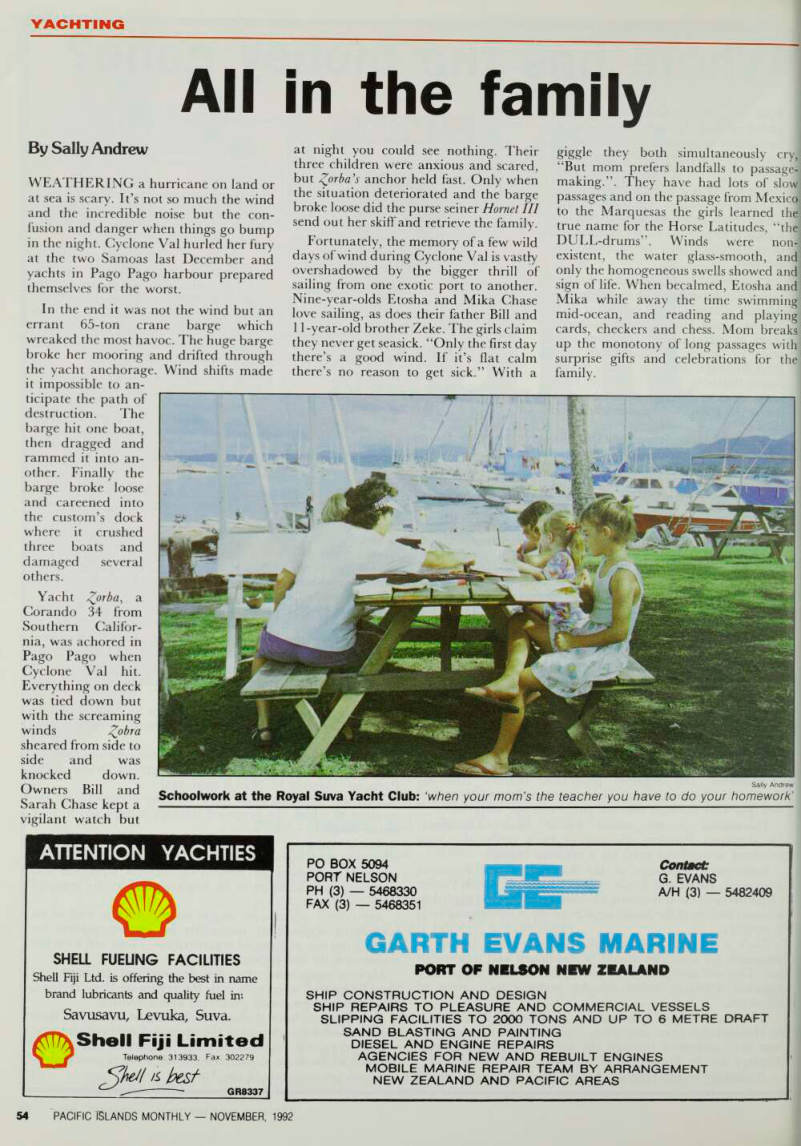
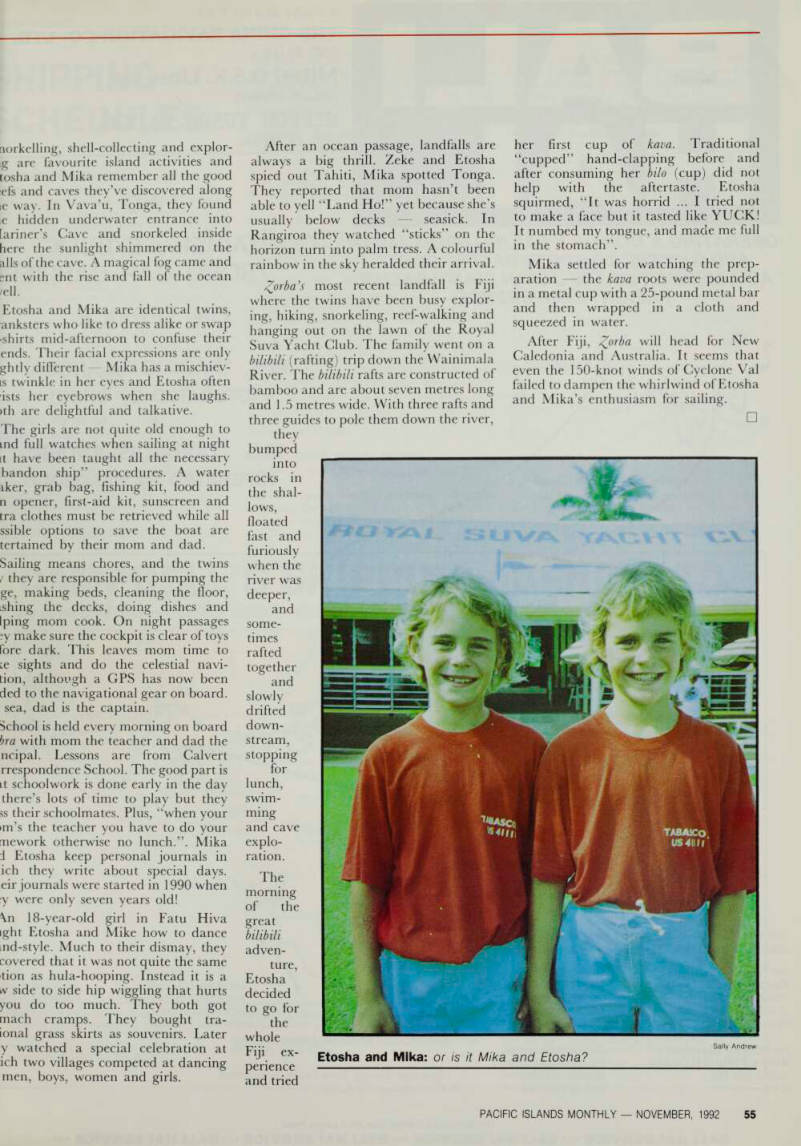
Yachting
By Sally Andrew
WEATHERING a hurricane on land or at sea is scary. It’s not so much the wind and the incredible noise but the con fusion and danger when things go bump in the night. Cyclone Val hurled her fury at the two Samoas last December and yachts in Pago Pago harbour prepared themselves for the worst.
In the end it was not the wind but an errant 65-ton crane barge which wreaked the most havoc. The huge barge broke her mooring and drifted through the yacht anchorage. Wind shifts made
it impossible to an ticipate the path of destruction. The barge hit one boat, then dragged and rammed it into an other. Finally the barge broke loose and careened into the custom’s dock where it crushed three boats and damaged several others.
Yacht £orba, a Corando 34 from Southern Califor nia, was achored in Pago Pago when Cyclone Val hit.
Everything on deck was tied down but with the screaming winds J?obra sheared from side to side and was knocked down.
Owners Bill and Sarah Chase kept a vigilant watch but
at night you could see nothing. Their three children were anxious and scared, but £orba’s anchor held fast. Only when the situation deteriorated and the barge broke loose did the purse seiner Hornet 111 send out her skiff and retrieve the family.
Fortunately, the memory of a few wild days of wind during Cyclone Val is vastty overshadowed by the bigger thrill of sailing from one exotic port to another.
Nine-year-olds Etosha and Mika Chase love sailing, as does their father Bill and 11-year-old brother Zeke. The girls claim they never get seasick. “Only the first day there’s a good wind. If it’s flat calm there’s no reason to get sick.” With a
giggle they both simultaneously cry, “But mom prefers landfalls to passage making.”. They have had lots of slow passages and on the passage from Mexico to the Marquesas the girls learned the true name for the Horse Latitudes, “the DULL-drums”. Winds were non-J existent, the water glass-smooth, and only the homogeneous swells showed and sign of life. When becalmed, Etosha and Mika while away the time swimming mid-ocean, and reading and playing cards, checkers and chess. Mom breaks up the monotony of long passages with surprise gifts and celebrations for the family.
Sally Andrew Schoolwork at the Royal Suva Yacht Club: when your mom's the teacher you have to do your homework’
norkelling, shell-collecting and explor
g are favourite island activities and tosha and Mika remember all the good efs and caves they’ve discovered along ie way. In Vava’u, Tonga, they found e hidden underwater entrance into [ariner’s Cave and snorkeled inside here the sunlight shimmered on the alls of the cave. A magical fog came and cnt with the rise and fall of the ocean fell.
Etosha and Mika are identical twins, anksters who like to dress alike or swap ■shirts mid-afternoon to confuse their ends. Their facial expressions are only ghtly different Mika has a mischiev is twinkle in her eyes and Etosha often ists her eyebrows when she laughs. >th are delightful and talkative.
The girls are not quite old enough to md full watches when sailing at night it have been taught all the necessary bandon ship” procedures. A water iker, grab bag, fishing kit, food and n opener, first-aid kit, sunscreen and tra clothes must be retrieved while all ssible options to save the boat are tertained by their mom and dad.
Sailing means chores, and the twins i they are responsible for pumping the ge, making beds, cleaning the floor, ishing the decks, doing dishes and Iping mom cook. On night passages ly make sure the cockpit is clear of toys fore dark. This leaves mom time to :e sights and do the celestial navi tion, although a GPS has now been ded to the navigational gear on board, sea, dad is the captain.
School is held every morning on board bra with mom the teacher and dad the ncipal. Lessons are from Calvert rrespondence School. The good part is it schoolwork is done early in the day there’s lots of time to play but they >s their schoolmates. Plus, “when your •m’s the teacher you have to do your mework otherwise no lunch.”. Mika i Etosha keep personal journals in ich they write about special days, eir journals were started in 1990 when y were only seven years old! \n 18-year-old girl in Fatu Hiva ight Etosha and Mike how to dance
md-style. Much to their dismay, they
covered that it was not quite the same tion as hula-hooping. Instead it is a w side to side hip wiggling that hurts you do too much. They both got mach cramps. They bought tra ional grass skirts as souvenirs. Later y watched a special celebration at
ich two villages competed at dancing
men, boys, women and girls.
After an ocean passage, landfalls are always a big thrill. Zeke and Etosha spied out Tahiti, Mika spotted Tonga.
They reported that mom hasn’t been able to yell“ Land Ho!” yet because she’s usually below decks seasick. In Rangiroa they watched “sticks” on the horizon turn into palm tress. A colourful rainbow in the sky heralded their arrival. ? , , . . i^^ j ll f;;; /orbas most recent landtall is riji Z' . „ • , , , i i where the twins have been busy explor- ... , r ,i-i mg, hiking, snorkel.ng, reef-walking and hanging out on the lawn oi the Royal Suva Yacht Club. The family went on a bilibih (rafting) trip down the Wainimala River. The bilibili rafts are constructed of bamboo and are about seven metres long and 1.5 metres wide. With three rafts and three guides to pole them down the river,
they bumped into rocks in the shal lows, floated fast and furiously when the river was deeper, and some times rafted together and slowly drifted down stream, stopping for lunch, swim ming and cave
explo
ration.
The morning of the great bilibili adven ture, Etosha decided to go for the whole
Fiji ex
perience and tried
her first cup of kava. Traditional “cupped” hand-clapping before and after consuming her bilo (cup) did not help with the aftertaste. Etosha squirmed, “It was horrid ... I tried not to make a face but it tasted like YUCK!
It numbed my tongue, and made me full in the stomach”.
Mika settled for watching the prep aration the kava roots were pounded in a metal cup with a 25-pound metal bar and then wrapped in a cloth and squeezed in water.
After Fiji, £orba will head for New Caledonia and Australia. It seems that even the 150-knot winds of Cyclone Val failed to dampen the whirlwind of Etosha and Mika’s enthusiasm for sailing.
Sally Andrew
Etosha and Mika: or is it Mika and Etosha?
Advertisements & other items, pp. 54-56 (1 item)
Attention Yachties
SHELL FUEUNG FACILITIES
Shell Fiji Ltd. is offering the best in name brand lubricants and quality fuel in: Savusavu, Levuka, Suva.
/TT7X Shell Fiji Limited
V Y Telephone 313933. Fax 302279
best
GR8337
sdh
A JOINT SERVICE OF
THE CHINA NAVIGATION CO. LTD
(INC. IN U.K.)
Mitsui O.S.K. Lines Ltd.
(INC. IN JAPAN)
NIPPON YUSEN KAISHA
(INC. IN JAPAN)
SERVICE
TWO
OPERA TING A MONTHL Y SAILING FROM JAPAN
AND S.KOREA TO SOUTH PACIFIC PORTS
AS A MEMBER OF THE JAPAN SOUTH PACIFIC
FREIGHT CONFERENCE
CONTAINER / B/BULK
/RORO CAR CARRIERS
Nagoya\
' % Busan •
ON SERVICE
Yokohama
M.S, "PACIFIC ISLANDER”
(OPERATED By CNCO)
M.S. "CORAL ISLANDER”
(OPERATED By NYK/MOL)
Papua New Guinea
\ Tarawa
U Jo I f I ■ i Honiara Santo Noumea Apia
,♦^<3Pago Pago
' Ba| ' \ m * Suva
'•--Si Vila \G?
S' Nukualofa
Papeete
0 ®
Rarotonga
For more information, please contact our AGENTS in SUVA / FIJI, or respective ports For "Pacific Islander".
Carpenters Shipping Private Mail Bag
G.P.O.
Suva
CABLE: CARPSHIP
TLX; 2199 CARPSHIP FJ
TEL: 679-312244
FAX: 679-301572
And calling at: New Zealand For "Coral Islander": Burns Philp(SS)Co Ltd G.P.O. Box 355 Suva
CABLE: BURNSOUTH
TLX: 2168 BURNSHIP FJ
TEL: 679-311777
FAX; 679-301127
TARAWA (9 Days) f LAUTOKA (13 Days) APIA (18 Days) PAGO PAGO (19 Days) NUKUALOFA (28days) NOUMEA (31 Days) SANTO (36 Days) * HONIARA (39 Days)
RAROTONGA (Via APIA or PAGO PAGO)
SUVA (14 Days)
PAPEETE (23 Days)
VILA (35 Days) C ) Average Transit Time From Yokohama 5k On Inducement Basis For Schedule Details See Your Local Press BALI HAI SERVICE ••• BALI HAI SERVICE ••• BALI HAI SERVICE ••• BALI HAI SERVICE •••
Shipping
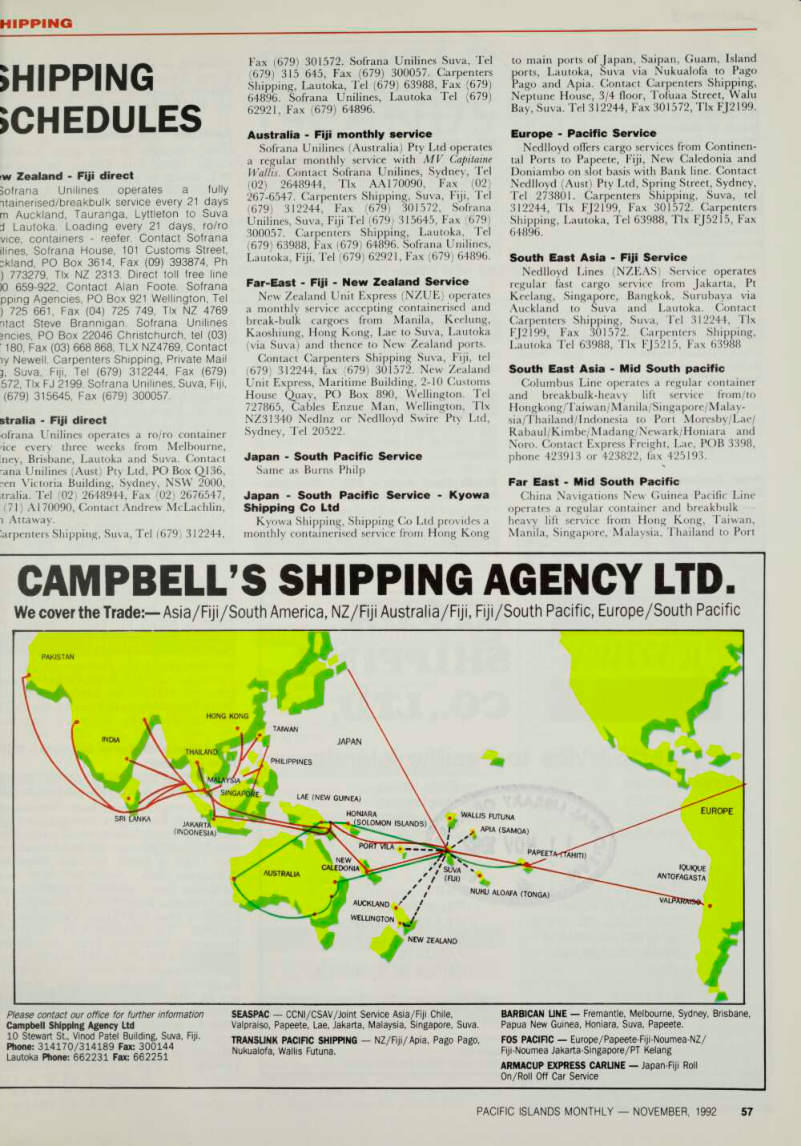
Schedules
>w Zealand - Fiii direct , . ii >. * i ,1,..
"? rana h/? 'lh P
to Suva T Lautoka Load i rv 2 ro/ro
Jice confainere - Contacf Sofrana
H nes Sofrana lOl -Customs Streef
idandfTO Box 3614,’ Fax (09) 393874, Ph ) 773279, Tlx NZ 2313. Direct toll free line )0 659-922, Contact Alan Foote. Sofrana pping Agencies, PO Box 921 Wellington, Tel ) 725 661, Fax (04) 725 749, Tlx NZ 4769 ntact Steve Branmgan. Sofrana Unilines jncies, PO Box 22046 Christchurch, tel (03) ' 180, Fax (03) 668 868, TLX NZ4769, Contact iy Newell. Carpenters Shipping, Private Mail I Suva, Fiji, Tel (679) 312244, Fax (679) 572, Tlx FJ 2199. Sofrana Unilines, Suva, Fiji, (679) 315645, Fax (679) 300057. stralia - Fiji direct ofrana Unilines operates a ro/ro container dee every three weeks from Melbourne, Iney, Brisbane, Lautoka and Suva. Contact r ana Unilines (Aust) Pty Ltd, PO Box Q 136, =en Victoria Building, Sydney, NSW 2000, tralia. Tel (02) 2648944, Fax (02) 2676547, (71) A 170090, Contact Andrew McLachlin, i Attaway. larpenters Shipping, Suva, Tel (679) 312244,
Fax (679) 301572. Sofrana Unilines Suva, Tel (679) 315 645, Fax (679) 300057. Carpenters Shipping, Lautoka, Tel (679) 63988, Fax (679) 64896. Sofrana Unilines, Lautoka Tel (679) 62921, Fax (679) 64896.
Australia - Fiji monthly service Sofrana Unilines (Australia) Pty Ltd operates a regular monthly service with MV Capitaine Wallis. Contact Sofrana Unilines, Sydney, Tel (02) 2648944, Tlx AA170090, Fax (02) 267-6547. Carpenters Shipping, Suva, Fiji, Tel (679) 312244, Fax (679) 301572, Sofrana Unilines, Suva, Fiji Tel (679) 315645, Fax (679) 300057. Carpenters Shipping, Lautoka, Tel (679) 63988, Fax (679) 64896. Sofrana Unilincs, Lautoka, Fiji, Tel (679) 62921, Fax (679) 64896.
Far-East - Fiji - New Zealand Service New Zealand Unit Express (NZUE) operates a monthly service accepting containerised and break-bulk cargoes from Manila, Keelung, Kaoshiung, Hong Kong, Lae to Suva, Lautoka (via Suva) and thence to New Zealand ports.
Contact Carpenters Shipping Suva, Fiji, tel (679) 312244, fax (679) 301572. New Zealand Unit Express, Maritime Building, 2-10 Customs House Quay, PO Box 890, Wellington. Tel 727865, Cables Enzue Man, Wellington, Tlx NZ31340 Nedlnz or Nedlloyd Swire Pty Ltd, Sydney, Tel 20522.
Japan - South Pacific Service Same as Burns Philp Japan - South Pacific Service - Kyowa Shipping Co Ltd Kyowa Shipping, Shipping Co Ltd provides a monthly containerised service from Hong Kong
to main ports of Japan, Saipan, Guam, Island ports, Lautoka, Suva via Nukualofa to Pago Pago and Apia. Contact Carpenters Shipping, Neptune House, 3/4 floor, Tofuaa Street, Walu Bay, Suva. Tel 312244, Fax 301572, Tlx FJ2199.
Europe - Pacific Service Nedlloyd offers cargo services from Continen tal Ports to Papeete, Fiji, New Caledonia and Doniambo on slot basis with Bank line. Contact Nedlloyd (Aust) Pty Ltd, Spring Street, Sydney, Tel 273801. Carpenters Shipping, Suva, tel 312244, Tlx FJ2199, Fax 301572. Carpenters Shipping, Lautoka, Tel 63988, Tlx FJ5215, Fax 64896.
South East Asia - Fiji Service Nedlloyd Lines (NZEAS) Service operates regular fast cargo service from Jakarta, Pt Keelang, Singapore, Bangkok, Surubaya via Auckland to Suva and Lautoka. Contact Carpenters Shipping, Suva, Tel 312244, Tlx FJ2199, Fax 301572. Carpenters Shipping, Lautoka Tel 63988, Tlx FJ5215, Fax 63988 South East Asia - Mid South pacific Columbus Line operates a regular container and breakbulk-heavy lift service from/to
Hongkong/Taiwan/Manila/Singapore/Malay
sia/Thailand/Indonesia to Port Moresby/Lac/
Rabaul/Kimbe/Madang/Newark/Honiara and
Noro. Contact Express Freight, Lae, POB 3398, phone 423913 or 423822, fax 425193.
Far East - Mid South Pacific China Navigations New Guinea Pacific Line operates a regular container and brcakbulk heavy lift service from Hong Kong, Taiwan, Manila, Singapore, Malaysia, Thailand to Port
Moresby, Lae, Rabaul, Kieta and Honi ara. Cargo from the same eastern ports to the South Pacific Ports of Noumea, Santo, Vila, Papeete, PagoPago, Apia, Nukualofa, Rarotonga and Tarawa will be shipped via Japan or Busan on the monthly Bali Hai
Service. Contact Steamships Shipping,
Port Moresby, PO Box 634, Tel 220283 or 220289.
Australia - New Caledonia - Fiji - Samoas - Tonga Pacific Forum Line operates a fully containerised service (general, reefer and ro-ro) from Sydney and Brisbane to Noumea, Lautoka, Suva, Apia, Pago Pago, Nuku’alofa, Sydney. Cargo centralised from Adelaide and Melbourne. Contact: Pacific Forum Line, PO Box 796, Auck land; Union Bulkships, 333 George St, Sydney, Brisbane and Melbourne; Union Co, Lautoka; Pacific Forum Line, Suva, Nuku’alofa; Pacific Forum Line, Apia; Polynesia Shipping, Pago Pago. Sofrana Unilines operates a roro/container service every three weeks from Melbourne, Sydney and Brisbane to Noumea, Suva and Lautoka with transhipment to the Samoas and Tonga.
New Zealand - Australia - PNG - Solomon Islands Pacific Forum Line operates a containerised and ro-ro service from Lyttleton, Napier and Auckland to Bris bane, Port Moresby, Lae, Honiara, Bris
bane then to New Zealand. Contact: Pacific Forum, Auckland, Christchurch;
Union Bulkships, Brisbane; Steamships
Shipping Port Moresby and Lae Sullivan Ltd, Honiara; Seabridge, Wellington.
NZ - Fiji Translink Pacific Shipping Fiji Agents are; Campbells Shipping Agency Ltd, Ph 314189 Fax 300144 Suva; Ph 662231 Fax 662251 Lautoka. Auckland Agents: McKay Shipping Ph (9) 390229 Fax (9) 3032931. Tauranga Agents, seatrade agencies Ph (75) 754989 Fax (75) 758380.
NZ - Fiji - Pago - Apia - Nuk Translink Pacific Shipping operates a monthly sailing with Polynesian Link, which carries Dry Container, reefers and breakbulk cargoes. NZ Agents McKay Shipping Shipping AKLD Ph 390229, Fax 3032931. Fiji Agents Campbells Shipping Agency & ltd Ph 314189 Fax 300144 NZ - Noumea - Wallis - Futuna Translink Pacific Agency operate a con tainer Breakbulk service once a month from NZ through Fiji and Noumea to Wallis & Futuna.
South East Asia - Fiji - Noumea - Papeete - Chile Service “Seaspac” A joint Chilean CCNI/CSAU Service offers a regular monthly sailing from Djakarta and Singapore to Noumea, Fiji, Papeete, and Chile. Cargo also
federated to Singapore from Korea, Honj Kong, Taiwan, Malaysia, Bangkok. Fij Agents: Campbells Shipping Agency Ltd ph. 314189, Fax 300144.
Australia - Fiji Service Chief container services under Australia Pacific Island Line Unitize Sofrana anc PFL vessels to provide a twice monthly service from Australia. Fiji Agents -j Campbells Shipping Agency Ltd PI 314189 Fax 300144. System Agent!
Nedlloyd Swire Ph(2) 2512699. Mel bourne Yarra Shipping Ph (3) 6936300| Brisbane, Nedlloyd Swire, ph (7) 8321551 j Australia - Fiji - Noumea - Vila - Santa Marsmond Express Lines operate a breakbulk service from Goodwood Island Australia to Fiji, Noumea, Vila Santo and Honiara. Continuous receiving depots ir Sydney and Brisbane enable this vessel tc bring cargoes from these parts. Fiji Agents Campbells Shipping Agency Ltd, ph, 314189, Fax 300144. Brisbane Agents Shippings & Marketing Ph (7) 2628082.
Sydney Agents Seabord Agencies (2) 3172325.
Australia - New Caledonia - Fiji ■ Hawaii - North America ACT Pace Pacific (ACTA Shipping) operates a fully containerised/break bulk service every 17-20 from Melbourne, Syd ney, Brisbane to Noumea, Suva and Lautoka. The vessels continue on to the West Coast of North America calling Honolulu at frequent intervals. Ships are ACT and ACT 12. Contacts: ACTA Pty Ltd, Sydney Ph 2869666, Tx 121369, Fx 2869610. ACTA Pty Ltd, Melbourne Ph
6112000, Tx 30949, Fx 6293055. Acta
Pty Ltd, Brisbane Ph 2213116 m Tx 40719, Fx 2298143. SATO, Noumea Ph 281122, Tx 3163, Fx 278532. Burns Philp Shipping,] Suva Ph 31 1777, Tx 2168, Fx 301127 d Burns Philp Shipping, Lautoka Ph 60777, Tx 5146, Fx 65850.
West Coast of North America - Fiji - New Zealand Blue Star Line Pacific Coast Service operates a fully containerised/break bulk service every 23 days from Vancouver, Seattle, San Francisco, Los Angeles to Pago Pago, Suva and New Zealand ports. Blue Star Line also provides a through service to East Coast of North America. Ships are Wellington Star, Southland Star and California Star. Contacts: Blue Star Line, San Francisco Ph 9282026, Tx 184925, Fx 6730355; Blue Star Line, Vancouver Ph 6817300, Tx 0451326, Fx 6835797; Interocean Steamship Corp, Seattle Ph 6829820, Tx 321101, Fx 3437421; Blue Star Line, Los Angeles Ph 5970454, Tx 408564, Fx 5978710. New Zealand Line, Welling ton, Ph 739029, Tx 3583, Fx 4992468; New Zealand Line, Auckland Ph 390965, Tx 2556, Fx 3032039; Burns Philp Shipping, Suva Ph 31 1777, Tx 2168, Fx 301127; Burns Philp Shipping, Lautoka Ph 60777, I Tx 5146, Fx 65850.
Advertisements & other items, pp. 57-60 (1 item)
Campbell’S Shipping Agency Ltd.
We cover the Trade:— Asia/Fiji/South America, NZ/Fiji Australia/Fiji, Fiji/South Pacific, Europe/South Pacific
HONG KONG
\ r
INDIA
JAPAN
THAI LAN
PHILIPPINES
I I
LAE (NEW GUINEA)
EUROPE
HONIARA
ISLANDS)
, WALDS FUTUNA
r s APIA (SAMOA)
SRI LANKA
JAKARTA
(INDONESIA)
POR? VILA 7-__T
PAPEET/KtAHITI)
NEW \
CALEDONIA
IQUIQUE
ANTOFAGASTA
m /, SUVA '
// (Fill) ,
/ / NUKU ALOAFA (TONGA)
AUCKLAND J f
WELUN6TON , /
AUSTRALIA
NEW ZEALAND
/ Please contact our office for further information Campbell Shipping Agency Ltd 10 Stewart St., Vinod Patel Building, Suva, Fiji.
Phone: 314170/314189 Fax: 300144 Lautoka Phone; 662231 Fax: 662251 SEASPAC CCNI/CSAV/Joint Service Asia/Fiji Chile, Valpraiso, Papeete, Lae, Jakarta, Malaysia, Singapore, Suva.
TRANSLINK PACIFIC SHIPPING NZ/Fiji/Apia, Pago Pago,
Nukualofa, Wallis Futuna.
BARBICAN LINE Fremantle, Melbourne, Sydney, Brisbane, Papua New Guinea, Honiara, Suva, Papeete.
FOS PACIFIC Europe/Papeete-Fiji-Noumea-NZ/ Fiji-Noumea Jakarta-Singapore/PT Kelang ARMACUP EXPRESS CARUNE Japan-Fiji Roll On/Roll Off Car Service
KYOWA
KYOWA
SHIPPING
CO., LTD.
Liner Service to Paciffic Islands
FROM
TO
OJAPAN
OKOREA
©TAIWAN
O THAILAf
1 1 NOV
O SAIPAN
OF MICRONESIA^
O MARSHAL ISLANDS
©AMERICAN SAMOA
©NEW CALEDONIA
©FIJI
HONG KONG
IGAPORE
JPPINES
JQfI^IYSIA
WMnq^)|(iesia
A p
©PALAU
©WESTERN SAMOA
©SOLOMON ISLANDS
©VANUATU
©PAPUA NEW GUINEA
HEAD OFFICE
6th Floor Kikushima Bldg 2-3. Hamamalsucho 2-chome Mmalo-ku, Tokyo 105. Japan Phon*. 03(437)2885 (Rep ) Cabtor MARIQUEEN Tokyo T#l#x; 242-4651 Kyowa J
OSAKA OFFICE
Dai San Fuji Bldg. 3-13 llachibon 1-chome. Osaka 550 Phon#; 06(533)5821 (Rep ) Cabtot. MARIQUEEN Osaka Tat#x: 525-6271 Ssiosa J
ACIFIC
ISLANDS
Q~ N T H L Y
fIRK€T PlfiC£
For the benefit of our resders who would like to piece e smell clessified edvertisement in our megezine, Merket Piece will essist you in selling persons! items, eccommodetion, reel estete, Posting or a service ... in feet enything you would like to sell to our over 50,000 reeders.
Merket Piece Advertising Retes ere structured to ellow you to piece as meny sdvertisements as you wish, economicelly.
TRAWLERS
Due to Licence restrictions, a large number of lodern steel and timber, Gulf of Carpentaria awlers are now available to Pacific Islands at r eatly reduced prices. Sizes range from 50 to 00 feet. Write or call Ben Lexcen Brokers, oug Meyer, 1 Jodrell St. Innisfail, Queensland jstralia 4860 (70) 614601 Delivery Avail- Dle. We deal in all types of Commercial 3ssels.”
FOR SALE
ji Beachfrontage. Two acres, vacant, freehold th fresh water stream on sealed road and ains electricity. Excellent swimming beach id deep water anchorage. Ideal tourist jvelopment or retirement. Valaga Bay, Savujvu. $63,000. Write Box 4693, Samabula, ji. Ph Fiji (679) 320-515.
TRAVEL
loneysaving tips in travel guides by David tanley: Micronesia Handbook (U 5515.45), ahiti-Polynesia Handbook (U 5515.45), Fiji lands Handbook (U 5512.45), South Pacific andbook (U 5519.45). Moon Publications, 22 Wall, Chico, CA 95928 USA, fax )16) 345-6751. Visa. Mastercard.
BUSINESS OPPORTUNITY
pportunity for shipowner to purchase shipng company with all licences, assets and lares in the Solomon Islands. Lucrative jsiness for 100 plus passenger vessel AUD 300,000 neg.
For further info.
Contact Manager P.O. Box 59 Honiara Phone 677/22914 Fax 677/23649 ■ In
\iational
~IBRARY OF AUSIRAI 1A
French Basic sail elf-furling >ne single doiti with kpit. Pro- -3w timber 4 (B) or nuatu.
HAWAII MASTER JOB LISTINGS
Hundreds of Jobs Rush US$l5 to Reliance Business Union, 91-1200 Mikohu St, Suite 44-B, Ewa Beach, Hawaii 96706.
SCRAP METAL
Good prices paid for your clean scrap Aluminium, Brass, Copper, Lead etc. Contact Nonferral Pty Ltd. 23 Davis Road, Wetherill Park NSW 2164 Australia. FAX 61 2 604 1304 for prompt reply. Our Company is a long established smelter and a leading metals buyer from the Pacific Region. Telephone 61 2 604 8855.
SOLAR SHOWER
Have a nice warm shower without electricity.
Ideal for the village, garden or camping, SA2S includes postage.
IMS PO Box 764 Airlie Beach, Qld 4802.
SHEETROCK CONTRACTOR
(808) 883-8215 Specializing in all phases of plasterboard construction. Will travel to jobsite!
Waikoloa Drywall 383165 Waikoloa, Hawaii 96738-3165
IMPORT - EXPORT OPPORTUNITIES
Urgently require listing of all your products.
Markets readily available on most goods.
Special interests in marine items: Ambergris, Sea Horse Etc. Sandalwood.
Contact: Beh Enterprises.
PO Box 477 Eastwood 2122 NSW. Australia.
Pho 61.2.874 6111 Fax. 61.2.874 5380 ■r.
V %
TATTOO SUPPLY
Everything. Write for price list. Tattoo Supply, P.O. Box 3068 Clontarf, Australia. Qld. 4019.
SCRAP METAL
Tall ingots operate from Brisbane, Australia and make frequent visits to the Pacific Islands which they have done for twenty-five years. We are buyers of Copper, Brass, Aluminium, Lead, Cable etc. Inspection no problems. Telephone 61 7 8922033. Fax 61 78922077.
DRYPOCK FOR SALE
Floating Dry Dock capable of slipping vessels of up to 30 metres loa. 350 tonnes displacement. 9 metre beam and 3.75 metres draught.
Dock is in excellent condition and in current Queensland department of harbours and marine survey. It is fully self contained.
Including 150 kva generating plant.
For further information contact Rosshaven Marine Pty. Ltd.
Phone 077 726392 or Fax 077 714337
PACIFIC
ISLANDS
[MONTH L Y 1
MfIRH€T PLflC€ CAN WORK
LUOND6RS FOR VOU ...
Promote your business, or service, sell your household
items, cars or heavy machinery
etc.
ONLY AUSSI PER WORD.
NO COMPANY LOGO. NO
DISPLAY. NO BOLD TYPE.
Just forward your Advertisement together with payment to: PACIFIC ISLANDS MONTHLY "Market Place ”, P.O. Box 1167, Suva, Fiji.
CONDITIONS:
1. All Advertisements are subject to acceptance and approval of publisher. 2. Advertisements are published as space permits; we cannot guarantee date of insertion. 3. All advertisements must be prepaid and should be typed or printed clearly. 4. Deadline for receipt of advertisements is the 10th of the month prior to issue.
5. PACIFIC ISLANDS MONTHLY
assumes no responsibility for any service other than publishing paid advertisements in this section.
i though we’re 75 years
sport still keeps us in shape.
50 A 1962 Mitsubishi 500 First of its class in the Macao Grand Prix. Powered by an air-cooled two-cylinder engine generating 21 ps. 36J M 1964 Mitsubishi Colt 600 First of its class in the Malaysian Grand Prix —Mm 15 1964 Mitsubishi Colt 1000 First in the Grand Prix of Japan. Its air-cooled engine with 51 ps gives it a top speed of 125 km/h.
£OLSsL
1967 Mitsubishi Colt I000F First of its class in Australia’s 2nd Southern Cross Rally. The 3rd Rally one year later is won by its successor, the Mitsubishi Colt 1000F Sports. mmw OjanriQAUNT , cnif 1970 Mitsubishi Galant GTO First Galant to race in a rally, Australia’s 5th Southern Cross Rally Boosted by twin carbs, its 1.6 1967 Mitsubishi Colt F 2-A First in the Grand Prix of Japan, Following in the tyremarks of its predecessor, the Colt F 3-A. It is powered by a 1.6 litre engine. 1970 Mitsubishi Colt F 2-D First of its class in the Grand Prix of Japan. ®3 1972 Mitsubishi Galant 16 LGS First in the 7th Southern Cross Rally of Australia 10 1988 Mitsubishi Galant Dynamic 4 First in the 9th Himalaya Rally. 1973 Mitsubishi Lancer 1600 GSR First in the 8th Southern Cross Rally. Follow-up victories in the 9th, 10th and 11th rallies. It also finished first in the 22nd ’(1974) and 24th (1976) East African Safari Rally 1989 Mitsubishi Galant Dynamic 4 First in two WRC events, the 39th 1000 Lakes Rally in Finland and the 38th RAC Rally. 1969 Mitsubishi F 2-C First in the Grand Prix of Japan. Powered by a 1.6 litre fuel injection engine delivering 240 ps. 1971 Mitsubishi Colt F 2000 First in the Grand Prix of Japan. Its 2.0 litre engine delivers 290 ps. sonojtD
MITSUBISHI
1985 Mitsubishi Pajero/Montero First in the 7th Paris-Dakar Rally in unmodified 4WD production class. First in Australia’s 1st
Wynn’s Safari Rally.
A* total 211 M 1992 Mitsubishi Pajero/Montero First, second and third in the 1st Paris-Cape Town Rally, the successor to Paris-Dakar. 13,000 gruelling kilometres extending the full length of Africa.
To many people, motorsport is great entertainment.
Modem rallies and races require skill, hard work, and a great deal of technological expertise. The resulting competition can be both fascinating and exhilarating
for participants and spectators alike.
But for Mitsubishi Motors there’s an added dimension —it’s an essential part of our business. We view the world’s toughest raid and rally courses as among our
most important research and development facilities.
We thrive on finding the most extreme conditions for both vehicle and driver. And we love the challenge of proving that our technology is the world’s best. But most of all, motorsport is important for us because what we learn by racing through jungles and deserts ultimately translates into better performing road vehicles.
Mitsubishi Motors is one of the world’s oldest car manufacturers. And we’re certainly proud of that heritage. But we believe that our tradition is only important as long as
we remain innovative.
AMERICAN SAMOA: PACIFIC MARKETING INC PO Box 698, Pago Pago Tel 699 9140 AUSTRALIA: MITSUBISHI MOTORS AUSTRALIA LTD. 1284 South Road, Clovelly Park. South Australia, Tel (08) 2757297 / FIJI: NIVIS MOTOR & MACHINERY CO. LTD. G.PO Box 150, Suva, Tel. 383411 / GUAM: GUAM INTERNATIONAL MOTORS INC. PO Box 8638, Tamunmg Guam. Tel 6467622 / NEW CALEDONIA: SOCIETE DTMPORTATION D'AUTO DU PACIFIQUE SUD S.A. PO Box 2548, Noumea.
Tel 274-144 / NEW ZEALAND: MITSUBISHI MOTORS NEW ZEALAND LTD. Private Bag Ponrua. Tel 237 0109 / NORFOLK ISLAND: BORRY’S PTY LTD. PO Box 169, Tel 2114 / PAPUA NEW GUINEA: TOBA PTY LTD. PO. Box 503. Port Moresby.
Tel 217-874 I SAIPAN: E’SAIPAN MOTORS INC PO Box 569, Tel 234 7343 SOLOMON ISLANDS: HARVEST PACIFIC LTD. G PO Box 823, Honiara. Tel 30407 / TAHITI (FRENCH POLYNESIA): SOPADEP S.A. PO Box 1617, Papeete Tel 427393 TONGA: SITANI MAPI CO., LTD. PO Box 83. Nuku’Alofa, Tel 24044 / VANUATU: SOCOMETRA VANUATU LTD. B P 06, Route de Lagon, Port Vila, Tel 2314 / WESTERN SAMOA: MOTOR DISTRIBUTORS (SAMOA) LTD. PO Box 576, Apia, Tel 20957
MITSUBISHI
MOTORS