New Caledonian system
pp. 48-49 · Read in the full issue
French Territories
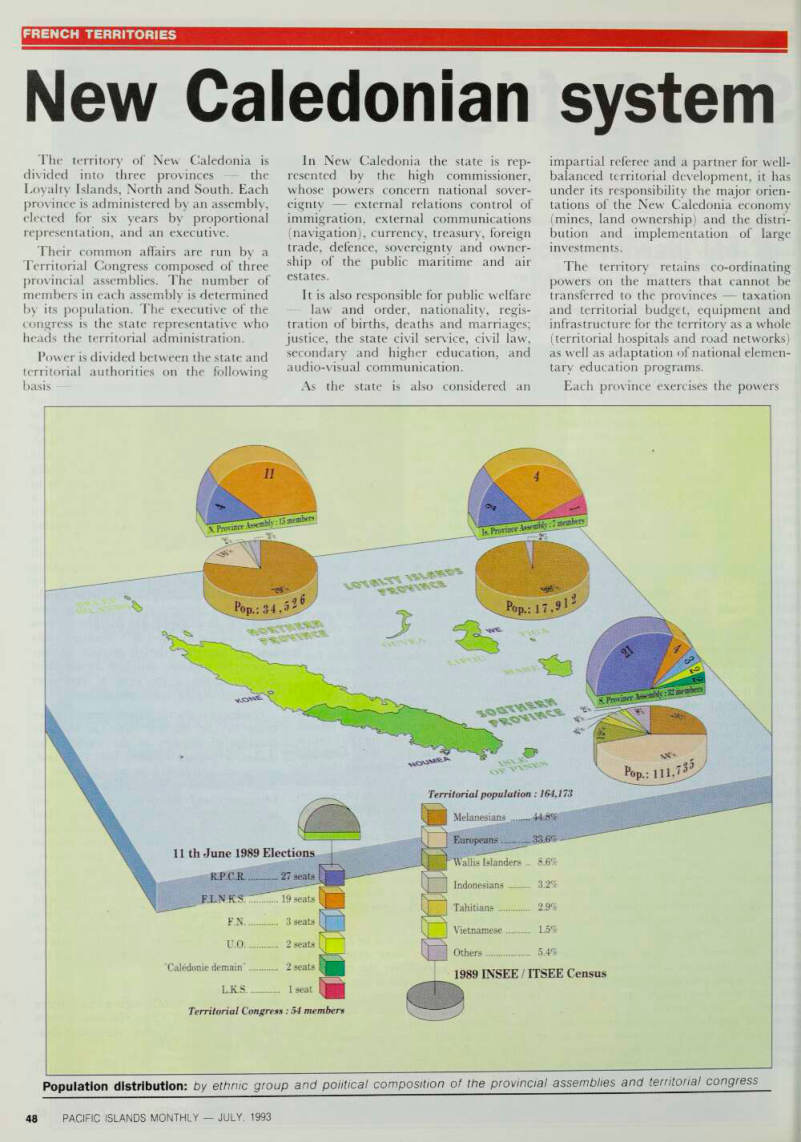
The territory of New Caledonia is divided into three provinces the Loyalty Islands, North and South. Each province is administered by an assembly, elected for six years by proportional representation, and an executive.
Their common affairs are run by a Territorial Congress composed of three provincial assemblies. The number of members in each assembly is determined by its population. The executive of the congress is the state representative who heads the territorial administration.
Power is divided between the state and territorial authorities on the following basis
In New Caledonia the state is rep resented by the high commissioner, whose powers concern national sover eignty external relations control of immigration, external communications (navigation), currency, treasury, foreign trade, defence, sovereignty and owner ship of the public maritime and air estates.
It is also responsible for public welfare law and order, nationality, regis tration of births, deaths and marriages; justice, the state civil service, civil law, secondary and higher education, and audio-visual communication.
As the state is also considered an
impartial referee and a partner for well balanced territorial development, it has under its responsibility the major orien tations of the New Caledonia economy (mines, land ownership) and the distri bution and implementation of large investments.
The territory retains co-ordinating powers on the matters that cannot be transferred to the provinces taxation and territorial budget, equipment and infrastructure for the territory as a whole
(territorial hospitals and road networks)
as well as adaptation of national elemen tary education programs.
Each province exercises the powers
Population distribution: by ethnic group and political composition of the provincial assemblies and territorial congress
that do not lie either with the state, the territory or the “communes”, in particular provincial budget, provincial development blueprints and related in frastructure, economic development, training, teaching of vernacular languages, promotion of local cultures, health and social policy, support of the communes for elementary education, youth, sport and leisure, cultural activities, land reform and land planning.
Consultative organs the provincial customary consultative council is made up of the major chiefs of the province’s customary areas. It is consulted by the Provincial council on draft or proposed resolutions concerning special civil law and landownership issues. It may be consulted on any other matters on the initiative of the president of the province, vs ho, also on Ins own initiative, can refer any question or proposal concerning the special civil law statute or the Melanesian land reserve statute to the arovincu.l council.
The Economic and Social Committee *m bodies thc private sector (professional jroups, trade unions, womens’, youth md rural associations). It gives consultaive advice on the cultural, economic or ocial bills submitted by the congress, the irovmcial customary consultative counil and the high commissioner. □