Simply frightening stuff
p. 47 · Read in the full issue
Ibooks
By Roman Grynberg
I know Rodney Cole well he is a decent man not given to apparent excess nor wild speculation nor to writing things that will frighten the socks off little children.
Finally, probably driven by the fact that no-one in government ever reads anything longer than an executive summary and many have not read a book since Gutlenberg, he has produced a report that would, as the Americans say “Get their undivided atten tion."
The report on population, prepared by he National Centre for Developing Studies, is part of a series of papers on the ulure of the region and is simply frighten ng stuff. Many of the conclusions are not erribly new but the analysis is in clear and oncise language that will hopefully make )olicy makers take heed of what is lappening in the Pacific. The facts arc implc and straightforward. Population is ncreasing at such a rapid rate in many ountrics of the South Pacific and economic rowth rates so low that a demographic nd economic disaster appears to be levilable.
The book is a series of projections of opulation to the year 2010 using computer rejections for PNG, Fiji, Vanuatu, Sol mon Islands, Kiribati, Western Samoa nd Tonga. For Melanesia where emi ration has never been an option nor riously considered, the trends on popu lion growth are without doubt the worst all. For PNG, for example, the results dicate that population will increase from i estimated 3.7 million in 1990 to over 5.2 illion in 2010. That is of course based on nimistic assumptions in the worst case enario PNG population could be in the cinity of 6.4 million by the year 2010.
The situation is no better throughout elanesia where population growth is ncerned. The Solomon Islands and anuatu will also face very similar situ ions to that of PNG. In Polynesia the uation is of course cushioned by the eater potential for Tongans and Western moans to emigrate. However, this should t be overestimated as emigration ssibilities in the traditional host countries :h as New Zealand, Australia and the US
quickly disappearing.
The increasing population leads to the ed for governments to devote even more ources to just providing basic health care d education for younger and younger pulation. Thus because of the rapid )wth of population governments in the are devoting scarce resources just to tintaining the current low and worsening ndards of education and health care in
the region rather than being able to improve quality.
The analysis by Professor Gannicott of the implications of rapid population growth on the stan dard of education makes equally grue some reading. “The most plausible con clusion is that the combination of rap idly growing popu lation and low GDP growth will make it possible for these three countries (PNG, Solomon Islands and Vanuatu) to make much progress with their education sys tem. Even 20 years from now it will not be possible for PNG, Solomon Islands and Vanuatu to provide basic 10 years of
schooling to everyone to school age.”
The effects of the population growth are most profound when one considers the number of jobs that would have to be created in order to give everyone employ ment. In Fiji, the expected increase in the size of the economically active labour force from 1991 to 2011 is over 5000 per year. In PNG the economically active population is increasing by approximately 36,000 per annum. In Fiji the increase in paid employment is on average 2500 per annum over the six years following the 1987 coups.
This was despite one of the most successful economic policies of restructuring that the region has witnessed. In PNG the growth in employment was 0.5 per cent per annum during the 1980 s or about 1000 jobs per year. This leaves 35,000 young people every year in PNG with no alternative but either the subsistence sector or a life of crime. That the criminal justice in PNG is incapable of dealing with this is clear but how long the subsistence sector will be able to sustain this population growth is just as serious a question.
All this would of course not be a problem if the South Pacific, were experiencing rapid economic growth like the rest of the Pacific rim. However, this is not the case.
In fact real per capita economic growth in the region has ben negative or so close to zero for most countries that they have virtually stood still. The island states stand in the centre of a great centrifuge of economic change in the Pacific where their
Asian and Ameri can neighbors whirl past them in increasing prosperity while they stand still or far worse.
There is only one thing that is
intellectually
wrong with the scenario pres ented by the Aus tralian National
University. As
Rodney Cole knows well, it is the height of bad manners in the Pacific for pa'lange to say harsh things. It would only be fitting and proper for us to provide a Santa Clause or a knight in shining armour, so to speak, which will
save the region from the impending demographic and economic disaster we must surely say nice things. As the knight approaches the end of this century those who will dare look him straight in the eyes will recognise him not as a shining knight but as one of the horsemen of the apocalypse carrying with him the scythe of aids to make a mockery of computer generated demographic projections.
Some of the Pacific island countries have some of the highest rates of sexually transmitted diseases in the world. This makes a perfect conduit for aids and, moreover, places like Suva, which are at times promiscuous beyond belief, as well as being ports and centres for regional tourism are the perfect breeding grounds and transmission centres for a disaster that could befall the region as quickly as it has S.E. Asia. Of course all this is unnecessary.
We could cope with the problem of high rates of population growth by doing the very hard things needed to assure rapid economic growth but we will not do these things so at least we will find cold solace and respite from the impending demo graphic disaster in the loving arms of the angel of death.
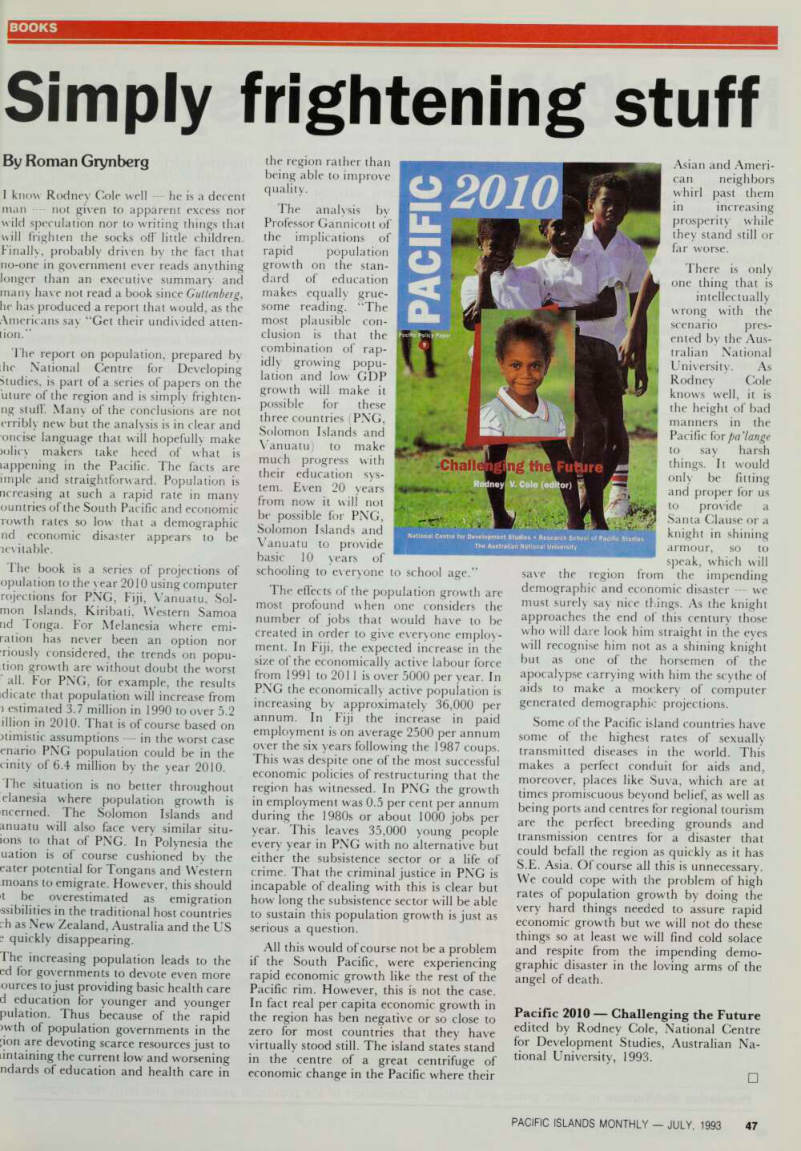
Pacific 2010 Challenging the Future edited by Rodney Cole, National Centre for Development Studies, Australian Na tional University, 1993.