digital
p. 45 · Read in the full issue
PACT goes digital
Due to the Australian government’s decision to introduce competition into the Australian telecommunications market and to merge its domestic and international carriers Telecom Australia and OTC, the familiar “OTC” business name has disappeared from international telecommunications. The new merged organ isation has been named the Telstra Corporation. The name “OTC” has been synonymous in the Pacific for may years with the Pacific Area Cooperative Telecommunications (PACT) Network.
In January 1994 Telstra will introduce a digital version of the current analogue PACT network into the Pacific Ocean region; and at the same time a similar network will be introduced into the Indian Ocean region. The new network, to be known as “DAMA NET”, will be operated initially as a separate overlay to PACT.
In general terms PACT and DAMA-NET are the same service, DAMA-NET being part of a path towards continual service enhancement which will provide the benefits of high quality digital transmission to the remotest parts of the Pacific. Interfaced with the small digital exchanges now available via Telstra, island users can enjoy the same quiet, echo free telephone calls that callers in more developed countries take for granted. Customers will also appreciate the full speed facsimile transmission and ability to transmit in-band data at 14.4 kilobits/second.
DAMA-NET earth stations are smaller and much cheaper than
those currently in use and will allow the economic provision of the “village telephone” and direct satellite access earth stations for business customers.
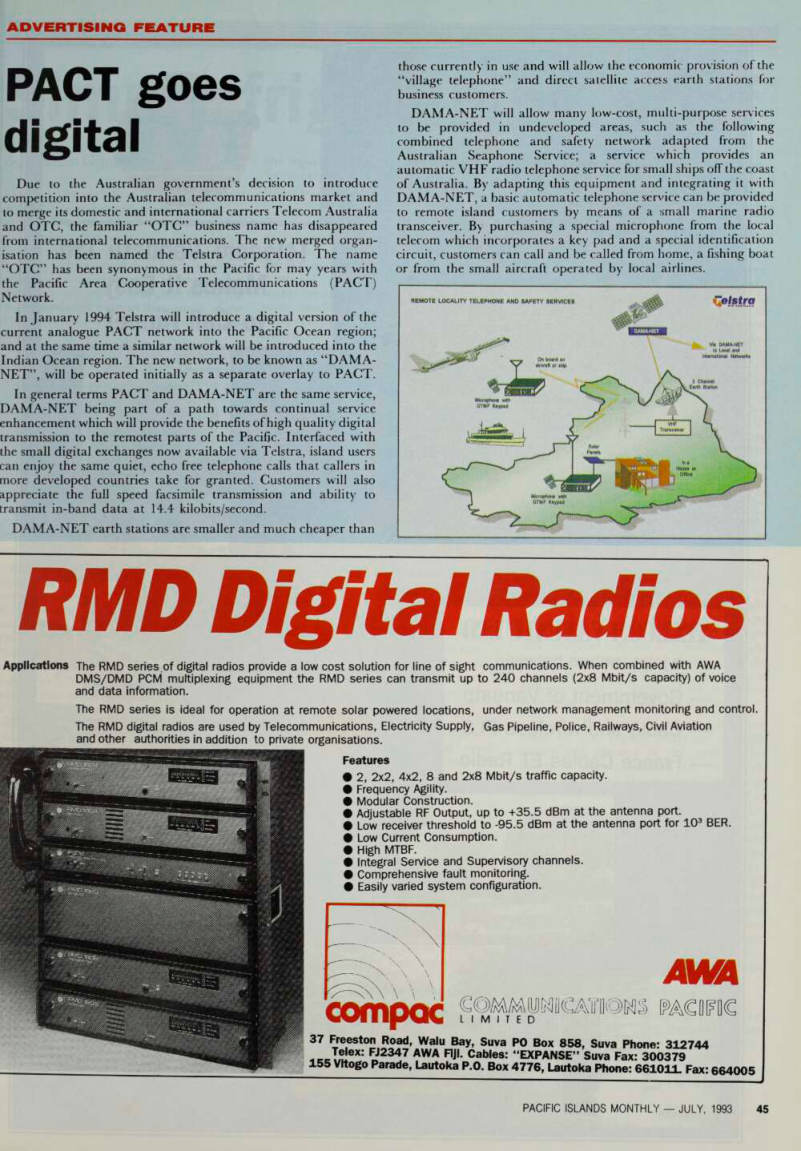
DAMA-NET will allow many low-cost, multi-purpose services to be provided in undeveloped areas, such as the following combined telephone and safety network adapted from the Australian Seaphone Service; a service which provides an automatic VHF radio telephone service for small ships off the coast of Australia. By adapting this equipment and integrating it with DAMA-NET, a basic automatic telephone sendee can be provided to remote island customers by means of a small marine radio transceiver. By purchasing a special microphone from the local telecom which incorporates a key pad and a special identification circuit, customers can call and be called from home, a fishing boat or from the small aircraft operated by local airlines.