Lost Fleet
pp. 48-49 · Read in the full issue
Science
By David North
THERE are so many sunken World War II warships lying in the waters just north of Guadalcanal in the Solomon Islands that maps call it Iron Bottom Sound.
Those deeply-sunk ships, and the re markable new underwater robots and cameras that photographed them, are the stars of a two-hour US television production to be released in May by The
National Geographic.
In production for more than a year, “The Lost Fleet of Guadalcanal” reports on the work of noted oceanographer Dr Robert D Ballard, who found the ill fated luxury liner, Titanic , and the Nazi battleship, Bismark, in the deep waters of
the North Atlantic.
The program moves back and forth between the war in the Solomons in 1942 and present life in the country. Old, grainy footage of the battle on Guadal canal between allied troops and the Japanese, and between the opposing navies, is intermixed with 1992 inter views with Solomon residents and shots of the 50th anniversary ceremonies.
Many historians regard the battle for Guadalcanal as the turning point in the Pacific War, the highpoint of Japanese expansion, as the battle for Stalingrad marked the peak of Nazi power in the European War.
The film not only shows old ships, it also shows old men, both Japanese
warriors and American marines, wl came back to the Solomons for a differe kind of reunion, a gathering of veterar: remembering war at a time of peace. TI old men are filmed with convention equipment, but the old ships get differe; and more expensive treatment; V. technology used in the Solomons for tf particular film will open many unlock* secrets at the bottom of the Pacific in t years to come.
Three types of underwater innovath were used in making the television sho* a bottom-crawling submersible; sophis; cated underwater robots; and newl developed underwater search lights.
The US Navy, which also lent t expedition a surface ship, provided
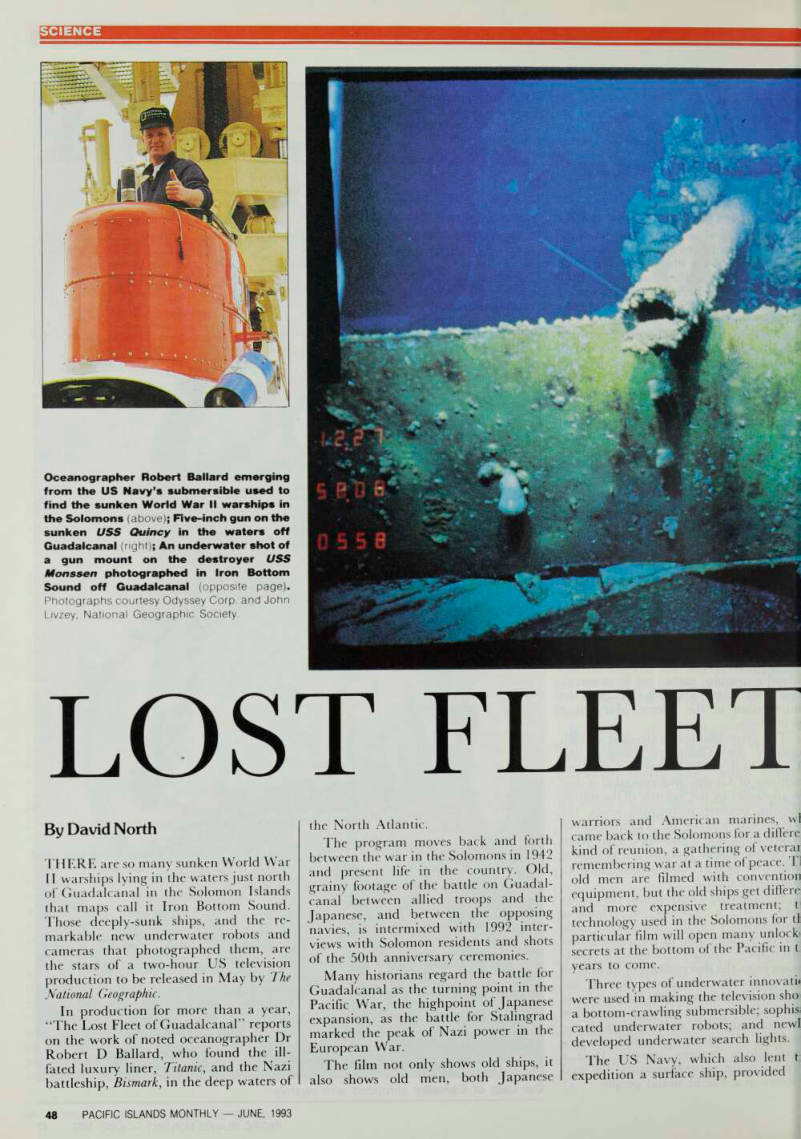
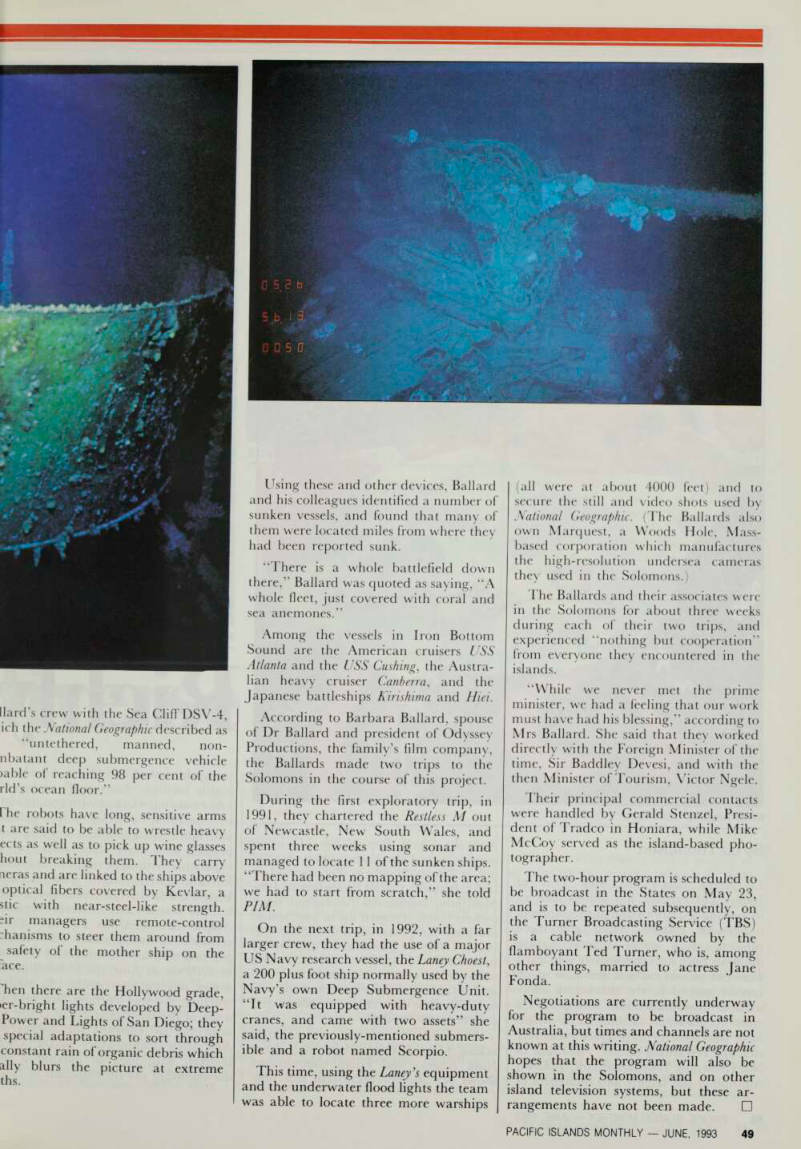
Oceanographer Robert Ballard emerging from the US Navy’s submersible used to find the sunken World War II warships in the Solomons (above); Five-inch gun on the sunken USS Quincy in the waters off Guadalcanal (right); An underwater shot of a gun mount on the destroyer USS Monssen photographed in Iron Bottom Sound off Guadalcanal (opposite page).
Photographs courtesy Odyssey Corp. and John Livzey, National Geographic Society.
Hard’s crew with the Sea Cliff DSV-4, ich the National Geographic described as “untethered, manned, non
nbatant deep submergence vehicle
>able of reaching 98 per cent of the rld’s ocean floor.” fhe robots have long, sensitive arms t are said to be able to wrestle heavy ects as well as to pick up wine glasses hout breaking them. They carry neras and are linked to the ships above optical fibers covered by Kevlar, a Stic with near-steel-like strength, -ir managers use remote-control zhanisms to steer them around from safety of the mother ship on the 'ace. hen there are the Hollywood grade,
•er-bright lights developed by Deep-
Power and Lights of San Diego; they special adaptations to sort through constant rain of organic debris which ally blurs the picture at extreme ths.
Using these and other devices, Ballard and his colleagues identified a number of sunken vessels, and found that many of them were located miles from where they had been reported sunk.
“There is a whole battlefield down there,” Ballard was quoted as saying, “A whole fleet, just covered with coral and sea anemones.”
Among the vessels in Iron Bottom Sound are the American cruisers USS Atlanta and the USS Cushing , the Austra lian heavy cruiser Canberra , and the Japanese battleships Kirishima and Hiei.
According to Barbara Ballard, spouse of Dr Ballard and president of Odyssey Productions, the family’s film company, the Ballards made two trips to the Solomons in the course of this project.
During the first exploratory trip, in
1991, they chartered the Restless M out of Newcastle, New South Wales, and spent three weeks using sonar and managed to locate 11 of the sunken ships.
“There had been no mapping of the area; we had to start from scratch,” she told
Rim.
On the next trip, in 1992, with a far larger crew, they had the use of a major US Navy research vessel, the Laney Choest, a 200 plus foot ship normally used by the Navy’s own Deep Submergence Unit.
“It was equipped with heavy-duty cranes, and came with two assets” she said, the previously-mentioned submers ible and a robot named Scorpio.
This time, using the Laney’s equipment and the underwater flood lights the team was able to locate three more warships
(all were at about 4000 feet) and to secure the still and video shots used by National Geographic. (The Ballards also own Marquest, a Woods Hole, Mass based corporation which manufactures the high-resolution undersea cameras they used in the Solomons.) The Ballards and their associates were in the Solomons for about three weeks during each of their two trips, and experienced “nothing but cooperation” from everyone they encountered in the islands.
“While we never met the prime minister, we had a feeling that our work must have had his blessing,” according to Mrs Ballard. She said that they worked directly with the Foreign Minister of the time, Sir Baddley Devesi, and with the then Minister of Tourism, Victor Ngele.
Their principal commercial contacts were handled by Gerald Stenzel, Presi dent of Tradco in Honiara, while Mike McCoy served as the island-based pho tographer.
The two-hour program is scheduled to be broadcast in the States on May 23, and is to be repeated subsequently, on the Turner Broadcasting Service (TBS) is a cable network owned by the flamboyant Ted Turner, who is, among other things, married to actress Jane Fonda.
Negotiations are currently underway
for the program to be broadcast in Australia, but times and channels are not known at this writing. National Geographic hopes that the program will also be shown in the Solomons, and on other island television systems, but these ar rangements have not been made. □